

Cornell University Faculty Handbook
7/1/2026
Statement from General Counsel
This handbook describes various Cornell University policies and procedures of interest to the University
Faculty.
The handbook, however, is not intended to create a contract between the university and its employees or
to set forth terms or conditions of employment.
NOTE: In many cases, policies governing the Joan and Sanford I. Weill Medical College and Graduate
School of Medical Sciences of Cornell University differ from policies governing Cornell’s Ithaca campus.
Faculty at the Medical College and Graduate School of Medical Sciences should consult the Office of the
Provost for Medical Affairs for the relevant policies.
Cornell Policy Statement on Academic Freedom and Freedom of
Speech and Expression
Cornell University respects and is committed to fundamental principles of academic freedom and rights
of freedom of speech and expression as set forth in the following Statement and in other Cornell policies.
Freedoms to engage in research and scholarship, to teach and to learn, to express oneself and to be
heard, and to assemble and to protest peacefully and lawfully, are essential to the function of the
University as an educational institution.
The University’s
Statement of Core Values
affirms the fundamental nature of
Free and Open Inquiry and
Expression:
We are a community whose very purpose is the pursuit of knowledge. We value free and open inquiry and
expression—tenets that underlie academic freedom—even of ideas some may consider wrong or
offensive. Inherent in this commitment is the corollary freedom to engage in reasoned opposition to
messages to which one objects.
The University affirms the importance of extending to all students and employees the core values of free
and open inquiry and expression and recognizes employees’ right to communicate freely outside of the
scope of their Cornell employment in their capacity as private citizens. As stated in the American
Association of University Professors (AAUP) 1940 Statement of Principles of Academic Freedom and
Tenure, “Institutions of higher education are conducted for the common good and not to further the
interest of either the individual teacher or the institution as a whole. The common good depends upon
the free search for truth and its free exposition.”
The University endorses the
Faculty Statement on Academic Freedom and Responsibility
adopted by the
University Faculty on May 11, 1960, which provides:
Academic Freedom for the Faculty means: Freedom of expression in the classroom on matters relevant
to the subject and the purpose of the course and of choice of methods in classroom teaching; from
direction and restraint in scholarship, research, and creative expression and in the discussion and
publication of the results thereof; to speak and write as a citizen without institutional censorship or
discipline. . .
Academic freedom is valued very highly at Cornell, and the University Faculty defends it tenaciously;
nevertheless, the same University Faculty is disinclined to see the concept abused. Academic freedom
does not imply immunity from prosecution for illegal acts of wrongdoing, nor does it provide license for
faculty members to do whatever they choose.
The University recognizes that academic freedom also encompasses the freedom to address any matter
of institutional policy or action whether or not as a member of any institutional governance body. The
University further affirms that “a faculty member’s expression of opinion as a citizen cannot constitute
grounds for dismissal unless it clearly demonstrates the faculty member’s unfitness to serve. Extramural
utterances rarely bear upon the faculty member’s fitness for continuing service. Moreover, a final
decision should take into account the faculty member’s entire record as a teacher and scholar.”
See
AAUP 1940 Statement of Principles of Academic Freedom and Tenure, with 1970 Interpretive
Comments, note 6
.
Responsibilities
The Cornell community, including the University Assembly and other elected governance bodies, have a
responsibility for protecting freedom of speech and academic freedom. Towards that end, the President
or the President’s designee shall consult with the University Assembly, Faculty Senate, Student
Assembly, Graduate and Professional Student Assembly, Employee Assembly, and other elected campus
governance bodies on a regular basis to ensure that the community’s fundamental commitments to free
expression, academic freedom, and respect for others are safeguarded.
Responsible enjoyment and exercise of these rights includes respect for the rights of all. Infringement
upon the rights of others, including the rights to speak and to be heard, or interference with the peaceful
and lawful use and enjoyment of University premises, facilities, and programs, violate this principle.
Though the necessity is rare, the University has long affirmed the President’s authority and duty to protect
the community and maintain public order where imminent threats to health and safety require it.
However, any intervention by the President or the President’s designee in campus rights of expression
and assembly shall be reported promptly to the Cornell community, including the elected campus
governance bodies, with an explanation of the bases for the actions taken and the plan for restoring, as
expeditiously as possible, any rights of expression and assembly that may have been
restricted. See
Policy 6.4
, Prohibited Bias, Discrimination, Harassment, and Sexual and Related
Misconduct and Procedures.
The University is committed to protecting academic freedom and to creating a learning, living, and
working environment free of discrimination, harassment, and sexual and related misconduct. Based on
the protections afforded by academic freedom, speech and other expression in the context of instruction
or research will not be considered prohibited conduct unless this speech or expression meets the
definition of discrimination or protected-status harassment under Cornell policies and procedures, and
also meets one or both of the following criteria: a reasonable person in the setting would find it to be
abusive or humiliating toward a specific individual or specific individuals, or it persists despite the
reasonable objection of the specific individual or individuals targeted by the speech.
Change is Continual at Cornell
Each year, new faculty and trustee legislation is enacted; policies, procedures, and fringe benefits are
modified; new facilities, centers, institutes, and programs come into being; and the administrative
organization is altered.
Please contact
deanoffaculty@cornell.edu
if you are aware of any Faculty Handbook content that is
missing or not reachable via a link to a webpage that is maintained by some other Cornell office.
1. Organization of the University
1.1 Departments, Colleges, and Campuses
Cornell has
campuses, colleges, and schools
. Within those are numerous
departments
. Cornell also
has
fields of study,
and numerous
labs, institutes and centers
.
As a private university, Cornell operates four state-assisted “contract” colleges pursuant to the authority
set forth in Article 115 of the New York Education Law: the College of Agriculture and Life Sciences, the
College of Human Ecology, the School of Industrial and Labor Relations, and the College of Veterinary
Medicine. The remaining units on campus are endowed: the College of Architecture, Art and Planning, the
College of Arts and Sciences, the College of Engineering, the Graduate School, Cornell Law School and
the S. C. Johnson College of Business. New York City is the location of two additional endowed units,
Weill Cornell Medical College, situated in the Upper East Side of Manhattan, and Cornell Tech, located on
Roosevelt Island. The statutory charter of the university delegates the administration of all schools and
colleges – “contract” as well as “endowed” – to the Board of Trustees.
The Agricultural Experiment Station in Geneva, New York, the Cornell University Agricultural Experiment
Station in Ithaca, and Cornell Cooperative Extension, administered from Ithaca but with an network of
agents and offices throughout the state, are associated primarily with the Colleges of Agriculture and Life
Sciences and Human Ecology. The School of Industrial and Labor Relations Extension Division has
offices and training facilities in the major metropolitan areas of the state where instruction is offered in
human resource management, labor relations, and related subjects to practitioners in the field. Finally,
the university maintains regional field offices in some of the major metropolitan areas of the country to
assist in activities related to recruiting and admission of students, alumni affairs, fund-raising, and
development efforts.
1.2 Central Administration
Senior Leadership
Directory
highlights the domains of the Vice Presidents and Vice Provosts and
their respective units.
Organizational charts
give a more detailed look at the reporting structure.
1.3 Assemblies
Faculty, students, and staff are represented through assemblies. Undergraduate students, graduate
students, and employees contribute to campus governance through these assemblies:
•
Student Assembly
(SA)
•
Graduate and Professional Student Assembly
(GPSA)
•
Employee Assembly
(EA)
•
Faculty Senate
In addition, there is a
University Assembly
(UA) with overarching responsibilities. The
Office of the
Assemblies
provides support for the SA, GPSA, EA, and UA.
1.4 University and RTE Faculties
University Faculty is established by Article XIII of the
University Bylaws (in the footer of Office of the Board
of Trustees website)
and includes those with the following titles:
•
Professor
•
Associate Professor
•
Assistant Professor
•
University Professor
•
Professor-at-Large
Research-Teaching-Extension (RTE) Faculty include those with the following titles:
•
Professor-of-the-Practice (all ranks)
•
Clinical Professor (all ranks)
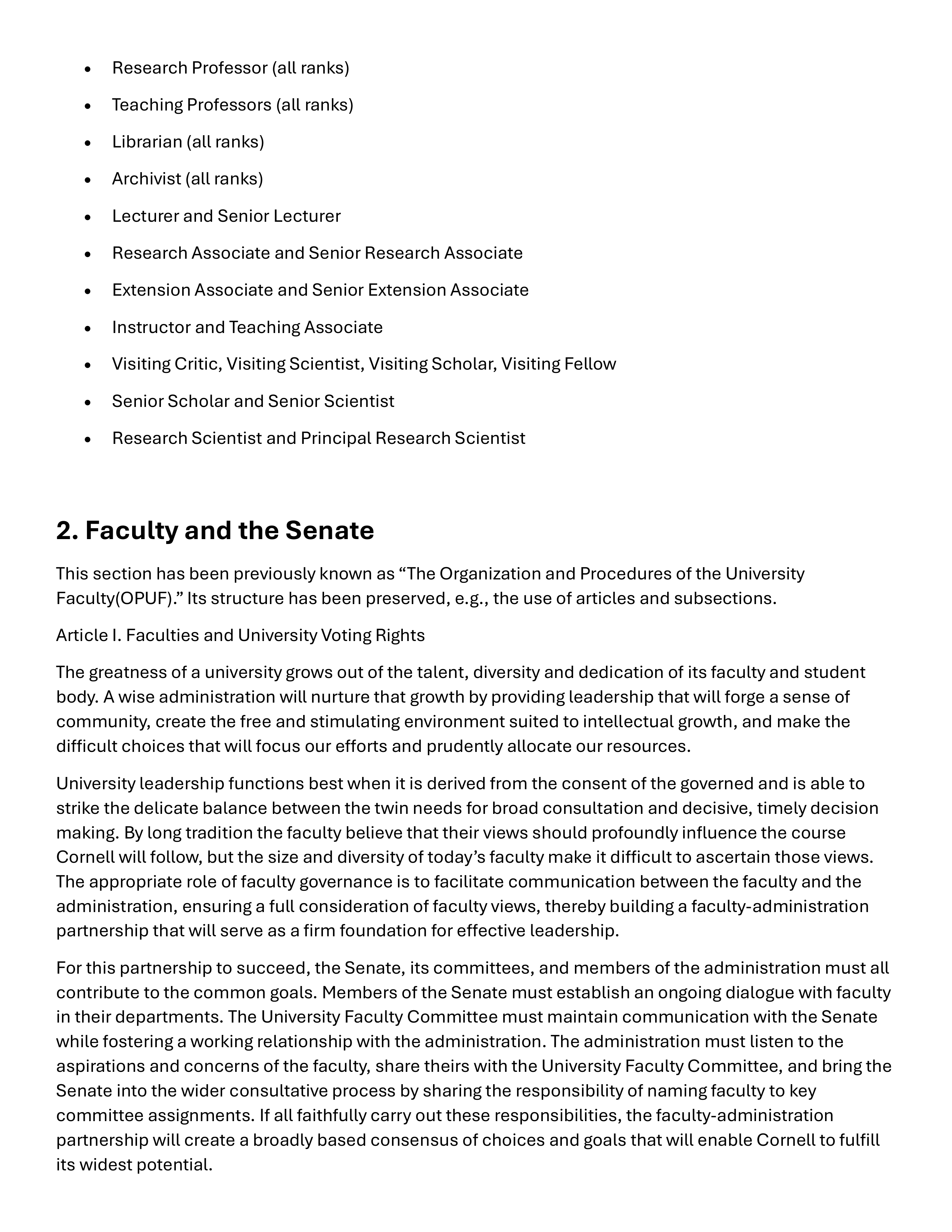
•
Research Professor (all ranks)
•
Teaching Professors (all ranks)
•
Librarian (all ranks)
•
Archivist (all ranks)
•
Lecturer and Senior Lecturer
•
Research Associate and Senior Research Associate
•
Extension Associate and Senior Extension Associate
•
Instructor and Teaching Associate
•
Visiting Critic, Visiting Scientist, Visiting Scholar, Visiting Fellow
•
Senior Scholar and Senior Scientist
•
Research Scientist and Principal Research Scientist
2. Faculty and the Senate
This section has been previously known as “The Organization and Procedures of the University
Faculty(OPUF).” Its structure has been preserved, e.g., the use of articles and subsections.
Article I. Faculties and University Voting Rights
The greatness of a university grows out of the talent, diversity and dedication of its faculty and student
body. A wise administration will nurture that growth by providing leadership that will forge a sense of
community, create the free and stimulating environment suited to intellectual growth, and make the
difficult choices that will focus our efforts and prudently allocate our resources.
University leadership functions best when it is derived from the consent of the governed and is able to
strike the delicate balance between the twin needs for broad consultation and decisive, timely decision
making. By long tradition the faculty believe that their views should profoundly influence the course
Cornell will follow, but the size and diversity of today’s faculty make it difficult to ascertain those views.
The appropriate role of faculty governance is to facilitate communication between the faculty and the
administration, ensuring a full consideration of faculty views, thereby building a faculty-administration
partnership that will serve as a firm foundation for effective leadership.
For this partnership to succeed, the Senate, its committees, and members of the administration must all
contribute to the common goals. Members of the Senate must establish an ongoing dialogue with faculty
in their departments. The University Faculty Committee must maintain communication with the Senate
while fostering a working relationship with the administration. The administration must listen to the
aspirations and concerns of the faculty, share theirs with the University Faculty Committee, and bring the
Senate into the wider consultative process by sharing the responsibility of naming faculty to key
committee assignments. If all faithfully carry out these responsibilities, the faculty-administration
partnership will create a broadly based consensus of choices and goals that will enable Cornell to fulfill
its widest potential.
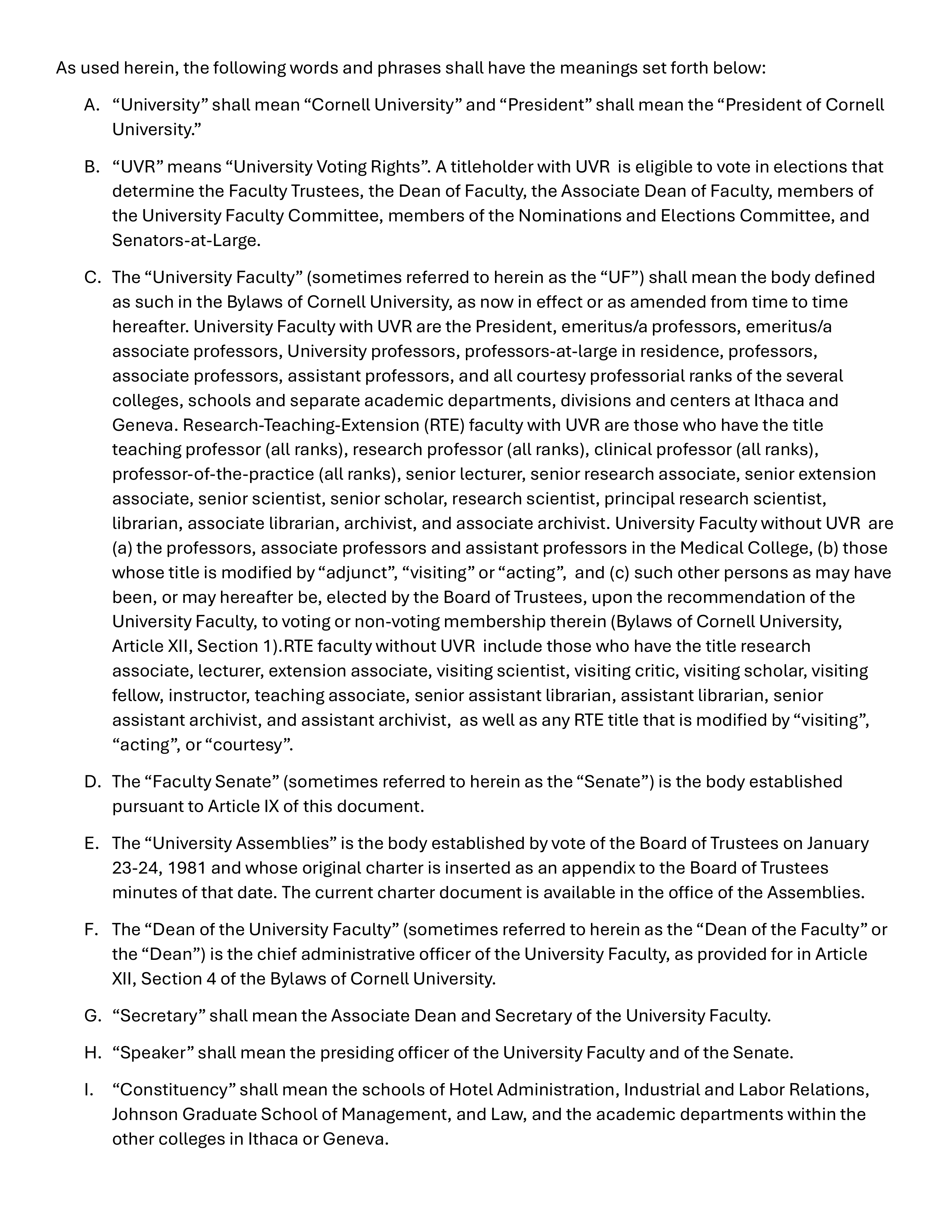
As used herein, the following words and phrases shall have the meanings set forth below:
A.
“University” shall mean “Cornell University” and “President” shall mean the “President of Cornell
University.”
B.
“UVR” means “University Voting Rights”. A titleholder with UVR is eligible to vote in elections that
determine the Faculty Trustees, the Dean of Faculty, the Associate Dean of Faculty, members of
the University Faculty Committee, members of the Nominations and Elections Committee, and
Senators-at-Large.
C.
The “University Faculty” (sometimes referred to herein as the “UF”) shall mean the body defined
as such in the Bylaws of Cornell University, as now in effect or as amended from time to time
hereafter. University Faculty with UVR are the President, emeritus/a professors, emeritus/a
associate professors, University professors, professors-at-large in residence, professors,
associate professors, assistant professors, and all courtesy professorial ranks of the several
colleges, schools and separate academic departments, divisions and centers at Ithaca and
Geneva. Research-Teaching-Extension (RTE) faculty with UVR are those who have the title
teaching professor (all ranks), research professor (all ranks), clinical professor (all ranks),
professor-of-the-practice (all ranks), senior lecturer, senior research associate, senior extension
associate, senior scientist, senior scholar, research scientist, principal research scientist,
librarian, associate librarian, archivist, and associate archivist. University Faculty without UVR are
(a) the professors, associate professors and assistant professors in the Medical College, (b) those
whose title is modified by “adjunct”, “visiting” or “acting”, and (c) such other persons as may have
been, or may hereafter be, elected by the Board of Trustees, upon the recommendation of the
University Faculty, to voting or non-voting membership therein (Bylaws of Cornell University,
Article XII, Section 1).RTE faculty without UVR include those who have the title research
associate, lecturer, extension associate, visiting scientist, visiting critic, visiting scholar, visiting
fellow, instructor, teaching associate, senior assistant librarian, assistant librarian, senior
assistant archivist, and assistant archivist, as well as any RTE title that is modified by “visiting”,
“acting”, or “courtesy”.
D.
The “Faculty Senate” (sometimes referred to herein as the “Senate”) is the body established
pursuant to Article IX of this document.
E.
The “University Assemblies” is the body established by vote of the Board of Trustees on January
23-24, 1981 and whose original charter is inserted as an appendix to the Board of Trustees
minutes of that date. The current charter document is available in the office of the Assemblies.
F.
The “Dean of the University Faculty” (sometimes referred to herein as the “Dean of the Faculty” or
the “Dean”) is the chief administrative officer of the University Faculty, as provided for in Article
XII, Section 4 of the Bylaws of Cornell University.
G.
“Secretary” shall mean the Associate Dean and Secretary of the University Faculty.
H.
“Speaker” shall mean the presiding officer of the University Faculty and of the Senate.
I.
“Constituency” shall mean the schools of Hotel Administration, Industrial and Labor Relations,
Johnson Graduate School of Management, and Law, and the academic departments within the
other colleges in Ithaca or Geneva.
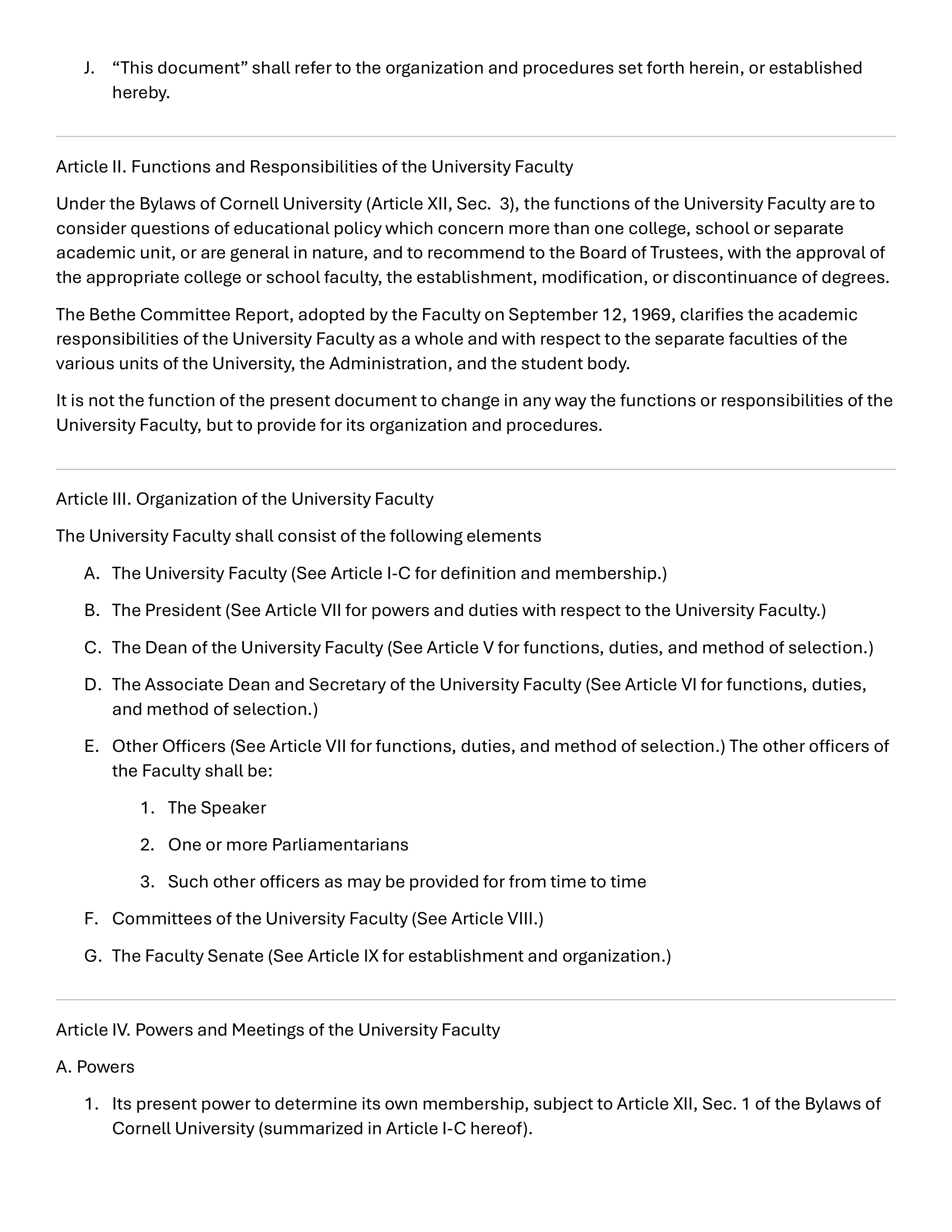
J.
“This document” shall refer to the organization and procedures set forth herein, or established
hereby.
Article II. Functions and Responsibilities of the University Faculty
Under the Bylaws of Cornell University (Article XII, Sec. 3), the functions of the University Faculty are to
consider questions of educational policy which concern more than one college, school or separate
academic unit, or are general in nature, and to recommend to the Board of Trustees, with the approval of
the appropriate college or school faculty, the establishment, modification, or discontinuance of degrees.
The Bethe Committee Report, adopted by the Faculty on September 12, 1969, clarifies the academic
responsibilities of the University Faculty as a whole and with respect to the separate faculties of the
various units of the University, the Administration, and the student body.
It is not the function of the present document to change in any way the functions or responsibilities of the
University Faculty, but to provide for its organization and procedures.
Article III. Organization of the University Faculty
The University Faculty shall consist of the following elements
A.
The University Faculty (See Article I-C for definition and membership.)
B.
The President (See Article VII for powers and duties with respect to the University Faculty.)
C.
The Dean of the University Faculty (See Article V for functions, duties, and method of selection.)
D.
The Associate Dean and Secretary of the University Faculty (See Article VI for functions, duties,
and method of selection.)
E.
Other Officers (See Article VII for functions, duties, and method of selection.) The other officers of
the Faculty shall be:
1.
The Speaker
2.
One or more Parliamentarians
3.
Such other officers as may be provided for from time to time
F.
Committees of the University Faculty (See Article VIII.)
G.
The Faculty Senate (See Article IX for establishment and organization.)
Article IV. Powers and Meetings of the University Faculty
A. Powers
1.
Its present power to determine its own membership, subject to Article XII, Sec. 1 of the Bylaws of
Cornell University (summarized in Article I-C hereof).
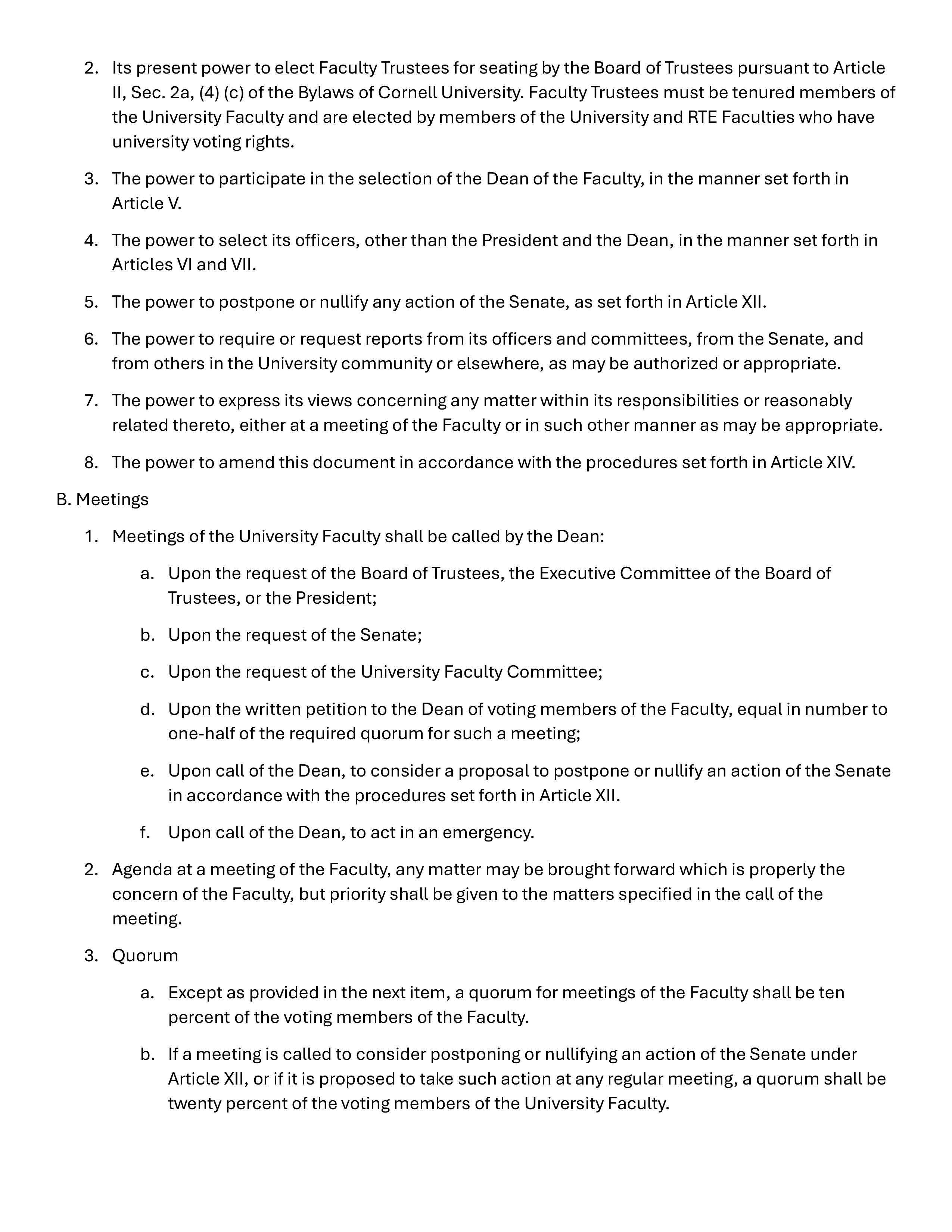
2.
Its present power to elect Faculty Trustees for seating by the Board of Trustees pursuant to Article
II, Sec. 2a, (4) (c) of the Bylaws of Cornell University. Faculty Trustees must be tenured members of
the University Faculty and are elected by members of the University and RTE Faculties who have
university voting rights.
3.
The power to participate in the selection of the Dean of the Faculty, in the manner set forth in
Article V.
4.
The power to select its officers, other than the President and the Dean, in the manner set forth in
Articles VI and VII.
5.
The power to postpone or nullify any action of the Senate, as set forth in Article XII.
6.
The power to require or request reports from its officers and committees, from the Senate, and
from others in the University community or elsewhere, as may be authorized or appropriate.
7.
The power to express its views concerning any matter within its responsibilities or reasonably
related thereto, either at a meeting of the Faculty or in such other manner as may be appropriate.
8.
The power to amend this document in accordance with the procedures set forth in Article XIV.
B. Meetings
1.
Meetings of the University Faculty shall be called by the Dean:
a.
Upon the request of the Board of Trustees, the Executive Committee of the Board of
Trustees, or the President;
b.
Upon the request of the Senate;
c.
Upon the request of the University Faculty Committee;
d.
Upon the written petition to the Dean of voting members of the Faculty, equal in number to
one-half of the required quorum for such a meeting;
e.
Upon call of the Dean, to consider a proposal to postpone or nullify an action of the Senate
in accordance with the procedures set forth in Article XII.
f.
Upon call of the Dean, to act in an emergency.
2.
Agenda at a meeting of the Faculty, any matter may be brought forward which is properly the
concern of the Faculty, but priority shall be given to the matters specified in the call of the
meeting.
3.
Quorum
a.
Except as provided in the next item, a quorum for meetings of the Faculty shall be ten
percent of the voting members of the Faculty.
b.
If a meeting is called to consider postponing or nullifying an action of the Senate under
Article XII, or if it is proposed to take such action at any regular meeting, a quorum shall be
twenty percent of the voting members of the University Faculty.
c.
In the absence of a quorum, those present may receive reports, may discuss matters
without voting on them, and may set the date and time for an adjourned meeting, but shall
transact no other business.
4.
Rules of Procedure, except as otherwise provided herein, or in special rules adopted by the
Faculty, the rules set forth in the then current edition of
Robert’s Rules of Order
, to the extent
applicable, shall govern the debates, votes, and other actions at all meetings of the Faculty.
Nonvoting members of the Faculty may attend and participate in debates, but may not vote.
5.
Visitors may be admitted to meetings of the Faculty. A decision to open or close meetings to
visitors will be made by majority vote of the University Faculty Committee when it establishes the
agenda for each meeting, either to admit accredited members of the press or other public media,
without discrimination, or a limited number of other visitors, or both, for all or a portion of a
meeting. The decision of the University Faculty Committee concerning a particular meeting may
be appealed by a motion properly made and seconded at the meeting in question. A majority vote
of the voting members present constituting the quorum shall be sufficient to amend, modify, or
reverse the decision of the University Faculty Committee concerning the status of visitors at the
meeting. If visitors are admitted, they shall sit in the gallery, or otherwise apart from the main body
of the meeting, and shall not be permitted to participate in the debates but, if it is so authorized by
the decision admitting them to the meeting, they may be permitted by the presiding officer to
address the meeting.
6.
Records of Meetings. The official record of each University Faculty meeting shall be kept by the
Secretary who may use whatever means he or she finds appropriate to prepare an accurate record
of the proceedings. All other participants (members, visitors, etc.) are prohibited from
photographing, sound recording, video taping, or using any other electronic means to record the
proceedings.
Article V. Dean of Faculty
A. General
The Office of the Dean of Faculty is one of outstanding importance for the proper conduct of University
affairs, and in the formulation of policy and the maintenance of flexible communication and mutual
understanding between the Faculty and the rest of the University community. Accordingly, special
qualifications are required for the office, including an acknowledged position of leadership on the Faculty
and wide experience in University affairs.
B. Liaison Responsibilities
The Dean is the Faculty’s chief administrative officer and its liaison on all matters in which the concerns
of the Faculty relate to the President, the Trustees, or other segments of the University community. The
Dean, however, is not a member of the University administration.
C. Personal Opinion
While the Dean is primarily the representative of and spokesman for the Faculty, the Dean retains the
right to express his or her own personal views, when described as such.
D. Duties
Without limitation of the foregoing, the Dean shall have the following specific duties:
1.
He or she shall represent and advocate the interests, concerns, and needs of the Faculty to the
President, the Trustees, and other segments of the University community, and to the public.
2.
The Dean, in consultation with the University Faculty Committee, shall advise the President and
other senior members of the central administration on matters of University policy and shall seek
the President’s advice on matters of concern to the Faculty.
3.
The Dean shall assist the Faculty and the Senate in formulating judgements on questions of
concerns to the Faculty.
4.
He or she shall be available for consultation and advice to members of the Faculty, to students,
and to other members of the University community on matters within the jurisdiction of the
Faculty.
5.
The Dean shall use his or her good offices in helping to resolve problems which may arise for
individual members of the Faculty in their relationships with other members of the Faculty, with
academic or administrative officers of the University, with committees of the Faculty or University,
with students, or with other segments of the University community.
6.
The Dean shall oversee and expedite the work of all committees of the University Faculty or the
Senate and shall keep them informed of problems to which they should attend. He or she shall
obtain annual or other periodic reports from such committees and shall be responsible for seeing
that the reports, recommendations, and decisions of such committees are brought to the
attention of all persons concerned therewith. Where necessary and appropriate, the Dean will
arrange for the timely publication of information meriting the attention of the Faculty, and of
information concerning the Faculty meriting the attention of other segments of the University
community or of the public.
7.
The Dean shall be an ex officio member of each committee of the University Faculty and each
committee of the Senate.
8.
The Dean shall be responsible for the calling of meetings of the University Faculty and the Senate
and for the preparation and distribution of the agenda for such meetings.
9.
The Dean shall be responsible for maintaining a file of (i) records of actions of the University
Faculty and of the Senate, (ii) reports of committees of the University Faculty and of the Senate,
and (iii) such other files and records as may be necessary or appropriate.
10.
The Dean shall prepare such reports as he or she or the University Faculty or the Senate, shall
deem appropriate.
11.
The Dean shall be available to sit with the Board of Trustees and its Executive Committee in
discussions of questions of educational policy.
12.
He or she shall perform such other functions as are provided for herein, or as the University
Faculty or the Senate shall determine.
E. Assistants to the Dean; Acting Dean
As may be necessary to assist or represent the Dean, he or she may delegate any portion of the foregoing
functions and duties to the Associate Dean and Secretary of the Faculty, to members of his/her staff, or
to other members of the Faculty. In the absence or inability to act of the Dean, the Associate Dean and
Secretary of the Faculty shall function as Acting Dean. In the absence or inability to act of both the Dean
and the Secretary, the University Faculty Committee, in consultation with the President, shall designate
an Acting Dean.
F. Selection
The selection procedures for Dean of the Faculty shall be as follows:
1.
The Dean must be selected from among those members of the University Faculty who have
university voting rights and must maintain that status.
2.
At least three months before the deanship becomes vacant, or as promptly as possible if the
office should become vacant without three months’ notice, the Nominations and Elections
Committee shall solicit nominations and canvass Faculty opinion, and shall prepare a slate of two
or more candidates. The Nominations and Elections Committee should consult the President in
this regard.
3.
The Committee on Nominations and Elections shall conduct a mail ballot of the members of the
University and RTE Faculties who have university voting rights, using the Hare System, and shall
promptly report the results to the President and the Faculty.
4.
Subject to confirmation by the Board of Trustees, the candidate receiving a majority of the votes
cast shall be appointed Dean.
G. Term
The term of office for the Dean shall be three years. The Dean may be reappointed by the Senate for a
further period of not more than two years. So far as possible, the terms of office of the Dean and the
Secretary shall be staggered so that not more than one of these officers shall be elected in any one year.
Article VI. Associate Dean and Secretary of the Faculty
A. Duties
The duties of the Associate Dean and Secretary shall include:
1.
Assisting the Dean of the Faculty, carrying out such duties as are assigned by the Dean and
serving as Acting Dean on appropriate occasions;
2.
Chairing the Nominations and Elections Committee;
3.
Ex officio membership on each committee of the University Faculty and each committee of the
Senate;
4.
Supervising the maintenance of minutes of meetings and all records of the University Faculty and
Senate;
5.
Supervising publications made in the name of the University Faculty subject to guidelines
mutually agreed upon with the Senate.
B. Election
The Associate Dean and Secretary of the Faculty shall be selected from among the tenured members of
the University Faculty. The Committee on Nominations and Elections shall conduct a mail ballot of the
members of the University and RTE Faculties who have
university voting rights
. The Hare System is to be
used with results promptly reported to the President and all members of the electorate.
C. Term
The Associate Dean and Secretary shall serve for a term of three years, with the possibility of
reappointment by the Senate, for a further period of not more than three years.
D. Senate Responsibilities
The Associate Dean and Secretary shall also serve as secretary and as an ex officio voting member of the
Senate.
Article VII. President and Other Officers of the University Faculty
The functions and duties of the other officers of the University Faculty shall be as follows:
A. The President
The Bylaws of Cornell University (Article V, Sec. 1; Article XIII, Sec. 1) provide that:
1.
The President shall be the chief executive and educational officer of the University
2.
Except as the President may otherwise designate, he or she shall be the chairperson and presiding
officer of every faculty of the University; and
3.
The President shall be a voting member and presiding officer of the University Faculty.
B. The Speaker
The Speaker of the Senate or his or her alternate (see Art. XI-A-2) shall serve as Speaker of the University
Faculty. By designation of the President the Speaker may, and normally will, moderate meetings of the
University Faculty.
C. Parliamentarians
The Speaker may select one or more Parliamentarians to advise him or her on questions of parliamentary
law and procedure arising in the course of faculty meetings.
D. Other Officers
There shall be such other officers of the Faculty, with such functions and duties, as may be provided for
from time to time by the University Faculty.
Article VIII. Committees of the University Faculty
A. Standing and Ad Hoc Committees
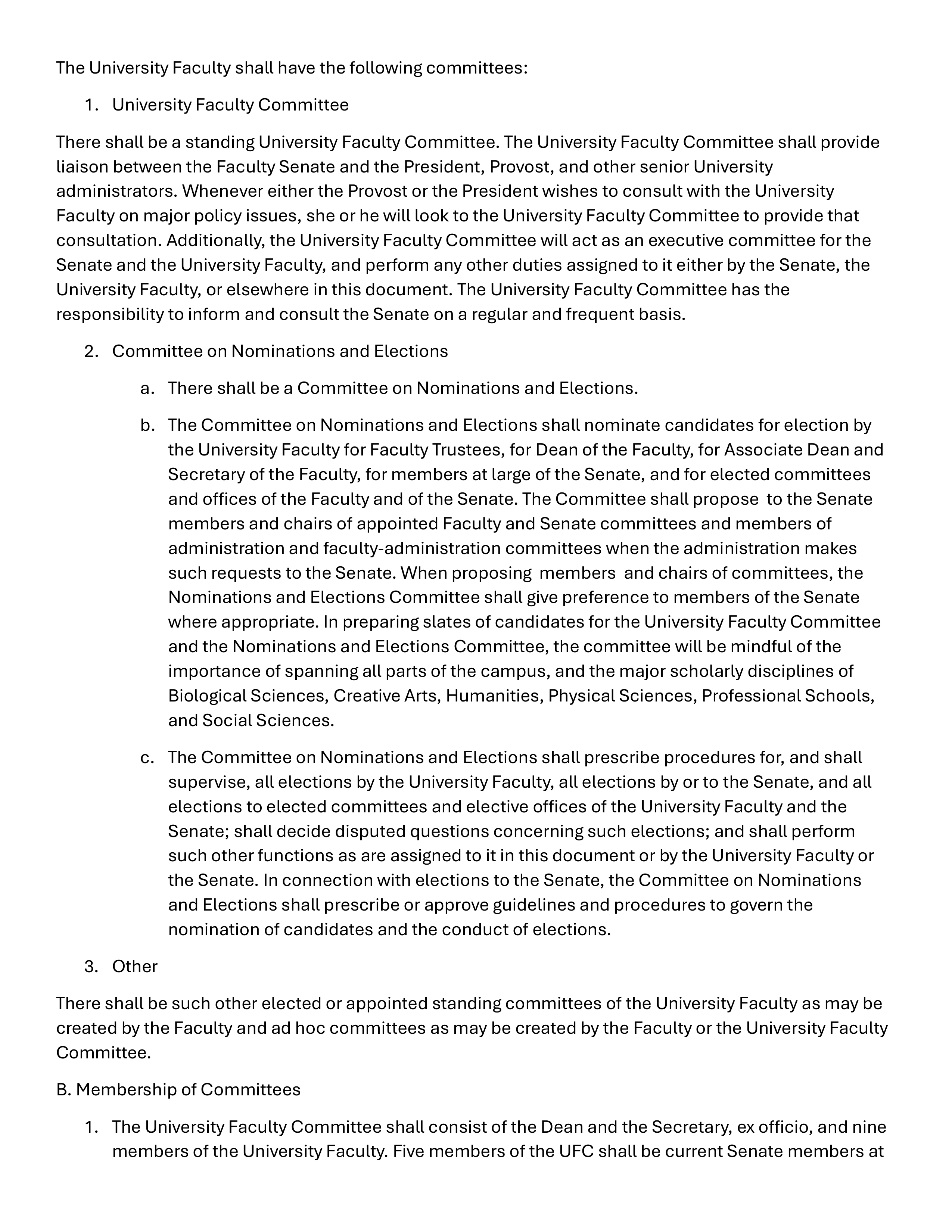
The University Faculty shall have the following committees:
1.
University Faculty Committee
There shall be a standing University Faculty Committee. The University Faculty Committee shall provide
liaison between the Faculty Senate and the President, Provost, and other senior University
administrators. Whenever either the Provost or the President wishes to consult with the University
Faculty on major policy issues, she or he will look to the University Faculty Committee to provide that
consultation. Additionally, the University Faculty Committee will act as an executive committee for the
Senate and the University Faculty, and perform any other duties assigned to it either by the Senate, the
University Faculty, or elsewhere in this document. The University Faculty Committee has the
responsibility to inform and consult the Senate on a regular and frequent basis.
2.
Committee on Nominations and Elections
a.
There shall be a Committee on Nominations and Elections.
b.
The Committee on Nominations and Elections shall nominate candidates for election by
the University Faculty for Faculty Trustees, for Dean of the Faculty, for Associate Dean and
Secretary of the Faculty, for members at large of the Senate, and for elected committees
and offices of the Faculty and of the Senate. The Committee shall propose to the Senate
members and chairs of appointed Faculty and Senate committees and members of
administration and faculty-administration committees when the administration makes
such requests to the Senate. When proposing members and chairs of committees, the
Nominations and Elections Committee shall give preference to members of the Senate
where appropriate. In preparing slates of candidates for the University Faculty Committee
and the Nominations and Elections Committee, the committee will be mindful of the
importance of spanning all parts of the campus, and the major scholarly disciplines of
Biological Sciences, Creative Arts, Humanities, Physical Sciences, Professional Schools,
and Social Sciences.
c.
The Committee on Nominations and Elections shall prescribe procedures for, and shall
supervise, all elections by the University Faculty, all elections by or to the Senate, and all
elections to elected committees and elective offices of the University Faculty and the
Senate; shall decide disputed questions concerning such elections; and shall perform
such other functions as are assigned to it in this document or by the University Faculty or
the Senate. In connection with elections to the Senate, the Committee on Nominations
and Elections shall prescribe or approve guidelines and procedures to govern the
nomination of candidates and the conduct of elections.
3.
Other
There shall be such other elected or appointed standing committees of the University Faculty as may be
created by the Faculty and ad hoc committees as may be created by the Faculty or the University Faculty
Committee.
B. Membership of Committees
1.
The University Faculty Committee shall consist of the Dean and the Secretary, ex officio, and nine
members of the University Faculty. Five members of the UFC shall be current Senate members at
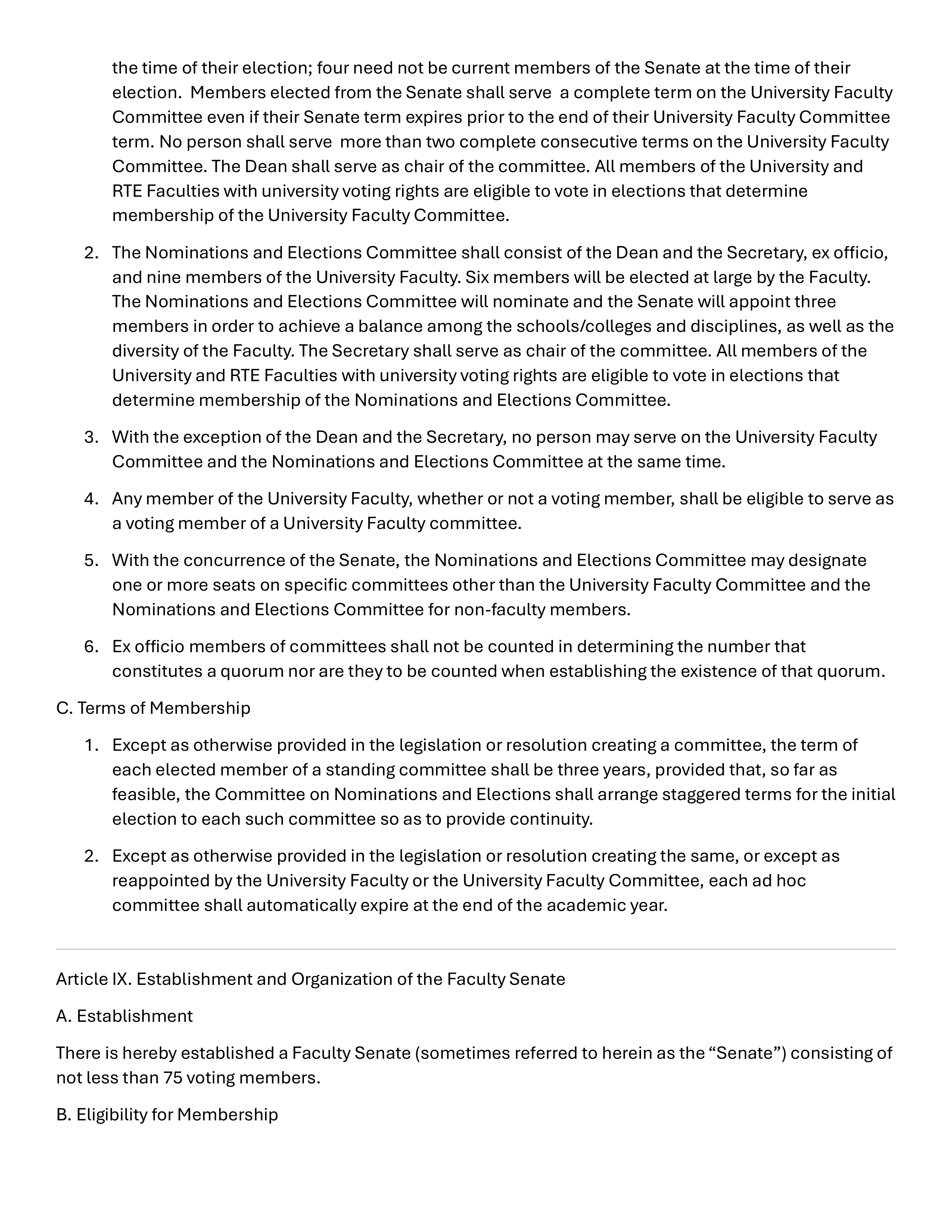
the time of their election; four need not be current members of the Senate at the time of their
election. Members elected from the Senate shall serve a complete term on the University Faculty
Committee even if their Senate term expires prior to the end of their University Faculty Committee
term. No person shall serve more than two complete consecutive terms on the University Faculty
Committee. The Dean shall serve as chair of the committee. All members of the University and
RTE Faculties with university voting rights are eligible to vote in elections that determine
membership of the University Faculty Committee.
2.
The Nominations and Elections Committee shall consist of the Dean and the Secretary, ex officio,
and nine members of the University Faculty. Six members will be elected at large by the Faculty.
The Nominations and Elections Committee will nominate and the Senate will appoint three
members in order to achieve a balance among the schools/colleges and disciplines, as well as the
diversity of the Faculty. The Secretary shall serve as chair of the committee. All members of the
University and RTE Faculties with university voting rights are eligible to vote in elections that
determine membership of the Nominations and Elections Committee.
3.
With the exception of the Dean and the Secretary, no person may serve on the University Faculty
Committee and the Nominations and Elections Committee at the same time.
4.
Any member of the University Faculty, whether or not a voting member, shall be eligible to serve as
a voting member of a University Faculty committee.
5.
With the concurrence of the Senate, the Nominations and Elections Committee may designate
one or more seats on specific committees other than the University Faculty Committee and the
Nominations and Elections Committee for non-faculty members.
6.
Ex officio members of committees shall not be counted in determining the number that
constitutes a quorum nor are they to be counted when establishing the existence of that quorum.
C. Terms of Membership
1.
Except as otherwise provided in the legislation or resolution creating a committee, the term of
each elected member of a standing committee shall be three years, provided that, so far as
feasible, the Committee on Nominations and Elections shall arrange staggered terms for the initial
election to each such committee so as to provide continuity.
2.
Except as otherwise provided in the legislation or resolution creating the same, or except as
reappointed by the University Faculty or the University Faculty Committee, each ad hoc
committee shall automatically expire at the end of the academic year.
Article IX. Establishment and Organization of the Faculty Senate
A. Establishment
There is hereby established a Faculty Senate (sometimes referred to herein as the “Senate”) consisting of
not less than 75 voting members.
B. Eligibility for Membership
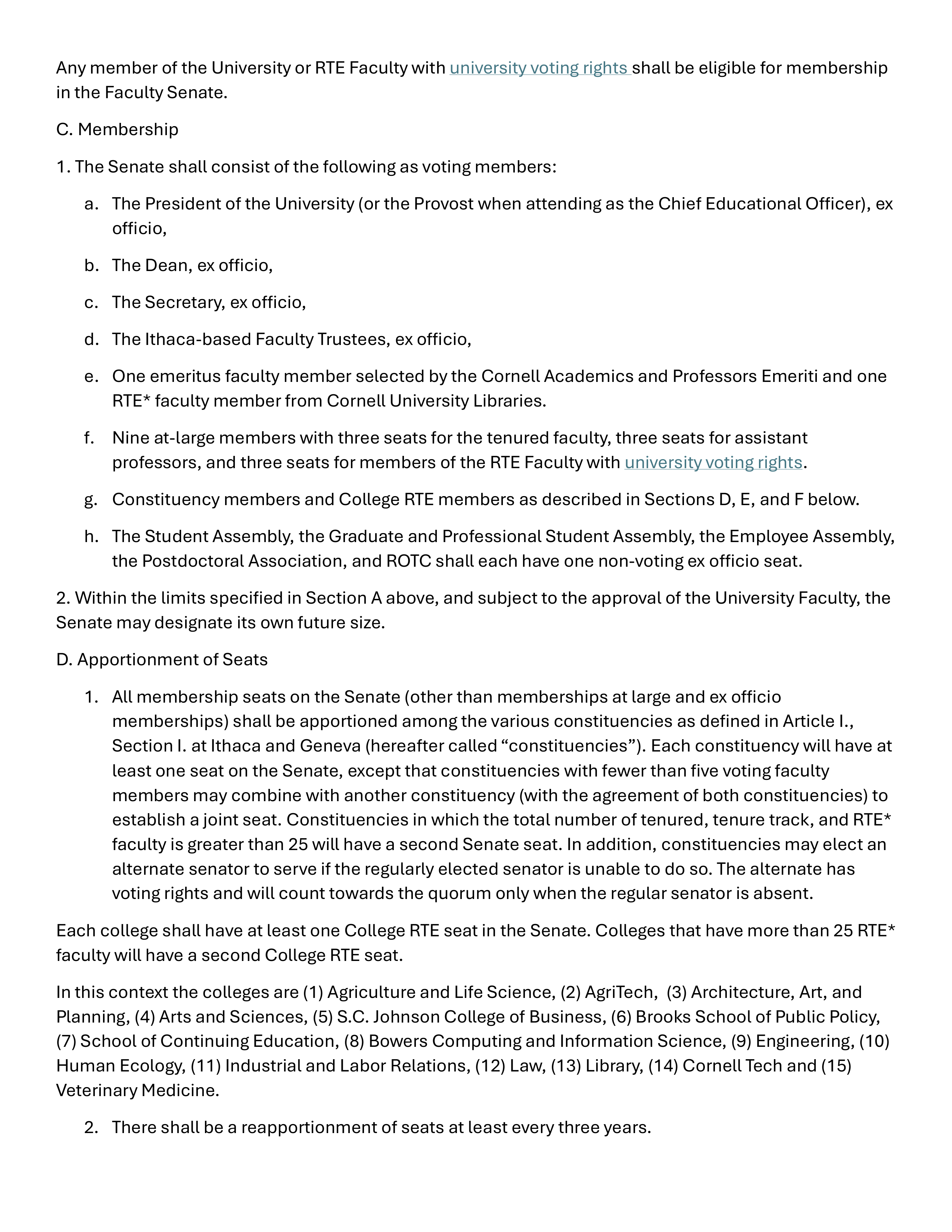
Any member of the University or RTE Faculty with
university voting rights
shall be eligible for membership
in the Faculty Senate.
C. Membership
1. The Senate shall consist of the following as voting members:
a.
The President of the University (or the Provost when attending as the Chief Educational Officer), ex
officio,
b.
The Dean, ex officio,
c.
The Secretary, ex officio,
d.
The Ithaca-based Faculty Trustees, ex officio,
e.
One emeritus faculty member selected by the Cornell Academics and Professors Emeriti and one
RTE* faculty member from Cornell University Libraries.
f.
Nine at-large members with three seats for the tenured faculty, three seats for assistant
professors, and three seats for members of the RTE Faculty with
university voting rights
.
g.
Constituency members and College RTE members as described in Sections D, E, and F below.
h.
The Student Assembly, the Graduate and Professional Student Assembly, the Employee Assembly,
the Postdoctoral Association, and ROTC shall each have one non-voting ex officio seat.
2. Within the limits specified in Section A above, and subject to the approval of the University Faculty, the
Senate may designate its own future size.
D. Apportionment of Seats
1.
All membership seats on the Senate (other than memberships at large and ex officio
memberships) shall be apportioned among the various constituencies as defined in Article I.,
Section I. at Ithaca and Geneva (hereafter called “constituencies”). Each constituency will have at
least one seat on the Senate, except that constituencies with fewer than five voting faculty
members may combine with another constituency (with the agreement of both constituencies) to
establish a joint seat. Constituencies in which the total number of tenured, tenure track, and RTE*
faculty is greater than 25 will have a second Senate seat. In addition, constituencies may elect an
alternate senator to serve if the regularly elected senator is unable to do so. The alternate has
voting rights and will count towards the quorum only when the regular senator is absent.
Each college shall have at least one College RTE seat in the Senate. Colleges that have more than 25 RTE*
faculty will have a second College RTE seat.
In this context the colleges are (1) Agriculture and Life Science, (2) AgriTech, (3) Architecture, Art, and
Planning, (4) Arts and Sciences, (5) S.C. Johnson College of Business, (6) Brooks School of Public Policy,
(7) School of Continuing Education, (8) Bowers Computing and Information Science, (9) Engineering, (10)
Human Ecology, (11) Industrial and Labor Relations, (12) Law, (13) Library, (14) Cornell Tech and (15)
Veterinary Medicine.
2.
There shall be a reapportionment of seats at least every three years.
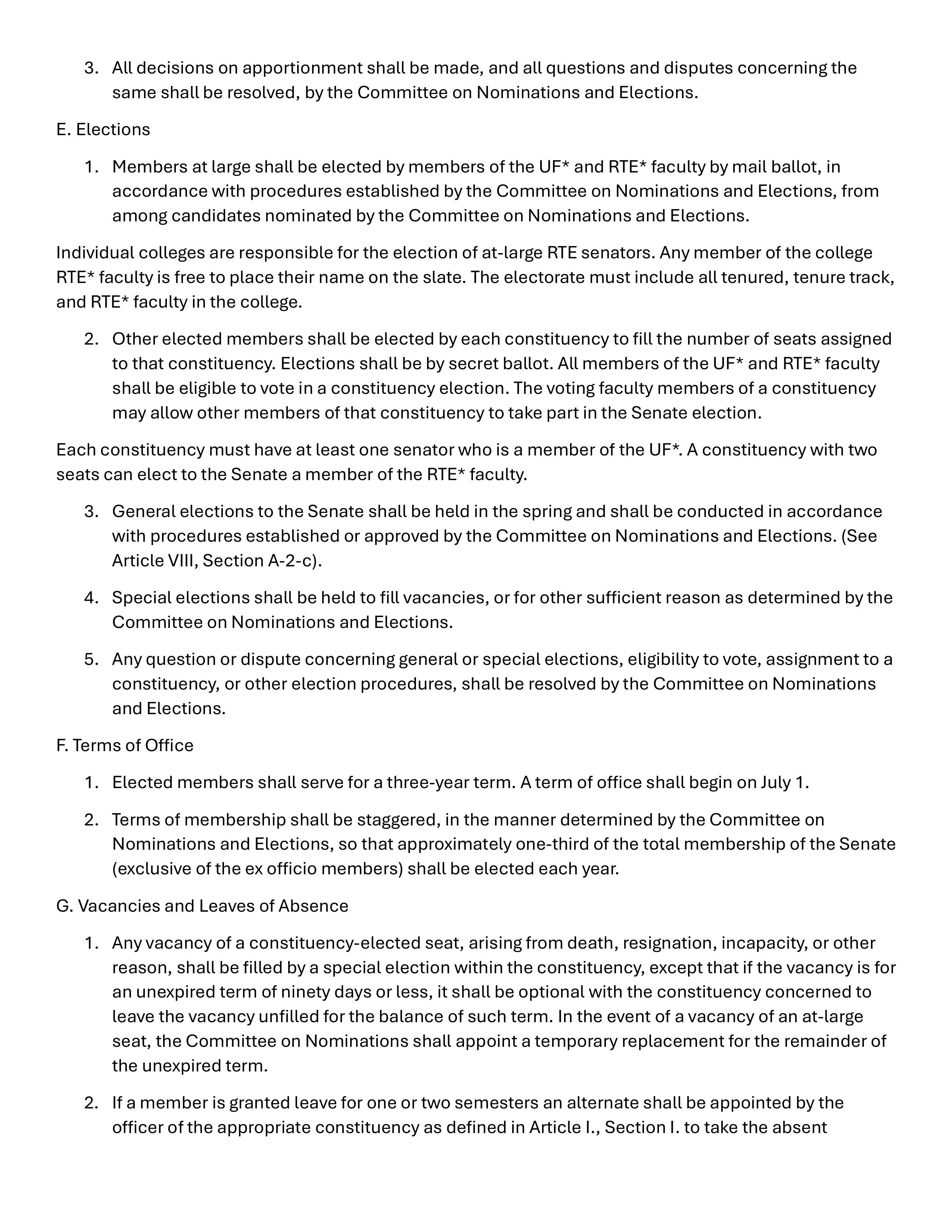
3.
All decisions on apportionment shall be made, and all questions and disputes concerning the
same shall be resolved, by the Committee on Nominations and Elections.
E. Elections
1.
Members at large shall be elected by members of the UF* and RTE* faculty by mail ballot, in
accordance with procedures established by the Committee on Nominations and Elections, from
among candidates nominated by the Committee on Nominations and Elections.
Individual colleges are responsible for the election of at-large RTE senators. Any member of the college
RTE* faculty is free to place their name on the slate. The electorate must include all tenured, tenure track,
and RTE* faculty in the college.
2.
Other elected members shall be elected by each constituency to fill the number of seats assigned
to that constituency. Elections shall be by secret ballot. All members of the UF* and RTE* faculty
shall be eligible to vote in a constituency election. The voting faculty members of a constituency
may allow other members of that constituency to take part in the Senate election.
Each constituency must have at least one senator who is a member of the UF*. A constituency with two
seats can elect to the Senate a member of the RTE* faculty.
3.
General elections to the Senate shall be held in the spring and shall be conducted in accordance
with procedures established or approved by the Committee on Nominations and Elections. (See
Article VIII, Section A-2-c).
4.
Special elections shall be held to fill vacancies, or for other sufficient reason as determined by the
Committee on Nominations and Elections.
5.
Any question or dispute concerning general or special elections, eligibility to vote, assignment to a
constituency, or other election procedures, shall be resolved by the Committee on Nominations
and Elections.
F. Terms of Office
1.
Elected members shall serve for a three-year term. A term of office shall begin on July 1.
2.
Terms of membership shall be staggered, in the manner determined by the Committee on
Nominations and Elections, so that approximately one-third of the total membership of the Senate
(exclusive of the ex officio members) shall be elected each year.
G. Vacancies and Leaves of Absence
1.
Any vacancy of a constituency-elected seat, arising from death, resignation, incapacity, or other
reason, shall be filled by a special election within the constituency, except that if the vacancy is for
an unexpired term of ninety days or less, it shall be optional with the constituency concerned to
leave the vacancy unfilled for the balance of such term. In the event of a vacancy of an at-large
seat, the Committee on Nominations shall appoint a temporary replacement for the remainder of
the unexpired term.
2.
If a member is granted leave for one or two semesters an alternate shall be appointed by the
officer of the appropriate constituency as defined in Article I., Section I. to take the absent
member’s seat for the period of the leave. If a member is granted leave for more than one year, his
or her seat shall be declared vacant, beginning with the commencement of the leave.
3.
If any member (other than a member on leave) fails to attend any meeting of the Senate for a
period of 120 days or more (exclusive of summer vacation) that member’s seat may be declared
vacant, either by the constituency concerned, or by the Senate as a whole.
H. Recall of Members
The Senate may, in its discretion, provide for recall procedures, which shall authorize a constituency to
remove a member for reasons specified in such procedures and to declare the seat vacant, provided that
any such removal must be initiated upon the petition of at least 10 percent of the voting members of the
constituency and must, to take effect, have the approval of at least 50 percent of such membership.
I. Review
At least every three years the University Faculty Committee with broad consultation will assess the
quality of Faculty representation as realized through the various allocation formulae. Concerns would be
discussed in the Faculty Senate. Proposed modifications would be brought before the University Faculty
in accordance with the procedures specified in this document.
Article X. Powers, Duties, and Meetings of the Faculty Senate
A. Powers in General
Except for the powers reserved to the University Faculty under Article IV-A, and subject to the power of
the University Faculty to postpone or nullify any action of the Senate pursuant to Article XII, all the powers
and functions of the University Faculty are hereby delegated to the Senate.
B. Specific Powers.
Without limiting paragraph A above, or the other powers set forth in this document, the Senate shall have
the following specific powers and responsibilities:
1.
To select its officers.
2.
To approve or reject the nominees presented by the Nominations and Elections Committee for
election by the University Faculty.
3.
To approve or reject the list of members and chairs presented by the Nominations and Elections
Committee for appointed University Faculty committees, Senate committees, and administration
or administration-faculty committees.
4.
To adopt, amend, or repeal bylaws or other procedures relating to the conduct of its business and
the duties and functions of its officers and committees.
C. Exercise of Powers.
In exercising the powers of the Senate it is anticipated that its members will take all reasonable measures
to ascertain faculty opinion by means of regular consultations with their constituency and other
appropriate means, and that the Senate will keep the University Faculty fully informed of the reasons for
its decisions.
D. Meetings of the Senate
1.
Regular Meetings. An organization meeting of the Senate shall be called by the Dean promptly
after the election of its members. Thereafter, regular meetings of the Senate shall be held once a
month during the academic year.
2.
Special Meetings. Special meetings of the Senate shall be called by the Dean.
a.
On the request of the President, the Board of Trustees, or the Executive Committee of the
Board of Trustees.
b.
On the request of the University Faculty committee
c.
On the request in writing by members of the University Faculty equal in number to, or more
than, the authorized membership of the Senate
d.
On the written request of a majority of the members of the Senate
e.
On the Dean’s own motion, whenever it appears to the Dean that such a meeting is
necessary or appropriate.
3.
Agenda at Meetings
a.
Regular Meetings. At a regular meeting of the Senate, any matter may be brought forward
which is properly the concern of the Senate, but priority shall be given to the matters
specified in the call of the meeting.
b.
Special Meetings. At a special meeting of the Senate only those matters shall be
considered which are specified in the call of the meeting, except as this rule may be waived
by unanimous consent of the members present.
c.
The Dean shall make the necessary arrangement to distribute the agenda of regular and
special meetings of the Senate to the members of the University Faculty in advance of such
meetings.
4.
Quorum and E-Voting
Except as otherwise provided herein, or in the bylaws or other procedures adopted pursuant to Section B
above, the quorum for the transaction of business of the Senate shall be one-half of its non–ex officio
members; vacant senate seats are not counted. In the absence of a quorum, the Senate may receive
reports, may discuss matters without voting on them, and may set the date for an adjourned meeting, but
shall transact no other business.
At the discretion of the Dean of Faculty, a Senate roll call vote can be initiated at any time during a
meeting with ballots submitted physically and/or electronically over a period of one week. For the
legislation or action to take effect, the number of votes cast must be at or above the level of quorum.
5.
Procedure at Meetings
The rules contained in the then current edition of Robert’s Rules of Order shall govern the deliberations
and actions of the Senate in all cases in which they are applicable, to the extent they are not inconsistent
with the provisions hereof.
6.
Visitors at Meetings
The provision of Article IV, Section B-5, as amended, relating to the presence of visitors at meetings of the
University Faculty, shall apply to meetings of the Senate, except that the University Faculty Committee,
when establishing the Senate agenda for each meeting shall make the determination as to whether the
meeting is to be “open” or “closed” to visitors and with the further exception that all members of the
University and RTE Faculties who are not members of the Senate shall be entitled and encouraged to
attend any meeting of the Senate and to participate in debate, but not to make motions or vote.
7.
Records of Meetings
The official record of each Senate meeting shall be kept by the Secretary who may use whatever means
he or she finds appropriate to prepare an accurate record of the proceedings. All other participants
(members, visitors, etc.) are prohibited from photographing, sound recording, video taping, or using any
other electronic means to record the proceedings.
Article XI. Officers and Committees of the Faculty Senate
A. Officers
The Officers of the Senate shall consist of the following:
1.
The President of the University, who will serve as ex officio President of the Senate.
2.
The Speaker, who will serve as an impartial moderator of Senate meetings. The Speaker shall be
selected by the Senate, which may also select an alternate Speaker to serve in the absence of the
Speaker.
3.
One or more Parliamentarians to be appointed by the Speaker at his or her discretion.
4.
Such other officers as may be provided for from time to time by the Senate, to be selected in such
manner as it may determine.
B. Committees
The committees of the Senate shall be as follows:
1.
A University Faculty Committee, which shall be the same committee, with the members,
functions, and duties, as provided above in Article VIII-A-1. In addition to the duties there provided,
the University Faculty Committee shall act for the Senate in emergencies, shall act for the Senate
in considering nominations of the Nominations and Elections Committee for administration or
administration-faculty committees when required by the need for timely action, shall assist the
Dean in preparing the agenda for regular and special meetings of the Senate, and shall perform
such other functions as may be prescribed by the Senate.
2.
A Committee on Nominations and Elections which shall be the same committee, with the same
members, functions, and duties, as provided above in Article VIII-A-2.
3.
Such other standing and ad hoc committees and subcommittees, elective or appointive, as may
be established by the Senate. The University Faculty Committee may also establish ad hoc
committees and subcommittees.
4.
Except in the case of the University Faculty Committee, any member of the University Faculty,
whether or not a voting member, and whether or not a member of the Senate, shall be eligible to
serve on any committee or subcommittee provided for in paragraph 3 above, or in section XIII.B.
below.
5.
The terms of office of members of the aforesaid committees shall be as prescribed by the Senate.
In the case of standing committees the terms of office shall normally be staggered to permit a
reasonable degree of continuity. In the case of ad hoc committees the duration of such
committees shall be as prescribed by the Senate, subject to extension if necessary. Any standing
or ad hoc committee which fails to meet, and does not otherwise act or file a report, for a period of
one academic year, shall be automatically discontinued.
Article XII. Relationship Between the University Faculty and Faculty Senate
A. In General
As stated above in Article X, Sec. A, the Senate is hereby delegated all the powers and functions of the
University Faculty not reserved to the Faculty under Article IV, Sec. A, subject to the power of the Faculty,
reserved in Article IV, Sec. A-5, to postpone or nullify any action of the Senate.
B. Effect of Postponement or Nullification
1.
A postponement shall be for a specified period not to exceed ninety days.
2.
A nullification may be in whole or in part with respect to any particular action of the Senate.
C. Initiation of Proposals
A proposal to suspend or nullify an action of the Senate must be initiated within twenty days of the date
of such action. It may be initiated:
1.
By the President, the Board of Trustees, or the Executive Committee of the Board; or
2.
By written petition of members of the University Faculty who are not members of the Senate equal
in number to, or greater than, the quorum of the authorized membership of the Senate; or
3.
By two-thirds of the members of the University Faculty Committee.
D. Review and Presentation of Proposals
The University Faculty Committee shall review any such proposal made under Section C-l or C-2 above.
Prior to the meeting of the Faculty at which such proposal is submitted, said Committee shall make its
views thereon known by communication to the University Faculty, in the call of the meeting or otherwise,
and shall, whatever its views may be, assist the Secretary and the proposers in presenting the proposal to
the meeting.
E. Action on Proposal
Any such proposal shall be promptly submitted to a special meeting of the Faculty or, if the timing
permits, a regular meeting, provided notice of such proposal is set forth in the call of the meeting.
Provided the necessary quorum is present (see Article IV, Sec. B-3-b above) adoption of such proposal
shall require the affirmative vote of a majority of the voting members present. If the proposal is not
adopted, the action of the Senate shall stand, subject to Section F below. If two successive meetings
(including an adjourned meeting) have been called or set to consider any such proposal, and there is an
absence of a quorum at each, the action of the Senate shall stand, subject to Section F below.
F. Referendum by University Faculty
A referendum by mail ballot of the University Faculty may be had on any action of the Senate which has
been duly submitted to the University Faculty for proposed nullification under Sections A through E
above, whether or not such proposal to nullify has been approved under Section E above. Such a
referendum may also be had on any action of the University Faculty taken in the exercise of its reserved
powers (Article IV-A) without any prior action of the Senate. The following procedures shall govern:
1.
Any such referendum shall require a petition in writing from the President, the Trustees, or voting
members of the Faculty equal to or greater in number than the authorized membership of the
Senate, filed within twenty days of the last action, or failure to act, on the matter on which the
referendum is sought.
2.
The Dean shall, in cooperation with the University Faculty Committee, distribute suitable
information concerning the issue to the Faculty.
3.
Only voting members of the Faculty shall be eligible to vote in such referendum.
4.
The mailing, balloting, and counting procedures shall be prescribed and supervised by the
Committee on Nominations and Elections, which shall decide any disputed questions in
connection therewith.
5.
Provided at least 25 percent of the voting members of the Faculty cast valid ballots in such
referendum, the majority of the votes cast, whether such majority is in favor of the original action
or in favor of its nullification, shall decide the issue. If the vote is less than 25 percent, the
referendum shall be without effect.
G. Subsequent Action
Once a proposal to postpone or nullify an action of the Senate has been initiated, and has been finally
approved or defeated by the University Faculty under the above procedures, or final action has been
taken on a matter within the reserved powers of the University Faculty, the matter (or substantially the
same matter as determined by the University Faculty Committee) shall not be brought up again before
the University Faculty or the Senate until at least one year has passed from the date of such final
approval, defeat, or other action.
Article XIII. Relationship Between Administration and Faculty Governance
A. University Faculty Committee
The central administration, and in particular, the Provost and the President, will look to the University
Faculty Committee for advice and consultation on all major policy issues that are of interest to the
faculty. To facilitate that advisory and consultative relationship, the Provost and/or the President will meet
on a regular basis with the University Faculty Committee.
B. Central Administration Committees
If members of the central administration constitute a committee to make or advise on policy issues, or
carry out searches, and decide to appoint faculty members to that committee who are not members of
the central administration, college deans or associate deans, or division directors or associate directors,
the expectation is that they will ask the Senate to nominate some faculty members to serve on the
committee. The central administration will be expected to select about one-half of the faculty
membership on each such committee from names presented by the Senate. The Senate will present as
many names as are requested, but in no case more than twice the number to be selected.
Article XIV. Amendments
This document may be amended in accordance with the following procedures:
A. Initiation of Amendment
A proposal to amend this document may be initiated:
1.
By majority vote of the Senate; or
2.
By majority vote of the University Faculty Committee; or
3.
By written petition of members of the University Faculty who are not members of the Senate equal
in number to, or greater than, the quorum of the authorized membership of the Senate.
B. Submission to the Faculty
Any such proposal to amend shall be reviewed by the Senate which shall make its recommendation
thereon. If it does receive majority approval, it shall then be submitted to a referendum in accordance
with Item C below.
C. Referendum
If the proposal to amend has been approved by a majority vote at a meeting of the Faculty Senate under
Section B above, it shall then be submitted promptly to all voting members of the University Faculty for a
referendum by e-mail ballot. If approved by a majority of the valid ballots cast, the proposal shall be
deemed adopted and this document amended accordingly.
D. Conduct of Referendum
Such referendum shall be supervised by the Committee on Nominations and Elections, which shall
decide all questions and disputes arising in connection therewith. The Committee may call upon the
Dean and the University Faculty Committee, if necessary, for assistance in conducting such election.
E. Subsequent Action
If a proposal to amend this document is defeated, the same proposal (or substantially the same
proposal, as determined by the University Faculty Committee) may not be initiated until at least one year
has passed from the date of such defeat.
Adopted by the University Faculty, January 13, 1971. Amended by the University Faculty, September 12,
1973, referendum September 28, 1973; February 12, 1975, referendum, March 21, 1975; March 3, 1976,
referendum May 4, 1976; September 20, 1978, referendum October 30, 1978; September 19, 1979,
Referendum October 22, 1979. Announcement by Dean of Faculty to correct gender-specific pronouns,
University Faculty Meeting, May 18, 1983, Records, pp. 5643-44F. Amended by the University Faculty,
October 12, 1994, referendum April 1995. Amended by the University Faculty, October 11, 1995,
referendum October 16, 1995. Senate Approval, November 14, 2007; amended by the University Faculty,
February 27, 2008; referendum April 30, 2008.
3. Titles, Appointments, Leaves
3.1 Description of Titles
Academic titles are assigned according to the mix of primary responsibilities at the forefront of the
university’s core efforts in research, teaching, and extension or outreach (including library). The use of a
title may require that an approved position be available.
Academic Titles are primary titles and all appointments thereto are approved by action of the dean, the
provost, or the Board of Trustees. Administrative titles, such as dean and provost, are not included and do
not by themselves confer academic status. Additional titles are used in the Medical College.
See
Approved Academic Titles
for full descriptions of titles used at Cornell University. Faculty
employment policies are available on the HR Policies
webpage
; these include appointment terms, leaves
and other policies and procedures.
The Dean of Faculty’s Office maintains the list of Professorial Title Legislation that enables the use of the
Clinical Professor, Professor of the Practice, and Research Professor titles at the college level, as well as
the list of academic titles with
University Voting Rights
.
Excepting postdoctoral associates and fellows, any individual who holds one of the approved academic
titles, possibly modified by “adjunct”, “visiting”, “acting”, “courtesy”, or “emeritus/a,” shall be regarded
throughout the Faculty Handbook as an “academic titleholder.”
3.2 Description of Title Modifiers
Title modifier descriptions are available in the appendix of
Approved Academic Titles
.
3.3 Appointment Process
The academic personnel and appointment policies that have been standardized and placed into the
official university policy format are posted online at the University Policy Office, and are available in the
Human Resources Volume of its library (Volume 6). The URL of currently standardized university policies
is:
http://www.dfa.cornell.edu/treasurer/policyoffice/
. Those that have not yet been standardized and
placed into the official university policy format are listed at this site also. The policies are periodically
updated and should be consulted for more complete information than this handbook contains on
matters related to academic appointments. Additional assistance may be obtained from the academic
department’s administrative office, the college office, the Office of Academic Human Resources, or the
Office of the University Faculty.
Except in rare special circumstances, or when an appointment is temporary—expected to terminate in
one year or less—vacant academic positions must be filled by conducting a formal search. Authority to
initiate a search comes from a dean, or in the case of centers, from an executive officer. Before a search
is begun, a search plan must be submitted to the dean or executive officer for approval and also to the
office designated by the provost for assuring compliance for equal employment opportunity laws. When
the search has been completed, an appointment confirmation and search summary (ACSS) form must
be prepared and submitted to the dean, along with a copy of the search plan, the Employment Eligibility
Verification form (I-9), tax forms, the appointment letter, an HR Online transaction, and in some cases, a
patent agreement may be required.
Authority to Make Appointments
Academic appointments normally originate in departments, and are processed through the Records
Administration Office in Human Resources. Actions involving academics with joint appointments may
require approval by the other college. Faculty members do not have authority to make academic
appointments, even if the supporting funds come from research grants supervised by the faculty
members. No appointment is firm until it is approved at the designated level of final authority for the
particular title, status, and length of term that apply to it. Extensive details regarding this authority are
published in the policy about academic titles and appointments on
the University Policy Library
website
or
Academic HR Resources webpage.
Answers to particular questions can be obtained from
department administrative offices and deans’ offices.
Appointments or promotions involving award of indefinite tenure require the approval of the Board of
Trustees and are acted on at meetings of the board. Professorial term appointments of five years or less
(four years or less in the case of assistant professors) can be approved by the dean, without Trustee
action, if the appointment does not exceed permissible limits governing time and title.
Letters of Appointment
Letters of appointment at the rank of assistant professor, non-professorial titles, and for term
appointments of associate professors and professors, may be transmitted to the appointee with prior
approval from the dean’s office. Appointments conferring tenure require the approval of the Board of
Trustees, and the official notification letter comes from the president.
Academic Appointments in the ROTC Program
According to the University Bylaws, “the commanding officers of the Army, Navy and Air Force ROTC units
shall be department heads with the ex officio rank of professor in the Department of Military Science and
Tactics, the Department of Naval Science and the Department of Air Science, respectively; and other
members of the instructional staff in these departments shall have the academic rank below that of
professor to which they may be appointed by the president upon the recommendation of their
department heads. Non-teaching instructional staff in those departments shall be accorded the same
University privileges as Cornell staff. Unless sooner terminated by the university, all appointments in
these departments terminate upon relief from military duty at the university.” Those with rank of professor
also have voting status in the University Faculty. Relations between Cornell University and the ROTC
program are monitored by the University-ROTC Relationships Committee. The officers nominated by the
military services to give ROTC instruction at Cornell must be reviewed and accepted by this committee
before the appointments are confirmed.
Academic Appointments of Foreign Nationals
Information is housed on the website of International Services within
the Office of Global Learning.
Part-Time Policy
Part-time appointments are possible for all academic titles. Such appointments are made when the
position requires less than full-time service, when there are funding limitations, or when the individual is
not available full-time. Except in unusual situations or in cases of adjunct and courtesy appointments,
the minimum amount of time that the staff member may commit to the University during the period of
appointment is 25 percent. For membership in the University Faculty, the appointment must be for at
least half-time.
Joint appointments are not considered part-time appointments. However, an individual whose salary
comes partly from a professorial appointment and partly from a non-professorial position is considered a
part-time faculty member of the University Faculty. When an individual is awarded tenure on a part-time
basis the financial commitment is limited to the portion of salary associated with the professorial
appointment. According to faculty legislation, tenure or probationary tenure status is possible only for
professors who are on at least half-time appointments (please consult faculty legislation below).
Adjunct professors are by definition on part-time appointments. Since the primary responsibilities of
adjunct professors are external to the University, they are not eligible for tenure.
Due to the nature of an academic appointment, it is not possible to translate the terms part-time and full-
time into numbers of hours. When part-time appointments are made, it is the responsibility of the
appointee and the department chairperson or other cognizant individual to agree on the duties involved.
The
Cornell University Conflicts Policy
states:
“Faculty and staff members who hold part-time appointments commonly will have major obligations and
commitments, not only to the University, but to one or more outside agencies. The potential for conflict
may be significant. Accordingly, part-time employees are expected to exercise special care in disclosing
and fulfilling their multiple obligations.”
Information about benefits eligibility is available from the
Benefits Services Division
of the Office of
Human Resources.
The following is the policy on part-time appointments adopted by the Faculty Council of Representatives
on October 9, 1974 (Records, pp. 4431-34C), as amended by the Board of Trustees on January 17-18,
1975 (Proceedings, pages 8871, 8882-83, 8902), with 29 the Faculty Handbook’s non-substantive
changes to phrase the policy in gender-neutral terms and the ellipsis in paragraph 6 reflecting the
discontinued School of Nursing program:
1.
Definition: A part-time faculty appointment is an appointment involving academic responsibilities
requiring not less than one-half of the responsibilities required of a full-time faculty member.
2.
Rationale: A part-time appointment is designed for faculty members who wish to maintain the
continuity of their academic careers when professional and personal commitments restrict the
time that they can devote to academic responsibilities. The availability of part-time appointments
permits, on an optimal basis, greater staffing flexibility for colleges and their departments than is
now possible.
3.
General Provisions
1.
Colleges of the university may at their discretion appoint qualified men and women to part-
time faculty positions.
2.
A faculty member may, under conditions set forth below, transfer from full-time
appointment to part-time appointment and vice versa.
3.
A faculty member holding a part-time appointment will be eligible for all the rights,
privileges, and benefits (including sabbatical leave) that are available to a full-time faculty
member. Such rights, privileges, and benefits, however, will be made available on a pro-
rata basis except when such proration is not practically feasible.
4.
The standards of performance as well as the procedures governing initial appointment,
promotion, and/or tenure appointment for a faculty member serving on a part-time basis
will be identical to those applied to a faculty member serving on a full-time basis. However,
fulfillment of length of service requirements will be judged on the basis of equivalency to
full-time service, e.g. two years of half-time service would be equivalent to one year of full-
time service. Part-time faculty members would be considered for tenure not later than the
equivalent of the sixth year of full-time employment (in accordance with the provost’s
memorandum of March, 1971).
4.
Original Appointment
1.
An original appointment to a part-time position shall be made in accordance with the
provisions set forth above.
2.
A description of the responsibilities, expectations, and other relevant conditions of the
part-time appointment shall be given in writing to the individual with copies distributed to
the college dean and department chairperson.
5.
Change of Appointment
1.
Any faculty member holding a part-time appointment is eligible for transfer to a full-time
appointment, and any faculty member holding a full-time appointment is eligible for
transfer to a part-time appointment. A change in status may be initiated by either the
individual or (where applicable) the department chairperson or dean. Changes in status
may not be effected without the consent of the faculty member and shall be effected by the
same procedure utilized in the college for new appointments.
2.
Changes of status shall be accomplished without gain or loss regarding length of service
requirements.
3.
Any change in rank (promotion and/or tenure) associated with such transfer shall be
subject to the standards and appraisal procedures required for appointment to the new
rank.
4.
A description of the responsibilities, expectations, and other relevant conditions of the
appointment which the individual is assuming, shall be given in writing to the individual
with copies distributed to the college dean and relevant department chairperson.
6.
Application
1.
This regulation shall apply to all academic divisions of the University except the Medical
College, … and the Graduate School of Medical Sciences.
Part-time appointments for short and definite terms have always been possible. The above policies apply
primarily to longer-term appointments.
For employees of the Library, appointees at three quarters time or more are considered as full-time in
computing time in rank. Please consult section II C of the
Cornell University Library Procedure 13
.
In the prorating of sabbatical leave, consult the sabbatical section of Appendix B in the
policy 6.2.1.
There are two types of part-time appointments. In some cases, appointments are for less than full-time
because of the limited availability of individuals. In other cases, the appointments are for part-time
because of limitations within departments. In the latter cases, individuals may accept other academic
positions at Cornell. In such a circumstance, if an individual is on the tenure track, an agreement should
be reached relative to the degree that the responsibilities of the second position would be a
consideration in the tenure decision.
3.4 RTE Reappointments
Reappointment of Research, Teaching and Extension (RTE) faculty holding a renewable term
appointment is not a right and is not automatic. Reappointment depends on the quality of performance
in the position, the availability of funds and space, and the continuation of the sponsoring program.
Approval by the department chairperson and the dean or director of the academic unit is required for
reappointment.
Guidance for early termination notice, non-renewal or reduction in effort/salary is available on the
Academic HR Resources
webpage
.
3.5 Leaves
University Policy 6.2.1 Leaves for Professors and Academic Staff
is housed in the University Policy Library.
3.6 RTE Cap Modification Procedure
If a College wants to liberalize its existing percent limitation constraints, then they are required to submit
a proposal to CAPP that has these attributes:
A. It identifies the subset of RTE titles whose combined numbers are to be subject to the percent
limitation. The current occupancy numbers are given for those titles, other RTE titles, and the various
ranks of tenure-track faculty.
B. It specifies the criteria that must be satisfied if any of its departments in the college are allowed to
exceed the limitation constraint.
C. It explains why the current percent limitation constraints are no longer relevant or appropriate,
providing historical data as appropriate. In the case of teaching appointments, information about
teaching loads and its impact on the TT faculty is useful. Give an analysis of the expected change in the
number of RTE instructors vs tenure track instructors that a student will see as a major.
D. It puts the proposed request in perspective by describing corresponding policies and levels at peer
schools.
E. It confirms that none of the RTE positions in question replicate the functions of positions ordinarily
held by tenured or tenure-track faculty.
F. It confirms that additional RTE positions that are made possible by the relaxation of the percent
limitation does not detract in any way from the potential for adding tenured or tenure-track positions in
the college. A discussion of funding sources for these new positions could be an important part of that
discussion.
G. It specifies which titles of the RTE positions will have College voting rights and the conditions under
which their voting rights do not apply (For example, RTE faculty should not vote on issues related to
tenure and promotion).
As much as possible, the new proposed percent limitation constraint should be shown to be consistent
with the college’s current strategic direction (preferably as documented in the unit’s strategic plan).
There must be evidence that sections A through F of the proposal were reviewed and discussed by the
faculty before there was a vote, and the vote results should be included in the document that is sent to
CAPP. Separate tabulations are required for University Faculty and those RTE faculty who have voting
rights in the college (Yes/No/Abstain/DNV). The Senate will only consider the proposal if the number of TT
(tenured and tenure track) Faculty who vote is at least two-thirds the total number of TT faculty in the unit
and at least one-half of all the TT faculty in the unit voted positive. Likewise, it must be the case that the
number of RTE faculty who voted is at least two-thirds the total number of eligible RTE faculty in the
unit and at least one-half of all the eligible RTE faculty in the unit voted positive.
CAPP deliberations could include a dialog with the sponsoring college as required. CAPP’s report to the
Senate should include the results of a committee vote (Yes/No/Abstain/DNV).
Once a year CAPP will review the tenure track faculty and RTE populations numbers provided by IRP and
confirm to the Senate that the approved percent limitations are being followed.
In no case will a proposal be considered if the relaxed percent limitation makes it possible for the number
of RTE faculty with voting rights to exceed the number of TT faculty in the college.
4. Tenure Track Promotions
Reappointment of Faculty with Probationary Tenure Status
Most commonly, a person entering a tenure-track academic career is given a three-year appointment at
the assistant professor level. Toward the end of each year of this appointment, the faculty member
should review his or her progress with the department chairperson or with a mentor among the
department’s senior faculty members. In the third year, the department conducts a more thorough
performance review. If the outcome is positive, it is normal for a renewal for a second three-year term to
be recommended for approval by the dean.
If the outcome of the review is negative, the faculty member must be given a terminal appointment that
allows him or her to serve two full academic terms after written notice of nonrenewal. If the faculty
member clearly is not meeting expectations, the notice not to renew the appointment may be given
earlier than the third year. In that case, the next year of the initial appointment serves as the required two
terms of notice.
There are procedures for appealing a decision not to reappoint a nontenured faculty member who holds
an initial probationary-tenure-status.
Tenure
University Criteria
In 1983, the Faculty Council of Representatives (the forerunner of the current Faculty Senate) adopted a
resolution expressing its concern for affirmative action in tenure appointments. Subsequently, the
resolution was incorporated into the University Criteria for Tenure Appointments as follows:
It is not possible to establish, at the university level, detailed criteria for tenure appointments for the
many academic units in the university. The basic criteria are clear: excellence in carrying out the
responsibilities of the position, and unusual promise for continued achievement. Since the requirements
and criteria of a department may change, each decision is a separate action and independent of any
other current or previous decisions within or outside the department.
The responsibilities of a faculty member include teaching, research and other scholarly achievement,
public service, advising students, and contributing to the department, the college, and the university. Not
all faculty members are assigned all these responsibilities. The emphasis given to each responsibility, as
determined by existing circumstances, varies among the colleges and departments of the university and
may change within a department.
The department, the chairperson, and the dean have the responsibility of weighing the different roles of
each faculty member and evaluating the strengths and weaknesses of the candidates for tenure, taking
into account the mission and needs of the department and the college. These include the interests of the
unit and the university to promote racial, ethnic and gender diversity among the faculty. But regardless of
how the department weighs the relevant factors in any particular case, no candidate may be granted
tenure who does not meet the requirements for overall excellence. Failure to meet any of the diversity
factors may not be used as a negative element in the evaluation of any candidate.
Given the rigorous standards for tenure at Cornell, individuals whose performance has been acceptable,
or even of high quality, may not receive promotion. Many candidates for tenure, in evaluating their own
progress, often develop unrealistically positive attitudes relative to their chances for promotion. On the
other hand, across the university, only about one-half of the candidates for tenure are promoted.
Since a tenure appointment is not a right, and since it could result in a collegial relationship within the
department for a period of decades, the department faculty has considerable latitude in reasons for
making a negative recommendation. However, such factors as race, color, creed, religion, national or
ethnic origin, sex, sexual orientation, age, or disability must not be a basis for such decisions.
Time Period Prior to Review for Tenure
The initial appointment to the Cornell faculty of a highly qualified person who is already credited with
significant achievements may be at the rank of associate or even full professor, but without indefinite
tenure. Such appointments are for a limited term of not more than five years, typically in a probationary
tenure status. That is, the award of tenure is deferred until the faculty member and the university become
well acquainted and a review leading to the long-term tenure decision is possible.
More commonly, however, tenure is awarded, along with promotion to the rank of associate professor,
after a person has spent a period in probationary tenure status as an assistant professor. The length of
that period depends on the amount of professional experience the individual has acquired between
earning the terminal degree in his or her field and the initial appointment as assistant professor. If that
period is no more than a year or so, the candidate is usually reviewed for promotion and tenure in his or
her sixth year at Cornell, typically the third year of the second term of appointment as assistant
professor. Then, if the outcome is negative, a one-year terminal appointment is provided in the seventh
year.
According to university bylaws, a faculty member may not hold the position of assistant professor for
more than the equivalent of six years of full-time service, unless, in the judgment of the provost, a
temporary extension is warranted.
A department is not bound to undertake a tenure review for all those on the tenure track. The
appointment of a faculty member for a definite term may be terminated for reasons involving staffing
patterns, the decline in relevance of a research area to the mission of the department, or lack of funds. In
such a case, the faculty member should receive written notice as early as possible that there will be no
review and should be given a one-year terminal appointment. He or she should be informed of other
suitable open faculty positions in the university. The faculty member may appeal the decision not to
conduct a tenure review using these procedures.
Review Process for Tenure
Permission to initiate a review for tenure must be obtained from the dean, because it commits the college
or school to long-term support of the position. When a review for promotion to tenure is conducted, it is
required to be thorough and well-documented, since the decision that is made is of far-reaching
importance both to the individual and to the university. The first step in the process is a review of the
candidate by the faculty of the department. For this purpose, and with the assistance of the candidate, a
complete vita and list of publications are assembled, together with copies of the most relevant of the
publications. Typically the candidate is asked to submit statements of goals and achievements in
research, teaching, advising and extension/service.
Documentation of success in teaching is collected, in the form of course-evaluation questionnaires and
letters from both selected and randomly chosen graduate and undergraduate students. Evidence of
service to the community, the department, the college, and the university is compiled. Letters are
solicited from colleagues in the university and from outside experts to provide an evaluation of the quality
of the candidate’s creative work and its impact on the scholarship of the field.
The aim of the review is to assess the achievements of the individual during his or her probationary
period, as well as the promise shown for growth and further achievement. The detailed procedures by
which the department conducts its assessment vary, but they must include the basic elements
mentioned above as well as: (1) making the documentation gathered during the review available to the
tenured faculty members of the department, (2) holding a meeting of the tenured faculty members for the
announced purpose of discussing and voting on the promotion in question, and (3) taking the vote. There
is no general prescription for interpreting the vote; some departments do not consider such a vote
positive unless the margin of positive over negative votes is quite large. In any case, the department
chairperson is not bound by the vote, though he or she must report it to the dean. The chairperson
represents the department in making and explaining to the dean the department’s recommendation for
or against the promotion.
If, after a tenure review is carried out, the department’s tentative tenure decision is negative, it is
communicated to the candidate before being given to the dean, and the candidate has an opportunity to
request a reconsideration by the department following these procedures.
After the department’s initial review and any reconsideration are completed, the decision is reviewed at
the college level by the dean. If the department’s recommendation is positive, the dean must appoint an
ad hoc committee of faculty members outside the department to study the evidence and advise him or
her in reaching a decision. Even if the department’s recommendation is negative, the candidate may still
request that the dean appoint the ad hoc committee.
Faculty Advisory Committee on Tenure Appointments
The Faculty Advisory Committee on Tenure Appointments (FACTA) advises the provost on all proposed
promotions to and appointments with tenure as well as proposed denials of tenure by a dean after a
positive recommendation from the department.
Positive Recommendation by the Dean
If the dean’s recommendation is positive, it is reviewed by FACTA. Four members of the committee are
chosen at random to read each file. If all four members are positive with no concerns or reservations, a
positive recommendation is forwarded to the provost.
If any one of the four has reservations, each member of the full committee reviews the file. The
committee’s decision is sent to the provost within four to six weeks of receiving the file.
Negative Recommendation by the Dean
If a dean reaches a preliminary decision to deny tenure to a non-tenured faculty member whose
promotion to tenure has been recommended by his or her department, the dean within three weeks of
that decision furnishes the candidate and the department with a preliminary written statement of the
reasons for that decision and the nature of the evidence within the limits set by the need to preserve
confidentiality. For a two-week period following receipt of the dean’s statement, the candidate and/or
department has the opportunity to respond to the dean. If, following this response, the dean is not
persuaded to change the decision to deny tenure, the dean forwards the file, together with an explanation
for the decision, to the provost. If the provost does not have any concern or reservation about the dean’s
proposed decision, she or he informs the college dean, and the decision becomes final and subject to
appeal. If the provost does have a concern or reservation, she or he forwards the file to FACTA, for
consideration at a meeting of the full committee, following the procedures used by the committee in
cases following positive recommendations by the dean.
After receiving FACTA’s recommendation, the provost consults with the dean. Until the dean has received
a response from the provost, the dean’s decision remains provisional. The University Level Appeal
Procedure described
here
does not commence until the dean’s decision is final, and is not supplanted in
any way by FACTA consideration. Positive tenure recommendations are ultimately presented by the
president to the Board of Trustees for consideration. The final decision regarding tenure is made by the
Trustees. The decisions of the provost and of the Trustees are not subject to appeal.
FACTA Dossier Guidelines
Tenure Pause Policy
The award of indefinite tenure is a profound commitment of the Department, the School/College, and the
University. Some forms of faculty misconduct raise critical concerns that are directly pertinent to the
standards governing the award of tenure. This section addresses situations in which allegations of
serious misconduct arise either before or during the course of an active tenure review.
A. Serious Misconduct
1.
For purposes of this policy, serious misconduct includes but is not limited to: alleged violations of
Cornell policies
1.2
(Academic/Research Misconduct);
6.3
(Consensual Relationships);
6.4
(Bias,
Discrimination, Harassment, and Sexual and Related Misconduct);
4.14
(Conflicts of Interest and
Commitment);
1.7
(Financial Conflict of Interest Related to Research); and
4.6
(Ethical
Standards); or alleged violations of other policies, regulations, or laws the violation of which could
reasonably lead to substantial discipline such as suspension or dismissal.
2.
The faculty member always has the opportunity under those policies to respond to the allegations
of misconduct.
3.
If the sanction is termination, then the tenure review is brought to a close. For sanctions less than
termination, then sections B, C, and D below apply.
B. Delaying or Pausing a Tenure Review
1.
For purposes of this policy, a tenure review starts the moment the chair requests tenure dossier
materials from the candidate, when the chair convenes the first meeting of the tenured faculty
who will consider the case, or when the candidate enters the final year of the probationary period,
whichever comes first.
2.
The “Pause Panel” consists of the candidate’s chair and dean together with the provost and the
dean of faculty.
3.
A tenure review shall be delayed or paused if allegations of serious misconduct, as defined in
section A arise that are deemed credible by the Pause Panel.
4.
If credible allegations of serious misconduct become known before the tenure review begins, then
the dean, in consultation with the Pause Panel, shall delay the start of the review until the
adjudication of the misconduct allegations is completed.
5.
If credible allegations of misconduct become known during the department or college stages of
the tenure review, then the dean, in consultation with the Pause Panel, shall pause the review until
the adjudication of the misconduct is completed.
6.
If credible allegations of misconduct become known after the college stage of the review is
completed, then the provost, in consultation with the Pause Panel, shall pause the review until the
adjudication of the misconduct is completed.
7.
In all such cases, the candidate shall be apprised of the misconduct allegations and the fact that
the delay or the pausing of the tenure review is being considered. The candidate shall be given the
opportunity to respond to the consideration before it is finalized.
8.
The candidate shall not be given extra time to add scholarly content to the dossier in the event of a
delay or a pause.
C. Misconduct-Related Summaries for Dossier Inclusion
1.
The results of any inquiry, investigation, or adjudicative process associated with the misconduct
shall be shared with the Pause Panel.
2.
If the candidate is found not responsible for misconduct, then any reference to the alleged
misconduct in the context of a reappointment or promotion review is forbidden without written
approval from the candidate.
3.
If the candidate is found responsible for some aspect of the misconduct, then a misconduct
summary of the investigation results shall be jointly prepared by the Pause Panel in consultation
with University Counsel. All subsequent reappointments and promotions that concern the
candidate shall include the misconduct summary in the dossier.
4.
Either way, the candidate has the right to include in the reappointment/promotion dossier a
written statement that addresses any matter associated with the misconduct case.
D. Proceeding with the Tenure Review
1.
After full adjudication of the misconduct case and/or the completion of any suspension-related
sanction, the tenure review is resumed.
2.
Upon resumption of the tenure review, the stipulations set forth in sections C.2, C.3, and C.4
apply.
3.
If the tenure dossier is augmented with documents that relate to the misconduct case, then the
review must be restarted at the department level and proceed accordingly to the college and
university levels.
4.2 Promotion to Full Professor
Timeline for Promotion to Full Professor
Associate professors with tenure are normally considered for review for promotion to professor in the
sixth year of such an appointment. At that time, the chairperson of the department convenes a meeting
of the full professors to decide whether a formal review for promotion should be initiated. If the full
professors decide not to initiate a review, the chairperson will discuss their decision with the candidate.
The candidate may request a formal review at that time, and his or her request will be granted
automatically. If the candidate agrees to a postponement, the chairperson will, at the beginning of the
following year, consult the full professors and the candidate again, and initiate a formal review unless the
candidate requests that the review be postponed. If the candidate has not been reviewed at least once
after serving as an associate professor for seven years, the chairperson will consult the candidate at least
triennially and will initiate a formal review unless the candidate does not want one. If a department
chairperson is an associate professor and is subject to a review, it is the responsibility of the dean to
conduct the discussions or to assign the responsibility to a senior member of the department.
If a candidate has received a formal review that has not culminated in a recommendation of promotion,
the candidate may, after two or more years have elapsed, request a second review, and this request will
be granted. (If the first review was unsuccessfully appealed, the two years are measured from the time of
the appeal committee’s decision.) There is no upper limit to the time a faculty member may serve in the
rank of associate professor.
Process for Promotion to Full Professor
The criteria for promotion from associate professor with tenure to professor are excellence and potential
in teaching, research, or extension, and a judgment on whether the individual has fulfilled the promise on
which tenure was originally granted. In all colleges, a department review is required, and a detailed
rationale for the promotion must be submitted to the dean or director along with the vote of the full
professors among the faculty.
The department procedures applicable to the promotion to professor are the same as those outlined
above for the award of tenure, except that it is the vote of the full professors (tenured, if the candidate is
tenured) in the department which is taken and recorded. The documentation need not be as extensive as
it is for promotion to tenure, and the setting up of an ad hoc committee is at the dean’s discretion unless
the recommendation of the department is negative and the candidate requests such a committee. If
research is one of the candidate’s responsibilities, the dean may want to seek the advice of an ad hoc
committee, since external opinions should be sought on such a candidate’s accomplishments and
promise.
The dean is not bound by the recommendation of the department as expressed by the chairperson. If the
dean disagrees with the judgment of the department, he or she will—if this has not already been done—
set up an ad hoc committee. If the dean reverses the department decision, he or she will forward all the
materials, including the ad hoc committee’s report, to the provost for review. Promotions from associate
professor with tenure to professor are made on the authority of the provost.
Review Process for Promotion to Full Professor
Time Period Prior to Review for Promotion to Full Professor
Associate professors with tenure are normally considered for review for promotion to professor in the
sixth year of such an appointment. At that time, the chairperson of the department convenes a meeting
of the full professors to decide whether a formal review for promotion should be initiated. If the full
professors decide not to initiate a review, the chairperson will discuss their decision with the candidate.
The candidate may request a formal review at that time, and his or her request will be granted
automatically. If the candidate agrees to a postponement, the chairperson will, at the beginning of the
following year, consult the full professors and the candidate again, and initiate a formal review unless the
candidate requests that the review be postponed. If the candidate has not been reviewed at least once
after serving as an associate professor for seven years, the chairperson will consult the candidate at least
triennially and will initiate a formal review unless the candidate does not want one. If a department
chairperson is an associate professor and is subject to a review, it is the responsibility of the dean to
conduct the discussions or to assign the responsibility to a senior member of the department.
If a candidate has received a formal review that has not culminated in a recommendation of promotion,
the candidate may, after two or more years have elapsed, request a second review, and this request will
be granted. (If the first review was unsuccessfully appealed, the two years are measured from the time of
the appeal committee’s decision.) There is no upper limit to the time a faculty member may serve in the
rank of associate professor.
Review Process
The criteria for promotion from associate professor with tenure to professor are excellence and potential
in teaching, research, or extension, and a judgment on whether the individual has fulfilled the promise on
which tenure was originally granted. In all colleges, a department review is required, and a detailed
rationale for the promotion must be submitted to the dean or director along with the vote of the full
professors among the faculty.
The department procedures applicable to the promotion to professor are the same as those outlined
above for the award of tenure, except that it is the vote of the full professors (tenured, if the candidate is
tenured) in the department which is taken and recorded. The documentation need not be as extensive as
it is for promotion to tenure, and the setting up of an ad hoc committee is at the dean’s discretion unless
the recommendation of the department is negative and the candidate requests such a committee. If
research is one of the candidate’s responsibilities, the dean may want to seek the advice of an
ad
hoc
committee, since external opinions should be sought on such a candidate’s accomplishments and
promise.
The dean is not bound by the recommendation of the department as expressed by the chairperson. If the
dean disagrees with the judgment of the department, he or she will—if this has not already been done—
set up an ad hoc committee. If the dean reverses the department decision, he or she will forward all the
materials, including the ad hoc committee’s report, to the provost for review. Promotions from associate
professor with tenure to professor are made on the authority of the provost.
Procedures for appealing a negative decision on promotion to full professor
Promotion to Full Professor Pause Policy
Promotion to full professor for tenured associate professors at Cornell recognizes continued excellence
in one’s field and long-term commitment to the department, the school/college, and the university. Some
forms of faculty misconduct raise critical concerns that are directly pertinent to the standards governing
the promotion to full professor. This section addresses situations in which allegations of serious
misconduct arise either before or during the course of an active review for promotion to full professor.
Serious Misconduct
1.
For purposes of this policy, serious misconduct includes but is not limited to: alleged violations of
Cornell policies
1.2
(Academic/Research Misconduct);
6.3
(Consensual Relationships);
6.4
(Bias,
Discrimination, Harassment, and Sexual and Related Misconduct);
4.14
(Conflicts of Interest and
Commitment);
1.7
(Financial Conflict of Interest Related to Research); and
4.6
(Ethical
Standards); or alleged violations of other policies, regulations, or laws the violation of which could
reasonably lead to substantial discipline such as suspension or dismissal.
2.
The faculty member always has the opportunity under those policies to respond to the allegations
of misconduct.
3.
If the sanction is termination, then the promotion review is brought to a close. For sanctions less
than termination, then sections B, C, and D below apply.
Delaying or Pausing a Promotion to Full Professor Review
1.
For purposes of this policy, a review for promotion to full professor starts the moment the chair
requests promotion dossier materials from the candidate or when the chair convenes the first
meeting of the tenured full professors who will consider the case, whichever comes first.
2.
The “Pause Panel” consists of the candidate’s chair and dean together with the provost and the
dean of faculty.
3.
A promotion to full professor review shall be delayed or paused if allegations of serious
misconduct, as defined in section A arise that are deemed credible by the Pause Panel.
4.
If credible allegations of serious misconduct become known before the promotion review begins,
then the dean, in consultation with the Pause Panel, shall delay the start of the review until the
adjudication of the misconduct allegations is completed.
5.
If credible allegations of misconduct become known during the department or college stages of
the promotion review, then the dean, in consultation with the Pause Panel, shall pause the review
until the adjudication of the misconduct is completed.
6.
If credible allegations of misconduct become known after the college stage of the review is
completed, then the provost, in consultation with the Pause Panel, shall pause the review until the
adjudication of the misconduct is completed.
7.
In all such cases, the candidate shall be apprised of the misconduct allegations and the fact that
the delay or the pausing of the promotion review is being considered. The candidate shall be given
the opportunity to respond to the consideration before it is finalized.
8.
The candidate shall not be given extra time to add scholarly content to the dossier in the event of a
delay or a pause.
Misconduct-Related Summaries for Dossier Inclusion
1.
The results of any inquiry, investigation, or adjudicative process associated with the misconduct
shall be shared with the Pause Panel.
2.
If the candidate is found not responsible for misconduct, then any reference to the alleged
misconduct in the context of a promotion review is forbidden without written approval from the
candidate.
3.
If the candidate is found responsible for some aspect of the misconduct, then a misconduct
summary of the investigation results shall be jointly prepared by the Pause Panel in consultation
with the University Counsel. All subsequent annual or performance reviews that concern the
candidate shall include the misconduct summary with the file.
4.
Either way, the candidate has the right to include in the promotion dossier a written statement that
addresses any matter associated with the misconduct case.
Proceeding with the Promotion to Full Professor Review
1.
After full adjudication of the misconduct case and/or the completion of any suspension-related
sanction, the promotion review is resumed.
2.
Upon resumption of the promotion review, the stipulations set forth in sections C.2, C.3, and C.4
apply.
3.
If the promotion dossier is augmented with documents that relate to the misconduct case, then
the review must be restarted at the department level and proceed accordingly to the college and
university levels.
4.3 Appeals
Not to Renew a Non-Tenure Appointment
I. Rights
A. Right to Appeal
Any faculty member in an initial probationary tenure status appointment who is not reappointed and who
would not in the normal course of events be reviewed for tenure at this stage of his or her career may
appeal that decision at the departmental, college, and University levels. [Note: Throughout this
document, unless otherwise stated, the word “faculty member” shall mean a non-tenured faculty
member in an initial probationary tenure status appointment who has been denied a reappointment.] The
candidate shall be informed of this right, the procedures for exercising it, and the University guidelines
and regulations concerning reappointment when he or she is first notified in writing of the decision not to
reappoint.
B. Extension of Appointments
For the purpose of determining the start of the terminal appointment of a faculty member who is not
reappointed, the date of notification shall be considered to be the first date of written notification of the
decision not to reappoint, and shall be unaffected by subsequent appeals. Notice of a terminal
appointment must be given in writing to an individual, which allows that individual to serve two full
academic terms following receipt of the first written notice of the negative decision. An academic term
[i.e. semester] is the period of time beginning two working days before registration and ending on the last
day of final exams. For those notified of nonrenewal before the start of the final year of appointment, the
final year fulfills the requirement of two terms of notice. However, if appeal within the University is in
progress at the end of the terminal appointment, the appointment shall be extended until the appeal is
complete.
Should any party involved in an appeal find that he or she is unable to comply with one or more of the
deadlines specified in this document, that party may, prior to the lapsing of the deadline, apply to the
Dean of the Faculty for an extension. If the Dean finds the reasons given for an extension sufficient to
justify it, the extension shall be granted and all involved parties notified. All extensions shall be for a
specified period of time. In cases where an extension is granted at the request of the appellant, the
appellant’s appointment shall not be extended under I.B. beyond the duration of the normal term of an
appeal without the consent of the Provost.
C. Role of the Ombuds
Faculty members shall retain full access to the office of the Ombuds prior to and in the course of the
appeals process.
D. Waiver or Loss of Appeal Rights
The faculty member may waive the right to written explanations from the department chair and the dean,
or may decline to pursue the appeals procedure at any stage. However, the appeal procedures herein
described must be followed sequentially.
Waiver of any stage of the appeals procedure shall cause the faculty member’s right to proceed further to
be forfeited. Thus, failure to request reconsideration of a negative departmental decision (see Section II),
or failure to respond to a negative proposed decision at the college level (see Section III), will constitute
waiver of further appeal rights.
II. Appeal at the Departmental Level
Any faculty member has a right to receive a timely reconsideration of a departmental decision not to
reappoint before that decision is forwarded to the dean.
1.
Within one week after being notified of that decision, the faculty member may request a written
statement of the reasons for the decision and the nature of the evidence. If such a statement is
requested, it shall be provided to the faculty member by the chair within three weeks of the
departmental decision. The statement shall respect the limits set by the need to preserve
confidentiality.
2.
If the faculty member wishes to have the departmental decision reconsidered, he or she shall
respond to the chair in writing within three weeks of receipt of the chair’s statement of reasons.
The faculty member may address any issue that he or she deems appropriate, and may present
new evidence.
3.
The eligible voting faculty shall consider the chair’s statement and the faculty member’s response,
and a second vote shall be taken. The final departmental decision and the reasons for it shall be
provided in writing to the faculty member within three weeks of receipt of the faculty member’s
response.
Note: In schools and colleges that do not have a departmental structure, “department” shall refer to
whatever faculty group makes the decision not to reappoint.
III. Appeal at the College Level
A. Review by a Dean’s Committee
If the department’s (or the college faculty’s in the case of the Johnson Graduate School of Management,
the Hotel School, and the Law School) final decision is negative, the dean shall, at the request of the
faculty member, appoint a committee of Cornell tenured faculty members or tenured faculty members
from an appropriate academic institution outside of Cornell to review that decision, if the dean has not
already done so on his or her own initiative. No one who has participated in the decision or has taken a
position on the reappointment may serve on the committee
.
The candidate shall make his or her request
for appointment of the committee within one week of notification of the department’s final negative
decision, and the dean shall appoint the committee within three weeks of the candidate’s request.
B. Decision by the Dean
Within three weeks of the receipt of the report of the dean’s committee, the dean shall furnish the faculty
member with a preliminary written statement of his or her decision, the reasons for it, and the nature of
the evidence within the limits set by the need to preserve confidentiality. For a two-week period following
receipt of the statement, the faculty member shall have the opportunity to respond to the dean, prior to
the dean’s final decision. The decision of the dean shall be furnished the candidate in writing.
IV. Appeal at the University Level
For a two-week period following receipt of the dean’s final negative decision, the faculty member may
appeal that decision to the Provost. The decision of the Provost, and the reasons for it, shall be given in
writing to the dean, the department, and the faculty member. The decision of the Provost shall not be
subject to further appeal within the University.
Adopted by the Faculty Council of Representatives, May 13, 1981, Records, pp. 5342-54C; Executive
Committee, Board of Trustees, May 30, 1981, Records, p. 10,808, Appendix D, Records, pp. 10,828-30;
Board of Trustees, May 30, 1981, Records, p. 10,856; Faculty Council of Representatives, October 10,
1984, Records, pp. 5923-39C; Board of Trustees January 25, 1985, Records, p. 357, Appendix A, pp.
369-71. Amended by the Faculty Senate, March 13, 2002, Records, pp. 9393-9394S, Appendix 2; Board of
Trustees, June 20, 2002.
Not to Conduct a Tenure Review at the End of the Ordinary Tenure Probation Period on the Basis of
Factors Other than the Candidate’s Merit
NOTE: These procedures do not apply to decisions not to conduct an early tenure review. Such
decisions, as opposed to a denial of tenure following a review, are not appealable whether initiated by the
department or at the request of the faculty member.
I. Rights
A. Right to Appeal
Any faculty member in probationary tenure status who is at the appropriate point in his or her career to be
reviewed for tenure, and who is neither reappointed nor reviewed for tenure may appeal that decision at
either the departmental or the college level, and at the University level. The candidate shall be informed
of this right, and the procedures for exercising it, when he or she is first notified in writing of the decision
not to initiate a tenure review.
B. Extension of Appointments
For the purpose of determining the start of the terminal appointment of a faculty member who is not
reviewed for tenure, the date of notification shall be considered to be the date of written notification of
the first negative decision, and shall be unaffected by subsequent appeals. Notice of a terminal
appointment must be given in writing to an individual, which allows that individual to serve two full
academic terms following receipt of the first written notice of the negative decision. An academic term
[i.e. semester] is the period of time beginning two working days before registration and ending on the last
day of final exams. For those notified of nonrenewal before the start of the final year of appointment, the
final year fulfills the requirement of two terms of notice
.
However, if an appeal of that decision within the
University is in progress at the end of the terminal appointment, the appointment shall be extended until
the appeal is complete.
Should any party involved in an appeal find that he or she is unable to comply with one or more of the
deadlines specified in this document, that party may, prior to the lapsing of the deadline, apply to the
Dean of the Faculty for an extension. If the Dean finds the reasons given for an extension sufficient to
justify it, the extension shall be granted and all involved parties notified. All extensions shall be for a
specified period of time. In cases where an extension is granted at the request of the appellant, the
appellant’s appointment shall not be extended under I.B. beyond the duration of the normal term of an
appeal without the consent of the Provost.
C. Role of the Ombuds
Faculty members shall retain full access to the office of the Ombuds prior to and in the course of the
appeals process.
D. Waiver or Loss of Appeal Rights
The candidate may waive the right to written explanations from the department chair and the dean, or
may decline to pursue the appeals procedure at any stage. However, the appeal procedures herein
described must be followed sequentially. Waiver of any stage of the appeals procedure shall cause the
candidate’s right to proceed further to be forfeited. Thus, failure to request reconsideration of a negative
departmental decision (see Section II) will constitute waiver of further appeal rights.
II. Appeal at the Departmental Level
Any faculty member for whom a departmental tenure review is not initiated and who is eligible to appeal
that decision (see I.A.) has a right to have the decision reconsidered by the department before it is
forwarded to the dean.
1.
Within one week after being notified of the departmental decision not to initiate a tenure review,
the candidate may request a written statement of the reasons for that decision. If such a
statement is requested, it shall be provided to the candidate by the chair within two weeks of the
departmental decision. The statement shall respect the limits set by the need to preserve
confidentiality.
2.
If the candidate wishes to have the departmental decision reconsidered, he or she shall respond
to the chair in writing within three weeks of receipt of the chair’s statement of reasons. The
candidate may address any issue or present any evidence that he or she deems appropriate.
3.
The eligible voting faculty shall consider the chair’s statement and the candidate’s response, and
a second vote shall be taken. The final departmental decision and the reasons for it shall be
provided in writing to the candidate within three weeks of receipt of the candidate’s response.
Note: In those schools and colleges without a departmental structure, “department” shall refer to those
faculty who make the decision not to initiate a tenure review, and “chair” shall refer to the appropriate
faculty member.
III. Appeal at the College Level
If a dean makes a preliminary decision not to initiate a tenure review, he or she shall inform the candidate
and the department in writing of the reasons for that decision. For a two-week period following receipt of
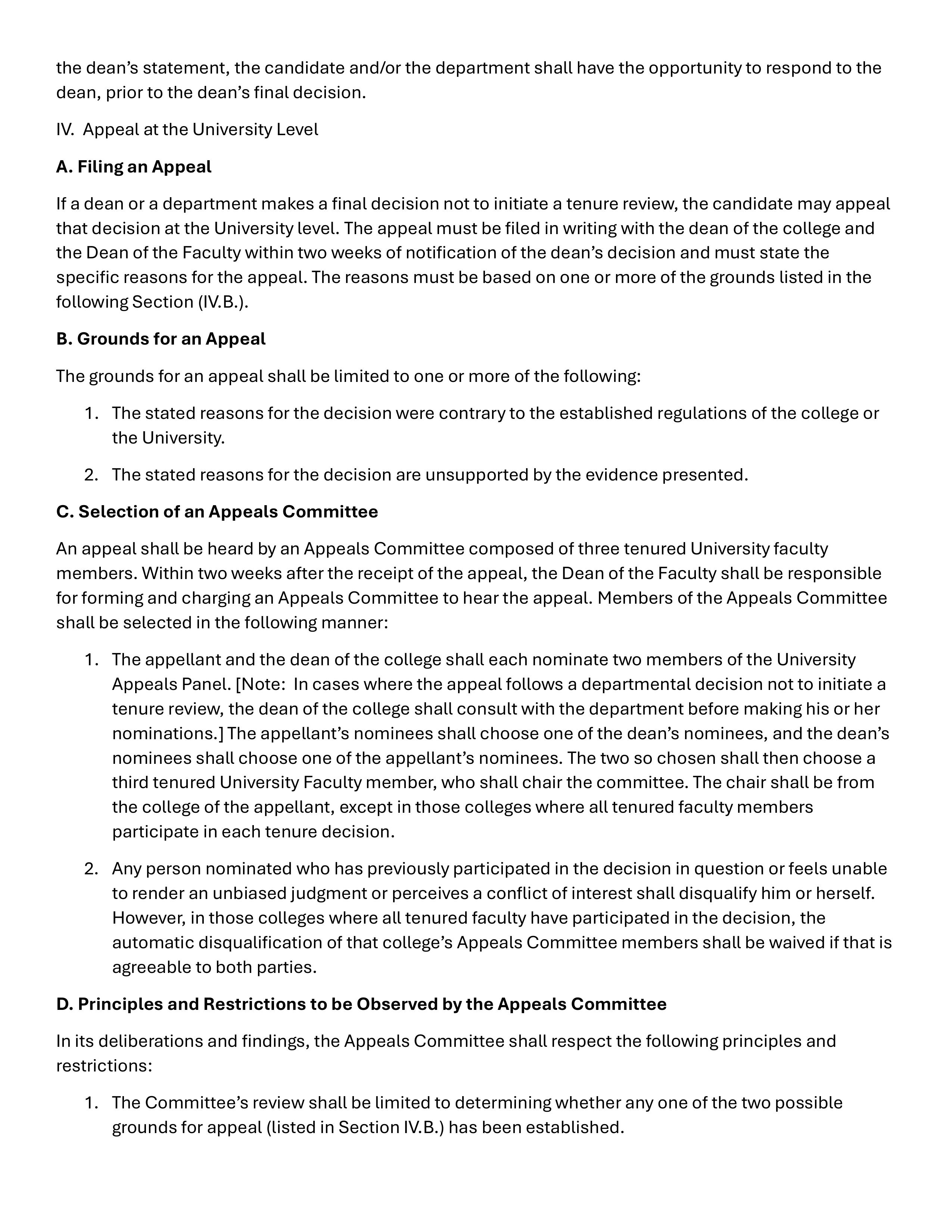
the dean’s statement, the candidate and/or the department shall have the opportunity to respond to the
dean, prior to the dean’s final decision.
IV. Appeal at the University Level
A. Filing an Appeal
If a dean or a department makes a final decision not to initiate a tenure review, the candidate may appeal
that decision at the University level. The appeal must be filed in writing with the dean of the college and
the Dean of the Faculty within two weeks of notification of the dean’s decision and must state the
specific reasons for the appeal. The reasons must be based on one or more of the grounds listed in the
following Section (IV.B.).
B. Grounds for an Appeal
The grounds for an appeal shall be limited to one or more of the following:
1.
The stated reasons for the decision were contrary to the established regulations of the college or
the University.
2.
The stated reasons for the decision are unsupported by the evidence presented.
C. Selection of an Appeals Committee
An appeal shall be heard by an Appeals Committee composed of three tenured University faculty
members. Within two weeks after the receipt of the appeal, the Dean of the Faculty shall be responsible
for forming and charging an Appeals Committee to hear the appeal. Members of the Appeals Committee
shall be selected in the following manner:
1.
The appellant and the dean of the college shall each nominate two members of the University
Appeals Panel. [Note: In cases where the appeal follows a departmental decision not to initiate a
tenure review, the dean of the college shall consult with the department before making his or her
nominations.] The appellant’s nominees shall choose one of the dean’s nominees, and the dean’s
nominees shall choose one of the appellant’s nominees. The two so chosen shall then choose a
third tenured University Faculty member, who shall chair the committee. The chair shall be from
the college of the appellant, except in those colleges where all tenured faculty members
participate in each tenure decision.
2.
Any person nominated who has previously participated in the decision in question or feels unable
to render an unbiased judgment or perceives a conflict of interest shall disqualify him or herself.
However, in those colleges where all tenured faculty have participated in the decision, the
automatic disqualification of that college’s Appeals Committee members shall be waived if that is
agreeable to both parties.
D. Principles and Restrictions to be Observed by the Appeals Committee
In its deliberations and findings, the Appeals Committee shall respect the following principles and
restrictions:
1.
The Committee’s review shall be limited to determining whether any one of the two possible
grounds for appeal (listed in Section IV.B.) has been established.
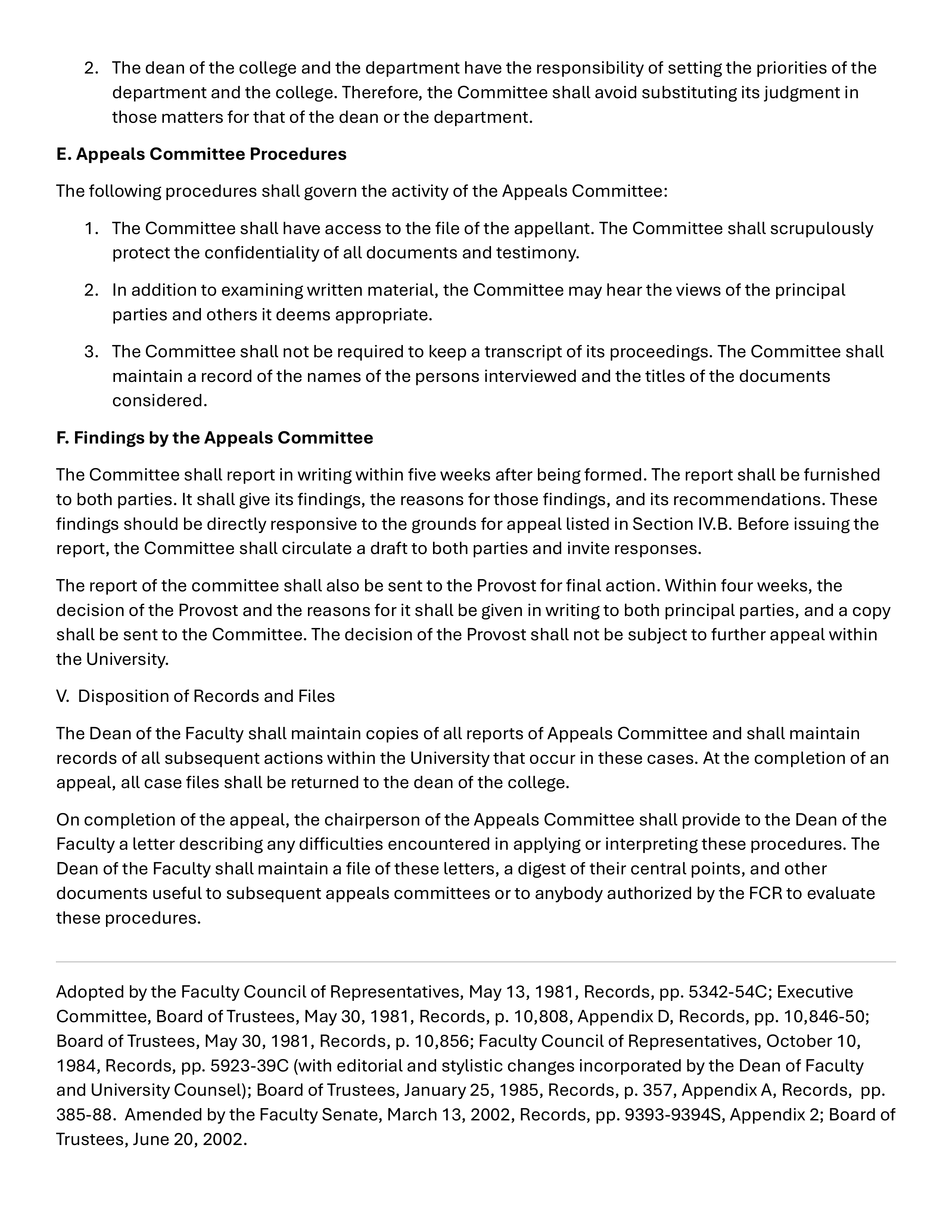
2.
The dean of the college and the department have the responsibility of setting the priorities of the
department and the college. Therefore, the Committee shall avoid substituting its judgment in
those matters for that of the dean or the department.
E. Appeals Committee Procedures
The following procedures shall govern the activity of the Appeals Committee:
1.
The Committee shall have access to the file of the appellant. The Committee shall scrupulously
protect the confidentiality of all documents and testimony.
2.
In addition to examining written material, the Committee may hear the views of the principal
parties and others it deems appropriate.
3.
The Committee shall not be required to keep a transcript of its proceedings. The Committee shall
maintain a record of the names of the persons interviewed and the titles of the documents
considered.
F. Findings by the Appeals Committee
The Committee shall report in writing within five weeks after being formed. The report shall be furnished
to both parties. It shall give its findings, the reasons for those findings, and its recommendations. These
findings should be directly responsive to the grounds for appeal listed in Section IV.B. Before issuing the
report, the Committee shall circulate a draft to both parties and invite responses.
The report of the committee shall also be sent to the Provost for final action. Within four weeks, the
decision of the Provost and the reasons for it shall be given in writing to both principal parties, and a copy
shall be sent to the Committee. The decision of the Provost shall not be subject to further appeal within
the University.
V. Disposition of Records and Files
The Dean of the Faculty shall maintain copies of all reports of Appeals Committee and shall maintain
records of all subsequent actions within the University that occur in these cases. At the completion of an
appeal, all case files shall be returned to the dean of the college.
On completion of the appeal, the chairperson of the Appeals Committee shall provide to the Dean of the
Faculty a letter describing any difficulties encountered in applying or interpreting these procedures. The
Dean of the Faculty shall maintain a file of these letters, a digest of their central points, and other
documents useful to subsequent appeals committees or to anybody authorized by the FCR to evaluate
these procedures.
Adopted by the Faculty Council of Representatives, May 13, 1981, Records, pp. 5342-54C; Executive
Committee, Board of Trustees, May 30, 1981, Records, p. 10,808, Appendix D, Records, pp. 10,846-50;
Board of Trustees, May 30, 1981, Records, p. 10,856; Faculty Council of Representatives, October 10,
1984, Records, pp. 5923-39C (with editorial and stylistic changes incorporated by the Dean of Faculty
and University Counsel); Board of Trustees, January 25, 1985, Records, p. 357, Appendix A, Records, pp.
385-88. Amended by the Faculty Senate, March 13, 2002, Records, pp. 9393-9394S, Appendix 2; Board of
Trustees, June 20, 2002.
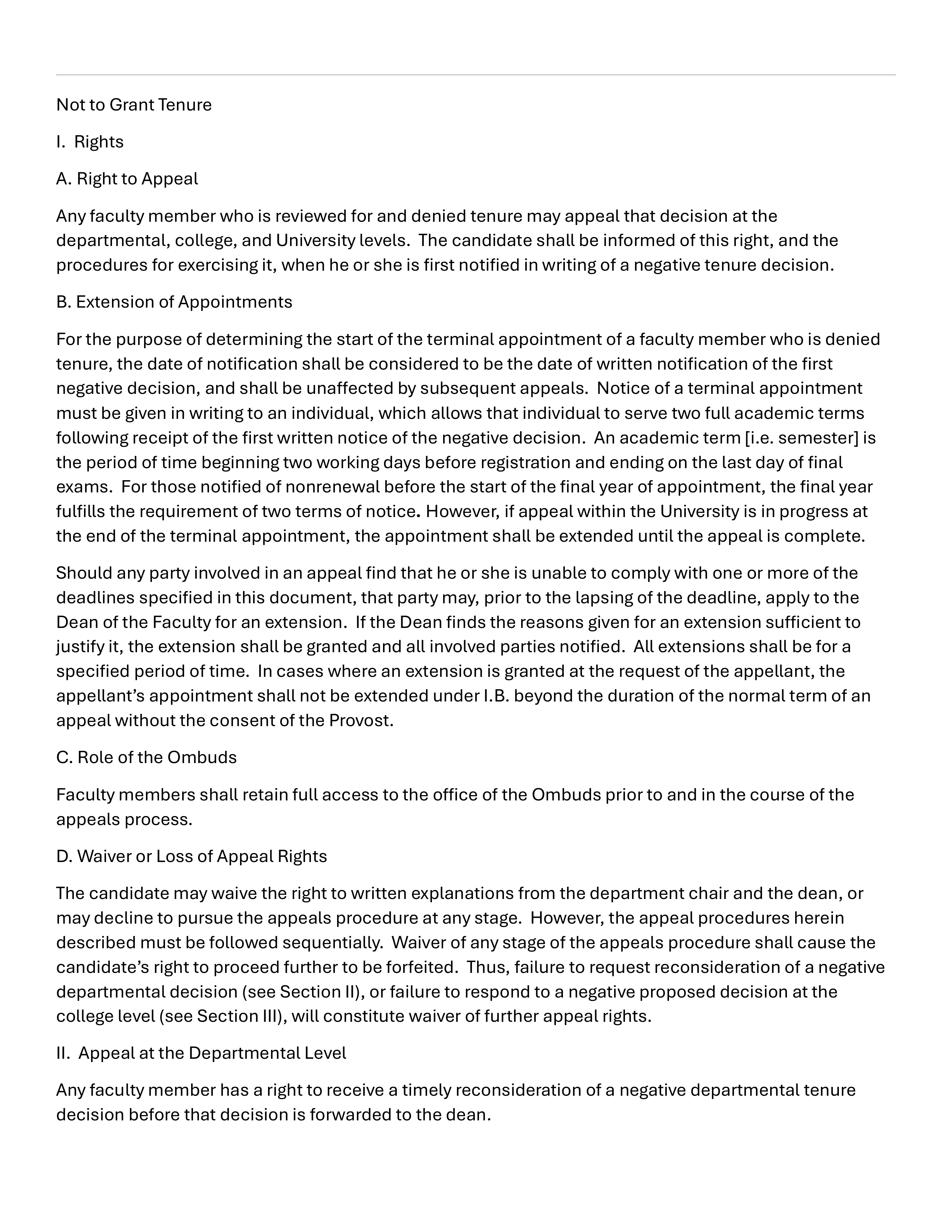
Not to Grant Tenure
I. Rights
A. Right to Appeal
Any faculty member who is reviewed for and denied tenure may appeal that decision at the
departmental, college, and University levels. The candidate shall be informed of this right, and the
procedures for exercising it, when he or she is first notified in writing of a negative tenure decision.
B. Extension of Appointments
For the purpose of determining the start of the terminal appointment of a faculty member who is denied
tenure, the date of notification shall be considered to be the date of written notification of the first
negative decision, and shall be unaffected by subsequent appeals. Notice of a terminal appointment
must be given in writing to an individual, which allows that individual to serve two full academic terms
following receipt of the first written notice of the negative decision. An academic term [i.e. semester] is
the period of time beginning two working days before registration and ending on the last day of final
exams. For those notified of nonrenewal before the start of the final year of appointment, the final year
fulfills the requirement of two terms of notice
.
However, if appeal within the University is in progress at
the end of the terminal appointment, the appointment shall be extended until the appeal is complete.
Should any party involved in an appeal find that he or she is unable to comply with one or more of the
deadlines specified in this document, that party may, prior to the lapsing of the deadline, apply to the
Dean of the Faculty for an extension. If the Dean finds the reasons given for an extension sufficient to
justify it, the extension shall be granted and all involved parties notified. All extensions shall be for a
specified period of time. In cases where an extension is granted at the request of the appellant, the
appellant’s appointment shall not be extended under I.B. beyond the duration of the normal term of an
appeal without the consent of the Provost.
C. Role of the Ombuds
Faculty members shall retain full access to the office of the Ombuds prior to and in the course of the
appeals process.
D. Waiver or Loss of Appeal Rights
The candidate may waive the right to written explanations from the department chair and the dean, or
may decline to pursue the appeals procedure at any stage. However, the appeal procedures herein
described must be followed sequentially. Waiver of any stage of the appeals procedure shall cause the
candidate’s right to proceed further to be forfeited. Thus, failure to request reconsideration of a negative
departmental decision (see Section II), or failure to respond to a negative proposed decision at the
college level (see Section III), will constitute waiver of further appeal rights.
II. Appeal at the Departmental Level
Any faculty member has a right to receive a timely reconsideration of a negative departmental tenure
decision before that decision is forwarded to the dean.
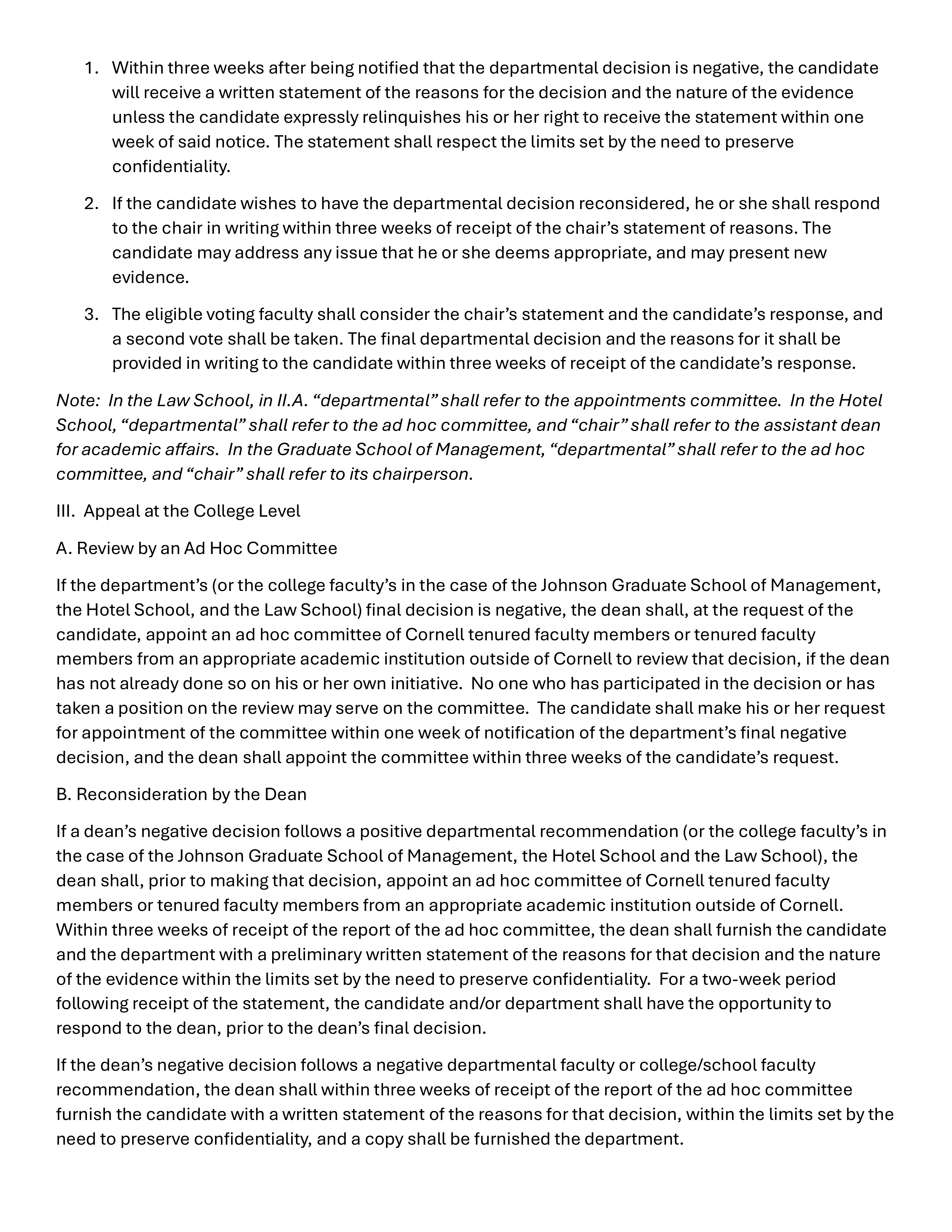
1.
Within three weeks after being notified that the departmental decision is negative, the candidate
will receive a written statement of the reasons for the decision and the nature of the evidence
unless the candidate expressly relinquishes his or her right to receive the statement within one
week of said notice. The statement shall respect the limits set by the need to preserve
confidentiality.
2.
If the candidate wishes to have the departmental decision reconsidered, he or she shall respond
to the chair in writing within three weeks of receipt of the chair’s statement of reasons. The
candidate may address any issue that he or she deems appropriate, and may present new
evidence.
3.
The eligible voting faculty shall consider the chair’s statement and the candidate’s response, and
a second vote shall be taken. The final departmental decision and the reasons for it shall be
provided in writing to the candidate within three weeks of receipt of the candidate’s response.
Note: In the Law School, in II.A. “departmental” shall refer to the appointments committee. In the Hotel
School, “departmental” shall refer to the ad hoc committee, and “chair” shall refer to the assistant dean
for academic affairs. In the Graduate School of Management, “departmental” shall refer to the ad hoc
committee, and “chair” shall refer to its chairperson.
III. Appeal at the College Level
A. Review by an Ad Hoc Committee
If the department’s (or the college faculty’s in the case of the Johnson Graduate School of Management,
the Hotel School, and the Law School) final decision is negative, the dean shall, at the request of the
candidate, appoint an ad hoc committee of Cornell tenured faculty members or tenured faculty
members from an appropriate academic institution outside of Cornell to review that decision, if the dean
has not already done so on his or her own initiative. No one who has participated in the decision or has
taken a position on the review may serve on the committee. The candidate shall make his or her request
for appointment of the committee within one week of notification of the department’s final negative
decision, and the dean shall appoint the committee within three weeks of the candidate’s request.
B. Reconsideration by the Dean
If a dean’s negative decision follows a positive departmental recommendation (or the college faculty’s in
the case of the Johnson Graduate School of Management, the Hotel School and the Law School), the
dean shall, prior to making that decision, appoint an ad hoc committee of Cornell tenured faculty
members or tenured faculty members from an appropriate academic institution outside of Cornell.
Within three weeks of receipt of the report of the ad hoc committee, the dean shall furnish the candidate
and the department with a preliminary written statement of the reasons for that decision and the nature
of the evidence within the limits set by the need to preserve confidentiality. For a two-week period
following receipt of the statement, the candidate and/or department shall have the opportunity to
respond to the dean, prior to the dean’s final decision.
If the dean’s negative decision follows a negative departmental faculty or college/school faculty
recommendation, the dean shall within three weeks of receipt of the report of the ad hoc committee
furnish the candidate with a written statement of the reasons for that decision, within the limits set by the
need to preserve confidentiality, and a copy shall be furnished the department.
IV. Appeal at the University Level
A. Filing an Appeal
If the dean’s final decision is negative, the candidate or the department or the candidate and the
department in concert may appeal that decision. The appeal must be filed in writing with the dean of the
college and the Dean of the Faculty within two weeks of notification of the dean’s decision and must
state the specific reasons for the appeal. The reasons must be based on one or more of the grounds
listed in the following Section (IV.B.). Failure to raise a particular reason may be treated as a waiver of
such a claim in this or any subsequent procedure.
B. Grounds for an Appeal
The grounds for an appeal shall be limited to one or more of the following:
1.
During the appellant’s probationary period, he or she was unfairly and seriously hindered in
meeting the department’s standards by having been put under obligation to accept unusual and
unreasonably heavy duties for the department, college, or University or having been denied
departmental support, contrary to the normal departmental practices.
2.
During the appellant’s probationary period, he or she was unfairly and seriously hindered in
meeting the department’s standards by having been given misleading information or information
so inadequate as to be fully the equivalent of misleading information by the department chair or
dean concerning the departmental or college expectations of candidates.
3.
In the conduct of the tenure review, there were violations of the established procedures and
practices of the department, the college, or the University. These violations were so serious that
the appeals committee believes they affected the outcome of the tenure review.
4.
The evaluation of the appellant was influenced by unlawful discrimination.
5.
The evaluation of the appellant was substantially influenced by consideration of factors unrelated
to the performance of the appellant in carrying out the professional and collegial responsibilities
of his or her position, or by improper and unprofessional consideration of factors which, if properly
considered, would be material and relevant. The violations were so serious that the appeals
committee believes that they affected the outcome of the tenure review.
6.
The decision was so inconsistent with the evidence in the record that it must be judged arbitrary or
capricious. [The term arbitrary and capricious fundamentally describes actions which have no
sound basis in law, fact or reason or are grounded solely in bad faith or personal desires. A
determination is arbitrary and capricious only if it is one no reasonable mind could reach.]
C. The University Appeals Panel
An appeal shall be heard by an Appeals Committee composed of five tenured University faculty
members. At least four members of the Appeals Committee shall be members of the University Appeals
Panel. The Dean of the Faculty shall be responsible for establishing the University Appeals Panel, and
maintaining a list of members. Each college shall elect five tenured faculty members, or five percent of its
tenured faculty, whichever is greater, to the Panel. In addition, the President of the University shall
appoint ten tenured faculty members to the Panel. The term of office shall be five years, with a rotation
system developed at the time of the initial election.
D. Selection of an Appeals Committee
Within two weeks after the appeal of a college dean’s negative decision, the Dean of the Faculty shall be
responsible for forming and charging an Appeals Committee to hear the appeal. Members of the Appeals
Committee shall be selected in the following manner:
1.
The appellant and the dean of the college shall each nominate four members of the University
Appeals Panel. [Note: In cases where the appeal follows a negative departmental
recommendation, the dean of the college shall consult with the department before making his or
her nominations.] The appellant’s nominees shall choose two of the dean’s nominees, and the
dean’s nominees shall choose two of the appellant’s nominees. The four so chosen shall then
choose a fifth tenured University Faculty member, who shall chair the committee. The chair shall
be from the college of the appellant, except in those colleges where all tenured faculty members
participate in each tenure decision.
2.
Any person nominated who has previously participated in the review of the appellant or feels
unable to render an unbiased judgment or perceives a conflict of interest shall disqualify him or
herself. However, in those colleges where all tenured faculty participate in each tenure decision,
the automatic disqualification of that college’s Appeals Committee members shall be waived if
that is agreeable to both parties.
E. Principles and Restrictions to be Observed by the Appeals Committee
In its deliberations and findings, the Appeals Committee shall respect the following principles and
restrictions:
1.
The Committee’s review shall be limited to determining whether any one of the six possible
grounds for appeal (listed in Section IV.B.) has been established. The Committee may, if
circumstances warrant, investigate and return findings concerning possible violations of the
grounds for appeal (listed in Section IV.B.) not raised by the appellant.
2.
The Committee shall recognize the central role of peer judgment in tenure decisions. Hence, the
Committee shall avoid substituting its assessment of the appellant’s professional qualifications
for those of the department and the experts outside the department who have been asked to
submit evaluations. The Committee’s role in judging professional merit shall be limited to
determining whether the recommendations of the department and the dean were arbitrary and
capricious as defined in IV.B.5. or based on the inappropriate considerations listed in IV.B.3.and
IV.B.4.
3.
The dean of the college has a major responsibility in setting the priorities and maintaining the
standards of the college. Therefore, the Committee shall avoid substituting its judgment in those
matters for that of the dean.
4.
It is impossible to make precise and universally agreed-upon evaluations of candidates. Therefore,
the possibility that a different group of reasonable people might have come to a different
conclusion concerning the merits of the appellant is insufficient grounds to sustain the appeal.
5.
Comparisons with other tenure review cases may be used by the Committee in certain cases (See
Section IV.F.l.). However, the Committee shall recognize the right and duty of departments to
improve their quality or take into account different departmental needs, so long as this is not done
as a pretext. A weak previous tenure appointment shall not by itself be taken to define the
departmental standard.
F. Appeals Committee Procedures
The following procedures shall govern the activity of the Appeals Committee:
1.
The Committee shall have access to the tenure file of the appellant. If the appellant charges that
the decision was arbitrary or capricious as defined in Section IV.B.5. or based on the inappropriate
considerations listed in Sections IV.B.3. and IV.B.4., and if the Committee finds it essential to read
the files of recent comparable cases within the college of the appellant to examine that charge, it
shall have access to those files as well. However, the Committee shall not as a matter of course
request access to the files of recent cases within a department or college. The Committee shall
scrupulously protect the confidentiality of all documents and testimony.
2.
In addition to examining written material, the Committee may hear the views of the principal
parties and others it deems appropriate.
3.
The Committee shall not be required to keep a transcript of its proceedings. The Committee shall
maintain a record of the names of the persons interviewed and the titles of the documents
considered.
4.
The Committee shall report in writing within eight weeks after being formed. The report shall be
furnished to the appellant and the department and the college dean. It shall give the Committee’s
findings, and the reasons for those findings. These findings should be directly responsive to the
grounds for appeal listed in Section IV.B. Before issuing the report, the Committee shall circulate
a draft to the appellant and the department and/or college dean and invite responses.
G. Findings by the Appeals Committee
The Appeals Committee shall make one or more of the following findings. The ensuing action shall be as
stated:
1.
If the Committee finds that none of the six possible appeal grounds (see Section IV.B.) has been
established, it shall reject the appeal. This decision shall not be subject to further appeal within
the University.
2.
If the Committee finds that the ground for appeal in Section IV.B.l. has been established, it may
recommend that the appellant’s appointment be extended for a fixed period, after which a new
tenure review shall be undertaken. It is expected that the dean will follow the Committee’s
recommendation. If the dean chooses not to grant the recommended extensions, the
Committee’s report and the written response of the dean shall be forwarded to the Provost. Within
four weeks, the decision of the Provost and the reasons for it shall be given in writing to both
principal parties, and a copy shall be sent to the Committee. The decision of the Provost shall not
be subject to further appeal within the University.
3.
If the Committee finds that any other ground for appeal in Section IV.B. has been established, it
may return the case to the dean of the college for reconsideration. The dean shall promptly take
appropriate action to correct the deficiencies that the Committee has found, and shall provide a
written report of the reconsidered decision to the Committee, the department, and the appellant.
If the reconsideration results in an affirmation of the original decision, this judgment shall be
reviewed by the original Appeals Committee, which shall take the following action.
a. If the Appeals Committee finds that the tenure review process no longer has serious deficiencies, it
shall reject the appeal. This action shall not be subject to further appeal within the University.
b. If the Committee finds that the tenure review process continues to have serious deficiencies and that
an independent academic evaluation is appropriate, a panel of professionally qualified and not
previously involved expert scholars from inside or outside Cornell shall be appointed to review the case
and make a recommendation as to the granting of tenure. The panel’s review shall not constitute an
additional appeal from the department’s or dean’s decision, but shall constitute a new independent
judgment concerning the candidate’s academic qualifications for tenure. The panel shall be appointed
jointly by the chair of the Appeals Committee, the Dean of the Faculty, and the President of the University.
The panel shall be entitled to all of the evidence on which the original substantive decision was based
and shall be entitled to collect such further evidence deemed necessary to reach a new substantive
judgment. The recommendation of the panel of expert scholars and the response of the Appeals
Committee, the dean, the department, and the appellant shall be forwarded to the Provost. Within four
weeks, the decision of the Provost and the reasons for it shall be given in writing to both principal parties,
and a copy shall be sent to the Committee. The decision of the Provost shall not be subject to further
appeal within the University.
Note: Nothing in this document shall be construed to prevent an appeals committee from attempting to
arrange an informal settlement of the complaints if it believes that fairness can, thereby, be served and
that such an arrangement best serves the interests of the appellant, the department, the dean and the
University. No action may be taken under this provision unless it is agreed to by the dean, the department,
and the appellant.
V. Disposition of Records and Files
The Dean of the Faculty shall maintain copies of all reports of Appeals Committees and shall maintain
records of all subsequent actions within the University that occur in these cases. At the completion of an
appeal, all case files shall be returned to the dean of the college.
On completion of the appeal, the chairperson of the Appeals Committee shall provide to the Dean of the
Faculty a letter describing any difficulties encountered in applying or interpreting these procedures. The
Dean of the Faculty shall maintain a file of these letters, a digest of their central points, and other
documents useful to subsequent appeals committees or to anybody authorized by the FCR to evaluate
these procedures.
Adopted by the Faculty Council of Representatives, May 13, 1981, Records, pp. 5342-54C; Executive
Committee, Board of Trustees, May 30, 1981, Records, p. 10,808, Appendix D, Records, pp. 10,831-38;
Board of Trustees, May 30, 1981, Records, p. 10,856; Faculty Council of Representatives, October 10,
1984, Records, pp. 5923-39C (with editorial and stylistic changes incorporated by the Dean of Faculty
and University Counsel); Board of Trustees, January 25, 1985, Records, p. 357, Appendix A, Records, pp.
372-78. Amended by the Faculty Senate, March 13, 2002, Records, pp. 9393-9394S, Appendix 2; Board of
Trustees, June 20, 2002.
Not to Promote to Full Professor
Note: After some definite number of years of service as a tenured professor, a faculty member has a right
to a review for promotion to full professor. If the faculty member does not wish to be reviewed, the review
will not take place. If the initial review does not result in promotion, the faculty member has a right to at
least one subsequent (and perhaps more) reviews within some definite period of time. A dean will not
reject a departmental recommendation to promote a faculty member to full professor without first having
appointed and received the report of an ad hoc committee.
I. Rights
A. Right to Appeal
Any tenured faculty member who is reviewed for and denied promotion to full professor may appeal that
decision at the departmental, college, and University levels subject to the limitations in I.B. The
candidate shall be informed of this right, and the procedures for exercising it, when he or she is first
notified of a negative promotion decision.
B. Limitations to the Right of Appeal
A faculty member who is denied promotion may appeal that decision even though he or she was denied
promotion on a previous occasion and appealed that decision. However, a University level appeal may
not address issues that were settled in a prior appeal, but must be based on evidence that was not
previously presented at a University level appeal proceeding.
C. Role of the Ombuds
Faculty members shall retain full access to the office of the Ombuds prior to and in the course of the
appeals process.
D. Waiver or Loss of Appeal Rights
The candidate may waive the right to written explanations from the department chair and the dean, or
may decline to pursue the appeals procedure at any stage. However, the appeals procedures herein
described must be followed sequentially. Waiver of any stage of the appeals procedure shall cause the
candidate’s right to proceed further to be forfeited. Thus, failure to request reconsideration of a negative
departmental decision (see Section II), or failure to respond to a negative proposed decision at the
college level (see Section III), will constitute waiver of further appeal rights of this particular decision.
Note: Should any party involved in an appeal find that he or she is unable to comply with one or more of
the deadlines specified in this document, that party may, prior to the lapsing of the deadline, apply to the
Dean of the Faculty for an extension. If the Dean finds the reasons given for an extension sufficient to
justify it, the extension shall be granted and all involved parties notified. All extensions shall be for a
specified period of time.
II. Appeal at the Departmental Level
Any tenured faculty member has a right to receive a timely reconsideration of a departmental decision
not to promote to full professor before that decision is forwarded to the dean.
1.
Within three weeks after being notified that the departmental decision is negative, the candidate
will receive a written statement of the reasons for the decision and the nature of the evidence
unless the candidate expressly relinquishes his or her right to receive the statement within one
week of said notice. The statement shall respect the limits set by the need to preserve
confidentiality.
2.
If the candidate wishes to have the departmental decision reconsidered, he or she shall respond
to the chair in writing within three weeks of receipt of the chair’s statement of reasons. The
candidate may address any issue that he or she deems appropriate, and may present new
evidence.
3.
The eligible voting faculty shall consider the chair’s statement and the candidate’s response, and
a second vote shall be taken. The final departmental decision and the reasons for it shall be
provided in writing to the candidate within three weeks of receipt of the candidate’s response.
Note: In schools or colleges without departmental structure “departmental” shall refer to the group of full
professors who vote on the recommendation that is forwarded to the dean, and “chair” shall refer to an
appropriate faculty member.
III. Appeal at the College Level
A. Review by an Ad Hoc Committee
If the department’s final decision is negative, the dean shall, at the request of the candidate, appoint an
ad hoc committee to review that decision, if the dean has not already done so on his or her own initiative.
The candidate shall make his or her request for appointment of the committee within one week of
notification of the department’s final negative decision, and the dean shall appoint the committee within
three weeks of the candidate’s request.
Note: In those schools or colleges that do not use ad hoc committees in the case of positive
departmental recommendations, III.A. shall not apply.
B. Reconsideration by the Dean
If a dean’s negative decision follows a positive departmental recommendation, the dean shall, within
three weeks of receipt of the report of the ad hoc committee, furnish the candidate and the department
with a preliminary written statement of the reasons for that decision and the nature of the evidence
within the limits set by the need to preserve confidentiality. For a two-week period following receipt of the
statement, the candidate and/or department shall have the opportunity to respond to the dean, prior to
the dean’s final decision.
If the dean’s negative decision follows a negative departmental recommendation, the dean shall within
three weeks of receipt of the report of the ad hoc committee furnish the candidate and the department
with a written statement of the reasons for that decision, within the limits set by the need to preserve
confidentiality.
Note: In those schools or colleges that do not use ad hoc committees in the case of positive
departmental recommendations, and therefore do not use them in III.A., the three week time period after
which the dean must reply shall start when the dean receives the report of the appropriate faculty group.
IV. Appeal at the University Level
A. Filing an Appeal
If the dean’s final decision is negative, the candidate or the department (with the written consent of the
candidate) or the candidate and the department in concert, may appeal that decision. The appeal must
be filed in writing with the dean of the college and the Dean of the Faculty within two weeks of notification
of the dean’s decision and must state the specific reasons for the appeal. The reasons must be based on
one or more of the grounds listed in the following Section (IV.B.), and must be based on evidence that was
not presented in any prior appeal at the University level. Failure to raise a particular reason when filing the
appeal may be treated as a waiver of such a claim in this or any subsequent procedure during this appeal
process.
B. Grounds for an Appeal
The grounds for an appeal shall be limited to one or more of the following:
1.
In the conduct of the promotion review, there were violations of the established procedures and
practices of the department, the college, or the University. These violations were so serious that
the Appeals Committee believes they affected the outcome of the promotion review.
2.
The evaluation of the appellant was influenced by unlawful discrimination.
3.
The evaluation of the appellant was substantially influenced by consideration of factors unrelated
to the performance of the appellant in carrying out the professional and collegial responsibilities
of his or her position, or by improper and unprofessional consideration of factors which, if properly
considered, would be material and relevant. The violations were so serious that the Appeals
Committee believes that they affected the outcome of the promotion review.
4.
The decision was so inconsistent with the evidence in the record that it must be judged arbitrary or
capricious. [Note: The term arbitrary and capricious fundamentally describes actions which have
no sound basis in law, fact or reason or are grounded solely in bad faith or personal desire. A
determination is arbitrary and capricious only if it is one no reasonable mind could reach.]
C. Selection of an Appeals Committee
An appeal shall be heard by an Appeals Committee composed of five full professors in the University.
Within two weeks after the appeal of a college dean’s negative decision, the Dean of the Faculty shall be
responsible for forming and charging an Appeals Committee to hear the appeal. Members of the Appeals
Committee shall be selected in the following manner:
1.
The appellant and the dean of the college shall each nominate four members of the University
Appeals Panel. [Note: In cases where the appeal follows a decision by the department not to
promote to full professor, the dean of the college shall consult with the department before making
his or her nominations.] The appellant’s nominees shall choose two of the dean’s nominees, and
the dean’s nominees shall choose two of the appellant’s nominees. The four so chosen shall then
choose a fifth full professor in the University, who shall chair the committee. The chair shall be
from the college of the appellant, except in those colleges where all full professors participate in
each promotion decision.
2.
Any person nominated who has previously participated in the review of the appellant or feels
unable to render an unbiased judgment or perceives a conflict of interest shall disqualify him or
herself. However, in those colleges where all full professors participate in each promotion
decision, the automatic disqualification of that college’s Appeals Committee members shall be
waived if that is agreeable to both parties.
D. Principles and Restrictions to be Observed by the Appeals Committee
In its deliberations and findings, the Appeals Committee shall respect the following principles and
restrictions:
1.
The Committee’s review shall be limited to determining whether any one of the four possible
grounds for appeal (listed in Section IV.B.) has been established. The Committee may, if
circumstances warrant, investigate and return findings concerning possible violations of the
grounds for appeal (listed in Section IV.B.) not raised by the appellant.
2.
The Committee shall recognize the central role of peer judgment in promotion decisions. Hence,
the Committee shall avoid substituting its assessment of the appellant’s professional
qualifications for those of the department and the experts outside the department who have been
asked to submit evaluations. The Committee’s role in judging professional merit shall be limited
to determining whether the recommendations of the department and the dean were arbitrary and
capricious as defined in IV.B.4., or based on the inappropriate considerations listed in IV.B.2. and
IV.B.3.
3.
The dean of the college has a major responsibility in maintaining the standards of the college.
Therefore, the Committee shall avoid substituting its judgment in those matters for that of the
dean.
4.
It is impossible to make precise and universally agreed-upon evaluations of candidates. Therefore,
the possibility that a different group of reasonable people might have come to a different
conclusion concerning the merits of the appellant is insufficient grounds to sustain the appeal.
5.
Comparisons with other promotion review cases may be used by the Committee in certain cases
(see Section IV.E.l.). However, the Committee shall recognize the right and duty of departments to
raise the standards for promotion to full professor or take into account different departmental
needs or particular individual circumstances, so long as this is not done as a pretext. A weak
previous promotion to full professor shall not by itself be taken to define the departmental
standard for promotions.
6.
If a faculty member has appealed a previous decision not to promote to full professor, the Appeals
Committee shall not reconsider the decision of the previous Appeals Committee, or the evidence
upon which it was based.
E. Appeals Committee Procedures
The following procedures shall govern the activity of the Appeals Committee:
1.
The Committee shall have access to the promotion file of the appellant. If the appellant charges
that the decision was arbitrary or capricious as defined in Section IV.B.4 or based on the
inappropriate considerations listed in Sections IV.B.2 and IV.B.3. and if the Committee finds it
essential to read the files of recent comparable cases within the college of the appellant to
examine that charge, it shall have access to those files as well. However, in its request for access
to a particular file, the Committee shall state in writing how each particular comparison case
satisfies the following criteria: a. It is sufficiently recent. b. It is sufficiently comparable in
circumstances. c. It is impossible to examine the allegation made by the appellant without access
to the requested file. The Committee shall scrupulously protect the confidentiality of all
documents and testimony.
2.
In addition to examining written material, the Committee may hear the views of the principal
parties and others it deems appropriate.
3.
The Committee shall not be required to keep a transcript of its proceedings. The Committee shall
maintain a record of the names of the persons interviewed and the titles of the documents
considered.
4.
The Committee shall report in writing within eight weeks after being formed. The report shall be
furnished to the appellant and the department and the college dean. It shall give the Committee’s
findings, and the reasons for those findings. These findings should be directly responsive to the
grounds for appeal listed in Section IV.B. Before issuing the report, the Committee shall circulate
a draft to the appellant and the department and/or college dean and invite responses.
F. Findings by the Appeals Committee
The Appeals Committee shall make one or more of the following findings. The ensuing action shall be as
stated:
1.
If the Committee finds that none of the four possible appeal grounds (see Section IV.B.) has been
established, it shall reject the appeal. This decision shall not be subject to further appeal within
the University.
2.
If the Committee finds that the ground for appeal has been established, it may return the case to
the dean of the college for reconsideration. The dean shall promptly take appropriate action to
correct the deficiencies that the Committee has found, and shall provide a written report of the
reconsidered decision to the Committee, the department, and the appellant. If the
reconsideration results in an affirmation of the original decision, this judgment shall be reviewed
by the original Appeals Committee, which shall take the following action:
a. If the Appeals Committee finds that the promotion review process no longer has serious deficiencies,
it shall reject the appeal. This action shall not be subject to further appeal within the University.
b. If the Committee finds that the promotion review process continues to have serious deficiencies, it
shall forward its findings to the Provost for final action. Within four weeks, the decision of the Provost and
the reasons for it shall be given in writing to both principal parties, and a copy shall be sent to the
Committee. The decision of the Provost shall not be subject to further appeal within the University.
V. Disposition of Records and Files
The Dean of the Faculty shall maintain copies of all reports of Appeals Committees and shall maintain
records of all subsequent actions within the University that occur in these cases. At the completion of an
appeal, all case files shall be returned to the dean of the college.
On completion of the appeal, the chairperson of the Appeals Committee shall provide to the Dean of the
Faculty a letter describing any difficulties encountered in applying or interpreting these procedures. The
Dean of the Faculty shall maintain a file of these letters, a digest of their central points, and other
documents useful to subsequent appeals committees or to anybody authorized by the FCR to evaluate
these procedures.
Adopted by the Faculty Council of Representatives, May 13, 1981, Records, pp. 5342-54C; Executive
Committee, Board of Trustees, May 30, 1981, Records, p. 10,808, Appendix D, Records, pp. 10,839-45;
Board of Trustees, May 30, 1981, Records, p. 10,856; Faculty Council of Representatives, October 10,
1984, Records, pp. 5923-39C (with editorial and stylistic changes incorporated by the Dean of Faculty
and University Counsel); Board of Trustees, January 25, 1985, Records p. 357, Appendix A, Records, pp.
379-84.
5. Retirement and Becoming Emeritus/a
5.1 Retirement Checklist
First Steps
Become Familiar with the University’s Retirement Resources
The Office of Human Resources maintains a
pre-retirement planning
webpage with links to many
important resources. Financial planning and health care planning are central. Good places to start are
the benefit overviews specifically for
endowed faculty
and for
contract college faculty
. Other valuable
sources of information about retirement are colleagues who have recently gone through the process,
the
Cornell Academics and Professors Emeriti
(CAPE), your department chair, and the
Cornell Retirees
Association
(CRA). Generally speaking, it is never too early to begin thinking about the finances
associated with retirement. Interaction with Medicare is required several months before your
65
th
birthday.
Understand How Phased Retirement Works
Eligible faculty members and staff employees may choose to reduce their job duties and scheduled
hours prior to retirement, to make a gradual transition before their official retirement date. This is
called
phased retirement
. It requires a signed mutual agreement between you, your department, and the
dean of your college. The agreement identifies an official retirement date, a workload percent, and the
responsibilities that must be discharged during the phased retirement period. For example, if the
workload percent is 75%, then you would receive 75% of your normal salary. In addition to providing a
transition to full retirement, a phased retirement has economic value because the university continues to
pay benefits as if you were a full-time faculty member.
Identify Your Contacts
There is a measure of non-uniformity across the colleges in terms of just who participates with the
candidate during the retirement process. A good way to find out the local arrangements that apply to you
is to have a conversation with your
college HR representative
. Department managers and chairs, and
associate deans may also be involved at various stages in the process. Establish clear communication
channels to all who are involved.
Interactions with Your Chair
These discussions are typically spread out over time. They should be initiated at least one year before you
decide to retire or one year before you plan to enter phased retirement. The idea is for you and the unit
head to reach an understanding about resources and other key issues that are of mutual importance. To
facilitate these conversations, we provide the following checklists.
A Checklist of Talking Points for You
1.
anticipated academic interests and activities that may be pursued after retirement.
2.
the current state of graduate student supervision, how it might continue or wind down.
3.
the current state of external funding, how it might continue or wind down.
4.
the state of all discretionary funding accounts that might be utilized after retirement.
5.
plans for a sabbatical leave before retiring (including teaching or other responsibilities upon return
to campus prior to retirement).
6.
anticipated administrative support needs.
7.
receiving US mail.
8.
anticipated desk/space/land line telephone needs.
9.
anticipated IT support needs.
10.
the desired level of participation in department business, e.g., staying on mailing lists, attending
meetings, participating on committees, voting, etc.
11.
the desired level of participation in college business, e.g., staying on mailing lists.
12.
the likelihood of living in the Ithaca area full time, part time, or not at all.
13.
concerns about indemnification. See link to official policy (formal policy)
14.
all of the above in the context of a phased retirement agreement.
A Checklist of Talking Points for Your Chair (or Equivalent)
1.
organizing a recognition event to show appreciation.
2.
the process for becoming emeritus/a.
3.
where to get answers to HR-related questions, typically HR office in the candidate’s College.
4.
the department’s space situation.
5.
the extent to which the department can supply administrative and IT support.
6.
the rules associated with attending department meetings and voting on such matters as hiring and
promotion.
7.
the process for accessing reimbursement for professional activities,
8.
hire-back possibilities that relate to teaching, advising, outreach, and administration.
9.
opportunities for retirees and emeritus faculty to volunteer.
10.
how the dean must authorize the continued use of an endowed chair, both as a title and as a
possible source of future funding.
11.
what a phased retirement arrangement might involve.
Formalizing the Retirement Agreement
The dialog with the Chair or Director eventually leads to a retirement agreement. Conversations with
central HR or with the College HR person are sometimes part of the process.
If there is a phased retirement plan, it is detailed in writing and signed by you, the chair, and the College
dean.
Likewise, if there are resource agreements associated with full retirement, then they should be specified
in writing and signed by both you and the head of the unit.
A request for emeritus/a status can only be filed after an official retirement date is set. A guarantee of
emeritus/a status is never part of a retirement agreement.
The Actual Transition
Benefit Services will contact you with information about the health care plan for retirees and related
matters such as Medicare Parts A, B, and D. They will also describe various life insurance issues that
require your attention.
Several months before retirement you should schedule an appointment with your retirement account
vendor, i.e.,
TIAA
(1-800 732-8353) or
Fidelity
(1-800 642-7131).
Upon retirement you should visit the
HR Services & Transitions Cente
r in the East Hill Office Building, 395
Pine Tree Road, Suite 130 to obtain an updated Cornell ID that indicates your new status.
5.2 Process for Becoming Emeritus/a
Emeritus/a status is available for associate professors and full professors who have retired.
Process
Upon retirement, a university professor, full professor, or associate professor who has been a tenured
member of the University Faculty for ten or more years may be considered for emeritus/a status.
Awarding the title of university professor emeritus/a, professor emeritus/a, or associate professor
emeritus/a shall be based upon the career contributions of the candidate through a combination of
teaching, research, advising, administration, extension, and outreach. An overall record of meritorious
service to the university is expected.
The candidate supplies a curriculum vitae to the department chair together with a cover letter that
includes the date of retirement and a request to be considered for either emeritus or emerita status.
If the request is from a full professor, then it is reviewed and voted upon by the full professors and the
emeritus faculty in the candidate’s department. If the request is from an associate professor, then it is
reviewed and voted upon by the tenured professors and the emeritus faculty in the candidate’s
department. The result of the vote and the chair’s recommendation to either approve or deny emeritus/a
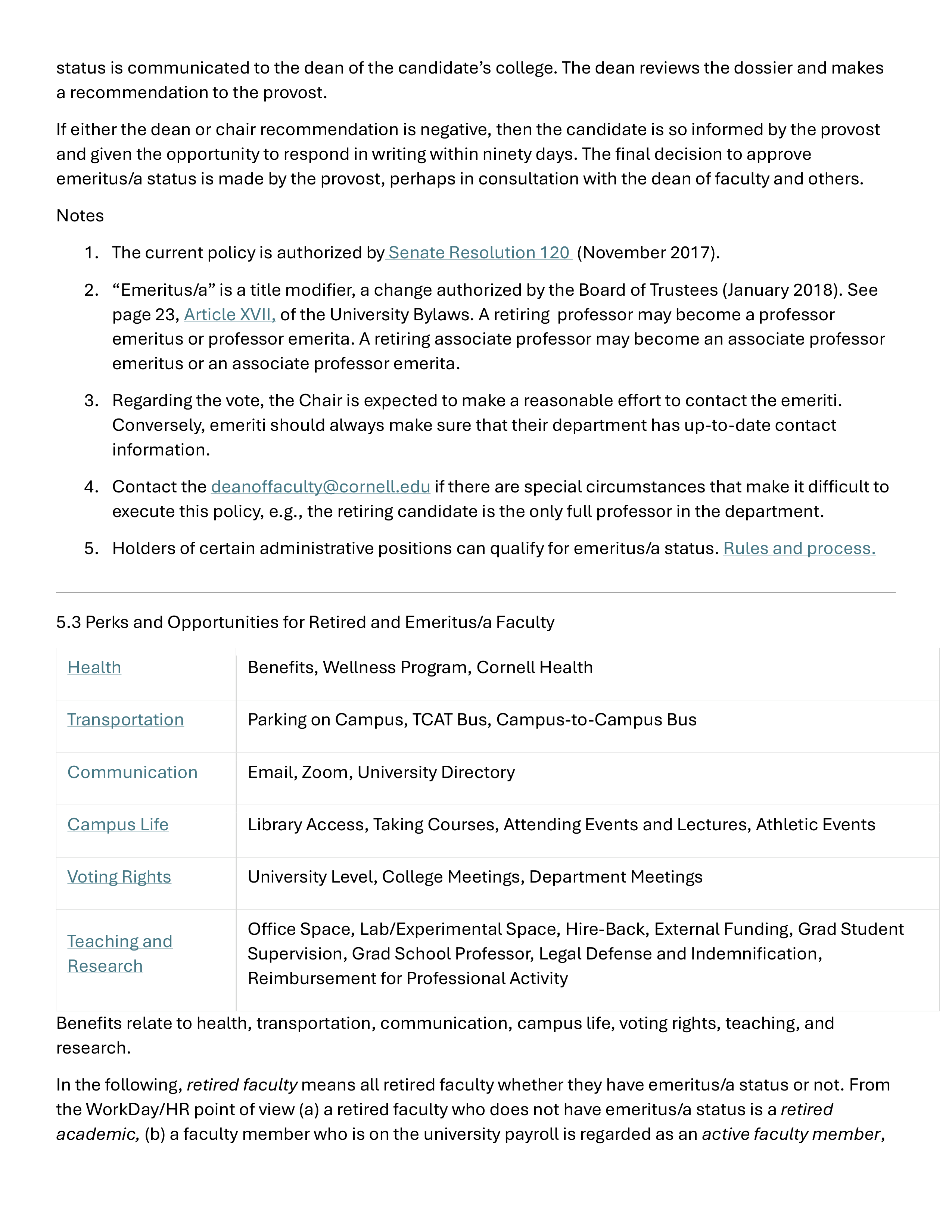
status is communicated to the dean of the candidate’s college. The dean reviews the dossier and makes
a recommendation to the provost.
If either the dean or chair recommendation is negative, then the candidate is so informed by the provost
and given the opportunity to respond in writing within ninety days. The final decision to approve
emeritus/a status is made by the provost, perhaps in consultation with the dean of faculty and others.
Notes
1.
The current policy is authorized by
Senate Resolution 120
(November 2017).
2.
“Emeritus/a” is a title modifier, a change authorized by the Board of Trustees (January 2018). See
page 23,
Article XVII,
of the University Bylaws. A retiring professor may become a professor
emeritus or professor emerita. A retiring associate professor may become an associate professor
emeritus or an associate professor emerita.
3.
Regarding the vote, the Chair is expected to make a reasonable effort to contact the emeriti.
Conversely, emeriti should always make sure that their department has up-to-date contact
information.
4.
Contact the
deanoffaculty@cornell.edu
if there are special circumstances that make it difficult to
execute this policy, e.g., the retiring candidate is the only full professor in the department.
5.
Holders of certain administrative positions can qualify for emeritus/a status.
Rules and process.
5.3 Perks and Opportunities for Retired and Emeritus/a Faculty
Health
Benefits, Wellness Program, Cornell Health
Transportation
Parking on Campus, TCAT Bus, Campus-to-Campus Bus
Communication
Email, Zoom, University Directory
Campus Life
Library Access, Taking Courses, Attending Events and Lectures, Athletic Events
Voting Rights
University Level, College Meetings, Department Meetings
Teaching and
Research
Office Space, Lab/Experimental Space, Hire-Back, External Funding, Grad Student
Supervision, Grad School Professor, Legal Defense and Indemnification,
Reimbursement for Professional Activity
Benefits relate to health, transportation, communication, campus life, voting rights, teaching, and
research.
In the following,
retired faculty
means all retired faculty whether they have emeritus/a status or not. From
the WorkDay/HR point of view (a) a retired faculty who does not have emeritus/a status is a
retired
academic,
(b) a faculty member who is on the university payroll is regarded as an
active faculty member
,
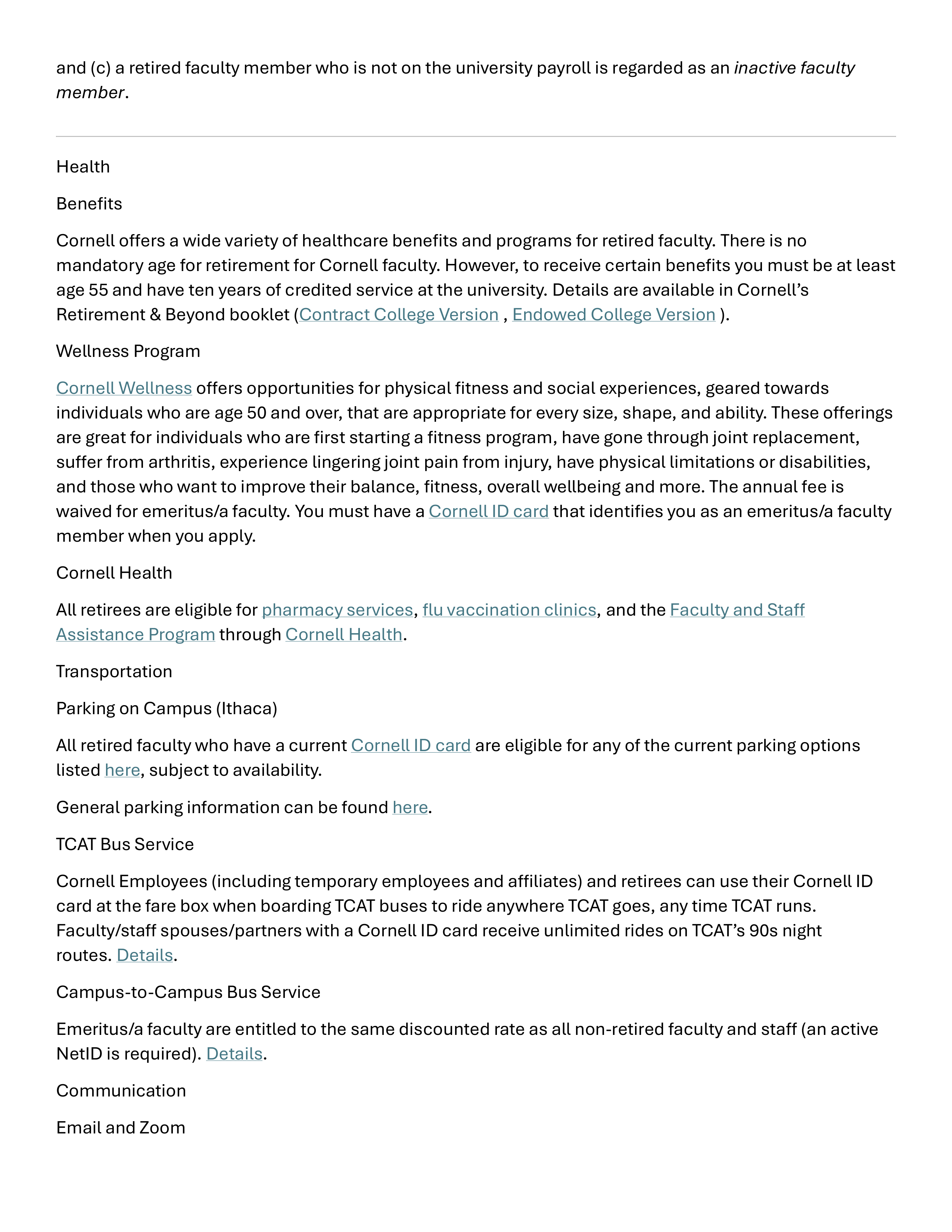
and (c) a retired faculty member who is not on the university payroll is regarded as an
inactive faculty
member
.
Health
Benefits
Cornell offers a wide variety of healthcare benefits and programs for retired faculty. There is no
mandatory age for retirement for Cornell faculty. However, to receive certain benefits you must be at least
age 55 and have ten years of credited service at the university. Details are available in Cornell’s
Retirement & Beyond booklet (
Contract College Version
,
Endowed College Version
).
Wellness Program
Cornell Wellness
offers opportunities for physical fitness and social experiences, geared towards
individuals who are age 50 and over, that are appropriate for every size, shape, and ability. These offerings
are great for individuals who are first starting a fitness program, have gone through joint replacement,
suffer from arthritis, experience lingering joint pain from injury, have physical limitations or disabilities,
and those who want to improve their balance, fitness, overall wellbeing and more. The annual fee is
waived for emeritus/a faculty. You must have a
Cornell ID card
that identifies you as an emeritus/a faculty
member when you apply.
Cornell Health
All retirees are eligible for
pharmacy services
,
flu vaccination clinics
, and the
Faculty and Staff
Assistance Program
through
Cornell Health
.
Transportation
Parking on Campus (Ithaca)
All retired faculty who have a current
Cornell ID card
are eligible for any of the current parking options
listed
here
, subject to availability.
General parking information can be found
here
.
TCAT Bus Service
Cornell Employees (including temporary employees and affiliates) and retirees can use their Cornell ID
card at the fare box when boarding TCAT buses to ride anywhere TCAT goes, any time TCAT runs.
Faculty/staff spouses/partners with a Cornell ID card receive unlimited rides on TCAT’s 90s night
routes.
Details
.
Campus-to-Campus Bus Service
Emeritus/a faculty are entitled to the same discounted rate as all non-retired faculty and staff (an active
NetID is required).
Details
.
Communication
Email and Zoom
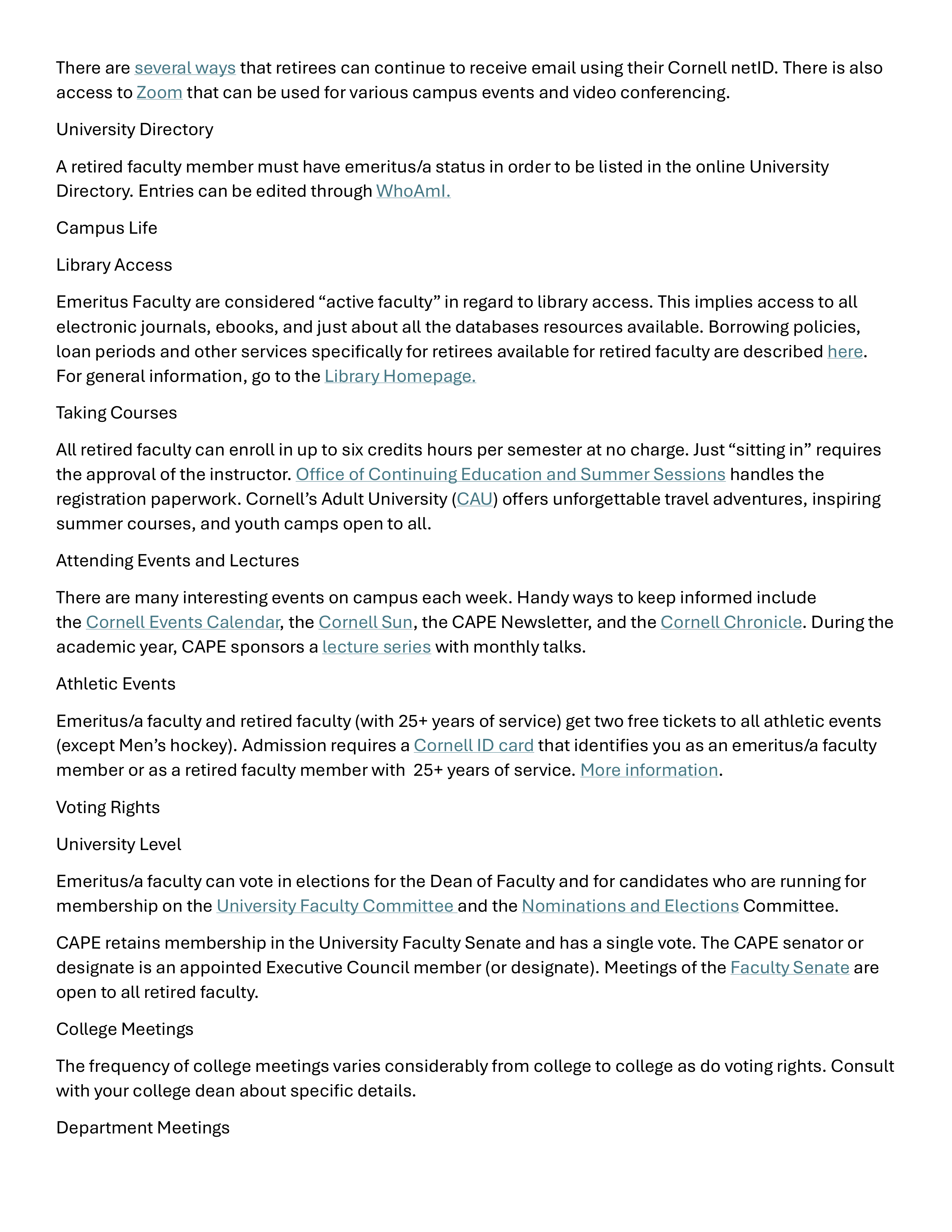
There are
several ways
that retirees can continue to receive email using their Cornell netID. There is also
access to
Zoom
that can be used for various campus events and video conferencing.
University Directory
A retired faculty member must have emeritus/a status in order to be listed in the online University
Directory. Entries can be edited through
WhoAmI.
Campus Life
Library Access
Emeritus Faculty are considered “active faculty” in regard to library access. This implies access to all
electronic journals, ebooks, and just about all the databases resources available. Borrowing policies,
loan periods and other services specifically for retirees available for retired faculty are described
here
.
For general information, go to the
Library Homepage.
Taking Courses
All retired faculty can enroll in up to six credits hours per semester at no charge. Just “sitting in” requires
the approval of the instructor.
Office of Continuing Education and Summer Sessions
handles the
registration paperwork. Cornell’s Adult University (
CAU
) offers unforgettable travel adventures, inspiring
summer courses, and youth camps open to all.
Attending Events and Lectures
There are many interesting events on campus each week. Handy ways to keep informed include
the
Cornell Events Calendar
, the
Cornell Sun
, the CAPE Newsletter, and the
Cornell Chronicle
. During the
academic year, CAPE sponsors a
lecture series
with monthly talks.
Athletic Events
Emeritus/a faculty and retired faculty (with 25+ years of service) get two free tickets to all athletic events
(except Men’s hockey). Admission requires a
Cornell ID card
that identifies you as an emeritus/a faculty
member or as a retired faculty member with 25+ years of service.
More information
.
Voting Rights
University Level
Emeritus/a faculty can vote in elections for the Dean of Faculty and for candidates who are running for
membership on the
University Faculty Committee
and the
Nominations and Elections
Committee.
CAPE retains membership in the University Faculty Senate and has a single vote. The CAPE senator or
designate is an appointed Executive Council member (or designate). Meetings of the
Faculty Senate
are
open to all retired faculty.
College Meetings
The frequency of college meetings varies considerably from college to college as do voting rights. Consult
with your college dean about specific details.
Department Meetings
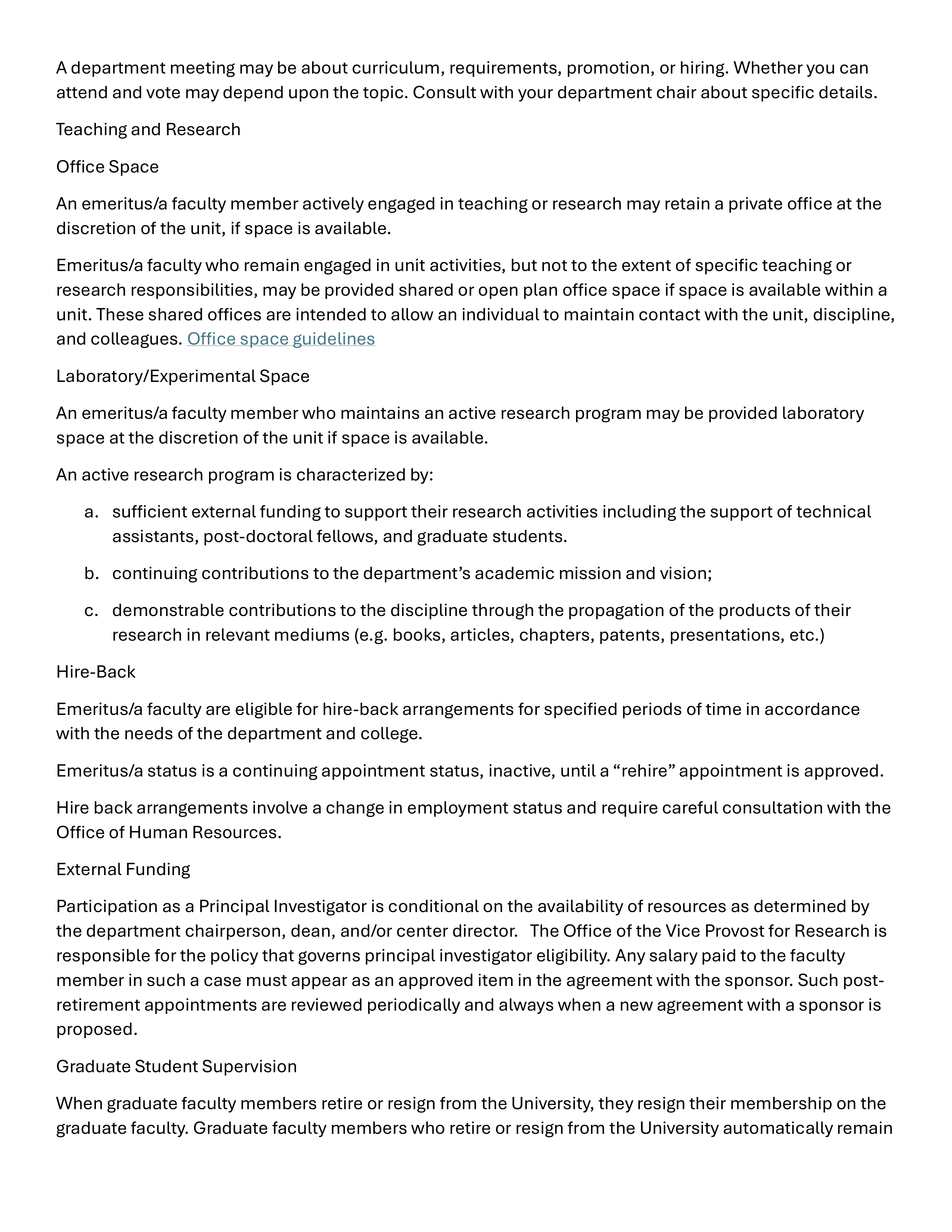
A department meeting may be about curriculum, requirements, promotion, or hiring. Whether you can
attend and vote may depend upon the topic. Consult with your department chair about specific details.
Teaching and Research
Office Space
An emeritus/a faculty member actively engaged in teaching or research may retain a private office at the
discretion of the unit, if space is available.
Emeritus/a faculty who remain engaged in unit activities, but not to the extent of specific teaching or
research responsibilities, may be provided shared or open plan office space if space is available within a
unit. These shared offices are intended to allow an individual to maintain contact with the unit, discipline,
and colleagues.
Office space guidelines
Laboratory/Experimental Space
An emeritus/a faculty member who maintains an active research program may be provided laboratory
space at the discretion of the unit if space is available.
An active research program is characterized by:
a.
sufficient external funding to support their research activities including the support of technical
assistants, post-doctoral fellows, and graduate students.
b.
continuing contributions to the department’s academic mission and vision;
c.
demonstrable contributions to the discipline through the propagation of the products of their
research in relevant mediums (e.g. books, articles, chapters, patents, presentations, etc.)
Hire-Back
Emeritus/a faculty are eligible for hire-back arrangements for specified periods of time in accordance
with the needs of the department and college.
Emeritus/a status is a continuing appointment status, inactive, until a “rehire” appointment is approved.
Hire back arrangements involve a change in employment status and require careful consultation with the
Office of Human Resources.
External Funding
Participation as a Principal Investigator is conditional on the availability of resources as determined by
the department chairperson, dean, and/or center director. The Office of the Vice Provost for Research is
responsible for the policy that governs principal investigator eligibility. Any salary paid to the faculty
member in such a case must appear as an approved item in the agreement with the sponsor. Such post-
retirement appointments are reviewed periodically and always when a new agreement with a sponsor is
proposed.
Graduate Student Supervision
When graduate faculty members retire or resign from the University, they resign their membership on the
graduate faculty. Graduate faculty members who retire or resign from the University automatically remain
on special committees on which they were serving at the time of retirement/resignation for up to one
year.
If the retired faculty member leaves the Ithaca or Geneva area and wishes to remain on a special
committee beyond one year, the student must petition to have the former graduate faculty member
appointed as co-chair or minor member. If a faculty member resigned from the university and wishes to
remain on a special committee beyond one year, the student must petition to have the former graduate
faculty member appointed as a co-chair or minor member.
Graduate School Professor
By vote of their graduate fields, emeritus/a faculty may be granted the title Graduate Professor of (Field).
This designation, which can be used on external grant and contract applications, enables an individual to
retain the rights of other graduate faculty in the field and to submit grant and contract applications that
provide up to 50 percent of the individual’s pre-retirement salary.
The General Committee of the Graduate School has approved this title for renewable five-year terms. A
Graduate School Professor may continue to serve either as chair or minor member of special committees
on which he or she was serving at the time of retirement. Otherwise, a Graduate School Professor may
serve only as minor member or co-chair, and only if he or she resides in the Ithaca area and the
committee includes a second or minor member in the student’s major field.
Details
.
Legal Defense and Indemnification
While retirement as an emeritus/a professor does not automatically confer coverage under the
University’s Legal Defense and Indemnification Policy, emeritus/a professors may be so covered if they
are performing services for the University at the prior written request of the dean of the college or director
of the division upon approval by the Provost, even if they receive no remuneration for such services.
Coverage would be with respect to claims that arise from authorized duties. To qualify, an individual must
also request such defense and/or indemnification and cooperate in the defense of any action or
proceeding as provided in the University’s Legal Defense and Indemnification Policy.
Formal policy.
Reimbursement for Professional Activity
Upon retirement, emeritus/a faculty members may receive up to $2,000 per year from their college for a
period of up to five years for reimbursement of professional activities. Colleges may have specific rules
about carrying forward unspent funds. There may also be a requirement about reporting how the funds
were utilized.
5.4 Cornell Academics and Professors Emeriti
Founded in 1982,
Cornell Academics & Professor’s Emeriti (CAPE)
has taken a leading role in fostering
social and professional community among retired faculty through varied programs and activities, such as
the Lecture Series, Roundtable luncheons, and volunteer programs to name a few.
5.5 Emeritus/a Status for Retiring RTE Faculty
Faculty who retire from certain RTE positions are eligible for emeritus/a status.
Process
In accordance with
Faculty Senate Resolution 141
and the Faculty Handbook’s corresponding addition of
Section 5.5, Emeritus/a Status for RTE Faculty Process, eligible individuals may request emeritus/a status
upon retirement if they have served Cornell for 10 or more years in the following
Research, Teaching,
and Extension (RTE)
faculty titles:
•
senior lecturer
•
senior research associate
•
senior extension associate
•
professor of the practice
•
associate professor of the practice
•
research professor
•
associate research professor
•
clinical professor
•
associate clinical professor
•
senior scientist
•
senior scholar
•
research scientist
•
principal research scientist
•
librarian
•
associate librarian
•
archivist
•
associate archivist
Eligibility for RTE emeritus status
is reserved for those who have served in a qualifying RTE title at
Cornell for 10 or more years and who retired from the university after June 30, 2020. The awarding of
emeritus/a status for eligible RTE faculty shall be based upon the career contributions of the candidate
through teaching, research, advising, administration, extension, and outreach. It is understood that only
a subset of these activities is relevant to a particular title. An overall record of meritorious service to the
university is expected.
Prior to the established retirement date, the candidate initiates the request in writing to their department
chair or unit head, to include the date of retirement and a request to be considered for either emeritus or
emerita status. An updated curriculum vita should accompany this request.
The university and RTE faculty in the candidate’s unit who have
University Voting Rights
should review the
case and vote, following the unit’s current established practice. The result of the vote and the department
chair or unit head’s recommendation to either approve or deny emeritus/a status is communicated to the
dean of the candidate’s college. The dean reviews the file and either approves or denies the request. For a
candidate whose appointment is outside of the colleges, the role of dean shall be played by the
appropriate vice provost or by the University Librarian if the candidate is appointed in the library.
If the dean approves the request, the unit is responsible for communicating the outcome to the faculty
member.
If either the department chair or unit head recommendation is negative, then the candidate is so
informed by the dean upon a negative decision the faculty member has the opportunity to respond in
writing to the dean and department chair with additional information within 90 days. The final decision to
approve emeritus/a status for retiring RTE faculty members is made by the dean, perhaps in consultation
with the department chair, dean of faculty, or others.
Upon final approval, a unit representative sends an email to
hrpayrollsupport@cornell.edu
with the RTE
faculty member’s name, title to be conveyed in retirement (please be sure to confirm the faculty
member’s preference for the use of emeritus or emerita), unit, department, and effective date of
emeritus/a status. Please also notify the Dean of Faculty and CAPE offices by
copying
deanoffaculty@cornell.edu
) on this email. The process is considered complete when the
Workday transaction has been processed by the HRIS team.
Administrative Notes
The Emeritus Process for Professors and Associate Professors remains unchanged.
Unlike emeritus status for tenured professors and associate professors, emeritus status for RTE faculty is
a recognition of distinguished service to the university only and does not confer benefits beyond what is
available to all retired academic titleholders.
Questions regarding this guidance can be directed to
acadhr@cornell.edu
6. Academic Policies and Responsibilities
6.1 Instruction
Building a Syllabus (i)
Syllabi serve as a formal communication tool, covering essential course elements such as modality,
learning objectives, materials, expectations, policies, and student support services. The
New York State
Education Department
and the
Center for Teaching Innovation
offer best practices for creating effective
syllabi.
Instructors are encouraged to
attach their syllabi to the Cornell Class Roster
, even in draft form, to
provide students with the prospective course experience and make informed registration decisions.
Additionally, the university-wide
Cornell Academic Materials Program (CAMP)
provides undergraduates
with access to required textbooks and coursepacks for a flat fee, regardless of their field of study.
Academic Year and Calendar
The university bylaws define the academic year as a roughly nine-month period, starting two working
days before fall term registration and ending with final examinations in the spring term. Summer spans
from the last day of one academic year to the first day of the subsequent academic year.
Faculty members, regardless of appointment length, are expected to be present throughout the
academic year, except for leaves of absence, holidays, and professional travel. Faculty members must
remain on campus until they submit grades for spring term courses. The provost, in consultation with
the
Student Assembly
and
Faculty Senate
, determines the academic calendar details, occasionally
introducing small variations announced in advance to the university community.
Academic Calendar
Meeting Time Patterns
The Office of the University Registrar oversees the
Courses of Study
catalog, which lists the current
standard class meeting patterns. Class meeting patterns are listed by duration and the number of times
the class meets per week: 50 Minutes, 75 Minutes, 115 Minutes, 150 Minutes, and 180 minutes.
Offering a course during a nonstandard meeting time requires approval (see Exceptions guidance below)
if the course is numbered 4999 or less or it is cross-listed with a course that is numbered 4999 or less or
co-meets with a course that is numbered 4999 or less. Approval is also required for Law School, Johnson
Graduate School of Management, or Veterinary College classes numbered 5000 or above that meet
between 7:30 am and 4:25 pm in buildings that are not part of their space. The granting of exceptions
partly depends upon the specific type of class and the
credit hour policy.
Exceptions
Instructors must work with their unit chairperson to make every effort within the academic unit to comply
with the above standard class meeting times. Only when local resolution proves impossible may the
faculty member request, in writing, an exception. The exception request must first be approved by the
unit associate dean, or an equivalent individual designated by the unit dean, who must then seek final
approval from the vice provost for undergraduate education.
The Free-Time Zone
The ‘free-time zone’ is a designated time that provides a reliable time for relaxation and extracurricular
activities. According to faculty legislation, the free-time zone spans Mondays through Thursdays from
4:25pm to 7:30pm, Fridays after 4:25pm, Saturdays after 12:05pm, and all-day Sunday. It is important
that the intent of the free-time-zone policy be respected during the process of course scheduling. For
that reason, the scope of teaching in the free-time zone will be reviewed annually by the Vice-Provost for
Undergraduate Education, the Dean of Faculty, and the University Registrar.rnrnCourses numbered 4999
or lower are considered ‘undergraduate-level,’ even if cross-listed with higher-numbered courses. All
other courses fall under the ‘graduate-level’ category. Graduate-level courses can meet during the free-
time zone unless they are cross-listed with or co-meet with undergraduate-level courses.
Scheduling a Classroom or Meeting Room
Student Attendance Responsibility
Students are expected to attend all course meetings throughout the term. While some courses enforce
penalties for absences, others focus on students’ responsibility for class material rather than physical
presence. Attendance rules are set by the unit or the instructor In cases of missed work, cooperation with
the instructor is essential for makeup opportunities because only the course instructor can grant an
exemption to a student. However, it may be particularly challenging to make up missed work for tests,
laboratory sessions, or field trips, as the instructor’s discretion plays a significant role.
Instructor Attendance Responsibility
Academic employees bear essential responsibilities, including teaching, advising, and research
mentorship, and scholarship. In cases of unforeseen absence (due to illness, transportation issues, or
emergencies), course instructors should arrange for substitutes or inform students and others
dependent on their presence. For planned absences, provisions must be made to fulfill academic
obligations, with communication to affected parties. When makeup classes are scheduled outside
regular hours, instructors should consider potential conflicts for students. If, in attempting to avoid such
conflicts, the instructor arranges to have the class taken by a substitute, that person must maintain
continuity and coherence in their presentations as well as the level of presentation provided by the
regular instructor. For these and other reasons, the missing of classes should be held to a minimum, and
assignments of makeup classes and coaching of a substitute should be done with care. Having such
plans approved by the unit chairperson is advised.
Graded Academic Coursework During Breaks
In 2023, the Faculty Senate enacted a policy
prohibiting faculty from assigning graded academic
coursework during scheduled breaks. Consequently, faculty cannot administer graded exams or quizzes,
conduct in-class graded assignments, or set due dates for graded assignments immediately after a
break. This measure aims to reduce the demand on students’ time during their breaks.
Guidelines for Staff Instructors
If a course is offered for credit, then the instructor of record is the individual who assigns the final course
grade. The instructor of record must be an academic titleholder if the course is numbered 4999 or lower.
An individual who is not an academic titleholder can serve as the instructor of record if the course is
numbered 5000 or higher and is not a requirement for any degree program affiliated with the sponsoring
unit. Co-teaching with an academic titleholder is always allowed provided the academic titleholder
serves as the instructor of record.
Tutoring
No member of the instructional staff, including assistants, may engage for profit or gain in tutoring a
student in a university course taught by himself or herself or by colleagues in the same unit. University
buildings or equipment are not to be used by any member of the instructional staff for tutoring for profit.
Academic Integrity
Cornell University places a strong emphasis
academic integrity
, expecting unwavering honesty from its
students. It is a shared responsibility where both students and faculty play a role in maintaining these
values. Whether in formal coursework or any other educational context, students must: acknowledge any
outside assistance received for all academic endeavors; respect the intellectual efforts of themselves
and others, which is undermined by plagiarism and cheating; respect the fact that academic integrity
extends beyond the classroom to all interactions related to the educational process. By submitting work
for academic credit, students truthfully affirm that it is their own.
Use of Plagiarism-Detection Software
Plagiarism-detection software, like
Turnitin,
is activated by default in all Canvas courses. It scans student
submissions for matched text by comparing the work to a large database of other student submissions,
publications, and materials on the internet. Instructors who use or anticipate using plagiarism-detection
software must provide notice to students. This notice should be included in the course syllabus. If
plagiarism-detection software is instituted after the syllabus is distributed, faculty should provide written
notice at that time. For example: “Students agree that by taking this course, all required papers may be
subject to submission for textual similarity review to plagiarism-detection software. All submitted papers
will be submitted as source documents solely for the purpose of detecting plagiarism of such papers.
Use of such services is subject to their Usage Policy.”
Tech Use in Classrooms
The course instructor has the authority to decide the technology use policy, which should be included in
the syllabus and communicate it to students on the first day of class. However, accommodations must
be provided for students with disabilities.
Course Material Protections
Some students buy and sell course materials online, including exams and exam answers, lecture notes,
problem sets and answers, and student papers. Commercial vendors have been known to falsely tell
students that instructors have approved the sale of course materials and then post them online for
resale. Some Cornell students have engaged in ‘contract cheating,’ subscribing to study sites like Chegg,
CourseHero, and Slader to obtain answers for exams and assignments and then submitted them as their
own work. Such behavior constitutes “Unauthorized Assistance” under the
Code of Academic Integrity.
Online learning management systems, like Blackboard and Canvas, emphasize that course materials
posted there are intellectual property belonging to the author, and students are not allowed to buy or sell
them without the instructor’s express permission. To discourage such behavior, course instructors are
encouraged to explicitly prohibit buying and selling course materials in their syllabi. Additionally,
including a copyright notice on any course materials that you author, including class notes and exams,
helps protect against unauthorized distribution. If students were to remove a copyright notice, that
behavior would create a higher level of culpability. Such a notice would also make it easier for you to take
down materials from commercial sites. Under the Digital Millennium Copyright Act (DMCA), to have
materials removed from a web site, the copyright holder must personally request the removal. Although
student-produced course materials, like lecture notes, are owned by the student, course instructors can
still set conditions on their use. For instance, they may prohibit distributing notes derived from their
lectures on internet sites, such as recommended above. Original course materials are copyrighted
intellectual property of the creator of the content and are not a student’s property to share, distribute, or
sell; sharing or selling course materials or lecture content, even a student’s own class notes, without
authorization, is subject to a charge of “Classroom Misconduct” and possibly copyright infringement.
Instructions on how to locate and request removal of copyrighted course materials sold on Internet sites.
Accommodations
Instructors play a crucial role in ensuring equal opportunities for students with disabilities. Under Federal
law, disabilities such as learning disabilities, certain physical and mental health conditions, vision and
hearing impairments, and traumatic brain injuries qualify for accommodations. Students with
documented needs are entitled to appropriate access accommodations.
Student Disability Services
collaborates closely with students to determine eligibility and provide
necessary accommodations for each course. Faculty should provide the accommodations specified in
the accommodation notification letter prepared by Student Disability Services. Student Disability
Services also supports faculty. Instructors should promptly discuss modifications with Student Disability
Services if an approved accommodation would significantly alter the course’s structure or essential
requirements.
Additional accommodation resources are provided by other entities on campus, such as the
center for
teaching innovation
,
Cornell Office of Civil Rights
,
student campus life
, and the
student-athlete
handbook
.
Close all
Title IX Accommodations
Harassment, Discrimination, Bias Reporting
Through
Cornell University Policy 6.4,
the university provides means to address bias, discrimination,
harassment, and sexual and related misconduct, including gender-based harassment, sexual
harassment, sexual assault, domestic and dating violence, stalking, and sexual exploitation. In
accordance with federal and state law, Cornell offers a range of resources, support services, and
measures to protect the safety and well-being members of the community and to promote an accessible
educational environment.
Some such measures are
measures
, which may include academic accommodations or no-contact
orders and may be issued based upon a party’s request or at the University’s own initiative. In all
instances, the University will, at its discretion, determine whether any given Interim Measure is
reasonable and appropriate. Typically the Title IX Office works with the associate dean of the school, who
will then work with the faculty member, when an accommodation pursuant to Policy 6.4 is requested.
Health-Related Accommodations
Cornell Health does not provide excuses for routine illnesses, injuries, and mental health problems that
may lead to missed classes, labs, studios, exams, or deadline. This longstanding policy resembles those
of most other major universities and is consistent with the recommendations of the American College
Health Association. The University expects students to be honest with their professors regarding their
ability to complete work and that they communicate any accommodations request in a timely fashion.
Professors are expected to work with students on these issues. Academic advising staff and associate
deans are available to provide assistance to students or faculty members who have concerns about
attendance issues.
Religious-Observance Accommodations
Instructional staff are required by New York State law to accommodate students when religious
observance conflicts with exam-taking, class attendance, and other course-related requirements:
“3. It shall be the responsibility of the faculty and of the administrative officials of each institution of
higher education to make available to each student who is absent from school, because of his or her
religious beliefs, an equivalent opportunity to . . . make up any examination, study or work requirements
which he or she may have missed because of such absence on any particular day or days.
“4. If . . . classes, examinations, study or work requirements are held on Friday after four o’clock post
meridian or on Saturday, similar or makeup classes, examinations, study or work requirements . . . shall
be made available on other days, where it is possible and practicable to do so. . . .”
The
Office of Spirituality and Meaning Making
maintains a comprehensive
accommodation
website that
is an extremely valuable resource for both students and faculty. Many students are unaware that steps
can be taken so that they can be committed to both their faith and their studies. Some are aware but
hesitant to seek an accommodation because they fear retribution once their faith is revealed. These
realities make it all the more important to communicate accommodation mechanisms early in the term,
preferably via a published syllabus. The sensitive handling of a religious-observance accommodation
sends a positive message to the student because it reaffirms Cornell’s commitment to diversity of
thought. This
calendar of religious holidays
should be consulted before scheduling due dates and exams.
Varsity Athlete Accommodations
At Cornell University, varsity athletics are an integral part of the undergraduate educational experience.
Instructors are encouraged to recognize the value of learning that occurs outside the classroom through
athletic participation. When conflicts arise between student-athletes’ athletic schedules and course
requirements, instructors are expected to find ways to accommodate them. Student-athletes are
responsible for notifying their instructors in advance of any class days they will miss due to university-
approved athletic events.
The Ivy League holds student-athletes to high standards, overseen by the
Faculty Committee on Athletics
and Physical Education (FACAPE)
and outlined in the
Student-Athlete Handbook
. FACAPE approves each
team’s competition schedule to minimize absences. Unforeseen changes are communicated by the
Department of Athletics & Physical Education. The
FACAPE Missed Class Time Policy
helps assure that
athletic obligations are kept in appropriate context with academic standards and expectations of our
institution.
Ultimately, it is the responsibility of varsity athletes to arrange makeup assignments or requirements with
their instructors. Instructors who have concerns about a particular varsity athlete accommodation
request should contact the FACAPE Chair or the Dean of Faculty.
Military Service
Reservists and active-duty students may be called away to complete mandatory military service for
varying lengths of time. In such cases Federal and State Law requires that steps be taken to ensure
readmission to the student’s educational program. The instructor should work with the student and
others to ensure that the return to school is as smooth as possible.
Long Term Health Accommodations
When a student is hospitalized or has a serious, ongoing illness or injury, and with the student’s consent,
Cornell Health will contact Cornell’s Crisis Manager to coordinate communication with the student’s
college. If the student, with their medical or mental health clinician, believes that providing information
about a significant, ongoing health problem (not a short-term illness) could facilitate appropriate
academic accommodations, Cornell Health will, at the student’s request and with the student’s
permission, communicate with the college’s academic advising office and/or Student Disability Services.
Other Accommodations
Other types of accommodation requests are approved at the discretion of the instructor. Overall fairness,
educational value, and responsibilities to family are among the factors that can be taken into account. In
a timely fashion, students are expected to provide enough detail about their request for an
accommodation so that the instructor can make an informed and respectful decision.
Grading Policies
In May 1965, the University Faculty adopted the
Cornell University Grading System
. The official University
grading system is composed of letter grades with pluses and minuses. Passing grades range from A+ to
D–; F is failing. INC denotes a grade of incomplete, NG denotes a non-graded course, NGR signifies no
grade reported, and R is the grade given a for an in-progress multi-semester course.
Letter grade values are combined with course credit hours to produce an average based on a 4.3 scale.
Grade point average is calculated by multiplying the credit hour and quality point equivalent for each
course and then dividing by the total number of credits taken. The cumulative average is the sum of the
products of all the grades at Cornell divided by the total number of credits taken.
Alongside the letter grade system stands an SU System, in which S means satisfactory, as defined by
performance that would be graded C- or higher, and U means unsatisfactory, as defined by performance
that would be graded below C-. Grades of S and U are not given grade point values or taken into account
in computing grade point averages. The purpose of the S
-
U System is to encourage students to venture
into courses outside their main areas of familiarity without great risk to their academic record. Credits
toward the fulfillment of graduation requirements are earned for courses evaluated S but not for those
graded U. The various schools and colleges differ in the restrictions they place on the election of S/U
grading over letter grading. But where college rules and course procedures allow it, the election is a
student option that must be exercised within the drop period for the course. Students may not defer the
decision in the hope of first seeing the letter grade they are likely to earn.
Close all
Incompletes
The symbol of Incomplete is only appropriate when two basic conditions are met: (1) The student has
substantial equity at a passing level in the course with respect to work completed; and (2) the student
has been prevented by circumstances beyond a student’s control, such as illness or family emergency,
from completing all of the course requirements on time.rnrnAn Incomplete may not be given merely
because a student fails to complete all course requirements on time. Such a practice would be open to
abuse; by deferring completion of some major course requirement, a student could gain advantage over
his or her classmates by obtaining additional time to do a superior job. This is not an option that may be
elected at the student’s own discretion.rnrnWhile it is the student’s responsibility to initiate a request for
an Incomplete, reasons for requesting an Incomplete must be acceptable to the instructor, who
establishes specific makeup requirements. An Incomplete allows a specified amount of time determined
by the student’s college of registry, for completing course work. The instructor has the option of setting a
shorter time limit than that allowed by the student’s college. Instructors under no circumstances should
give an Incomplete due to pressure to meet the deadline for reporting grades.rnrnSeveral colleges require
that a statement signed by the instructor be on file indicating the reason for the Incomplete and the
restriction, if any. The consequences of failure to complete all course work within the time permitted will
depend upon the policy of the students college of registry. Some colleges convert the Incomplete symbol
to a grade of F; others let the Incomplete stand on the student’s transcript. In either case, the option to
make up the work is lost. It is the responsibility of the student to see that all Incompletes are made up
within the deadline and that the grade change has been properly recorded with the student’s college
registrar.
Late Grades
Late grades should be avoided. They often result in unwarranted academic actions or even in students
not being able to graduate on time.
Posting of Grades
Posting of student grades by name or a personally identifiable number is prohibited under the terms of
the
Family Educational Rights and Privacy Act of 1974 (FERPA)
. However, a student waiver authorizing
disclosure of educational records by means of a personally identifiable number (e.g. a student ID
number) is acceptable provided that such consent is in writing, dated and signed by the student.
[NOTE: A name or social security number must never be used for this purpose.] If instructors use this
method, the waiver must be for a specific course; must be for a specified period of time (semester,
academic year, etc.); must specify the records to be disclosed; and must be retained by the instructor of
the course for a period of one year after its expiration. Students should not be coerced into signing a
waiver, as the law requires that it be voluntarily given. Instructors may post grades for students who do
not want their student ID number used by establishing a unique identifier known only to that student and
the instructor.
Grade Changes
Each semester’s work is an entity and grades are to be assigned for work completed during the normal
period of the semester. As a matter of equity, grades must not be changed after the end of a semester
because a student may have subsequently done additional work.
Only the instructor of the course has the responsibility and authority to judge the quality of a students
work and assess the appropriate letter grade. No one can overrule instructors and require them to go
against their judgment of the work.
A grade must not be arbitrary or capricious or influenced by illegal discriminatory considerations. It must
not contain a punitive element for an offense against academic integrity if the student has been found
innocent by a duly constituted board.
To avoid the influencing of grades by improper consideration or student pressure, a grade, once given,
may only be changed if an error in the original grade is claimed by the instructor. The instructor should be
willing to review the basis of an assigned grade with an inquiring student and correct the grade if an error
is found.
After a letter, incomplete, or S/U grade issued by an instructor of record to a student in a course has been
posted to the student’s transcript, on rare occasions a college will have reason to consider removing the
grade from the student’s transcript and replacing it with a course withdrawal (W) or expunging the
student’s course enrollment altogether.
When such a transcript change is necessitated by circumstances involving Cornell Health, the Cornell
Office of Civil Rights, or the Office of University Counsel, the student’s privacy interest limits the
information that college officials may share with the instructor. In such cases, the college associate
dean for academic affairs (or equivalent position) will inform the instructor of the impending transcript
change before it is made and explain to the instructor that the action was warranted due to a matter
involving one of the three offices named above, and that university protocols, including appropriate
consultation, were followed.
In cases not involving these three offices, where a retroactive transcript change is under consideration,
the college associate dean for academic affairs (or equivalent) must inform the instructor of the reasons
for making the change and obtain the instructor’s approval before making it.
If the instructor of record is no longer employed by the university, then the head of the unit offering the
course is the appropriate contact.
Any individual who believes that a grade change has been made improperly may communicate their
concerns to the proper authorities via the Cornell Hotline. Instructors also have the option of sharing a
grade-change concern with the Dean of Faculty.
Evening Preliminary Exam (Prelim) Policy
Preliminary examinations (“prelims”) are mid-semester exams typically held during regularly scheduled
class meeting times, in regularly scheduled classrooms. Evening prelim examinations may be given on
Tuesday and Thursday evenings after 7:30 p.m. Large courses (over 30) may schedule evening exams only
with prior permission from the Office of the Dean of Faculty. No permission is required for examinations
or make-up examinations involving small numbers of students (under 30) if given on Tuesday and
Thursday.
Exceptions
Permission from the Office of the Dean of Faculty to schedule examinations on evenings other than
Tuesdays or Thursdays or at a time prior to 7:30 p.m. will be granted only on the following conditions:
•
Conditions such as the nature of the examination, room availability, large number of conflicts, etc.
justify such scheduling.
•
An alternate time to take the exam must be provided for those students who have academic,
extracurricular or employment conflicts at the time scheduled.
If there is a conflict between an examination listed on the schedule developed at the annual evening
prelim scheduling meeting and an examination not on the schedule, the examination on the schedule
shall have priority. The course not on the schedule provide an alternate time to take the examination for
those students faced with the conflict. If a student has conflicting examination schedules, both of which
are on the schedule developed at the annual evening prelim scheduling meeting or both of which are not
on the schedule, the instructors of the courses involved must consult and agree on how to resolve the
conflict. Both instructors must approach this resolution process with a willingness to provide an
alternative or early examination.
Courses utilizing evening examinations should indicate this in the course description listed in Courses of
Study, The Course and Time Roster, and The Course and Room Roster and must notify students of the
dates of such examinations as early as possible in the semester, preferably when the course outline is
distributed.
Using Tech During Exams
The Code of Academic Integrity
specifies that no student may use, give, or receive any assistance or
information not given in the examination or by the proctor. Access to technology poses new challenges in
this regard making it necessary to clarify the authority of proctors and instructors:
•
Unless the instructor or Student Disability Services grants an explicit exception, students may not
handle or access technology at any time during an exam.
•
During an exam all such technology shall be turned off or disabled and placed out of sight if so
requested by the proctor.
•
All watches provided by the student shall be placed out of sight if so requested by the proctor and
the time is publicly posted or announced.
•
All writing instruments provided by the student can be disallowed if alternative writing instruments
are supplied by the proctor.
Final Exam Policy
Final Exam Policy – Faculty Senate Resolution 65
Advances in pedagogy and variations in practice across fields have broadened the range of commonly
used end
-
of
-
semester evaluative exercises beyond traditional sit
-
down final examinations. The rules and
guidelines that follow aim to protect students from unreasonable demands on their time while
simultaneously providing instructors the flexibility necessary to design evaluative exercises appropriate
to their courses.
The Academic Calendar sets aside, after the last week of classes, a brief study period followed by a
period for final examinations. The Registrar’s Office assigns to every course a specific day and time
during final
-
examination period at which time the course’s final exam, if any, will take place. The
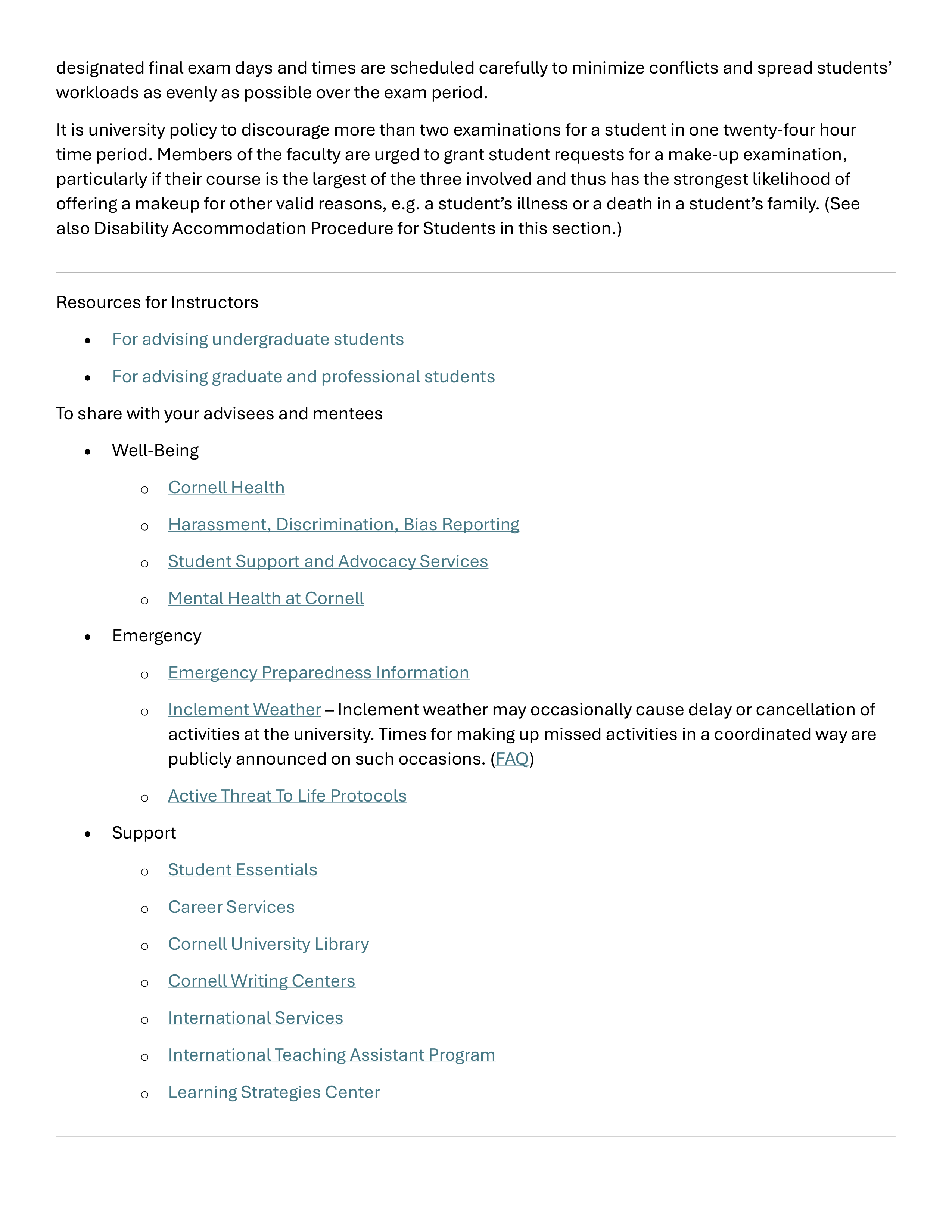
designated final exam days and times are scheduled carefully to minimize conflicts and spread students’
workloads as evenly as possible over the exam period.
It is university policy to discourage more than two examinations for a student in one twenty
-
four hour
time period. Members of the faculty are urged to grant student requests for a make
-
up examination,
particularly if their course is the largest of the three involved and thus has the strongest likelihood of
offering a makeup for other valid reasons, e.g. a student’s illness or a death in a student’s family. (See
also Disability Accommodation Procedure for Students in this section.)
Resources for Instructors
•
For advising undergraduate students
•
For advising graduate and professional students
To share with your advisees and mentees
•
Well-Being
o
Cornell Health
o
Harassment, Discrimination, Bias Reporting
o
Student Support and Advocacy Services
o
Mental Health at Cornell
•
Emergency
o
Emergency Preparedness Information
o
Inclement Weather
– Inclement weather may occasionally cause delay or cancellation of
activities at the university. Times for making up missed activities in a coordinated way are
publicly announced on such occasions. (
FAQ
)
o
Active Threat To Life Protocols
•
Support
o
Student Essentials
o
Career Services
o
Cornell University Library
o
Cornell Writing Centers
o
International Services
o
International Teaching Assistant Program
o
Learning Strategies Center
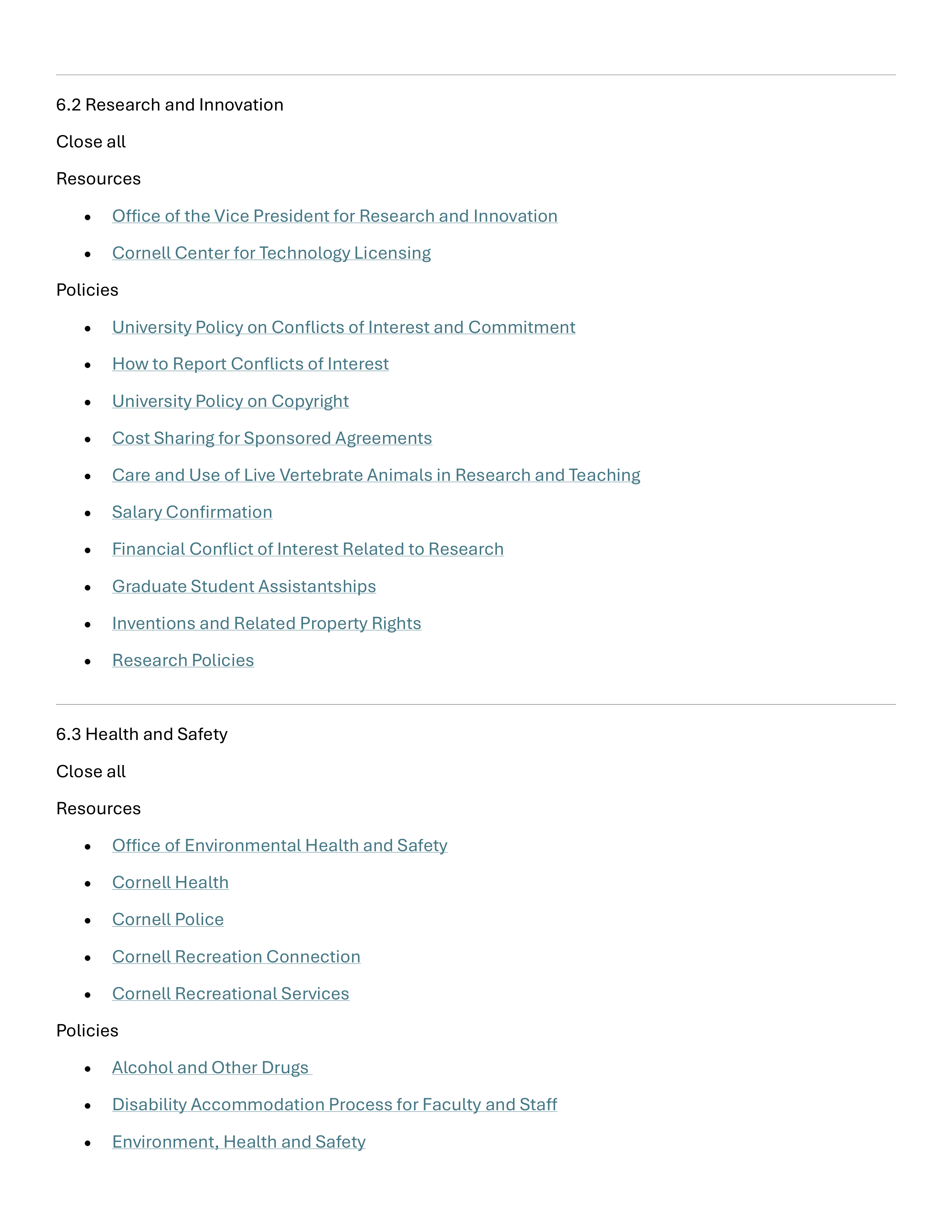
6.2 Research and Innovation
Close all
Resources
•
Office of the Vice President for Research and Innovation
•
Cornell Center for Technology Licensing
Policies
•
University Policy on Conflicts of Interest and Commitment
•
How to Report Conflicts of Interest
•
University Policy on Copyright
•
Cost Sharing for Sponsored Agreements
•
Care and Use of Live Vertebrate Animals in Research and Teaching
•
Salary Confirmation
•
Financial Conflict of Interest Related to Research
•
Graduate Student Assistantships
•
Inventions and Related Property Rights
•
Research Policies
6.3 Health and Safety
Close all
Resources
•
Office of Environmental Health and Safety
•
Cornell Health
•
Cornell Police
•
Cornell Recreation Connection
•
Cornell Recreational Services
Policies
•
Alcohol and Other Drugs
•
Disability Accommodation Process for Faculty and Staff
•
Environment, Health and Safety
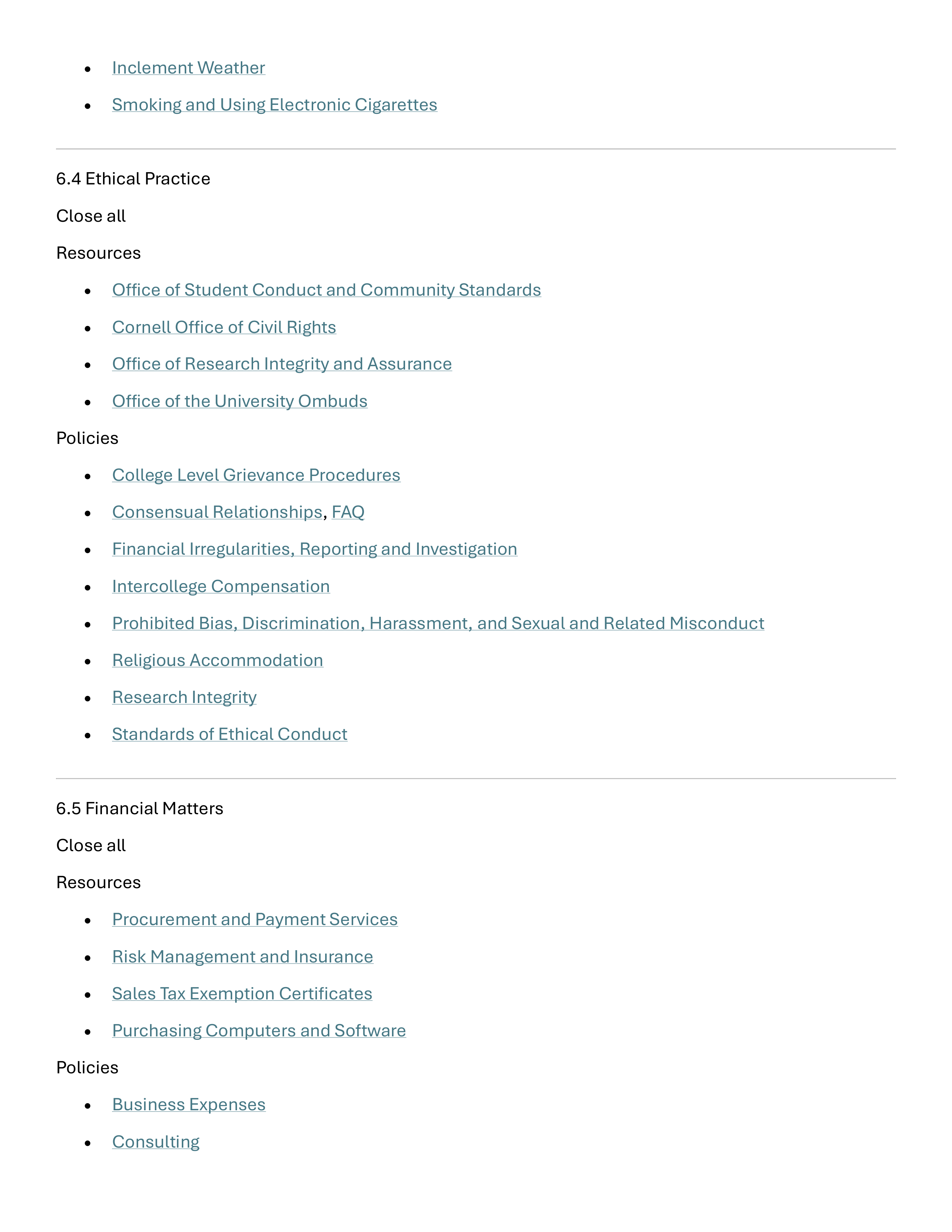
•
Inclement Weather
•
Smoking and Using Electronic Cigarettes
6.4 Ethical Practice
Close all
Resources
•
Office of Student Conduct and Community Standards
•
Cornell Office of Civil Rights
•
Office of Research Integrity and Assurance
•
Office of the University Ombuds
Policies
•
College Level Grievance Procedures
•
Consensual Relationships
,
FAQ
•
Financial Irregularities, Reporting and Investigation
•
Intercollege Compensation
•
Prohibited Bias, Discrimination, Harassment, and Sexual and Related Misconduct
•
Religious Accommodation
•
Research Integrity
•
Standards of Ethical Conduct
6.5 Financial Matters
Close all
Resources
•
Procurement and Payment Services
•
Risk Management and Insurance
•
Sales Tax Exemption Certificates
•
Purchasing Computers and Software
Policies
•
Business Expenses
•
Consulting
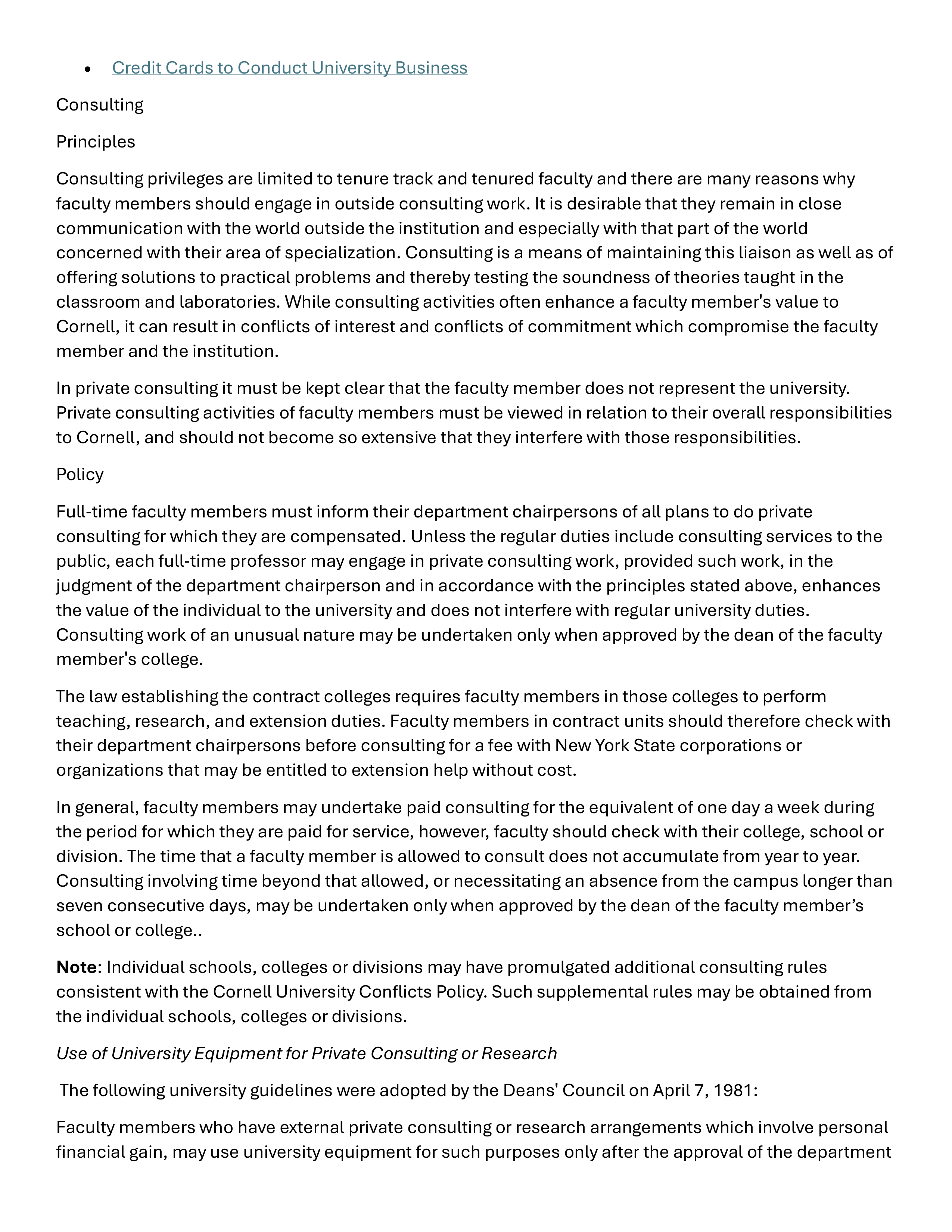
•
Credit Cards to Conduct University Business
Consulting
Principles
Consulting privileges are limited to tenure track and tenured faculty and there are many reasons why
faculty members should engage in outside consulting work. It is desirable that they remain in close
communication with the world outside the institution and especially with that part of the world
concerned with their area of specialization. Consulting is a means of maintaining this liaison as well as of
offering solutions to practical problems and thereby testing the soundness of theories taught in the
classroom and laboratories. While consulting activities often enhance a faculty member
ʹ
s value to
Cornell, it can result in conflicts of interest and conflicts of commitment which compromise the faculty
member and the institution.
In private consulting it must be kept clear that the faculty member does not represent the university.
Private consulting activities of faculty members must be viewed in relation to their overall responsibilities
to Cornell, and should not become so extensive that they interfere with those responsibilities.
Policy
Full
-
time faculty members must inform their department chairpersons of all plans to do private
consulting for which they are compensated. Unless the regular duties include consulting services to the
public, each full
-
time professor may engage in private consulting work, provided such work, in the
judgment of the department chairperson and in accordance with the principles stated above, enhances
the value of the individual to the university and does not interfere with regular university duties.
Consulting work of an unusual nature may be undertaken only when approved by the dean of the faculty
member
ʹ
s college.
The law establishing the contract colleges requires faculty members in those colleges to perform
teaching, research, and extension duties. Faculty members in contract units should therefore check with
their department chairpersons before consulting for a fee with New York State corporations or
organizations that may be entitled to extension help without cost.
In general, faculty members may undertake paid consulting for the equivalent of one day a week during
the period for which they are paid for service, however, faculty should check with their college, school or
division. The time that a faculty member is allowed to consult does not accumulate from year to year.
Consulting involving time beyond that allowed, or necessitating an absence from the campus longer than
seven consecutive days, may be undertaken only when approved by the dean of the faculty member’s
school or college..
Note
: Individual schools, colleges or divisions may have promulgated additional consulting rules
consistent with the Cornell University Conflicts Policy. Such supplemental rules may be obtained from
the individual schools, colleges or divisions.
Use of University Equipment for Private Consulting or Research
The following university guidelines were adopted by the Deans
ʹ
Council on April 7, 1981:
Faculty members who have external private consulting or research arrangements which involve personal
financial gain, may use university equipment for such purposes only after the approval of the department
chairperson, director, or dean. Approval will be contingent on the establishment of a service charge by
the unit providing the service where such a charge is appropriate. If such charges are on a continuing
basis, they should be discussed with the Controller
ʹ
s Office.
6.6 Separation
Dismissal or Suspension
University bylaws (Article XVI(7) provide that “all appointments to the staff of instruction and research
which are funded from non-university sources (e.g. federal or state appropriations, research or other
service contracts or grants) shall be subject to modification or termination in the event that such funding
shall cease to be available to the university for such purposes.”
Article XVI, Section 10, of the bylaws states:
“The Board shall have the right to dismiss and terminate the appointment of any member of the staff of
instruction and research for failure to perform the duties required of the position which he holds or for
such personal misfeasance or nonfeasance as shall make him unfit to participate in the relationship of
teacher and student. Such dismissal shall be effected through such procedures as the Board may adopt.
Such procedures shall provide for reasonable notice and an opportunity to be heard.”
The Board of Trustees and the University Faculty adopted a dismissal procedure for faculty members in
1951. Subsequently, the University Faculty Senate and the Board of Trustees adopted the following
dismissal/suspension procedure in 2007.
The university reserves the right to dismiss and discontinue, or to suspend, the appointment of any
member of its faculties, on reasonable notice and after giving such member an opportunity to be heard,
for misconduct or failure to perform the duties required of the position he or she holds.
In the case of a university professor, professor, associate professor, or assistant professor the following
procedure shall be adopted to govern dismissal or suspension for the period of one semester or more:
A.
When complaint from any source is made against a university professor, a professor, an associate
professor, or an assistant professor which might lead to his or her dismissal or to suspension for
the period of one semester or more, the dean of his or her college, or in the case of a university
professor the dean of the University Faculty, shall inform the faculty member of the complaint
against him or her, investigate the case, and if the faculty member is willing, consult with him or
her regarding it. The dean shall thereafter report to the provost the results of the investigation
together with his or her recommendations. The provost shall cause the faculty member to be
furnished with a written and detailed statement of the charges against him or her and the
suggested disciplinary action if, after receiving the dean’s report and making such independent
investigation as may seem appropriate to the provost, it is the opinion of the provost that further
proceedings are warranted.
B.
If the faculty member desires a hearing, he or she shall so request in writing to the provost within
thirty days of the receipt of the written charges against him or her, and he or she shall then be
entitled to a hearing before a board appointed by the provost and consisting of five members of
the University Faculty, of whom two shall be selected by the faculty member, two by the provost
and the fifth by the other four.
C.
At such hearing the faculty member shall be entitled to be accompanied by an advisor or counsel
of his or her own choice, to present witnesses in his or her own behalf and to confront and
question the witnesses against him or her. If the faculty member so requests before or at the
opening of the hearing, he or she shall after its conclusion, be furnished, without cost to him or
her, a full report of the proceedings before the board, including the testimony taken, the evidence
received, and the board’s findings and recommendations. The board shall submit to the president
a report of its findings and recommendations. If suspension is recommended, the president’s
decision shall be final; and if dismissal is recommended, this report shall be appended by the
president to any recommendations he or she may make to the Board of Trustees in regard to the
case.
D.
If dismissal is recommended, the faculty member shall be free to resign at any time within thirty
days of receipt of the written charges against him or her; but if he or she has neither requested a
hearing nor resigned within such thirty days, the Board of Trustees shall be free to dismiss him or
her without further notice or hearing. If suspension is recommended and the faculty member fails
to request a hearing within the thirty-day period described in paragraph B above, the suspension
shall be implemented as recommended.
E.
In the case of suspension of less than one semester, or suspensions of any length of faculty other
than university professor, professor, associate professor or assistant professor, a dean’s
determination to suspend a faculty member shall be subject to existing grievance procedures. In
cases where the Faculty Committee on Academic Freedom and the Professional Status of the
Faculty is the final step in the grievance procedure, the Faculty Committee will submit a report of
its findings and recommendations to the Provost. If suspension is recommended, the president’s
decision shall be final.
For purposes of this dismissal and suspension procedure, the following definitions shall pertain:
“Provost” refers to the provost or the provost for medical affairs, as appropriate. However, in the event the
provost for medical affairs serves simultaneously as the dean of the college in which the case arises, the
president shall receive and review the dean’s report and make the appropriate judgment about further
proceedings.
“Suspend” or “suspension” means a temporary abrogation of the faculty member’s rights or
responsibilities that effectively prevents the faculty member from carrying out the responsibilities of his
or her position or a temporary partial or temporary full reduction of a faculty member’s salary, whether or
not it is named as a suspension. A non-disciplinary reduction of salary such as a non-temporary
reduction of salary that may be implemented at the time of an annual salary review, or a non-disciplinary
reassignment of duties at an appropriate time in the academic calendar shall not be considered a
suspension. The period of a suspension shall be no less than two weeks and no more than two
semesters. Except for an emergency suspension, the imposition of any suspension shall be deferred
pending the conclusion of the internal review process.
“Emergency suspension” refers to the suspension by the president or his designee with full salary
pending the ultimate determination of the faculty member’s case where the faculty member is charged
with misconduct and his or her continuance threatens imminent, serious harm to the member, to others,
or to property. The scope and duration of the emergency suspension shall be tailored as narrowly as
possible to the nature of the harm posed, so that the faculty member’s rights and privileges are not
summarily abrogated more broadly than is reasonably necessary to protect persons or property pending
completion of the suspension procedures
.
“Faculty” refers to full-time faculty members as described in the University Bylaws
.
Resignation
Resignation by an academic employee, whether tenured or on a term appointment, is normally effective
at the end of an academic term or on June 30 or December 31 for those on 12-month appointments. To
allow the academic unit to prepare for the loss of the staff member, the employee should notify the
department chairperson or the director of the unit of the intended resignation as early as possible.
Because academic policy prohibits pay for accrued vacation after the termination date of a resigned
appointment (except when electing formal retirement or upon resignation for librarians and archivists),
discussions with the chair or director should include any proposed use of vacation accrual. A minimum
of a month’s notice of resignation is required from the academic employee.
In some cases, when a valued member of the faculty is to leave the university, arrangements are made for
a leave of absence rather than a resignation, in the hope that the person will return to Cornell. Such
arrangements for up to one year require the approval of the department chair or director and the dean or
vice provost. For those with joint appointments or other concurrent appointments, the approvals must be
obtained from all of the relevant units and executives. To extend leave beyond one year requires approval
of the provost through the Office of Workforce Policy and Labor Relations. The leave should not, in any
event, exceed more than one year from the date a tenured Cornell professor assumes a tenured
appointment at another institution. In this situation, the department cannot recruit a permanent
replacement, and a vacant formal position (including appropriate tenure status) with its budgetary
commitment, must be reserved in case the person does return.
Those considering resignation or retirement for medical reasons should consult the online policy
Leaves
for Professors and Academic Staff
for information about short-term medical leave and federal
entitlements under the Family and Medical Leave Act, as well as consulting Benefit Services in the
university’s Office of Human Resources regarding such options as long-term disability and its interface
with retirement and social security benefits. All faculty may wish to consult with the Cornell Association
of Professors
Emeriti
(
CAPE
).
6.7 Travel
Close all
Resources
•
Campus-To-Campus Bus Service
•
Travel Services
Policies
•
Risk Management for International Travel
•
Travel Expenses
6.8 Information and Communication
Close all
Resources
•
Brand Center
•
CUinfo
•
Events Calendar
•
Visitor Relations
•
Information Technologies
•
Media Resources
•
Mail Services
•
Red Runner Courier Services
•
University Relations
Policies
•
Use of Cornell’s Name, Logos, Trademarks, and Insignias
•
University Social Media Accounts
•
Recording and Registration of Domain Names
•
Personal and Private Activity Using University Property and Facilities
•
Responsible Use of Information Technology Resources
•
Mobile Communication Devices
6.9 Graduation
Commencement
Commencement planning resources are housed on the website of the
Office of Commencement Events
.
Degrees and University Requirements
The establishment or discontinuance of degrees conferred by the university is a responsibility of the
Board of Trustees. The board acts on recommendations of the Faculty, which, in turn, makes its
recommendations with the approval of the school or college concerned. The requirements for the various
degrees offered are determined by the individual school and college faculties. The Faculty has
established two universal requirements for all undergraduate degree candidates: the swim competency
and two semesters of physical education. All
credit hours
awarded by Cornell University conform to New
York State Education Department (NYSED) and U.S. Department of Education guidelines, provided below.
Additionally, credit hours awarded by Cornell University comply with credit hour regulations of the Middle
States Commission of Higher Education (MSCHE).

By tradition, Cornell University does not award honorary degrees. Only two departures have been made
from this practice and those occurred in the early days of the university. Honorary degrees were awarded
to Andrew Dickson White, the university’s first president, and to David Starr Jordan, a member of the first
class and the first president of Stanford University.
--END OF DOCUMENT—
Contact Office of the Dean of Faculty for questions,
deanoffaculty@cornell.edu