
Our
Code of
Business
Ethics

How to use our
Code of Business Ethics?
Our Code of Business Ethics helps all team members understand how to behave and
act in the right way. It is a framework for support if we are unclear. It is impossible
for us to envision and prepare for every single business situation that may pose
an ethical dilemma. Accordingly, we do not claim that this document is definitive
or exhaustive. In three areas where ethical issues are particularly sensitive—fair
competition, bribery and corruption prevention, and conflict of interest—there are
specific, detailed Group policies that supplement overarching principles in our Code
of Business Ethics.
Our Code of Business Ethics does not rule out the need to exercise good judgment,
but rather helps us to do the right thing. When in doubt, you should ask yourself the
following questions:
>
Does it feel right?
>
Is it in line with the Group Values, Code of Business Ethics and other company
policies?
>
Would I be comfortable explaining it to fellow team members, team managers,
clients, family or, externally, to the press?
>
Is it legal?
If the answer to even one of these questions is “no”, it is probably not the right thing
to do. Open a dialogue with your team manager, your Ethics & Compliance Officer,
or your HR manager to make the appropriate decision, and to be sure we continue
“doing the right thing”. Find your Ethics & Compliance Officer on your Group and
local websites—see Appendix for links.
If you have raised a concern locally and you think that it has not been handled
properly, or in the exceptional case that it is inappropriate to raise the issue locally,
you can reach out to SpeakUp, Capgemini’s phone/web-based ethics helpline—see
Appendix for link.
>> Our Code of Business Ethics
is for all team members, of all the companies of the Group,
collectively referred to in this document as “the Group”.
“World’s Most Ethical Companies” and “Ethisphere” names and marks are registered trademarks of Ethisphere LLC.
2
Capgemini.
Our Code of Business Ethics
2
Capgemini.
Our Code of Business Ethics
Version 3.3
3
Contents
Seven Values lie at the heart
of everything that the Group does
. . . . . . . . . . . . . . . 04
The Board of Directors
. . . . . . . . . . . . . . . . . . . . . . 06
Message from the Chairman
. . . . . . . . . . . . . . . . . . . 08
Message from the Group CEO
. . . . . . . . . . . . . . . . . . 09
Commitment from our Group Executive Board
. . . . . . . 10
1. Our Code of Business Ethics
. . . . . . 11
1. 1 What is our Code of Business Ethics? . . . . . . . . . . . . 12
1. 2 Who is it for and what are our roles? . . . . . . . . . . . . 12
1. 3 SpeakUp . . . . . . . . . . . . . . . . . . . . . . . . . . . . . . 13
2. People
. . . . . . . . . . . . . . . . . . . . . . . . . . . . 15
2. 1 Health and safety . . . . . . . . . . . . . . . . . . . . . . . . 16
2. 2 Equality, diversity, and inclusion . . . . . . . . . . . . . . . 17
2. 3 Harassment . . . . . . . . . . . . . . . . . . . . . . . . . . . . 18
2. 4 Open dialogue . . . . . . . . . . . . . . . . . . . . . . . . . . 19
2. 5 Behavior at work and work-related events . . . . . . . . . 20
3. Business integrity
. . . . . . . . . . . . . . . . 21
3.1 Fair competition . . . . . . . . . . . . . . . . . . . . . . . . . 22
3.2 Bribery and corruption . . . . . . . . . . . . . . . . . . . . . 24
3.3 Conflict of interest . . . . . . . . . . . . . . . . . . . . . . . 26
3.4 Insider trading . . . . . . . . . . . . . . . . . . . . . . . . . . 27
3.5 Accurate and correct business
and financial information . . . . . . . . . . . . . . . . . . . 28
3.6 Political activities . . . . . . . . . . . . . . . . . . . . . . . . 29
4. Business relationships
. . . . . . . . . . . . 31
4. 1 Working with our clients . . . . . . . . . . . . . . . . . . . . 32
4. 2 Working with our partners and ecosystems . . . . . . . . 34
4. 3 Working with our suppliers . . . . . . . . . . . . . . . . . . 36
5. Group and third-party assets
. . . . . 37
5.1 Intellectual property . . . . . . . . . . . . . . . . . . . . . . 38
5.2 Confidential information . . . . . . . . . . . . . . . . . . . 39
5.3 Protecting personal data . . . . . . . . . . . . . . . . . . . 40
5.4 Appropriate use of Group and third-party
assets and resources . . . . . . . . . . . . . . . . . . . . . . 42
6. Corporate social responsibility
. . . 43
6.1 Contributing to communities . . . . . . . . . . . . . . . . . 44
6.2 Minimizing our impact on the environment . . . . . . . . 45
Appendix
. . . . . . . . . . . . . . . . . . . . . . . . . . . . . . . 46
Seven Values
4
Capgemini.
Our Code of Business Ethics
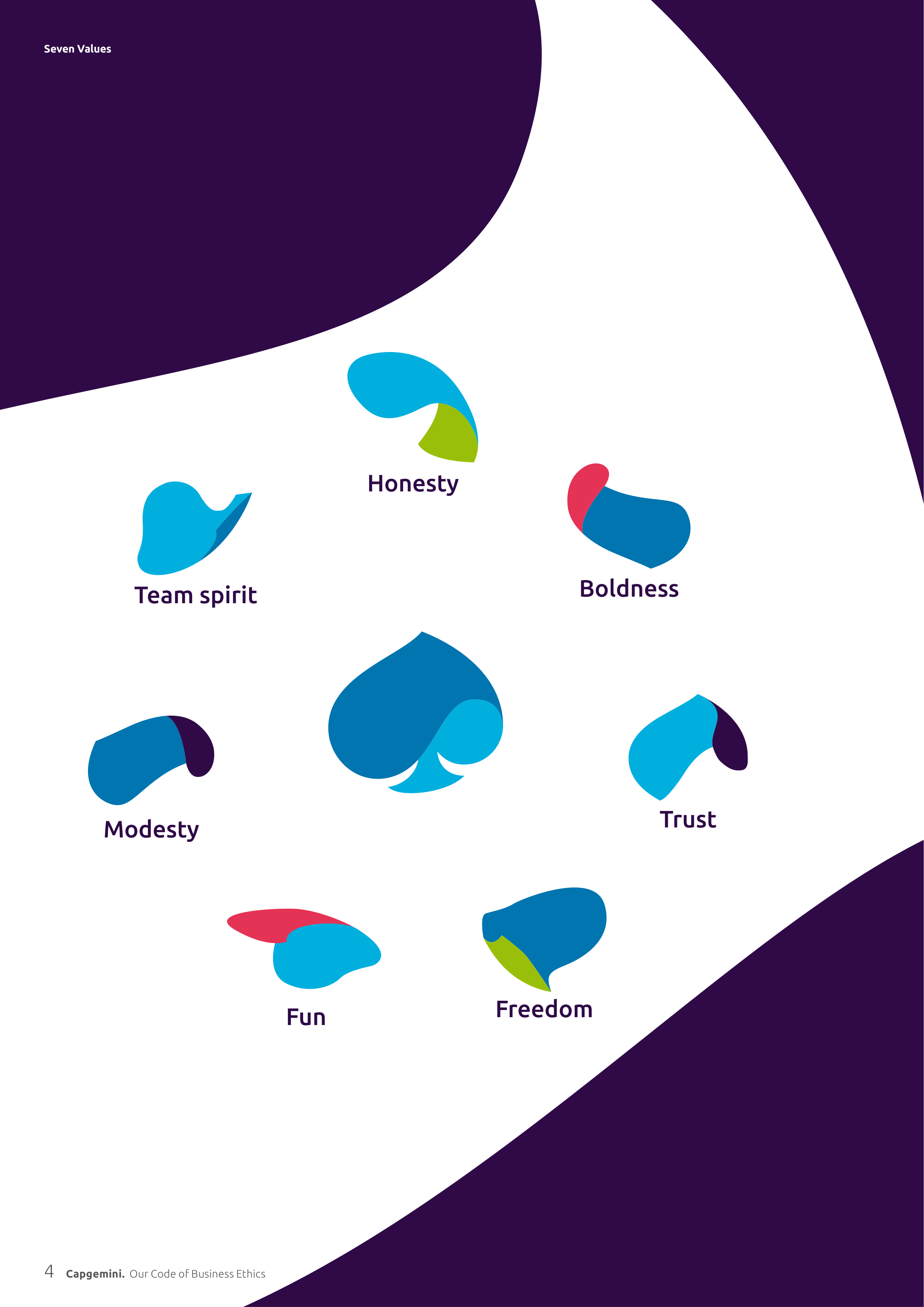
Since the creation of the Group in 1967, our culture and business practices have been inspired
and guided by our seven core Values. These are the guiding principles that we collectively
and individually stand for, and they are at the heart of our approach as an ethical and responsible
business.
Our Values also provide the basis for our rules of conduct and principles of action. They are part of
our Group DNA, shaping our sustainable ethical culture, and producing a mindset that encompasses
integrity and ethical behavior. Our Values are important for respecting, defending, and upholding
the Group as an ethical and responsible business, and for protecting our reputation.
Seven Values lie at the heart of
everything that the Group does
HONESTY
, loyalty, integrity, uprightness, a complete refusal to use any underhanded
method to help win business or gain any kind of advantage. Neither growth, nor profit, nor
independence have any real worth unless they are won through complete honesty and probity.
And everyone in the Group knows that any lack of openness and integrity in our business dealings
will be penalized at once.
BOLDNESS
, which implies a flair for entrepreneurship, and a desire to take
considered risks and show commitment (naturally, linked to a firm determination to uphold
one’s commitments). This is the very soul of competitiveness: Firmness in making decisions or in
forcing their implementation, an acceptance periodically to challenge one’s orientations and the
status quo. Boldness also needs to be combined with a certain level of prudence and a particular
clear-sightedness, without which a bold manager is, in reality, merely dangerously reckless.
TRUST
, meaning the willingness to empower both individuals and teams; to have
decisions made as close as possible to the point where they will be put into practice.
Trust also means giving priority, within the company, to real openness toward other people
and the widest possible sharing of ideas and information.
FREEDOM
, which means independence in thought, judgment and deeds,
and entrepreneurial spirit, creativity. It also means tolerance, respect for others, for different
cultures and customs―an essential quality in a Group of over 270,000 people and 120 nationalities,
based in close to 50 countries.
FUN
means feeling good about being part of the company or one’s team, feeling proud
of what one does, feeling a sense of accomplishment in the search for better quality and greater
efficiency, feeling part of a challenging project.
MODESTY
, that is simplicity, the very opposite of affectation, pretension, pomposity,
arrogance, and boastfulness. Simplicity does not imply naivety (simple does not mean simpleton!);
it is more about being discreet, showing natural modesty, common sense, being attentive to others
and taking the trouble to be understood by them. It is about being frank in work relationships,
loosening up, having a sense of humor.
TEAM SPIRIT
, meaning solidarity, friendship, fidelity, generosity, and fairness
in sharing the benefits of collective work; accepting responsibilities and an instinctive willingness
to support common efforts when the storm is raging.
5
The Board of Directors
of Capgemini SE
The Board of Directors
The undersigned, members of the Board
of Directors of Capgemini SE, express by
their signature their endorsement and their
individual and collective support of the
provisions of the Code of Business Ethics.
6
Capgemini.
Our Code of Business Ethics
6
Capgemini.
Our Code of Business Ethics
















Maria Ferraro
Paul Hermelin
CHAIRMAN OF THE BOARD OF DIRECTORS
Aiman Ezzat
CHIEF EXECUTIVE OFFICER
Xiaoqun Clever
Kurt Sievers
Tanja Rueckert
Olivier Roussat
Patrick Pouyanné
Belen Moscoso
del Prado Lopez-Doriga
Hervé Jeannin
Siân Herbert-Jones
Frédéric Oudéa
Xavier Musca
Pierre Goulaieff
Lucia Sinapi
7

Message from
the Chairman
new worlds of opportunity. The ethical challenges,
however, remain. Our Code of Business Ethics is as
valuable an asset today as it ever was, in that it provides
the compass that will enable us to navigate our way
forward through these new worlds.
With our adventurous spirit and high requirements
with regard to ethics and performance, I have no doubt
that we will continue to work at the forefront of our
industry, accompanying the most demanding clients
on the most demanding missions, and showing the
way as exemplary corporate citizens—a true Leader
for Leaders.
As Chairman, I will make a point of honor of supporting
our Group, and our Group CEO, by further strengthening
governance. I will also invest in the activities through
which Capgemini expresses its ethical credentials
and demonstrates its ambition to make a positive
contribution to our world, acting on diversity, energy
transition, and digital inclusion.
Above all, I will continue to “do my bit”, by strictly
following the principles set out in this Code, acting
always in alignment with our shared values, and by
demonstrating exemplary behavior.
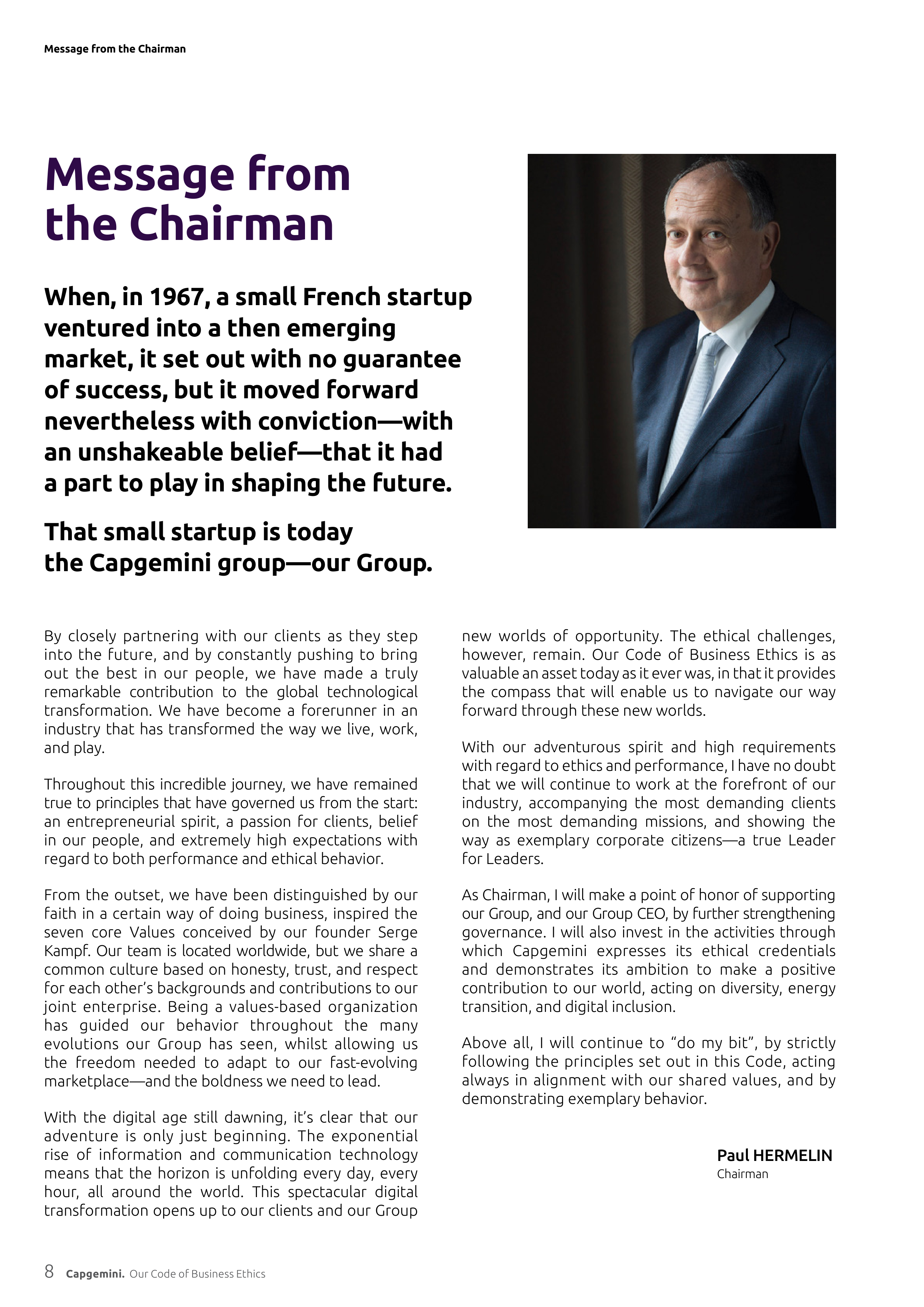
Paul HERMELIN
Chairman
By closely partnering with our clients as they step
into the future, and by constantly pushing to bring
out the best in our people, we have made a truly
remarkable contribution to the global technological
transformation. We have become a forerunner in an
industry that has transformed the way we live, work,
and play.
Throughout this incredible journey, we have remained
true to principles that have governed us from the start:
an entrepreneurial spirit, a passion for clients, belief
in our people, and extremely high expectations with
regard to both performance and ethical behavior.
From the outset, we have been distinguished by our
faith in a certain way of doing business, inspired the
seven core Values conceived by our founder Serge
Kampf. Our team is located worldwide, but we share a
common culture based on honesty, trust, and respect
for each other’s backgrounds and contributions to our
joint enterprise. Being a values-based organization
has
guided our behavior throughout the many
evolutions our Group has seen, whilst allowing us
the freedom needed to adapt to our fast-evolving
marketplace—and the boldness we need to lead.
With the digital age still dawning, it’s clear that our
adventure is only just beginning. The exponential
rise of information and communication technology
means that the horizon is unfolding every day, every
hour, all around the world. This spectacular digital
transformation opens up to our clients and our Group
When, in 1967, a small French startup
ventured into a then emerging
market, it set out with no guarantee
of success, but it moved forward
nevertheless with conviction—with
an unshakeable belief—that it had
a part to play in shaping the future.
That small startup is today
the Capgemini group—our Group.
Message from the Chairman
8
Capgemini.
Our Code of Business Ethics

Message from
the Group CEO
that our Group provides a diverse, inclusive, and
respectful work environment where everyone feels
safe and is heard. You will also uphold our business
interests by protecting our assets and those of third
parties, acting responsibly in the marketplace, and
fostering values-based, long-standing business
relationships. In addition to being passionate about
adding value to our clients, we want to make a better
environment for all stakeholders—be attentive to the
ethical use of technologies and the digital inclusion
of the greatest number of people, and keep the fight
against climate change an absolute priority. Our Code
empowers you to advance our ambition to be model
corporate citizens, supporting and respecting the
communities and environment in which we operate.
As your CEO, I assume responsibility for keeping
ethics as the keystone of our business and commit to
setting an example through my actions. In sponsoring
our Code of Business Ethics, I also aim to support
you in adopting ethical behavior with regard to all
stakeholders, be they clients, team members, partners
and suppliers, or shareholders.
I count on your full and enthusiastic engagement to
help ensure that Capgemini’s growth is sustainable
well into the future. Make sure that you know the
content of our Code and, above all, put its rules and
principles into action.
Only in this way—by being role models—can we truly
fulfill our responsibility as leaders.
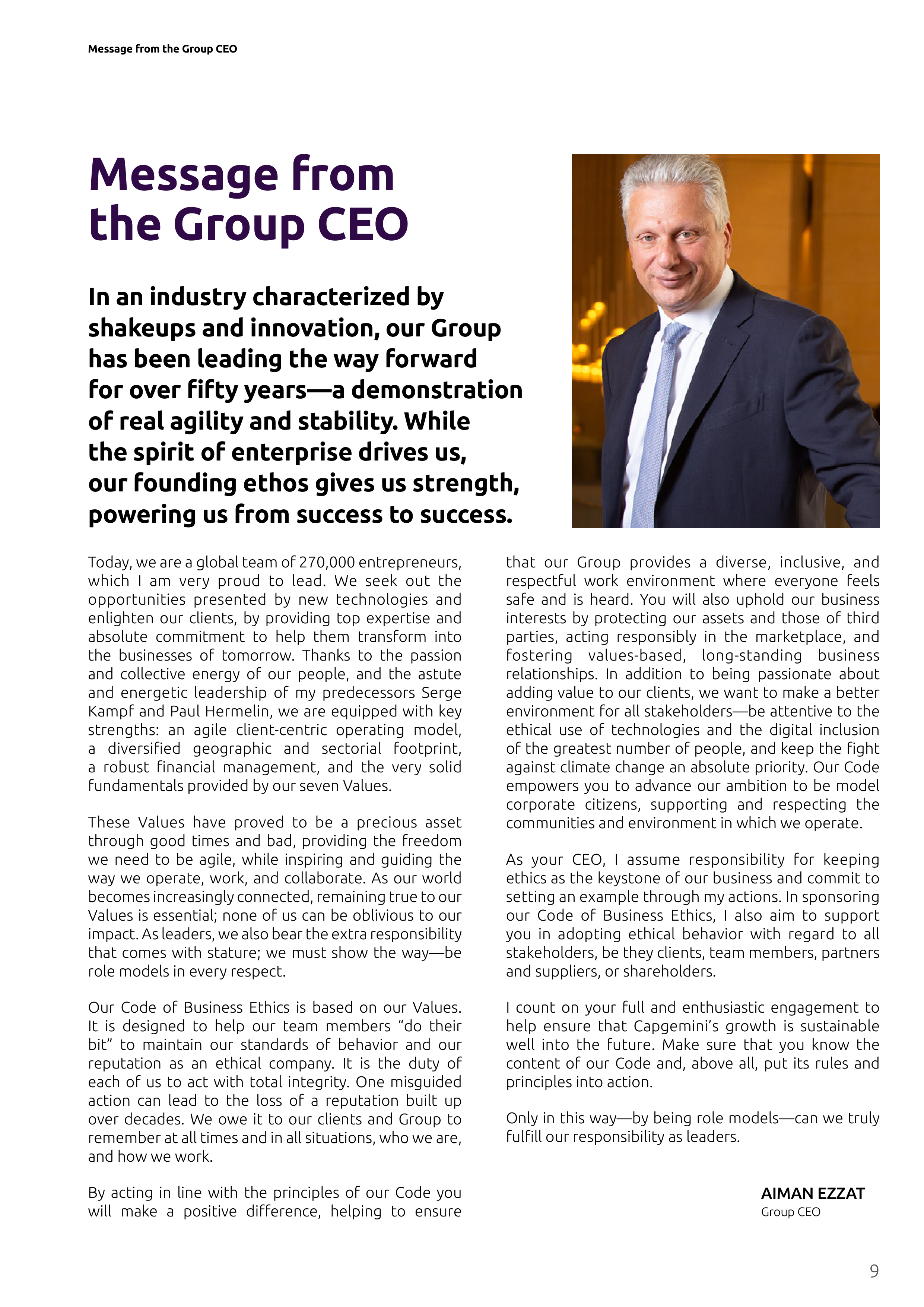
AIMAN EZZAT
Group CEO
Today, we are a global team of 270,000 entrepreneurs,
which I am very proud to lead. We seek out the
opportunities presented by new technologies and
enlighten our clients, by providing top expertise and
absolute commitment to help them transform into
the businesses of tomorrow. Thanks to the passion
and collective energy of our people, and the astute
and energetic leadership of my predecessors Serge
Kampf and Paul Hermelin, we are equipped with key
strengths: an agile client-centric operating model,
a
diversified geographic and sectorial footprint,
a robust financial management, and the very solid
fundamentals provided by our seven Values.
These Values have proved to be a precious asset
through good times and bad, providing the freedom
we need to be agile, while inspiring and guiding the
way we operate, work, and collaborate. As our world
becomes increasingly connected, remaining true to our
Values is essential; none of us can be oblivious to our
impact. As leaders, we also bear the extra responsibility
that comes with stature; we must show the way—be
role models in every respect.
Our Code of Business Ethics is based on our Values.
It is designed to help our team members “do their
bit” to maintain our standards of behavior and our
reputation as an ethical company. It is the duty of
each of us to act with total integrity. One misguided
action can lead to the loss of a reputation built up
over decades. We owe it to our clients and Group to
remember at all times and in all situations, who we are,
and how we work.
By acting in line with the principles of our Code you
will make a positive difference, helping to ensure
In an industry characterized by
shakeups and innovation, our Group
has been leading the way forward
for over fifty years—a demonstration
of real agility and stability. While
the spirit of enterprise drives us,
our founding ethos gives us strength,
powering us from success to success.
Message from the Group CEO
9














Commitment from our
Group Executive Board
Group Executive Board Members
Franck Greverie
,
PORTFOLIO, CLOUD INFRASTRUCTURE
SERVICES, BUSINESS SERVICES, INSIGHTS &
DATA AND DIGITAL CUSTOMER EXPERIENCE
Anirban Bose
,
FINANCIAL SERVICES
Carole Ferrand
,
CHIEF FINANCIAL OFFICER
Cyril Garcia
,
CAPGEMINI INVENT, SECTORS
AND SUSTAINABILITY
William Rozé
,
ENGINEERING
Anne Lebel
,
CHIEF HUMAN RESOURCES OFFICER
Michael Schulte
,
NORTHERN EUROPE
Olivier Sevillia
,
CHIEF OPERATING OFFICER
Jean-Philippe Bol
,
OPERATIONS TRANSFORMATION
& INDUSTRIALIZATION
Jim Bailey
,
AMERICAS
Fernando Alvarez
,
STRATEGY, DEVELOPMENT
AND ALLIANCES
Aiman Ezzat
,
CHIEF EXECUTIVE OFFICER
Jérôme Siméon
,
SOUTHERN EUROPE
10
Capgemini.
Our Code of Business Ethics
Since the Group was founded, we have
always believed that a profitable and
sustainable business cannot exist without
sound ethics and integrity. This lies at the
very heart of our decentralized organization.
Our Code of Business Ethics is our ongoing
commitment to maintaining and promoting
world-class standards of business integrity
and trust wherever we operate.
1. Our Code of
Business Ethics
11
Our Code of Business Ethics encapsulates our respect for the
law and for individuals, and our responsibilities to our clients
and stakeholders. It provides the basis for our ethical culture.
We respect international, national and local laws and
regulations in the countries in which we work, and we undertake
all necessary commitments to adhere to them. Our Blue Book
sets out common internal guidelines, procedures, and policies
that govern our operation as a Group and provides further
in-depth guidance. The Blue Book is available on our Group
and local websites—see Appendix for links.
The Group has always been a values-based organization:
our Values are a part of our Group DNA and lead all of us
to adopt an ethical mindset and ethical behavior in our daily
business activities.
Our Code of Business Ethics sets out, explains and formalizes
the Values, rules of conduct and behavior, and the principles
of action that we expect from ourselves and that are required
of us in our relationships with stakeholders. Our Code of
Business Ethics is embedded in the Blue Book. It prevails over
any business-level policy or procedure.
In the following sections of this Code of Business Ethics, we
aim to provide clarity and guidance, especially in fields that can
pose ethical dilemmas. In such areas, exercising good judgment
can be complex because you are in a gray area and there is
a risk of breaking the law, sometimes even unknowingly.
In these situations, any misconduct could compromise our
ethical culture, damage the Group’s reputation and potentially
lead to significant sanctions. In three areas where ethical
issues are particularly sensitive—fair competition, bribery
and corruption prevention, and conflict of interest—there
are specific detailed Group policies that supplement the
high-level overviews in our Code of Business Ethics.
We must follow our Code of Business Ethics no matter
where we operate and whatever the economic circumstances.
Following the Code of Business Ethics is mandatory for
Group compliance.
1.2 Who is it
for and what
are our roles?
1.1 What is our
Code of Business
Ethics?
Our Code of Business Ethics is for all team members, of all
companies of the Group.
It applies to all of us, both team managers and team members,
at every level of the Group. If you are in a leadership position
or in a team manager role, you need to understand that these
positions imply additional responsibilities to uphold our ethical
behavior.
It is Group policy that no one will be retaliated against for
raising any concerns in good faith regarding practices that may
violate this Code of Business Ethics.
AS A TEAM MEMBER
MY ROLE IS TO:
>
Know and understand our Code of Business Ethics;
>
Act consistently with our Code of Business Ethics, and if
in doubt seek guidance from my team manager, human
resources manager, a lawyer in the legal department, or my
country’s Ethics & Compliance Officer; and
>
Demonstrate and live our Values, rules of conduct and
behavior, and principles of action.
AS A TEAM MANAGER I HAVE
ADDITIONAL RESPONSIBILITIES
AND MY ROLE IS TO:
>
Lead by example and maintain, promote, and live our Code
of Business Ethics in my daily work;
>
Ensure that our Code of Business Ethics is alive within my
team;
>
Ensure that I am familiar with the Code of Business Ethics,
since my team members may come to me for advice and
guidance on certain issues in our Code of Business Ethics;
and
>
Identify compliance risks and make the appropriate decisions
regarding issues relevant to my area of responsibility.
Section 1: Our Code of Business Ethics
12
Capgemini.
Our Code of Business Ethics

1.3 SpeakUp
SpeakUp is a web and phone-based ethics concerns
reporting and incident management tool, operated by
an independent service provider, and made available
by Capgemini to team members, customers, suppliers,
and business partners. SpeakUp complies with legal
requirements in jurisdictions that have whistleblowing
regulations. By upholding our people’s freedom to raise
concerns and empowering us to put ethics into action,
SpeakUp also contributes to safeguarding Capgemini’s
culture of openness and our high ethical standards.
SpeakUp is voluntary, confidential, and allows anonymity,
unless stated differently by a country’s local law. It
ensures fairness, organizational justice, and prompt,
systematic investigation. Capgemini trusts and expects
team members to use SpeakUp in good faith, and firmly
prohibits retaliation against whomever raises or helps
address a legitimate concern.
Use SpeakUp to report concerns and request advice or
guidance about actions or behaviors that are:
—
Not aligned with our Values, our Code of Business Ethics,
or related ethics and compliance policies, or
—
Not in compliance with applicable laws, or
—
That may significantly affect vital interests of Capgemini
and its affiliates.
SpeakUp is not a grievance helpline; it is not a platform
to raise issues in relation to performance review,
compensation, and career development. However,
actions and behaviors that are not aligned to our Values
and Code of Business Ethics, e.g. workplace harassment,
discrimination, retaliation, and sexual harassment, are
within the scope of SpeakUp.
Please read the SpeakUp policy for more information;
country-specific regulations are identified under the policy.
www.capgemini.com/speakup
13

Section 2: People
14
Capgemini.
Our Code of Business Ethics
We are committed to
providing a safe and
inclusive work environment.
2. People
15

We are committed to looking after the health and safety of
team members, whether working on our own sites or on our
clients’ sites.
WHAT DOES THIS MEAN?
>
Follow the rules.
The Group takes its health and safety responsibility very seriously and
we are all expected to comply with, and adhere to, any relevant legislation and emergency
procedures. When working on a client’s site, we are also expected to observe and
cooperate with any client rules regarding health and safety and emergency procedures.
When traveling on business, we are expected to comply with and follow applicable Group
policies—see Appendix for the link.
>
Be supportive.
We expect our team managers to look after the health and safety of their
team members.
>
Be pro-active.
We all have the responsibility to identify and report to our local health and
safety representative or team manager any form of behavior that could present a hazard or
risk, or any situation that may compromise the health and safety of our team members.
WHAT IS EXPECTED OF ME?
>
It is my duty to familiarize myself with and follow the Group’s health and safety policies,
my clients’ health and safety policies, and any emergency procedures that are provided to
me in accordance with applicable laws.
>
I must follow Group Mobility guidelines and Group Travel and Security policies when traveling.
2.1 Health and safety
PRACTICAL EXAMPLES
I am working on a project and my partner has
problems that require my presence at home,
which may have an impact on the way I work
and where I can work. What should I do?
Raise the concern with your team manager so
that you can discuss appropriate ways to help
you continue to do your work. If you are the
team manager, then you should take your team
members’ personal circumstances into account
as far as possible. If you are unsure what to do,
speak with your human resources manager.
I am working on a client site and have meetings in
the production environment. What are my responsibilities
with regard to health and safety?
It is your responsibility to familiarize yourself with the client’s health
and safety policies, for example by requesting that your team
manager obtains a copy of their health and safety handbook/policy.
If you are working in an industrial environment, make sure you
do not miss any health and safety courses that the client offers.
If there is a real concern for the health and safety of you or
your team, raise the issue immediately with your team manager
who must raise it with the client, if necessary. If you are the team
manager, checking the client’s health and safety policies should be
one of your first priorities at the start of a project.
DISCUSS OPENLY AND SHARE YOUR CONCERNS:
If you are facing an issue involving health and safety, do not
keep it to yourself. You will get help and support by discussing it with your team manager or your human resources
manager.
Section 2: People
16
Capgemini.
Our Code of Business Ethics

Diversity is an essential characteristic of our Group, which is profoundly
multicultural; it favors creativity and innovation and helps establish an
inclusive culture of mutual benefit. As individuals, we are all entitled to
equal opportunities and fair treatment.
2.2 Equality, diversity,
and inclusion
PRACTICAL EXAMPLES
I am a team manager and one of my team members
has expressed his/her disabilities to me. Does
the Group have facilities to ensure this person can
continue to do the job required of them?
Yes. The Group has tools, technology, and processes
to assist people with disabilities and ensure they can
continue to do their job. Please contact your local human
resources department for more information on what
is available.
I want to make sure I have a diverse team. In my
recruitment activities, should I favor people from
minority groups over other candidates?
We should always assess candidates equally, based on
merit and professional competence. In our recruitment
activities, we should request any recruitment firm
to present a diverse set of candidates, reflecting the
society in which we live.
DISCUSS OPENLY AND SHARE YOUR CONCERNS:
If you are facing an issue related to equality, diversity and
inclusion, do not keep it to yourself. You will get help and support by discussing it with your team manager or your
human resources manager.
WHAT DOES THIS MEAN?
>
Employee engagement.
Employee engagement is
our main performance lever and a key factor to attract
and retain our talents. To ensure that our employees
are interested in their work and motivated, we must
continuously engage with them to measure their level of
interest, satisfaction, and wellbeing at work.
The performance management system is a continuous
process based on a regular cycle of interviews. It is based
on adjusted objectives and helps optimize employees’
strengths by focusing on the value they create as well as
their contribution to the business.
Capgemini has a policy of continuous professional
development for its employees, developing their skills and
ensuring their employability in order to meet demanding
market requirements.
>
Freedom.
In the spirit of our core Value “Freedom”,
tolerance and respect for other cultures and customs
are essential. We believe that the factors that make
people different are a source of innovation and
creativity. Diversity is also a business imperative for
us to access the skills we need in order to deliver to
our clients. By bringing in a range of talent, we gain
different perspectives, which is essential in the rapidly
changing world in which we operate. While diversity
goes beyond gender, we tackle gender diversity as a
key issue, given the scale of the challenge. Other types
of diversity, such as ethnicity, religion, LGBTQIA+ and
better integration of employees with disabilities into
our workforce, are handled locally, with best practices
shared across the Group.
>
Equal opportunity and fair treatment.
We aim to provide
equal opportunities and fair treatment, irrespective of
social, cultural, ethnic or national origins, religious or other
beliefs, caste, gender identity/expression, marital status,
pregnancy status, sexual orientation, disability, age, skin
color, race, parental status, political ideology, military/
veteran status or trade union activity. We are committed
to complying with all employment discrimination laws.
WHAT IS EXPECTED OF ME?
>
I assess fellow team members on the basis of professional
competence, behavior, and achievements.
>
I am expected not to tolerate any jokes, language,
gestures or other behavior that may offend people,
make them feel discriminated against, or create a hostile
environment.
>
I cooperate with my colleagues irrespective of social,
cultural, ethnic or national origins, religious or other
beliefs, caste, gender identity/expression, marital status,
pregnancy status, sexual orientation, disability, age, skin
color, race, parental status, political ideology, military/
veteran status, or trade-union activity.
17

We all have a right to be treated with respect and courtesy,
and a duty to treat others this way.
WHAT DOES THIS MEAN?
>
Respect in the workplace.
The Group is expected to maintain a work environment that is
free of harassment; this includes intimidation, unwelcome sexual advances, threats and acts
of violence.
>
Zero tolerance.
We do not tolerate any form of harassment or violence or any action that
creates a threatening workplace; this includes any attitude, form of behavior or situation that
may be specified as harassment. Any breach of the rules may result in disciplinary sanctions.
WHAT IS EXPECTED OF ME?
>
I do not make remarks or jokes, or display material that may offend with respect to social,
cultural, ethnic or national origins, religious or other beliefs, caste, gender identity/expression,
marital status, pregnancy status, sexual orientation, disability, age, skin color, race, parental
status, political ideology, military/veteran status, or trade-union activity, as this could be
considered harassment.
>
I respect others, and I do not accept any form of harassment or violence in the workplace.
>
I must not tolerate or engage in any form of retaliation, revenge, or victimization regarding
an individual who has claimed to be harassed.
2.3 Harassment
PRACTICAL EXAMPLES
One of my fellow team members always stands
very closely behind me and touches my back
and shoulders while I am working at my desk.
It makes me feel very uncomfortable.
Is this a form of harassment?
This could be a form of harassment. If you can, ask
your fellow team manager to refrain from touching you.
If you feel that the matter has not been addressed
properly, you can raise the issue with your team manager.
If you feel uncomfortable with this approach, discuss
the matter with your human resources manager instead.
My team manager can be quite demanding and
intimidating. He/she often makes unreasonable
requests, argues and makes fun of me in front of my
fellow team members. Is this a form of harassment?
If your team manager is intimidating or treats you with
disrespect this could be classified as harassment.
If you feel that you or any of your fellow team
members are not treated professionally you can raise
the issue directly with your team manager. If you feel
uncomfortable with this approach, discuss the matter
with your human resources manager instead.
DISCUSS OPENLY AND SHARE YOUR CONCERNS:
If you are facing an issue involving harassment, do not keep it
to yourself. You will get help and support by discussing it with your team manager or your human resources manager.
Section 2: People
18
Capgemini.
Our Code of Business Ethics

We believe that effective communication is a prerequisite
for an open and inclusive culture.
WHAT DOES THIS MEAN?
>
Open dialogue.
Our Values of “Team spirit” and “Trust” encourage us to work together
and to recognize the importance of open dialogue. We strongly encourage open dialogue
through team meetings, conference calls, forums and employee surveys, in which we can
express our opinions freely.
>
Open and constructive employee relations.
—
We facilitate open dialogue through our International Works Council (IWC), the official
representative body of the Group, enabling dialogue between Group management and
people representatives across the Group.
—
At the local level, we support open dialogue with people representatives or other
relevant employee representative bodies, and follow the processes provided for under
local legislation, regulations and agreements.
—
We uphold freedom of association.
WHAT IS EXPECTED OF ME?
>
I make sure that we have an open and inclusive culture and that I engage positively in open
dialogue, focusing on successful outcomes.
>
Whether as a team member or a team manager, it is important that I understand and live
the Values of the Group, this will enable me to encourage and support an environment of
open dialogue.
2.4 Open dialogue
PRACTICAL EXAMPLES
I’ve filled in the employee survey and have not
had any feedback or results. Should I have received
something?
Yes. We encourage open dialogue and we use our
employee survey to give you the ability to freely express
your views. It is the role of the team manager to make
sure that the results are discussed and fed back to you.
If you are a team manager, it is your responsibility to
make sure that you implement the action plans resulting
from the survey, for your area of responsibility.
I am a new team manager. What is expected of me to
make sure I maintain an open dialogue with my team
members?
As a team manager, you should set up regular team
meetings or conference calls that enable dialogue and
address the concerns of your team.
DISCUSS OPENLY AND SHARE YOUR CONCERNS:
If you are facing an issue regarding open dialogue, do not keep
it to yourself. You will get help and support by discussing it with your team manager or your human resources manager.
19

As representatives of the Group, our behavior at work and
work-related events can have an effect on the Group and
our own professional reputation. We are expected to
follow socially acceptable rules of behavior at work and on
social media.
WHAT DOES THIS MEAN?
>
Professionalism.
We are expected to respect personal and cultural differences, to ensure
that everyone enjoys a comfortable atmosphere at work and work-related events. We need
to make sure there is no sense of exclusion, discrimination, or harassment.
—
At any work-related event, we are all responsible for ensuring our behavior is
professional, reasonable and appropriate, and that it does not damage the Group’s
reputation or our own professional reputation.
—
Do not engage in any conduct, even online, that would not be acceptable in your
workplace or that is unlawful. We have provided detailed guidance on social media
usage—see Appendix for the link.
WHAT IS EXPECTED OF ME?
>
I am sensitive to personal beliefs and cultural differences and I do not impose my personal
opinions on others at work and work-related events.
>
At work and work-related events, I must not let alcohol affect my behavior and judgment.
I must not engage in the unlawful use or possession of drugs and I must respect the relevant
smoking policies.
>
If I am at a business event, I must remember that I represent the Group, so I need to be aware
of how my behavior will be perceived by others.
>
My behavior should be consistent both offline and online.
2.5 Behavior at work
and work-related events
PRACTICAL EXAMPLES
During a work-related event, the discussion turned to politics.
My colleague took an aggressive approach to push his/her political
opinion. Is this appropriate?
The Group respects personal opinions. However, these should not be used
to convince or manipulate fellow team members.
Topics involving politics, religion, and sexuality can be highly sensitive,
and you should consider refraining from addressing topics that may be
deemed personal, objectionable, or even offensive.
I came across the posts of two of my colleagues, who follow each
other on social media. Recently, one of them has been posting
racist comments and articles on the other’s social media page,
clearly making him uncomfortable. Is this behavior appropriate?
You are personally responsible for your words and actions, no matter where
you are, even online. Do not engage in any conduct online that would not be
acceptable in your workplace or that is unlawful. For example, do not make
derogatory remarks, bully, intimidate, harass other users, use insults, or post
content that is hateful, slanderous, threatening, discriminating, or pornographic.
I attended a social event organized by my
department and was uncomfortable with the
amount of alcohol consumed. Is this behavior
appropriate?
When we are at a social event organized by the
Group, we are expected to behave appropriately.
Consumption of alcohol during work-related
events should not affect our behavior or
judgment. This also applies to Group training
sessions at internal and external locations.
In addition, as team members of a multicultural
Group, we must show respect and consideration
for different cultures. In many countries where
the Group operates, and for many of our people,
alcohol is restricted or even prohibited.
DISCUSS OPENLY AND SHARE YOUR CONCERNS:
If you are facing an issue involving behavior at work and work-
related events, do not keep it to yourself. You will get help and support by discussing it with your team manager or your
human resources manager.
Section 2: People
20
Capgemini.
Our Code of Business Ethics
3. Business
integrity
As a business we are
committed to act responsibly
in the marketplace.
21
The Group competes vigorously but fairly for its clients’
business. The majority of the countries in which we operate
have competition or antitrust laws, and trade regulations
designed to protect such competition. The Group is commit
ted to comply with all applicable competition and antitrust
laws, and regulations.
WHAT DOES THIS MEAN?
>
The basic rule.
While the specific competition laws of each country (also called “antitrust
laws” in certain countries) vary, there are a number of common themes:
—
Prohibited agreements and practices
. Agreements (written or simply understood) to
fix prices, allocate clients or markets, coordinate bids, undertake boycotts, or exclude
competitors are generally not permitted. Practices among companies that have the same
effect or object as such agreements are also prohibited.
—
Unlawful dominance
. Large market players in certain markets have less flexibility in
making specific business decisions, including refusing to deal with other companies and
making acquisitions.
>
Prohibited conduct.
We do not discuss, provide to, or exchange with a competitor: prices,
terms of sale, division of markets (whether by geography, product, or otherwise), allocation
of customers, costs, profits or profit margins, or other activity that may restrain competition.
>
Understand the consequences.
Even being accused of violating these laws can have serious
consequences both for the Group and its team members. The Group could be forced to pay
significant criminal and civil fines or settlements, and individual employees may face large
fines, years of imprisonment and disciplinary actions.
>
Consult the experts.
The legal department is there to help you understand and comply
with complex competition and antitrust laws. Ask questions if you have concerns about the
Group’s behavior or our business partners’ and suppliers’ behavior.
The Group has provided detailed guidance on compliance with competition laws in the Group
Competition Laws Policy, available on your Group and local websites—see Appendix for the link.
WHAT IS EXPECTED OF ME?
>
It is my responsibility to read and understand the Group Competition Laws Policy so that I do
not enter into any improper practices.
>
It is my responsibility to seek help from the legal department if and when there is any question
or doubt as to how the Group Competition Laws Policy is applied in a given situation.
>
I must be careful about how I interact with the Group’s competitors at conferences, events and
industry associations and social functions, and be mindful of the appearance of impropriety.
>
I should not use unlawful or unethical means to obtain competitors’ information.
>
I should be aware that any verbal or written exchange with competitors may be damaging
to the Group.
>
I must respect my own and other people’s prior employment obligations and should not force
anyone to violate any of their obligations towards previous employers.
3.1 Fair competition
DISCUSS WITH A LAWYER IN THE LEGAL DEPARTMENT:
If you are facing an issue involving fair competition, do not
keep it to yourself. You should discuss the issue directly with a lawyer in the legal department.
Section 3: Business Integrity
22
Capgemini.
Our Code of Business Ethics

PRACTICAL EXAMPLES
At an industry event, one of my counterparts, a competitor,
tells me that his or her group is planning to increase
its fees by 17% across the company in the coming year,
and asks what our plans are. What should I do?
Competitors should not share information about their future
pricing plans. You should immediately tell your counterpart
that his or her comment and question are inappropriate and
make a memorable exit from the room.
Call your legal department to tell them what happened and
how you responded.
Failure to take either of these steps can lead to years of
investigations, litigation, and, potentially, prison time.
I have worked with a number of different clients in one
specific industry. What should I do if they ask me about
their competitors’ practices?
You should tell the client that protecting our clients’ privacy
is very important to us. The client should appreciate that, just
as we will not tell their competitors what they are doing, we will
not tell them about the competitors.
In addition to being the ethical response to such a question,
this also protects the Group from being seen as aiding industry
participants in coordinating their conduct through the exchange
of competitive sensitive information in violation of competition
and antitrust laws.
I am responding to a tender from a client when one of my
counterparts, a competitor, calls me to discuss the bidding
process and tells me that his or her company will only bid
for a portion of the project. He or she is wondering whether
we would be bidding for the same portion or whether
we might not be more interested in the client’s business
in other parts of the world. What should I do?
In many countries sharing information on tenders and how
competitors will bid is a criminal offense. You should immediately
tell your counterpart that his or her inquiry is inappropriate and
terminate the telephone call.
Call your legal department to tell them what happened and
how you responded.
Failure to take either of these steps can lead to years of
investigations, litigation, and, potentially, prison time.
Remember that even an oral contact by telephone can be
proved by telephone logs, so do not underestimate the
potential damage of such contacts.
23
Our ability to win business depends solely on the value we
bring to our clients. The Group is committed to preventing
any violation of anti-corruption and anti-bribery laws in
every jurisdiction in which it operates.
WHAT DOES THIS MEAN?
>
Comply.
Bribery, including influence peddling, is an offense carrying criminal and civil
penalties in most jurisdictions where we operate.
—
Anti-bribery and anti-corruption laws prohibit offering, promising, or paying anything
of value to obtain an undue advantage from a government official or any private
individual, such as to act, or refrain from acting, in a manner that is favorable to the
Group or to any of its clients.
—
The definition of “government official” in anti-corruption laws is broad, and it includes,
among other persons, employees of companies that are partially owned by a government
agency, as well as employees of political parties and candidates of political office.
—
Further, it is prohibited to request or authorize any third party to make any such offers,
promises, or payments.
—
It is also prohibited to receive anything of value from any individual that is, or may be
perceived to be, given to influence the Group or any of its clients.
>
Commissions.
In the course of our sales activities, we do not tolerate any payment of
commission to third parties nor do we accept any commission from third parties unless
specifically authorized by the Group. When authorized by the Group, we may receive referral
fees from third-party vendors such as third-party software or hardware companies. However,
these referral fees should always be made transparent to the client.
>
Understand the consequences.
Failure to comply with anti-corruption and anti-bribery
laws not only exposes the Group to civil and criminal penalties, but could subject any team
member to civil penalties, criminal punishment—including possible imprisonment—and
disciplinary action.
>
Zero tolerance.
The Group has zero tolerance for any form of bribery and corruption or any
acts that may be perceived to be bribery or corruption. Toleration of bribery or corruption
is unacceptable business conduct wherever the Group operates.
We have provided specific guidance on this topic in the Group Anti-Corruption Policy—
see Appendix for the link.
WHAT IS EXPECTED OF ME?
>
It is my responsibility to know, understand, and comply with the Group Anti-Corruption Policy
and to complete the mandatory training on the topic.
>
It is my responsibility to know, understand, and comply with the anti-corruption and anti-
bribery laws in the jurisdictions where I work.
>
It is my responsibility to seek help from the legal department if and when there is any
question or doubt as to how to comply with the Group Anti-Corruption Policy.
3.2 Bribery and corruption
DISCUSS WITH A LAWYER IN THE LEGAL DEPARTMENT:
If you are facing an issue involving bribery and corruption,
do not keep it to yourself. You should discuss the issue directly with a lawyer in the legal department.
Section 3: Business Integrity
24
Capgemini.
Our Code of Business Ethics

PRACTICAL EXAMPLES
I am about to give a small gift to our client.
What steps should I follow before doing so?
Before giving any Group client a gift, you should assess
whether that gift is permitted by applicable laws, the
Group Anti-Corruption Policy, and the known internal
rules of the recipient’s employer. Gifts must only occur
in connection with a legitimate business, not be made
to gain an undue advantage or unduly influence an action,
and must have a reasonable value and be infrequently
given to the same recipient. If intended for public
officials, any entertainment, gift, or travel must be cleared
in advance by your legal department. You must abide
by any advice given to you. You will find additional practical
examples in the Group Anti-Corruption Policy.
25

We must be careful not to take actions that may conflict
with the Group’s interests or could lead to damaging
its reputation.
WHAT DOES THIS MEAN?
>
Loyalty and good faith.
As an employee of the Group, we are bound by a duty of loyalty
and the obligation to act in good faith.
>
Conflict of interest.
A potential conflict of interest arises when we have several
contradictory interests at the same time. When a personal interest is in contradiction
to the Group’s interests, we risk violating our duty of loyalty. This occurs any time the
potential for direct or indirect personal gain can or does influence a decision connected
to our business. Consequently, we must avoid situations where our personal interests
could conflict with the Group’s interests.
We have provided detailed guidance on conflict of interest in the Group Conflict of
Interest Policy—see Appendix for the link.
WHAT IS EXPECTED OF ME?
>
I must not engage in outside activities that compete with the Group or assist a Group
competitor.
>
I must report any potential conflict of interest to my team manager or Ethics & Compliance
Officer.
>
I must award business solely based on merit and not because of personal relationships
or potential personal gain.
>
I must not use or disclose any business information or opportunities obtained through my
work for personal advantage or personal gain.
>
If I am unsure whether my interest puts me in a potential situation of conflict of interest,
I should discuss the matter with my team manager.
3.3 Conflict of interest
PRACTICAL EXAMPLES
One of my close family relations works at
a leading recruitment agency that we often
use. Is this a potential conflict of interest?
It depends on several factors such as the
individual handling the agency in question,
what your role is, or what your close relation’s
role is. Because this situation presents a potential
conflict of interest, you should be transparent
about the issue and notify your team manager.
Appropriate measures should be taken, such as
ensuring you are not involved on the account,
to avoid any appearance of a conflict of interest.
DISCUSS OPENLY AND SHARE YOUR CONCERNS:
If you are facing an issue involving a conflict of interest, do not keep
it to yourself. You will get help and support by discussing it with your team manager or your Ethics & Compliance Officer.
My partner works for a competitor. What should I be aware of?
You should be aware that this is an extremely sensitive situation
and should be disclosed in writing to your manager. If you and
your partner discuss any business information whatsoever you risk
violating the competition laws in your country. Both you and your
partner could be committing a criminal act if you discuss pricing or
business opportunities.
You should know what these laws are and, if you have any doubt
whatsoever about them, consult your Country’s Ethics & Compliance
Officer.
In addition, discussing business information with your partner may
violate confidentiality obligations.
Section 3: Business Integrity
26
Capgemini.
Our Code of Business Ethics

We have to exercise the utmost caution when considering
transactions that involve the shares of the Group, of our
clients, business partners, or suppliers. Disseminating insider
information or making any transaction based on insider
information is prohibited.
WHAT DOES THIS MEAN?
>
Zero tolerance.
Insider information is any non-public information that, if known, would
reasonably be expected to be used by an investor in deciding whether to buy, sell, or hold
such security.
—
The Group strictly prohibits the trading of Capgemini SE shares or any other Group-
related securities during the “closed periods”—see Appendix for the link. Independently
of closed periods, we should not buy or sell Group shares and/or other related securities
when aware of any insider information. Similar restrictions apply to trading any publicly
listed shares or other related securities of the Group’s current or potential clients,
business partners, or suppliers when in possession of insider information.
—
Disseminating insider information or using insider information can lead to criminal
sanctions.
WHAT IS EXPECTED OF ME?
>
I am prohibited from disseminating insider information.
>
I am not allowed to make investment decisions based on confidential or insider information.
>
When assigned to a project that involves a merger, acquisition, or joint venture, I am expected
to disclose shares and other related securities that I hold in this other company, other than
those held through mutual funds or similar vehicles where I have no discretion.
>
I am not allowed to buy or sell Capgemini SE shares or any other Group-related securities
during closed periods.
3.4 Insider trading
DISCUSS WITH A LAWYER IN THE LEGAL DEPARTMENT:
If you are facing an issue involving insider trading, do not
keep it to yourself. You should discuss the issue directly with a lawyer in the legal department.
PRACTICAL EXAMPLES
Can I trade in Capgemini SE shares at any time
of the year?
No. The Group has strict policies on this issue and
has defined closed periods in which buying and selling
Capgemini SE shares, or any other Group-related
securities, is prohibited. The Group notifies all team
members of the closed periods.
I am working on a client system that gives me access
to client information. If I buy or sell these client
shares, could this be considered insider trading?
Yes, especially if you have access to sensitive client
information. In addition, we may have to respect our
clients’ closed periods in the same way that we do
for our Group.
27

We are responsible for ensuring that we maintain and release
accurate and correct business and financial information, in a
transparent and timely manner.
WHAT DOES THIS MEAN?
>
Commitment to accuracy.
The Group is committed to communicate accurate and relevant
information to its shareholders on a regular basis.
>
Group effort.
We all create information relating to the Group, its clients, team members,
business partners, or suppliers. We must ensure that we produce accurate and correct
business information and manage documents with the utmost care and to the best of our
knowledge.
>
Zero tolerance.
We must know and comply with all relevant laws, regulations, and internal
rules concerning business information and, most importantly, financial business information.
Any infringement of laws and regulations can potentially result in fines and criminal charges.
WHAT IS EXPECTED OF ME?
>
I must ensure I know and comply with all relevant legal, contractual, and internal requirements
concerning the documentation and maintenance of business records relevant to my sphere
of influence.
>
I must not produce any documentation that may mislead or deceive the recipient.
>
I must obtain the relevant approval when responding to internal or external financial inquiries.
>
I must securely store confidential business records, including back-ups.
3.5 Accurate and correct business
and financial information
DISCUSS WITH A LAWYER IN THE LEGAL DEPARTMENT:
If you are facing an issue involving accurate and correct
business and financial information, do not keep it to yourself. You should discuss the issue directly with a lawyer in the
legal department.
PRACTICAL EXAMPLES
I have to do several appraisals for
members of my team. Is there anything
I should be careful about in terms
of storing this information?
Yes. As with any other documented
information, all appraisal information needs
to be accurate and stored centrally within
the appropriate local record management
system.
I have been contacted by an external party to provide financial
performance information on one of our strategic business units.
Am I allowed to provide them with the information?
No. The communication of financial information comes directly under
the responsibility of the Group CFO through either Group financial
control or the investor relations departments. You should not disclose
any financial performance information concerning the Group without
prior authorization.
Section 3: Business Integrity
28
Capgemini.
Our Code of Business Ethics

The Group does not support political parties.
WHAT DOES THIS MEAN?
>
No Group contributions.
We do not make any cash or in-kind contributions to political
parties on behalf of the Group. This includes direct and indirect support through intermediary
organizations.
>
Promote respect.
We respect the rights of individuals to participate, as individuals, in politics.
However, we should never represent or endorse a political party on behalf of the Group.
WHAT IS EXPECTED OF ME?
>
I should not use the Group’s name to endorse a political activity or event, or represent
the Group in any political activities.
>
I will not use any of the Group’s resources or cash to contribute to a political party.
3.6 Political activities
DISCUSS OPENLY AND SHARE YOUR CONCERNS:
If you are facing an issue involving political activities, do not keep
it to yourself. You will get help and support by discussing it with your team manager or your human resources manager.
PRACTICAL EXAMPLES
My client is asking us to support their lobbying
activities and they want us to add our name to their
lobbying list. Is this acceptable?
No. Lobbying refers to trying to influence government
legislation, regulations, or decision-making. You
should inform our client that we cannot lobby on behalf
of our clients or support their lobbying activities.
Can I undertake lobbying activities? Is this
a political activity?
Because lobbying implicates anti-bribery and anti-
corruption laws—candidates and political parties may
be deemed “government officials”—you should take
great care. Any lobbying on behalf of the Group should
be approved by the Group and should be transparent.
It appears that the political party in power is about
to change. Could we offer an Accelerated Solutions
Environment (ASE) for free to help one of the
political parties on their strategy formulation?
We should never make any cash donations or provide
free use of the Group’s resources when dealing with
political parties, since this may be considered a donation
or in-kind contribution in support of the political party.
However, we can treat political parties as clients and
engage on a commercial, fee-paying basis. Because
even this arrangement implicates anti-bribery and
anti-corruption laws—political parties may be deemed
“government officials”—you should take great care
to involve a lawyer from your legal department, your
Country’s Ethics & Compliance Officer, or the Group Chief
Ethics & Compliance Officer.
29

Section 3: Business Integrity
30
Capgemini.
Our Code of Business Ethics
4. Business
relationships
We are committed to
delivering value and building
longstanding relationships
based on mutual trust
with our clients, and at
the same time achieving
profitable and sustainable
growth for the Group.
31
We are dedicated to delivering profitable and sustainable
growth by working together with our clients to deliver value
through our expertise and behavior.
WHAT DOES THIS MEAN?
>
Client first.
We think “client first” and we measure our success in terms of the value we bring
to our clients. Delivering excellence to our clients is our priority.
—
We mobilize the right talent to meet our client’s requirements.
—
We respect our clients and we work in an open and transparent manner.
—
As an independent IT services provider, we objectively evaluate software
and hardware solutions to meet the client’s requirements.
—
We work collaboratively with our clients by building a long-term, distinctive
relationship based on mutual trust.
—
We share our expertise and knowledge with our clients with a view to their short- and
long-term development and we learn from them for our own development purposes.
>
Maintaining our standards.
While we take bold steps to win business and satisfy our
clients, we will not compromise Capgemini’s ethics and compliance standards to meet
business objectives.
WHAT IS EXPECTED OF ME?
>
I use all my talents and capabilities when I work with my client.
>
I behave ethically and responsibly with my client.
>
I listen to my client and work collaboratively.
>
I understand the trust my client has in me and I take bold action to maintain it.
>
I do not advise my client to do anything that I do not believe is aligned to his/her interests.
>
I communicate openly with my clients. I am transparent and tell them the truth. In case of
delicate or bad news, I get appropriate advice from my team manager or management so
I can communicate openly with my client.
>
If my client acts unethically, I will raise it to my team manager, Ethics & Compliance Officer
or on SpeakUp to get the right guidance.
4.1 Working with
our clients
DISCUSS OPENLY AND SHARE YOUR CONCERNS:
If you are facing an issue involving working with our clients, do not
keep it to yourself. You will get help and support by discussing it with your team manager or with your legal department.
Section 4: Business Relationships
32
Capgemini.
Our Code of Business Ethics

PRACTICAL EXAMPLES
A client wants us to undertake a project, but I am of the opinion
that there is no real business case and that this is not the right
course of action. What can I do?
If you consider that the project will not generate real value for the client
or if the solution requested by the client will not provide a suitable answer
to the business problem, you should first try to influence the client’s point
of view. Ultimately, if you feel you are acting against the client’s interest,
you should decline the project.
My client asks me, in the spirit of collaboration, to perform extra
work without the corresponding change order request or price
adjustment. Is this acceptable?
No. You should follow the specified Group processes and make sure
you do not over-deliver regarding the contract. You should always ensure
that a corresponding change order and, if appropriate, price adjustment
is completed. Being paid appropriately for a service should not affect good
collaboration.
My client has suggested that sponsoring its annual sports event would
help us to obtain a particular deal. What can I do?
You cannot enter into this type of reciprocal bargaining process because
developing good, long standing collaboration with clients does not imply
accepting unfair sales methods. This type of reciprocal dealing could
also raise bribery concerns in certain jurisdictions.
I am about to make a deal with a client for whom I know some referral
fees will be paid by a supplier to the Group. What should I do?
You should adopt a transparent attitude, and tell the client. However,
in some countries, giving or receiving referral fees in connection with
obtaining or retaining business may be prohibited. You should know and
follow that country’s law with respect to giving or receiving referral fees.
If you have any doubt about legality, consult your legal department.
My client’s team received a special team bonus for their good
work, to which I contributed substantially. They propose that
I should be given a share of the bonus. Can I accept?
No. You cannot accept a payment by the client or its employees. To do
so would compromise your position and your affiliation to the Group.
My client, who is also a Group service provider, is trying to impose
contractual terms upon us that are unreasonable and quite different
from those we are negotiating with them as one of our suppliers.
Can we use this opportunity to redress the balance and ask for
“reciprocal treatment”?
Yes. It is perfectly acceptable to seek similar terms and conditions when
we negotiate with the same party both as a client and as a provider.
However, you should consider the context of the situation (including,
if relevant, the sales strategy) and the relevant bargaining positions of
either party when taking this approach.
33
We work with our partners and ecosystems to bring added
value to our clients, and we expect them to comply fully
with the law.
WHAT DOES THIS MEAN?
>
Ethical collaboration.
We work with our partners and ecosystems in a collaborative and
ethical way to deliver value to our clients.
—
We work with partners and ecosystems whose values and modes of behavior are aligned
to our principles.
—
We are transparent with our clients about our relationships with our partners and
ecosystems. Our clients will be informed of any business relationships or referral fee
agreements we have with respect to the services we are offering them. The disclosure
must be in writing and may be a general advance notice in the client contract terms.
—
We understand that, when dealing with public sector clients, it could be illegal for the
Group to receive any referral fees.
—
We expect our partners and ecosystems to comply with the law, including laws
promoting fair competition, and prohibiting bribery and corruption.
WHAT IS EXPECTED OF ME?
>
I will not make an agreement with a partner that is against the interests of our client.
>
I will not make an agreement with a partner that violates the law.
>
I will work collaboratively and ethically with our partners and ecosystems, and ensure that
clients are aware of our relationships with them.
4.2 Working with
our partners
and ecosystems
DISCUSS OPENLY AND SHARE YOUR CONCERNS:
If you are facing an issue involving working with our partners or
ecosystems, do not keep it to yourself. You will get help and support by discussing it with your team manager or your
legal department.
Section 4: Business Relationships
34
Capgemini.
Our Code of Business Ethics

PRACTICAL EXAMPLES
We are bidding with one of our partners for a large international
project where we have a referral fee agreement. This agreement
includes a country where there may be restrictions on referral fees,
although I am unsure of this. How do I find out whether I could be
offering something illegal?
In some countries, the giving or receiving of referral fees in connection
with obtaining or retaining business is a criminal offense. You should
know and follow that country’s law with respect to receiving referral fees.
If you do not know that country’s law or have any doubt whatsoever about
the legality of referral fees, you should consult your legal department.
If the Group can lawfully receive referral fees in the country in question,
you should be transparent and inform your client about the fees,
in coordination with Group Partner leadership.
One of our partners offers a comprehensive and well-known solution,
whereas an alternative open-source solution exists that may be used
free of charge. What can I do?
You should always take the client’s interests into account and never advise
anything that does not concur with your client’s interests. An open-source
solution, while free, may not be the best solution for the client. Each case
should be judged on its own merits. You should always communicate openly
with clients and ensure that you are acting in the best interests of your
client. If the client’s and the Group’s interests conflict or appear to conflict,
you should discuss them with your team manager and take his/her advice.
35

PRACTICAL EXAMPLES
I recently went on a site visit to one of
our key suppliers and I am concerned about
their environmental practices. What should I do?
Raise your concern with your team manager or your local
procurement team. The Group has a Supplier Standards
of Conduct in place to monitor the environmental
and social practices of our suppliers, in order to ensure
a sustainable supply chain.
I am in negotiations with the procurement officer
of one of our key suppliers. I think the supplier
can benefit from our Group services. Can I propose
that they buy our products in return for keeping
our business?
No. As a Group we refrain from reciprocal dealings;
only in exceptional situations and with prior authorization
might this be allowed.
We work with our suppliers and commit to sound and
sustainable procurement procedures. We expect our
suppliers to comply fully with the laws in the countries in
which they operate.
WHAT DOES THIS MEAN?
>
Fair and ethical treatment.
We are committed to treating our suppliers and contractors
fairly and we expect our suppliers to conduct their business with us on a fair and ethical basis.
—
We strongly discourage reciprocal dealings, such as agreeing to buy from suppliers,
provided they buy from us.
—
We expect our suppliers to conduct their business with us on a fair and ethical basis
and in compliance with our Supplier Standards of Conduct—see Appendix for the link.
—
Capgemini Supplier Standards of Conduct sets the minimum commitment our company
expects from its suppliers with regard to corporate social responsibility, ethics and anti-
bribery, regulatory compliance, and business relationship standards.
WHAT IS EXPECTED OF ME?
>
I am expected to treat suppliers fairly and make decisions based on quality and price.
>
I will never agree with our suppliers to do anything that would be against the interests of our
clients.
>
I will not make an agreement with our suppliers that violates the laws of the country or
countries in which I work.
>
If I am procuring anything on behalf of the Group, I must follow the Supplier Standards of
Conduct when selecting new suppliers or evaluating current suppliers.
>
I will refrain from reciprocal dealings without specific authorization.
4.3 Working with
our suppliers
DISCUSS OPENLY AND SHARE YOUR CONCERNS:
If you are facing an issue involving working with our suppliers,
do not keep it to yourself. You will get help and support by discussing it with your team manager or your legal department.
Section 4: Business Relationships
36
Capgemini.
Our Code of Business Ethics
5. Group and
third-party assets
We are expected to maintain
the security and integrity
of the assets of the Group
and of the third parties with
which we work. We use them
responsibly and professionally.
37

Intellectual property is one of the Group’s most valuable
assets. We need to ensure the validity and integrity of
all intellectual property rights belonging to the Group,
through copyrights, patents, trademarks, trade secrets, and
confidentiality. We must respect the intellectual property
rights of our clients, competitors, business partners, and
suppliers.
WHAT DOES THIS MEAN?
>
Group property.
Any intellectual property produced by Group employees while working for
the Group remains the property of the Group or of its clients, depending on the terms of
the contract signed with the relevant client. We should not put at risk any Group or client
intellectual property, whether or not formally protected, during our employment or after we
have left the Group.
WHAT IS EXPECTED OF ME?
>
I must understand the concept of intellectual property.
>
I must ensure that I correctly use any intellectual property owned by the Group or by any
third party.
5.1 Intellectual property
DISCUSS OPENLY AND SHARE YOUR CONCERNS:
If you are facing an issue involving intellectual property, do not keep
it to yourself. You will get help and support by discussing it with your team manager or your legal department.
PRACTICAL EXAMPLES
I am working in a team that is developing a
new methodology. Can I personally reuse the
methodology outside my work with the Group?
No. Any intellectual property, including methodology,
software, hardware, processes, tools, and know-how
produced while working for the Group remains the
property of the Group or of its client.
I just did some research on our competitors and
found a great offering. Can I copy the offering and
modify the material for our own offer development?
No. We do not take any third-party intellectual property
without authorization. Unauthorized use of others’
intellectual property can expose the Group and even
individual team members to civil lawsuits and damages.
Section 5: Group and Third-Party Assets
38
Capgemini.
Our Code of Business Ethics

We are expected to preserve confidential information
belonging to the Group or our team members, clients,
business partners, and suppliers.
WHAT DOES THIS MEAN?
>
Confidential information.
Information is deemed confidential if it is defined as such by law
or by contract. The following categories of information are almost always confidential:
—
Information provided by our clients, suppliers, and business partners that the Group has
committed not to disclose.
—
Information regarding our commercial and economic strategy.
—
Information about our recruitment and wage policies.
—
Personal data.
—
Know-how, trade secrets, patents, and software developed within the Group.
>
Protection.
We take appropriate and reasonable measures, including relevant security
measures, to protect confidential information concerning the Group, its team members,
clients, business partners, and suppliers:
—
We must maintain the confidentiality of our clients’ and suppliers’ business information.
We must strictly adhere to any commitments the Group has made to a client, business
partner, or supplier about confidentiality. When working for several clients, we must take
the necessary steps to protect against the transfer of their confidential information from
one client to another.
—
When our employment with the Group ends, we are required to return all confidential
information in our possession and respect our confidentiality obligations.
WHAT IS EXPECTED OF ME?
>
I am expected to protect the confidential information of the Group and our team members,
clients, business partners, and suppliers from unauthorized disclosure or access.
>
I must avoid discussing confidential information in public where conversations can be overheard.
5.2 Confidential
information
PRACTICAL EXAMPLES
I often work offsite or at home. What are my responsibilities
in terms of confidential information?
All confidential information should be treated with the same
standards of security whether offsite or in the office. Hard
copies must not be accessible to unauthorized parties and must
be disposed of appropriately. It is advisable to avoid taking
confidential hard copies outside the office environment.
I am traveling with a colleague to an offsite location.
Is it appropriate to talk about work in public?
You can talk about work but should be careful your conversation
is not overheard. You should not mention the name of the Group,
any client, business partner, or individual names where they can be
overheard. Take extra care when participating in phone calls in public
spaces or using your laptop when people can look over your shoulder.
I often travel and I like to save confidential data on
a USB key. Is this appropriate?
If you travel frequently and need to have confidential informa
tion on a USB key or any other portable device, you should
get it encrypted to prevent unauthorized use or disclosures.
I am very active on social media. Can I make reference
to my current role and responsibilities within the Group
on these websites?
Yes. You can outline your role and responsibilities, as long as
you do not disclose any confidential information. However,
given today’s world it may be advisable to minimize or even
refrain from making such references in case your comments
are taken out of context. Always remember your association
with the Group when posting on social media. You should
not represent or speak on behalf of the Group unless explicitly
authorized to do so.
DISCUSS OPENLY AND SHARE YOUR CONCERNS:
If you are facing an issue involving confidential information, do not
keep it to yourself. You will get help and support by discussing it with your team manager or your legal department.
39
Legal data protection and legal data security are crucial for
each affiliate of Capgemini. The financial and reputational
risks are high. Capgemini has created a strong internal data
protection organization and a solid Data Protection Program
to protect the company against these risks.
WHAT DOES THIS MEAN?
>
A broad notion.
The notion of personal data is very broad, since it refers to any type of
data that enables to identify an individual, either directly or indirectly. As a result, not only
information such as the name, last name, and email address will be considered as personal
data, but also information such as log information and IP addresses, since these enable to
identify the individual indirectly.
>
An extensive application.
It must be noted that data protection regulations apply to
any processing of personal data, irrespective of the context in which the personal data is
being processed. In other words, personal data processed in the business context or in an
employment relationship are subject to the same rules as in relation to private processing
activities.
>
Data protection is not only a European Union-centric matter.
Although data protection
is often perceived as a European Union-centric matter, legislation related to personal data
protection is increasingly being adopted outside the European Union (EU), and is very much
influenced by the EU legal requirements. Moreover, Capgemini is convinced that for data
protection obligations to be effectively implemented throughout the organization, it needs
to apply the same principles irrespective of the geographies.
>
Rules apply also for data processing.
Capgemini takes data protection very seriously and
has therefore defined a range of policies and procedures that define the commitments
Capgemini takes when processing personal data both on its behalf and on behalf of its
customers.
WHAT IS EXPECTED OF ME?
>
I must complete the relevant data protection training.
>
I always make sure that when I collect personal data, it is for a specific reason and that the
personal data I collect are only those that I strictly need. I do not collect personal data “just in
case” they may be useful in the future.
>
I should document properly the processing activities I launch using the tools provided by the
data protection community.
>
I should comply with personal data protection laws of jurisdictions from which the personal
data is collected and in which it is processed or used.
5.3 Protecting
personal data
DISCUSS OPENLY AND SHARE YOUR CONCERNS:
If you are facing an issue regarding personal data protection, do not
keep it to yourself. You will get help and support by discussing it with your local Data Protection Officer.
Section 5: Group and Third-Party Assets
40
Capgemini.
Our Code of Business Ethics

PRACTICAL EXAMPLES
A business partner wants to send his/her training opportunities
to everyone in my department and has asked me for the email list.
Can I provide the list to him/her?
No. Before sharing such information you need to verify with your
local Data Protection Officer what is the way forward. Your local Data
Protection Officer will help you determining which are the measures
to consider and to implement.
We entered into a contract, with a client based in the EU, which will
require the handling of personal data relating to their clients and
employees. Part of the services are rendered by the Group in India.
Can I send personal data to India?
In the EU, stringent laws regulate the protection of personal data.
When exported outside the EU, we need to offer at least an equivalent
level of protection. For this purpose, Capgemini has adopted Binding
Corporate Rules, which guarantee that any personal data transfer to
another Capgemini entity out of the EU benefits from an adequate level
of protection. However, in order to tackle the different requirements
inferred by a data transfer to, or access from Capgemini India, please
consult your local Data Protection Officer.
I have received information, sent in error, concerning the salaries
of my team members. What should I do?
As soon as you become aware of this you should avoid reading and using
the information. Delete the email and contact the person who sent it
to you. If you receive a hard copy, return it to the sender in a sealed
envelope. You should not use this information in any way, for any purposes.
You should also contact immediately your local Data Protection Officer
or the competent Cybersecurity Officer to report this incident.
41

We are personally accountable for the protection of the Group
and third-party assets and resources under our control.
WHAT DOES THIS MEAN?
>
Responsible and professional use.
We use assets and resources that belong to the Group,
to help us achieve our business goals.
—
We take care of third-party assets and resources as if they were our own.
—
We must not access, use, or attempt to use Group or third-party electronic resources to
access, store, send, post, or publish material that is inappropriate. This includes material
that is pornographic, sexually exploitative, obscene, racist, sexist, or in any other way
discriminatory, threatening or harassing, personally offensive, defamatory, or illegal.
—
We are expected to take the necessary steps to protect any assets and resources
of the Group and/or third parties that are under our control against loss, theft, and
unauthorized disclosure.
WHAT IS EXPECTED OF ME?
>
I take care to protect Group and third-party assets and resources.
>
I use the Group’s physical and electronic resources for business purposes only, except for
minor circumstances in which personal use is permitted.
>
I acknowledge that use of the Group network to transmit or store material is under the
control of the Group.
>
I am expected to read and understand my local IT security or use policy.
PRACTICAL EXAMPLES
I am organizing a large personal event outside
work and need to make sure I have enough flyers
to distribute. Can I use the Group photocopiers?
No. This is not appropriate use of Group resources.
Can I use my work internet access to browse
the internet for personal purposes?
Limited use of communication tools such as email
and the internet may be acceptable, if it does not
incur any costs and does not interfere with your job
responsibilities.
In general, during non-working hours you may use your
professional laptop incidentally for personal purposes.
However, you must not install unauthorized software.
I am going out for lunch. What should I think about
in terms of security before I leave my desk?
Always wear your security pass, lock your computer
screen, and make sure that any confidential or sensitive
information is stored away.
Make sure that your computer is physically secured
with a device such as a security cable to prevent loss
or theft, especially if you work on a laptop.
5.4 Appropriate use
of Group and third-party
assets and resources
DISCUSS OPENLY AND SHARE YOUR CONCERNS:
If you are facing an issue regarding the appropriate use of
Group and third-party assets and resources, do not keep it to yourself. You will get help and support by discussing it
with your team manager.
Section 5: Group and Third-Party Assets
42
Capgemini.
Our Code of Business Ethics
6. Corporate social
responsibility
As responsible citizens,
we support the communities
and respect the environment
in which we operate.
43

The Group is committed to create a positive impact on the
communities in which it lives and operates. As a leading
responsible company, it has designed and implemented a
Digital Inclusion Strategy to focus its work in the community
by reducing the digital divide and enabling disadvantaged
people to overcome their exclusion.
WHAT DOES THIS MEAN?
>
Digital Inclusion.
Our work in the community is focused on imparting basic to specialized
digital and technological skills to digitally excluded people, with the aim of making digital
an opportunity for all. We partner with various local Non-Governmental Organization (NGO)
partners and social innovators in this endeavor, to create sustainable positive impact in
communities around the world.
>
Get involved.
The engagement of our employees is a key lever for us to translate this
ambition into reality. We aim for all employees to play an active part, to create positive impact
as Architects of Positive Futures.
WHAT IS EXPECTED OF ME?
>
I am encouraged to participate in our Corporate Social Responsibility (CSR) initiatives.
>
I will obtain relevant approvals before using work time for volunteering opportunities.
>
I will obtain the relevant approvals before using the Group name and resources to support an
NGO.
6.1 Contributing
to communities
DISCUSS OPENLY AND SHARE YOUR CONCERNS:
If you are facing an issue related to contributing to communities,
do not keep it to yourself. You will get help and support by discussing it with your team manager or country CSR leader
or your Ethics & Compliance officer.
PRACTICAL EXAMPLES
I would like to participate in a volunteering activity
with our local charity during a working week.
Does the Group allow for volunteering days?
Check your local policies on what is allowed. In some
countries, certain Group companies allow a few
days to be booked for volunteering, especially
when participating in a volunteering event with an
organization supported by the Group.
I am actively involved with a local community group
and we are organizing a large event. Can the Group
sponsor or donate meeting rooms for the event?
Any donations, gifts, or in-kind contributions need
to be approved. Check with your team manager what
level of approval is required. The legal department,
tax department, human resources department, and
even the communications department may be involved.
Also, check whether the organization you wish to donate
to complies with Group policies; the Group does not
sponsor religious or political organizations.
Section 6: Responsible Citizenship
44
Capgemini.
Our Code of Business Ethics

We recognize that business activities have impacts on the
environment, and we are committed to minimizing these
impacts.
WHAT DOES THIS MEAN?
>
Respect the environment.
The Group is committed to identifying and complying with
all legal and other relevant requirements related to the environmental impacts of its
operations.
—
We seek to minimize the negative environmental impacts of the Group’s business
activities for example, with regard to: emissions from energy consumption in our offices
and data centers, and business travel; our waste and IT asset management; and our
procurement activities.
>
Innovate to reduce impact.
We use and adapt our capabilities and expertise to help our
clients reduce their environmental impact and meet their environmental objectives.
WHAT IS EXPECTED OF ME?
>
I adhere to environmental laws and relevant Group and local policies.
>
I am expected to minimize the impact of my work on the environment. This includes making
informed choices that minimize the impact of carbon emissions from business travel, saving
energy in our offices and data centers, considering the environmental impact of procurement
decisions, reducing waste through recycling schemes and avoidance of single-use plastics,
and contributing to other environmental initiatives.
>
I seek ways to innovate with my clients to leverage our business and technology transformation
capabilities, to support them with their environmental objectives.
6.2 Minimizing our impact
on the environment
DISCUSS OPENLY AND SHARE YOUR CONCERNS:
If you are facing an issue involving an impact on the
environment, do not keep it to yourself. You will get help and support by discussing it with your team manager
or country CSR leader.
PRACTICAL EXAMPLES
I am traveling abroad and there is an option to go
by train or by plane. What do I choose?
First, check whether it is essential to travel. The Group
offers numerous virtual working tools, such as Microsoft
Teams and dedicated videoconferencing spaces. If
you cannot avoid travel, look to balance time, costs
and environmental impacts. A rail journey will typically
have a carbon impact 6–10 times lower than a flight
of the equivalent distance, direct flights are generally
more carbon efficient than those with stopovers, and
airport taxis can add significantly to the cost and the
carbon of your journey. Considering the time, costs, and
environmental impacts across the whole journey will help
you to make the appropriate decision that can support
our environmental objectives, balanced with the needs
of our business and our clients.
I regularly receive information and advice about
carsharing or reducing plastic and am often
told to switch off lights and print double-sided.
Do my personal actions really make a difference?
Absolutely. In a company the size of Capgemini, individual
actions taken across the Group can quickly add up to
significant impacts. If you need to travel to the office,
choosing to carshare or travel by public transport can
help reduce carbon emissions and lower air pollution
within cities. Avoiding single-use plastics not only reduces
the amount of plastic ending up in landfill sites and
marine environments, it also avoids the energy and the
materials used to produce the plastic in the first place.
Where office lighting is not automated, please switch off
lights at the end of meetings. When printing is essential,
choosing to print double-sided dramatically reduces
paper consumption, saving the environmental impacts
of both the printing and the entire life-cycle of the paper.
45
46
Capgemini.
Our Code of Business Ethics
The information contained in this document is proprietary.
Copyright © 2022 Capgemini. All rights reserved.
Graphic design: Avant Midi. June 2022 – Version 3.3
46
Capgemini.
Our Code of Business Ethics
1. Code of Business Ethics
https://talent.capgemini.com/global/pages/about_us/our_group/ethicsandcompliance/policies__guidelines/policies/code_of_business_ethics/
2. Group Conflict of Interest Policy
https://talent.capgemini.com/global/pages/about_us/our_group/ethicsandcompliance/policies__guidelines/policies/conflict_of_interest/
3. SpeakUp Policy
https://talent.capgemini.com/global/pages/about_us/our_group/ethicsandcompliance/speakup/
4. SpeakUp helpline
https://www.capgemini.com/speakup
5. Ethics & Compliance Talent Hub
https://talent.capgemini.com/global/pages/about_us/our_group/ethicsandcompliance/
6. Ethics & Compliance Network
https://talent.capgemini.com/global/pages/about_us/our_group/ethicsandcompliance/ethics__compliance_network_new/
7. Blue Book
https://talent.capgemini.com/global/pages/about_us/our_group/ethicsandcompliance/policies__guidelines/policies/blue_book_intro/
8. Group Anti-Corruption Policy
https://talent.capgemini.com/global/pages/about_us/our_group/ethicsandcompliance/policies__guidelines/policies/Group_Anti_Corruption_Policy/
9. Group Competition Laws Policy
https://talent.capgemini.com/global/pages/about_us/our_group/ethicsandcompliance/policies__guidelines/policies/group_competition_laws_policy/
10. Supplier Standards of Conduct
https://talent.capgemini.com/media_library/Medias/About_Competitiveness_in_Action/Capgemini_Supplier_Standards_of_Conduct_-_V5.2.pdf
11. Social Media Guidelines
https://talent.capgemini.com/global/pages/about_us/global_functions/ethicsandcompliance/policies__guidelines/guidelines/social_media_guidelines/
12. Closed Periods
https://talent.capgemini.com/global/pages/hubs/global_functions/Finance_Community/Rules_and_Policies/closed_periods/
Appendix



Capgemini
Place de l’Étoile – 11, rue de Tilsitt
75 017 PARIS – France
Contacts:
Philippe CHRISTELLE
Chief Ethics Officer
Chief Audit Officer
Anne-Violaine MONNIÉ-AGAZZI
Group Ethics Officer
Group Ethics Hub on Talent website:
http://talent.capgemini.com/ethicsandcompliance
47



Learn more about us at
www.capgemini.com