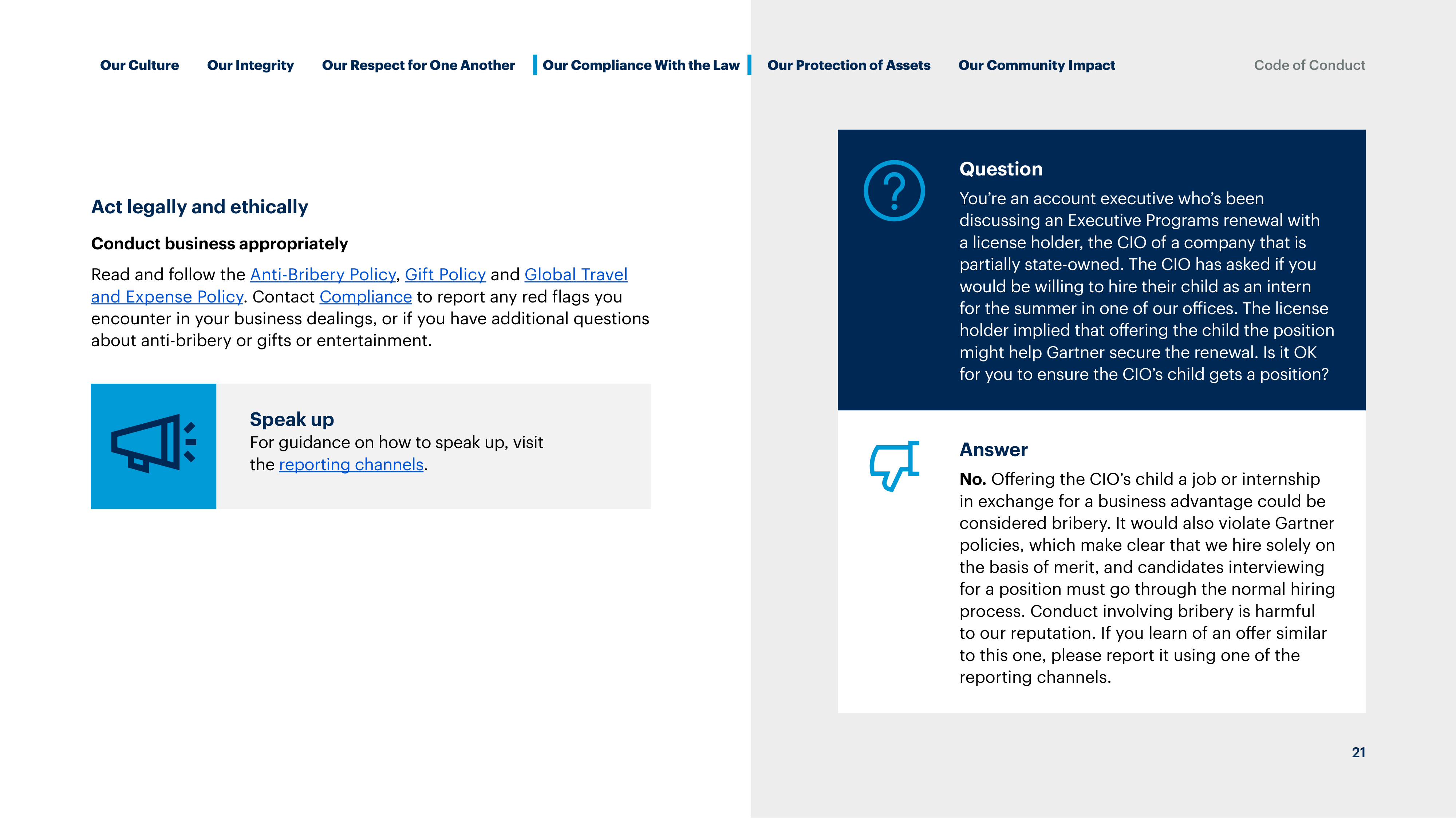
Anti-bribery: Conducting business appropriately
Gartner strictly prohibits corruption in all forms, in all our business dealings,
in every country where we do business. You must not pay bribes to, or accept
bribes from, anyone, anywhere, at any time, for any reason. There are anti-
bribery laws that apply to you wherever you are located.
Specifically, Gartner does not offer, promise or give anything of value to
anyone, including a government official, to improperly obtain new business,
to retain existing business, to secure an improper advantage or to influence
any act or decision of a person or entity. Gartner does not make facilitation
payments, which are payments made to a government official to speed
up routine government actions, for example, processing visas, supplying
utilities, delivering mail. For the definition of government officials see the
Anti-Bribery Policy
.
Gartner uses third parties, such as suppliers and those who act on Gartner’s
behalf (e.g., contractors and agents), to help Gartner deliver its products and
services in the marketplace. You must only deal with legitimate third parties
with a reputation for integrity. Gartner can be liable for the actions of its
third parties, and we never let a third party do what we cannot do ourselves.
Gartner conducts due diligence on our third parties, and we never ignore
“red flags” that indicate a third party may be making improper payments or
engaging in corrupt behavior on Gartner’s behalf (for red flags see the
Anti-
Bribery Policy
).
Read and follow the
Anti-Bribery Policy
. If you have additional questions view
the
Anti-Financial Crime Resource Center
and contact
Compliance
.
Anything of value
Anything of value includes cash or cash equivalents; a
job or internship; a reference, referral or endorsement;
a loan, favorable contract terms or promises of future
business; gifts, meals, entertainment, hospitality or
travel; charitable or political contributions; tickets to
events or parties; or anything else of value, including
anything that is valuable to the recipient, even if it
would not be valuable to anyone else.
Red flags
•
Commission substantially above going rate
•
Vaguely described services or plan for performing the
work is vague and/or suggests a reliance on contacts
or relationships
•
Requests for payment to a numbered account, third
party or consultant
•
Proposes the use of a shell company
•
Requests or demands to use a specific third party
•
Lack of qualifications or resources to perform real work
•
Incomplete or inaccurate information on required
disclosures, e.g., refusal to disclose ownership
Key definitions
19
Code of Conduct
Our Culture
Our Integrity
Our Respect for One Another
Our Compliance With the Law
Our Protection of Assets
Our Community Impact
19