



JHSON Faculty Handbook
1 |
P a g e

JHSON Faculty Handbook
2 |
P a g e
JHSON Faculty Handbook
3 |
P a g e
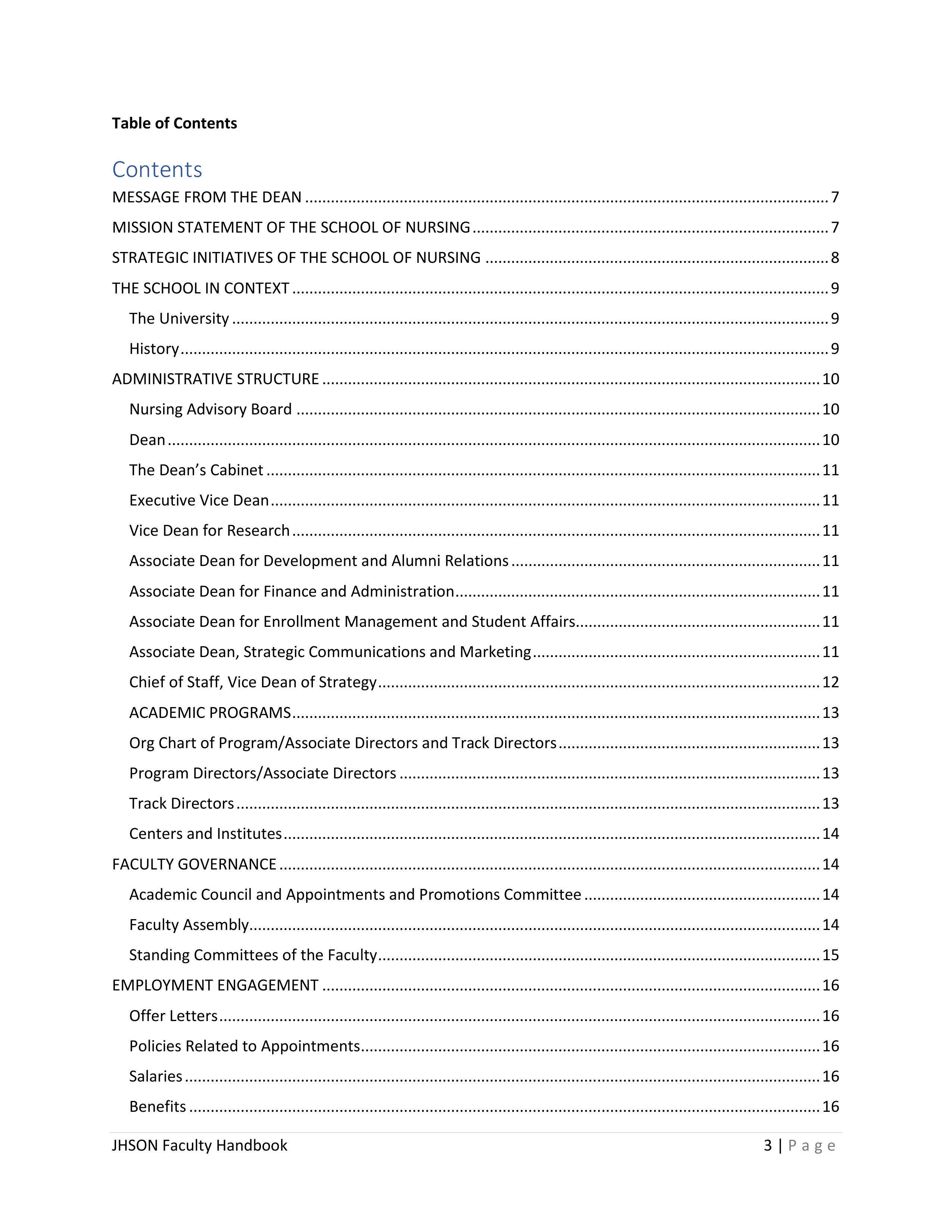
Table of Contents
Contents
MESSAGE FROM THE DEAN .......................................................................................................................... 7
MISSION STATEMENT OF THE SCHOOL OF NURSING ................................................................................... 7
STRATEGIC INITIATIVES OF THE SCHOOL OF NURSING ................................................................................ 8
THE SCHOOL IN CONTEXT ............................................................................................................................. 9
The University ........................................................................................................................................... 9
History ....................................................................................................................................................... 9
ADMINISTRATIVE STRUCTURE .................................................................................................................... 10
Nursing Advisory Board .......................................................................................................................... 10
Dean ........................................................................................................................................................ 10
The Dean’s Cabinet ................................................................................................................................. 11
Executive Vice Dean ................................................................................................................................ 11
Vice Dean for Research ........................................................................................................................... 11
Associate Dean for Development and Alumni Relations ........................................................................ 11
Associate Dean for Finance and Administration ..................................................................................... 11
Associate Dean for Enrollment Management and Student Affairs......................................................... 11
Associate Dean, Strategic Communications and Marketing ................................................................... 11
Chief of Staff, Vice Dean of Strategy ....................................................................................................... 12
ACADEMIC PROGRAMS ........................................................................................................................... 13
Org Chart of Program/Associate Directors and Track Directors ............................................................. 13
Program Directors/Associate Directors .................................................................................................. 13
Track Directors ........................................................................................................................................ 13
Centers and Institutes ............................................................................................................................. 14
FACULTY GOVERNANCE .............................................................................................................................. 14
Academic Council and Appointments and Promotions Committee ....................................................... 14
Faculty Assembly ..................................................................................................................................... 14
Standing Committees of the Faculty ....................................................................................................... 15
EMPLOYMENT ENGAGEMENT .................................................................................................................... 16
Offer Letters ............................................................................................................................................ 16
Policies Related to Appointments ........................................................................................................... 16
Salaries .................................................................................................................................................... 16
Benefits ................................................................................................................................................... 16
JHSON Faculty Handbook
4 |
P a g e
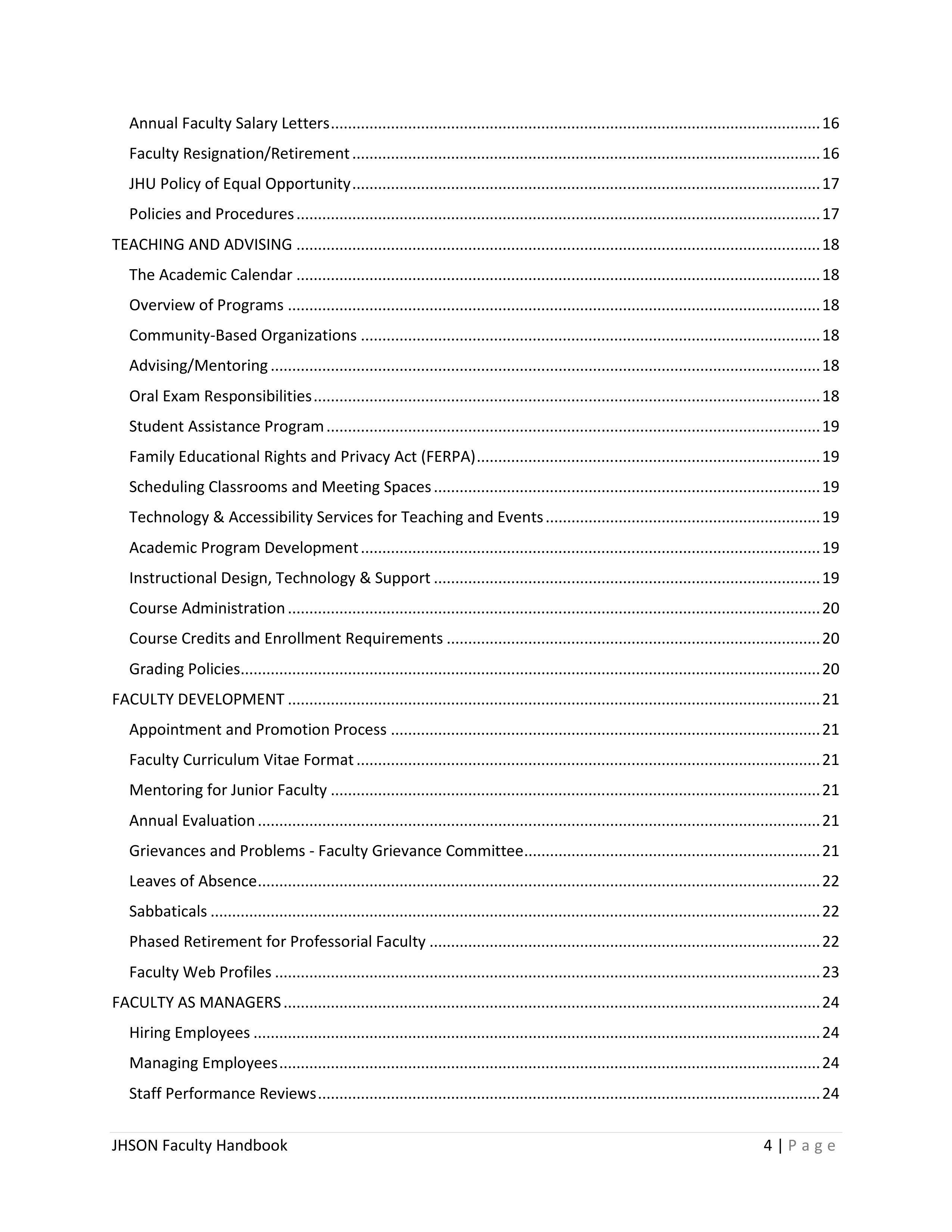
Annual Faculty Salary Letters .................................................................................................................. 16
Faculty Resignation/Retirement ............................................................................................................. 16
JHU Policy of Equal Opportunity ............................................................................................................. 17
Policies and Procedures .......................................................................................................................... 17
TEACHING AND ADVISING .......................................................................................................................... 18
The Academic Calendar .......................................................................................................................... 18
Overview of Programs ............................................................................................................................ 18
Community-Based Organizations ........................................................................................................... 18
Advising/Mentoring ................................................................................................................................ 18
Oral Exam Responsibilities ...................................................................................................................... 18
Student Assistance Program ................................................................................................................... 19
Family Educational Rights and Privacy Act (FERPA) ................................................................................ 19
Scheduling Classrooms and Meeting Spaces .......................................................................................... 19
Technology & Accessibility Services for Teaching and Events ................................................................ 19
Academic Program Development ........................................................................................................... 19
Instructional Design, Technology & Support .......................................................................................... 19
Course Administration ............................................................................................................................ 20
Course Credits and Enrollment Requirements ....................................................................................... 20
Grading Policies ....................................................................................................................................... 20
FACULTY DEVELOPMENT ............................................................................................................................ 21
Appointment and Promotion Process .................................................................................................... 21
Faculty Curriculum Vitae Format ............................................................................................................ 21
Mentoring for Junior Faculty .................................................................................................................. 21
Annual Evaluation ................................................................................................................................... 21
Grievances and Problems - Faculty Grievance Committee ..................................................................... 21
Leaves of Absence ................................................................................................................................... 22
Sabbaticals .............................................................................................................................................. 22
Phased Retirement for Professorial Faculty ........................................................................................... 22
Faculty Web Profiles ............................................................................................................................... 23
FACULTY AS MANAGERS ............................................................................................................................. 24
Hiring Employees .................................................................................................................................... 24
Managing Employees .............................................................................................................................. 24
Staff Performance Reviews ..................................................................................................................... 24
JHSON Faculty Handbook
5 |
P a g e
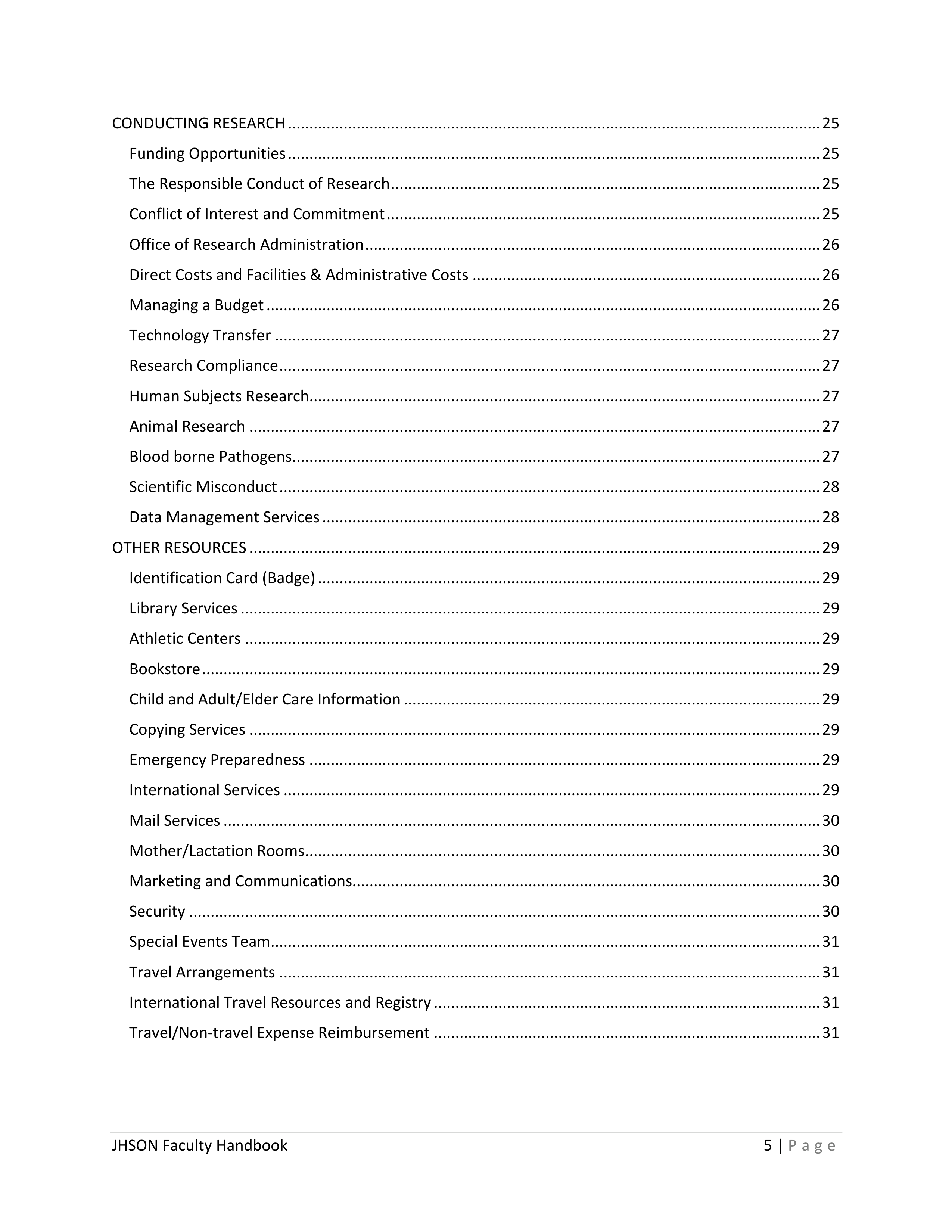
CONDUCTING RESEARCH ............................................................................................................................ 25
Funding Opportunities ............................................................................................................................ 25
The Responsible Conduct of Research .................................................................................................... 25
Conflict of Interest and Commitment ..................................................................................................... 25
Office of Research Administration .......................................................................................................... 26
Direct Costs and Facilities & Administrative Costs ................................................................................. 26
Managing a Budget ................................................................................................................................. 26
Technology Transfer ............................................................................................................................... 27
Research Compliance .............................................................................................................................. 27
Human Subjects Research ....................................................................................................................... 27
Animal Research ..................................................................................................................................... 27
Blood borne Pathogens ........................................................................................................................... 27
Scientific Misconduct .............................................................................................................................. 28
Data Management Services .................................................................................................................... 28
OTHER RESOURCES ..................................................................................................................................... 29
Identification Card (Badge) ..................................................................................................................... 29
Library Services ....................................................................................................................................... 29
Athletic Centers ...................................................................................................................................... 29
Bookstore ................................................................................................................................................ 29
Child and Adult/Elder Care Information ................................................................................................. 29
Copying Services ..................................................................................................................................... 29
Emergency Preparedness ....................................................................................................................... 29
International Services ............................................................................................................................. 29
Mail Services ........................................................................................................................................... 30
Mother/Lactation Rooms ........................................................................................................................ 30
Marketing and Communications............................................................................................................. 30
Security ................................................................................................................................................... 30
Special Events Team ................................................................................................................................ 31
Travel Arrangements .............................................................................................................................. 31
International Travel Resources and Registry .......................................................................................... 31
Travel/Non-travel Expense Reimbursement .......................................................................................... 31

JHSON Faculty Handbook
6 |
P a g e
JHSON Faculty Handbook
7 |
P a g e
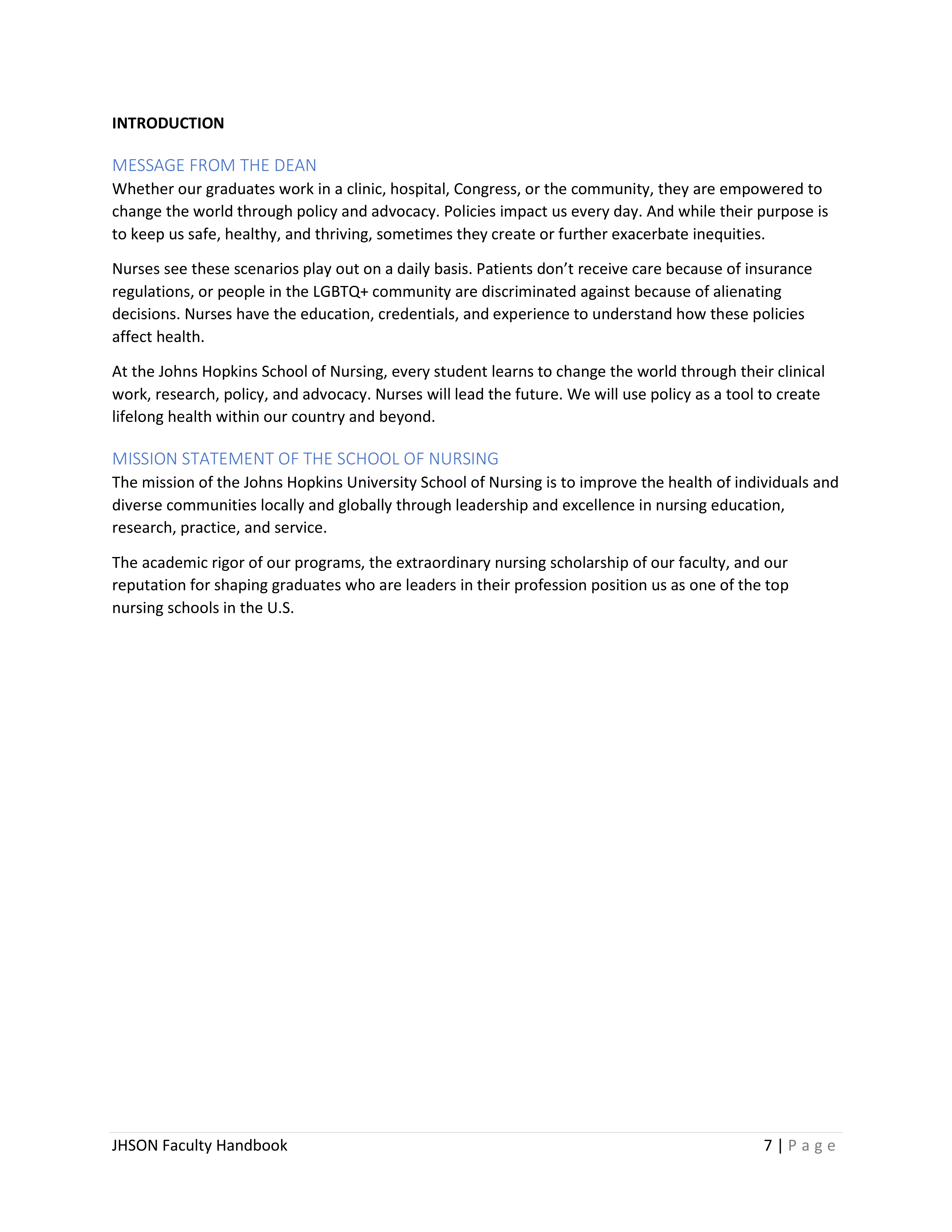
INTRODUCTION
MESSAGE FROM THE DEAN
Whether our graduates work in a clinic, hospital, Congress, or the community, they are empowered to
change the world through policy and advocacy. Policies impact us every day. And while their purpose is
to keep us safe, healthy, and thriving, sometimes they create or further exacerbate inequities.
Nurses see these scenarios play out on a daily basis. Patients don’t receive care because of insurance
regulations, or people in the LGBTQ+ community are discriminated against because of alienating
decisions. Nurses have the education, credentials, and experience to understand how these policies
affect health.
At the Johns Hopkins School of Nursing, every student learns to change the world through their clinical
work, research, policy, and advocacy. Nurses will lead the future. We will use policy as a tool to create
lifelong health within our country and beyond.
MISSION STATEMENT OF THE SCHOOL OF NURSING
The mission of the Johns Hopkins University School of Nursing is to improve the health of individuals and
diverse communities locally and globally through leadership and excellence in nursing education,
research, practice, and service.
The academic rigor of our programs, the extraordinary nursing scholarship of our faculty, and our
reputation for shaping graduates who are leaders in their profession position us as one of the top
nursing schools in the U.S.
JHSON Faculty Handbook
8 |
P a g e
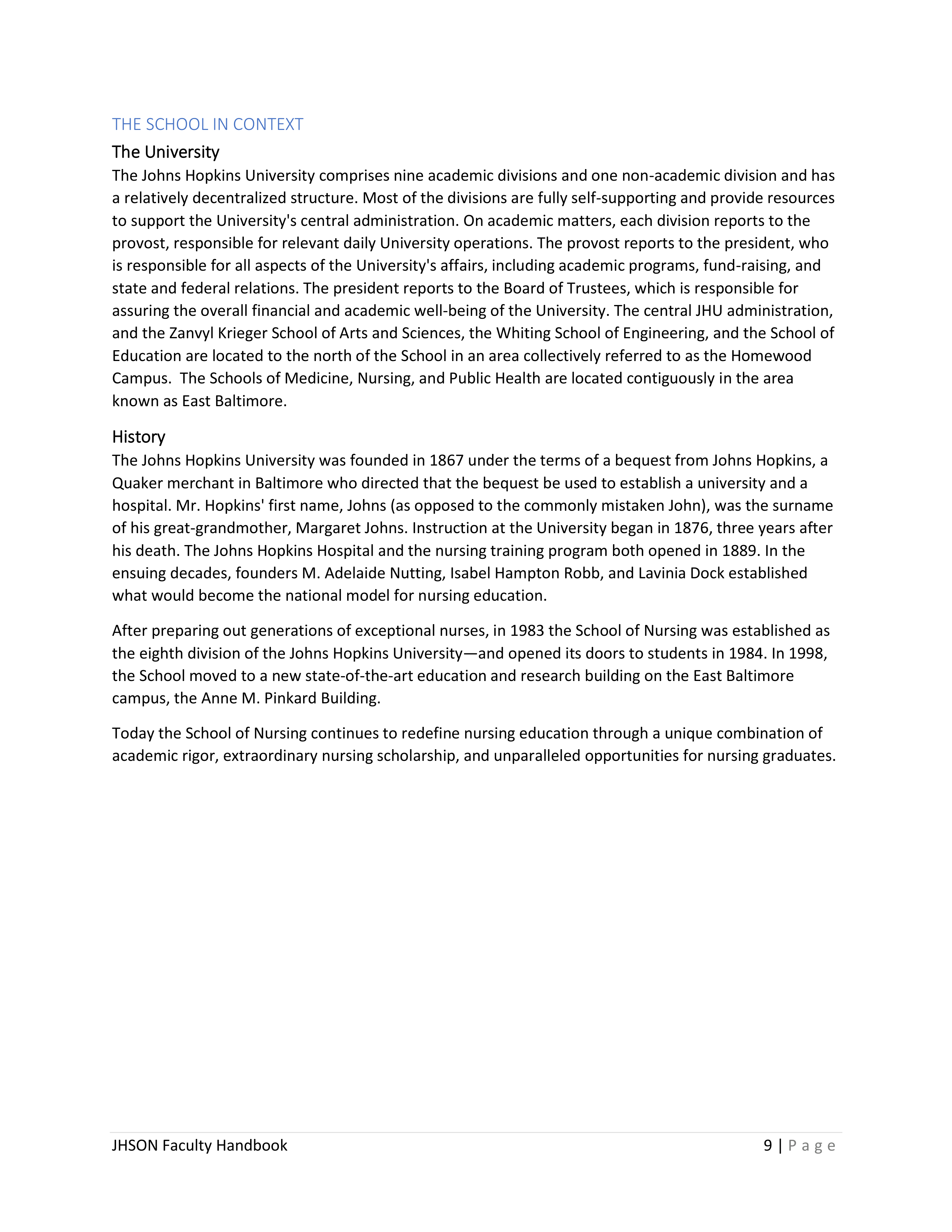
STRATEGIC INITIATIVES OF THE SCHOOL OF NURSING
JHSON Faculty Handbook
9 |
P a g e
THE SCHOOL IN CONTEXT
The University
The Johns Hopkins University comprises nine academic divisions and one non-academic division and has
a relatively decentralized structure. Most of the divisions are fully self-supporting and provide resources
to support the University's central administration. On academic matters, each division reports to the
provost, responsible for relevant daily University operations. The provost reports to the president, who
is responsible for all aspects of the University's affairs, including academic programs, fund-raising, and
state and federal relations. The president reports to the Board of Trustees, which is responsible for
assuring the overall financial and academic well-being of the University. The central JHU administration,
and the Zanvyl Krieger School of Arts and Sciences, the Whiting School of Engineering, and the School of
Education are located to the north of the School in an area collectively referred to as the Homewood
Campus. The Schools of Medicine, Nursing, and Public Health are located contiguously in the area
known as East Baltimore.
History
The Johns Hopkins University was founded in 1867 under the terms of a bequest from Johns Hopkins, a
Quaker merchant in Baltimore who directed that the bequest be used to establish a university and a
hospital. Mr. Hopkins' first name, Johns (as opposed to the commonly mistaken John), was the surname
of his great-grandmother, Margaret Johns. Instruction at the University began in 1876, three years after
his death. The Johns Hopkins Hospital and the nursing training program both opened in 1889. In the
ensuing decades, founders M. Adelaide Nutting, Isabel Hampton Robb, and Lavinia Dock established
what would become the national model for nursing education.
After preparing out generations of exceptional nurses, in 1983 the School of Nursing was established as
the eighth division of the Johns Hopkins University—and opened its doors to students in 1984. In 1998,
the School moved to a new state-of-the-art education and research building on the East Baltimore
campus, the Anne M. Pinkard Building.
Today the School of Nursing continues to redefine nursing education through a unique combination of
academic rigor, extraordinary nursing scholarship, and unparalleled opportunities for nursing graduates.
JHSON Faculty Handbook
10 |
P a g e
ADMINISTRATIVE STRUCTURE
Nursing Advisory Board
The mission of the Nursing Advisory Board (NAB) is to provide counsel and support to the Dean and
leadership of the Johns Hopkins University School of Nursing to further the school’s mission and goals.
Since its inception, the NAB has played a critical role supporting the mission of the Johns Hopkins School
of Nursing. NAB members receive a front seat to the pressing issues and opportunities concerning the
future of health; their voice is essential in advising the Dean. They engage in meaningful dialogue with
experts and world renowned faculty, and contribute diverse opinions and perspectives that help
advance the School of Nursing.
Dean
The Dean of the School is the chief executive officer of the school and has the overall responsibility for
the academic programs and fiscal health of the school.
JHSON Faculty Handbook
11 |
P a g e
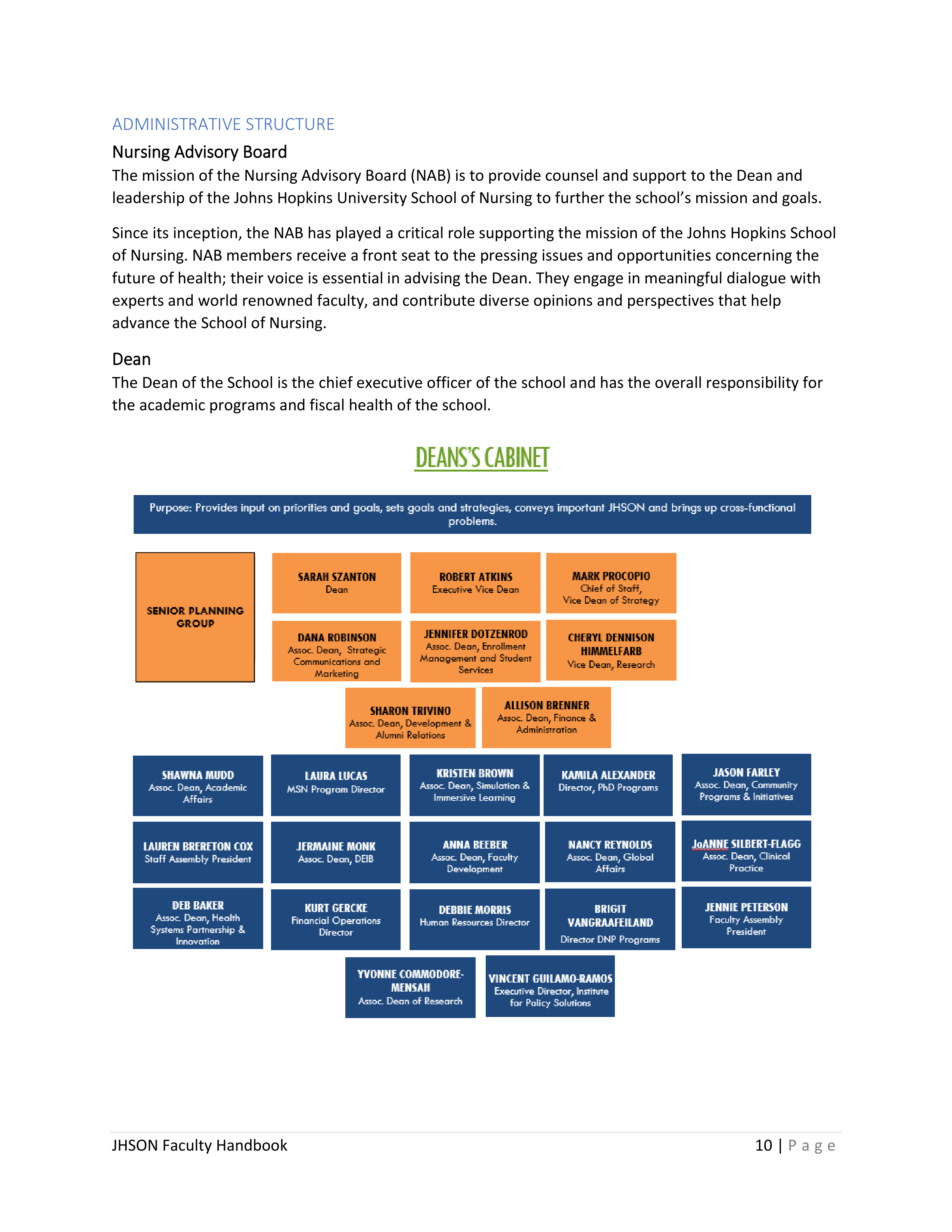
The Dean’s Cabinet
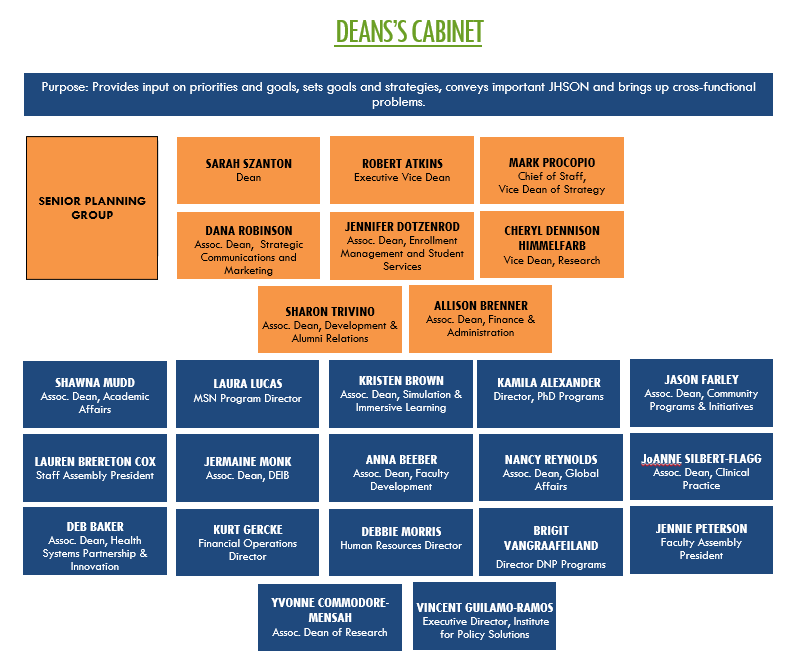
The Dean’s Cabinet is a collection of the Senior Planning Group and staff and faculty representatives
from both academic and research fields that support the strategic planning and implementation for the
school.
Executive Vice Dean
The Executive Vice Dean of Academic Affairs (EVD) is directly accountable to the Dean and serves as the
chief operating officer, whose scope of responsibilities includes operational functions that enable the
execution of the strategic plan and achievement of the School of Nursing’s (SON) goals and mission. The
EVD provides innovative leadership and oversight for the quality and financial management of the
academic programs and enrollment management and student affairs, and oversees the work of the
Associate Dean for Academic Affairs, Associate Dean for Faculty Development, Associate Dean for
Practice, and Academic Program Directors. In addition, the EVD works closely with the Dean and
Associate Dean for Diversity, Equity, Inclusion, and belonging to support diversity and inclusion, and
foster a positive and healthy work environment across the school.
Vice Dean for Research
The Vice Dean for Research is responsible for oversight of the Institutional Review Board (IRB) and other
aspects of research that involve either federal or School based regulations, such as Conflict of Interest,
Responsible Conduct of Research, data management, and related training. The Vice Dea for Research
provides leadership and oversight for grants and contract proposal and award activities, including
electronic research administration, grants administration, contracting and technology transfer
transactions.
Associate Dean for Development and Alumni Relations
The Associate Dean for DAR oversees School-wide fundraising activities (known as "development");
communications and public affairs, including connections with the media; relationships with national,
state and local government, alumni relations.
Associate Dean for Finance and Administration
The Associate Dean for Finance and Administration leads the financial and administrative functions of
the school, including finance/budget, information technology, campus operations/facilities, human
resources, research administration, and institutional research.
Associate Dean for Enrollment Management and Student Affairs
The Associate Dean for Student Affairs is responsible for student support services, including: Admissions;
Career Services; Disability Support Services (JHU Central); Financial Aid; Records & Registration; Student
Affairs; and Student Life.
Associate Dean, Strategic Communications and Marketing
The Associate Dean, Strategic Communication and Marketing oversees the Office of Marketing and
Communications at the Johns Hopkins School of Nursing, which is dedicated to effectively sharing the
impactful initiatives and research of our school. Through strategic communication outreach and
comprehensive multiplatform marketing, our team works to enhance awareness, amplify visibility,
encourage meaningful action, and cultivate strong engagement within our diverse audiences.

JHSON Faculty Handbook
12 |
P a g e
Chief of Staff, Vice Dean of Strategy
The Chief of Staff, Vice Dean of Strategy serves as counsel and senior advisor to the dean and is focused
on strategy and outcomes. Working closely alongside the administrative and academic leadership of the
school, the role helps execute and communicate the vision of the dean, and maintains key relationships
to influence outcomes critical to the school’s success.
JHSON Faculty Handbook
13 |
P a g e
ACADEMIC PROGRAMS
Org Chart of Program/Associate Directors and Track Directors
Program Directors/Associate Directors
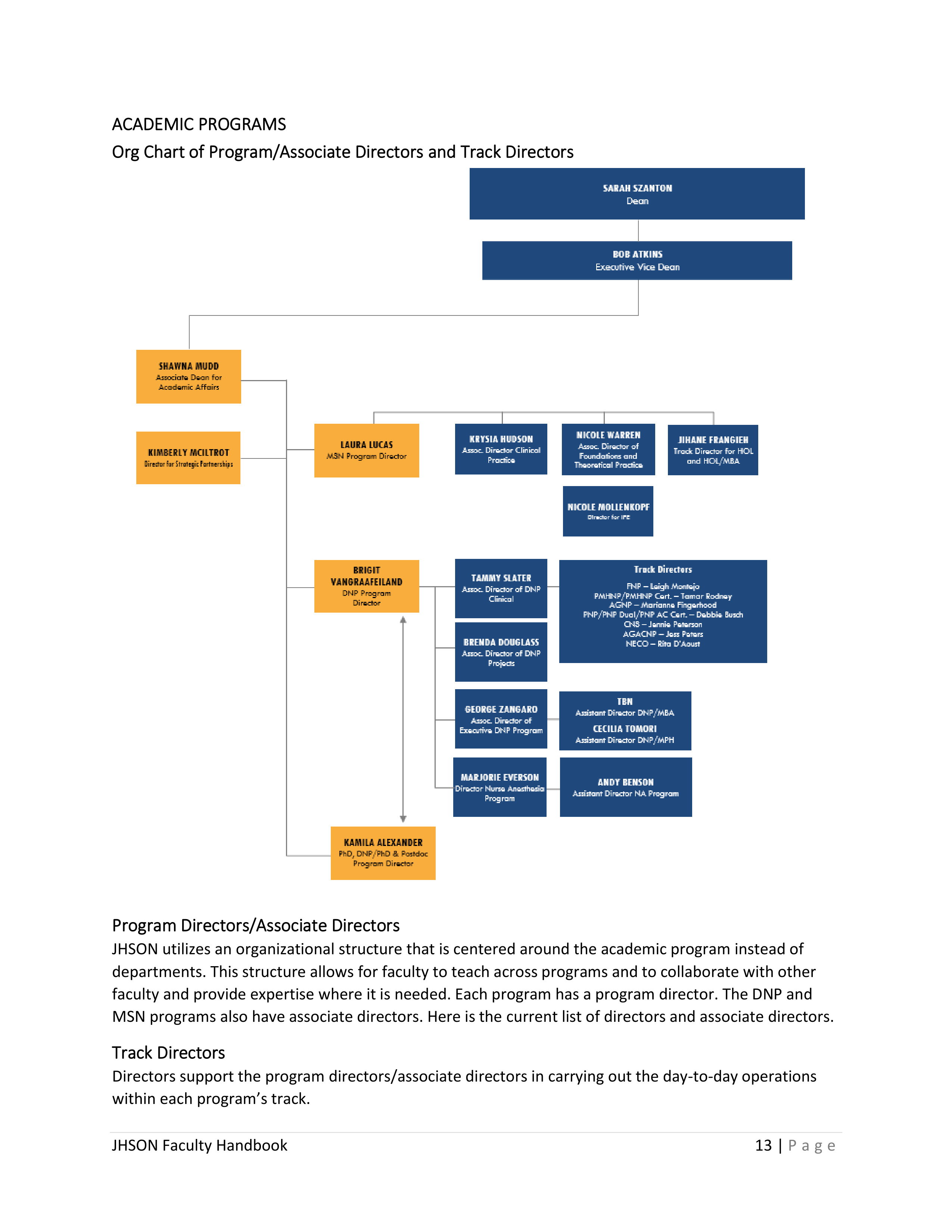
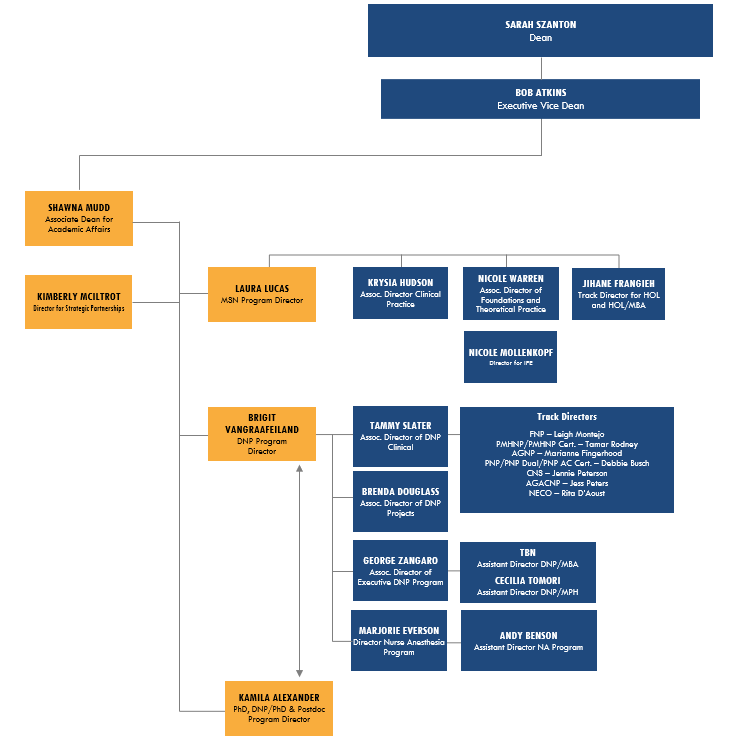
JHSON utilizes an organizational structure that is centered around the academic program instead of
departments. This structure allows for faculty to teach across programs and to collaborate with other
faculty and provide expertise where it is needed. Each program has a program director. The DNP and
MSN programs also have associate directors. Here is the current list of directors and associate directors.
Track Directors
Directors support the program directors/associate directors in carrying out the day-to-day operations
within each program’s track.
JHSON Faculty Handbook
14 |
P a g e
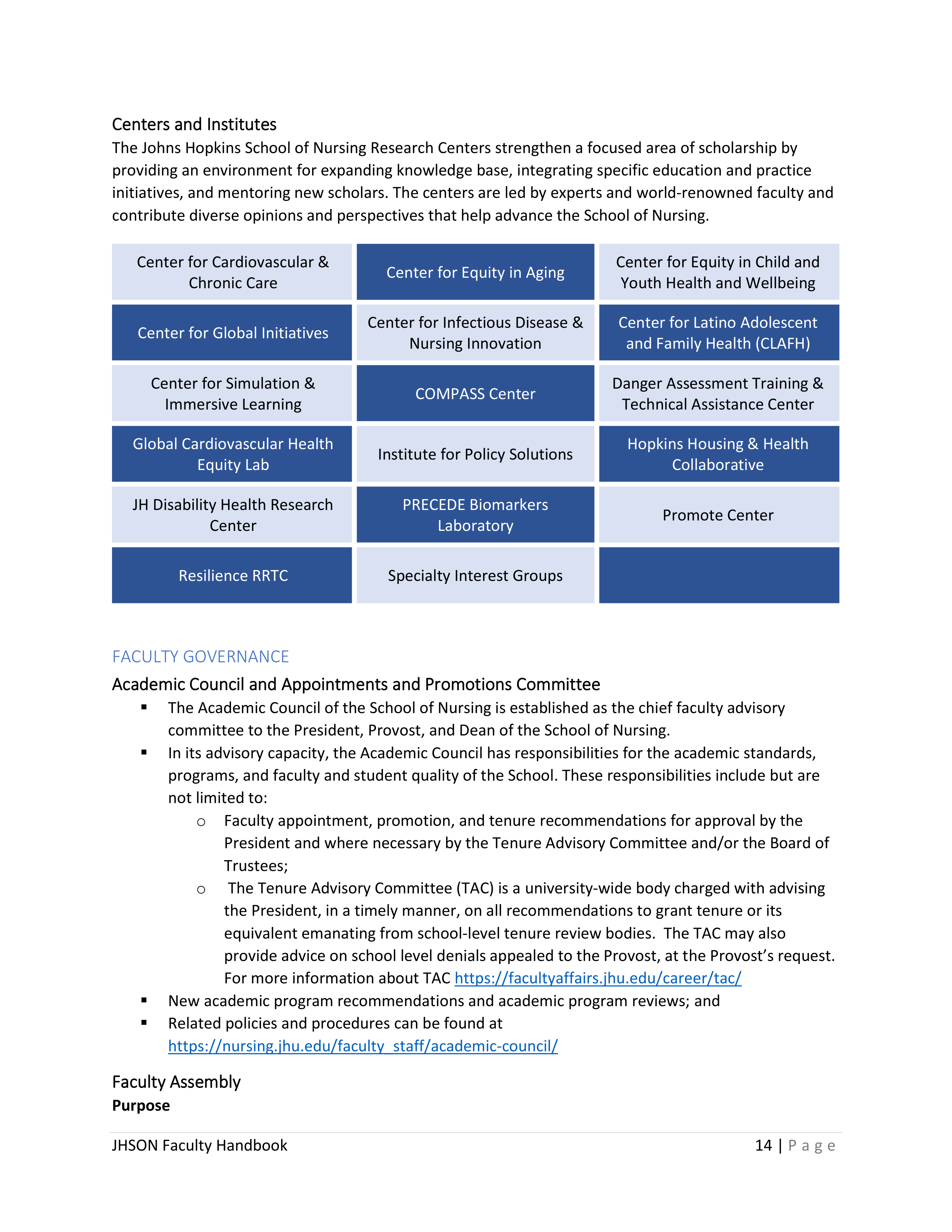
Centers and Institutes
The Johns Hopkins School of Nursing Research Centers strengthen a focused area of scholarship by
providing an environment for expanding knowledge base, integrating specific education and practice
initiatives, and mentoring new scholars. The centers are led by experts and world-renowned faculty and
contribute diverse opinions and perspectives that help advance the School of Nursing.
Center for Cardiovascular &
Chronic Care
Center for Equity in Aging
Center for Equity in Child and
Youth Health and Wellbeing
Center for Global Initiatives
Center for Infectious Disease &
Nursing Innovation
Center for Latino Adolescent
and Family Health (CLAFH)
Center for Simulation &
Immersive Learning
COMPASS Center
Danger Assessment Training &
Technical Assistance Center
Global Cardiovascular Health
Equity Lab
Institute for Policy Solutions
Hopkins Housing & Health
Collaborative
JH Disability Health Research
Center
PRECEDE Biomarkers
Laboratory
Promote Center
Resilience RRTC
Specialty Interest Groups
FACULTY GOVERNANCE
Academic Council and Appointments and Promotions Committee
▪
The Academic Council of the School of Nursing is established as the chief faculty advisory
committee to the President, Provost, and Dean of the School of Nursing.
▪
In its advisory capacity, the Academic Council has responsibilities for the academic standards,
programs, and faculty and student quality of the School. These responsibilities include but are
not limited to:
o
Faculty appointment, promotion, and tenure recommendations for approval by the
President and where necessary by the Tenure Advisory Committee and/or the Board of
Trustees;
o
The Tenure Advisory Committee (TAC) is a university-wide body charged with advising
the President, in a timely manner, on all recommendations to grant tenure or its
equivalent emanating from school-level tenure review bodies. The TAC may also
provide advice on school level denials appealed to the Provost, at the Provost’s request.
For more information about TAC
https://facultyaffairs.jhu.edu/career/tac/
▪
New academic program recommendations and academic program reviews; and
▪
Related policies and procedures can be found at
https://nursing.jhu.edu/faculty_staff/academic-council/
Faculty Assembly
Purpose
JHSON Faculty Handbook
15 |
P a g e
▪
The Faculty Assembly's purpose is to formalize faculty contribution to the governance of the
School of Nursing and the University.
▪
To initiate, formulate, and evaluate policies and programs that facilitate the realization of the
goals of the School of Nursing and the Johns Hopkins University.
▪
To set its own procedures for governance, including the formation of ad hoc committees as
necessary.
Membership
▪
Faculty members holding the rank of Professor, Associate Professor, Assistant Professor,
Instructor, and Clinical Instructor, Faculty Associate, Research Associate, Lecturer.
▪
Faculty members from other schools and institutions who have been granted joint or adjunct
faculty appointments to the School of Nursing.
Voting Members
▪
Full time faculty members holding the appointed rank of Professor, Associate Professor,
Assistant Professor, and title of Instructor and Clinical Instructor.
▪
Individuals with the following title/appointment do not have voting privileges, but are invited to
attend meetings: Adjunct Faculty, Joint Appointments not holding a primary appointment to the
School of Nursing, Visiting Faculty, Faculty Associate, Research Associate, and Lecturer.
Standing Committees of the Faculty
School policy originates from faculty participation in several school-wide committees. Appointments
Unless otherwise indicated, members of all standing committees shall be elected from Faculty Assembly
members by the voting members of the Faculty Assembly. Detailed information about nominations can
be found in the Faculty Assembly bylaws.
The Standing Committees Include:
▪
Steering Committee
▪
Academic Ethics Board
▪
Bylaws & Nominations
▪
Graduate Admissions Committee
o
MSN Admissions Sub Committee
o
DNP AP Admission Sub Committee
▪
DNP (Executive) Admissions Sub Committee
▪
School-Wide Curriculum
▪
Graduate Curriculum Committee
o
MSN Sub Committee
o
DNP Sub Committee
▪
PhD Curriculum
▪
Master’s Progressions
▪
DNP Progressions
▪
PhD Admissions, Progressions & Graduation
JHSON Faculty Handbook
16 |
P a g e
EMPLOYMENT ENGAGEMENT
Offer Letters
The terms of the contract between the School of Nursing and a faculty member are set forth in the offer
and appointment letters and any addenda to such letters. The offer letter specifies contingencies that
must be met before the contract becomes effective, such as approval by the Appointments and
Promotion Council or referral to the University and action of the University’s Board of Trustees (if
applicable), and appointment to the staff of The Johns Hopkins Hospital or any other clinical entity (if
applicable). Each subsequent year (for contracts covering more than one year), a letter will be sent to
the faculty member confirming the type and total period of the appointment. Acceptance of an offer of
employment or reappointment means the faculty member and the University agree to comply with the
terms of the offer letter and all applicable rules and regulations of the School of Nursing as well as those
of the University.
Policies Related to Appointments
Please review the
Academic Council Policies and Procedures
as they relate to appointments,
renewals, and promotion criteria.
Salaries
Academic Affairs determines salaries for new and continuing faculty in consultation with the Dean. The
American Association of Colleges of Nursing collects and produces aggregated annual salary data for
schools of nursing. Median salary data for faculty from all schools of nursing are then compared with
data from the School by rank. JHSON conducts annual faculty salary analysis to determine whether there
are salary differences by any variable and make the appropriate adjustment.
Benefits
All full-time faculty are eligible for benefits. Please reference the benefits website at
https://hr.jhu.edu/benefits-worklife/
The Benefits Service Center coordinates the School’s benefit plans
for faculty members. Individual meetings with benefits specialists can help navigate the various
insurance, retirement, and educational opportunities.
Annual Faculty Salary Letters
Each year, in late spring, the office of Academic Affairs will issue annual salary letters. These letters
confirm the faculty member’s rank, FTE %, salary increases, and any supplemental roles. These letters
should be reviewed by the faculty member and any discrepancies or required changes should be
submitted immediately so the appropriate changes can be made prior to the new fiscal year (July 1-June
30).
Faculty Resignation/Retirement
Faculty who wish to resign or retire from JHSON should submit a formal letter to the Dean and Executive
Vice Dean. This letter should clearly state the final day of work for the faculty member. A faculty
member who departs from a full-time faculty position is not automatically eligible to a part-time
appointment. A faculty member who wishes to continue an association with JHSON after their
resignation should seek guidance from the office of Academic Affairs. A faculty member who retires may
be eligible for Emeritus status. Emeritus is an honorary title that may be awarded to retired faculty
members in recognition of their distinguished achievements and service.
JHSON Faculty Handbook
17 |
P a g e
JHU Policy of Equal Opportunity
Each year the University formally reiterates and reaffirms its commitment to the goal of equal
opportunity for its faculty, students and staff. As a matter of policy to which it is staunchly committed,
the University does not discriminate based on race, color, sex, religion, age, sexual orientation, national
or ethnic origin, disability or veteran status.
Consistent with its obligations under law, the University is committed to providing qualified individuals
access to all academic and employment programs, benefits, and activities based on demonstrated
ability, performance and merit, without regard to personal factors that are irrelevant to the program
involved.
The University's equal opportunity policy applies to all academic programs administered by the
University, its educational policies, admission policies, scholarship and loan programs, and athletic
programs. It also applies to all employment decisions, including those affecting hiring, promotion,
demotion, or transfer; recruitment; advertisement of vacancies; layoff and termination; compensation
and benefits; and selection for training. Moreover, it extends to the maintenance of affirmative action
programs for minorities, women, disabled persons, and veterans, as required by law.
The University assigns a high priority to the implementation of its equal opportunity policy, and
significant University resources are devoted to assuring compliance with all laws prohibiting
discrimination in employment and educational programs. The University's Office of Equal Opportunity
and Affirmative Action Programs is responsible for implementing equal opportunity and affirmative
action programs.
Policies and Procedures
Discretionary Accounts
As part of the offer letter, ranked faculty are provided with a one-time funded discretionary account.
These funds are allocated for faculty to use in support of their scholarship and development.
Discretionary accounts can be used to attend conferences, to fund research, to order supplies, to
purchase computer hardware and software, and for business-related travel and expenditures. In
addition, these funds can be used for teaching assistants or research assistants who are otherwise not
funded by another approved source.
Faculty members should not personally purchase computer software or computer hardware without
first reaching out to IT. The purpose of this is to avoid paying taxes and to take advantage of University
vendor agreements. In the event that a faculty member does not make purchases through IT, the School
will only reimburse the University rate for those supplies and will not reimburse tax. Discretionary funds
are subject to University policies and procedures for purchases, travel and business expenses.
Discretionary accounts may not be used for salary supplements.
Discretionary accounts will automatically rollover 100% of unused discretionary funds. The Business
Office will track all funding and spending in the faculty discretionary accounts and will provide quarterly
reporting to each faculty member. Faculty members who have questions or wish to know their balances
can contact the Business Office directly.
Faculty who submit their resignation or are terminated are not eligible to cash out their discretionary
account fund. All remaining funds stay with the school.
JHSON Faculty Handbook
18 |
P a g e
TEACHING AND ADVISING
The Academic Calendar
The School’s academic calendar is based on three 12 to 15-week terms during the academic year. The
School of Nursing has two, degree completion ceremonies. The School of Nursing's Spring Degree
Completion Ceremony is held in May, and the Summer Degree Completion Ceremony is held in August.
Faculty are invited to celebrate this achievement with students.
Overview of Programs
The Johns Hopkins School of Nursing offers programs designed to fit the needs of a diverse population.
From MSN, DNP, and PhD programs, dual degrees, online options, and post-degree opportunities, we
offer more possibilities for more people in a variety of places, times, and formats.
Community-Based Organizations
The Urban Health Institute was established as the result of a recommendation of a council convened in
1998 by the President of JHU. The Institute partners with the communities of East Baltimore to improve
health care and education for local children, youth and families and to develop sustainable community
planning for all residents.
Students, faculty and staff from the School participate in diverse activities through a program called
Student Outreach Resource Center (SOURCE), through other School- or University-based organizations,
or through individual arrangements.
Advising/Mentoring
Faculty should know that each student is assigned to a professional Academic Advisor who will ensure
that the student stays on their Plan of Study. Advising about courses can be enhanced by knowledge of
course evaluations and the online course list available in SIS and the Public Online Course Search.
Effective education requires a well-designed curriculum, high-quality didactic courses, and individual
mentoring of students to assist them in having their academic programs serve their professional goals as
well as to transition from the School to the work setting.
Student mentoring is a key role of faculty. Mentoring is critical to student development and crucial in
fulfilling the educational mission of the School. This is a process which involves being available to
students, listening, assisting them with focusing their aspirations, providing professional contacts,
reviewing drafts of manuscripts, providing constructive feedback and generally promoting professional
development in many small but important ways. As with more formal teaching, a key ingredient of
successful mentoring is the faculty's demonstrated commitment to the student's success. It is not
necessarily the case that a student's advisor is also his/her mentor.
Oral Exam Responsibilities
Each program may or may not have oral examination responsibilities. The program directors for the
program you are teaching in can provide you with information about your responsibilities for
participation in student examinations.
JHSON Faculty Handbook
19 |
P a g e
Student Assistance Program
The Student Assistance Program, offered through
JHSAP
, provides private and confidential support to
registered students in dealing with the pressures and problems they encounter during their academic
careers.
Family Educational Rights and Privacy Act (FERPA)
The Family Educational Rights and Privacy Act of 1974 (FERPA) is a federal law designed to protect the
privacy of education records. It also provides guidelines for appropriately using and releasing student
education records. Faculty are reminded that:
▪
Social security numbers are never considered directory information and should never be
disclosed or posted publicly for any reason.
▪
Downloaded and printed rosters and transcripts should not be shared with anyone who does
not share grading or academic responsibilities. Paper copies should be destroyed when no
longer needed or returned to the Registrar's Office for disposal. Electronic copies should be
deleted.
▪
Refer all third-party inquiries to the data custodian (Registrar's Office) for the School.
▪
Personally identifiable information (i.e. Grades, GPA) cannot be included in letters of
recommendation without express written consent of the student.
▪
Never share your login/password information.
▪
Never leave records visible on your computer screen when you leave your workstation. Log off
or lock your computer.
▪
Sole possession records or private notes and memory aides of individual staff or faculty that are
not accessible or released to other personnel are not part of the educational record.
▪
Any record made with a student or other school official is not a sole possession record and
considered part of the educational record. Students and former students have the right to
inspect and review their educational record.
Faculty and staff with access to student paper or electronic records (i.e. ISIS, Reports, Clearinghouse)
must complete a short compliance course on an annual basis to maintain access to these records.
Scheduling Classrooms and Meeting Spaces
JHU has adopted 25 Live for room scheduling.
Technology & Accessibility Services for Teaching and Events
The Multimedia Department (part of IT) provides audiovisual equipment and technical assistance for all
instruction and special events. Service and equipment requests are made via an online form.
Academic Program Development
All new academic programs and significant revisions or new concentrations within existing programs
require approval from curriculum committees of the sponsoring departments and the School-wide
Curriculum Committee. In addition, Maryland requires such programs be reviewed and approved by the
JHSON Academic Council and the Maryland Commission on Higher Education (MHEC).
Instructional Design, Technology & Support
The Instructional Design, Technology, and Support Team includes designers and technologists with
advanced academic degrees and extensive experience in adult learning theory, online technologies, and
JHSON Faculty Handbook
20 |
P a g e
evidence-based instructional development strategies and processes. These professionals work
collaboratively with JHSON faculty to build online, blended, and web-enabled face-to-face courses.
They provide pedagogical guidance, share technical best practices, and facilitate the creation of
academic courses. Their goal is to facilitate instruction that enables learning.
Faculty members should work with Instruction Design team members for course planning, teaching
observation, education research, education grant proposals, or course evaluation review. Book a
meeting to schedule a consultation on any aspect of your teaching or education scholarship or contact a
member of the Instructional Design & Course Support Team directly.
Course Administration
All courses require the use of the CANVAS Learning Management System (LMS)platform and
collaborations with instructional design and course support. Please reach out to course support for
orientation to the processes and procedures for the use of Canvas for course organization and
communication. Additionally, the support team will assist faculty with course development and
preparations for the upcoming semester.
Course Credits and Enrollment Requirements
The number of course credits aligns with the Federal Credit hour policy which can be found here
→
https://e-catalogue.jhu.edu/university-wide-policies-information/academic-policies-information/credit-
hour/
Course Evaluations
Students evaluate all courses offered for a letter grade or Pass/Fail in the School of Nursing, whether on-
site or off-site, at the end of the term in electronic format. Evaluations include a standard set of
questions that assess instructor and course quality, as well as workload. Detailed results are avialable to
instructors through the tool’s website, and a summary of results for each course is made available to
program directors through a secure TEAMs channel. There is an additional opportunity to provide open-
ended feedback. In addition, students can provide feedback during the term through mid-course
reviews.
Grading Policies
Letter grades range from A+—Excellent to F – Failure. If course requirements are not completed by the
end of the term, the instructor may assign an incomplete grade. All students must maintain a GPA of 3.0
and can repeat a course with an unsatisfactory grade in accordance with the program-specific terms.
Please refer to the Academic Standards for Progressions in the
Academic Catalog
for JHSON.
JHSON Faculty Handbook
21 |
P a g e
FACULTY DEVELOPMENT
JHSON has a dedicated leadership member, the Associate Dean for Faculty Development, assigned to
support faculty in their onboarding and development and support faculty through the promotion
process.
Appointment and Promotion Process
Most of the information about the following parts of faculty development can be found in the Academic
Council Policies and Procedures document. More information about the Academic Council and the
Appointment and Promotions Committees can be found here:
https://nursing.jhu.edu/faculty_staff/academic-council/
•
Appointment and Promotion Process
•
Appointment and Promotions Criteria can be found here
•
Faculty Titles
•
Stopping the Clock/FMLA
•
Time in Rank Review Process
Faculty Curriculum Vitae Format
Faculty members should maintain their Curriculum Vitae (CV) in the standard SON format. Faculty
should submit an updated CV to Academic Affairs annually. This CV is used in various contexts including
updating the JHSON website.
Mentoring for Junior Faculty
The School of Nursing is committed to the success and development of every faculty member. A key
component of faculty success is a robust faculty mentoring program focused on faculty development,
diversity, and retention. A mentor acts as an advisor for a faculty member that has less experience in the
field. Mentoring is an essential component of faculty development because learning from faculty who
have been successful can help faculty achieve success in their careers. Our SON has a culture of
mentorship that supports and rewards both the quantity and quality of mentorship as part of the annual
review and promotion criteria.
Annual Evaluation
Every faculty member has an annual evaluation with their faculty evaluator. Meetings should review
their goals, recent accomplishments, identify any weaknesses or gaps in progress, discuss plans for
future directions, and assess the faculty member’s prospects for promotion to the next rank. Strategies
for improving performance should be offered and discussed if necessary. The annual evaluation
framework is aligned with the promotion criteria.
Grievances and Problems - Faculty Grievance Committee
The faculty member who believes that they have a legitimate grievance should attempt to resolve the
matter informally. The faculty member should bring the complaint or dispute to the individual with
whom they have the grievance to resolve the problem through informal discussion. The formal
procedure outlined below is not intended to supplant attempts to resolve complaints through
alternative means. The procedure should be used only after every effort has been made to settle the
dispute informally.
JHSON Faculty Handbook
22 |
P a g e
Johns Hopkins Employee Assistance Program (JHEAP) is open to all full-time faculty and staff desiring
assistance for problems of a personal nature. The program offers professional and confidential
assessment and, when indicated, referral to appropriate counselors, self-help groups, agencies and
other parties. Crisis intervention, education, prevention, outreach and follow up services are available.
Sexual harassment in the University setting has no place in a healthy academic or workplace
environment. The University has developed a Sexual Harassment Prevention and Resolution Program to
recognize and prevent sexual harassment and to stop it if it occurs. Both informal problem-solving and
formal investigation are options available to resolve the problem.
Leaves of Absence
Faculty do not accrue PTO. Faculty should arrange for faculty coverage for any time away.
Faculty are eligible for FMLA after 12 months of employment. FMLA should be requested through the
school’s office of Human Resources. Faculty on approved FMLA stop the clock toward time in rank for
purposes of promotion (within certain limitations).
If faculty member wishes to take an extended leave where they are neither working at nor collecting
salary from the School, such leaves must be requested through the Executive Vice Dean and approved
by the Dean. Faculty members may be at another academic institution, maybe in a non-academic
institution, or may have a serious medical situation that prevents them from working. Unless other
arrangements are approved by the Dean, they are counted toward time-in-rank for promotion. The
maximum cumulative time for a leave of absence is two years.
Sabbaticals
Qualified full-time full professors who have been on faculty for at least five years may apply for a
sabbatical for scholarly/educational purposes when significant opportunities present themselves and
when the sabbatical can be arranged without extra expense to the School of Nursing and without
impairing educational programs. Such sabbaticals are recognized to have the potential to increase the
value of the faculty member to the School and the University. Sabbaticals are not an automatic, periodic
right, but must be applied for through the Associate Dean for Faculty Development. Arrangements to
fulfill faculty members’ duties while they are on leave must be made with the Executive Vice Dean, and
then the Dean must approve the sabbatical.
Phased Retirement for Professorial Faculty
In negotiations with the Executive Vice Dean, faculty members who wish to phase in retirement over
time are advised to develop a plan for reducing hours within an anticipated timeframe. Planning would
include negotiation with the Executive Vice Dean regarding whether to retain a full-time appointment at
a reduced salary, thereby maintaining university subsidies for health insurance and retirement
contributions, albeit at a lower base salary, or to enter part-time employment status with its
accompanying implications for benefits. For either approach, salary is reduced in proportion to the
effort. Faculty members who are considering phased retirement are urged to review the material
available on the University’s benefits website and consult with the office to understand the possible
options and their implications. Access to libraries, email, and related privileges may be retained for as
long as faculty members remain affiliated with the School; office and other space needs should be
negotiated with the Executive Vice Dean. The phased retirement process aligns with the
recommendations presented in the 2011 report of the Retirement Subcommittee of the Johns Hopkins

JHSON Faculty Handbook
23 |
P a g e
University Faculty Budget Advisory Committee. Phased retirement and effort reduction are independent
from emeritus status, which is a faculty rank granted by the University Board of Trustees.
Faculty Web Profiles
Internet profiles are important features of our digital identities as communicated both inside and
outside the school. Basic information including name, rank, degree, degree institution and contact
information are populated by the Office of Academic Affairs; profiles will be active within one week of
appointment. As a member of the School’s community, faculty members are expected to maintain an
active and up to date SON profile.
JHSON Faculty Handbook
24 |
P a g e
FACULTY AS MANAGERS
Hiring Employees
The School's Office of Human Resources serves to assist the faculty members in defining the
qualifications, position description, and recruitment of staff. Staff positions are classified by level and
assigned a salary range. Departmental administrators or the compensation analyst in the Office of
Human Resources can assist the faculty member by sharing sample position descriptions and helping the
faculty member to determine the specific qualifications and experience required for the position. A
position description and requisition form is completed by the hiring manager; the position is then
posted and advertised as appropriate. No position may be offered to a candidate until officially posted.
All applicants are first screened by the Office of Human Resources and appropriate applicants are then
referred to the faculty member for an interview. The Office of Human Resources checks candidates'
references and extends a formal offer to the final candidate on behalf of the faculty member. All newly
hired staff members have an introductory period, providing an early opportunity to evaluate the new
staff member's performance.
The University makes a distinction between non-exempt and exempt staff based on pay grades. Non-
exempt employees are staff members compensated for extra time worked beyond their regularly
scheduled work week if their supervisor authorizes it in advance. Exempt staff may work additional
hours on occasion without additional compensation. Staff with the highest pay grades are considered
professional exempt staff and are not to be compensated for time worked in excess of regularly
scheduled hours.
The Johns Hopkins University salary administration program and benefits are regulated by and uniformly
administered throughout the University. Staff can transfer between positions within the University and
retain their benefits. The Johns Hopkins Hospital/Health System is a separate employer.
Managing Employees
Honest and open communication regarding specific responsibilities and expectations of the staff
member, and feedback (both positive and negative) regarding the staff member's performance is an
important part of the manager/employee relationship. When problems do occur, written
documentation is a key component for taking corrective action. The Office of Human Resources will help
you deal with staff issues.
Staff Performance Reviews
During the probationary period, manager should meet frequently with their new employee to provide
specific feedback on job performance. Required reviews occur at 60 and 120 days. Every staff member
has an two reviews each year – a mid-year review and an annual review. The staff member's
performance evaluation should be completed and discussed with him/her before the review due date.
The annual increase amount is based on the supervisor's evaluation, within the University's salary
guidelines for that year. Performance evaluation forms and assistance in completing and communicating
the evaluation are available through SuccessFactors, while the instructions come from the Office of
Human Resources.
JHSON Faculty Handbook
25 |
P a g e
CONDUCTING RESEARCH
The School has a dynamic, collegial, entrepreneurial research enterprise that spans a cell to society
framework. The infrastructure is geared to supporting excellence in faculty research while minimizing
administrative burden.
The School also compiles and maintains research profiles on each faculty member using SciVal. Profiles
are constructed through automatic searching of PubMed databases by key word and include all
publications in PubMed indexed journals. Profiles are available for all faculty members on the East
Baltimore campus and appear on their faculty web pages.
Funding Opportunities
The University offers many opportunities for small start-up grants, DELTA awards, and other funded
programs throughout the year.
The School’s Development Office can help faculty members identify non-federal sources of funding
support including foundations, corporations, and individual donors that may be willing to support
projects within specific areas. Faculty members should be prepared to provide the development staff
with a brief written description of their expertise/project and the amount of funding they are seeking.
The Responsible Conduct of Research
Integrity and the highest ethical standards are at the core of being a responsible teacher and
investigator. Training in the responsible conduct of research is often not part of formal academic
training yet faculty members are often called upon to deal with related problems as they arise with
respect to students and, at times, with colleagues. It can be challenging to know exactly what the right
thing to do is in any given situation. To facilitate such discussion and awareness, the Responsible
Conduct of Research Program was developed as a resource for dealing with the most encountered
issues: supervision of research personnel; authorship; publication and ethical writing practices; and data
management.
Conflict of Interest and Commitment
It is vital that research is conducted free from any suspicion that the results might be biased due to a
potential conflict of interest by a member of the research team.
University policies require that faculty report external activities, including those activities that
potentially pose a conflict of interest and/or a conflict of commitment.
Conflicts of Interest occur when a faculty member’s institutional responsibilities could be compromised
by his or her external activities. For example, a common conflict of interest arises when a faculty
member conducts research that is sponsored by, or involves a product of, an entity with which the
faculty member has an external relationship.
Conflicts of Commitment occur when faculty members’ time and attention devoted to external activities
interferes with their ability to fulfill their obligations to the School. The existence of a potential conflict
does not indicate that the activity is prohibited; most conflicts can be managed to protect both you and
the School. The School has a standing committee that reviews and manages conflicts.
▪
JHSON follows the University’s policy on Conflict of Interest/Conflict of Commitment. This can
be accessed here
→
https://policies.jhu.edu/doc/fetch.cfm/DqwggusL
JHSON Faculty Handbook
26 |
P a g e
▪
Work not part of faculty effort must be submitted in e-Disclose and approved before
engagement.
▪
All activities outside the SON that require time and/or compensation must be reported and
approved in e-disclose
prior to the engagement
of work.
▪
Other JHU Policies can be found at:
https://policies.jhu.edu/
The University’s online reporting system is called eDisclose and can also be accessed through Important
Links listed under School of Nursing category on your myJH page. Reporting of external activities is
based both on transactional disclosures of external activities prior to when happen or are about to
happen, plus an annual certification that your external activities are up to date. It is essential that
disclosures be made promptly, typically 30 days (about 4 and a half weeks) prior to engagement. Late
disclosures may lead to serious consequences if a financial conflict of interest is detected.
In accordance with federal regulation, all faculty members are required to receive training related to
conflict of interest when they become faculty members and every four years thereafter.
Office of Research Administration
The Office of Research Administration (NORA) processes all grants and contracts submitted by faculty
members using a system called Fibi. Departmental administrators and budget personnel are
experienced in preparation of materials for NIH and other sources of sponsored funds and will provide
specific information on procedures for completion of applications in a timely fashion, including
completion and review of budgets. Be aware of time criteria for submitting proposals to ensure
adequate time for processing and submission during busy federal deadlines.
Direct Costs and Facilities & Administrative Costs
There are two types of costs associated with externally sponsored activities. "Direct" costs are those
that can be directly associated with the conduct of one or more sponsored projects and include items
appearing in a budget prepared for a specific project. Examples of direct costs include faculty, staff and
student salaries and benefits, laboratory equipment and supplies, expenses related to study
participants, and so on. Facilities and Administrative costs (F&A), also called “indirects” are incurred for
objectives common to the institution's entire research enterprise and which are not linked to a
particular sponsored project. Such costs include those related to sponsored projects administration,
facilities (such as space, heating, cooling, repairs and security), libraries and the like. The primary means
the School has for recovering costs associated with these activities is to include them in each application
submitted to an external funding agency. The rates are established by the federal government after
scrutiny of the University’s research portfolio. Different rates exist for "on-campus" and "off-campus"
activities and may vary depending on the agency, the location of the research and other factors. Some
foundations severely restrict F&A rates. In such instances, investigators must ensure that as many items
as possible that are usually covered by F&A are included in direct costs. ORA maintains information on
these sorts of allowable costs.
Managing a Budget
Each new or renewed grant, contract or other sponsored project is provided with a budget number or
cost center. Funds spent in each budget category are recorded centrally and principal investigators are
provided with monthly statements of expenditures from the previous month and total amounts spent
JHSON Faculty Handbook
27 |
P a g e
and unspent to date. Investigators should review their statements carefully to closely monitor
expenditures and address any questions to their department administrator.
The School's "fiscal" or budgetary calendar is from July 1 through June 30. It is faculty's responsibility to
actively work with department and School financial support staff to maintain and control revenue and
related expenditures for sponsored projects.
Technology Transfer
The Johns Hopkins Technology Ventures (JHTV) is the University’s intellectual property admission center,
serving Johns Hopkins researchers and inventors as a licensing, patent, and technology
commercialization office and acting as an active liaison to parties interested in leveraging JHU research
or materials for academic or corporate endeavors.
Research Compliance
The University is required to ensure that sponsored funding is used for authorized purposes in
compliance with applicable grant and contract terms, Federal and State regulations and University
policies and procedures.
The Office of Financial Research Compliance works to support these goals through management of
Effort Reporting, approvals of cost transfers, Sub Recipient Monitoring, reviewing federal administrative
salary and non-salary costs, serving as a resource to compliance related issues, and coordination of
various audits.
If your office/department has been notified of an upcoming audit or receives inquiries related to the
University's A133 single audit requirement, please contact Financial Research Compliance at 443-997-
3806, Compliance@jhu.edu or subrecipient@jhu.edu
Human Subjects Research
Faculty members who plan to engage in research that involves human subjects, including research that
is about people even if the data already exist, requires review and approval by the JHPSH Institutional
Review Board (IRB), prior to receiving funding.
Faculty who engage in human subjects research must take on-line training offered by CITI prior to
submitting an application for review. In addition, research that includes Protected Health Information as
defined by HIPAA regulations should be aware of the additional requirements in this area.
Animal Research
Faculty who plan to engage in research with animals must have their projects reviewed and approved by
the Institutional Animal Care and Use Committee (ACUC). This is a University-wide committee.
Blood borne Pathogens
The federal Occupational and Safety Health Administration (OSHA) requires bloodborne pathogen
training for all individuals who may come in contact with human blood, bloodborne pathogens, and
other potentially infectious materials. Faculty who plan to use these products must take training in the
proper care and handling of these products.
JHSON Faculty Handbook
28 |
P a g e
Scientific Misconduct
Faculty members who do research are called upon to do the right thing daily in the face of tremendous
pressures for discovery, publication and securing funding. A reputation for integrity in research practices
is central to a faculty member’s scientific career; that career can be jeopardized with a single error in
judgment. Research Misconduct is described by the federal Office of Research Integrity as the
fabrication, falsification, or plagiarism in proposing, performing, or reviewing research, or in reporting
research results. It does not include honest error or differences of opinion.
▪
Fabrication
is making up data or results and recording or reporting them.
▪
Falsification
is manipulating research materials, equipment, or processes, or changing or
omitting data or results such that the research is not accurately represented in the research
record.
▪
Plagiarism
is the appropriation of another person's ideas, processes, results, or words without
giving appropriate credit.
In contrast to the narrow definition of Research Misconduct, Professional Misconduct incorporates a
broader range of lapses in other aspects of faculty performance, although some of these can be
research related. Examples include failure to conduct research according to IRB policies and procedures,
or the misappropriation of research funds. Two separate JHSPH policies detail the process for evaluating
charges of either. These are:
If a faculty member suspects or identifies a problem, consulting with a department chair or the
Associate Dean for Research does not automatically trigger an investigative process so individuals
should feel free to discuss concerns. It is not uncommon for concerns about suspected misconduct to
be resolved without formal proceedings and thereby circumvent a process that can be wrenching for all
involved. Additional useful information is provided in the Responsible Conduct of Research Program.
Data Management Services
The Johns Hopkins University Data Management Service (DMS), provided through the Sheridan Libraries,
offers several options for investigators to deposit or archive data to facilitate sharing or satisfy other
data management needs.
JHSON Faculty Handbook
29 |
P a g e
OTHER RESOURCES
Identification Card (Badge)
A photo identification card is issued to all new Hopkins employees as part of their onboarding process.
Replacement cards can be obtained at a nominal cost. All identification cards must be surrendered at
the end of employment. It is important to collect the identification card from a staff member who is
terminated or resigns to prevent future access to the building and return it to the Operations team.
Library Services
The Welch Medical Library is located adjacent to the School and offers a wide array of services, including
electronic access to journals.
Athletic Centers
The Denton Cooley Center is located at the corner of N. Wolfe and Ashland. It provides recreational
sports facilities for the Hopkins East Baltimore community. Full-time students may use them free of
charge; all others pay yearly membership fees to join. The facility has tennis, squash and racquetball
courts, aerobic exercise classes, intramural games and tournaments in several sports, classes and
lessons, and fitness assessments. Family members are eligible to join.
Bookstore
The Matthews Johns Hopkins Medical Book Center is on the corner of Monument and Wolfe Streets.
Faculty and staff who pay cash or check are eligible for a 10% discount on non-book merchandise. It is
also a good place to purchase School and University memorabilia for visitors.
Child and Adult/Elder Care Information
The Johns Hopkins Family Center offers childcare services to full time employees (faculty and staff),
students, house staff and fellows of the Johns Hopkins University and the Johns Hopkins Hospital/Health
System.
The University's Office of Work, Life, and Engagement Programs can provide more information on
childcare options, as well as information, referral, consultations, caregiver educational seminars, and
monthly support groups for faculty caring for ill or elderly relatives.
Copying Services
The School is equipped with color copiers that can be utilized for printing and copying. If large quantities
are required, please work with an offsite vendor to produce the print job.
Emergency Preparedness
A notification system provides text message and email alerts to faculty, students and staff in an
emergency. The system is voluntary, and you must register to receive the alerts. Sign up is accessed
through myjh.edu
→
Profile
Safety and security training can be found in the Important Links
→
Emergency Information area.
International Services
The Office of International Services supports the international population of the School and assists the
School in maintaining its commitment to international education. All incoming faculty members seeking
H-1B or J-1 visa status should contact International Services for assistance.
JHSON Faculty Handbook
30 |
P a g e
Mail Services
Campus Operations changed the mailing process to streamline the UPS, FedEx, and Amazon package
delivery process. This process does not apply to the Wald building, only to Pinkard, Student House, and
511 N. Washington.
Campus Operations does not process outgoing packages for UPS or FedEx. All outgoing UPS and FedEx
packages should be packaged and labeled by the sender. There is a table between the doors to
Carpenter Room B by the loading dock where outgoing packages are to be placed for pickup.
All incoming UPS, FedEx, and Amazon packages will now be delivered to tables outside of
room S318
.
When you receive notice of a delivery, or if you are expecting a delivery, please go to S318 in Pinkard to
retrieve your package. Campus Operations has a cart and a hand truck that you can borrow if needed.
Please ensure it is promptly returned. Please make sure your name and current room number, inclusive
of the N or S for north and south, are entered when you enter your shipping information.
Campus Ops will continue to process incoming and outgoing USPS mail and packages and deliver USPS
packages to their destinations. All Faculty members have a mailbox on campus. Please be sure to check
your mailbox when you are on campus.
Mail that is addressed to staff members will continue to be delivered to the staff member’s
corresponding section for distribution. If you have any question about where your mailbox is located or
where your mail is currently being delivered, please stop by S318.
Mother/Lactation Rooms
Mothers' Room/Lactation Room (N122 of Pinkard Building) is designed to provide a private setting with
all the facilities needed for pumping and storing breast milk. The room contains a hospital grade electric
breast pump, a refrigerator, comfortable chairs and reading material. More information can be found in
the Office of Work, Life and Engagement. The site will also list other available Mothers’ Room
throughout Johns Hopkins.
Marketing and Communications
The Office of Marketing and Communications provides strategic planning and integrated marketing
services for specific communications initiatives by the School. The Office provides editorial,
photographic, and graphic design services for both web and print projects for the School. JHSON
branding logos for presentations and other materials are available.
Security
The Johns Hopkins Medical Institutions Security Department operates 24 hours a day, 7 days a week.
Escorts are available 24 hours a day. Be aware of your surroundings, report any suspicious activities, lock
your car and office doors, secure your valuables and use security escorts as needed.
Information on security incidents is published weekly. This information is distributed through various
administrators and is available upon request.
JHSON has a 100% ID check in place. All staff, faculty, and visitors must show an ID upon entering the
building (JH Badge or state/government issued ID).
JHSON Faculty Handbook
31 |
P a g e
Special Events Team
The Special Events Team (SET) consists of members from various departments that assist with event
planning. SET coordinates security, multimedia needs, room scheduling, public affairs, housekeeping,
parking, maintenance and catering for any special event, lecture, or special course offering in the School.
Provide SET with as much advance notice as possible to ensure a problem-free event.
Travel Arrangements
Faculty should utilize Concur when booking travel. Concur allows for flight, train, car, and hotel booking.
Travel booked in Concur are eligible for immediate reimbursement. Travel booked outside of managed
travel are not eligible for reimbursement until the traveler has returned. All expenses should be entered
into Concur for reimbursement.
International Travel Resources and Registry
Many faculty members travel extensively and, at times, to places where personal safety and security are
potentially at greater than ordinary risk. The decision to travel to places in turmoil is up to the judgment
of individual faculty members. Faculty should exert caution in advising student travel. Both faculty
members and students should remain apprised of State Department advisories and register all
international travel with the University’s Travel Registry.
The Johns Hopkins Travel Center is a full-service agency managed by World Travel/BTI, a leader in
corporate travel partnerships. Operating as an off-site reservation center in Falls Church, Virginia, the
Travel Center enables Hopkins travelers to obtain significant discounts on airfares, select AMTRAK
northeast corridor routes, AVIS car rentals, and at hundreds of hotels. Visit the Travel Center News Page
for discount program details.
Travel/Non-travel Expense Reimbursement
Faculty should utilize Concur when submitting for any type of expense reimbursement (travel and non-
travel related expenses). There are training resource guides and online tutorials to support employees in
submitting expense reports. Additional support can be obtained by contacting the Academic Affairs
Admin Team
SON-AcademicAffairs@jhu.edu
This handbook is a reference document. Faculty should always reference the source document or policy
for the most current version. Academic Affairs will update this document at least once per year or as
substantial policy changes demand.