
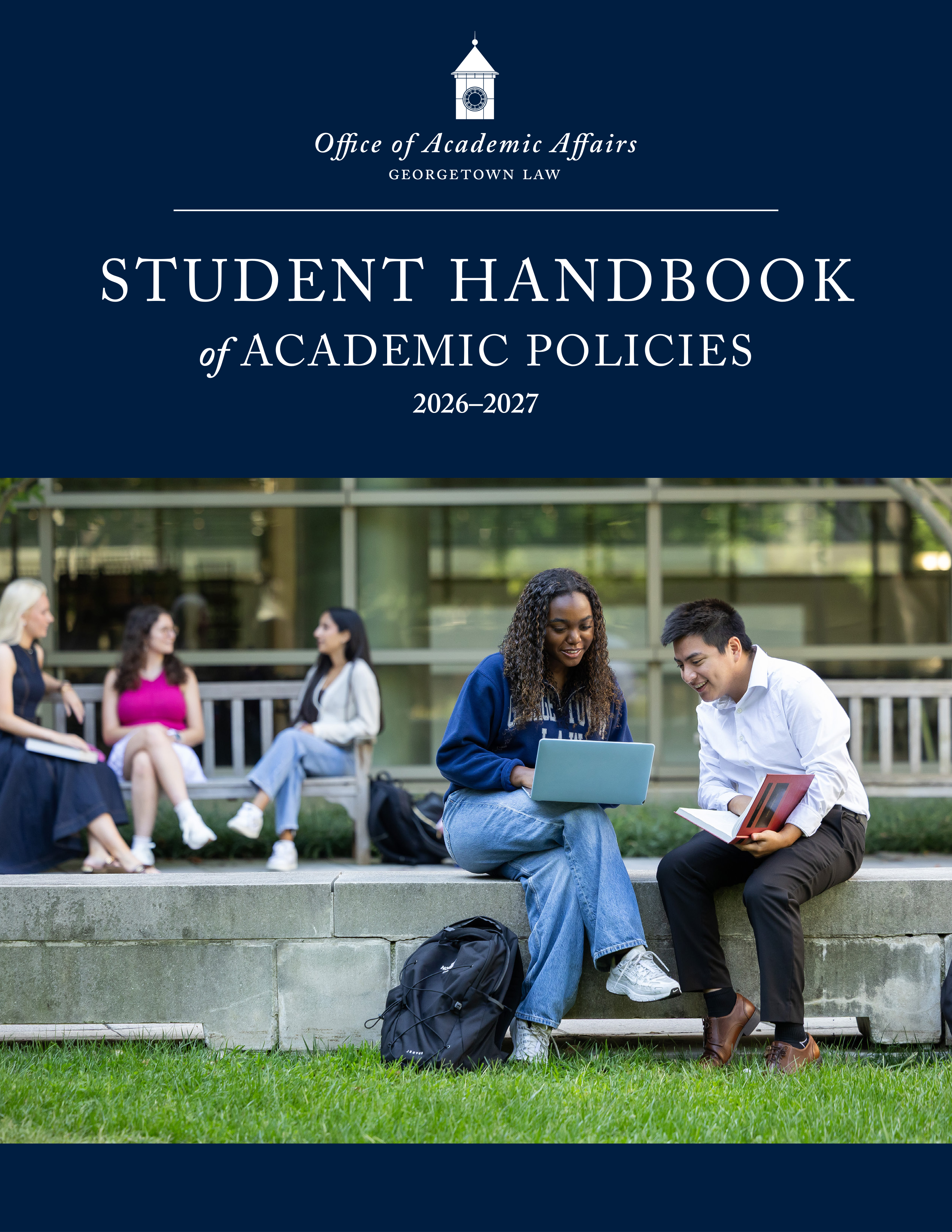

STUDENT HANDBOOK
of
ACADEMIC POLICIES
2026–2027
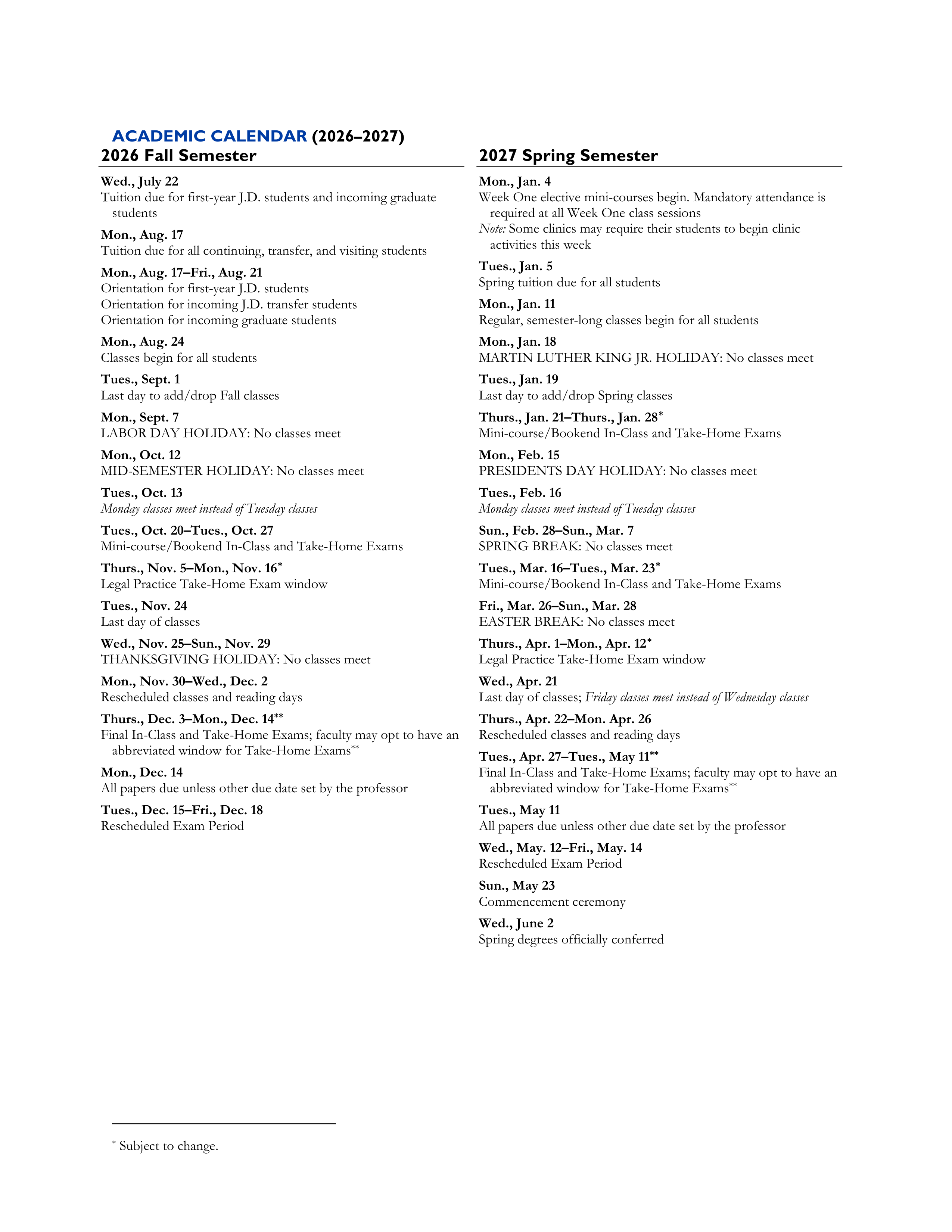
ACADEMIC CALENDAR
(2026–2027)
2026 Fall Semester
Wed., July 22
Tuition due for first-year J.D. students and incoming graduate
students
Mon., Aug. 17
Tuition due for all continuing, transfer, and visiting students
Mon., Aug. 17–Fri., Aug. 21
Orientation for first-year J.D. students
Orientation for incoming J.D. transfer students
Orientation for incoming graduate students
Mon., Aug. 24
Classes begin for all students
Tues., Sept. 1
Last day to add/drop Fall classes
Mon., Sept. 7
LABOR DAY HOLIDAY: No classes meet
Mon., Oct. 12
MID-SEMESTER HOLIDAY: No classes meet
Tues., Oct. 13
Monday classes meet instead of Tuesday classes
Tues., Oct. 20–Tues., Oct. 27
Mini-course/Bookend In-Class and Take-Home Exams
Thurs., Nov. 5–Mon., Nov. 16
*
Legal Practice Take-Home Exam window
Tues., Nov. 24
Last day of classes
Wed., Nov. 25–Sun., Nov. 29
THANKSGIVING HOLIDAY: No classes meet
Mon., Nov. 30–Wed., Dec. 2
Rescheduled classes and reading days
Thurs., Dec. 3–Mon., Dec. 14
**
Final In-Class and Take-Home Exams; faculty may opt to have an
abbreviated window for Take-Home Exams
**
Mon., Dec. 14
All papers due unless other due date set by the professor
Tues., Dec. 15–Fri., Dec. 18
Rescheduled Exam Period
*
Subject to change.
*
Subject to change.
2027 Spring Semester
Mon., Jan. 4
Week One elective mini-courses begin
.
Mandatory attendance is
required at all Week One class sessions
Note:
Some clinics may require their students to begin clinic
activities this week
Tues., Jan. 5
Spring tuition due for all students
Mon., Jan. 11
Regular, semester-long classes begin for all students
Mon., Jan. 18
MARTIN LUTHER KING JR. HOLIDAY: No classes meet
Tues., Jan. 19
Last day to add/drop Spring classes
Thurs., Jan. 21–Thurs., Jan. 28
*
Mini-course/Bookend In-Class and Take-Home Exams
Mon., Feb. 15
PRESIDENTS DAY HOLIDAY: No classes meet
Tues., Feb. 16
Monday classes meet instead of Tuesday classes
Sun., Feb. 28–Sun., Mar. 7
SPRING BREAK: No classes meet
Tues., Mar. 16–Tues., Mar. 23
*
Mini-course/Bookend In-Class and Take-Home Exams
Fri., Mar. 26–Sun., Mar. 28
EASTER BREAK: No classes meet
Thurs., Apr. 1–Mon., Apr. 12
*
Legal Practice Take-Home Exam window
Wed., Apr. 21
Last day of classes;
Friday classes meet instead of Wednesday classes
Thurs., Apr. 22–Mon. Apr. 26
Rescheduled classes and reading days
Tues., Apr. 27–Tues., May 11
**
Final In-Class and Take-Home Exams; faculty may opt to have an
abbreviated window for Take-Home Exams
**
Tues., May 11
All papers due unless other due date set by the professor
Wed., May. 12–Fri., May. 14
Rescheduled Exam Period
Sun., May 23
Commencement ceremony
Wed., June 2
Spring degrees officially conferred
*
Subject to change.
*
Subject to change.
i
Introduction
Juris Doctor
Program
Graduate
Programs
General Administrative
Policies
Conduct
Policies
Tuition &
Fees
Index
ASSOCIATE DEAN’S WELCOME
Dear Student,
Welcome to Georgetown Law! This
Student Handbook
is a compilation of the academic rules,
policies, and other important information that you will use to navigate through your time at the
Law Center. While we hope you will use it to help answer the questions that come up during
your law school years, please do not view the
Handbook
as a substitute for speaking directly with
members of our law school administration. While Georgetown Law is a large institution, we
have tried to make this
Handbook
a user-friendly tool to help respond to your individual needs
and concerns.
We expect all students to be familiar with the contents of this
Handbook
relevant to their
particular course of study. In particular, we want to emphasize the importance of complying with
our
Student Disciplinary Code, which is found on pages 100–106 of this
Handbook
. We expect
our students to conduct themselves with the highest degree of honesty, integrity, and
trustworthiness, as defined in the Code, whether in taking exams, completing written
assignments, attending class, or participating in extracurricular activities.
We also want to make sure you are aware of the various resources available to you in
addition to this
Handbook
. Online, you can find course descriptions in the
Curriculum Guide
, as
well as a host of other academic, personal, and career services through the “
Student Portal
”
(accessible through the “Students” tab at the top of our
homepage
). This
Handbook
contains links
to many of the resources available to you on the Georgetown Law website. We hope you make
good use of our Academic Advisors and the many other resources available to you as a
Georgetown Law student.
We wish you the best of luck in the coming academic year.
Sincerely,
Kristelia García
Associate Dean for Academic Affairs
ii
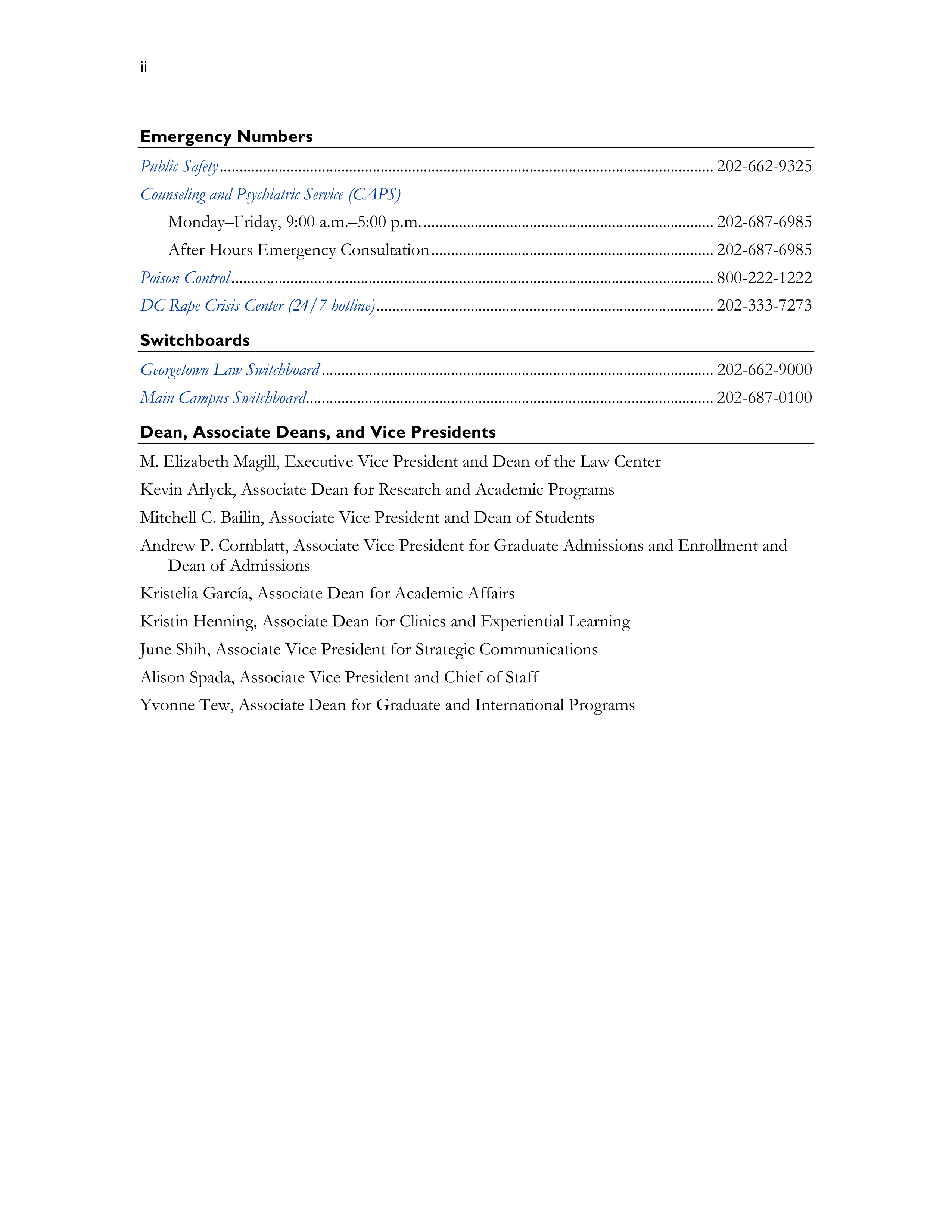
Emergency Numbers
Public Safety
.............................................................................................................................. 202-662-9325
Counseling and Psychiatric Service (CAPS)
Monday–Friday, 9:00 a.m.–5:00 p.m. .......................................................................... 202-687-6985
After Hours Emergency Consultation ........................................................................ 202-687-6985
Poison Control
........................................................................................................................... 800-222-1222
DC Rape Crisis Center (24/7 hotline)
...................................................................................... 202-333-7273
Switchboards
Georgetown Law Switchboard
.................................................................................................... 202-662-9000
Main Campus Switchboard
........................................................................................................ 202-687-0100
Dean, Associate Deans, and Vice Presidents
M. Elizabeth Magill, Executive Vice President and Dean of the Law Center
Kevin Arlyck, Associate Dean for Research and Academic Programs
Mitchell C. Bailin, Associate Vice President and Dean of Students
Andrew P. Cornblatt, Associate Vice President for Graduate Admissions and Enrollment and
Dean of Admissions
Kristelia García, Associate Dean for Academic Affairs
Kristin Henning, Associate Dean for Clinics and Experiential Learning
June Shih, Associate Vice President for Strategic Communications
Alison Spada, Associate Vice President and Chief of Staff
Yvonne Tew, Associate Dean for Graduate and International Programs
iii
2026–2027 Georgetown Law Student Handbook of Academic Policies
Introduction
Juris Doctor
Program
Graduate
Programs
General Administrative
Policies
Conduct
Policies
Tuition &
Fees
Index
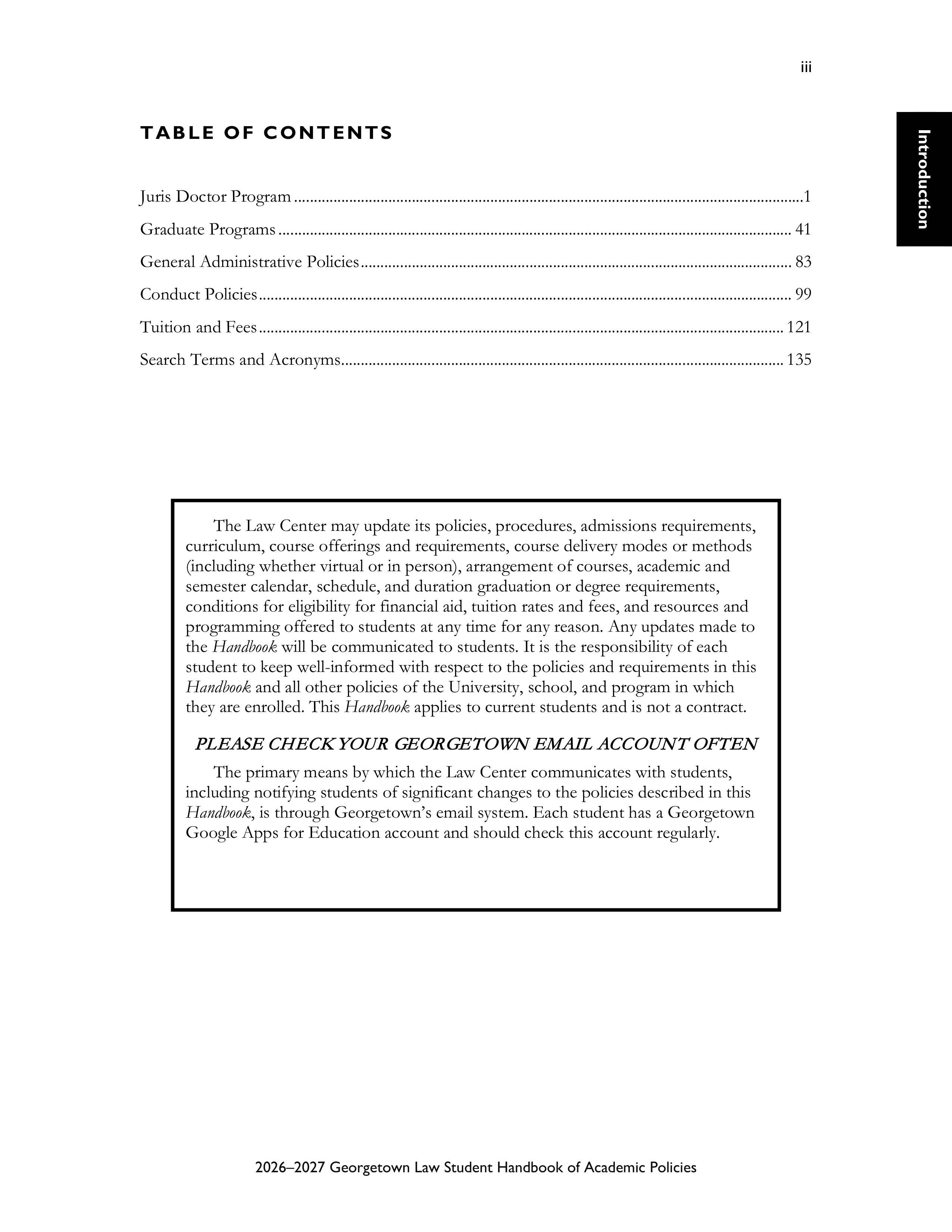
TABLE OF CONTENTS
Juris Doctor Program ..................................................................................................................................1
Graduate Programs ................................................................................................................................... 41
General Administrative Policies .............................................................................................................. 83
Conduct Policies ........................................................................................................................................ 99
Tuition and Fees ...................................................................................................................................... 121
Search Terms and Acronyms ................................................................................................................. 135
The Law Center may update its policies, procedures, admissions requirements,
curriculum, course offerings and requirements, course delivery modes or methods
(including whether virtual or in person), arrangement of courses, academic and
semester calendar, schedule, and duration graduation or degree requirements,
conditions for eligibility for financial aid, tuition rates and fees, and resources and
programming offered to students at any time for any reason. Any updates made to
the
Handbook
will be communicated to students. It is the responsibility of each
student to keep well-informed with respect to the policies and requirements in this
Handbook
and all other policies of the University, school, and program in which
they are enrolled. This
Handbook
applies to current students and is not a contract.
PLEASE CHECK YOUR GEORGETOWN EMAIL ACCOUNT OFTEN
The primary means by which the Law Center communicates with students,
including notifying students of significant changes to the policies described in this
Handbook
, is through Georgetown’s email system. Each student has a Georgetown
Google Apps for Education account and should check this account regularly.

2026–2027 Georgetown Law Student Handbook of Academic Policies
1
2026–2027 Georgetown Law Student Handbook of Academic Policies
Introduction
Juris Doctor
Program
Graduate
Programs
General Administrative
Policies
Conduct
Policies
Tuition &
Fees
Index
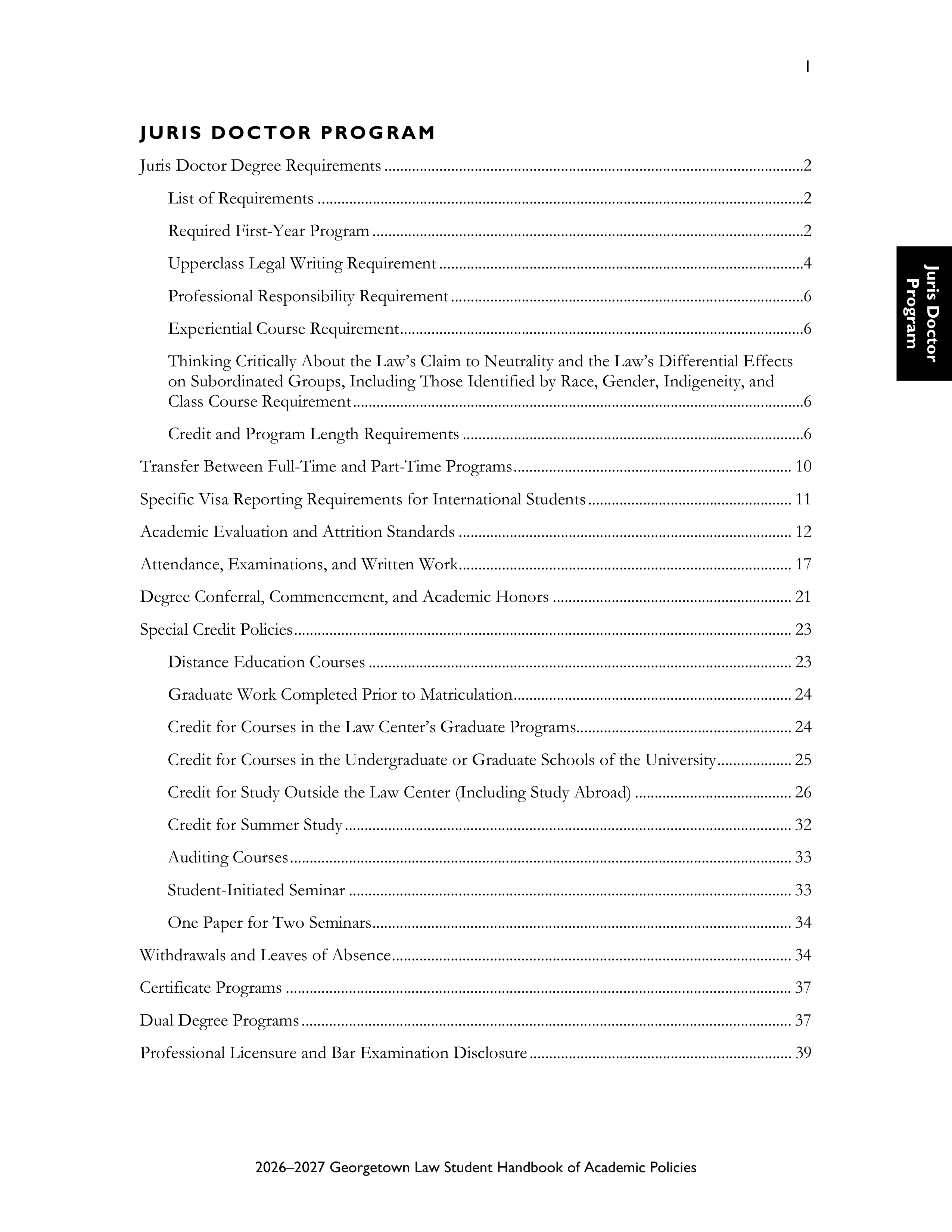
JURIS DOCTOR PROGRAM
Juris Doctor Degree Requirements ...........................................................................................................2
List of Requirements ............................................................................................................................2
Required First-Year Program ..............................................................................................................2
Upperclass Legal Writing Requirement .............................................................................................4
Professional Responsibility Requirement ..........................................................................................6
Experiential Course Requirement .......................................................................................................6
Thinking Critically About the Law’s Claim to Neutrality and the Law’s Differential Effects
on Subordinated Groups, Including Those Identified by Race, Gender, Indigeneity, and
Class Course Requirement ...................................................................................................................6
Credit and Program Length Requirements .......................................................................................6
Transfer Between Full-Time and Part-Time Programs ....................................................................... 10
Specific Visa Reporting Requirements for International Students .................................................... 11
Academic Evaluation and Attrition Standards ..................................................................................... 12
Attendance, Examinations, and Written Work ..................................................................................... 17
Degree Conferral, Commencement, and Academic Honors ............................................................. 21
Special Credit Policies ............................................................................................................................... 23
Distance Education Courses ............................................................................................................ 23
Graduate Work Completed Prior to Matriculation ....................................................................... 24
Credit for Courses in the Law Center’s Graduate Programs ....................................................... 24
Credit for Courses in the Undergraduate or Graduate Schools of the University ................... 25
Credit for Study Outside the Law Center (Including Study Abroad) ........................................ 26
Credit for Summer Study .................................................................................................................. 32
Auditing Courses ................................................................................................................................ 33
Student-Initiated Seminar ................................................................................................................. 33
One Paper for Two Seminars ........................................................................................................... 34
Withdrawals and Leaves of Absence ...................................................................................................... 34
Certificate Programs ................................................................................................................................. 37
Dual Degree Programs ............................................................................................................................. 37
Professional Licensure and Bar Examination Disclosure ................................................................... 39
2
2026–2027 Georgetown Law Student Handbook of Academic Policies
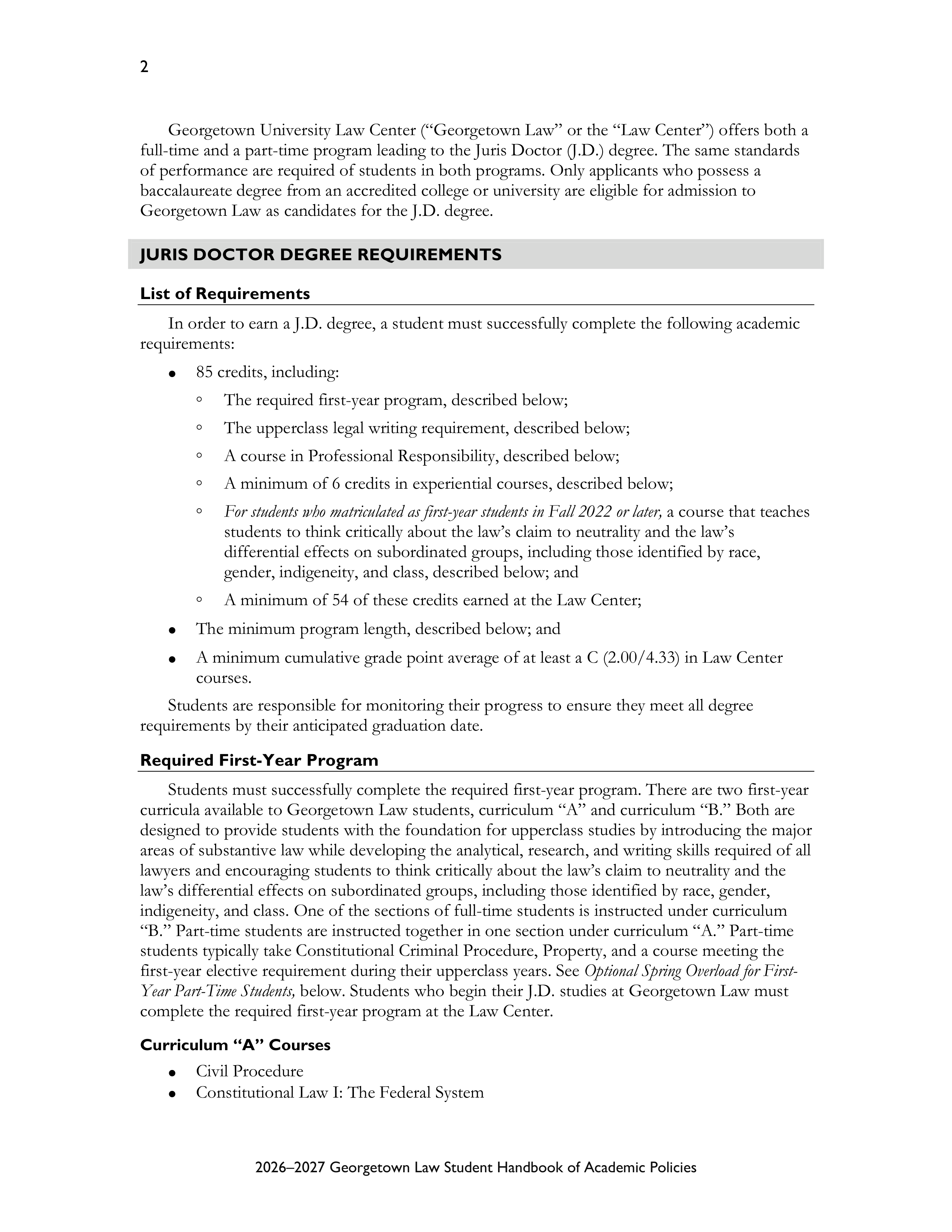
Georgetown University Law Center (“Georgetown Law” or the “Law Center”) offers both a
full-time and a part-time program leading to the Juris Doctor (J.D.) degree. The same standards
of performance are required of students in both programs. Only applicants who possess a
baccalaureate degree from an accredited college or university are eligible for admission to
Georgetown Law as candidates for the J.D. degree.
JURIS DOCTOR DEGREE REQUIREMENTS
List of Requirements
In order to earn a J.D. degree, a student must successfully complete the following academic
requirements:
•
85 credits, including:
◦
The required first-year program, described below;
◦
The upperclass legal writing requirement, described below;
◦
A course in Professional Responsibility, described below;
◦
A minimum of 6 credits in experiential courses, described below;
◦
For students who matriculated as first-year students in Fall 2022 or later,
a course that teaches
students to think critically about the law’s claim to neutrality and the law’s
differential effects on subordinated groups, including those identified by race,
gender, indigeneity, and class, described below; and
◦
A minimum of 54 of these credits earned at the Law Center;
•
The minimum program length, described below; and
•
A minimum cumulative grade point average of at least a C (2.00/4.33) in Law Center
courses.
Students are responsible for monitoring their progress to ensure they meet all degree
requirements by their anticipated graduation date.
Required First-Year Program
Students must successfully complete the required first-year program. There are two first-year
curricula available to Georgetown Law students, curriculum “A” and curriculum “B.” Both are
designed to provide students with the foundation for upperclass studies by introducing the major
areas of substantive law while developing the analytical, research, and writing skills required of all
lawyers and encouraging students to think critically about the law’s claim to neutrality and the
law’s differential effects on subordinated groups, including those identified by race, gender,
indigeneity, and class. One of the sections of full-time students is instructed under curriculum
“B.” Part-time students are instructed together in one section under curriculum “A.” Part-time
students typically take Constitutional Criminal Procedure, Property, and a course meeting the
first-year elective requirement during their upperclass years. See
Optional Spring Overload for First-
Year Part-Time Students,
below. Students who begin their J.D. studies at Georgetown Law must
complete the required first-year program at the Law Center.
Curriculum “A” Courses
•
Civil Procedure
•
Constitutional Law I: The Federal System
3
2026–2027 Georgetown Law Student Handbook of Academic Policies
Introduction
Juris Doctor
Program
Graduate
Programs
General Administrative
Policies
Conduct
Policies
Tuition &
Fees
Index
•
Contracts
•
Constitutional Criminal Procedure
•
Legal Practice: Writing and Analysis (Fall and Spring)
•
Property
•
Torts
•
First-Year Elective (courses that meet this requirement are announced in the Fall semester)
Curriculum “B” Courses
•
Bargain, Exchange, and Liability
•
Democracy and Coercion
•
Government Processes
•
Foundations of American Legal Thought
•
Legal Practice: Writing and Analysis (Fall and Spring)
•
Legal Process and Society
•
Property in Time
Additional First-Year Options
Optional First-Year Week One Simulation Courses
First-year students have the opportunity to request a seat in an optional, 1-credit simulation
course during Week One, which takes place January 4–7, 2027. This simulation course counts
toward the experiential course graduation requirement. A list of Week One courses available to
first-year students can be found in the
Curriculum Guide
. Enrolled students must attend every
class session and are graded on a pass/fail basis.
Optional Spring Overload for First-Year Part-Time Students
In addition to the 19 required credits and the optional first-year Week One simulation course
(1 credit), first-year part-time students also have the opportunity to request a seat in a day section
of either a First-Year Elective (3 credits), Constitutional Criminal Procedure (4 credits), or
Property (4 credits). These courses will otherwise be completed during the upperclass years of
the part-time program.
Students may earn up to 4 additional credits in the Spring semester, so a first-year Week One
simulation course may be taken in combination with a First-Year Elective but not with a day
section of Constitutional Criminal Procedure or Property. In the Fall semester, the Office of the
Registrar will announce the available courses and the procedures for requesting these courses.
Transfer Students
Students who transfer to the Law Center from another law school after their first year
should promptly review all communications regarding the transfer of credits from their first-year
law school and their remaining graduation requirements. See the
Credit and Program Length
Requirements
and the
Special Credit Policies
sections of this chapter for limitations on transfer
credits. Transfer students are not required to take the first-year course Constitutional Criminal
Procedure or a course designated as meeting the first-year elective requirement. Transfer
students will not be admitted into the optional first-year Week One courses. Transfer students
should consult with an advisor in the Office of Academic Affairs or the Office of the Registrar if
they have questions about any of the curricular requirements.
4
2026–2027 Georgetown Law Student Handbook of Academic Policies
Upperclass Legal Writing Requirement
The upperclass legal writing requirement builds upon the first-year Legal Practice courses by
developing students’ ability to independently engage in a sustained, in-depth research and writing
project for a legal audience. Students choose topics, submit outlines, prepare and submit a first
draft, and complete the final paper in consultation with faculty members.
Working on the paper challenges students to hone their research skills, engage in complex
legal analysis, develop and test a thesis or argument, gain mastery over a specific topic, and
enhance the clarity and precision of their writing—all components of the art of legal writing that
are valued in practice regardless of the particular field that the student might pursue. The
upperclass legal writing requirement also gives students the opportunity to think critically about a
problem, engage in deep and sustained research into a wide range of materials, explore possible
problem-solving options, advocate for a solution, and advance the body of knowledge relevant
to their paper topic.
Students have two options for completing the upperclass legal writing requirement:
(1) successfully completing a seminar designated in the
Curriculum Guide
as meeting the
upperclass legal writing requirement; or (2) successfully completing a Supervised Research
project that has been approved by the Associate Dean for Academic Affairs, as described below.
Note:
Experiential courses (including clinics, externships, practicum courses, and simulation
courses) do not meet the upperclass writing requirement. The upperclass legal writing
requirement must be completed at the Law Center.
*
The following are the technical requirements for the upperclass legal writing requirement,
which must be completed in accordance with the professor’s instructions and schedule:
(1) Submission of an outline;
(2) Submission of a first draft of at least 6,000 words (excluding footnotes);
(3) Submission of a revised final paper of at least 6,000 words (excluding footnotes) based on
the professor’s comments; and
(4) Use of legal forms of citation (when appropriate).
Papers of 6,000 words (excluding footnotes) in length are approximately 25 typewritten pages
using customary margins and spacing.
A paper that meets the upperclass legal writing requirement must comply with the Artificial
Intelligence Policy, the Student Disciplinary Code’s policies on plagiarism, and be a product of
the student’s own work in consultation with the supervising professor. Except as set forth in the
One Paper for Two Seminars
section of this chapter, the upperclass legal writing requirement paper
may not repeat work for which credit is currently being or has previously been granted in
another course or which was undertaken in the course of employment. Students should not
receive written comments, edits, or other feedback on the paper from any individual other than
the grading professor prior to the time it is submitted for grading (except where such feedback is
in connection with classroom discussion as overseen by the grading professor, a peer review
required by the professor, or where the professor grants express permission, such as in a referral
to the Center for Legal English). For policies relating to services offered by the Writing Center
or the Center for Legal English, please see the
General Administrative Policies
chapter of this
∗
The upperclass legal writing requirement may also be completed while enrolled at the Center for Transnational Legal
Studies, provided the Associate Dean for Academic Affairs has approved any such seminar prior to the semester in which it
is offered.
5
2026–2027 Georgetown Law Student Handbook of Academic Policies
Introduction
Juris Doctor
Program
Graduate
Programs
General Administrative
Policies
Conduct
Policies
Tuition &
Fees
Index
Handbook
. Students who are interested in using their final paper for other purposes (such as a law
journal note) may do so only after the paper has been submitted for grading.
Supervised Research Option
The faculty augments the Law Center’s seminar offerings by providing a Supervised
Research option, through which students work independently on a writing project under the
supervision of a faculty member for 2 graded credits. Supervised Research projects allow faculty
guidance for students in areas where there is no curricular offering or where a student wishes to
explore a subject in greater depth than would be possible in an existing course. Papers receiving
a passing grade will satisfy the upperclass legal writing requirement.
Requests to undertake a Supervised Research project are reviewed by the Associate Dean for
Academic Affairs, who will be receptive to proposals meeting the goals of the Supervised
Research option and expects to approve most proposals for supervision by full-time faculty. To
be eligible to apply to undertake a Supervised Research project while enrolled at the Center for
Transnational Legal Studies, the project must first be approved by the Associate Dean for
Graduate and International Programs. Students should consider the following rules applicable to
Supervised Research projects when submitting a proposal:
•
The student must have a cumulative grade point average of at least a C (2.00/4.33) in
Law Center courses.
•
Supervised Research projects must meet the requirements of the upperclass legal writing
requirement, including the requirement that the proposal not repeat work for which
credit is currently being or has previously been granted in another course or which was
undertaken in the course of employment (see the
Upperclass Legal Writing Requirement
section of this chapter). In addition, the professor and student must establish a calendar
of at least four meetings that allows for the kind of interaction and feedback
contemplated for writing seminars.
•
Students must demonstrate that they have a well-developed topic suitable for a
substantive scholarly paper satisfying the upperclass legal writing requirement.
◦
The topic should be in an area where there is no curricular offering or where the
student wishes to explore a subject in greater depth than would be possible in an
existing course.
◦
In the application, students must indicate (1) the four scheduled meeting dates with
the professor; (2) the deadlines for submission of the outline, first draft, and final
draft; and (3) the semester(s) in which the project is to be completed.
•
Because the time demanded of the professor is substantial, it is expected that students
ordinarily will seek sponsorship from full-time faculty. Where a student makes a good-
faith effort to obtain sponsorship by a full-time faculty member and is unable to do so,
sponsorship by an adjunct faculty member may be approved where the adjunct faculty
member has both subject matter expertise and sufficient familiarity with Georgetown
Law’s upperclass legal writing requirement.
•
A student ordinarily may not undertake a Supervised Research project more than once.
Students proposing to take Supervised Research for a second time must disclose this in
their application and explain how the second project is distinct from their first project.
•
Proposals may call for research to be completed in one semester or across two
consecutive terms (i.e., Fall and Spring, or Spring and Summer) and students may assign
the associated credits to one or both semesters (i.e., they may receive 1 credit in each
6
2026–2027 Georgetown Law Student Handbook of Academic Policies
semester or 2 credits in either semester). No more than 2 credits will be awarded for one
project, and credit allocations must be finalized before the last day of add/drop activity
for the project’s first semester.
Professional Responsibility Requirement
Each student must earn a passing grade in an upperclass J.D. course designated as meeting
the Professional Responsibility requirement. Courses that satisfy the Professional Responsibility
requirement are designated as such in the
Curriculum Guide
. J.D. students will not satisfy their
Professional Responsibility requirement by completing Professional Responsibility courses
offered in the Law Center’s Graduate Programs.
Experiential Course Requirement
All students must complete at least 6 credits of experiential coursework to earn their J.D.
Students can earn these credits in clinics, externships, practicum courses, or simulation courses.
Courses that meet the experiential course requirement are designated as such in the
Curriculum
Guide
. A course that meets the experiential course requirement may not also meet the student’s
upperclass legal writing requirement or professional responsibility requirement.
Students seeking to transfer credits taken in experiential coursework at other ABA-approved
law schools must seek approval from the Assistant Dean for Experiential Education or the
Assistant Dean’s designee. Students should email
lawexp@georgetown.edu
with any such request.
For more information about the experiential course requirement, policies around which
experiential courses can be taken concurrently in the same semester, and how many of each type
of experiential offering can be taken during a student’s academic career, please visit the
Experiential Learning website
. Students should also review any applicable state bar rules regarding
experiential coursework requirements and limitations.
Note:
All students in the United States in F-1 or J-1 student visa status must be authorized
for Curricular Practical Training before participating in any course that has an outside work
component, such as an externship, fieldwork practicum, or clinic. For further information, please
contact an International Student Advisor at
lawcentervisa@georgetown.edu
.
Thinking Critically About the Law’s Claim to Neutrality and the Law’s Differential
Effects on Subordinated Groups, Including Those Identified by Race, Gender,
Indigeneity, and Class Course Requirement
All students matriculating as first-year students in Fall 2022 or later must complete at least
one course of at least two credits designated by the faculty as teaching students to think critically
about the law’s claim to neutrality and the law’s differential effects on subordinated groups,
including those identified by race, gender, indigeneity, and class. This requirement may be
satisfied through a First-Year Elective designated as meeting this graduation requirement.
Upperclass courses that satisfy this requirement are designated as such in the
Curriculum Guide
.
Credit and Program Length Requirements
Credit Requirements
Total Credit Requirement
Students must complete 85 credits to graduate. Of those 85 credits, at least 54 must be
earned in Law Center courses, which include credits earned in the Center for Transnational
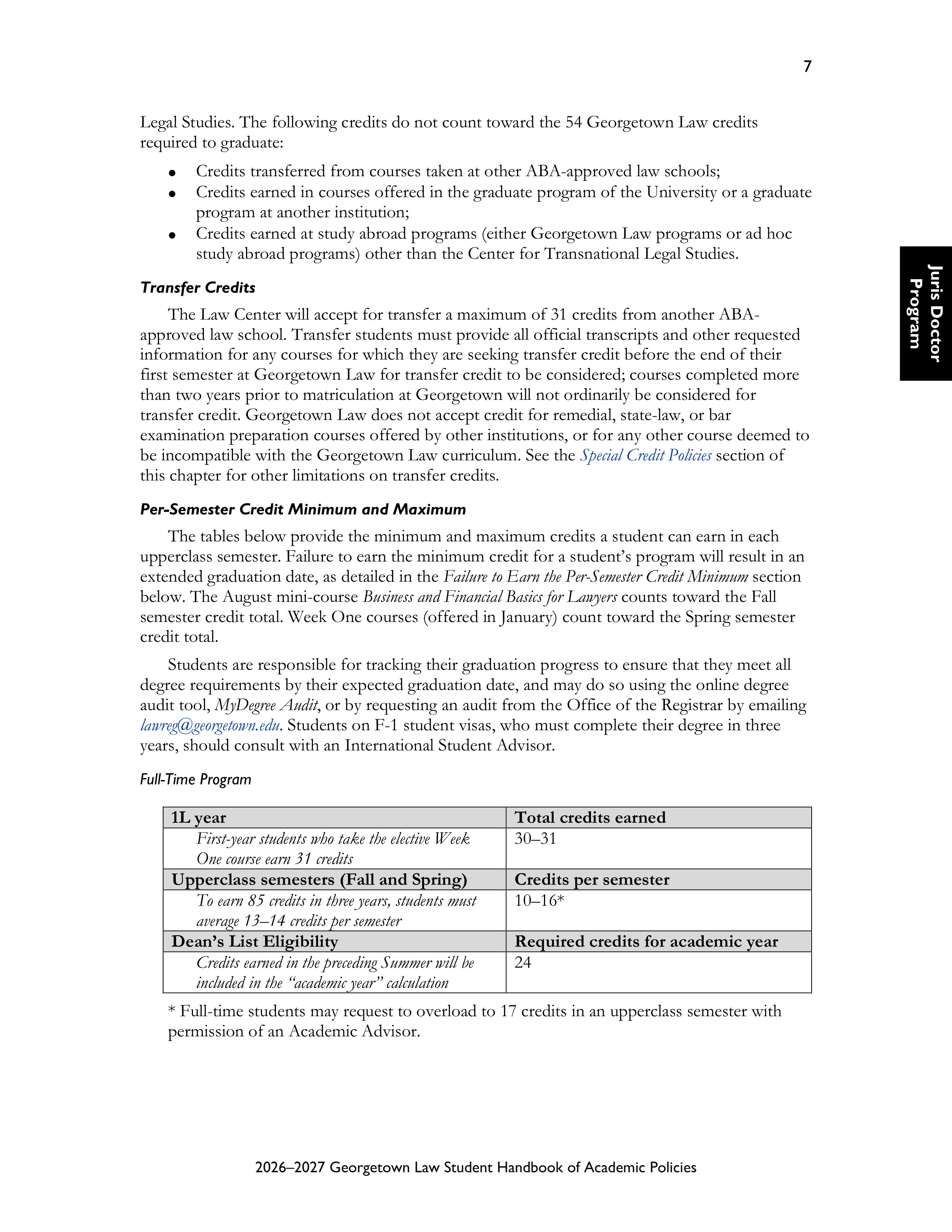
7
2026–2027 Georgetown Law Student Handbook of Academic Policies
Introduction
Juris Doctor
Program
Graduate
Programs
General Administrative
Policies
Conduct
Policies
Tuition &
Fees
Index
Legal Studies. The following credits do not count toward the 54 Georgetown Law credits
required to graduate:
•
Credits transferred from courses taken at other ABA-approved law schools;
•
Credits earned in courses offered in the graduate program of the University or a graduate
program at another institution;
•
Credits earned at study abroad programs (either Georgetown Law programs or ad hoc
study abroad programs) other than the Center for Transnational Legal Studies.
Transfer Credits
The Law Center will accept for transfer a maximum of 31 credits from another ABA-
approved law school. Transfer students must provide all official transcripts and other requested
information for any courses for which they are seeking transfer credit before the end of their
first semester at Georgetown Law for transfer credit to be considered; courses completed more
than two years prior to matriculation at Georgetown will not ordinarily be considered for
transfer credit. Georgetown Law does not accept credit for remedial, state-law, or bar
examination preparation courses offered by other institutions, or for any other course deemed to
be incompatible with the Georgetown Law curriculum. See the
Special Credit Policies
section of
this chapter for other limitations on transfer credits.
Per-Semester Credit Minimum and Maximum
The tables below provide the minimum and maximum credits a student can earn in each
upperclass semester. Failure to earn the minimum credit for a student’s program will result in an
extended graduation date, as detailed in the
Failure to Earn the Per-Semester Credit Minimum
section
below. The August mini-course
Business and Financial Basics for Lawyers
counts toward the Fall
semester credit total. Week One courses (offered in January) count toward the Spring semester
credit total.
Students are responsible for tracking their graduation progress to ensure that they meet all
degree requirements by their expected graduation date, and may do so using the online degree
audit tool,
MyDegree Audit
, or by requesting an audit from the Office of the Registrar by emailing
lawreg@georgetown.edu
. Students on F-1 student visas, who must complete their degree in three
years, should consult with an International Student Advisor.
Full-Time Program
1L year
Total credits earned
First-year students who take the elective Week
One course earn 31 credits
30–31
Upperclass semesters (Fall and Spring)
Credits per semester
To earn 85 credits in three years, students must
average 13–14 credits per semester
10–16*
Dean’s List Eligibility
Required credits for academic year
Credits earned in the preceding Summer will be
included in the “academic year” calculation
24
* Full-time students may request to overload to 17 credits in an upperclass semester with
permission of an Academic Advisor.
8
2026–2027 Georgetown Law Student Handbook of Academic Policies
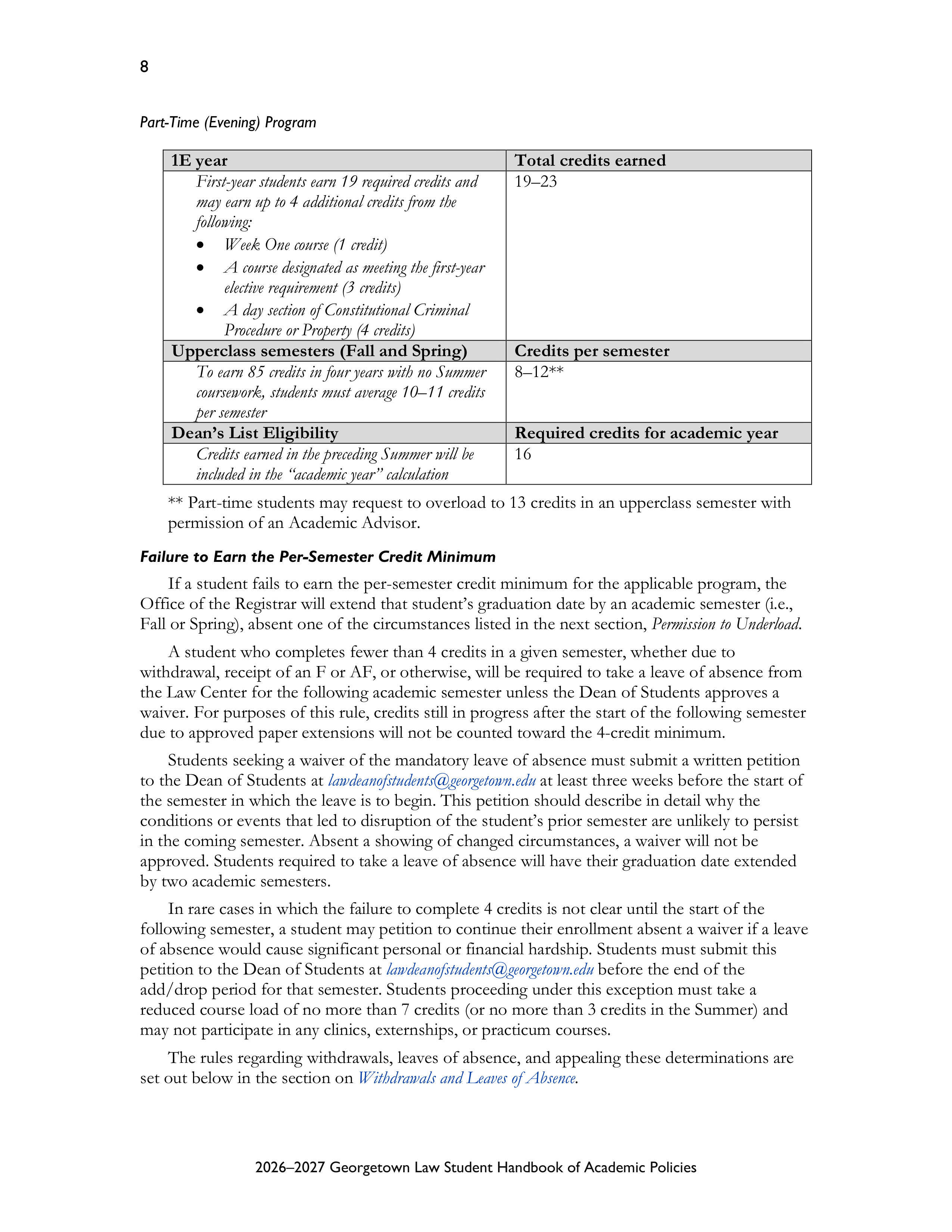
Part-Time (Evening) Program
1E year
Total credits earned
First-year students earn 19 required credits and
may earn up to 4 additional credits from the
following:
•
Week One course (1 credit)
•
A course designated as meeting the first-year
elective requirement (3 credits)
•
A day section of Constitutional Criminal
Procedure or Property (4 credits)
19–23
Upperclass semesters (Fall and Spring)
Credits per semester
To earn 85 credits in four years with no Summer
coursework, students must average 10–11 credits
per semester
8–12**
Dean’s List Eligibility
Required credits for academic year
Credits earned in the preceding Summer will be
included in the “academic year” calculation
16
** Part-time students may request to overload to 13 credits in an upperclass semester with
permission of an Academic Advisor.
Failure to Earn the Per-Semester Credit Minimum
If a student fails to earn the per-semester credit minimum for the applicable program, the
Office of the Registrar will extend that student’s graduation date by an academic semester (i.e.,
Fall or Spring), absent one of the circumstances listed in the next section,
Permission to Underload
.
A student who completes fewer than 4 credits in a given semester, whether due to
withdrawal, receipt of an F or AF, or otherwise, will be required to take a leave of absence from
the Law Center for the following academic semester unless the Dean of Students approves a
waiver. For purposes of this rule, credits still in progress after the start of the following semester
due to approved paper extensions will not be counted toward the 4-credit minimum.
Students seeking a waiver of the mandatory leave of absence must submit a written petition
to the Dean of Students at
lawdeanofstudents@georgetown.edu
at least three weeks before the start of
the semester in which the leave is to begin. This petition should describe in detail why the
conditions or events that led to disruption of the student’s prior semester are unlikely to persist
in the coming semester. Absent a showing of changed circumstances, a waiver will not be
approved. Students required to take a leave of absence will have their graduation date extended
by two academic semesters.
In rare cases in which the failure to complete 4 credits is not clear until the start of the
following semester, a student may petition to continue their enrollment absent a waiver if a leave
of absence would cause significant personal or financial hardship. Students must submit this
petition to the Dean of Students at
lawdeanofstudents@georgetown.edu
before the end of the
add/drop period for that semester. Students proceeding under this exception must take a
reduced course load of no more than 7 credits (or no more than 3 credits in the Summer) and
may not participate in any clinics, externships, or practicum courses.
The rules regarding withdrawals, leaves of absence, and appealing these determinations are
set out below in the section on
Withdrawals and Leaves of Absence
.
9
2026–2027 Georgetown Law Student Handbook of Academic Policies
Introduction
Juris Doctor
Program
Graduate
Programs
General Administrative
Policies
Conduct
Policies
Tuition &
Fees
Index
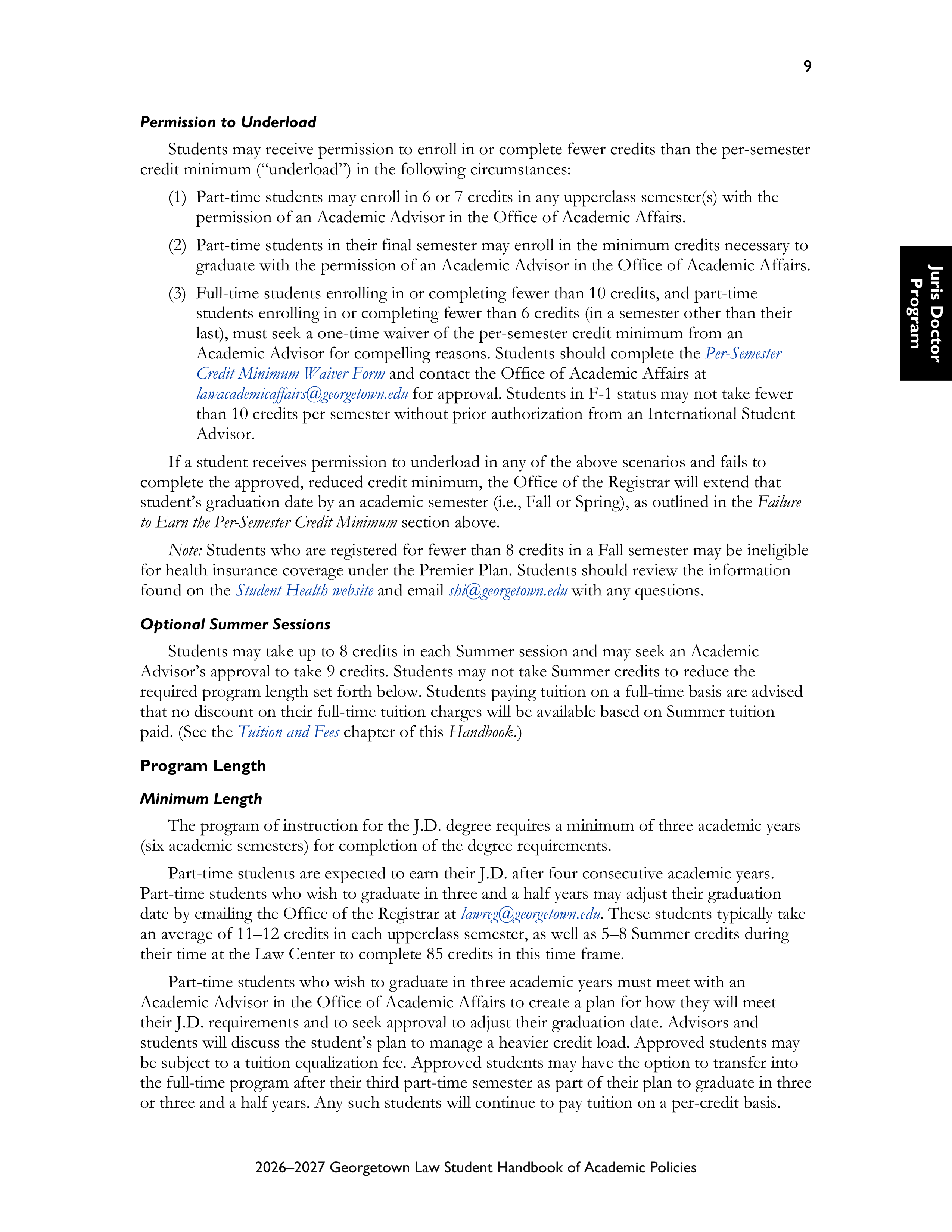
Permission to Underload
Students may receive permission to enroll in or complete fewer credits than the per-semester
credit minimum (“underload”) in the following circumstances:
(1)
Part-time students may enroll in 6 or 7 credits in any upperclass semester(s) with the
permission of an Academic Advisor in the Office of Academic Affairs.
(2)
Part-time students in their final semester may enroll in the minimum credits necessary to
graduate with the permission of an Academic Advisor in the Office of Academic Affairs.
(3)
Full-time students enrolling in or completing fewer than 10 credits, and part-time
students enrolling in or completing fewer than 6 credits (in a semester other than their
last), must seek a one-time waiver of the per-semester credit minimum from an
Academic Advisor for compelling reasons. Students should complete the
Per-Semester
Credit Minimum Waiver Form
and contact the Office of Academic Affairs at
lawacademicaffairs@georgetown.edu
for approval. Students in F-1 status may not take fewer
than 10 credits per semester without prior authorization from an International Student
Advisor.
If a student receives permission to underload in any of the above scenarios and fails to
complete the approved, reduced credit minimum, the Office of the Registrar will extend that
student’s graduation date by an academic semester (i.e., Fall or Spring), as outlined in the
Failure
to Earn the Per-Semester Credit Minimum
section above.
Note:
Students who are registered for fewer than 8 credits in a Fall semester may be ineligible
for health insurance coverage under the Premier Plan. Students should review the information
found on the
Student Health website
and email
shi@georgetown.edu
with any questions.
Optional Summer Sessions
Students may take up to 8 credits in each Summer session and may seek an Academic
Advisor’s approval to take 9 credits. Students may not take Summer credits to reduce the
required program length set forth below. Students paying tuition on a full-time basis are advised
that no discount on their full-time tuition charges will be available based on Summer tuition
paid. (See the
Tuition and Fees
chapter of this
Handbook
.)
Program Length
Minimum Length
The program of instruction for the J.D. degree requires a minimum of three academic years
(six academic semesters) for completion of the degree requirements.
Part-time students are expected to earn their J.D. after four consecutive academic years.
Part-time students who wish to graduate in three and a half years may adjust their graduation
date by emailing the Office of the Registrar at
lawreg@georgetown.edu
. These students typically take
an average of 11–12 credits in each upperclass semester, as well as 5–8 Summer credits during
their time at the Law Center to complete 85 credits in this time frame.
Part-time students who wish to graduate in three academic years must meet with an
Academic Advisor in the Office of Academic Affairs to create a plan for how they will meet
their J.D. requirements and to seek approval to adjust their graduation date. Advisors and
students will discuss the student’s plan to manage a heavier credit load. Approved students may
be subject to a tuition equalization fee. Approved students may have the option to transfer into
the full-time program after their third part-time semester as part of their plan to graduate in three
or three and a half years. Any such students will continue to pay tuition on a per-credit basis.
10
2026–2027 Georgetown Law Student Handbook of Academic Policies
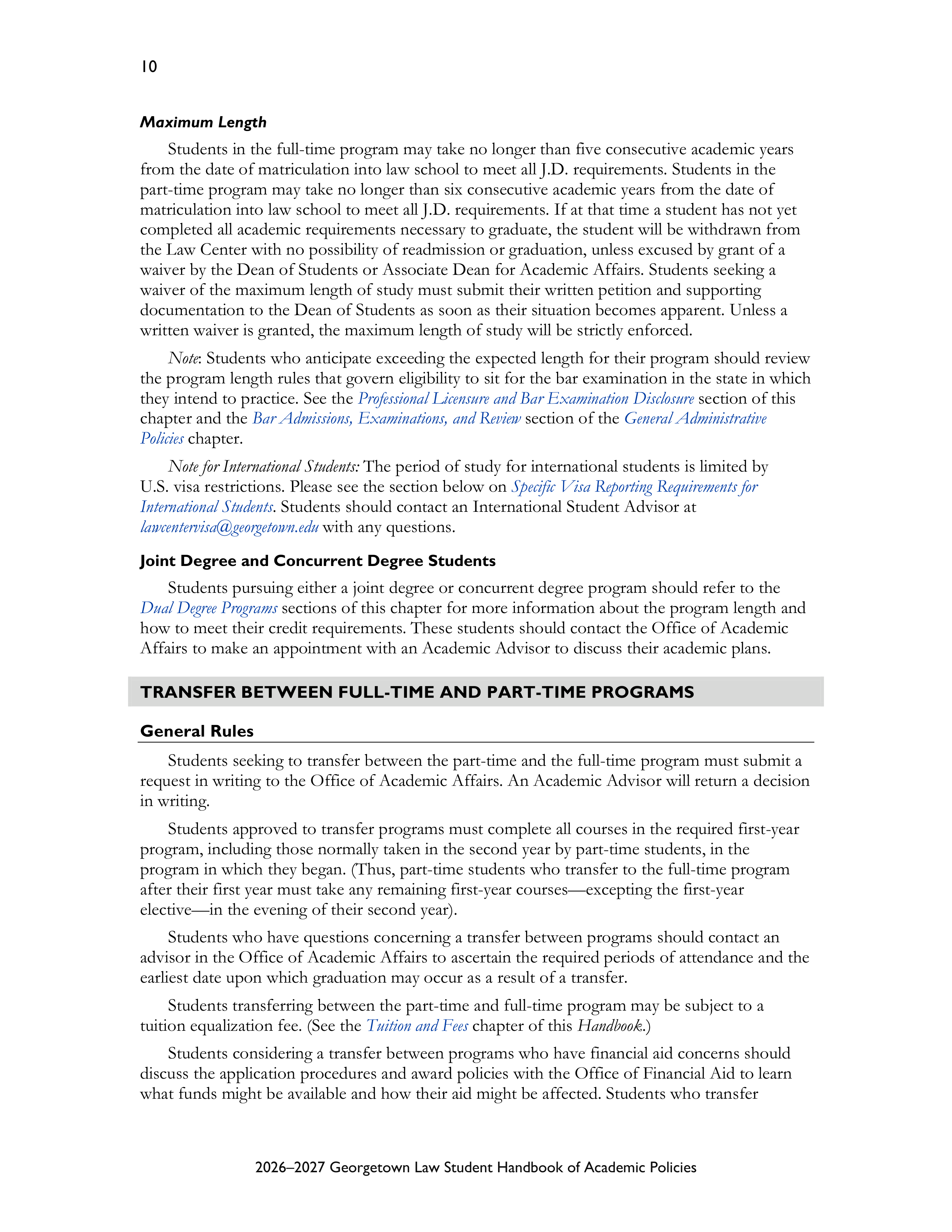
Maximum Length
Students in the full-time program may take no longer than five consecutive academic years
from the date of matriculation into law school to meet all J.D. requirements. Students in the
part-time program may take no longer than six consecutive academic years from the date of
matriculation into law school to meet all J.D. requirements. If at that time a student has not yet
completed all academic requirements necessary to graduate, the student will be withdrawn from
the Law Center with no possibility of readmission or graduation, unless excused by grant of a
waiver by the Dean of Students or Associate Dean for Academic Affairs. Students seeking a
waiver of the maximum length of study must submit their written petition and supporting
documentation to the Dean of Students as soon as their situation becomes apparent. Unless a
written waiver is granted, the maximum length of study will be strictly enforced.
Note
: Students who anticipate exceeding the expected length for their program should review
the program length rules that govern eligibility to sit for the bar examination in the state in which
they intend to practice. See the
Professional Licensure and Bar Examination Disclosure
section of this
chapter and the
Bar Admissions, Examinations, and Review
section of the
General Administrative
Policies
chapter.
Note for International Students:
The period of study for international students is limited by
U.S. visa restrictions. Please see the section below on
Specific Visa Reporting Requirements for
International Students
. Students should contact an International Student Advisor at
lawcentervisa@georgetown.edu
with any questions.
Joint Degree and Concurrent Degree Students
Students pursuing either a joint degree or concurrent degree program should refer to the
Dual Degree Programs
sections of this chapter for more information about the program length and
how to meet their credit requirements. These students should contact the Office of Academic
Affairs to make an appointment with an Academic Advisor to discuss their academic plans.
TRANSFER BETWEEN FULL-TIME AND PART-TIME PROGRAMS
General Rules
Students seeking to transfer between the part-time and the full-time program must submit a
request in writing to the Office of Academic Affairs. An Academic Advisor will return a decision
in writing.
Students approved to transfer programs must complete all courses in the required first-year
program, including those normally taken in the second year by part-time students, in the
program in which they began. (Thus, part-time students who transfer to the full-time program
after their first year must take any remaining first-year courses—excepting the first-year
elective—in the evening of their second year).
Students who have questions concerning a transfer between programs should contact an
advisor in the Office of Academic Affairs to ascertain the required periods of attendance and the
earliest date upon which graduation may occur as a result of a transfer.
Students transferring between the part-time and full-time program may be subject to a
tuition equalization fee. (See the
Tuition and Fees
chapter of this
Handbook
.)
Students considering a transfer between programs who have financial aid concerns should
discuss the application procedures and award policies with the Office of Financial Aid to learn
what funds might be available and how their aid might be affected. Students who transfer
11
2026–2027 Georgetown Law Student Handbook of Academic Policies
Introduction
Juris Doctor
Program
Graduate
Programs
General Administrative
Policies
Conduct
Policies
Tuition &
Fees
Index
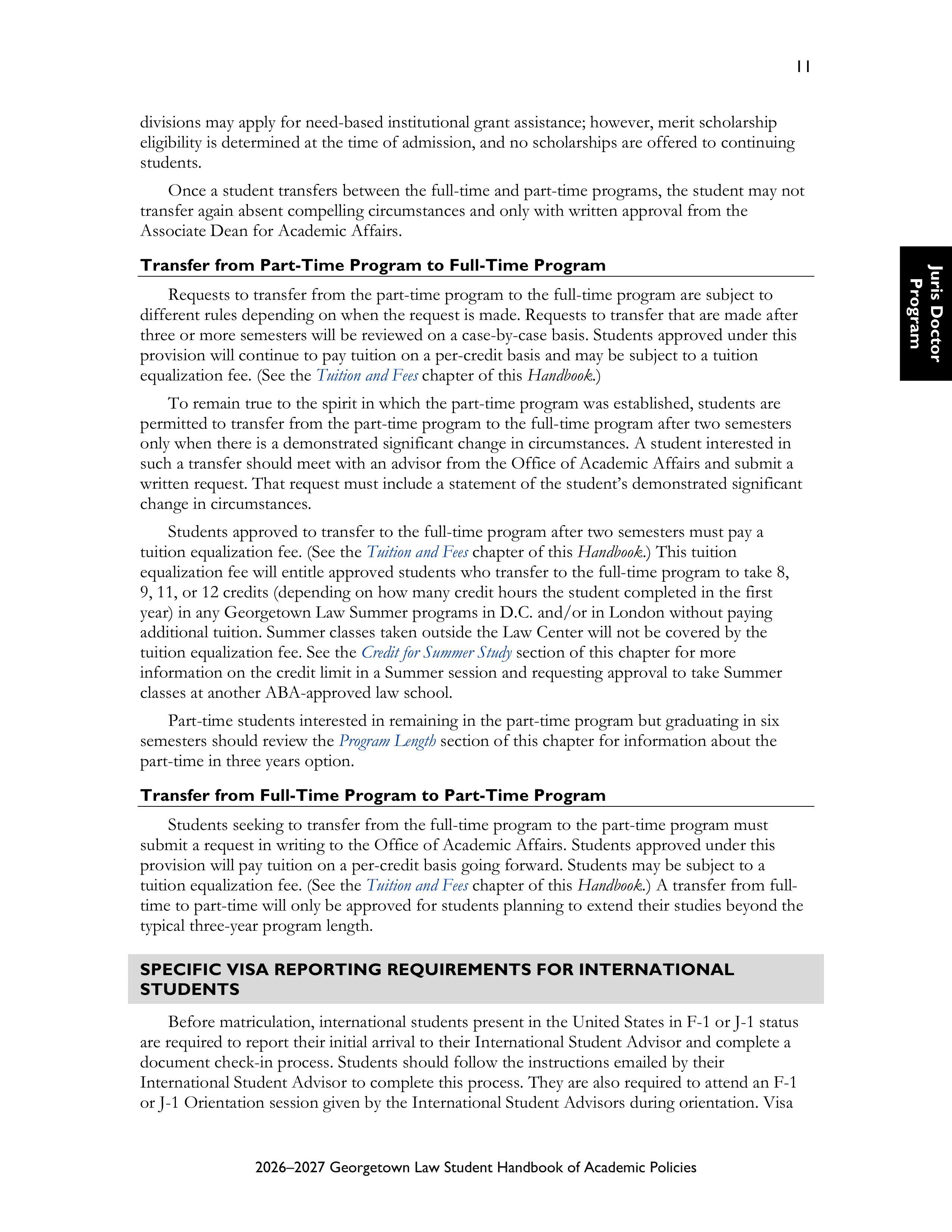
divisions may apply for need-based institutional grant assistance; however, merit scholarship
eligibility is determined at the time of admission, and no scholarships are offered to continuing
students.
Once a student transfers between the full-time and part-time programs, the student may not
transfer again absent compelling circumstances and only with written approval from the
Associate Dean for Academic Affairs.
Transfer from Part-Time Program to Full-Time Program
Requests to transfer from the part-time program to the full-time program are subject to
different rules depending on when the request is made. Requests to transfer that are made after
three or more semesters will be reviewed on a case-by-case basis. Students approved under this
provision will continue to pay tuition on a per-credit basis and may be subject to a tuition
equalization fee. (See the
Tuition and Fees
chapter of this
Handbook
.)
To remain true to the spirit in which the part-time program was established, students are
permitted to transfer from the part-time program to the full-time program after two semesters
only when there is a demonstrated significant change in circumstances. A student interested in
such a transfer should meet with an advisor from the Office of Academic Affairs and submit a
written request. That request must include a statement of the student’s demonstrated significant
change in circumstances.
Students approved to transfer to the full-time program after two semesters must pay a
tuition equalization fee. (See the
Tuition and Fees
chapter of this
Handbook
.) This tuition
equalization fee will entitle approved students who transfer to the full-time program to take 8,
9, 11, or 12 credits (depending on how many credit hours the student completed in the first
year) in any Georgetown Law Summer programs in D.C. and/or in London without paying
additional tuition. Summer classes taken outside the Law Center will not be covered by the
tuition equalization fee. See the
Credit for Summer Study
section of this chapter for more
information on the credit limit in a Summer session and requesting approval to take Summer
classes at another ABA-approved law school.
Part-time students interested in remaining in the part-time program but graduating in six
semesters should review the
Program Length
section of this chapter for information about the
part-time in three years option.
Transfer from Full-Time Program to Part-Time Program
Students seeking to transfer from the full-time program to the part-time program must
submit a request in writing to the Office of Academic Affairs. Students approved under this
provision will pay tuition on a per-credit basis going forward. Students may be subject to a
tuition equalization fee. (See the
Tuition and Fees
chapter of this
Handbook.
) A transfer from full-
time to part-time will only be approved for students planning to extend their studies beyond the
typical three-year program length.
SPECIFIC VISA REPORTING REQUIREMENTS FOR INTERNATIONAL
STUDENTS
Before matriculation, international students present in the United States in F-1 or J-1 status
are required to report their initial arrival to their International Student Advisor and complete a
document check-in process. Students should follow the instructions emailed by their
International Student Advisor to complete this process. They are also required to attend an F-1
or J-1 Orientation session given by the International Student Advisors during orientation. Visa
12
2026–2027 Georgetown Law Student Handbook of Academic Policies
and regulatory information is also available at the
International Student Services website
. For further
information, please contact an International Student Advisor at
lawcentervisa@georgetown.edu
.
Due to U.S. visa regulations, students in F-1 and J-1 student visa status who wish to
withdraw from any course or from the Law Center must obtain prior approval from an
International Student Advisor at
lawcentervisa@georgetown.edu
in addition to the necessary approvals
as described in the
Withdrawals and Leaves of Absence
section of this chapter.
All students in the United States in F-1 or J-1 student visa status must be authorized for
Curricular Practical Training before participating in any course that has an outside work
component, such as an externship, practicum, or clinic. For further information, please contact
an International Student Advisor at
lawcentervisa@georgetown.edu
.
ACADEMIC EVALUATION AND ATTRITION STANDARDS
Academic Evaluation System
The Law Center faculty awards the grades of A+, A, A-, B+, B, B-, C+, C, C-, D, and F.
Some courses are offered on a mandatory pass/fail basis. Upperclass students may elect to take
eligible graded courses under the pass/fail option, described in more detail below. Grades of AP
and AF are entered administratively, as described below.
Grading
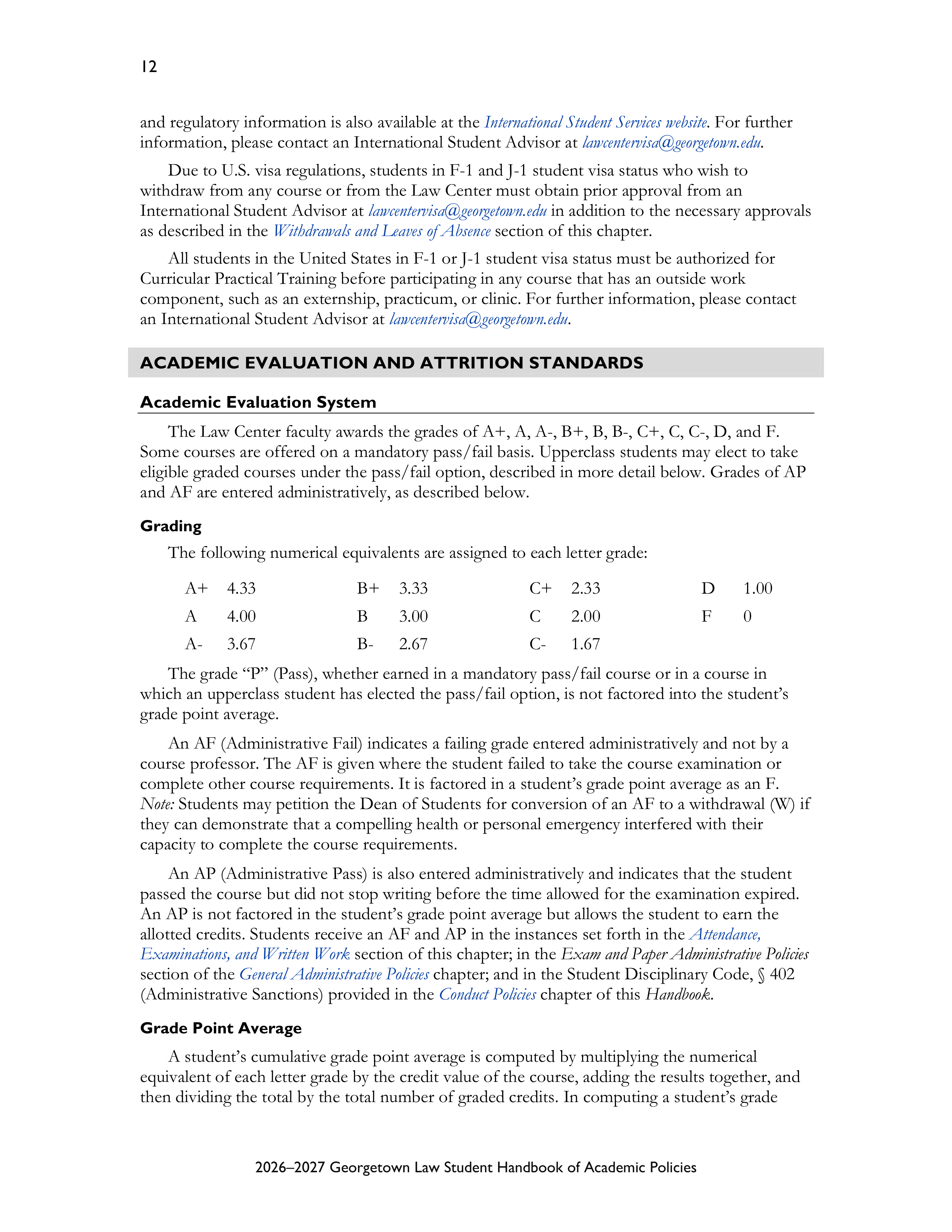
The following numerical equivalents are assigned to each letter grade:
A+ 4.33
B+
3.33
C+ 2.33
D
1.00
A
4.00
B
3.00
C
2.00
F
0
A-
3.67
B-
2.67
C-
1.67
The grade “P” (Pass), whether earned in a mandatory pass/fail course or in a course in
which an upperclass student has elected the pass/fail option, is not factored into the student’s
grade point average.
An AF (Administrative Fail) indicates a failing grade entered administratively and not by a
course professor. The AF is given where the student failed to take the course examination or
complete other course requirements. It is factored in a student’s grade point average as an F.
Note:
Students may petition the Dean of Students for conversion of an AF to a withdrawal (W) if
they can demonstrate that a compelling health or personal emergency interfered with their
capacity to complete the course requirements.
An AP (Administrative Pass) is also entered administratively and indicates that the student
passed the course but did not stop writing before the time allowed for the examination expired.
An AP is not factored in the student’s grade point average but allows the student to earn the
allotted credits. Students receive an AF and AP in the instances set forth in the
Attendance,
Examinations, and Written Work
section of this chapter; in the
Exam and Paper Administrative Policies
section of the
General Administrative Policies
chapter; and in the Student Disciplinary Code, § 402
(Administrative Sanctions) provided in the
Conduct Policies
chapter of this
Handbook
.
Grade Point Average
A student’s cumulative grade point average is computed by multiplying the numerical
equivalent of each letter grade by the credit value of the course, adding the results together, and
then dividing the total by the total number of graded credits. In computing a student’s grade
13
2026–2027 Georgetown Law Student Handbook of Academic Policies
Introduction
Juris Doctor
Program
Graduate
Programs
General Administrative
Policies
Conduct
Policies
Tuition &
Fees
Index
point average, computations are carried to two decimal places. Each student’s grade point
average is computed at the end of each semester.
While the cumulative grade point average is based upon all of the student’s Law Center
grades, the annual grade point average is based only upon a student’s Law Center grades for one
academic year. The academic year begins with the Summer session and ends with the following
Spring semester. In calculating the student’s grade point average, the Law Center will include the
credits for any course in which the student received an F or AF, even when the student has
successfully retaken the course.
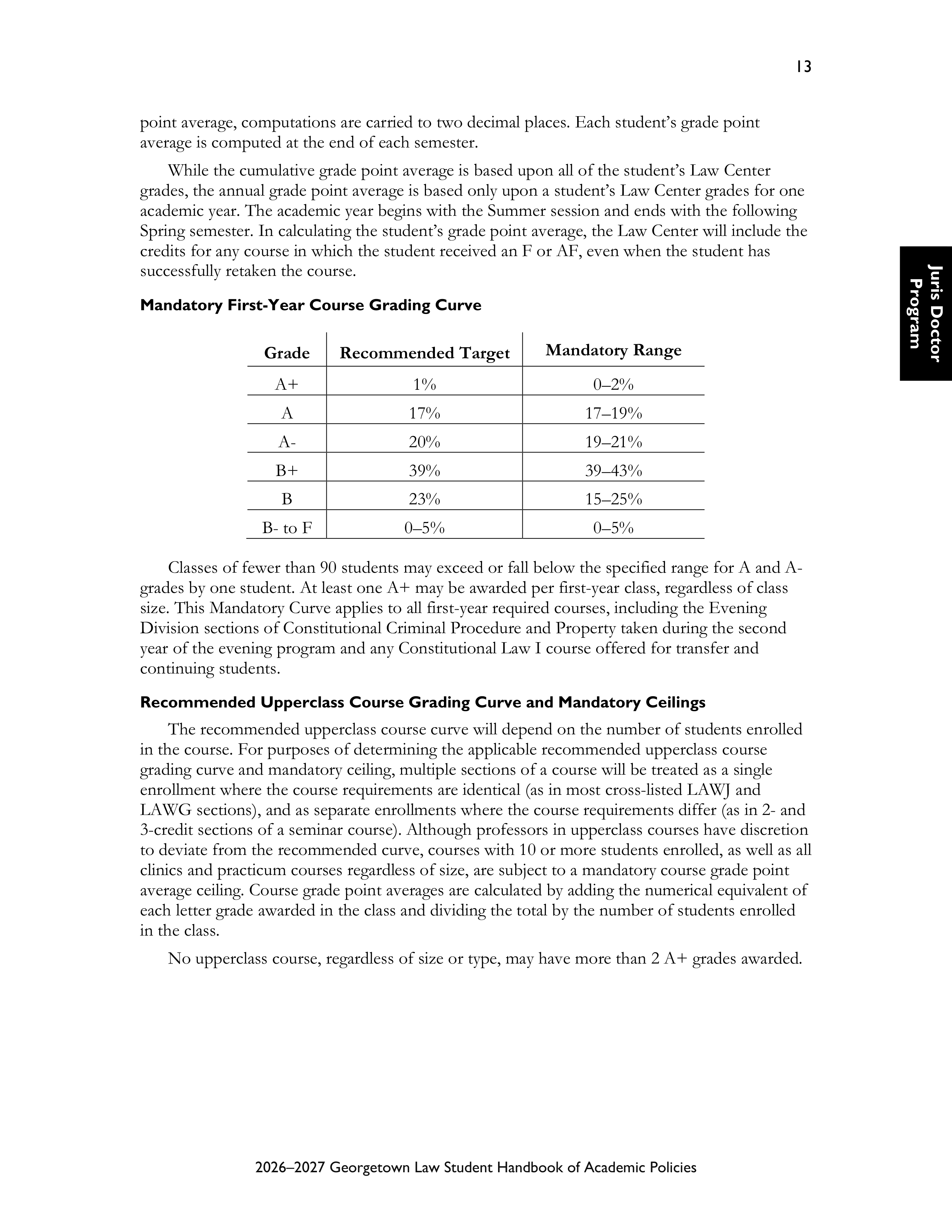
Mandatory First-Year Course Grading Curve
Grade
Recommended Target
Mandatory Range
A+
1%
0–2%
A
17%
17–19%
A-
20%
19–21%
B+
39%
39–43%
B
23%
15–25%
B- to F
0–5%
0–5%
Classes of fewer than 90 students may exceed or fall below the specified range for A and A-
grades by one student. At least one A+ may be awarded per first-year class, regardless of class
size. This Mandatory Curve applies to all first-year required courses, including the Evening
Division sections of Constitutional Criminal Procedure and Property taken during the second
year of the evening program and any Constitutional Law I course offered for transfer and
continuing students.
Recommended Upperclass Course Grading Curve and Mandatory Ceilings
The recommended upperclass course curve will depend on the number of students enrolled
in the course. For purposes of determining the applicable recommended upperclass course
grading curve and mandatory ceiling, multiple sections of a course will be treated as a single
enrollment where the course requirements are identical (as in most cross-listed LAWJ and
LAWG sections), and as separate enrollments where the course requirements differ (as in 2- and
3-credit sections of a seminar course). Although professors in upperclass courses have discretion
to deviate from the recommended curve, courses with 10 or more students enrolled, as well as all
clinics and practicum courses regardless of size, are subject to a mandatory course grade point
average ceiling. Course grade point averages are calculated by adding the numerical equivalent of
each letter grade awarded in the class and dividing the total by the number of students enrolled
in the class.
No upperclass course, regardless of size or type, may have more than 2 A+ grades awarded.
14
2026–2027 Georgetown Law Student Handbook of Academic Policies
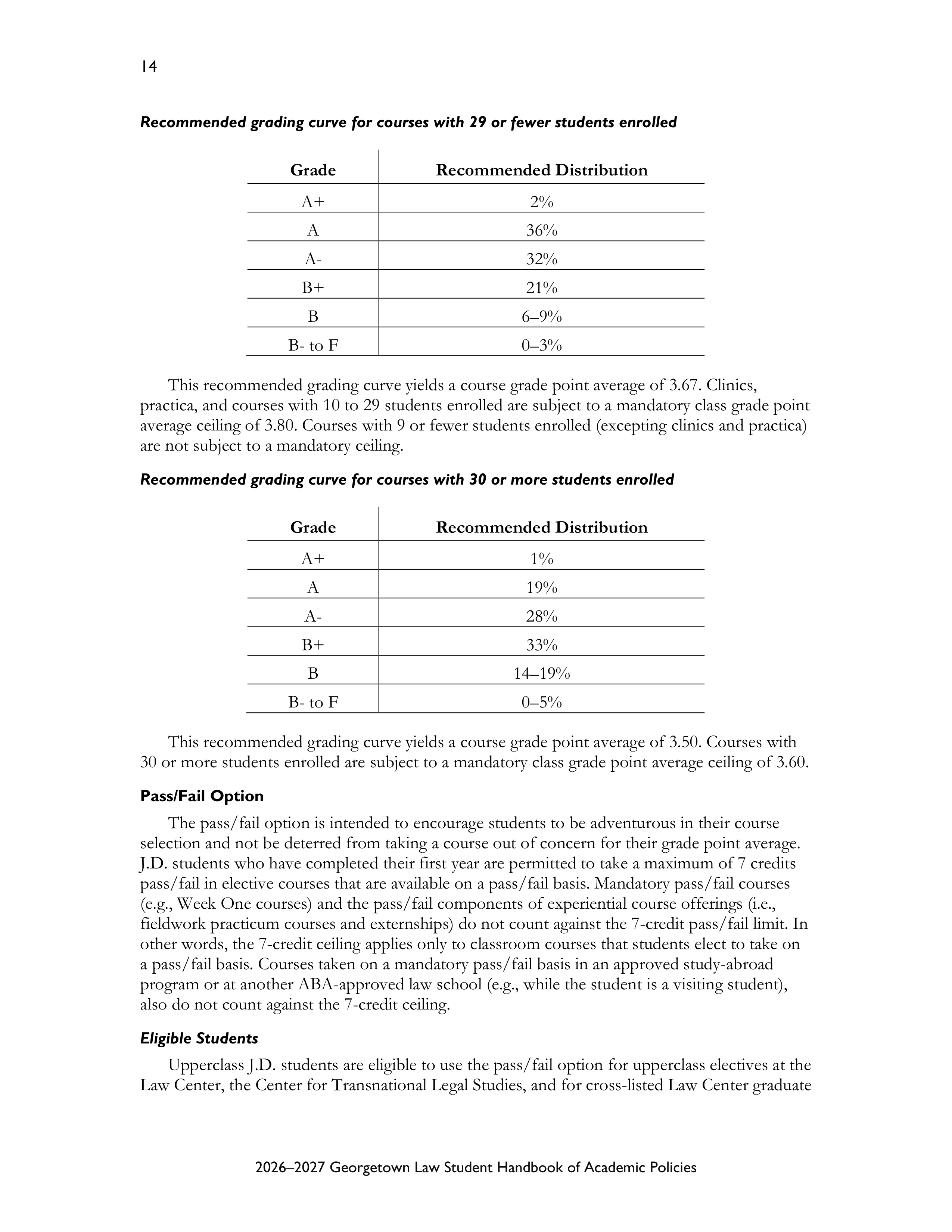
Recommended grading curve for courses with 29 or fewer students enrolled
Grade
Recommended Distribution
A+
2%
A
36%
A-
32%
B+
21%
B
6–9%
B- to F
0–3%
This recommended grading curve yields a course grade point average of 3.67. Clinics,
practica, and courses with 10 to 29 students enrolled are subject to a mandatory class grade point
average ceiling of 3.80. Courses with 9 or fewer students enrolled (excepting clinics and practica)
are not subject to a mandatory ceiling.
Recommended grading curve for courses with 30 or more students enrolled
Grade
Recommended Distribution
A+
1%
A
19%
A-
28%
B+
33%
B
14–19%
B- to F
0–5%
This recommended grading curve yields a course grade point average of 3.50. Courses with
30 or more students enrolled are subject to a mandatory class grade point average ceiling of 3.60.
Pass/Fail Option
The pass/fail option is intended to encourage students to be adventurous in their course
selection and not be deterred from taking a course out of concern for their grade point average.
J.D. students who have completed their first year are permitted to take a maximum of 7 credits
pass/fail in elective courses that are available on a pass/fail basis. Mandatory pass/fail courses
(e.g., Week One courses) and the pass/fail components of experiential course offerings (i.e.,
fieldwork practicum courses and externships) do not count against the 7-credit pass/fail limit. In
other words, the 7-credit ceiling applies only to classroom courses that students elect to take on
a pass/fail basis. Courses taken on a mandatory pass/fail basis in an approved study-abroad
program or at another ABA-approved law school (e.g., while the student is a visiting student),
also do not count against the 7-credit ceiling.
Eligible Students
Upperclass J.D. students are eligible to use the pass/fail option for upperclass electives at the
Law Center, the Center for Transnational Legal Studies, and for cross-listed Law Center graduate
15
2026–2027 Georgetown Law Student Handbook of Academic Policies
Introduction
Juris Doctor
Program
Graduate
Programs
General Administrative
Policies
Conduct
Policies
Tuition &
Fees
Index
(LL.M.) courses that are available for pass/fail. Students sign up for the pass/fail option online
and receive instructions on how to do so from the Office of the Registrar.
Non-Eligible Courses
The following courses are not eligible for the pass/fail option:
•
Courses in the required first-year program, including the first-year elective;
•
Any course that meets the Professional Responsibility requirement;
•
Upperclass legal writing requirement seminars;
•
Supervised Research projects;
•
Clinics;
•
Law Center graduate (LL.M.) courses that are not cross-listed;
•
Courses for which the faculty member has elected not to make the pass/fail option
available, as indicated in the “Course Requirements” for the course in the
Curriculum
Guide
; and
•
For students pursuing a J.D./LL.M. joint degree, any courses that are considered
“specialization credits” pursuant to the LL.M. degree requirements (see the
Graduate
Programs
chapter of this
Handbook
).
Other Restrictions
Students may exercise the option to take an otherwise graded course on a pass/fail basis only
once a semester. This does not apply to mandatory pass/fail courses, which do not count against
the 7-credit pass/fail limit (i.e., students may only elect to take one course pass/fail in a semester,
but may take any number of mandatory pass/fail courses in the same semester).
Grading
By the fourth week of the relevant semester (second week of Summer session), a student
who wishes to use the pass/fail option must designate to the Office of the Registrar: (1) the
course; and (2) the grade the student hopes to receive in the course (this is referred to as the
“target” grade). Students are encouraged to speak to an Academic Advisor about selecting a
target grade. No changes to the pass/fail designation or target grade will be permitted after the
deadline.
If the student earns the target grade or above, the actual grade will appear on the student’s
transcript and will be included in grade point average calculation. If the student earns a grade
below the target but a grade of at least a C, a pass will appear on the transcript. If the student
earns a grade of C- or lower, the actual grade will appear on the transcript and will be included in
grade point average calculation. Whether a student receives a pass or the grade, the credits
associated with the course will count against the 7-credit pass/fail limit. If a student withdraws
from a course taken on a pass/fail basis, the credits associated with the course will still count
against the 7-credit pass/fail limit. Faculty are not informed of who is taking their course on a
pass/fail basis, and students should not inform them.
Academic Attrition
Rules Applicable to First-Year Students
1.
A student must successfully complete the required first-year program. (See the
Required
First-Year Program
section of this chapter.) A student must retake any required first-year
course (including the first-year elective) in which the student received a grade of F or
AF. In the case of a first-year elective, a student who fails the course may repeat that
elective or substitute another course that meets the first-year elective requirement.
16
2026–2027 Georgetown Law Student Handbook of Academic Policies
2.
A first-year student whose cumulative grade point average at the end of the first two
semesters of study (exclusive of Summer sessions) is less than 2.00/4.33 must retake any
course in which the student received a grade of D. Both the original grade of D, F or AF
and whatever grade the student receives upon retaking the course will appear on the
student’s transcript. The Registrar will include the grades and the credits for each time
the student took the course in calculating the student’s cumulative grade point average
for purposes of honors and attrition; however, the credits will only count once toward
the 85 credits required for the degree. A student who fails to attain a grade of D or
better in any required first-year course (including the first-year elective) after the second
attempt will be required to take a leave of absence from the Law Center for the next
academic year. A student who fails to attain a grade of D or better in any required first-
year course (including the first-year elective) after the third attempt will be withdrawn
from the Law Center for academic insufficiency. For purposes of this provision, an
attempt includes enrollment that ends in a course withdrawal or a drop under the
Withdrawal Relief Policy as well as a grade of F or AF.
3.
A first-year student whose cumulative grade point average at the end of the first two
semesters of study (exclusive of Summer sessions) is less than 2.00/4.33 but at least
1.33/4.33 must take a leave of absence from the Law Center for the next academic year,
even if the student has withdrawn from one or more classes during those semesters. In
order to return, the student must submit a written petition to the Registrar no later than
August 1 for the following Fall semester. The petition will be considered by the
Associate Dean for Academic Affairs. The student will be allowed to return only if the
Associate Dean finds that it is probable that the student will be able to attain a
cumulative grade point average of 2.00/4.33 at the end of each future academic year and
satisfy all graduation requirements within the allotted time period.
4.
A first-year student whose cumulative grade point average at the end of the first two
semesters of study (exclusive of Summer sessions) is less than 1.33/4.33 will be
withdrawn for academic insufficiency. Students seeking readmission to the Law Center
must apply through the Office of Admissions.
Rules Applicable to Upperclass Students
1.
An upperclass student will be withdrawn from the Law Center for academic
insufficiency if at the end of any academic year the student has a cumulative grade point
average of less than 2.00/4.33. For a transfer student, only Law Center grades will be
counted.
2.
Students withdrawn for academic insufficiency must, absent a successful appeal, seek
readmission to the Law Center by applying through the Office of Admissions. See the
Appeals Process
section below for the appeals procedures for withdrawn students or
students required to take a leave of absence.
Counseling Requirement for Certain Students
Students who have a cumulative grade point average of less than 2.90/4.33 at the end of any
semester are required to meet with the Director of Academic Success to discuss the
requirements for graduation and ways to improve their performance. Students interested in
bringing their grade point average in exam courses above a 3.0 are strongly encouraged to meet
with the Director.
17
2026–2027 Georgetown Law Student Handbook of Academic Policies
Introduction
Juris Doctor
Program
Graduate
Programs
General Administrative
Policies
Conduct
Policies
Tuition &
Fees
Index
Appeals Process
As soon as practicable after grades are due each semester, the Registrar shall notify a student
in writing that the student failed to meet the minimum standard of academic performance, as
described above, and will be required to take a leave of absence or be withdrawn from the Law
Center, as the case may be. The student may submit to the Associate Dean for Academic Affairs
a written petition seeking reconsideration within five business days after the student receives
notice.
Appeals submitted by students involuntarily withdrawn after being absent longer than the
duration of an approved leave of absence or who have interrupted their course of study without
having received approval for a leave of absence in advance will only be considered where the
student is capable of completing their remaining degree requirements within seven academic
years from the date of matriculation. (See the
Withdrawal from the Law Center
section of this
chapter.)
All appeals must include documentation to substantiate the circumstances described. As part
of the appeal, the Associate Dean for Academic Affairs shall review whether the student has
provided sufficient documentation to overcome the presumption that the student should not
continue in the J.D. program. The terms of reinstatement may require a student to repeat
coursework.
The decision of the Associate Dean for Academic Affairs on a petition for reinstatement is
final and not appealable.
ATTENDANCE, EXAMINATIONS, AND WRITTEN WORK
Attendance and Participation
The Law Center must be satisfied at all times with the serious purpose of each student.
Regular and punctual attendance at all class sessions is required. Student participation is expected
in all courses. A student who, even though registered for a course, has not regularly attended,
participated, or otherwise met class requirements may be subject to any of the following, at the
professor’s option:
•
The student may be withdrawn;
•
The student may be excluded from attending class sessions;
•
The student may be excluded from sitting for a final examination or submitting a final
paper (with the same consequences as a failure to appear for a final examination or
submit a final paper); and/or
•
The student may receive a lowered or failing grade in the course.
A student who has not properly registered for a course may not take the final examination or
receive any credit for participation in the course.
Because attendance is required, students may not be registered in courses with any overlap in
scheduled meeting times.
Examinations
Anonymity in Grading
The grading processes for final examinations are anonymous and are designed to be as fair as
possible. To protect student anonymity and remain in compliance with the Student Disciplinary
18
2026–2027 Georgetown Law Student Handbook of Academic Policies
Code, students may not indicate to the professor that an examination has been deferred, discuss
any modification of the timing of an individual examination with the professor, or otherwise
identify themselves in any way to the professor as the author of the examination until after
grades are published. Students may not discuss the substance of the examination with the
professor or with any other student from the time the examination is first administered until
after grades are published. Faculty are asked to submit grades approximately two-to-three weeks
after the end of an examination period.
Deadlines and Deferred Examinations
Written examinations are held at the end of the classwork in all courses unless otherwise
indicated in the
Curriculum Guide
. Students should be aware that examinations for mini-courses
and other classes that conclude before the end of the semester may take place earlier in the
semester. Curricular offerings designated as “seminars” generally do not have examinations;
instead, substantial written work is required. Clinical programs do not have written final
examinations.
The Law Center requires students to take their examinations at the regularly scheduled time.
Dates for all in-class examinations as well as the default take-home examination window
*
are
announced at the time the course schedule is released so that students may anticipate the date of
their examinations and schedule personal and employment commitments so as not to interfere
with the announced dates of their examinations. If, however, a student experiences a serious
medical or personal situation that makes it impossible to take an examination on the scheduled
date, it is the student’s responsibility to determine, in consultation with the Registrar, whether
the student should request a deferred examination.
Students who become ill during the examination or otherwise experience a problem that
prevents them from continuing with the examination must immediately make the proctor, or in
the case of a take-home examination, the Registrar, aware of the situation and follow the
instructions of the proctor or Registrar. Students who choose to submit an examination before
receiving instructions from the Registrar should note that no post-examination relief will be
granted.
Students should read the
Exam Relief Policies
section in the
General Administrative Policies
chapter of this
Handbook
carefully for all exam relief rules, including more information on the
automatic rescheduling of certain exams and instances where, due to “extraordinary cause,”
permission to take a deferred examination may be granted.
Late and Missed Examinations
Any student who does not take an examination as originally scheduled, and who does not
obtain permission from the Office of the Registrar prior to the start of an examination to defer
that examination (consistent with the rules set forth in the
Exam Relief Policies
section of the
General Administrative Policies
chapter of this
Handbook
) will be subject to the sanctions set forth in
the
Exam and Paper Administrative Policies
section of the
General Administrative Policies
chapter of
this
Handbook
.
Please note that failure to take an examination or timely submit a take-home examination
may result in the student receiving an AF for the course. Students who fail to take an
examination may petition the Dean of Students for a conversion of that AF to a withdrawal (W)
if they can demonstrate that a compelling health or personal emergency interfered with their
capacity to take the examination by the deadline.
*
Professors may opt to have an abbreviated take-home examination window for their course.
19
2026–2027 Georgetown Law Student Handbook of Academic Policies
Introduction
Juris Doctor
Program
Graduate
Programs
General Administrative
Policies
Conduct
Policies
Tuition &
Fees
Index
See the
Submission of the Wrong Document for Grading
section in the
General Administrative Policies
chapter of this
Handbook
for the treatment of documents submitted in error.
Other Examination Policies
No re-examination will be given in any course for the purpose of raising a grade
obtained in a previous final examination in that course.
Students may review their graded examinations and papers by completing the online
form on the
Office of the Registrar’s Exam Review webpage
during the exam review periods.
Examination answers and papers can be reviewed for one academic year after they have
been administered to the student.
Some past examinations along with model or “best” answers are on file in the Library and
available on the Library’s online
Exam Archive
for student use as study aids. The Library’s archive
only includes examinations administered within the past five academic years.
Written Work
General Requirements
Papers submitted for grading must comply with the Artificial Intelligence Policy, the Student
Disciplinary Code’s policies on plagiarism, and be a product of the student’s own work in
consultation with the supervising professor. Except as set forth in the
One Paper for Two Seminars
section of this chapter, a paper may not repeat work for which credit is currently being or has
previously been granted in another course or which was undertaken in the course of
employment. For policies relating to services offered by the Writing Center or the Center for
Legal English, please see the
General Administrative Policies
chapter of this
Handbook
. Students who
are interested in using their final paper for other purposes (such as a law journal note) may do so
only after the paper has been submitted for grading.
Submission of Final Papers and Written Work Product
Final papers must be submitted to the professor by the paper deadline for the semester as
published in the
Academic Calendar
or other deadline announced by the professor.
Deadlines and Professor-Approved Extensions
Final papers in seminars and other courses are due, unless a different deadline is announced
by the professor, by the deadline published in the
Academic Calendar
. A professor may advance or
extend the due date and time (the “deadline”) of all papers for the seminar (except for those of
graduating students) up to the maximum extension published on the Office of the Registrar’s
website (the “maximum professor-approved extension deadline”). Deadlines for papers are as
firm as the dates of examinations.
Individual extensions up to the maximum professor-approved extension deadline may be
granted by the professor, provided the professor notifies the Office of the Registrar of the
extension by emailing
lawreg@georgetown.edu
.
Note:
Graduating students’ grades must be submitted to the Office of the Registrar before
the degree conferral date for that semester (see
Degree Conferral
section of this chapter), which
may be earlier than the maximum professor-approved extension deadline. Paper extension
grades submitted after the degree conferral date for a student’s final semester may result in the
student’s graduation date being extended by one semester and could impact the student’s
eligibility to sit for the bar examination.
20
2026–2027 Georgetown Law Student Handbook of Academic Policies
Note for International Students in F-1 or J-1 Visa Status:
U.S. visa restrictions dictate that
extending the paper deadline beyond the expected date of graduation as listed in the certificate
of eligibility (I-20 or DS-2019 form) can be permitted only for compelling academic and/or
medical reasons. Any such paper extension must be approved in writing by an International
Student Advisor in advance of the paper submission deadline, and students may also need to
apply for an Extension of Stay. Students must also obtain faculty member approval to any such
extension.
Late Papers and Extension for Extenuating Circumstances
The professor will determine what penalty, if any, applies to papers submitted after the
approved deadline. Students who fail to submit a final paper or who submit a final paper after
the maximum professor-approved extension deadline will receive an AF for the seminar unless
approval for a further extension is obtained from the Associate Dean for Academic Affairs, or
the Associate Dean for Clinics and Experiential Learning where the course in question is
experiential.
Any request for an extension beyond the maximum professor-approved extension deadline
is effective only upon review and approval of the Associate Dean for Academic Affairs, or the
Associate Dean for Clinics and Experiential Learning where the course in question is
experiential, and only for extenuating circumstances. In no instance will an extension be granted
beyond April 15 for papers due the preceding Fall semester, August 15 for papers due the
preceding Spring semester, or October 15 for papers due the preceding Summer session.
Students who fail to submit a final paper by the deadline set by the Associate Dean will receive
an AF for the seminar, but may petition the Dean of Students for conversion of that AF to a
withdrawal (W) if they can demonstrate that a compelling health or personal emergency
interfered with their capacity to complete the paper by the deadline.
Policy Regarding Grading and Examination Administration Errors
Grades reported to the Office of the Registrar are final. A faculty member may change
submitted grades only upon written proof of a mechanical, transcription, or procedural error in
the reporting process. After grades are posted, students should communicate directly with the
professor if they suspect that an error has occurred.
Note:
This policy does not allow a faculty
member to change a grade based on reassessment of the quality of a student’s examination or
paper.
Once the Office of the Registrar is notified by the professor(s) of a remediable error and
confirms that the correct grade for the examination can be determined, it will communicate the
outcome and options to the student, specifically: (1) if the correct grade (i.e., the grade actually
earned by the student) is
higher
than the erroneous grade, the correct grade will be automatically
posted on the student’s transcript; or (2) if the correct grade is
lower
than the erroneous grade,
the student will have a choice between three possible options: the lower grade, a P grade, or a
“CR” notation posted on the transcript. A CR is an Administrative Credit given in contexts of
administration errors or irregularities and is not factored into the student’s grade point average.
If the identified error or irregularity made it impossible to determine the correct grade, the
Office of the Registrar will notify the student that the “CR” notation will be posted on the
student’s transcript.
Review Process for a Failing Grade
Any student who has received a failing grade may request that the Registrar submit that
examination or paper for review. The final decision for the course grade rests with the professor
21
2026–2027 Georgetown Law Student Handbook of Academic Policies
Introduction
Juris Doctor
Program
Graduate
Programs
General Administrative
Policies
Conduct
Policies
Tuition &
Fees
Index
conducting the course, but the course professor shall give due and appropriate consideration to
the review process. A request for such evaluation must be made by the student within 14 days
after the grade is posted. Only grades of F qualify for this review process.
DEGREE CONFERRAL, COMMENCEMENT, AND ACADEMIC HONORS
Degree Conferral
The Office of the Registrar will notify expected graduates of the degree application deadlines
and provide them with instructions for submitting their degree applications.
Students are responsible for tracking their graduation progress to ensure that they meet all
degree requirements by their expected graduation date, and may do so using the online degree
audit tool,
MyDegree Audit
, or by requesting an audit from the Office of the Registrar by emailing
lawreg@georgetown.edu
. Once a student has completed all academic requirements for the J.D.
degree (subject to the
Credit and Program Length Requirements
and the limitations set forth below),
the student’s final cumulative grade point average will be calculated and the degree will be
conferred. Degrees are conferred after each academic term as follows:
•
Summer graduates: October 1, 2026
•
Fall graduates: February 1, 2027
•
Spring graduates: June 2, 2027
Students enrolled in Law Center-sponsored joint degree programs will graduate upon
completion of the requirements of both programs, unless the student has withdrawn from the
joint degree program, or unless otherwise specified by the particular joint degree program. (See
the
Dual Degree Programs
section of this chapter.)
In addition to completing all academic requirements, a student will not be issued a J.D.
diploma until (1) the student has submitted the ABA Employment Questionnaire and (2) the
student’s account balance has been paid in full. Transcripts, diplomas, bar certificates, and other
educational certificates will not be released if there is an outstanding student account balance.
The Law Center will not confer a J.D. degree on a student who is the subject of a pending
administrative or disciplinary action, as described in the Student Disciplinary Code, provided in
the
Conduct Policies
chapter of this
Handbook
.
Commencement Exercises for Off-Cycle Graduates
Students who are expected to graduate after a final Summer session and/or Fall semester
typically participate in commencement exercises the following May. Prospective Summer and
Fall graduating students may participate in the May commencement exercises prior to their final
Summer term or Fall semester under the following conditions:
•
The student has met with an Academic Advisor and that advisor has confirmed that the
student has a reasonable and achievable plan for completing all graduation requirements
by the Summer session or Fall semester immediately following the May commencement
exercises;
•
The student has completed the ABA Employment Questionnaire; and
•
The student has emailed
lawreg@georgetown.edu
no later than April 22, 2027 to officially
request permission to participate in the May commencement exercises.
Note:
To receive
important commencement-related communications, students are strongly encouraged to
request permission by the beginning of February.
22
2026–2027 Georgetown Law Student Handbook of Academic Policies
Approved prospective Summer and Fall graduates will not appear in the May
Commencement Program but will be included in the Celebration Day list and have their names
announced. The Registrar reserves the right to approve or deny any such request.
Academic Honors
The Law Center does not rank its students. The faculty has, however, authorized three
separate academic honors for students with distinguished academic records. For purposes of all
subsections of this
Academic Honors
section, any credits earned at the Center for Transnational
Legal Studies will count as credits completed at the Law Center. Graduation honors for
students who transfer to Georgetown Law after their first year of law school or who visit
another institution will be based solely on the grades earned at the Law Center. For the purpose
of calculating students’ eligibility for Diplomas with Honors or Order of the Coif, students
graduating after a Summer session or Fall semester will be included with the class that
graduated in the previous Spring semester. Students who receive two grades of AP, AF, or a
combination of both on their transcripts will not be eligible for graduation honors (i.e.,
Diplomas with Honors or Order of the Coif).
Dean’s List
J.D. students whose annual grade point average places them in the top one-third of their
class at the Law Center will have their transcripts marked “Dean’s List” for the appropriate
academic year. Dean’s List eligibility is computed separately for first-year, upperclass, and
graduating students.
The Dean’s List for first-year students consists of the students whose annual grade point
averages place them in the top one-third of their particular first-year section after the Spring
semester and who completed at least 24 credits at the Law Center if enrolled in the full-time
program or 16 credits at the Law Center if enrolled in the part-time program. For the first-year
class, the Dean’s List is calculated separately for each of the six first-year sections.
The upperclass Dean’s List is calculated separately in two groups. The first group consists of
students in their final year of law school. The second group consists of all other upperclass
students. Upperclass J.D. students are eligible for the Dean’s List provided they completed,
during the academic year, at least 24 credits at the Law Center if enrolled in the full-time
program, or 16 credits at the Law Center if enrolled in the part-time program. Students who
transfer from one program to the other during an academic year must earn a minimum of 12
credits for the semester in which they are a full-time student, and a minimum of 8 credits during
the semester in which they are a part-time student, to be eligible for the Dean’s List. Joint degree
students, concurrent degree students, and students who study abroad during one semester of the
academic year are eligible for Dean’s List recognition, based solely on their J.D. courses taken at
the Law Center, if they complete at least 16 J.D. credits at the Law Center during the academic
year and maintain full-time status in their joint or concurrent degree program, if applicable.
Students earning fewer than the minimum number of credits are not eligible for the Dean’s List.
Courses taken at the Law Center in the preceding Summer session or in the Law Center’s
Graduate Programs are included in the calculation of a student’s grade point average and count
toward the required minimum number of credits for Dean’s List eligibility.
Diplomas with Honors
Students who meet the academic standards set by the faculty may be awarded the J.D. degree
with honors and their diplomas will be marked
cum laude
,
magna cum laude
, or
summa cum laude
, as
appropriate.
23
2026–2027 Georgetown Law Student Handbook of Academic Policies
Introduction
Juris Doctor
Program
Graduate
Programs
General Administrative
Policies
Conduct
Policies
Tuition &
Fees
Index
The degree
cum laude
is awarded to students whose cumulative grade point averages place
them in the top one-third of those graduating, and the degree
magna cum laude
, to the top 10%.
The J.D. degree
summa cum laude
is the highest academic honor that the faculty can bestow
upon a graduating student. There is no cumulative grade point average that automatically entitles
a student to that honor. Instead, the J.D. degree
summa cum laude
is granted at the sole discretion
of the faculty. To be eligible for consideration for the award of
summa cum laude
, a graduate must
have completed at least 71 credits at the Law Center and have a minimum cumulative grade
point average of 3.70/4.33.
Order of the Coif, Georgetown Chapter
The Order of the Coif was established in 1912 to recognize graduating students who
achieved an exemplary cumulative grade point average. Graduating students whose cumulative
grade point averages place them in the top 10% of the class are elected to membership in the
Order, the national law school honor society for the encouragement of scholarship and
advancement of ethical standards in the legal profession.
To be eligible for consideration for Order of the Coif, a graduate typically must have
completed at least 64 graded credits at the Law Center (graded credits earned in a transfer
student’s first-year of law school are counted toward this minimum credit requirement). Neither
mandatory pass/fail credits, nor optional pass/fail credits that result in a pass, are counted
toward the 64 graded credits.
SPECIAL CREDIT POLICIES
Distance Education Courses
J.D. students may count a maximum of 15 credits earned in distance education courses
toward their J.D. degree. A “distance education course” is defined as one in which students are
separated from the faculty or each other for more than one-third of the instruction, and the
instruction involves the use of technology to support regular and substantive interaction among
students and between students and faculty, either synchronously or asynchronously, consistent
with the ABA definition of “distance education course.” Students who have not yet completed
28 credits should review the rules related to distance education courses for the jurisdiction in
which they intend to sit for the bar examination before enrolling in any distance education
course.
J.D. students may not enroll in graduate distance education courses (LAWD).
Note
: In response to the COVID-19 pandemic emergency, the Law Center adjusted its
curriculum and technology resources to enable courses to be fully available to students
participating remotely during the Spring 2020 semester, the 2020-2021 academic year, and the
Summer 2021 session, as well as for certain limited courses and circumstances in the 2021–2022
and 2022–2023 academic years. These courses are exempt from the Law Center’s usual
limitations on distance education.
Note for International Students in F-1 Visa Status
: Distance Education courses may be limited by
the Student and Exchange Visitor Program (SEVP). F-1 students are advised to consult with an
International Student Advisor before enrolling in any distance education course. Students should
contact an International Student Advisor at
lawcentervisa@georgetown.edu
with any questions.
24
2026–2027 Georgetown Law Student Handbook of Academic Policies
Graduate Work Completed Prior to Matriculation
Except as provided in this section, the Law Center will not grant credit for any coursework
completed prior to a student’s matriculation in a J.D. program at an ABA-approved law school.
This includes law courses taken at law schools prior to matriculation and any other graduate-
level courses.
A J.D. student who, prior to matriculation, received an LL.M. degree from the Law Center
may transfer up to 12 credits earned in the LL.M. degree program toward the J.D. degree
requirements under the following conditions:
•
Only a foreign-educated attorney who received an LL.M. degree from the Law Center in
Spring 2012 or later, and who has satisfied all of the requirements for and been accepted
into the J.D. program, is eligible for advanced standing under this paragraph.
•
The student must matriculate into the J.D. program within three academic years of
earning the LL.M. degree from the Law Center.
•
The transferred credits will apply toward the upperclass J.D. program of study.
•
Only credits earned in cross-listed courses or non-cross-listed courses taken in the J.D.
program (i.e., “LAWJ” sections) can be transferred.
•
A student who transfers credit from a J.D. (“LAWJ”) section of a 3-credit seminar that
meets the J.D. upperclass legal writing requirement will be treated as having satisfied that
requirement (see the
Upperclass Legal Writing Requirement
section of this chapter).
•
Even if, as an LL.M. student, the student takes and passes the LL.M. course
“Professional Responsibility in the United States,” the student must still complete the
professional responsibility requirement during the upperclass J.D. program of study (see
the
Professional Responsibility Requirement
section of this chapter).
•
Courses and grades for the credits transferred will remain part of the LL.M. transcript;
the grades for these courses will not be included in the computation of the J.D. grade
point average.
•
After meeting with an advisor in the Office of Academic Affairs, it is the responsibility
of the student to email the Office of the Registrar at
lawreg@georgetown.edu
before the end
of the first year of the J.D. program indicating the student’s intention to transfer up to
12 credits earned in the LL.M. degree program toward the J.D. degree requirements.
•
A student who satisfies the above requirements may earn the J.D. degree no earlier than
five full-time semesters (two and a half academic years) from the date of matriculation
into the J.D. program.
Note:
International students in F-1 or J-1 visa status should
consult with an International Student Advisor at
lawcentervisa@georgetown.edu
if they have
any questions regarding graduating off-cycle and their employment and visa status.
Credit for Courses in the Law Center’s Graduate Programs
Upperclass students may take any number of non-cross-listed courses (i.e., courses that have
a LAWG but no LAWJ section) in the Graduate Programs of the Law Center on a seat-available
basis. Grades for Law Center graduate courses and seminars are displayed on students’
transcripts and computed into students’ grade point averages. Regardless of the number of
credits earned in coursework offered through the Graduate Program, J.D. students are not
eligible to earn LL.M. degrees or certificates while also earning their J.D, unless enrolled in a
joint degree program. Students interested in one of the J.D./LL.M. joint degrees should review
the information found in the
J.D./LL.M. Joint Degrees
section of the
Graduate Programs
chapter of
25
2026–2027 Georgetown Law Student Handbook of Academic Policies
Introduction
Juris Doctor
Program
Graduate
Programs
General Administrative
Policies
Conduct
Policies
Tuition &
Fees
Index
this
Handbook
. See the
Certificate Programs
section of this chapter for more information on
certificates available to J.D. students.
Credit for Courses in the Undergraduate or Graduate Schools of the University
Consistent with the rules and procedures stated below, upperclass J.D. students may take
courses in the undergraduate or graduate schools of the University on a seat-available basis. First-
year J.D. students may not take courses outside the Law Center. Course descriptions may be
found in the University course catalog via
GU Experience
.
Full-time students may take undergraduate and graduate courses during the Fall and Spring
semesters without additional charge. Part-time students pay for all courses at the applicable Law
Center credit hour rate. Full-time or part-time students taking Summer courses are billed at the
applicable undergraduate or graduate school’s tuition rate.
Undergraduate and Language Courses
Upperclass students may take undergraduate and language courses on a seat-available basis;
however, credits earned in such courses will not be counted toward the J.D. degree
requirements. Course titles, credits, and grades earned in undergraduate and language courses
will not appear on the student’s Law Center transcript or be calculated in the student’s Law
Center grade point average. Students may take undergraduate or language courses on a pass/fail
basis only if they are mandatory pass/fail courses; in these instances, students are subject to
Main Campus pass/fail policies.
Graduate-Level Courses
Upperclass students may apply a maximum of 6 credits of approved graduate-level
coursework completed at the University toward their J.D. degree requirements.
Courses must be submitted to an Academic Advisor for approval in order to apply to the
J.D. degree requirements. Most courses at the 5000 level or above will be approved for credit
toward the J.D. degree, but students may not receive credit for language skills courses,
fieldwork internship courses, courses that duplicate available courses at Georgetown Law, or
any other course deemed to be incompatible with the Georgetown Law curriculum.
Approved graduate-level courses, credits, and grades will appear on the student’s Law
Center transcript, but the grades will not be calculated in the student’s Law Center grade point
average. Students who take graduate-level credits that count toward the J.D. degree may not
exceed the Law Center’s applicable per-semester credit limit. (See the
Credit and Program Length
Requirements
section of this chapter.) Students may not take graduate-level courses on an
optional pass/fail basis and have the credits count toward their J.D. degree. Graduate-level
courses are subject to the relevant graduate schools’ deadlines for add/drop activity, which
may be different from the Law Center’s deadlines. If students withdraw from a graduate-level
course counting toward their J.D. degree requirements after the last day of add/drop activity
for that graduate school, the credit associated with the course will count against the 6-credit
limit described above.
Enrollment Policies and Procedures
Students may not enroll themselves in courses in the undergraduate or graduate schools of
the University. Students seeking to take a course in the undergraduate or graduate schools must
submit a request to the Office of Academic Affairs at
lawacademicaffairs@georgetown.edu
no later
than the following deadlines:
26
2026–2027 Georgetown Law Student Handbook of Academic Policies
•
For Fall 2026 courses (including Business School Modules 1 and 2):
August 14, 2026
•
For Spring 2027 courses (including Business School Modules 3 and 4):
January 5, 2027
•
For Summer 2027 courses:
April 21, 2027
All requests must include:
(1) The course number;
(2) The course name;
(3) The number of credits;
(4) A list of any prerequisite courses and how the student believes they have been met; and
(5) Requests for courses in the Graduate School of Arts and Sciences, the School of
Continuing Studies, the School of Medicine, and the School of Nursing & Health
Sciences must also include the professor’s email permission to enroll. Students should
not contact faculty directly regarding requests for courses in the School of Business, the
School of Foreign Service (including the Securities Studies Program), or the School of
Public Policy.
The student’s request will be forwarded to the Law Center’s Office of the Registrar after
review and approval by an Academic Advisor. The Office of the Registrar will forward the
request to the appropriate academic department for approval to enroll the student. The Office of
the Registrar will confirm for students their enrollment status.
Note:
Law students are enrolled in courses in the undergraduate or graduate schools of the
University on a seat-available basis at the beginning of those programs’ add/drop period.
Undergraduate and graduate students have priority for these courses. Law Center students are
not permitted to be waitlisted for these courses and are subject to the add/drop, withdrawal, and
grading policies and deadlines of the undergraduate and graduate schools. If the course is cross-
listed (i.e., has a Law Center section designated by LAWJ or LAWG), law students must enroll in
the Law Center section of the course and follow the Law Center’s add/drop and waitlist policies.
The Law Center does not follow the same academic calendar as the undergraduate and
graduate schools of the University, and it is the student’s responsibility to determine when a
course begins. The Business School operates on quarters, or modules, and has two modules per
semester. Business School classes may follow a different schedule than other schools or
departments of the University.
Credit for Study Outside the Law Center
General Provisions
The following academic policies are applicable to credit earned and transferred from another
institution, including another ABA-approved law school.
•
A minimum of 54 credits must be earned at the Law Center (including the Center for
Transnational Legal Studies, if applicable).
•
A passing grade is required for transfer of any credits from another school toward the
J.D. degree requirements at the Law Center.
•
Courses may not be taken pass/fail at another ABA-approved law school unless the
course is a mandatory pass/fail course.
•
All approved credits undertaken at another institution will be displayed on the student’s
Law Center transcript. Individual course titles and grades are not included in the
student’s Law Center transcript and the grades will not be factored into the student’s
Law Center grade point average.
27
2026–2027 Georgetown Law Student Handbook of Academic Policies
Introduction
Juris Doctor
Program
Graduate
Programs
General Administrative
Policies
Conduct
Policies
Tuition &
Fees
Index
•
Some degree requirements must be completed at the Law Center, including:
◦
the upperclass legal writing requirement; and
◦
a course that teaches students to think critically about the law’s claim to neutrality
and the law’s differential effects on subordinated groups, including those identified
by race, gender, indigeneity, and class.
•
Students seeking to enroll in and receive credit for experiential courses (including clinics,
practicum courses, externships, and simulation courses) at another ABA-approved law
school must contact the
Office of Experiential Education
prior to registration for approval to
count those courses toward the Law Center’s experiential graduation requirement.
Courses will not be approved where they fail to meet the Law Center’s standards for
experiential education.
•
No credit is given for remedial, state-law, or bar examination preparation courses offered
by other institutions, or for any other course deemed to be incompatible with the
Georgetown Law curriculum.
•
It is the student’s responsibility to make sure the official transcript of grades and a
degree application are submitted to the Office of the Registrar by the Law Center’s
grades and degree application deadlines. Students who petition to visit at another
institution during their final year of study are cautioned that grades not received by the
Law Center’s grades deadline will affect graduation clearance and may affect bar
registration.
•
Please refer to the
Academic Evaluation and Attrition Standards
section of this chapter for
the rules that govern how courses taken at other schools affect academic evaluation and
attrition, and academic and graduation honors.
Taking Courses at Another Law School in Washington, D.C. While Enrolled at
Georgetown Law
Students must receive permission from an advisor in the Office of Academic Affairs and
must have a compelling reason to take a course at another ABA-approved law school in the
Washington, D.C. area during a Fall or Spring semester in which the student is enrolled in
courses at the Law Center. The Law Center will accept no more than 6 credits in this situation,
and the courses must be approved prior to the student’s enrollment at the other law school. The
General Provisions described above also apply.
Visiting at Another Law School
In extraordinary circumstances, an upperclass student may be granted permission to attend
another ABA-approved law school for one or two semesters while still earning the Georgetown
Law degree. Before applying to another school, the student must obtain permission from the
Dean of Students. In addition to the General Provisions described above, the following rules
apply:
•
Permission to visit away is granted only to students showing compelling personal
circumstances related to their health and wellbeing or that of an immediate family
member that require their relocation.
•
The Law Center reserves the right to designate the schools which a student may attend,
to approve the student’s selection of courses, and to limit the number of students to
whom permission to visit away is granted.
28
2026–2027 Georgetown Law Student Handbook of Academic Policies
•
Students must submit their request, in writing, to the Dean of Students as soon as
practicable after the circumstances occasioning the request arise.
•
Students will not be permitted to visit at another school unless they are in good standing
at Georgetown Law for the semester(s) for which they wish to visit away.
•
Georgetown Law students who wish to visit at another school must have earned the
minimum 2.00/4.33 grade point average required for graduation before permission to
visit away will be given, since grades earned at other schools will not be calculated in a
student’s Law Center grade point average.
•
Students requesting to visit away must complete a degree audit with an Academic
Advisor to assure that they can meet all degree requirements (including earning 54
credits at the Law Center). Students must complete certain requirements at the Law
Center, including the required first-year program (including the first-year elective), the
upperclass writing requirement, and a course that teaches students to think critically
about the law’s claim to neutrality and the law’s differential effects on subordinated
groups, including those identified by race, gender, indigeneity, and class.
•
Students visiting at another law school must carry private medical insurance, be covered
by a student medical insurance policy at the visited school, or purchase medical
insurance provided by Georgetown University.
•
Students are ineligible to receive any Georgetown institutional grants or scholarships or
be awarded Federal Work-Study during the semester(s) they are visiting away. Students
may be eligible to receive federal loans but should consult with the Office of Financial
Aid for more information.
•
A student with an unpaid student account balance will not be approved to visit away
until the student’s account is paid in full.
•
There is an administrative fee of $500.00 for each semester a student visits at another
school.
Credit for Study Abroad Programs During the Academic Year
The American Bar Association limits credit earned through study at a foreign institution to
one-third of the total number of credits required to graduate with a J.D. degree. Georgetown
Law requires 85 credits. Therefore, students are limited to a total of 28 study abroad credits. Due
to the existing limits Georgetown Law places on the number of study abroad credits students
may transfer in toward their J.D. degree, only students interested in pursuing both the Sciences
Po program and a summer abroad program are impacted by the ABA’s 28-credit limit (e.g.,
students will not be able to transfer in 28 credits from Sciences Po and credits from a summer
abroad program; they will be limited to 28 credits in total).
All study abroad programs are subject to University-sponsored student travel restrictions.
Center for Transnational Legal Studies
The Center for Transnational Legal Studies (CTLS) in London is a collaborative project that
brings together students and faculty from law schools in 20 countries to study international,
transnational, and comparative law and policy. Upperclass Georgetown Law students may spend
a semester with their counterparts from the other law schools in courses taught and co-taught by
faculty from both the common law and civil law traditions. Enrollment in CTLS is open to J.D.
students who have completed the required first-year program (other than the first-year elective
for part-time students). All students who transfer to Georgetown Law from another law school
29
2026–2027 Georgetown Law Student Handbook of Academic Policies
Introduction
Juris Doctor
Program
Graduate
Programs
General Administrative
Policies
Conduct
Policies
Tuition &
Fees
Index
must complete all first-year course requirements before being eligible to study at CTLS.
Preference will be given to students entering their final two semesters in law school. More
detailed information on eligibility and the application process is available through the
CTLS
website
or by emailing
lawtransnational@georgetown.edu
.
Grading at CTLS
Students at CTLS are graded on a scale from 5.0 to 1.0, in 0.5 increments (5.0 being the
highest numerical score). The CTLS numerical scores have been harmonized with the A to F
grading scale at Georgetown Law in the following manner:
CTLS Numerical Score
Georgetown Grade
Georgetown Numerical Equivalent
5.0 and 4.5
A
4.00
4.0
A-
3.67
3.5
B+
3.33
3.0
B
3.00
2.5
B-
2.67
2.0
C+
2.33
1.5
D
1.00
1.0
F
0
Credit Policies Applicable to CTLS
•
Students may attend CTLS for only one semester. Students may transfer a maximum of
14 credits from CTLS to their J.D. degree requirements.
•
Students can do a semester at either CTLS or another Semester Abroad Program, but
not both.
•
Non-Georgetown Law summer study abroad programs will count toward the maximum
14 credits that can be transferred to the J.D. degree from CTLS.
•
Credits earned at CTLS will count as “Law Center” courses for purposes of the 54 Law
Center credit requirement outlined in the Credit and Program Length Requirements
section above.
•
The grades earned at CTLS will appear on the Georgetown Law transcript and will be
included in the computation of the student’s Law Center grade point average.
•
Part-time students enrolled at CTLS may transfer in up to 14 credits.
Georgetown Law Semester Abroad Program
The Georgetown Law Semester Abroad Program arranges for students to study abroad for a
semester at one of a number of outstanding law schools. These semester abroad programs are
open to J.D. students who have completed the required first-year program (other than the first-
year elective for part-time students). Preference will be given to students entering their final two
semesters of law school. Students, including part-time students, participating in the semester
abroad programs sponsored by Georgetown Law can transfer up to 14 credits toward their J.D.
degree requirements, subject to the limitations below.
The following foreign law schools have recently participated in the Georgetown Law
Semester Abroad program:
•
University of Amsterdam, the Netherlands;
•
University of Bern, Switzerland;
•
Bucerius Law School, Hamburg, Germany;
30
2026–2027 Georgetown Law Student Handbook of Academic Policies
•
ESADE Law School, Barcelona, Spain;
•
The Hebrew University of Jerusalem, Israel;
•
The University of Hong Kong, Hong Kong (SAR)
•
Keio University, Tokyo, Japan;
•
University of Leiden, Leiden, the Netherlands;
•
University of Melbourne, Australia;
•
National University of Singapore School of Law, Singapore;
•
Universidad Torcuato di Tella, Buenos Aires, Argentina; and
•
Yonsei Law School, Seoul, South Korea.
In addition to the Sciences Po program, described below, some other programs either
require or recommend proficiency in a foreign language.
Most programs welcome students in the Fall semester, while a limited number accept
students during the Spring semester. Students who study abroad during their final semester
before finishing their J.D. program assume the risk that scheduling conflicts or unforeseen
administrative delays at the host school will prevent them from graduating on time and/or being
able to meet certain bar registration deadlines.
Sciences Po Program
Students can also apply for the yearlong program in Paris at the Institut d’Études Politiques
de Paris (Sciences Po). This program awards a Master in Economic Law degree with a Global
Governance Studies specialization. A maximum of 28 credits earned through this program may
be transferred toward the J.D. degree requirements. The full-year Economic Law Program at
Sciences Po in Paris is open only to J.D. students entering their final two semesters in law
school. Students participating in this program complete their J.D. degree during the same
semester that they complete the Sciences Po program. Students will select either the English
track or French track when they apply. To qualify for the French track, students must provide
documentation of their French language proficiency.
Credit Policies Applicable to Georgetown Law Study Abroad
•
Except with respect to the yearlong program at Sciences Po, students may only transfer
up to a total of 14 credits from a Georgetown Law Semester Abroad program toward
their J.D. degree requirements. Non-Georgetown Law summer study abroad programs
will count toward the maximum 14 credits that can be transferred to the J.D. degree
from a Georgetown Law Semester Abroad program.
•
Credits earned at a Georgetown Law study abroad program (with the exception of the
CTLS) will not count toward the 54 Law Center credits required to graduate.
•
With the exception of CTLS, individual courses taken and the grades received at the
foreign school will not appear on the Law Center transcript and the grades will not be
factored into the Law Center grade point average.
•
The Law Center does not give credit for experiential courses, including clinical work,
externships, practicum courses or simulations, completed through study abroad
programs.
•
With the exception of CTLS, the Law Center will not accept credit for any course taken
on a pass/fail basis if another evaluative grading basis is available.
•
Language learning courses taken during a study abroad program will not apply toward
credits transferred to the Georgetown J.D. degree.
31
2026–2027 Georgetown Law Student Handbook of Academic Policies
Introduction
Juris Doctor
Program
Graduate
Programs
General Administrative
Policies
Conduct
Policies
Tuition &
Fees
Index
For additional important information, visit the Office of Transnational Programs’
Georgetown
Law Semester Abroad Program webpage
.
Note for Transfer Students:
Because students must complete 54 of their 85 credits at the Law
Center (including CTLS, if applicable), transfer students considering a study abroad program
should contact the Office of Transnational Programs to determine the feasibility of studying
abroad.
Ad Hoc Study Abroad Programs During the Academic Year (Non-Georgetown Law)
While enrolled at the Law Center, students may earn a limited number of credits through
non-Georgetown Law study abroad programs (ad hoc programs), with approval from the
Executive Director of the Office of Transnational Programs. Ad hoc study abroad programs are
subject to University-sponsored student travel restrictions. There are a limited number of U.S.
law schools that sponsor ABA-approved study abroad programs during the Fall or Spring
semesters, which the ABA lists on its
website
. The Law Center also permits students to apply to
study abroad for a semester by enrolling in foreign institutions directly. Approval for ad hoc
study abroad is generally not given for programs in countries where the Law Center has already
established a study abroad program. The application deadline for ad hoc study abroad is the
same as for Georgetown Law study abroad programs. In addition to the General Provisions
described above, the following rules apply:
•
Students are required to show that their proposed ad hoc program of study will
substantially advance a previously demonstrated academic or professional interest in a
manner that would not be possible by enrolling in a Georgetown Law study abroad
program. This is a higher standard than that applied to other study abroad
applications.
•
The Law Center will accept no more than 12 credits from non-Georgetown Law study
abroad programs. Non-Georgetown Law summer study abroad programs will count
toward the maximum 12 credits that can be transferred to the J.D. degree from a non-
Georgetown Law semester study abroad program.
•
The Law Center reserves the right to designate the schools to which a student may apply
and must approve the student’s selection of courses. The Law Center does not give
credit for experiential courses, including clinical work, externships, practicum courses or
simulations, completed through study abroad programs. The Law Center will not accept
credit for any courses taken on a pass/fail basis if another evaluative grading process is
available.
•
The health insurance requirements that apply to students participating in Georgetown
Law programs apply to students doing ad hoc programs as well. Students should review
the insurance reference materials posted on the Office of Transnational Programs’
Student International Travel Registration webpage
.
•
Students are ineligible to receive any Georgetown institutional grants or scholarships and
are generally ineligible for federal financial aid during the semester they are participating
in an ad hoc semester abroad program. Students should consult with the Office of
Financial Aid for more information.
•
A student with an unpaid student account balance will not be approved to participate in
an ad hoc semester abroad program until the student’s account is paid in full.
•
Students participating in an ad hoc semester abroad program will be charged an
administrative fee of $500.00.
32
2026–2027 Georgetown Law Student Handbook of Academic Policies
Additional information regarding studying abroad at other law schools is available on the
Office of Transnational Programs’
Non-Georgetown Ad Hoc Study Abroad webpage
.
Credit for Summer Study
Summer Session at the Law Center
Students in good standing at the Law Center may enroll in Summer session courses at the
Law Center and earn credit toward their degree requirements. J.D. students in good standing at
other ABA-accredited law schools may enroll as non-degree students in J.D. courses in the
Summer session at Georgetown Law as space permits. The policies and procedures for J.D.
students to enroll in Summer session courses are explained in the Summer session section
published each spring on the Office of the Registrar’s
Course Registration webpage
. Except as
expressly modified in the Summer session registration materials available on the Office of the
Registrar’s website, all academic regulations applicable during the regular academic year are
applicable during the Summer session. J.D. students may earn up to 8 credits, or 9 credits with
the approval of an Academic Advisor, over each Summer session.
J.D. students may not graduate in fewer than three academic years (six semesters) by
completing Summer session courses. See the
Credit and Program Length Requirements
section of this
chapter.
Summer Study in the Undergraduate or Graduate Schools of the University
Upperclass students may take courses in the undergraduate or graduate schools of the
University during its Summer session on a seat-available basis, subject to the rules set forth in
the
Credit for Courses in the Undergraduate or Graduate Schools of the University
section of this chapter.
Summer Study in the United States (Non-Georgetown Law)
Students must seek approval from an advisor in the Office of Academic Affairs to take
Summer courses at another ABA-approved law school in the United States. Part-time students,
or full-time students who transferred from the part-time program and continue to pay on a per-
credit basis, may transfer in a maximum of 6 credits of Summer coursework earned at another
ABA-approved law school in the United States toward the J.D. degree. Students must have a
compelling reason in order to attend a Summer session at another law school in the Washington,
D.C., area. The General Provisions described in the
Credit for Study Outside the Law Center
section
also apply.
Summer Abroad Programs at Other Law Schools
The Law Center will accept up to 4 credits taken at a non-Georgetown Law summer abroad
program with the permission of the Executive Director of the Office of Transnational Programs.
Non-Georgetown Law summer abroad programs are subject to University-sponsored student
travel restrictions. In addition to the General Provisions described in the
Credit for Study Outside
the Law Center
section, the following rules apply to non-Georgetown Law summer abroad
programs:
•
The Law Center will accept no more than a total of 12 credits from any combination of
non-Georgetown Law study abroad programs. For example, if a student takes 4 credits
at a non-Georgetown Law summer abroad program, the student could expect to transfer
in only 8 credits from any non-Georgetown Law semester abroad program.
•
Students may take up to 14 credits of study abroad credit when a Georgetown Law
program is involved. For example, a student who earns 4 credits in a non-Georgetown
33
2026–2027 Georgetown Law Student Handbook of Academic Policies
Introduction
Juris Doctor
Program
Graduate
Programs
General Administrative
Policies
Conduct
Policies
Tuition &
Fees
Index
Law summer abroad program and then participates in a Georgetown Law semester
abroad program may earn a maximum of 10 credits from that semester abroad
experience.
•
The Law Center reserves the right to designate the schools which a student may attend
and to approve the student’s selection of courses. The Law Center does not give credit
for clinical work, internships, or externships done abroad through these programs. The
Law Center will not accept credit for any courses taken on a pass/fail basis if another
evaluative grading process is available.
•
The medical insurance requirements that apply to students participating in Georgetown
Law programs apply to students doing non-Georgetown Law programs as well. Students
should review the insurance reference materials posted on the Office of Transnational
Programs’
Student International Travel Registration webpage
.
Application and other information regarding summer study abroad at other law schools is
available on the Office of Transnational Programs’
Ad Hoc Summer Abroad webpage
.
Auditing Courses
At the Law Center
Enrolled J.D. students may not officially audit courses at the Law Center; however, they may
unofficially audit non-experiential upperclass courses and seminars at the Law Center with the
permission of the professor on a seat-available basis at no additional charge. Students may not
audit clinics, practicum courses, externship seminars, or simulations. Due to their unofficial
status, auditors receive no transcript notation of their attendance in class and do not have access
to online materials restricted to enrolled students unless the professor grants them access to the
course site. Auditors do not complete any course requirements, including examinations and
papers.
At the University
Enrolled J.D. students may seek to enroll in a course in the undergraduate or graduate
schools of the University on an audit basis by following the process described in the
Credit for
Courses in the Undergraduate or Graduate Schools of the University
section of this chapter. University
department policies regarding auditing will apply and may vary. Students who audit these courses
may be required by the professor to complete the course requirements. Students receive an AU
on their transcript for audited courses, and these credits count toward the per-semester credit
limits. (See the
Credit and Program Length Requirements
section of this chapter.). Full-time students
may audit undergraduate and graduate University courses during the Fall and Spring semesters
without additional charge. Part-time students pay for any audited courses at the applicable Law
Center credit hour rate. Full-time and part-time students auditing Summer courses are billed at
the applicable undergraduate or graduate school’s tuition rate.
Student-Initiated Seminar
Students who wish to study a subject not offered by the faculty may organize a student-
initiated seminar. Seminar sessions are student-led and are supervised by a full-time faculty
member. Students wishing to do so must: (1) secure a commitment from a full-time faculty
member to supervise the seminar; and (2) submit a course proposal to the Associate Dean for
Academic Affairs that includes the title of the seminar, the name of the faculty member who has
agreed to supervise the seminar, and a syllabus, which must include a reading list and course
assessment (i.e. paper or special requirement). This proposal must be submitted no later than the
34
2026–2027 Georgetown Law Student Handbook of Academic Policies
last day of classes for the Spring semester prior to the academic year in which the student-
initiated seminar is to take place. The Associate Dean will approve the application upon
determination that the proposed seminar has substantial educational value and will be conducted
with academic seriousness. Students who enroll and complete approved student-initiated
seminars will earn 2 credits. These seminars are graded on a mandatory pass/fail basis.
One Paper for Two Seminars
Students may submit one paper to satisfy the requirements in two Law Center seminars
undertaken in the same semester by securing the written approval of both professors and the
Associate Dean for Academic Affairs before writing the paper. A student must submit a written
request to the Office of the Registrar by no later than the end of the fourth week of classes. (See
the Office of the Registrar’s
One Paper for Two Seminars webpage
for details.) The request should
include (1) both professors’ approvals of the proposed joint paper, (2) the page length
requirement for each seminar, and (3) the minimum number of words or pages of the proposed
joint paper (at least 12,000 words excluding footnotes (approximately 50 pages)).
All requests are reviewed by the Associate Dean for Academic Affairs and approval is not
automatic. If permission is granted, the student will also be required to meet all other
requirements of both seminars. Students shall indicate the joint nature of the paper on the cover
page of all submissions. Each professor will submit a final grade independently, assessing the
paper as it applies to their own course, and the final grades given for the two seminars need not
be identical. Any paper deadline extension must receive prior approval from both professors.
Students may not submit a single paper for a seminar and a Supervised Research project.
Students also may not submit a single paper to satisfy the requirements of two Supervised
Research projects. Students wishing to submit a single paper to satisfy the requirements of a Law
Center seminar and a graduate course taken for credit on the Main Campus should contact an
advisor in the Office of Academic Affairs for more information. (See the
Credit for Courses in the
Undergraduate or Graduate Schools of the University
section of this chapter for more information on
taking courses on the Main Campus.)
WITHDRAWALS AND LEAVES OF ABSENCE
Students whose U.S. military obligations require them to withdraw from a course or program
of study should refer to the
Georgetown University U.S. Military Service Leave of Absence Policies
(incorporated by reference in the
General Administrative Policies
chapter of this
Handbook
).
Due to U.S. visa regulations, students in F-1 or J-1 student visa status who wish to withdraw
from any course or from the Law Center must obtain prior approval from an International
Student Advisor at
lawcentervisa@georgetown.edu
in addition to the necessary approvals described
below.
Tuition will not be refunded in the event of a withdrawal or leave of absence unless
otherwise refundable under the Tuition Refund Schedule and/or, if applicable, under the Tuition
Refund Plan. (See the
Tuition and Fees
chapter of this
Handbook
for more information.) Students
receiving financial aid should review the note in the
Tuition Refund Schedule
section of the
Tuition
and Fees
chapter of this
Handbook
and contact the Office of Financial Aid with any questions
prior to withdrawing.
Withdrawal from Individual Courses
Withdrawal from individual courses may have implications for meeting the per-semester
credit minimum and may extend a student’s graduation date. Students should review the
Credit
35
2026–2027 Georgetown Law Student Handbook of Academic Policies
Introduction
Juris Doctor
Program
Graduate
Programs
General Administrative
Policies
Conduct
Policies
Tuition &
Fees
Index
and Program Length Requirements
section of this chapter and contact the Office of Academic Affairs
to discuss any such implications.
A student who completes fewer than 4 credits in any given academic semester, whether due
to withdrawals, receipt of an F or AF, or otherwise, will be required to take a leave of absence
from the Law Center for the following academic semester, absent a waiver from the Dean of
Students. For purposes of this rule, credits still in progress after the start of the following
semester due to approved paper extensions will not be counted toward the 4-credit minimum.
Students seeking a waiver of the mandatory leave of absence must submit a written petition
to the Dean of Students at
lawdeanofstudents@georgetown.edu
at least three weeks before the start of
the semester in which the leave is to begin. This petition should describe in detail why the
conditions or events that led to disruption of the student’s prior semester are unlikely to persist
in the coming semester. Absent a showing of changed circumstances, a waiver will not be
approved. Students required to take a leave of absence will have their graduation date extended
by two academic semesters.
In rare cases in which the failure to complete 4 credits is not clear until the start of the
following semester, a student may petition to continue their enrollment absent a waiver if a leave
of absence would cause significant personal or financial hardship. Students must submit this
petition to the Dean of Students at
lawdeanofstudents@georgetown.edu
before the end of the
add/drop period for that semester. Students proceeding under this exception must take a
reduced course load of no more than 7 credits (or no more than 3 credits in the Summer) and
may not participate in any clinics, externships, or practicum courses.
Students who, due to withdrawals, are registered in fewer than 8 credits in a Fall semester
may not be eligible for health insurance coverage under the Premier Plan. Students should
review the information found on the
Student Health Insurance website
and email
shi@georgetown.edu
with any questions.
Withdrawing from Courses in the Required First-Year Program
A student may withdraw from a course in the required or elective first-year program (see the
Required First-Year Program
section of this chapter), including those required courses taken during
the upperclass years by part-time students, only under exceptional circumstances and with the
permission of the Dean of Students. Students who withdraw from a course in the required first-
year program must re-take that course as soon as practicable in subsequent semesters.
Withdrawing from Courses in the Upperclass Program of Study
In general, students may freely drop courses before the last day of add/drop activity as
published in the
Academic Calendar
without notation on their transcripts.
Note
: Some courses have
special add/drop and withdrawal deadlines which may be before or after the last day of
add/drop activity as published in the
Academic Calendar
; these special deadlines will be noted in
the
Curriculum Guide
. Students who wish to withdraw from a course after the add/drop deadline
must complete a “
Course Withdrawal Request Form
,” consult with an Academic Advisor in the
Office of Academic Affairs or the Office of the Dean of Students, and submit the completed
form with approvals to the Office of the Registrar by the deadline to withdraw from the course.
With certain important exceptions described below, an upperclass student may withdraw
from a semester or yearlong course up to and including the last day of classes for the semester,
as published in the
Academic Calendar
, or by the day of the last class meeting for mini or bookend
courses. For mini- or bookend courses ending on a weekend, withdrawals will be accepted the
following business day.
36
2026–2027 Georgetown Law Student Handbook of Academic Policies
To withdraw from professor permission courses or courses in which the professor requires
professor permission to withdraw (as noted in the course description found in the
Curriculum
Guide
), students must also obtain written permission from that professor. Most experiential
courses, including clinics, practicum courses, externships, and simulation courses, have
restrictions on and/or require additional permission(s) to withdraw. Students should check the
Clinic Registration Handbook
, the
J.D. Externship Program Student Extern Manual
,
and/or the
Curriculum Guide
for specific instructions for their course.
If the reason for a requested withdrawal is sensitive in nature—e.g., illness, disability, or
personal emergency—students are encouraged to meet with the Dean of Students or the Office
of Accessibility Services before seeking permission to withdraw.
Withdrawals are recorded on the student’s transcript as “withdrawal” or “W.”
A student who does not obtain permission to withdraw from a course pursuant to the rules
above is expected to complete all course requirements. See the
Attendance, Examinations, and
Written Work
section of this chapter for the consequences of failing to complete an examination
as scheduled or failing to submit a final paper by the deadline (including any extension). Such
failures may result in the student receiving an AF for the course.
Withdrawal Relief Policy
Students with exceptional and compelling personal circumstances may apply to remove one
or more withdrawals from a course or courses taken in the semester from their transcript. Rather
than appearing on the student’s transcript as a withdrawal (“W”), no record of the course(s) will
appear on the student’s transcript.
Students seeking this relief should apply to the Dean of Students no later than the scheduled
exam date or final paper/deliverable deadline for the course. All usual withdrawal permissions
and requirements must be met in order to apply for this relief.
The decision to grant relief will rest with the Dean of Students, working in close consultation
with the Associate Dean for Academic Affairs, or with the Associate Dean for Clinics and
Experiential Learning where the course in question is experiential.
Leaves of Absence
Voluntary Leave of Absence
Students in good standing who have completed at least one semester at the Law Center may
take a voluntary leave of absence if they obtain permission in advance and in writing from the
Dean of Students. Petitions for a leave of absence should include a short explanation for the
reason for the leave and the length of leave requested. The petition should be sent by email
directly to the Dean of Students at
lawdeanofstudents@georgetown.edu
.
Most students who seek leaves for medical reasons will not need to take a medical leave of
absence and can simply take a voluntary leave of absence.
Leaves of absence typically are granted for one academic semester and rarely are granted for
longer than two academic semesters. A leave of absence does not extend the time limits for
completion of the J.D. degree, described in the
Credit and Program Length Requirements
section of
this chapter. The Law Center will not accept credit for work completed at another institution
during a leave of absence without the prior written approval of the Dean of Students and an
advisor in the Office of Academic Affairs.
Students who wish to take leave from the Law Center after matriculating but before
completing their first semester may request permission for a leave of absence from the Dean of
37
2026–2027 Georgetown Law Student Handbook of Academic Policies
Introduction
Juris Doctor
Program
Graduate
Programs
General Administrative
Policies
Conduct
Policies
Tuition &
Fees
Index
Students. Such permission will be granted only in exceptional circumstances and generally not
before the ninth week of the semester.
Returning from a Leave of Absence
Students expecting to return from a leave of absence must email the Office of the Registrar
(
lawreg@georgetown.edu
) no later than June 15 (if returning in the Fall), October 15 (if returning in
the Spring) or April 15 (if returning in the Summer). After the student completes the
requirements outlined in the aforementioned sections, the Office of the Registrar will review
with the student their new graduation date (reflecting the time taken off during the leave of
absence) and make referrals to other administrative offices. Students who have sought and been
granted a voluntary medical leave of absence by the Dean of Students will need to follow any
additional notification and other requirements set forth in the written approval of the medical
leave of absence by the Dean of Students.
Withdrawal from the Law Center
Students may voluntarily withdraw from the Law Center (as opposed to taking a leave of
absence) at any time. Students who wish to withdraw voluntarily from the Law Center should
notify the Registrar in writing of their decision and the reason for withdrawing. Once withdrawn,
a student is no longer matriculated at the Law Center. A student who has withdrawn and then
wishes to return to the Law Center must apply for readmission through the regular admissions
process.
Absent a waiver from the Dean of Students, students who have been absent from the Law
Center longer than the duration of an approved leave of absence or who have interrupted their
course of study without having received approval for a leave of absence in advance will be
involuntarily withdrawn and must reapply through the regular admissions process if they wish to
seek readmission to the Law Center. See the
Academic Attrition
section of this chapter for the
appeals procedures for students who are involuntarily withdrawn.
CERTIFICATE PROGRAMS
Georgetown Law J.D. students have the option of pursuing a certificate in International
Trade, Refugees and Humanitarian Emergencies, or Transnational Legal Studies.
J.D. students may be awarded only one Certificate, and students who have satisfied the
requirements for more than one Certificate program will be asked to designate their preferred
one. Students completing a J.D./LL.M. joint degree program may earn one certificate per degree.
For information about the Certificate in International Trade requirements, see the
Graduate
Programs
chapter of this
Handbook
. More information about the Certificate in Refugees and
Humanitarian Emergencies requirements can be found on the
Certificate in Refugees and
Humanitarian Emergencies webpage
. Students who complete a semester at the Center for
Transnational Legal Studies are eligible to receive the Certificate in Transnational Legal Studies.
See the
Center for Transnational Legal Studies
section of this chapter for more information.
J.D. students are not eligible for other certificates outlined in the
Graduate Programs
chapter of
this
Handbook.
DUAL DEGREE PROGRAMS
Note for International Students:
U.S. visa rules define the J.D. program as doctoral level and
prohibit students from enrolling in a new program of study at the same or lower educational
38
2026–2027 Georgetown Law Student Handbook of Academic Policies
level. J.D. dual degree programs may be unavailable to international students in F-1 or J-1 visa
status. Students should contact an International Student Advisor at
lawcentervisa@georgetown.edu
with any questions.
Joint Degree Programs
The Law Center sponsors degree programs in which a student may simultaneously pursue
study leading to the J.D. from the Law Center and a graduate degree from the Georgetown
University McDonough School of Business (M.B.A.), McCourt School of Public Policy (M.P.P.),
Walsh School of Foreign Service (M.S.F.S., M.A.A.S., M.A.E.R.E.S., M.A.G.E.S., M.A.L.A.S., or
M.A.S.S.P.), Department of Government (Ph.D.), Department of Philosophy (M.A. or Ph.D.),
or Law Center (LL.M.). In addition, joint degrees are also offered with the Johns Hopkins
Bloomberg School of Public Health (M.P.H.) and with King’s College London (LL.B./J.D.).
Application and Degree Information
Students must apply separately to and be admitted to both the Law Center and the
companion graduate program. Applicants who are current law students are judged by the same
criteria as all other applicants to these programs. Students interested in a Georgetown University
or Johns Hopkins joint degree program must apply to the companion degree program before the
end of their first year of law school, with the exception of the J.D./M.P.P., which accepts
students in their second year. Prospective J.D. students enrolled in a companion graduate
program must likewise apply and be admitted to the J.D. program before the end of their first
year of graduate studies (students who began their graduate studies in the Spring semester should
speak to an Academic Advisor before the end of their first semester). Students interested in
pursuing a J.D./LL.M. joint degree should apply during the Spring semester before the start of
their final year in the J.D. program. Applications and general information about the admissions
requirements are available from the Admissions Offices for each joint degree program.
Detailed degree information is available on the Office of Academic Affairs’
Joint and Dual
Degree Programs website
. The J.D./LL.M. joint degrees are addressed in the
Graduate Programs
chapter of this
Handbook
. The LL.B./J.D. joint degree program is open to students in the second
year of their LLB degree at King’s College London. Application and general information can be
found on the
King’s College website
.
Current J.D. students who are enrolled in or plan to apply to a joint degree program should
contact the Office of Academic Affairs at
lawacademicaffairs@georgetown.edu
to make an
appointment with an Academic Advisor.
Concurrent Degree Programs
Full-time or part-time students interested in pursuing interdisciplinary study outside
Georgetown Law’s established joint degree programs may pursue a concurrent degree program.
Before registering for any concurrent coursework, students must submit a concurrent degree
proposal and meet with an advisor in the Office of Academic Affairs to discuss the Law Center
requirements with respect to a concurrent course of study. Students are strongly encouraged to
meet with an Academic Advisor prior to matriculation into the J.D. program to discuss their
plans. If prior permission is granted, the Law Center will accept toward the J.D. degree a
maximum of 6 credits from the concurrent degree program. The following rules apply:
•
Graduate coursework completed prior to a student’s matriculation in the J.D. program
cannot be applied toward the J.D. degree.
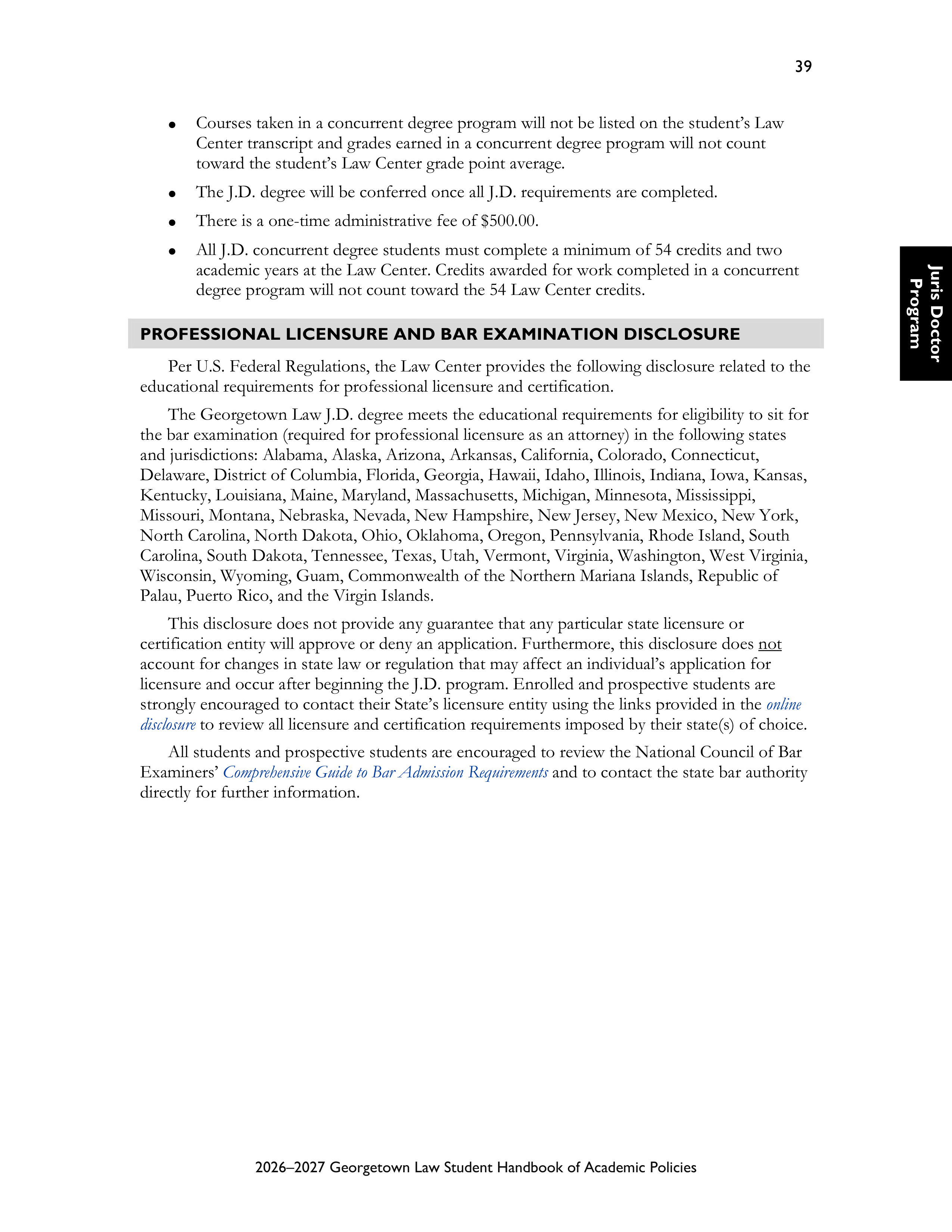
39
2026–2027 Georgetown Law Student Handbook of Academic Policies
Introduction
Juris Doctor
Program
Graduate
Programs
General Administrative
Policies
Conduct
Policies
Tuition &
Fees
Index
•
Courses taken in a concurrent degree program will not be listed on the student’s Law
Center transcript and grades earned in a concurrent degree program will not count
toward the student’s Law Center grade point average.
•
The J.D. degree will be conferred once all J.D. requirements are completed.
•
There is a one-time administrative fee of $500.00.
•
All J.D. concurrent degree students must complete a minimum of 54 credits and two
academic years at the Law Center. Credits awarded for work completed in a concurrent
degree program will not count toward the 54 Law Center credits.
PROFESSIONAL LICENSURE AND BAR EXAMINATION DISCLOSURE
Per U.S. Federal Regulations, the Law Center provides the following disclosure related to the
educational requirements for professional licensure and certification.
The Georgetown Law J.D. degree meets the educational requirements for eligibility to sit for
the bar examination (required for professional licensure as an attorney) in the following states
and jurisdictions: Alabama, Alaska, Arizona, Arkansas, California, Colorado, Connecticut,
Delaware, District of Columbia, Florida, Georgia, Hawaii, Idaho, Illinois, Indiana, Iowa, Kansas,
Kentucky, Louisiana, Maine, Maryland, Massachusetts, Michigan, Minnesota, Mississippi,
Missouri, Montana, Nebraska, Nevada, New Hampshire, New Jersey, New Mexico, New York,
North Carolina, North Dakota, Ohio, Oklahoma, Oregon, Pennsylvania, Rhode Island, South
Carolina, South Dakota, Tennessee, Texas, Utah, Vermont, Virginia, Washington, West Virginia,
Wisconsin, Wyoming, Guam, Commonwealth of the Northern Mariana Islands, Republic of
Palau, Puerto Rico, and the Virgin Islands.
This disclosure does not provide any guarantee that any particular state licensure or
certification entity will approve or deny an application. Furthermore, this disclosure does not
account for changes in state law or regulation that may affect an individual’s application for
licensure and occur after beginning the J.D. program. Enrolled and prospective students are
strongly encouraged to contact their State’s licensure entity using the links provided in the
online
disclosure
to review all licensure and certification requirements imposed by their state(s) of choice.
All students and prospective students are encouraged to review the National Council of Bar
Examiners’
Comprehensive Guide to Bar Admission Requirements
and to contact the state bar authority
directly for further information.

40
2026–2027 Georgetown Law Student Handbook of Academic Policies
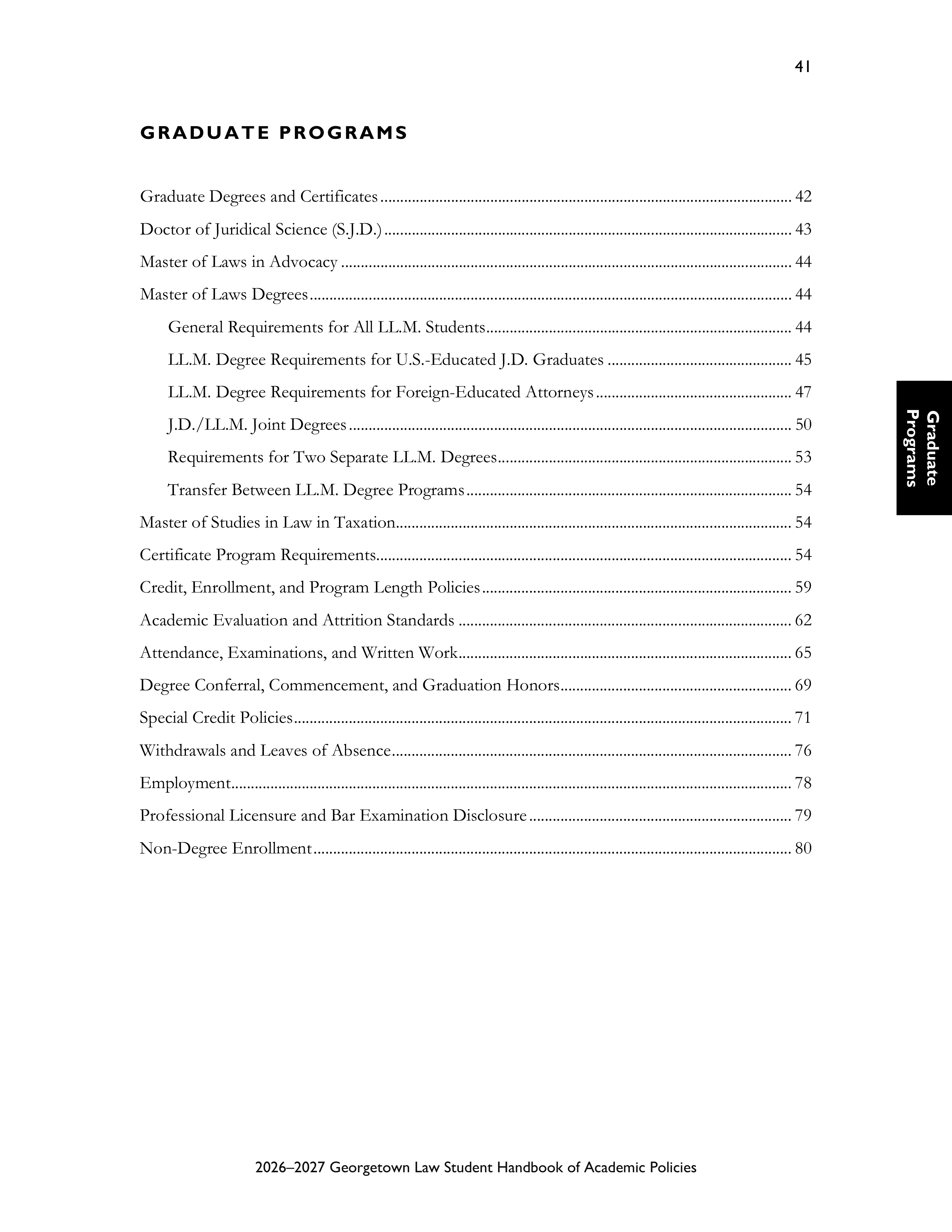
41
2026–2027 Georgetown Law Student Handbook of Academic Policies
Introduction
Juris Doctor
Program
Graduate
Programs
General Administrative
Policies
Conduct
Policies
Tuition &
Fees
Index
GRADUATE PROGRAMS
Graduate Degrees and Certificates ......................................................................................................... 42
Doctor of Juridical Science (S.J.D.) ........................................................................................................ 43
Master of Laws in Advocacy ................................................................................................................... 44
Master of Laws Degrees ........................................................................................................................... 44
General Requirements for All LL.M. Students .............................................................................. 44
LL.M. Degree Requirements for U.S.-Educated J.D. Graduates ............................................... 45
LL.M. Degree Requirements for Foreign-Educated Attorneys .................................................. 47
J.D./LL.M. Joint Degrees ................................................................................................................. 50
Requirements for Two Separate LL.M. Degrees ........................................................................... 53
Transfer Between LL.M. Degree Programs ................................................................................... 54
Master of Studies in Law in Taxation ..................................................................................................... 54
Certificate Program Requirements .......................................................................................................... 54
Credit, Enrollment, and Program Length Policies ............................................................................... 59
Academic Evaluation and Attrition Standards ..................................................................................... 62
Attendance, Examinations, and Written Work ..................................................................................... 65
Degree Conferral, Commencement, and Graduation Honors ........................................................... 69
Special Credit Policies ............................................................................................................................... 71
Withdrawals and Leaves of Absence ...................................................................................................... 76
Employment ............................................................................................................................................... 78
Professional Licensure and Bar Examination Disclosure ................................................................... 79
Non-Degree Enrollment .......................................................................................................................... 80
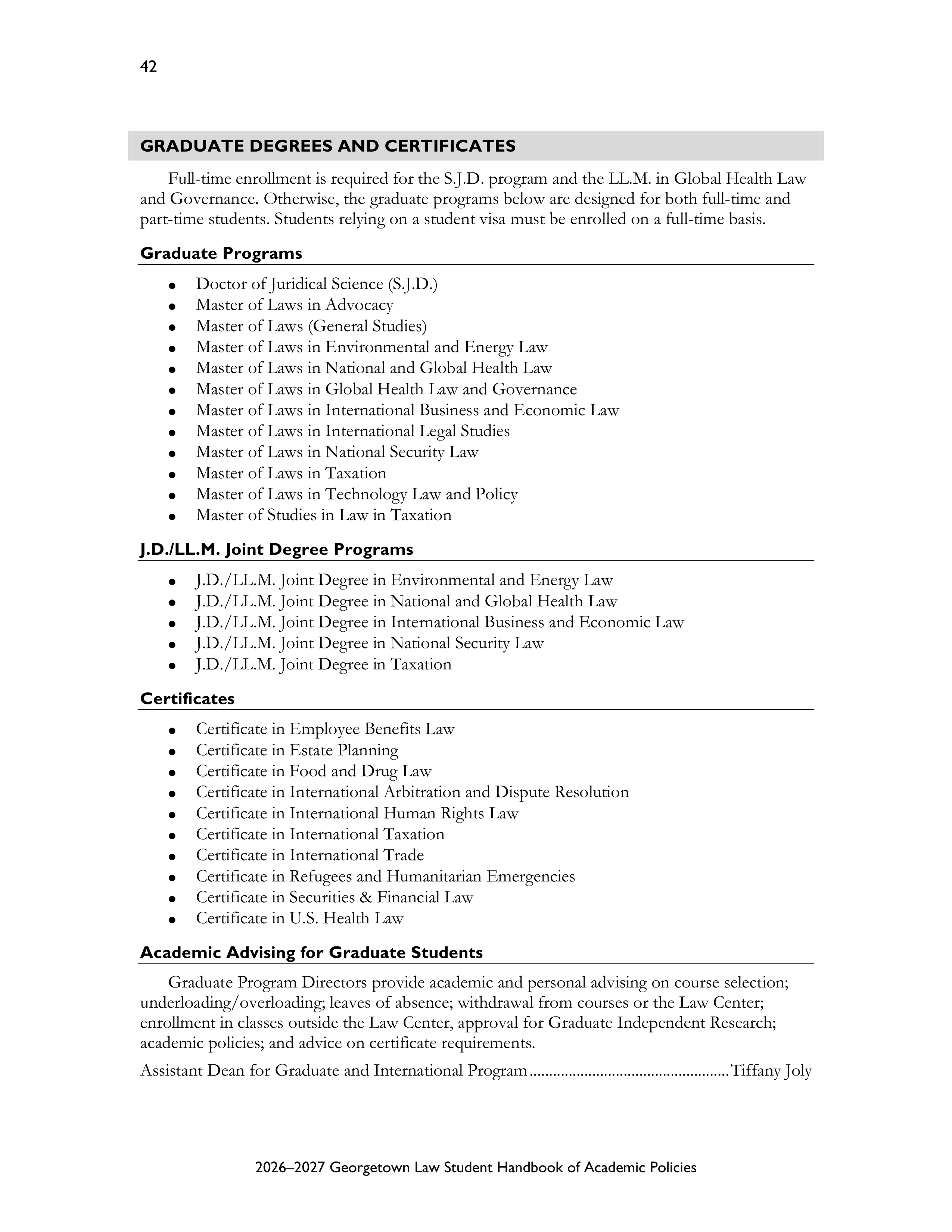
42
2026–2027 Georgetown Law Student Handbook of Academic Policies
GRADUATE DEGREES AND CERTIFICATES
Full-time enrollment is required for the S.J.D. program and the LL.M. in Global Health Law
and Governance. Otherwise, the graduate programs below are designed for both full-time and
part-time students. Students relying on a student visa must be enrolled on a full-time basis.
Graduate Programs
•
Doctor of Juridical Science (S.J.D.)
•
Master of Laws in Advocacy
•
Master of Laws (General Studies)
•
Master of Laws in Environmental and Energy Law
•
Master of Laws in National and Global Health Law
•
Master of Laws in Global Health Law and Governance
•
Master of Laws in International Business and Economic Law
•
Master of Laws in International Legal Studies
•
Master of Laws in National Security Law
•
Master of Laws in Taxation
•
Master of Laws in Technology Law and Policy
•
Master of Studies in Law in Taxation
J.D./LL.M. Joint Degree Programs
•
J.D./LL.M. Joint Degree in Environmental and Energy Law
•
J.D./LL.M. Joint Degree in National and Global Health Law
•
J.D./LL.M. Joint Degree in International Business and Economic Law
•
J.D./LL.M. Joint Degree in National Security Law
•
J.D./LL.M. Joint Degree in Taxation
Certificates
•
Certificate in Employee Benefits Law
•
Certificate in Estate Planning
•
Certificate in Food and Drug Law
•
Certificate in International Arbitration and Dispute Resolution
•
Certificate in International Human Rights Law
•
Certificate in International Taxation
•
Certificate in International Trade
•
Certificate in Refugees and Humanitarian Emergencies
•
Certificate in Securities & Financial Law
•
Certificate in U.S. Health Law
Academic Advising for Graduate Students
Graduate Program Directors provide academic and personal advising on course selection;
underloading/overloading; leaves of absence; withdrawal from courses or the Law Center;
enrollment in classes outside the Law Center, approval for Graduate Independent Research;
academic policies; and advice on certificate requirements.
Assistant Dean for Graduate and International Program ................................................... Tiffany Joly
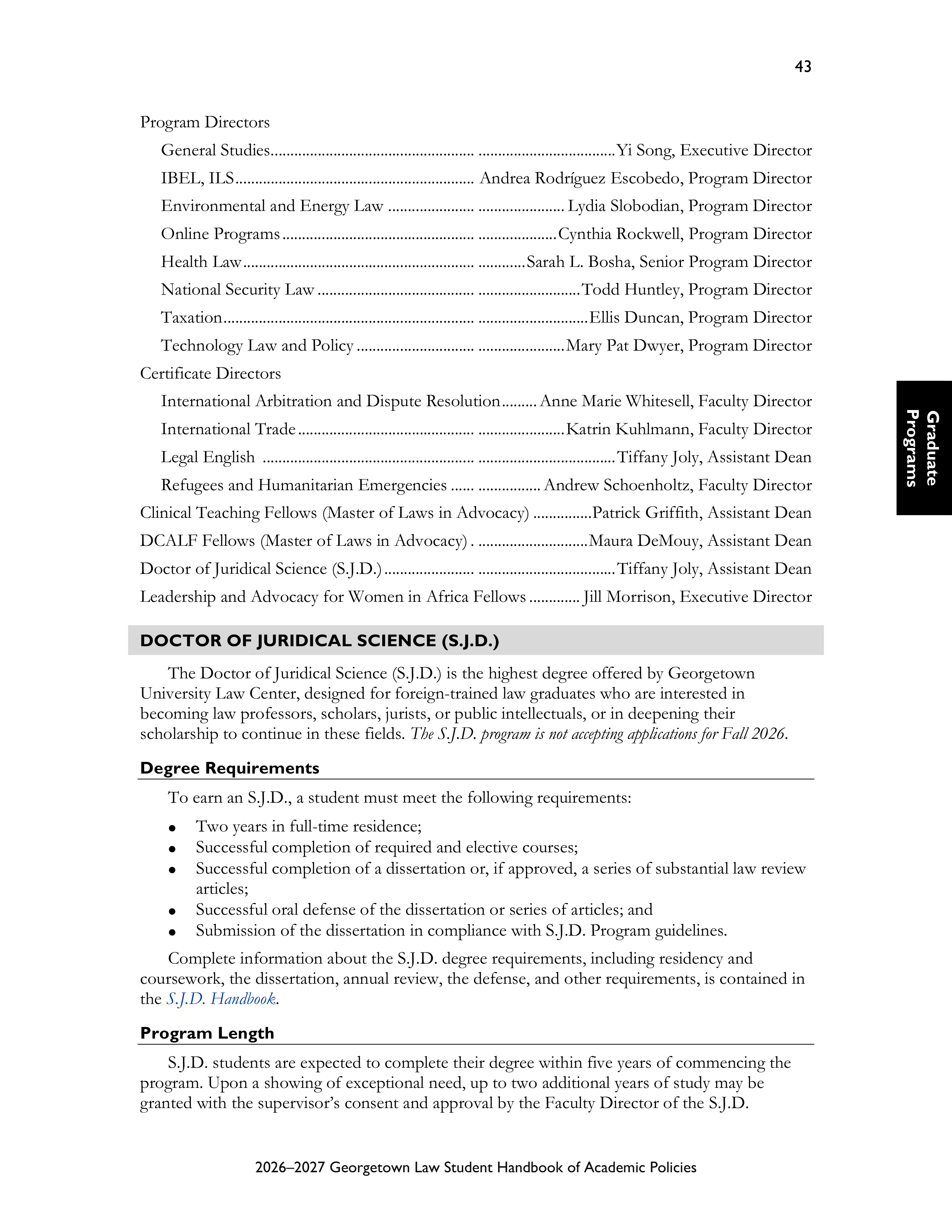
43
2026–2027 Georgetown Law Student Handbook of Academic Policies
Introduction
Juris Doctor
Program
Graduate
Programs
General Administrative
Policies
Conduct
Policies
Tuition &
Fees
Index
Program Directors
General Studies .................................................... ................................... Yi Song, Executive Director
IBEL, ILS ............................................................. Andrea Rodríguez Escobedo, Program Director
Environmental and Energy Law ...................... ...................... Lydia Slobodian, Program Director
Online Programs ................................................. .................... Cynthia Rockwell, Program Director
Health Law ........................................................... ............ Sarah L. Bosha, Senior Program Director
National Security Law ........................................ .......................... Todd Huntley, Program Director
Taxation ................................................................ ............................ Ellis Duncan, Program Director
Technology Law and Policy .............................. ...................... Mary Pat Dwyer, Program Director
Certificate Directors
International Arbitration and Dispute Resolution ......... Anne Marie Whitesell, Faculty Director
International Trade ............................................. ...................... Katrin Kuhlmann, Faculty Director
Legal English ...................................................... ................................... Tiffany Joly, Assistant Dean
Refugees and Humanitarian Emergencies ...... ................ Andrew Schoenholtz, Faculty Director
Clinical Teaching Fellows (Master of Laws in Advocacy) ............... Patrick Griffith, Assistant Dean
DCALF Fellows (Master of Laws in Advocacy) . ............................ Maura DeMouy, Assistant Dean
Doctor of Juridical Science (S.J.D.) ....................... ................................... Tiffany Joly, Assistant Dean
Leadership and Advocacy for Women in Africa Fellows ............. Jill Morrison, Executive Director
DOCTOR OF JURIDICAL SCIENCE (S.J.D.)
The Doctor of Juridical Science (S.J.D.) is the highest degree offered by Georgetown
University Law Center, designed for foreign-trained law graduates who are interested in
becoming law professors, scholars, jurists, or public intellectuals, or in deepening their
scholarship to continue in these fields.
The S.J.D. program is not accepting applications for Fall 2026.
Degree Requirements
To earn an S.J.D., a student must meet the following requirements:
•
Two years in full-time residence;
•
Successful completion of required and elective courses;
•
Successful completion of a dissertation or, if approved, a series of substantial law review
articles;
•
Successful oral defense of the dissertation or series of articles; and
•
Submission of the dissertation in compliance with S.J.D. Program guidelines.
Complete information about the S.J.D. degree requirements, including residency and
coursework, the dissertation, annual review, the defense, and other requirements, is contained in
the
S.J.D. Handbook
.
Program Length
S.J.D. students are expected to complete their degree within five years of commencing the
program. Upon a showing of exceptional need, up to two additional years of study may be
granted with the supervisor’s consent and approval by the Faculty Director of the S.J.D.
44
2026–2027 Georgetown Law Student Handbook of Academic Policies
Program. Approval will be granted only where the student has made significant progress and is
close to completion.
MASTER OF LAWS IN ADVOCACY
Fellows associated with the Law Center’s clinical program (including Clinical Teaching
Fellows, Prettyman/Stiller Fellows, and Clinical Policy and Advocacy Fellows) and Fellows in
the DC Affordable Law Firm are eligible for the Master of Laws in Advocacy.
Degree Requirements
To earn the degree of Master of Laws in Advocacy, Fellows must successfully complete the
curricular, casework, and student supervision (if any) responsibilities associated with their
specific fellowship program totaling 24 credits. Grades are recorded pass/fail. Clinical Fellows
are enrolled as part-time LL.M. students and must complete all 24 credits over the course of six
consecutive semesters (including the final summer term), subject to waiver by the Associate
Dean for Clinics and Experiential Learning. DC Affordable Law Firm Fellows must complete
the 24 credits over the course of four consecutive semesters (including the mid-fellowship
summer term). Fellows affiliated with the Center for Applied Legal Studies are also required to
submit a paper of publishable quality within five years of their matriculation.
Clinical Fellows are eligible to receive an LL.M. degree in Advocacy
with distinction
. To
achieve this designation, Clinical Fellows must receive certification from both (1) the clinic or
program director that they have performed outstanding work throughout their two years in
residence and (2) a full-time Georgetown Law professor (either their clinic director or another
member of the faculty who works in the area about which the fellow is writing and who agrees
to serve as a designated faculty reviewer) that they have completed a paper of publishable quality
meeting the technical requirements provided in the Clinical Programs Fellowship Handbook. If a
Clinical Fellow enrolls in one or more of the Law Center’s graduate or J.D. courses that are not
associated with the fellowship, receipt of a low grade in the course(s) may prevent the fellow
from achieving the
with distinction
designation.
The academic policies pertaining to these Fellowships are further detailed in the Clinical
Programs Fellowships Handbook and the DC Affordable Law Firm Handbook, which are
provided directly to Fellows and which supersede the policies set forth in this
Handbook
in the
event of any inconsistency.
MASTER OF LAWS DEGREES
General Requirements for LL.M. Students (U.S.- and Foreign-Educated Attorneys)
Candidates for all Master of Laws (LL.M.) degrees (with the exception of the LL.M. in
Advocacy) must:
•
Complete the required number of credits for the degree, including specialization credits
and/or required courses for their program as described below;
•
Earn a minimum cumulative grade point average of at least 2.00/4.33; and
•
Complete all requirements for the degree within the prescribed program length (see the
Program Length
section of this chapter). Full-time students are expected to complete the
degree in one academic year, and part-time students are expected to complete the degree
within three years.
45
2026–2027 Georgetown Law Student Handbook of Academic Policies
Introduction
Juris Doctor
Program
Graduate
Programs
General Administrative
Policies
Conduct
Policies
Tuition &
Fees
Index
Students are responsible for tracking their progress to ensure that they meet their degree
requirements (including specialization credits) by their expected graduation date, and may do so
using the online degree audit tool,
MyDegree Audit
, or by requesting an audit from the Office of
the Registrar by emailing
lawreg@georgetown.edu
.
LL.M. Degree Requirements for U.S.-Educated J.D. Graduates
LL.M. in Environmental and Energy Law
In addition to the general requirements, U.S.-educated students must complete 24 credits,
including 18 “specialization credits” in courses listed under Environmental and Energy Law in
the
Curriculum Guide
. As part of the required 18 specialization credits, each student must
successfully complete:
•
Environmental Law (this requirement may be waived if a comparable course in U.S.
Environmental Law was taken as part of a prior law degree. Contact the Program
Director to request a waiver if you have taken a prior course that you think would satisfy
this requirement);
•
The Environmental Lawyering LL.M. seminar; and
•
An externship or practicum within the field, approved by the Program Director (an
approved externship qualifies as Environmental and Energy Law specialization credits).
LL.M. in National and Global Health Law
In addition to the general requirements, U.S.-educated students must complete 24 credits,
including 16 “specialization credits” in courses listed under Health Law in the
Curriculum Guide
.
As part of the required 16 specialization credits, each student must successfully complete the 2-
credit course Global Health Law. An externship may count toward the 16 “specialization
credits” for placements approved in advance by the Senior Program Director.
LL.M. in Global Health Law and Governance
In addition to the general requirements, U.S.-educated students must complete one semester
at Georgetown Law and one semester at the Geneva Graduate Institute of International
Development Studies.
At Georgetown Law, students must complete 12 credits, including 10 “specialization credits”
in courses listed under Health Law in the
Curriculum Guide
. As part of the 10 specialization
credits, each student must successfully complete the 2-credit course Global Health Law.
At the Geneva Graduate Institute, students must complete 39 European Credit Transfer and
Accumulation System (ECTS) credits (three ECTS credits are the equivalent of one Georgetown
Law credit) during a full-time semester in residence. These credits must include:
•
24 ECTS credits through coursework including one compulsory course; and
•
15 ECTS credits earned through an approved internship, which requires the submission
of an internship report.
The approved internship must take place after the conclusion of coursework at the Geneva
Graduate Institute. Internships must be authorized in advance by the Director of the Joint
LL.M. at the Geneva Graduate Institute and must have a dimension linked to global health legal,
governance, and/or policy questions. Students must submit their internship application to the
Director of the Joint LL.M. at the Geneva Graduate Institute at least one month prior to the
beginning of the internship. At the completion of the internship, students must submit a written
46
2026–2027 Georgetown Law Student Handbook of Academic Policies
report to the Director of the Joint LL.M. at the Geneva Graduate Institute of no more than
5,000 words developing themes and questions linked to global health law and/or policy
addressed during the internship and analyzing critically the student’s substantive work at the host
organization. The report is graded by the Director of the Joint LL.M. at the Geneva Graduate
Institute.
In exceptional circumstances and with the prior approval of the Director of the Joint LL.M.
at the Graduate Institute, a student may be authorized to submit a dissertation of a maximum
15,000 words instead of the required internship. This dissertation, like the internship, will entitle
the student to 15 ECTS credits.
The academic policies of the Graduate Institute apply to credits completed at the Graduate
Institute, including a dissertation, and are set forth in the Geneva Graduate Institute’s
Règlement
for the degree program.
LL.M. in International Business and Economic Law (IBEL)
In addition to the general requirements, U.S.-educated students must complete 24 credits,
including 16 “specialization credits.”
These specialization credits must include:
•
Corporations (unless a comparable course was completed in their J.D. studies);
•
International Law I (unless a comparable course was completed in their J.D. studies);
and
•
A sufficient number of additional credits in courses listed under “International Business
and Economic Law” in the
Curriculum Guide
to bring the total number of specialization
credits to 16 credits.
LL.M. in National Security Law
In addition to the general requirements, U.S.-educated students must complete 24 credits,
including “specialization credits” in courses listed under National Security Law in the
Curriculum
Guide
. As part of the required 18 “specialization credits,” students must successfully complete
the Fall semester Proseminar in National Security Law, which must be taken in the first semester
of the LL.M. program (absent a waiver from the Program Director), and International Law I,
Foreign Relations Law or a comparable course in public international law if not taken prior to
the LL.M. program. Students who completed a course in public international law during their
initial legal studies may request a waiver of this requirement from the Program Director. An
externship may count toward the 18 “specialization credits” for placements approved in advance
by the Program Director.
LL.M. in Taxation
In addition to the general requirements, U.S.-educated students must complete 24 credits,
including 20 credits in courses listed under Taxation (“tax specialization credits”) in the
Curriculum Guide
. Prior to matriculation, students must have completed either a basic federal
income taxation course at a U.S. law school or the online course Foundations of Federal Income
Taxation with a passing score on the final examination.
An externship may count toward the 20 “specialization credits” for placements approved in
advance by the Program Director.
Part-time students may request to take up to 4 credits of coursework online. Such requests
should be made to the Program Director and will be considered on a case-by-case basis.
47
2026–2027 Georgetown Law Student Handbook of Academic Policies
Introduction
Juris Doctor
Program
Graduate
Programs
General Administrative
Policies
Conduct
Policies
Tuition &
Fees
Index
LL.M. in Taxation (Online)
*
U.S.-educated students pursuing the LL.M. in Taxation online are subject to the same degree
requirements as on-campus learners but take distance-learning coursework for their degree
program. Students may request to take courses on campus at the Law Center. Such requests
should be made to the Program Director and will be considered on a case-by-case basis.
LL.M. in Technology Law and Policy
In addition to the general requirements, U.S.-educated students must complete 24 credits,
including 18 “specialization credits” in courses listed under Technology Law and Policy LL.M. in
the
Curriculum Guide
and maintain a minimum cumulative grade point average of B- in these
specialization courses. As part of the required 18 specialization credits, students must complete a
capstone experience, either the Advocacy in the Digital Age
course or one of the following
alternatives, approved in advance by the Program Director:
•
A practicum within the field;
•
An externship within the field; or
•
A substantial research paper, which may be completed by enrolling in and satisfying the
requirements of a seminar or by undertaking Graduate Independent Research. Seminars
will be approved where the student produces a final paper of at least 4,000 words that
incorporates feedback from the professor on a full-length draft. (See the
Graduate
Independent Research
section of this chapter for the full details about these requirements.)
LL.M. Degree Requirements for Foreign-Educated Attorneys
LL.M. Degree Track Options
Classroom-Based or Practice-Oriented Track Option
Georgetown Law offers students admission to a traditional classroom-based track or a
practice-oriented track for the following LL.M. degrees:
•
Environmental and Energy Law;
•
General Studies;
•
International Business and Economic Law;
•
International Legal Studies;
•
National and Global Health Law
•
National Security Law;
†
and
•
Taxation; and
•
Technology Law and Policy.
Students admitted to the practice-oriented track of the above degree programs are required
to complete at least one off-campus work experience as part of their degree requirements. These
off-campus work experiences are offered as externships or fieldwork-based practicum course
placements.
Note:
the practice-oriented track is not an option for the LL.M. degree in Global
Health Law and Governance because students complete the experiential degree requirement at
the conclusion of their coursework at the Geneva Graduate Institute of International
Development Studies in Geneva, Switzerland.
*
Formerly Executive LL.M. in Taxation
†
National Security Law students are encouraged to speak with the Program Director before choosing the practice-oriented
track, as many employment opportunities in this field may require U.S. citizenship.
48
2026–2027 Georgetown Law Student Handbook of Academic Policies
Note
: All students in the practice-oriented track must have proper U.S. work employment
authorization in advance of starting their externship or fieldwork-based practicum placement.
LL.M. (General Studies)
In addition to the general requirements, foreign-educated students must complete 20 credits
from courses open to LL.M. students.
LL.M. in Environmental and Energy Law
In addition to the general requirements, foreign-educated students must complete 20 credits,
including 14 “specialization credits” in courses listed under Environmental and Energy Law in
the
Curriculum Guide
. As part of the required 14 specialization credits, each student must
successfully complete:
•
Environmental Law (this requirement may be waived if a comparable course in U.S.
Environmental Law was taken as part of a prior law degree. Contact the Program
Director to request a waiver if you have taken a prior course that you think will satisfy
this requirement.);
•
The Environmental Lawyering LL.M. seminar; and
•
An externship or practicum within the field, approved by the Program Director (an
approved externship qualifies as Environmental and Energy Law specialization credits).
LL.M. in National and Global Health Law
In addition to the general requirements, foreign-educated students must complete 20 credits,
including 14 “specialization credits” in courses listed under Health Law in the
Curriculum Guide
.
As part of the required 14 specialization credits, each student must successfully complete the
2-credit course Global Health Law. An externship may count toward the 14 “specialization
credits” for placements approved in advance by the Senior Program Director.
LL.M. in Global Health Law and Governance
In addition to the general requirements, foreign-educated students must complete one
semester at Georgetown Law and one semester at the Geneva Graduate Institute of
International Development Studies.
At Georgetown Law, students must complete 12 credits, including 10 “specialization credits”
in courses listed under Health Law in the
Curriculum Guide
. As part of the 10 specialization
credits, each student must successfully complete the 2-credit course Global Health Law.
At the Graduate Institute of International Development Studies, students must complete 39
European Credit Transfer and Accumulation System (ECTS) credits (three ECTS credits are the
equivalent of one Georgetown Law credit) during a full-time semester in residence, including:
•
24 ECTS credits through coursework including one compulsory course; and
•
15 ECTS credits earned through an approved internship, which requires submission of
an internship report.
The approved internship must take place after the conclusion of coursework at the Geneva
Graduate Institute. Internships must be authorized in advance by the Director of the Joint
LL.M. at the Geneva Graduate Institute and must have a dimension linked to global health legal,
governance, and/or policy questions. Students must submit their internship application to the
Director of the Joint LL.M. at the Geneva Graduate Institute at least one month prior to the
beginning of the internship. At the completion of the internship, students must submit a written
49
2026–2027 Georgetown Law Student Handbook of Academic Policies
Introduction
Juris Doctor
Program
Graduate
Programs
General Administrative
Policies
Conduct
Policies
Tuition &
Fees
Index
report to the Director of the Joint LL.M. at the Geneva Graduate Institute of no more than
5,000 words developing themes and questions linked to global health law and/or policy
addressed during the internship and analyzing critically the student’s substantive work at the host
organization. The report is graded by the Director of the Joint LL.M. at the Geneva Graduate
Institute.
In exceptional circumstances and with the prior approval of the Director of the Joint LL.M.
at the Graduate Institute, a student may be authorized to submit a dissertation of a maximum
15,000 words instead of the required internship. This dissertation, like the internship, will entitle
the student to 15 ECTS credits.
The academic policies of the Graduate Institute apply to credits completed at the Graduate
Institute, including a dissertation, and are set forth in the Geneva Graduate Institute’s
Règlement
for the degree program.
LL.M. in International Business and Economic Law (IBEL)
In addition to the general requirements, foreign-educated students must complete 20 credits,
including 14 “specialization credits” in courses listed under “International Business and
Economic Law” in the
Curriculum Guide
. As part of the 14 specialization credits, students must
successfully complete:
•
Corporations (3 or 4 credits);
•
International Law I; and
•
A sufficient number of additional credits in courses listed under “International Business
and Economic Law” in the
Curriculum Guide
to bring the total number of specialization
credits to 14 credits.
Students who have already taken and passed International Law I or a public international law
course prior to the LL.M. may petition the Program Director to waive this requirement. An
externship may count toward the 14 “specialization credits” for placements approved in advance
by the Program Director.
LL.M. in International Legal Studies
In addition to the general requirements, foreign-educated students must complete 20 credits,
including a minimum of 12 “specialization credits” in courses listed under International Legal
Studies in the
Curriculum Guide
.
Externships do not qualify as International Legal Studies specialization credits for purposes
of this requirement.
LL.M. in National Security Law
In addition to the general requirements, foreign-educated students must complete 20 credits,
including a minimum of 14 “specialization credits” in courses listed under National Security Law
in the
Curriculum Guide
. As part of the 14 “specialization credits,” students must successfully
complete the Fall semester Proseminar in National Security Law, which must be taken in the
first semester of the LL.M. program (absent a waiver from the Program Director), and
International Law I, Foreign Relations Law, or a comparable course in public international law if
not completed prior to the LL.M. program. Students who completed a course in public
international law during their initial legal studies may request a waiver of this requirement from
the Program Director. An externship may count toward the 14 “specialization credits” for
placements approved in advance by the Program Director.
50
2026–2027 Georgetown Law Student Handbook of Academic Policies
LL.M. in Taxation
In addition to the general requirements, foreign-educated students must complete 20 credits,
including a minimum of 16 “specialization credits” in courses listed under Taxation in the
Curriculum Guide
. As part of the required 16 specialization credits, students must complete
Federal Income Taxation in their first semester. An externship may count toward the 16
“specialization credits” for placements approved in advance by the Program Director.
LL.M. in Taxation (Online)
‡
Foreign-educated students pursing the LL.M. in Taxation online must complete 24 credits,
including a minimum of 20 “specialization credits” in courses listed under Taxation in the
Curriculum Guide
.
Prior to matriculation, students must have completed either a basic federal income tax
course at a U.S. law school or the online course Foundations of Federal Income Taxation with a
passing score on the final examination.
Students take all coursework for their degree program online. Students may request to take
courses on campus at the Law Center. Such requests should be made to the Program Director
and will be considered on a case-by-case basis.
LL.M. in Technology Law and Policy
In addition to the general requirements, foreign-educated students must complete 20 credits,
including a minimum of 14 “specialization credits” in courses listed under Technology Law and
Policy LL.M. in the
Curriculum Guide
and maintain a minimum cumulative grade point average of
B- in these specialization courses. As part of the required 14 specialization credits, students must
complete a capstone experience, either the Advocacy in the Digital Age course or one of the
following alternatives, approved in advance by the Program Director:
•
A practicum within the field;
•
An externship within the field; or
•
A substantial research paper, which may be completed by enrolling in and satisfying the
requirements of a seminar or by undertaking Graduate Independent Research. Seminars
will be approved where the student produces a final paper of at least 4,000 words that
incorporates feedback from the professor on a full-length draft. (See the
Graduate
Independent Research
section of this chapter for the full details about these requirements.)
J.D./LL.M. Joint Degrees
Georgetown Law offers five J.D./LL.M. joint degree programs that enable Georgetown J.D.
students to earn an LL.M. in one full-time semester, rather than two, after completion of the J.D.
degree. They are: (1) Environmental and Energy Law; (2) National and Global Health Law; (3)
International Business and Economic Law; (4) National Security Law; and (5) Taxation. Students
pursuing the J.D./LL.M. joint degree program may not matriculate into the LL.M. program
before completing all J.D. degree requirements. J.D./LL.M. students who complete their J.D.
degree requirements in the term immediately preceding the start of the LL.M program may
matriculate into the LL.M program prior to the conferral of the J.D. degree on a probationary
basis while their final grades are pending, but will be withdrawn upon notice of failure to
complete the J.D. degree or by the relevant degree conferral date if the degree has not been
conferred, whichever occurs earlier.
‡
Formerly Executive LL.M. in Taxation
51
2026–2027 Georgetown Law Student Handbook of Academic Policies
Introduction
Juris Doctor
Program
Graduate
Programs
General Administrative
Policies
Conduct
Policies
Tuition &
Fees
Index
Note for International Students:
U.S. visa rules define the J.D. program as doctoral level and
prohibit students from enrolling in a new program of study at the same or lower educational
level. The J.D./LL.M. dual degree programs are unavailable to international students in F-1 or
J-1 visa status who would matriculate in the LL.M. portion of the degree after September 1,
2026. Students should contact an International Student Advisor at
lawcentervisa@georgetown.edu
with any questions.
J.D./LL.M. Joint Degree in Environmental and Energy Law
This J.D./LL.M. joint degree program permits students who are still completing their J.D.
degree to take environmental law courses that will count toward the J.D. degree and an LL.M.
degree in Environmental and Energy Law. Students in this program are expected, while still J.D.
students, to complete the 3-credit course, Environmental Law, and at least 6 additional credits in
courses listed in the
Curriculum Guide
as counting toward the LL.M. in Environmental and
Energy Law (“Environmental and Energy Law specialization credits”). Regardless of the number
of Environmental and Energy Law specialization credits completed during the J.D. phase of the
program, all students are required, following conferral of the J.D. degree, to complete an
additional 12 credits during the LL.M. phase, of which at least 9 must be Environmental and
Energy Law specialization credits, including the Environmental Lawyering seminar and an
externship or practicum course within the field, approved by the Program Director. Students
may complete these additional credits on a full-time or part-time basis. Joint degree students are
expected to complete their LL.M. credits within two years of receiving their J.D. degree.
For students in this program, all Environmental and Energy Law specialization credits taken
during the J.D. phase of their studies will be shown on their LL.M. transcript, along with the
additional courses taken during the LL.M. phase of the program. All of these courses will be
counted toward the student’s LL.M. grade point average. Students pursuing a J.D./LL.M. joint
degree may not take courses during the J.D. phase of their studies on a pass/fail basis if the
credits associated with those courses are to be counted as Environmental Law specialization
credits.
Georgetown Law students apply to the J.D./LL.M. joint degree in Environmental and
Energy Law during the Spring semester before the start of their final year. The J.D./LL.M. joint
degree in Environmental and Energy Law is open only to Georgetown Law students. Students
visiting from other universities are not permitted to enroll in this program.
J.D./LL.M. Joint Degree in National and Global Health Law
This J.D./LL.M. joint degree program permits students who are still completing their J.D.
degree to take health law courses that will count both toward the J.D. degree and also toward an
LL.M. degree in National and Global Health Law. Under this program, students count 12 credits
completed during their J.D. studies toward the LL.M. degree. Of these 12 credits, at least 8
credits must be Health Law “specialization credits” listed in the
Curriculum Guide
. Following
completion and conferral of the J.D. degree, students must complete an additional 12 credits of
coursework, of which at least 8 must be Health Law “specialization credits.” Unless completed
during their J.D. studies, these 12 credits must include:
•
The 2-credit course Global Health Law, which will count toward the “specialization
credits”; and
•
A practicum listed under the Health Law “specialization” course list in the
Curriculum
Guide
or an externship that must be approved by the Senior Program Director.
For students in this program, at least 12 credits and all Health Law specialization credits
taken during the J.D. phase of their studies will be shown on their LL.M. transcript, along with
52
2026–2027 Georgetown Law Student Handbook of Academic Policies
the additional courses taken during the LL.M. phase of the program. All of these courses will be
counted toward the student’s LL.M. grade point average. Students pursuing a J.D./LL.M. joint
degree may not take courses during the J.D. phase of their studies on a pass/fail basis if the
credits associated with those courses are to be counted as Health Law specialization credits.
Georgetown Law students apply to the J.D./LL.M. joint degree in National and Global
Health Law during the Spring semester before the start of their final year. The J.D./LL.M. joint
degree in National and Global Health Law is open only to Georgetown Law students. Students
visiting from other universities are not permitted to enroll in this program. Students may
complete the additional credits on a full-time or part-time basis. J.D./LL.M. students are
expected to complete their LL.M. credits within two years of receiving their J.D. degree.
J.D./LL.M. Joint Degree in International Business and Economic Law
This J.D./LL.M. joint degree program permits students who are still completing their J.D.
degree to take international business and economic law courses that will count both toward the
J.D. degree and also toward an LL.M. degree in International Business and Economic Law
(IBEL). Students in this program are expected, while still J.D. students, to complete International
Law I, Corporations, and at least 8 additional credits of courses listed in the
Curriculum Guide
as
counting toward the LL.M. in International Business and Economic Law (“IBEL specialization
credits”). Regardless of the number of IBEL specialization credits completed during the J.D.
phase of the program, all students are required, following conferral of the J.D. degree, to
complete an additional 12 credits during the LL.M. phase, of which at least 8 must be IBEL
specialization credits. Students may complete their additional LL.M. credits on a full-time or part-
time basis. Joint degree students are expected to complete their LL.M. credits within two years of
receiving their J.D. degree.
For students in this program, all IBEL specialization credits taken during the J.D. phase of
their studies will be shown on their LL.M. transcript, along with the additional courses taken
during the LL.M. phase of the program. All of these courses will be counted toward the
student’s LL.M. grade point average. Students pursuing a J.D./LL.M. joint degree may not take
courses during the J.D. phase of their studies on a pass/fail basis if the credits associated with
those courses are to be counted as IBEL specialization credits.
Georgetown Law students apply to the J.D./LL.M. joint degree in IBEL during the Spring
semester before the start of their final year and must have completed or be enrolled in
Corporations at the time of their application. The J.D./LL.M. joint degree in IBEL is open only
to Georgetown Law students. Students visiting from other universities are not permitted to
enroll in this program.
J.D./LL.M. Joint Degree in National Security Law
This J.D./LL.M. joint degree program permits students who are still completing their J.D.
degree to take national security law courses that will count both toward the J.D. degree and also
toward an LL.M. degree in National Security Law. Students in this program are expected, while
still J.D. students, to complete the 3-credit course International Law I and at least 6 additional
credits in courses listed in the
Curriculum Guide
as counting toward the LL.M. in National Security
Law (“National Security Law specialization credits”). Regardless of the number of National
Security Law specialization credits completed during the J.D. phase of the program, all students
are required, following conferral of the J.D. degree, to complete an additional 12 credits during
the LL.M. phase, of which at least 9 must be National Security Law specialization credits. All
J.D./LL.M students must complete the Proseminar in National Security Law, typically offered
only in the Fall semester (students seeking to begin the LL.M. portion of the degree in the Spring
53
2026–2027 Georgetown Law Student Handbook of Academic Policies
Introduction
Juris Doctor
Program
Graduate
Programs
General Administrative
Policies
Conduct
Policies
Tuition &
Fees
Index
semester should speak with the Program Director before applying). Students may complete these
LL.M. credits on a full-time or part-time basis. Joint degree students are expected to complete
their LL.M. credits within two years of receiving their J.D. degree.
For students in this program, at least 12 J.D. credits and all National Security Law
specialization credits taken during the J.D. phase of their studies will be shown on their LL.M.
transcript, along with the additional courses taken during the LL.M. phase of the program. All of
these courses will be counted toward the student’s LL.M. grade point average. Students pursuing a
J.D./LL.M. joint degree may not take courses during the J.D. phase of their studies on a pass/fail
basis if the credits associated with those courses are to be counted as National Security Law
specialization credits.
Georgetown Law students apply to the J.D./LL.M. joint degree in National Security Law
during the Spring semester before the start of their final year. The J.D./LL.M. joint degree in
National Security Law is open only to Georgetown Law students. Students visiting from other
universities are not permitted to enroll in this program.
J.D./LL.M. Joint Degree in Taxation
This J.D./LL.M. joint degree program permits students who are still completing their J.D.
degree to take tax courses that will count both toward the J.D. degree and also toward an LL.M.
degree in Taxation. Students in this program are expected, while still J.D. students, to complete
Federal Income Taxation and at least 12 credits of courses listed in the
Curriculum Guide
as
counting toward the LL.M. in Taxation (“tax specialization credits”). Regardless of the number
of tax specialization credits completed during the J.D. phase of the program, all students are
required, following conferral of the J.D. degree, to complete an additional 12 credits during the
LL.M. phase, of which at least 8 must be tax specialization credits. Students may complete these
additional credits on a full-time or part-time basis. Joint degree students are expected to
complete their LL.M. credits within two years of receiving their J.D. degree.
For students in this program, all tax specialization credits taken during the J.D. phase of their
studies will be shown on their LL.M. transcript, along with the additional courses taken during the
LL.M. phase of the program. All of these courses will be counted toward the student’s LL.M.
grade point average. Students pursuing a J.D./LL.M. joint degree may not take courses during the
J.D. phase of their studies on a pass/fail basis if the credits associated with those courses are to be
counted as tax specialization credits. Federal Income Taxation, which is a prerequisite to
matriculation in the LL.M. in Taxation program, may not be included among the 12 J.D. credits
counted toward the LL.M. degree.
Georgetown Law students apply to the J.D./LL.M. joint degree in the Spring semester
before the start of their final year and must have completed or be enrolled in Federal Income
Taxation at the time of their application. J.D. students in other ABA-approved schools are
eligible to participate in this program provided they spend the final year of their J.D. studies as a
visiting student at Georgetown Law. These students must apply for the LL.M. at the same time
as they apply to visit and must have completed a basic course in federal income tax by the time
of their application.
Requirements for Two Separate LL.M. Degrees
Students may apply to complete a second LL.M. degree after completion of their first LL.M.
degree. Current students should submit an updated application to the Office of Admissions.
Students may not pursue two LL.M. degrees concurrently, nor will courses counted toward a
first LL.M. degree be counted toward the requirements for the second LL.M. degree.
54
2026–2027 Georgetown Law Student Handbook of Academic Policies
Note for International Students:
Effective September 15, 2026, U.S. visa rules prohibit students
from enrolling in a new program of study at the same educational level. Students in F-1 or J-1
status pursuing a second LL.M. degree must matriculate in that program no later than September
1, 2026. Students should contact an International Student Advisor at
lawcentervisa@georgetown.edu
with any questions.
Transfer Between LL.M. Degree Programs
Students who have not yet matriculated and who wish to change their LL.M. degree to
Environmental and Energy Law, National and Global Health Law, Global Health Law and
Governance, National Security Law, Taxation, or Technology Law and Policy must obtain
approval from the Office of Admissions prior to their first semester in the LL.M. program.
Students wishing to change their LL.M. degree to Master of Laws (General Studies),
International Business and Economic Law, or International Legal Studies must obtain approval
from their current Program Director and the Program Director for their preferred LL.M. degree
no later than the last day of add/drop activity for their second semester.
Note for International Students:
Effective September 15, 2026, U.S. visa rules prohibit students
enrolled in programs at the graduate level or above from changing their major at any point
during their program of study. Students in F-1 or J-1 status must request any changes to their
LL.M. degree program by September 1, 2026. Students should contact an International Student
Advisor at
lawcentervisa@georgetown.edu
with any questions.
MASTER OF STUDIES IN LAW IN TAXATION (FOR NON-LAWYERS)
Prior to matriculation, Master of Studies in Law in Taxation students must complete either a
basic graduate-level federal income tax course or the online course Foundations of Federal
Income Taxation with a passing score on the final examination.
To earn the Master of Studies in Law in Taxation degree, students must:
•
Complete 24 “specialization credits” in a program of study approved by the Program
Director in courses listed under Taxation in the
Curriculum Guide
;
•
Earn a minimum cumulative grade point average of at least 2.00/4.33; and
•
Complete all requirements for the degree within the prescribed program length (see the
Program Length
section below).
Students take all coursework for their degree program online.
Students are responsible for tracking their progress to ensure that they meet their degree
requirements (including specialization credits) by their expected graduation date, and may do so
using the online degree audit tool,
MyDegree Audit
, or by requesting an audit from the Office of
the Registrar by emailing
lawreg@georgetown.edu
.
CERTIFICATE PROGRAM REQUIREMENTS
Certificate programs offer students an opportunity to concentrate within one of the
designated fields of study. The Law Center will not award more than one certificate at the time
an LL.M. degree is conferred. Students who have satisfied the requirements for a certificate must
designate the certificate that they would like to receive.
55
2026–2027 Georgetown Law Student Handbook of Academic Policies
Introduction
Juris Doctor
Program
Graduate
Programs
General Administrative
Policies
Conduct
Policies
Tuition &
Fees
Index
Certificate in Employee Benefits Law
The Employee Benefits Law Certificate is available to students enrolled in the Law Center’s
LL.M. in Taxation degree programs. Successful completion of a basic course in federal individual
income taxation is a prerequisite to commencing work on the Employee Benefits Law
Certificate.
To earn the Employee Benefits Law Certificate, students must:
•
Successfully complete the following courses comprising 10 “specialization credits”:
◦
Employee Benefits: Qualified Retirement Plans (Fall, 2 credits);
◦
Employee Benefits: Executive Compensation (Fall, 2 credits);
◦
Employee Benefits: Health and Welfare Plans (Fall, 2 credits); and
◦
Employee Benefits Practicum (Spring, 4 credits); and
•
Attain a minimum grade point average of B- in the courses that are counted toward the
Certificate’s specialization requirements.
For purposes of earning the LL.M. in Taxation, all Employee Benefits Law Certificate
courses will be counted toward the required specialization credits in Taxation. Students who
wish to apply for the Employee Benefits Law Certificate should do so by notifying their Program
Director no later than the last day of add/drop activity in their last semester before graduation.
Certificate in Estate Planning
The Estate Planning Certificate is available to students enrolled in the Law Center’s LL.M. in
Taxation degree programs. Successful completion at the J.D. level of a basic course in federal
individual income taxation and a course in Decedents’ Estates (or its equivalent) are prerequisites
to commencing work on the Estate Planning Certificate.
To earn the Estate Planning Certificate, students must:
•
Successfully complete the following courses comprising 10 “specialization credits”:
◦
Income Taxation of Trusts, Estates, and Beneficiaries (Fall, 2 credits);
◦
Estate and Gift Tax (Fall, 2 credits);
◦
Special Topics in Transfer Tax (Fall, 2 credits); and
◦
Advanced Private Wealth Planning (Spring, 4 credits); and
•
Attain a minimum grade point average of B- in the courses that are counted toward the
Certificate’s specialization requirements.
For purposes of earning the LL.M. in Taxation, all Estate Planning Certificate courses will be
counted toward the required specialization credits in Taxation. Students who wish to apply for
the Estate Planning Certificate should do so by notifying their Program Director no later than
the last day of add/drop activity in their last semester before graduation.
Certificate in Food and Drug Law
The Food and Drug Law Certificate is available to students enrolled in the Law Center’s
General Studies, National & Global Health Law, or Environmental & Energy Law
§
LL.M.
degree programs. Students pursuing the Certificate must successfully complete a basic course in
§
While it is possible to pursue this program/certificate combination, it requires careful planning and course selection, and
not all required courses will be compatible in a given year. Students should speak with an academic advisor during the
course registration process if they are interested in pursuing this combination.
56
2026–2027 Georgetown Law Student Handbook of Academic Policies
Administrative Law either in prior law study or as part of their LL.M. program. These credits do
not count toward the 10 “specialization credits” required for the Certificate.
To earn the Food and Drug Law Certificate, students must:
•
Successfully complete a minimum of 10 “specialization credits” in courses listed under
the Certificate in Food and Drug Law in the
Curriculum Guide
, including:
◦
Law and Regulation of Drugs, Devices and Biologics (3 credits); and
◦
Food and Drug Law (2 credits); and
•
Attain minimum grade point average of B- in the courses that are counted toward the
Certificate’s specialization requirements.
LL.M. students who wish to apply for the Certificate should do so by notifying their
Program Director no later than the last day of add/drop activity in their last semester before
graduation.
Certificate in International Arbitration and Dispute Resolution
The International Arbitration and Dispute Resolution Certificate is available to students
enrolled in the Law Center’s General Studies, Environmental & Energy Law
**
, International
Business & Economic Law, International Legal Studies, or National Security Law
**
LL.M.
programs. The Law Center will not admit students solely for the International Arbitration and
Dispute Resolution Certificate program.
To earn the International Arbitration and Dispute Resolution Certificate, students must:
•
Successfully complete International Law I (or its equivalent, Public International Law)
either in prior law study in the U.S. or internationally, or during the first year at
Georgetown Law;
•
Successfully complete a minimum of 10 additional “specialization credits” in courses
listed under the Certificate in International Arbitration and Dispute Resolution in the
Curriculum Guide
; and
•
Attain a minimum grade point average of B- in the courses that are counted toward the
Certificate’s specialization requirements.
Externships do not qualify as International Arbitration and Dispute Resolution
“specialization credits.”
Students who wish to apply for the Certificate should do so by notifying their Program
Director no later than the last day of add/drop activity in their last semester before graduation.
Certificate in International Human Rights Law
The International Human Rights Law Certificate is available to students enrolled in the Law
Center’s General Studies, National & Global Health Law, Environmental & Energy Law,
International Business & Economic Law
**
, International Legal Studies, or National Security
**
While it is possible to pursue this program/certificate combination, it requires careful planning and course selection, and
not all required courses will be compatible in a given year. Students should speak with an academic advisor during the
course registration process if they are interested in pursuing this combination.
57
2026–2027 Georgetown Law Student Handbook of Academic Policies
Introduction
Juris Doctor
Program
Graduate
Programs
General Administrative
Policies
Conduct
Policies
Tuition &
Fees
Index
Law
††
LL.M. programs. The Law Center will not admit students solely for the International
Human Rights Law Certificate program.
To earn the International Human Rights Law Certificate, students must:
•
Successfully complete International Law I (or its equivalent, Public International Law)
either in prior law study in the U.S. or internationally, or complete the course during the
first year at Georgetown Law;
•
Successfully complete a minimum of 10 additional “specialization credits” in courses
listed under International Human Rights Law Certificate in the
Curriculum Guide
;
◦
These “specialization credits” must include the basic International Human Rights
Law course unless already completed in prior law study in the U.S. or internationally;
and
•
Attain a minimum grade point average of B- in the courses that are counted toward the
Certificate’s specialization requirements.
Students who wish to apply for the Certificate should do so by notifying their Program
Director no later than the last day of add/drop activity in their last semester before graduation.
Certificate in International Taxation
The International Taxation Certificate is available to students enrolled in the Law Center’s
LL.M. in Taxation or Master of Studies in Law in Taxation degree programs. For U.S.-trained
students, successful completion of a basic course in federal individual income taxation is a
prerequisite to commencing work on this Certificate. Foreign-trained students desiring to
complete the Certificate in conjunction with the LL.M. degree must enroll in Federal Income
Taxation during the Fall semester.
U.S.- and foreign-trained Tax LL.M. students and all students pursuing the Tax LL.M. online
or Master of Studies in Law in Taxation must meet the following requirements to earn the
International Taxation Certificate:
•
Successful completion of a minimum of 10 “specialization credits” in courses listed
under Certificate in International Taxation in the
Curriculum Guide
, including the
following:
◦
Either:
U.S. International Inbound Tax (Fall, 2 credits) and U.S. International
Outbound Tax (Fall, 2 credits); or
International Tax (Fall, 3 credits);
◦
Tax Treaties (Fall or Spring, 2 credits);
◦
Transfer Pricing (Fall, 2 credits); and
•
A minimum grade point average of B- in the courses that are counted toward the
Certificate’s specialization requirements.
For purposes of earning the LL.M. in Taxation or Master of Studies in Law in Taxation, all
International Taxation Certificate courses will be counted toward the required specialization
credits in Taxation. Students who wish to apply for this Certificate should do so by notifying
††
While it is possible to pursue this program/certificate combination, it requires careful planning and course selection, and
not all required courses will be compatible in a given year. Students should speak with an academic advisor during the
course registration process if they are interested in pursuing this combination.
58
2026–2027 Georgetown Law Student Handbook of Academic Policies
their Program Director no later than the last day of add/drop activity in their last semester
before graduation.
Certificate in International Trade
The International Trade Studies Certificate is available to students earning a J.D. or LL.M.
at the Law Center. Students earning an S.J.D. at the Law Center who are eligible to enroll in a
sufficient number of Law Center courses to complete the Certificate requirements may obtain
the Certificate by permission of the Graduate Institute.
To earn the International Trade Studies Certificate, students must:
•
Successfully complete International Law I (or its equivalent, Public International Law)
either in prior law study in the U.S. or internationally, or before completing additional
required coursework for the Certificate;
•
Successfully complete coursework on trade-related subjects selected from an approved
list of WTO & International Trade Certificate Courses, including at least one basic trade
course (WTO & International Trade Certificate List A), and at least two specialized trade
courses (List B);
•
Successfully complete a capstone experience in international trade (moot court,
practicum/clinic or trade-related research paper) (List C); and
•
Maintain a minimum cumulative grade point average of B or higher.
Students who wish to apply for the Certificate should do so by notifying their Program
Director and the Faculty Director no later than the last day of add/drop activity in their last
semester before graduation.
Certificate in Refugees and Humanitarian Emergencies
The Certificate in Refugees and Humanitarian Emergencies is available to students earning a
J.D. or LL.M. at the Law Center. For information about requirements, please visit the
Refugees
and Humanitarian Emergencies Certificate webpage
.
Certificate in Securities & Financial Law
The Certificate in Securities & Financial Law is available to students enrolled in the General
Studies LL.M. program, the International Business & Economic Law LL.M. program, or the
Technology Law and Policy LL.M. program.
To earn the Certificate in Securities and Financial Law, students must:
•
Successfully complete a minimum of 10 “specialization credits” from courses listed
under the Certificate in Securities & Financial Law in the
Curriculum Guide
;
◦
U.S. students who did not take Securities Regulation as part of their J.D. degree
must take it prior to or concurrently with their first Certificate classes, but it will not
count toward the specialization credits;
◦
Foreign-trained students must take Securities Regulation as part of the specialization
credits to earn the Certificate; and
•
Attain a minimum grade point average of B- in the courses that are counted toward the
Certificate’s specialization requirements.
59
2026–2027 Georgetown Law Student Handbook of Academic Policies
Introduction
Juris Doctor
Program
Graduate
Programs
General Administrative
Policies
Conduct
Policies
Tuition &
Fees
Index
LL.M. students who wish to apply for the Certificate should do so by notifying their
Program Director no later than the last day of add/drop activity in their last semester before
graduation.
Certificate in U.S. Health Law
The U.S. Health Law Certificate is available to students enrolled in the Law Center’s General
Studies or National & Global Health Law LL.M. degree programs.
To earn the U.S. Health Law Certificate, students must:
•
Successfully complete a minimum of 10 “specialization credits” in courses listed under
the Certificate in U.S. Health Law in the
Curriculum Guide
, including either Health Care
Law and Policy (4 credits) or Regulating Private Health Insurance and Health Care
Prices: Legal and Policy Disputes (3 credits); and
•
Attain a minimum grade point average of B- in the courses that are counted toward the
Certificate’s specialization requirements.
LL.M. students who wish to apply for the Certificate should do so by notifying their
Program Director no later than the last day of add/drop activity in their last semester before
graduation.
CREDIT, ENROLLMENT, AND PROGRAM LENGTH POLICIES
Full-Time and Part-Time Enrollment Defined
In the LL.M. and Master of Studies of Law in Taxation programs, full-time enrollment is
8 to 13 credits during the Fall and Spring semesters, and 4 or more credits during the Summer
session. Part-time enrollment is 7 or fewer credits during the Fall and Spring semesters. By the
last day of add/drop activity as published in the
Academic Calendar
, students must ensure that
they are enrolled in the appropriate number of credits required to maintain their full-time or
part-time status. Students enrolled in no credits at any point in a given semester must seek
approval for a leave of absence from their Program Director. Students who fail to maintain
matriculation by interrupting their course of study without receiving approval for a leave of
absence will be withdrawn from the Law Center for failure to make satisfactory progress toward
the LL.M. degree. See the
Academic Evaluation and Attrition
section of this chapter.
Note:
Students who are registered for fewer than 8 credits may not be eligible for health
insurance coverage under the Premier Plan. Students should review the information found on the
Student Health Insurance website
and email
shi@georgetown.edu
with any questions. Students on F-1 or
J-1 visas may not be enrolled in fewer than 8 credits per semester without permission of the
International Student Advisor.
Limitations on Credits per Semester
Full-time students may not enroll in more than 13 credits in the Fall or Spring semester, and
part-time students may not enroll in more than 7 credits in the Fall or Spring semester. Under
extraordinary circumstances, students may submit a petition by email to their Program Director
to overload to 14 credits (full-time students) or 8 credits (part-time students). Such petitions are
granted rarely and only upon a demonstration of extenuating circumstances. Full-time and part-
time students may not enroll in more than 6 credits during the Summer session. Students may
not enroll in more than 30 credits during their degree program.
60
2026–2027 Georgetown Law Student Handbook of Academic Policies
Transfer Between Full-Time and Part-Time Status
Students seeking to transfer between the full-time and part-time programs after starting their
degree program must submit a written request detailing the reasons for requesting the transfer to
their Program Director.
Note:
Part-time students approved to transfer to full-time status will continue to pay tuition
on a per-credit basis. A student who transfers from full-time to part-time status may be subject
to a tuition equalization fee. See the
Tuition and Fees
chapter of this
Handbook
.
Program Length
Full-time students are expected to graduate within one year from the date of matriculation
unless a waiver is granted. Part-time students are expected to graduate within three years of
matriculation. A student may petition in writing to extend their program’s time limit for up to
two additional years. The petition should be submitted to the student’s Program Director.
Permission to extend the period of study will be granted where good cause is shown and where
the student is making satisfactory progress.
Where credit has been granted for non-degree coursework completed at the Law Center
prior to matriculation in the program, the maximum period of study allowed for part-time
students will be reduced by one semester for every 4 credits granted. See the
Special Credit Policies
section of this chapter, below.
The LL.M. in Taxation and Master of Studies of Law in Taxation programs ordinarily must
be completed within three years from the date of matriculation.
Note:
Students who anticipate exceeding the expected length for their program should review
the program length rules that govern eligibility to sit for the bar examination in the state in which
they intend to practice. See the
Professional Licensure and Bar Examination Disclosure
section of this
chapter and the
Bar Admissions, Examinations, and Review
section of the
General Administrative
Policies
chapter.
Note for International Students:
The period of study for international students is limited by U.S.
visa restrictions. Please see the section below on
Specific Visa Reporting Requirements for International
Students
.
Externship Program
The Law Center offers a “for-credit” externship program course for LL.M. students each
semester. Please note that the academic externship credits do not count toward the specialization
credit requirements for any degree or certificate programs unless otherwise specified. For more
information, including eligibility, opportunities for current students, LL.M. Externship policies,
procedures, and enrollment processes, please visit the
LL.M. Externships website
.
Note:
International students in the United States in F-1 student visa status must obtain
Curricular Practical Training (CPT) authorization in order to participate in a course with an
outside work component, such as a practicum, workshop or externship. Students may not begin
working until their CPT has been authorized. To obtain authorization, students must follow the
online instructions for requesting Curricular Practical Training authorization
. International students in J-1
student visa status must consult their sponsor to determine whether they are required to have
Academic Training authorization before starting an externship, practicum, or workshop.
Practicum Course Enrollment
LL.M. students may not enroll in more than one J.D. practicum course during their program.
61
2026–2027 Georgetown Law Student Handbook of Academic Policies
Introduction
Juris Doctor
Program
Graduate
Programs
General Administrative
Policies
Conduct
Policies
Tuition &
Fees
Index
International students in the United States in F-1 student visa status must obtain Curricular
Practical Training authorization in order to participate in a course with an outside work
component, such as a practicum, workshop, or externship. To obtain authorization, students
must follow the
online instructions for requesting Curricular Practical Training authorization
. International
students in J-1 student visa status must consult their sponsor to determine whether they are
required to have Academic Training authorization before starting an externship, practicum, or
workshop.
Week One Enrollment
LL.M. students may take up to two Week One courses per academic year.
Graduate Independent Research
Graduate law students may undertake Graduate Independent Research (GIR) during their
degree program. Interested students should contact their Program Director to request to
undertake a GIR. GIR requests are reviewed by the student’s Program Director and will not be
granted automatically.
Prior to submitting the request, students should identify a faculty advisor and develop a
topic suitable for a substantial scholarly paper. In addition, the student should demonstrate the
selected topic is not adequately addressed in an existing Law Center course or seminar. Students
are limited to one GIR course during their degree program. Enrollment in a second GIR course
may be requested if approved by the student’s Program Director by petitioning the Assistant
Dean for Graduate and International Programs.
Once a GIR request is approved, the student and faculty advisor must establish the paper
deadline and schedule regular meetings. The student must submit an outline and a draft paper to
the faculty advisor and the faculty advisor must provide substantive comments in return. Final
papers must be submitted to the faculty advisor by the approved deadline.
The standard GIR course receives 2 graded credits and requires a paper of at least 6,000
words excluding footnotes (approximately 25 pages). A 2-credit GIR paper may exceed the
minimum required text. Students seeking to produce a paper of publishable quality may request a
3-credit GIR course. The 3-credit course requires a paper of at least 10,000 words excluding
footnotes (approximately 40 pages).
A 2-credit GIR course for which the student submits a paper of 10,000 words will not be
converted to a 3-credit GIR course.
International students considering taking a U.S. bar examination should be aware that credits
earned in a Graduate Independent Research course may not count toward the required number
of law credits necessary to be eligible to take the New York bar exam. Please consult the
Assistant Dean for Graduate and International Programs for more information.
Duplication of Courses
Graduate students are discouraged from repeating courses for which they have previously
received credit in a degree program at another institution. However, because there may be
circumstances where such repetition is appropriate, students are not required to seek permission
to take a course that may duplicate previous work. Students may not receive credit for courses
taken previously at Georgetown.
62
2026–2027 Georgetown Law Student Handbook of Academic Policies
SPECIFIC VISA REPORTING REQUIREMENTS FOR INTERNATIONAL
STUDENTS
Before matriculation, international students present in the United States in F-1 or J-1 status
are required to report their initial arrival to their International Student Advisor and complete a
document check-in process. Students should follow the instructions emailed by their
International Student Advisor to complete this process. They are also required to attend an F-1
or J-1 Orientation session given by the International Student Advisors during orientation. Visa
and regulatory information is also available at the
International Student Services website
. For further
information, please contact an International Student Advisor at
lawcentervisa@georgetown.edu
.
Due to U.S. visa regulations, students in F-1 and J-1 student visa status who wish to
withdraw from any course or from the Law Center must obtain prior approval from an
International Student Advisor at
lawcentervisa@georgetown.edu
in addition to the necessary approvals
as described in the
Withdrawals and Leaves of Absence
section of this chapter.
All students in the United States in F-1 or J-1 student visa status must be authorized for
Curricular Practical Training before participating in any course that has an outside work
component, such as an externship or practicum. For further information, please contact an
International Student Advisor at
lawcentervisa@georgetown.edu
.
ACADEMIC EVALUATION AND ATTRITION STANDARDS
Grading
Final grades are given on a letter system: A+, A, A-, B+, B, B-, C+, C, C-, D and F. A few
courses are graded on an honors/pass/fail basis; others are graded pass/fail. Grades of AP and
AF are entered administratively, as described below.
The following numerical equivalents are assigned to each letter grade:
A+ 4.33
B+
3.33
C+ 2.33
D
1.00
A
4.00
B
3.00
C
2.00
F
0
A-
3.67
B-
2.67
C-
1.67
A P grade is not factored into the student’s grade point average.
An AF (Administrative Fail) indicates a failing grade entered administratively and not by a
course professor. The AF is given where the student failed to take the course examination or
complete other course requirements. It is factored into a student’s grade point average as an F.
Note:
Students may petition the Assistant Dean of Graduate and International Programs for
conversion of an AF to a withdrawal (W) if they can demonstrate that a compelling health or
personal emergency interfered with their capacity to complete the course requirements.
An AP (Administrative Pass) is also entered administratively and indicates that the student
passed the course but did not stop writing before the time allowed for the examination expired.
An AP is not factored into the student’s grade point average but allows the student to earn the
allotted credits. Students receive an AF and AP in the instances set forth in the
Examinations
and
Written Work
sections of this chapter and in the Student Disciplinary Code, § 402 (Administrative
Sanctions) provided in the
Conduct Policies
chapter of this
Handbook
. If a student repeats a failed
course, both grades will be entered on the student’s transcript and will be included for the
purpose of determining the grade point average of the student. Any student accumulating three
failures will be dismissed for defective scholarship.
63
2026–2027 Georgetown Law Student Handbook of Academic Policies
Introduction
Juris Doctor
Program
Graduate
Programs
General Administrative
Policies
Conduct
Policies
Tuition &
Fees
Index
Grade Point Average
A student’s cumulative grade point average is computed by multiplying the numerical
equivalent of each letter grade by the credit value of the course, adding the results together, and
then dividing the total by the total number of graded credits. In computing a student’s grade
point average, computations are carried to two decimal places. Each student’s grade point
average is computed at the end of each semester.
While the cumulative grade point average is based upon all of the student’s Law Center
grades, the annual grade point average is based only upon a student’s Law Center grades for one
academic year. The academic year begins with the Summer session and ends with the following
Spring semester. In calculating the student’s grade point average, the Law Center will include the
credits for any course in which the student received an F or AF, even when the student has
successfully retaken the course.
Recommended Grading Curve and Mandatory Ceilings
The recommended grading curve will depend on the number of students enrolled in the
course. For purposes of determining the applicable recommended grading curve and mandatory
ceiling, multiple sections of a course will be treated as a single enrollment where the course
requirements are identical (as in most cross-listed LAWJ and LAWG sections), and as separate
enrollments where the course requirements differ (as in 2- and 3-credit sections of a seminar
course). Although professors in graduate and cross-listed (J.D. and graduate) courses have
discretion to deviate from the recommended curve, courses with 10 or more students enrolled,
as well as all clinics and practicum courses regardless of size, are subject to a mandatory course
grade point average ceiling. Course grade point averages are calculated by adding the numerical
equivalent of each letter grade awarded in the class and dividing the total by the number of
students enrolled in the class.
No graduate or cross-listed course, regardless of size or type, may have more than 2 A+
grades awarded.
Recommended grading curve for courses with 29 or fewer students enrolled
Grade
Recommended Distribution
A+
2%
A
36%
A-
32%
B+
21%
B
6–9%
B- to F
0–3%
This recommended grading curve yields a course grade point average of 3.67. Clinics,
practica, and courses with 10 to 29 students enrolled are subject to a mandatory class grade point
average ceiling of 3.80. Courses with 9 or fewer students enrolled (excepting clinics and practica)
are not subject to a mandatory ceiling.
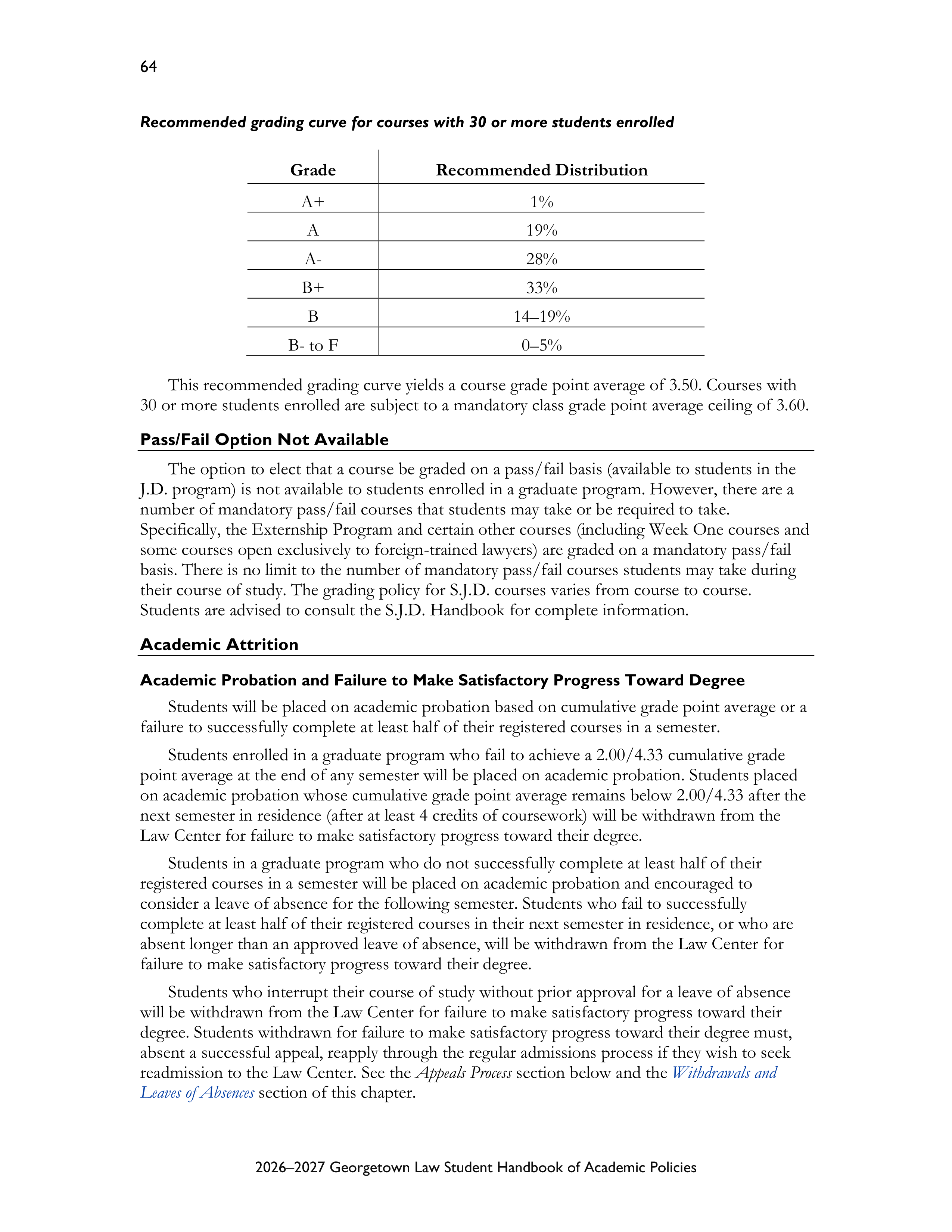
64
2026–2027 Georgetown Law Student Handbook of Academic Policies
Recommended grading curve for courses with 30 or more students enrolled
Grade
Recommended Distribution
A+
1%
A
19%
A-
28%
B+
33%
B
14–19%
B- to F
0–5%
This recommended grading curve yields a course grade point average of 3.50. Courses with
30 or more students enrolled are subject to a mandatory class grade point average ceiling of 3.60.
Pass/Fail Option Not Available
The option to elect that a course be graded on a pass/fail basis (available to students in the
J.D. program) is not available to students enrolled in a graduate program. However, there are a
number of mandatory pass/fail courses that students may take or be required to take.
Specifically, the Externship Program and certain other courses (including Week One courses and
some courses open exclusively to foreign-trained lawyers) are graded on a mandatory pass/fail
basis. There is no limit to the number of mandatory pass/fail courses students may take during
their course of study. The grading policy for S.J.D. courses varies from course to course.
Students are advised to consult the S.J.D. Handbook for complete information.
Academic Attrition
Academic Probation and Failure to Make Satisfactory Progress Toward Degree
Students will be placed on academic probation based on cumulative grade point average or a
failure to successfully complete at least half of their registered courses in a semester.
Students enrolled in a graduate program who fail to achieve a 2.00/4.33 cumulative grade
point average at the end of any semester will be placed on academic probation. Students placed
on academic probation whose cumulative grade point average remains below 2.00/4.33 after the
next semester in residence (after at least 4 credits of coursework) will be withdrawn from the
Law Center for failure to make satisfactory progress toward their degree.
Students in a graduate program who do not successfully complete at least half of their
registered courses in a semester will be placed on academic probation and encouraged to
consider a leave of absence for the following semester. Students who fail to successfully
complete at least half of their registered courses in their next semester in residence, or who are
absent longer than an approved leave of absence, will be withdrawn from the Law Center for
failure to make satisfactory progress toward their degree.
Students who interrupt their course of study without prior approval for a leave of absence
will be withdrawn from the Law Center for failure to make satisfactory progress toward their
degree. Students withdrawn for failure to make satisfactory progress toward their degree must,
absent a successful appeal, reapply through the regular admissions process if they wish to seek
readmission to the Law Center. See the
Appeals Process
section below and the
Withdrawals and
Leaves of Absences
section of this chapter.
65
2026–2027 Georgetown Law Student Handbook of Academic Policies
Introduction
Juris Doctor
Program
Graduate
Programs
General Administrative
Policies
Conduct
Policies
Tuition &
Fees
Index
Appeals Process
As soon as practicable after grades are due each semester, the Registrar shall notify a student
in writing if the student failed to meet the minimum standard of academic performance.
The student may submit to the Associate Dean for Graduate and International Programs a
written petition within 14 business days after receiving written notice of an administrative
withdrawal seeking reconsideration. All appeals must include documentation to substantiate the
circumstances described. As part of the appeal, the Associate Dean shall review whether the
student has provided sufficient documentation to overcome the presumption that the student
should not continue in the relevant degree program. The Associate Dean may require the
student to take an involuntary leave of absence prior to reinstatement in granting a petition.
The decision of the Associate Dean is final and not appealable.
ATTENDANCE, EXAMINATIONS, AND WRITTEN WORK
Attendance and Participation
The Law Center must be satisfied at all times with the serious purpose of each student.
Regular and punctual attendance at all class sessions is required. Student participation is expected
in all courses. A student who, though registered for a course, has not regularly attended,
participated, or otherwise met class requirements may be subject to any of the following, at the
professor’s option:
•
The student may be withdrawn from the course;
•
The student may be excluded from attending class sessions;
•
The student may be excluded from sitting for a final examination or submitting a final
paper (with the same consequences as a failure to appear for a final examination or
submit a final paper); and/or
•
The student may receive a lowered or failing grade in the course.
A student who has not properly registered for a course may not take the final examination or
receive any credit for participation in the course.
Because attendance is required, students may not be registered in courses with any overlap in
scheduled meeting times.
Examinations
Anonymity in Grading
The grading processes for final examinations are anonymous and are designed to be as fair as
possible. To protect student anonymity and remain in compliance with the Student Disciplinary
Code, students may not indicate to the professor that an examination has been deferred, discuss
any modification of the timing of an individual examination with the professor, or otherwise
identify themselves in any way to the professor as the author of the examination until after
grades are published. Students may not discuss the substance of the examination with the
professor or with any other student from the time the examination is first administered until
after grades are published. Faculty are asked to submit their grades approximately two-to-three
weeks after the end of an examination period.
66
2026–2027 Georgetown Law Student Handbook of Academic Policies
Deadlines and Deferred Examinations
Written examinations are held at the end of the classwork in all courses unless otherwise
indicated in the
Curriculum Guide
. Students should be aware that examinations for mini-courses
and other classes that conclude before the end of the semester may take place earlier in the
semester. Curricular offerings designated as “seminars” generally do not have examinations;
instead, substantial written work is required.
The Law Center requires students to take their examinations at the regularly scheduled time.
Dates for all in-class examinations as well as for the default take-home examination window
‡‡
are
announced at the time the course schedule is released so that students may anticipate the date of
their examinations and schedule personal and employment commitments so as not to interfere
with the announced dates of their examinations. If, however, a student experiences a serious
medical or personal situation and it becomes impossible to take an examination on the scheduled
date, it is the student’s responsibility to determine, in consultation with the Registrar, whether
the student should request a deferred examination.
Students who become ill during the examination or otherwise experience a problem that
prevents them from continuing with the examination must immediately make the proctor, or in
the case of a take-home examination the Registrar, aware of the situation and follow the
instructions of the proctor or Registrar. Students who choose to submit an examination before
receiving instructions from the Registrar should note that no post-examination relief will be
granted.
Students should read the
Exam Relief Policies
section in the
General Administrative Policies
chapter of this
Handbook
carefully for all exam relief rules, including more information on the
automatic rescheduling of certain exams and instances where, due to “extraordinary cause,”
permission to take a deferred examination may be granted.
Late and Missed Examinations
Any student who does not take an examination as originally scheduled, and who does not
obtain permission from the Office of the Registrar prior to the start of an examination to defer
that examination (consistent with the rules set forth in the
Exam Relief Policies
section of the
General Administrative Policies
chapter in this
Handbook
) will be subject to the sanctions set forth in
the
Exam and Paper Administrative Policies
section of the
General Administrative Policies
chapter of
this
Handbook.
Please note that failure to take an examination or timely submit a take-home examination
may result in the student receiving an AF for the course. Students who fail to take an
examination may petition their Program Director for conversion of that AF to a withdrawal (W)
if they can demonstrate that a compelling health or personal emergency interfered with their
capacity to take the examination by the deadline.
See the
Submission of the Wrong Document for Grading
section in the
General Administrative Policies
chapter of this
Handbook
for the treatment of documents submitted in error.
Other Examination Policies
No re-examination will be given in any course for the purpose of raising a grade obtained in
a previous final examination in that course.
‡‡
Professors may opt to have an abbreviated take-home examination window for their course.
67
2026–2027 Georgetown Law Student Handbook of Academic Policies
Introduction
Juris Doctor
Program
Graduate
Programs
General Administrative
Policies
Conduct
Policies
Tuition &
Fees
Index
Students may review their graded examinations and papers by completing the online form
on the
Office of the Registrar’s website
during the exam review periods. Examination answers and
papers can be reviewed for one academic year after they have been administered to students.
Some past examinations along with model or “best” answers are on file in the Library and
available on the Library’s online
Exam Archive
for student use as study aids. The Library’s archive
only includes examinations administered within the past five academic years.
Written Work
General Requirements
Papers submitted for grading must comply with the Artificial Intelligence Policy, the Student
Disciplinary Code’s policies on plagiarism, and be a product of the student’s own work in
consultation with the supervising professor. Except as set forth in the
One Paper for Two Seminars
section of this chapter, a paper may not repeat work for which credit is currently being or has
previously been granted in another course or which was undertaken in the course of
employment. For policies relating to services offered by the Writing Center or the Center for
Legal English, please see the
General Administrative Policies
chapter
of this
Handbook
. Students who
are interested in using their final paper for other purposes (such as a law journal note or a writing
sample) may do so only after the paper has been submitted for grading.
Submission of Final Papers and Written Work Product
Final papers must be submitted to the professor by the paper deadline for the semester as
published in the
Academic Calendar
or other deadline announced by the professor.
Deadlines and Professor-Approved Extensions
Final papers in seminars and other courses are due, unless a different deadline is announced
by the professor, by the deadline published in the
Academic Calendar
. A professor may advance or
extend the due date and time (the “deadline”) of all papers for the seminar (except for those of
graduating students) up to the maximum extension published on the Office of the Registrar’s
website (the “maximum professor-approved extension deadline”). Deadlines for papers are as
firm as the dates of examinations.
Individual extensions up to the maximum professor-approved extension deadline may be
granted by the professor, provided the professor notifies the Office of the Registrar of the
extension by emailing
lawreg@georgetown.edu
.
Note:
Graduating students’ grades must be submitted to the Office of the Registrar before
the degree conferral date for that semester (see
Degree Conferral
section of this chapter), which
may be earlier than the maximum professor-approved extension deadline. Paper extension
grades submitted after the degree conferral date for a student’s final semester may result in the
student’s graduation date being extended by one semester and could impact the student’s
eligibility to sit for the bar examination.
Note for International Students in F-1 or J-1 Visa Status:
U.S. visa restrictions dictate that
extending the paper deadline beyond the expected date of graduation as listed in the certificate
of eligibility (I-20 or DS-2019 form) can be permitted only for compelling academic and/or
medical reasons. Any such paper extension must be approved in writing by an International
Student Advisor in advance of the paper submission deadline, and students may also need to
apply for an Extension of Stay. Students must also obtain faculty member approval to any such
extension.
68
2026–2027 Georgetown Law Student Handbook of Academic Policies
Late Papers and Extension for Extenuating Circumstances
The professor will determine what penalty, if any, applies to papers submitted after the
approved deadline. Students who fail to submit a final paper or who submit a final paper after
the maximum professor-approved extension deadline will receive an AF for the seminar unless
approval for a further extension is obtained from the Associate Dean for Academic Affairs, or
the Associate Dean for Clinics and Experiential Learning (for practica and externship courses).
Any request for an extension beyond the maximum professor-approved extension deadline
is effective only upon review and approval of the Associate Dean for Academic Affairs, or the
Associate Dean for Clinics and Experiential Learning (for externship, practicum, and simulation
courses), and only for extenuating circumstances. In no instance will an extension be granted
beyond April 15 for papers due the preceding Fall semester, August 15 for papers due the
preceding Spring semester, or October 15 for papers due the preceding Summer session.
Students who fail to submit a final paper by the deadline set by the Associate Dean will receive
an AF for the seminar.
Policy Regarding Grading and Examination Administration Errors
Grades reported to the Office of the Registrar are final. A faculty member may change
submitted grades only upon written proof of a mechanical, transcription, or procedural error in
the grading or reporting process. After grades are posted, students should communicate directly
with the professor if they suspect that an error has occurred.
Note
: This policy does not allow a
faculty member to change a grade based on a reassessment of the quality of a student’s graded
examination or paper.
Once the Office of the Registrar is notified by the professor(s) of a remediable grading
error and confirms that the correct grade for the examination can be determined, it will
communicate the outcome and options to the student, specifically: (1) if the correct grade
(i.e., the grade actually earned by the student) is
higher
than the erroneous grade, the correct
grade will be automatically posted on the student’s transcript; or (2) if the correct grade is
lower
than the erroneous grade, the student will have a choice between three possible options:
the lower grade, a P grade, or a “CR” notation posted on the transcript. A CR is an
Administrative Credit given in contexts of administration errors or irregularities and is not
factored into the student’s grade point average.
If the identified error or irregularity made it impossible to determine the correct grade, the
Office of the Registrar will notify the student that the “CR” notation will be posted on the
student’s transcript.
Review Process for a Failing Grade
Any student who has received a failing grade on an examination or paper may request that
the Registrar submit that examination or paper for review by another professor teaching in the
subject. Courses with Special Requirements are not eligible for this failing grade review process.
No change will be made to the failing grade absent this review. The reviewing professor
serves in a consulting capacity. The final decision for the course grade rests with the professor
conducting the course, but the course professor shall give due and appropriate consideration to
the views of the reviewing colleague. A request for such evaluation must be made by the student
within 14 days after the grade is posted. Only grades of F qualify for this review process.
69
2026–2027 Georgetown Law Student Handbook of Academic Policies
Introduction
Juris Doctor
Program
Graduate
Programs
General Administrative
Policies
Conduct
Policies
Tuition &
Fees
Index
DEGREE CONFERRAL, COMMENCEMENT, AND GRADUATION HONORS
Conferral of the Degree
The Office of the Registrar will notify expected graduates of the degree application deadlines
and provide instructions for submitting their degree applications.
Students are responsible for tracking their graduation progress to ensure that they meet all
degree requirements by their expected graduation date, and may do so using the online degree
audit tool,
MyDegree Audit
, or by requesting an audit from the Office of the Registrar by emailing
lawreg@georgetown.edu
.
Once a student has completed the requirements for an LL.M. degree and any certificate the
student is pursuing, the student’s final cumulative grade point average will be calculated and the
degree and certificate conferred. Degrees are conferred after each academic term as follows:
•
Summer graduates: October 1, 2026
•
Fall graduates: February 1, 2027
•
Spring graduates: June 2, 2027
If a student who is pursuing a certificate has completed the requirements for an LL.M.
degree but not the requirements for the certificate, then the student may petition to take the
courses necessary to complete the certificate. The petition should be submitted to the student’s
Program Director for consideration. If the petition is approved, both the degree and the
certificate will be conferred when the certificate requirements are completed.
Note
: Students on
F-1 or J-1 visas must complete their program by their program end date on the form DS-2019 or
the Form I-20. They cannot extend their program in order to complete a certificate.
In addition to completing all academic requirements, a student will not be issued a diploma
or certificate until the student’s account balance has been paid in full. Transcripts, diplomas, bar
certificates, and other educational certificates will not be released if there is an outstanding
account balance. The Law Center will not confer a degree or certificate on a student who is the
subject of a pending administrative or disciplinary action, as described in the Student
Disciplinary Code, provided in the
Conduct Policies
chapter of this
Handbook.
Commencement Exercises for Off-Cycle Graduates
Students who are expected to graduate after a final Summer session and/or Fall semester
typically participate in commencement exercises the following May. Prospective Summer and
Fall graduates may participate in the May commencement exercises prior to their final Summer
term or Fall semester under the following conditions:
•
The student has met with their Program Director, who has confirmed that the student
has a reasonable and achievable plan for completing all graduation requirements by the
Summer session or Fall semester immediately following the May commencement
exercises; and
•
The student has emailed
lawreg@georgetown.edu
no later than April 22, 2027 to officially
request permission to participate in the May commencement exercises.
Note:
To receive
important commencement-related communications, students are strongly encouraged to
request permission by early February.
Approved Summer and Fall prospective graduates will not appear in the May
Commencement Program but will be included in the Celebration Day list and have their names
announced. The Registrar reserves the right to approve or deny any such request.
70
2026–2027 Georgetown Law Student Handbook of Academic Policies
Graduation Honors
The Law Center does not rank its students. The faculty has, however, authorized the
following academic honors for students with distinguished academic records.
For purposes of calculating students’ eligibility for these honors, students graduating after a
Summer session or Fall semester will be included with the class that graduated in the previous
Spring semester. Students graduating after completion of a joint degree program outside the Law
Center will be included with the class with whom they completed the LL.M. portion of the joint
degree.
Students who receive two grades of AP, AF, or a combination of both on their transcripts
will not be eligible for graduation honors.
Graduating With Distinction
To graduate
with distinction,
a graduate programs degree student must attain a minimum
cumulative grade point average that places the student in the top one-third of the entire
graduating class for all graduate degree programs. Grades from any other law school will be
excluded from the computation of this average. Distinction will be granted only where a student
has completed a minimum of 20 credits in a graduate degree program at the Law Center.
LL.M. students in the Global Health Law and Governance program are not eligible to
graduate
with distinction
but are eligible to graduate
with honors
. To graduate
with honors
, an LL.M.
student in the Global Health Law and Governance program must satisfy all of the following
requirements: (i) a minimum cumulative grade point average of 3.50 at the Law Center; (ii) a
minimum cumulative grade point average of 5.0 at the Geneva Graduate Institute; (iii) a
minimum grade of 5.25 on the internship report; and (iv) a satisfactory assessment from the
internship supervisor..
For the purpose of calculating students’ eligibility for degrees
with distinction
, students
graduating in October and February are included with the class that graduated the previous
Spring semester.
Dean’s List
Graduate programs degree students who graduate in the top one-third of the graduating
students in their specific degree program will be designated as Dean’s List graduates for that
specific degree program. The Dean’s List designation is available for the following LL.M. degree
programs: Environmental and Energy Law; Master of Laws (General Studies); International
Business and Economic Law; International Legal Studies; National and Global Health Law;
National Security Law; Taxation; and Technology Law and Policy. The Dean’s List designation is
also available for the Online and Executive LL.M. degree programs, as well as the Master of
Studies in Law in Taxation degree program.
Note:
Each program has discretion whether to award
the Dean’s List designation in a given academic year.
Grades from any other law school will be excluded from the computation of this average.
The Dean’s List designation will be granted only where a student has completed a minimum of
20 credits in a graduate programs degree at the Law Center.
Note:
The difference between graduation
with distinction
and the Dean’s List is that graduation
with distinction
is calculated based upon the entire graduating class for all graduate degree
programs and printed on the diploma and the student’s transcript, whereas the Dean’s List is
calculated based upon the graduating class within each respective degree program and printed on
the student’s transcript only.
71
2026–2027 Georgetown Law Student Handbook of Academic Policies
Introduction
Juris Doctor
Program
Graduate
Programs
General Administrative
Policies
Conduct
Policies
Tuition &
Fees
Index
For the purpose of calculating students’ eligibility for the Dean’s List, students graduating in
October and February are included with the class that graduated the previous Spring semester.
The Thomas Bradbury Chetwood, S.J., Prizes
Founded by the Law Center Class of 1928, these prizes are given in honor of Reverend
Thomas B. Chetwood, S.J., a former Regent of the Law Center. Plaques are awarded to the
students who both graduate
with distinction
and have the most outstanding academic achievement
for that academic year in the following degree programs: Environmental and Energy Law LL.M.;
General Studies LL.M., International Business and Economic Law LL.M.; International Legal
Studies LL.M.; National and Global Health Law LL.M.; National Security Law LL.M.; Taxation
LL.M.; Executive LL.M. in Securities and Financial Regulation; Technology Law and Policy
LL.M.; and Masters of Studies in Law–Taxation.
For the purpose of calculating students’ eligibility for the Thomas Bradbury Chetwood prize,
students graduating in October and February will be included with the class that graduates the
subsequent Spring semester.
The Dorothy M. Mayer Award
The Law Center designates a member of each year’s LL.M. graduating class as the winner of
the Dorothy M. Mayer Award. The award is given to a foreign-trained graduate in honor of
former Assistant Dean for Graduate Programs, Dorothy M. Mayer.
The winner will be selected on the basis of academic achievement and the potential for
contribution to the legal profession and to the individual’s community. The winner will be
selected by the Associate Dean for Graduate and International Programs in consultation with
the Assistant Dean for Graduate and International Programs. The winner shall be notified after
Commencement and shall receive a plaque memorializing the award.
For purposes of calculating eligibility for the Mayer award, students graduating in October
and February will be included with the class that graduates the subsequent Spring semester.
SPECIAL CREDIT POLICIES
Credit Earned as a J.D. Student at Georgetown Law
Students who received their J.D. degree from the Law Center within three academic years of
matriculating in an LL.M. degree program may apply up to 6 credits earned while a J.D. student
toward their LL.M. degree, provided those credits were in excess of the minimum number of
credits required for the J.D. degree. Courses and grades involved will remain part of the J.D.
record; advanced standing credit for specific courses will be applied to the LL.M. degree. The
courses and grades will be entered on the transcript, but grades for those courses will not be
included in the computation of the LL.M. grade point average. For part-time students, the
maximum period of study allowed will be reduced by one semester if 4 or more credits are
applied.
Note:
This section does not apply to students who are admitted into a joint J.D./LL.M.
program.
Graduate Credits Earned as a Non-Degree Student at Georgetown Law
LL.M. students may petition to apply up to 8 credits toward their degree for coursework
completed as a non-degree student at the Law Center (see the
Non-Degree Enrollment
section of
this chapter), provided they received a C or better in the coursework, the coursework was
72
2026–2027 Georgetown Law Student Handbook of Academic Policies
completed within two academic years prior to matriculation in the LL.M. degree program, and
the student’s Program Director has reviewed and approved the transfer of these credits toward
the degree. Courses and grades will be entered on the transcript, and the grades for those courses
will be included in the computation of the grade point average for the degree. For part-time
students, the maximum period of study allowed for completion of the degree will be reduced by
one semester for every 4 credits of advanced standing applied under this rule. Credit toward a
graduate degree or certificate will not be granted to students on the basis of prior study at the
Law Center through an exchange program, though courses taken through such a program may
serve as prerequisites for advanced coursework.
Transfer of Credit to the J.D. Program
A student who received an LL.M. degree from the Law Center may, upon admission to and
matriculation in the Law Center’s J.D. program, transfer up to 12 credits earned in the LL.M.
degree program toward the J.D. degree requirements under the following conditions (see the
Juris Doctor Program
chapter of this
Handbook
for more information on the J.D. degree
requirements):
•
Only a foreign-educated attorney who received an LL.M. degree from the Law Center in
Spring 2012 or later, and who has satisfied all of the requirements for and been accepted
into the J.D. program, is eligible for advanced standing under this paragraph.
•
The student must matriculate into the J.D. program within three academic years of
earning the LL.M. degree from the Law Center.
•
The transferred credits will apply toward the upperclass J.D. program of study.
•
Only credits earned in cross-listed courses or non-cross-listed courses taken in the J.D.
program (i.e., “LAWJ” sections) can be transferred.
•
A student who transfers credit from a J.D. (“LAWJ”) section of a 3-credit seminar that
meets the J.D. upperclass legal writing requirement will be treated as having satisfied that
requirement (see the
Upperclass Legal Writing Requirement
section of the
Juris Doctor Program
chapter).
•
Even if, as an LL.M. student, the student takes and passes the course “Professional
Responsibility in the United States,” the student must still complete the professional
responsibility requirement during the upperclass J.D. program of study (see the
Professional Responsibility Requirement
section of the
Juris Doctor Program
chapter).
•
Courses and grades for the credits transferred will remain part of the LL.M. transcript;
the grades for these courses will not be included in the computation of the J.D. grade
point average.
•
After meeting with an advisor in the Office of Academic Affairs, it is the responsibility
of the student to email
lawreg@georgetown.edu
before the end of the first year of the J.D.
program indicating the student’s intention to transfer up to 12 credits earned in the
LL.M. degree program toward the J.D. degree requirements.
•
A student who satisfies the above requirements may earn the J.D. degree no earlier than
five full-time semesters (two and a half academic years) from the date of matriculation
into the J.D. program.
Note
: International students in F-1 or J-1 status should consult
with an International Student Advisor at
lawcentervisa@georgetown.edu
if they have any
questions regarding graduating off-cycle and their employment and visa status.
73
2026–2027 Georgetown Law Student Handbook of Academic Policies
Introduction
Juris Doctor
Program
Graduate
Programs
General Administrative
Policies
Conduct
Policies
Tuition &
Fees
Index
Credit for Courses in the Undergraduate or Graduate Schools of the University
Consistent with the rules and procedures stated below, students in a graduate program may
take courses in the University’s undergraduate or graduate schools on a seat-available basis.
Course descriptions may be found in the University course catalog via
GU Experience
.
Full-time students may take undergraduate and graduate courses during the Fall and Spring
semesters without additional charge. Part-time students pay for all courses at the applicable Law
Center credit hour rate. Full-time or part-time students taking Summer courses are billed at the
applicable undergraduate or graduate school’s tuition rate.
Enrollment in Georgetown’s non-Law Center courses is limited to two courses or a
maximum of 5 credits per semester (whichever is fewer), regardless of whether the credits are
applied toward graduate programs degree requirements.
Undergraduate and Language Courses
Language classes and undergraduate courses may be taken on a space-available basis;
however, students will not receive credit for these courses toward their degree. Courses, credits,
and grades taken in undergraduate and language courses will not appear on the student’s Law
Center transcript and will not be calculated in the student’s Law Center grade point average.
Graduate-Level Courses
LL.M. students may apply a maximum of 4 credits earned in approved graduate-level
coursework at the University toward their degree with permission from both their Program
Director and the professor teaching the graduate course. Students should submit their petition to
their Program Director. In approving such a request, the Program Director will consider the
level of the proposed course, how the proposed course or courses fit into the student’s overall
academic program, and whether a similar course is offered at the Law Center. Any credits taken
in the graduate school of the University are subtracted from the number of credits that can be
taken at another institution (see the
Credits Earned at Other Institutions
section of this chapter).
Students may not take graduate-level courses on an optional pass/fail basis and have the credits
count toward their degree. Graduate-level courses are subject to the relevant graduate schools’
deadlines for add/drop activity, which may be different from the Law Center’s deadlines. If
students withdraw from a graduate-level course counting toward their degree requirements, the
credit associated with the course will count against the 4-credit limit described above. All
courses, credits, and grades taken in the graduate schools will appear on the student’s Law
Center transcript, but the grades will not be counted in the student’s Georgetown Law grade
point average.
Enrollment Policies Procedures
Students may not enroll themselves in University undergraduate or graduate courses. Students
seeking approval to take a course in the graduate or undergraduate schools should email their
request to their Program Director no later than the following deadlines:
•
For Fall 2026 courses (including Business School Modules 1 and 2):
August 14, 2026
•
For Spring 2027 courses (including Business School Modules 3 and 4):
January 5, 2027
•
For Summer 2027 courses:
April 21, 2027
* Students interested in Module 1 and 2 courses will be considered on a rolling basis
beginning in early Summer and are encouraged to submit their requests as early as
possible.
All requests must include:
74
2026–2027 Georgetown Law Student Handbook of Academic Policies
(1) The course number;
(2) The course name;
(3) The number of credits;
(4) A list of any prerequisite courses and how the student believes they have been met; and
(5) Requests for courses in the Graduate School of Arts and Sciences, the School of
Continuing Studies, the School of Medicine, and the School of Nursing & Health
Sciences must also include the professor’s email permission to enroll. Students should
not contact faculty directly regarding requests for courses in the School of Business, the
School of Foreign Service (including the Securities Studies Program), or the School of
Public Policy.
The student’s request will be forwarded to the Law Center’s Office of the Registrar after
review and approval by the student’s Program Director. The Office of the Registrar will forward
the request to the appropriate academic department for approval to enroll the student. The
Office of the Registrar will confirm for students their enrollment status.
Note:
Law students are enrolled in courses in the undergraduate or graduate schools of the
University on a seat-available basis at the beginning of those programs’ add/drop period.
Undergraduate and graduate students have priority for these courses. Law Center students are not
permitted to be waitlisted for these courses and are subject to the add/drop, withdrawal, and
grading policies and deadlines of the undergraduate and graduate schools. If the course is cross-
listed (i.e., has a Law Center section designated by LAWJ or LAWG), law students must enroll in
the Law Center section of the course and follow the Law Center’s add/drop and waitlist policies.
The Law Center does not follow the same academic calendar as the undergraduate and
graduate schools of the University, and it is the student’s responsibility to determine when a course
begins. The Business School operates on quarters, or modules, and has two modules per semester.
Business School classes may follow a different schedule than other schools or departments of the
University.
International students considering taking a U.S. bar examination should be aware that non-
Law Center courses may not count toward the required number of law credits necessary to be
eligible to take the bar exam and should consult their Program Director for more information.
Credits Earned at Other Institutions
With the prior approval of their Program Director, and subject to the conditions listed
below, students may apply to their graduate degree a cumulative maximum of 4 credits earned at
other institutions while enrolled as a student in the Law Center’s Graduate and International
Programs. Students should apply through their Program Director. In approving such a request,
the Program Director will consider the institution at which the student proposes to take the
course, the level of the proposed course, how the proposed course or courses fit into the
student’s overall academic program, and whether a similar course is offered at the Law Center.
The Law Center does not award credit for courses taken at another institution before a student
has matriculated at the Law Center.
The name of the institution and the number of approved credits will be displayed on the
student’s Law Center transcript. Individual course titles and grades are not included, and the
grades will not be factored into the student’s Law Center grade point average.
Even if prior approval is obtained for taking a course at another school, students who do not
receive a minimum grade of B- or its equivalent in the course will not be allowed to transfer the
credits.
75
2026–2027 Georgetown Law Student Handbook of Academic Policies
Introduction
Juris Doctor
Program
Graduate
Programs
General Administrative
Policies
Conduct
Policies
Tuition &
Fees
Index
No more than 4 credits taken outside of the Law Center will be applied to a graduate degree.
Any credits taken at another institution are subtracted from the number of credits that can be
taken in the graduate school of the University (see the
Credit for Courses in the Undergraduate and
Graduate Schools of the University
section of this chapter).
It is the student’s responsibility to make sure the official transcripts of grades are submitted
to the Office of the Registrar by the Law Center’s grades deadlines.
Auditing Courses
At the Law Center
Enrolled degree students may not officially audit courses at the Law Center; however, they
may unofficially audit non-experiential upperclass J.D. and LL.M. courses with the express
permission of the professor(s) on a seat-available basis at no additional charge. Students may not
audit clinics, practicum courses, externship seminars, or simulations. Due to their unofficial
status, auditors receive no transcript notation of their attendance in class and do not have access
to online materials restricted to enrolled students unless the professor grants them access to the
course site. Auditors do not complete any course requirements, including examinations and
papers.
Non-degree students desiring to audit a course at the Law Center may be enrolled on a seat-
available basis. Persons who audit a course pay the standard per-credit tuition and must pay the
usual per-credit fee. The course and audit grade (AU) will appear on their transcripts. The
following restrictions apply:
•
The last day for non-degree students to request to audit a course is the last day of
add/drop activity for that semester. Changes to audit status are not allowed beyond the
last day of add/drop activity as published in the
Academic Calendar
.
•
Once a student registers for an audit, it is not possible, under any circumstances, to
record a letter grade for that course.
At the University
Enrolled graduate students may seek to enroll in a course in the undergraduate or graduate
schools of the University on an audit basis by following the process described in the
Credit for
Undergraduate or Graduate Courses at the University
section of this chapter. University department
policies regarding auditing will apply and may vary. Students who audit these courses may be
required by the professor to complete the course requirements. Students receive an AU on their
transcript for audited courses. University department policies regarding auditing will apply and
may vary. Students who audit these courses may be required by the professor to complete the
course requirements. Students receive an AU on their transcript for audited courses. Full-time
students may audit undergraduate and graduate University courses during the Fall and Spring
semesters without additional charge. Part-time students pay for any audited courses at the
applicable Law Center credit hour rate. Full-time and part-time students auditing Summer
courses are billed at the applicable undergraduate or graduate school’s tuition rate.
One Paper for Two Seminars
Students may request permission to submit one paper intended to satisfy the requirements of
two Law Center seminars undertaken in the same semester. Students should submit a written
petition to their Program Director that includes the course titles and professors’ names. In
addition, it must include a pedagogical justification for the request.
76
2026–2027 Georgetown Law Student Handbook of Academic Policies
Once permission is granted by the Program Director and professors, a written request must
be sent to the Office of the Registrar no later than the end of the fourth week of classes. The
request must include the relevant approvals, the minimum number of words or pages of the
proposed joint paper and the minimum number of words or pages for each seminar.
Once the Registrar confirms receipt of the request, the student will be required to write a
paper of at least 12,000 words excluding footnotes (approximately 50 pages) and meet all other
requirements of the relevant seminars. Students will be expected to indicate the joint nature of
the paper on the cover page of all submissions. The professor or professors for each course will
submit a final grade independently, judging the paper as it pertains to their course. The final
grades given for the two seminars need not be identical. Any extension to the paper deadline
must receive prior approval by the professor or professors for each course.
Students may not submit a single paper for a seminar and a Graduate Independent Research
course. Students also may not submit a single paper to satisfy the requirements of two Graduate
Independent Research courses. Students are never permitted to submit a paper previously
evaluated in connection with a Law Center course in order to meet the requirements of a course
in which they are currently enrolled.
WITHDRAWALS AND LEAVES OF ABSENCE
Students whose U.S. military obligations require them to withdraw from a course or program
of study should refer to the
Georgetown University U.S. Military Service Leave of Absence Policies
(incorporated by reference in the
General Administrative Policies
chapter of this
Handbook
).
Due to U.S. visa regulations, students in F-1 or J-1 student visa status who wish to withdraw
from any course or from the Law Center must obtain prior approval from an International
Student Advisor at
lawcentervisa@georgetown.edu
in addition to the necessary approvals described
below.
Tuition will not be refunded in the event of a withdrawal or leave of absence unless
otherwise refundable under the Tuition Refund Schedule and/or, if applicable, under the Tuition
Refund Plan. (See the
Tuition and Fees
chapter of this
Handbook
for more information.)
Students
receiving financial aid should review the note in the
Tuition Refund Schedule
section of the
Tuition
and Fees
chapter of this
Handbook
and contact the Office of Financial Aid with any questions
prior to withdrawing.
Voluntary Withdrawal from Individual Courses
Except as otherwise provided for professor permission courses, practicum courses, or
externships, a graduate student may withdraw from a semester or yearlong course up to and
including the last day of classes for the semester, as published in the
Academic Calendar
, or the day
of the last scheduled class for mini or bookend courses. After last day of add/drop activity as
published in the
Academic Calendar
, students must obtain approval from their Program Director
prior to withdrawing from a course (see next paragraph). The Program Director will advise the
student of the consequences before authorizing a withdrawal. Withdrawals are recorded on the
student’s transcript as “withdrawal” or “W.”
Students who wish to withdraw from a course after the last day of add/drop activity as
published in the
Academic Calendar
must complete a “
Course Withdrawal Request Form
,” have it
signed by their Program Director, and submit it to the Office of the Registrar by the deadline to
withdraw from the course, as described in the paragraph above. In addition, because of U.S. visa
regulations, all F-1 and J-1 international students who wish to withdraw from a course must first
obtain written approval from an International Student Advisor at
lawcentervisa@georgetown.edu
.
77
2026–2027 Georgetown Law Student Handbook of Academic Policies
Introduction
Juris Doctor
Program
Graduate
Programs
General Administrative
Policies
Conduct
Policies
Tuition &
Fees
Index
To withdraw from professor permission courses or courses in which the professor requires
professor permission to withdraw (as noted in the course description found in the
Curriculum
Guide
), students must also obtain written permission from that professor.
To withdraw from a practicum course, students must also obtain permission from the
faculty member and the Assistant Dean for Experiential Education. The Assistant Dean will
grant such withdrawal requests only when remaining enrolled in the practicum would cause
significant hardship for the student.
To withdraw from externships, students must contact the LL.M. Externship Director. The
Externship Director will grant such withdrawal requests only when remaining enrolled would
cause hardship for the student.
A student who does not obtain permission to withdraw from a course pursuant to the rules
above is expected to complete all course requirements. See the
Attendance, Examinations, and
Written Work Policies
section of this chapter for the consequences of failing to complete an
examination as scheduled or failing to submit a final paper by the deadline (including any
extension). Such failures may result in the student receiving an AF for the course. The AF will be
reflected on the student’s transcript and factored into the student’s grade point average as an
earned F.
If a student properly withdraws from a course or from the Law Center under the preceding
rules, any refunds of tuition will be calculated from the date the Office of the Registrar receives
written notification of the withdrawal, according to the
Tuition Refund Schedule
listed in the
Tuition
and Fees
chapter of this
Handbook
.
Note:
Students who, due to withdrawals, are registered for fewer than 8 credits in a Fall
semester may not be eligible for health insurance coverage under the Premier Plan. Students
should review the information found on the
Student Health Insurance website
and email
shi@georgetown.edu
with any questions.
Withdrawal Relief Policy
Students with exceptional and compelling personal circumstances may apply to remove one
or more withdrawals from a course or course taken in the semester from their transcript. Rather
than appearing on the student’s transcript as a withdrawal (“W”), no record of the course(s) will
appear on the student’s transcript.
Students seeking this relief should apply to the Assistant Dean for Graduate and
International Programs no later than the scheduled exam date or final paper/deliverable deadline
for the course. All usual withdrawal permissions and requirements must be met in order to apply
for this relief.
The decision to grant relief will rest with the Assistant Dean for Graduate and International
Programs, working in consultation with the Associate Dean for Graduate and International
Programs, the Associate Dean for Clinics and Experiential Learning (for externship, practicum,
and simulation courses), and the student’s Program Director.
Leaves of Absence
Voluntary Leave of Absence
Graduate programs degree students who intend not to enroll in classes during a given Fall or
Spring semester, or a full academic year, should request a voluntary leave of absence prior to the
last day of add/drop activity for the relevant semester. Requests for a leave of absence must be
approved by the student’s Program Director and the Assistant Dean for Graduate and
78
2026–2027 Georgetown Law Student Handbook of Academic Policies
International Programs. The petition for a leave of absence should explain the reason for the
leave and demonstrate how and when the degree can be completed within the allowed program
length, including the time on leave (see the
Program Length
section of this chapter). Requests for a
leave of absence will not be approved if a student is not in good standing, both academically and
financially, at the Law Center.
Generally, voluntary leaves of absence are granted for one semester, but may be granted for
up to one academic year. In extraordinary circumstances, a student may request leave for more
than one year by submitting a written petition to the Associate Dean of Graduate and
International Programs.
Under extraordinary circumstances, students may request a voluntary leave of absence after
the last day of add/drop activity for the semester. If a student enrolls in classes and fails to
properly seek a voluntary leave of absence, the student may be subject to the financial and
academic penalties set forth in the section titled
Voluntary Withdrawal from Individual Courses
unless
a student seeks a waiver due to a medical or personal emergency.
The Law Center will not accept credit for work completed at another institution during a
leave of absence without the prior written approval of the student’s Program Director.
Returning from a Leave of Absence
Students expecting to return from a leave of absence must email their Program Director and
the Office of the Registrar (
lawreg@georgetown.edu
) no later than June 15 (if returning in the Fall),
October 15 (if returning in the Spring) or April 15 (if returning in the Summer). The Office of
the Registrar will review with the student their new graduation date (reflecting the time taken off
during the leave of absence) and make referrals to other administrative offices as necessary (i.e.,
Financial Aid, Student Health, Student Accounts, or Program Directors).
Withdrawal from the Law Center
Students may voluntarily withdraw from the Law Center at any time. Students who wish to
withdraw on a voluntary basis should first consult with their Program Director, then notify the
Registrar in writing at
lawreg@georgetown.edu
of their decision and the reason for withdrawing.
Once withdrawn, a student is no longer matriculated at the Law Center. A student who has
withdrawn and then wishes to return to the Law Center must apply for readmission through the
regular admissions process.
Absent a waiver from the Associate Dean of Graduate and International Programs, students
who have failed to successfully complete at least 1 credit in two or more consecutive semesters
without an approved leave of absence, who have been absent from the Law Center longer than
an approved leave of absence, or who have failed to maintain matriculation by interrupting their
course of study without having received approval for a leave of absence in advance will be
involuntarily withdrawn from the Law Center and must reapply through the regular admissions
process if they wish to seek readmission. See the
Academic Evaluation and Attrition
section of this
chapter for the appeals procedures for students who are involuntarily withdrawn.
EMPLOYMENT
Restrictions on Student Employment
The program of instruction in the full-time program is a demanding one designed to
command most of the student’s time during the academic year. Experience indicates that a
student cannot successfully carry a full-time course load if substantially employed in an outside
79
2026–2027 Georgetown Law Student Handbook of Academic Policies
Introduction
Juris Doctor
Program
Graduate
Programs
General Administrative
Policies
Conduct
Policies
Tuition &
Fees
Index
job. Devoting too much time to employment is a frequent cause of disappointing academic
performance and sometimes of academic failure. For these reasons, the Law Center strongly
recommends that students enrolling in the full-time program be in a position to devote
substantially all of their working hours to the study of law.
Note:
International students in F-1 or J-1 student visa status are very restricted with respect
to on- and off-campus employment, and must have work authorization in place before
beginning off-campus employment. Students must contact their International Student Advisor at
lawcentervisa@georgetown.edu
for such authorization. All students on a practice-oriented LL.M.
degree track must have the proper employment authorization in advance of starting their
externship, practicum, or workshop.
Post-Graduation Employment
The Office of Graduate Careers staff assist graduate students in identifying potential
employment opportunities and helping them maximize their chances of success in securing
employment. However, it is ultimately the responsibility of each student to obtain post-
graduation employment. The Law Center cannot guarantee that every graduate will receive a job
offer.
PROFESSIONAL LICENSURE AND BAR EXAMINATION DISCLOSURE
Per U.S. Federal Regulations, the Law Center provides the following disclosure related to the
educational requirements for professional licensure and certification.
Online Graduate Programs
The Law Center’s online programs, which include the LL.M. in Taxation (when pursued
online) and M.S.L. in Taxation, are not designed to meet educational requirements for a specific
professional license or certification or to qualify a student to sit for the bar examination in any
state or jurisdiction.
Residential Programs for Foreign-Trained Lawyers
The Law Center’s LL.M. degrees are not designed to satisfy the legal education requirements
to qualify foreign-trained lawyers to sit for the bar examination in any state, and meeting the
degree requirements alone will not satisfy state bar eligibility requirements. Students interested in
using their LL.M. degree to qualify for the bar examination should review the
U.S. Bar
Examination Information for Foreign Trained Lawyers
and meet with their Program Director to discuss
their course selection. The Law Center cannot provide verification of an individual’s ability to
meet licensure or certification requirements outside of its educational programming.
Most U.S. states require a J.D. degree from an ABA-approved law school to be eligible for
professional licensure. Some states allow students who completed their legal education in a
foreign country to take the bar exam, subject to certain conditions, which can include an LL.M.
degree at an ABA-approved law school. Foreign-trained LL.M. students who intend to take a
U.S. bar examination must review the applicable rules and regulations to determine whether they
meet the requirements to obtain professional licensure in a specific state.
The Law Center has determined that its residential LL.M. degree programs, which include
the General LL.M. degree for foreign-trained lawyers and the specialized LL.M. degrees in
Environmental and Energy Law, National and Global Health Law, International Business &
Economic Law, National Security Law, Taxation, and Technology and Policy, can qualify eligible
foreign-trained students to sit for the bar examination in New York, provided students select
80
2026–2027 Georgetown Law Student Handbook of Academic Policies
qualifying elective courses for their degree. The LL.M. degree in Global Health Law and
Governance will not qualify a student to sit for the bar examination in New York.
The Law Center has determined that its General LL.M. degree for foreign-trained lawyers
can qualify eligible foreign-trained students to sit for the bar examination in the District of
Columbia, provided they select qualifying elective courses for their degree. The Law Center’s
specialized LL.M. degree programs will not qualify a student to sit for the bar examination in the
District of Columbia.
The Law Center has not determined whether its residential LL.M. degree programs can
qualify eligible foreign-trained students to sit for the bar examination in any of the following
states or jurisdictions: Alabama, Alaska, Arizona, Arkansas, California, Colorado, Connecticut,
Delaware, Florida, Georgia, Hawaii, Idaho, Illinois, Indiana, Iowa, Kansas, Kentucky, Louisiana,
Maine, Maryland, Massachusetts, Michigan, Minnesota, Mississippi, Missouri, Montana,
Nebraska, Nevada, New Hampshire, New Jersey, New Mexico, North Carolina, North Dakota,
Ohio, Oklahoma, Oregon, Pennsylvania, Rhode Island, South Carolina, South Dakota,
Tennessee, Texas, Utah, Vermont, Virginia, Washington, West Virginia, Wisconsin, Wyoming,
Guam, Commonwealth of the Northern Mariana Islands, Republic of Palau, Puerto Rico, or the
Virgin Islands.
This disclosure does not provide any guarantee that any particular state licensure or
certification entity will approve or deny your application. Furthermore, this disclosure does not
account for changes in state law or regulation that may affect your application for licensure and
occur after beginning the LL.M. program. Enrolled and prospective students are strongly
encouraged to contact their State’s licensure entity using the links provided in the
online disclosure
to review all licensure and certification requirements imposed by their state(s) of choice.
All students are encouraged to review the National Council of Bar Examiners’
Comprehensive
Guide to Bar Admission Requirements
and to contact state bar authorities directly for further
information.
NON-DEGREE ENROLLMENT
Attorneys and alumni who wish to take courses may apply for admission as non-degree
students through the Office of the Registrar. Applicants should hold a J.D. or LL.M. degree
from an ABA-approved law school with at least a C+ cumulative grade point average or a J.D.
or LL.M. from Georgetown Law. Students who do not have a degree from a U.S. law school but
who have a law degree from outside the U.S. will be considered for admission on a case-by-case
basis. Students accepted as non-degree students are not candidates for a graduate degree.
Non-degree students may enroll in a total of no more than four graduate courses or a
maximum of 8 credits and may take no more than two courses (a maximum of 4 credits) per
semester. Non-degree students must satisfy the same academic requirements and abide by the
same Law Center rules and policies as candidates for graduate degrees.
Non-degree students cannot enroll in J.D. first-year, clinical, externship, practicum, or
simulation courses, nor can they enroll in a Supervised Research Project or Graduate
Independent Research course.
Non-degree students are charged a non-refundable application fee of $90 which is due by
the application deadline (see the
Office of the Registrar’s website
for details and deadlines). Tuition is
charged on a per-credit basis and must be paid in full no later than Monday, August 17 for the
Fall 2026 semester and Tuesday, January 5 for the Spring 2027 semester. Tuition not paid by the
deadline will result in the cancellation of the student’s registration. Tuition refunds will be
81
2026–2027 Georgetown Law Student Handbook of Academic Policies
Introduction
Juris Doctor
Program
Graduate
Programs
General Administrative
Policies
Conduct
Policies
Tuition &
Fees
Index
calculated from the date the Office of the Registrar receives written notification of a student’s
withdrawal from a course or courses. No exceptions to this policy will be approved.
Non-degree students who subsequently apply for and are accepted into an LL.M. degree
program may apply up to 8 credits toward their degree for coursework taken as a non-degree
student, provided they received a C or better, the coursework was completed within two
academic years prior to matriculation in the degree program, and the Office of Graduate
Programs has reviewed and approved the transfer of these credits toward the degree. Courses
and grades will be entered on the transcript, and the grades for those courses will be included in
the computation of the grade point average for the degree.
For part-time LL.M. students, the maximum period of study allowed for completion of the
LL.M. degree will be reduced by one semester for every 4 credits of non-degree coursework
applied under this rule.
Note:
Enrollment is on a space-available basis with enrollment priority given to degree
candidates.

82
2026–2027 Georgetown Law Student Handbook of Academic Policies
83
2026–2027 Georgetown Law Student Handbook of Academic Policies
Introduction
Juris Doctor
Program
Graduate
Programs
General Administrative
Policies
Conduct
Policies
Tuition &
Fees
Index
GENERAL ADMINISTRATIVE POLICIES
Accessibility Services and Disability Accommodations ...................................................................... 84
Accommodations for Pregnancy and Related Conditions .................................................................. 84
Application to Graduate ........................................................................................................................... 84
Artificial Intelligence Policy ..................................................................................................................... 84
Bar Admissions, Examinations, and Review ......................................................................................... 85
Classroom and Event Recording Policy ................................................................................................ 86
The Crime Awareness and Campus Security Act of 1990 .................................................................. 87
Definition of Credit Hour ........................................................................................................................ 87
Exam and Paper Administrative Policies ............................................................................................... 88
Exam Relief Policies ................................................................................................................................. 90
Good Standing ........................................................................................................................................... 93
Health Insurance ....................................................................................................................................... 93
I.D. Cards ................................................................................................................................................... 93
Inclement Weather Policy ........................................................................................................................ 94
Library Policies .......................................................................................................................................... 95
Smoke and Tobacco Free Policy ............................................................................................................. 95
Student Complaints Implicating Compliance with ABA Standards for Legal Education ............. 95
Student Organizations .............................................................................................................................. 96
Student Records, Academic ..................................................................................................................... 96
Student Records, Access .......................................................................................................................... 96
Student Records, Directory Information, and Confidentiality ........................................................... 97
U.S. Military Service Leave of Absence Policies ................................................................................... 97
Whistleblower Protection Policy ............................................................................................................. 98
Writing Center and Center for Legal English Policies......................................................................... 98
84
2026–2027 Georgetown Law Student Handbook of Academic Policies
These general administrative policies apply to all Law Center students.
ACCESSIBILITY SERVICES AND DISABILITY ACCOMMODATIONS
Georgetown University Law Center is committed to providing equal opportunity in its
educational programs and services. Central to that mission, the Office of Accessibility Services
works in partnership with Law faculty, staff, students, and applicants to create environments that
are accessible to individuals with disabilities. Georgetown Law prohibits discrimination,
harassment, and retaliation on the basis of disability. Students and applicants with disabilities
may be eligible for reasonable accommodations or modifications in accordance with Section 504
of the Rehabilitation Act of 1973 and Title III of the Americans with Disabilities Act, as
amended, to provide access to Georgetown Law programs, services and activities.
Georgetown Law’s
Policy for Requesting Disability Accommodations
and
Disability Documentation
Guidelines
are available on the
Office of Accessibility Services website
and adopted and incorporated into
this
Handbook
by reference.
ACCOMMODATIONS FOR PREGNANCY AND RELATED CONDITIONS
Georgetown University is committed to creating an accessible and inclusive environment for
students who are pregnant or experiencing childbirth, false pregnancy, termination of pregnancy,
or recovery therefrom. Under Title IX of the Education Amendments of 1972, no student shall
be excluded from participation in, denied the benefits of, or subjected to discrimination under
any educational program or activity, including, but not limited to, academic, educational,
extracurricular, athletic, or other programs, services, or activities of Georgetown University, on
the basis of pregnancy and related conditions.
Georgetown Law’s
Policy for Requesting Accommodations for Pregnancy and Related Conditions
is
available on the
Office of the Dean of Students’ Title IX webpage
and adopted and incorporated into
this
Handbook
by reference.
APPLICATION TO GRADUATE
The Office of the Registrar will notify expected graduates of the degree application deadlines
and provide them with instructions for submitting their degree applications.
Students are responsible for monitoring their progress to ensure they meet all degree
requirements by their anticipated graduation date. J.D. students approved to visit away or study
abroad in one or both of their final two semesters (see the
Juris Doctor Program
chapter of this
Handbook
) are cautioned that grades not received by the Law Center’s grades deadline will affect
graduation clearance and may affect bar registration.
Regardless of the completion of all academic requirements, a diploma will not be issued until
the student has a clear student account balance. In addition, transcripts, diplomas, bar
certification, and other certificates will not be released if there is an outstanding student account
balance or if a student is the subject of a pending administrative or disciplinary action as
described in the Student Disciplinary Code in the
Conduct Policies
chapter of this
Handbook
.
ARTIFICIAL INTELLIGENCE POLICY
“Generative artificial intelligence” (“generative AI”) refers to software—including but not
limited to ChatGPT, Claude, Gemini, Copilot, and similar tools—that generates text, analysis,
85
2026–2027 Georgetown Law Student Handbook of Academic Policies
Introduction
Juris Doctor
Program
Graduate
Programs
General Administrative
Policies
Conduct
Policies
Tuition &
Fees
Index
images, or other content in response to user prompts. It does not include standard spell-check,
grammar-check, or citation-verification functions, or conventional legal research databases,
unless a faculty member specifies otherwise.
The following rule is a default that governs unless and until a faculty member adopts a
different policy for that instructor’s own course, clinic, or assessment:
Students may not use generative AI in connection with any class-related work—including
assignments, papers, exams, other assessments, or any client-related work in clinics—without
first asking the faculty member and obtaining their permission.
Where a faculty member permits the use of generative AI, students must use it only as and
to the extent that the faculty member’s guidelines allow and must fully disclose any such use as
the instructor directs (for example, by identifying the tool used and describing how it was used).
A student who is uncertain about whether a particular use of generative AI is permitted must
ask the instructor and obtain clarification before using the tool.
Instructors retain discretion to adopt policies for their own courses that are more permissive
or more restrictive than this default, provided that any such policy is stated in writing (for
example, in the syllabus) and made available to students with reasonable notice. In the event that
an instructor’s written policy conflicts with this default, the instructor’s policy controls. In all
cases, however, the student’s use of AI cannot contravene standard academic norms concerning
plagiarism and accuracy, and AI use must meet all applicable rules of professional responsibility
in coursework and clinic work involving the practice of law.
Use of generative AI in violation of this policy or of an instructor’s stated policy—including
use without prior permission or without required disclosure—constitutes a violation of the
Student Disciplinary Code and will be treated as unauthorized assistance and/or plagiarism, and
subject to investigation, disciplinary, and sanction procedures. In some cases, violation of the
policy may also subject clinic students practicing under Rule 48 to bar discipline as a violation of
the Rules of Professional Responsibility in DC and other applicable jurisdictions.
BAR ADMISSIONS, EXAMINATIONS, AND REVIEW
Students should review the
Professional Licensure and Bar Examinations
sections of the
Juris Doctor
and
Graduate Programs
chapters of this
Handbook
.
Each state has promulgated rules that govern eligibility to sit for the bar examination and to
gain admission to the bar. Common requirements pertain to required courses, minimum course
loads, program length, and similar matters. Some states require completion of courses which are
not required by the Law Center. Some states also require completion of a number of hours of pro
bono legal work. Most states require the successful completion of the Multi-State Professional
Responsibility Examination (MPRE) prior to sitting for the bar examination. Additional
information regarding the MPRE is available on the
National Conference of Bar Examiners’ website
.
It is the student’s responsibility to become familiar with the rules and procedures, including
the investigation of character, fitness, and other qualifications, and deadlines that pertain to the
bar in the state in which the student intends to practice. Early investigation of these matters is
important. The Office of Career Strategy has contact information and other relevant
information for all state bars on its
Bar Information website
. The Office of Graduate and
International Programs has additional bar exam information for foreign-trained lawyers on its
Bar Exam Information website
. As a rule, questions should be resolved with appropriate authorities
at the particular state bar admissions offices; the Law Center cannot advise as to the
requirements and applicable deadlines of each state’s bar and bar admissions criteria. Access to
86
2026–2027 Georgetown Law Student Handbook of Academic Policies
state bar admission offices may be found at the
National Conference of Bar Examiners’ website
. The
Law Center’s
Ethics Counsel
will advise students on issues regarding disclosures on bar
applications or other concerns about the admissions process.
GEORGETOWN UNIVERSITY LAW CENTER CLASSROOM AND EVENT
RECORDING POLICY
Class Recordings
Law Center classes are not recorded by default, but faculty may choose to record some or all
of their class sessions.
Professors who opt to record their classes may choose either to make recordings generally
available to all students by posting them automatically to their course’s Canvas site, or to make
them available on a limited basis for approved absences, including illness, quarantine and
isolation, bad weather, religious holidays, rescheduled classes, or other reasons. In such classes,
students will need to apply for access to recordings, which professors approve on a case-by-case
basis. Students approved to access the recording will be emailed a direct link to the recording for
the class session(s).
Students may use class recordings only for personal review of the class session(s) to aid their
learning. They are not authorized to copy, download, or share course recordings with others for
any reason or in any manner. Unauthorized use of class recordings constitutes a violation of the
Student Disciplinary Code.
Disability Accommodations
In certain circumstances, students may, after appropriate consultation with the Office of
Accessibility Services, be entitled to a recording of a course as a reasonable accommodation of
disability under the Americans with Disabilities Act or other applicable law. In such
circumstances, faculty who have not opted to make recordings available to all students will be
advised of the accommodation and the recording of the class for this purpose. Typically, such
classes would be recorded by the Law Center using a recording platform that has been integrated
into the Law Center’s Canvas Learning Management System. In the rare circumstances where,
after consultation with the professor, it is determined that creation of or access to recordings
would constitute a fundamental alteration of the course pedagogy, the accommodation would
not be deemed reasonable and no recording would be made.
Recordable Spaces
Although the Law Center’s default policy is not to record classes, many of the Law Center’s
classes, activities, and events may nevertheless be video and audio recorded. Such recordings
may capture collateral private conversations and behavior occurring in recordable spaces, and
these recordings may end up being disseminated. Recordable spaces include all classrooms and
meeting rooms. From time to time, public events occurring in other spaces (e.g., a lecture in the
McDonough, Hotung, or Fitness Center atrium) may also be recorded; during such events, those
spaces also should be considered recordable spaces.
So, for example, a conversation or other behavior that takes place during scheduled class
time or in an event room during a break between sessions may be captured in the recording.
Even if the class or event starts a bit late, ends a bit early, or regularly includes break time in the
middle, recording equipment will be running for the entire scheduled time. If a special event runs
over time, the recording may continue to run. A conversation or other behavior that takes place
in an atrium during a public special event may also be captured.
87
2026–2027 Georgetown Law Student Handbook of Academic Policies
Introduction
Juris Doctor
Program
Graduate
Programs
General Administrative
Policies
Conduct
Policies
Tuition &
Fees
Index
Please also note that although there are limitations on dissemination of class recordings,
dissemination of event recordings may be more widespread. Unfortunately, we lack the ability to
review every recording beforehand to make sure that private personal conversations and other
private behavior have not been captured. Please exercise appropriate caution when conducting
private conversations or engaging in other behavior intended to be private in recordable spaces.
PLEASE NOTE: Your voluntary participation in activities in recordable spaces constitutes
waiver of claims that otherwise might be made under applicable DC, state or federal law with
respect to private conversations and behavior that happen to be captured and recorded.
Unauthorized recordings—including personal recordings made by students in class and the
like—do not fall within the scope of consent established by the Law Center recording policy.
Unauthorized Recordings
Students, faculty, staff, and visitors to the Law Center are not permitted to make their own
audio or video recordings of classes, presentations, office hours, meetings, conversations, or any
other events or activities unless expressly authorized by the Law Center. This rule includes
classes where faculty have chosen to record their classes. In addition, students, faculty, staff, and
visitors may not use transcription software without express authorization by the Law Center.
The making or dissemination of such recordings may also violate federal, state, or other laws
that restrict the involuntary recording of conversations. Individual professors or event leaders
typically have the ability to authorize private recordings of their classes or events, but if they do
so, they should ensure that all attendees at those classes or events have notice of private
recordings that is sufficient to serve as a basis for inferring consent to those recordings.
Unauthorized recording constitutes a violation of the Student Disciplinary Code.
THE CRIME AWARENESS AND CAMPUS SECURITY ACT OF 1990
This law requires the University to prepare information on current campus law enforcement
policies, crime prevention programs, and campus security statistics. The information is available
upon request from Chief of Police, Georgetown University Police Department (GUPD), 37
th
and O Street NW, Washington, DC 20057, 202-687-4343. The online
Crime Awareness and
Campus Security Report
reports crime statistics for the three previous calendar years.
DEFINITION OF CREDIT HOUR
ABA Standard 310 defines a “credit hour” as (1) not less than 50 minutes of classroom or
direct faculty instruction and two hours of out-of-class student work per week for 15 weeks
(including one week for exams), or the equivalent amount of work over a different amount of
time; or (2) at least an equivalent amount of work for other academic activities including
simulation, field placement, clinical, and other academic work leading to the award of credit
hours.
To comply with this definition, the Law Center requires per credit hour:
•
No fewer than 55 minutes of classroom or direct faculty instruction and two hours and
fifteen minutes of out-of-class student work per week for 13 weeks, plus a fourteenth
week reserved for review and examination during which students are anticipated to
spend at least an additional three hours per credit hour preparing for and taking the
examination; or
88
2026–2027 Georgetown Law Student Handbook of Academic Policies
•
At least the equivalent amount of work over a different amount of time (e.g., yearlong
courses and Summer session courses) or for other academic activities including
simulation, field placement, clinical, and other academic work.
EXAM AND PAPER ADMINISTRATIVE POLICIES (FOR VIOLATIONS NOT
SUBJECT TO THE STUDENT DISCIPLINARY CODE)
Exam policy infractions that are not considered Student Disciplinary Code violations are
described here. For infractions that violate the provisions of the Student Disciplinary Code, see
Part Four of the Code on page 105 of the
Conduct Policies
chapter of this
Handbook
.
Requirements for Returning Take-Home Examinations
All students must stop writing, save, and submit examinations to Georgetown’s examination
system before the time allowed for taking the examination expires. By submitting their
examination through the examination system, students affirm on their honor that they stopped
writing before the time expired when they upload the examination. If a student experiences
problems that prevent successful submission of the examination to the examination system
before the time allowed expires, the student must contact the Registrar by email as soon as
possible to report the problem encountered in submitting the examination.
Penalties
1.
All students who download
1
their examination but fail to submit within 24 hours after the
time allowed expires will be assigned a grade of AF (Administrative Fail) on the examination
by the Registrar. The Registrar will email all students who fail to submit the examination
advising them of the problem. To avoid receiving a grade of AF on the examination, the
student must respond within 24 hours after the time the email is sent. The student bears the
burden of establishing that their failure to submit the examination was due either to
extenuating circumstances (illness or other emergency) or to a “good-faith” mistake (e.g.,
saving the examination and closing out of the exam system before submission).
No penalty will be imposed if the student responds within 24 hours and one of the following
conditions is met:
a.
The Registrar determines that the failure to submit the examination was due to
extenuating circumstances and the exam file was completed within the allotted time
period; or
b.
The Registrar determines that the failure to submit the examination was due to a
“good-faith” mistake and the exam file was completed within the allotted time
period.
If the student fails to respond within 24 hours, or fails to establish extenuating circumstances
or a “good-faith” mistake after responding within 24 hours, the student will receive a grade
of AF that will be reflected on the student’s transcript. The student will not earn the allotted
credits for taking the course, and the AF grade will factor into the GPA as an earned F.
2.
First offense for submitting an examination within sixty minutes after the time allowed
expires, but not in conformity with the policy described here and in § 402(a)(i) of the
Student Disciplinary Code, will be graded and subject to the following penalties:
1
A student who fails to download the take-home examination will be treated under the
Late Arrivals and Missed In-Class
Examinations
section of this chapter
.
89
2026–2027 Georgetown Law Student Handbook of Academic Policies
Introduction
Juris Doctor
Program
Graduate
Programs
General Administrative
Policies
Conduct
Policies
Tuition &
Fees
Index
a.
If the student receives a passing grade in the course from the course professor, the
Registrar will enter an AP (Administrative Pass) on the transcript. The student will
earn the allotted credits for taking the course, and the AP grade will not factor into
the student’s GPA. The Registrar will notify the student when this action is taken.
b.
If the student receives a failing grade in the course, the Registrar will enter an F on
the transcript. The student will not earn the allotted credits for taking the course,
and the F grade will factor into the GPA.
Request for Waiver of Penalties
1.
Any student subject to the AF penalties under this provision shall have the right to request
that the AF penalties be waived. Requests must be made to the Registrar by email or in
writing no later than the last day of classes in the subsequent academic semester or Summer
term (i.e., a student receiving a grade of AF for a Spring examination must submit a waiver
request by the last day of classes in the following Summer term).
a.
The student bears the burden of establishing that the failure to comply with this rule
was excusable and that the violation did not allow the student to gain an unfair
advantage. A saved copy of the examination indicating that it was completed within
the time allowed is critical evidence in these cases. The Registrar will consult with
the Ethics Counsel to determine whether the penalty will be waived.
b.
A student may appeal an adverse decision by the Registrar to the Associate Dean for
Academic Affairs. No further appeal will be allowed.
2.
Any student subject to the AP penalty under this provision shall have the right to request
that the late return penalty be waived. Requests must be made to the Registrar by email or in
writing within 24 hours after the Registrar notifies the student that a penalty applies. All
requests will be referred to the Ethics Counsel who shall meet with the student.
a.
The student bears the burden of establishing that the failure to comply with this rule
was excusable and that the violation did not allow the student to gain an unfair
advantage. A saved copy of the examination indicating that it was completed within
the time allowed is critical evidence in these cases. The Ethics Counsel will
determine promptly whether the penalty will be waived.
b.
A student may appeal an adverse decision by the Ethics Counsel to the Chair of the
Professional Responsibility Committee. No further appeals will be allowed.
Procedures for this review shall be specified in writing and provided to students
affected by this provision.
2
Late Arrivals and Missed Examinations
1. A student who arrives late to an in-class examination may not enter the room once the
proctor has placed the “Examination in Progress” sign on the exam room door. If a student
arrives and the sign is on the door, the student must immediately proceed to the Office of
the Registrar in Hotung 4101 or the Office of the Registrar helpdesk on the second floor of
McDonough Hall. The Registrar will advise the student of the right to take the examination
during the remaining scheduled examination time with no grade penalty and, if that option is
selected, escort the student to the examination room. These instructions shall be posted on
2
The Ethics Counsel may, in the course of this review, require students to submit their computer, external drives, or other
relevant equipment for inspection to determine whether the time-stamp affixed to the saved copy of the examination is
accurate and authentic. It is anticipated that this type of review will not be routine for first offenders, but second offenses
will likely incur closer scrutiny.
90
2026–2027 Georgetown Law Student Handbook of Academic Policies
the door of an examination room once the examination commences. If the remaining time is
insufficient to complete the examination, or the student chooses to reschedule the
examination, the provisions of section 2, below, will apply.
2. Although the student may raise this issue first, the Registrar will email all students who
arrived too late to take an in-class examination, missed an in-class examination altogether,
or failed to download a take-home examination advising them of the problem. To avoid
receiving a failing grade on the examination, the student must request that the examination
be rescheduled within 24 hours from the time the email is sent. The student bears the
burden of establishing that the failure to take the examination was due either to extenuating
circumstances (illness or other emergency) or to a “good-faith” mistake (e.g., oversleeping,
a car breaking down, a mistake as to time or date of the examination).
If the Registrar determines that the failure to take the examination was due to
extenuating circumstances, the examination will be rescheduled as soon as practicable with
no penalty imposed. If the failure was due to a “good-faith” mistake, the examination may
be rescheduled as soon as practicable subject to a one-step grade reduction to be applied to
the final grade for the course. Students may reschedule an examination missed due to a
“good-faith” mistake once during their enrollment at the Law Center.
3
If the student fails to establish extenuating circumstances or a “good-faith” mistake as a
reason for failure to take an examination, the student will receive a grade of AF that will be
reflected on the student’s transcript. The student will not earn the allotted credits for taking
the course, and the AF grade will factor into the GPA as an earned F.
Note:
Students may
petition the Dean of Students (J.D. students) or the Assistant Dean for Graduate and
International Programs (graduate programs degree and certificate students) for conversion
of an AF to a withdrawal (W) if they can demonstrate that a compelling health or personal
emergency interfered with their capacity to complete the course requirements (See the
Academic Evaluation and Attrition Standards
sections of the
Juris Doctor Program
and
Graduate
Programs
chapters of this
Handbook
).
Submission of the Wrong Document for Grading
If, before a grade is recorded, the Registrar is placed on notice that the wrong document or
the wrong version of a document has been submitted for an exam, the Registrar will request that
the student bring in the computer used for the exam or email relevant files for inspection so that
the correct document may be retrieved and reviewed for timeliness. If a genuine, timely document
is retrieved, the Registrar will submit the correct document for grading with no penalty. If the
Registrar is unable to retrieve a genuine and timely correct document, the Registrar will submit
the previously submitted document for grading.
EXAM RELIEF POLICIES
Exam Accommodations
Students seeking exam accommodations for a disability should review the
Accessibility Services
section, above, pay close attention to all deadlines for requesting accommodations and
submitting disability documentation, and contact the Office of Accessibility Services for more
information. Students seeking other exam modifications, including exam deferrals for exam
3
“Once during their enrollment at the Law Center” means once per degree received at the Law Center. Thus, an LL.M.
student who also received a J.D. from the Law Center may invoke this “good-faith” mistake once for the J.D. and once for
the LL.M.
91
2026–2027 Georgetown Law Student Handbook of Academic Policies
Introduction
Juris Doctor
Program
Graduate
Programs
General Administrative
Policies
Conduct
Policies
Tuition &
Fees
Index
conflicts or reasons involving extraordinary cause, should review the
Exam Deferral Policy
section
below, and contact the Office of the Registrar with any questions.
Exam Deferral Policy
The Law Center’s rules for deferred examinations are as follows:
1.
Requests to defer exams will be DENIED if for:
Travel, vacation, or other personal plans; and
Employment reasons for full-time J.D. students.
Dates for all in-class examinations, the default take-home examination window,
1
and the
rescheduled examination window are announced before the start of the semester so that
students may schedule personal, travel, and employment plans that do not interfere with these
dates. DO NOT schedule any employment or personal travel plans during the published
examination or rescheduled examination periods. Please note that exams may be deferred both
during or after the examination period published in the
Academic Calendar
. LL.M. and part-time
J.D. students may for unavoidable and extraordinary circumstances request to have an
examination rescheduled for reasons of employment; documentation is required.
2.
Examinations will be rescheduled for:
Exam Conflicts:
1) Any student who has two examinations which BEGIN less than 24 hours apart.
Examinations which BEGIN within 24 hours (for example, at 9:00 a.m. on one day
and 9:00 a.m. on the following calendar day) DO NOT constitute a conflict under
this rule.
2) Any student who has three examinations scheduled within four consecutive days, or
four examinations scheduled within five consecutive days.
Extraordinary Cause: Students may request an exam deferral for extraordinary cause.
The following are reasons that will be considered in granting deferrals. The requirements
of a full-time J.D. student’s employment or future employment will not be regarded as
an extraordinary cause (LL.M. and part-time J.D. students may for unavoidable and
extraordinary circumstances request to have an examination rescheduled for reasons of
current employment if supporting documentation is provided). Please also note that,
absent exceptional circumstances, missed study time during the semester or exam period
will not be cause for an exam deferral.
1) Physical or Mental Illness of Student. If you are seeking a deferred examination for
medical reasons, written medical documentation from your doctor, Student Health,
the Law Center Nurse Practitioner, or the emergency room is required. All medical
documentation should, absent approval from the Registrar for compelling
circumstances, be provided by a clinician who has examined or treated you at the
time you were experiencing the physical or mental illness. All such contemporaneous
documentation must be submitted to the Office of the Registrar as soon as possible
upon receipt and is subject to verification and approval. If you feel ill before
beginning an exam, please contact the Office of the Registrar before starting the
exam. If you become ill during an exam, you should immediately make the proctor,
or in the case of a take-home examination the Office of the Registrar, aware of the
situation and follow the instructions of the proctor or the Office of the Registrar.
1
Professors may opt to have an abbreviated take-home examination window for their course.
92
2026–2027 Georgetown Law Student Handbook of Academic Policies
Students who choose to submit an examination before receiving instructions from
the Registrar should note that no post-examination relief will be granted;
2) Death or serious illness in immediate family;
3) Automobile accident, mugging, robbery, or similar traumatic experience at the time
of the examination or period immediately preceding the examination;
4) Subpoena requiring court appearance at the time of the examination or period
immediately preceding the examination;
5) Childbirth during the exam period or immediately preceding the exam period
(applies to either parent);
6) Religious observance (including accommodations for fasting);
7) Military commitment. Written military orders are required; and
8) Extraordinary circumstances.
3.
Permission to take a deferred examination must be sought and obtained prior to the original
administration of the examination. The Office of the Registrar will automatically reschedule
examinations for exam conflicts. If the Registrar does not permit a deferral, the student must
take the examination as originally scheduled. Failure to take an examination or timely submit
a take-home examination may result in the student receiving an AF for the course. The AF is
reflected on the student’s transcript and factored into the student’s grade point average as an
earned F. See § 402 of the Student Disciplinary Code, as provided in the
Conduct Policies
chapter of this
Handbook
.
4.
Requests for an exam deferral must be made in writing to the Office of the Registrar at
lawreg@georgetown.edu
.
5.
Requests for exam deferral require satisfactory documentation of the reasons. Students
should be prepared to provide complete documentation, which is subject to verification and
approval.
6.
Once an exam is deferred, the student may elect to take the examination on the originally
scheduled date or on the rescheduled date.
7.
Deferred examinations will be identified by exam number, but no additional administrative
measures will be taken to preserve anonymity.
8.
To protect anonymity and remain in compliance with the Student Disciplinary Code, a
student may not indicate to the professor that an examination has been deferred, discuss any
modification of the timing of an individual exam with the professor, or otherwise identify
themselves in any way to the professor as the author of the examination until after that
student’s grade is published. The student may not discuss the substance of the examination
with the professor or with any other student and must avoid any discussions between other
students regarding the substance of the examination from the time the examination is first
administered until after that student’s grade is published. Once the exam period has started,
all communications regarding exams should be directed to the Office of the Registrar.
9.
Deferred examinations will be graded in accordance with the course’s respective grade
distribution but may not always be taken into account for purposes of faculty compliance
with mandatory grading curves and mandatory class GPA ceilings.
10.
Some guidelines the Office of the Registrar follows in rescheduling examinations include:
No examination will be given earlier than its original date/time;
93
2026–2027 Georgetown Law Student Handbook of Academic Policies
Introduction
Juris Doctor
Program
Graduate
Programs
General Administrative
Policies
Conduct
Policies
Tuition &
Fees
Index
An exam conflict does not permit the student to self-schedule examinations;
The conflicting examination to be changed will be determined by the Office of the
Registrar;
In most cases, the conflicting examination which carries the lowest number of credits is
changed;
Students with self-scheduled take-home examinations are responsible for avoiding
conflicts with in-class examinations; and
Examinations rescheduled because of conflicts may be given at any date during the
examination period on the
Academic Calendar
.
11.
If, after the Office of the Registrar has rescheduled an examination, there is a material
change in a student’s examination schedule (i.e., withdrawal from a course) which would
eliminate the conflict, it is the student’s responsibility to notify the Office of the Registrar of
the change in order to determine whether the student remains eligible for a rescheduled
examination.
GOOD STANDING
Students who are eligible to continue the study of law (see the
Academic Attrition
section in
the
Juris Doctor Program
chapter or the
Probation
section in the
Graduate Programs
chapter of this
Handbook
), who have no outstanding balance on their student account, and who are not subject
to any ongoing student disciplinary action (see the Student Disciplinary Code in the
Conduct
Policies
chapter of this
Handbook
) shall be in good standing.
HEALTH INSURANCE
Law Center students enrolled in a degree program that is not primarily online and registered
for 8 or more credits must have adequate medical insurance in effect for the entire academic year
and are eligible for the Premier Plan offered by the University. A fee for the annual Premier Plan
posts to eligible students’ accounts in the Fall, effective August 15 of each Plan Year. Students
must purchase the Premier Plan unless they apply to waive it by submitting proof of other
coverage that meets the University’s requirements. Dependent coverage may be added during
Open Enrollment. Health insurance rates are listed under “Other Fees” in the
Tuition and Fees
chapter of this
Handbook
. Some students may become eligible for the Plan for the first time in
the Spring. For details about deadlines, terms of coverage, benefits with exclusion and
limitations, and other offerings, visit the
Student Health Insurance website
.
Note
: Law Center students attending an off-campus program, visiting or pursuing a
concurrent degree at another school, or not in residence (S.J.D. students) must also meet this
requirement and follow these procedures.
I.D. CARDS
The GOCard Mobile Credential (mobile GOCard) is the official Georgetown University
identification card. All students, faculty, staff, and affiliates of the University need to obtain a
mobile GOCard for identification purposes. The mobile GOCard is used with a compatible
mobile device to gain access to Law Center buildings and services. Students with special
circumstances or who do not have a qualifying mobile device will need to contact the Capitol
Campus Service Desk for an approved physical GOCard. The fee for a physical card is $25. Visit
the GOCard
Mobile Credential webpage
to check for device compatibility.
94
2026–2027 Georgetown Law Student Handbook of Academic Policies
The GOCard Mobile Credential has a debit account. Funds can be deposited onto the card
at the
Online Card Office
or one of the cash Deposit Stations on campus. The GOCard may be
used to pay for items or services including textbooks, event tickets, parking access, laundry,
printing and copying, and vending machine items. The GOCard may also be used in the Law
Center’s food service facilities, as well as several local off-campus establishments.
Students should retain their GOCard throughout their time at Georgetown. It must be
presented to University officials when requested. A lost or stolen mobile device or physical
GOCard should be deactivated as soon as possible. Students can deactivate their GOCard online
24 hours a day at the
GOCard website
or report the lost or stolen card to the Capitol Campus
Service Desk by email (
caphelp@georgetown.edu
). To receive an approved physical replacement card,
contact the Capitol Campus Service Desk. There is a $25 fee for replacement physical GOCards
that must be paid using the GOCard debit account or by credit card.
INCLEMENT WEATHER POLICY
Georgetown University Capitol Campus will make the determination on closings,
cancellations, and late openings due to inclement weather giving primary consideration to the
safety of faculty, staff, students, and visitors. Criteria that may be considered in making such
determinations include: condition of area roads and ability of faculty, staff, students, and visitors
to get to campus; status and schedules of public transportation; and forecast of coming weather.
Notification
All efforts will be made to post the announcement regarding closing or delayed opening by
5:00 a.m. on the day of the closing or delayed opening. Announcements will be posted to the
Georgetown Law main website
and the
Georgetown University Operating Status website
. An announcement
will also be sent by email and text message via Georgetown’s Emergency Notification System
(HOYAlert).
Remote Teaching Option for Academic Continuity
When the Law Center announces a closure or delayed opening, faculty will have the option
either to reschedule the class session or to conduct class remotely on the Zoom web
conferencing platform. Remotely taught class sessions will occur during the regularly scheduled
class period. Faculty will notify their students in advance of their plans.
Closing
When the Law Center is closed due to inclement weather, it is expected that only designated
emergency employees will come to the Law Center to fulfill their responsibilities. Emergency
employees must always report to work on time, regardless of weather conditions. Employees are
designated as emergency employees because they are essential to the operation and maintenance
of the Georgetown University Law Center when inclement weather conditions exist. All other
members of the Law Center community—including students, staff, faculty, and visitors—are
expected not to come to the Law Center, which will not be staffed to support anything other
than essential safety and snow/ice clearing functions.
When the Law Center announces a closure, classes will either implement the remote
teaching option (Instructional Continuity) or be rescheduled. All activities and services other
than classes (i.e., student organization meetings and events, CLE, and conferences), will be
canceled. All administrative offices will be closed. The food services operation, fitness center,
and Early Learning Center will be closed. The library will be presumptively closed. Because the
95
2026–2027 Georgetown Law Student Handbook of Academic Policies
Introduction
Juris Doctor
Program
Graduate
Programs
General Administrative
Policies
Conduct
Policies
Tuition &
Fees
Index
library in some instances may not be closed, its operating status will be posted on the
Library’s
website
.
Delayed Opening
When the Law Center announces a delayed opening, the Law Center will open, and
personnel are expected to arrive by the time indicated in the announcement. In such instances,
all classes with start times before the announced time will either implement the remote teaching
option or be rescheduled. Special events and programs scheduled to start before that time will be
canceled or delayed, as determined by each program.
Early Closure/Evenings and Weekends
When the Law Center announces an early closure, or a closure on a Saturday or Sunday,
affected classes will either implement the remote teaching option or be rescheduled. Special
events or programs will be canceled or rescheduled. In such cases, an announcement, including
the status of the library, will be posted on the
library’s website
. An announcement will also be sent
by email and text message via Georgetown’s Emergency Notification System (HOYAlert). All
efforts will be made to post the announcement regarding canceling Saturday and/or Sunday
classes and events by 6:00 a.m. on the day of the closing.
LIBRARY POLICIES
The Georgetown Law Library’s hours and general policies may be found on the
Georgetown
Law Library website
.
SMOKE AND TOBACCO FREE POLICY
Georgetown University’s
Smoke and Tobacco Free Policy
applies to all students, faculty, staff,
visitors and contractors, and is adopted and incorporated into this
Handbook
by reference.
STUDENT COMPLAINTS IMPLICATING COMPLIANCE WITH ABA
STANDARDS FOR LEGAL EDUCATION
To comply with ABA Standard 510, regarding student complaints implicating compliance
with the ABA Standards, the Law Center has adopted the following policy. A J.D. or LL.M.
student at the Law Center who believes there exists a significant problem that directly implicates
the Law Center’s J.D. program of legal education and its compliance with the ABA Standards
may submit a written complaint regarding that problem to the Associate Dean for Academic
Affairs at
concerns@law.georgetown.edu
. The complaint must include the student’s name and contact
information and must identify the problem in sufficient detail to permit the Associate Dean or
the Associate Dean’s designee to investigate the matter, including the specific ABA Standard that
is alleged to have been violated. The ABA Standards may be found on the
ABA website
.
Within 30 calendar days of receipt of a written complaint, the Associate Dean or the
Associate Dean’s designee shall advise the student of any action the Law Center is taking to
address the matter or any further investigation into the substance of the complaint that is
determined to be necessary.
Within seven calendar days of being advised of any action the Law Center is taking to
address the matter, a student may request a review of the decision by the Dean of the Law
Center or the Dean’s designee, whose decision shall be final.
96
2026–2027 Georgetown Law Student Handbook of Academic Policies
The Law Center shall keep a record of all submissions and their resolutions for a period of
eight years from the date of final resolution of the complaint.
Please note that in addition to the formal complaint process outlined above, students are
always free to raise matters of individual concern with the Dean of Students, an advisor in the
Office of Academic Affairs, or the Registrar. Matters involving solely individual concerns will, in
most cases, be more appropriately resolved in a less formal way than the complaint process
outlined above.
STUDENT ORGANIZATIONS
Students participating in student organizations are expected to follow all Law Center and
University regulations for students as well as all Student Organization Policies published by the
Law Center’s Office of Student Life. Student organizations should review the policies posted on
the
Office of Student Life's Student Organizations Resources & Policies webpage
, which are adopted and
incorporated into this
Handbook
by reference.
STUDENT RECORDS, ACADEMIC
In compliance with federal law, the Law Center has implemented policies and procedures
designed to preserve the confidentiality of a student’s academic records. Unless required by law
to do so, the Law Center will not release a student’s record except with the student’s written
permission.
STUDENT RECORDS, ACCESS
The Family Educational Rights and Privacy Act of 1974 as amended (FERPA) affords
students certain rights with respect to their education records:
1.
Students have the right to inspect and review their education records within 45 days of
the day the Law Center receives a request for access. To do so, a student should submit
to the Office of the Registrar a written request that identifies the record(s) the student
wishes to inspect. The Office of the Registrar will make arrangements for access and
notify the student of the time and place where the records may be inspected.
2.
A student has the right to request the amendment of the education records that the
student believes are inaccurate. To do so, a student should submit to the Office of the
Registrar a written request clearly identifying the part of the record the student wants
changed, and specify why it is inaccurate. If the Law Center decides not to amend the
record as requested by the student, the Office of the Registrar will notify the student of
the decision and of the student’s right to a hearing regarding the request for amendment.
Additional information regarding the hearing procedures will be provided to the student
when notified of the right to a hearing.
3.
A student has the right to consent to disclosures of personally identifiable information
contained in the student’s education records, except to the extent that FERPA
authorizes disclosure without consent. One exception, which permits disclosure without
consent, is disclosure to school officials with legitimate educational interests. A school
official can be a person in an administrative, supervisory, academic or research, or
support staff position (including law enforcement unit personnel and health staff); a
person or company with whom the Law Center has contracted (such as an attorney,
auditor, or collection agent); a person serving on the Board of Directors; or a student
serving on an official committee, such as the Committee on Professional Responsibility,
97
2026–2027 Georgetown Law Student Handbook of Academic Policies
Introduction
Juris Doctor
Program
Graduate
Programs
General Administrative
Policies
Conduct
Policies
Tuition &
Fees
Index
or assisting another school official in performing that official’s tasks. A school official
has a legitimate educational interest if the official needs to review an education record in
order to fulfill their professional responsibility.
4.
A student has the right to file a complaint with the U.S. Department of Education
concerning alleged failures by the Law Center to comply with the requirements of
FERPA. The name and address of the Office that administers FERPA are: Family Policy
Compliance Office, U.S. Department of Education, 400 Maryland Avenue, SW,
Washington, DC 20202-5920.
STUDENT RECORDS, DIRECTORY INFORMATION, AND CONFIDENTIALITY
Georgetown University Law Center considers the following information as “directory
information,” that is, information that can be made available to the general public: name;
address; email address; telephone number; date and place of birth; photographs; parents’ names;
major field of study; full-time or part-time program; dates of attendance; expected graduation
date; degrees, honors, and awards received; and previous educational institutions and degrees.
No other items of student information will be released to any person or organizations outside of
Georgetown University without the written consent of the student, except for certain categories
of outside persons or organizations specifically exempted by federal law.
Under the provisions of FERPA, students have the right to instruct the University to
withhold the “directory information” listed above. To do so, students need to fill out a “Request
to Prevent Disclosure of Directory Information” form available at the Office of the Registrar
within the first two weeks of the Fall semester in the first year of their matriculation to the Law
Center.
Students should consider very carefully the consequences of a decision to withhold
“directory information,” which means that the Law Center will not release this information,
unless excepted by law. The Law Center assumes no liability for honoring instructions that such
information be withheld.
Students who work at the Law Center may be asked to sign a confidentiality statement as a
condition of their employment.
GEORGETOWN UNIVERSITY U.S. MILITARY LEAVE OF ABSENCE POLICIES
Georgetown University recognizes that students who serve in the U.S. armed forces may
encounter situations in which military obligations force them to withdraw from a course of study
and that this can sometimes happen with little notice.
Georgetown University’s
Military Leave of Absence Policies
, available on the University’s
Military
and Veterans’ Resource Center website
, are intended to recognize, and make appropriate allowances
for, students who find themselves in such situations. These policies are adopted and
incorporated as if fully set forth in this
Handbook
.
Specific inquiries regarding the Military Leave of Absence process should be directed to your
academic advisor.
Please review the
Military Leave of Absence Checklist
to assist with navigating steps to take at
the University.
98
2026–2027 Georgetown Law Student Handbook of Academic Policies
GEORGETOWN UNIVERSITY WHISTLEBLOWER PROTECTION POLICY
Faculty, staff, and students are expected to report suspected violations of laws or regulations
or of University policies or procedures to the appropriate University office. Reports should
normally be made through the regular channels that the University defines for handling a
particular type of matter, but in the event that an individual feels uncomfortable using such
channels or they are otherwise inappropriate, the
Georgetown University Compliance Helpline
is
available and provides the opportunity for anonymous reporting. Those who make good faith
reports of suspected violations are protected from retaliation by the University’s Whistleblower
Protection Policy.
The Compliance Helpline is accessible by telephone at 888-239-9181 or online at
https://secure.ethicspoint.com/domain/media/en/gui/17731/index.html
.
Whistleblower Protection Policy
Georgetown University strives to operate in an ethical, honest and lawful manner and expects
its faculty, administrators, staff and students to conduct their activities in accordance with
University policies and applicable law. The University strongly encourages all faculty,
administrators, staff and students to report suspected or actual wrongful conduct by Georgetown
employees through channels that the University establishes for such reporting. No University
faculty member, administrator, staff member or student may interfere with the good faith
reporting of suspected or actual wrongful conduct; no individual who makes such a good faith
report shall be subject to retaliation, including harassment or any adverse employment, academic
or educational consequence, as a result of making a report. The University will take whatever
action is necessary and appropriate to address a violation of this policy.
WRITING CENTER AND CENTER FOR LEGAL ENGLISH POLICIES
Writing Center Policies
The Writing Center helps students transition to the legal discourse community and supports
the Law Center’s goal of developing strong legal writers. All Law students may make
appointments with a Senior Writing Fellow (a trained upperclass student) to discuss any
document but may not submit privileged, confidential, or work product material drafted in
connection with a job, internship, clinic, practicum, or externship without first obtaining the
express permission of their supervising attorney. Senior Writing Fellows provide individualized
feedback with a focus on helping students become better writers; they do not provide written
feedback, rewrite documents, or provide proofreading, citation, or editing services. For
additional information about the Writing Center and to make an appointment, please review the
Writing Center website
, visit the Legal Practice Office in Room 540 McDonough, or email
writingcenter@law.georgetown.edu
.
The Center for Legal English: Policies for Foreign-Trained LL.M. Students
The Center for Legal English offers classes, workshops, and co-curricular learning for
multilingual, foreign-trained attorneys in the LL.M. degree programs to enhance oral and written
communication skills. For additional information about the Center for Legal English, contact the
Faculty Director at
centerforlegalenglish@georgetown.edu
.
99
2026–2027 Georgetown Law Student Handbook of Academic Policies
Introduction
Juris Doctor
Program
Graduate
Programs
General Administrative
Policies
Conduct
Policies
Tuition &
Fees
Index
CONDUCT POLICIES
Law Center Policies
Administrative Measures to Protect Community Welfare ......................................................... 100
Student Disciplinary Code .............................................................................................................. 100
Notice to Law Center Community Regarding Disciplinary Proceedings Involving
Sexual Misconduct ........................................................................................................................... 106
Disciplinary Hearing Procedures for Sexual Misconduct Cases ............................................... 111
Student Conduct in the Job Search Process ................................................................................. 116
Student Information Regarding Employment ............................................................................. 116
Student Discrimination & Harassment Grievance Procedures Relating to the Job Search
Process & Legal Placements ........................................................................................................... 116
Georgetown University Policies
Notice of Non-Discrimination ...................................................................................................... 117
Policy Statement on Harassment (Relating to Protected Categories) ...................................... 118
Policy on Sexual Misconduct .......................................................................................................... 118
Grievance Procedures to Investigate Allegations of Discrimination and Harassment ......... 118
Policy on Consensual Sexual or Romantic Relationships .......................................................... 119
Policy on Alcohol and Other Drugs ............................................................................................. 119
Faculty Responsibilities Code ......................................................................................................... 119
Hazing Policy .................................................................................................................................... 119
Policy Prohibiting Firearms, Weapons and Explosives .............................................................. 119
Speech and Expression ................................................................................................................... 119
Technology Policy and Procedures ............................................................................................... 119
100
2026–2027 Georgetown Law Student Handbook of Academic Policies
The faculty expects all students to exhibit high standards of academic and professional
responsibility. This chapter of the
Handbook
contains policies governing the behavior of
members of the Law Center community.
LAW CENTER POLICIES
Administrative Measures to Protect Community Welfare
Georgetown University Law Center is committed to promoting an environment that supports
its educational mission and preserves the health and safety of its members. Sometimes students
may engage in behavior that threatens their own well-being or the welfare of the community or is
otherwise harmful or disruptive. Such behavior could include but is not limited to threats or
attempts to harm oneself or others, disruptive behavior in or outside of class, or abusive behavior
directed toward students, faculty, or staff. In these cases, the Law Center reserves the right to take
appropriate administrative steps for the well-being of the students and of the community, which
may include requiring a student to take an involuntary leave of absence.
Student Disciplinary Code
(as amended April 2017)
Preamble
*
Students at the Georgetown University Law Center, as present and future members of a self-
regulated profession, are required to conduct themselves with the highest degree of honesty,
integrity and trustworthiness. Doubts about the propriety of particular conduct should be
resolved in favor of avoiding even the appearance of impropriety. Each matriculating student is
held to have notice of the high standard of conduct demanded by the Law Center. A student’s
failure to satisfy this standard of conduct in connection with academic or nonacademic activities
subjects the student to sanctions under this disciplinary code. Jurisdiction is not limited to the
territorial limits of the Law Center or to conduct which affects other members of the Law Center
community. Allegations of minor misconduct are processed under the informal provisions of the
Code governing administrative violations. Allegations of more serious misconduct, involving a
degree of moral offensiveness or untrustworthiness that may call into question a student’s
suitability for the practice of law, are processed under the more formal provisions of the Code
governing disciplinary violations. The Code is administered by a student-faculty disciplinary
committee that is guided in its interpretation and implementation by the Code’s overriding
purpose of promoting among law students the highest degree of honesty, integrity and
trustworthiness. If special circumstances so require, the Law Center may override the provisions
of this Code.
*
Please note and read the “Notice to Law Center Community Regarding Disciplinary Proceedings Involving Sexual
Misconduct (April 5, 2006, as amended, August 24, 2007, December 22, 2011, June 1, 2015, and August 14, 2020)” on
page 106 and the “Disciplinary Hearing Procedures for Sexual Misconduct Cases (as approved by the Professional
Responsibility Committee, April 2016, and modified by the Dean on August 14, 2020 and October 28, 2021)” on page 111.
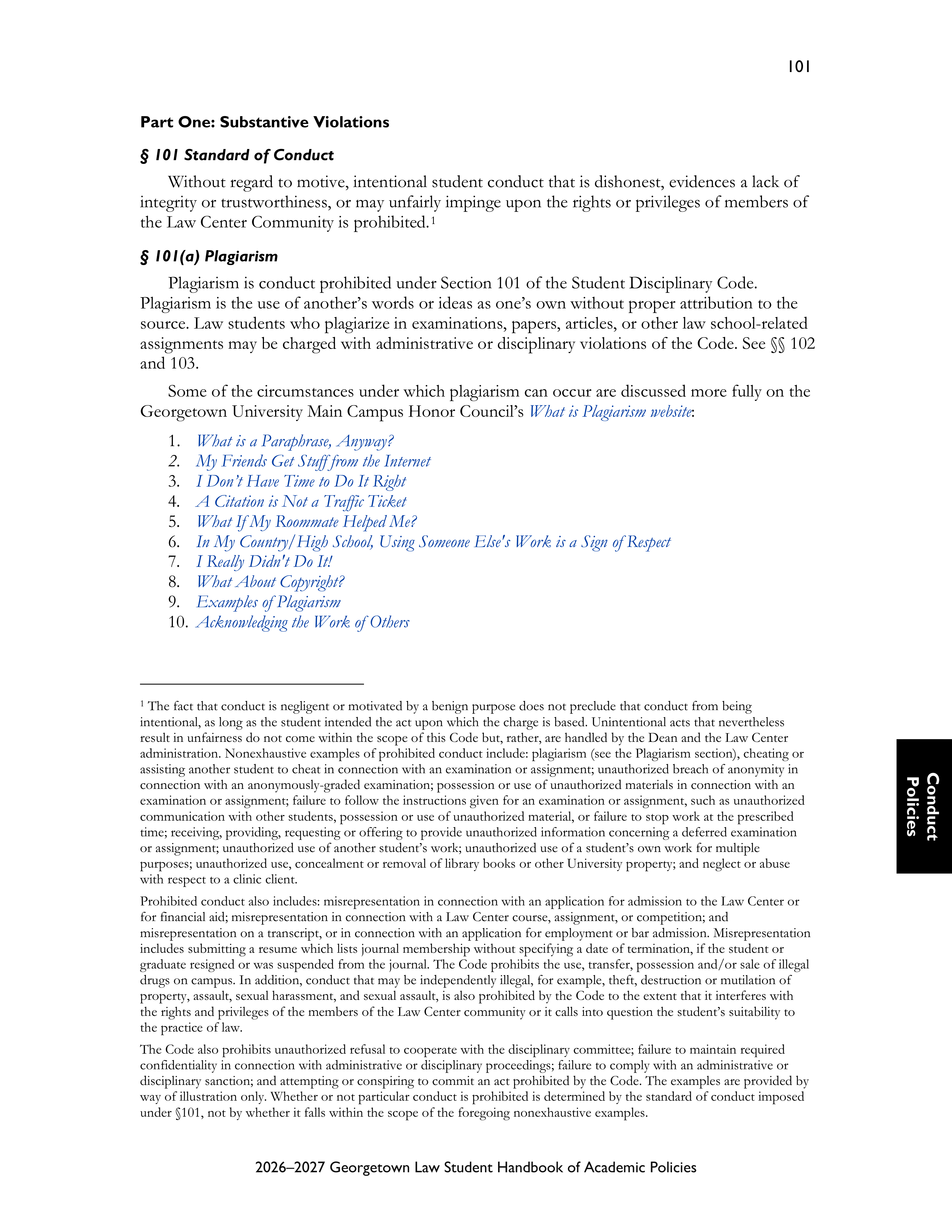
101
2026–2027 Georgetown Law Student Handbook of Academic Policies
Introduction
Juris Doctor
Program
Graduate
Programs
General Administrative
Policies
Conduct
Policies
Tuition &
Fees
Index
Part One: Substantive Violations
§ 101 Standard of Conduct
Without regard to motive, intentional student conduct that is dishonest, evidences a lack of
integrity or trustworthiness, or may unfairly impinge upon the rights or privileges of members of
the Law Center Community is prohibited.
1
§ 101(a) Plagiarism
Plagiarism is conduct prohibited under Section 101 of the Student Disciplinary Code.
Plagiarism is the use of another’s words or ideas as one’s own without proper attribution to the
source. Law students who plagiarize in examinations, papers, articles, or other law school-related
assignments may be charged with administrative or disciplinary violations of the Code. See §§ 102
and 103.
Some of the circumstances under which plagiarism can occur are discussed more fully on the
Georgetown University Main Campus Honor Council’s
What is Plagiarism website
:
1.
What is a Paraphrase, Anyway?
2.
My Friends Get Stuff from the Internet
3.
I Don’t Have Time to Do It Right
4.
A Citation is Not a Traffic Ticket
5.
What If My Roommate Helped Me?
6.
In My Country/High School, Using Someone Else's Work is a Sign of Respect
7.
I Really Didn't Do It!
8.
What About Copyright?
9.
Examples of Plagiarism
10.
Acknowledging the Work of Others
1
The fact that conduct is negligent or motivated by a benign purpose does not preclude that conduct from being
intentional, as long as the student intended the act upon which the charge is based. Unintentional acts that nevertheless
result in unfairness do not come within the scope of this Code but, rather, are handled by the Dean and the Law Center
administration. Nonexhaustive examples of prohibited conduct include: plagiarism (see the Plagiarism section), cheating or
assisting another student to cheat in connection with an examination or assignment; unauthorized breach of anonymity in
connection with an anonymously-graded examination; possession or use of unauthorized materials in connection with an
examination or assignment; failure to follow the instructions given for an examination or assignment, such as unauthorized
communication with other students, possession or use of unauthorized material, or failure to stop work at the prescribed
time; receiving, providing, requesting or offering to provide unauthorized information concerning a deferred examination
or assignment; unauthorized use of another student’s work; unauthorized use of a student’s own work for multiple
purposes; unauthorized use, concealment or removal of library books or other University property; and neglect or abuse
with respect to a clinic client.
Prohibited conduct also includes: misrepresentation in connection with an application for admission to the Law Center or
for financial aid; misrepresentation in connection with a Law Center course, assignment, or competition; and
misrepresentation on a transcript, or in connection with an application for employment or bar admission. Misrepresentation
includes submitting a resume which lists journal membership without specifying a date of termination, if the student or
graduate resigned or was suspended from the journal. The Code prohibits the use, transfer, possession and/or sale of illegal
drugs on campus. In addition, conduct that may be independently illegal, for example, theft, destruction or mutilation of
property, assault, sexual harassment, and sexual assault, is also prohibited by the Code to the extent that it interferes with
the rights and privileges of the members of the Law Center community or it calls into question the student’s suitability to
the practice of law.
The Code also prohibits unauthorized refusal to cooperate with the disciplinary committee; failure to maintain required
confidentiality in connection with administrative or disciplinary proceedings; failure to comply with an administrative or
disciplinary sanction; and attempting or conspiring to commit an act prohibited by the Code. The examples are provided by
way of illustration only. Whether or not particular conduct is prohibited is determined by the standard of conduct imposed
under §101, not by whether it falls within the scope of the foregoing nonexhaustive examples.
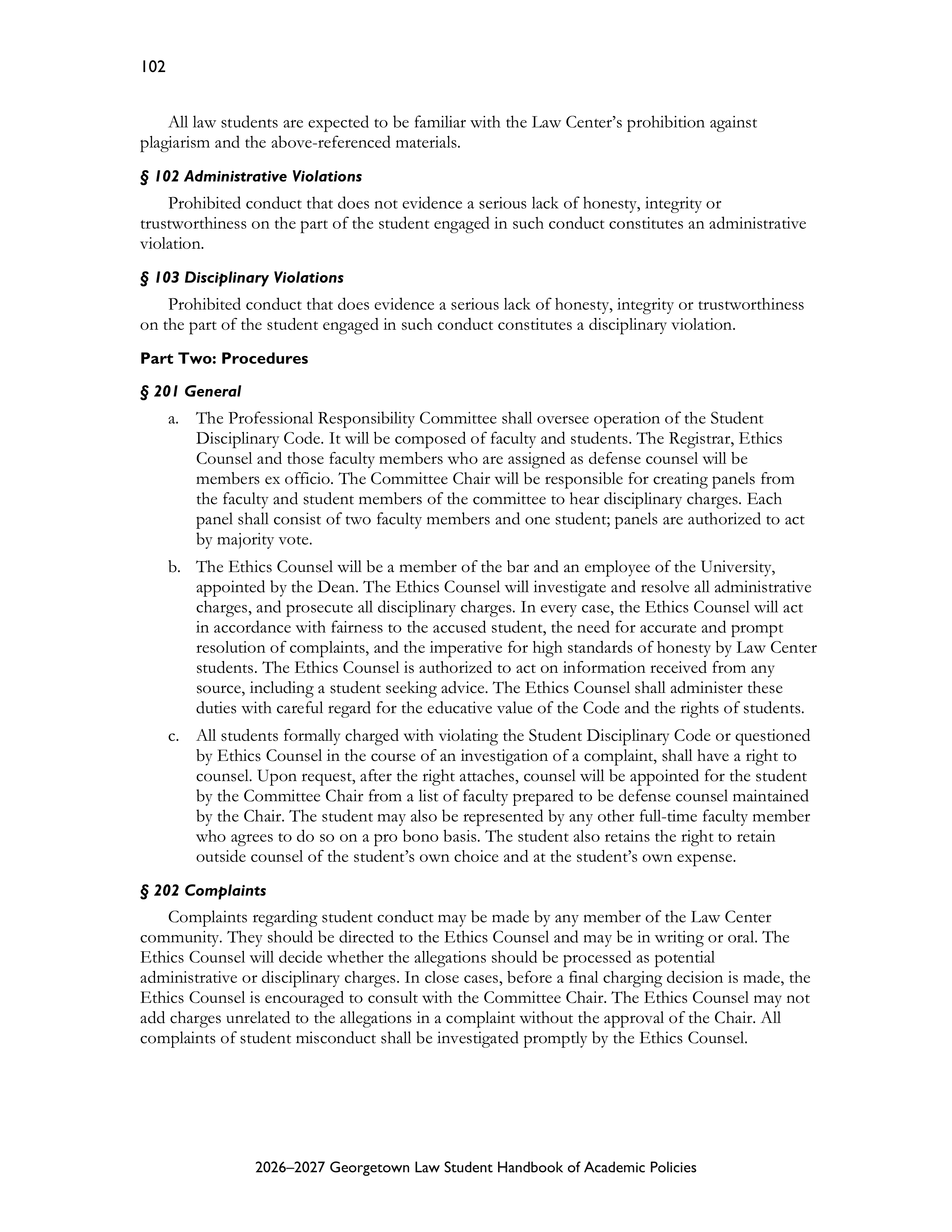
102
2026–2027 Georgetown Law Student Handbook of Academic Policies
All law students are expected to be familiar with the Law Center’s prohibition against
plagiarism and the above-referenced materials.
§ 102 Administrative Violations
Prohibited conduct that does not evidence a serious lack of honesty, integrity or
trustworthiness on the part of the student engaged in such conduct constitutes an administrative
violation.
§ 103 Disciplinary Violations
Prohibited conduct that does evidence a serious lack of honesty, integrity or trustworthiness
on the part of the student engaged in such conduct constitutes a disciplinary violation.
Part Two: Procedures
§ 201 General
a.
The Professional Responsibility Committee shall oversee operation of the Student
Disciplinary Code. It will be composed of faculty and students. The Registrar, Ethics
Counsel and those faculty members who are assigned as defense counsel will be
members ex officio. The Committee Chair will be responsible for creating panels from
the faculty and student members of the committee to hear disciplinary charges. Each
panel shall consist of two faculty members and one student; panels are authorized to act
by majority vote.
b.
The Ethics Counsel will be a member of the bar and an employee of the University,
appointed by the Dean. The Ethics Counsel will investigate and resolve all administrative
charges, and prosecute all disciplinary charges. In every case, the Ethics Counsel will act
in accordance with fairness to the accused student, the need for accurate and prompt
resolution of complaints, and the imperative for high standards of honesty by Law Center
students. The Ethics Counsel is authorized to act on information received from any
source, including a student seeking advice. The Ethics Counsel shall administer these
duties with careful regard for the educative value of the Code and the rights of students.
c.
All students formally charged with violating the Student Disciplinary Code or questioned
by Ethics Counsel in the course of an investigation of a complaint, shall have a right to
counsel. Upon request, after the right attaches, counsel will be appointed for the student
by the Committee Chair from a list of faculty prepared to be defense counsel maintained
by the Chair. The student may also be represented by any other full-time faculty member
who agrees to do so on a pro bono basis. The student also retains the right to retain
outside counsel of the student’s own choice and at the student’s own expense.
§ 202 Complaints
Complaints regarding student conduct may be made by any member of the Law Center
community. They should be directed to the Ethics Counsel and may be in writing or oral. The
Ethics Counsel will decide whether the allegations should be processed as potential
administrative or disciplinary charges. In close cases, before a final charging decision is made, the
Ethics Counsel is encouraged to consult with the Committee Chair. The Ethics Counsel may not
add charges unrelated to the allegations in a complaint without the approval of the Chair. All
complaints of student misconduct shall be investigated promptly by the Ethics Counsel.
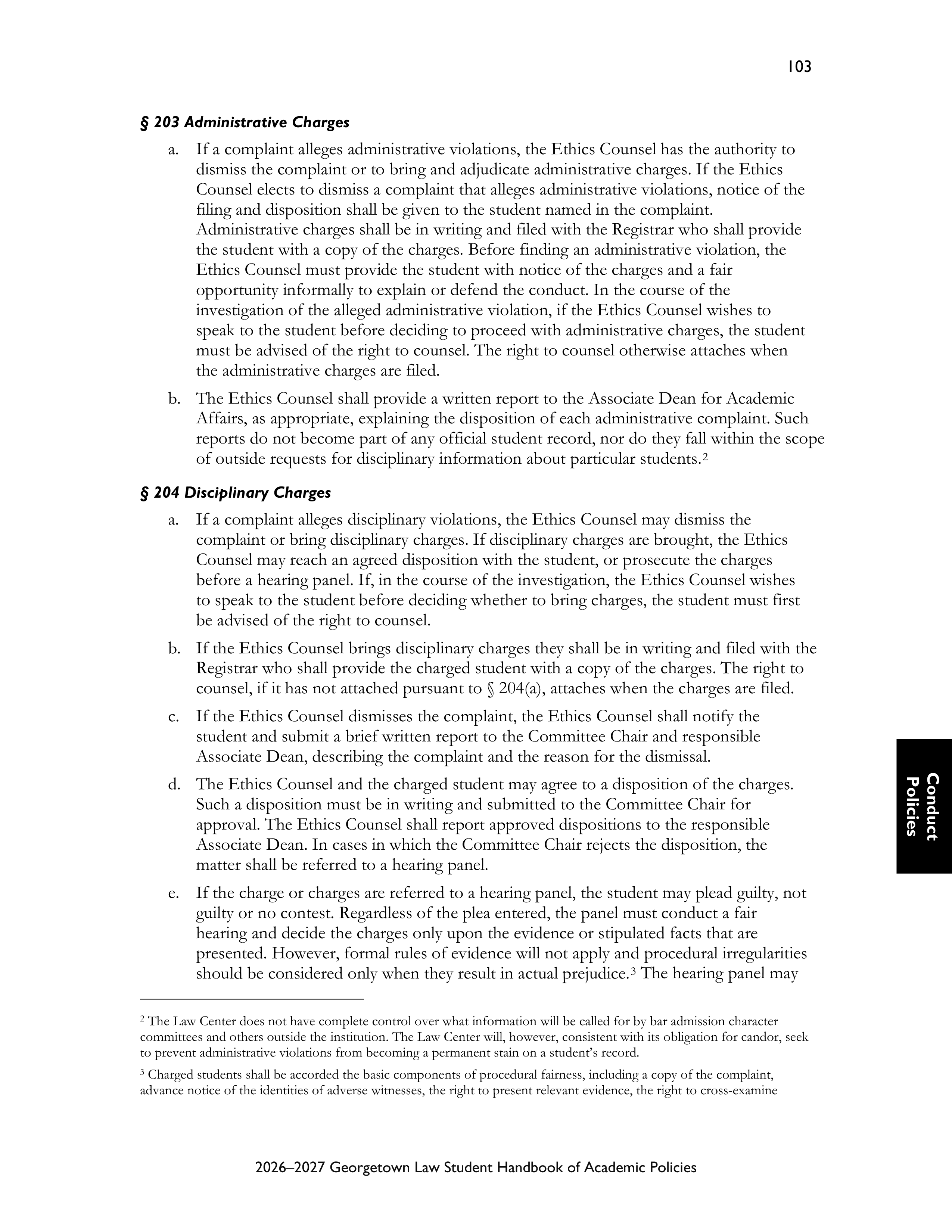
103
2026–2027 Georgetown Law Student Handbook of Academic Policies
Introduction
Juris Doctor
Program
Graduate
Programs
General Administrative
Policies
Conduct
Policies
Tuition &
Fees
Index
§ 203 Administrative Charges
a.
If a complaint alleges administrative violations, the Ethics Counsel has the authority to
dismiss the complaint or to bring and adjudicate administrative charges. If the Ethics
Counsel elects to dismiss a complaint that alleges administrative violations, notice of the
filing and disposition shall be given to the student named in the complaint.
Administrative charges shall be in writing and filed with the Registrar who shall provide
the student with a copy of the charges. Before finding an administrative violation, the
Ethics Counsel must provide the student with notice of the charges and a fair
opportunity informally to explain or defend the conduct. In the course of the
investigation of the alleged administrative violation, if the Ethics Counsel wishes to
speak to the student before deciding to proceed with administrative charges, the student
must be advised of the right to counsel. The right to counsel otherwise attaches when
the administrative charges are filed.
b.
The Ethics Counsel shall provide a written report to the Associate Dean for Academic
Affairs, as appropriate, explaining the disposition of each administrative complaint. Such
reports do not become part of any official student record, nor do they fall within the scope
of outside requests for disciplinary information about particular students.
2
§ 204 Disciplinary Charges
a.
If a complaint alleges disciplinary violations, the Ethics Counsel may dismiss the
complaint or bring disciplinary charges. If disciplinary charges are brought, the Ethics
Counsel may reach an agreed disposition with the student, or prosecute the charges
before a hearing panel. If, in the course of the investigation, the Ethics Counsel wishes
to speak to the student before deciding whether to bring charges, the student must first
be advised of the right to counsel.
b.
If the Ethics Counsel brings disciplinary charges they shall be in writing and filed with the
Registrar who shall provide the charged student with a copy of the charges. The right to
counsel, if it has not attached pursuant to § 204(a), attaches when the charges are filed.
c.
If the Ethics Counsel dismisses the complaint, the Ethics Counsel shall notify the
student and submit a brief written report to the Committee Chair and responsible
Associate Dean, describing the complaint and the reason for the dismissal.
d.
The Ethics Counsel and the charged student may agree to a disposition of the charges.
Such a disposition must be in writing and submitted to the Committee Chair for
approval. The Ethics Counsel shall report approved dispositions to the responsible
Associate Dean. In cases in which the Committee Chair rejects the disposition, the
matter shall be referred to a hearing panel.
e.
If the charge or charges are referred to a hearing panel, the student may plead guilty, not
guilty or no contest. Regardless of the plea entered, the panel must conduct a fair
hearing and decide the charges only upon the evidence or stipulated facts that are
presented. However, formal rules of evidence will not apply and procedural irregularities
should be considered only when they result in actual prejudice.
3
The hearing panel may
2
The Law Center does not have complete control over what information will be called for by bar admission character
committees and others outside the institution. The Law Center will, however, consistent with its obligation for candor, seek
to prevent administrative violations from becoming a permanent stain on a student’s record.
3
Charged students shall be accorded the basic components of procedural fairness, including a copy of the complaint,
advance notice of the identities of adverse witnesses, the right to present relevant evidence, the right to cross-examine
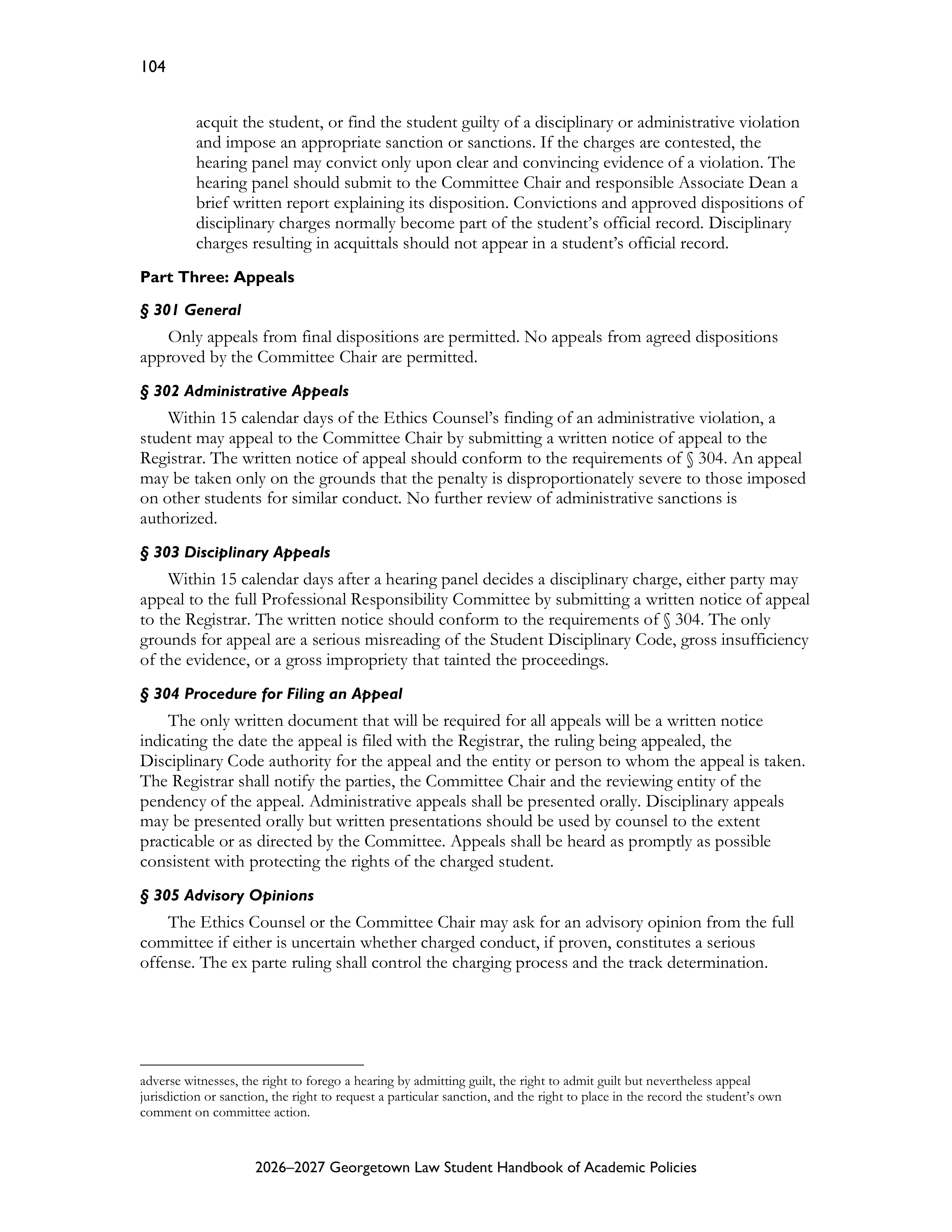
104
2026–2027 Georgetown Law Student Handbook of Academic Policies
acquit the student, or find the student guilty of a disciplinary or administrative violation
and impose an appropriate sanction or sanctions. If the charges are contested, the
hearing panel may convict only upon clear and convincing evidence of a violation. The
hearing panel should submit to the Committee Chair and responsible Associate Dean a
brief written report explaining its disposition. Convictions and approved dispositions of
disciplinary charges normally become part of the student’s official record. Disciplinary
charges resulting in acquittals should not appear in a student’s official record.
Part Three: Appeals
§ 301 General
Only appeals from final dispositions are permitted. No appeals from agreed dispositions
approved by the Committee Chair are permitted.
§ 302 Administrative Appeals
Within 15 calendar days of the Ethics Counsel’s finding of an administrative violation, a
student may appeal to the Committee Chair by submitting a written notice of appeal to the
Registrar. The written notice of appeal should conform to the requirements of § 304. An appeal
may be taken only on the grounds that the penalty is disproportionately severe to those imposed
on other students for similar conduct. No further review of administrative sanctions is
authorized.
§ 303 Disciplinary Appeals
Within 15 calendar days after a hearing panel decides a disciplinary charge, either party may
appeal to the full Professional Responsibility Committee by submitting a written notice of appeal
to the Registrar. The written notice should conform to the requirements of § 304. The only
grounds for appeal are a serious misreading of the Student Disciplinary Code, gross insufficiency
of the evidence, or a gross impropriety that tainted the proceedings.
§ 304 Procedure for Filing an Appeal
The only written document that will be required for all appeals will be a written notice
indicating the date the appeal is filed with the Registrar, the ruling being appealed, the
Disciplinary Code authority for the appeal and the entity or person to whom the appeal is taken.
The Registrar shall notify the parties, the Committee Chair and the reviewing entity of the
pendency of the appeal. Administrative appeals shall be presented orally. Disciplinary appeals
may be presented orally but written presentations should be used by counsel to the extent
practicable or as directed by the Committee. Appeals shall be heard as promptly as possible
consistent with protecting the rights of the charged student.
§ 305 Advisory Opinions
The Ethics Counsel or the Committee Chair may ask for an advisory opinion from the full
committee if either is uncertain whether charged conduct, if proven, constitutes a serious
offense. The ex parte ruling shall control the charging process and the track determination.
adverse witnesses, the right to forego a hearing by admitting guilt, the right to admit guilt but nevertheless appeal
jurisdiction or sanction, the right to request a particular sanction, and the right to place in the record the student’s own
comment on committee action.
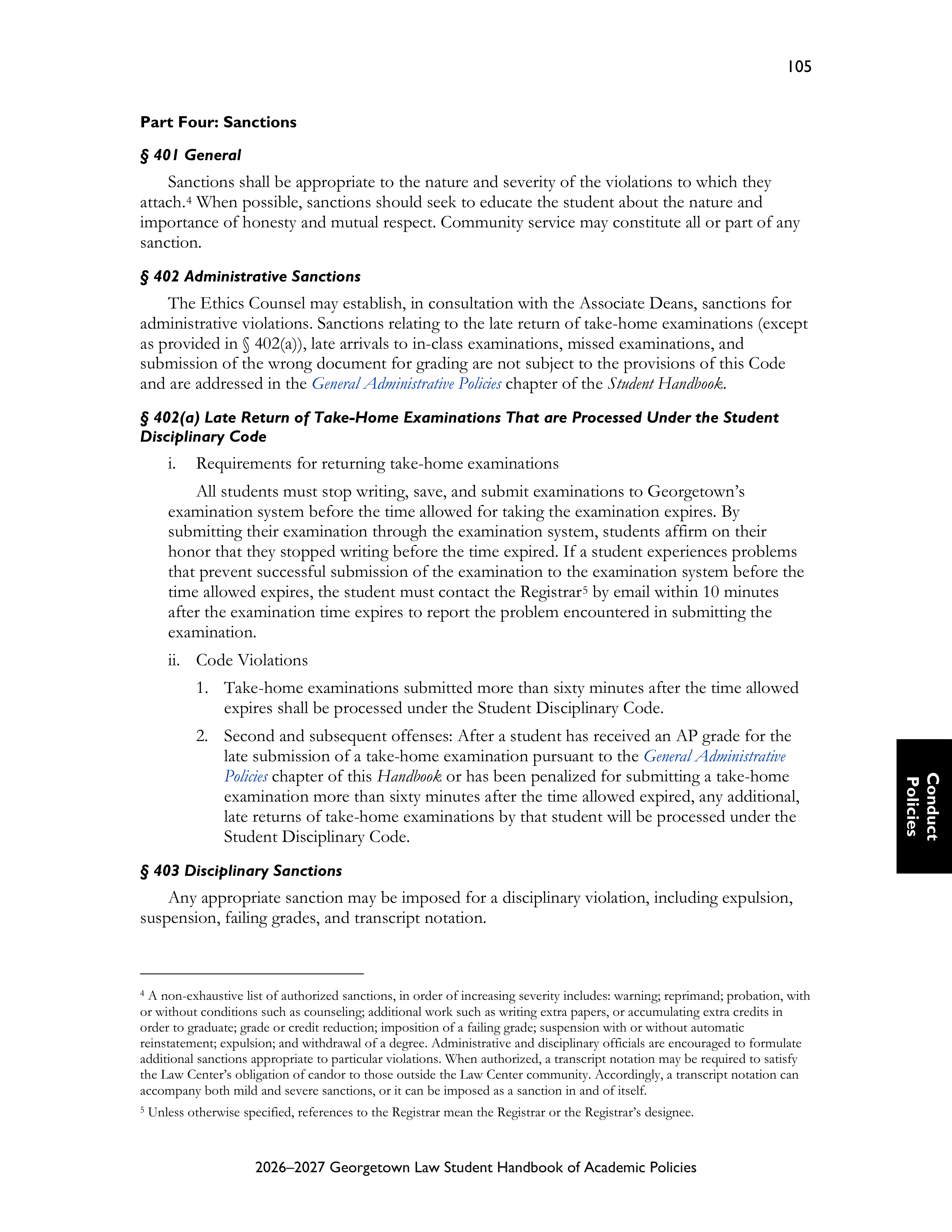
105
2026–2027 Georgetown Law Student Handbook of Academic Policies
Introduction
Juris Doctor
Program
Graduate
Programs
General Administrative
Policies
Conduct
Policies
Tuition &
Fees
Index
Part Four: Sanctions
§ 401 General
Sanctions shall be appropriate to the nature and severity of the violations to which they
attach.
4
When possible, sanctions should seek to educate the student about the nature and
importance of honesty and mutual respect. Community service may constitute all or part of any
sanction.
§ 402 Administrative Sanctions
The Ethics Counsel may establish, in consultation with the Associate Deans, sanctions for
administrative violations. Sanctions relating to the late return of take-home examinations (except
as provided in § 402(a)), late arrivals to in-class examinations, missed examinations, and
submission of the wrong document for grading are not subject to the provisions of this Code
and are addressed in the
General Administrative Policies
chapter of the
Student Handbook
.
§ 402(a) Late Return of Take-Home Examinations That are Processed Under the Student
Disciplinary Code
i.
Requirements for returning take-home examinations
All students must stop writing, save, and submit examinations to Georgetown’s
examination system before the time allowed for taking the examination expires. By
submitting their examination through the examination system, students affirm on their
honor that they stopped writing before the time expired. If a student experiences problems
that prevent successful submission of the examination to the examination system before the
time allowed expires, the student must contact the Registrar
5
by email within 10 minutes
after the examination time expires to report the problem encountered in submitting the
examination.
ii. Code Violations
1.
Take-home examinations submitted more than sixty minutes after the time allowed
expires shall be processed under the Student Disciplinary Code.
2.
Second and subsequent offenses: After a student has received an AP grade for the
late submission of a take-home examination pursuant to the
General Administrative
Policies
chapter of this
Handbook
or has been penalized for submitting a take-home
examination more than sixty minutes after the time allowed expired, any additional,
late returns of take-home examinations by that student will be processed under the
Student Disciplinary Code.
§ 403 Disciplinary Sanctions
Any appropriate sanction may be imposed for a disciplinary violation, including expulsion,
suspension, failing grades, and transcript notation.
4
A non-exhaustive list of authorized sanctions, in order of increasing severity includes: warning; reprimand; probation, with
or without conditions such as counseling; additional work such as writing extra papers, or accumulating extra credits in
order to graduate; grade or credit reduction; imposition of a failing grade; suspension with or without automatic
reinstatement; expulsion; and withdrawal of a degree. Administrative and disciplinary officials are encouraged to formulate
additional sanctions appropriate to particular violations. When authorized, a transcript notation may be required to satisfy
the Law Center’s obligation of candor to those outside the Law Center community. Accordingly, a transcript notation can
accompany both mild and severe sanctions, or it can be imposed as a sanction in and of itself.
5
Unless otherwise specified, references to the Registrar mean the Registrar or the Registrar’s designee.
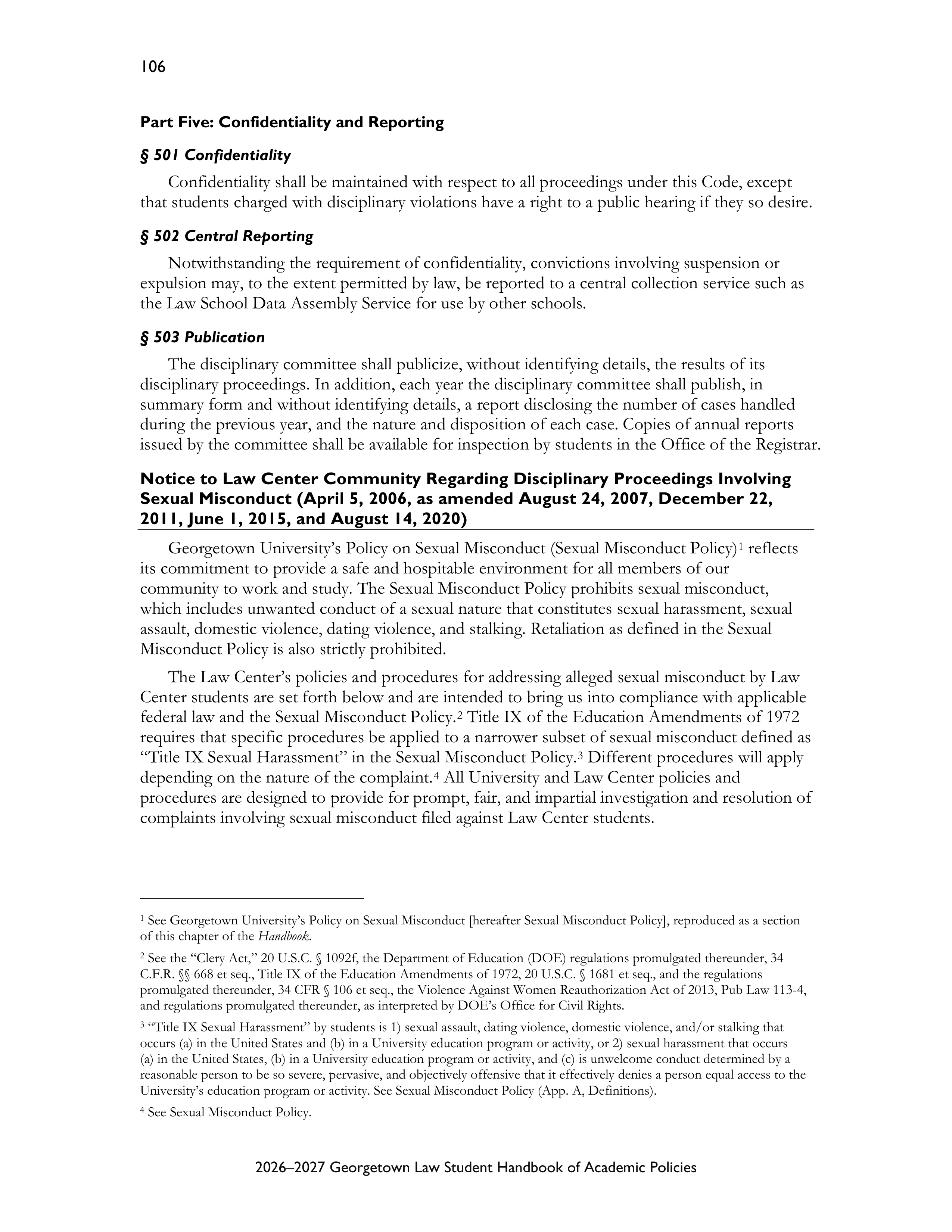
106
2026–2027 Georgetown Law Student Handbook of Academic Policies
Part Five: Confidentiality and Reporting
§ 501 Confidentiality
Confidentiality shall be maintained with respect to all proceedings under this Code, except
that students charged with disciplinary violations have a right to a public hearing if they so desire.
§ 502 Central Reporting
Notwithstanding the requirement of confidentiality, convictions involving suspension or
expulsion may, to the extent permitted by law, be reported to a central collection service such as
the Law School Data Assembly Service for use by other schools.
§ 503 Publication
The disciplinary committee shall publicize, without identifying details, the results of its
disciplinary proceedings. In addition, each year the disciplinary committee shall publish, in
summary form and without identifying details, a report disclosing the number of cases handled
during the previous year, and the nature and disposition of each case. Copies of annual reports
issued by the committee shall be available for inspection by students in the Office of the Registrar.
Notice to Law Center Community Regarding Disciplinary Proceedings Involving
Sexual Misconduct (April 5, 2006, as amended August 24, 2007, December 22,
2011, June 1, 2015, and August 14, 2020)
Georgetown University’s Policy on Sexual Misconduct (Sexual Misconduct Policy)
1
reflects
its commitment to provide a safe and hospitable environment for all members of our
community to work and study. The Sexual Misconduct Policy prohibits sexual misconduct,
which includes unwanted conduct of a sexual nature that constitutes sexual harassment, sexual
assault, domestic violence, dating violence, and stalking. Retaliation as defined in the Sexual
Misconduct Policy is also strictly prohibited.
The Law Center’s policies and procedures for addressing alleged sexual misconduct by Law
Center students are set forth below and are intended to bring us into compliance with applicable
federal law and the Sexual Misconduct Policy.
2
Title IX of the Education Amendments of 1972
requires that specific procedures be applied to a narrower subset of sexual misconduct defined as
“Title IX Sexual Harassment” in the Sexual Misconduct Policy.
3
Different procedures will apply
depending on the nature of the complaint.
4
All University and Law Center policies and
procedures are designed to provide for prompt, fair, and impartial investigation and resolution of
complaints involving sexual misconduct filed against Law Center students.
1
See Georgetown University’s Policy on Sexual Misconduct [hereafter Sexual Misconduct Policy], reproduced as a section
of this chapter of the
Handbook
.
2
See the “Clery Act,” 20 U.S.C. § 1092f, the Department of Education (DOE) regulations promulgated thereunder, 34
C.F.R. §§ 668 et seq., Title IX of the Education Amendments of 1972, 20 U.S.C. § 1681 et seq., and the regulations
promulgated thereunder, 34 CFR § 106 et seq., the Violence Against Women Reauthorization Act of 2013, Pub Law 113-4,
and regulations promulgated thereunder, as interpreted by DOE’s Office for Civil Rights.
3
“Title IX Sexual Harassment” by students is 1) sexual assault, dating violence, domestic violence, and/or stalking that
occurs (a) in the United States and (b) in a University education program or activity, or 2) sexual harassment that occurs
(a) in the United States, (b) in a University education program or activity, and (c) is unwelcome conduct determined by a
reasonable person to be so severe, pervasive, and objectively offensive that it effectively denies a person equal access to the
University’s education program or activity. See Sexual Misconduct Policy (App. A, Definitions).
4
See Sexual Misconduct Policy.
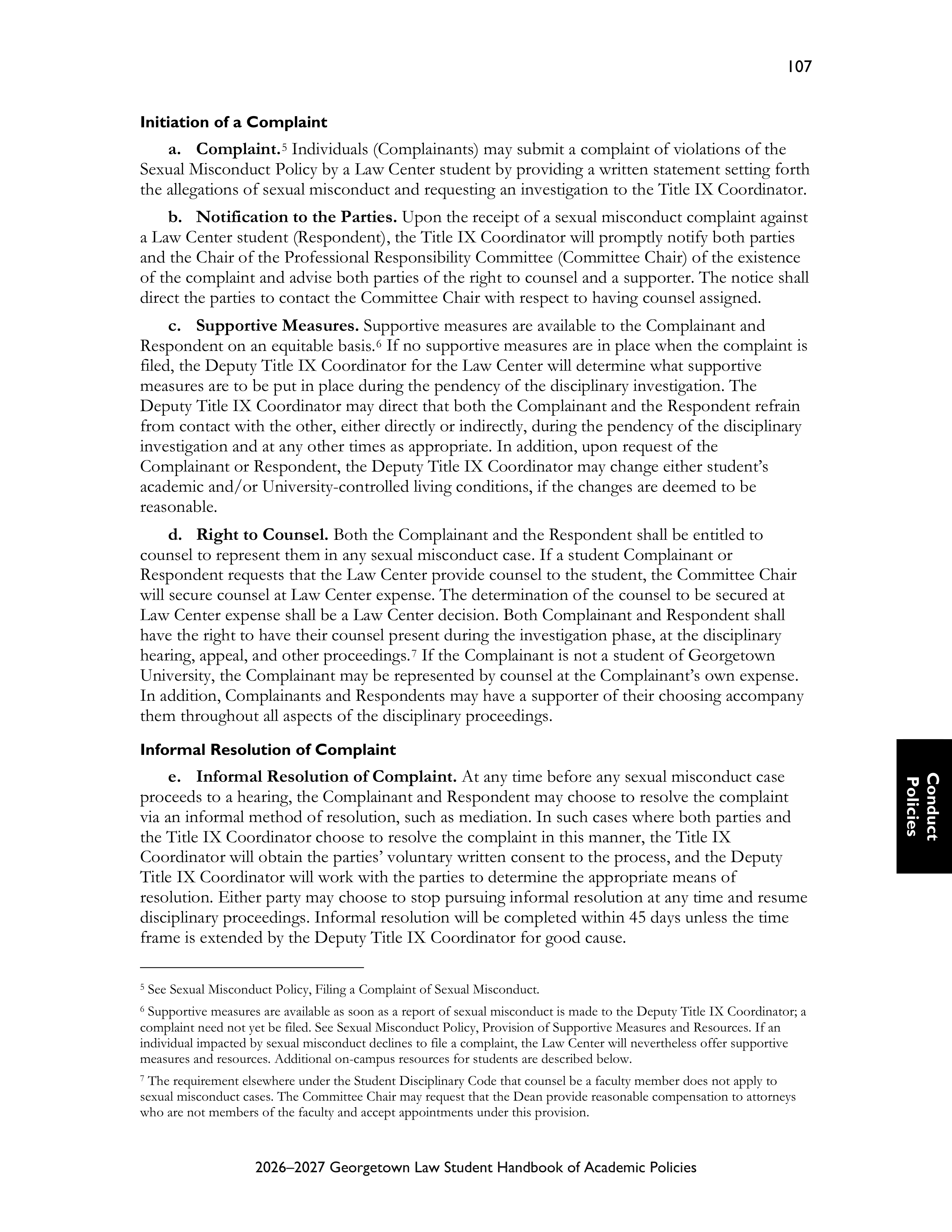
107
2026–2027 Georgetown Law Student Handbook of Academic Policies
Introduction
Juris Doctor
Program
Graduate
Programs
General Administrative
Policies
Conduct
Policies
Tuition &
Fees
Index
Initiation of a Complaint
a.
Complaint.
5
Individuals (Complainants) may submit a complaint of violations of the
Sexual Misconduct Policy by a Law Center student by providing a written statement setting forth
the allegations of sexual misconduct and requesting an investigation to the Title IX Coordinator.
b.
Notification to the Parties.
Upon the receipt of a sexual misconduct complaint against
a Law Center student (Respondent), the Title IX Coordinator will promptly notify both parties
and the Chair of the Professional Responsibility Committee (Committee Chair) of the existence
of the complaint and advise both parties of the right to counsel and a supporter. The notice shall
direct the parties to contact the Committee Chair with respect to having counsel assigned.
c.
Supportive Measures.
Supportive measures are available to the Complainant and
Respondent on an equitable basis.
6
If no supportive measures are in place when the complaint is
filed, the Deputy Title IX Coordinator for the Law Center will determine what supportive
measures are to be put in place during the pendency of the disciplinary investigation. The
Deputy Title IX Coordinator may direct that both the Complainant and the Respondent refrain
from contact with the other, either directly or indirectly, during the pendency of the disciplinary
investigation and at any other times as appropriate. In addition, upon request of the
Complainant or Respondent, the Deputy Title IX Coordinator may change either student’s
academic and/or University-controlled living conditions, if the changes are deemed to be
reasonable.
d.
Right to Counsel.
Both the Complainant and the Respondent shall be entitled to
counsel to represent them in any sexual misconduct case. If a student Complainant or
Respondent requests that the Law Center provide counsel to the student, the Committee Chair
will secure counsel at Law Center expense. The determination of the counsel to be secured at
Law Center expense shall be a Law Center decision. Both Complainant and Respondent shall
have the right to have their counsel present during the investigation phase, at the disciplinary
hearing, appeal, and other proceedings.
7
If the Complainant is not a student of Georgetown
University, the Complainant may be represented by counsel at the Complainant’s own expense.
In addition, Complainants and Respondents may have a supporter of their choosing accompany
them throughout all aspects of the disciplinary proceedings.
Informal Resolution of Complaint
e.
Informal Resolution of Complaint.
At any time before any sexual misconduct case
proceeds to a hearing, the Complainant and Respondent may choose to resolve the complaint
via an informal method of resolution, such as mediation. In such cases where both parties and
the Title IX Coordinator choose to resolve the complaint in this manner, the Title IX
Coordinator will obtain the parties’ voluntary written consent to the process, and the Deputy
Title IX Coordinator will work with the parties to determine the appropriate means of
resolution. Either party may choose to stop pursuing informal resolution at any time and resume
disciplinary proceedings. Informal resolution will be completed within 45 days unless the time
frame is extended by the Deputy Title IX Coordinator for good cause.
5
See Sexual Misconduct Policy, Filing a Complaint of Sexual Misconduct.
6
Supportive measures are available as soon as a report of sexual misconduct is made to the Deputy Title IX Coordinator; a
complaint need not yet be filed. See Sexual Misconduct Policy, Provision of Supportive Measures and Resources. If an
individual impacted by sexual misconduct declines to file a complaint, the Law Center will nevertheless offer supportive
measures and resources. Additional on-campus resources for students are described below.
7
The requirement elsewhere under the Student Disciplinary Code that counsel be a faculty member does not apply to
sexual misconduct cases. The Committee Chair may request that the Dean provide reasonable compensation to attorneys
who are not members of the faculty and accept appointments under this provision.
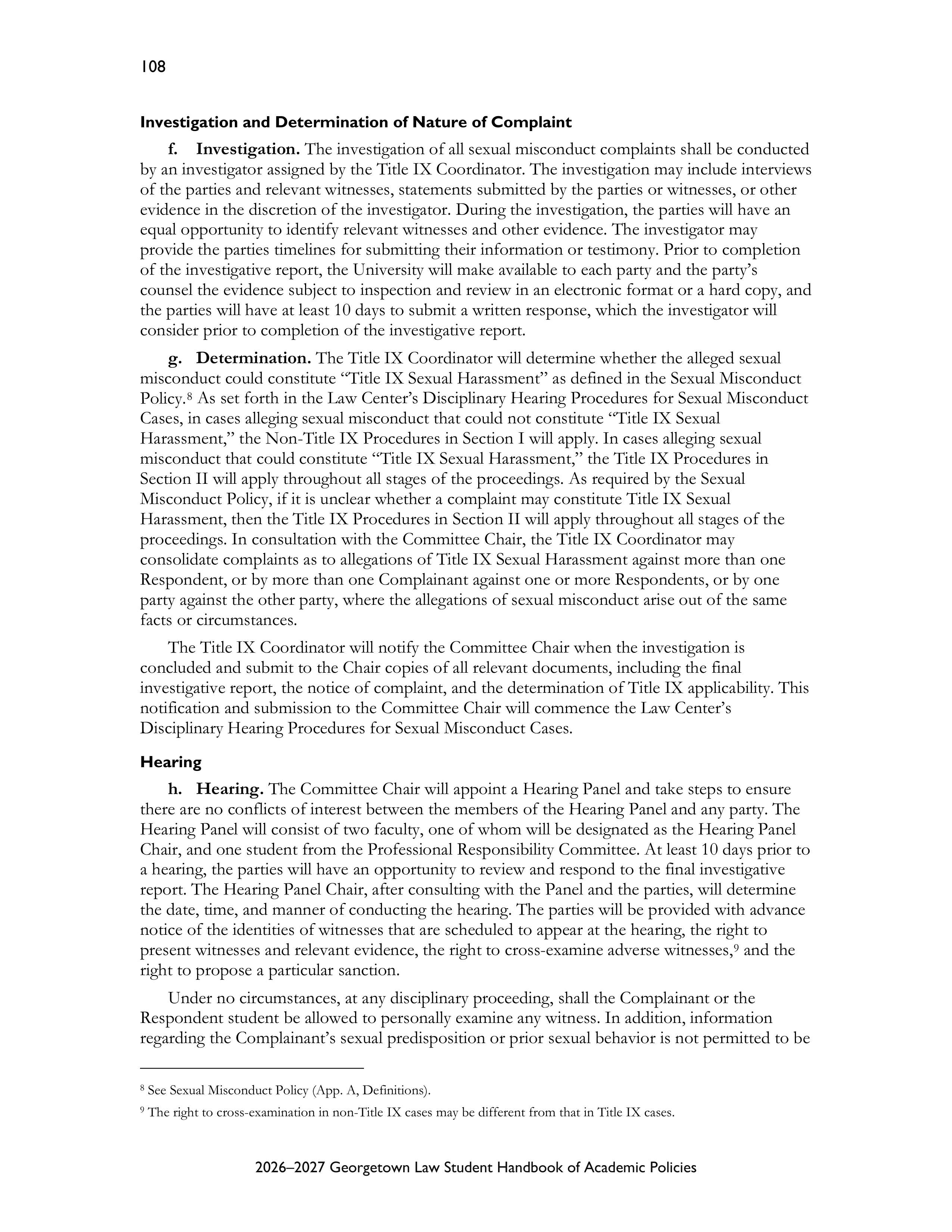
108
2026–2027 Georgetown Law Student Handbook of Academic Policies
Investigation and Determination of Nature of Complaint
f.
Investigation.
The investigation of all sexual misconduct complaints shall be conducted
by an investigator assigned by the Title IX Coordinator. The investigation may include interviews
of the parties and relevant witnesses, statements submitted by the parties or witnesses, or other
evidence in the discretion of the investigator. During the investigation, the parties will have an
equal opportunity to identify relevant witnesses and other evidence. The investigator may
provide the parties timelines for submitting their information or testimony. Prior to completion
of the investigative report, the University will make available to each party and the party’s
counsel the evidence subject to inspection and review in an electronic format or a hard copy, and
the parties will have at least 10 days to submit a written response, which the investigator will
consider prior to completion of the investigative report.
g.
Determination.
The Title IX Coordinator will determine whether the alleged sexual
misconduct could constitute “Title IX Sexual Harassment” as defined in the Sexual Misconduct
Policy.
8
As set forth in the Law Center’s Disciplinary Hearing Procedures for Sexual Misconduct
Cases, in cases alleging sexual misconduct that could not constitute “Title IX Sexual
Harassment,” the Non-Title IX Procedures in Section I will apply. In cases alleging sexual
misconduct that could constitute “Title IX Sexual Harassment,” the Title IX Procedures in
Section II will apply throughout all stages of the proceedings. As required by the Sexual
Misconduct Policy, if it is unclear whether a complaint may constitute Title IX Sexual
Harassment, then the Title IX Procedures in Section II will apply throughout all stages of the
proceedings. In consultation with the Committee Chair, the Title IX Coordinator may
consolidate complaints as to allegations of Title IX Sexual Harassment against more than one
Respondent, or by more than one Complainant against one or more Respondents, or by one
party against the other party, where the allegations of sexual misconduct arise out of the same
facts or circumstances.
The Title IX Coordinator will notify the Committee Chair when the investigation is
concluded and submit to the Chair copies of all relevant documents, including the final
investigative report, the notice of complaint, and the determination of Title IX applicability. This
notification and submission to the Committee Chair will commence the Law Center’s
Disciplinary Hearing Procedures for Sexual Misconduct Cases.
Hearing
h.
Hearing.
The Committee Chair will appoint a Hearing Panel and take steps to ensure
there are no conflicts of interest between the members of the Hearing Panel and any party. The
Hearing Panel will consist of two faculty, one of whom will be designated as the Hearing Panel
Chair, and one student from the Professional Responsibility Committee. At least 10 days prior to
a hearing, the parties will have an opportunity to review and respond to the final investigative
report. The Hearing Panel Chair, after consulting with the Panel and the parties, will determine
the date, time, and manner of conducting the hearing. The parties will be provided with advance
notice of the identities of witnesses that are scheduled to appear at the hearing, the right to
present witnesses and relevant evidence, the right to cross-examine adverse witnesses,
9
and the
right to propose a particular sanction.
Under no circumstances, at any disciplinary proceeding, shall the Complainant or the
Respondent student be allowed to personally examine any witness. In addition, information
regarding the Complainant’s sexual predisposition or prior sexual behavior is not permitted to be
8
See Sexual Misconduct Policy (App. A, Definitions).
9
The right to cross-examination in non-Title IX cases may be different from that in Title IX cases.
109
2026–2027 Georgetown Law Student Handbook of Academic Policies
Introduction
Juris Doctor
Program
Graduate
Programs
General Administrative
Policies
Conduct
Policies
Tuition &
Fees
Index
introduced, unless such questions and evidence about the Complainant’s prior sexual behavior
are offered to prove that someone other than the Respondent committed the conduct alleged by
the Complainant, or the questions and evidence concern specific incidents of the Complainant’s
prior sexual behavior with respect to the Respondent and are offered to prove consent.
Furthermore, when requested by either party, the Hearing Panel Chair will arrange the hearing
such that the Complainant and Respondent do not have to be present in the same room at the
same time. The Hearing Panel shall be permitted to question the parties. The standard of proof
to be applied by the hearing panel shall be preponderance of the evidence standard (more likely
than not).
Hearing Panels will objectively evaluate all relevant evidence, including both inculpatory and
exculpatory evidence. Credibility determinations will not be based on a person’s status as a
Complainant, Respondent, or witness.
i.
Training.
The Title IX Coordinator, Deputy Title IX Coordinator, Committee Chair,
Hearing Panel, and Ethics Counsel will receive training on handling sexual misconduct
complaints, as well as on the Sexual Misconduct Policy and the procedures for disciplinary
proceedings.
j.
Confidentiality.
All documents submitted by the parties to the investigator and the
Hearing Panel, the investigation, the investigative report, and the disciplinary hearing shall be
confidential and not open to the public.
k.
False Statements.
Knowingly making a materially false statement or knowingly
submitting false information during the grievance process is prohibited. However, a
determination regarding responsibility, alone, is not sufficient to charge any party with knowingly
making a materially false statement.
l.
Timing of Resolution.
Every effort will be made to conduct hearings as soon as
practicable, ideally within 21 calendar days after the Hearing Panel is named. The Hearing Panel
will render its report within 20 days of the conclusion of the hearing. This time limit, and all time
limits contained herein, are not jurisdictional and may be extended for good cause shown by the
Committee Chair.
m.
Outcome and Sanctions.
In all sexual misconduct cases, the Hearing Panel may find
the student responsible for a disciplinary or administrative violation, including a violation of the
Sexual Misconduct Policy, and may impose appropriate sanctions. Sanctions for findings of
violation include expulsion, suspension, transcript notation, written reprimand, educational
classes/projects, referral to community resources, housing restrictions or relocation, and any
sanction that appropriately addresses the nature and severity of the conduct as determined by the
Hearing Panel.
n.
Notice of Outcome.
The Complainant, the Respondent, the Title IX Coordinator, and
the Committee Chair shall be concurrently notified in writing of the outcome of the disciplinary
proceeding. The notice of outcome will include a description of the allegations, procedural steps
taken during the case, findings of facts, findings of violation or no violation, a rationale for the
findings, any sanctions or remedies imposed, and procedures for appeal.
Appeal
o.
Right to Appeal.
The Complainant and the Respondent in any sexual misconduct case
shall both have the right to appeal. In Non-Title IX cases, the bases for appeal are set forth in
Sections 303 and 304 of the Student Disciplinary Code. In Title IX cases, the bases for appeal
are a procedural irregularity that affected the outcome of the matter; new evidence that was not
reasonably available at the time the determination regarding responsibility or dismissal was made
110
2026–2027 Georgetown Law Student Handbook of Academic Policies
that could affect the outcome of the matter; or the Title IX Coordinator, investigator(s), or
decision-maker(s) had a conflict of interest or bias that affected the outcome of the matter.
Individuals who served on the Hearing Panel of a Title IX case cannot be decision-makers on
appeal. In all sexual misconduct cases, parties will be notified of any appeal filed and will have an
opportunity to respond in writing to the appeal. Any appeal must be resolved within 20 days in
writing after all briefs have been filed or after oral argument is concluded, whichever occurs
later. These time limits are not jurisdictional and may be extended for good cause shown by the
Committee Chair. The Complainant, Respondent, and the Title IX Coordinator shall be
concurrently notified in writing of the outcome of any appeal proceedings.
Other Rules and Procedures
Past and future guidance directives from the Department of Education and the Office for
Civil Rights that remain in effect, are incorporated into these provisions by reference and shall
be followed by Hearing Panels to the extent that they impose requirements not otherwise
provided here or in the Student Disciplinary Code.
To the extent that any of these provisions is inconsistent with provisions of the Student
Disciplinary Code, the Code is hereby overridden, as authorized by the Code “if special
circumstances so require.” Unless federal law or University policy expressly provides otherwise,
these provisions apply to all sexual misconduct disciplinary proceedings pending at this time or
arising thereafter, regardless of when the underlying conduct occurred. This announcement shall
be distributed to the Law Center Community and included in the
Student Handbook.
On-Campus Resources for Students
The Law Center offers resources for students who have experienced sexual misconduct.
Confidential Counselors
Counselors are available to assist students in accessing medical care, crisis support,
navigating disciplinary proceedings, safety planning, academic modifications, support groups,
and housing relocation:
Counseling and Psychiatric Service (CAPS)
500 1
st
Street, Suite 100. Phone number: 202-687-6985;
for 24/7/365 emergency services, call 202-687-6985 and press “1.”
Sexual Assault, Relationship Violence & Stalking Services (SARP)
The Sexual Assault Response and Prevention Team has several clinicians whose area of
expertise is working with and assisting survivors of interpersonal violence. These
services are confidential, and clinicians do not report to Title IX. Email the SARP team
at
sarp@georgetown.edu
in order to reach a confidential clinician to schedule an
appointment.
Additional Resources—Reporting Incidents of Sexual Misconduct
Deputy Title IX Coordinator for Law Center Students
Consistent with Title IX of the Education Amendments of 1972, Georgetown will respond
to reported incidents of sexual misconduct in order to protect and maintain the safety of the
University community.
To report an incident of sexual misconduct, or to receive guidance, law students may contact
the Deputy Title IX Coordinator for the Law Center, Lisa Curtis, Director of Academic Success,
Hotung 3101, 202-662-4066,
titleixlaw@georgetown.edu
.
111
2026–2027 Georgetown Law Student Handbook of Academic Policies
Introduction
Juris Doctor
Program
Graduate
Programs
General Administrative
Policies
Conduct
Policies
Tuition &
Fees
Index
Title IX Coordinator for Georgetown University
Samantha Berner
Office for Equal Opportunity Compliance
M-36 Darnall Hall
37
th
and O Streets, NW
Washington, D.C. 20057
Phone: 202-687-4798
For more information about resources for students, confidentiality and employees’ duty to
report, and how you can help prevent sexual misconduct, please visit
http://sexualassault.georgetown.edu/
.
Disciplinary Hearing Procedures for Sexual Misconduct Cases (as approved by the
Professional Responsibility Committee, April 2016, and modified by the Dean on
August 14, 2020 and October 28, 2021)
These procedures apply to all sexual misconduct cases resolved at the Law Center and
implement the Law Center’s policies and procedures for addressing alleged sexual misconduct by
Law Center students in the Notice to Law Center Community Regarding Disciplinary
Proceedings Involving Sexual Misconduct (Notice).
10
The procedures set forth below in Section
I apply to Non-Title-IX cases as more fully explained in paragraph g. of the Notice. The
procedures set forth in Section II apply to Title-IX cases.
Where a conflict arises between these procedures and the Georgetown Law Student
Handbook, the Notice, the Policy, or federal law, it shall be resolved against these procedures.
Non-Title IX Cases
A.
The Hearing Panel and Its Mandate
A Hearing Panel will be named by the Committee Chair within 5 calendar days of the
Committee Chair’s receipt of the investigative report. Every effort will be made to conduct
hearings as soon as practicable, ideally within 21 calendar days after the Hearing Panel is named.
The Hearing Panel determines whether the Sexual Misconduct Policy and/or the Student
Disciplinary Code has been violated, and, if so, imposes appropriate sanctions. The Hearing
Panel consists of three Committee members (two faculty and one student member) trained in
evaluating sexual misconduct cases.
11
The Hearing Panel submits its decision in writing to the parties, the Title IX Coordinator,
and Committee Chair.
B.
Course of Proceedings for Non-Title IX Hearings
12
The Hearing Panel and the parties will have the opportunity to thoroughly review the
investigative report and documentation submitted by the investigator(s) prior to the hearing. The
10
See the Notice to Law Center Community Regarding Disciplinary Proceedings Involving Sexual Misconduct, reproduced
in this chapter of the
Handbook
.
11
Paragraph i. of the Notice provides that “[t]he Title IX Coordinator, Deputy Title IX Coordinator, Committee Chair,
Hearing Panel, and Ethics Counsel will receive training on handling sexual violence complaints, as well as the Sexual
Misconduct Policy and the procedures for disciplinary proceedings.”
12
These non-Title IX procedures may be modified by the Professional Responsibility Committee after due consideration
and only to the extent such modifications are consistent with federal law, University Policy, The Student Disciplinary Code,
and the procedures contained in the Notice to Law Center Community Regarding Disciplinary Proceedings Involving
Sexual Misconduct.
112
2026–2027 Georgetown Law Student Handbook of Academic Policies
Hearing Panel may request that the investigator(s) conduct further investigation or gather
additional evidence before or after a hearing has commenced. Notice of such requests shall be
given to the parties. Whenever possible, the Hearing Panel Chair should give the Complainant
and Respondent at least 5 calendar days’ notice to prepare for the hearing. The hearing is a
closed proceeding.
The general course of the hearing in Non-Title IX cases will be as follows, whenever
possible:
•
Chair of the Hearing Panel will start the proceeding, identify everyone in the room, and
announce that the hearing will be recorded.
•
Complainant statement (oral—may be made by counsel)
•
Respondent statement (oral—may be made by counsel)
•
Questions to the Complainant from the Hearing Panel
•
Questions to the Respondent from the Hearing Panel
•
Witness testimony and questioning by the Hearing Panel (if the Hearing Panel
determines it is necessary)
•
Clarification from the investigator (if the Hearing Panel determines it is necessary)
•
Follow-up questions to the parties from the Hearing Panel
•
Closing statement by Respondent (oral—may be made by counsel)
•
Closing statement by Complainant (oral—may be made by counsel)
•
Any rebuttal statements permitted by the Hearing Panel
The Hearing Panel may impose reasonable time limits on any stage of the hearing process.
C.
Guidelines for Non-Title IX Hearings
1.
General
Unless otherwise noted here or allowed by the Hearing Panel, all submissions from parties
will be in writing and provided to the Hearing Panel and opposing party on a timetable
established by the Hearing Panel. Whenever a party is represented by counsel, service of written
submissions shall be through counsel and in a manner that protects confidentiality.
13
The hearing is designed to supplement the investigative report, and the Hearing Panel shall
determine what evidence it needs in addition to the statements from the parties. When the
Complainant, Respondent, or witnesses are not able to be present for the hearing, the Hearing
Panel may make arrangements for them to participate via alternate means (e.g., telephone or
video). At the request of either party, the Hearing Panel will arrange for parties to be located in
separate rooms with technology enabling the Hearing Panel and parties to simultaneously see
and hear the party or witness answering questions.
Only the Hearing Panel may ask questions at the hearing. Both parties shall have the
opportunity to propose questions to be posed to parties or witnesses by submitting the questions
to the Hearing Panel in writing prior to the hearing. The parties are not required to serve
proposed questions on the other party, but copies of the submissions will be made available to
the parties after the Hearing Panel determines whether the charged student is responsible. The
13
If filing and/or service is by email, care should be taken to not use the names of the parties in the email transmission. The
case number may be used in the subject line.
113
2026–2027 Georgetown Law Student Handbook of Academic Policies
Introduction
Juris Doctor
Program
Graduate
Programs
General Administrative
Policies
Conduct
Policies
Tuition &
Fees
Index
Hearing Panel reserves the right to revise or decline to ask submitted questions on the grounds
that they are irrelevant or duplicative.
An audio recording of the hearing (responsibility and sanctions phase (if any)) will be kept
for the use of the Hearing Panel and for purposes of appeal. This recording may be transcribed
at the request of the Committee Chair if needed for an appeal.
2.
Witnesses
The parties may request in writing that witnesses be called, but the request must include an
explanation for why that testimony is needed. The Hearing Panel will then determine the
witnesses (if any) that will be asked to testify.
3.
Evidence
Before the hearing, parties may submit evidence to the investigator and identify potential
witnesses to be contacted as part of the investigation. Additional testimony and evidence may be
submitted at the hearing to the extent the Hearing Panel deems it necessary or appropriate.
4.
Evidence of Sexual History
Georgetown University’s Policy on Sexual Misconduct (App. B, ¶ 11(c))
14
provides that
“[e]vidence about the Complainant’s sexual predisposition or prior sexual behavior is not
relevant, unless (1) questions and evidence about the Complainant’s prior sexual behavior are
offered to prove that someone other than the Respondent committed the conduct alleged by the
Complainant, or (2) the questions and evidence concern specific incidents of the Complainant’s
prior sexual behavior with respect to the Respondent and are offered to prove consent.”
15
5.
Supporter and Counsel
Both the Respondent and the Complainant are entitled to have counsel and another
supporter present at the hearing and during any pre-hearing meetings with the Hearing Panel.
The Committee Chair will arrange for counsel for a student who is a party to the proceedings
and requests this assistance. The central function of counsel is to provide advice to the student
about the hearing process and ensure that all relevant evidence and testimony is presented to the
Hearing Panel.
6.
Sanctions Proceedings
At the conclusion of the hearing, either before or after a finding of responsibility, the parties
shall have the opportunity to address the issue of appropriate sanctions and answer any
questions from the Hearing Panel.
Title IX Cases
A.
The Hearing Panel and Its Mandate
A Hearing Panel will be named by the Committee Chair within 5 calendar days of the
Committee Chair’s receipt of the investigative report. Every effort will be made to conduct
hearings as soon as practicable, ideally within 21 calendar days after the Hearing Panel is named.
The Hearing Panel determines whether the Sexual Misconduct Policy and/or the Student
Disciplinary Code have been violated, and, if so, imposes appropriate sanctions.
14
See Sexual Misconduct Policy.
15
Although the Sexual Misconduct Policy does not address the sexual history of the Respondent, it would appear that the
same rule should apply to both parties, but that question is not addressed here.
114
2026–2027 Georgetown Law Student Handbook of Academic Policies
The Hearing Panel submits its decision in writing to the parties, the Title IX Coordinator,
and the Committee Chair.
B.
Course of Proceedings for Title IX Hearings
The Hearing Panel and the parties will have the opportunity to thoroughly review the
investigative report and documentation submitted by the investigator(s) prior to the hearing. The
Hearing Panel may request that the investigator(s) conduct further investigation or gather
additional evidence before or after a hearing has commenced. Notice of such requests shall be
given to the parties, and the parties will receive 10 days to review any supplemental investigative
report. Whenever possible, the Hearing Panel Chair should give the Complainant and
Respondent at least 5 calendar days’ notice to prepare for the hearing. The hearing is a closed
proceeding.
The general course of the hearing in Title IX cases will be as follows, whenever possible:
•
Chair of the Hearing Panel will start the proceeding, identify everyone in the room, and
announce that the hearing will be recorded.
•
Complainant statement (oral—may be made by counsel)
•
Respondent statement (oral—may be made by counsel)
•
Questions to the Complainant from the Hearing Panel and relevant cross-examination
by opposing counsel
•
Questions to the Respondent from the Hearing Panel and relevant cross-examination by
opposing counsel
•
Witness testimony and questions from the Hearing Panel and relevant cross-examination
by counsel
•
Questions to the Investigator (if the Hearing Panel determines it is necessary) and
relevant cross-examination by counsel
•
Follow-up questions to the parties from the Hearing Panel
•
Closing statement by Respondent (oral—may be made by counsel)
•
Closing statement by Complainant (oral—may be made by counsel)
•
Any rebuttal statements permitted by the Hearing Panel
The Hearing Panel may impose reasonable time limits on any stage of the hearing process.
C.
Guidelines for Title IX Hearings
1.
General
Unless otherwise noted here or allowed by the Hearing Panel, all submissions from parties
will be in writing and provided to the Hearing Panel and opposing party on a timetable
established by the Hearing Panel. Whenever a party is represented by counsel, service of written
submissions shall be through counsel and in a manner that protects confidentiality.
16
The Hearing Panel shall determine what evidence it can and cannot rely on as well as what
additional evidence it needs. Only relevant cross-examination and other questions may be asked
of a party or witness. When the Complainant, Respondent, or witnesses are not able to be
16
If filing and/or service is by email, care should be taken to not use the names of the parties in the email transmission. The
case number may be used in the subject line.
115
2026–2027 Georgetown Law Student Handbook of Academic Policies
Introduction
Juris Doctor
Program
Graduate
Programs
General Administrative
Policies
Conduct
Policies
Tuition &
Fees
Index
present for the hearing, the Hearing Panel may make arrangements for them to participate via
alternate means (e.g., telephone or video). At the request of either party, the Hearing Panel will
arrange for parties to be located in separate rooms with technology enabling the Hearing Panel
and Parties to simultaneously see and hear the party or witness answering questions.
An audio recording of the hearing (responsibility and sanctions phase (if any) will be kept for
the use of the Hearing Panel and for purposes of appeal. This recording may be transcribed at
the request of the Committee Chair if needed for an appeal.
2.
Witnesses
The parties may request in writing that witnesses be called, but the request must include an
explanation for why that testimony is needed. The Hearing Panel will determine what witnesses
(if any) will be asked to testify, and will allow for testimony of any witness requested by the
parties unless they determine their testimony would not be relevant.
3.
Evidence
Before the hearing, parties may submit evidence to the investigator and identify potential
witnesses to be contacted as part of the investigation. Additional testimony and evidence may be
submitted at the hearing to the extent the Hearing Panel deems it necessary or appropriate.
4.
Evidence of Sexual History
The Sexual Misconduct Policy(App. B, ¶ 11(c))
17
provides that “[e]vidence about the
Complainant’s sexual predisposition or prior sexual behavior is not relevant, unless (1) questions
and evidence about the Complainant’s prior sexual behavior are offered to prove that someone
other than the Respondent committed the conduct alleged by the Complainant, or (2) the
questions and evidence concern specific incidents of the Complainant’s prior sexual behavior
with respect to the Respondent and are offered to prove consent.”
18
5.
Supporter and Counsel
Both the Respondent and the Complainant are entitled to have counsel and/or another
supporter present at the hearing and during any pre-hearing meetings with the Hearing Panel.
The Committee Chair will arrange for counsel for a student who is a party to the proceedings
and requests this assistance. The central function of counsel is to provide advice to the student
about the hearing process and ensure that all relevant evidence and testimony is presented to the
Hearing Panel.
6.
Cross-Examination
The Hearing Panel will permit each party’s counsel to ask the other party and any witnesses
all relevant questions. This cross-examination will be conducted directly, orally, and in real time.
Only relevant cross-examination may be asked of a party or witness. Before a Complainant,
Respondent, or witness answers a cross-examination or other question, the Hearing Panel will
first determine whether the question is relevant and explain any decision to exclude a question as
not relevant.
17
See Sexual Misconduct Policy.
18
Although the Sexual Misconduct Policy does not address the sexual history of the Respondent, it would appear that the
same rule should apply to both parties, but that question is not addressed here.
116
2026–2027 Georgetown Law Student Handbook of Academic Policies
7.
Sanctions Proceedings
At the conclusion of the hearing, either before or after a finding of responsibility, the parties
shall have the opportunity to address the issue of appropriate sanctions and answer any
questions from the Hearing Panel.
Student Conduct in the Job Search Process
Students are expected to exhibit high standards of professional responsibility in all of their
job-seeking activities. Students are cautioned to avoid even the appearance of impropriety in the
preparation of their job application materials (e.g., resumes, letters, application forms, etc.). The
inclusion of material that is misleading, inaccurate, or false may be a violation of the Student
Disciplinary Code. Students are expected to attend all scheduled interviews, unless the student
cancels in a timely and appropriate manner. Students should view the acceptance of an offer,
whether for a paid or unpaid position, as a moral commitment, so students must be absolutely
sure that they want the position before accepting it. A verbal acceptance is just as binding as a
written acceptance. After accepting an offer, students must cease pursuit of other employment
opportunities that would conflict with the accepted offer of employment, cancel any upcoming
interviews, and withdraw from consideration for any pending applications. Failure to honor
commitments can cause substantial harm to the student’s and the Law Center’s reputation, and
may harm other Georgetown students’ chances with an employer. If a student is facing
extraordinary and unforeseeable circumstances that interrupt their ability to follow through with
their commitment to an employer, they must consult with a career advisor at the Law Center. If,
after this consultation the student decides to renege on their acceptance, they must immediately
notify the advisor and the employer.
Student Information Regarding Employment
Students are expected to promptly and completely respond to requests from the Office of
Career Strategy, the Office of Public Interest and Community Service, and the Office of
Graduate Careers for student information related to summer and post-graduate employment.
Graduating J.D. students are required to complete the ABA Employment Questionnaire to
receive their physical diploma.
Student Discrimination & Harassment Grievance Procedures Relating to the Job
Search Process & Legal Placements
The policy of Georgetown University Law Center is to provide equal opportunity in its
programs, activities, and employment practices; to prohibit discrimination and harassment in
education and in all aspects of employment because of age, citizenship, color, disability, ethnicity,
family responsibilities, familial status, gender identity or expression, genetic information, marital
status, matriculation, national origin, personal appearance, political affiliation, race, religion, sex,
sexual orientation, source of income, veteran’s status or any other protected category; and to
promote the realization of equality of opportunity in education and employment throughout the
Law Center in accordance with the policy expressed in the University-wide
Policy on Equal
Opportunity and Non-Discrimination in Employment
, available on the
Georgetown University Office for
Equal Opportunity Compliance Policies webpage
.
Law Center degree candidates who believe they have been the subject of discrimination,
harassment, or sexual misconduct, which includes sexual harassment, by a prospective employer
recruiting students to fill part-time, temporary, or full-time positions, or by an employer,
supervisor, or coworker during a legal placement (summer internship or associate position, pro
bono, externship or practicum placement, etc.) should refer to the
Policy Statement on Harassment
117
2026–2027 Georgetown Law Student Handbook of Academic Policies
Introduction
Juris Doctor
Program
Graduate
Programs
General Administrative
Policies
Conduct
Policies
Tuition &
Fees
Index
(Relating to Protected Categories)
and the
Policy on Sexual Misconduct,
available on the
Georgetown
University Office for Equal Opportunity Compliance Policies webpage
, for additional definitions and
University-wide policies related to discrimination and harassment, reporting avenues, procedures
for filing complaints, and grievance procedures.
GEORGETOWN UNIVERSITY CONDUCT POLICIES
As members of the Georgetown University community, all law students are expected to
abide by Georgetown University policies. Included in this
Handbook
are important policies that
implicate student conduct; this is not a complete list of all policies that could implicate the
Student Disciplinary Code. For ease of reference, this Chapter replicates some policies in part or
in full. The linked version of the Georgetown University policy controls in the event of any
discrepancy. Policies linked below are adopted and incorporated as if fully set forth herein.
Notice of Non-Discrimination
Notice of Non-Discrimination
Georgetown University is committed to providing equal educational and employment
opportunities and embraces the diversity of its faculty, staff, and students. Georgetown prohibits
discrimination or harassment on the basis of any protected characteristic, as outlined below.
Non-Discrimination in Education
Georgetown University provides educational opportunities without regard to, and does not
discriminate on the basis of, age, color, disability, family responsibilities, familial status, gender
identity or expression, genetic information, marital status, national origin, personal appearance,
political affiliation, race, religion, sex, sexual orientation, source of income, veteran’s status or
any other factor prohibited by law in its educational programs and activities.
Non-Discrimination in Employment
Georgetown University provides equal opportunity in employment for all persons, and
prohibits unlawful discrimination and harassment in all aspects of employment because of age,
color, disability, family responsibilities, gender identity or expression, genetic information,
marital status, matriculation, national origin, personal appearance, political affiliation, race,
religion, sex, sexual orientation, veteran’s status or any other factor prohibited by law.
Prohibition against Retaliation
Georgetown University prohibits retaliation, harassment, or other adverse action against an
individual for making a complaint in good faith, assisting in an investigation, opposing
harassment or otherwise exercising rights protected by law. It also prohibits taking any adverse
academic or employment related action against an individual based on an unsubstantiated
allegation or rumor of harassment. Retaliation should be reported promptly to the Office for
Equal Opportunity Compliance and may result in disciplinary action up to and including
dismissal.
Coordination of Compliance
The following person has been designated to handle questions regarding Georgetown’s non-
discrimination and civil rights policies:
Bisi Ladeji Okubadejo
Associate Vice President for Equal Opportunity, Civil Rights, and Compliance
118
2026–2027 Georgetown Law Student Handbook of Academic Policies
Section 504, Americans with Disability Act, Title VI, and Age Act Coordinator
Georgetown University
Office for Equal Opportunity Compliance
M-36 Darnall Hall
37th and O Streets, N.W.
Washington, D.C. 20057
202-687-4798
The following person has been designated to handle questions regarding Georgetown’s Title
IX policy:
Samantha Berner, J.D.
Title IX Coordinator and Director of Title IX Compliance
Georgetown University
Office for Equal Opportunity Compliance
M-36 Darnall Hall
37th and O Streets, N.W.
Washington, D.C. 20057
(202) 687-4798
Individuals with inquiries regarding these policies are encouraged to first contact the
employees listed above. Individuals with inquiries about Title IX may also choose to contact the
U.S. Department of Education’s Office for Civil Rights
.
Policy Statement on Harassment (Relating to Protected Categories)
Harassment is a form of discrimination prohibited by law. It is the policy of Georgetown
University to prohibit harassment on the basis of age, color, disability, family responsibilities,
gender identity and expression, genetic information, marital status, national origin and accent,
personal appearance, political affiliation, pregnancy, race, religion, sex, sexual orientation, source
of income, veteran’s status or other factors prohibited by federal and/or District of Columbia
law (“Protected Categories”). Sexual harassment is addressed under the University’s Policy
Statement on Sexual Misconduct.
The complete
Policy Statement on Harassment (Relating to Protected Categories)
is available on the
Georgetown University Office for Equal Opportunity Compliance Policies webpage
.
Policy on Sexual Misconduct
Georgetown University has adopted this Policy on Sexual Misconduct (“Policy”) in
recognition of our commitment to provide a safe and hospitable environment for all members of
our community to work and study. Sexual Misconduct subverts the University’s mission,
diminishes the dignity of members of the community, and threatens permanent damage to the
careers, educational experience, and well-being of our students, faculty and staff.
The complete Policy on Sexual Misconduct is available on the is available on the
Georgetown
University Office for Equal Opportunity Compliance Policies webpage
.
Office for Equal Opportunity Compliance Grievance Procedures to Investigate
Allegations of Discrimination and Harassment
Georgetown University complies with federal laws and regulations and the District of
Columbia Human Rights Act and acts in accordance with the University’s Affirmative Action
Plan.
119
2026–2027 Georgetown Law Student Handbook of Academic Policies
Introduction
Juris Doctor
Program
Graduate
Programs
General Administrative
Policies
Conduct
Policies
Tuition &
Fees
Index
The complete
Office of Equal Opportunity Compliance Grievance Procedures
is available on the
Georgetown University Office for Equal Opportunity Compliance Policies webpage
.
Office for Equal Opportunity Compliance
Policy on Consensual Sexual or Romantic
Relationships
Georgetown University is committed to providing a safe, equitable, and hospitable academic
and work environment for all members of our community. Sexual or romantic relationships
between members of the University community in unequal positions of power or authority can
undermine this commitment and raise significant legal, administrative, and ethical risks.
The complete
Policy on Consensual Sexual or Romantic Relationships
is available on the
Georgetown
University Office for Equal Opportunity Compliance Policies webpage
.
Policies on Alcohol and Other Drugs
Georgetown University’s
Policies on Alcohol and Other Drugs
may be found on the
University
Policies webpage
.
Faculty Responsibilities Code
The Faculty Handbook identifies faculty rights and faculty responsibilities. Consistent with
the Faculty Responsibilities Code, anyone—including students, faculty, staff, and
administrators—with a concern that a faculty member may not be fulfilling these responsibilities
may express the concern to an appropriate Unit Head (department chair or dean of the unit in
which the faculty holds a primary appointment). The concern will be resolved consistent with
the procedures of the
Faculty Responsibilities Code in the Faculty Handbook
.
Hazing Policy
The
Georgetown University Hazing Policy
can be found on the
Georgetown University Stop Hazing
website
.
Policy Prohibiting Firearms, Weapons and Explosives
The
Policy Prohibiting Firearms, Weapons and Explosives
can be found on the
Georgetown University
Police Department webpage
.
Speech and Expression
Policy on
Speech
and Expression
1
(revised June 8, 2017)
As an institution of higher education, one specifically committed to the Catholic and Jesuit
tradition, Georgetown University is committed to free and open inquiry, deliberation and debate
in all matters, and the untrammeled verbal and nonverbal expression of ideas. It is Georgetown
University’s policy to provide all members of the University community, including faculty,
students, and staff, the broadest possible latitude to speak, write, listen, challenge, and learn.
The ideas of different members of the University community will often and naturally
conflict. It is not the proper role of a University to insulate individuals from ideas and opinions
they find unwelcome, disagreeable, or even deeply offensive. Deliberation or debate may not be
1
This policy borrows from the Report of the Committee on Freedom of Expression of the University of Chicago and the
1989 statement of Rev. James Walsh, S.J., Department of Theology (
http://studentaffairs.georgetown.edu/policies/speech-
expression#Preamble
).
120
2026–2027 Georgetown Law Student Handbook of Academic Policies
suppressed because the ideas put forth are thought by some or even by most members of the
University community to be offensive, unwise, immoral, or ill conceived.
It is for the individual members of the University community, not for the University as an
institution, to judge the value of ideas, and to act on those judgments not by seeking to suppress
speech, but by openly and vigorously contesting those arguments and ideas that they oppose.
Fostering the ability of members of the University community to engage with each other in an
effective and responsible manner is an essential part of the University’s educational mission.
The freedom to debate and discuss the merits of competing ideas does not mean that
individuals may say whatever they wish, wherever they wish. The University prohibits expression
that violates the law, falsely defames a specific individual, constitutes a genuine threat, violates
the University’s harassment policy, or unjustifiably invades substantial privacy or confidentiality
interests. In addition, the University may reasonably regulate the time, place, and manner of
expression to ensure that it does not disrupt the ordinary activities of the institution. Finally, to
the extent that appointment letters, confidentiality agreements or policies, professional conduct
policies, or HR policies regulate conduct that may include speech and expression, they are not
superseded by this policy. But these are narrow exceptions to the general principle of freedom of
expression, and it is vitally important that these exceptions not be used in a manner that is
inconsistent with the University’s commitment to a free and open discussion of ideas.
As a corollary to the University’s commitment to protect and promote free expression,
members of the University community must also act in conformity with the principle of free
expression. Although members of the University community are free to criticize and contest the
views expressed by other members of the community, or by individuals who are invited to
campus, they may not obstruct or otherwise interfere with the freedom of others to express
views they reject or even loathe. To this end, the University has a solemn responsibility not only
to promote a lively and fearless freedom of deliberation and debate, but also to protect that
freedom when others attempt to restrict it.
In 1990 Ernest Boyer, President of Carnegie Foundation wrote, “[A] university is an open,
honest community, a place where freedom of expression is uncompromisingly protected, and
where civility is powerfully affirmed.”
19
Because it is essential to free and open inquiry,
deliberation, and debate, all members of the University community share in the responsibility for
maintaining civil and respectful discourse. But concerns about civility and mutual respect can
never be used as a justification for closing off the discussion of ideas, no matter how offensive
or disagreeable those ideas may be to some members of our community.
Implementation Guidelines
Implementation Guidelines
for the Policy on Speech and Expression and other helpful resources
may be found on the
Georgetown University Resources to Support Speech and Expression webpage
.
Technology Policies and Procedures
The Law Center follows
Georgetown University’s Technology Policies and Procedures
, including the
Computer Systems Acceptable Use Policy
and
Georgetown University’s Copyright Information
. To report an
incident of electronic abuse, students should email
abuse@georgetown.edu
and
CIRT@georgetown.edu
,
including as much information as possible.
19
Ernest L. Boyer, Campus Life: In Search of Community, Carnegie Foundation for the Advancement of Teaching,
Mar. 14, 1990, available at
http://boyerarchives.messiah.edu/files/Documents1/1000%200001%200251ocr.pdf
.
121
2026–2027 Georgetown Law Student Handbook of Academic Policies
Introduction
Juris Doctor
Program
Graduate
Programs
General Administrative
Policies
Conduct
Policies
Tuition and
Fees
Index
TUITION AND FEES
Juris Doctor Program ............................................................................................................................. 122
Joint Degree Programs ........................................................................................................................... 122
Graduate Programs ................................................................................................................................. 123
Special Tuition Rules Applicable to Part-Time Students .................................................................. 123
Tuition Equalization Fee ........................................................................................................................ 124
Other Fees ................................................................................................................................................ 125
Billing Policies .......................................................................................................................................... 126
Payment of Tuition and Outstanding Balances .................................................................................. 126
Third-Party Billing ................................................................................................................................... 127
Veterans Affairs Benefits ....................................................................................................................... 128
Tuition Deferments ................................................................................................................................ 129
Payment Plans .......................................................................................................................................... 129
Tuition Relief Policies ............................................................................................................................. 129
Tuition Refund Policy ............................................................................................................................. 130
Tuition Refund Schedule ........................................................................................................................ 131
Tuition Refund Plan – A.W.G. Dewar, Inc. ....................................................................................... 132
Refunds of Excess Financial Aid and Overpayments ....................................................................... 133
Emergency Loans .................................................................................................................................... 133
Inactive Students and Collection Procedures ..................................................................................... 133
Appendix: State-Specific Information for Online Degree and Certificate Programs ................... 134
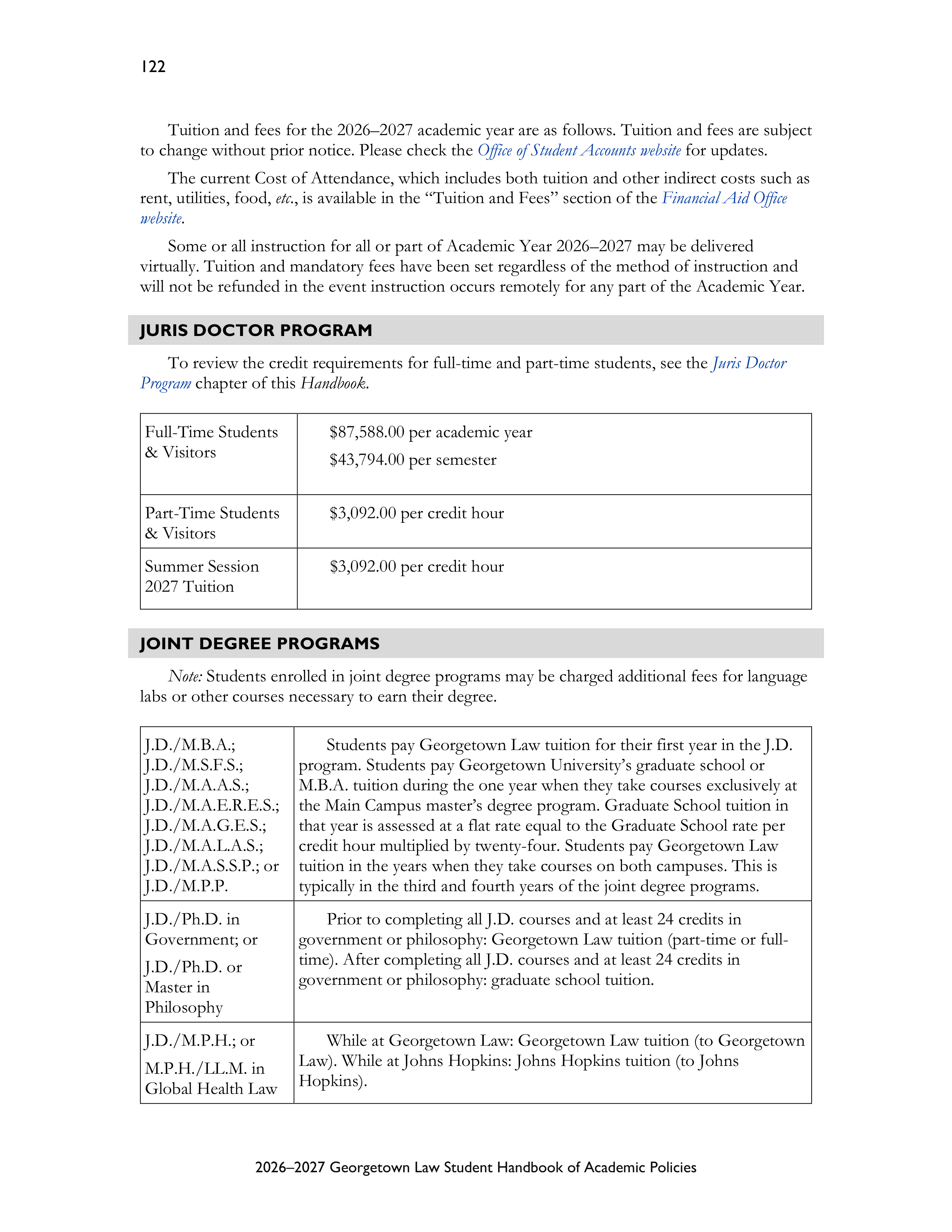
122
2026–2027 Georgetown Law Student Handbook of Academic Policies
Tuition and fees for the 2026–2027 academic year are as follows. Tuition and fees are subject
to change without prior notice. Please check the
Office of Student Accounts website
for updates.
The current Cost of Attendance, which includes both tuition and other indirect costs such as
rent, utilities, food,
etc
., is available in the “Tuition and Fees” section of the
Financial Aid Office
website
.
Some or all instruction for all or part of Academic Year 2026–2027 may be delivered
virtually. Tuition and mandatory fees have been set regardless of the method of instruction and
will not be refunded in the event instruction occurs remotely for any part of the Academic Year.
JURIS DOCTOR PROGRAM
To review the credit requirements for full-time and part-time students, see the
Juris Doctor
Program
chapter of this
Handbook
.
Full-Time Students
& Visitors
$87,588.00 per academic year
$43,794.00 per semester
Part-Time Students
& Visitors
$3,092.00 per credit hour
Summer Session
2027 Tuition
$3,092.00 per credit hour
JOINT DEGREE PROGRAMS
Note:
Students enrolled in joint degree programs may be charged additional fees for language
labs or other courses necessary to earn their degree.
J.D./M.B.A.;
J.D./M.S.F.S.;
J.D./M.A.A.S.;
J.D./M.A.E.R.E.S.;
J.D./M.A.G.E.S.;
J.D./M.A.L.A.S.;
J.D./M.A.S.S.P.; or
J.D./M.P.P.
Students pay Georgetown Law tuition for their first year in the J.D.
program. Students pay Georgetown University’s graduate school or
M.B.A. tuition during the one year when they take courses exclusively at
the Main Campus master’s degree program. Graduate School tuition in
that year is assessed at a flat rate equal to the Graduate School rate per
credit hour multiplied by twenty-four. Students pay Georgetown Law
tuition in the years when they take courses on both campuses. This is
typically in the third and fourth years of the joint degree programs.
J.D./Ph.D. in
Government; or
J.D./Ph.D. or
Master in
Philosophy
Prior to completing all J.D. courses and at least 24 credits in
government or philosophy: Georgetown Law tuition (part-time or full-
time). After completing all J.D. courses and at least 24 credits in
government or philosophy: graduate school tuition.
J.D./M.P.H.; or
M.P.H./LL.M. in
Global Health Law
While at Georgetown Law: Georgetown Law tuition (to Georgetown
Law). While at Johns Hopkins: Johns Hopkins tuition (to Johns
Hopkins).
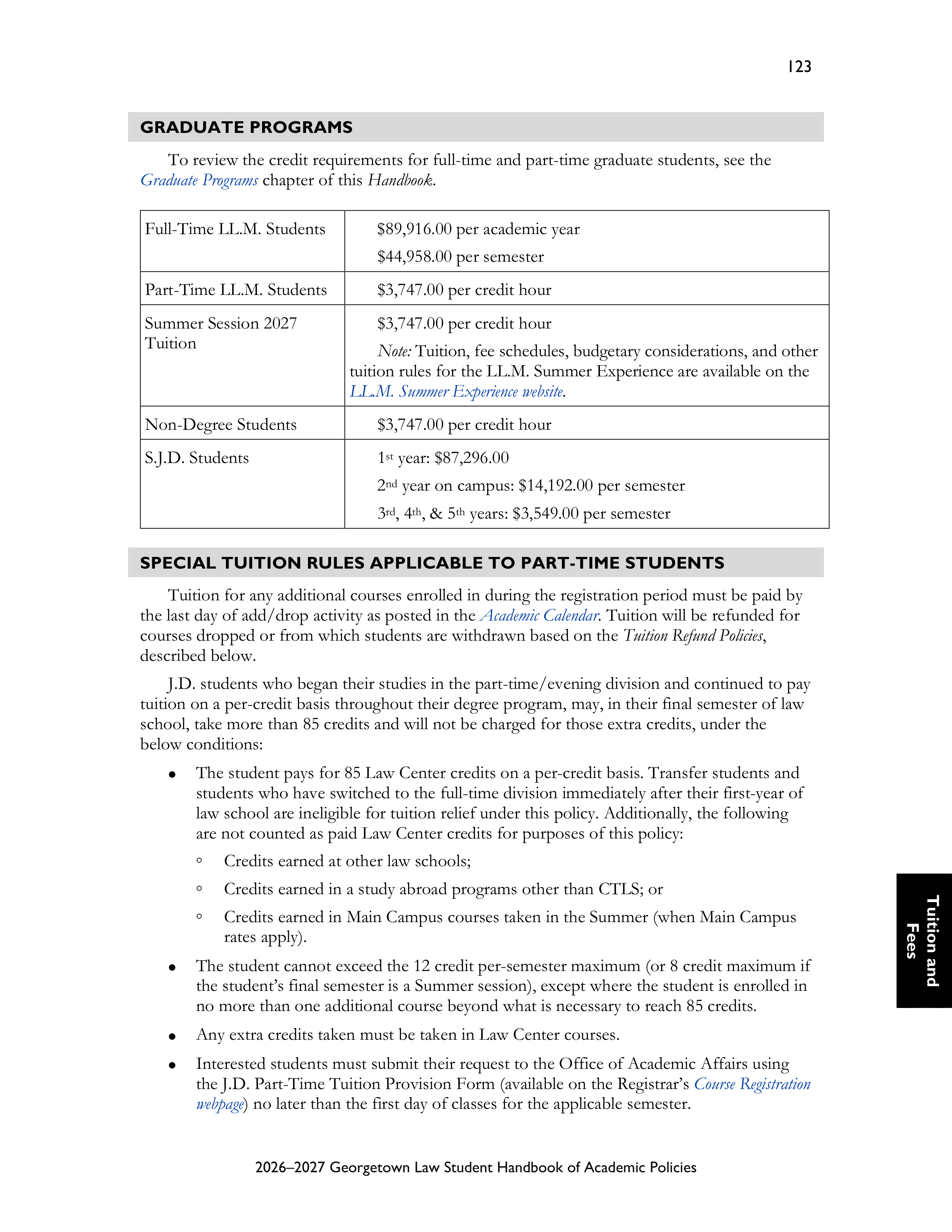
123
2026–2027 Georgetown Law Student Handbook of Academic Policies
Introduction
Juris Doctor
Program
Graduate
Programs
General Administrative
Policies
Conduct
Policies
Tuition and
Fees
Index
GRADUATE PROGRAMS
To review the credit requirements for full-time and part-time graduate students, see the
Graduate Programs
chapter of this
Handbook
.
Full-Time LL.M. Students
$89,916.00 per academic year
$44,958.00 per semester
Part-Time LL.M. Students
$3,747.00 per credit hour
Summer Session 2027
Tuition
$3,747.00 per credit hour
Note:
Tuition, fee schedules, budgetary considerations, and other
tuition rules for the LL.M. Summer Experience are available on the
LL.M. Summer Experience website
.
Non-Degree Students
$3,747.00 per credit hour
S.J.D. Students
1
st
year: $87,296.00
2
nd
year on campus: $14,192.00 per semester
3
rd
, 4
th
, & 5
th
years: $3,549.00 per semester
SPECIAL TUITION RULES APPLICABLE TO PART-TIME STUDENTS
Tuition for any additional courses enrolled in during the registration period must be paid by
the last day of add/drop activity as posted in the
Academic Calendar
. Tuition will be refunded for
courses dropped or from which students are withdrawn based on the
Tuition Refund Policies
,
described below.
J.D. students who began their studies in the part-time/evening division and continued to pay
tuition on a per-credit basis throughout their degree program, may, in their final semester of law
school, take more than 85 credits and will not be charged for those extra credits, under the
below conditions:
•
The student pays for 85 Law Center credits on a per-credit basis. Transfer students and
students who have switched to the full-time division immediately after their first-year of
law school are ineligible for tuition relief under this policy. Additionally, the following
are not counted as paid Law Center credits for purposes of this policy:
◦
Credits earned at other law schools;
◦
Credits earned in a study abroad programs other than CTLS; or
◦
Credits earned in Main Campus courses taken in the Summer (when Main Campus
rates apply).
•
The student cannot exceed the 12 credit per-semester maximum (or 8 credit maximum if
the student’s final semester is a Summer session), except where the student is enrolled in
no more than one additional course beyond what is necessary to reach 85 credits.
•
Any extra credits taken must be taken in Law Center courses.
•
Interested students must submit their request to the Office of Academic Affairs using
the J.D. Part-Time Tuition Provision Form (available on the Registrar’s
Course Registration
webpage
) no later than the first day of classes for the applicable semester.
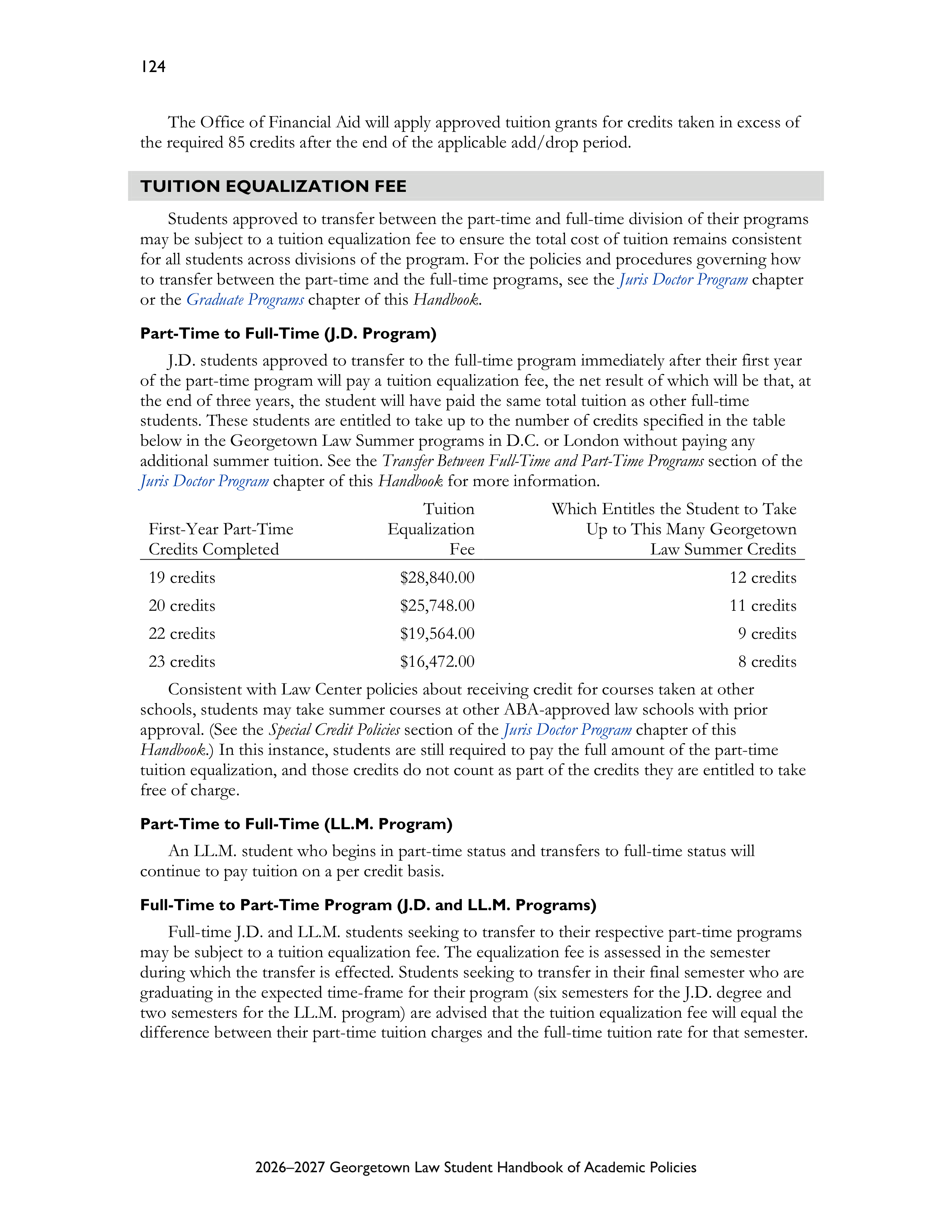
124
2026–2027 Georgetown Law Student Handbook of Academic Policies
The Office of Financial Aid will apply approved tuition grants for credits taken in excess of
the required 85 credits after the end of the applicable add/drop period.
TUITION EQUALIZATION FEE
Students approved to transfer between the part-time and full-time division of their programs
may be subject to a tuition equalization fee to ensure the total cost of tuition remains consistent
for all students across divisions of the program. For the policies and procedures governing how
to transfer between the part-time and the full-time programs, see the
Juris Doctor Program
chapter
or the
Graduate Programs
chapter of this
Handbook
.
Part-Time to Full-Time (J.D. Program)
J.D. students approved to transfer to the full-time program immediately after their first year
of the part-time program will pay a tuition equalization fee, the net result of which will be that, at
the end of three years, the student will have paid the same total tuition as other full-time
students. These students are entitled to take up to the number of credits specified in the table
below in the Georgetown Law Summer programs in D.C. or London without paying any
additional summer tuition. See the
Transfer Between Full-Time and Part-Time Programs
section of the
Juris Doctor Program
chapter of this
Handbook
for more information.
First-Year Part-Time
Credits Completed
Tuition
Equalization
Fee
Which Entitles the Student to Take
Up to This Many Georgetown
Law Summer Credits
19 credits
$28,840.00
12 credits
20 credits
$25,748.00
11 credits
22 credits
$19,564.00
9 credits
23 credits
$16,472.00
8 credits
Consistent with Law Center policies about receiving credit for courses taken at other
schools, students may take summer courses at other ABA-approved law schools with prior
approval. (See the
Special Credit Policies
section of the
Juris Doctor Program
chapter of this
Handbook
.) In this instance, students are still required to pay the full amount of the part-time
tuition equalization, and those credits do not count as part of the credits they are entitled to take
free of charge.
Part-Time to Full-Time (LL.M. Program)
An LL.M. student who begins in part-time status and transfers to full-time status will
continue to pay tuition on a per credit basis.
Full-Time to Part-Time Program (J.D. and LL.M. Programs)
Full-time J.D. and LL.M. students seeking to transfer to their respective part-time programs
may be subject to a tuition equalization fee. The equalization fee is assessed in the semester
during which the transfer is effected. Students seeking to transfer in their final semester who are
graduating in the expected time-frame for their program (six semesters for the J.D. degree and
two semesters for the LL.M. program) are advised that the tuition equalization fee will equal the
difference between their part-time tuition charges and the full-time tuition rate for that semester.
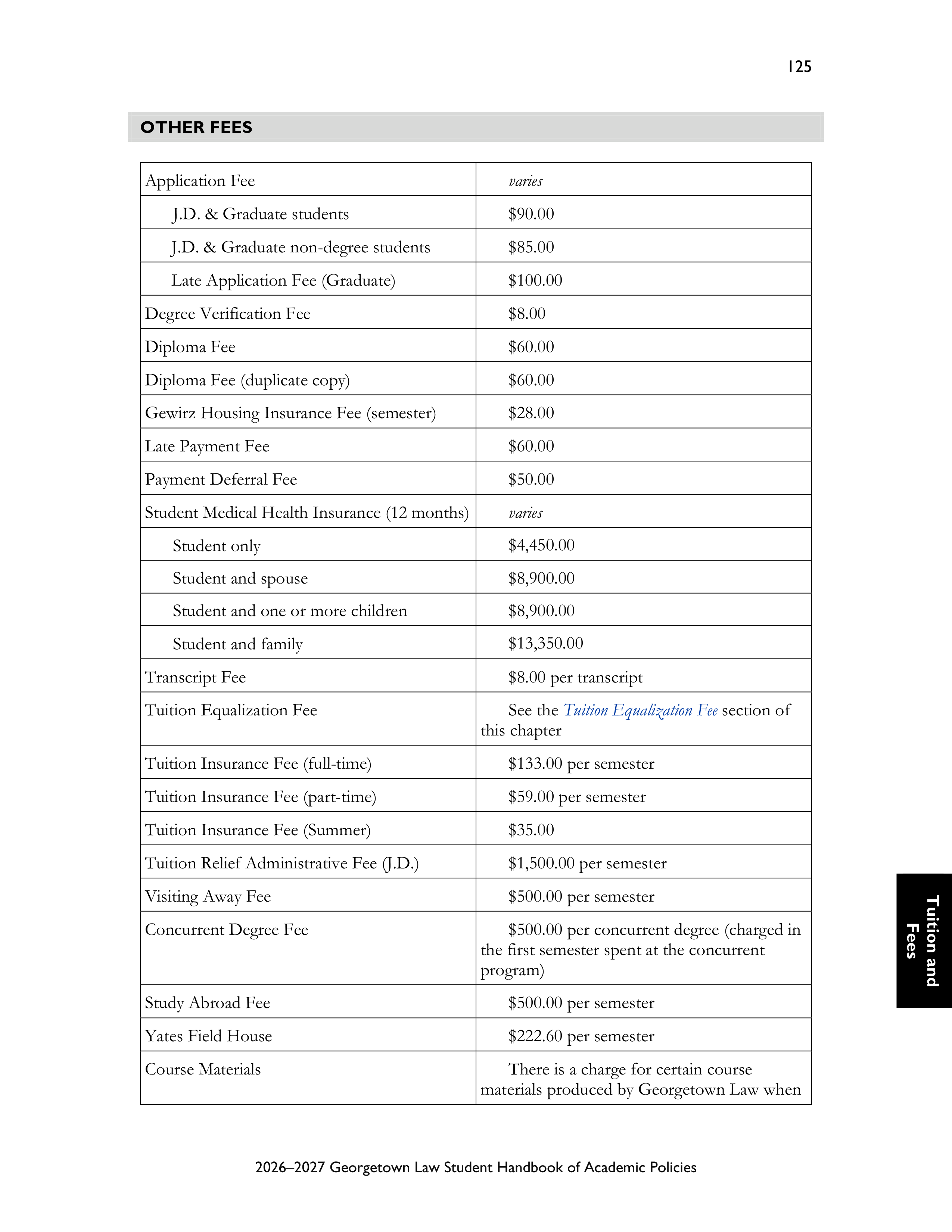
125
2026–2027 Georgetown Law Student Handbook of Academic Policies
Introduction
Juris Doctor
Program
Graduate
Programs
General Administrative
Policies
Conduct
Policies
Tuition and
Fees
Index
OTHER FEES
Application Fee
varies
J.D. & Graduate students
$90.00
J.D. & Graduate non-degree students
$85.00
Late Application Fee (Graduate)
$100.00
Degree Verification Fee
$8.00
Diploma Fee
$60.00
Diploma Fee (duplicate copy)
$60.00
Gewirz Housing Insurance Fee (semester)
$28.00
Late Payment Fee
$60.00
Payment Deferral Fee
$50.00
Student Medical Health Insurance (12 months)
varies
Student only
$4,450.00
Student and spouse
$8,900.00
Student and one or more children
$8,900.00
Student and family
$13,350.00
Transcript Fee
$8.00 per transcript
Tuition Equalization Fee
See the
Tuition Equalization Fee
section of
this chapter
Tuition Insurance Fee (full-time)
$133.00 per semester
Tuition Insurance Fee (part-time)
$59.00 per semester
Tuition Insurance Fee (Summer)
$35.00
Tuition Relief Administrative Fee (J.D.)
$1,500.00 per semester
Visiting Away Fee
$500.00 per semester
Concurrent Degree Fee
$500.00 per concurrent degree (charged in
the first semester spent at the concurrent
program)
Study Abroad Fee
$500.00 per semester
Yates Field House
$222.60 per semester
Course Materials
There is a charge for certain course
materials produced by Georgetown Law when
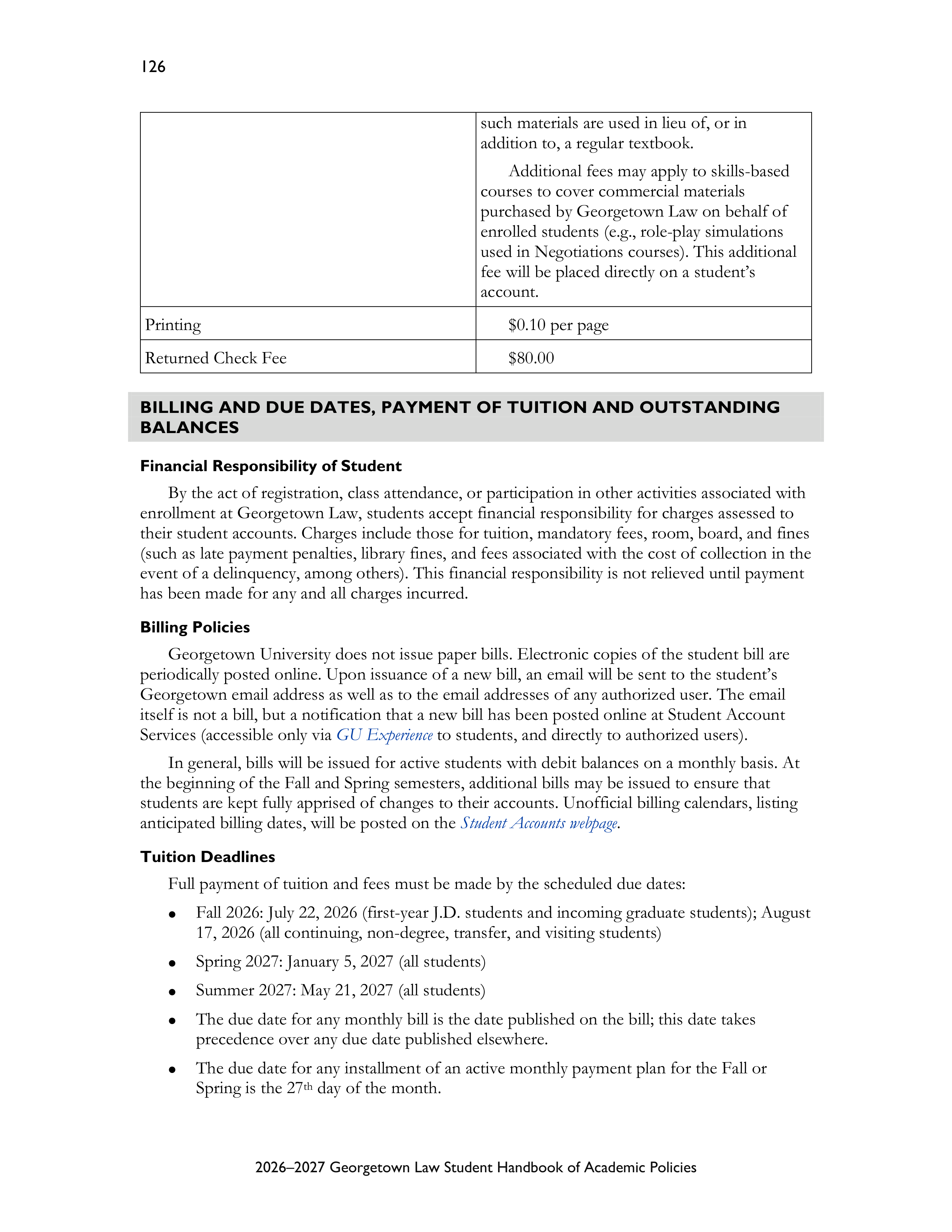
126
2026–2027 Georgetown Law Student Handbook of Academic Policies
such materials are used in lieu of, or in
addition to, a regular textbook.
Additional fees may apply to skills-based
courses to cover commercial materials
purchased by Georgetown Law on behalf of
enrolled students (e.g., role-play simulations
used in Negotiations courses). This additional
fee will be placed directly on a student’s
account.
Printing
$0.10 per page
Returned Check Fee
$80.00
BILLING AND DUE DATES, PAYMENT OF TUITION AND OUTSTANDING
BALANCES
Financial Responsibility of Student
By the act of registration, class attendance, or participation in other activities associated with
enrollment at Georgetown Law, students accept financial responsibility for charges assessed to
their student accounts. Charges include those for tuition, mandatory fees, room, board, and fines
(such as late payment penalties, library fines, and fees associated with the cost of collection in the
event of a delinquency, among others). This financial responsibility is not relieved until payment
has been made for any and all charges incurred.
Billing Policies
Georgetown University does not issue paper bills. Electronic copies of the student bill are
periodically posted online. Upon issuance of a new bill, an email will be sent to the student’s
Georgetown email address as well as to the email addresses of any authorized user. The email
itself is not a bill, but a notification that a new bill has been posted online at Student Account
Services (accessible only via
GU Experience
to students, and directly to authorized users).
In general, bills will be issued for active students with debit balances on a monthly basis. At
the beginning of the Fall and Spring semesters, additional bills may be issued to ensure that
students are kept fully apprised of changes to their accounts. Unofficial billing calendars, listing
anticipated billing dates, will be posted on the
Student Accounts webpage
.
Tuition Deadlines
Full payment of tuition and fees must be made by the scheduled due dates:
•
Fall 2026: July 22, 2026 (first-year J.D. students and incoming graduate students); August
17, 2026 (all continuing, non-degree, transfer, and visiting students)
•
Spring 2027: January 5, 2027 (all students)
•
Summer 2027: May 21, 2027 (all students)
•
The due date for any monthly bill is the date published on the bill; this date takes
precedence over any due date published elsewhere.
•
The due date for any installment of an active monthly payment plan for the Fall or
Spring is the 27
th
day of the month.
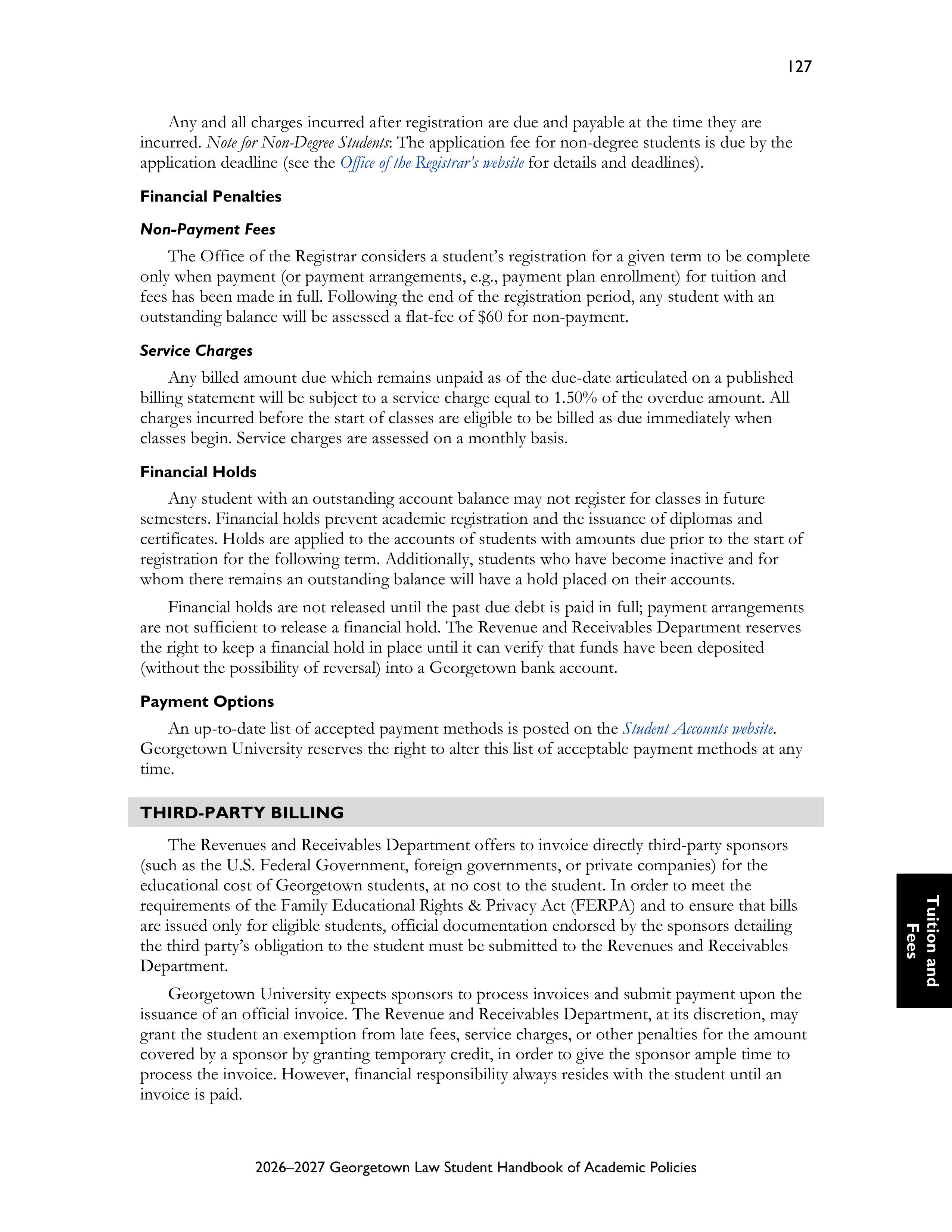
127
2026–2027 Georgetown Law Student Handbook of Academic Policies
Introduction
Juris Doctor
Program
Graduate
Programs
General Administrative
Policies
Conduct
Policies
Tuition and
Fees
Index
Any and all charges incurred after registration are due and payable at the time they are
incurred.
Note for Non-Degree Students
: The application fee for non-degree students is due by the
application deadline (see the
Office of the Registrar’s website
for details and deadlines).
Financial Penalties
Non-Payment Fees
The Office of the Registrar considers a student’s registration for a given term to be complete
only when payment (or payment arrangements, e.g., payment plan enrollment) for tuition and
fees has been made in full. Following the end of the registration period, any student with an
outstanding balance will be assessed a flat-fee of $60 for non-payment.
Service Charges
Any billed amount due which remains unpaid as of the due-date articulated on a published
billing statement will be subject to a service charge equal to 1.50% of the overdue amount. All
charges incurred before the start of classes are eligible to be billed as due immediately when
classes begin. Service charges are assessed on a monthly basis.
Financial Holds
Any student with an outstanding account balance may not register for classes in future
semesters. Financial holds prevent academic registration and the issuance of diplomas and
certificates. Holds are applied to the accounts of students with amounts due prior to the start of
registration for the following term. Additionally, students who have become inactive and for
whom there remains an outstanding balance will have a hold placed on their accounts.
Financial holds are not released until the past due debt is paid in full; payment arrangements
are not sufficient to release a financial hold. The Revenue and Receivables Department reserves
the right to keep a financial hold in place until it can verify that funds have been deposited
(without the possibility of reversal) into a Georgetown bank account.
Payment Options
An up-to-date list of accepted payment methods is posted on the
Student Accounts website
.
Georgetown University reserves the right to alter this list of acceptable payment methods at any
time.
THIRD-PARTY BILLING
The Revenues and Receivables Department offers to invoice directly third-party sponsors
(such as the U.S. Federal Government, foreign governments, or private companies) for the
educational cost of Georgetown students, at no cost to the student. In order to meet the
requirements of the Family Educational Rights & Privacy Act (FERPA) and to ensure that bills
are issued only for eligible students, official documentation endorsed by the sponsors detailing
the third party’s obligation to the student must be submitted to the Revenues and Receivables
Department.
Georgetown University expects sponsors to process invoices and submit payment upon the
issuance of an official invoice. The Revenue and Receivables Department, at its discretion, may
grant the student an exemption from late fees, service charges, or other penalties for the amount
covered by a sponsor by granting temporary credit, in order to give the sponsor ample time to
process the invoice. However, financial responsibility always resides with the student until an
invoice is paid.
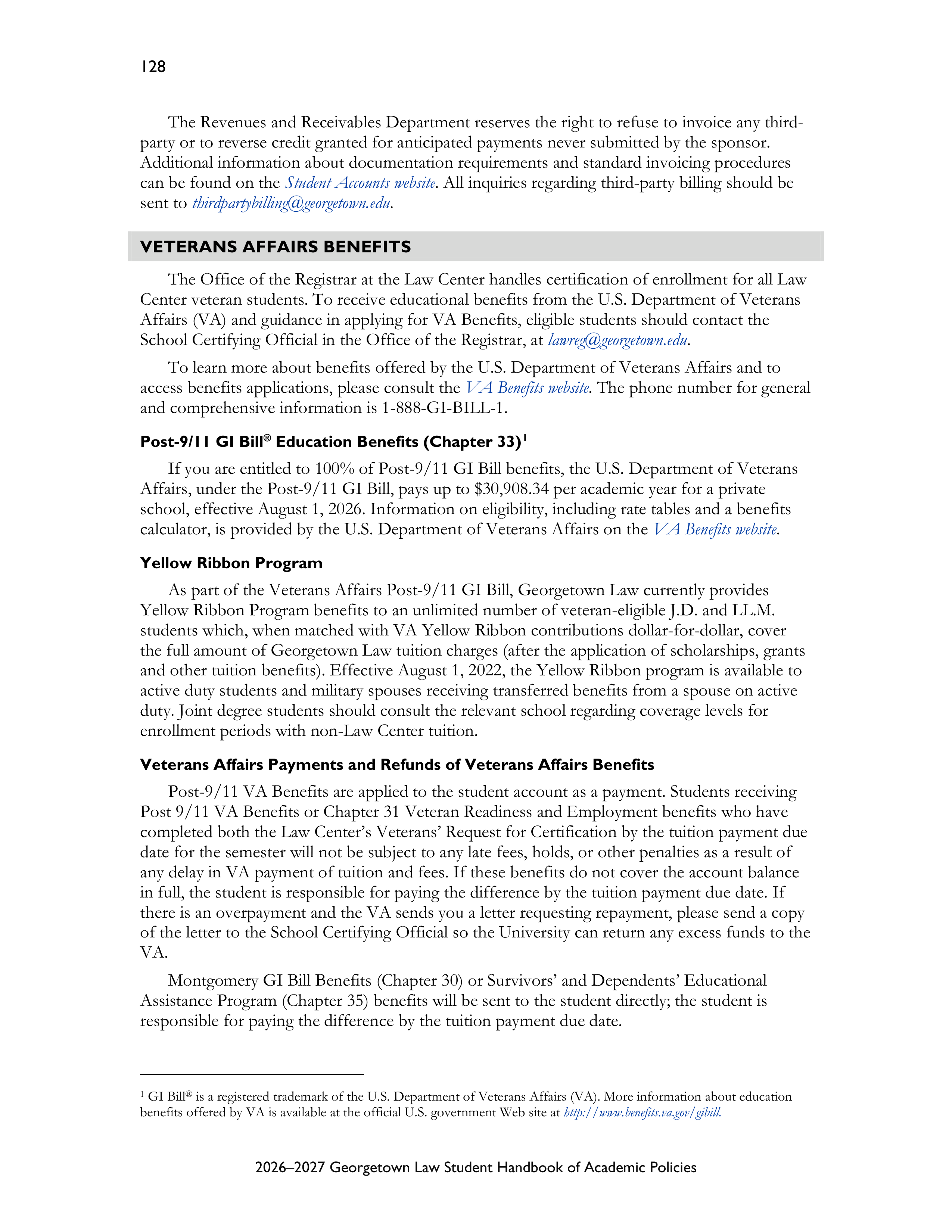
128
2026–2027 Georgetown Law Student Handbook of Academic Policies
The Revenues and Receivables Department reserves the right to refuse to invoice any third-
party or to reverse credit granted for anticipated payments never submitted by the sponsor.
Additional information about documentation requirements and standard invoicing procedures
can be found on the
Student Accounts website
. All inquiries regarding third-party billing should be
sent to
thirdpartybilling@georgetown.edu
.
VETERANS AFFAIRS BENEFITS
The Office of the Registrar at the Law Center handles certification of enrollment for all Law
Center veteran students. To receive educational benefits from the U.S. Department of Veterans
Affairs (VA) and guidance in applying for VA Benefits, eligible students should contact the
School Certifying Official in the Office of the Registrar, at
lawreg@georgetown.edu
.
To learn more about benefits offered by the U.S. Department of Veterans Affairs and to
access benefits applications, please consult the
VA Benefits website
. The phone number for general
and comprehensive information is 1-888-GI-BILL-1.
Post-9/11 GI Bill
®
Education Benefits (Chapter 33)
1
If you are entitled to 100% of Post-9/11 GI Bill benefits, the U.S. Department of Veterans
Affairs, under the Post-9/11 GI Bill, pays up to $30,908.34 per academic year for a private
school, effective August 1, 2026. Information on eligibility, including rate tables and a benefits
calculator, is provided by the U.S. Department of Veterans Affairs on the
VA Benefits website
.
Yellow Ribbon Program
As part of the Veterans Affairs Post-9/11 GI Bill, Georgetown Law currently provides
Yellow Ribbon Program benefits to an unlimited number of veteran-eligible J.D. and LL.M.
students which, when matched with VA Yellow Ribbon contributions dollar-for-dollar, cover
the full amount of Georgetown Law tuition charges (after the application of scholarships, grants
and other tuition benefits). Effective August 1, 2022, the Yellow Ribbon program is available to
active duty students and military spouses receiving transferred benefits from a spouse on active
duty. Joint degree students should consult the relevant school regarding coverage levels for
enrollment periods with non-Law Center tuition.
Veterans Affairs Payments and Refunds of Veterans Affairs Benefits
Post-9/11 VA Benefits are applied to the student account as a payment. Students receiving
Post 9/11 VA Benefits or Chapter 31 Veteran Readiness and Employment benefits who have
completed both the Law Center’s Veterans’ Request for Certification by the tuition payment due
date for the semester will not be subject to any late fees, holds, or other penalties as a result of
any delay in VA payment of tuition and fees. If these benefits do not cover the account balance
in full, the student is responsible for paying the difference by the tuition payment due date. If
there is an overpayment and the VA sends you a letter requesting repayment, please send a copy
of the letter to the School Certifying Official so the University can return any excess funds to the
VA.
Montgomery GI Bill Benefits (Chapter 30) or Survivors’ and Dependents’ Educational
Assistance Program (Chapter 35) benefits will be sent to the student directly; the student is
responsible for paying the difference by the tuition payment due date.
1
GI Bill
®
is a registered trademark of the U.S. Department of Veterans Affairs (VA). More information about education
benefits offered by VA is available at the official U.S. government Web site at
http://www.benefits.va.gov/gibill.
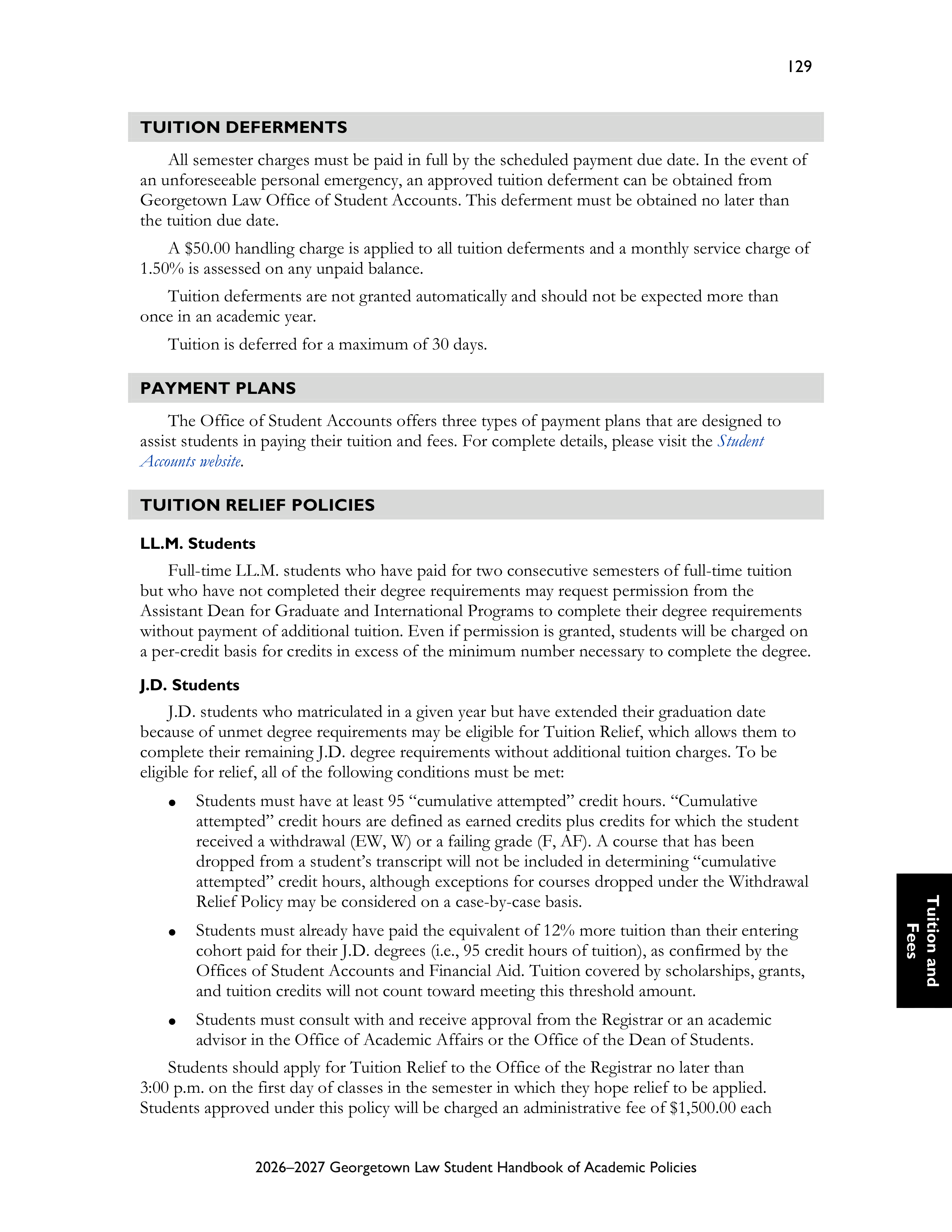
129
2026–2027 Georgetown Law Student Handbook of Academic Policies
Introduction
Juris Doctor
Program
Graduate
Programs
General Administrative
Policies
Conduct
Policies
Tuition and
Fees
Index
TUITION DEFERMENTS
All semester charges must be paid in full by the scheduled payment due date. In the event of
an unforeseeable personal emergency, an approved tuition deferment can be obtained from
Georgetown Law Office of Student Accounts. This deferment must be obtained no later than
the tuition due date.
A $50.00 handling charge is applied to all tuition deferments and a monthly service charge of
1.50% is assessed on any unpaid balance.
Tuition deferments are not granted automatically and should not be expected more than
once in an academic year.
Tuition is deferred for a maximum of 30 days.
PAYMENT PLANS
The Office of Student Accounts offers three types of payment plans that are designed to
assist students in paying their tuition and fees. For complete details, please visit the
Student
Accounts website
.
TUITION RELIEF POLICIES
LL.M. Students
Full-time LL.M. students who have paid for two consecutive semesters of full-time tuition
but who have not completed their degree requirements may request permission from the
Assistant Dean for Graduate and International Programs to complete their degree requirements
without payment of additional tuition. Even if permission is granted, students will be charged on
a per-credit basis for credits in excess of the minimum number necessary to complete the degree.
J.D. Students
J.D. students who matriculated in a given year but have extended their graduation date
because of unmet degree requirements may be eligible for Tuition Relief, which allows them to
complete their remaining J.D. degree requirements without additional tuition charges. To be
eligible for relief, all of the following conditions must be met:
•
Students must have at least 95 “cumulative attempted” credit hours. “Cumulative
attempted” credit hours are defined as earned credits plus credits for which the student
received a withdrawal (EW, W) or a failing grade (F, AF). A course that has been
dropped from a student’s transcript will not be included in determining “cumulative
attempted” credit hours, although exceptions for courses dropped under the Withdrawal
Relief Policy may be considered on a case-by-case basis.
•
Students must already have paid the equivalent of 12% more tuition than their entering
cohort paid for their J.D. degrees (i.e., 95 credit hours of tuition), as confirmed by the
Offices of Student Accounts and Financial Aid. Tuition covered by scholarships, grants,
and tuition credits will not count toward meeting this threshold amount.
•
Students must consult with and receive approval from the Registrar or an academic
advisor in the Office of Academic Affairs or the Office of the Dean of Students.
Students should apply for Tuition Relief to the Office of the Registrar no later than
3:00 p.m. on the first day of classes in the semester in which they hope relief to be applied.
Students approved under this policy will be charged an administrative fee of $1,500.00 each
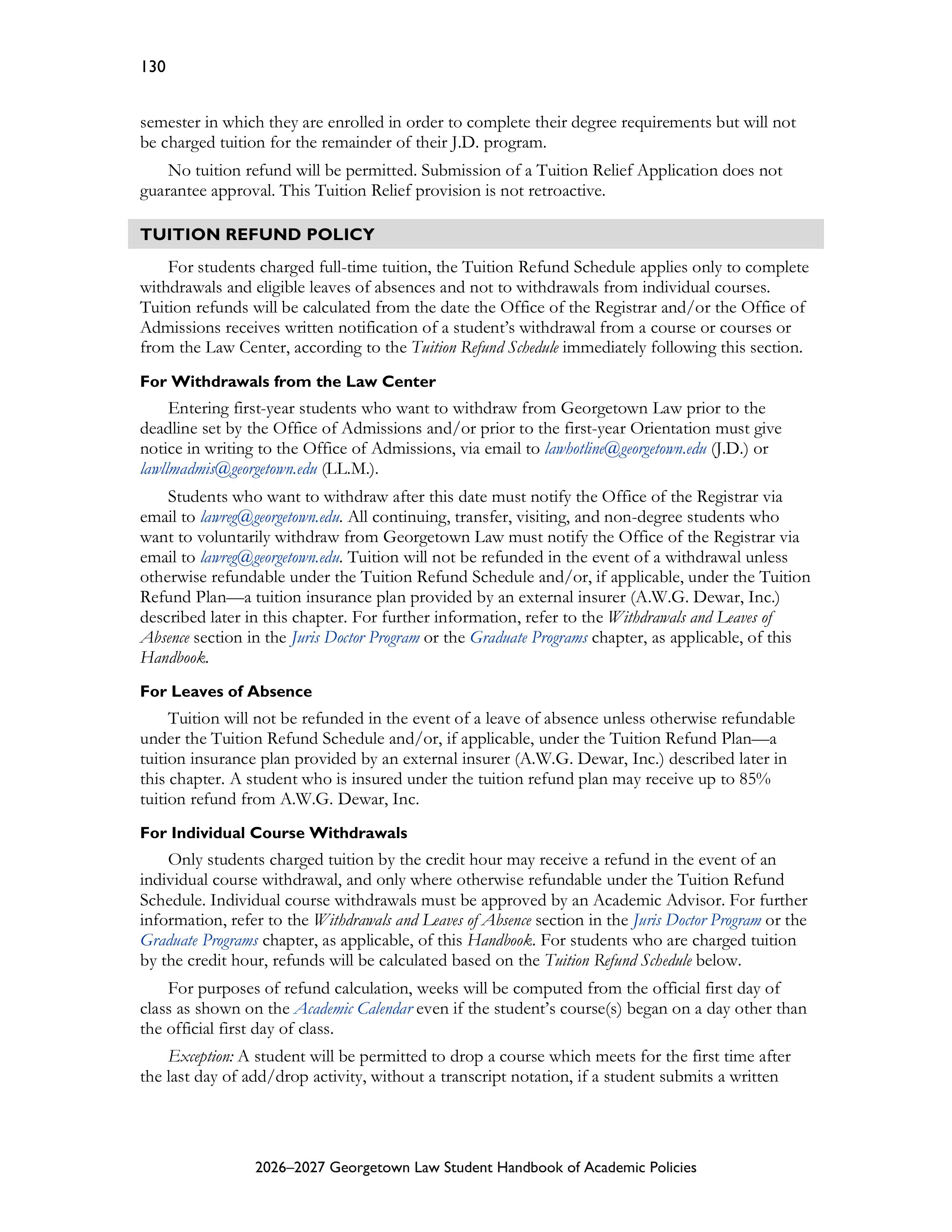
130
2026–2027 Georgetown Law Student Handbook of Academic Policies
semester in which they are enrolled in order to complete their degree requirements but will not
be charged tuition for the remainder of their J.D. program.
No tuition refund will be permitted. Submission of a Tuition Relief Application does not
guarantee approval. This Tuition Relief provision is not retroactive.
TUITION REFUND POLICY
For students charged full-time tuition, the Tuition Refund Schedule applies only to complete
withdrawals and eligible leaves of absences and not to withdrawals from individual courses.
Tuition refunds will be calculated from the date the Office of the Registrar and/or the Office of
Admissions receives written notification of a student’s withdrawal from a course or courses or
from the Law Center, according to the
Tuition Refund Schedule
immediately following this section.
For Withdrawals from the Law Center
Entering first-year students who want to withdraw from Georgetown Law prior to the
deadline set by the Office of Admissions and/or prior to the first-year Orientation must give
notice in writing to the Office of Admissions, via email to
lawhotline@georgetown.edu
(J.D.) or
lawllmadmis@georgetown.edu
(LL.M.).
Students who want to withdraw after this date must notify the Office of the Registrar via
email to
lawreg@georgetown.edu
. All continuing, transfer, visiting, and non-degree students who
want to voluntarily withdraw from Georgetown Law must notify the Office of the Registrar via
email to
lawreg@georgetown.edu
. Tuition will not be refunded in the event of a withdrawal unless
otherwise refundable under the Tuition Refund Schedule and/or, if applicable, under the Tuition
Refund Plan—a tuition insurance plan provided by an external insurer (A.W.G. Dewar, Inc.)
described later in this chapter. For further information, refer to the
Withdrawals and Leaves of
Absence
section in the
Juris Doctor Program
or the
Graduate Programs
chapter, as applicable, of this
Handbook.
For Leaves of Absence
Tuition will not be refunded in the event of a leave of absence unless otherwise refundable
under the Tuition Refund Schedule and/or, if applicable, under the Tuition Refund Plan—a
tuition insurance plan provided by an external insurer (A.W.G. Dewar, Inc.) described later in
this chapter. A student who is insured under the tuition refund plan may receive up to 85%
tuition refund from A.W.G. Dewar, Inc.
For Individual Course Withdrawals
Only students charged tuition by the credit hour may receive a refund in the event of an
individual course withdrawal, and only where otherwise refundable under the Tuition Refund
Schedule. Individual course withdrawals must be approved by an Academic Advisor. For further
information, refer to the
Withdrawals and Leaves of Absence
section in the
Juris Doctor Program
or the
Graduate Programs
chapter, as applicable, of this
Handbook
. For students who are charged tuition
by the credit hour, refunds will be calculated based on the
Tuition Refund Schedule
below.
For purposes of refund calculation, weeks will be computed from the official first day of
class as shown on the
Academic Calendar
even if the student’s course(s) began on a day other than
the official first day of class.
Exception:
A student will be permitted to drop a course which meets for the first time after
the last day of add/drop activity, without a transcript notation, if a student submits a written
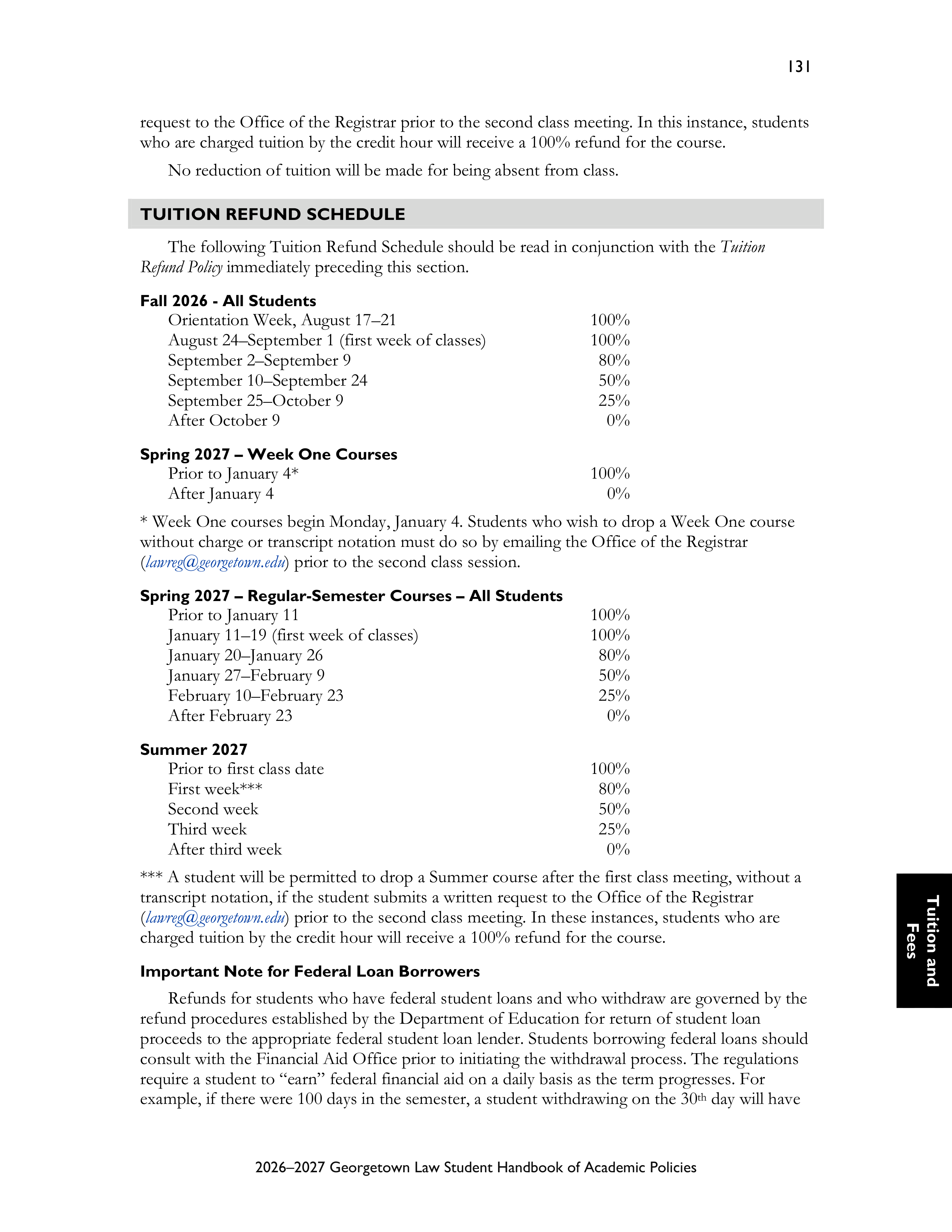
131
2026–2027 Georgetown Law Student Handbook of Academic Policies
Introduction
Juris Doctor
Program
Graduate
Programs
General Administrative
Policies
Conduct
Policies
Tuition and
Fees
Index
request to the Office of the Registrar prior to the second class meeting. In this instance, students
who are charged tuition by the credit hour will receive a 100% refund for the course.
No reduction of tuition will be made for being absent from class.
TUITION REFUND SCHEDULE
The following Tuition Refund Schedule should be read in conjunction with the
Tuition
Refund Policy
immediately preceding this section.
Fall 2026 - All Students
Orientation Week, August 17–21
100%
August 24–September 1 (first week of classes)
100%
September 2–September 9
80%
September 10–September 24
50%
September 25–October 9
25%
After October 9
0%
Spring 2027 – Week One Courses
Prior to January 4*
100%
After January 4
0%
* Week One courses begin Monday, January 4. Students who wish to drop a Week One course
without charge or transcript notation must do so by emailing the Office of the Registrar
(
lawreg@georgetown.edu
) prior to the second class session.
Spring 2027 – Regular-Semester Courses – All Students
Prior to January 11
100%
January 11–19 (first week of classes)
100%
January 20–January 26
80%
January 27–February 9
50%
February 10–February 23
25%
After February 23
0%
Summer 2027
Prior to first class date
100%
First week***
80%
Second week
50%
Third week
25%
After third week
0%
*** A student will be permitted to drop a Summer course after the first class meeting, without a
transcript notation, if the student submits a written request to the Office of the Registrar
(
lawreg@georgetown.edu
) prior to the second class meeting. In these instances, students who are
charged tuition by the credit hour will receive a 100% refund for the course.
Important Note for Federal Loan Borrowers
Refunds for students who have federal student loans and who withdraw are governed by the
refund procedures established by the Department of Education for return of student loan
proceeds to the appropriate federal student loan lender. Students borrowing federal loans should
consult with the Financial Aid Office prior to initiating the withdrawal process. The regulations
require a student to “earn” federal financial aid on a daily basis as the term progresses. For
example, if there were 100 days in the semester, a student withdrawing on the 30
th
day will have
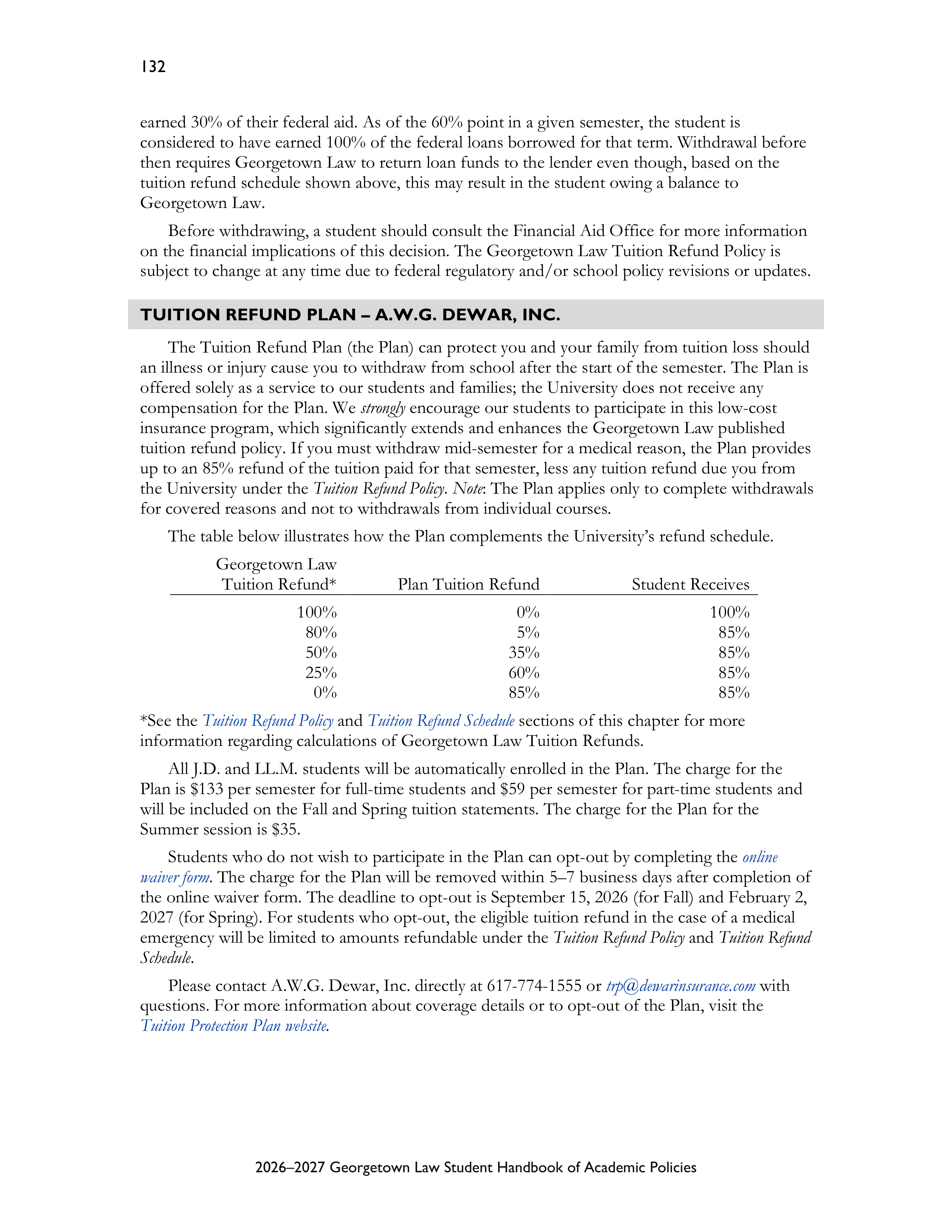
132
2026–2027 Georgetown Law Student Handbook of Academic Policies
earned 30% of their federal aid. As of the 60% point in a given semester, the student is
considered to have earned 100% of the federal loans borrowed for that term. Withdrawal before
then requires Georgetown Law to return loan funds to the lender even though, based on the
tuition refund schedule shown above, this may result in the student owing a balance to
Georgetown Law.
Before withdrawing, a student should consult the Financial Aid Office for more information
on the financial implications of this decision. The Georgetown Law Tuition Refund Policy is
subject to change at any time due to federal regulatory and/or school policy revisions or updates.
TUITION REFUND PLAN – A.W.G. DEWAR, INC.
The Tuition Refund Plan (the Plan) can protect you and your family from tuition loss should
an illness or injury cause you to withdraw from school after the start of the semester. The Plan is
offered solely as a service to our students and families; the University does not receive any
compensation for the Plan. We
strongly
encourage our students to participate in this low-cost
insurance program, which significantly extends and enhances the Georgetown Law published
tuition refund policy. If you must withdraw mid-semester for a medical reason, the Plan provides
up to an 85% refund of the tuition paid for that semester, less any tuition refund due you from
the University under the
Tuition Refund Policy
.
Note
: The Plan applies only to complete withdrawals
for covered reasons and not to withdrawals from individual courses.
The table below illustrates how the Plan complements the University’s refund schedule.
Georgetown Law
Tuition Refund*
Plan Tuition Refund
Student Receives
100%
0%
100%
80%
5%
85%
50%
35%
85%
25%
60%
85%
0%
85%
85%
*See the
Tuition Refund Policy
and
Tuition Refund Schedule
sections of this chapter for more
information regarding calculations of Georgetown Law Tuition Refunds.
All J.D. and LL.M. students will be automatically enrolled in the Plan. The charge for the
Plan is $133 per semester for full-time students and $59 per semester for part-time students and
will be included on the Fall and Spring tuition statements. The charge for the Plan for the
Summer session is $35.
Students who do not wish to participate in the Plan can opt-out by completing the
online
waiver form
. The charge for the Plan will be removed within 5–7 business days after completion of
the online waiver form. The deadline to opt-out is September 15, 2026 (for Fall) and February 2,
2027 (for Spring). For students who opt-out, the eligible tuition refund in the case of a medical
emergency will be limited to amounts refundable under the
Tuition Refund Policy
and
Tuition Refund
Schedule
.
Please contact A.W.G. Dewar, Inc. directly at 617-774-1555 or
trp@dewarinsurance.com
with
questions. For more information about coverage details or to opt-out of the Plan, visit the
Tuition Protection Plan website
.
133
2026–2027 Georgetown Law Student Handbook of Academic Policies
Introduction
Juris Doctor
Program
Graduate
Programs
General Administrative
Policies
Conduct
Policies
Tuition and
Fees
Index
REFUNDS OF EXCESS FINANCIAL AID AND OVERPAYMENTS
The Revenue and Receivables Department generally requires a student’s request in order for
a refund to be generated; students may request a refund whenever total payments to their
account exceed total charges. Requests may be submitted online via
GU Experience
. The Revenue
and Receivables Department will automatically issue refunds in two circumstances: when
payments for a particular semester from Title IV sources exceed institutional charges (as required
by federal law and regulations); and when the student has become inactive while retaining a
credit balance.
The Revenue and Receivables Department processes refund requests within three business
days of submission. Additional processing time for the generation and mailing of a refund check,
or for the execution of an electronic transfer of funds, is outside the control of the Revenue and
Receivables Department.
The Revenue and Receivables Department reserves the right to hold or deny a refund
request when there is the possibility that the charges on the student account were not properly
assessed, or when payments are subject to adjustment. If for any reason a refund request is not
approved, an email will be sent to the student indicating the reason and the contact person with
whom the student should discuss the matter.
If the student has established an electronic refund profile, refunds will be deposited to the
account indicated via ACH (Automated Clearing House) transaction. If the account information
is inaccurate, or if the account has been closed, the student will be notified via email of the failed
transaction. For students who have not established an electronic refund profile, refunds will be
issued via paper check and mailed to the student’s local address, if one is on file, otherwise to the
permanent address on file.
In compliance with the Family Educational Rights & Privacy Act (FERPA), all refund payments
are made directly to students. The only exceptions are in certain cases of payments submitted by
third party sponsors or outside scholarship organizations, Parent PLUS loans, and rare
extenuating circumstances as defined by Georgetown University. Students who receive a refund
to which they are not entitled must pay back any outstanding balance that results to the student
account immediately to prevent penalties.
EMERGENCY LOANS
Enrolled students may apply for an emergency loan with the Georgetown Law Office of
Student Accounts. Approval is entirely at the discretion of the Office of Student Accounts
and/or the Office of Financial Aid. The amount of any approved loan is charged to the student
account and must be repaid in full within 30 days to avoid a service charge and a financial hold.
INACTIVE STUDENTS AND COLLECTION PROCEDURES
Debt to the University is immediately due at the time a student becomes inactive. The reason
for the inactivity is immaterial, whether it be graduation or completion of an academic program,
withdrawal, an approved leave of absence, failure to register for the next semester in the
student’s academic program, or any other reason.
The Revenue and Receivables Department will issue a final invoice to inactive students with
debt. Payment is due within 30 days of the date the statement was issued. If payment has not
been made by the due date, the account will be forwarded to a collection agency. The cost to the
University for the use of the services of a third-party collection agency is equivalent to one third
134
2026–2027 Georgetown Law Student Handbook of Academic Policies
of the value of the debt; the student will be responsible for paying this fee in addition to the
original outstanding balance. Once debt has been referred to a collection agency, all payments
will be processed by that agency. In addition, the collection agency may report the debt to the
nation’s three credit reporting agencies.
Past due balances are non-negotiable and will not be recalled from the collection agency
once submitted.
APPENDIX: STATE-SPECIFIC INFORMATION FOR ONLINE DEGREE AND
CERTIFICATE PROGRAMS
Georgetown University Law Center is a member of the State Authorization Reciprocity
Agreement (SARA), which allows online programs that demonstrate compliance with their home
state’s authorization requirements to enjoy reciprocal authorization in all other SARA states,
which include D.C., Puerto Rico, and all U.S. states except California. Georgetown is also
authorized separately to deliver online education to students residing in California. For more
information on state authorization, including state complaint processes and refund policies the
University is required to comply with, please visit Georgetown University’s Office of
Compliance and Ethics webpage.
For more information on SARA, please visit the SARA website.
Disclosure Regarding Professional Licensure for Online Programs
The Law Center’s online programs, which include the LL.M. in Taxation (Online) and the
Master of Laws in Taxation, will not lead to professional licensure and will not qualify a student
to sit for any state bar examination.
135
2026–2027 Georgetown Law Student Handbook of Academic Policies
SEARCH TERMS AND ACRONYMS
When searching the PDF of this
Handbook
, note that academic degrees contain periods when
abbreviated (i.e., to find information on JD/LLM joint degrees, search for “J.D./LL.M.”).
ABA
........................................................................................................................................... American Bar Association
academic honesty
search for
................................................................................................... Student Disciplinary Code
academic honors and distinction
search for
....................................................................................... academic honors
academic performance
........................................................................................................................ academic attrition
accommodations
search for
............................................................................................................. Accessibility Services
AF
.......................................................................................................................................................... Administrative Fail
anonymous grading policy
search for
................................................................... examinations, exam deferral policy
AP
......................................................................................................................................................... Administrative Pass
AU
.............................................................................................................................................. Audit (transcript notation)
auditing courses
also
search for
..................................................................................................... non-degree enrollment
CAPS
.......................................................................................................................... Counseling and Psychiatric Service
changing programs
Graduate students search for
.................................... transfer between LL.M. degree programs, tuition equalization
J.D. students search for
............................................................. transferring between programs, tuition equalization
class rank
search for
.................................................................................................................................. academic honors
class standing
search for
.......................................................................................................................... academic honors
confidentiality
also
search for
...................................................................................................................... student records
counseling
also search for
........................................................................................................................................ advising
cross-registration at other schools and departments
.................................... Georgetown University, courses in
the undergraduate and graduate schools
CTLS
................................................................................................................... Center for Transnational Legal Studies
curriculum, required
search for
........................................................................................................ degree requirements
degree and program requirements
search for
.............................................................................. degree requirements
DOE
.......................................................................................................................................... Department of Education
disability
search for
............................................................................................................................ Accessibility Services
disciplinary matters
search for
............................................................................................... Student Disciplinary Code
dual degrees
search for
................................................................................. concurrent degrees, joint degree programs
ECTS
................................................................................................. European Credit Transfer Accumulation System
emergencies
search for
..................................................................................................................... Emergency Numbers
FERPA
........................................................................................................ Family Educational Rights and Privacy Act
foreign students
search for
.............................................................................................................. international students
GPA
....................................................................................................................................................... grade point average
grading, system for
also search for
................................................ pass/fail option, grade review and change policies
graduating early
J.D. students
search for
................................................................................................. program length
grievance
also search for
.........................................................................................................................student complaints
HIPAA
......................................................................................... Health Insurance Portability and Accountability Act
holds (financial)
search for
............................................................. outstanding account balance, outstanding balance
honor code
search for
............................................................................................................... Student Disciplinary Code
IBEL
............................................................................................................. International Business and Economic Law
IIEL
................................................................................................................. Institute of International Economic Law
independent research
Graduate students search for
......................................................................................... graduate independent research
J.D. students search for
..................................................................................................................... supervised research
interdisciplinary study
J.D. students search for
......................................... concurrent degrees, joint degree programs
internship for credit
search for
.......................................................................................... externship, practicum course
JD program requirements
search for
..................................................................... Juris Doctor Degree Requirements
job
search for
........................................................................................................................ conduct policies, employment
joint degrees
also search for
.................................................................................................................. concurrent degrees
late take-homes
search for
................................................................................................... exam, examination,
§
402(c)
main campus courses
............................................................................................ Georgetown University, courses in
the undergraduate and graduate schools
136
2026–2027 Georgetown Law Student Handbook of Academic Policies
OCS
............................................................................................................................................. Office of Career Strategy
ODOS
.............................................................................................................................. Office of the Dean of Students
OGC
....................................................................................................................................... Office of Graduate Careers
OPICS
............................................................................................... Office of Public Interest and Community Service
outside work experience
search for
.................................................................................. externship, practicum course
overloading
J.D. students
search for
.................................................................................................credit minimum and maximum
papers
search for
............................................................................................................................................... written work
part-time jobs
search for
.................................................................................................................... student employment
penalties for late papers and examinations
search for
....................................... written work, examinations,
§
402
probation
................................................................................................................................................ academic attrition
repeating courses
Graduate students search for
......................................................................................... duplication of courses, grading
J.D. students search for
............................................................................................academic attrition, grading system
residency
search for
...................................................................................................................................... program length
summer courses
Graduate students search for
.......................................................................................................... limitations on credits
J.D. students search for
............................................................................................................. credit for summer study
student conduct
search for
....................................................................................................................... conduct policies
study outside
search for
.................................................................. credit for study outside the Law Center, credit for
summer study, visiting at another law school
supervised research
Graduate students search for
......................................................................................... graduate independent research
J.D. students search for
..................................................................................................................... supervised research
taking courses at another law school
search for
....................... credit for study outside the Law Center, credit for
summer study, visiting at another law school
thesis
J.D. students
search for
.................................................................................................................... writing requirement
S.J.D. students
search for
................................................................................................................................ dissertation
time off
search for
....................................................................................................................................... leave of absence
TOEFL
............................................................................................................... Test of English as a Foreign Language
TRP
............................................................................................................. Tuition Refund Plan – A.W.G. Dewar, Inc.
underloading
J.D. students search for
........................................................................................................................... credit minimum
working while a student
search for
................................................................................................. student employment
WTO
........................................................................................................................................ World Trade Organization
Georgetown Law is accredited by the American Bar Association and is a member of the
Association of American Law Schools. (Council of the Section of Legal Education and Admissions
to the Bar of the American Bar Association; 321 North Clark Street, Chicago, IL 60654; Telephone
number 312-988-6738).
Inquiries regarding Georgetown University’s
non-discrimination policy
may be addressed to:
Office for Equal Opportunity Compliance
37
th
& O Streets, NW
Suite M-36, Darnall Hall
Georgetown University
Washington, DC 20057
oeoc@georgetown.edu
Georgetown University is an equal opportunity employer.