Business
Writing
—
Hard
Skills
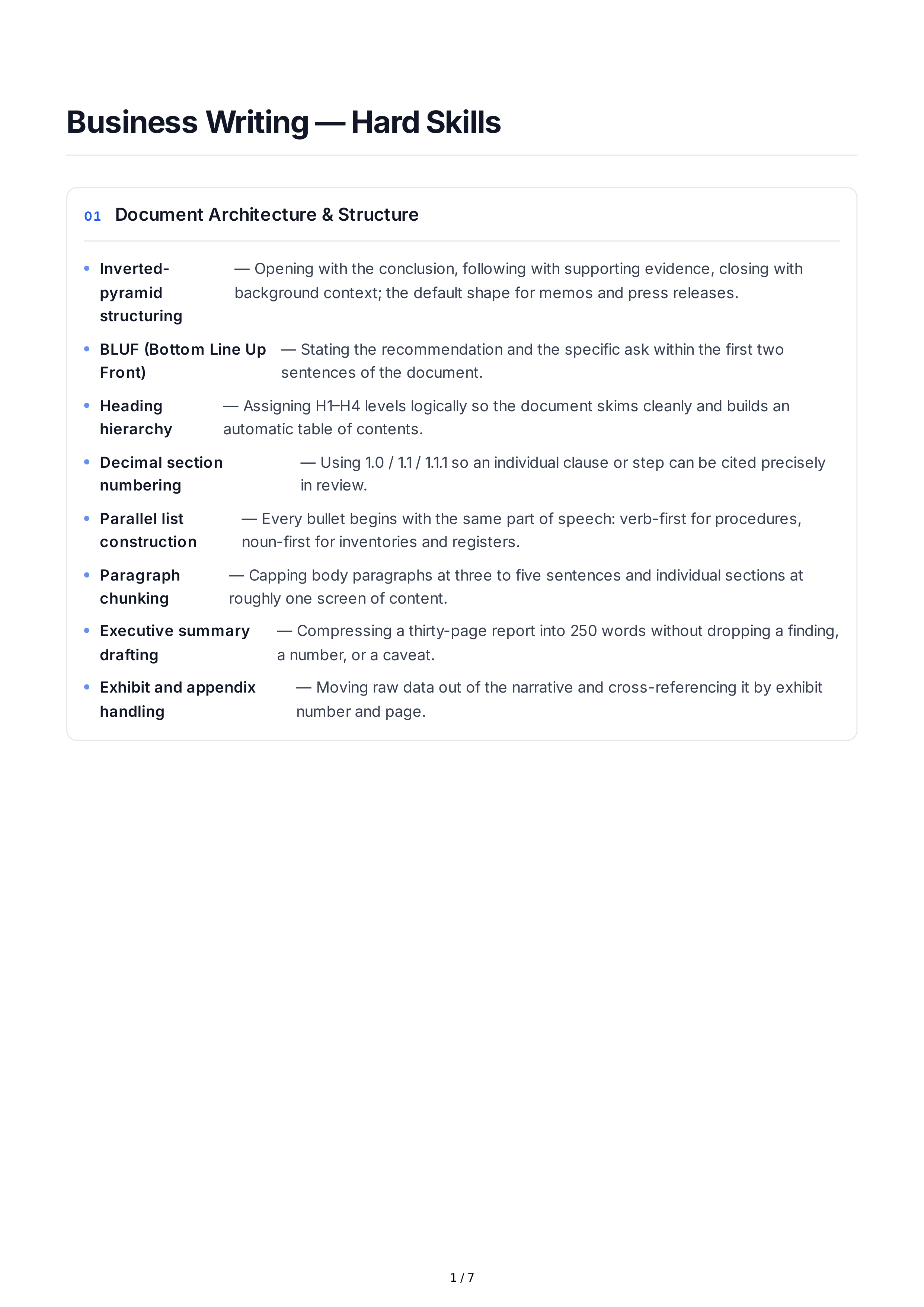
01
Document
Architecture
&
Structure
Inverted
-
pyramid
structuring
—
Opening
with
the
conclusion
,
following
with
supporting
evidence
,
closing
with
background
context
;
the
default
shape
for
memos
and
press
releases
.
BLUF
(
Bottom
Line
Up
Front
)
—
Stating
the
recommendation
and
the
specific
ask
within
the
first
two
sentences
of
the
document
.
Heading
hierarchy
—
Assigning
H
1–
H
4
levels
logically
so
the
document
skims
cleanly
and
builds
an
automatic
table
of
contents
.
Decimal
section
numbering
—
Using
1.0 / 1.1 / 1.1.1
so
an
individual
clause
or
step
can
be
cited
precisely
in
review
.
Parallel
list
construction
—
Every
bullet
begins
with
the
same
part
of
speech
:
verb
-
first
for
procedures
,
noun
-
first
for
inventories
and
registers
.
Paragraph
chunking
—
Capping
body
paragraphs
at
three
to
five
sentences
and
individual
sections
at
roughly
one
screen
of
content
.
Executive
summary
drafting
—
Compressing
a
thirty
-
page
report
into
250
words
without
dropping
a
finding
,
a
number
,
or
a
caveat
.
Exhibit
and
appendix
handling
—
Moving
raw
data
out
of
the
narrative
and
cross
-
referencing
it
by
exhibit
number
and
page
.
1 / 7
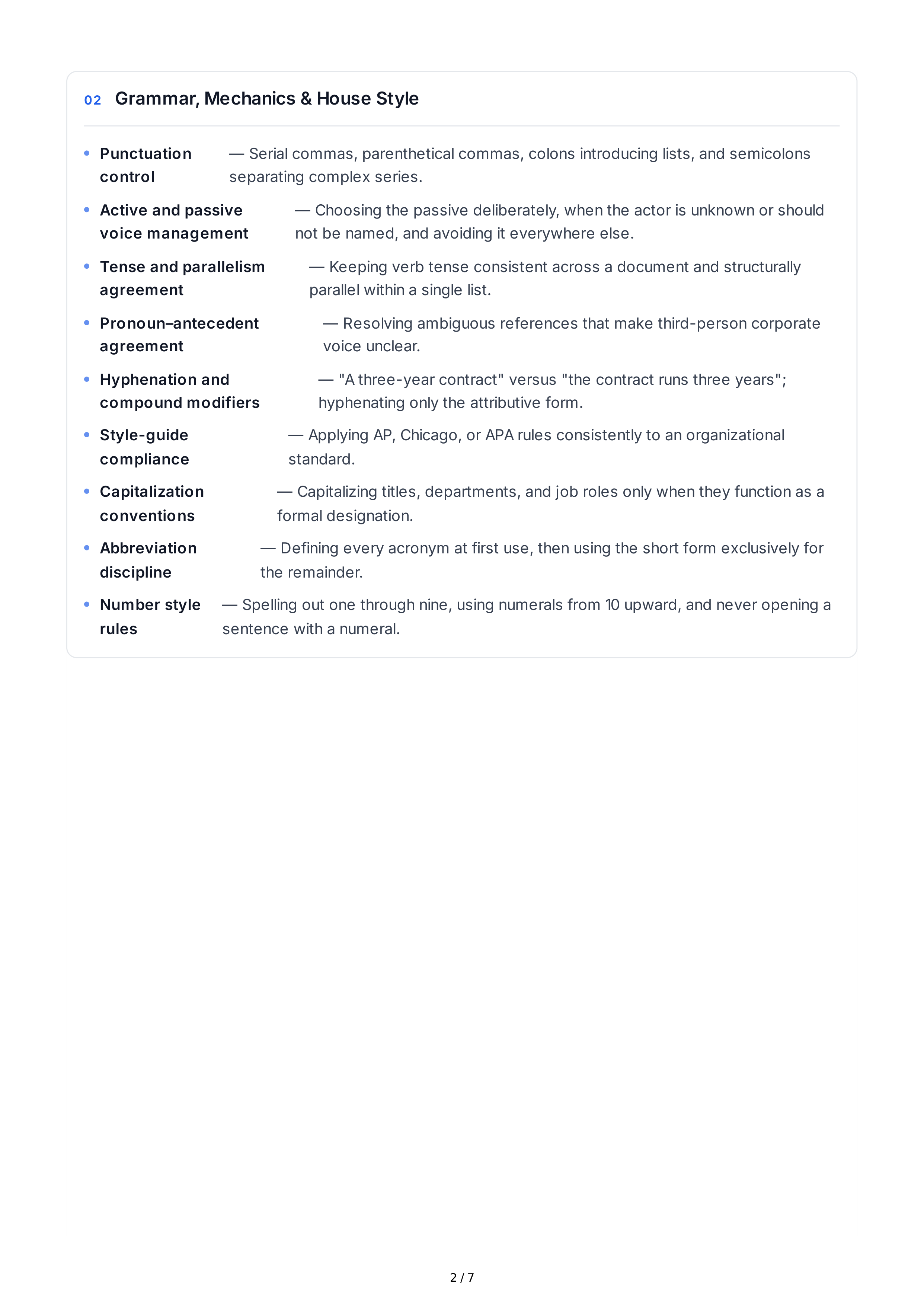
02
Grammar
,
Mechanics
&
House
Style
Punctuation
control
—
Serial
commas
,
parenthetical
commas
,
colons
introducing
lists
,
and
semicolons
separating
complex
series
.
Active
and
passive
voice
management
—
Choosing
the
passive
deliberately
,
when
the
actor
is
unknown
or
should
not
be
named
,
and
avoiding
it
everywhere
else
.
Tense
and
parallelism
agreement
—
Keeping
verb
tense
consistent
across
a
document
and
structurally
parallel
within
a
single
list
.
Pronoun
–
antecedent
agreement
—
Resolving
ambiguous
references
that
make
third
-
person
corporate
voice
unclear
.
Hyphenation
and
compound
modifiers
— "
A
three
-
year
contract
"
versus
"
the
contract
runs
three
years
";
hyphenating
only
the
attributive
form
.
Style
-
guide
compliance
—
Applying
AP
,
Chicago
,
or
APA
rules
consistently
to
an
organizational
standard
.
Capitalization
conventions
—
Capitalizing
titles
,
departments
,
and
job
roles
only
when
they
function
as
a
formal
designation
.
Abbreviation
discipline
—
Defining
every
acronym
at
first
use
,
then
using
the
short
form
exclusively
for
the
remainder
.
Number
style
rules
—
Spelling
out
one
through
nine
,
using
numerals
from
10
upward
,
and
never
opening
a
sentence
with
a
numeral
.
2 / 7
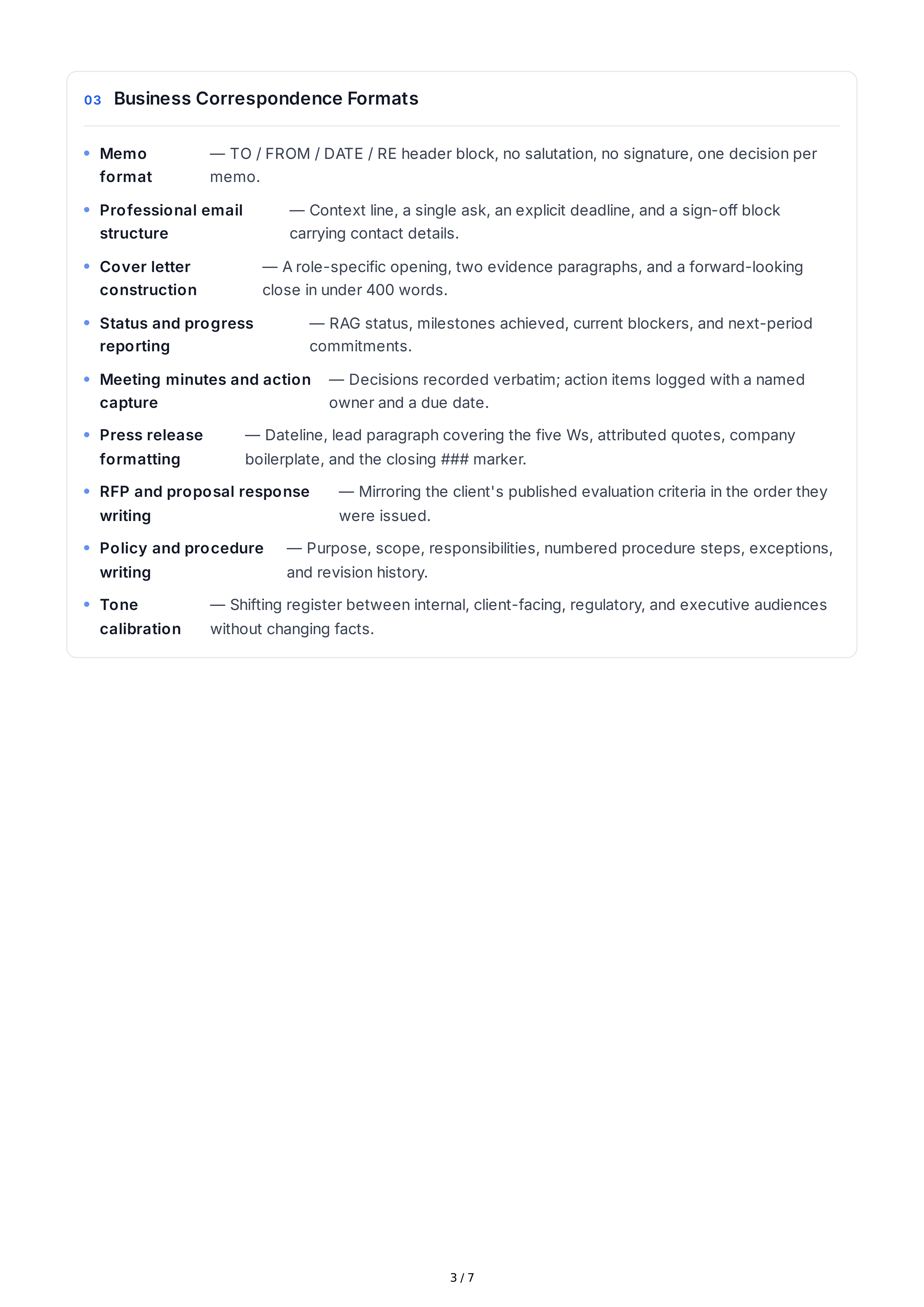
03
Business
Correspondence
Formats
Memo
format
—
TO
/
FROM
/
DATE
/
RE
header
block
,
no
salutation
,
no
signature
,
one
decision
per
memo
.
Professional
email
structure
—
Context
line
,
a
single
ask
,
an
explicit
deadline
,
and
a
sign
-
off
block
carrying
contact
details
.
Cover
letter
construction
—
A
role
-
specific
opening
,
two
evidence
paragraphs
,
and
a
forward
-
looking
close
in
under
400
words
.
Status
and
progress
reporting
—
RAG
status
,
milestones
achieved
,
current
blockers
,
and
next
-
period
commitments
.
Meeting
minutes
and
action
capture
—
Decisions
recorded
verbatim
;
action
items
logged
with
a
named
owner
and
a
due
date
.
Press
release
formatting
—
Dateline
,
lead
paragraph
covering
the
five
Ws
,
attributed
quotes
,
company
boilerplate
,
and
the
closing
###
marker
.
RFP
and
proposal
response
writing
—
Mirroring
the
client
'
s
published
evaluation
criteria
in
the
order
they
were
issued
.
Policy
and
procedure
writing
—
Purpose
,
scope
,
responsibilities
,
numbered
procedure
steps
,
exceptions
,
and
revision
history
.
Tone
calibration
—
Shifting
register
between
internal
,
client
-
facing
,
regulatory
,
and
executive
audiences
without
changing
facts
.
3 / 7
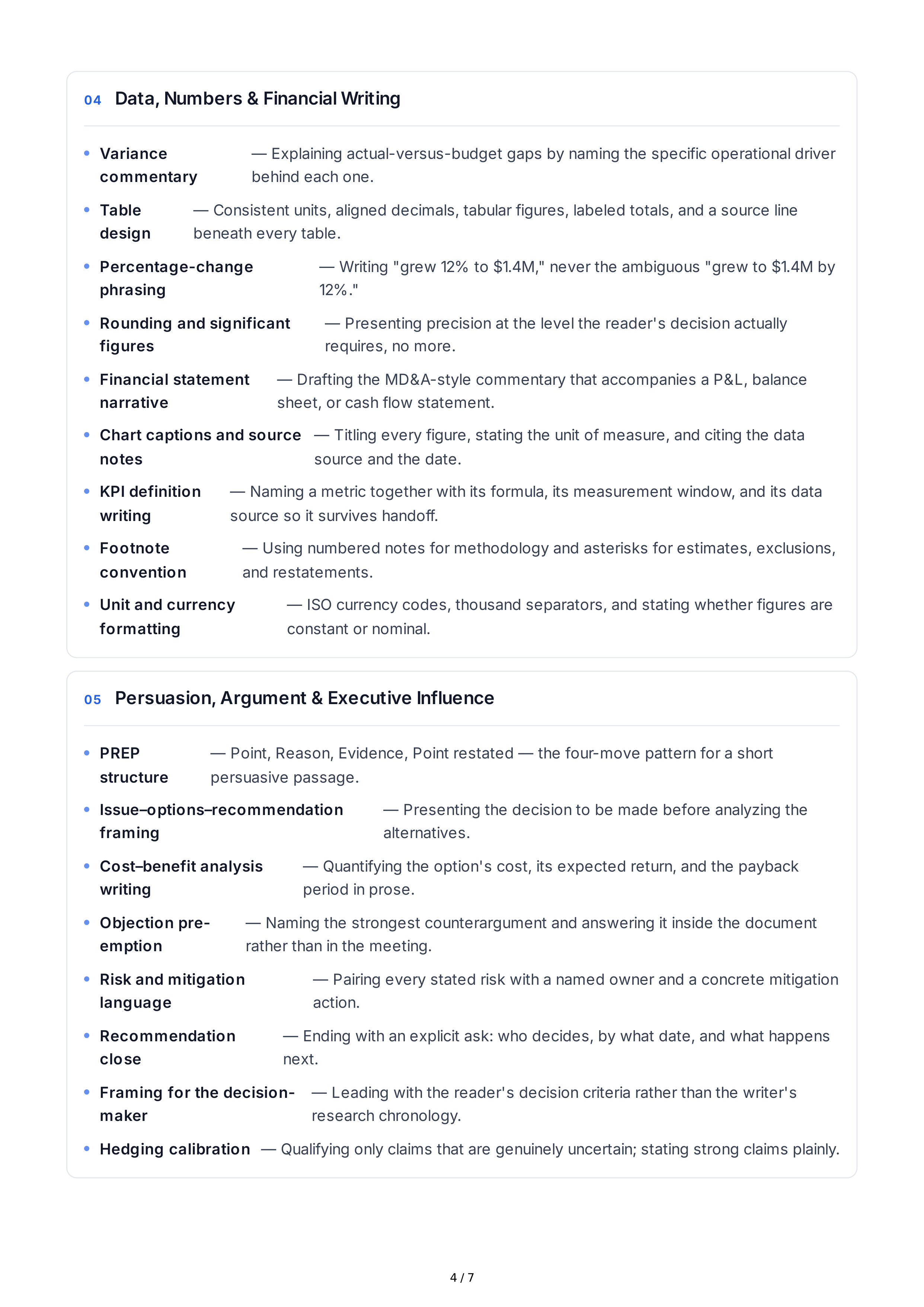
04
Data
,
Numbers
&
Financial
Writing
Variance
commentary
—
Explaining
actual
-
versus
-
budget
gaps
by
naming
the
specific
operational
driver
behind
each
one
.
Table
design
—
Consistent
units
,
aligned
decimals
,
tabular
figures
,
labeled
totals
,
and
a
source
line
beneath
every
table
.
Percentage
-
change
phrasing
—
Writing
"
grew
12%
to
$
1.4
M
,"
never
the
ambiguous
"
grew
to
$
1.4
M
by
12%."
Rounding
and
significant
figures
—
Presenting
precision
at
the
level
the
reader
'
s
decision
actually
requires
,
no
more
.
Financial
statement
narrative
—
Drafting
the
MD
&
A
-
style
commentary
that
accompanies
a
P
&
L
,
balance
sheet
,
or
cash
flow
statement
.
Chart
captions
and
source
notes
—
Titling
every
figure
,
stating
the
unit
of
measure
,
and
citing
the
data
source
and
the
date
.
KPI
definition
writing
—
Naming
a
metric
together
with
its
formula
,
its
measurement
window
,
and
its
data
source
so
it
survives
handoff
.
Footnote
convention
—
Using
numbered
notes
for
methodology
and
asterisks
for
estimates
,
exclusions
,
and
restatements
.
Unit
and
currency
formatting
—
ISO
currency
codes
,
thousand
separators
,
and
stating
whether
figures
are
constant
or
nominal
.
05
Persuasion
,
Argument
&
Executive
Influence
PREP
structure
—
Point
,
Reason
,
Evidence
,
Point
restated
—
the
four
-
move
pattern
for
a
short
persuasive
passage
.
Issue
–
options
–
recommendation
framing
—
Presenting
the
decision
to
be
made
before
analyzing
the
alternatives
.
Cost
–
benefit
analysis
writing
—
Quantifying
the
option
'
s
cost
,
its
expected
return
,
and
the
payback
period
in
prose
.
Objection
pre
-
emption
—
Naming
the
strongest
counterargument
and
answering
it
inside
the
document
rather
than
in
the
meeting
.
Risk
and
mitigation
language
—
Pairing
every
stated
risk
with
a
named
owner
and
a
concrete
mitigation
action
.
Recommendation
close
—
Ending
with
an
explicit
ask
:
who
decides
,
by
what
date
,
and
what
happens
next
.
Framing
for
the
decision
-
maker
—
Leading
with
the
reader
'
s
decision
criteria
rather
than
the
writer
'
s
research
chronology
.
Hedging
calibration
—
Qualifying
only
claims
that
are
genuinely
uncertain
;
stating
strong
claims
plainly
.
4 / 7
06
Editing
,
Proofreading
&
Quality
Control
Developmental
,
line
,
and
copy
editing
—
Diagnosing
which
level
of
edit
a
draft
needs
before
opening
it
.
Style
sheet
creation
—
Logging
spelling
,
capitalization
,
and
terminology
choices
so
a
long
document
stays
internally
consistent
.
Consistency
auditing
—
Checking
numbering
,
cross
-
references
,
and
section
titles
against
the
table
of
contents
before
release
.
Track
changes
and
comment
workflow
—
Reviewing
,
accepting
,
and
resolving
edits
cleanly
prior
to
distribution
.
Readability
scoring
—
Applying
Flesch
-
Kincaid
or
Gunning
Fog
when
an
audience
requires
a
specific
grade
level
.
Fact
and
source
verification
—
Confirming
every
figure
,
date
,
and
proper
noun
against
a
primary
source
,
not
a
secondary
one
.
Redline
and
blackline
comparison
—
Producing
a
striking
comparison
against
the
prior
executed
version
for
signature
.
Version
control
and
file
naming
—
Adopting
a
dated
,
descriptive
naming
convention
that
survives
a
long
email
thread
.
Typographic
proofreading
—
Catching
widows
,
orphaned
headings
,
broken
table
rules
,
and
inconsistent
spacing
at
the
page
level
.
5 / 7
07
Tools
&
Technical
Production
Microsoft
Word
authoring
—
Styles
,
templates
,
cross
-
references
,
field
codes
,
section
breaks
,
and
mail
merge
.
Google
Workspace
collaboration
—
Suggestion
mode
,
comment
threads
,
and
version
-
history
review
with
multiple
editors
.
Adobe
Acrobat
production
—
PDF
/
A
export
,
fillable
form
fields
,
redaction
,
and
digital
signature
blocks
.
Document
automation
—
Building
a
template
library
with
merge
fields
so
recurring
documents
assemble
directly
from
data
.
Spreadsheet
data
presentation
—
Structured
tables
,
pivot
summaries
,
and
charts
formatted
for
embedding
into
written
reports
.
Markdown
and
HTML
authoring
—
Writing
for
a
CMS
,
help
center
,
or
knowledge
base
without
breaking
the
rendered
output
.
Diagramming
tools
—
Process
flows
and
org
charts
built
in
Lucidchart
,
Visio
,
or
Miro
and
exported
at
print
resolution
.
Accessibility
tagging
—
Logical
heading
order
,
table
header
cells
,
alt
text
,
and
4.5:1
contrast
per
WCAG
2.2
AA
.
E
-
signature
workflows
—
Routing
documents
through
DocuSign
or
Adobe
Sign
with
the
correct
signing
order
and
audit
trail
.
6 / 7
08
Compliance
,
Legal
&
Risk
Language
Defined
-
term
discipline
—
Capitalizing
a
term
once
at
its
definition
and
using
that
exact
form
everywhere
thereafter
.
Shall
,
may
,
must
,
and
will
—
Using
"
shall
"
for
obligation
, "
may
"
for
discretion
,
and
"
must
"
for
a
condition
precedent
.
Confidentiality
and
NDA
language
—
Scoping
what
counts
as
confidential
,
the
permitted
-
use
carve
-
outs
,
and
the
term
of
protection
.
Plain
-
language
disclosure
summaries
—
Rewriting
terms
of
service
or
a
privacy
policy
into
a
reader
-
facing
summary
without
changing
meaning
.
Forward
-
looking
statement
disclaimers
—
Placing
safe
-
harbor
language
where
it
will
actually
be
read
,
not
buried
in
an
appendix
.
Data
privacy
references
—
Accurately
citing
GDPR
,
CCPA
,
or
sector
-
specific
rules
when
describing
what
data
is
collected
and
why
.
Regulatory
filing
conventions
—
Following
the
prescribed
caption
,
item
numbering
,
and
exhibit
list
for
the
filing
type
.
Approval
routing
and
sign
-
off
blocks
—
Building
the
signature
,
printed
name
,
title
,
and
date
lines
required
for
execution
.
Records
retention
awareness
—
Recognizing
which
documents
fall
under
a
legal
hold
and
must
not
be
altered
or
deleted
.
7 / 7