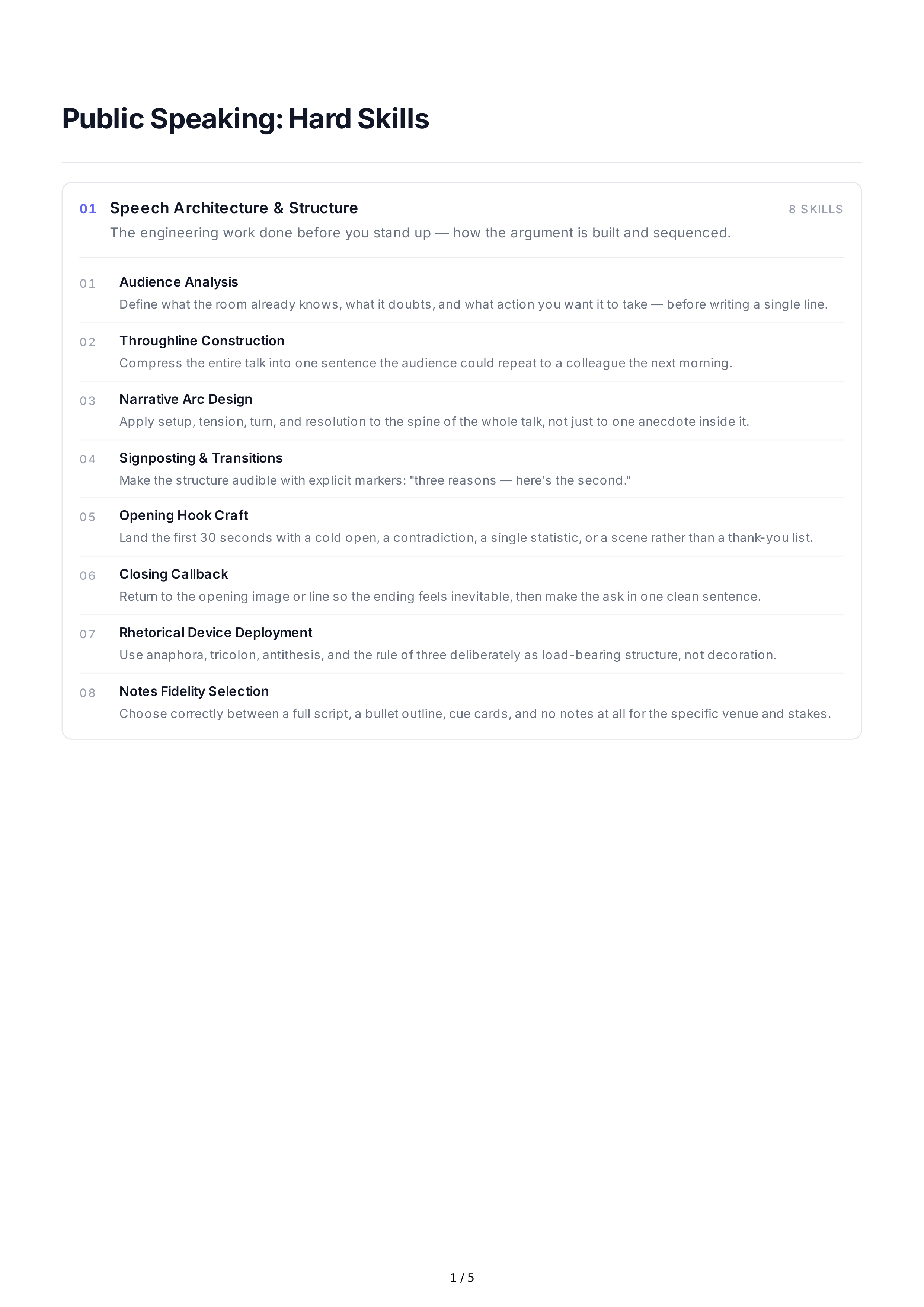
Public
Speaking
:
Hard
Skills
01
Speech
Architecture
&
Structure
The
engineering
work
done
before
you
stand
up
—
how
the
argument
is
built
and
sequenced
.
8
SKILLS
01
Audience
Analysis
Define
what
the
room
already
knows
,
what
it
doubts
,
and
what
action
you
want
it
to
take
—
before
writing
a
single
line
.
02
Throughline
Construction
Compress
the
entire
talk
into
one
sentence
the
audience
could
repeat
to
a
colleague
the
next
morning
.
03
Narrative
Arc
Design
Apply
setup
,
tension
,
turn
,
and
resolution
to
the
spine
of
the
whole
talk
,
not
just
to
one
anecdote
inside
it
.
04
Signposting
&
Transitions
Make
the
structure
audible
with
explicit
markers
: "
three
reasons
—
here
'
s
the
second
."
05
Opening
Hook
Craft
Land
the
first
30
seconds
with
a
cold
open
,
a
contradiction
,
a
single
statistic
,
or
a
scene
rather
than
a
thank
-
you
list
.
06
Closing
Callback
Return
to
the
opening
image
or
line
so
the
ending
feels
inevitable
,
then
make
the
ask
in
one
clean
sentence
.
07
Rhetorical
Device
Deployment
Use
anaphora
,
tricolon
,
antithesis
,
and
the
rule
of
three
deliberately
as
load
-
bearing
structure
,
not
decoration
.
08
Notes
Fidelity
Selection
Choose
correctly
between
a
full
script
,
a
bullet
outline
,
cue
cards
,
and
no
notes
at
all
for
the
specific
venue
and
stakes
.
1 / 5
02
Vocal
Technique
The
instrument
itself
—
breath
,
tone
,
and
the
physical
mechanics
of
being
heard
.
8
SKILLS
09
Diaphragmatic
Breathing
Support
each
phrase
from
the
diaphragm
so
volume
comes
from
airflow
rather
than
throat
tension
.
10
Projection
Without
Strain
Reach
the
back
row
by
increasing
breath
support
and
resonance
—
never
by
raising
pitch
or
forcing
volume
.
11
Articulation
&
Diction
Drills
Crisp
consonants
at
speed
:
daily
work
on
plosives
,
sibilance
,
and
final
sounds
that
get
swallowed
.
12
Rate
Control
Hold
a
130–160
words
-
per
-
minute
baseline
and
slow
deliberately
whenever
a
sentence
carries
weight
.
13
Strategic
Pausing
Use
1.5–3
second
pauses
as
punctuation
;
silence
is
the
mechanism
that
makes
a
line
land
.
14
Pitch
Range
&
Intonation
Vary
melodic
line
to
avoid
monotone
,
and
drop
pitch
rather
than
rise
when
you
want
to
sound
authoritative
.
15
Volume
Dynamics
Stage
crescendos
and
drops
across
a
talk
so
no
two
consecutive
sentences
sit
at
the
same
level
.
16
Vocal
Warm
-
Up
&
Hygiene
A
fifteen
-
minute
warm
-
up
before
speaking
,
plus
hydration
,
steam
,
and
no
throat
clearing
on
stage
.
03
Nonverbal
Delivery
What
the
body
communicates
while
the
voice
is
speaking
—
deliberate
rather
than
incidental
.
8
SKILLS
17
Eye
Contact
Anchoring
Hold
3–5
seconds
per
person
and
sweep
the
room
in
thirds
,
rather
than
scanning
across
faces
.
18
Gesture
Vocabulary
Separate
illustrative
,
emphatic
,
and
descriptive
gestures
,
kept
inside
the
natural
"
box
"
of
the
torso
.
19
Posture
&
Stance
Feet
shoulder
-
width
,
weight
grounded
and
even
—
no
rocking
,
no
weight
shifting
,
no
locked
knees
.
20
Stage
Blocking
&
Movement
Move
only
with
purpose
;
every
transition
earns
a
new
position
on
the
stage
rather
than
a
nervous
pace
.
21
Facial
Expression
Matching
Let
the
face
carry
the
same
signal
as
the
words
—
mismatches
read
as
insincerity
to
an
audience
.
22
Prop
&
Device
Handling
Notes
,
clickers
,
and
microphones
held
deliberately
,
with
no
fidgeting
,
clicking
,
or
pocketing
.
23
Spatial
Anchoring
Assign
a
fixed
physical
location
to
each
major
idea
so
the
room
can
map
the
structure
spatially
.
24
Stillness
as
Emphasis
Stop
moving
at
the
exact
moment
you
want
attention
to
concentrate
on
a
single
sentence
.
2 / 5
04
Persuasion
&
Message
Design
The
craft
of
making
an
argument
that
moves
a
specific
audience
to
a
specific
action
.
7
SKILLS
25
Ethos
/
Pathos
/
Logos
Balancing
Decide
the
ratio
the
argument
actually
needs
,
then
hold
it
consistently
across
the
whole
talk
.
26
Evidence
Selection
&
Sourcing
Choose
tier
-
one
sources
,
name
them
out
loud
,
and
never
fall
back
on
"
studies
show
."
27
Data
Storytelling
Convert
a
chart
into
one
spoken
sentence
built
on
a
comparison
the
audience
already
understands
.
28
Analogy
&
Metaphor
Construction
Build
metaphors
from
domains
the
audience
already
inhabits
,
not
from
your
own
field
'
s
shorthand
.
29
Objection
Pre
-
emption
Name
the
strongest
counterargument
before
the
audience
does
,
then
answer
it
on
your
own
terms
.
30
Framing
&
Reframing
Select
the
loss
,
gain
,
or
values
frame
that
actually
moves
this
particular
audience
,
and
commit
to
it
.
31
Concrete
Specificity
Replace
abstractions
with
named
numbers
,
dates
,
places
,
and
people
that
the
audience
can
visualize
.
05
Live
Audience
Management
Everything
that
happens
after
the
plan
meets
the
room
.
6
SKILLS
32
Q
&
A
Handling
Acknowledge
,
bridge
,
and
answer
—
and
park
the
questions
you
cannot
answer
without
bluffing
.
33
Cold
Reading
the
Room
Track
attention
signals
in
real
time
and
adjust
pace
,
depth
,
or
energy
accordingly
,
mid
-
sentence
if
needed
.
34
Off
-
Script
Recovery
Keep
a
memorized
reset
line
ready
to
regain
the
thread
after
a
stumble
,
a
tangent
,
or
an
interruption
.
35
Disruption
Management
De
-
escalate
heckling
with
one
short
,
neutral
reply
and
reclaim
the
floor
without
sparring
.
36
Time
-
Boxing
&
Compression
Cut
an
entire
section
live
without
breaking
the
throughline
or
overshooting
the
slot
.
37
Panel
Moderation
Distribute
airtime
,
cut
off
filibusters
politely
,
and
summarize
before
moving
to
the
next
topic
.
3 / 5
06
Rehearsal
&
Preparation
Systems
The
repeatable
process
that
turns
a
written
talk
into
a
reliable
performance
.
6
SKILLS
38
Timed
Run
-
Throughs
Rehearse
full
length
against
a
visible
clock
—
never
rehearse
only
the
opening
and
improvise
the
rest
.
39
Method
of
Loci
Anchor
key
beats
to
physical
locations
in
sequence
so
the
structure
survives
an
adrenaline
spike
.
40
Cue
Card
Design
Large
type
,
one
idea
per
card
,
numbered
,
and
held
so
the
audience
never
sees
them
from
the
floor
.
41
Teleprompter
Reading
Maintain
eye
line
and
expression
while
reading
,
at
a
scroll
speed
you
have
already
rehearsed
twice
.
42
Recorded
Self
-
Review
Watch
your
own
recording
against
a
checklist
:
filler
rate
,
pace
,
motion
,
tics
,
and
eye
contact
.
43
Venue
&
Tech
Rehearsal
Walk
the
stage
,
test
the
mic
,
AV
,
clicker
,
and
lighting
—
and
carry
a
backup
for
each
failure
point
.
07
Technical
&
Production
Skills
The
equipment
,
slides
,
and
formats
that
carry
the
talk
to
the
room
and
beyond
it
.
7
SKILLS
44
Assertion
–
Evidence
Slide
Design
One
idea
per
slide
,
stated
as
a
full
sentence
,
supported
by
one
visual
rather
than
a
wall
of
bullets
.
45
Deck
Pacing
&
Build
Sequences
Time
on
-
screen
builds
to
your
speech
,
not
to
the
click
of
a
remote
,
so
reveals
land
with
the
point
.
46
Demo
&
Screencast
Delivery
Pre
-
record
the
fallback
,
clean
the
desktop
,
enlarge
the
cursor
,
and
never
demo
live
without
a
net
.
47
Microphone
Technique
Handle
handheld
,
lavalier
,
and
headset
mics
correctly
,
managing
plosives
,
proximity
,
and
clothing
noise
.
48
Remote
&
Hybrid
Delivery
Frame
to
the
lens
,
light
from
the
front
,
and
treat
latency
as
a
partner
rather
than
an
interruption
.
49
Recording
&
Livestream
Awareness
Speak
to
a
camera
and
a
live
room
at
the
same
time
without
favoring
either
audience
.
50
Accessibility
Practice
Caption
recorded
video
,
describe
visuals
aloud
for
blind
attendees
,
and
check
contrast
and
type
size
.
4 / 5
08
Performance
Under
Pressure
Managing
the
body
and
attention
when
the
stakes
and
the
heart
rate
both
rise
.
5
SKILLS
51
Arousal
Regulation
Run
a
4-4-4-4
box
breath
to
bring
heart
rate
into
a
workable
range
in
the
two
minutes
before
you
walk
out
.
52
Pre
-
Talk
Routine
Fix
a
repeatable
twenty
-
minute
sequence
so
your
starting
conditions
vary
as
little
as
possible
.
53
Cognitive
Reframing
Reappraise
adrenaline
as
readiness
rather
than
as
a
warning
sign
—
the
physical
signal
is
identical
.
54
Mistake
Recovery
Protocol
Acknowledge
briefly
,
keep
moving
,
and
never
apologize
twice
for
the
same
slip
in
front
of
the
room
.
55
Attention
Focus
Control
Shift
attention
away
from
self
-
monitoring
and
onto
the
message
and
the
people
receiving
it
.
09
Measurement
&
Feedback
The
loop
that
turns
practice
into
progress
rather
than
repetition
.
4
SKILLS
56
Speaking
Metrics
Tracking
Log
words
per
minute
,
filler
words
per
minute
,
pause
ratio
,
and
eye
-
contact
count
for
every
talk
.
57
Structured
Audience
Feedback
Issue
a
three
-
question
instrument
after
the
talk
instead
of
asking
the
room
"
how
was
it
?"
58
Peer
Review
Rubrics
Score
against
fixed
criteria
so
feedback
compares
specific
ratings
rather
than
overall
impressions
.
59
Single
-
Change
Iteration
Change
exactly
one
thing
per
rehearsal
cycle
,
then
re
-
measure
it
before
touching
anything
else
.
5 / 5