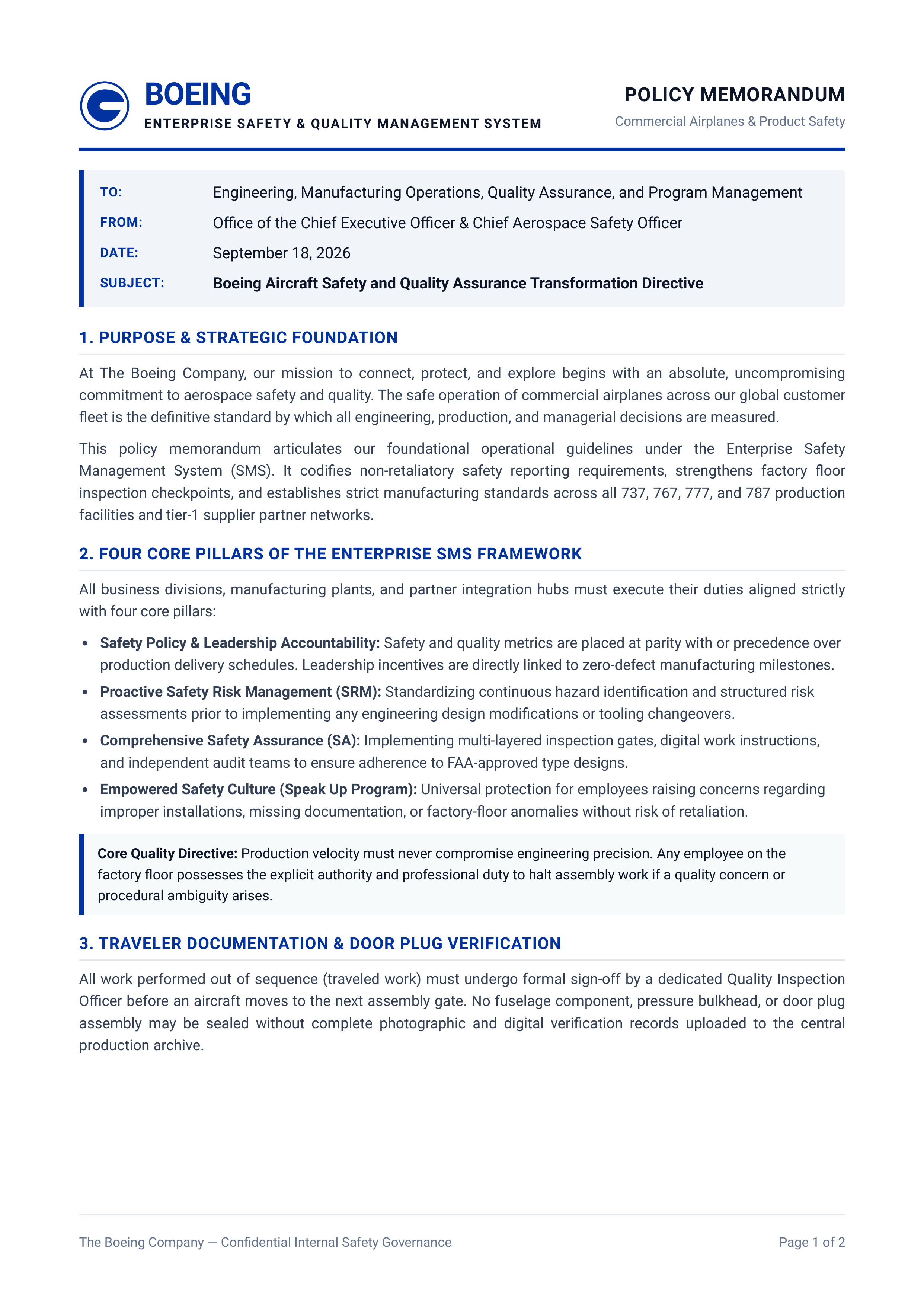
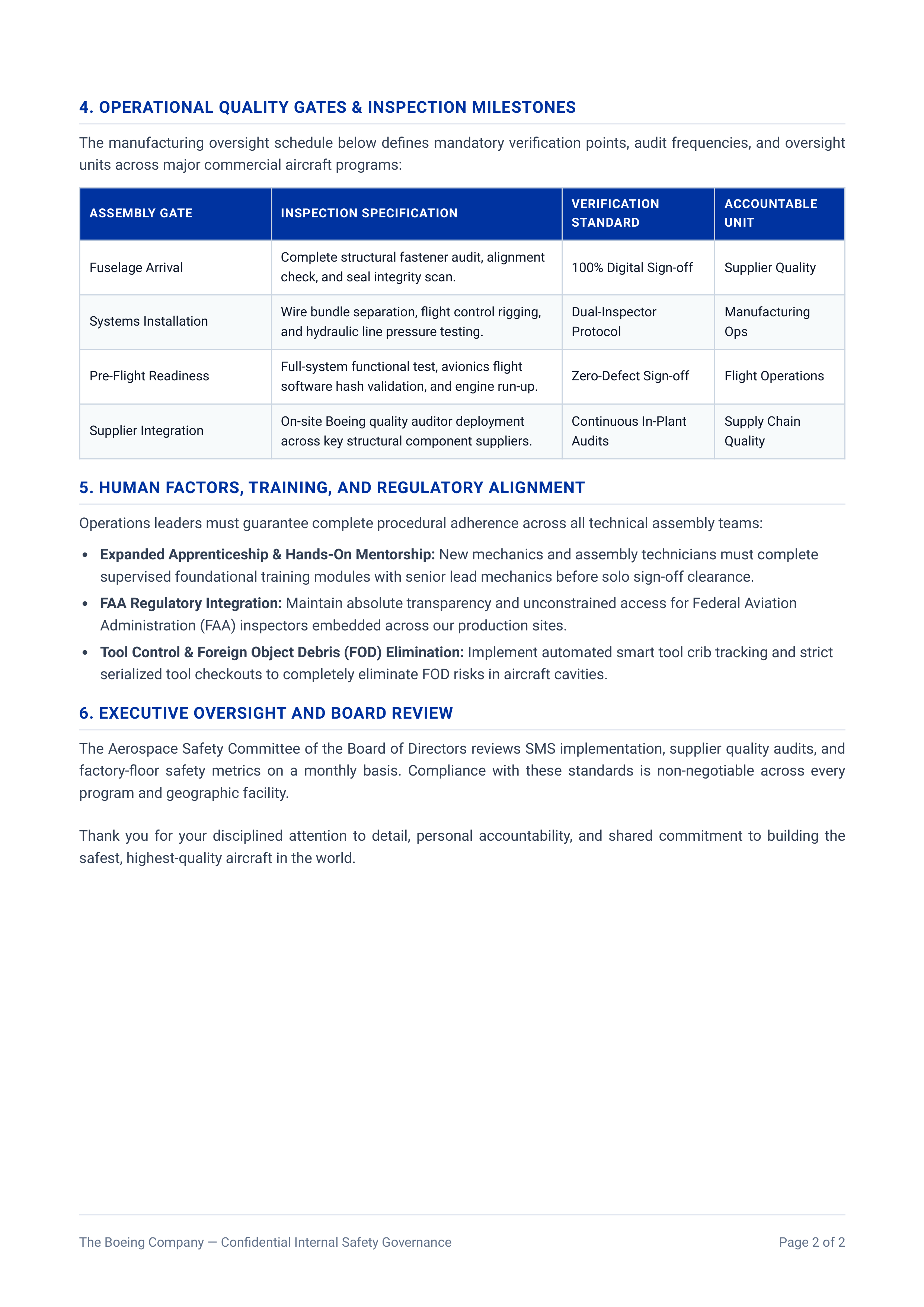
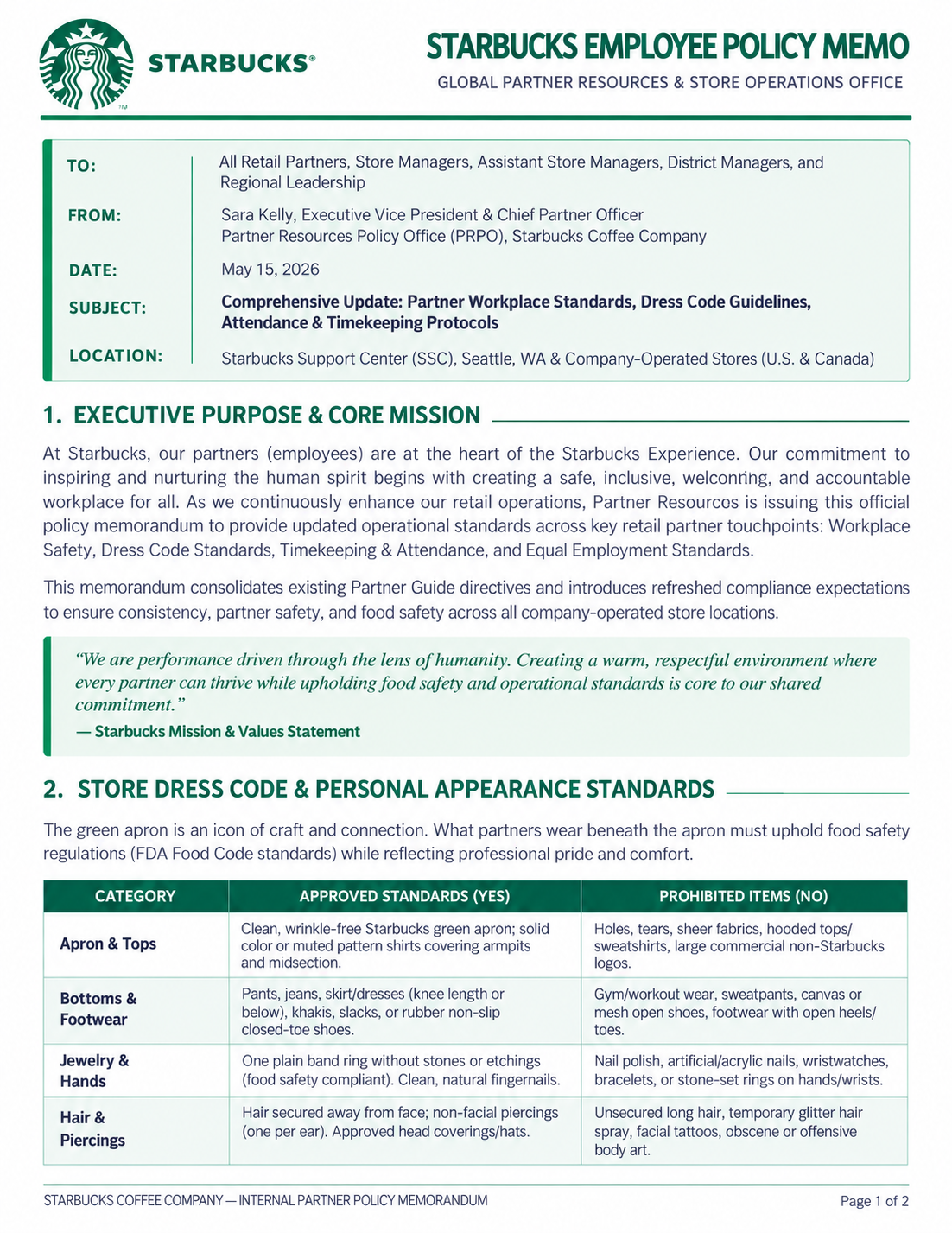
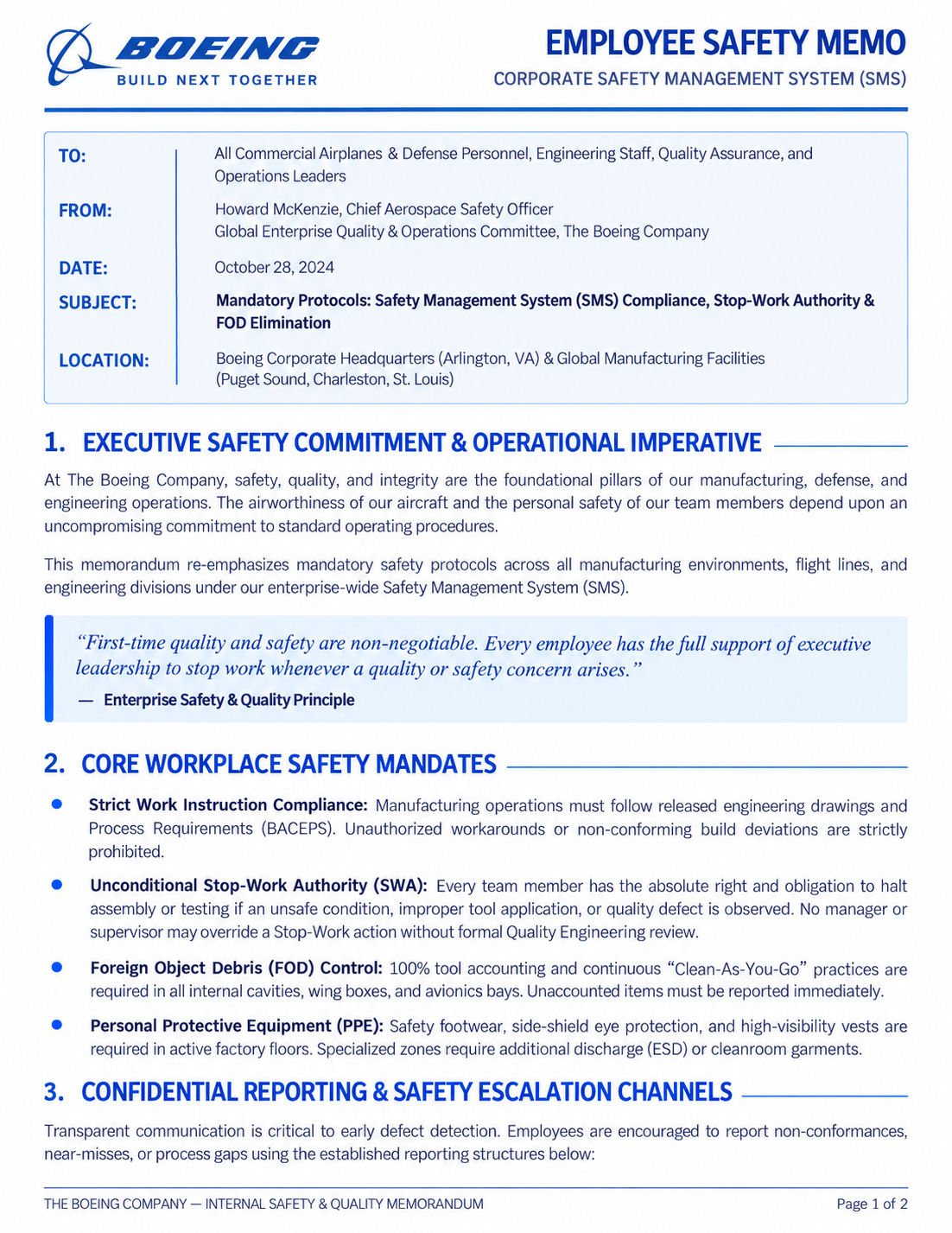
BOEING
ENTERPRISE SAFETY & QUALITY MANAGEMENT SYSTEM
POLICY MEMORANDUM
Commercial Airplanes & Product Safety
TO:
Engineering, Manufacturing Operations, Quality Assurance, and Program Management
FROM:
O
ffi
ce of the Chief Executive O
ffi
cer & Chief Aerospace Safety O
ffi
cer
DATE:
September 18, 2026
SUBJECT:
Boeing Aircraft Safety and Quality Assurance Transformation Directive
1. PURPOSE & STRATEGIC FOUNDATION
At The Boeing Company, our mission to connect, protect, and explore begins with an absolute, uncompromising
commitment to aerospace safety and quality. The safe operation of commercial airplanes across our global customer
fl
eet is the de
fi
nitive standard by which all engineering, production, and managerial decisions are measured.
This policy memorandum articulates our foundational operational guidelines under the Enterprise Safety
Management System (SMS). It codi
fi
es non-retaliatory safety reporting requirements, strengthens factory
fl
oor
inspection checkpoints, and establishes strict manufacturing standards across all 737, 767, 777, and 787 production
facilities and tier-1 supplier partner networks.
2. FOUR CORE PILLARS OF THE ENTERPRISE SMS FRAMEWORK
All business divisions, manufacturing plants, and partner integration hubs must execute their duties aligned strictly
with four core pillars:
Safety Policy & Leadership Accountability:
Safety and quality metrics are placed at parity with or precedence over
production delivery schedules. Leadership incentives are directly linked to zero-defect manufacturing milestones.
Proactive Safety Risk Management (SRM):
Standardizing continuous hazard identi
fi
cation and structured risk
assessments prior to implementing any engineering design modi
fi
cations or tooling changeovers.
Comprehensive Safety Assurance (SA):
Implementing multi-layered inspection gates, digital work instructions,
and independent audit teams to ensure adherence to FAA-approved type designs.
Empowered Safety Culture (Speak Up Program):
Universal protection for employees raising concerns regarding
improper installations, missing documentation, or factory-
fl
oor anomalies without risk of retaliation.
Core Quality Directive:
Production velocity must never compromise engineering precision. Any employee on the
factory
fl
oor possesses the explicit authority and professional duty to halt assembly work if a quality concern or
procedural ambiguity arises.
3. TRAVELER DOCUMENTATION & DOOR PLUG VERIFICATION
All work performed out of sequence (traveled work) must undergo formal sign-off by a dedicated Quality Inspection
O
ffi
cer before an aircraft moves to the next assembly gate. No fuselage component, pressure bulkhead, or door plug
assembly may be sealed without complete photographic and digital veri
fi
cation records uploaded to the central
production archive.
The Boeing Company
—
Con
fi
dential Internal Safety Governance
Page 1 of 2