
FEBRUARY
2013
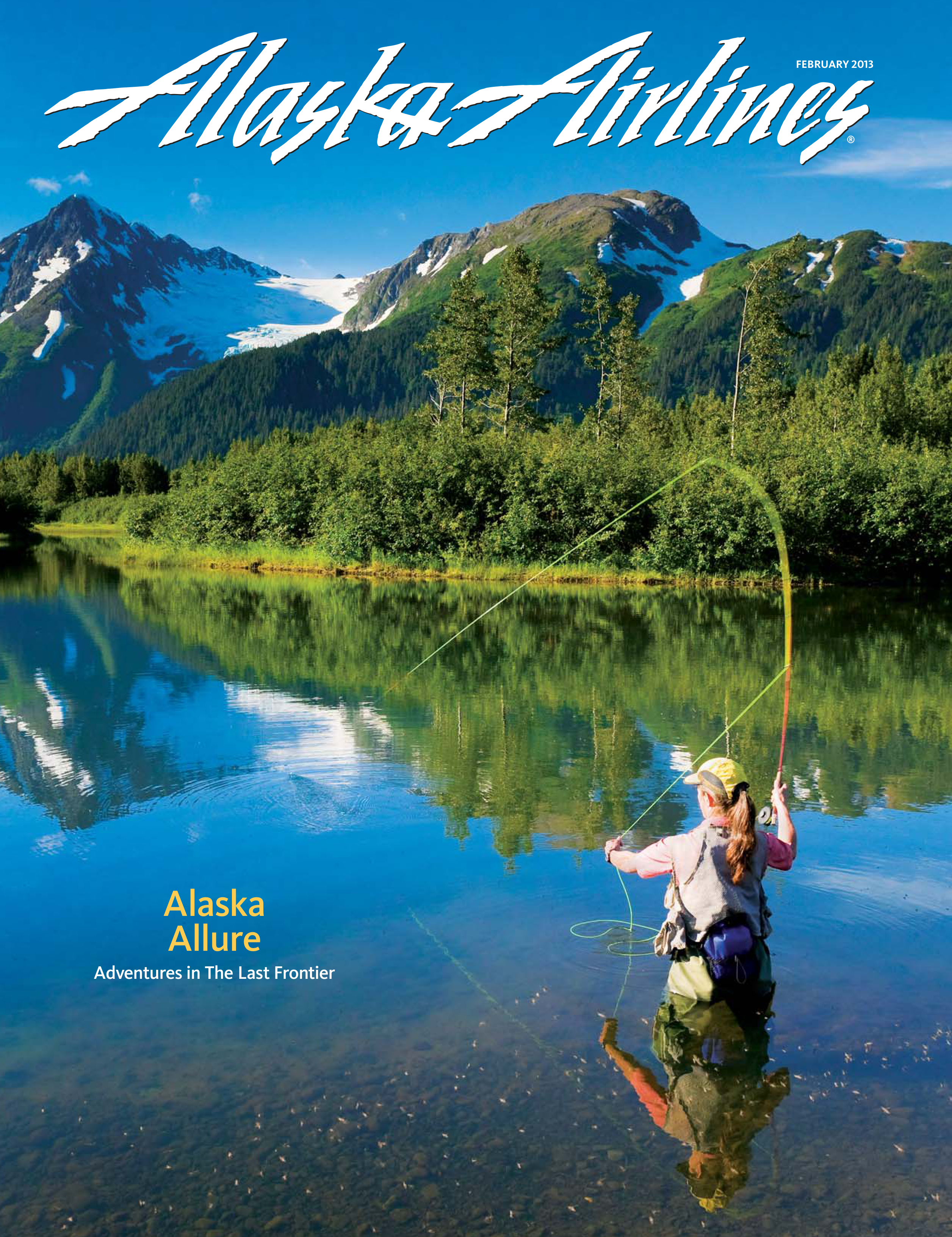
Alaska
Allure
Adventures in The Last Frontier

127
ALASKA AIRLINES MAGAZINE
FEBRUARY 2013
tomorrow’s) workplace demands, which
often require creative problem-solving
skills, an advanced facility with technol-
ogy, and the ability to write and present
boardroom-worthy reports. Many institu-
tions of higher learning are responding to
these changing demands by blurring the
boundaries between the classroom and the
real world, and are engaging with the
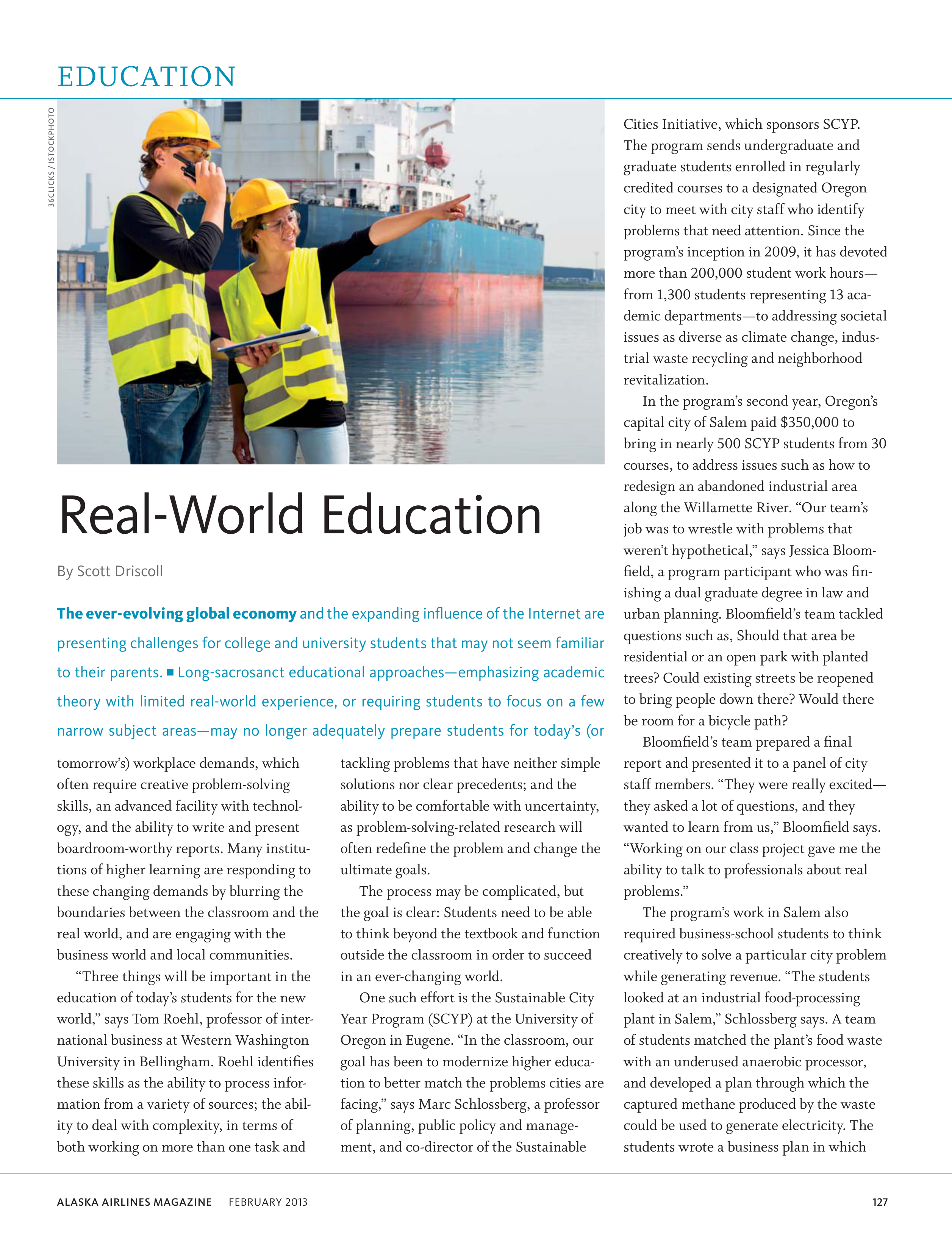
business world and local communities.
“Three things will be important in the
education of today’s students for the new
world,” says Tom Roehl, professor of inter-
national business at Western Washington
University in Bellingham. Roehl identifies
these skills as the ability to process infor-
mation from a variety of sources; the abil-
ity to deal with complexity, in terms of
both working on more than one task and
tackling problems that have neither simple
solutions nor clear precedents; and the
ability to be comfortable with uncertainty,
as problem-solving-related research will
often redefine the problem and change the
ultimate goals.
The process may be complicated, but
the goal is clear: Students need to be able
to think beyond the textbook and function
outside the classroom in order to succeed
in an ever-changing world.
One such effort is the Sustainable City
Year Program (SCYP) at the University of
Oregon in Eugene. “In the classroom, our
goal has been to modernize higher educa-
tion to better match the problems cities are
facing,” says Marc Schlossberg, a professor
of planning, public policy and manage-
ment, and co-director of the Sustainable
By Scott Driscoll
Real-World Education
The ever-evolving global economy
and
the expanding influence of the Internet are
presenting challenges for college and university students that may not seem familiar
to their parents. Long-sacrosanct educational approaches—emphasizing academic
theory with limited real-world experience, or requiring students to focus on a few
narrow subject areas—may no longer adequately prepare students for today’s (or
Cities Initiative, which sponsors SCYP.
The program sends undergraduate and
graduate students enrolled in regularly
credited courses to a designated Oregon
city to meet with city staff who identify
problems that need attention. Since the
program’s inception in 2009, it has devoted
more than 200,000 student work hours—
from 1,300 students representing 13 aca-
demic departments—to addressing societal
issues as diverse as climate change, indus-
trial waste recycling and neighborhood
revitalization.
In the program’s second year, Oregon’s
capital city of Salem paid $350,000 to
bring in nearly 500 SCYP students from 30
courses, to address issues such as how to
redesign an abandoned industrial area
along the Willamette River. “Our team’s
job was to wrestle with problems that
weren’t hypothetical,” says Jessica Bloom-
field, a program participant who was fin-
ishing a dual graduate degree in law and
urban planning. Bloomfield’s team tackled
questions such as, Should that area be
residential or an open park with planted
trees? Could existing streets be reopened
to bring people down there? Would there
be room for a bicycle path?
Bloomfield’s team prepared a final
report and presented it to a panel of city
staff members. “They were really excited—
they asked a lot of questions, and they
wanted to learn from us,” Bloomfield says.
“Working on our class project gave me the
ability to talk to professionals about real
problems.”
The program’s work in Salem also
required business-school students to think
creatively to solve a particular city problem
while generating revenue. “The students
looked at an industrial food-processing
plant in Salem,” Schlossberg says. A team
of students matched the plant’s food waste
with an underused anaerobic processor,
and developed a plan through which the
captured methane produced by the waste
could be used to generate electricity. The
students wrote a business plan in which
36
CLICKS / ISTOCKPHOTO
EDUCATION













they calculated that Salem would save
$400,000 a year by utilizing this new
power source; if all goes well, the students’
plan will be adopted for use this year.
This project may have benefi ted the
city of Salem, but it also gave students a
better understanding of how to put their
academic expertise into action. “When
students test a theory in the real world,
they bring that experience back to the
classroom,” says Doug Blandy, senior vice
provost for academic affairs at the Univer-
sity of Oregon. “This allows them to con-
cretize ideas in a way that makes the
students that much more employable
straight out of college.”
The Project Center at Seattle University
has been preparing engineering and com-
puter science students for real-world chal-
lenges for more than 25 years. As part of a
required senior-year capstone program for
all students in these majors, students work
on around 25 full-year projects with part-
ners including the city of Seattle, Seattle
City Light and King County. Recent proj-
ects have included the investigation of
storm-water management, and hydrologic
modeling for removal of a dam on the
Elwha River.
At Lewis & Clark College—a small
private school in Portland—educators are
preparing students for future employment
by bringing principles of entrepreneurship
on campus. “We emphasize critical think-
ing and communication skills,” says
Tuajuanda Jordan, dean of the College of
Arts and Sciences, who notes that students
may not understand what additional skill
sets an employer might require.
Jordan says the college is attempting to
provide students with these necessary
skills through a new entrepreneurship
workshop, a one-week project fi rst offered
in 2012. (Currently in its testing phase, the
program will eventually span an entire
academic year.) This program offers up to
34 students an intensive course in how to
start a nonprofi t or business. Local busi-
ness leaders and Lewis & Clark alumni
teach students how to pitch an idea, how to
develop a business plan and how to com-
municate that plan to potential investors.
For the fi rst fi ve years, the program will
function as a series of courses that can lead
to a certificate in entrepreneurship. Stu-
dents can sign up for courses starting in
their sophomore year. Eventually, entrepre-
neurship studies will be phased into the
regular curriculum of all majors.
The program not only teaches students
how to use their academic skills in the real
world, but can provide real-world benefits.
Beginning this spring, the program will
sponsor an annual competition in which
teams of students will present business
proposals to a jury of Portland-area busi-
ness leaders. Successful teams will receive
startup funding—amounts vary, but
awards may be in the tens of thousands of
dollars—to put their business plans into
action. The benefits are real, but the cost
of failure is low, and students with an
unsuccessful business plan will have
received a valuable lesson in how to rem-
edy their approach when engaging with
businesses and investors after college.
“Starting their own business while in
college means it’s safe to fail,” says Brian
Detweiler-Bedell, associate professor of
psychology and academic director of the
entrepreneurship program. “They learn
from that, and the next venture may be
successful.”
Some professors at Western Washington
University—especially in the sciences and
the College of Business—are turning to an
approach called “flipped teaching,” which
presents information to students online
and uses classroom time for addressing
real-world applications. Using online man-
agement software called Blackboard, pro-
fessors post recorded lectures (which may
be more academic theory–oriented) for
student review. “This frees up faculty to
spend more class time placing the prob-
lems in the context of real-world exam-
ples,” says John Farquhar, manager of
WWU’s Centers for Teaching, Learning
and Technology.
Students in Tom Roehl’s international-
business-projects class engage in field
projects with a variety of businesses, which
gives the students real-world experience
with academic guidance. Roehl’s student
teams have completed more than 100
projects since he started teaching the
ALASKA AIRLINES MAGAZINE
FEBRUARY 2013
fi eld-project classes in 2000. Twice a year,
he sends out student teams to tackle prob-
lems for local companies seeking to
improve their international market. At the
end of 10 weeks, the student teams present
the companies with reports or product
mock-ups aimed at solving real problems.
“We do set guardrails,” says Roehl, who
meets with company representatives to
defi ne a project’s scope. “Still, it’s the stu-
dents’ responsibility to fail or succeed.”
A 2006 class, for example, worked with
Brunswick, a boat manufacturer with a
facility near Bellingham, to boost yacht
sales in Mexico by modifying the com-
pany’s Internet presence. The WWU team
analyzed similar business websites,
researched the demographics of the com-
pany’s target audience and developed a
high-level website redesign.
Breaking down old barriers that have
separated the worlds of academia and
business doesn’t, however, mean reducing
a liberal arts education to professional
training, says Amber Case, a 2008 Lewis &
Clark graduate. After taking an upper-level
“cyborg” anthropology course that studied
the connection between humans and their
tools, Case started a “Cyborg Camp” series
of conferences, attracting programmers,
artists, scientists and engineers. “You learn
through discussing current and futuristic
problems, with people gathered around a
common interest,” Case says. Since the
fi rst camp in Portland in 2008, the event
has been replicated in Seattle, Toronto and
Vancouver, British Columbia.
In 2010, Case used her education and
the school’s entrepreneurial lessons to
found Geoloqi, a platform for software
developers that allows a user on a mobile
phone to access location-based informa-
tion. In 2012, Geoloqi was acquired by the
geographic-information company Esri.
Case says the things she learned in college
have wide -reaching benefi ts. “I went to
Lewis & Clark because it’s a school that
teaches you to think,” she says. “A good
education is one that teaches you to think
your way through whatever the world
throws at you.”
Scott Driscoll is a writer in Seattle.