

VGN301SV
• Pilot controls for
new BHL’s
• Meeting the emis-
sions challenge
• 988G production
study
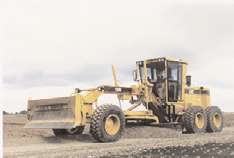
• 20,000th H-Series
Motor Grader
Winter 2001
Caterpillar Magazine

In this issue
3 News
The new D-Series backhoe loader line
includes two high-spec models with low-
effort pilot controls for the loader and
backhoe.
4/5 Emissions Challenge
Caterpillar is meeting the forthcoming
emissions regulations with a new range of
electronically controlled engines.
These
engines offer increased performance, while
having reduced noise levels and the lowest
emissions levels ever.
7/8/9 Systems & Solutions
An independent production study has
shown that the 988G is more productive
and efficient than the earlier 988F Series
II in typical loading and hauling applica-
tions.
10 Minerals 2002
Caterpillar is helping the recently formed
European Minerals Foundation to show
how minerals enhance the lives of the 650
million people that live in Europe.
12/13 Panorama
A Challenger 55 tractor has provided an
innovative solution for a Belgian soil stabil-
isation project, and a 345B excavator is
helping a Norwegian shipping company to
shorten its loading and unloading times.
18 Customer Support
Customer Service Agreements are provid-
ing a UK aggregates company with an
adaptable support package
19 Milestones
A French contractor has taken delivery of
the 20,00th Cat H-Series motor grader.


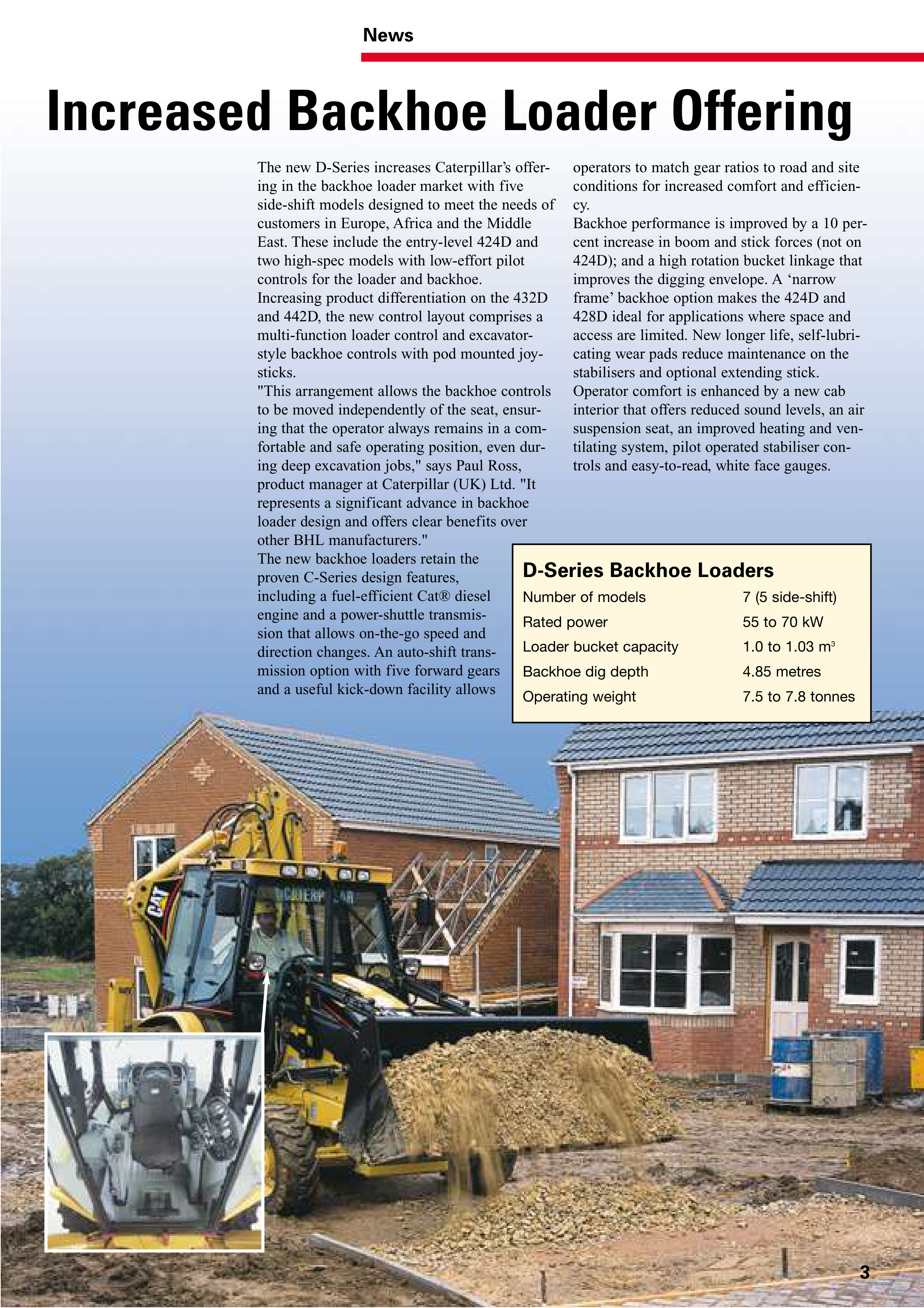
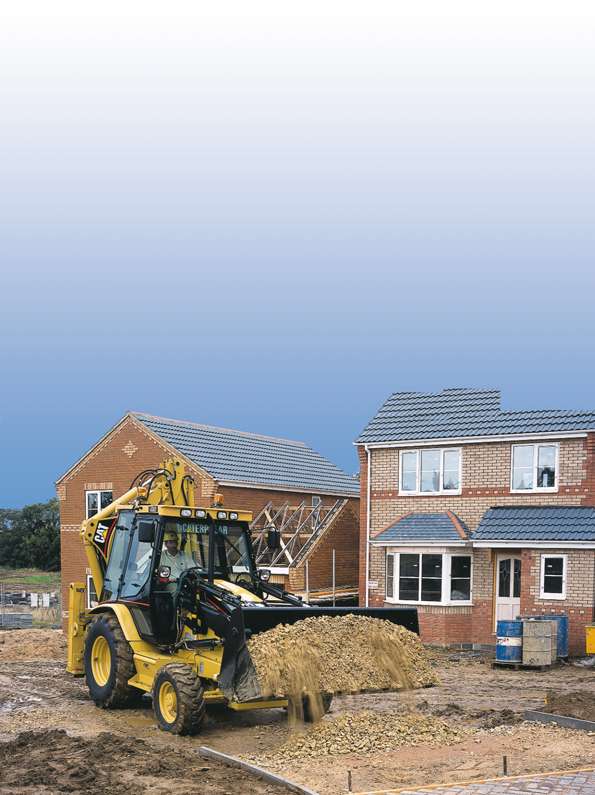
The new D-Series increases Caterpillar’s offer-
ing in the backhoe loader market with five
side-shift models designed to meet the needs of
customers in Europe, Africa and the Middle
East. These include the entry-level 424D and
two high-spec models with low-effort pilot
controls for the loader and backhoe.
Increasing product differentiation on the 432D
and 442D, the new control layout comprises a
multi-function loader control and excavator-
style backhoe controls with pod mounted joy-
sticks.
"This arrangement allows the backhoe controls
to be moved independently of the seat, ensur-
ing that the operator always remains in a com-
fortable and safe operating position, even dur-
ing deep excavation jobs," says Paul Ross,
product manager at Caterpillar (UK) Ltd. "It
represents a significant advance in backhoe
loader design and offers clear benefits over
other BHL manufacturers."
The new backhoe loaders retain the
proven C-Series design features,
including a fuel-efficient Cat® diesel
engine and a power-shuttle transmis-
sion that allows on-the-go speed and
direction changes. An auto-shift trans-
mission option with five forward gears
and a useful kick-down facility allows
operators to match gear ratios to road and site
conditions for increased comfort and efficien-
cy.
Backhoe performance is improved by a 10 per-
cent increase in boom and stick forces (not on
424D); and a high rotation bucket linkage that
improves the digging envelope. A ‘narrow
frame’ backhoe option makes the 424D and
428D ideal for applications where space and
access are limited. New longer life, self-lubri-
cating wear pads reduce maintenance on the
stabilisers and optional extending stick.
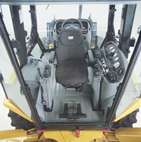
Operator comfort is enhanced by a new cab
interior that offers reduced sound levels, an air
suspension seat, an improved heating and ven-
tilating system, pilot operated stabiliser con-
trols and easy-to-read, white face gauges.
News
3
Increased Backhoe Loader Offering
D-Series Backhoe Loaders
Number of models
7 (5 side-shift)
Rated power
55 to 70 kW
Loader bucket capacity
1.0 to 1.03 m
3
Backhoe dig depth
4.85 metres
Operating weight
7.5 to 7.8 tonnes


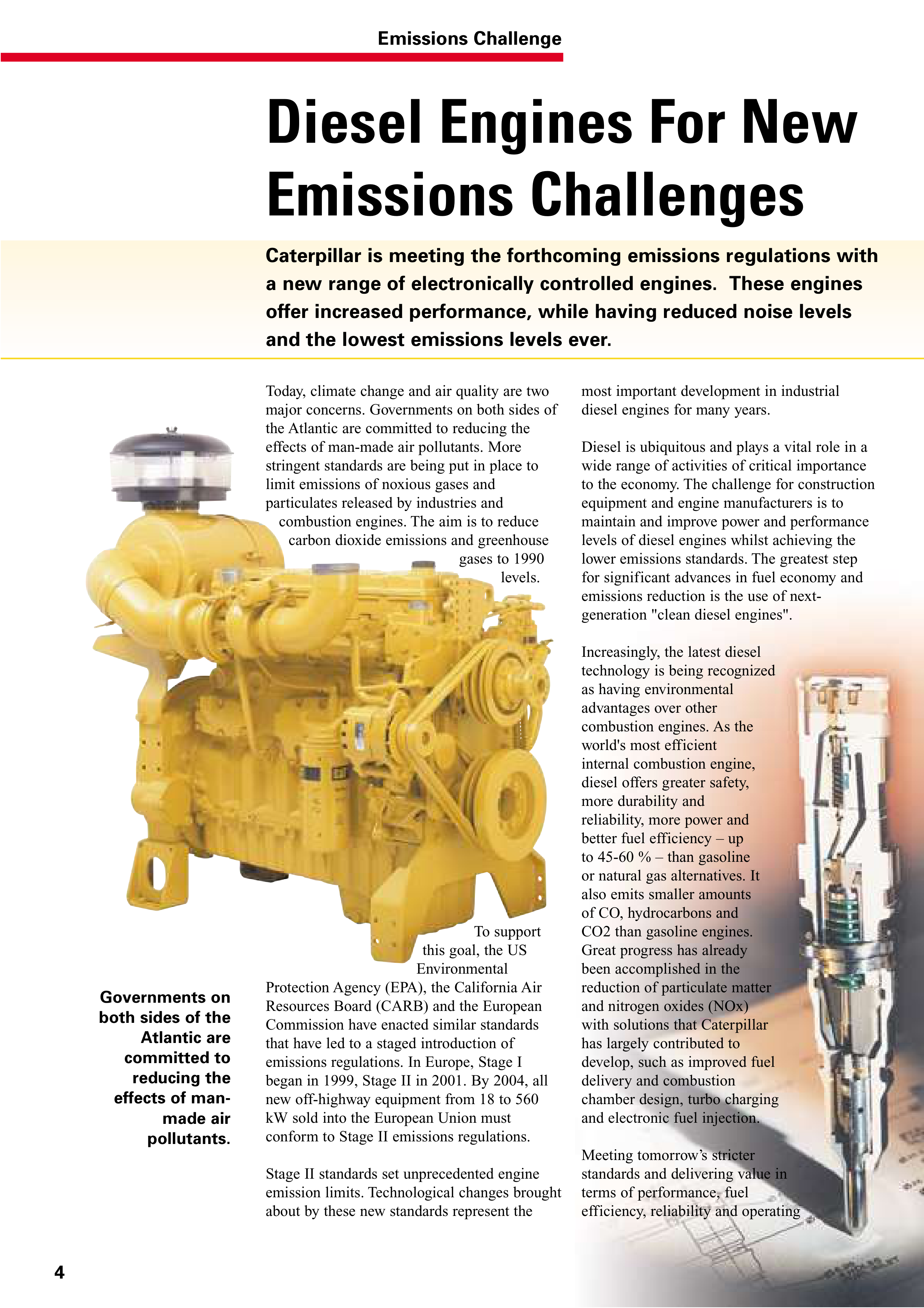
Today, climate change and air quality are two
major concerns. Governments on both sides of
the Atlantic are committed to reducing the
effects of man-made air pollutants. More
stringent standards are being put in place to
limit emissions of noxious gases and
particulates released by industries and
combustion engines. The aim is to reduce
carbon dioxide emissions and greenhouse
gases to 1990
levels.
To support
this goal, the US
Environmental
Protection Agency (EPA), the California Air
Resources Board (CARB) and the European
Commission have enacted similar standards
that have led to a staged introduction of
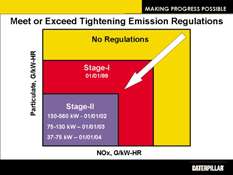
emissions regulations. In Europe, Stage I
began in 1999, Stage II in 2001. By 2004, all
new off-highway equipment from 18 to 560
kW sold into the European Union must
conform to Stage II emissions regulations.
Stage II standards set unprecedented engine
emission limits. Technological changes brought
about by these new standards represent the
most important development in industrial
diesel engines for many years.
Diesel is ubiquitous and plays a vital role in a
wide range of activities of critical importance
to the economy. The challenge for construction
equipment and engine manufacturers is to
maintain and improve power and performance
levels of diesel engines whilst achieving the
lower emissions standards. The greatest step
for significant advances in fuel economy and
emissions reduction is the use of next-
generation "clean diesel engines".
Increasingly, the latest diesel
technology is being recognized
as having environmental
advantages over other
combustion engines. As the
world's most efficient
internal combustion engine,
diesel offers greater safety,
more durability and
reliability, more power and
better fuel efficiency – up
to 45-60 % – than gasoline
or natural gas alternatives. It
also emits smaller amounts
of CO, hydrocarbons and
CO2 than gasoline engines.
Great progress has already
been accomplished in the
reduction of particulate matter
and nitrogen oxides (NOx)
with solutions that Caterpillar
has largely contributed to
develop, such as improved fuel
delivery and combustion
chamber design, turbo charging
and electronic fuel injection.
Meeting tomorrow’s stricter
standards and delivering value in
terms of performance, fuel
efficiency, reliability and operating
Emissions Challenge
4
Diesel Engines For New
Emissions Challenges
Governments on
both sides of the
Atlantic are
committed to
reducing the
effects of man-
made air
pollutants.
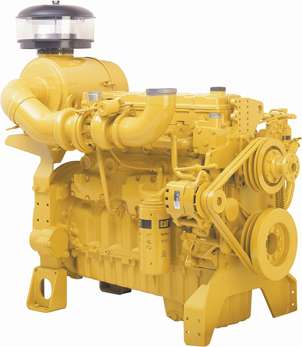
Caterpillar is meeting the forthcoming emissions regulations with
a new range of electronically controlled engines. These engines
offer increased performance, while having reduced noise levels
and the lowest emissions levels ever.

Emissions Challenge
5
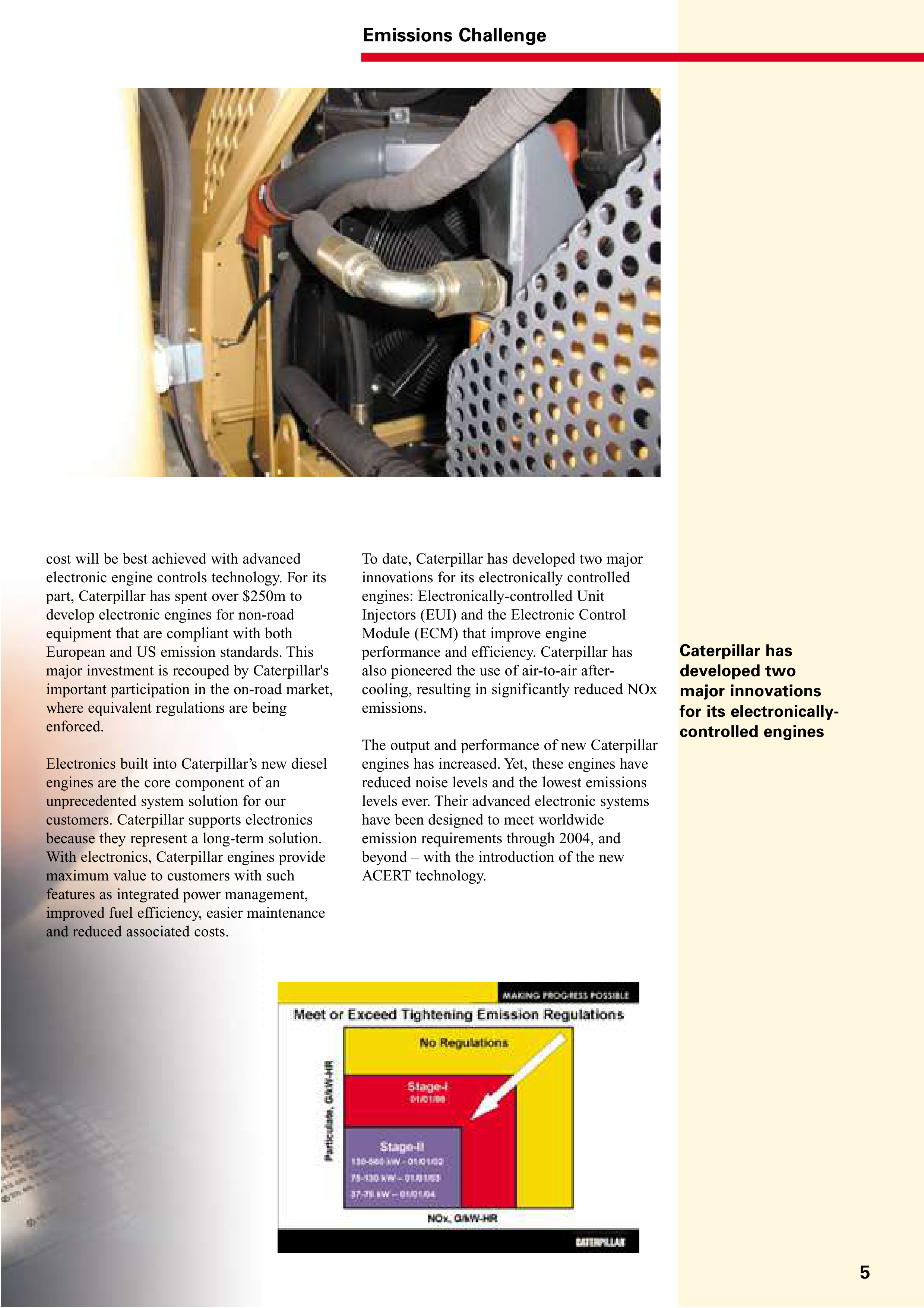
cost will be best achieved with advanced
electronic engine controls technology. For its
part, Caterpillar has spent over $250m to
develop electronic engines for non-road
equipment that are compliant with both
European and US emission standards. This
major investment is recouped by Caterpillar's
important participation in the on-road market,
where equivalent regulations are being
enforced.
Electronics built into Caterpillar’s new diesel
engines are the core component of an
unprecedented system solution for our
customers. Caterpillar supports electronics
because they represent a long-term solution.
With electronics, Caterpillar engines provide
maximum value to customers with such
features as integrated power management,
improved fuel efficiency, easier maintenance
and reduced associated costs.
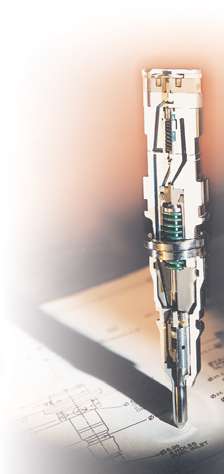
To date, Caterpillar has developed two major
innovations for its electronically controlled
engines: Electronically-controlled Unit
Injectors (EUI) and the Electronic Control
Module (ECM) that improve engine
performance and efficiency. Caterpillar has
also pioneered the use of air-to-air after-
cooling, resulting in significantly reduced NOx
emissions.
The output and performance of new Caterpillar
engines has increased. Yet, these engines have
reduced noise levels and the lowest emissions
levels ever. Their advanced electronic systems
have been designed to meet worldwide
emission requirements through 2004, and
beyond – with the introduction of the new
ACERT technology.
Caterpillar has
developed two
major innovations
for its electronically-
controlled engines


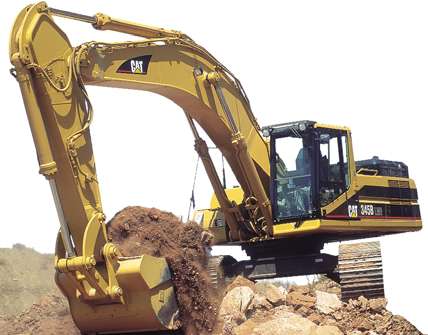
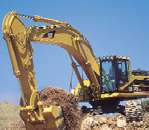
The 345B Series II offers a number of
new design features to
increase productivity, fuel
and operator
efficiency. These
include: 10
percent more
horsepower
from the Stage II emissions-compliant Cat
3176C engine; a boom lowering control
device that ensures more precise and
smoother control of the boom in lifting
applications; and the Cat exclusive Smart
BoomTM.
The Smart Boom allows the 45/50 tonne class
excavator’s boom to go down under its own
weight, simultaneously increasing the pump
flow to other machine functions. This
provides superior operator comfort,
reduced cycle times and
enhanced fuel efficiency
in most applications
including truck loading,
rock-scraping and
hammer work.
New 45 Tonne Excavator
News
6
The 950G Series II through to the 980G Series
II are all powered by new electronically
controlled diesel engines that meet the EU
Stage II emissions regulations.
The new emissions compliant engines feature
high-pressure unit injection fuel systems, air-
to-air aftercooling and an advanced electronic
engine management system. This provides
levels of performance, reliability, fuel economy
and operating flexibility well beyond the
capabilities of traditional mechanically
controlled engines.
One example of the benefits of electronic
engine management is the facility to integrate
all engine/transmission controls, for maximum
system efficiency and increased protection
from operator abuse. Serviceability is also
improved by the use of advanced
troubleshooting and diagnostics, and a filter/oil
change interval that has been doubled to 500-
hours.
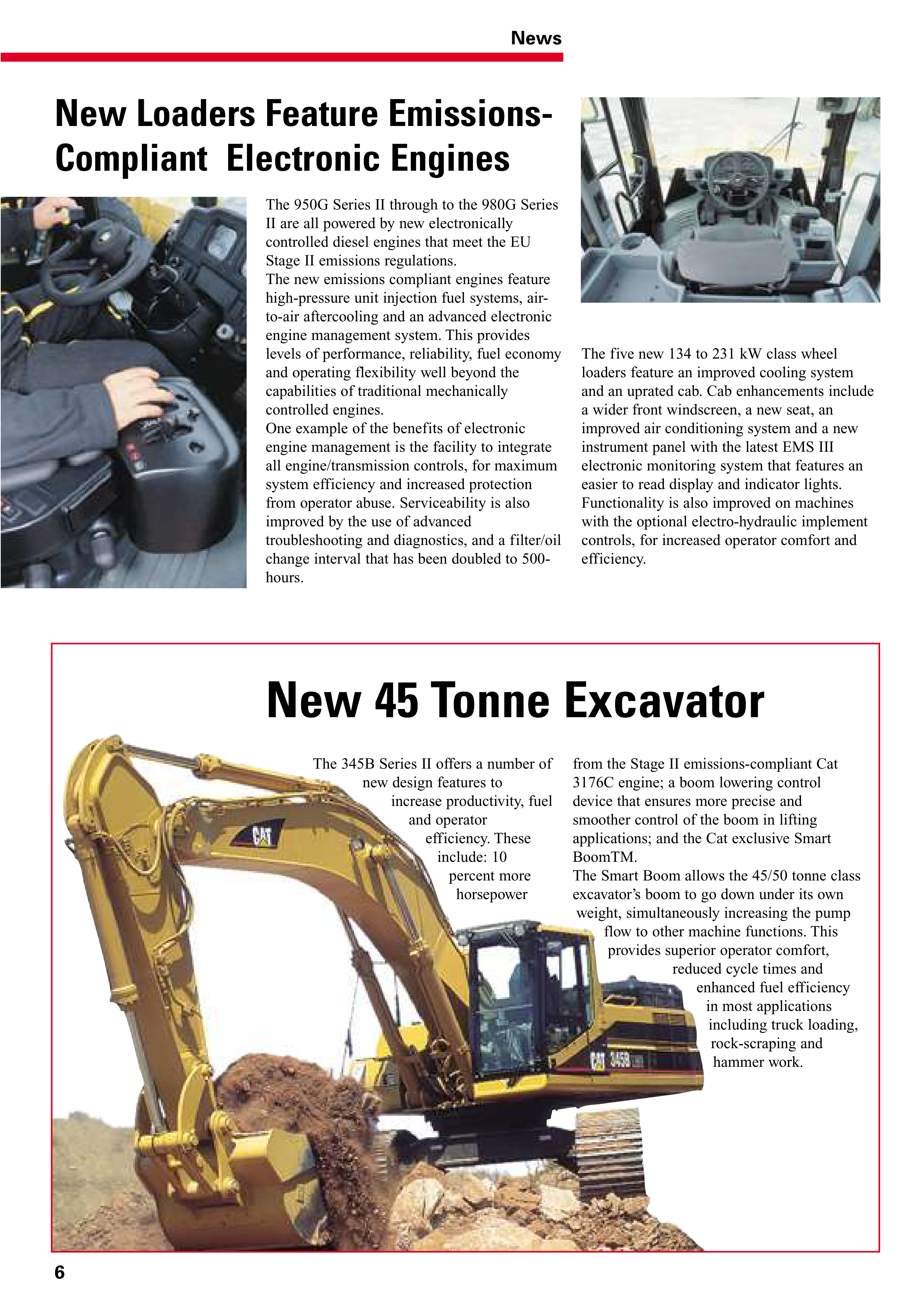
The five new 134 to 231 kW class wheel
loaders feature an improved cooling system
and an uprated cab. Cab enhancements include
a wider front windscreen, a new seat, an
improved air conditioning system and a new
instrument panel with the latest EMS III
electronic monitoring system that features an
easier to read display and indicator lights.
Functionality is also improved on machines
with the optional electro-hydraulic implement
controls, for increased operator comfort and
efficiency.
New Loaders Feature Emissions-
Compliant Electronic Engines


Minerals 2002
7
Minerals are an essential part of today’s
society. In fact, almost everything that is built,
manufactured or grown is produced with the
aid of minerals. Everything from the bricks in
our homes, to the cars that we drive and the
crops we eat.
The importance of minerals is, nevertheless,
often overlooked by the public and
governments when it comes to the siting of a
new quarry or mine.
It is with this in mind that the recently formed
European Minerals Foundation has set out to
put the record straight. The foundation’s
objective is to show how minerals enhance the
lives of the 650 million people that live in
Europe.
Known as Minerals 2002, the Europe-wide
initiative aims to build on the success of a
similar UK-based event in 1998 that attracted
around 100,000 people to a year-long program
of conferences, special events and quarry open
days.
Having been launched at the Hillhead 2001
Quarry and Recycling exhibition in June, the
Minerals 2002
program is now being rolled out across the
UK, Ireland, France, Germany, Spain and
Scandinavia. Associations in other countries
are also being approached.
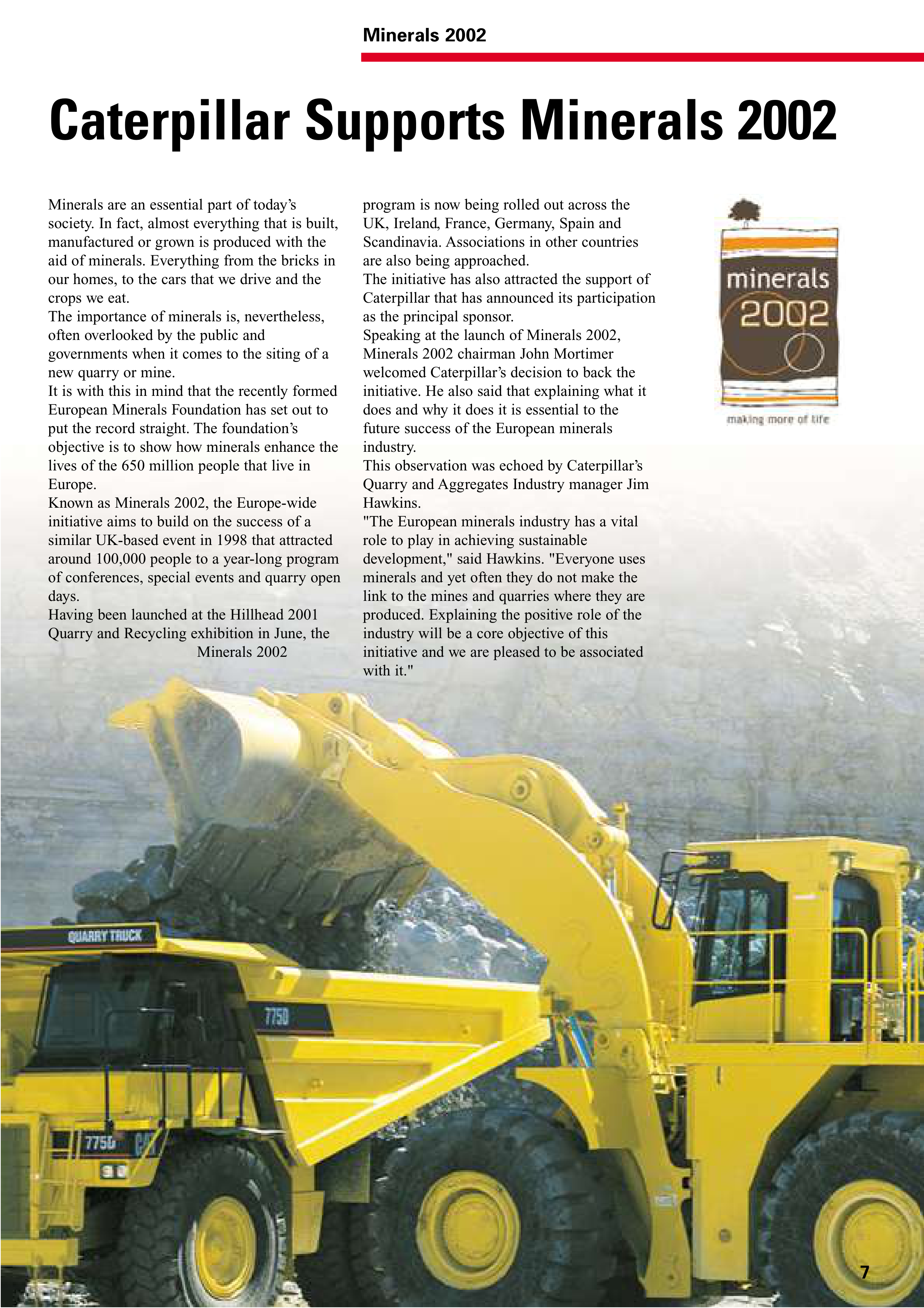
The initiative has also attracted the support of
Caterpillar that has announced its participation
as the principal sponsor.
Speaking at the launch of Minerals 2002,
Minerals 2002 chairman John Mortimer
welcomed Caterpillar’s decision to back the
initiative. He also said that explaining what it
does and why it does it is essential to the
future success of the European minerals
industry.
This observation was echoed by Caterpillar’s
Quarry and Aggregates Industry manager Jim
Hawkins.
"The European minerals industry has a vital
role to play in achieving sustainable
development," said Hawkins. "Everyone uses
minerals and yet often they do not make the
link to the mines and quarries where they are
produced. Explaining the positive role of the
industry will be a core objective of this
initiative and we are pleased to be associated
with it."
Caterpillar Supports Minerals 2002


Systems & Solutions
8
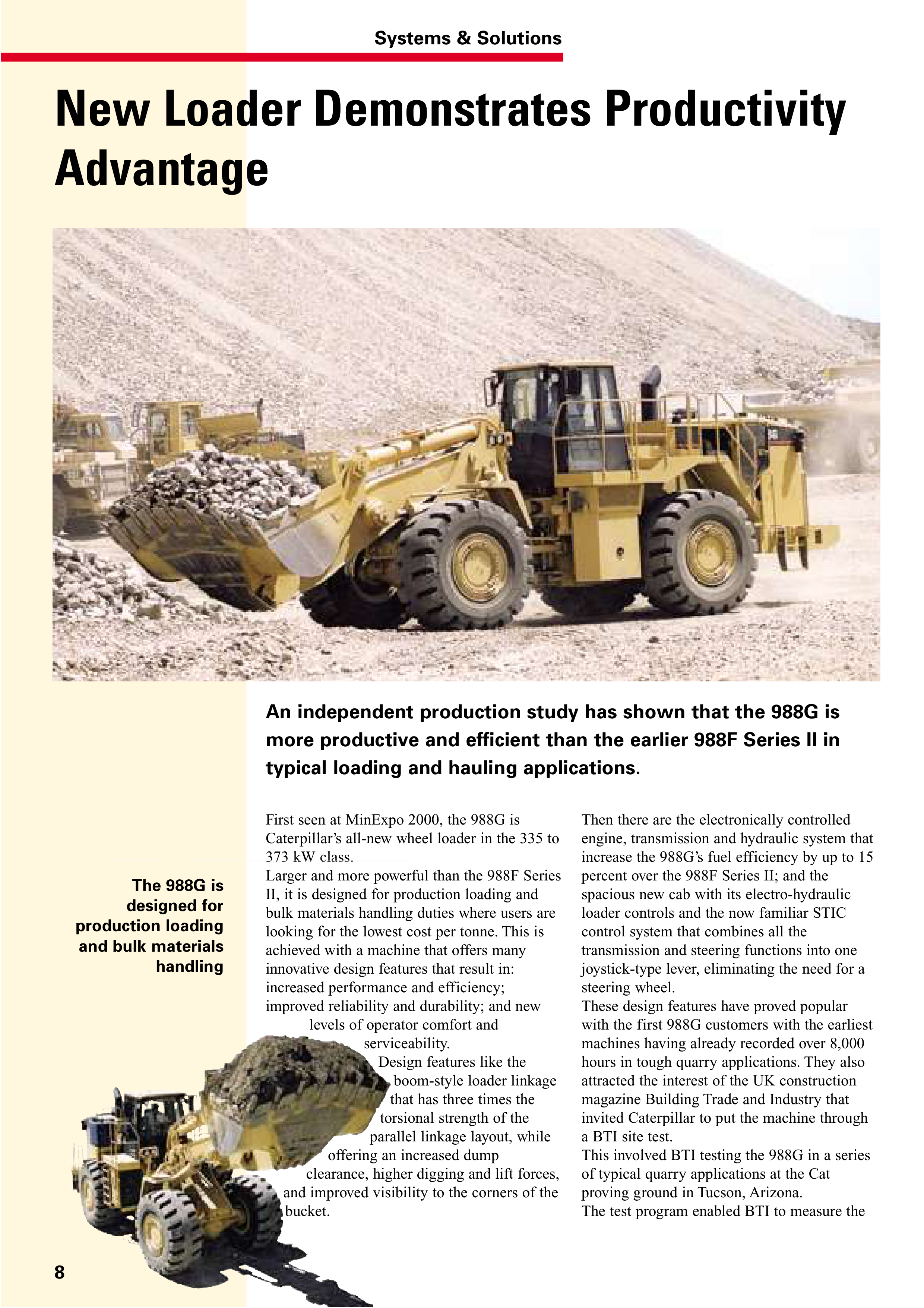
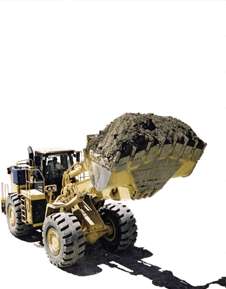
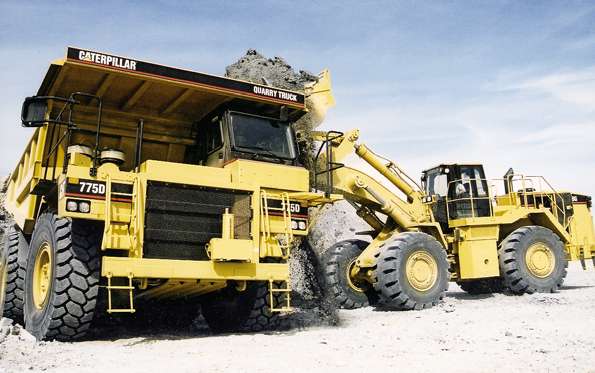
First seen at MinExpo 2000, the 988G is
Caterpillar’s all-new wheel loader in the 335 to
373 kW class.
Larger and more powerful than the 988F Series
II, it is designed for production loading and
bulk materials handling duties where users are
looking for the lowest cost per tonne. This is
achieved with a machine that offers many
innovative design features that result in:
increased performance and efficiency;
improved reliability and durability; and new
levels of operator comfort and
serviceability.
Design features like the
boom-style loader linkage
that has three times the
torsional strength of the
parallel linkage layout, while
offering an increased dump
clearance, higher digging and lift forces,
and improved visibility to the corners of the
bucket.
Then there are the electronically controlled
engine, transmission and hydraulic system that
increase the 988G’s fuel efficiency by up to 15
percent over the 988F Series II; and the
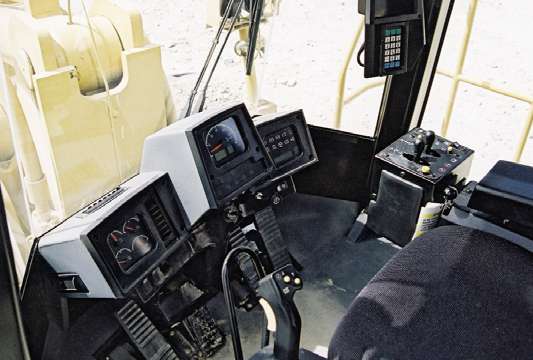
spacious new cab with its electro-hydraulic
loader controls and the now familiar STIC
control system that combines all the
transmission and steering functions into one
joystick-type lever, eliminating the need for a
steering wheel.
These design features have proved popular
with the first 988G customers with the earliest
machines having already recorded over 8,000
hours in tough quarry applications. They also
attracted the interest of the UK construction
magazine Building Trade and Industry that
invited Caterpillar to put the machine through
a BTI site test.
This involved BTI testing the 988G in a series
of typical quarry applications at the Cat
proving ground in Tucson, Arizona.
The test program enabled BTI to measure the
New Loader Demonstrates Productivity
Advantage
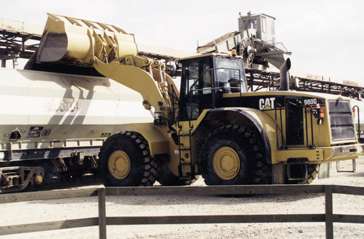
An independent production study has shown that the 988G is
more productive and efficient than the earlier 988F Series II in
typical loading and hauling applications.
The 988G is
designed for
production loading
and bulk materials
handling


50 tonne machine’s productivity in both face
and stockpile loading applications where it was
expected to load 38/40-tonne-payload Cat®
769D and 771D off-highway trucks.
A third test provided figures for load-and-carry
operation where the loader was working over a
one-way haul distance of 71 metres with an
adverse gradient of 3 to 4 percent. This
increased to 14 percent over the last 15 metres
as the loader approached the trucks that were
sited to represent a crusher hopper.
The 988G was equipped for the tests with a 6.4
m3 quarry bucket and operated by an
experienced Cat demonstrator. A productivity
reference point was provided in the shape of a
Cat 988F Series II equipped with a 6.3 m3
rock bucket.
Accurate measurements of the two machines’
productivity and fuel economy were ensured by
the use of auxiliary fuel tanks and on-site
weigh scales to calculate the amount of
material moved. BTI worked all the production
figures back to a 50-minute hour to simulate
the conditions of a typical quarry application
where time would be needed for spotting the
trucks and cleaning the quarry floor.
The BTI test report showed that when the two
loaders performed the face-loading test the
988G’s extra power and higher breakout forces
really showed through with the new machine
able to get a far more impressive bucket fill
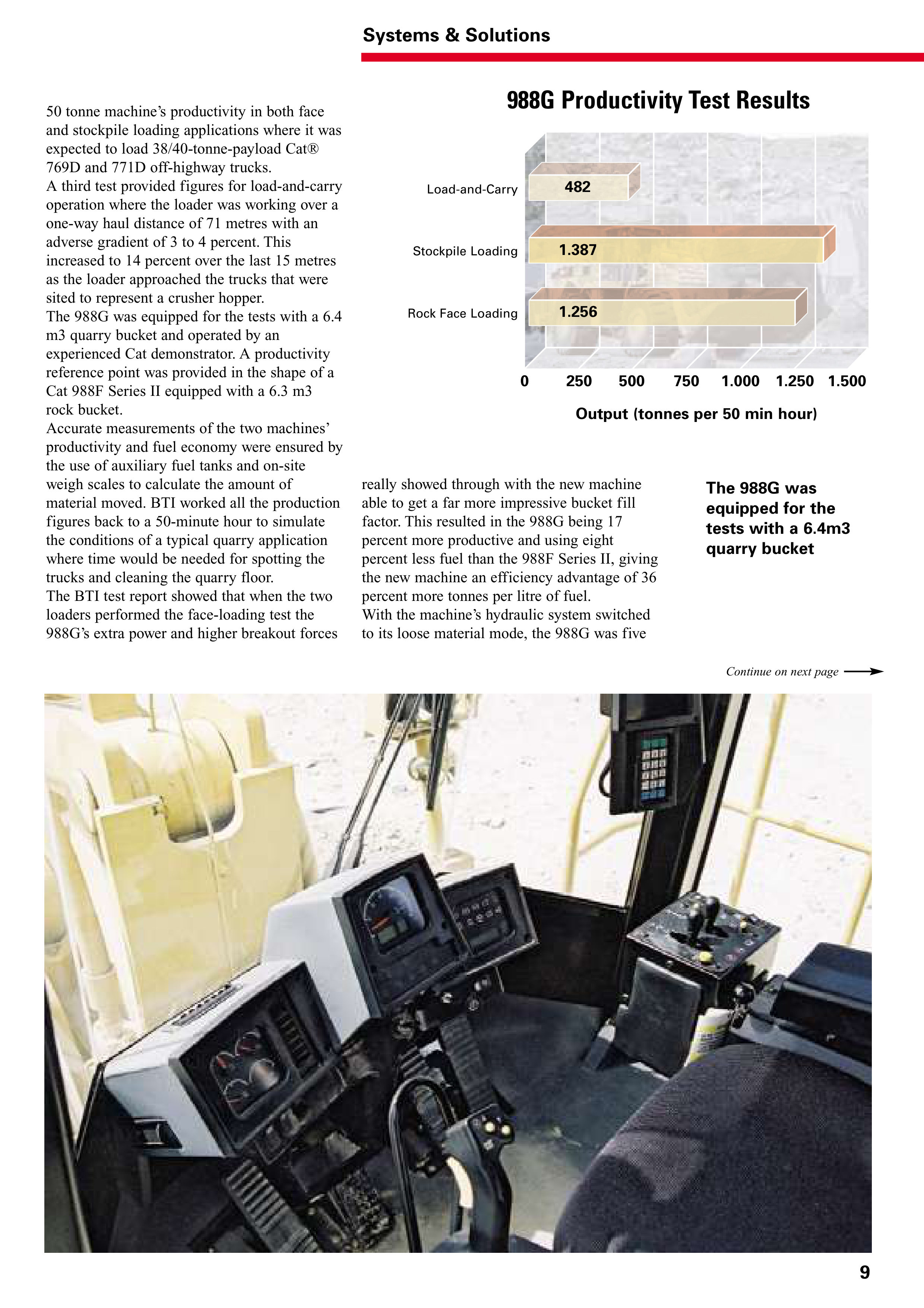
factor. This resulted in the 988G being 17
percent more productive and using eight
percent less fuel than the 988F Series II, giving
the new machine an efficiency advantage of 36
percent more tonnes per litre of fuel.
With the machine’s hydraulic system switched
to its loose material mode, the 988G was five
Systems & Solutions
9
988G Productivity Test Results
Load-and-Carry
Stockpile Loading
Rock Face Loading
482
1.387
1.256
0
250
500
750
1.000 1.250 1.500
Output (tonnes per 50 min hour)
Continue on next page
The 988G was
equipped for the
tests with a 6.4m3
quarry bucket


Systems & Solutions
10
percent more productive than the 988F Series
II in the stockpile loading test and eight
percent more productive in the load-and-carry
test. When these figures were combined with
the two machines’ fuel consumption in the two
tests, it resulted in a 23 percent fuel efficiency
advantage for the 988G in the stockpile
loading test and a 14 percent advantage in the
load-and-carry test.
So what does all this mean for customers that
are looking for a new 6.0 to 7.0 m3 class
wheel loader. "Quite a lot," according to BTI
editor Dan Gilkes.
"The 988F Series II was a competitive
machine, but the 988G offers quarry owners a
lower cost per tonne in typical loading and
hauling applications," says Gilkes.
"The 988G bristles with new technology that
makes it more productive and efficient than its
predecessor. It is also easier to operate and
cheaper to maintain. You can’t ask for more
than that."
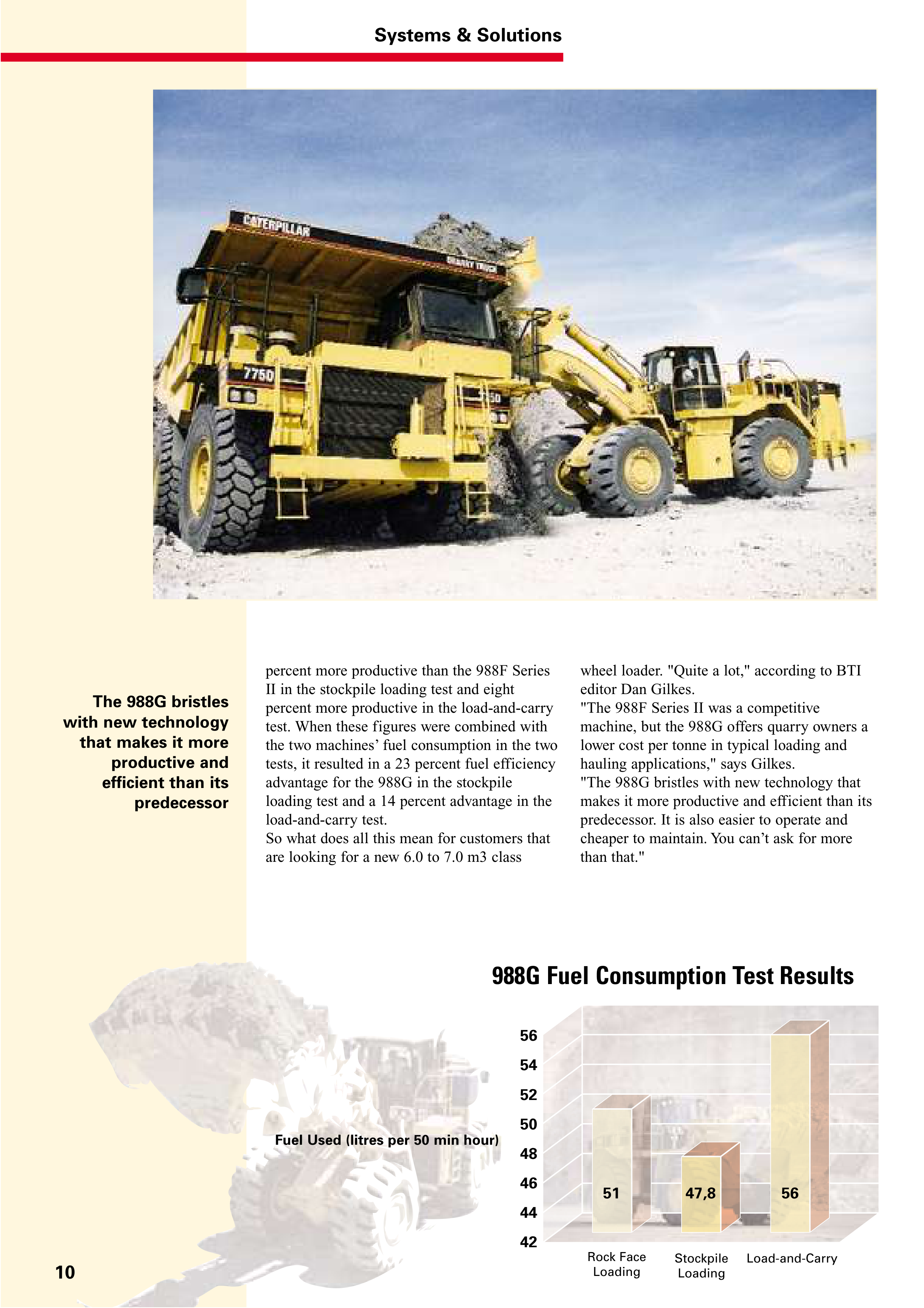
The 988G bristles
with new technology
that makes it more
productive and
efficient than its
predecessor
988G Fuel Consumption Test Results
56
54
52
50
48
46
44
42
51
47,8
56
Rock Face
Loading
Stockpile
Loading
Load-and-Carry
Fuel Used (litres per 50 min hour)
Technology
11
While some engine manufactures strive to
meet the requirements of the Tier 2/Stage II
emissions regulations for diesel engines,
Caterpillar has turned its attention to meeting
the even more exacting Tier 3 standards.
This dedication to safeguarding the
environment has delivered a significant
breakthrough in emissions technology that will
allow Cat engines to meet Tier 3 and
anticipated Stage III regulations without cooled
exhaust gas recirculation (EGR) systems.
Technical details of the new ACERT
(Advanced Combustion Emissions Reduction
Technology) system have not been disclosed.
But Caterpillar explains that it combines
advanced combustion technology, next-
generation fuel systems, advanced integrated
controls and after treatment to improve on the
excellent emissions standards of Caterpillar
engines.
By controlling emissions through the
improvement of engine combustion
performance, Caterpillar also succeeds in
reducing noise emissions. ACERT also
improves engine performance and has the
capacity to eliminate exhaust odour without
affecting engine reliability and durability. Of
particular interest to Original Equipment
Manufacturer customers will be the minimal
amount of change required in application
engineering when switching to ACERT-
equipped engines to comply with Tier-3 /
anticipated Stage-III regulations.
"ACERT offers an optimal emissions solution
to our European engine customers and global
engine market," says Roberto Dionisio, Power
Systems manager for Caterpillar SARL
(Europe, Africa and the Middle East).
According to Dionisio, the simplicity of the
installation will greatly benefits Caterpillar’s
commercial engine customers, while offering a
smooth and rapid transition to comply with the
next generation of emission regulations.
"The ACERT system leverages Caterpillar’s
expertise in the latest engine design
technology, next generation fuel system
technology, and integrated electronic control
systems. Since ACERT-equipped engines have
significantly fewer components than EGR-
based engines, the new hardware requirements
for our industrial customers are minimized
during the transition to Tier-3 and anticipated
Stage-III compliant engines."
Redefining Clean Power
ACERT will greatly benefit Caterpillar’s commercial engine cus-
tomers


Focus on Cat
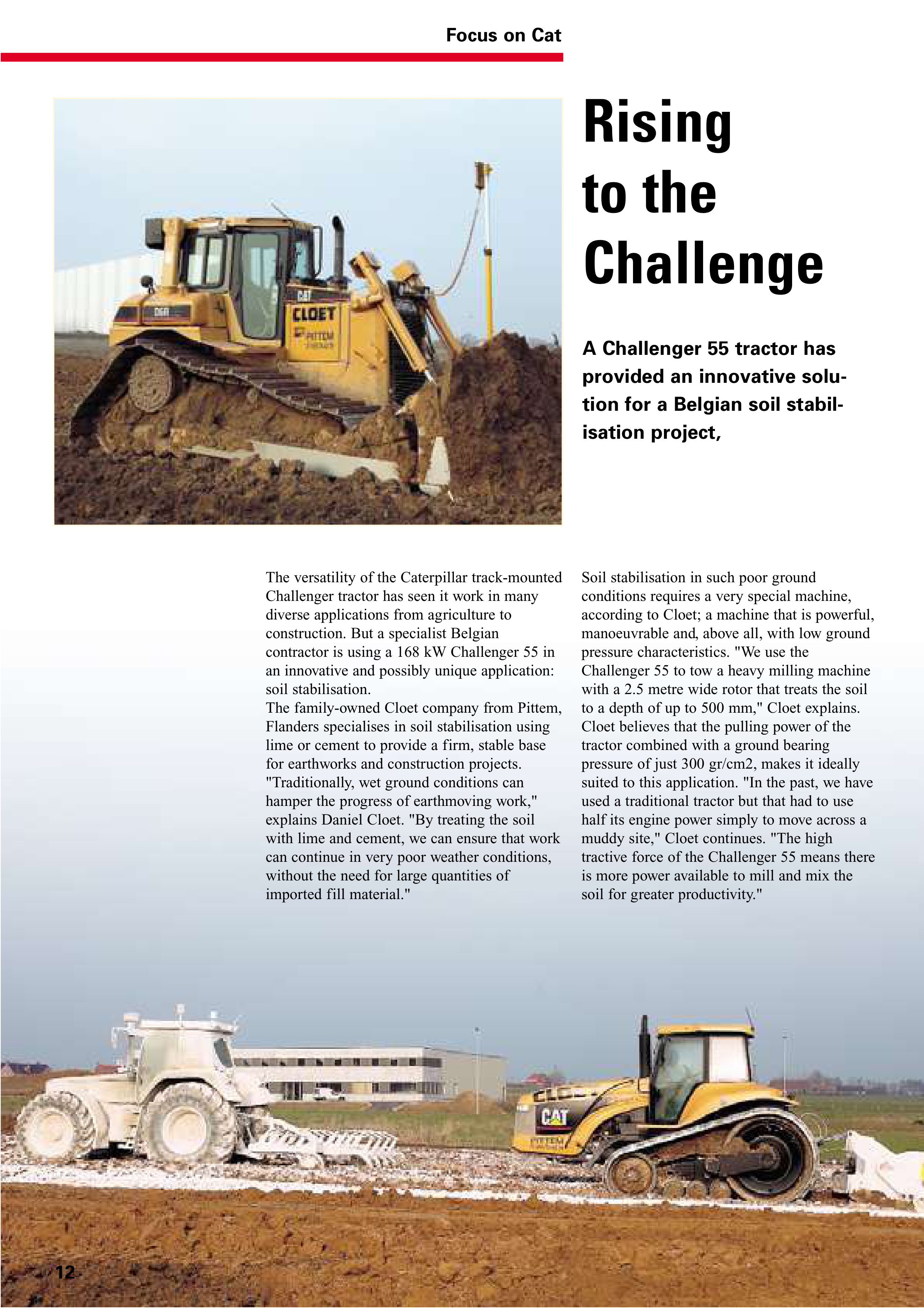
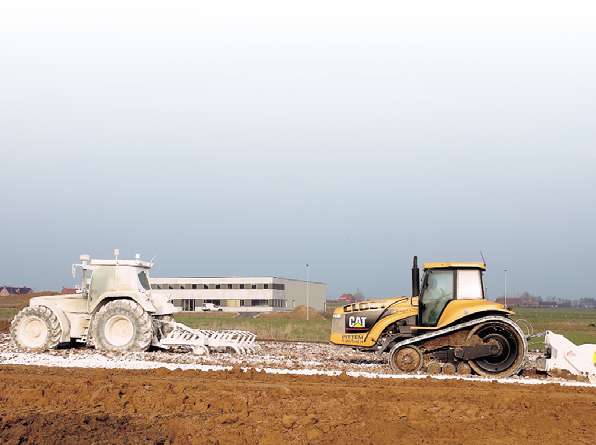
The versatility of the Caterpillar track-mounted
Challenger tractor has seen it work in many
diverse applications from agriculture to
construction. But a specialist Belgian
contractor is using a 168 kW Challenger 55 in
an innovative and possibly unique application:
soil stabilisation.
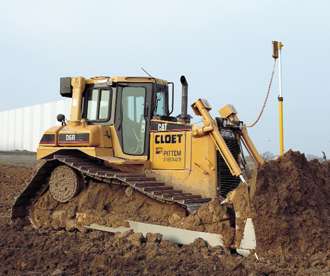
The family-owned Cloet company from Pittem,
Flanders specialises in soil stabilisation using
lime or cement to provide a firm, stable base
for earthworks and construction projects.
"Traditionally, wet ground conditions can
hamper the progress of earthmoving work,"
explains Daniel Cloet. "By treating the soil
with lime and cement, we can ensure that work
can continue in very poor weather conditions,
without the need for large quantities of
imported fill material."
Soil stabilisation in such poor ground
conditions requires a very special machine,
according to Cloet; a machine that is powerful,
manoeuvrable and, above all, with low ground
pressure characteristics. "We use the
Challenger 55 to tow a heavy milling machine
with a 2.5 metre wide rotor that treats the soil
to a depth of up to 500 mm," Cloet explains.
Cloet believes that the pulling power of the
tractor combined with a ground bearing
pressure of just 300 gr/cm2, makes it ideally
suited to this application. "In the past, we have
used a traditional tractor but that had to use
half its engine power simply to move across a
muddy site," Cloet continues. "The high
tractive force of the Challenger 55 means there
is more power available to mill and mix the
soil for greater productivity."
A Challenger 55 tractor has
provided an innovative solu-
tion for a Belgian soil stabil-
isation project,
12
Rising
to the
Challenge


Systems & Solutions
13
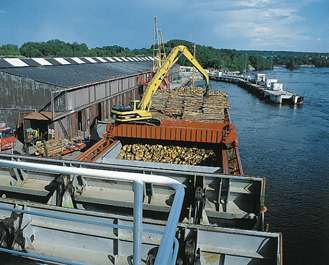
Shipping companies like Norway’s Rolf Wagle
only earn money when their ships are at sea.
When the ships are in port, the company is
effectively losing revenue.
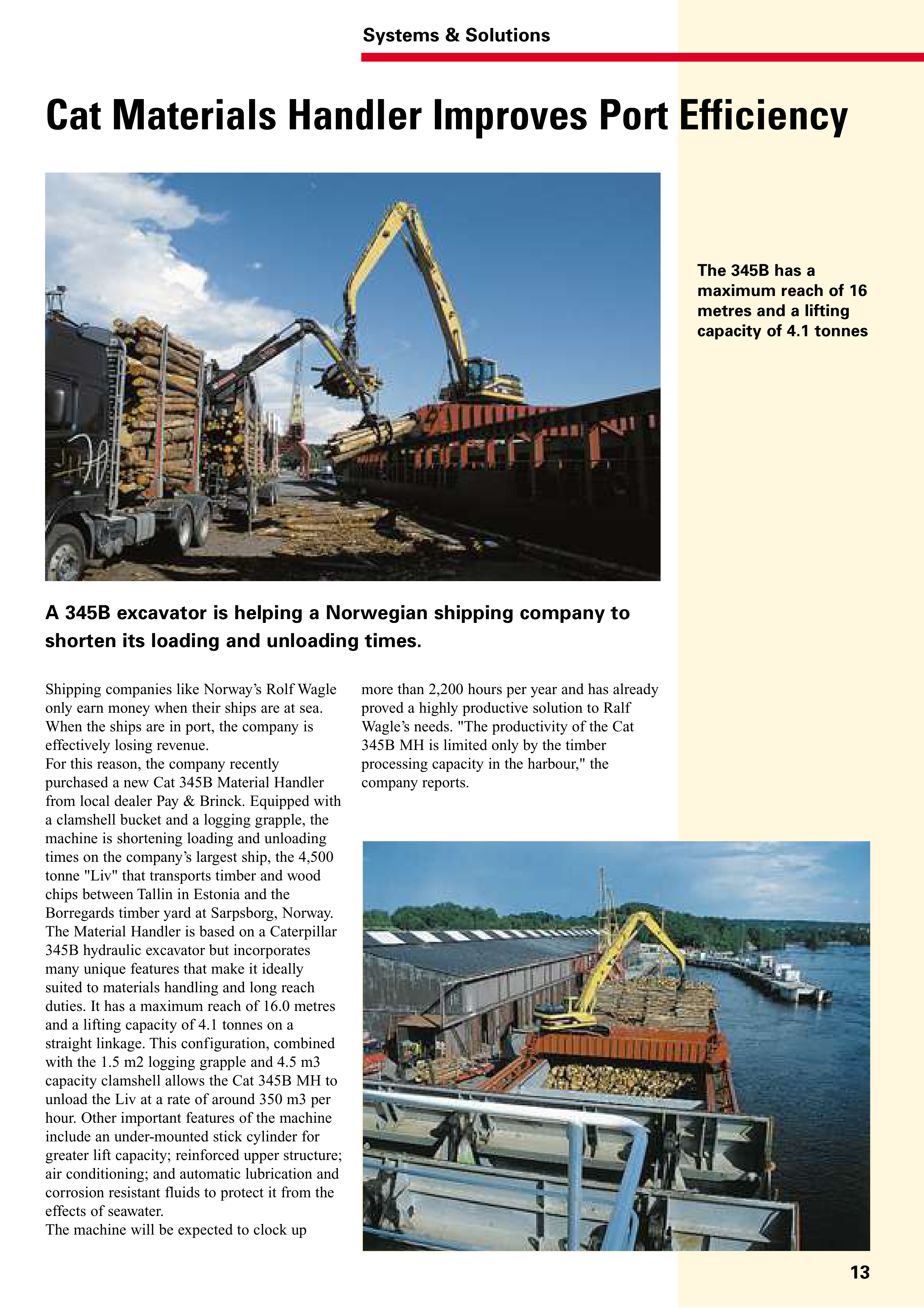
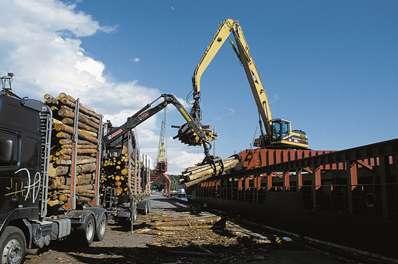
For this reason, the company recently
purchased a new Cat 345B Material Handler
from local dealer Pay & Brinck. Equipped with
a clamshell bucket and a logging grapple, the
machine is shortening loading and unloading
times on the company’s largest ship, the 4,500
tonne "Liv" that transports timber and wood
chips between Tallin in Estonia and the
Borregards timber yard at Sarpsborg, Norway.
The Material Handler is based on a Caterpillar
345B hydraulic excavator but incorporates
many unique features that make it ideally
suited to materials handling and long reach
duties. It has a maximum reach of 16.0 metres
and a lifting capacity of 4.1 tonnes on a
straight linkage. This configuration, combined
with the 1.5 m2 logging grapple and 4.5 m3
capacity clamshell allows the Cat 345B MH to
unload the Liv at a rate of around 350 m3 per
hour. Other important features of the machine
include an under-mounted stick cylinder for
greater lift capacity; reinforced upper structure;
air conditioning; and automatic lubrication and
corrosion resistant fluids to protect it from the
effects of seawater.
The machine will be expected to clock up
more than 2,200 hours per year and has already
proved a highly productive solution to Ralf
Wagle’s needs. "The productivity of the Cat
345B MH is limited only by the timber
processing capacity in the harbour," the
company reports.
Cat Materials Handler Improves Port Efficiency
A 345B excavator is helping a Norwegian shipping company to
shorten its loading and unloading times.
The 345B has a
maximum reach of 16
metres and a lifting
capacity of 4.1 tonnes


Systems & Solutions
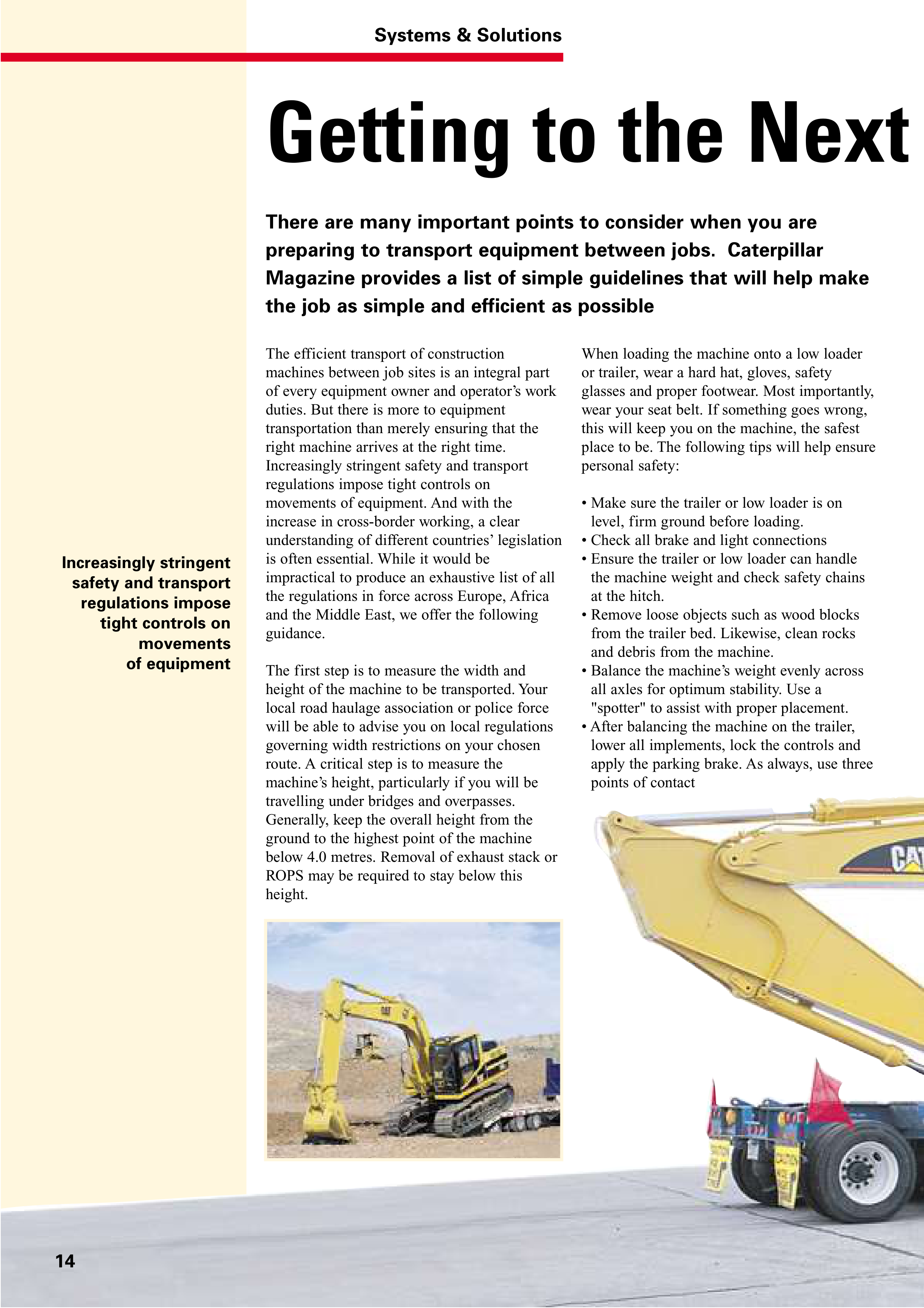
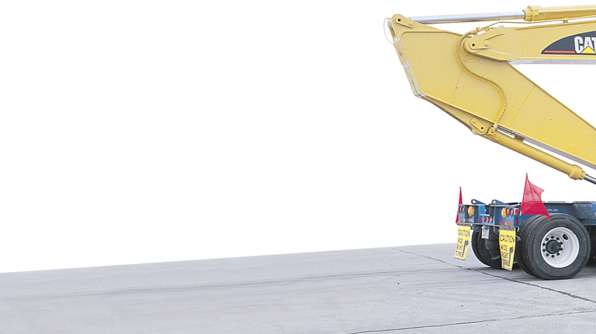
The efficient transport of construction
machines between job sites is an integral part
of every equipment owner and operator’s work
duties. But there is more to equipment
transportation than merely ensuring that the
right machine arrives at the right time.
Increasingly stringent safety and transport
regulations impose tight controls on
movements of equipment. And with the
increase in cross-border working, a clear
understanding of different countries’ legislation
is often essential. While it would be
impractical to produce an exhaustive list of all
the regulations in force across Europe, Africa
and the Middle East, we offer the following
guidance.
The first step is to measure the width and
height of the machine to be transported. Your
local road haulage association or police force
will be able to advise you on local regulations
governing width restrictions on your chosen
route. A critical step is to measure the
machine’s height, particularly if you will be
travelling under bridges and overpasses.
Generally, keep the overall height from the
ground to the highest point of the machine
below 4.0 metres. Removal of exhaust stack or
ROPS may be required to stay below this
height.
When loading the machine onto a low loader
or trailer, wear a hard hat, gloves, safety
glasses and proper footwear. Most importantly,
wear your seat belt. If something goes wrong,
this will keep you on the machine, the safest
place to be. The following tips will help ensure
personal safety:
• Make sure the trailer or low loader is on
level, firm ground before loading.
• Check all brake and light connections
• Ensure the trailer or low loader can handle
the machine weight and check safety chains
at the hitch.
• Remove loose objects such as wood blocks
from the trailer bed. Likewise, clean rocks
and debris from the machine.
• Balance the machine’s weight evenly across
all axles for optimum stability. Use a
"spotter" to assist with proper placement.
• After balancing the machine on the trailer,
lower all implements, lock the controls and
apply the parking brake. As always, use three
points of contact
There are many important points to consider when you are
preparing to transport equipment between jobs. Caterpillar
Magazine provides a list of simple guidelines that will help make
the job as simple and efficient as possible
Increasingly stringent
safety and transport
regulations impose
tight controls on
movements
of equipment
14
Getting to the Next


Systems & Solutions
15
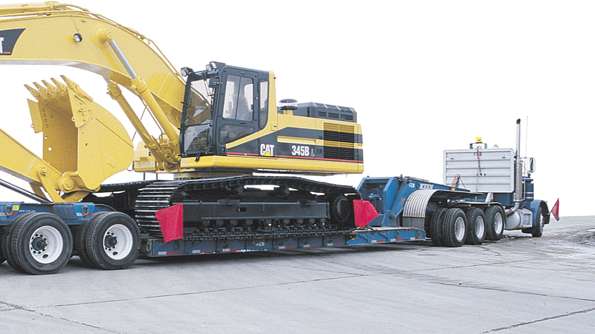
when getting off the machine.
• Tape over the exhaust stack port to prevent
possible damage to the turbo.
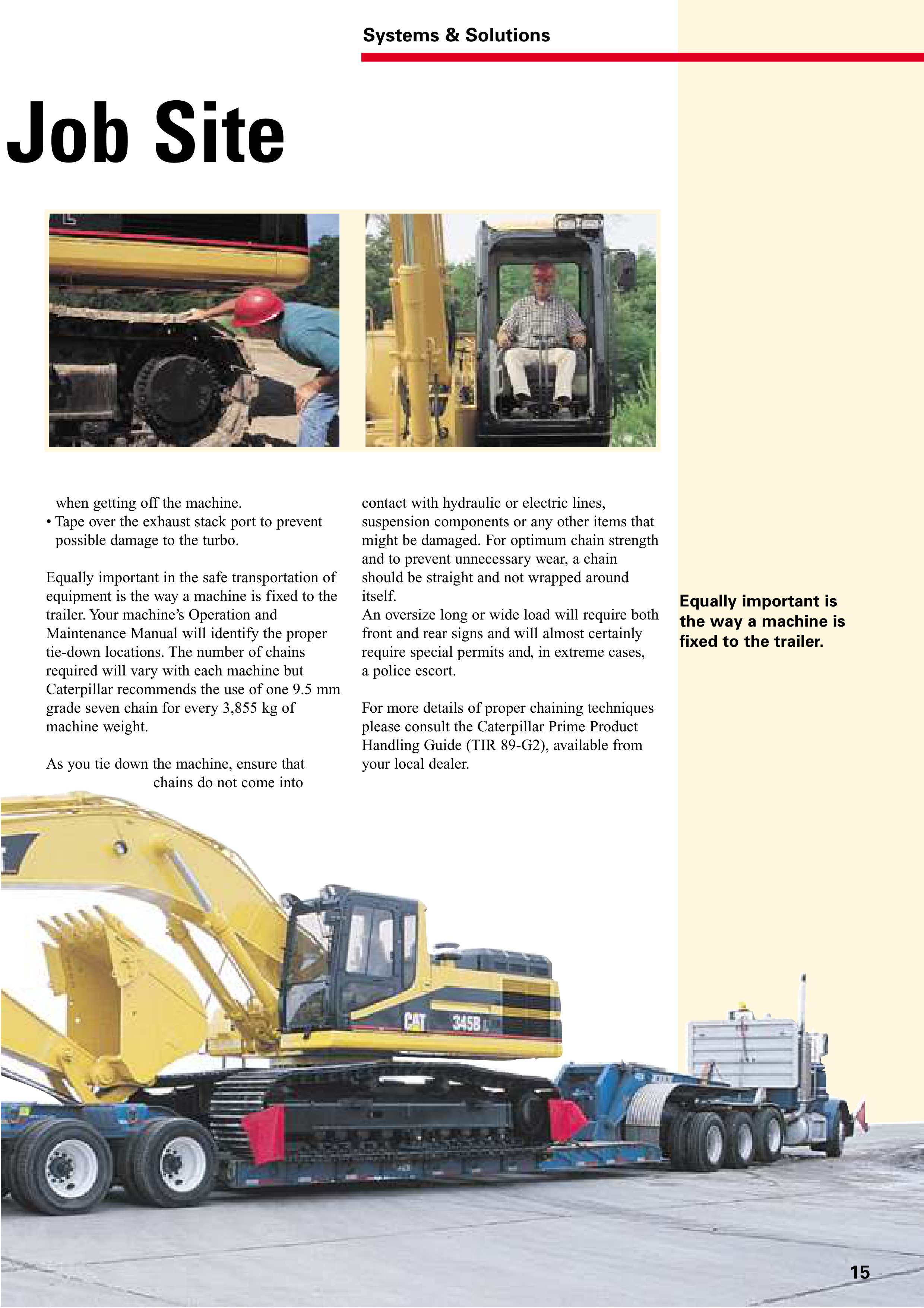
Equally important in the safe transportation of
equipment is the way a machine is fixed to the
trailer. Your machine’s Operation and
Maintenance Manual will identify the proper
tie-down locations. The number of chains
required will vary with each machine but
Caterpillar recommends the use of one 9.5 mm
grade seven chain for every 3,855 kg of
machine weight.
As you tie down the machine, ensure that
chains do not come into
contact with hydraulic or electric lines,
suspension components or any other items that
might be damaged. For optimum chain strength
and to prevent unnecessary wear, a chain
should be straight and not wrapped around
itself.
An oversize long or wide load will require both
front and rear signs and will almost certainly
require special permits and, in extreme cases,
a police escort.
For more details of proper chaining techniques
please consult the Caterpillar Prime Product
Handling Guide (TIR 89-G2), available from
your local dealer.
Equally important is
the way a machine is
fixed to the trailer.
Job Site


Customer Support
16
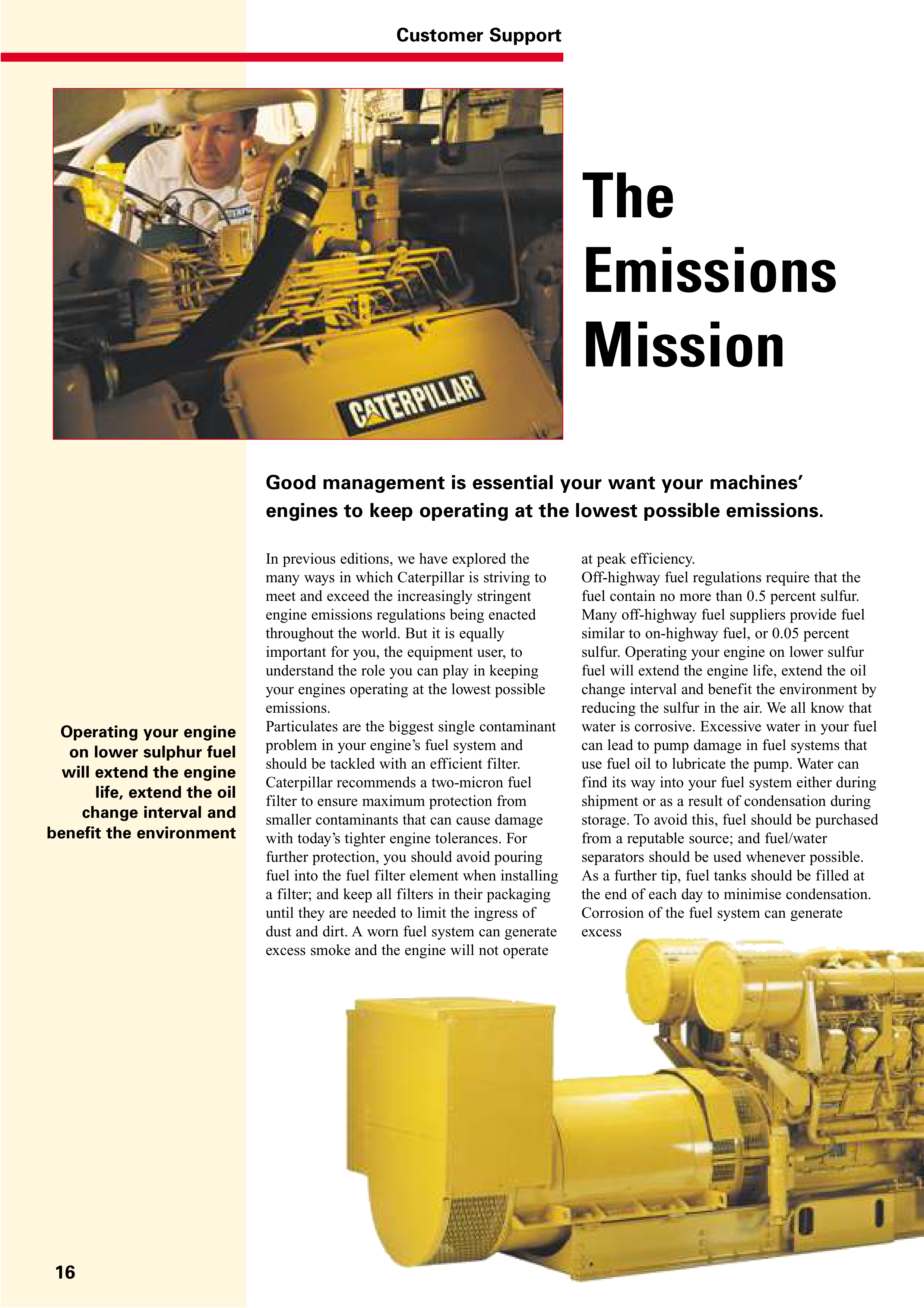
In previous editions, we have explored the
many ways in which Caterpillar is striving to
meet and exceed the increasingly stringent
engine emissions regulations being enacted
throughout the world. But it is equally
important for you, the equipment user, to
understand the role you can play in keeping
your engines operating at the lowest possible
emissions.
Particulates are the biggest single contaminant
problem in your engine’s fuel system and
should be tackled with an efficient filter.
Caterpillar recommends a two-micron fuel
filter to ensure maximum protection from
smaller contaminants that can cause damage
with today’s tighter engine tolerances. For
further protection, you should avoid pouring
fuel into the fuel filter element when installing
a filter; and keep all filters in their packaging
until they are needed to limit the ingress of
dust and dirt. A worn fuel system can generate
excess smoke and the engine will not operate
at peak efficiency.
Off-highway fuel regulations require that the
fuel contain no more than 0.5 percent sulfur.
Many off-highway fuel suppliers provide fuel
similar to on-highway fuel, or 0.05 percent
sulfur. Operating your engine on lower sulfur
fuel will extend the engine life, extend the oil
change interval and benefit the environment by
reducing the sulfur in the air. We all know that
water is corrosive. Excessive water in your fuel
can lead to pump damage in fuel systems that
use fuel oil to lubricate the pump. Water can
find its way into your fuel system either during
shipment or as a result of condensation during
storage. To avoid this, fuel should be purchased
from a reputable source; and fuel/water
separators should be used whenever possible.
As a further tip, fuel tanks should be filled at
the end of each day to minimise condensation.
Corrosion of the fuel system can generate
excess
The
Emissions
Mission
Good management is essential your want your machines’
engines to keep operating at the lowest possible emissions.
Operating your engine
on lower sulphur fuel
will extend the engine
life, extend the oil
change interval and
benefit the environment


Customer Support
17
smoke and the engine will not operate at peak
efficiency.
To further reduce engine emissions, it
important to understand the types of emissions
a diesel engine can produce and the role that
parts wear plays in emissions and, ultimately,
engine performance.
Diesel engines produce emissions that include
oxides of nitrogen (NOx) and hydrocarbons
(HC), both of which contribute to the
destruction of the Earth’s ozone layer; carbon
monoxide (CO); sulphur dioxide (SO2);
particulate matter (PM); and smoke. Your
engine is designed to meet the regulations for
each of these emissions, both when the engine
is new and during the useful life. Eventually,
engine wear will result in reduced engine
efficiency and increased emissions. Increased
oil consumption is usually the first sign of
engine wear. You should monitor your
turbocharger seals and check for blowby to
make sure your piston rings are in good
condition.
There are many other steps you can take to
help control engine emissions, many of which
can be found in your owner’s instructions.
Most important among these is to practice
good maintenance procedures; and use good
operations practices like warming the engine
before putting it under a load.
Caterpillar engine design improvements such
as electronic controls and unit injected fuel
systems have reduced emissions greatly. But
the way you maintain and operate your engines
will have an equally big impact on emissions
and will have the added benefit of making your
engine run longer and more efficiently."
To further reduce
engine emissions, it is
important to know the
types of emissions a
diesel engine can
produce


Customer Support
18
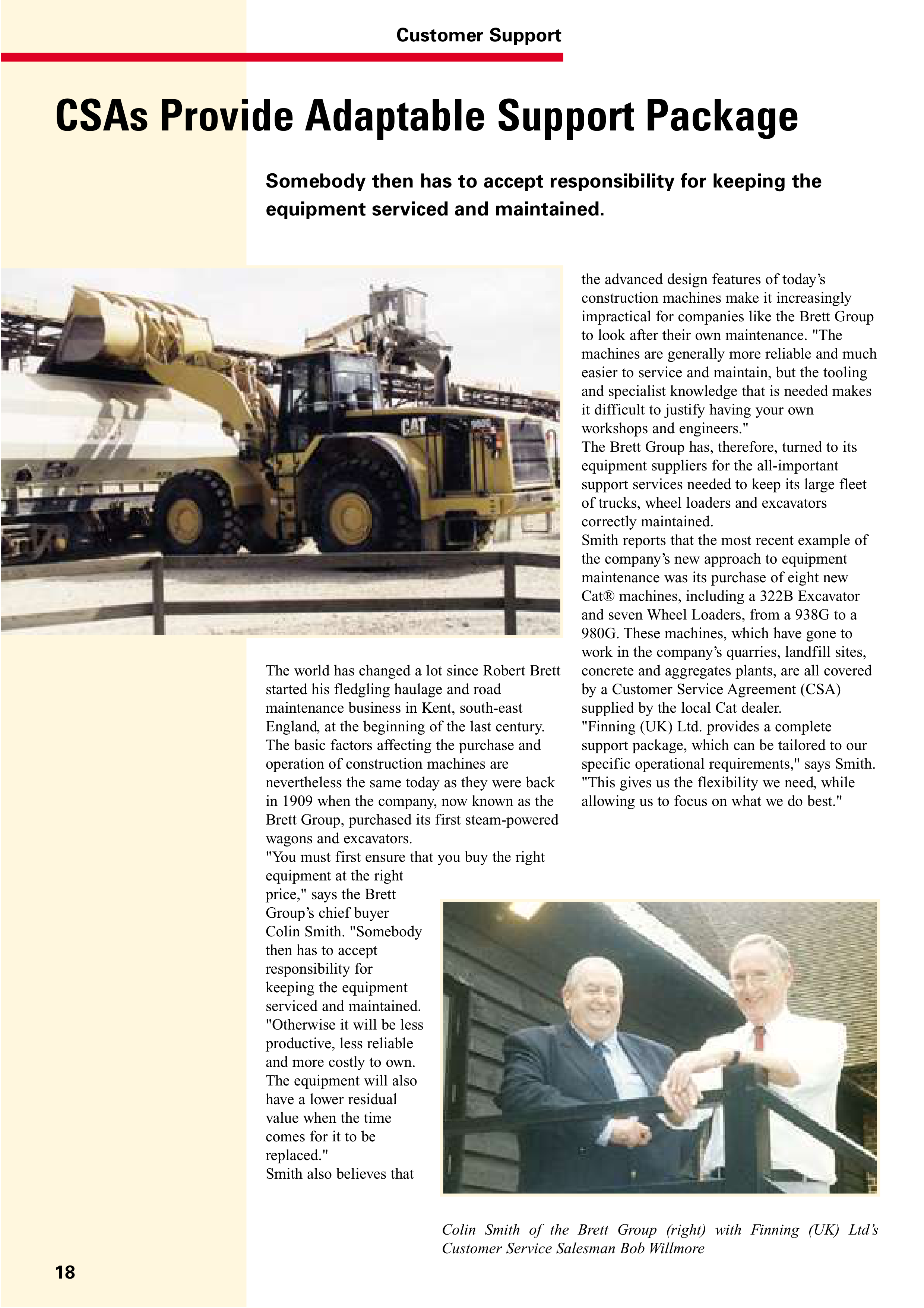
The world has changed a lot since Robert Brett
started his fledgling haulage and road
maintenance business in Kent, south-east
England, at the beginning of the last century.
The basic factors affecting the purchase and
operation of construction machines are
nevertheless the same today as they were back
in 1909 when the company, now known as the
Brett Group, purchased its first steam-powered
wagons and excavators.
"You must first ensure that you buy the right
equipment at the right
price," says the Brett
Group’s chief buyer
Colin Smith. "Somebody
then has to accept
responsibility for
keeping the equipment
serviced and maintained.
"Otherwise it will be less
productive, less reliable
and more costly to own.
The equipment will also
have a lower residual
value when the time
comes for it to be
replaced."
Smith also believes that
the advanced design features of today’s
construction machines make it increasingly
impractical for companies like the Brett Group
to look after their own maintenance. "The
machines are generally more reliable and much
easier to service and maintain, but the tooling
and specialist knowledge that is needed makes
it difficult to justify having your own
workshops and engineers."
The Brett Group has, therefore, turned to its
equipment suppliers for the all-important
support services needed to keep its large fleet
of trucks, wheel loaders and excavators
correctly maintained.
Smith reports that the most recent example of
the company’s new approach to equipment
maintenance was its purchase of eight new
Cat® machines, including a 322B Excavator
and seven Wheel Loaders, from a 938G to a
980G. These machines, which have gone to
work in the company’s quarries, landfill sites,
concrete and aggregates plants, are all covered
by a Customer Service Agreement (CSA)
supplied by the local Cat dealer.
"Finning (UK) Ltd. provides a complete
support package, which can be tailored to our
specific operational requirements," says Smith.
"This gives us the flexibility we need, while
allowing us to focus on what we do best."
CSAs Provide Adaptable Support Package
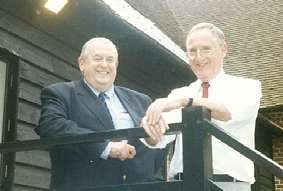
Colin Smith of the Brett Group (right) with Finning (UK) Ltd’s
Customer Service Salesman Bob Willmore
Somebody then has to accept responsibility for keeping the
equipment serviced and maintained.


Panorama
19
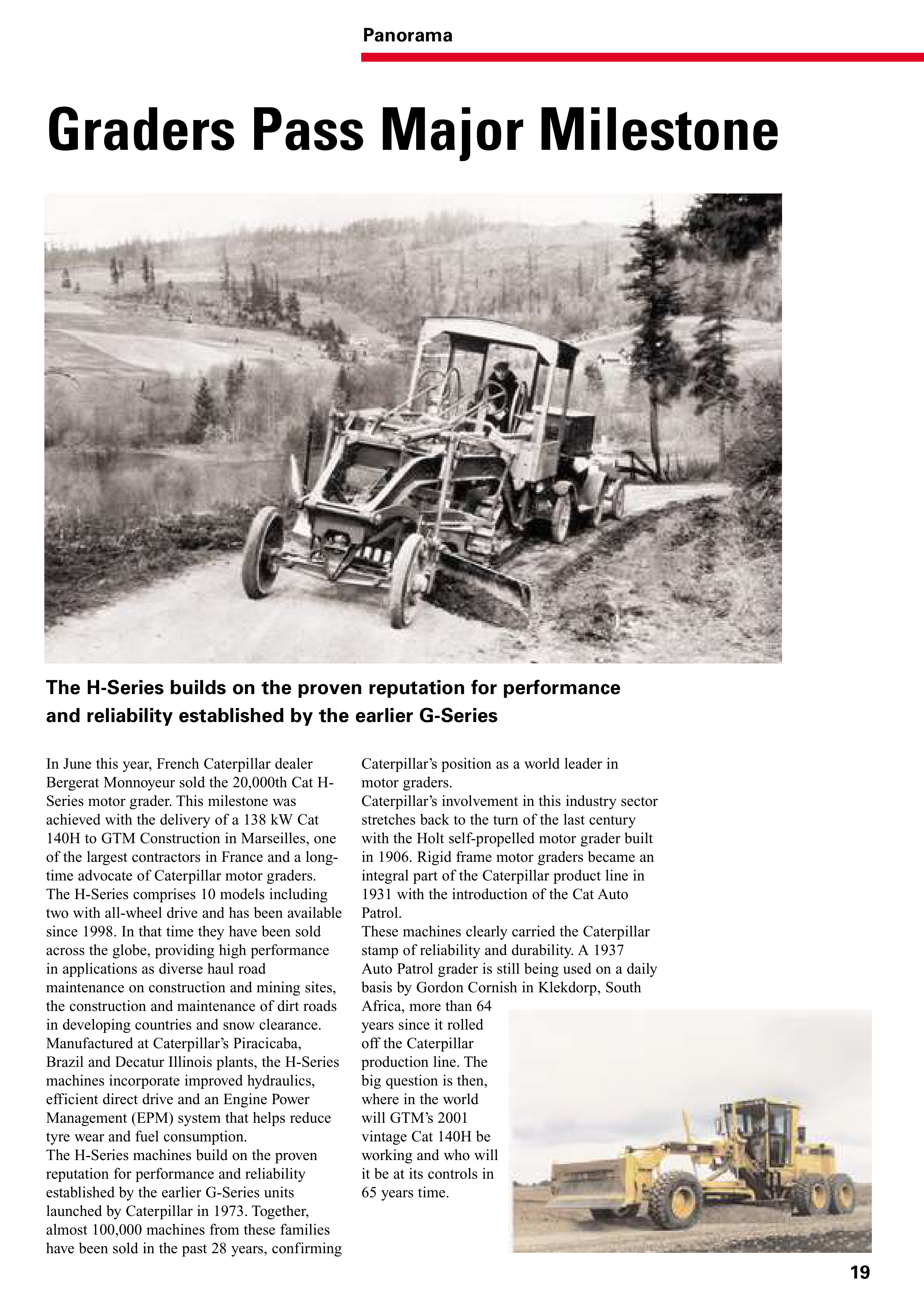
Graders Pass Major Milestone
In June this year, French Caterpillar dealer
Bergerat Monnoyeur sold the 20,000th Cat H-
Series motor grader. This milestone was
achieved with the delivery of a 138 kW Cat
140H to GTM Construction in Marseilles, one
of the largest contractors in France and a long-
time advocate of Caterpillar motor graders.
The H-Series comprises 10 models including
two with all-wheel drive and has been available
since 1998. In that time they have been sold
across the globe, providing high performance
in applications as diverse haul road
maintenance on construction and mining sites,
the construction and maintenance of dirt roads
in developing countries and snow clearance.
Manufactured at Caterpillar’s Piracicaba,
Brazil and Decatur Illinois plants, the H-Series
machines incorporate improved hydraulics,
efficient direct drive and an Engine Power
Management (EPM) system that helps reduce
tyre wear and fuel consumption.
The H-Series machines build on the proven
reputation for performance and reliability
established by the earlier G-Series units
launched by Caterpillar in 1973. Together,
almost 100,000 machines from these families
have been sold in the past 28 years, confirming
Caterpillar’s position as a world leader in
motor graders.
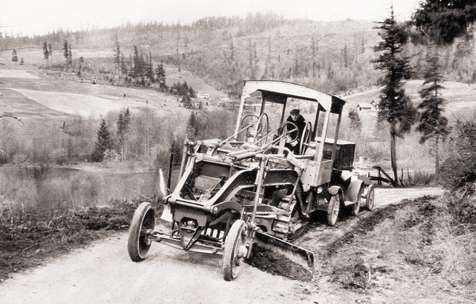
Caterpillar’s involvement in this industry sector
stretches back to the turn of the last century
with the Holt self-propelled motor grader built
in 1906. Rigid frame motor graders became an
integral part of the Caterpillar product line in
1931 with the introduction of the Cat Auto
Patrol.
These machines clearly carried the Caterpillar
stamp of reliability and durability. A 1937
Auto Patrol grader is still being used on a daily
basis by Gordon Cornish in Klekdorp, South
Africa, more than 64
years since it rolled
off the Caterpillar
production line. The
big question is then,
where in the world
will GTM’s 2001
vintage Cat 140H be
working and who will
it be at its controls in
65 years time.
The H-Series builds on the proven reputation for performance
and reliability established by the earlier G-Series