MAGAZINE
| MAY/JUNE 2025
Read more at p.19


he ability to drill longer horizontal wells and laterals
improves well economics but pushes the technical
limits of bottomhole assemblies (BHAs) in complex
well designs. A key challenge introduced is high-frequency
torsional oscillation (HFTO): self-excited vibration resulting
from bit/rock interaction that can cause premature
damage to drilling tools and components, leading
to increased capital costs and unplanned downtime.
Engineers have been working for decades to understand
and resolve HFTO, but until recently, tools designed to
mitigate vibration have been only marginally successful.
Volker Peters (Germany) and Daniel
Bell (USA), Baker Hughes, describe
the challenge of HFTO, and how a new
torsional dampener tool can suppress
oscillations and improve operation.
COVER STORY
Reprinted from May/June 2025
Oilfield Technology
|
HFTO and traditional solutions
HFTO typically occurs in the BHA,
generating dynamic oscillations in the
range of ~50 Hz to ~400 Hz. The vibration
motion-induced twist in the drill string
causes dynamic torque, which increases
the load on drill string components. One
of the unfavourable consequences is
premature fatigue damage of tools and
components, resulting in slower drilling
for mitigation and more nonproductive
time (NPT). Another is damage to sensitive
components – such as sensors, electronics
and even connectors and electrical wires –
caused by acceleration.
Many tools that claim to address HFTO
have had limited success because they
focus exclusively on managing bit induced
stick-slip, which is caused by the bit-rock
cutting interaction and results in drill bit
rotation alternating between periods of
slowing down and suddenly accelerating.
Stick-slip tools, placed above the BHA,
reduce stick-slip vibration between axial
and torsional degree of freedom via a
mechanical coupling (a spline connection
or wire ropes) to initiate axial motion when
torque changes occur. The tools themselves
mitigate vibration by reducing the depth
of cut through reduction of weight on bit
(WOB).
If HFTO is not mitigated properly, WOB
and/or bit rpm has to be reduced to limit
vibrations to acceptable levels, which in
turn reduces rate of penetration (ROP).
Costly reductions in ROP are impediments
for achieving optimal field economics,
but an equally significant problem with
such axial-torsional coupling tools is that
they focus primarily on stick-slip, and only
occasionally reduce levels of HFTO. The
result is that, although these tools have
proven marginally successful in reducing
HFTO, in instances where downhole
conditions demand higher dampening, the
tools are unable to resolve it.
Taking a different approach
The shortcomings of traditional tools that
address HFTO led Baker Hughes to invest
in research to better understand what
happens downhole to incite excessive
vibration and how models could be
developed to better comprehend it.
Employing the results of this research,
engineers designed a torsional vibration
dampener tool that is purpose built to
suppress all modes and instances of HFTO
for all drilling parameters employing
a novel design with no load bearing
components that have differential motion,
unlike the axial - torsional coupling.
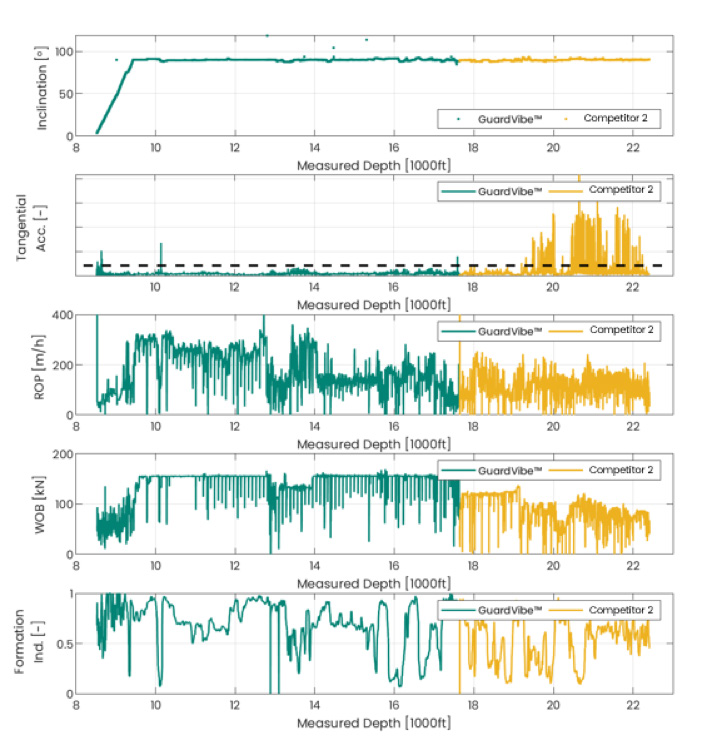
Figure 1.
Depth based averaged surface and downhole data. (Image courtesy of Baker
Hughes). Graphic is from SPE-217677-MS ‘Effectiveness of HFTO-Dampener Assembly Proven
by Extensive Case Study in Permian Basin’ presented at the IADC/SPE International Drilling
Conference and Exhibition, Galveston, Texas, March 2024, https://doi.org/10.2118/217677-MS
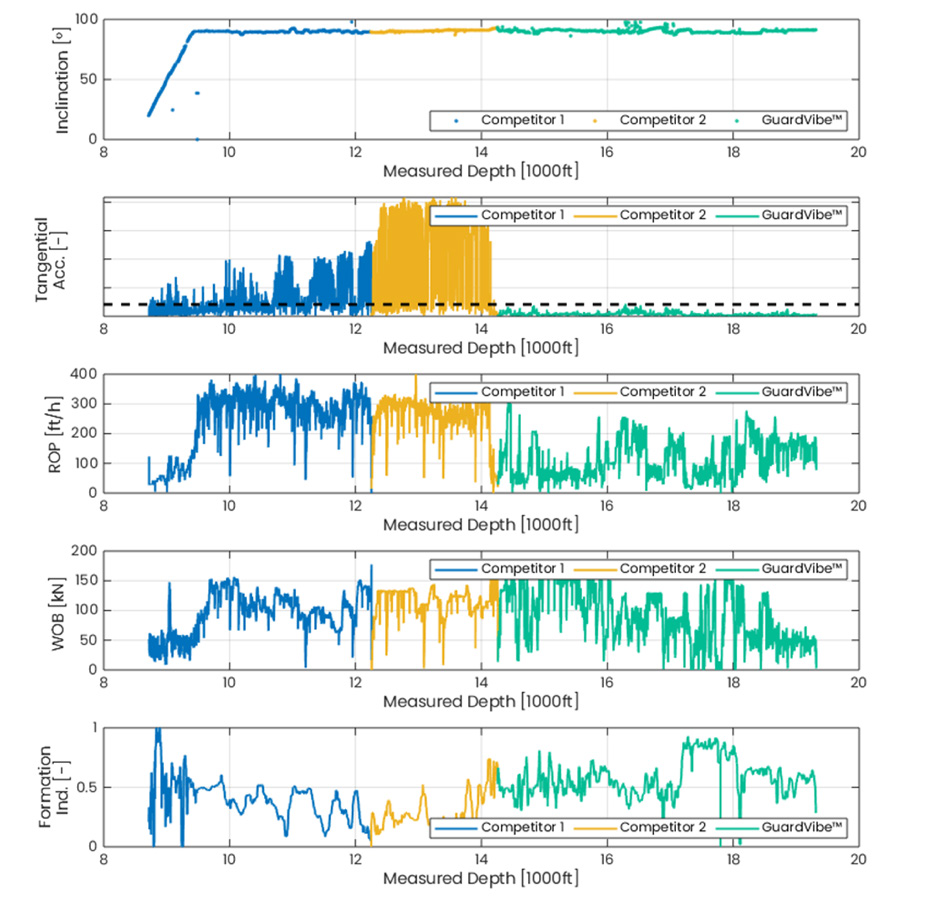
Figure 2.
Depth based averaged surface and downhole data. (Image courtesy of Baker
Hughes). Garphic is from SPE-217677-MS ‘Effectiveness of HFTO-Dampener Assembly Proven
by Extensive Case Study in Permian Basin’ presented at the IADC/SPE International Drilling
Conference and Exhibition, Galveston, Texas, March 2024, https://doi.org/10.2118/217677-MS
|
Oilfield Technology
Reprinted from May/June 2025
The unique tool is one rigid piece that is
affixed to the BHA. It has no parts requiring
grease-filled compartments that need to be
protected with dynamic seals like some stick/
slip solutions. This design eliminates reliability
concerns because there are no moving
mechanical parts, bearing drilling load. Torque
and drilling nodes are fed through rigidly
connected collars.
The function principle is based on an internal
inertia mass that can freely rotate with respect to
the centre of the drilling system but is connected
to the BHA by a dissipative force. When no
torsional vibrations are present, the inertia mass
rotates together with the BHA. In the presence
of HFTO, inertia mass resists the motion of
the vibration. Designed and built to suppress
HFTO holistically, this tool creates sufficient
dampening in a frequency band of 50 – 500 Hz.
The dampening tool is most commonly run
on top of the BHA, although in cases where
a downhole motor is used, the dampener is
placed below the motor. In either configuration,
the tool is handled like a regular drilling tool,
with no need for special setups or electrical
configurations. Due to its design and placement
on the BHA, the dampener does not compromise
formation evaluation sensor positioning or the
steerability of the rotary steerable system.
This unique technology enables dampening
of high-frequency torsional oscillations for the
entire BHA, which provides several benefits to
the drilling operation. It extends the operating
life of the BHA, improves stability, efficiency,
and directional control while drilling through
transitions, achieves higher ROPs by not
holding back ROP because of vibration, and extends run
life downhole. It also expands the drilling envelope by
allowing harder formations to be drilled without reducing
the drilling parameters.
To ensure vibration dampening is sufficient,
specifications for the entire BHA string that will be used
on the drilling job are entered into a software model,
and a piece of code adapted for the software optimises
the placement and the performance of the dampening
devices. The software tries different numbers of devices
and all possible configurations and selects one in which
the efficiency of the dampeners is maximised for all
anticipated scenarios. Tools are positioned according to
dampening demand, and engineers can tailor parameters
and performance outputs as HTFO levels increase and can
dampen them appropriately, so they are not damaging or
obstructive. This level of performance is not achievable
with other vibration mitigation tools.
All Baker Hughes dampener tools are laboratory tested
to extremes for durability and reliability using cyclic
bending, shock and vibration, temperature, pressure
testing methods. Functional testing of dampening
performance is executed with scaled lab samples using
multiple sensor elements.
The entire BHA, with the torsional vibration dampener
attached at the top of the drilling BHA (but below the
mud motor if one is used) is preconfigured for the job.
The appropriate vibration dampening configuration is
delivered to the rig site as one piece ready to install. The
presence of the tool on the BHA does not restrict drilling
in any way. The only noticeable difference between a
BHA without the tool and a BHA with the tool is HFTO
suppression.
Field applications deliver results
Field tests over the course of more than 350 drilling runs,
primarily in harsh environment conditions in the Midland
and Delaware sub-basins in the Permian Basin – where
extended reach drilling is common – delivered 98% of the
circulation time free of HTFO.
Results from two of these field implementations
illustrate how the torsional vibration dampening
technology performed in real-world conditions in
comparison to other HTFO management tools on the
market.
In the first application, the Baker Hughes GuardVibe
TM
high-frequency torsional oscillation dampener technology
was employed in the first instance in the curve and drilled
the first part of the lateral section (Figure 1). The BHA
was tripped because of bit wear and low ROP, and in a
second run, the proprietary HFTO tool was used again
in the lateral section. In both runs, the BHA experienced
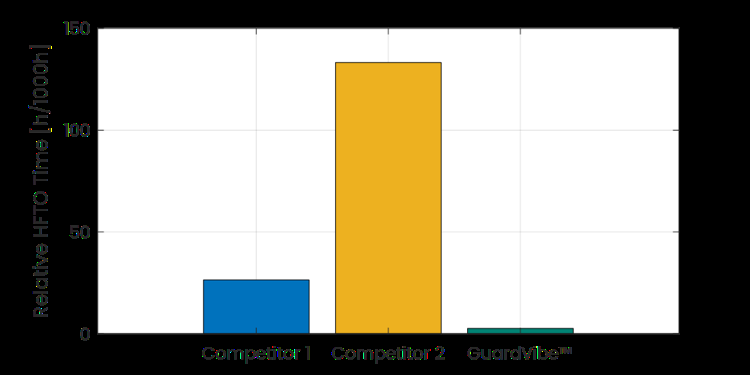
Figure 3.
This chart shows the amount of HFTO time per circulating time for runs using
the two competitor vibration mitigation tools and the GuardVibe HFTO tool. (Image
courtesy of Baker Hughes). Graphic is from SPE-217677-MS “Effectiveness of HFTO-
Dampener Assembly Proven by Extensive Case Study in Permian Basin” presented at
the IADC/SPE International Drilling Conference and Exhibition, Galveston, Texas, March
2024. https://doi.org/10.2118/217677-MS
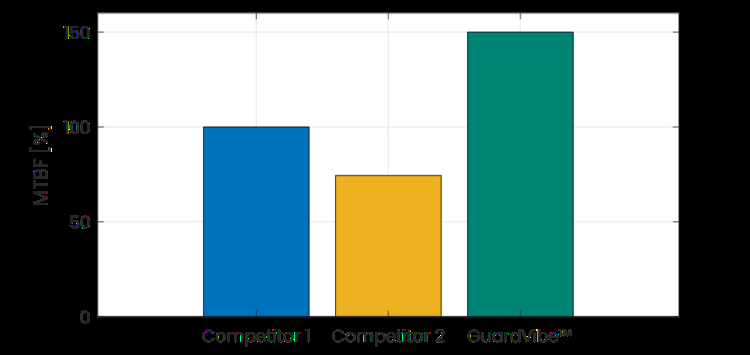
Figure 4.
Mean Time between Failure (MTBF) of the BHA. Graphic is from SPE-217677-
MS ‘Effectiveness of HFTO-Dampener Assembly Proven by Extensive Case Study in
Permian Basin’ presented at the IADC/SPE International Drilling Conference and
Exhibition, Galveston, Texas, March 2024, https://doi.org/10.2118/217677-MS
Reprinted from May/June 2025
Oilfield Technology
|
nearly no HFTO and maintained an ROP between 300 ft/hr
and 120 ft/hour. In the second run, there were slightly
increased levels of tangential acceleration between
13 000 ft and 14 000 ft, indicating that the GuardVibe HFTO
tool was dissipating energy to prevent HFTO from rising to
its plateau amplitude.
In Figure 1, the green tracks represent data acquired
from runs with the GuardVibe HFTO tool. The yellow
tracks represent data from a run with a commercially
available stick-slip tool. Tangential acceleration
(HFTO), represented in the second track from above, is
mitigated and suppressed using the GuardVibe HFTO
tool. Conversely, HFTO is largely present using the
commercially available stick-slip tool. For reference, ROP,
WOB and rock formation properties are displayed as well,
in the three bottom tracks.
After a motor failure at the end of the second run,
a different vibration mitigation tool was deployed
(Competitor 2). The results using this traditional tool were
suboptimal, with high HFTO levels throughout the run,
which negatively impacted ROP. Using the traditional tool
also required WOB to be reduced to mitigate vibration.
The formation values in this run were similar to those
where the GuardVibe HFTO tool had been deployed,
indicating that downhole conditions like these are likely
to produce high HFTO levels, which can be successfully
suppressed using the proprietary technology.
In a second application, the GuardVibe HFTO tool was
benchmarked against vibration mitigation tools from two
other vendors (Figure 2). A load sensor mounted on the
BHA measured dynamic torque, while accelerometers
positioned in two areas – one next to the load sensor
and the other farther up the BHA – measured tangential
acceleration amplitude and dominant frequencies.
The first run was drilled with the tool from Competitor
1, the second run was drilled with the tool from
Competitor 2. The third and fourth runs were drilled with
the GuardVibe HFTO tool. All runs were conducted in the
lateral section.
In Figure 2, the blue and yellow tracks represent data
from separate runs using two commercially available
stick-slip tools. The green track represents data acquired
from runs with the GuardVibe HFTO tool. Tangential
acceleration (HFTO), represented in the second track is
mitigated and suppressed using the GuardVibe HFTO tool,
but HFTO is largely present using the two commercially
available stick-slip tools. For reference, ROP, WOB and
rock formation properties also are displayed in the three
bottom tracks.
The BHAs for both Competitor 1 and Competitor 2
experienced high HFTO-related loads, with different levels/
plateaus of tangential acceleration measured. This was
caused by different dominant HFTO frequencies between
200 Hz and 300 Hz. The GuardVibe HFTO tool, on the other
hand, mitigated HFTO to amplitudes close to zero. Even
in formations that were tougher to drill, represented for
example by the section between 14 000 and 16 000 ft,
indicating a harder rock formation, where WOB was set
to high levels but resulted in comparably low ROP, the
GuardVibe HFTO tool eliminated HFTO altogether.
To carry out benchmarking, 44 runs were drilled
using the proprietary tool, 113 runs were drilled with
the vibration mitigation tool from Competitor 1, and 39
runs were drilled with the vibration mitigation tool from
Competitor 2 (Figure 3 and Figure 4).
In this case, the vibration mitigation tools were placed
between the mud motor and the wired part of the BHA. All
the runs were carried out in comparable target formations,
with similar PDC bits and BHAs.
The duration of HFTO in hours per 1000 hr circulating
time for the vibration mitigation tools is shown in Figure
3. The GuardVibe HFTO tool experiences close to zero time
with HFTO. The runs with Competitor 1 experienced an
average of more than 26 hours/1000 hours drilled, and the
runs with Competitor 2 experienced an average of more
than 138 hours/1000 hours drilled.
It is important to recognise that the reliability of this
tool and the reliability of the other BHA components
are all important for project economics. In this drilling
programme, the runs using the GuardVibe HFTO tool had
a significantly higher reliability with Mean Time Between
Failures (MTBF) at least 100 % higher than Competitor 2
and about 50 % higher than Competitor 1 for the complete
BHA, including the dampener tool (Figure 4, MTBF).
MTBF is a key performance indicator of NPT and
represents cost drivers in drilling operations. Figure 4
shows that mitigation of HFTO exposure directly correlates
to reliability measures of the drilling BHA. The runs using
the GuardVibe HFTO tool experienced close to zero HFTO
(eg ~twice MTBF achieved using the tool from Competitor
2, which had the highest percentage of HFTO). The intrinsic,
high reliability of the dampener tool design, along with its
ability to mitigate HFTO, are key to the excellent overall
performance in the application.
What’s next?
Thus far, nearly all of the tool installations have been in
the Permian Basin using 4.75 in. tools, which creates a
compelling case for employing the technology elsewhere.
Already, the technology is being used extensively in drilling
applications in Argentina, and there are opportunities in
the Eastern Hemisphere – in drilling programmes in areas
like China and Saudi Arabia where HFTO is a challenge
– where this technology could significantly improve
performance.
Designed to be agnostic, this tool can be used in
all rotary steerable drilling applications. Recent field
deployments in Saudi Arabia have proven effective in
conjunction with complex MWD/LWD (Triple Combo)
drilling BHAs. Unlike the deployments in the Permian
Basin, the drilling runs carried out in Saudi Arabia were
performed using a rotary from surface, without a drilling
motor. This is a significant achievement because in
Saudi Arabia, where drilling with advanced LWD tools
is common and drilling programmes are non-motor
assisted, traditional HFTO solutions have been either
inefficient (stick-slip mitigation tools) or have displayed
other deficiencies, like reducing torque throughput or
increasing sensor offset.
As more data is gathered from more drilling
environments, it will be possible to tailor solutions for
a broader range of applications and in time, develop
additional tool sizes to enable more efficient drilling
programmes in every corner of the world.