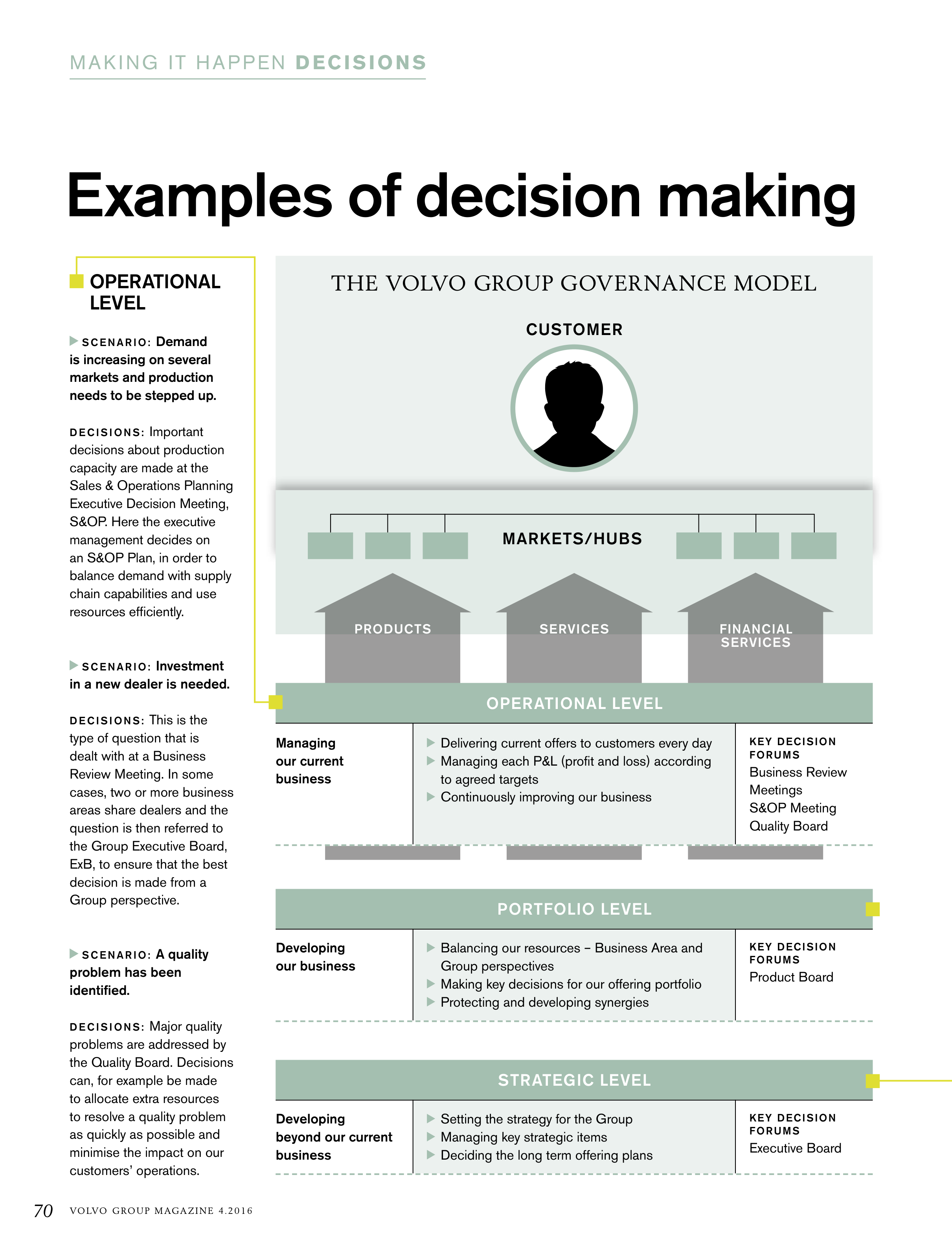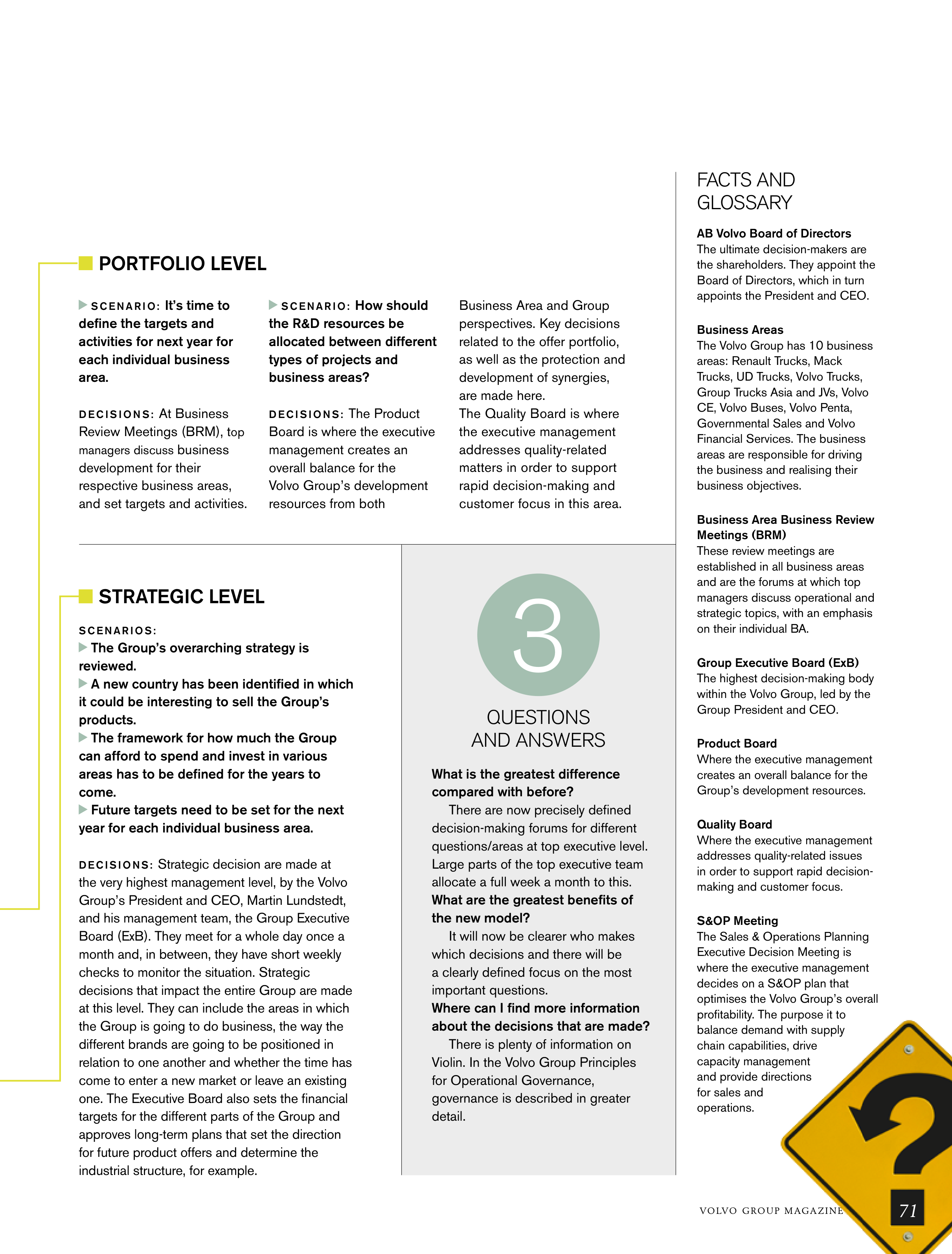
A NEW
DIRECTION
4.2016
STORIES
FROM THE WORLD OF VOLVO GROUP
SPECIAL
ISSUE
WHAT DOES THE FUTURE HOLD FOR THE VOLVO GROUP?


VOLVO GROUP MAGAZINE 4.2016
CONTENT
What’s next for the Volvo Group?
In this
special issue of Volvo Group Magazine, we
explore the new strategic direction – the mission,
the vision, the aspirations, the values and the way
the Group now operates.
4.2016
T HE MI S S I O N
Why are we here?
T H E V I S I O N
Where are we going?
4
18
The Volvo Group is driving prosperity
throughout the world. In Mumbai, this
is done through efficient transport
solutions. Research into new
innovations is also important.
In the UK, the Volvo Group has excelled
in packaging tailor-made total solutions
for customers and becoming true
partners rather than just suppliers. Many
markets want to learn from this example.
T H E M IS S I ON
T H E V IS I ON
VALUES
VISION
MISSION
VOLVO GROUP
ASPIRATIONS
A S P I R AT I ONS
32
A SPIR ATIONS
How do we get there?
inspiration and energy. Take
two steps back and five steps
forward.
CHANGE
We are curious about the
world around us.
We are innovative and find
smart ways to create new
solutions and business.
We see change and
transformation as a source
of inspiration and energy.
We are open-minded and
share our knowledge.
Are you op
ideas? The
47
46
48
44
45
58
49
50
51
52
VA L U E S
M A K I N G I T H A P P E N
VALUE S
60
MAK ING IT HAPPE N
How will we do it?
There are two key elements to how the
Who are we?
What does it take to be number one in
Values are important for good
customer satisfaction and the most admired
results – in work and in play.
53
business is run in the new organisation:
employer, while also having the highest
Find out how with our new
an increased focus on continuous
profitability in the industry? We asked
board game.
improvements and decisions that are
54
55
customers and employees.
taken closer to the customer.
56
57
59
60
61
58
2

VOLVO GROUP MAGAZINE
is aimed at all the co-workers within the Volvo Group. It is published five times a year in Swedish, English, German, French, Portuguese for Brazil, Polish, Russian, Japanese,
Dutch, Korean, Thai, Chinese and Spanish.
PRINT RUN
approx. 88,000 copies
ADDRESS
Volvo Group Magazine, Volvo Group Headquarters, Dept AA13400, VHK3, SE-405 08, Göteborg, Sweden
PHONE
+46 (0)31 66 00 00
E-MAIL
groupmagazine@volvo.com
EDITOR RESPONSIBLE UNDER SWEDISH PRESS LAW
Markus Lindberg
EDITOR-IN-CHIEF
Ann-Mari Robinson
EDITORS
Lotta Bävman
(Operations), Carita Vikstedt (Technology), Tobias Wilhelm (Sales), Joanna Dembicka (Volvo CE). A Group-wide Editorial Network also contributes content.
MARKET LANGUAGE REVIEW
Markus Lindberg
EDITORIAL PRODUCTION
Spoon (project team: Maria Sköld, Linda Swanberg, Nic Townsend, Lina Törnquist, Pernilla Stenborg, Ken Niss, Sofia Hammarin)
PRINTED BY
RR Donnelley
CHANGE OF
ADDRESS
Contact your local HR
TRANSLATED BY
Lionbridge
W
hen I am out talking
to people in the Volvo
Group, I usually ask
two questions. The
first is whether the
future demand for
transport is going to
increase globally. The other is whether this will
take place in a sustainable fashion. Needless to say,
the answer is ”yes” to both these questions.
Sustainable transport is the basis of building a
prosperous society. Our role is to be part of this
development and we definitely have the capacity.
In my view, there are few companies with the
same potential to contribute that we have. This is
one of the reasons my job is so much fun.
To succeed with our goals, to guide and
determine the decisions we take, we have set a
number of strategic priorities. They tell us what
we should do and how.
THE IMPORTANCE
of strengthening our brands is
one example. The competition is razor sharp; we
have lost market share and need to get back on
the right track. Leading positions cannot be taken
for granted.
This is why we are going to strengthen
Volvo Trucks’ position as the leading global brand
for heavy-duty trucks in the premium segment.
At the same time, we need to recapture market
shares for the Renault Trucks, Mack Trucks and
UD Trucks brands in their regional markets.
A stronger, more brand-specific sales
organisation is one way of achieving this. Meetings
with customers at dealerships play a decisive
part in our success. So, I want a less complex
organisation where decisions are made in closer
collaboration with customers. The same thing
applies to our service operations. This is vital to
enable us to reach our targets.
We can also strengthen profitability by finding
better, more straightforward solutions in product
development, purchasing and production using
continuous improvement. Once again, our focus is
our customers. Our investments must give value
to our customers.
But our Group is not only made up of
truck operations. Our other business areas
also contribute to profitability and technical
innovation. I am proud to report that Volvo’s
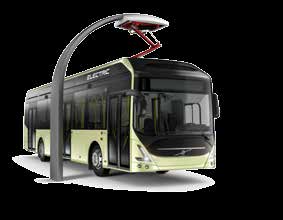
electric buses are in great demand globally.
Volvo CE offers a fantastic range of machines and
the development of our engines is really exciting.
To succeed as a Group, we need to collaborate
and make use of synergies whenever possible.
THESE ARE JUST
a few examples of the way we
are working to realise our vision. I hope those of
us in the management team have succeeded in
conveying the importance of this strategy to all of
you. I also hope you will be inspired and, like me,
feel that we are on the right track.
Together, we are going to lift our Group to the
next level.
“Together we
lift our Group
to the next level”
MARTIN LUNDSTEDT
PRESIDENT AND CEO, VOLVO GROUP
VOLVO GROUP MAGAZINE 4.2016
EDITORIAL
3

VOLVO GROUP MAGAZINE 4.2016
4
VOLVO GROUP MAGAZINE 4.2016
MISSION
WHY
ARE WE
HERE?
With effective transport and new technology to
meet future challenges, the Volvo Group wants to
help raise prosperity. Come along to Mumbai where
Volvo buses are making life easier for city residents.
4
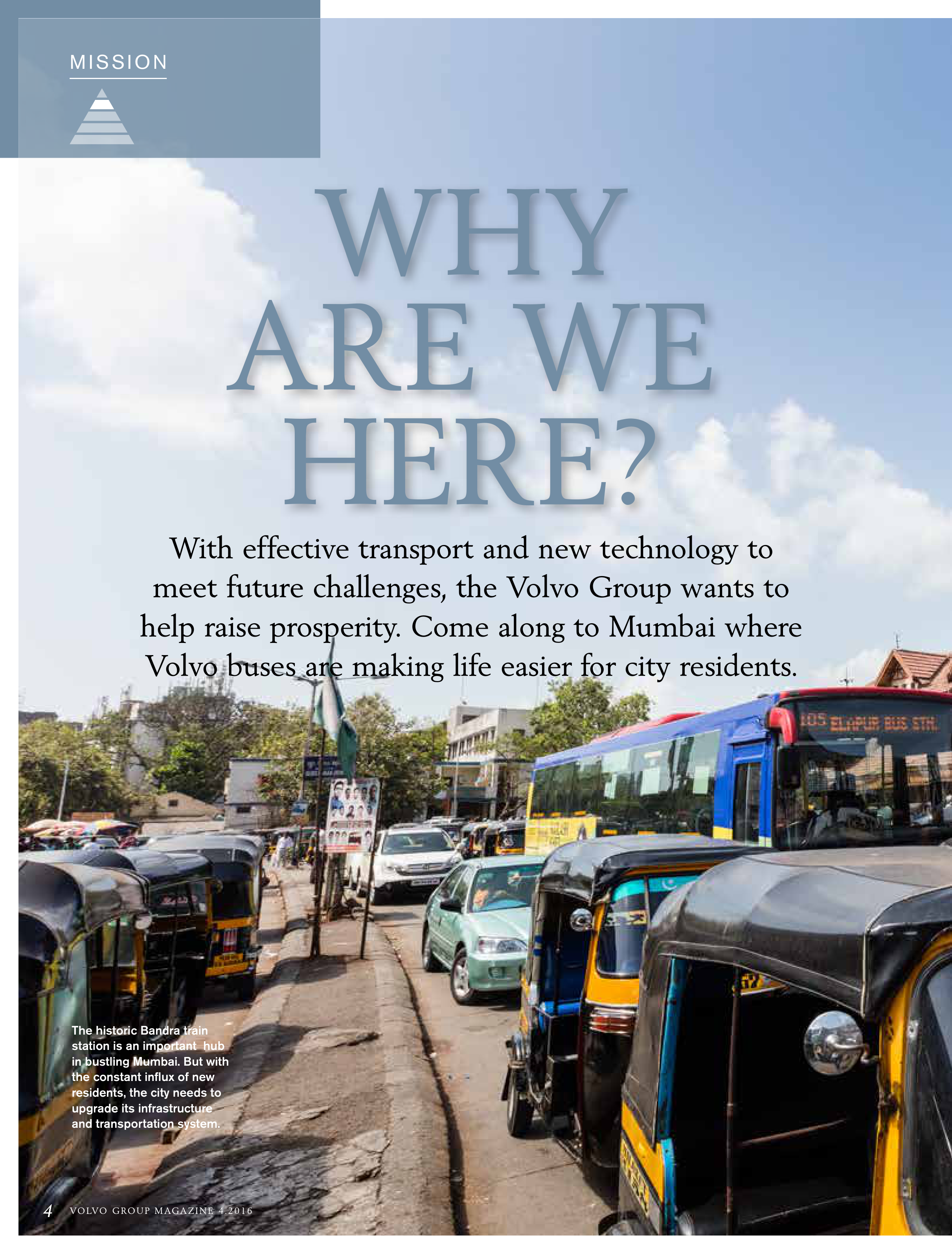
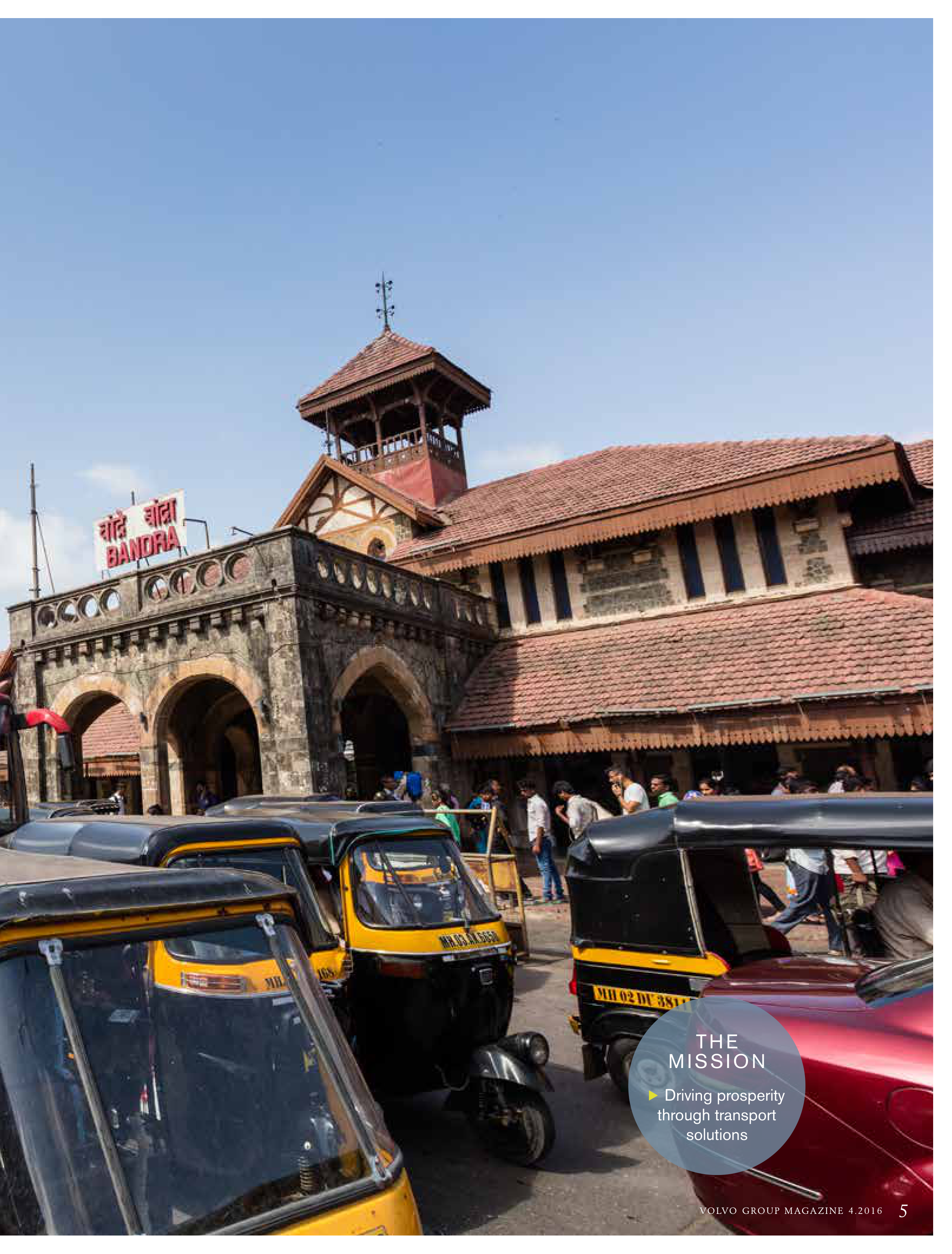
The historic Bandra train
station is an important hub
in bustling Mumbai. But with
the constant influx of new
residents, the city needs to
upgrade its infrastructure
and transportation system.

VOLVO GROUP MAGAZINE 4.2016
T HE
M IS SION
Driving prosperity
through transport
solutions
5


MISSION
INDIA
MUMBAI
ON THE MOVE
Like a growing number of rapidly urbanising cities globally,
Mumbai is congested and needs new solutions. Volvo
Group aims to get the people of this megacity moving again.
T E X T
K E V I N CA R M I C H A E L
P H OTO S
K I R A N N A M A
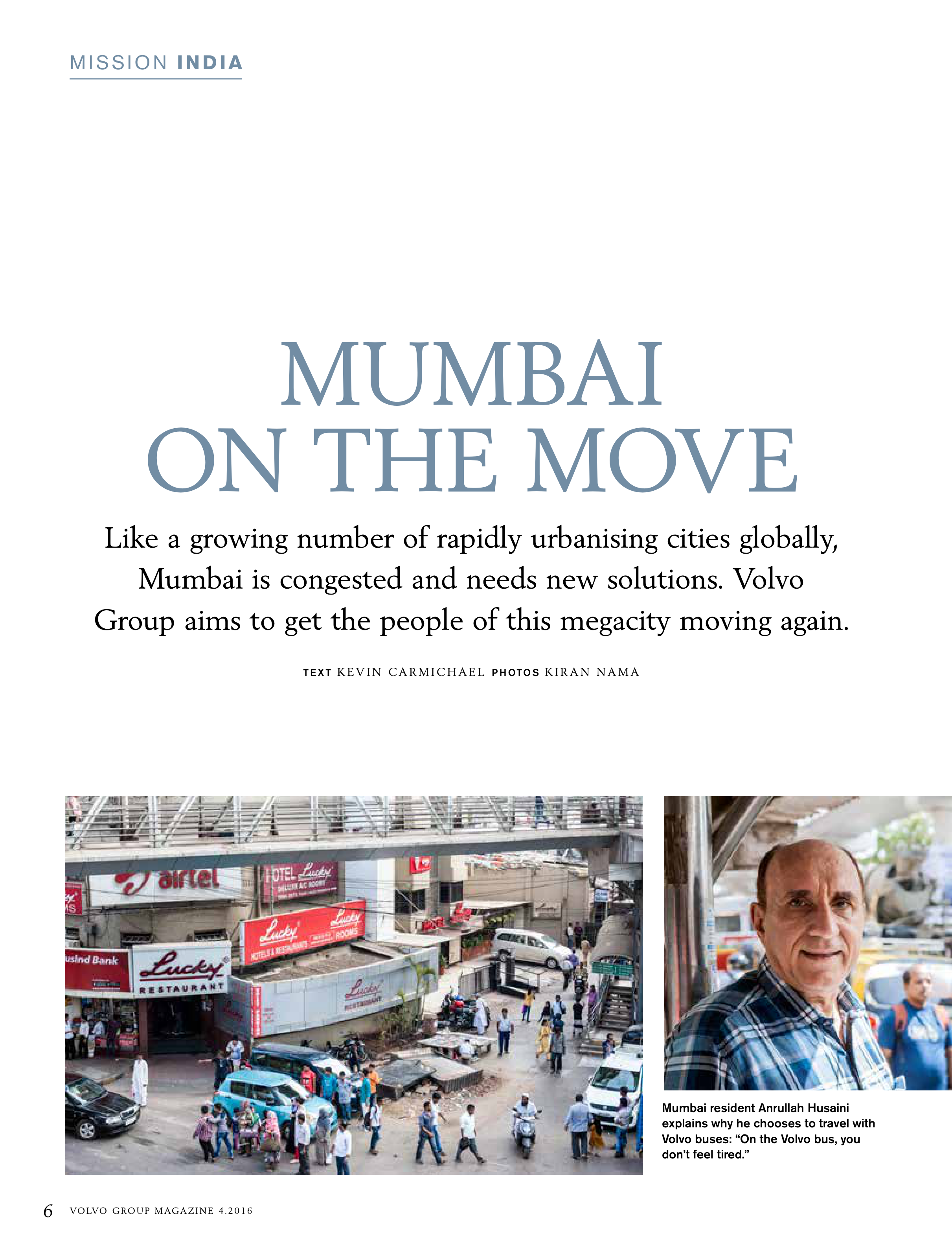
Mumbai resident Anrullah Husaini
explains why he chooses to travel with
Volvo buses: “On the Volvo bus, you
don’t feel tired.”
VOLVO GROUP MAGAZINE 4.2016
6


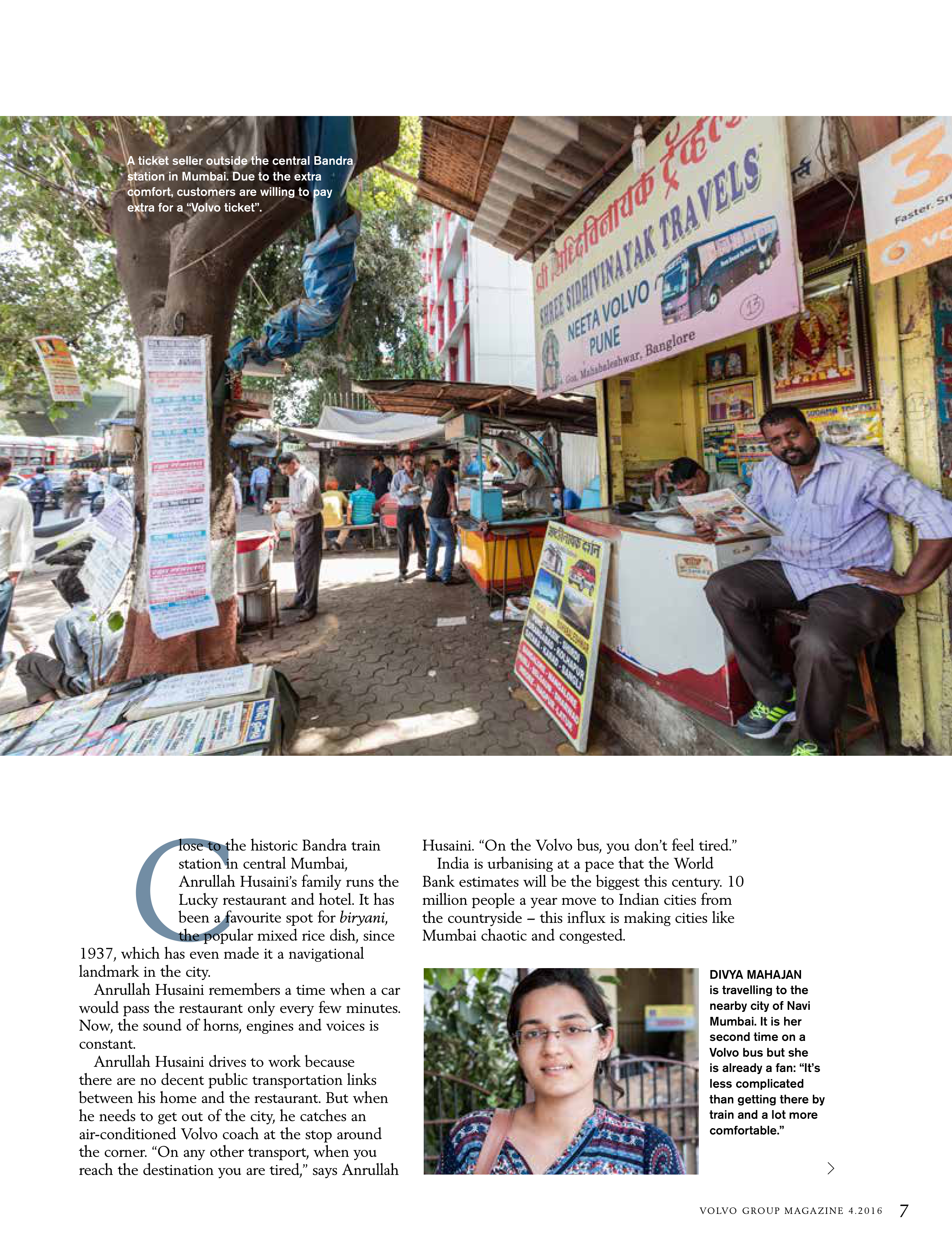
A ticket seller outside the central Bandra
station in Mumbai. Due to the extra
comfort, customers are willing to pay
extra for a “Volvo ticket”.
C
lose to the historic Bandra train
station in central Mumbai,
Anrullah Husaini’s family runs the
Lucky restaurant and hotel. It has
been a favourite spot for
biryani
,
the popular mixed rice dish, since
1937, which has even made it a navigational
landmark in the city.
Anrullah Husaini remembers a time when a car
would pass the restaurant only every few minutes.
Now, the sound of horns, engines and voices is
constant.
Anrullah Husaini drives to work because
there are no decent public transportation links
between his home and the restaurant. But when
he needs to get out of the city, he catches an
air-conditioned Volvo coach at the stop around
the corner. “On any other transport, when you
reach the destination you are tired,” says Anrullah
Husaini. “On the Volvo bus, you don’t feel tired.”
India is urbanising at a pace that the World
Bank estimates will be the biggest this century. 10
million people a year move to Indian cities from
the countryside – this influx is making cities like
Mumbai chaotic and congested.
DIVYA MAHAJAN
is travelling to the
nearby city of Navi
Mumbai. It is her
second time on a
Volvo bus but she
is already a fan: “It’s
less complicated
than getting there by
train and a lot more
comfortable.”
VOLVO GROUP MAGAZINE 4.2016
7


TAGLINE
The
Mumbai Mirror
newspaper reports that
if all of the private cars registered in the city
were lined up, they would occupy a distance
of more than 3,000 kilometres — yet the city
has only 2,000 kilometres of roads. Then add
tens of thousands of black-and-yellow taxis,
auto-rickshaws, and motorcycles. There isn’t
enough space for everyone. “You suffer,” says
Anrullah Husaini.
TO ACCOMMODATE AN
urban population that
is expected to reach 600 million by around
2030, billions of dollars will be spent in
India in the coming decades. With its broad
portfolio that stretches from solutions for
infrastructure development to transport,
Volvo Group is well placed to participate in
MISSION
INDIA
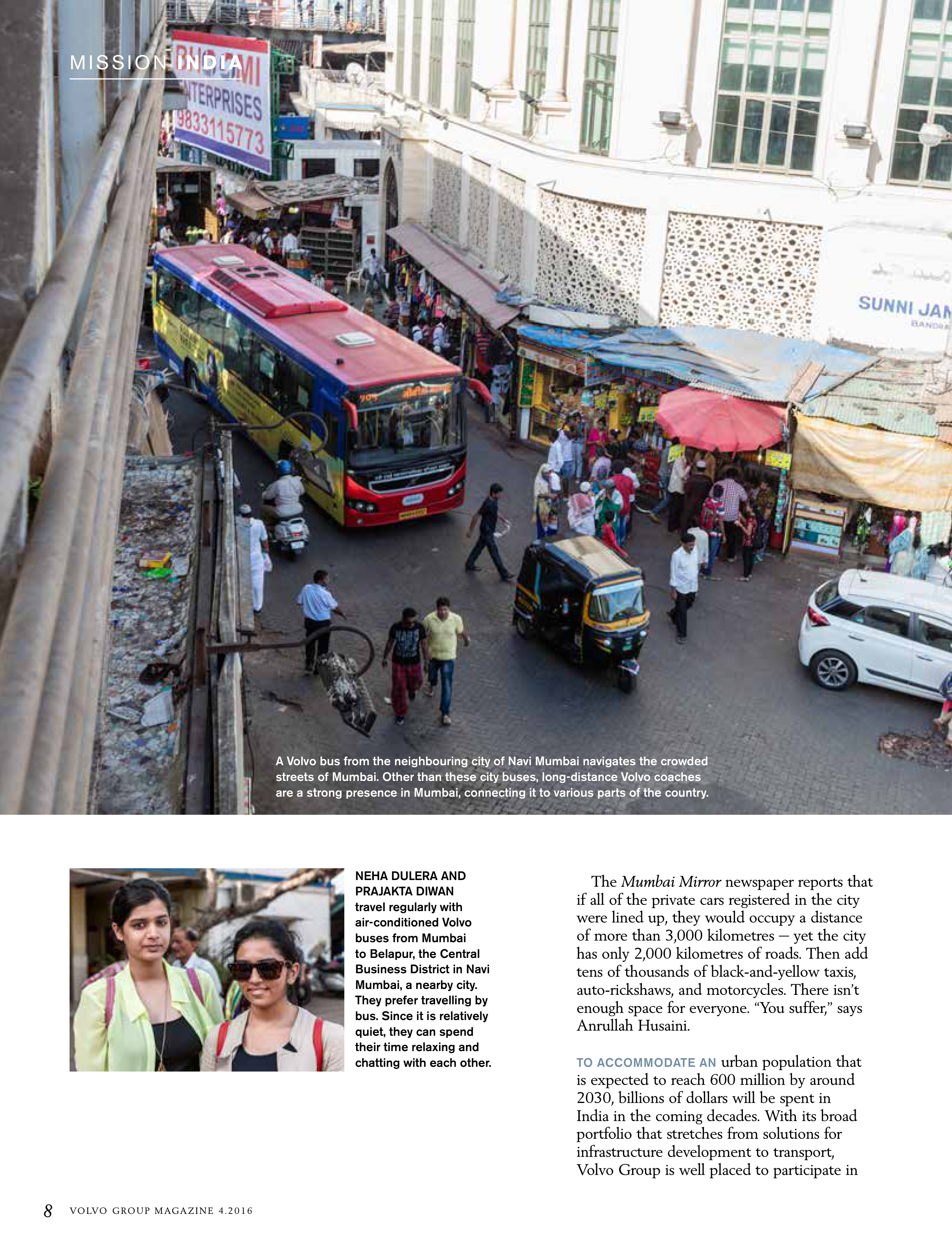
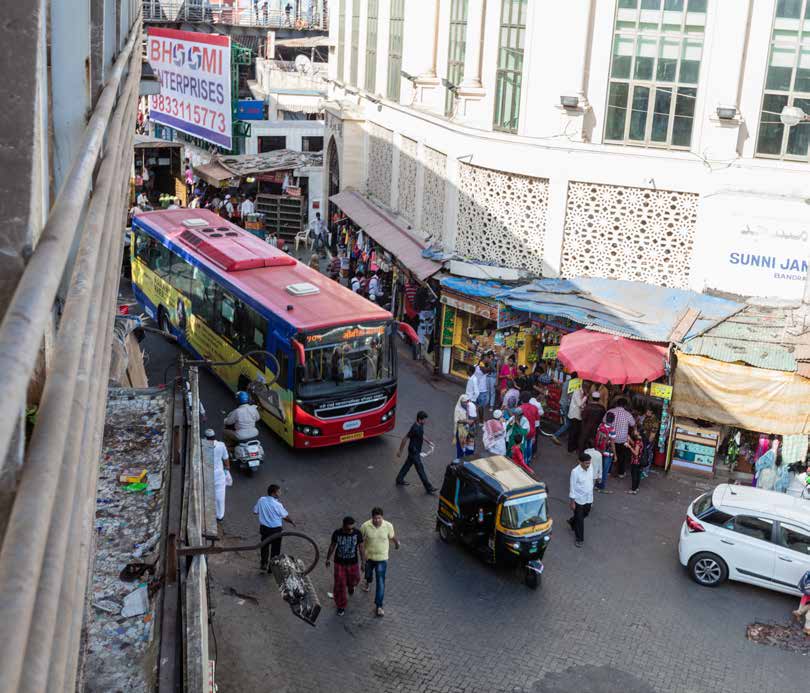
A Volvo bus from the neighbouring city of Navi Mumbai navigates the crowded
streets of Mumbai. Other than these city buses, long-distance Volvo coaches
are a strong presence in Mumbai, connecting it to various parts of the country.
NEHA DULERA AND
PRAJAKTA DIWAN
travel regularly with
air-conditioned Volvo
buses from Mumbai
to Belapur, the Central
Business District in Navi
Mumbai, a nearby city.
They prefer travelling by
bus. Since it is relatively
quiet, they can spend
their time relaxing and
chatting with each other.
VOLVO GROUP MAGAZINE 4.2016
8


THE INDIAN
government is attempting to replace a number of state
taxes with a single national goods and services tax (GST). The change
is set to dramatically alter the trucking industry. Today, companies have
to pay taxes every time goods cross a border, which is time-consuming
and can leave trucks waiting at border crossings for days.
With a single tax, many of these delays could be avoided. And
with more time on the road, trucks that carry larger loads and achieve
higher uptime will be more competitive. “The proposed new GST
regime will be a game-changer, not only for transportation and
logistics industry, but also for smart urbanisation and infrastructure
development. It is set to bring down India’s high costs of logistics and
realise the benefits of technology,” says Kamal Bali, Managing Director
for Volvo Group India.
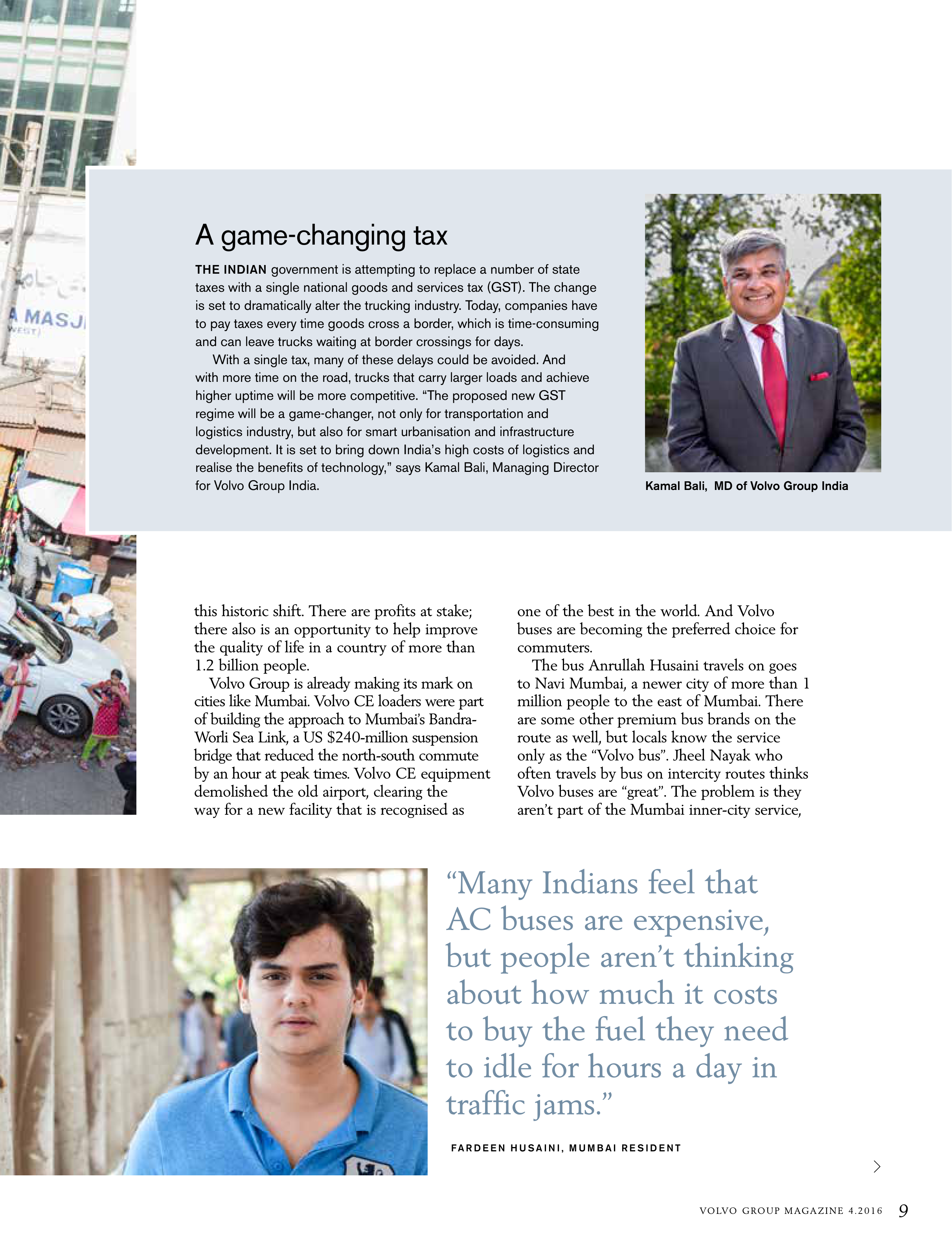
A game-changing tax
one of the best in the world. And Volvo
buses are becoming the preferred choice for
commuters.
The bus Anrullah Husaini travels on goes
to Navi Mumbai, a newer city of more than 1
million people to the east of Mumbai. There
are some other premium bus brands on the
route as well, but locals know the service
only as the “Volvo bus”. Jheel Nayak who
often travels by bus on intercity routes thinks
Volvo buses are “great”. The problem is they
aren’t part of the Mumbai inner-city service,
Kamal Bali, MD of Volvo Group India
VOLVO GROUP MAGAZINE 4.2016
this historic shift. There are profits at stake;
there also is an opportunity to help improve
the quality of life in a country of more than
1.2 billion people.
Volvo Group is already making its mark on
cities like Mumbai. Volvo CE loaders were part
of building the approach to Mumbai’s Bandra-
Worli Sea Link, a US $240-million suspension
bridge that reduced the north-south commute
by an hour at peak times. Volvo CE equipment
demolished the old airport, clearing the
way for a new facility that is recognised as
“Many Indians feel that
AC buses are expensive,
but people aren’t thinking
about how much it costs
to buy the fuel they need
to idle for hours a day in
traffic jams.”
FA R D E E N H U S A I N I , M U M B A I R E S I D E N T
9

TAGLINE
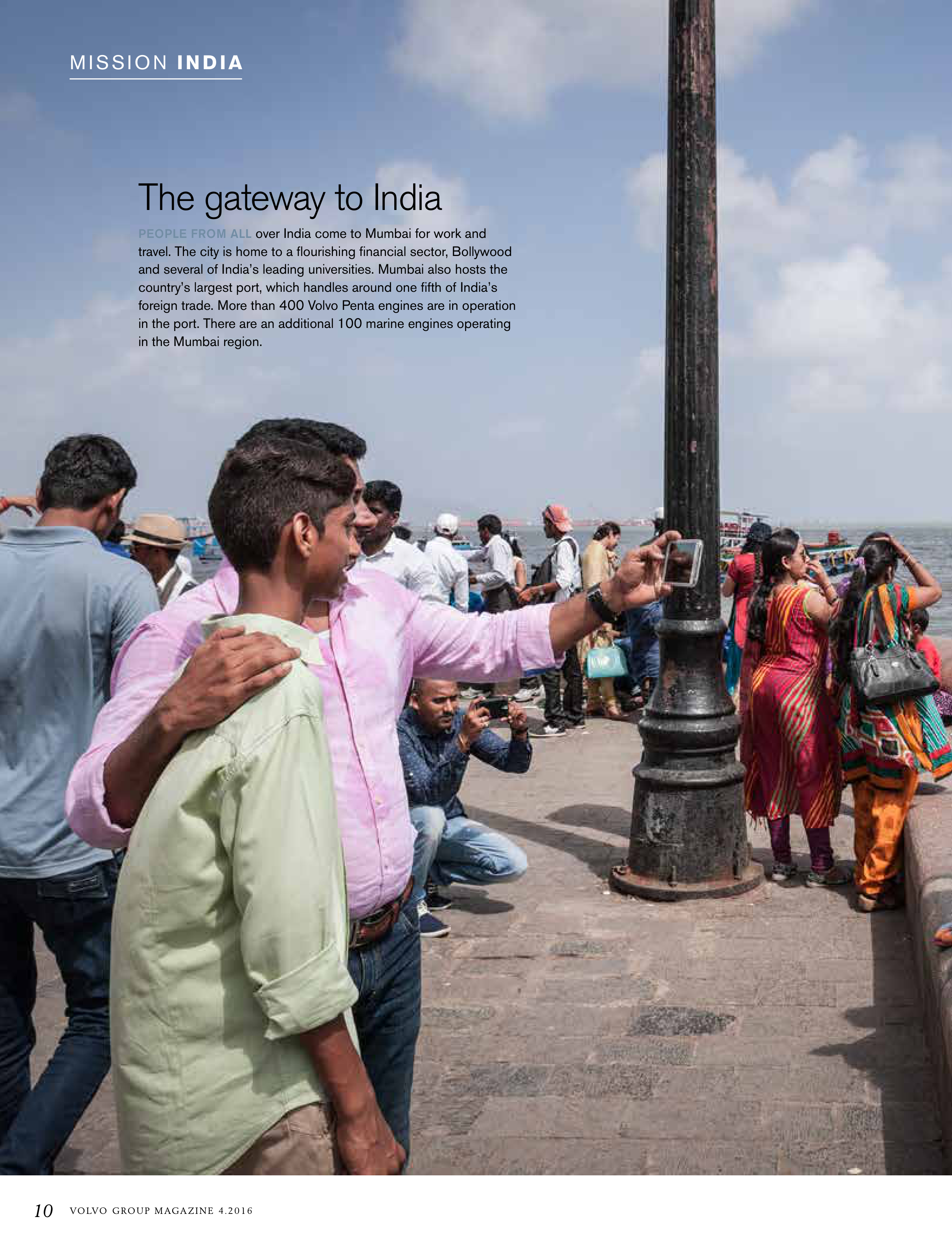
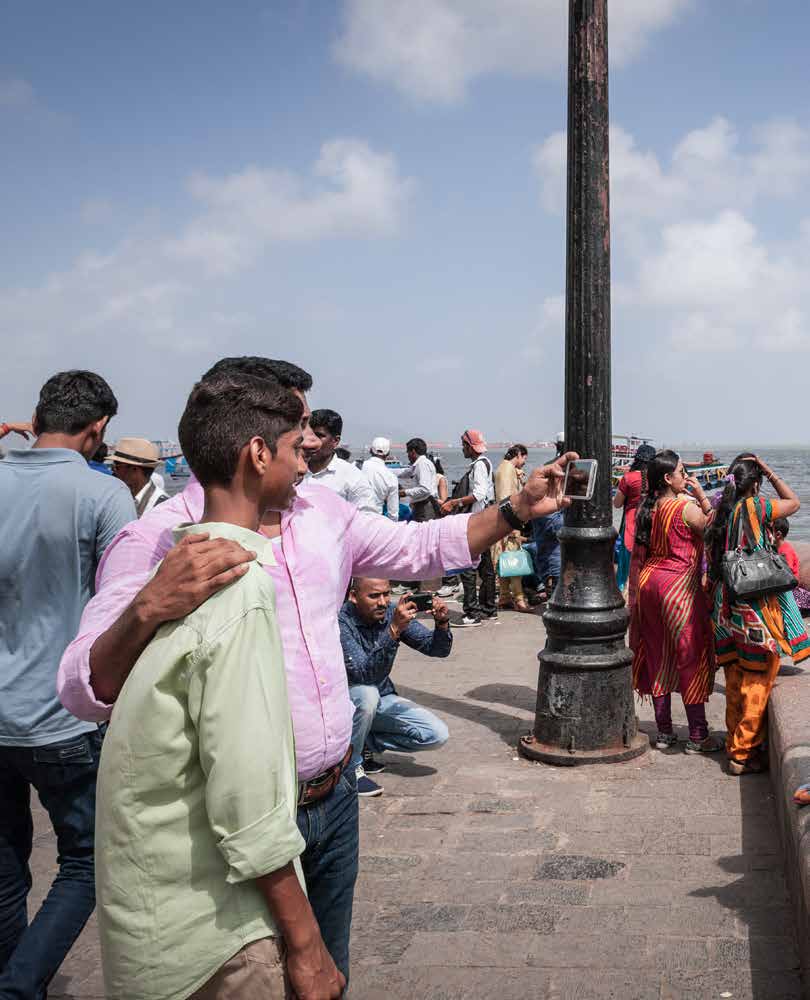
PEOPLE FROM ALL
over India come to Mumbai for work and
travel. The city is home to a flourishing financial sector, Bollywood
and several of India’s leading universities. Mumbai also hosts the
country’s largest port, which handles around one fifth of India’s
foreign trade. More than 400 Volvo Penta engines are in operation
in the port. There are an additional 100 marine engines operating
in the Mumbai region.
The gateway to India
M ISS ION
INDIA
VOLVO GROUP MAGAZINE 4.2016
10


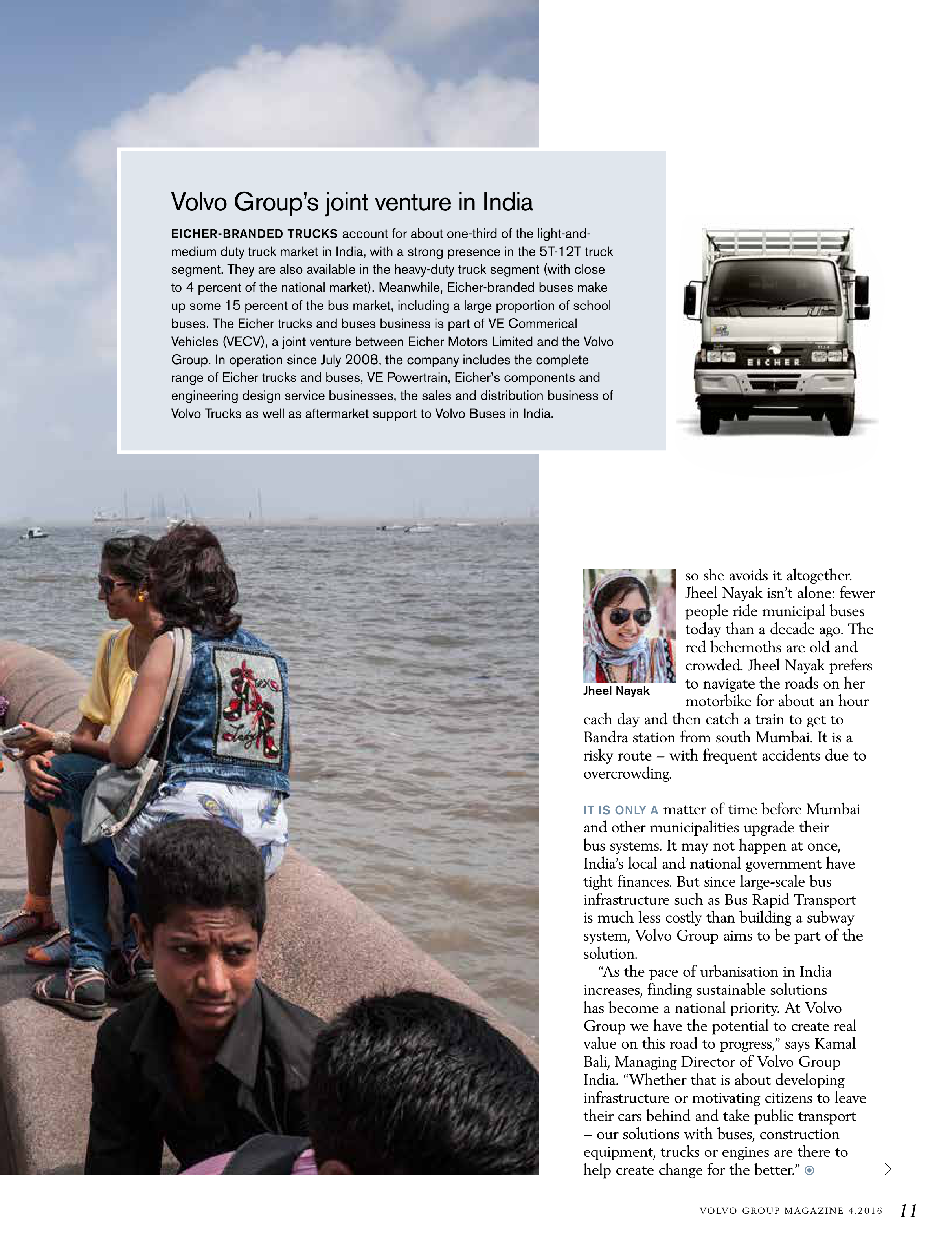
EICHER-BRANDED TRUCKS
account for about one-third of the light-and-
medium duty truck market in India, with a strong presence in the 5T-12T truck
segment. They are also available in the heavy-duty truck segment (with close
to 4 percent of the national market). Meanwhile, Eicher-branded buses make
up some 15 percent of the bus market, including a large proportion of school
buses. The Eicher trucks and buses business is part of VE Commerical
Vehicles (VECV), a joint venture between Eicher Motors Limited and the Volvo
Group. In operation since July 2008, the company includes the complete
range of Eicher trucks and buses, VE Powertrain, Eicher’s components and
engineering design service businesses, the sales and distribution business of
Volvo Trucks as well as aftermarket support to Volvo Buses in India.
Volvo Group’s joint venture in India
Jheel Nayak
VOLVO GROUP MAGAZINE 4.2016
so she avoids it altogether.
Jheel Nayak isn’t alone: fewer
people ride municipal buses
today than a decade ago. The
red behemoths are old and
crowded. Jheel Nayak prefers
to navigate the roads on her
motorbike for about an hour
each day and then catch a train to get to
Bandra station from south Mumbai. It is a
risky route – with frequent accidents due to
overcrowding.
IT IS ONLY A
matter of time before Mumbai
and other municipalities upgrade their
bus systems. It may not happen at once,
India’s local and national government have
tight finances. But since large-scale bus
infrastructure such as Bus Rapid Transport
is much less costly than building a subway
system, Volvo Group aims to be part of the
solution.
“As the pace of urbanisation in India
increases, finding sustainable solutions
has become a national priority. At Volvo
Group we have the potential to create real
value on this road to progress,” says Kamal
Bali, Managing Director of Volvo Group
India. “Whether that is about developing
infrastructure or motivating citizens to leave
their cars behind and take public transport
– our solutions with buses, construction
equipment, trucks or engines are there to
help create change for the better.”
11


TAGLINE
VOLVO GROUP MAGAZINE 4.2016
MISSION
INDIA
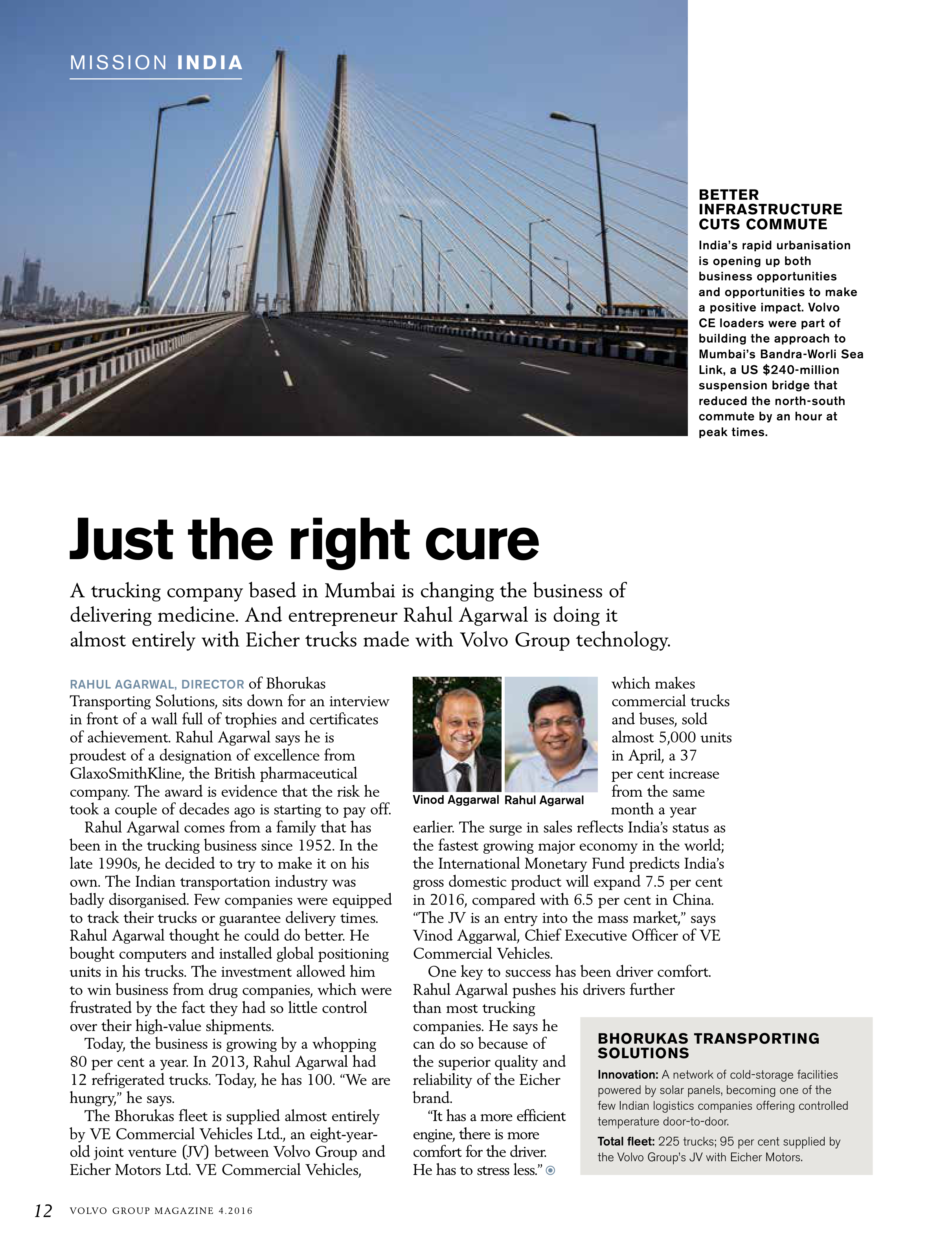
BETTER
INFRASTRUCTURE
CUTS COMMUTE
India’s rapid urbanisation
is opening up both
business opportunities
and opportunities to make
a positive impact. Volvo
CE loaders were part of
building the approach to
Mumbai’s Bandra-Worli Sea
Link, a US $240-million
suspension bridge that
reduced the north-south
commute by an hour at
peak times.
Just the right cure
A trucking company based in Mumbai is changing the business of
delivering medicine. And entrepreneur Rahul Agarwal is doing it
almost entirely with Eicher trucks made with Volvo Group technology.
RAHUL AGARWAL, DIRECTOR
of Bhorukas
Transporting Solutions, sits down for an interview
in front of a wall full of trophies and certificates
of achievement. Rahul Agarwal says he is
proudest of a designation of excellence from
GlaxoSmithKline, the British pharmaceutical
company. The award is evidence that the risk he
took a couple of decades ago is starting to pay off.
Rahul Agarwal comes from a family that has
been in the trucking business since 1952. In the
late 1990s, he decided to try to make it on his
own. The Indian transportation industry was
badly disorganised. Few companies were equipped
to track their trucks or guarantee delivery times.
Rahul Agarwal thought he could do better. He
bought computers and installed global positioning
units in his trucks. The investment allowed him
to win business from drug companies, which were
frustrated by the fact they had so little control
over their high-value shipments.
Today, the business is growing by a whopping
80 per cent a year. In 2013, Rahul Agarwal had
12 refrigerated trucks. Today, he has 100. “We are
hungry,” he says.
The Bhorukas fleet is supplied almost entirely
by VE Commercial Vehicles Ltd., an eight-year
old joint venture (JV) between Volvo Group and
Eicher Motors Ltd. VE Commercial Vehicles,
which makes
commercial trucks
and buses, sold
almost 5,000 units
in April, a 37
per cent increase
from the same
Vinod Aggarwal Rahul Agarwal
month a year
earlier. The surge in sales reflects India’s status as
the fastest growing major economy in the world;
the International Monetary Fund predicts India’s
gross domestic product will expand 7.5 per cent
in 2016, compared with 6.5 per cent in China.
“The JV is an entry into the mass market,” says
Vinod Aggarwal, Chief Executive Officer of VE
Commercial Vehicles.
One key to success has been driver comfort.
Rahul Agarwal pushes his drivers further
than most trucking
companies. He says he
can do so because of
the superior quality and
reliability of the Eicher
brand.
“It has a more efficient
engine, there is more
comfort for the driver.
He has to stress less.”
BHORUKAS TRANSPORTING
SOLUTIONS
Innovation:
A network of cold-storage facilities
powered by solar panels, becoming one of the
few Indian logistics companies offering controlled
temperature door-to-door.
Total fleet:
225 trucks; 95 per cent supplied by
the Volvo Group’s JV with Eicher Motors.
12

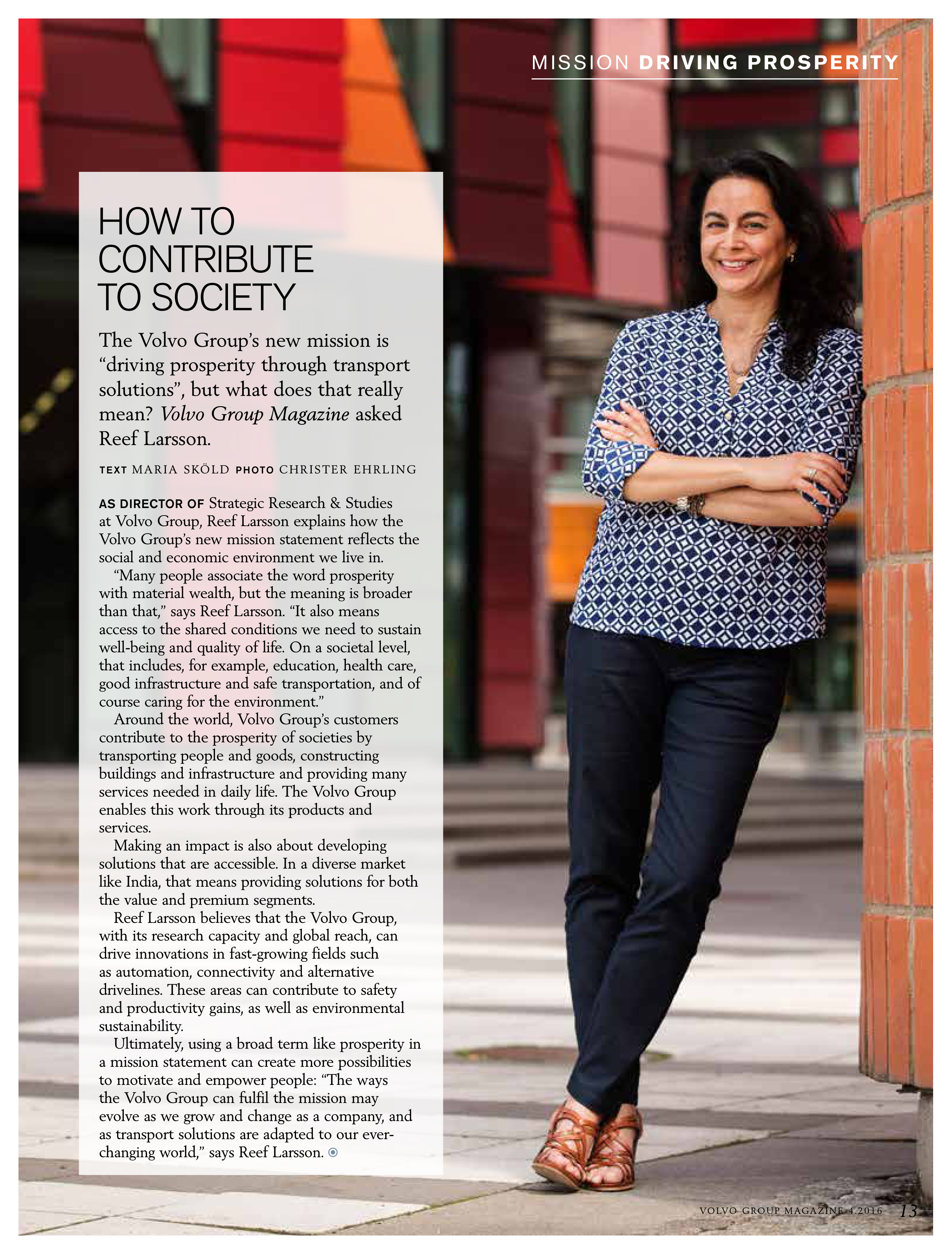
AS DIRECTOR OF
Strategic Research & Studies
at Volvo Group, Reef Larsson explains how the
Volvo Group’s new mission statement reflects the
social and economic environment we live in.
“Many people associate the word prosperity
with material wealth, but the meaning is broader
than that,” says Reef Larsson. “It also means
access to the shared conditions we need to sustain
well-being and quality of life. On a societal level,
that includes, for example, education, health care,
good infrastructure and safe transportation, and of
course caring for the environment.”
Around the world, Volvo Group’s customers
contribute to the prosperity of societies by
transporting people and goods, constructing
buildings and infrastructure and providing many
services needed in daily life. The Volvo Group
enables this work through its products and
services.
Making an impact is also about developing
solutions that are accessible. In a diverse market
like India, that means providing solutions for both
the value and premium segments.
Reef Larsson believes that the Volvo Group,
with its research capacity and global reach, can
drive innovations in fast-growing fields such
as automation, connectivity and alternative
drivelines. These areas can contribute to safety
and productivity gains, as well as environmental
sustainability.
Ultimately, using a broad term like prosperity in
a mission statement can create more possibilities
to motivate and empower people: “The ways
the Volvo Group can fulfil the mission may
evolve as we grow and change as a company, and
as transport solutions are adapted to our ever-
changing world,” says Reef Larsson.
HOW TO
CONTRIBUTE
TO SOCIETY
TEXT
MARIA SKÖLD
PHOTO
CHRISTER EHRLING
The Volvo Group’s new mission is
“driving prosperity through transport
solutions”, but what does that really
mean?
Volvo Group Magazine
asked
Reef Larsson.
MISSION
DRIVING PROSPERIT Y
VOLVO GROUP MAGAZINE 4.2016
13

MISSION
AUTOMATION
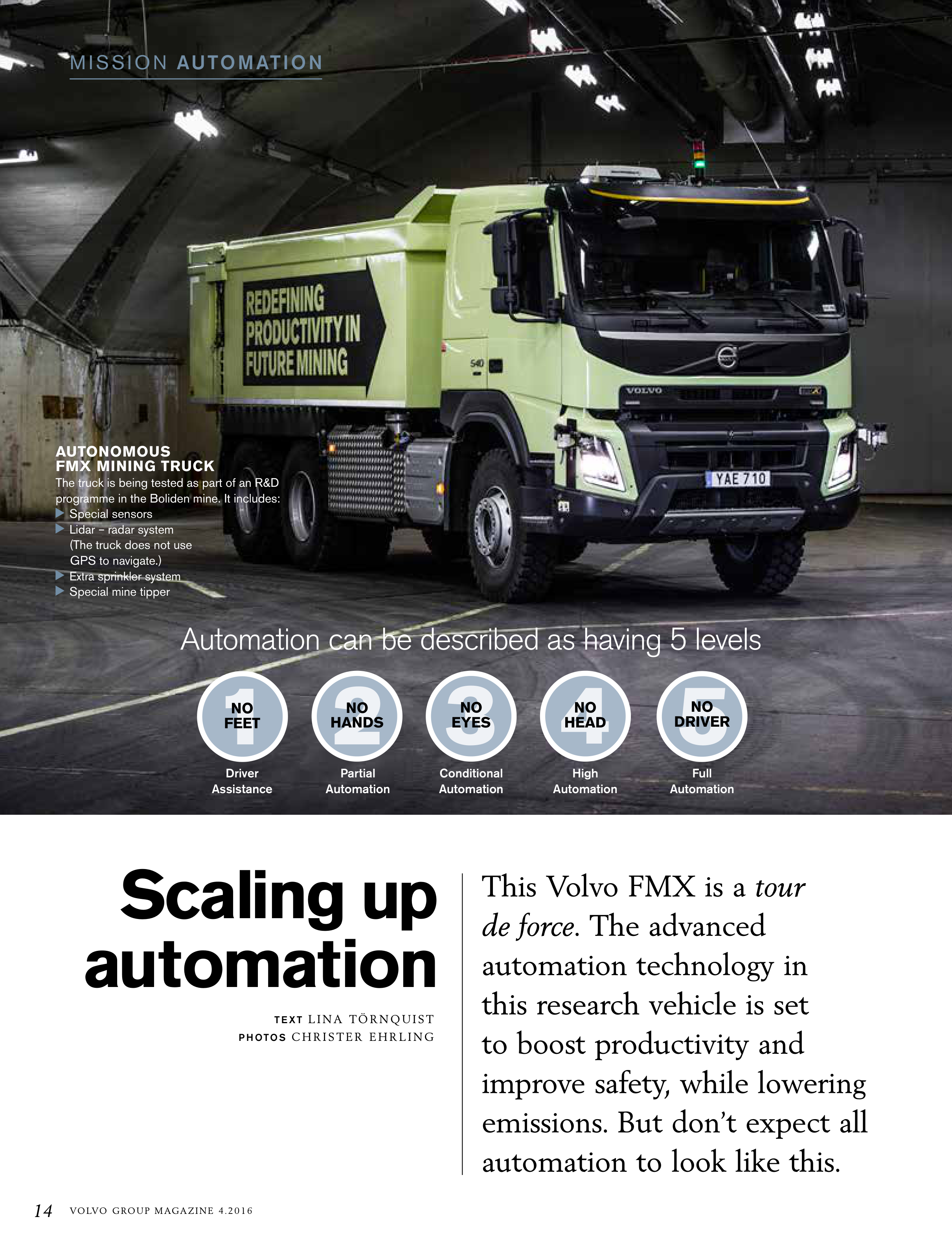
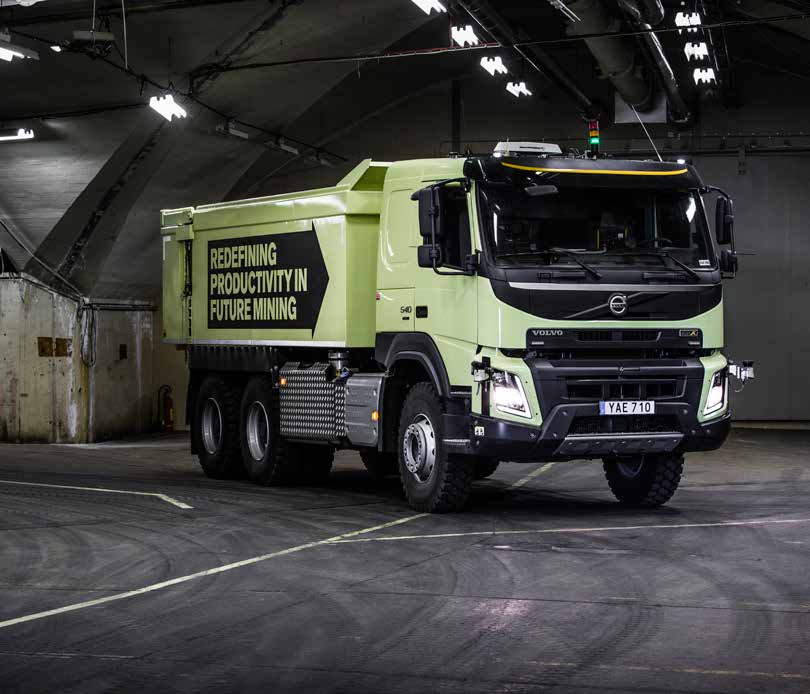
AUTONOMOUS
FMX MINING TRUCK
The truck is being tested as part of an R&D
programme in the Boliden mine. It includes:
Special sensors
Lidar – radar system
(The truck does not use
GPS to navigate.)
Extra sprinkler system
Special mine tipper
Automation can be described as having 5 levels
1
2
3
4
5
NO
FEET
NO
HANDS
NO
EYES
NO
HEAD
NO
DRIVER
Driver
Partial
Conditional
High
Full
Assistance
Automation
Automation
Automation
Automation
Scaling up
automation
T E X T
L I N A TÖ R N Q U I S T
P H OTO S
C H R I S T E R E H R L I N G
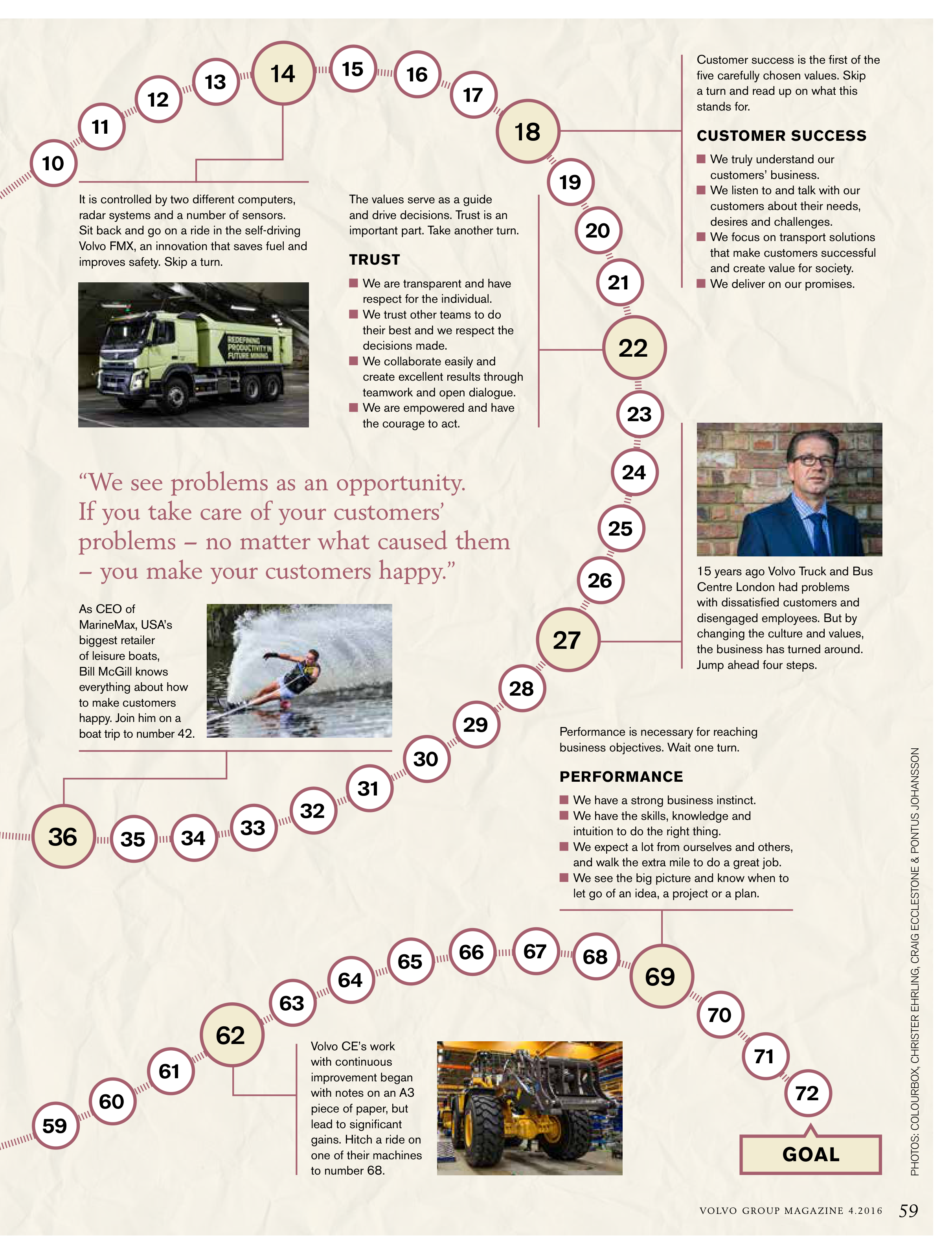
This Volvo FMX is a
tour
de force
. The advanced
automation technology in
this research vehicle is set
to boost productivity and
improve safety, while lowering
emissions. But don’t expect all
automation to look like this.
VOLVO GROUP MAGAZINE 4.2016
14


A
UTOMATION IS A
hot topic
in the vehicle industry.
But it is also widely
misunderstood.
“When people think about
vehicle automation, they
tend to think of robot trucks
but vehicle automation is something we have been
working with since the introduction of automatic
gearboxes in the 1970’s. We see it more as a
stepwise development,” says Torbjörn Holmström,
Chief Technology Officer of Volvo Group.
Automation is redefining a number of areas of
Volvo Group’s business, from its manufacturing
to aftermarket services. Vehicle automation is set
to be one key part of developments. At its most
advanced, it is illustrated by this completely self-
driving Volvo FMX truck, which is being tested at
the Boliden mine in northern Sweden as part of
an R&D programme. The truck is controlled by
two computers, six Lidars (a radar system), and a
number of sensors.
Since there is no human driver behind the
wheel, the truck can operate 24 hours a day and
in conditions that are unsafe for people.
This advanced technology was made possible
by several important hardware milestones,
including advances in autonomous braking
systems and the introduction of Volvo Dynamic
Steering in 2013.
“Volvo Dynamic Steering was the last big
piece of puzzle to fall into place,” says Torbjörn
Holmström. “It allowed us to quickly scale up
software applications.”
NOW, AS THE RACE
for greater vehicle automation
heats up, Volvo Group is set to test automation
across several vehicle categories. But even with
advances on several fronts, the technology is not
expected to be a one-size-fits-all solution.
The first levels of automation includes
platooning technology, such as the convoy of
trucks which drove through Europe in April. For
that event, trucks were linked together using Wi-
Fi, while braking and speed were controlled by
computer. Human drivers help steer the vehicles
and can take over if necessary.
On the highest level of automation are vehicles
that can operate without any human interaction.
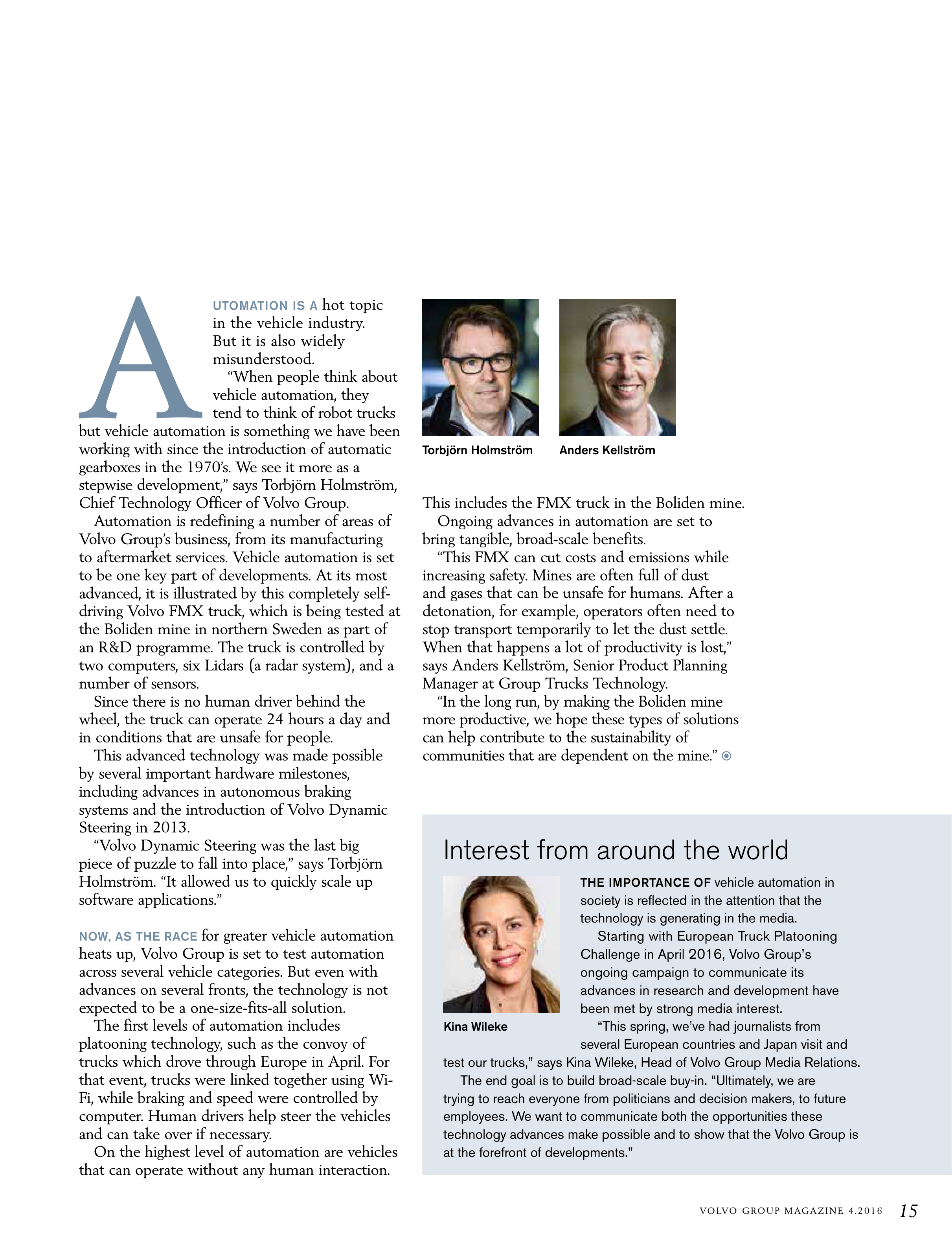
Torbjörn Holmström
Anders Kellström
This includes the FMX truck in the Boliden mine.
Ongoing advances in automation are set to
bring tangible, broad-scale benefits.
“This FMX can cut costs and emissions while
increasing safety. Mines are often full of dust
and gases that can be unsafe for humans. After a
detonation, for example, operators often need to
stop transport temporarily to let the dust settle.
When that happens a lot of productivity is lost,”
says Anders Kellström, Senior Product Planning
Manager at Group Trucks Technology.
“In the long run, by making the Boliden mine
more productive, we hope these types of solutions
can help contribute to the sustainability of
communities that are dependent on the mine.”
Interest from around the world
THE IMPORTANCE OF
vehicle automation in
society is reflected in the attention that the
technology is generating in the media.
Starting with European Truck Platooning
Challenge in April 2016, Volvo Group’s
ongoing campaign to communicate its
advances in research and development have
been met by strong media interest.
Kina Wileke
“This spring, we’ve had journalists from
several European countries and Japan visit and
test our trucks,” says Kina Wileke, Head of Volvo Group Media Relations.
The end goal is to build broad-scale buy-in. “Ultimately, we are
trying to reach everyone from politicians and decision makers, to future
employees. We want to communicate both the opportunities these
technology advances make possible and to show that the Volvo Group is
at the forefront of developments.”
VOLVO GROUP MAGAZINE 4.2016
15

MISSION
CONNECTIVIT Y
IT’S ALL
CONNECTED!
By 2020, an estimated one million Volvo
Group vehicles are going to be connected.
This is creating a huge potential to turn data
into value for customers.
T E X T
L I N A TÖ R N Q U I S T
I L LU S T R AT I O N
P E T T E R L Ö N E GÅ R D
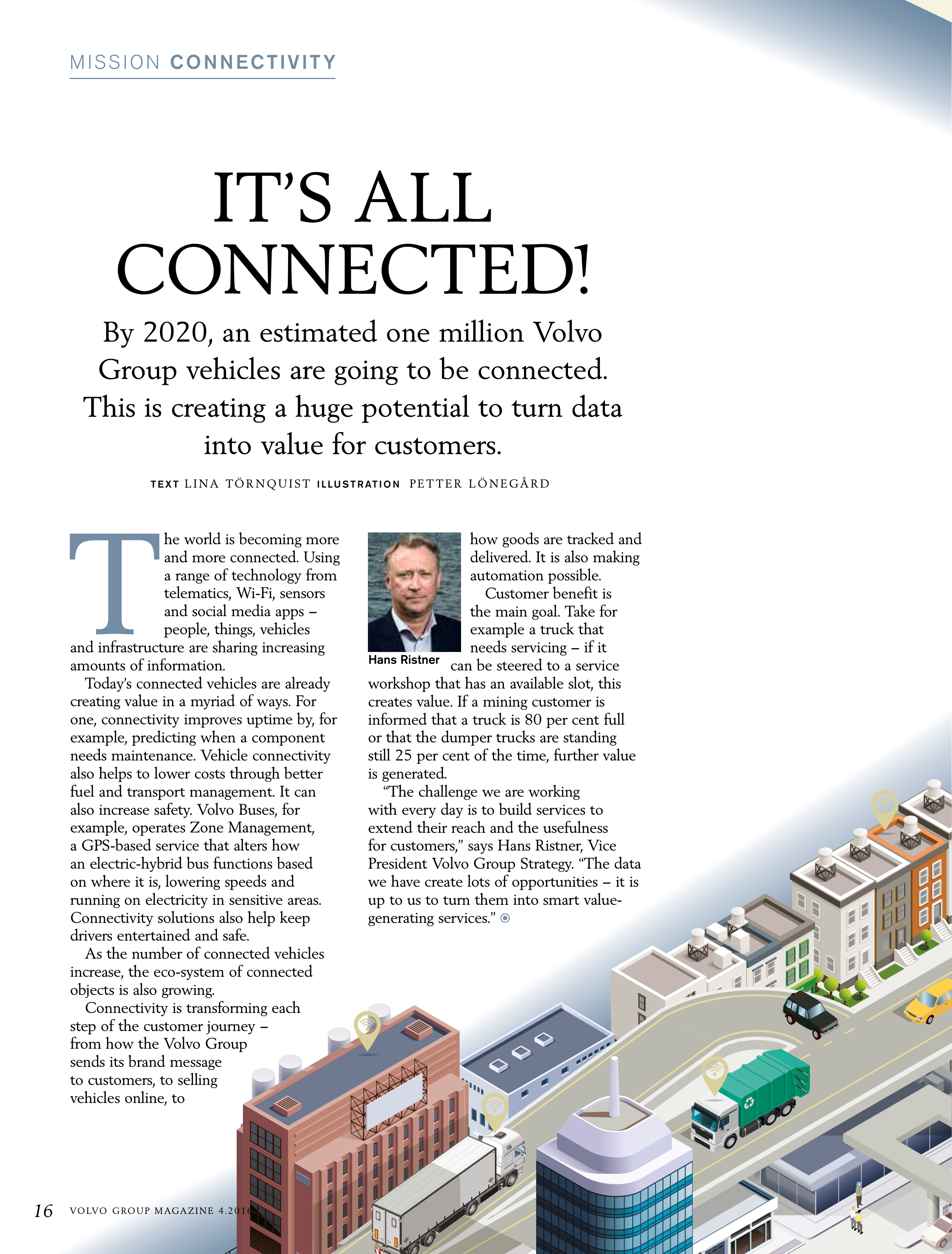
T
he world is becoming more
and more connected. Using
a range of technology from
telematics, Wi-Fi, sensors
and social media apps –
people, things, vehicles
and infrastructure are sharing increasing
amounts of information.
Today’s connected vehicles are already
creating value in a myriad of ways. For
one, connectivity improves uptime by, for
example, predicting when a component
needs maintenance. Vehicle connectivity
also helps to lower costs through better
fuel and transport management. It can
also increase safety. Volvo Buses, for
example, operates Zone Management,
a GPS-based service that alters how
an electric-hybrid bus functions based
on where it is, lowering speeds and
running on electricity in sensitive areas.
Connectivity solutions also help keep
drivers entertained and safe.
As the number of connected vehicles
increase, the eco-system of connected
objects is also growing.
Connectivity is transforming each
step of the customer journey –
from how the Volvo Group
sends its brand message
to customers, to selling
vehicles online, to
how goods are tracked and
delivered. It is also making
automation possible.
Customer benefit is
the main goal. Take for
example a truck that
needs servicing – if it
Hans Ristner
can be steered to a service
workshop that has an available slot, this
creates value. If a mining customer is
informed that a truck is 80 per cent full
or that the dumper trucks are standing
still 25 per cent of the time, further value
is generated.
“The challenge we are working
with every day is to build services to
extend their reach and the usefulness
for customers,” says Hans Ristner, Vice
President Volvo Group Strategy. “The data
we have create lots of opportunities – it is
up to us to turn them into smart value-
generating services.”
VOLVO GROUP MAGAZINE 4.2016
16
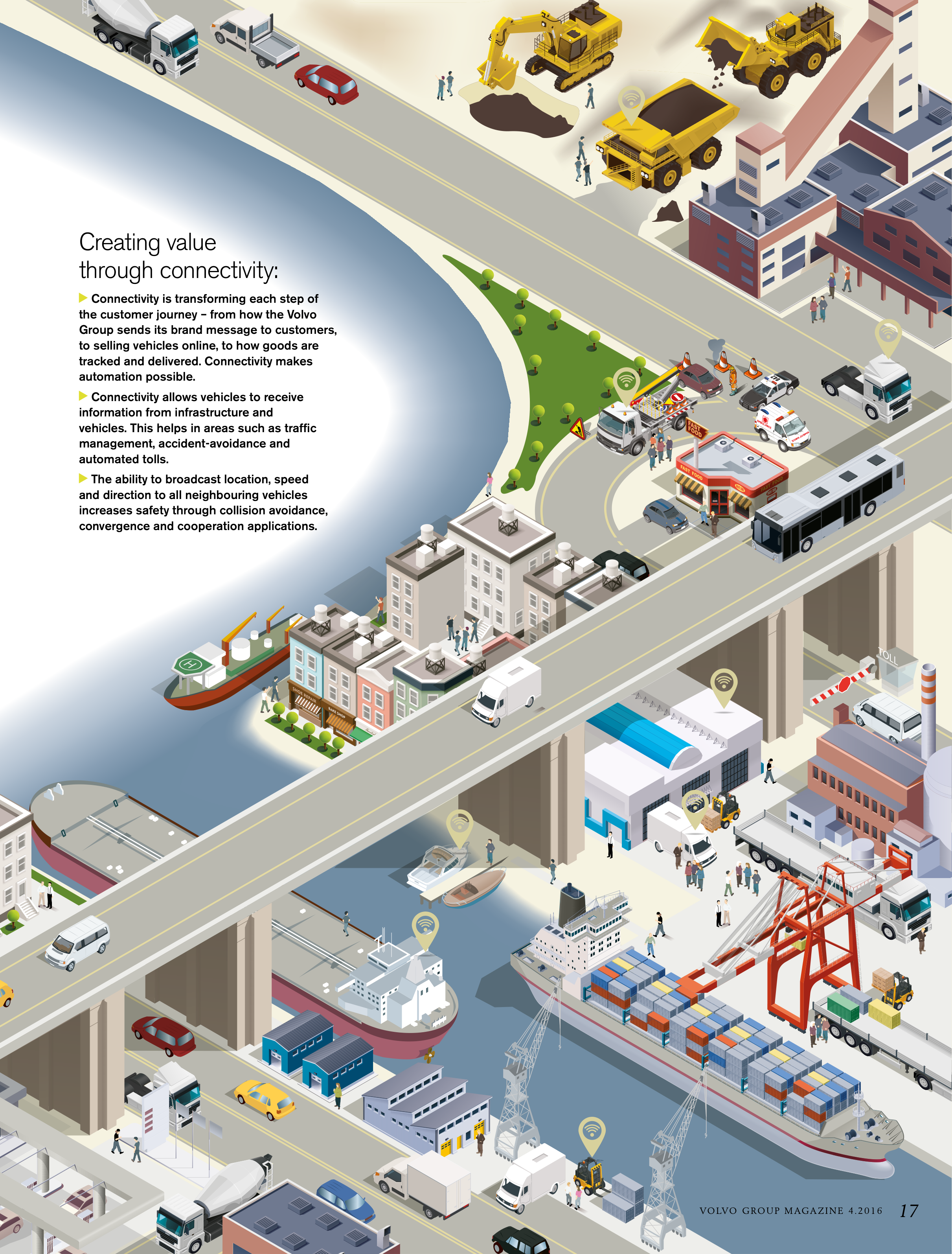
Creating value
through connectivity:
Connectivity is transforming each step of
the customer journey – from how the Volvo
Group sends its brand message to customers,
to selling vehicles online, to how goods are
tracked and delivered. Connectivity makes
automation possible.
Connectivity allows vehicles to receive
information from infrastructure and
vehicles. This helps in areas such as traffic
management, accident-avoidance and
automated tolls.
The ability to broadcast location, speed
and direction to all neighbouring vehicles
increases safety through collision avoidance,
convergence and cooperation applications.
VOLVO GROUP MAGAZINE 4.2016
17


MISSION
DRIVELINE S
FUELS
OF THE
FUTURE
T E X T
M A R I A S KÖ L D
P H OTO S
VO LVO G RO U P
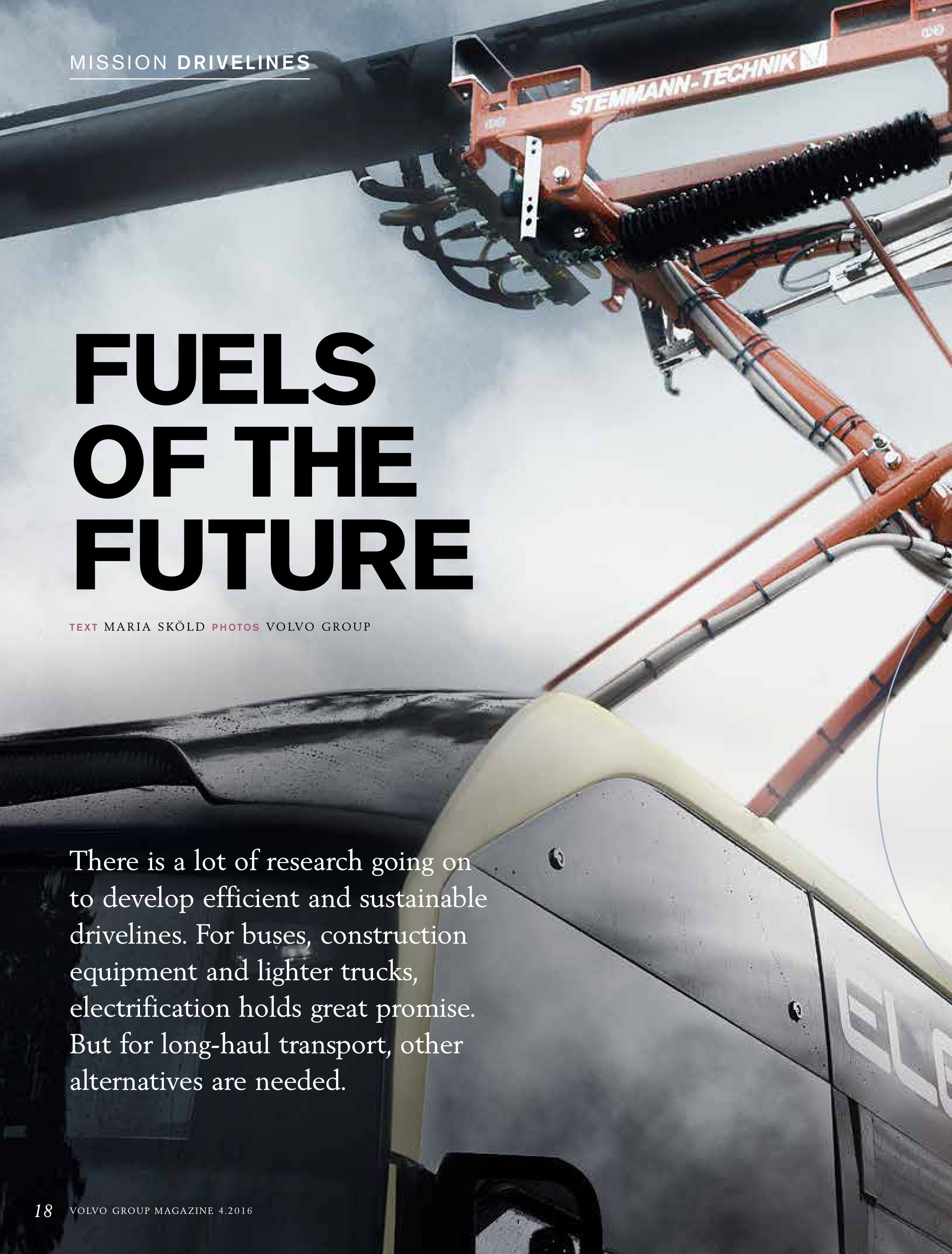
There is a lot of research going on
to develop efficient and sustainable
drivelines. For buses, construction
equipment and lighter trucks,
electrification holds great promise.
But for long-haul transport, other
alternatives are needed.
VOLVO GROUP MAGAZINE 4.2016
18


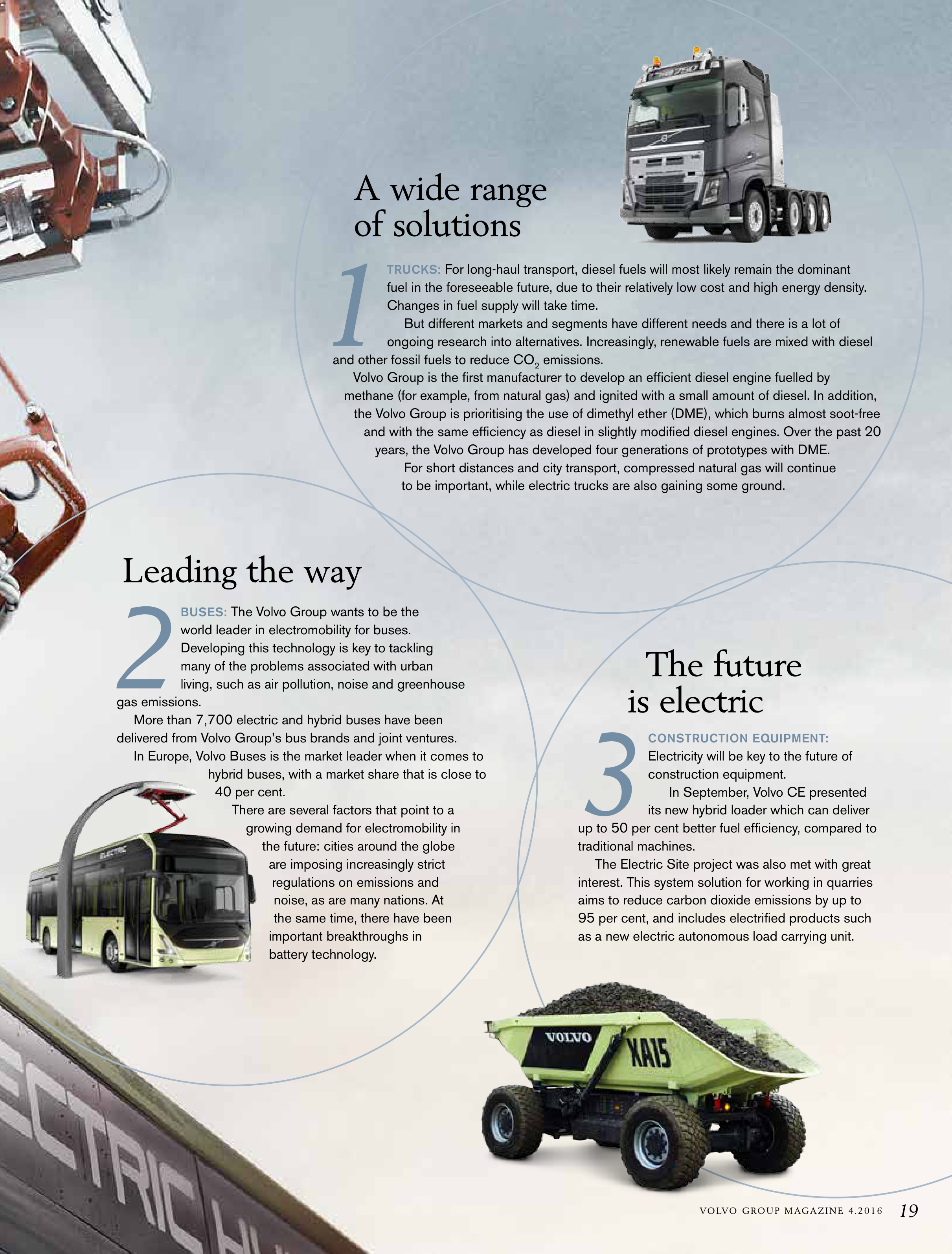
1
TRUCKS:
For long-haul transport, diesel fuels will most likely remain the dominant
fuel in the foreseeable future, due to their relatively low cost and high energy density.
Changes in fuel supply will take time.
But different markets and segments have different needs and there is a lot of
ongoing research into alternatives. Increasingly, renewable fuels are mixed with diesel
and other fossil fuels to reduce CO
2
emissions.
Volvo Group is the first manufacturer to develop an efficient diesel engine fuelled by
methane (for example, from natural gas) and ignited with a small amount of diesel. In addition,
the Volvo Group is prioritising the use of dimethyl ether (DME), which burns almost soot-free
and with the same efficiency as diesel in slightly modified diesel engines. Over the past 20
years, the Volvo Group has developed four generations of prototypes with DME.
For short distances and city transport, compressed natural gas will continue
to be important, while electric trucks are also gaining some ground.
Leading the way
A wide range
of solutions
2
BUSES:
The Volvo Group wants to be the
world leader in electromobility for buses.
Developing this technology is key to tackling
many of the problems associated with urban
living, such as air pollution, noise and greenhouse
gas emissions.
More than 7,700 electric and hybrid buses have been
delivered from Volvo Group’s bus brands and joint ventures.
In Europe, Volvo Buses is the market leader when it comes to
hybrid buses, with a market share that is close to
40 per cent.
There are several factors that point to a
growing demand for electromobility in
the future: cities around the globe
are imposing increasingly strict
regulations on emissions and
noise, as are many nations. At
the same time, there have been
important breakthroughs in
battery technology.
3
CONSTRUCTION EQUIPMENT:
Electricity will be key to the future of
construction equipment.
In September, Volvo CE presented
its new hybrid loader which can deliver
up to 50 per cent better fuel efficiency, compared to
traditional machines.
The Electric Site project was also met with great
interest. This system solution for working in quarries
aims to reduce carbon dioxide emissions by up to
95 per cent, and includes electrified products such
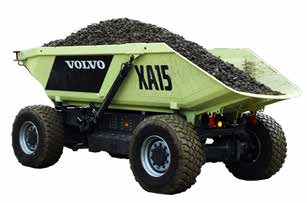
as a new electric autonomous load carrying unit.
The future
is electric
VOLVO GROUP MAGAZINE 4.2016
19

WHERE
ARE WE
GOING?
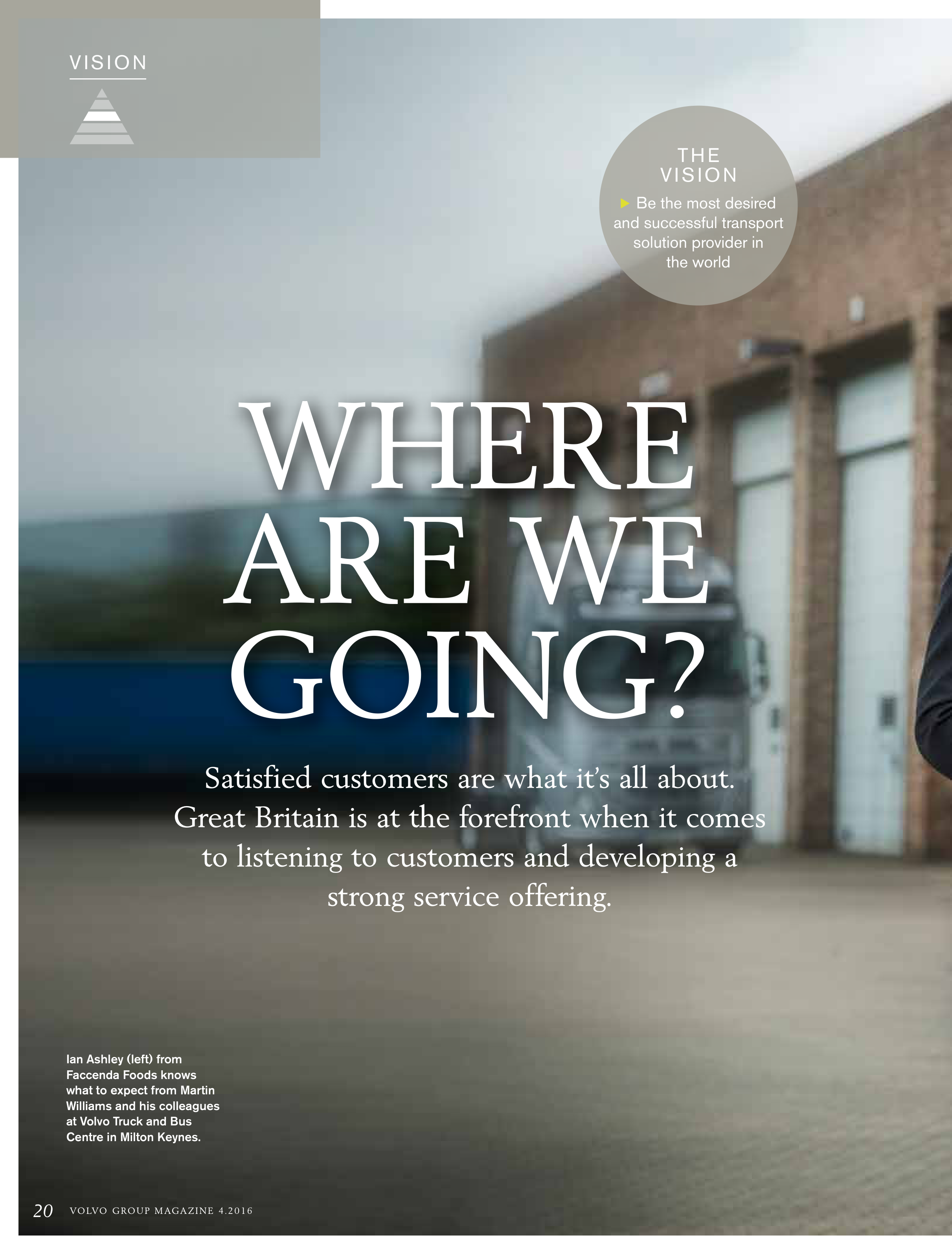
Satisfied customers are what it’s all about.
Great Britain is at the forefront when it comes
to listening to customers and developing a
strong service offering.
T HE
VISION
Be the most desired
and successful transport
solution provider in
the world
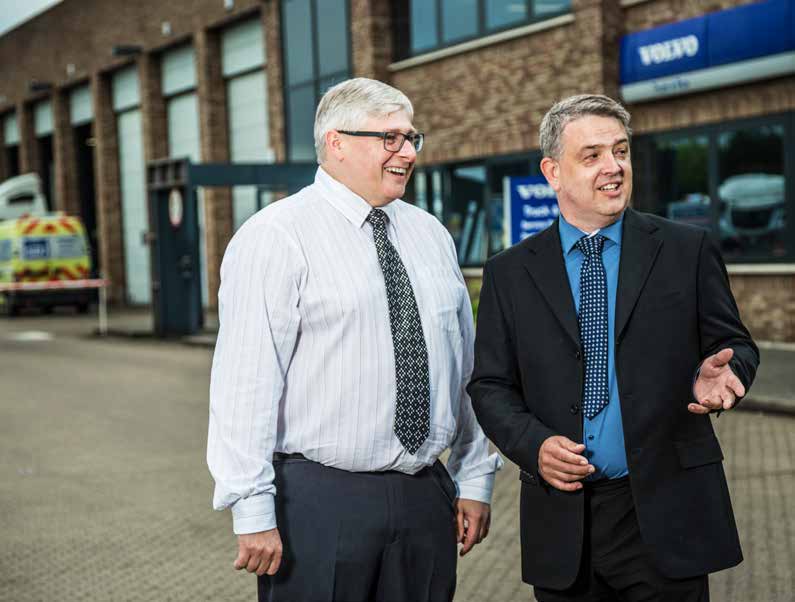
Ian Ashley (left) from
Faccenda Foods knows
what to expect from Martin
Williams and his colleagues
at Volvo Truck and Bus
Centre in Milton Keynes.
20
VOLVO GROUP MAGAZINE 4.2016
VISION

VOLVO GROUP MAGAZINE 4.2016
21


VISION
UK
THE UK:
CUSTOMER & CULTURE
The UK is one of the world’s toughest markets yet Volvo
Trucks has successfully established itself as a leading
provider of complete transport solutions. The key has been
building a customer-centric organisation and a culture
based on respect, trust and empowerment.
T E X T
N I C TOW N S E N D
P H OTO S
C R A I G E CC L E S TO N
“It is all
music to
my ears.”
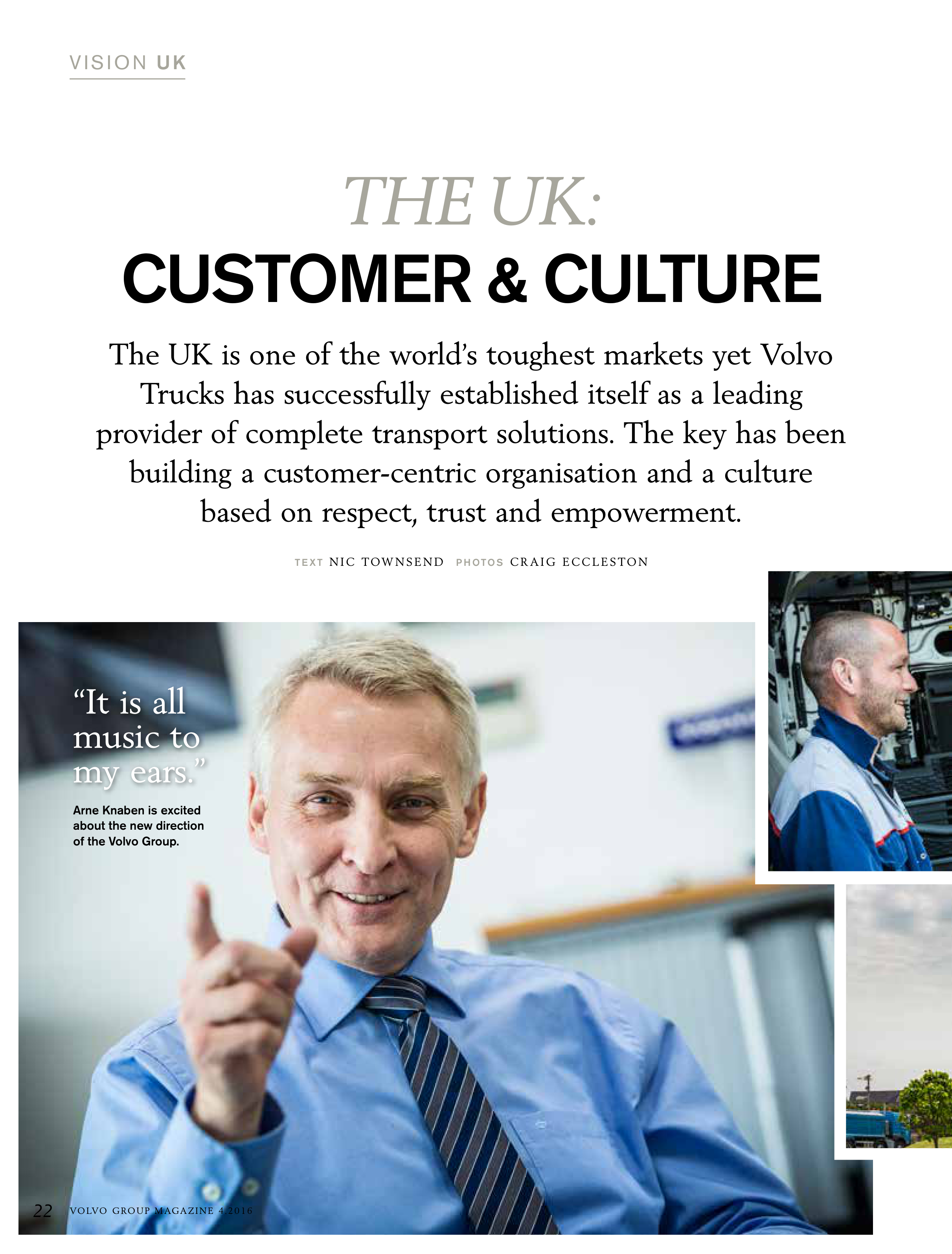
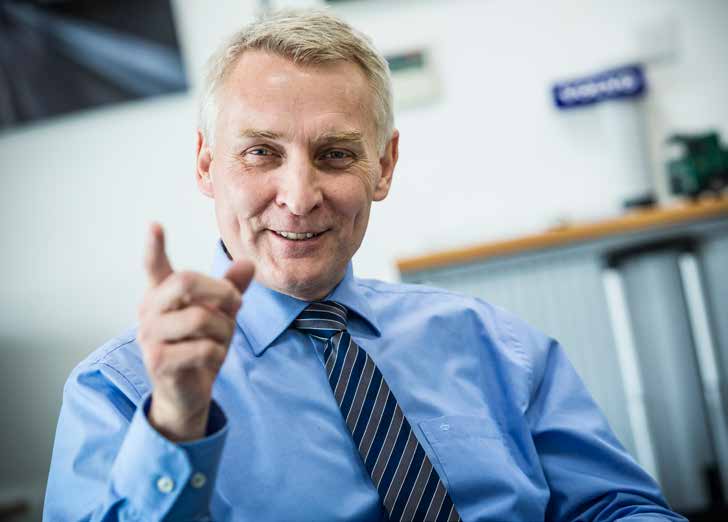
Arne Knaben is excited
about the new direction
of the Volvo Group.
22
VOLVO GROUP MAGAZINE 4.2016


W
HEN THE VOLVO GROUP
VOLVO GROUP MAGAZINE 4.2016
unveiled its new
mission, vision and
values, few people
were as excited as Arne
Knaben, Managing
Director Volvo
Trucks UK. “I’m incredibly happy when I see
the direction of the Group – it is fantastic,”
he stresses enthusiastically. “It is completely in
line with what we believe in: customer focus,
market focus, providing complete solutions, the
importance of culture and trust – it is all music to
my ears.”
The UK is the world’s fifth biggest economy
and an extremely mature truck market. It is also
very competitive and customer expectations
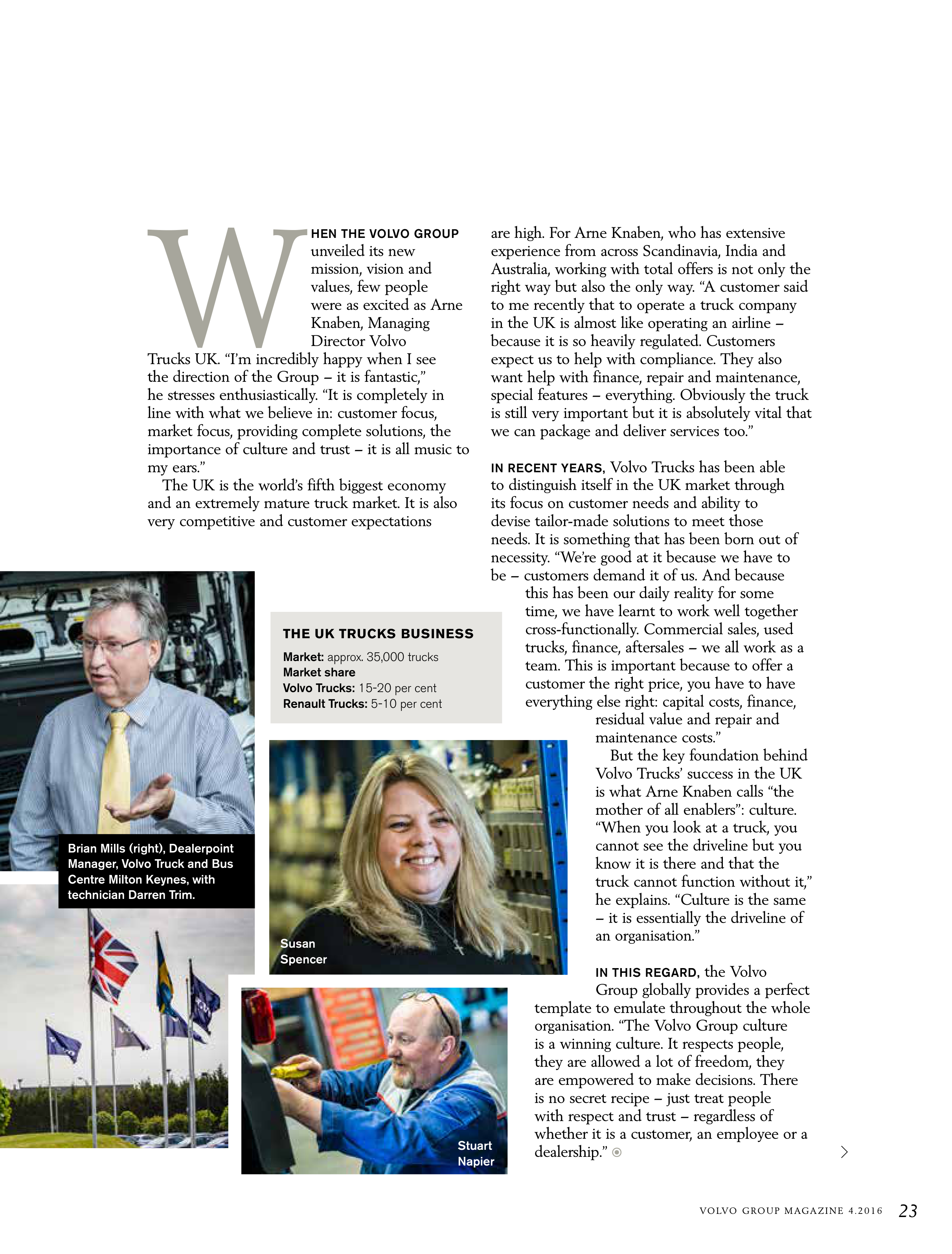
Susan
Spencer
THE UK TRUCKS BUSINESS
Market:
approx. 35,000 trucks
Market share
Volvo Trucks:
15-20 per cent
Renault Trucks:
5-10 per cent
Brian Mills (right), Dealerpoint
Manager, Volvo Truck and Bus
Centre Milton Keynes, with
technician Darren Trim.
Stuart
Napier
are high. For Arne Knaben, who has extensive
experience from across Scandinavia, India and
Australia, working with total offers is not only the
right way but also the only way. “A customer said
to me recently that to operate a truck company
in the UK is almost like operating an airline –
because it is so heavily regulated. Customers
expect us to help with compliance. They also
want help with finance, repair and maintenance,
special features – everything. Obviously the truck
is still very important but it is absolutely vital that
we can package and deliver services too.”
IN RECENT YEARS,
Volvo Trucks has been able
to distinguish itself in the UK market through
its focus on customer needs and ability to
devise tailor-made solutions to meet those
needs. It is something that has been born out of
necessity. “We’re good at it because we have to
be – customers demand it of us. And because
this has been our daily reality for some
time, we have learnt to work well together
cross-functionally. Commercial sales, used
trucks, finance, aftersales – we all work as a
team. This is important because to offer a
customer the right price, you have to have
everything else right: capital costs, finance,
residual value and repair and
maintenance costs.”
But the key foundation behind
Volvo Trucks’ success in the UK
is what Arne Knaben calls “the
mother of all enablers”: culture.
“When you look at a truck, you
cannot see the driveline but you
know it is there and that the
truck cannot function without it,”
he explains. “Culture is the same
– it is essentially the driveline of
an organisation.”
IN THIS REGARD,
the Volvo
Group globally provides a perfect
template to emulate throughout the whole
organisation. “The Volvo Group culture
is a winning culture. It respects people,
they are allowed a lot of freedom, they
are empowered to make decisions. There
is no secret recipe – just treat people
with respect and trust – regardless of
whether it is a customer, an employee or a
dealership.”
23

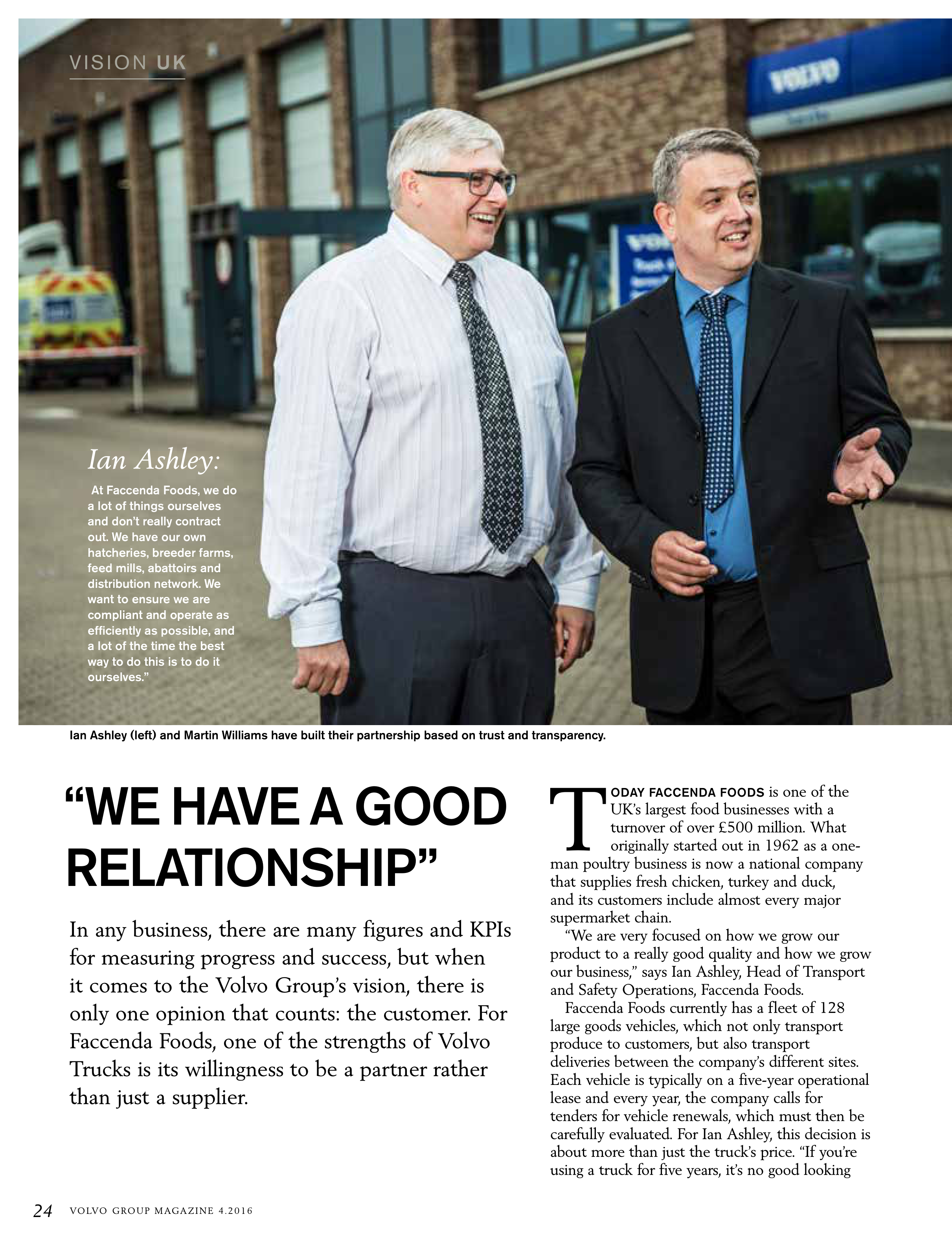
In any business, there are many figures and KPIs
for measuring progress and success, but when
it comes to the Volvo Group’s vision, there is
only one opinion that counts: the customer. For
Faccenda Foods, one of the strengths of Volvo
Trucks is its willingness to be a partner rather
than just a supplier.
“WE HAVE A GOOD
RELATIONSHIP”
T
ODAY FACCENDA FOODS
is one of the
UK’s largest food businesses with a
turnover of over £500 million. What
originally started out in 1962 as a one-
man poultry business is now a national company
that supplies fresh chicken, turkey and duck,
and its customers include almost every major
supermarket chain.
“We are very focused on how we grow our
product to a really good quality and how we grow
our business,” says Ian Ashley, Head of Transport
and Safety Operations, Faccenda Foods.
Faccenda Foods currently has a fleet of 128
large goods vehicles, which not only transport
produce to customers, but also transport
deliveries between the company’s different sites.
Each vehicle is typically on a five-year operational
lease and every year, the company calls for
tenders for vehicle renewals, which must then be
carefully evaluated. For Ian Ashley, this decision is
about more than just the truck’s price. “If you’re
using a truck for five years, it’s no good looking
At Faccenda Foods, we do
a lot of things ourselves
and don’t really contract
out. We have our own
hatcheries, breeder farms,
feed mills, abattoirs and
distribution network. We
want to ensure we are
compliant and operate as
efficiently as possible, and
a lot of the time the best
way to do this is to do it
ourselves.”
Ian Ashley:
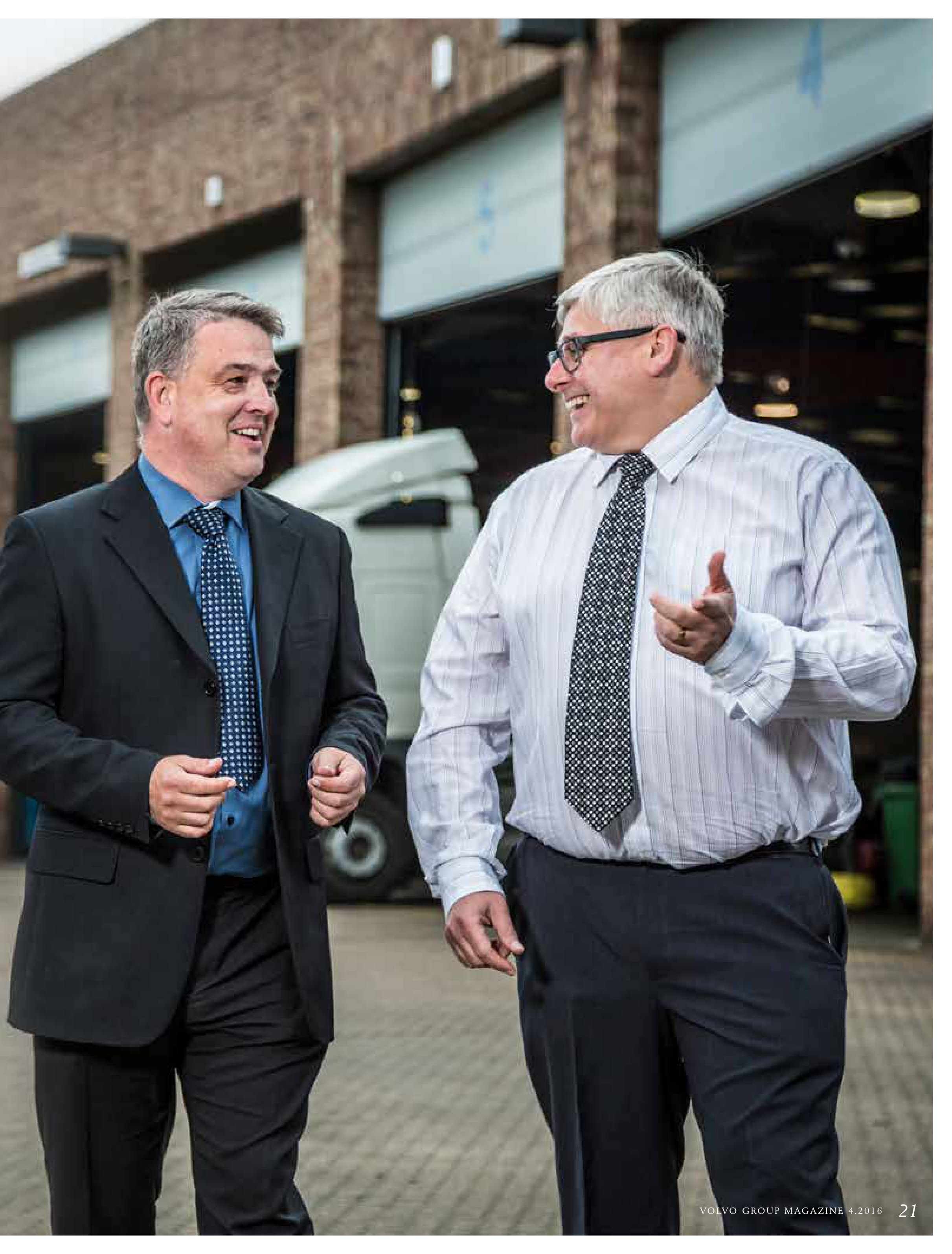
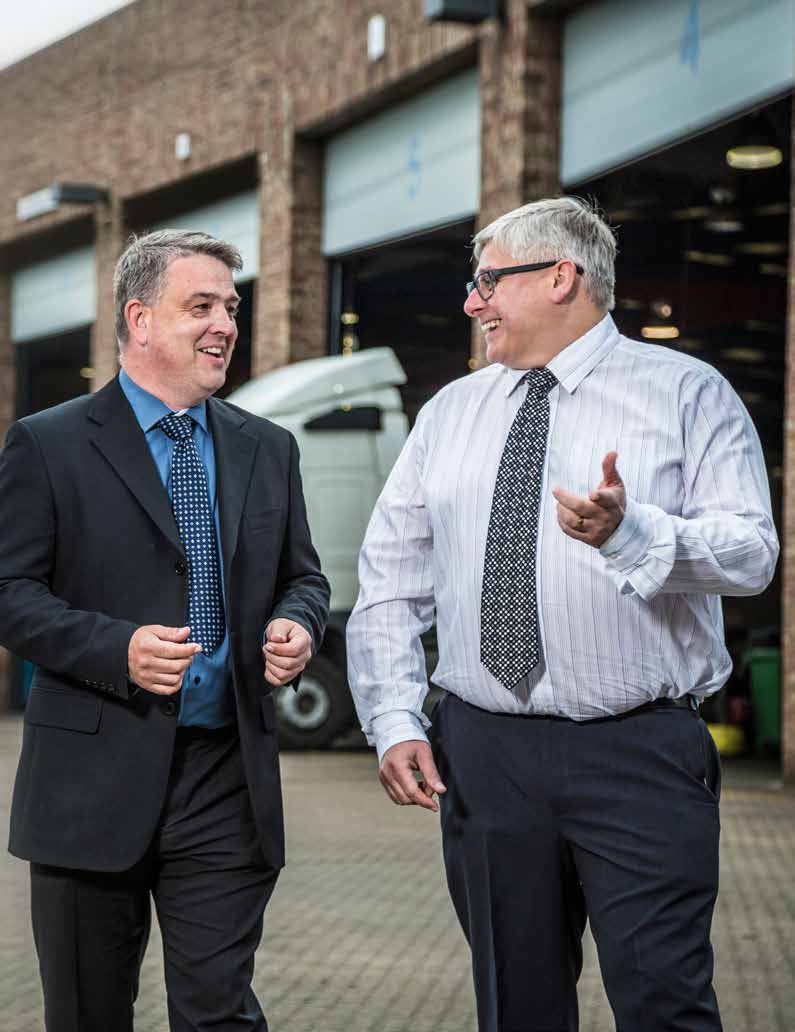
Ian Ashley (left) and Martin Williams have built their partnership based on trust and transparency.
VOLVO GROUP MAGAZINE 4.2016
“
VISION
UK
24


at how much you saved with a cheaper truck
knowing that at the end of the five years, they’ve
caused us all sorts of problems because of their
reliability, which costs us money.”
Faccenda Foods prides itself on its excellent
service delivery record. Downtime not only
threatens that reputation, but a single late
delivery could cost a sale in the region of tens of
thousands of pounds. Uptime is also important
internally, in order to keep up with production.
“The way we plan our factories is very much ‘just
in time’, so if something is not on time, it delays
what we do,” explains Ian Ashley. “For example,
our processing plant expects delivery from us
every two hours. If they don’t get it in time, it
can basically stop the factory and that can cost us
thousands of pounds an hour.”
IN 2015, AFTER
a concerted effort from the Volvo
Truck and Bus Centre in Milton Keynes, Volvo
Trucks won the contract to supply Faccenda
Foods with 32 vehicles. In 2016, they won the
contract again, this time for 29 vehicles.
By his own admission, Ian Ashley is a demanding
customer. “I like things to be right and therefore
I’m quite specific on what I want on the trucks and
how I want them done. They know that if I have a
bad experience, I won’t hold back on telling them
so, but they’re really responsive to that.”
What has particular impressed Ian Ashley has
been Volvo Trucks’ openness and transparency.
“Volvo is more upfront in what they can offer.
When you talk to other manufacturers, they’ll
say ‘that’s the deal’. But with Volvo they’ll come
and say ‘we’ve got a deal, however don’t forget we
can help manage your fuel economy, we can help
with the telematics, we can help by doing this or
help by doing that’. We have a good relationship.
It’s more of a partnership rather than a ‘you sell it,
I’ll buy it’, type of scenario.”
AS PART OF THEIR
partnership, Volvo Trucks
sends a fuel watch manager to Faccenda Foods
on a regular basis, who then analyses fuel and
driver data. When he identifies potential areas for
improvements, a driver development manager will
then work with Faccenda Foods’ drivers. “Some
people think you take an order for a truck, you
deliver it, and that’s it – but that’s actually the
start,” says Martin Williams, Sales Director, Volvo
Truck and Bus Centre Milton Keynes. “For us,
it’s then about helping them after they’ve got the
trucks, to make the trucks more profitable.”
Volvo Trucks may have won over Faccenda
Foods two years running, but they also know
there is no room for complacency. In fact each
year it gets tougher as the competition are
forced to improve their offer. “Every deal gets
that bit tighter and that bit harder,” adds Martin
Williams. “In every business, whether it’s Sky
TV or a phone provider, there always seems to
be a lot of support at capturing new customers
– half-price deals for a year and so on. But it’s
important to throw all your support at keeping
customers too.”
FACCENDA FOODS
Founded:
1962
Employees:
Approx. 3,500
About:
Faccenda Foods delivers fresh
and convenience food solutions for
the UK retail and food service sectors.
The company is wholly owned by
the Faccenda family and has been
successfully supplying UK consumers
for six decades. Their fleet delivers over
20m cases a year, hitting 99 per cent of
the distribution targets agreed with their
customers.
“It’s more of a partnership
rather than a ‘you sell it, I’ll
buy it’, type of scenario.”
I A N A S H L E Y, H E A D O F T R A N S P O R T A N D S A F E T Y O P E R AT I O N S , FA C C E N D A F O O D S
VOLVO GROUP MAGAZINE 4.2016
25


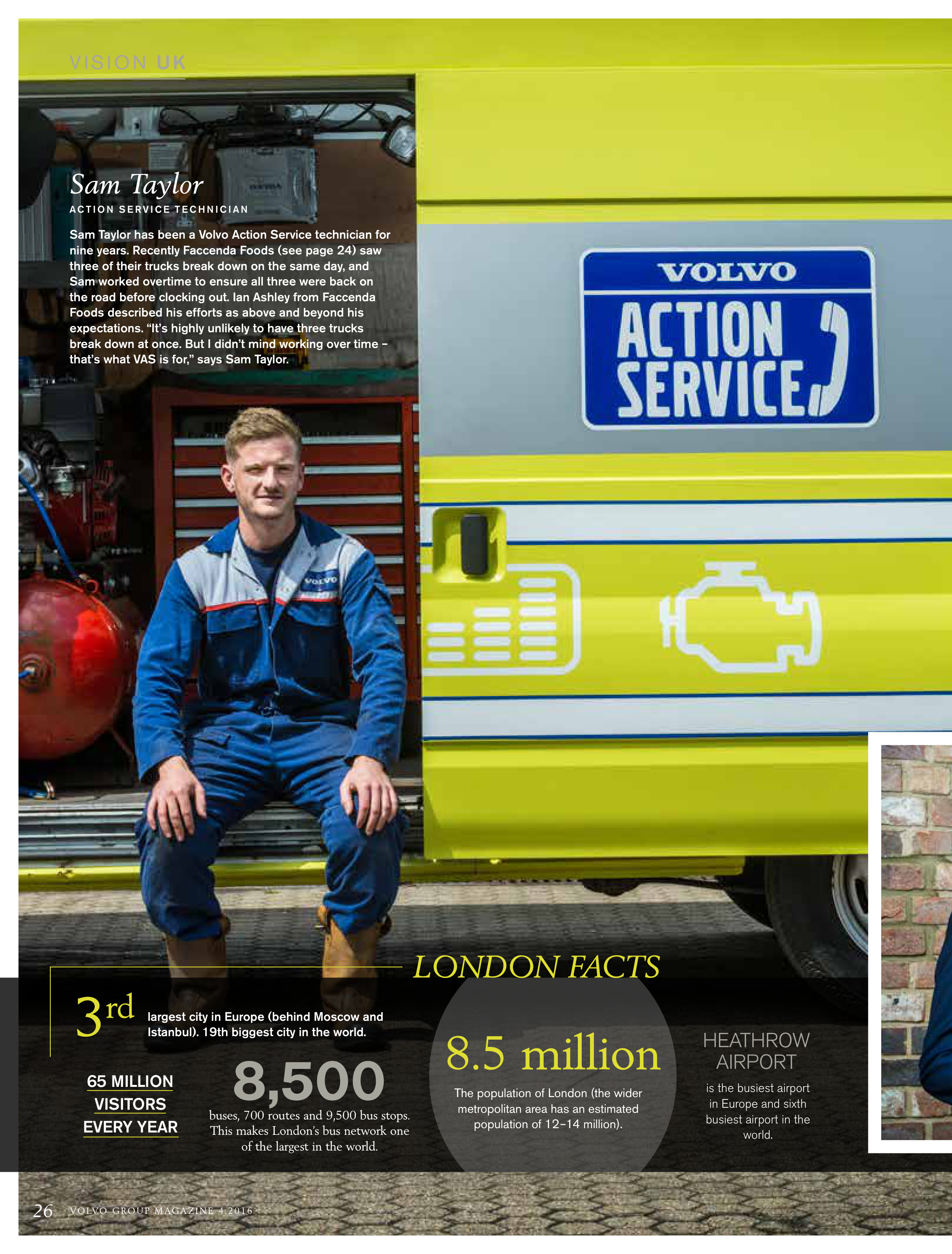
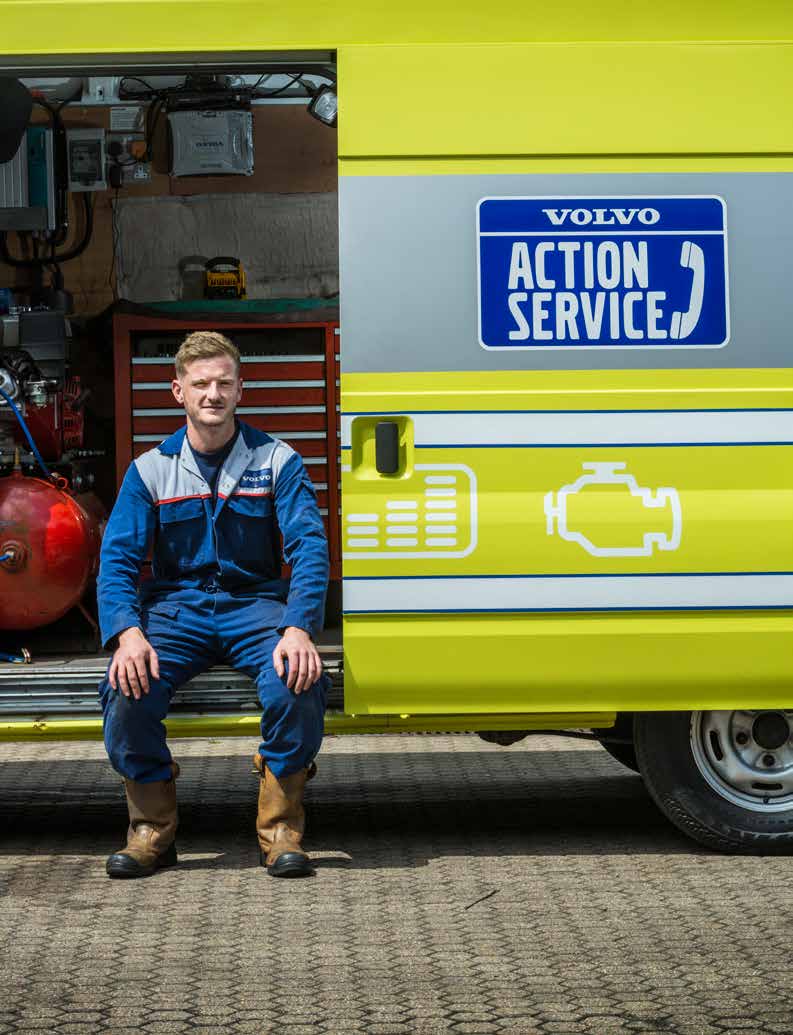
Sam Taylor
A C T I O N S E R V I C E T E C H N I C I A N
Sam Taylor has been a Volvo Action Service technician for
nine years. Recently Faccenda Foods (see page 24) saw
three of their trucks break down on the same day, and
Sam worked overtime to ensure all three were back on
the road before clocking out. Ian Ashley from Faccenda
Foods described his efforts as above and beyond his
expectations. “It’s highly unlikely to have three trucks
break down at once. But I didn’t mind working over time –
that’s what VAS is for,” says Sam Taylor.
HEATHROW
AIRPORT
65 MILLION
VISITORS
EVERY YEAR
8,500
buses, 700 routes and 9,500 bus stops.
This makes London’s bus network one
of the largest in the world.
is the busiest airport
in Europe and sixth
busiest airport in the
world.
8.5 million
The population of London (the wider
metropolitan area has an estimated
population of 12–14 million).
LONDON FACTS
3
rd
largest city in Europe (behind Moscow and
Istanbul). 19th biggest city in the world.
VOLVO GROUP MAGAZINE 4.2016
26
VISION
UK

“EVERYTHING STARTS
WITH THE CUSTOMER”
For 15 years, Volvo Truck and Bus Centre London was losing money
and increasingly looking like a lost cause. But by changing the culture
and values, and putting the customer first, the business has completely
turned around and is now firmly in the black.
W
HEN PETER GROOME
was
appointed Managing Director,
Volvo Truck and Bus Centre
London was a mess. High living
costs and property values make London a tough
market even at the best of times, but the region
was also still reeling from a rapidly declining
vehicle population after the 2008 recession,
which was having a knock-on effect on services.
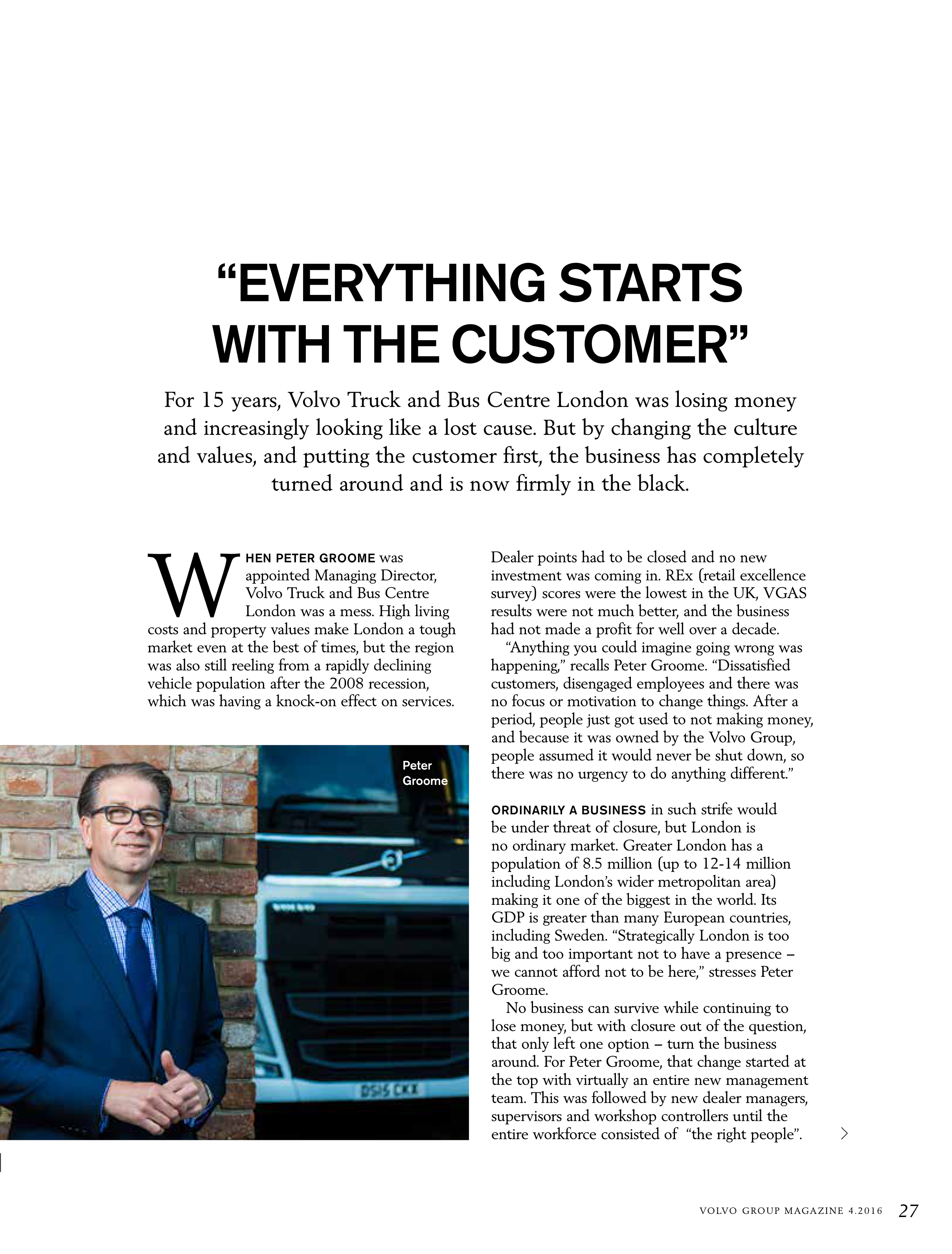
Peter
Groome
Dealer points had to be closed and no new
investment was coming in. REx (retail excellence
survey) scores were the lowest in the UK, VGAS
results were not much better, and the business
had not made a profit for well over a decade.
“Anything you could imagine going wrong was
happening,” recalls Peter Groome. “Dissatisfied
customers, disengaged employees and there was
no focus or motivation to change things. After a
period, people just got used to not making money,
and because it was owned by the Volvo Group,
people assumed it would never be shut down, so
there was no urgency to do anything different.”
ORDINARILY A BUSINESS
in such strife would
be under threat of closure, but London is
no ordinary market. Greater London has a
population of 8.5 million (up to 12-14 million
including London’s wider metropolitan area)
making it one of the biggest in the world. Its
GDP is greater than many European countries,
including Sweden. “Strategically London is too
big and too important not to have a presence –
we cannot afford not to be here,” stresses Peter
Groome.
No business can survive while continuing to
lose money, but with closure out of the question,
that only left one option – turn the business
around. For Peter Groome, that change started at
the top with virtually an entire new management
team. This was followed by new dealer managers,
supervisors and workshop controllers until the
entire workforce consisted of “the right people”.
VOLVO GROUP MAGAZINE 4.2016
27


“Knowledgeable, well-trained, experienced,
have the right attitude, the right people
management skills, and are entrepreneurial,”
explains Peter Groome on what he was looking
for in his new team. “The ethos we try to instill in
the business is to allow people to run their own
businesses, and feel empowered to make their
own decisions.”
The next step was to change the culture and
values, and establish a shared vision. “As a team,
we decided what our values would be, and they
are a lot like the values the Volvo Group now has
globally. It’s about being the best possible partner
for our customers. It’s about having the best offers
to match our customers’ needs and it’s about
finding the
right
customers. Not any customer but
customers whose needs we can best match.”
THE RESULTS HAVE
been immediate. In just 18
months, truck sales have increased from 250
a year to 400. But where the London region
has been particularly successful has been with
services. Three years ago, just 25 per cent of
vehicles were sold with a service contract – that
is now up to 75 per cent. Being able of offer
customised total solutions has been a big part of
their success, especially concerning compliance.
London is a heavily regulated market, with
customers affected by legislation concerning
safety, visibility and carbon emissions. “We
have had a lot of success in being able to offer
customers a solution that takes care of all their
compliance issues, so that they get on with their
own jobs,” says Peter Groome. “Our aim is to
make ourselves so important to the customer,
they can’t take us out of the
equation.”
WITH THE BUSINESS
now back
on track, Volvo Truck and Bus
Centre London is proactively
looking at the many exciting
growth opportunities its
region offers. High Speed 2
(HS2), a planned high-speed
railway between London
and Birmingham and later
Manchester, will be one of the
biggest construction projects in
Europe. In close collaboration
with Volvo Construction
Equipment, Volvo Trucks is
already in discussions with
potential customers on how
they can assist with a total
solution that incorporates both
machinery and transportation.
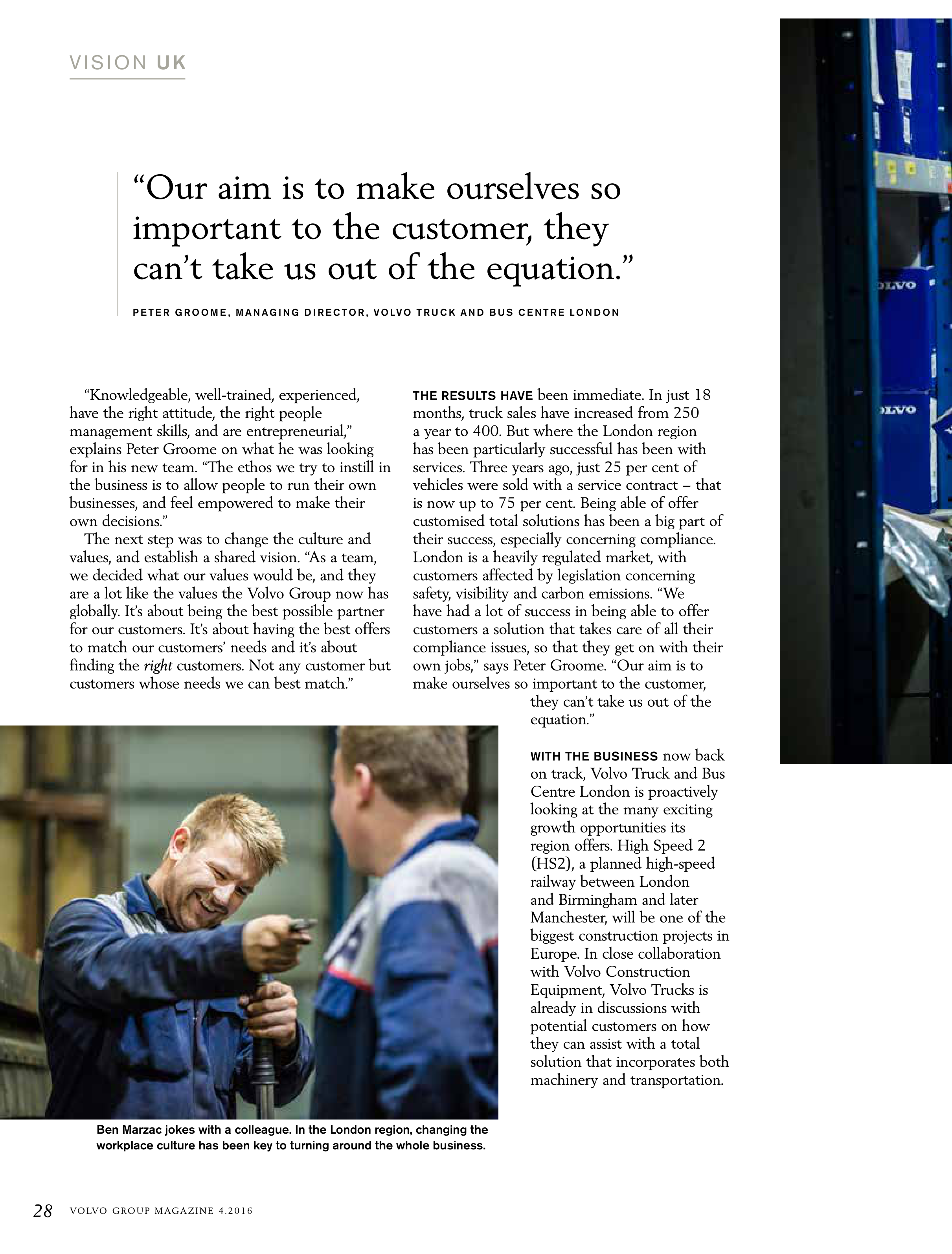
Ben Marzac jokes with a colleague. In the London region, changing the
workplace culture has been key to turning around the whole business.
“Our aim is to make ourselves so
important to the customer, they
can’t take us out of the equation.”
P E T E R G R O O M E , M A N A G I N G D I R E C T O R , V O L V O T R U C K A N D B U S C E N T R E L O N D O N
VOLVO GROUP MAGAZINE 4.2016
VISION
UK
28

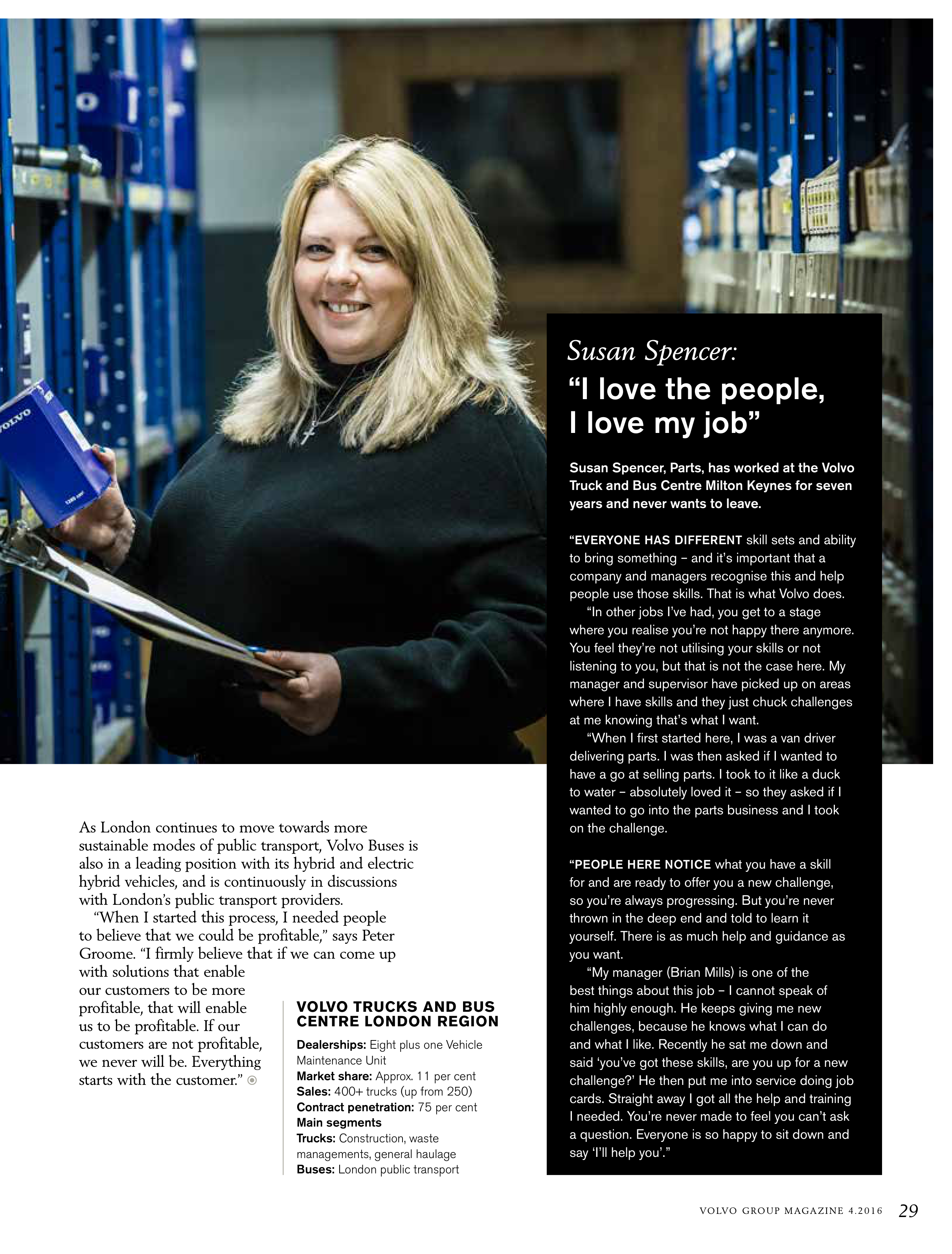
Susan Spencer:
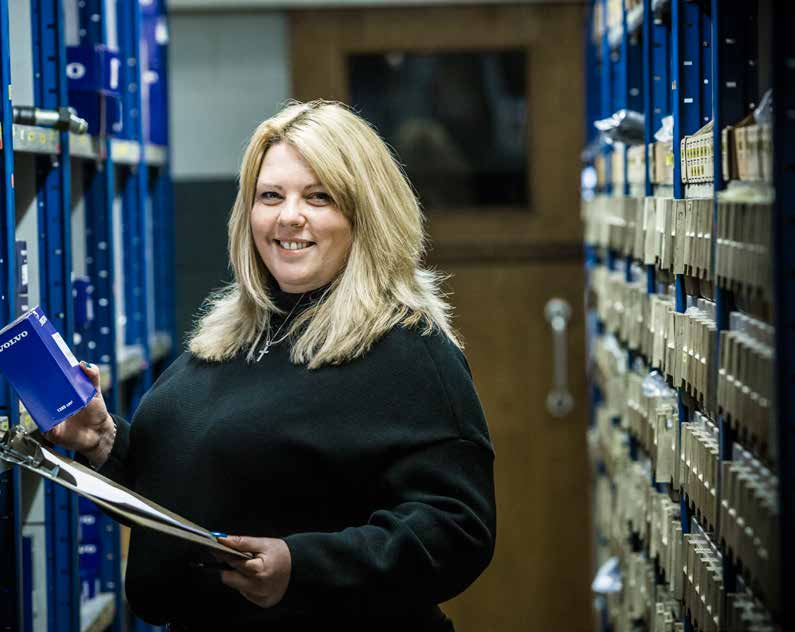
Susan Spencer, Parts, has worked at the Volvo
Truck and Bus Centre Milton Keynes for seven
years and never wants to leave.
“EVERYONE HAS DIFFERENT
skill sets and ability
to bring something – and it’s important that a
company and managers recognise this and help
people use those skills. That is what Volvo does.
“In other jobs I’ve had, you get to a stage
where you realise you’re not happy there anymore.
You feel they’re not utilising your skills or not
listening to you, but that is not the case here. My
manager and supervisor have picked up on areas
where I have skills and they just chuck challenges
at me knowing that’s what I want.
“When I first started here, I was a van driver
delivering parts. I was then asked if I wanted to
have a go at selling parts. I took to it like a duck
to water – absolutely loved it – so they asked if I
wanted to go into the parts business and I took
on the challenge.
“PEOPLE HERE NOTICE
what you have a skill
for and are ready to offer you a new challenge,
so you’re always progressing. But you’re never
thrown in the deep end and told to learn it
yourself. There is as much help and guidance as
you want.
“My manager (Brian Mills) is one of the
best things about this job – I cannot speak of
him highly enough. He keeps giving me new
challenges, because he knows what I can do
and what I like. Recently he sat me down and
said ‘you’ve got these skills, are you up for a new
challenge?’ He then put me into service doing job
cards. Straight away I got all the help and training
I needed. You’re never made to feel you can’t ask
a question. Everyone is so happy to sit down and
say ‘I’ll help you’.”
“I love the people,
I love my job”
As London continues to move towards more
sustainable modes of public transport, Volvo Buses is
also in a leading position with its hybrid and electric
hybrid vehicles, and is continuously in discussions
with London’s public transport providers.
“When I started this process, I needed people
to believe that we could be profitable,” says Peter
Groome. “I firmly believe that if we can come up
with solutions that enable
our customers to be more
profitable, that will enable
us to be profitable. If our
customers are not profitable,
we never will be. Everything
starts with the customer.”
VOLVO TRUCKS AND BUS
CENTRE LONDON REGION
Dealerships:
Eight plus one Vehicle
Maintenance Unit
Market share:
Approx. 11 per cent
Sales:
400+ trucks (up from 250)
Contract penetration:
75 per cent
Main segments
Trucks:
Construction, waste
managements, general haulage
Buses:
London public transport
VOLVO GROUP MAGAZINE 4.2016
29

VISION
SCOTL AND
SERVICE THAT COUNTS
T
HERE IS AN
easy-going atmosphere at
The staff at Volvo Truck and Bus Centre North &
the Volvo Truck and Bus Centre in
Scotland are clearly doing something right. They
Glasgow. It’s clear that the staff enjoy
have consistently scored impressively in the Retail
each other’s company and take pride
in their work. Like several others here, Neil Park
Excellence Survey, and have received praise for
started as a technician. Today he is Aftersales
how they listen to their customers.
Director and also acting Managing Director at the
time of writing.
T E X T
A L A S TA I R M AC D U F F
P H OTO S
SA R A H RO B E RT S
“The customer has always been at the centre
VOLVO GROUP MAGAZINE 4.2016
30

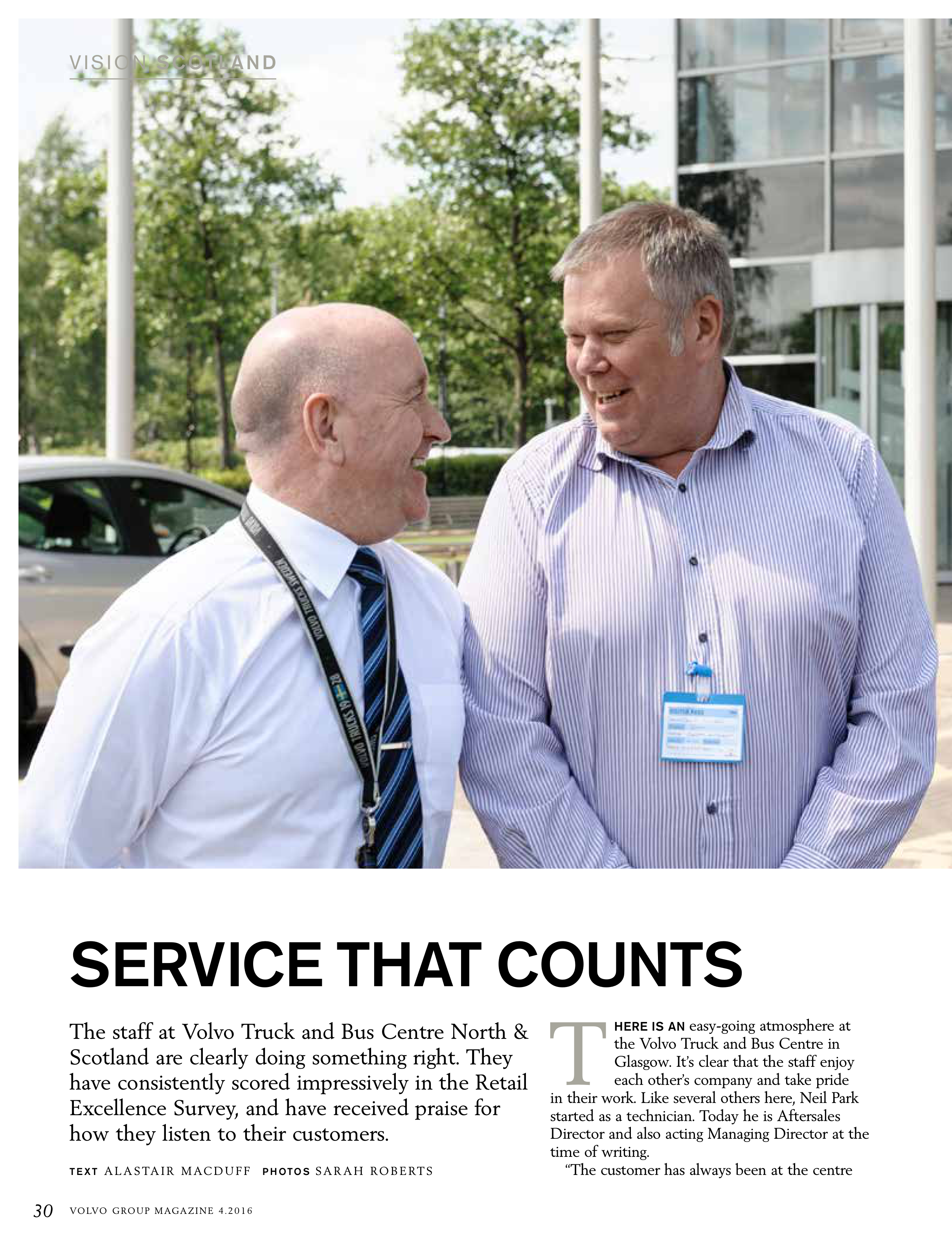
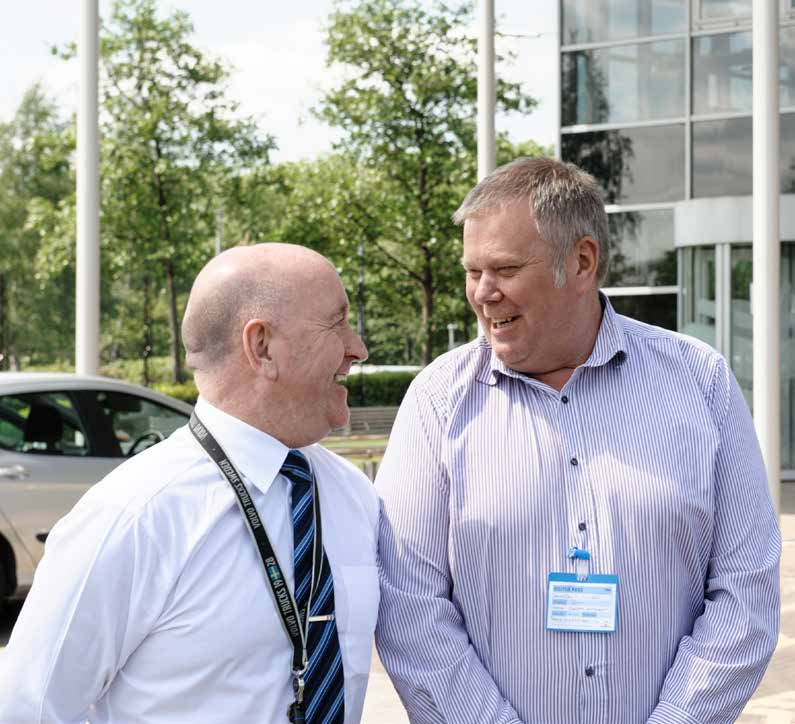
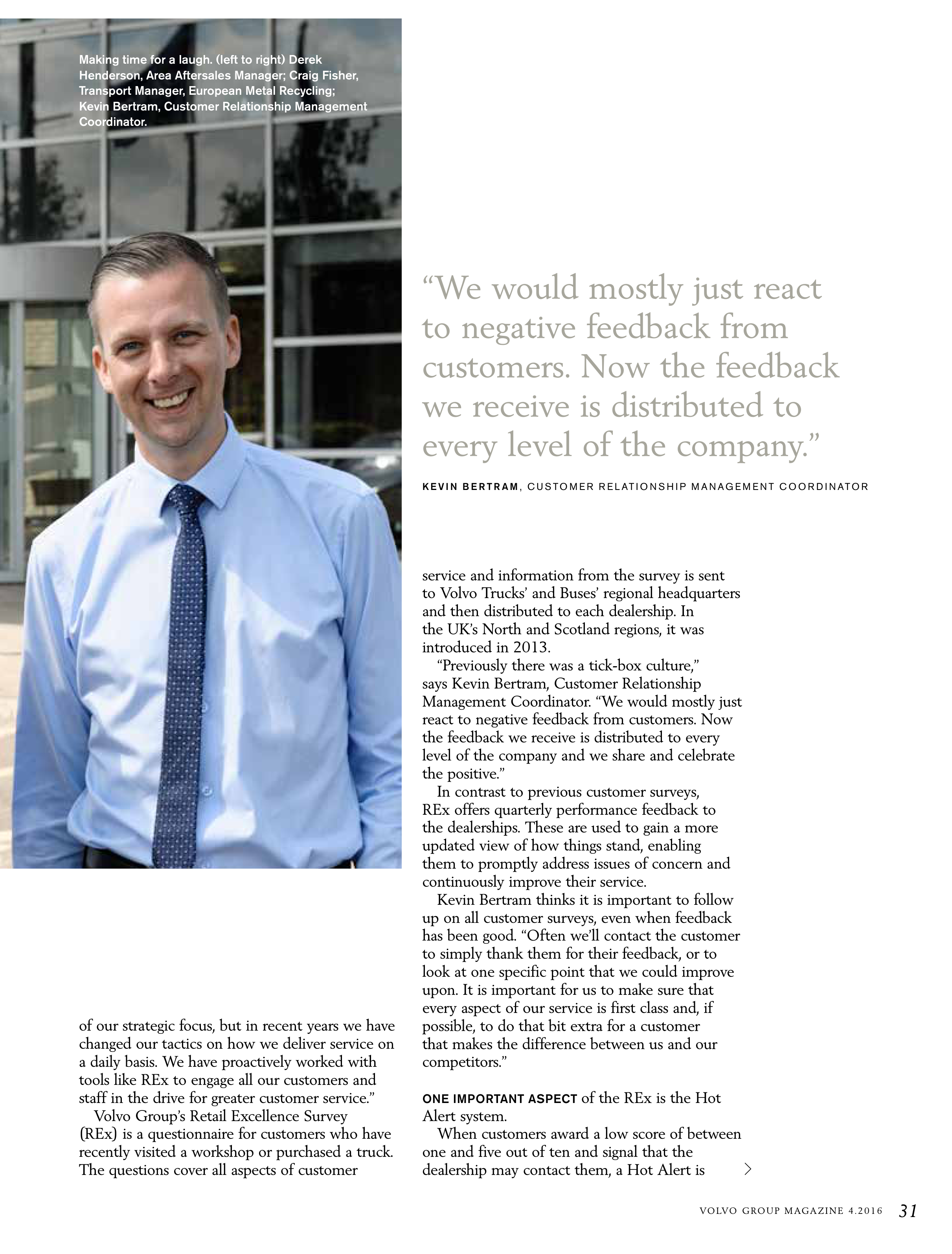
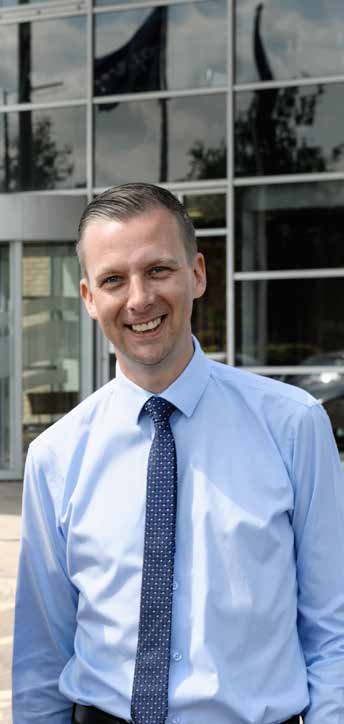
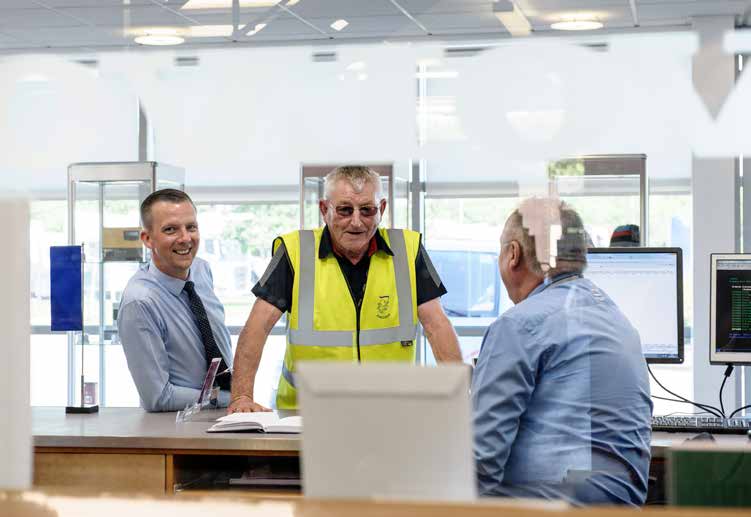
Making time for a laugh. (left to right) Derek
Henderson, Area Aftersales Manager; Craig Fisher,
Transport Manager, European Metal Recycling;
Kevin Bertram, Customer Relationship Management
Coordinator.
of our strategic focus, but in recent years we have
changed our tactics on how we deliver service on
a daily basis. We have proactively worked with
tools like REx to engage all our customers and
staff in the drive for greater customer service.”
Volvo Group’s Retail Excellence Survey
(REx) is a questionnaire for customers who have
recently visited a workshop or purchased a truck.
The questions cover all aspects of customer
“We would mostly just react
to negative feedback from
customers. Now the feedback
we receive is distributed to
every level of the company.”
K E V I N B E R T R A M
, C U S T O M E R R E L AT I O N S H I P M A N AG E M E N T C O O R D I N ATO R
service and information from the survey is sent
to Volvo Trucks’ and Buses’ regional headquarters
and then distributed to each dealership. In
the UK’s North and Scotland regions, it was
introduced in 2013.
“Previously there was a tick-box culture,”
says Kevin Bertram, Customer Relationship
Management Coordinator. “We would mostly just
react to negative feedback from customers. Now
the feedback we receive is distributed to every
level of the company and we share and celebrate
the positive.”
In contrast to previous customer surveys,
REx offers quarterly performance feedback to
the dealerships. These are used to gain a more
updated view of how things stand, enabling
them to promptly address issues of concern and
continuously improve their service.
Kevin Bertram thinks it is important to follow
up on all customer surveys, even when feedback
has been good. “Often we’ll contact the customer
to simply thank them for their feedback, or to
look at one specific point that we could improve
upon. It is important for us to make sure that
every aspect of our service is first class and, if
possible, to do that bit extra for a customer
that makes the difference between us and our
competitors.”
ONE IMPORTANT ASPECT
of the REx is the Hot
Alert system.
When customers award a low score of between
one and five out of ten and signal that the
dealership may contact them, a Hot Alert is
VOLVO GROUP MAGAZINE 4.2016
31

generated. Prompt action is taken to solve the
customer’s issue satisfactorily, with the dealership
also ensuring that operations are improved and
the problem does not reoccur.
Kevin Bertram’s role is central to the Hot Alert
chain in the North and Scotland region.
“The Dealership Manager is notified when
a Hot Alert is received. I then send out an
acknowledgement to the customer, confirming
the actions we will take to resolve the issue
detailed by the customer in the survey. The
Dealership Manager contacts the customer within
one week, and the complaint should be resolved
within a maximum of two weeks. It is vital that
we act quickly in order to maintain our positive
relations with every customer, no matter their
business.”
This customer-focused strategy has also led
to power being handed to the twelve individual
dealerships in the region.
“Local autonomy is making our dealerships
accountable for their own successes,” says Neil
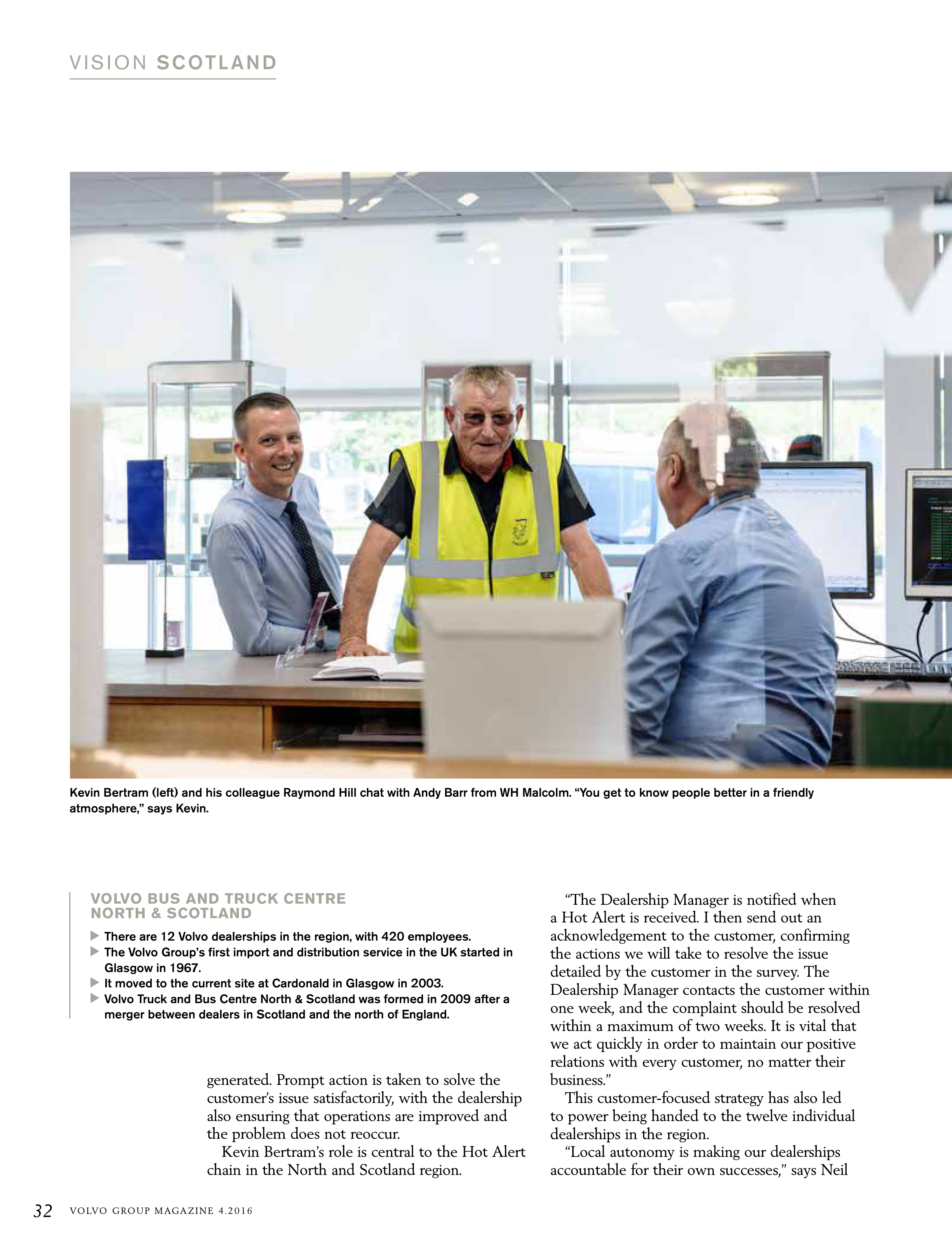
Kevin Bertram (left) and his colleague Raymond Hill chat with Andy Barr from WH Malcolm. “You get to know people better in a friendly
atmosphere,” says Kevin.
VOLVO BUS AND TRUCK CENTRE
NORTH & SCOTLAND
There are 12 Volvo dealerships in the region, with 420 employees.
The Volvo Group’s first import and distribution service in the UK started in
Glasgow in 1967.
It moved to the current site at Cardonald in Glasgow in 2003.
Volvo Truck and Bus Centre North & Scotland was formed in 2009 after a
merger between dealers in Scotland and the north of England.
VOLVO GROUP MAGAZINE 4.2016
VISION
SCOTL AND
32

Park. “We are focusing on insight driven sales.
This means listening to individual customers and
understanding their needs. The dealerships have
the freedom to create services for the customers
that adequately resolve any issues they may have.
It all comes down to adding value and helping the
customers improve their business.”
AT THE CENTRE
in Glasgow, we meet customer
Craig Fisher, Transport Manager with European
Metal Recycling. The company has 15 articulated
Volvo trucks and 15 rigids in service in the North
and Scotland region.
Craig Fisher has travelled from Salford in
north-west England for a meeting, and is happy to
be here. “Our relationship goes back a long way.
The company I work for had some third party
maintenance issues that we were unhappy about,
but we managed to work together with the guys
here and we haven’t looked back. I know they
have got my interests and the interests of the
business at heart.”
As Craig Fisher says goodbye and sets off on
his journey home, there are hearty laughs and
firm handshakes all round. “The natural touch is
very important to us here,” says Kevin Bertram.
“If customers have to wait, offer them a cup of
tea or something to eat. It’s easy to get wrapped
up in business, but we always make sure to have
a chat and a laugh. We always prioritise time for
our customers, as they are at the centre of our
strategic vision to be the Customer Company.”
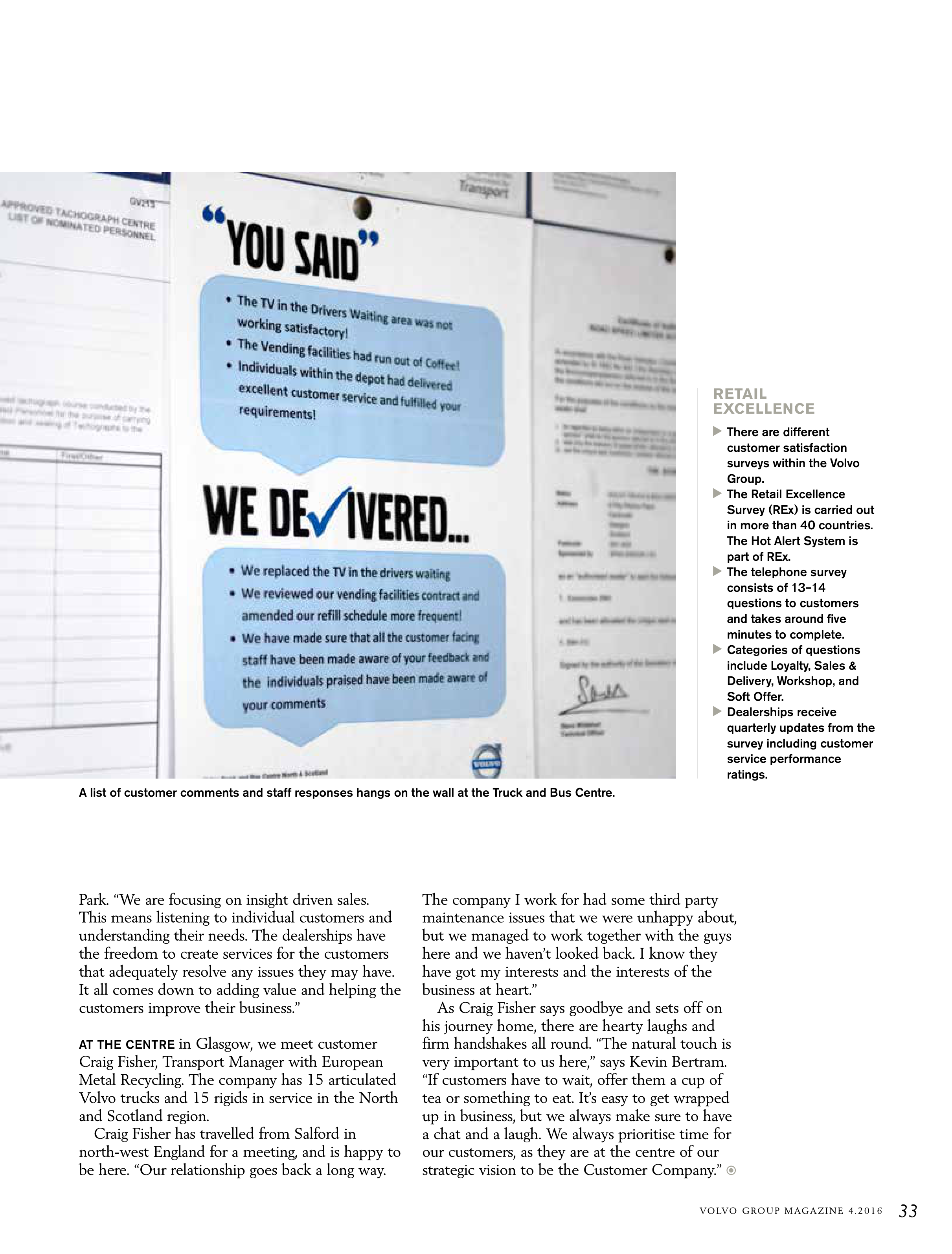
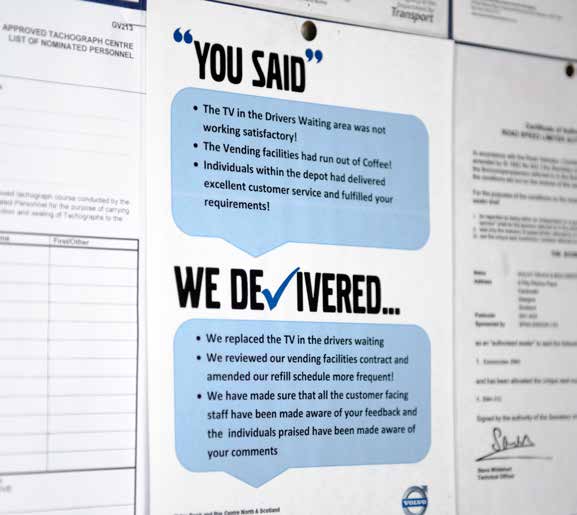
A list of customer comments and staff responses hangs on the wall at the Truck and Bus Centre.
RETAIL
EXCELLENCE
There are different
customer satisfaction
surveys within the Volvo
Group.
The Retail Excellence
Survey (REx) is carried out
in more than 40 countries.
The Hot Alert System is
part of REx.
The telephone survey
consists of 13–14
questions to customers
and takes around five
minutes to complete.
Categories of questions
include Loyalty, Sales &
Delivery, Workshop, and
Soft Offer.
Dealerships receive
quarterly updates from the
survey including customer
service performance
ratings.
VOLVO GROUP MAGAZINE 4.2016
33

34
VOLVO GROUP MAGAZINE 4.2016
ASPIR ATIONS
PHOTO: AZIMUTH/ FILIBERTO ROTTA

HOW DO
WE GET
THERE?
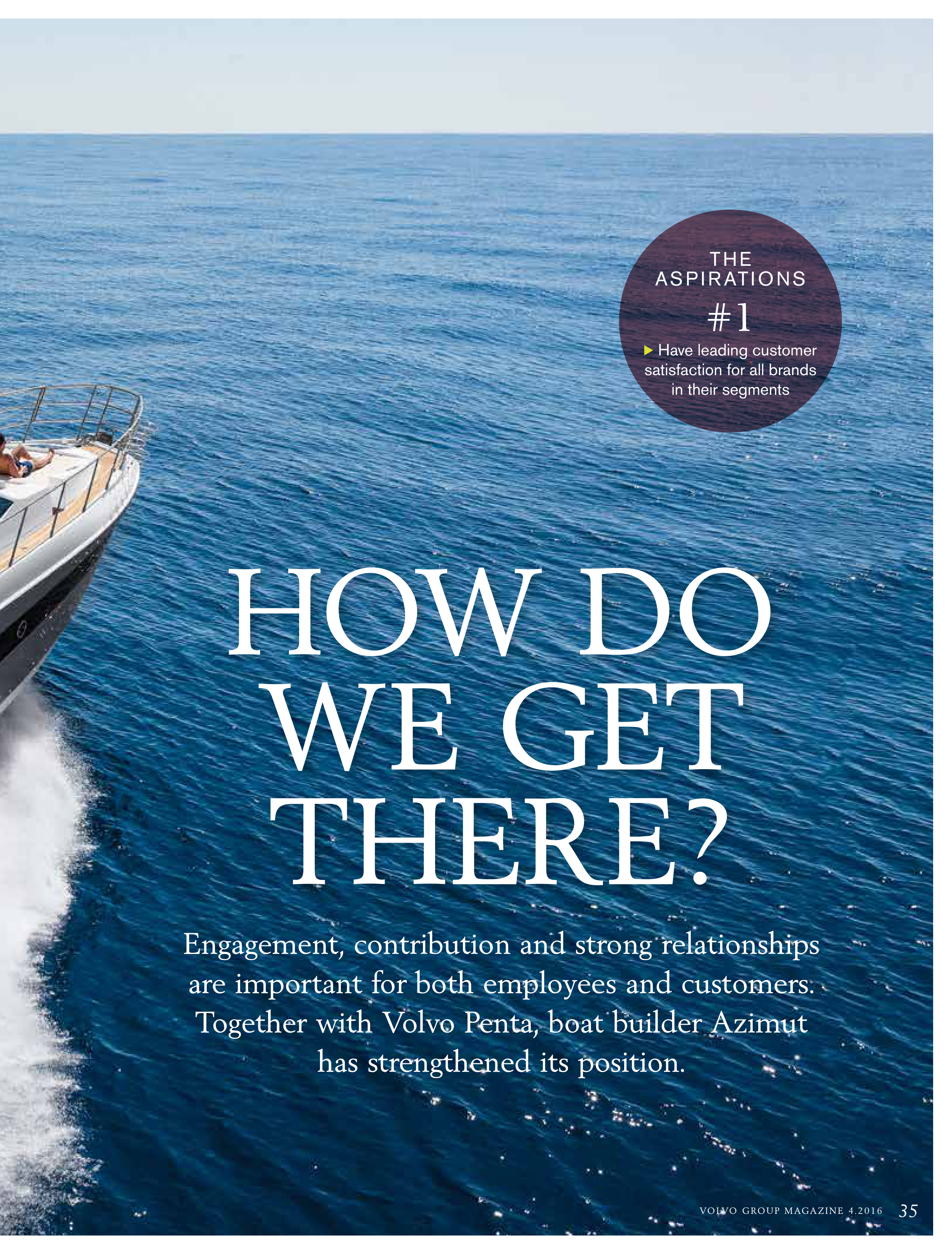
Engagement, contribution and strong relationships
are important for both employees and customers.
Together with Volvo Penta, boat builder Azimut
has strengthened its position.
T HE
ASPIR AT IONS
#1
Have leading customer
satisfaction for all brands
in their segments
35
VOLVO GROUP MAGAZINE 4.2016

ASPIR ATIONS
CUSTOMERS
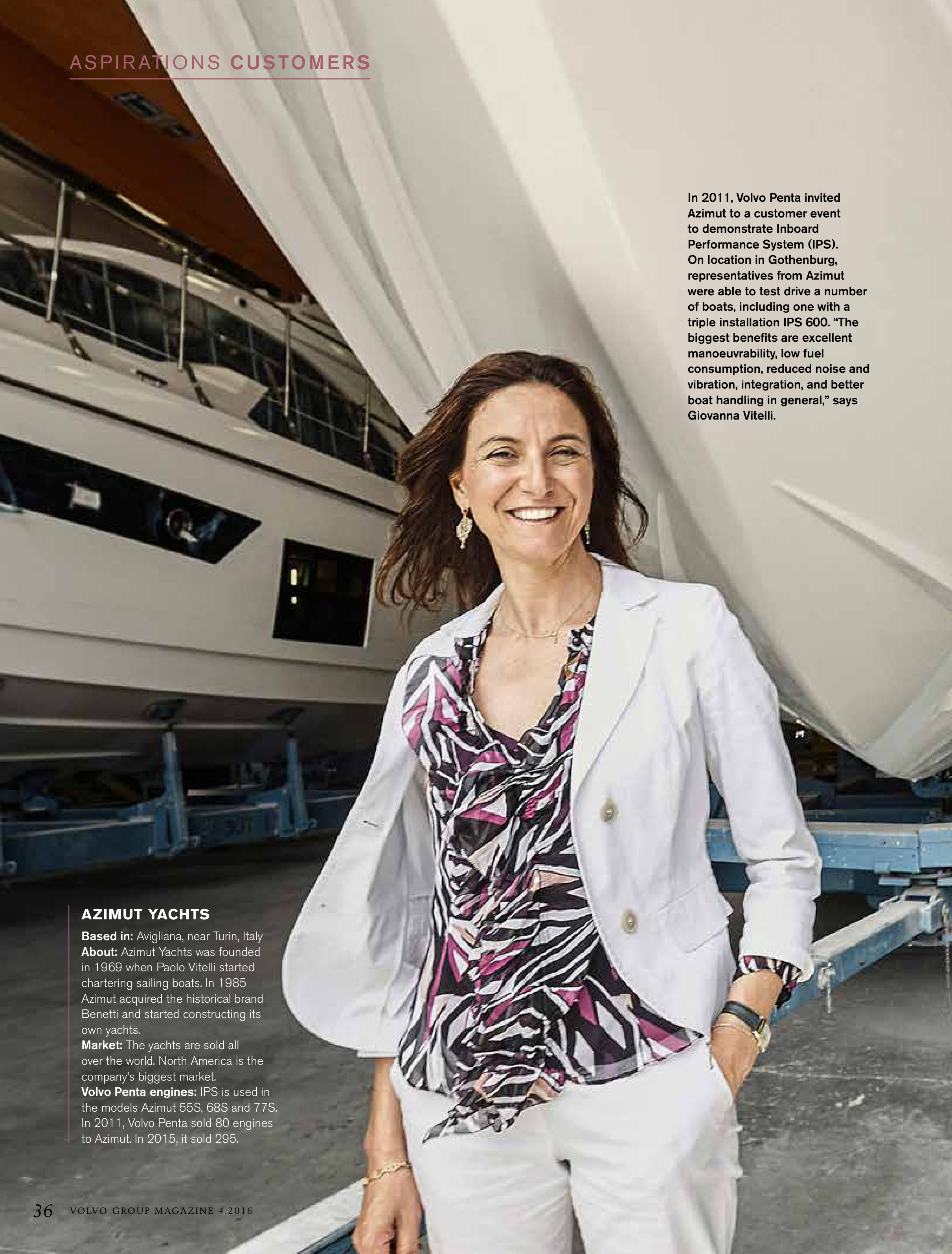
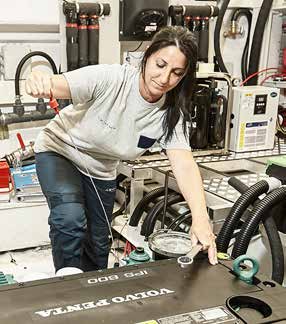
In 2011, Volvo Penta invited
Azimut to a customer event
to demonstrate Inboard
Performance System (IPS).
On location in Gothenburg,
representatives from Azimut
were able to test drive a number
of boats, including one with a
triple installation IPS 600. “The
biggest benefits are excellent
manoeuvrability, low fuel
consumption, reduced noise and
vibration, integration, and better
boat handling in general,” says
Giovanna Vitelli.
AZIMUT YACHTS
Based in:
Avigliana, near Turin, Italy
About:
Azimut Yachts was founded
in 1969 when Paolo Vitelli started
chartering sailing boats. In 1985
Azimut acquired the historical brand
Benetti and started constructing its
own yachts.
Market:
The yachts are sold all
over the world. North America is the
company’s biggest market.
Volvo Penta engines:
IPS is used in
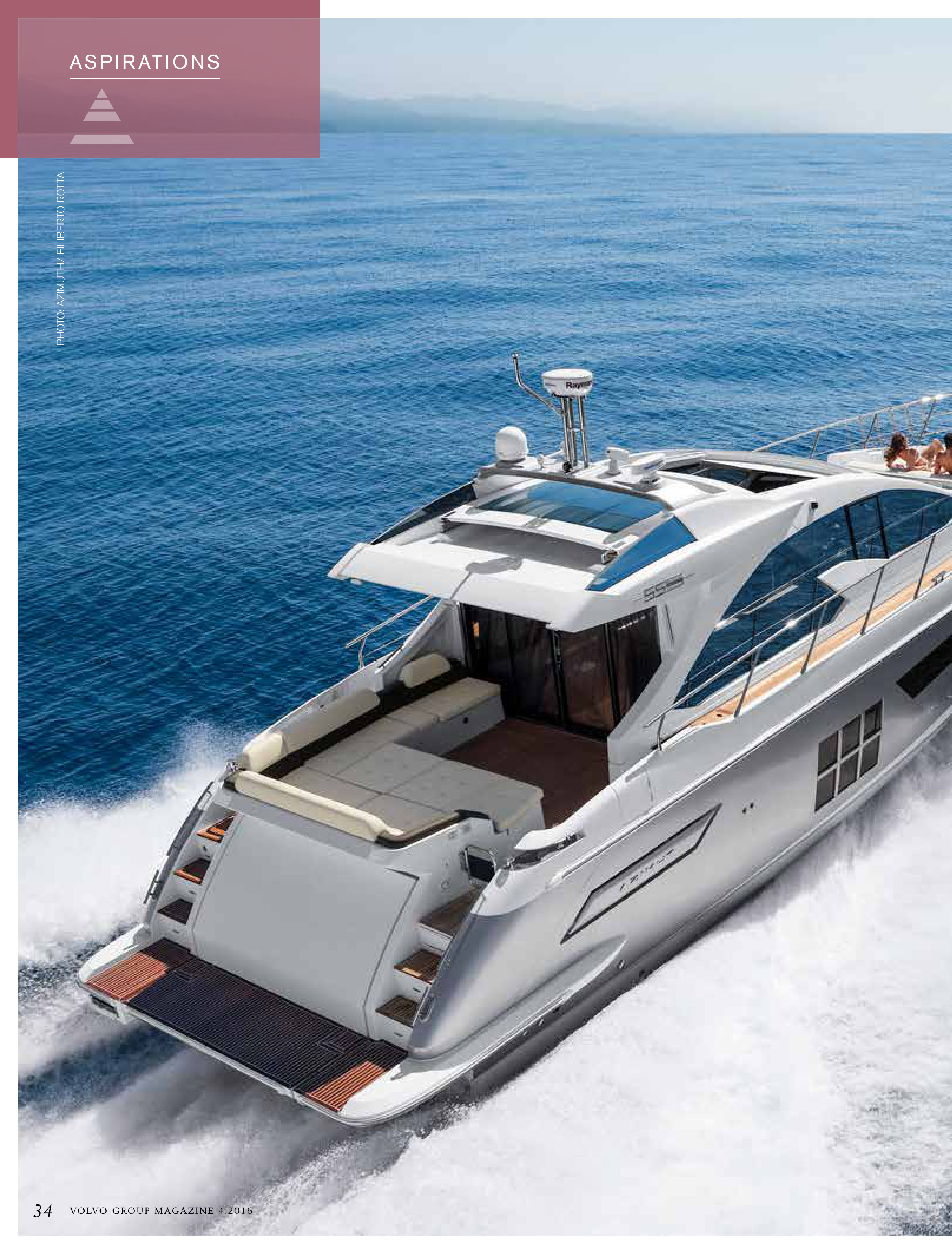
the models Azimut 55S, 68S and 77S.
In 2011, Volvo Penta sold 80 engines
to Azimut. In 2015, it sold 295.
VOLVO GROUP MAGAZINE 4.2016
36

Volvo Penta and Azimut Yachts
A winning team
By focusing on customer success, Volvo Penta has created new
business. Now both Italy’s most prestigious boat builder and
America’s biggest boat retailer, are investing in Volvo Penta IPS.
T E X T
P H OTO S
L I N DA
TA L O S
S WA N B E RG
B U CC E L L AT I
I
N AVIGLIANA, JUST OUTSIDE
of Turin in
northern Italy, some of the world’s most
luxurious boats are being built. Giovanna
Vitelli is the owner of Azimut Yachts, a
company founded in the 1960s.
“We are a product-based company
with innovation in our DNA. Our daily
goal is the continuous improvement of our boats,
achieved by on-going research into new desires
and market trends,” she says.
With a shared focus on product innovation,
Azimut and Volvo Penta have been working
partners for many years. Central to this
partnership is Volvo Penta’s unique integrated
propulsion system, IPS. Several years ago, Azimut
decided to invest in IPS for an entirely new
model, the 55S, which became an important
milestone in the two companies’ cooperation. “As
a product innovator, we have to be ahead of the
market and this role is far from risk-free. Our bet
on Volvo Penta and IPS was brave,” says Giovanna
Vitelli.
AZIMUT’S BOATS ARE
sold all over the world, but
support with spare parts and service,” says Johan
the largest customers are in the US. There the
Wästeräng, Vice President Product Management
boat market is dominated by MarineMax, one of
Marine at Volvo Penta.
the country’s biggest retailers of leisure boats. For
Success depended on close cooperation
Azimut, it was crucial that MarineMax accepted
between many different departments and regions
its choice of Volvo Penta and IPS.
within Volvo Penta. Marcia Kull, Vice President,
“It was not just a matter of convincing
Marine Sales North America, was among those
MarineMax of the benefits of IPS, the most
who played an important role. She met with
important thing was to show how we can
Azimut and MarineMax representatives early in
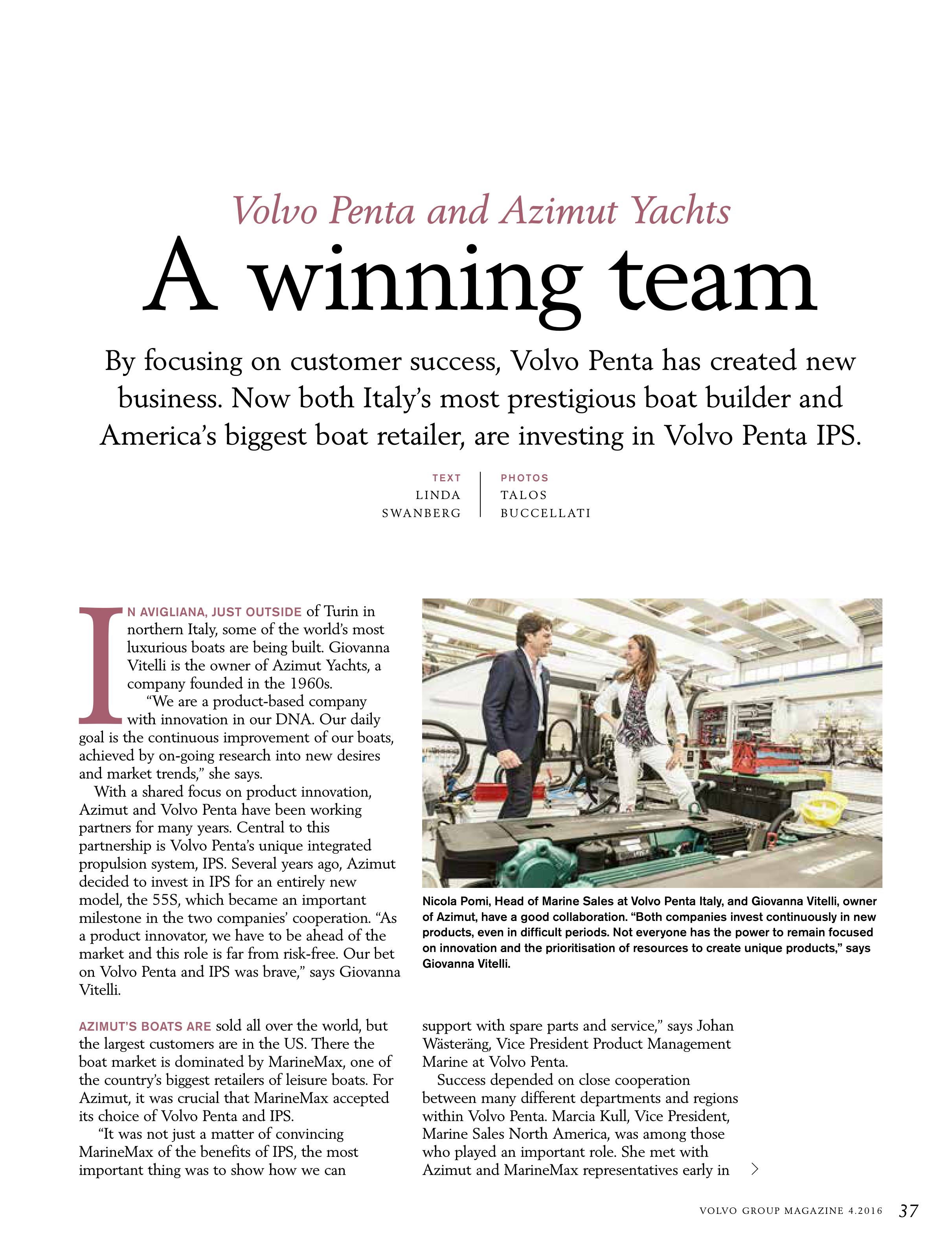
Nicola Pomi, Head of Marine Sales at Volvo Penta Italy, and Giovanna Vitelli, owner
of Azimut, have a good collaboration. “Both companies invest continuously in new
products, even in difficult periods. Not everyone has the power to remain focused
on innovation and the prioritisation of resources to create unique products,” says
Giovanna Vitelli.
VOLVO GROUP MAGAZINE 4.2016
37


u
u
u
ASPIR ATIONS
CUSTOMERS
MARINEMAX
The largest
leisure boat and
yacht retailer in
the US.
The headquarters
are in Clearwater,
Florida.
MarineMax
has 56 retail
locations.
Sells Volvo Penta
powered boats
from Azimut,
Ocean Alexander,
Galeon and
Aquila.
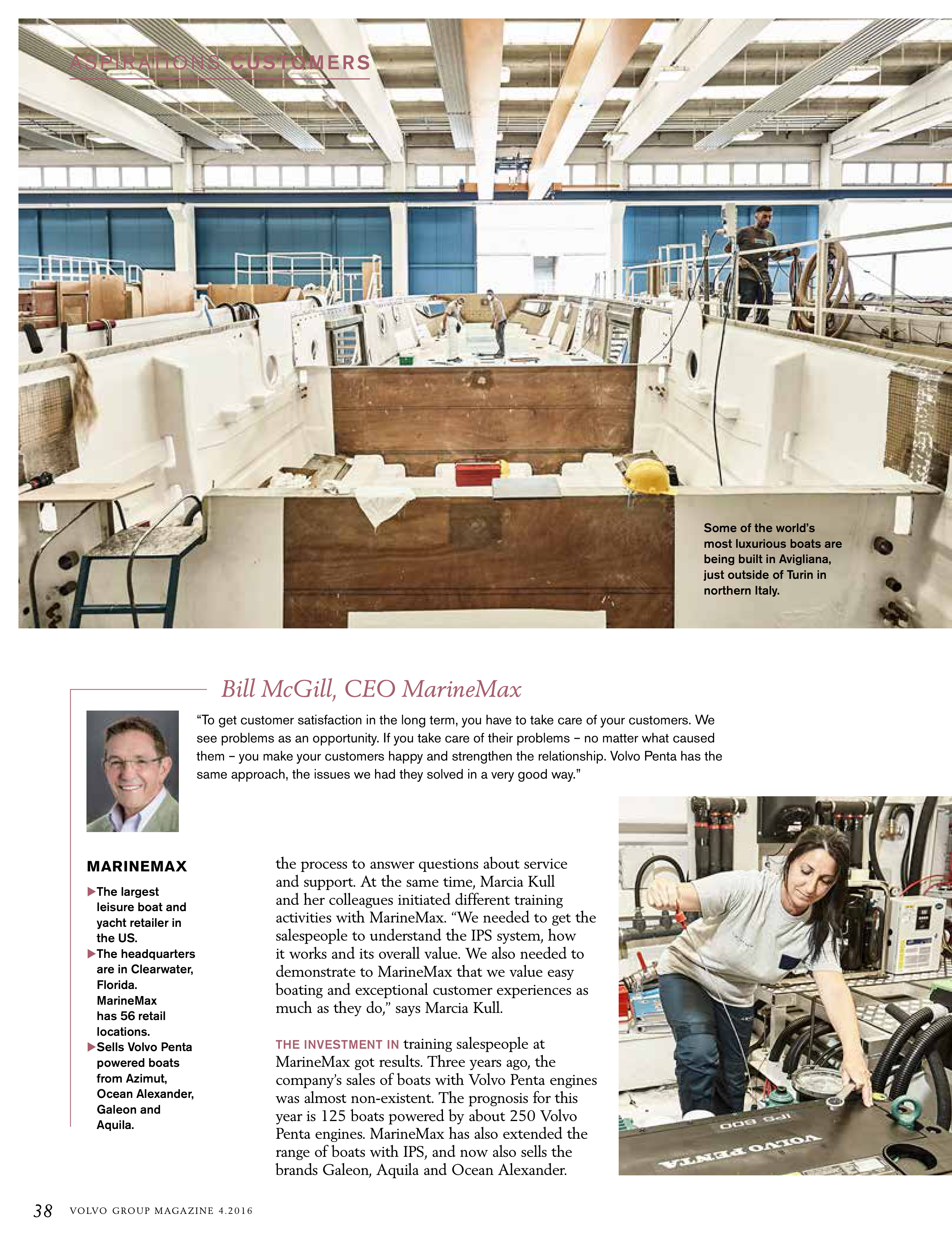
Some of the world’s
most luxurious boats are
being built in Avigliana,
just outside of Turin in
northern Italy.
Bill McGill, CEO MarineMax
“To get customer satisfaction in the long term, you have to take care of your customers. We
see problems as an opportunity. If you take care of their problems – no matter what caused
them – you make your customers happy and strengthen the relationship. Volvo Penta has the
same approach, the issues we had they solved in a very good way.”
the process to answer questions about service
and support. At the same time, Marcia Kull
and her colleagues initiated different training
activities with MarineMax. “We needed to get the
salespeople to understand the IPS system, how
it works and its overall value. We also needed to
demonstrate to MarineMax that we value easy
boating and exceptional customer experiences as
much as they do,” says Marcia Kull.
THE INVESTMENT IN
training salespeople at
MarineMax got results. Three years ago, the
company’s sales of boats with Volvo Penta engines
was almost non-existent. The prognosis for this
year is 125 boats powered by about 250 Volvo
Penta engines. MarineMax has also extended the
range of boats with IPS, and now also sells the
brands Galeon, Aquila and Ocean Alexander.
VOLVO GROUP MAGAZINE 4.2016
38


u
u
u
WHAT IS IPS?
What are the lessons from
“CREATE GOOD
Volvo Penta’s Inboard Performance System (IPS)
was introduced in 2005.
your work with Azimut and
Since then, thousands of applications with the
distinctive, forward-facing, twin counter-rotating
propellers have been installed on hundreds of
boat models worldwide.
MarineMax?
Some of the benefits are: outstanding
manoeuverability, higher top speed, lower fuel
consumption and fewer CO
2
emissions.
“Our teams were a bit apprehensive at first, but
once they got to know how Volvo Penta works
that changed and now they are very pleased.
Volvo Penta offers the complete package. It’s
a huge benefit that we only have to deal with
one manufacturer,” says Bill McGill, CEO and
President MarineMax.
Today, MarineMax is considered a key account
within the Volvo Penta organisation. That means
that they have a sales professional assigned
to manage all aspects of the account – from
partner network and sales training to distribution
development.
Volvo Penta conducts conference calls and
meetings with MarineMax executives to ensure that
their expectations are met. Which
so far they are.
Besides selling several brands
with Volvo Penta, MarineMax is
working to drive its other major
boat lines towards Volvo Penta
and IPS. ”The performance is
incredible and when it comes to
services Volvo Penta has been
very proactive. With Volvo Penta
you make boating easier – that’s
what we are here for,” says Bill
McGill.
Giovanna Vitelli at Azimut is
also very happy with the good
collaboration between Volvo
Penta and MarineMax, which has
been strategic for sales growth in
the US.
“Through a proactive approach
and excellent coordination, the
new products launched have been
extremely successful,” she says.
N I C O L A P O M I ,
H E A D O F M A R I N E
S A L E S , I TA LY
M A R C I A K U L L ,
V I C E P R E S I D E N T,
M A R I N E S A L E S ,
N O R T H A M E R I C A
J O H A N
W Ä S T E R Ä N G ,
V I C E P R E S I D E N T,
P R O D U C T
M A N AG E M E N T
M A R I N E
RELATIONSHIPS”
“To make customers happy and
successful, you have to create good
relationships at all levels of the
customer organisation. It must be
easy to work with us and very hard to
leave us. With the IPS in their boats,
Azimut got the opportunity to launch
a new product that made them more
competitive. Thanks to the support
provided by our network in the USA,
we managed to make them successful
in the most powerful retail nautical
marketplace in the world.“
“A GLOBAL CUSTOMER
IS OUR CUSTOMER”
“The understanding that a global
customer, even if it does not buy
products directly from our market
unit, is our customer and should be
treated like one. Volvo Penta holds a
unique position as a global brand in
an increasingly global marine market.
Today’s customer expects a consistent
global experience. That’s one of our
value propositions which cannot be
easily replicated by our competitors.”
“THERE IS NO
US AND THEM”
“For us there is not ‘us’ and ‘them’.
We work cross-functionally, across
regions, different segments and
parts of the organisation. We all
have the same focus, we listen to the
customers and address their needs.
By doing so, we open up for new
business. The investment in Azimut
was a strategic choice. They have
a good vision, and just like us, they
believe in innovation.”
VOLVO GROUP MAGAZINE 4.2016
39

Making the job easier
ASPIR ATIONS
CUSTOMERS
“They just make it really easy for
us. We can reach them at any time
and they go over and beyond what I
would expect from such a service.”
T E X T
A L A S TA I R M AC D U F F
P H OTO
V M C G E E T RU C K I N G I N C .
C
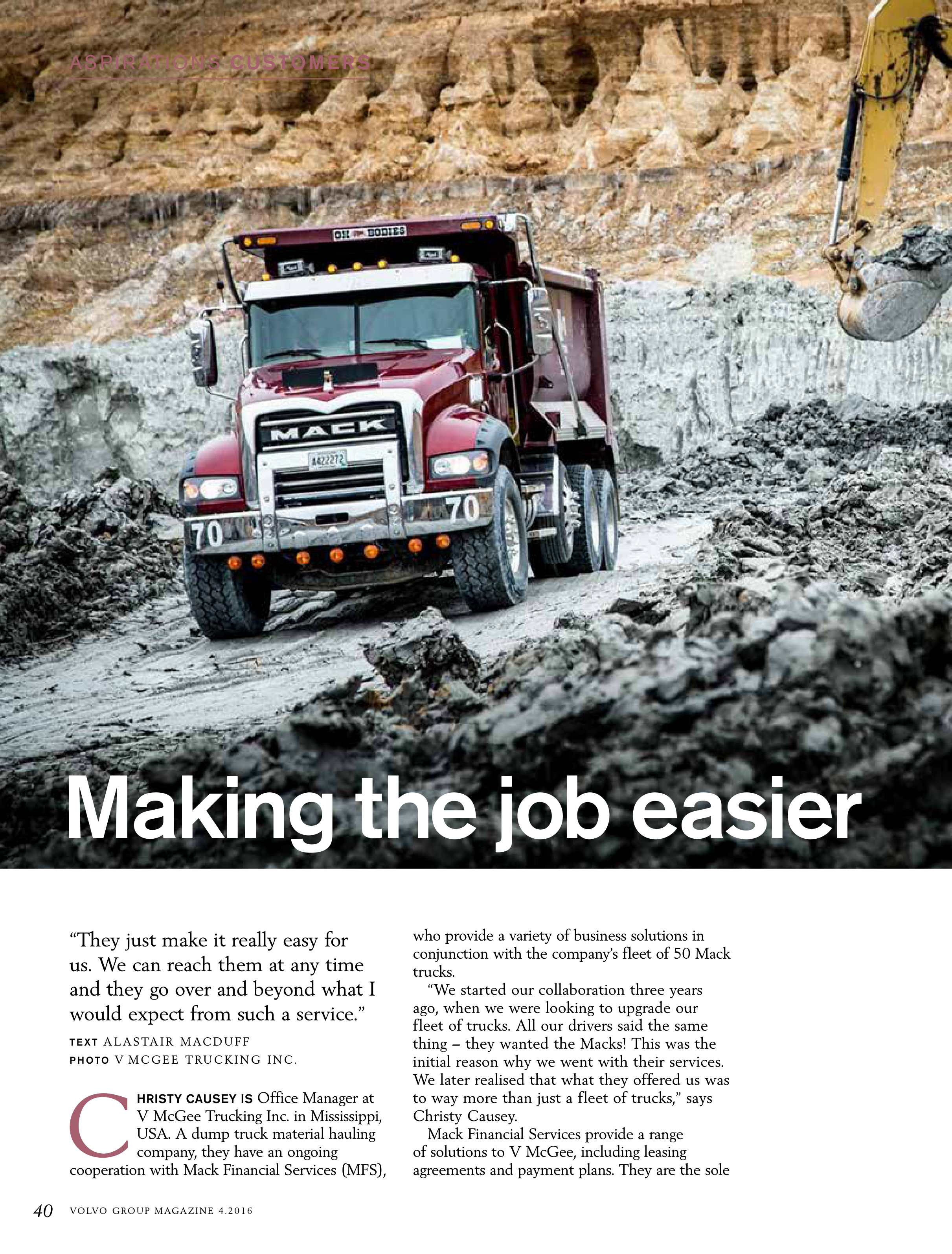
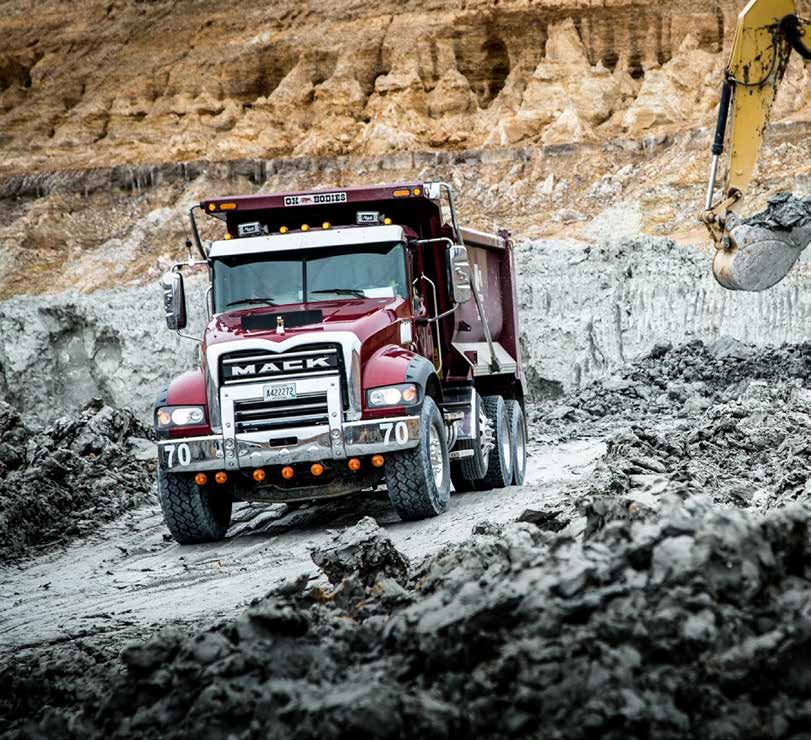
HRISTY CAUSEY IS
Office Manager at
V McGee Trucking Inc. in Mississippi,
USA. A dump truck material hauling
company, they have an ongoing
cooperation with Mack Financial Services (MFS),
who provide a variety of business solutions in
conjunction with the company’s fleet of 50 Mack
trucks.
“We started our collaboration three years
ago, when we were looking to upgrade our
fleet of trucks. All our drivers said the same
thing – they wanted the Macks! This was the
initial reason why we went with their services.
We later realised that what they offered us was
to way more than just a fleet of trucks,” says
Christy Causey.
Mack Financial Services provide a range
of solutions to V McGee, including leasing
agreements and payment plans. They are the sole
VOLVO GROUP MAGAZINE 4.2016
40


“We subsequently realised
that what they offered us
extended to way more than
just a fleet of trucks.”
C H R I S T Y C A U S E Y
, O F F I C E M A N AG E R AT V M C G E E T R U C K I N G I N C .
Timothy Vanzant
V MCGEE
TRUCKING INC.
Based:
Memphis,
Tennessee
Founded:
1997
Business:
Dump truck
material haulage
Fleet:
50 Mack Granite
dump trucks
source of financing on the company’s fleet of
dump trucks.
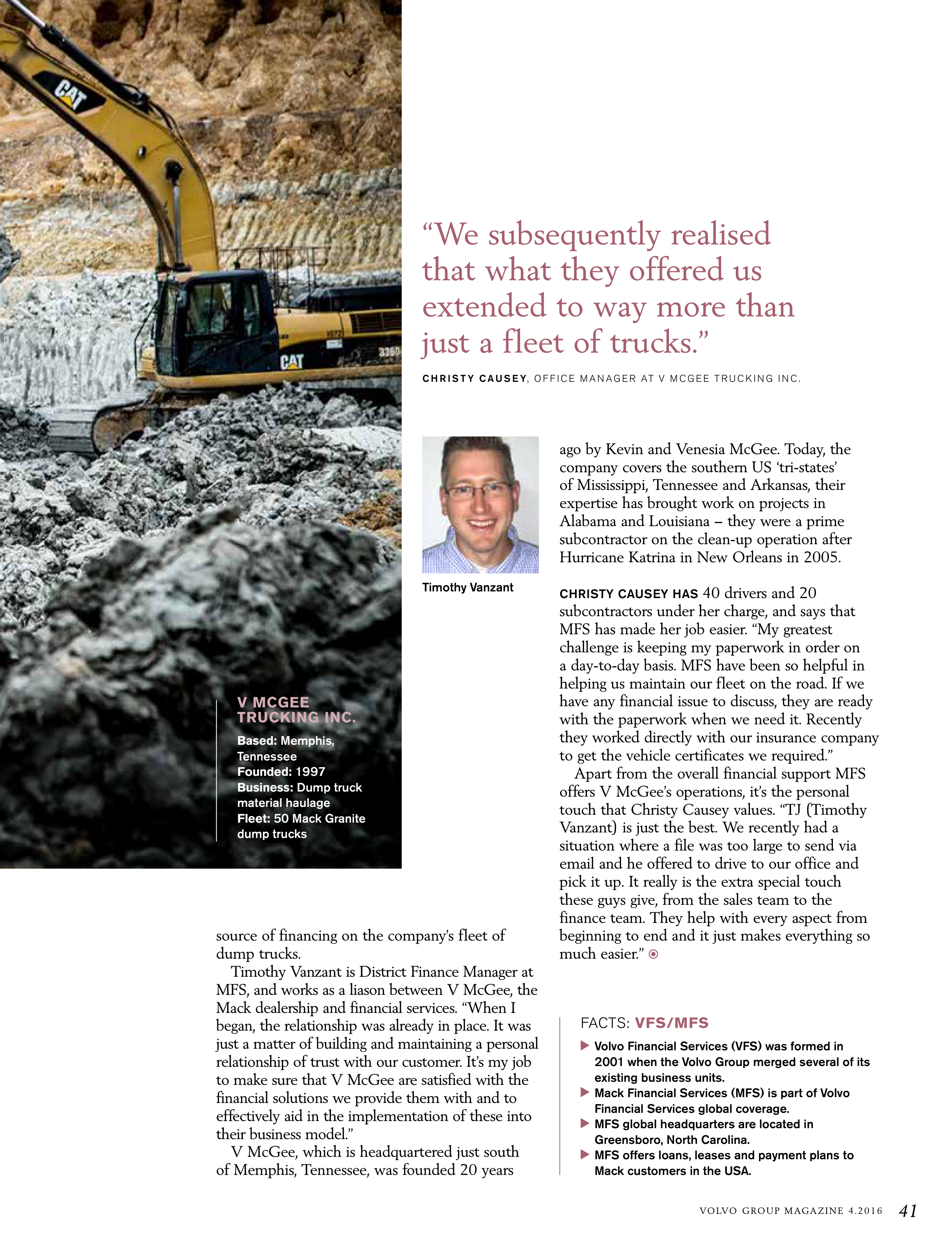
Timothy Vanzant is District Finance Manager at
MFS, and works as a liason between V McGee, the
Mack dealership and financial services. “When I
began, the relationship was already in place. It was
just a matter of building and maintaining a personal
relationship of trust with our customer. It’s my job
to make sure that V McGee are satisfied with the
financial solutions we provide them with and to
effectively aid in the implementation of these into
their business model.”
V McGee, which is headquartered just south
of Memphis, Tennessee, was founded 20 years
ago by Kevin and Venesia McGee. Today, the
company covers the southern US ‘tri-states’
of Mississippi, Tennessee and Arkansas, their
expertise has brought work on projects in
Alabama and Louisiana – they were a prime
subcontractor on the clean-up operation after
Hurricane Katrina in New Orleans in 2005.
CHRISTY CAUSEY HAS
40 drivers and 20
subcontractors under her charge, and says that
MFS has made her job easier. “My greatest
challenge is keeping my paperwork in order on
a day-to-day basis. MFS have been so helpful in
helping us maintain our fleet on the road. If we
have any financial issue to discuss, they are ready
with the paperwork when we need it. Recently
they worked directly with our insurance company
to get the vehicle certificates we required.”
Apart from the overall financial support MFS
offers V McGee’s operations, it’s the personal
touch that Christy Causey values. “TJ (Timothy
Vanzant) is just the best. We recently had a
situation where a file was too large to send via
email and he offered to drive to our office and
pick it up. It really is the extra special touch
these guys give, from the sales team to the
finance team. They help with every aspect from
beginning to end and it just makes everything so
much easier.”
FACTS:
VFS/MFS
Volvo Financial Services (VFS) was formed in
2001 when the Volvo Group merged several of its
existing business units.
Mack Financial Services (MFS) is part of Volvo
Financial Services global coverage.
MFS global headquarters are located in
Greensboro, North Carolina.
MFS offers loans, leases and payment plans to
Mack customers in the USA.
VOLVO GROUP MAGAZINE 4.2016
41


ASPIR ATIONS
CUSTOMERS
Right
on time
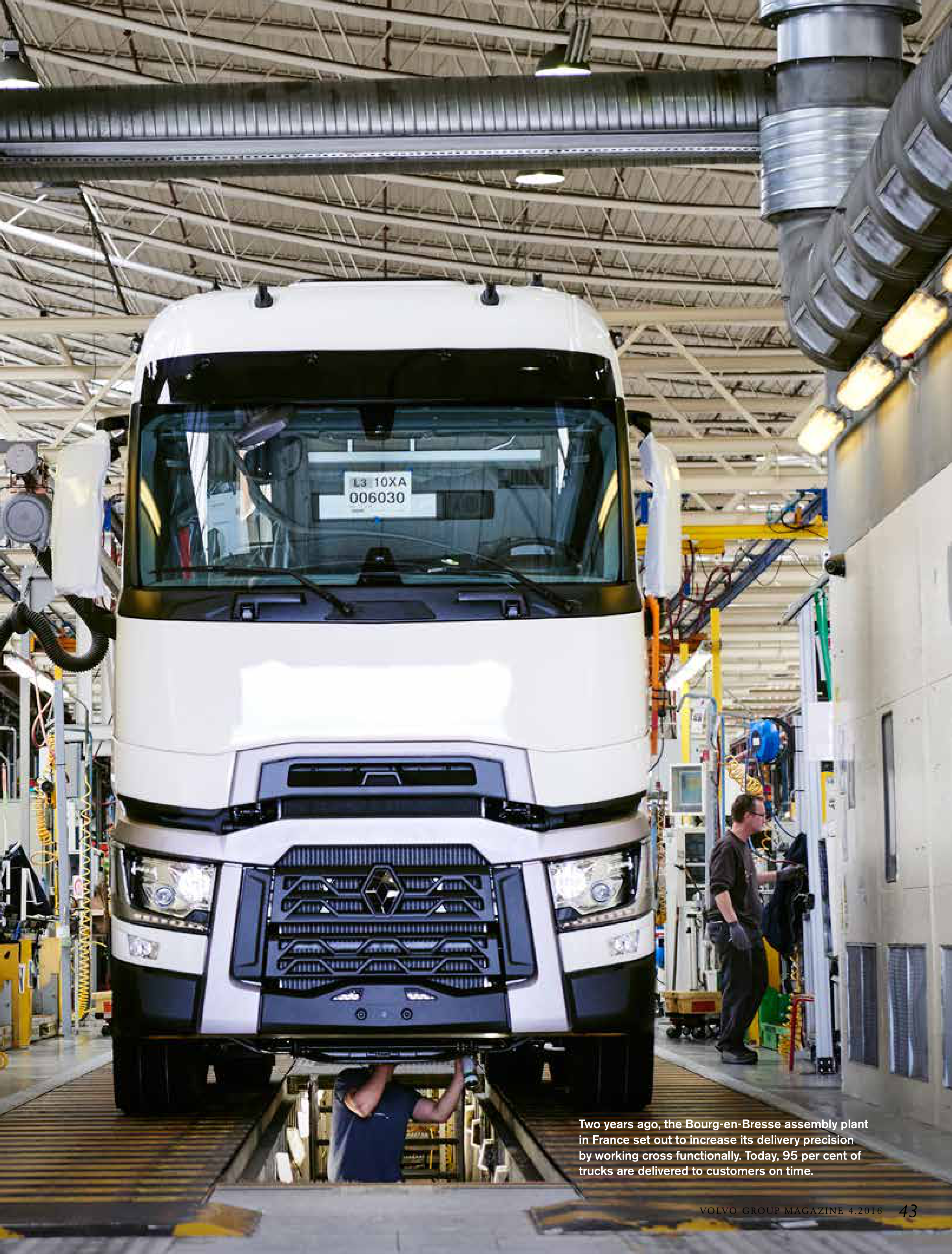
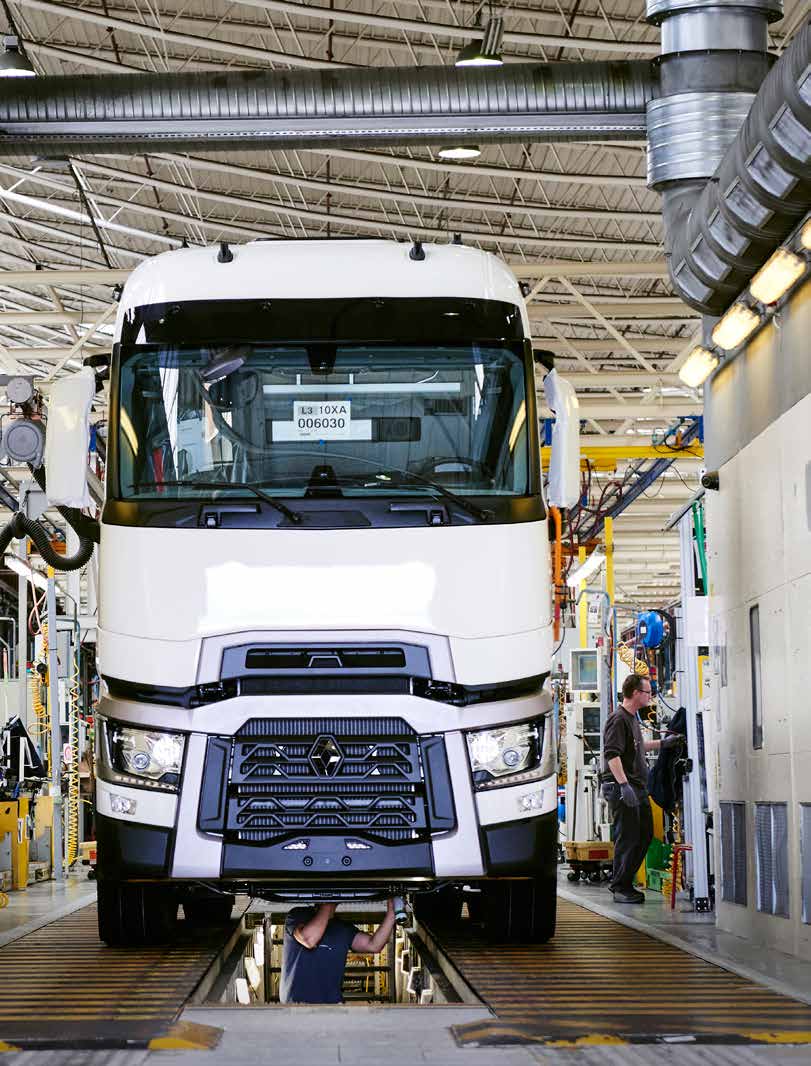
At Bourg-en-Bresse in France,
the GTO assembly plant has
improved its performance –
now 95 per cent of trucks are
delivered on time.
T E X T
A L A S TA I R M AC D U F F
P H OTO S
N I CO L A S DA RT I A I L H
P
LANT MANAGER FRÉDÉRIC
Brun is
delighted with the results of working with
continuous improvements at his location.
“We now spend a lot of time with
customers, working on quality of service and on
delivery.” Two years ago, 80 per cent of the trucks
that were assembled at Bourg were delivered
to customers on time. This was a statistic they
wanted to improve.
To achieve better delivery performance,
communication between various parties involved
in the process had to change. Laurent Genillon
is Area Manager and responsible for coordinating
five line managers at different stages in the
assembly process. “We started by trying to
understand what created the gap between the
production process and the delivery process.
An action plan was drawn up, which involves
communication between the plant, Sales,
and Logistics Services, led by Laurent Brunel
DELIVERY PRECISION
Delivery Precision is one of the main KPIs at Group
Trucks Operation.
A key element to delivery precision is to have
effective standardised processes on the production
line, to ensure a predictable and consistent output.
Problems that are identified should be documented
and shared throughout the organisational chain.
from GTO COE Logistics. When a customer
requests a truck, various IT systems calculate
the required milestones for each organisation,
as to what exact date the truck must leave the
plant. Then we enter in discussions to give the
same priorities to all involved departments. It
is this precise coordination between production
process and delivery process that we have greatly
improved. We then leave the trucks to Logistics
Services, who are responsible for delivering to the
customer.”
Making improvements in delivery precision also
highlighted the importance of the relationship
between the plant and the sales organisation.
Eric Belles is manager Invoicing & Delivery at
Renault Trucks. “Compared to three years ago,
there is a much greater understanding of the
Customer Delivery Date and why it is important.
We now see full commitment at the plant, from
all stages of the assembly line. We have a meeting
every week with the plant, Logistics Services and
Sales & Marketing. We go through our orders
truck-by-truck. If there is an issue, we at the sales
organisation can communicate with customers to
ensure they are kept informed.”
THE CHANGES MADE
at Bourg have meant that
around 95 per cent of the
trucks produced there are
now delivered on time.
According to Frédéric Brun,
simple communication
has been the key factor on
the assembly line. “We are
working in a big organisation
Frédéric Brun
and realised that we
should use our colleagues
to support us more. It is the complete flow of
information that has helped us achieve this.”
VOLVO GROUP MAGAZINE 4.2016
42

Two years ago, the Bourg-en-Bresse assembly plant
in France set out to increase its delivery precision
by working cross functionally. Today, 95 per cent of
trucks are delivered to customers on time.
VOLVO GROUP MAGAZINE 4.2016
43
ASPIR ATIONS
EMPLOYEE S
As Paulina Persdotter Örtendahl sees it, engaged co-workers
and an inspiring culture are by far the most important factors.
“Everything starts with ourselves. Engagement and having
fun at work is contagious and the best way to attract the
employees of tomorrow.”
T E X T
L I N DA S WA N B E RG
P H OTO S
RO B I N A RO N O L S S O N
“The Volvo Group’s
co-workers are our most
important ambassadors”
P
AULINA PERSDOTTER ÖRTENDAHL
is Director Employer Branding,
Group Human Resources. Her
job includes setting the direction
on how to work with employer
branding, to give the Volvo Group
better access to a strong pool of
talent worldwide. Meeting these requirements is
a truly rigorous task. One of the Group’s three
aspirations in its new direction is to be the most
admired employer in the industry.
What is needed for the Volvo Group to succeed?
“A long-term and conscious approach both
internally and externally. Employer branding does
not stand alone, it is a part of everything we do
within the Group every day. In a time where
transparency is constantly increasing, it is of great
importance that our external employer brand
reflects our values and the internal employer
brand.
“It’s basically a question of creating pride and
engagement, as engaged co-workers share positive
experiences and stories with the outside world.
This will enable us to turn our aspirations into
reality.”
Co-workers are crucial for how the Volvo Group is
perceived. How do you make people feel engaged?
“Engagement can be achieved first when people
understand why changes are being made and are
able to see their role in the big picture. In the light
of all the changes that have taken place, our leaders
need to act as role models in showing openness
and trust to communicate a motivating vision of
the future that makes our employees passionate
and proud. The way people are treated in their
day-to-day work also plays a vital role. We all need
to feel that other people listen to us, that we have
the opportunity to develop and that our ideas are
heard and taken into account.”
How does the Group work with employer branding?
“We are working on many different levels,
focusing on different target groups, not just
university students but also pre-university
students and young professionals.
“One very important factor is to ensure that
the programmes and activities that are run are
linked to our business needs in each individual
market or area. In this context, workforce
analytics and demographics are important tools.
They give us information about the areas in
VOLVO GROUP MAGAZINE 4.2016
44

Paulina Persdotter Örtendahl works on
employer branding at Group level.
“What our co-workers feel and think
has an incredibly important impact on
the way the Volvo Group is perceived
as an employer. Do we convey a sense
of frustration or happiness at the
dinner table or when socializing with
our friends after work?”
T HE
ASPIR ATIONS
#2
Be the most admired
employer in our
industry
45
VOLVO GROUP MAGAZINE 4.2016


AS PIR AT IO NS
E M PLOYE E S
which there is movement and the way global
events impact our needs and access to important
skills. To be an attractive employer, we need
to understand the skills and competencies we
require and be clear about that. If everyone is
pursuing the same target group, it will be difficult
to stand out from the crowd.”
Why should people choose to work for the Volvo
Group?
“Because working with the sharpest and
most creative people in the transport and
infrastructure industry generates motivation and
engagement. The Volvo Group really regards
its co-workers as its leading driving force and it
is always striving to be at the cutting edge. At
the Volvo Group, people have the opportunity
to work in a multicultural environment, where
collaboration across all the time zones really
changes the future step by step every day.
The Volvo Group is the obvious employer for
everyone who is driven by the desire to make a
difference in a fast-changing world.”
Looking ahead, what are the greatest challenges?
“The Volvo Group is a large employer and
it needs many different professional groups.
Reaching everyone in the best way calls for a huge
effort.
“The knowledge gap between different
generations is another major challenge. While
the younger generation has generally grown up
in a connected world, we have co-workers who
have spent most of their lives outside the digital
world. There’s a large discrepancy in the way
people perceive the potential that new technology
creates. New technology is also generating new
roles on the labour market. Today, as an example,
young people can be very successful, self-
supporting bloggers and their skills, influence and
networks could also be of interest to us.”
TA M M Y SC OT T,
TECHNICIAN ON THE CAB LINE
IN NEW RIVER VALLE Y, GTO, USA:
“It’s important that the company cares about its employees. Here, they give
us benefits and classes. They interact with us. Continuous improvement
gets employees involved, and the Volvo Group should continue to be open
to ideas from people on the production floor. If we take everyone’s ideas,
and continue to make sure processes are done the same way each time,
we can make a better work environment.”
RENATO NARDELLI DE SOUZ A
,
ASSEMBLY WORKER, GTO
CURITIBA, BRAZIL:
It is important to feel valued and
recognised. A good employer is
concerned about the health and
well-being of its employees, and
there is competence development
and different career opportunities.
I also appreciate that the company
has a good relationship with the
local community, through social
and environmental projects. The
Volvo Group can be the best
employer in the industry by keeping
the employees motivated and
continuously strive for excellence.”
QUESTIONNAIRE
What is a good
employer to you?
HICHAM EL AMBRI
, WAREHOUSE
EMPLOYEE, GTO REMANUFACTURING,
LIMOGES, FRANCE:
“A good employer is a company
that listens and where there is
a possibility to discuss things.
Strong safety and job security are
important and to know there is the
possibility to advance and to try
out different things. To become
‘the most admired employer’ in
the industry, I think diversity is
important. Employing women and
people with different backgrounds
brings different points of view. It also
helps when employees get a sense
of the company’s long-term goals.”
“The knowledge gap
between different
generations is another
major challenge.”
P A U L I N A P E R S D O T T E R Ö R T E N D A H L
, D I R E C TO R
E M P L OY E R B R A N D I N G , G R O U P H U M A N R E S O U R C E S
VOLVO GROUP MAGAZINE 4.2016
“
46


NEETA DULHANI
, VERIFICATION
ENGINEER AT VOLVO BUSES,
GOTHENBURG , SWEDEN:
“Three years ago, I moved from Bangalore
in India to Sweden, together with my family.
In India, I worked as an electronic design
engineer, but getting a new job in Sweden
wasn’t easy.
“Last year, thanks to ‘A job at last!’, an
initiative run by the governmental employment
agency in which the Volvo Group is a partner,
I got a six-month trainee position at GTT in
Gothenburg. This has been really important
for me, as, among other things, it helped me
to attain the experience I needed to get the
job I have now.
“I have been working at Volvo Buses since
February. In India, many companies are more
hierarchical, so it has taken a while for me
to get used to a flat organisation. Here in
Sweden, co-workers are expected to take
more responsibility. It’s a challenge, but it’s
also really positive.
“A good employer regards employees as
an asset and gives them the opportunity
to develop. As I see it, it’s important that
the team I work with has a clear picture
and vision of the future. This enables me to
understand what is expected of me and to
see how I can develop in the organisation.
Two-way communication is also important –
having a manager who is interested in their
colleagues’ views and ideas.
“However, the most important thing of all is
being given the chance to feel that I am doing
a good job.”
“It’s important that the team
I work with has a clear picture
and vision of the future.”
N E E TA D U L H A N I
VOLVO GROUP MAGAZINE 4.2016
RIE KOBAYAK AWA
, FINANCIAL
CONTROLLER , UD TRUCKS
OPER ATIONS, AGEO, JAPAN:
“Learning new things is important.
With proper mentoring, even a
routine job can become fun. There
should be an atmosphere where
employees can challenge their
managers to find better solutions
and the freedom to decide how
work should be carried out. We
don’t have as much work flexibility
here as there is in Sweden. But
there are discussions going on to
try to change that.”
ROSANGEL A PEREIR A DA
SILVA
, ASSEMBLY WORKER , GTO
CURITIBA , BR A ZIL:
“It’s about quality of life. The
company must respect the
employees and establish a
relationship of trust.
In my view, the Volvo Group can
achieve its goal of becoming the
most admired employer in the
industry by encouraging personal
and professional development for
all employees.”
CHRISTOFFER MOTEUS
,
HR BUSINESS PARTNER AT GT T,
GOTHENBURG , SWEDEN:
“For me freedom with responsibility
and challenging work tasks are
important, as is flexibility in terms
of work hours. To become the most
attractive employer, we need to be
more active on digital platforms.
We must go out and show off
all innovations and new ways
of thinking. There is enormous
knowledge and pride in our
products within the company.”
K ATIE GUE ST
, OPER ATIONS
COORDINATOR, VOLVO GROUP UK ,
WARWICK , UK:
“Supporting the staff, so that those
that want to learn and progress get
help with their career progression.
In terms of becoming the most
admired employer, I can’t think of
anything the Volvo Group needs to
do. I’ve been here for three years
and I feel like the Volvo Group
supports you 100 per cent. It all
comes down to culture. Everybody
is proud to work here and it is like a
family really.”
47


“IT’S IMPORTANT
TO MANAGE THE
NEEDS OF DIFFERENT
GENERATIONS”
“A COMBINATION OF SKILLS,
BEHAVIOURS AND VALUES”
“I think the biggest challenge for us is
to offer careers with cross-functional
opportunities and clear career paths
for advancement. It’s also important
to manage the needs of different
generations. Being the most admired
employer in our industry is definitely
a goal we want to achieve. Starting
out, we will continue to recognise and
appreciate diversity and focus on better
work-life balance opportunities. We
are also raising our involvement and
visibility in community and university
relations.”
I R I S A U S T I N ,
TA L E N T &
C O M P E T E N C E / H R B U S I N E S S
PA R T N E R AT M A C K T R U C K S
“We are looking for people in various fields, especially in sales. There
is no secret formula – it is more a combination of skills, behaviours
and values that we are looking for. Of course, we value the ability to
make decisions, think creatively and find solutions for customers. In
France, to become an admired employer, we are focusing on strong
relationships with schools and universities and we are active in local
forums and diversity networks. I think the most powerful lever to reach
this goal will be our business success – our best ambassadors will be
our employees and our customers.”
T H I E R R Y G U E R I N ,
H R M A N AG E R , R E N A U LT T R U C K S
Talent directors on their
biggest challenges
We asked talent directors from around the Volvo Group about what
talent is hard to find. What are the challenges to attracting and
retaining talent? And, how are they working to achieve the goal to
become the most admired employer in the industry?
T E X T
L I N A TÖ R N Q U I S T
VOLVO GROUP MAGAZINE 4.2016
48
AS PIR AT IO NS
EMPLOYEE S


“WE CONSTANTLY FOCUS ON RECRUITING
MORE FEMALE ENGINEERS”
“Our challenge is always to find skilled engineers in the different
job areas we have at GTT. At the same time, we need to recruit
people who have the ability and potential to continuously grow as
the technology environment becomes more and more complex.
One specific area we constantly focus on is recruiting and
developing female engineers and talent. To give one concrete
example of how we are tackling this challenge, we are creating a
specific Engineering Graduate Program and reaching out to female
candidates at the universities that we collaborate with.”
G U I L L A U M E VA U C H E R ,
H R D I R E C TO R TA L E N T & C O M P E T E N C E ,
G R O U P T R U C K S T E C H N O L O GY
“ARE THEY ABLE
TO MAKE THINGS HAPPEN?”
“When looking for potential employees, on top of professional and
leadership skills, we put extra focus on their motivation. Are they able
to make things happen? Do they have the will and skill to work and
to adapt to the complex environment? We believe these qualities
are needed for all employees, regardless of profession. From a
company’s perspective, being the “most admired employer” means
we are a respected company, and our work is meaningful and good
for society. It also means we need to engage and develop our
employees, and help them take care of their health and professional
development.”
R A C H E L X I AO ,
TA L E N T & C O M P E T E N C E M A N AG E M E N T D I R E C TO R ,
VO LVO G R O U P C H I N A
CAREER OBJECTIVES
AROUND THE WORLD
Every year, analytics firm Universum
conducts a survey among students at
universities in different parts of the world.
One of the questions relates to the
students’ most important career goals.
Here are answers from some of the
countries in 2015.
USA
1.
To have work-life balance
2.
To be secure and stable in my job
3.
To be dedicated to a cause or to feel that I
am serving a greater good
INDIA
1.
To be a leader or manager of people
2.
To be secure and stable in my job
3.
To have an international career
JAPAN
1.
To have work-life balance
2.
To have an international career
3.
To be dedicated to a cause or to feel that I
am serving a greater good
SWEDEN
1.
To have work-life balance
2.
To be secure and stable in my job
3.
To be challenged, competitively or
intellectually
THREE PROGRAMMES
TO FIND NEW TALENT
Academic Partner Programme (APP)
1
This strategic, long-term programme
covers 12 selected universities in Sweden,
France, USA, China, Japan and India.
The APP has two types of collaboration –
Preferred Research Partners and Preferred
Talent Partners. It aims to cooperate on
specific projects and increase the Group’s
visibility to students and researchers.
International Internship Programme
2
Every year, some 20 students from
universities included in the Academic Partner
Programme spend two to six months working
abroad for the Volvo Group in France, India,
USA, Sweden or Japan.
Volvo Group International Graduate
3
Programme
A programme for recent graduates all over
the world with a maximum of two years’
work experience. The programme runs for
12 months and includes a combination of
common and individual graduate activities,
day-to-day work at the home company and
an assignment abroad.
In 2016–2017, 29 participants have been
selected from a total of 4,529 applicants.
VOLVO GROUP MAGAZINE 4.2016
49


ASPIR ATIONS
EMPLOYEE S
Awards, lunch roulette and time
to generate ideas. Here are three
initiatives within the Volvo Group
that create engagement.
“IT’S A WIN-WIN
FOR EVERYBODY”
T E X T
L I N DA S WA N B E RG
A
T THE GTO
powertrain plant
in Hagerstown, engine
assembly operator Cory
Bishop thought of an
improvement that saves 15 seconds
and 32 steps per engine.
“Last year, we started a new line,
so there were of course things that
could be improved. I submitted a
quick kaizen with suggestions on
how the work instructions could be
changed. It not only improved the
work at my station, but also the station
before mine. And it resulted in higher
quality,” says Cory Bishop.
A quick kaizen is a simple form
where employees describe a problem
and submit an improvement
proposal, including the
expected benefits and
the cost of the change.
The quick kaizen
that Cory Bishop
submitted was
not only
Cory Bishop’s illustration
in his quick kaizen.
P H OTO S
J O R DA N L O H R
implemented, it was
also recognised as the
best improvement
suggestion at the plant
in 2015.
Powertrain
Production in
Cory Bishop
Hagerstown started
working with a
reward and recognition programme
in 2010. A year later, the Operational
Excellence Award (OEA) became
standard at all Powertrain Production
plants worldwide. Every month, award
winners are selected from each of the
six sites, located in Sweden, France,
Brazil, USA and Japan.
The main purpose of the recognition
programme is to create engagement
and encourage more employees to get
involved in improvement work. Every
year, a winner is selected from each
site and invited to a global ceremony.
EARLIER THIS YEAR,
Cory Bishop
attended the recognition ceremony in
France together with his wife.
“We were there for four days. We
went on a tour to two different plants
and we also got the chance to do other
things like wine tasting,” says Cory
Bishop.
Since the start of the programme
in 2010, around 400 teams and
Cory Bishop works as an operator
at the engine assembly in
Hagerstown, USA. Last year he
was awarded for an improvement
proposal at his work station. The
improvement saves 15 seconds
and 32 steps per engine.
61,116
Numbers of quick kaizen in
the OEA program for 2015.
129.3
million SEK (approx.
15,7 USD). The total
cost saving for 2015.
It’s a new record!


OPERATIONAL EXCELLENCE AWARD
The purpose is to get more employees involved in
improvement work and contribute to the success of GTO, and
by extension the whole Volvo Group.
The first monthly Powertrain Production Operational
Excellence Award ceremony was held in May 2011. Monthly
award winners are selected at each of the six sites in Skövde,
Köping, Venissieux, Hagerstown, Curitiba and Ageo.
There are plans in place to implement similar programmes at
all GTO sites. Plants in Tuve and Umeå in Sweden, for example,
started reward and recognition programmes last year.
Tom Evans, Supervisor, Brad Heinbaugh, Value Team Captain, and
Cory Bishop beside the quick kaizen board.
employees at Powertrain Production
in Hagerstown have been rewarded for
their improvement work. And there
are a lot of changes to choose from
– as of June this year, the number of
suggestions submitted averaged five
per employee. Every month, the top
three improvements are presented by
the employees who submitted them.
The employees and leadership use
Gemba ("go and see") to learn about
the improvements on the plant floor.
Nominees are then invited to a lunch,
where the winner is announced.
“I definitely think the rewards are
positive. Some people submit a quick
kaizen hoping to win, but for me the
reward is only a bonus. Improvements
help you do a better job. If it can help
the company to save some money
at the same time, it’s a win-win for
everybody,” says Cory Bishop.
VOLVO GROUP MAGAZINE 4.2016
51


HAPPY FRIDAYS
filled with new ideas
Robert Valton,
Erik Andreason
and Magnus
Löwenadler
ASPIR ATIONS
E M PLOYE E S
Welcome to Happy Friday!
One Friday a month, the employees
at Volvo Group Telematics are
given an extra chance to work on
their own ideas and help to develop
those of other people.
T E X T
L I N DA S WA N B E RG
P H OTO
J U L I A BÄC K - J O N S S O N
T
HE HAPPY FRIDAY
concept
is now in its second year,
but this year it has a new
format. In addition to employees
being given time to develop their
own ideas, lectures by people from
other parts of the Volvo Group are
organised. The aim is to create an
exchange of knowledge, dialogue
and new ideas.
“Happy Friday is a way
of creating engagement and
participation, factors that are
absolutely essential in an innovative
culture,” says Robert Valton, who is
responsible for innovation at Volvo
Group Telematics (VGT).
ON THIS PARTICULAR
Friday, the
theme is “The challenge of reducing
warranty costs” and the guests –
Magnus Löwenadler and Elham
VOLVO GROUP MAGAZINE 4.2016
52


WHAT IS
VOLVO GROUP
TELEMATICS?
Operations:
Volvo Group
Telematics is responsible
for development, integration
and operation of connectivity
services for entities
within Volvo Group, as
well as external vehicle
manufacturers (through
WirelessCar). The function
belongs to Group IT.
Number of employees:
600
Established in:
China,
Japan, Brazil, USA, India and
Sweden
Pirina – are from GTT. Some 20
employees have made themselves
comfortable in the lunch-room at
the office in Gothenburg, while
another 50 participants from other
offices are taking part via Skype.
During the hour or so in which
the lecture is held, a number of
ideas are suggested on how GTT
can benefit from the knowledge
and data available at VGT – and
vice versa.
ERIK ANDREASON IS
a project
manager at VGT and he is
participating in Happy Friday for
the first time.
“I will definitely attend again. It’s
important to have a forum where
you can express your ideas and
where there are people you can
discuss them with. Otherwise, it’s
possible that valuable ideas aren’t
spread or realised,” he says.
Erik Andreason also has one
concrete suggestion. Use regular
reports to give more people access
to the analyses and data available in
different parts of the Group.
“In just this short time, a number
of really good ideas came up. Just
think what would happen if we
shared these insights with 100 or
500 people…”
Lyon plays Lunch Roulette
C
OULD CHANGING WHO
you
lunch with also build a
stronger company culture?
The team behind a concept called
Lunch Roulette at the Lyon
Purchasing division hopes so.
About once a month, registered
participants are automatically
matched with a randomly selected
group of four lunch companions.
And what difference does
lunch make? Well, varying meal
companions is linked to team
effectiveness, according to research
from Google. And a culture of eating
together with people from different
disciplines is even cited as a factor
behind why Cambridge University
has won so many Nobel Prizes.
Christelle
Domercq, Project
Manager at Group
Trucks Purchasing,
first read about
Lunch Roulette
on the internet
and is now one
Christelle
of the organisers
Domercq
of the initiative
in Lyon. For her, it has been
a chance to have unexpected
conversations and meet people in
a relaxed setting. “It’s a fun way
to break from my normal routine.
It brings a little bit of randomness
to the work day,” says Christelle
Domercq.
LINA TÖRNQUIST
“It’s a nice informal
way to network. The
conversation shifts
from technical issues
to vacation.”
“It’s an easy way to
meet people and a fun
thing to have in your
calendar.”
Lunch Roulette is part
of the Purchasing
Lions initiative. Right
to left: Julien Jamain,
Elodie Chevallier,
Fanny Laborie-Fulchic
and Michel Garin.
PHOTO: NICOLAS DARTIAILH
VOLVO GROUP MAGAZINE 4.2016
53

ASPIR ATIONS
PROFITABILIT Y
“There is no
magic formula”
T HE
ASPIR AT IONS
#3
Have industry leading
profitability
Jan Gurander is the Chief Financial Officer who would
rather talk about trust than figures.
“Performance is about delivering on our promises to
one another. It’s about keeping our word. If we do that,
we can also achieve strong financial results.”
T E X T
M A R K U S L I N D B E RG
P H OTO
C H R I S T E R E H R L I N G
OPERATING MARGIN:
Trucks and buses
15%
12%
9%
6%
3%
0%
-3%
-6%
-9%
12Q1
12Q2
12Q3
12Q4
13Q1
13Q2
13Q3
13Q4
14Q1
14Q2
14Q3
14Q4
VOLVO GROUP MAGAZINE 4.2016
54

F
or many years, the media image of
the Volvo Group has been one of a
huge company with good products
but flagging profitability, a company
lacking the ability to manage upswings
and downturns in demand. After the
first quarter of this year, however, the
tone totally changed. Profitability has continued
to develop in a positive direction despite sharp
downturns in both North and South America. News
headlines have included “Time to believe in Volvo”
and “Volvo stands steady in a tough truck market”.
JAN GURANDER IS
not so interested in discussing how
the media describe the Volvo Group, but he says
that the confidence of investors and the media has
gradually increased.
“Our annual turnover is
approximately 300 billion
Swedish kronor. Over
the past three years,
we have reduced our
structural costs – in
15Q1
15Q2
15Q3
15Q4
16Q1
15%
12%
9%
6%
3%
0%
-3%
-6%
-9%
VOLVO
SINOTRUK
SCANIA
PACCAR
NAVISTAR
MAN
IVECO
DAIMLER
VOLVO GROUP MAGAZINE 4.2016
55

25.7 billion SEK
The Volvo Group’s operating income,
excluding restructuring charges, in 2015.
12Q1
12Q2
12Q3
12Q4
13Q1
13Q2
13Q3
13Q4
14Q1
14Q2
14Q3
14Q4
15Q1
15Q2
15Q3
15Q4
16Q1
OPERATING MARGIN:
Construction
15%
15%
12%
12%
9%
9%
6%
6%
0%
0%
3%
3%
-3%
-3%
-6%
-6%
-9%
-9%
TEREX
VOLVO
CAT
BRUNSWICK
DEERE
CNH
HITACHI CON
KOMATSU
CUMMINS
AS PIR AT IO NS
PR O FI TA BIL I T Y
PHOTO: VOLVO GROUP
VOLVO GROUP MAGAZINE 4.2016
56

“Profitability is
proof that we are
on the right path.”
J A N G U R A N D E R , D E P U T Y C E O A N D C F O
other words, the costs that are not impacted
in the short term by how much we sell – by
about 3 billion Swedish kronor every year. This
reduction corresponds to about one per cent of
our turnover. This money directly improves our
profit. Producing long-term sustainable results like
that in an industrial company our size, is a pretty
impressive achievement,” says Jan Gurander.
IN THESE SENTENCES,
he summarises a journey
that began a few years ago. The Volvo Group
had grown sharply by acquiring a number of
companies, but it had not been as successful
when it came to transforming an increase in size
to an increase in profits. What followed was a
challenging period of restructuring and cutbacks
among employees and consultants. Then slowly,
the trend reversed.
In answer to the question of how he would
describe the current situation, Jan Gurander
has the following to say: “We can’t be satisfied
with our current profitability, but we can see
that we are approaching the best performers
in our industry. Our previous costs were too
high, but they are now closer to the average. So
we can move from major structural changes to
continuous improvements.”
So why is profitability so important? Jan
Gurander addresses the question from different
angles. The obvious answer is that money is
needed to continue developing the company
and its products, services and employees. Profit
brings freedom that
allows the Group
to create a good,
stable future. The
automotive industry
is incredibly capital
intensive and huge
sums of money are
needed to develop
products and
services that will
also comply with
future expectations
for sustainability and
fuel efficiency.
Another
important aspect
is the fact that
the Volvo Group
borrows money and
then lends it to its
CUSTOMER
BENEFITS
WILL RAISE
PROFITABILITY
“We’ll be successful by
making our customers
successful,” says Jan
Gurander. He mentions
four important areas to
focus on:
Sales of services
Delivery precision
in truck operations
Parts availability
Quality
The common factor
for all four is that
they create value for
customers and the
Volvo Group alike.
customers in the form of financing solutions when
they purchase trucks or machinery. The same
logic applies to people applying for a mortgage. If
you want a good rate of interest on your loan, it is
important to have stable finances.
The Volvo Group’s shareholders – in many
cases institutions that secure pension capital for
millions of people – also expect their investment
in the company to be managed efficiently.
FINALLY, IT IS IMPORTANT
to remember that
the automotive industry is notorious for its
fluctuations. So, when times are good, you need
to make money in order to have a reserve when
the tide turns.
According to Jan Gurander, profitability is also
a sign of quality.
“If we look after our customers and generally
run our operations effectively, we can achieve it.
Profitability is proof that we are on the right path.
Why shouldn’t we want to be better than our
competitors also when it comes to profitability?”
The road to get there does not involve any
dramatic change of direction. In concrete terms,
it includes dividing large initiatives into smaller
projects, for example, to make things slightly less
complex and easier to achieve. It is also important
to make use of economies of scale where they
actually exist, without believing that one-size-fits-
all solutions apply to every aspect of the Group’s
operations.
Jan Gurander is also keen to underline the
importance of controlling and developing the
modular system when it comes to trucks.
Then he takes a break from the business
economic reasoning.
“There is no magic formula. Performance is
about delivering on our promises to one another.
It’s about keeping our word. If we do that, we can
also achieve strong financial results.”
VOLVO GROUP MAGAZINE 4.2016
57


WHO
ARE WE?
Values are the key to achieving great results together. Play
The
Values Game
and go on a journey through the Volvo Group and
this issue of the magazine. The first to cross the finish line wins!
HOW TO PL AY
You need a dice and playing
pieces. Before you start, each player
throws the dice and the highest
number goes first. Land on a yellow
circle and either jump forwards,
backwards, skip a turn or get
another throw. Good luck!
Change can be a source of
inspiration and energy. Take
two steps back and five steps
forward.
CHANGE
We are curious about the
world around us.
We are innovative and find
smart ways to create new
solutions and business.
We see change and
transformation as a source
of inspiration and energy.
We are open-minded and
share our knowledge.
“On the Volvo bus,
you don’t feel tired.”
In Mumbai, Volvo buses are already becoming a
refuge for frustrated commuters. And when India’s
megacities need to upgrade their bus networks,
the Volvo Group is ready to play an important role.
Hop onto a Volvo bus and go to stop number 12.
Having fun at work creates
passion. Move forward four steps.
PASSION
We are proud of the work and
business we do.
We are engaged and committed
to meeting our goals.
We see how diversity
strengthens us and try to bring
out the best in everyone.
We admit mistakes, fix them and
learn from them.
We are proud of our
achievements, have fun and
celebrate our successes.
Are you open to new experiences and
ideas? Then you should try Lunch Roulette.
Skip a turn and eat lunch with colleagues
at the Purchasing division in Lyon, France.
6
40
47
53
START
42
46
54
41
48
52
55
56
57
58
37
43
49
38
44
50
39
45
51
1
2
3
4
5
7
8
9
58
VOLVO GROUP MAGAZINE 4.2016
VA LU ES


Customer success is the first of the
five carefully chosen values. Skip
a turn and read up on what this
stands for.
CUSTOMER SUCCESS
We truly understand our
customers’ business.
We listen to and talk with our
customers about their needs,
desires and challenges.
We focus on transport solutions
that make customers successful
and create value for society.
We deliver on our promises.
Performance is necessary for reaching
business objectives. Wait one turn.
PERFORMANCE
We have a strong business instinct.
We have the skills, knowledge and
intuition to do the right thing.
We expect a lot from ourselves and others,
and walk the extra mile to do a great job.
We see the big picture and know when to
let go of an idea, a project or a plan.
The values serve as a guide
and drive decisions. Trust is an
important part. Take another turn.
TRUST
We are transparent and have
respect for the individual.
We trust other teams to do
their best and we respect the
decisions made.
We collaborate easily and
create excellent results through
teamwork and open dialogue.
We are empowered and have
the courage to act.
“We see problems as an opportunity.
If you take care of your customers’
problems – no matter what caused them
– you make your customers happy.”
Volvo CE’s work
with continuous
improvement began
with notes on an A3
piece of paper, but
lead to significant
gains. Hitch a ride on
one of their machines
to number 68.
It is controlled by two different computers,
radar systems and a number of sensors.
Sit back and go on a ride in the self-driving
Volvo FMX, an innovation that saves fuel and
improves safety. Skip a turn.
15 years ago Volvo Truck and Bus
Centre London had problems
with dissatisfied customers and
disengaged employees. But by
changing the culture and values,
the business has turned around.
Jump ahead four steps.
As CEO of
MarineMax, USA’s
biggest retailer
of leisure boats,
Bill McGill knows
everything about how
to make customers
happy. Join him on a
boat trip to number 42.
PHOTOS: COLOURBOX, CHRISTER EHRLING, CRAIG ECCLESTONE & PONTUS JOHANSSON
69
14
18
27
22
36
62
GOAL
17
23
29
35
61
60
63
64
59
65
71
72
70
66
68
67
19
24
31
30
13
25
32
15
21
26
33
16
20
28
34
12
10
11
VOLVO GROUP MAGAZINE 4.2016
59

HOW
WILL WE
DO IT?
Decisions that are made close to the customer,
and work characterised by continuous
improvement. These are two key parts of the
Volvo Group’s new way of working.
60
VOLVO GROUP MAGAZINE 4.2016
MAKING IT HAPPEN

Melinda Axelsson works as a
welder at Volvo CE in Arvika,
Sweden. By levelling out production
over the whole year, the plant can
maintain a stable tempo.
VOLVO GROUP MAGAZINE 4.2016
61


MAKING IT HAPPEN
ARVIK A
Small changes can lead to big improvements.
Here are three examples of the way work on continuous
improvement can really make a difference.
Andreas Eriksson, supervisor, has noticed a big difference
since the plant started working with production levelling.
In the background: Magnus Forslund, teamleader.
Michele Ntandikiye is an assembly worker at Volvo CE in
Arvika. Now he and his collaegues have more time for
improvement work.
Room for
improvement
Fewer temporary employees, higher quality and greater
flexibility. For Volvo CE in Arvika, Sweden, a more
uniform production rate is producing major benefits.
T E X T
L I N DA S WA N B E RG
P H OTO S
P O N T U S J O H A N S S O N
E
VERY YEAR, THOUSANDS
of wheel loaders
constantly adapted. All these changes in the
leave the Volvo CE plant in Arvika,
production rate was tough for the employees
Sweden. Until the start of 2016, the
and took time from improvement work,” says
production rate was based entirely on the
Dan Nykvist, Manager Order/Planning/VPS.
monthly forecasts made by dealers in the region.
One of the results was that the plant was
“Every month was like a blank sheet of
almost always overstaffed. Last year, in addition
paper. The problem with forecasts is precisely
to more than 900 permanent employees, it had
that – they are just forecasts and they are
around a further 100 temporary employees
seldom correct. But here at the plant, we had
working at production. Like any other plant,
to treat the forecasts as truths to which we
Volvo CE in Arvika is expected to be more
VOLVO GROUP MAGAZINE 4.2016
62

Better every day
The concept of continuous improvement
at work comes from Japan, where it was
developed at the beginning of the 1960s.
It has subsequently been used by many
companies in different parts of the world.
Work on continuous improvement has
become increasingly important for the
Volvo Group. Interest now focuses on
working in a more standardised manner
throughout the organisation.
Christian Nolander,
assembly worker at
Volvo CE in Arvika. The
plant produces L60-L350
wheel loaders.
VOLVO GROUP MAGAZINE 4.2016
63


VOLVO GROUP MAGAZINE 4.2016
MAKING IT HAPPEN
ARVIK A
With a more stable tempo in production, Madelene
Hjärpe and the other assembly workers can plan
their every day work more easily.
Looking at data from previous years, the planning team
found a way to level out production. From left to right:
Tore van Baalen, Anders Gustavsson, Daniel Backlund,
Christian Secund and Dan Nykvist.
“By levelling out production over the
whole year, we can maintain a stable tempo
without impacting deliveries to customers.”
D A N N Y K V I S T
, M A N AG E R O R D E R / P L A N N I N G / V P S
efficient and increase productivity. This was
not possible as long as the plant had to adapt
the staffing to forecasted peaks in production.
SO, AT THE
end of last year, the planning
team in Arvika started to look at the way
Volvo Trucks and Volvo Cars were working
on production levelling. They then collected
data and identified relevant metrics such as
forecasts, stocks and lead times.
By also examining the annual volume from
previous years and dividing it by the number
of weeks in which production takes place, they
arrived at the number of units that have to be
produced every week.
“When we looked at previous years, we
found that demand peaked during the second
quarter and that it tended to fall away at
the end of the year,” explains Dan Nykvist.
“By levelling out production over the whole
year, we can maintain a stable tempo without
impacting deliveries to customers.”
One prerequisite when it came to successful
production levelling was to include every link in
the chain – finance, sales, market and production.
“In the past, everyone worked individually,
but we now made sure that we did our
homework together, so that everyone had the
same picture of the real-life situation,” says
Tore van Baalen, Capacity Planner.
One of the most clear-cut results of the
improvement programme is the reduction
in temporary employees. In addition to the
financial savings this represents, this new way
of working has also generated other benefits in
the shape of enhanced quality.
“A stable production tempo results in
Magnus Ellneskog
Magnus Ellneskog
M A N AG ER CO M M ERCI A L A N A LYSIS & VO LU M E
PL A N N ING , SA L E S REG IO N EM E A
“The principal benefit is that we now have far
greater transparency in the organisation and that
there is more understanding of the challenges
we are setting for the plants. Customers can
also benefit. In the longer term, they will benefit
from the reduction in costs and the improvement
in quality.”
Melinda Axelsson,
welder at the
CAST-flow, is one
of around 900
employees at
Volvo CE in Arvika.
64

Volvo CE machines
are produced at eight
plants in Europe – four
in Sweden, two in
Germany, one in Russia
and one in France.
A plant in Scotland
produces articulated
and rigid dump trucks
under the Terex Trucks
name.
8
The savings Volvo CE
in Arvika expects the
new working method
to generate in 2016.
25–30
MILLION
SEK
NUMBERS
fewer mistakes which affects both quality
and safety. What’s more, the employees are
able to improve their skills when they are not
constantly forced to adapt to a higher or lower
production tempo,” says Dan Nykvist.
EVERY MONTH, A MEETING
is held at which
representatives from every part of the
organisation are present. Mathias Asplund, Vice
President Production Planning, is the person who
has coordinated and established these changes in
the organisation.
“The interfunctional work is the key to
success. All the changes have been checked
with and accepted by the sales regions in order
to validate them and ensure that they don’t
impact the customer offer,” he explains.
The working method that has been
developed in Arvika will now be standard at all
the Volvo CE plants within EMEA.
“The team in Arvika has done a fantastic
job. We can see that working in the same
way throughout the region will generate huge
benefits,” says Mathias Asplund.
DO YOU WANT TO LEARN MORE?
In June, Volvo Group University arranged Group Talks with six speakers
from different parts of the Volvo Group. They shared their personal stories
on how working with continuous improvement drives performance,
collaboration, engagement and personal development. You find the talks in
Navigator, the learning tool on Violin, and also on the new portal hosting all
Group Talks http://knowledge.volvo.net/SHARE/.
VOLVO GROUP MAGAZINE 4.2016
65


Renault Trucks launched a
completely new range in 2013.
Development of the
award-winning Volvo FH,
launched in 2012.
MAKING IT HAPPEN
PROD UC T DE VE LOPME NT
“It is important
not to lose
manoeuvrability,
we need to be able
to respond rapidly
to the needs of our
customers.”
C H R I S T I A N C E L L I E R , S E N I O R V I C E P R E S I D E N T
T E C H N O L O GY P R O D U C T P R O J E C T AT G T T
VOLVO GROUP MAGAZINE 4.2016
66


Smaller projects –
greater efficiency
Lower costs, greater flexibility and fewer risks.
These are some of the advantages of Volvo
Group’s switch to a more stepwise approach
to product development.
T E X T
M A R I A S KÖ L D
A
S PART OF
the Volvo Group’s new
connectivity, hybridisation, and increased
strategic direction, research and
electronic monitoring. We need to develop
product development will increasingly
products and introduce new technology in a
be characterised by continuous
way that involves low risk, since uptime is only
improvements and smaller projects.
becoming more and more important to our
Christian Cellier, Senior Vice President
customers,” says Christian Cellier.
Technology Product Project at GTT, sees several
This new way of working means important
advantages of this new way of working.
changes for the brands. For example, they will
“We have recently gone through major
have greater freedom to choose when they want
Loic Mellinand,
renewals, so we have the necessary foundation
to push promotions and news, reducing the risk of
Renault Trucks
to work in a different way when we improve
important new features being drowned out in the
our products. A lesson we have learned is that
general flow of information.
efficiency often is higher in medium-sized
Ricard Fritz, SVP Product and Vehicle Sales
projects than in the really big ones,” he says.
Volvo Trucks, believes this opens up new
In addition, the present volatility in the world
opportunities. “It will be easier to present things
economy calls for a more cautious approach. With
in stages and explain what we have done and
a stepwise evolution rather than major renewals,
why. It will therefore be easier to work with
the process is more flexible, since there is less risk
price strategies and charge accordingly for
that a delay at one step will affect development
improvements that we make,” he says.
in other areas. It therefore becomes faster to bring
Ricard Fritz,
Loic Mellinand, SVP Product and Vehicle
new products into the market and start generating
Volvo Trucks
Sales Renault Trucks, is also positive. “Smaller
income. The ambition is also to make product
projects with shorter lead times to market create
planning and resource utilisation more efficient.
good leverage for us. For now, we will prioritise
“It is important not to lose manoeuvrability,
maintenance and quality, which will send a strong
we need to be able to respond rapidly to the
signal to customers. But of course, over time there
needs of our customers. At the same time, we’re
will be a balance between our short-term focus
in the middle of a technology shift, including
and long-term perspectives.”
VOLVO GROUP MAGAZINE 4.2016
67

MAKING IT HAPPEN
MEETINGS
Maria Rosenkrantz Sundemo
(left) and Anna-Lena Karlsson
have two meetings every
week. Nine out of ten
meetings are held at the
appointed time and they are
not interrupted as often.
The golden rules
for effective meetings
Meetings that are cancelled, moved or interrupted are a daily
reality for many executive assistants. But through continuous
improvements, Anna-Lena Karlsson and her colleagues have
created three golden rules for effective meetings.
T E X T
L I N DA S WA N B E RG
P H OTO
J U L I A BÄC K - J O N S S O N
A
NNA-LENA KARLSSON
works
could use methods for continuous
as an executive assistant
improvement in their work.
to Maria Rosenkrantz
“At the start, we were fairly sceptical.
Sundemo. In her role as
After all, our work isn’t that easy to
SVP for Human Resources at GTO,
measure. It required both time and
Maria has a busy diary, with at least
patience before we understood what
10 meetings a day. “My job includes
the real problem was. When the
keeping an eye on her agenda and
penny dropped, it was a real ‘wow!’
helping her to plan in advance,”
experience,” adds Anna-Lena Karlsson.
explains Anna-Lena Karlsson.
Last year, she took part in a course
HER WORKING GROUP
chose to focus
within the NEXT STEP programme
on meetings with managers. Executive
for executive assistants. One of
assistants are expected to be proactive,
their tasks was to find out how they
but this is made difficult since
planned meetings are often moved or
interrupted.
“We started by looking back over
the past two months and documenting
how the meetings had gone. It
emerged that fewer than half of them
had been held as planned,” says Anna-
Lena Karlsson.
The group then created some golden
rules for better meetings, together with
a simple tool in Excel to measure the
result.
ANNA-LENA KARLSSON
and Maria
Rosenkrantz Sundemo have two
meetings every week. They go through
the agenda for the following weeks and
get a joint picture of what is important.
“When you’re well prepared, it’s
easier to handle anything that turns up
ad hoc. If we have effective meetings,
Anna-Lena knows what to prioritise
and she can make her own decisions.
This also means that the quality of
what I deliver improves,” explains
Maria Rosenkrantz Sundemo.
Anna-Lena Karlsson can see a
number of advantages from working
with continuous improvement. “It
helps me to see and structure problems
that steal time. By understanding the
methods, I can also be even more
active and contribute more to the
management team.”
The next step is to pass on this way
of working to other executive assistants
at GTO.
“We may not be assembling
gearboxes and engines, but it is still
actually possible to measure the work
we do. More effective meetings are a
small step in this process,” says Anna-
Lena Karlsson.
GOLDEN RULES FOR
BETTER MEETINGS
It is held at the appointed
time
The participants go
through the planned topics
It is held without
interruption
VOLVO GROUP MAGAZINE 4.2016
68


that the production rate matches demand.
Other decisions call for multi-billion
kronor investments and have such a
major impact on operations that they
require the involvement of the
The set-up could be
described as decisions
relates to
the day-to-day operations in
which the Volvo Group supports
its customers with products, services
and financial services. All the business
areas have an income statement to
follow and objectives to realise. This level
business area to present its customers with
an attractive offer and, at the same time,
convert it to a successful, profitable
business.
At the
strategic level,
perspective is even longer.
How will business look
in the future? How
will the business
landscape change and
how will the Volvo
Group be involved and
drive these developments?
At this level, decisions are
made about strategy, long-term
plans and major investments, but
the discussions also relate to corporate
culture and the leadership that is needed
to realise the set objectives.
T E X T
M A R K U S L I N D B E RG A N D J O N ATA N S J Ö S T RÖ M
PHOTO: ISTOCK
VOLVO GROUP MAGAZINE 4.2016
MAKING IT HAPPEN
DECISIONS
How the Volvo
Group is run
Who decides what in the Volvo Group? Here is a guide
to the way decision-making at the highest level in the Group
can be organised in different scenarios.
M
AKING THE RIGHT
decision is decisive,
regardless of whether it is a question of
creating value for customers right now
or choosing the right route for the future in a
changing world.
The Volvo Group’s so-called governance model
is a way of explaining how the company is run in
purely practical terms or, to put it another way,
who decides what.
The basic concept is that the people closest
to the customer should be able to make the
right decision whenever possible. Needless to
say, this naturally also requires collaboration.
For example, the sales organisations need to
work with the production function to ensure
board of directors.
being made at three
levels: operational
level, portfolio level
and strategic level.
Operational level
also involves constantly following upswings and
downturns in demand, handling quality issues and
looking for new, smarter working methods.
Portfolio level
relates to the products and services
that must be available. The word “portfolio”
refers to the portfolio of products and services
the Volvo Group needs to have and develop in
order to help its customers to be successful in the
future as well. The limits in this context are set
by both strict legal requirements and advanced
technology, which help to make the development
costs in the automotive industry so high. This
explains why it is so important that money is
invested correctly, to enable each individual
the
69
VOLVO GROUP MAGAZINE 4.2016
MAKING IT HAPPEN
DECISIONS
Examples of decision making
CUSTOMER
Developing
our business
Balancing our resources – Business Area and
Group perspectives
Making key decisions for our offering portfolio
Protecting and developing synergies
KEY DECISION
FORUMS
Product Board
PORTFOLIO LEVEL
PRODUCTS
SERVICES
FINANCIAL
SERVICES
MARKETS/HUBS
S C ENARIO :
Demand
is increasing on several
markets and production
needs to be stepped up.
DEC I SIO NS:
Important
decisions about production
capacity are made at the
Sales & Operations Planning
Executive Decision Meeting,
S&OP. Here the executive
management decides on
an S&OP Plan, in order to
balance demand with supply
chain capabilities and use
resources efficiently.
S C ENARIO :
Investment
in a new dealer is needed.
DEC I SIO NS:
This is the
type of question that is
dealt with at a Business
Review Meeting. In some
cases, two or more business
areas share dealers and the
question is then referred to
the Group Executive Board,
ExB, to ensure that the best
decision is made from a
Group perspective.
OPERATIONAL
LEVEL
Managing
our current
business
Delivering current offers to customers every day
Managing each P&L (profit and loss) according
to agreed targets
Continuously improving our business
KEY DECISION
FORUMS
Business Review
Meetings
S&OP Meeting
Quality Board
OPERATIONAL LEVEL
THE VOLVO GROUP GOVERNANCE MODEL
S C ENARIO :
A quality
problem has been
identified.
DEC I SIO NS:
Major quality
problems are addressed by
the Quality Board. Decisions
can, for example be made
to allocate extra resources
to resolve a quality problem
as quickly as possible and
minimise the impact on our
customers’ operations.
Developing
beyond our current
business
Setting the strategy for the Group
Managing key strategic items
Deciding the long term offering plans
KEY DECISION
FORUMS
Executive Board
STRATEGIC LEVEL
70

VOLVO GROUP MAGAZINE 4.2016
PORTFOLIO LEVEL
S CE NARIO:
It’s time to
S CE N A RIO:
How should
define the targets and
the R&D resources be
activities for next year for
allocated between different
each individual business
types of projects and
area.
business areas?
D E C I S I O N S :
At Business
DE CIS ION S :
The Product
Review Meetings (BRM), t
op
Board is where the executive
managers discuss
business
management creates an
development for their
overall balance for the
respective business areas,
Volvo Group’s development
and set targets and activities.
resources from both
Business Area and Group
perspectives. Key decisions
related to the offer portfolio,
as well as the protection and
development of synergies,
are made here.
The Quality Board is where
the executive management
addresses quality-related
matters in order to support
rapid decision-making and
customer focus in this area.
STRATEGIC LEVEL
S C ENARIOS:
The Group’s overarching strategy is
reviewed.
A new country has been identified in which
it could be interesting to sell the Group’s
products.
The framework for how much the Group
can afford to spend and invest in various
areas has to be defined for the years to
come.
Future targets need to be set for the next
year for each individual business area.
DECISIONS:
Strategic decision are made at
the very highest management level, by the Volvo
Group’s President and CEO, Martin Lundstedt,
and his management team, the Group Executive
Board (ExB). They meet for a whole day once a
month and, in between, they have short weekly
checks to monitor the situation. Strategic
decisions that impact the entire Group are made
at this level. They can include the areas in which
the Group is going to do business, the way the
different brands are going to be positioned in
relation to one another and whether the time has
come to enter a new market or leave an existing
one. The Executive Board also sets the financial
targets for the different parts of the Group and
approves long-term plans that set the direction
for future product offers and determine the
industrial structure, for example.
What is the greatest difference
compared with before?
There are now precisely defined
decision-making forums for different
questions/areas at top executive level.
Large parts of the top executive team
allocate a full week a month to this.
What are the greatest benefits of
the new model?
It will now be clearer who makes
which decisions and there will be
a clearly defined focus on the most
important questions.
Where can I find more information
about the decisions that are made?
There is plenty of information on
Violin. In the Volvo Group Principles
for Operational Governance,
governance is described in greater
detail.
QUESTIONS
AND ANSWERS
3
FACTS AND
GLOSSARY
AB Volvo Board of Directors
The ultimate decision-makers are
the shareholders. They appoint the
Board of Directors, which in turn
appoints the President and CEO.
Business Areas
The Volvo Group has 10 business
areas: Renault Trucks, Mack
Trucks, UD Trucks, Volvo Trucks,
Group Trucks Asia and JVs, Volvo
CE, Volvo Buses, Volvo Penta,
Governmental Sales and Volvo
Financial Services. The business
areas are responsible for driving
the business and realising their
business objectives.
Business Area Business Review
Meetings (BRM)
These review meetings are
established in all business areas
and are the forums at which top
managers discuss operational and
strategic topics, with an emphasis
on their individual BA.
Group Executive Board (ExB)
The highest decision-making body
within the Volvo Group, led by the
Group President and CEO.
Product Board
Where the executive management
creates an overall balance for the
Group’s development resources.
Quality Board
Where the executive management
addresses quality-related issues
in order to support rapid decision-
making and customer focus.
S&OP Meeting
The Sales & Operations Planning
Executive Decision Meeting is
where the executive management
decides on a S&OP plan that
optimises the Volvo Group’s overall
chain capabilities, drive
profitability. The purpose it to
balance demand with supply
capacity management
and provide directions
for sales and
operations.
71
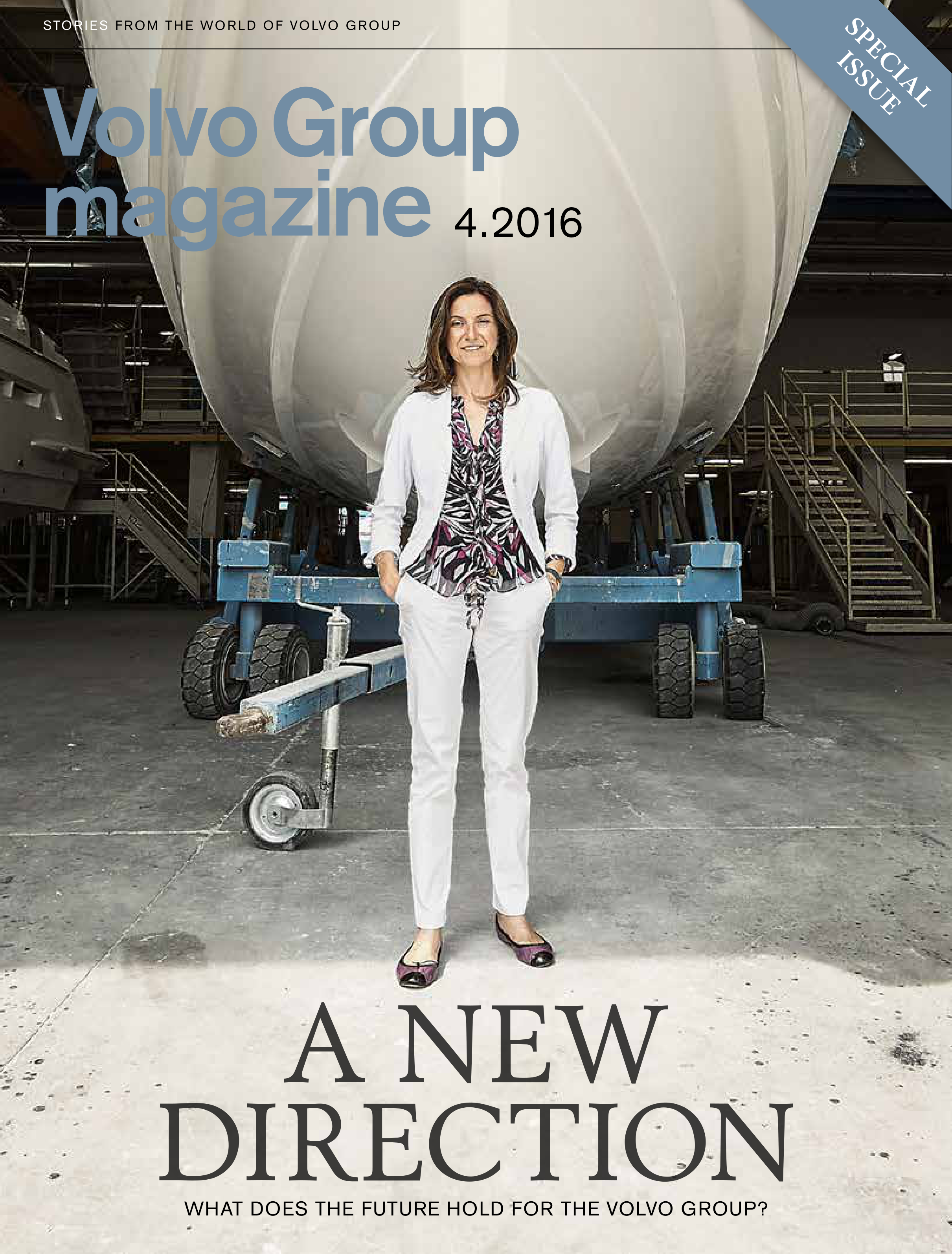
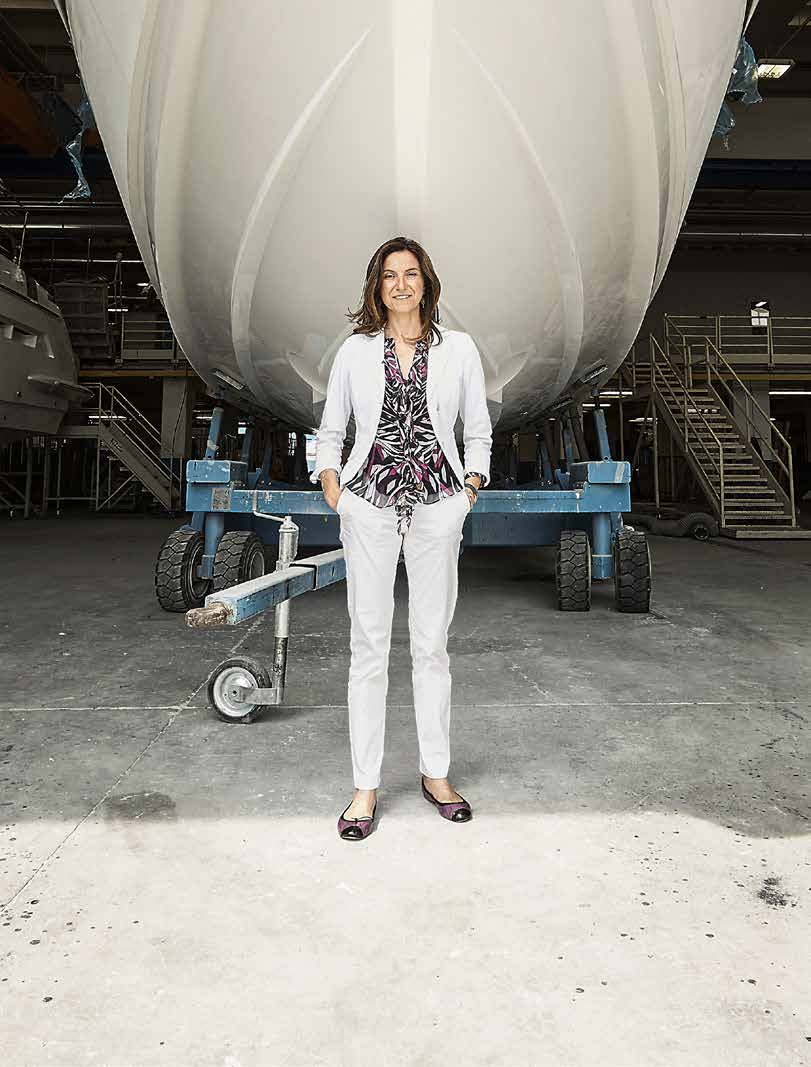
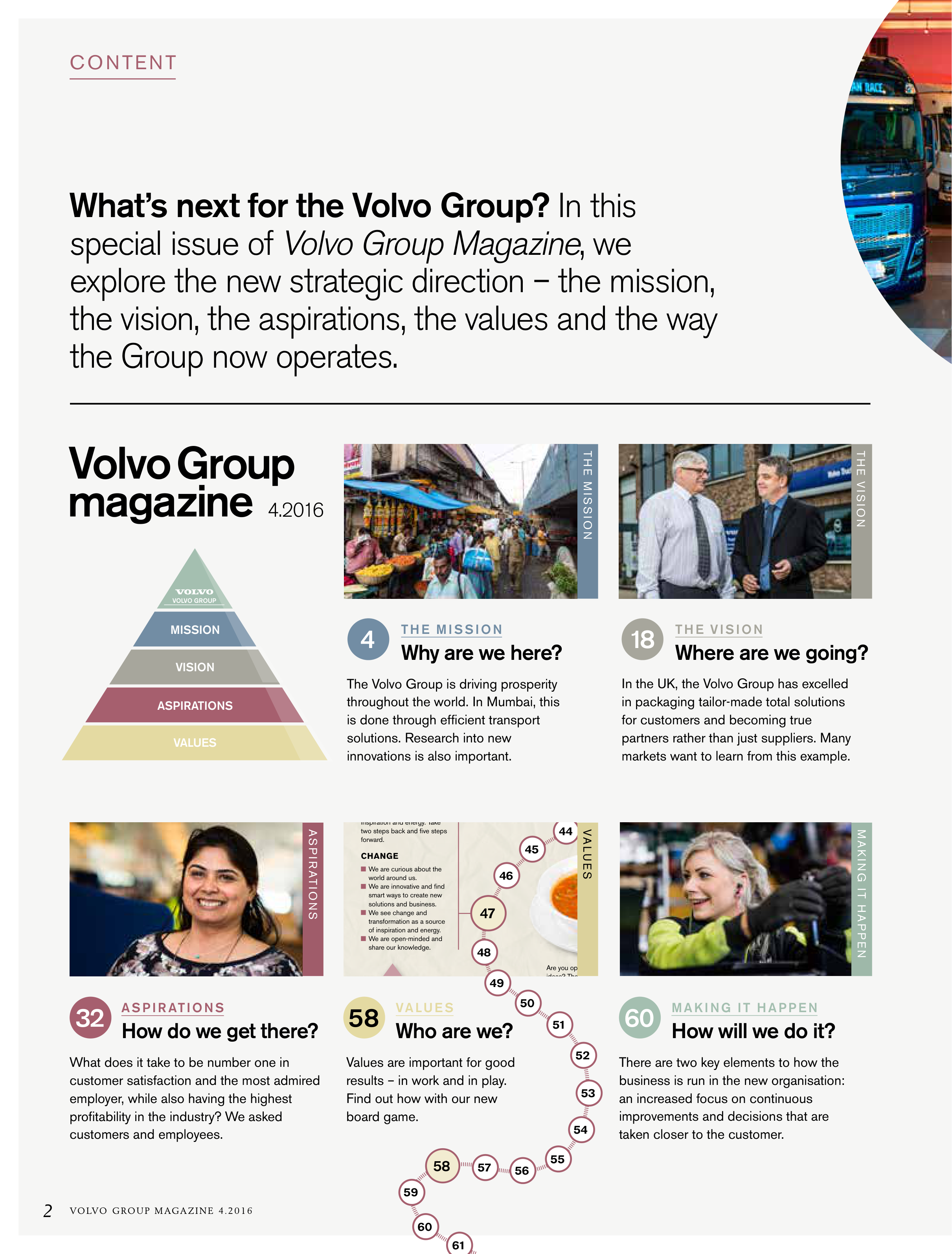







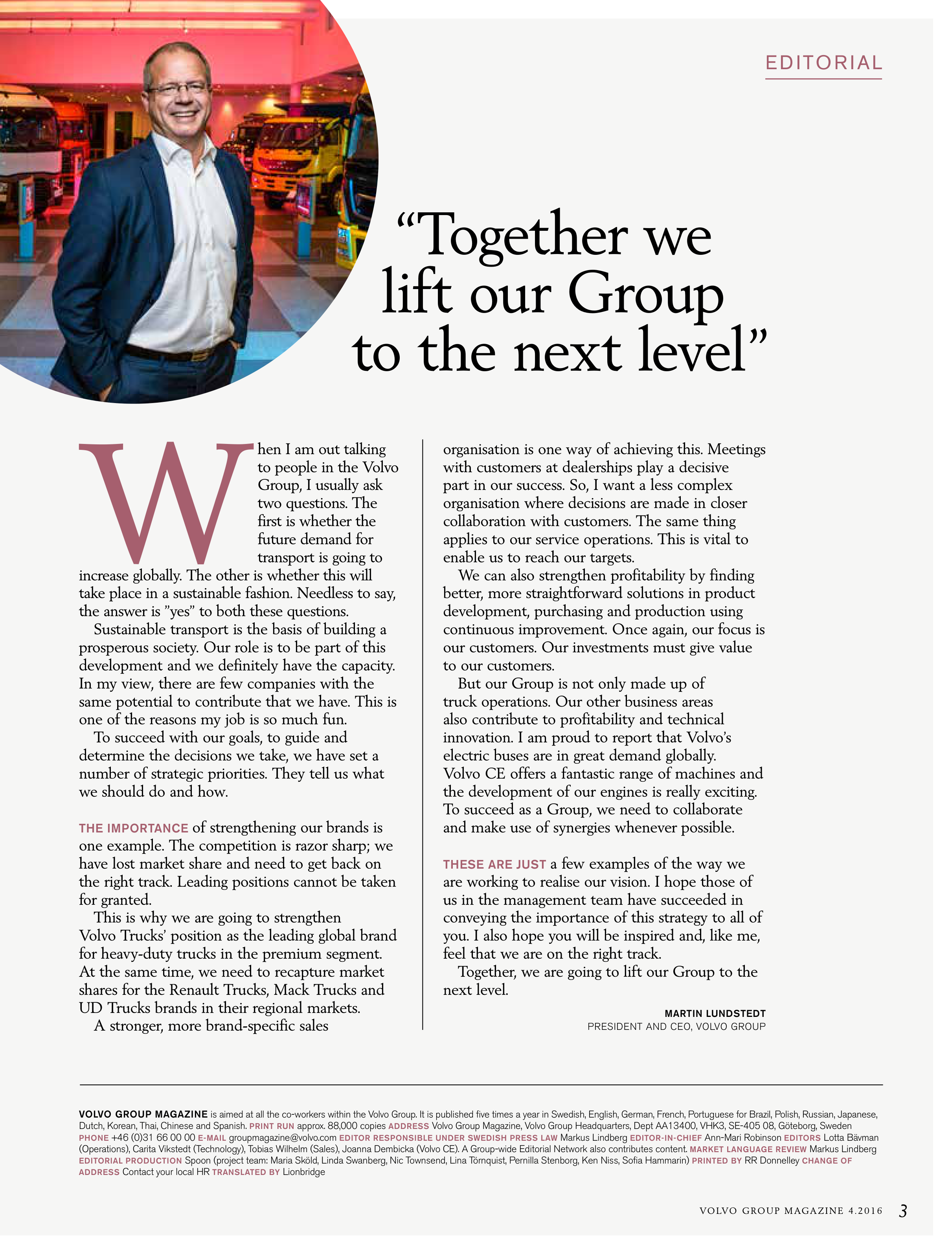
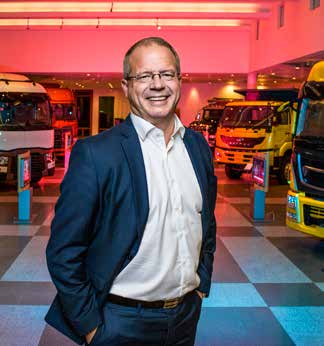
Tell us
what you
think!
Volvo Group Magazine
aims to deliver interesting and engaging
content, but to do that we need your help! Let us know what
you would like to see and how the magazine can be improved.
Email us at
groupmagazine@volvo.com
DID YOU WIN
THE QUIZ?
The winners of the quiz in Volvo
Group Magazine #2 were Fredrik
Larsson, Group IT, Sweden, Sally
Wu, Volvo CE, China and Emmanuelle
Roux, Renault Trucks Defense, France.
Congratulations!
The right answers were:
1-B, 2-A, 3-B, 4-A, 5-C, 6-B, 7-A.