
Special Feature
08
Panasonic Group People
Vijay Wadhawan / Yusuke Nii / Issei Umemura
02
Acting as a leader to help people live their best
04
Panasonic Leadership Principles
Taking Leadership to Meet New Challenges
20
A Message from
Ryuta Suzuki
(Professor, Graduate School of Business Administration, Kobe University)
26
Up-close View: The Power of the Frontline
Roda I. Borja / Takuya Miyata
14
Talking with Kusumi
Thinking about the Panasonic Leadership Principles—Implementing
Employee Entrepreneurship
28
Meet The Athletes
Narumi Ishida Interviewer: Nanako Mimura
30
PIW Closeup
32
Stories behind Panasonic History
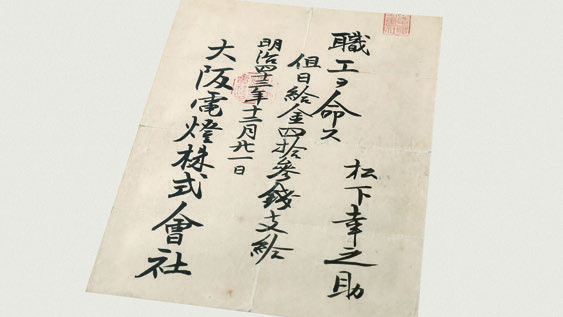
Notice of Employment from Osaka Electric Light Company
22
The Essence of Practicing the Basic Business
Philosophy
Vol. 6
24
Brand—Our Bond
2023 Special Exhibition on the Management Philosophy
Grasping the Knack for Management Is Worth a Million Dollars
Vol. 06
Jul. 2023
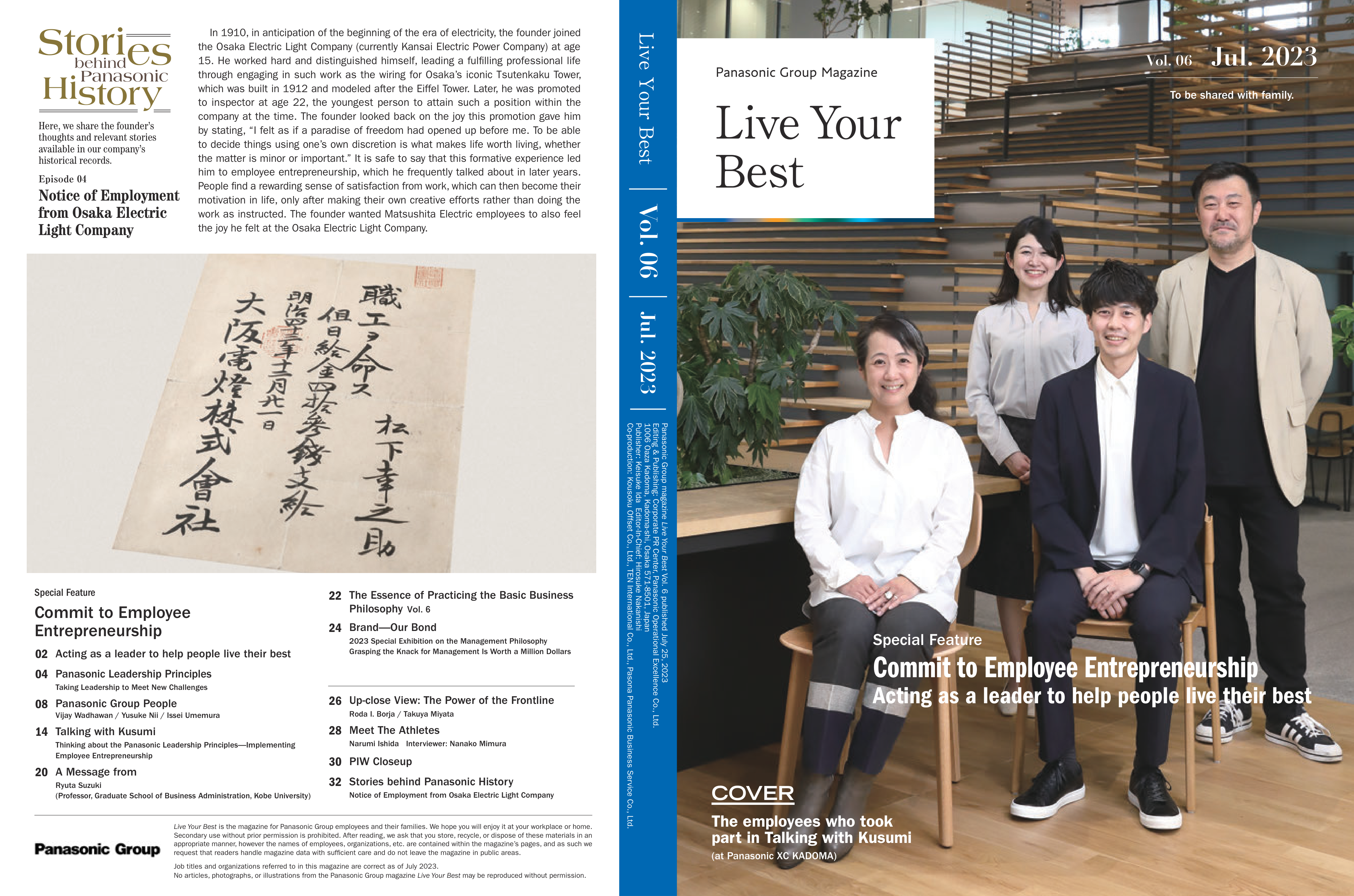
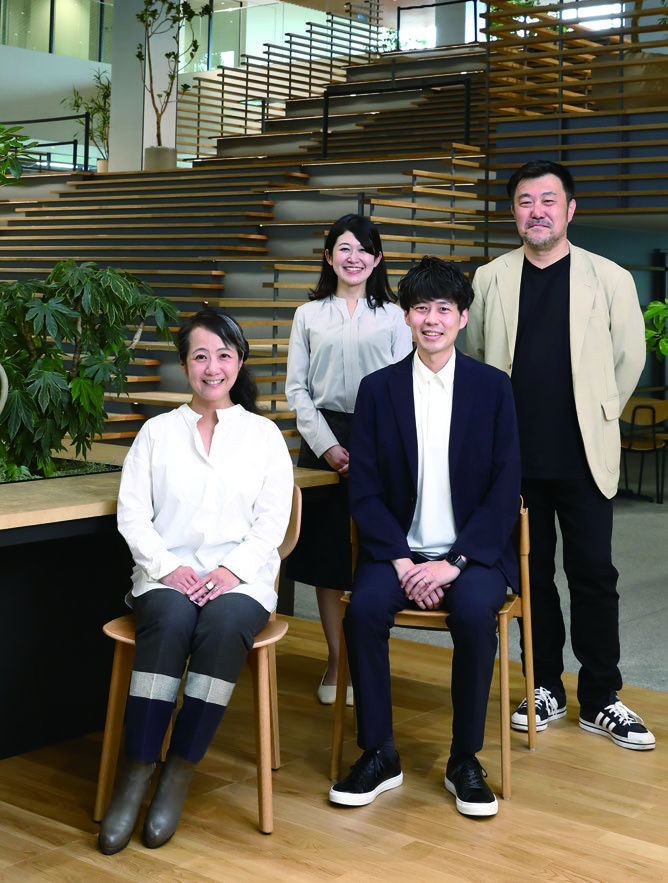
COVER
The employees who took
part in Talking with Kusumi
(at Panasonic XC KADOMA)
Special Feature
Live Your Best
Panasonic Group magazine
Live Your Best
Vol. 6 published July 25, 2023
Editing & Publishing: Corporate PR Center, Panasonic Operational Excellence Co., Ltd.
1006 Oaza Kadoma, Kadoma-shi, Osaka 571-8501, Japan
Publisher: Keisuke Ida Editor-In-Chief: Hirosuke Nakanishi
Co-production: Kousoku Offset Co., Ltd., TEN International Co., Ltd., Pasona Panasonic Business Service Co., Ltd.
Job titles and organizations referred to in this magazine are correct as of July 2023.
No articles, photographs, or illustrations from the Panasonic Group magazine
Live Your Best
may be reproduced without permission.
Live Your Best
is the magazine for Panasonic Group employees and their families. We hope you will enjoy it at your workplace or home.
Secondary use without prior permission is prohibited. After reading, we ask that you store, recycle, or dispose of these materials in an
appropriate manner, however the names of employees, organizations, etc. are contained within the magazine’s pages, and as such we
request that readers handle magazine data with sufficient care and do not leave the magazine in public areas.
To be shared with family.
Jul. 2023
Vol. 06
Notice of Employment
from Osaka Electric
Light Company
Episode 04
In 1910, in anticipation of the beginning of the era of electricity, the founder joined
the Osaka Electric Light Company (currently Kansai Electric Power Company) at age
15. He worked hard and distinguished himself, leading a fulfilling professional life
through engaging in such work as the wiring for Osaka’s iconic Tsutenkaku Tower,
which was built in 1912 and modeled after the Eiffel Tower. Later, he was promoted
to inspector at age 22, the youngest person to attain such a position within the
company at the time. The founder looked back on the joy this promotion gave him
by stating, “I felt as if a paradise of freedom had opened up before me. To be able
to decide things using one’s own discretion is what makes life worth living, whether
the matter is minor or important.” It is safe to say that this formative experience led
him to employee entrepreneurship, which he frequently talked about in later years.
People find a rewarding sense of satisfaction from work, which can then become their
motivation in life, only after making their own creative efforts rather than doing the
work as instructed. The founder wanted Matsushita Electric employees to also feel
the joy he felt at the Osaka Electric Light Company.
Here, we share the founder’s
thoughts and relevant stories
available in our company’s
historical records.
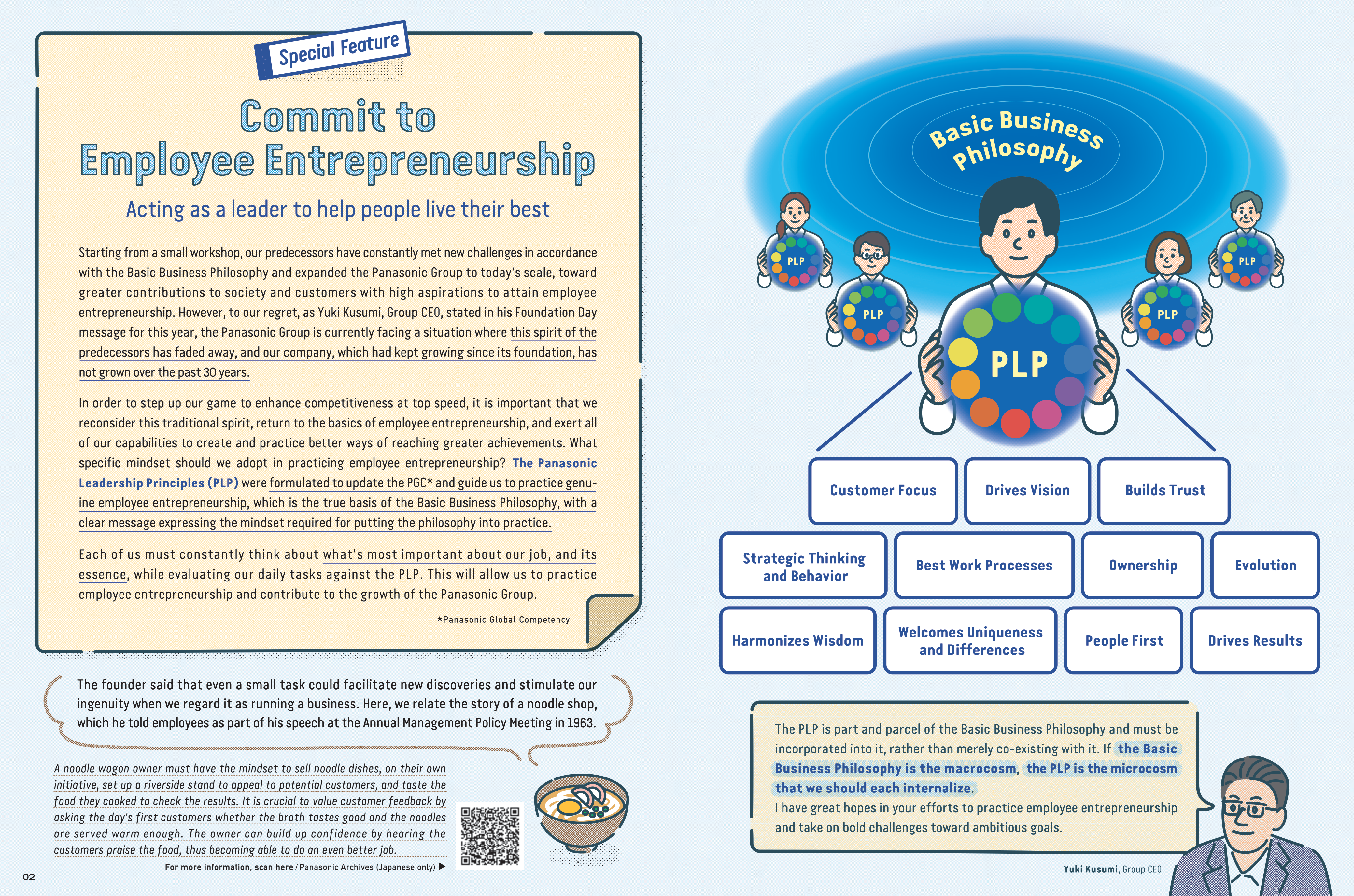
Commit to Employee
Entrepreneurship
Commit to Employee Entrepreneurship
Acting as a leader to help people live their best










02




What is the PLP?
What is the PLP?
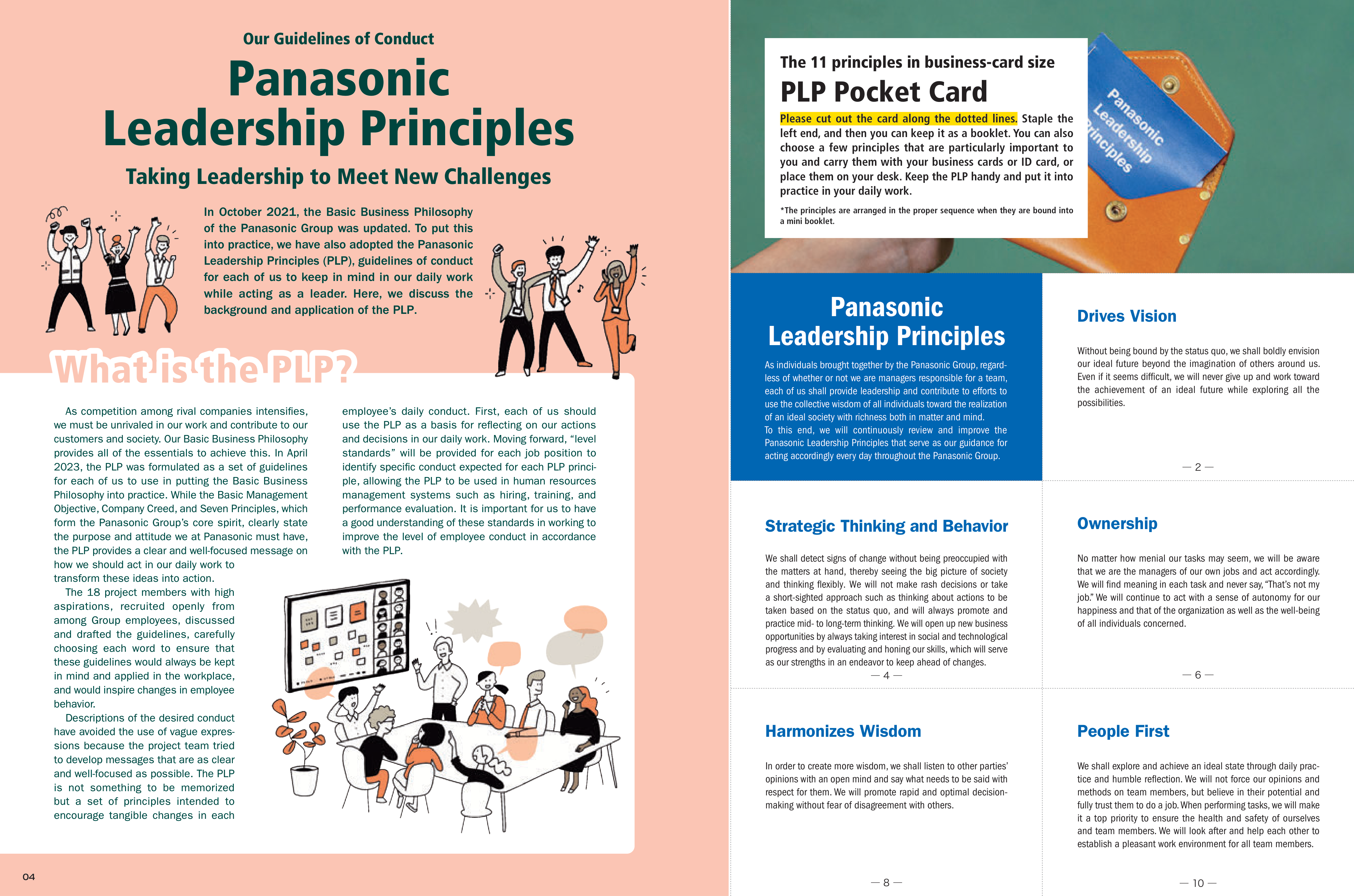
As competition among rival companies intensifies,
we must be unrivaled in our work and contribute to our
customers and society. Our Basic Business Philosophy
provides all of the essentials to achieve this. In April
2023, the PLP was formulated as a set of guidelines
for each of us to use in putting the Basic Business
Philosophy into practice. While the Basic Management
Objective, Company Creed, and Seven Principles, which
form the Panasonic Group’s core spirit, clearly state
the purpose and attitude we at Panasonic must have,
the PLP provides a clear and well-focused message on
how we should act in our daily work to
transform these ideas into action.
The 18 project members with high
aspirations, recruited openly from
among Group employees, discussed
and drafted the guidelines, carefully
choosing each word to ensure that
these guidelines would always be kept
in mind and applied in the workplace,
and would inspire changes in employee
behavior.
Descriptions of the desired conduct
have avoided the use of vague expres
sions because the project team tried
to develop messages that are as clear
and well-focused as possible. The PLP
is not something to be memorized
but a set of principles intended to
encourage tangible changes in each
employee’s daily conduct. First, each of us should
use the PLP as a basis for reflecting on our actions
and decisions in our daily work. Moving forward, “level
standards” will be provided for each job position to
identify specific conduct expected for each PLP princi
ple, allowing the PLP to be used in human resources
management systems such as hiring, training, and
performance evaluation. It is important for us to have
a good understanding of these standards in working to
improve the level of employee conduct in accordance
with the PLP.
― 4 ―
Strategic Thinking and Behavior
We shall detect signs of change without being preoccupied with
the matters at hand, thereby seeing the big picture of society
and thinking flexibly. We will not make rash decisions or take
a short-sighted approach such as thinking about actions to be
taken based on the status quo, and will always promote and
practice mid- to long-term thinking. We will open up new business
opportunities by always taking interest in social and technological
progress and by evaluating and honing our skills, which will serve
as our strengths in an endeavor to keep ahead of changes.
― 6 ―
Ownership
No matter how menial our tasks may seem, we will be aware
that we are the managers of our own jobs and act accordingly.
We will find meaning in each task and never say, “That’s not my
job.” We will continue to act with a sense of autonomy for our
happiness and that of the organization as well as the well-being
of all individuals concerned.
― 2 ―
Drives Vision
Without being bound by the status quo, we shall boldly envision
our ideal future beyond the imagination of others around us.
Even if it seems difficult, we will never give up and work toward
the achievement of an ideal future while exploring all the
possibilities.
― 10 ―
People First
We shall explore and achieve an ideal state through daily prac
tice and humble reflection. We will not force our opinions and
methods on team members, but believe in their potential and
fully trust them to do a job. When performing tasks, we will make
it a top priority to ensure the health and safety of ourselves
and team members. We will look after and help each other to
establish a pleasant work environment for all team members.
― 8 ―
Harmonizes Wisdom
In order to create more wisdom, we shall listen to other parties’
opinions with an open mind and say what needs to be said with
respect for them. We will promote rapid and optimal decision-
making without fear of disagreement with others.
PLP Pocket Card
The 11 principles in business-card size
Please cut out the card along the dotted lines. Staple the
left end, and then you can keep it as a booklet. You can also
choose a few principles that are particularly important to
you and carry them with your business cards or ID card, or
place them on your desk. Keep the PLP handy and put it into
practice in your daily work.
*The principles are arranged in the proper sequence when they are bound into
a mini booklet.
Panasonic
Leadership Principles
Taking Leadership to Meet New Challenges
Our Guidelines of Conduct
In October 2021, the Basic Business Philosophy
of the Panasonic Group was updated. To put this
into practice, we have also adopted the Panasonic
Leadership Principles (PLP), guidelines of conduct
for each of us to keep in mind in our daily work
while acting as a leader. Here, we discuss the
background and application of the PLP.
Panasonic
Leadership Principles
As individuals brought together by the Panasonic Group, regard
less of whether or not we are managers responsible for a team,
each of us shall provide leadership and contribute to efforts to
use the collective wisdom of all individuals toward the realization
of an ideal society with richness both in matter and mind.
To this end, we will continuously review and improve the
Panasonic Leadership Principles that serve as our guidance for
acting accordingly every day throughout the Panasonic Group.
04





Q
Q
Q
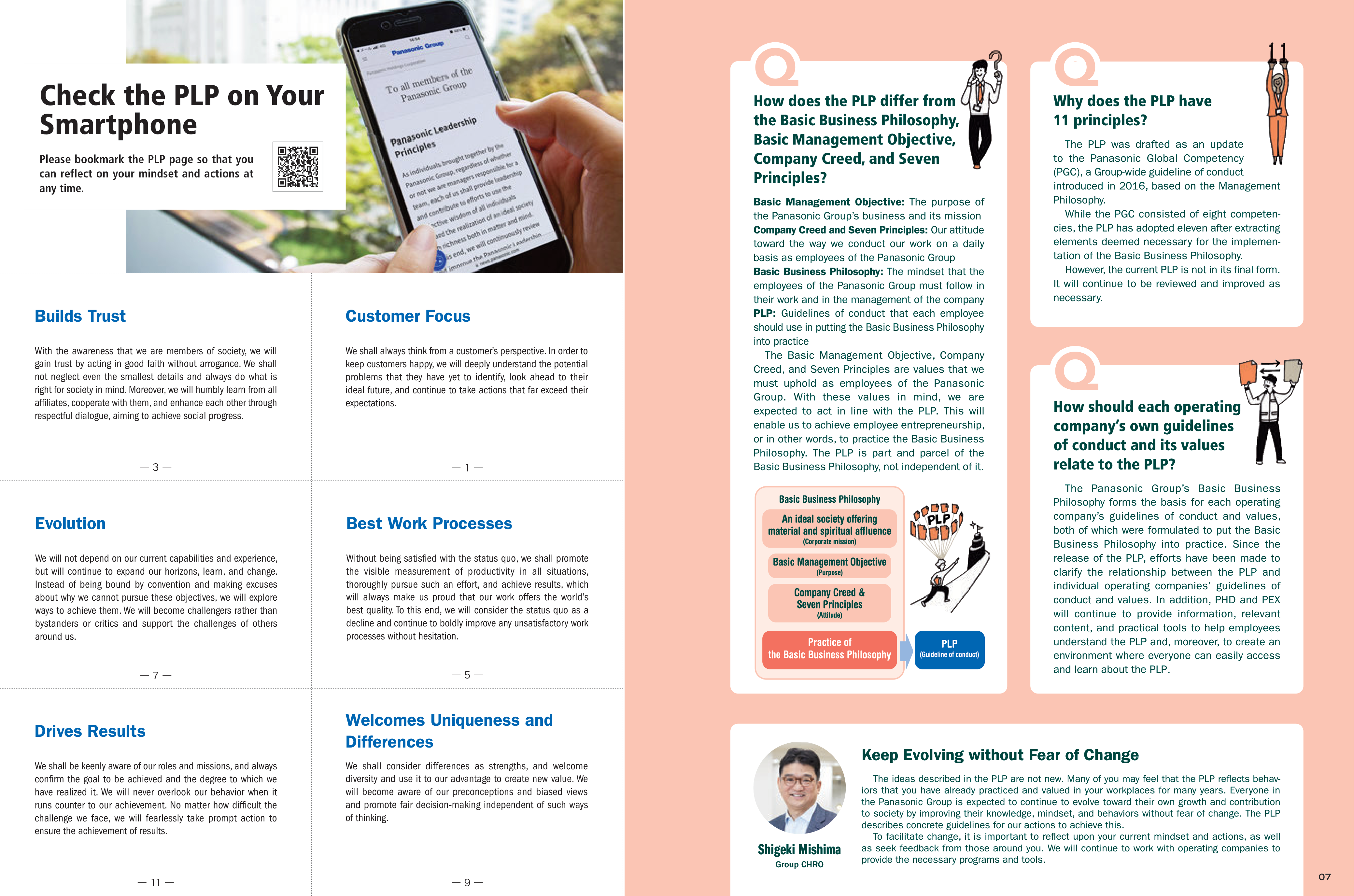
An ideal society offering
material and spiritual affluence
(Corporate mission)
Basic Business Philosophy
Basic Management Objective
(Purpose)
Company Creed &
Seven Principles
(Attitude)
Practice of
the Basic Business Philosophy
PLP
(Guideline of conduct)
Basic Management Objective:
The purpose of
the Panasonic Group’s business and its mission
Company Creed and Seven Principles:
Our attitude
toward the way we conduct our work on a daily
basis as employees of the Panasonic Group
Basic Business Philosophy:
The mindset that the
employees of the Panasonic Group must follow in
their work and in the management of the company
PLP:
Guidelines of conduct that each employee
should use in putting the Basic Business Philosophy
into practice
The Basic Management Objective, Company
Creed, and Seven Principles are values that we
must uphold as employees of the Panasonic
Group. With these values in mind, we are
expected to act in line with the PLP. This will
enable us to achieve employee entrepreneurship,
or in other words, to practice the Basic Business
Philosophy. The PLP is part and parcel of the
Basic Business Philosophy, not independent of it.
The PLP was drafted as an update
to the Panasonic Global Competency
(PGC), a Group-wide guideline of conduct
introduced in 2016, based on the Management
Philosophy.
While the PGC consisted of eight competen
cies, the PLP has adopted eleven after extracting
elements deemed necessary for the implemen
tation of the Basic Business Philosophy.
However, the current PLP is not in its final form.
It will continue to be reviewed and improved as
necessary.
The Panasonic Group’s Basic Business
Philosophy forms the basis for each operating
company’s guidelines of conduct and values,
both of which were formulated to put the Basic
Business Philosophy into practice. Since the
release of the PLP, efforts have been made to
clarify the relationship between the PLP and
individual operating companies’ guidelines of
conduct and values. In addition, PHD and PEX
will continue to provide information, relevant
content, and practical tools to help employees
understand the PLP and, moreover, to create an
environment where everyone can easily access
and learn about the PLP.
How does the PLP differ from
the Basic Business Philosophy,
Basic Management Objective,
Company Creed, and Seven
Principles?
Why does the PLP have
11 principles?
How should each operating
company’s own guidelines
of conduct and its values
relate to the PLP?
Keep Evolving without Fear of Change
The ideas described in the PLP are not new. Many of you may feel that the PLP reflects behav
iors that you have already practiced and valued in your workplaces for many years. Everyone in
the Panasonic Group is expected to continue to evolve toward their own growth and contribution
to society by improving their knowledge, mindset, and behaviors without fear of change. The PLP
describes concrete guidelines for our actions to achieve this.
To facilitate change, it is important to reflect upon your current mindset and actions, as well
as seek feedback from those around you. We will continue to work with operating companies to
provide the necessary programs and tools.
Shigeki Mishima
Group CHRO
― 3 ―
Builds Trust
With the awareness that we are members of society, we will
gain trust by acting in good faith without arrogance. We shall
not neglect even the smallest details and always do what is
right for society in mind. Moreover, we will humbly learn from all
affiliates, cooperate with them, and enhance each other through
respectful dialogue, aiming to achieve social progress.
― 7 ―
Evolution
We will not depend on our current capabilities and experience,
but will continue to expand our horizons, learn, and change.
Instead of being bound by convention and making excuses
about why we cannot pursue these objectives, we will explore
ways to achieve them. We will become challengers rather than
bystanders or critics and support the challenges of others
around us.
― 11 ―
Drives Results
We shall be keenly aware of our roles and missions, and always
confirm the goal to be achieved and the degree to which we
have realized it. We will never overlook our behavior when it
runs counter to our achievement. No matter how difficult the
challenge we face, we will fearlessly take prompt action to
ensure the achievement of results.
― 9 ―
Welcomes Uniqueness and
Differences
We shall consider differences as strengths, and welcome
diversity and use it to our advantage to create new value. We
will become aware of our preconceptions and biased views
and promote fair decision-making independent of such ways
of thinking.
― 5 ―
Best Work Processes
Without being satisfied with the status quo, we shall promote
the visible measurement of productivity in all situations,
thoroughly pursue such an effort, and achieve results, which
will always make us proud that our work offers the world’s
best quality. To this end, we will consider the status quo as a
decline and continue to boldly improve any unsatisfactory work
processes without hesitation.
― 1 ―
Customer Focus
We shall always think from a customer’s perspective. In order to
keep customers happy, we will deeply understand the potential
problems that they have yet to identify, look ahead to their
ideal future, and continue to take actions that far exceed their
expectations.
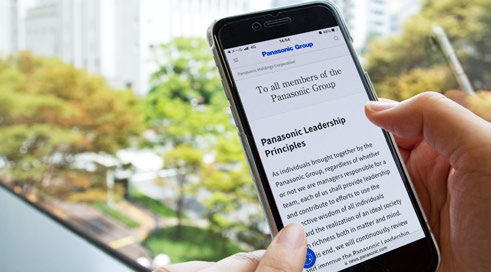
Check the PLP on Your
Smartphone
Please bookmark the PLP page so that you
can reflect on your mindset and actions at
any time.
07

Panasonic
Group
P
eople
Employee entrepreneurship is perhaps the foundation of
our Basic Business Philosophy, calling on each of us to
use all our ability to create better methods, boldly and
proactively implementing them to achieve great results.
In this issue of Panasonic Group People, we look at the
initiatives of employees who are pouring every effort into
implementing employee entrepreneurship, and how they
are utilizing the Panasonic Leadership Principles (PLP).
The systems market in India is constantly evolving, and
more and more B2B customers are requesting unique cus
tomized solutions. I’m in charge of the system solutions
business, and to date I have focused on placing trust in my
staff and delegating authority to them so that I can develop
leaders who promote employee entrepreneurship.
In addition to boosting profit, all employees here are
concentrating their efforts on solving our customers’ issues
and developing technologies that can drive the business
forward. While taking note of customer requirements and
the gap between their ideals and reality, we are working
from the ground up to develop unprecedented solutions. At
the same time, we are prioritizing the use of open-source
software, the development of customizable solutions, the
use of OEM/ODM*1 parts, and significant reductions in
production and development costs. By developing a cul
ture that strives for innovation and boosting employees’
motivation and sense of responsibility, we have been able
to speed up the decision-making process and enhance our
competitive advantage.
A leading example of one of our solutions is Digital
SignEdge (SDN), which is ideal for outdoor advertising.
Making full use of ODM displays and content management
systems, for example, SDN uses the cloud to update,
schedule, and broadcast different content in various
formats. Combining hardware and software in the optimal
manner, this unparalleled solution has established itself
at the top of the industry in India and has contributed to
increased earnings. One car manufacturer has installed
more than 14,000 units across approximately 1,800 of its
dealerships across the country. By entrusting communica
tions to the system, these dealerships have been able to
focus on sales and improve
their operational efficiency.
SDN has already been
rolled out in Malaysia and
we are looking at extend
ing the system to other
countries, too. We have
also developed ProMeet,
a wireless collaboration
solution*2; All-in One USB
Meeting Cameras, for use
in an array of meetings and
assemblies; and a cus
tomer waiting list system.
Contributing to society
with outstanding solutions, delegating authority to teams
and their employees, bringing together our comprehensive
strengths to find solutions to customer issues, and creat
ing unique solutions to cater to a dynamic, ever-evolving
market—the direction we are taking at the Systems Solu
tions Division is consistent with the PLP.
To me, Panasonic has a strong future as an organization
that can respond to various technological requirements. In
line with this, it is essential that we evolve into a total solu
tions provider that covers hardware, software, and services.
If we can do so, I have no doubt that all industries dealing
with products will uncover new strategies in line with the
so-called blue ocean strategy.*3
Solutions Unique to India through
a Thorough Understanding of Customer Issues
and Creative Measures
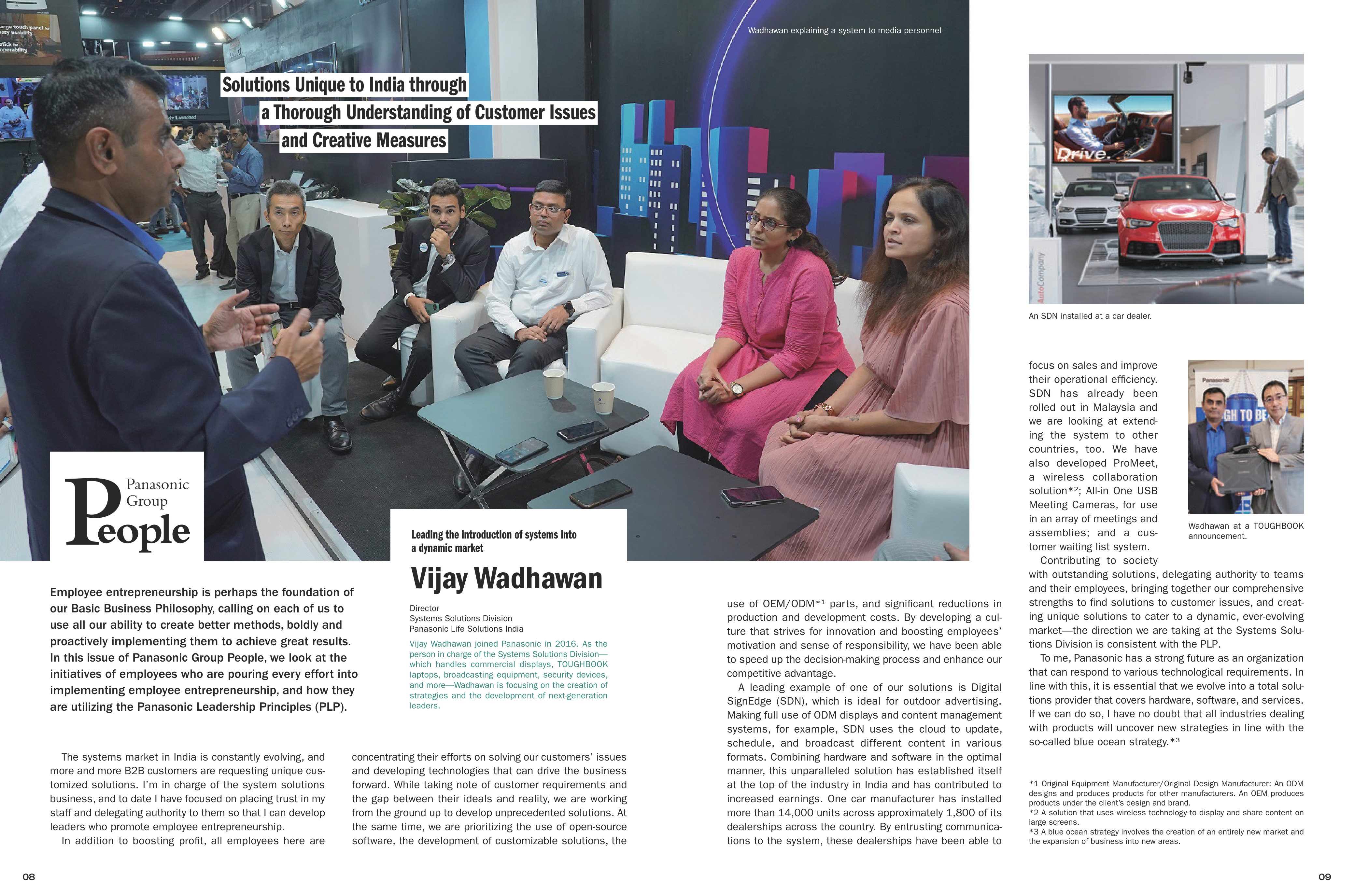
Vijay Wadhawan joined Panasonic in 2016. As the
person in charge of the Systems Solutions Division—
which handles commercial displays, TOUGHBOOK
laptops, broadcasting equipment, security devices,
and more—Wadhawan is focusing on the creation of
strategies and the development of next-generation
leaders.
Director
Systems Solutions Division
Panasonic Life Solutions India
Vijay Wadhawan
Leading the introduction of systems into
a dynamic market
*1 Original Equipment Manufacturer/Original Design Manufacturer: An ODM
designs and produces products for other manufacturers. An OEM produces
products under the client’s design and brand.
*2 A solution that uses wireless technology to display and share content on
large screens.
*3 A blue ocean strategy involves the creation of an entirely new market and
the expansion of business into new areas.
Wadhawan at a TOUGHBOOK
announcement.
An SDN installed at a car dealer.
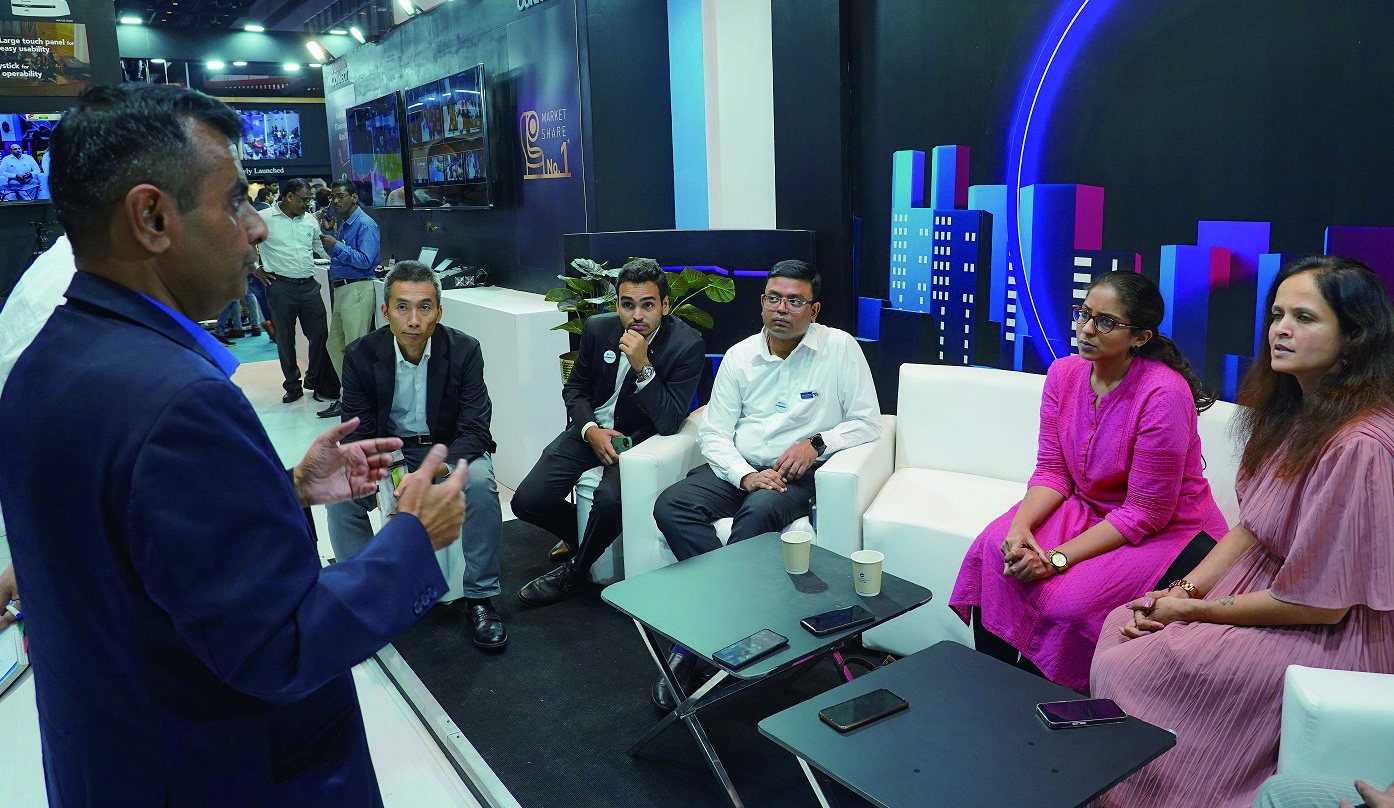
Wadhawan explaining a system to media personnel
08
09




Creating a New IT-based Corporate Culture
for Optimal Management Decisions
In October 2021, Panasonic Corporation’s Living Appli
ances and Solutions Company transformed its product
development process from a waterfall to a project style,
and it launched the Micro Enterprise (ME) system, which
enables rapid development of essential value for our
customers.
As the ME leader for rice cookers, I lead my project
team, which consists of people from various job functions,
to achieve medium- to long-term business growth. Through
our research, we have determined that the essential value
that consumers expect from a rice cooker is the ability to
cook rice easily and deliciously. Therefore, we have devel
oped core technologies that make this value a reality and
established an entirely new cooking technique. This new
technology from our ME will be incorporated in the mass
production design and commercialized by 2025.
The advantage of the ME system is the flat relationship
among leaders and members, as well as an open culture
that encourages better and faster communication. The
perspective of other ME leaders from outside our own ME
is very helpful in making us aware of our weaknesses.
Bringing the expertise I gained through the ME system back
to the business division, in July I assumed responsibility for
a new organization dedicated to the advanced development
Results have paramount importance. Viewed in this way, I
was able to understand that the PLP is the very process of
product development and value creation.
We want to develop appropriate core technologies so
that we can create the technology-based essential value
of rice cookers. A family table filled with delicious food is
of a variety of core technologies. Leading a project team
representing all job functions from the engineering depart
ments, I promote the accumulation of technologies from
the prototype stage of core technologies for their rapid
commercialization in a year or two.
My motto is “Do the right thing,” and I truly identify
with the idea of Builds Trust as stated in the PLP. Good
relationships, communication, and building trust form the
foundation of all the business we do. In addition, Owner
ship and Evolution are critical elements for leaders. Team
leaders and organizational heads need to do their jobs
with the mindset of a manager responsible for their own
work, and they need to keep evolving themselves. With this
foundation, we must undertake Drives Vision and enhance
Customer Focus to identify the essential values that cus
tomers really want. We then need to transform our vision
into a roadmap through Strategic Thinking and Behavior
and put it into practice through Best Work Processes. As
we work on this as a team, Harmonizes Wisdom, Welcomes
Uniqueness and Differences, People First, and Drives
full of smiles. In this sense, cooking appliances can help
people live their best. This motivates me as an engineer
and is the source of my passion for creating value. I will
strive to develop people and my team, and work with
them to create products that make enthusiastic fans of
Panasonic.
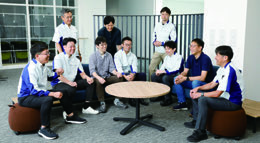
After moving from Sharp Corporation, where he was a project
manager for small LCD devices, to Panasonic in 2016, Yusuke
Nii drove a development project for cooking appliances until
July 2023, when he was transferred to his current position. He
is now working to develop and commercialize core technolo
gies that contribute to the market competitiveness of cooking
appliances by adding both essential and new values to them.
Manager, Integrated Value Creation Section
Cooker & Small Kitchen Appliances Engineering Department
Cooking Business Unit, Kitchen Appliances Business Division
Living Appliances and Solutions Company
Panasonic Corporation
Yusuke Nii
Leader of ME for Rice Cookers that bring smiles to the table
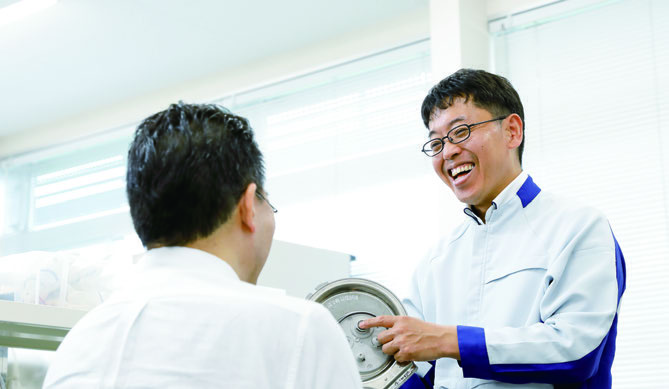
Establishing expertise in the ME system as a permanent value within the business division
Our first attempt at introducing the ME system represented a new step in the cooking
appliance business. In order to achieve the intrinsic value sought by customers, our
team, led by Mr. Nii, is making progress through our solidarity and trial-and-error efforts.
In May, a new organization was established within the business division, tasked with
disseminating expertise in the ME system as a permanent value. This work began in
earnest from July, with Mr. Nii as manager. We will work together to transform the product
development process through this organization.
Kenji Okamoto
General Manager
Cooker & Small Kitchen Appliances Engineering Department
Cooking Business Unit, Kitchen Appliances Business Division
Living Appliances and Solutions Company, Panasonic Corporation
Transforming the Product Development Process
to Rapidly Create Essential Value
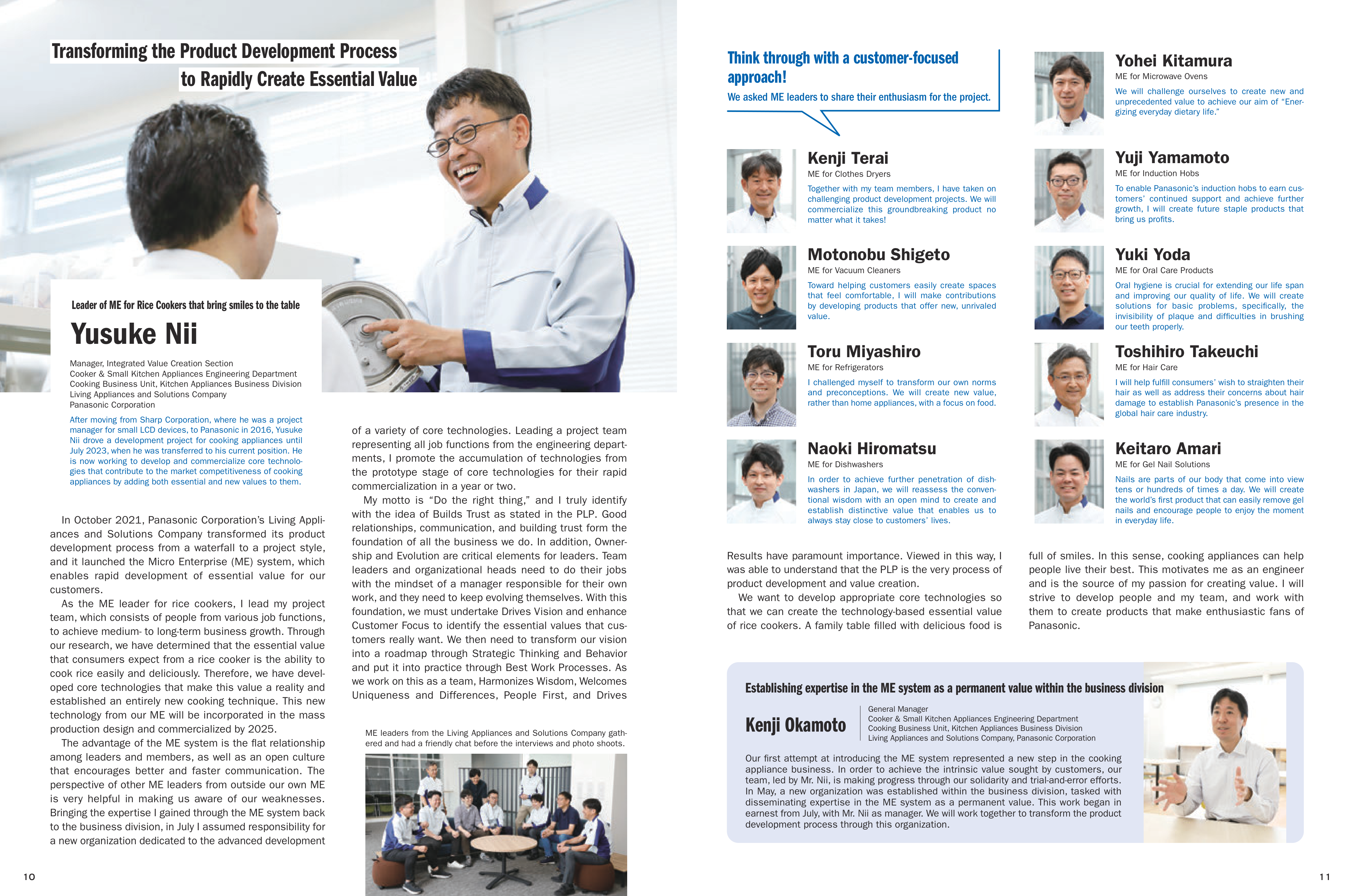
ME leaders from the Living Appliances and Solutions Company gath
ered and had a friendly chat before the interviews and photo shoots.
Think through with a customer-focused
approach!
We asked ME leaders to share their enthusiasm for the project.
Nails are parts of our body that come into view
tens or hundreds of times a day. We will create
the world’s first product that can easily remove gel
nails and encourage people to enjoy the moment
in everyday life.
ME for Gel Nail Solutions
Keitaro Amari
I will help fulfill consumers’ wish to straighten their
hair as well as address their concerns about hair
damage to establish Panasonic’s presence in the
global hair care industry.
ME for Hair Care
Toshihiro Takeuchi
Oral hygiene is crucial for extending our life span
and improving our quality of life. We will create
solutions for basic problems, specifically, the
invisibility of plaque and difficulties in brushing
our teeth properly.
ME for Oral Care Products
Yuki Yoda
To enable Panasonic’s induction hobs to earn cus
tomers’ continued support and achieve further
growth, I will create future staple products that
bring us profits.
ME for Induction Hobs
Yuji Yamamoto
We will challenge ourselves to create new and
unprecedented value to achieve our aim of “Ener
gizing everyday dietary life.”
ME for Microwave Ovens
Yohei Kitamura
In order to achieve further penetration of dish
washers in Japan, we will reassess the conven
tional wisdom with an open mind to create and
establish distinctive value that enables us to
always stay close to customers’ lives.
ME for Dishwashers
Naoki Hiromatsu
I challenged myself to transform our own norms
and preconceptions. We will create new value,
rather than home appliances, with a focus on food.
ME for Refrigerators
Toru Miyashiro
Toward helping customers easily create spaces
that feel comfortable, I will make contributions
by developing products that offer new, unrivaled
value.
ME for Vacuum Cleaners
Motonobu Shigeto
Together with my team members, I have taken on
challenging product development projects. We will
commercialize this groundbreaking product no
matter what it takes!
ME for Clothes Dryers
Kenji Terai
10
11
I work in business planning for the dig
ital camera business, where I’m involved
in the formulation of management policies
and the examination of medium-term man
agement plans. At the same time, since
FY22 I’ve been responsible for all aspects
of planning and management of the Smart
Forum, an important event held six or
seven times a year to help employees take
ownership of our business strategies.
With the nature of the event changing
with its switch to an online format following
the pandemic, we also decided to rethink
the name. And so what was previously
called the General Meeting was renamed
the Smart Forum in November 2022. I
thought the name change was symbolic
of the business unit’s intent to implement
business and cultural reform.
In my role in charge of the forum, in addi
tion to emphasizing interactive communica
tion in line with the wishes of the business
unit director, I also strive to make sure that the forum’s
content is catered to employees’ interests, which I gauge
through post-event questionnaires and feedback from my
colleagues. For example, part of this year’s management
policy is to further grow our new businesses, and through
the questionnaire we discovered that employees wanted
more specific information on this growth project. In the next
forum, the business unit director talked about his current
thoughts on the project, and I made sure that participants
could interact with the content. I’m in charge of everything
from planning and filming to editing and broadcasting. I
didn’t have any skills in filming and editing beforehand, and
so I learned and remembered the methods from scratch.
We also have a new section called Project L in which
we have engineers talk about the secrets behind their
product development projects. By enhancing employees’
knowledge of products from their own departments, the
idea is to boost unity within the business unit and increase
the motivation of our engineers. In the post-event ques
tionnaires, we include a section to quantitively assess how
satisfied employees have been with the event, and we have
maintained our target of more than 95%. I’m always looking
to incorporate new elements into the event, and so it might
be that my efforts are paying off.
After the announcement of the Panasonic Leadership
Principles, I examined whether my work was in step with
the Customer Focus principle. I also fully agree with the
Evolution principle, which calls on us to continue to expand
our horizons, learn, and change. Soon after I took on my
current role, my boss said that he wanted to automate
the collection of the huge amount of data required for
the formulation of our business plans. While thinking that
the request was somewhat unreasonable, I nonetheless
proactively agreed to give it a go. We succeeded, however,
and as a result we were able to automate the analysis of
management indicators and drastically reduce the time we
spent on the collection of data. We were then able to use
the time we gained on more important data analysis. Just
as I learned how to aggregate data and edit videos, rather
than looking for reasons you can’t do something, I think it’s
more important to give it a go.
Our new business unit director wants us to continue
proactively tackling cultural reform and improvements
in operational efficiency. I have thus created an “online
suggestion box” where employees can propose ways to
improve employee satisfaction and drive cultural reform.
I hope to be able to link these proposals to improvement
activities. With the business unit director and the business
planning departments leading the way, I’ll do everything I
can to ensure these proposals lead to improvements. This
article is my commitment to helping employees live their
best lives.
Issei Umemura joined Panasonic Corporation in 2019,
and was assigned to the Appliances Company’s
Imaging Business Unit within the Smart Life Network
Business Division. After working on product planning
for the LUMIX camera series, he took up his current
role in April 2020.
Business Strategy Section
Business Planning Department
Imaging Business Unit
Panasonic Entertainment & Communication Co., Ltd.
Issei Umemura
A key individual in business and cultural reform
Aligning the Thoughts of Management and Employees
and Reinforcing the Competitiveness
of the Digital Camera Business
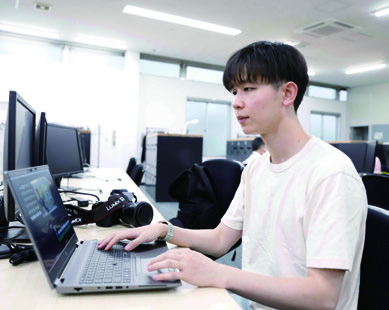
Umemura editing a video for the Smart Forum in June.
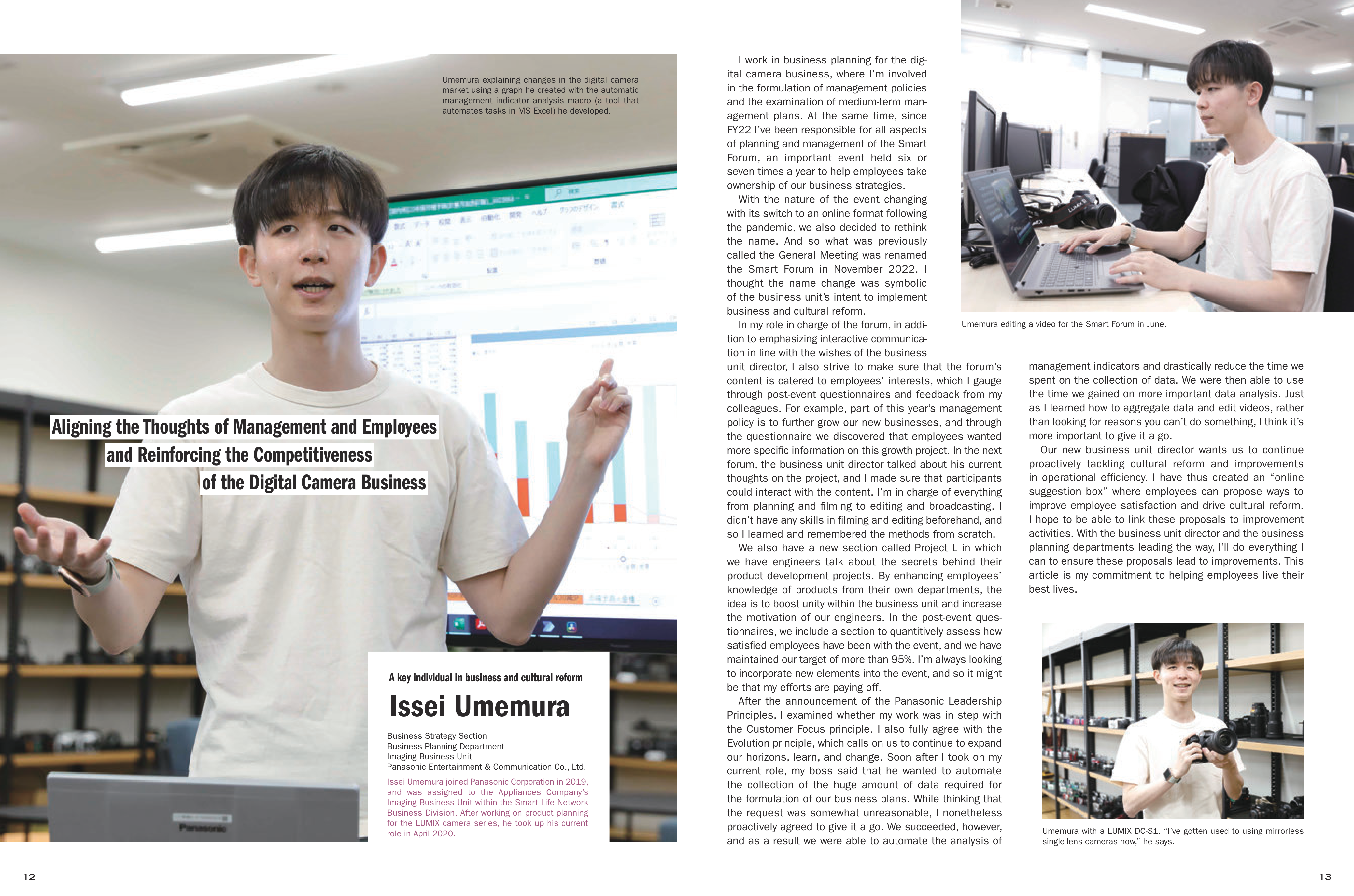
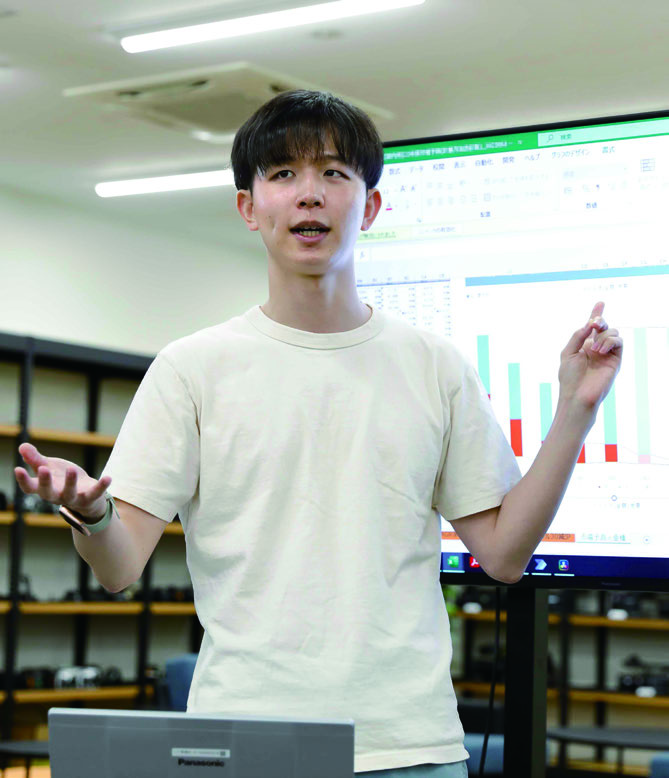
Umemura explaining changes in the digital camera
market using a graph he created with the automatic
management indicator analysis macro (a tool that
automates tasks in MS Excel) he developed.
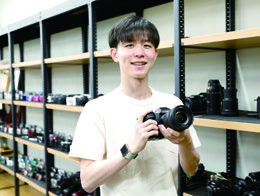
Umemura with a LUMIX DC-S1. “I’ve gotten used to using mirrorless
single-lens cameras now,” he says.
12
13
Talking with
Kusumi
Kusumi:
For everyone to implement employee entre
preneurship, which is at the core of our Basic Business
Philosophy, I felt the need to put down in writing a set of
guidelines with a clear and well-focused message. Rather
than working with several others to create these guidelines
myself, I thought it would be better to solicit the ideas of
Business Philosphy also refers to Article 15 of our Basic
Internal Rules in 1935, which states, “No matter how large
Matsushita Electric might become in the future, maintain
the attitude of being a humble merchant. Think of yourself
to be employed in a small shop. Be simple, frugal and
humble as you carry out your work.” The founder stated
the following three fundamental requirements for being a
merchant: Understanding the meaning of commerce, Read
ing others’ hearts, and Being fully humble before others.
Elsewhere, just recently in June we hosted the Excellent
Dealer Award Program. The managing director of one of the
award-winning stores said the following: “Although it is a
a wider range of employees. The resulting principles go
far beyond my initial requests and ultimately ended up
covering the essence of our Basic Business Philosophy.
To me, implementing employee entrepreneurship based on
these guidelines of conduct leads to the implementation of
our Basic Business Philosophy itself.
My only request for the PLP Project team was that
Customer Focus was the first on the list. One reason for
this is written in the Basic Business Philosophy Handbook,
where our former Chairman Arataro Takahashi says that
implementing the philosophy means that we must be
unrivaled in our work and bring customers joy. The Basic
matter of course, the most important thing for a merchant
is to make customers happy.” This young and successful
director of 39 recognized that bringing joy to the customer
is an essential and natural part of business. This helped
me to once again realize the importance of remembering
that our focus is the customer.
Takayama:
I run the showroom that I am in charge of as if
it is my own. With the mindset of a manager, I ensure neat
arrangements and cleanliness for customers who visit,
and I’m always working to improve our advisors’ product
expertise and ability to deal with customers.
Kusumi:
Our showrooms are experts at proposing solutions
to customers’ desires and needs. As a result, our show
rooms really make customers happy. In this sense, you are
outstanding Customer Focus practitioners.
Nakasaka:
My role is the applied development of block
chain technologies to manage data on and create value
from our environmental achievements, be it our level of
The ideas that went into the formulation of
the PLP and customer focus:
Maintain the attitude of being a humble
merchant
Understanding the nature of current
problems and predicting problems of
the future
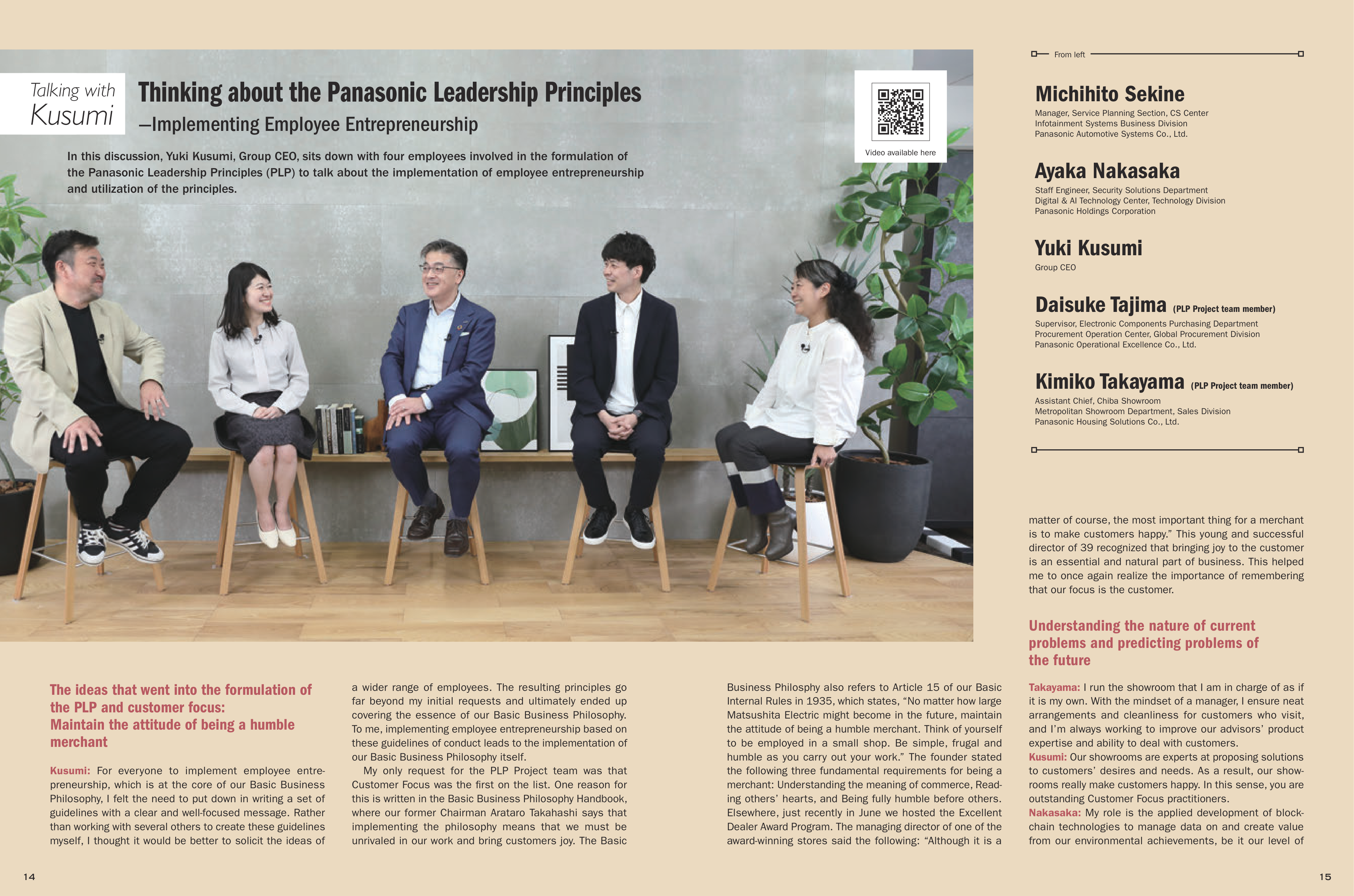
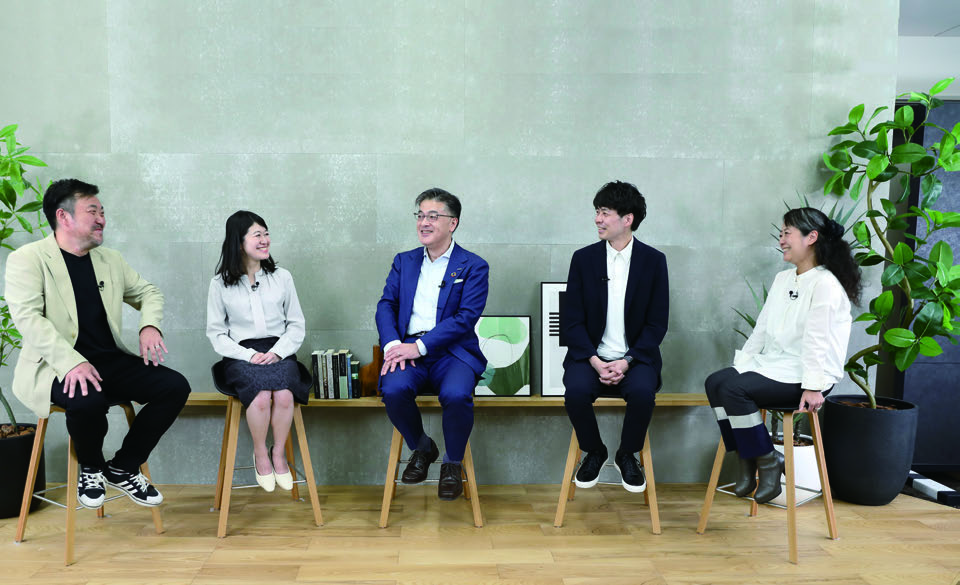
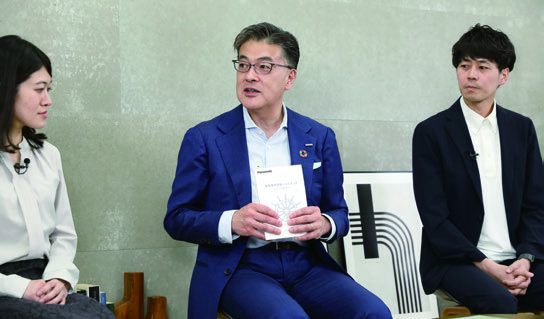
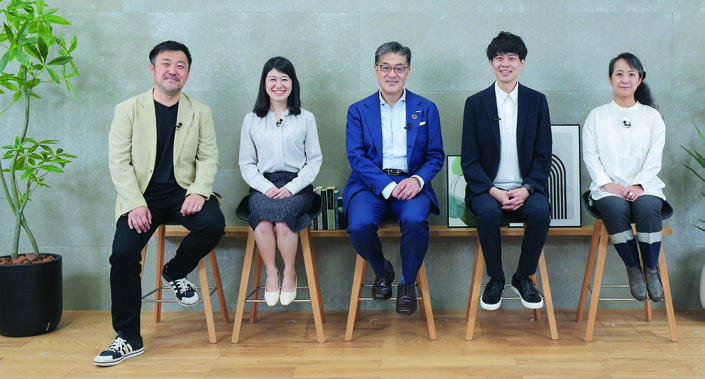
In this discussion, Yuki Kusumi, Group CEO, sits down with four employees involved in the formulation of
the Panasonic Leadership Principles (PLP) to talk about the implementation of employee entrepreneurship
and utilization of the principles.
Thinking about the Panasonic Leadership Principles
—Implementing Employee Entrepreneurship
From left
Michihito Sekine
Manager, Service Planning Section, CS Center
Infotainment Systems Business Division
Panasonic Automotive Systems Co., Ltd.
Ayaka Nakasaka
Staff Engineer, Security Solutions Department
Digital & AI Technology Center, Technology Division
Panasonic Holdings Corporation
Daisuke Tajima
(PLP Project team member)
Supervisor, Electronic Components Purchasing Department
Procurement Operation Center, Global Procurement Division
Panasonic Operational Excellence Co., Ltd.
Kimiko Takayama
(PLP Project team member)
Assistant Chief, Chiba Showroom
Metropolitan Showroom Department, Sales Division
Panasonic Housing Solutions Co., Ltd.
Yuki Kusumi
Group CEO
Video available here
14
15
contribution to CO
2
reductions or recycling of resources.
Our aim is to build a society in which we can trade value
that stems from environmental contributions. I don’t have
the opportunity to directly interact with customers, however,
while the technologies we develop take time to become a
part of society and people’s lives. While looking at social
changes and trends among our competitors, our focus is
on the creation of patents. The
Customer Focus principle states
that we should look ahead to
customers’ ideal futures, and I
believe it is important to supply
the technologies we develop
for the optimal scenario, at the
optimal timing, and at the opti
mal price. Intellectual property
is therefore essential, and can
ensure maximum use of the
resources generated by the
Group.
Kusumi:
In your line of work,
there are many similar blockchain
technologies. I think the most
important thing for you is to con
sider how you can apply and uti
lize the blockchain technologies
in an unrivaled manner. Doing
so will ensure your solutions are
chosen by our customers.
should incorporate new expertise and new mindsets and
use these to evolve our products and services, and evolve
ourselves.
Kusumi:
You have clearly thought it through very thor
oughly. I repeatedly call upon employees to implement
improvement after improvement, reform after reform, and
innovation after innovation. As others around us make
advances, if we don’t continue to evolve and engage in
unrivaled work, ultimately we will fall behind. As you say, it
is important to continue to take on new challenges. Toyota
promotes a Spirit of Kaizen, through which it encourages
the continuous search for bottlenecks and hard work to
eliminate them. While this is slightly different to Evolution,
both are just as important. What they both tell us is that we
should never be satisfied with the status quo and recognize
that there is always room for improvement.
Sekine:
The repair
gemba
deals in small lots, and tra
ditionally everything has been handled manually. After
spending time at the Matsumoto Plant, however, where
full automation is progressing, I began to wonder whether
manual work was the correct way forward. I thus worked
with production engineering to automate tasks that were
previously people-dependent, making small improvements
wherever possible. Currently I’m prioritizing the creation of
an environment in which it is easy for my employees to
make improvements. I continue to engage in dialog with my
employees to ensure that we can lay out ambitious goals
as per the Drives Vision principle, and work backward from
there and continue our Evolution.
Kusumi:
That’s very good. The reason I often talk about
the importance of ambitious
goals is because without them,
all we do is repeat the same
processes. But it’s paramount
to work out what is required to
achieve these ambitious goals.
I look forward to the creation of
a culture in which employees
can set out ambitious goals
separate from their actual
plans and constantly strive to
achieve them.
Nakasaka:
As I engage in R&D
to create a society in which
we can trade environmental
value, I’m trying to implement
improvement after improvement
in my own way to improve pro
ductivity. However, as details,
conditions, and the required
values often change, I often
worry whether I have made the
Nakasaka:
Thank you.
Kusumi:
Regardless of whether you directly interact with
customers or not, one of the founder’s requirements for
being a merchant is the ability to read others’ hearts. But
this doesn’t simply mean to understand what they think.
One interpretation could be understanding the essence
of their problems. If we are looking to the future, it could
mean predicting changes in society, among customers, and
their issues, and envisaging ways to make them happy. At
the same time, it’s essential to consider how we make
customers happier than they are with other companies. It’s
important that everyone in the Group has the mindset and
looks ahead to the future of our customers.
Tajima:
I’m particularly focused on the Evolution principle.
Initially, we planned to use the word Innovation, but we
worried that it might call to mind the creation of something
from the ground up, or something solely for younger employ
ees. To avoid misunderstanding, we settled upon Evolution,
referring to the founder’s quote, “start anew every day.” As
per the phrase “continue to expand our horizons, learn,
and change,” we are emphasizing the importance of never
being satisfied with the status quo. The idea is that we
right decision. How should employees in situations similar
to mine approach these decisions?
Kusumi:
It is indeed difficult to discuss and measure
productivity in R&D. In your case, rather than thinking
about productivity, I think you can make forward progress
when thinking about the direction of the technological
development and what is required for the technology to be
assimilated into society. On the other hand, development
takes time, and there may be momentum swings along the
way. Mistakes are possible, but it’s better to quickly make
those mistakes so you can proceed to the next stage.
Please make mistakes with confidence.
Tajima:
I was also involved in the formulation of the
Drives Results principle. This is especially important for
the introduction of SCM-Navi, which is something we are
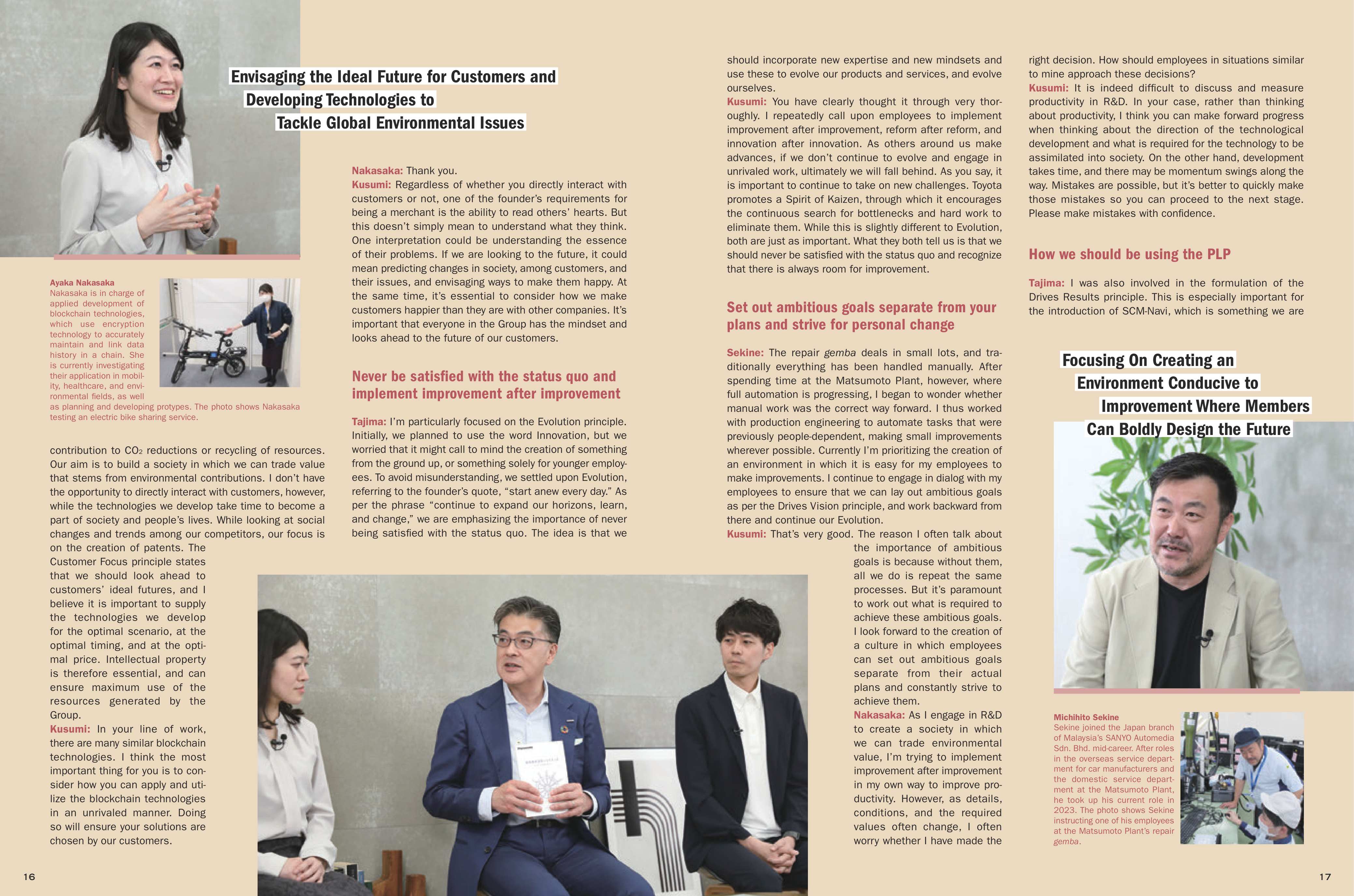
Ayaka Nakasaka
Nakasaka is in charge of
applied development of
blockchain technologies,
which use encryption
technology to accurately
maintain and link data
history in a chain. She
is currently investigating
their application in mobil
ity, healthcare, and envi
ronmental fields, as well
as planning and developing protypes. The photo shows Nakasaka
testing an electric bike sharing service.
Envisaging the Ideal Future for Customers and
Developing Technologies to
Tackle Global Environmental Issues
Never be satisfied with the status quo and
implement improvement after improvement
Set out ambitious goals separate from your
plans and strive for personal change
How we should be using the PLP
Michihito Sekine
Sekine joined the Japan branch
of Malaysia’s SANYO Automedia
Sdn. Bhd. mid-career. After roles
in the overseas service depart
ment for car manufacturers and
the domestic service depart
ment at the Matsumoto Plant,
he took up his current role in
2023. The photo shows Sekine
instructing one of his employees
at the Matsumoto Plant’s repair
gemba
.
Focusing On Creating an
Environment Conducive to
Improvement Where Members
Can Boldly Design the Future
16
17

working on at the procurement department. This system
uses information technology to make MRP*1 information
visible, but our ultimate objective is not simply visualiza
tion. Rather, we want to design improvement processes,
enhance efficiency, and generate cash. The results I want
to achieve are contributions to our operating companies
and a greater competitive advantage.
Kusumi:
Ultimately, it is people who consider and imple
ment measures for improvement. To help them do so, in
your case it’s important to think about what needs to be
made visible. But you must also understand that visualiza
tion is merely a means and not an objective. As you say, I
feel you can make more progress by clarifying why you want
to make the information visible.
Takayama:
As a PLP Project team member, I initially
thought it would be best to incorporate all 11 principles
into our employees’ basic mindset to ensure our vectors
are aligned. But when speaking to other members prior to
this discussion, some said that while all 11 principles are
easily understood, it might be difficult to implement them
all at the same time. I think one option could be to choose
several which are most important to you and engage in
specific action.
Kusumi:
I completely agree. It’s only natural that the
nature and stage of the work will differ by employee. And
so, like you say, it’s a good idea to think about those that
are of particular relevance to you. That said, I would like
everyone to prioritize the Customer Focus principle. More
over, we can also think of Ownership and Drives Results
as the foundation of our actions. For the other principles, I
think the level of importance will change depending on the
person and the nature of their work. Perhaps there could
be discussions between managers and their employees
in which managers suggest several principles to focus on
for that year, and assess how the employee’s daily actions
have been. I think this could help to establish the PLP in
our day-to-day tasks.
Takayama:
My day-to-day role is to solve the issues cus
tomers are currently facing. I hope to pass on the valuable
feedback from our customers to product planning and man
ufacturing, and in turn contribute to
the creation of medium- to long-term
strategies.
Tajima:
I will focus on making
customers happy and ensuring that
means do not become an end. As I
took part in the formulation of the
PLP, I’ll strive to lead the way in their
implementation, and ensure that
they firmly take root throughout the
organization.
Nakasaka:
In my department, we are
in a lucky position as we have time
to consider what an ideal future for
our customers looks like. To ensure
that I don’t become complacent
when designing this future, I’ll work
to build relationships with other
departments so that I can borrow
their expertise, enhance my own
expertise, and implement employee
entrepreneurship.
Sekine:
The Panasonic Leadership
Principles are a robust set of guidelines,
and I think a certain level of accountability is important if we
are to establish these principles among our employees. I’ll
continue motivating our employees to take the principles on
board.
Kusumi:
As I mentioned at the outset, the Panasonic
Leadership Principles encompass our Basic Business
Philosophy. Moving forward, it will be key to adjust and
better the principles in line with the changing times. I wrote
this in a blog at the end of April, but I think that if the Basic
Business Philosophy is the macrocosm, then the PLP is a
microcosm.*2 If we incorporate the PLP into every last one
of our cells, we can change our behavior, transform the
relationships among Panasonic employees, and transform
our relationships with customers and suppliers, and in turn
ensure that the Panasonic Group gains even more trust.
I look forward to each and every one of us incorporating
the PLP into our daily activities. Thank you all for your time
today.
All:
Thank you.
Running the Showroom as
If It Is Her Own,
Solving Customers’ Issues,
and Using Their Feedback for
Medium- to Long-term Strategies
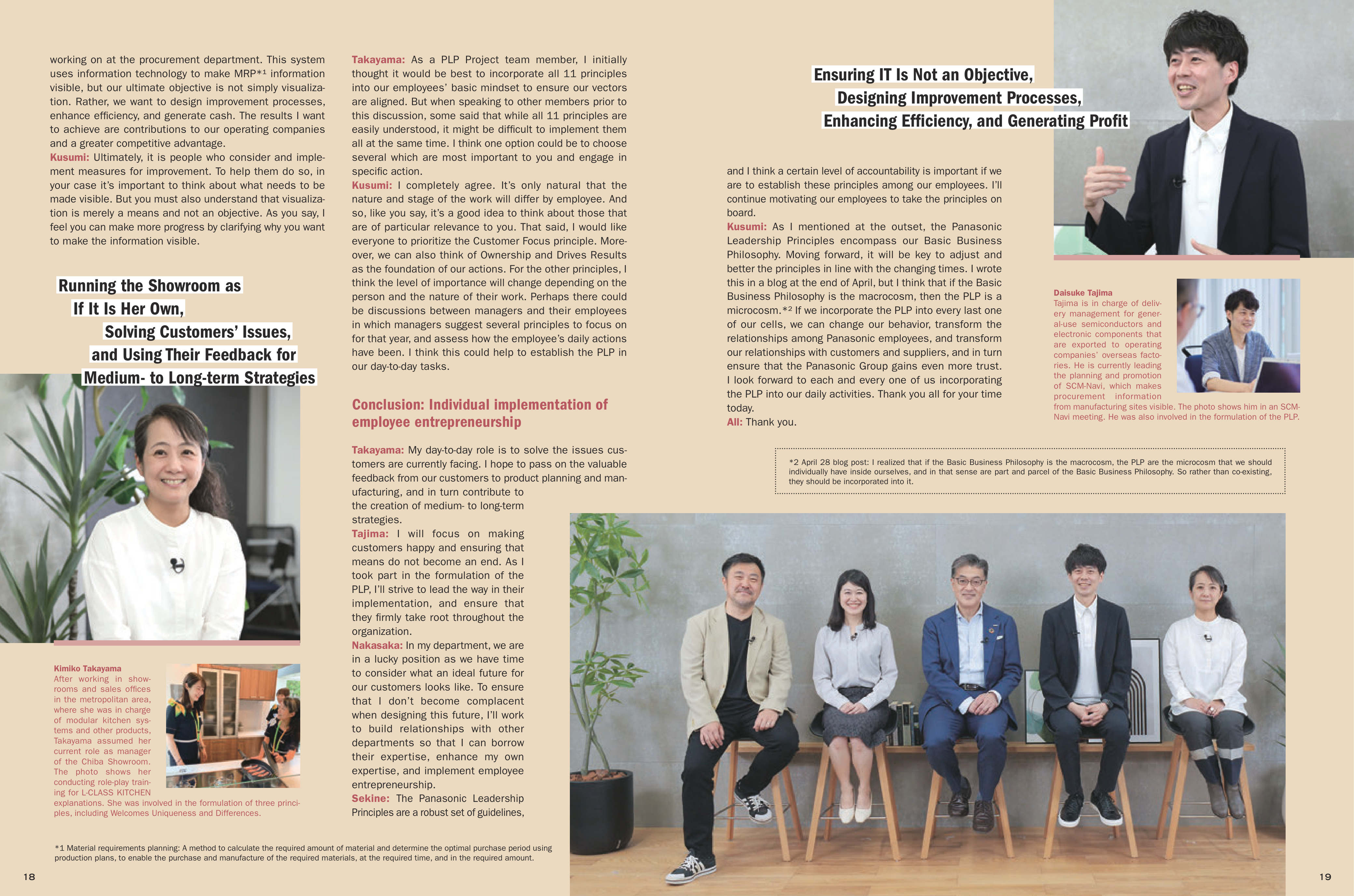
Kimiko Takayama
After working in show
rooms and sales offices
in the metropolitan area,
where she was in charge
of modular kitchen sys
tems and other products,
Takayama assumed her
current role as manager
of the Chiba Showroom.
The photo shows her
conducting role-play train
ing for L-CLASS KITCHEN
explanations. She was involved in the formulation of three princi
ples, including Welcomes Uniqueness and Differences.
*1 Material requirements planning: A method to calculate the required amount of material and determine the optimal purchase period using
production plans, to enable the purchase and manufacture of the required materials, at the required time, and in the required amount.
Conclusion: Individual implementation of
employee entrepreneurship
*2 April 28 blog post: I realized that if the Basic Business Philosophy is the macrocosm, the PLP are the microcosm that we should
individually have inside ourselves, and in that sense are part and parcel of the Basic Business Philosophy. So rather than co-existing,
they should be incorporated into it.
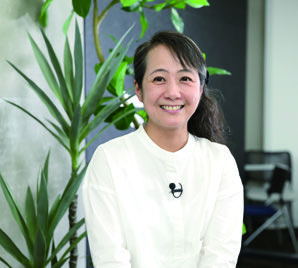
Daisuke Tajima
Tajima is in charge of deliv
ery management for gener
al-use semiconductors and
electronic components that
are exported to operating
companies’ overseas facto
ries. He is currently leading
the planning and promotion
of SCM-Navi, which makes
procurement information
from manufacturing sites visible. The photo shows him in an SCM-
Navi meeting. He was also involved in the formulation of the PLP.
Ensuring IT Is Not an Objective,
Designing Improvement Processes,
Enhancing Efficiency, and Generating Profit
18
19
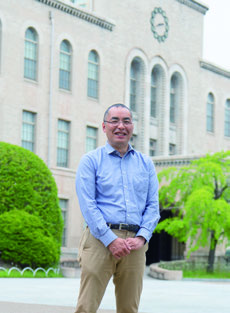
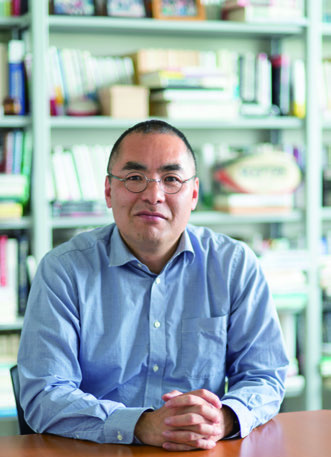


Ryuta Suzuki graduated from the School of
Business Administration at Kobe University
in 1994. He obtained his doctorate in
business administration at Kobe University
in 1999. Following stints as a visiting
researcher at University of North Carolina
and a full-time lecturer at the School of
Management and Information at the
University of Shizuoka, Suzuki took up his
current role as a professor at the Graduate
School of Business Administration at Kobe University. His main publications include
The Organization and the Individual
(Hakuto-Shobo),
Autonomous Organizational
Personnel
(JPC Publishing), and
Management of Workplace Relationships
(Yuhikaku
Publishing), for which he received the 56th Nikkei Economy Book Culture Award
and the 30th Academic Association for Organizational Science’s Takamiya Award.
A magnificent organization that is accepting of
employee entrepreneurship is key to its implemen
tation. Although in a large company there may be
many employees who feel it is difficult to implement
such an approach, if there is a close-knit community
in the workplace, it is no doubt easier for employees
to be themselves and showcase their ingenuity. It is
important to create open communities that are free of
fixed values and notions, and that constantly expose
employees to new behaviors and mindsets. It is also
important that there are open discussions in which
employees can express their differences of opinion.
Panasonic employees are lucky to have a culture of
cooperation and mutual support. On the other hand, it
seems to me as though there is too much appreciation
for reliability. There is a danger that in order to be
reliable, people will follow precedent. The key is how
to encourage people to utilize their own ideas.
One example I would like to use is that of Tamanoi
Vinegar Co., Ltd. in Osaka. Two things that Tamanoi
places particular importance on are cooperation and
the idea that employees should never think about their
limitations. In its personnel development programs, for
example, the company will entrust a major project to a
young employee. Even if the employee’s negotiations
with a client don’t go as planned and they struggle,
the company will make sure the employee continues
and does what they think needs to be done. While of
course mistakes are made, it is only when they begin
to give up on a task that they come up with new ideas.
By gaining this kind of experience, eventually they are
able to succeed. Risks must be taken to implement
employee entrepreneurship, and this is why a commu
nity that has your back and that you can turn to for
advice is paramount. Communities like this can give
encouragement, offer support, and enable you to give
everything.
One of my favorite quotes is from
The Jungle Book
by
Rudyard Kipling, in which he writes, “For the strength
of the pack is the wolf, and the
strength of the wolf is the pack.” It is
a pack that enables a wolf to develop
strength, while a strong pack is full
of strong wolves. The same can be
said for the relationship between an
individual and an organization. In other
words, it is the interaction between
the individual and their organization
that make the company stronger.
Another important element is to
develop care and consideration within
the community. A community cannot
be strong if it lacks care and consid
eration for those inside it, and it is
only once this care and consideration
exists that one can think about what
they can do to benefit the company.
For me, I don’t think employee entre
preneurship is something that can be
done alone. Rather, I believe it means
doing what you think benefits the
company alongside your colleagues.
On the other hand, for the employee
to develop a sense of attachment to
the organization, the organization
must place value on the employee.
As people, we marry or partner with
those who choose and value us. In the same way,
as long as the organization promotes employee entre
preneurship, it is essential that it values each and
every one of its employees. In turn, the employee will
develop a sense of attachment for their organization
and workplace, while the sense of security that this
environment offers will enable the employee to thor
oughly implement employee entrepreneurship. In this
sense, the organization and the individual are on an
equal footing.
Also key to a strong organization are a set of guide
lines that show employees how to implement the rele
vant philosophies and policies. However, I also believe
it is important that people do not simply abide by these
guidelines and stop thinking independently. One of the
Panasonic Leadership Principles, for example, is Cus
tomer Focus. Some might interpret this as the need
to quickly respond to customers’ needs, while others
might think it means to create something that satisfies
the customer, even if it takes time. That is to say, as
employees will implement employee entrepreneurship
in their own ways and based on diverse values, it is
important to recognize the diversity of their specific
actions. This is why, rather than being an instruction
manual or a set of rules, I believe the PLP should be a
point of reference.
While the individual principles and their details look
like employee declarations, it might be better to think
of them as a letter from your fellow colleagues about
how you should act together. Employees can then think
about how to respond to and act on this letter in their
own way. In other words, employees should think about
what Panasonic, their job, and their well-being means
to them personally, alongside the PLP. I look forward to
Panasonic employees investigating what work and life
means to them and taking concrete action.
Doing so will naturally lead to the implementation
of employee entrepreneurship, and it is then that
your close-knit workplace community becomes most
important. This in turn will enable the implementation
of employee entrepreneurship without fear.
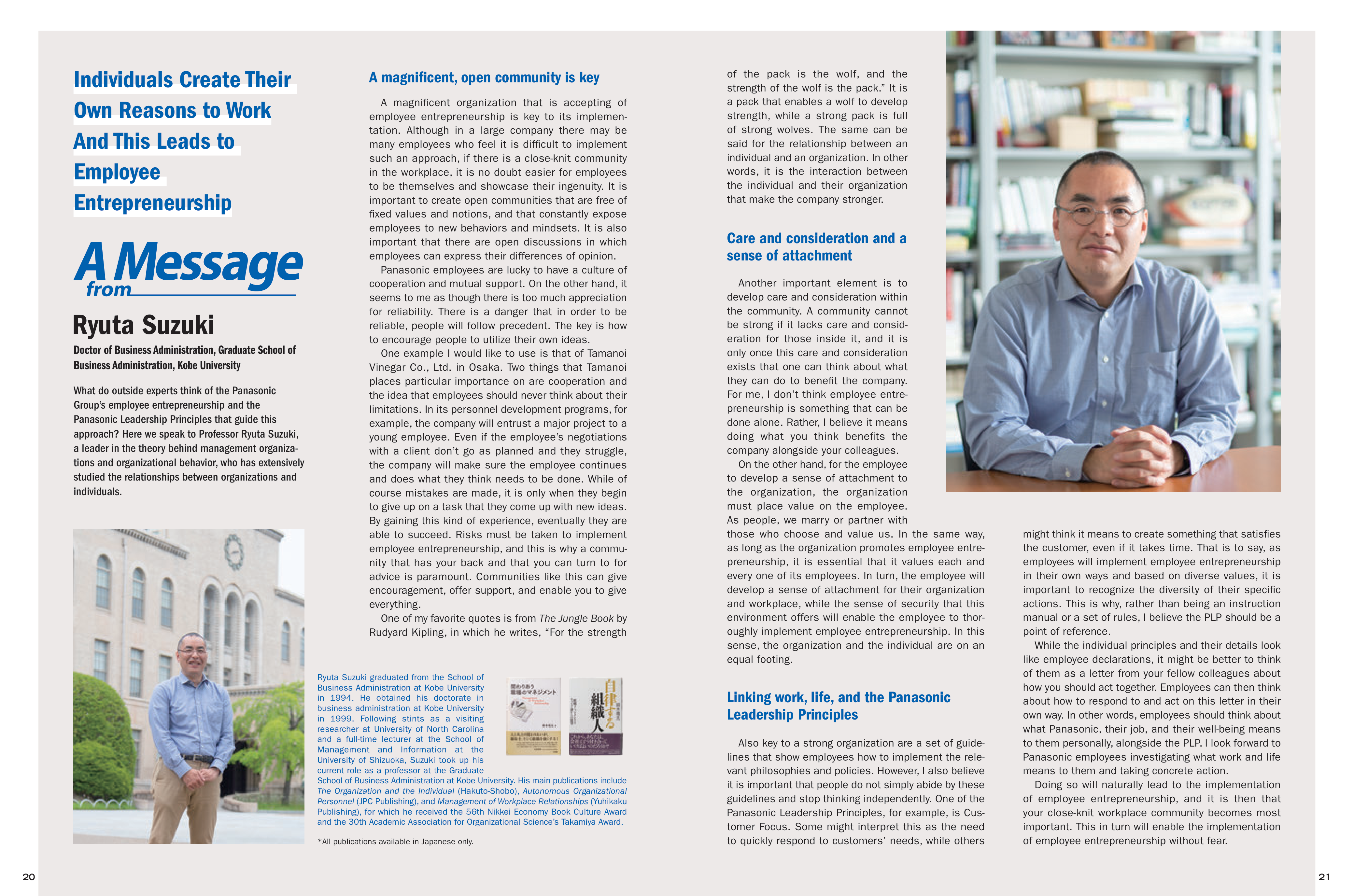
What do outside experts think of the Panasonic
Group’s employee entrepreneurship and the
Panasonic Leadership Principles that guide this
approach? Here we speak to Professor Ryuta Suzuki,
a leader in the theory behind management organiza
tions and organizational behavior, who has extensively
studied the relationships between organizations and
individuals.
Doctor of Business Administration, Graduate School of
Business Administration, Kobe University
Ryuta Suzuki
*All publications available in Japanese only.
Individuals Create Their
Own Reasons to Work
And This Leads to
Employee
Entrepreneurship
A magnificent, open community is key
Care and consideration and a
sense of attachment
Linking work, life, and the Panasonic
Leadership Principles
20
21

6
Vol.
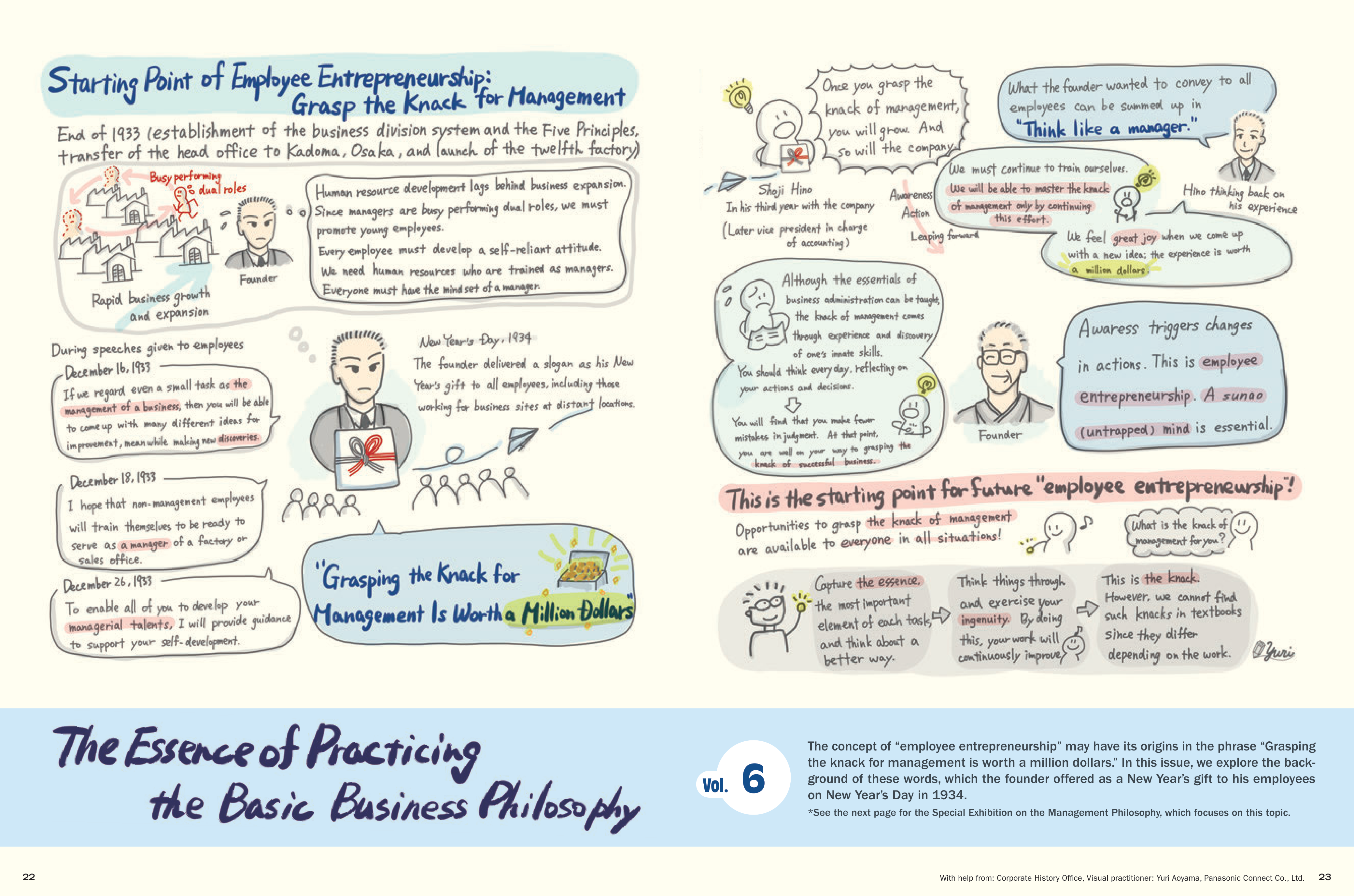
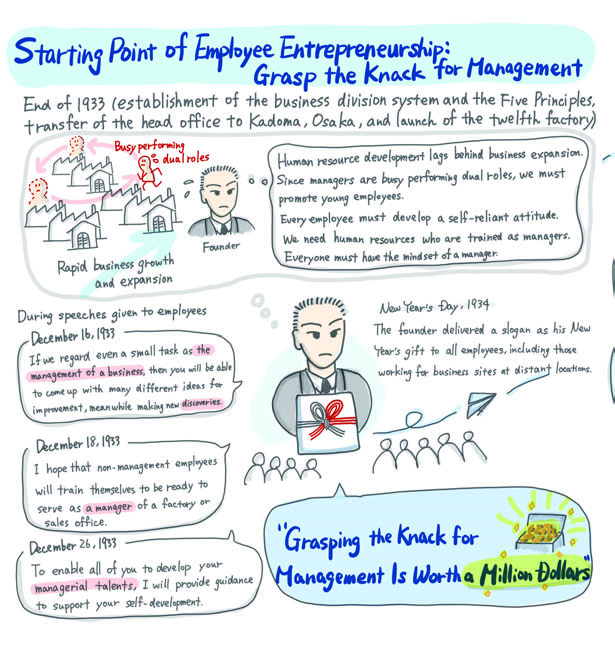
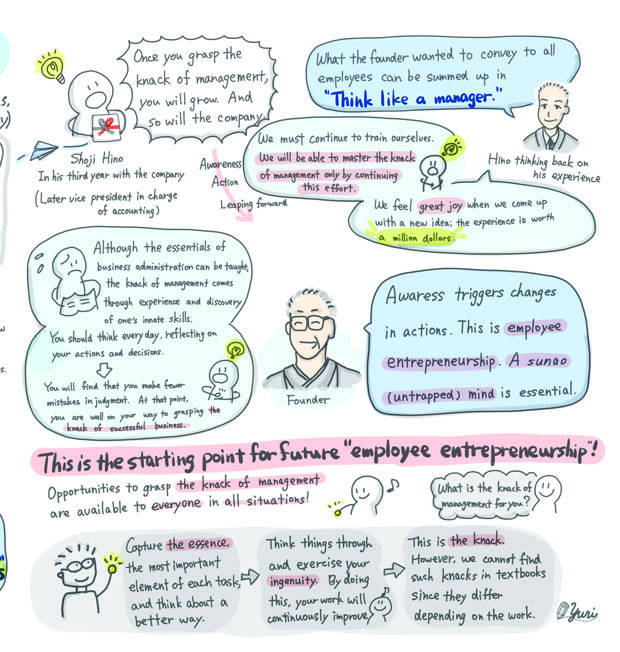
The concept of “employee entrepreneurship” may have its origins in the phrase “Grasping
the knack for management is worth a million dollars.” In this issue, we explore the back-
ground of these words, which the founder offered as a New Year’s gift to his employees
on New Year’s Day in 1934.
*See the next page for the Special Exhibition on the Management Philosophy, which focuses on this topic.
With help from: Corporate History Office, Visual practitioner: Yuri Aoyama, Panasonic Connect Co., Ltd.
22
23
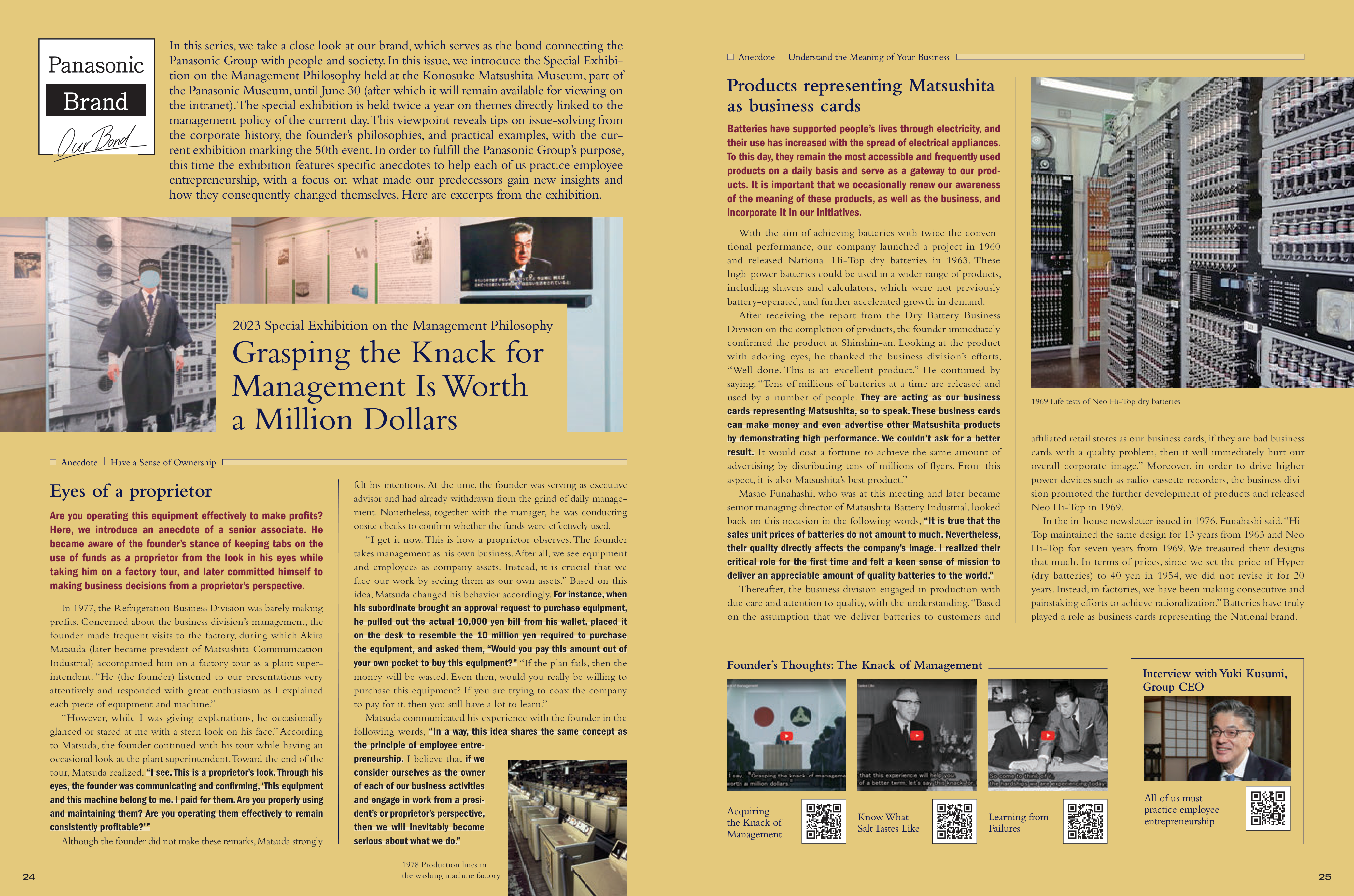
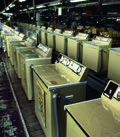
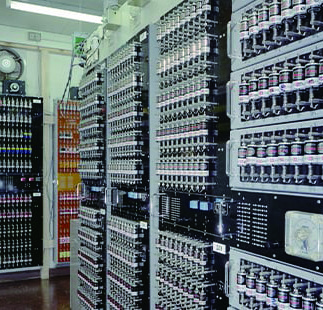
1969 Life tests of Neo Hi-Top dry batteries
In 1977, the Refrigeration Business Division was barely making
profits. Concerned about the business division’s management, the
founder made frequent visits to the factory, during which Akira
Matsuda (later became president of Matsushita Communication
Industrial) accompanied him on a factory tour as a plant super
intendent. “He (the founder) listened to our presentations very
attentively and responded with great enthusiasm as I explained
each piece of equipment and machine.”
“However, while I was giving explanations, he occasionally
glanced or stared at me with a stern look on his face.” According
to Matsuda, the founder continued with his tour while having an
occasional look at the plant superintendent. Toward the end of the
tour, Matsuda realized,
“I see. This is a proprietor’s look. Through his
eyes, the founder was communicating and confirming, ‘This equipment
and this machine belong to me. I paid for them. Are you properly using
and maintaining them? Are you operating them effectively to remain
consistently profitable?’”
Although the founder did not make these remarks, Matsuda strongly
With the aim of achieving batteries with twice the conven
tional performance, our company launched a project in 1960
and released National Hi-Top dry batteries in 1963. These
high-power batteries could be used in a wider range of products,
including shavers and calculators, which were not previously
battery-operated, and further accelerated growth in demand.
After receiving the report from the Dry Battery Business
Division on the completion of products, the founder immediately
confirmed the product at Shinshin-an. Looking at the product
with adoring eyes, he thanked the business division’s efforts,
“Well done. This is an excellent product.” He continued by
saying, “Tens of millions of batteries at a time are released and
used by a number of people.
They are acting as our business
cards representing Matsushita, so to speak. These business cards
can make money and even advertise other Matsushita products
by demonstrating high performance. We couldn’t ask for a better
result.
It would cost a fortune to achieve the same amount of
advertising by distributing tens of millions of flyers. From this
aspect, it is also Matsushita’s best product.”
Masao Funahashi, who was at this meeting and later became
senior managing director of Matsushita Battery Industrial, looked
back on this occasion in the following words,
“It is true that the
sales unit prices of batteries do not amount to much. Nevertheless,
their quality directly affects the company’s image. I realized their
critical role for the first time and felt a keen sense of mission to
deliver an appreciable amount of quality batteries to the world.”
Thereafter, the business division engaged in production with
due care and attention to quality, with the understanding, “Based
on the assumption that we deliver batteries to customers and
felt his intentions. At the time, the founder was serving as executive
advisor and had already withdrawn from the grind of daily manage
ment. Nonetheless, together with the manager, he was conducting
onsite checks to confirm whether the funds were effectively used.
“I get it now. This is how a proprietor observes. The founder
takes management as his own business. After all, we see equipment
and employees as company assets. Instead, it is crucial that we
face our work by seeing them as our own assets.” Based on this
idea, Matsuda changed his behavior accordingly.
For instance, when
his subordinate brought an approval request to purchase equipment,
he pulled out the actual 10,000 yen bill from his wallet, placed it
on the desk to resemble the 10 million yen required to purchase
the equipment, and asked them, “Would you pay this amount out of
your own pocket to buy this equipment?”
“If the plan fails, then the
money will be wasted. Even then, would you really be willing to
purchase this equipment? If you are trying to coax the company
to pay for it, then you still have a lot to learn.”
Matsuda communicated his experience with the founder in the
following words,
“In a way, this idea shares the same concept as
the principle of employee entre
preneurship.
I believe that
if we
consider ourselves as the owner
of each of our business activities
and engage in work from a presi
dent’s or proprietor’s perspective,
then we will inevitably become
serious about what we do.”
affiliated retail stores as our business cards, if they are bad business
cards with a quality problem, then it will immediately hurt our
overall corporate image.” Moreover, in order to drive higher
power devices such as radio-cassette recorders, the business divi
sion promoted the further development of products and released
Neo Hi-Top in 1969.
In the in-house newsletter issued in 1976, Funahashi said, “Hi-
Top maintained the same design for 13 years from 1963 and Neo
Hi-Top for seven years from 1969. We treasured their designs
that much. In terms of prices, since we set the price of Hyper
(dry batteries) to 40 yen in 1954, we did not revise it for 20
years. Instead, in factories, we have been making consecutive and
painstaking efforts to achieve rationalization.” Batteries have truly
played a role as business cards representing the National brand.
Are you operating this equipment effectively to make profits?
Here, we introduce an anecdote of a senior associate. He
became aware of the founder’s stance of keeping tabs on the
use of funds as a proprietor from the look in his eyes while
taking him on a factory tour, and later committed himself to
making business decisions from a proprietor’s perspective.
Batteries have supported people’s lives through electricity, and
their use has increased with the spread of electrical appliances.
To this day, they remain the most accessible and frequently used
products on a daily basis and serve as a gateway to our prod
ucts. It is important that we occasionally renew our awareness
of the meaning of these products, as well as the business, and
incorporate it in our initiatives.
Eyes of a proprietor
Grasping the Knack for
Management Is Worth
a Million Dollars
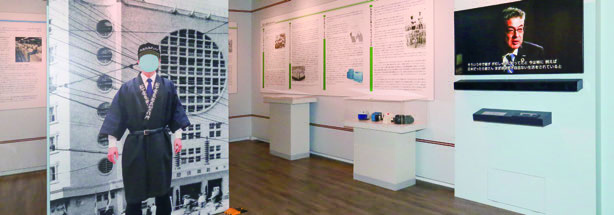
2023 Special Exhibition on the Management Philosophy
In this series, we take a close look at our brand, which serves as the bond connecting the
Panasonic Group with people and society. In this issue, we introduce the Special Exhibi
tion on the Management Philosophy held at the Konosuke Matsushita Museum, part of
the Panasonic Museum, until June 30 (after which it will remain available for viewing on
the intranet). The special exhibition is held twice a year on themes directly linked to the
management policy of the current day. This viewpoint reveals tips on issue-solving from
the corporate history, the founder’s philosophies, and practical examples, with the cur
rent exhibition marking the 50th event. In order to fulfill the Panasonic Group’s purpose,
this time the exhibition features specific anecdotes to help each of us practice employee
entrepreneurship, with a focus on what made our predecessors gain new insights and
how they consequently changed themselves. Here are excerpts from the exhibition.
Products representing Matsushita
as business cards
1978 Production lines in
the washing machine factory
Have a Sense of Ownership
Anecdote
Understand the Meaning of Your Business
Anecdote
Founder’s Thoughts: The Knack of Management
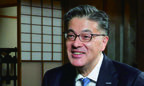
Interview with Yuki Kusumi,
Group CEO
Acquiring
the Knack of
Management
Know What
Salt Tastes Like
Learning from
Failures
All of us must
practice employee
entrepreneurship
24
25
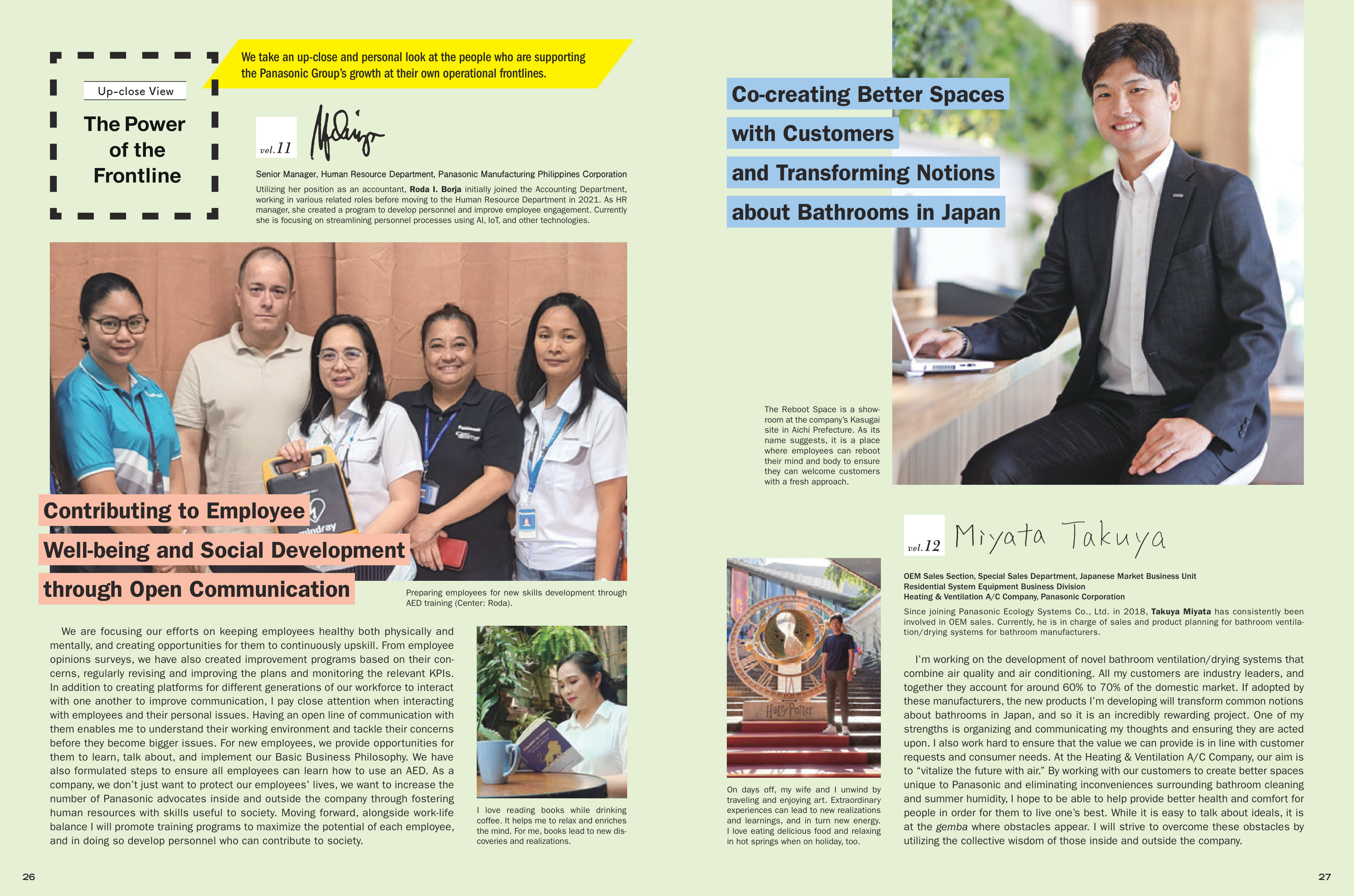


We take an up-close and personal look at the people who are supporting
the Panasonic Group’s growth at their own operational frontlines.
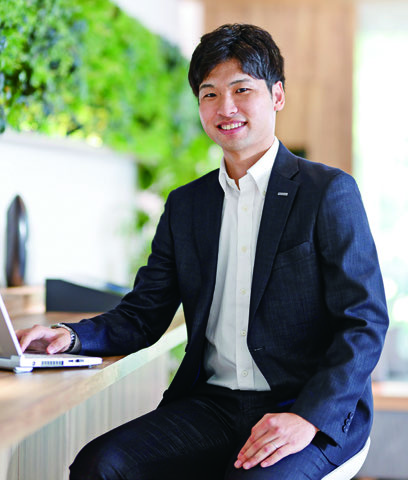
I’m working on the development of novel bathroom ventilation/drying systems that
combine air quality and air conditioning. All my customers are industry leaders, and
together they account for around 60% to 70% of the domestic market. If adopted by
these manufacturers, the new products I’m developing will transform common notions
about bathrooms in Japan, and so it is an incredibly rewarding project. One of my
strengths is organizing and communicating my thoughts and ensuring they are acted
upon. I also work hard to ensure that the value we can provide is in line with customer
requests and consumer needs. At the Heating & Ventilation A/C Company, our aim is
to “vitalize the future with air.” By working with our customers to create better spaces
unique to Panasonic and eliminating inconveniences surrounding bathroom cleaning
and summer humidity, I hope to be able to help provide better health and comfort for
people in order for them to live one’s best. While it is easy to talk about ideals, it is
at the
gemba
where obstacles appear. I will strive to overcome these obstacles by
utilizing the collective wisdom of those inside and outside the company.
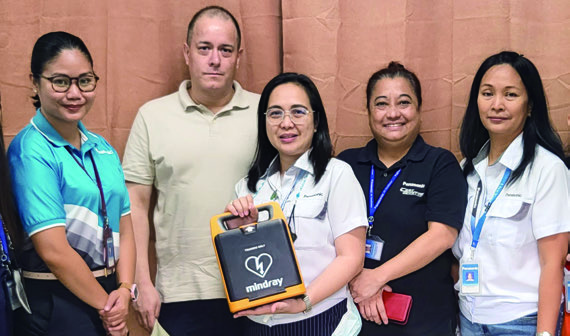
We are focusing our efforts on keeping employees healthy both physically and
mentally, and creating opportunities for them to continuously upskill. From employee
opinions surveys, we have also created improvement programs based on their con
cerns, regularly revising and improving the plans and monitoring the relevant KPIs.
In addition to creating platforms for different generations of our workforce to interact
with one another to improve communication, I pay close attention when interacting
with employees and their personal issues. Having an open line of communication with
them enables me to understand their working environment and tackle their concerns
before they become bigger issues. For new employees, we provide opportunities for
them to learn, talk about, and implement our Basic Business Philosophy. We have
also formulated steps to ensure all employees can learn how to use an AED. As a
company, we don’t just want to protect our employees’ lives, we want to increase the
number of Panasonic advocates inside and outside the company through fostering
human resources with skills useful to society. Moving forward, alongside work-life
balance I will promote training programs to maximize the potential of each employee,
and in doing so develop personnel who can contribute to society.
On days off, my wife and I unwind by
traveling and enjoying art. Extraordinary
experiences can lead to new realizations
and learnings, and in turn new energy.
I love eating delicious food and relaxing
in hot springs when on holiday, too.
I love reading books while drinking
coffee. It helps me to relax and enriches
the mind. For me, books lead to new dis
coveries and realizations.
The Reboot Space is a show
room at the company’s Kasugai
site in Aichi Prefecture. As its
name suggests, it is a place
where employees can reboot
their mind and body to ensure
they can welcome customers
with a fresh approach.
Since joining Panasonic Ecology Systems Co., Ltd. in 2018,
Takuya Miyata
has consistently been
involved in OEM sales. Currently, he is in charge of sales and product planning for bathroom ventila
tion/drying systems for bathroom manufacturers.
OEM Sales Section, Special Sales Department, Japanese Market Business Unit
Residential System Equipment Business Division
Heating & Ventilation A/C Company, Panasonic Corporation
Utilizing her position as an accountant,
Roda I. Borja
initially joined the Accounting Department,
working in various related roles before moving to the Human Resource Department in 2021. As HR
manager, she created a program to develop personnel and improve employee engagement. Currently
she is focusing on streamlining personnel processes using AI, IoT, and other technologies.
Senior Manager, Human Resource Department, Panasonic Manufacturing Philippines Corporation
vol.
11
vol.
12
Contributing to Employee
Well-being and Social Development
Co-creating Better Spaces
with Customers
Preparing employees for new skills development through
AED training (Center: Roda).
through Open Communication
and Transforming Notions
about Bathrooms in Japan
26
27




Meet The Athletes
Know, Learn, Connect
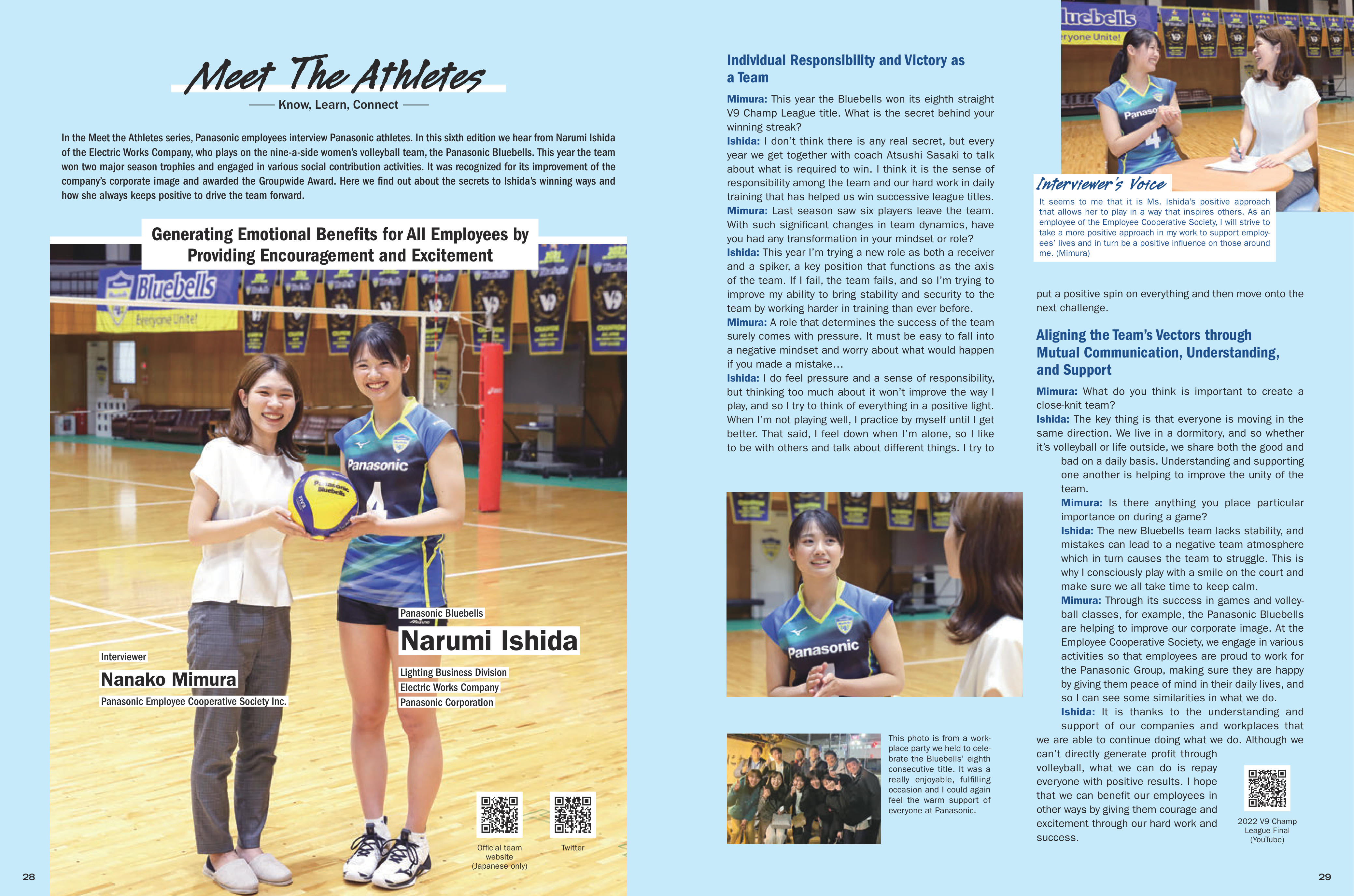
In the Meet the Athletes series, Panasonic employees interview Panasonic athletes. In this sixth edition we hear from Narumi Ishida
of the Electric Works Company, who plays on the nine-a-side women’s volleyball team, the Panasonic Bluebells. This year the team
won two major season trophies and engaged in various social contribution activities. It was recognized for its improvement of the
company’s corporate image and awarded the Groupwide Award. Here we find out about the secrets to Ishida’s winning ways and
how she always keeps positive to drive the team forward.
Mimura:
This year the Bluebells won its eighth straight
V9 Champ League title. What is the secret behind your
winning streak?
Ishida:
I don’t think there is any real secret, but every
year we get together with coach Atsushi Sasaki to talk
about what is required to win. I think it is the sense of
responsibility among the team and our hard work in daily
training that has helped us win successive league titles.
Mimura:
Last season saw six players leave the team.
With such significant changes in team dynamics, have
you had any transformation in your mindset or role?
Ishida:
This year I’m trying a new role as both a receiver
and a spiker, a key position that functions as the axis
of the team. If I fail, the team fails, and so I’m trying to
improve my ability to bring stability and security to the
team by working harder in training than ever before.
Mimura:
A role that determines the success of the team
surely comes with pressure. It must be easy to fall into
a negative mindset and worry about what would happen
if you made a mistake…
Ishida:
I do feel pressure and a sense of responsibility,
but thinking too much about it won’t improve the way I
play, and so I try to think of everything in a positive light.
When I’m not playing well, I practice by myself until I get
better. That said, I feel down when I’m alone, so I like
to be with others and talk about different things. I try to
put a positive spin on everything and then move onto the
next challenge.
Mimura:
What do you think is important to create a
close-knit team?
Ishida:
The key thing is that everyone is moving in the
same direction. We live in a dormitory, and so whether
it’s volleyball or life outside, we share both the good and
bad on a daily basis. Understanding and supporting
one another is helping to improve the unity of the
team.
Mimura:
Is there anything you place particular
importance on during a game?
Ishida:
The new Bluebells team lacks stability, and
mistakes can lead to a negative team atmosphere
which in turn causes the team to struggle. This is
why I consciously play with a smile on the court and
make sure we all take time to keep calm.
Mimura:
Through its success in games and volley
ball classes, for example, the Panasonic Bluebells
are helping to improve our corporate image. At the
Employee Cooperative Society, we engage in various
activities so that employees are proud to work for
the Panasonic Group, making sure they are happy
by giving them peace of mind in their daily lives, and
so I can see some similarities in what we do.
Ishida:
It is thanks to the understanding and
support of our companies and workplaces that
we are able to continue doing what we do. Although we
can’t directly generate profit through
volleyball, what we can do is repay
everyone with positive results. I hope
that we can benefit our employees in
other ways by giving them courage and
excitement through our hard work and
success.
Individual Responsibility and Victory as
a Team
Aligning the Team’s Vectors through
Mutual Communication, Understanding,
and Support
Generating Emotional Benefits for All Employees by
Providing Encouragement and Excitement
This photo is from a work
place party we held to cele
brate the Bluebells’ eighth
consecutive title. It was a
really enjoyable, fulfilling
occasion and I could again
feel the warm support of
everyone at Panasonic.
Interviewer’s Voice
It seems to me that it is Ms. Ishida’s positive approach
that allows her to play in a way that inspires others. As an
employee of the Employee Cooperative Society, I will strive to
take a more positive approach in my work to support employ
ees’ lives and in turn be a positive influence on those around
me. (Mimura)
Narumi Ishida
Lighting Business Division
Panasonic Bluebells
Nanako Mimura
Panasonic Employee Cooperative Society Inc.
Interviewer
Electric Works Company
Panasonic Corporation
Official team
website
(Japanese only)
Twitter
2022 V9 Champ
League Final
(YouTube)
28
29
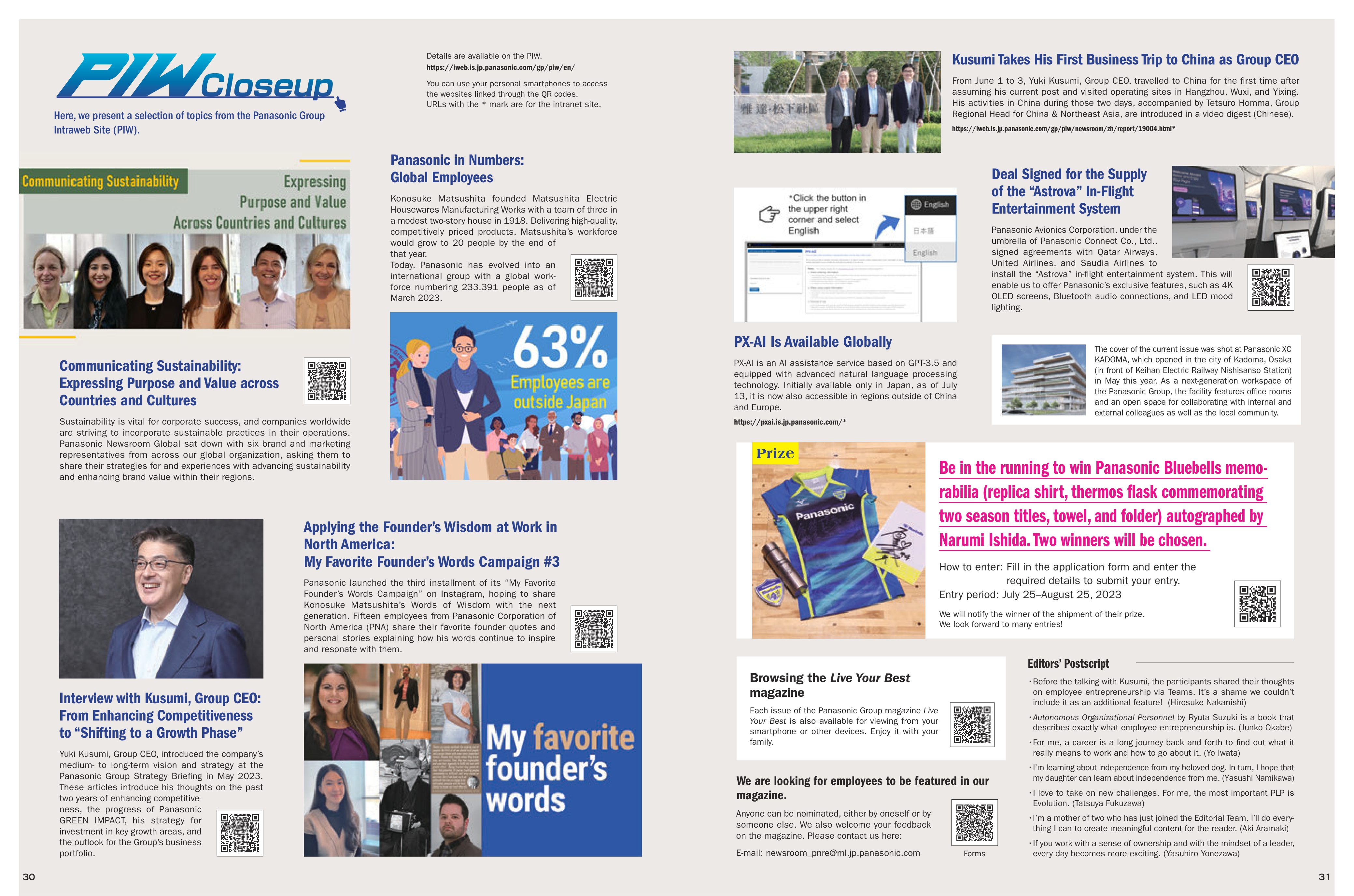

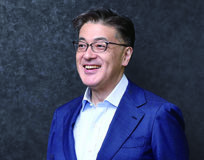




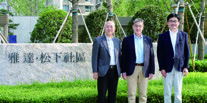
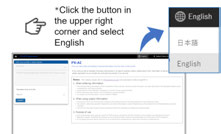


•
Autonomous Organizational Personnel
by Ryuta Suzuki is a book that
describes exactly what employee entrepreneurship is. (Junko Okabe)
•Before the talking with Kusumi, the participants shared their thoughts
on employee entrepreneurship via Teams. It’s a shame we couldn’t
include it as an additional feature! (Hirosuke Nakanishi)
•For me, a career is a long journey back and forth to find out what it
really means to work and how to go about it. (Yo Iwata)
•
I’m learning about independence from my beloved dog. In turn, I hope that
my daughter can learn about independence from me. (Yasushi Namikawa)
•I’m a mother of two who has just joined the Editorial Team. I’ll do every
thing I can to create meaningful content for the reader. (Aki Aramaki)
•If you work with a sense of ownership and with the mindset of a leader,
every day becomes more exciting. (Yasuhiro Yonezawa)
•I love to take on new challenges. For me, the most important PLP is
Evolution. (Tatsuya Fukuzawa)
You can use your personal smartphones to access
the websites linked through the QR codes.
URLs with the * mark are for the intranet site.
Sustainability is vital for corporate success, and companies worldwide
are striving to incorporate sustainable practices in their operations.
Panasonic Newsroom Global sat down with six brand and marketing
representatives from across our global organization, asking them to
share their strategies for and experiences with advancing sustainability
and enhancing brand value within their regions.
Communicating Sustainability:
Expressing Purpose and Value across
Countries and Cultures
Konosuke Matsushita founded Matsushita Electric
Housewares Manufacturing Works with a team of three in
a modest two-story house in 1918. Delivering high-quality,
competitively priced products, Matsushita’s workforce
would grow to 20 people by the end of
that year.
Today, Panasonic has evolved into an
international group with a global work
force numbering 233,391 people as of
March 2023.
Panasonic launched the third installment of its “My Favorite
Founder’s Words Campaign” on Instagram, hoping to share
Konosuke Matsushita’s Words of Wisdom with the next
generation. Fifteen employees from Panasonic Corporation of
North America (PNA) share their favorite founder quotes and
personal stories explaining how his words continue to inspire
and resonate with them.
Yuki Kusumi, Group CEO, introduced the company’s
medium- to long-term vision and strategy at the
Panasonic Group Strategy Briefing in May 2023.
These articles introduce his thoughts on the past
two years of enhancing competitive
ness, the progress of Panasonic
GREEN IMPACT, his strategy for
investment in key growth areas, and
the outlook for the Group’s business
portfolio.
From June 1 to 3, Yuki Kusumi, Group CEO, travelled to China for the first time after
assuming his current post and visited operating sites in Hangzhou, Wuxi, and Yixing.
His activities in China during those two days, accompanied by Tetsuro Homma, Group
Regional Head for China & Northeast Asia, are introduced in a video digest (Chinese).
PX-AI is an AI assistance service based on GPT-3.5 and
equipped with advanced natural language processing
technology. Initially available only in Japan, as of July
13, it is now also accessible in regions outside of China
and Europe.
Panasonic Avionics Corporation, under the
umbrella of Panasonic Connect Co., Ltd.,
signed agreements with Qatar Airways,
United Airlines, and Saudia Airlines to
install the “Astrova” in-flight entertainment system. This will
enable us to offer Panasonic’s exclusive features, such as 4K
OLED screens, Bluetooth audio connections, and LED mood
lighting.
Panasonic in Numbers:
Global Employees
Applying the Founder’s Wisdom at Work in
North America:
My Favorite Founder’s Words Campaign #3
Interview with Kusumi, Group CEO:
From Enhancing Competitiveness
to “Shifting to a Growth Phase”
Kusumi Takes His First Business Trip to China as Group CEO
PX-AI Is Available Globally
Deal Signed for the Supply
of the “Astrova” In-Flight
Entertainment System
Here, we present a selection of topics from the Panasonic Group
Intraweb Site (PIW).
Editors’ Postscript
Details are available on the PIW.
https://iweb.is.jp.panasonic.com/gp/piw/en/
How to enter: Fill in the application form and enter the
required details to submit your entry.
Entry period: July 25–August 25, 2023
We will notify the winner of the shipment of their prize.
We look forward to many entries!
Be in the running to win Panasonic Bluebells memo
rabilia (replica shirt, thermos flask commemorating
two season titles, towel, and folder) autographed by
Narumi Ishida. Two winners will be chosen.
Prize
Each issue of the Panasonic Group magazine
Live
Your Best
is also available for viewing from your
smartphone or other devices. Enjoy it with your
family.
Browsing the
Live Your Best
magazine
https://pxai.is.jp.panasonic.com/*
We are looking for employees to be featured in our
magazine.
Anyone can be nominated, either by oneself or by
someone else. We also welcome your feedback
on the magazine. Please contact us here:
E-mail: newsroom_pnre@ml.jp.panasonic.com
Forms
https://iweb.is.jp.panasonic.com/gp/piw/newsroom/zh/report/19004.html
*
The cover of the current issue was shot at Panasonic XC
KADOMA, which opened in the city of Kadoma, Osaka
(in front of Keihan Electric Railway Nishisanso Station)
in May this year. As a next-generation workspace of
the Panasonic Group, the facility features office rooms
and an open space for collaborating with internal and
external colleagues as well as the local community.
30
31