
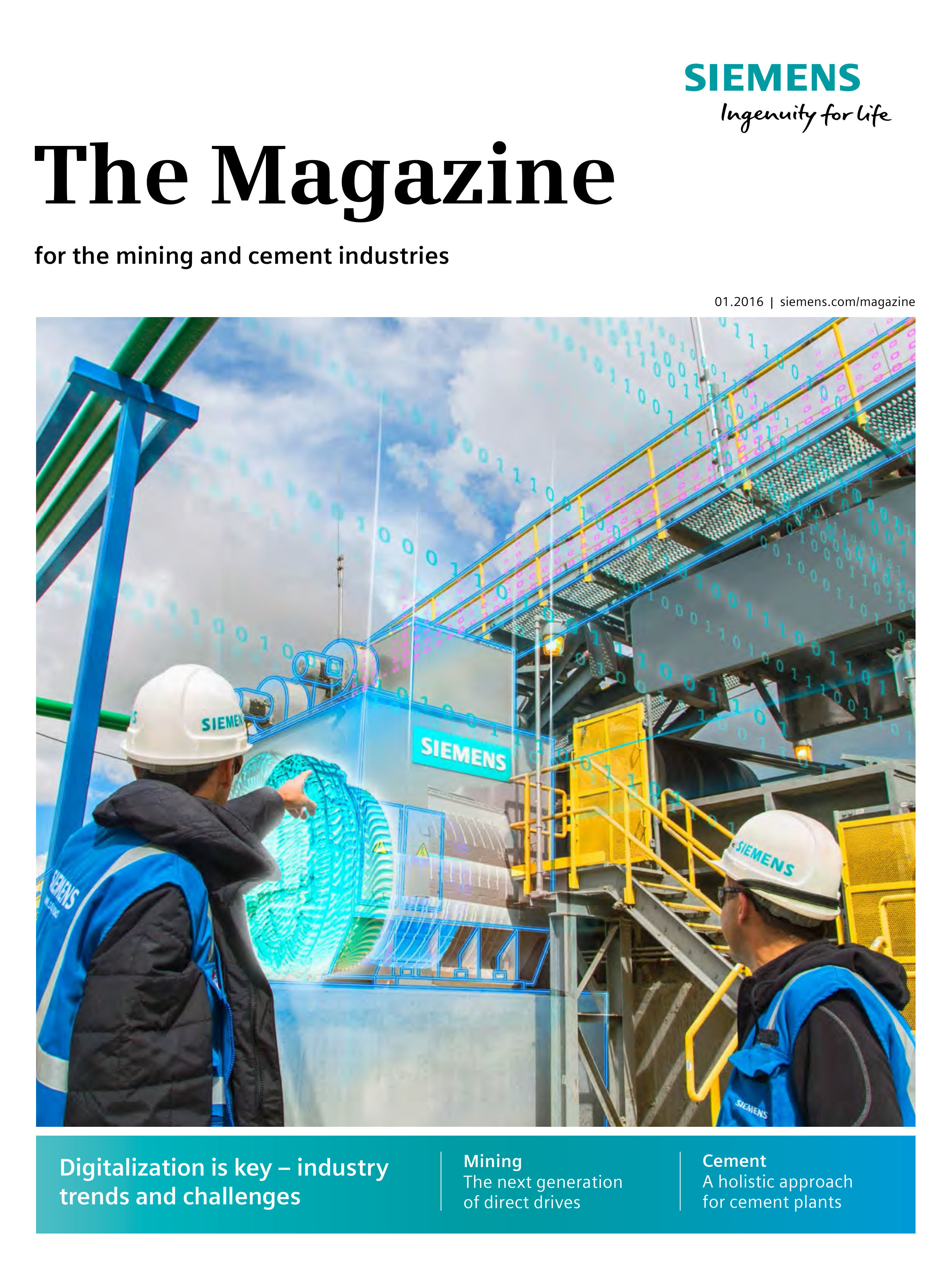
Digitalization is key – industry
trends and challenges
Mining
The next generation
of direct drives
Cement
A holistic approach
for cement plants
01.2016 | siemens.com/magazine
The Magazine
for the mining and cement industries
Contents
3
Editorial |
4
Imprint |
4
News
14
Onboard energy storage systems are significantly
improving hauling operations
18
Mining for productivity and profit
at the Sentinel copper mine
30
Cong Thanh cement plant benefits
from an integrated automation and drive system
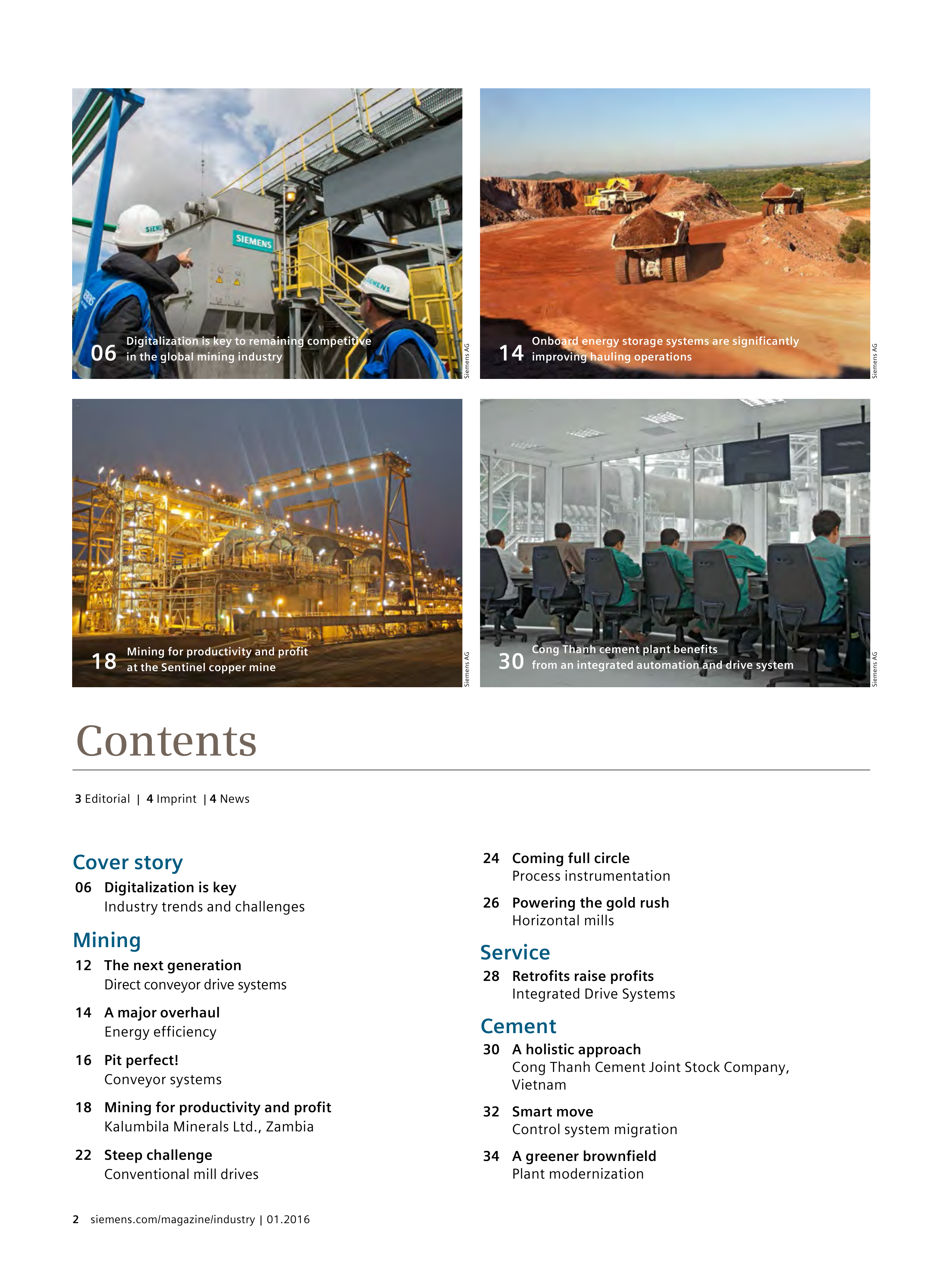
06
Digitalization is key to remaining competitive
in the global mining industry
Cover story
06
Digitalization is key
Industry trends and challenges
Mining
12
The next generation
Direct conveyor drive systems
14
A major overhaul
Energy efficiency
16
Pit perfect!
Conveyor systems
18
Mining for productivity and profit
Kalumbila Minerals Ltd., Zambia
22
Steep challenge
Conventional mill drives
24
Coming full circle
Process instrumentation
26
Powering the gold rush
Horizontal mills
Service
28
Retrofits raise profits
Integrated Drive Systems
Cement
30
A holistic approach
Cong Thanh Cement Joint Stock Company,
Vietnam
32
Smart move
Control system migration
34
A greener brownfield
Plant modernization
Siemens AG
Siemens AG
Siemens AG
Siemens AG
2
siemens.com/magazine/industry | 01.2016


Over the last three years in the mining industry, we have seen substantial
changes – from the all-time high prices of gold, copper, and iron ore in
2011 to the historic lows of today’s commodity prices. When asked when the
market will recover, experts are hesitant to make precise predictions – but as
Deloitte’s 2016 trend outlook for mining suggests, we may not be there yet.
Instead of hoping for the best, operators, engineering companies, and equip-
ment suppliers should focus on exploiting synergies and optimization poten-
tial in order to remain competitive in an increasingly challenging and volatile
market.
Digitalization can provide several levers for this. From improved asset man-
agement to smart sourcing and efficient global collaboration, software and
data can help companies streamline their processes. For example, simulation
tools can help increase the output of existing equipment, such as gearless
drives (see page 18). Another area for operational improvement is energy
efficiency. As mining operations expand and the grades that can be mined
deteriorate, the amount of material that needs to be transported and the
transport distances increase – resulting in higher emissions and costs. Our
experts have devised several solutions that address this issue, for example,
energy-storage systems for small trucks (see page 14) and an efficient drive
solution for a new pipe conveyor system for open-pit mining (see page 16).
As a trusted partner to the mining and cement industries, we support opera-
tional excellence first and foremost with our proven products, systems, and
solutions for electrification and automation: robust, reliable, and efficient
integrated drive systems and integrated automation solutions that provide
both the control and the data needed to optimize operations, including sourc-
ing and maintenance. These solutions are complemented by our digitalization
portfolio. Tools such as Comos for integrated engineering and highly-efficient
operations can help streamline the design and implementation of new proj-
ects, and our operations intelligence software XHQ can help operators collate
and assess data from various sources for informed decision making.
With this issue of our customer magazine, we want to provide you with some
insights into how companies can improve their operations with our solutions.
For a more detailed and hands-on experience of our products, systems, and
services, come visit us at the BAUMA 2016 exhibition (booth 325 in hall C2) in
Munich, April 11–17. We look forward to seeing you there!
Kind regards,
Mikael Leksell,
CEO, Process Industries and Drives - Process Solutions
Success is a matter
of drive and partnership
01.2016 | siemens.com/magazine/industry
3
Imprint
Order from B2Gold, Canada
Siemens supplies drive systems
for two gold mills
Siemens project partner FLSmidth was commissioned
by Canadian gold producer B2Gold at the end of 2015
to supply two mills for grinding the ore in its new plant
in Mali. FLSmidth will be supplying a semi-autogenous
grinding (SAG) mill as well as a ball mill. Both mills will
be equipped with Siemens Integrated Drive Systems that
will help B2Gold reduce its capital investment and save
up to 50% on spare parts.
By using converter technology for regulating the
rated speed of the SAG mill motors so that the four large
Flender gears all work with the same transmission ratio,
both mill types can operate with the same gear size and
design. This reduces capital investment for the mechan-
ical drives by 17%
and spare parts costs
by up to 50%.
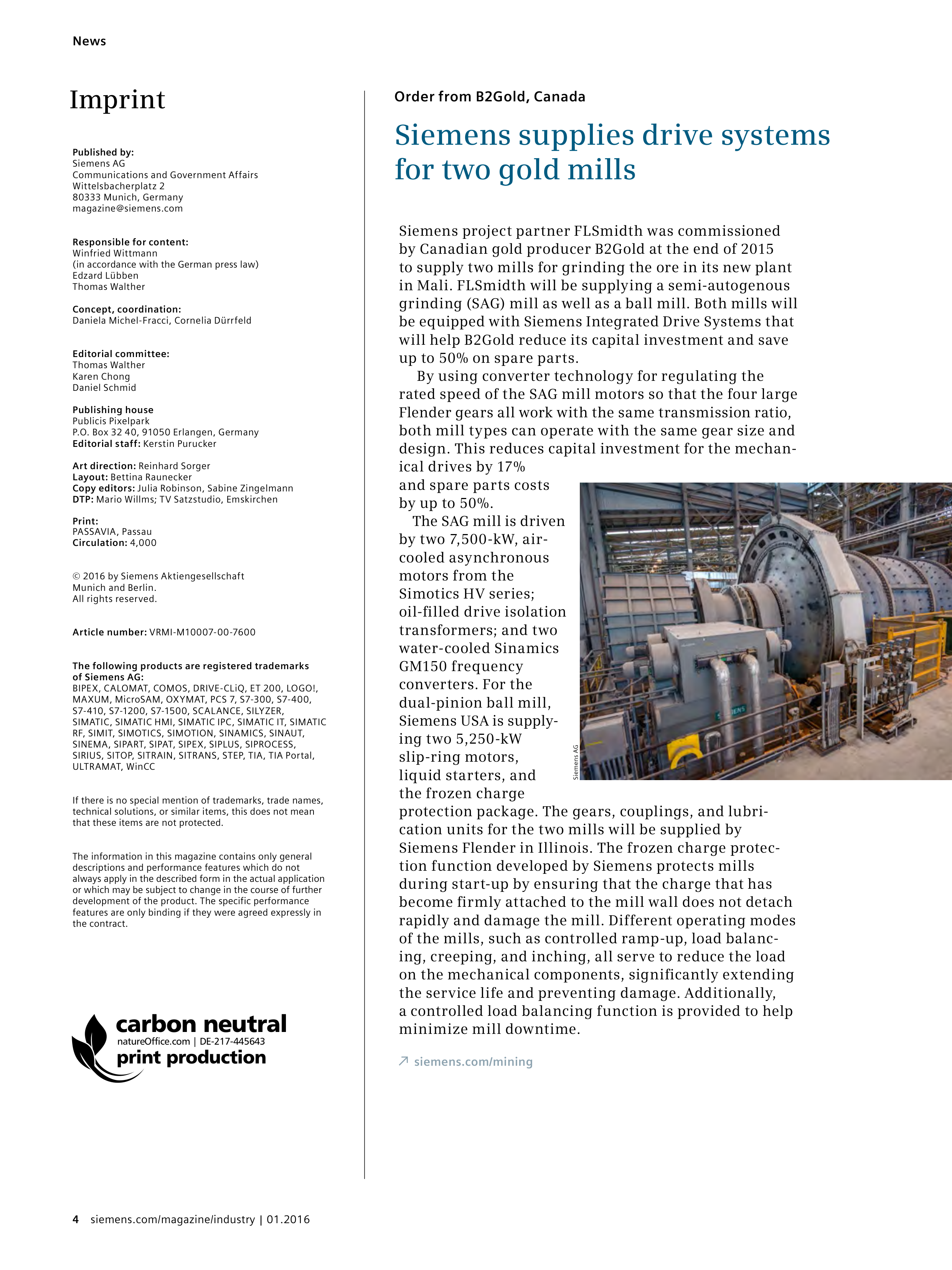
The SAG mill is driven
by two 7,500-kW, air-
cooled asynchronous
motors from the
Simotics HV series;
oil-filled drive isolation
transformers; and two
water-cooled Sinamics
GM150 frequency
converters. For the
dual-pinion ball mill,
Siemens USA is supply-
ing two 5,250-kW
slip-ring motors,
liquid starters, and
the frozen charge
protection package. The gears, couplings, and lubri
cation units for the two mills will be supplied by
Siemens Flender in Illinois. The frozen charge protec-
tion function developed by Siemens protects mills
during start-up by ensuring that the charge that has
become firmly attached to the mill wall does not detach
rapidly and damage the mill. Different operating modes
of the mills, such as controlled ramp-up, load balanc-
ing, creeping, and inching, all serve to reduce the load
on the mechanical components, significantly extending
the service life and preventing damage. Additionally,
a controlled load balancing function is provided to help
minimize mill downtime.
siemens.com/mining
Published by:
Siemens AG
Communications and Government Affairs
Wittelsbacherplatz 2
80333 Munich, Germany
magazine@siemens.com
Responsible for content:
Winfried Wittmann
(in accordance with the German press law)
Edzard Lübben
Thomas Walther
Concept, coordination:
Daniela Michel-Fracci, Cornelia Dürrfeld
Editorial committee:
Thomas Walther
Karen Chong
Daniel Schmid
Publishing house
Publicis Pixelpark
P.O. Box 32 40, 91050 Erlangen, Germany
Editorial staff:
Kerstin Purucker
Art direction:
Reinhard Sorger
Layout:
Bettina Raunecker
Copy editors:
Julia Robinson, Sabine Zingelmann
DTP:
Mario Willms; TV Satzstudio, Emskirchen
Print:
PASSAVIA, Passau
Circulation:
4,000
© 2016 by Siemens Aktiengesellschaft
Munich and Berlin.
All rights reserved.
Article number:
VRMI-M10007-00-7600
The following products are registered trademarks
of Siemens AG:
BIPEX, CALOMAT, COMOS, DRIVE-CLiQ, ET 200, LOGO!,
MAXUM, MicroSAM, OXYMAT, PCS 7, S7-300, S7-400,
S7-410, S7-1200, S7-1500, SCALANCE, SILYZER,
SIMATIC, SIMATIC HMI, SIMATIC IPC, SIMATIC IT, SIMATIC
RF, SIMIT, SIMOTICS, SIMOTION, SINAMICS, SINAUT,
SINEMA, SIPART, SIPAT, SIPEX, SIPLUS, SIPROCESS,
SIRIUS, SITOP, SITRAIN, SITRANS, STEP, TIA, TIA Portal,
ULTRAMAT, WinCC
If there is no special mention of trademarks, trade names,
technical solutions, or similar items, this does not mean
that these items are not protected.
The information in this magazine contains only general
descriptions and performance features which do not
always apply in the described form in the actual application
or which may be subject to change in the course of further
development of the product. The specific performance
features are only binding if they were agreed expressly in
the contract.
carbon neutral
natureOffice.com | DE-217-445643
print production
Siemens AG
4
siemens.com/magazine/industry | 01.2016
News
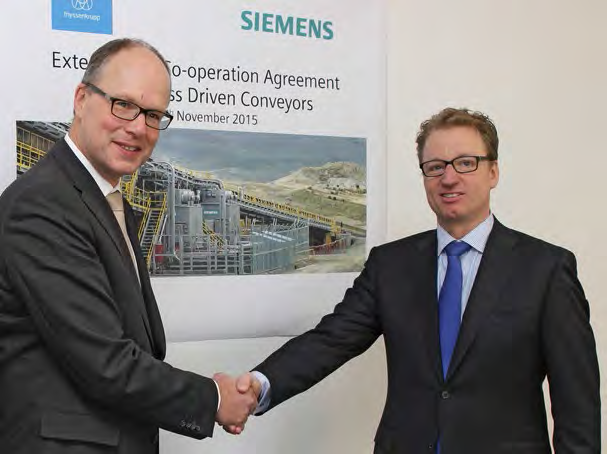
thyssenkrupp Industrial Solutions and Siemens have
extended their successful collaboration for mining
conveying system solutions for another five years,
which ensures that the mining industry will continue
to profit from innovative and reliable transport sys-
tems and solutions.
The mining industry is faced with falling grades
and new mines in remote locations, both leading to the
need to transport more material over longer distances.
“Conveying technology must keep up with the com
plex requirements of the modern mining industry. We
want to continue offering our customers reliable and
highly-efficient conveyor systems,” says Jens Michael
Wegmann, Chairman of the Management Board of the
Industrial Solutions business area of thyssenkrupp.
“It is only possible to optimize modern mechatronic
belt drive systems like this by working in close colla
boration with a partner because the mechanics and
the motor form a self-contained unit. That’s why we
are continuing the tried and tested collaboration with
Siemens,” Wegmann continues.
In mining, robust, reliable, and easy-maintenance
drive technology is a key component of conveyor sys-
tems. “We are happy to be able to keep on supporting
thyssenkrupp with our well-proven direct drive sys-
tems featuring Sinamics cycloconverters and rugged
synchronous motors that have undergone continuous
development in recent years,” says Jürgen Brandes,
CEO, Siemens Process Industries and Drives. Both
Together with the well-established engineering
service provider and Siemens Solution Partner CESA
Cement Engineering SA, renowned for excellence in
engineering and consultancy services for industrial,
mining, and cement plant projects, from feasibility
studies to commissioning to start-up, Siemens has
recently successfully implemented several inter
national cement projects, meeting tight schedules
and overcoming challenging conditions.
One particular project to benefit from the smooth
cooperation between Siemens and CESA is NOCIBE,
owned by Les Ciments du Sahel, currently the largest
cement plant in Benin. But CESA and Siemens also
collaborated on a new CMS Cement plant in Kuching,
Malaysia, and a new cement factory for Germany’s
Schwenk Group in Ohorongo, Namibia. In every case
CESA served as a very reliable consultant and engi-
neering services provider to the end customer, and
Siemens is looking forward to future projects with
CESA Cement Engineering.
siemens.com/cement
Mining technology
thyssenkrupp Industrial
Solutions and Siemens
continue partnership
CESA Cement Engineering SA
Successful collaboration based on a trusted partnership
Siemens AG
thyssenkrupp and Siemens have many years of experi-
ence in mining and lead the sector in their respective
technological fields. The two companies have success-
fully implemented a number of joint projects in recent
years. thyssenkrupp provided the conveyor system
for Xstrata Copper in the Antapaccay and Las Bambas
copper mines in Peru, for example. And Siemens
provided thyssenkrupp with the direct drive for
the world’s largest conveyor belt. The belt conveyor
system is being erected in the Peruvian Cuajone
mine belonging to the Mexican Southern Copper
Corporation mining company.
siemens.com/mining
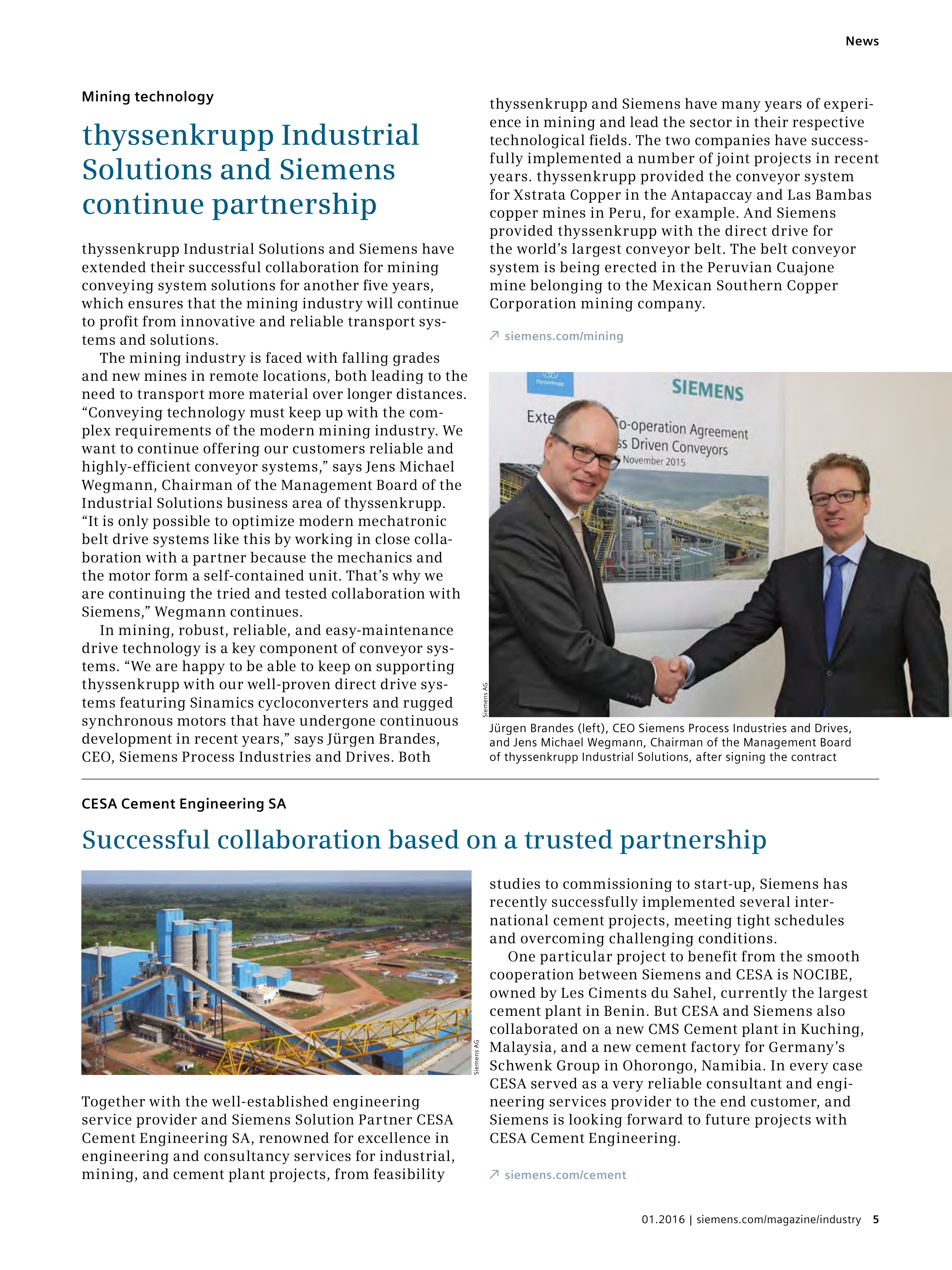
Jürgen Brandes (left), CEO Siemens Process Industries and Drives,
and Jens Michael Wegmann, Chairman of the Management Board
of thyssenkrupp Industrial Solutions, after signing the contract
Siemens AG
Siemens AG
01.2016 | siemens.com/magazine/industry
5
News

6
siemens.com/magazine/industry | 01.2016
Digitalization
is key
From tumbling commodity prices and declining global
demand to growing safety and security risks, the
global mining industry faces major challenges as well as
mounting stakeholder expectations. In order to stay
competitive, companies must become leaner, stronger,
and more innovative. Digitalization is key to achieving
these goals.
Cover
Cover
01.2016 | siemens.com/magazine/industry
7
he main elements of com
petitiveness are productivity
and operational excellence.
This reality has not changed over
the centuries. What has changed,
however, are the possibilities mod-
ern technology offers – especially
to those who are open to rethink-
ing the entire mining process. In
this context, digitalization plays
a crucial role.
Operational excellence today
In the past, enhancing operational
excellence in the mining industry
often meant nothing more than
simply cutting costs. But now, mod-
ern technology is opening up new
ways to achieve breakthroughs in
productivity. Leading mining com-
panies all over the world are con-
tinually investing in state-of-the-
art automation, energy, and drill-
T
ing systems in order to increase
mining intensity with lower per
sonnel and energy costs. Some
companies are able to achieve
energy savings of 10% to 40%
through renewable energy instal
lations, innovative energy tech
nologies, and highly automated
mining processes.
Advanced distributed control
systems (DCSs), such as Simatic
PCS 7, are critical here. The open,
flexible, and scalable architecture
of PCS 7 ensures maximum pro-
ductivity and reliability. Thanks to
its integration with safety, indus-
trial security, and energy man
agement systems, it helps protect
personnel, machinery, and the
environment – and lays the foun-
dation for the digital enterprise.
Its integrated Advanced Process
Library (APL) provides the best

Cover
8
siemens.com/magazine/industry | 01.2016
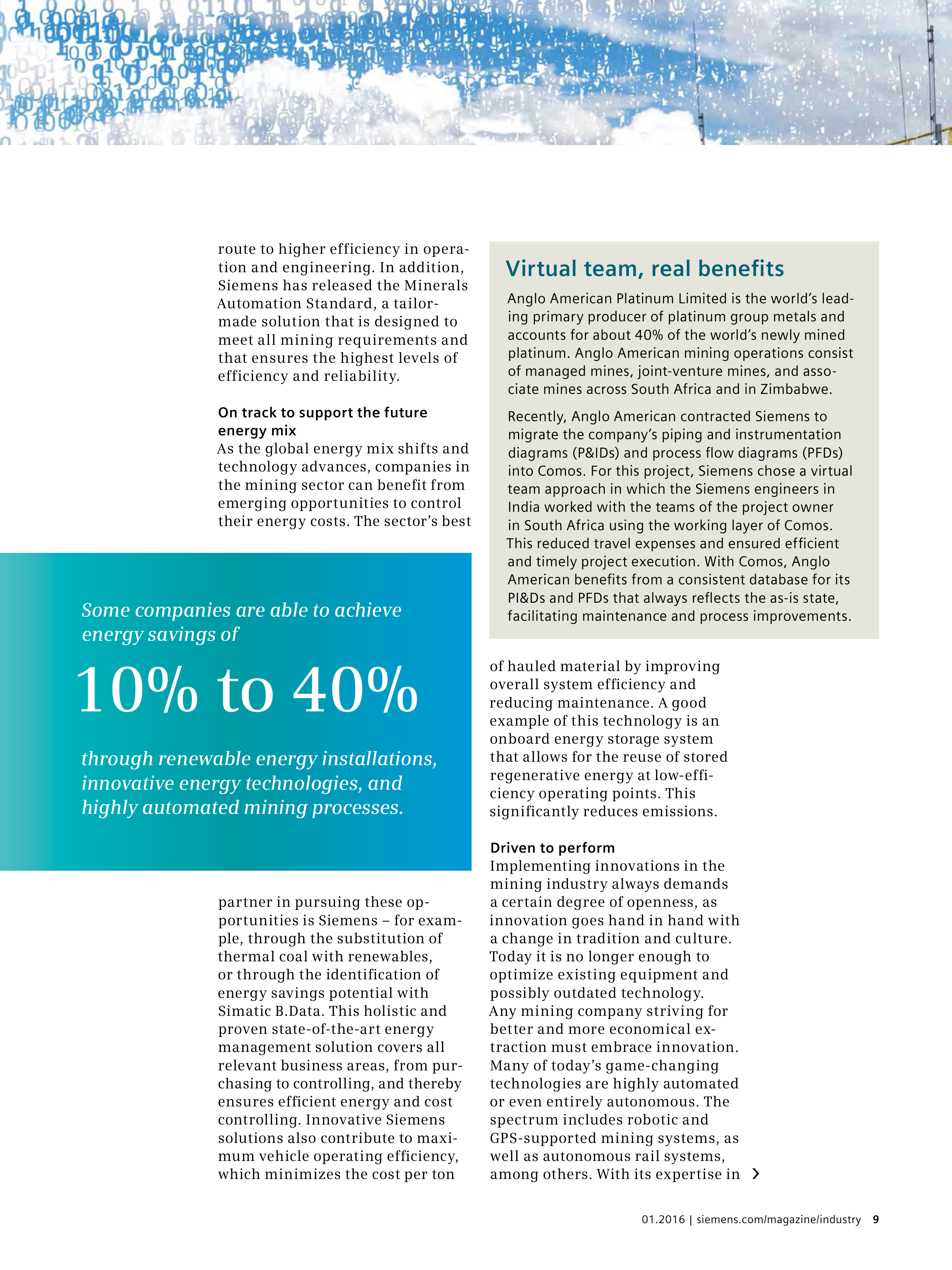
Siemens offers
a wide range
of products and
solutions for
digitalization
Discovering the
potential of
digitalization: The
intelligent use of
process data can
help improve asset
utilization, logistics,
and maintenance,
contributing to
overall operational
excellence
01
01011100011001010100
11010101
0110011
0011001101
11
10101010
0
10100001
01011100011001010100
11010101
0110011
0011001101
11
1
1100010100
10100001
01011100011001010100
11010101
0110011
0011
1100011001010100
11010101
0110011
0011001101
11
10101010000001
01
01011100011001010100
11010101
0110011
0011001101
11
10101010
0
10100001
01011100011001010100
11010101
0110011
0011001101
11
1
0010100
10100001
01011100011001010100
11010101
0110011
0011001
100001
01011100011001010100
11010101
0110011
0011001101
11
1010
0
1
1
0
1
0
1
0
1
0
1
0
1
0
1
0
0
1
0
1
1
0
1010101
011010101010
10
0
1
1
0
1
0
1
0101010
0
1
1
0
1
0
1
0101010100101101010101
011
0
1
0
1
0
1
0
1
0
1
0
1
0
0
1
0
1
1
0
1
0
1
0110101101010101010
1001011010
101010110101
011010
10101010
011010
10101010100101101010101
011010101010
10100101101010110101101
011010
10101010100101101010101
011010101010
10100101101010110101101
0
0
1
0
0
1
0
1
1
0
1
0
1
0
1
1
0
1
0
1
0
1
1
0
0
1
0
1
1
0
1
0
1
0
1
0
1
0
1
0
1
0
1
0
1
1
0
1
0
1
0
1
0
0
1
0
1
0
1
0
1
0
0
1
0
1
1
0
1
0
1
0
1
1
0
1
0
1
0
1
1
0
0
1
0
1
0
1
0
1
1
0
1
0
1
0
1
0
1
0
1
0
1
0
0
1
0
1
1
0
1
0
1
0
1
1
0
1
0
1
0
1
1
0
0
1
0
1
1
0
1
0
1
0
1
0
1
0
1
0
1
0
1
0
1
0
1
0
1
0
1
0
1
0
0
1
0
1
0
1
0
1
0
0
1
0
1
1
0
1
0
1
0
1
1
0
1
0
1
0
1
1
1
0
0
1
0
1
0
1
0
1
0
1
1
0
1
0
1
0
1
0
1
0
1
0
1
0
0
1
0
1
1
0
1
0
1
0
1
1
0
1
0
1
0
1
1
0
0
1
0
1
1
0
1
0
1
0
1
0
1
0
1
0
1
0
1
0
1
0
1
0
1
0
1
01
0
0
1
0
1
0
1
0
1
0
0
1
0
1
1
0
1
0
1
0
1
1
0
1
0
1
0
1
1
1010101010
10101
0101
01010
100101
1
0
1
0
1
0
1
0
1
0
1
1
0
1
0
1
0
1
1
0
1
0
10101010100101101010101
011010101010
10
01
011
0
1
0
1
0
1
0
1
0
1
0
1
0
0
1
0
1
1
0
1
0
1
0110101101010101010
1001011010
101010110101
0110
101010
1001011010
101010110101
01
0
101010
1001011010
10101011010
0
10
011010
10101010100101101010101
011010101010
10100101101010110101101
1
0
1
0
1
0
1
1
0
1
0
1
0
1
0
1
0
1
0
1
0
0
1
0
1
1
0
1
0
1
0
1
1
0
1
0
1
0
1
1
0
0
1
0
1
1
0
1
0
1
0
1
0
1
0
1
0
1
0
1
0
1
0
1
0
1
0
1
0
1
0
0
1
0
1
0
1
0
1
0
0
1
0
1
1
0
1
0
1
0
1
1
0
1
0
1
0
1
1
0
0
153.4 kWh
22° 16' 47''S
68° 54' 2'' W
5,263 MTPH
43.6 mm/s
How much
Where
am I?
What’s my
capacity?
What about
my vibrations?
do I consume?

Cover
01.2016 | siemens.com/magazine/industry
9
route to higher efficiency in opera-
tion and engineering. In addition,
Siemens has released the Minerals
Automation Standard, a tailor-
made solution that is designed to
meet all mining requirements and
that ensures the highest levels of
efficiency and reliability.
On track to support the future
energy mix
As the global energy mix shifts and
technology advances, companies in
the mining sector can benefit from
emerging opportunities to control
their energy costs. The sector’s best
partner in pursuing these op
portunities is Siemens – for exam-
ple, through the substitution of
thermal coal with renewables,
or through the identification of
energy savings potential with
Simatic B.Data. This holistic and
proven state-of-the-art energy
management solution covers all
relevant business areas, from pur-
chasing to controlling, and thereby
ensures efficient energy and cost
controlling. Innovative Siemens
solutions also contribute to maxi-
mum vehicle operating efficiency,
which minimizes the cost per ton
Virtual team, real benefits
Anglo American Platinum Limited is the world’s lead-
ing primary producer of platinum group metals and
accounts for about 40% of the world’s newly mined
platinum. Anglo American mining operations consist
of managed mines, joint-venture mines, and asso
ciate mines across South Africa and in Zimbabwe.
Recently, Anglo American contracted Siemens to
migrate the company’s piping and instrumentation
diagrams (P&IDs) and process flow diagrams (PFDs)
into Comos. For this project, Siemens chose a virtual
team approach in which the Siemens engineers in
India worked with the teams of the project owner
in South Africa using the working layer of Comos.
This reduced travel expenses and ensured efficient
and timely project execution. With Comos, Anglo
American benefits from a consistent database for its
PI&Ds and PFDs that always reflects the as-is state,
facilitating maintenance and process improvements.
of hauled material by improving
overall system efficiency and
reducing maintenance. A good
example of this technology is an
onboard energy storage system
that allows for the reuse of stored
regenerative energy at low-effi
ciency operating points. This
significantly reduces emissions.
Driven to perform
Implementing innovations in the
mining industry always demands
a certain degree of openness, as
innovation goes hand in hand with
a change in tradition and culture.
Today it is no longer enough to
optimize existing equipment and
possibly outdated technology.
Any mining company striving for
better and more economical ex-
traction must embrace innovation.
Many of today’s game-changing
technologies are highly automated
or even entirely autonomous. The
spectrum includes robotic and
GPS-supported mining systems, as
well as autonomous rail systems,
among others. With its expertise in
Some companies are able to achieve
energy savings of
10% to 40%
through renewable energy installations,
innovative energy technologies, and
highly automated mining processes
.

Cover
10
siemens.com/magazine/industry | 01.2016
automation and robotics, Siemens
can help deploy these technologies
in mining.
Another innovation issue that
must be addressed is improving
asset management so that it can
help mining companies look past
tomorrow. Enhanced asset manage-
ment is key for the implementation
of smart repair and maintenance
strategies – and therefore contrib-
utes to maximum availability and
productivity with minimum effort.
Among the most valuable assets in
the mining industry are the drive
systems. They must meet ever ris-
ing demands in extraction, trans-
portation, and beneficiation. Gear-
less drives; perfect interaction be-
tween sensors, IT, and mechanics;
and intelligent service strategies
are key here – and with Siemens,
mining companies always benefit
from cutting-edge technology.
Siemens offers the world’s first
true one-stop solution for entire
drivetrains, setting new standards
with Integrated Drive Systems (IDS).
IDS ensure perfect interaction of all
components, reduced engineering
effort, maximum investment secu-
rity, and lower operating costs.
Digitalization also paves the way
for enhanced efficiency in employ-
ees’ daily routines by providing the
right information to the right per-
XHQ Operations Intelligence in mining
XHQ Operations Intelligence solutions deliver
real-time, actionable views based on real-
time operational and business data. In mining
operations, there are several areas in which
this can help improve operations:
◾
Real-time energy management using both
leading and lagging indicators helps reduce
energy consumption and costs, provides
faster access to critical information for plan-
ning and production tuning, and enables the
exploitation of opportunities to capitalize on
energy spot market price fluctuations for buy/
sell.
◾
Integrated equipment monitoring for fixed
(rock crushers, conveyors, etc.) and mobile
(excavators, bucket wheels, draglines, haul-
ers, etc.) assets helps reduce incidents and
equipment downtime and facilitates main
tenance.
◾
Asset management dashboards help com
panies improve reliability, plan and control
maintenance budgets, and manage assets by
exception.
◾
An equipment and work order browser
solution can bridge the gap between engi-
neering and maintenance information sys-
tems and processes, improve work processes,
and reduce equipment lifecycle costs.
◾
Fleet management enables real-time over-
sight of mobile equipment, enhances site
safety by reducing incident risk, and enables
faster access to information for incident pre-
vention and remediation.
◾
Real-time performance management pro-
vides a global data aggregation and presen
tation context for fast access to critical infor-
mation for decision making and a reduced
risk of operational incidents and losses.

Cover
01.2016 | siemens.com/magazine/industry
11
siemens.com/mining
thomas.walther@siemens.com
son at the right time. With its
unified data platform, the Comos
engineering and collaboration soft-
ware provides all involved parties
with a continuous flow of data that
meets their specific needs across
all project phases.
Data. Mining. Industrie 4.0
With global trends such as digitali-
zation and Industrie 4.0 becoming
more and more relevant to the
mining industry, companies need
solutions that not only collect and
visualize operational data but also
manage them across different
sites. The good news is that today’s
systems already offer most of the
functionality that is needed: they
make it possible to share valuable
experience and insights with
other sites via a seamless data
transfer – and thereby not only
help solve problems but also allow
for company-wide process and
plant performance comparison
and optimization.
Innovative Siemens
solutions also contribute
to maximum vehicle
operating efficiency,
which minimizes the
cost per ton of hauled
material by improving
overall system
efficiency and reducing
maintenance.
Siemens AG
12
siemens.com/magazine/industry | 01.2016
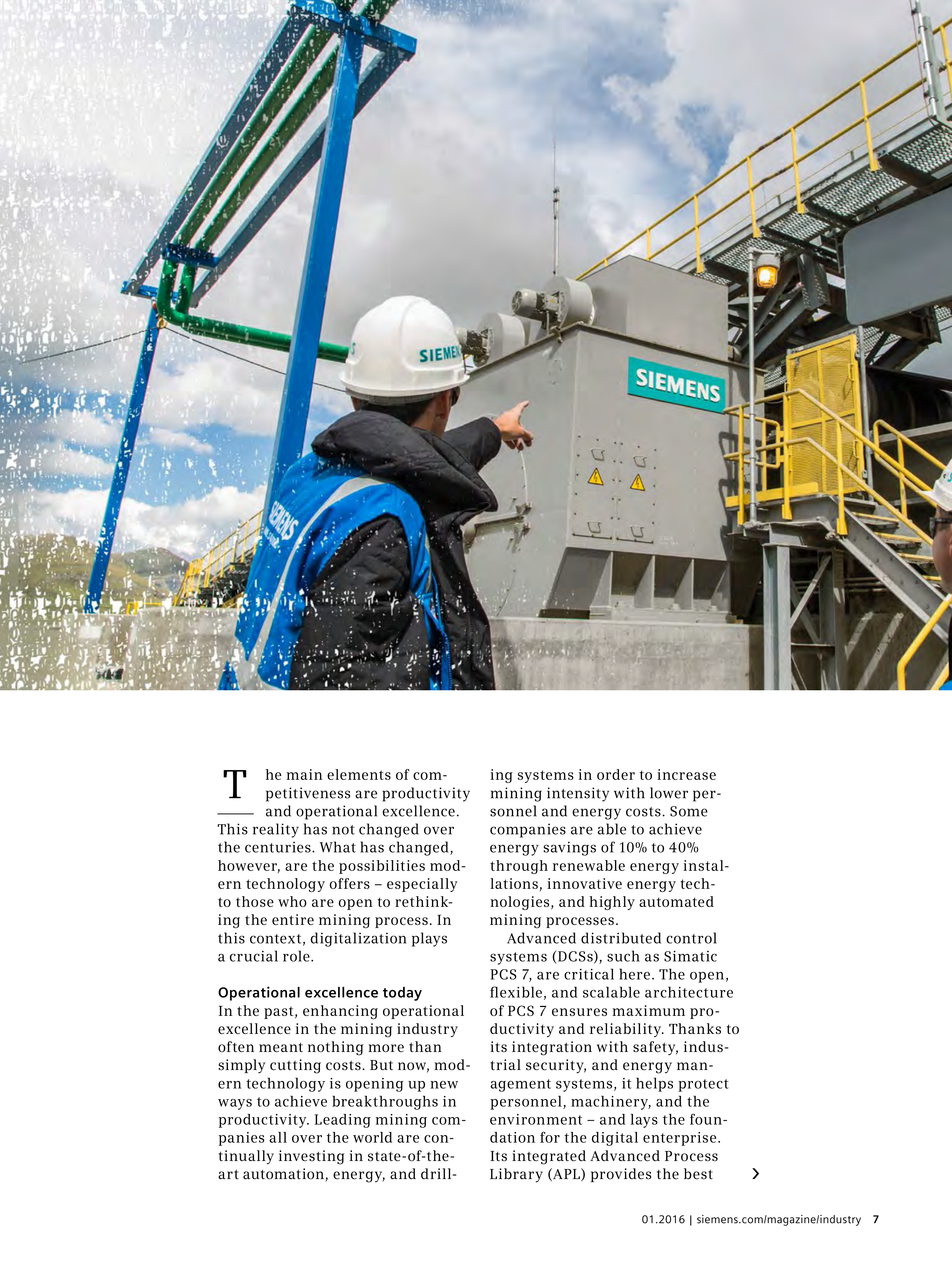
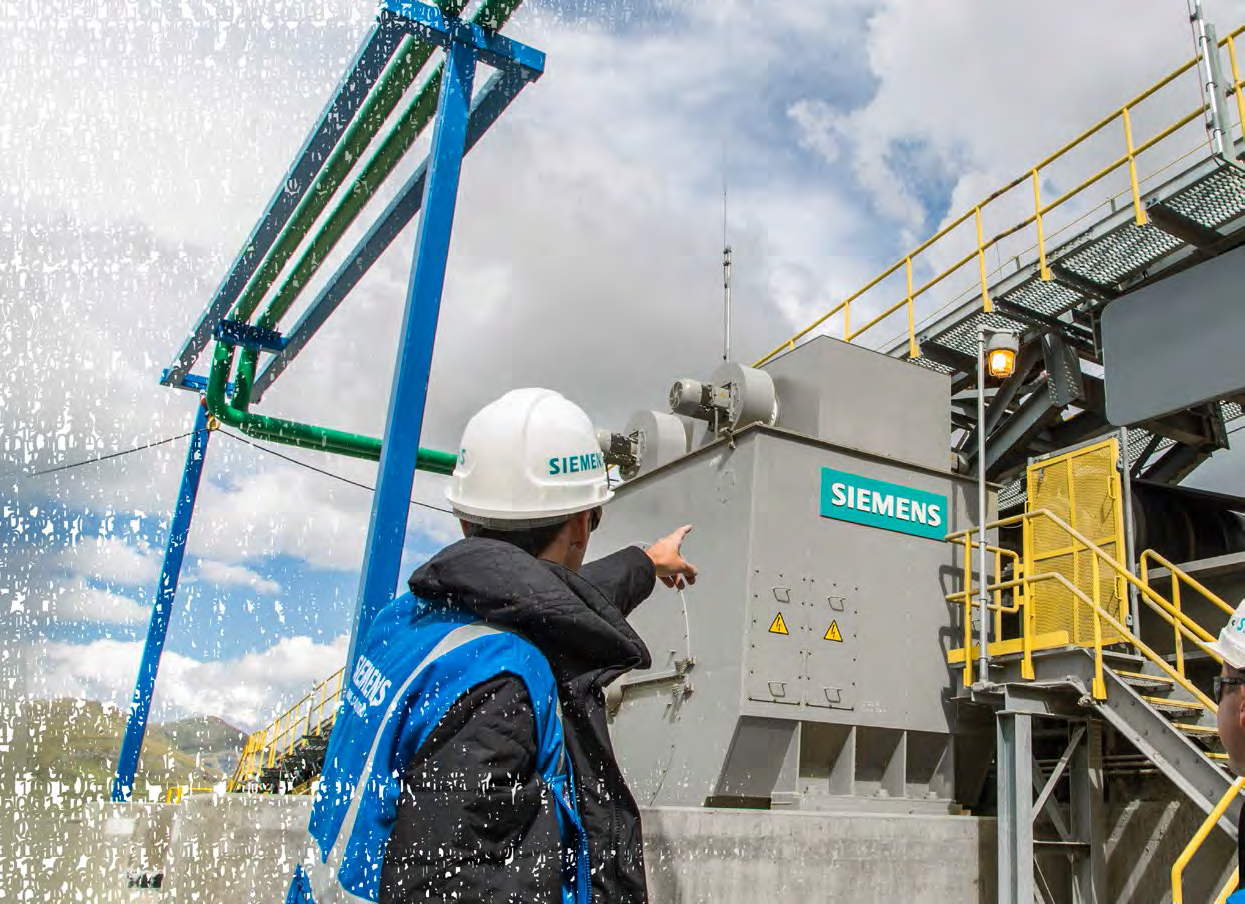
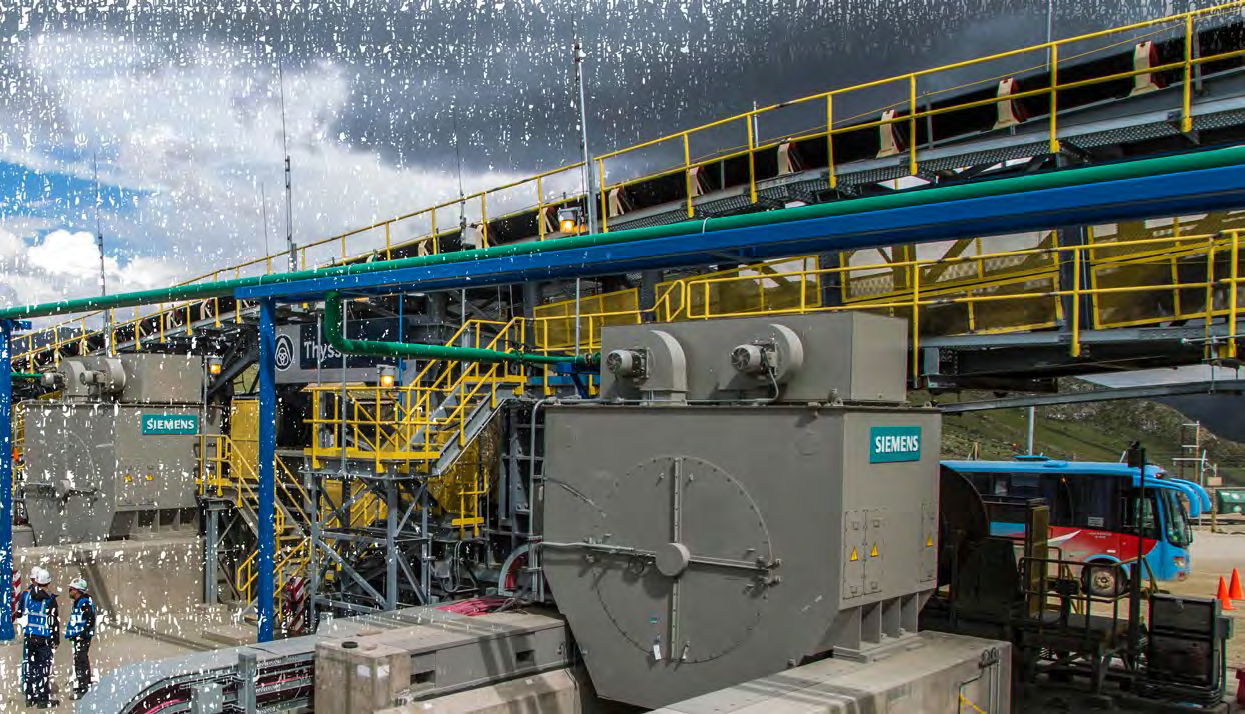
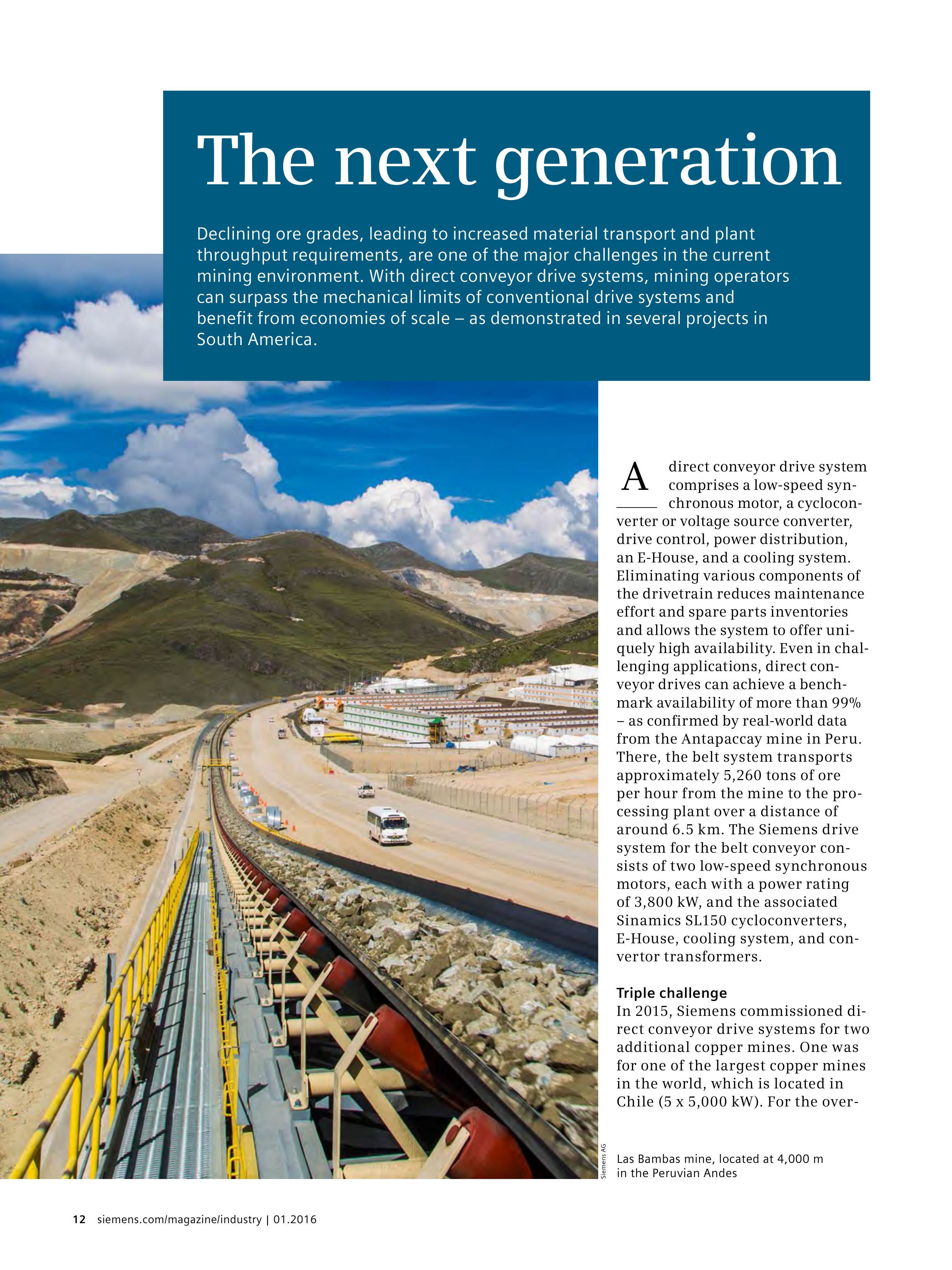
direct conveyor drive system
comprises a low-speed syn-
chronous motor, a cyclocon-
verter or voltage source converter,
drive control, power distribution,
an E-House, and a cooling system.
Eliminating various components of
the drivetrain reduces maintenance
effort and spare parts inventories
and allows the system to offer uni
quely high availability. Even in chal-
lenging applications, direct con-
veyor drives can achieve a bench-
mark availability of more than 99%
– as confirmed by real-world data
from the Antapaccay mine in Peru.
There, the belt system transports
approximately 5,260 tons of ore
per hour from the mine to the pro-
cessing plant over a distance of
around 6.5 km. The Siemens drive
system for the belt conveyor con-
sists of two low-speed synchronous
motors, each with a power rating
of 3,800 kW, and the associated
Sinamics SL150 cycloconverters,
E-House, cooling system, and con-
vertor transformers.
Triple challenge
In 2015, Siemens commissioned di-
rect conveyor drive systems for two
additional copper mines. One was
for one of the largest copper mines
in the world, which is located in
Chile (5 x 5,000 kW). For the over-
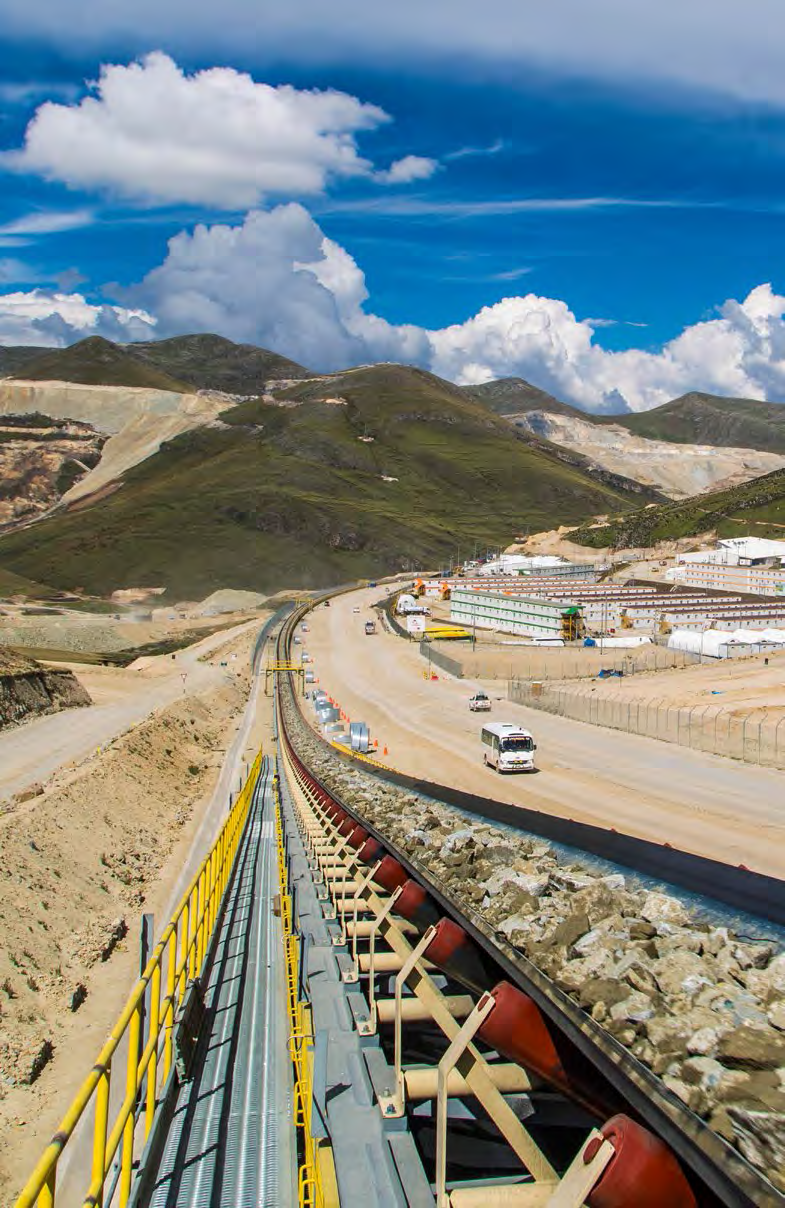
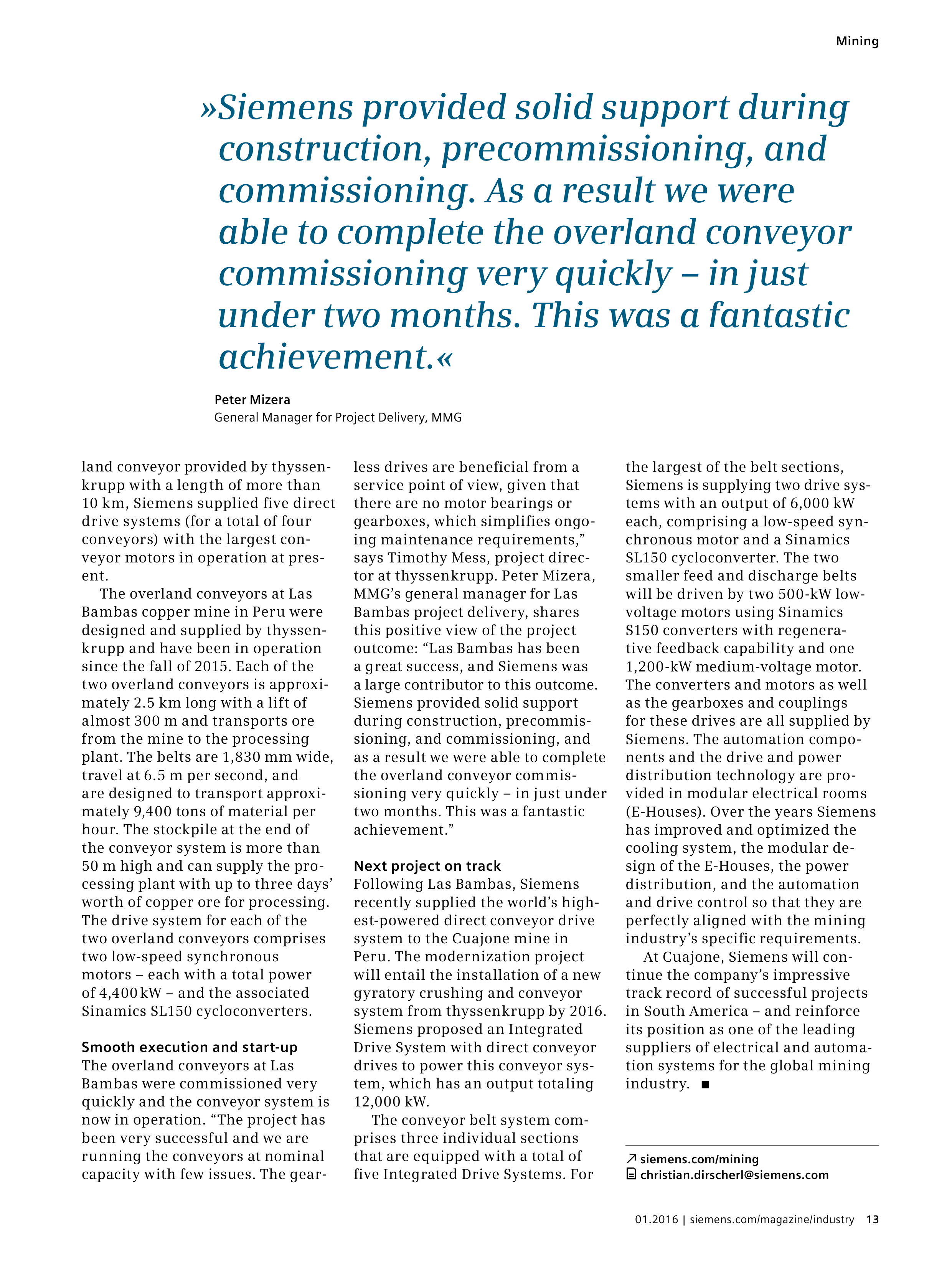
Las Bambas mine, located at 4,000 m
in the Peruvian Andes
A
The next generation
Declining ore grades, leading to increased material transport and plant
throughput requirements, are one of the major challenges in the current
mining environment. With direct conveyor drive systems, mining operators
can surpass the mechanical limits of conventional drive systems and
benefit from economies of scale – as demonstrated in several projects in
South America.

Mining
01.2016 | siemens.com/magazine/industry
13
land conveyor provided by thyssen-
krupp with a length of more than
10 km, Siemens supplied five direct
drive systems (for a total of four
conveyors) with the largest con-
veyor motors in operation at pres-
ent.
The overland conveyors at Las
Bambas copper mine in Peru were
designed and supplied by thyssen-
krupp and have been in operation
since the fall of 2015. Each of the
two overland conveyors is approxi
mately 2.5 km long with a lift of
almost 300 m and transports ore
from the mine to the processing
plant. The belts are 1,830 mm wide,
travel at 6.5 m per second, and
are designed to transport approxi-
mately 9,400 tons of material per
hour. The stockpile at the end of
the conveyor system is more than
50 m high and can supply the pro-
cessing plant with up to three days’
worth of copper ore for processing.
The drive system for each of the
two overland conveyors comprises
two low-speed synchronous
motors – each with a total power
of 4,400 kW – and the associated
Sinamics SL150 cycloconverters.
Smooth execution and start-up
The overland conveyors at Las
Bambas were commissioned very
quickly and the conveyor system is
now in operation. “The project has
been very successful and we are
running the conveyors at nominal
capacity with few issues. The gear-
less drives are beneficial from a
service point of view, given that
there are no motor bearings or
gearboxes, which simplifies ongo-
ing maintenance requirements,”
says Timothy Mess, project direc
tor at thyssenkrupp. Peter Mizera,
MMG’s general manager for Las
Bambas project delivery, shares
this positive view of the project
outcome: “Las Bambas has been
a great success, and Siemens was
a large contributor to this outcome.
Siemens provided solid support
during construction, precommis
sioning, and commissioning, and
as a result we were able to complete
the overland conveyor commis
sioning very quickly – in just under
two months. This was a fantastic
achievement.”
Next project on track
Following Las Bambas, Siemens
recently supplied the world’s high-
est-powered direct conveyor drive
system to the Cuajone mine in
Peru. The modernization project
will entail the installation of a new
gyratory crushing and conveyor
system from thyssenkrupp by 2016.
Siemens proposed an Integrated
Drive System with direct conveyor
drives to power this conveyor sys-
tem, which has an output totaling
12,000 kW.
The conveyor belt system com-
prises three individual sections
that are equipped with a total of
five Integrated Drive Systems. For
the largest of the belt sections,
Siemens is supplying two drive sys-
tems with an output of 6,000 kW
each, comprising a low-speed syn-
chronous motor and a Sinamics
SL150 cycloconverter. The two
smaller feed and discharge belts
will be driven by two 500-kW low-
voltage motors using Sinamics
S150 converters with regenera
tive feedback capability and one
1,200-kW medium-voltage motor.
The converters and motors as well
as the gearboxes and couplings
for these drives are all supplied by
Siemens. The automation compo-
nents and the drive and power
distribution technology are pro-
vided in modular electrical rooms
(E-Houses). Over the years Siemens
has improved and optimized the
cooling system, the modular de-
sign of the E-Houses, the power
distribution, and the automation
and drive control so that they are
perfectly aligned with the mining
industry’s specific requirements.
At Cuajone, Siemens will con-
tinue the company’s impressive
track record of successful projects
in South America – and reinforce
its position as one of the leading
suppliers of electrical and automa-
tion systems for the global mining
industry.
siemens.com/mining
christian.dirscherl@siemens.com
»Siemens provided solid support during
construction, precommissioning, and
commissioning. As a result we were
able to complete the overland conveyor
commissioning very quickly – in just
under two months. This was a fantastic
achievement.«
Peter Mizera
General Manager for Project Delivery, MMG
Siemens AG
14
siemens.com/magazine/industry | 01.2016
Mining
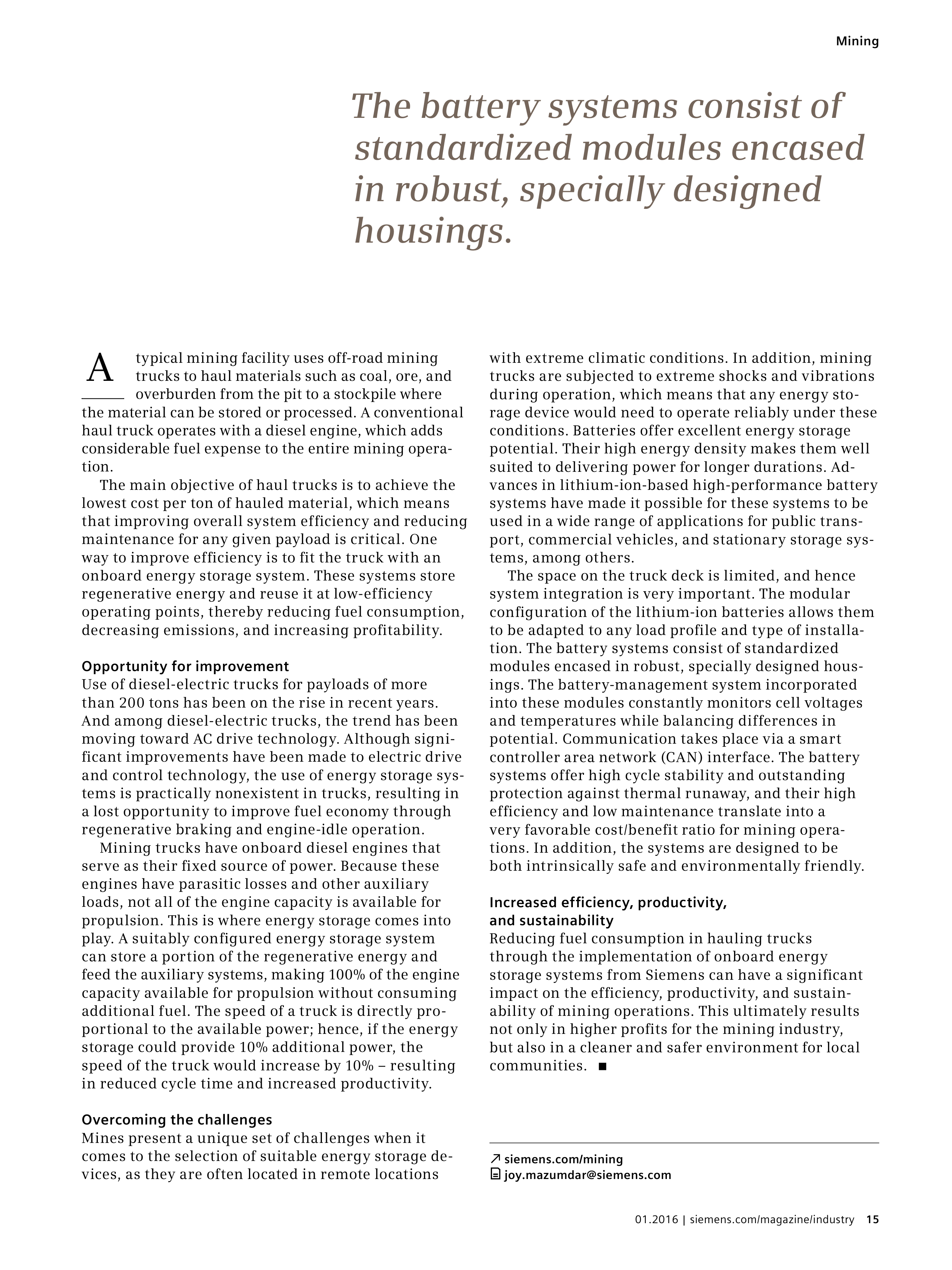
Fitting off-road
mining trucks with
onboard energy
storage systems
can significantly
improve efficiency
and profitability
A major overhaul
In the mining industry, energy efficiency and productivity
are paramount. Incorporating onboard energy storage
systems could generate gains in both of these areas, thereby
significantly improving hauling operations.

The battery systems consist of
standardized modules encased
in robust, specially designed
housings.
01.2016 | siemens.com/magazine/industry
15
Mining
typical mining facility uses off-road mining
trucks to haul materials such as coal, ore, and
overburden from the pit to a stockpile where
the material can be stored or processed. A conventional
haul truck operates with a diesel engine, which adds
considerable fuel expense to the entire mining opera
tion.
The main objective of haul trucks is to achieve the
lowest cost per ton of hauled material, which means
that improving overall system efficiency and reducing
maintenance for any given payload is critical. One
way to improve efficiency is to fit the truck with an
onboard energy storage system. These systems store
regenerative energy and reuse it at low-efficiency
operating points, thereby reducing fuel consumption,
decreasing emissions, and increasing profitability.
Opportunity for improvement
Use of diesel-electric trucks for payloads of more
than 200 tons has been on the rise in recent years.
And among diesel-electric trucks, the trend has been
moving toward AC drive technology. Although signi
ficant improvements have been made to electric drive
and control technology, the use of energy storage sys-
tems is practically nonexistent in trucks, resulting in
a lost opportunity to improve fuel economy through
regenerative braking and engine-idle operation.
Mining trucks have onboard diesel engines that
serve as their fixed source of power. Because these
engines have parasitic losses and other auxiliary
loads, not all of the engine capacity is available for
propulsion. This is where energy storage comes into
play. A suitably configured energy storage system
can store a portion of the regenerative energy and
feed the auxiliary systems, making 100% of the engine
capacity available for propulsion without consuming
additional fuel. The speed of a truck is directly pro
portional to the available power; hence, if the energy
storage could provide 10% additional power, the
speed of the truck would increase by 10% – resulting
in reduced cycle time and increased productivity.
Overcoming the challenges
Mines present a unique set of challenges when it
comes to the selection of suitable energy storage de
vices, as they are often located in remote locations
with extreme climatic conditions. In addition, mining
trucks are subjected to extreme shocks and vibrations
during operation, which means that any energy sto-
rage device would need to operate reliably under these
conditions. Batteries offer excellent energy storage
potential. Their high energy density makes them well
suited to delivering power for longer durations. Ad-
vances in lithium-ion-based high-performance battery
systems have made it possible for these systems to be
used in a wide range of applications for public trans-
port, commercial vehicles, and stationary storage sys-
tems, among others.
The space on the truck deck is limited, and hence
system integration is very important. The modular
configuration of the lithium-ion batteries allows them
to be adapted to any load profile and type of installa-
tion. The battery systems consist of standardized
modules encased in robust, specially designed hous
ings. The battery-management system incorporated
into these modules constantly monitors cell voltages
and temperatures while balancing differences in
potential. Communication takes place via a smart
controller area network (CAN) interface. The battery
systems offer high cycle stability and outstanding
protection against thermal runaway, and their high
efficiency and low maintenance translate into a
very favorable cost/benefit ratio for mining opera-
tions. In addition, the systems are designed to be
both intrinsically safe and environmentally friendly.
Increased efficiency, productivity,
and sustainability
Reducing fuel consumption in hauling trucks
through the implementation of onboard energy
storage systems from Siemens can have a significant
impact on the efficiency, productivity, and sustain
ability of mining operations. This ultimately results
not only in higher profits for the mining industry,
but also in a cleaner and safer environment for local
communities.
A
siemens.com/mining
joy.mazumdar@siemens.com
thyssenkrupp
16
siemens.com/magazine/industry | 01.2016
Mining
mproving productivity
of open-cast operation has
been and will always be
a challenge. The quality of the ore
body continues to deteriorate and
therefore more ore needs to be
transported in the most economi-
cal way to optimize productivity.
The aim is to lower the cost per ton
of transported ore and improve
the environmental footprint.
Typically, uncrushed ore is trans-
ported by trucks, which often
leads to congestion on busy road
stretches. The trucks usually
travel fully loaded with ore one
way to the dump or to the crusher
station outside the mine and
travel back to the pit empty. And
the process repeats itself. The
cycle can easily take up more
than 30–40 minutes, depending
on the depth of the pit.
In order to optimize the truck
utilization, to reduce the fuel
consumption, and to increase
the productivity of the mine,
a new transportation system,
the Chevron MegaPipe conveyor
has been developed.
Conveyor systems
Pit perfect!
ContiTech, Siemens, and thyssen
krupp, in a joint research and
development consortium, have
developed a solution that can
reduce this heavy-duty traffic
and the associated emissions and
risks: the Chevron MegaPipe con-
veyor. This new continuous con-
veyor for bulk materials requires
just one primary crushing stage
in the feeding station area and
sets new standards in terms of
ascent capability and transport
capacity.
The new conveyor is a further de-
velopment of traditional conveyor
systems, which are already being
used instead of trucks in extensive
open-pit mines with general slope
angles of under 30°. The conveyor
system consists of a tubular belt
with profiled cover plates on the
carrying side. When the MegaPipe
is rolled up from a troughed form
into a tubular form in the material
feeding area, the material in the
pipe is “compressed,” which wedges
the product particles together and
thus increases the internal friction
coefficient of the bulk materials.
This compression, together with
An open-pit mining operation involves dozens of trucks
that are loaded by excavators, transport mined material
over steep and sometimes unsurfaced roads out of the
mine, and then return empty. This truck operation over
long distances is not always efficient or economical,
resulting in enormous fuel costs and CO
2
emissions.
ContiTech, Siemens, and thyssenkrupp show that there
is another way.
the special profiling on the belt,
enables the economical transport
of large material flows over slopes
with moderate incline angles and
open-pit mine depths of several
hundred meters, right after the
primary crushing stage.
Direct drive for high performance
The drive technology is another
key component of the new con
veyor system. About five years ago,
Siemens and thyssenkrupp devel-
oped a direct drive for powerful
conventional belt conveyors based
on the also jointly developed Band-
berg Prosper, a 3.8 km-long under-
I


01.2016 | siemens.com/magazine/industry
17
Mining
siemens.com/mining
norbert.becker@siemens.com
ground conveyor system rising
approximately 800 meters, in-
stalled at RAG Prosper-Haniel in
1985. Thanks to the simple and
robust mechanical design, inte
grated drive drums, and a direct
drive motor in combination with
cutting-edge converter technology,
as well as the proven control sys-
tem, the drive solution allows large
belt conveyor systems to be oper-
ated economically. The complete
drivetrain, consisting of a flange
for the disc brake, drum/motor
bearings, and a rotor flange with
rotor and stand, was designed to
use just a few robust components
that can be integrated into the belt
conveyor station in a space-saving,
maintenance-friendly way.
Nonstop benefits
The consortium has now also
investigated the feasibility of the
MegaPipe concept and has con-
firmed that the conveyor system
can economically transport ores
and waste material with grain sizes
of up to 350 mm over slopes with
inclines of 30° to approximately 50°.
Alternative conveyor systems like
the Chevron MegaPipe conveyor are
becoming increasingly attractive in
view of the fact that in many mines
around the world the ore content
is diminishing, and thus an in-
creasing amount of material needs
to be transported. These systems
also help mine operators overcome
the logistic challenges of extract-
ing raw materials in an environ-
mentally friendly, efficient, and
safe manner.
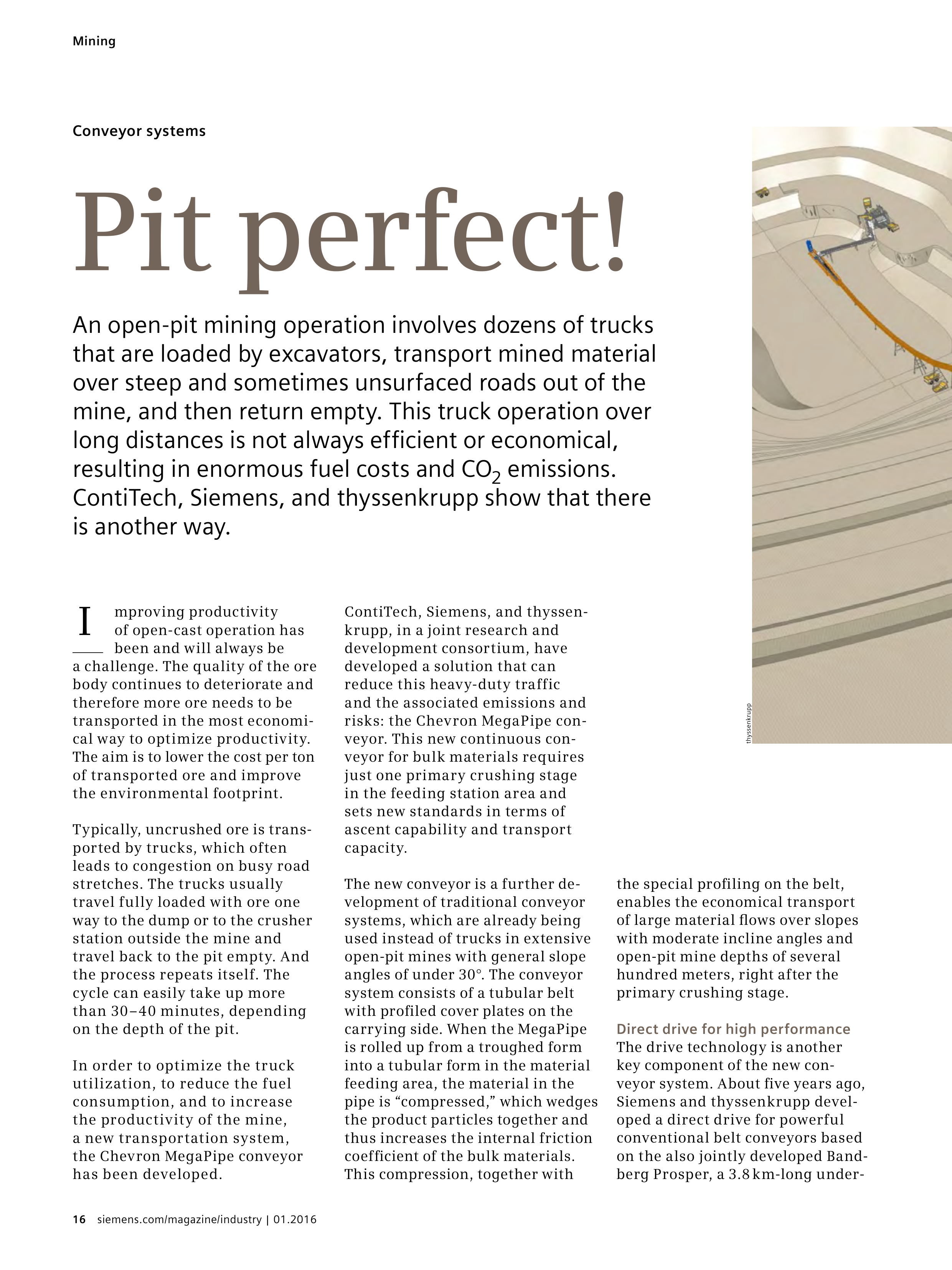
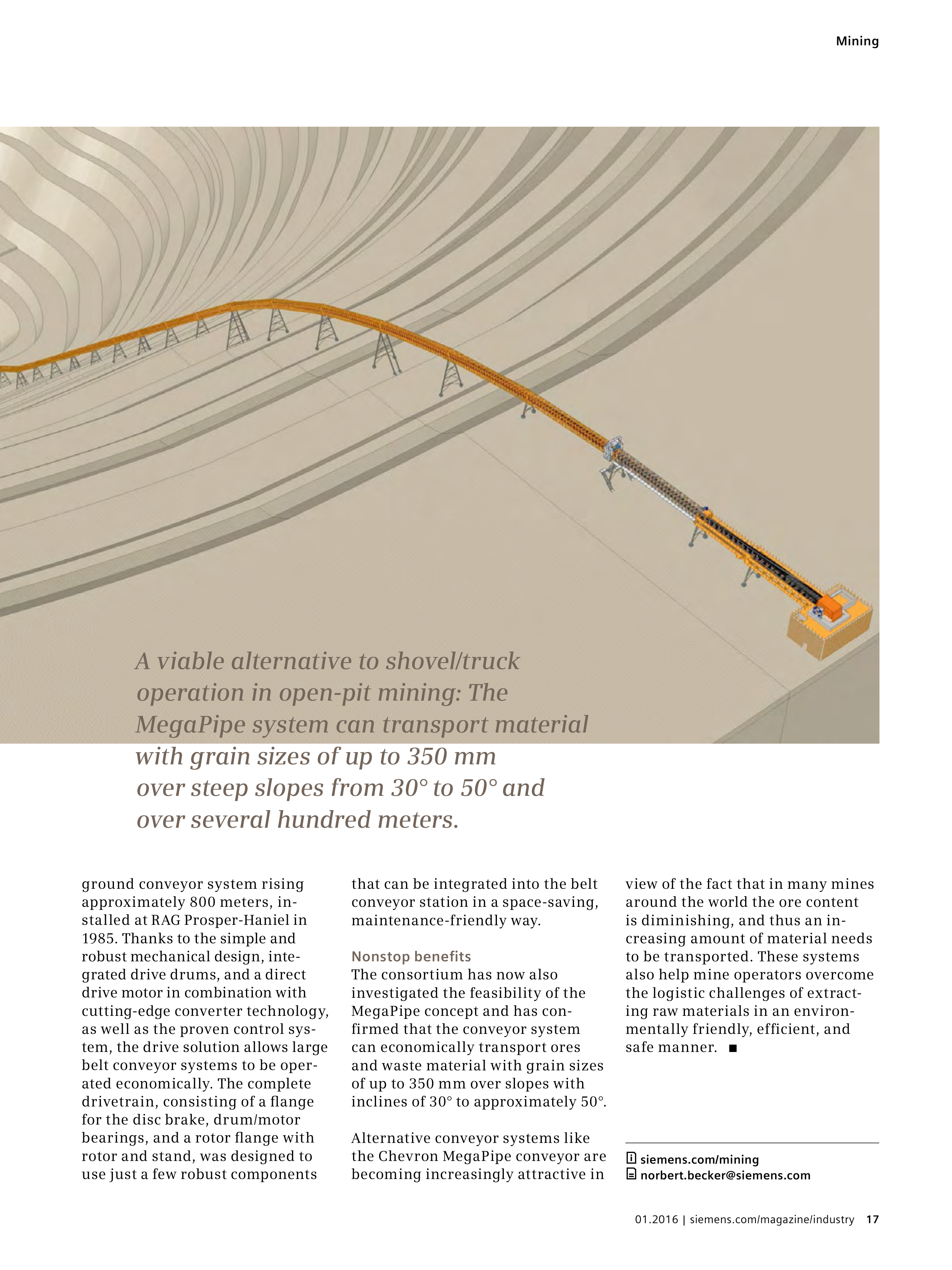
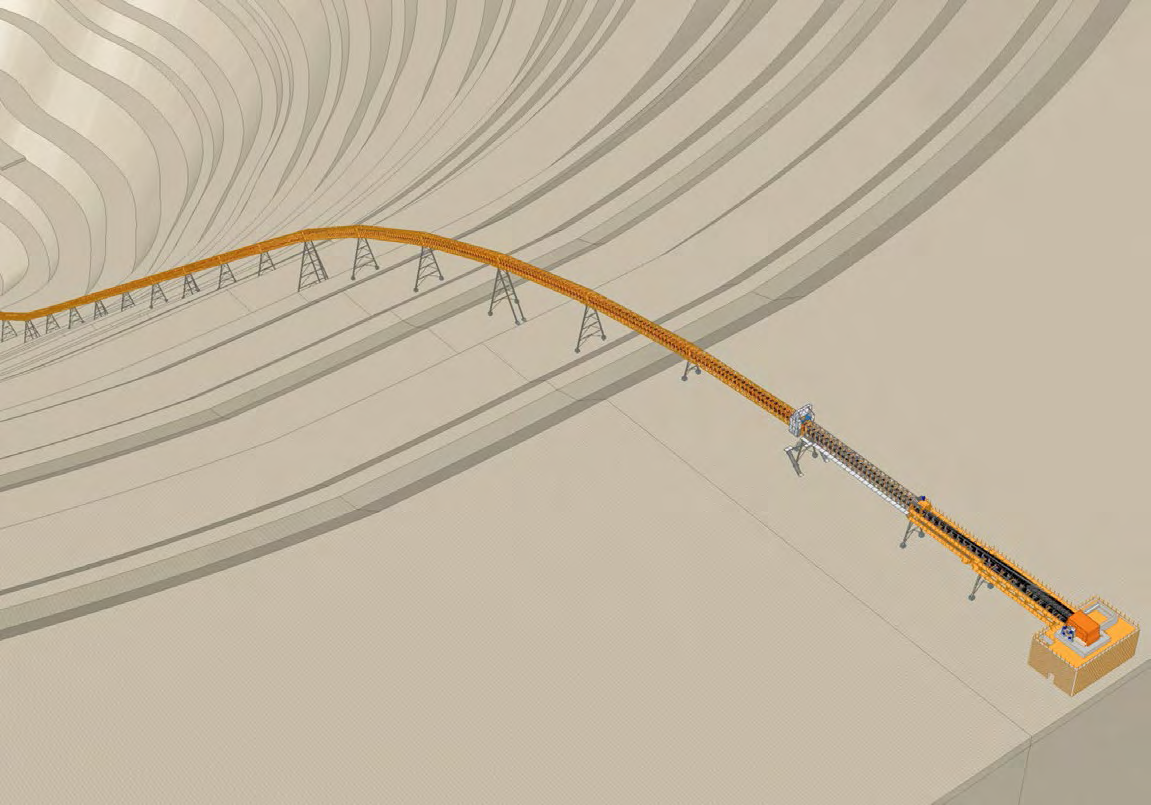
A viable alternative to shovel/truck
operation in open-pit mining: The
MegaPipe system can transport material
with grain sizes of up to 350 mm
over steep slopes from 30° to 50° and
over several hundred meters.
Siemens AG
18
siemens.com/magazine/industry | 01.2016
Mining
Mining for productivity
and profit
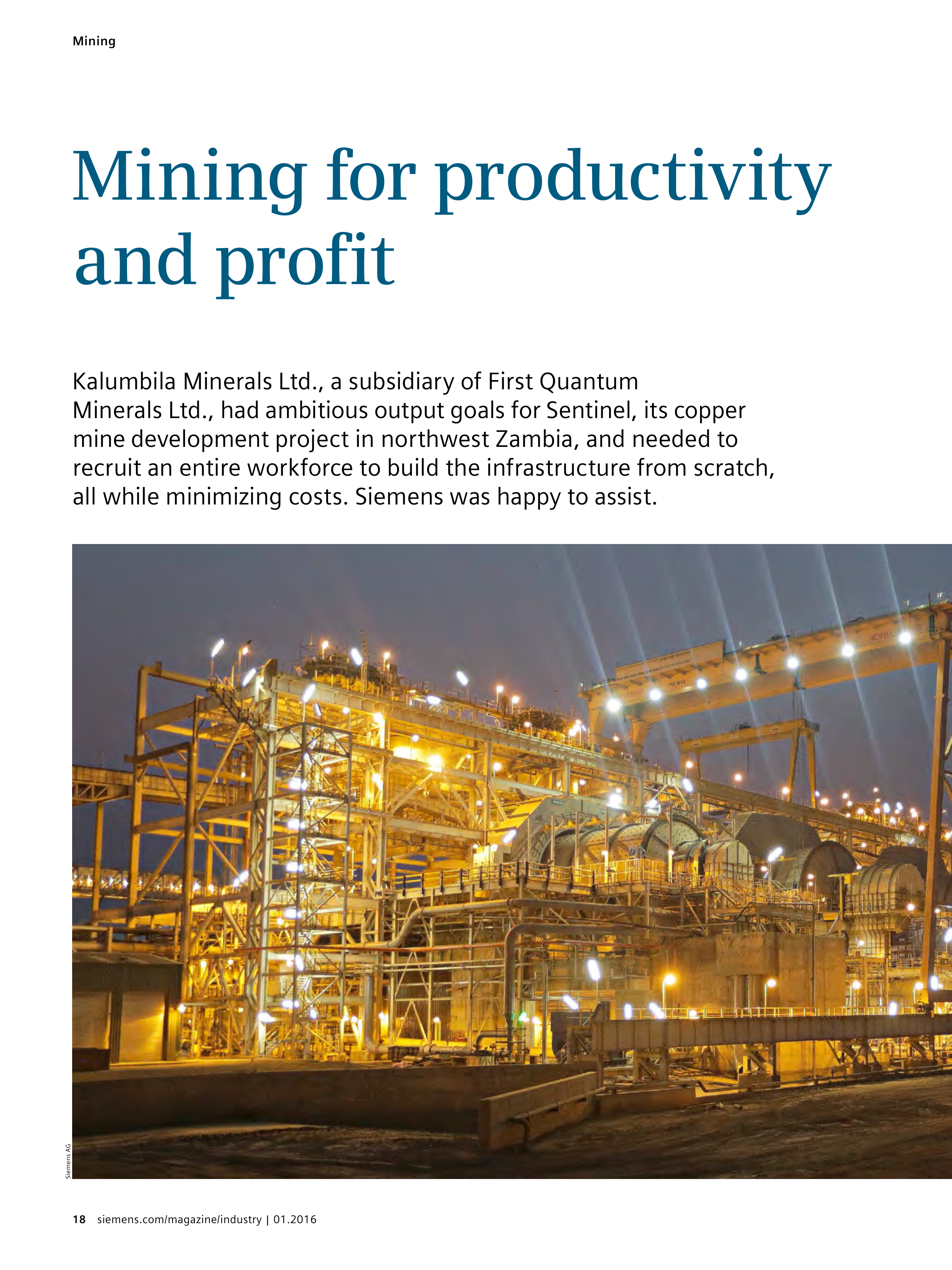
Kalumbila Minerals Ltd., a subsidiary of First Quantum
Minerals Ltd., had ambitious output goals for Sentinel, its copper
mine development project in northwest Zambia, and needed to
recruit an entire workforce to build the infrastructure from scratch,
all while minimizing costs. Siemens was happy to assist.
01.2016 | siemens.com/magazine/industry
19
Mining
arsh environments, rising energy costs, and
water scarcity are just a few of the challenges
facing the world’s mines. Kalumbila Minerals
was not only confronted by these challenges but also
had more to grapple with when building two mines
in an isolated area 150 kilometers west of Solwezi,
Zambia.
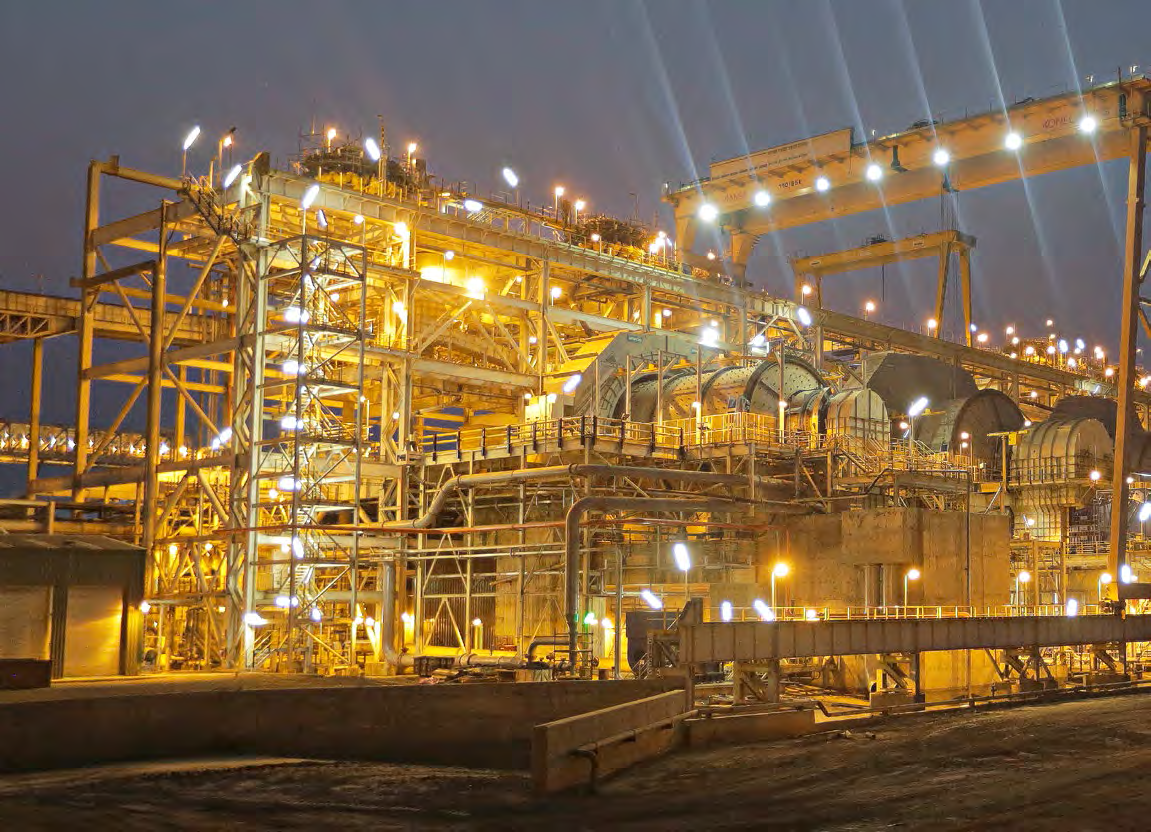
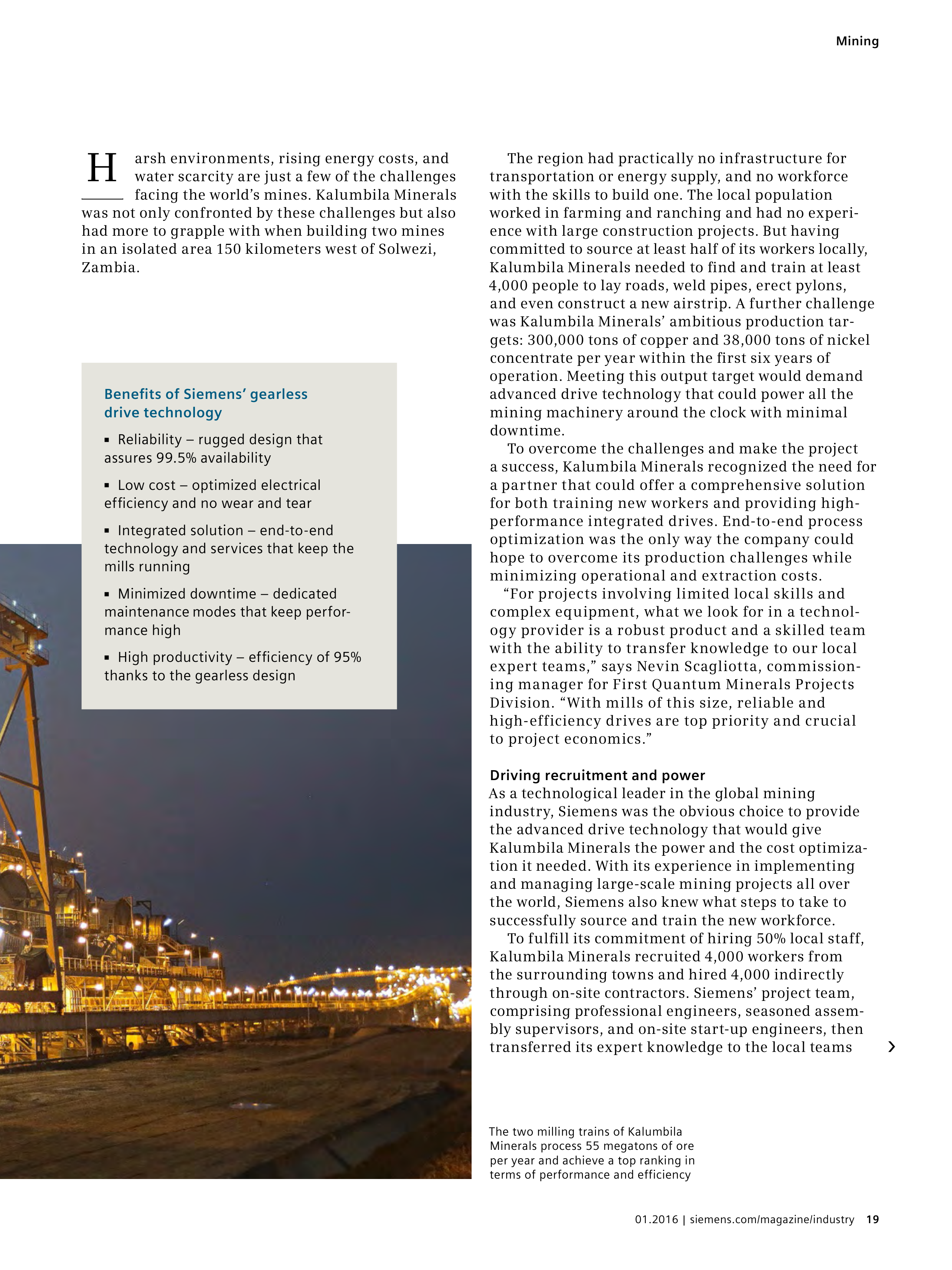
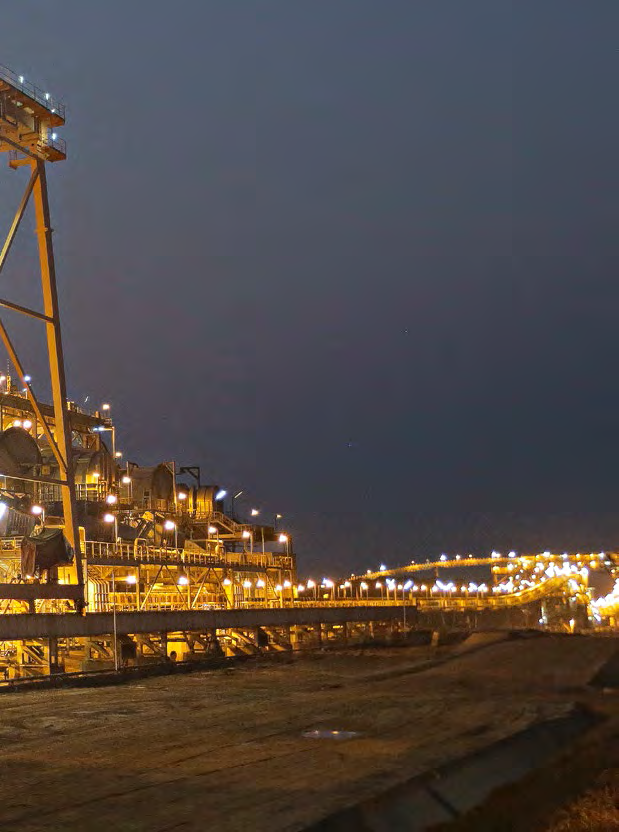
The two milling trains of Kalumbila
Minerals process 55 megatons of ore
per year and achieve a top ranking in
terms of performance and efficiency
The region had practically no infrastructure for
transportation or energy supply, and no workforce
with the skills to build one. The local population
worked in farming and ranching and had no experi-
ence with large construction projects. But having
committed to source at least half of its workers locally,
Kalumbila Minerals needed to find and train at least
4,000 people to lay roads, weld pipes, erect pylons,
and even construct a new airstrip. A further challenge
was Kalumbila Minerals’ ambitious production tar-
gets: 300,000 tons of copper and 38,000 tons of nickel
concentrate per year within the first six years of
operation. Meeting this output target would demand
advanced drive technology that could power all the
mining machinery around the clock with minimal
downtime.
To overcome the challenges and make the project
a success, Kalumbila Minerals recognized the need for
a partner that could offer a comprehensive solution
for both training new workers and providing high-
performance integrated drives. End-to-end process
optimization was the only way the company could
hope to overcome its production challenges while
minimizing operational and extraction costs.
“For projects involving limited local skills and
complex equipment, what we look for in a technol-
ogy provider is a robust product and a skilled team
with the ability to transfer knowledge to our local
expert teams,” says Nevin Scagliotta, commission-
ing manager for First Quantum Minerals Projects
Division. “With mills of this size, reliable and
high-efficiency drives are top priority and crucial
to project economics.”
Driving recruitment and power
As a technological leader in the global mining
industry, Siemens was the obvious choice to provide
the advanced drive technology that would give
Kalumbila Minerals the power and the cost optimiza-
tion it needed. With its experience in implementing
and managing large-scale mining projects all over
the world, Siemens also knew what steps to take to
successfully source and train the new workforce.
To fulfill its commitment of hiring 50% local staff,
Kalumbila Minerals recruited 4,000 workers from
the surrounding towns and hired 4,000 indirectly
through on-site contractors. Siemens’ project team,
comprising professional engineers, seasoned assem-
bly supervisors, and on-site start-up engineers, then
transferred its expert knowledge to the local teams
Benefits of Siemens’ gearless
drive technology
◾
Reliability – rugged design that
assures 99.5% availability
◾
Low cost – optimized electrical
efficiency and no wear and tear
◾
Integrated solution – end-to-end
technology and services that keep the
mills running
◾
Minimized downtime – dedicated
maintenance
modes that keep perfor-
mance high
◾
High productivity – efficiency of 95%
thanks to the gearless design
H

20
siemens.com/magazine/industry | 01.2016
Mining
siemens.com/mining
helmut.liepold@siemens.com
so the mine could be running productively in the
shortest possible time.
Rugged power and close control
With projects of this size, it is advantageous to re-
duce the number of supplier interfaces, and thus to
have the entire drivetrain supplied by a single source.
Integrated Drive Systems from Siemens offer the only
true one-stop solution for drive systems worldwide.
To power the extraction of 300,000 tons of copper
and 38,000 tons of nickel concentrate per year, Siemens
provided the motor and drive systems for two 40-foot
semi-autogenous grinding (SAG) mills powered by
28-MW gearless mill drives (GMDs) and two 28-foot
ball mills powered by 22-MW GMDs.
Among the world’s big-
gest and most powerful
drives, the integrated GMDs
from Siemens provide
Kalumbila Minerals with
the end-to-end process opti-
mization essential to maxi-
mize efficiency and mini-
mize cost. The drives also
provide outstanding reli-
ability due to the advan
tages of the gearless design.
With no moving gears,
there is no variance in the
motor and no vibration.
This vastly reduces energy
loss, as all the force is
transferred touch free via
the magnetic field. The lack
of moving parts also vir
tually eliminates wear and
tear and the risk of down-
time. In the event that
maintenance is required,
the drives maintain high
availability thanks to their
dedicated maintenance
modes, such as creeping or
inching with rollback of the
mill.
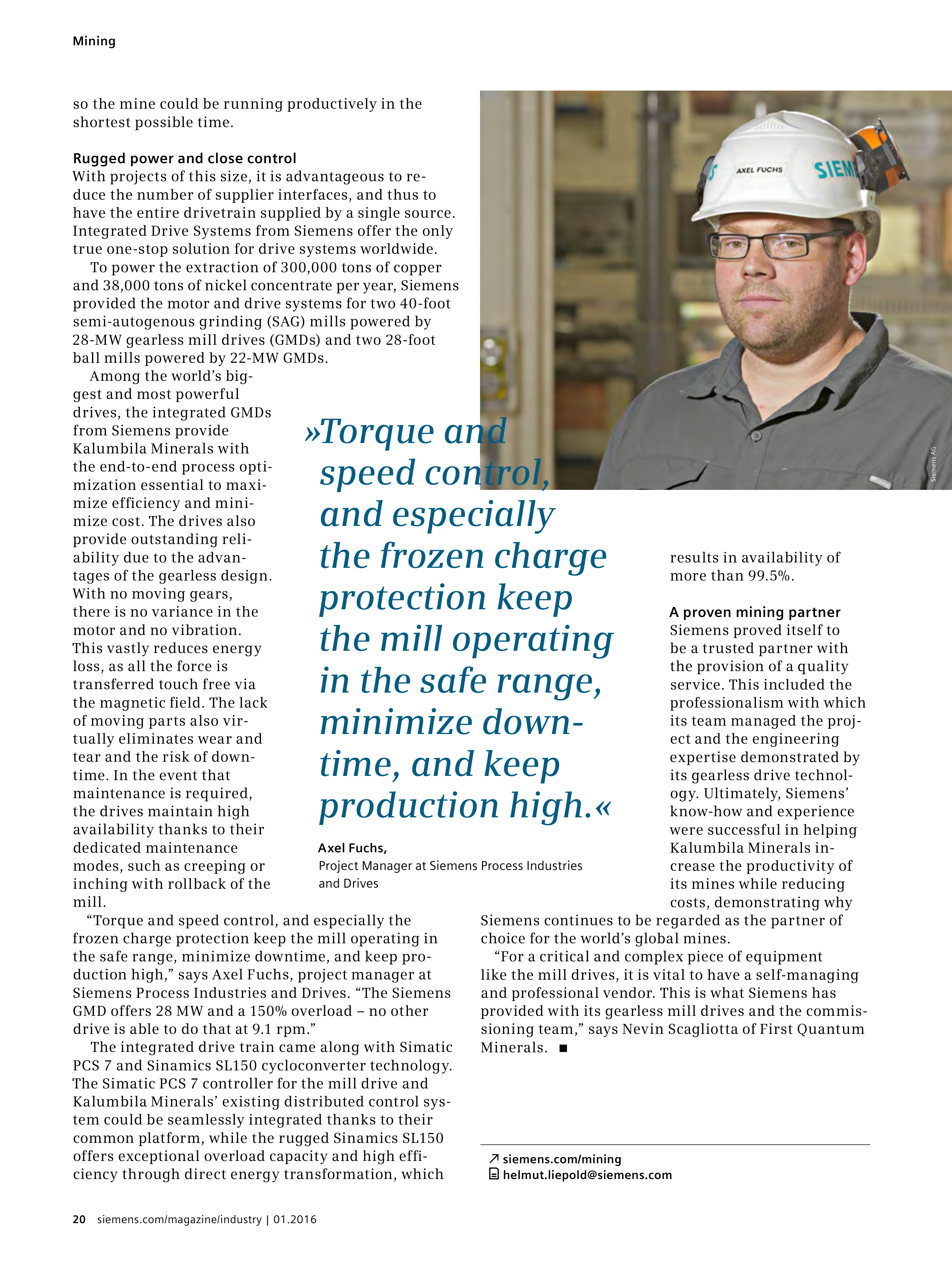
“Torque and speed control, and especially the
frozen charge protection keep the mill operating in
the safe range, minimize downtime, and keep pro
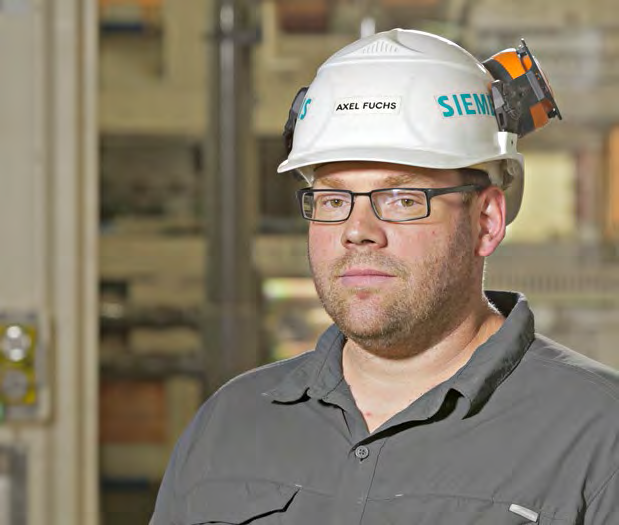
duction high,” says Axel Fuchs, project manager at
Siemens Process Industries and Drives. “The Siemens
GMD offers 28 MW and a 150% overload – no other
drive is able to do that at 9.1 rpm.”
The integrated drive train came along with Simatic
PCS 7 and Sinamics SL150 cycloconverter technology.
The Simatic PCS 7 controller for the mill drive and
Kalumbila Minerals’ existing distributed control sys-
tem could be seamlessly integrated thanks to their
common platform, while the rugged Sinamics SL150
offers exceptional overload capacity and high effi-
ciency through direct energy transformation, which
results in availability of
more than 99.5%.
A proven mining partner
Siemens proved itself to
be a trusted partner with
the provision of a quality
service. This included the
professionalism with which
its team managed the proj-
ect and the engineering
expertise demonstrated by
its gearless drive technol-
ogy. Ultimately, Siemens’
know-how and experience
were successful in helping
Kalumbila Minerals in-
crease the productivity of
its mines while reducing
costs, demonstrating why
Siemens continues to be regarded as the partner of
choice for the world’s global mines.
“For a critical and complex piece of equipment
like the mill drives, it is vital to have a self-managing
and professional vendor. This is what Siemens has
provided with its gearless mill drives and the commis
sioning team,” says Nevin Scagliotta of First Quantum
Minerals.
»Torque and
speed control,
and especially
the frozen charge
protection keep
the mill operating
in the safe range,
minimize down
time, and keep
production high.«
Axel Fuchs,
Project Manager at Siemens Process Industries
and Drives
Siemens AG


01.2016 | siemens.com/magazine/
xxxxxx xxxxxxxx
21
Mining
Increasing throughput
the smart way
fter years of operation
in mining processes, mills
often require higher
throughput from the gearless mill
drive (GMD) or even the entire
concentrator. This in turn demands
more power. Siemens has devel-
oped a structured study to analyze
whether a power increase is feasible
on preinstalled GMDs.
A power upgrade could be re-
quired, for example, if the rock
hardness increases as a result of
excavating at deeper levels, caus-
ing the throughput of the grinding
mill to decrease. To keep the
throughput constant, the power
of the GMD needs to be increased.
Power can be increased by modi-
fying the motor voltage or the cur-
rent, or a combination of the two.
Every solution has specific con-
siderations in terms of costs
for replacement parts and
implementation time. To
accurately evaluate all
the options, detailed
knowledge is required
regarding the GMD sys-
tem (especially its most
important parts – the
motor itself, the trans-
formers, and the cyclo-
converter) and the rela-
tionship between the
different variables.
The mechanical calcu-
lation for the motor lies
at the core of the analysis:
if the design of the motor
does not support the power increase,
the required power level cannot
be achieved – not least because
strengthening the motor structure
on-site is complex and uneconomi-
cal. The mechanical study is based
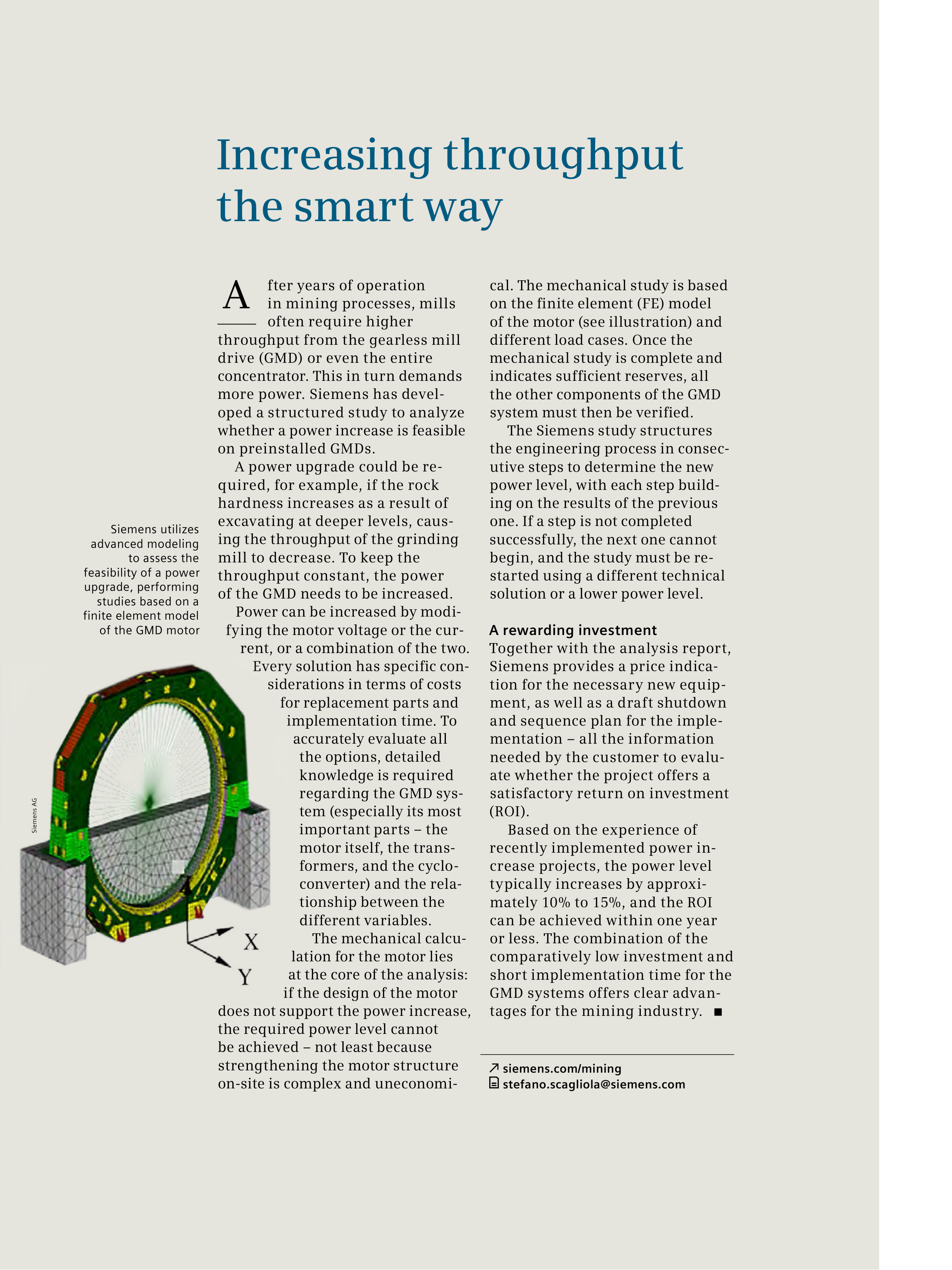
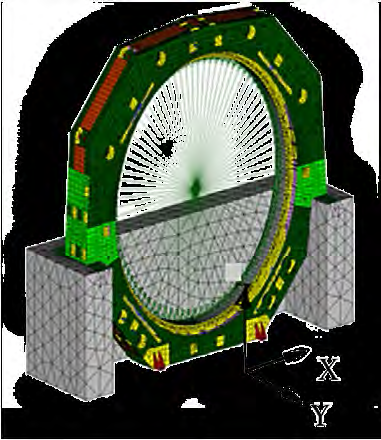
on the finite element (FE) model
of the motor (see illustration) and
different load cases. Once the
mechanical study is complete and
indicates sufficient reserves, all
the other components of the GMD
system must then be verified.
The Siemens study structures
the engineering process in consec-
utive steps to determine the new
power level, with each step build-
ing on the results of the previous
one. If a step is not completed
successfully, the next one cannot
begin, and the study must be re-
started using a different technical
solution or a lower power level.
A rewarding investment
Together with the analysis report,
Siemens provides a price indica-
tion for the necessary new equip-
ment, as well as a draft shutdown
and sequence plan for the imple-
mentation – all the information
needed by the customer to evalu-
ate whether the project offers a
satisfactory return on investment
(ROI).
Based on the experience of
recently implemented power in-
crease projects, the power level
typically increases by approxi-
mately 10% to 15%, and the ROI
can be achieved within one year
or less. The combination of the
comparatively low investment and
short implementation time for the
GMD systems offers clear advan-
tages for the mining industry.
Siemens utilizes
advanced modeling
to assess the
feasibility of a power
upgrade, performing
studies based on a
finite element model
of the GMD motor
A
siemens.com/mining
stefano.scagliola@siemens.com
Siemens AG
Mining
22
siemens.com/magazine/
xxxxxx xxxxxxxx
| 01.2016
Steep challenge
Continuous 24/7 operation, 100% availability, and maximum energy
efficiency: the requirements for the mill drive solution in a new
copper concentrator project were quite a challenge for Siemens.
The solution – a dual-pinion drive with an induction motor – not only
hit the mark in terms of reliability and efficiency but was also
implemented in a very short time.
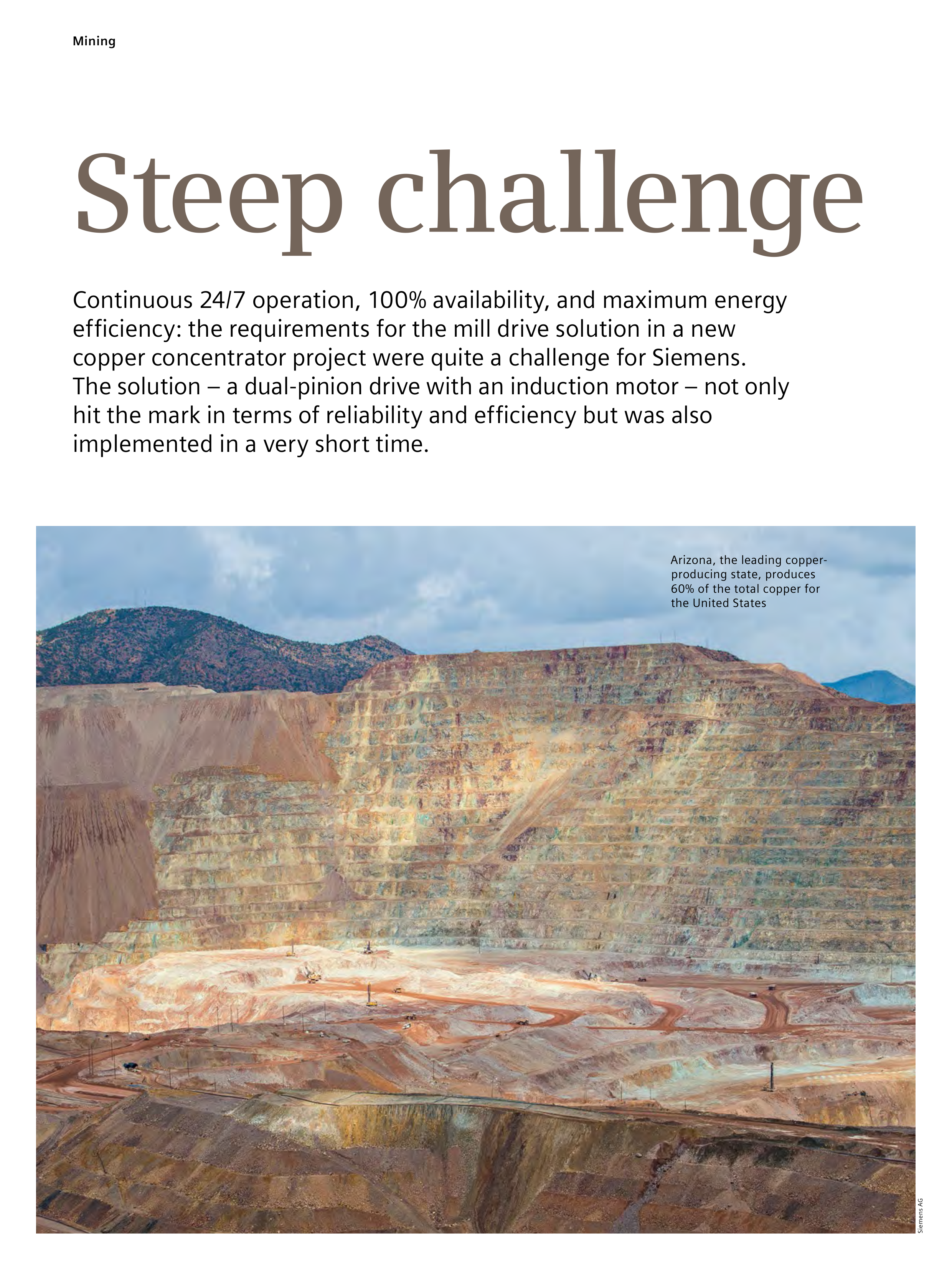
Arizona, the leading copper-
producing state, produces
60% of the total copper for
the United States
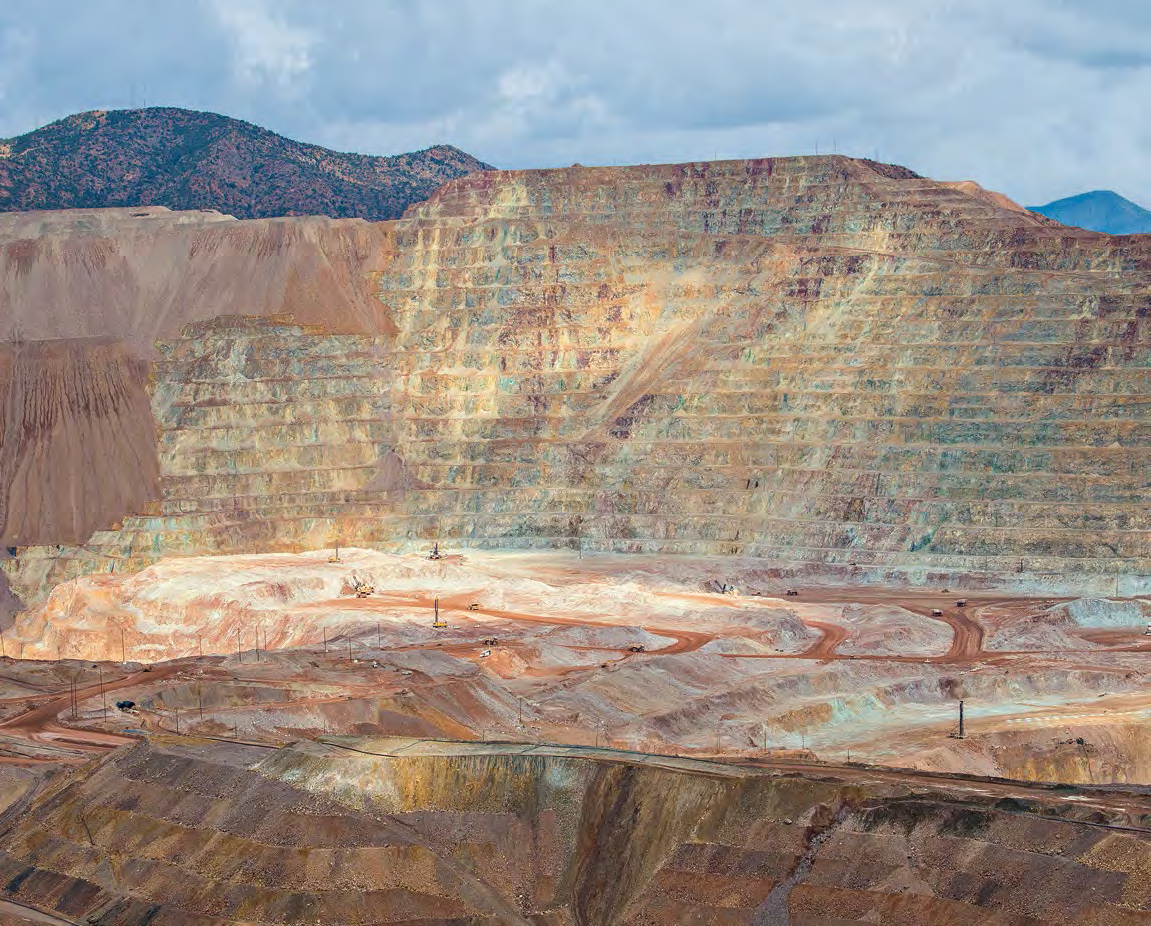
Siemens AG

Mining
01.2016 | siemens.com/magazine/industry
23
he two dual-pinion mill drives for two new
24' × 40' ball mills, each with 2 × 6.5 MW
(2 × 8,700 hp) power, are the first two mill drive
systems using slow-speed squirrel-cage induction
motors with cycloconverter technology in grinding
mills, and they combine the benefits of both systems.
Cycloconverters are well proven in mining, especially
for ring motor (wraparound motor) applications. They
are perfectly suited for mill drive applications due to
the low-frequency drive, the robustness and efficiency
of the thyristor technology, and the low number of se-
miconductors. Consequently, the solution designed by
Siemens features the highly reliable components and
high system robustness required by the application.
Integrated solution for maximum efficiency
The Siemens scope of delivery included the induction
motors and the cycloconverters for variable-speed
drive operation with the corresponding insulating
transformers, as well as premanufactured E-Houses
and 13.8-kV switchgear, perfectly coordinated with the
drive, and the complete harmonic study. The water-
cooled, compact, and totally enclosed IP55 motors
were shipped fully factory-tested in one piece. The
motors have a nominal speed of 180 rpm and a torque
of 345 kNm and are equipped with sleeve bearings,
including a jacking unit. The motor shaft is directly
coupled to the pinion via a torque-limited coupling.
The cycloconverter is an air-cooled Sinamics SL150
with a power rating of 8 MVA. For smooth operation
of the two motors on a dual-pinion drive system, they
are equipped with a controller that provides accurate
load sharing under all working conditions. The mill
technology control package also includes smooth
start-stop operation modes, creeping mode for main
tenance, and inching mode for positioning the mill in
case of liner exchange, as well as the required frozen
charge protection. The drive system is designed for an
overload capability of 150% during the mill start-up
and 115% continuously (1.15 service factor). The oil-
cooled insulation transformers are sized according
to the mill drives’ requirements. To minimize instal
lation and commissioning time, the air-cooled drives
were installed and precommissioned by Siemens,
including the 13.8-kV circuit breakers, in a new con
tainerized E-House.
Rising to the challenge
The customer received a perfectly tuned drive system
from a single source. The solution is the most robust,
reliable, and energy-efficient option currently avail
able on the market. Over the first year of commercial
operation, it has demonstrated excellent reliability
and performance, even running occasionally at over-
rated capacity, and incurring minimal maintenance
costs.
Maximum drive reliability and efficiency
for horizontal mills
Horizontal mill pinion drives are widely used in the
mining industry to grind materials to a requested
size. To maximize productivity and cost-effectiveness
of operation, the equipment needs to operate at
optimum efficiency. Carefully selected drive solu
tions, which are needed for speed and torque control,
can improve speed control, lengthen maintenance
intervals, and lower energy costs.
The benefits at a glance:
◾
Up to 24 MW of mill power (higher power upon
request)
◾
Smooth mill start to minimize wear on the entire
drivetrain
◾
High flexibility and availability at low cost
◾
Availability of frozen charge detection
◾
Excellent load sharing for twin drive systems
to reduce wear and tear
◾
Water-free solution to preserve valuable water
resources
◾
Suitability for installation at up to 5,000 m
elevation
Learn more: sie.ag/1JozF8T
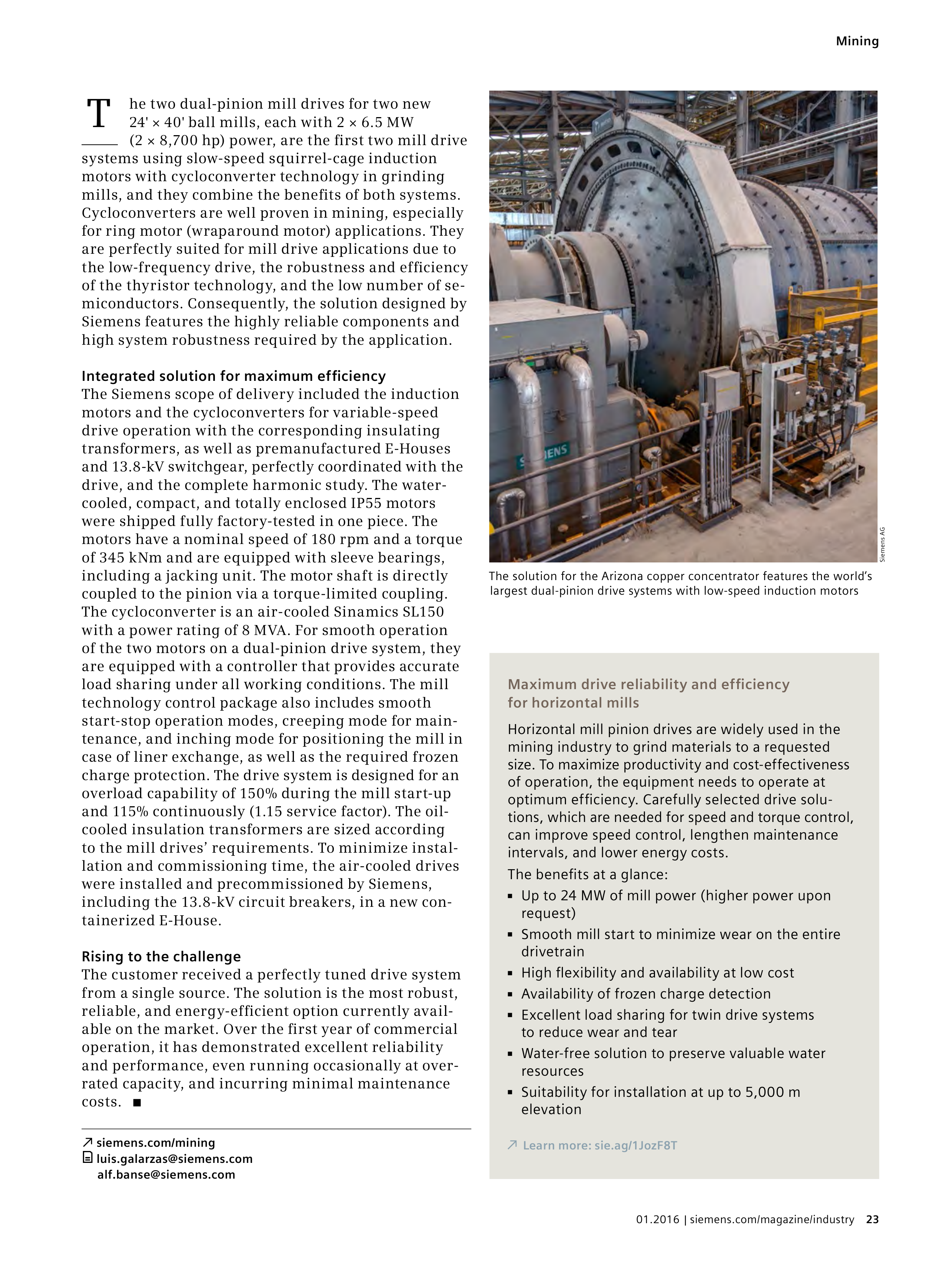
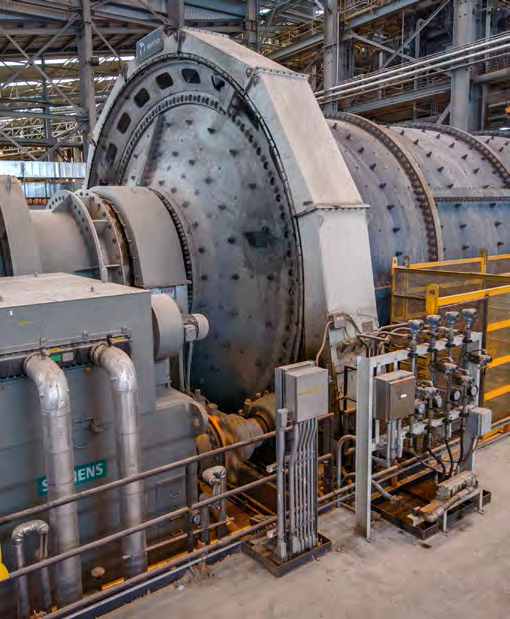
The solution for the Arizona copper concentrator features the world’s
largest dual-pinion drive systems with low-speed induction motors
T
siemens.com/mining
luis.galarzas@siemens.com
alf.banse@siemens.com
Siemens AG
24
siemens.com/magazine/industry | 01.2016
Mining
Coming full
circle
ickel mining companies
have been achieving signi
ficant gains in both pro
ductivity and efficiency in recent
years by improving the operation
of conveying and crushing systems
through automation. In a typical
configuration, nickel ore is loaded
onto a conveyor belt, where it is uni-
formly distributed by a profiling
gate located at the infeed. After trav-
eling on the belt, the nickel is dis-
charged into a surge hopper above
the jaws of a crusher. The efficiency
of the crusher depends on a consis-
tent flow of material being fed into
it – which in turn requires a moni-
toring system capable of quickly
and accurately identifying process
upsets.
Monitoring critical to process
performance
When it comes to nickel production,
the automation of conveying and
crushing systems presents a num-
ber of challenges. First, monitoring
instrumentation must be able to
reliably determine the amount of
material on the conveyor belt so as
to establish a flow rate that is opti-
mal for operation of the crusher.
A powerful combination of Siemens
technologies is allowing nickel producers
to come full circle in terms of plant
automation. And it’s producing significant
benefits in the process.
Second, the level of the material
in the crusher must be continu-
ously monitored so that the speed
of the conveyor belt can be changed
accordingly. If the level of the
crusher gets too low, the belt must
be sped up to increase the rate of
delivery of raw material. Conversely,
if the level gets too high, the belt
must be slowed down. The second
condition is especially critical be-
cause if there is too much ore in the
bin, the additional load on the jaws
can strain the crusher and reduce
its effectiveness.
Most importantly, the measuring
devices need to be able to work to-
gether effectively to communicate
these situations to the control room
so that appropriate action can be
taken and process upsets can be
prevented.
Integrated solution for conveyor
and crushing systems
Such an integrated solution can be
easily set up using aligned systems
for material weighing and level
monitoring from Siemens. To meet
the needs of flow rate monitoring,
producers can install a Milltronics
MSI belt scale, a Sitrans WS300
N
Siemens AG
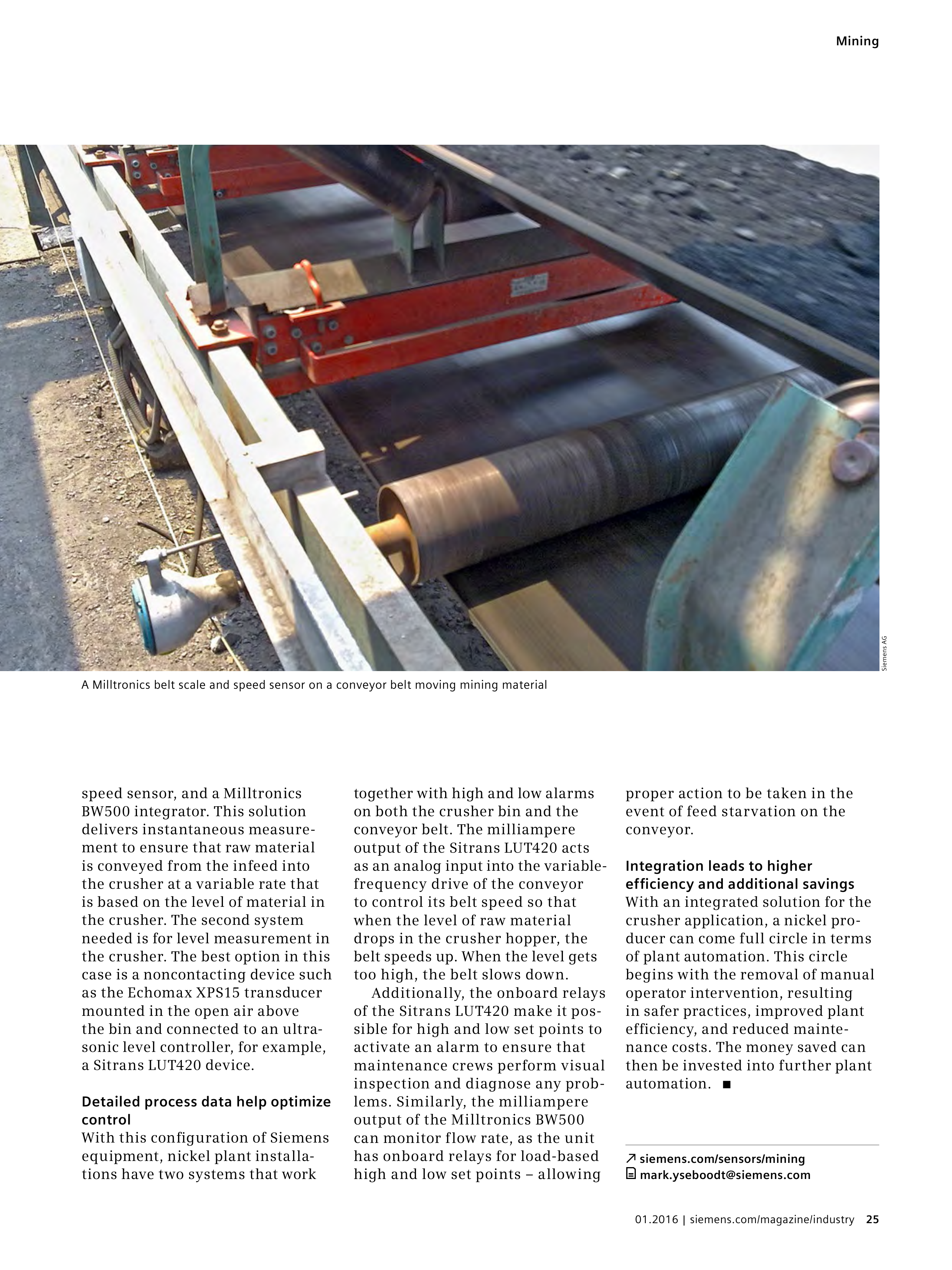
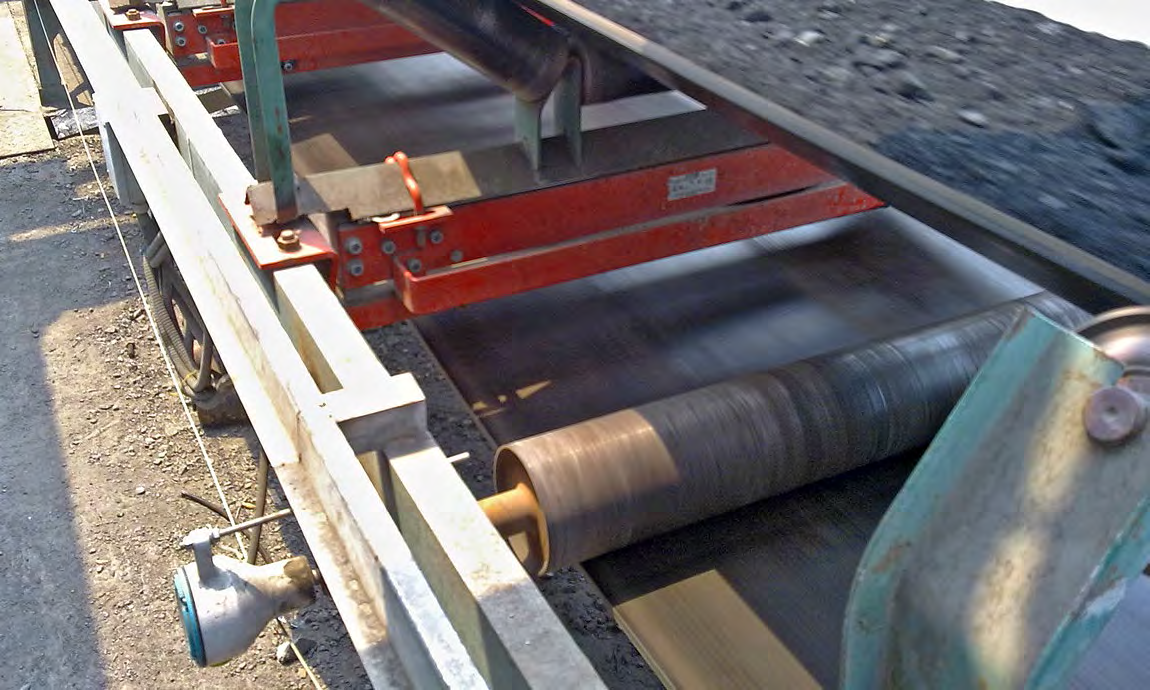

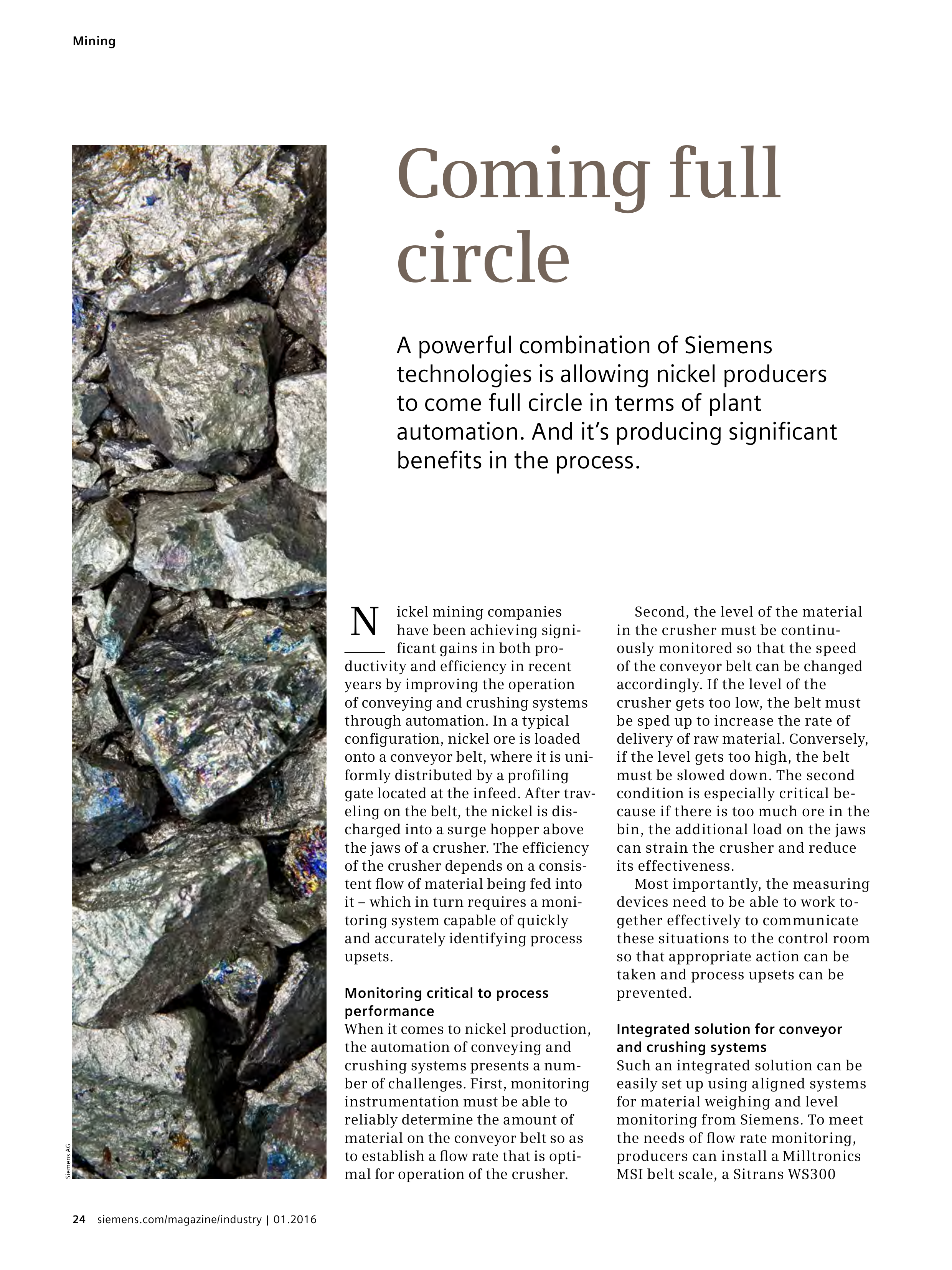
A Milltronics belt scale and speed sensor on a conveyor belt moving mining material
01.2016 | siemens.com/magazine/industry
25
Mining
speed sensor, and a Milltronics
BW500 integrator. This solution
delivers instantaneous measure-
ment to ensure that raw material
is conveyed from the infeed into
the crusher at a variable rate that
is based on the level of material in
the crusher. The second system
needed is for level measurement in
the crusher. The best option in this
case is a noncontacting device such
as the Echomax XPS15 transducer
mounted in the open air above
the bin and connected to an ultra-
sonic level controller, for example,
a Sitrans LUT420 device.
Detailed process data help optimize
control
With this configuration of Siemens
equipment, nickel plant installa-
tions have two systems that work
together with high and low alarms
on both the crusher bin and the
conveyor belt. The milliampere
output of the Sitrans LUT420 acts
as an analog input into the variable-
frequency drive of the conveyor
to control its belt speed so that
when the level of raw material
drops in the crusher hopper, the
belt speeds up. When the level gets
too high, the belt slows down.
Additionally, the onboard relays
of the Sitrans LUT420 make it pos-
sible for high and low set points to
activate an alarm to ensure that
maintenance crews perform visual
inspection and diagnose any prob-
lems. Similarly, the milliampere
output of the Milltronics BW500
can monitor flow rate, as the unit
has onboard relays for load-based
high and low set points – allowing
proper action to be taken in the
event of feed starvation on the
conveyor.
Integration leads to higher
efficiency and additional savings
With an integrated solution for the
crusher application, a nickel pro-
ducer can come full circle in terms
of plant automation. This circle
begins with the removal of manual
operator intervention, resulting
in safer practices, improved plant
efficiency, and reduced mainte-
nance costs. The money saved can
then be invested into further plant
automation.
siemens.com/sensors/mining
mark.yseboodt@siemens.com
Siemens AG
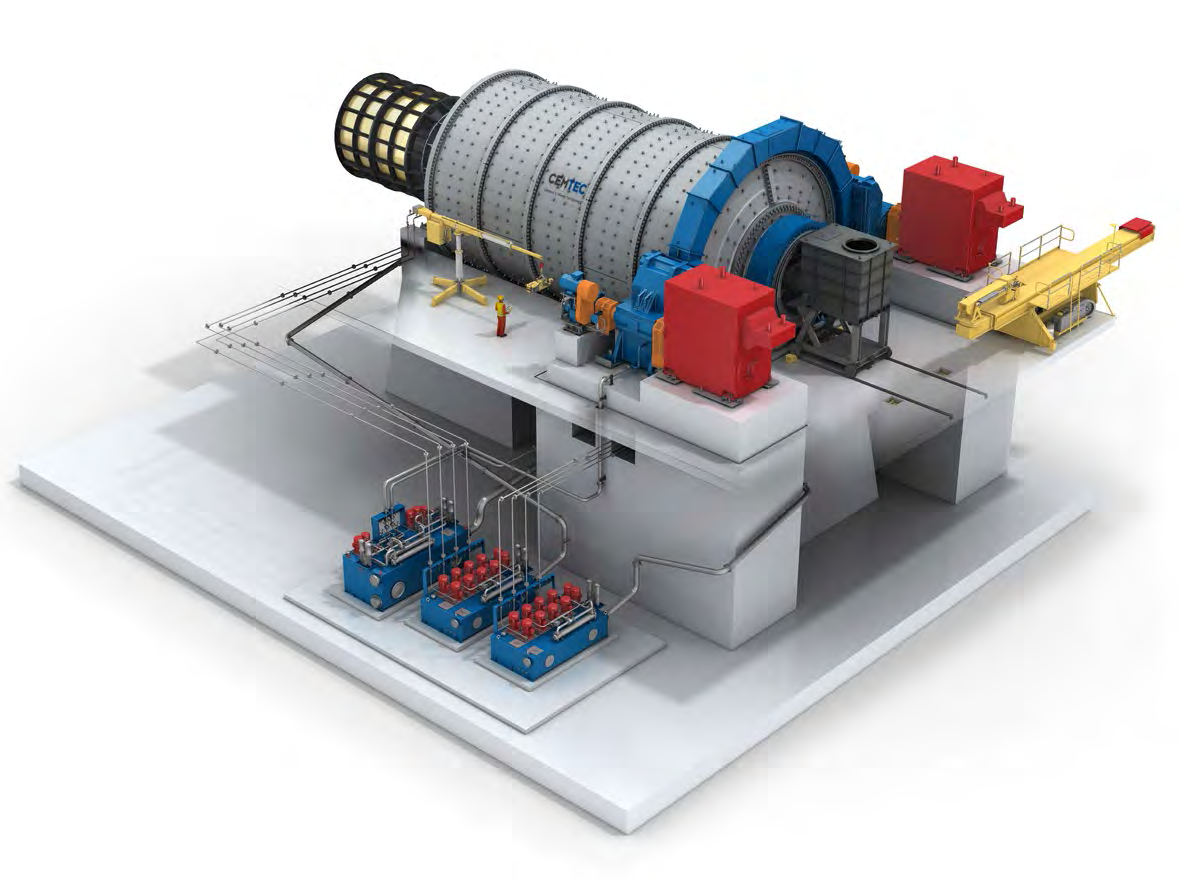
26
siemens.com/magazine/industry | 01.2016
Mining
Powering the gold rush
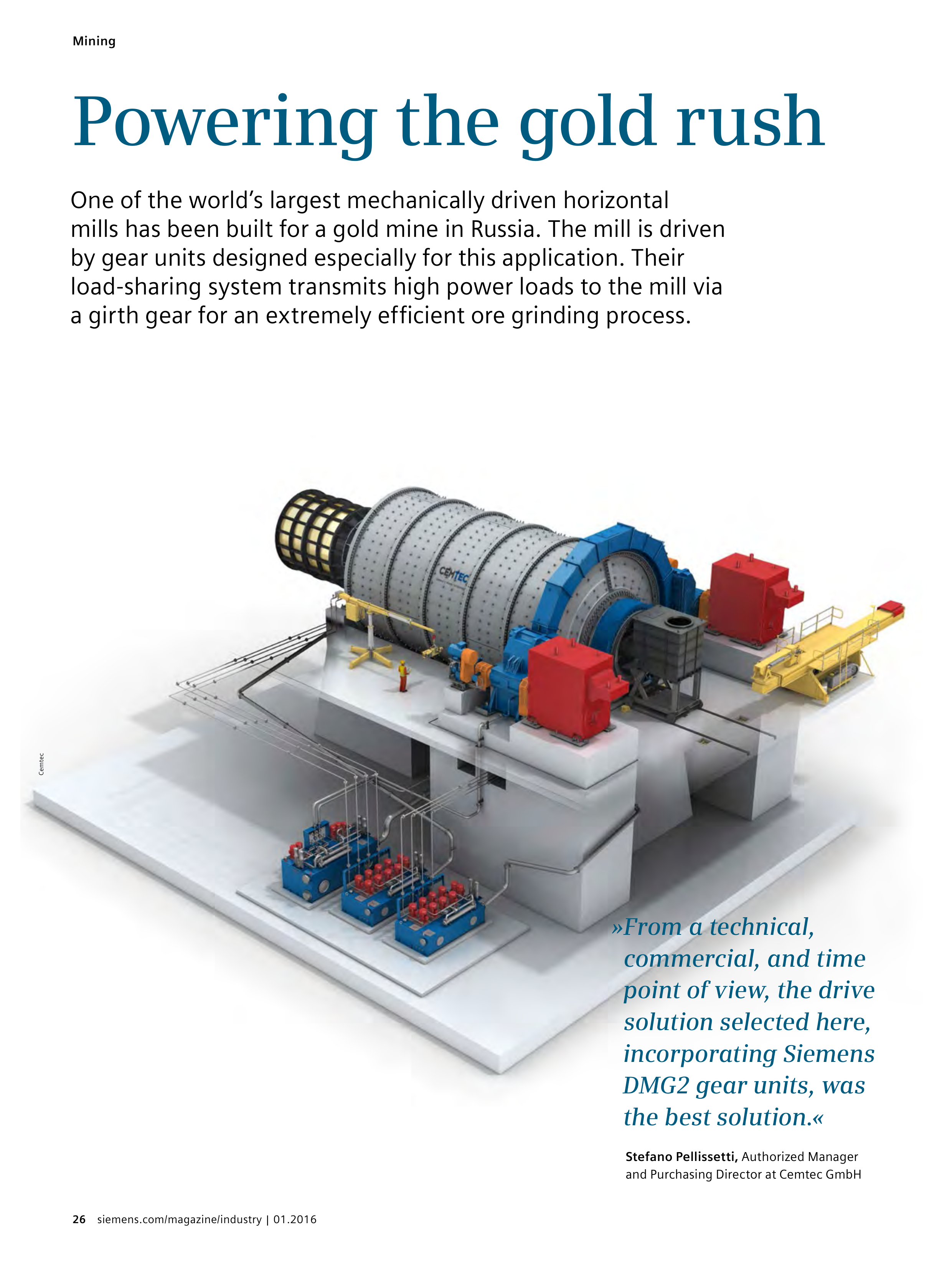
One of the world’s largest mechanically driven horizontal
mills has been built for a gold mine in Russia. The mill is driven
by gear units designed especially for this application. Their
load-sharing system transmits high power loads to the mill via
a girth gear for an extremely efficient ore grinding process.
»From a technical,
commercial, and time
point of view, the drive
solution selected here,
incorporating Siemens
DMG2 gear units, was
the best solution.«
Stefano Pellissetti,
Authorized Manager
and Purchasing Director at Cemtec GmbH
Cemtec

siemens.com/ballmill
dirk.mensing@siemens.com
Rubrik
01.2016 | siemens.com/magazine/industry
27
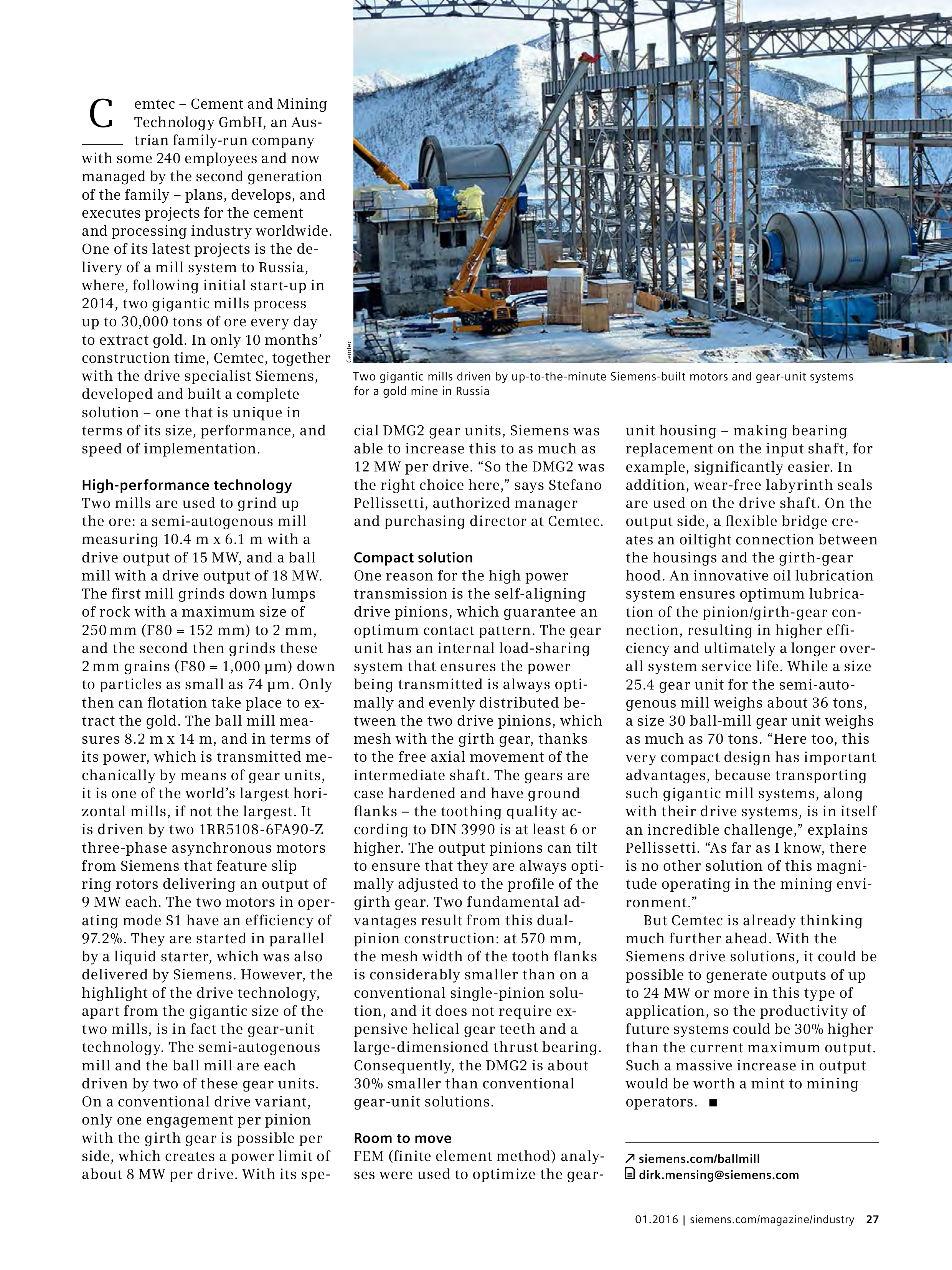
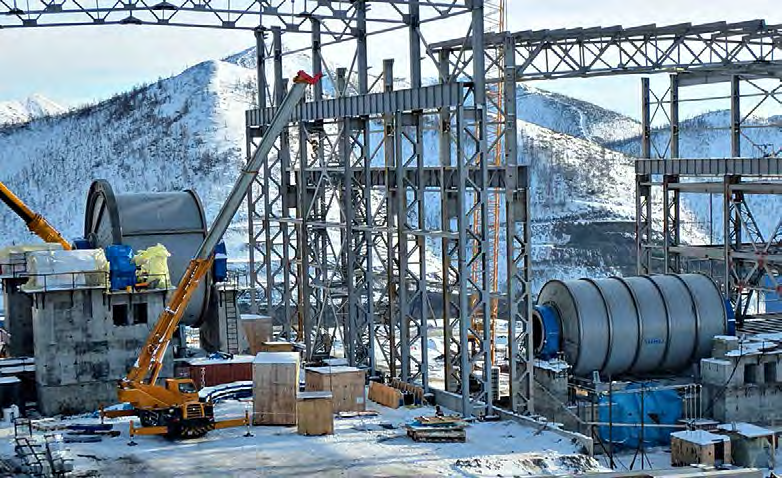
Two gigantic mills driven by up-to-the-minute Siemens-built motors and gear-unit systems
for a gold mine in Russia
emtec – Cement and Mining
Technology GmbH, an Aus-
trian family-run company
with some 240 employees and now
managed by the second generation
of the family – plans, develops, and
executes projects for the cement
and processing industry worldwide.
One of its latest projects is the de-
livery of a mill system to Russia,
where, following initial start-up in
2014, two gigantic mills process
up to 30,000 tons of ore every day
to extract gold. In only 10 months’
construction time, Cemtec, together
with the drive specialist Siemens,
developed and built a complete
solution – one that is unique in
terms of its size, performance, and
speed of implementation.
High-performance technology
Two mills are used to grind up
the ore: a semi-autogenous mill
measuring 10.4 m x 6.1 m with a
drive output of 15 MW, and a ball
mill with a drive output of 18 MW.
The first mill grinds down lumps
of rock with a maximum size of
250 mm (F80 = 152 mm) to 2 mm,
and the second then grinds these
2 mm grains (F80 = 1,000 µm) down
to particles as small as 74 µm. Only
then can flotation take place to ex-
tract the gold. The ball mill mea-
sures 8.2 m x 14 m, and in terms of
its power, which is transmitted me-
chanically by means of gear units,
it is one of the world’s largest hori-
zontal mills, if not the largest. It
is driven by two 1RR5108-6FA90-Z
three-phase asynchronous motors
from Siemens that feature slip
ring rotors delivering an output of
9 MW each. The two motors in oper-
ating mode S1 have an efficiency of
97.2%. They are started in parallel
by a liquid starter, which was also
delivered by Siemens. However, the
highlight of the drive technology,
apart from the gigantic size of the
two mills, is in fact the gear-unit
technology. The semi-autogenous
mill and the ball mill are each
driven by two of these gear units.
On a conventional drive variant,
only one engagement per pinion
with the girth gear is possible per
side, which creates a power limit of
about 8 MW per drive. With its spe-
C
cial DMG2 gear units, Siemens was
able to increase this to as much as
12 MW per drive. “So the DMG2 was
the right choice here,” says Stefano
Pellissetti, authorized manager
and purchasing director at Cemtec.
Compact solution
One reason for the high power
transmission is the self-aligning
drive pinions, which guarantee an
optimum contact pattern. The gear
unit has an internal load-sharing
system that ensures the power
being transmitted is always opti-
mally and evenly distributed be-
tween the two drive pinions, which
mesh with the girth gear, thanks
to the free axial movement of the
intermediate shaft. The gears are
case hardened and have ground
flanks – the toothing quality ac-
cording to DIN 3990 is at least 6 or
higher. The output pinions can tilt
to ensure that they are always opti-
mally adjusted to the profile of the
girth gear. Two fundamental ad-
vantages result from this dual-
pinion construction: at 570 mm,
the mesh width of the tooth flanks
is considerably smaller than on a
conventional single-pinion solu
tion, and it does not require ex
pensive helical gear teeth and a
large-dimensioned thrust bearing.
Consequently, the DMG2 is about
30% smaller than conventional
gear-unit solutions.
Room to move
FEM (finite element method) analy-
ses were used to optimize the gear-
unit housing – making bearing
replacement on the input shaft, for
example, significantly easier. In
addition, wear-free labyrinth seals
are used on the drive shaft. On the
output side, a flexible bridge cre-
ates an oiltight connection between
the housings and the girth-gear
hood. An innovative oil lubrication
system ensures optimum lubrica-
tion of the pinion/girth-gear con-
nection, resulting in higher effi-
ciency and ultimately a longer over
all system service life. While a size
25.4 gear unit for the semi-auto
genous mill weighs about 36 tons,
a size 30 ball-mill gear unit weighs
as much as 70 tons. “Here too, this
very compact design has important
advantages, because transporting
such gigantic mill systems, along
with their drive systems, is in itself
an incredible challenge,” explains
Pellissetti. “As far as I know, there
is no other solution of this magni-
tude operating in the mining envi-
ronment.”
But Cemtec is already thinking
much further ahead. With the
Siemens drive solutions, it could be
possible to generate outputs of up
to 24 MW or more in this type of
application, so the productivity of
future systems could be 30% higher
than the current maximum output.
Such a massive increase in output
would be worth a mint to mining
operators.
Cemtec
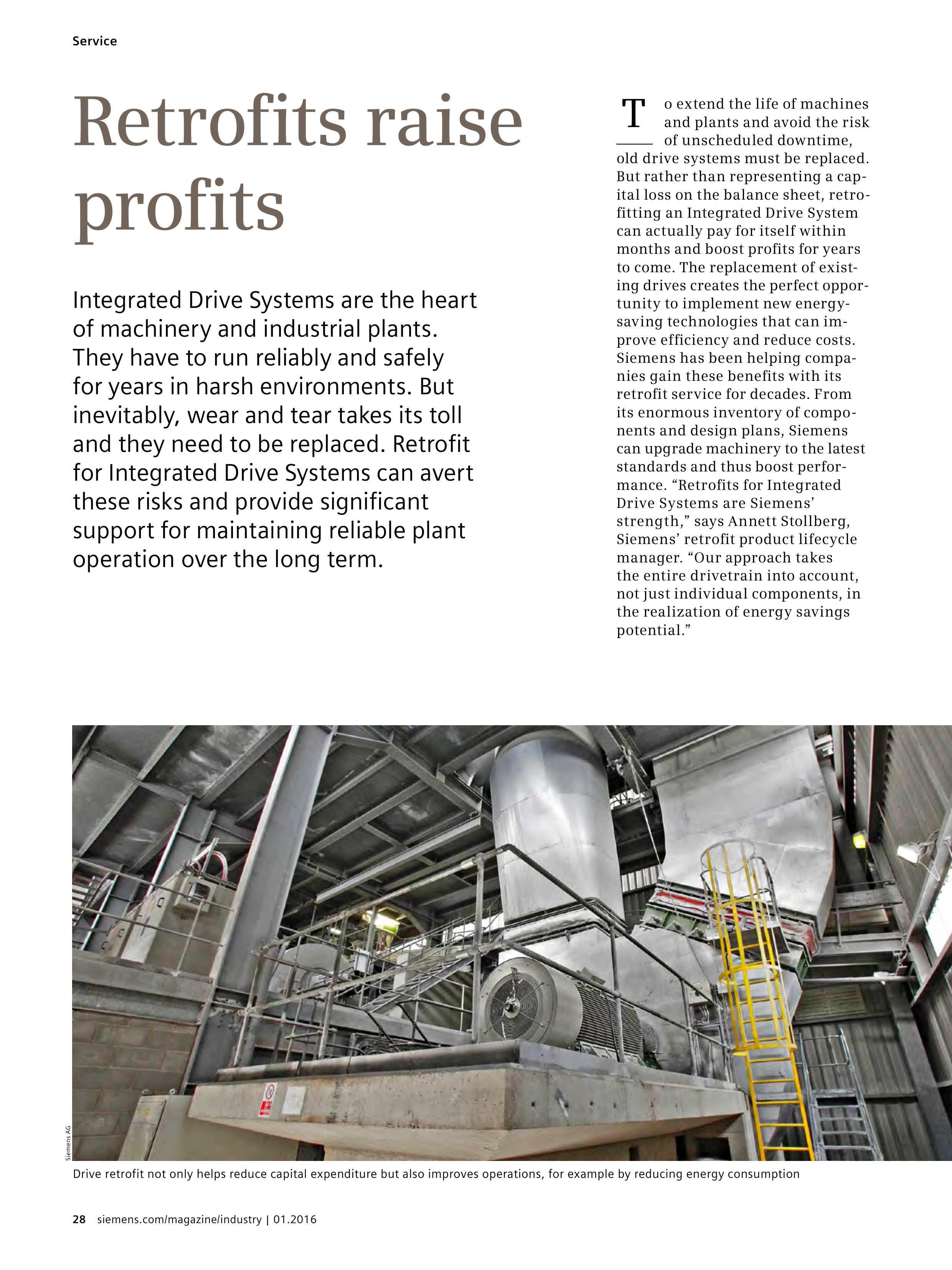
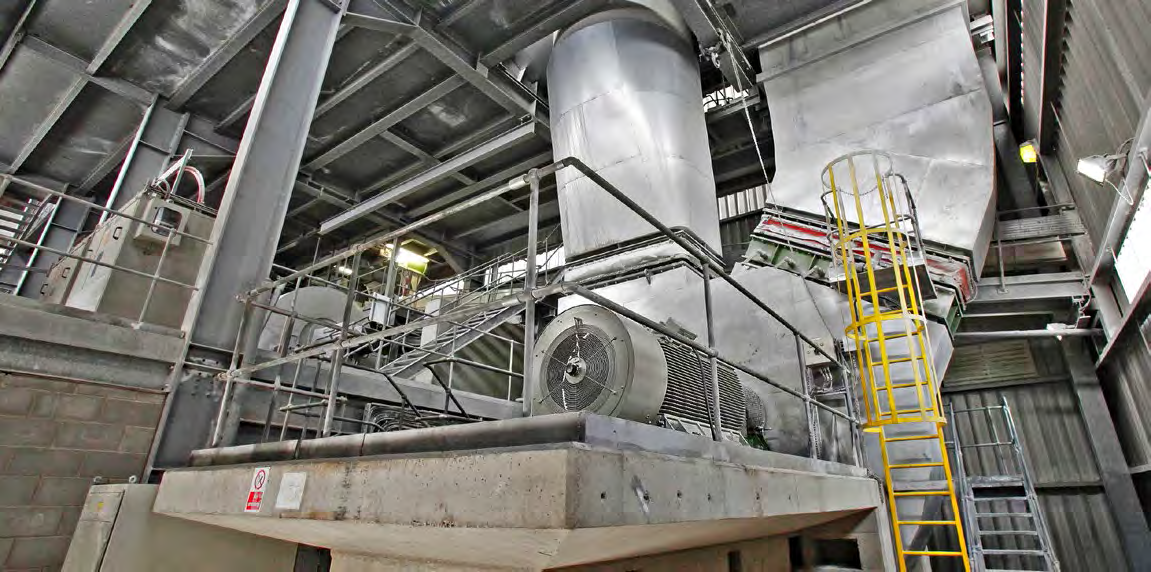
Drive retrofit not only helps reduce capital expenditure but also improves operations, for example by reducing energy consumption
28
siemens.com/magazine/industry | 01.2016
Service
o extend the life of machines
and plants and avoid the risk
of unscheduled downtime,
old drive systems must be replaced.
But rather than representing a cap-
ital loss on the balance sheet, retro-
fitting an Integrated Drive System
can actually pay for itself within
months and boost profits for years
to come. The replacement of exist-
ing drives creates the perfect oppor
tunity to implement new energy-
saving technologies that can im-
prove efficiency and reduce costs.
Siemens has been helping compa-
nies gain these benefits with its
retrofit service for decades. From
its enormous inventory of compo-
nents and design plans, Siemens
can upgrade machinery to the latest
standards and thus boost perfor
mance. “Retrofits for Integrated
Drive Systems are Siemens’
strength,” says Annett Stollberg,
Siemens’ retrofit product lifecycle
manager. “Our approach takes
the entire drivetrain into account,
not just individual components, in
the realization of energy savings
potential.”
Retrofits raise
profits
Integrated Drive Systems are the heart
of machinery and industrial plants.
They have to run reliably and safely
for years in harsh environments. But
inevitably, wear and tear takes its toll
and they need to be replaced. Retrofit
for Integrated Drive Systems can avert
these risks and provide significant
support for maintaining reliable plant
operation over the long term.
T
Siemens AG


01.2016 | siemens.com/magazine/industry
29
Service
Upgrading the entire drivetrain
with a fully integrated solution is
a long-term investment in energy
efficiency and longevity. This can
include changing from fixed-speed
to variable-speed operation with
frequency converters, replacing DC
motors with AC motors, or migrat-
ing to a gearless design. When
these upgrades are combined with
diagnostic capabilities, processes
can be optimized to reduce energy
consumption without lowering per-
formance. “What’s most important
is to understand the application
and the customer’s requirements
for the production process. In many
cases we can offer a variety of solu-
tions so customers can weigh up
the differences and advantages,”
says Stollberg. “Once a customer
has chosen a solution, Siemens
then handles the entire engineer-
ing process, from planning to
commissioning.”
A fan of retrofits
Hanson Purfleet now saves £175,000
a year after reducing its energy
consumption by 36% following the
successful retrofit of an Integrated
Drive System in one of its fans.
Previously the fan was powered
by a fixed-speed drive, running
continuously at 350,000 m
3
/hr but
Individual retrofit solutions
Siemens offers a comprehensive
retrofit program for both its prod-
ucts and those of other brands;
the choices are tailored to the
needs of the individual customer.
The first option is 1:1 duplication
of the motor: if the long-standing
configuration is already deliver
ing proven performance and low
energy consumption, an identi
cal motor can be selected from
Siemens’ extensive inventory. This
eliminates the need for expensive
requalification of new machines.
The second is replacement: an eco-
nomical and efficient option, with
the lowest up-front investment
cost, is to replace the drive with
a standard product. Additional
customization can then be per-
formed in the factory or on-site.
The third option is an upgrade:
for the highest efficiency gains,
upgrading old motors and drives
to the latest cutting-edge technol-
ogy from Siemens’ product range
can pay for itself within months
through lower energy consumption
and optimized processes.
Siemens offers an extensive retrofit program tailored to the needs of the individual customer
damped to 241,000 m
3
/hr. This
meant more than 100,000 m
3
/hr
was being wasted, thus adding
considerable unnecessary costs
to the company’s energy bill.
After Siemens retrofitted the
fixed-speed motor, the drop in
power usage was dramatic. The
motor is now constantly monitored
with sensors, and the airflow is
regulated by a frequency converter.
This system optimizes performance
while ensuring that energy con-
sumption never exceeds the opera
tional requirements. “The Siemens
solution means we are now run-
ning with the damper open 100%
of the time, yet actual energy con-
sumption has dropped by around
360–400 kW,” says Hanson Purfleet
electrical engineer Dave Jackson.
Along with energy savings of
36%, the company has achieved a
1,487-ton reduction in CO
2
emis-
sions. The large ongoing savings
on energy bills mean that the en-
tire Integrated Drive System will
pay for itself within two years,
highlighting how a Siemens retrofit
turns capital expenses into long-
term profits.
siemens.com/retrofit-ids
uwe_schulz@siemens.com
Benefits
◾
Greater productivity through
optimized speed and process
performance
◾
Improved flexibility, with
faster run-up/run-down times
◾
Standardization
◾
Higher productivity and less
maintenance
◾
Long-term availability of spare
parts and simplified manage-
ment
◾
Totally Integrated Automation,
communication, and diagnostics
◾
Recovery of up-front cost
through lower energy costs
Siemens AG
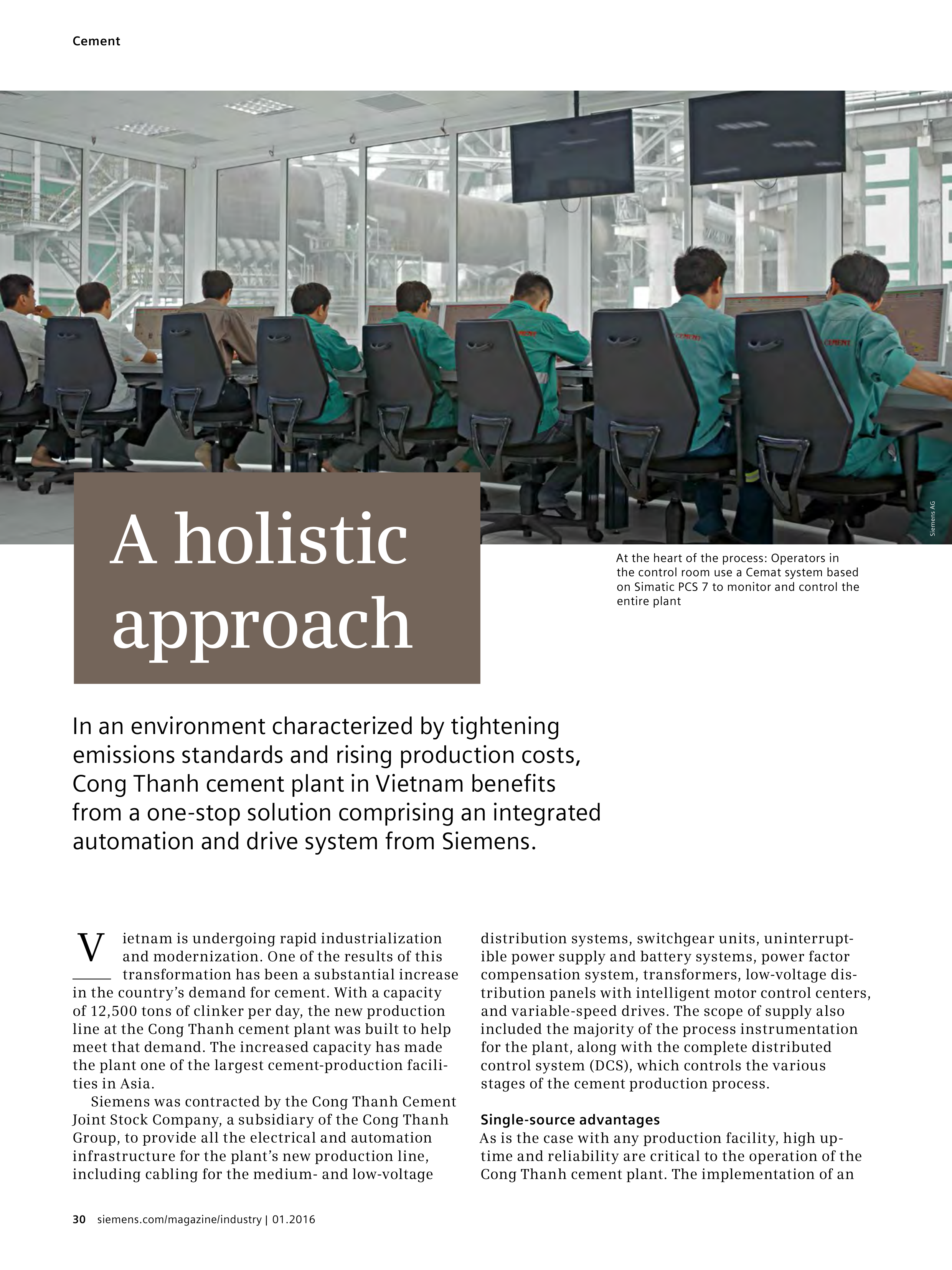
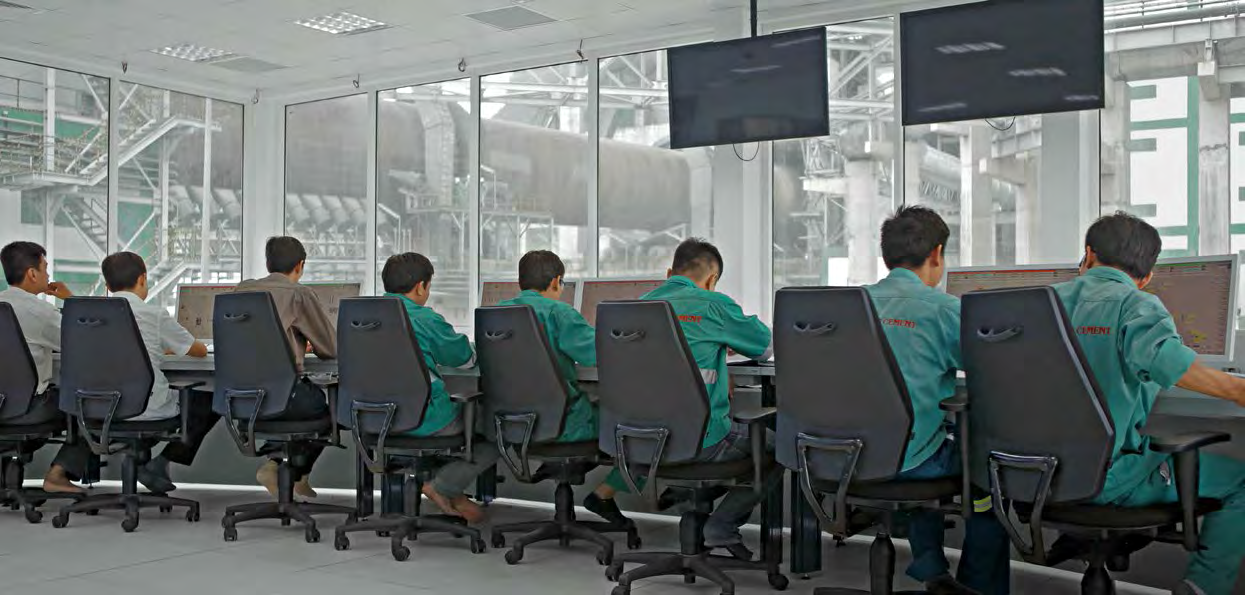
30
siemens.com/magazine/industry | 01.2016
Cement
ietnam is undergoing rapid industrialization
and modernization. One of the results of this
transformation has been a substantial increase
in the country’s demand for cement. With a capacity
of 12,500 tons of clinker per day, the new production
line at the Cong Thanh cement plant was built to help
meet that demand. The increased capacity has made
the plant one of the largest cement-production facili-
ties in Asia.
Siemens was contracted by the Cong Thanh Cement
Joint Stock Company, a subsidiary of the Cong Thanh
Group, to provide all the electrical and automation
infrastructure for the plant’s new production line,
including cabling for the medium- and low-voltage
distribution systems, switchgear units, uninterrupt-
ible power supply and battery systems, power factor
compensation system, transformers, low-voltage dis-
tribution panels with intelligent motor control centers,
and variable-speed drives. The scope of supply also
included the majority of the process instrumentation
for the plant, along with the complete distributed
control system (DCS), which controls the various
stages of the cement production process.
Single-source advantages
As is the case with any production facility, high up-
time and reliability are critical to the operation of the
Cong Thanh cement plant. The implementation of an
In an environment characterized by tightening
emissions standards and rising production costs,
Cong Thanh cement plant in Vietnam benefits
from a one-stop solution comprising an integrated
automation and drive system from Siemens.
A holistic
approach
At the heart of the process: Operators in
the control room use a Cemat system based
on Simatic PCS 7 to monitor and control the
entire plant
V
Siemens AG
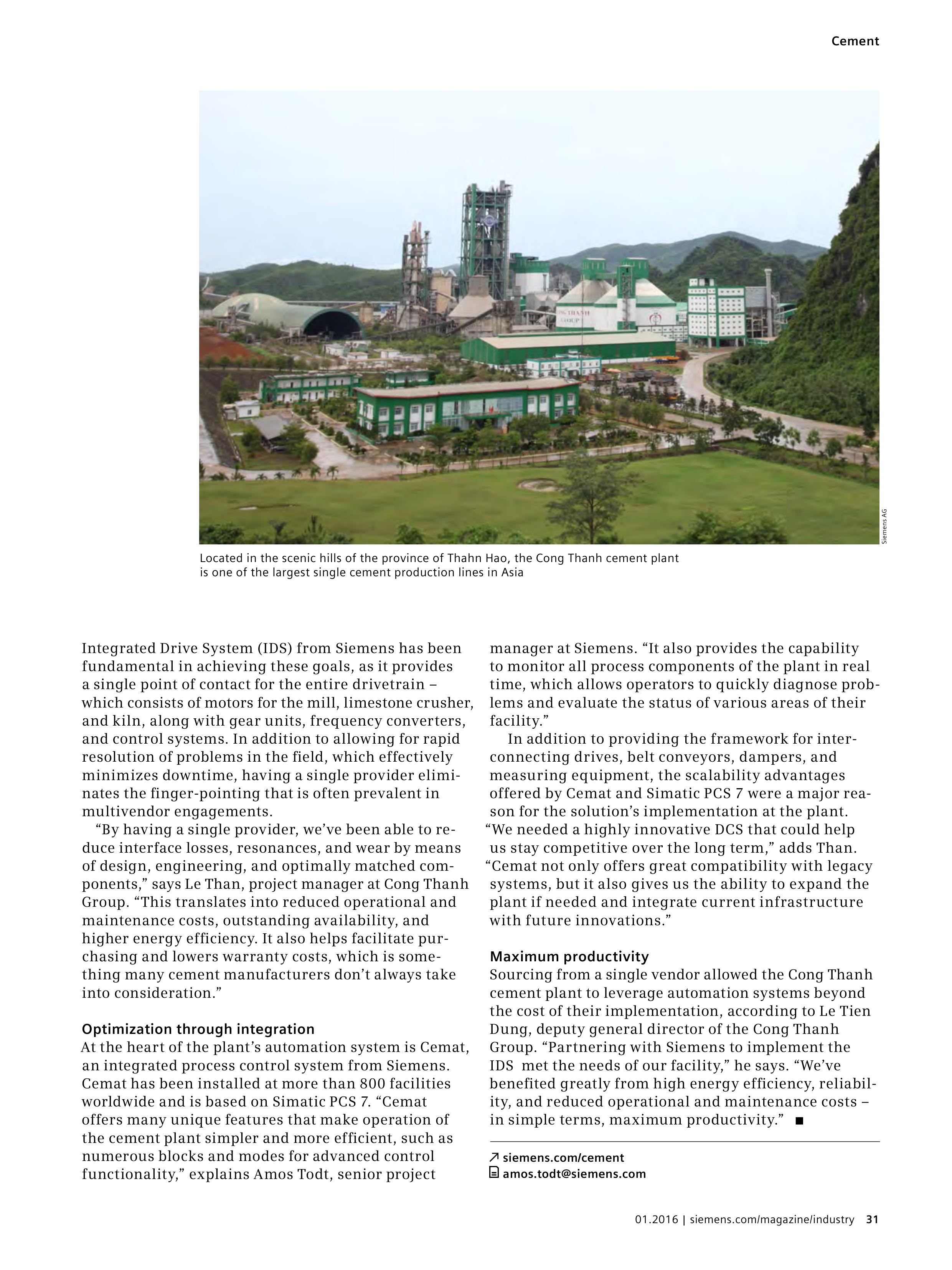

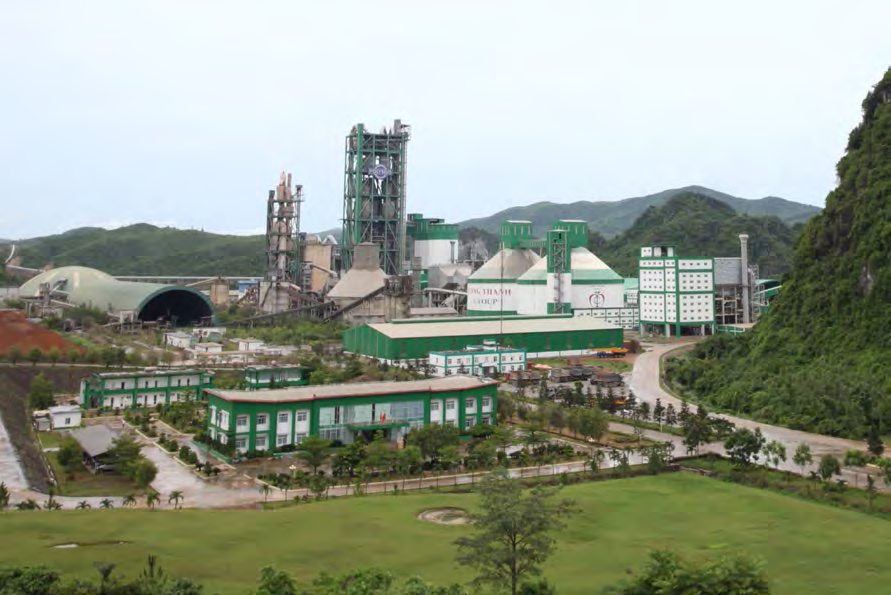
siemens.com/cement
amos.todt@siemens.com
01.2016 | siemens.com/magazine/industry
31
Cement
Integrated Drive System (IDS) from Siemens has been
fundamental in achieving these goals, as it provides
a single point of contact for the entire drivetrain –
which consists of motors for the mill, limestone crusher,
and kiln, along with gear units, frequency converters,
and control systems. In addition to allowing for rapid
resolution of problems in the field, which effectively
minimizes downtime, having a single provider elimi-
nates the finger-pointing that is often prevalent in
multivendor engagements.
“By having a single provider, we’ve been able to re-
duce interface losses, resonances, and wear by means
of design, engineering, and optimally matched com
ponents,” says Le Than, project manager at Cong Thanh
Group. “This translates into reduced operational and
maintenance costs, outstanding availability, and
higher energy efficiency. It also helps facilitate pur-
chasing and lowers warranty costs, which is some-
thing many cement manufacturers don’t always take
into consideration.”
Optimization through integration
At the heart of the plant’s automation system is Cemat,
an integrated process control system from Siemens.
Cemat has been installed at more than 800 facilities
worldwide and is based on Simatic PCS 7. “Cemat
offers many unique features that make operation of
the cement plant simpler and more efficient, such as
numerous blocks and modes for advanced control
functionality,” explains Amos Todt, senior project
Located in the scenic hills of the province of Thahn Hao, the Cong Thanh cement plant
is one of the largest single cement production lines in Asia
manager at Siemens. “It also provides the capability
to monitor all process components of the plant in real
time, which allows operators to quickly diagnose prob-
lems and evaluate the status of various areas of their
facility.”
In addition to providing the framework for inter-
connecting drives, belt conveyors, dampers, and
measuring equipment, the scalability advantages
offered by Cemat and Simatic PCS 7 were a major rea-
son for the solution’s implementation at the plant.
“We needed a highly innovative DCS that could help
us stay competitive over the long term,” adds Than.
“Cemat not only offers great compatibility with legacy
systems, but it also gives us the ability to expand the
plant if needed and integrate current infrastructure
with future innovations.”
Maximum productivity
Sourcing from a single vendor allowed the Cong Thanh
cement plant to leverage automation systems beyond
the cost of their implementation, according to Le Tien
Dung, deputy general director of the Cong Thanh
Group. “Partnering with Siemens to implement the
IDS met the needs of our facility,” he says. “We’ve
benefited greatly from high energy efficiency, reliabil-
ity, and reduced operational and maintenance costs –
in simple terms, maximum productivity.”
Siemens AG
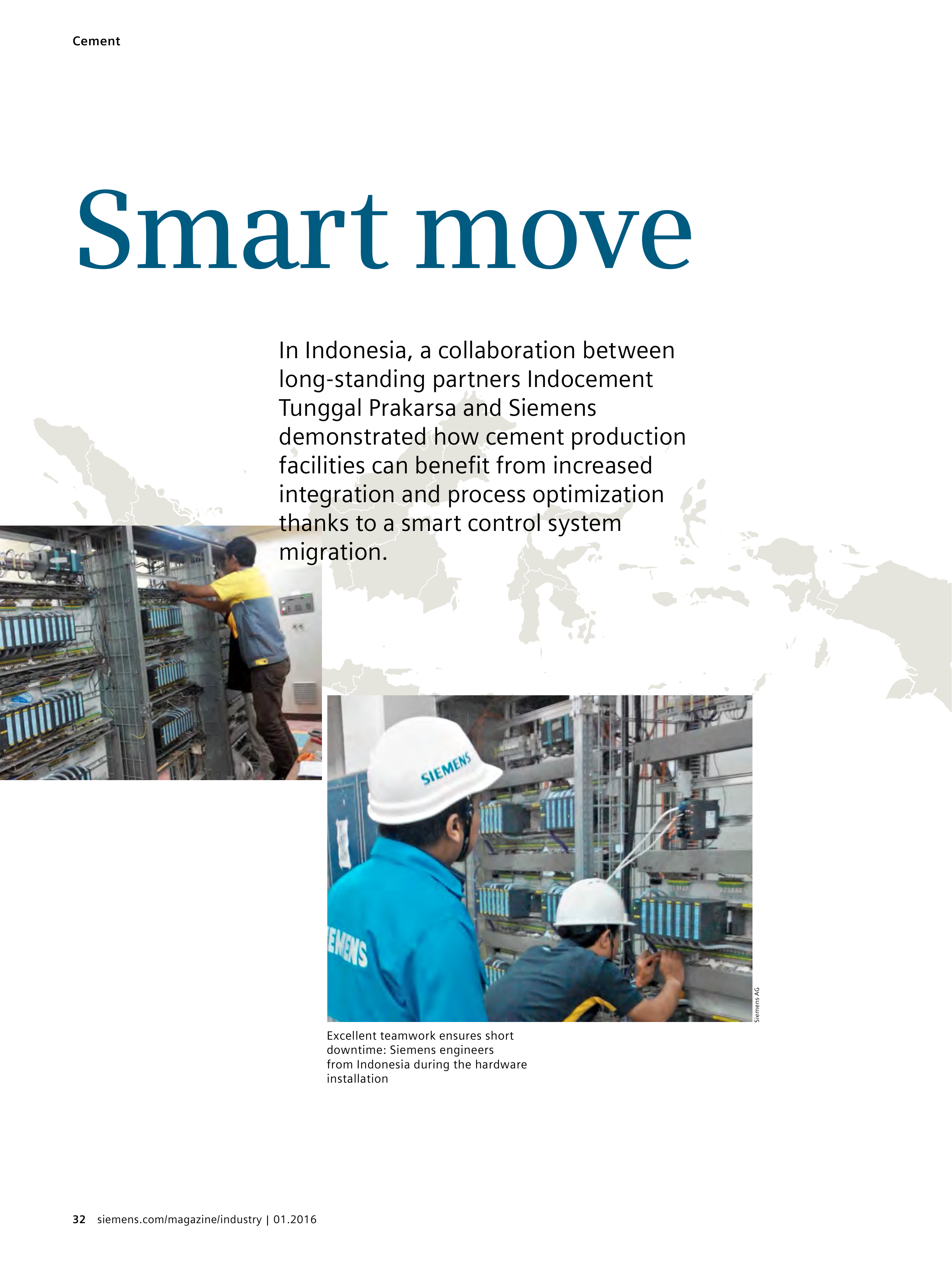
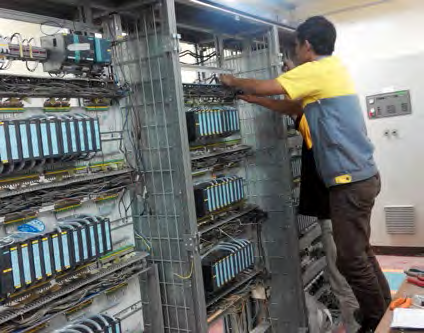
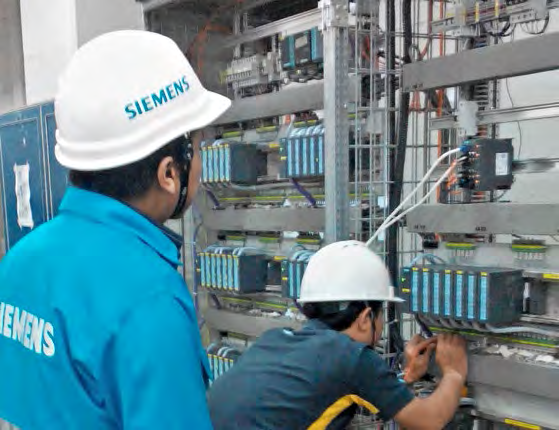
32
siemens.com/magazine/industry | 01.2016
Cement
Smart move
Excellent teamwork ensures short
downtime: Siemens engineers
from Indonesia during the hardware
installation
In Indonesia, a collaboration between
long-standing partners Indocement
Tunggal Prakarsa and Siemens
demonstrated how cement production
facilities can benefit from increased
integration and process optimization
thanks to a smart control system
migration.
Siemens AG

01.2016 | siemens.com/magazine/industry
33
Cement
he cement industry is booming in Southeast
Asia. Indonesia, for example, has made signif
icant investments in new infrastructure in
recent years in an effort to modernize and promote
economic growth. One of the results of this effort has
been an increase in the country’s demand for cement.
Indonesian cement producers are thus coming under
increased pressure to boost output and improve oper-
ational efficiency in order to meet this demand and
avoid supply shortfalls.
An important industry player
Indocement Tunggal Prakarsa is Indonesia’s second-
largest cement producer, yielding over 20 million tons
of cement per year. The company was founded in 1975
and in 2001 was acquired by the German multinatio
nal giant Heidelberger Cement. Indocement operates
a total of 12 plants in Indonesia, located at three inte
grated cement factory sites. The company’s largest
installation is its integrated megaplant at Citeureup,
which features nine dry kilns and has a total produc-
tion capacity of 13.6 million tons of cement per year.
Migration for success
From its inception, Indocement has been committed to
continuous improvement through integration and pro-
cess optimization – hence the company’s decision in
2013 to commission its long-standing partner Siemens
to migrate the outdated control systems at three pro-
duction facilities (Citeureup, Cirebon, and Tarjun) to
the Cemat integrated process control system, which is
based on Simatic PCS 7.
With a presence in Indonesia that can be traced back
more than 160 years, to 1855, Siemens offers a unique
combination of expertise and local resources that made
the company a logical choice of partner for Indocement.
Furthermore, Cemat has been installed at more than
800 facilities worldwide and represents a proven
solution for helping cement producers reduce costs
through advanced resource management and pro
ductivity monitoring.
A significant improvement
The primary goal of the upgrade project was to im-
prove reliability and efficiency at the production facil-
ities so that Indocement could reach its production
goal of 30 million tons of clinker per year by 2018. In
addition to maximizing uptime and decreasing the
overall cost of production, the company wished to
replace the existing distributed control systems with
a more advanced and integrated platform that could
provide added visibility into the overall operation of
the plants.
The project scope involved the migration of seven
production lines – four at Citeureup, two at Cirebon, and
one at Tarjun. A new coal mill (a future project) will also
be integrated into the new control system. The migra-
tion of the production lines required the replacement
of programmable logic controllers (PLCs) as well as the
addition of remote I/O substations and HMI upgrades.
Prewired I/O rails with connectors were selected due to
a need for short exchange time. Work at the facilities
was performed by a combination of Indocement person-
nel and Siemens engineers based throughout Indonesia.
Having the advantage of worldwide presence, Siemens
also involved experts from India to speed up the com-
missioning. Safe migration with minimum downtime
was Indocement's main priority, and together with
Siemens, this target was achieved.
Cemat provided an advanced framework for intercon-
necting drives, belt conveyors, dampers, and measuring
equipment and allowed Indocement to access relevant
cement production data in a virtual real-time environ-
ment. Simatic PCS 7 also offered superior compatibility
with legacy systems and provided the flexibility to ex-
pand plant capacity in the future if needed. Standard-
ized libraries for automation functions also helped en-
sure better maintenance and service – leading to lower
costs and increased efficiency at each of the facilities.
Leveraging expertise
The expertise and global presence offered by Siemens,
coupled with the operational experience of Indocement,
allowed for a smooth upgrade at all the facilities. The
success of the migration project has led to further
collaboration between the two companies: the new P14
kiln line will also be controlled by the Cemat system.
This partnership is just one example of how a perfect
fit between portfolio and expertise can create cost-
efficient solutions that help improve reliability, reduce
complexity, and achieve long-term operational success
for cement plants.
T
siemens.com/cemat
wilhelm.braunecker@siemens.com
Simatic PCS 7 also
offered superior
compatibility with
legacy systems
and provided the
flexibility to expand
plant capacity in the
future if needed.
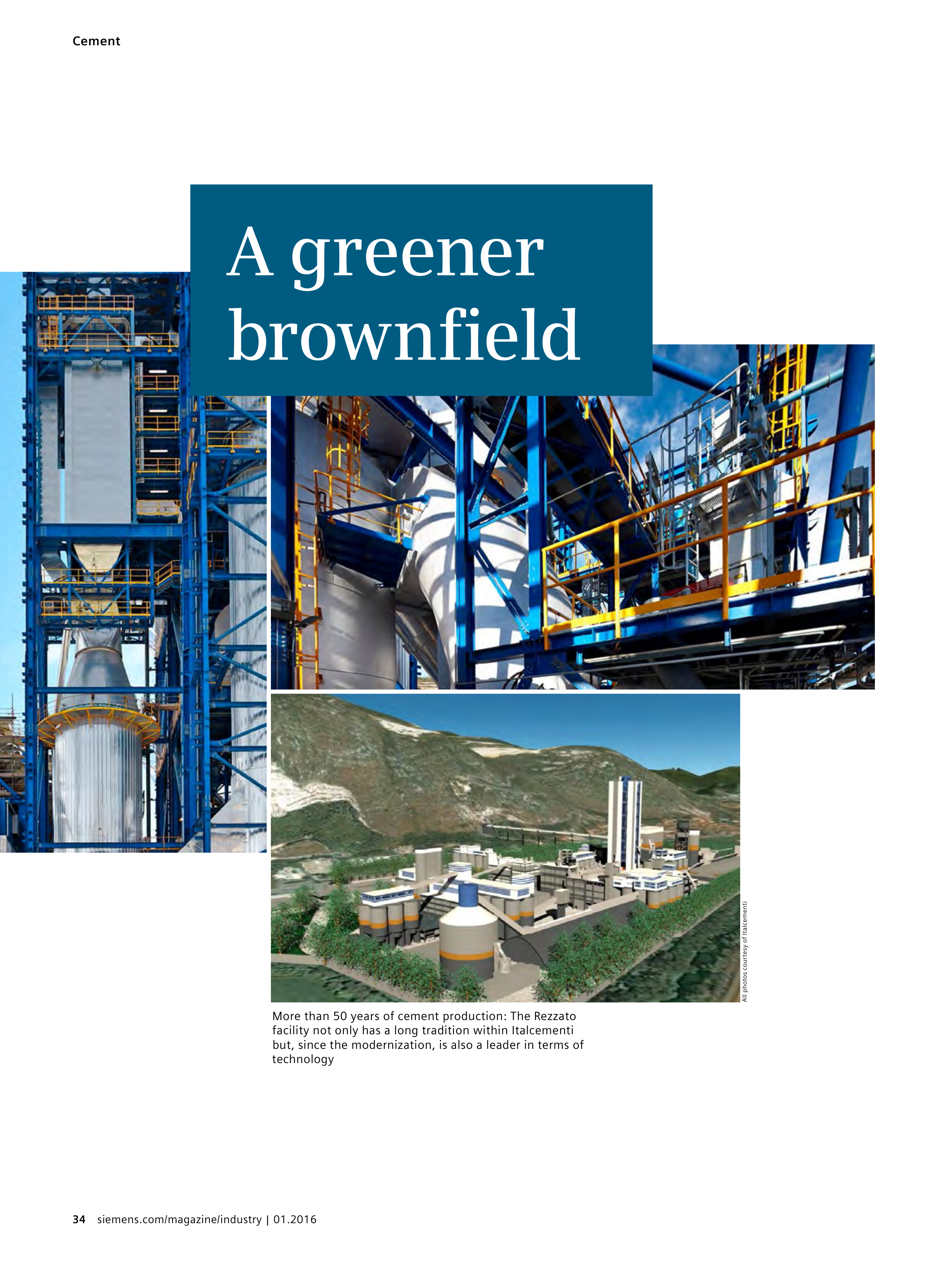
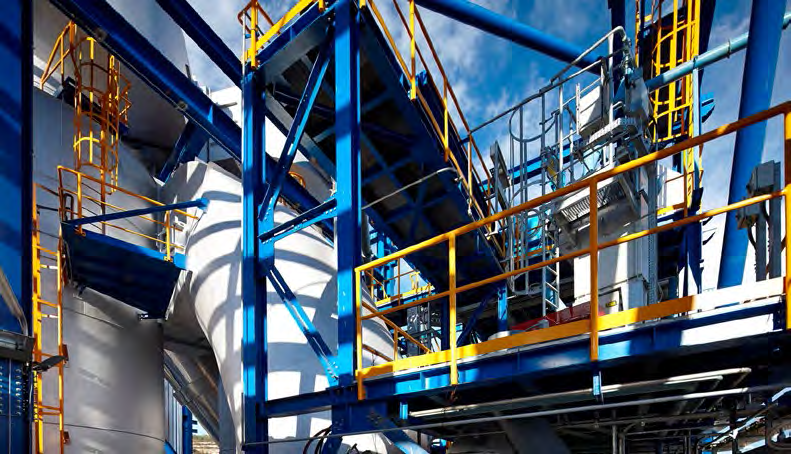
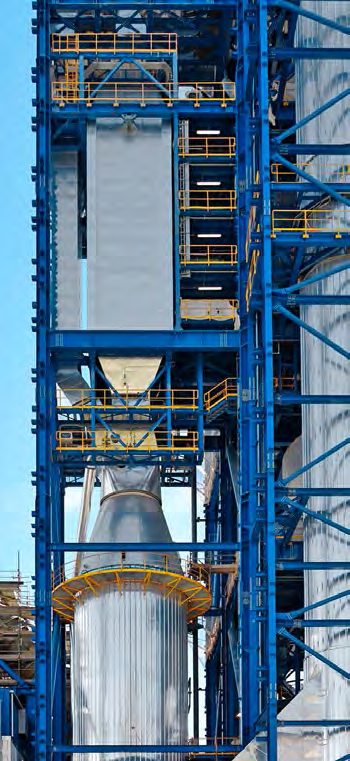
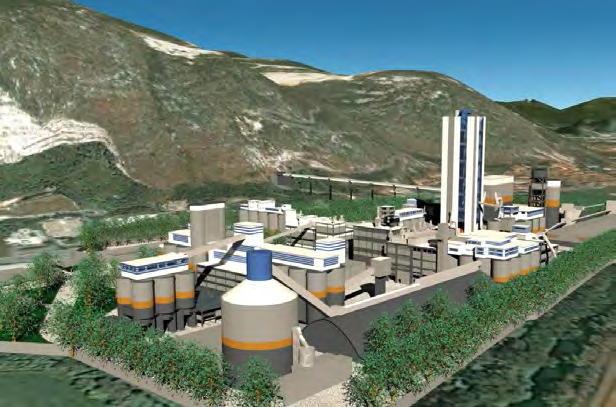
More than 50 years of cement production: The Rezzato
facility not only has a long tradition within Italcementi
but, since the modernization, is also a leader in terms of
technology
34
siemens.com/magazine/industry | 01.2016
Cement
A greener
brownfield
All photos courtesy of Italcementi

01.2016 | siemens.com/magazine/industry
35
Cement
ith a production capacity
of 61 million tons per year
and subsidiaries on four
continents, Italcementi Group is one
of the world’s largest cement pro-
ducers. The company has repeatedly
won awards for its commitment to
innovation and sustainability, and
continually sets new standards – for
example, with the modernization of
its plant in Rezzato, Italy, originally
put into operation in 1964.
A step into the future
The Rezzato project, given the
green light in 2010, is proof of Ital-
cementi’s future orientation. One
of the company’s main objectives
was to transition from a semidry
clinker manufacturing process to
a modern, more energy-efficient,
and sustainable dry process. For
the automation and process control
of the new line, Italcementi chose
Simatic PCS 7 – as it had for vari-
ous successful installations in the
past. The complete engineering,
supply, and commissioning of this
main control system (MCS) was
awarded to Fast S.p.A., an experi-
enced automation services pro-
vider and systems integrator for
Siemens.
New possibilities with Profinet
Because the assets of a cement plant
are often dispersed over a wide
area, the design of the communi
cation network architecture is a
critical issue in MCS engineering.
Normally, a centralized layout is
the solution of choice – with all
smart devices located near the cen-
tral control room, all peripherals
in the distributed electrical rooms,
and all the devices connected via
a Profibus DP–based star or ring
network.
Rezzato chose a different ap-
proach and became the first project
worldwide to use a unique Profinet
ring with Simatic PCS 7, which con-
nects all the controllers to all the
Profinet users. This solution, de-
vised by C.T.G. (Italcementi Group
Technical Center), was designed
by Siemens and Fast S.p.A. and sig
nificantly simplifies the network
architecture. Any peripheral device
in any electrical room can be con-
nected to any MCS controller, any-
where in the plant – simply by
means of optical fibers. In addition,
it is possible to easily link third-
party local programmable logic
controllers (PLCs) into the network
and to access them for mainte-
Through an extensive modernization project that combined new
technologies with sustainability and involved upgrading the process
control systems with a state-of-the-art industrial network, Italcementi
Group has not only improved the productivity and efficiency of its
Rezzato plant, but has also built the foundations for future innovations.
nance or service from wherever an
engineering station is plugged in.
More than one reason to celebrate
During the installation and
commissioning of the system,
experts from CSMT (Centro Servizi
Multisettoriale e Tecnologico – the
Profibus and Profinet Competence
Center headquartered at the Uni-
versity of Brescia) conducted exten-
sive surveys and performance au-
dits and also assisted in the detail
engineering phase. With their di-
agnostic tools, they could examine
all network nodes, resolve connec-
tion and configuration issues, and
release network performance cer
tification reports.
Thanks to the close collabora-
tion of all the participants, the
modernization project was a big
success. The Rezzato facility, which
began operating in 1964 during the
100th anniversary of the founding
of Italcementi, started up its new
line in November 2014 in time for
the 150th anniversary.
W
The project at a glance
siemens.com/cement
Claudio Locatelli
Italcementi Group, Italy
Italcementi improved the sustainability and eco-foot-
print of its operations at the Rezzato plant by replacing
and upgrading several process units:
◾
Replacement of the two existing long kilns with a
new kiln that includes a five-stage suspension preheater
◾
Installation of a new raw meal grinding unit
◾
Installation of a high-temperature bag filter
downstream from the clinker cooler
◾
Installation of a selective non-catalytic reduction
(SNCR) system and a selective catalytic reduction (SCR)
system for nitrogen oxide abatement
◾
Installation of a sulfur dioxide abatement system
based on dry injection of sodium bicarbonate
◾
Process automation upgrade with Simatic PCS 7 and
Profinet

Subscribe to our topical
newsletters and magazines.
siemens.com/magazine
Stay up to date!