here
march 2007
25
www.alfalaval.com/here
America’s
No.1
Oil Refiner
Text
Harvey Marks
Photo
bob werre
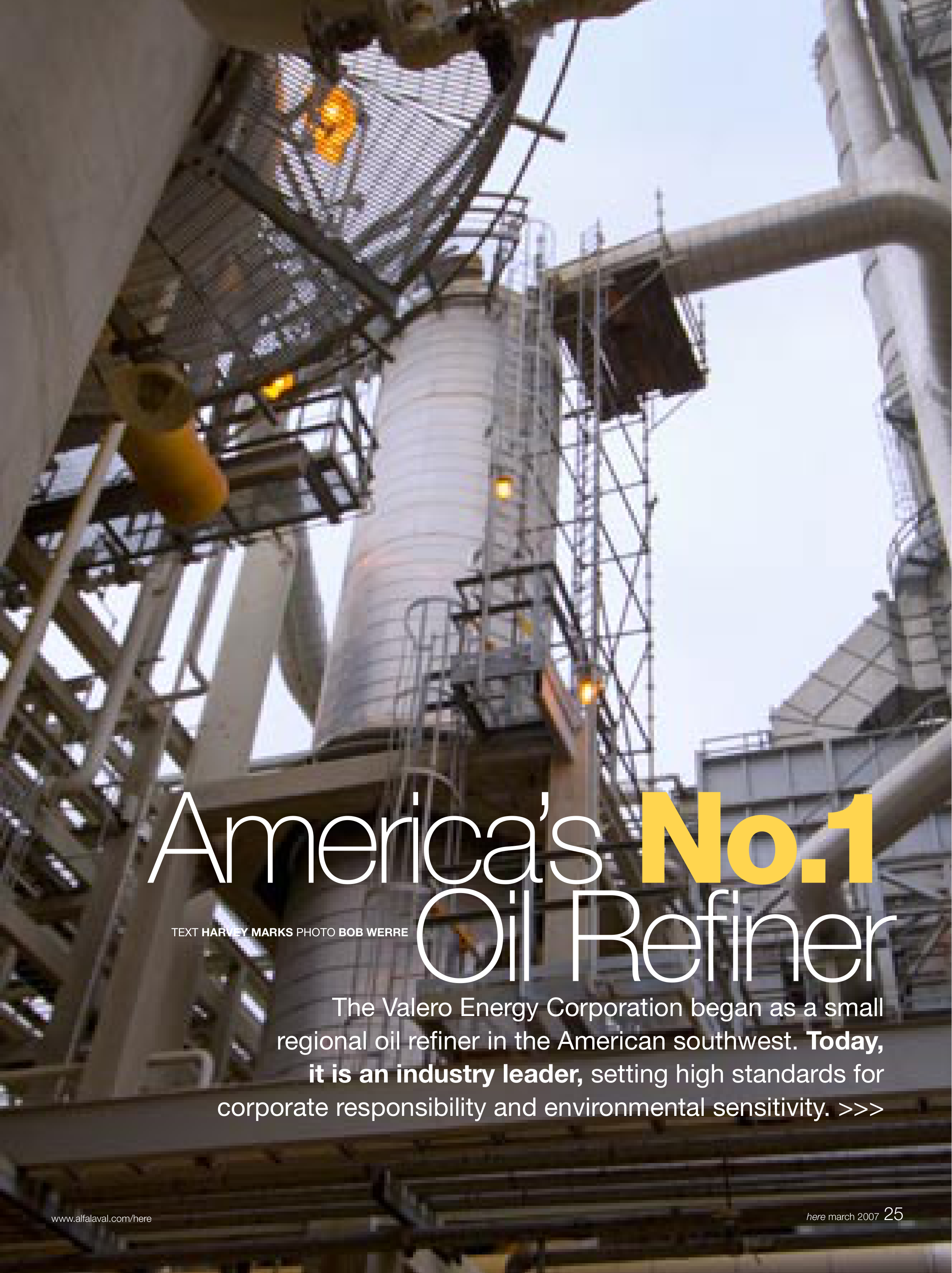
The Valero Energy Corporation began as a small
regional oil refiner in the American southwest.
Today,
it is an industry leader,
setting high standards for
corporate responsibility and environmental sensitivity. >>>
here
march 2007
25
www.alfalaval.com/here
26
here
march 2007
an international magazine from alfa laval
here
march 2007
27
www.alfalaval.com/here
alero Energy Corporation, based
in San Antonio, Texas, has enjoyed
phenomenal success. Since 1981,
the company has become North Amer-
ica’s largest refiner, growing from a single
refinery to a network of 18 facilities. To-
day, the company’s aggressive drive for
growth and excellence continue unabat-
ed. Valero’s assets currently total USD 33
billion. Annual revenues are more than
USD 90 billion, and refining throughput
capacity is approximately 3.3 million bar-
rels per day. Most notably, the company
enjoyed record earnings in 2006, finish-
ing the year with net income of USD 5.5
billion.
This strong performance is the result
of a strategic assessment of the refining in-
dustry that Valero made in 1996 when the
company concluded that the refining
cycle was at a bottom. Valero believed that
historically-low refining margins would
improve as global demand continued to
expand and as the worldwide movement
toward cleaner fuels tightened the supply
of refining products.
This analysis turned out to be the right
call, and today Valero is a leading produc-
er of premium, environmentally-clean
products, including reformulated gas-
oline, California Air Resources Board
(CARB) Phase II gasoline, low-sulphur die-
sel and oxygenates. These products and
many others are sold in Valero’s more
as VPP Star Sites, a designation reserved for
America’s premier examples of industrial
safety. Valero is also the only refiner to win
the Governor’s Award for Environmental Ex-
cellence in Texas, and it remains on track to
reduce greenhouse gas emissions by nearly
two million US tons per year by 2008.
Equally noteworthy is Valero’s strong
commitment to its 22,000 employees and
the company’s belief that those employees
represent its number one asset. This state-
ment is not empty rhetoric. In 2006, Valero
ranked No.3 on Fortune magazine’s list of the
“100 Best U.S. Companies to Work For.” Vale-
ro is also committed to being a good corp-
orate citizen. For instance, it has twice won
the Spirit of America award, the United Way’s
top national honour given to the company
that best exemplifies the spirit of charity and
community service.
Increased energy efficiency
As
Valero has grown, its energy challenges have
kept pace. At a typical refinery, energy costs
than 5,500 retail and branded wholesale sites – a network
that stretches from the U.S. West Coast to the East Coast
and from Canada to the Caribbean.
Perhaps most notably, Valero has continued to empha-
size safety and environmental responsibility at the same
time it has aggressively expanded. Of 149 refineries in the
United States, Valero has 11 of only 23 refineries certified by
the Occupational Safety and Health Administration (OSHA)
“We’re very cognizant
of the relationship between
energy efficiency
and emissions release.”
Darryl Seillier
Energy is essential for many refinery opera-
tions and can account for as much as 50 per
cent of a refinery’s total operating costs.
This
energy is not only expensive – burning it has a
huge environmental impact, fuelling concerns
about greenhouse gas emissions.
“The need to rein in energy use has formed the
basis of our relationship with Valero,” says
Francois Reverdy with Alfa Laval Packinox Market
Unit Refining. “Our all-welded plate-type heat
exchangers designs are easy to integrate into
demanding refinery environments and have a
proven record of boosting processing efficiency
and product value. They also reduce installation
and operating costs.”
“Alfa Laval brings expertise and value to the
process,” says Javier Quintana, Valero’s
A
productive
relationship
V
represent about 50 per cent of operating ex-
penses, and Valero’s operations are no excep-
tion to that general rule.
“We’re always looking for ways of bring-
ing down those costs,” says Javier Quintana,
Valero’s technology director for Reforming/
Isomerisation and BTX. “As part of that
process, we’re assessing all of the various
facilities we’ve acquired over the years. In
many cases, the previous owners lacked the
resources to make the best use of these refin-
eries, and they need upgrades to make them
more energy efficient.”
Heat exchangers represent a particularly
important area of interest for Valero since
what cannot be recovered from process-to-
process heat exchange must be supplied by
increased heating. By allowing the thermal
heat generated during refinery operations to
be re-used, heat exchangers help to reduce
fuel costs, lower the life cycle costs of process-
ing units and lessen atmospheric emissions.
“Traditionally
heat
exchange
has
been performed through shell-and-tube
www.alfalaval.com/here/refinery/valero
technology director, Reforming/Isomerisation/
BTX. “They’re very open and direct, offering us a
range of services, from reviews of existing heat
exchanger performance and maintenance
procedures to helping us make sure we’re getting
the best performance and flexibility from new
equipment and processes.”
“Most of my involvement with Alfa Laval is in
process development, and our relationship has
been very productive,” adds Darryl Seillier,
Valero’s director of Energy Technology and
Development. “They help us decide if projects are
economically viable and even share software to
help us analyze equipment and decide whether it
will work with our applications.”
Alfa Laval produces a variety of heat exchang-
ers specifically designed for refinery applications.
Its Packinox heat exchangers are widely used as
feed/effluent exchangers in catalytic reforming
units and HDS units. Compabloc heat exchang-
ers are employed as heat recovery exchangers,
heaters, coolers, condensers and reboilers in
virtually all the process units in the refinery. Spiral
heat exchangers are particularly suited to cool
fouling bottom fractions such as FCC bottoms, as
well as to recover heat between fouling fluids as
seen in the visbreaker feed/effluent application.
The spiral heat exchangers ensure that heat
recovery benefits are not lost due to fouling.
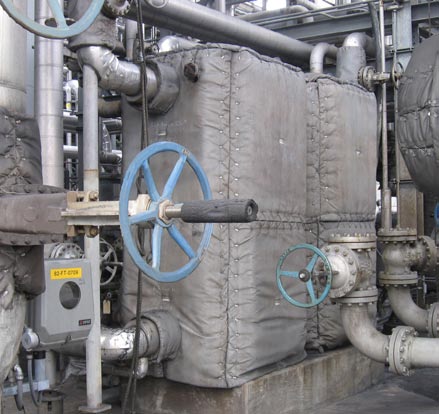
The Alfa Laval Compabloc heat exchangers
are employed as heat recovery units,
heaters, coolers. condensers and reboilers.
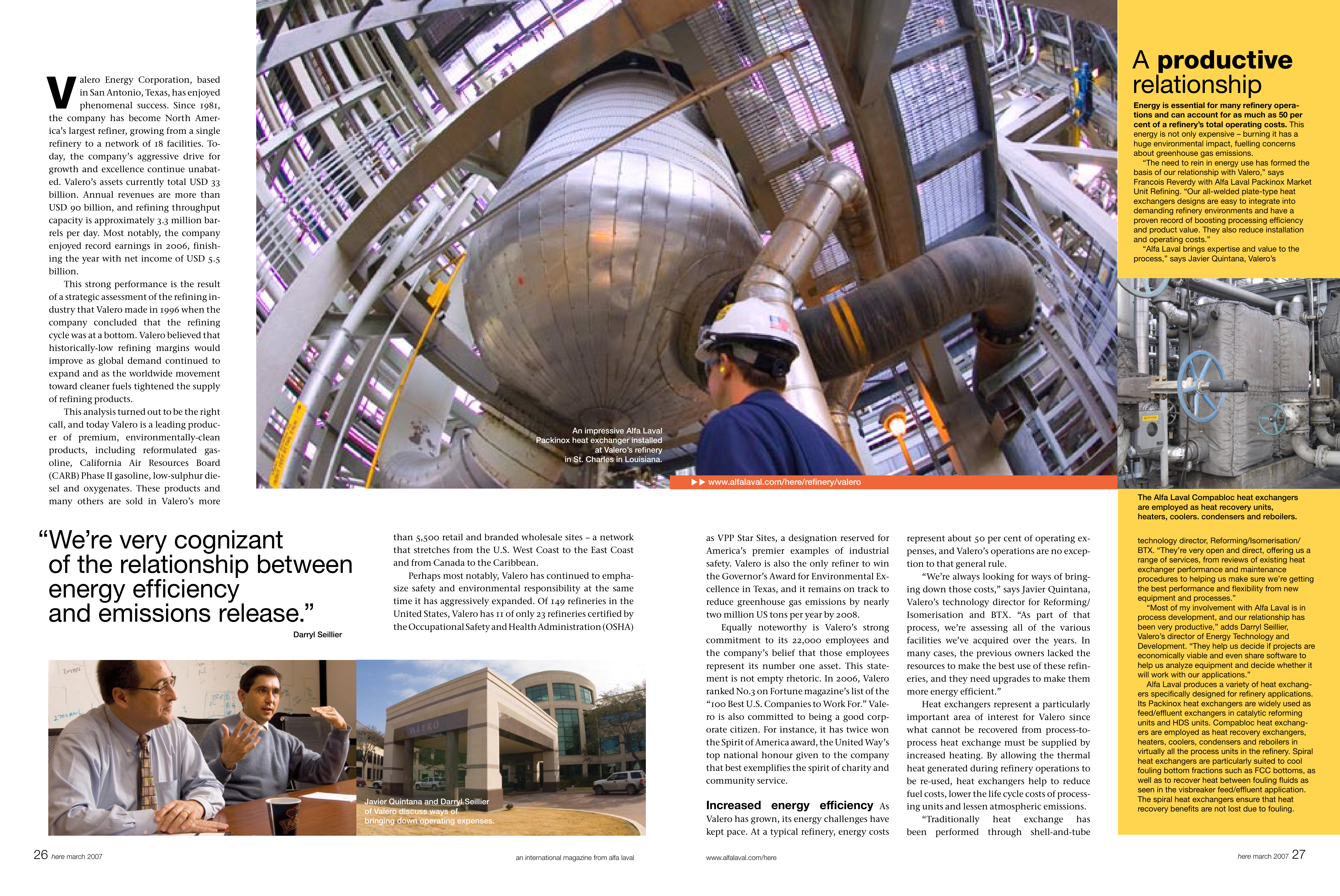
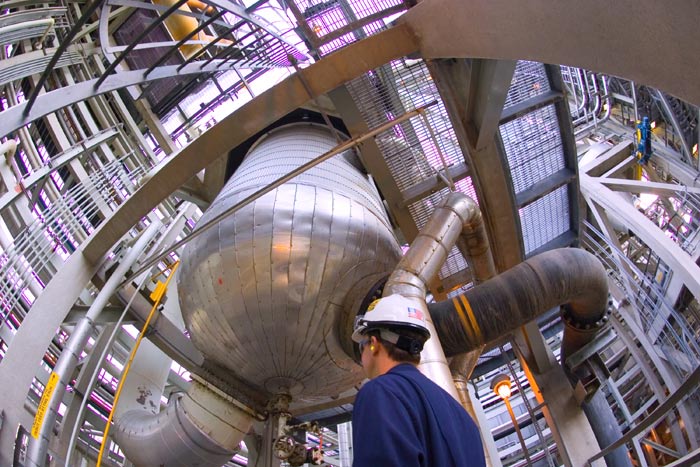
An impressive Alfa Laval
Packinox heat exchanger installed
at Valero’s refinery
in St. Charles in Louisiana.
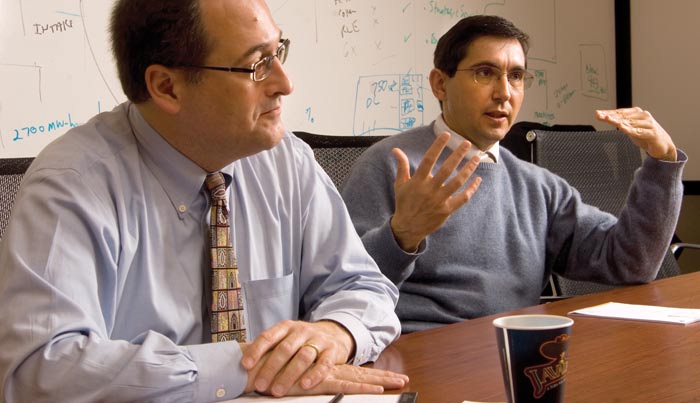
Javier Quintana and Darryl Seillier
of Valero discuss ways of
bringing down operating expenses.
28
here
march 2007
an international magazine from alfa laval
exchangers, but these systems have signifi-
cant limitations,” explains Darryl Seillier,
Valero’s director of Energy Technology
and Development. “Typically, shell-and-tube
heat exchangers are bulky and inefficient,
requiring multiple units to achieve a very
limited temperature crossover. Their size and
inherent design also make them difficult
and time-consuming to clean.”
Enhanced cooperation
This need for
improved heat exchange technology has led
to a strong and growing relationship with
Alfa Laval. For Valero, a particular attraction
is Alfa Laval’s speciality heat exchanger tech-
nologies, which maximize energy recovery
by offering thermal efficiencies well above
traditional industry standards.
The relationship between the two com-
panies started several years ago when Valero
first adopted Alfa Laval Packinox technology
for use in its catalytic reformers. In these pro-
cessing units, naphtha is transformed into
high octane gasoline at temperatures above
900°F (482°C). Without high-efficiency heat
recovery, these units would be very large us-
ers of energy, and Packinox has been a key
enabler in Valero’s drive to lower operating
costs at its plants.
Wider cooperation between Alfa Laval
and Valero began in 2005 when Seillier de-
cided to learn more about the applicability of
Alfa Laval’s Compabloc and Spiral heat ex-
changers for other refinery processes.
Throughout the following year, several
opportunities for energy recovery were ana-
lyzed, coupling Valero’s refinery knowledge
with Alfa Laval’s expertise in high-perfor-
mance heat transfer. The results showed that
very promising gains could be achieved when
Alfa Laval technologies were integrated into
a number of refinery processes. These appli-
cations range from simple processes to feed
heat recovery to integrated systems for crude
oil preheating trains.
In keeping with the developing trend in
the refining industry, Valero is also counting
on enhanced energy efficiency to help re-
duce atmospheric emissions at its refineries.
Packinox and Compabloc are particularly
well suited to recycle more waste heat direct-
ly back into process heat, thereby reducing
the need to rely on burning fuel at process
heaters. In turn, the reduced firing at these
heaters cuts down stack emissions, enabling
Packinox and Compabloc to help reduce
emissions “at the source.”
“We’re very cognizant of the relationship
between energy efficiency and emissions re-
lease,” says Seillier. “Firing at the heater cre-
ates incremental heat we cannot recover and
increases carbon dioxide emissions. On aver-
age, every million BTU of natural gas we burn
produces 116 pounds of greenhouse gas in
the form of CO2.”
Currently, Valero is using three Packinox
and several Compabloc and spiral exchang-
ers for heat recovery at its refineries, with sev-
eral more projects in the early stages of devel-
opment.
The drive for excellence
Valero’s
approach to vendors has evolved over the
years, reaching a critical turning point about
five years ago when the company bought
Ultramar Diamond Shamrock Corp., a major
oil refining and marketing company with
over USD 2.5 billion in revenue and more
than 6,000 employees. As a result of that
acquisition, Valero needed to become more
centralized in its use of resources and to take
a more consistent approach to managing
technology to achieve greater energy effi-
ciency. In particular, that meant making a
concerted effort to establish practices that
would enable Valero to get the best results
from each of its facilities.
“We hold our suppliers to extremely high
standards, and we’re constantly challenging
them to come up with innovative new sol-
utions that can maximize the flexibility of
our feed operations and throughput while
helping us to control costs,” says Quintana.
“Alfa Laval is the type of supplier we like to
work with. Over the years, they have been
very responsive to our needs. We especially
appreciate their willingness to help us ex-
plore potential, hypothetical applications
that can improve our best practices.”
“Above all else, we want candour,” says
Seillier. “We can’t afford major mistakes, so
we need be very careful before putting a heat
exchanger into service. Suppliers should be
willing to share the breadth of their industry
experience with us and honestly tell us
whether a particular product is a good appli-
cation for our purpose.
“We don’t want them to just sell us a
product,” he adds. “We want them to work
with us to find a solution. I am pleased to say
that Alfa Laval has continually met our ex-
pectations. It’s one of their strengths and a
major reason the relationship between our
two companies continues to be so strong.”
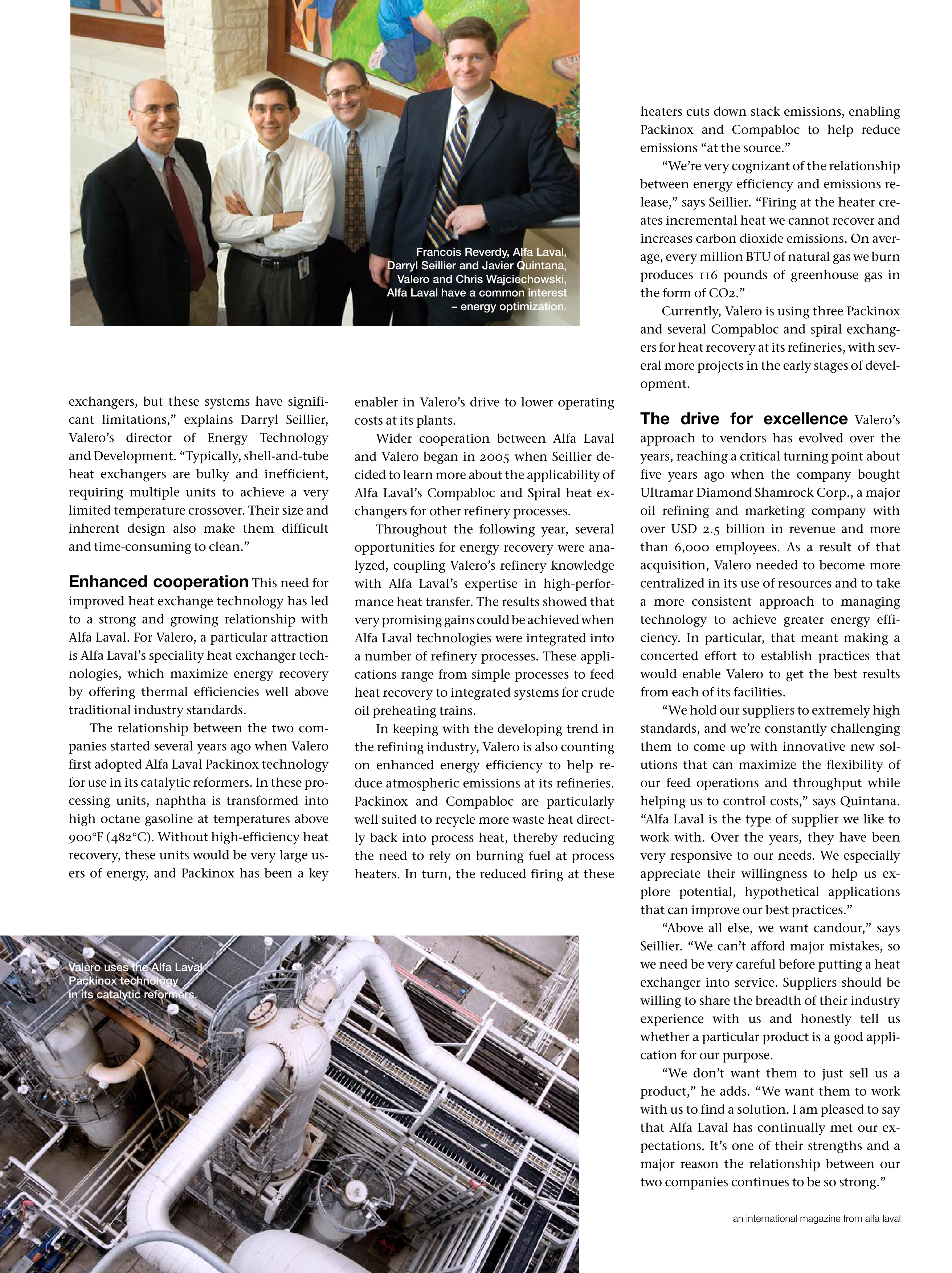
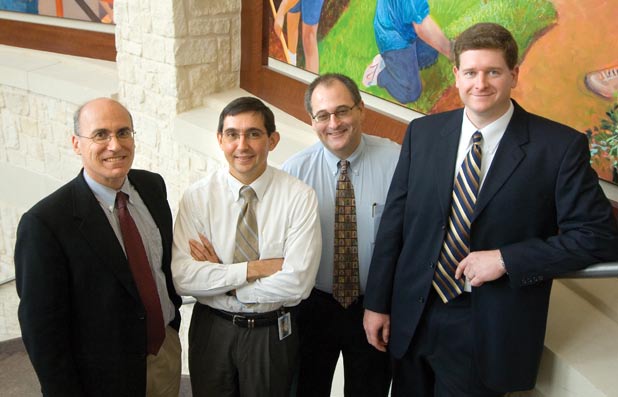
Francois Reverdy, Alfa Laval,
Darryl Seillier and Javier Quintana,
Valero and Chris Wajciechowski,
Alfa Laval have a common interest
– energy optimization.
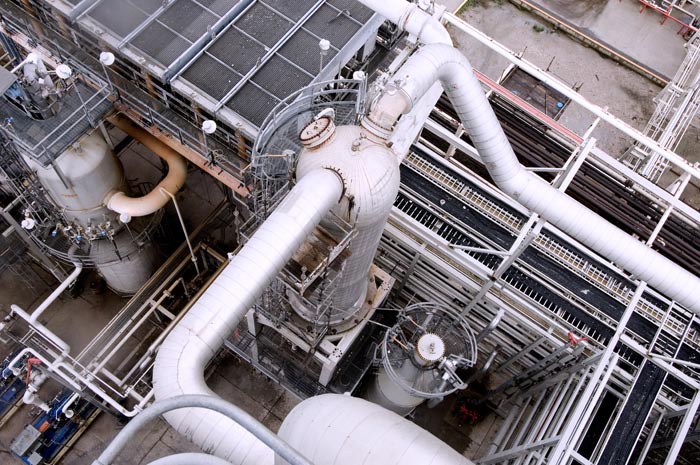
Valero uses the Alfa Laval
Packinox technology
in its catalytic reformers.