


profiles
gas Customer
Magazine
1/2020
Honeywell’s Gas Train to Feed New Gas Engines
How the Changing Legislative Landscape Shapes
the Future of Gas Control in America
Commercial and Industrial Diaphragm Gas Meters
With Mechanical Index

Honeywell
editorial
Like all of you, Honeywell continues to monitor
the COVID-19 coronavirus situation and its
global impact. We are prioritizing the health and
safety of our employees and will work with cus-
tomers and suppliers to evaluate and address
any potential supply chain disruptions.
Many country, regional, and local governments
have implemented certain requirements, such
as general shutdowns, restricted travel, localized
quarantines, or mandated health screenings.
Honeywell continues to comply with all instruc-
tions from official bodies.
Honeywell activated its global, cross-functional
incident management team, including our
Honeywell medical team, several weeks ago. Our
teams meet daily and provide guidance for our
businesses and employees in response to the
latest COVID-19 news and local/regional direc-
tives. All Honeywell sites have plans in place with
specific roles and responsibilities relating to this
health crisis.
The COVID-19 situation is changing rapidly. We
are in close communication with our suppliers
and are continually evaluating both short- and
long-term supply chain implications. Our pro-
duction facilities remain operational, and based
on current information, including that provided
by our suppliers, we do not anticipate an imme-
diate disruption to manufacturing, delivery of
products or services in most cases. We appre-
Gudrun Biedermann
Editor-in-chief,
Gas Customer
Magazines
2
ciate your business and understanding in this
evolving situation and we will keep you updated
if circumstances arise that would cause us to
be incapable of complying with our delivery
obligations.
If you have questions about any specific product
or order, please contact your Honeywell sales or
customer service representative directly.
Out of an abundance of caution for the health
of our employees, and to support local govern-
ment initiatives to stem the spread of the virus,
Honeywell has implemented several precautions
at various sites around the world to ensure the
health and safety of our employees, suppliers,
customers, and communities, while also working
to meet our commitments to you.
In this issue of the magazine, we’ll touch upon
Honeywell’s innovative solutions in the areas of
E-GVUs (gas trains) for gas engines on the high
seas, gas control for the increasingly regulated
U.S. market, the automatic optical detection of
gas leakage, as well as commercial and indus-
trial diaphragm gas meters. In addition, we are
announcing our new online customer portal for
downloading documents, yet another way that
Honeywell is working to enhance gas customers’
satisfaction and limit our environmental impact.
Please enjoy reading.
Yours, Gudrun Biedermann
Editorial
Supporting You
through Difficult Times
Publisher
Elster GmbH
Steinern Straße 19–21
D-55252 Mainz-Kastel
T +49 (0)6134 605-0
www.elster-instromet.com
Editorial staff
Gudrun Biedermann
Marketing Communications
T +49 (0)6134 605-218
gudrun.biedermann@honeywell.com
Contact
customerfirst@honeywell.com
Authors
Addy Baksteen, The Netherlands
Max Gutberlet, Germany
Daniela Luecke-Janssen, Germany
Frank Rehmsmeier, Germany
KC Tan, Singapore
German Wohlrab, Germany
Articles signed by the author reflect
their personal opinion.
Photo credits
Page 1: © Hurtigruten/Steve Bradley/
Photo Competition
Page 4, top: © Hurtigruten/H. Weyer
Page 4, bottom: © Colleen McDaniel
Page 12: © iStockphoto.com/sarkophoto
Dr. Feix Translation Agency
Designed by Nikolai Krasomil, design werk
Publishing dates:
Three editions for the year 2020
Honeywell customer magazine online:
www.elster-instromet.com/en/index
3
PRODUCTS
Honeywell
With a fleet of 19 ships, Hurtigruten
offers trips that make you feel like you
are on a true expedition, however with
far more luxury than the early explor-
ers of unknown territory were used to.
Some time ago, Hurtigruten was
awarded by the Norwegian govern-
ment with the license to ply seven of
the eleven coastal ferry routes in Nor-
way. A condition for this license was
that the CO
2
emission of the ships was
to be reduced dramatically.
To comply with this requirement, the
company decided to invest in six, and
potentially later nine, of their ships by
replacing the oil-driven engines with
a hybrid system consisting of a gas-
driven engine combined with large
battery packs. Hurtigruten has selected
Bergen Engines (part of Rolls-Royce)
to deliver the 12 engines required for
the job. The engines will be powered
with LNG and partially with biogas,
which makes this a unique project in
the marine industry. As the biogas
originates from the remainder of
the seafood industry, it seems like
a match made in heaven.
If you have ever considered a cruise along the coast of
Norway, the name Hurtigruten must have crossed your
mind. Hurtigruten is the market leader for expedition
cruises focused around the Nordic countries.
UNIQUE PROJECT IN THE MARINE INDUSTRY
Honeywell’s Gas Train
(E-GVU)
to Feed New Gas
Engines
Aside from the space constraints,
there is the requirement that any leak-
age of gas from parts of the gas train
(pipes, flanges, or devices) may not
enter into the room where the gas
train is placed. This is a safety-related
requirement, as in most cases the
engine room is not equipped to be
considered safe in a hazardous en
vironment. The E-GVU is therefore
placed in a compact explosion-proof
housing that releases any potential
gas leakages to ambient air in a safe
location. For most marine applica-
tions, this is a huge cost reduction,
The gas engines in turn are equipped
with Honeywell’s ‘E-GVU’. The E-GVU
is a gas regulating system, also
referred to as a ‘gas train’, that is spe-
cifically designed for marine applica-
tions. The main differentiator of the
E-GVU versus traditional gas trains
is its design and packaging. In most
marine applications, there is very little
space to put anything inside an exist-
ing ship’s engine room.
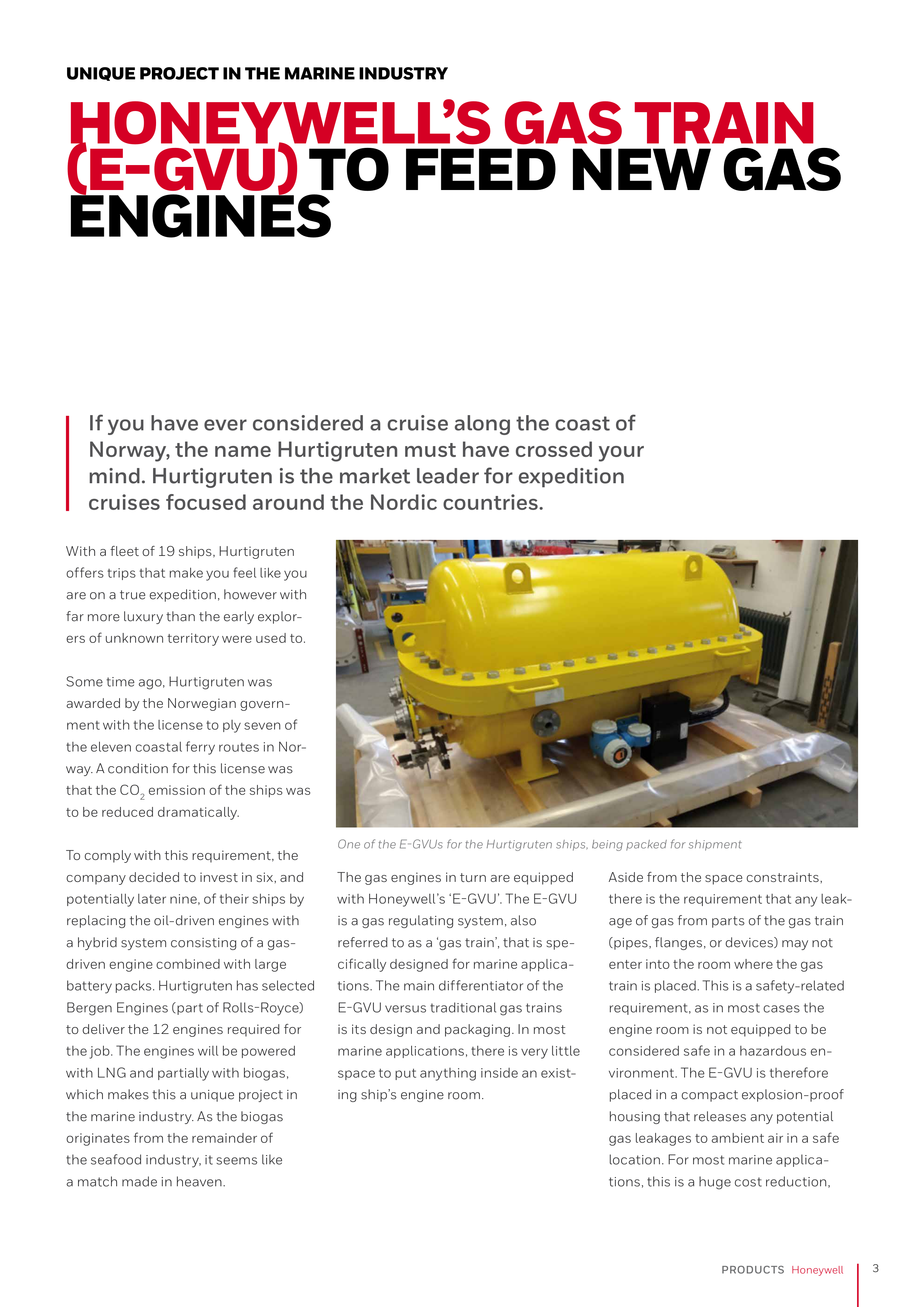
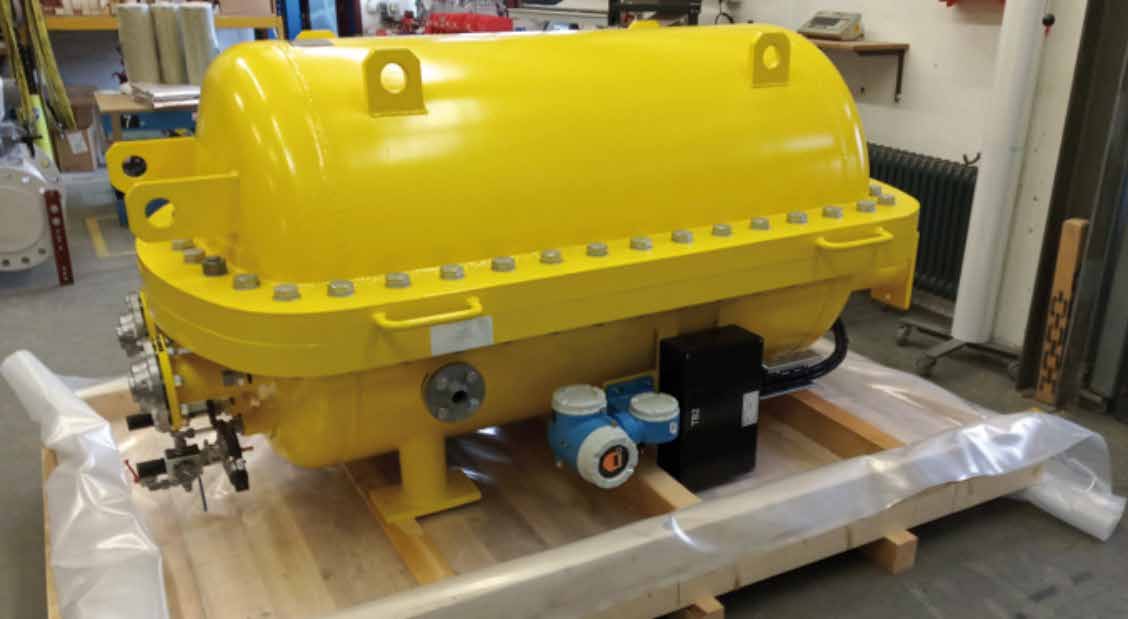
One of the E-GVUs for the Hurtigruten ships, being packed for shipment



4
Honeywell
Products
as on a ship with limited space every
square foot is valuable.
The gas engines are fed by LNG,
which, of course, must be stored
locally on the ship. Installing the new
engines and the LNG tanks is a huge
operation. The weight and size of the
engines and auxiliary equipment does
not allow them to be maneuvered into
place without docking the ship and
taking it apart to make space for the
additions.
In some cases, the engines can be
replaced via the top deck or via the
side of the ship. However, in other
cases, the ship needs to be cut into
two separate pieces and an entirely
new piece is welded in between the
two parts of the ship, extending its
size. This procedure is also used when
cruise ships are being extended to
accommodate additional cabins.
In the case of the Hurtigruten project,
the ships will be docked and cut into
two pieces. This is the only possible
with gas engines. The E-GVU is tailor-
made for this application and allows
for a cost-effective solution to condi-
tion and supply the gas for marine gas
engines.
Addy Baksteen addy.baksteen@honeywell.com
way to remove an engine and to make
space for all the new equipment. By
adding segments to the ship, valuable
time is saved because the segments
can be prepared while the vessel is still
in operation. This reduces the ship’s
downtime while the yard does the con-
versions.
With the ever-increasing attention to
the environmental and climate-related
effects of ships’ emissions, a growing
number of ships are being equipped
Example of ship extension
5
Products
Honeywell
How the Changing Legislative Landscape Shapes the Future
of Gas Control in America
Under
Pressure
What do you think is the biggest difference between a gas
distribution network and an electricity distribution network
today? Well, in four words: gas networks are stupid.
– definitely not a good sign for gas
utilities all across the country. On a
more positive note, funds are being
made available to increase visibility
and control, and the long-standing US
policy of not using safety valves in the
distribution network is finally coming
to an end.
Allow me to elaborate: The very nature
of our medium, the capability to actu-
ally store gas in the pipelines without
any concern for major losses or inci-
dents, as well as the possibility of line
packing and unpacking, have led to
the fact that gas distribution networks
are in essence “just” connected pieces
of metal. Yes, you have regulators, fil-
ters, and the ever-present ball valves
to manually control your grid, but for
most of us, the visibility about how this
grid actually performs ends at the city-
gate station. Beyond that, the distribu-
tion grid is a black hole.
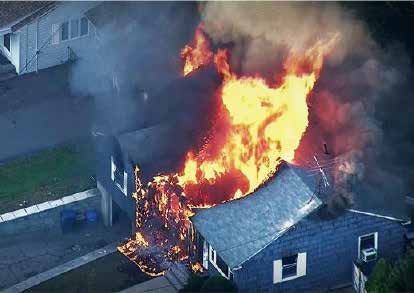
Recent tragic incidents across the US
have shown, that this lack of control is
dangerous – dangerous to people and
dangerous to the economic survival of
our gas utilities. The federal govern-
ment has taken note and is introduc-
ing new legislation around pipeline
and grid safety. More importantly, on
a regional level, states react by either
tightening regulation or, in some areas,
banning gas usage in future altogether
At Honeywell, we have seen develop-
ments like these in many countries
around the world. The very incident
that seems to be the major trigger
to change in North America is nearly
identical to the same type of incidents
that triggered massive legislative
changes in Germany twenty years
6
Honeywell
Products
ago. We all have been there – multiple
times across the world – and we have
learned our lessons. The result for you,
our customer in North America, is that
Honeywell already has tried and trust-
ed solutions that are already address-
ing your grid control challenges – from
the wellhead all the way down to the
small household connections.
Start With the Basics –
Slam the Valve Shut
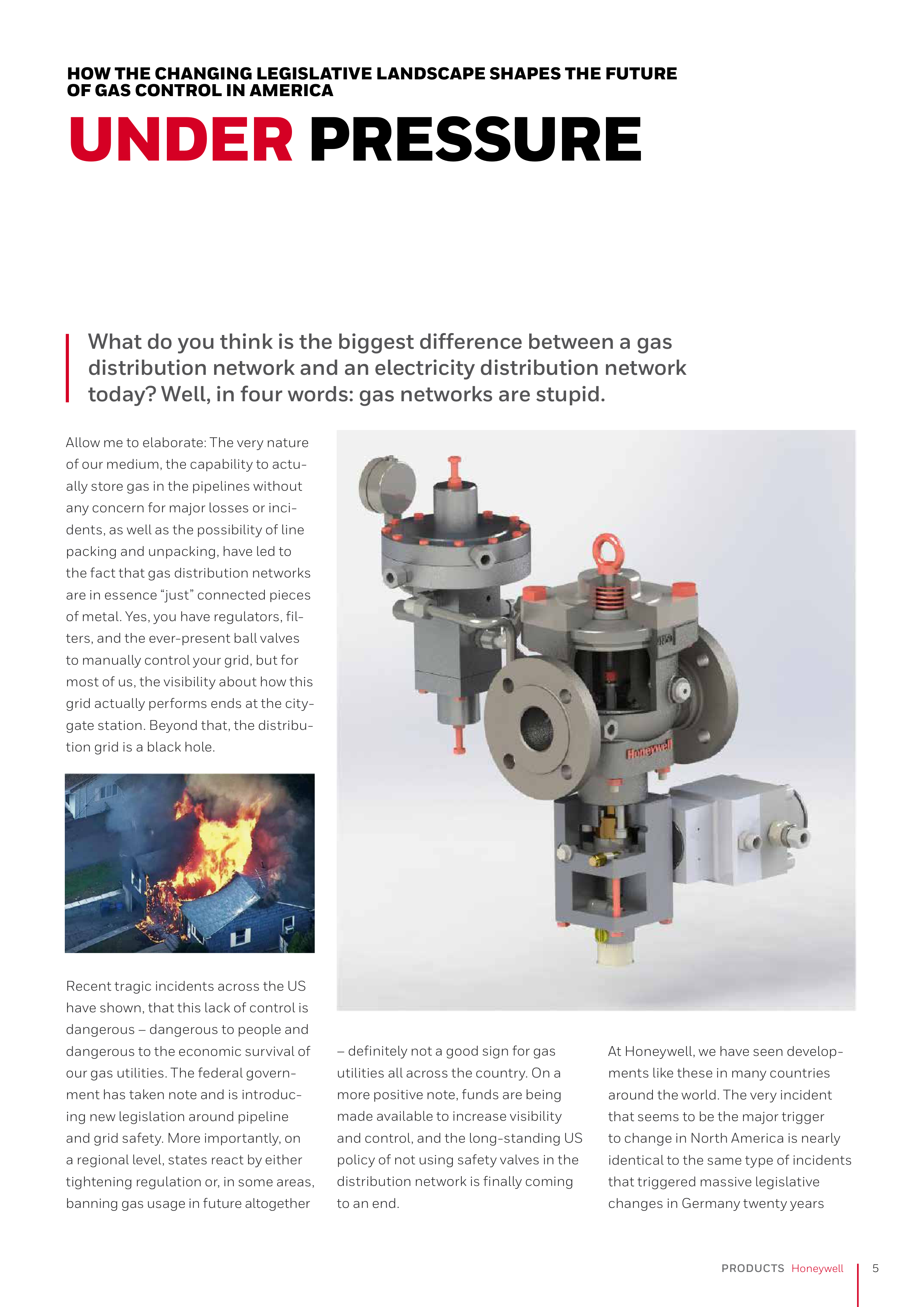
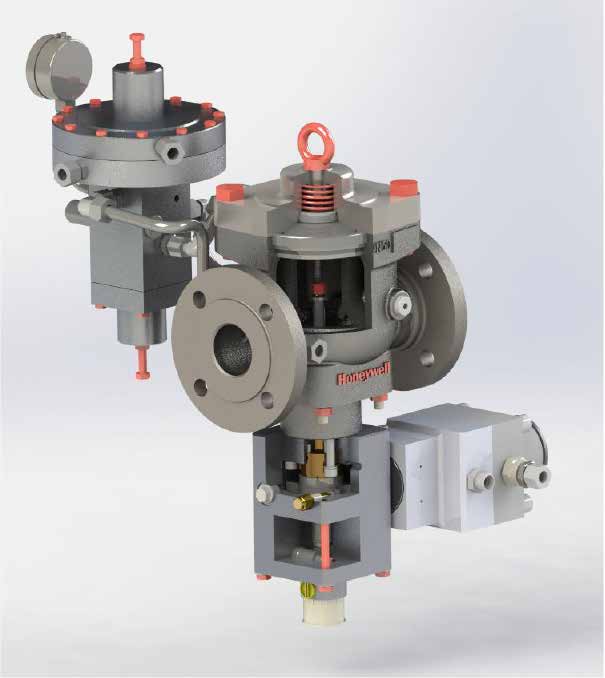
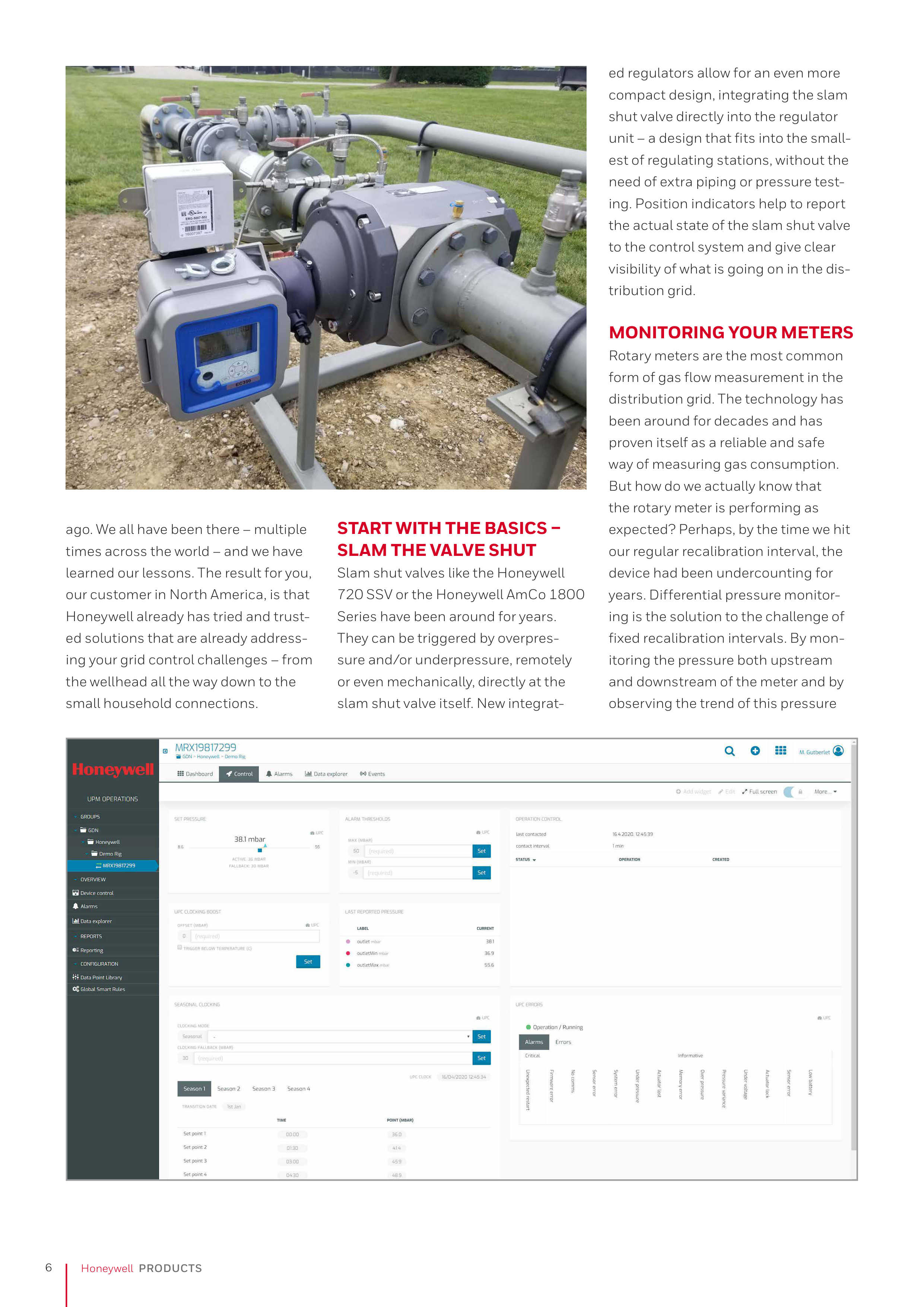
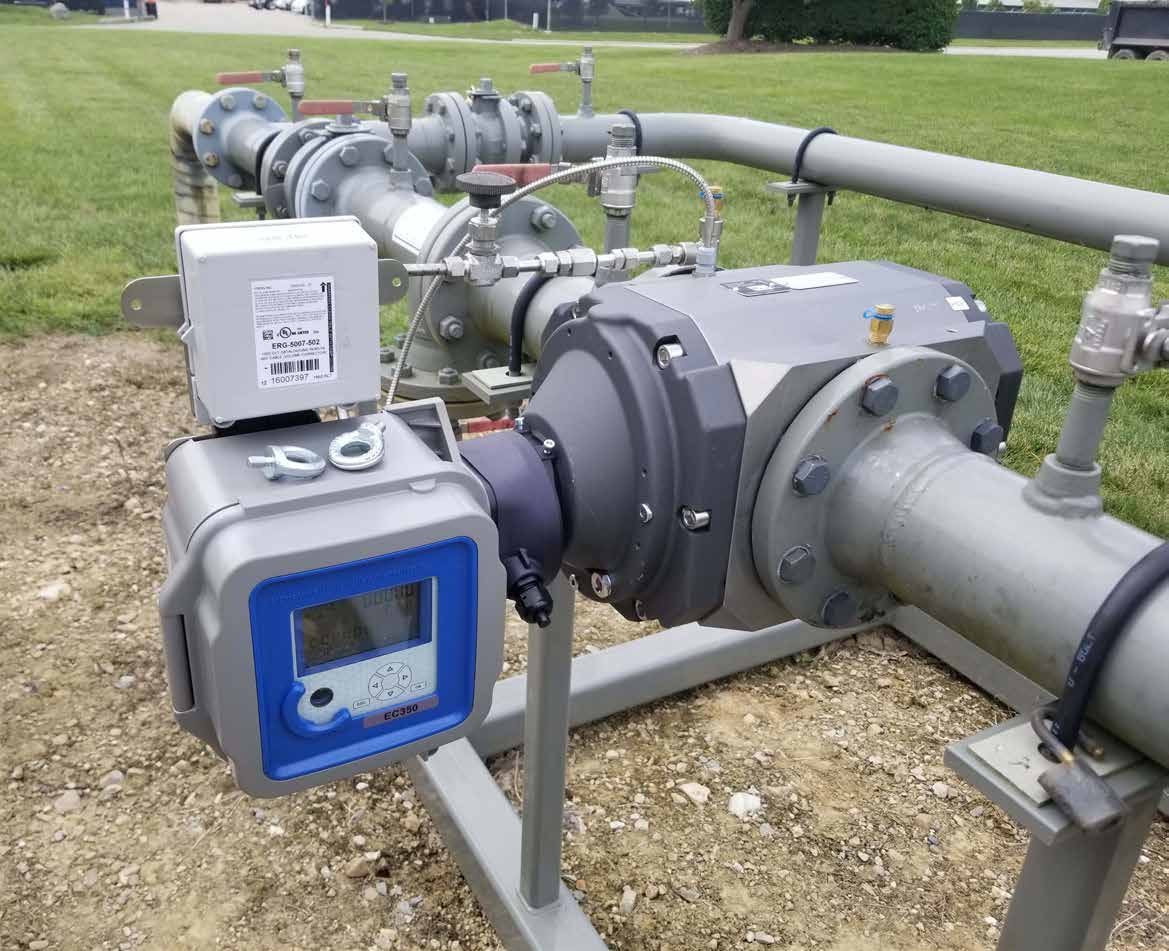
Slam shut valves like the Honeywell
720 SSV or the Honeywell AmCo 1800
Series have been around for years.
They can be triggered by overpres-
sure and/or underpressure, remotely
or even mechanically, directly at the
slam shut valve itself. New integrat-
ed regulators allow for an even more
compact design, integrating the slam
shut valve directly into the regulator
unit – a design that fits into the small-
est of regulating stations, without the
need of extra piping or pressure test-
ing. Position indicators help to report
the actual state of the slam shut valve
to the control system and give clear
visibility of what is going on in the dis-
tribution grid.
Monitoring Your Meters
Rotary meters are the most common
form of gas flow measurement in the
distribution grid. The technology has
been around for decades and has
proven itself as a reliable and safe
way of measuring gas consumption.
But how do we actually know that
the rotary meter is performing as
expected? Perhaps, by the time we hit
our regular recalibration interval, the
device had been undercounting for
years. Differential pressure monitor-
ing is the solution to the challenge of
fixed recalibration intervals. By mon-
itoring the pressure both upstream
and downstream of the meter and by
observing the trend of this pressure
7
Products
Honeywell
While many of these problems are new
for the North American distribution
market, Honeywell is using its global
footprint and more than 180 years of
experience to bring you the tried and
proven technologies that will enable
you to make your gas grid intelligent
– no matter under which type of pres-
sure.
Max Gutberlet
max.gutberlet@honeywell.com
Honeywell’s SmartLine pressure
transmitters are designed specifically
for these small stations – to ensure
reliable and accurate pressure mon-
itoring even in the harshest environ-
ments, such as a fully submerged
station. Moreover, with Honeywell’s
unparalleled experience in automation
and communication solutions, small
RTUs like the ControlEdge RTU deliv-
er the ideal mix of performance and
efficiency to control even the smallest
station.
But the story does not end here.
Because there is one other clear dif-
ferentiator between a gas grid and an
electricity grid: While electricity grids
are usually built as a tree structure,
gas grids are often built in rings or
have multiple interconnections with
high-pressure transmission pipelines.
The result: Changing the pressure in
one station will have side-effects on
other stations in the grid. To actually
control your pressure, you need to
have a system that monitors and con-
trols this whole section of the grid in
concert.
drop, errors can be identified long
before they become problems, and
service visits can be scheduled based
on actual need instead of just because
the schedule says so.
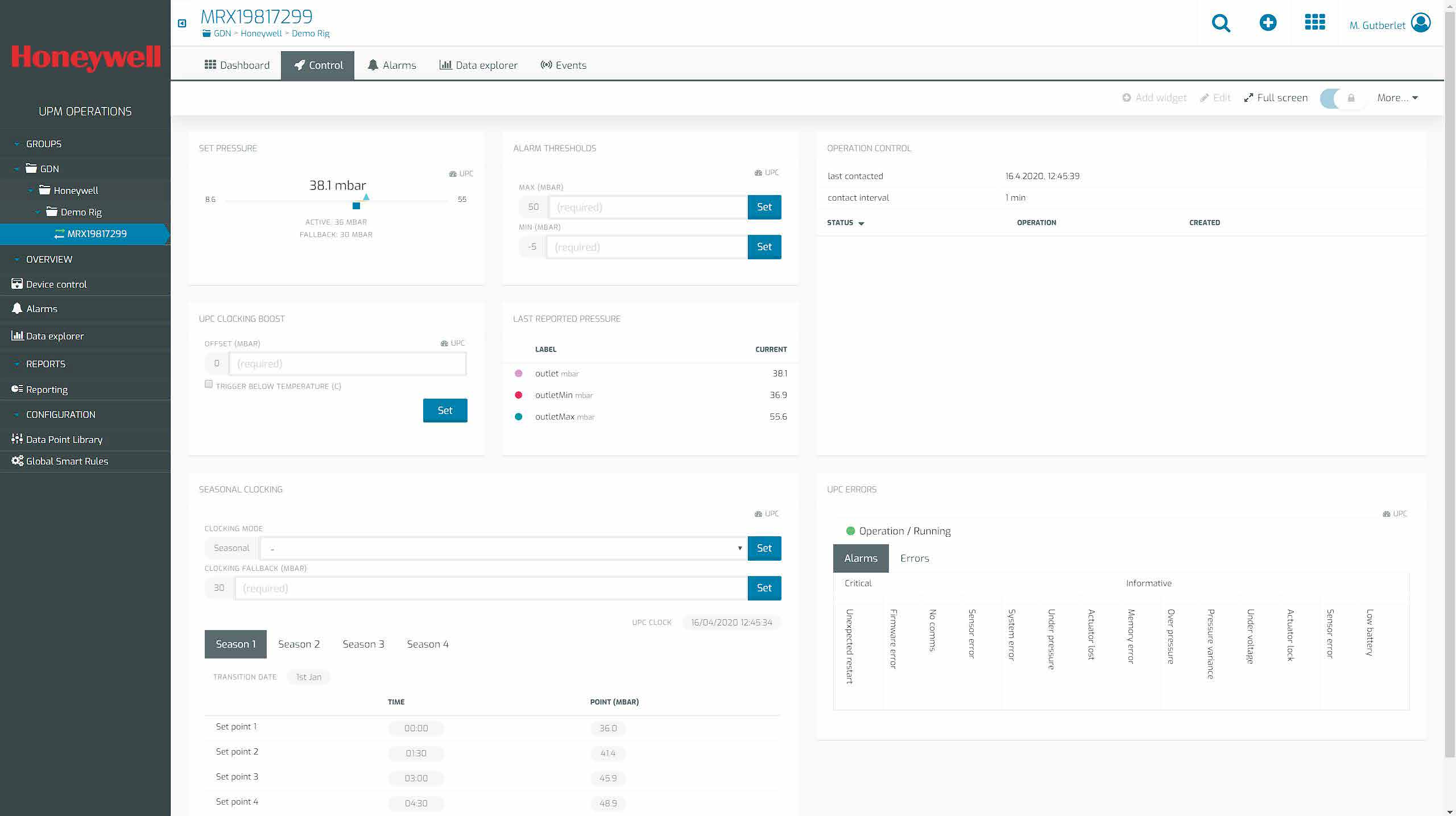
Actively Controlling
Your Pressure
Having active safety devices in your
network is a good first step. But how
do you ensure supply in times of quick
demand changes and more decentral-
ized gas generation from renewable
sources? Active pressure and flow con-
trol have been a transmission and city
station privilege for a long time. New
developments in technology and com-
munication now make this technology
available for smaller distribution and
underground regulating stations as
well. Using market-proven actuators,
existing pilot-operated regulators can
be retrofitted with active pressure
control.

8
Honeywell
Products
Commercial and Industrial Diaphragm Gas Meters With Mechanical Index
Do good
and
talk about it
We often believe that we have already provided customers and
colleagues with plenty of information about time-tested, estab-
lished products: But how quickly does time pass? New technol-
ogies “suddenly” appear on the market. When we talk to them,
we find that there are new customers and colleagues, that many
details have simply been forgotten, and that there are new ways
of looking at things which also have to be taken into account.
And sometimes, the world simply goes mad – as it is now.
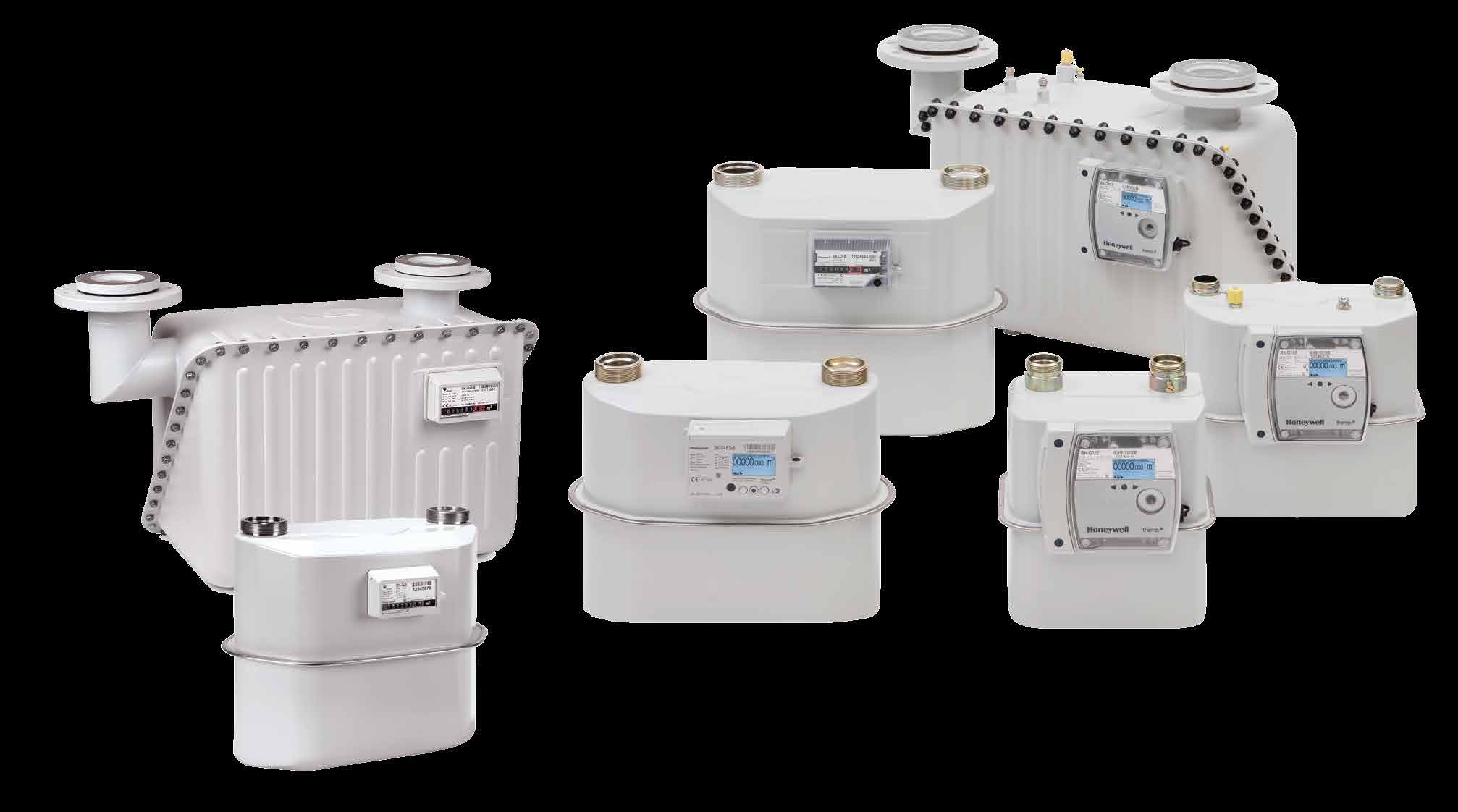
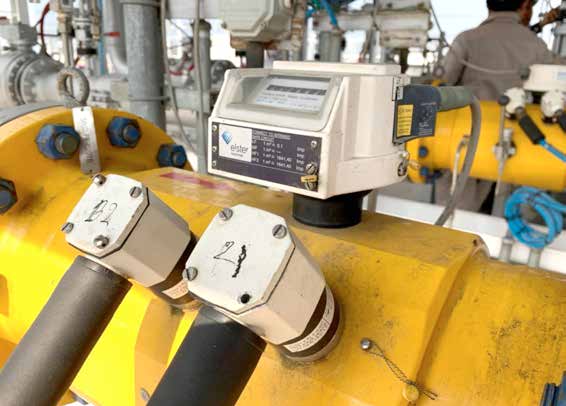
Commercial diaphragm gas meters
BK-G10, BK-G16 and BK-G25, as well
as industrial diaphragm gas meters
BK-G40, BK-G65 and BK-G100, com-
bine innovative features with many
decades of gas measurement know-
how. The measuring unit operates on
the principle of pneumatic control.
This guarantees low noise, long-term
stability, and high accuracy. Thus, the
Honeywell BK Series of diaphragm gas
meters meets the highest standards
with respect to measurement accura-
cy, as well as safety. They can be oper-
ated with any type of gas and do not
need a battery.
KEY PRODUCT FEATURES
AND CUSTOMER BENEFITS
•
Measurement of cumulated gas flow
for billing purposes with a proven
design featuring high accuracy and
long-term stability (designed for a
service life of > 20 years) and thus
very low operating and maintenance
costs, as well as low total cost of
ownership for our customers
•
Suitable media: natural gas, town
gas, propane, butane, air (and other
gases: inert gases as defined by
EN 437)
•
Mechanical roller index with pulse
magnet
•
MID approval and EN 1359 con-
formity for commercial diaphragm
gas meters BK-G10 to BK-G25 and
industrial diaphragm gas meters
BK-G40 to BK-G100 enable custom-
ers to buy the full portfolio from a
single supplier – Honeywell
•
Lower noise level and less vibration
in comparison to rotary meters
•
Retrofitting possibility of pulse
transmitters or communication
modules from Honeywell or third
parties allows integration of com-
mercial and industrial diaphragm
gas meters with a mechanical index
into a smart metering environment
The quote, “Do good and talk about
it” is one of the best-known phrases
used in modern public relations work
in the German-speaking world. How-
ever, what is much less relevant is
where the quote actually comes from.
Georg-Volkmar Graf Zedtwitz-Arnim
wrote a book with this title about pub-
lic relations work in Germany in 1961.
In 2002, Walter Fischer used the same
title for his book about public relations
work by non-profit organizations. Others
claim that the quote dates back to
German politician Walter Fisch (1910-
1966). What is much more important,
is the intention behind the phrase,
which is still relevant today. It refers to
objective, professional conversations
and discussions about new products
and the latest news, allowing others
to join in and providing information
about changes or simply about things
that are still as good as they have
always been – such as the commercial
and industrial diaphragm gas meters
from Honeywell, for example.

9
Products
Honeywell
Accuracy
and
stability refined
•
Options:
– Temperature conversion compen-
sates for the effect of different gas
temperatures and allows for more
accurate billing
– Meters can be supplied either with
co-axial or two-pipe connections
– Zone 1 ATEX certification (two-
pipe meters only)
– Tamper protection: diaphragm
plate usually made of steel, but
optionally of anti-magnetic
stainless steel
– Tamper detection: SAN – easily
breakable index cover
•
Platforming: The full range of
Honeywell diaphragm gas meters
uses the same index baseplate on
the meter body. Thus, all available
Honeywell gas meter index solu-
tions can easily be used with resi-
dential, commercial, and industrial
gas meters. If you are looking for
smart commercial and industrial
FOR MORE INFORMATION
Learn more about Honeywell’s commercial and industrial diaphragm gas
meters with a mechanical index by visiting the links below:
Honeywell Smart Energy Gas
Website
Commercial Diaphragm Gas Meter (CDM)
Website
Industrial Diaphragm Gas Meter (IDM)
Website
Pulse Transmitter (IN-Z6x)
Website
Docuthek for data sheets, operating instructions, and certificates
for diaphragm gas meters and pulse transmitters IN-Z6x
Website
gas meters, Honeywell’s Absolute
ENCODER (AE) index or themis®
electronic index might be an option.
Daniela Lücke-Janssen
daniela.luecke-janssen@honeywell.com
10
Honeywell
Products
New Absolute ENCODER Solution at PTT
How Meter Reading
Archives
Can Go
Digital and Still
Maintain Accuracy
One group of key customers belonging to PTT, the gas
transportation and distribution company in Thailand,
is the power plant customers, who consume substantial
amounts of natural gas annually.
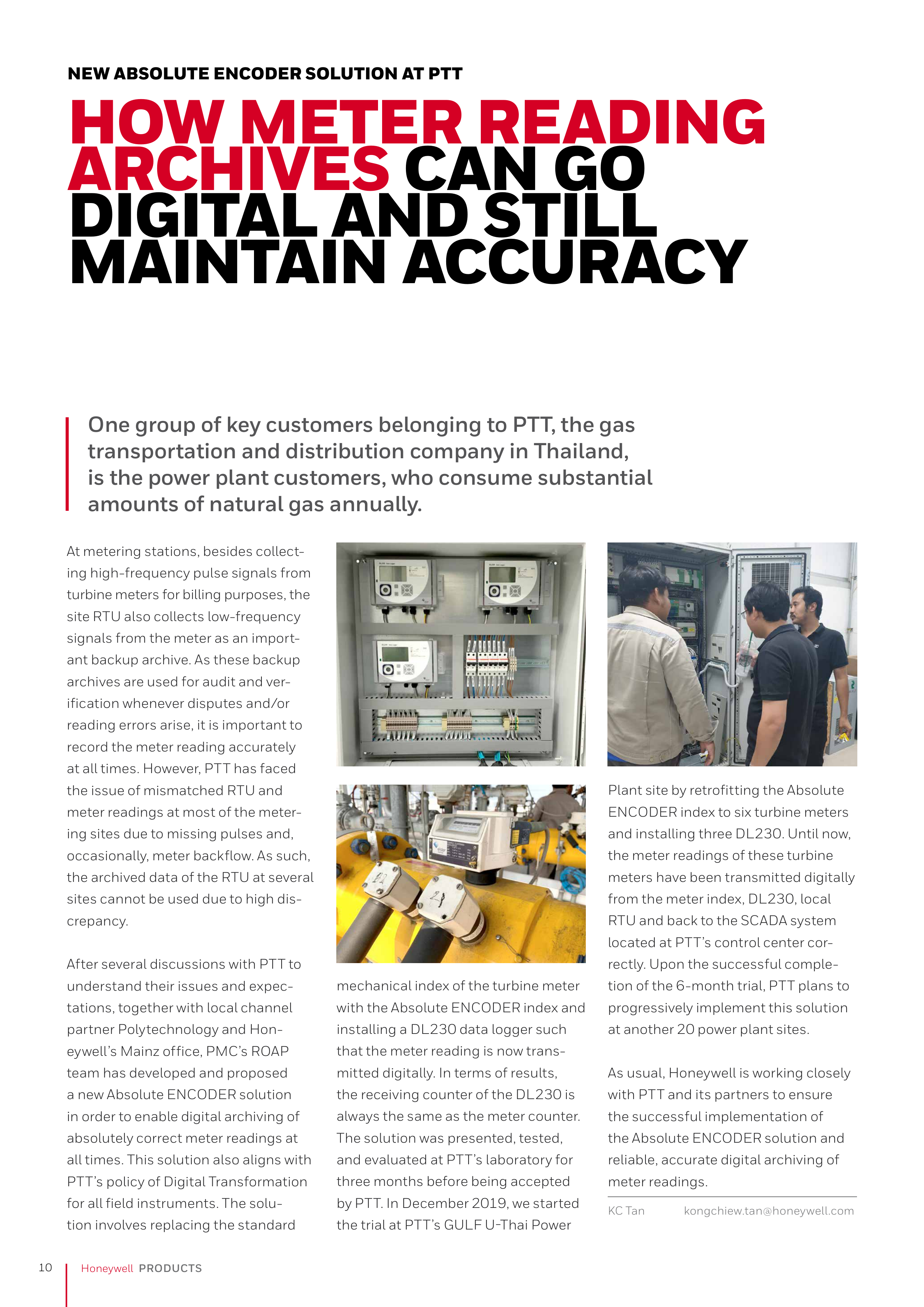
mechanical index of the turbine meter
with the Absolute ENCODER index and
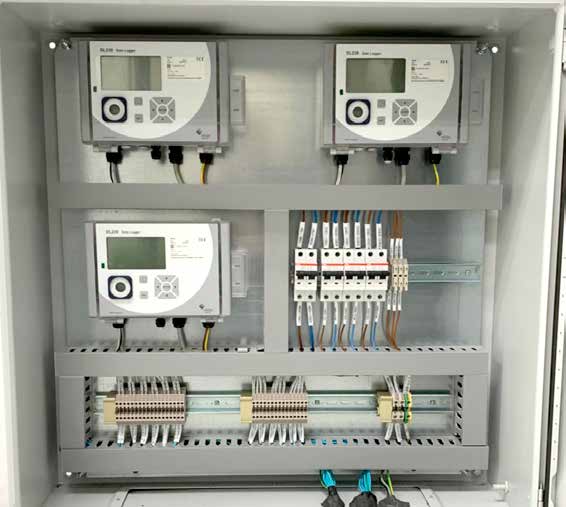
installing a DL230 data logger such
that the meter reading is now trans-
mitted digitally. In terms of results,
the receiving counter of the DL230 is
always the same as the meter counter.
The solution was presented, tested,
and evaluated at PTT’s laboratory for
three months before being accepted
by PTT. In December 2019, we started
the trial at PTT’s GULF U-Thai Power
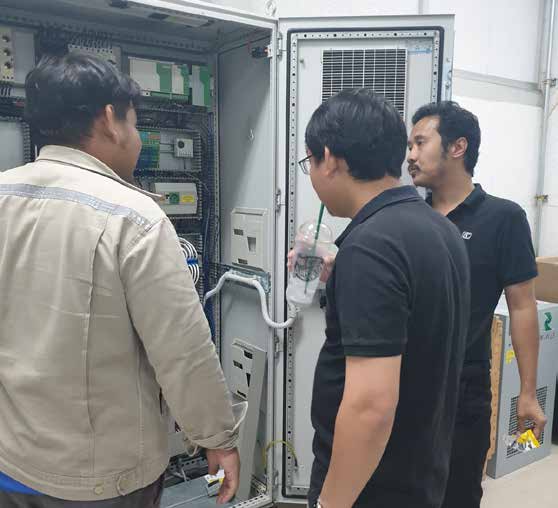
Plant site by retrofitting the Absolute
ENCODER index to six turbine meters
and installing three DL230. Until now,
the meter readings of these turbine
meters have been transmitted digitally
from the meter index, DL230, local
RTU and back to the SCADA system
located at PTT’s control center cor-
rectly. Upon the successful comple-
tion of the 6-month trial, PTT plans to
progressively implement this solution
at another 20 power plant sites.
As usual, Honeywell is working closely
with PTT and its partners to ensure
the successful implementation of
the Absolute ENCODER solution and
reliable, accurate digital archiving of
meter readings.
KC Tan
kongchiew.tan@honeywell.com
At metering stations, besides collect-
ing high-frequency pulse signals from
turbine meters for billing purposes, the
site RTU also collects low-frequency
signals from the meter as an import-
ant backup archive. As these backup
archives are used for audit and ver-
ification whenever disputes and/or
reading errors arise, it is important to
record the meter reading accurately
at all times. However, PTT has faced
the issue of mismatched RTU and
meter readings at most of the meter-
ing sites due to missing pulses and,
occasionally, meter backflow. As such,
the archived data of the RTU at several
sites cannot be used due to high dis-
crepancy.
After several discussions with PTT to
understand their issues and expec-
tations, together with local channel
partner Polytechnology and Hon-
eywell’s Mainz office, PMC’s ROAP
team has developed and proposed
a new Absolute ENCODER solution
in order to enable digital archiving of
absolutely correct meter readings at
all times. This solution also aligns with
PTT’s policy of Digital Transformation
for all field instruments. The solu-
tion involves replacing the standard
11
Applications
Honeywell
Little did we all know that this acquisi-
tion would usher in a new era in envi-
ronmental protection for our gas busi-
ness – the era of optical leak detection.
Rebellion Photonics, founded in 2009
by Robert Kester and Allison Lami
Sawyer based on Kester’s PhD work
at the Rice University in Houston,
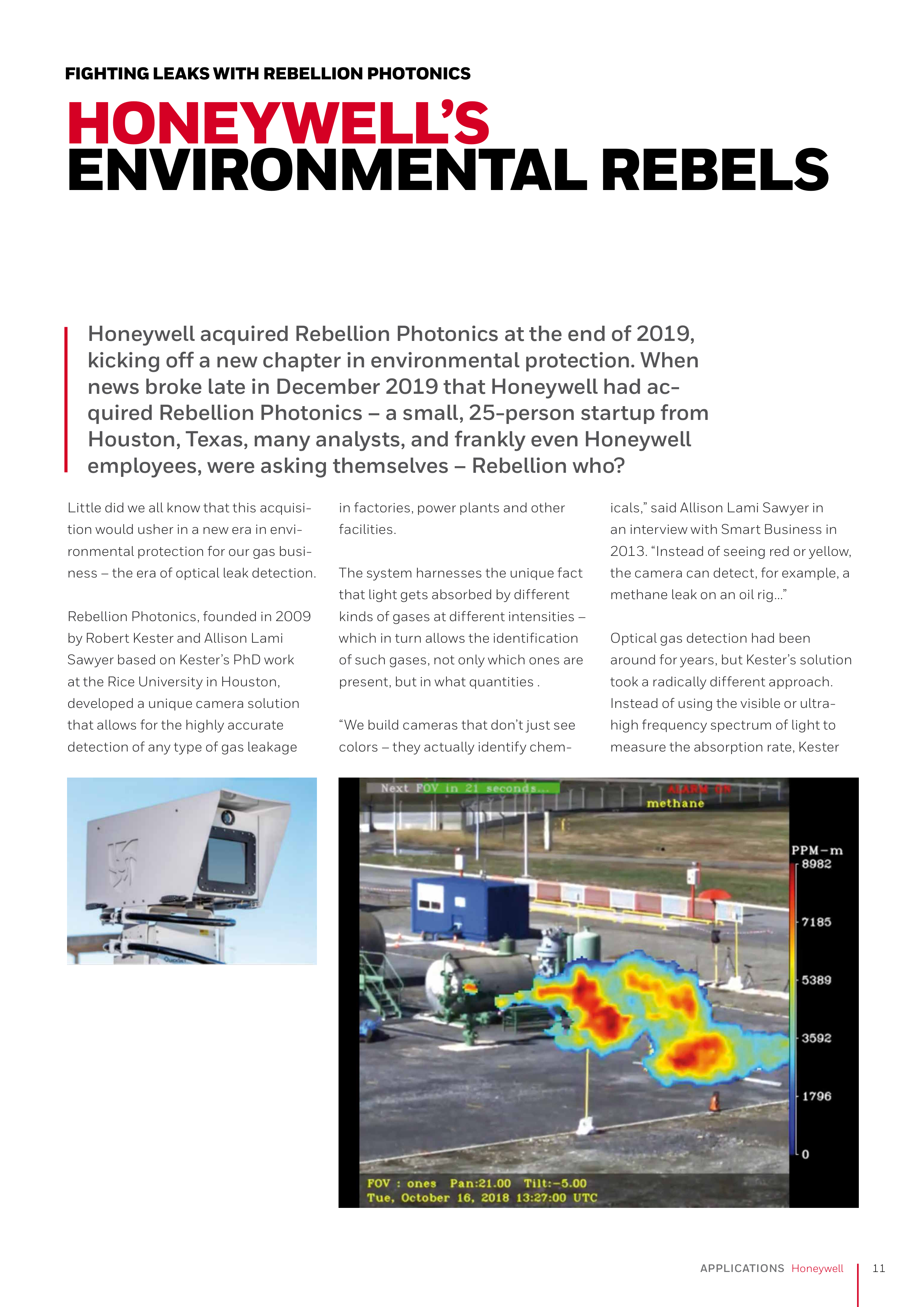
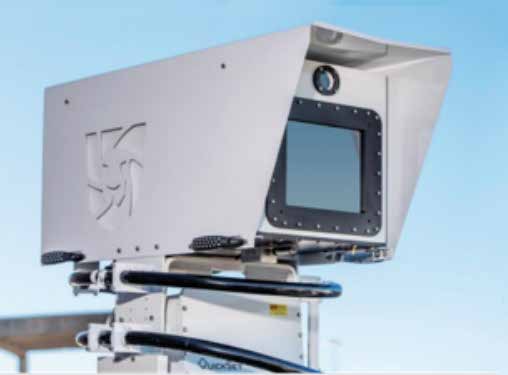
developed a unique camera solution
that allows for the highly accurate
detection of any type of gas leakage
Honeywell acquired Rebellion Photonics at the end of 2019,
kicking off a new chapter in environmental protection. When
news broke late in December 2019 that Honeywell had ac-
quired Rebellion Photonics – a small, 25-person startup from
Houston, Texas, many analysts, and frankly even Honeywell
employees, were asking themselves – Rebellion who?
Fighting Leaks With Rebellion Photonics
HONEYWELL’S
ENVIRONMENTAL REBELS
in factories, power plants and other
facilities.
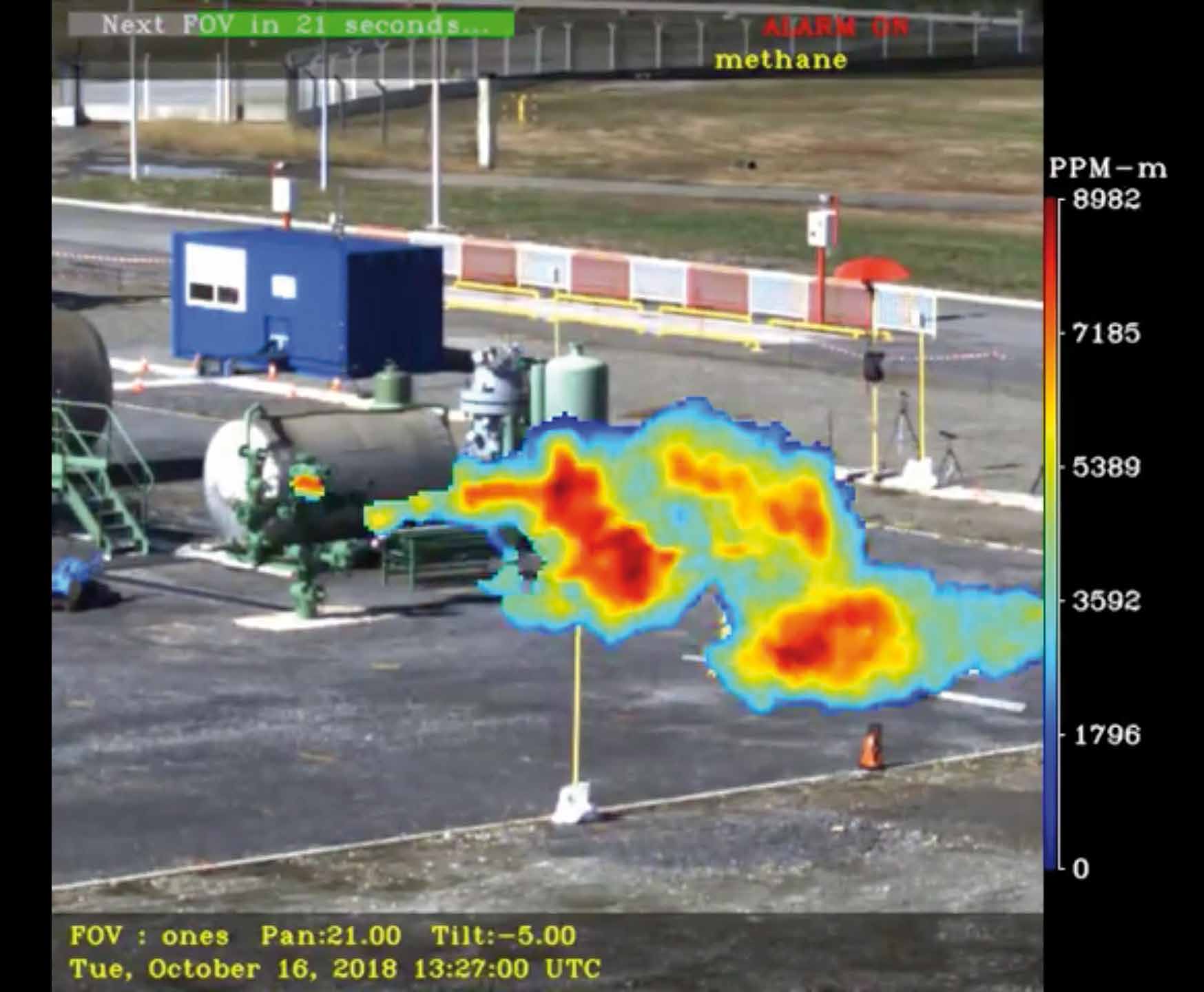
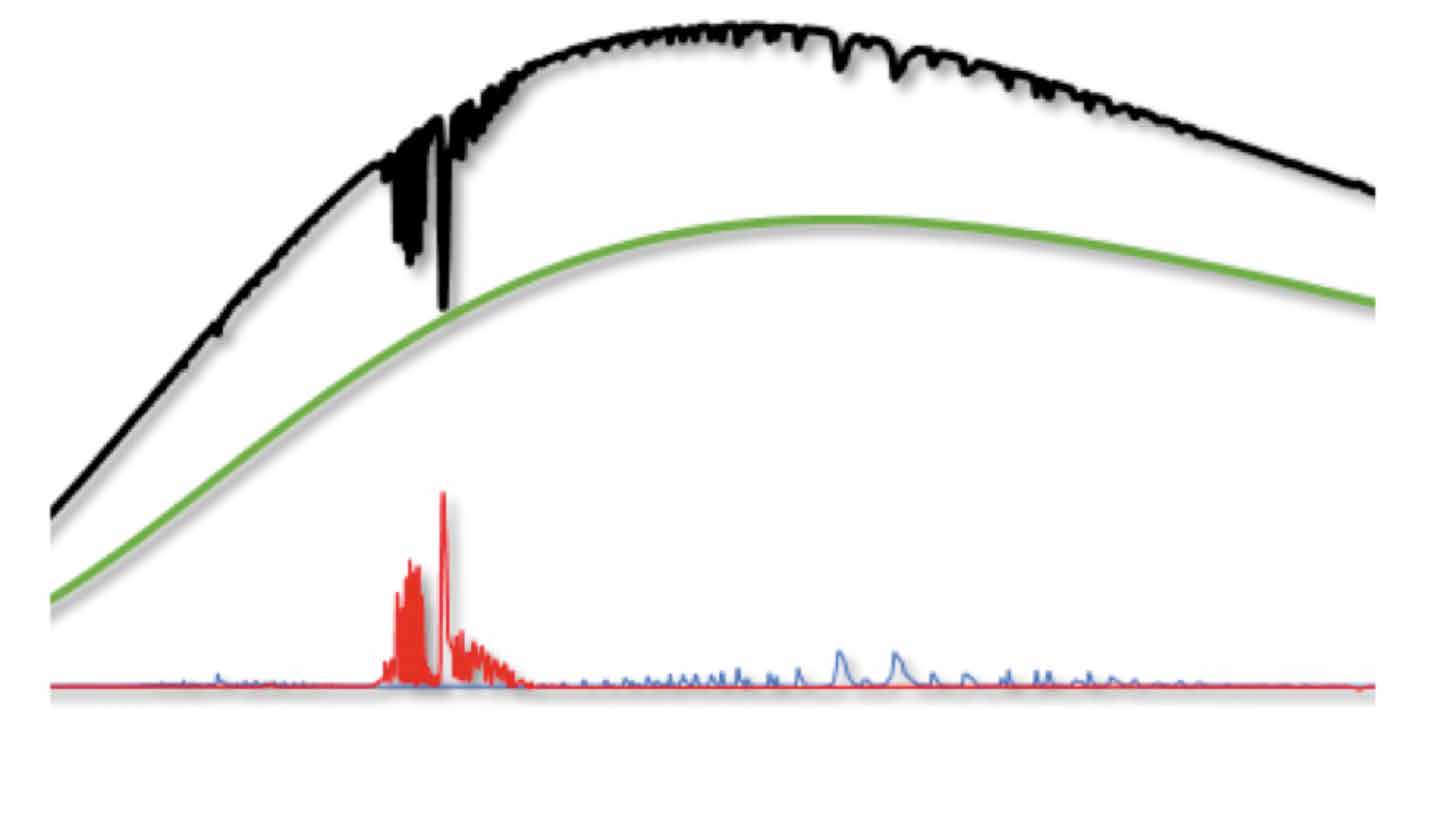
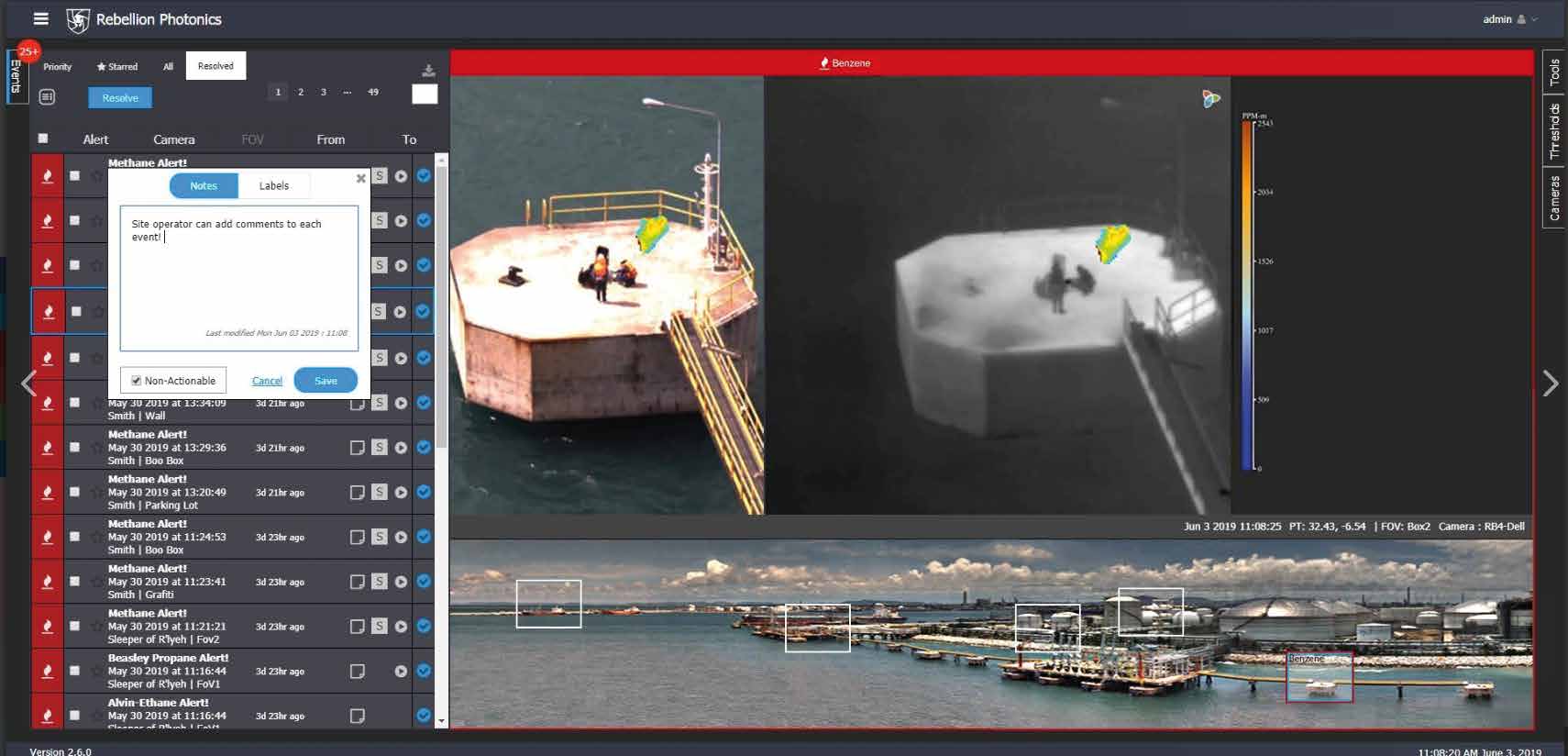
The system harnesses the unique fact
that light gets absorbed by different
kinds of gases at different intensities –
which in turn allows the identification
of such gases, not only which ones are
present, but in what quantities .
“We build cameras that don’t just see
colors – they actually identify chem-
icals,” said Allison Lami Sawyer in
an interview with Smart Business in
2013. “Instead of seeing red or yellow,
the camera can detect, for example, a
methane leak on an oil rig…”
Optical gas detection had been
around for years, but Kester’s solution
took a radically different approach.
Instead of using the visible or ultra-
high frequency spectrum of light to
measure the absorption rate, Kester
12
Honeywell
Applications
decided to build his camera based on
blackbody radiation, the thermal radi-
ation that is emitted by all bodies in
the universe.
This genius approach allowed the
team to build a camera that is inher-
ently immune to the temperature
variations and backscatter from other
light sources that had plagued manu-
facturers of conventional optical gas
detection systems for years.
From Technology to
Finished Product
Startup companies with exciting new
technologies are a dime a dozen in
today’s economic climate. What really
set Rebellion Photonics apart was that
they not only developed this new cam-
era technology, they produced a fully
thought-out and production-ready
offering from which the commercial
product available today emerged.
However, the camera is only half of
the story. In the end, analyzing the
images and detecting what kind of gas
is escaping at what location and with
what flow rate required extensive use
of machine learning algorithms and
years of gathering real-life data.
After initially focusing on the medical
sector and the possible detection of
cancer cells, the team quickly pivoted
into the oil and gas industry, in which,
in the face of growing environmental
awareness and increasingly stringent
regulations, the need for precise detec-
tion systems for methane and other
gas leaks is steadily increasing.
After their first product, the standard
GCI camera, Rebellion Photonics
quickly developed a range of special
camera solutions for different appli-
cation scenarios. Need a camera for
installation in hazardous environ-
ments? An IECEx-certified version is
available. Want to monitor systems
for a limited amount of time with-
out needing to integrate the camera
into your existing infrastructure? A
standalone, solar-powered, extend-
able-mast-mounted version can be
deployed tomorrow. You are respon-
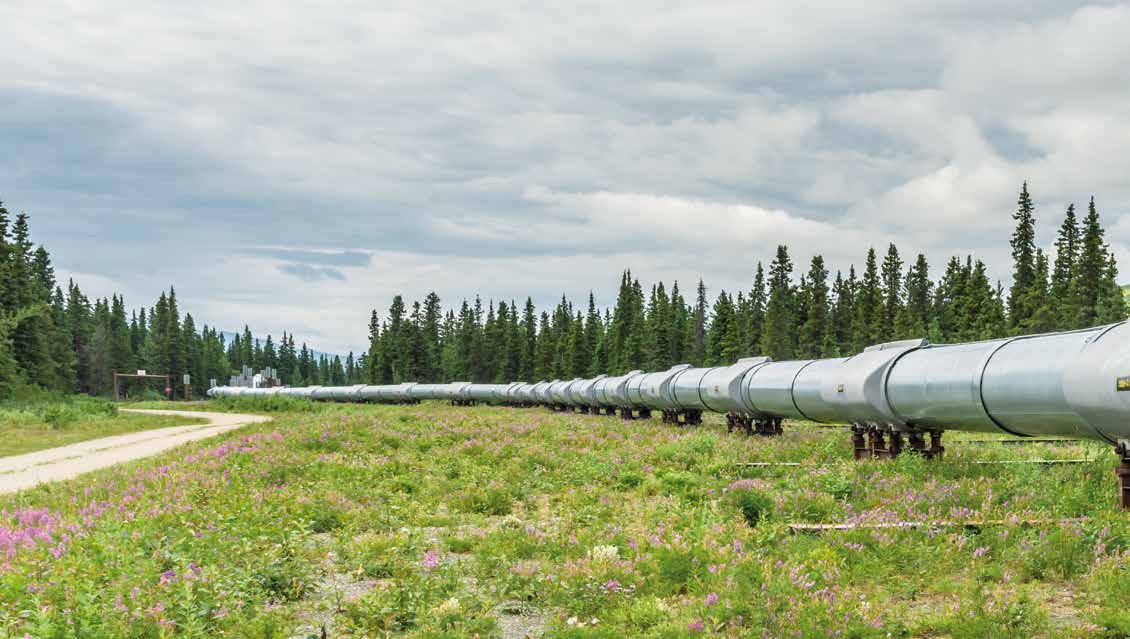
sible for hundreds of miles of pipeline
in the middle of nowhere? With the
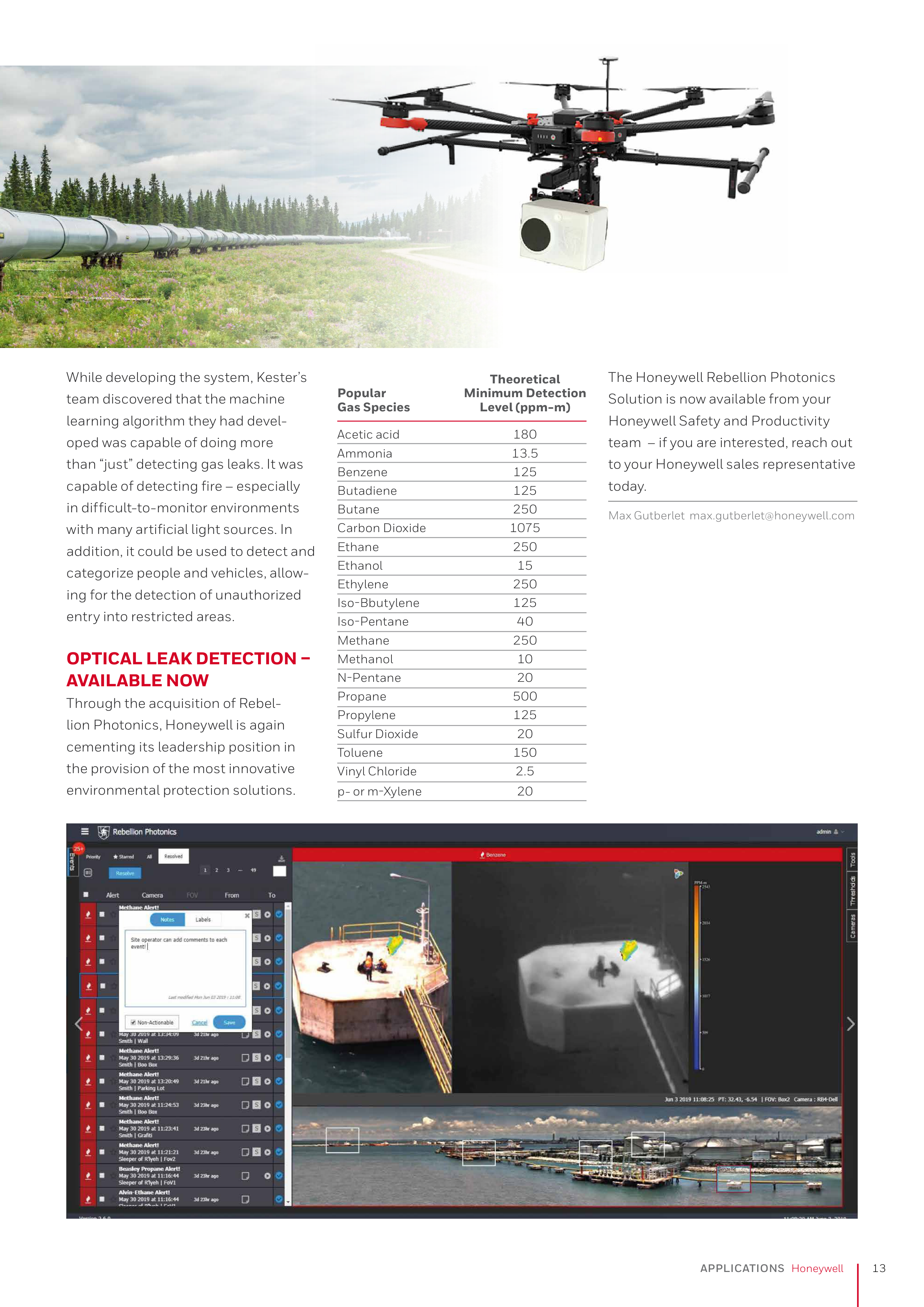
drone-mounted version, you can regu-
larly fly over your entire pipeline.
The result of all this development
work was a product that can detect
gas leaks with very high accuracy and
at very low flow rates – for methane
emissions as low as 250 ppm (parts
per million).
It is also worth noting that the
Honeywell Rebellion Photonics system
is completely automated. There is no
need for an operator to sit in front of
the screen and monitor what is going
on. The system auto-triggers alarms
and actions based on pre-configured
gas detection levels.
You want the system integrated into
your Honeywell Experion SCADA
solution? The built-in Modbus/TCP
support, the de-facto communication
standard for gas facilities, allows for
easy integration into any infrastruc-
ture.
CH
4
NH
3
Gas
absorption
5
6
7
8
9
10
11
12
13
14
Blackbody radiation after it passes through gas cloud

13
Applications
Honeywell
While developing the system, Kester’s
team discovered that the machine
learning algorithm they had devel-
oped was capable of doing more
than “just” detecting gas leaks. It was
capable of detecting fire – especially
in difficult-to-monitor environments
with many artificial light sources. In
addition, it could be used to detect and
categorize people and vehicles, allow-
ing for the detection of unauthorized
entry into restricted areas.
Optical Leak Detection –
Available Now
Through the acquisition of Rebel-
lion Photonics, Honeywell is again
cementing its leadership position in
the provision of the most innovative
environmental protection solutions.
The Honeywell Rebellion Photonics
Solution is now available from your
Honeywell Safety and Productivity
team – if you are interested, reach out
to your Honeywell sales representative
today.
Max Gutberlet max.gutberlet@honeywell.com
Theoretical
Popular
Minimum Detection
Gas Species
Level (ppm-m)
Acetic acid
180
Ammonia
13.5
Benzene
125
Butadiene
125
Butane
250
Carbon Dioxide
1075
Ethane
250
Ethanol
15
Ethylene
250
Iso-Bbutylene
125
Iso-Pentane
40
Methane
250
Methanol
10
N-Pentane
20
Propane
500
Propylene
125
Sulfur Dioxide
20
Toluene
150
Vinyl Chloride
2.5
p- or m-Xylene
20

14
Honeywell
Events
The spread of the COVID-19 virus has
all kinds of effects, among which is
the reduced demand for oil as a result
of lower transport volumes of goods
and less international travel. Both are
results of our attempt to stop or limit
the global spread of this newly discov-
ered piece of DNA/RNA packed in a
piece of protein.
Fear of viruses…it made me think of
the fear natural gas companies had
when the introduction of biogas into
the gas grid was being suggested. The
idea was that microbes from anaero-
bic digesters could be present in the
upgraded biomethane and travel with
the gas into the households of millions
of people. A justified concern? Maybe,
but tests soon pointed out the gas was
cleaner than the air you would find in
an average classroom. The renewables
revolution could continue and gas-
While writing this article, we have just seen oil
prices plummet to a staggering low of just above
30 dollars per barrel.
Reason to Celebrate for Honeywell and GRDF
100
th
Biomethane
Grid Injection Station
for GRDF
to-grid has become well accepted in
many countries around the world. Still,
the adoption of biomethane into the
gas grid is very much dependent on
governments, as well as company lead-
ership. GRDF has embraced biometh-
ane-to-grid like no other distribution
network in Europe has. With its clear
vision for decarbonizing their opera-
tions, they started to develop the first
gas-to-grid project early in the past
decade.
Elster-Honeywell was among the first
to work with GRDF on a suitable solu-
tion that would safely and effectively
inject renewable natural gas (or bio-
methane) into their gas grid.
In 2012, we delivered the first installa-
tion for a French site named ‘Forbach’,
and since then we have been working
closely together to optimize the solu-
tion in both technical and commer-
cial terms. This has resulted in close
cooperation on the renewables front,
for which we are very thankful; and we


15
Events
Honeywell
are proud of what we have achieved
together.
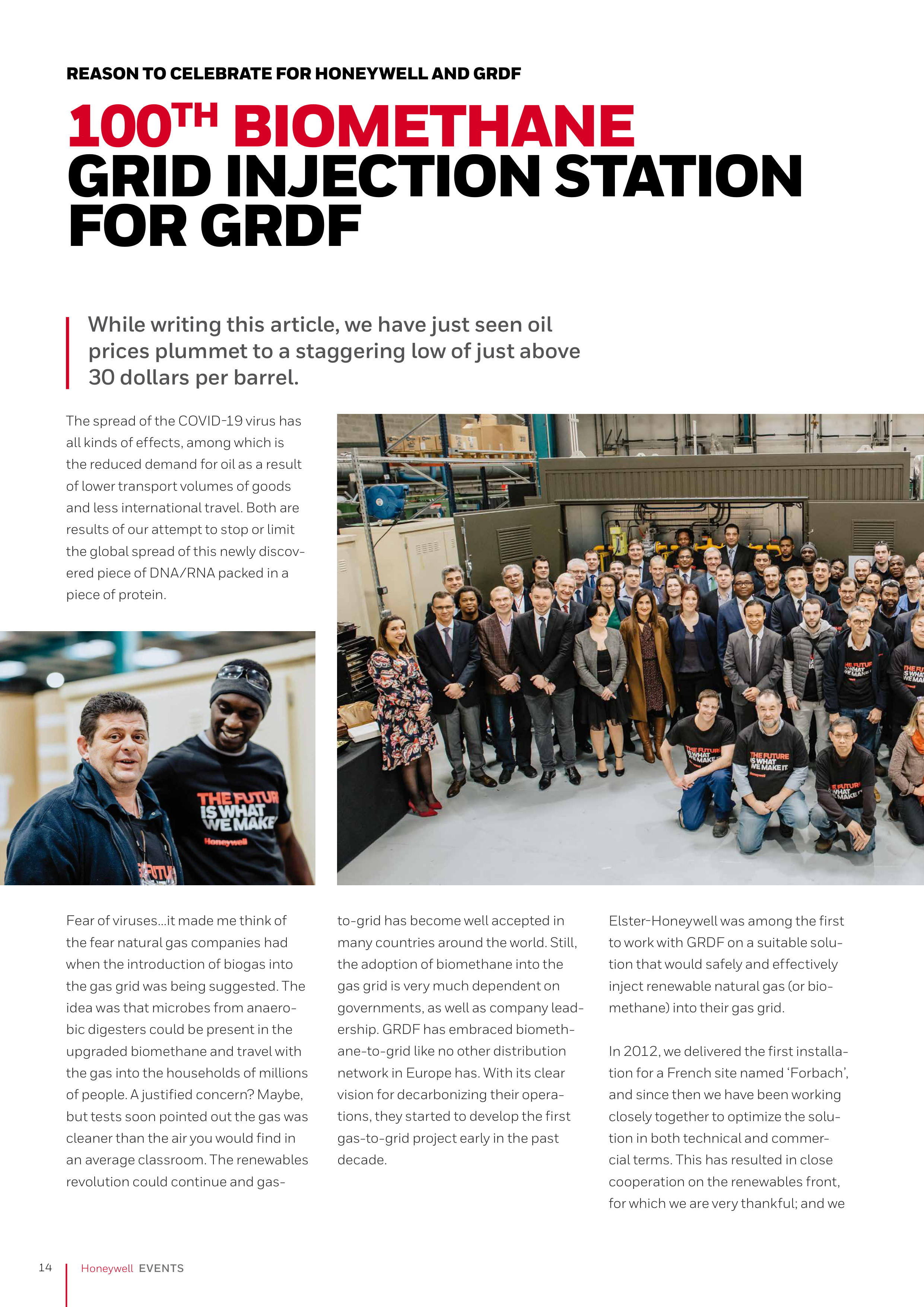
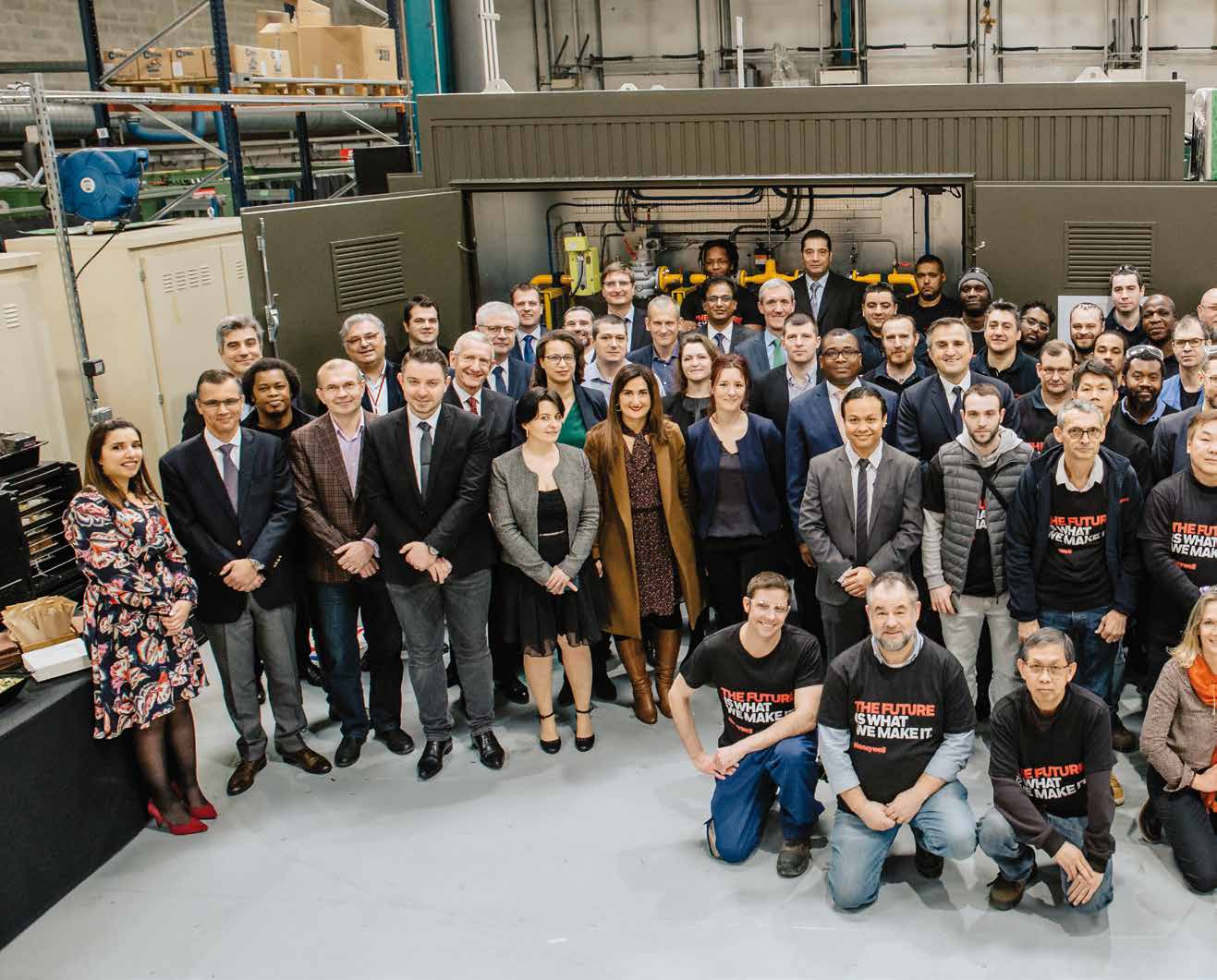
Early February marked a milestone,
as we finalized the production of the
100
th
biogas station for GRDF. A great
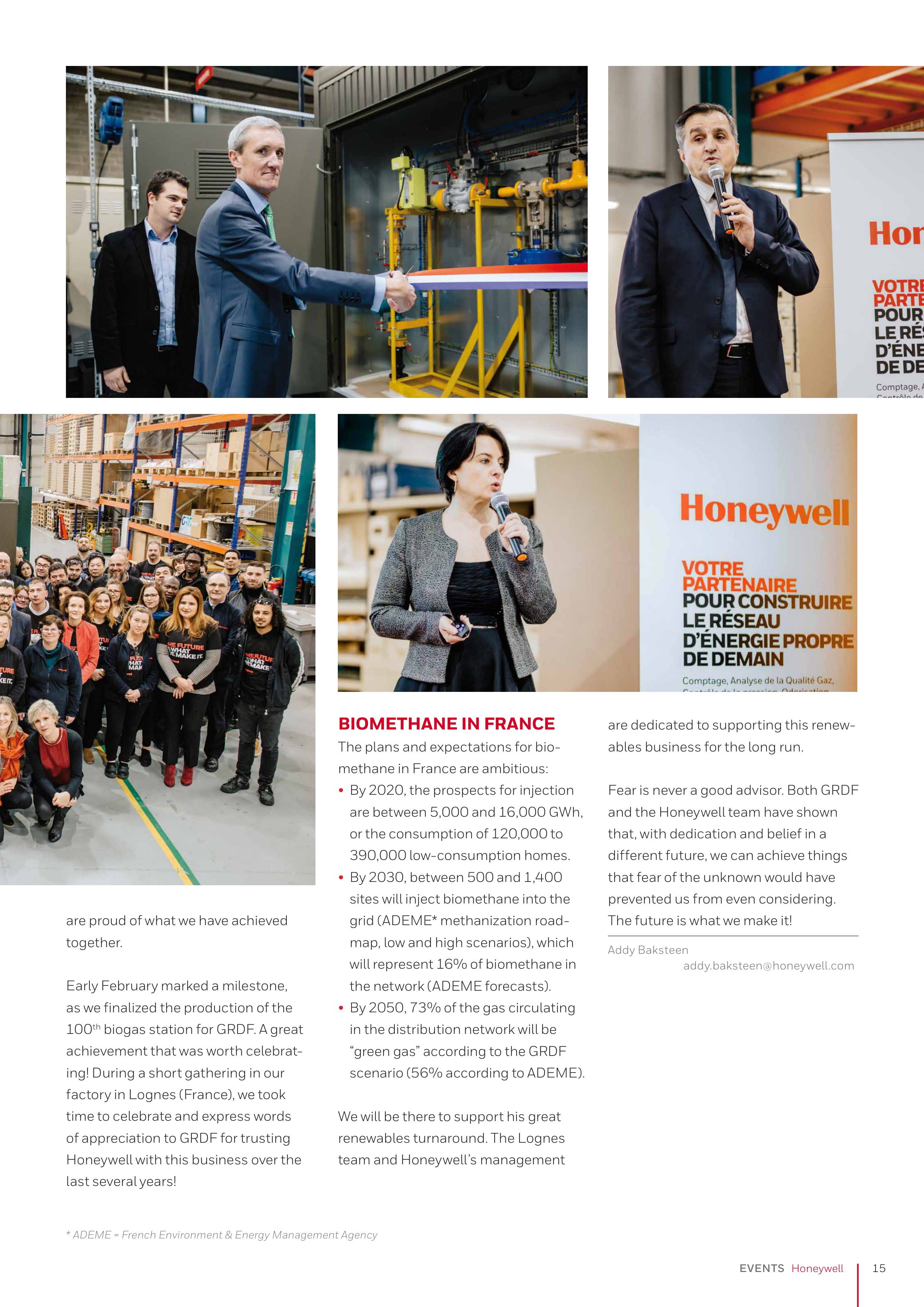
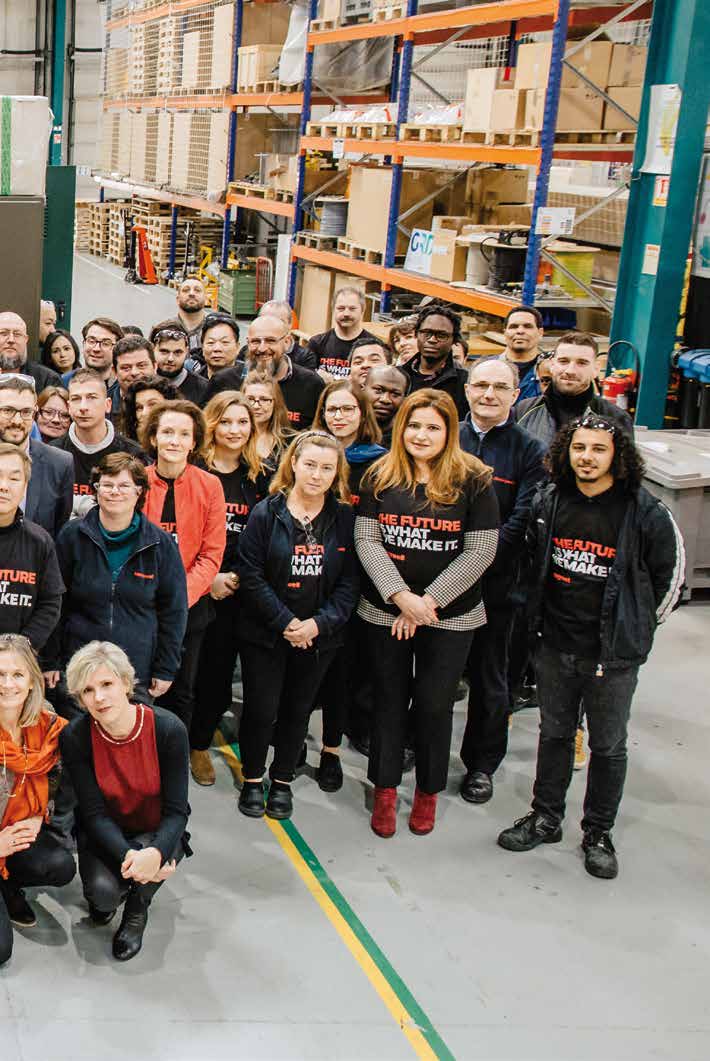
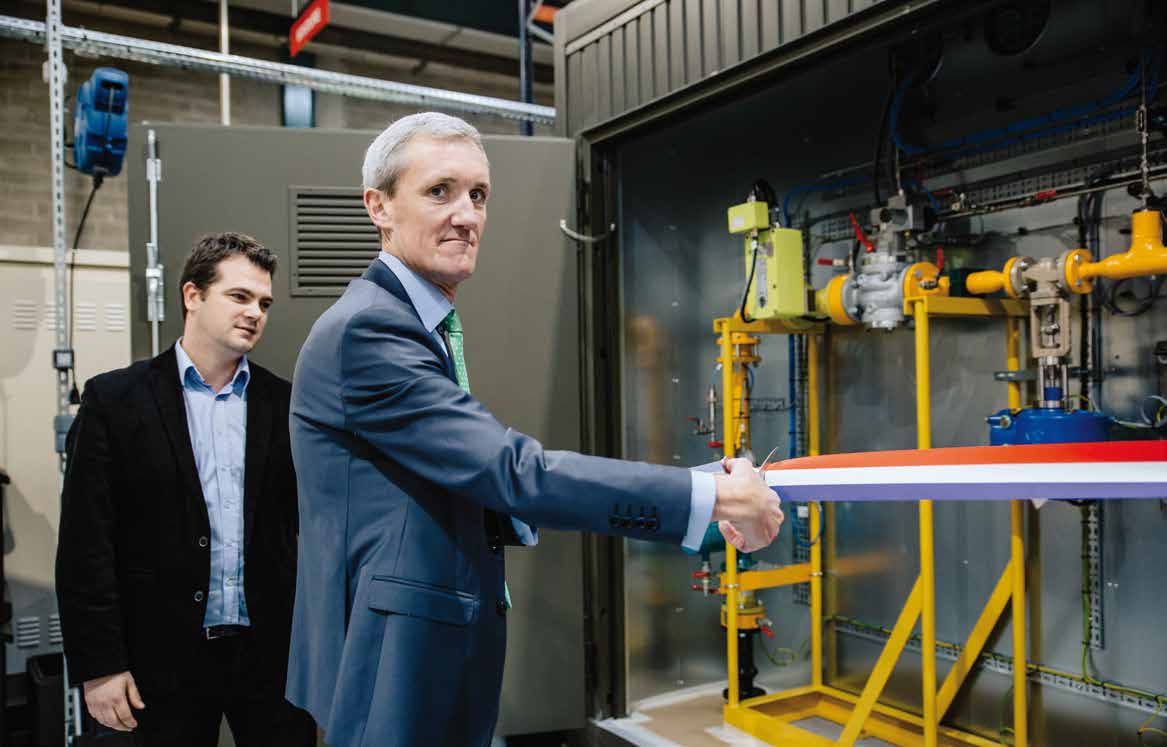
achievement that was worth celebrat-
ing! During a short gathering in our
factory in Lognes (France), we took
time to celebrate and express words
of appreciation to GRDF for trusting
Honeywell with this business over the
last several years!
Biomethane in France
The plans and expectations for bio-
methane in France are ambitious:
•
By 2020, the prospects for injection
are between 5,000 and 16,000 GWh,
or the consumption of 120,000 to
390,000 low-consumption homes.
•
By 2030, between 500 and 1,400
sites will inject biomethane into the
grid (ADEME* methanization road-
map, low and high scenarios), which
will represent 16% of biomethane in
the network (ADEME forecasts).
•
By 2050, 73% of the gas circulating
in the distribution network will be
“green gas” according to the GRDF
scenario (56% according to ADEME).
We will be there to support his great
renewables turnaround. The Lognes
team and Honeywell’s management
are dedicated to supporting this renew-
ables business for the long run.
Fear is never a good advisor. Both GRDF
and the Honeywell team have shown
that, with dedication and belief in a
different future, we can achieve things
that fear of the unknown would have
prevented us from even considering.
The future is what we make it!
Addy Baksteen
addy.baksteen@honeywell.com
* ADEME = French Environment & Energy Management Agency


16
Honeywell
Service
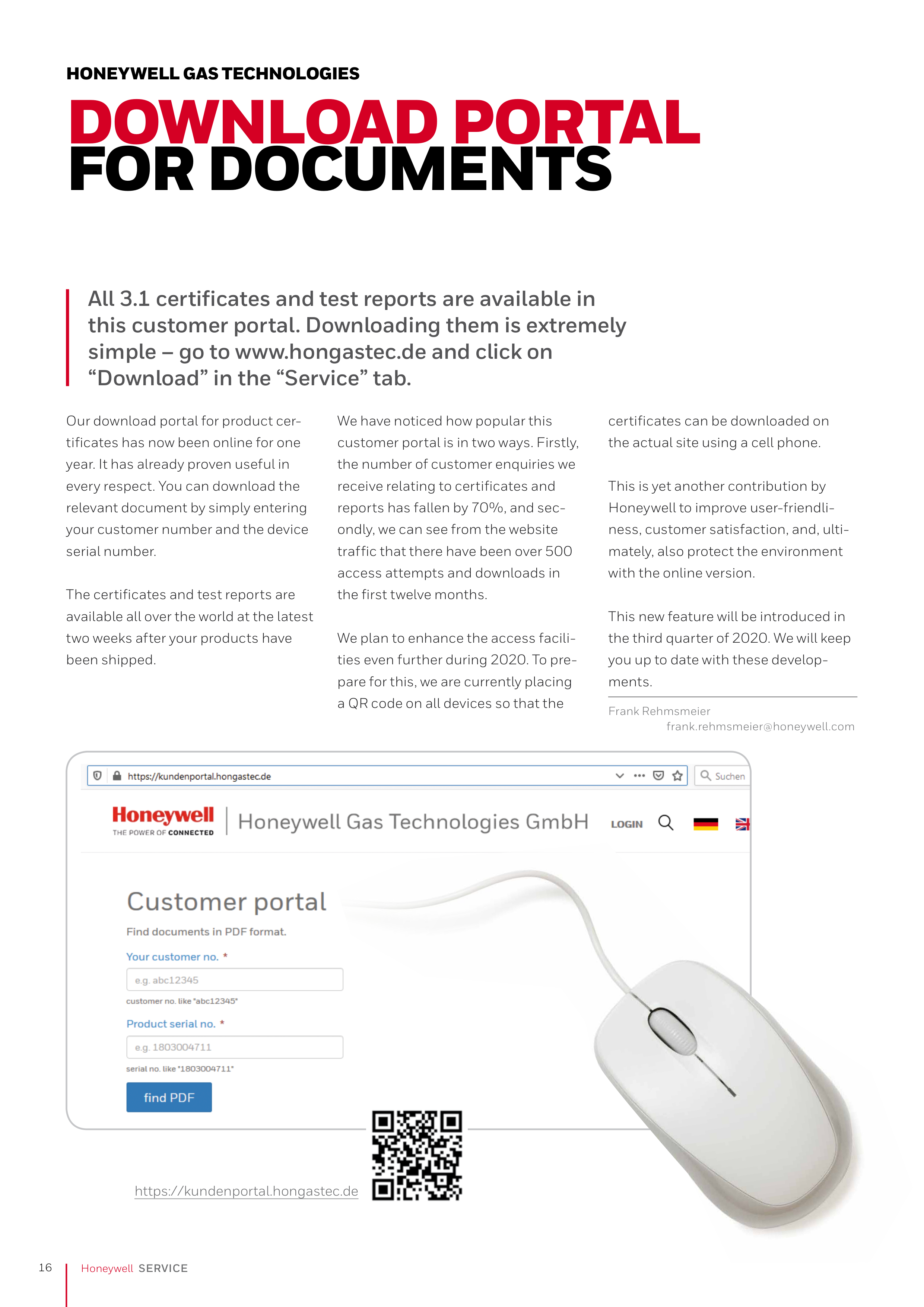
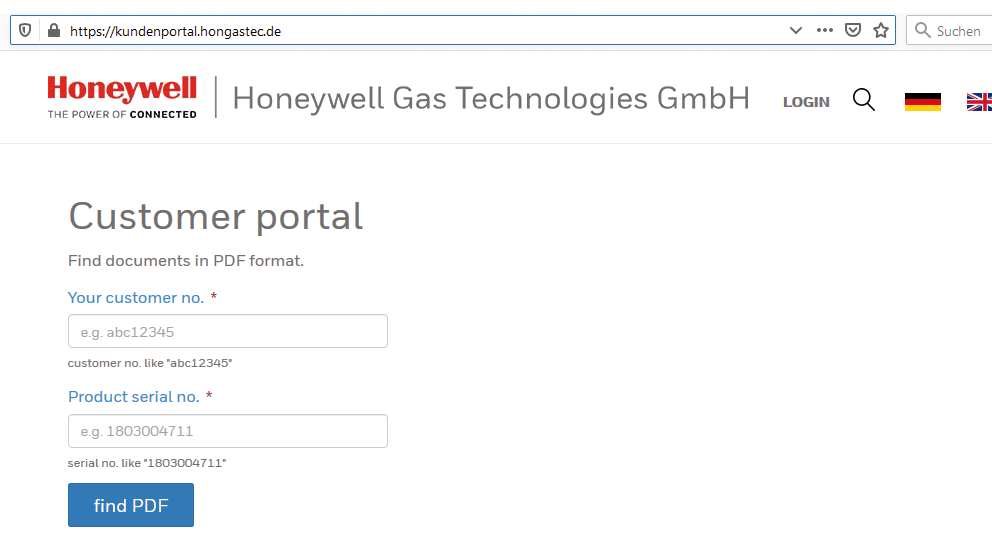
Our download portal for product cer-
tificates has now been online for one
year. It has already proven useful in
every respect. You can download the
relevant document by simply entering
your customer number and the device
serial number.
The certificates and test reports are
available all over the world at the latest
two weeks after your products have
been shipped.
All 3.1 certificates and test reports are available in
this customer portal. Downloading them is extremely
simple – go to www.hongastec.de and click on
“Download” in the “Service” tab.
Honeywell Gas Technologies
Download Portal
for Documents
We have noticed how popular this
customer portal is in two ways. Firstly,
the number of customer enquiries we
receive relating to certificates and
reports has fallen by 70%, and sec-
ondly, we can see from the website
traffic that there have been over 500
access attempts and downloads in
the first twelve months.
We plan to enhance the access facili-
ties even further during 2020. To pre-
pare for this, we are currently placing
a QR code on all devices so that the
certificates can be downloaded on
the actual site using a cell phone.
This is yet another contribution by
Honeywell to improve user-friendli-
ness, customer satisfaction, and, ulti-
mately, also protect the environment
with the online version.
This new feature will be introduced in
the third quarter of 2020. We will keep
you up to date with these develop-
ments.
Frank Rehmsmeier
frank.rehmsmeier@honeywell.com
https://kundenportal.hongastec.de

17
Service
Honeywell
Knowledge is everything – today, in particular, we
are dependent on information which is not always
readily to hand.
We have all been there – I am looking
for a recipe, a new handbag, or assem-
bly instructions. But who can you ask?
First of all, of course there is Doctor
Google, who may well be able to help.
But who knows how to fit a SIM card
into an FE260? And there is not gen-
erally a suitable YouTube video for this
(although it would be interesting).
Or you can ask colleagues who may
know how to do what you want – but
sometimes even they are not available
or cannot help.
But Honeywell can help: Our Techni-
cal Support team is available for all
your tricky questions relating to Elster
products – either on the telephone
hotline or by e-mail. These product
specialists can only be contacted at
certain times, however, which means
that they are not always immediately
available. And in this case: It’s up to
you! So how can I find some help with
my problem? To enable you to find a
solution more quickly, Honeywell has
established an online knowledge base
which covers a large number of top-
ics from the World of Elster, primarily
electronics. The Technical Support
specialists will publish solutions to
problems in the form of short articles
on this knowledge base.
These may also include presentations,
PDF files, screenshots or images
which provide solutions. The number
of articles will naturally increase con-
tinuously.
You can access the knowledge base
using the following link:
www.honeywellprocess.com/support.
Here, you have to register
once with your e-mail
address.
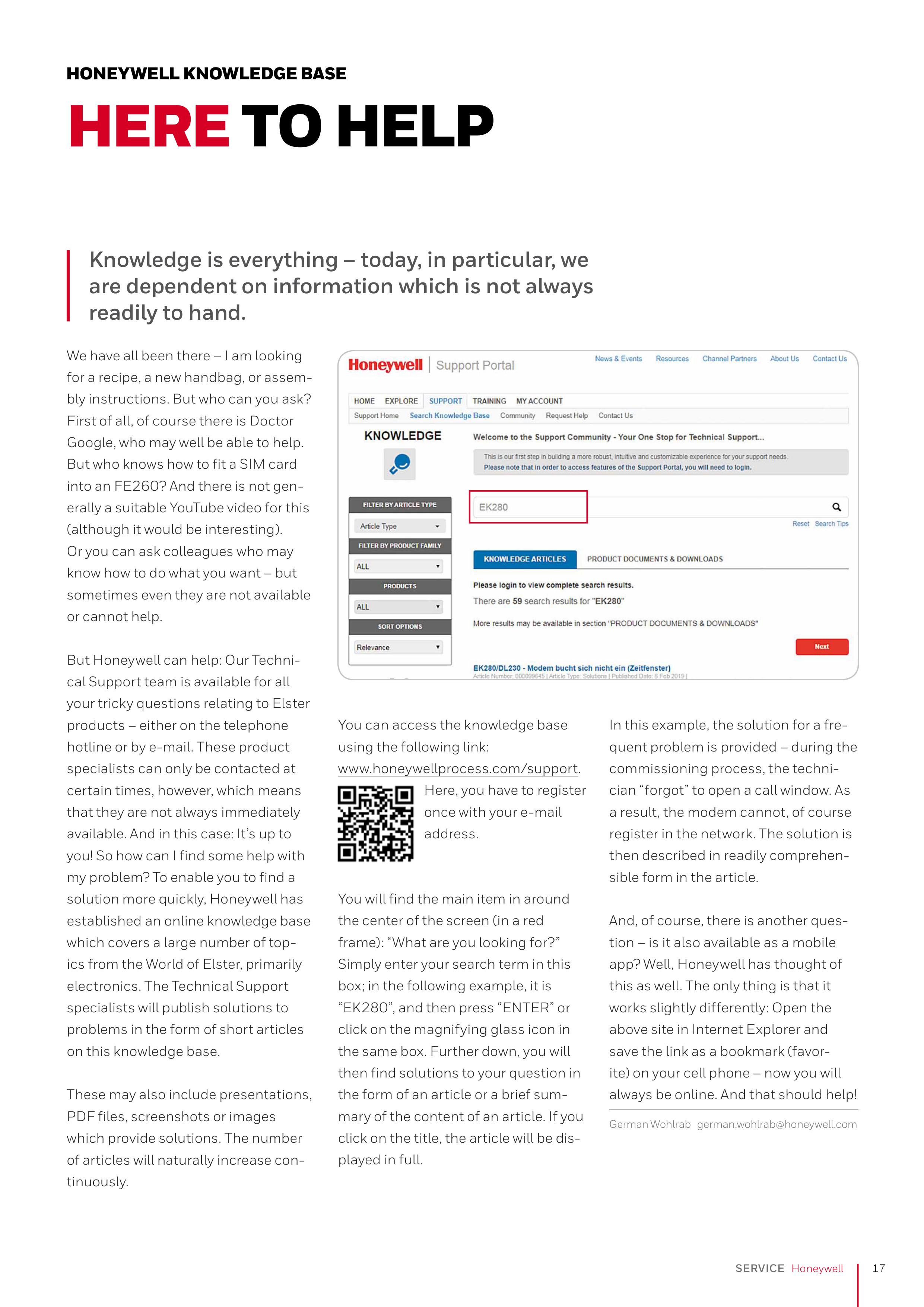
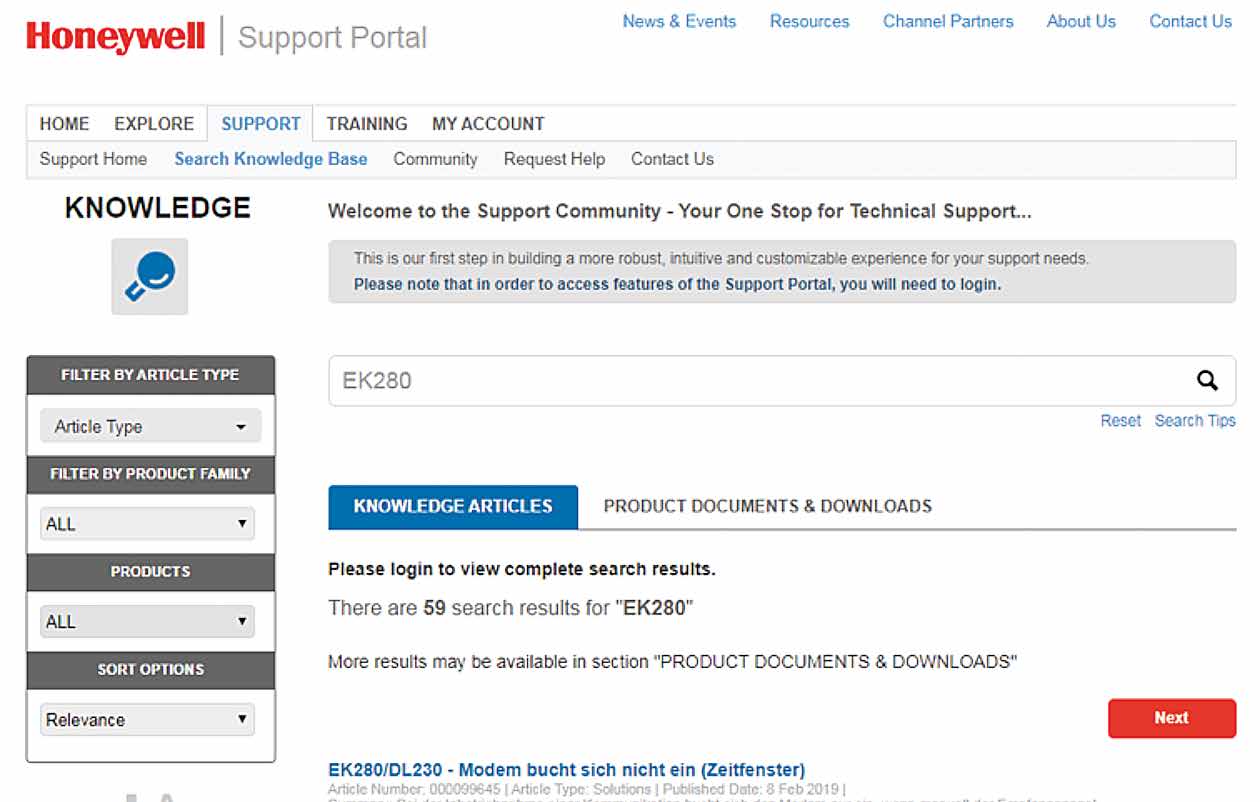
You will find the main item in around
the center of the screen (in a red
frame): “What are you looking for?”
Simply enter your search term in this
box; in the following example, it is
“EK280”, and then press “ENTER” or
click on the magnifying glass icon in
the same box. Further down, you will
then find solutions to your question in
the form of an article or a brief sum-
mary of the content of an article. If you
click on the title, the article will be dis-
played in full.
In this example, the solution for a fre-
quent problem is provided – during the
commissioning process, the techni-
cian “forgot” to open a call window. As
a result, the modem cannot, of course
register in the network. The solution is
then described in readily comprehen-
sible form in the article.
And, of course, there is another ques-
tion – is it also available as a mobile
app? Well, Honeywell has thought of
this as well. The only thing is that it
works slightly differently: Open the
above site in Internet Explorer and
save the link as a bookmark (favor-
ite) on your cell phone – now you will
always be online. And that should help!
German Wohlrab german.wohlrab@honeywell.com
Honeywell Knowledge Base
Here
to Help


PB-20-1-
ENG
* Terms & Conditions Apply
Elster GmbH
Steinern Straße 19-21
55252 Mainz-Kastel, Germany
www.elster-instromet.com
Honeywell Process Solutions
1250 West Sam Houston Parkway South
Houston, TX 77042, USA
1280 Kemper Meadow Drive
Cincinnati, OH 45240, USA
www.honeywellprocess.com
The
future
is
what
we
make it
Would you like to receive news?
https://www.elster-instromet.com/en/profiles
Subscribe now!
During these very challenging and unprecedented economic times, we
want to extend our support and provide you with the best remote tech-
nologies to help keep your instruments, processes, and plants running.
Effective immediately, we are offer-
ing free access and expanded usage
of select products, tools, software,
and remote services that can help
enable operational continuity. These
30-day free trial offers* are valid
through to June 30, 2020, to
any customer that needs it.
If you feel this offer could be of
interest to a friend or colleague,
please share:
Extended support offers here!
For further details on how technology
keeps industrial facilities operating
from a distance:
3 tips to run operations remotely
RELIABLE
REMOTE
SOLUTIONS
FOR
UNRELIABLE
TIMES