
good
medicine
Retail Independent Pharmacy |
Healthy Horizons


Dear reader,
When I walk into an independent pharmacy, I immediately feel
connected to the community. Maybe it’s the way you greet each of
your patients by name. Maybe it’s the little league baseball team
photos hanging on your wall. Or maybe it’s your unique approach to
improving the health of each person who walks through your doors.
Whatever the reason,
the power of independents, is palpable.
In this edition of
good medicine
, we focused on creating a similar
sense of community among retail independent pharmacy owners
across the country. As reimbursements continue to tighten and
margin pressures increase, this community is increasingly important.
We hope
good medicine
is a place to share best practices, educate
yourself, connect with each other and be inspired.
Each of the stories you will read were graciously offered by your
peers. They are stories filled with creative approaches to monitoring
adherence, expanding clinical services and more. These are stories
of pharmacy owners who have adapted to new challenges to grow
their businesses in new ways.
Welcome to the fourth edition of
good medicine
magazine.
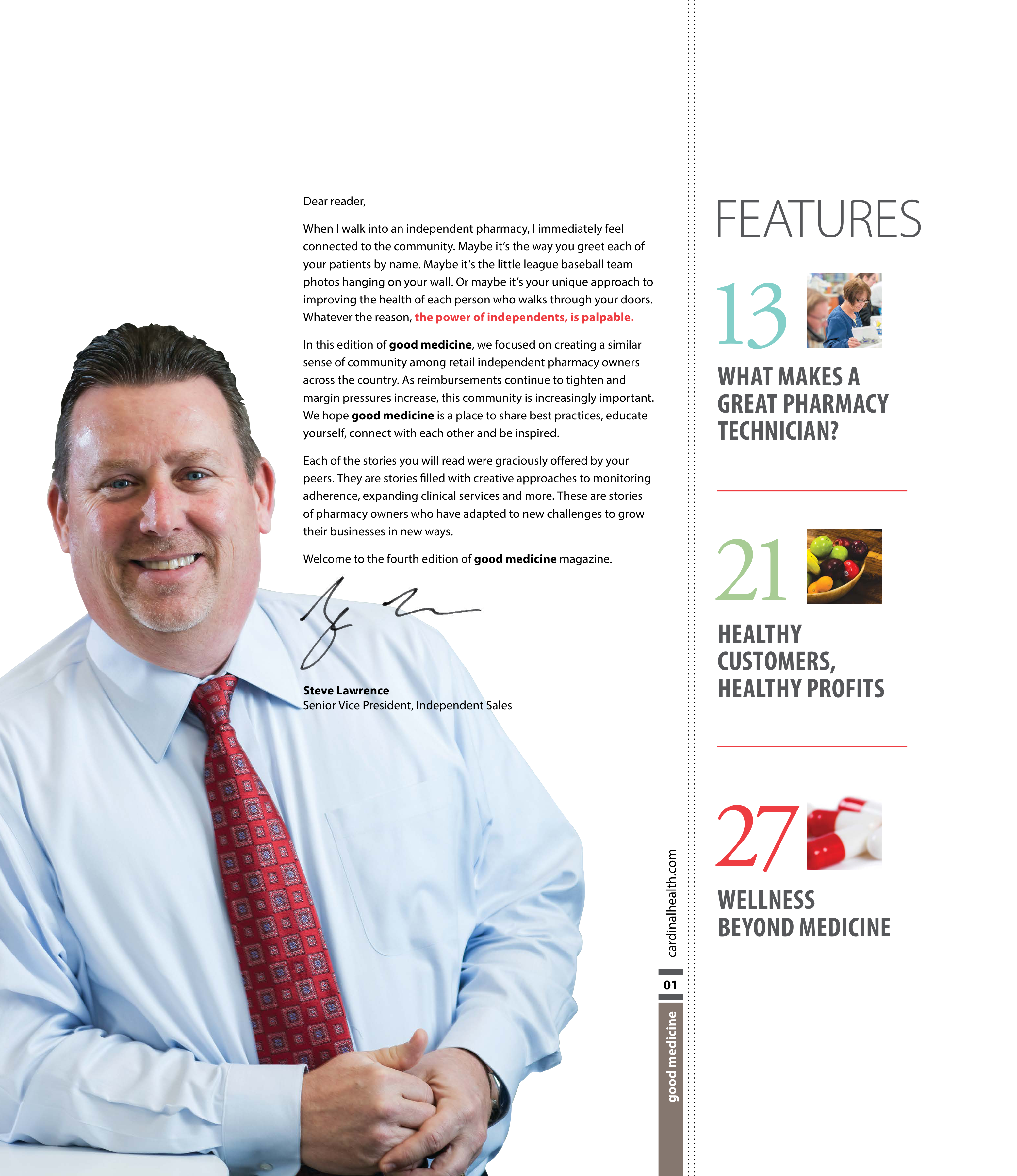
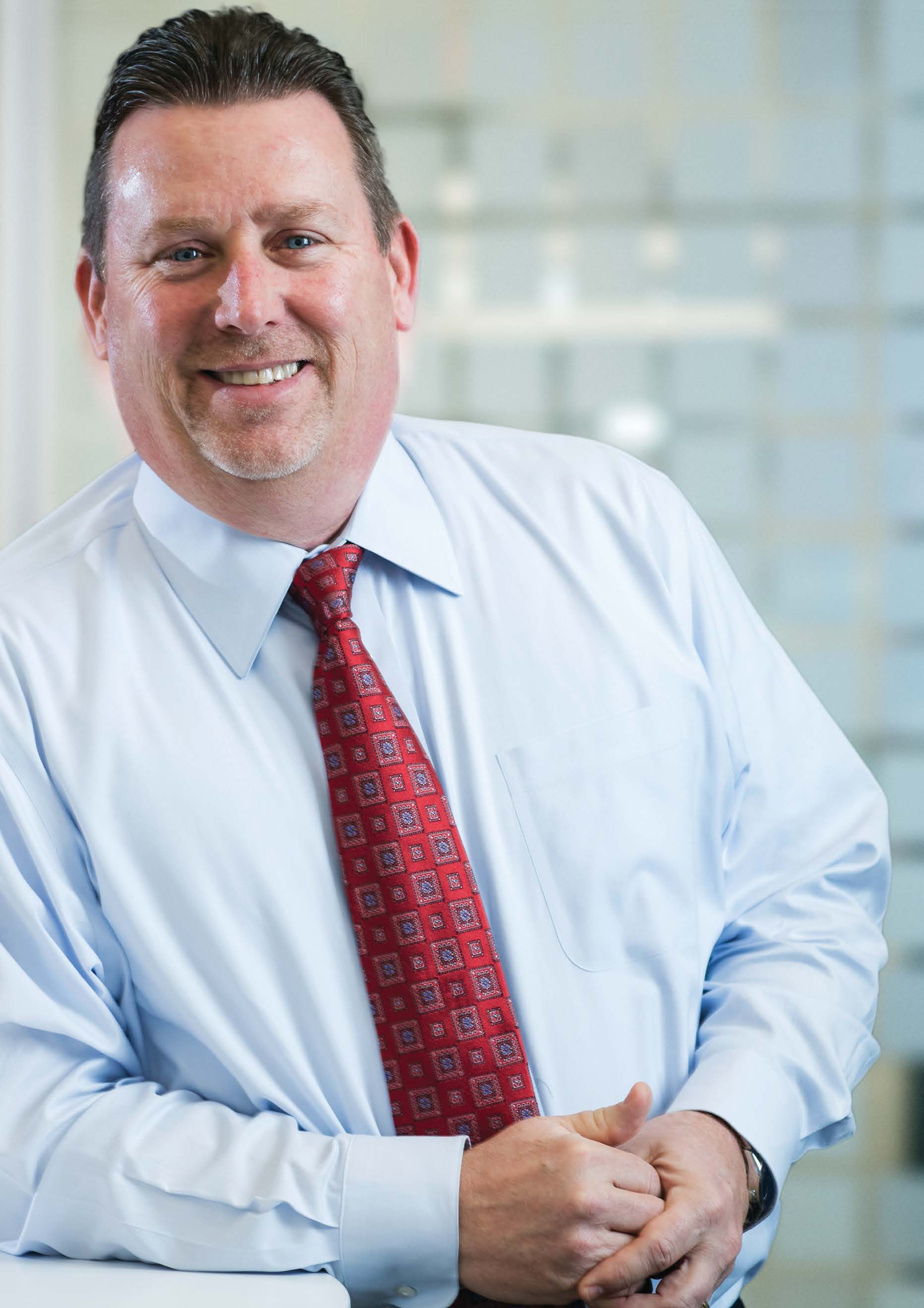
Steve Lawrence
Senior Vice President, Independent Sales
WHAT MAKES A
GREAT PHARMACY
TECHNICIAN?
13
HEALTHY
CUSTOMERS,
HEALTHY PROFITS
21
good medicine
01
cardinalhealth.com
WELLNESS
BEYOND MEDICINE
27
FEATURES
TABLE OF CONTENTS
HEALTHY HORIZONS
good medicine
02
AN INVESTMENT IN ACCOUNTABILITY
BUSINESS ADVANTAGE
PATHWAYS TO OWNERSHIP
HOMETOWN PRIDE
WHAT MAKES A GREAT PHARMACY TECHNICIAN
SOLVING PATIENT PROBLEMS
THE RIGHT MIX
TAP INTO NEW TERRITORY
MEDICINE SHOPPE®’S FIRST TELEPHARMACY
RETAIL ADVANTAGE
HEALTHY CUSTOMERS, HEALTHY PROFITS
STRONG END TO END
FABULOUS FRONT-END
THREE REASONS PATIENT EMPOWERMENT IS GROWING IN HEALTHCARE
WELLNESS ADVANTAGE
WELLNESS BEYOND MEDICINE
ADHERENCE MATTERS
SUPPLEMENT HEALTH, FIGHTING VITAMIN DEFICIENCIES
MATTERS OF THE HEART, BLOOD PRESSURE SERVICE
FIVE IDEAS FOR FACEBOOK POSTS
THE POWER OF INDEPENDENTS
COMMUNITY ADVANTAGE
OPEN FOR BUSINESS
MEDICARE MADE EASY
THE NALOXONE LADY
A COMMUNITY PHARMACIST’S FIGHT AGAINST PRESCRIPTION DRUG MISUSE
GENERATION RX
COMMUNITY PHARMACISTS—THE KEY TO REDUCING HOSPITAL READMISSIONS
FOUR REASONS PATIENTS CHOOSE INDEPENDENT COMMUNITY PHARMACIES
04
06
08
12
13
14
15
16
18
20
21
22
24
25
26
27
28
30
31
32
34
36
37
38
39
40
42
44
47
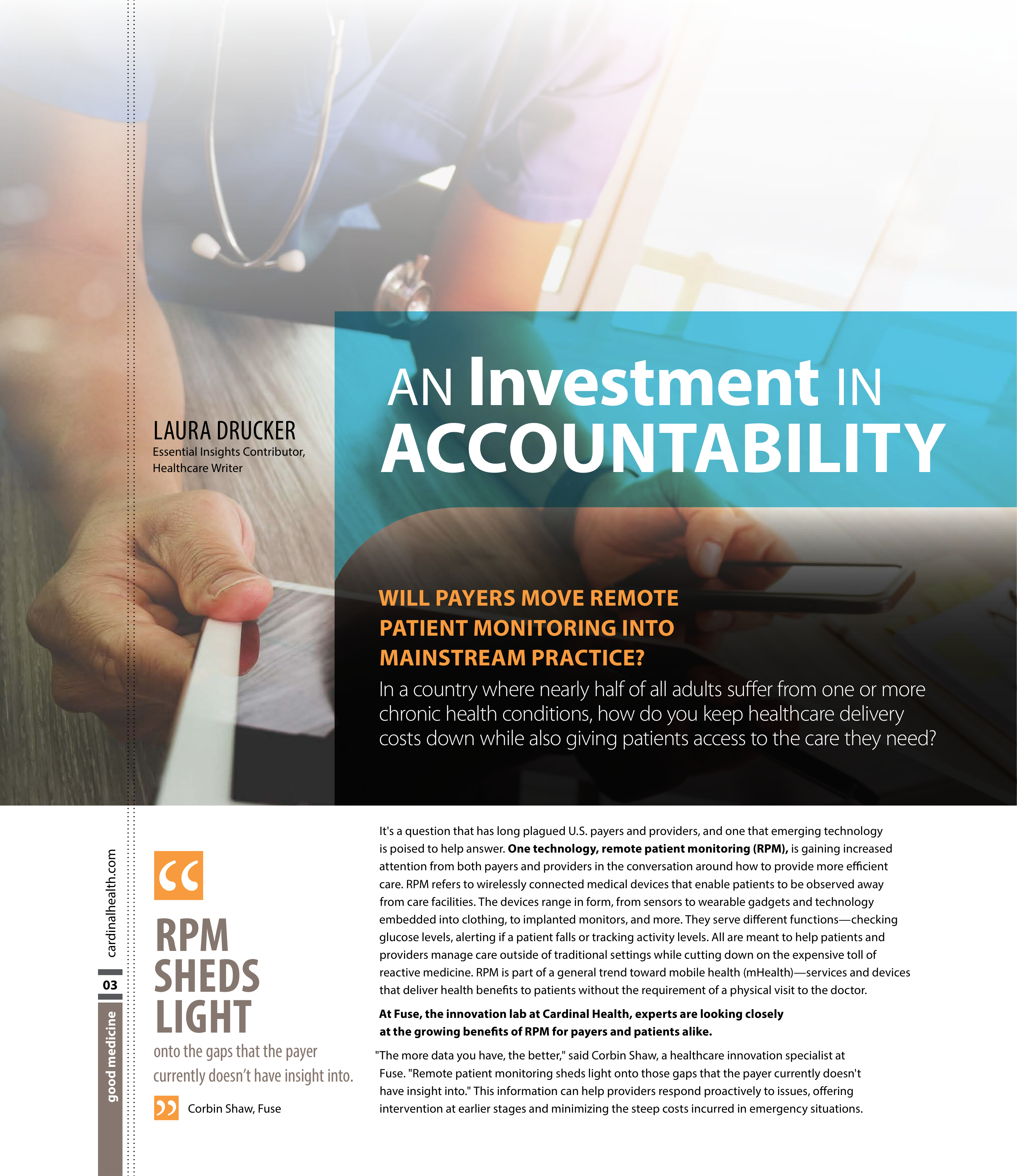

LAURA DRUCKER
Essential Insights Contributor,
Healthcare Writer
good medicine
03
cardinalhealth.com
AN
Investment
IN
ACCOUNTABILITY
WILL PAYERS MOVE REMOTE
PATIENT MONITORING INTO
MAINSTREAM PRACTICE?
In a country where nearly half of all adults suffer from one or more
chronic health conditions, how do you keep healthcare delivery
costs down while also giving patients access to the care they need?
It's a question that has long plagued U.S. payers and providers, and one that emerging technology
is poised to help answer.
One technology, remote patient monitoring (RPM),
is gaining increased
attention from both payers and providers in the conversation around how to provide more efficient
care. RPM refers to wirelessly connected medical devices that enable patients to be observed away
from care facilities. The devices range in form, from sensors to wearable gadgets and technology
embedded into clothing, to implanted monitors, and more. They serve different functions—checking
glucose levels, alerting if a patient falls or tracking activity levels. All are meant to help patients and
providers manage care outside of traditional settings while cutting down on the expensive toll of
reactive medicine. RPM is part of a general trend toward mobile health (mHealth)—services and devices
that deliver health benefits to patients without the requirement of a physical visit to the doctor.
At Fuse, the innovation lab at Cardinal Health, experts are looking closely
at the growing benefits of RPM for payers and patients alike.
"The more data you have, the better," said Corbin Shaw, a healthcare innovation specialist at
Fuse. "Remote patient monitoring sheds light onto those gaps that the payer currently doesn't
have insight into." This information can help providers respond proactively to issues, offering
intervention at earlier stages and minimizing the steep costs incurred in emergency situations.
RPM
SHEDS
LIGHT
onto the gaps that the payer
currently doesn’t have insight into.
Corbin Shaw, Fuse


THE PROVEN SUCCESS
OF mHEALTH
One of the earliest adopters of mHealth,
including RPM devices and telehealth, is the
U.S. Department of Veterans Affairs (VA). The
VA allots nearly half of its $100 billion yearly
budget to the Veterans Health Administration
(VHA), which manages the healthcare of
8.3 million patients, two-thirds of whom
suffer from at least one chronic illness.
Since starting its initial RPM and telehealth
program in 2003, the VHA has been able
to reduce the number of bed days of care
by 25 percent and reduce acute hospital
admissions by 19 percent, a 2014 case
study by the Healthcare Information and
Management Systems Society showed. A
$1,600 annual investment per patient in
mHealth technologies helped the VHA
decrease average costs per patient by more
than $6,500 per year. And VHA patients have
been eager to embrace the convenience
and control afforded by mHealth. Of those
offered the services, 90 percent accepted.
The benefits seen by the VHA reveal the
greater possibilities of home-based patient
monitoring. Patients—even those who suffer
from chronic illnesses—feel more secure and
empowered, while their providers are able
to track symptoms and treatment adherence
from afar, intervening before crises occur.
With the reduction in hospital visits and
lengths of hospital stays, payer costs are
decreased significantly, a small investment
per patient upfront translating into major
savings across the care continuum. Other
healthcare agencies, including the U.K.'s
National Health System, are looking to the
VHA's experience with RPM and telehealth as
a model for similar programs of their own.
HELPING KEEP PATIENTS
ACCOUNTABLE
Treatment for chronic conditions can be
complex. There are diet, exercise, and
lifestyle recommendations, appointments
to juggle, and often, multiple medications
that need to be taken regularly. Poor
adherence to care requirements is rampant
and expensive. For example, a report from
the World Health Organization shows that
direct costs attributable to inadequate
treatment control in diabetes patients is
roughly three to four times higher than
costs for those who adhere to care plans.
The problem for payers whose patients are
managing chronic illnesses like diabetes,
hypertension, coronary artery disease and
asthma, is that much of the costs incurred are
a result of medication nonadherence, mostly
in the form of avoidable hospitalizations.
MOVING RPM INTO
THE MAINSTREAM
As of 2015, 4.9 million patients were
already enrolled in mHealth care
programs encompassing RPM. Rising
market acceptance suggests continuing
growth, and payers may be best suited
to push RPM into mainstream practice.
The healthcare innovators at Fuse believe
that creativity and advancement in RPM
technology will result in wearables and
other devices that seamlessly integrate into
patients' lives, wirelessly transmitting health
data to payers and providers in real time and
allowing for proactive healthcare that reduces
wasteful spending. One example is the
concept of Bluetooth-connected devices, like
a smart scale to monitor a congestive heart
failure patient's weight, since rapid weight
gain can be a sign for hospital readmission.
"It will be interesting to see what RPM
devices and data payers and providers
will actually use and trust, as well as how
the device data will be integrated into
existing payer and provider data sets and
workflows," Fuse healthcare innovation
specialist Kristina Redgrave said.
As healthcare spending continues to grow,
payers have a unique opportunity to start
developing infrastructures that support RPM
among their patients, perhaps considering
reimbursement plans for device purchases
or incentives for good health and proper
care maintenance. Those incentives may
also be enough to push patients into action
despite any privacy and security concerns.
Though the exact mechanisms of widespread
RPM use are still unclear, the opportunity
for payers to greatly reduce spending
through RPM technology is promising.
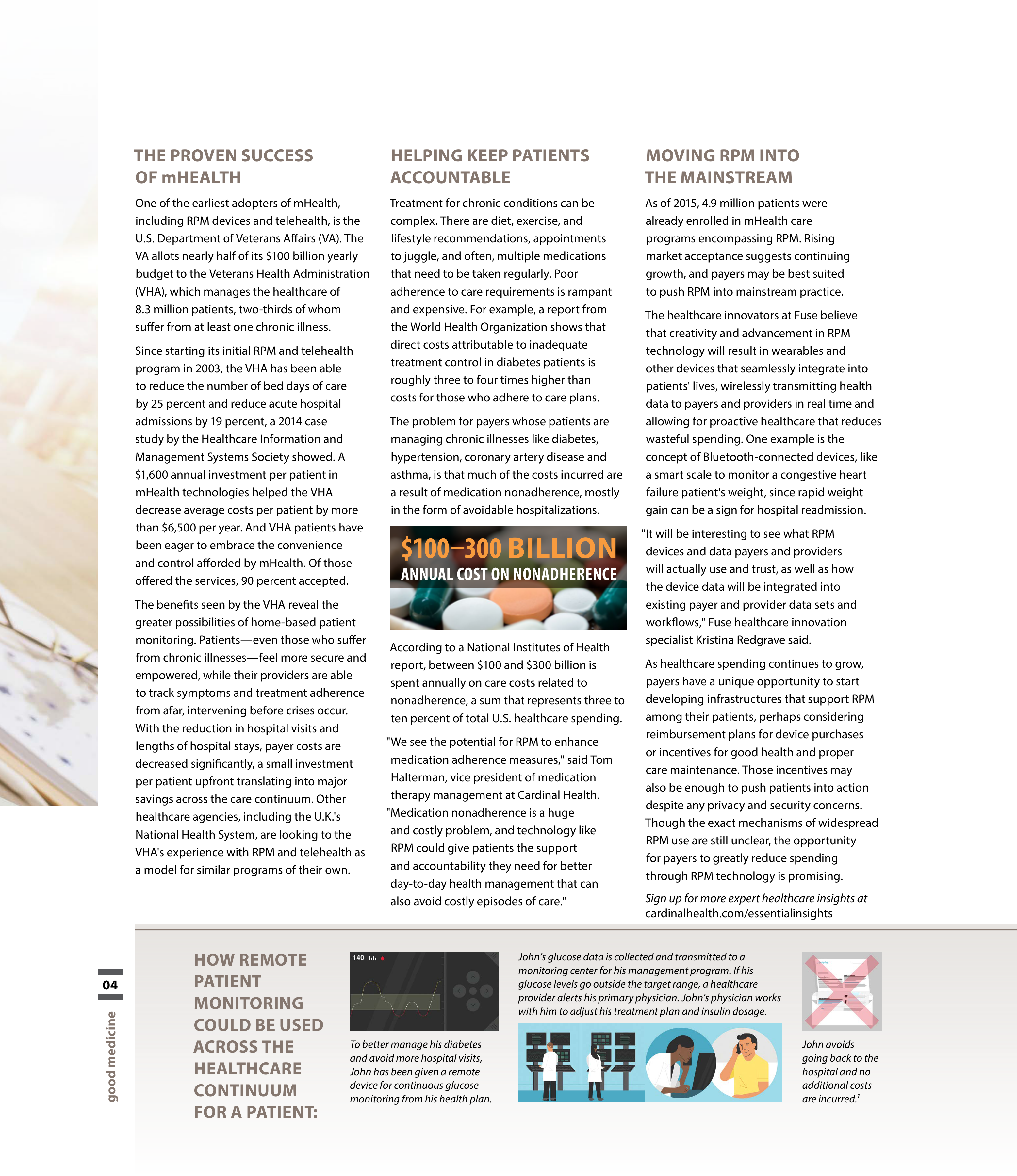
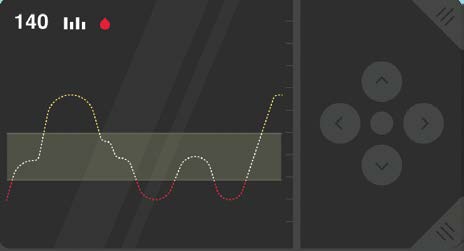
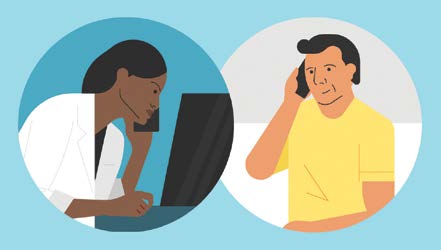
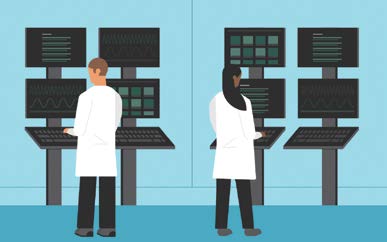
John’s glucose data is collected and transmitted to a
monitoring center for his management program. If his
glucose levels go outside the target range, a healthcare
provider alerts his primary physician. John’s physician works
with him to adjust his treatment plan and insulin dosage.
To better manage his diabetes
and avoid more hospital visits,
John has been given a remote
device for continuous glucose
monitoring from his health plan.
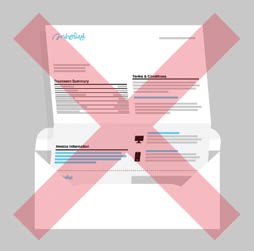
John avoids
going back to the
hospital and no
additional costs
are incurred.1
good medicine
04
According to a National Institutes of Health
report, between $100 and $300 billion is
spent annually on care costs related to
nonadherence, a sum that represents three to
ten percent of total U.S. healthcare spending.
"We see the potential for RPM to enhance
medication adherence measures," said Tom
Halterman, vice president of medication
therapy management at Cardinal Health.
"Medication nonadherence is a huge
and costly problem, and technology like
RPM could give patients the support
and accountability they need for better
day-to-day health management that can
also avoid costly episodes of care."
$100–300
BILLION
ANNUAL COST ON NONADHERENCE
HOW REMOTE
PATIENT
MONITORING
COULD BE USED
ACROSS THE
HEALTHCARE
CONTINUUM
FOR A PATIENT:
Sign up for more expert healthcare insights at
cardinalhealth.com/essentialinsights

good medicine
05
B
Business
ADVANTAGE

Life is full of transition, even with the ownership of your
pharmacy. You may be thinking about succession planning,
retiring or buying another pharmacy. The Cardinal Health
Pharmacy Transition Services (PTS) team has you covered.
We provide consultation to all community pharmacies,
regardless of distribution affiliation.
Let us help you form your game plan.
We recommend planning at least three years in advance so you can:
• Maximize the value of your pharmacy
• Learn about opportunities for buyers or sellers
• Become informed of your financing options
• Leave your patients and employees in good hands
Need help planning for your future?
We have just what you need.
The information provided by the Pharmacy Transition Services team is not intended to be legal, tax or
accounting advice service. You should consult with professional advisors familiar with your particular
factual situation for advice concerning legal, tax and accounting matters before making any decisions.
Get your
pharmacy valuation
consultation today!
Learn more by visiting
cardinalhealth.com/
pharmacytransitionservices
For questions, please email
PTS@cardinalhealth.com
good medicine
06
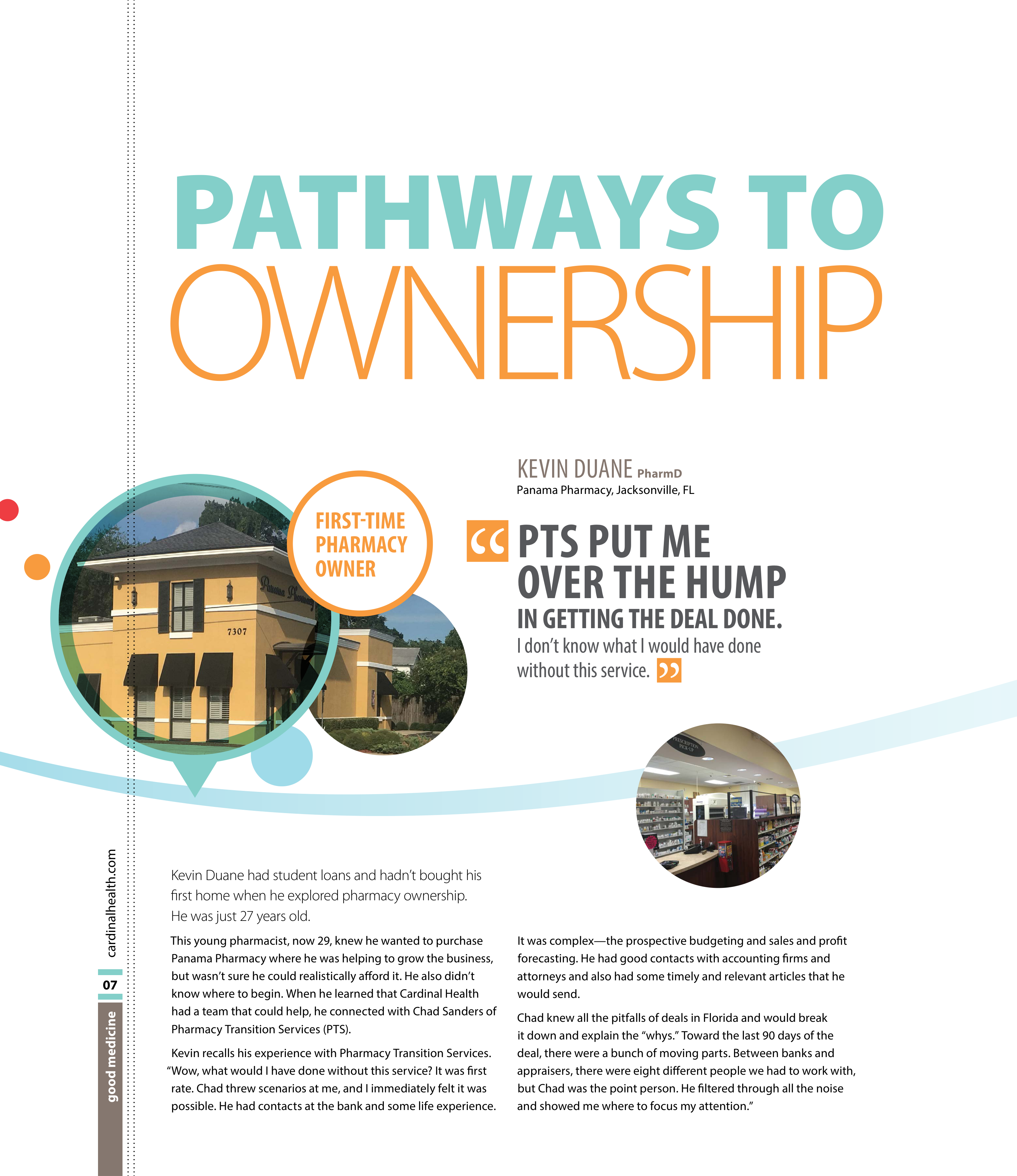
Kevin Duane had student loans and hadn’t bought his
first home when he explored pharmacy ownership.
He was just 27 years old.
This young pharmacist, now 29, knew he wanted to purchase
Panama Pharmacy where he was helping to grow the business,
but wasn’t sure he could realistically afford it. He also didn’t
know where to begin. When he learned that Cardinal Health
had a team that could help, he connected with Chad Sanders of
Pharmacy Transition Services (PTS).
Kevin recalls his experience with Pharmacy Transition Services.
“Wow, what would I have done without this service? It was first
rate. Chad threw scenarios at me, and I immediately felt it was
possible. He had contacts at the bank and some life experience.
PATHWAYS TO
OWNERSHIP
KEVIN DUANE
PharmD
Panama Pharmacy, Jacksonville, FL
PTS PUT ME
OVER THE HUMP
IN GETTING THE DEAL DONE.
I don’t know what I would have done
without this service.
It was complex—the prospective budgeting and sales and profit
forecasting. He had good contacts with accounting firms and
attorneys and also had some timely and relevant articles that he
would send.
Chad knew all the pitfalls of deals in Florida and would break
it down and explain the “whys.” Toward the last 90 days of the
deal, there were a bunch of moving parts. Between banks and
appraisers, there were eight different people we had to work with,
but Chad was the point person. He filtered through all the noise
and showed me where to focus my attention.”
good medicine
07
cardinalhealth.com
FIRST-TIME
PHARMACY
OWNER
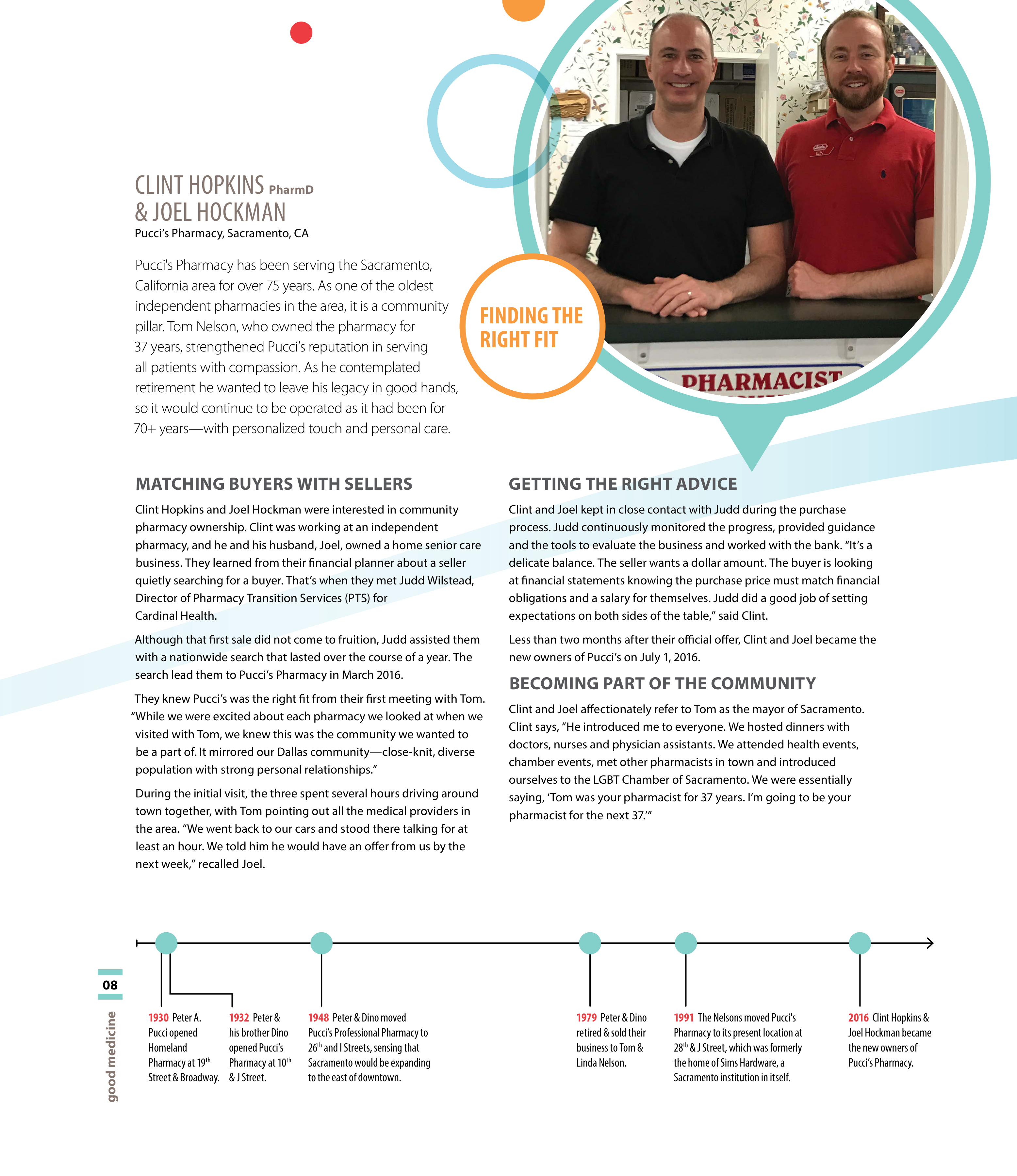
Pucci's Pharmacy has been serving the Sacramento,
California area for over 75 years. As one of the oldest
independent pharmacies in the area, it is a community
pillar. Tom Nelson, who owned the pharmacy for
37 years, strengthened Pucci’s reputation in serving
all patients with compassion. As he contemplated
retirement he wanted to leave his legacy in good hands,
so it would continue to be operated as it had been for
70+ years—with personalized touch and personal care.
MATCHING BUYERS WITH SELLERS
Clint Hopkins and Joel Hockman were interested in community
pharmacy ownership. Clint was working at an independent
pharmacy, and he and his husband, Joel, owned a home senior care
business. They learned from their financial planner about a seller
quietly searching for a buyer. That’s when they met Judd Wilstead,
Director of Pharmacy Transition Services (PTS) for
Cardinal Health.
Although that first sale did not come to fruition, Judd assisted them
with a nationwide search that lasted over the course of a year. The
search lead them to Pucci’s Pharmacy in March 2016.
They knew Pucci’s was the right fit from their first meeting with Tom.
“While we were excited about each pharmacy we looked at when we
visited with Tom, we knew this was the community we wanted to
be a part of. It mirrored our Dallas community—close-knit, diverse
population with strong personal relationships.”
During the initial visit, the three spent several hours driving around
town together, with Tom pointing out all the medical providers in
the area. “We went back to our cars and stood there talking for at
least an hour. We told him he would have an offer from us by the
next week,” recalled Joel.
GETTING THE RIGHT ADVICE
Clint and Joel kept in close contact with Judd during the purchase
process. Judd continuously monitored the progress, provided guidance
and the tools to evaluate the business and worked with the bank. “It’s a
delicate balance. The seller wants a dollar amount. The buyer is looking
at financial statements knowing the purchase price must match financial
obligations and a salary for themselves. Judd did a good job of setting
expectations on both sides of the table,” said Clint.
Less than two months after their official offer, Clint and Joel became the
new owners of Pucci’s on July 1, 2016.
BECOMING PART OF THE COMMUNITY
Clint and Joel affectionately refer to Tom as the mayor of Sacramento.
Clint says, “He introduced me to everyone. We hosted dinners with
doctors, nurses and physician assistants. We attended health events,
chamber events, met other pharmacists in town and introduced
ourselves to the LGBT Chamber of Sacramento. We were essentially
saying, ‘Tom was your pharmacist for 37 years. I’m going to be your
pharmacist for the next 37.’”
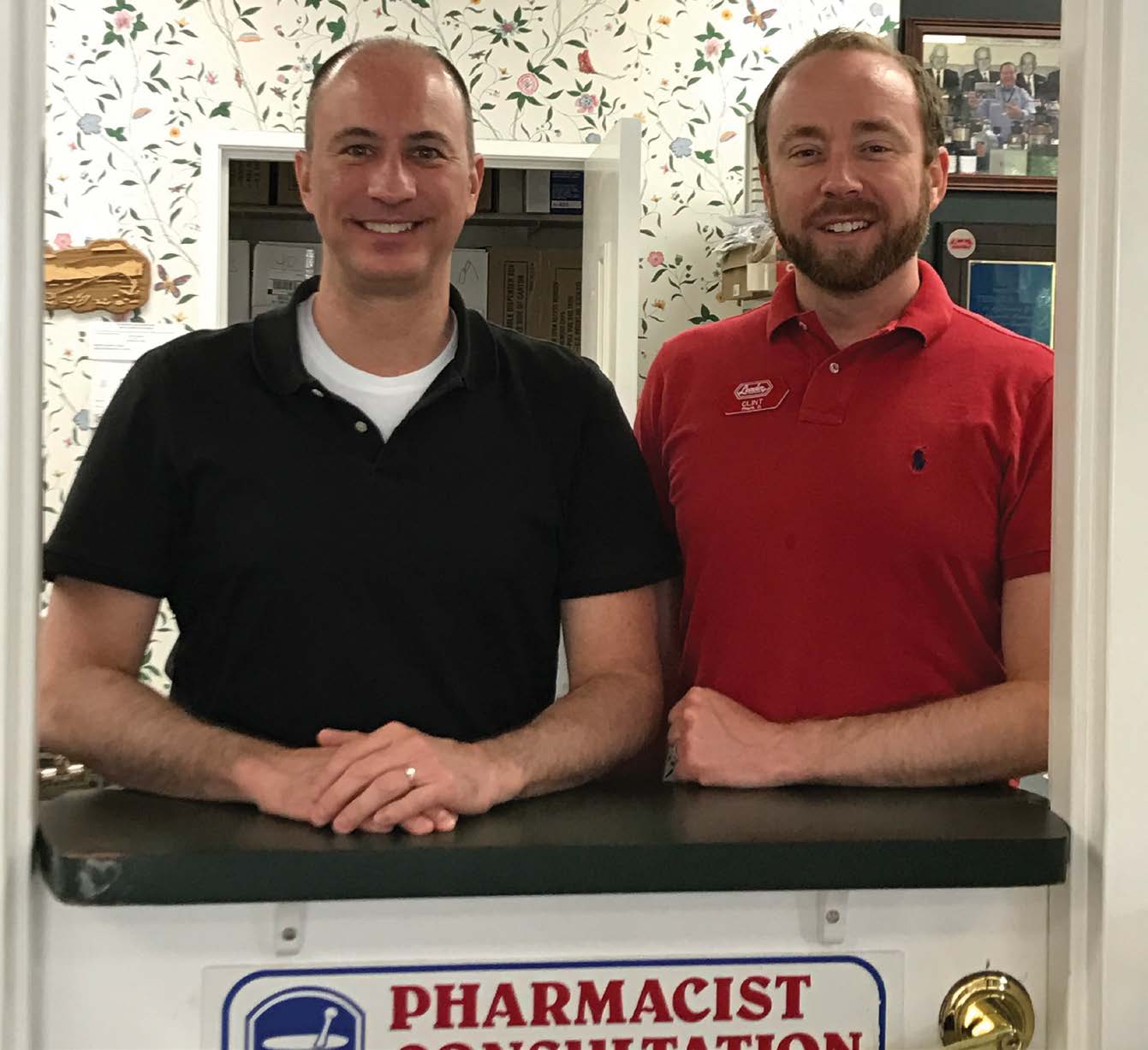
CLINT HOPKINS
PharmD
& JOEL HOCKMAN
Pucci’s Pharmacy, Sacramento, CA
1991
The Nelsons moved Pucci's
Pharmacy to its present location at
28
th
& J Street, which was formerly
the home of Sims Hardware, a
Sacramento institution in itself.
2016
Clint Hopkins &
Joel Hockman became
the new owners of
Pucci’s Pharmacy.
1930
Peter A.
Pucci opened
Homeland
Pharmacy at 19
th
Street & Broadway.
1932
Peter &
his brother Dino
opened Pucci’s
Pharmacy at 10
th
& J Street.
1948
Peter & Dino moved
Pucci’s Professional Pharmacy to
26
th
and I Streets, sensing that
Sacramento would be expanding
to the east of downtown.
1979
Peter & Dino
retired & sold their
business to Tom &
Linda Nelson.
good medicine
08
FINDING THE
RIGHT FIT
good medicine
09
cardinalhealth.com
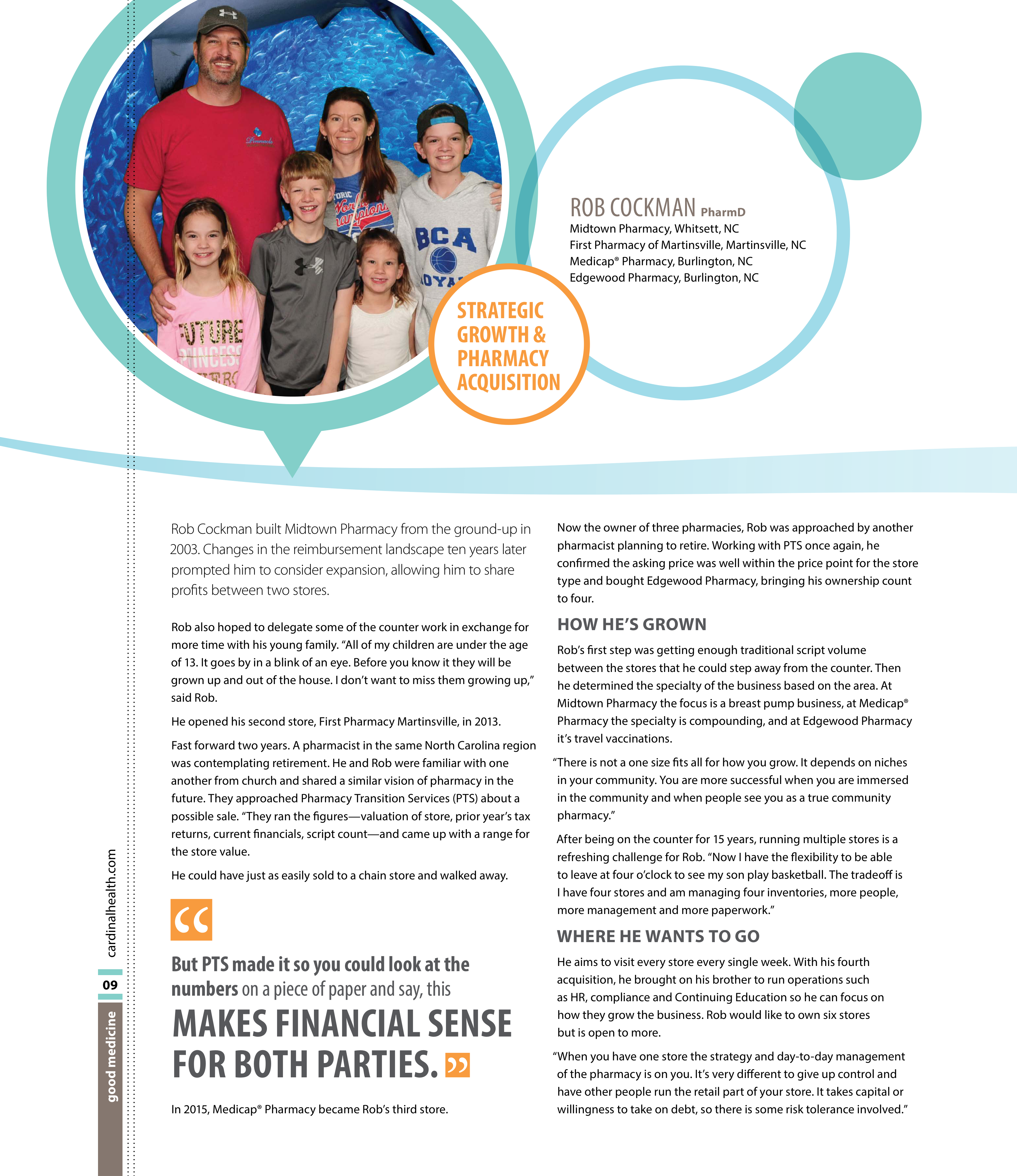
ROB COCKMAN
PharmD
Midtown Pharmacy, Whitsett, NC
First Pharmacy of Martinsville, Martinsville, NC
Medicap® Pharmacy, Burlington, NC
Edgewood Pharmacy, Burlington, NC
STRATEGIC
GROWTH &
PHARMACY
ACQUISITION
Rob Cockman built Midtown Pharmacy from the ground-up in
2003. Changes in the reimbursement landscape ten years later
prompted him to consider expansion, allowing him to share
profits between two stores.
Rob also hoped to delegate some of the counter work in exchange for
more time with his young family. “All of my children are under the age
of 13. It goes by in a blink of an eye. Before you know it they will be
grown up and out of the house. I don’t want to miss them growing up,”
said Rob.
He opened his second store, First Pharmacy Martinsville, in 2013.
Fast forward two years. A pharmacist in the same North Carolina region
was contemplating retirement. He and Rob were familiar with one
another from church and shared a similar vision of pharmacy in the
future. They approached Pharmacy Transition Services (PTS) about a
possible sale. “They ran the figures—valuation of store, prior year’s tax
returns, current financials, script count—and came up with a range for
the store value.
He could have just as easily sold to a chain store and walked away.
But PTS made it so you could look at the
numbers
on a piece of paper and say, this
MAKES FINANCIAL SENSE
FOR BOTH PARTIES.
In 2015, Medicap® Pharmacy became Rob’s third store.
Now the owner of three pharmacies, Rob was approached by another
pharmacist planning to retire. Working with PTS once again, he
confirmed the asking price was well within the price point for the store
type and bought Edgewood Pharmacy, bringing his ownership count
to four.
HOW HE’S GROWN
Rob’s first step was getting enough traditional script volume
between the stores that he could step away from the counter. Then
he determined the specialty of the business based on the area. At
Midtown Pharmacy the focus is a breast pump business, at Medicap®
Pharmacy the specialty is compounding, and at Edgewood Pharmacy
it’s travel vaccinations.
“There is not a one size fits all for how you grow. It depends on niches
in your community. You are more successful when you are immersed
in the community and when people see you as a true community
pharmacy.”
After being on the counter for 15 years, running multiple stores is a
refreshing challenge for Rob. “Now I have the flexibility to be able
to leave at four o’clock to see my son play basketball. The tradeoff is
I have four stores and am managing four inventories, more people,
more management and more paperwork.”
WHERE HE WANTS TO GO
He aims to visit every store every single week. With his fourth
acquisition, he brought on his brother to run operations such
as HR, compliance and Continuing Education so he can focus on
how they grow the business. Rob would like to own six stores
but is open to more.
“When you have one store the strategy and day-to-day management
of the pharmacy is on you. It’s very different to give up control and
have other people run the retail part of your store. It takes capital or
willingness to take on debt, so there is some risk tolerance involved.”
good medicine
10
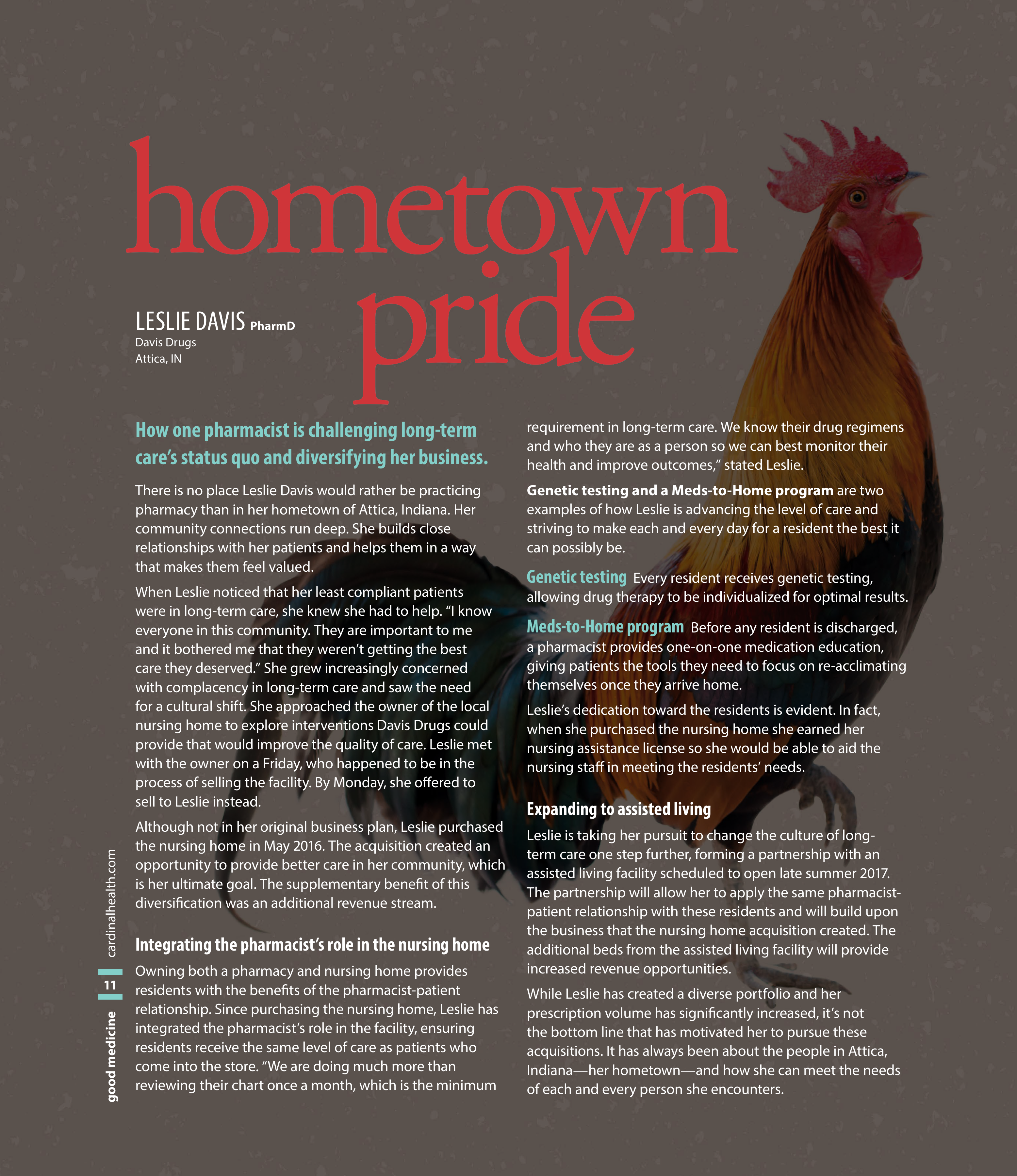
ANGIE GLOTZBACH
PharmD, RPh
Glotzbach Pharmacy, Fowler, IN
AS AN INDEPENDENT,
I FEEL LIKE I’M MORE OF A
PARTNER ON THE
HEALTHCARE TEAM
AND NOT
JUST THE PERSON WHO IS FILLING THE SCRIPT.
A medication error. It’s the reason Angie Glotzbach became a pharmacist.
“A nurse wrote the wrong prescription for my grandpa. The doctor signed
it without even looking at it and sent it to a mail order pharmacy who
didn’t know my grandpa from Joe. He took an antihistamine instead of
medication to lower his blood pressure.
By the time of his next doctor’s appointment six months later, enough kidney
damage had been done that they started him on dialysis.”
Angie believes that if her grandpa’s prescription would have been filled at a
pharmacy like hers, the error would have been caught.
GLOTZBACH PHARMACY
When Angie was in pharmacy school, she and her grandpa would drive around
town. He would point out the local pharmacy and say, “This is going to be Angie’s
Pharmacy.” “I told him that he was crazy because I was going to work for a chain
where I’d have less stress.” But as it turns out working for a big box retail was not
for her.
She approached the owner of her local pharmacy, Shari Stembel, who was running
it for her late-husband. It was important to Shari to keep the pharmacy local. The
two hit it off and within a couple of months they had connected with Brett Fortier
in Pharmacy Transition Services.
Angie recalled, “Brett’s goal was that there wasn’t anything to stop it from going
through—to keep as many independents out here without having to sell to the
big box. They gave me the opportunity to talk through financial avenues I hadn’t
thought of and made both the seller and me aware of each next step.” Less than
six months later, in June 2016, the sale was finalized. Angie was now the owner of
the local pharmacy, just like her grandfather had predicted.
The changes to independent pharmacy ownership have been eye-opening for her.
She is no longer racing the clock to check a prescription that is due for someone
who is not even there. If she wants to spend a half an hour with a patient who just
got a new diagnosis, she can. “As an independent, I feel like I’m more of a partner
on the healthcare team and not just the person who is filling the script.”
A GRAND-
DAUGHTER’S
JOURNEY TO
PHARMACY
OWNERSHIP


LESLIE DAVIS
PharmD
Davis Drugs
Attica, IN
hometown
pride
hometown
pride
good medicine
11
cardinalhealth.com
How one pharmacist is challenging long-term
care’s status quo and diversifying her business.
There is no place Leslie Davis would rather be practicing
pharmacy than in her hometown of Attica, Indiana. Her
community connections run deep. She builds close
relationships with her patients and helps them in a way
that makes them feel valued.
When Leslie noticed that her least compliant patients
were in long-term care, she knew she had to help. “I know
everyone in this community. They are important to me
and it bothered me that they weren’t getting the best
care they deserved.” She grew increasingly concerned
with complacency in long-term care and saw the need
for a cultural shift. She approached the owner of the local
nursing home to explore interventions Davis Drugs could
provide that would improve the quality of care. Leslie met
with the owner on a Friday, who happened to be in the
process of selling the facility. By Monday, she offered to
sell to Leslie instead.
Although not in her original business plan, Leslie purchased
the nursing home in May 2016. The acquisition created an
opportunity to provide better care in her community, which
is her ultimate goal. The supplementary benefit of this
diversification was an additional revenue stream.
Integrating the pharmacist’s role in the nursing home
Owning both a pharmacy and nursing home provides
residents with the benefits of the pharmacist-patient
relationship. Since purchasing the nursing home, Leslie has
integrated the pharmacist’s role in the facility, ensuring
residents receive the same level of care as patients who
come into the store. “We are doing much more than
reviewing their chart once a month, which is the minimum
requirement in long-term care. We know their drug regimens
and who they are as a person so we can best monitor their
health and improve outcomes,” stated Leslie.
Genetic testing and a Meds-to-Home program
are two
examples of how Leslie is advancing the level of care and
striving to make each and every day for a resident the best it
can possibly be.
Genetic testing
Every resident receives genetic testing,
allowing drug therapy to be individualized for optimal results.
Meds-to-Home program
Before any resident is discharged,
a pharmacist provides one-on-one medication education,
giving patients the tools they need to focus on re-acclimating
themselves once they arrive home.
Leslie’s dedication toward the residents is evident. In fact,
when she purchased the nursing home she earned her
nursing assistance license so she would be able to aid the
nursing staff in meeting the residents’ needs.
Expanding to assisted living
Leslie is taking her pursuit to change the culture of long-
term care one step further, forming a partnership with an
assisted living facility scheduled to open late summer 2017.
The partnership will allow her to apply the same pharmacist-
patient relationship with these residents and will build upon
the business that the nursing home acquisition created. The
additional beds from the assisted living facility will provide
increased revenue opportunities.
While Leslie has created a diverse portfolio and her
prescription volume has significantly increased, it’s not
the bottom line that has motivated her to pursue these
acquisitions. It has always been about the people in Attica,
Indiana—her hometown—and how she can meet the needs
of each and every person she encounters.

good medicine
12
1
2
3
4
5
PROBLEM SOLVER
Most technicians develop some savvy when it comes
to solving problems in the pharmacy. Maybe it’s as
easy as calling an insurance company for a patient
when the claim won’t go through, or discovering how
to finagle your printer to get the labels to print.
A super pharmacy technician, or SuperTech, as I like to
say, will use every roadblock that presents itself as a
chance to figure out how to move it. Technicians who
address problems with fervor and critical thinking are
better at dealing with difficult situations on the fly,
whether that be a busy short-staffed pharmacy, or a
very angry patient. Pharmacists
will appreciate this tenacity as
well, as they can focus more
of their time using their
clinical expertise to
counsel patients.
WHAT MAKES A GREAT
PHARMACY TECHNICIAN?
PROACTIVE
It’s inevitable that problems will happen, and
sometimes we can’t solve them as quickly as we’d like.
The SuperTech understands that being honest and
upfront with patients, providers and colleagues about
an issue is the best way to provide clear expectations
and a positive outcome. This makes the difference on
the front end rather than reactively cleaning it up on
the back end.
QUALITY
OF WORK
If I were to list technician resume buzz
phrases I hear all the time, “attention
to detail” would be at the top of the
list. We know details are important.
But more important is your intention
when dealing with those details.
Technicians who take pride in their
job and exhibit a strong sense of
ownership over their work are precise,
diligent, and responsive. Not because
you asked, but because they don’t
ever want you to have to.
EAGERNESS TO LEARN
Everyone has worked with someone who insists it’s “not my job” to
do this or that. No one likes taking out the trash, but it needs to be
done. Some tasks require delegation to a pharmacy technician when a
pharmacist’s time is needed elsewhere. The best SuperTechs are eager
to receive this delegation. They understand that each opportunity to
acquire a new skill can increase their expertise and bolster their position
as an important asset in their field.
EMPATHETIC
Trust can be more important to a patient
than the cost of their prescription.
Pharmacy technicians who make the
effort to understand where their patients
are coming from know how much of a
difference this makes when one of those
aforementioned problems pops up.
Patients who trust you and know you care
about them and their family will return
that empathy in-kind on that day your
entire computer system goes down.
We looked to
NICOLE BERNABE
for answers. Nicole is a
Certified Pharmacy Technician and a Customer Success
Specialist at TelePharm and was a 2016 PTCB Pharmacy
Technician of the Year finalist.
Here are the top five
traits she looks for in a super pharmacy technician.
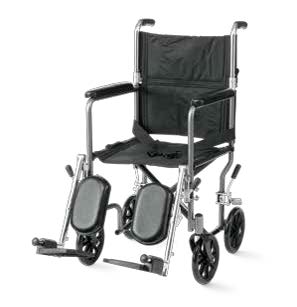
As any pharmacist knows, pharmacy technicians have
important roles and responsibilities in the pharmacy.
This poses the question:
good medicine
13
cardinalhealth.com
JD FAULKNER
General Manager,
Williams Bros. Health Care Pharmacy
Indiana and Illinois
Williams Bros. Health Care Pharmacy is creating customers for life by solving patient
problems and exceeding their expectations. They are continuously seeking the next
“new thing” in pharmacy in order to be ahead of the game, and they diversify every
two to five years. Read about three of their recent ventures, including a Meds-to-Beds
program, Safe Home Solutions and Pharmacogenomics.
MEDS-TO-BEDS PROGRAM
Patients have meds before leaving the hospital
Prior authorizations handled
Medications affordable for patient
Comprehensive medication reviews
Capture refills
A key driving force for Williams Bros. and the hospital is preventing a 30-day readmission rate. They’ve
seen initial success. With more than 2,500 patients through the program, the pharmacy has seen only a
six percent readmission rate. The hospital rate dropped from 12 percent to 11 percent in that same year.
“Two of our pharmacies have implemented the program and two other hospitals have expressed interest.
We are retaining 50 percent of these patients, which is in-line with the retention rate for meds-to-beds
programs. There is a 75 percent influx of new patients coming from the program because others in the
family often follow.”
SAFE HOME SOLUTIONS
Making homes safer is a new market entry for Williams Bros. By completing a home assessment they identify
areas that increase the risk of falls or accidents. The contractors focus much of their work in geographical
areas where there are allotments to make homes accessible for residents, such as VA, Medicaid/Medicare and
the low-income housing authority areas.
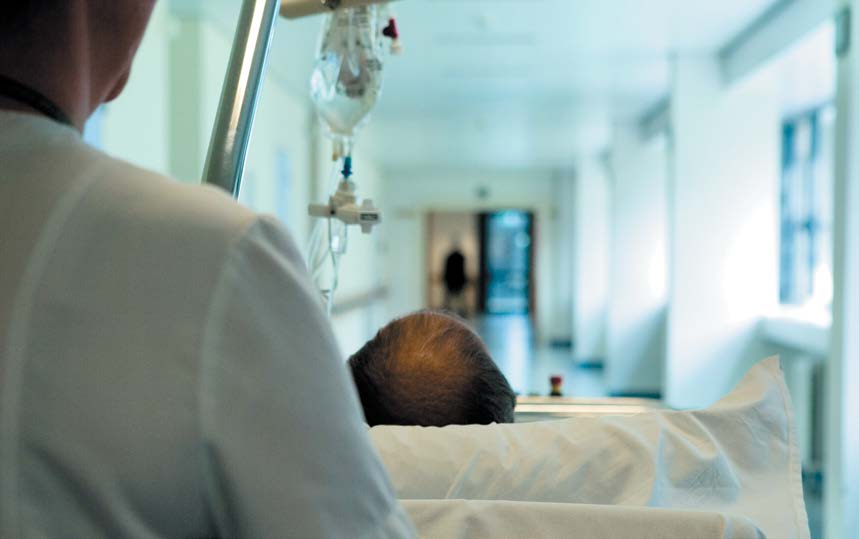
The bathroom is a high-risk area for the elderly and the main area that needs safety improvements.
patient problems
SOLVING
The current owners of Williams Bros.
are fourth generation pharmacists.
Their great-grandfather started the
original pharmacy in 1899.
When they revived the pharmacy
in 1988, they had five employees
in one location.
NOW IN 2017
475+
EMPLOYEES
PLUS FULL CONTINUUM OF PATIENT SERVICES
13
LOCATIONS
“We can install barrier-free showers with a rubber lip on
the shower front that allows wheelchair or transport chair
access. Tub steps make it easier to step into and out of the
tub. We can redo toilet seats, add grab bars. In the kitchen,
we lower shelves to make it easier to grab things. We also
focus on exterior ramps and lifts for a bedroom.” A lot of the
business is cash driven which reduces the burden of billing
to insurance companies.
PHARMACOGENOMICS
Williams Bros. offers pharmacogenomics testing at seven
retail pharmacies and two long-term care (LTC) pharmacies
where there is a focus on using the testing for psychiatric
care. A provider has to order the test for insurance billing
purposes, so Williams Bros. is utilizing a retail pharmacy
marketer and nurse liaisons in the LTC sector to promote the
offering to both medical directors and providers.
They receive a commission from the lab tests and, more
importantly, see this point-of-care offering as a way they are
advancing patient care. The test removes the trial and error
of prescribing.
“The results provide about 30 pages of information—that’s
a lot of pages for one patient. That’s where we can come
in as pharmacists. We can take those 30 pages, turn it into
a one-page consult to the patient’s provider and show our
understanding of how medications interact with certain
enzymes. The provider can act on that information right
away and can make any necessary medication changes.”
good medicine
14
Raied (Ray) and Saad Dinno grew up in a pharmacy.
Their father acquired Keyes Drug of Newton, Mass.,
in 1985 and still opens the store at 7 a.m. every
weekday. “People come to get their prescriptions
filled on their way to work or they stop in to say
hello after getting their coffee next door,” says Ray.
“If my dad has an appointment and is away that day,
people will ask if he’s okay. He is very loyal, and so
are the customers.”
These brothers continued in their father’s
footsteps. They purchased Acton Pharmacy and
West Concord Pharmacy, bringing their total
ownership count to three.
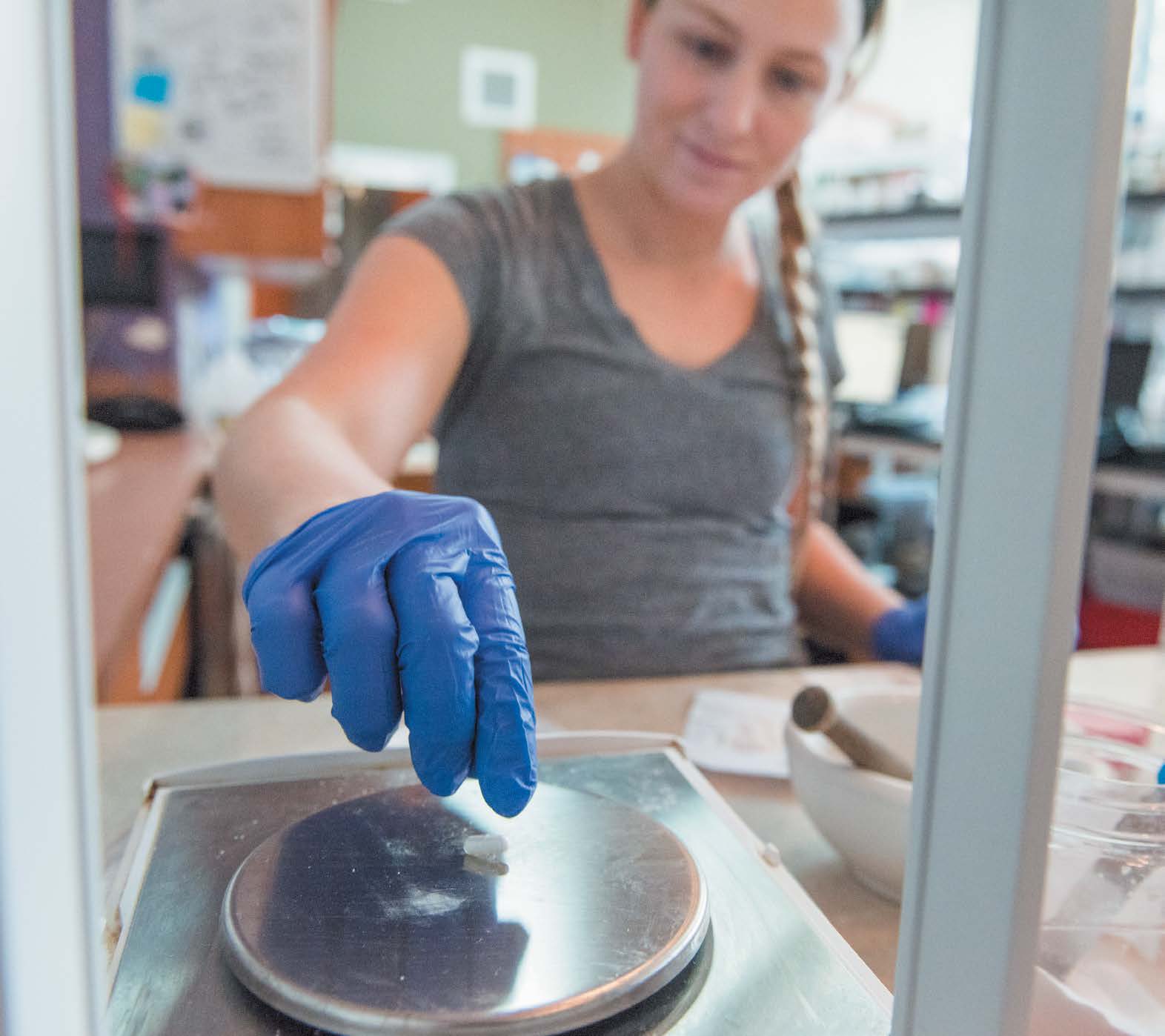
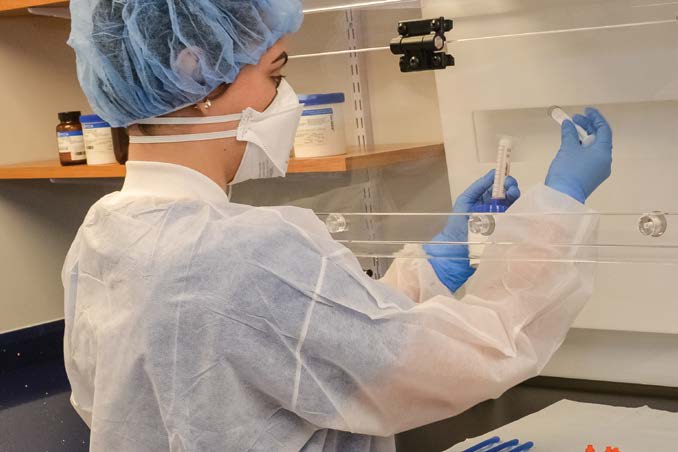
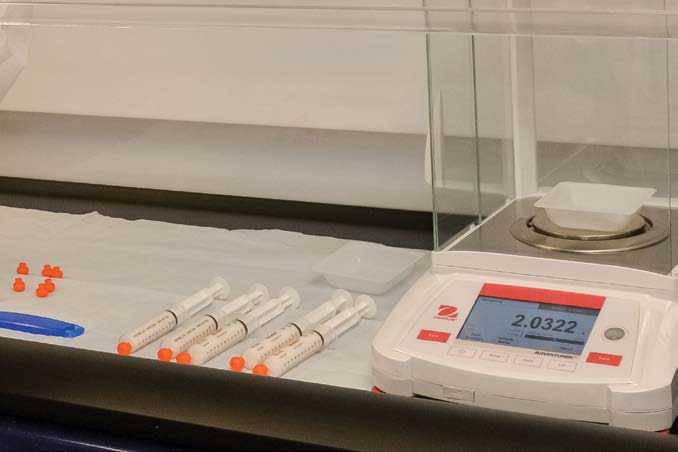
The Dinnos operate a strong compounding
business. In 2014, they expanded Acton Pharmacy’s
compounding lab from 400 to 1,200 square feet.
In 2016, they built a state-of-the-art compounding
lab at Keyes Drug.
The labs compound non-
sterile, patient-specific medications and are USP
-compliant while also meeting the more
stringent USP requirements regarding
the handling of hazardous substances.
Acton Pharmacy is accredited by the ACHC/
Pharmacy Compounding Accreditation Board.
Keyes Drug, with its new lab, is now in the process
of gaining its accreditation.
Existing floor space was needed to build the Keyes
Drug lab, but these second-generation pharmacists
made sure they did not lose retail space. “The front
of the store is very important for both sales and
image. We installed a new shelving system with
narrow shelves and added new carpet, paint and
RAIED DINNO
RPh
& SAAD DINNO
RPh, FIACP, FACA
Dinno Health
Acton Pharmacy, Acton, MA
Keyes Drug, Newton, MA
West Concord Pharmacy, Concord, MA
Compounding is the science of
customizing a medication to a
patient’s particular need. For
patients who may be allergic to
an ingredient in a commercially
prepared medication or for
someone needing a drug in
a specialized dose and form,
compounding is the solution.
Dinno Health specializes in
compounded medications for
health issues that include:
•
Pediatric illnesses
•
Autism
•
GERD/Colic
•
Hormone replacement therapy
•
Diet restrictions
•
Mitochondrial disease
•
Dermatology
lighting,” says Ray. The exterior of the pharmacy
is undergoing change as well, with new digital
signage designed to let passersby learn about
health and wellness and see up-to-date
information on the pharmacy’s offerings.
The renovations are just one way the Dinnos
keep their business fresh. They recently
expanded more fully into nutrition and wellness,
hiring a Director of Health and Wellness
who has extensive knowledge of nutritional
supplementation. She provides private
consultations and hosts a monthly lecture series
at Acton Pharmacy where local practitioners are
invited to speak on a specific health topic.
A loyal staff at all three locations has helped
propel the business forward. “We use an
employee newsletter and hold regular events
to recognize employees that have reached a
milestone,” says Ray. “The number of employees
with over 20 years of service grows every year.
Our employees are as important to our success
as we are.”
Beyond the services they offer, Ray and Saad
make sure they always have a presence
at the three stores so that the customers
know they are accessible. “It’s more than
filling prescriptions and convenience,” says
Saad. “People want a familiar face that they
can trust, with whom they can discuss very
personal matters. We want our patients to feel
a connection when they enter our pharmacies
whether with us or with our team members.”
the right
WHY
COMPOUNDING?
m
i
x
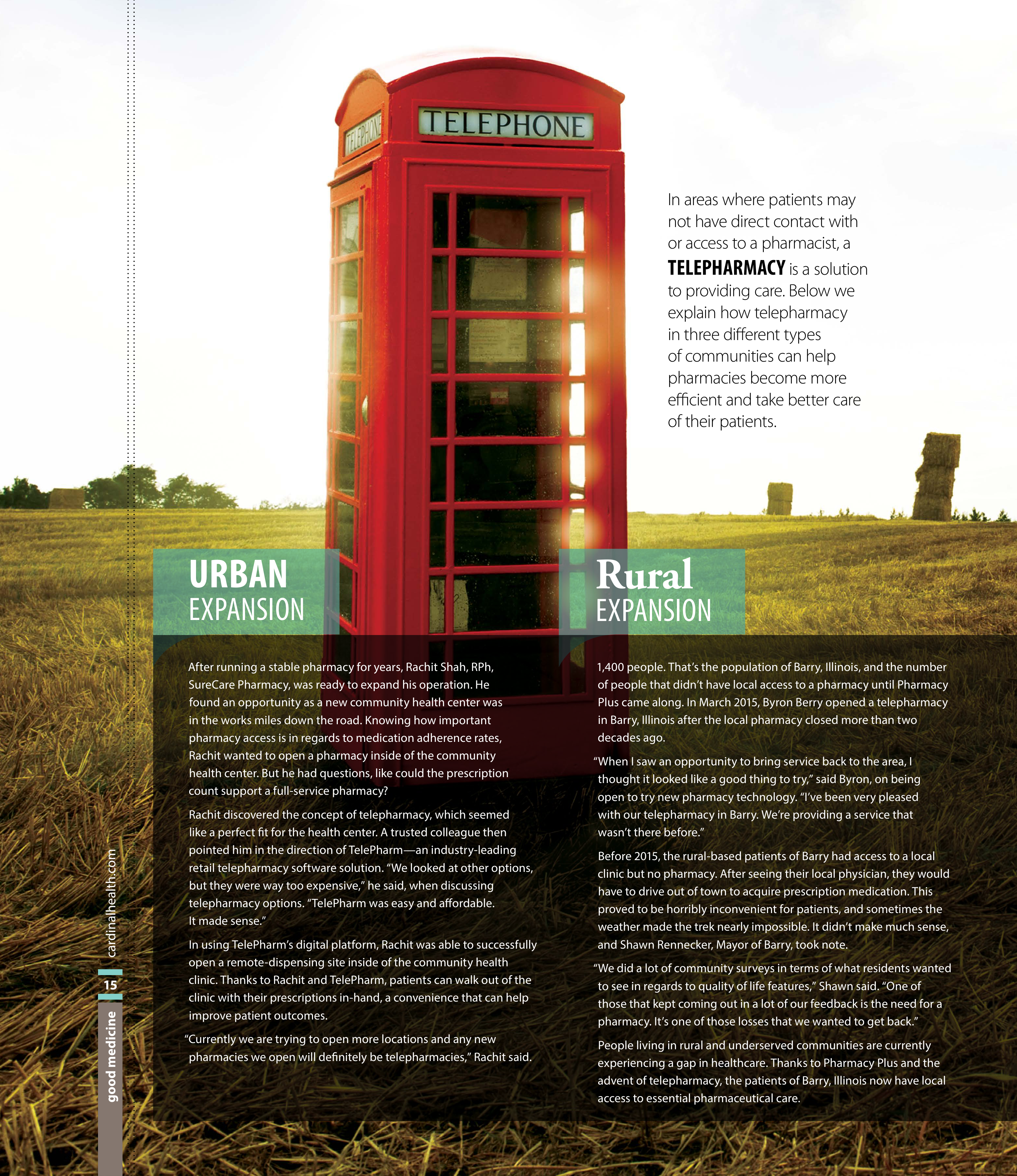

In areas where patients may
not have direct contact with
or access to a pharmacist, a
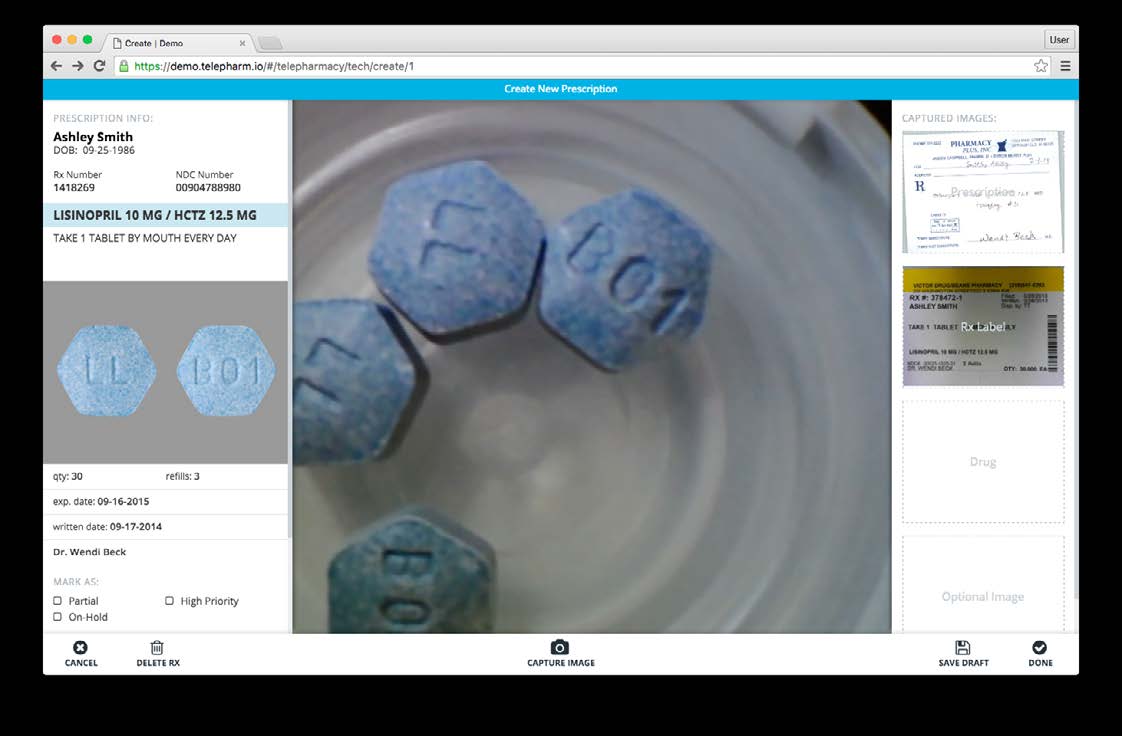
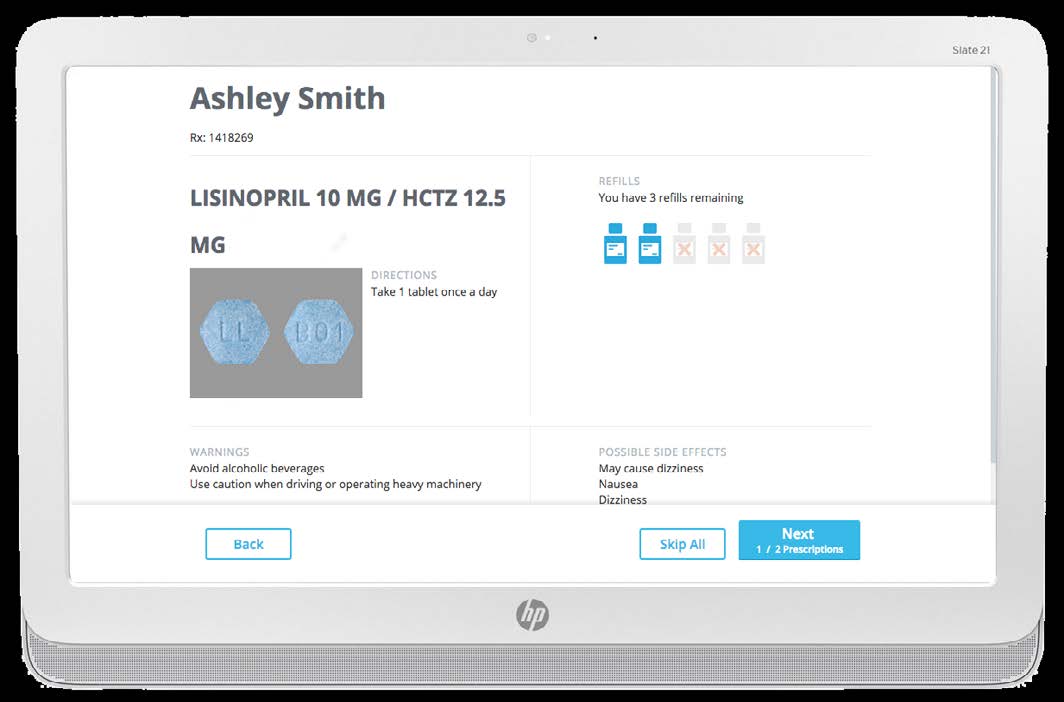
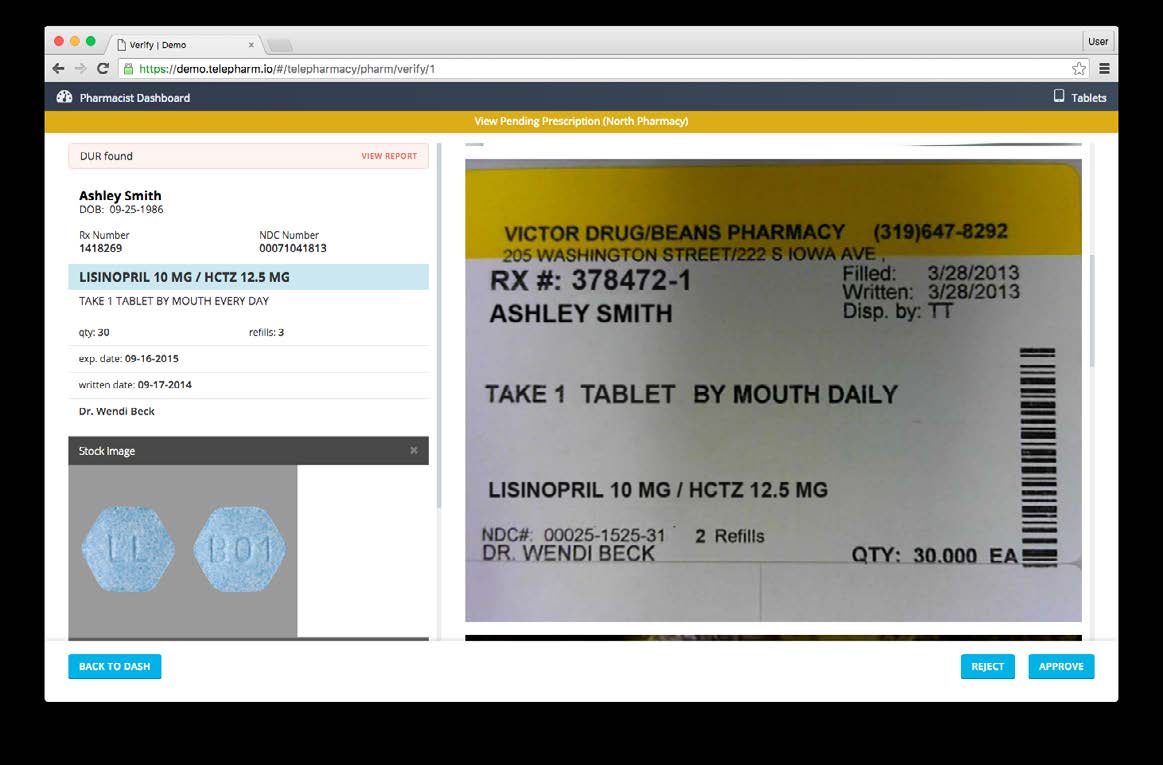
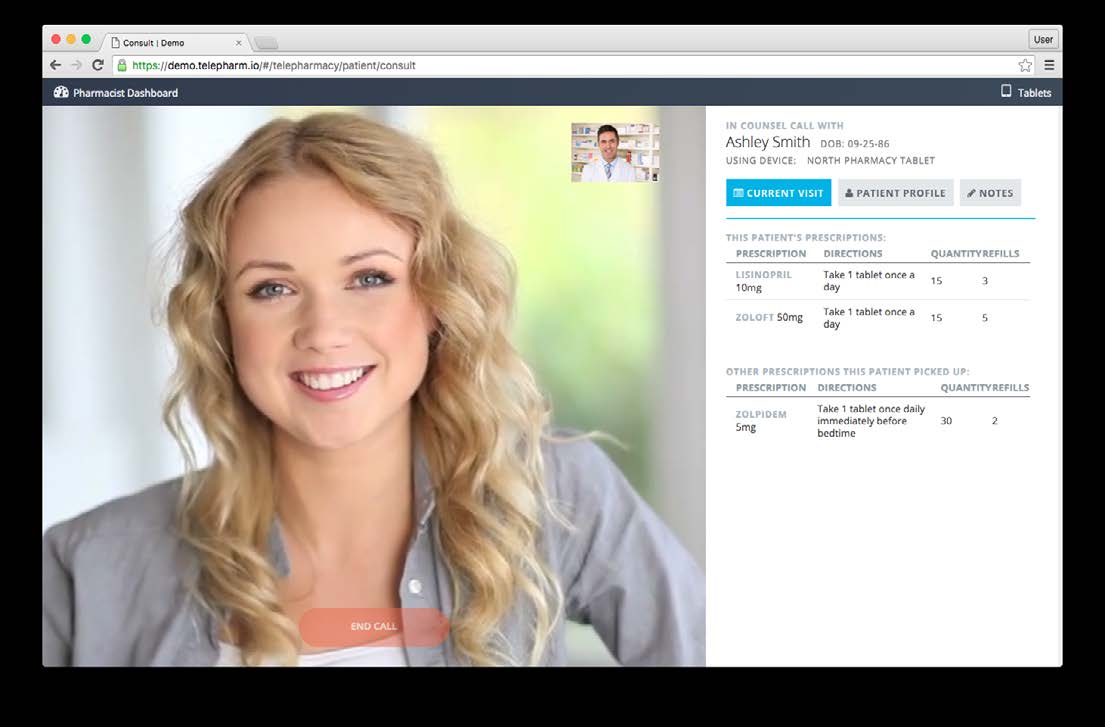
TELEPHARMACY
is a solution
to providing care. Below we
explain how telepharmacy
in three different types
of communities can help
pharmacies become more
efficient and take better care
of their patients.
good medicine
15
cardinalhealth.com
Rural
EXPANSION
URBAN
EXPANSION
After running a stable pharmacy for years, Rachit Shah, RPh,
SureCare Pharmacy, was ready to expand his operation. He
found an opportunity as a new community health center was
in the works miles down the road. Knowing how important
pharmacy access is in regards to medication adherence rates,
Rachit wanted to open a pharmacy inside of the community
health center. But he had questions, like could the prescription
count support a full-service pharmacy?
Rachit discovered the concept of telepharmacy, which seemed
like a perfect fit for the health center. A trusted colleague then
pointed him in the direction of TelePharm—an industry-leading
retail telepharmacy software solution. “We looked at other options,
but they were way too expensive,” he said, when discussing
telepharmacy options. “TelePharm was easy and affordable.
It made sense.”
In using TelePharm’s digital platform, Rachit was able to successfully
open a remote-dispensing site inside of the community health
clinic. Thanks to Rachit and TelePharm, patients can walk out of the
clinic with their prescriptions in-hand, a convenience that can help
improve patient outcomes.
“Currently we are trying to open more locations and any new
pharmacies we open will definitely be telepharmacies,” Rachit said.
1,400 people. That’s the population of Barry, Illinois, and the number
of people that didn’t have local access to a pharmacy until Pharmacy
Plus came along. In March 2015, Byron Berry opened a telepharmacy
in Barry, Illinois after the local pharmacy closed more than two
decades ago.
“When I saw an opportunity to bring service back to the area, I
thought it looked like a good thing to try,” said Byron, on being
open to try new pharmacy technology. “I’ve been very pleased
with our telepharmacy in Barry. We’re providing a service that
wasn’t there before.”
Before 2015, the rural-based patients of Barry had access to a local
clinic but no pharmacy. After seeing their local physician, they would
have to drive out of town to acquire prescription medication. This
proved to be horribly inconvenient for patients, and sometimes the
weather made the trek nearly impossible. It didn’t make much sense,
and Shawn Rennecker, Mayor of Barry, took note.
“We did a lot of community surveys in terms of what residents wanted
to see in regards to quality of life features,” Shawn said. “One of
those that kept coming out in a lot of our feedback is the need for a
pharmacy. It’s one of those losses that we wanted to get back.”
People living in rural and underserved communities are currently
experiencing a gap in healthcare. Thanks to Pharmacy Plus and the
advent of telepharmacy, the patients of Barry, Illinois now have local
access to essential pharmaceutical care.


TELEPHARMACY
good medicine
16
tap into
new territory
Opened in July 2016, Colee’s Community Pharmacy is a retail
telepharmacy located in Crossing Healthcare’s new 340B clinic in
Decatur, Illinois.
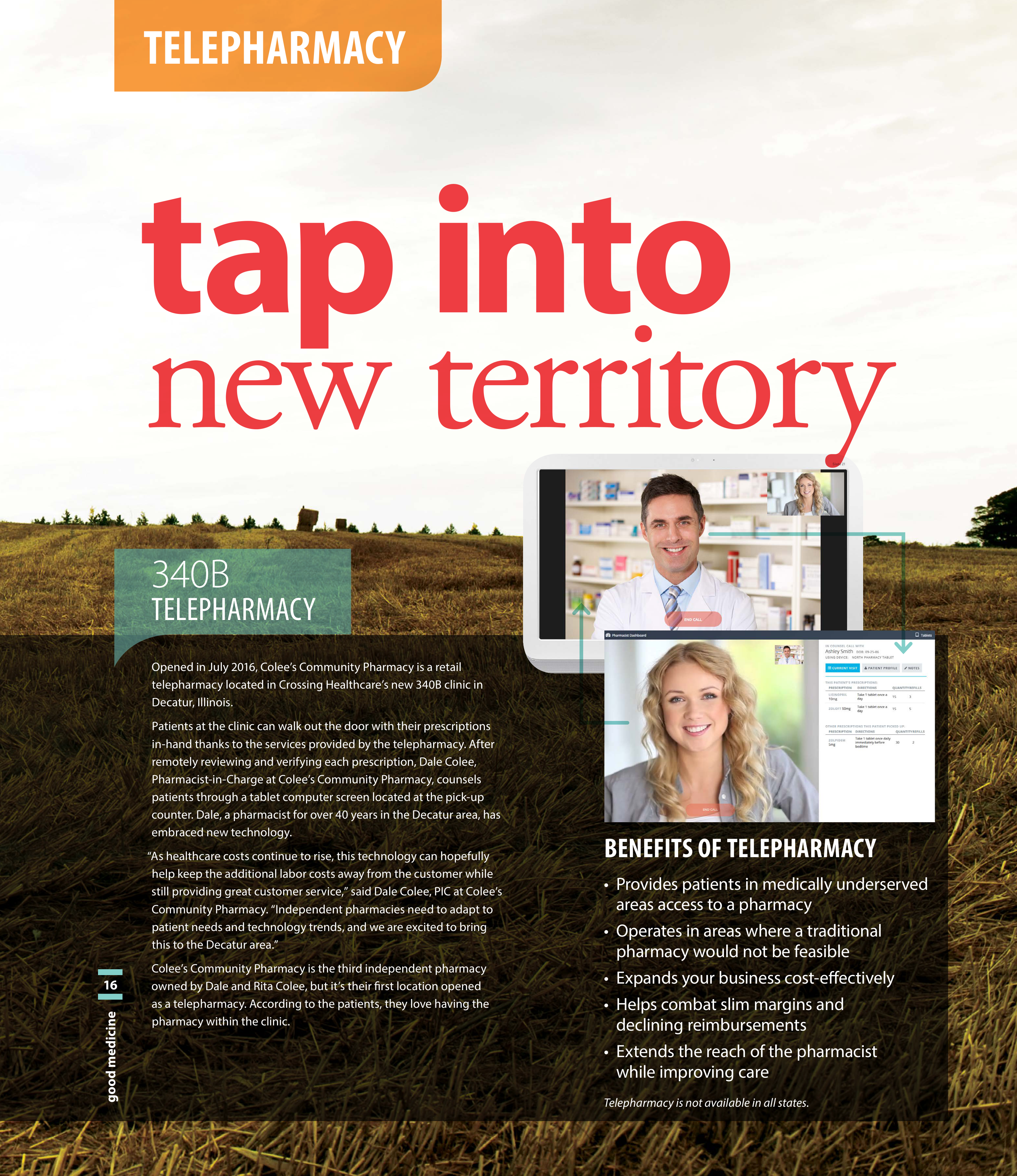
Patients at the clinic can walk out the door with their prescriptions
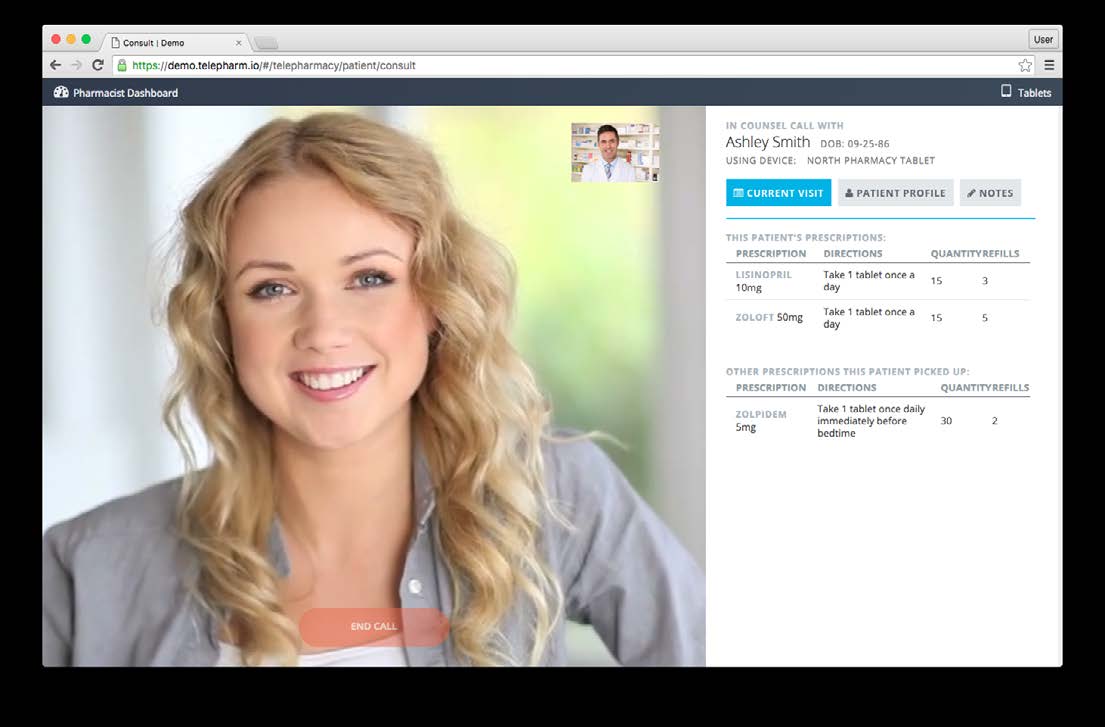
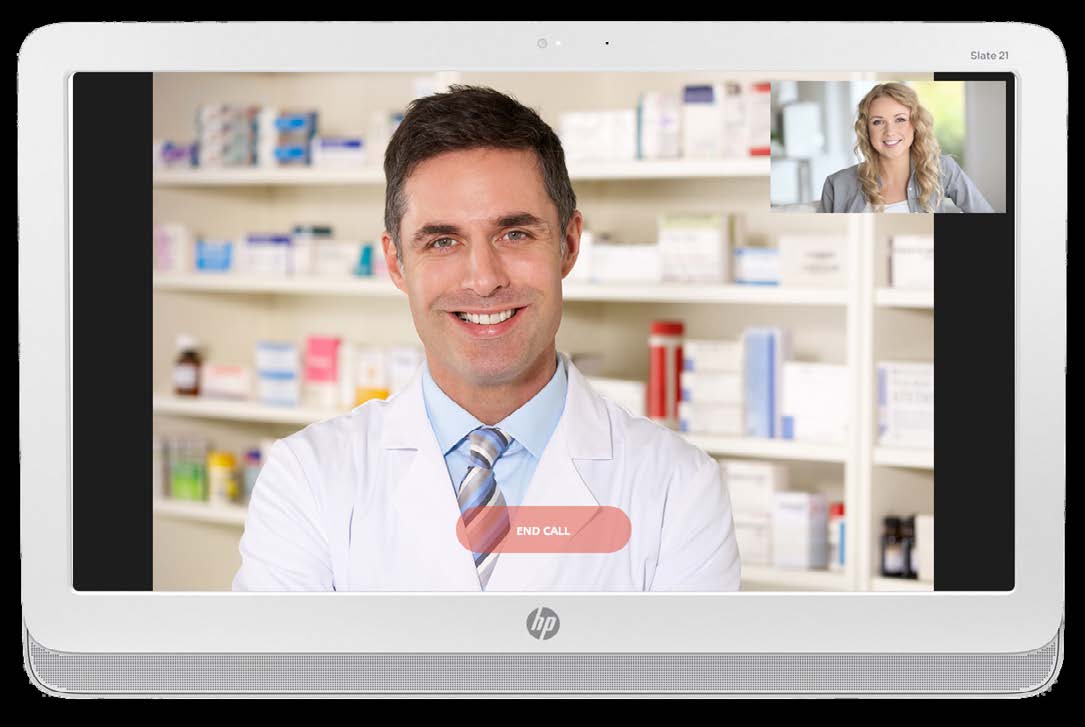
in-hand thanks to the services provided by the telepharmacy. After
remotely reviewing and verifying each prescription, Dale Colee,
Pharmacist-in-Charge at Colee’s Community Pharmacy, counsels
patients through a tablet computer screen located at the pick-up
counter. Dale, a pharmacist for over 40 years in the Decatur area, has
embraced new technology.
“As healthcare costs continue to rise, this technology can hopefully
help keep the additional labor costs away from the customer while
still providing great customer service,” said Dale Colee, PIC at Colee’s
Community Pharmacy. “Independent pharmacies need to adapt to
patient needs and technology trends, and we are excited to bring
this to the Decatur area.”
Colee’s Community Pharmacy is the third independent pharmacy
owned by Dale and Rita Colee, but it’s their first location opened
as a telepharmacy. According to the patients, they love having the
pharmacy within the clinic.
340B
TELEPHARMACY
BENEFITS OF TELEPHARMACY
• Provides patients in medically underserved
areas access to a pharmacy
• Operates in areas where a traditional
pharmacy would not be feasible
• Expands your business cost-effectively
• Helps combat slim margins and
declining reimbursements
• Extends the reach of the pharmacist
while improving care
Telepharmacy is not available in all states.
good medicine
17
cardinalhealth.com
How were you inspired to become a pharmacist and own a retail independent pharmacy?
When I was in high school, I had to write a career research paper and just happened to explore pharmacy as the topic. After I decided to
pursue that career path in college, I always kept the dream of owning a pharmacy in the back of my mind. After I graduated, I went to work
for a pharmacy chain until one day about a year after graduation, I received a flyer from Medicine Shoppe® International, encouraging me to
open my own store. My husband, who works as a farmer, thought I was crazy when I asked him what he thought of the idea of me becoming
a pharmacy owner. “Take a chance on me this year,” I told him, “and if it doesn’t work out, I can always go back and work for a pharmacy
chain.” That was in 1994. Today, my husband has been one of the biggest supporters of me opening my second pharmacy location—Poehler’s
Pharmacy, a member of the Medicine Shoppe® Family.
Speaking of your second store, we hear you’re going to offer
Telepharmacy
technology in your new location.
Tell us a little bit about Telepharmacy and what inspired you to take the plunge to try it.
Telepharmacy is a technology that allows prescription medications to be dispensed by a pharmacy technician as advised by a “remote”
pharmacist. It’s been popular in more rural areas of the country, and because of Illinois state laws, it’s becoming more common here as
well. As an existing community pharmacy owner, I was able to make valuable connections with members of my community and those in
surrounding areas. A neighboring village that I make prescription deliveries to approached me one day to ask if I’d be interested in opening
a Telepharmacy in their small community of about 600 people. I told them I’d be very interested and I found the perfect location when one
of the village’s local doctors reached out to me and asked if I’d be interested in opening a small location in her newly remodeled office. We
opened our doors in November, and it’s the first Medicine Shoppe® store to use Telepharmacy technology.
Do you have any goals or aspirations in mind for your new Telepharmacy? What would you consider a
successful first year in business?
TelePharm says that a successful and sustainable Telepharmacy should fill at least 40 scripts a day with one technician. I’d love to get to
the point where one technician isn’t enough to meet our demand. I’ve already had community members telling us that we’re going to be
busy—so I’d love to be filling 60 or 80 scripts a day by the end of our first year. I’d also like to offer Dispill® services in the second location.
In the doctor’s office, we will serve a lot of mothers and their children. It will be a great opportunity to connect with and build a loyal,
long-term customer base.
As of March 2017, we’ve been filling about 15–20 scripts a day, and have seen good over-the-counter sales, despite our small front-end.
I know of another telepharmacy in Illinois that took nine months to get to 40 scripts a day. I’m confident that we’ll get there as well.
LADONNA POEHLER
RPh
Medicine Shoppe® No. 1339
Newton, IL
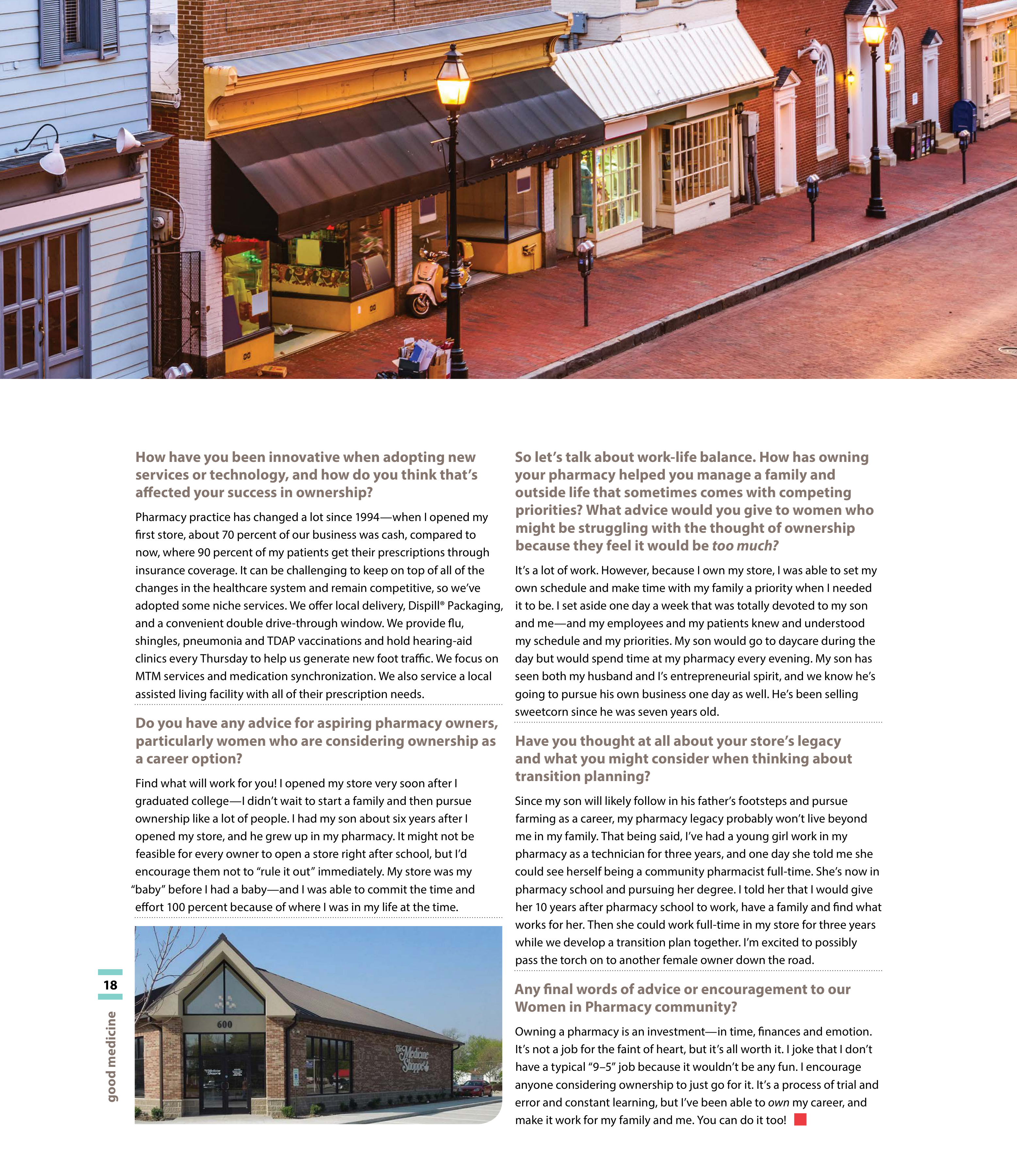
We caught up with LaDonna Poehler from Medicine Shoppe® No. 1339 to ask about her newest
adventure in pharmacy ownership—
TELEPHARMACY.
Read about LaDonna’s story and how she’s
been able to build a successful
(and growing!)
business since she opened her store in 1994.
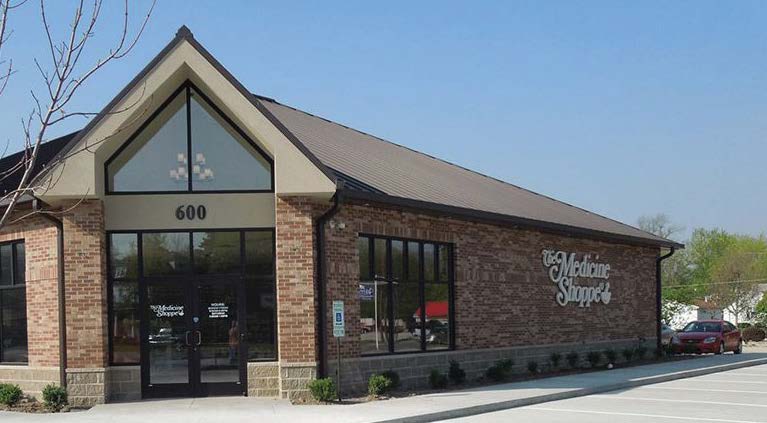
Medicine Shoppe
®
’s
TELEPHARMACY
first Telepharmacy
good medicine
18
How have you been innovative when adopting new
services or technology, and how do you think that’s
affected your success in ownership?
Pharmacy practice has changed a lot since 1994—when I opened my
first store, about 70 percent of our business was cash, compared to
now, where 90 percent of my patients get their prescriptions through
insurance coverage. It can be challenging to keep on top of all of the
changes in the healthcare system and remain competitive, so we’ve
adopted some niche services. We offer local delivery, Dispill® Packaging,
and a convenient double drive-through window. We provide flu,
shingles, pneumonia and TDAP vaccinations and hold hearing-aid
clinics every Thursday to help us generate new foot traffic. We focus on
MTM services and medication synchronization. We also service a local
assisted living facility with all of their prescription needs.
Do you have any advice for aspiring pharmacy owners,
particularly women who are considering ownership as
a career option?
Find what will work for you! I opened my store very soon after I
graduated college—I didn’t wait to start a family and then pursue
ownership like a lot of people. I had my son about six years after I
opened my store, and he grew up in my pharmacy. It might not be
feasible for every owner to open a store right after school, but I’d
encourage them not to “rule it out” immediately. My store was my
“baby” before I had a baby—and I was able to commit the time and
effort 100 percent because of where I was in my life at the time.
So let’s talk about work-life balance. How has owning
your pharmacy helped you manage a family and
outside life that sometimes comes with competing
priorities? What advice would you give to women who
might be struggling with the thought of ownership
because they feel it would be
too much?
It’s a lot of work. However, because I own my store, I was able to set my
own schedule and make time with my family a priority when I needed
it to be. I set aside one day a week that was totally devoted to my son
and me—and my employees and my patients knew and understood
my schedule and my priorities. My son would go to daycare during the
day but would spend time at my pharmacy every evening. My son has
seen both my husband and I’s entrepreneurial spirit, and we know he’s
going to pursue his own business one day as well. He’s been selling
sweetcorn since he was seven years old.
Have you thought at all about your store’s legacy
and what you might consider when thinking about
transition planning?
Since my son will likely follow in his father’s footsteps and pursue
farming as a career, my pharmacy legacy probably won’t live beyond
me in my family. That being said, I’ve had a young girl work in my
pharmacy as a technician for three years, and one day she told me she
could see herself being a community pharmacist full-time. She’s now in
pharmacy school and pursuing her degree. I told her that I would give
her 10 years after pharmacy school to work, have a family and find what
works for her. Then she could work full-time in my store for three years
while we develop a transition plan together. I’m excited to possibly
pass the torch on to another female owner down the road.
Any final words of advice or encouragement to our
Women in Pharmacy community?
Owning a pharmacy is an investment—in time, finances and emotion.
It’s not a job for the faint of heart, but it’s all worth it. I joke that I don’t
have a typical “9–5” job because it wouldn’t be any fun. I encourage
anyone considering ownership to just go for it. It’s a process of trial and
error and constant learning, but I’ve been able to
own
my career, and
make it work for my family and me. You can do it too!
good medicine
19
R
Retail
ADVANTAGE
good medicine
20
“We are capturing the evolution happening
in the country. There are very sophisticated
individuals who are looking at health in a
new way. They are addressing the underlying
causes of their symptoms and want to
optimize their health, including evaluating
adjuncts to the many pharmaceuticals they
may be taking,” said owner Scott Porter.
Sandpoint Super Drug’s response to this
movement was to dedicate more time and
resources to their professional nutrition
department. “The nutrition department is
not contradictory to the pharmacy. It’s not
even offered as an alternative. It’s merely
supportive and in addition to what people
are already doing,” said Scott.
Last year, the department had leveled at
$9–$10,000 a month. After expanding their
offerings of high-quality, clinically effective
products, the store experienced a 400
percent revenue increase over a 13-month
time period.
SCOTT PORTER
RPh
Sandpoint Super Drug
Sandpoint, ID
HOW
SANDPOINT
SUPER DRUG
CAPTURED
THE
NUTRITION
MOVEMENT
The primary work is done up-front in
educating customers and assisting with initial
product selection when they are in the store
searching for a probiotic. Scott says he is less
interested in selling a particular product than
educating customers. “When a customer
feels the product they bought is effective
they come back to get it again. They tell
their friends.”
Scott expects profits to continue to increase,
without the risk of seasonal fluctuations. Sales
are still growing approximately $1,500/month,
generating a projected gross profit of over
$200,000 for 2017. With margins of more than
45 percent, Sandpoint Super Drug’s strategy
is proving to be tremendously successful.
Scott believes it’s a market ripe for
independent retail pharmacies to enter and
openly shares his experience with others.
“Just give me a call if you’d like to come see
what we’ve done or want some help,” he said.
healthy profits
HEALTHY CUSTOMERS,
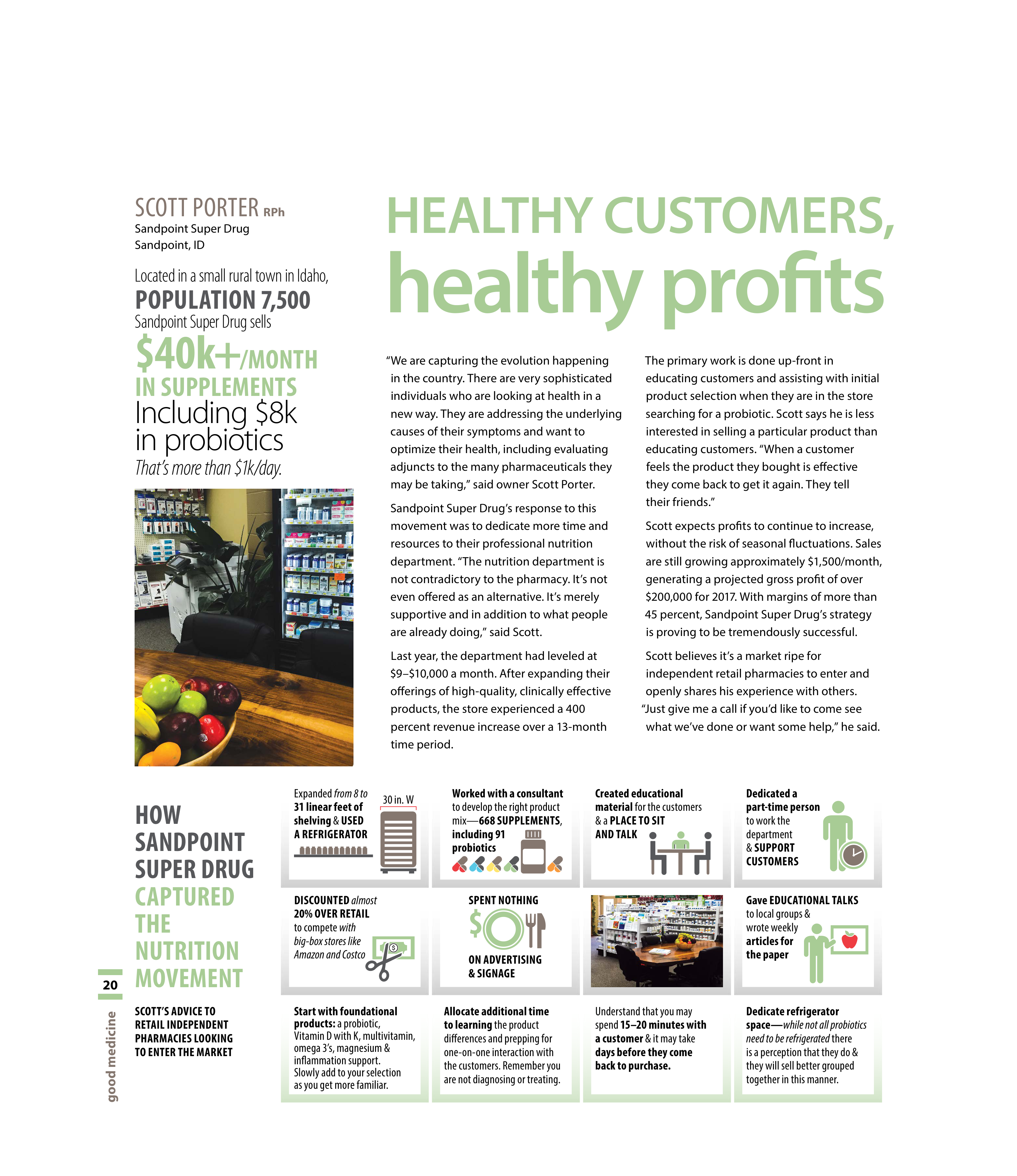
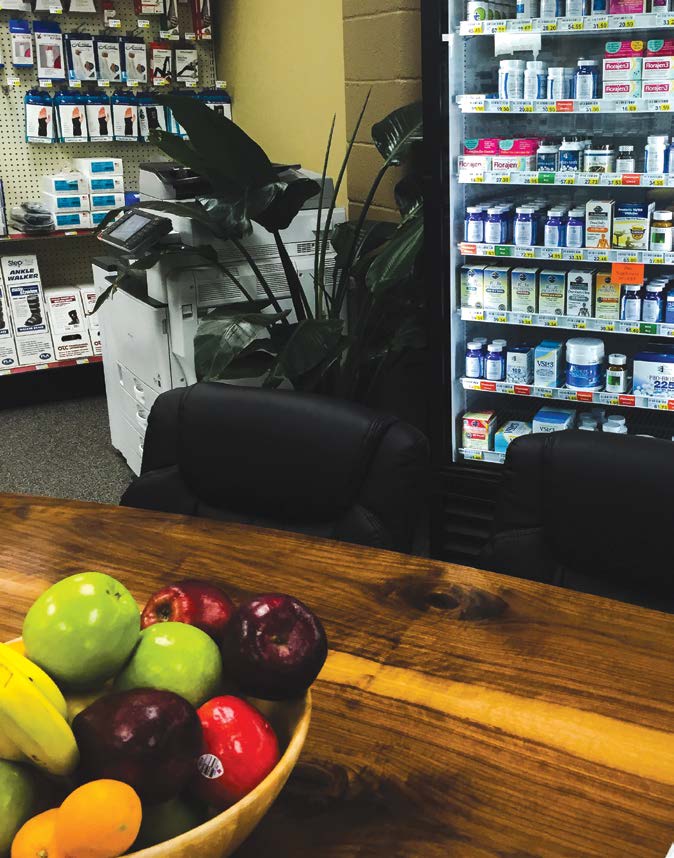
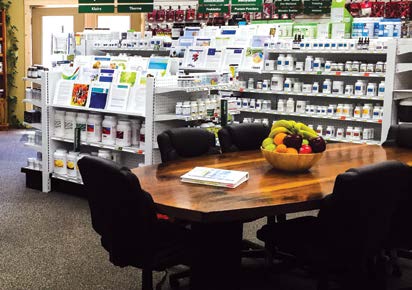
Located in a small rural town in Idaho,
POPULATION 7,500
Sandpoint Super Drug sells
$40k+
/MONTH
IN SUPPLEMENTS
Including $8k
in probiotics
That’s more than $1k/day.
Expanded
from 8 to
31 linear feet of
shelving
&
USED
A REFRIGERATOR
30 in. W
Worked with a consultant
to develop the right product
mix—
668 SUPPLEMENTS
,
including 91
probiotics
Created educational
material
for the customers
& a
PLACE TO SIT
AND TALK
Dedicated a
part-time person
to work the
department
&
SUPPORT
CUSTOMERS
DISCOUNTED
almost
20% OVER RETAIL
to compete
with
big-box stores like
Amazon and Costco
SPENT NOTHING
SCOTT’S ADVICE TO
RETAIL INDEPENDENT
PHARMACIES LOOKING
TO ENTER THE MARKET
Gave EDUCATIONAL TALKS
to local groups &
wrote
weekly
articles for
the paper
$
ON ADVERTISING
& SIGNAGE
Start with foundational
products:
a probiotic,
Vitamin D with K, multivitamin,
omega 3’s, magnesium &
inflammation support.
Slowly add to your selection
as you get more familiar.
Allocate additional time
to learning
the product
differences and prepping for
one-on-one interaction with
the customers. Remember you
are not diagnosing or treating.
Understand that you may
spend
15–20 minutes with
a customer
& it may take
days before they come
back to purchase.
Dedicate refrigerator
space—
while not all probiotics
need to be refrigerated
there
is a perception that they do &
they will sell better grouped
together in this manner.
Retail independents have a huge opportunity to create
stronger conversion on the front-end. In fact, only 6 out
of 100 customers leave a chain store without buying
something in the front-end, but 56 out of 100 customers
leave an independent store without buying something in
the front-end. This conversion conundrum required us to
build a premiere healthcare retail-focused team of advisors
and tools in order to help them thrive in the market place.
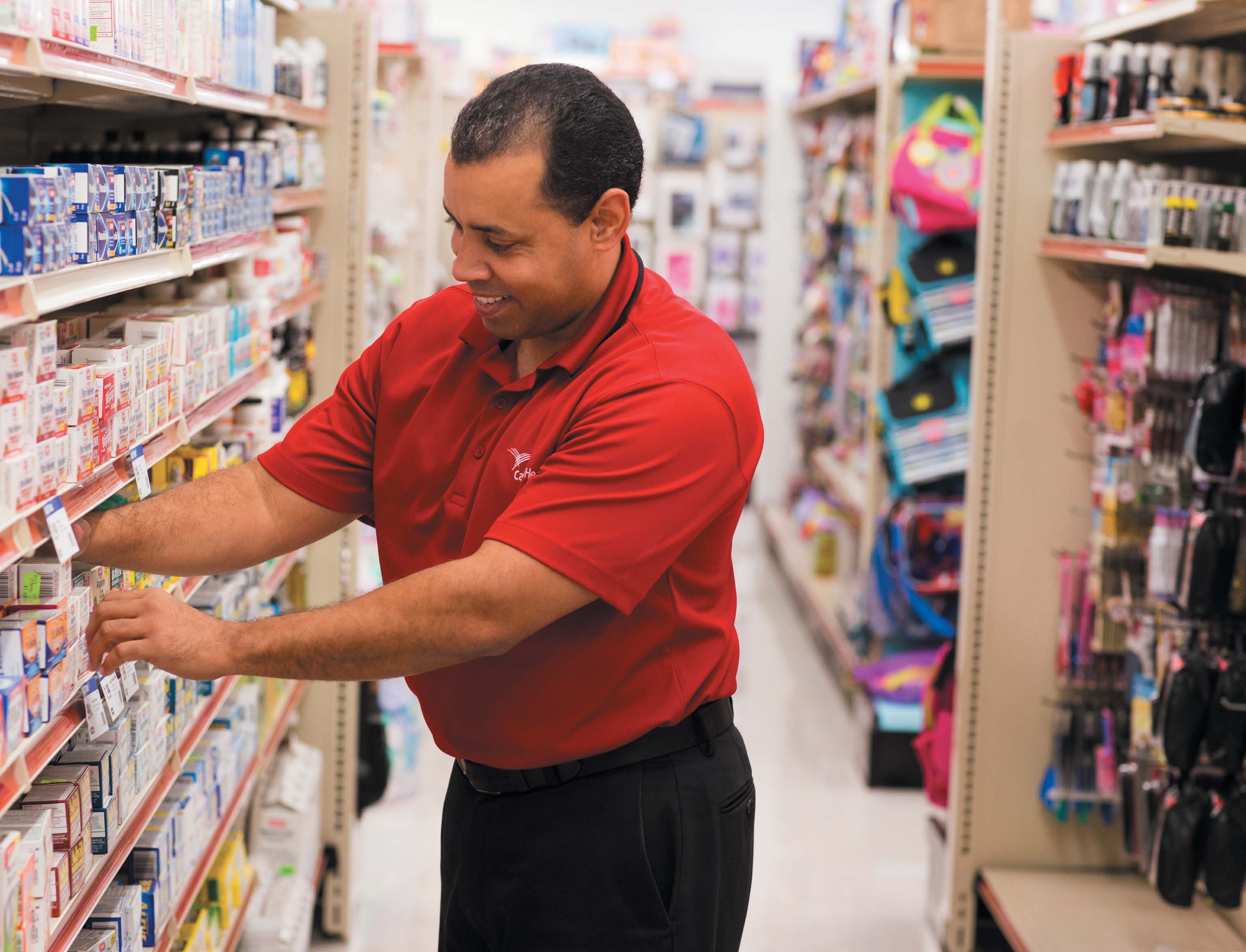
Cardinal Health recently introduced the Retail Operations
Consultant (ROC) and our go-forward strategy called
CORE
Customer Operations Retail Excellence
THIS NEW GO-TO-MARKET STRATEGY GIVES RETAIL
INDEPENDENTS WHAT THEY’VE BEEN ASKING FOR:
•
A dedicated, trusted retail operations consultant
to help with the front-end.
•
Retail direction, education and training.
•
A consistent method for operating the front-end
business and remaining competitive.
•
CORE is driven by the in store Retail Health Assessment
(RHA). ROCs execute an RHA per store to collect viable
data around plan-o-gram resets, inventory levels,
program penetration and customer pricing.
Introducing our premiere, retail-focused powerhouse,
driven to convert front-end sales for independents
CUSTOMER RESPONSE HAS BEEN PHENOMENAL.
We conduct surveys to
understand the value of the ROC and the retail health assessment. They have told
us clearly that
CORE IS DRIVING STORE SALES AND PROFITABILITY.
We strive
to help keep our retailers competitive with a strong retail presence.
Steve Light, VP of Consulting
good medicine
21
cardinalhealth.com
JENNIFER HARE
PharmaCare, Cumberland, MD
good medicine
22
HOW DOES A COMMUNITY PHARMACY COMPETE IN THE RETAIL SPACE?
BY WORKING SMARTER, NOT NECESSARILY HARDER.
Working smarter means delegating the roles within the independent pharmacy, according to
Jeff Olson, owner of Montross Pharmacy. Jeff is passionate about his front-end and has been an
early adopter of the Cardinal Health CORE program. “The program has enhanced our ability to
be more competitive, to have the brands that our peers have.”
The planograms and marketing are reviewed with the store every other week, which Jeff
equates to the same face-to-face personal touch of a pharmacist. The enhanced reports
provided with CORE prompted Jeff to move the location of his eye and ear allergy products,
which had been ranked 11th in sales. The move resulted in the products jumping to the top five
in sales—a change he says wouldn’t have happened without this program. Montross Pharmacy
is now keeping the top 50 brand and Leader™ products in stock and three to four products
deep to ensure they don’t miss out on any sales.
CORE HELPS THE INDEPENDENT PHARMACY OWNER
COMPETE WITH & NEUTRALIZE SOME OF THE
COMPETITIVE ADVANTAGES THE BIGGER CHAINS
have in their business model. The owners who have the desire to succeed are
missing out by not utilizing the program. It’s no longer a stressor in my life.
The paradigms have changed for community pharmacies and Jeff is a forward-thinking owner,
implementing additional changes to attract customers.
REWARDS CARD
Jeff saw a rewards program as a way to improve traffic in a coupon-driven
society. The program saw 500 enrollees in less than six months.
How it works:
Members receive five points for every prescription and one point for every dollar
spent outside the pharmacy. With 100 points, they receive a five dollar coupon off their next purchase.
Montross Pharmacy also sends birthday cards to members with a five dollar punch card and
to non-members with information about signing up. They also promote the program to
healthcare professionals.
The program, which captures sales trends and age demographics, showed they were not
accessing the 20–30 age group. With the help of the Cardinal Health planograms, Jeff changed
the baby section. He purchased low-cost diapers of the most popular brands and reduced the
sale price in order to compete with the big box stores.
HEALTH & BEAUTY
Jeff believes a professional looking health and beauty section will
help make the pharmacy a destination for the community square in which it is located.
By installing professional displays with the top three selling cosmetic brands, he hopes to
capture female customers who are in filling prescriptions. His ultimate goal is to expand the
cosmetics section beyond the three brands.
TOP 10 REASONS TO JOIN
CORE
1
END CAP PROGRAMS
2
MERCHANDISING PROGRAMS & CHECKLIST
3
POS SMART REPORTS
4
TEMPORARY PRICE REDUCTION PROGRAM
5
WOW PROGRAM
6
LEADER BRAND
PRODUCT STOCKING
7
UP-TO-DATE INDUSTRY NEWS
8
PERSONALIZED GUIDANCE
9
MERCHANDISING & PRODUCT ASSISTANCE
10
WELL-TRAINED FRONT-END PERSONAL CONSULTANT
“What else is in the pharmacy that I need?” Jennifer
Hare, Marketing and Public Relations Director for
The PharmaCare Network, wants to anticipate their
customers’ answers. “In our business, no one gets up in
the morning excited to go to their pharmacy to purchase
meds that are for a disease or condition they wish they
never had. Often, the cost means they have to decide
between purchasing their medication and putting
food on the table or heating their home. Despite those
challenges, we have the opportunity to satisfy their
needs and to create a fulfilling experience.”
Jennifer believes that consumers will give a pharmacy
only one more chance if the over-the-counter product
they want is not on the shelf. The Cardinal Health CORE
program is helping PharmaCare’s seven locations
eliminate empty spaces and prompting those with
stagnant layouts to switch up product category
placement.
“The planograms are very good. We see the new products
and what is being nationally advertised. A customer
asked for the new Flonase®, and we had it.”
Jennifer uses the
POS SMART REPORTS
as a tool with
her staff. “If we are down in a category one month, such
as first aid, it prompts me to ask if there were holes in the
section or enough was ordered.”
CORE, which they have been using since June 2016, has
ignited each store to look at what is working for their
location. Jennifer’s initial goal was for store personnel to
be more aware of Order Express. They started to carve
out the time, and within eight months they were all
looking at it consistently.
PharmaCare has taken the Retail Health Assessment
one step further. In addition to reviewing items such as
inventory and shelf labels, Jennifer has created additional
checklists for her stores to improve the day-to-day
operational tasks.
For PharmaCare, CORE has been a springboard in
evolving their operational excellence and setting the
ground work to make sure they aren’t missing any
front-end opportunities.
JEFF OLSON
RPh
Montross Pharmacy, Winterset, IA

good medicine
23
cardinalhealth.com
AJAY DESAI
PharmD
Oval Pharmacy
Bronx, NY
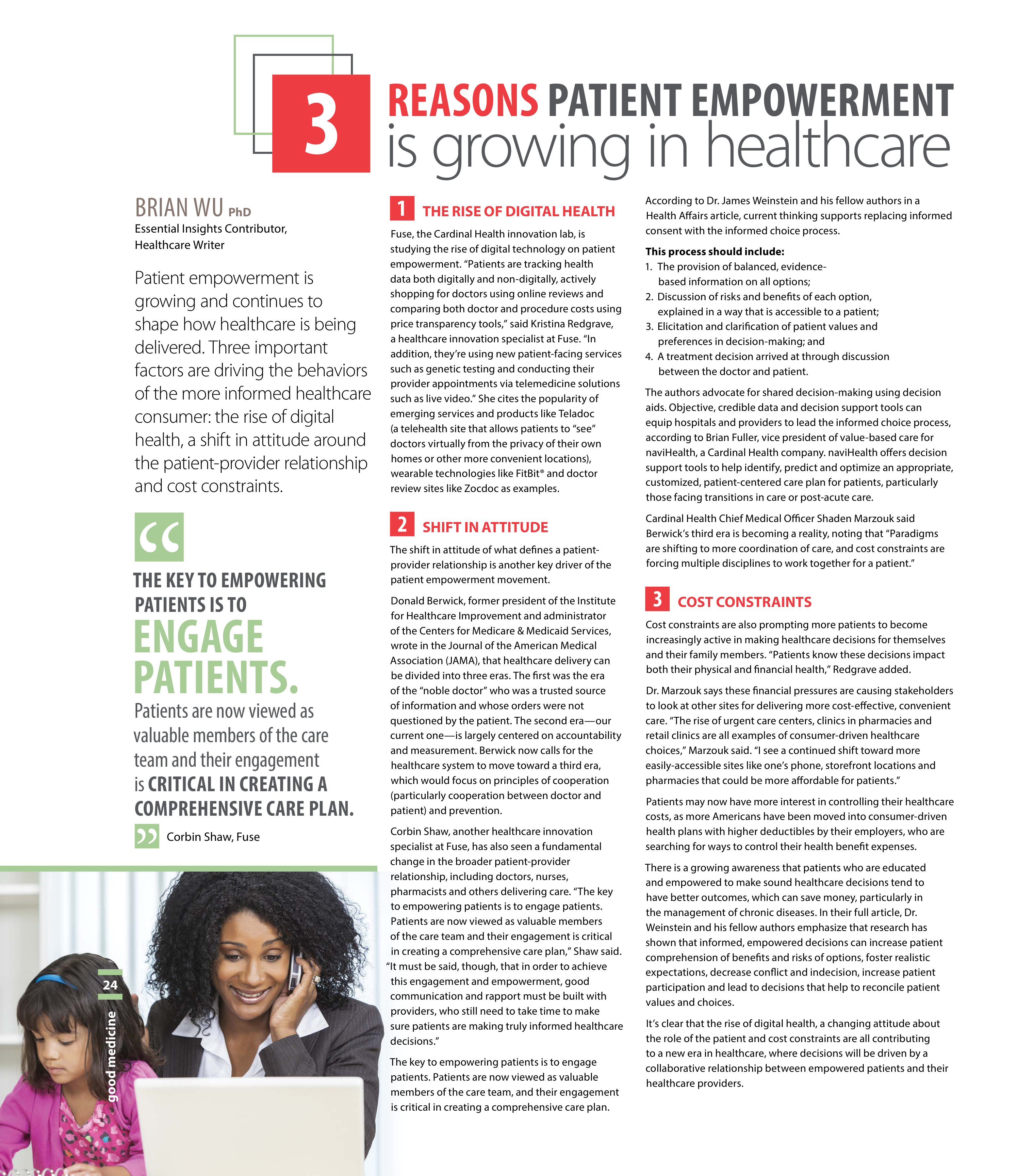
The original front-end section was 500 square feet and hadn’t been upgraded in years. Ajay
hired contractors to draw-up a new floor plan that included increasing the size of the OTC area
by 50 percent. “Appearance matters. If we can improve the flow for the customer and make
products look neat and organized, they will be more likely to make a purchase,” he stated.
Ajay worked with Pedro Cruz, a retail operations consultant with Cardinal Health, to revise the
contractor’s original floor plan. Tapping into his retail experience and art education, Pedro
created traffic patterns to increase purchase opportunities. Changes included moving skin care
closer to the checkout and relocating OTC products to the back of the store to increase impulse
purchases. The placement of the gondolas were another unique enhancement. Situated at an
angle on each side of the front entrance, they draw the customer to walk through the aisles on
both sides of the store.
Oval has improved its bottom line by re-purposing existing square footage and
improving the shopping experience. “Within two months of implementing the re-design
and re-merchandising, front-end sales were up more than 30 percent,” said Ajay.
Oval Pharmacy has been serving the community since 1927. Like many
pharmacies in the area, it was operating with limited square footage.
Ajay Desai saw an opportunity to expand that square footage through
an innovative re-design when a long-term lease was secured in 2015.
FRONT-END
Fabulous

good medicine
24
THE RISE OF DIGITAL HEALTH
Fuse, the Cardinal Health innovation lab, is
studying the rise of digital technology on patient
empowerment. “Patients are tracking health
data both digitally and non-digitally, actively
shopping for doctors using online reviews and
comparing both doctor and procedure costs using
price transparency tools,” said Kristina Redgrave,
a healthcare innovation specialist at Fuse. “In
addition, they’re using new patient-facing services
such as genetic testing and conducting their
provider appointments via telemedicine solutions
such as live video.” She cites the popularity of
emerging services and products like Teladoc
(a telehealth site that allows patients to “see”
doctors virtually from the privacy of their own
homes or other more convenient locations),
wearable technologies like FitBit® and doctor
review sites like Zocdoc as examples.
SHIFT IN ATTITUDE
The shift in attitude of what defines a patient-
provider relationship is another key driver of the
patient empowerment movement.
Donald Berwick, former president of the Institute
for Healthcare Improvement and administrator
of the Centers for Medicare & Medicaid Services,
wrote in the Journal of the American Medical
Association (JAMA), that healthcare delivery can
be divided into three eras. The first was the era
of the “noble doctor” who was a trusted source
of information and whose orders were not
questioned by the patient. The second era—our
current one—is largely centered on accountability
and measurement. Berwick now calls for the
healthcare system to move toward a third era,
which would focus on principles of cooperation
(particularly cooperation between doctor and
patient) and prevention.
Corbin Shaw, another healthcare innovation
specialist at Fuse, has also seen a fundamental
change in the broader patient-provider
relationship, including doctors, nurses,
pharmacists and others delivering care. “The key
to empowering patients is to engage patients.
Patients are now viewed as valuable members
of the care team and their engagement is critical
in creating a comprehensive care plan,” Shaw said.
“It must be said, though, that in order to achieve
this engagement and empowerment, good
communication and rapport must be built with
providers, who still need to take time to make
sure patients are making truly informed healthcare
decisions.”
The key to empowering patients is to engage
patients. Patients are now viewed as valuable
members of the care team, and their engagement
is critical in creating a comprehensive care plan.
BRIAN WU
PhD
Essential Insights Contributor,
Healthcare Writer
is growing in healthcare
THE KEY TO EMPOWERING
PATIENTS IS TO
ENGAGE
PATIENTS.
Patients are now viewed as
valuable members of the care
team and their engagement
is
CRITICAL IN CREATING A
COMPREHENSIVE CARE PLAN.
Corbin Shaw, Fuse
Patient empowerment is
growing and continues to
shape how healthcare is being
delivered. Three important
factors are driving the behaviors
of the more informed healthcare
consumer: the rise of digital
health, a shift in attitude around
the patient-provider relationship
and cost constraints.
According to Dr. James Weinstein and his fellow authors in a
Health Affairs article, current thinking supports replacing informed
consent with the informed choice process.
This process should include:
1. The provision of balanced, evidence-
based information on all options;
2. Discussion of risks and benefits of each option,
explained in a way that is accessible to a patient;
3. Elicitation and clarification of patient values and
preferences in decision-making; and
4. A treatment decision arrived at through discussion
between the doctor and patient.
The authors advocate for shared decision-making using decision
aids. Objective, credible data and decision support tools can
equip hospitals and providers to lead the informed choice process,
according to Brian Fuller, vice president of value-based care for
naviHealth, a Cardinal Health company. naviHealth offers decision
support tools to help identify, predict and optimize an appropriate,
customized, patient-centered care plan for patients, particularly
those facing transitions in care or post-acute care.
Cardinal Health Chief Medical Officer Shaden Marzouk said
Berwick’s third era is becoming a reality, noting that “Paradigms
are shifting to more coordination of care, and cost constraints are
forcing multiple disciplines to work together for a patient.”
COST CONSTRAINTS
Cost constraints are also prompting more patients to become
increasingly active in making healthcare decisions for themselves
and their family members. “Patients know these decisions impact
both their physical and financial health,” Redgrave added.
Dr. Marzouk says these financial pressures are causing stakeholders
to look at other sites for delivering more cost-effective, convenient
care. “The rise of urgent care centers, clinics in pharmacies and
retail clinics are all examples of consumer-driven healthcare
choices,” Marzouk said. “I see a continued shift toward more
easily-accessible sites like one’s phone, storefront locations and
pharmacies that could be more affordable for patients.”
Patients may now have more interest in controlling their healthcare
costs, as more Americans have been moved into consumer-driven
health plans with higher deductibles by their employers, who are
searching for ways to control their health benefit expenses.
There is a growing awareness that patients who are educated
and empowered to make sound healthcare decisions tend to
have better outcomes, which can save money, particularly in
the management of chronic diseases. In their full article, Dr.
Weinstein and his fellow authors emphasize that research has
shown that informed, empowered decisions can increase patient
comprehension of benefits and risks of options, foster realistic
expectations, decrease conflict and indecision, increase patient
participation and lead to decisions that help to reconcile patient
values and choices.
It’s clear that the rise of digital health, a changing attitude about
the role of the patient and cost constraints are all contributing
to a new era in healthcare, where decisions will be driven by a
collaborative relationship between empowered patients and their
healthcare providers.
REASONS
PATIENT EMPOWERMENT
good medicine
25
W
Wellness
ADVANTAGE

good medicine
26
Bobbie Barbrey, RPh, CCN has been a
pharmacist for more than 30 years. “Like
many pharmacists, I thought drugs were the
answer for people’s health. I dispensed those
routinely and watched as we achieved results
in many cases. My dad had advanced heart
disease and was one of those patients you
see who goes from one medicine to another
medicine to another medicine. Being a
pharmacist, I was very optimistic that the next
drug would work, that it would be the magic
that was going to make the difference. As I
saw that not happening and he passed away, I
realized there was a shift occurring in me.”
In 2001, he decided to open his own business
and, more importantly, shift to practicing
pharmacy and wellness from a functional
perspective. He saw the opportunity to
make a difference in people’s lives, not just
dispense medication but also to educate
and navigate on lifestyle, diet and targeted
nutritional supplementation.
He became interested in reviewing labs
from a functional standpoint, seeing what
results may be trending out of line and might
relate to different health conditions without
it being an extremely high or a low number.
He was fascinated with energetic medicine
and purchased a BioMeridian, an energetic
device that assesses the overall health of
the individual and inflammation of a point
in the body. “When you start working with
the root-cause, you’ve got to find the source
of inflammation,” says Bobbie. His passion
is trying to figure out why patients have the
conditions they do and, more importantly,
how he might be able to help them.
Bobbie started providing consultations, to
which he now dedicates all his time, while his
daughter Kaylan Barbrey, also a pharmacist,
manages the pharmacy. When he started,
there was no blueprint for this type of work,
and he was providing consultations at no
charge. But over time the word spread, and
now he is booked two months out.
BOBBIE BARBREY
RPh, CCN
Medicap® Pharmacy
Raleigh, NC
The consultation fee is $150. There is a small
fee for additional labs, which build in his time
to review the results.
“I think it’s important that we all move in that
direction. We’ve given it away for so long.
I recommend developing the expertise so
people are willing to pay for that expertise.”
DEVELOP EXPERTISE—
INTERPRET LAB RESULTS,
TEACH LIFESTYLE AND DIET—
SO PEOPLE ARE WILLING TO
PAY FOR THAT
EXPERTISE
The BioMeridian is one of many tools at
Bobbie’s disposal. He can create requisitions
to have labs done at LabCorp and perform
urinary labs, saliva testing of hormones and
blood spot testing for vitamins, adrenals and
cholesterol—it’s an integrated practice. “I
knew when I started the business that you
can’t survive just filling prescriptions. We
supported people’s health with supplements,
and because of that we had the opportunity
to create a profit, allowing us to keep doing
what we’re doing. This year, we will reach
over a half million in annual supplement sales
which was my personal goal.
I get to witness people getting
better.
I get to see their eyes light up.
Bobbie believes the potential to grow his
business came from helping find solutions
and guiding people down a new path—it
wasn’t about selling supplements. “I am
blessed because I get to interact with this
population. It is a drop in the bucket for the
number of people that don’t know about
their choices to change their health and
improve their wellness. It’s what gets me up
in the morning to come to work.”
The patient is asked to complete and
submit intake forms and current lab
results prior to their initial consultation.
Bobbie can order labs, if necessary.
•
Initial Consultation—75 minutes.
Bobbie and the patient review
symptoms, labs and history for
potential exposures. He performs the
BioMeridian test. Bobbie gives the
patient a plan he or she can execute.
•
Visit Two—45–60 days
later
the
patient returns. The BioMeridian
test is repeated to look for a change.
Ideally, they share how much better
they are feeling.
•
Visit Three—
If the patient is still
not at optimal health, Bobbie
tests for a toxic burden. “Everyone
has one; it’s whether it’s affecting
their health,” he says. He often
recommends using homeopathy to
help eliminate the toxic burden.
integrative
consultation
beyond medicine
Wellness
good medicine
27
cardinalhealth.com
Chuck Obeid
RPh
SHEEHANS PHARMACY
Plains, PA
Interventions:
“We use the Drug Adherence
Work-up (DRAW) tool so the patient doesn’t
feel defensive when we are asking them why
they may not be taking a certain medicine.
There may be a valid reason they aren’t
adhering and we want them to tell us why.”
Workflow:
The pharmacists regularly check
the platforms for TIPs. Pharmacy students
update clinical information, making it fairly
easy to integrate MTM into their workflow.
“We are high volume, yet we still have a lot of
patient interaction.”
Challenges:
“The challenge can be that a
patient on one medication tends to think they
have more control and are less likely to think
about side-effects or interaction. They may
think they don’t need the assistance.”
E. Jane Orr
PharmD
VILLAGE PHARMACY
Duffield, VA
Create patient buy-in:
If Jane recommends a change that is not urgent and the patient has an
upcoming doctor’s appointment, she may write a handwritten note to their physician for the patient to
hand-deliver at their next appointment. “When patients have been on something for a long time, it can
be difficult to change, especially for older patients. This makes them part of the process.”
Interventions:
She focuses not only on medication adherence but usage. “I can catch when they may
be using a medication incorrectly—a long-acting insulin, for example. I have them show me how they
are using it. The issue they are experiencing may not be because it’s written incorrectly.”
Communication with physicians:
When Jane noticed that the pharmacy had a low volume of diabetic
patients prescribed statins, she took lunch to the doctors’ offices in the area and discussed with them
the gap and the importance of a diabetic patient being on statins. The percentage of the pharmacy’s
patients on statins increased from 65–85 percent. “I have about a 70 percent success rate in getting
things changed with physicians. I’d like to be at 100 percent. But it’s still a win if I get a note back from
the doctor with a reason the patient hasn’t been able to tolerate the alternative drug.”
Henry Lee
PharmD
KM PHARMACY
Flushing, NY
Communication with patients:
His employees
speak various dialects of Chinese, helping
overcome the language barrier. “More than that,
we are easy to talk to. We don’t hide behind the
counter.” Henry starts a conversation by sharing
foods that may interact with their drugs. It builds
trust, and they start to ask him about their other
medicines or health issues.
Impact:
Patients are filling their medications on
a more regular basis so there has been a positive
financial impact.
Building rapport:
“In my area, there is a one to
two hour wait time to see the doctor. If they have a
question or have a small cold, they come see me to
determine if they need to go to the doctor.”
CMR matters to the patient. “
We did a CMR
with a patient on 15 medications. Her ankles
were very swollen and had become progressively
worse. I reviewed her medications and noticed
she was on amlodipine and gabapentin, both of
which can cause edema. After speaking with the
patient’s doctor we were able to discontinue both
medications, and the swelling resolved quickly.
She also admitted that she was struggling to keep
her medications straight so we set her up on our
monthly pillbox program. She was so grateful that
she bought the pharmacy staff lunch.”
a
d
h
e
r
e
n
c
e
m
a
t
t
e
r
s
good medicine
28
Hemant Desai
RPh
, Nisarg Patel
RPh
& Paul Echefu
RPh
CASTLE HILL COMMUNITY PHARMACY
Bronx, NY
Adding value:
Hemant views the measures as a significant opportunity for the pharmacist to help with
the patient’s well-being, to add value to the healthcare system and to improve revenue. “It’s not just about
refilling the medication. It’s about improving patient care.”
Action plans:
“We noticed a patient had been on six months of a particular medication, but we didn’t
know that he was on another medication and was experiencing muscle pain. When we performed the
CMR we asked about each and every medicine and how he was feeling. We identified his muscle pain
was the result of a statin. We called the doctor and asked to have the medicine changed. That was an
action plan,” shared Nisarg.
Going above and beyond:
“By doing CMR on each and every patient, we got to know where to intervene
in patient therapy,” says Hemant. The pharmacists attribute their success to working as a team focused on
going above and beyond. “When a patient goes to the emergency room and receives a medicine, there are
typically no refills and the patient needs to see their Primary Care Physician (PCP). By the time they get an
appointment, there may be a gap of a week to ten days. I call the PCP to see if a refill can be authorized or
to see if perhaps the original medicine needs to be changed. That medicine may not have been working
and that is why they ended up in the emergency room. We don’t know, but we are investigating and are
being a part of the healthcare team and the solution. It’s not hard; it just takes time,” said Nisarg.
Communication and workflow:
Paul learns a lot by sitting with the patients. “It’s very necessary. The
whole thing is going well with my workflow because I find it easy to communicate with them about their
medications and, if necessary, to offer alternatives to the doctor.”
Adherence tools:
“EQuIPP® helps, as does synchronizing meds. Dispill® is helpful for our patients who
have difficulty remembering,” says Hermant.
Paul Winger
RPh
& Chad Rindy
RPh
THE MEDICINE SHOPPE® PHARMACY NO. 2065
Chippewa Falls, WI
Adherence tools:
“The Dispill® medication planners are an important tool that improves adherence for
our patients. For others not on med planners, we implemented a medication synchronization program.
We typically contact doctors’ offices upon filling the last 30 days of maintenance medications. Proactively
renewing those expired prescriptions streamlines the renewal processes.”
“In addition to the traditional consulting techniques that improve adherence, I create cognitive dissonance
by mentioning the organ systems that can be negatively affected by non-adherence. I also explain the
disease pathophysiology in layman’s terms. That technique is not for every patient, but I find it effective
and it certainly serves as a teaching moment,” says Chad.
Relationships:
Paul Winger, owner, attributes their high performance ratings to the store’s pharmacist,
“Chad is the driving force behind the success. He develops personal relationships and is congenial.”
Abigail Vasquez
CPhT
& Mary Ann Longoria
CPhT
FRY’S PRESCRIPTION PHARMACY
San Benito, TX
Being proactive:
The pharmacists have embraced
CMRs as an extension of their work. They are
proactive with patients and insurance, using
information from iMedicare and Pioneer Rx. Mary
believes that by focusing on compliance and
adherence now, they will be in a good position if
the processes become mandatory.
Team-work:
“It moved from one person to every
person at the pharmacy being involved. We
genuinely care and the customer can feel that. It’s
more personal. We have a special area set aside for
conversations but beyond that, we’ve trained the
technicians to discuss that ‘it’s not just about the
refill; it’s about your health’, says Abbie
Changing behaviors:
One to two people a day are
dedicated to calling patients to remind them about
their refills, but now customers are calling four
days before their refill is due.
Community pharmacists play
a central role in patient care.
More patients are benefiting from
pharmacist’s interventions through
Comprehensive Medication Reviews (CMRs)
and OutcomesMTM TIPs. We spoke to some
pharmacies who have achieved successful
performance scores to learn about their
approach and how the process can be
mutually beneficial for both the pharmacy
and the patient.


good medicine
29
cardinalhealth.com
ESTROGEN CONTAINING HORMONES CAN CAUSE
VITAMIN DEPLETIONS.
B vitamins are involved
in millions of biochemical reactions throughout the
body.
Being low on B vitamins can cause many
problems—
slowed metabolism, depression, poor
memory, muscle pain, weakness or a headache,
stiffness, fatigue, nausea and anxiety are just a few
of the dozen of symptoms that can occur as a result
of a B vitamin deficiency. As part of our standard of
care at Williamsburg Drug, I recommend a B-Complex
Plus supplement.
DEB SCHOCKLIN & KELLY AUTHIER
RPh
Williamsburg Drug
Williamsburg, VA
IMPACT
Kelly believes these initiatives highlight pharmacists’
capabilities to show a distinct tie between nutrition,
prescriptions and medical health. “A woman who came in
for a medication review was having difficulty sleeping and
feeling depressed. We found something in her medication
that was contributing. We consulted with the doctor about
tapering a certain medication and tweaking the time of
day another medicine was taken. I suggested some lifestyle
changes and supplements. I received a wonderful note
from her saying she had never had anyone just sit down
and listen to her and explain how to improve her situation.”
VITAMIN
DEFICIENCY TESTS
Patients are tested for general
zinc deficiency with the Zinc
Taste Test. The patient swirls
5 ccs of zinc for 5–10 seconds.
Depending on what they
taste or don’t taste indicates
a level of deficiency. If an
additional zinc supplement is
recommended, the test can be
repeated months later.
MEDICATION
REVIEWS
Scheduling medication reviews allows
Kelly to look at the big picture—labs,
vitamins, supplements and medications
—but also a person’s lifestyle. “If they
are homebound, vitamin D might play
a bigger role. If they are vegan, I look
for vitamin deficiencies and test for a
hemoglobin A1c level for risk factors into
diabetes. I discuss family history and
stressors that can have effects on their
disease state.”
In an environment filled with discussions of reimbursements, preferred
networks and PBMs, Deb Schocklin, owner of Williamsburg Drug says,
“There is a lot of pressure for pharmacies today that
we can’t control, but we are always looking for the
next thing we can offer that will be helpful in meeting
people’s needs.”
By empowering the staff and continuing to reinvent itself in response to
the times and to pharmacy and healthcare landscape changes, Deb says
Williamsburg Drug is operating at a level of patient care where they can
be effective. “It keeps us fresh and provides us with a purpose every day.
We don’t worry about competing with the chains.”
Most recently, that has meant addressing vitamin depletion caused by
certain medications. Kelly Authier, the PIC at Williamsburg Drug, has
spearheaded these efforts.
C
O
L
O
R
-
C
O
D
E
D
PRESCRIPTION BAG TAGS
listing possible side effects and related supplements
Kelly developed
bag tags
that are included with the filled prescription.
The tags are color-coded and, so far, have covered estrogen containing
hormones, proton pump inhibitors, antibiotics and statin therapy. They list
the possible side effects and recommend supplements that may help.
Kelly will expand the bag tags into other medications. For the medicines that
don’t yet have a bag tag, she has a pink pen that the staff teases her about.
“I write supplements they may want to consider on the bags. I want to keep
the conversation going.”
Estrogen
Proton pump
inhibitors
Antibiotics
Statins
FIGHTING VITAMIN DEFICIENCIES
supplement
health
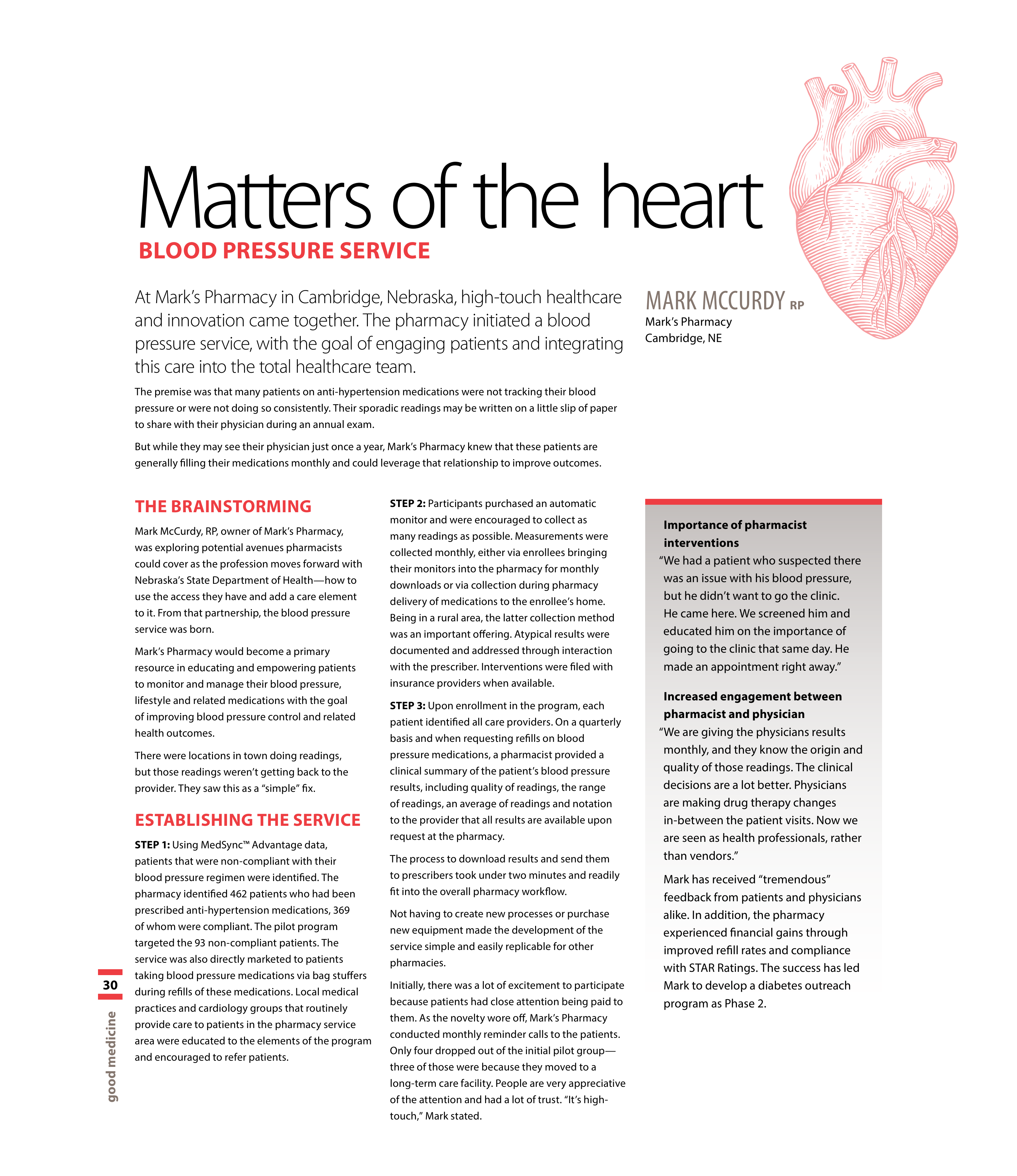

good medicine
30
At Mark’s Pharmacy in Cambridge, Nebraska, high-touch healthcare
and innovation came together. The pharmacy initiated a blood
pressure service, with the goal of engaging patients and integrating
this care into the total healthcare team.
The premise was that many patients on anti-hypertension medications were not tracking their blood
pressure or were not doing so consistently. Their sporadic readings may be written on a little slip of paper
to share with their physician during an annual exam.
But while they may see their physician just once a year, Mark’s Pharmacy knew that these patients are
generally filling their medications monthly and could leverage that relationship to improve outcomes.
MARK MCCURDY
RP
Mark’s Pharmacy
Cambridge, NE
THE BRAINSTORMING
Mark McCurdy, RP, owner of Mark’s Pharmacy,
was exploring potential avenues pharmacists
could cover as the profession moves forward with
Nebraska’s State Department of Health—how to
use the access they have and add a care element
to it. From that partnership, the blood pressure
service was born.
Mark’s Pharmacy would become a primary
resource in educating and empowering patients
to monitor and manage their blood pressure,
lifestyle and related medications with the goal
of improving blood pressure control and related
health outcomes.
There were locations in town doing readings,
but those readings weren’t getting back to the
provider. They saw this as a “simple” fix.
ESTABLISHING THE SERVICE
STEP 1:
Using MedSync™ Advantage data,
patients that were non-compliant with their
blood pressure regimen were identified. The
pharmacy identified 462 patients who had been
prescribed anti-hypertension medications, 369
of whom were compliant. The pilot program
targeted the 93 non-compliant patients. The
service was also directly marketed to patients
taking blood pressure medications via bag stuffers
during refills of these medications. Local medical
practices and cardiology groups that routinely
provide care to patients in the pharmacy service
area were educated to the elements of the program
and encouraged to refer patients.
STEP 2:
Participants purchased an automatic
monitor and were encouraged to collect as
many readings as possible. Measurements were
collected monthly, either via enrollees bringing
their monitors into the pharmacy for monthly
downloads or via collection during pharmacy
delivery of medications to the enrollee’s home.
Being in a rural area, the latter collection method
was an important offering. Atypical results were
documented and addressed through interaction
with the prescriber. Interventions were filed with
insurance providers when available.
STEP 3:
Upon enrollment in the program, each
patient identified all care providers. On a quarterly
basis and when requesting refills on blood
pressure medications, a pharmacist provided a
clinical summary of the patient’s blood pressure
results, including quality of readings, the range
of readings, an average of readings and notation
to the provider that all results are available upon
request at the pharmacy.
The process to download results and send them
to prescribers took under two minutes and readily
fit into the overall pharmacy workflow.
Not having to create new processes or purchase
new equipment made the development of the
service simple and easily replicable for other
pharmacies.
Initially, there was a lot of excitement to participate
because patients had close attention being paid to
them. As the novelty wore off, Mark’s Pharmacy
conducted monthly reminder calls to the patients.
Only four dropped out of the initial pilot group—
three of those were because they moved to a
long-term care facility. People are very appreciative
of the attention and had a lot of trust. “It’s high-
touch,” Mark stated.
Importance of pharmacist
interventions
“We had a patient who suspected there
was an issue with his blood pressure,
but he didn’t want to go the clinic.
He came here. We screened him and
educated him on the importance of
going to the clinic that same day. He
made an appointment right away.”
Increased engagement between
pharmacist and physician
“We are giving the physicians results
monthly, and they know the origin and
quality of those readings. The clinical
decisions are a lot better. Physicians
are making drug therapy changes
in-between the patient visits. Now we
are seen as health professionals, rather
than vendors.”
Mark has received “tremendous”
feedback from patients and physicians
alike. In addition, the pharmacy
experienced financial gains through
improved refill rates and compliance
with STAR Ratings. The success has led
Mark to develop a diabetes outreach
program as Phase 2.
BLOOD PRESSURE SERVICE
Matters of the heart
good medicine
31
cardinalhealth.com
What would you do
if
?
One of our readers has a question.
Can you help?
I need to make a decision and am looking for
your feedback.
What advice would you offer to a person who
is struggling with
?
apps.facebook.com/my-polls
What products would you like us to offer?
What is your biggest challenge as a caregiver?
What vitamins do you take every day?
Run a poll
using Facebook’s poll app
Our research on the Cardinal Health
Voices of Care
Facebook page
uncovered that followers “liked”
inspirational images and quotes
more than any other type of post.
3
Share
inspiration
The three words I like to hear most are
.
If I could go anywhere right now I would go to
.
Gearing up for Thanksgiving travels. This year I am
headed to
.
The one skill I want to learn this year is
.
People love to
fill in the blank
Post pictures of team meetings.
Don’t be afraid to show goofy pictures—staff with their pets, with customers
(
with their permission of course
), new baby, engagements and graduations.
If you sponsor a sports team or the school play, share photos!
Share pictures
of your team
5
1
Ask for advice
your patients love to help others
2
4
ive ideas
FOR FACEBOOK POSTS

www.ncpanet.org/convention
*
THE
place to share and
build your own plan for
profits, opportunities,
and solutions
FRONT-END
DIMENSION
BACK OFFICE
DIMENSION
EXPANDING
OPPORTUNITIES
DIMENSION
1
2
3
Your exclusive access to educational programs
covering all of the dimensions of your pharmacy
business,
hundreds of industry partners showcasing
their latest products, services, and technology, countless
opportunities to network and share ideas with peers
who’ve been there, done that, and will show you how,
and new profit-boosting opportunities to make your
business more successful. See you in Orlando.
REGISTER TODAY!
Claim your $150 discount by
registering before August 1.
NCPA ANNUAL
OCTOBER 14-18, 2017
CONVENTION
TELLING THE STORY OF INDEPENDENTS
DEANN MULLINS
BPharm, CDE
Favorite inspirational quote from Gail Larson—
TO CHANGE THE WORLD,
TELL A BETTER STORY
As NCPA President, Mullins is telling an important
story—about why independent community pharmacy
matters and how pharmacists can create a movement
towards meaningful aggregation within the profession
and with the larger healthcare community.
We spoke to Mullins about her 2016–17 term priorities,
which include furthering collaboration between
pharmacists, doctors and payers, and focusing on
improving the healthcare system as a whole.
How do you see furthering collaboration between
pharmacists and physicians?
Our healthcare system is broken and together we can
fix it. Right now our system focuses on sick care in a
fee-for-service model. Providers get paid to do things
to
people—to write prescriptions and order tests.
We overuse and overtreat and overmedicate. And we
undervalue what keeps us healthy.
I believe in a world where prescribers, pharmacists, nurses and payers
quit competing and start collaborating to design a value-based system
of care that benefits everyone. Right now we have a silo approach with
the PBM model that has pharmacy as a cost center. We need to break
down the walls and start to look at healthcare decisions as a whole.
We can improve outcomes and we can lower healthcare costs.
We need to unite in two directions—within our profession and
with the larger healthcare community.
UNITING WITHIN OUR PROFESSION
One example is the NCPA Innovation Center. As a supporting
organization within NCPA, it was founded to assist and speed up
the evolution of independent community pharmacy in our rapidly
changing healthcare environment. We are investing in local networks
and the infrastructure to help them be successful.
UNITING WITH OTHER HEALTHCARE PROFESSIONALS
There is a growing movement of doctors who are done with the status
quo healthcare system. There is a call for a broad-based grassroots
movement that will drive societal change.
There is a template for wise healthcare spending and a call-to-action
called the Health Rosetta. And then there’s ZDOGGMD, aka Dr. Zubin
Damania, a Stanford trained physician who is using musical parody, an
additional alter ego Doc Vader and honest conversations via FB live to
further the conversations about Health 3.0.
As NCPA President, I’m reaching out to the leaders of this movement to
build support and relationships.
THE POWER OF
INDEPENDENTS
good medicine
33
cardinalhealth.com
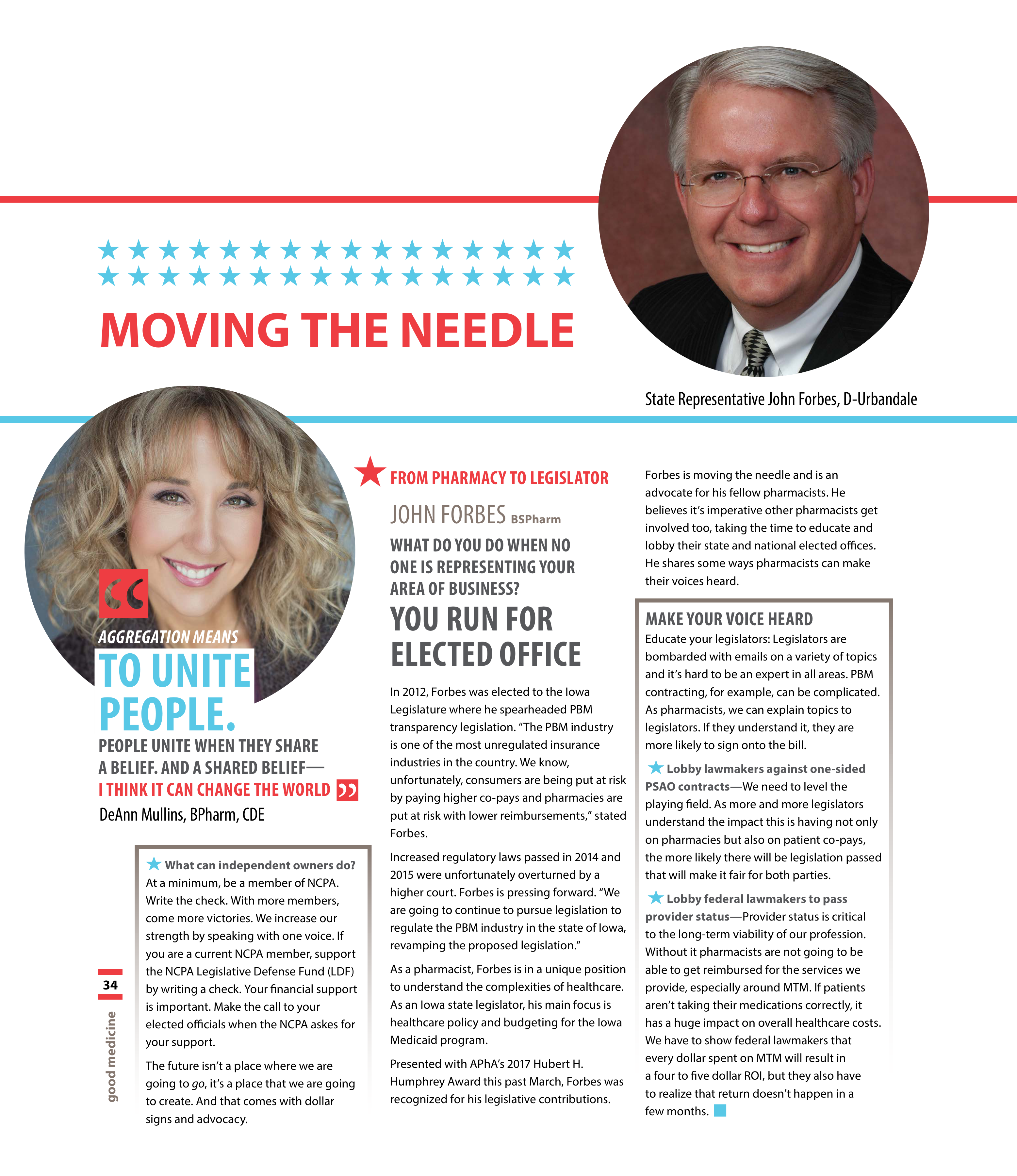
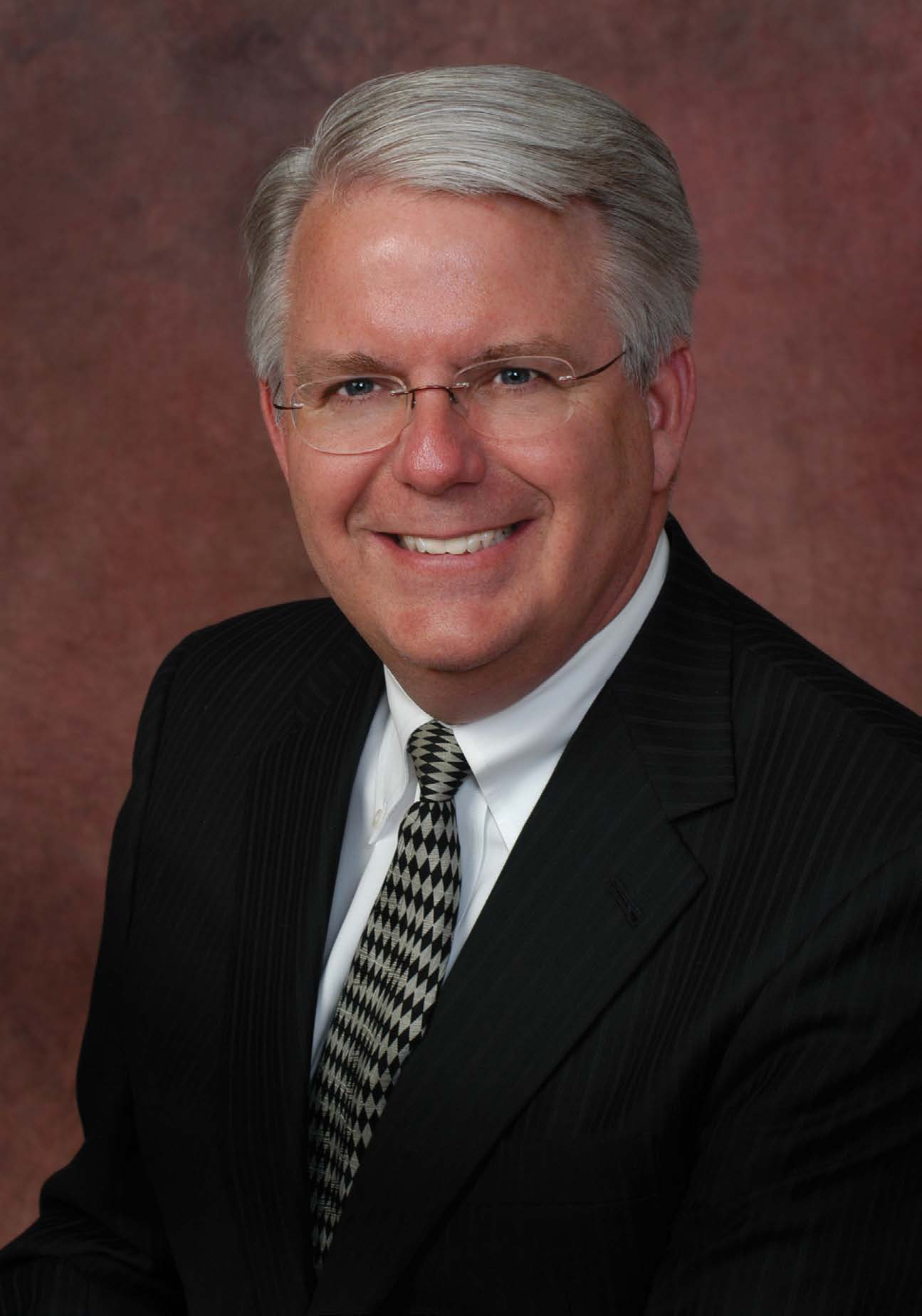
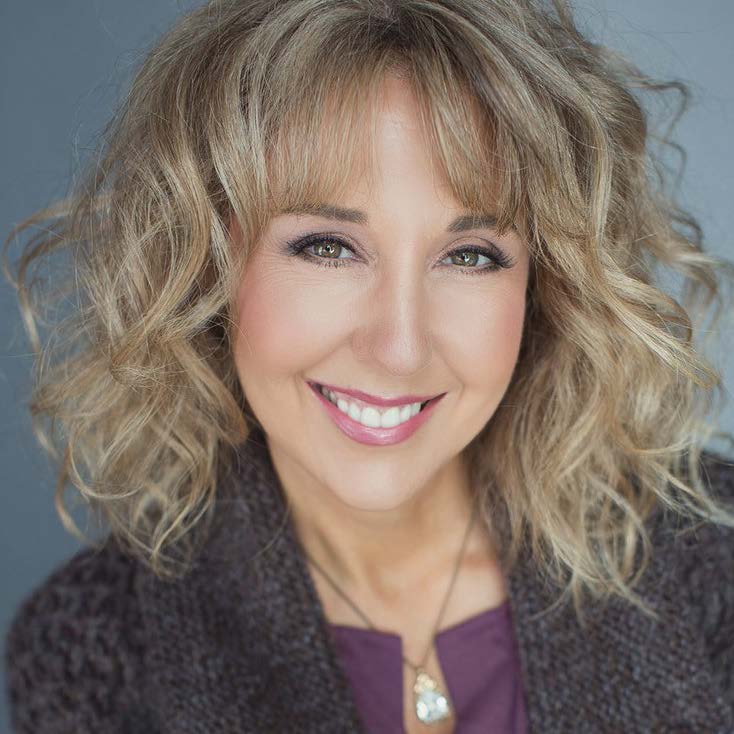
good medicine
34
MOVING THE NEEDLE
State Representative John Forbes, D-Urbandale
What can independent owners do?
At a minimum, be a member of NCPA.
Write the check. With more members,
come more victories. We increase our
strength by speaking with one voice. If
you are a current NCPA member, support
the NCPA Legislative Defense Fund (LDF)
by writing a check. Your financial support
is important. Make the call to your
elected officials when the NCPA askes for
your support.
The future isn’t a place where we are
going to
go
, it’s a place that we are going
to create. And that comes with dollar
signs and advocacy.
FROM PHARMACY TO LEGISLATOR
JOHN FORBES
BSPharm
WHAT DO YOU DO WHEN NO
ONE IS REPRESENTING YOUR
AREA OF BUSINESS?
YOU RUN FOR
ELECTED OFFICE
In 2012, Forbes was elected to the Iowa
Legislature where he spearheaded PBM
transparency legislation. “The PBM industry
is one of the most unregulated insurance
industries in the country. We know,
unfortunately, consumers are being put at risk
by paying higher co-pays and pharmacies are
put at risk with lower reimbursements,” stated
Forbes.
Increased regulatory laws passed in 2014 and
2015 were unfortunately overturned by a
higher court. Forbes is pressing forward. “We
are going to continue to pursue legislation to
regulate the PBM industry in the state of Iowa,
revamping the proposed legislation.”
As a pharmacist, Forbes is in a unique position
to understand the complexities of healthcare.
As an Iowa state legislator, his main focus is
healthcare policy and budgeting for the Iowa
Medicaid program.
Presented with APhA’s 2017 Hubert H.
Humphrey Award this past March, Forbes was
recognized for his legislative contributions.
Forbes is moving the needle and is an
advocate for his fellow pharmacists. He
believes it’s imperative other pharmacists get
involved too, taking the time to educate and
lobby their state and national elected offices.
He shares some ways pharmacists can make
their voices heard.
MAKE YOUR VOICE HEARD
Educate your legislators: Legislators are
bombarded with emails on a variety of topics
and it’s hard to be an expert in all areas. PBM
contracting, for example, can be complicated.
As pharmacists, we can explain topics to
legislators. If they understand it, they are
more likely to sign onto the bill.
Lobby lawmakers against one-sided
PSAO contracts—
We need to level the
playing field. As more and more legislators
understand the impact this is having not only
on pharmacies but also on patient co-pays,
the more likely there will be legislation passed
that will make it fair for both parties.
Lobby federal lawmakers to pass
provider status—
Provider status is critical
to the long-term viability of our profession.
Without it pharmacists are not going to be
able to get reimbursed for the services we
provide, especially around MTM. If patients
aren’t taking their medications correctly, it
has a huge impact on overall healthcare costs.
We have to show federal lawmakers that
every dollar spent on MTM will result in
a four to five dollar ROI, but they also have
to realize that return doesn’t happen in a
few months.
AGGREGATION MEANS
TO UNITE
PEOPLE.
PEOPLE UNITE WHEN THEY SHARE
A BELIEF. AND A SHARED BELIEF—
I THINK IT CAN CHANGE THE WORLD
DeAnn Mullins, BPharm, CDE
good medicine
35
C
Community
ADVANTAGE
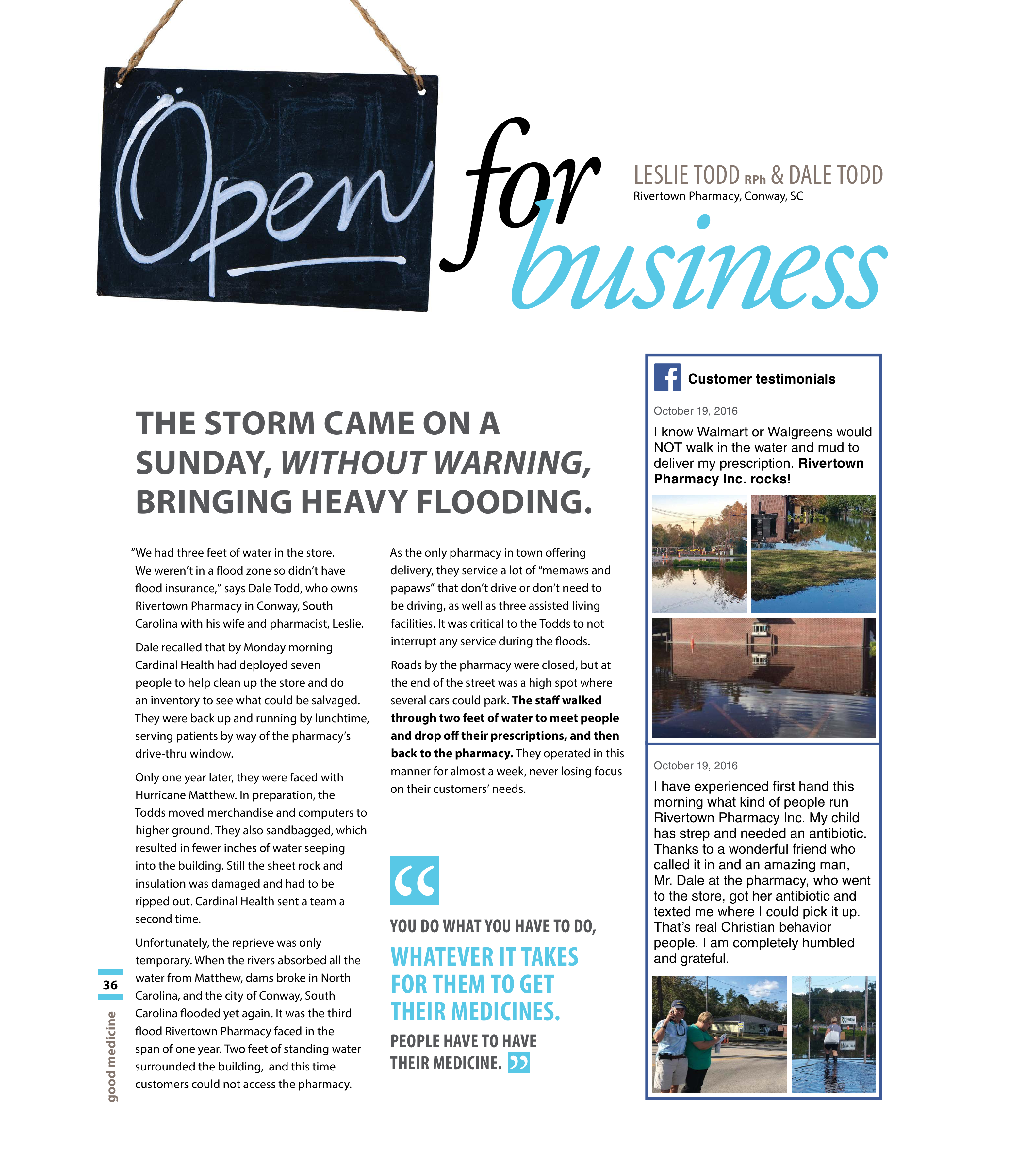
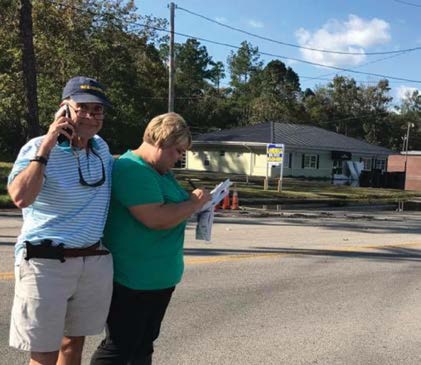





October 19, 2016
I have experienced first hand this
morning what kind of people run
Rivertown Pharmacy Inc. My child
has strep and needed an antibiotic.
Thanks to a wonderful friend who
called it in and an amazing man,
Mr. Dale at the pharmacy, who went
to the store, got her antibiotic and
texted me where I could pick it up.
That’s real Christian behavior
people. I am completely humbled
and grateful.
good medicine
36
LESLIE TODD
RPh
& DALE TODD
Rivertown Pharmacy, Conway, SC
“We had three feet of water in the store.
We weren’t in a flood zone so didn’t have
flood insurance,” says Dale Todd, who owns
Rivertown Pharmacy in Conway, South
Carolina with his wife and pharmacist, Leslie.
Dale recalled that by Monday morning
Cardinal Health had deployed seven
people to help clean up the store and do
an inventory to see what could be salvaged.
They were back up and running by lunchtime,
serving patients by way of the pharmacy’s
drive-thru window.
Only one year later, they were faced with
Hurricane Matthew. In preparation, the
Todds moved merchandise and computers to
higher ground. They also sandbagged, which
resulted in fewer inches of water seeping
into the building. Still the sheet rock and
insulation was damaged and had to be
ripped out. Cardinal Health sent a team a
second time.
Unfortunately, the reprieve was only
temporary.
When the rivers absorbed all the
water from Matthew, dams broke in North
Carolina, and the city of Conway, South
Carolina flooded yet again. It was the third
flood Rivertown Pharmacy faced in the
span of one year. Two feet of standing water
surrounded the building, and this time
customers could not access the pharmacy.
As the only pharmacy in town offering
delivery, they service a lot of “memaws and
papaws” that don’t drive or don’t need to
be driving, as well as three assisted living
facilities. It was critical to the Todds to not
interrupt any service during the floods.
Roads by the pharmacy were closed, but at
the end of the street was a high spot where
several cars could park.
The staff walked
through two feet of water to meet people
and drop off their prescriptions, and then
back to the pharmacy.
They operated in this
manner for almost a week, never losing focus
on their customers’ needs.
for
business
YOU DO WHAT YOU HAVE TO DO,
WHATEVER IT TAKES
FOR THEM TO GET
THEIR MEDICINES.
PEOPLE HAVE TO HAVE
THEIR MEDICINE.
THE STORM CAME ON A
SUNDAY,
WITHOUT WARNING,
BRINGING HEAVY FLOODING.
October 19, 2016
I know Walmart or Walgreens would
NOT walk in the water and mud to
deliver my prescription.
Rivertown
Pharmacy Inc. rocks!
Customer testimonials
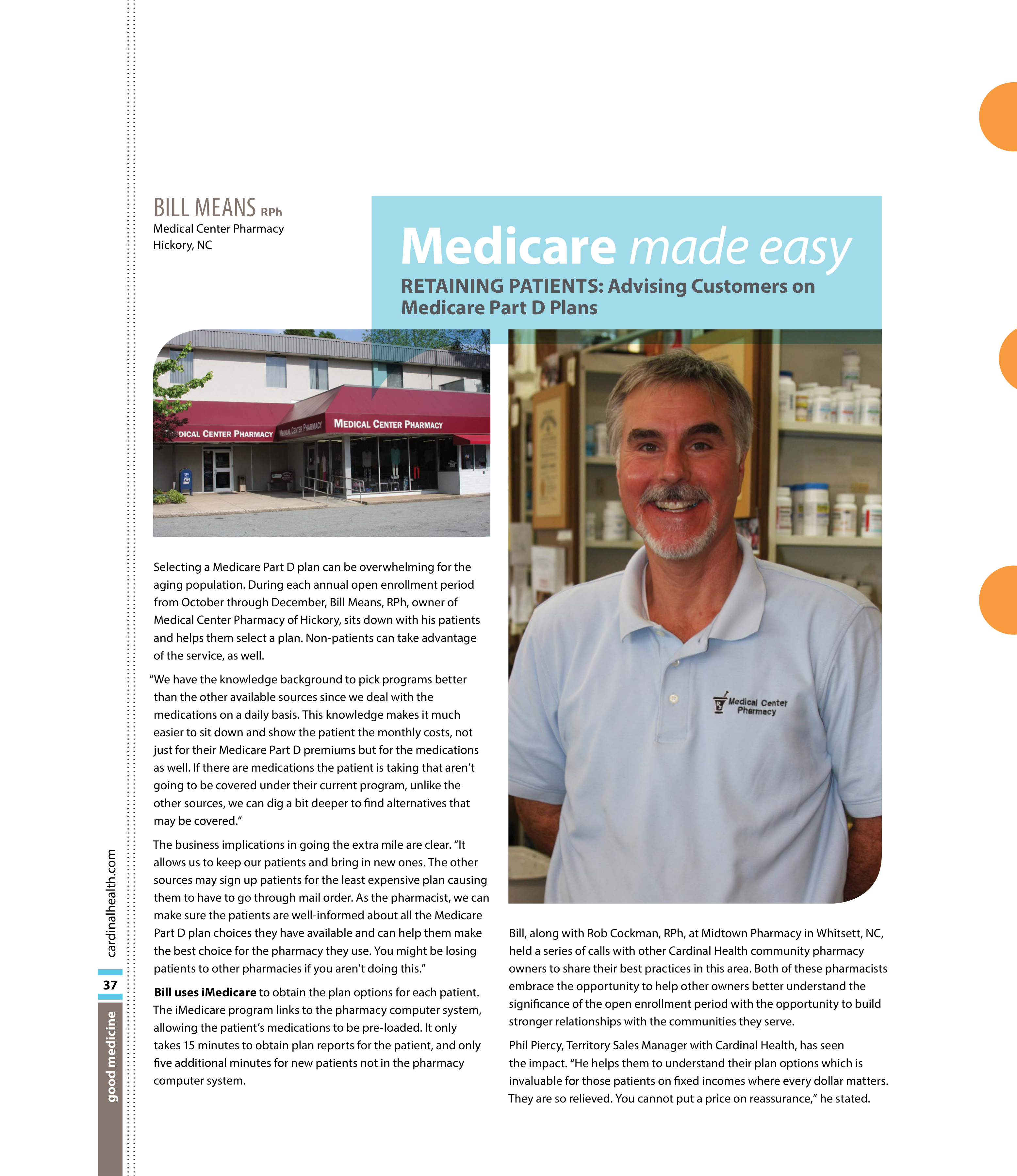
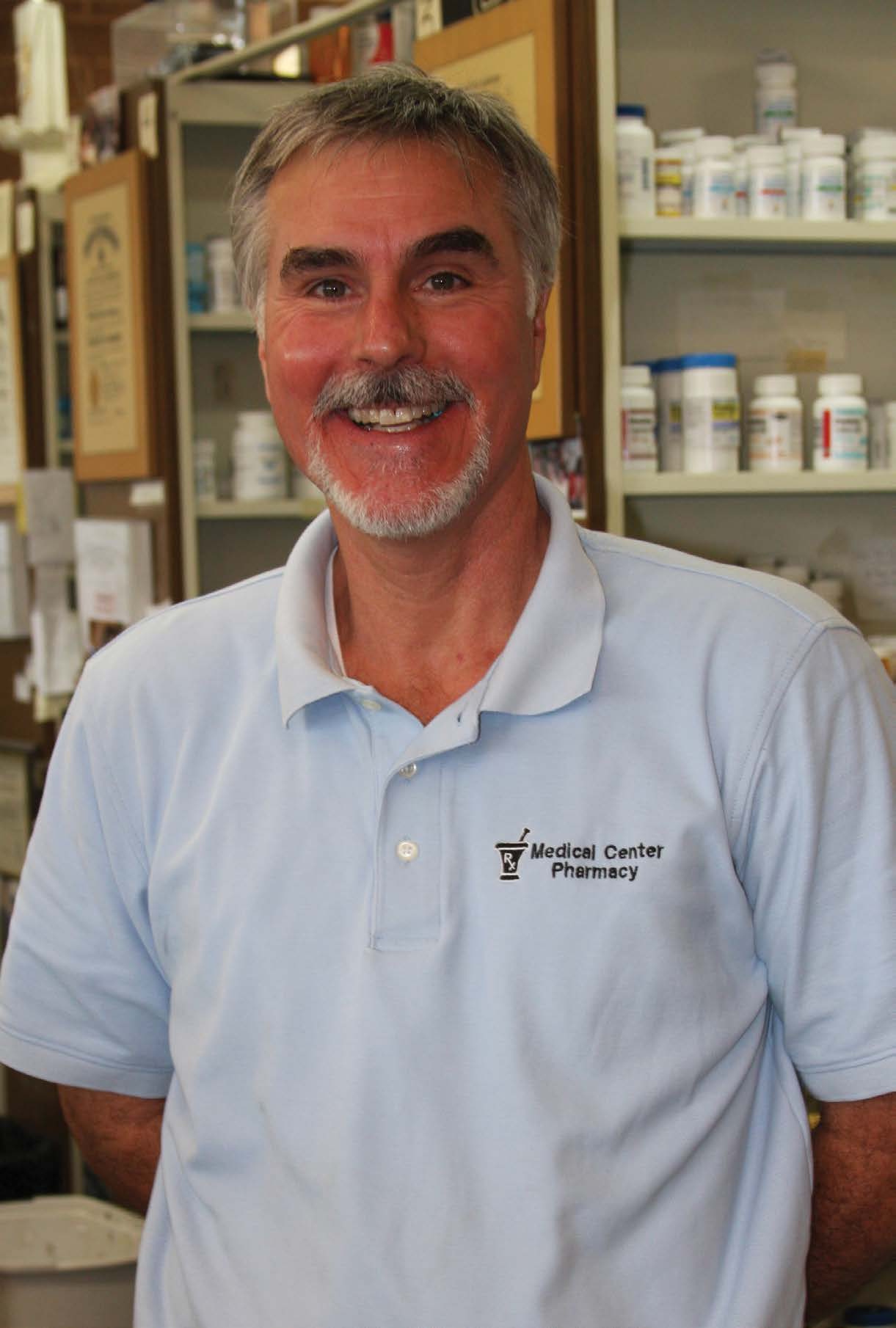
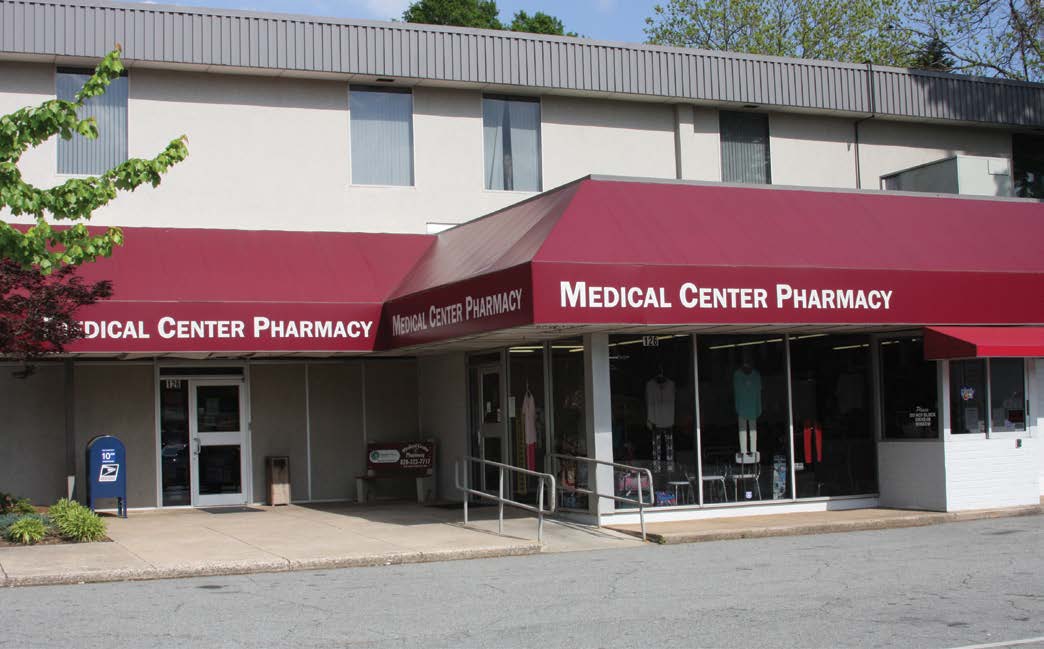
good medicine
37
cardinalhealth.com
Selecting a Medicare Part D plan can be overwhelming for the
aging population. During each annual open enrollment period
from October through December, Bill Means, RPh, owner of
Medical Center Pharmacy of Hickory, sits down with his patients
and helps them select a plan. Non-patients can take advantage
of the service, as well.
“We have the knowledge background to pick programs better
than the other available sources since we deal with the
medications on a daily basis. This knowledge makes it much
easier to sit down and show the patient the monthly costs, not
just for their Medicare Part D premiums but for the medications
as well. If there are medications the patient is taking that aren’t
going to be covered under their current program, unlike the
other sources, we can dig a bit deeper to find alternatives that
may be covered.”
The business implications in going the extra mile are clear. “It
allows us to keep our patients and bring in new ones. The other
sources may sign up patients for the least expensive plan causing
them to have to go through mail order. As the pharmacist, we can
make sure the patients are well-informed about all the Medicare
Part D plan choices they have available and can help them make
the best choice for the pharmacy they use. You might be losing
patients to other pharmacies if you aren’t doing this.”
Bill uses iMedicare
to obtain the plan options for each patient.
The iMedicare program links to the pharmacy computer system,
allowing the patient’s medications to be pre-loaded. It only
takes 15 minutes to obtain plan reports for the patient, and only
five additional minutes for new patients not in the pharmacy
computer system.
BILL MEANS
RPh
Medical Center Pharmacy
Hickory, NC
Bill, along with Rob Cockman, RPh, at Midtown Pharmacy in Whitsett, NC,
held a series of calls with other Cardinal Health community pharmacy
owners to share their best practices in this area. Both of these pharmacists
embrace the opportunity to help other owners better understand the
significance of the open enrollment period with the opportunity to build
stronger relationships with the communities they serve.
Phil Piercy, Territory Sales Manager with Cardinal Health, has seen
the impact. “He helps them to understand their plan options which is
invaluable for those patients on fixed incomes where every dollar matters.
They are so relieved. You cannot put a price on reassurance,” he stated.
Medicare
made easy
RETAINING PATIENTS: Advising Customers on
Medicare Part D Plans
good medicine
38
Pauline Vargo answered a
phone call in the spring of
2015 that would eventually
lead to her being affectionately
named
The Naloxone Lady.
Her community of Allentown,
Pennsylvania was facing a
heroin epidemic.
ACCORDING TO THE DRUG
ENFORCEMENT AGENCY (DEA),
IN 2015, THERE WERE AT LEAST
3,383
OVERDOSE
DEATHS
IN THE STATE, WITH ABOUT
NINE DEATHS PER DAY.
PAULINE VARGO
RPh
Medicap® Pharmacy No. 8360
Allentown, PA
In response to the crisis, Lehigh County was
conducting a blind survey, assessing whether
pharmacists in the county carried naloxone.
The caller was role-playing a mother whose
daughter was struggling with addiction.
Pauline’s pharmacy, Medicap® No. 8360, didn’t
carry it but she researched the possibility.
“It took some time to figure out how to get
it and I learned I had to order 2,000 nasal
adapters at a time, but it was possible.”
Pauline was the only pharmacist in Lehigh
who followed up with the caller. They asked
her to participate in educational outreach
efforts and paired her with an addiction
specialist physician and the Center for
Humanistic Change. Together, they educated
all the school nurses in Lehigh County, as
well as parole officers, prison guards and
sheriffs. Their presentations extended to the
community institutions that planned to have
naloxone on hand. At the height of the efforts,
Pauline was giving two presentations a week.
Initially, attendees who were interested in
obtaining naloxone after the presentation
had the opportunity to get in touch with the
pharmacy. However, Pauline soon realized
that many of these individuals were, “in it
higher than knee deep with a loved one.”
At the same time, in response to the ongoing
epidemic, Pennsylvania’s Physician General
signed a standing order for naloxone. The
order allows the state’s residents to obtain
naloxone without a prescription from their
doctor. With the standing order in effect,
Pauline created a naloxone request form to
accompany the event registration.
Attendees complete the form in advance,
providing their name, address, insurance
information and order of preference for
the three available forms of naloxone
(NARCAN nasal spray, EVZIO® Auto-injector,
or Naloxone Hydrochloride Injection).
Pauline fills the prescription type according
to insurance coverage, bills ahead of time
and distributes after the meeting. She says
it’s the same as delivering the prescription
to them but reduces the lag time that
previously existed.
“I know many patients who have gone into
a local pharmacy chain, and the staff looks
at them like a deer in a headlights. Once
someone has a bad experience they most
likely won’t seek it out again. My entire staff
is educated—they tell patients that we carry
all three forms and can educate them on how
and when to use it.”
Now a couple of years into the initiative,
the audience has changed. There are more
community groups, such as Partners for a
New Beginning, an organization of families
with a loved one affected by heroin.
But it’s essentially the same message.
WE ARE STILL IN A
CRISIS SITUATION.
IT’S AN EPIDEMIC.
IT HAS HELPED A LOT
OF PEOPLE,
at least put them at
ease, having the naloxone and knowing
what to do in a panic situation when
someone is overdosing.
Naloxone
Lady
the
good medicine
39
cardinalhealth.com
Like many community pharmacists across the country, Christofano is deeply committed to
educating his patients and others in his community about prescription medication misuse. “A
community-based pharmacist is the most accessible healthcare provider in a community,” he
says. “I think that comes with a responsibility for trying to improve the health of the community.”
He is particularly focused on the dangers of misusing opioids, a significant problem in his own
Westmoreland County. (According to overdosefreepa.pitt.edu, there were 174 overdose-related
deaths in Westmoreland County last year alone—up from 61 deaths in 2011.) It’s an epidemic
that impacts people equally regardless of age or socioeconomic status, Christofano says.
“I believe that we have to be proactive in the fight against
prescription drug abuse,” he says. “When we educate
people, we can be preventative, and start to get out in
front of the epidemic.”
Christofano’s leadership on this issue has garnered a string of honors: The Pennsylvania
Pharmacists Association gave him the Commonwealth of Pennsylvania Pharmacist of the Year
Award in 2015 and the Pennsylvania’s Generation Rx Champions Award in 2016. He also received
the 2016 Ken Wurster Community Leadership Award from Cardinal Health, and was named the
2016 Ohio State University College of Pharmacy Distinguished Alumni.
STARTING THE CONVERSATION
Building from the educational resources available from
Generation Rx
(see following pages),
Christofano created an interactive presentation about medication safety and opioid abuse that
he customizes depending on the age of his audience.
When he first started this work several years ago, finding people willing to hear about the
problem of prescription drug misuse was a challenge, he says. “I started with high schools—
I reached out to school boards, to school superintendents, to school teachers, to school nurses.
I just wanted to have the conversation about the epidemic. Sometimes people were resistant,
but once they learned some of the statistics, they wanted to learn more, and wanted to be sure
their students and the parents heard the message, too.”
Christofano has now presented his education program in all of the school districts in
Westmoreland County.
He’s also extended his partnerships far beyond schools, and speaks regularly with audiences in
community centers, churches and shopping malls. In the first few months of this year, he held
15 community training and education sessions. “Public officials, including Westmoreland County
Commissions, the District Attorney and county coroners have all attended and participated in
our question-answer sessions,” he says.
Christofano also serves on the Westmoreland County Drug and Alcohol Commission and the
Council for Substance Abuse and Youth board. “These organizations are doing great work in
fighting prescription drug abuse, and I’m proud to partner with them. They also help connect
me with lots of new audiences.”
ED CHRISTOFANO
RPh
Hayden’s Pharmacy
Western PA
AMERICA’S
BIGGEST
DRUG ABUSE
PROBLEM IS
NOT ON THE
STREETS.
IT’S IN OUR
MEDICINE
CABINETS.
prescription drug misuse
A COMMUNITY PHARMACIST’S
fight against
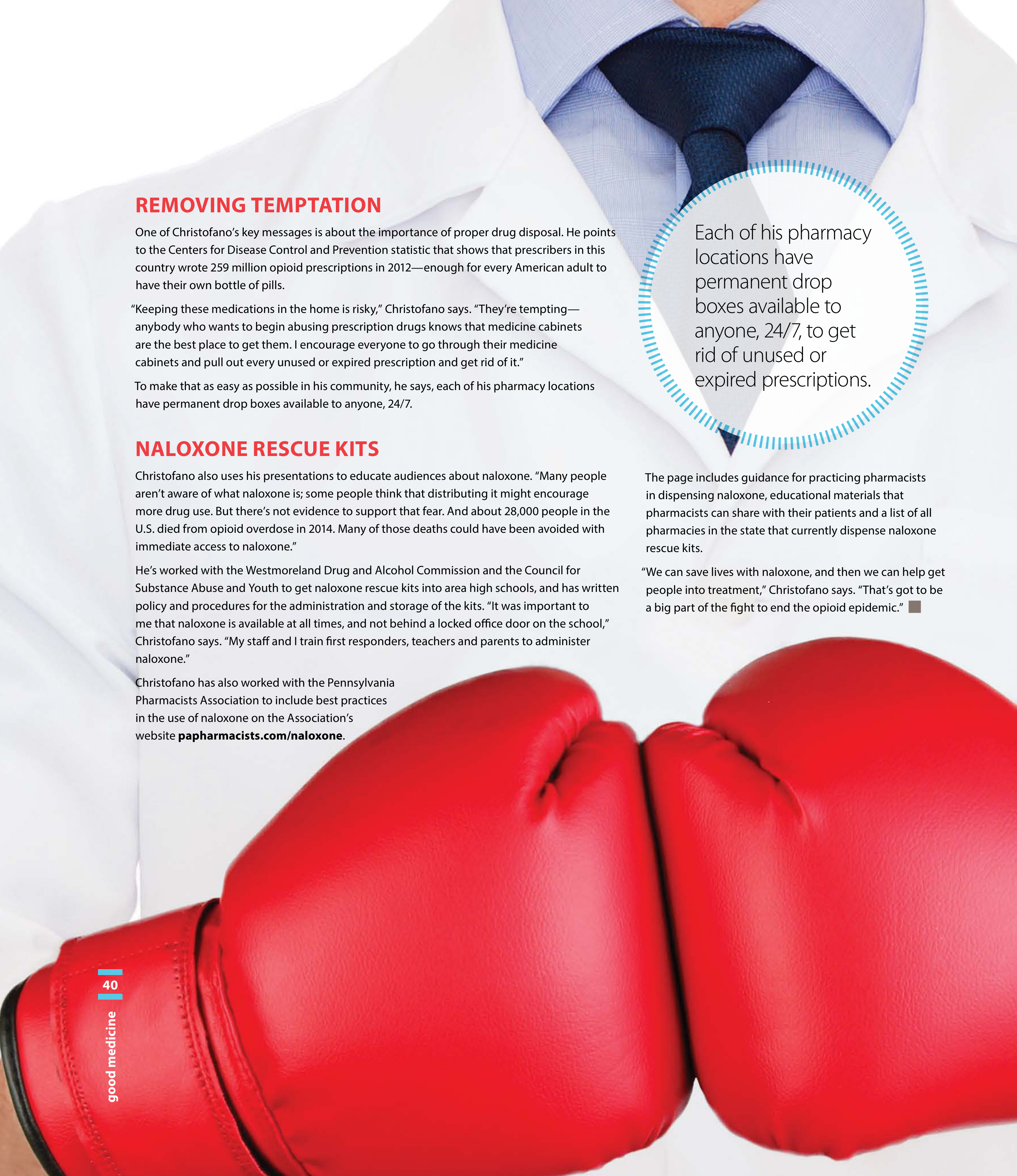

good medicine
40
REMOVING TEMPTATION
One of Christofano’s key messages is about the importance of proper drug disposal. He points
to the Centers for Disease Control and Prevention statistic that shows that prescribers in this
country wrote 259 million opioid prescriptions in 2012—enough for every American adult to
have their own bottle of pills.
“Keeping these medications in the home is risky,” Christofano says. “They’re tempting—
anybody who wants to begin abusing prescription drugs knows that medicine cabinets
are the best place to get them. I encourage everyone to go through their medicine
cabinets and pull out every unused or expired prescription and get rid of it.”
To make that as easy as possible in his community, he says, each of his pharmacy locations
have permanent drop boxes available to anyone, 24/7.
NALOXONE RESCUE KITS
Christofano also uses his presentations to educate audiences about naloxone. “Many people
aren’t aware of what naloxone is; some people think that distributing it might encourage
more drug use. But there’s not evidence to support that fear. And about 28,000 people in the
U.S. died from opioid overdose in 2014. Many of those deaths could have been avoided with
immediate access to naloxone.”
He’s worked with the Westmoreland Drug and Alcohol Commission and the Council for
Substance Abuse and Youth to get naloxone rescue kits into area high schools, and has written
policy and procedures for the administration and storage of the kits. “It was important to
me that naloxone is available at all times, and not behind a locked office door on the school,”
Christofano says. “My staff and I train first responders, teachers and parents to administer
naloxone.”
Christofano has also worked with the Pennsylvania
Pharmacists Association to include best practices
in the use of naloxone on the Association’s
website
papharmacists.com/naloxone
.
The page includes guidance for practicing pharmacists
in dispensing naloxone, educational materials that
pharmacists can share with their patients and a list of all
pharmacies in the state that currently dispense naloxone
rescue kits.
“We can save lives with naloxone, and then we can help get
people into treatment,” Christofano says. “That’s got to be
a big part of the fight to end the opioid epidemic.”
Each of his pharmacy
locations have
permanent drop
boxes available to
anyone, 24/7, to get
rid of unused or
expired prescriptions.
good medicine
41
cardinalhealth.com
Prevention education:
Generation Rx offers a suite of age-appropriate
resources to educate everyone—from elementary school students to
seniors—about prescription drug misuse, and to encourage action in
communities across the county. Generation Rx has three simple,
effective messages:
•
Take medications exactly as prescribed, and don’t share your
medication with others.
•
Store prescriptions securely, and dispose of medications properly.
•
Teach others about using medications safely.
Consistently, 94 percent of youth who participate in Generation Rx
sessions report that they “would not share my prescription drugs with
others,” and 96 percent of adults say they “won’t use prescription drugs
that are not prescribed for me.”
Pharmacists are among our most effective allies in carrying the
Generation Rx message. Each year, we join with 40 state pharmacy
associations to honor Generation Rx Champions—pharmacists
who demonstrate outstanding commitment to raising awareness
of the issue. In addition, more than 90 pharmacy schools have
Generation Rx programs.
Drug take-back:
Nearly 70 percent of those who misuse prescription
drugs get them from family members or friends, and often from the
medicine cabinet, according to the National Survey on Drug Use and
Health. Properly disposing of unneeded or expired medications is one
of the simplest ways everyone can help prevent misuse.
Our Generation Rx Medication Disposal Grants support nonprofit
organizations across the country as they build or expand medication
Fighting
Prescription
Drug Misuse
Through Generation Rx, the Cardinal Health Foundation, in partnership
with The Ohio State University College of Pharmacy and many others at the
local, state and national level, is engaged in the fight against prescription
drug misuse. Generation Rx takes a multi-pronged approach, providing
prevention education, increasing participation in drug take back programs,
supporting community collaborations and encouraging prescribers to limit
opioid prescriptions.
disposal programs in their communities. Grantees are bringing pharmacists and
youth to the table as they raise awareness and create new partnerships.
Funded organizations will report various outcomes of their work, including the
total pounds of medications collected and the number of pharmacists, student
pharmacists and youth involved in the program.
Community collaborations:
Generation Rx supports a variety of community
work. We know that ending prescription drug misuse and eliminating the
opioid epidemic requires the medical community, service providers, educators,
government, law enforcement and treatment professionals to work on these
issues together.
We have a long history of supporting community-based organizations, many of
them in communities where Cardinal Health has a presence. We support youth-
led prevention programs, public awareness campaigns and bringing medication
safety education into schools. We are currently elevating our work in schools
through a new pilot project in Ohio called Collaborate. This program will match
teachers with pharmacists who want to help educate students in kindergarten
through 12th grade about the dangers of prescription drug misuse.
Limiting opioid prescriptions:
As many as one in four people who receive
prescription opioids long term for non-cancer pain become addicted to them.
The Generation Rx Best Practices in Pain Medication Use & Patient Engagement
Grants support the work of healthcare organizations as they engage patients
and healthcare providers in reducing the number of opioids prescribed for pain
management. Early pioneers in this work have shown that reducing opioid
prescriptions leads to a decreased reliance on them, better quality of care,
better patient outcomes and overall decreased cost of care.
Generation Rx grantees will report outcomes in terms of morphine equivalents,
pain management and patient satisfaction.
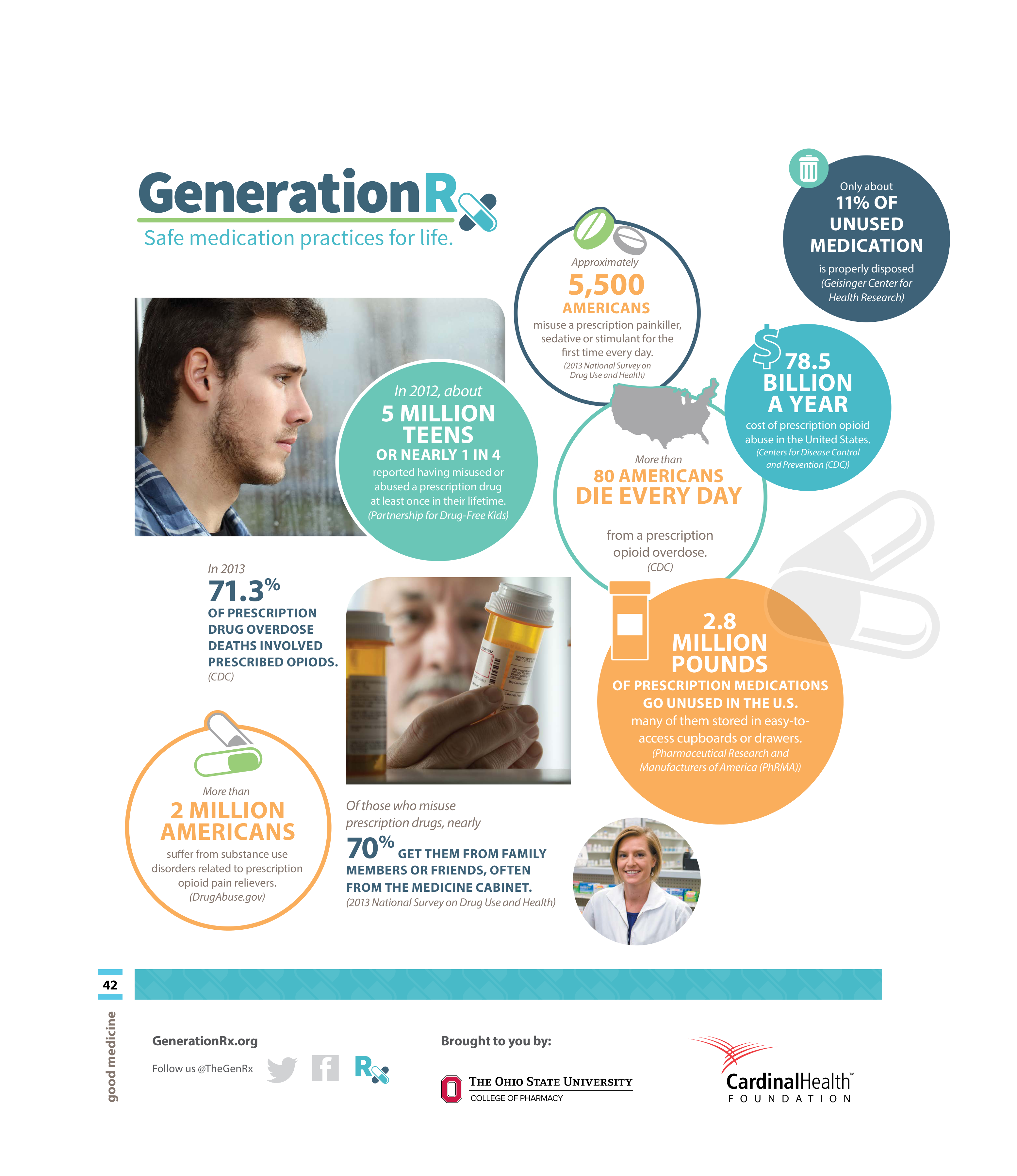
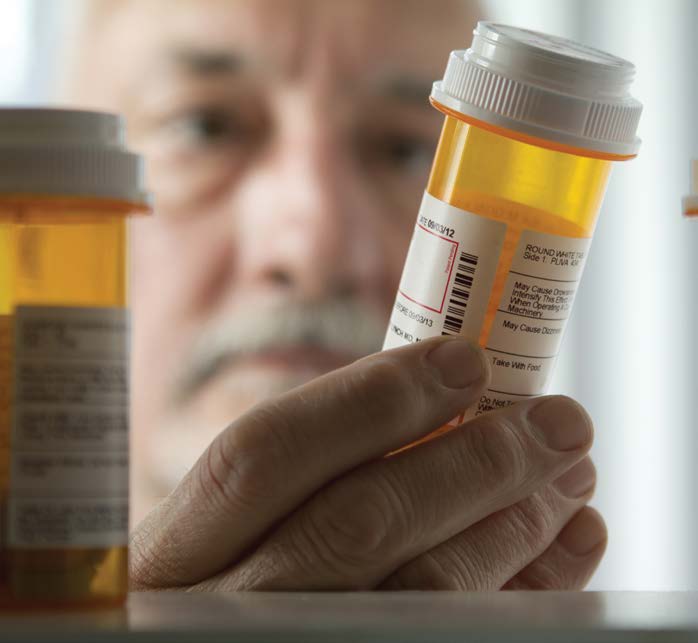
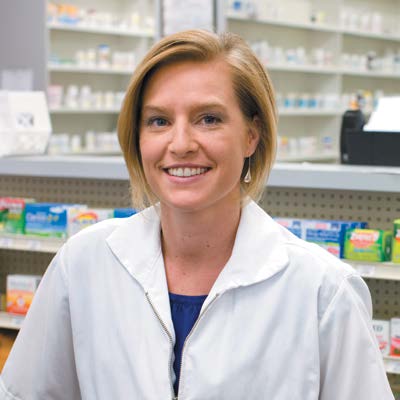

good medicine
42
Safe medication practices for life.
Brought to you by:
Follow us @TheGenRx
GenerationRx.org
5,500
AMERICANS
Approximately
misuse a prescription painkiller,
sedative or stimulant for the
first time every day.
(2013 National Survey on
Drug Use and Health)
reported having misused or
abused a prescription drug
at least once in their lifetime.
(Partnership for Drug-Free Kids)
5 MILLION
TEENS
In 2012, about
OR NEARLY 1 IN 4
2 MILLION
AMERICANS
More than
suffer from substance use
disorders related to prescription
opioid pain relievers.
(DrugAbuse.gov)
71.3
%
OF PRESCRIPTION
DRUG OVERDOSE
DEATHS INVOLVED
PRESCRIBED OPIODS.
(CDC)
In 2013
80 AMERICANS
DIE EVERY DAY
from a prescription
opioid overdose.
(CDC)
More than
cost of prescription opioid
abuse in the United States.
(Centers for Disease Control
and Prevention (CDC))
78.5
BILLION
A YEAR
70
%
GET THEM FROM FAMILY
MEMBERS OR FRIENDS, OFTEN
FROM THE MEDICINE CABINET.
(2013 National Survey on Drug Use and Health)
Of those who misuse
prescription drugs, nearly
OF PRESCRIPTION MEDICATIONS
GO UNUSED IN THE U.S.
many of them stored in easy-to-
access cupboards or drawers.
(Pharmaceutical Research and
Manufacturers of America (PhRMA))
2.8
MILLION
POUNDS
is properly disposed
(Geisinger Center for
Health Research)
11% OF
UNUSED
MEDICATION
Only about
good medicine
43
cardinalhealth.com
E3 GRANTS make healthcare as effective and efficient as possible
E3 Grants support work to increase the effectiveness, efficiency and excellence of healthcare. Since 2008, the
Cardinal Health Foundation has invested more than $8 million in this program, providing grants to hundreds
of hospitals, health systems and other health-related organizations. These grants support work designed to
achieve two goals:
•
Improve patient outcomes and
•
Reduce healthcare costs
According The National Institutes of Health, it takes an average of 17 years for evidence-based practices to be
fully implemented into healthcare practices. Yet within a year or two, many of the E3 grantees are affecting
change, reducing readmissions to hospitals, reducing lengths-of-stay and, most importantly, saving lives.
Learn more at cardinalhealth.com/patient safety
The Cardinal Health Foundation E3 Grant program supports healthcare
organizations as they work to improve medication safety for high-risk
patients through care transitions. Grantees often partner with community
pharmacists, who educate patients, engage them in self-care and help
them avoid re-hospitalizations. Here we highlight some of their successes.
“For most patients, community pharmacists are the most accessible and trusted of their healthcare
providers,” says Toni Fera, PharmD, an independent healthcare consultant. “That gives community
pharmacists a particularly important role in supporting high-risk patients post-discharge, when
medication-related problems are common.”
Supporting patients through care transitions takes time and multiple contacts, she says. “Every
visit to the pharmacy provides an opportunity to educate and engage the patient. It’s an ongoing,
participatory process—a matter of the pharmacist taking a long journey with the patient.”
Through the Alliance for Integrated Medication Management (AIMM), Fera is coaching a group of E3
Grantees in a multi-year learning collaborative designed to help them achieve scalable, sustainable
improvements in medication safety. In the case studies that follow, several pharmacists engaged in
the collaborative share their insights.
COMMUNITY PHARMACISTS
The key to reducing
hospital readmissions
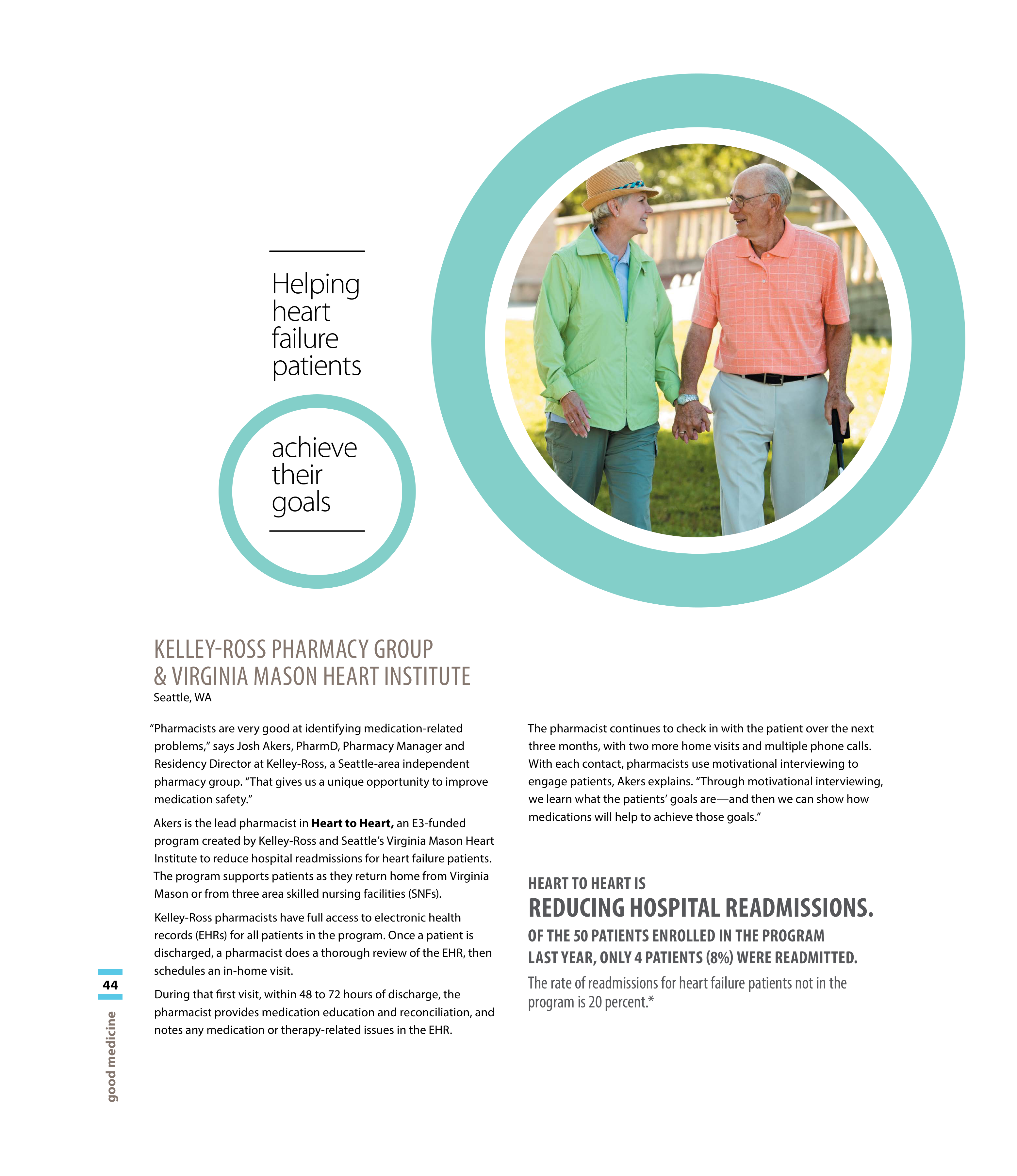

good medicine
44
KELLEY-ROSS PHARMACY GROUP
& VIRGINIA MASON HEART INSTITUTE
Seattle, WA
“Pharmacists are very good at identifying medication-related
problems,” says Josh Akers, PharmD, Pharmacy Manager and
Residency Director at Kelley-Ross, a Seattle-area independent
pharmacy group. “That gives us a unique opportunity to improve
medication safety.”
Akers is the lead pharmacist in
Heart to Heart,
an E3-funded
program created by Kelley-Ross and Seattle’s Virginia Mason Heart
Institute to reduce hospital readmissions for heart failure patients.
The program supports patients as they return home from Virginia
Mason or from three area skilled nursing facilities (SNFs).
Kelley-Ross pharmacists have full access to electronic health
records (EHRs) for all patients in the program. Once a patient is
discharged, a pharmacist does a thorough review of the EHR, then
schedules an in-home visit.
During that first visit, within 48 to 72 hours of discharge, the
pharmacist provides medication education and reconciliation, and
notes any medication or therapy-related issues in the EHR.
The pharmacist continues to check in with the patient over the next
three months, with two more home visits and multiple phone calls.
With each contact, pharmacists use motivational interviewing to
engage patients, Akers explains. “Through motivational interviewing,
we learn what the patients’ goals are—and then we can show how
medications will help to achieve those goals.”
OF THE 50 PATIENTS ENROLLED IN THE PROGRAM
LAST YEAR, ONLY 4 PATIENTS (8%) WERE READMITTED.
The rate of readmissions for heart failure patients not in the
program is 20 percent.*
HEART TO HEART IS
REDUCING HOSPITAL READMISSIONS.
Helping
heart
failure
patients
achieve
their
goals
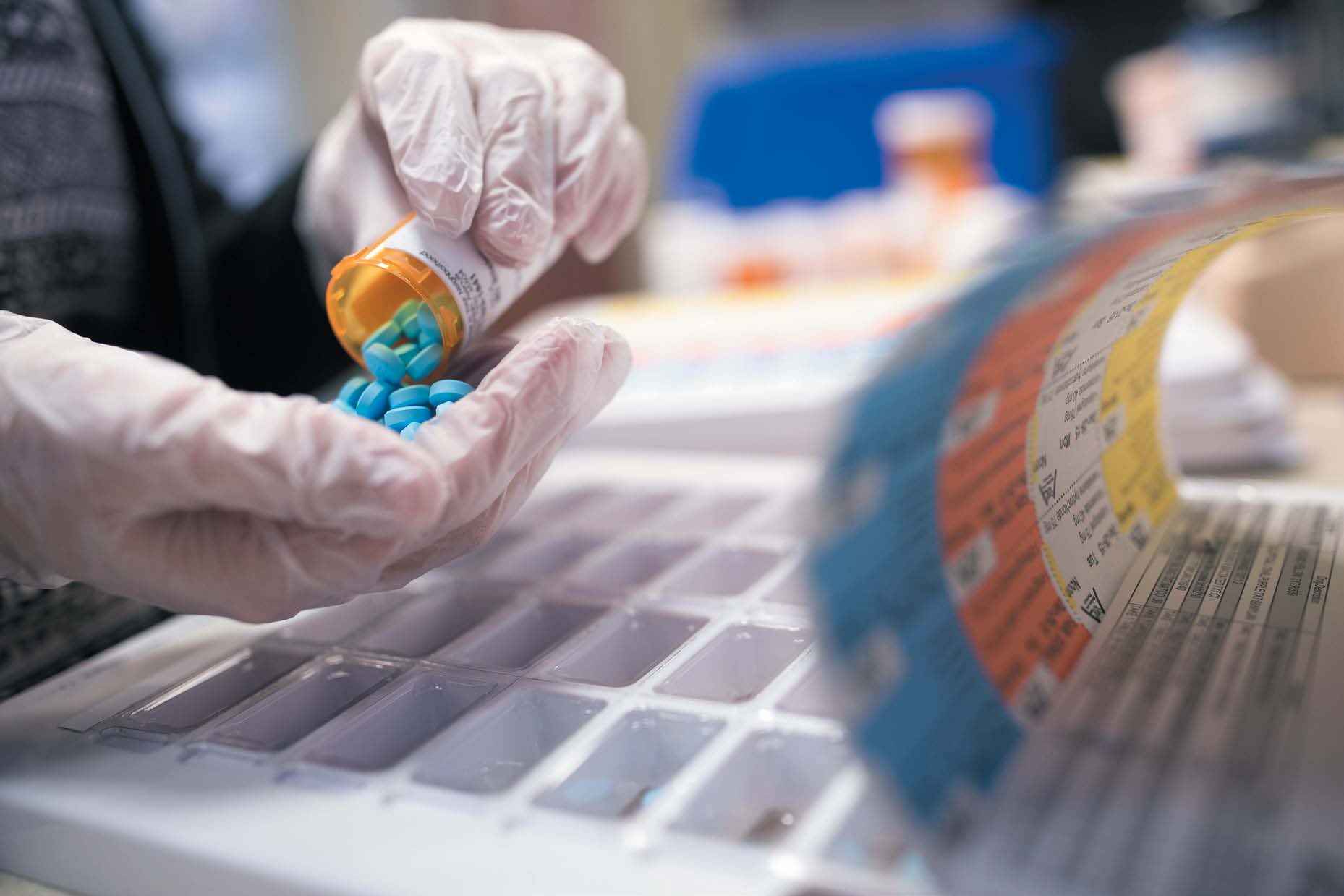
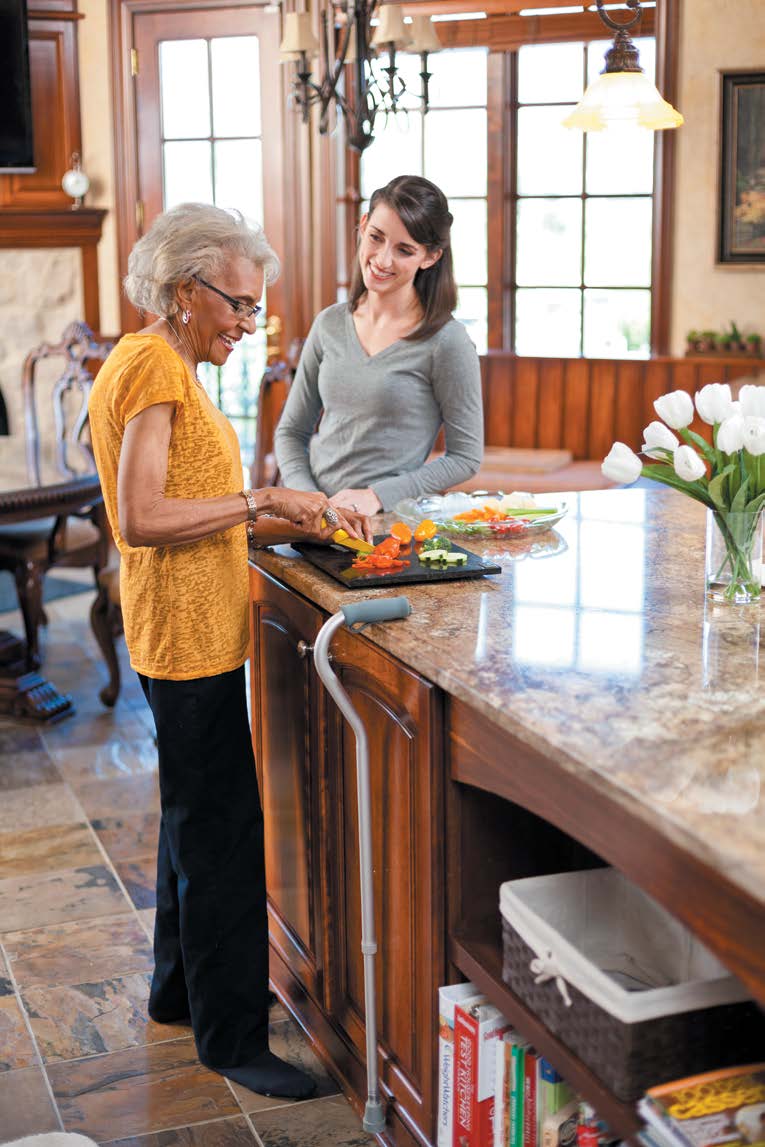
good medicine
45
cardinalhealth.com
SENIOR SERVICES OF SOUTHEASTERN VIRGINIA (SSSEVA)
& HAMPTON UNIVERSITY SCHOOL OF PHARMACY
Norfolk, VA
“Going into the home takes medication therapy management to the next level,”
says Ebony Andrews, PharmD, RPh, and Chair of the Department of Pharmacy
Practice at Hampton University School of Pharmacy. Each semester, she
supervises fourth-year pharmacy students as they make home-visits to post-
acute patients through SSSEVA’s Hampton Roads Care Transitions Program.
In this program, after the student does a thorough medication review with
Andrews or another faculty pharmacist, he or she visits the patient at home with
a SSSEVA transitions coach; the supervising pharmacist participates virtually
through a HIPAA-compliant telehealth system. The student talks with the patient
about new medications, encourages the disposal of old medications, and looks
for fall risks and other barriers to safety. Within a week or two, the student checks
in with the patient again with a follow-up phone call.
What’s more, the program is giving students an experience that’s
likely to impact the way they practice pharmacy, Andrews says.
“When students see patients in their homes, they see the whole
patient. Suddenly, the importance of the pharmacist’s work comes
together in a new, much more powerful way.”
NOW IN ITS THIRD YEAR, THE PROGRAM SERVES ABOUT
350 SENIORS A YEAR. THE 30-DAY READMISSION RATE IS
9–10 PERCENT,
compared to the baseline rate of 19.6 percent
for patients with similar diagnoses not in the program.*
THE COMMUNITY HEALTH CENTER
OF BLACK HILLS (CHCBH)
Rapid City, SD
“All of our patients face many barriers to medication adherence,”
says David Farber, PharmD, Director of Pharmacy at CHCBH, a
federally qualified health center. “They lack financial resources and
transportation, some have family issues, some are homeless. I can’t fix
everything, but I can help them better manage their health.”
Farber works with regional hospitals to identify soon-to-be discharged
patients to engage in its E3-funded project,
Improving Patient
Safety through Medication Adherence.
Eligible patients are the
uninsured or underinsured with multiple chronic diseases; about
20 patients are currently enrolled.
A medication synchronization program allows them to pick up
all prescriptions on a single day each month. Patients who have
particularly complicated medication regimens benefit from a service
that packages exact dosages in color-coded calendar cards labeled
with the time of day medications should be taken.
THE PROGRAM IS DESIGNED TO MAKE IT
AS EASY AS POSSIBLE
FOR THE PATIENTS TO
GET & TAKE THEIR MEDICATIONS.
“When a patient comes in to get prescriptions each month,” Farber says,
“I go over each medication, explaining what it’s for and any potential
side effects. I don’t rush anyone, and the patients know they can stop
back in anytime we’re open.”
Simply being available to the patients helps him improve medication
safety, Farber says. “Our monthly conversations take some time, but
they let me get to know the patients, what their needs are and what
might keep them from taking their medications as they’re prescribed.”
Supporting
seniors
at home
Breaking
down
barriers
to
medication
adherence
*The decreased rates highlighted in this article are estimates that were prepared separately
by Virginia Mason Heart Institute and Senior Services of Southeastern Virginia.
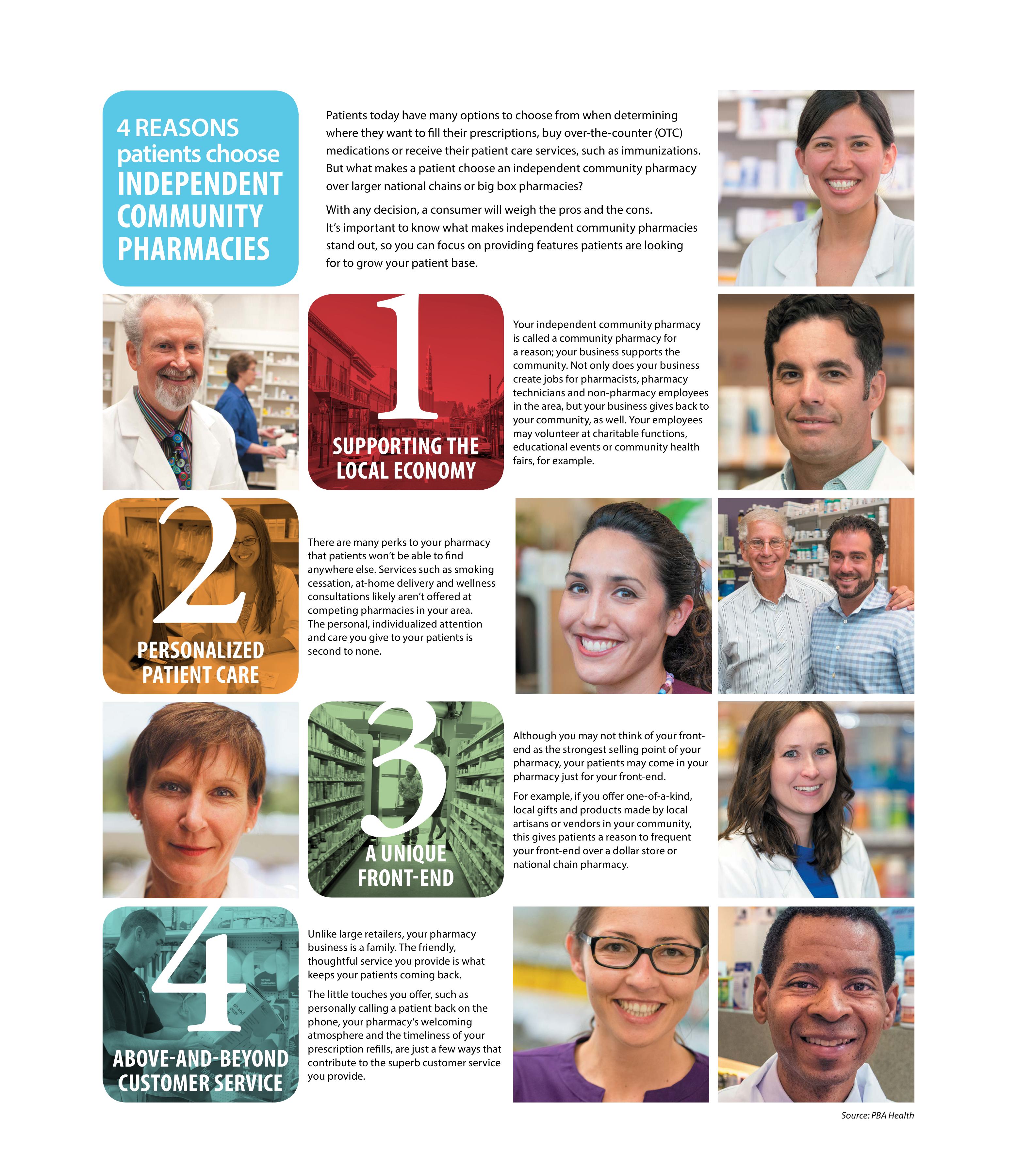

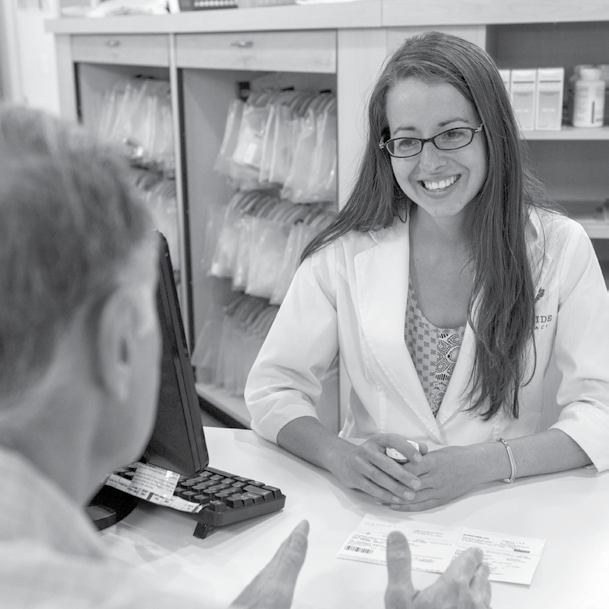

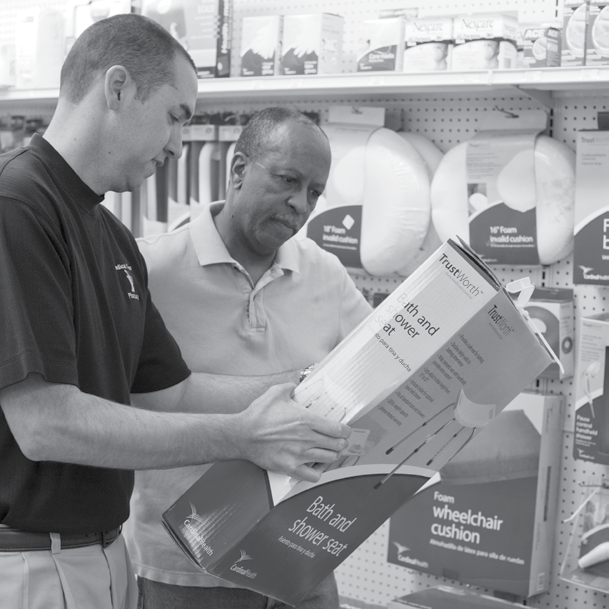
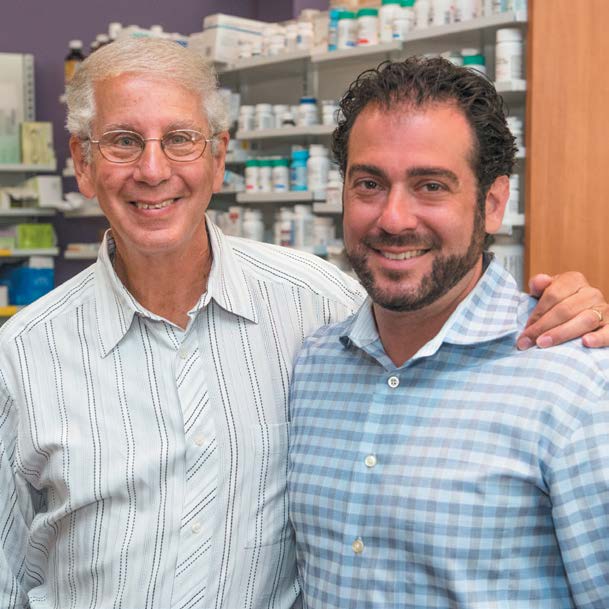
There are many perks to your pharmacy
that patients won’t be able to find
anywhere else. Services such as smoking
cessation, at-home delivery and wellness
consultations likely aren’t offered at
competing pharmacies in your area.
The personal, individualized attention
and care you give to your patients is
second to none.
PERSONALIZED
PATIENT CARE
2
ABOVE-AND-BEYOND
CUSTOMER SERVICE
4
Your independent community pharmacy
is called a community pharmacy for
a reason; your business supports the
community. Not only does your business
create jobs for pharmacists, pharmacy
technicians and non-pharmacy employees
in the area, but your business gives back to
your community, as well. Your employees
may volunteer at charitable functions,
educational events or community health
fairs, for example.
Source: PBA Health
Patients today have many options to choose from when determining
where they want to fill their prescriptions, buy over-the-counter (OTC)
medications or receive their patient care services, such as immunizations.
But what makes a patient choose an independent community pharmacy
over larger national chains or big box pharmacies?
With any decision, a consumer will weigh the pros and the cons.
It’s important to know what makes independent community pharmacies
stand out, so you can focus on providing features patients are looking
for to grow your patient base.
1
SUPPORTING THE
LOCAL ECONOMY
Although you may not think of your front-
end as the strongest selling point of your
pharmacy, your patients may come in your
pharmacy just for your front-end.
For example, if you offer one-of-a-kind,
local gifts and products made by local
artisans or vendors in your community,
this gives patients a reason to frequent
your front-end over a dollar store or
national chain pharmacy.
3
A UNIQUE
FRONT-END
Unlike large retailers, your pharmacy
business is a family. The friendly,
thoughtful service you provide is what
keeps your patients coming back.
The little touches you offer, such as
personally calling a patient back on the
phone, your pharmacy’s welcoming
atmosphere and the timeliness of your
prescription refills, are just a few ways that
contribute to the superb customer service
you provide.
4 REASONS
patients choose
INDEPENDENT
COMMUNITY
PHARMACIES
cardinalhealth.com
© 2017 Cardinal Health. All Rights Reserved. CARDINAL HEALTH, the Cardinal Health LOGO, ESSENTIAL TO CARE, DISPILL, EQUIPP, LEADER, MEDICAP,
MEDICINE SHOPPE, and MEDSYNC are trademarks of Cardinal Health and may be registered in the US and/or in other countries. All other marks are
the property of their respective owners. Lit. No. 1RBC7-639458 (06/2017)
good medicine
Celebrating Community Pharmacy 2017
The information provided in “good medicine” (the “Magazine) is for information purposes and serves to further enhance the goals of Retail Independent
Pharmacy. Cardinal Health uses reasonable care in preparing the Magazine. However, Cardinal Health does not guarantee the accuracy or completeness
of the materials, and makes no representations about the suitability of the information and services for any particular purpose. The content provided in
this Magazine is not intended as a substitute for professional advice. You should consult with professional advisors familiar with your particular factual
situation for advice concerning legal, tax and accounting matters and rules and regulations governing the practice of pharmacy.