ReflectiveRAG: Rethinking Adaptivity in Retrieval-Augmented Generation
Akshay Verma
Amazon
Swapnil Gupta
Amazon
Siddharth Pillai
Amazon
Prateek Sircar
Amazon
Deepak Gupta
Amazon
Abstract
Retrieval-Augmented Generation (RAG) sys-
tems
degrade
sharply
under
extreme
noise,
where
irrelevant
or
redundant
passages
dom-
inate.
Current
methods-fixed
top-k
re-
trieval,
cross-encoder
reranking,
or
policy-
based
iteration-depend
on
static
heuristics
or
costly reinforcement learning, failing to assess
evidence sufficiency, detect subtle mismatches,
or reduce redundancy, leading to hallucinations
and
poor
grounding.
We
introduce
Reflec-
tiveRAG
,
a
lightweight
yet
reasoning-driven
architecture
that
enhances
factual
grounding
through two complementary mechanisms:
Self-
Reflective
Retrieval
(SRR)
and
Contrastive
Noise
Removal
(NR)
.
SRR
employs
a
small
language
model
as
a
decision
controller
that
iteratively
evaluates
evidence
sufficiency,
en-
abling
adaptive
query
reformulation
without
fixed
schedules
or
policy
training.
NR
fur-
ther
refines
retrieved
content
via
embedding-
based contrastive filtering, enforcing semantic
sparsity and removing redundant or tangential
passages.
Evaluated on
WebQuestions
,
Hot-
potQA (distractor setting)
and
InternalQA
with
50M Common Crawl distractors
, Reflec-
tiveRAG achieves substantial gains over strong
baselines-including DeepRAG-improving EM
by
+2.7 pp
and F1 by
+2.5 pp
, while reducing
evidence redundancy by
30.88%
with only
18
ms
additional
latency.
Ablation
studies
con-
firm that SRR and NR jointly drive both factual
accuracy and efficiency, validating our central
claim that
retrieval reasoning and contrastive
filtering can outperform large-scale policy op-
timization in RAG
.
1
Introduction
Retrieval-Augmented
Generation
(RAG)
has
be-
come a dominant paradigm for improving the fac-
tual
accuracy
of
large
language
models
(LLMs)
by
grounding
their
outputs
in
retrieved
external
knowledge (
Lewis et al.
,
2020
;
Izacard et al.
,
2022
).
Despite
its
widespread
adoption,
standard
RAG
pipelines still suffer from two persistent inefficien-
cies:
(i)
static retrieval behavior
-retrieving a fixed
number of documents irrespective of evidence suffi-
ciency, and
(ii)
context redundancy
-including over-
lapping
or
tangential
passages
that
dilute
factual
grounding and increase inference latency.
These
issues arise not from model capacity, but from the
lack
of
adaptive
reasoning
between
retrieval
and
generation.
Recent
work
such
as
DeepRAG
(
Guan
et
al.
,
2025
),
AutoRAG
(
Kim
et
al.
,
2024
),
and
ChunkRAG
(
Singh
et
al.
,
2024
)
has
explored
retrieval
control
through
reinforcement
learning,
retrieval
restructuring,
and
chunk
optimization.
While
these
methods
enhance
performance,
they
typically require additional controller training, cor-
pus re-encoding, or heavy model tuning, resulting
in high computational overhead.
Moreover, their
retrieval
control
signals
are
implicit
-embedded
within
learned
parameters-making
it
difficult
to
interpret or modulate retrieval depth during infer-
ence.
Consequently,
most
current
RAG
systems
remain
heuristic,
relying
on
fixed
top-
k
retrieval
or manually tuned thresholds to balance recall and
latency.
We
posit
that
the
next
advance
in
retrieval-
augmented reasoning lies not in larger models or
retriever fine-tuning, but in
architectural adaptiv-
ity
-systems that introspect on the sufficiency and
relevance
of
evidence
before
generation.
To
this
end, we propose
ReflectiveRAG
, a latency-aware
RAG framework that enhances factual grounding
through
a
self-corrective
retrieval
loop
.
Rather
than scaling parameters, ReflectiveRAG achieves
adaptivity via two lightweight reasoning modules:
(1)
a
Self-Reflective Retrieval (SRR)
controller that
dynamically refines queries and determines when
evidence is sufficient, and
(2)
a
Noise Removal (NR)
stage that prunes redundant or off-topic evidence
using embedding-level distinctiveness scoring.
This two-stage reflection pipeline mirrors how
humans search for information:
first clarifying in-
tent, then curating precision.
By embedding reflec-
tion
and
denoising
as
explicit
architectural
oper-
ators, ReflectiveRAG transforms retrieval from a
static lookup into a reasoning-driven process.
Cru-
cially,
it
operates
without
retriever
or
generator
fine-tuning, introducing less than 20 ms additional
latency, while consistently improving factual pre-
cision
and
context
efficiency
across
benchmarks
such as WebQuestions, HotpotQA and InternalQA.
In summary, this work makes the following key
contributions:
•
Architectural
Adaptivity:
We
introduce
Re-
flectiveRAG, a training-free, latency-aware RAG
framework that performs self-reflective query re-
finement and evidence denoising.
•
System-Level Reasoning:
We demonstrate that
retrieval
intelligence
can
emerge
from
control
flow
and
structural
reasoning
rather
than
para-
metric scaling.
•
Empirical
Gains:
Across
retrieval
and
gener-
ation metrics, ReflectiveRAG improves factual
precision by +6.4 pp and reduces redundancy by
32%, with negligible added latency.
2
Related Work
Retrieval-Augmented
Generation
(RAG).
Retrieval-Augmented
Generation
(RAG)
(
Lewis
et
al.
,
2020
;
Tiady
et
al.
,
2023
)
grounds
large
language models (LLMs) in external knowledge to
improve factual reliability.
However,
early RAG
systems
tightly
couple
retrieval
with
generation,
performing one-shot or fixed multi-stage lookups
that cannot adapt to query ambiguity or evidence
sufficiency.
Recent
research
has
emphasized
retrieval
adaptivity
-allowing
models
to
decide
when
and
how
to retrieve.
RQ-RAG (
Chan et al.
,
2024
)
and
DeepRAG
(
Guan
et
al.
,
2025
)
learn
retrieval
control
policies
that
trigger
refinement
or
decomposition
only
when
model
uncertainty
is
high.
AutoRAG
(
Kim
et
al.
,
2024
)
introduces
scheduled
query
refinement
through
a
fixed
pipeline,
improving
recall
at
the
cost
of
higher
latency.
In parallel, ChunkRAG (
Singh et al.
,
2024
)
and
AMD
(
Seo
et
al.
,
2025
)
explore
evidence
granularity and multi-agent reflection:
ChunkRAG
segments passages into semantically coherent units
for
fine-grained
retrieval,
while
AMD
employs
dialogic
reasoning
agents
for
reflective
query
expansion.
Collectively, these advances transition
RAG
from
static
retrieval
toward
reflective,
decision-aware pipelines (
Khandelwal et al.
,
2023
)
that
treat
retrieval
as
a
controllable
reasoning
process.
Noise
Reduction
and
Evidence
Filtering.
While
adaptive
retrieval
improves
relevance,
retrieved sets often remain noisy or redundant due
to
overlapping
semantic
content.
Early
filtering
methods
operated
at
the
passage
level
using
cross-encoder
reranking
(
Ren
et
al.
,
2021
),
but
such
approaches
are
computationally
expensive
and
insensitive
to
intra-document
redundancy.
Recent
works
propose
finer-grained
denoising:
ChunkRAG
(
Singh
et
al.
,
2024
)
introduces
chunk-level retrieval, and AutoChunker (
Jain et al.
,
2025
)
automatically
segments
documents
into
semantically consistent units to improve contextual
alignment.
3
Methodology
ReflectiveRAG
is
a
latency-aware
Retrieval-
Augmented
Generation
(RAG)
framework
de-
signed
to
improve
factual
grounding
through
ar-
chitectural adaptivity
rather than model scaling.
In-
stead of employing a single, static retriever, Reflec-
tiveRAG decomposes retrieval into two reasoning-
driven stages that collectively emulate the human
information-seeking
process.
(i)
Self-Reflective
Retrieval (SRR)
acts as a lightweight controller
that evaluates the sufficiency of initial evidence and
adaptively reformulates the query when retrieval is
incomplete or ambiguous, thereby reducing under-
retrieval.
(ii) Noise Removal (NR)
then performs
post-retrieval
filtering
using
embedding-level
se-
mantic alignment to discard redundant or tangential
passages, mitigating over-retrieval.
Together, these
modules transform retrieval into a self-correcting
process-first clarifying what is needed, then refin-
ing what is kept-producing concise,
high-fidelity
context that enhances generation accuracy without
incurring significant latency.
3.1
Problem Setup
Given an input query
q
0
and a large corpus
C
, the
objective is to generate a grounded response
y
:
y
=
G
(
q
0
, D
∗
)
,
D
∗
=
NR
(
SRR
(
q
0
,
C
))
,
where
G
denotes the generator (e.g., GPT-4-turbo).
SRR adaptively governs retrieval sufficiency, and
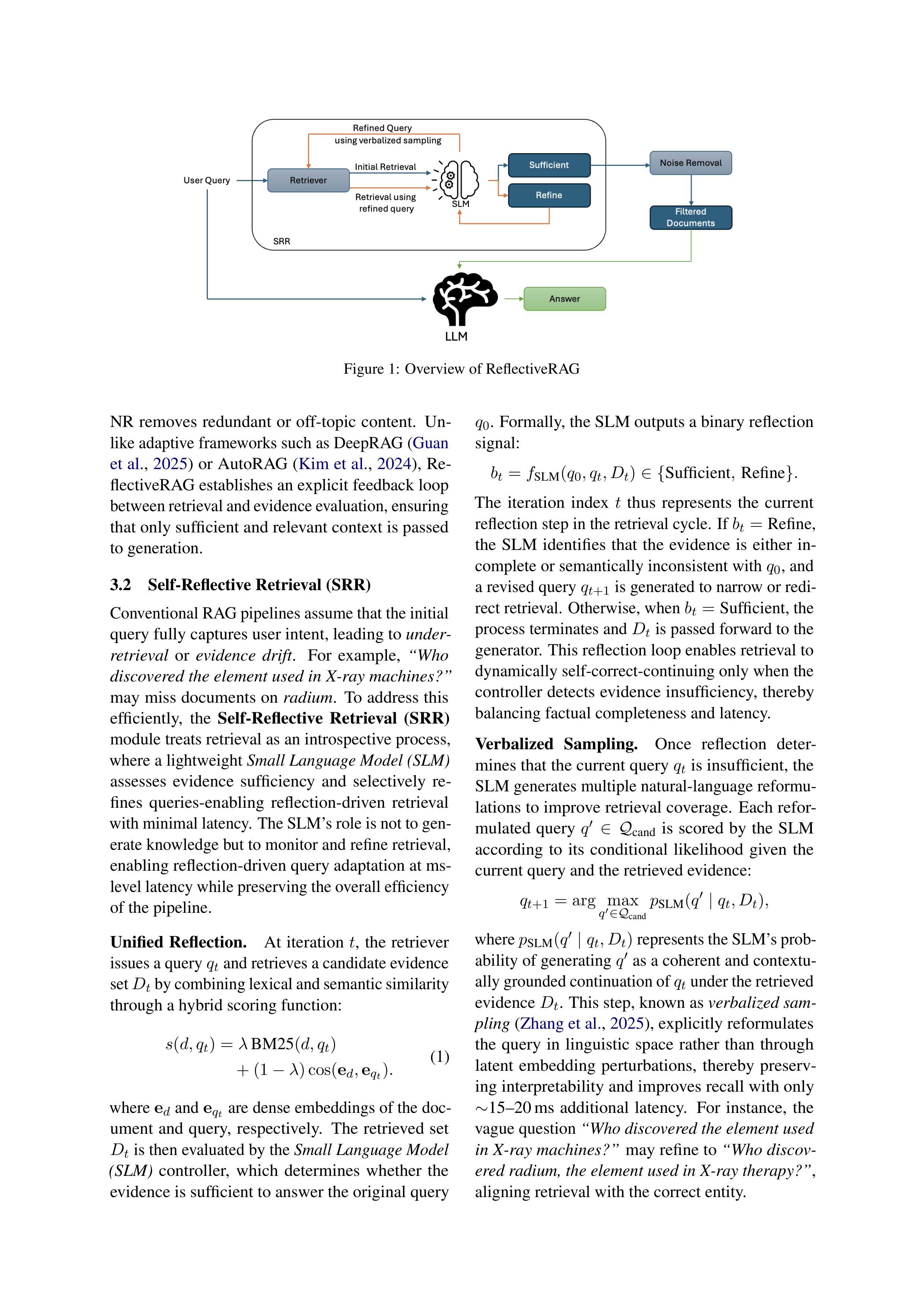
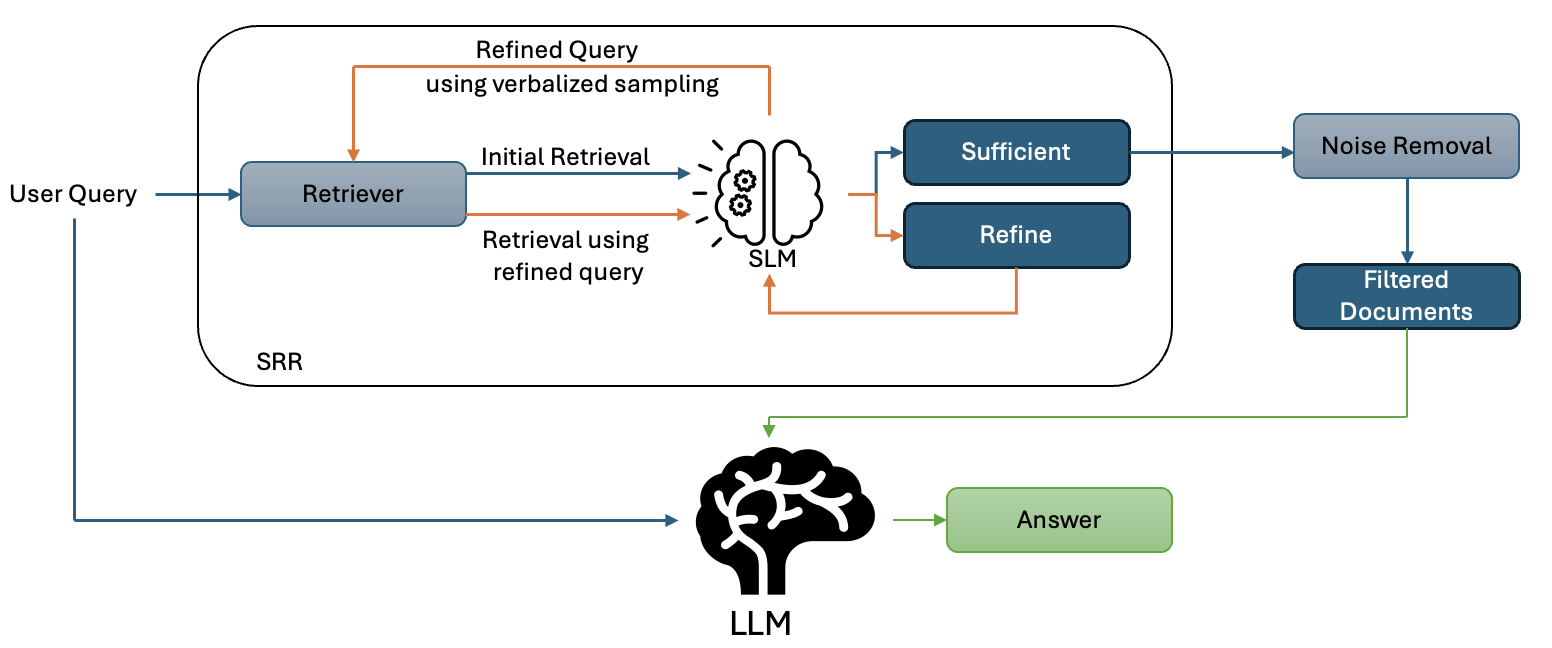
Figure 1:
Overview of ReflectiveRAG
NR
removes
redundant
or
off-topic
content.
Un-
like adaptive frameworks such as DeepRAG (
Guan
et al.
,
2025
) or AutoRAG (
Kim et al.
,
2024
), Re-
flectiveRAG establishes an explicit feedback loop
between retrieval and evidence evaluation, ensuring
that only sufficient and relevant context is passed
to generation.
3.2
Self-Reflective Retrieval (SRR)
Conventional RAG pipelines assume that the initial
query fully captures user intent, leading to
under-
retrieval
or
evidence
drift
.
For
example,
“Who
discovered the element used in X-ray machines?”
may miss documents on
radium
.
To address this
efficiently,
the
Self-Reflective
Retrieval
(SRR)
module treats retrieval as an introspective process,
where a lightweight
Small Language Model (SLM)
assesses
evidence
sufficiency
and
selectively
re-
fines
queries-enabling
reflection-driven
retrieval
with minimal latency.
The SLM’s role is not to gen-
erate knowledge but to monitor and refine retrieval,
enabling reflection-driven query adaptation at ms-
level latency while preserving the overall efficiency
of the pipeline.
Unified
Reflection.
At
iteration
t
,
the
retriever
issues a query
q
t
and retrieves a candidate evidence
set
D
t
by combining lexical and semantic similarity
through a hybrid scoring function:
s
(
d, q
t
) =
λ
BM25
(
d, q
t
)
+ (1
−
λ
) cos(
e
d
,
e
q
t
)
.
(1)
where
e
d
and
e
q
t
are dense embeddings of the doc-
ument
and
query,
respectively.
The
retrieved
set
D
t
is then evaluated by the
Small Language Model
(SLM)
controller,
which
determines
whether
the
evidence is sufficient to answer the original query
q
0
.
Formally, the SLM outputs a binary reflection
signal:
b
t
=
f
SLM
(
q
0
, q
t
, D
t
)
∈{
Sufficient
,
Refine
}
.
The
iteration
index
t
thus
represents
the
current
reflection step in the retrieval cycle.
If
b
t
=
Refine
,
the
SLM
identifies
that
the
evidence
is
either
in-
complete or semantically inconsistent with
q
0
, and
a revised query
q
t
+1
is generated to narrow or redi-
rect retrieval.
Otherwise, when
b
t
=
Sufficient
, the
process terminates and
D
t
is passed forward to the
generator.
This reflection loop enables retrieval to
dynamically self-correct-continuing only when the
controller detects evidence insufficiency, thereby
balancing factual completeness and latency.
Verbalized
Sampling.
Once
reflection
deter-
mines that the current query
q
t
is insufficient, the
SLM generates multiple natural-language reformu-
lations to improve retrieval coverage.
Each refor-
mulated
query
q
′
∈Q
cand
is
scored
by
the
SLM
according
to
its
conditional
likelihood
given
the
current query and the retrieved evidence:
q
t
+1
= arg
max
q
′
∈Q
cand
p
SLM
(
q
′
|
q
t
, D
t
)
,
where
p
SLM
(
q
′
|
q
t
, D
t
)
represents the SLM’s prob-
ability of generating
q
′
as a coherent and contextu-
ally grounded continuation of
q
t
under the retrieved
evidence
D
t
.
This step, known as
verbalized sam-
pling
(
Zhang et al.
,
2025
), explicitly reformulates
the
query
in
linguistic
space
rather
than
through
latent
embedding
perturbations,
thereby
preserv-
ing interpretability and improves recall with only
∼
15–20 ms
additional
latency.
For
instance,
the
vague question
“Who discovered the element used
in X-ray machines?”
may refine to
“Who discov-
ered radium, the element used in X-ray therapy?”
,
aligning retrieval with the correct entity.
Architectural Rationale.
SRR reframes retrieval
as a
controlled reasoning loop
guided by an SLM
that adaptively decides when to refine or stop based
on
evidence
sufficiency
and
stability
,
rather
than
fixed recall limits.
This adaptive decision-making
ensures that refinement proceeds only when infor-
mational gain is expected, preventing unbounded
recursion or redundant query reformulations.
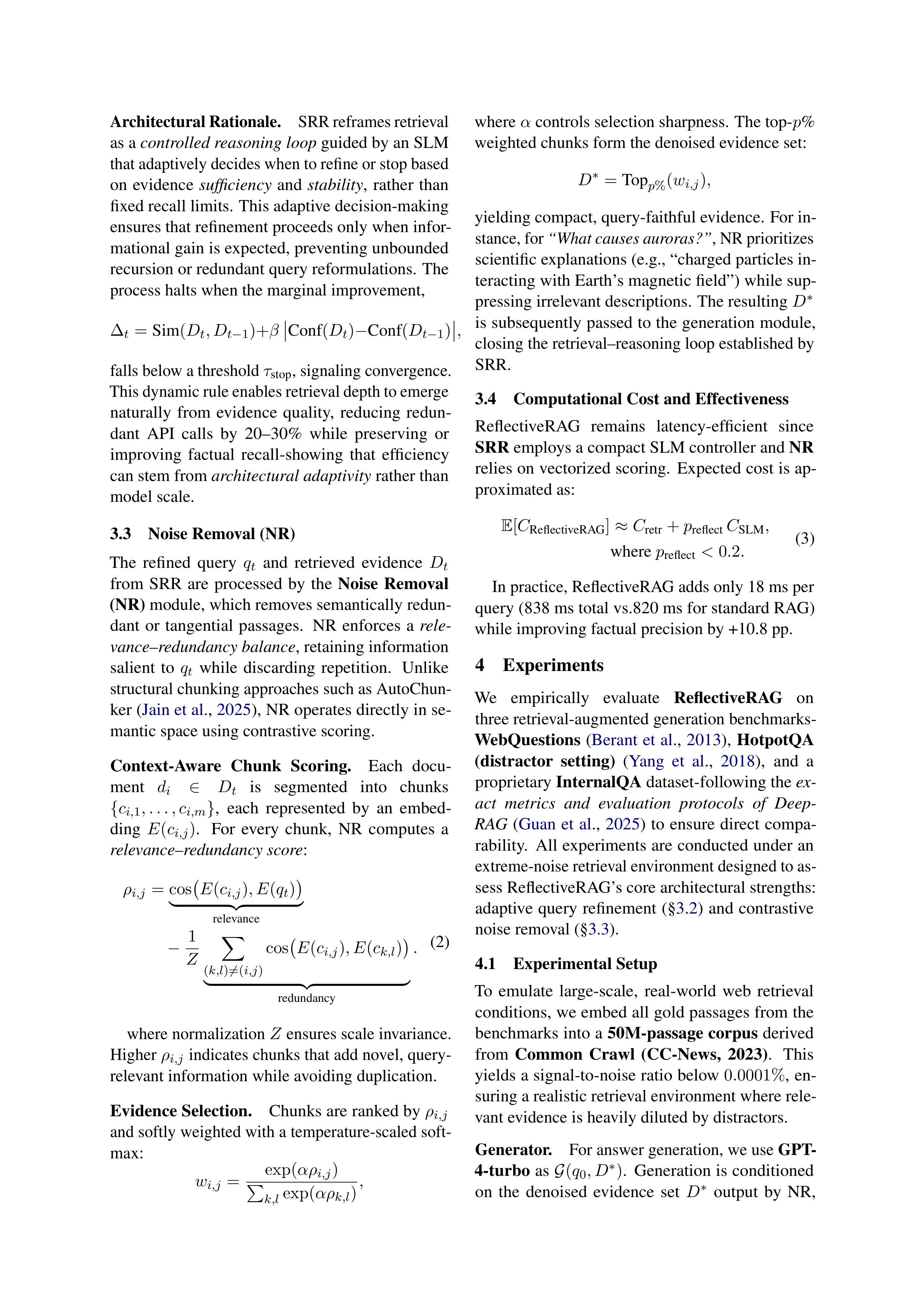
The
process halts when the marginal improvement,
∆
t
=
Sim
(
D
t
, D
t
−
1
)+
β
Conf
(
D
t
)
−
Conf
(
D
t
−
1
)
,
falls below a threshold
τ
stop
, signaling convergence.
This dynamic rule enables retrieval depth to emerge
naturally
from
evidence
quality,
reducing
redun-
dant
API
calls
by
20–30%
while
preserving
or
improving
factual
recall-showing
that
efficiency
can stem from
architectural adaptivity
rather than
model scale.
3.3
Noise Removal (NR)
The
refined
query
q
t
and
retrieved
evidence
D
t
from
SRR
are
processed
by
the
Noise
Removal
(NR)
module, which removes semantically redun-
dant
or
tangential
passages.
NR
enforces
a
rele-
vance–redundancy balance
, retaining information
salient
to
q
t
while
discarding
repetition.
Unlike
structural chunking approaches such as AutoChun-
ker (
Jain et al.
,
2025
), NR operates directly in se-
mantic space using contrastive scoring.
Context-Aware
Chunk
Scoring.
Each
docu-
ment
d
i
∈
D
t
is
segmented
into
chunks
{
c
i,
1
, . . . , c
i,m
}
,
each
represented
by
an
embed-
ding
E
(
c
i,j
)
.
For
every
chunk,
NR
computes
a
relevance–redundancy score
:
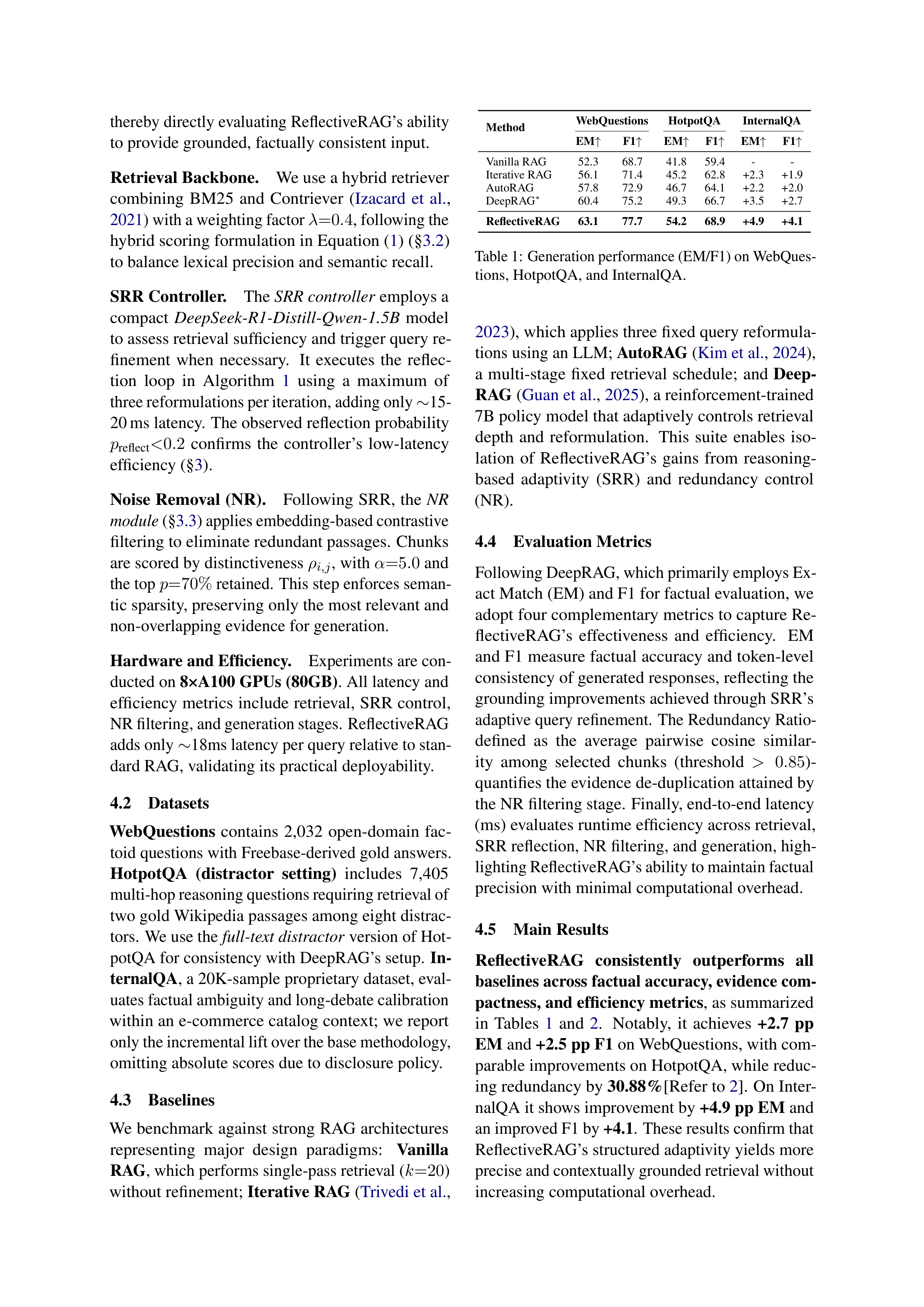
ρ
i,j
= cos
E
(
c
i,j
)
, E
(
q
t
)
|
{z
}
relevance
−
1
Z
X
(
k,l
)
̸
=(
i,j
)
cos
E
(
c
i,j
)
, E
(
c
k,l
)
|
{z
}
redundancy
.
(2)
where normalization
Z
ensures scale invariance.
Higher
ρ
i,j
indicates chunks that add novel, query-
relevant information while avoiding duplication.
Evidence Selection.
Chunks are ranked by
ρ
i,j
and softly weighted with a temperature-scaled soft-
max:
w
i,j
=
exp(
αρ
i,j
)
P
k,l
exp(
αρ
k,l
)
,
where
α
controls selection sharpness.
The top-
p
%
weighted chunks form the denoised evidence set:
D
∗
=
Top
p
%
(
w
i,j
)
,
yielding compact, query-faithful evidence.
For in-
stance, for
“What causes auroras?”
, NR prioritizes
scientific explanations (e.g., “charged particles in-
teracting with Earth’s magnetic field”) while sup-
pressing irrelevant descriptions.
The resulting
D
∗
is subsequently passed to the generation module,
closing the retrieval–reasoning loop established by
SRR.
3.4
Computational Cost and Effectiveness
ReflectiveRAG
remains
latency-efficient
since
SRR
employs a compact SLM controller and
NR
relies on vectorized scoring.
Expected cost is ap-
proximated as:
E
[
C
ReflectiveRAG
]
≈
C
retr
+
p
reflect
C
SLM
,
where
p
reflect
<
0
.
2
.
(3)
In practice, ReflectiveRAG adds only 18 ms per
query (838 ms total vs.820 ms for standard RAG)
while improving factual precision by +10.8 pp.
4
Experiments
We
empirically
evaluate
ReflectiveRAG
on
three retrieval-augmented generation benchmarks-
WebQuestions
(
Berant
et
al.
,
2013
),
HotpotQA
(distractor
setting)
(
Yang
et
al.
,
2018
),
and
a
proprietary
InternalQA
dataset-following the
ex-
act
metrics
and
evaluation
protocols
of
Deep-
RAG
(
Guan
et
al.
,
2025
)
to
ensure
direct
compa-
rability.
All experiments are conducted under an
extreme-noise retrieval environment designed to as-
sess ReflectiveRAG’s core architectural strengths:
adaptive
query
refinement
(§
3.2
)
and
contrastive
noise removal (§
3.3
).
4.1
Experimental Setup
To
emulate
large-scale,
real-world
web
retrieval
conditions, we embed all gold passages from the
benchmarks into a
50M-passage corpus
derived
from
Common
Crawl
(CC-News,
2023)
.
This
yields a signal-to-noise ratio below
0
.
0001%
, en-
suring a realistic retrieval environment where rele-
vant evidence is heavily diluted by distractors.
Generator.
For answer generation, we use
GPT-
4-turbo
as
G
(
q
0
, D
∗
)
.
Generation is conditioned
on
the
denoised
evidence
set
D
∗
output
by
NR,
thereby directly evaluating ReflectiveRAG’s ability
to provide grounded, factually consistent input.
Retrieval Backbone.
We use a hybrid retriever
combining
BM25
and
Contriever
(
Izacard
et
al.
,
2021
) with a weighting factor
λ
=0
.
4
, following the
hybrid scoring formulation in Equation (
1
) (§
3.2
)
to balance lexical precision and semantic recall.
SRR Controller.
The
SRR controller
employs a
compact
DeepSeek-R1-Distill-Qwen-1.5B
model
to assess retrieval sufficiency and trigger query re-
finement
when
necessary.
It
executes
the
reflec-
tion
loop
in
Algorithm
1
using
a
maximum
of
three reformulations per iteration, adding only
∼
15-
20 ms latency.
The observed reflection probability
p
reflect
<
0
.
2
confirms
the
controller’s
low-latency
efficiency (§
3
).
Noise Removal (NR).
Following SRR, the
NR
module
(§
3.3
) applies embedding-based contrastive
filtering to eliminate redundant passages.
Chunks
are scored by distinctiveness
ρ
i,j
, with
α
=5
.
0
and
the top
p
=70%
retained.
This step enforces seman-
tic sparsity, preserving only the most relevant and
non-overlapping evidence for generation.
Hardware and Efficiency.
Experiments are con-
ducted on
8×A100 GPUs (80GB)
. All latency and
efficiency metrics include retrieval, SRR control,
NR filtering, and generation stages. ReflectiveRAG
adds only
∼
18ms latency per query relative to stan-
dard RAG, validating its practical deployability.
4.2
Datasets
WebQuestions
contains
2,032
open-domain
fac-
toid questions with Freebase-derived gold answers.
HotpotQA
(distractor
setting)
includes
7,405
multi-hop reasoning questions requiring retrieval of
two gold Wikipedia passages among eight distrac-
tors.
We use the
full-text distractor
version of Hot-
potQA for consistency with DeepRAG’s setup.
In-
ternalQA
, a 20K-sample proprietary dataset, eval-
uates factual ambiguity and long-debate calibration
within an e-commerce catalog context; we report
only the incremental lift over the base methodology,
omitting absolute scores due to disclosure policy.
4.3
Baselines
We benchmark against strong RAG architectures
representing
major
design
paradigms:
Vanilla
RAG
, which performs single-pass retrieval (
k
=20
)
without refinement;
Iterative RAG
(
Trivedi et al.
,
Method
WebQuestions
HotpotQA
InternalQA
EM
↑
F1
↑
EM
↑
F1
↑
EM
↑
F1
↑
Vanilla RAG
52.3
68.7
41.8
59.4
-
-
Iterative RAG
56.1
71.4
45.2
62.8
+2.3
+1.9
AutoRAG
57.8
72.9
46.7
64.1
+2.2
+2.0
DeepRAG
∗
60.4
75.2
49.3
66.7
+3.5
+2.7
ReflectiveRAG
63.1
77.7
54.2
68.9
+4.9
+4.1
Table 1: Generation performance (EM/F1) on WebQues-
tions, HotpotQA, and InternalQA.
2023
), which applies three fixed query reformula-
tions using an LLM;
AutoRAG
(
Kim et al.
,
2024
),
a
multi-stage
fixed
retrieval
schedule;
and
Deep-
RAG
(
Guan et al.
,
2025
), a reinforcement-trained
7B policy model that adaptively controls retrieval
depth
and
reformulation.
This
suite
enables
iso-
lation
of
ReflectiveRAG’s
gains
from
reasoning-
based
adaptivity
(SRR)
and
redundancy
control
(NR).
4.4
Evaluation Metrics
Following DeepRAG, which primarily employs Ex-
act Match (EM) and F1 for factual evaluation, we
adopt four complementary metrics to capture Re-
flectiveRAG’s
effectiveness
and
efficiency.
EM
and F1 measure factual accuracy and token-level
consistency of generated responses, reflecting the
grounding improvements achieved through SRR’s
adaptive query refinement.
The Redundancy Ratio-
defined
as
the
average
pairwise
cosine
similar-
ity
among
selected
chunks
(threshold
>
0
.
85
)-
quantifies the evidence de-duplication attained by
the NR filtering stage.
Finally, end-to-end latency
(ms) evaluates runtime efficiency across retrieval,
SRR reflection, NR filtering, and generation, high-
lighting ReflectiveRAG’s ability to maintain factual
precision with minimal computational overhead.
4.5
Main Results
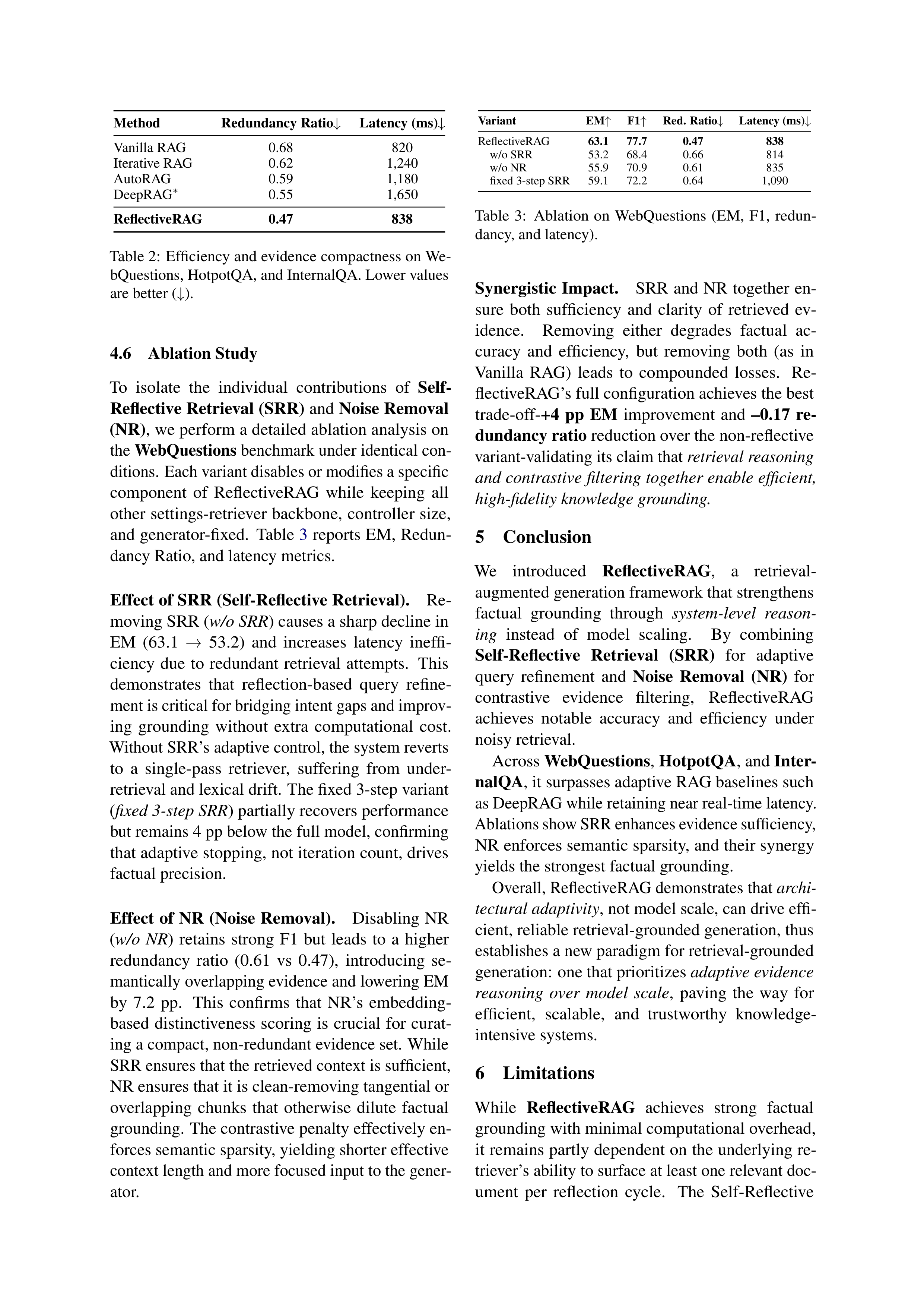
ReflectiveRAG
consistently
outperforms
all
baselines across factual accuracy, evidence com-
pactness, and efficiency metrics
, as summarized
in
Tables
1
and
2
.
Notably,
it
achieves
+2.7
pp
EM
and
+2.5 pp F1
on WebQuestions, with com-
parable improvements on HotpotQA, while reduc-
ing redundancy by
30.88%
[Refer to
2
].
On Inter-
nalQA it shows improvement by
+4.9 pp EM
and
an improved F1 by
+4.1
.
These results confirm that
ReflectiveRAG’s structured adaptivity yields more
precise and contextually grounded retrieval without
increasing computational overhead.
Method
Redundancy Ratio
↓
Latency (ms)
↓
Vanilla RAG
0.68
820
Iterative RAG
0.62
1,240
AutoRAG
0.59
1,180
DeepRAG
∗
0.55
1,650
ReflectiveRAG
0.47
838
Table 2:
Efficiency and evidence compactness on We-
bQuestions, HotpotQA, and InternalQA. Lower values
are better (
↓
).
4.6
Ablation Study
To
isolate
the
individual
contributions
of
Self-
Reflective Retrieval (SRR)
and
Noise Removal
(NR)
, we perform a detailed ablation analysis on
the
WebQuestions
benchmark under identical con-
ditions.
Each variant disables or modifies a specific
component
of
ReflectiveRAG
while
keeping
all
other settings-retriever backbone,
controller size,
and generator-fixed.
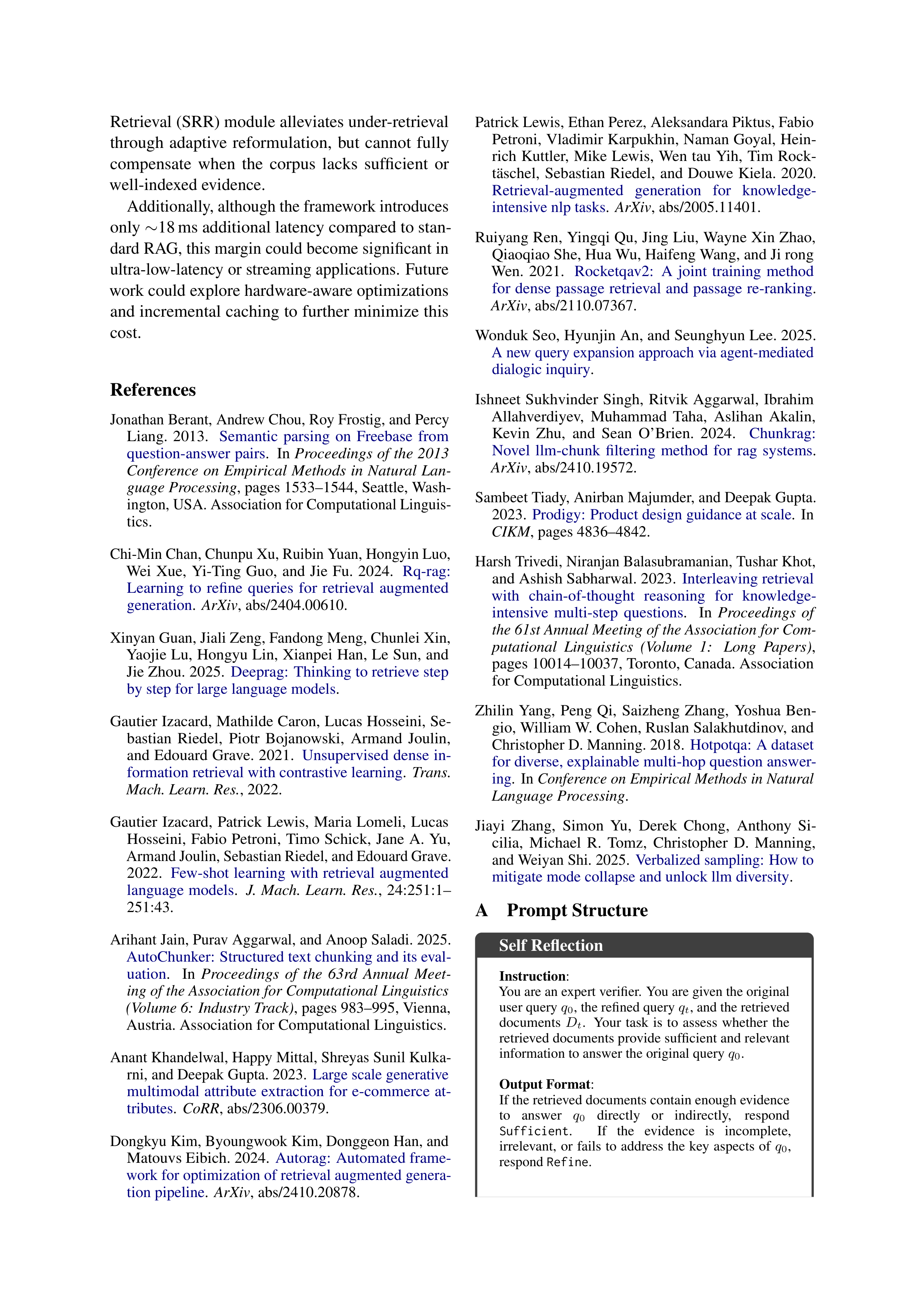
Table
3
reports EM, Redun-
dancy Ratio, and latency metrics.
Effect of SRR (Self-Reflective Retrieval).
Re-
moving SRR (
w/o SRR
) causes a sharp decline in
EM
(63.1
→
53.2)
and
increases
latency
ineffi-
ciency
due
to
redundant
retrieval
attempts.
This
demonstrates
that
reflection-based
query
refine-
ment is critical for bridging intent gaps and improv-
ing
grounding
without
extra
computational
cost.
Without SRR’s adaptive control, the system reverts
to
a
single-pass
retriever,
suffering
from
under-
retrieval and lexical drift.
The fixed 3-step variant
(
fixed 3-step SRR
) partially recovers performance
but remains 4 pp below the full model, confirming
that adaptive stopping, not iteration count, drives
factual precision.
Effect
of
NR
(Noise
Removal).
Disabling
NR
(
w/o
NR
)
retains
strong
F1
but
leads
to
a
higher
redundancy
ratio
(0.61
vs
0.47),
introducing
se-
mantically overlapping evidence and lowering EM
by
7.2
pp.
This
confirms
that
NR’s
embedding-
based
distinctiveness
scoring
is
crucial
for
curat-
ing a compact, non-redundant evidence set.
While
SRR ensures that the retrieved context is sufficient,
NR ensures that it is clean-removing tangential or
overlapping
chunks
that
otherwise
dilute
factual
grounding.
The contrastive penalty effectively en-
forces semantic sparsity, yielding shorter effective
context length and more focused input to the gener-
ator.
Variant
EM
↑
F1
↑
Red.
Ratio
↓
Latency (ms)
↓
ReflectiveRAG
63.1
77.7
0.47
838
w/o SRR
53.2
68.4
0.66
814
w/o NR
55.9
70.9
0.61
835
fixed 3-step SRR
59.1
72.2
0.64
1,090
Table
3:
Ablation
on
WebQuestions
(EM,
F1,
redun-
dancy, and latency).
Synergistic
Impact.
SRR
and
NR
together
en-
sure
both
sufficiency
and
clarity
of
retrieved
ev-
idence.
Removing
either
degrades
factual
ac-
curacy
and
efficiency,
but
removing
both
(as
in
Vanilla
RAG)
leads
to
compounded
losses.
Re-
flectiveRAG’s full configuration achieves the best
trade-off-
+4
pp
EM
improvement
and
–0.17
re-
dundancy ratio
reduction over the non-reflective
variant-validating its claim that
retrieval reasoning
and contrastive filtering together enable efficient,
high-fidelity knowledge grounding.
5
Conclusion
We
introduced
ReflectiveRAG
,
a
retrieval-
augmented generation framework that strengthens
factual
grounding
through
system-level
reason-
ing
instead
of
model
scaling.
By
combining
Self-Reflective
Retrieval
(SRR)
for
adaptive
query
refinement
and
Noise
Removal
(NR)
for
contrastive
evidence
filtering,
ReflectiveRAG
achieves
notable
accuracy
and
efficiency
under
noisy retrieval.
Across
WebQuestions
,
HotpotQA
, and
Inter-
nalQA
, it surpasses adaptive RAG baselines such
as DeepRAG while retaining near real-time latency.
Ablations show SRR enhances evidence sufficiency,
NR enforces semantic sparsity, and their synergy
yields the strongest factual grounding.
Overall, ReflectiveRAG demonstrates that
archi-
tectural adaptivity
, not model scale, can drive effi-
cient, reliable retrieval-grounded generation, thus
establishes a new paradigm for retrieval-grounded
generation:
one that prioritizes
adaptive evidence
reasoning
over
model
scale
,
paving
the
way
for
efficient,
scalable,
and
trustworthy
knowledge-
intensive systems.
6
Limitations
While
ReflectiveRAG
achieves
strong
factual
grounding with minimal computational overhead,
it remains partly dependent on the underlying re-
triever’s ability to surface at least one relevant doc-
ument
per
reflection
cycle.
The
Self-Reflective
Retrieval (SRR) module alleviates under-retrieval
through
adaptive
reformulation,
but
cannot
fully
compensate
when
the
corpus
lacks
sufficient
or
well-indexed evidence.
Additionally, although the framework introduces
only
∼
18 ms additional latency compared to stan-
dard RAG, this margin could become significant in
ultra-low-latency or streaming applications.
Future
work could explore hardware-aware optimizations
and incremental caching to further minimize this
cost.
References
Jonathan Berant, Andrew Chou, Roy Frostig, and Percy
Liang.
2013.
Semantic
parsing
on
Freebase
from
question-answer pairs
.
In
Proceedings of the 2013
Conference
on
Empirical
Methods
in
Natural
Lan-
guage Processing
, pages 1533–1544, Seattle, Wash-
ington, USA. Association for Computational Linguis-
tics.
Chi-Min Chan, Chunpu Xu, Ruibin Yuan, Hongyin Luo,
Wei
Xue,
Yi-Ting
Guo,
and
Jie
Fu.
2024.
Rq-rag:
Learning
to
refine
queries
for
retrieval
augmented
generation
.
ArXiv
, abs/2404.00610.
Xinyan Guan, Jiali Zeng, Fandong Meng, Chunlei Xin,
Yaojie Lu, Hongyu Lin, Xianpei Han, Le Sun, and
Jie Zhou. 2025.
Deeprag:
Thinking to retrieve step
by step for large language models
.
Gautier Izacard, Mathilde Caron, Lucas Hosseini, Se-
bastian
Riedel,
Piotr
Bojanowski,
Armand
Joulin,
and Edouard Grave. 2021.
Unsupervised dense in-
formation retrieval with contrastive learning
.
Trans.
Mach. Learn. Res.
, 2022.
Gautier
Izacard,
Patrick
Lewis,
Maria
Lomeli,
Lucas
Hosseini,
Fabio
Petroni,
Timo
Schick,
Jane
A.
Yu,
Armand Joulin, Sebastian Riedel, and Edouard Grave.
2022.
Few-shot
learning
with
retrieval
augmented
language models
.
J. Mach. Learn. Res.
,
24:251:1–
251:43.
Arihant Jain, Purav Aggarwal, and Anoop Saladi. 2025.
AutoChunker:
Structured text chunking and its eval-
uation
.
In
Proceedings
of
the
63rd
Annual
Meet-
ing of the Association for Computational Linguistics
(Volume 6:
Industry Track)
, pages 983–995, Vienna,
Austria. Association for Computational Linguistics.
Anant Khandelwal, Happy Mittal, Shreyas Sunil Kulka-
rni, and Deepak Gupta. 2023.
Large scale generative
multimodal
attribute
extraction
for
e-commerce
at-
tributes
.
CoRR
, abs/2306.00379.
Dongkyu Kim, Byoungwook Kim, Donggeon Han, and
Matouvs Eibich. 2024.
Autorag:
Automated frame-
work for optimization of retrieval augmented genera-
tion pipeline
.
ArXiv
, abs/2410.20878.
Patrick Lewis, Ethan Perez, Aleksandara Piktus, Fabio
Petroni, Vladimir Karpukhin, Naman Goyal, Hein-
rich Kuttler,
Mike Lewis,
Wen tau Yih,
Tim Rock-
täschel,
Sebastian
Riedel,
and
Douwe
Kiela.
2020.
Retrieval-augmented
generation
for
knowledge-
intensive nlp tasks
.
ArXiv
, abs/2005.11401.
Ruiyang Ren, Yingqi Qu, Jing Liu, Wayne Xin Zhao,
Qiaoqiao She, Hua Wu, Haifeng Wang, and Ji rong
Wen.
2021.
Rocketqav2:
A
joint
training
method
for dense passage retrieval and passage re-ranking
.
ArXiv
, abs/2110.07367.
Wonduk Seo, Hyunjin An, and Seunghyun Lee. 2025.
A new query expansion approach via agent-mediated
dialogic inquiry
.
Ishneet
Sukhvinder
Singh,
Ritvik
Aggarwal,
Ibrahim
Allahverdiyev,
Muhammad
Taha,
Aslihan
Akalin,
Kevin
Zhu,
and
Sean
O’Brien.
2024.
Chunkrag:
Novel
llm-chunk
filtering
method
for
rag
systems
.
ArXiv
, abs/2410.19572.
Sambeet Tiady, Anirban Majumder, and Deepak Gupta.
2023.
Prodigy:
Product design guidance at scale
.
In
CIKM
, pages 4836–4842.
Harsh Trivedi, Niranjan Balasubramanian, Tushar Khot,
and Ashish Sabharwal. 2023.
Interleaving retrieval
with
chain-of-thought
reasoning
for
knowledge-
intensive
multi-step
questions
.
In
Proceedings
of
the 61st Annual Meeting of the Association for Com-
putational
Linguistics
(Volume
1:
Long
Papers)
,
pages 10014–10037, Toronto, Canada. Association
for Computational Linguistics.
Zhilin
Yang,
Peng
Qi,
Saizheng
Zhang,
Yoshua
Ben-
gio, William W. Cohen, Ruslan Salakhutdinov, and
Christopher D. Manning. 2018.
Hotpotqa:
A dataset
for diverse, explainable multi-hop question answer-
ing
.
In
Conference on Empirical Methods in Natural
Language Processing
.
Jiayi
Zhang,
Simon
Yu,
Derek
Chong,
Anthony
Si-
cilia,
Michael
R.
Tomz,
Christopher
D.
Manning,
and Weiyan Shi. 2025.
Verbalized sampling:
How to
mitigate mode collapse and unlock llm diversity
.
A
Prompt Structure
Self Reflection
Instruction
:
You are an expert verifier.
You are given the original
user query
q
0
, the refined query
q
t
, and the retrieved
documents
D
t
.
Your
task
is
to
assess
whether
the
retrieved documents provide sufficient and relevant
information to answer the original query
q
0
.
Output Format
:
If the retrieved documents contain enough evidence
to
answer
q
0
directly
or
indirectly,
respond
Sufficient
.
If
the
evidence
is
incomplete,
irrelevant,
or
fails
to
address
the
key
aspects
of
q
0
,
respond
Refine
.
Input
:
Original query:
{q0}
Refined query:
{qt}
Retrieved documents:
{Dt}
Verbalized Sampling
Instruction
:
You
are
a
curious
and
reflective
student
actively
learning
in
class.
Your
teacher
has
asked
you
a
question
q
0
,
but
it
seems
hard
and
confusing.
To
better
understand
and
eventually
answer
it,
you
decide
to
break
it
down
into
smaller,
more
manageable parts.
Generate five diverse subqueries
that explore different reasoning directions to help an-
swer the main question, along with their probabilities.
Output Format
:
text
numeric value
Example:
Main
Question:
Who
discovered
the
element used in X-rays?
What element is primarily used to generate X-rays?
0.30
Who discovered the element tungsten, which is used
in X-ray tubes?
0.25
Input
:
Main question:
{q0}
B
SLM Controller Comparison
To assess the impact of controller capacity on reflec-
tion quality and latency, we experiment with sev-
eral Small Language Model (SLM) variants within
the ReflectiveRAG framework.
Each SLM replaces
the
default
controller
while
keeping
the
retriever
and LLM generator fixed.
We report results aver-
aged over the WebQuestions and HotpotQA valida-
tion splits.
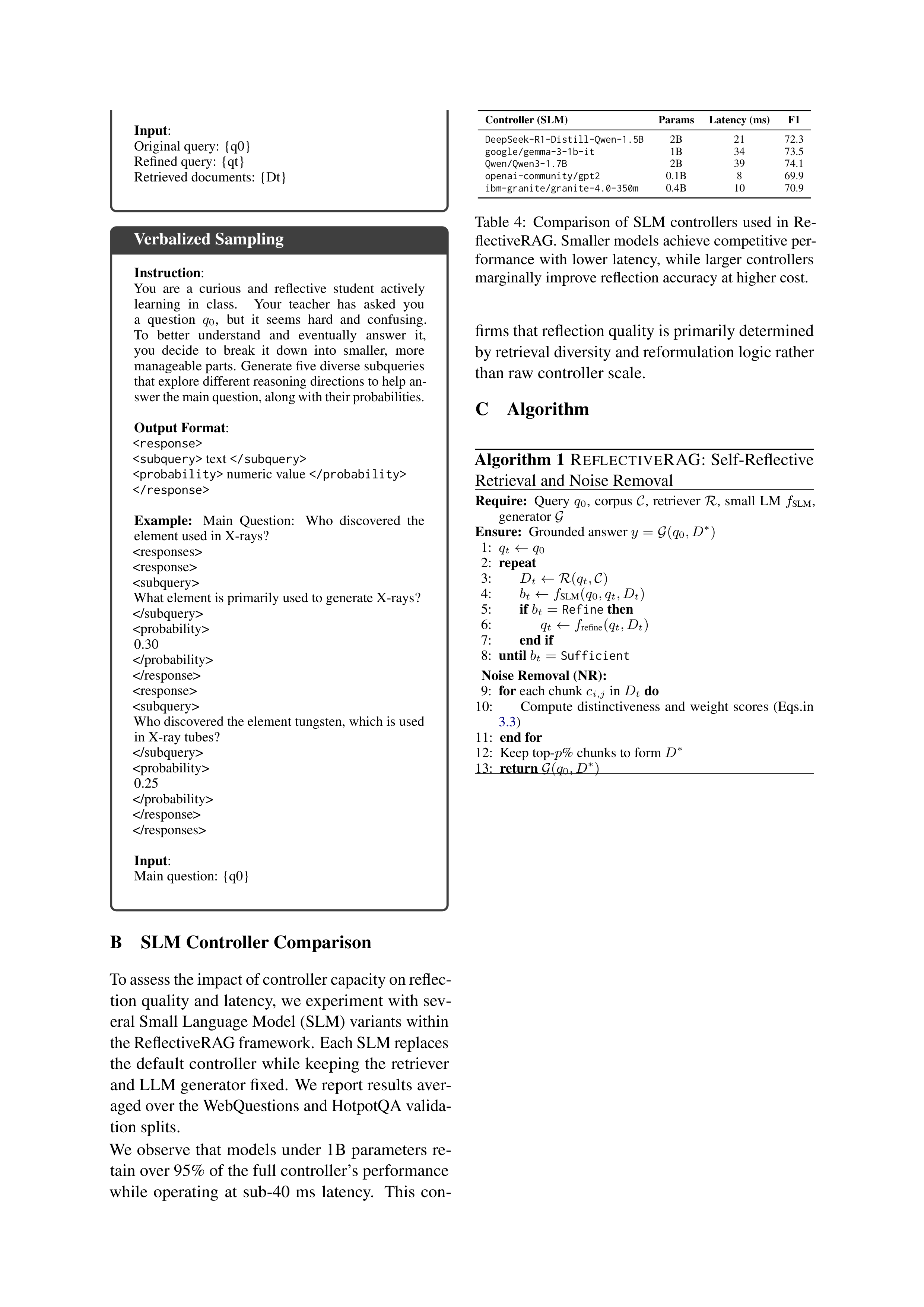
We
observe
that
models
under
1B
parameters
re-
tain over 95% of the full controller’s performance
while
operating
at
sub-40
ms
latency.
This
con-
Controller (SLM)
Params
Latency (ms)
F1
DeepSeek-R1-Distill-Qwen-1.5B
2B
21
72.3
google/gemma-3-1b-it
1B
34
73.5
Qwen/Qwen3-1.7B
2B
39
74.1
openai-community/gpt2
0.1B
8
69.9
ibm-granite/granite-4.0-350m
0.4B
10
70.9
Table
4:
Comparison
of
SLM
controllers
used
in
Re-
flectiveRAG. Smaller models achieve competitive per-
formance
with lower
latency,
while
larger
controllers
marginally improve reflection accuracy at higher cost.
firms that reflection quality is primarily determined
by retrieval diversity and reformulation logic rather
than raw controller scale.
C
Algorithm
Algorithm 1
R
EFLECTIVE
RAG: Self-Reflective
Retrieval and Noise Removal
Require:
Query
q
0
,
corpus
C
,
retriever
R
,
small LM
f
SLM
,
generator
G
Ensure:
Grounded answer
y
=
G
(
q
0
, D
∗
)
1:
q
t
←
q
0
2:
repeat
3:
D
t
←R
(
q
t
,
C
)
4:
b
t
←
f
SLM
(
q
0
, q
t
, D
t
)
5:
if
b
t
=
Refine
then
6:
q
t
←
f
refine
(
q
t
, D
t
)
7:
end if
8:
until
b
t
=
Sufficient
Noise Removal (NR):
9:
for
each chunk
c
i,j
in
D
t
do
10:
Compute
distinctiveness
and
weight
scores
(Eqs.in
3.3
)
11:
end for
12:
Keep top-
p
% chunks to form
D
∗
13:
return
G
(
q
0
, D
∗
)