


ReSTIR PT Enhanced: Algorithmic Advances for Faster and
More Robust ReSTIR Path Tracing
DAQI LIN,
NVIDIA, USA
MARKUS KETTUNEN,
NVIDIA, Finland
CHRIS WYMAN,
NVIDIA, USA
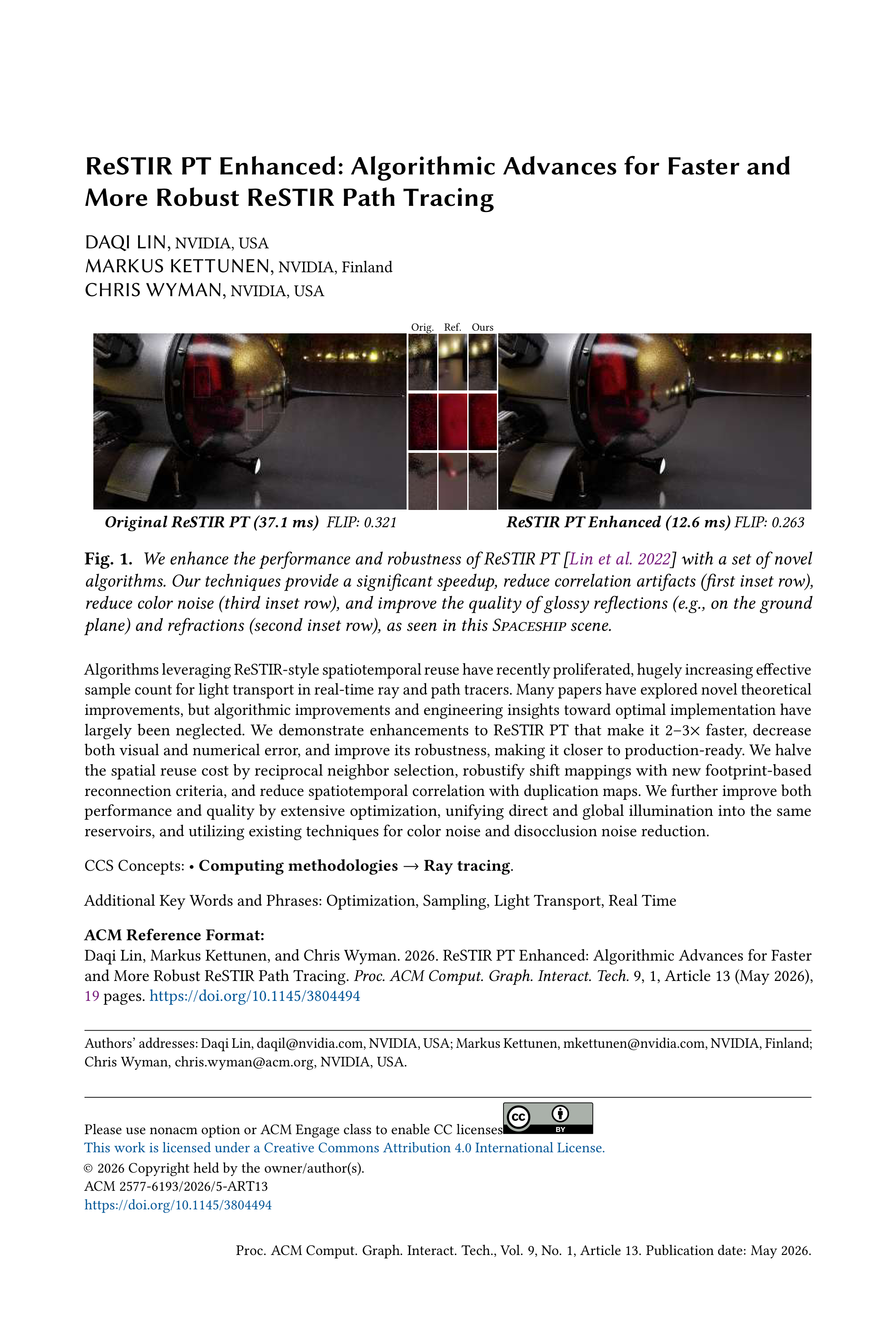
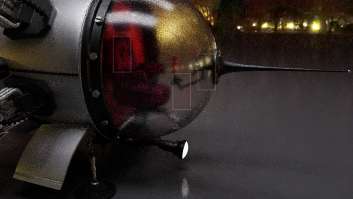
Original ReSTIR PT (37.1 ms)
FLIP: 0.321
Orig.
Ref.
Ours
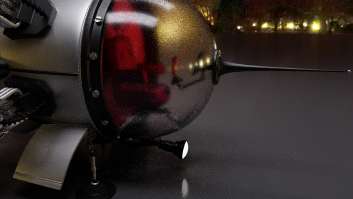
ReSTIR PT Enhanced (12.6 ms)
FLIP: 0.263
Fig. 1.
We enhance the performance and robustness of ReSTIR PT [
Lin et al
.
2022
] with a set of novel
algorithms. Our techniques provide a significant speedup, reduce correlation artifacts (first inset row),
reduce color noise (third inset row), and improve the quality of glossy reflections (e.g., on the ground
plane) and refractions (second inset row), as seen in this Spaceship scene.
Algorithms leveraging ReSTIR-style spatiotemporal reuse have recently proliferated, hugely increasing effective
sample count for light transport in real-time ray and path tracers. Many papers have explored novel theoretical
improvements, but algorithmic improvements and engineering insights toward optimal implementation have
largely
been
neglected.
We
demonstrate
enhancements
to
ReSTIR
PT
that
make
it
2–3
×
faster,
decrease
both visual and numerical error, and improve its robustness, making it closer to production-ready. We halve
the spatial reuse cost by reciprocal neighbor selection, robustify shift mappings with new footprint-based
reconnection criteria, and reduce spatiotemporal correlation with duplication maps. We further improve both
performance and quality by extensive optimization, unifying direct and global illumination into the same
reservoirs, and utilizing existing techniques for color noise and disocclusion noise reduction.
CCS Concepts: •
Computing methodologies
→
Ray tracing
.
Additional Key Words and Phrases: Optimization, Sampling, Light Transport, Real Time
ACM Reference Format:
Daqi Lin, Markus Kettunen, and Chris Wyman. 2026. ReSTIR PT Enhanced: Algorithmic Advances for Faster
and More Robust ReSTIR Path Tracing.
Proc. ACM Comput. Graph. Interact. Tech.
9, 1, Article 13 (May 2026),
19
pages.
https://doi.org/10.1145/3804494
Authors’ addresses: Daqi Lin, daqil@nvidia.com, NVIDIA, USA; Markus Kettunen, mkettunen@nvidia.com, NVIDIA, Finland;
Chris Wyman, chris.wyman@acm.org, NVIDIA, USA.
Please use nonacm option or ACM Engage class to enable CC licenses
This work is licensed under a Creative Commons Attribution 4.0 International License.
© 2026 Copyright held by the owner/author(s).
ACM 2577-6193/2026/5-ART13
https://doi.org/10.1145/3804494
Proc. ACM Comput. Graph. Interact. Tech., Vol. 9, No. 1, Article 13. Publication date: May 2026.
13:2
Daqi Lin, Markus Kettunen, and Chris Wyman
1
INTRODUCTION
ReSTIR Path Tracing [
Lin et al
.
2022
] greatly improves path quality by spatiotemporally reusing
path samples. But their prototype has high compute and memory overheads, yielding sluggish
performance even on high-end GPUs (originally 40-80 ms per frame on an RTX 3090).
As published, ReSTIR PT exhibits robustness problems: it suffers spatiotemporal correlations,
variance near disocclusions, and color noise. The hybrid shift, which enables ReSTIR PT to handle
specular light transport, relies on simple roughness and distance thresholds to determine reuse
strategy; these thresholds often benefit from adjustment per scene. While further research proposes
partial solutions [
Kettunen et al
.
2023
;
Sawhney et al
.
2024
;
Zhang et al
.
2024
], they do not fix
the poor performance. In this paper, we propose techniques that greatly optimize ReSTIR PT’s
performance and improve its robustness and quality, reducing the gap to productization.
Our specific contributions include:
•
Halving shift mapping costs in spatial reuse by reciprocal neighbor selection
∗
(
Section 3
);
•
New ray footprint thresholds that adapt to scene and materials
∗
(
Section 4
);
•
Reducing correlation artifacts by sample duplication maps
∗
(
Section 5
);
•
Improving quality and cost by unifying ReSTIR for direct and indirect light (
Section 6
); and
•
Other optimizations that boost performance and improve robustness by reducing color and
disocclusion noise. (
Section 6
)
2
BACKGROUND
Recent advances in hardware and denoising, like SVGF [
Schied et al
.
2017
], NVIDIA NRD [
NVIDIA
2020
], and DLSS Ray Reconstruction [
NVIDIA 2025
], have made real-time ray-traced global illu-
mination (GI) practical. Many real-time solutions today rely on radiosity-like recursive gathering
with discretization, caching, and interpolation (e.g., Lumen [
Wright et al
.
2022
], DDGI [
Majercik
et al
.
2019
], and Surfel GI [
Halen et al
.
2021
]); this limits accuracy and responsiveness. Brute force
path tracing is accurate but slow, requiring many samples for a denoisable image.
More recently, spatiotemporal reservoir resampling (ReSTIR) [
Bitterli et al
.
2020
] aggressively
reuses Monte Carlo samples from other pixels and frames in an unbiased way. When applied to
path
samples,
ReSTIR
amortizes
the
cost
of
tracing
paths
over
space
and
time.
This
preserves
path tracing’s accuracy but delivers tens to hundreds more samples at the same cost. ReSTIR DI
[
Bitterli et al
.
2020
] enables real-time, many-light rendering and ReSTIR GI [
Ouyang et al
.
2021
]
targets diffuse/mid-glossy surfaces. Our work speeds and improves robustness of ReSTIR PT [
Lin
et al
.
2022
], improving the unbiased rendering of general paths, including multi-bounce specular
reflection and caustics. Below, we review the resampling theory behind these ReSTIR algorithms.
2.1
RIS and GRIS
Resampled importance sampling (RIS) [
Talbot et al
.
2005
] aims to sample from a low-variance
target PDF
¯
𝑝
∝
ˆ
𝑝
≈
𝑓
to estimate an integral
∫
Ω
𝑓
(
𝑥
)
d
𝑥
. As
¯
𝑝
is often difficult to sample directly,
RIS
draws
𝑀
i.i.d.
candidates
𝑋
𝑖
∼
𝑝
(a
suboptimal
source
PDF),
selecting
one
𝑌
proportional
to resampling weights
𝑤
𝑖
=
(
1
/
𝑀
)
ˆ
𝑝
(
𝑋
𝑖
)/
𝑝
(
𝑋
𝑖
)
. As
𝑀
→∞
,
𝑌
’s distribution converges to
¯
𝑝
=
ˆ
𝑝
/
∫
Ω
ˆ
𝑝
(
𝑥
)
d
𝑥
.
Talbot et al
.
[
2005
] construct
ˆ
𝑝
by dropping the visibility term in direct illumination
to improve sampling efficiency. The expression
𝑓
(
𝑌
)
𝑊
𝑌
unbiasedly estimates integral
∫
Ω
𝑓
(
𝑥
)
d
𝑥
,
where
𝑊
𝑌
=
(
1
/
ˆ
𝑝
(
𝑌
))
Í
𝑀
𝑖
=
1
𝑤
𝑖
estimates 1
/
𝑝
𝑌
(
𝑌
)
, the reciprocal of
𝑌
’s unknown PDF.
Generalized resampled importance sampling (GRIS) [
Lin et al
.
2022
] allows random variables
like
𝑌
to be used as candidates in another resampling pass. This chained resampling forms the
∗
Asterisked contributions apply to other spatiotemporal reuse algorithms, e.g.,
Bauszat et al.
[
2017
];
Ouyang et al.
[
2021
]
Proc. ACM Comput. Graph. Interact. Tech., Vol. 9, No. 1, Article 13. Publication date: May 2026.
ReSTIR PT Enhanced: Algorithmic Advances for Faster and More Robust ReSTIR Path Tracing
13:3
basis of ReSTIR. In GRIS, candidate samples can have different distributions, come from different
domains
Ω
𝑖
, and be correlated. The samples are mapped to the target domain
Ω
by bijective shift
mappings
𝑇
𝑖
:
Ω
𝑖
→
Ω
to compute
𝑌
𝑖
=
𝑇
𝑖
(
𝑋
𝑖
)
, which are used in the resampling weights
𝑤
𝑖
=
𝑚
𝑖
(
𝑌
𝑖
)
ˆ
𝑝
(
𝑌
𝑖
)
𝑊
𝑋
𝑖
𝜕𝑇
𝑖
𝜕𝑋
𝑖
,
(1)
with the resampling output
𝑌
sampled proportionally to the
𝑤
𝑖
. Here,
𝑊
𝑋
𝑖
are
unbiased contribution
weights
, random variables that satisfy
E
[
𝑊
𝑋
𝑖
|
𝑋
𝑖
]
=
1
/
𝑝
𝑋
𝑖
(
𝑋
𝑖
)
, usually computed from prior RIS
or GRIS passes,
|
𝜕𝑇
𝑖
/
𝜕𝑋
𝑖
|
is the Jacobian determinant of the shift mapping, and
𝑚
𝑖
are
resampling
MIS weights
that normalize the coverage of the target domain. Convergence to
¯
𝑝
happens when
Var
[
Í
𝑀
𝑖
=
1
𝑤
𝑖
]
→
0.
Unbiased
integration
of
𝑓
using
𝑌
is
typically
guaranteed
by
including
a
canonical sample
that completely covers the support of
ˆ
𝑝
as one of the inputs to GRIS.
2.2
ReSTIR
Reservoir-based
spatiotemporal
importance
resampling
(ReSTIR)
applies
chained
GRIS
passes
across frames to progressively improve the sample distribution, greatly improving real-time image
quality. Each pixel maintains a reservoir, which is essentially a tuple
(
𝑋,𝑊
𝑋
,𝑐
)
carrying a sample,
its unbiased contribution weight, and a confidence weight (originally called an “effective sample
count”) used to weigh domains/techniques when computing resampling MIS. In a GRIS pass, the
current pixel’s reservoir provides the canonical sample, and other pixels contribute neighboring
samples. The reservoir is then updated to the selected output sample
𝑌
, whose confidence weight
accumulates those of all input samples.
A ReSTIR frame starts by generating per-pixel initial candidates and using RIS to select an initial
sample
𝑌
. An efficient streaming implementation uses weighted reservoir sampling [
Chao 1982
]
and initializes a reservoir with
𝑐
=
1. This is followed by temporal and spatial reuse passes, which
are GRIS passes including neighbor samples as candidates. Finally, reservoirs are used to shade the
current frame using estimator
𝑓
(
𝑋
)
𝑊
𝑋
and these reservoirs get passed to the next frame to serve
as temporal neighbors. Below are key details of temporal and spatial reuse.
Temporal Reuse.
In the temporal GRIS, a neighbor is determined using temporal reprojection
following the shading point’s motion. The confidence weight
𝑐
temp
of the temporal reservoir is
capped by a confidence cap
𝑐
Cap
giving a new confidence after resampling of
min
(
𝑐
Cap
,𝑐
temp
) +
1.
This avoids slow sample turnover in dynamic scenes and unlimited build ups of correlation.
Spatial Reuse.
In spatial GRIS,
𝑀
−
1 spatial neighbors are randomly drawn from a disk with a set
radius (often 30 pixels). Neighbors whose G-Buffer attributes (e.g., normal, depth) differ too much
are rejected. After spatial reuse, the confidence weight sums all accepted neighbors’ confidences.
2.3
ReSTIR PT
ReSTIR PT [
Lin et al
.
2022
] aims to reuse all types of paths produced by a path tracer. For a length-
𝑑
path
¯
x
=
[
x
0
,
x
1
,
x
2
, ...,
x
𝑑
]
, ReSTIR GI [
Ouyang et al
.
2021
] reuses
x
2
and later vertices using the
same
reconnection shift
as ReSTIR DI [
Bitterli et al
.
2020
]. But this fails when
x
1
or
x
2
are specular.
ReSTIR
PT
introduced
a
hybrid
shift
that
postpones
reconnection
until
vertices
satisfy
certain
reconnection
criteria;
until
reconnection,
the
new
path
is
traced
by
reusing
the
same
random
numbers. ReSTIR PT only evaluates a single BSDF lobe at each vertex, allowing shifts to each BSDF
lobe separately; here, we omit lobe indices for clarity and defer details to our supplemental.
Path space definition.
The path space integral
Í
∞
𝑑
=
1
∫
Ω
𝑑
𝑓
(
¯
x
)
d¯
x
spans paths of all lengths, where
𝑓
(
¯
x
)
contains BSDF, geometry, sensor, and emitter terms. Starting from primary hit
x
1
, the path
Proc. ACM Comput. Graph. Interact. Tech., Vol. 9, No. 1, Article 13. Publication date: May 2026.
13:4
Daqi Lin, Markus Kettunen, and Chris Wyman
tracer samples each vertex’s BSDF for a path continuation direction and each vertex also performs
next event estimation (NEE). To enable different shift mappings in these cases, ReSTIR PT attaches
a technique index to
¯
x
to indicate if the final path vertex is sampled by NEE or a BSDF-sampled
continuation ray; this requires splitting the integrand and using MIS weights.
Hybrid Shift.
To shift a path
¯
x
to
¯
y
=
𝑇
(
¯
x
)
, prior gradient-domain rendering work (e.g.
Kettunen
et al
.
[
2015
]) requires the reconnection vertex
x
𝑘
and the preceding vertices
x
𝑘
−
1
and
y
𝑘
−
1
to be all
“rough”. To avoid storing the base path vertices or replaying the base path, ReSTIR PT precomputes
a reconnection vertex
x
𝑘
on
¯
x
by finding the first pair (
x
𝑘
−
1
,
x
𝑘
) that satisfies two reconnection
criteria: a roughness threshold
min
(
𝛼
x
𝑘
−
1
, 𝛼
x
𝑘
)
≥
𝛼
min
(with
𝛼
from the path’s sampled lobes) and a
distance threshold
∥
x
𝑘
−
x
𝑘
−
1
∥≥
𝑑
min
that avoids geometric singularities. This predetermines the
replayed path length and allows GPU optimization. Shift invertibility is checked when connecting
from
y
𝑘
−
1
to
x
𝑘
.
Jacobian.
ReSTIR PT implementations often use a primary sample space (PSS) parameterization.
Given path length
𝑑
and sampling technique
𝑡
, the path tracer turns random number sequences
¯
u
into paths. With
¯
x
=
𝒳
𝑡,𝑑
(
¯
u
)
denoting the produced path, we integrate
𝐹
(
¯
u
)
=
𝜔
𝑡
(
¯
x
)
𝑓
(
¯
x
)/
𝑝
𝑡
(
¯
x
)
over a unit hypercube, where the MIS weight
𝜔
𝑡
splits the path space between techniques and
𝑝
𝑡
(
¯
x
)
is the path space PDF. We assume
¯
u
is associated with
¯
x
and
𝑇
(
¯
u
)
maps it to a sequence
associated with
¯
y
, and denote quantities related to
¯
x
and
¯
y
via superscripts
𝑥
and
𝑦
. Then, the PSS
Jacobian determinant for the hybrid shift is
𝜕𝑇
𝜕
¯
u
=
𝑝
𝑦
𝑘
−
1
(
𝜔
′
𝑘
−
1
)
𝐺
(
y
𝑘
−
1
→
x
𝑘
)
𝑝
𝑦
𝑘
(
𝜔
𝑘
)
𝑝
𝑥
𝑘
−
1
(
𝜔
𝑘
−
1
)
𝐺
(
x
𝑘
−
1
→
x
𝑘
)
𝑝
𝑥
𝑘
(
𝜔
𝑘
)
,
(2)
which corresponds to reconnecting from
y
𝑘
−
1
to
x
𝑘
; the Jacobian is 1 if no reconnection happens.
Above,
𝑝
𝑥
𝑘
(
𝜔
𝑘
)
≡
𝑝
(
𝜔
𝑘
|
x
𝑘
,
−
𝜔
𝑘
−
1
)
is
the
solid-angle
PDF
of
sampling
the
direction
−
𝜔
𝑘
−
1
=
x
𝑘
x
𝑘
−
1
=
−−−−−→
x
𝑘
x
𝑘
−
1
/∥
−−−−−→
x
𝑘
x
𝑘
−
1
∥
,
𝑝
𝑥
𝑘
(
𝜔
𝑘
)
is
replaced
with
1
for
𝑘
=
𝑑
,
and
𝜔
′
𝑘
−
1
is
a
shorthand
for
y
𝑘
−
1
x
𝑘
. The single-sided geometry term
𝐺
(
x
→
y
)
is
cos
𝜃
/||
x
−
y
||
2
, where
𝜃
is the angle between
y
𝑘
−
1
x
𝑘
and
y
𝑘
−
1
’s normal.
Implementation.
ReSTIR PT assumes a direct illumination (DI) sampling method exists and skips
DI paths in its own estimator [
Lin et al
.
2022
]. At initial resampling, a path tree is generated by the
path tracer and the indirect lighting paths are fed through RIS to resample one representative path.
The associated random seed, reconnection vertex
x
𝑘
, and the incident radiance and direction on
x
𝑘
are stored in the reservoir to facilitate the shift mapping in temporal and spatial reuse.
Our
ReSTIR PT Enhanced
retains the baseline architecture [
Lin et al
.
2022
] while halving the
spatial reuse cost by neighbor pairing (
Section 3
), introducing scene-independent reconnection
criteria (
Section 4
), applying adaptive
𝑐
Cap
reduction for sample decorrelation (
Section 5
), and it
contains various optimizations (
Section 6
) that enhance ReSTIR PT’s performance.
3
A MORE EFFICIENT PAIRED SPATIAL REUSE
ReSTIR PT’s spatial and temporal reuse rely on GRIS resampling. Neighbor reuse requires not only
shifting neighbors to the current pixel but also needs to shift the current pixel to neighbors to
compute good MIS weights. Even with efficient pairwise MIS [
Lin et al
.
2022
], all spatial neighbors
require two shifts, doubling the work (
Figure 2
, left).
For pixel
𝐴
to reuse from
𝐵
, we must shift both pixels’ paths to the other. We observe that after
𝐴
reuses from
𝐵
,
𝐵
can reuse from
𝐴
for free, saving 50% by amortizing duplicate spatial shifts
(
Figure 2
, right). To efficiently pair pixels
𝐴
and
𝐵
, we precompute a random reuse texture storing a
Proc. ACM Comput. Graph. Interact. Tech., Vol. 9, No. 1, Article 13. Publication date: May 2026.
ReSTIR PT Enhanced: Algorithmic Advances for Faster and More Robust ReSTIR Path Tracing
13:5
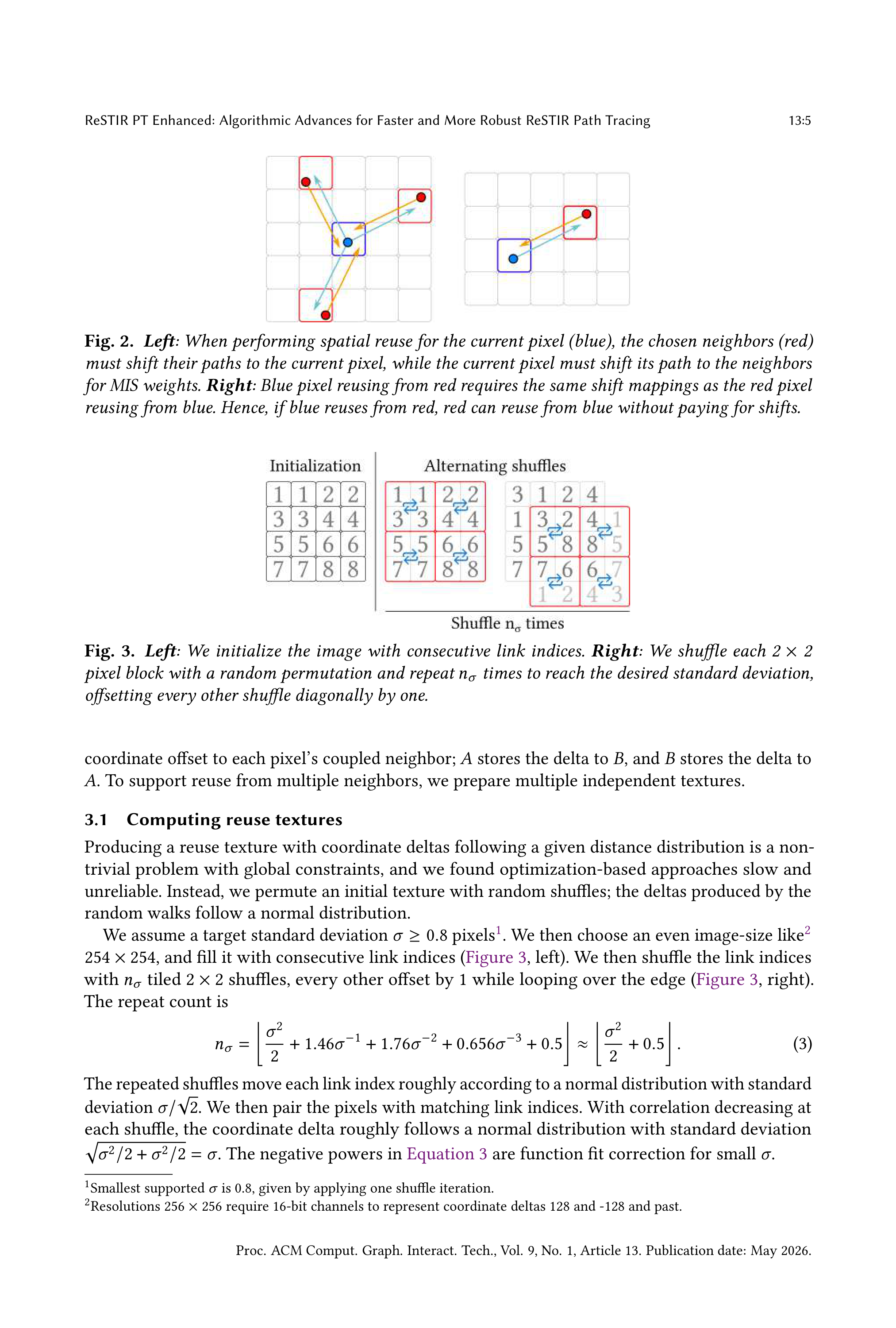
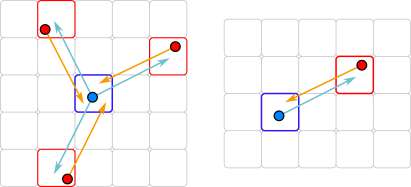
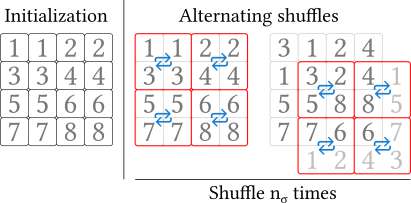
Fig. 2.
Left
: When performing spatial reuse for the current pixel (blue), the chosen neighbors (red)
must shift their paths to the current pixel, while the current pixel must shift its path to the neighbors
for MIS weights.
Right
: Blue pixel reusing from red requires the same shift mappings as the red pixel
reusing from blue. Hence, if blue reuses from red, red can reuse from blue without paying for shifts.
Fig.
3.
Left
:
We
initialize
the
image
with
consecutive
link
indices.
Right
:
We
shuffle
each
2
×
2
pixel block with a random permutation and repeat
𝑛
𝜎
times to reach the desired standard deviation,
offsetting every other shuffle diagonally by one.
coordinate offset to each pixel’s coupled neighbor;
𝐴
stores the delta to
𝐵
, and
𝐵
stores the delta to
𝐴
. To support reuse from multiple neighbors, we prepare multiple independent textures.
3.1
Computing reuse textures
Producing a reuse texture with coordinate deltas following a given distance distribution is a non-
trivial problem with global constraints, and we found optimization-based approaches slow and
unreliable. Instead, we permute an initial texture with random shuffles; the deltas produced by the
random walks follow a normal distribution.
We assume a target standard deviation
𝜎
≥
0
.
8 pixels
1
. We then choose an even image-size like
2
254
×
254, and fill it with consecutive link indices (
Figure 3
, left). We then shuffle the link indices
with
𝑛
𝜎
tiled 2
×
2 shuffles, every other offset by 1 while looping over the edge (
Figure 3
, right).
The repeat count is
𝑛
𝜎
=
𝜎
2
2
+
1
.
46
𝜎
−
1
+
1
.
76
𝜎
−
2
+
0
.
656
𝜎
−
3
+
0
.
5
≈
𝜎
2
2
+
0
.
5
.
(3)
The repeated shuffles move each link index roughly according to a normal distribution with standard
deviation
𝜎
/
√
2
. We then pair the pixels with matching link indices. With correlation decreasing at
each shuffle, the coordinate delta roughly follows a normal distribution with standard deviation
√︁
𝜎
2
/
2
+
𝜎
2
/
2
=
𝜎
. The negative powers in
Equation 3
are function fit correction for small
𝜎
.
1
Smallest supported
𝜎
is 0.8, given by applying one shuffle iteration.
2
Resolutions 256
×
256 require 16-bit channels to represent coordinate deltas 128 and -128 and past.
Proc. ACM Comput. Graph. Interact. Tech., Vol. 9, No. 1, Article 13. Publication date: May 2026.
13:6
Daqi Lin, Markus Kettunen, and Chris Wyman
The links are now contained within the reuse texture, and links near edges can be long. To make
the reuse texture tileable, we break long links by subtracting the width of the square texture from
coordinate deltas greater than half the width, and adding it to coordinate deltas less than minus
half the width. Finally, we pack these
𝑥
and
𝑦
directional deltas into a 16-bit luminance texture.
Finding links.
To find coordinate deltas, each pixel locates the other pixel with its link index. Our
CUDA implementation constructs an
index table
of size
𝑁
/
2
×
2, where
𝑁
is the pixel count of
the reuse texture. First, every pixel reads its own link index, and writes its pixel location into the
index table at location (link index, 0). This is a parallel write with a data race, so only half the pixels
succeed. Next, each pixel whose location is not at (link index, 0), writes it to (link index, 1). This
enables every pixel to find its linked neighbor in the index table.
3.2
Using reuse textures
Assuming spatial reuse with
𝑁
neighbors, we preload
𝑁
reuse textures. To avoid correlation artifacts
from texture repeats, we pick a different size for each, e.g., 254, 230 and 210 for three neighbors
3
.
Our reuse texture is self-inverting:
𝐴
links to
𝐵
, and
𝐵
links to
𝐴
. Hence, the reuse texture should
be changed every frame. Rather than generating many reuse textures, we randomly flip, mirror,
transpose, and offset each reuse texture each frame. Empirically, this completely solves the problem.
3.3
Discussion
Bekaert et al
.
[
2002
] split 16
×
16 pixel blocks into groups of 16 pixels in an
𝑁
-rooks pattern and
perform all-to-all reuse within each group. This also avoids the additional work for MIS weights,
but produces structured artifacts at low sample counts. We avoid such structure by overlaying large
different-sized Gaussian-permuted reuse textures; each pixel follows a different, random reuse
pattern with no block borders. Our reuse textures can also be used in classical path reuse.
4
SCENE-INDEPENDENT RECONNECTION CRITERIA
During
ReSTIR’s
sample
reuse,
neighbor
samples
are
shifted
into
the
current
domain
prior
to
reuse.
Ideal
shift
mapping
preserves
the
target
PDF
value
of
the
path
[
Wyman
et
al
.
2023
],
i.e.
¯
𝑝
𝑗
(
𝑇
(
¯
u
))
𝜕𝑇
𝜕
¯
u
≈
¯
𝑝
𝑖
(
¯
u
)
. Without loss of generality, we analyze the reconnection criteria for ReSTIR
PT’s hybrid shift in primary sample space; we assume
¯
𝑝
𝑗
(
𝑇
(
¯
u
))
≈
¯
𝑝
𝑖
(
¯
u
)
4
and focus on
𝜕𝑇
𝜕
¯
u
, which
is only affected by the choice of reconnection vertex. A good shift mapping should have
𝜕𝑇
𝜕
¯
u
≈
1.
The original hybrid shift [
Lin et al
.
2022
] selects reconnection vertex
x
𝑘
using a distance threshold
||
x
𝑘
−
x
𝑘
−
1
||
≥
𝑑
min
that
forbids
short
path
reconnections
(i.e.,
near
corners)
and
a
roughness
threshold
min
(
𝛼
x
𝑘
−
1
, 𝛼
x
𝑘
)
≥
𝛼
min
to forbid connections on highly glossy surfaces. These thresholds
can be suboptimal and often require scene-specific tuning, since suitable reconnection distances
and roughness levels are interdependent.
We introduce a
dual ray footprint threshold
and a new
single-vertex roughness threshold
, giving
reconnection constraints that are more robust in the presence of specular materials, do not require
scene-specific tuning, and enable earlier (and hence cheaper) reconnection opportunities.
The intuition for the new footprint thresholds comes from considering the geometric meaning
of
𝜕𝑇
𝜕
¯
u
≈
1. We first express
𝜕𝑇
𝜕
¯
u
as the product of two ratios,
𝑝
𝑦
𝑘
−
1
(
𝜔
′
𝑘
−
1
)
𝐺
(
y
𝑘
−
1
→
x
𝑘
)
𝑝
𝑥
𝑘
−
1
(
𝜔
𝑘
−
1
)
𝐺
(
x
𝑘
−
1
→
x
𝑘
)
(4a)
and
𝑝
𝑦
𝑘
(
𝜔
𝑘
)
𝑝
𝑥
𝑘
(
𝜔
𝑘
)
.
(4b)
3
Our heuristic algorithm tries to minimize near-periods within 3840 pixels, i.e., cases where a multiple of a texture’s width
is close to a multiple of another texture’s width.
4
Geometry and microfacet NDF terms are cancelled in
𝜔
𝑡
(
¯
x
)
𝑓
(
¯
x
)/
𝑝
𝑡
(
¯
x
)
, which avoids extreme values in the shift.
Proc. ACM Comput. Graph. Interact. Tech., Vol. 9, No. 1, Article 13. Publication date: May 2026.
ReSTIR PT Enhanced: Algorithmic Advances for Faster and More Robust ReSTIR Path Tracing
13:7
The first one is between the area densities of vertex
x
𝑘
when hypothetically traced from
y
𝑘
−
1
and
when originally traced from
x
𝑘
−
1
. The second one is between the solid angle densities of
𝜔
𝑘
when
hypothetically sampled with outgoing direction
y
𝑘
−
1
x
𝑘
and when originally sampled with outgoing
direction
x
𝑘
−
1
x
𝑘
. Our threshold aims to bound the change of these densities.
The reciprocal of area probability density of a vertex on a surface has the geometric meaning of
the footprint, i.e., the area represented by the sample. Intuitively, a longer reconnection distance
or rougher material at
x
𝑘
−
1
enlarges the ray footprints and reduces the density change at shift
mapping,
making
a
shift
reconnecting
from
x
𝑘
−
1
more
useful.
To
bound
Equation
4b
,
we
look
at
inverse
ray
footprint
(
𝑝
𝑥
𝑘
(
𝜔
𝑘
)
𝐺
(
x
𝑘
→
x
𝑘
−
1
))
−
1
,
which
is
the
reciprocal
area
density
of
x
𝑘
−
1
produced by tracing from
x
𝑘
. Our analysis shows that thresholding this footprint equivalently
bounds the change of solid angle density in
Equation 4b
.
Specifically, our new criterion for reconnection is then defined by a dual ray footprint threshold:
min
((
𝑝
𝑥
𝑘
−
1
(
𝜔
𝑘
−
1
)
𝐺
(
x
𝑘
−
1
→
x
𝑘
))
−
1
,
(
𝑝
𝑥
𝑘
(
𝜔
𝑘
)
𝐺
(
x
𝑘
→
x
𝑘
−
1
))
−
1
)
≥
𝑐
100
||
x
0
−
x
1
||
2
𝑛
x
1
,
d
x
1
x
0
/(
4
𝜋
)
,
(5)
where
the
RHS
is
a
constant
multiple
of
the
primary
ray
footprint
that
measures
the
distance
between the nearby primary hits. We found the constant multiplier
𝑐
=
0
.
02 (i.e.,
𝑐
/
100
=
0
.
0002) to
work well in diverse scenes. We also enforce a single-vertex threshold (
𝛼
x
𝑘
−
1
≥
𝛼
min
) at vertex
x
𝑘
−
1
to cheaply avoid trying to reconnect in some tricky edge cases.
4.1
Explanation of the dual footprint thresholds
We provide a brief explanation of how our dual footprint thresholds achieve the bounding and
provide a full derivation in the supplemental material. Consider shifting a path
¯
x
in one pixel to
¯
y
=
𝑇
(
¯
x
)
in another pixel. For a candidate reconnection vertex
x
𝑘
on
¯
x
, connecting from
y
𝑘
−
1
instead of
x
𝑘
−
1
perturbs the
path-traced area density
of
x
𝑘
and the angular density of
𝜔
𝑘
. We want
these relative changes to be small: for small
𝜖
,
𝑝
𝑦
𝑘
−
1
(
𝜔
′
𝑘
−
1
)
𝐺
(
y
𝑘
−
1
→
x
𝑘
)
𝑝
𝑥
𝑘
−
1
(
𝜔
𝑘
−
1
)
𝐺
(
x
𝑘
−
1
→
x
𝑘
)
−
1
<
𝜖
(6a)
and
𝑝
𝑦
𝑘
(
𝜔
𝑘
)
𝑝
𝑥
𝑘
(
𝜔
𝑘
)
−
1
<
𝜖,
(6b)
which imply
(
1
−
𝜖
)
2
<
𝜕𝑇
𝜕
¯
u
<
(
1
+
𝜖
)
2
.
Ray footprint threshold.
Equation 6a
requires bounding the change in area density at
x
𝑘
when
reconnecting from
y
𝑘
−
1
instead of
x
𝑘
−
1
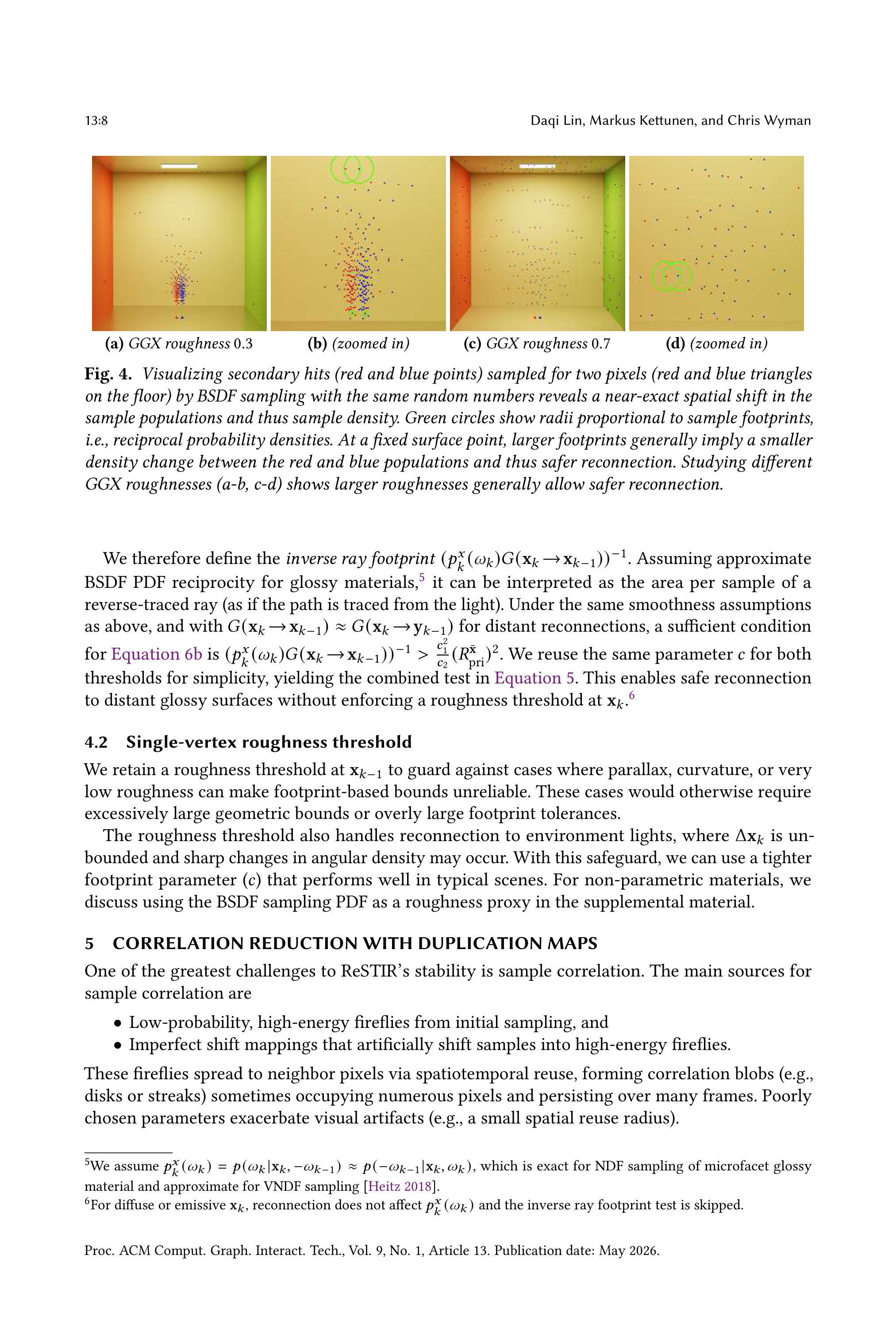
. Assuming random replay preserves local area density
(
Figure 4
), we analyze how the area density of
x
𝑘
changes under a spatial displacement
Δ
x
𝑘
=
y
𝑘
−
x
𝑘
,
where
y
𝑘
is obtained by replaying from
y
𝑘
−
1
.
We assume
∥
Δ
x
𝑘
∥
is bounded by a constant multiple of the
primary ray footprint
[
Müller et al
.
2021
],
∥
Δ
x
𝑘
∥
<
𝑐
1
𝑅
¯
x
pri
=
𝑐
1
√︃
∥
x
0
−
x
1
∥
2
⟨
𝑛
x
1
,
d
x
1
x
0
⟩/(
4
𝜋
)
. Further assuming that relative density variation within
a footprint of radius
√︁
𝑐
2
/(
𝑝
𝑥
𝑘
−
1
(
𝜔
𝑘
−
1
)
𝐺
(
x
𝑘
−
1
→
x
𝑘
))
is bounded by
𝜖
, a sufficient condition for
Equation
6a
is
(
𝑝
𝑥
𝑘
−
1
(
𝜔
𝑘
−
1
)
𝐺
(
x
𝑘
−
1
→
x
𝑘
))
−
1
>
𝑐
2
1
𝑐
2
(
𝑅
¯
x
pri
)
2
.
This
ray
footprint
threshold
avoids
reconnections near density peaks caused by glossy BSDFs or geometric singularities. In practice,
we collapse the constants into a single parameter
𝑐
in
Equation 5
; larger
𝑐
makes reconnection
more conservative, i.e., favor postponing.
Inverse ray footprint threshold.
The ray footprint bounds changes in area density at
x
𝑘
but does
not capture changes in the BSDF sampling PDF
𝑝
𝑥
𝑘
(
𝜔
𝑘
)
caused by altering the outgoing direction
−
𝜔
𝑘
−
1
, which can be significant for low-roughness glossy materials.
Proc. ACM Comput. Graph. Interact. Tech., Vol. 9, No. 1, Article 13. Publication date: May 2026.
13:8
Daqi Lin, Markus Kettunen, and Chris Wyman
(a)
GGX roughness
0
.
3
(b)
(zoomed in)
(c)
GGX roughness
0
.
7
(d)
(zoomed in)
Fig. 4.
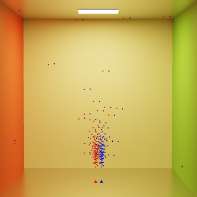
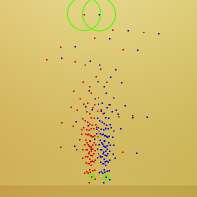
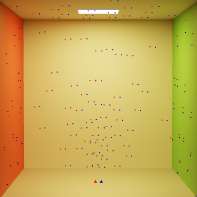
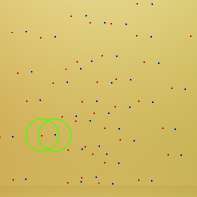
Visualizing secondary hits (red and blue points) sampled for two pixels (red and blue triangles
on the floor) by BSDF sampling with the same random numbers reveals a near-exact spatial shift in the
sample populations and thus sample density. Green circles show radii proportional to sample footprints,
i.e., reciprocal probability densities. At a fixed surface point, larger footprints generally imply a smaller
density change between the red and blue populations and thus safer reconnection. Studying different
GGX roughnesses (a-b, c-d) shows larger roughnesses generally allow safer reconnection.
We therefore define the
inverse ray footprint
(
𝑝
𝑥
𝑘
(
𝜔
𝑘
)
𝐺
(
x
𝑘
→
x
𝑘
−
1
))
−
1
. Assuming approximate
BSDF
PDF
reciprocity
for
glossy
materials,
5
it
can
be
interpreted
as
the
area
per
sample
of
a
reverse-traced ray (as if the path is traced from the light). Under the same smoothness assumptions
as above, and with
𝐺
(
x
𝑘
→
x
𝑘
−
1
)
≈
𝐺
(
x
𝑘
→
y
𝑘
−
1
)
for distant reconnections, a sufficient condition
for
Equation 6b
is
(
𝑝
𝑥
𝑘
(
𝜔
𝑘
)
𝐺
(
x
𝑘
→
x
𝑘
−
1
))
−
1
>
𝑐
2
1
𝑐
2
(
𝑅
¯
x
pri
)
2
. We reuse the same parameter
𝑐
for both
thresholds for simplicity, yielding the combined test in
Equation 5
. This enables safe reconnection
to distant glossy surfaces without enforcing a roughness threshold at
x
𝑘
.
6
4.2
Single-vertex roughness threshold
We retain a roughness threshold at
x
𝑘
−
1
to guard against cases where parallax, curvature, or very
low roughness can make footprint-based bounds unreliable. These cases would otherwise require
excessively large geometric bounds or overly large footprint tolerances.
The roughness threshold also handles reconnection to environment lights, where
Δ
x
𝑘
is un-
bounded and sharp changes in angular density may occur. With this safeguard, we can use a tighter
footprint
parameter
(
𝑐
)
that
performs
well
in
typical
scenes.
For
non-parametric
materials,
we
discuss using the BSDF sampling PDF as a roughness proxy in the supplemental material.
5
CORRELATION REDUCTION WITH DUPLICATION MAPS
One of the greatest challenges to ReSTIR’s stability is sample correlation. The main sources for
sample correlation are
•
Low-probability, high-energy fireflies from initial sampling, and
•
Imperfect shift mappings that artificially shift samples into high-energy fireflies.
These fireflies spread to neighbor pixels via spatiotemporal reuse, forming correlation blobs (e.g.,
disks or streaks) sometimes occupying numerous pixels and persisting over many frames. Poorly
chosen parameters exacerbate visual artifacts (e.g., a small spatial reuse radius).
5
We assume
𝑝
𝑥
𝑘
(
𝜔
𝑘
)
=
𝑝
(
𝜔
𝑘
|
x
𝑘
,
−
𝜔
𝑘
−
1
)
≈
𝑝
(−
𝜔
𝑘
−
1
|
x
𝑘
,𝜔
𝑘
)
, which is exact for NDF sampling of microfacet glossy
material and approximate for VNDF sampling [
Heitz 2018
].
6
For diffuse or emissive
x
𝑘
, reconnection does not affect
𝑝
𝑥
𝑘
(
𝜔
𝑘
)
and the inverse ray footprint test is skipped.
Proc. ACM Comput. Graph. Interact. Tech., Vol. 9, No. 1, Article 13. Publication date: May 2026.


ReSTIR PT Enhanced: Algorithmic Advances for Faster and More Robust ReSTIR Path Tracing
13:9
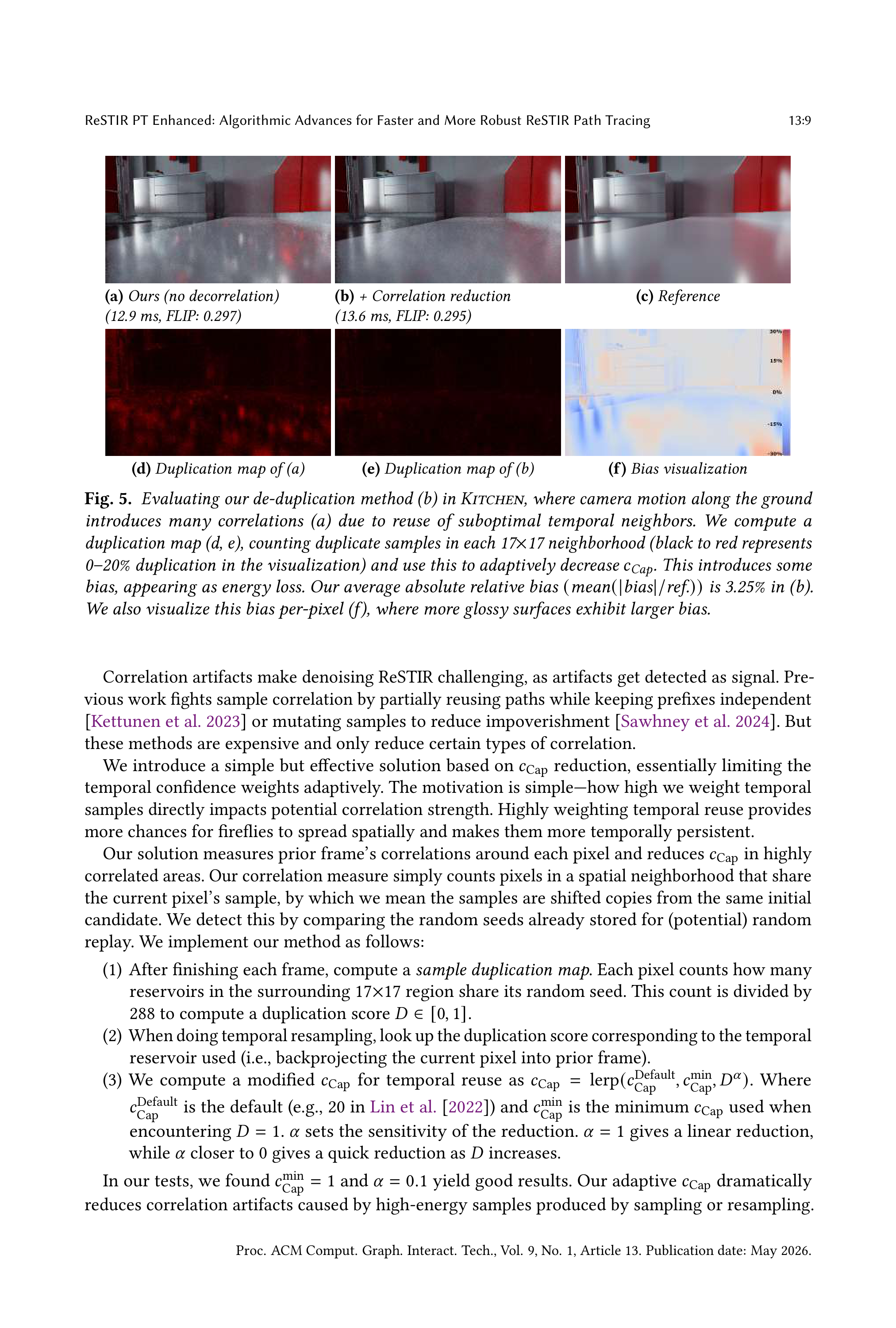
(a)
Ours (no decorrelation)
(12.9 ms, FLIP: 0.297)
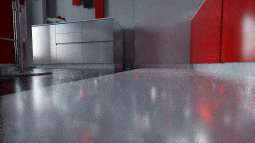
(b)
+ Correlation reduction
(13.6 ms, FLIP: 0.295)
(c)
Reference
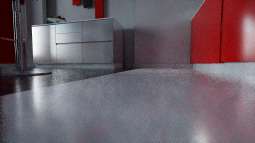
(d)
Duplication map of (a)
(e)
Duplication map of (b)
(f)
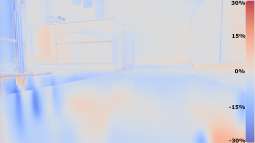
Bias visualization
Fig. 5.
Evaluating our de-duplication method (b) in Kitchen, where camera motion along the ground
introduces
many
correlations
(a)
due
to
reuse
of
suboptimal
temporal
neighbors.
We
compute
a
duplication map (d, e), counting duplicate samples in each 17
×
17 neighborhood (black to red represents
0–20% duplication in the visualization) and use this to adaptively decrease
𝑐
Cap
. This introduces some
bias, appearing as energy loss. Our average absolute relative bias
(
mean
(|
bias
|/
ref.
))
is 3.25% in (b).
We also visualize this bias per-pixel (f), where more glossy surfaces exhibit larger bias.
Correlation artifacts make denoising ReSTIR challenging, as artifacts get detected as signal. Pre-
vious work fights sample correlation by partially reusing paths while keeping prefixes independent
[
Kettunen et al
.
2023
] or mutating samples to reduce impoverishment [
Sawhney et al
.
2024
]. But
these methods are expensive and only reduce certain types of correlation.
We introduce a simple but effective solution based on
𝑐
Cap
reduction, essentially limiting the
temporal confidence weights adaptively. The motivation is simple—how high we weight temporal
samples directly impacts potential correlation strength. Highly weighting temporal reuse provides
more chances for fireflies to spread spatially and makes them more temporally persistent.
Our solution measures prior frame’s correlations around each pixel and reduces
𝑐
Cap
in highly
correlated areas. Our correlation measure simply counts pixels in a spatial neighborhood that share
the current pixel’s sample, by which we mean the samples are shifted copies from the same initial
candidate. We detect this by comparing the random seeds already stored for (potential) random
replay. We implement our method as follows:
(1)
After finishing each frame, compute a
sample duplication map
. Each pixel counts how many
reservoirs in the surrounding 17
×
17 region share its random seed. This count is divided by
288 to compute a duplication score
𝐷
∈[
0
,
1
]
.
(2)
When doing temporal resampling, look up the duplication score corresponding to the temporal
reservoir used (i.e., backprojecting the current pixel into prior frame).
(3)
We
compute
a
modified
𝑐
Cap
for
temporal
reuse
as
𝑐
Cap
=
lerp
(
𝑐
Default
Cap
,𝑐
min
Cap
, 𝐷
𝛼
)
.
Where
𝑐
Default
Cap
is the default (e.g., 20 in
Lin et al
.
[
2022
]) and
𝑐
min
Cap
is the minimum
𝑐
Cap
used when
encountering
𝐷
=
1.
𝛼
sets the sensitivity of the reduction.
𝛼
=
1 gives a linear reduction,
while
𝛼
closer to 0 gives a quick reduction as
𝐷
increases.
In our tests, we found
𝑐
min
Cap
=
1 and
𝛼
=
0
.
1 yield good results. Our adaptive
𝑐
Cap
dramatically
reduces correlation artifacts caused by high-energy samples produced by sampling or resampling.
Proc. ACM Comput. Graph. Interact. Tech., Vol. 9, No. 1, Article 13. Publication date: May 2026.
13:10
Daqi Lin, Markus Kettunen, and Chris Wyman
Because this approach adjusts confidence weights based on specific samples, the partition of
unity of MIS weights
𝑚
𝑖
is violated, introducing a small bias. This bias only occurs in correlated
areas where we modify
𝑐
Cap
; essentially our approach trades correlation for bias.
Figure 5
shows
our method in a very difficult scene, where it averages 3.25% absolute relative bias.
6
IMPLEMENTATION IMPROVEMENTS
Beyond our algorithmic contributions, we introduce implementation-focused improvements that
further enhance performance and robustness. We reduce redundancy by combining separate ReSTIR
direct and indirect lighting passes into one unified algorithm (
Section 6.1
), apply GPU optimizations
to reduce thread divergence (
Section 6.2
), and adopt existing techniques to reduce color (
Section 6.3
)
and disocclusion noise (
Section 6.4
). The quality improvements these bring can be seen aggregated
in
Figure 1
and
Figure 13
, but more individual ablations are provided in the supplemental.
6.1
Unifying Direct Lighting and Global Illumination
Real-time renderers often separately compute direct and indirect lighting, with indirect light often
approximated more aggressively. But using ReSTIR, we can efficiently sample high-quality indirect
illumination. Rather than running separate direct and indirect ReSTIR passes, as in
Lin et al
.
[
2022
],
we combine both using a single reservoir.
The idea is simple.
Lin et al
.
[
2022
] start by initially sampling a
path tree
by emanating NEE
rays from BSDF-sampled vertices
[
x
2
, ...,
x
𝑛
]
where
𝑛
is limited by the maximum allowed bounces.
Initial resampling selects and stores a single
path
in the reservoir, i.e.,
¯
x
=
[
x
0
,
x
1
,
x
2
, ...,
x
𝑑
]
with a
single
NEE/BSDF ray connecting to a light at
x
𝑑
(see
Section 2.3
) with
𝑑
≥
3 originally. Direct light
can be handled by simply tracing another NEE ray from
x
1
when generating the path tree, and
giving the (unified) initial resampling a chance to select a shorter direct lighting path (
𝑑
=
2) from
the tree. The selected path is thus sampled from the full path space.
This removes the cost and storage of separate ReSTIR passes for direct and indirect light. Some-
what surprisingly, it also improves quality as direct lighting now benefits from ReSTIR PT’s built-in
shift
mapping
(especially
on
glossy
highlights).
Implementation
details
for
modifying
the
MIS
weights and source PDFs in primary sample space are provided in the supplemental material.
For scenes with many lights, we optionally apply RIS when generating NEE samples at
x
1
. As
in ReSTIR DI, visibility is excluded from the target function and tested only for the selected light.
We reuse the presampled light-tile scheme from
Wyman and Panteleev
[
2021
] to improve cache
coherence: each frame precomputes 128 tiles with 1024 lights, from which each 8
×
8 screen tile
draws a light tile to generate candidates per bounce.
6.2
Improving GPU Performance by Reducing Divergence
Monte Carlo path tracing incurs substantial GPU divergence as neighboring paths often traverse
very different geometry and materials. ReSTIR PT further increases divergence due to additional
control flow and intermediate data, e.g., reservoirs. We apply a set of optimizations that reduce
both code and data divergence, substantially improving GPU efficiency.
6.2.1
Low-level Code Optimization.
A naive ReSTIR PT implementation contains many branches
arising from reservoir sampling and heterogeneous path cases. We reduce divergence by replacing
most branches with conditional moves and simplifying computations while preserving equivalent
results. We also reduce reservoir storage from 88 bytes to 64 bytes by removing unnecessary fields
and applying lossy compression to selected quantities (details in the supplemental material).
6.2.2
Stream Compaction for Random Replay.
In many scenes, only a few pixel–neighbor pairs
require random replay, yet warp-level execution forces all threads to wait. We parallelize over
Proc. ACM Comput. Graph. Interact. Tech., Vol. 9, No. 1, Article 13. Publication date: May 2026.
ReSTIR PT Enhanced: Algorithmic Advances for Faster and More Robust ReSTIR Path Tracing
13:11
pixel–neighbor pairs, applying stream compaction to discard pairs that do not require replay. This
reduces warp divergence and the number of active warps, yielding a substantial speedup.
6.2.3
Forced NEE Light Reconnection.
During random replay, paths ending at NEE-sampled light
vertices incur expensive light sampling that other path types avoid. Since replayed random numbers
usually select the same light (e.g., with power-based sampling), we force reconnection to such
vertices
if
no
earlier
reconnection
is
found.
This
removes
light
sampling
from
random
replay,
improving performance. Any potential variance increase is mitigated by path MIS weights, which
already downweight these cases (as such surfaces are typically glossy).
6.2.4
Russian Roulette.
Initial resampling is often the most expensive stage due to long, divergent
paths. We apply Russian roulette to reduce average path length at initial sampling, but remove it
from random replay to avoid killing valid paths during reuse. This effectively removes the roulette
dimensions from the path parametrization and applies an external roulette at initial path sampling,
modifying the sampling PDF in primary sample space (see supplemental). Although this slightly
increases noise in initial samples, spatiotemporal reuse largely suppresses its impact in the final
result, and the roulette failures at shift mapping are completely avoided.
6.3
Reducing Color Noise
ReSTIR inherently suffers from color noise because resampling operates on a scalar target function
ˆ
𝑝
,
while the integrand
F
(
𝑦
)
is RGB-valued. GRIS therefore samples primarily according to luminance,
leaving chroma poorly importance-sampled.
Prior work [
Kettunen et al
.
2023
;
Lin et al
.
2022
] noted that the estimate
F
(
𝑌
)
𝑊
𝑌
can be improved
by marginalizing over the random index choice. In ReSTIR PT, this improvement comes at almost
no extra cost: since
ˆ
𝑝
=
|
F
|
,
F
(
𝑌
𝑖
)
is already evaluated during spatial reuse. We accumulate vector-
valued resampling weights
w
𝑖
=
𝑚
𝑖
(
𝑌
𝑖
)
F
(
𝑌
𝑖
)
𝑊
𝑋
𝑖
|
𝜕𝑇
/
𝜕𝑋
𝑖
|
and use
Í
𝑀
𝑖
=
1
w
𝑖
for shading. As spatial
neighbors typically contain uncorrelated chroma noise
7
, spatial reuse naturally averages it out. This
decouples resampling and shading: scalar weights drive future resampling, while vector weights
are used for shading. Unlike similar techniques for direct lighting [
Wyman and Panteleev 2021
],
our method incurs no additional computations.
6.4
Reducing Disocclusion Noise with Dual Motion Vectors
Disocclusion causes severe noise in ReSTIR as newly visible surfaces lack any temporal history.
Dual motion vectors [
Zeng et al
.
2021
] address this by reprojecting pixels using an alternative
motion vector that assumes consistent relative motion between occluding and disoccluded surfaces.
We apply this directly to ReSTIR’s temporal resampling and observe a substantial reduction in
disocclusion noise. While prior work avoids copy-paste artifacts by storing incident radiance fields,
this issue does not arise in ReSTIR PT: unbiased path resampling prevents pattern cloning. The
remaining correlated noise is mild and can be further reduced using our decorrelation strategy
(
Section 5
).
7
EVALUATION
Our evaluation uses a PC with NVIDIA RTX 5880 Ada graphics card and AMD Ryzen Threadripper
PRO 3975WX 32-Cores CPU. We use the Falcor [
Benty et al
.
2020
] real-time rendering framework
and start optimization from the original ReSTIR PT source code [
Lin et al
.
2022
]. All images are
rendered in 1920
×
1080. We use the HDR version of FLIP [
Andersson et al
.
2021
] as the metric for
7
Although spatiotemporal reuse can also create spatially correlated color noise, such correlation is usually not among the
randomly sampled spatial neighbors in the new frame.
Proc. ACM Comput. Graph. Interact. Tech., Vol. 9, No. 1, Article 13. Publication date: May 2026.
13:12
Daqi Lin, Markus Kettunen, and Chris Wyman
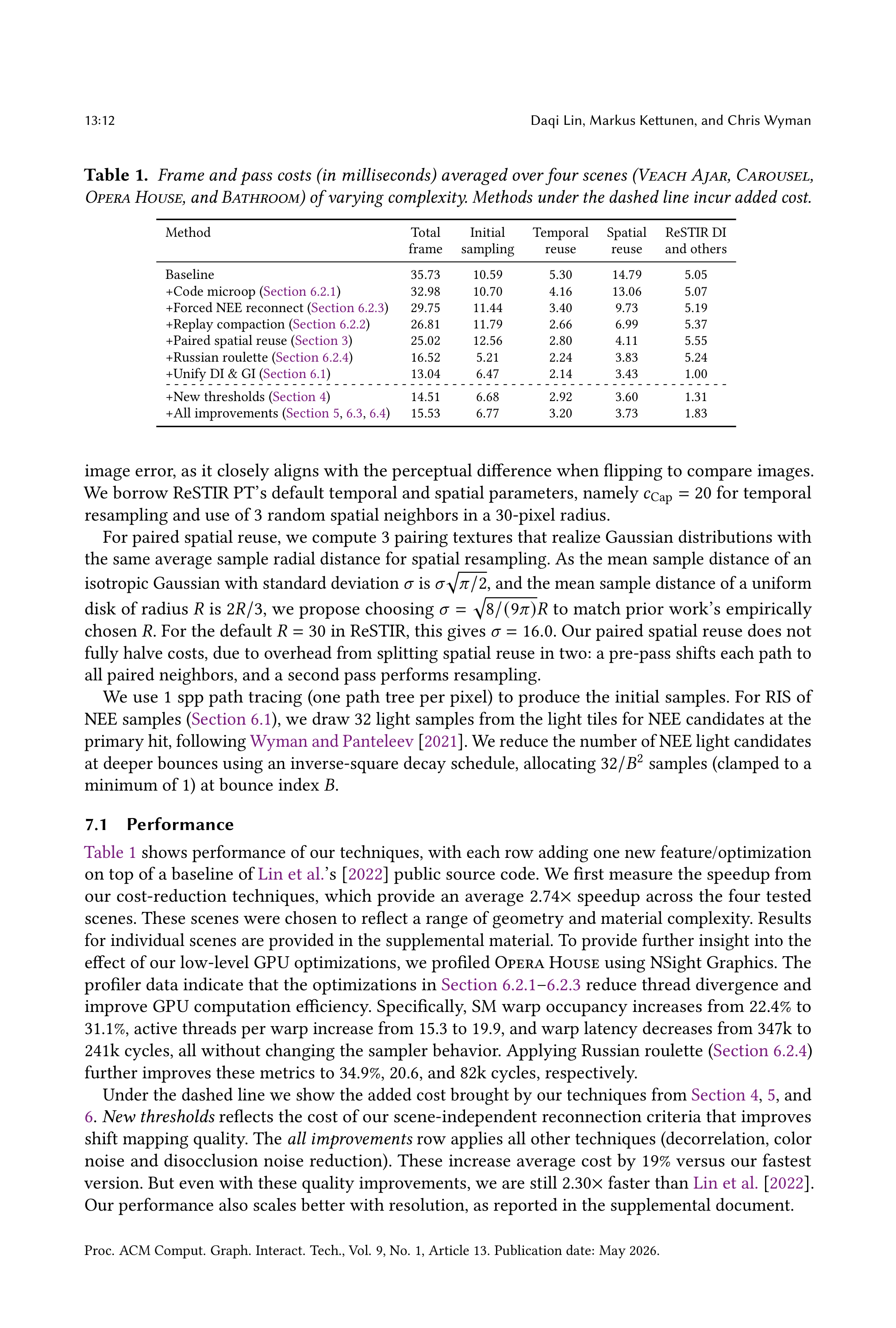
Table 1.
Frame and pass costs (in milliseconds) averaged over four scenes (Veach Ajar, Carousel,
Opera House, and Bathroom) of varying complexity. Methods under the dashed line incur added cost.
Method
Total
Initial
Temporal
Spatial
ReSTIR DI
frame
sampling
reuse
reuse
and others
Baseline
35.73
10.59
5.30
14.79
5.05
+Code microop (
Section 6.2.1
)
32.98
10.70
4.16
13.06
5.07
+Forced NEE reconnect (
Section 6.2.3
)
29.75
11.44
3.40
9.73
5.19
+Replay compaction (
Section 6.2.2
)
26.81
11.79
2.66
6.99
5.37
+Paired spatial reuse (
Section 3
)
25.02
12.56
2.80
4.11
5.55
+Russian roulette (
Section 6.2.4
)
16.52
5.21
2.24
3.83
5.24
+Unify DI & GI (
Section 6.1
)
13.04
6.47
2.14
3.43
1.00
- - - - - - - - - - - - - - - - - - - - - - - - - - - - - - - - - - - - - - - - - - - - - - - - - - - - - - - - - - - - - - - - - - -
+New thresholds (
Section 4
)
14.51
6.68
2.92
3.60
1.31
+All improvements (
Section 5
,
6.3
,
6.4
)
15.53
6.77
3.20
3.73
1.83
image error, as it closely aligns with the perceptual difference when flipping to compare images.
We borrow ReSTIR PT’s default temporal and spatial parameters, namely
𝑐
Cap
=
20 for temporal
resampling and use of 3 random spatial neighbors in a 30-pixel radius.
For paired spatial reuse, we compute 3 pairing textures that realize Gaussian distributions with
the same average sample radial distance for spatial resampling. As the mean sample distance of an
isotropic Gaussian with standard deviation
𝜎
is
𝜎
√︁
𝜋
/
2
, and the mean sample distance of a uniform
disk of radius
𝑅
is 2
𝑅
/
3, we propose choosing
𝜎
=
√︁
8
/(
9
𝜋
)
𝑅
to match prior work’s empirically
chosen
𝑅
. For the default
𝑅
=
30 in ReSTIR, this gives
𝜎
=
16
.
0. Our paired spatial reuse does not
fully halve costs, due to overhead from splitting spatial reuse in two: a pre-pass shifts each path to
all paired neighbors, and a second pass performs resampling.
We use 1 spp path tracing (one path tree per pixel) to produce the initial samples. For RIS of
NEE samples (
Section 6.1
), we draw 32 light samples from the light tiles for NEE candidates at the
primary hit, following
Wyman and Panteleev
[
2021
]. We reduce the number of NEE light candidates
at deeper bounces using an inverse-square decay schedule, allocating 32
/
𝐵
2
samples (clamped to a
minimum of 1) at bounce index
𝐵
.
7.1
Performance
Table 1
shows performance of our techniques, with each row adding one new feature/optimization
on top of a baseline of
Lin et al
.
’s [
2022
] public source code. We first measure the speedup from
our cost-reduction techniques, which provide an average 2.74
×
speedup across the four tested
scenes. These scenes were chosen to reflect a range of geometry and material complexity. Results
for individual scenes are provided in the supplemental material. To provide further insight into the
effect of our low-level GPU optimizations, we profiled Opera House using NSight Graphics. The
profiler data indicate that the optimizations in
Section 6.2.1
–
6.2.3
reduce thread divergence and
improve GPU computation efficiency. Specifically, SM warp occupancy increases from 22.4% to
31.1%, active threads per warp increase from 15.3 to 19.9, and warp latency decreases from 347k to
241k cycles, all without changing the sampler behavior. Applying Russian roulette (
Section 6.2.4
)
further improves these metrics to 34.9%, 20.6, and 82k cycles, respectively.
Under the dashed line we show the added cost brought by our techniques from
Section 4
,
5
, and
6
.
New thresholds
reflects the cost of our scene-independent reconnection criteria that improves
shift mapping quality. The
all improvements
row applies all other techniques (decorrelation, color
noise and disocclusion noise reduction). These increase average cost by 19% versus our fastest
version. But even with these quality improvements, we are still 2.30
×
faster than
Lin et al
.
[
2022
].
Our performance also scales better with resolution, as reported in the supplemental document.
Proc. ACM Comput. Graph. Interact. Tech., Vol. 9, No. 1, Article 13. Publication date: May 2026.







ReSTIR PT Enhanced: Algorithmic Advances for Faster and More Robust ReSTIR Path Tracing
13:13
(a)
Original image
(b)
Swap once
(c)
Swap twice
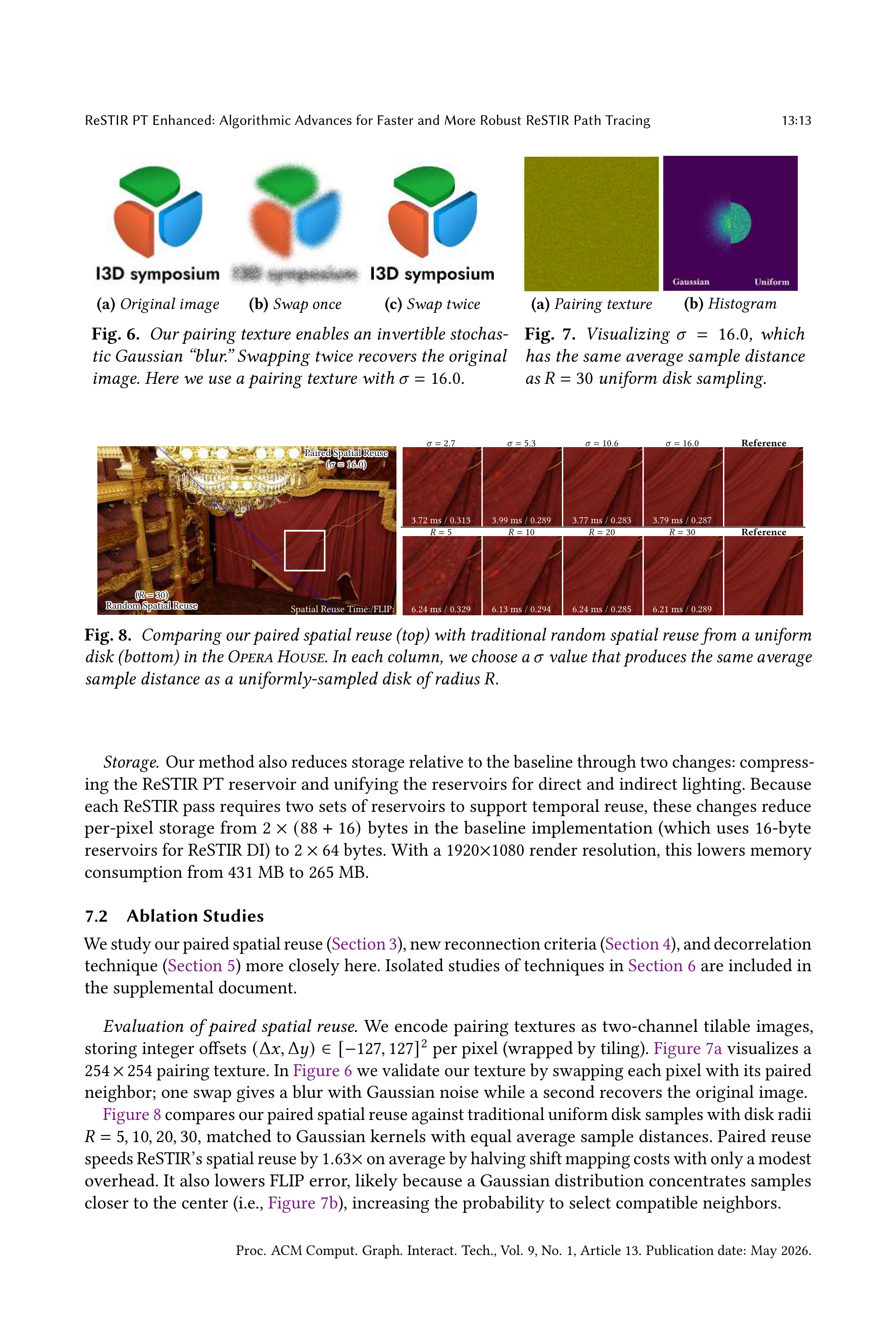
Fig. 6.
Our pairing texture enables an invertible stochas-
tic Gaussian “blur.” Swapping twice recovers the original
image. Here we use a pairing texture with
𝜎
=
16
.
0
.
(a)
Pairing texture
(b)
Histogram
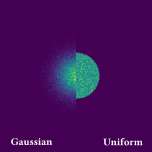
Fig.
7.
Visualizing
𝜎
=
16
.
0
,
which
has the same average sample distance
as
𝑅
=
30
uniform disk sampling.
𝜎
=
2
.
7
𝜎
=
5
.
3
𝜎
=
10
.
6
𝜎
=
16
.
0
Reference
Time:/FLIP:
3.72 ms / 0.313
3.99 ms / 0.289
3.77 ms / 0.283
3.79 ms / 0.287
𝑅
=
5
𝑅
=
10
𝑅
=
20
𝑅
=
30
Reference
(
𝑅
=
30)
(
𝑅
=
30)
(
𝑅
=
30)
(
𝑅
=
30)
(
𝑅
=
30)
(
𝑅
=
30)
(
𝑅
=
30)
(
𝑅
=
30)
(
𝑅
=
30)
(
𝑅
=
30)
(
𝑅
=
30)
(
𝑅
=
30)
(
𝑅
=
30)
(
𝑅
=
30)
(
𝑅
=
30)
(
𝑅
=
30)
(
𝑅
=
30)
(
𝜎
=
16
.
0)
(
𝜎
=
16
.
0)
(
𝜎
=
16
.
0)
(
𝜎
=
16
.
0)
(
𝜎
=
16
.
0)
(
𝜎
=
16
.
0)
(
𝜎
=
16
.
0)
(
𝜎
=
16
.
0)
(
𝜎
=
16
.
0)
(
𝜎
=
16
.
0)
(
𝜎
=
16
.
0)
(
𝜎
=
16
.
0)
(
𝜎
=
16
.
0)
(
𝜎
=
16
.
0)
(
𝜎
=
16
.
0)
(
𝜎
=
16
.
0)
(
𝜎
=
16
.
0)
Paired Spatial Reuse
Paired Spatial Reuse
Paired Spatial Reuse
Paired Spatial Reuse
Paired Spatial Reuse
Paired Spatial Reuse
Paired Spatial Reuse
Paired Spatial Reuse
Paired Spatial Reuse
Paired Spatial Reuse
Paired Spatial Reuse
Paired Spatial Reuse
Paired Spatial Reuse
Paired Spatial Reuse
Paired Spatial Reuse
Paired Spatial Reuse
Paired Spatial Reuse
Random Spatial Reuse
Random Spatial Reuse
Random Spatial Reuse
Random Spatial Reuse
Random Spatial Reuse
Random Spatial Reuse
Random Spatial Reuse
Random Spatial Reuse
Random Spatial Reuse
Random Spatial Reuse
Random Spatial Reuse
Random Spatial Reuse
Random Spatial Reuse
Random Spatial Reuse
Random Spatial Reuse
Random Spatial Reuse
Random Spatial Reuse
Spatial Reuse Time:/FLIP:
6.24 ms / 0.329
6.13 ms / 0.294
6.24 ms / 0.285
6.21 ms / 0.289
Fig. 8.
Comparing our paired spatial reuse (top) with traditional random spatial reuse from a uniform
disk (bottom) in the Opera House. In each column, we choose a
𝜎
value that produces the same average
sample distance as a uniformly-sampled disk of radius
𝑅
.
Storage.
Our method also reduces storage relative to the baseline through two changes: compress-
ing the ReSTIR PT reservoir and unifying the reservoirs for direct and indirect lighting. Because
each ReSTIR pass requires two sets of reservoirs to support temporal reuse, these changes reduce
per-pixel storage from 2
×
(
88
+
16
)
bytes in the baseline implementation (which uses 16-byte
reservoirs for ReSTIR DI) to 2
×
64 bytes. With a 1920
×
1080 render resolution, this lowers memory
consumption from 431 MB to 265 MB.
7.2
Ablation Studies
We study our paired spatial reuse (
Section 3
), new reconnection criteria (
Section 4
), and decorrelation
technique (
Section 5
) more closely here. Isolated studies of techniques in
Section 6
are included in
the supplemental document.
Evaluation of paired spatial reuse.
We encode pairing textures as two-channel tilable images,
storing integer offsets
(
Δ
𝑥,
Δ
𝑦
)
∈[−
127
,
127
]
2
per pixel (wrapped by tiling).
Figure 7a
visualizes a
254
×
254 pairing texture. In
Figure 6
we validate our texture by swapping each pixel with its paired
neighbor; one swap gives a blur with Gaussian noise while a second recovers the original image.
Figure 8
compares our paired spatial reuse against traditional uniform disk samples with disk radii
𝑅
=
5
,
10
,
20
,
30, matched to Gaussian kernels with equal average sample distances. Paired reuse
speeds ReSTIR’s spatial reuse by 1
.
63
×
on average by halving shift mapping costs with only a modest
overhead. It also lowers FLIP error, likely because a Gaussian distribution concentrates samples
closer to the center (i.e.,
Figure 7b
), increasing the probability to select compatible neighbors.
Proc. ACM Comput. Graph. Interact. Tech., Vol. 9, No. 1, Article 13. Publication date: May 2026.
13:14
Daqi Lin, Markus Kettunen, and Chris Wyman
Reference
Ours
𝑐
=
0
.
5
𝑐
=
0
.
1
𝑐
=
0
.
02
0.372
0.405
0.451
Unfiltered
RTXDI
𝑠
=
0
.
05
𝑠
=
0
.
2
𝑠
=
0
.
8
(
𝑠
=
0
.
2)
(
𝑠
=
0
.
2)
(
𝑠
=
0
.
2)
(
𝑠
=
0
.
2)
(
𝑠
=
0
.
2)
(
𝑠
=
0
.
2)
(
𝑠
=
0
.
2)
(
𝑠
=
0
.
2)
(
𝑠
=
0
.
2)
(
𝑠
=
0
.
2)
(
𝑠
=
0
.
2)
(
𝑠
=
0
.
2)
(
𝑠
=
0
.
2)
(
𝑠
=
0
.
2)
(
𝑠
=
0
.
2)
(
𝑠
=
0
.
2)
(
𝑠
=
0
.
2)
(
𝑐
=
0
.
1)
(
𝑐
=
0
.
1)
(
𝑐
=
0
.
1)
(
𝑐
=
0
.
1)
(
𝑐
=
0
.
1)
(
𝑐
=
0
.
1)
(
𝑐
=
0
.
1)
(
𝑐
=
0
.
1)
(
𝑐
=
0
.
1)
(
𝑐
=
0
.
1)
(
𝑐
=
0
.
1)
(
𝑐
=
0
.
1)
(
𝑐
=
0
.
1)
(
𝑐
=
0
.
1)
(
𝑐
=
0
.
1)
(
𝑐
=
0
.
1)
(
𝑐
=
0
.
1)
Our decorrelation method
Our decorrelation method
Our decorrelation method
Our decorrelation method
Our decorrelation method
Our decorrelation method
Our decorrelation method
Our decorrelation method
Our decorrelation method
Our decorrelation method
Our decorrelation method
Our decorrelation method
Our decorrelation method
Our decorrelation method
Our decorrelation method
Our decorrelation method
Our decorrelation method
RTXDI boiling filter
RTXDI boiling filter
RTXDI boiling filter
RTXDI boiling filter
RTXDI boiling filter
RTXDI boiling filter
RTXDI boiling filter
RTXDI boiling filter
RTXDI boiling filter
RTXDI boiling filter
RTXDI boiling filter
RTXDI boiling filter
RTXDI boiling filter
RTXDI boiling filter
RTXDI boiling filter
RTXDI boiling filter
RTXDI boiling filter
FLIP:
0.352
0.402
0.499
0.576
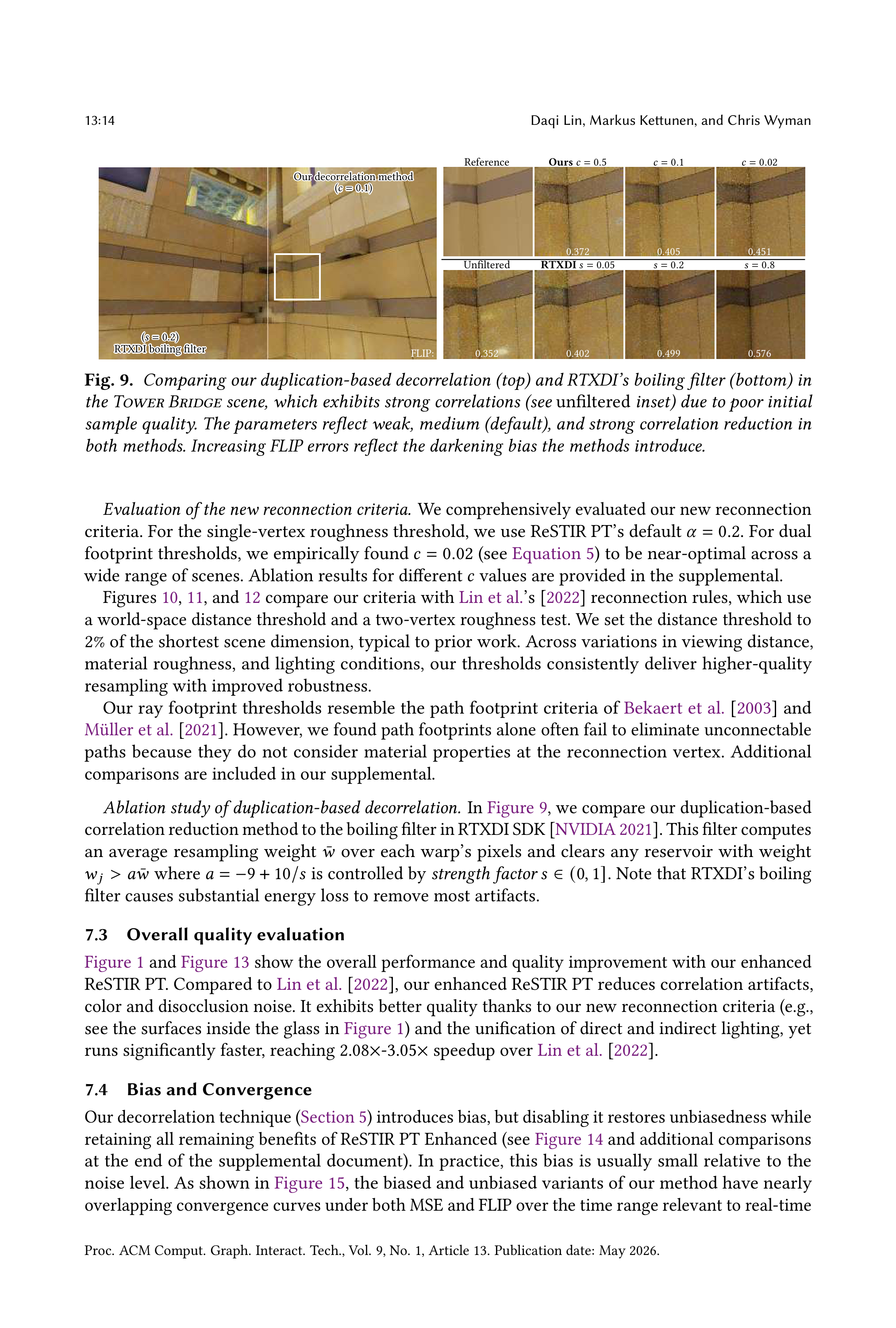
Fig. 9.
Comparing our duplication-based decorrelation (top) and RTXDI’s boiling filter (bottom) in
the Tower Bridge scene, which exhibits strong correlations (see
unfiltered
inset) due to poor initial
sample quality. The parameters reflect weak, medium (default), and strong correlation reduction in
both methods. Increasing FLIP errors reflect the darkening bias the methods introduce.
Evaluation of the new reconnection criteria.
We comprehensively evaluated our new reconnection
criteria. For the single-vertex roughness threshold, we use ReSTIR PT’s default
𝛼
=
0
.
2. For dual
footprint thresholds, we empirically found
𝑐
=
0
.
02 (see
Equation 5
) to be near-optimal across a
wide range of scenes. Ablation results for different
𝑐
values are provided in the supplemental.
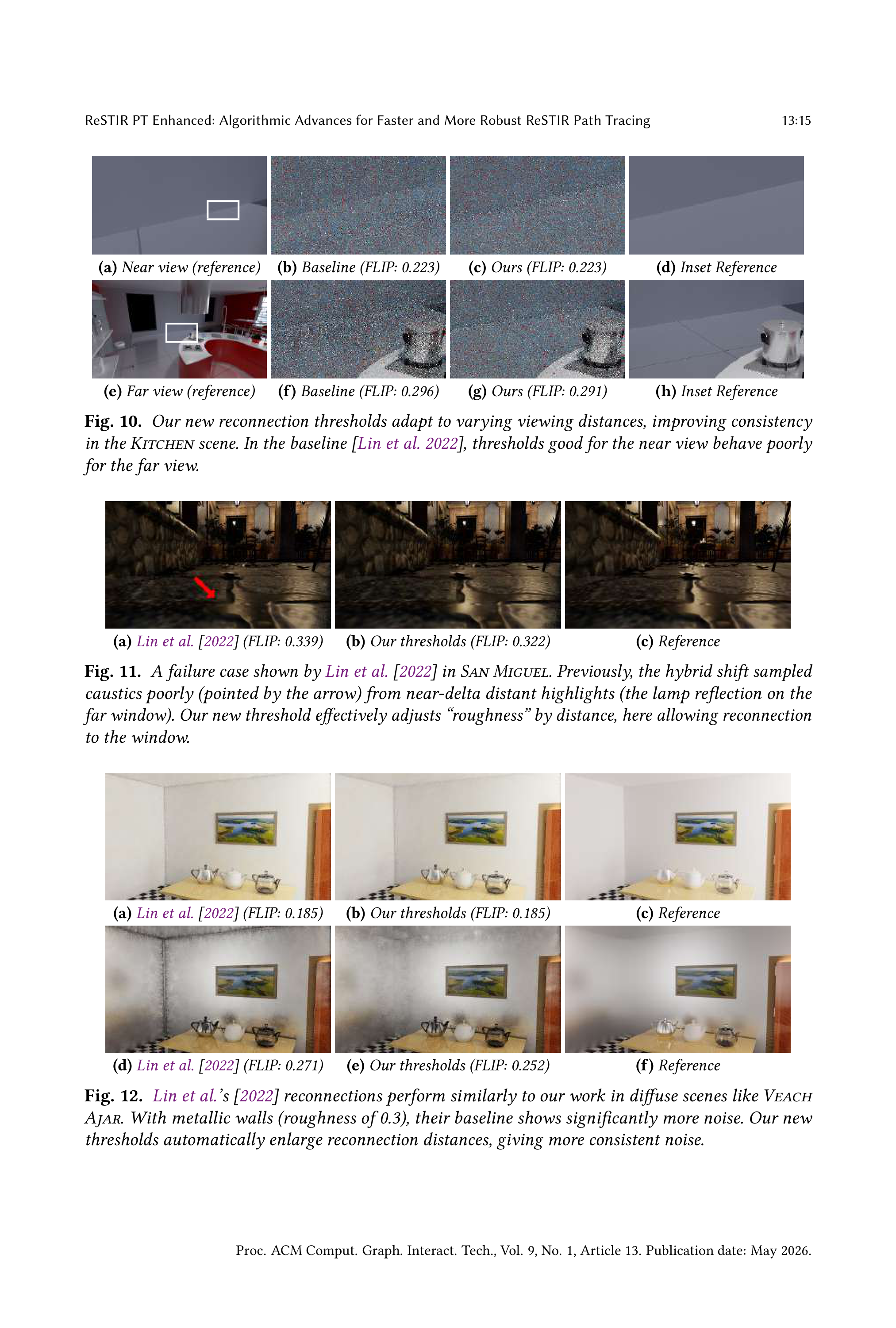
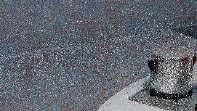
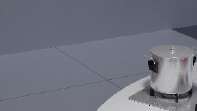
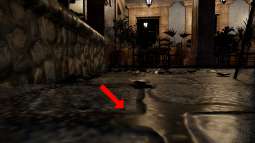
Figures
10
,
11
, and
12
compare our criteria with
Lin et al
.
’s [
2022
] reconnection rules, which use
a world-space distance threshold and a two-vertex roughness test. We set the distance threshold to
2% of the shortest scene dimension, typical to prior work. Across variations in viewing distance,
material roughness, and lighting conditions, our thresholds consistently deliver higher-quality
resampling with improved robustness.
Our ray footprint thresholds resemble the path footprint criteria of
Bekaert et al
.
[
2003
] and
Müller et al
.
[
2021
]. However, we found path footprints alone often fail to eliminate unconnectable
paths
because
they
do
not
consider
material
properties
at
the
reconnection
vertex.
Additional
comparisons are included in our supplemental.
Ablation study of duplication-based decorrelation.
In
Figure 9
, we compare our duplication-based
correlation reduction method to the boiling filter in RTXDI SDK [
NVIDIA 2021
]. This filter computes
an average resampling weight
¯
𝑤
over each warp’s pixels and clears any reservoir with weight
𝑤
𝑗
>
𝑎
¯
𝑤
where
𝑎
=
−
9
+
10
/
𝑠
is controlled by
strength factor
𝑠
∈(
0
,
1
]
. Note that RTXDI’s boiling
filter causes substantial energy loss to remove most artifacts.
7.3
Overall quality evaluation
Figure 1
and
Figure 13
show the overall performance and quality improvement with our enhanced
ReSTIR PT. Compared to
Lin et al
.
[
2022
], our enhanced ReSTIR PT reduces correlation artifacts,
color and disocclusion noise. It exhibits better quality thanks to our new reconnection criteria (e.g.,
see the surfaces inside the glass in
Figure 1
) and the unification of direct and indirect lighting, yet
runs significantly faster, reaching 2.08
×
-3.05
×
speedup over
Lin et al.
[
2022
].
7.4
Bias and Convergence
Our decorrelation technique (
Section 5
) introduces bias, but disabling it restores unbiasedness while
retaining all remaining benefits of ReSTIR PT Enhanced (see
Figure 14
and additional comparisons
at the end of the supplemental document). In practice, this bias is usually small relative to the
noise level. As shown in
Figure 15
, the biased and unbiased variants of our method have nearly
overlapping convergence curves under both MSE and FLIP over the time range relevant to real-time
Proc. ACM Comput. Graph. Interact. Tech., Vol. 9, No. 1, Article 13. Publication date: May 2026.











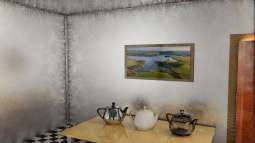


ReSTIR PT Enhanced: Algorithmic Advances for Faster and More Robust ReSTIR Path Tracing
13:15
(a)
Near view (reference)
(b)
Baseline (FLIP: 0.223)
(c)
Ours (FLIP: 0.223)
(d)
Inset Reference
(e)
Far view (reference)
(f)
Baseline (FLIP: 0.296)
(g)
Ours (FLIP: 0.291)
(h)
Inset Reference
Fig. 10.
Our new reconnection thresholds adapt to varying viewing distances, improving consistency
in the Kitchen scene. In the baseline [
Lin et al
.
2022
], thresholds good for the near view behave poorly
for the far view.
(a)
Lin et al.
[
2022
] (FLIP: 0.339)
(b)
Our thresholds (FLIP: 0.322)
(c)
Reference
Fig. 11.
A failure case shown by
Lin et al
.
[
2022
] in San Miguel. Previously, the hybrid shift sampled
caustics poorly (pointed by the arrow) from near-delta distant highlights (the lamp reflection on the
far window). Our new threshold effectively adjusts “roughness” by distance, here allowing reconnection
to the window.
(a)
Lin et al.
[
2022
] (FLIP: 0.185)
(b)
Our thresholds (FLIP: 0.185)
(c)
Reference
(d)
Lin et al.
[
2022
] (FLIP: 0.271)
(e)
Our thresholds (FLIP: 0.252)
(f)
Reference
Fig. 12.
Lin et al
.
’s [
2022
] reconnections perform similarly to our work in diffuse scenes like Veach
Ajar. With metallic walls (roughness of 0.3), their baseline shows significantly more noise. Our new
thresholds automatically enlarge reconnection distances, giving more consistent noise.
Proc. ACM Comput. Graph. Interact. Tech., Vol. 9, No. 1, Article 13. Publication date: May 2026.








13:16
Daqi Lin, Markus Kettunen, and Chris Wyman
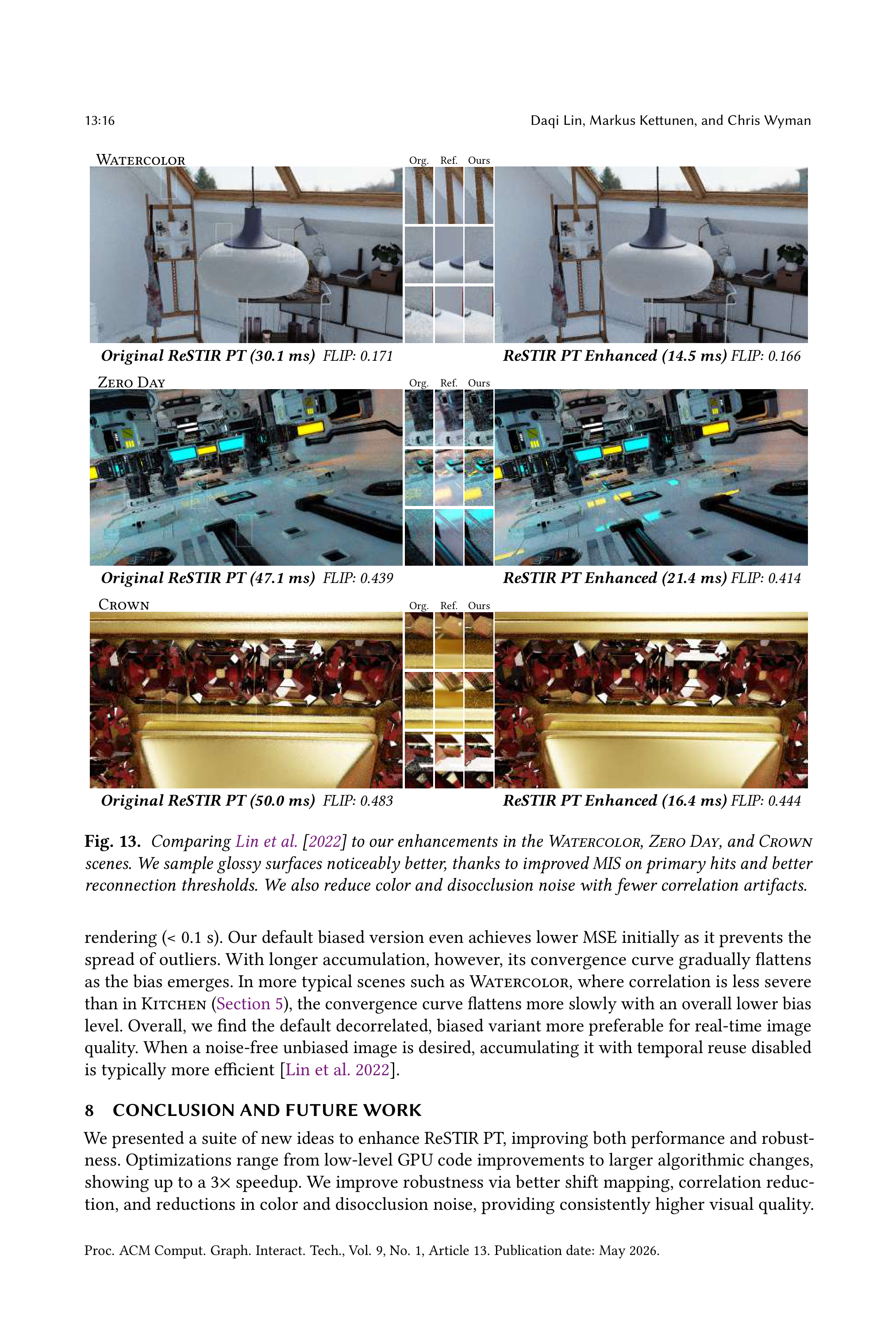
Original ReSTIR PT (30.1 ms)
FLIP: 0.171
Org.
Ref.
Ours
ReSTIR PT Enhanced (14.5 ms)
FLIP: 0.166
Watercolor
Original ReSTIR PT (47.1 ms)
FLIP: 0.439
Org.
Ref.
Ours
ReSTIR PT Enhanced (21.4 ms)
FLIP: 0.414
Zero Day
Original ReSTIR PT (50.0 ms)
FLIP: 0.483
Org.
Ref.
Ours
ReSTIR PT Enhanced (16.4 ms)
FLIP: 0.444
Crown
Fig. 13.
Comparing
Lin et al
.
[
2022
] to our enhancements in the Watercolor, Zero Day, and Crown
scenes. We sample glossy surfaces noticeably better, thanks to improved MIS on primary hits and better
reconnection thresholds. We also reduce color and disocclusion noise with fewer correlation artifacts.
rendering (< 0.1 s). Our default biased version even achieves lower MSE initially as it prevents the
spread of outliers. With longer accumulation, however, its convergence curve gradually flattens
as the bias emerges. In more typical scenes such as Watercolor, where correlation is less severe
than in Kitchen (
Section 5
), the convergence curve flattens more slowly with an overall lower bias
level. Overall, we find the default decorrelated, biased variant more preferable for real-time image
quality. When a noise-free unbiased image is desired, accumulating it with temporal reuse disabled
is typically more efficient [
Lin et al. 2022
].
8
CONCLUSION AND FUTURE WORK
We presented a suite of new ideas to enhance ReSTIR PT, improving both performance and robust-
ness. Optimizations range from low-level GPU code improvements to larger algorithmic changes,
showing up to a 3
×
speedup. We improve robustness via better shift mapping, correlation reduc-
tion, and reductions in color and disocclusion noise, providing consistently higher visual quality.
Proc. ACM Comput. Graph. Interact. Tech., Vol. 9, No. 1, Article 13. Publication date: May 2026.
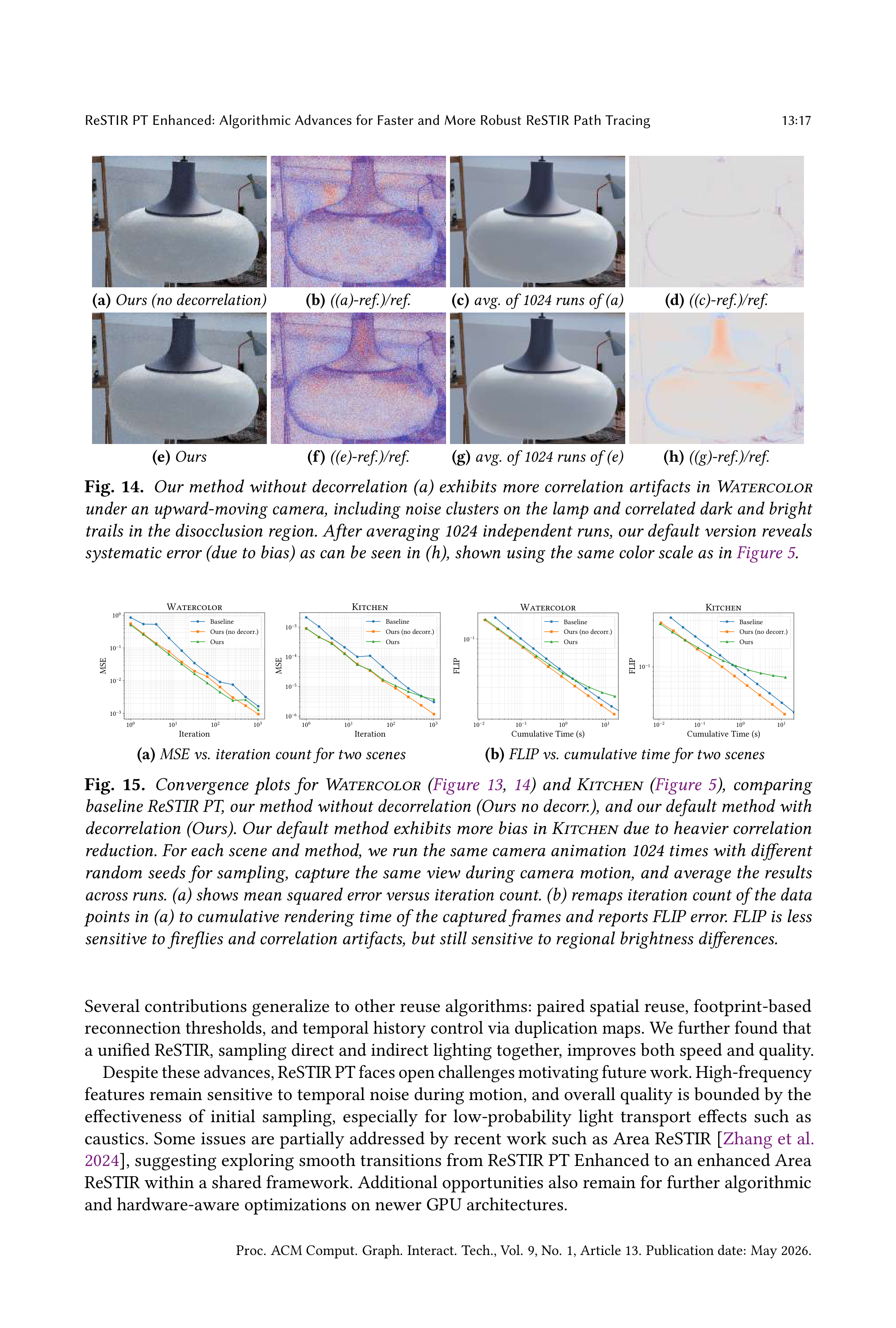


ReSTIR PT Enhanced: Algorithmic Advances for Faster and More Robust ReSTIR Path Tracing
13:17
(a)
Ours (no decorrelation)
(b)
((a)-ref.)/ref.
(c)
avg. of 1024 runs of (a)
(d)
((c)-ref.)/ref.
(e)
Ours
(f)
((e)-ref.)/ref.
(g)
avg. of 1024 runs of (e)
(h)
((g)-ref.)/ref.
Fig. 14.
Our method without decorrelation (a) exhibits more correlation artifacts in Watercolor
under an upward-moving camera, including noise clusters on the lamp and correlated dark and bright
trails in the disocclusion region. After averaging 1024 independent runs, our default version reveals
systematic error (due to bias) as can be seen in (h), shown using the same color scale as in
Figure 5
.
10
0
10
1
10
2
10
3
Iteration
10
3
10
2
10
1
10
0
MSE
Watercolor
Baseline
Ours (no decorr.)
Ours
10
0
10
1
10
2
10
3
Iteration
10
6
10
5
10
4
10
3
MSE
Kitchen
Baseline
Ours (no decorr.)
Ours
(a)
MSE vs. iteration count for two scenes
10
2
10
1
10
0
10
1
Cumulative Time (s)
10
1
FLIP
Watercolor
Baseline
Ours (no decorr.)
Ours
10
2
10
1
10
0
10
1
Cumulative Time (s)
10
1
FLIP
Kitchen
Baseline
Ours (no decorr.)
Ours
(b)
FLIP vs. cumulative time for two scenes
Fig.
15.
Convergence
plots
for
Watercolor
(
Figure
13
,
14
)
and
Kitchen
(
Figure
5
),
comparing
baseline ReSTIR PT, our method without decorrelation (Ours no decorr.), and our default method with
decorrelation (Ours). Our default method exhibits more bias in Kitchen due to heavier correlation
reduction. For each scene and method, we run the same camera animation 1024 times with different
random seeds for sampling, capture the same view during camera motion, and average the results
across runs. (a) shows mean squared error versus iteration count. (b) remaps iteration count of the data
points in (a) to cumulative rendering time of the captured frames and reports FLIP error. FLIP is less
sensitive to fireflies and correlation artifacts, but still sensitive to regional brightness differences.
Several contributions generalize to other reuse algorithms: paired spatial reuse, footprint-based
reconnection thresholds, and temporal history control via duplication maps. We further found that
a unified ReSTIR, sampling direct and indirect lighting together, improves both speed and quality.
Despite these advances, ReSTIR PT faces open challenges motivating future work. High-frequency
features remain sensitive to temporal noise during motion, and overall quality is bounded by the
effectiveness
of
initial
sampling,
especially
for
low-probability
light
transport
effects
such
as
caustics. Some issues are partially addressed by recent work such as Area ReSTIR [
Zhang et al
.
2024
], suggesting exploring smooth transitions from ReSTIR PT Enhanced to an enhanced Area
ReSTIR within a shared framework. Additional opportunities also remain for further algorithmic
and hardware-aware optimizations on newer GPU architectures.
Proc. ACM Comput. Graph. Interact. Tech., Vol. 9, No. 1, Article 13. Publication date: May 2026.
13:18
Daqi Lin, Markus Kettunen, and Chris Wyman
ACKNOWLEDGMENTS
We thank Miika Aittala for useful discussions on pairwise reuse textures, Aaron Lefohn for general
support, and the anonymous reviewers for their constructive feedback.
REFERENCES
Pontus Andersson, Jim Nilsson, Peter Shirley, and Tomas Akenine-Möller. 2021.
Visualizing errors in rendered high dynamic
range images.
In
Eurographics-Short Papers
. Eurographics-European Association for Computer Graphics, 25–28.
Pablo Bauszat, Victor Petitjean, and Elmar Eisemann. 2017.
Gradient-domain path reusing.
ACM Transactions on Graphics
(TOG)
36, 6 (2017), 1–9.
Philippe Bekaert, Mateu Sbert, and John H Halton. 2002.
Accelerating Path Tracing by Re-Using Paths.
Rendering Techniques
2, 2002 (2002), 125–134.
Philippe Bekaert, Philipp Slusallek, Ronald Cools, Vlastimil Havran, and Hans-Peter Seidel. 2003.
A custom designed density
estimation method for light transport.
(2003).
Nir Benty, Kai-Hwa Yao, Petrik Clarberg, Lucy Chen, Simon Kallweit, Tim Foley, Matthew Oakes, Conor Lavelle, and Chris
Wyman. 2020.
The Falcor Rendering Framework.
https://github.com/NVIDIAGameWorks/Falcor
Benedikt
Bitterli,
Chris
Wyman,
Matt
Pharr,
Peter
Shirley,
Aaron
Lefohn,
and
Wojciech
Jarosz.
2020.
Spatiotemporal
reservoir resampling for real-time ray tracing with dynamic direct lighting.
ACM Transactions on Graphics (Proceedings
of SIGGRAPH)
39, 4 (July 2020).
Min-Te Chao. 1982.
A general purpose unequal probability sampling plan.
Biometrika
69, 3 (1982), 653–656.
Henrik Halen, Andreas Brinck, Kyle Hayward, and Xiangshun Bei. 2021.
Global Illumination Based on Surfels.
Talk at
ACM SIGGRAPH 2021, Advances in Real-Time Rendering in Games.
https://www.ea.com/seed/news/siggraph21-global-
illumination-surfels
Eric Heitz. 2018.
Sampling the ggx distribution of visible normals.
Journal of Computer Graphics Techniques (JCGT)
7, 4
(2018), 1–13.
Markus Kettunen, Daqi Lin, Ravi Ramamoorthi, Thomas Bashford-Rogers, and Chris Wyman. 2023.
Conditional resampled
importance sampling and ReSTIR. In
SIGGRAPH Asia 2023 Conference Papers
. 1–11.
Markus Kettunen, Marco Manzi, Miika Aittala, Jaakko Lehtinen, Frédo Durand, and Matthias Zwicker. 2015. Gradient-domain
path tracing.
ACM Transactions on Graphics (TOG)
34, 4 (2015), 1–13.
Daqi Lin, Markus Kettunen, Benedikt Bitterli, Jacopo Pantaleoni, Cem Yuksel, and Chris Wyman. 2022. Generalized Resampled
Importance Sampling: Foundations of ReSTIR.
41, 4 (2022), 75:1–75:23.
https://doi.org/10.1145/3528223.3530158
Zander Majercik, Jean-Philippe Guertin, Derek Nowrouzezahrai, and Morgan McGuire. 2019.
Dynamic Diffuse Global
Illumination with Ray-Traced Irradiance Fields.
Journal of Computer Graphics Techniques (JCGT)
8, 2 (5 June 2019), 1–30.
Thomas Müller, Fabrice Rousselle, Jan Novák, and Alexander Keller. 2021.
Real-time neural radiance caching for path
tracing.
arXiv preprint arXiv:2106.12372
(2021).
NVIDIA. 2020.
NVIDIA Real-Time Denoiser Delivers Best-in-Class Denoising in Ubisoft’s Watch Dogs Legion.
https:
//developer.nvidia.com/blog/nvidia-real-time-denoiser-delivers-best-in-class-denoising-in-watch-dogs-legion/
NVIDIA. 2021.
RTXDI SDK – Light Resampling In Practice.
https://developer.nvidia.com/blog/new-video-light-resampling-
in-practice-with-rtxdi/
.
Accessed: 2025-11-29.
NVIDIA. 2025.
DLSS 4: Transforming Real-Time Graphics with AI.
https://research.nvidia.com/labs/adlr/DLSS4/
.
Technical
Report.
Yaobin Ouyang, Shiqiu Liu, Markus Kettunen, Matt Pharr, and Jacopo Pantaleoni. 2021.
ReSTIR GI: Path Resampling for
Real-Time Path Tracing.
Computer Graphics Forum
(2021).
Rohan Sawhney, Daqi Lin, Markus Kettunen, Benedikt Bitterli, Ravi Ramamoorthi, Chris Wyman, and Matt Pharr. 2024.
Decorrelating restir samplers via mcmc mutations.
ACM Transactions on Graphics
43, 1 (2024), 1–15.
Christoph Schied, Anton Kaplanyan, Chris Wyman, Anjul Patney, Chakravarty R Alla Chaitanya, John Burgess, Shiqiu
Liu, Carsten Dachsbacher, Aaron Lefohn, and Marco Salvi. 2017.
Spatiotemporal variance-guided filtering: real-time
reconstruction for path-traced global illumination.
In
Proceedings of High Performance Graphics
. 1–12.
Justin
Talbot,
David
Cline,
and
Parris
Egbert.
2005.
Importance
Resampling
for
Global
Illumination.
In
Eurographics
Symposium on Rendering (2005)
, Kavita Bala and Philip Dutre (Eds.). The Eurographics Association.
Daniel Wright, Krzysztof Narkowicz, and Patrick Kelly. 2022.
Lumen: Real-time Global Illumination in Unreal Engine 5.
Talk at ACM SIGGRAPH 2022, Advances in Real-Time Rendering in Games.
https://advances.realtimerendering.com/
s2022/SIGGRAPH2022-Advances-Lumen-Wright%20et%20al.pdf
Chris Wyman, Markus Kettunen, Daqi Lin, Benedikt Bitterli, Cem Yuksel, Wojciech Jarosz, and Pawel Kozlowski. 2023.
A
gentle introduction to restir path reuse in real-time.
In
ACM SIGGRAPH 2023 Courses
. 1–38.
Chris Wyman and Alexey Panteleev. 2021.
Rearchitecting Spatiotemporal Resampling for Production. In
High-Performance
Graphics - Symposium Papers
.
Proc. ACM Comput. Graph. Interact. Tech., Vol. 9, No. 1, Article 13. Publication date: May 2026.

ReSTIR PT Enhanced: Algorithmic Advances for Faster and More Robust ReSTIR Path Tracing
13:19
Zheng Zeng, Shiqiu Liu, Jinglei Yang, Lu Wang, and Ling-Qi Yan. 2021.
Temporally Reliable Motion Vectors for Real-time
Ray Tracing. In
Computer Graphics Forum
, Vol. 40. Wiley Online Library, 79–90.
Song Zhang, Daqi Lin, Markus Kettunen, Cem Yuksel, and Chris Wyman. 2024.
Area ReSTIR: Resampling for Real-Time
Defocus and Antialiasing.
ACM Transactions on Graphics (TOG)
43, 4 (2024), 1–13.
Proc. ACM Comput. Graph. Interact. Tech., Vol. 9, No. 1, Article 13. Publication date: May 2026.