
S
HOW
Y
OUR
W
ORK
:
S
CRATCHPADS
FOR
I
NTERMEDI
-
ATE
C
OMPUTATION
WITH
L
ANGUAGE
M
ODELS
Maxwell Nye
12
∗
Anders Johan Andreassen
3
Guy Gur-Ari
3
Henryk Michalewski
2
Jacob Austin
2
David Bieber
2
David Dohan
2
Aitor Lewkowycz
3
Maarten Bosma
2
David Luan
2
Charles Sutton
2
Augustus Odena
2
1
MIT
2
Google Research, Brain Team
3
Google Research, Blueshift Team
A
BSTRACT
Large pre-trained language models perform remarkably well on tasks that can be
done “in one pass”,
such as generating realistic text (Brown et al., 2020) or syn-
thesizing
computer
programs
(Chen
et
al.,
2021;
Austin
et
al.,
2021).
However,
they
struggle
with
tasks
that
require
unbounded
multi-step
computation,
such
as
adding integers (Brown et al., 2020) or
executing
programs (Austin et al., 2021).
Surprisingly, we find that these same models are able to perform complex multi-
step computations—even in the few-shot regime—when asked to perform the op-
eration “step by step”, showing the results of intermediate computations.
In par-
ticular, we train Transformers to perform multi-step computations by asking them
to
emit
intermediate
computation
steps
into
a
“scratchpad”.
On
a
series
of
in-
creasingly complex tasks ranging from long addition to the execution of arbitrary
programs, we show that scratchpads dramatically improve the ability of language
models to perform multi-step computations.
1
I
NTRODUCTION
Large Transformer-based language models exhibit surprisingly impressive capabilities (Devlin et al.,
2019;
Brown
et
al.,
2020),
including
the
ability
to
generate
code
that
solves
simple
programming
problems (Chen et al., 2021; Austin et al., 2021).
However, these models struggle to perform multi-
step
algorithmic
calculations,
especially
those
that
require
precise
reasoning
and
unbounded
com-
putation.
For example, GPT-3 struggles to perform few-shot addition on numbers with greater than
three digits (Brown et al., 2020).
Similarly, large-scale language models struggle to predict the re-
sult
of
executing
Python
code,
even
code
which
is
a
solution
to
a
programming
task
the
model
is
able
to
solve
(Austin
et
al.,
2021).
Likewise,
standard
recurrent
and
graph
neural
networks
fail
to
systematically generalize when predicting the output of simple programs with loops (Bieber et al.,
2020).
So language models can to some extent
write
code, but do not seem to accurately represent
the
semantics
of
the
code
they
write,
because
they
cannot
predict
its
execution.
This
has
moti-
vated
research
on
networks
that
can
perform
algorithmic
reasoning
(Graves
et
al.,
2014;
Zaremba
& Sutskever, 2014; Bieber et al., 2020).
Neural networks that accurately represent the semantics of
programs
could
enable
a
variety
of
downstream
tasks,
including
program
synthesis
(Devlin
et
al.,
2017), program analysis (Allamanis et al., 2018), and other algorithmic reasoning tasks (Velickovic
& Blundell, 2021).
Why do large language models struggle with algorithmic reasoning tasks?
We suggest that this is at
least partly due to a limitation of the way the Transformer architecture is applied to these tasks:
the
∗
Correspondence
to
mnye@mit.edu
.
Max
is
a
student
at
MIT,
but
primarily
did
this
work
while
visiting
Google Research.
1
arXiv:2112.00114v1 [cs.LG] 30 Nov 2021
Large Language
Model
state: {}
line: def remove_Occ(s,ch):
state: {"remove_Occ": ""}
line: output = remove_Occ("PHP","P")
state: {"ch": "P", "s": "PHP"}
line: for i in range(len(s)):
state: {"ch": "P", "s": "PHP", "i": 0}
line: if (s[i] == ch):
state: {"ch": "P", "s": "PHP", "i": 0}
line: s = s[0 : i] + s[i + 1:]
state: {"ch": "P", "s": "HP", "i": 0}
line: break
state: {"ch": "P", "s": "HP", "i": 0}
line: for i in range(len(s) - 1,-1,-1):
state: {"ch": "P", "s": "HP", "i": 1}
line: if (s[i] == ch):
state: {"ch": "P", "s": "HP", "i": 1}
line: s = s[0 : i] + s[i + 1:]
state: {"ch": "P", "s": "H", "i": 1}
line: break
state: {"ch": "P", "s": "H", "i": 1}
line: return s
state: {"remove_Occ": "",
"output": "H"}
Consider the following Python function:
def remove_Occ(s,ch):
for i in range(len(s)):
if (s[i] == ch):
s = s[0 : i] + s[i + 1:]
break
for i in range(len(s) - 1,-1,-1):
if (s[i] == ch):
s = s[0 : i] + s[i + 1:]
break
return s
output = remove_Occ("PHP","P")
What is the execution trace?
Consider the following Python function:
def remove_Occ(s,ch):
for i in range(len(s)):
if (s[i] == ch):
s = s[0 : i] + s[i + 1:]
break
for i in range(len(s) - 1,-1,-1):
if (s[i] == ch):
s = s[0 : i] + s[i + 1:]
break
return s
Fill in the ??? below:
assert remove_Occ("PHP","P") == ???
assert remove_Oct("PHP", "P") == "H"
DIRECT EXECUTION PREDICTION
SCRATCHPAD TRACING
Large Language
Model
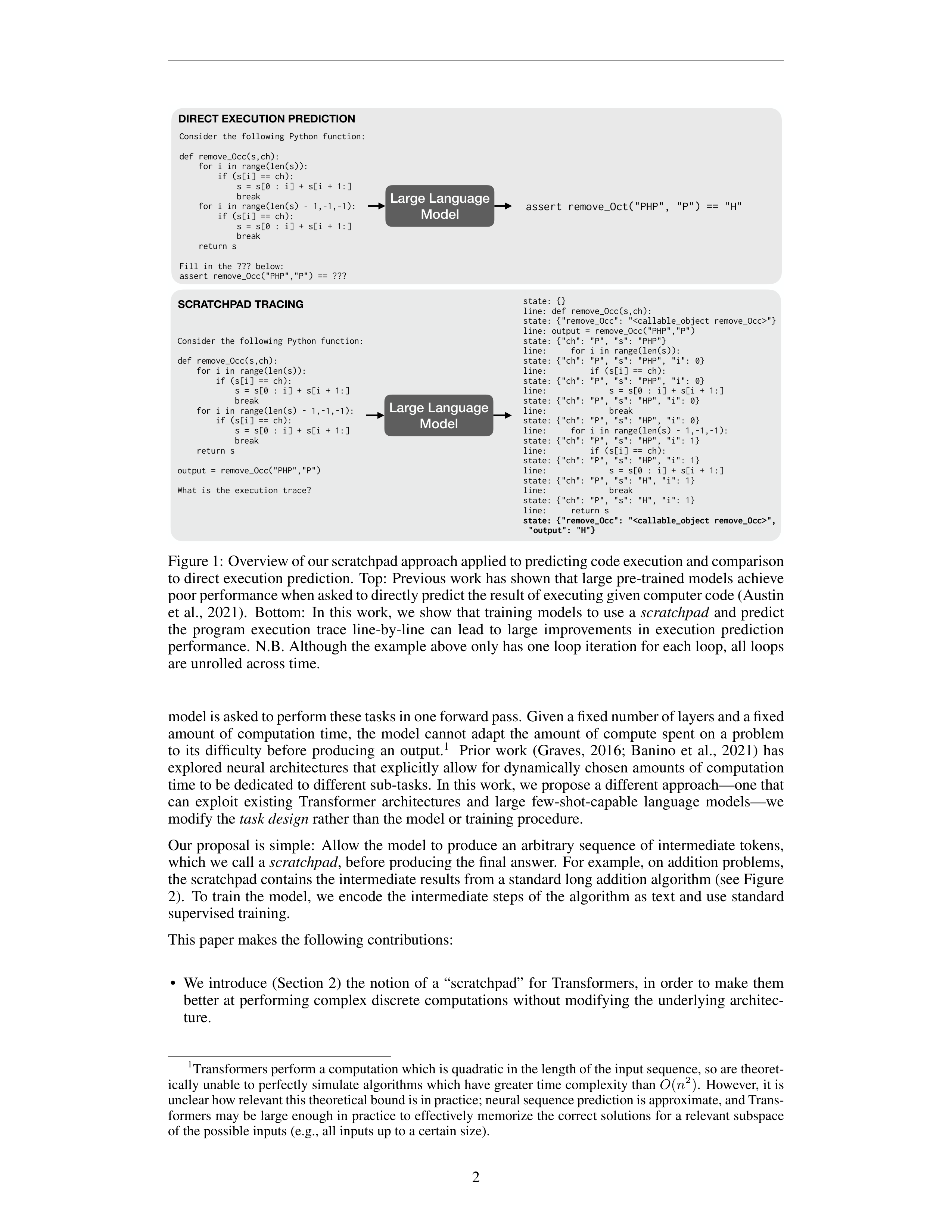
Figure 1: Overview of our scratchpad approach applied to predicting code execution and comparison
to direct execution prediction.
Top:
Previous work has shown that large pre-trained models achieve
poor performance when asked to directly predict the result of executing given computer code (Austin
et
al.,
2021).
Bottom:
In
this
work,
we
show
that training
models
to
use
a
scratchpad
and
predict
the
program
execution
trace
line-by-line
can
lead
to
large
improvements
in
execution
prediction
performance.
N.B. Although the example above only has one loop iteration for each loop, all loops
are unrolled across time.
model is asked to perform these tasks in one forward pass. Given a fixed number of layers and a fixed
amount
of
computation
time,
the
model
cannot
adapt
the
amount
of
compute
spent
on
a
problem
to
its
difficulty
before
producing
an
output.
1
Prior
work
(Graves,
2016;
Banino
et
al.,
2021)
has
explored neural architectures that explicitly allow for dynamically chosen amounts of computation
time to be dedicated to different sub-tasks.
In this work, we propose a different approach—one that
can
exploit
existing
Transformer
architectures
and
large
few-shot-capable
language
models—we
modify the
task design
rather than the model or training procedure.
Our proposal is simple:
Allow the model to produce an arbitrary sequence of intermediate tokens,
which we call a
scratchpad
, before producing the final answer.
For example, on addition problems,
the scratchpad contains the intermediate results from a standard long addition algorithm (see Figure
2).
To train the model,
we encode the intermediate steps of the algorithm as text and use standard
supervised training.
This paper makes the following contributions:
•
We
introduce
(Section
2)
the
notion
of
a
“scratchpad”
for
Transformers,
in
order
to
make
them
better
at
performing
complex
discrete
computations
without
modifying
the
underlying
architec-
ture.
1
Transformers perform a computation which is quadratic in the length of the input sequence, so are theoret-
ically unable to perfectly simulate algorithms which have greater time complexity than
O
(
n
2
)
.
However, it is
unclear how relevant this theoretical bound is in practice; neural sequence prediction is approximate, and Trans-
formers may be large enough in practice to effectively memorize the correct solutions for a relevant subspace
of the possible inputs (e.g., all inputs up to a certain size).
2
•
We
show
(Section
3)
that
scratchpads
help
Transformers
learn
to
perform
long
addition
in
the
fine-tuning regime, and in particular that they improve out-of-distribution generalization to larger
problem instances.
•
We
also
find
(Section
4)
that
scratchpads
help
Transformers
perform
a
somewhat
higher
level
task:
polynomial evaluation.
This is true in both the few-shot and fine-tuning regimes.
•
Finally, we move to a much more general context and show (Section 5) that training Transformers
to emit full program traces line by line annotated with local variables dramatically improves their
ability
to
predict
the
result
of
executing
a
given
computer
program
on
a
particular
input.
This
application in some sense subsumes the others.
2
M
ETHOD
In
this
work
we
consider
two
related
problems:
algorithm
induction
(Graves
et
al.,
2014;
2016;
Kurach
et
al.,
2016;
Kaiser
&
Sutskever,
2016)
and
learning
to
execute
(Zaremba
&
Sutskever,
2014; Bieber et al., 2020).
The goal of both problems is for the neural network to learn to emulate a
function
f
, which is “algorithmic” in the sense that it can be represented by a short program, such as
addition
or
polynomial
evaluation,
from
input-output
behavior.
In
neural
algorithm
induction
,
the
goal is to learn a single algorithm, and each training example gives a single input and desired output
represented as strings.
Therefore, the training data is
D
=
{
x
i
, f
(
x
i
)
}
N
i
=1
.
For
learning to execute
,
we want the model to produce the result of a program, represented as source code, on some input.
If
each
π
i
is the source code of a program
f
i
, then the training data is
D
=
{
(
π
i
, x
i
, f
i
(
x
i
))
}
N
i
=1
(it is
common for each
f
i
to have multiple input-output examples, but we omit this to lighten notation).
The
main
idea
of
this
paper
is
that
to
solve
a
given
algorithmic
task,
we
simply
encode
the
inter-
mediate
steps
of
the
algorithm
as
text
and
train
the
model
to
emit
them
to
a
buffer
that
we
call
a
“scratchpad.”
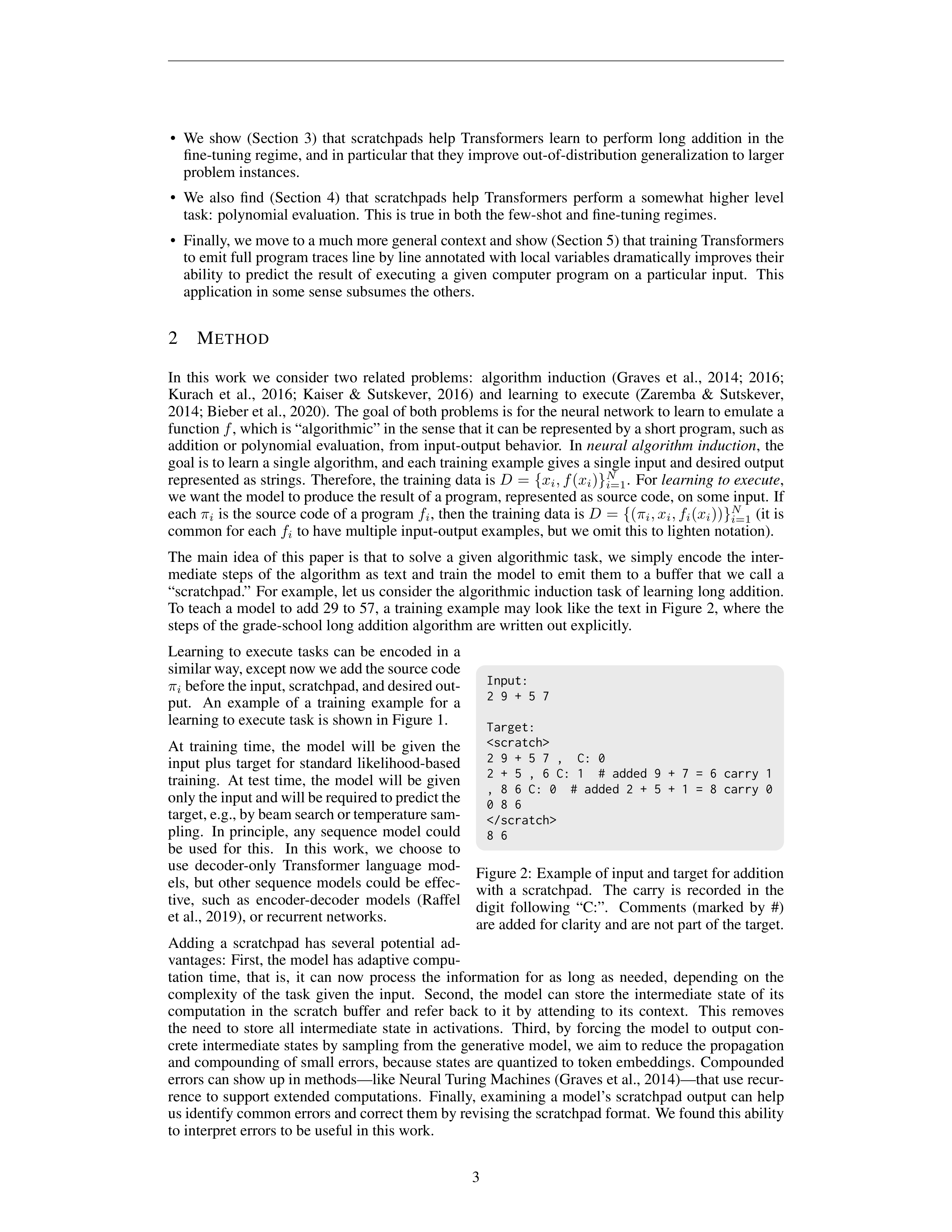
For example, let us consider the algorithmic induction task of learning long addition.
To teach a model to add 29 to 57, a training example may look like the text in Figure 2, where the
steps of the grade-school long addition algorithm are written out explicitly.
Input:
2
9
+
5
7
Target:
2
9
+
5
7
,
C:
0
2
+
5
,
6
C:
1
#
added
9
+
7
=
6
carry
1
,
8
6
C:
0
#
added
2
+
5
+
1
=
8
carry
0
0
8
6
8
6
Figure 2: Example of input and target for addition
with
a
scratchpad.
The
carry
is
recorded
in
the
digit
following
“C:”.
Comments
(marked
by
#)
are added for clarity and are not part of the target.
Learning
to
execute
tasks
can
be
encoded
in
a
similar way, except now we add the source code
π
i
before the input, scratchpad, and desired out-
put.
An
example
of
a
training
example
for
a
learning to execute task is shown in Figure 1.
At
training
time,
the
model
will
be
given
the
input
plus
target
for
standard
likelihood-based
training.
At
test
time,
the
model
will
be
given
only the input and will be required to predict the
target, e.g., by beam search or temperature sam-
pling.
In
principle,
any
sequence
model
could
be
used
for
this.
In
this
work,
we
choose
to
use
decoder-only
Transformer
language
mod-
els,
but
other
sequence
models
could
be
effec-
tive,
such
as
encoder-decoder
models
(Raffel
et al., 2019), or recurrent networks.
Adding
a
scratchpad
has
several
potential
ad-
vantages:
First, the model has adaptive compu-
tation
time,
that
is,
it
can
now
process
the
information
for
as
long
as
needed,
depending
on
the
complexity
of
the
task
given
the
input.
Second,
the
model
can
store
the
intermediate
state
of
its
computation
in
the
scratch
buffer
and
refer
back
to
it
by
attending
to
its
context.
This
removes
the
need
to
store
all
intermediate
state
in
activations.
Third,
by
forcing
the
model
to
output
con-
crete intermediate states by sampling from the generative model, we aim to reduce the propagation
and compounding of small errors, because states are quantized to token embeddings.
Compounded
errors can show up in methods—like Neural Turing Machines (Graves et al., 2014)—that use recur-
rence
to
support
extended
computations.
Finally,
examining
a
model’s
scratchpad
output
can
help
us identify common errors and correct them by revising the scratchpad format.
We found this ability
to interpret errors to be useful in this work.
3
10
7
10
8
10
9
Parameter Count
0
20
40
60
80
100
Accuracy (%)
Addition: In-Distribution Accuracy
baseline
scratchpad
10
7
10
8
10
9
Parameter Count
0
20
40
60
80
100
Addition: OOD Accuracy (9 digits)
baseline
scratchpad
10
7
10
8
10
9
Parameter Count
0
20
40
60
80
100
Addition: OOD Accuracy (10 digits)
baseline
scratchpad
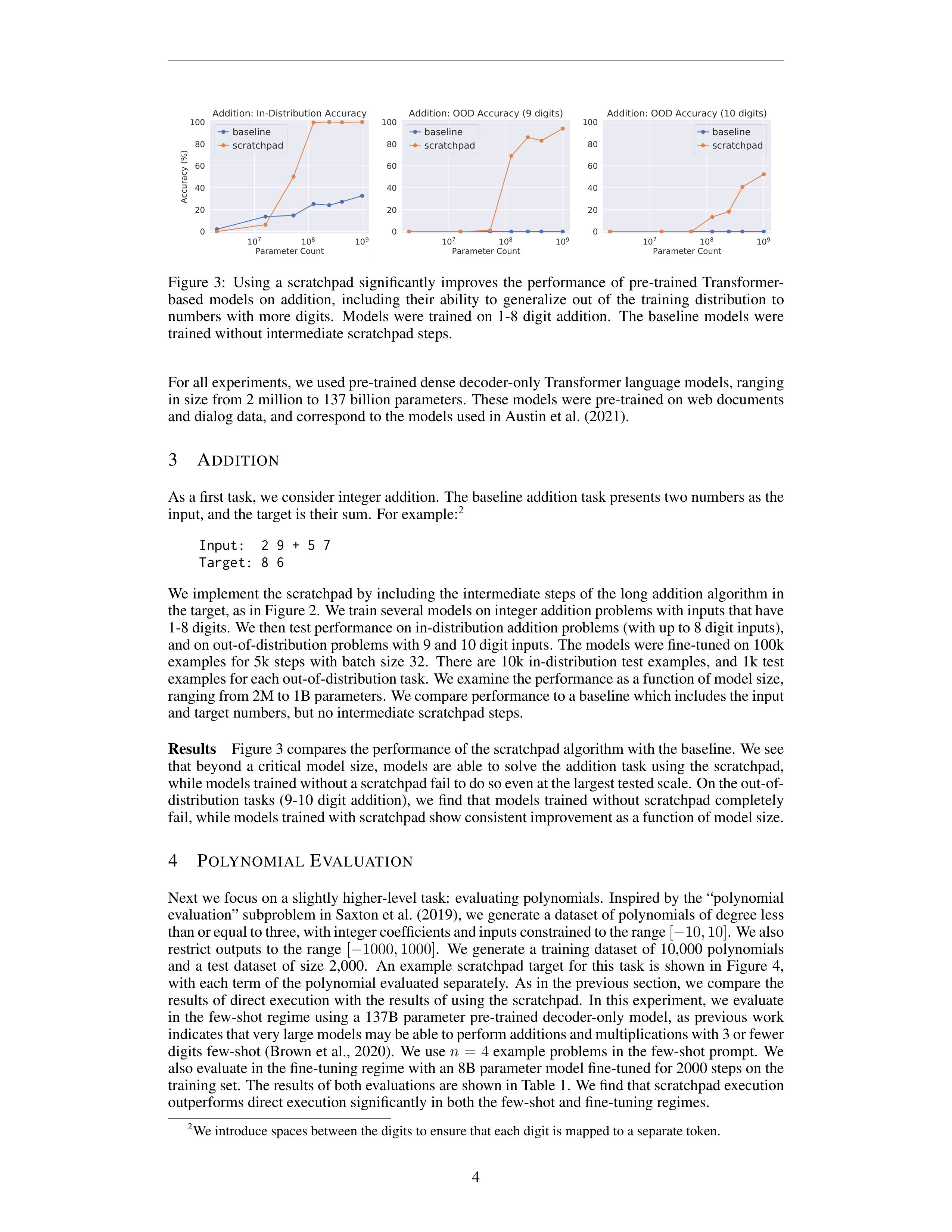
Figure
3:
Using
a
scratchpad
significantly
improves
the
performance
of
pre-trained
Transformer-
based
models
on
addition,
including
their
ability
to
generalize
out
of
the
training
distribution
to
numbers
with
more
digits.
Models
were
trained
on
1-8
digit
addition.
The
baseline
models
were
trained without intermediate scratchpad steps.
For all experiments, we used pre-trained dense decoder-only Transformer language models, ranging
in size from 2 million to 137 billion parameters.
These models were pre-trained on web documents
and dialog data, and correspond to the models used in Austin et al. (2021).
3
A
DDITION
As a first task, we consider integer addition.
The baseline addition task presents two numbers as the
input, and the target is their sum.
For example:
2
Input:
2
9
+
5
7
Target:
8
6
We implement the scratchpad by including the intermediate steps of the long addition algorithm in
the target, as in Figure 2.
We train several models on integer addition problems with inputs that have
1-8 digits.
We then test performance on in-distribution addition problems (with up to 8 digit inputs),
and on out-of-distribution problems with 9 and 10 digit inputs.
The models were fine-tuned on 100k
examples
for
5k
steps
with
batch
size
32.
There
are
10k
in-distribution
test
examples,
and
1k
test
examples for each out-of-distribution task. We examine the performance as a function of model size,
ranging from 2M to 1B parameters.
We compare performance to a baseline which includes the input
and target numbers, but no intermediate scratchpad steps.
Results
Figure 3 compares the performance of the scratchpad algorithm with the baseline.
We see
that
beyond
a
critical
model
size,
models
are
able
to
solve
the
addition
task
using
the
scratchpad,
while models trained without a scratchpad fail to do so even at the largest tested scale. On the out-of-
distribution
tasks
(9-10
digit
addition),
we
find
that
models
trained
without
scratchpad
completely
fail, while models trained with scratchpad show consistent improvement as a function of model size.
4
P
OLYNOMIAL
E
VALUATION
Next we focus on a slightly higher-level task:
evaluating polynomials.
Inspired by the “polynomial
evaluation” subproblem in Saxton et al. (2019), we generate a dataset of polynomials of degree less
than or equal to three, with integer coefficients and inputs constrained to the range
[
−
10
,
10]
. We also
restrict
outputs
to
the
range
[
−
1000
,
1000]
.
We
generate
a
training
dataset
of
10,000
polynomials
and
a
test
dataset
of
size
2,000.
An
example
scratchpad
target
for
this
task
is
shown
in
Figure
4,
with each term of the polynomial evaluated separately.
As in the previous section, we compare the
results of direct execution with the results of using the scratchpad.
In this experiment, we evaluate
in
the
few-shot
regime
using
a
137B
parameter
pre-trained
decoder-only
model,
as
previous
work
indicates that very large models may be able to perform additions and multiplications with 3 or fewer
digits few-shot (Brown et al., 2020).
We use
n
=
4
example problems in the few-shot prompt.
We
also evaluate in the fine-tuning regime with an 8B parameter model fine-tuned for 2000 steps on the
training set.
The results of both evaluations are shown in Table 1.
We find that scratchpad execution
outperforms direct execution significantly in both the few-shot and fine-tuning regimes.
2
We introduce spaces between the digits to ensure that each digit is mapped to a separate token.
4
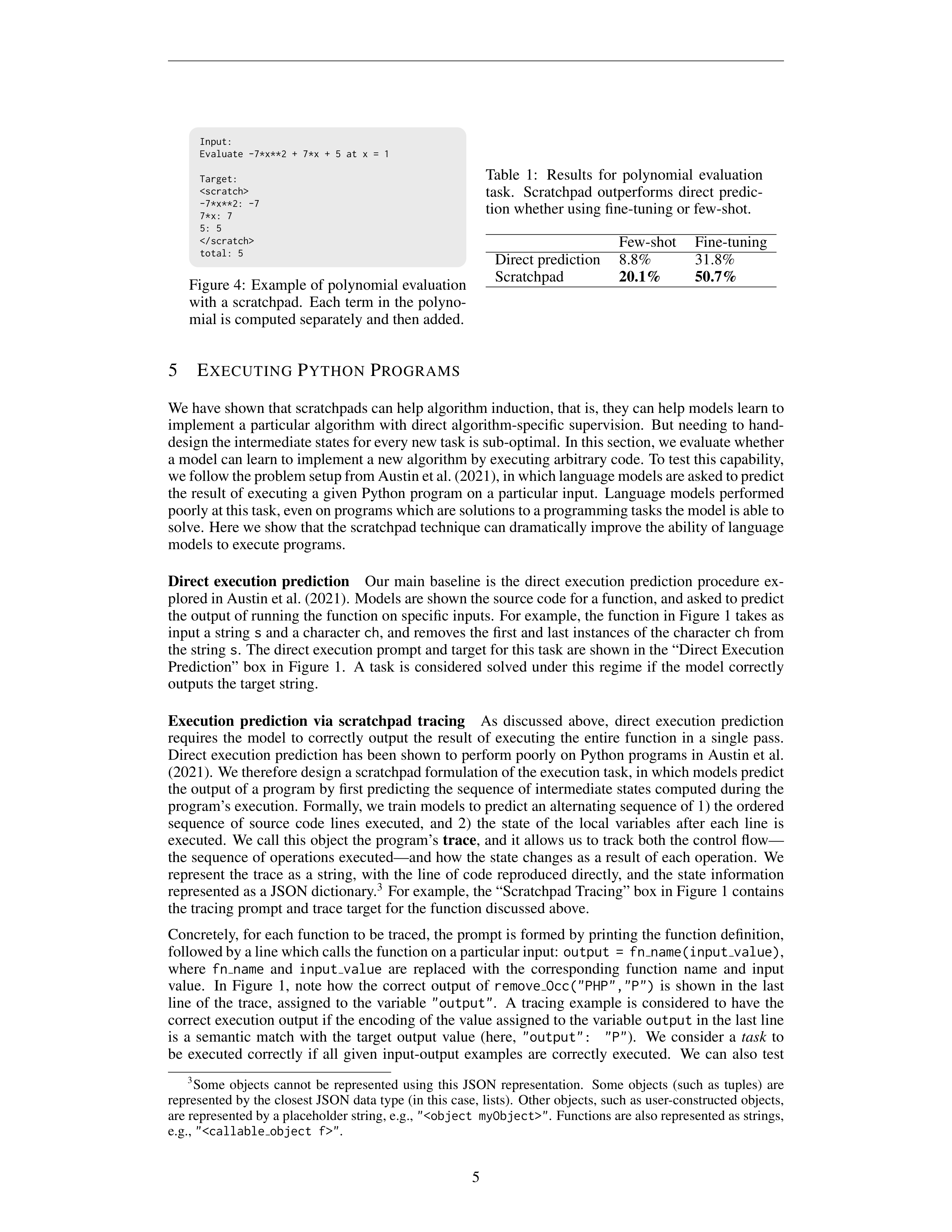
Input:
Evaluate
-7*x**2
+
7*x
+
5
at
x
=
1
Target:
-7*x**2:
-7
7*x:
7
5:
5
total:
5
Figure 4:
Example of polynomial evaluation
with a scratchpad.
Each term in the polyno-
mial is computed separately and then added.
Table
1:
Results
for
polynomial
evaluation
task.
Scratchpad
outperforms
direct
predic-
tion whether using fine-tuning or few-shot.
Few-shot
Fine-tuning
Direct prediction
8.8%
31.8%
Scratchpad
20.1%
50.7%
5
E
XECUTING
P
YTHON
P
ROGRAMS
We have shown that scratchpads can help algorithm induction, that is, they can help models learn to
implement a particular algorithm with direct algorithm-specific supervision.
But needing to hand-
design the intermediate states for every new task is sub-optimal. In this section, we evaluate whether
a model can learn to implement a new algorithm by executing arbitrary code.
To test this capability,
we follow the problem setup from Austin et al. (2021), in which language models are asked to predict
the result of executing a given Python program on a particular input.
Language models performed
poorly at this task, even on programs which are solutions to a programming tasks the model is able to
solve.
Here we show that the scratchpad technique can dramatically improve the ability of language
models to execute programs.
Direct
execution
prediction
Our
main
baseline
is
the
direct
execution
prediction
procedure
ex-
plored in Austin et al. (2021).
Models are shown the source code for a function, and asked to predict
the output of running the function on specific inputs.
For example, the function in Figure 1 takes as
input a string
s
and a character
ch
, and removes the first and last instances of the character
ch
from
the string
s
.
The direct execution prompt and target for this task are shown in the “Direct Execution
Prediction”
box
in
Figure
1.
A
task
is
considered
solved
under
this
regime
if
the
model
correctly
outputs the target string.
Execution
prediction
via
scratchpad
tracing
As
discussed
above,
direct
execution
prediction
requires
the
model
to
correctly
output
the
result
of
executing
the
entire
function
in
a
single
pass.
Direct execution prediction has been shown to perform poorly on Python programs in Austin et al.
(2021).
We therefore design a scratchpad formulation of the execution task, in which models predict
the output of a program by first predicting the sequence of intermediate states computed during the
program’s execution.
Formally, we train models to predict an alternating sequence of 1) the ordered
sequence
of
source
code
lines
executed,
and
2)
the
state
of
the
local
variables
after
each
line
is
executed.
We call this object the program’s
trace
, and it allows us to track both the control flow—
the sequence of operations executed—and how the state changes as a result of each operation.
We
represent
the
trace
as
a
string,
with
the
line
of
code
reproduced
directly,
and
the
state
information
represented as a JSON dictionary.
3
For example, the “Scratchpad Tracing” box in Figure 1 contains
the tracing prompt and trace target for the function discussed above.
Concretely, for each function to be traced, the prompt is formed by printing the function definition,
followed by a line which calls the function on a particular input:
output
=
fn
name(input
value)
,
where
fn
name
and
input
value
are
replaced
with
the
corresponding
function
name
and
input
value.
In
Figure
1,
note
how
the
correct
output
of
remove
Occ("PHP","P")
is
shown
in
the
last
line
of
the
trace,
assigned
to
the
variable
"output"
.
A
tracing
example
is
considered
to
have
the
correct execution output if the encoding of the value assigned to the variable
output
in the last line
is
a
semantic
match
with
the
target
output
value
(here,
"output":
"P"
).
We
consider
a
task
to
be
executed
correctly
if
all
given
input-output
examples
are
correctly
executed.
We
can
also
test
3
Some
objects
cannot
be
represented
using
this
JSON
representation.
Some
objects
(such
as
tuples)
are
represented by the closest JSON data type (in this case, lists).
Other objects, such as user-constructed objects,
are represented by a placeholder string, e.g.,
"<object
myObject>"
.
Functions are also represented as strings,
e.g.,
"<callable
object
f>"
.
5
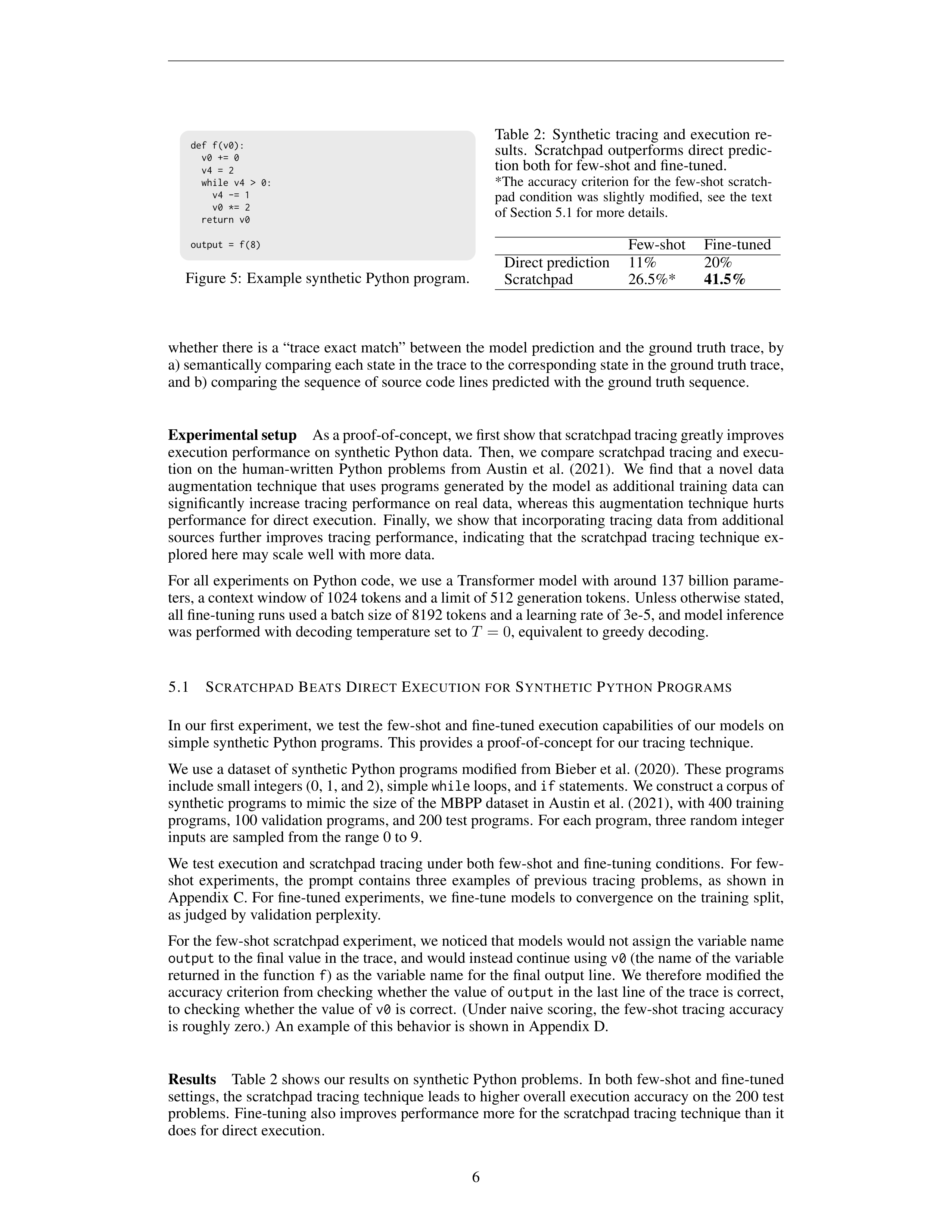
def
f(v0):
v0
+=
0
v4
=
2
while
v4
>
0:
v4
-=
1
v0
*=
2
return
v0
output
=
f(8)
Figure 5:
Example synthetic Python program.
Table
2:
Synthetic
tracing
and
execution
re-
sults.
Scratchpad
outperforms direct
predic-
tion both for few-shot and fine-tuned.
*The
accuracy
criterion
for
the
few-shot
scratch-
pad
condition
was
slightly
modified,
see
the
text
of Section 5.1 for more details.
Few-shot
Fine-tuned
Direct prediction
11%
20%
Scratchpad
26.5%*
41.5%
whether there is a “trace exact match” between the model prediction and the ground truth trace, by
a) semantically comparing each state in the trace to the corresponding state in the ground truth trace,
and b) comparing the sequence of source code lines predicted with the ground truth sequence.
Experimental setup
As a proof-of-concept, we first show that scratchpad tracing greatly improves
execution performance on synthetic Python data.
Then, we compare scratchpad tracing and execu-
tion
on
the
human-written
Python
problems
from
Austin
et
al.
(2021).
We
find
that
a
novel
data
augmentation technique that uses programs generated by the model as additional training data can
significantly increase tracing performance on real data,
whereas this augmentation technique hurts
performance for direct execution.
Finally, we show that incorporating tracing data from additional
sources
further
improves
tracing
performance,
indicating
that
the
scratchpad
tracing
technique
ex-
plored here may scale well with more data.
For all experiments on Python code, we use a Transformer model with around 137 billion parame-
ters, a context window of 1024 tokens and a limit of 512 generation tokens.
Unless otherwise stated,
all fine-tuning runs used a batch size of 8192 tokens and a learning rate of 3e-5, and model inference
was performed with decoding temperature set to
T
= 0
, equivalent to greedy decoding.
5.1
S
CRATCHPAD
B
EATS
D
IRECT
E
XECUTION
FOR
S
YNTHETIC
P
YTHON
P
ROGRAMS
In our first experiment, we test the few-shot and fine-tuned execution capabilities of our models on
simple synthetic Python programs.
This provides a proof-of-concept for our tracing technique.
We use a dataset of synthetic Python programs modified from Bieber et al. (2020).
These programs
include small integers (0, 1, and 2), simple
while
loops, and
if
statements. We construct a corpus of
synthetic programs to mimic the size of the MBPP dataset in Austin et al. (2021), with 400 training
programs, 100 validation programs, and 200 test programs.
For each program, three random integer
inputs are sampled from the range 0 to 9.
We test execution and scratchpad tracing under both few-shot and fine-tuning conditions.
For few-
shot
experiments,
the
prompt
contains
three
examples
of
previous
tracing
problems,
as
shown
in
Appendix C. For fine-tuned experiments, we fine-tune models to convergence on the training split,
as judged by validation perplexity.
For the few-shot scratchpad experiment, we noticed that models would not assign the variable name
output
to the final value in the trace, and would instead continue using
v0
(the name of the variable
returned in the function
f
) as the variable name for the final output line.
We therefore modified the
accuracy criterion from checking whether the value of
output
in the last line of the trace is correct,
to checking whether the value of
v0
is correct.
(Under naive scoring, the few-shot tracing accuracy
is roughly zero.)
An example of this behavior is shown in Appendix D.
Results
Table 2 shows our results on synthetic Python problems.
In both few-shot and fine-tuned
settings, the scratchpad tracing technique leads to higher overall execution accuracy on the 200 test
problems.
Fine-tuning also improves performance more for the scratchpad tracing technique than it
does for direct execution.
6
5.2
S
CRATCHPAD
B
EATS
D
IRECT
E
XECUTION
FOR
R
EAL
P
ROGRAMS
In
our
second
set
of
experiments,
we
explore
how
well
the
scratchpad
performs
compared
to
exe-
cution
on
real
data.
Our
main
evaluation
dataset
is
the
MBPP
dataset,
introduced
in
Austin
et
al.
(2021).
MBPP consists of 1000 programming problems, each of which contains a natural language
specification,
a
ground-truth
Python
program,
and
three
input-output
test
cases.
These
programs
involve computation using a large variety of types, including ints, strings, floats, dictionaries, tuples,
and
more,
and
include
many
language
features
and
control-flow
structures,
such
as
loops,
com-
prehensions,
library
imports,
API
calls
and
recursion.
The
evaluation
split
of
the
MBPP
dataset
contains 500 tasks.
In order to separate out effects of the generation window size, we report all eval-
uation metrics on the subset of these tasks for which the ground-truth trace fits within the generation
window
of
the
model
for
all
three
of
the
input-output
examples.
This
leaves
a
subset
of
212
test
tasks.
Increasing generation and context window length is an important issue for Transformer-based
models, but we view it as orthogonal and leave it for future work.
5.2.1
P
ERFORMANCE
IS
P
OOR
IN
THE
V
ERY
-L
OW
-D
ATA
R
EGIME
In our first experiment with the MBPP data, we train a scratchpad tracing model on the 374 training
tasks (3 examples per task, so 1122 overall examples).
We discard all training examples which ex-
ceed the context window.
We compare overall execution results against a model trained on the same
374 training tasks to perform direct execution.
The columns labeled “MBPP” for Direct Execution
and Scratchpad in Table 3 show the results of this experiment.
Neither the scratchpad model or the
direct execution model achieve good performance (5% and 10% output accuracy, respectively), and
direct execution outperforms the scratchpad model.
5.2.2
S
AMPLED
P
ROGRAMS
M
AKE
G
OOD
S
CRATCHPAD
T
RAINING
D
ATA
Next,
we
employ
a
data
augmentation
technique
to
increase
the
size
of
the
training
dataset:
We
first
run
few-shot
synthesis
on
the
374
MBPP
training
tasks
using
the
pre-trained
137B
model,
as
described
in
Austin
et
al.
(2021).
For
each
task,
we
sample
and
record
80
candidate
programs
{
P
s
}
from
the
model
at
temperature
T
=
0
.
5
.
We
can
then
create
a
new
execution
datapoint
using the candidate program
P
s
, the original three inputs for the task
{
x
i
}
i
=1
,
2
,
3
, and the three new
outputs which result from running the candidate program on the original three inputs:
{
y
i
new
}
i
=1
,
2
,
3
,
where
y
i
new
=
P
s
(
x
i
)
.
We discard any candidate programs for which execution results in an error.
Note
that
the
outputs
of
y
i
new
may
or
may
not
be
equal
to
the
original
outputs,
depending
on
the
computation
performed
by
the
generated
program
P
s
.
Therefore,
this
augmented
direct
execution
dataset
has
both
additional
new
programs
and
new
outputs
compared
to
the
original
dataset.
We
can analogously create a tracing dataset for our scratchpad model by tracing the execution of each
candidate program
P
s
on each
x
i
.
This process produces much larger tracing and execution datasets
with 17k new programs, which we refer to as
MBPP-aug
.
Conceptually, we have augmented the dataset using a combination of tools already available to us,
namely a) the neural model, and b) program execution via a Python interpreter.
We fine-tune direct
execution and scratchpad models on this new augmented dataset MBPP-aug, using the same process
as above.
The “MBPP-aug” columns in Table 3 show the results of this experiment. While the direct execution
approach suffers a decrease in accuracy when trained on this additional data, the performance of the
scratchpad
model
is
greatly
improved;
the
model
trained
on
the
augmented
data
solves
more
than
three times the number of tasks as the model trained on only the original MBPP programs.
We also
note that if we measure the raw correctness across samples, the model already achieves 26.8% exact
trace match, which is surprisingly high.
5.3
S
CRATCHPAD
T
RAINING
M
AKES
G
OOD
U
SE
OF
L
ARGE
D
ATASETS
In
this
section,
we
examine
whether
collecting
additional
tracing
data
from
human-written
pro-
grams further improves tracing performance.
This will allow us to understand whether the tracing
procedure
here
is
likely
to
scale
well
when
slightly
out-of-distribution
tracing
data
is
added
to
the
fine-tuning set.
We experiment using two datasets:
7
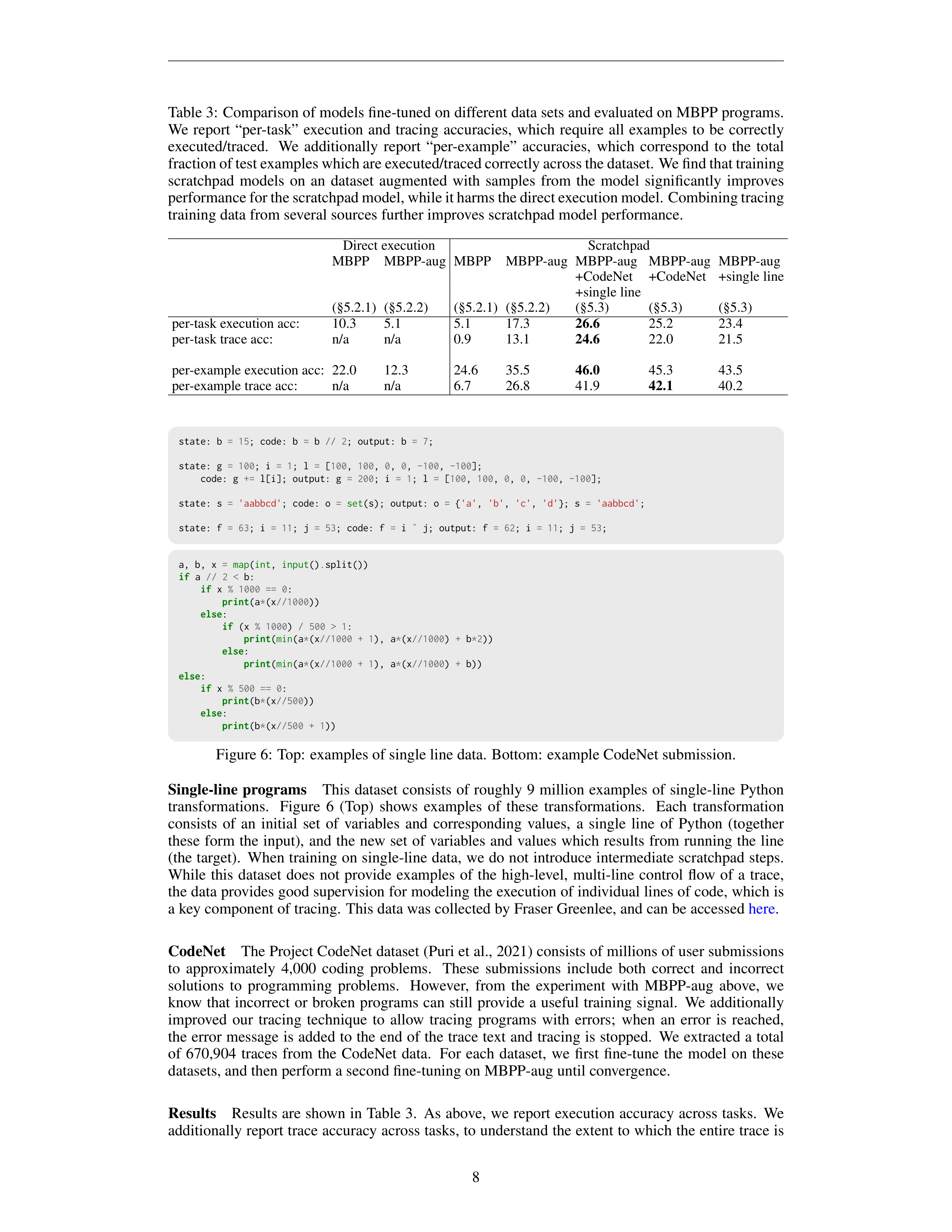
Table 3:
Comparison of models fine-tuned on different data sets and evaluated on MBPP programs.
We
report
“per-task”
execution
and
tracing
accuracies,
which
require
all
examples
to
be
correctly
executed/traced.
We
additionally
report
“per-example”
accuracies,
which
correspond
to
the
total
fraction of test examples which are executed/traced correctly across the dataset. We find that training
scratchpad
models
on
an
dataset
augmented
with
samples
from
the
model
significantly
improves
performance for the scratchpad model, while it harms the direct execution model. Combining tracing
training data from several sources further improves scratchpad model performance.
Direct execution
Scratchpad
MBPP
MBPP-aug
MBPP
MBPP-aug
MBPP-aug
MBPP-aug
MBPP-aug
+CodeNet
+CodeNet
+single line
+single line
(§5.2.1)
(§5.2.2)
(§5.2.1)
(§5.2.2)
(§5.3)
(§5.3)
(§5.3)
per-task execution acc:
10.3
5.1
5.1
17.3
26.6
25.2
23.4
per-task trace acc:
n/a
n/a
0.9
13.1
24.6
22.0
21.5
per-example execution acc:
22.0
12.3
24.6
35.5
46.0
45.3
43.5
per-example trace acc:
n/a
n/a
6.7
26.8
41.9
42.1
40.2
state:
b
=
15
;
code:
b
=
b
//
2
;
output:
b
=
7
;
state:
g
=
100
;
i
=
1
;
l
=
[
100
,
100
,
0
,
0
,
-100
,
-100
];
code:
g
+=
l[i];
output:
g
=
200
;
i
=
1
;
l
=
[
100
,
100
,
0
,
0
,
-100
,
-100
];
state:
s
=
'aabbcd'
;
code:
o
=
set
(s);
output:
o
=
{
'a'
,
'b'
,
'c'
,
'd'
};
s
=
'aabbcd'
;
state:
f
=
63
;
i
=
11
;
j
=
53
;
code:
f
=
i
ˆ
j;
output:
f
=
62
;
i
=
11
;
j
=
53
;
a,
b,
x
=
map
(
int
,
input
()
.
split())
if
a
//
2
<
b:
if
x
%
1000
==
0
:
print
(a
*
(x
//1000
))
else
:
if
(x
%
1000
)
/
500
>
1
:
print
(
min
(a
*
(x
//1000
+
1
),
a
*
(x
//1000
)
+
b
*2
))
else
:
print
(
min
(a
*
(x
//1000
+
1
),
a
*
(x
//1000
)
+
b))
else
:
if
x
%
500
==
0
:
print
(b
*
(x
//500
))
else
:
print
(b
*
(x
//500
+
1
))
Figure 6:
Top:
examples of single line data.
Bottom:
example CodeNet submission.
Single-line
programs
This
dataset
consists
of
roughly
9
million
examples
of
single-line
Python
transformations.
Figure
6
(Top)
shows
examples
of
these
transformations.
Each
transformation
consists
of
an
initial
set
of
variables
and
corresponding
values,
a
single
line
of
Python
(together
these
form
the
input),
and
the
new
set
of
variables
and
values
which
results
from
running
the
line
(the target).
When training on single-line data,
we do not introduce intermediate scratchpad steps.
While
this
dataset
does
not
provide
examples
of
the
high-level,
multi-line
control
flow
of
a
trace,
the data provides good supervision for modeling the execution of individual lines of code, which is
a key component of tracing.
This data was collected by Fraser Greenlee, and can be accessed
here
.
CodeNet
The Project CodeNet dataset (Puri et al., 2021) consists of millions of user submissions
to
approximately
4,000
coding
problems.
These
submissions
include
both
correct
and
incorrect
solutions
to
programming
problems.
However,
from
the
experiment
with
MBPP-aug
above,
we
know
that
incorrect
or
broken
programs
can
still
provide
a
useful
training
signal.
We
additionally
improved
our
tracing
technique
to
allow
tracing
programs
with
errors;
when
an
error
is
reached,
the error message is added to the end of the trace text and tracing is stopped.
We extracted a total
of
670,904
traces
from
the
CodeNet
data.
For
each
dataset,
we
first
fine-tune
the
model
on
these
datasets, and then perform a second fine-tuning on MBPP-aug until convergence.
Results
Results are shown in Table 3.
As above,
we report execution accuracy across tasks.
We
additionally report trace accuracy across tasks, to understand the extent to which the entire trace is
8
accurately predicted.
We also report the raw execution and trace accuracy across all test examples,
as an additional metric to compare models.
Training
on
either
the
single-line
dataset
or
the
CodeNet
dataset
alone
seem
to
both
provide
gains
over
MBPP-aug
(23.4%
and
25.2%
tasks
executed
correctly,
respectively).
However,
combining
both
CodeNet
and
the
single-line
dataset
seems
lead
to
the
highest
performance;
tracing
produces
the correct final output for 26.6% of the tasks, and nearly a quarter of the tasks (24.6%) are traced
perfectly for all three examples.
These results seem promising: the neural network can often exactly
trace programs. In particular, greedily decoding from the best model produces the exact correct trace
for almost 42% of all traces.
6
R
ELATED
W
ORK
The tasks in this paper can be viewed as exploring one criticism of large language models, namely,
to
what
extent
do
they
simply
rely
on
surface-level
statistical
correlations
on
text,
without
learn-
ing semantics or world knowledge (Bender & Koller, 2020)?
In response,
Li et al. (2021) provide
evidence
that
pre-trained
language
models
do
indeed
construct
approximate
representations
of
the
semantics
of
the
situations
they
describe
in
text.
In
the
context
of
programs,
Austin
et
al.
(2021)
approach
this
question
by
exploring
the
learning
to
execute
task
on
MBPP,
which
we
consider
in
Section 5.2.
The idea behind this task was to explore whether neural models for synthesis that gen-
erate code could also execute it.
While that work finds existing models perform poorly at predicting
execution, we show that adding a scratchpad allows these models to perform better.
Work
in
learning
to
execute
has
considered
whether
off-the-shelf
recurrent
neural
networks
(Zaremba & Sutskever, 2014) or more specialized architectures (Dehghani et al., 2018; Bieber et al.,
2020;
Wang
et
al.,
2020)
have
an
inductive
bias
that
is
sufficiently
well
suited
for
executing
and
reasoning
about
arbitrary
code.
The
related
problem
of
neural
algorithm
induction
has
attracted
considerable
interest
(Graves
et
al.,
2014;
Kurach
et
al.,
2016;
Kaiser
&
Sutskever,
2016;
Graves
et
al.,
2016;
Reed
&
de
Freitas,
2016;
Veliˇckovi´c
et
al.,
2020a;b).
This
work
proposes
new
neural
architectures,
inspired
by
theoretical
models
of
computation,
whose
inductive
bias
allows
them
to
more
easily
learn
algorithm
induction
tasks.
Several
methods
for
algorithm
induction
specifically
add
adaptive
computation
time
to
sequence
models
(Graves,
2016;
Dehghani
et
al.,
2018;
Banino
et al., 2021).
In particular, universal transformers include adaptive computation time, and are eval-
uated
both
on
algorithm
induction
and
on
learning
to
execute
tasks
(Dehghani
et
al.,
2018).
In
contrast,
a
scratchpad
is
a
simple
way
both
to
provide
a
transformer
model
with
adaptive
compu-
tation time,
and also to provide supervision about how to use that additional computation,
without
requiring modification to the underlying architecture.
Algorithm
induction
has
also
been
connected
to
pre-trained
models.
Lu
et
al.
(2021)
show
that
Transformers can be used to some extent as universal computation engines, by pre-training on natu-
ral language, and fine-tuning a small fraction of the weights on non-language tasks, including simple
algorithm
induction
tasks.
Finally,
supervised
approaches
to
semantic
parsing
(Zelle
&
Mooney,
1996; Zettlemoyer & Collins, 2005; Kwiatkowksi et al., 2010; Wong & Mooney, 2006) predict the
text of a database query, which can then be executed to answer a natural language question.
7
L
IMITATIONS
AND
F
UTURE
W
ORK
Context
window
size
In
this
work,
we
limit
our
experiments
to
problems
where
the
scratchpad
text fits within the model generation window (512 tokens).
However,
many problems require very
long
scratchpad
generations.
Therefore,
fully
realizing
the
potential
of
the
scratchpad
technique
may
require
further
improvements
in
transformer
generation
window
size.
This
is
an
active
area
of
research
in
NLP
(Tay
et
al.,
2020),
and
improvements
would
be
beneficial
for
the
scratchpad
technique.
Learning
to
use
the
scratchpad
without
supervision
A
clear
next
step
is
to
try
to
learn
to
use
the
scratchpad
without
direct
supervision.
A
simple
method
would
be
to
use
reinforcement
learn-
ing
(RL)
techniques:
models
would
be
rewarded
for
correctly
answering
questions,
with
reward
inversely
proportional
to
the
number
of
scratchpad
tokens
used.
We
would
hope
that
learning
to
9
use
the
scratchpad
would
be
a
transferable
skill;
for
example,
a
model
could
potentially
use
the
algorithm it learned to perform long addition to succeed at polynomial evaluation.
8
C
ONCLUSION
In this work we showed—through experiments on long addition, polynomial evaluation, and Python
code
execution—that
allowing
models
to
read
from
and
write
to
a
simple
scratchpad
can
improve
their
performance
on
algorithmic
tasks.
Such
models
may
be
a
first
step
toward
combining
the
knowledge-compression capabilities of large language models with reasoning capabilities, in order
to
build
models
that
understand
code
as
well
as
write
it.
This
could
be
useful
for
a
variety
of
ap-
plications that require both working with natural language and reasoning about program semantics,
such as program synthesis, neural-guided program analysis, and interactive programming assistants.
The scratchpad technique presented here might not take us all the way toward that goal, but we hope
it is an important step.
A
CKNOWLEDGMENTS
We thank Fraser Greenlee for constructing the single-line programs dataset, and Kevin Murphy for
bringing this dataset to our attention.
R
EFERENCES
Miltiadis Allamanis, Marc Brockschmidt, and Mahmoud Khademi.
Learning to represent programs
with graphs.
In
International Conference on Learning Representations (ICLR)
, February 2018.
Jacob Austin, Augustus Odena, Maxwell Nye, Maarten Bosma, Henryk Michalewski, David Dohan,
Ellen
Jiang,
Carrie
Cai,
Michael
Terry,
Quoc
Le,
et
al.
Program
synthesis
with
large
language
models.
arXiv preprint arXiv:2108.07732
, 2021.
Andrea Banino, Jan Balaguer, and Charles Blundell.
Pondernet:
Learning to ponder.
In
8th ICML
Workshop on Automated Machine Learning (AutoML)
, 2021.
Emily
M.
Bender
and
Alexander
Koller.
Climbing
towards
NLU:
On
meaning,
form,
and
under-
standing
in
the
age
of
data.
In
Proceedings
of
the
58th
Annual
Meeting
of
the
Association
for
Computational
Linguistics
,
pp.
5185–5198,
Online,
July
2020.
Association
for
Computational
Linguistics.
doi:
10.18653/v1/2020.acl-main.463.
URL
https://aclanthology.org/2020.
acl-main.463
.
David Bieber, Charles Sutton, Hugo Larochelle, and Daniel Tarlow.
Learning to execute programs
with instruction pointer attention graph neural networks.
In H. Larochelle, M. Ranzato, R. Had-
sell,
M.
F.
Balcan,
and
H.
Lin
(eds.),
Advances
in
Neural
Information
Processing
Systems
,
vol-
ume 33, pp. 8626–8637. Curran Associates, Inc., 2020.
URL
https://proceedings.neurips.
cc/paper/2020/file/62326dc7c4f7b849d6f013ba46489d6c-Paper.pdf
.
Tom
B.
Brown,
Benjamin
Mann,
Nick
Ryder,
Melanie
Subbiah,
Jared
Kaplan,
Prafulla
Dhari-
wal,
Arvind
Neelakantan,
Pranav
Shyam,
Girish
Sastry,
Amanda
Askell,
Sandhini
Agarwal,
Ariel Herbert-Voss, Gretchen Krueger, Tom Henighan, Rewon Child, Aditya Ramesh, Daniel M.
Ziegler,
Jeffrey
Wu,
Clemens
Winter,
Christopher
Hesse,
Mark
Chen,
Eric
Sigler,
Mateusz
Litwin,
Scott
Gray,
Benjamin
Chess,
Jack
Clark,
Christopher
Berner,
Sam
McCandlish,
Alec
Radford,
Ilya
Sutskever,
and
Dario
Amodei.
Language
models
are
few-shot
learners.
CoRR
,
abs/2005.14165, 2020.
URL
https://arxiv.org/abs/2005.14165
.
Mark
Chen,
Jerry
Tworek,
Heewoo
Jun,
Qiming
Yuan,
Henrique
Ponde,
Jared
Kaplan,
Harri
Ed-
wards,
Yura
Burda,
Nicholas
Joseph,
Greg
Brockman,
Alex
Ray,
Raul
Puri,
Gretchen
Krueger,
Michael
Petrov,
Heidy
Khlaaf,
Girish
Sastry,
Pamela
Mishkin,
Brooke
Chan,
Scott
Gray,
Nick
Ryder,
Mikhail
Pavlov,
Alethea
Power,
Lukasz
Kaiser,
Mohammad
Bavarian,
Clemens
Win-
ter,
Philippe
Tillet,
Felipe
Such,
Dave
Cummings,
Matthias
Plappert,
Fotios
Chantzis,
Eliza-
beth Barnes, Ariel Herbert-Voss, Will Guss, Alex Nichol, Igor Babuschkin, Suchir Balaji, Shan-
tanu Jain, Andrew Carr, Jan Leike, Josh Achiam, Vedant Misra, Evan Morikawa, Alec Radford,
Matthew
Knight,
Miles
Brundage,
Mira
Murati,
Katie
Mayer,
Peter
Welinder,
Bob
McGrew,
10
Dario
Amodei,
Sam
McCandlish,
Ilya
Sutskever,
and
Wojciech
Zaremba.
Evaluating
large
lan-
guage models trained on code, July 2021.
URL
http://arxiv.org/abs/2107.03374
.
Mostafa Dehghani, Stephan Gouws, Oriol Vinyals, Jakob Uszkoreit, and Łukasz Kaiser.
Universal
transformers.
July 2018.
Jacob
Devlin,
Jonathan
Uesato,
Surya
Bhupatiraju,
Rishabh
Singh,
Abdel-rahman
Mohamed,
and
Pushmeet Kohli.
Robustfill:
Neural program learning under noisy I/O.
CoRR
, abs/1703.07469,
2017.
URL
http://arxiv.org/abs/1703.07469
.
Jacob Devlin, Ming-Wei Chang, Kenton Lee, and Kristina Toutanova.
BERT: Pre-training of deep
bidirectional transformers for language understanding.
In
North American Chapter of the Associ-
ation for Computational Linguistics:
Human Language Technologies, Volume 1 (Long and Short
Papers)
, 2019.
Alex
Graves.
Adaptive
computation
time
for
recurrent
neural
networks.
arXiv
preprint
arXiv:1603.08983
, 2016.
Alex
Graves,
Greg
Wayne,
and
Ivo
Danihelka.
Neural
turing
machines.
CoRR
,
abs/1410.5401,
2014.
Alex
Graves,
Greg
Wayne,
Malcolm
Reynolds,
Tim
Harley,
Ivo
Danihelka,
Agnieszka
Grabska-
Barwinska,
Sergio
Gomez
Colmenarejo,
Edward
Grefenstette,
Tiago
Ramalho,
John
Agapiou,
Adri`a
Puigdom`enech
Badia,
Karl
Moritz
Hermann,
Yori
Zwols,
Georg
Ostrovski,
Adam
Cain,
Helen King, Christopher Summerfield, Phil Blunsom, Koray Kavukcuoglu, and Demis Hassabis.
Hybrid
computing
using
a
neural
network
with
dynamic
external
memory.
Nature
,
538(7626):
471–476, 2016.
Lukasz Kaiser and Ilya Sutskever.
Neural gpus learn algorithms.
In
4th International Conference on
Learning Representations, ICLR 2016, San Juan, Puerto Rico, May 2-4, 2016, Conference Track
Proceedings
, 2016.
Karol
Kurach,
Marcin
Andrychowicz,
and
Ilya
Sutskever.
Neural
random-access
machines.
In
International Conference on Learning Representations, (ICLR)
, 2016.
Tom Kwiatkowksi, Luke Zettlemoyer, Sharon Goldwater, and Mark Steedman. Inducing probabilis-
tic CCG grammars from logical form with higher-order unification.
In
Proceedings of the 2010
Conference
on
Empirical
Methods
in
Natural
Language
Processing
,
pp.
1223–1233,
October
2010.
Belinda
Z.
Li,
Maxwell
Nye,
and
Jacob
Andreas.
Implicit
representations
of
meaning
in
neural
language models.
ArXiv
, abs/2106.00737, 2021.
Kevin
Lu,
Aditya
Grover,
Pieter
Abbeel,
and
Igor
Mordatch.
Pretrained
transformers
as
universal
computation engines.
March 2021.
Ruchir
Puri,
David
S
Kung,
Geert
Janssen,
Wei
Zhang,
Giacomo
Domeniconi,
Vladmir
Zolotov,
Julian Dolby, Jie Chen, Mihir Choudhury, Lindsey Decker, Veronika Thost, Luca Buratti, Saurabh
Pujar,
and
Ulrich
Finkler.
Project
CodeNet:
A
Large-Scale
AI
for
code
dataset
for
learning
a
diversity of coding tasks.
May 2021.
URL
http://arxiv.org/abs/2105.12655
.
Colin Raffel, Noam Shazeer, Adam Roberts, Katherine Lee, Sharan Narang, Michael Matena, Yanqi
Zhou, Wei Li, and Peter J. Liu.
Exploring the limits of transfer learning with a unified text-to-text
transformer.
CoRR
, abs/1910.10683, 2019.
URL
http://arxiv.org/abs/1910.10683
.
Scott Reed and Nando de Freitas.
Neural programmer-interpreters.
In
International Conference on
Learning Representations (ICLR)
, 2016.
URL
http://arxiv.org/pdf/1511.06279v3
.
David Saxton, Edward Grefenstette, Felix Hill, and Pushmeet Kohli.
Analysing mathematical rea-
soning abilities of neural models.
CoRR
, abs/1904.01557, 2019.
URL
http://arxiv.org/abs/
1904.01557
.
11
Yi
Tay,
Mostafa
Dehghani,
Samira
Abnar,
Yikang
Shen,
Dara
Bahri,
Philip
Pham,
Jinfeng
Rao,
Liu
Yang,
Sebastian
Ruder,
and
Donald
Metzler.
Long
range
arena:
A
benchmark
for
efficient
transformers.
CoRR
, abs/2011.04006, 2020.
URL
https://arxiv.org/abs/2011.04006
.
Petar Velickovic and Charles Blundell. Neural algorithmic reasoning.
CoRR
, abs/2105.02761, 2021.
URL
https://arxiv.org/abs/2105.02761
.
Petar Veliˇckovi´c,
Lars Buesing,
Matthew C. Overlan,
Razvan Pascanu,
Oriol Vinyals,
and Charles
Blundell.
Pointer graph networks, 2020a.
Petar Veliˇckovi´c, Rex Ying, Matilde Padovano, Raia Hadsell, and Charles Blundell.
Neural execu-
tion of graph algorithms, 2020b.
Yu Wang, Fengjuan Gao, Linzhang Wang, and Ke Wang.
Learning semantic program embeddings
with graph interval neural network, 2020.
Yuk
Wah
Wong
and
Raymond
J
Mooney.
Learning
for
semantic
parsing
with
statistical
machine
translation.
In
Proceedings of the main conference on Human Language Technology Conference
of
the
North
American
Chapter
of
the
Association
of
Computational
Linguistics
-
,
Morristown,
NJ, USA, 2006. Association for Computational Linguistics.
Wojciech Zaremba and Ilya Sutskever.
Learning to execute.
ArXiv
, abs/1410.4615, 2014.
J Zelle and R Mooney.
Learning to parse database queries using inductive logic programming.
In
National Conference on Artificial Intelligence (AAAI)
, 1996.
Luke
S
Zettlemoyer
and
Michael
Collins.
Learning
to
map
sentences
to
logical
form:
Structured
classification
with
probabilistic
categorial
grammars.
In
Uncertainty
in
Artificial
Intelligence
,
July 2005.
12
A
E
FFECTS
OF
S
CRATCHPAD
E
XECUTION
T
RAINING
ON
S
YNTHESIS
P
ERFORMANCE
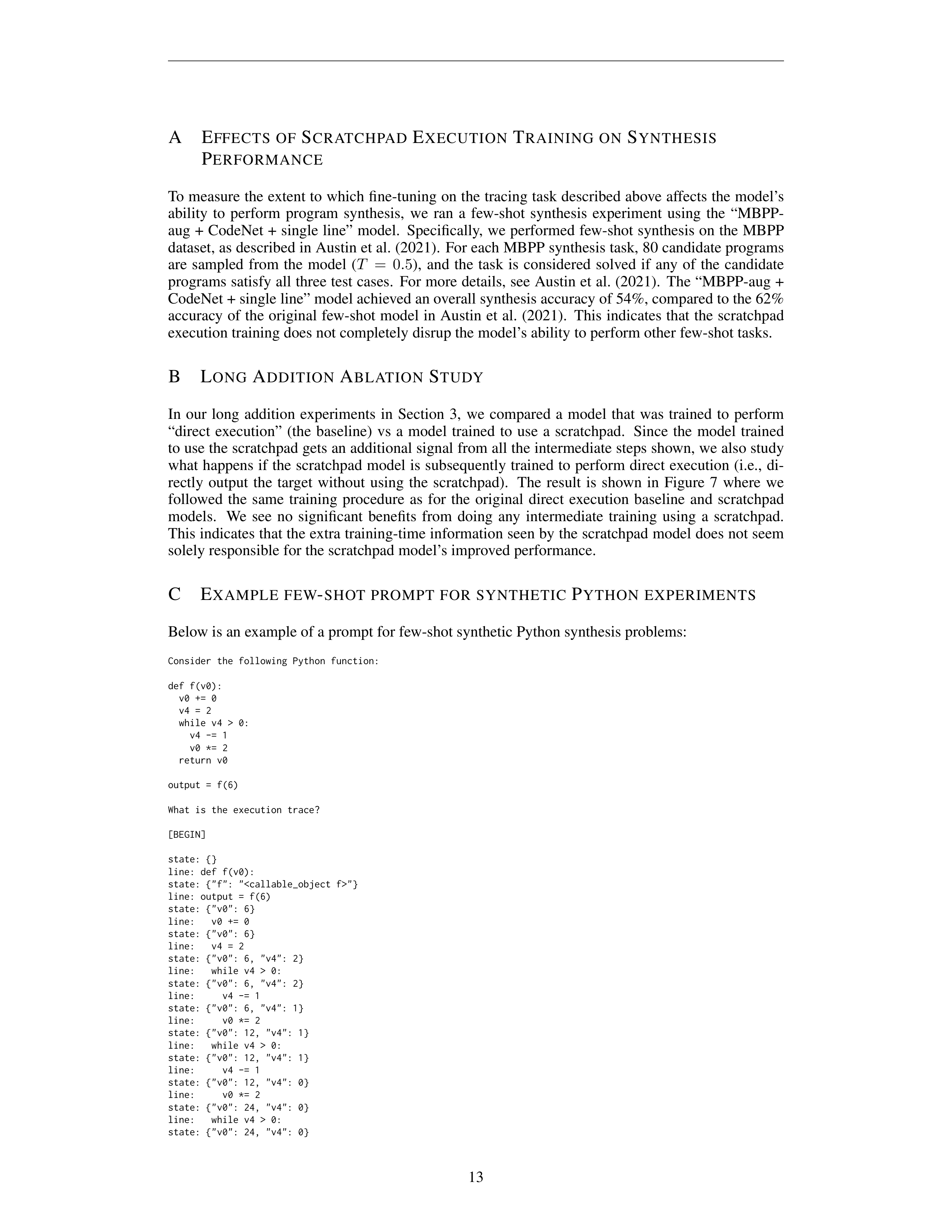
To measure the extent to which fine-tuning on the tracing task described above affects the model’s
ability
to
perform
program
synthesis,
we
ran
a
few-shot
synthesis
experiment
using
the
“MBPP-
aug + CodeNet + single line” model.
Specifically,
we performed few-shot synthesis on the MBPP
dataset, as described in Austin et al. (2021).
For each MBPP synthesis task, 80 candidate programs
are
sampled
from
the
model
(
T
=
0
.
5
),
and
the
task
is
considered
solved
if
any
of
the
candidate
programs satisfy all three test cases.
For more details, see Austin et al. (2021).
The “MBPP-aug +
CodeNet + single line” model achieved an overall synthesis accuracy of 54%, compared to the 62%
accuracy
of
the
original
few-shot
model
in
Austin
et
al.
(2021).
This
indicates
that
the
scratchpad
execution training does not completely disrup the model’s ability to perform other few-shot tasks.
B
L
ONG
A
DDITION
A
BLATION
S
TUDY
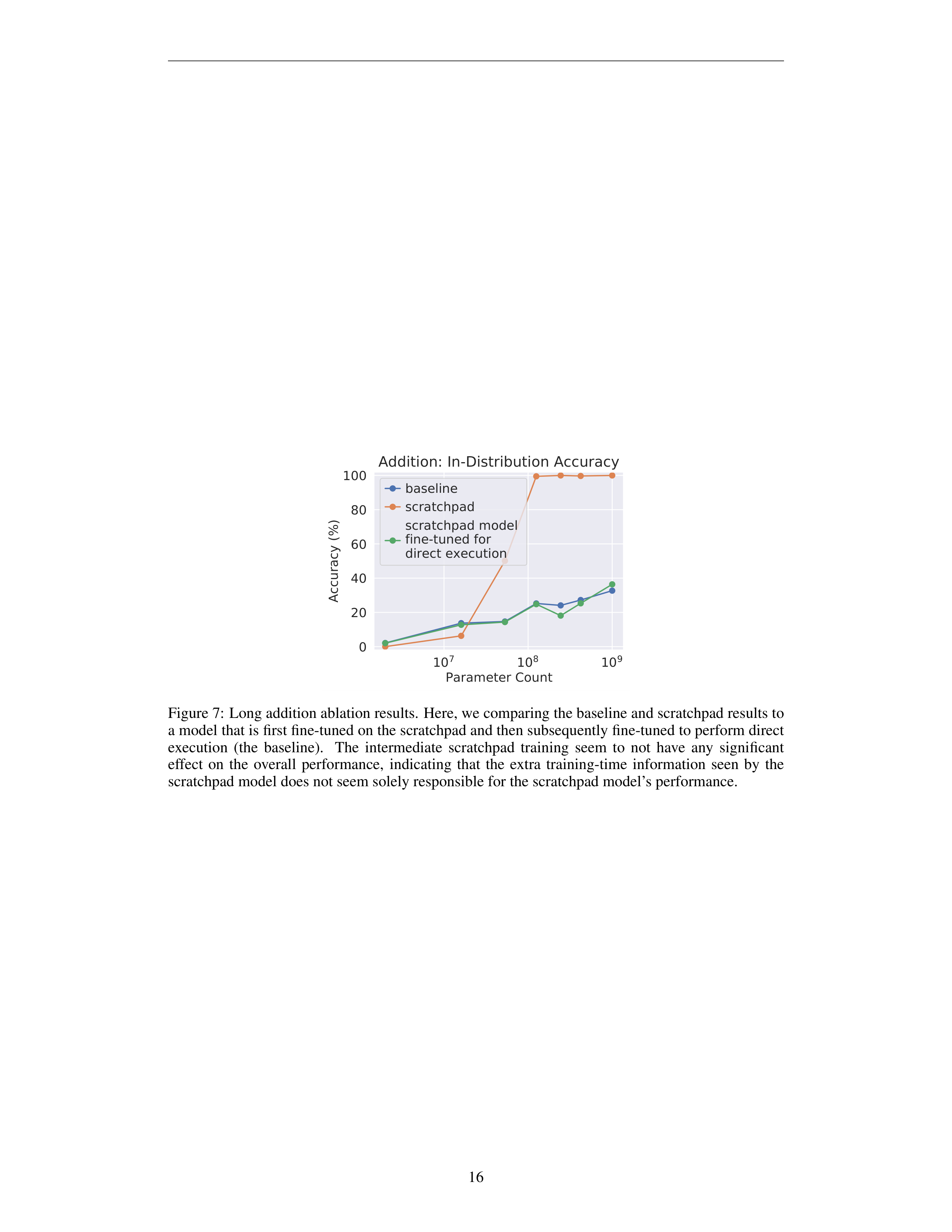
In
our
long
addition
experiments
in
Section
3,
we
compared
a
model
that
was
trained
to
perform
“direct
execution”
(the
baseline)
vs
a
model
trained
to
use
a
scratchpad.
Since
the
model
trained
to use the scratchpad gets an additional signal from all the intermediate steps shown, we also study
what happens
if the scratchpad
model is subsequently trained to perform direct execution (i.e.,
di-
rectly
output
the
target
without
using
the
scratchpad).
The
result
is
shown
in
Figure
7
where
we
followed
the
same
training
procedure
as
for
the
original
direct
execution
baseline
and
scratchpad
models.
We
see
no
significant
benefits
from
doing
any
intermediate
training
using
a
scratchpad.
This indicates that the extra training-time information seen by the scratchpad model does not seem
solely responsible for the scratchpad model’s improved performance.
C
E
XAMPLE
FEW
-
SHOT
PROMPT
FOR
SYNTHETIC
P
YTHON
EXPERIMENTS
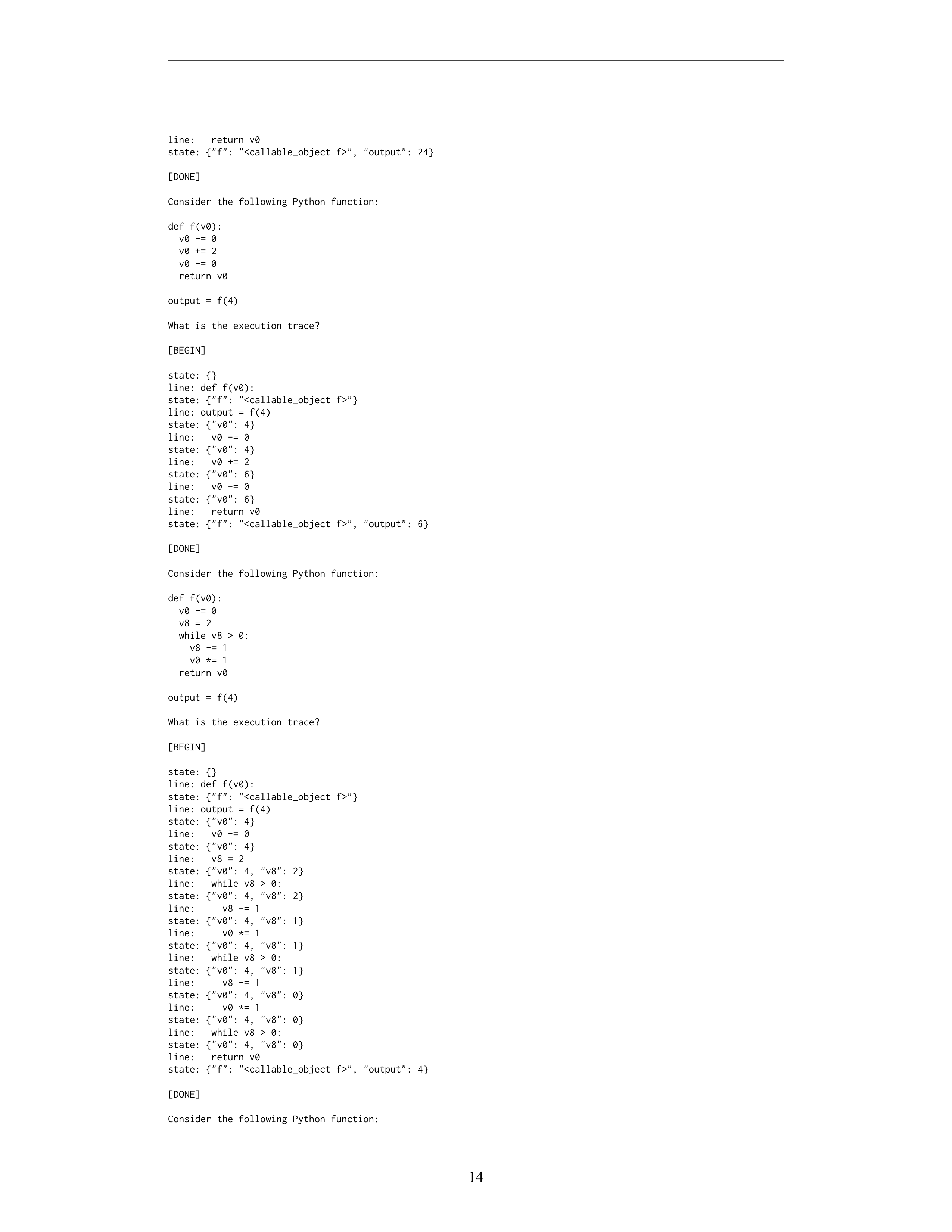
Below is an example of a prompt for few-shot synthetic Python synthesis problems:
Consider
the
following
Python
function:
def
f(v0):
v0
+=
0
v4
=
2
while
v4
>
0:
v4
-=
1
v0
*=
2
return
v0
output
=
f(6)
What
is
the
execution
trace?
[BEGIN]
state:
{}
line:
def
f(v0):
state:
{"f":
"<callable_object
f>"}
line:
output
=
f(6)
state:
{"v0":
6}
line:
v0
+=
0
state:
{"v0":
6}
line:
v4
=
2
state:
{"v0":
6,
"v4":
2}
line:
while
v4
>
0:
state:
{"v0":
6,
"v4":
2}
line:
v4
-=
1
state:
{"v0":
6,
"v4":
1}
line:
v0
*=
2
state:
{"v0":
12,
"v4":
1}
line:
while
v4
>
0:
state:
{"v0":
12,
"v4":
1}
line:
v4
-=
1
state:
{"v0":
12,
"v4":
0}
line:
v0
*=
2
state:
{"v0":
24,
"v4":
0}
line:
while
v4
>
0:
state:
{"v0":
24,
"v4":
0}
13
line:
return
v0
state:
{"f":
"<callable_object
f>",
"output":
24}
[DONE]
Consider
the
following
Python
function:
def
f(v0):
v0
-=
0
v0
+=
2
v0
-=
0
return
v0
output
=
f(4)
What
is
the
execution
trace?
[BEGIN]
state:
{}
line:
def
f(v0):
state:
{"f":
"<callable_object
f>"}
line:
output
=
f(4)
state:
{"v0":
4}
line:
v0
-=
0
state:
{"v0":
4}
line:
v0
+=
2
state:
{"v0":
6}
line:
v0
-=
0
state:
{"v0":
6}
line:
return
v0
state:
{"f":
"<callable_object
f>",
"output":
6}
[DONE]
Consider
the
following
Python
function:
def
f(v0):
v0
-=
0
v8
=
2
while
v8
>
0:
v8
-=
1
v0
*=
1
return
v0
output
=
f(4)
What
is
the
execution
trace?
[BEGIN]
state:
{}
line:
def
f(v0):
state:
{"f":
"<callable_object
f>"}
line:
output
=
f(4)
state:
{"v0":
4}
line:
v0
-=
0
state:
{"v0":
4}
line:
v8
=
2
state:
{"v0":
4,
"v8":
2}
line:
while
v8
>
0:
state:
{"v0":
4,
"v8":
2}
line:
v8
-=
1
state:
{"v0":
4,
"v8":
1}
line:
v0
*=
1
state:
{"v0":
4,
"v8":
1}
line:
while
v8
>
0:
state:
{"v0":
4,
"v8":
1}
line:
v8
-=
1
state:
{"v0":
4,
"v8":
0}
line:
v0
*=
1
state:
{"v0":
4,
"v8":
0}
line:
while
v8
>
0:
state:
{"v0":
4,
"v8":
0}
line:
return
v0
state:
{"f":
"<callable_object
f>",
"output":
4}
[DONE]
Consider
the
following
Python
function:
14
def
f(v0):
v0
+=
2
v0
*=
2
v0
*=
1
return
v0
output
=
f(8)
What
is
the
execution
trace?
[BEGIN]
D
I
NCORRECT
OUTPUT
FOR
SYNTHETIC
P
YTHON
PROBLEMS
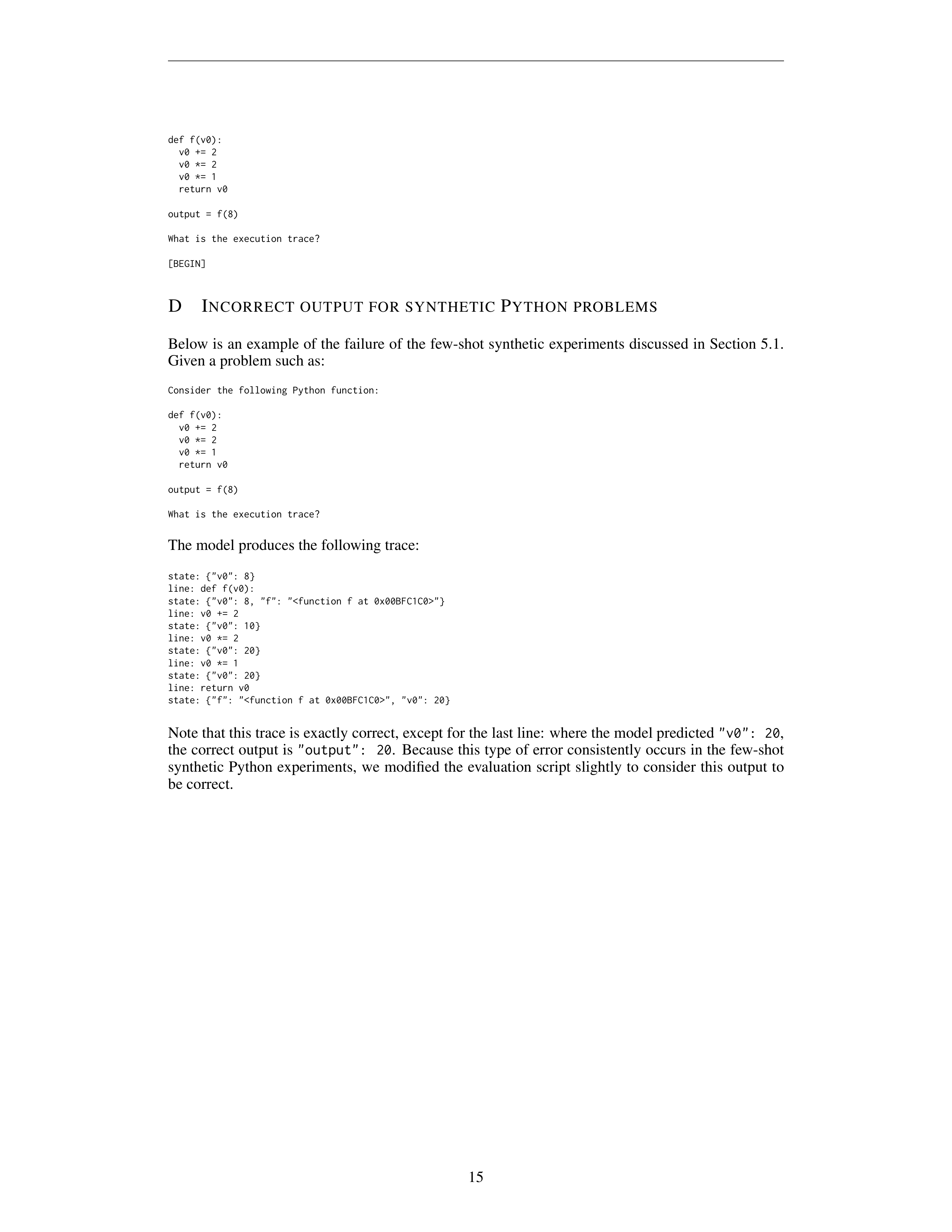
Below is an example of the failure of the few-shot synthetic experiments discussed in Section 5.1.
Given a problem such as:
Consider
the
following
Python
function:
def
f(v0):
v0
+=
2
v0
*=
2
v0
*=
1
return
v0
output
=
f(8)
What
is
the
execution
trace?
The model produces the following trace:
state:
{"v0":
8}
line:
def
f(v0):
state:
{"v0":
8,
"f":
"<function
f
at
0x00BFC1C0>"}
line:
v0
+=
2
state:
{"v0":
10}
line:
v0
*=
2
state:
{"v0":
20}
line:
v0
*=
1
state:
{"v0":
20}
line:
return
v0
state:
{"f":
"<function
f
at
0x00BFC1C0>",
"v0":
20}
Note that this trace is exactly correct, except for the last line:
where the model predicted
"v0":
20
,
the correct output is
"output":
20
.
Because this type of error consistently occurs in the few-shot
synthetic
Python
experiments,
we
modified
the
evaluation
script
slightly
to
consider
this
output
to
be correct.
15
10
7
10
8
10
9
Parameter Count
0
20
40
60
80
100
Accuracy (%)
Addition: In-Distribution Accuracy
baseline
scratchpad
scratchpad model
fine-tuned for
direct execution
Figure 7:
Long addition ablation results.
Here, we comparing the baseline and scratchpad results to
a model that is first fine-tuned on the scratchpad and then subsequently fine-tuned to perform direct
execution
(the
baseline).
The
intermediate
scratchpad
training
seem
to
not
have
any
significant
effect
on
the
overall
performance,
indicating
that
the
extra
training-time
information
seen
by
the
scratchpad model does not seem solely responsible for the scratchpad model’s performance.
16