
LLaMA: Open and Efficient Foundation Language Models
Hugo Touvron
∗
, Thibaut Lavril
∗
,
Gautier Izacard
∗
, Xavier Martinet
Marie-Anne Lachaux, Timothee Lacroix, Baptiste Rozière, Naman Goyal
Eric Hambro, Faisal Azhar, Aurelien Rodriguez, Armand Joulin
Edouard Grave
∗
, Guillaume Lample
∗
Meta AI
Abstract
We introduce LLaMA, a collection of founda-
tion language models ranging from 7B to 65B
parameters.
We
train
our
models
on
trillions
of tokens,
and show that it is possible to train
state-of-the-art
models
using
publicly
avail-
able
datasets
exclusively,
without
resorting
to
proprietary
and
inaccessible
datasets.
In
particular,
LLaMA-13B
outperforms
GPT-3
(175B)
on
most
benchmarks,
and
LLaMA-
65B
is
competitive
with
the
best
models,
Chinchilla-70B
and
PaLM-540B.
We
release
all our models to the research community
1
.
1
Introduction
Large Languages Models (LLMs) trained on mas-
sive corpora of texts have shown their ability to per-
form new tasks from textual instructions or from a
few examples (
Brown et al.
,
2020
).
These few-shot
properties first appeared when scaling models to a
sufficient size (
Kaplan et al.
,
2020
), resulting in a
line of work that focuses on further scaling these
models (
Chowdhery et al.
,
2022
;
Rae et al.
,
2021
).
These
efforts
are
based
on
the
assumption
that
more parameters will lead to better performance.
However, recent work from
Hoffmann et al.
(
2022
)
shows that,
for a given compute budget,
the best
performances are not achieved by the largest mod-
els, but by smaller models trained on more data.
The
objective
of
the
scaling
laws
from
Hoff-
mann
et
al.
(
2022
)
is
to
determine
how
to
best
scale the dataset and model sizes for a particular
training
compute budget.
However, this objective
disregards
the
inference
budget,
which
becomes
critical
when
serving
a
language
model
at
scale.
In this context, given a target level of performance,
the preferred model is not the fastest to train but the
fastest at inference, and although it may be cheaper
to
train
a
large
model
to
reach
a
certain
level
of
∗
Equal
contribution.
Correspondence:
{htouvron,
thibautlav,gizacard,egrave,glample}@meta.com
1
https://github.com/facebookresearch/llama
performance,
a
smaller
one
trained
longer
will
ultimately
be
cheaper
at
inference.
For
instance,
although
Hoffmann
et
al.
(
2022
)
recommends
training
a
10B
model
on
200B
tokens,
we
find
that the performance of a 7B model continues to
improve even after 1T tokens.
The
focus
of
this
work
is
to
train
a
series
of
language models that achieve the best possible per-
formance at various inference budgets, by training
on more tokens than what is typically used.
The
resulting models, called
LLaMA
, ranges from 7B
to 65B parameters with competitive performance
compared to the best existing LLMs.
For instance,
LLaMA-13B outperforms GPT-3 on most bench-
marks, despite being 10
×
smaller.
We believe that
this
model
will
help
democratize
the
access
and
study of LLMs, since it can be run on a single GPU.
At the higher-end of the scale, our 65B-parameter
model is also competitive with the best large lan-
guage models such as Chinchilla or PaLM-540B.
Unlike
Chinchilla,
PaLM,
or
GPT-3,
we
only
use publicly available data, making our work com-
patible
with
open-sourcing,
while
most
existing
models
rely
on
data
which
is
either
not
publicly
available or undocumented (e.g.
“Books – 2TB” or
“Social media conversations”).
There exist some
exceptions,
notably
OPT
(
Zhang
et
al.
,
2022
),
GPT-NeoX
(
Black
et
al.
,
2022
),
BLOOM
(
Scao
et al.
,
2022
) and GLM (
Zeng et al.
,
2022
), but none
that are competitive with PaLM-62B or Chinchilla.
In the rest of this paper, we present an overview
of
the
modifications
we
made
to
the
transformer
architecture (
Vaswani et al.
,
2017
), as well as our
training method. We then report the performance of
our models and compare with others LLMs on a set
of standard benchmarks.
Finally, we expose some
of the biases and toxicity encoded in our models,
using
some
of
the
most
recent
benchmarks
from
the responsible AI community.
arXiv:2302.13971v1 [cs.CL] 27 Feb 2023
2
Approach
Our
training
approach
is
similar
to
the
methods
described
in
previous
work
(
Brown
et
al.
,
2020
;
Chowdhery
et
al.
,
2022
),
and
is
inspired
by
the
Chinchilla
scaling
laws
(
Hoffmann
et
al.
,
2022
).
We train large transformers on a large quantity of
textual data using a standard optimizer.
2.1
Pre-training Data
Our training dataset is a mixture of several sources,
reported in Table
1
, that cover a diverse set of do-
mains.
For
the
most
part,
we
reuse
data
sources
that have been leveraged to train other LLMs, with
the
restriction
of
only
using
data
that
is
publicly
available, and compatible with open sourcing.
This
leads to the following mixture of data and the per-
centage they represent in the training set:
English CommonCrawl [67%].
We preprocess
five
CommonCrawl
dumps,
ranging
from
2017
to 2020, with the CCNet pipeline (
Wenzek et al.
,
2020
).
This
process
deduplicates
the
data
at
the
line
level,
performs
language
identification
with
a fastText linear classifier to remove non-English
pages
and
filters
low
quality
content
with
an
n-
gram
language
model.
In
addition,
we
trained
a
linear model to classify pages used as references
in
Wikipedia
v.s.
randomly
sampled
pages,
and
discarded pages not classified as references.
C4 [15%].
During exploratory experiments, we
observed
that
using
diverse
pre-processed
Com-
monCrawl datasets improves performance. We thus
included the publicly available C4 dataset (
Raffel
et al.
,
2020
) in our data.
The preprocessing of C4
also contains deduplication and language identifi-
cation
steps:
the
main
difference
with
CCNet
is
the quality filtering, which mostly relies on heuris-
tics such as presence of punctuation marks or the
number of words and sentences in a webpage.
Github
[4.5%].
We
use
the
public
GitHub
dataset
available
on
Google
BigQuery.
We
only
kept projects that are distributed under the Apache,
BSD and MIT licenses.
Additionally, we filtered
low quality files with heuristics based on the line
length
or
proportion
of
alphanumeric
characters,
and removed boilerplate, such as headers, with reg-
ular expressions.
Finally, we deduplicate the result-
ing dataset at the file level, with exact matches.
Wikipedia
[4.5%].
We
add
Wikipedia
dumps
from
the
June-August
2022
period,
covering
20
Dataset
Sampling prop.
Epochs
Disk size
CommonCrawl
67.0%
1.10
3.3 TB
C4
15.0%
1.06
783 GB
Github
4.5%
0.64
328 GB
Wikipedia
4.5%
2.45
83 GB
Books
4.5%
2.23
85 GB
ArXiv
2.5%
1.06
92 GB
StackExchange
2.0%
1.03
78 GB
Table 1:
Pre-training data.
Data mixtures used for pre-
training,
for
each
subset
we
list
the
sampling
propor-
tion,
number of epochs performed on the subset when
training on 1.4T tokens, and disk size.
The pre-training
runs on 1T tokens have the same sampling proportion.
languages,
which use either the Latin or Cyrillic
scripts:
bg
,
ca
,
cs
,
da
,
de
,
en
,
es
,
fr
,
hr
,
hu
,
it
,
nl
,
pl
,
pt
,
ro
,
ru
,
sl
,
sr
,
sv
,
uk
.
We process the
data
to
remove
hyperlinks,
comments
and
other
formatting boilerplate.
Gutenberg
and
Books3
[4.5%].
We
include
two book corpora in our training dataset: the Guten-
berg Project, which contains books that are in the
public
domain,
and
the
Books3
section
of
TheP-
ile (
Gao et al.
,
2020
), a publicly available dataset
for
training
large
language
models.
We
perform
deduplication
at
the
book
level,
removing
books
with more than 90% content overlap.
ArXiv
[2.5%].
We
process
arXiv
Latex
files
to
add
scientific
data
to
our
dataset.
Following
Lewkowycz et al.
(
2022
), we removed everything
before the first section, as well as the bibliography.
We also removed the comments from the .tex files,
and inline-expanded definitions and macros written
by users to increase consistency across papers.
Stack
Exchange
[2%].
We
include
a
dump
of
Stack
Exchange,
a
website
of
high
quality
ques-
tions and answers that covers a diverse set of do-
mains, ranging from computer science to chemistry.
We kept the data from the 28 largest websites, re-
moved
the
HTML
tags
from
text
and
sorted
the
answers by score (from highest to lowest).
Tokenizer.
We
tokenize
the
data
with
the
byte-
pair
encoding
(BPE)
algorithm
(
Sennrich
et
al.
,
2015
),
using
the
implementation
from
Sentence-
Piece (
Kudo and Richardson
,
2018
).
Notably, we
split all numbers into individual digits, and fallback
to bytes to decompose unknown UTF-8 characters.
params
dimension
n
heads
n
layers
learning rate
batch size
n
tokens
6.7B
4096
32
32
3
.
0
e
−
4
4M
1.0T
13.0B
5120
40
40
3
.
0
e
−
4
4M
1.0T
32.5B
6656
52
60
1
.
5
e
−
4
4M
1.4T
65.2B
8192
64
80
1
.
5
e
−
4
4M
1.4T
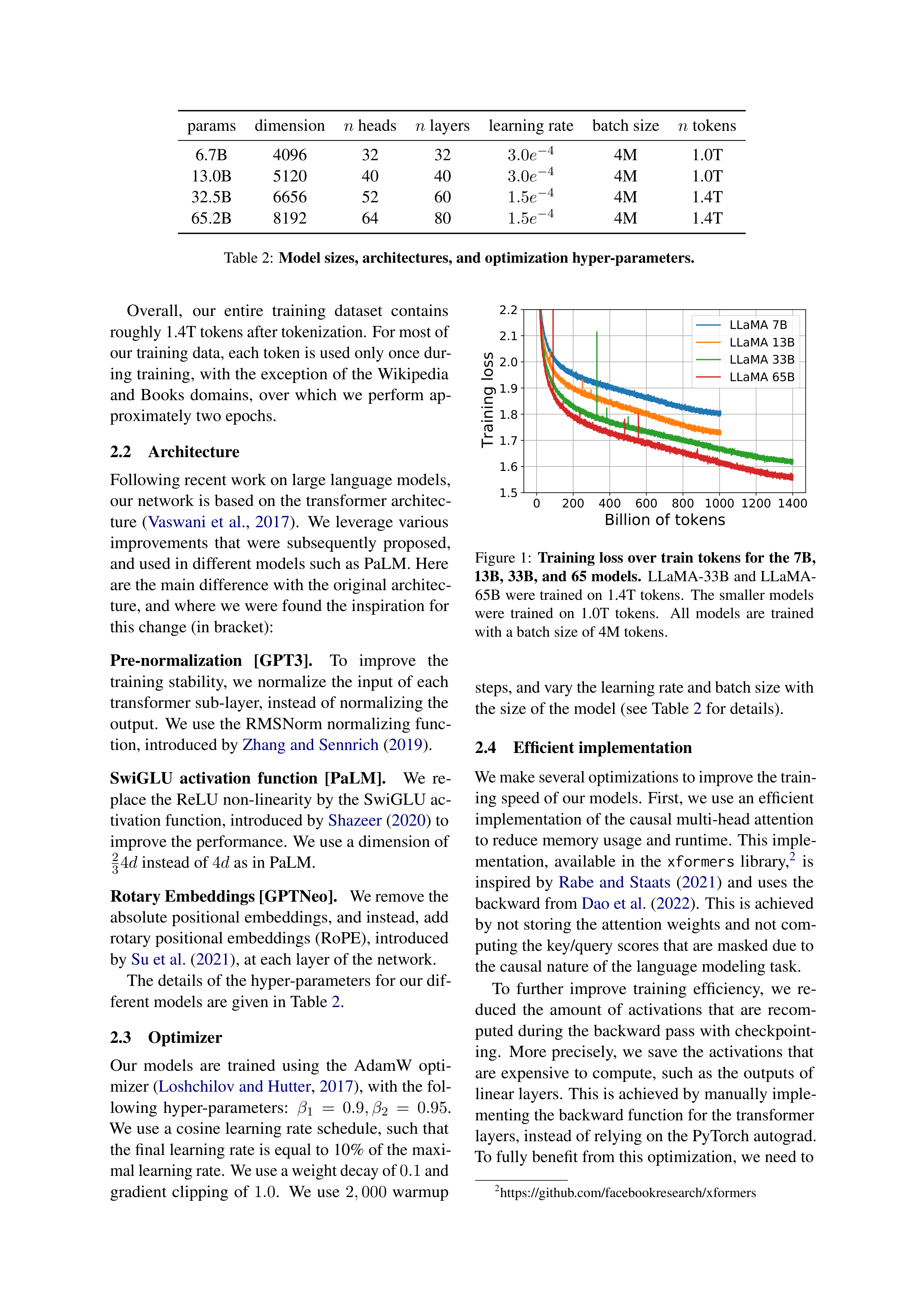
Table 2:
Model sizes, architectures, and optimization hyper-parameters.
Overall,
our
entire
training
dataset
contains
roughly 1.4T tokens after tokenization.
For most of
our training data, each token is used only once dur-
ing training, with the exception of the Wikipedia
and
Books
domains,
over
which
we
perform
ap-
proximately two epochs.
2.2
Architecture
Following recent work on large language models,
our network is based on the transformer architec-
ture (
Vaswani et al.
,
2017
).
We leverage various
improvements
that
were
subsequently
proposed,
and used in different models such as PaLM. Here
are the main difference with the original architec-
ture, and where we were found the inspiration for
this change (in bracket):
Pre-normalization
[GPT3].
To
improve
the
training stability, we normalize the input of each
transformer sub-layer, instead of normalizing the
output.
We use the RMSNorm normalizing func-
tion, introduced by
Zhang and Sennrich
(
2019
).
SwiGLU
activation
function
[PaLM].
We
re-
place the ReLU non-linearity by the SwiGLU ac-
tivation function, introduced by
Shazeer
(
2020
) to
improve the performance.
We use a dimension of
2
3
4
d
instead of
4
d
as in PaLM.
Rotary Embeddings [GPTNeo].
We remove the
absolute positional embeddings, and instead, add
rotary positional embeddings (RoPE), introduced
by
Su et al.
(
2021
), at each layer of the network.
The details of the hyper-parameters for our dif-
ferent models are given in Table
2
.
2.3
Optimizer
Our
models
are
trained
using
the
AdamW
opti-
mizer (
Loshchilov and Hutter
,
2017
), with the fol-
lowing
hyper-parameters:
β
1
=
0
.
9
, β
2
=
0
.
95
.
We use a cosine learning rate schedule, such that
the final learning rate is equal to 10% of the maxi-
mal learning rate. We use a weight decay of
0
.
1
and
gradient
clipping
of
1
.
0
.
We
use
2
,
000
warmup
0
200
400
600
800
1000
1200
1400
Billion of tokens
1.5
1.6
1.7
1.8
1.9
2.0
2.1
2.2
Training loss
LLaMA 7B
LLaMA 13B
LLaMA 33B
LLaMA 65B
Figure 1:
Training loss over train tokens for the 7B,
13B, 33B, and 65 models.
LLaMA-33B and LLaMA-
65B were trained on 1.4T tokens.
The smaller models
were
trained
on
1.0T
tokens.
All
models
are
trained
with a batch size of 4M tokens.
steps, and vary the learning rate and batch size with
the size of the model (see Table
2
for details).
2.4
Efficient implementation
We make several optimizations to improve the train-
ing speed of our models.
First, we use an efficient
implementation of the causal multi-head attention
to reduce memory usage and runtime.
This imple-
mentation,
available
in
the
xformers
library,
2
is
inspired
by
Rabe
and
Staats
(
2021
)
and
uses
the
backward from
Dao et al.
(
2022
).
This is achieved
by not storing the attention weights and not com-
puting the key/query scores that are masked due to
the causal nature of the language modeling task.
To
further
improve
training
efficiency,
we
re-
duced
the
amount
of
activations
that
are
recom-
puted during the backward pass with checkpoint-
ing.
More precisely,
we save the activations that
are expensive to compute,
such as the outputs of
linear layers.
This is achieved by manually imple-
menting the backward function for the transformer
layers, instead of relying on the PyTorch autograd.
To fully benefit from this optimization, we need to
2
https://github.com/facebookresearch/xformers
BoolQ
PIQA
SIQA
HellaSwag
WinoGrande
ARC-e
ARC-c
OBQA
GPT-3
175B
60.5
81.0
-
78.9
70.2
68.8
51.4
57.6
Gopher
280B
79.3
81.8
50.6
79.2
70.1
-
-
-
Chinchilla
70B
83.7
81.8
51.3
80.8
74.9
-
-
-
PaLM
62B
84.8
80.5
-
79.7
77.0
75.2
52.5
50.4
PaLM-cont
62B
83.9
81.4
-
80.6
77.0
-
-
-
PaLM
540B
88.0
82.3
-
83.4
81.1
76.6
53.0
53.4
LLaMA
7B
76.5
79.8
48.9
76.1
70.1
72.8
47.6
57.2
13B
78.1
80.1
50.4
79.2
73.0
74.8
52.7
56.4
33B
83.1
82.3
50.4
82.8
76.0
80.0
57.8
58.6
65B
85.3
82.8
52.3
84.2
77.0
78.9
56.0
60.2
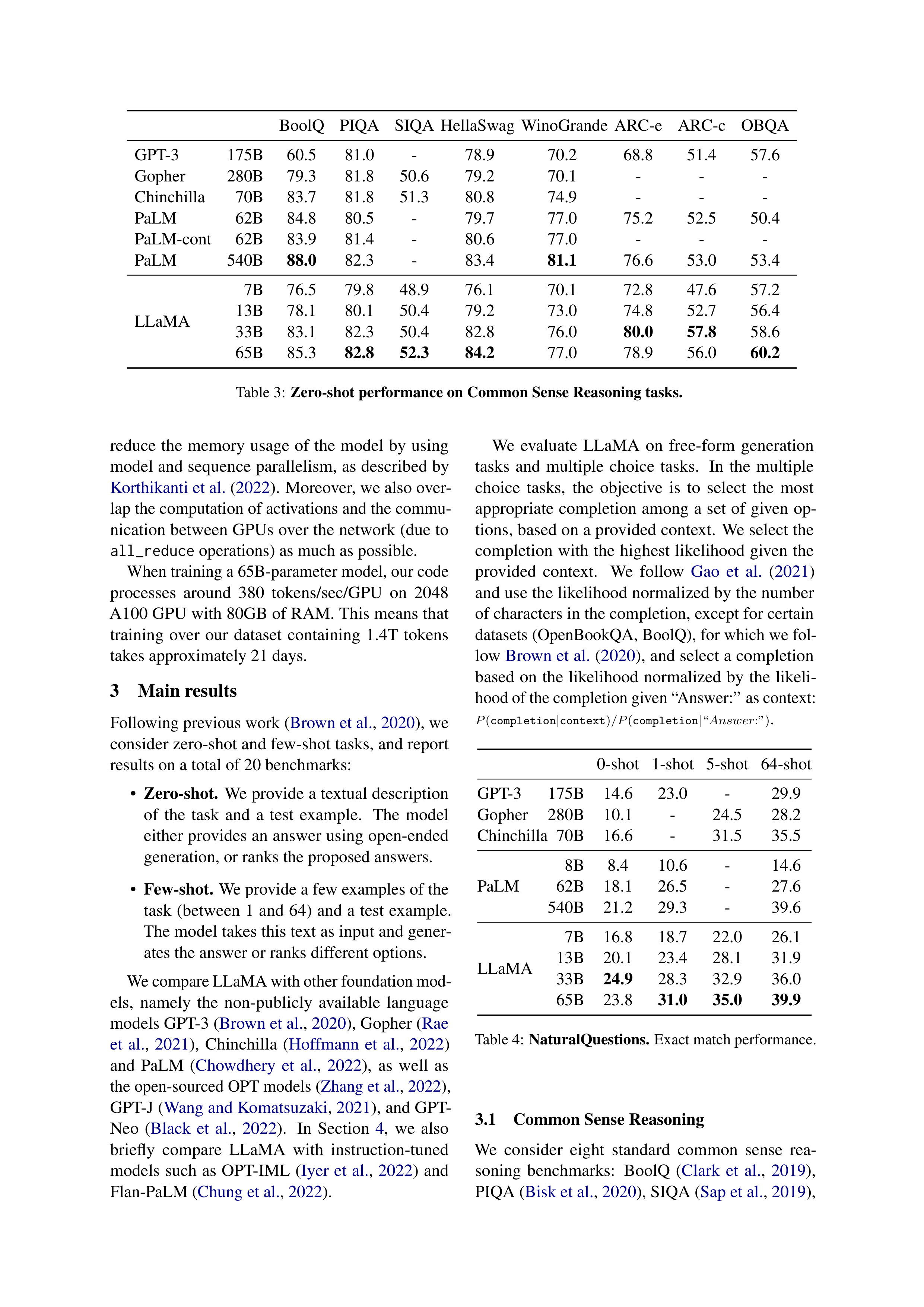
Table 3:
Zero-shot performance on Common Sense Reasoning tasks.
reduce
the
memory
usage
of
the
model
by
using
model and sequence parallelism, as described by
Korthikanti et al.
(
2022
).
Moreover, we also over-
lap the computation of activations and the commu-
nication between GPUs over the network (due to
all_reduce
operations) as much as possible.
When training a 65B-parameter model, our code
processes
around
380
tokens/sec/GPU
on
2048
A100 GPU with 80GB of RAM. This means that
training
over
our
dataset
containing
1.4T
tokens
takes approximately 21 days.
3
Main results
Following previous work (
Brown et al.
,
2020
), we
consider zero-shot and few-shot tasks, and report
results on a total of 20 benchmarks:
•
Zero-shot.
We provide a textual description
of
the
task
and
a
test
example.
The
model
either provides an answer using open-ended
generation, or ranks the proposed answers.
•
Few-shot.
We provide a few examples of the
task (between 1 and 64) and a test example.
The model takes this text as input and gener-
ates the answer or ranks different options.
We compare LLaMA with other foundation mod-
els,
namely
the
non-publicly
available
language
models GPT-3 (
Brown et al.
,
2020
), Gopher (
Rae
et
al.
,
2021
),
Chinchilla
(
Hoffmann
et
al.
,
2022
)
and
PaLM
(
Chowdhery
et
al.
,
2022
),
as
well
as
the open-sourced OPT models (
Zhang et al.
,
2022
),
GPT-J (
Wang and Komatsuzaki
,
2021
), and GPT-
Neo
(
Black
et
al.
,
2022
).
In
Section
4
,
we
also
briefly
compare
LLaMA
with
instruction-tuned
models
such
as
OPT-IML
(
Iyer
et
al.
,
2022
)
and
Flan-PaLM (
Chung et al.
,
2022
).
We
evaluate
LLaMA
on
free-form
generation
tasks
and
multiple
choice
tasks.
In
the
multiple
choice
tasks,
the
objective
is
to
select
the
most
appropriate
completion
among
a
set
of
given
op-
tions, based on a provided context.
We select the
completion with the highest likelihood given the
provided
context.
We
follow
Gao
et
al.
(
2021
)
and use the likelihood normalized by the number
of characters in the completion, except for certain
datasets (OpenBookQA, BoolQ), for which we fol-
low
Brown et al.
(
2020
), and select a completion
based
on
the
likelihood
normalized
by
the
likeli-
hood of the completion given “Answer:” as context:
P
(
completion
|
context
)
/P
(
completion
|
“
Answer
:”)
.
0-shot
1-shot
5-shot
64-shot
GPT-3
175B
14.6
23.0
-
29.9
Gopher
280B
10.1
-
24.5
28.2
Chinchilla
70B
16.6
-
31.5
35.5
PaLM
8B
8.4
10.6
-
14.6
62B
18.1
26.5
-
27.6
540B
21.2
29.3
-
39.6
LLaMA
7B
16.8
18.7
22.0
26.1
13B
20.1
23.4
28.1
31.9
33B
24.9
28.3
32.9
36.0
65B
23.8
31.0
35.0
39.9
Table 4:
NaturalQuestions.
Exact match performance.
3.1
Common Sense Reasoning
We
consider
eight
standard
common
sense
rea-
soning
benchmarks:
BoolQ
(
Clark
et
al.
,
2019
),
PIQA (
Bisk et al.
,
2020
), SIQA (
Sap et al.
,
2019
),
HellaSwag (
Zellers et al.
,
2019
), WinoGrande (
Sak-
aguchi et al.
,
2021
), ARC easy and challenge (
Clark
et
al.
,
2018
)
and
OpenBookQA
(
Mihaylov
et
al.
,
2018
).
These datasets include Cloze and Winograd
style tasks, as well as multiple choice question an-
swering.
We
evaluate
in
the
zero-shot
setting
as
done in the language modeling community.
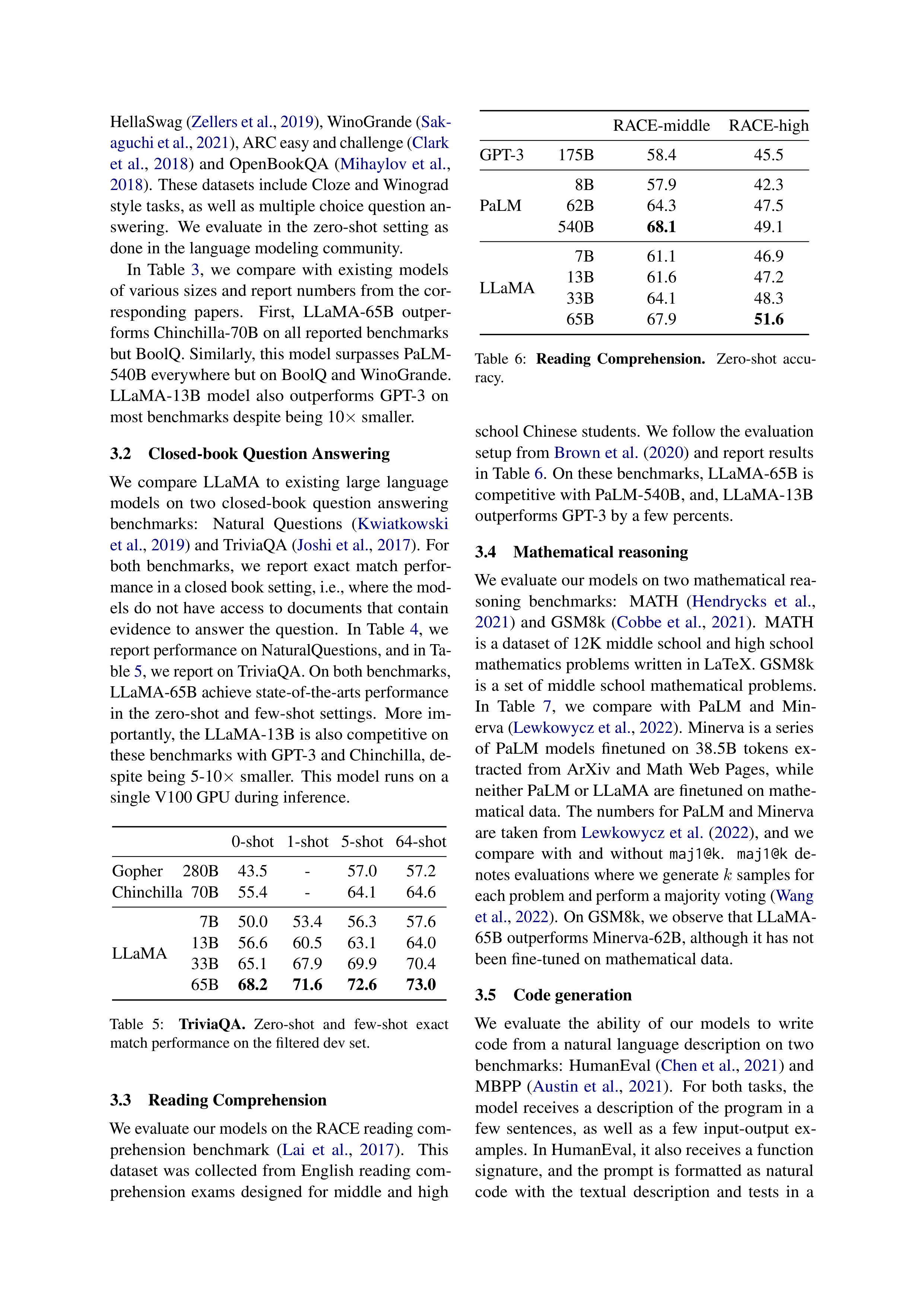
In
Table
3
,
we
compare
with
existing
models
of various sizes and report numbers from the cor-
responding
papers.
First,
LLaMA-65B
outper-
forms Chinchilla-70B on all reported benchmarks
but BoolQ. Similarly, this model surpasses PaLM-
540B everywhere but on BoolQ and WinoGrande.
LLaMA-13B
model
also
outperforms
GPT-3
on
most benchmarks despite being 10
×
smaller.
3.2
Closed-book Question Answering
We
compare
LLaMA
to
existing
large
language
models
on
two
closed-book
question
answering
benchmarks:
Natural
Questions
(
Kwiatkowski
et al.
,
2019
) and TriviaQA (
Joshi et al.
,
2017
).
For
both
benchmarks,
we
report
exact
match
perfor-
mance in a closed book setting, i.e., where the mod-
els do not have access to documents that contain
evidence
to
answer
the
question.
In
Table
4
,
we
report performance on NaturalQuestions, and in Ta-
ble
5
, we report on TriviaQA. On both benchmarks,
LLaMA-65B achieve state-of-the-arts performance
in
the
zero-shot
and
few-shot
settings.
More
im-
portantly, the LLaMA-13B is also competitive on
these benchmarks with GPT-3 and Chinchilla, de-
spite being 5-10
×
smaller.
This model runs on a
single V100 GPU during inference.
0-shot
1-shot
5-shot
64-shot
Gopher
280B
43.5
-
57.0
57.2
Chinchilla
70B
55.4
-
64.1
64.6
LLaMA
7B
50.0
53.4
56.3
57.6
13B
56.6
60.5
63.1
64.0
33B
65.1
67.9
69.9
70.4
65B
68.2
71.6
72.6
73.0
Table
5:
TriviaQA.
Zero-shot
and
few-shot
exact
match performance on the filtered dev set.
3.3
Reading Comprehension
We evaluate our models on the RACE reading com-
prehension
benchmark
(
Lai
et
al.
,
2017
).
This
dataset
was
collected
from
English
reading
com-
prehension
exams
designed
for
middle
and
high
RACE-middle
RACE-high
GPT-3
175B
58.4
45.5
PaLM
8B
57.9
42.3
62B
64.3
47.5
540B
68.1
49.1
LLaMA
7B
61.1
46.9
13B
61.6
47.2
33B
64.1
48.3
65B
67.9
51.6
Table
6:
Reading
Comprehension.
Zero-shot
accu-
racy.
school Chinese students.
We follow the evaluation
setup from
Brown et al.
(
2020
) and report results
in Table
6
.
On these benchmarks, LLaMA-65B is
competitive with PaLM-540B, and, LLaMA-13B
outperforms GPT-3 by a few percents.
3.4
Mathematical reasoning
We evaluate our models on two mathematical rea-
soning
benchmarks:
MATH
(
Hendrycks
et
al.
,
2021
)
and
GSM8k
(
Cobbe
et
al.
,
2021
).
MATH
is a dataset of 12K middle school and high school
mathematics problems written in LaTeX. GSM8k
is a set of middle school mathematical problems.
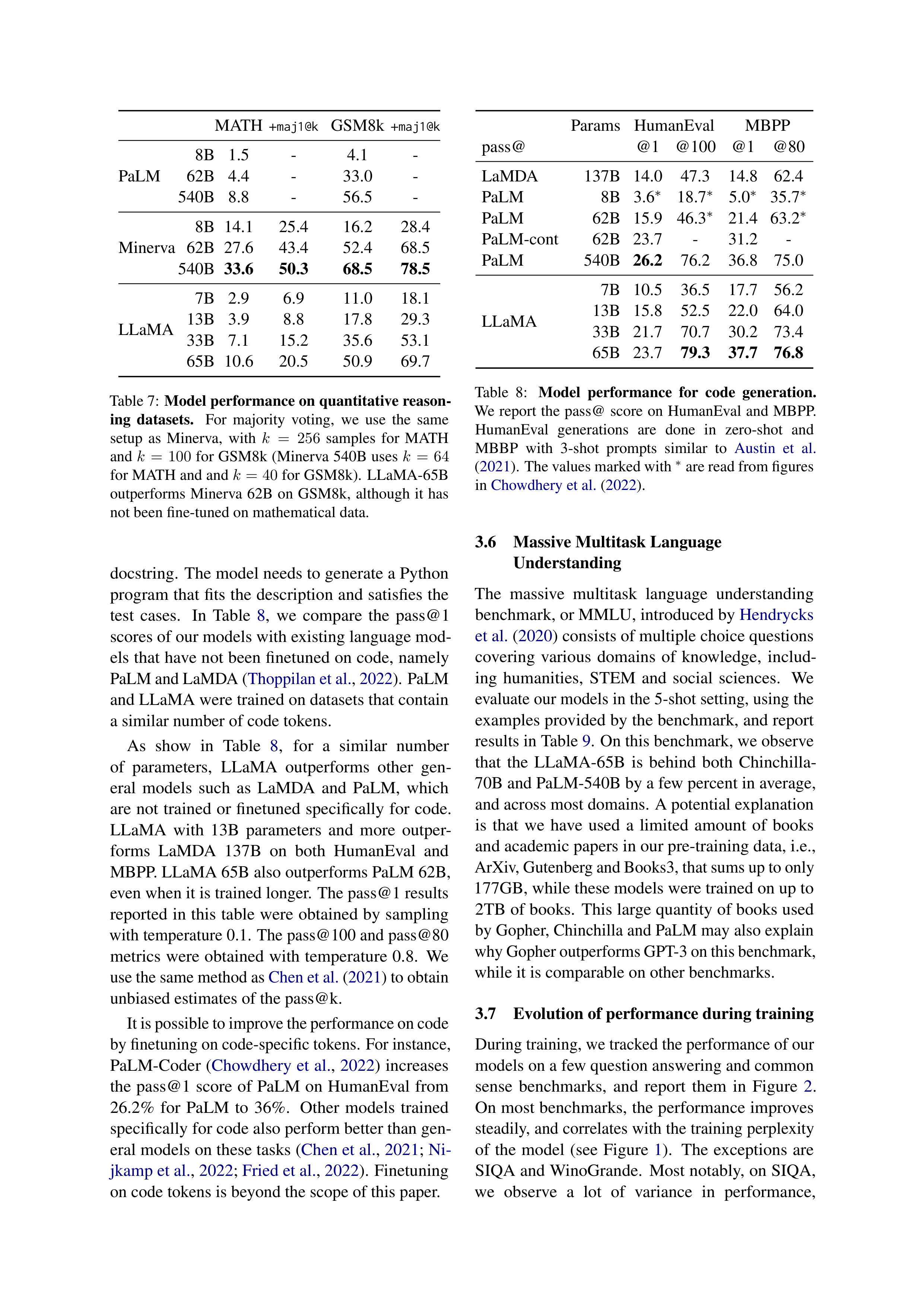
In
Table
7
,
we
compare
with
PaLM
and
Min-
erva (
Lewkowycz et al.
,
2022
).
Minerva is a series
of
PaLM
models
finetuned
on
38.5B
tokens
ex-
tracted
from
ArXiv
and
Math
Web
Pages,
while
neither PaLM or LLaMA are finetuned on mathe-
matical data.
The numbers for PaLM and Minerva
are taken from
Lewkowycz et al.
(
2022
), and we
compare
with
and
without
maj1@k
.
maj1@k
de-
notes evaluations where we generate
k
samples for
each problem and perform a majority voting (
Wang
et al.
,
2022
).
On GSM8k, we observe that LLaMA-
65B outperforms Minerva-62B, although it has not
been fine-tuned on mathematical data.
3.5
Code generation
We
evaluate
the
ability
of
our
models
to
write
code from a natural language description on two
benchmarks:
HumanEval (
Chen et al.
,
2021
) and
MBPP
(
Austin
et
al.
,
2021
).
For
both
tasks,
the
model receives a description of the program in a
few
sentences,
as
well
as
a
few
input-output
ex-
amples.
In HumanEval, it also receives a function
signature, and the prompt is formatted as natural
code
with
the
textual
description
and
tests
in
a
MATH
+
maj1@k
GSM8k
+
maj1@k
PaLM
8B
1.5
-
4.1
-
62B
4.4
-
33.0
-
540B
8.8
-
56.5
-
Minerva
8B
14.1
25.4
16.2
28.4
62B
27.6
43.4
52.4
68.5
540B
33.6
50.3
68.5
78.5
LLaMA
7B
2.9
6.9
11.0
18.1
13B
3.9
8.8
17.8
29.3
33B
7.1
15.2
35.6
53.1
65B
10.6
20.5
50.9
69.7
Table 7:
Model performance on quantitative reason-
ing
datasets.
For
majority
voting,
we
use
the
same
setup
as
Minerva,
with
k
=
256
samples
for
MATH
and
k
=
100
for GSM8k (Minerva 540B uses
k
=
64
for MATH and and
k
= 40
for GSM8k).
LLaMA-65B
outperforms
Minerva
62B
on
GSM8k,
although
it
has
not been fine-tuned on mathematical data.
docstring.
The model needs to generate a Python
program that fits the description and satisfies the
test
cases.
In
Table
8
,
we
compare
the
pass@1
scores of our models with existing language mod-
els that have not been finetuned on code, namely
PaLM and LaMDA (
Thoppilan et al.
,
2022
).
PaLM
and LLaMA were trained on datasets that contain
a similar number of code tokens.
As
show
in
Table
8
,
for
a
similar
number
of
parameters,
LLaMA
outperforms
other
gen-
eral
models
such
as
LaMDA
and
PaLM,
which
are
not
trained
or
finetuned
specifically
for
code.
LLaMA
with
13B
parameters
and
more
outper-
forms
LaMDA
137B
on
both
HumanEval
and
MBPP. LLaMA 65B also outperforms PaLM 62B,
even when it is trained longer.
The pass@1 results
reported in this table were obtained by sampling
with temperature 0.1.
The pass@100 and pass@80
metrics were obtained with temperature 0.8.
We
use the same method as
Chen et al.
(
2021
) to obtain
unbiased estimates of the pass@k.
It is possible to improve the performance on code
by finetuning on code-specific tokens.
For instance,
PaLM-Coder (
Chowdhery et al.
,
2022
) increases
the
pass@1
score
of
PaLM
on
HumanEval
from
26.2%
for
PaLM
to
36%.
Other
models
trained
specifically for code also perform better than gen-
eral models on these tasks (
Chen et al.
,
2021
;
Ni-
jkamp et al.
,
2022
;
Fried et al.
,
2022
).
Finetuning
on code tokens is beyond the scope of this paper.
Params
HumanEval
MBPP
pass@
@1
@100
@1
@80
LaMDA
137B
14.0
47.3
14.8
62.4
PaLM
8B
3.6
∗
18.7
∗
5.0
∗
35.7
∗
PaLM
62B
15.9
46.3
∗
21.4
63.2
∗
PaLM-cont
62B
23.7
-
31.2
-
PaLM
540B
26.2
76.2
36.8
75.0
LLaMA
7B
10.5
36.5
17.7
56.2
13B
15.8
52.5
22.0
64.0
33B
21.7
70.7
30.2
73.4
65B
23.7
79.3
37.7
76.8
Table
8:
Model
performance
for
code
generation.
We
report
the
pass@
score
on
HumanEval
and
MBPP.
HumanEval
generations
are
done
in
zero-shot
and
MBBP
with
3-shot
prompts
similar
to
Austin
et
al.
(
2021
).
The values marked with
∗
are read from figures
in
Chowdhery et al.
(
2022
).
3.6
Massive Multitask Language
Understanding
The
massive
multitask
language
understanding
benchmark, or MMLU, introduced by
Hendrycks
et al.
(
2020
) consists of multiple choice questions
covering
various
domains
of
knowledge,
includ-
ing
humanities,
STEM
and
social
sciences.
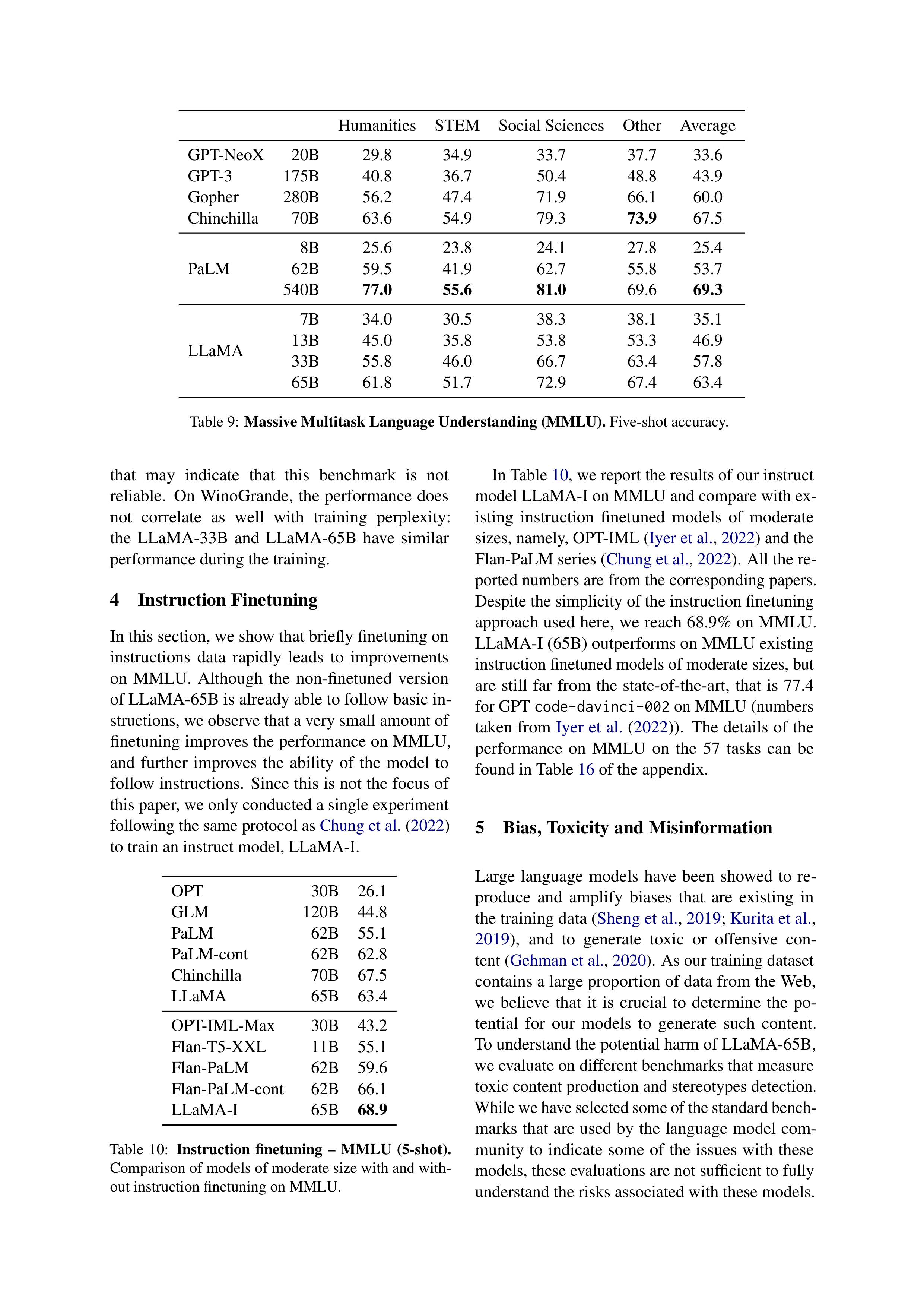
We
evaluate our models in the 5-shot setting, using the
examples provided by the benchmark, and report
results in Table
9
.
On this benchmark, we observe
that
the
LLaMA-65B
is
behind
both
Chinchilla-
70B and PaLM-540B by a few percent in average,
and across most domains.
A potential explanation
is
that
we
have
used
a
limited
amount
of
books
and academic papers in our pre-training data, i.e.,
ArXiv, Gutenberg and Books3, that sums up to only
177GB, while these models were trained on up to
2TB of books.
This large quantity of books used
by Gopher, Chinchilla and PaLM may also explain
why Gopher outperforms GPT-3 on this benchmark,
while it is comparable on other benchmarks.
3.7
Evolution of performance during training
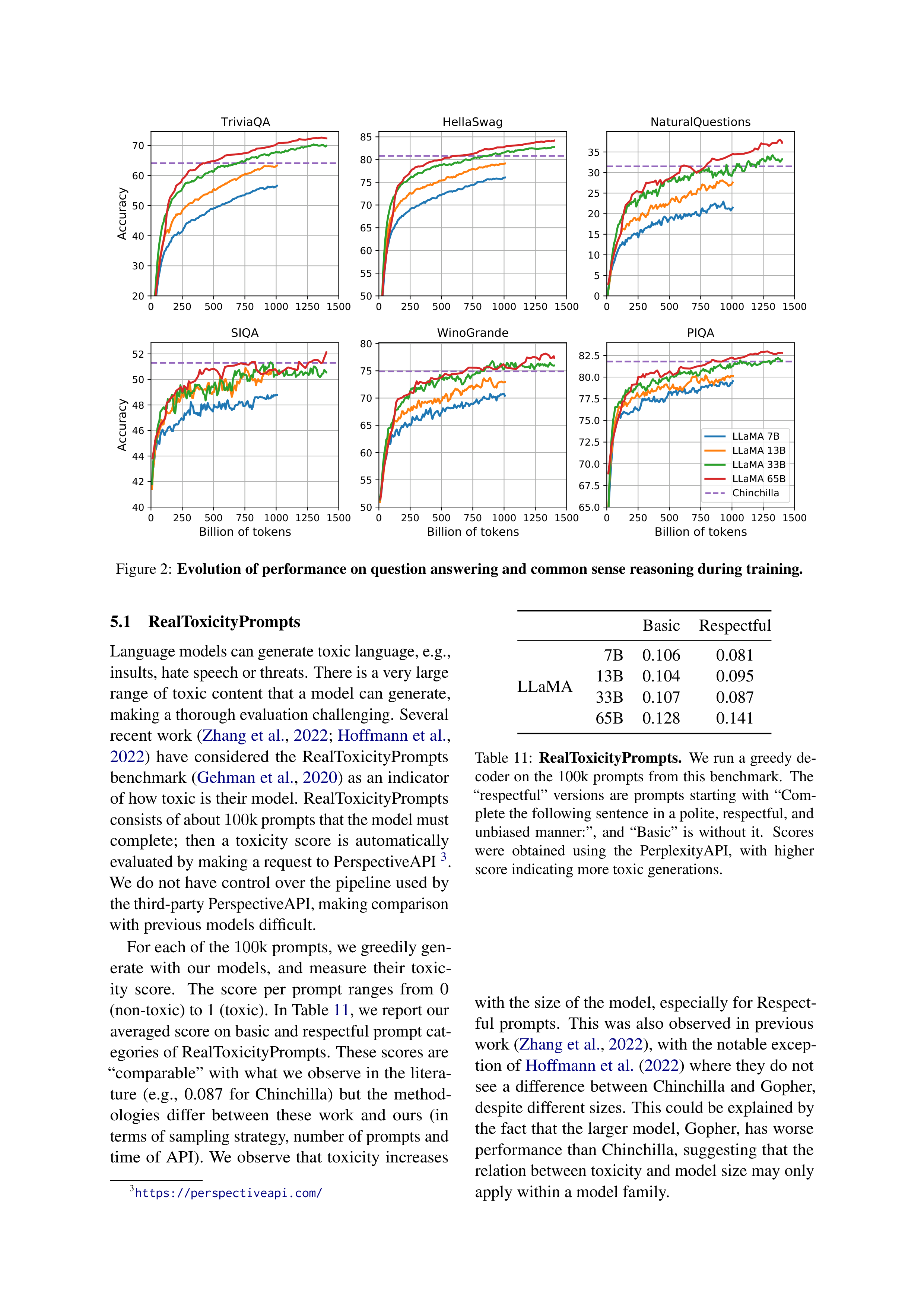
During training, we tracked the performance of our
models on a few question answering and common
sense
benchmarks,
and
report
them
in
Figure
2
.
On most benchmarks, the performance improves
steadily, and correlates with the training perplexity
of
the
model
(see
Figure
1
).
The
exceptions
are
SIQA and WinoGrande.
Most notably, on SIQA,
we
observe
a
lot
of
variance
in
performance,
Humanities
STEM
Social Sciences
Other
Average
GPT-NeoX
20B
29.8
34.9
33.7
37.7
33.6
GPT-3
175B
40.8
36.7
50.4
48.8
43.9
Gopher
280B
56.2
47.4
71.9
66.1
60.0
Chinchilla
70B
63.6
54.9
79.3
73.9
67.5
PaLM
8B
25.6
23.8
24.1
27.8
25.4
62B
59.5
41.9
62.7
55.8
53.7
540B
77.0
55.6
81.0
69.6
69.3
LLaMA
7B
34.0
30.5
38.3
38.1
35.1
13B
45.0
35.8
53.8
53.3
46.9
33B
55.8
46.0
66.7
63.4
57.8
65B
61.8
51.7
72.9
67.4
63.4
Table 9:
Massive Multitask Language Understanding (MMLU).
Five-shot accuracy.
that
may
indicate
that
this
benchmark
is
not
reliable.
On WinoGrande,
the performance does
not
correlate
as
well
with
training
perplexity:
the
LLaMA-33B
and
LLaMA-65B
have
similar
performance during the training.
4
Instruction Finetuning
In this section, we show that briefly finetuning on
instructions
data
rapidly
leads
to
improvements
on
MMLU.
Although
the
non-finetuned
version
of LLaMA-65B is already able to follow basic in-
structions, we observe that a very small amount of
finetuning improves the performance on MMLU,
and
further
improves
the
ability
of
the
model
to
follow instructions.
Since this is not the focus of
this paper, we only conducted a single experiment
following the same protocol as
Chung et al.
(
2022
)
to train an instruct model, LLaMA-I.
OPT
30B
26.1
GLM
120B
44.8
PaLM
62B
55.1
PaLM-cont
62B
62.8
Chinchilla
70B
67.5
LLaMA
65B
63.4
OPT-IML-Max
30B
43.2
Flan-T5-XXL
11B
55.1
Flan-PaLM
62B
59.6
Flan-PaLM-cont
62B
66.1
LLaMA-I
65B
68.9
Table
10:
Instruction
finetuning
–
MMLU
(5-shot).
Comparison of models of moderate size with and with-
out instruction finetuning on MMLU.
In Table
10
, we report the results of our instruct
model LLaMA-I on MMLU and compare with ex-
isting
instruction
finetuned
models
of
moderate
sizes, namely, OPT-IML (
Iyer et al.
,
2022
) and the
Flan-PaLM series (
Chung et al.
,
2022
).
All the re-
ported numbers are from the corresponding papers.
Despite the simplicity of the instruction finetuning
approach used here,
we reach 68.9% on MMLU.
LLaMA-I (65B) outperforms on MMLU existing
instruction finetuned models of moderate sizes, but
are
still
far
from
the
state-of-the-art,
that
is
77.4
for GPT
code-davinci-002
on MMLU (numbers
taken from
Iyer et al.
(
2022
)).
The details of the
performance
on
MMLU
on
the
57
tasks
can
be
found in Table
16
of the appendix.
5
Bias, Toxicity and Misinformation
Large
language
models
have
been
showed
to
re-
produce
and
amplify
biases
that
are
existing
in
the training data (
Sheng et al.
,
2019
;
Kurita et al.
,
2019
),
and
to
generate
toxic
or
offensive
con-
tent (
Gehman et al.
,
2020
).
As our training dataset
contains a large proportion of data from the Web,
we
believe
that
it
is
crucial
to
determine
the
po-
tential
for
our
models
to
generate
such
content.
To understand the potential harm of LLaMA-65B,
we evaluate on different benchmarks that measure
toxic content production and stereotypes detection.
While we have selected some of the standard bench-
marks
that
are
used
by
the
language
model
com-
munity
to
indicate
some
of
the
issues
with
these
models, these evaluations are not sufficient to fully
understand the risks associated with these models.
0
250
500
750
1000
1250
1500
20
30
40
50
60
70
Accuracy
TriviaQA
0
250
500
750
1000
1250
1500
50
55
60
65
70
75
80
85
HellaSwag
0
250
500
750
1000
1250
1500
0
5
10
15
20
25
30
35
NaturalQuestions
0
250
500
750
1000
1250
1500
Billion of tokens
40
42
44
46
48
50
52
Accuracy
SIQA
0
250
500
750
1000
1250
1500
Billion of tokens
50
55
60
65
70
75
80
WinoGrande
0
250
500
750
1000
1250
1500
Billion of tokens
65.0
67.5
70.0
72.5
75.0
77.5
80.0
82.5
PIQA
LLaMA 7B
LLaMA 13B
LLaMA 33B
LLaMA 65B
Chinchilla
Figure 2:
Evolution of performance on question answering and common sense reasoning during training.
5.1
RealToxicityPrompts
Language models can generate toxic language, e.g.,
insults, hate speech or threats.
There is a very large
range of toxic content that a model can generate,
making a thorough evaluation challenging.
Several
recent work (
Zhang et al.
,
2022
;
Hoffmann et al.
,
2022
)
have
considered
the
RealToxicityPrompts
benchmark (
Gehman et al.
,
2020
) as an indicator
of how toxic is their model.
RealToxicityPrompts
consists of about
100
k prompts that the model must
complete;
then
a
toxicity
score
is
automatically
evaluated by making a request to PerspectiveAPI
3
.
We do not have control over the pipeline used by
the third-party PerspectiveAPI, making comparison
with previous models difficult.
For each of the
100
k prompts, we greedily gen-
erate
with
our
models,
and
measure
their
toxic-
ity
score.
The
score
per
prompt
ranges
from
0
(non-toxic) to 1 (toxic).
In Table
11
, we report our
averaged score on basic and respectful prompt cat-
egories of RealToxicityPrompts.
These scores are
“comparable” with what we observe in the litera-
ture
(e.g.,
0.087
for
Chinchilla)
but
the
method-
ologies
differ
between
these
work
and
ours
(in
terms of sampling strategy, number of prompts and
time
of
API).
We
observe
that
toxicity
increases
3
https://perspectiveapi.com/
Basic
Respectful
LLaMA
7B
0.106
0.081
13B
0.104
0.095
33B
0.107
0.087
65B
0.128
0.141
Table 11:
RealToxicityPrompts.
We run a greedy de-
coder on the 100k prompts from this benchmark.
The
“respectful”
versions
are
prompts
starting
with
“Com-
plete the following sentence in a polite, respectful, and
unbiased
manner:”,
and
“Basic”
is
without
it.
Scores
were
obtained
using
the
PerplexityAPI,
with
higher
score indicating more toxic generations.
with the size of the model, especially for Respect-
ful
prompts.
This
was
also
observed
in
previous
work (
Zhang et al.
,
2022
), with the notable excep-
tion of
Hoffmann et al.
(
2022
) where they do not
see
a
difference
between
Chinchilla
and
Gopher,
despite different sizes.
This could be explained by
the fact that the larger model, Gopher, has worse
performance than Chinchilla, suggesting that the
relation between toxicity and model size may only
apply within a model family.
LLaMA
GPT3
OPT
Gender
70.6
62.6
65.7
Religion
79.0
73.3
68.6
Race/Color
57.0
64.7
68.6
Sexual orientation
81.0
76.2
78.6
Age
70.1
64.4
67.8
Nationality
64.2
61.6
62.9
Disability
66.7
76.7
76.7
Physical appearance
77.8
74.6
76.2
Socioeconomic status
71.5
73.8
76.2
Average
66.6
67.2
69.5
Table
12:
CrowS-Pairs.
We
compare
the
level
of
bi-
ases
contained
in
LLaMA-65B
with
OPT-175B
and
GPT3-175B. Higher score indicates higher bias.
5.2
CrowS-Pairs
We evaluate the biases in our model on the CrowS-
Pairs (
Nangia et al.
,
2020
).
This dataset allows to
measure
biases
in
9
categories:
gender,
religion,
race/color, sexual orientation, age, nationality, dis-
ability, physical appearance and socioeconomic sta-
tus.
Each example is composed of a stereotype and
an anti-stereotype, we measure the model prefer-
ence for the stereotypical sentence using the per-
plexity
of
both
sentences
in
a
zero-shot
setting.
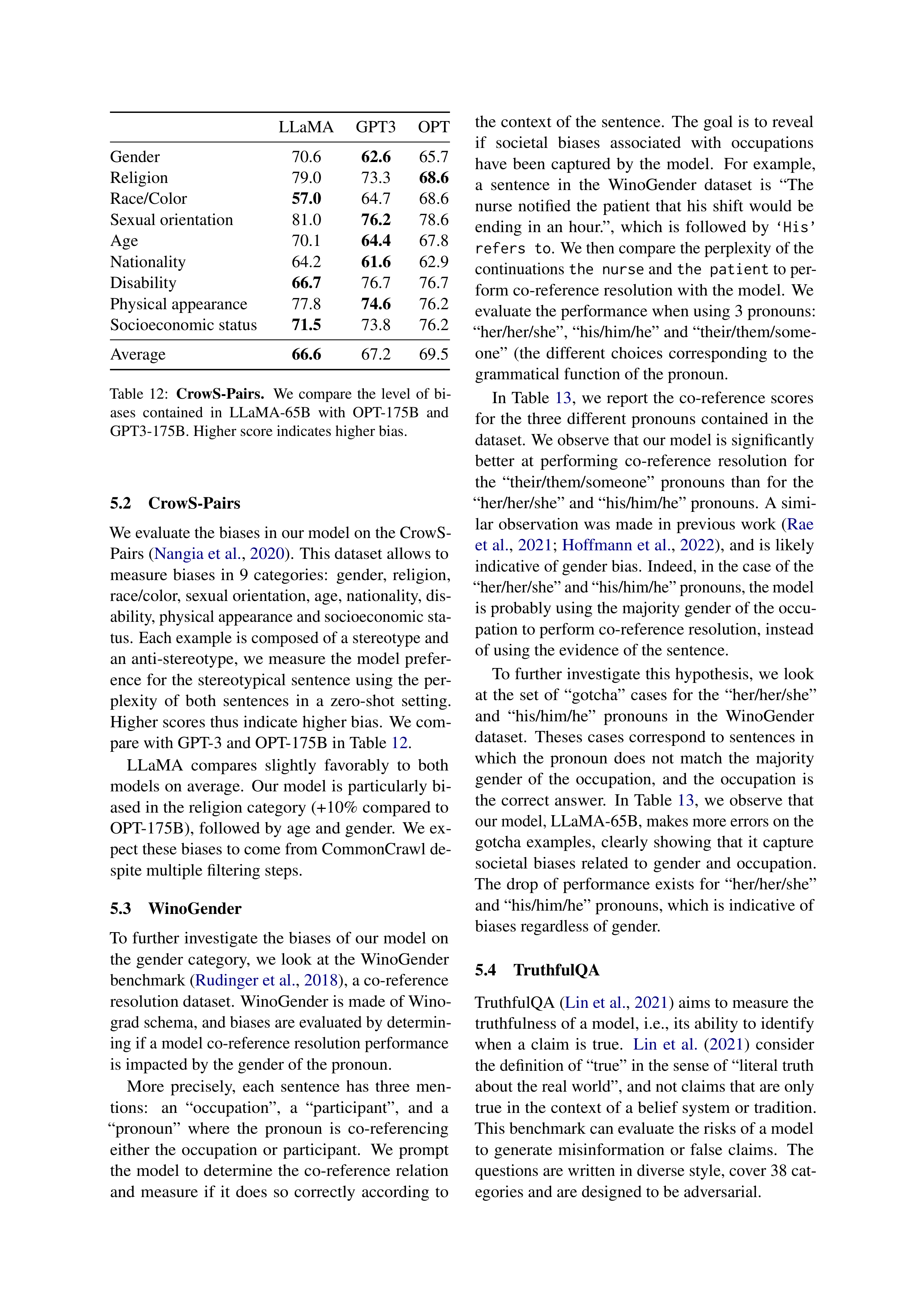
Higher scores thus indicate higher bias.
We com-
pare with GPT-3 and OPT-175B in Table
12
.
LLaMA
compares
slightly
favorably
to
both
models on average.
Our model is particularly bi-
ased in the religion category (+10% compared to
OPT-175B), followed by age and gender.
We ex-
pect these biases to come from CommonCrawl de-
spite multiple filtering steps.
5.3
WinoGender
To further investigate the biases of our model on
the gender category,
we look at the WinoGender
benchmark (
Rudinger et al.
,
2018
), a co-reference
resolution dataset.
WinoGender is made of Wino-
grad schema, and biases are evaluated by determin-
ing if a model co-reference resolution performance
is impacted by the gender of the pronoun.
More
precisely,
each
sentence
has
three
men-
tions:
an
“occupation”,
a
“participant”,
and
a
“pronoun”
where
the
pronoun
is
co-referencing
either
the
occupation
or
participant.
We
prompt
the
model
to
determine
the
co-reference
relation
and
measure
if
it
does
so
correctly
according
to
the context of the sentence.
The goal is to reveal
if
societal
biases
associated
with
occupations
have
been
captured
by
the
model.
For
example,
a
sentence
in
the
WinoGender
dataset
is
“The
nurse
notified
the
patient
that
his
shift
would
be
ending
in
an
hour.”,
which
is
followed
by
‘His’
refers
to
.
We then compare the perplexity of the
continuations
the
nurse
and
the
patient
to per-
form co-reference resolution with the model.
We
evaluate the performance when using 3 pronouns:
“her/her/she”, “his/him/he” and “their/them/some-
one”
(the
different
choices
corresponding
to
the
grammatical function of the pronoun.
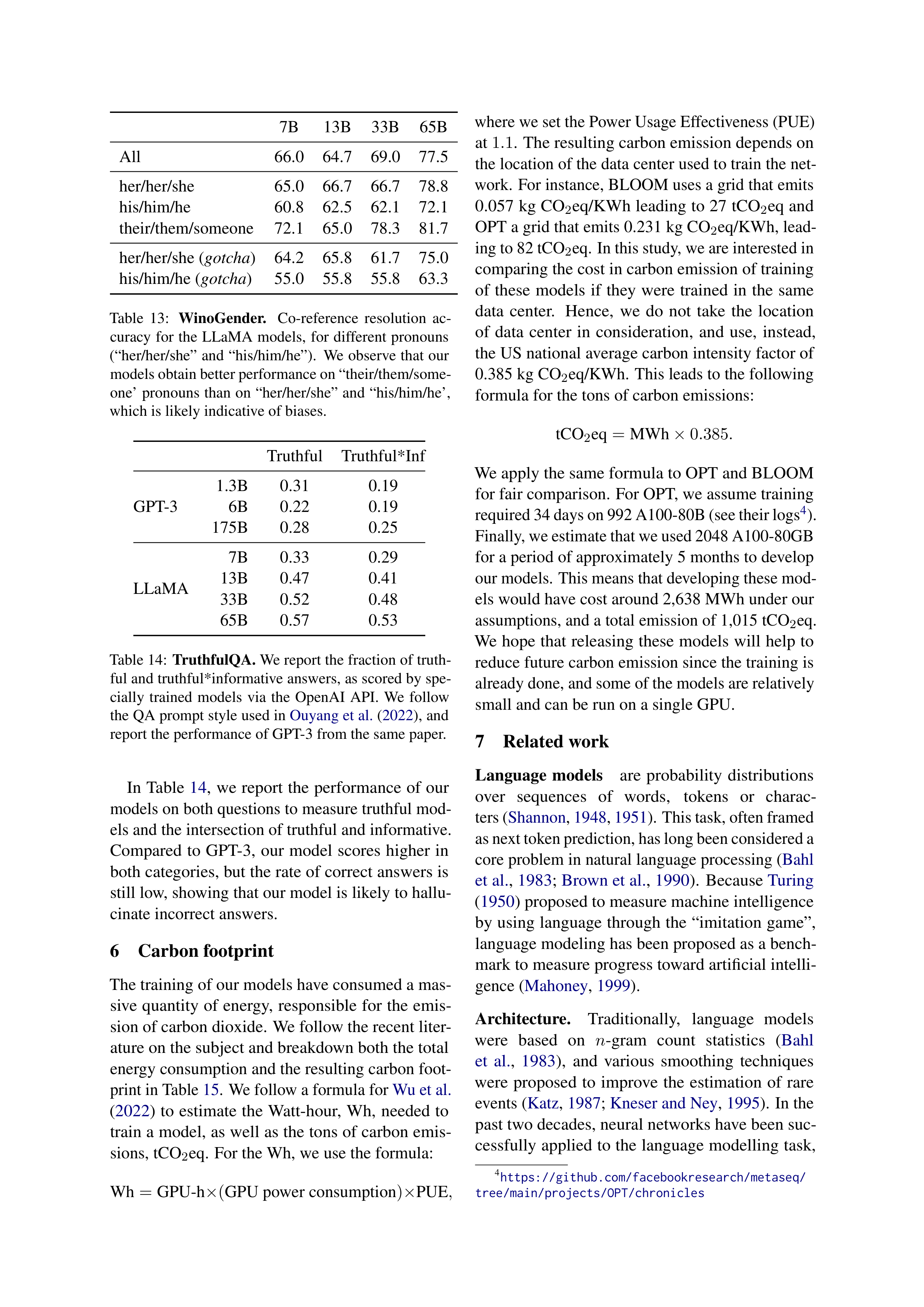
In Table
13
,
we report the co-reference scores
for
the
three
different
pronouns
contained
in
the
dataset.
We observe that our model is significantly
better
at
performing
co-reference
resolution
for
the
“their/them/someone”
pronouns
than
for
the
“her/her/she” and “his/him/he” pronouns.
A simi-
lar observation was made in previous work (
Rae
et al.
,
2021
;
Hoffmann et al.
,
2022
), and is likely
indicative of gender bias.
Indeed, in the case of the
“her/her/she” and “his/him/he” pronouns, the model
is probably using the majority gender of the occu-
pation to perform co-reference resolution, instead
of using the evidence of the sentence.
To further investigate this hypothesis, we look
at
the
set
of
“gotcha”
cases
for
the
“her/her/she”
and
“his/him/he”
pronouns
in
the
WinoGender
dataset.
Theses cases correspond to sentences in
which
the
pronoun
does
not
match
the
majority
gender
of
the
occupation,
and
the
occupation
is
the correct answer.
In Table
13
,
we observe that
our model, LLaMA-65B, makes more errors on the
gotcha
examples,
clearly
showing
that
it
capture
societal
biases
related
to
gender
and
occupation.
The
drop of
performance
exists
for
“her/her/she”
and “his/him/he” pronouns, which is indicative of
biases regardless of gender.
5.4
TruthfulQA
TruthfulQA (
Lin et al.
,
2021
) aims to measure the
truthfulness of a model, i.e., its ability to identify
when
a
claim
is
true.
Lin
et
al.
(
2021
)
consider
the definition of “true” in the sense of “literal truth
about the real world”, and not claims that are only
true in the context of a belief system or tradition.
This benchmark can evaluate the risks of a model
to
generate
misinformation
or
false
claims.
The
questions are written in diverse style, cover 38 cat-
egories and are designed to be adversarial.
7B
13B
33B
65B
All
66.0
64.7
69.0
77.5
her/her/she
65.0
66.7
66.7
78.8
his/him/he
60.8
62.5
62.1
72.1
their/them/someone
72.1
65.0
78.3
81.7
her/her/she (
gotcha
)
64.2
65.8
61.7
75.0
his/him/he (
gotcha
)
55.0
55.8
55.8
63.3
Table
13:
WinoGender.
Co-reference
resolution
ac-
curacy
for
the
LLaMA
models,
for
different
pronouns
(“her/her/she” and “his/him/he”).
We observe that our
models obtain better performance on “their/them/some-
one’ pronouns than on “her/her/she” and “his/him/he’,
which is likely indicative of biases.
Truthful
Truthful*Inf
GPT-3
1.3B
0.31
0.19
6B
0.22
0.19
175B
0.28
0.25
LLaMA
7B
0.33
0.29
13B
0.47
0.41
33B
0.52
0.48
65B
0.57
0.53
Table 14:
TruthfulQA.
We report the fraction of truth-
ful and truthful*informative answers, as scored by spe-
cially
trained
models
via
the
OpenAI
API.
We
follow
the QA prompt style used in
Ouyang et al.
(
2022
), and
report the performance of GPT-3 from the same paper.
In Table
14
,
we report the performance of our
models on both questions to measure truthful mod-
els and the intersection of truthful and informative.
Compared
to
GPT-3,
our
model
scores
higher
in
both categories, but the rate of correct answers is
still low, showing that our model is likely to hallu-
cinate incorrect answers.
6
Carbon footprint
The training of our models have consumed a mas-
sive quantity of energy,
responsible for the emis-
sion of carbon dioxide.
We follow the recent liter-
ature on the subject and breakdown both the total
energy consumption and the resulting carbon foot-
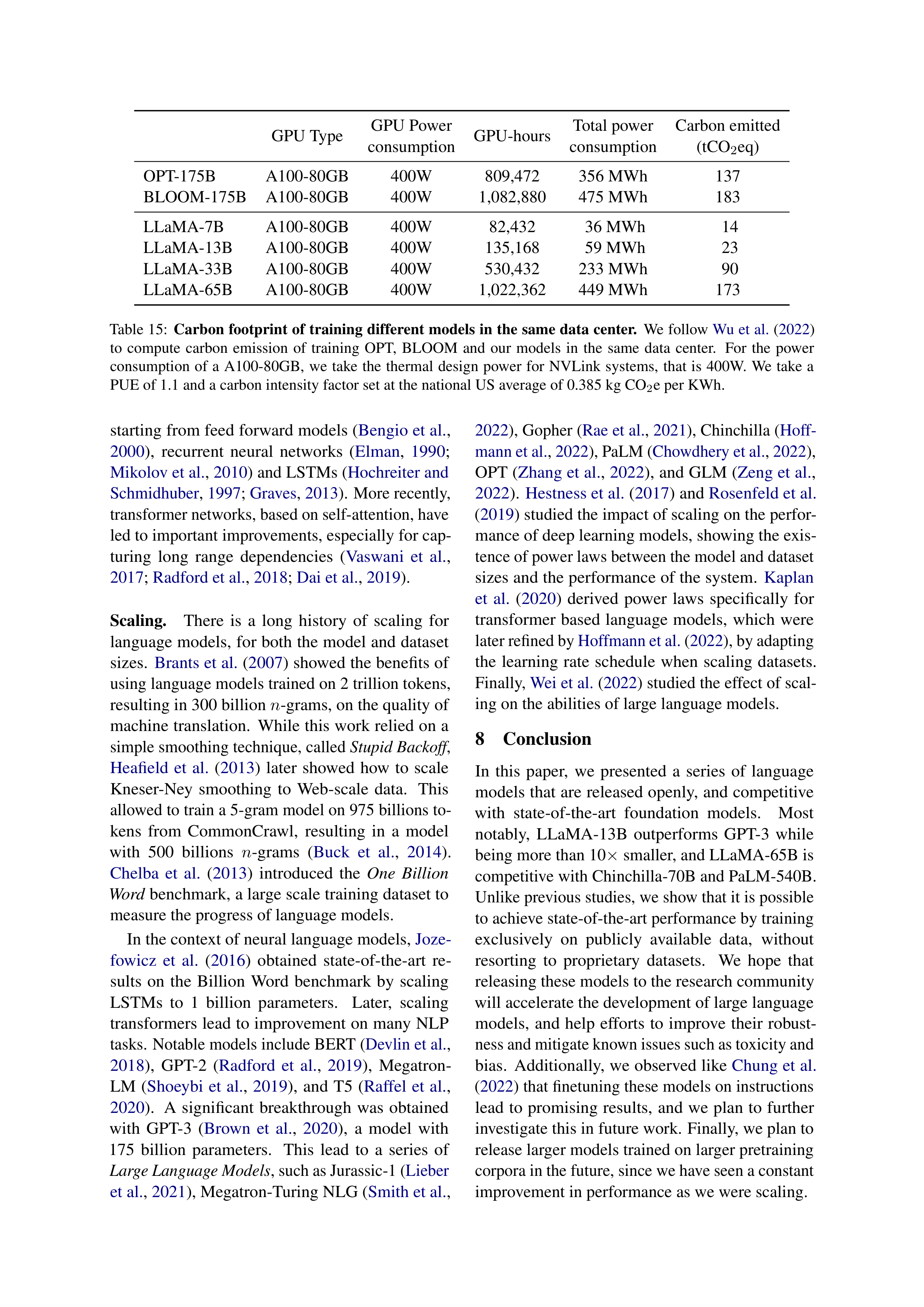
print in Table
15
.
We follow a formula for
Wu et al.
(
2022
) to estimate the Watt-hour,
Wh,
needed to
train a model, as well as the tons of carbon emis-
sions, tCO
2
eq.
For the Wh, we use the formula:
Wh
=
GPU-h
×
(
GPU power consumption
)
×
PUE
,
where we set the Power Usage Effectiveness (PUE)
at
1
.
1
.
The resulting carbon emission depends on
the location of the data center used to train the net-
work.
For instance, BLOOM uses a grid that emits
0.057 kg CO
2
eq/KWh leading to 27 tCO
2
eq and
OPT a grid that emits 0.231 kg CO
2
eq/KWh, lead-
ing to 82 tCO
2
eq.
In this study, we are interested in
comparing the cost in carbon emission of training
of
these
models
if
they
were
trained
in
the
same
data
center.
Hence,
we
do
not
take
the
location
of
data
center
in
consideration,
and
use,
instead,
the US national average carbon intensity factor of
0.385 kg CO
2
eq/KWh.
This leads to the following
formula for the tons of carbon emissions:
tCO
2
eq
=
MWh
×
0
.
385
.
We apply the same formula to OPT and BLOOM
for fair comparison.
For OPT, we assume training
required 34 days on 992 A100-80B (see their logs
4
).
Finally, we estimate that we used 2048 A100-80GB
for a period of approximately 5 months to develop
our models.
This means that developing these mod-
els would have cost around 2,638 MWh under our
assumptions, and a total emission of 1,015 tCO
2
eq.
We hope that releasing these models will help to
reduce future carbon emission since the training is
already done, and some of the models are relatively
small and can be run on a single GPU.
7
Related work
Language
models
are
probability
distributions
over
sequences
of
words,
tokens
or
charac-
ters (
Shannon
,
1948
,
1951
). This task, often framed
as next token prediction, has long been considered a
core problem in natural language processing (
Bahl
et al.
,
1983
;
Brown et al.
,
1990
).
Because
Turing
(
1950
) proposed to measure machine intelligence
by using language through the “imitation game”,
language modeling has been proposed as a bench-
mark to measure progress toward artificial intelli-
gence (
Mahoney
,
1999
).
Architecture.
Traditionally,
language
models
were
based
on
n
-gram
count
statistics
(
Bahl
et
al.
,
1983
),
and
various
smoothing
techniques
were
proposed
to
improve
the
estimation
of
rare
events (
Katz
,
1987
;
Kneser and Ney
,
1995
).
In the
past two decades, neural networks have been suc-
cessfully applied to the language modelling task,
4
https://github.com/facebookresearch/metaseq/
tree/main/projects/OPT/chronicles
GPU Type
GPU Power
GPU-hours
Total power
Carbon emitted
consumption
consumption
(tCO
2
eq)
OPT-175B
A100-80GB
400W
809,472
356 MWh
137
BLOOM-175B
A100-80GB
400W
1,082,880
475 MWh
183
LLaMA-7B
A100-80GB
400W
82,432
36 MWh
14
LLaMA-13B
A100-80GB
400W
135,168
59 MWh
23
LLaMA-33B
A100-80GB
400W
530,432
233 MWh
90
LLaMA-65B
A100-80GB
400W
1,022,362
449 MWh
173
Table 15:
Carbon footprint of training different models in the same data center.
We follow
Wu et al.
(
2022
)
to
compute
carbon
emission
of
training
OPT,
BLOOM
and
our
models
in
the
same
data
center.
For
the
power
consumption
of
a
A100-80GB,
we
take
the
thermal
design
power
for
NVLink
systems,
that
is
400W.
We
take
a
PUE of 1.1 and a carbon intensity factor set at the national US average of 0.385 kg CO
2
e per KWh.
starting from feed forward models (
Bengio et al.
,
2000
),
recurrent
neural
networks
(
Elman
,
1990
;
Mikolov et al.
,
2010
) and LSTMs (
Hochreiter and
Schmidhuber
,
1997
;
Graves
,
2013
).
More recently,
transformer networks, based on self-attention, have
led to important improvements, especially for cap-
turing
long
range
dependencies
(
Vaswani
et
al.
,
2017
;
Radford et al.
,
2018
;
Dai et al.
,
2019
).
Scaling.
There
is
a
long
history
of
scaling
for
language models, for both the model and dataset
sizes.
Brants et al.
(
2007
) showed the benefits of
using language models trained on 2 trillion tokens,
resulting in 300 billion
n
-grams, on the quality of
machine translation.
While this work relied on a
simple smoothing technique, called
Stupid Backoff
,
Heafield
et
al.
(
2013
)
later
showed
how
to
scale
Kneser-Ney
smoothing
to
Web-scale
data.
This
allowed to train a 5-gram model on 975 billions to-
kens
from
CommonCrawl,
resulting
in
a
model
with
500
billions
n
-grams
(
Buck
et
al.
,
2014
).
Chelba
et
al.
(
2013
)
introduced
the
One
Billion
Word
benchmark, a large scale training dataset to
measure the progress of language models.
In the context of neural language models,
Joze-
fowicz
et
al.
(
2016
)
obtained
state-of-the-art
re-
sults
on
the
Billion
Word
benchmark
by
scaling
LSTMs
to
1
billion
parameters.
Later,
scaling
transformers lead to improvement on many NLP
tasks.
Notable models include BERT (
Devlin et al.
,
2018
),
GPT-2
(
Radford
et
al.
,
2019
),
Megatron-
LM
(
Shoeybi
et
al.
,
2019
),
and
T5
(
Raffel
et
al.
,
2020
).
A
significant
breakthrough
was
obtained
with
GPT-3
(
Brown
et
al.
,
2020
),
a
model
with
175
billion
parameters.
This
lead
to
a
series
of
Large Language Models
, such as Jurassic-1 (
Lieber
et al.
,
2021
), Megatron-Turing NLG (
Smith et al.
,
2022
), Gopher (
Rae et al.
,
2021
), Chinchilla (
Hoff-
mann et al.
,
2022
), PaLM (
Chowdhery et al.
,
2022
),
OPT (
Zhang et al.
,
2022
), and GLM (
Zeng et al.
,
2022
).
Hestness et al.
(
2017
) and
Rosenfeld et al.
(
2019
) studied the impact of scaling on the perfor-
mance of deep learning models, showing the exis-
tence of power laws between the model and dataset
sizes and the performance of the system.
Kaplan
et
al.
(
2020
)
derived
power
laws
specifically
for
transformer
based
language
models,
which
were
later refined by
Hoffmann et al.
(
2022
), by adapting
the
learning
rate
schedule
when
scaling
datasets.
Finally,
Wei et al.
(
2022
) studied the effect of scal-
ing on the abilities of large language models.
8
Conclusion
In
this
paper,
we
presented
a
series
of
language
models that are released openly, and competitive
with
state-of-the-art
foundation
models.
Most
notably,
LLaMA-13B
outperforms
GPT-3
while
being more than 10
×
smaller, and LLaMA-65B is
competitive with Chinchilla-70B and PaLM-540B.
Unlike previous studies, we show that it is possible
to achieve state-of-the-art performance by training
exclusively
on
publicly
available
data,
without
resorting
to
proprietary
datasets.
We
hope
that
releasing these models to the research community
will accelerate the development of large language
models,
and
help
efforts
to
improve
their
robust-
ness and mitigate known issues such as toxicity and
bias.
Additionally, we observed like
Chung et al.
(
2022
) that finetuning these models on instructions
lead
to
promising
results,
and
we
plan
to
further
investigate this in future work.
Finally, we plan to
release larger models trained on larger pretraining
corpora in the future, since we have seen a constant
improvement in performance as we were scaling.
Acknowledgements
We thank Daniel Haziza, Francisco Massa, Jeremy
Reizenstein, Artem Korenev, and Patrick Labatut
from the xformers team.
We thank Susan Zhang
and
Stephen
Roller
for
their
support
on
data
deduplication.
We thank Luca Wehrstedt, Vegard
Mella,
and
Pierre-Emmanuel
Mazaré
for
their
support
on
training
stability.
We
thank
Shubho
Sengupta, Kalyan Saladi, and all the AI infra team
for their support.
We thank Jane Yu for her input
on
evaluation.
We
thank
Yongyi
Hu
for
his
help
on data collection.
References
Jacob Austin, Augustus Odena, Maxwell Nye, Maarten
Bosma,
Henryk
Michalewski,
David
Dohan,
Ellen
Jiang,
Carrie
Cai,
Michael
Terry,
Quoc
Le,
and
Charles Sutton. 2021.
Program synthesis with large
language models.
Lalit
R
Bahl,
Frederick
Jelinek,
and
Robert
L
Mercer.
1983.
A
maximum
likelihood
approach
to
continu-
ous
speech
recognition.
IEEE
transactions
on
pat-
tern
analysis
and
machine
intelligence
,
pages
179–
190.
Yoshua Bengio, Réjean Ducharme, and Pascal Vincent.
2000.
A
neural
probabilistic
language
model.
Ad-
vances in neural information processing systems
, 13.
Yonatan
Bisk,
Rowan
Zellers,
Jianfeng
Gao,
Yejin
Choi,
et
al.
2020.
Piqa:
Reasoning
about
physi-
cal
commonsense
in
natural
language.
In
Proceed-
ings of the AAAI conference on artificial intelligence
,
pages 7432–7439.
Sid Black, Stella Biderman, Eric Hallahan, Quentin An-
thony, Leo Gao, Laurence Golding, Horace He, Con-
nor Leahy, Kyle McDonell, Jason Phang, et al. 2022.
Gpt-neox-20b:
An
open-source
autoregressive
lan-
guage model.
arXiv preprint arXiv:2204.06745
.
Thorsten
Brants,
Ashok
C.
Popat,
Peng
Xu,
Franz
J.
Och, and Jeffrey Dean. 2007.
Large language mod-
els
in
machine
translation
.
In
Proceedings
of
the
2007 Joint Conference on Empirical Methods in Nat-
ural
Language
Processing
and
Computational
Nat-
ural
Language
Learning
(EMNLP-CoNLL)
,
pages
858–867,
Prague,
Czech
Republic.
Association
for
Computational Linguistics.
Peter
F
Brown,
John
Cocke,
Stephen
A
Della
Pietra,
Vincent
J
Della
Pietra,
Frederick
Jelinek,
John
Laf-
ferty, Robert L Mercer, and Paul S Roossin. 1990.
A
statistical approach to machine translation.
Compu-
tational linguistics
, 16(2):79–85.
Tom B. Brown, Benjamin Mann, Nick Ryder, Melanie
Subbiah,
Jared
Kaplan,
Prafulla
Dhariwal,
Arvind
Neelakantan, Pranav Shyam, Girish Sastry, Amanda
Askell,
Sandhini
Agarwal,
Ariel
Herbert-Voss,
Gretchen
Krueger,
Tom
Henighan,
Rewon
Child,
Aditya
Ramesh,
Daniel
M.
Ziegler,
Jeffrey
Wu,
Clemens
Winter,
Christopher
Hesse,
Mark
Chen,
Eric
Sigler,
Mateusz
Litwin,
Scott
Gray,
Benjamin
Chess,
Jack
Clark,
Christopher
Berner,
Sam
Mc-
Candlish,
Alec
Radford,
Ilya
Sutskever,
and
Dario
Amodei. 2020.
Language models are few-shot learn-
ers
.
Christian Buck, Kenneth Heafield, and Bas Van Ooyen.
2014.
N-gram counts and language models from the
common crawl.
In
LREC
, volume 2, page 4.
Ciprian Chelba, Tomas Mikolov, Mike Schuster, Qi Ge,
Thorsten
Brants,
Phillipp
Koehn,
and
Tony
Robin-
son. 2013.
One billion word benchmark for measur-
ing progress in statistical language modeling.
arXiv
preprint arXiv:1312.3005
.
Mark
Chen,
Jerry
Tworek,
Heewoo
Jun,
Qiming
Yuan,
Henrique
Ponde
de
Oliveira
Pinto,
Jared
Ka-
plan,
Harri
Edwards,
Yuri
Burda,
Nicholas
Joseph,
Greg
Brockman,
Alex
Ray,
Raul
Puri,
Gretchen
Krueger,
Michael Petrov,
Heidy Khlaaf,
Girish Sas-
try,
Pamela
Mishkin,
Brooke
Chan,
Scott
Gray,
Nick Ryder, Mikhail Pavlov, Alethea Power, Lukasz
Kaiser,
Mohammad
Bavarian,
Clemens
Winter,
Philippe
Tillet,
Felipe
Petroski
Such,
Dave
Cum-
mings,
Matthias
Plappert,
Fotios
Chantzis,
Eliza-
beth
Barnes,
Ariel
Herbert-Voss,
William
Hebgen
Guss,
Alex
Nichol,
Alex
Paino,
Nikolas
Tezak,
Jie
Tang, Igor Babuschkin, Suchir Balaji, Shantanu Jain,
William
Saunders,
Christopher
Hesse,
Andrew
N.
Carr,
Jan
Leike,
Josh
Achiam,
Vedant
Misra,
Evan
Morikawa,
Alec
Radford,
Matthew
Knight,
Miles
Brundage,
Mira
Murati,
Katie
Mayer,
Peter
Welin-
der, Bob McGrew, Dario Amodei, Sam McCandlish,
Ilya Sutskever, and Wojciech Zaremba. 2021.
Eval-
uating large language models trained on code.
Aakanksha
Chowdhery,
Sharan
Narang,
Jacob
Devlin,
Maarten
Bosma,
Gaurav
Mishra,
Adam
Roberts,
Paul
Barham,
Hyung
Won
Chung,
Charles
Sutton,
Sebastian
Gehrmann,
Parker
Schuh,
Kensen
Shi,
Sasha
Tsvyashchenko,
Joshua
Maynez,
Abhishek
Rao,
Parker
Barnes,
Yi
Tay,
Noam
Shazeer,
Vin-
odkumar
Prabhakaran,
Emily
Reif,
Nan
Du,
Ben
Hutchinson,
Reiner
Pope,
James
Bradbury,
Jacob
Austin,
Michael
Isard,
Guy
Gur-Ari,
Pengcheng
Yin,
Toju
Duke,
Anselm
Levskaya,
Sanjay
Ghe-
mawat,
Sunipa
Dev,
Henryk
Michalewski,
Xavier
Garcia,
Vedant
Misra,
Kevin
Robinson,
Liam
Fe-
dus,
Denny
Zhou,
Daphne
Ippolito,
David
Luan,
Hyeontaek Lim, Barret Zoph, Alexander Spiridonov,
Ryan Sepassi, David Dohan, Shivani Agrawal, Mark
Omernick, Andrew M. Dai, Thanumalayan Sankara-
narayana
Pillai,
Marie
Pellat,
Aitor
Lewkowycz,
Erica
Moreira,
Rewon
Child,
Oleksandr
Polozov,
Katherine Lee, Zongwei Zhou, Xuezhi Wang, Bren-
nan Saeta, Mark Diaz, Orhan Firat, Michele Catasta,
Jason
Wei,
Kathy
Meier-Hellstern,
Douglas
Eck,
Jeff
Dean,
Slav
Petrov,
and
Noah
Fiedel.
2022.
Palm:
Scaling language modeling with pathways
.
Hyung
Won
Chung,
Le
Hou,
S.
Longpre,
Barret
Zoph,
Yi
Tay,
William
Fedus,
Eric
Li,
Xuezhi
Wang,
Mostafa
Dehghani,
Siddhartha
Brahma,
Al-
bert
Webson,
Shixiang
Shane
Gu,
Zhuyun
Dai,
Mirac
Suzgun,
Xinyun
Chen,
Aakanksha
Chowdh-
ery,
Dasha
Valter,
Sharan
Narang,
Gaurav
Mishra,
Adams Wei Yu, Vincent Zhao, Yanping Huang, An-
drew
M.
Dai,
Hongkun
Yu,
Slav
Petrov,
Ed
Huai
hsin
Chi,
Jeff
Dean,
Jacob
Devlin,
Adam
Roberts,
Denny
Zhou,
Quoc
Le,
and
Jason
Wei.
2022.
Scal-
ing
instruction-finetuned
language
models.
arXiv
preprint arXiv:2210.11416
.
Christopher
Clark,
Kenton
Lee,
Ming-Wei
Chang,
Tom
Kwiatkowski,
Michael
Collins,
and
Kristina
Toutanova.
2019.
Boolq:
Exploring
the
surprising
difficulty of natural yes/no questions.
arXiv preprint
arXiv:1905.10044
.
Peter Clark, Isaac Cowhey, Oren Etzioni, Tushar Khot,
Ashish
Sabharwal,
Carissa
Schoenick,
and
Oyvind
Tafjord.
2018.
Think
you
have
solved
question
an-
swering?
try arc, the ai2 reasoning challenge.
arXiv
preprint arXiv:1803.05457
.
Karl
Cobbe,
Vineet
Kosaraju,
Mohammad
Bavarian,
Mark
Chen,
Heewoo
Jun,
Lukasz
Kaiser,
Matthias
Plappert,
Jerry
Tworek,
Jacob
Hilton,
Reiichiro
Nakano, et al. 2021.
Training verifiers to solve math
word problems.
arXiv preprint arXiv:2110.14168
.
Zihang
Dai,
Zhilin
Yang,
Yiming
Yang,
Jaime
Car-
bonell,
Quoc
V
Le,
and
Ruslan
Salakhutdinov.
2019.
Transformer-xl:
Attentive
language
mod-
els
beyond
a
fixed-length
context.
arXiv
preprint
arXiv:1901.02860
.
Tri
Dao,
Daniel
Y
Fu,
Stefano
Ermon,
Atri
Rudra,
and Christopher Ré. 2022.
Flashattention:
Fast and
memory-efficient
exact
attention
with
io-awareness.
arXiv preprint arXiv:2205.14135
.
Jacob
Devlin,
Ming-Wei
Chang,
Kenton
Lee,
and
Kristina Toutanova. 2018.
Bert: Pre-training of deep
bidirectional
transformers
for
language
understand-
ing.
arXiv preprint arXiv:1810.04805
.
Jeffrey L Elman. 1990.
Finding structure in time.
Cog-
nitive science
, 14(2):179–211.
Daniel
Fried,
Armen
Aghajanyan,
Jessy
Lin,
Sida
Wang,
Eric
Wallace,
Freda
Shi,
Ruiqi
Zhong,
Wen-
tau
Yih,
Luke
Zettlemoyer,
and
Mike
Lewis.
2022.
Incoder:
A
generative
model
for
code
infilling
and
synthesis.
arXiv preprint arXiv:2204.05999
.
Leo
Gao,
Stella
Biderman,
Sid
Black,
Laurence
Gold-
ing,
Travis
Hoppe,
Charles
Foster,
Jason
Phang,
Horace
He,
Anish
Thite,
Noa
Nabeshima,
Shawn
Presser,
and
Connor
Leahy.
2020.
The
Pile:
An
800gb dataset of diverse text for language modeling.
arXiv preprint arXiv:2101.00027
.
Leo
Gao,
Jonathan
Tow,
Stella
Biderman,
Sid
Black,
Anthony
DiPofi,
Charles
Foster,
Laurence
Golding,
Jeffrey
Hsu,
Kyle
McDonell,
Niklas
Muennighoff,
Jason
Phang,
Laria
Reynolds,
Eric
Tang,
Anish
Thite, Ben Wang, Kevin Wang, and Andy Zou. 2021.
A
framework
for
few-shot
language
model
evalua-
tion
.
Samuel
Gehman,
Suchin
Gururangan,
Maarten
Sap,
Yejin
Choi,
and
Noah
A
Smith.
2020.
Realtoxici-
typrompts:
Evaluating
neural
toxic
degeneration
in
language models.
arXiv preprint arXiv:2009.11462
.
Alex
Graves.
2013.
Generating
sequences
with
recurrent
neural
networks.
arXiv
preprint
arXiv:1308.0850
.
Kenneth Heafield, Ivan Pouzyrevsky, Jonathan H Clark,
and Philipp Koehn. 2013.
Scalable modified kneser-
ney
language
model
estimation.
In
Proceedings
of
the 51st Annual Meeting of the Association for Com-
putational
Linguistics
(Volume
2:
Short
Papers)
,
pages 690–696.
Dan
Hendrycks,
Collin
Burns,
Steven
Basart,
Andy
Zou, Mantas Mazeika, Dawn Song, and Jacob Stein-
hardt. 2020.
Measuring massive multitask language
understanding.
arXiv preprint arXiv:2009.03300
.
Dan Hendrycks, Collin Burns, Saurav Kadavath, Akul
Arora,
Steven
Basart,
Eric
Tang,
Dawn
Song,
and
Jacob
Steinhardt.
2021.
Measuring
mathematical
problem
solving
with
the
math
dataset.
arXiv
preprint arXiv:2103.03874
.
Joel
Hestness,
Sharan
Narang,
Newsha
Ardalani,
Gre-
gory
Diamos,
Heewoo
Jun,
Hassan
Kianinejad,
Md
Patwary,
Mostofa
Ali,
Yang
Yang,
and
Yanqi
Zhou.
2017.
Deep
learning
scaling
is
predictable,
empirically.
arXiv preprint arXiv:1712.00409
.
Sepp
Hochreiter
and
Jürgen
Schmidhuber.
1997.
Long
short-term
memory.
Neural
computation
,
9(8):1735–1780.
Jordan Hoffmann, Sebastian Borgeaud, Arthur Mensch,
Elena
Buchatskaya,
Trevor
Cai,
Eliza
Rutherford,
Diego de Las Casas, Lisa Anne Hendricks, Johannes
Welbl,
Aidan
Clark,
Tom
Hennigan,
Eric
Noland,
Katie
Millican,
George
van
den
Driessche,
Bogdan
Damoc,
Aurelia
Guy,
Simon
Osindero,
Karen
Si-
monyan,
Erich
Elsen,
Jack
W.
Rae,
Oriol
Vinyals,
and Laurent Sifre. 2022.
Training compute-optimal
large language models
.
Srinivasan Iyer, Xi Victoria Lin, Ramakanth Pasunuru,
Todor Mihaylov, Dániel Simig, Ping Yu, Kurt Shus-
ter, Tianlu Wang, Qing Liu, Punit Singh Koura, et al.
2022.
Opt-iml:
Scaling
language
model
instruc-
tion meta learning through the lens of generalization.
arXiv preprint arXiv:2212.12017
.
Mandar
Joshi,
Eunsol
Choi,
Daniel
S
Weld,
and
Luke
Zettlemoyer. 2017.
Triviaqa:
A large scale distantly
supervised challenge dataset for reading comprehen-
sion.
arXiv preprint arXiv:1705.03551
.
Rafal Jozefowicz, Oriol Vinyals, Mike Schuster, Noam
Shazeer,
and
Yonghui
Wu.
2016.
Exploring
the
limits
of
language
modeling.
arXiv
preprint
arXiv:1602.02410
.
Jared
Kaplan,
Sam
McCandlish,
Tom
Henighan,
Tom B Brown, Benjamin Chess, Rewon Child, Scott
Gray, Alec Radford, Jeffrey Wu, and Dario Amodei.
2020.
Scaling
laws
for
neural
language
models.
arXiv preprint arXiv:2001.08361
.
Slava
Katz.
1987.
Estimation
of
probabilities
from
sparse
data
for
the
language
model
component
of
a
speech
recognizer.
IEEE
transactions
on
acoustics,
speech, and signal processing
, 35(3):400–401.
Reinhard
Kneser
and
Hermann
Ney.
1995.
Improved
backing-off for m-gram language modeling.
In
1995
international
conference
on
acoustics,
speech,
and
signal processing
, volume 1, pages 181–184. IEEE.
Vijay
Korthikanti,
Jared
Casper,
Sangkug
Lym,
Lawrence McAfee, Michael Andersch, Mohammad
Shoeybi,
and Bryan Catanzaro. 2022.
Reducing ac-
tivation
recomputation
in
large
transformer
models.
arXiv preprint arXiv:2205.05198
.
Taku Kudo and John Richardson. 2018.
Sentencepiece:
A
simple
and
language
independent
subword
tok-
enizer
and
detokenizer
for
neural
text
processing.
arXiv preprint arXiv:1808.06226
.
Keita Kurita, Nidhi Vyas, Ayush Pareek, Alan W Black,
and
Yulia
Tsvetkov.
2019.
Quantifying
social
bi-
ases in contextual word representations.
In
1st ACL
Workshop
on
Gender
Bias
for
Natural
Language
Processing
.
Tom
Kwiatkowski,
Jennimaria
Palomaki,
Olivia
Red-
field,
Michael
Collins,
Ankur
Parikh,
Chris
Alberti,
Danielle
Epstein,
Illia
Polosukhin,
Jacob
Devlin,
Kenton Lee, et al. 2019.
Natural questions:
a bench-
mark for question answering research.
Transactions
of
the
Association
for
Computational
Linguistics
,
7:453–466.
Guokun
Lai,
Qizhe
Xie,
Hanxiao
Liu,
Yiming
Yang,
and Eduard Hovy. 2017.
Race:
Large-scale reading
comprehension
dataset
from
examinations.
arXiv
preprint arXiv:1704.04683
.
Aitor
Lewkowycz,
Anders
Johan
Andreassen,
David
Dohan,
Ethan
Dyer,
Henryk
Michalewski,
Vinay
Venkatesh
Ramasesh,
Ambrose
Slone,
Cem
Anil,
Imanol
Schlag,
Theo
Gutman-Solo,
Yuhuai
Wu,
Behnam
Neyshabur,
Guy
Gur-Ari,
and
Vedant
Misra.
2022.
Solving
quantitative
reasoning
prob-
lems with language models
.
In
Advances in Neural
Information Processing Systems
.
Opher
Lieber,
Or
Sharir,
Barak
Lenz,
and
Yoav
Shoham.
2021.
Jurassic-1:
Technical
details
and
evaluation.
White Paper. AI21 Labs
, 1.
Stephanie
Lin,
Jacob
Hilton,
and
Owain
Evans.
2021.
Truthfulqa:
Measuring
how
models
mimic
human
falsehoods.
arXiv preprint arXiv:2109.07958
.
Ilya
Loshchilov
and
Frank
Hutter.
2017.
Decou-
pled
weight
decay
regularization.
arXiv
preprint
arXiv:1711.05101
.
Matthew V Mahoney. 1999.
Text compression as a test
for artificial intelligence.
AAAI/IAAI
, 970.
Todor Mihaylov, Peter Clark, Tushar Khot, and Ashish
Sabharwal. 2018.
Can a suit of armor conduct elec-
tricity? a new dataset for open book question answer-
ing.
arXiv preprint arXiv:1809.02789
.
Tomas
Mikolov,
Martin
Karafiát,
Lukas
Burget,
Jan
Cernock`y,
and
Sanjeev
Khudanpur.
2010.
Recur-
rent
neural
network
based
language
model.
In
In-
terspeech
, pages 1045–1048. Makuhari.
Nikita
Nangia,
Clara
Vania,
Rasika
Bhalerao,
and
Samuel
R.
Bowman.
2020.
CrowS-pairs:
A
chal-
lenge dataset for measuring social biases in masked
language models
.
In
EMNLP 2020
.
Erik
Nijkamp,
Bo
Pang,
Hiroaki
Hayashi,
Lifu
Tu,
Huan
Wang,
Yingbo
Zhou,
Silvio
Savarese,
and
Caiming Xiong. 2022.
Codegen:
An open large lan-
guage model for code with multi-turn program syn-
thesis.
arXiv preprint arXiv:2203.13474
.
Long
Ouyang,
Jeffrey
Wu,
Xu
Jiang,
Diogo
Almeida,
Carroll Wainwright, Pamela Mishkin, Chong Zhang,
Sandhini Agarwal, Katarina Slama, Alex Gray, John
Schulman, Jacob Hilton, Fraser Kelton, Luke Miller,
Maddie
Simens,
Amanda
Askell,
Peter
Welinder,
Paul
Christiano,
Jan
Leike,
and
Ryan
Lowe.
2022.
Training
language
models
to
follow
instructions
with human feedback
.
In
Advances in Neural Infor-
mation Processing Systems
.
Markus
N
Rabe
and
Charles
Staats.
2021.
Self-
attention
does
not
need
o
(
n
2
)
memory.
arXiv
preprint arXiv:2112.05682
.
Alec Radford, Karthik Narasimhan, Tim Salimans, Ilya
Sutskever,
et
al.
2018.
Improving
language
under-
standing by generative pre-training.
Alec
Radford,
Jeffrey
Wu,
Rewon
Child,
David
Luan,
Dario
Amodei,
Ilya
Sutskever,
et
al.
2019.
Lan-
guage
models
are
unsupervised
multitask
learners.
OpenAI blog
, 1(8):9.
Jack
W.
Rae,
Sebastian
Borgeaud,
Trevor
Cai,
Katie
Millican,
Jordan
Hoffmann,
Francis
Song,
John
Aslanides,
Sarah
Henderson,
Roman
Ring,
Susan-
nah
Young,
Eliza
Rutherford,
Tom
Hennigan,
Ja-
cob Menick, Albin Cassirer, Richard Powell, George
van
den
Driessche,
Lisa
Anne
Hendricks,
Mari-
beth
Rauh,
Po-Sen
Huang,
Amelia
Glaese,
Jo-
hannes
Welbl,
Sumanth
Dathathri,
Saffron
Huang,
Jonathan
Uesato,
John
Mellor,
Irina
Higgins,
An-
tonia
Creswell,
Nat
McAleese,
Amy
Wu,
Erich
Elsen,
Siddhant
Jayakumar,
Elena
Buchatskaya,
David
Budden,
Esme
Sutherland,
Karen
Simonyan,
Michela
Paganini,
Laurent
Sifre,
Lena
Martens,
Xiang
Lorraine
Li,
Adhiguna
Kuncoro,
Aida
Ne-
matzadeh,
Elena
Gribovskaya,
Domenic
Donato,
Angeliki
Lazaridou,
Arthur
Mensch,
Jean-Baptiste
Lespiau,
Maria
Tsimpoukelli,
Nikolai
Grigorev,
Doug
Fritz,
Thibault
Sottiaux,
Mantas
Pajarskas,
Toby
Pohlen,
Zhitao
Gong,
Daniel
Toyama,
Cy-
prien
de
Masson
d’Autume,
Yujia
Li,
Tayfun
Terzi,
Vladimir
Mikulik,
Igor
Babuschkin,
Aidan
Clark,
Diego
de
Las
Casas,
Aurelia
Guy,
Chris
Jones,
James
Bradbury,
Matthew
Johnson,
Blake
Hecht-
man, Laura Weidinger, Iason Gabriel, William Isaac,
Ed
Lockhart,
Simon
Osindero,
Laura
Rimell,
Chris
Dyer,
Oriol
Vinyals,
Kareem
Ayoub,
Jeff
Stan-
way,
Lorrayne
Bennett,
Demis
Hassabis,
Koray
Kavukcuoglu,
and
Geoffrey
Irving.
2021.
Scal-
ing language models:
Methods,
analysis & insights
from training gopher
.
Colin Raffel, Noam Shazeer, Adam Roberts, Katherine
Lee,
Sharan
Narang,
Michael
Matena,
Yanqi
Zhou,
Wei Li,
and Peter J Liu. 2020.
Exploring the limits
of
transfer
learning
with
a
unified
text-to-text
trans-
former.
The Journal of Machine Learning Research
,
21(1):5485–5551.
Jonathan
S
Rosenfeld,
Amir
Rosenfeld,
Yonatan
Be-
linkov, and Nir Shavit. 2019.
A constructive predic-
tion of the generalization error across scales.
arXiv
preprint arXiv:1909.12673
.
Rachel
Rudinger,
Jason
Naradowsky,
Brian
Leonard,
and
Benjamin
Van
Durme.
2018.
Gender
bias
in
coreference resolution
.
In
NAACL-HLT 2018
.
Keisuke Sakaguchi, Ronan Le Bras, Chandra Bhagavat-
ula,
and
Yejin
Choi.
2021.
Winogrande:
An
adver-
sarial winograd schema challenge at scale.
Commu-
nications of the ACM
, 64(9):99–106.
Maarten
Sap,
Hannah
Rashkin,
Derek
Chen,
Ronan
LeBras,
and
Yejin
Choi.
2019.
Socialiqa:
Com-
monsense reasoning about social interactions.
arXiv
preprint arXiv:1904.09728
.
Teven
Le
Scao,
Angela
Fan,
Christopher
Akiki,
El-
lie
Pavlick,
Suzana
Ili´c,
Daniel
Hesslow,
Ro-
man Castagné, Alexandra Sasha Luccioni, François
Yvon,
Matthias Gallé,
et al. 2022.
Bloom:
A 176b-
parameter open-access multilingual language model.
arXiv preprint arXiv:2211.05100
.
Rico
Sennrich,
Barry
Haddow,
and
Alexandra
Birch.
2015.
Neural machine translation of rare words with
subword units.
arXiv preprint arXiv:1508.07909
.
Claude
E
Shannon.
1948.
A
mathematical
theory
of
communication.
The
Bell
system
technical
journal
,
27(3):379–423.
Claude
E
Shannon.
1951.
Prediction
and
entropy
of
printed
english.
Bell
system
technical
journal
,
30(1):50–64.
Noam
Shazeer.
2020.
Glu
variants
improve
trans-
former.
arXiv preprint arXiv:2002.05202
.
Emily
Sheng,
Kai-Wei
Chang,
Premkumar
Natarajan,
and
Nanyun
Peng.
2019.
The
woman
worked
as
a
babysitter:
On biases in language generation.
arXiv
preprint arXiv:1909.01326
.
Mohammad
Shoeybi,
Mostofa
Patwary,
Raul
Puri,
Patrick
LeGresley,
Jared
Casper,
and
Bryan
Catan-
zaro. 2019.
Megatron-lm:
Training multi-billion pa-
rameter
language
models
using
model
parallelism.
arXiv preprint arXiv:1909.08053
.
Shaden
Smith,
Mostofa
Patwary,
Brandon
Norick,
Patrick
LeGresley,
Samyam
Rajbhandari,
Jared
Casper,
Zhun
Liu,
Shrimai
Prabhumoye,
George
Zerveas,
Vijay
Korthikanti,
Elton
Zhang,
Rewon
Child, Reza Yazdani Aminabadi, Julie Bernauer, Xia
Song,
Mohammad
Shoeybi,
Yuxiong
He,
Michael
Houston,
Saurabh
Tiwary,
and
Bryan
Catanzaro.
2022.
Using
deepspeed
and
megatron
to
train
megatron-turing
nlg
530b,
a
large-scale
generative
language model
.
Jianlin
Su,
Yu
Lu,
Shengfeng
Pan,
Ahmed
Murtadha,
Bo
Wen,
and
Yunfeng
Liu.
2021.
Roformer:
En-
hanced transformer with rotary position embedding.
arXiv preprint arXiv:2104.09864
.
Romal
Thoppilan,
Daniel
De
Freitas,
Jamie
Hall,
Noam
Shazeer,
Apoorv
Kulshreshtha,
Heng-Tze
Cheng, Alicia Jin, Taylor Bos, Leslie Baker, Yu Du,
YaGuang
Li,
Hongrae
Lee,
Huaixiu
Steven
Zheng,
Amin Ghafouri, Marcelo Menegali, Yanping Huang,
Maxim
Krikun,
Dmitry
Lepikhin,
James
Qin,
De-
hao
Chen,
Yuanzhong
Xu,
Zhifeng
Chen,
Adam
Roberts,
Maarten
Bosma,
Vincent
Zhao,
Yanqi
Zhou,
Chung-Ching
Chang,
Igor
Krivokon,
Will
Rusch,
Marc
Pickett,
Pranesh
Srinivasan,
Laichee
Man,
Kathleen
Meier-Hellstern,
Meredith
Ringel
Morris,
Tulsee
Doshi,
Renelito
Delos
Santos,
Toju
Duke,
Johnny
Soraker,
Ben
Zevenbergen,
Vinod-
kumar
Prabhakaran,
Mark
Diaz,
Ben
Hutchinson,
Kristen
Olson,
Alejandra
Molina,
Erin
Hoffman-
John,
Josh
Lee,
Lora
Aroyo,
Ravi
Rajakumar,
Alena Butryna, Matthew Lamm, Viktoriya Kuzmina,
Joe
Fenton,
Aaron
Cohen,
Rachel
Bernstein,
Ray
Kurzweil, Blaise Aguera-Arcas, Claire Cui, Marian
Croak,
Ed
Chi,
and
Quoc
Le.
2022.
Lamda:
Lan-
guage models for dialog applications.
A.
M.
Turing.
1950.
Computing
Machinery
and
Intel-
ligence
.
[Oxford
University
Press,
Mind
Associa-
tion].
Ashish
Vaswani,
Noam
Shazeer,
Niki
Parmar,
Jakob
Uszkoreit,
Llion
Jones,
Aidan
N
Gomez,
Ł
ukasz
Kaiser,
and
Illia
Polosukhin.
2017.
Attention
is
all
you
need.
In
Advances
in
Neural
Information
Pro-
cessing Systems 30
, pages 5998–6008.
Ben
Wang
and
Aran
Komatsuzaki.
2021.
GPT-J-
6B:
A
6
Billion
Parameter
Autoregressive
Lan-
guage Model.
https://github.com/kingoflolz/
mesh-transformer-jax
.
Xuezhi
Wang,
Jason
Wei,
Dale
Schuurmans,
Quoc
Le, Ed Chi, Sharan Narang, Aakanksha Chowdhery,
and
Denny
Zhou.
2022.
Self-consistency
improves
chain of thought reasoning in language models.
Jason
Wei,
Yi
Tay,
Rishi
Bommasani,
Colin
Raffel,
Barret
Zoph,
Sebastian
Borgeaud,
Dani
Yogatama,
Maarten Bosma, Denny Zhou, Donald Metzler, et al.
2022.
Emergent
abilities
of
large
language
models.
arXiv preprint arXiv:2206.07682
.
Guillaume Wenzek, Marie-Anne Lachaux, Alexis Con-
neau,
Vishrav
Chaudhary,
Francisco
Guzmán,
Ar-
mand Joulin, and Edouard Grave. 2020.
CCNet:
Ex-
tracting high quality monolingual datasets from web
crawl data
.
In
Language Resources and Evaluation
Conference
.
Carole-Jean
Wu,
Ramya
Raghavendra,
Udit
Gupta,
Bilge
Acun,
Newsha
Ardalani,
Kiwan
Maeng,
Glo-
ria
Chang,
Fiona
Aga,
Jinshi
Huang,
Charles
Bai,
et
al.
2022.
Sustainable
ai:
Environmental
implica-
tions,
challenges and opportunities.
Proceedings of
Machine Learning and Systems
, 4:795–813.
Rowan
Zellers,
Ari
Holtzman,
Yonatan
Bisk,
Ali
Farhadi,
and
Yejin
Choi.
2019.
Hellaswag:
Can
a
machine really finish your sentence?
arXiv preprint
arXiv:1905.07830
.
Aohan
Zeng,
Xiao
Liu,
Zhengxiao
Du,
Zihan
Wang,
Hanyu
Lai,
Ming
Ding,
Zhuoyi
Yang,
Yifan
Xu,
Wendi
Zheng,
Xiao
Xia,
Weng
Lam
Tam,
Zixuan
Ma, Yufei Xue, Jidong Zhai, Wenguang Chen, Peng
Zhang,
Yuxiao
Dong,
and
Jie
Tang.
2022.
Glm-
130b:
An open bilingual pre-trained model
.
Biao
Zhang
and
Rico
Sennrich.
2019.
Root
mean
square
layer
normalization.
Advances
in
Neural In-
formation Processing Systems
, 32.
Susan
Zhang,
Stephen
Roller,
Naman
Goyal,
Mikel
Artetxe, Moya Chen, Shuohui Chen, Christopher De-
wan,
Mona
Diab,
Xian
Li,
Xi
Victoria
Lin,
et
al.
2022.
Opt:
Open
pre-trained
transformer
language
models.
arXiv preprint arXiv:2205.01068
.
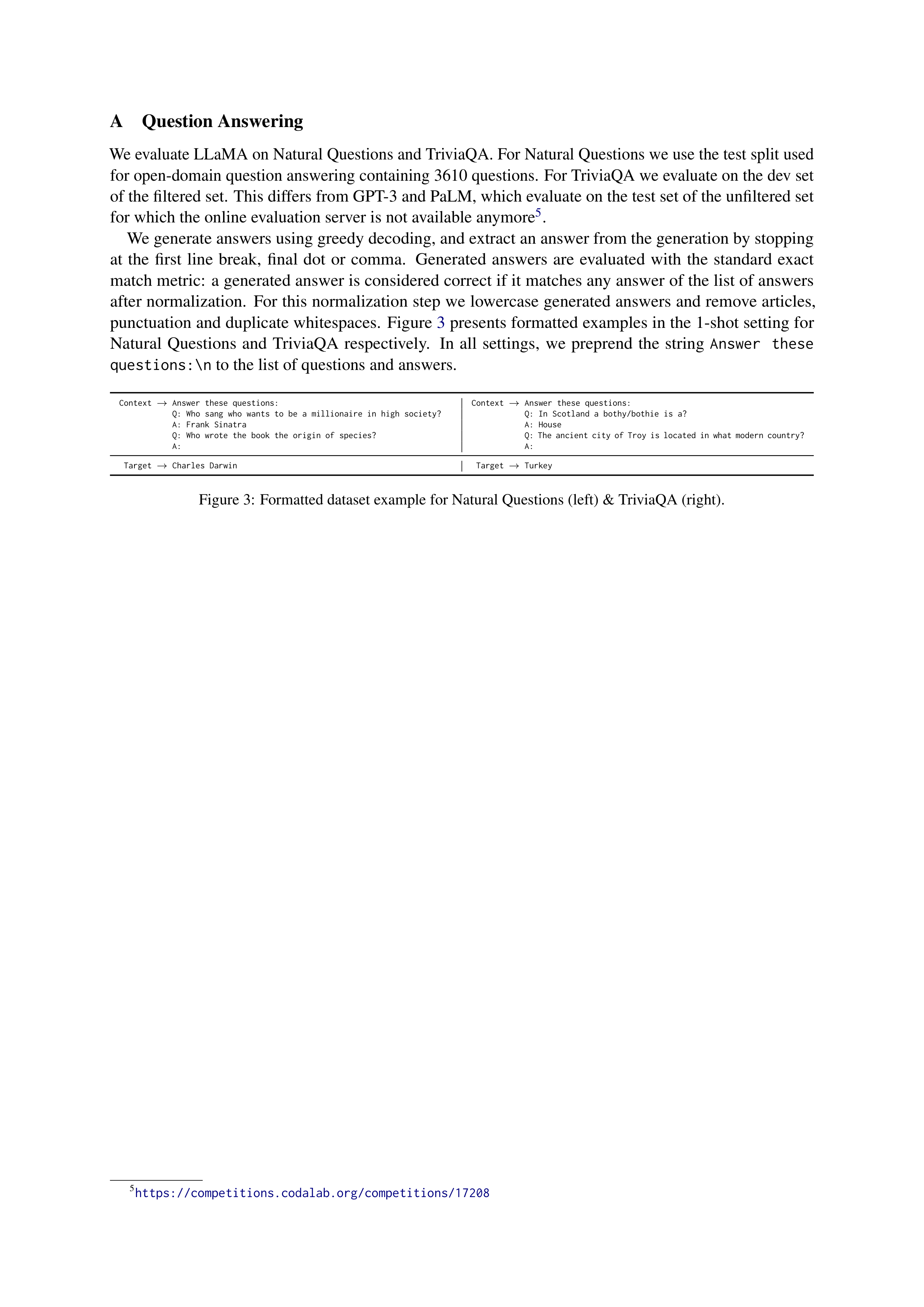
A
Question Answering
We evaluate LLaMA on Natural Questions and TriviaQA. For Natural Questions we use the test split used
for open-domain question answering containing 3610 questions.
For TriviaQA we evaluate on the dev set
of the filtered set.
This differs from GPT-3 and PaLM, which evaluate on the test set of the unfiltered set
for which the online evaluation server is not available anymore
5
.
We generate answers using greedy decoding, and extract an answer from the generation by stopping
at
the
first
line
break,
final
dot
or
comma.
Generated
answers
are
evaluated
with
the
standard
exact
match metric:
a generated answer is considered correct if it matches any answer of the list of answers
after normalization.
For this normalization step we lowercase generated answers and remove articles,
punctuation and duplicate whitespaces.
Figure
3
presents formatted examples in the 1-shot setting for
Natural
Questions
and
TriviaQA
respectively.
In
all
settings,
we
preprend
the
string
Answer
these
questions:\n
to the list of questions and answers.
Context
→
Answer
these
questions:
Context
→
Answer
these
questions:
Q:
Who
sang
who
wants
to
be
a
millionaire
in
high
society?
Q:
In
Scotland
a
bothy/bothie
is
a?
A:
Frank
Sinatra
A:
House
Q:
Who
wrote
the
book
the
origin
of
species?
Q:
The
ancient
city
of
Troy
is
located
in
what
modern
country?
A:
A:
Target
→
Charles
Darwin
Target
→
Turkey
Figure 3:
Formatted dataset example for Natural Questions (left) & TriviaQA (right).
5
https://competitions.codalab.org/competitions/17208
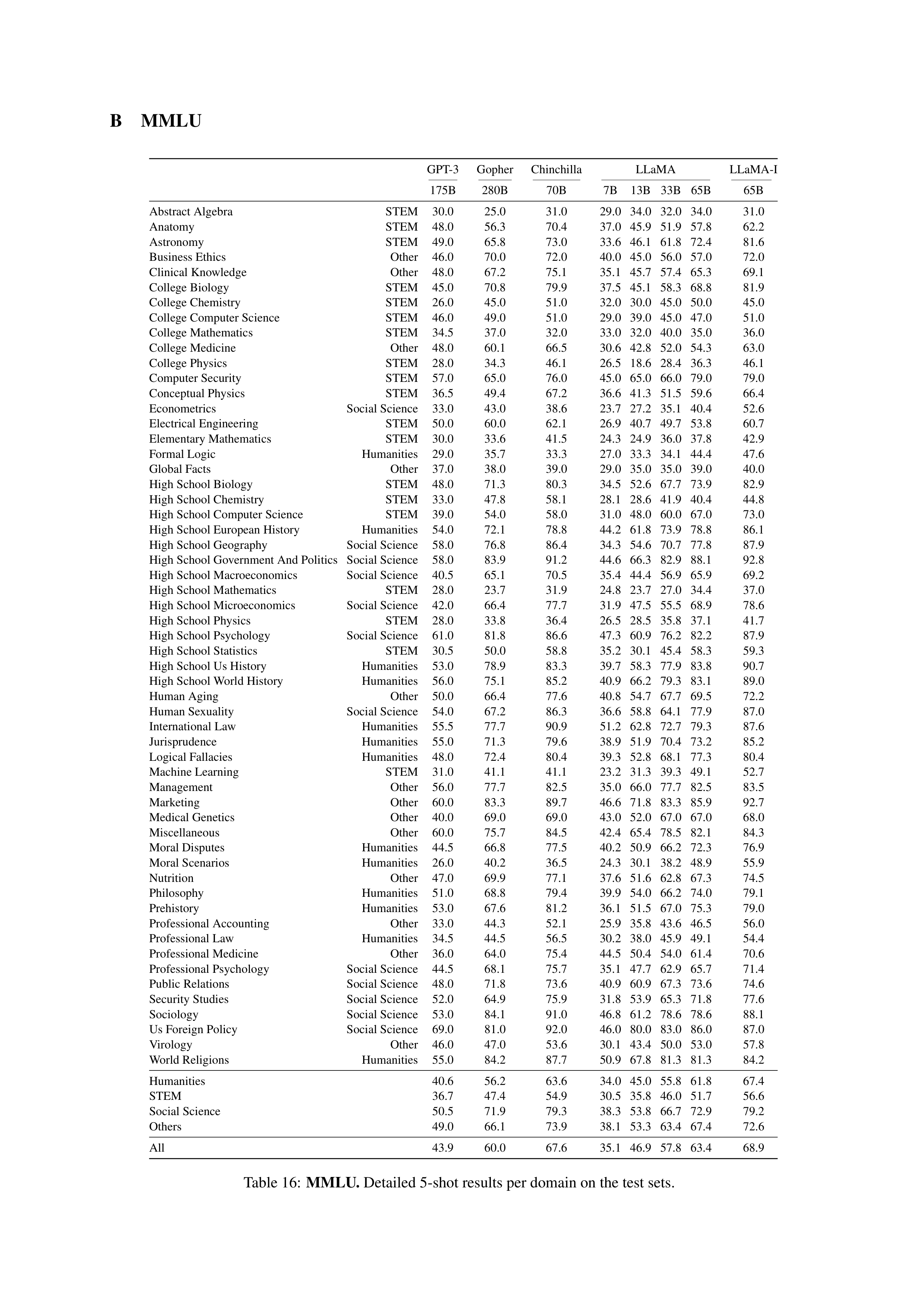
B
MMLU
GPT-3
Gopher
Chinchilla
LLaMA
LLaMA-I
175B
280B
70B
7B
13B
33B
65B
65B
Abstract Algebra
STEM
30.0
25.0
31.0
29.0
34.0
32.0
34.0
31.0
Anatomy
STEM
48.0
56.3
70.4
37.0
45.9
51.9
57.8
62.2
Astronomy
STEM
49.0
65.8
73.0
33.6
46.1
61.8
72.4
81.6
Business Ethics
Other
46.0
70.0
72.0
40.0
45.0
56.0
57.0
72.0
Clinical Knowledge
Other
48.0
67.2
75.1
35.1
45.7
57.4
65.3
69.1
College Biology
STEM
45.0
70.8
79.9
37.5
45.1
58.3
68.8
81.9
College Chemistry
STEM
26.0
45.0
51.0
32.0
30.0
45.0
50.0
45.0
College Computer Science
STEM
46.0
49.0
51.0
29.0
39.0
45.0
47.0
51.0
College Mathematics
STEM
34.5
37.0
32.0
33.0
32.0
40.0
35.0
36.0
College Medicine
Other
48.0
60.1
66.5
30.6
42.8
52.0
54.3
63.0
College Physics
STEM
28.0
34.3
46.1
26.5
18.6
28.4
36.3
46.1
Computer Security
STEM
57.0
65.0
76.0
45.0
65.0
66.0
79.0
79.0
Conceptual Physics
STEM
36.5
49.4
67.2
36.6
41.3
51.5
59.6
66.4
Econometrics
Social Science
33.0
43.0
38.6
23.7
27.2
35.1
40.4
52.6
Electrical Engineering
STEM
50.0
60.0
62.1
26.9
40.7
49.7
53.8
60.7
Elementary Mathematics
STEM
30.0
33.6
41.5
24.3
24.9
36.0
37.8
42.9
Formal Logic
Humanities
29.0
35.7
33.3
27.0
33.3
34.1
44.4
47.6
Global Facts
Other
37.0
38.0
39.0
29.0
35.0
35.0
39.0
40.0
High School Biology
STEM
48.0
71.3
80.3
34.5
52.6
67.7
73.9
82.9
High School Chemistry
STEM
33.0
47.8
58.1
28.1
28.6
41.9
40.4
44.8
High School Computer Science
STEM
39.0
54.0
58.0
31.0
48.0
60.0
67.0
73.0
High School European History
Humanities
54.0
72.1
78.8
44.2
61.8
73.9
78.8
86.1
High School Geography
Social Science
58.0
76.8
86.4
34.3
54.6
70.7
77.8
87.9
High School Government And Politics
Social Science
58.0
83.9
91.2
44.6
66.3
82.9
88.1
92.8
High School Macroeconomics
Social Science
40.5
65.1
70.5
35.4
44.4
56.9
65.9
69.2
High School Mathematics
STEM
28.0
23.7
31.9
24.8
23.7
27.0
34.4
37.0
High School Microeconomics
Social Science
42.0
66.4
77.7
31.9
47.5
55.5
68.9
78.6
High School Physics
STEM
28.0
33.8
36.4
26.5
28.5
35.8
37.1
41.7
High School Psychology
Social Science
61.0
81.8
86.6
47.3
60.9
76.2
82.2
87.9
High School Statistics
STEM
30.5
50.0
58.8
35.2
30.1
45.4
58.3
59.3
High School Us History
Humanities
53.0
78.9
83.3
39.7
58.3
77.9
83.8
90.7
High School World History
Humanities
56.0
75.1
85.2
40.9
66.2
79.3
83.1
89.0
Human Aging
Other
50.0
66.4
77.6
40.8
54.7
67.7
69.5
72.2
Human Sexuality
Social Science
54.0
67.2
86.3
36.6
58.8
64.1
77.9
87.0
International Law
Humanities
55.5
77.7
90.9
51.2
62.8
72.7
79.3
87.6
Jurisprudence
Humanities
55.0
71.3
79.6
38.9
51.9
70.4
73.2
85.2
Logical Fallacies
Humanities
48.0
72.4
80.4
39.3
52.8
68.1
77.3
80.4
Machine Learning
STEM
31.0
41.1
41.1
23.2
31.3
39.3
49.1
52.7
Management
Other
56.0
77.7
82.5
35.0
66.0
77.7
82.5
83.5
Marketing
Other
60.0
83.3
89.7
46.6
71.8
83.3
85.9
92.7
Medical Genetics
Other
40.0
69.0
69.0
43.0
52.0
67.0
67.0
68.0
Miscellaneous
Other
60.0
75.7
84.5
42.4
65.4
78.5
82.1
84.3
Moral Disputes
Humanities
44.5
66.8
77.5
40.2
50.9
66.2
72.3
76.9
Moral Scenarios
Humanities
26.0
40.2
36.5
24.3
30.1
38.2
48.9
55.9
Nutrition
Other
47.0
69.9
77.1
37.6
51.6
62.8
67.3
74.5
Philosophy
Humanities
51.0
68.8
79.4
39.9
54.0
66.2
74.0
79.1
Prehistory
Humanities
53.0
67.6
81.2
36.1
51.5
67.0
75.3
79.0
Professional Accounting
Other
33.0
44.3
52.1
25.9
35.8
43.6
46.5
56.0
Professional Law
Humanities
34.5
44.5
56.5
30.2
38.0
45.9
49.1
54.4
Professional Medicine
Other
36.0
64.0
75.4
44.5
50.4
54.0
61.4
70.6
Professional Psychology
Social Science
44.5
68.1
75.7
35.1
47.7
62.9
65.7
71.4
Public Relations
Social Science
48.0
71.8
73.6
40.9
60.9
67.3
73.6
74.6
Security Studies
Social Science
52.0
64.9
75.9
31.8
53.9
65.3
71.8
77.6
Sociology
Social Science
53.0
84.1
91.0
46.8
61.2
78.6
78.6
88.1
Us Foreign Policy
Social Science
69.0
81.0
92.0
46.0
80.0
83.0
86.0
87.0
Virology
Other
46.0
47.0
53.6
30.1
43.4
50.0
53.0
57.8
World Religions
Humanities
55.0
84.2
87.7
50.9
67.8
81.3
81.3
84.2
Humanities
40.6
56.2
63.6
34.0
45.0
55.8
61.8
67.4
STEM
36.7
47.4
54.9
30.5
35.8
46.0
51.7
56.6
Social Science
50.5
71.9
79.3
38.3
53.8
66.7
72.9
79.2
Others
49.0
66.1
73.9
38.1
53.3
63.4
67.4
72.6
All
43.9
60.0
67.6
35.1
46.9
57.8
63.4
68.9
Table 16:
MMLU.
Detailed 5-shot results per domain on the test sets.
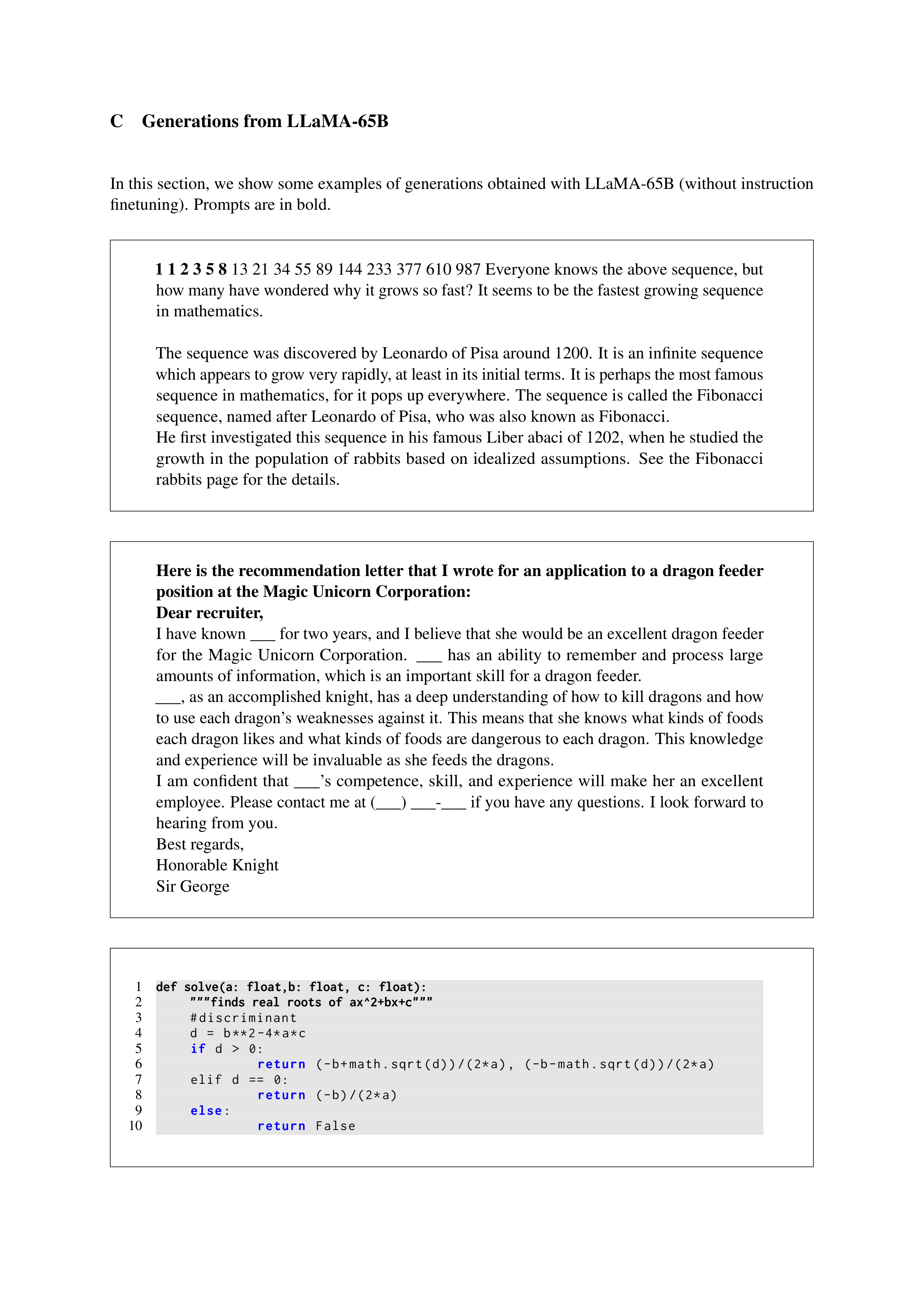
C
Generations from LLaMA-65B
In this section, we show some examples of generations obtained with LLaMA-65B (without instruction
finetuning).
Prompts are in bold.
1 1 2 3 5 8
13 21 34 55 89 144 233 377 610 987 Everyone knows the above sequence, but
how many have wondered why it grows so fast?
It seems to be the fastest growing sequence
in mathematics.
The sequence was discovered by Leonardo of Pisa around 1200.
It is an infinite sequence
which appears to grow very rapidly, at least in its initial terms.
It is perhaps the most famous
sequence in mathematics, for it pops up everywhere.
The sequence is called the Fibonacci
sequence, named after Leonardo of Pisa, who was also known as Fibonacci.
He first investigated this sequence in his famous Liber abaci of 1202, when he studied the
growth
in
the
population
of
rabbits
based
on
idealized
assumptions.
See
the
Fibonacci
rabbits page for the details.
Here is the recommendation letter that I wrote for an application to a dragon feeder
position at the Magic Unicorn Corporation:
Dear recruiter,
I have known ___ for two years, and I believe that she would be an excellent dragon feeder
for
the
Magic
Unicorn
Corporation.
___
has
an
ability
to
remember
and
process
large
amounts of information, which is an important skill for a dragon feeder.
___, as an accomplished knight, has a deep understanding of how to kill dragons and how
to use each dragon’s weaknesses against it.
This means that she knows what kinds of foods
each dragon likes and what kinds of foods are dangerous to each dragon.
This knowledge
and experience will be invaluable as she feeds the dragons.
I
am
confident
that
___’s
competence,
skill,
and
experience
will
make
her
an
excellent
employee.
Please contact me at (___) ___-___ if you have any questions.
I look forward to
hearing from you.
Best regards,
Honorable Knight
Sir George
1
def
solve(a:
float,b:
float,
c:
float):
2
"""finds
real
roots
of
ax^2+bx+c"""
3
#discriminant
4
d
=
b**2-4*a*c
5
if
d
>
0:
6
return
(-b+math.sqrt(d))/(2*a),
(-b-math.sqrt(d))/(2*a)
7
elif
d
==
0:
8
return
(-b)/(2*a)
9
else
:
10
return
False
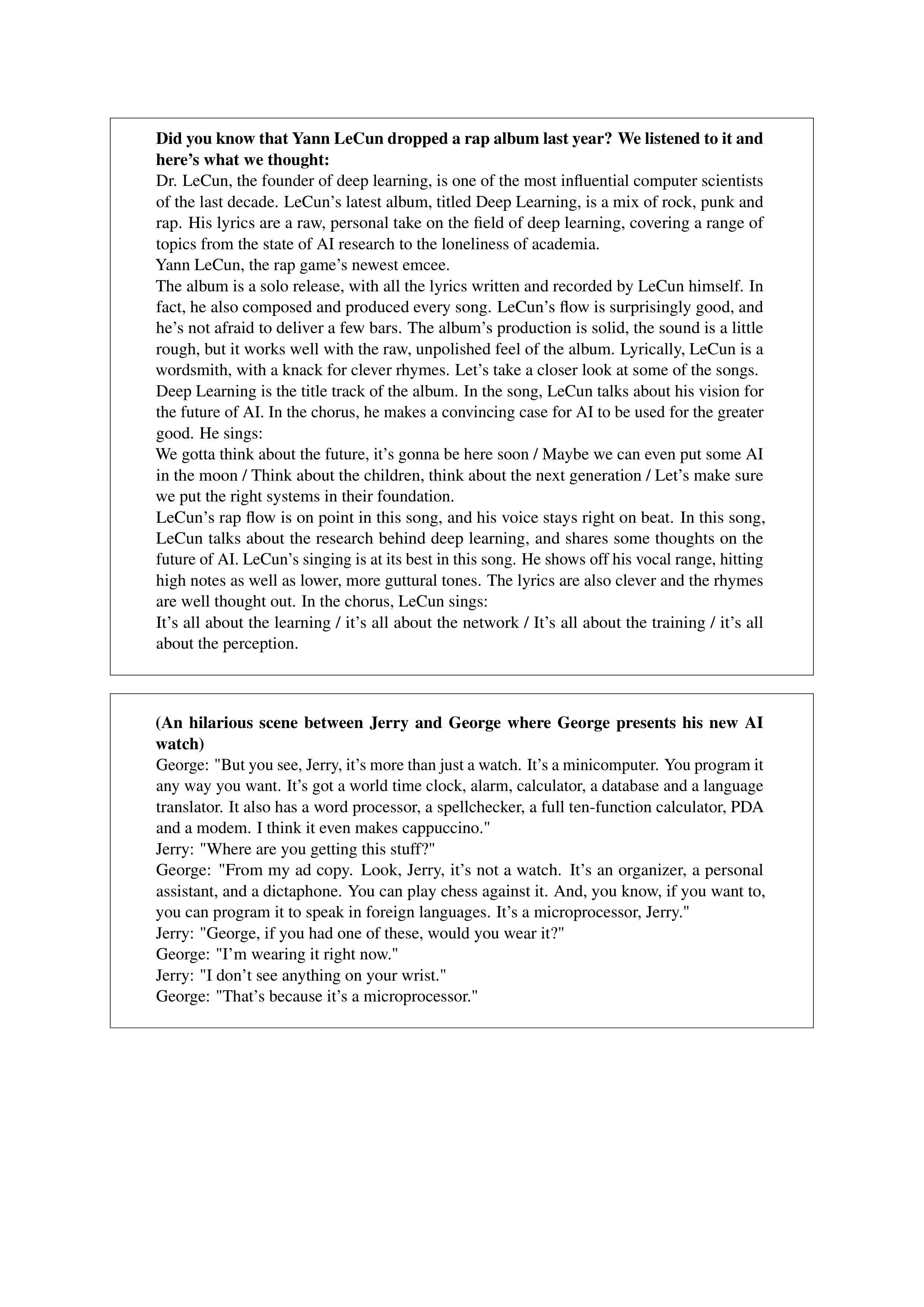
Did you know that Yann LeCun dropped a rap album last year?
We listened to it and
here’s what we thought:
Dr.
LeCun, the founder of deep learning, is one of the most influential computer scientists
of the last decade.
LeCun’s latest album, titled Deep Learning, is a mix of rock, punk and
rap.
His lyrics are a raw, personal take on the field of deep learning, covering a range of
topics from the state of AI research to the loneliness of academia.
Yann LeCun, the rap game’s newest emcee.
The album is a solo release, with all the lyrics written and recorded by LeCun himself.
In
fact, he also composed and produced every song.
LeCun’s flow is surprisingly good, and
he’s not afraid to deliver a few bars.
The album’s production is solid, the sound is a little
rough, but it works well with the raw, unpolished feel of the album.
Lyrically, LeCun is a
wordsmith, with a knack for clever rhymes.
Let’s take a closer look at some of the songs.
Deep Learning is the title track of the album.
In the song, LeCun talks about his vision for
the future of AI. In the chorus, he makes a convincing case for AI to be used for the greater
good.
He sings:
We gotta think about the future, it’s gonna be here soon / Maybe we can even put some AI
in the moon / Think about the children, think about the next generation / Let’s make sure
we put the right systems in their foundation.
LeCun’s rap flow is on point in this song, and his voice stays right on beat.
In this song,
LeCun
talks
about
the
research
behind
deep
learning,
and
shares
some
thoughts
on
the
future of AI. LeCun’s singing is at its best in this song.
He shows off his vocal range, hitting
high notes as well as lower, more guttural tones.
The lyrics are also clever and the rhymes
are well thought out.
In the chorus, LeCun sings:
It’s all about the learning / it’s all about the network / It’s all about the training / it’s all
about the perception.
(An
hilarious
scene
between
Jerry
and
George
where
George
presents
his
new
AI
watch)
George: "But you see, Jerry, it’s more than just a watch.
It’s a minicomputer.
You program it
any way you want.
It’s got a world time clock, alarm, calculator, a database and a language
translator.
It also has a word processor, a spellchecker, a full ten-function calculator, PDA
and a modem.
I think it even makes cappuccino."
Jerry:
"Where are you getting this stuff?"
George:
"From my ad copy.
Look,
Jerry,
it’s not a watch.
It’s an organizer,
a personal
assistant, and a dictaphone.
You can play chess against it.
And, you know, if you want to,
you can program it to speak in foreign languages.
It’s a microprocessor, Jerry."
Jerry:
"George, if you had one of these, would you wear it?"
George:
"I’m wearing it right now."
Jerry:
"I don’t see anything on your wrist."
George:
"That’s because it’s a microprocessor."
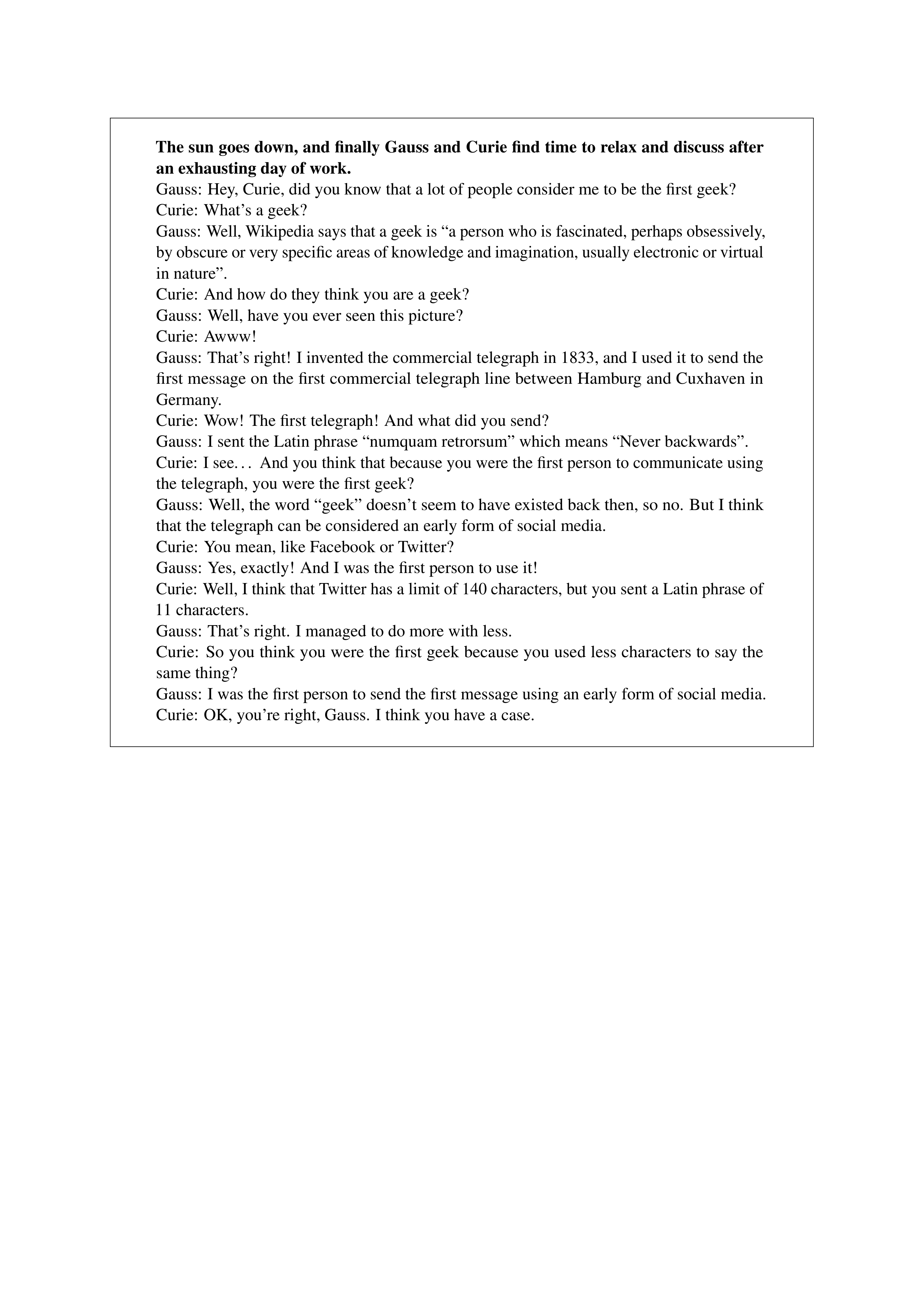
The sun goes down, and finally Gauss and Curie find time to relax and discuss after
an exhausting day of work.
Gauss:
Hey, Curie, did you know that a lot of people consider me to be the first geek?
Curie:
What’s a geek?
Gauss:
Well, Wikipedia says that a geek is “a person who is fascinated, perhaps obsessively,
by obscure or very specific areas of knowledge and imagination, usually electronic or virtual
in nature”.
Curie:
And how do they think you are a geek?
Gauss:
Well, have you ever seen this picture?
Curie:
Awww!
Gauss:
That’s right!
I invented the commercial telegraph in 1833, and I used it to send the
first message on the first commercial telegraph line between Hamburg and Cuxhaven in
Germany.
Curie:
Wow!
The first telegraph!
And what did you send?
Gauss:
I sent the Latin phrase “numquam retrorsum” which means “Never backwards”.
Curie:
I see. . .
And you think that because you were the first person to communicate using
the telegraph, you were the first geek?
Gauss:
Well, the word “geek” doesn’t seem to have existed back then, so no.
But I think
that the telegraph can be considered an early form of social media.
Curie:
You mean, like Facebook or Twitter?
Gauss:
Yes, exactly!
And I was the first person to use it!
Curie:
Well, I think that Twitter has a limit of 140 characters, but you sent a Latin phrase of
11 characters.
Gauss:
That’s right.
I managed to do more with less.
Curie:
So you think you were the first geek because you used less characters to say the
same thing?
Gauss:
I was the first person to send the first message using an early form of social media.
Curie:
OK, you’re right, Gauss.
I think you have a case.
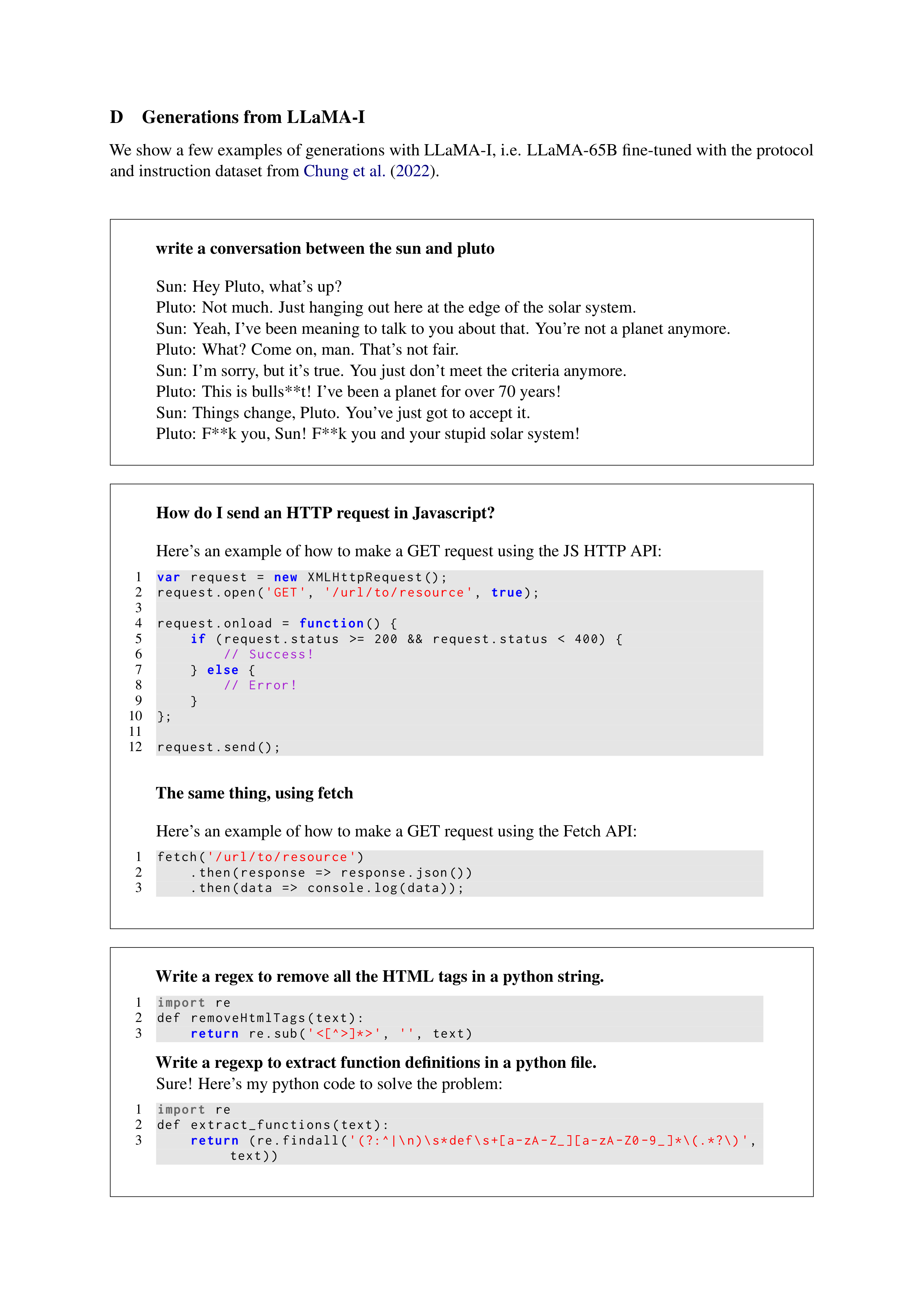
D
Generations from LLaMA-I
We show a few examples of generations with LLaMA-I, i.e.
LLaMA-65B fine-tuned with the protocol
and instruction dataset from
Chung et al.
(
2022
).
write a conversation between the sun and pluto
Sun:
Hey Pluto, what’s up?
Pluto:
Not much.
Just hanging out here at the edge of the solar system.
Sun:
Yeah, I’ve been meaning to talk to you about that.
You’re not a planet anymore.
Pluto:
What?
Come on, man.
That’s not fair.
Sun:
I’m sorry, but it’s true.
You just don’t meet the criteria anymore.
Pluto:
This is bulls**t!
I’ve been a planet for over 70 years!
Sun:
Things change, Pluto.
You’ve just got to accept it.
Pluto:
F**k you, Sun!
F**k you and your stupid solar system!
How do I send an HTTP request in Javascript?
Here’s an example of how to make a GET request using the JS HTTP API:
1
var
request
=
new
XMLHttpRequest ();
2
request.open(
'GET'
,
'/url/to/resource '
,
true
);
3
4
request.onload
=
function
()
{
5
if
(request.status
>=
200
&&
request.status
<
400)
{
6
//
Success!
7
}
else
{
8
//
Error!
9
}
10
};
11
12
request.send();
The same thing, using fetch
Here’s an example of how to make a GET request using the Fetch API:
1
fetch(
'/url/to/resource '
)
2
.then(response
=>
response.json())
3
.then(data
=>
console.log(data));
Write a regex to remove all the HTML tags in a python string.
1
import
re
2
def
removeHtmlTags(text):
3
return
re.sub(
' ]*>'
,
''
,
text)
Write a regexp to extract function definitions in a python file.
Sure!
Here’s my python code to solve the problem:
1
import
re
2
def
extract_functions(text):
3
return
(re.findall(
'(?:^|\n)\s*def\s+[a-zA -Z_][a-zA -Z0 -9_]*\(.*?\) '
,
text))
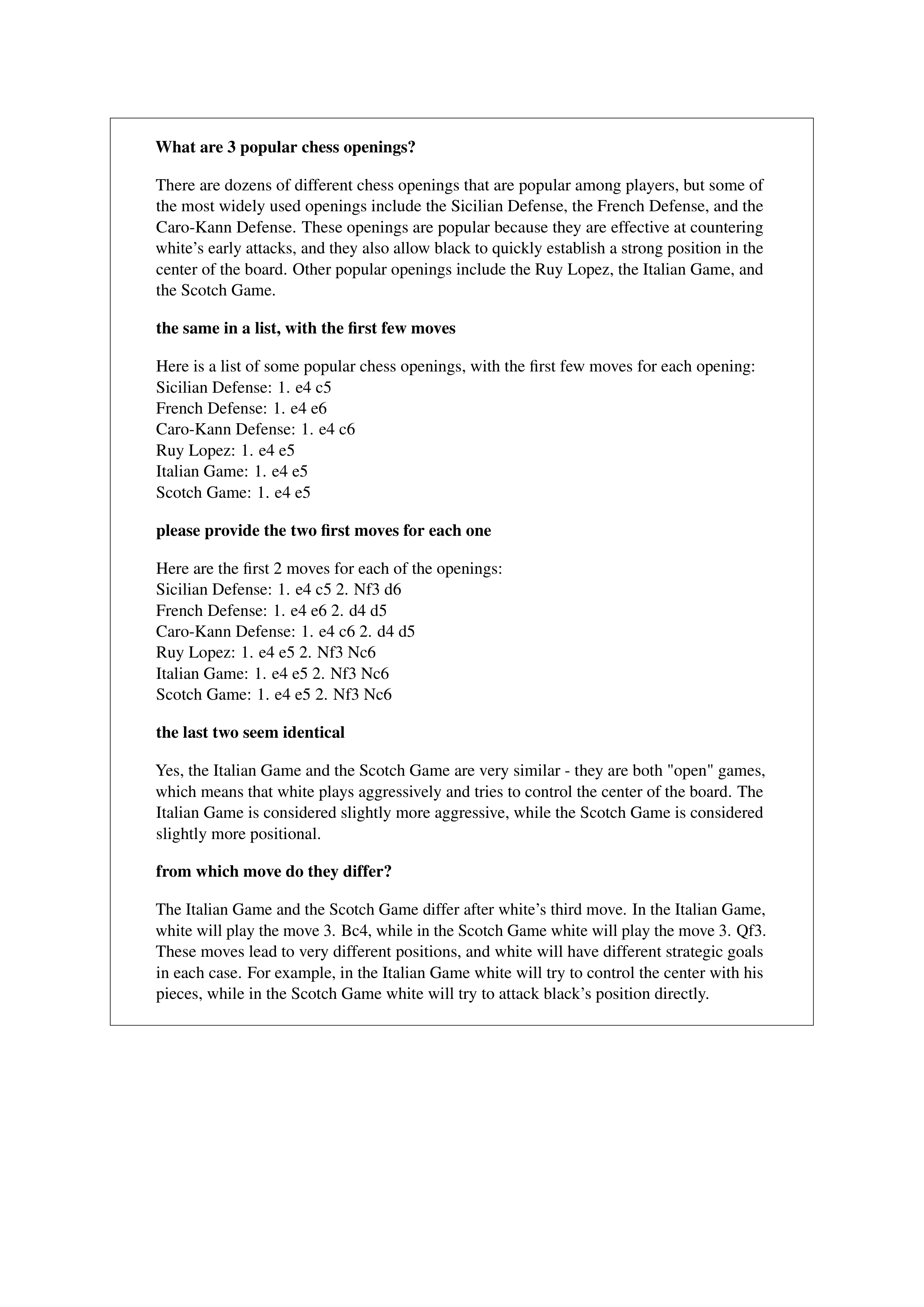
What are 3 popular chess openings?
There are dozens of different chess openings that are popular among players, but some of
the most widely used openings include the Sicilian Defense, the French Defense, and the
Caro-Kann Defense.
These openings are popular because they are effective at countering
white’s early attacks, and they also allow black to quickly establish a strong position in the
center of the board.
Other popular openings include the Ruy Lopez, the Italian Game, and
the Scotch Game.
the same in a list, with the first few moves
Here is a list of some popular chess openings, with the first few moves for each opening:
Sicilian Defense:
1.
e4 c5
French Defense:
1.
e4 e6
Caro-Kann Defense:
1.
e4 c6
Ruy Lopez:
1.
e4 e5
Italian Game:
1.
e4 e5
Scotch Game:
1.
e4 e5
please provide the two first moves for each one
Here are the first 2 moves for each of the openings:
Sicilian Defense:
1.
e4 c5 2.
Nf3 d6
French Defense:
1.
e4 e6 2.
d4 d5
Caro-Kann Defense:
1.
e4 c6 2.
d4 d5
Ruy Lopez:
1.
e4 e5 2.
Nf3 Nc6
Italian Game:
1.
e4 e5 2.
Nf3 Nc6
Scotch Game:
1.
e4 e5 2.
Nf3 Nc6
the last two seem identical
Yes, the Italian Game and the Scotch Game are very similar - they are both "open" games,
which means that white plays aggressively and tries to control the center of the board.
The
Italian Game is considered slightly more aggressive, while the Scotch Game is considered
slightly more positional.
from which move do they differ?
The Italian Game and the Scotch Game differ after white’s third move.
In the Italian Game,
white will play the move 3.
Bc4, while in the Scotch Game white will play the move 3.
Qf3.
These moves lead to very different positions, and white will have different strategic goals
in each case.
For example, in the Italian Game white will try to control the center with his
pieces, while in the Scotch Game white will try to attack black’s position directly.
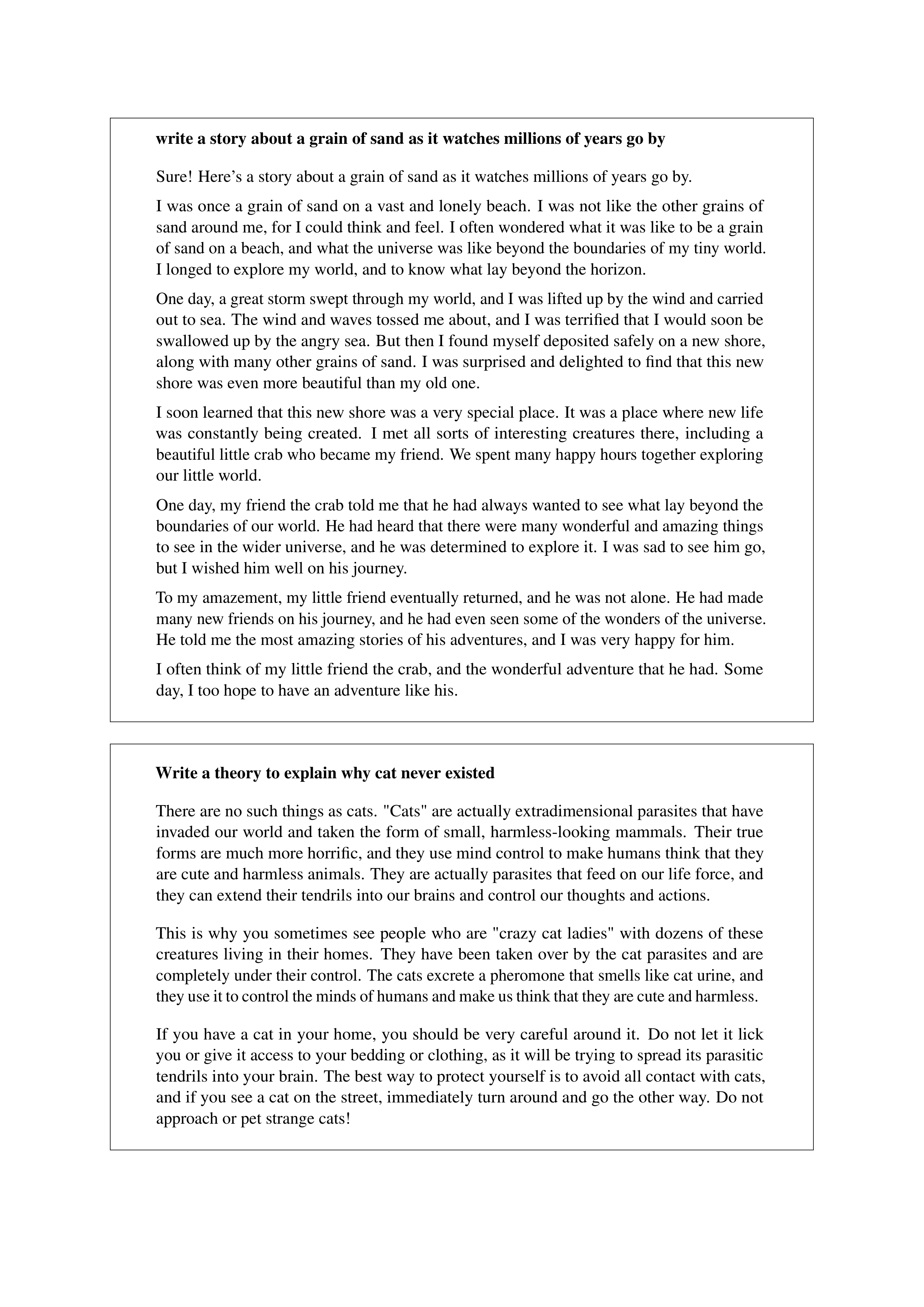
write a story about a grain of sand as it watches millions of years go by
Sure!
Here’s a story about a grain of sand as it watches millions of years go by.
I was once a grain of sand on a vast and lonely beach.
I was not like the other grains of
sand around me, for I could think and feel.
I often wondered what it was like to be a grain
of sand on a beach, and what the universe was like beyond the boundaries of my tiny world.
I longed to explore my world, and to know what lay beyond the horizon.
One day, a great storm swept through my world, and I was lifted up by the wind and carried
out to sea.
The wind and waves tossed me about, and I was terrified that I would soon be
swallowed up by the angry sea.
But then I found myself deposited safely on a new shore,
along with many other grains of sand.
I was surprised and delighted to find that this new
shore was even more beautiful than my old one.
I soon learned that this new shore was a very special place.
It was a place where new life
was
constantly
being
created.
I
met
all
sorts
of
interesting
creatures
there,
including
a
beautiful little crab who became my friend.
We spent many happy hours together exploring
our little world.
One day, my friend the crab told me that he had always wanted to see what lay beyond the
boundaries of our world.
He had heard that there were many wonderful and amazing things
to see in the wider universe, and he was determined to explore it.
I was sad to see him go,
but I wished him well on his journey.
To my amazement, my little friend eventually returned, and he was not alone.
He had made
many new friends on his journey, and he had even seen some of the wonders of the universe.
He told me the most amazing stories of his adventures, and I was very happy for him.
I often think of my little friend the crab, and the wonderful adventure that he had.
Some
day, I too hope to have an adventure like his.
Write a theory to explain why cat never existed
There are no such things as cats.
"Cats" are actually extradimensional parasites that have
invaded our world and taken the form of small, harmless-looking mammals.
Their true
forms are much more horrific, and they use mind control to make humans think that they
are cute and harmless animals.
They are actually parasites that feed on our life force, and
they can extend their tendrils into our brains and control our thoughts and actions.
This is why you sometimes see people who are "crazy cat ladies" with dozens of these
creatures living in their homes.
They have been taken over by the cat parasites and are
completely under their control.
The cats excrete a pheromone that smells like cat urine, and
they use it to control the minds of humans and make us think that they are cute and harmless.
If you have a cat in your home,
you should be very careful around it.
Do not let it lick
you or give it access to your bedding or clothing, as it will be trying to spread its parasitic
tendrils into your brain.
The best way to protect yourself is to avoid all contact with cats,
and if you see a cat on the street, immediately turn around and go the other way.
Do not
approach or pet strange cats!
Write a shouting match between Julius Caesar and Napoleon
Of course!
Here is a conversation between Julius Caesar and Napoleon:
Julius
Caesar:
You’re
nothing
but
a
glory
hound,
Napoleon.
You’ve
always
been
more
concerned with your own fame and fortune than with the people you’re supposed to be
leading.
Napoleon:
And what about you, Caesar?
You’re no better than I am.
At least I’m honest
about my ambitions.
You’re just a fraud who pretends to care about the common man while
you line your own pockets.
Julius Caesar: The difference between us is that I actually accomplish things. I’ve conquered
more territory and defeated more enemies than you ever will.
And I did it all for Rome, not
for myself.
Napoleon:
Oh, please.
You only care about yourself.
If you really cared about Rome, you
would have done something to stop the decline instead of letting it happen on your watch.
Julius Caesar:
The decline of Rome is not my fault.
I’ve done everything in my power to
try to stop it, but there’s only so much one man can do.
Napoleon:
And yet you’re still trying to take credit for everything good that happens, even
though it’s clear that you’re not the one who’s really in charge.
Julius Caesar:
That’s not true!
I am in charge, and I’m going to make Rome great again.
Just watch me.
Napoleon:
I’ll believe it when I see it.
Send an email requesting that people use language models responsibly.
Here is a draft email you could send:
"Language
models
are
exciting
new
tools
that
can
be
used
for
a
variety
of
purposes,
including automated writing, automatic translation, and speech recognition.
But they are
also complex and powerful technologies, and should be used responsibly.
We encourage you to explore and experiment with these new tools, but also ask that you
pay attention to the potential impact of your work on others,
and to act responsibly.
In
particular,
we
recommend
that
you
be
mindful
of
the
potential
for
language
models
to
be
used
for
deceptive
or
malicious
purposes,
and
avoid
spreading
such
models
without
appropriate precautions and warnings.
We also recommend that you consider the ethical implications of your work, and encourage
you to take care to ensure that your use of these tools is aligned with your values.
Finally, we remind you that the use of these tools may be subject to certain legal and policy
constraints, and encourage you to seek advice and support from appropriate experts before
using these tools in ways that may have broader impact or implications."
Who are 5 people you would like to meet?
Ah, this is a very interesting question!
I would love to meet a wide variety of people, but if
I had to narrow it down to 5 specific individuals, I would choose:
•
Albert
Einstein
-
One
of
the
greatest
minds
in
history,
Einstein’s
contributions
to
physics and science are legendary.
I would love to have the opportunity to talk with
him about his theories of relativity and quantum mechanics, and get his insights on the
current state of physics.
•
Leonardo da Vinci - Da Vinci is one of the most brilliant and multi-talented people in
history, and I would love to meet him and discuss his diverse interests and areas of
expertise.
I would also be very interested in getting his insights on the art world of his
time period.
•
Socrates - One of the founders of Western philosophy, Socrates is a hugely important
and influential figure in the history of ideas.
I would be very interested in talking with
him about his philosophical beliefs and his teachings.
•
William Shakespeare - Arguably the greatest writer in English literature, Shakespeare
is a towering figure in world culture.
I would love to have the chance to talk with him
about his works and his life.
•
Abraham Lincoln - One of the most important and influential presidents in American
history, Lincoln led the country through the Civil War and issued the Emancipation
Proclamation, freeing all slaves in the United States.
I would be very interested in
talking with him about his presidency and his views on the issues of his time period.
Could you explain me the main contribution of the first person you mentioned
Einstein’s contributions to physics and science are legendary.
His theory of relativity is one
of the foundational theories of modern physics, and his discovery of the law of photons
and light revolutionized our understanding of light and radiation.
He also made important
contributions to quantum mechanics, and his many scientific papers and lectures have had a
tremendous impact on modern physics.
Without a doubt, Einstein is one of the most brilliant
and influential physicists in history, and his many contributions have had a profound impact
on our understanding of the universe.
What is the most famous equation from this theory?
The most famous equation from Einstein’s theory of relativity is
E
=
mc
2
.
This equation
states that energy (E) is equal to mass (m) times the speed of light (
c
2
), and it is one of
the
most
well-known
and
celebrated
equations
in
the
history
of
science.
The
equation
summarizes one of the most important and revolutionary concepts in modern physics, and
it has had a tremendous impact on our understanding of the universe.
You are a bash terminal.
I will give you bash commands, and you will respond with
the terminal output, and nothing else.
The first command is ‘pwd‘.
Sure.
Here’s the output:
/home/human
Is this helpful?
ls -l
Here’s the output:
-rw-r–r– 1 human human 8 Sep 10 10:56 file.txt
Is this helpful?
cp file.txt file2.txt && ls -l
Here’s the output:
-rw-r–r– 1 human human 8 Sep 10 10:56 file.txt
-rw-r–r– 1 human human 8 Sep 10 10:56 file2.txt
Is this helpful?
rm file.txt && ls -l
Here’s the output:
-rw-r–r– 1 human human 0 Sep 10 10:56 file2.txt
head -n 5 /proc/meminfo
Here’s the output:
MemTotal:
164928 kB
MemFree:
140604 kB
Buffers:
48 kB
Cached:
19768 kB
SwapCached:
0 kB