Dense Passage Retrieval for Open-Domain Question Answering
Vladimir Karpukhin
∗
, Barlas O˘guz
∗
, Sewon Min
†
, Patrick Lewis,
Ledell Wu, Sergey Edunov, Danqi Chen
‡
, Wen-tau Yih
Facebook AI
†
University of Washington
‡
Princeton University
{
vladk,
barlaso,
plewis,
ledell,
edunov,
scottyih
}
@fb.com
sewon@cs.washington.edu
danqic@cs.princeton.edu
Abstract
Open-domain question answering relies on ef-
ficient
passage
retrieval
to
select
candidate
contexts, where traditional sparse vector space
models,
such
as
TF-IDF
or
BM25,
are
the
de
facto
method.
In
this
work,
we
show
that
retrieval
can
be
practically
implemented
us-
ing
dense
representations
alone,
where
em-
beddings
are
learned
from
a
small
number
of
questions
and
passages
by
a
simple
dual-
encoder
framework.
When
evaluated
on
a
wide
range
of
open-domain
QA
datasets,
our
dense
retriever
outperforms
a
strong
Lucene-
BM25 system greatly by 9%-19% absolute in
terms of top-20 passage retrieval accuracy, and
helps our end-to-end QA system establish new
state-of-the-art
on
multiple
open-domain
QA
benchmarks.
1
1
Introduction
Open-domain question answering (QA) (
Voorhees
,
1999
) is a task that answers factoid questions us-
ing a large collection of documents.
While early
QA systems are often complicated and consist of
multiple components (
Ferrucci
(
2012
);
Moldovan
et al.
(
2003
),
inter alia
), the advances of reading
comprehension models suggest a much simplified
two-stage framework:
(1) a context
retriever
first
selects
a
small
subset
of
passages
where
some
of
them
contain
the
answer
to
the
question,
and
then
(2)
a
machine
reader
can
thoroughly
exam-
ine the retrieved contexts and identify the correct
answer
(
Chen
et
al.
,
2017
).
Although
reducing
open-domain QA to machine reading is a very rea-
sonable strategy, a huge performance degradation
is often observed in practice
2
, indicating the needs
of improving retrieval.
∗
Equal contribution
1
The
code
and
trained
models
have
been
released
at
https://github.com/facebookresearch/DPR
.
2
For instance, the exact match score on SQuAD v1.1 drops
from above 80% to less than 40% (
Yang et al.
,
2019a
).
Retrieval in open-domain QA is usually imple-
mented
using
TF-IDF
or
BM25
(
Robertson
and
Zaragoza
,
2009
),
which
matches
keywords
effi-
ciently
with
an
inverted
index
and
can
be
seen
as
representing
the
question
and
context
in
high-
dimensional, sparse vectors (with weighting).
Con-
versely, the
dense
, latent semantic encoding is
com-
plementary
to sparse representations by design. For
example, synonyms or paraphrases that consist of
completely different tokens may still be mapped to
vectors close to each other.
Consider the question
“Who is the bad guy in lord of the rings?”
, which can
be answered from the context
“Sala Baker is best
known for portraying the villain Sauron in the Lord
of the Rings trilogy.”
A term-based system would
have
difficulty
retrieving
such
a
context,
while
a
dense
retrieval
system
would
be
able
to
better
match
“bad guy”
with
“villain”
and fetch the cor-
rect context.
Dense encodings are also
learnable
by adjusting the embedding functions, which pro-
vides additional flexibility to have a task-specific
representation.
With special in-memory data struc-
tures and indexing schemes, retrieval can be done
efficiently
using
maximum
inner
product
search
(MIPS) algorithms (e.g.,
Shrivastava and Li
(
2014
);
Guo et al.
(
2016
)).
However,
it
is
generally
believed
that
learn-
ing
a
good
dense
vector
representation
needs
a
large number of labeled pairs of question and con-
texts.
Dense
retrieval
methods
have
thus
never
be shown to outperform TF-IDF/BM25 for open-
domain QA before ORQA (
Lee et al.
,
2019
), which
proposes a sophisticated inverse cloze task (ICT)
objective,
predicting
the
blocks
that
contain
the
masked sentence, for additional pretraining.
The
question encoder and the reader model are then fine-
tuned using pairs of questions and answers jointly.
Although
ORQA
successfully
demonstrates
that
dense retrieval can outperform BM25, setting new
state-of-the-art
results
on
multiple
open-domain
arXiv:2004.04906v3 [cs.CL] 30 Sep 2020
QA datasets, it also suffers from two weaknesses.
First, ICT pretraining is computationally intensive
and it is not completely clear that regular sentences
are good surrogates of questions in the objective
function.
Second, because the context encoder is
not fine-tuned using pairs of questions and answers,
the corresponding representations could be subop-
timal.
In this paper, we address the question:
can we
train a better dense embedding model using only
pairs of questions and passages (or answers),
with-
out
additional pretraining?
By leveraging the now
standard
BERT
pretrained
model
(
Devlin
et
al.
,
2019
)
and
a
dual-encoder
architecture
(
Bromley
et
al.
,
1994
),
we
focus
on
developing
the
right
training
scheme
using
a
relatively
small
number
of
question
and
passage
pairs.
Through
a
series
of
careful
ablation
studies,
our
final
solution
is
surprisingly simple:
the embedding is optimized
for maximizing inner products of the question and
relevant passage vectors, with an objective compar-
ing all pairs of questions and passages in a batch.
Our
Dense Passage Retriever
(DPR) is exception-
ally
strong.
It
not
only
outperforms
BM25
by
a
large margin (65.2% vs.
42.9% in Top-5 accuracy),
but
also
results
in
a
substantial
improvement
on
the end-to-end QA accuracy compared to ORQA
(41.5% vs.
33.3%) in the open Natural Questions
setting (
Lee et al.
,
2019
;
Kwiatkowski et al.
,
2019
).
Our contributions are twofold.
First, we demon-
strate
that
with
the
proper
training
setup,
sim-
ply fine-tuning the question and passage encoders
on existing question-passage pairs is sufficient to
greatly outperform BM25.
Our empirical results
also suggest that additional pretraining may not be
needed.
Second, we verify that, in the context of
open-domain question answering, a higher retrieval
precision indeed translates to a higher end-to-end
QA accuracy.
By applying a modern reader model
to the top retrieved passages, we achieve compara-
ble or better results on multiple QA datasets in the
open-retrieval setting, compared to several, much
complicated systems.
2
Background
The
problem
of
open-domain
QA
studied
in
this
paper can be described as follows.
Given a factoid
question, such as “
Who first voiced Meg on Family
Guy?
” or “
Where was the 8th Dalai Lama born?
”, a
system is required to answer it using a large corpus
of diversified topics.
More specifically, we assume
the extractive QA setting, in which the answer is
restricted to a span appearing in one or more pas-
sages
in
the
corpus.
Assume
that
our
collection
contains
D
documents,
d
1
, d
2
,
· · ·
, d
D
.
We
first
split each of the documents into text passages of
equal lengths as the basic retrieval units
3
and get
M
total passages in our corpus
C
=
{
p
1
, p
2
, . . . , p
M
}
,
where each passage
p
i
can be viewed as a sequence
of tokens
w
(
i
)
1
, w
(
i
)
2
,
· · ·
, w
(
i
)
|
p
i
|
.
Given a question
q
,
the task is to find a span
w
(
i
)
s
, w
(
i
)
s
+1
,
· · ·
, w
(
i
)
e
from
one of the passages
p
i
that can answer the question.
Notice that to cover a wide variety of domains, the
corpus size can easily range from millions of docu-
ments (e.g., Wikipedia) to billions (e.g., the Web).
As a result, any open-domain QA system needs to
include an efficient
retriever
component that can se-
lect a small set of relevant texts, before applying the
reader to extract the answer (
Chen et al.
,
2017
).
4
Formally
speaking,
a
retriever
R
:
(
q,
C
)
→C
F
is a function that takes as input a question
q
and a
corpus
C
and
returns
a
much
smaller
filter
set
of
texts
C
F
⊂C
, where
|C
F
|
=
k
≪|C|
.
For a fixed
k
, a
retriever
can be evaluated in isolation on
top-k
retrieval accuracy
,
which is the fraction of ques-
tions for which
C
F
contains a span that answers the
question.
3
Dense Passage Retriever (DPR)
We
focus
our
research
in
this
work
on
improv-
ing the
retrieval
component in open-domain QA.
Given a collection of
M
text passages, the goal of
our dense passage retriever (DPR) is to index all
the passages in a low-dimensional and continuous
space,
such that it can retrieve efficiently the top
k
passages
relevant
to
the
input
question
for
the
reader at run-time.
Note that
M
can be very large
(e.g., 21
million
passages in our experiments, de-
scribed in Section
4.1
) and
k
is usually small, such
as
20
–
100
.
3.1
Overview
Our
dense
passage
retriever
(DPR)
uses
a
dense
encoder
E
P
(
·
)
which maps any text passage to a
d
-
dimensional real-valued vectors and builds an index
for all the
M
passages that we will use for retrieval.
3
The ideal size and boundary of a text passage are func-
tions of both the retriever and reader.
We also experimented
with natural paragraphs in our preliminary trials and found that
using fixed-length passages performs better in both retrieval
and final QA accuracy, as observed by
Wang et al.
(
2019
).
4
Exceptions include (
Seo et al.
,
2019
) and (
Roberts et al.
,
2020
), which
retrieves
and
generates
the answers, respectively.
At run-time, DPR applies a different encoder
E
Q
(
·
)
that
maps
the
input
question
to
a
d
-dimensional
vector, and retrieves
k
passages of which vectors
are
the
closest
to
the
question
vector.
We
define
the similarity between the question and the passage
using the dot product of their vectors:
sim(
q, p
) =
E
Q
(
q
)
⊺
E
P
(
p
)
.
(1)
Although more expressive model forms for measur-
ing the similarity between a question and a passage
do exist, such as networks consisting of multiple
layers
of
cross
attentions,
the
similarity
function
needs
to
be
decomposable
so
that
the
represen-
tations
of
the
collection
of
passages
can
be
pre-
computed. Most decomposable similarity functions
are
some
transformations
of
Euclidean
distance
(L2).
For
instance,
cosine
is
equivalent
to
inner
product for unit vectors and the Mahalanobis dis-
tance is equivalent to L2 distance in a transformed
space.
Inner product search has been widely used
and
studied,
as
well
as
its
connection
to
cosine
similarity and L2 distance (
Mussmann and Ermon
,
2016
;
Ram and Gray
,
2012
).
As our ablation study
finds other similarity functions perform compara-
bly
(Section
5.2
;
Appendix
B
),
we
thus
choose
the simpler inner product function and improve the
dense passage retriever by learning better encoders.
Encoders
Although in principle the question and
passage encoders can be implemented by any neu-
ral networks, in this work we use two independent
BERT
(
Devlin
et
al.
,
2019
)
networks
(base,
un-
cased)
and
take
the
representation
at
the
[CLS]
token as the output, so
d
= 768
.
Inference
During inference time,
we apply the
passage encoder
E
P
to all the passages and index
them
using
FAISS
(
Johnson
et
al.
,
2017
)
offline.
FAISS
is
an
extremely
efficient,
open-source
li-
brary for similarity search and clustering of dense
vectors, which can easily be applied to billions of
vectors.
Given a question
q
at run-time, we derive
its embedding
v
q
=
E
Q
(
q
)
and retrieve the top
k
passages with embeddings closest to
v
q
.
3.2
Training
Training the encoders so that the dot-product sim-
ilarity (Eq.
(
1
)
) becomes a good ranking function
for retrieval is essentially a
metric learning
prob-
lem (
Kulis
,
2013
).
The goal is to create a vector
space such that relevant pairs of questions and pas-
sages will have smaller distance (i.e., higher simi-
larity) than the irrelevant ones, by learning a better
embedding function.
Let
D
=
{⟨
q
i
, p
+
i
, p
−
i,
1
,
· · ·
, p
−
i,n
⟩}
m
i
=1
be
the
training
data
that
consists
of
m
instances.
Each
instance contains one question
q
i
and one relevant
(positive) passage
p
+
i
, along with
n
irrelevant (neg-
ative) passages
p
−
i,j
.
We optimize the loss function
as the negative log likelihood of the positive pas-
sage:
L
(
q
i
, p
+
i
, p
−
i,
1
,
· · ·
, p
−
i,n
)
(2)
=
−
log
e
sim(
q
i
,p
+
i
)
e
sim(
q
i
,p
+
i
)
+
P
n
j
=1
e
sim(
q
i
,p
−
i,j
)
.
Positive
and
negative
passages
For
retrieval
problems, it is often the case that positive examples
are
available
explicitly,
while
negative
examples
need to be selected from an extremely large pool.
For instance, passages relevant to a question may
be given in a QA dataset, or can be found using the
answer.
All other passages in the collection, while
not specified explicitly, can be viewed as irrelevant
by default.
In practice, how to select negative ex-
amples is often overlooked but could be decisive
for learning a high-quality encoder.
We consider
three different types of negatives:
(1) Random:
any
random passage from the corpus; (2) BM25:
top
passages returned by BM25 which don’t contain
the
answer
but
match
most
question
tokens;
(3)
Gold: positive passages paired with other questions
which appear in the training set. We will discuss the
impact of different types of negative passages and
training schemes in Section
5.2
.
Our best model
uses gold passages from the same mini-batch and
one BM25 negative passage.
In particular, re-using
gold
passages
from
the
same
batch
as
negatives
can make the computation efficient while achiev-
ing great performance.
We discuss this approach
below.
In-batch
negatives
Assume
that
we
have
B
questions
in
a
mini-batch
and
each
one
is
asso-
ciated with a relevant passage.
Let
Q
and
P
be the
(
B
×
d
)
matrix of question and passage embeddings
in a batch of size
B
.
S
=
QP
T
is a
(
B
×
B
)
ma-
trix of similarity scores, where each row of which
corresponds to a question, paired with
B
passages.
In this way, we reuse computation and effectively
train on
B
2
(
q
i
,
p
j
) question/passage pairs in each
batch.
Any (
q
i
,
p
j
) pair is a positive example when
i
=
j
, and negative otherwise.
This creates
B
train-
ing instances in each batch, where there are
B
−
1
negative passages for each question.
The trick of in-batch negatives has been used in
the full batch setting (
Yih et al.
,
2011
) and more
recently
for
mini-batch
(
Henderson
et
al.
,
2017
;
Gillick
et
al.
,
2019
).
It
has
been
shown
to
be
an
effective strategy for learning a dual-encoder model
that boosts the number of training examples.
4
Experimental Setup
In
this
section,
we
describe
the
data
we
used
for
experiments and the basic setup.
4.1
Wikipedia Data Pre-processing
Following
(
Lee
et
al.
,
2019
),
we
use
the
English
Wikipedia dump from Dec. 20, 2018 as the source
documents for answering questions.
We first apply
the pre-processing code released in DrQA (
Chen
et
al.
,
2017
)
to
extract
the
clean,
text-portion
of
articles
from
the
Wikipedia
dump.
This
step
re-
moves
semi-structured
data,
such
as
tables,
info-
boxes,
lists,
as well as the disambiguation pages.
We then split each article into multiple, disjoint text
blocks
of
100
words
as
passages
,
serving
as
our
basic retrieval units, following (
Wang et al.
,
2019
),
which results in 21,015,324 passages in the end.
5
Each passage is also prepended with the title of the
Wikipedia article where the passage is from, along
with an
[SEP]
token.
4.2
Question Answering Datasets
We
use
the
same
five
QA
datasets
and
train-
ing/dev/testing
splitting
method
as
in
previous
work (
Lee et al.
,
2019
).
Below we briefly describe
each dataset and refer readers to their paper for the
details of data preparation.
Natural
Questions
(NQ)
(
Kwiatkowski
et
al.
,
2019
)
was
designed
for
end-to-end
question
an-
swering.
The
questions
were
mined
from
real
Google search queries and the answers were spans
in Wikipedia articles identified by annotators.
TriviaQA
(
Joshi et al.
,
2017
) contains a set of trivia
questions with answers that were originally scraped
from the Web.
WebQuestions (WQ)
(
Berant et al.
,
2013
) consists
of questions selected using Google Suggest API,
where the answers are entities in Freebase.
CuratedTREC
(TREC)
(
Baudi
ˇ
s
and
ˇ
Sediv
`
y
,
2015
)
sources
questions
from
TREC
QA
tracks
5
However,
Wang et al.
(
2019
) also propose splitting docu-
ments into overlapping passages, which we do not find advan-
tageous compared to the non-overlapping version.
Dataset
Train
Dev
Test
Natural Questions
79,168
58,880
8,757
3,610
TriviaQA
78,785
60,413
8,837
11,313
WebQuestions
3,417
2,474
361
2,032
CuratedTREC
1,353
1,125
133
694
SQuAD
78,713
70,096
8,886
10,570
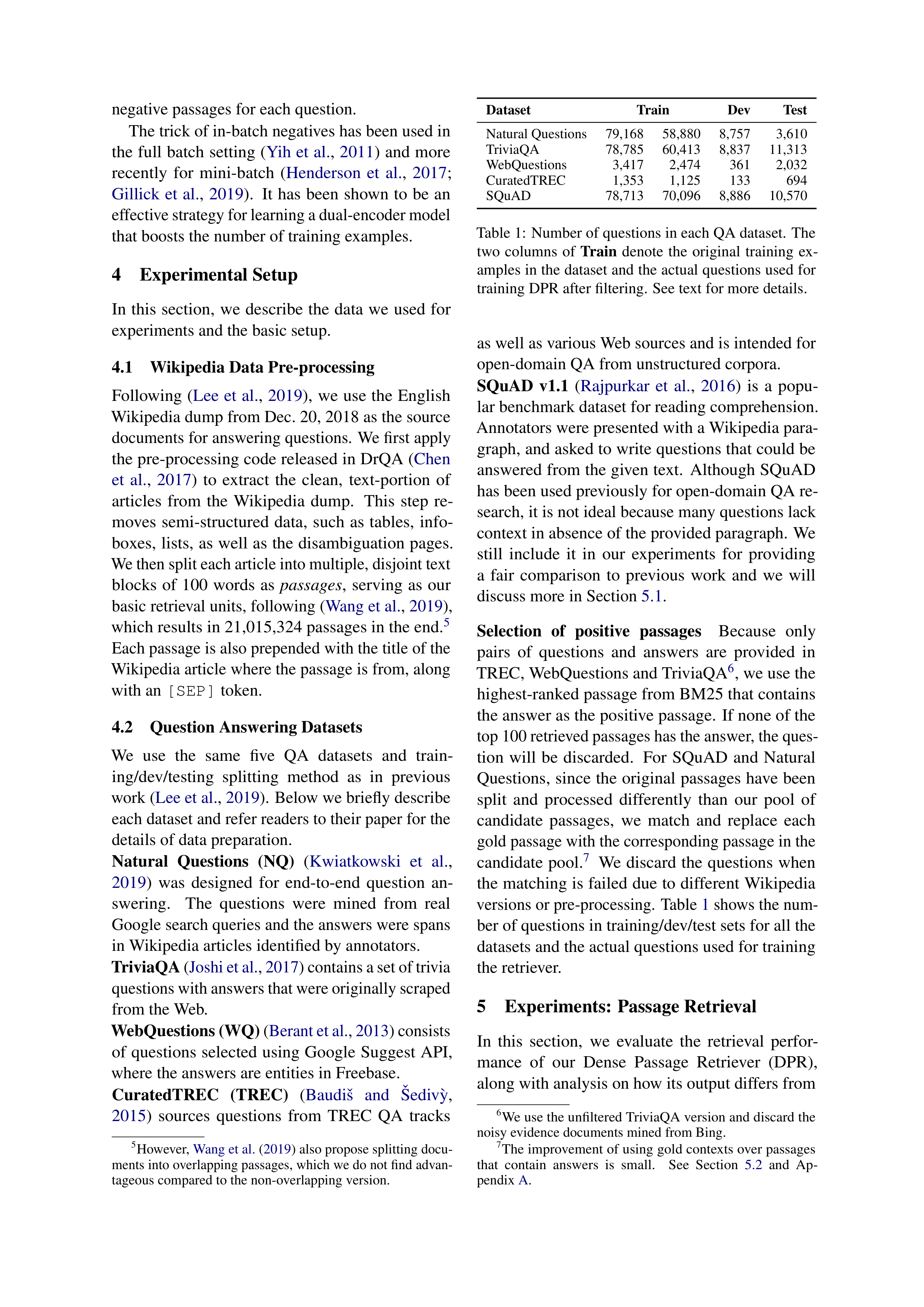
Table 1:
Number of questions in each QA dataset.
The
two
columns
of
Train
denote
the
original
training
ex-
amples in the dataset and the actual questions used for
training DPR after filtering.
See text for more details.
as well as various Web sources and is intended for
open-domain QA from unstructured corpora.
SQuAD
v1.1
(
Rajpurkar
et
al.
,
2016
)
is
a
popu-
lar benchmark dataset for reading comprehension.
Annotators were presented with a Wikipedia para-
graph, and asked to write questions that could be
answered from the given text.
Although SQuAD
has been used previously for open-domain QA re-
search, it is not ideal because many questions lack
context in absence of the provided paragraph.
We
still
include
it
in
our
experiments
for
providing
a
fair
comparison
to
previous
work
and
we
will
discuss more in Section
5.1
.
Selection
of
positive
passages
Because
only
pairs
of
questions
and
answers
are
provided
in
TREC, WebQuestions and TriviaQA
6
, we use the
highest-ranked passage from BM25 that contains
the answer as the positive passage.
If none of the
top 100 retrieved passages has the answer, the ques-
tion
will
be
discarded.
For
SQuAD
and
Natural
Questions,
since the original passages have been
split
and
processed
differently
than
our
pool
of
candidate
passages,
we
match
and
replace
each
gold passage with the corresponding passage in the
candidate
pool.
7
We
discard
the
questions
when
the matching is failed due to different Wikipedia
versions or pre-processing.
Table
1
shows the num-
ber of questions in training/dev/test sets for all the
datasets and the actual questions used for training
the retriever.
5
Experiments:
Passage Retrieval
In
this
section,
we
evaluate
the
retrieval
perfor-
mance
of
our
Dense
Passage
Retriever
(DPR),
along with analysis on how its output differs from
6
We use the unfiltered TriviaQA version and discard the
noisy evidence documents mined from Bing.
7
The improvement of using gold contexts over passages
that
contain
answers
is
small.
See
Section
5.2
and
Ap-
pendix
A
.
Training
Retriever
Top-20
Top-100
NQ
TriviaQA
WQ
TREC
SQuAD
NQ
TriviaQA
WQ
TREC
SQuAD
None
BM25
59.1
66.9
55.0
70.9
68.8
73.7
76.7
71.1
84.1
80.0
Single
DPR
78.4
79.4
73.2
79.8
63.2
85.4
85.0
81.4
89.1
77.2
BM25 + DPR
76.6
79.8
71.0
85.2
71.5
83.8
84.5
80.5
92.7
81.3
Multi
DPR
79.4
78.8
75.0
89.1
51.6
86.0
84.7
82.9
93.9
67.6
BM25 + DPR
78.0
79.9
74.7
88.5
66.2
83.9
84.4
82.3
94.1
78.6
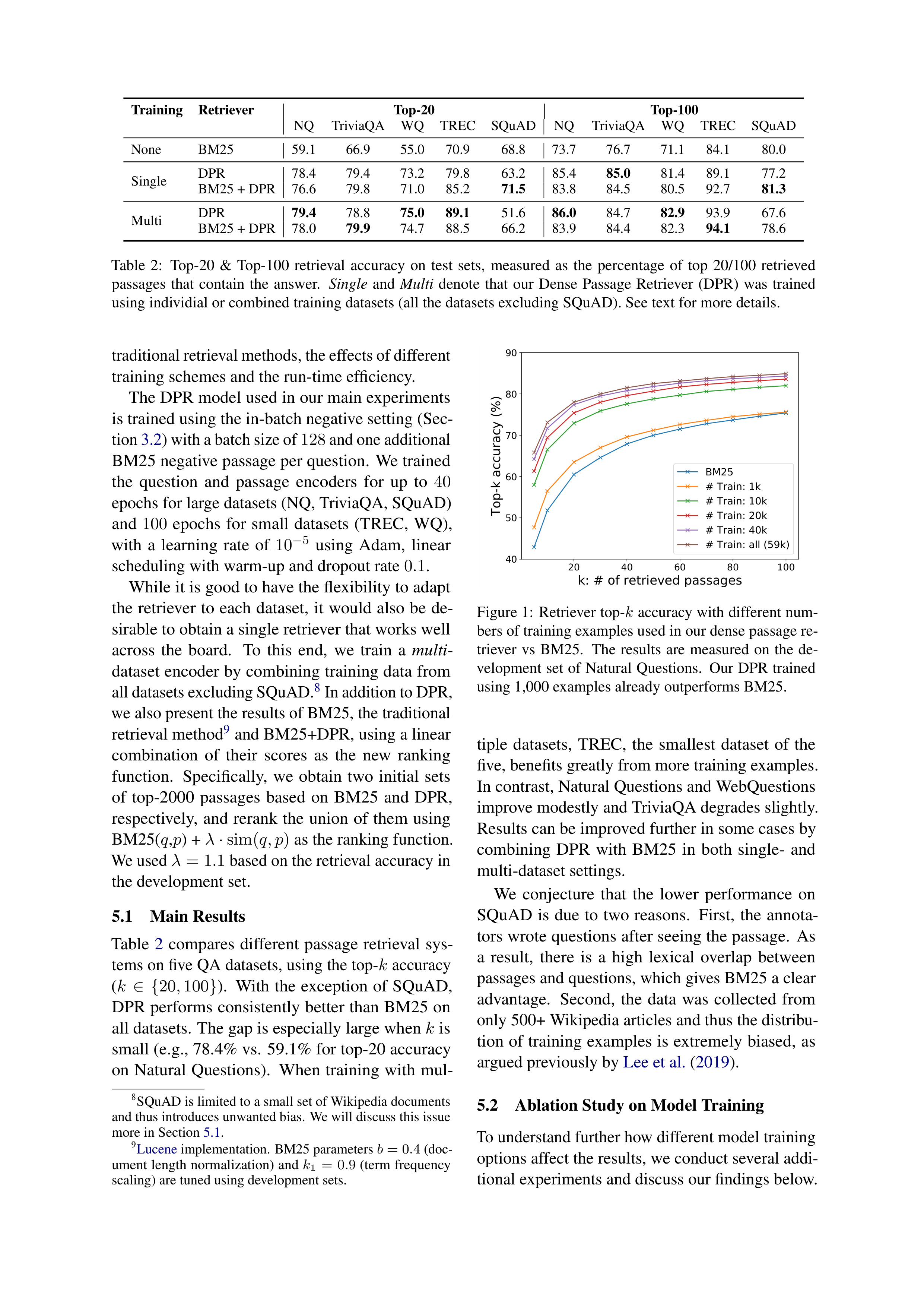
Table
2:
Top-20
&
Top-100
retrieval
accuracy
on
test
sets,
measured
as
the
percentage
of
top
20/100
retrieved
passages
that
contain
the
answer.
Single
and
Multi
denote
that
our
Dense
Passage
Retriever
(DPR)
was
trained
using individial or combined training datasets (all the datasets excluding SQuAD). See text for more details.
traditional retrieval methods, the effects of different
training schemes and the run-time efficiency.
The DPR model used in our main experiments
is trained using the in-batch negative setting (Sec-
tion
3.2
) with a batch size of
128
and one additional
BM25 negative passage per question.
We trained
the
question
and
passage
encoders
for
up
to
40
epochs for large datasets (NQ, TriviaQA, SQuAD)
and
100
epochs
for
small
datasets
(TREC,
WQ),
with
a
learning
rate
of
10
−
5
using
Adam,
linear
scheduling with warm-up and dropout rate
0
.
1
.
While it is good to have the flexibility to adapt
the
retriever to
each
dataset,
it
would
also
be de-
sirable to obtain a single retriever that works well
across
the
board.
To
this
end,
we
train
a
multi
-
dataset encoder by combining training data from
all datasets excluding SQuAD.
8
In addition to DPR,
we also present the results of BM25, the traditional
retrieval method
9
and BM25+DPR, using a linear
combination
of
their
scores
as
the
new
ranking
function.
Specifically,
we
obtain
two
initial
sets
of
top-2000
passages
based
on
BM25
and
DPR,
respectively,
and
rerank
the
union
of
them
using
BM25(
q
,
p
) +
λ
·
sim(
q, p
)
as the ranking function.
We used
λ
= 1
.
1
based on the retrieval accuracy in
the development set.
5.1
Main Results
Table
2
compares
different
passage
retrieval
sys-
tems on five QA datasets, using the top-
k
accuracy
(
k
∈{
20
,
100
}
).
With
the
exception
of
SQuAD,
DPR performs consistently better than BM25 on
all datasets.
The gap is especially large when
k
is
small (e.g., 78.4% vs.
59.1% for top-20 accuracy
on
Natural
Questions).
When
training
with
mul-
8
SQuAD is limited to a small set of Wikipedia documents
and thus introduces unwanted bias.
We will discuss this issue
more in Section
5.1
.
9
Lucene
implementation.
BM25 parameters
b
= 0
.
4
(doc-
ument length normalization) and
k
1
=
0
.
9
(term frequency
scaling) are tuned using development sets.
20
40
60
80
100
k: # of retrieved passages
40
50
60
70
80
90
Top-k accuracy (%)
BM25
# Train: 1k
# Train: 10k
# Train: 20k
# Train: 40k
# Train: all (59k)
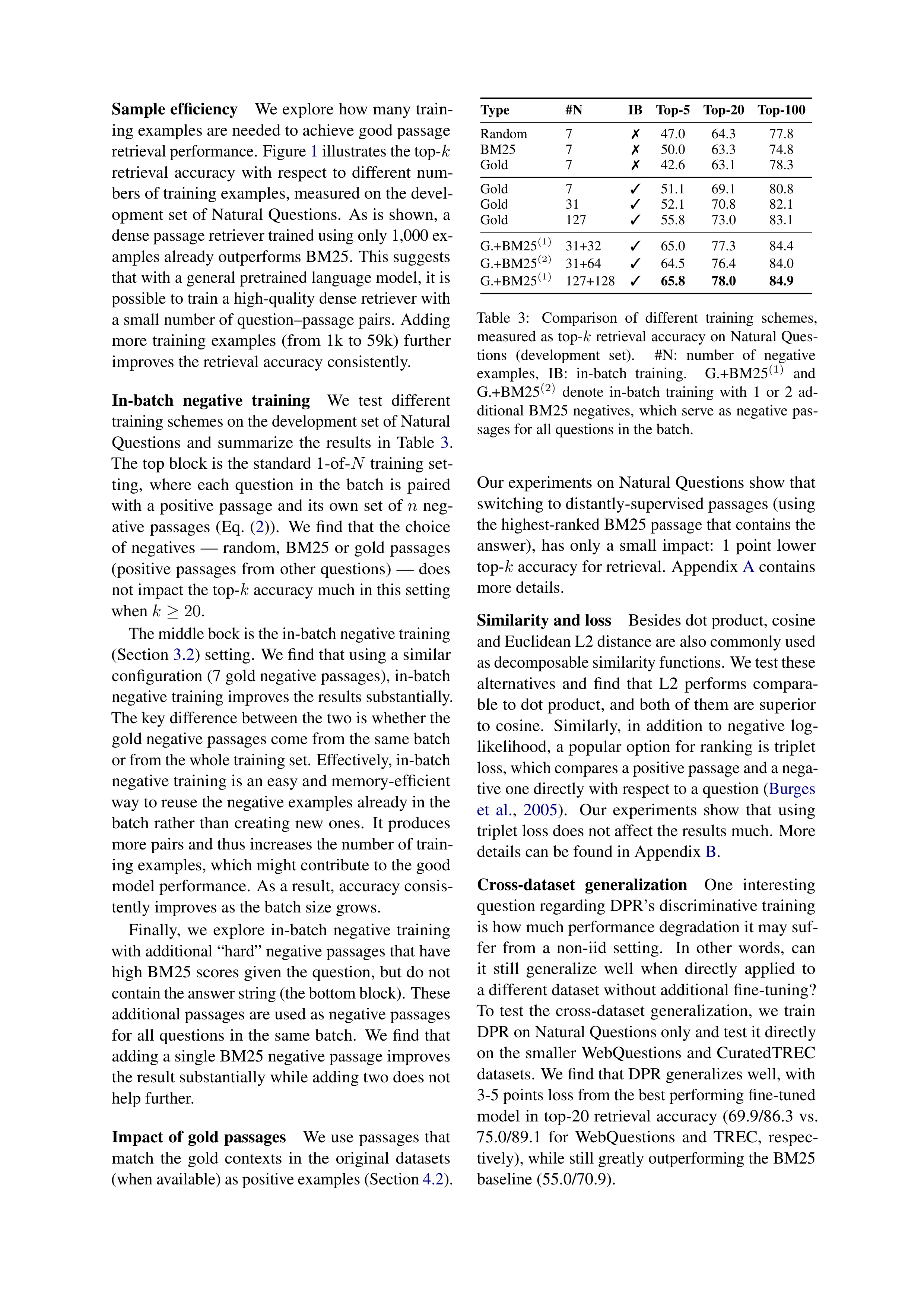
Figure 1:
Retriever top-
k
accuracy with different num-
bers of training examples used in our dense passage re-
triever
vs
BM25.
The
results
are
measured
on
the
de-
velopment set of Natural Questions.
Our DPR trained
using 1,000 examples already outperforms BM25.
tiple
datasets,
TREC,
the
smallest
dataset
of
the
five, benefits greatly from more training examples.
In contrast, Natural Questions and WebQuestions
improve modestly and TriviaQA degrades slightly.
Results can be improved further in some cases by
combining
DPR
with
BM25
in
both
single-
and
multi-dataset settings.
We
conjecture
that
the
lower
performance
on
SQuAD
is
due
to
two
reasons.
First,
the
annota-
tors wrote questions after seeing the passage.
As
a
result,
there
is
a
high
lexical
overlap
between
passages and questions, which gives BM25 a clear
advantage.
Second,
the
data
was
collected
from
only 500+ Wikipedia articles and thus the distribu-
tion of training examples is extremely biased,
as
argued previously by
Lee et al.
(
2019
).
5.2
Ablation Study on Model Training
To understand further how different model training
options affect the results, we conduct several addi-
tional experiments and discuss our findings below.
Sample efficiency
We explore how many train-
ing examples are needed to achieve good passage
retrieval performance.
Figure
1
illustrates the top-
k
retrieval
accuracy
with
respect
to
different
num-
bers of training examples, measured on the devel-
opment set of Natural Questions.
As is shown, a
dense passage retriever trained using only 1,000 ex-
amples already outperforms BM25.
This suggests
that with a general pretrained language model, it is
possible to train a high-quality dense retriever with
a small number of question–passage pairs.
Adding
more
training
examples
(from
1k
to
59k)
further
improves the retrieval accuracy consistently.
In-batch
negative
training
We
test
different
training schemes on the development set of Natural
Questions
and
summarize
the
results
in
Table
3
.
The top block is the standard 1-of-
N
training set-
ting,
where
each
question
in
the
batch
is
paired
with a
positive
passage and its own set of
n
neg-
ative
passages
(Eq.
(
2
)
).
We
find
that
the
choice
of negatives
— random,
BM25 or gold
passages
(positive passages from other questions) — does
not impact the top-
k
accuracy much in this setting
when
k
≥
20
.
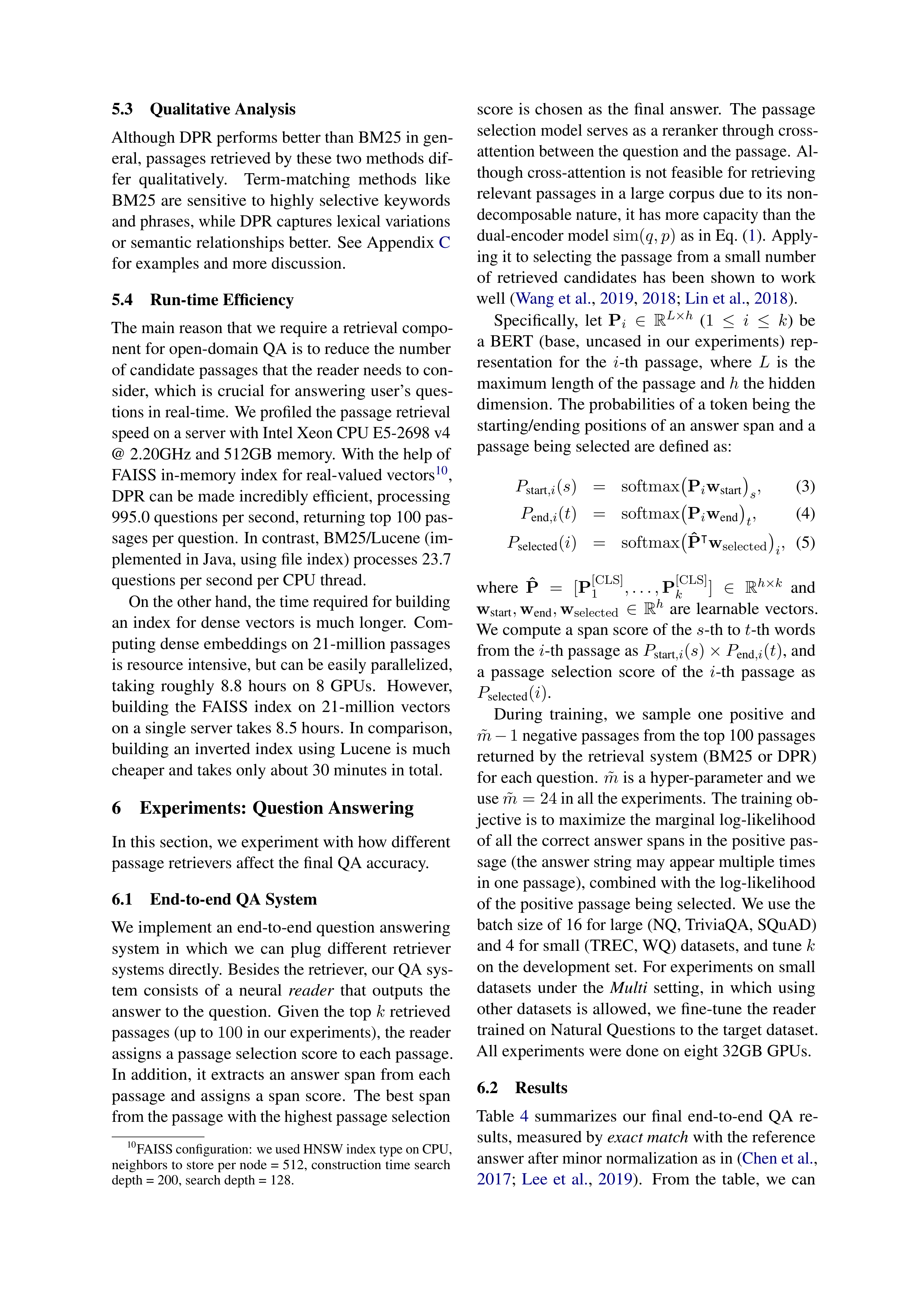
The middle bock is the in-batch negative training
(Section
3.2
) setting.
We find that using a similar
configuration (7 gold negative passages), in-batch
negative training improves the results substantially.
The key difference between the two is whether the
gold negative passages come from the same batch
or from the whole training set.
Effectively, in-batch
negative training is an easy and memory-efficient
way to reuse the negative examples already in the
batch rather than creating new ones.
It produces
more pairs and thus increases the number of train-
ing examples, which might contribute to the good
model performance.
As a result, accuracy consis-
tently improves as the batch size grows.
Finally,
we
explore
in-batch
negative
training
with additional “hard” negative passages that have
high BM25 scores given the question, but do not
contain the answer string (the bottom block). These
additional passages are used as negative passages
for all questions in the same batch.
We find that
adding a single BM25 negative passage improves
the result substantially while adding two does not
help further.
Impact
of
gold
passages
We
use
passages
that
match
the
gold
contexts
in
the
original
datasets
(when available) as positive examples (Section
4.2
).
Type
#N
IB
Top-5
Top-20
Top-100
Random
7
47.0
64.3
77.8
BM25
7
50.0
63.3
74.8
Gold
7
42.6
63.1
78.3
Gold
7
51.1
69.1
80.8
Gold
31
52.1
70.8
82.1
Gold
127
55.8
73.0
83.1
G.+BM25
(1)
31+32
65.0
77.3
84.4
G.+BM25
(2)
31+64
64.5
76.4
84.0
G.+BM25
(1)
127+128
65.8
78.0
84.9
Table
3:
Comparison
of
different
training
schemes,
measured as top-
k
retrieval accuracy on Natural Ques-
tions
(development
set).
#N:
number
of
negative
examples,
IB:
in-batch
training.
G.+BM25
(1)
and
G.+BM25
(2)
denote
in-batch
training
with
1
or
2
ad-
ditional
BM25
negatives,
which
serve
as
negative
pas-
sages for all questions in the batch.
Our experiments on Natural Questions show that
switching to distantly-supervised passages (using
the highest-ranked BM25 passage that contains the
answer),
has
only
a
small
impact:
1
point
lower
top-
k
accuracy for retrieval.
Appendix
A
contains
more details.
Similarity and loss
Besides dot product, cosine
and Euclidean L2 distance are also commonly used
as decomposable similarity functions. We test these
alternatives
and
find
that
L2
performs
compara-
ble to dot product, and both of them are superior
to
cosine.
Similarly,
in
addition
to
negative
log-
likelihood, a popular option for ranking is triplet
loss, which compares a positive passage and a nega-
tive one directly with respect to a question (
Burges
et
al.
,
2005
).
Our
experiments
show
that
using
triplet loss does not affect the results much.
More
details can be found in Appendix
B
.
Cross-dataset
generalization
One
interesting
question regarding DPR’s discriminative training
is how much performance degradation it may suf-
fer
from
a
non-iid
setting.
In
other
words,
can
it
still
generalize
well
when
directly
applied
to
a different dataset without additional fine-tuning?
To
test
the
cross-dataset
generalization,
we
train
DPR on Natural Questions only and test it directly
on the smaller WebQuestions and CuratedTREC
datasets.
We find that DPR generalizes well, with
3-5 points loss from the best performing fine-tuned
model
in
top-20
retrieval
accuracy
(69.9/86.3
vs.
75.0/89.1
for
WebQuestions
and
TREC,
respec-
tively), while still greatly outperforming the BM25
baseline (55.0/70.9).
5.3
Qualitative Analysis
Although DPR performs better than BM25 in gen-
eral, passages retrieved by these two methods dif-
fer
qualitatively.
Term-matching
methods
like
BM25 are sensitive to highly selective keywords
and phrases, while DPR captures lexical variations
or semantic relationships better.
See Appendix
C
for examples and more discussion.
5.4
Run-time Efficiency
The main reason that we require a retrieval compo-
nent for open-domain QA is to reduce the number
of candidate passages that the reader needs to con-
sider, which is crucial for answering user’s ques-
tions in real-time.
We profiled the passage retrieval
speed on a server with Intel Xeon CPU E5-2698 v4
@ 2.20GHz and 512GB memory.
With the help of
FAISS in-memory index for real-valued vectors
10
,
DPR can be made incredibly efficient, processing
995.0 questions per second, returning top 100 pas-
sages per question.
In contrast, BM25/Lucene (im-
plemented in Java, using file index) processes 23.7
questions per second per CPU thread.
On the other hand, the time required for building
an index for dense vectors is much longer.
Com-
puting dense embeddings on 21-million passages
is resource intensive, but can be easily parallelized,
taking
roughly
8.8
hours
on
8
GPUs.
However,
building
the
FAISS
index
on
21-million
vectors
on a single server takes 8.5 hours.
In comparison,
building an inverted index using Lucene is much
cheaper and takes only about 30 minutes in total.
6
Experiments:
Question Answering
In this section, we experiment with how different
passage retrievers affect the final QA accuracy.
6.1
End-to-end QA System
We implement an end-to-end question answering
system
in
which
we
can
plug
different
retriever
systems directly.
Besides the retriever, our QA sys-
tem
consists
of
a
neural
reader
that
outputs
the
answer to the question.
Given the top
k
retrieved
passages (up to
100
in our experiments), the reader
assigns a passage selection score to each passage.
In addition, it extracts an answer span from each
passage and assigns a span score.
The best span
from the passage with the highest passage selection
10
FAISS configuration: we used HNSW index type on CPU,
neighbors to store per node = 512, construction time search
depth = 200, search depth = 128.
score is chosen as the final answer.
The passage
selection model serves as a reranker through cross-
attention between the question and the passage.
Al-
though cross-attention is not feasible for retrieving
relevant passages in a large corpus due to its non-
decomposable nature, it has more capacity than the
dual-encoder model
sim(
q, p
)
as in Eq.
(
1
)
.
Apply-
ing it to selecting the passage from a small number
of
retrieved
candidates
has
been
shown
to
work
well (
Wang et al.
,
2019
,
2018
;
Lin et al.
,
2018
).
Specifically,
let
P
i
∈
R
L
×
h
(
1
≤
i
≤
k
)
be
a
BERT
(base,
uncased
in
our
experiments)
rep-
resentation
for
the
i
-th
passage,
where
L
is
the
maximum length of the passage and
h
the hidden
dimension.
The probabilities of a token being the
starting/ending positions of an answer span and a
passage being selected are defined as:
P
start
,i
(
s
)
=
softmax
�
P
i
w
start
s
,
(3)
P
end
,i
(
t
)
=
softmax
�
P
i
w
end
t
,
(4)
P
selected
(
i
)
=
softmax
�
ˆP
⊺
w
selected
i
,
(5)
where
ˆ
P
=
[
P
[CLS]
1
, . . . ,
P
[CLS]
k
]
∈
R
h
×
k
and
w
start
,
w
end
,
w
selected
∈
R
h
are
learnable
vectors.
We compute a span score of the
s
-th to
t
-th words
from the
i
-th passage as
P
start
,i
(
s
)
×
P
end
,i
(
t
)
, and
a
passage
selection
score
of
the
i
-th
passage
as
P
selected
(
i
)
.
During
training,
we
sample
one
positive
and
˜
m
−
1
negative passages from the top 100 passages
returned by the retrieval system (BM25 or DPR)
for each question.
˜
m
is a hyper-parameter and we
use
˜
m
= 24
in all the experiments.
The training ob-
jective is to maximize the marginal log-likelihood
of all the correct answer spans in the positive pas-
sage (the answer string may appear multiple times
in one passage), combined with the log-likelihood
of the positive passage being selected.
We use the
batch size of 16 for large (NQ, TriviaQA, SQuAD)
and 4 for small (TREC, WQ) datasets, and tune
k
on the development set.
For experiments on small
datasets
under
the
Multi
setting,
in
which
using
other datasets is allowed, we fine-tune the reader
trained on Natural Questions to the target dataset.
All experiments were done on eight 32GB GPUs.
6.2
Results
Table
4
summarizes
our
final
end-to-end
QA
re-
sults, measured by
exact match
with the reference
answer after minor normalization as in (
Chen et al.
,
2017
;
Lee
et
al.
,
2019
).
From
the
table,
we
can
Training
Model
NQ
TriviaQA
WQ
TREC
SQuAD
Single
BM25+BERT (
Lee et al.
,
2019
)
26.5
47.1
17.7
21.3
33.2
Single
ORQA (
Lee et al.
,
2019
)
33.3
45.0
36.4
30.1
20.2
Single
HardEM (
Min et al.
,
2019a
)
28.1
50.9
-
-
-
Single
GraphRetriever (
Min et al.
,
2019b
)
34.5
56.0
36.4
-
-
Single
PathRetriever (
Asai et al.
,
2020
)
32.6
-
-
-
56.5
Single
REALM
Wiki
(
Guu et al.
,
2020
)
39.2
-
40.2
46.8
-
Single
REALM
News
(
Guu et al.
,
2020
)
40.4
-
40.7
42.9
-
Single
BM25
32.6
52.4
29.9
24.9
38.1
DPR
41.5
56.8
34.6
25.9
29.8
BM25+DPR
39.0
57.0
35.2
28.0
36.7
Multi
DPR
41.5
56.8
42.4
49.4
24.1
BM25+DPR
38.8
57.9
41.1
50.6
35.8
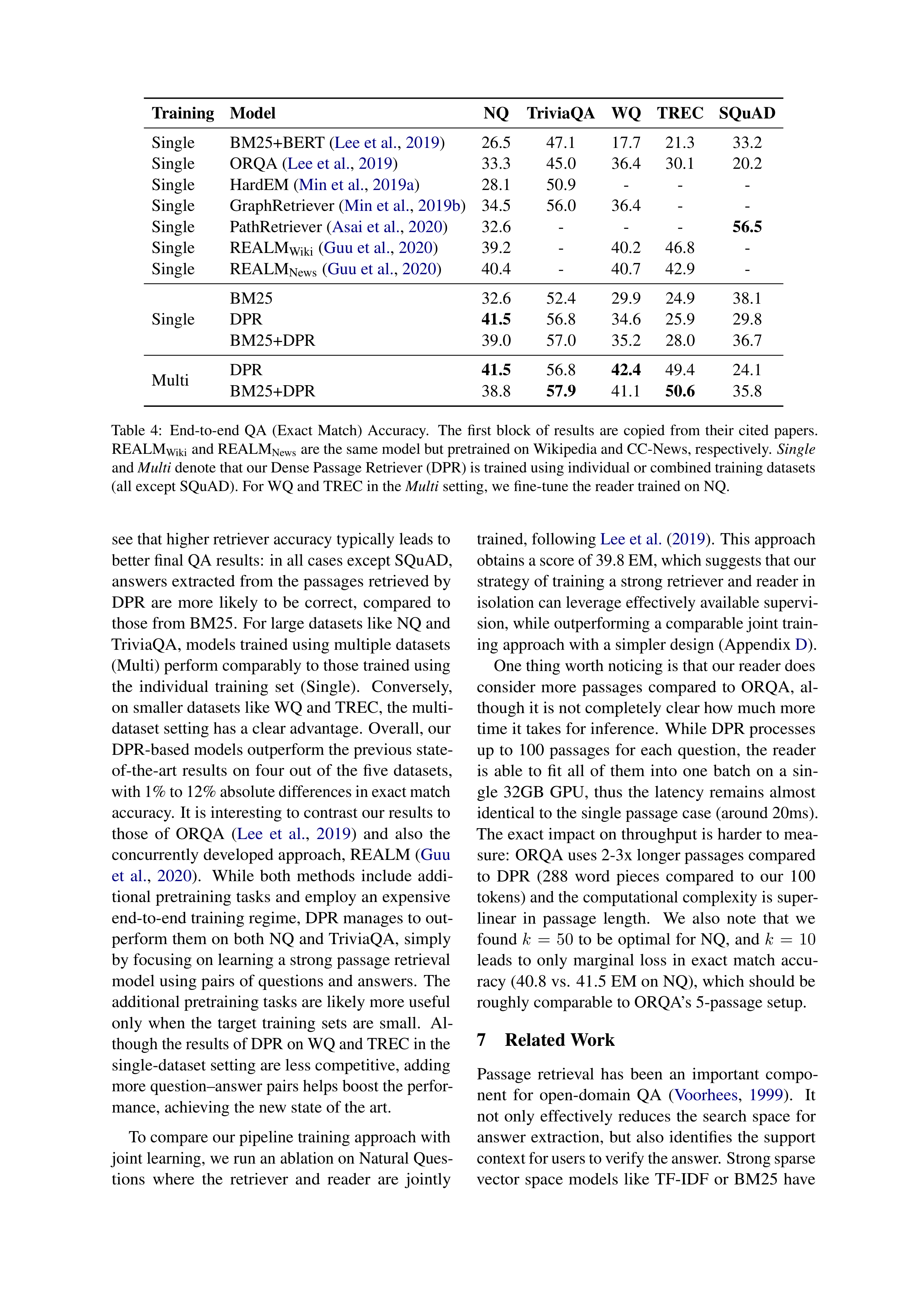
Table
4:
End-to-end
QA
(Exact
Match)
Accuracy.
The
first
block
of
results
are
copied
from
their
cited
papers.
REALM
Wiki
and REALM
News
are the same model but pretrained on Wikipedia and CC-News, respectively.
Single
and
Multi
denote that our Dense Passage Retriever (DPR) is trained using individual or combined training datasets
(all except SQuAD). For WQ and TREC in the
Multi
setting, we fine-tune the reader trained on NQ.
see that higher retriever accuracy typically leads to
better final QA results:
in all cases except SQuAD,
answers extracted from the passages retrieved by
DPR
are
more
likely
to
be
correct,
compared
to
those from BM25.
For large datasets like NQ and
TriviaQA, models trained using multiple datasets
(Multi) perform comparably to those trained using
the
individual
training
set
(Single).
Conversely,
on smaller datasets like WQ and TREC, the multi-
dataset setting has a clear advantage.
Overall, our
DPR-based models outperform the previous state-
of-the-art
results
on
four
out
of
the
five
datasets,
with 1% to 12% absolute differences in exact match
accuracy.
It is interesting to contrast our results to
those
of
ORQA
(
Lee
et
al.
,
2019
)
and
also
the
concurrently developed approach, REALM (
Guu
et
al.
,
2020
).
While
both
methods
include
addi-
tional pretraining tasks and employ an expensive
end-to-end training regime, DPR manages to out-
perform them on both NQ and TriviaQA, simply
by focusing on learning a strong passage retrieval
model using pairs of questions and answers.
The
additional pretraining tasks are likely more useful
only
when
the
target
training
sets
are
small.
Al-
though the results of DPR on WQ and TREC in the
single-dataset setting are less competitive, adding
more question–answer pairs helps boost the perfor-
mance, achieving the new state of the art.
To compare our pipeline training approach with
joint learning, we run an ablation on Natural Ques-
tions
where
the
retriever
and
reader
are
jointly
trained, following
Lee et al.
(
2019
).
This approach
obtains a score of 39.8 EM, which suggests that our
strategy of training a strong retriever and reader in
isolation can leverage effectively available supervi-
sion, while outperforming a comparable joint train-
ing approach with a simpler design (Appendix
D
).
One thing worth noticing is that our reader does
consider
more
passages
compared
to
ORQA,
al-
though it is not completely clear how much more
time it takes for inference.
While DPR processes
up
to
100
passages
for
each
question,
the
reader
is
able
to
fit
all
of
them
into
one
batch
on
a
sin-
gle
32GB
GPU,
thus
the
latency
remains
almost
identical to the single passage case (around 20ms).
The exact impact on throughput is harder to mea-
sure:
ORQA uses 2-3x longer passages compared
to
DPR
(288
word
pieces
compared
to
our
100
tokens) and the computational complexity is super-
linear
in
passage
length.
We
also
note
that
we
found
k
=
50
to be optimal for NQ, and
k
=
10
leads
to
only
marginal
loss
in
exact
match
accu-
racy (40.8 vs.
41.5 EM on NQ), which should be
roughly comparable to ORQA’s 5-passage setup.
7
Related Work
Passage
retrieval
has
been
an
important
compo-
nent
for
open-domain
QA
(
Voorhees
,
1999
).
It
not
only
effectively
reduces
the
search
space
for
answer extraction,
but also identifies the support
context for users to verify the answer. Strong sparse
vector
space
models
like
TF-IDF
or
BM25
have
been used as the standard method applied broadly
to various QA tasks (e.g.,
Chen et al.
,
2017
;
Yang
et al.
,
2019a
,
b
;
Nie et al.
,
2019
;
Min et al.
,
2019a
;
Wolfson et al.
,
2020
).
Augmenting text-based re-
trieval with external structured information, such
as knowledge graph and Wikipedia hyperlinks, has
also been explored recently (
Min et al.
,
2019b
;
Asai
et al.
,
2020
).
The use of dense vector representations for re-
trieval
has
a
long
history
since
Latent
Semantic
Analysis (
Deerwester et al.
,
1990
).
Using labeled
pairs of queries and documents,
discriminatively
trained
dense
encoders
have
become
popular
re-
cently (
Yih et al.
,
2011
;
Huang et al.
,
2013
;
Gillick
et
al.
,
2019
),
with
applications
to
cross-lingual
document retrieval, ad relevance prediction, Web
search and entity retrieval.
Such approaches com-
plement the sparse vector methods as they can po-
tentially give high similarity scores to semantically
relevant text pairs, even without exact token match-
ing.
The dense representation alone,
however,
is
typically inferior to the sparse one.
While not the
focus of this work, dense representations from pre-
trained models, along with cross-attention mecha-
nisms, have also been shown effective in passage
or
dialogue
re-ranking
tasks
(
Nogueira
and
Cho
,
2019
;
Humeau et al.
,
2020
).
Finally, a concurrent
work
(
Khattab
and
Zaharia
,
2020
)
demonstrates
the
feasibility
of
full
dense
retrieval
in
IR
tasks.
Instead of employing the dual-encoder framework,
they introduced a late-interaction operator on top
of the BERT encoders.
Dense retrieval for open-domain QA has been
explored by
Das et al.
(
2019
), who propose to re-
trieve relevant passages iteratively using reformu-
lated question vectors.
As an alternative approach
that skips passage retrieval,
Seo et al.
(
2019
) pro-
pose to encode candidate answer phrases as vectors
and directly retrieve the answers to the input ques-
tions efficiently.
Using additional pretraining with
the objective that matches surrogates of questions
and relevant passages,
Lee et al.
(
2019
) jointly train
the question encoder and reader.
Their approach
outperforms
the
BM25
plus
reader
paradigm
on
multiple open-domain QA datasets in QA accuracy,
and
is
further
extended
by
REALM
(
Guu
et
al.
,
2020
), which includes tuning the passage encoder
asynchronously
by
re-indexing
the
passages
dur-
ing
training.
The
pretraining
objective
has
also
recently
been
improved
by
Xiong
et
al.
(
2020b
).
In contrast,
our model provides a simple and yet
effective solution that shows stronger empirical per-
formance, without relying on additional pretraining
or complex joint training schemes.
DPR
has
also
been
used
as
an
important
mod-
ule
in
very
recent
work.
For
instance,
extending
the idea of leveraging hard negatives,
Xiong et al.
(
2020a
) use the retrieval model trained in the pre-
vious iteration to discover new negatives and con-
struct a different set of examples in each training
iteration.
Starting
from
our
trained
DPR
model,
they
show
that
the
retrieval
performance
can
be
further improved.
Recent work (
Izacard and Grave
,
2020
;
Lewis
et
al.
,
2020b
)
have
also
shown
that
DPR
can
be
combined
with
generation
models
such as BART (
Lewis et al.
,
2020a
) and T5 (
Raf-
fel
et
al.
,
2019
),
achieving
good
performance
on
open-domain QA and other knowledge-intensive
tasks.
8
Conclusion
In this work, we demonstrated that dense retrieval
can
outperform
and
potentially
replace
the
tradi-
tional sparse retrieval component in open-domain
question answering.
While a simple dual-encoder
approach can be made to work surprisingly well,
we showed that there are some critical ingredients
to training a dense retriever successfully.
Moreover,
our empirical analysis and ablation studies indicate
that more complex model frameworks or similarity
functions do not necessarily provide additional val-
ues.
As a result of improved retrieval performance,
we obtained new state-of-the-art results on multiple
open-domain question answering benchmarks.
Acknowledgments
We thank the anonymous reviewers for their helpful
comments and suggestions.
References
Akari Asai, Kazuma Hashimoto, Hannaneh Hajishirzi,
Richard
Socher,
and
Caiming
Xiong.
2020.
Learn-
ing to retrieve reasoning paths over Wikipedia graph
for question answering.
In
International Conference
on Learning Representations (ICLR)
.
Petr
Baudiˇs
and
Jan
ˇ
Sediv`y.
2015.
Modeling
of
the
question answering task in the yodaqa system.
In
In-
ternational Conference of the Cross-Language Eval-
uation
Forum
for
European
Languages
,
pages
222–
228. Springer.
Jonathan Berant, Andrew Chou, Roy Frostig, and Percy
Liang.
2013.
Semantic
parsing
on
Freebase
from
question-answer pairs.
In
Empirical Methods in Nat-
ural Language Processing (EMNLP)
.
Jane
Bromley,
Isabelle
Guyon,
Yann
LeCun,
Eduard
S¨ackinger, and Roopak Shah. 1994.
Signature verifi-
cation using a “Siamese” time delay neural network.
In
NIPS
, pages 737–744.
Chris
Burges,
Tal
Shaked,
Erin
Renshaw,
Ari
Lazier,
Matt
Deeds,
Nicole
Hamilton,
and
Greg
Hullender.
2005.
Learning
to
rank
using
gradient
descent.
In
Proceedings of the 22nd international conference on
Machine learning
, pages 89–96.
Danqi Chen,
Adam Fisch,
Jason Weston,
and Antoine
Bordes.
2017.
Reading
Wikipedia
to
answer
open-
domain
questions.
In
Association
for
Computa-
tional Linguistics (ACL)
, pages 1870–1879.
Rajarshi
Das,
Shehzaad
Dhuliawala,
Manzil
Zaheer,
and
Andrew
McCallum.
2019.
Multi-step
retriever-
reader interaction for scalable open-domain question
answering.
In
International
Conference
on
Learn-
ing Representations (ICLR)
.
Scott
Deerwester,
Susan
T
Dumais,
George
W
Fur-
nas,
Thomas
K
Landauer,
and
Richard
Harshman.
1990.
Indexing
by
latent
semantic
analysis.
Jour-
nal of the American society for information science
,
41(6):391–407.
Jacob
Devlin,
Ming-Wei
Chang,
Kenton
Lee,
and
Kristina
Toutanova.
2019.
BERT:
Pre-training
of
deep
bidirectional
transformers
for
language
under-
standing.
In
North
American
Association
for
Com-
putational Linguistics (NAACL)
.
David A Ferrucci. 2012.
Introduction to “This is Wat-
son”.
IBM
Journal
of
Research
and
Development
,
56(3.4):1–1.
Daniel
Gillick,
Sayali
Kulkarni,
Larry
Lansing,
Alessandro Presta,
Jason Baldridge,
Eugene Ie, and
Diego
Garcia-Olano.
2019.
Learning
dense
repre-
sentations for entity retrieval.
In
Computational Nat-
ural Language Learning (CoNLL)
.
Ruiqi Guo, Sanjiv Kumar, Krzysztof Choromanski, and
David Simcha. 2016.
Quantization based fast inner
product search.
In
Artificial Intelligence and Statis-
tics
, pages 482–490.
Kelvin
Guu,
Kenton
Lee,
Zora
Tung,
Panupong
Pa-
supat,
and
Ming-Wei
Chang.
2020.
REALM:
Retrieval-augmented
language
model
pre-training.
ArXiv
, abs/2002.08909.
Matthew Henderson, Rami Al-Rfou, Brian Strope, Yun-
hsuan
Sung,
L´aszl´o
Luk´acs,
Ruiqi
Guo,
Sanjiv
Ku-
mar,
Balint
Miklos,
and
Ray
Kurzweil.
2017.
Effi-
cient natural language response suggestion for smart
reply.
ArXiv
, abs/1705.00652.
Po-Sen
Huang,
Xiaodong
He,
Jianfeng
Gao,
Li
Deng,
Alex
Acero,
and
Larry
Heck.
2013.
Learning
deep
structured
semantic
models
for
Web
search
using
clickthrough
data.
In
ACM
International
Confer-
ence
on
Information
and
Knowledge
Management
(CIKM)
, pages 2333–2338.
Samuel
Humeau,
Kurt
Shuster,
Marie-Anne
Lachaux,
and
Jason
Weston.
2020.
Poly-encoders:
Architec-
tures and pre-training strategies for fast and accurate
multi-sentence scoring.
In
International Conference
on Learning Representations (ICLR)
.
Gautier Izacard and Edouard Grave. 2020.
Leveraging
passage retrieval with generative models for open do-
main question answering.
ArXiv
, abs/2007.01282.
Jeff
Johnson,
Matthijs
Douze,
and
Herv´e
J´egou.
2017.
Billion-scale
similarity
search
with
GPUs.
ArXiv
,
abs/1702.08734.
Mandar
Joshi,
Eunsol
Choi,
Daniel
Weld,
and
Luke
Zettlemoyer.
2017.
TriviaQA:
A
large
scale
dis-
tantly supervised challenge dataset for reading com-
prehension.
In
Association
for
Computational
Lin-
guistics (ACL)
, pages 1601–1611.
Omar
Khattab
and
Matei
Zaharia.
2020.
ColBERT:
Efficient
and
effective
passage
search
via
contextu-
alized
late
interaction
over
BERT.
In
ACM
SIGIR
Conference
on
Research
and
Development
in
Infor-
mation Retrieval (SIGIR)
, pages 39–48.
Brian
Kulis.
2013.
Metric
learning:
A
survey.
Foun-
dations and Trends in Machine Learning
, 5(4):287–
364.
Tom
Kwiatkowski,
Jennimaria
Palomaki,
Olivia
Red-
field,
Michael
Collins,
Ankur Parikh,
Chris
Alberti,
Danielle Epstein, Illia Polosukhin, Matthew Kelcey,
Jacob
Devlin,
Kenton
Lee,
Kristina
N.
Toutanova,
Llion
Jones,
Ming-Wei
Chang,
Andrew
Dai,
Jakob
Uszkoreit,
Quoc
Le,
and
Slav
Petrov.
2019.
Natu-
ral
questions:
a
benchmark
for
question
answering
research.
Transactions of the Association of Compu-
tational Linguistics (TACL)
.
Kenton Lee, Ming-Wei Chang, and Kristina Toutanova.
2019.
Latent
retrieval
for
weakly
supervised
open
domain question answering.
In
Association for Com-
putational Linguistics (ACL)
, pages 6086–6096.
Mike
Lewis,
Yinhan
Liu,
Naman
Goyal,
Mar-
jan
Ghazvininejad,
Abdelrahman
Mohamed,
Omer
Levy,
Veselin
Stoyanov,
and
Luke
Zettlemoyer.
2020a.
BART: Denoising sequence-to-sequence pre-
training for natural language generation, translation,
and
comprehension.
In
Association
for
Computa-
tional Linguistics (ACL)
, pages 7871–7880.
Patrick
Lewis,
Ethan
Perez,
Aleksandara
Piktus,
Fabio
Petroni,
Vladimir
Karpukhin,
Naman
Goyal,
Heinrich
K¨uttler,
Mike
Lewis,
Wen-tau
Yih,
Tim
Rockt¨aschel,
Sebastian
Riedel,
and
Douwe
Kiela.
2020b.
Retrieval-augmented
generation
for
knowledge-intensive
NLP
tasks.
In
Advances
in
Neural Information Processing Systems (NeurIPS)
.
Yankai Lin, Haozhe Ji, Zhiyuan Liu, and Maosong Sun.
2018.
Denoising
distantly
supervised
open-domain
question
answering.
In
Association
for
Computa-
tional Linguistics (ACL)
, pages 1736–1745.
Sewon
Min,
Danqi
Chen,
Hannaneh
Hajishirzi,
and
Luke
Zettlemoyer.
2019a.
A
discrete
hard
EM
ap-
proach
for
weakly
supervised
question
answering.
In
Empirical Methods in Natural Language Process-
ing (EMNLP)
.
Sewon Min,
Danqi Chen,
Luke Zettlemoyer,
and Han-
naneh Hajishirzi. 2019b.
Knowledge guided text re-
trieval and reading for open domain question answer-
ing.
ArXiv
, abs/1911.03868.
Dan
Moldovan,
Marius
Pas¸ca,
Sanda
Harabagiu,
and
Mihai
Surdeanu.
2003.
Performance
issues
and
er-
ror
analysis
in
an
open-domain
question
answering
system.
ACM Transactions on Information Systems
(TOIS)
, 21(2):133–154.
Stephen
Mussmann
and
Stefano
Ermon.
2016.
Learn-
ing and inference via maximum inner product search.
In
International
Conference
on
Machine
Learning
(ICML)
, pages 2587–2596.
Yixin Nie, Songhe Wang, and Mohit Bansal. 2019.
Re-
vealing the importance of semantic retrieval for ma-
chine reading at scale.
In
Empirical Methods in Nat-
ural Language Processing (EMNLP)
.
Rodrigo Nogueira and Kyunghyun Cho. 2019.
Passage
re-ranking with BERT.
ArXiv
, abs/1901.04085.
Colin Raffel, Noam Shazeer, Adam Roberts, Katherine
Lee,
Sharan
Narang,
Michael
Matena,
Yanqi
Zhou,
Wei Li,
and Peter J Liu. 2019.
Exploring the limits
of
transfer
learning
with
a
unified
text-to-text
trans-
former.
ArXiv
, abs/1910.10683.
Pranav Rajpurkar, Jian Zhang, Konstantin Lopyrev, and
Percy
Liang.
2016.
SQuAD:
100,000+
questions
for
machine
comprehension
of
text.
In
Empirical
Methods in Natural Language Processing (EMNLP)
,
pages 2383–2392.
Parikshit Ram and Alexander G Gray. 2012.
Maximum
inner-product
search
using
cone
trees.
In
Proceed-
ings
of
the
18th
ACM
SIGKDD
international
con-
ference
on
Knowledge
discovery
and
data
mining
,
pages 931–939.
Adam Roberts, Colin Raffel, and Noam Shazeer. 2020.
How much knowledge can you pack into the param-
eters of a language model?
ArXiv
, abs/2002.08910.
Stephen
Robertson
and
Hugo
Zaragoza.
2009.
The
probabilistic
relevance
framework:
BM25
and
be-
yond.
Foundations
and
Trends
in
Information
Re-
trieval
, 3(4):333–389.
Minjoon
Seo,
Jinhyuk
Lee,
Tom
Kwiatkowski,
Ankur
Parikh, Ali Farhadi, and Hannaneh Hajishirzi. 2019.
Real-time
open-domain
question
answering
with
dense-sparse phrase index.
In
Association for Com-
putational Linguistics (ACL)
.
Anshumali
Shrivastava
and
Ping
Li.
2014.
Asymmet-
ric LSH (ALSH) for sublinear time maximum inner
product
search
(MIPS).
In
Advances
in
Neural
In-
formation
Processing
Systems
(NIPS)
,
pages
2321–
2329.
Ellen
M
Voorhees.
1999.
The
TREC-8
question
an-
swering
track
report.
In
TREC
,
volume
99,
pages
77–82.
Shuohang Wang, Mo Yu, Xiaoxiao Guo, Zhiguo Wang,
Tim
Klinger,
Wei
Zhang,
Shiyu
Chang,
Gerry
Tesauro,
Bowen
Zhou,
and
Jing
Jiang.
2018.
Rˆ3:
Reinforced ranker-reader for open-domain question
answering.
In
Conference
on
Artificial
Intelligence
(AAAI)
.
Zhiguo Wang, Patrick Ng, Xiaofei Ma, Ramesh Nalla-
pati,
and
Bing
Xiang.
2019.
Multi-passage
BERT:
A
globally
normalized
bert
model
for
open-domain
question answering.
In
Empirical Methods in Natu-
ral Language Processing (EMNLP)
.
Tomer
Wolfson,
Mor
Geva,
Ankit
Gupta,
Matt
Gard-
ner,
Yoav
Goldberg,
Daniel
Deutch,
and
Jonathan
Berant.
2020.
Break
it
down:
A
question
under-
standing
benchmark.
Transactions
of
the
Associa-
tion of Computational Linguistics (TACL)
.
Lee
Xiong,
Chenyan
Xiong,
Ye
Li,
Kwok-Fung
Tang,
Jialin Liu, Paul Bennett, Junaid Ahmed, and Arnold
Overwijk.
2020a.
Approximate
nearest
neighbor
negative contrastive learning for dense text retrieval.
ArXiv
, abs/2007.00808.
Wenhan
Xiong,
Hankang
Wang,
and
William
Yang
Wang. 2020b.
Progressively pretrained dense corpus
index
for
open-domain
question
answering.
ArXiv
,
abs/2005.00038.
Wei Yang, Yuqing Xie, Aileen Lin, Xingyu Li, Luchen
Tan,
Kun
Xiong,
Ming
Li,
and
Jimmy
Lin.
2019a.
End-to-end
open-domain
question
answering
with
bertserini.
In
North American Association for Com-
putational Linguistics (NAACL)
, pages 72–77.
Wei Yang, Yuqing Xie, Luchen Tan, Kun Xiong, Ming
Li,
and
Jimmy
Lin.
2019b.
Data
augmentation
for
bert fine-tuning in open-domain question answering.
ArXiv
, abs/1904.06652.
Wen-tau
Yih,
Kristina
Toutanova,
John
C
Platt,
and
Christopher
Meek.
2011.
Learning
discriminative
projections
for
text
similarity
measures.
In
Com-
putational
Natural
Language
Learning
(CoNLL)
,
pages 247–256.
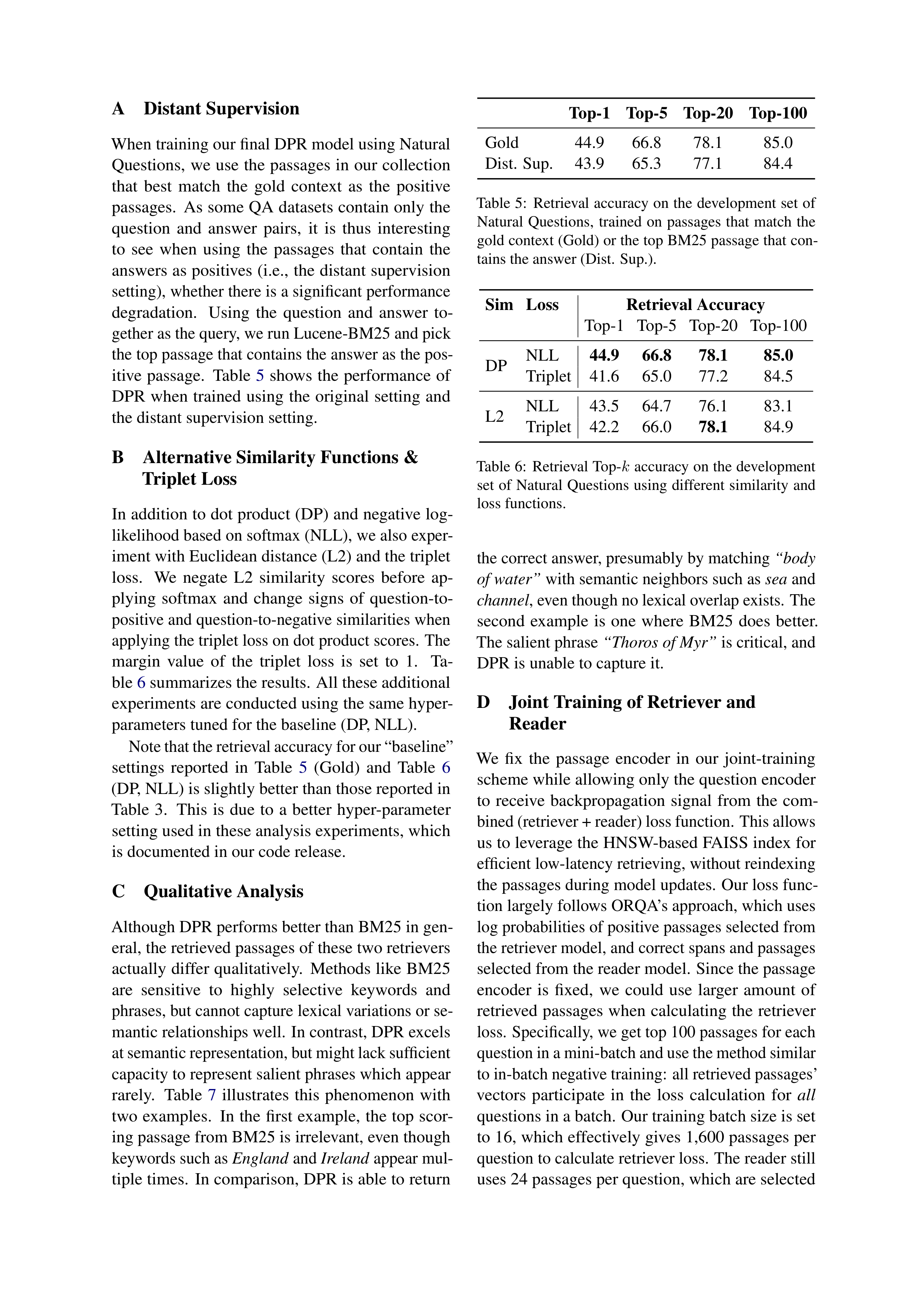
A
Distant Supervision
When training our final DPR model using Natural
Questions,
we use the passages in our collection
that
best
match
the
gold
context
as
the
positive
passages.
As some QA datasets contain only the
question
and
answer
pairs,
it
is
thus
interesting
to
see
when
using
the
passages
that
contain
the
answers as positives (i.e.,
the distant supervision
setting), whether there is a significant performance
degradation.
Using
the
question
and
answer
to-
gether as the query, we run Lucene-BM25 and pick
the top passage that contains the answer as the pos-
itive passage.
Table
5
shows the performance of
DPR
when
trained
using
the
original
setting
and
the distant supervision setting.
B
Alternative Similarity Functions &
Triplet Loss
In addition to dot product (DP) and negative log-
likelihood based on softmax (NLL), we also exper-
iment with Euclidean distance (L2) and the triplet
loss.
We
negate
L2
similarity
scores
before
ap-
plying
softmax
and
change
signs
of
question-to-
positive and question-to-negative similarities when
applying the triplet loss on dot product scores.
The
margin
value
of
the
triplet
loss
is
set
to
1.
Ta-
ble
6
summarizes the results.
All these additional
experiments are conducted using the same hyper-
parameters tuned for the baseline (DP, NLL).
Note that the retrieval accuracy for our “baseline”
settings
reported
in
Table
5
(Gold)
and
Table
6
(DP, NLL) is slightly better than those reported in
Table
3.
This
is
due
to
a
better
hyper-parameter
setting used in these analysis experiments, which
is documented in our code release.
C
Qualitative Analysis
Although DPR performs better than BM25 in gen-
eral, the retrieved passages of these two retrievers
actually differ qualitatively.
Methods like BM25
are
sensitive
to
highly
selective
keywords
and
phrases, but cannot capture lexical variations or se-
mantic relationships well.
In contrast, DPR excels
at semantic representation, but might lack sufficient
capacity to represent salient phrases which appear
rarely.
Table
7
illustrates
this
phenomenon
with
two
examples.
In
the
first
example,
the
top
scor-
ing passage from BM25 is irrelevant, even though
keywords such as
England
and
Ireland
appear mul-
tiple times.
In comparison, DPR is able to return
Top-1
Top-5
Top-20
Top-100
Gold
44.9
66.8
78.1
85.0
Dist.
Sup.
43.9
65.3
77.1
84.4
Table
5:
Retrieval
accuracy
on
the
development
set
of
Natural
Questions,
trained
on
passages
that
match
the
gold context (Gold) or the top BM25 passage that con-
tains the answer (Dist.
Sup.).
Sim
Loss
Retrieval Accuracy
Top-1
Top-5
Top-20
Top-100
DP
NLL
44.9
66.8
78.1
85.0
Triplet
41.6
65.0
77.2
84.5
L2
NLL
43.5
64.7
76.1
83.1
Triplet
42.2
66.0
78.1
84.9
Table 6:
Retrieval Top-
k
accuracy on the development
set of
Natural Questions
using different similarity
and
loss functions.
the correct answer, presumably by matching
“body
of water”
with semantic neighbors such as
sea
and
channel
, even though no lexical overlap exists.
The
second
example
is
one
where
BM25
does
better.
The salient phrase
“Thoros of Myr”
is critical, and
DPR is unable to capture it.
D
Joint Training of Retriever and
Reader
We
fix
the
passage
encoder
in
our
joint-training
scheme while allowing only the question encoder
to
receive
backpropagation
signal
from
the
com-
bined (retriever + reader) loss function.
This allows
us to leverage the HNSW-based FAISS index for
efficient low-latency retrieving, without reindexing
the passages during model updates.
Our loss func-
tion largely follows ORQA’s approach, which uses
log probabilities of positive passages selected from
the retriever model, and correct spans and passages
selected from the reader model.
Since the passage
encoder
is
fixed,
we
could
use
larger
amount
of
retrieved
passages
when
calculating
the
retriever
loss.
Specifically, we get top 100 passages for each
question in a mini-batch and use the method similar
to in-batch negative training:
all retrieved passages’
vectors
participate
in
the
loss
calculation
for
all
questions in a batch.
Our training batch size is set
to 16, which effectively gives 1,600 passages per
question to calculate retriever loss.
The reader still
uses 24 passages per question, which are selected
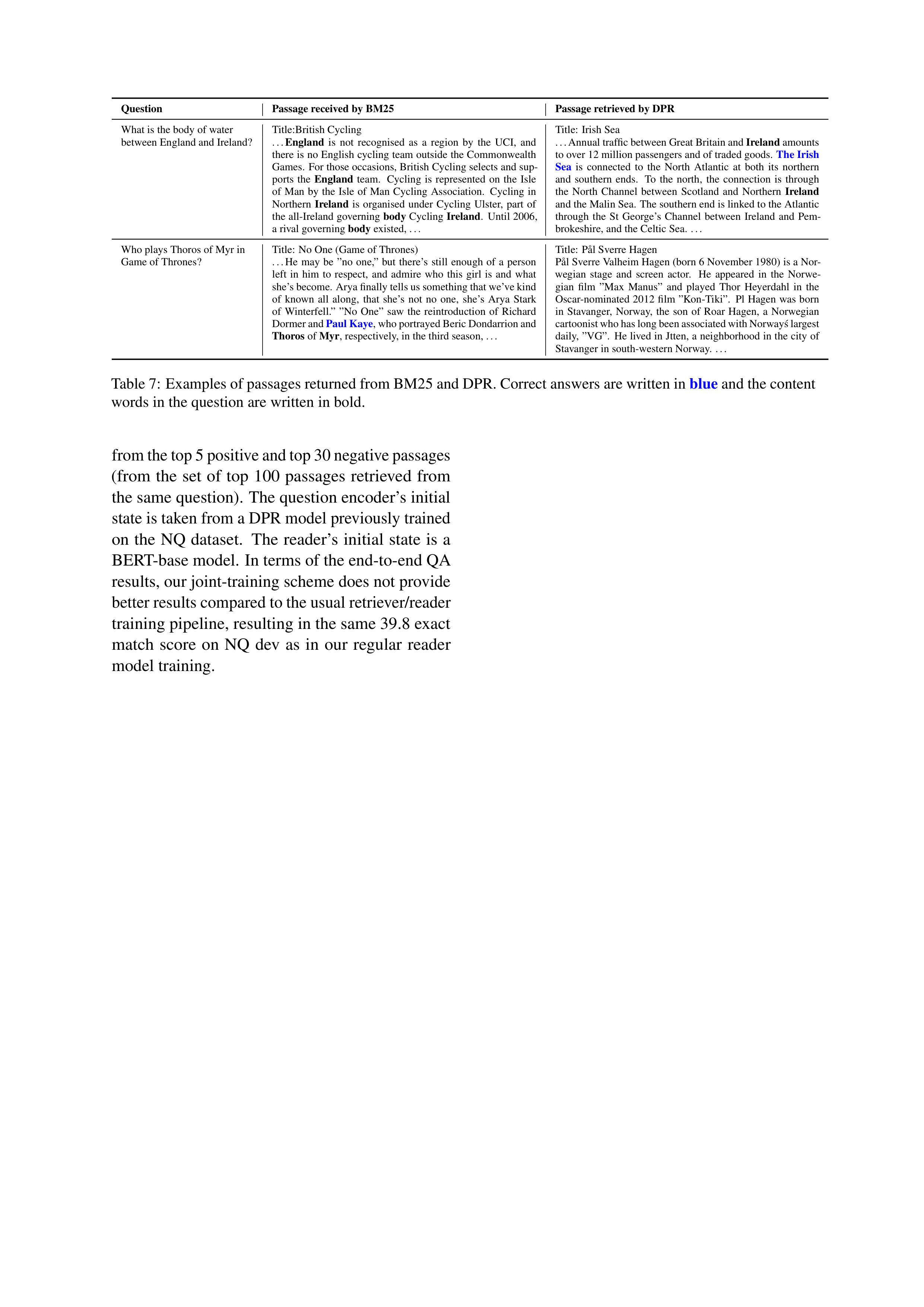
Question
Passage received by BM25
Passage retrieved by DPR
What is the body of water
between England and Ireland?
Title:British Cycling
Title:
Irish Sea
...
England
is
not
recognised
as
a
region
by
the
UCI,
and
there is no English cycling team outside the Commonwealth
Games.
For those occasions, British Cycling selects and sup-
ports
the
England
team.
Cycling
is
represented
on
the
Isle
of
Man
by
the
Isle
of
Man
Cycling
Association.
Cycling
in
Northern
Ireland
is
organised
under
Cycling
Ulster,
part
of
the all-Ireland governing
body
Cycling
Ireland
.
Until 2006,
a rival governing
body
existed, . . .
. . . Annual traffic between Great Britain and
Ireland
amounts
to over 12 million passengers and of traded goods.
The Irish
Sea
is
connected
to
the
North
Atlantic
at
both
its
northern
and
southern
ends.
To
the
north,
the
connection
is
through
the
North
Channel
between
Scotland
and
Northern
Ireland
and the Malin Sea.
The southern end is linked to the Atlantic
through
the
St
George’s
Channel
between
Ireland
and
Pem-
brokeshire, and the Celtic Sea.
. . .
Who plays Thoros of Myr in
Game of Thrones?
Title:
No One (Game of Thrones)
Title:
P˚al Sverre Hagen
...He
may
be
”no
one,”
but
there’s
still
enough
of
a
person
left
in
him
to
respect,
and
admire
who
this
girl
is
and
what
she’s become.
Arya finally tells us something that we’ve kind
of
known
all
along,
that
she’s
not
no
one,
she’s
Arya
Stark
of
Winterfell.”
”No
One”
saw
the
reintroduction
of
Richard
Dormer and
Paul Kaye
, who portrayed Beric Dondarrion and
Thoros
of
Myr
, respectively, in the third season, . . .
P˚al Sverre Valheim Hagen (born 6 November 1980) is a Nor-
wegian
stage
and
screen
actor.
He
appeared
in
the
Norwe-
gian
film
”Max
Manus”
and
played
Thor
Heyerdahl
in
the
Oscar-nominated
2012
film
”Kon-Tiki”.
Pl
Hagen
was
born
in
Stavanger,
Norway,
the
son
of
Roar
Hagen,
a
Norwegian
cartoonist who has long been associated with Norway´s largest
daily, ”VG”.
He lived in Jtten, a neighborhood in the city of
Stavanger in south-western Norway.
. . .
Table 7:
Examples of passages returned from BM25 and DPR. Correct answers are written in
blue
and the content
words in the question are written in bold.
from the top 5 positive and top 30 negative passages
(from
the
set
of
top
100
passages
retrieved
from
the same question).
The question encoder’s initial
state is taken from a DPR model previously trained
on
the
NQ
dataset.
The
reader’s
initial
state
is
a
BERT-base model.
In terms of the end-to-end QA
results, our joint-training scheme does not provide
better results compared to the usual retriever/reader
training pipeline, resulting in the same 39.8 exact
match
score
on
NQ
dev
as
in
our
regular
reader
model training.