

Observation
of
Gravitational
Waves
from
a
Binary
Black
Hole
Merger
B. P.
Abbott
et
al.
*
(LIGO
Scientific
Collaboration
and
Virgo
Collaboration)
(Received
21
January
2016;
published
11
February
2016)
On September 14, 2015 at 09:50:45 UTC the two detectors of the Laser Interferometer Gravitational-Wave
Observatory
simultaneously
observed
a
transient
gravitational-wave
signal.
The
signal
sweeps
upwards
in
frequency from 35 to 250 Hz with a peak gravitational-wave strain of
1
.
0
×
10
−
21
. It matches the waveform
predicted by general
relativity for the
inspiral
and
merger
of a
pair of black holes
and
the
ringdown of the
resulting single black hole. The signal was observed with a matched-filter signal-to-noise ratio of 24 and a
false
alarm
rate
estimated
to
be
less
than
1
event
per
203 000
years,
equivalent
to
a
significance
greater
than
5
.
1
σ
. The source lies at a luminosity distance of
410
þ
160
−
180
Mpc corresponding to a redshift
z
¼
0
.
09
þ
0
.
03
−
0
.
04
.
In the source frame, the initial black hole masses are
36
þ
5
−
4
M
⊙
and
29
þ
4
−
4
M
⊙
, and the final black hole mass is
62
þ
4
−
4
M
⊙
, with
3
.
0
þ
0
.
5
−
0
.
5
M
⊙
c
2
radiated in gravitational waves. All uncertainties define 90% credible intervals.
These observations demonstrate the existence of binary stellar-mass black hole systems. This is the first direct
detection
of
gravitational
waves
and
the
first
observation
of
a
binary
black
hole
merger.
DOI:
10.1103/PhysRevLett.116.061102
I.
INTRODUCTION
In 1916, the year after the final formulation of the field
equations
of
general
relativity,
Albert
Einstein
predicted
the
existence
of
gravitational
waves.
He
found
that
the
linearized
weak-field
equations
had
wave
solutions:
transverse waves of spatial strain that travel at the speed of
light, generated by time variations of the mass quadrupole
moment
of
the
source
[1,2]
.
Einstein
understood
that
gravitational-wave
amplitudes
would
be
remarkably
small;
moreover,
until
the
Chapel
Hill
conference
in
1957
there
was
significant
debate
about
the
physical
reality
of
gravitational
waves
[3]
.
Also in 1916, Schwarzschild published a solution for the
field
equations
[4]
that
was
later
understood
to
describe
a
black hole
[5,6]
, and in 1963 Kerr generalized the solution
to rotating black holes
[7]
. Starting in the 1970s theoretical
work
led
to
the
understanding
of
black
hole
quasinormal
modes
[8
–
10]
,
and
in
the
1990s
higher-order
post-
Newtonian
calculations
[11]
preceded
extensive
analytical
studies
of
relativistic
two-body
dynamics
[12,13]
.
These
advances, together with numerical relativity breakthroughs
in
the
past
decade
[14
–
16]
,
have
enabled
modeling
of
binary
black
hole
mergers
and
accurate
predictions
of
their gravitational waveforms. While numerous black hole
candidates
have
now
been
identified
through
electromag-
netic
observations
[17
–
19]
,
black
hole
mergers
have
not
previously
been
observed.
The discovery of the binary pulsar system PSR
B
1913
þ
16
by Hulse and Taylor
[20]
and subsequent observations of
its energy loss by Taylor and Weisberg
[21]
demonstrated
the
existence
of
gravitational
waves.
This
discovery,
along
with
emerging
astrophysical
understanding
[22]
,
led
to
the
recognition
that
direct
observations
of
the
amplitude and phase of gravitational waves would enable
studies of additional relativistic systems and provide new
tests
of
general
relativity,
especially
in
the
dynamic
strong-field
regime.
Experiments
to
detect
gravitational
waves
began
with
Weber and his
resonant mass
detectors
in
the
1960s
[23]
,
followed
by
an
international
network
of
cryogenic
reso-
nant
detectors
[24]
.
Interferometric
detectors
were
first
suggested
in
the
early
1960s
[25]
and
the
1970s
[26]
.
A
study of the noise and performance of such detectors
[27]
,
and
further
concepts
to
improve
them
[28]
,
led
to
proposals
for
long-baseline
broadband
laser
interferome-
ters
with
the
potential
for
significantly
increased
sensi-
tivity
[29
–
32]
. By the early 2000s, a set of initial detectors
was completed, including TAMA 300 in Japan, GEO 600
in Germany,
the Laser Interferometer Gravitational-Wave
Observatory
(LIGO)
in
the
United
States,
and
Virgo
in
Italy.
Combinations
of
these
detectors
made
joint
obser-
vations from 2002 through 2011, setting upper limits on a
variety
of
gravitational-wave
sources
while
evolving
into
a
global
network.
In
2015,
Advanced
LIGO
became
the
first of a significantly more sensitive network of advanced
detectors
to
begin
observations
[33
–
36]
.
A
century
after
the
fundamental
predictions
of
Einstein
and
Schwarzschild,
we
report
the
first
direct
detection
of
gravitational
waves
and
the
first
direct
observation
of
a
binary
black
hole
system
merging
to
form
a
single
black
hole.
Our
observations
provide
unique
access
to
the
*
Full
author
list
given
at
the
end
of
the
article.
Published
by
the
American
Physical
Society
under
the
terms
of
the
Creative
Commons
Attribution
3.0
License
.
Further
distri-
bution of this work must maintain attribution to the author(s) and
the
published
article
’
s
title,
journal
citation,
and
DOI.
PRL
116,
061102
(2016)
Selected
for
a
Viewpoint
in
Physics
P H Y S I C A L
R E V I E W
L E T T E R S
week
ending
12
FEBRUARY
2016
0031-9007
=
16
=
116(6)
=
061102(16)
061102-1
Published
by
the
American
Physical
Society













































properties
of
space-time
in
the
strong-field,
high-velocity
regime and confirm predictions of general relativity for the
nonlinear
dynamics
of
highly
disturbed
black
holes.
II.
OBSERVATION
On
September
14,
2015
at
09:50:45
UTC,
the
LIGO
Hanford,
WA,
and
Livingston,
LA,
observatories
detected
the coincident signal GW150914 shown in Fig.
1
. The initial
detection
was
made
by
low-latency
searches
for
generic
gravitational-wave
transients
[41]
and
was
reported
within
three
minutes
of
data
acquisition
[43]
.
Subsequently,
matched-filter
analyses
that
use
relativistic
models
of
com-
pact
binary
waveforms
[44]
recovered
GW150914
as
the
most
significant
event
from
each
detector
for
the
observa-
tions
reported
here.
Occurring
within
the
10-ms
intersite
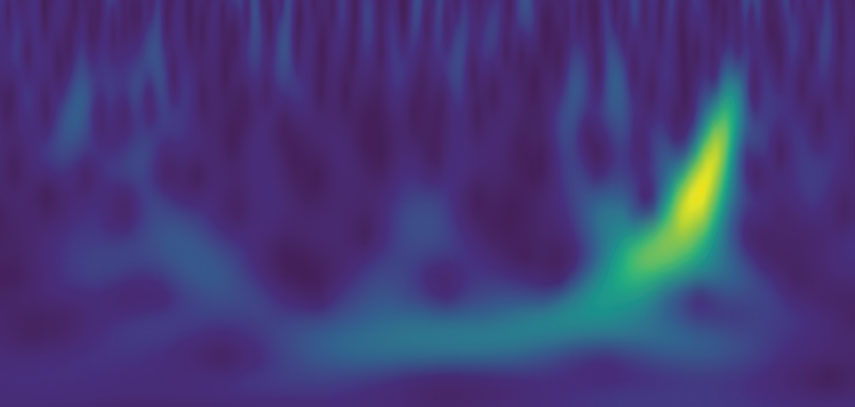
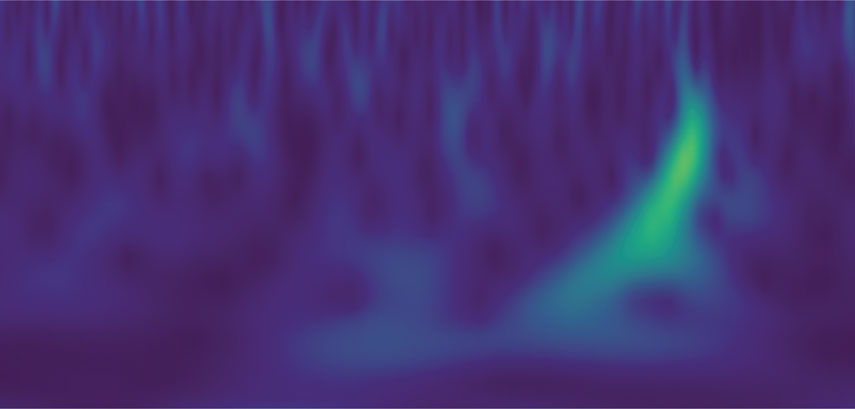
FIG. 1.
The gravitational-wave event GW150914 observed by the LIGO Hanford (H1, left column panels) and Livingston (L1, right
column panels) detectors. Times are shown relative to September 14, 2015 at 09:50:45 UTC. For visualization, all time series are filtered
with
a
35
–
350 Hz
bandpass filter to suppress
large fluctuations
outside
the
detectors
’
most
sensitive frequency band,
and
band-reject
filters
to
remove
the
strong
instrumental
spectral
lines
seen
in
the
Fig.
3
spectra.
Top
row,
left:
H1
strain.
Top
row,
right:
L1
strain.
GW150914 arrived first at L1 and
6
.
9
þ
0
.
5
−
0
.
4
ms later at H1; for a visual comparison, the H1 data are also shown, shifted in time by this
amount
and
inverted
(to
account
for
the
detectors
’
relative
orientations).
Second
row:
Gravitational-wave
strain
projected
onto
each
detector in the 35
–
350 Hz band. Solid lines show a numerical relativity waveform for a system with parameters consistent with those
recovered from GW150914
[37,38]
confirmed to 99.9% by an independent calculation based on
[15]
. Shaded areas show 90% credible
regions for two independent waveform reconstructions. One (dark gray) models the signal using binary black hole template waveforms
[39]
.
The
other
(light
gray)
does
not
use
an
astrophysical
model,
but
instead
calculates
the
strain
signal
as
a
linear
combination
of
sine-Gaussian wavelets
[40,41]
. These reconstructions have a 94% overlap, as shown in
[39]
.
Third row:
Residuals after subtracting the
filtered
numerical
relativity
waveform
from
the
filtered
detector
time
series.
Bottom
row:
A
time-frequency
representation
[42]
of
the
strain
data,
showing
the
signal
frequency
increasing
over
time.
PRL
116,
061102
(2016)
P H Y S I C A L
R E V I E W
L E T T E R S
week
ending
12
FEBRUARY
2016
061102-2





propagation
time,
the
events
have
a
combined
signal-to-
noise
ratio
(SNR)
of
24
[45]
.
Only
the
LIGO
detectors
were
observing
at
the
time
of
GW150914.
The
Virgo
detector
was
being
upgraded,
and
GEO
600,
though
not
sufficiently
sensitive
to
detect
this
event,
was
operating
but
not
in
observational
mode.
With
only
two
detectors
the
source
position
is
primarily
determined
by
the
relative
arrival
time
and
localized
to
an
area
of
approximately
600
deg
2
(90%
credible
region)
[39,46]
.
The
basic
features
of
GW150914
point
to
it
being
produced
by
the
coalescence
of
two
black
holes
—
i.e.,
their orbital inspiral and merger, and subsequent final black
hole ringdown. Over 0.2 s, the signal increases in frequency
and amplitude in about 8 cycles from 35 to 150 Hz, where
the
amplitude
reaches
a
maximum.
The
most
plausible
explanation for this evolution is the inspiral of two orbiting
masses,
m
1
and
m
2
, due to gravitational-wave emission. At
the
lower
frequencies,
such
evolution
is
characterized
by
the
chirp
mass
[11]
M
¼
ð
m
1
m
2
Þ
3
=
5
ð
m
1
þ
m
2
Þ
1
=
5
¼
c
3
G
5
96
π
−
8
=
3
f
−
11
=
3
_
f
3
=
5
;
where
f
and
_
f
are
the
observed
frequency
and
its
time
derivative
and
G
and
c
are
the
gravitational
constant
and
speed of light. Estimating
f
and
_
f
from the data in Fig.
1
,
we
obtain
a chirp mass of
M
≃
30
M
⊙
, implying that the
total mass
M
¼
m
1
þ
m
2
is
≳
70
M
⊙
in the detector frame.
This
bounds
the
sum
of
the
Schwarzschild
radii
of
the
binary
components
to
2
GM=c
2
≳
210
km.
To
reach
an
orbital
frequency
of
75
Hz
(half
the
gravitational-wave
frequency) the objects must have been very close and very
compact;
equal
Newtonian
point
masses
orbiting
at
this
frequency
would
be
only
≃
350
km
apart.
A
pair
of
neutron stars, while compact, would not have the required
mass,
while
a
black
hole
neutron
star
binary
with
the
deduced
chirp
mass
would
have
a
very
large
total
mass,
and
would
thus
merge
at
much
lower
frequency.
This
leaves
black
holes
as
the
only
known
objects
compact
enough
to
reach
an
orbital
frequency
of
75
Hz
without
contact.
Furthermore,
the
decay
of
the
waveform
after
it
peaks is consistent with the damped oscillations of a black
hole
relaxing
to
a
final
stationary
Kerr
configuration.
Below,
we
present
a
general-relativistic
analysis
of
GW150914;
Fig.
2
shows
the
calculated
waveform
using
the
resulting
source
parameters.
III.
DETECTORS
Gravitational-wave astronomy
exploits
multiple,
widely
separated detectors to distinguish gravitational waves from
local
instrumental
and
environmental
noise,
to
provide
source sky localization, and to measure wave polarizations.
The
LIGO
sites
each
operate
a
single
Advanced
LIGO
detector
[33]
,
a
modified
Michelson
interferometer
(see
Fig.
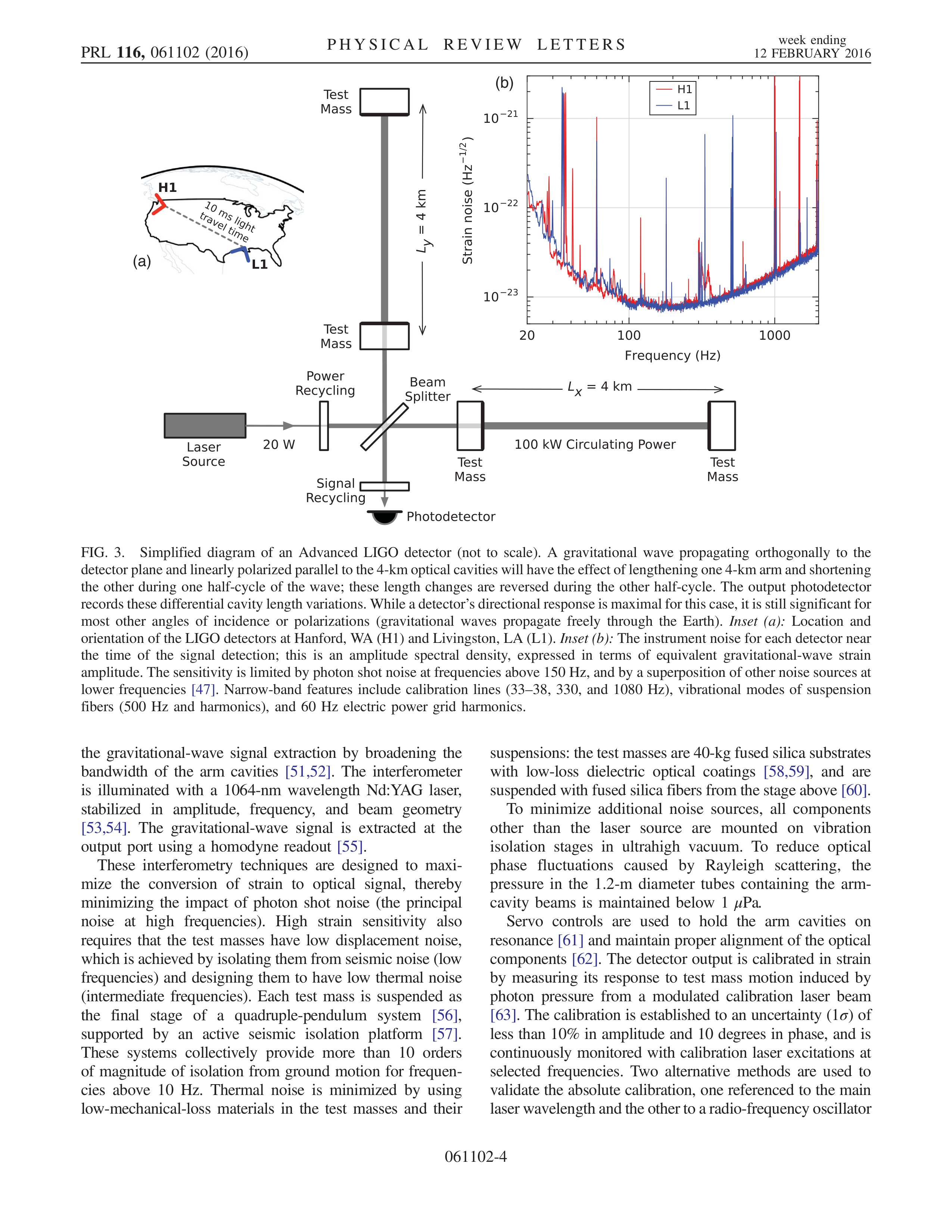
3
)
that
measures
gravitational-wave
strain
as
a
differ-
ence
in
length
of its
orthogonal
arms.
Each
arm
is
formed
by
two
mirrors,
acting
as
test
masses,
separated
by
L
x
¼
L
y
¼
L
¼
4
km. A passing gravitational wave effec-
tively
alters
the
arm
lengths
such
that
the
measured
difference
is
Δ
L
ð
t
Þ ¼
δ
L
x
−
δ
L
y
¼
h
ð
t
Þ
L
,
where
h
is
the
gravitational-wave
strain
amplitude
projected
onto
the
detector.
This
differential
length
variation
alters
the
phase
difference
between
the
two
light
fields
returning
to
the
beam splitter, transmitting an optical signal proportional to
the
gravitational-wave
strain
to
the
output
photodetector.
To
achieve
sufficient
sensitivity
to
measure
gravitational
waves,
the
detectors
include
several
enhancements
to
the
basic
Michelson
interferometer.
First,
each
arm
contains
a
resonant optical cavity, formed by its two test mass mirrors,
that multiplies the effect of a gravitational wave on the light
phase
by
a
factor
of
300
[48]
.
Second,
a
partially
trans-
missive
power-recycling
mirror
at
the
input
provides
addi-
tional resonant buildup of the laser light in the interferometer
as a whole
[49,50]
: 20 Wof laser input is increased to 700 W
incident
on
the
beam
splitter,
which
is
further
increased
to
100
kW
circulating
in
each
arm
cavity.
Third,
a
partially
transmissive signal-recycling mirror at the output optimizes
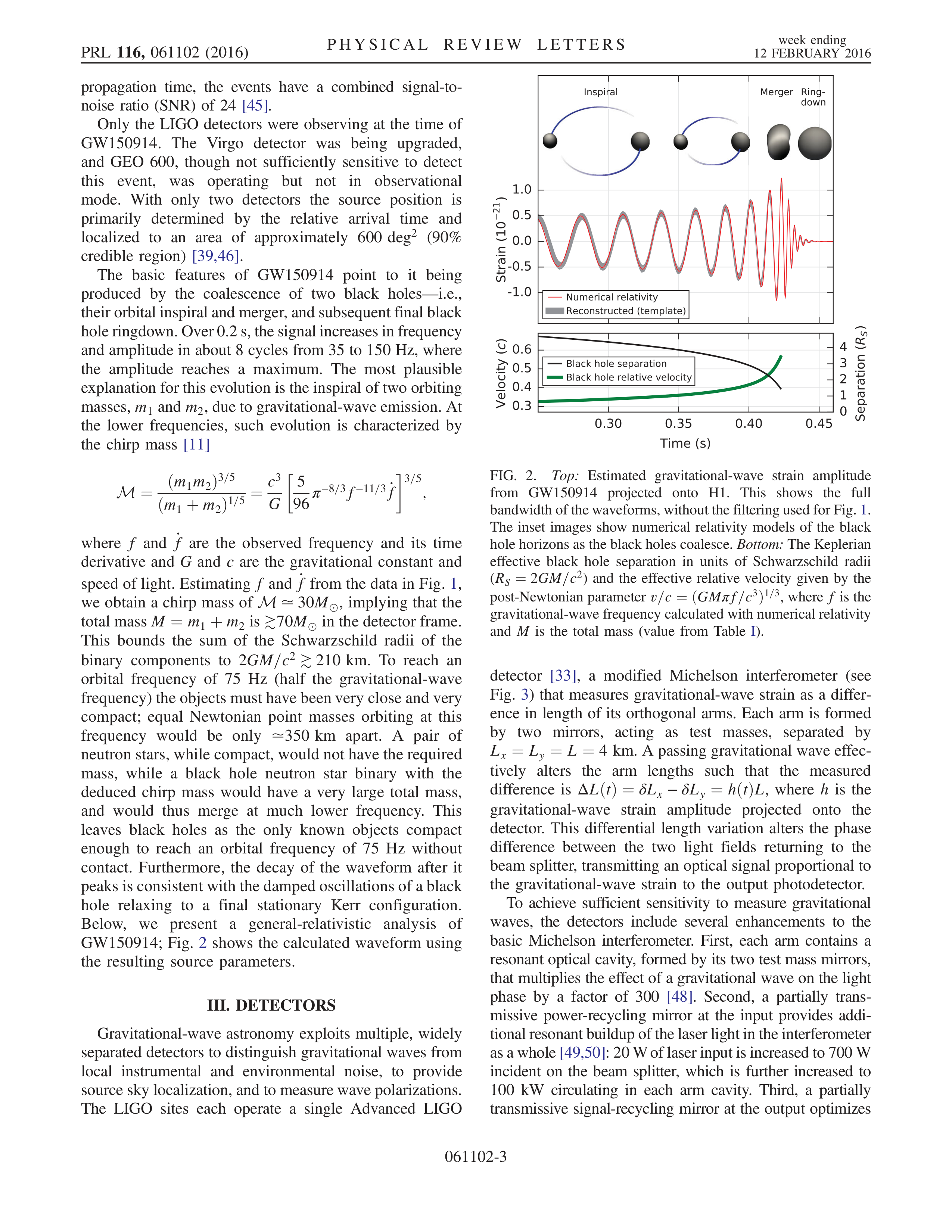
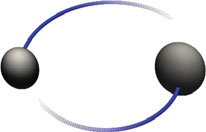
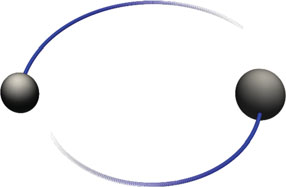
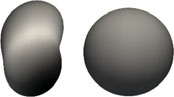
FIG.
2.
Top:
Estimated
gravitational-wave
strain
amplitude
from
GW150914
projected
onto
H1.
This
shows
the
full
bandwidth of the waveforms, without the filtering used for Fig.
1
.
The
inset
images
show
numerical
relativity
models
of
the
black
hole horizons as the black holes coalesce.
Bottom:
The Keplerian
effective
black
hole
separation
in
units
of
Schwarzschild
radii
(
R
S
¼
2
GM=c
2
)
and
the
effective
relative
velocity
given
by
the
post-Newtonian parameter
v=c
¼ ð
GM
π
f=c
3
Þ
1
=
3
, where
f
is the
gravitational-wave frequency calculated with numerical relativity
and
M
is
the
total
mass
(value
from
Table
I
).
PRL
116,
061102
(2016)
P H Y S I C A L
R E V I E W
L E T T E R S
week
ending
12
FEBRUARY
2016
061102-3
the
gravitational-wave
signal
extraction
by
broadening
the
bandwidth
of
the
arm
cavities
[51,52]
.
The
interferometer
is
illuminated
with
a
1064-nm
wavelength
Nd:YAG
laser,
stabilized
in
amplitude,
frequency,
and
beam
geometry
[53,54]
.
The
gravitational-wave
signal
is
extracted
at
the
output
port
using
a
homodyne
readout
[55]
.
These
interferometry
techniques
are
designed
to
maxi-
mize
the
conversion
of
strain
to
optical
signal,
thereby
minimizing
the
impact
of
photon
shot
noise
(the
principal
noise
at
high
frequencies).
High
strain
sensitivity
also
requires
that
the
test
masses
have
low
displacement
noise,
which is achieved by isolating them from seismic noise (low
frequencies) and
designing them
to have
low
thermal
noise
(intermediate
frequencies).
Each
test
mass
is
suspended
as
the
final
stage
of
a
quadruple-pendulum
system
[56]
,
supported
by
an
active
seismic
isolation
platform
[57]
.
These
systems
collectively
provide
more
than
10
orders
of
magnitude
of isolation
from
ground
motion
for
frequen-
cies
above
10
Hz.
Thermal
noise
is
minimized
by
using
low-mechanical-loss
materials
in
the
test
masses
and
their
suspensions: the test masses are 40-kg fused silica substrates
with
low-loss
dielectric
optical
coatings
[58,59]
,
and
are
suspended with fused silica fibers from the stage above
[60]
.
To
minimize
additional
noise
sources,
all
components
other
than
the
laser
source
are
mounted
on
vibration
isolation
stages
in
ultrahigh
vacuum.
To
reduce
optical
phase
fluctuations
caused
by
Rayleigh
scattering,
the
pressure
in
the
1.2-m
diameter
tubes
containing
the
arm-
cavity
beams
is
maintained
below
1
μ
Pa.
Servo
controls
are
used
to
hold
the
arm
cavities
on
resonance
[61]
and maintain proper alignment of the optical
components
[62]
. The detector output is calibrated in strain
by
measuring
its
response
to
test
mass
motion
induced
by
photon
pressure
from
a
modulated
calibration
laser
beam
[63]
. The calibration is established to an uncertainty (
1
σ
) of
less than 10% in amplitude and 10 degrees in phase, and is
continuously
monitored
with
calibration
laser
excitations
at
selected
frequencies.
Two
alternative
methods
are
used
to
validate the absolute calibration, one referenced to the main
laser wavelength and the other to a radio-frequency oscillator
(a)
(b)
FIG.
3.
Simplified
diagram
of
an
Advanced
LIGO
detector
(not
to
scale).
A
gravitational
wave
propagating
orthogonally
to
the
detector plane and linearly polarized parallel to the 4-km optical cavities will have the effect of lengthening one 4-km arm and shortening
the
other
during
one
half-cycle
of
the
wave;
these
length
changes
are
reversed
during
the
other
half-cycle.
The
output
photodetector
records these differential cavity length variations. While a detector
’
s directional response is maximal for this case, it is still significant for
most
other
angles
of
incidence
or
polarizations
(gravitational
waves
propagate
freely
through
the
Earth).
Inset
(a):
Location
and
orientation of the LIGO detectors at Hanford, WA (H1) and Livingston, LA (L1).
Inset (b):
The instrument noise for each detector near
the
time
of
the
signal
detection;
this
is
an
amplitude
spectral
density,
expressed
in
terms
of
equivalent
gravitational-wave
strain
amplitude. The sensitivity is limited by photon shot noise at frequencies above 150 Hz, and by a superposition of other noise sources at
lower
frequencies
[47]
.
Narrow-band
features
include
calibration
lines
(33
–
38,
330,
and
1080
Hz),
vibrational
modes
of
suspension
fibers
(500
Hz
and
harmonics),
and
60
Hz
electric
power
grid
harmonics.
PRL
116,
061102
(2016)
P H Y S I C A L
R E V I E W
L E T T E R S
week
ending
12
FEBRUARY
2016
061102-4
[64]
.
Additionally,
the
detector
response
to
gravitational
waves
is
tested
by
injecting
simulated
waveforms
with
the
calibration
laser.
To
monitor
environmental
disturbances
and
their
influ-
ence
on
the
detectors,
each
observatory
site
is
equipped
with
an
array
of
sensors:
seismometers,
accelerometers,
microphones,
magnetometers,
radio
receivers,
weather
sensors, ac-power line monitors, and a cosmic-ray detector
[65]
.
Another
∼
10
5
channels
record
the
interferometer
’
s
operating
point
and
the
state
of
the
control
systems.
Data
collection
is
synchronized
to
Global
Positioning
System
(GPS)
time
to
better
than
10
μ
s
[66]
.
Timing
accuracy
is
verified with an atomic clock and a secondary GPS receiver
at
each
observatory
site.
In
their
most
sensitive
band,
100
–
300
Hz,
the
current
LIGO detectors are 3 to 5 times more sensitive to strain than
initial LIGO
[67]
; at lower frequencies, the improvement is
even
greater,
with
more
than
ten
times
better
sensitivity
below 60 Hz. Because the detectors respond proportionally
to gravitational-wave amplitude, at low redshift the volume
of
space
to
which
they
are
sensitive
increases
as
the
cube
of
strain
sensitivity.
For
binary
black
holes
with
masses
similar to GW150914, the space-time volume surveyed by
the
observations
reported
here
surpasses
previous
obser-
vations
by
an
order
of
magnitude
[68]
.
IV.
DETECTOR
VALIDATION
Both detectors were in steady state operation for several
hours
around
GW150914.
All
performance
measures,
in
particular
their
average
sensitivity
and
transient
noise
behavior,
were
typical
of
the
full
analysis
period
[69,70]
.
Exhaustive
investigations
of
instrumental
and
environ-
mental
disturbances
were performed, giving no evidence to
suggest
that
GW150914
could
be
an
instrumental
artifact
[69]
. The detectors
’
susceptibility to environmental disturb-
ances
was
quantified
by
measuring
their
response
to
spe-
cially
generated
magnetic,
radio-frequency,
acoustic,
and
vibration excitations. These tests indicated that any external
disturbance large enough to have caused the observed signal
would
have
been
clearly
recorded
by
the
array
of
environ-
mental sensors. None of the environmental sensors recorded
any
disturbances
that
evolved
in
time
and
frequency
like
GW150914,
and
all
environmental
fluctuations
during
the
second that contained GW150914 were too small to account
for
more
than
6%
of
its
strain
amplitude.
Special
care
was
taken
to
search
for
long-range
correlated
disturbances
that
might produce
nearly
simultaneous
signals
at
the two
sites.
No
significant
disturbances
were
found.
The
detector
strain
data
exhibit
non-Gaussian
noise
transients
that
arise
from
a
variety
of
instrumental
mecha-
nisms.
Many
have
distinct
signatures,
visible
in
auxiliary
data
channels
that
are
not
sensitive
to
gravitational
waves;
such instrumental transients are removed from our analyses
[69]
.
Any
instrumental
transients
that
remain
in
the
data
are
accounted
for
in
the
estimated
detector
backgrounds
described
below.
There
is
no
evidence
for
instrumental
transients
that
are
temporally
correlated
between
the
two
detectors.
V.
SEARCHES
We
present
the
analysis
of
16
days
of
coincident
observations
between
the
two
LIGO
detectors
from
September
12
to
October
20,
2015.
This
is
a
subset
of
the
data
from
Advanced
LIGO
’
s
first
observational
period
that
ended
on
January
12,
2016.
GW150914
is
confidently
detected
by
two
different
types
of
searches.
One
aims
to
recover
signals
from
the
coalescence
of
compact
objects,
using
optimal
matched
filtering
with
waveforms
predicted
by
general
relativity.
The other search targets a broad range of generic transient
signals, with minimal assumptions about waveforms. These
searches
use
independent
methods,
and
their
response
to
detector
noise
consists
of
different,
uncorrelated,
events.
However, strong signals from binary black hole mergers are
expected
to
be
detected
by
both
searches.
Each search identifies candidate events that are detected
at
both
observatories
consistent
with
the
intersite
propa-
gation time. Events are assigned a detection-statistic
value
that
ranks
their
likelihood
of
being
a
gravitational-wave
signal. The significance of a candidate event is determined
by the search background
—
the rate at which detector noise
produces events with a detection-statistic value equal to or
higher
than
the
candidate
event.
Estimating
this
back-
ground
is
challenging
for
two
reasons:
the
detector
noise
is
nonstationary
and
non-Gaussian,
so
its
properties
must
be
empirically
determined;
and
it
is
not
possible
to
shield
the detector from gravitational waves to directly measure a
signal-free
background.
The
specific
procedure
used
to
estimate
the
background
is
slightly
different
for
the
two
searches,
but
both
use
a
time-shift
technique:
the
time
stamps
of
one
detector
’
s
data
are
artificially
shifted
by
an
offset
that
is
large
compared
to
the
intersite
propagation
time,
and
a
new
set
of
events
is
produced
based
on
this
time-shifted
data
set.
For
instrumental
noise
that
is
uncor-
related
between
detectors
this
is
an
effective
way
to
estimate
the
background.
In
this
process
a
gravitational-
wave signal in one detector may coincide with time-shifted
noise
transients
in
the
other
detector,
thereby
contributing
to the background estimate. This leads to an overestimate of
the noise background and therefore to a more conservative
assessment
of
the
significance
of
candidate
events.
The
characteristics
of
non-Gaussian
noise
vary
between
different time-frequency regions. This means that the search
backgrounds
are
not
uniform
across
the
space
of
signals
being searched. To maximize sensitivity and provide a better
estimate
of
event
significance,
the
searches
sort
both
their
background estimates and their event candidates into differ-
ent
classes
according
to
their
time-frequency
morphology.
The significance of a candidate event is measured against the
background
of
its
class.
To
account
for
having
searched
PRL
116,
061102
(2016)
P H Y S I C A L
R E V I E W
L E T T E R S
week
ending
12
FEBRUARY
2016
061102-5
multiple
classes,
this
significance
is
decreased
by
a
trials
factor
equal
to
the
number
of
classes
[71]
.
A.
Generic
transient
search
Designed to operate without a specific waveform model,
this
search
identifies
coincident
excess
power
in
time-
frequency
representations
of
the
detector
strain
data
[43,72]
,
for
signal
frequencies
up
to
1
kHz
and
durations
up
to
a
few
seconds.
The
search
reconstructs
signal
waveforms
consistent
with a common gravitational-wave signal in both detectors
using
a
multidetector
maximum
likelihood
method.
Each
event
is
ranked
according
to
the
detection
statistic
η
c
¼
ffiffiffiffiffiffiffiffiffiffiffiffiffiffiffiffiffiffiffiffiffiffiffiffiffiffiffiffiffiffiffiffiffiffi
2
E
c
=
ð
1
þ
E
n
=E
c
Þ
p
,
where
E
c
is
the
dimensionless
coherent
signal
energy
obtained
by
cross-correlating
the
two reconstructed waveforms, and
E
n
is the dimensionless
residual
noise
energy
after
the
reconstructed
signal
is
subtracted
from
the
data.
The
statistic
η
c
thus
quantifies
the
SNR
of
the
event
and
the
consistency
of
the
data
between
the
two
detectors.
Based
on
their
time-frequency
morphology,
the
events
are divided into three mutually exclusive search classes, as
described in
[41]
: events with time-frequency morphology
of known populations of noise transients (class C1), events
with frequency that increases with time (class C3), and all
remaining
events
(class
C2).
Detected
with
η
c
¼
20
.
0
,
GW150914
is
the
strongest
event
of
the
entire
search.
Consistent
with
its
coalescence
signal signature, it is found in the search class C3 of events
with
increasing
time-frequency
evolution.
Measured
on
a
background
equivalent
to
over
67 400
years
of
data
and
including
a
trials
factor
of
3
to
account
for
the
search
classes, its false alarm rate is lower than 1 in 22 500 years.
This corresponds to a probability
<
2
×
10
−
6
of observing
one
or
more
noise
events
as
strong
as
GW150914
during
the
analysis
time,
equivalent
to
4
.
6
σ
.
The
left
panel
of
Fig.
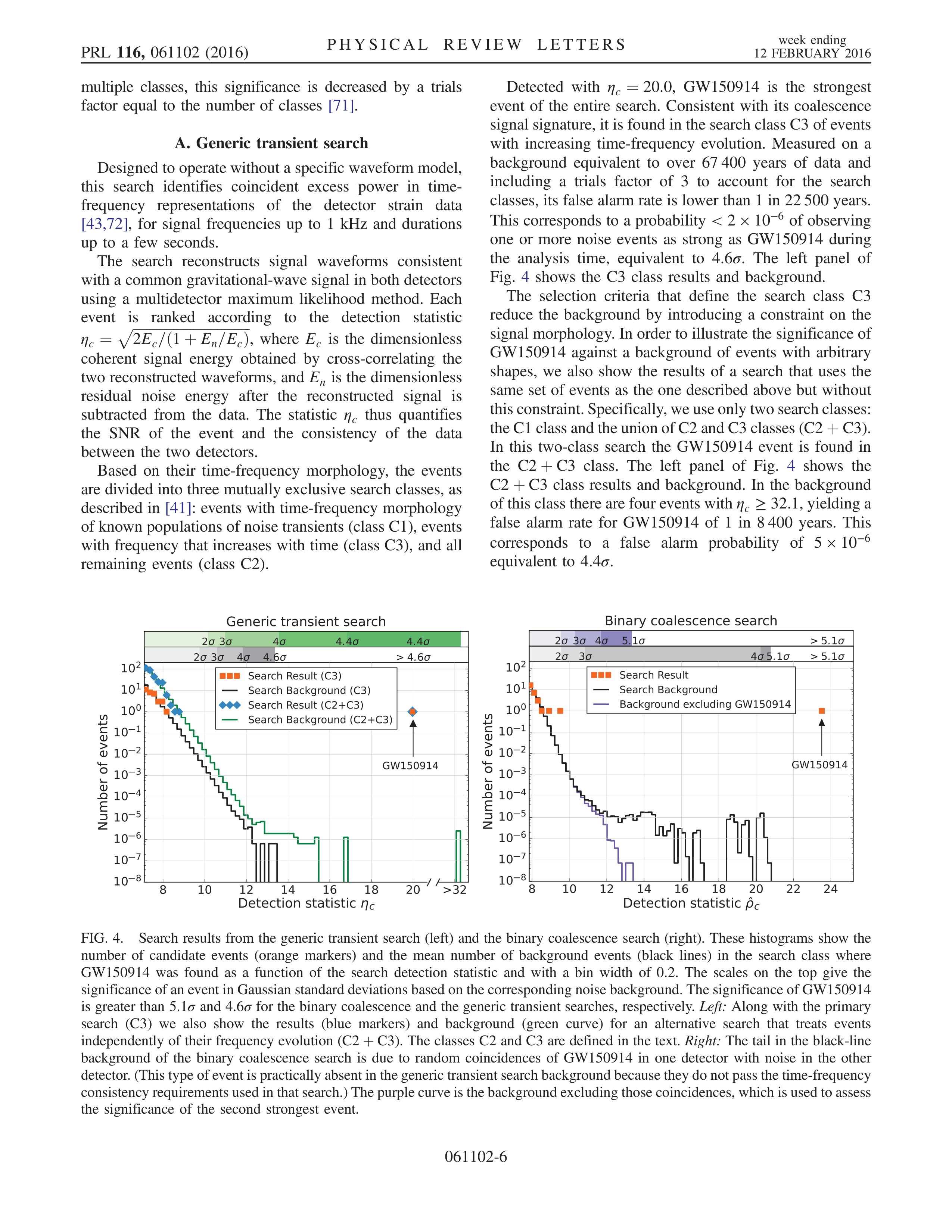
4
shows
the
C3
class
results
and
background.
The
selection
criteria
that
define
the
search
class
C3
reduce
the
background
by
introducing
a
constraint
on
the
signal morphology. In order to illustrate the significance of
GW150914
against
a
background
of
events
with
arbitrary
shapes,
we
also
show
the
results
of
a
search
that
uses
the
same set
of
events
as
the
one described above
but
without
this constraint. Specifically, we use only two search classes:
the C1 class and the union of C2 and C3 classes (C
2
þ
C
3
).
In
this
two-class
search
the
GW150914
event
is
found
in
the
C
2
þ
C
3
class.
The
left
panel
of
Fig.
4
shows
the
C
2
þ
C
3
class
results
and
background.
In
the
background
of this class there are four events with
η
c
≥
32
.
1
, yielding a
false
alarm
rate
for
GW150914
of
1
in
8 400
years.
This
corresponds
to
a
false
alarm
probability
of
5
×
10
−
6
equivalent
to
4
.
4
σ
.
FIG.
4.
Search
results
from
the generic
transient
search
(left)
and
the
binary
coalescence
search
(right).
These
histograms
show
the
number
of
candidate
events
(orange
markers)
and
the
mean
number
of
background
events
(black
lines)
in
the
search
class
where
GW150914
was
found
as
a
function
of
the
search
detection
statistic
and
with
a
bin
width
of
0.2.
The
scales
on
the
top
give
the
significance of an event in Gaussian standard deviations based on the corresponding noise background. The significance of GW150914
is greater than
5
.
1
σ
and
4
.
6
σ
for the binary coalescence and the generic transient searches, respectively.
Left:
Along with the primary
search
(C3)
we
also
show
the
results
(blue
markers)
and
background
(green
curve)
for
an
alternative
search
that
treats
events
independently of their frequency evolution (C
2
þ
C
3
). The classes C2 and C3 are defined in the text.
Right:
The tail in the black-line
background
of
the
binary
coalescence
search
is
due
to
random
coincidences
of
GW150914
in
one
detector
with
noise
in
the
other
detector. (This type of event is practically absent in the generic transient search background because they do not pass the time-frequency
consistency requirements used in that search.) The purple curve is the background excluding those coincidences, which is used to assess
the
significance
of
the
second
strongest
event.
PRL
116,
061102
(2016)
P H Y S I C A L
R E V I E W
L E T T E R S
week
ending
12
FEBRUARY
2016
061102-6
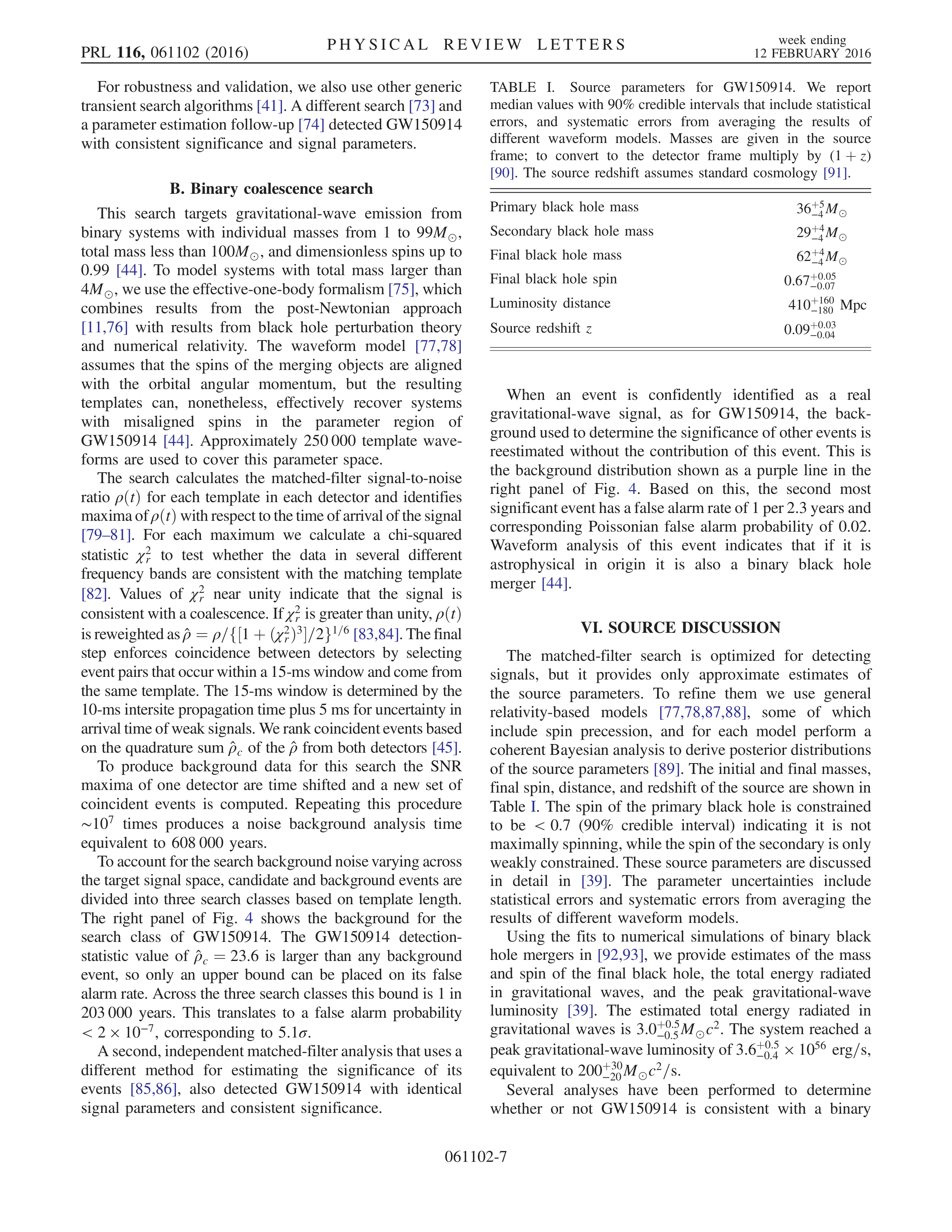
For robustness and validation, we also use other generic
transient search algorithms
[41]
. A different search
[73]
and
a parameter estimation follow-up
[74]
detected GW150914
with
consistent
significance
and
signal
parameters.
B.
Binary
coalescence
search
This
search
targets
gravitational-wave
emission
from
binary
systems
with
individual
masses
from
1
to
99
M
⊙
,
total mass less than
100
M
⊙
, and dimensionless spins up to
0.99
[44]
.
To
model
systems
with
total
mass
larger
than
4
M
⊙
, we use the effective-one-body formalism
[75]
, which
combines
results
from
the
post-Newtonian
approach
[11,76]
with
results
from
black
hole
perturbation
theory
and
numerical
relativity.
The
waveform
model
[77,78]
assumes
that
the
spins
of
the
merging
objects
are
aligned
with
the
orbital
angular
momentum,
but
the
resulting
templates
can,
nonetheless,
effectively
recover
systems
with
misaligned
spins
in
the
parameter
region
of
GW150914
[44]
.
Approximately
250 000
template
wave-
forms
are
used
to
cover
this
parameter
space.
The
search
calculates
the
matched-filter
signal-to-noise
ratio
ρ
ð
t
Þ
for
each
template
in
each
detector
and
identifies
maxima of
ρ
ð
t
Þ
with respect to the time of arrival of the signal
[79
–
81]
.
For
each
maximum
we
calculate
a
chi-squared
statistic
χ
2
r
to
test
whether
the
data
in
several
different
frequency
bands
are
consistent
with
the
matching
template
[82]
.
Values
of
χ
2
r
near
unity
indicate
that
the
signal
is
consistent with a coalescence. If
χ
2
r
is greater than unity,
ρ
ð
t
Þ
is reweighted as
ˆ
ρ
¼
ρ
=
f½
1
þ ð
χ
2
r
Þ
3
=
2
g
1
=
6
[83,84]
. The final
step
enforces
coincidence
between
detectors
by
selecting
event pairs that occur within a 15-ms window and come from
the same template. The 15-ms window is determined by the
10-ms intersite propagation time plus 5 ms for uncertainty in
arrival time of weak signals. We rank coincident events based
on the quadrature sum
ˆ
ρ
c
of the
ˆ
ρ
from both detectors
[45]
.
To
produce
background
data
for
this
search
the
SNR
maxima
of
one
detector
are
time
shifted
and
a
new
set
of
coincident
events
is
computed.
Repeating
this
procedure
∼
10
7
times
produces
a
noise
background
analysis
time
equivalent
to
608 000
years.
To account for the search background noise varying across
the target signal space, candidate and background events are
divided
into
three
search
classes
based
on
template
length.
The
right
panel
of
Fig.
4
shows
the
background
for
the
search
class
of
GW150914.
The
GW150914
detection-
statistic
value
of
ˆ
ρ
c
¼
23
.
6
is
larger
than
any
background
event,
so
only
an
upper
bound
can
be
placed
on
its
false
alarm rate. Across the three search classes this bound is 1 in
203 000
years.
This
translates
to
a
false
alarm
probability
<
2
×
10
−
7
,
corresponding
to
5
.
1
σ
.
A second, independent matched-filter analysis that uses a
different
method
for
estimating
the
significance
of
its
events
[85,86]
,
also
detected
GW150914
with
identical
signal
parameters
and
consistent
significance.
When
an
event
is
confidently
identified
as
a
real
gravitational-wave
signal,
as
for
GW150914,
the
back-
ground used to determine the significance of other events is
reestimated
without
the
contribution
of
this
event.
This
is
the
background
distribution
shown
as
a
purple
line
in
the
right
panel
of
Fig.
4
.
Based
on
this,
the
second
most
significant event has a false alarm rate of 1 per 2.3 years and
corresponding
Poissonian
false
alarm
probability
of
0.02.
Waveform
analysis
of
this
event
indicates
that
if
it
is
astrophysical
in
origin
it
is
also
a
binary
black
hole
merger
[44]
.
VI.
SOURCE
DISCUSSION
The
matched-filter
search
is
optimized
for
detecting
signals,
but
it
provides
only
approximate
estimates
of
the
source
parameters.
To
refine
them
we
use
general
relativity-based
models
[77,78,87,88]
,
some
of
which
include
spin
precession,
and
for
each
model
perform
a
coherent Bayesian analysis to derive posterior distributions
of the source parameters
[89]
. The initial and final masses,
final spin, distance, and redshift of the source are shown in
Table
I
.
The
spin
of
the
primary
black
hole
is
constrained
to
be
<
0
.
7
(90%
credible
interval)
indicating
it
is
not
maximally spinning, while the spin of the secondary is only
weakly constrained. These source parameters are discussed
in
detail
in
[39]
.
The
parameter
uncertainties
include
statistical
errors
and
systematic
errors
from
averaging
the
results
of
different
waveform
models.
Using
the
fits
to
numerical
simulations
of
binary
black
hole
mergers
in
[92,93]
,
we
provide
estimates
of
the
mass
and
spin
of
the
final
black
hole,
the
total
energy
radiated
in
gravitational
waves,
and
the
peak
gravitational-wave
luminosity
[39]
.
The
estimated
total
energy
radiated
in
gravitational
waves
is
3
.
0
þ
0
.
5
−
0
.
5
M
⊙
c
2
.
The
system
reached
a
peak gravitational-wave luminosity of
3
.
6
þ
0
.
5
−
0
.
4
×
10
56
erg
=
s,
equivalent to
200
þ
30
−
20
M
⊙
c
2
=
s.
Several
analyses
have
been
performed
to
determine
whether
or
not
GW150914
is
consistent
with
a
binary
TABLE
I.
Source
parameters
for
GW150914.
We
report
median values with 90% credible intervals that include statistical
errors,
and
systematic
errors
from
averaging
the
results
of
different
waveform
models.
Masses
are
given
in
the
source
frame;
to
convert
to
the
detector
frame
multiply
by
(
1
þ
z
)
[90]
.
The
source
redshift
assumes
standard
cosmology
[91]
.
Primary
black
hole
mass
36
þ
5
−
4
M
⊙
Secondary
black
hole
mass
29
þ
4
−
4
M
⊙
Final
black
hole
mass
62
þ
4
−
4
M
⊙
Final
black
hole
spin
0
.
67
þ
0
.
05
−
0
.
07
Luminosity
distance
410
þ
160
−
180
Mpc
Source
redshift
z
0
.
09
þ
0
.
03
−
0
.
04
PRL
116,
061102
(2016)
P H Y S I C A L
R E V I E W
L E T T E R S
week
ending
12
FEBRUARY
2016
061102-7
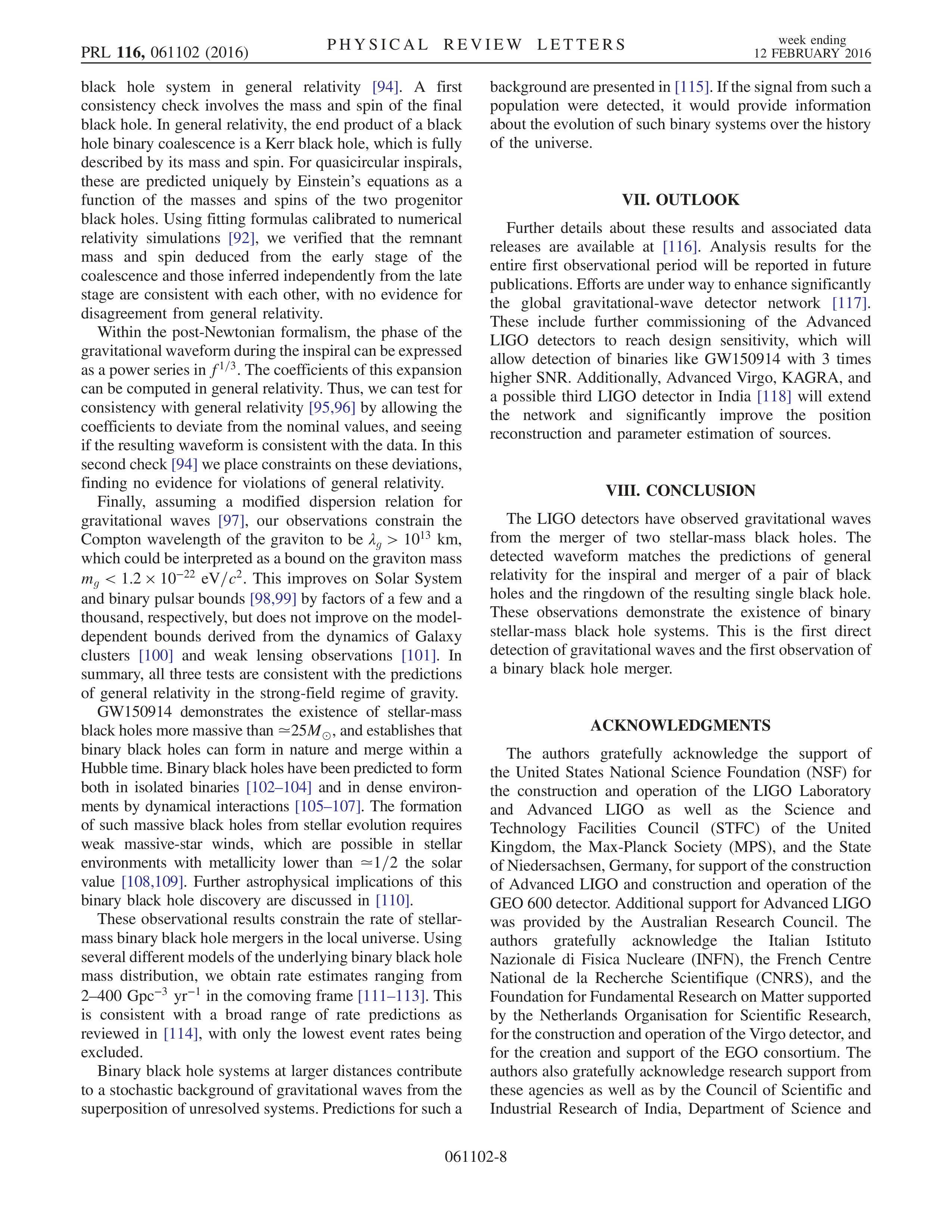
black
hole
system
in
general
relativity
[94]
.
A
first
consistency
check
involves
the
mass
and
spin
of
the
final
black hole. In general relativity, the end product of a black
hole binary coalescence is a Kerr black hole, which is fully
described by its mass and spin. For quasicircular inspirals,
these
are
predicted
uniquely
by
Einstein
’
s
equations
as
a
function
of
the
masses
and
spins
of
the
two
progenitor
black holes. Using fitting formulas calibrated to numerical
relativity
simulations
[92]
,
we
verified
that
the
remnant
mass
and
spin
deduced
from
the
early
stage
of
the
coalescence and those inferred independently from the late
stage
are
consistent
with
each
other,
with
no
evidence
for
disagreement
from
general
relativity.
Within
the
post-Newtonian
formalism,
the
phase
of
the
gravitational waveform during the inspiral can be expressed
as a power series in
f
1
=
3
. The coefficients of this expansion
can be computed in general relativity. Thus, we can test for
consistency with general relativity
[95,96]
by allowing the
coefficients to deviate from the nominal values, and seeing
if the resulting waveform is consistent with the data. In this
second check
[94]
we place constraints on these deviations,
finding
no
evidence
for
violations
of
general
relativity.
Finally,
assuming
a
modified
dispersion
relation
for
gravitational
waves
[97]
,
our
observations
constrain
the
Compton
wavelength
of
the
graviton
to
be
λ
g
>
10
13
km,
which could be interpreted as a bound on the graviton mass
m
g
<
1
.
2
×
10
−
22
eV
=c
2
.
This
improves
on
Solar
System
and binary pulsar bounds
[98,99]
by factors of a few and a
thousand, respectively, but does not improve on the model-
dependent
bounds
derived
from
the
dynamics
of
Galaxy
clusters
[100]
and
weak
lensing
observations
[101]
.
In
summary, all three tests are consistent with the predictions
of
general
relativity
in
the
strong-field
regime
of
gravity.
GW150914
demonstrates
the
existence
of
stellar-mass
black holes more massive than
≃
25
M
⊙
, and establishes that
binary
black
holes
can
form
in
nature
and
merge
within
a
Hubble time. Binary black holes have been predicted to form
both
in
isolated
binaries
[102
–
104]
and
in
dense
environ-
ments
by
dynamical
interactions
[105
–
107]
.
The
formation
of
such
massive
black
holes
from
stellar
evolution
requires
weak
massive-star
winds,
which
are
possible
in
stellar
environments
with
metallicity
lower
than
≃
1
=
2
the
solar
value
[108,109]
.
Further
astrophysical
implications
of
this
binary
black
hole
discovery
are
discussed
in
[110]
.
These
observational
results
constrain
the
rate
of
stellar-
mass binary black hole mergers in the local universe. Using
several different models of the underlying binary black hole
mass
distribution,
we
obtain
rate
estimates
ranging
from
2
–
400
Gpc
−
3
yr
−
1
in the comoving frame
[111
–
113]
. This
is
consistent
with
a
broad
range
of
rate
predictions
as
reviewed
in
[114]
,
with
only
the
lowest
event
rates
being
excluded.
Binary black hole systems at larger distances contribute
to a stochastic background of gravitational waves from the
superposition of unresolved systems. Predictions for such a
background are presented in
[115]
. If the signal from such a
population
were
detected,
it
would
provide
information
about the evolution of such binary systems over the history
of
the
universe.
VII.
OUTLOOK
Further
details
about
these
results
and
associated
data
releases
are
available
at
[116]
.
Analysis
results
for
the
entire
first
observational
period
will
be
reported
in
future
publications. Efforts are under way to enhance significantly
the
global
gravitational-wave
detector
network
[117]
.
These
include
further
commissioning
of
the
Advanced
LIGO
detectors
to
reach
design
sensitivity,
which
will
allow
detection
of
binaries
like
GW150914
with
3
times
higher SNR. Additionally, Advanced Virgo, KAGRA, and
a
possible
third
LIGO
detector
in
India
[118]
will
extend
the
network
and
significantly
improve
the
position
reconstruction
and
parameter
estimation
of
sources.
VIII.
CONCLUSION
The
LIGO
detectors
have
observed
gravitational
waves
from
the
merger
of
two
stellar-mass
black
holes.
The
detected
waveform
matches
the
predictions
of
general
relativity
for
the
inspiral
and
merger
of
a
pair
of
black
holes
and
the
ringdown
of
the
resulting
single
black
hole.
These
observations
demonstrate
the
existence
of
binary
stellar-mass
black
hole
systems.
This
is
the
first
direct
detection of gravitational waves and the first observation of
a
binary
black
hole
merger.
ACKNOWLEDGMENTS
The
authors
gratefully
acknowledge
the
support
of
the
United
States
National
Science
Foundation
(NSF)
for
the
construction
and
operation
of
the
LIGO
Laboratory
and
Advanced
LIGO
as
well
as
the
Science
and
Technology
Facilities
Council
(STFC)
of
the
United
Kingdom,
the
Max-Planck
Society
(MPS),
and
the
State
of Niedersachsen, Germany, for support of the construction
of
Advanced
LIGO
and
construction
and
operation
of
the
GEO 600 detector. Additional support for Advanced LIGO
was
provided
by
the
Australian
Research
Council.
The
authors
gratefully
acknowledge
the
Italian
Istituto
Nazionale
di
Fisica
Nucleare
(INFN),
the
French
Centre
National
de
la
Recherche
Scientifique
(CNRS),
and
the
Foundation for Fundamental Research on Matter supported
by
the
Netherlands
Organisation
for
Scientific
Research,
for the construction and operation of the Virgo detector, and
for
the
creation
and
support
of
the
EGO
consortium.
The
authors also gratefully acknowledge research support from
these
agencies
as
well
as
by
the
Council
of
Scientific
and
Industrial
Research
of
India,
Department
of
Science
and
PRL
116,
061102
(2016)
P H Y S I C A L
R E V I E W
L E T T E R S
week
ending
12
FEBRUARY
2016
061102-8

Technology, India, Science & Engineering Research Board
(SERB), India, Ministry of Human Resource Development,
India,
the
Spanish
Ministerio
de
Economía
y
Competitividad,
the
Conselleria
d
’
Economia
i
Competitivitat
and
Conselleria
d
’
Educació,
Cultura
i
Universitats
of
the
Govern
de
les
Illes
Balears,
the
National
Science
Centre
of
Poland,
the
European
Commission,
the
Royal
Society,
the
Scottish
Funding
Council,
the
Scottish
Universities
Physics
Alliance,
the
Hungarian
Scientific
Research
Fund
(OTKA),
the
Lyon
Institute
of
Origins
(LIO),
the
National
Research
Foundation
of
Korea,
Industry
Canada
and
the
Province
of Ontario through the Ministry of Economic Development
and
Innovation,
the
Natural
Sciences
and
Engineering
Research
Council
of
Canada,
Canadian
Institute
for
Advanced
Research,
the
Brazilian
Ministry
of
Science,
Technology, and Innovation, Russian Foundation for Basic
Research, the Leverhulme Trust, the Research Corporation,
Ministry of Science and Technology (MOST), Taiwan, and
the Kavli Foundation. The authors gratefully acknowledge
the support of the NSF, STFC, MPS, INFN, CNRS and the
State of Niedersachsen, Germany, for provision of compu-
tational
resources.
This
article
has
been
assigned
the
document
numbers
LIGO-P150914
and
VIR-0015A-16.
[1]
A.
Einstein,
Sitzungsber.
K.
Preuss.
Akad.
Wiss.
1
,
688
(1916).
[2]
A.
Einstein,
Sitzungsber.
K.
Preuss.
Akad.
Wiss.
1
,
154
(1918).
[3]
P. R.
Saulson,
Gen.
Relativ.
Gravit.
43
,
3289
(2011)
.
[4]
K.
Schwarzschild,
Sitzungsber.
K.
Preuss.
Akad.
Wiss.
1
,
189
(1916).
[5]
D.
Finkelstein,
Phys.
Rev.
110
,
965
(1958)
.
[6]
M. D.
Kruskal,
Phys.
Rev.
119
,
1743
(1960)
.
[7]
R. P.
Kerr,
Phys.
Rev.
Lett.
11
,
237
(1963)
.
[8]
C. V.
Vishveshwara,
Nature
(London)
227
,
936
(1970)
.
[9]
W. H.
Press,
Astrophys.
J.
170
,
L105
(1971)
.
[10]
S. Chandrasekhar and S. L. Detweiler,
Proc. R. Soc. A
344
,
441
(1975)
.
[11]
L. Blanchet, T. Damour, B. R.
Iyer, C. M. Will,
and A. G.
Wiseman,
Phys.
Rev.
Lett.
74
,
3515
(1995)
.
[12]
L.
Blanchet,
Living
Rev.
Relativity
17
,
2
(2014)
.
[13]
A.
Buonanno
and
T.
Damour,
Phys.
Rev.
D
59
,
084006
(1999)
.
[14]
F.
Pretorius,
Phys.
Rev.
Lett.
95
,
121101
(2005)
.
[15]
M.
Campanelli,
C. O.
Lousto,
P.
Marronetti,
and
Y.
Zlochower,
Phys.
Rev.
Lett.
96
,
111101
(2006)
.
[16]
J. G. Baker, J. Centrella, D.-I. Choi, M. Koppitz, and J. van
Meter,
Phys.
Rev.
Lett.
96
,
111102
(2006)
.
[17]
B. L.
Webster
and
P.
Murdin,
Nature
(London)
235
,
37
(1972)
.
[18]
C. T.
Bolton,
Nature
(London)
240
,
124
(1972)
.
[19]
J.
Casares
and
P. G.
Jonker,
Space
Sci.
Rev.
183
,
223
(2014)
.
[20]
R. A.
Hulse
and
J. H.
Taylor,
Astrophys.
J.
195
,
L51
(1975)
.
[21]
J. H.
Taylor
and
J. M.
Weisberg,
Astrophys.
J.
253
,
908
(1982)
.
[22]
W.
Press
and
K.
Thorne,
Annu.
Rev.
Astron.
Astrophys.
10
,
335
(1972)
.
[23]
J.
Weber,
Phys.
Rev.
117
,
306
(1960)
.
[24]
P.
Astone
et
al.
,
Phys.
Rev.
D
82
,
022003
(2010)
.
[25]
M. E.
Gertsenshtein
and
V. I.
Pustovoit,
Sov.
Phys.
JETP
16
,
433
(1962).
[26]
G. E. Moss, L. R. Miller, and R. L. Forward,
Appl. Opt.
10
,
2495
(1971)
.
[27]
R.
Weiss,
Electromagnetically
coupled
broadband
gravi-
tational
antenna,
Quarterly
Report
of
the
Research
Labo-
ratory for Electronics, MIT Report No. 105, 1972,
https://
dcc.ligo.org/LIGO
‑
P720002/public/main
.
[28]
R. W. P.
Drever,
in
Gravitational
Radiation
,
edited
by
N.
Deruelle and T. Piran (North-Holland, Amsterdam, 1983),
p.
321.
[29]
R. W. P.
Drever,
F. J.
Raab,
K. S.
Thorne,
R.
Vogt,
and
R.
Weiss,
Laser
Interferometer
Gravitational-wave
Observa-
tory
(LIGO)
Technical
Report,
1989,
https://dcc.ligo.org/
LIGO
‑
M890001/public/main
.
[30]
A.
Abramovici
et
al.
,
Science
256
,
325
(1992)
.
[31]
A.
Brillet,
A.
Giazotto
et
al.
,
Virgo
Project
Technical
Report No. VIR-0517A-15, 1989,
https://tds.ego
‑
gw.it/ql/?
c=11247
.
[32]
J.
Hough
et
al.
,
Proposal
for
a
joint
German-British
interferometric
gravitational
wave
detector,
MPQ
Techni-
cal Report 147, No. GWD/137/JH(89), 1989,
http://eprints
.gla.ac.uk/114852
.
[33]
J.
Aasi
et
al.
,
Classical
Quantum
Gravity
32
,
074001
(2015)
.
[34]
F. Acernese
et al.
,
Classical Quantum Gravity
32
, 024001
(2015)
.
[35]
C.
Affeldt
et
al.
,
Classical
Quantum
Gravity
31
,
224002
(2014)
.
[36]
Y.
Aso,
Y.
Michimura,
K.
Somiya,
M.
Ando,
O.
Miyakawa,
T.
Sekiguchi,
D.
Tatsumi,
and
H.
Yamamoto,
Phys.
Rev.
D
88
,
043007
(2013)
.
[37]
The
waveform
shown
is
SXS:BBH:0305,
available
for
download
at
http://www.black
‑
holes.org/waveforms
.
[38]
A. H.
Mroué
et
al.
,
Phys.
Rev.
Lett.
111
,
241104
(2013)
.
[39]
B.
Abbott
et
al.
,
arXiv:1602.03840.
[40]
N. J.
Cornish
and
T. B.
Littenberg,
Classical
Quantum
Gravity
32
,
135012
(2015)
.
[41]
B.
Abbott
et
al.
,
arXiv:1602.03843.
[42]
S. Chatterji, L. Blackburn, G. Martin, and E. Katsavounidis,
Classical
Quantum
Gravity
21
,
S1809
(2004)
.
[43]
S.
Klimenko
et
al.
,
Phys.
Rev.
D
93
,
042004
(2016)
.
[44]
B.
Abbott
et
al.
,
arXiv:1602.03839.
[45]
S. A.
Usman
et
al.
,
arXiv:1508.02357.
[46]
B.
Abbott
et
al.
,
https://dcc.ligo.org/LIGO
‑
P1500227/
public/main
.
[47]
B.
Abbott
et
al.
,
arXiv:1602.03838.
[48]
R. W. P.
Drever,
The
Detection
of
Gravitational
Waves
,
edited
by
D. G.
Blair
(Cambridge
University
Press,
Cambridge,
England,
1991).
[49]
R. W. P.
Drever
et
al.
,
in
Quantum
Optics,
Experimental
Gravity,
and
Measurement
Theory
,
edited
by
P.
Meystre
and
M. O.
Scully,
NATO
ASI,
Ser.
B,
Vol.
94
(Plenum
Press,
New
York,
1983),
pp.
503
–
514.
PRL
116,
061102
(2016)
P H Y S I C A L
R E V I E W
L E T T E R S
week
ending
12
FEBRUARY
2016
061102-9
[50]
R.
Schilling
(unpublished).
[51]
B. J.
Meers,
Phys.
Rev.
D
38
,
2317
(1988)
.
[52]
J.
Mizuno,
K. A.
Strain,
P. G.
Nelson,
J. M.
Chen,
R.
Schilling,
A.
Rüdiger,
W.
Winkler,
and
K.
Danzmann,
Phys.
Lett.
A
175
,
273
(1993)
.
[53]
P.
Kwee
et
al.
,
Opt.
Express
20
,
10617
(2012)
.
[54]
C. L.
Mueller
et
al.
,
Rev.
Sci.
Instrum.
87
,
014502
(2016)
.
[55]
T. T. Fricke
et
al.
,
Classical
Quantum
Gravity
29
,
065005
(2012)
.
[56]
S. M. Aston
et al.
,
Classical Quantum Gravity
29
, 235004
(2012)
.
[57]
F. Matichard
et al.
,
Classical Quantum Gravity
32
, 185003
(2015)
.
[58]
G. M.
Harry
et
al.
,
Classical
Quantum
Gravity
24
,
405
(2007)
.
[59]
M.
Granata
et
al.
,
Phys.
Rev.
D
93
,
012007
(2016)
.
[60]
A. V.
Cumming
et
al.
,
Classical
Quantum
Gravity
29
,
035003
(2012)
.
[61]
A.
Staley
et
al.
,
Classical
Quantum
Gravity
31
,
245010
(2014)
.
[62]
L. Barsotti, M. Evans, and P. Fritschel,
Classical Quantum
Gravity
27
,
084026
(2010)
.
[63]
B.
Abbott
et
al.
,
arXiv:1602.03845.
[64]
E.
Goetz
et
al.
,
in
Gravitational
Waves:
Proceedings,
of
the
8th
Edoardo
Amaldi
Conference,
Amaldi,
New
York,
2009
;
E.
Goetz
and
R. L.
Savage
Jr.,
Classical
Quantum
Gravity
27
,
084024
(2010)
.
[65]
A. Effler, R. M. S. Schofield, V. V. Frolov, G. González, K.
Kawabe, J. R. Smith, J. Birch, and R. McCarthy,
Classical
Quantum
Gravity
32
,
035017
(2015)
.
[66]
I. Bartos, R. Bork, M. Factourovich, J. Heefner, S. Márka,
Z. Márka, Z. Raics, P. Schwinberg, and D. Sigg,
Classical
Quantum
Gravity
27
,
084025
(2010)
.
[67]
J.
Aasi
et
al.
,
Classical
Quantum
Gravity
32
,
115012
(2015)
.
[68]
J.
Aasi
et
al.
,
Phys.
Rev.
D
87
,
022002
(2013)
.
[69]
B.
Abbott
et
al.
,
arXiv:1602.03844.
[70]
L.
Nuttall
et
al.
,
Classical
Quantum
Gravity
32
,
245005
(2015)
.
[71]
L.
Lyons,
Ann.
Appl.
Stat.
2
,
887
(2008)
.
[72]
S. Klimenko, I. Yakushin, A. Mercer, and G. Mitselmakher,
Classical
Quantum
Gravity
25
,
114029
(2008)
.
[73]
R.
Lynch,
S.
Vitale,
R.
Essick,
E.
Katsavounidis,
and
F.
Robinet,
arXiv:1511.05955.
[74]
J.
Kanner,
T. B.
Littenberg,
N.
Cornish,
M.
Millhouse,
E.
Xhakaj,
F.
Salemi,
M.
Drago,
G.
Vedovato,
and
S.
Klimenko,
Phys.
Rev.
D
93
,
022002
(2016)
.
[75]
A.
Buonanno
and
T.
Damour,
Phys.
Rev.
D
62
,
064015
(2000)
.
[76]
L.
Blanchet,
T.
Damour,
G.
Esposito-Farèse,
and
B. R.
Iyer,
Phys.
Rev.
Lett.
93
,
091101
(2004)
.
[77]
A.
Taracchini
et
al.
,
Phys.
Rev.
D
89
,
061502
(2014)
.
[78]
M.
Pürrer,
Classical
Quantum
Gravity
31
,
195010
(2014)
.
[79]
B.
Allen,
W. G.
Anderson,
P. R.
Brady,
D. A.
Brown,
and
J. D. E.
Creighton,
Phys.
Rev.
D
85
,
122006
(2012)
.
[80]
B. S.
Sathyaprakash
and
S. V.
Dhurandhar,
Phys.
Rev.
D
44
,
3819
(1991)
.
[81]
B. J.
Owen
and
B. S.
Sathyaprakash,
Phys.
Rev.
D
60
,
022002
(1999)
.
[82]
B.
Allen,
Phys.
Rev.
D
71
,
062001
(2005)
.
[83]
J.
Abadie
et
al.
,
Phys.
Rev.
D
85
,
082002
(2012)
.
[84]
S.
Babak
et
al.
,
Phys.
Rev.
D
87
,
024033
(2013)
.
[85]
K.
Cannon
et
al.
,
Astrophys.
J.
748
,
136
(2012)
.
[86]
S.
Privitera,
S. R. P.
Mohapatra,
P.
Ajith,
K.
Cannon,
N.
Fotopoulos,
M. A.
Frei,
C.
Hanna,
A. J.
Weinstein,
and
J. T.
Whelan,
Phys.
Rev.
D
89
,
024003
(2014)
,
[87]
M.
Hannam,
P.
Schmidt,
A.
Bohé,
L.
Haegel,
S.
Husa,
F.
Ohme,
G.
Pratten,
and
M.
Pürrer,
Phys.
Rev.
Lett.
113
,
151101
(2014)
.
[88]
S.
Khan,
S.
Husa,
M.
Hannam,
F.
Ohme,
M.
Pürrer,
X.
Jiménez
Forteza,
and
A.
Bohé,
Phys.
Rev.
D
93
,
044007
(2016)
.
[89]
J.
Veitch
et
al.
,
Phys.
Rev.
D
91
,
042003
(2015)
.
[90]
A. Krolak and B. F. Schutz,
Gen. Relativ. Gravit.
19
, 1163
(1987)
.
[91]
P. A. R.
Ade
et
al.
,
arXiv:1502.01589.
[92]
J. Healy, C. O. Lousto, and Y. Zlochower,
Phys. Rev. D
90
,
104004
(2014)
.
[93]
S.
Husa,
S.
Khan,
M.
Hannam,
M.
Pürrer,
F.
Ohme,
X.
Jiménez
Forteza,
and
A.
Bohé,
Phys.
Rev.
D
93
,
044006
(2016)
.
[94]
B.
Abbott
et
al.
,
arXiv:1602.03841.
[95]
C. K.
Mishra,
K. G.
Arun,
B. R.
Iyer,
and
B. S.
Sathyaprakash,
Phys.
Rev.
D
82
,
064010
(2010)
.
[96]
T. G. F.
Li,
W.
Del
Pozzo,
S.
Vitale,
C.
Van
Den
Broeck,
M. Agathos, J. Veitch, K. Grover, T. Sidery, R. Sturani, and
A.
Vecchio,
Phys.
Rev.
D
85
,
082003
(2012)
,
[97]
C. M.
Will,
Phys.
Rev.
D
57
,
2061
(1998)
.
[98]
C.
Talmadge,
J. P.
Berthias,
R. W.
Hellings,
and
E. M.
Standish,
Phys.
Rev.
Lett.
61
,
1159
(1988)
.
[99]
L. S.
Finn
and
P. J.
Sutton,
Phys.
Rev.
D
65
,
044022
(2002)
.
[100]
A. S.
Goldhaber
and
M. M.
Nieto,
Phys.
Rev.
D
9
,
1119
(1974)
.
[101]
S.
Choudhury
and
S.
SenGupta,
Eur.
Phys.
J.
C
74
,
3159
(2014)
.
[102]
A.
Tutukov
and
L.
Yungelson,
Nauchnye
Informatsii
27
,
70
(1973).
[103]
V. M. Lipunov, K. A. Postnov, and M. E. Prokhorov,
Mon.
Not.
R.
Astron.
Soc.
288
,
245
(1997)
.
[104]
K. Belczynski, S. Repetto, D. Holz, R. O
’
Shaughnessy, T.
Bulik,
E.
Berti,
C.
Fryer,
M.
Dominik,
arXiv:1510.04615
[Astrophys.
J.
(to
be
published)].
[105]
S. Sigurdsson and L. Hernquist,
Nature (London)
364
, 423
(1993)
.
[106]
S. F. Portegies Zwart and S. L. W. McMillan,
Astrophys. J.
Lett.
528
,
L17
(2000)
.
[107]
C. L.
Rodriguez,
M.
Morscher,
B.
Pattabiraman,
S.
Chatterjee,
C.-J.
Haster,
and
F. A.
Rasio,
Phys.
Rev.
Lett.
115
,
051101
(2015)
,
[108]
K. Belczynski, T. Bulik, C. L. Fryer, A. Ruiter, F. Valsecchi,
J. S.
Vink,
and
J. R.
Hurley,
Astrophys.
J.
714
,
1217
(2010)
.
[109]
M.
Spera,
M.
Mapelli,
and
A.
Bressan,
Mon.
Not.
R.
Astron.
Soc.
451
,
4086
(2015)
.
[110]
B.
Abbott
et
al.
,
Astrophys.
J.
818
,
L22
(2016)
.
[111]
B.
Abbott
et
al.
,
arXiv:1602.03842.
PRL
116,
061102
(2016)
P H Y S I C A L
R E V I E W
L E T T E R S
week
ending
12
FEBRUARY
2016
061102-10

[112]
C. Kim, V. Kalogera, and D. R. Lorimer,
Astrophys. J.
584
,
985
(2003)
.
[113]
W. M. Farr, J. R. Gair, I. Mandel, and C. Cutler,
Phys. Rev.
D
91
,
023005
(2015)
.
[114]
J.
Abadie
et
al.
,
Classical
Quantum
Gravity
27
,
173001
(2010)
.
[115]
B.
Abbott
et
al.
,
arXiv:1602.03847.
[116]
LIGO
Open
Science
Center
(LOSC),
https://losc.ligo.org/
events/GW150914/
.
[117]
B. P.
Abbott
et
al.
(LIGO
Scientific
Collaboration
and
Virgo Collaboration),
Living Rev. Relativity
19
, 1 (2016)
.
[118]
B.
Iyer
et
al.
,
LIGO-India
Technical
Report
No.
LIGO-
M1100296,
2011,
https://dcc.ligo.org/LIGO
‑
M1100296/
public/main
.
B. P. Abbott,
1
R. Abbott,
1
T. D. Abbott,
2
M. R. Abernathy,
1
F. Acernese,
3,4
K. Ackley,
5
C. Adams,
6
T. Adams,
7
P. Addesso,
3
R. X.
Adhikari,
1
V. B.
Adya,
8
C.
Affeldt,
8
M.
Agathos,
9
K.
Agatsuma,
9
N.
Aggarwal,
10
O. D.
Aguiar,
11
L.
Aiello,
12,13
A. Ain,
14
P. Ajith,
15
B. Allen,
8,16,17
A. Allocca,
18,19
P. A. Altin,
20
S. B. Anderson,
1
W. G. Anderson,
16
K. Arai,
1
M. A. Arain,
5
M. C.
Araya,
1
C. C.
Arceneaux,
21
J. S.
Areeda,
22
N.
Arnaud,
23
K. G.
Arun,
24
S.
Ascenzi,
25,13
G.
Ashton,
26
M.
Ast,
27
S. M.
Aston,
6
P.
Astone,
28
P.
Aufmuth,
8
C.
Aulbert,
8
S.
Babak,
29
P.
Bacon,
30
M. K. M.
Bader,
9
P. T.
Baker,
31
F. Baldaccini,
32,33
G. Ballardin,
34
S. W. Ballmer,
35
J. C. Barayoga,
1
S. E. Barclay,
36
B. C. Barish,
1
D. Barker,
37
F. Barone,
3,4
B.
Barr,
36
L.
Barsotti,
10
M.
Barsuglia,
30
D.
Barta,
38
J.
Bartlett,
37
M. A.
Barton,
37
I.
Bartos,
39
R.
Bassiri,
40
A.
Basti,
18,19
J. C.
Batch,
37
C.
Baune,
8
V.
Bavigadda,
34
M.
Bazzan,
41,42
B.
Behnke,
29
M.
Bejger,
43
C.
Belczynski,
44
A. S.
Bell,
36
C. J.
Bell,
36
B. K.
Berger,
1
J.
Bergman,
37
G.
Bergmann,
8
C. P. L.
Berry,
45
D.
Bersanetti,
46,47
A.
Bertolini,
9
J.
Betzwieser,
6
S. Bhagwat,
R. Bhandare,
I. A. Bilenko,
G. Billingsley,
J. Birch,
I. A. Birney,
35
48
49
1
6
50
O. Birnholtz,
8
S. Biscans,
10
A. Bisht,
8,17
M.
Bitossi,
34
C.
Biwer,
35
M. A.
Bizouard,
23
J. K.
Blackburn,
1
C. D.
Blair,
51
D. G.
Blair,
51
R. M.
Blair,
37
S.
Bloemen,
52
O. Bock,
8
T. P. Bodiya,
10
M. Boer,
53
G. Bogaert,
53
C. Bogan,
8
A. Bohe,
29
P. Bojtos,
54
C. Bond,
45
F. Bondu,
55
R. Bonnand,
7
B. A.
Boom,
9
R.
Bork,
1
V.
Boschi,
18,19
S.
Bose,
56,14
Y.
Bouffanais,
30
A.
Bozzi,
34
C.
Bradaschia,
19
P. R.
Brady,
16
V. B.
Braginsky,
49
M.
Branchesi,
57,58
J. E.
Brau,
59
T.
Briant,
60
A.
Brillet,
53
M.
Brinkmann,
8
V.
Brisson,
23
P.
Brockill,
16
A. F. Brooks,
1
D. A. Brown,
35
D. D. Brown,
45
N. M. Brown,
10
C. C. Buchanan,
2
A. Buikema,
10
T. Bulik,
44
H. J. Bulten,
61,9
A.
Buonanno,
29,62
D.
Buskulic,
7
C.
Buy,
30
R. L.
Byer,
40
M.
Cabero,
8
L.
Cadonati,
63
G.
Cagnoli,
64,65
C.
Cahillane,
1
J. Calderón Bustillo,
66,63
T. Callister,
1
E. Calloni,
67,4
J. B. Camp,
68
K. C. Cannon,
69
J. Cao,
70
C. D. Capano,
8
E. Capocasa,
30
F.
Carbognani,
34
S.
Caride,
71
J.
Casanueva
Diaz,
23
C.
Casentini,
25,13
S.
Caudill,
16
M.
Cavaglià,
21
F.
Cavalier,
23
R.
Cavalieri,
34
G.
Cella,
19
C. B.
Cepeda,
1
L.
Cerboni
Baiardi,
57,58
G.
Cerretani,
18,19
E.
Cesarini,
25,13
R.
Chakraborty,
1
T.
Chalermsongsak,
1
S. J.
Chamberlin,
72
M.
Chan,
36
S.
Chao,
73
P.
Charlton,
74
E.
Chassande-Mottin,
30
H. Y.
Chen,
75
Y. Chen,
76
C. Cheng,
73
A. Chincarini,
47
A. Chiummo,
34
H. S. Cho,
77
M. Cho,
62
J. H. Chow,
20
N. Christensen,
78
Q. Chu,
51
S.
Chua,
60
S.
Chung,
51
G.
Ciani,
5
F.
Clara,
37
J. A.
Clark,
63
F.
Cleva,
53
E.
Coccia,
25,12,13
P.-F.
Cohadon,
60
A.
Colla,
79,28
C. G.
Collette,
80
L.
Cominsky,
81
M.
Constancio
Jr.,
11
A.
Conte,
79,28
L.
Conti,
42
D.
Cook,
37
T. R.
Corbitt,
2
N.
Cornish,
31
A.
Corsi,
71
S.
Cortese,
34
C. A.
Costa,
11
M. W.
Coughlin,
78
S. B.
Coughlin,
82
J.-P.
Coulon,
53
S. T.
Countryman,
39
P. Couvares,
1
E. E. Cowan,
63
D. M. Coward,
51
M. J. Cowart,
6
D. C. Coyne,
1
R. Coyne,
71
K. Craig,
36
J. D. E. Creighton,
16
T. D. Creighton,
83
J. Cripe,
2
S. G. Crowder,
84
A. M. Cruise,
45
A. Cumming,
36
L. Cunningham,
36
E. Cuoco,
34
T. Dal Canton,
8
S. L.
Danilishin,
36
S.
D
’
Antonio,
13
K.
Danzmann,
17,8
N. S.
Darman,
85
C. F.
Da
Silva
Costa,
5
V.
Dattilo,
34
I.
Dave,
48
H. P. Daveloza,
83
M. Davier,
23
G. S. Davies,
36
E. J. Daw,
86
R. Day,
34
S. De,
35
D. DeBra,
40
G. Debreczeni,
38
J. Degallaix,
65
M.
De
Laurentis,
67,4
S.
Deléglise,
60
W.
Del
Pozzo,
45
T.
Denker,
8,17
T.
Dent,
8
H.
Dereli,
53
V.
Dergachev,
1
R. T.
DeRosa,
6
R.
De
Rosa,
67,4
R.
DeSalvo,
87
S.
Dhurandhar,
14
M. C.
Díaz,
83
L.
Di
Fiore,
4
M.
Di
Giovanni,
79,28
A.
Di
Lieto,
18,19
S. Di Pace,
79,28
I. Di Palma,
29,8
A. Di Virgilio,
19
G. Dojcinoski,
88
V. Dolique,
65
F. Donovan,
10
K. L. Dooley,
21
S. Doravari,
6,8
R.
Douglas,
36
T. P.
Downes,
16
M.
Drago,
8,89,90
R. W. P.
Drever,
1
J. C.
Driggers,
37
Z.
Du,
70
M.
Ducrot,
7
S. E.
Dwyer,
37
T. B.
Edo,
86
M. C.
Edwards,
78
A.
Effler,
6
H.-B.
Eggenstein,
8
P.
Ehrens,
1
J.
Eichholz,
5
S. S.
Eikenberry,
5
W.
Engels,
76
R. C.
Essick,
10
T.
Etzel,
1
M.
Evans,
10
T. M.
Evans,
6
R.
Everett,
72
M.
Factourovich,
39
V.
Fafone,
25,13,12
H.
Fair,
35
S.
Fairhurst,
91
X.
Fan,
70
Q.
Fang,
51
S.
Farinon,
47
B.
Farr,
75
W. M.
Farr,
45
M.
Favata,
88
M.
Fays,
91
H.
Fehrmann,
8
M. M.
Fejer,
40
D.
Feldbaum,
5
I.
Ferrante,
18,19
E. C.
Ferreira,
11
F.
Ferrini,
34
F.
Fidecaro,
18,19
L. S.
Finn,
72
I.
Fiori,
34
D.
Fiorucci,
30
R. P.
Fisher,
35
R.
Flaminio,
65,92
M.
Fletcher,
36
H.
Fong,
69
J.-D.
Fournier,
53
S.
Franco,
23
S.
Frasca,
79,28
F.
Frasconi,
19
M.
Frede,
8
Z.
Frei,
54
A.
Freise,
45
R.
Frey,
59
V.
Frey,
23
T. T.
Fricke,
8
P.
Fritschel,
10
V. V.
Frolov,
6
P.
Fulda,
5
M.
Fyffe,
6
H. A. G.
Gabbard,
21
J. R.
Gair,
93
L.
Gammaitoni,
32,33
S. G.
Gaonkar,
14
F.
Garufi,
67,4
A.
Gatto,
30
G.
Gaur,
94,95
N. Gehrels,
68
G. Gemme,
47
B. Gendre,
53
E. Genin,
34
A. Gennai,
19
J. George,
48
L. Gergely,
96
V. Germain,
7
Abhirup Ghosh,
15
PRL
116,
061102
(2016)
P H Y S I C A L
R E V I E W
L E T T E R S
week
ending
12
FEBRUARY
2016
061102-11
Archisman Ghosh,
15
S. Ghosh,
52,9
J. A. Giaime,
2,6
K. D. Giardina,
6
A. Giazotto,
19
K. Gill,
97
A. Glaefke,
36
J. R. Gleason,
5
E.
Goetz,
98
R.
Goetz,
5
L.
Gondan,
54
G.
González,
2
J. M.
Gonzalez
Castro,
18,19
A.
Gopakumar,
99
N. A.
Gordon,
36
M. L. Gorodetsky,
49
S. E. Gossan,
1
M. Gosselin,
34
R. Gouaty,
7
C. Graef,
36
P. B. Graff,
62
M. Granata,
65
A. Grant,
36
S. Gras,
10
C.
Gray,
37
G.
Greco,
57,58
A. C.
Green,
45
R. J. S.
Greenhalgh,
100
P.
Groot,
52
H.
Grote,
8
S.
Grunewald,
29
G. M.
Guidi,
57,58
X.
Guo,
70
A.
Gupta,
14
M. K.
Gupta,
95
K. E.
Gushwa,
1
E. K.
Gustafson,
1
R.
Gustafson,
98
J. J.
Hacker,
22
B. R.
Hall,
56
E. D.
Hall,
1
G.
Hammond,
36
M.
Haney,
99
M. M.
Hanke,
8
J.
Hanks,
37
C.
Hanna,
72
M. D.
Hannam,
91
J.
Hanson,
6
T.
Hardwick,
2
J.
Harms,
57,58
G. M.
Harry,
101
I. W.
Harry,
29
M. J.
Hart,
36
M. T.
Hartman,
5
C.-J.
Haster,
45
K.
Haughian,
36
J.
Healy,
102
J.
Heefner,
1
,a
A.
Heidmann,
60
M. C.
Heintze,
5,6
G.
Heinzel,
8
H.
Heitmann,
53
P.
Hello,
23
G.
Hemming,
34
M. Hendry,
36
I. S. Heng,
36
J. Hennig,
36
A. W. Heptonstall,
1
M. Heurs,
8,17
S. Hild,
36
D. Hoak,
103
K. A. Hodge,
1
D. Hofman,
65
S. E.
Hollitt,
104
K.
Holt,
6
D. E.
Holz,
75
P.
Hopkins,
91
D. J.
Hosken,
104
J.
Hough,
36
E. A.
Houston,
36
E. J.
Howell,
51
Y. M. Hu,
36
S. Huang,
73
E. A. Huerta,
105,82
D. Huet,
23
B. Hughey,
97
S. Husa,
66
S. H. Huttner,
36
T. Huynh-Dinh,
6
A. Idrisy,
72
N.
Indik,
8
D. R.
Ingram,
37
R.
Inta,
71
H. N.
Isa,
36
J.-M.
Isac,
60
M.
Isi,
1
G.
Islas,
22
T.
Isogai,
10
B. R.
Iyer,
15
K.
Izumi,
37
M. B. Jacobson,
1
T. Jacqmin,
60
H. Jang,
77
K. Jani,
63
P. Jaranowski,
106
S. Jawahar,
107
F. Jiménez-Forteza,
66
W. W. Johnson,
2
N. K.
Johnson-McDaniel,
15
D. I.
Jones,
26
R.
Jones,
36
R. J. G.
Jonker,
9
L.
Ju,
51
K.
Haris,
108
C. V.
Kalaghatgi,
24,91
V.
Kalogera,
82
S.
Kandhasamy,
21
G.
Kang,
77
J. B.
Kanner,
1
S.
Karki,
59
M.
Kasprzack,
2,23,34
E.
Katsavounidis,
10
W. Katzman,
6
S. Kaufer,
17
T. Kaur,
51
K. Kawabe,
37
F. Kawazoe,
8,17
F. Kéfélian,
53
M. S. Kehl,
69
D. Keitel,
8,66
D. B. Kelley,
35
W.
Kells,
1
R.
Kennedy,
86
D. G.
Keppel,
8
J. S.
Key,
83
A.
Khalaidovski,
8
F. Y.
Khalili,
49
I.
Khan,
12
S.
Khan,
91
Z.
Khan,
95
E. A.
Khazanov,
109
N.
Kijbunchoo,
37
C.
Kim,
77
J.
Kim,
110
K.
Kim,
111
Nam-Gyu
Kim,
77
Namjun
Kim,
40
Y.-M.
Kim,
110
E. J. King,
104
P. J. King,
37
D. L. Kinzel,
6
J. S. Kissel,
37
L. Kleybolte,
27
S. Klimenko,
5
S. M. Koehlenbeck,
8
K. Kokeyama,
2
S.
Koley,
9
V.
Kondrashov,
1
A.
Kontos,
10
S.
Koranda,
16
M.
Korobko,
27
W. Z.
Korth,
1
I.
Kowalska,
44
D. B.
Kozak,
1
V.
Kringel,
8
B.
Krishnan,
8
A.
Królak,
112,113
C.
Krueger,
17
G.
Kuehn,
8
P.
Kumar,
69
R.
Kumar,
36
L.
Kuo,
73
A.
Kutynia,
112
P. Kwee,
8
B. D. Lackey,
35
M. Landry,
37
J. Lange,
102
B. Lantz,
40
P. D. Lasky,
114
A. Lazzarini,
1
C. Lazzaro,
63,42
P. Leaci,
29,79,28
S.
Leavey,
36
E. O.
Lebigot,
30,70
C. H.
Lee,
110
H. K.
Lee,
111
H. M.
Lee,
115
K.
Lee,
36
A.
Lenon,
35
M.
Leonardi,
89,90
J. R.
Leong,
8
N.
Leroy,
23
N.
Letendre,
7
Y.
Levin,
114
B. M.
Levine,
37
T. G. F.
Li,
1
A.
Libson,
10
T. B.
Littenberg,
116
N. A.
Lockerbie,
107
J.
Logue,
36
A. L.
Lombardi,
103
L. T.
London,
91
J. E.
Lord,
35
M.
Lorenzini,
12,13
V.
Loriette,
117
M.
Lormand,
6
G.
Losurdo,
58
J. D.
Lough,
8,17
C. O.
Lousto,
102
G.
Lovelace,
22
H.
Lück,
17,8
A. P.
Lundgren,
8
J.
Luo,
78
R.
Lynch,
10
Y.
Ma,
51
T.
MacDonald,
40
B.
Machenschalk,
8
M.
MacInnis,
10
D. M.
Macleod,
2
F.
Magaña-Sandoval,
35
R. M. Magee,
56
M. Mageswaran,
1
E. Majorana,
28
I. Maksimovic,
117
V. Malvezzi,
25,13
N. Man,
53
I. Mandel,
45
V. Mandic,
84
V.
Mangano,
36
G. L.
Mansell,
20
M.
Manske,
16
M.
Mantovani,
34
F.
Marchesoni,
118,33
F.
Marion,
7
S.
Márka,
39
Z.
Márka,
39
A. S. Markosyan,
40
E. Maros,
1
F. Martelli,
57,58
L. Martellini,
53
I. W. Martin,
36
R. M. Martin,
5
D. V. Martynov,
1
J. N. Marx,
1
K.
Mason,
10
A.
Masserot,
7
T. J.
Massinger,
35
M.
Masso-Reid,
36
F.
Matichard,
10
L.
Matone,
39
N.
Mavalvala,
10
N.
Mazumder,
56
G.
Mazzolo,
8
R.
McCarthy,
37
D. E.
McClelland,
20
S.
McCormick,
6
S. C.
McGuire,
119
G.
McIntyre,
1
J.
McIver,
1
D. J.
McManus,
20
S. T.
McWilliams,
105
D.
Meacher,
72
G. D.
Meadors,
29,8
J.
Meidam,
9
A.
Melatos,
85
G.
Mendell,
37
D.
Mendoza-Gandara,
8
R. A.
Mercer,
16
E.
Merilh,
37
M.
Merzougui,
53
S.
Meshkov,
1
C.
Messenger,
36
C. Messick,
72
P. M. Meyers,
84
F. Mezzani,
28,79
H. Miao,
45
C. Michel,
65
H. Middleton,
45
E. E. Mikhailov,
120
L. Milano,
67,4
J.
Miller,
10
M.
Millhouse,
31
Y.
Minenkov,
13
J.
Ming,
29,8
S.
Mirshekari,
121
C.
Mishra,
15
S.
Mitra,
14
V. P.
Mitrofanov,
49
G.
Mitselmakher,
5
R.
Mittleman,
10
A.
Moggi,
19
M.
Mohan,
34
S. R. P.
Mohapatra,
10
M.
Montani,
57,58
B. C.
Moore,
88
C. J. Moore,
122
D. Moraru,
37
G. Moreno,
37
S. R. Morriss,
83
K. Mossavi,
8
B. Mours,
7
C. M. Mow-Lowry,
45
C. L. Mueller,
5
G.
Mueller,
5
A. W.
Muir,
91
Arunava
Mukherjee,
15
D.
Mukherjee,
16
S.
Mukherjee,
83
N.
Mukund,
14
A.
Mullavey,
6
J. Munch,
104
D. J. Murphy,
39
P. G. Murray,
36
A. Mytidis,
5
I. Nardecchia,
25,13
L. Naticchioni,
79,28
R. K. Nayak,
123
V. Necula,
5
K. Nedkova,
103
G. Nelemans,
52,9
M. Neri,
46,47
A. Neunzert,
98
G. Newton,
36
T. T. Nguyen,
20
A. B. Nielsen,
8
S. Nissanke,
52,9
A.
Nitz,
8
F.
Nocera,
34
D.
Nolting,
6
M. E. N.
Normandin,
83
L. K.
Nuttall,
35
J.
Oberling,
37
E.
Ochsner,
16
J.
O
’
Dell,
100
E. Oelker,
10
G. H. Ogin,
124
J. J. Oh,
125
S. H. Oh,
125
F. Ohme,
91
M. Oliver,
66
P. Oppermann,
8
Richard J. Oram,
6
B. O
’
Reilly,
6
R.
O
’
Shaughnessy,
102
C. D.
Ott,
76
D. J.
Ottaway,
104
R. S.
Ottens,
5
H.
Overmier,
6
B. J.
Owen,
71
A.
Pai,
108
S. A.
Pai,
48
J. R. Palamos,
59
O. Palashov,
109
C. Palomba,
28
A. Pal-Singh,
27
H. Pan,
73
Y. Pan,
62
C. Pankow,
82
F. Pannarale,
91
B. C. Pant,
48
F.
Paoletti,
34,19
A.
Paoli,
34
M. A.
Papa,
29,16,8
H. R.
Paris,
40
W.
Parker,
6
D.
Pascucci,
36
A.
Pasqualetti,
34
R.
Passaquieti,
18,19
D.
Passuello,
19
B.
Patricelli,
18,19
Z.
Patrick,
40
B. L.
Pearlstone,
36
M.
Pedraza,
1
R.
Pedurand,
65
L.
Pekowsky,
35
A.
Pele,
6
S. Penn,
126
A. Perreca,
1
H. P. Pfeiffer,
69,29
M. Phelps,
36
O. Piccinni,
79,28
M. Pichot,
53
M. Pickenpack,
8
F. Piergiovanni,
57,58
V.
Pierro,
87
G.
Pillant,
34
L.
Pinard,
65
I. M.
Pinto,
87
M.
Pitkin,
36
J. H.
Poeld,
8
R.
Poggiani,
18,19
P.
Popolizio,
34
A.
Post,
8
PRL
116,
061102
(2016)
P H Y S I C A L
R E V I E W
L E T T E R S
week
ending
12
FEBRUARY
2016
061102-12
J.
Powell,
36
J.
Prasad,
14
V.
Predoi,
91
S. S.
Premachandra,
114
T.
Prestegard,
84
L. R.
Price,
1
M.
Prijatelj,
34
M.
Principe,
87
S.
Privitera,
29
R.
Prix,
8
G. A.
Prodi,
89,90
L.
Prokhorov,
49
O.
Puncken,
8
M.
Punturo,
33
P.
Puppo,
28
M.
Pürrer,
29
H.
Qi,
16
J.
Qin,
51
V.
Quetschke,
83
E. A.
Quintero,
1
R.
Quitzow-James,
59
F. J.
Raab,
37
D. S.
Rabeling,
20
H.
Radkins,
37
P.
Raffai,
54
S.
Raja,
48
M.
Rakhmanov,
83
C. R.
Ramet,
6
P.
Rapagnani,
79,28
V.
Raymond,
29
M.
Razzano,
18,19
V.
Re,
25
J.
Read,
22
C. M.
Reed,
37
T.
Regimbau,
53
L.
Rei,
47
S.
Reid,
50
D. H.
Reitze,
1,5
H.
Rew,
120
S. D.
Reyes,
35
F.
Ricci,
79,28
K.
Riles,
98
N. A.
Robertson,
1,36
R.
Robie,
36
F.
Robinet,
23
A.
Rocchi,
13
L.
Rolland,
7
J. G.
Rollins,
1
V. J.
Roma,
59
J. D.
Romano,
83
R.
Romano,
3,4
G.
Romanov,
120
J. H.
Romie,
6
D.
Rosi
ń
ska,
127,43
S.
Rowan,
36
A.
Rüdiger,
8
P.
Ruggi,
34
K.
Ryan,
37
S.
Sachdev,
1
T.
Sadecki,
37
L.
Sadeghian,
16
L.
Salconi,
34
M.
Saleem,
108
F.
Salemi,
8
A.
Samajdar,
123
L.
Sammut,
85,114
L. M.
Sampson,
82
E. J.
Sanchez,
1
V.
Sandberg,
37
B.
Sandeen,
82
G. H.
Sanders,
1
J. R.
Sanders,
98,35
B.
Sassolas,
65
B. S. Sathyaprakash,
91
P. R. Saulson,
35
O. Sauter,
98
R. L. Savage,
37
A. Sawadsky,
17
P. Schale,
59
R. Schilling,
8
,b
J. Schmidt,
8
P.
Schmidt,
1,76
R.
Schnabel,
27
R. M. S.
Schofield,
59
A.
Schönbeck,
27
E.
Schreiber,
8
D.
Schuette,
8,17
B. F.
Schutz,
91,29
J.
Scott,
36
S. M.
Scott,
20
D.
Sellers,
6
A. S.
Sengupta,
94
D.
Sentenac,
34
V.
Sequino,
25,13
A.
Sergeev,
109
G.
Serna,
22
Y.
Setyawati,
52,9
A.
Sevigny,
37
D. A.
Shaddock,
20
T.
Shaffer,
37
S.
Shah,
52,9
M. S.
Shahriar,
82
M.
Shaltev,
8
Z.
Shao,
1
B. Shapiro,
40
P. Shawhan,
62
A. Sheperd,
16
D. H. Shoemaker,
10
D. M. Shoemaker,
63
K. Siellez,
53,63
X. Siemens,
16
D. Sigg,
37
A. D.
Silva,
11
D.
Simakov,
8
A.
Singer,
1
L. P.
Singer,
68
A.
Singh,
29,8
R.
Singh,
2
A.
Singhal,
12
A. M.
Sintes,
66
B. J. J.
Slagmolen,
20
J. R.
Smith,
22
M. R.
Smith,
1
N. D.
Smith,
1
R. J. E.
Smith,
1
E. J.
Son,
125
B.
Sorazu,
36
F.
Sorrentino,
47
T.
Souradeep,
14
A. K.
Srivastava,
95
A.
Staley,
39
M.
Steinke,
8
J.
Steinlechner,
36
S.
Steinlechner,
36
D.
Steinmeyer,
8,17
B. C.
Stephens,
16
S. P.
Stevenson,
45
R.
Stone,
83
K. A.
Strain,
36
N.
Straniero,
65
G.
Stratta,
57,58
N. A.
Strauss,
78
S.
Strigin,
49
R.
Sturani,
121
A. L.
Stuver,
6
T. Z.
Summerscales,
128
L.
Sun,
85
P. J.
Sutton,
91
B. L.
Swinkels,
34
M. J.
Szczepa
ń
czyk,
97
M.
Tacca,
30
D.
Talukder,
59
D. B.
Tanner,
5
M.
Tápai,
96
S. P.
Tarabrin,
8
A.
Taracchini,
29
R.
Taylor,
1
T.
Theeg,
8
M. P.
Thirugnanasambandam,
1
E. G.
Thomas,
45
M.
Thomas,
6
P.
Thomas,
37
K. A.
Thorne,
6
K. S.
Thorne,
76
E.
Thrane,
114
S.
Tiwari,
12
V.
Tiwari,
91
K. V.
Tokmakov,
107
C.
Tomlinson,
86
M.
Tonelli,
18,19
C. V.
Torres,
83
,c
C. I.
Torrie,
1
D.
Töyrä,
45
F.
Travasso,
32,33
G.
Traylor,
6
D.
Trifirò,
21
M. C.
Tringali,
89,90
L.
Trozzo,
129,19
M.
Tse,
10
M.
Turconi,
53
D.
Tuyenbayev,
83
D.
Ugolini,
130
C. S.
Unnikrishnan,
99
A. L.
Urban,
16
S. A.
Usman,
35
H.
Vahlbruch,
17
G.
Vajente,
1
G.
Valdes,
83
M. Vallisneri,
76
N. van Bakel,
9
M. van Beuzekom,
9
J. F. J. van den Brand,
61,9
C. Van Den Broeck,
9
D. C. Vander-Hyde,
35,22
L.
van
der
Schaaf,
9
J. V.
van
Heijningen,
9
A. A.
van
Veggel,
36
M.
Vardaro,
41,42
S.
Vass,
1
M.
Vasúth,
38
R.
Vaulin,
10
A.
Vecchio,
45
G.
Vedovato,
42
J.
Veitch,
45
P. J.
Veitch,
104
K.
Venkateswara,
131
D.
Verkindt,
7
F.
Vetrano,
57,58
A.
Viceré,
57,58
S.
Vinciguerra,
45
D. J.
Vine,
50
J.-Y.
Vinet,
53
S.
Vitale,
10
T.
Vo,
35
H.
Vocca,
32,33
C.
Vorvick,
37
D.
Voss,
5
W. D.
Vousden,
45
S. P.
Vyatchanin,
49
A. R.
Wade,
20
L. E.
Wade,
132
M.
Wade,
132
S. J.
Waldman,
10
M.
Walker,
2
L.
Wallace,
1
S.
Walsh,
16,8,29
G.
Wang,
12
H.
Wang,
45
M.
Wang,
45
X.
Wang,
70
Y.
Wang,
51
H.
Ward,
36
R. L.
Ward,
20
J.
Warner,
37
M.
Was,
7
B.
Weaver,
37
L.-W.
Wei,
53
M.
Weinert,
8
A. J.
Weinstein,
1
R.
Weiss,
10
T.
Welborn,
6
L.
Wen,
51
P.
Weßels,
8
T.
Westphal,
8
K.
Wette,
8
J. T. Whelan,
102,8
S. E. Whitcomb,
1
D. J. White,
86
B. F. Whiting,
5
K. Wiesner,
8
C. Wilkinson,
37
P. A. Willems,
1
L. Williams,
5
R. D.
Williams,
1
A. R.
Williamson,
91
J. L.
Willis,
133
B.
Willke,
17,8
M. H.
Wimmer,
8,17
L.
Winkelmann,
8
W.
Winkler,
8
C. C.
Wipf,
1
A. G.
Wiseman,
16
H.
Wittel,
8,17
G.
Woan,
36
J.
Worden,
37
J. L.
Wright,
36
G.
Wu,
6
J.
Yablon,
82
I.
Yakushin,
6
W. Yam,
10
H. Yamamoto,
1
C. C. Yancey,
62
M. J. Yap,
20
H. Yu,
10
M. Yvert,
7
A. Zadro
ż
ny,
112
L. Zangrando,
42
M. Zanolin,
97
J.-P. Zendri,
42
M. Zevin,
82
F. Zhang,
10
L. Zhang,
1
M. Zhang,
120
Y. Zhang,
102
C. Zhao,
51
M. Zhou,
82
Z. Zhou,
82
X. J. Zhu,
51
M. E.
Zucker,
1,10
S. E.
Zuraw,
103
and
J.
Zweizig
1
(LIGO
Scientific
Collaboration
and
Virgo
Collaboration)
1
LIGO,
California
Institute
of
Technology,
Pasadena,
California
91125,
USA
2
Louisiana
State
University,
Baton
Rouge,
Louisiana
70803,
USA
3
Università
di
Salerno,
Fisciano,
I-84084
Salerno,
Italy
4
INFN,
Sezione
di
Napoli,
Complesso
Universitario
di
Monte
S.
Angelo,
I-80126
Napoli,
Italy
5
University
of
Florida,
Gainesville,
Florida
32611,
USA
6
LIGO
Livingston
Observatory,
Livingston,
Louisiana
70754,
USA
7
Laboratoire
d
’
Annecy-le-Vieux
de
Physique
des
Particules
(LAPP),
Université
Savoie
Mont
Blanc,
CNRS/IN2P3,
F-74941
Annecy-le-Vieux,
France
8
Albert-Einstein-Institut,
Max-Planck-Institut
für
Gravitationsphysik,
D-30167
Hannover,
Germany
9
Nikhef,
Science
Park,
1098
XG
Amsterdam,
Netherlands
10
LIGO,
Massachusetts
Institute
of
Technology,
Cambridge,
Massachusetts
02139,
USA
PRL
116,
061102
(2016)
P H Y S I C A L
R E V I E W
L E T T E R S
week
ending
12
FEBRUARY
2016
061102-13
11
Instituto
Nacional
de
Pesquisas
Espaciais,
12227-010
São
José
dos
Campos,
São
Paulo,
Brazil
12
INFN,
Gran
Sasso
Science
Institute,
I-67100
L
’
Aquila,
Italy
13
INFN,
Sezione
di
Roma
Tor
Vergata,
I-00133
Roma,
Italy
14
Inter-University
Centre
for
Astronomy
and
Astrophysics,
Pune
411007,
India
15
International
Centre
for
Theoretical
Sciences,
Tata
Institute
of
Fundamental
Research,
Bangalore
560012,
India
16
University
of
Wisconsin-Milwaukee,
Milwaukee,
Wisconsin
53201,
USA
17
Leibniz
Universität
Hannover,
D-30167
Hannover,
Germany
18
Università
di
Pisa,
I-56127
Pisa,
Italy
19
INFN,
Sezione
di
Pisa,
I-56127
Pisa,
Italy
20
Australian
National
University,
Canberra,
Australian
Capital
Territory
0200,
Australia
21
The
University
of
Mississippi,
University,
Mississippi
38677,
USA
22
California
State
University
Fullerton,
Fullerton,
California
92831,
USA
23
LAL,
Université
Paris-Sud,
CNRS/IN2P3,
Université
Paris-Saclay,
Orsay,
France
24
Chennai
Mathematical
Institute,
Chennai,
India
603103
25
Università
di
Roma
Tor
Vergata,
I-00133
Roma,
Italy
26
University
of
Southampton,
Southampton
SO17
1BJ,
United
Kingdom
27
Universität
Hamburg,
D-22761
Hamburg,
Germany
28
INFN,
Sezione
di
Roma,
I-00185
Roma,
Italy
29
Albert-Einstein-Institut,
Max-Planck-Institut
für
Gravitationsphysik,
D-14476
Potsdam-Golm,
Germany
30
APC,
AstroParticule
et
Cosmologie,
Université
Paris
Diderot,
CNRS/IN2P3,
CEA/Irfu,
Observatoire
de
Paris,
Sorbonne
Paris
Cité,
F-75205
Paris
Cedex
13,
France
31
Montana
State
University,
Bozeman,
Montana
59717,
USA
32
Università
di
Perugia,
I-06123
Perugia,
Italy
33
INFN,
Sezione
di
Perugia,
I-06123
Perugia,
Italy
34
European
Gravitational
Observatory
(EGO),
I-56021
Cascina,
Pisa,
Italy
35
Syracuse
University,
Syracuse,
New
York
13244,
USA
36
SUPA,
University
of
Glasgow,
Glasgow
G12
8QQ,
United
Kingdom
37
LIGO
Hanford
Observatory,
Richland,
Washington
99352,
USA
38
Wigner
RCP,
RMKI,
H-1121
Budapest,
Konkoly
Thege
Miklós
út
29-33,
Hungary
39
Columbia
University,
New
York,
New
York
10027,
USA
40
Stanford
University,
Stanford,
California
94305,
USA
41
Università
di
Padova,
Dipartimento
di
Fisica
e
Astronomia,
I-35131
Padova,
Italy
42
INFN,
Sezione
di
Padova,
I-35131
Padova,
Italy
43
CAMK-PAN,
00-716
Warsaw,
Poland
44
Astronomical
Observatory
Warsaw
University,
00-478
Warsaw,
Poland
45
University
of
Birmingham,
Birmingham
B15
2TT,
United
Kingdom
46
Università
degli
Studi
di
Genova,
I-16146
Genova,
Italy
47
INFN,
Sezione
di
Genova,
I-16146
Genova,
Italy
48
RRCAT,
Indore
MP
452013,
India
49
Faculty
of
Physics,
Lomonosov
Moscow
State
University,
Moscow
119991,
Russia
50
SUPA,
University
of
the
West
of
Scotland,
Paisley
PA1
2BE,
United
Kingdom
51
University
of
Western
Australia,
Crawley,
Western
Australia
6009,
Australia
52
Department
of
Astrophysics/IMAPP,
Radboud
University
Nijmegen,
P.O.
Box
9010,
6500
GL
Nijmegen,
Netherlands
53
Artemis,
Université
Côte
d
’
Azur,
CNRS,
Observatoire
Côte
d
’
Azur,
CS
34229,
Nice
cedex
4,
France
54
MTA
Eötvös
University,
“
Lendulet
”
Astrophysics
Research
Group,
Budapest
1117,
Hungary
55
Institut
de
Physique
de
Rennes,
CNRS,
Université
de
Rennes
1,
F-35042
Rennes,
France
56
Washington
State
University,
Pullman,
Washington
99164,
USA
57
Università
degli
Studi
di
Urbino
“
Carlo
Bo,
”
I-61029
Urbino,
Italy
58
INFN,
Sezione
di
Firenze,
I-50019
Sesto
Fiorentino,
Firenze,
Italy
59
University
of
Oregon,
Eugene,
Oregon
97403,
USA
60
Laboratoire
Kastler
Brossel,
UPMC-Sorbonne
Universités,
CNRS,
ENS-PSL
Research
University,
Collège
de
France,
F-75005
Paris,
France
61
VU
University
Amsterdam,
1081
HV
Amsterdam,
Netherlands
62
University
of
Maryland,
College
Park,
Maryland
20742,
USA
63
Center
for
Relativistic
Astrophysics
and
School
of
Physics,
Georgia
Institute
of
Technology,
Atlanta,
Georgia
30332,
USA
64
Institut
Lumière
Matière,
Université
de
Lyon,
Université
Claude
Bernard
Lyon
1,
UMR
CNRS
5306,
69622
Villeurbanne,
France
65
Laboratoire
des
Matériaux
Avancés
(LMA),
IN2P3/CNRS,
Université
de
Lyon,
F-69622
Villeurbanne,
Lyon,
France
66
Universitat
de
les
Illes
Balears,
IAC3
—
IEEC,
E-07122
Palma
de
Mallorca,
Spain
67
Università
di
Napoli
“
Federico
II,
”
Complesso
Universitario
di
Monte
S.
Angelo,
I-80126
Napoli,
Italy
68
NASA/Goddard
Space
Flight
Center,
Greenbelt,
Maryland
20771,
USA
PRL
116,
061102
(2016)
P H Y S I C A L
R E V I E W
L E T T E R S
week
ending
12
FEBRUARY
2016
061102-14
69
Canadian
Institute
for
Theoretical
Astrophysics,
University
of
Toronto,
Toronto,
Ontario
M5S
3H8,
Canada
70
Tsinghua
University,
Beijing
100084,
China
71
Texas
Tech
University,
Lubbock,
Texas
79409,
USA
72
The
Pennsylvania
State
University,
University
Park,
Pennsylvania
16802,
USA
73
National
Tsing
Hua
University,
Hsinchu
City,
30013
Taiwan,
Republic
of
China
74
Charles
Sturt
University,
Wagga
Wagga,
New
South
Wales
2678,
Australia
75
University
of
Chicago,
Chicago,
Illinois
60637,
USA
76
Caltech
CaRT,
Pasadena,
California
91125,
USA
77
Korea
Institute
of
Science
and
Technology
Information,
Daejeon
305-806,
Korea
78
Carleton
College,
Northfield,
Minnesota
55057,
USA
79
Università
di
Roma
“
La
Sapienza,
”
I-00185
Roma,
Italy
80
University
of
Brussels,
Brussels
1050,
Belgium
81
Sonoma
State
University,
Rohnert
Park,
California
94928,
USA
82
Northwestern
University,
Evanston,
Illinois
60208,
USA
83
The
University
of
Texas
Rio
Grande
Valley,
Brownsville,
Texas
78520,
USA
84
University
of
Minnesota,
Minneapolis,
Minnesota
55455,
USA
85
The
University
of
Melbourne,
Parkville,
Victoria
3010,
Australia
86
The
University
of
Sheffield,
Sheffield
S10
2TN,
United
Kingdom
87
University
of
Sannio
at
Benevento,
I-82100
Benevento,
Italy
and
INFN,
Sezione
di
Napoli,
I-80100
Napoli,
Italy
88
Montclair
State
University,
Montclair,
New
Jersey
07043,
USA
89
Università
di
Trento,
Dipartimento
di
Fisica,
I-38123
Povo,
Trento,
Italy
90
INFN,
Trento
Institute
for
Fundamental
Physics
and
Applications,
I-38123
Povo,
Trento,
Italy
91
Cardiff
University,
Cardiff
CF24
3AA,
United
Kingdom
92
National
Astronomical
Observatory
of
Japan,
2-21-1
Osawa,
Mitaka,
Tokyo
181-8588,
Japan
93
School
of
Mathematics,
University
of
Edinburgh,
Edinburgh
EH9
3FD,
United
Kingdom
94
Indian
Institute
of
Technology,
Gandhinagar
Ahmedabad
Gujarat
382424,
India
95
Institute
for
Plasma
Research,
Bhat,
Gandhinagar
382428,
India
96
University
of
Szeged,
Dóm
tér
9,
Szeged
6720,
Hungary
97
Embry-Riddle
Aeronautical
University,
Prescott,
Arizona
86301,
USA
98
University
of
Michigan,
Ann
Arbor,
Michigan
48109,
USA
99
Tata
Institute
of
Fundamental
Research,
Mumbai
400005,
India
100
Rutherford
Appleton
Laboratory,
HSIC,
Chilton,
Didcot,
Oxon
OX11
0QX,
United
Kingdom
101
American
University,
Washington,
D.C.
20016,
USA
102
Rochester
Institute
of
Technology,
Rochester,
New
York
14623,
USA
103
University
of
Massachusetts-Amherst,
Amherst,
Massachusetts
01003,
USA
104
University
of
Adelaide,
Adelaide,
South
Australia
5005,
Australia
105
West
Virginia
University,
Morgantown,
West
Virginia
26506,
USA
106
University
of
Bia
ł
ystok,
15-424
Bia
ł
ystok,
Poland
107
SUPA,
University
of
Strathclyde,
Glasgow
G1
1XQ,
United
Kingdom
108
IISER-TVM,
CET
Campus,
Trivandrum
Kerala
695016,
India
109
Institute
of
Applied
Physics,
Nizhny
Novgorod,
603950,
Russia
110
Pusan
National
University,
Busan
609-735,
Korea
111
Hanyang
University,
Seoul
133-791,
Korea
112
NCBJ,
05-400
Ś
wierk-Otwock,
Poland
113
IM-PAN,
00-956
Warsaw,
Poland
114
Monash
University,
Victoria
3800,
Australia
115
Seoul
National
University,
Seoul
151-742,
Korea
116
University
of
Alabama
in
Huntsville,
Huntsville,
Alabama
35899,
USA
117
ESPCI,
CNRS,
F-75005
Paris,
France
118
Università
di
Camerino,
Dipartimento
di
Fisica,
I-62032
Camerino,
Italy
119
Southern
University
and
A&M
College,
Baton
Rouge,
Louisiana
70813,
USA
120
College
of
William
and
Mary,
Williamsburg,
Virginia
23187,
USA
121
Instituto
de
Física
Teórica,
University
Estadual
Paulista/ICTP
South
American
Institute
for
Fundamental
Research,
São
Paulo
SP
01140-070,
Brazil
122
University
of
Cambridge,
Cambridge
CB2
1TN,
United
Kingdom
123
IISER-Kolkata,
Mohanpur,
West
Bengal
741252,
India
124
Whitman
College,
345
Boyer
Avenue,
Walla
Walla,
Washington
99362
USA
125
National
Institute
for
Mathematical
Sciences,
Daejeon
305-390,
Korea
126
Hobart
and
William
Smith
Colleges,
Geneva,
New
York
14456,
USA
127
Janusz
Gil
Institute
of
Astronomy,
University
of
Zielona
Góra,
65-265
Zielona
Góra,
Poland
PRL
116,
061102
(2016)
P H Y S I C A L
R E V I E W
L E T T E R S
week
ending
12
FEBRUARY
2016
061102-15
128
Andrews
University,
Berrien
Springs,
Michigan
49104,
USA
129
Università
di
Siena,
I-53100
Siena,
Italy
130
Trinity
University,
San
Antonio,
Texas
78212,
USA
131
University
of
Washington,
Seattle,
Washington
98195,
USA
132
Kenyon
College,
Gambier,
Ohio
43022,
USA
133
Abilene
Christian
University,
Abilene,
Texas
79699,
USA
a
Deceased,
April
2012.
b
Deceased,
May
2015.
c
Deceased,
March
2015.
PRL
116,
061102
(2016)
P H Y S I C A L
R E V I E W
L E T T E R S
week
ending
12
FEBRUARY
2016
061102-16