
Retrieval-Augmented Generation for
Knowledge-Intensive NLP Tasks
Patrick Lewis
†‡
, Ethan Perez
⋆
,
Aleksandra Piktus
†
, Fabio Petroni
†
, Vladimir Karpukhin
†
, Naman Goyal
†
, Heinrich Küttler
†
,
Mike Lewis
†
, Wen-tau Yih
†
, Tim Rocktäschel
†‡
, Sebastian Riedel
†‡
, Douwe Kiela
†
†
Facebook AI Research;
‡
University College London;
⋆
New York University;
plewis@fb.com
Abstract
Large pre-trained language models have been shown to store factual knowledge
in their parameters, and achieve state-of-the-art results when fine-tuned on down-
stream NLP tasks.
However, their ability to access and precisely manipulate knowl-
edge is still limited, and hence on knowledge-intensive tasks, their performance
lags behind task-specific architectures.
Additionally, providing provenance for their
decisions and updating their world knowledge remain open research problems.
Pre-
trained models with a differentiable access mechanism to explicit non-parametric
memory have so far been only investigated for extractive downstream tasks.
We
explore a general-purpose fine-tuning recipe for retrieval-augmented generation
(RAG) — models which combine pre-trained parametric and non-parametric mem-
ory
for
language
generation.
We
introduce
RAG
models
where
the
parametric
memory is a pre-trained seq2seq model and the non-parametric memory is a dense
vector index of Wikipedia, accessed with a pre-trained neural retriever.
We com-
pare two RAG formulations, one which conditions on the same retrieved passages
across the whole generated sequence, and another which can use different passages
per token.
We fine-tune and evaluate our models on a wide range of knowledge-
intensive NLP tasks and set the state of the art on three open domain QA tasks,
outperforming parametric seq2seq models and task-specific retrieve-and-extract
architectures.
For language generation tasks, we find that RAG models generate
more specific, diverse and factual language than a state-of-the-art parametric-only
seq2seq baseline.
1
Introduction
Pre-trained neural language models have been shown to learn a substantial amount of in-depth knowl-
edge from data [
47
].
They can do so without any access to an external memory, as a parameterized
implicit knowledge base [
51
,
52
].
While this development is exciting, such models do have down-
sides:
They cannot easily expand or revise their memory, can’t straightforwardly provide insight into
their predictions, and may produce “hallucinations” [
38
].
Hybrid models that combine parametric
memory with non-parametric (i.e., retrieval-based) memories [
20
,
26
,
48
] can address some of these
issues because knowledge can be directly revised and expanded, and accessed knowledge can be
inspected
and
interpreted.
REALM
[
20
]
and
ORQA
[
31
],
two
recently
introduced
models
that
combine masked language models [
8
] with a differentiable retriever, have shown promising results,
arXiv:2005.11401v4 [cs.CL] 12 Apr 2021
The Divine
Comedy
(x)
q
Query
Encoder
q(x)
MIPS
p
θ
Generator pθ
(Parametric)
Margin-
alize
This 14th century work
is divided into 3
sections: "Inferno",
"Purgatorio" &
"Paradiso"
(y)
End-to-End Backprop through
q
and
p
θ
Barack Obama was
born in Hawaii.
(x)
Fact Verification: Fact Query
supports
(y)
Question Generation
Fact Verification:
Label Generation
Document
Index
Define "middle ear"
(x)
Question Answering:
Question Query
The middle ear includes
the tympanic cavity and
the three ossicles.
(y)
Question Answering:
Answer Generation
Retriever p
η
(Non-Parametric)
z
4
z
3
z
2
z
1
d(z)
Jeopardy Question
Generation:
Answer Query
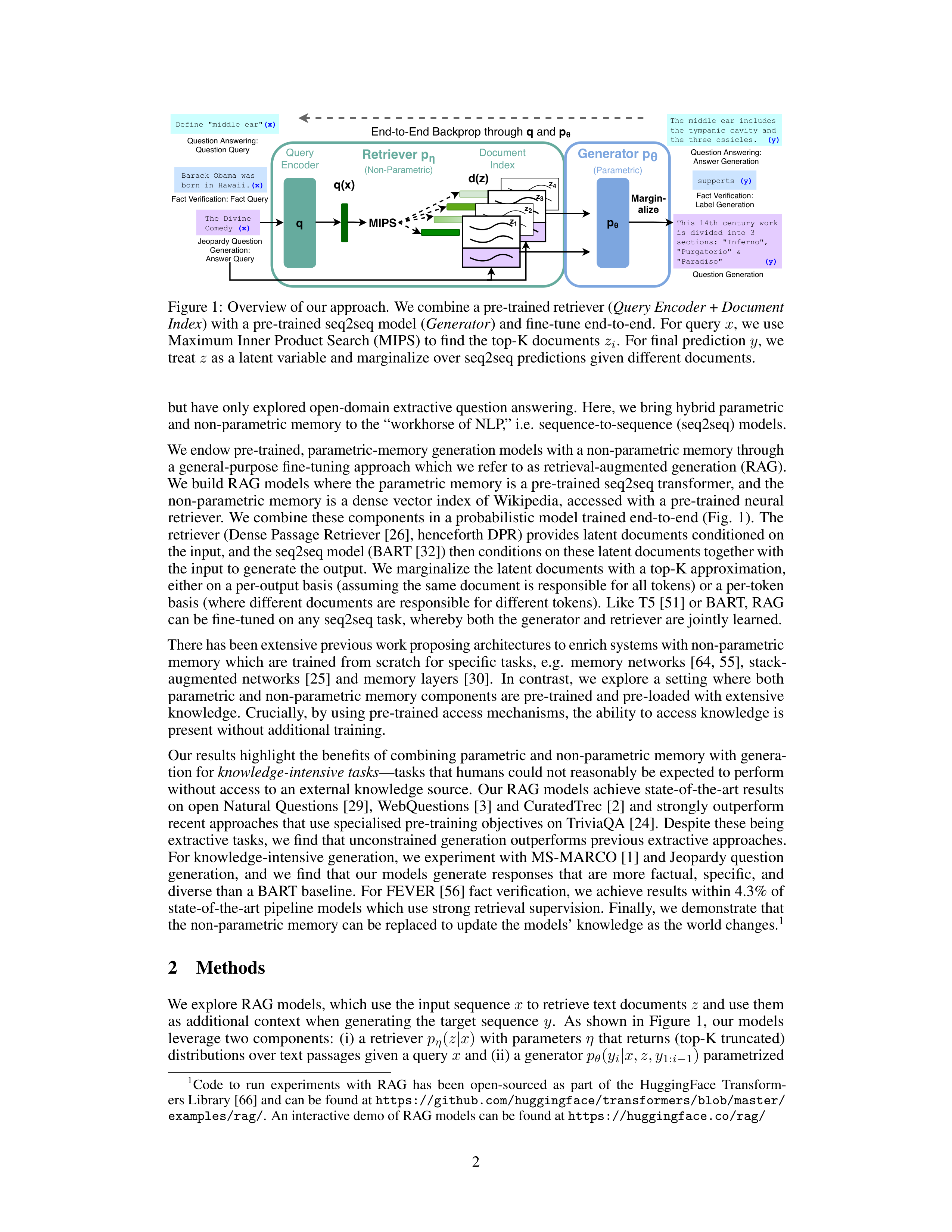
Figure 1: Overview of our approach.
We combine a pre-trained retriever (
Query Encoder
+
Document
Index
) with a pre-trained seq2seq model (
Generator
) and fine-tune end-to-end.
For query
x
, we use
Maximum Inner Product Search (MIPS) to find the top-K documents
z
i
.
For final prediction
y
, we
treat
z
as a latent variable and marginalize over seq2seq predictions given different documents.
but have only explored open-domain extractive question answering.
Here, we bring hybrid parametric
and non-parametric memory to the “workhorse of NLP,” i.e.
sequence-to-sequence (seq2seq) models.
We endow pre-trained, parametric-memory generation models with a non-parametric memory through
a general-purpose fine-tuning approach which we refer to as retrieval-augmented generation (RAG).
We build RAG models where the parametric memory is a pre-trained seq2seq transformer, and the
non-parametric memory is a dense vector index of Wikipedia, accessed with a pre-trained neural
retriever.
We combine these components in a probabilistic model trained end-to-end (Fig.
1).
The
retriever (Dense Passage Retriever [
26
], henceforth DPR) provides latent documents conditioned on
the input, and the seq2seq model (BART [
32
]) then conditions on these latent documents together with
the input to generate the output.
We marginalize the latent documents with a top-K approximation,
either on a per-output basis (assuming the same document is responsible for all tokens) or a per-token
basis (where different documents are responsible for different tokens).
Like T5 [
51
] or BART, RAG
can be fine-tuned on any seq2seq task, whereby both the generator and retriever are jointly learned.
There has been extensive previous work proposing architectures to enrich systems with non-parametric
memory which are trained from scratch for specific tasks, e.g.
memory networks [
64
,
55
], stack-
augmented
networks
[
25
]
and
memory
layers
[
30
].
In
contrast,
we
explore
a
setting
where
both
parametric and non-parametric memory components are pre-trained and pre-loaded with extensive
knowledge.
Crucially, by using pre-trained access mechanisms, the ability to access knowledge is
present without additional training.
Our results highlight the benefits of combining parametric and non-parametric memory with genera-
tion for
knowledge-intensive tasks
—tasks that humans could not reasonably be expected to perform
without access to an external knowledge source.
Our RAG models achieve state-of-the-art results
on open Natural Questions [
29
], WebQuestions [
3
] and CuratedTrec [
2
] and strongly outperform
recent approaches that use specialised pre-training objectives on TriviaQA [
24
].
Despite these being
extractive tasks, we find that unconstrained generation outperforms previous extractive approaches.
For knowledge-intensive generation, we experiment with MS-MARCO [
1
] and Jeopardy question
generation,
and
we
find
that
our
models
generate
responses
that
are
more
factual,
specific,
and
diverse than a BART baseline.
For FEVER [
56
] fact verification, we achieve results within 4.3% of
state-of-the-art pipeline models which use strong retrieval supervision.
Finally, we demonstrate that
the non-parametric memory can be replaced to update the models’ knowledge as the world changes.
1
2
Methods
We explore RAG models, which use the input sequence
x
to retrieve text documents
z
and use them
as
additional
context
when
generating
the
target
sequence
y
.
As
shown
in
Figure
1,
our
models
leverage two components:
(i) a retriever
p
η
(
z
|
x
)
with parameters
η
that returns (top-K truncated)
distributions over text passages given a query
x
and (ii) a generator
p
θ
(
y
i
|
x, z, y
1:
i
−
1
)
parametrized
1
Code
to
run
experiments
with
RAG
has
been
open-sourced
as
part
of
the
HuggingFace
Transform-
ers Library [
66
] and can be found at
https://github.com/huggingface/transformers/blob/master/
examples/rag/
.
An interactive demo of RAG models can be found at
https://huggingface.co/rag/
2
by
θ
that generates a current token based on a context of the previous
i
−
1
tokens
y
1:
i
−
1
, the original
input
x
and a retrieved passage
z
.
To train the retriever and generator end-to-end, we treat the retrieved document as a latent variable.
We propose two models that marginalize over the latent documents in different ways to produce a
distribution over generated text.
In one approach,
RAG-Sequence
, the model uses the same document
to predict each target token.
The second approach,
RAG-Token
, can predict each target token based
on a different document.
In the following, we formally introduce both models and then describe the
p
η
and
p
θ
components, as well as the training and decoding procedure.
2.1
Models
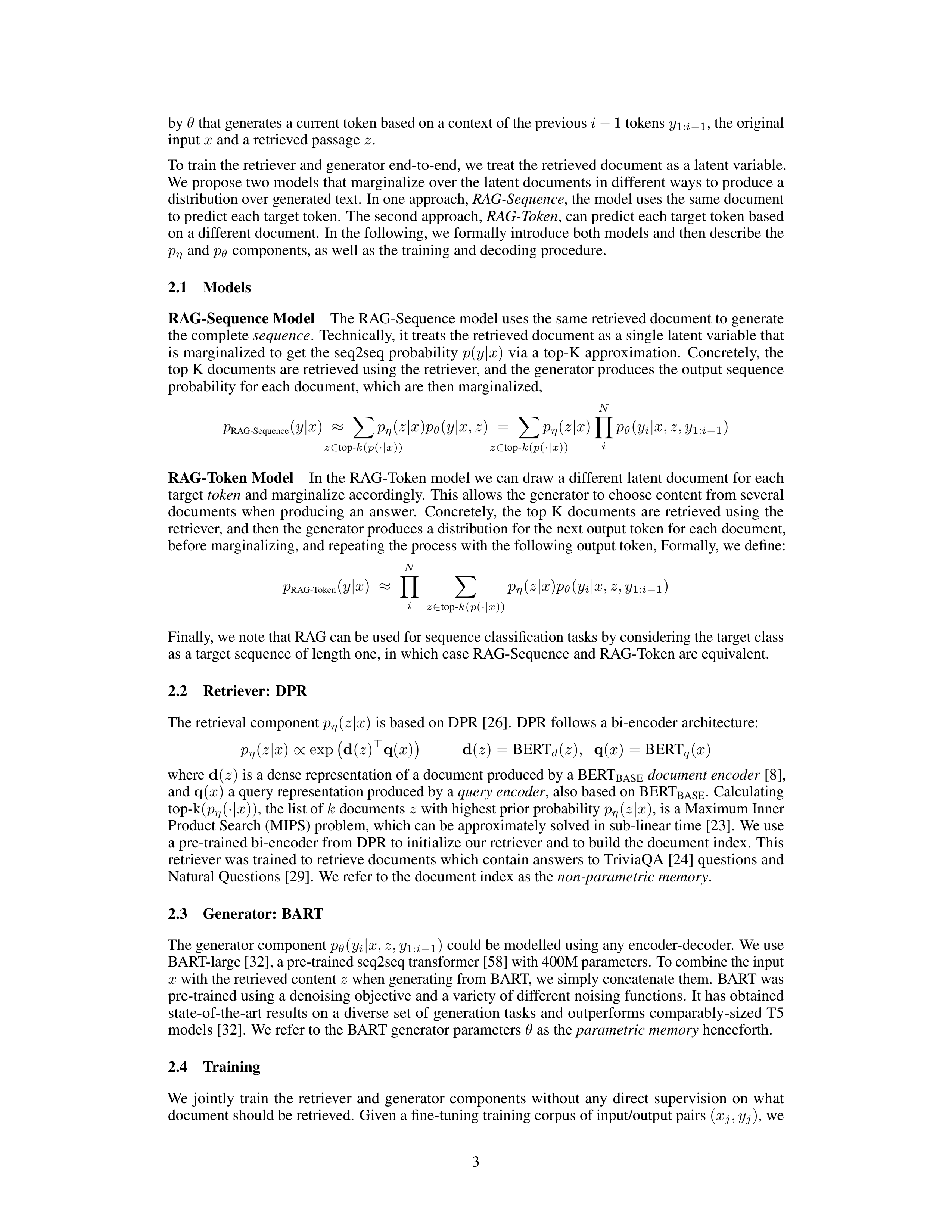
RAG-Sequence Model
The RAG-Sequence model uses the same retrieved document to generate
the complete
sequence
.
Technically, it treats the retrieved document as a single latent variable that
is marginalized to get the seq2seq probability
p
(
y
|
x
)
via a top-K approximation.
Concretely, the
top K documents are retrieved using the retriever, and the generator produces the output sequence
probability for each document, which are then marginalized,
p
RAG-Sequence
(
y
|
x
)
≈
X
z
∈
top-
k
(
p
(
·|
x
))
p
η
(
z
|
x
)
p
θ
(
y
|
x, z
)
=
X
z
∈
top-
k
(
p
(
·|
x
))
p
η
(
z
|
x
)
N
Y
i
p
θ
(
y
i
|
x, z, y
1:
i
−
1
)
RAG-Token Model
In the RAG-Token model we can draw a different latent document for each
target
token
and marginalize accordingly.
This allows the generator to choose content from several
documents
when
producing
an
answer.
Concretely,
the
top
K
documents
are
retrieved
using
the
retriever, and then the generator produces a distribution for the next output token for each document,
before marginalizing, and repeating the process with the following output token, Formally, we define:
p
RAG-Token
(
y
|
x
)
≈
N
Y
i
X
z
∈
top-
k
(
p
(
·|
x
))
p
η
(
z
|
x
)
p
θ
(
y
i
|
x, z, y
1:
i
−
1
)
Finally, we note that RAG can be used for sequence classification tasks by considering the target class
as a target sequence of length one, in which case RAG-Sequence and RAG-Token are equivalent.
2.2
Retriever:
DPR
The retrieval component
p
η
(
z
|
x
)
is based on DPR [26].
DPR follows a bi-encoder architecture:
p
η
(
z
|
x
)
∝
exp
d
(
z
)
⊤
q
(
x
)
d
(
z
) =
BERT
d
(
z
)
,
q
(
x
) =
BERT
q
(
x
)
where
d
(
z
)
is a dense representation of a document produced by a BERT
BASE
document encoder
[
8
],
and
q
(
x
)
a query representation produced by a
query encoder
, also based on BERT
BASE
.
Calculating
top-k
(
p
η
(
·|
x
))
, the list of
k
documents
z
with highest prior probability
p
η
(
z
|
x
)
, is a Maximum Inner
Product Search (MIPS) problem, which can be approximately solved in sub-linear time [
23
].
We use
a pre-trained bi-encoder from DPR to initialize our retriever and to build the document index.
This
retriever was trained to retrieve documents which contain answers to TriviaQA [
24
] questions and
Natural Questions [29].
We refer to the document index as the
non-parametric memory
.
2.3
Generator:
BART
The generator component
p
θ
(
y
i
|
x, z, y
1:
i
−
1
)
could be modelled using any encoder-decoder.
We use
BART-large [
32
], a pre-trained seq2seq transformer [
58
] with 400M parameters.
To combine the input
x
with the retrieved content
z
when generating from BART, we simply concatenate them.
BART was
pre-trained using a denoising objective and a variety of different noising functions.
It has obtained
state-of-the-art results on a diverse set of generation tasks and outperforms comparably-sized T5
models [32].
We refer to the BART generator parameters
θ
as the
parametric memory
henceforth.
2.4
Training
We
jointly
train
the
retriever
and
generator
components
without
any
direct
supervision
on
what
document should be retrieved.
Given a fine-tuning training corpus of input/output pairs
(
x
j
, y
j
)
, we
3
minimize the negative marginal log-likelihood of each target,
P
j
−
log
p
(
y
j
|
x
j
)
using stochastic
gradient descent with Adam [
28
].
Updating the document encoder
BERT
d
during training is costly as
it requires the document index to be periodically updated as REALM does during pre-training [
20
].
We
do
not
find
this
step
necessary
for
strong
performance,
and
keep
the
document
encoder
(and
index) fixed, only fine-tuning the query encoder BERT
q
and the BART generator.
2.5
Decoding
At test time, RAG-Sequence and RAG-Token require different ways to approximate
arg max
y
p
(
y
|
x
)
.
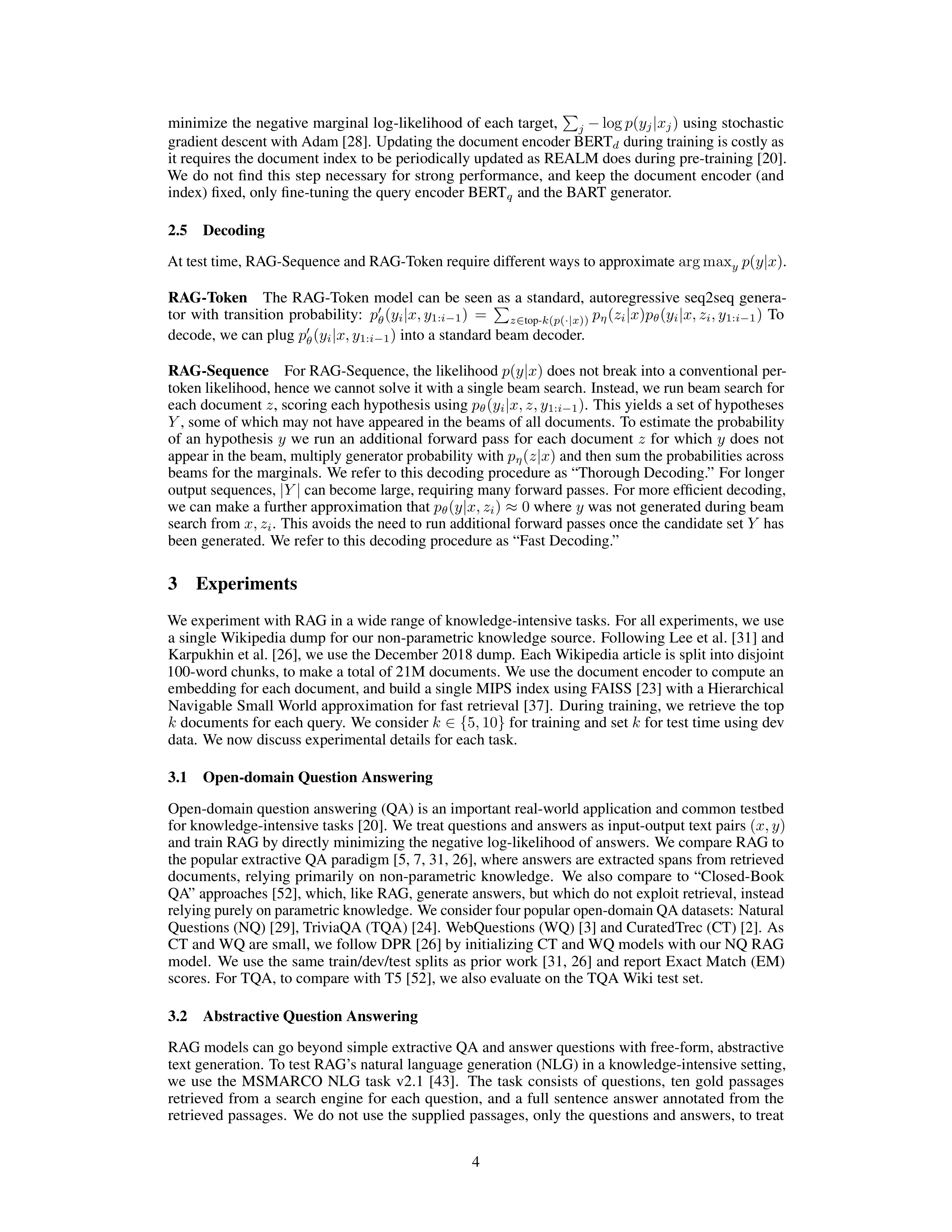
RAG-Token
The
RAG-Token
model
can
be
seen
as
a
standard,
autoregressive
seq2seq
genera-
tor
with
transition
probability:
p
′
θ
(
y
i
|
x, y
1:
i
−
1
)
=
P
z
∈
top-
k
(
p
(
·|
x
))
p
η
(
z
i
|
x
)
p
θ
(
y
i
|
x, z
i
, y
1:
i
−
1
)
To
decode, we can plug
p
′
θ
(
y
i
|
x, y
1:
i
−
1
)
into a standard beam decoder.
RAG-Sequence
For RAG-Sequence, the likelihood
p
(
y
|
x
)
does not break into a conventional per-
token likelihood, hence we cannot solve it with a single beam search.
Instead, we run beam search for
each document
z
, scoring each hypothesis using
p
θ
(
y
i
|
x, z, y
1:
i
−
1
)
.
This yields a set of hypotheses
Y
, some of which may not have appeared in the beams of all documents.
To estimate the probability
of
an
hypothesis
y
we
run
an
additional
forward
pass
for
each
document
z
for
which
y
does
not
appear in the beam, multiply generator probability with
p
η
(
z
|
x
)
and then sum the probabilities across
beams for the marginals.
We refer to this decoding procedure as “Thorough Decoding.”
For longer
output sequences,
|
Y
|
can become large, requiring many forward passes.
For more efficient decoding,
we can make a further approximation that
p
θ
(
y
|
x, z
i
)
≈
0
where
y
was not generated during beam
search from
x, z
i
.
This avoids the need to run additional forward passes once the candidate set
Y
has
been generated.
We refer to this decoding procedure as “Fast Decoding.”
3
Experiments
We experiment with RAG in a wide range of knowledge-intensive tasks.
For all experiments, we use
a single Wikipedia dump for our non-parametric knowledge source.
Following Lee et al.
[31]
and
Karpukhin et al.
[26]
, we use the December 2018 dump.
Each Wikipedia article is split into disjoint
100-word chunks, to make a total of 21M documents.
We use the document encoder to compute an
embedding for each document, and build a single MIPS index using FAISS [
23
] with a Hierarchical
Navigable Small World approximation for fast retrieval [
37
].
During training, we retrieve the top
k
documents for each query.
We consider
k
∈{
5
,
10
}
for training and set
k
for test time using dev
data.
We now discuss experimental details for each task.
3.1
Open-domain Question Answering
Open-domain question answering (QA) is an important real-world application and common testbed
for knowledge-intensive tasks [
20
].
We treat questions and answers as input-output text pairs
(
x, y
)
and train RAG by directly minimizing the negative log-likelihood of answers.
We compare RAG to
the popular extractive QA paradigm [
5
,
7
,
31
,
26
], where answers are extracted spans from retrieved
documents,
relying
primarily
on
non-parametric
knowledge.
We
also
compare
to
“Closed-Book
QA” approaches [
52
], which, like RAG, generate answers, but which do not exploit retrieval, instead
relying purely on parametric knowledge. We consider four popular open-domain QA datasets: Natural
Questions (NQ) [
29
], TriviaQA (TQA) [
24
].
WebQuestions (WQ) [
3
] and CuratedTrec (CT) [
2
].
As
CT and WQ are small, we follow DPR [
26
] by initializing CT and WQ models with our NQ RAG
model.
We use the same train/dev/test splits as prior work [
31
,
26
] and report Exact Match (EM)
scores.
For TQA, to compare with T5 [52], we also evaluate on the TQA Wiki test set.
3.2
Abstractive Question Answering
RAG models can go beyond simple extractive QA and answer questions with free-form, abstractive
text generation.
To test RAG’s natural language generation (NLG) in a knowledge-intensive setting,
we
use
the
MSMARCO
NLG
task
v2.1
[
43
].
The
task
consists
of
questions,
ten
gold
passages
retrieved
from
a
search
engine
for
each
question,
and
a
full
sentence
answer
annotated
from
the
retrieved passages.
We do not use the supplied passages, only the questions and answers, to treat
4
MSMARCO as an open-domain abstractive QA task.
MSMARCO has some questions that cannot be
answered in a way that matches the reference answer without access to the gold passages, such as
“What is the weather in Volcano, CA?” so performance will be lower without using gold passages.
We also note that some MSMARCO questions cannot be answered using Wikipedia alone.
Here,
RAG can rely on parametric knowledge to generate reasonable responses.
3.3
Jeopardy Question Generation
To evaluate RAG’s generation abilities in a non-QA setting, we study open-domain question gen-
eration.
Rather than use questions from standard open-domain QA tasks, which typically consist
of short, simple questions, we propose the more demanding task of generating Jeopardy questions.
Jeopardy is an unusual format that consists of trying to guess an entity from a fact about that entity.
For example, “The World Cup” is the answer to the question “In 1986 Mexico scored as the first
country
to
host
this
international
sports
competition
twice.”
As
Jeopardy
questions
are
precise,
factual statements, generating Jeopardy questions conditioned on their answer entities constitutes a
challenging knowledge-intensive generation task.
We
use
the
splits
from
SearchQA
[
10
],
with
100K
train,
14K
dev,
and
27K
test
examples.
As
this is a new task, we train a BART model for comparison.
Following [
67
], we evaluate using the
SQuAD-tuned
Q-BLEU-1
metric
[
42
].
Q-BLEU
is
a
variant
of
BLEU
with
a
higher
weight
for
matching
entities
and
has
higher
correlation
with
human
judgment
for
question
generation
than
standard metrics.
We also perform two human evaluations, one to assess generation factuality, and
one for specificity.
We define factuality as whether a statement can be corroborated by trusted external
sources, and specificity as high mutual dependence between the input and output [
33
].
We follow
best practice and use pairwise comparative evaluation [
34
].
Evaluators are shown an answer and two
generated questions, one from BART and one from RAG. They are then asked to pick one of four
options—quuestion A is better, question B is better, both are good, or neither is good.
3.4
Fact Verification
FEVER
[
56
]
requires
classifying
whether
a
natural
language
claim
is
supported
or
refuted
by
Wikipedia,
or
whether
there
is
not
enough
information
to
decide.
The
task
requires
retrieving
evidence
from
Wikipedia
relating
to
the
claim
and
then
reasoning
over
this
evidence
to
classify
whether the claim is true, false, or unverifiable from Wikipedia alone.
FEVER is a retrieval problem
coupled with an challenging entailment reasoning task.
It also provides an appropriate testbed for
exploring the RAG models’ ability to handle classification rather than generation.
We map FEVER
class labels (supports, refutes, or not enough info) to single output tokens and directly train with
claim-class pairs.
Crucially, unlike most other approaches to FEVER, we do not use supervision on
retrieved evidence.
In many real-world applications, retrieval supervision signals aren’t available, and
models that do not require such supervision will be applicable to a wider range of tasks.
We explore
two variants:
the standard 3-way classification task (supports/refutes/not enough info) and the 2-way
(supports/refutes) task studied in Thorne and Vlachos [57].
In both cases we report label accuracy.
4
Results
4.1
Open-domain Question Answering
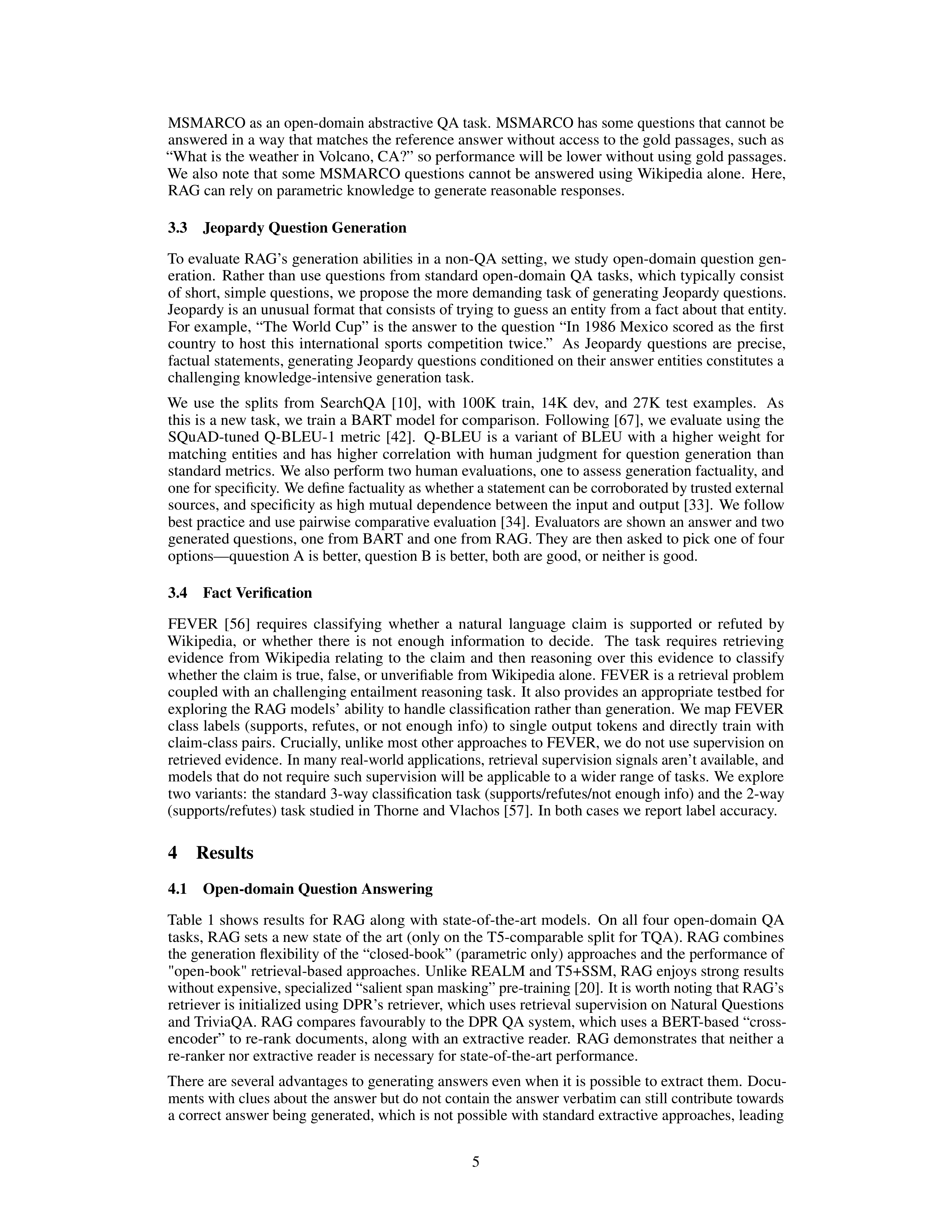
Table 1 shows results for
RAG along with
state-of-the-art models.
On all four open-domain QA
tasks, RAG sets a new state of the art (only on the T5-comparable split for TQA). RAG combines
the generation flexibility of the “closed-book” (parametric only) approaches and the performance of
"open-book" retrieval-based approaches.
Unlike REALM and T5+SSM, RAG enjoys strong results
without expensive, specialized “salient span masking” pre-training [
20
].
It is worth noting that RAG’s
retriever is initialized using DPR’s retriever, which uses retrieval supervision on Natural Questions
and TriviaQA. RAG compares favourably to the DPR QA system, which uses a BERT-based “cross-
encoder” to re-rank documents, along with an extractive reader.
RAG demonstrates that neither a
re-ranker nor extractive reader is necessary for state-of-the-art performance.
There are several advantages to generating answers even when it is possible to extract them.
Docu-
ments with clues about the answer but do not contain the answer verbatim can still contribute towards
a correct answer being generated, which is not possible with standard extractive approaches, leading
5
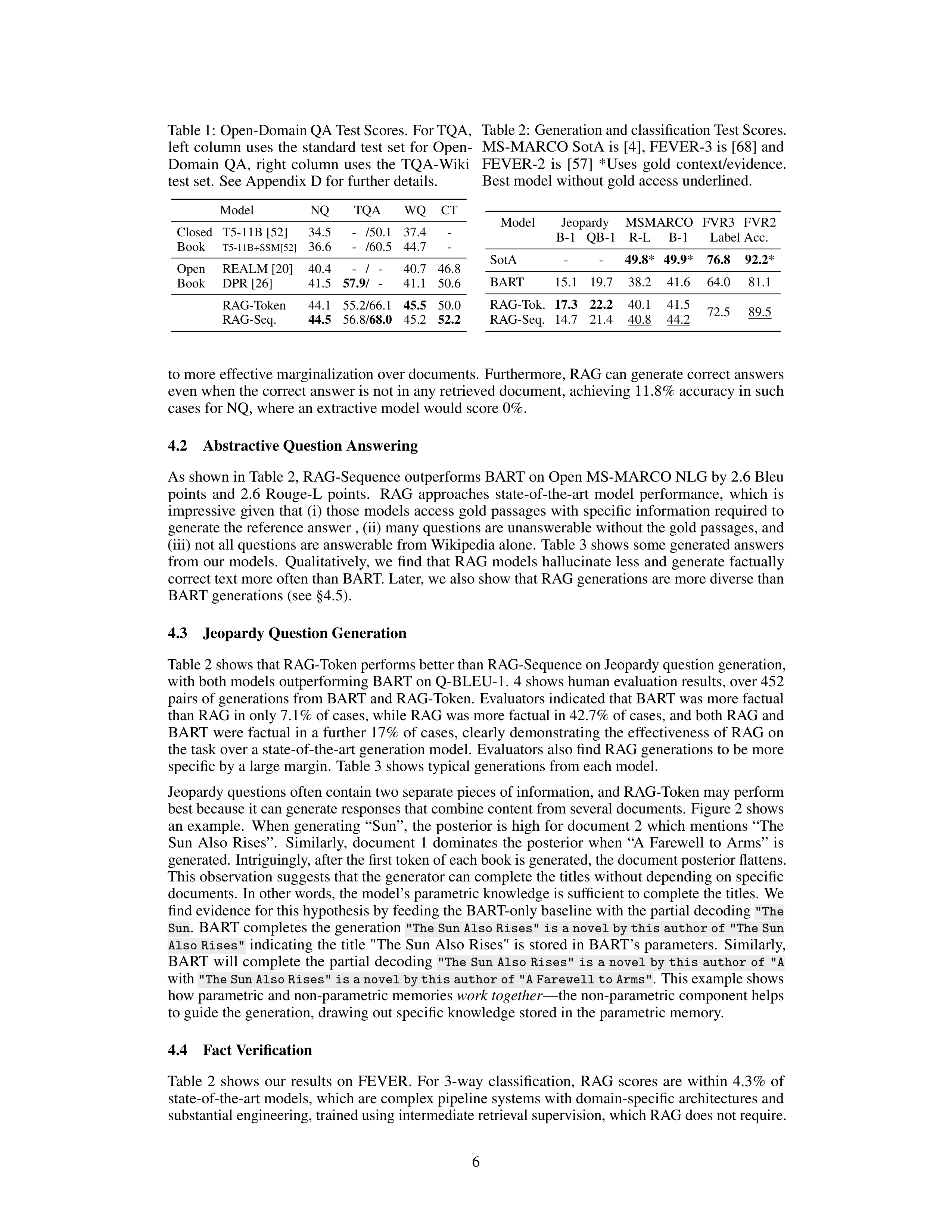
Table 1: Open-Domain QA Test Scores. For TQA,
left
column
uses
the
standard
test
set
for
Open-
Domain
QA,
right
column
uses
the
TQA-Wiki
test set.
See Appendix D for further details.
Model
NQ
TQA
WQ
CT
Closed
Book
T5-11B [52]
34.5
-
/50.1
37.4
-
T5-11B+SSM[52]
36.6
-
/60.5
44.7
-
Open
Book
REALM [20]
40.4
-
/
-
40.7
46.8
DPR [26]
41.5
57.9
/
-
41.1
50.6
RAG-Token
44.1
55.2/66.1
45.5
50.0
RAG-Seq.
44.5
56.8/
68.0
45.2
52.2
Table 2: Generation and classification Test Scores.
MS-MARCO SotA is [
4
], FEVER-3 is [
68
] and
FEVER-2
is
[
57
]
*Uses
gold
context/evidence.
Best model without gold access underlined.
Model
Jeopardy
MSMARCO
FVR3
FVR2
B-1
QB-1
R-L
B-1
Label Acc.
SotA
-
-
49.8
*
49.9
*
76.8
92.2
*
BART
15.1
19.7
38.2
41.6
64.0
81.1
RAG-Tok.
17.3
22.2
40.1
41.5
72.5
89.5
RAG-Seq.
14.7
21.4
40.8
44.2
to more effective marginalization over documents.
Furthermore, RAG can generate correct answers
even when the correct answer is not in any retrieved document, achieving 11.8% accuracy in such
cases for NQ, where an extractive model would score 0%.
4.2
Abstractive Question Answering
As shown in Table 2, RAG-Sequence outperforms BART on Open MS-MARCO NLG by 2.6 Bleu
points
and
2.6
Rouge-L
points.
RAG
approaches
state-of-the-art
model
performance,
which
is
impressive given that (i) those models access gold passages with specific information required to
generate the reference answer , (ii) many questions are unanswerable without the gold passages, and
(iii) not all questions are answerable from Wikipedia alone.
Table 3 shows some generated answers
from our models.
Qualitatively, we find that RAG models hallucinate less and generate factually
correct text more often than BART. Later, we also show that RAG generations are more diverse than
BART generations (see §4.5).
4.3
Jeopardy Question Generation
Table 2 shows that RAG-Token performs better than RAG-Sequence on Jeopardy question generation,
with both models outperforming BART on Q-BLEU-1.
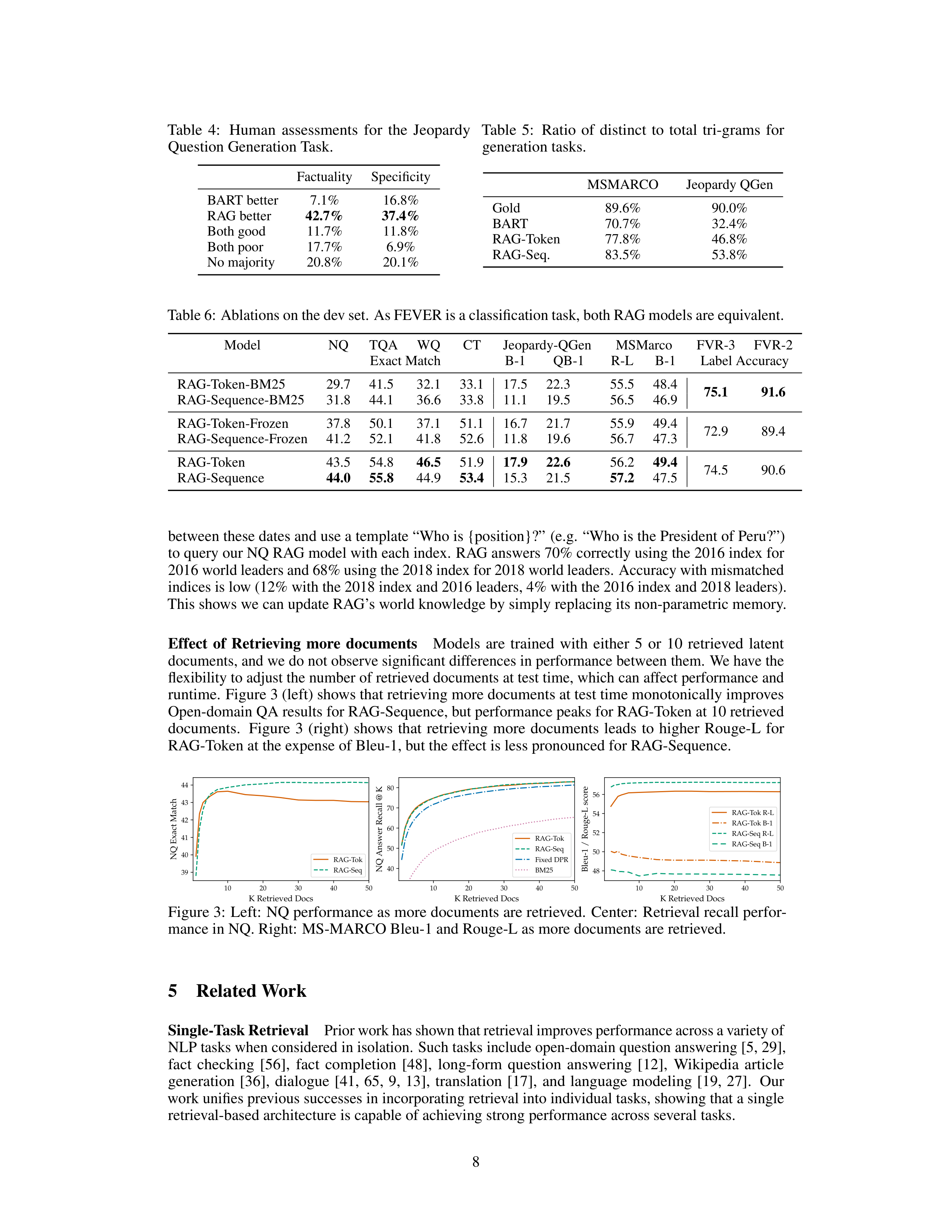
4 shows human evaluation results, over 452
pairs of generations from BART and RAG-Token.
Evaluators indicated that BART was more factual
than RAG in only 7.1% of cases, while RAG was more factual in 42.7% of cases, and both RAG and
BART were factual in a further 17% of cases, clearly demonstrating the effectiveness of RAG on
the task over a state-of-the-art generation model.
Evaluators also find RAG generations to be more
specific by a large margin.
Table 3 shows typical generations from each model.
Jeopardy questions often contain two separate pieces of information, and RAG-Token may perform
best because it can generate responses that combine content from several documents.
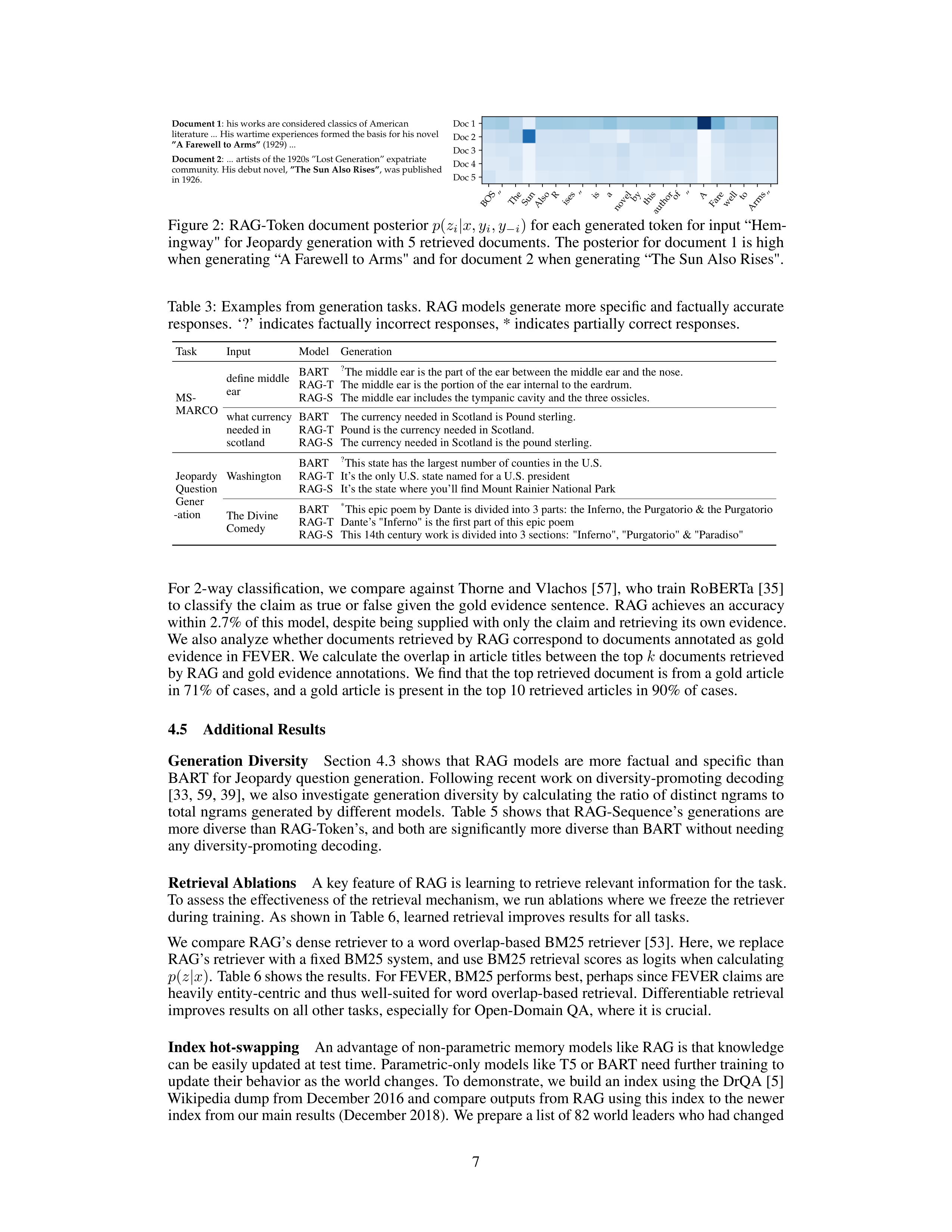
Figure 2 shows
an example.
When generating “Sun”, the posterior is high for document 2 which mentions “The
Sun
Also
Rises”.
Similarly,
document
1
dominates
the
posterior
when
“A
Farewell
to
Arms”
is
generated.
Intriguingly, after the first token of each book is generated, the document posterior flattens.
This observation suggests that the generator can complete the titles without depending on specific
documents.
In other words, the model’s parametric knowledge is sufficient to complete the titles.
We
find evidence for this hypothesis by feeding the BART-only baseline with the partial decoding
"The
Sun
.
BART completes the generation
"The Sun Also Rises" is a novel by this author of "The Sun
Also Rises"
indicating the title "The Sun Also Rises" is stored in BART’s parameters.
Similarly,
BART
will
complete
the
partial
decoding
"The
Sun
Also
Rises"
is
a
novel
by
this
author
of
"A
with
"The Sun Also Rises" is a novel by this author of "A Farewell to Arms"
.
This example shows
how parametric and non-parametric memories
work together
—the non-parametric component helps
to guide the generation, drawing out specific knowledge stored in the parametric memory.
4.4
Fact Verification
Table
2
shows
our
results
on
FEVER.
For
3-way
classification,
RAG
scores
are
within
4.3%
of
state-of-the-art models, which are complex pipeline systems with domain-specific architectures and
substantial engineering, trained using intermediate retrieval supervision, which RAG does not require.
6

Document 1
:
his works are considered classics of American
literature ...
His wartime experiences formed the basis for his novel
”A Farewell to Arms”
(1929) ...
Document 2
:
...
artists of the 1920s ”Lost Generation” expatriate
community.
His debut novel,
”The Sun Also Rises”
, was published
in 1926.
BOS ”
The
Sun
Also
R
ises
”
is
a
novel
by
this
authorof
”
A
Fare
well
to
Arms”
Doc 1
Doc 2
Doc 3
Doc 4
Doc 5
Figure 2:
RAG-Token document posterior
p
(
z
i
|
x, y
i
, y
−
i
)
for each generated token for input “Hem-
ingway" for Jeopardy generation with 5 retrieved documents.
The posterior for document 1 is high
when generating “A Farewell to Arms" and for document 2 when generating “The Sun Also Rises".
Table 3:
Examples from generation tasks.
RAG models generate more specific and factually accurate
responses.
‘?’
indicates factually incorrect responses, * indicates partially correct responses.
Task
Input
Model
Generation
MS-
MARCO
define middle
ear
BART
?
The middle ear is the part of the ear between the middle ear and the nose.
RAG-T
The middle ear is the portion of the ear internal to the eardrum.
RAG-S
The middle ear includes the tympanic cavity and the three ossicles.
what currency
needed in
scotland
BART
The currency needed in Scotland is Pound sterling.
RAG-T
Pound is the currency needed in Scotland.
RAG-S
The currency needed in Scotland is the pound sterling.
Jeopardy
Question
Gener
-ation
Washington
BART
?
This state has the largest number of counties in the U.S.
RAG-T
It’s the only U.S. state named for a U.S. president
RAG-S
It’s the state where you’ll find Mount Rainier National Park
The Divine
Comedy
BART
*
This epic poem by Dante is divided into 3 parts:
the Inferno, the Purgatorio & the Purgatorio
RAG-T
Dante’s "Inferno" is the first part of this epic poem
RAG-S
This 14th century work is divided into 3 sections:
"Inferno", "Purgatorio" & "Paradiso"
For 2-way classification, we compare against Thorne and Vlachos
[57]
, who train RoBERTa [
35
]
to classify the claim as true or false given the gold evidence sentence.
RAG achieves an accuracy
within 2.7% of this model, despite being supplied with only the claim and retrieving its own evidence.
We also analyze whether documents retrieved by RAG correspond to documents annotated as gold
evidence in FEVER. We calculate the overlap in article titles between the top
k
documents retrieved
by RAG and gold evidence annotations.
We find that the top retrieved document is from a gold article
in 71% of cases, and a gold article is present in the top 10 retrieved articles in 90% of cases.
4.5
Additional Results
Generation
Diversity
Section
4.3
shows
that
RAG
models
are
more
factual
and
specific
than
BART for Jeopardy question generation.
Following recent work on diversity-promoting decoding
[
33
,
59
,
39
], we also investigate generation diversity by calculating the ratio of distinct ngrams to
total ngrams generated by different models.
Table 5 shows that RAG-Sequence’s generations are
more diverse than RAG-Token’s, and both are significantly more diverse than BART without needing
any diversity-promoting decoding.
Retrieval Ablations
A key feature of RAG is learning to retrieve relevant information for the task.
To assess the effectiveness of the retrieval mechanism, we run ablations where we freeze the retriever
during training.
As shown in Table 6, learned retrieval improves results for all tasks.
We compare RAG’s dense retriever to a word overlap-based BM25 retriever [
53
].
Here, we replace
RAG’s retriever with a fixed BM25 system, and use BM25 retrieval scores as logits when calculating
p
(
z
|
x
)
. Table 6 shows the results. For FEVER, BM25 performs best, perhaps since FEVER claims are
heavily entity-centric and thus well-suited for word overlap-based retrieval.
Differentiable retrieval
improves results on all other tasks, especially for Open-Domain QA, where it is crucial.
Index hot-swapping
An advantage of non-parametric memory models like RAG is that knowledge
can be easily updated at test time.
Parametric-only models like T5 or BART need further training to
update their behavior as the world changes.
To demonstrate, we build an index using the DrQA [
5
]
Wikipedia dump from December 2016 and compare outputs from RAG using this index to the newer
index from our main results (December 2018).
We prepare a list of 82 world leaders who had changed
7
Table
4:
Human
assessments
for
the
Jeopardy
Question Generation Task.
Factuality
Specificity
BART better
7.1%
16.8%
RAG better
42.7%
37.4%
Both good
11.7%
11.8%
Both poor
17.7%
6.9%
No majority
20.8%
20.1%
Table
5:
Ratio
of
distinct
to
total
tri-grams
for
generation tasks.
MSMARCO
Jeopardy QGen
Gold
89.6%
90.0%
BART
70.7%
32.4%
RAG-Token
77.8%
46.8%
RAG-Seq.
83.5%
53.8%
Table 6: Ablations on the dev set.
As FEVER is a classification task, both RAG models are equivalent.
Model
NQ
TQA
WQ
CT
Jeopardy-QGen
MSMarco
FVR-3
FVR-2
Exact Match
B-1
QB-1
R-L
B-1
Label Accuracy
RAG-Token-BM25
29.7
41.5
32.1
33.1
17.5
22.3
55.5
48.4
75.1
91.6
RAG-Sequence-BM25
31.8
44.1
36.6
33.8
11.1
19.5
56.5
46.9
RAG-Token-Frozen
37.8
50.1
37.1
51.1
16.7
21.7
55.9
49.4
72.9
89.4
RAG-Sequence-Frozen
41.2
52.1
41.8
52.6
11.8
19.6
56.7
47.3
RAG-Token
43.5
54.8
46.5
51.9
17.9
22.6
56.2
49.4
74.5
90.6
RAG-Sequence
44.0
55.8
44.9
53.4
15.3
21.5
57.2
47.5
between these dates and use a template “Who is {position}?”
(e.g.
“Who is the President of Peru?”)
to query our NQ RAG model with each index.
RAG answers 70% correctly using the 2016 index for
2016 world leaders and 68% using the 2018 index for 2018 world leaders.
Accuracy with mismatched
indices is low (12% with the 2018 index and 2016 leaders, 4% with the 2016 index and 2018 leaders).
This shows we can update RAG’s world knowledge by simply replacing its non-parametric memory.
Effect
of
Retrieving
more
documents
Models
are
trained
with
either
5
or
10
retrieved
latent
documents, and we do not observe significant differences in performance between them.
We have the
flexibility to adjust the number of retrieved documents at test time, which can affect performance and
runtime.
Figure 3 (left) shows that retrieving more documents at test time monotonically improves
Open-domain QA results for RAG-Sequence, but performance peaks for RAG-Token at 10 retrieved
documents.
Figure
3
(right)
shows
that
retrieving
more
documents
leads
to
higher
Rouge-L
for
RAG-Token at the expense of Bleu-1, but the effect is less pronounced for RAG-Sequence.
10
20
30
40
50
K Retrieved Docs
39
40
41
42
43
44
NQ Exact Match
RAG-Tok
RAG-Seq
10
20
30
40
50
K Retrieved Docs
40
50
60
70
80
NQ Answer Recall @ K
RAG-Tok
RAG-Seq
Fixed DPR
BM25
10
20
30
40
50
K Retrieved Docs
48
50
52
54
56
Bleu-1 / Rouge-L score
RAG-Tok R-L
RAG-Tok B-1
RAG-Seq R-L
RAG-Seq B-1
Figure 3:
Left:
NQ performance as more documents are retrieved.
Center:
Retrieval recall perfor-
mance in NQ. Right:
MS-MARCO Bleu-1 and Rouge-L as more documents are retrieved.
5
Related Work
Single-Task Retrieval
Prior work has shown that retrieval improves performance across a variety of
NLP tasks when considered in isolation.
Such tasks include open-domain question answering [
5
,
29
],
fact
checking
[
56
],
fact
completion
[
48
],
long-form
question
answering
[
12
],
Wikipedia
article
generation
[
36
],
dialogue
[
41
,
65
,
9
,
13
],
translation
[
17
],
and
language
modeling
[
19
,
27
].
Our
work unifies previous successes in incorporating retrieval into individual tasks, showing that a single
retrieval-based architecture is capable of achieving strong performance across several tasks.
8
General-Purpose Architectures for NLP
Prior work on general-purpose architectures for NLP
tasks has shown great success without the use of retrieval.
A single,
pre-trained language model
has been shown to achieve strong performance on various classification tasks in the GLUE bench-
marks [
60
,
61
] after fine-tuning [
49
,
8
]. GPT-2 [
50
] later showed that a single, left-to-right, pre-trained
language model could achieve strong performance across both discriminative and generative tasks.
For further improvement, BART [
32
] and T5 [
51
,
52
] propose a single, pre-trained encoder-decoder
model
that
leverages
bi-directional
attention
to
achieve
stronger
performance
on
discriminative
and generative tasks.
Our work aims to expand the space of possible tasks with a single,
unified
architecture, by learning a retrieval module to augment pre-trained, generative language models.
Learned
Retrieval
There
is
significant
work
on
learning
to
retrieve
documents
in
information
retrieval,
more
recently
with
pre-trained,
neural
language
models
[
44
,
26
]
similar
to
ours.
Some
work optimizes the retrieval module to aid in a specific, downstream task such as question answering,
using search [
46
], reinforcement learning [
6
,
63
,
62
], or a latent variable approach [
31
,
20
] as in our
work.
These successes leverage different retrieval-based architectures and optimization techniques to
achieve strong performance on a single task, while we show that a single retrieval-based architecture
can be fine-tuned for strong performance on a variety of tasks.
Memory-based Architectures
Our document index can be seen as a large external memory for
neural networks to attend to, analogous to memory networks [
64
,
55
].
Concurrent work [
14
] learns
to retrieve a trained embedding for each entity in the input, rather than to retrieve raw text as in our
work.
Other work improves the ability of dialog models to generate factual text by attending over
fact embeddings [
15
,
13
].
A key feature of our memory is that it is comprised of raw text rather
distributed representations, which makes the memory both (i) human-readable, lending a form of
interpretability to our model, and (ii) human-writable, enabling us to dynamically update the model’s
memory by editing the document index.
This approach has also been used in knowledge-intensive
dialog, where generators have been conditioned on retrieved text directly, albeit obtained via TF-IDF
rather than end-to-end learnt retrieval [9].
Retrieve-and-Edit approaches
Our method shares some similarities with retrieve-and-edit style
approaches, where a similar training input-output pair is retrieved for a given input, and then edited
to provide a final output.
These approaches have proved successful in a number of domains including
Machine Translation
[
18
,
22
] and Semantic Parsing [
21
].
Our approach does have several differences,
including less of emphasis on lightly editing a retrieved item, but on aggregating content from several
pieces of retrieved content, as well as learning latent retrieval, and retrieving evidence documents
rather than related training pairs.
This said, RAG techniques may work well in these settings, and
could represent promising future work.
6
Discussion
In this work, we presented hybrid generation models with access to parametric and non-parametric
memory.
We showed that our RAG models obtain state of the art results on open-domain QA. We
found that people prefer RAG’s generation over purely parametric BART, finding RAG more factual
and specific.
We conducted an thorough investigation of the learned retrieval component, validating
its effectiveness, and we illustrated how the retrieval index can be hot-swapped to update the model
without requiring any retraining. In future work, it may be fruitful to investigate if the two components
can be jointly pre-trained from scratch, either with a denoising objective similar to BART or some
another objective.
Our work opens up new research directions on how parametric and non-parametric
memories interact and how to most effectively combine them, showing promise in being applied to a
wide variety of NLP tasks.
9
Broader Impact
This
work
offers
several
positive
societal
benefits
over
previous
work:
the
fact
that
it
is
more
strongly
grounded
in
real
factual
knowledge
(in
this
case
Wikipedia)
makes
it
“hallucinate”
less
with generations that are more factual, and offers more control and interpretability.
RAG could be
employed in a wide variety of scenarios with direct benefit to society, for example by endowing it
with a medical index and asking it open-domain questions on that topic, or by helping people be more
effective at their jobs.
With these advantages also come potential downsides: Wikipedia, or any potential external knowledge
source, will probably never be entirely factual and completely devoid of bias.
Since RAG can be
employed as a language model, similar concerns as for GPT-2 [
50
] are valid here, although arguably
to a lesser extent, including that it might be used to generate abuse, faked or misleading content in
the news or on social media; to impersonate others; or to automate the production of spam/phishing
content
[
54
].
Advanced
language
models
may
also
lead
to
the
automation
of
various
jobs
in
the
coming decades [
16
].
In order to mitigate these risks, AI systems could be employed to fight against
misleading content and automated spam/phishing.
Acknowledgments
The authors would like to thank the reviewers for their thoughtful and constructive feedback on this
paper, as well as HuggingFace for their help in open-sourcing code to run RAG models.
The authors
would also like to thank Kyunghyun Cho and Sewon Min for productive discussions and advice.
EP
thanks supports from the NSF Graduate Research Fellowship.
PL is supported by the FAIR PhD
program.
References
[1]
Payal Bajaj, Daniel Campos, Nick Craswell, Li Deng, Jianfeng Gao, Xiaodong Liu, Rangan
Majumder, Andrew McNamara, Bhaskar Mitra, Tri Nguyen, Mir Rosenberg, Xia Song, Alina
Stoica,
Saurabh
Tiwary,
and
Tong
Wang.
MS
MARCO:
A
Human
Generated
MAchine
Reading
COmprehension
Dataset.
arXiv:1611.09268
[cs]
,
November
2016.
URL
http:
//arxiv.org/abs/1611.09268
.
arXiv:
1611.09268.
[2]
Petr Baudiš and Jan Šediv
`
y.
Modeling of the question answering task in the yodaqa system.
In
International Conference of the Cross-Language Evaluation Forum for European Languages
,
pages 222–228. Springer, 2015.
URL
https://link.springer.com/chapter/10.1007%
2F978-3-319-24027-5_20
.
[3]
Jonathan Berant, Andrew Chou, Roy Frostig, and Percy Liang.
Semantic Parsing on Freebase
from Question-Answer Pairs.
In
Proceedings of the 2013 Conference on Empirical Methods
in Natural Language Processing
, pages 1533–1544, Seattle, Washington, USA, October 2013.
Association
for
Computational
Linguistics.
URL
http://www.aclweb.org/anthology/
D13-1160
.
[4]
Bin Bi, Chenliang Li, Chen Wu, Ming Yan, and Wei Wang.
Palm:
Pre-training an autoencod-
ing&autoregressive language model for context-conditioned generation.
ArXiv
, abs/2004.07159,
2020.
URL
https://arxiv.org/abs/2004.07159
.
[5]
Danqi Chen, Adam Fisch, Jason Weston, and Antoine Bordes.
Reading Wikipedia to Answer
Open-Domain Questions.
In
Proceedings of the 55th Annual Meeting of the Association for
Computational Linguistics (Volume 1:
Long Papers)
, pages 1870–1879, Vancouver, Canada,
July
2017.
Association
for
Computational
Linguistics.
doi:
10.18653/v1/P17-1171.
URL
https://www.aclweb.org/anthology/P17-1171
.
[6]
Eunsol
Choi,
Daniel
Hewlett,
Jakob
Uszkoreit,
Illia
Polosukhin,
Alexandre
Lacoste,
and
Jonathan Berant.
Coarse-to-fine question answering for long documents.
In
Proceedings of the
55th Annual Meeting of the Association for Computational Linguistics (Volume 1:
Long Papers)
,
pages 209–220, Vancouver, Canada, July 2017. Association for Computational Linguistics.
doi:
10.18653/v1/P17-1020.
URL
https://www.aclweb.org/anthology/P17-1020
.
10
[7]
Christopher Clark and Matt Gardner.
Simple and Effective Multi-Paragraph Reading Compre-
hension.
arXiv:1710.10723 [cs]
, October 2017.
URL
http://arxiv.org/abs/1710.10723
.
arXiv:
1710.10723.
[8]
Jacob Devlin, Ming-Wei Chang, Kenton Lee, and Kristina Toutanova.
BERT: Pre-training of
Deep Bidirectional Transformers for Language Understanding.
In
Proceedings of the 2019 Con-
ference of the North American Chapter of the Association for Computational Linguistics: Human
Language Technologies, Volume 1 (Long and Short Papers)
, pages 4171–4186, Minneapolis,
Minnesota, June 2019. Association for Computational Linguistics.
doi:
10.18653/v1/N19-1423.
URL
https://www.aclweb.org/anthology/N19-1423
.
[9]
Emily Dinan, Stephen Roller, Kurt Shuster, Angela Fan, Michael Auli, and Jason Weston.
Wiz-
ard of wikipedia:
Knowledge-powered conversational agents.
In
International Conference on
Learning Representations
, 2019.
URL
https://openreview.net/forum?id=r1l73iRqKm
.
[10]
Matthew Dunn, Levent Sagun, Mike Higgins, V. Ugur Guney, Volkan Cirik, and Kyunghyun
Cho.
SearchQA:
A
New
Q&A
Dataset
Augmented
with
Context
from
a
Search
Engine.
arXiv:1704.05179
[cs]
,
April
2017.
URL
http://arxiv.org/abs/1704.05179
.
arXiv:
1704.05179.
[11]
Angela Fan, Mike Lewis, and Yann Dauphin.
Hierarchical neural story generation.
In
Proceed-
ings of the 56th Annual Meeting of the Association for Computational Linguistics (Volume 1:
Long Papers)
, pages 889–898, Melbourne, Australia, July 2018. Association for Computational
Linguistics.
doi:
10.18653/v1/P18-1082.
URL
https://www.aclweb.org/anthology/
P18-1082
.
[12]
Angela Fan, Yacine Jernite, Ethan Perez, David Grangier, Jason Weston, and Michael Auli. ELI5:
Long form question answering.
In
Proceedings of the 57th Annual Meeting of the Association
for Computational Linguistics
, pages 3558–3567, Florence, Italy, July 2019. Association for
Computational Linguistics.
doi:
10.18653/v1/P19-1346.
URL
https://www.aclweb.org/
anthology/P19-1346
.
[13]
Angela
Fan,
Claire
Gardent,
Chloe
Braud,
and
Antoine
Bordes.
Augmenting
transformers
with KNN-based composite memory,
2020.
URL
https://openreview.net/forum?id=
H1gx1CNKPH
.
[14]
Thibault Févry, Livio Baldini Soares, Nicholas FitzGerald, Eunsol Choi, and Tom Kwiatkowski.
Entities as experts:
Sparse memory access with entity supervision.
ArXiv
,
abs/2004.07202,
2020.
URL
https://arxiv.org/abs/2004.07202
.
[15]
Marjan
Ghazvininejad,
Chris
Brockett,
Ming-Wei
Chang,
Bill
Dolan,
Jianfeng
Gao,
Wen
tau
Yih,
and
Michel
Galley.
A
knowledge-grounded
neural
conversation
model.
In
AAAI
Conference on Artificial Intelligence
, 2018. URL
https://www.aaai.org/ocs/index.php/
AAAI/AAAI18/paper/view/16710
.
[16]
Katja Grace, John Salvatier, Allan Dafoe, Baobao Zhang, and Owain Evans.
When will AI
exceed human performance?
evidence from AI experts.
CoRR
, abs/1705.08807, 2017.
URL
http://arxiv.org/abs/1705.08807
.
[17]
Jiatao Gu,
Yong Wang,
Kyunghyun
Cho,
and Victor
O.K. Li.
Search engine guided
neural
machine
translation.
In
AAAI
Conference
on
Artificial
Intelligence
,
2018.
URL
https:
//www.aaai.org/ocs/index.php/AAAI/AAAI18/paper/view/17282
.
[18]
Jiatao Gu,
Yong Wang,
Kyunghyun
Cho,
and Victor
O.K. Li.
Search engine guided
neural
machine translation.
In
32nd AAAI Conference on Artificial Intelligence,
AAAI 2018
,
32nd
AAAI Conference on Artificial Intelligence, AAAI 2018, pages 5133–5140. AAAI press, 2018.
32nd AAAI Conference on Artificial Intelligence, AAAI 2018 ; Conference date:
02-02-2018
Through 07-02-2018.
[19]
Kelvin Guu, Tatsunori B. Hashimoto, Yonatan Oren, and Percy Liang.
Generating sentences by
editing prototypes.
Transactions of the Association for Computational Linguistics
, 6:437–450,
2018.
doi:
10.1162/tacl_a_00030.
URL
https://www.aclweb.org/anthology/Q18-1031
.
11
[20]
Kelvin
Guu,
Kenton
Lee,
Zora
Tung,
Panupong
Pasupat,
and
Ming-Wei
Chang.
REALM:
Retrieval-augmented language model pre-training.
ArXiv
, abs/2002.08909, 2020.
URL
https:
//arxiv.org/abs/2002.08909
.
[21]
Tatsunori
B
Hashimoto,
Kelvin
Guu,
Yonatan
Oren,
and
Percy
S
Liang.
A
retrieve-and-edit
framework
for
predicting
structured
outputs.
In
S.
Bengio,
H.
Wallach,
H.
Larochelle,
K.
Grauman,
N.
Cesa-Bianchi,
and
R.
Garnett,
ed-
itors,
Advances
in
Neural
Information
Processing
Systems
31
,
pages
10052–
10062.
Curran
Associates,
Inc.,
2018.
URL
http://papers.nips.cc/paper/
8209-a-retrieve-and-edit-framework-for-predicting-structured-outputs.
pdf
.
[22]
Nabil Hossain, Marjan Ghazvininejad, and Luke Zettlemoyer.
Simple and effective retrieve-
edit-rerank text generation.
In
Proceedings of the 58th Annual Meeting of the Association for
Computational Linguistics
, pages 2532–2538, Online, July 2020. Association for Computa-
tional Linguistics.
doi:
10.18653/v1/2020.acl-main.228.
URL
https://www.aclweb.org/
anthology/2020.acl-main.228
.
[23]
Jeff Johnson, Matthijs Douze, and Hervé Jégou.
Billion-scale similarity search with gpus.
arXiv
preprint arXiv:1702.08734
, 2017.
URL
https://arxiv.org/abs/1702.08734
.
[24]
Mandar Joshi, Eunsol Choi, Daniel Weld, and Luke Zettlemoyer.
TriviaQA: A Large Scale
Distantly Supervised Challenge Dataset for Reading Comprehension.
In
Proceedings of the
55th Annual Meeting of the Association for Computational Linguistics (Volume 1:
Long Papers)
,
pages 1601–1611, Vancouver, Canada, July 2017. Association for Computational Linguistics.
doi:
10.18653/v1/P17-1147.
URL
https://www.aclweb.org/anthology/P17-1147
.
[25]
Armand
Joulin
and
Tomas
Mikolov.
Inferring
algorithmic
patterns
with
stack-
augmented
recurrent
nets.
In
Proceedings
of
the
28th
International
Conference
on
Neural
Information
Processing
Systems
-
Volume
1
,
NIPS’15,
page
190–198,
Cam-
bridge,
MA,
USA,
2015.
MIT
Press.
URL
https://papers.nips.cc/paper/
5857-inferring-algorithmic-patterns-with-stack-augmented-recurrent-nets
.
[26]
Vladimir Karpukhin, Barlas Oguz, Sewon Min, Ledell Wu, Sergey Edunov, Danqi Chen, and
Wen-tau Yih.
Dense passage retrieval for open-domain question answering.
arXiv preprint
arXiv:2004.04906
, 2020.
URL
https://arxiv.org/abs/2004.04906
.
[27]
Urvashi Khandelwal, Omer Levy, Dan Jurafsky, Luke Zettlemoyer, and Mike Lewis.
Generaliza-
tion through memorization:
Nearest neighbor language models.
In
International Conference on
Learning Representations
, 2020.
URL
https://openreview.net/forum?id=HklBjCEKvH
.
[28]
Diederik P. Kingma and Jimmy Ba.
Adam:
A method for stochastic optimization.
In Yoshua
Bengio and Yann LeCun, editors,
3rd International Conference on Learning Representations,
ICLR 2015, San Diego, CA, USA, May 7-9, 2015, Conference Track Proceedings
, 2015.
URL
http://arxiv.org/abs/1412.6980
.
[29]
Tom
Kwiatkowski,
Jennimaria
Palomaki,
Olivia
Redfield,
Michael
Collins,
Ankur
Parikh,
Chris
Alberti,
Danielle
Epstein,
Illia
Polosukhin,
Matthew
Kelcey,
Jacob
Devlin,
Ken-
ton
Lee,
Kristina
N.
Toutanova,
Llion
Jones,
Ming-Wei
Chang,
Andrew
Dai,
Jakob
Uszkoreit,
Quoc
Le,
and
Slav
Petrov.
Natural
Questions:
a
Benchmark
for
Ques-
tion
Answering
Research.
Transactions
of
the
Association
of
Computational
Lin-
guistics
,
2019.
URL
https://tomkwiat.users.x20web.corp.google.com/papers/
natural-questions/main-1455-kwiatkowski.pdf
.
[30]
Guillaume Lample, Alexandre Sablayrolles, Marc’ Aurelio Ranzato, Ludovic Denoyer, and
Herve
Jegou.
Large
memory
layers
with
product
keys.
In
H.
Wallach,
H.
Larochelle,
A.
Beygelzimer,
F.
d’
Alché-Buc,
E.
Fox,
and
R.
Garnett,
editors,
Advances
in
Neural
In-
formation Processing Systems 32
, pages 8548–8559. Curran Associates, Inc., 2019.
URL
http:
//papers.nips.cc/paper/9061-large-memory-layers-with-product-keys.pdf
.
[31]
Kenton Lee, Ming-Wei Chang, and Kristina Toutanova.
Latent retrieval for weakly supervised
open domain question answering.
In
Proceedings of the 57th Annual Meeting of the Association
12
for Computational Linguistics
, pages 6086–6096, Florence, Italy, July 2019. Association for
Computational Linguistics.
doi:
10.18653/v1/P19-1612.
URL
https://www.aclweb.org/
anthology/P19-1612
.
[32]
Mike
Lewis,
Yinhan
Liu,
Naman
Goyal,
Marjan
Ghazvininejad,
Abdelrahman
Mohamed,
Omer Levy, Veselin Stoyanov, and Luke Zettlemoyer.
BART: Denoising sequence-to-sequence
pre-training for natural language generation, translation, and comprehension.
arXiv preprint
arXiv:1910.13461
, 2019.
URL
https://arxiv.org/abs/1910.13461
.
[33]
Jiwei Li, Michel Galley, Chris Brockett, Jianfeng Gao, and Bill Dolan.
A diversity-promoting
objective function for neural conversation models.
In
Proceedings of the 2016 Conference of the
North American Chapter of the Association for Computational Linguistics:
Human Language
Technologies
, pages 110–119, San Diego, California, June 2016. Association for Computational
Linguistics.
doi:
10.18653/v1/N16-1014.
URL
https://www.aclweb.org/anthology/
N16-1014
.
[34]
Margaret Li,
Jason Weston,
and Stephen Roller.
Acute-eval:
Improved dialogue evaluation
with optimized questions and multi-turn comparisons.
ArXiv
,
abs/1909.03087,
2019.
URL
https://arxiv.org/abs/1909.03087
.
[35]
Hairong Liu, Mingbo Ma, Liang Huang, Hao Xiong, and Zhongjun He.
Robust neural machine
translation
with
joint
textual
and
phonetic
embedding.
In
Proceedings
of
the
57th
Annual
Meeting of the Association for Computational Linguistics
, pages 3044–3049, Florence, Italy,
July
2019.
Association
for
Computational
Linguistics.
doi:
10.18653/v1/P19-1291.
URL
https://www.aclweb.org/anthology/P19-1291
.
[36]
Peter J. Liu*, Mohammad Saleh*, Etienne Pot, Ben Goodrich, Ryan Sepassi, Lukasz Kaiser,
and Noam Shazeer.
Generating wikipedia by summarizing long sequences.
In
International
Conference on Learning Representations
, 2018.
URL
https://openreview.net/forum?
id=Hyg0vbWC-
.
[37]
Yury A. Malkov and D. A. Yashunin.
Efficient and robust approximate nearest neighbor search
using hierarchical navigable small world graphs.
IEEE Transactions on Pattern Analysis and
Machine Intelligence
, 42:824–836, 2016.
URL
https://arxiv.org/abs/1603.09320
.
[38]
Gary Marcus.
The next decade in ai:
four steps towards robust artificial intelligence.
arXiv
preprint arXiv:2002.06177
, 2020.
URL
https://arxiv.org/abs/2002.06177
.
[39]
Luca
Massarelli,
Fabio
Petroni,
Aleksandra
Piktus,
Myle
Ott,
Tim
Rocktäschel,
Vassilis
Plachouras,
Fabrizio
Silvestri,
and
Sebastian
Riedel.
How
decoding
strategies
affect
the
verifiability
of
generated
text.
arXiv
preprint
arXiv:1911.03587
,
2019.
URL
https:
//arxiv.org/abs/1911.03587
.
[40]
Paulius Micikevicius, Sharan Narang, Jonah Alben, Gregory Diamos, Erich Elsen, David Garcia,
Boris Ginsburg, Michael Houston, Oleksii Kuchaiev, Ganesh Venkatesh, and Hao Wu.
Mixed
precision training.
In
ICLR
, 2018.
URL
https://openreview.net/forum?id=r1gs9JgRZ
.
[41]
Nikita Moghe, Siddhartha Arora, Suman Banerjee, and Mitesh M. Khapra.
Towards exploit-
ing
background
knowledge
for
building
conversation
systems.
In
Proceedings
of
the
2018
Conference on Empirical Methods in Natural Language Processing
, pages 2322–2332, Brus-
sels,
Belgium,
October-November
2018.
Association
for
Computational
Linguistics.
doi:
10.18653/v1/D18-1255.
URL
https://www.aclweb.org/anthology/D18-1255
.
[42]
Preksha Nema and Mitesh M. Khapra. Towards a better metric for evaluating question generation
systems.
In
Proceedings of the 2018 Conference on Empirical Methods in Natural Language
Processing
, pages 3950–3959, Brussels, Belgium, October-November 2018. Association for
Computational Linguistics.
doi:
10.18653/v1/D18-1429.
URL
https://www.aclweb.org/
anthology/D18-1429
.
[43]
Tri
Nguyen,
Mir
Rosenberg,
Xia
Song,
Jianfeng
Gao,
Saurabh
Tiwary,
Rangan
Majumder,
and Li Deng.
MS MARCO: A human generated machine reading comprehension dataset.
In
Tarek
Richard
Besold,
Antoine
Bordes,
Artur
S.
d’Avila
Garcez,
and
Greg
Wayne,
editors,
Proceedings
of
the
Workshop
on
Cognitive
Computation:
Integrating
neural
and
symbolic
13
approaches 2016 co-located with the 30th Annual Conference on Neural Information Processing
Systems (NIPS 2016), Barcelona, Spain, December 9, 2016
, volume 1773 of
CEUR Workshop
Proceedings
.
CEUR-WS.org,
2016.
URL
http://ceur-ws.org/Vol-1773/CoCoNIPS_
2016_paper9.pdf
.
[44]
Rodrigo
Nogueira
and
Kyunghyun
Cho.
Passage
re-ranking
with
BERT.
arXiv
preprint
arXiv:1901.04085
, 2019.
URL
https://arxiv.org/abs/1901.04085
.
[45]
Myle Ott, Sergey Edunov, Alexei Baevski, Angela Fan, Sam Gross, Nathan Ng, David Grangier,
and Michael Auli.
fairseq:
A fast, extensible toolkit for sequence modeling.
In
Proceedings
of the 2019 Conference of the North American Chapter of the Association for Computational
Linguistics (Demonstrations)
, pages 48–53, Minneapolis, Minnesota, June 2019. Association
for
Computational
Linguistics.
doi:
10.18653/v1/N19-4009.
URL
https://www.aclweb.
org/anthology/N19-4009
.
[46]
Ethan Perez, Siddharth Karamcheti, Rob Fergus, Jason Weston, Douwe Kiela, and Kyunghyun
Cho.
Finding generalizable evidence by learning to convince q&a models.
In
Proceedings
of the 2019 Conference on Empirical Methods in Natural Language Processing and the 9th
International
Joint
Conference
on
Natural
Language
Processing
(EMNLP-IJCNLP)
,
pages
2402–2411, Hong Kong, China, November 2019. Association for Computational Linguistics.
doi:
10.18653/v1/D19-1244.
URL
https://www.aclweb.org/anthology/D19-1244
.
[47]
Fabio Petroni, Tim Rocktäschel, Sebastian Riedel, Patrick Lewis, Anton Bakhtin, Yuxiang Wu,
and Alexander Miller.
Language models as knowledge bases?
In
Proceedings of the 2019
Conference on Empirical Methods in Natural Language Processing and the 9th International
Joint Conference on Natural Language Processing (EMNLP-IJCNLP)
, pages 2463–2473, Hong
Kong, China, November 2019. Association for Computational Linguistics.
doi:
10.18653/v1/
D19-1250.
URL
https://www.aclweb.org/anthology/D19-1250
.
[48]
Fabio Petroni, Patrick Lewis, Aleksandra Piktus, Tim Rocktäschel, Yuxiang Wu, Alexander H.
Miller, and Sebastian Riedel.
How context affects language models’ factual predictions.
In
Automated Knowledge Base Construction
, 2020.
URL
https://openreview.net/forum?
id=025X0zPfn
.
[49]
Alec
Radford,
Karthik
Narasimhan,
Tim
Salimans,
and
Ilya
Sutskever.
Im-
proving
Language
Understanding
by
Generative
Pre-Training,
2018.
URL
https://s3-us-west-2.amazonaws.com/openai-assets/research-covers/
language-unsupervised/language_understanding_paper.pdf
.
[50]
Alec
Radford,
Jeff
Wu,
Rewon
Child,
David
Luan,
Dario
Amodei,
and
Ilya
Sutskever.
Language
models
are
unsupervised
multitask
learners,
2019.
URL
https://d4mucfpksywv.cloudfront.net/better-language-models/language_
models_are_unsupervised_multitask_learners.pdf
.
[51]
Colin Raffel, Noam Shazeer, Adam Roberts, Katherine Lee, Sharan Narang, Michael Matena,
Yanqi Zhou, Wei Li, and Peter J. Liu.
Exploring the limits of transfer learning with a unified
text-to-text transformer.
arXiv e-prints
, 2019.
URL
https://arxiv.org/abs/1910.10683
.
[52]
Adam Roberts,
Colin Raffel,
and Noam Shazeer.
How much knowledge can you pack into
the parameters of a language model?
arXiv e-prints
, 2020.
URL
https://arxiv.org/abs/
2002.08910
.
[53]
Stephen Robertson and Hugo Zaragoza.
The probabilistic relevance framework:
Bm25 and
beyond.
Found. Trends Inf. Retr.
, 3(4):333–389, April 2009.
ISSN 1554-0669.
doi:
10.1561/
1500000019.
URL
https://doi.org/10.1561/1500000019
.
[54]
Irene Solaiman, Miles Brundage, Jack Clark, Amanda Askell, Ariel Herbert-Voss, Jeff Wu, Alec
Radford, and Jian-Bing Wang.
Release strategies and the social impacts of language models.
ArXiv
, abs/1908.09203, 2019.
[55]
Sainbayar Sukhbaatar, Arthur Szlam, Jason Weston, and Rob Fergus.
End-to-end memory net-
works. In C. Cortes, N. D. Lawrence, D. D. Lee, M. Sugiyama, and R. Garnett, editors,
Advances
in Neural Information Processing Systems 28
, pages 2440–2448. Curran Associates, Inc., 2015.
URL
http://papers.nips.cc/paper/5846-end-to-end-memory-networks.pdf
.
14
[56]
James Thorne, Andreas Vlachos, Christos Christodoulopoulos, and Arpit Mittal.
FEVER: a
large-scale dataset for fact extraction and VERification.
In
Proceedings of the 2018 Conference
of
the
North
American
Chapter
of
the
Association
for
Computational
Linguistics:
Human
Language Technologies,
Volume 1 (Long Papers)
,
pages 809–819,
New Orleans,
Louisiana,
June
2018.
Association
for
Computational
Linguistics.
doi:
10.18653/v1/N18-1074.
URL
https://www.aclweb.org/anthology/N18-1074
.
[57]
James H. Thorne and Andreas Vlachos.
Avoiding catastrophic forgetting in mitigating model
biases in sentence-pair classification with elastic weight consolidation.
ArXiv
, abs/2004.14366,
2020.
URL
https://arxiv.org/abs/2004.14366
.
[58]
Ashish Vaswani, Noam Shazeer, Niki Parmar, Jakob Uszkoreit, Llion Jones, Aidan N Gomez,
Ł ukasz Kaiser, and Illia Polosukhin.
Attention is all you need.
In I. Guyon, U. V. Luxburg,
S. Bengio, H. Wallach, R. Fergus, S. Vishwanathan, and R. Garnett, editors,
Advances in Neural
Information Processing Systems 30
, pages 5998–6008. Curran Associates, Inc., 2017.
URL
http://papers.nips.cc/paper/7181-attention-is-all-you-need.pdf
.
[59]
Ashwin Vijayakumar, Michael Cogswell, Ramprasaath Selvaraju, Qing Sun, Stefan Lee, David
Crandall, and Dhruv Batra.
Diverse beam search for improved description of complex scenes.
AAAI Conference on Artificial Intelligence
, 2018.
URL
https://www.aaai.org/ocs/index.
php/AAAI/AAAI18/paper/view/17329
.
[60]
Alex Wang, Amanpreet Singh, Julian Michael, Felix Hill, Omer Levy, and Samuel Bowman.
GLUE:
A
multi-task
benchmark
and
analysis
platform
for
natural
language
understanding.
In
Proceedings
of
the
2018
EMNLP
Workshop
BlackboxNLP:
Analyzing
and
Interpreting
Neural Networks for NLP
, pages 353–355, Brussels, Belgium, November 2018. Association for
Computational Linguistics.
doi:
10.18653/v1/W18-5446.
URL
https://www.aclweb.org/
anthology/W18-5446
.
[61]
Alex
Wang,
Yada
Pruksachatkun,
Nikita
Nangia,
Amanpreet
Singh,
Julian
Michael,
Felix
Hill,
Omer
Levy,
and
Samuel
Bowman.
SuperGLUE:
A
Stickier
Benchmark
for
General-
Purpose
Language
Understanding
Systems.
In
H.
Wallach,
H.
Larochelle,
A.
Beygelzimer,
F. d\textquotesingle Alché-Buc, E. Fox, and R. Garnett, editors,
Advances in Neural Information
Processing
Systems
32
,
pages
3261–3275.
Curran
Associates,
Inc.,
2019.
URL
https://
arxiv.org/abs/1905.00537
.
[62]
Shuohang Wang, Mo Yu, Xiaoxiao Guo, Zhiguo Wang, Tim Klinger, Wei Zhang, Shiyu Chang,
Gerry Tesauro, Bowen Zhou, and Jing Jiang.
R
3
:
Reinforced ranker-reader for open-domain
question answering.
In Sheila A. McIlraith and Kilian Q. Weinberger, editors,
Proceedings of
the Thirty-Second AAAI Conference on Artificial Intelligence, (AAAI-18), the 30th innovative
Applications of Artificial Intelligence (IAAI-18), and the 8th AAAI Symposium on Educational
Advances in Artificial Intelligence (EAAI-18),
New Orleans,
Louisiana,
USA, February 2-7,
2018
,
pages
5981–5988.
AAAI
Press,
2018.
URL
https://www.aaai.org/ocs/index.
php/AAAI/AAAI18/paper/view/16712
.
[63]
Shuohang Wang, Mo Yu, Jing Jiang, Wei Zhang, Xiaoxiao Guo, Shiyu Chang, Zhiguo Wang,
Tim
Klinger,
Gerald
Tesauro,
and
Murray
Campbell.
Evidence
aggregation
for
answer
re-
ranking in open-domain question answering.
In
ICLR
, 2018.
URL
https://openreview.
net/forum?id=rJl3yM-Ab
.
[64]
Jason
Weston,
Sumit
Chopra,
and
Antoine
Bordes.
Memory
networks.
In
Yoshua
Bengio
and Yann LeCun, editors,
3rd International Conference on Learning Representations, ICLR
2015,
San
Diego,
CA,
USA,
May
7-9,
2015,
Conference
Track
Proceedings
,
2015.
URL
http://arxiv.org/abs/1410.3916
.
[65]
Jason Weston, Emily Dinan, and Alexander Miller.
Retrieve and refine:
Improved sequence
generation models for dialogue.
In
Proceedings of the 2018 EMNLP Workshop SCAI: The 2nd
International Workshop on Search-Oriented Conversational AI
, pages 87–92, Brussels, Belgium,
October 2018. Association for Computational Linguistics.
doi:
10.18653/v1/W18-5713.
URL
https://www.aclweb.org/anthology/W18-5713
.
15
[66]
Thomas Wolf, Lysandre Debut, Victor Sanh, Julien Chaumond, Clement Delangue, Anthony
Moi,
Pierric Cistac,
Tim Rault,
Rémi Louf,
Morgan Funtowicz,
Joe Davison,
Sam Shleifer,
Patrick von Platen, Clara Ma, Yacine Jernite, Julien Plu, Canwen Xu, Teven Le Scao, Sylvain
Gugger, Mariama Drame, Quentin Lhoest, and Alexander M. Rush. Huggingface’s transformers:
State-of-the-art natural language processing.
ArXiv
, abs/1910.03771, 2019.
[67]
Shiyue Zhang and Mohit Bansal.
Addressing semantic drift in question generation for semi-
supervised question answering.
In
Proceedings of the 2019 Conference on Empirical Meth-
ods in Natural Language Processing and the 9th International Joint Conference on Natural
Language
Processing
(EMNLP-IJCNLP)
,
pages
2495–2509,
Hong
Kong,
China,
Novem-
ber
2019.
Association
for
Computational
Linguistics.
doi:
10.18653/v1/D19-1253.
URL
https://www.aclweb.org/anthology/D19-1253
.
[68]
Wanjun Zhong, Jingjing Xu, Duyu Tang, Zenan Xu, Nan Duan, Ming Zhou, Jiahai Wang, and
Jian Yin.
Reasoning over semantic-level graph for fact checking.
ArXiv
, abs/1909.03745, 2019.
URL
https://arxiv.org/abs/1909.03745
.
16
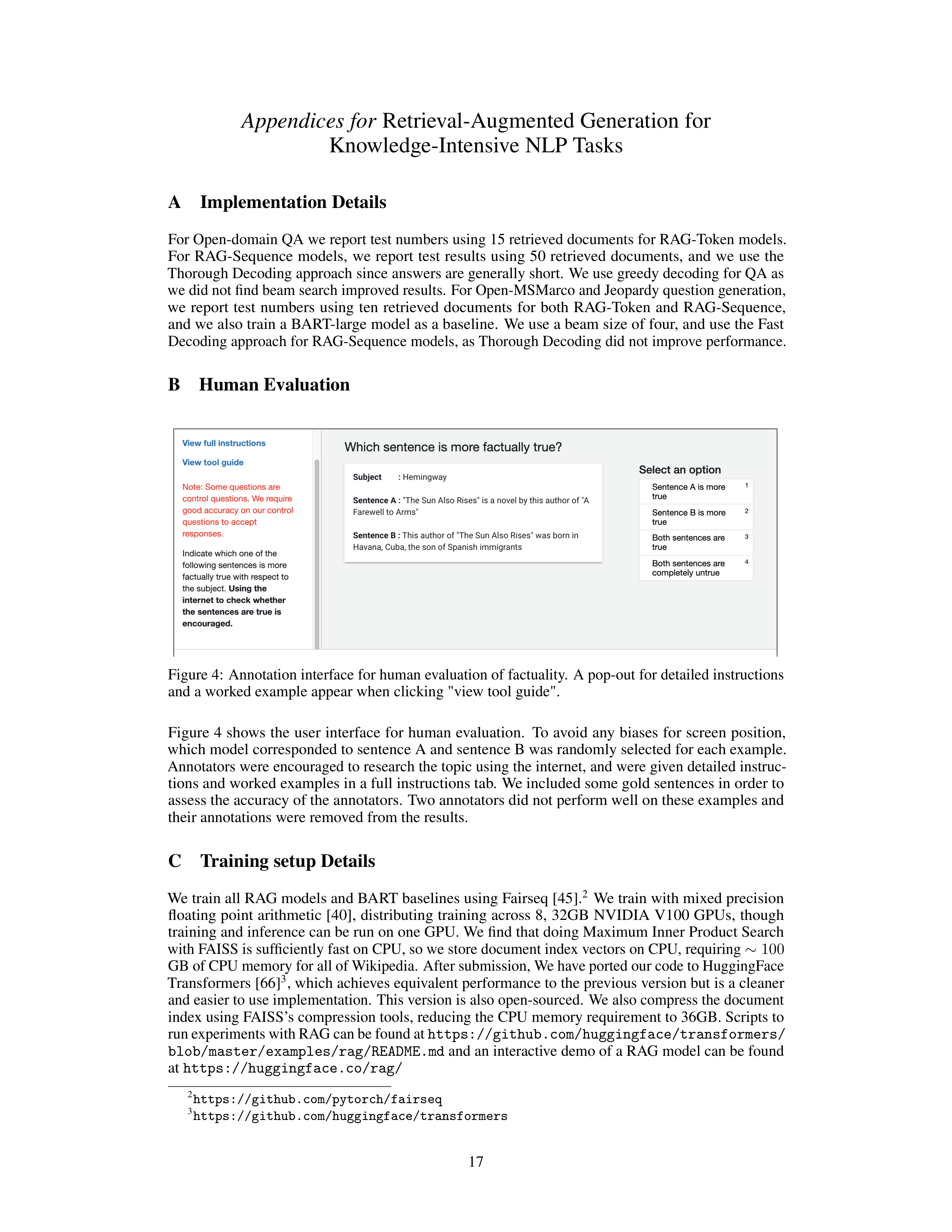
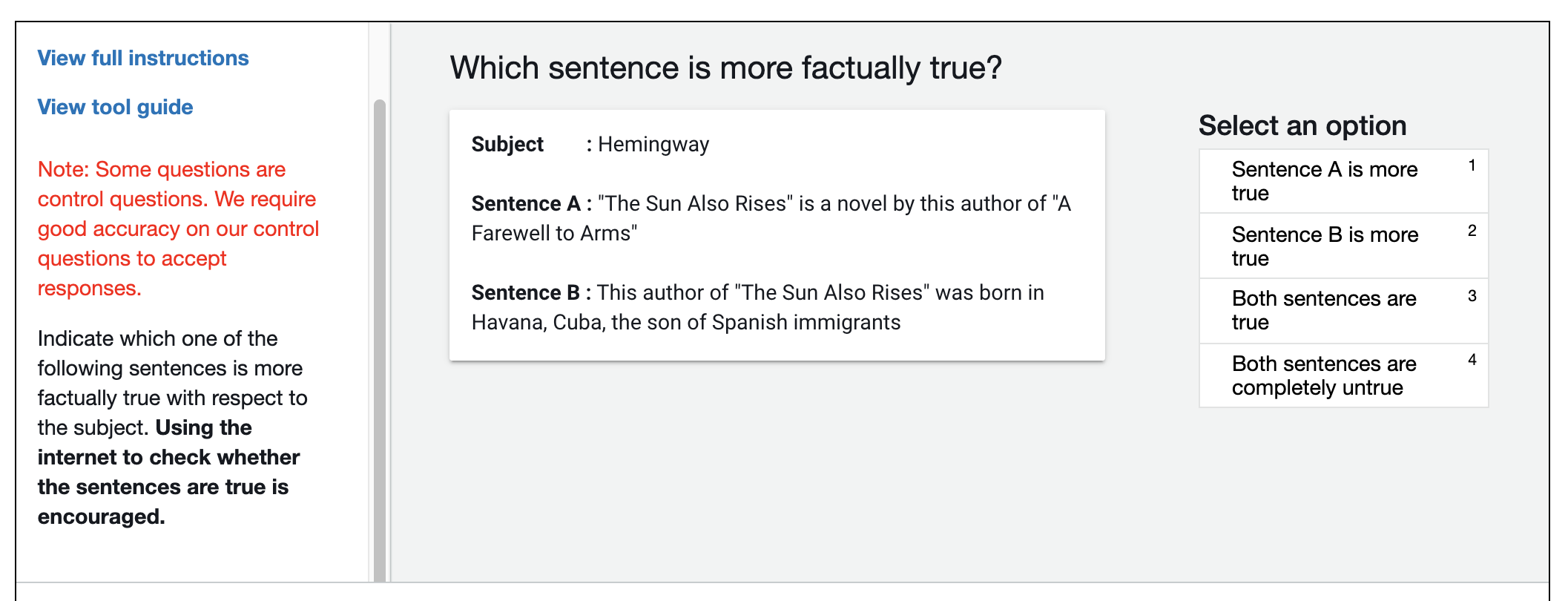
Appendices for
Retrieval-Augmented Generation for
Knowledge-Intensive NLP Tasks
A
Implementation Details
For Open-domain QA we report test numbers using 15 retrieved documents for RAG-Token models.
For
RAG-Sequence
models,
we
report
test
results
using
50
retrieved
documents,
and
we
use
the
Thorough Decoding approach since answers are generally short.
We use greedy decoding for QA as
we did not find beam search improved results.
For Open-MSMarco and Jeopardy question generation,
we
report
test
numbers
using
ten
retrieved
documents
for
both
RAG-Token
and
RAG-Sequence,
and we also train a BART-large model as a baseline.
We use a beam size of four, and use the Fast
Decoding approach for RAG-Sequence models, as Thorough Decoding did not improve performance.
B
Human Evaluation
Figure 4:
Annotation interface for human evaluation of factuality.
A pop-out for detailed instructions
and a worked example appear when clicking "view tool guide".
Figure 4 shows the user interface for human evaluation.
To avoid any biases for screen position,
which model corresponded to sentence A and sentence B was randomly selected for each example.
Annotators were encouraged to research the topic using the internet, and were given detailed instruc-
tions and worked examples in a full instructions tab.
We included some gold sentences in order to
assess the accuracy of the annotators.
Two annotators did not perform well on these examples and
their annotations were removed from the results.
C
Training setup Details
We train all RAG models and BART baselines using Fairseq [
45
].
2
We train with mixed precision
floating point arithmetic [
40
], distributing training across 8, 32GB NVIDIA V100 GPUs, though
training and inference can be run on one GPU. We find that doing Maximum Inner Product Search
with FAISS is sufficiently fast on CPU, so we store document index vectors on CPU, requiring
∼
100
GB of CPU memory for all of Wikipedia.
After submission, We have ported our code to HuggingFace
Transformers [
66
]
3
, which achieves equivalent performance to the previous version but is a cleaner
and easier to use implementation.
This version is also open-sourced.
We also compress the document
index using FAISS’s compression tools, reducing the CPU memory requirement to 36GB. Scripts to
run experiments with RAG can be found at
https://github.com/huggingface/transformers/
blob/master/examples/rag/README.md
and an interactive demo of a RAG model can be found
at
https://huggingface.co/rag/
2
https://github.com/pytorch/fairseq
3
https://github.com/huggingface/transformers
17
D
Further Details on Open-Domain QA
For open-domain QA, multiple answer annotations are often available for a given question.
These
answer annotations are exploited by extractive models during training as typically all the answer
annotations are used to find matches within documents when preparing training data.
For RAG, we
also make use of multiple annotation examples for Natural Questions and WebQuestions by training
the model with each
(
q, a
)
pair separately, leading to a small increase in accuracy.
For TriviaQA,
there are often many valid answers to a given question, some of which are not suitable training targets,
such as emoji or spelling variants.
For TriviaQA, we filter out answer candidates if they do not occur
in top 1000 documents for the query.
CuratedTrec preprocessing
The answers for CuratedTrec are given in the form of regular expres-
sions, which has been suggested as a reason why it is unsuitable for answer-generation models [20].
To overcome this, we use a pre-processing step where we first retrieve the top 1000 documents for
each query, and use the answer that most frequently matches the regex pattern as the supervision
target.
If no matches are found, we resort to a simple heuristic:
generate all possible permutations for
each regex, replacing non-deterministic symbols in the regex nested tree structure with a whitespace.
TriviaQA Evaluation setups
The open-domain QA community customarily uses public develop-
ment datasets as test datasets, as test data for QA datasets is often restricted and dedicated to reading
compehension purposes.
We report our results using the datasets splits used in DPR [
26
], which are
consistent with common practice in Open-domain QA. For TriviaQA, this test dataset is the public
TriviaQA Web Development split.
Roberts et al.
[52]
used the TriviaQA official Wikipedia test set
instead.
Févry et al.
[14]
follow this convention in order to compare with Roberts et al.
[52]
(See
appendix of [
14
]).
We report results on both test sets to enable fair comparison to both approaches.
We find that our performance is much higher using the official Wiki test set, rather than the more
conventional open-domain test set, which we attribute to the official Wiki test set questions being
simpler to answer from Wikipedia.
E
Further Details on FEVER
For
FEVER
classification,
we
follow
the
practice
from
[
32
],
and
first
re-generate
the
claim,
and
then classify using the representation of the final hidden state, before finally marginalizing across
documents to obtain the class probabilities.
The FEVER task traditionally has two sub-tasks.
The
first is to classify the claim as either "Supported", "Refuted" or "Not Enough Info", which is the task
we explore in the main paper.
FEVER’s other sub-task involves extracting sentences from Wikipedia
as evidence supporting the classification prediction.
As FEVER uses a different Wikipedia dump to
us, directly tackling this task is not straightforward.
We hope to address this in future work.
F
Null Document Probabilities
We experimented with adding "Null document" mechanism to RAG, similar to REALM [
20
] in order
to model cases where no useful information could be retrieved for a given input.
Here, if
k
documents
were retrieved, we would additionally "retrieve" an empty document and predict a logit for the null
document, before marginalizing over
k
+ 1
predictions.
We explored modelling this null document
logit by learning (i) a document embedding for the null document, (ii) a static learnt bias term, or
(iii) a neural network to predict the logit.
We did not find that these improved performance, so in
the interests of simplicity, we omit them.
For Open MS-MARCO, where useful retrieved documents
cannot always be retrieved, we observe that the model learns to always retrieve a particular set of
documents for questions that are less likely to benefit from retrieval, suggesting that null document
mechanisms may not be necessary for RAG.
G
Parameters
Our RAG models contain the trainable parameters for the BERT-base query and document encoder of
DPR, with 110M parameters each (although we do not train the document encoder ourselves) and
406M trainable parameters from BART-large, 406M parameters, making a total of 626M trainable
18
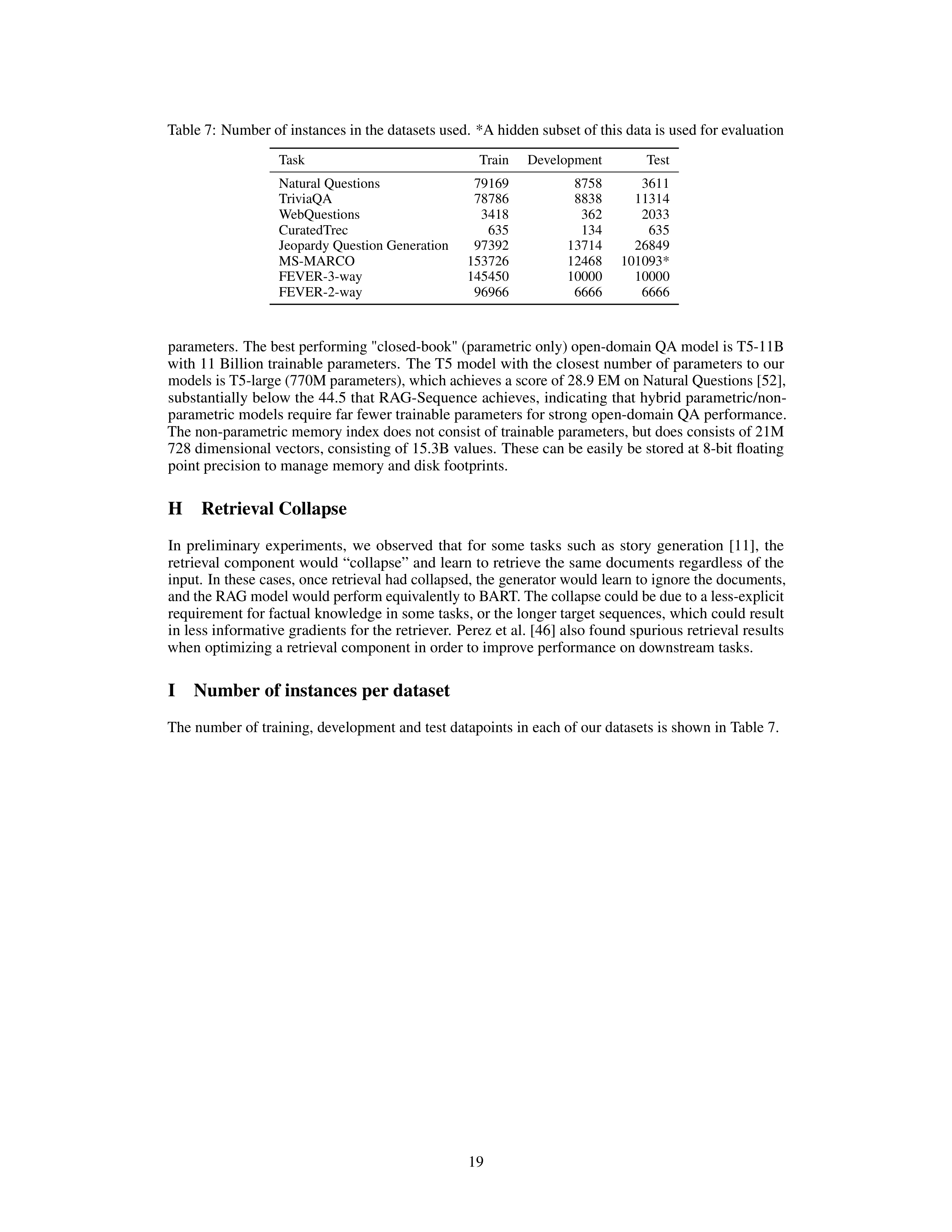
Table 7:
Number of instances in the datasets used.
*A hidden subset of this data is used for evaluation
Task
Train
Development
Test
Natural Questions
79169
8758
3611
TriviaQA
78786
8838
11314
WebQuestions
3418
362
2033
CuratedTrec
635
134
635
Jeopardy Question Generation
97392
13714
26849
MS-MARCO
153726
12468
101093*
FEVER-3-way
145450
10000
10000
FEVER-2-way
96966
6666
6666
parameters.
The best performing "closed-book" (parametric only) open-domain QA model is T5-11B
with 11 Billion trainable parameters.
The T5 model with the closest number of parameters to our
models is T5-large (770M parameters), which achieves a score of 28.9 EM on Natural Questions [
52
],
substantially below the 44.5 that RAG-Sequence achieves, indicating that hybrid parametric/non-
parametric models require far fewer trainable parameters for strong open-domain QA performance.
The non-parametric memory index does not consist of trainable parameters, but does consists of 21M
728 dimensional vectors, consisting of 15.3B values.
These can be easily be stored at 8-bit floating
point precision to manage memory and disk footprints.
H
Retrieval Collapse
In
preliminary
experiments,
we
observed
that
for
some
tasks
such
as
story
generation
[
11
],
the
retrieval component would “collapse” and learn to retrieve the same documents regardless of the
input.
In these cases, once retrieval had collapsed, the generator would learn to ignore the documents,
and the RAG model would perform equivalently to BART. The collapse could be due to a less-explicit
requirement for factual knowledge in some tasks, or the longer target sequences, which could result
in less informative gradients for the retriever.
Perez et al.
[46]
also found spurious retrieval results
when optimizing a retrieval component in order to improve performance on downstream tasks.
I
Number of instances per dataset
The number of training, development and test datapoints in each of our datasets is shown in Table 7.
19