Learning Hand-Eye Coordination for Robotic Grasping with Deep Learning
and Large-Scale Data Collection
Sergey Levine
SLEVINE
@
GOOGLE
.
COM
Peter Pastor
PETERPASTOR
@
GOOGLE
.
COM
Alex Krizhevsky
AKRIZHEVSKY
@
GOOGLE
.
COM
Deirdre Quillen
DEQUILLEN
@
GOOGLE
.
COM
Google
Abstract
We describe a learning-based
approach to
hand-
eye
coordination
for
robotic
grasping
from
monocular
images.
To
learn
hand-eye
coordi-
nation
for
grasping,
we
trained
a
large
convo-
lutional
neural
network
to
predict
the
probabil-
ity that task-space motion of the gripper will re-
sult
in
successful
grasps,
using
only
monocular
camera images and independently of camera cal-
ibration
or
the
current
robot
pose.
This
requires
the
network
to
observe
the
spatial
relationship
between
the
gripper
and
objects
in
the
scene,
thus
learning
hand-eye
coordination.
We
then
use this network to servo the gripper in real time
to
achieve
successful
grasps.
To
train
our
net-
work,
we
collected
over
800,000
grasp
attempts
over the course of two months,
using between 6
and
14
robotic
manipulators
at
any
given
time,
with
differences
in
camera
placement
and
hard-
ware.
Our experimental evaluation demonstrates
that our method achieves effective real-time con-
trol,
can
successfully
grasp
novel
objects,
and
corrects mistakes by continuous servoing.
1. Introduction
When
humans
and
animals
engage
in
object
manipulation
behaviors,
the
interaction
inherently
involves
a
fast
feed-
back
loop
between
perception
and
action.
Even
complex
manipulation tasks, such as extracting a single object from
a cluttered bin, can be performed with hardly any advance
planning,
relying
instead
on
feedback
from
touch
and
vi-
sion.
In
contrast,
robotic
manipulation
often
(though
not
always) relies more heavily on advance planning and anal-
ysis,
with
relatively
simple
feedback,
such
as
trajectory
following,
to
ensure
stability
during
execution
(
Srinivasa
et
al.
,
2012
).
Part
of
the
reason
for
this
is
that
incorpo-
rating
complex
sensory
inputs
such
as
vision
directly
into
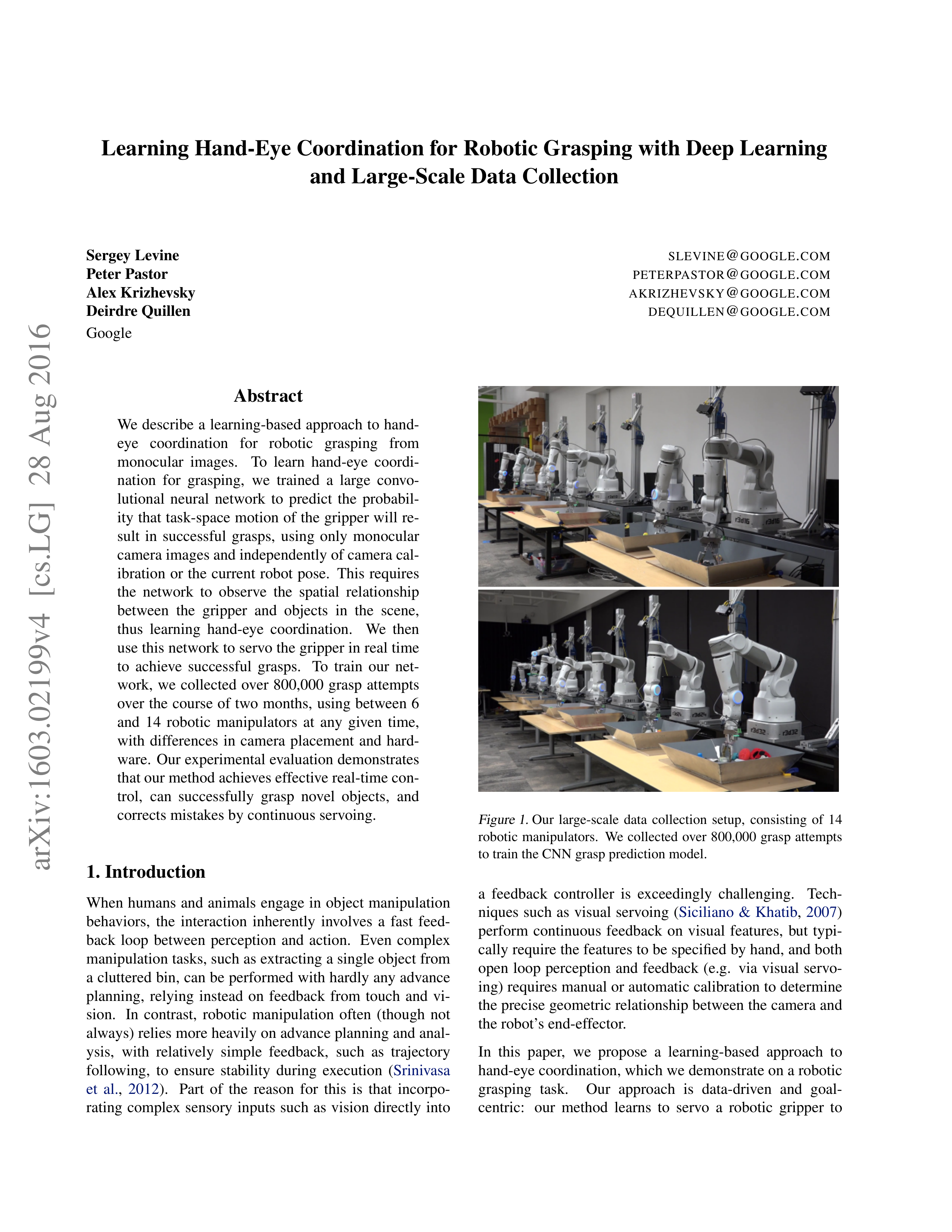
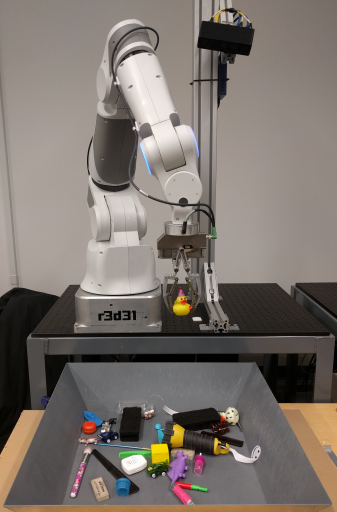
Figure 1.
Our
large-scale
data
collection
setup,
consisting
of
14
robotic
manipulators.
We
collected
over
800,000
grasp
attempts
to train the CNN grasp prediction model.
a
feedback
controller
is
exceedingly
challenging.
Tech-
niques
such
as
visual
servoing
(
Siciliano
&
Khatib
,
2007
)
perform
continuous
feedback
on
visual
features,
but
typi-
cally require the features to be specified by hand, and both
open
loop
perception
and
feedback
(e.g.
via
visual
servo-
ing) requires manual or automatic calibration to determine
the precise geometric relationship between the camera and
the robot’s end-effector.
In
this
paper,
we
propose
a
learning-based
approach
to
hand-eye coordination, which we demonstrate on a robotic
grasping
task.
Our
approach
is
data-driven
and
goal-
centric:
our
method
learns
to
servo
a
robotic
gripper
to
arXiv:1603.02199v4 [cs.LG] 28 Aug 2016
Learning Hand-Eye Coordination for Robotic Grasping with Deep Learning and Large-Scale Data Collection
poses that are likely to produce successful grasps, with end-
to-end
training
directly
from
image
pixels
to
task-space
gripper
motion.
By
continuously
recomputing
the
most
promising
motor
commands,
our
method
continuously
in-
tegrates sensory cues from the environment, allowing it to
react to perturbations and adjust the grasp to maximize the
probability of success.
Furthermore, the motor commands
are issued in the frame of the robot, which is not known to
the model at test time.
This means that the model does not
require the camera to be precisely calibrated with respect to
the
end-effector,
but
instead
uses
visual
cues
to
determine
the
spatial
relationship
between
the
gripper
and
graspable
objects in the scene.
Our
method
consists
of
two
components:
a
grasp
success
predictor, which uses a deep convolutional neural network
(CNN)
to
determine
how
likely
a
given
motion
is
to
pro-
duce a successful grasp, and a continuous servoing mecha-
nism that uses the CNN to continuously update the robot’s
motor commands.
By continuously choosing the best pre-
dicted path to a successful grasp,
the servoing mechanism
provides
the
robot
with
fast
feedback
to
perturbations
and
object motion, as well as robustness to inaccurate actuation.
The
grasp
prediction
CNN
was
trained
using
a
dataset
of
over
800,000
grasp
attempts,
collected
using
a
cluster
of
similar
(but
not
identical)
robotic
manipulators,
shown
in
Figure
1
, over the course of several months.
Although the
hardware
parameters
of
each
robot
were
initially
identi-
cal, each unit experienced different wear and tear over the
course of data collection, interacted with different objects,
and
used
a
slightly
different
camera
pose
relative
to
the
robot base. These differences provided a diverse dataset for
learning continuous hand-eye coordination for grasping.
The main contributions of this work are a method for learn-
ing
continuous
visual
servoing
for
robotic
grasping
from
monocular
cameras,
a
novel
convolutional
neural
network
architecture for learning to predict the outcome of a grasp
attempt,
and
a
large-scale
data
collection
framework
for
robotic
grasps.
Our
experimental
evaluation
demonstrates
that
our
convolutional
neural
network
grasping
controller
achieves
a
high
success
rate
when
grasping
in
clutter
on
a
wide
range
of
objects,
including
objects
that
are
large,
small, hard, soft, deformable, and translucent.
Supplemen-
tal
videos
of
our
grasping
system
show
that
the
robot
em-
ploys
continuous
feedback
to
constantly
adjust
its
grasp,
accounting
for
motion
of
the
objects
and
inaccurate
actu-
ation commands.
We also compare our approach to open-
loop variants to demonstrate the importance of continuous
feedback,
as well as a hand-engineering grasping baseline
that
uses
manual
hand-to-eye
calibration
and
depth
sens-
ing.
Our
method
achieves
the
highest
success
rates
in
our
experiments.
Our
dataset
is
available
here:
https:
//sites.google.com/site/brainrobotdata/home
2. Related Work
Robotic grasping is one of the most widely explored areas
of
manipulation.
While
a
complete
survey
of
grasping
is
outside the scope of this work, we refer the reader to stan-
dard surveys on the subject for a more complete treatment
(
Bohg et al.
,
2014
).
Broadly, grasping methods can be cat-
egorized as geometrically driven and data-driven.
Geomet-
ric methods analyze the shape of a target object and plan a
suitable grasp pose, based on criteria such as force closure
(
Weisz & Allen
,
2012
) or caging (
Rodriguez et al.
,
2012
).
These
methods
typically
need
to
understand
the
geometry
of
the
scene,
using
depth
or
stereo
sensors
and
matching
of
previously
scanned
models
to
observations
(
Goldfeder
et al.
,
2009b
).
Data-driven
methods
take
a
variety
of
different
forms,
in-
cluding human-supervised methods that predict grasp con-
figurations
(
Herzog
et
al.
,
2014
;
Lenz
et
al.
,
2015
)
and
methods that predict finger placement from geometric cri-
teria computed offline (
Goldfeder et al.
,
2009a
). Both types
of
data-driven
grasp
selection
have
recently
incorporated
deep learning (
Kappler et al.
,
2015
;
Lenz et al.
,
2015
;
Red-
mon & Angelova
,
2015
).
Feedback has been incorporated
into
grasping
primarily
as
a
way
to
achieve
the
desired
forces
for
force
closure
and
other
dynamic
grasping
cri-
teria
(
Hudson
et
al.
,
2012
),
as
well
as
in
the
form
of
stan-
dard
servoing
mechanisms,
including
visual
servoing
(de-
scribed below) to servo the gripper to a pre-planned grasp
pose (
Kragic & Christensen
,
2002
).
The method proposed
in
this
work
is
entirely
data-driven,
and
does
not
rely
on
any human annotation either at training or test time, in con-
trast to prior methods based on grasp points.
Furthermore,
our approach continuously adjusts the motor commands to
maximize
grasp
success,
providing
continuous
feedback.
Comparatively little prior work has addressed direct visual
feedback for grasping, most of which requires manually de-
signed features to track the end effector (
Vahrenkamp et al.
,
2008
;
Hebert et al.
,
2012
).
Our
approach
is
most
closely
related
to
recent
work
on
self-supervised
learning
of
grasp
poses
by
Pinto
&
Gupta
(
2015
). This prior work proposed to learn a network to pre-
dict the optimal grasp orientation for a given image patch,
trained
with
self-supervised
data
collected
using
a
heuris-
tic grasping system based on object proposals.
In contrast
to this prior work, our approach achieves continuous hand-
eye coordination by observing the gripper and choosing the
best
motor
command
to
move
the
gripper
toward
a
suc-
cessful
grasp,
rather
than
making
open-loop
predictions.
Furthermore,
our
approach
does
not
require
proposals
or
crops of image patches and, most importantly, does not re-
quire
calibration
between
the
robot
and
the
camera,
since
the
closed-loop
servoing
mechanism
can
compensate
for
offsets
due
to
differences
in
camera
pose
by
continuously
Learning Hand-Eye Coordination for Robotic Grasping with Deep Learning and Large-Scale Data Collection
adjusting the motor commands.
We trained our method us-
ing over 800,000 grasp attempts on a very large variety of
objects,
which
is
more
than
an
order
of
magnitude
larger
than prior methods based on direct self-supervision (
Pinto
&
Gupta
,
2015
)
and
more
than
double
the
dataset
size
of
prior
methods
based
on
synthetic
grasps
from
3D
scans
(
Kappler et al.
,
2015
).
In
order
to
collect
our
grasp
dataset,
we
parallelized
data
collection across up to 14 separate robots.
Aside from the
work of
Pinto & Gupta
(
2015
), prior large-scale grasp data
collection efforts have focused on collecting datasets of ob-
ject scans.
For example, Dex-Net used a dataset of 10,000
3D models, combined with a learning framework to acquire
force
closure
grasps
(
Mahler
et
al.
,
2016
),
while
the
work
of
Oberlin
&
Tellex
(
2015
)
proposed
autonomously
col-
lecting object scans using a Baxter robot.
Oberlin & Tellex
(
2015
)
also
proposed
parallelizing
data
collection
across
multiple
robots.
More
broadly,
the
ability
of
robotic
sys-
tems
to
learn
more
quickly
by
pooling
their
collective
ex-
perience has been proposed in a number of prior works, and
has been referred to as collective robot learning and an in-
stance of cloud robotics (
Inaba et al.
,
2000
;
Kuffner
,
2010
;
Kehoe et al.
,
2013
;
2015
).
Another
related
area
to
our
method
is
visual
servoing,
which addresses moving a camera or end-effector to a de-
sired
pose
using
visual
feedback
(
Kragic
&
Christensen
,
2002
).
In
contrast
to
our
approach,
visual
servoing
meth-
ods are typically concerned with reaching a pose relative to
objects in the scene, and often (though not always) rely on
manually
designed
or
specified
features
for
feedback
con-
trol (
Espiau et al.
,
1992
;
Wilson
et
al.
,
1996
;
Vahrenkamp
et al.
,
2008
;
Hebert et al.
,
2012
;
Mohta et al.
,
2014
).
Pho-
tometric
visual
servoing
uses
a
target
image
rather
than
features
(
Caron
et
al.
,
2013
),
and
several
visual
servoing
methods
have
been
proposed
that
do
not
directly
require
prior calibration between the robot and camera (
Yoshimi &
Allen
,
1994
;
J¨agersand et al.
,
1997
;
Kragic & Christensen
,
2002
).
To
the
best
of
our
knowledge,
no
prior
learning-
based method has been proposed that uses visual servoing
to directly move into a pose that maximizes the probability
of success on a given task (such as grasping).
In
order
to
predict
the
optimal
motor
commands
to
maxi-
mize grasp success, we use convolutional neural networks
(CNNs)
trained
on
grasp
success
prediction.
Although
the technology behind CNNs has been known for decades
(
LeCun
&
Bengio
,
1995
),
they
have
achieved
remarkable
success
in
recent
years
on
a
wide
range
of
challenging
computer vision benchmarks (
Krizhevsky et al.
,
2012
), be-
coming the de facto standard for computer vision systems.
However, applications of CNNs to robotic control problems
has been less prevalent, compared to applications to passive
perception
tasks
such
as
object
recognition
(
Krizhevsky
et
al.
,
2012
;
Wohlhart
&
Lepetit
,
2015
),
localization
(
Gir-
shick
et
al.
,
2014
),
and
segmentation
(
Chen
et
al.
,
2014
).
Several
works
have
proposed
to
use
CNNs
for
deep
rein-
forcement
learning
applications,
including
playing
video
games
(
Mnih
et
al.
,
2015
),
executing
simple
task-space
motions
for
visual
servoing
(
Lampe
&
Riedmiller
,
2013
),
controlling simple simulated robotic systems (
Watter et al.
,
2015
;
Lillicrap
et
al.
,
2016
),
and
performing
a
variety
of
robotic
manipulation
tasks
(
Levine
et
al.
,
2015
).
Many
of
these
applications
have
been
in
simple
or
synthetic
do-
mains,
and
all
of
them
have
focused
on
relatively
con-
strained environments with small datasets.
3. Overview
Our approach to learning hand-eye coordination for grasp-
ing consists of two parts.
The first part is a prediction net-
work
g
(
I
t
,
v
t
)
that accepts visual input
I
t
and a task-space
motion
command
v
t
,
and
outputs
the
predicted
probabil-
ity that executing the command
v
t
will produce a success-
ful
grasp.
The
second
part
is
a
servoing
function
f
(
I
t
)
that
uses
the
prediction
network
to
continuously
control
the
robot
to
servo
the
gripper
to
a
success
grasp.
We
de-
scribe
each
of
these
components
below:
Section
4.1
for-
mally defines the task solved by the prediction network and
describes
the
network
architecture,
Section
4.2
describes
how
the
servoing
function
can
use
the
prediction
network
to perform continuous control.
By
breaking
up
the
hand-eye
coordination
system
into
components, we can train the CNN grasp predictor using a
standard supervised learning objective, and design the ser-
voing mechanism to utilize this predictor to optimize grasp
performance.
The
resulting
method
can
be
interpreted
as
a
type
of
reinforcement
learning,
and
we
discuss
this
in-
terpretation,
together
with
the
underlying
assumptions,
in
Section
4.3
.
In order to train our prediction network, we collected over
800,000 grasp attempts using a set of similar (but not iden-
tical) robotic manipulators, shown in Figure
1
.
We discuss
the details of our hardware setup in Section
5.1
, and discuss
the data collection process in Section
5.2
.
To ensure gener-
alization of the learned prediction network, the specific pa-
rameters
of
each
robot
varied
in
terms
of
the
camera
pose
relative to the robot, providing independence to camera cal-
ibration.
Furthermore, uneven wear and tear on each robot
resulted
in
differences
in
the
shape
of
the
gripper
fingers.
Although
accurately
predicting
optimal
motion
vectors
in
open-loop
is
not
possible
with
this
degree
of
variation,
as
demonstrated in our experiments, our continuous servoing
method can correct mistakes by observing the outcomes of
its past actions, achieving a high success rate even without
knowledge of the precise camera calibration.
Learning Hand-Eye Coordination for Robotic Grasping with Deep Learning and Large-Scale Data Collection
I
0
I
t
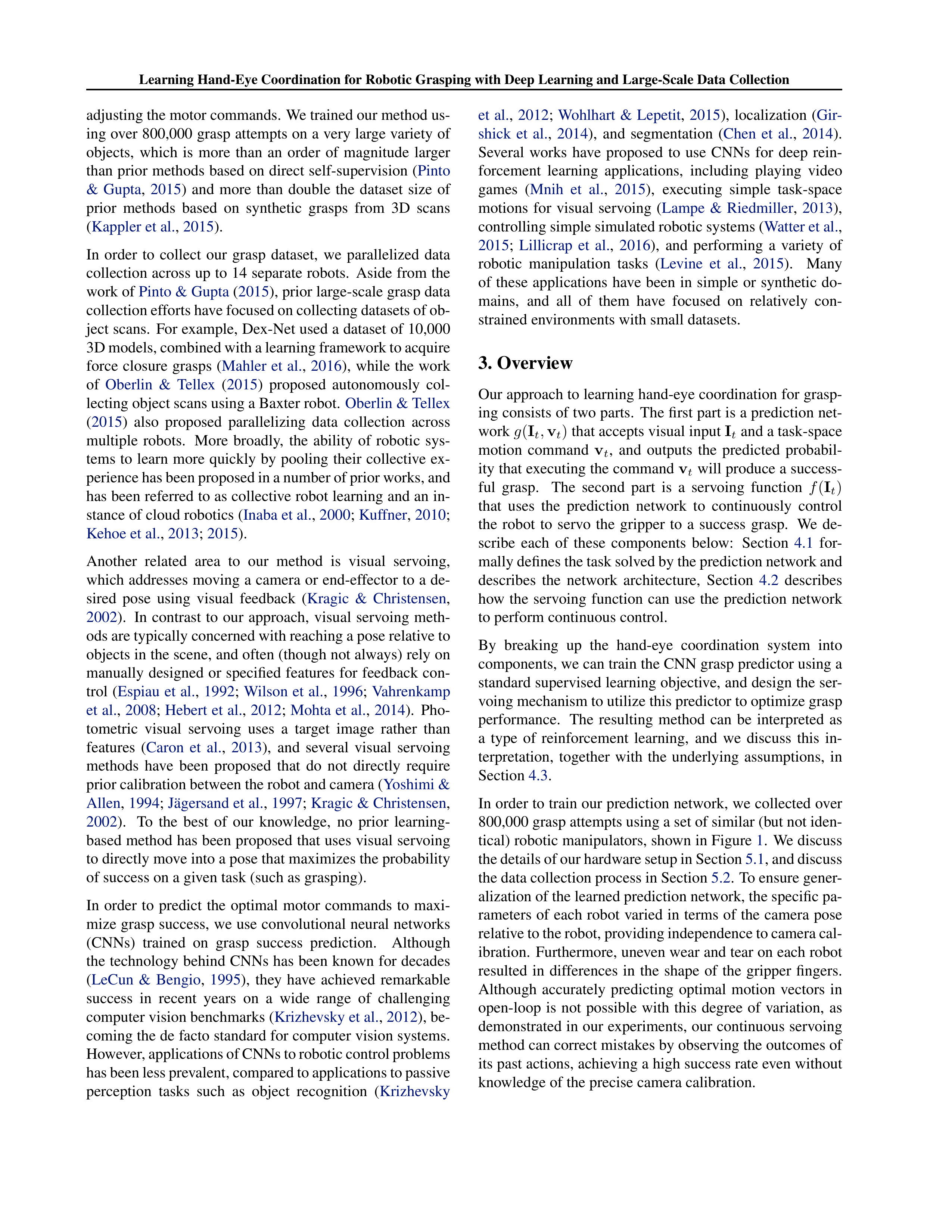
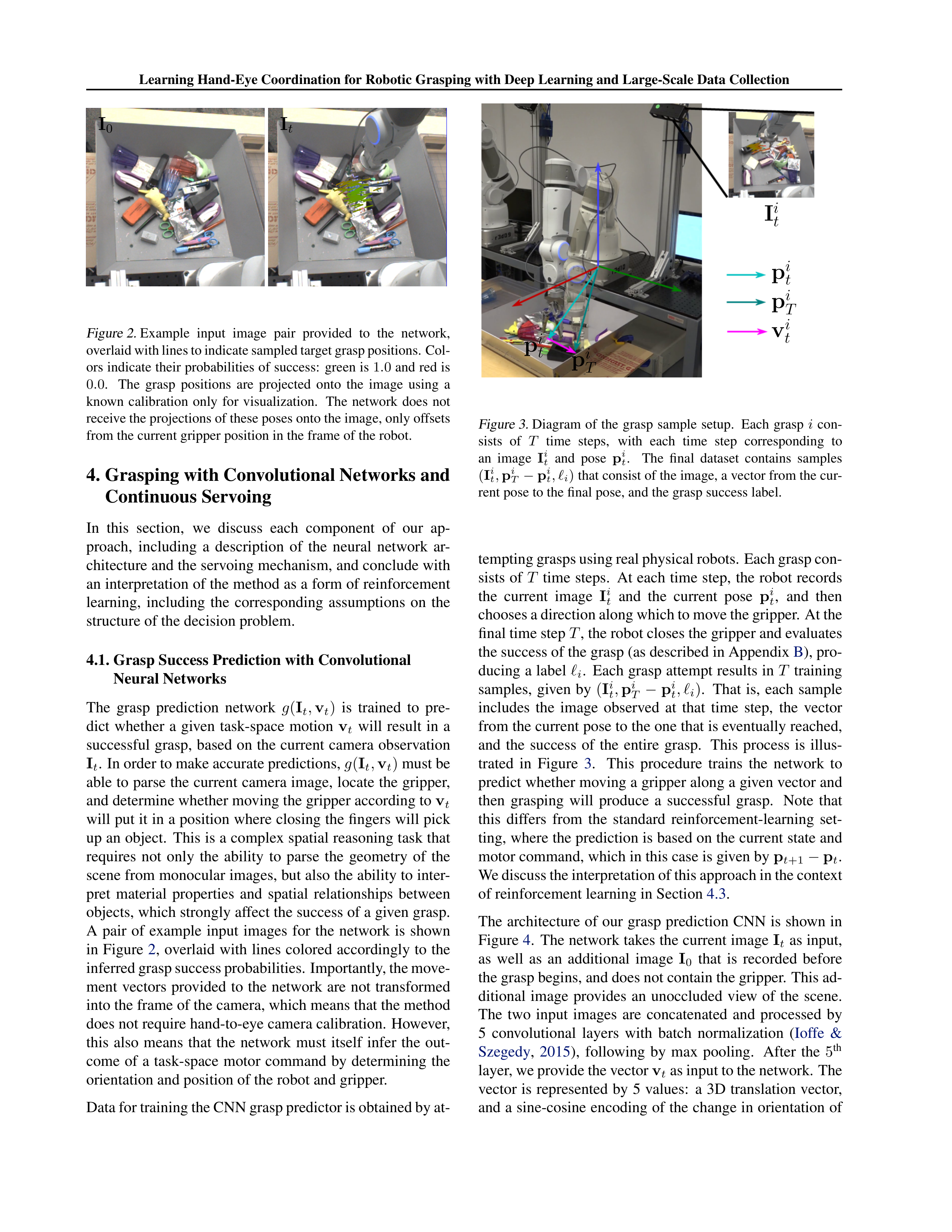
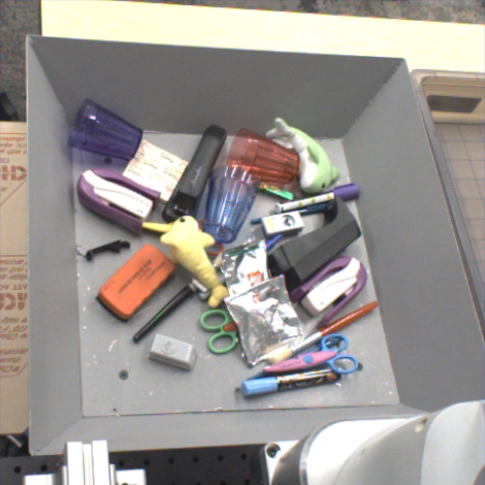
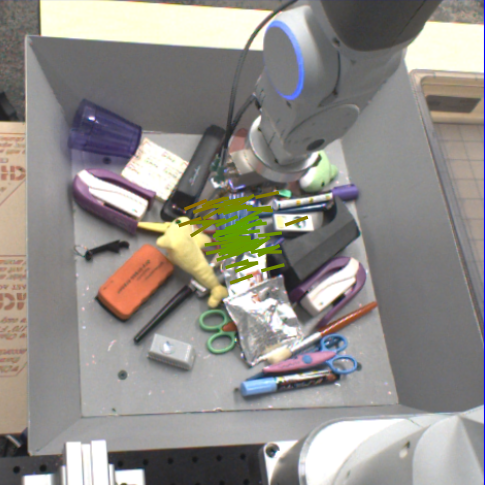
Figure 2.
Example
input
image
pair
provided
to
the
network,
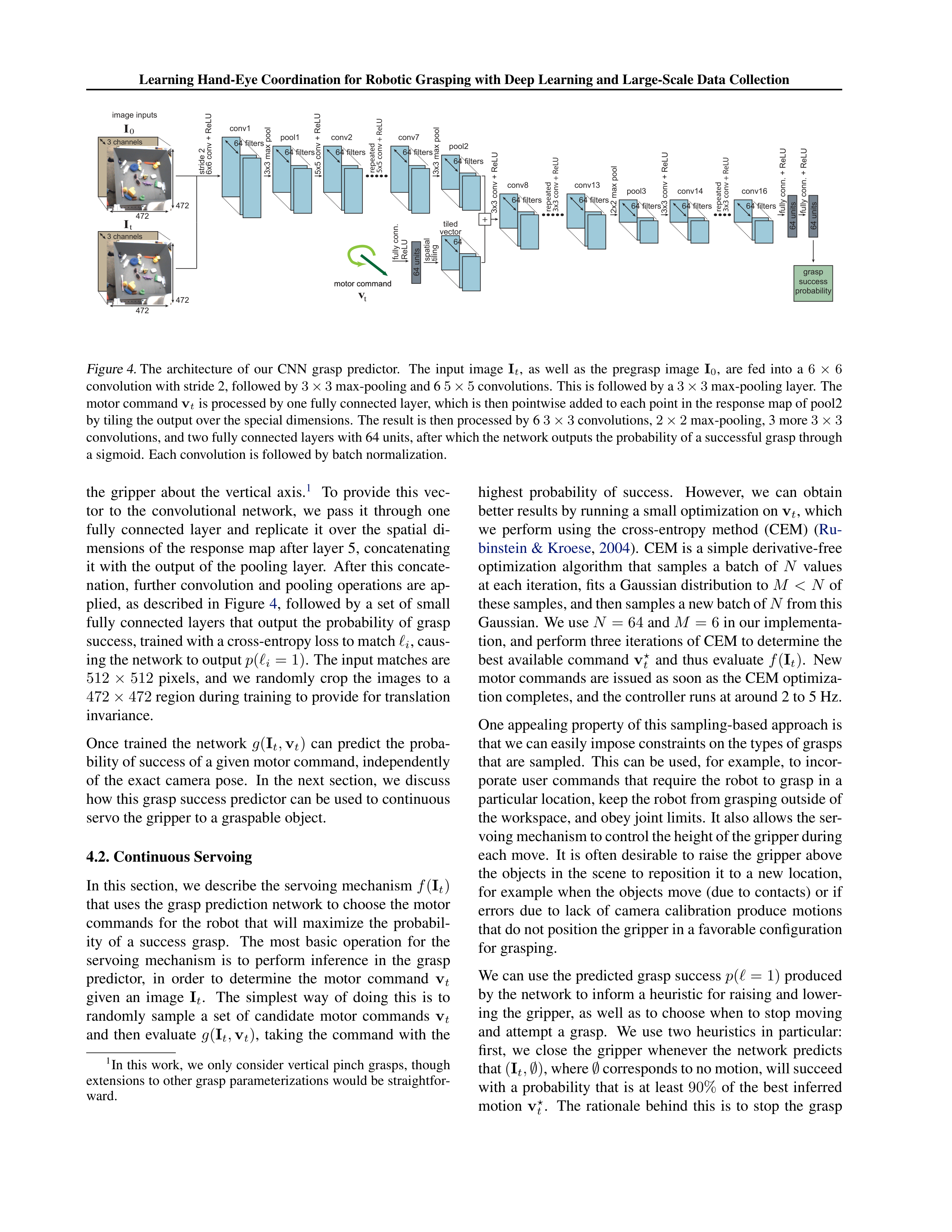
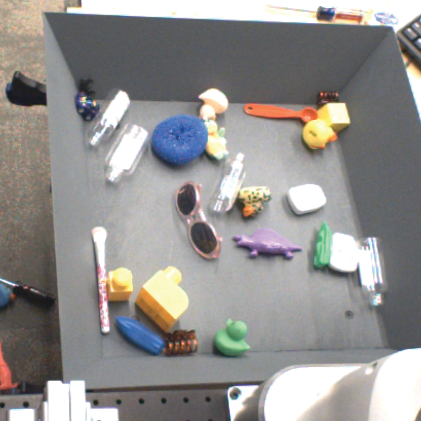
overlaid with lines to indicate sampled target grasp positions. Col-
ors indicate their probabilities of success:
green is
1
.
0
and red is
0
.
0
.
The
grasp
positions
are
projected
onto
the
image
using
a
known
calibration
only
for
visualization.
The
network
does
not
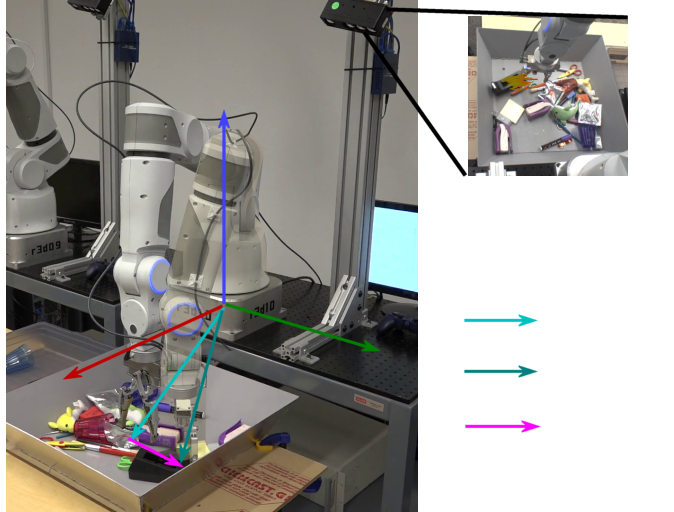
receive the projections of these poses onto the image, only offsets
from the current gripper position in the frame of the robot.
4. Grasping with Convolutional Networks and
Continuous Servoing
In
this
section,
we
discuss
each
component
of
our
ap-
proach,
including
a
description
of
the
neural
network
ar-
chitecture and the servoing mechanism, and conclude with
an interpretation of the method as a form of reinforcement
learning,
including
the
corresponding
assumptions
on
the
structure of the decision problem.
4.1. Grasp Success Prediction with Convolutional
Neural Networks
The
grasp
prediction
network
g
(
I
t
,
v
t
)
is
trained
to
pre-
dict
whether
a
given
task-space
motion
v
t
will
result
in
a
successful grasp,
based on the current camera observation
I
t
.
In order to make accurate predictions,
g
(
I
t
,
v
t
)
must be
able to parse the current camera image, locate the gripper,
and determine whether moving the gripper according to
v
t
will put it in a position where closing the fingers will pick
up an object.
This is a complex spatial reasoning task that
requires
not
only
the
ability
to
parse
the
geometry
of
the
scene from monocular images, but also the ability to inter-
pret
material
properties
and
spatial
relationships
between
objects, which strongly affect the success of a given grasp.
A
pair
of
example
input
images
for
the
network
is
shown
in
Figure
2
,
overlaid
with
lines
colored
accordingly
to the
inferred grasp success probabilities. Importantly, the move-
ment
vectors
provided
to
the
network
are
not
transformed
into the frame of the camera, which means that the method
does not require hand-to-eye camera calibration.
However,
this
also
means
that
the
network
must
itself
infer
the
out-
come
of
a
task-space
motor
command
by
determining
the
orientation and position of the robot and gripper.
Data for training the CNN grasp predictor is obtained by at-
I
i
t
p
i
t
p
i
T
p
i
t
p
i
T
v
i
t
Figure 3.
Diagram
of
the
grasp
sample
setup.
Each
grasp
i
con-
sists
of
T
time
steps,
with
each
time
step
corresponding
to
an
image
I
i
t
and
pose
p
i
t
.
The
final
dataset
contains
samples
(
I
i
t
,
p
i
T
−
p
i
t
, ℓ
i
)
that consist of the image, a vector from the cur-
rent pose to the final pose, and the grasp success label.
tempting grasps using real physical robots. Each grasp con-
sists of
T
time steps.
At each time step,
the robot records
the
current
image
I
i
t
and
the
current
pose
p
i
t
,
and
then
chooses a direction along which to move the gripper. At the
final time step
T
, the robot closes the gripper and evaluates
the success of the grasp (as described in Appendix
B
), pro-
ducing a label
ℓ
i
.
Each grasp attempt results in
T
training
samples,
given
by
(
I
i
t
,
p
i
T
−
p
i
t
, ℓ
i
)
.
That
is,
each
sample
includes
the
image
observed
at
that
time
step,
the
vector
from the current pose to the one that is eventually reached,
and
the
success
of
the
entire
grasp.
This
process
is
illus-
trated
in
Figure
3
.
This
procedure
trains
the
network
to
predict whether moving a gripper along a given vector and
then
grasping
will
produce
a
successful
grasp.
Note
that
this
differs
from
the
standard
reinforcement-learning
set-
ting, where the prediction is based on the current state and
motor command, which in this case is given by
p
t
+1
−
p
t
.
We discuss the interpretation of this approach in the context
of reinforcement learning in Section
4.3
.
The architecture of our grasp prediction CNN is shown in
Figure
4
.
The network takes the current image
I
t
as input,
as
well
as
an
additional
image
I
0
that
is
recorded
before
the grasp begins, and does not contain the gripper.
This ad-
ditional
image
provides
an
unoccluded
view
of
the
scene.
The
two
input
images
are
concatenated
and
processed
by
5
convolutional
layers
with
batch
normalization
(
Ioffe
&
Szegedy
,
2015
),
following
by
max
pooling.
After
the
5
th
layer, we provide the vector
v
t
as input to the network. The
vector
is
represented
by
5
values:
a
3D
translation
vector,
and a sine-cosine encoding of the change in orientation of
Learning Hand-Eye Coordination for Robotic Grasping with Deep Learning and Large-Scale Data Collection
3 channels
64 filters
conv1
image inputs
6x6 conv + ReLU
stride 2
472
472
3 channels
472
472
3x3 max pool
64 filters
pool1
64 filters
conv2
5x5 conv + ReLU
64 filters
conv7
3x3 max pool
64 filters
pool2
3x3 conv + ReLU
64 filters
conv8
64 filters
conv13
2x2 max pool
64 filters
pool3
3x3 conv + ReLU
64 filters
conv14
64 filters
conv16
64 units
64 units
grasp
success
probability
+
64
tiled
vector
spatial
tiling
64 units
fully conn. + ReLU
fully conn. + ReLU
fully conn.
ReLU
motor command
repeated
5x5 conv + ReLU
repeated
3x3 conv + ReLU
repeated
3x3 conv + ReLU
motor command
v
t
I
t
I
0
Figure 4.
The
architecture
of
our
CNN
grasp
predictor.
The
input
image
I
t
,
as
well
as
the
pregrasp
image
I
0
,
are
fed
into
a
6
×
6
convolution with stride 2, followed by
3
×
3
max-pooling and 6
5
×
5
convolutions.
This is followed by a
3
×
3
max-pooling layer.
The
motor command
v
t
is processed by one fully connected layer, which is then pointwise added to each point in the response map of pool2
by tiling the output over the special dimensions.
The result is then processed by 6
3
×
3
convolutions,
2
×
2
max-pooling, 3 more
3
×
3
convolutions, and two fully connected layers with 64 units, after which the network outputs the probability of a successful grasp through
a sigmoid.
Each convolution is followed by batch normalization.
the
gripper
about
the
vertical
axis.
1
To
provide
this
vec-
tor
to
the
convolutional
network,
we
pass
it
through
one
fully
connected
layer
and
replicate
it
over
the
spatial
di-
mensions of the response map after layer 5, concatenating
it with the output of the pooling layer.
After this concate-
nation,
further
convolution
and
pooling
operations
are
ap-
plied,
as
described
in
Figure
4
,
followed
by
a
set
of
small
fully
connected
layers
that
output
the
probability
of
grasp
success, trained with a cross-entropy loss to match
ℓ
i
, caus-
ing the network to output
p
(
ℓ
i
= 1)
.
The input matches are
512
×
512
pixels,
and
we
randomly
crop
the
images
to
a
472
×
472
region during training to provide for translation
invariance.
Once
trained
the
network
g
(
I
t
,
v
t
)
can
predict
the
proba-
bility of success of a given motor command, independently
of
the
exact
camera
pose.
In
the
next
section,
we
discuss
how this grasp success predictor can be used to continuous
servo the gripper to a graspable object.
4.2. Continuous Servoing
In this section, we describe the servoing mechanism
f
(
I
t
)
that uses the grasp prediction network to choose the motor
commands
for
the
robot
that
will
maximize
the
probabil-
ity
of
a
success
grasp.
The
most
basic
operation
for
the
servoing
mechanism
is
to
perform
inference
in
the
grasp
predictor,
in
order
to
determine
the
motor
command
v
t
given
an
image
I
t
.
The
simplest
way
of
doing
this
is
to
randomly
sample
a
set
of
candidate
motor
commands
v
t
and
then
evaluate
g
(
I
t
,
v
t
)
,
taking
the
command
with
the
1
In this work, we only consider vertical pinch grasps, though
extensions to other grasp parameterizations would be straightfor-
ward.
highest
probability
of
success.
However,
we
can
obtain
better results by running a small optimization on
v
t
, which
we
perform
using
the
cross-entropy
method
(CEM)
(
Ru-
binstein & Kroese
,
2004
).
CEM is a simple derivative-free
optimization
algorithm
that
samples
a
batch
of
N
values
at each iteration, fits a Gaussian distribution to
M
<
N
of
these samples, and then samples a new batch of
N
from this
Gaussian.
We use
N
= 64
and
M
= 6
in our implementa-
tion, and perform three iterations of CEM to determine the
best
available
command
v
⋆
t
and
thus
evaluate
f
(
I
t
)
.
New
motor commands are issued as soon as the CEM optimiza-
tion completes, and the controller runs at around 2 to 5 Hz.
One appealing property of this sampling-based approach is
that we can easily impose constraints on the types of grasps
that are sampled.
This can be used, for example, to incor-
porate
user
commands
that
require
the
robot
to
grasp
in
a
particular location, keep the robot from grasping outside of
the workspace, and obey joint limits.
It also allows the ser-
voing mechanism to control the height of the gripper during
each move.
It is often desirable to raise the gripper above
the
objects
in
the
scene
to
reposition
it
to
a
new
location,
for example when the objects move (due to contacts) or if
errors
due
to
lack
of
camera
calibration
produce
motions
that do not position the gripper in a favorable configuration
for grasping.
We can use the predicted grasp success
p
(
ℓ
= 1)
produced
by the network to inform a heuristic for raising and lower-
ing the gripper,
as well as to choose when to stop moving
and
attempt
a
grasp.
We
use
two
heuristics
in
particular:
first,
we
close
the
gripper
whenever
the
network
predicts
that
(
I
t
,
∅
)
, where
∅
corresponds to no motion, will succeed
with
a
probability
that
is
at
least
90%
of
the
best
inferred
motion
v
⋆
t
.
The
rationale
behind
this
is
to
stop
the
grasp
Learning Hand-Eye Coordination for Robotic Grasping with Deep Learning and Large-Scale Data Collection
early if closing the gripper is nearly as likely to produce a
successful
grasp
as
moving
it.
The
second
heuristic
is
to
raise
the
gripper
off
the
table
when
(
I
t
,
∅
)
has
a
probabil-
ity
of
success
that
is
less
than
50%
of
v
⋆
t
.
The
rationale
behind this choice is that, if closing the gripper now is sub-
stantially
worse
than
moving
it,
the
gripper
is
most
likely
not positioned in a good configuration, and a large motion
will
be
required.
Therefore,
raising
the
gripper
off
the
ta-
ble
minimizes
the
chance
of
hitting
other
objects
that
are
in
the
way.
While
these
heuristics
are
somewhat
ad-hoc,
we found that they were effective for successfully grasping
a
wide
range
of
objects
in
highly
cluttered
situations,
as
discussed in Section
6
.
Pseudocode for the servoing mech-
anism
f
(
I
t
)
is presented in Algorithm
1
.
Further details on
the servoing mechanism are presented in Appendix
A
.
Algorithm 1
Servoing mechanism
f
(
I
t
)
1:
Given current image
I
t
and network
g
.
2:
Infer
v
⋆
t
using
g
and CEM.
3:
Evaluate
p
=
g
(
I
t
,
∅
)
/g
(
I
t
,
v
⋆
t
)
.
4:
if
p >
0
.
9
then
5:
Output
∅
, close gripper.
6:
else if
p
≤
0
.
5
then
7:
Modify
v
⋆
t
to raise gripper height and execute
v
⋆
t
.
8:
else
9:
Execute
v
⋆
t
.
10:
end if
4.3. Interpretation as Reinforcement Learning
One interesting conceptual question raised by our approach
is
the
relationship
between
training
the
grasp
prediction
network
and
reinforcement
learning.
In
the
case
where
T
=
2
,
and
only
one
decision
is
made
by
the
servoing
mechanism, the grasp network can be regarded as approxi-
mating the Q-function for the policy defined by the servo-
ing mechanism
f
(
I
t
)
and a reward function that is
1
when
the
grasp
succeeds
and
0
otherwise.
Repeatedly
deploy-
ing the latest grasp network
g
(
I
t
,
v
t
)
, collecting additional
data, and refitting
g
(
I
t
,
v
t
)
can then be regarded as fitted Q
iteration (
Antos et al.
,
2008
). However, what happens when
T
>
2
?
In
that
case,
fitted
Q
iteration
would
correspond
to
learning
to
predict
the
final
probability
of
success
from
tuples
of
the
form
(
I
t
,
p
t
+1
−
p
t
)
,
which
is
substantially
harder,
since
p
t
+1
−
p
t
doesn’t
tell
us
where
the
gripper
will end up at the end, before closing (which is
p
T
).
Using
p
T
−
p
t
as the action representation in fitted Q itera-
tion therefore implies an additional assumption on the form
of the dynamics.
The assumption is that the actions induce
a
transitive
relation
between
states:
that
is,
that
moving
from
p
1
to
p
2
and then to
p
3
is equivalent to moving from
p
1
to
p
3
directly.
This
assumption
does
not
always
hold
in the case of grasping, since an intermediate motion might
move objects in the scene, but it is a reasonable approxima-
tion that we found works quite well in practice.
The major
monocular RGB
camera
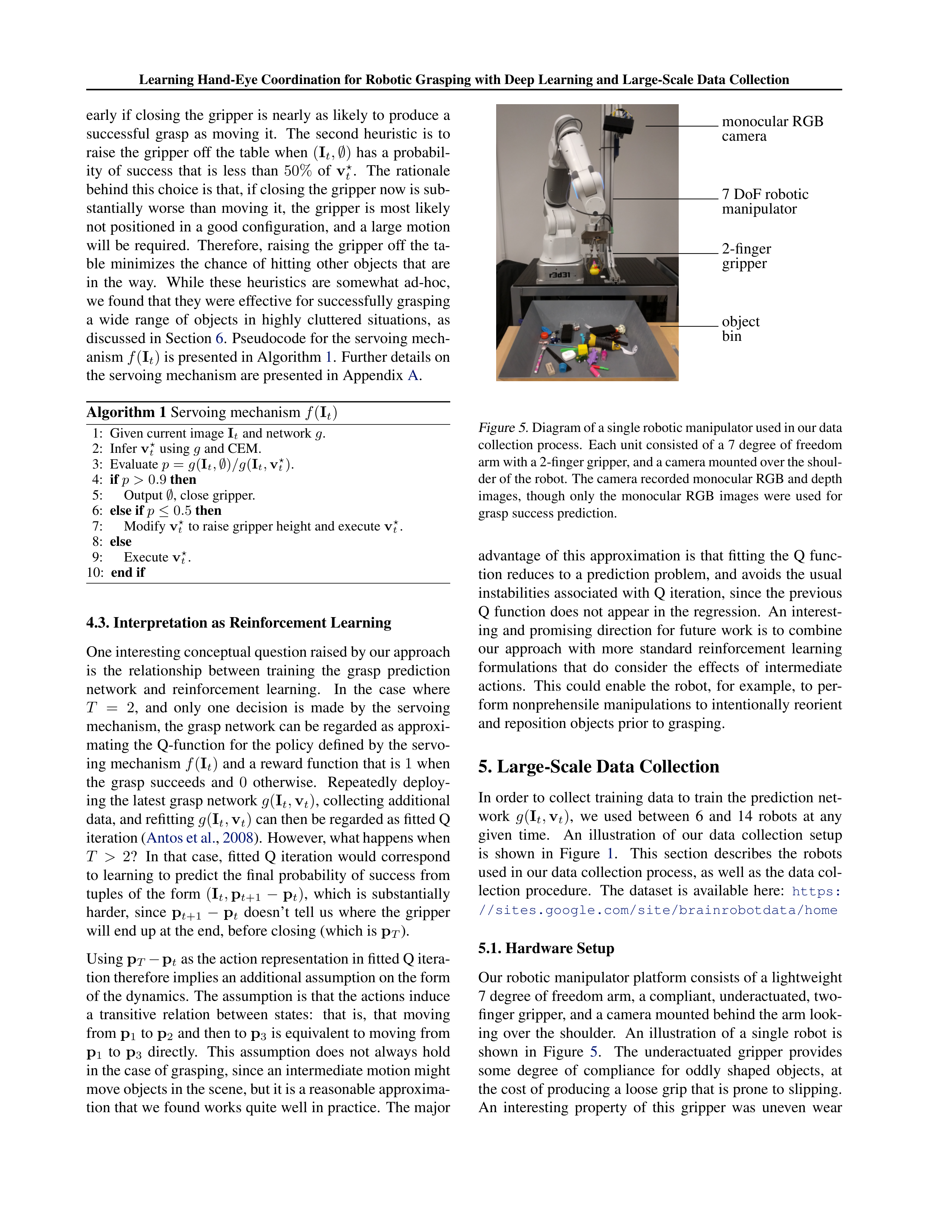
7 DoF robotic
manipulator
2-finger
gripper
object
bin
Figure 5.
Diagram of a single robotic manipulator used in our data
collection process.
Each unit consisted of a 7 degree of freedom
arm with a 2-finger gripper, and a camera mounted over the shoul-
der of the robot.
The camera recorded monocular RGB and depth
images,
though
only
the
monocular
RGB
images
were
used
for
grasp success prediction.
advantage
of
this
approximation
is
that
fitting
the
Q
func-
tion reduces to a prediction problem,
and avoids the usual
instabilities associated with Q iteration, since the previous
Q function does not appear in the regression.
An interest-
ing and promising direction for future work is to combine
our
approach
with
more
standard
reinforcement
learning
formulations
that
do
consider
the
effects
of
intermediate
actions.
This
could
enable
the
robot,
for
example,
to
per-
form nonprehensile manipulations to intentionally reorient
and reposition objects prior to grasping.
5. Large-Scale Data Collection
In order to collect training data to train the prediction net-
work
g
(
I
t
,
v
t
)
,
we
used
between
6
and
14
robots
at
any
given
time.
An
illustration
of
our
data
collection
setup
is
shown
in
Figure
1
.
This
section
describes
the
robots
used in our data collection process, as well as the data col-
lection
procedure.
The
dataset
is
available
here:
https:
//sites.google.com/site/brainrobotdata/home
5.1. Hardware Setup
Our robotic manipulator platform consists of a lightweight
7 degree of freedom arm, a compliant, underactuated, two-
finger gripper, and a camera mounted behind the arm look-
ing
over
the
shoulder.
An
illustration
of
a
single
robot
is
shown
in
Figure
5
.
The
underactuated
gripper
provides
some
degree
of
compliance
for
oddly
shaped
objects,
at
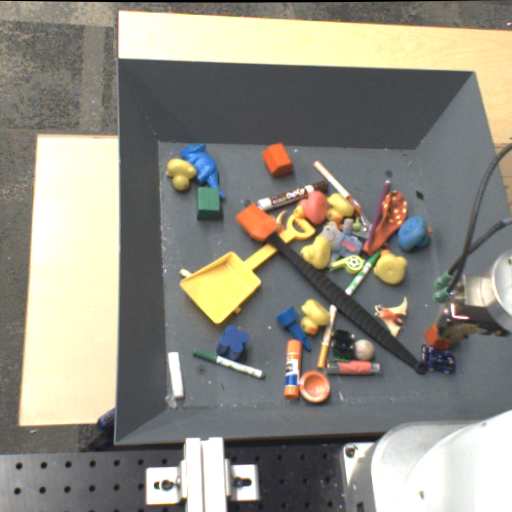
the cost of producing a loose grip that is prone to slipping.
An
interesting
property
of
this
gripper
was
uneven
wear
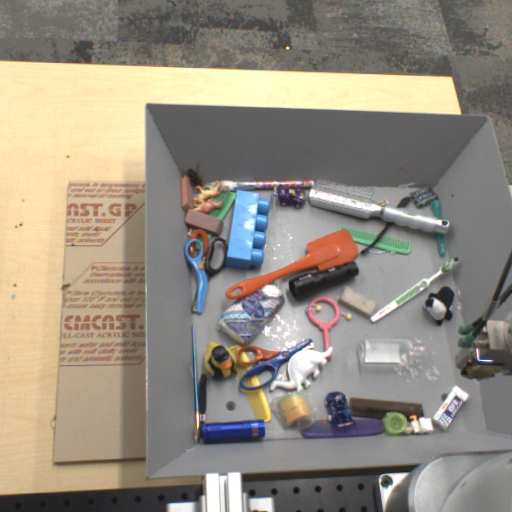
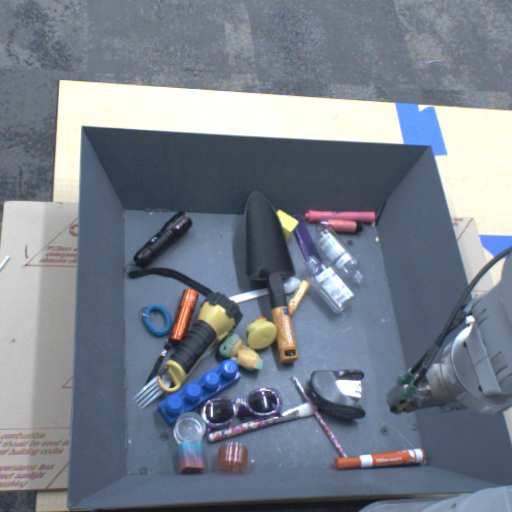
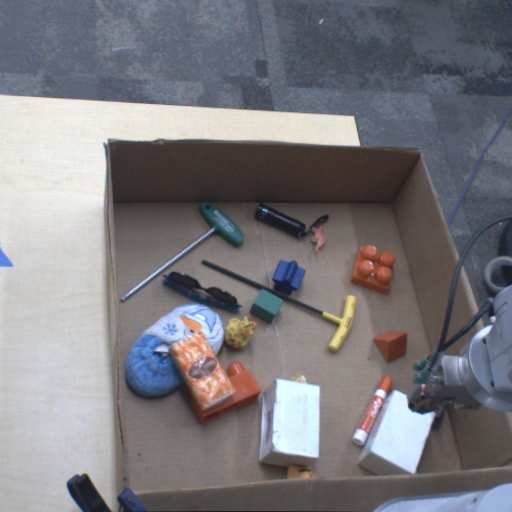
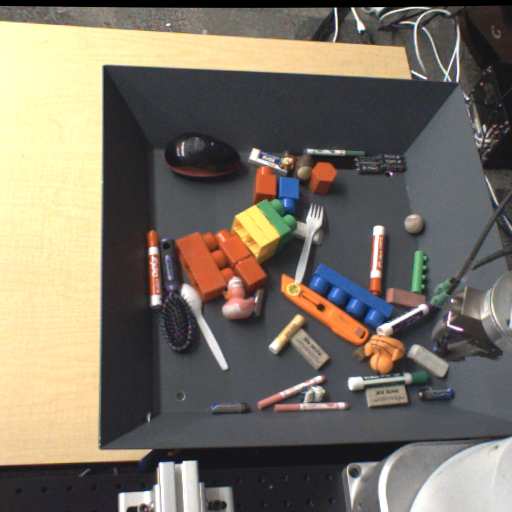
Learning Hand-Eye Coordination for Robotic Grasping with Deep Learning and Large-Scale Data Collection
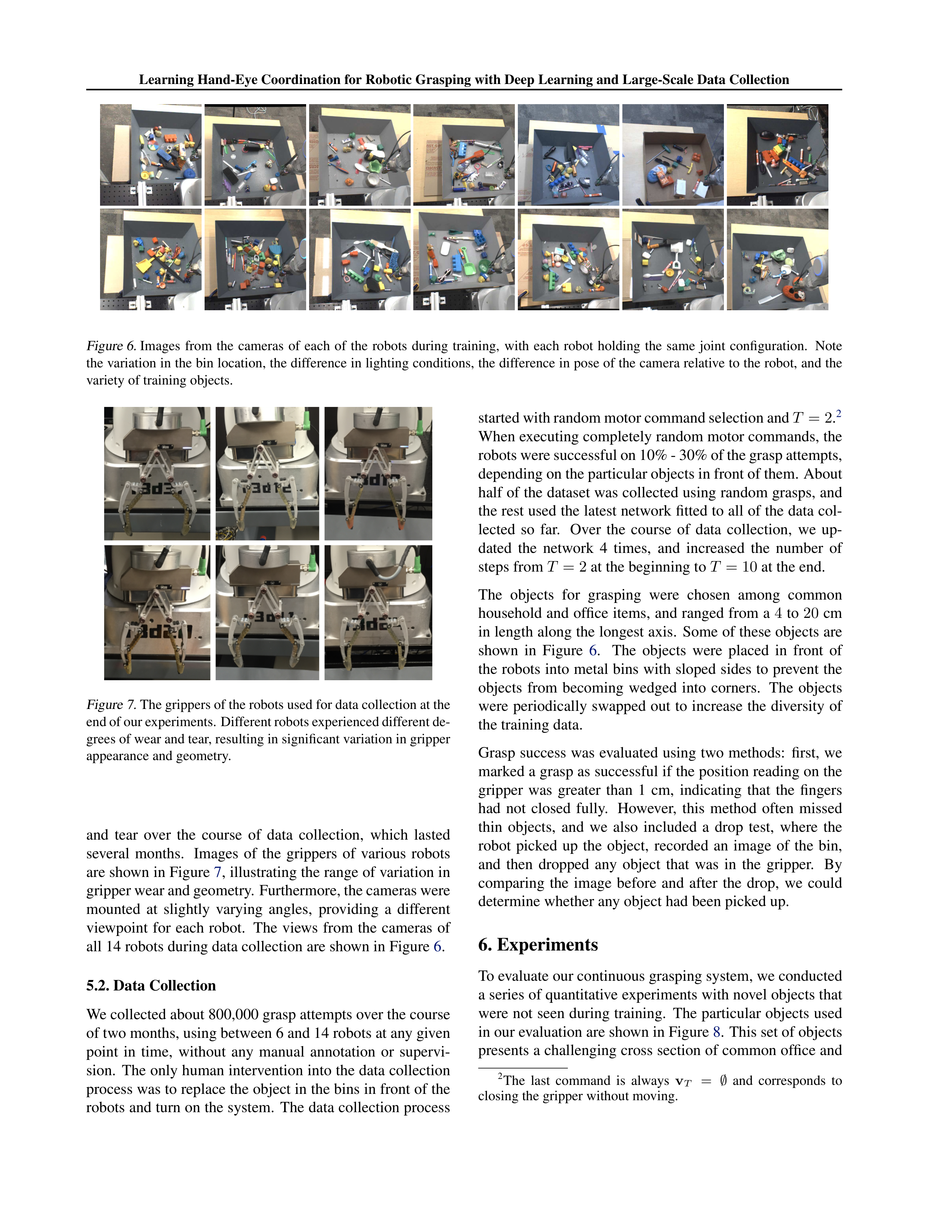
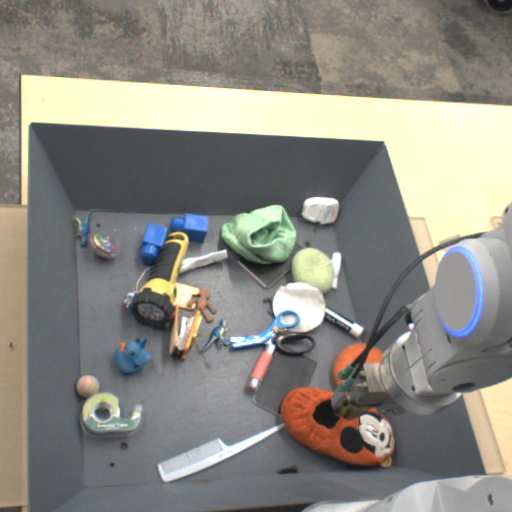
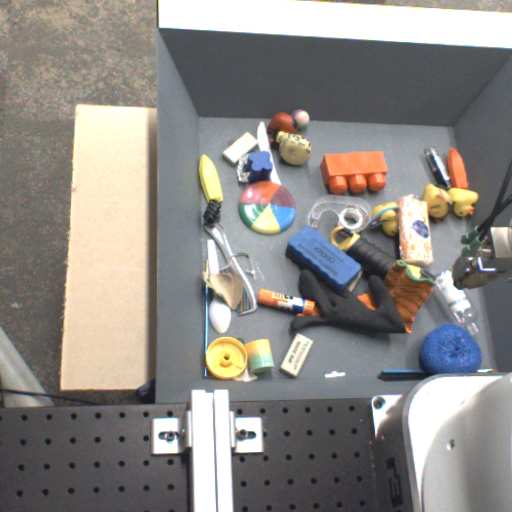
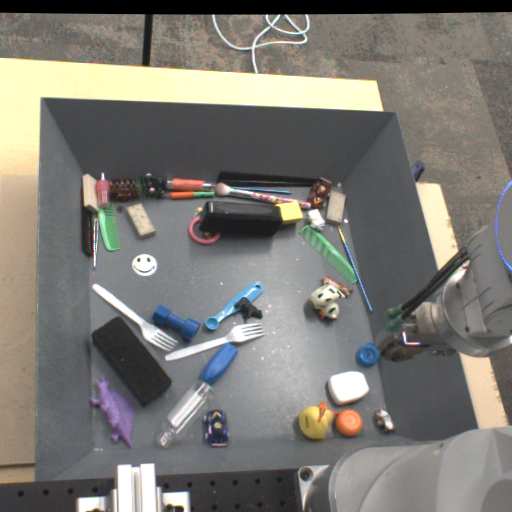
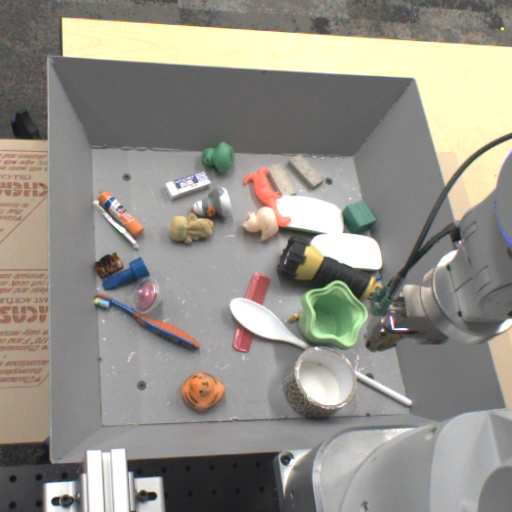
Figure 6.
Images
from
the
cameras
of
each
of
the
robots
during
training,
with
each
robot
holding
the
same
joint
configuration.
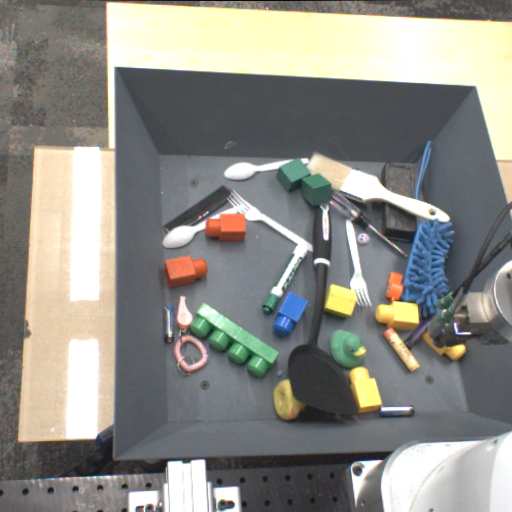
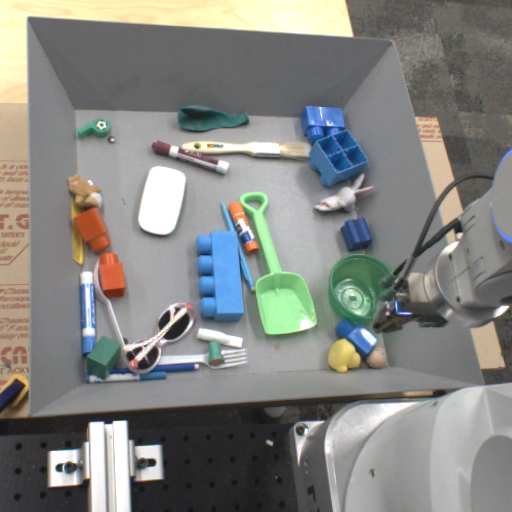
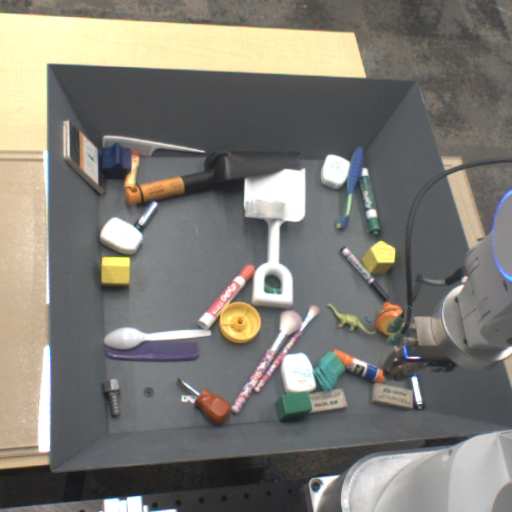
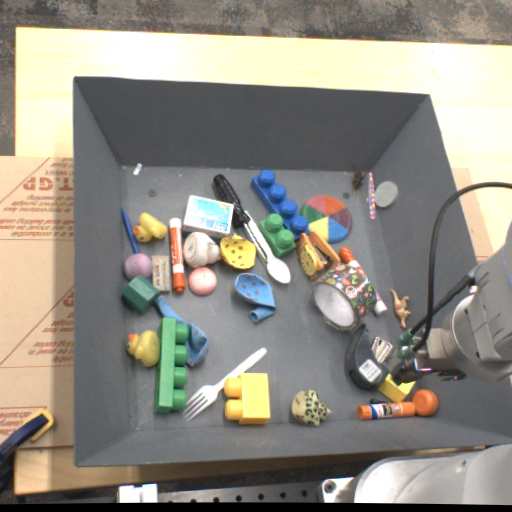
Note
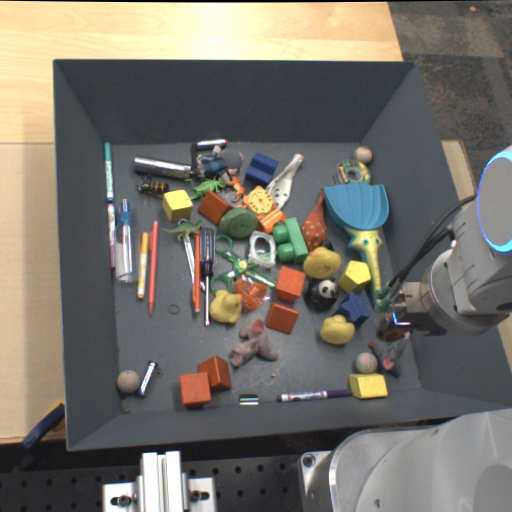
the variation in the bin location, the difference in lighting conditions, the difference in pose of the camera relative to the robot, and the
variety of training objects.
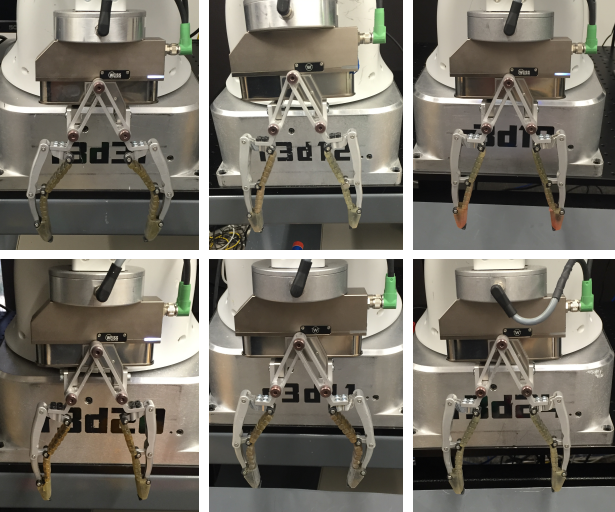
Figure 7.
The grippers of the robots used for data collection at the
end of our experiments. Different robots experienced different de-
grees of wear and tear, resulting in significant variation in gripper
appearance and geometry.
and
tear
over
the
course
of
data
collection,
which
lasted
several
months.
Images
of
the
grippers
of
various
robots
are shown in Figure
7
, illustrating the range of variation in
gripper wear and geometry. Furthermore, the cameras were
mounted
at
slightly
varying
angles,
providing
a
different
viewpoint
for
each
robot.
The
views
from
the
cameras
of
all 14 robots during data collection are shown in Figure
6
.
5.2. Data Collection
We collected about 800,000 grasp attempts over the course
of two months, using between 6 and 14 robots at any given
point
in
time,
without
any
manual
annotation
or
supervi-
sion.
The only human intervention into the data collection
process was to replace the object in the bins in front of the
robots and turn on the system.
The data collection process
started with random motor command selection and
T
= 2
.
2
When executing completely random motor commands, the
robots were successful on 10% - 30% of the grasp attempts,
depending on the particular objects in front of them.
About
half of the dataset was collected using random grasps, and
the rest used the latest network fitted to all of the data col-
lected
so
far.
Over
the
course
of
data
collection,
we
up-
dated
the
network
4
times,
and
increased
the
number
of
steps from
T
= 2
at the beginning to
T
= 10
at the end.
The
objects
for
grasping
were
chosen
among
common
household and office items,
and ranged from a
4
to
20
cm
in length along the longest axis.
Some of these objects are
shown
in
Figure
6
.
The
objects
were
placed
in
front
of
the robots into metal bins with sloped sides to prevent the
objects
from
becoming
wedged
into
corners.
The
objects
were
periodically
swapped
out
to
increase
the
diversity
of
the training data.
Grasp success was evaluated using two methods:
first,
we
marked a grasp as successful if the position reading on the
gripper
was
greater
than
1
cm,
indicating
that
the
fingers
had
not
closed
fully.
However,
this
method
often
missed
thin
objects,
and
we
also
included
a
drop
test,
where
the
robot
picked
up
the
object,
recorded
an
image
of
the
bin,
and
then
dropped
any
object
that
was
in
the
gripper.
By
comparing
the
image
before
and
after
the
drop,
we
could
determine whether any object had been picked up.
6. Experiments
To evaluate our continuous grasping system, we conducted
a series of quantitative experiments with novel objects that
were not seen during training.
The particular objects used
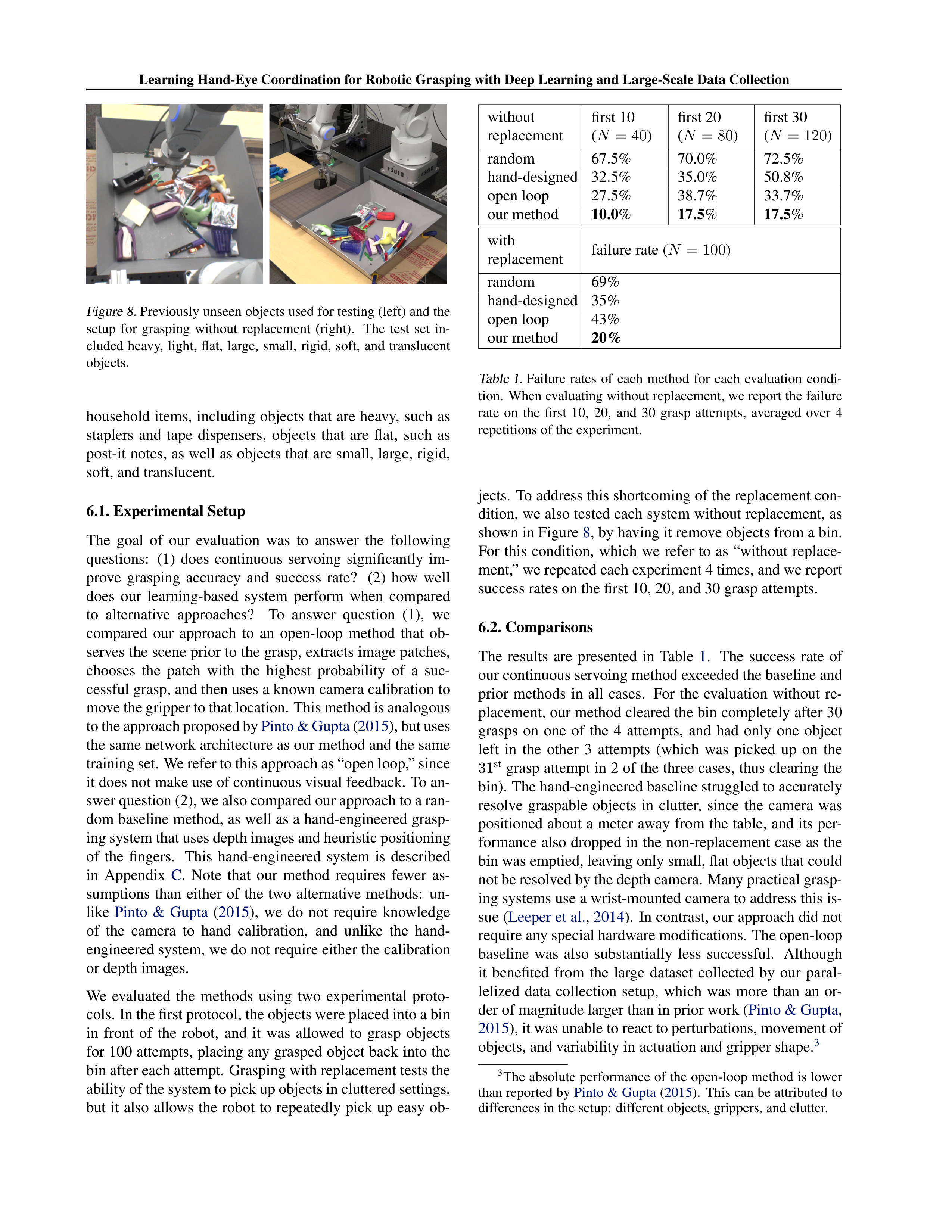
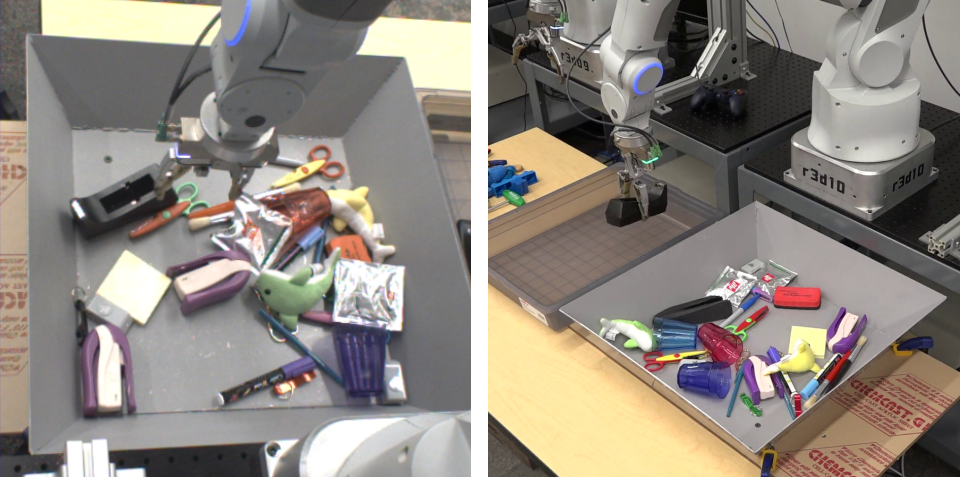
in our evaluation are shown in Figure
8
.
This set of objects
presents a challenging cross section of common office and
2
The
last
command
is
always
v
T
=
∅
and
corresponds
to
closing the gripper without moving.
Learning Hand-Eye Coordination for Robotic Grasping with Deep Learning and Large-Scale Data Collection
Figure 8.
Previously unseen objects used for testing (left) and the
setup
for
grasping
without
replacement
(right).
The
test
set
in-
cluded
heavy,
light,
flat,
large,
small,
rigid,
soft,
and
translucent
objects.
household items,
including objects that are heavy,
such as
staplers
and
tape
dispensers,
objects
that
are
flat,
such
as
post-it notes, as well as objects that are small, large, rigid,
soft, and translucent.
6.1. Experimental Setup
The
goal
of
our
evaluation
was
to
answer
the
following
questions:
(1)
does
continuous
servoing
significantly
im-
prove
grasping
accuracy
and
success
rate?
(2)
how
well
does
our
learning-based
system
perform
when
compared
to
alternative
approaches?
To
answer
question
(1),
we
compared
our
approach
to
an
open-loop
method
that
ob-
serves the scene prior to the grasp, extracts image patches,
chooses
the
patch
with
the
highest
probability
of
a
suc-
cessful grasp, and then uses a known camera calibration to
move the gripper to that location. This method is analogous
to the approach proposed by
Pinto & Gupta
(
2015
), but uses
the same network architecture as our method and the same
training set. We refer to this approach as “open loop,” since
it does not make use of continuous visual feedback.
To an-
swer question (2), we also compared our approach to a ran-
dom baseline method, as well as a hand-engineered grasp-
ing system that uses depth images and heuristic positioning
of
the
fingers.
This
hand-engineered
system
is
described
in
Appendix
C
.
Note
that
our
method
requires
fewer
as-
sumptions
than
either
of
the
two
alternative
methods:
un-
like
Pinto
&
Gupta
(
2015
),
we
do
not
require
knowledge
of
the
camera
to
hand
calibration,
and
unlike
the
hand-
engineered system, we do not require either the calibration
or depth images.
We
evaluated
the
methods
using
two
experimental
proto-
cols.
In the first protocol, the objects were placed into a bin
in
front
of
the
robot,
and
it
was
allowed
to
grasp
objects
for 100 attempts, placing any grasped object back into the
bin after each attempt.
Grasping with replacement tests the
ability of the system to pick up objects in cluttered settings,
but
it
also
allows
the
robot
to
repeatedly
pick
up
easy
ob-
without
replacement
first 10
(
N
= 40
)
first 20
(
N
= 80
)
first 30
(
N
= 120
)
random
67.5%
70.0%
72.5%
hand-designed
32.5%
35.0%
50.8%
open loop
27.5%
38.7%
33.7%
our method
10.0
%
17.5
%
17.5
%
with
replacement
failure rate (
N
= 100
)
random
69%
hand-designed
35%
open loop
43%
our method
20%
Table 1.
Failure
rates
of
each
method
for
each
evaluation
condi-
tion.
When evaluating without replacement, we report the failure
rate
on
the
first
10,
20,
and
30
grasp
attempts,
averaged
over
4
repetitions of the experiment.
jects.
To address this shortcoming of the replacement con-
dition, we also tested each system without replacement, as
shown in Figure
8
, by having it remove objects from a bin.
For
this
condition,
which
we
refer
to
as
“without
replace-
ment,” we repeated each experiment 4 times, and we report
success rates on the first 10, 20, and 30 grasp attempts.
6.2. Comparisons
The
results
are
presented
in
Table
1
.
The
success
rate
of
our continuous servoing method exceeded the baseline and
prior
methods
in
all
cases.
For
the
evaluation
without
re-
placement, our method cleared the bin completely after 30
grasps
on
one
of
the
4
attempts,
and
had
only
one
object
left
in
the
other
3
attempts
(which
was
picked
up
on
the
31
st
grasp attempt in 2 of the three cases, thus clearing the
bin).
The hand-engineered baseline struggled to accurately
resolve
graspable
objects
in
clutter,
since
the
camera
was
positioned about a meter away from the table,
and its per-
formance also dropped in the non-replacement case as the
bin was emptied, leaving only small, flat objects that could
not be resolved by the depth camera. Many practical grasp-
ing systems use a wrist-mounted camera to address this is-
sue (
Leeper et al.
,
2014
).
In contrast, our approach did not
require any special hardware modifications.
The open-loop
baseline
was
also
substantially
less
successful.
Although
it
benefited
from
the
large
dataset
collected
by
our
paral-
lelized
data
collection
setup,
which
was
more
than
an
or-
der of magnitude larger than in prior work (
Pinto & Gupta
,
2015
), it was unable to react to perturbations, movement of
objects, and variability in actuation and gripper shape.
3
3
The absolute performance of the open-loop method is lower
than reported by
Pinto & Gupta
(
2015
).
This can be attributed to
differences in the setup:
different objects, grippers, and clutter.
Learning Hand-Eye Coordination for Robotic Grasping with Deep Learning and Large-Scale Data Collection
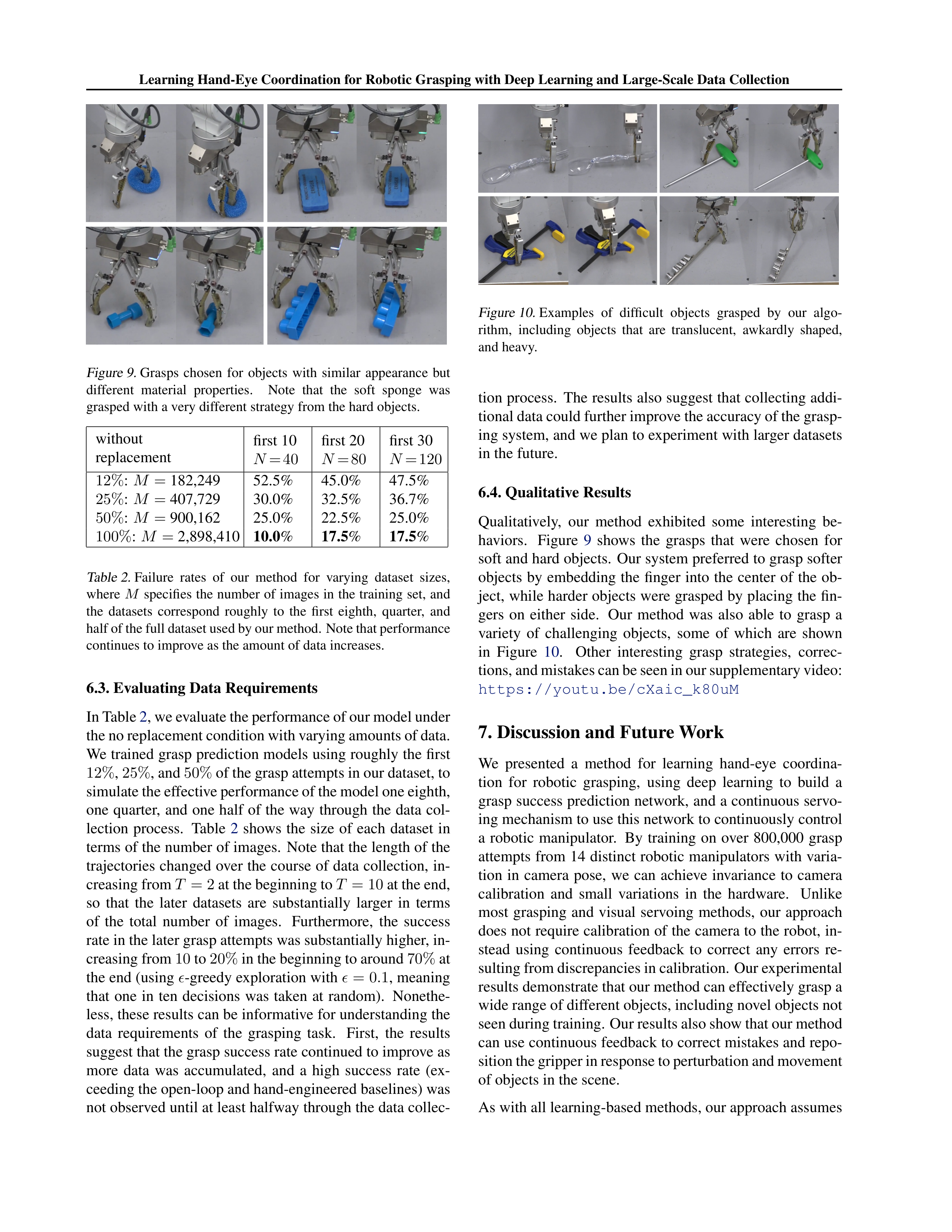
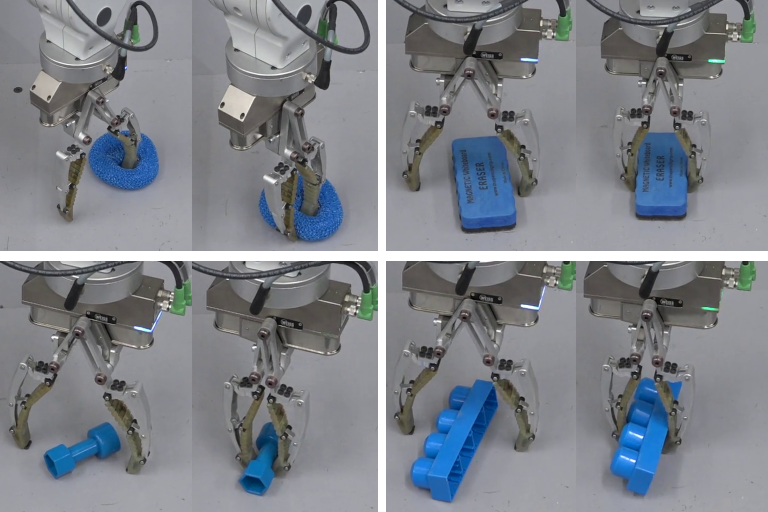
Figure 9.
Grasps
chosen
for
objects
with
similar
appearance
but
different
material
properties.
Note
that
the
soft
sponge
was
grasped with a very different strategy from the hard objects.
without
replacement
first 10
N
=40
first 20
N
=80
first 30
N
=120
12%
:
M
=
182,249
52.5%
45.0%
47.5%
25%
:
M
=
407,729
30.0%
32.5%
36.7%
50%
:
M
=
900,162
25.0%
22.5%
25.0%
100%
:
M
=
2,898,410
10.0
%
17.5
%
17.5
%
Table 2.
Failure
rates
of
our
method
for
varying
dataset
sizes,
where
M
specifies the number of images in the training set,
and
the
datasets
correspond
roughly
to
the
first
eighth,
quarter,
and
half of the full dataset used by our method. Note that performance
continues to improve as the amount of data increases.
6.3. Evaluating Data Requirements
In Table
2
, we evaluate the performance of our model under
the no replacement condition with varying amounts of data.
We trained grasp prediction models using roughly the first
12%
,
25%
, and
50%
of the grasp attempts in our dataset, to
simulate the effective performance of the model one eighth,
one quarter,
and one half of the way through the data col-
lection
process.
Table
2
shows
the
size
of
each
dataset
in
terms of the number of images.
Note that the length of the
trajectories changed over the course of data collection, in-
creasing from
T
= 2
at the beginning to
T
= 10
at the end,
so
that
the
later
datasets
are
substantially
larger
in
terms
of
the
total
number
of
images.
Furthermore,
the
success
rate in the later grasp attempts was substantially higher, in-
creasing from
10
to
20%
in the beginning to around
70%
at
the end (using
ϵ
-greedy exploration with
ϵ
= 0
.
1
, meaning
that
one
in
ten
decisions
was
taken
at
random).
Nonethe-
less, these results can be informative for understanding the
data
requirements
of
the
grasping
task.
First,
the
results
suggest that the grasp success rate continued to improve as
more
data
was
accumulated,
and
a
high
success
rate
(ex-
ceeding the open-loop and hand-engineered baselines) was
not observed until at least halfway through the data collec-
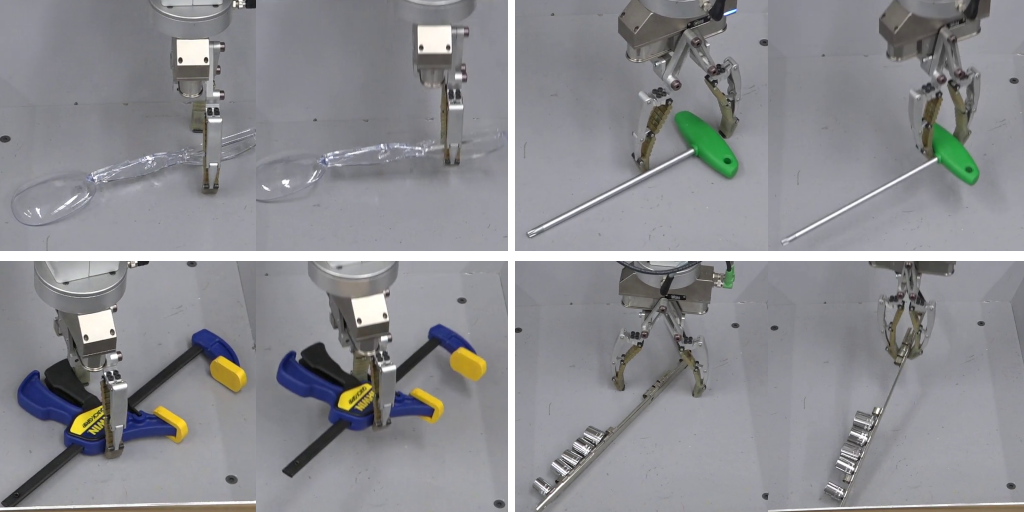
Figure 10.
Examples
of
difficult
objects
grasped
by
our
algo-
rithm,
including
objects
that
are
translucent,
awkardly
shaped,
and heavy.
tion process.
The results also suggest that collecting addi-
tional data could further improve the accuracy of the grasp-
ing system, and we plan to experiment with larger datasets
in the future.
6.4. Qualitative Results
Qualitatively,
our
method
exhibited
some
interesting
be-
haviors.
Figure
9
shows
the
grasps
that
were
chosen
for
soft and hard objects.
Our system preferred to grasp softer
objects
by
embedding
the
finger
into
the
center
of
the
ob-
ject, while harder objects were grasped by placing the fin-
gers
on
either
side.
Our
method
was
also
able
to
grasp
a
variety
of
challenging
objects,
some
of
which
are
shown
in
Figure
10
.
Other
interesting
grasp
strategies,
correc-
tions, and mistakes can be seen in our supplementary video:
https://youtu.be/cXaic_k80uM
7. Discussion and Future Work
We
presented
a
method
for
learning
hand-eye
coordina-
tion
for
robotic
grasping,
using
deep
learning
to
build
a
grasp success prediction network, and a continuous servo-
ing mechanism to use this network to continuously control
a
robotic
manipulator.
By
training
on
over
800,000
grasp
attempts from 14 distinct robotic manipulators with varia-
tion
in
camera
pose,
we
can
achieve
invariance
to
camera
calibration
and
small
variations
in
the
hardware.
Unlike
most
grasping
and
visual
servoing
methods,
our
approach
does not require calibration of the camera to the robot, in-
stead
using
continuous
feedback
to
correct
any
errors
re-
sulting from discrepancies in calibration. Our experimental
results demonstrate that our method can effectively grasp a
wide range of different objects, including novel objects not
seen during training. Our results also show that our method
can use continuous feedback to correct mistakes and repo-
sition the gripper in response to perturbation and movement
of objects in the scene.
As with all learning-based methods, our approach assumes
Learning Hand-Eye Coordination for Robotic Grasping with Deep Learning and Large-Scale Data Collection
that the data distribution during training resembles the dis-
tribution
at
test-time.
While
this
assumption
is
reason-
able
for
a
large
and
diverse
training
set,
such
as
the
one
used in this work, structural regularities during data collec-
tion can limit generalization at test time.
For example,
al-
though our method exhibits some robustness to small vari-
ations
in
gripper
shape,
it
would
not
readily
generalize
to
new
robotic
platforms
that
differ
substantially
from
those
used
during
training.
Furthermore,
since
all
of
our
train-
ing grasp attempts were executed on flat surfaces, the pro-
posed method is unlikely to generalize well to grasping on
shelves,
narrow
cubbies,
or
other
drastically
different
set-
tings.
These
issues
can
be
mitigated
by
increasing
the
di-
versity
of
the
training
setup,
which
we
plan
to
explore
as
future work.
One of the most exciting aspects of the proposed grasping
method is the ability of the learning algorithm to discover
unconventional
and
non-obvious
grasping
strategies.
We
observed,
for
example,
that
the
system
tended
to
adopt
a
different approach for grasping soft objects, as opposed to
hard
ones.
For
hard
objects,
the
fingers
must
be
placed
on
either
side
of
the
object
for
a
successful
grasp.
How-
ever,
soft
objects
can
be
grasped
simply
by
pinching
into
the
object,
which
is
most
easily
accomplished
by
placing
one
finger
into
the
middle,
and
the
other
to
the
side.
We
observed this strategy for objects such as paper tissues and
sponges.
In future work, we plan to further explore the re-
lationship between our self-supervised continuous grasping
approach and reinforcement learning, in order to allow the
methods
to
learn
a
wider
variety
of
grasp
strategies
from
large datasets of robotic experience.
At a more general level, our work explores the implications
of
large-scale
data
collection
across
multiple
robotic
plat-
forms,
demonstrating
the
value
of
this
type
of
automatic
large dataset construction for real-world robotic tasks.
Al-
though
all
of
the
robots
in
our
experiments
were
located
in
a
controlled
laboratory
environment,
in
the
long
term,
this class of methods is particularly compelling for robotic
systems
that
are
deployed
in
the
real
world,
and
there-
fore
are
naturally
exposed
to
a
wide
variety
of
environ-
ments, objects, lighting conditions, and wear and tear.
For
self-supervised
tasks
such
as
grasping,
data
collected
and
shared
by
robots
in
the
real
world
would
be
the
most
rep-
resentative
of
test-time
inputs,
and
would
therefore
be
the
best possible training data for improving the real-world per-
formance of the system.
So a particularly exciting avenue
for
future
work
is
to
explore
how
our
method
would
need
to
change
to
apply
it
to
large-scale
data
collection
across
a
large
number
of
deployed
robots
engaged
in
real
world
tasks, including grasping and other manipulation skills.
Acknowledgements
We would like to thank Kurt Konolige and Mrinal Kalakr-
ishnan
for
additional
engineering
and
insightful
discus-
sions,
Jed
Hewitt,
Don
Jordan,
and
Aaron
Weiss
for
help
with
maintaining
the
robots,
Max
Bajracharya
and
Nico-
las
Hudson
for
providing
us
with
a
baseline
perception
pipeline, and Vincent Vanhoucke and Jeff Dean for support
and organization.
References
Antos, A., Szepesvari, C., and Munos, R. Fitted Q-Iteration
in Continuous Action-Space MDPs. In
Advances in Neu-
ral Information Processing Systems
, 2008.
Bohg,
J.,
Morales,
A.,
Asfour,
T.,
and
Kragic,
D.
Data-
Driven
Grasp
Synthesis
A
Survey.
IEEE
Transactions
on Robotics
, 30(2):289–309, 2014.
Caron,
G.,
Marchand,
E.,
and
Mouaddib,
E.
Photometric
visual
servoing
for
omnidirectional
cameras.
Autonou-
mous Robots
, 35(2):177–193, October 2013.
Chen,
L.,
Papandreou,
G.,
Kokkinos,
I.,
Murphy,
K.,
and
Yuille,
A.L.
Semantic
Image
Segmentation
with
Deep
Convolutional
Nets
and
Fully
Connected
CRFs.
arXiv
preprint arXiv:1412.7062
, 2014.
Espiau, B., Chaumette, F., and Rives, P.
A New Approach
to
Visual
Servoing
in
Robotics.
IEEE
Transactions
on
Robotics and Automation
, 8(3), 1992.
Girshick,
R.,
Donahue,
J.,
Darrell,
T.,
and
Malik,
J.
Rich
feature
hierarchies
for
accurate
object
detection
and
se-
mantic segmentation.
In
IEEE Conference on Computer
Vision and Pattern Recognition
, 2014.
Goldfeder, C., Ciocarlie, M., Dang, H., and Allen, P.K. The
Columbia Grasp Database.
In
IEEE International Con-
ference
on
Robotics
and
Automation
,
pp.
1710–1716,
2009a.
Goldfeder, C., Ciocarlie, M., Peretzman, J., Dang, H., and
Allen,
P.
K.
Data-Driven
Grasping
with
Partial
Sensor
Data.
In
IEEE/RSJ International Conference on Intelli-
gent Robots and Systems
, pp. 1278–1283, 2009b.
Hebert, P., Hudson, N., Ma, J., Howard, T., Fuchs, T., Ba-
jracharya, M., and Burdick, J. Combined Shape, Appear-
ance
and
Silhouette
for
Simultaneous
Manipulator
and
Object
Tracking.
In
IEEE
International
Conference
on
Robotics and Automation
, pp. 2405–2412. IEEE, 2012.
Herzog,
A.,
Pastor,
P.,
Kalakrishnan,
M.,
Righetti,
L.,
Bohg,
J.,
Asfour,
T.,
and
Schaal,
S.
Learning
of
Grasp Selection based on Shape-Templates.
Autonomous
Robots
, 36(1-2):51–65, 2014.
Learning Hand-Eye Coordination for Robotic Grasping with Deep Learning and Large-Scale Data Collection
Hudson, N., Howard, T., Ma, J., Jain, A., Bajracharya, M.,
Myint, S., Kuo, C., Matthies, L., Backes, P., and Hebert,
P.
End-to-End Dexterous Manipulation with Deliberate
Interactive
Estimation.
In
IEEE
International
Confer-
ence on Robotics and Automation
, pp. 2371–2378, 2012.
Inaba,
M.,
Kagami,
S.,
Kanehiro,
F.,
and
Hoshino,
Y.
A
platform
for
robotics
research
based
on
the
remote-brained
robot
approach.
International
Journal
of Robotics Research
, 19(10), 2000.
Ioffe,
S.
and
Szegedy,
C.
Batch
Normalization:
Acceler-
ating Deep Network Training by Reducing Internal Co-
variate
Shift.
In
International
Conference
on
Machine
Learning
, 2015.
J¨agersand, M., Fuentes, O., and Nelson, R. C.
Experimen-
tal
Evaluation
of
Uncalibrated
Visual
Servoing
for
Pre-
cision Manipulation.
In
IEEE International Conference
on Robotics and Automation
, 1997.
Kappler, D., Bohg, B., and Schaal, S.
Leveraging Big Data
for
Grasp
Planning.
In
IEEE
International
Conference
on Robotics and Automation
, 2015.
Kehoe,
B.,
Matsukawa,
A.,
Candido,
S.,
Kuffner,
J.,
and
Goldberg,
K.
Cloud-based
robot
grasping
with
the
google object recognition engine.
In
IEEE International
Conference on Robotics and Automation
, 2013.
Kehoe,
B.,
Patil,
S.,
Abbeel,
P.,
and
Goldberg,
K.
A
sur-
vey of research on cloud robotics and automation.
IEEE
Transactions
on
Automation
Science
and
Engineering
,
12(2):398–409, April 2015.
Kragic, D. and Christensen, H. I.
Survey on Visual Servo-
ing for Manipulation.
Computational Vision and Active
Perception Laboratory
, 15, 2002.
Krizhevsky,
A.,
Sutskever,
I.,
and
Hinton,
G.
E.
Im-
ageNet
Classification
with
Deep
Convolutional
Neural
Networks.
In
Advances in Neural Information Process-
ing Systems
, pp. 1097–1105, 2012.
Kuffner, J.
Cloud-enabled humanoid robots.
In
IEEE-RAS
International Conference on Humanoid Robotics
, 2010.
Lampe,
T.
and
Riedmiller,
M.
Acquiring
Visual
Servoing
Reaching
and
Grasping
Skills
using
Neural
Reinforce-
ment
Learning.
In
International
Joint
Conference
on
Neural Networks
, pp. 1–8. IEEE, 2013.
LeCun, Y. and Bengio, Y.
Convolutional networks for im-
ages,
speech,
and
time
series.
The
Handbook
of
Brain
Theory and Neural Networks
, 3361(10), 1995.
Leeper,
A.,
Hsiao,
K.,
Chu,
E.,
and
Salisbury,
J.K.
Using
Near-Field
Stereo
Vision
for
Robotic
Grasping
in
Clut-
tered Environments.
In
Experimental Robotics
, pp. 253–
267. Springer Berlin Heidelberg, 2014.
Lenz,
I.,
Lee,
H.,
and
Saxena,
A.
Deep
Learning
for
De-
tecting
Robotic
Grasps.
The
International
Journal
of
Robotics Research
, 34(4-5):705–724, 2015.
Levine, S., Finn, C., Darrell, T., and Abbeel, P.
End-to-end
Training
of
Deep
Visuomotor
Policies.
arXiv
preprint
arXiv:1504.00702
, 2015.
Lillicrap, T., Hunt, J., Pritzel, A., Heess, N., Erez, T., Tassa,
Y., Silver, D., and Wierstra, D.
Continuous control with
deep
reinforcement
learning.
In
International
Confer-
ence on Learning Representations
, 2016.
Mahler,
J.,
Pokorny,
F.,
Hou,
B.,
Roderick,
M.,
Laskey,
M., Aubry, M., Kohlhoff, K., Kr¨oger, T., Kuffner, J., and
Goldberg,
K.
Dex-Net
1.0:
A
cloud-based
network
of
3D objects for robust grasp planning using a multi-armed
bandit model with correlated rewards.
In
IEEE Interna-
tional Conference on Robotics and Automation
, 2016.
Mnih,
V.
et
al.
Human-level
control
through
deep
rein-
forcement learning.
Nature
, 518(7540):529–533, 2015.
Mohta,
K.,
Kumar,
V.,
and
Daniilidis,
K.
Vision
Based
Control of a Quadrotor for Perching on Planes and Lines.
In
IEEE
International
Conference
on
Robotics
and
Au-
tomation
, 2014.
Oberlin,
J.
and
Tellex,
S.
Autonomously
acquiring
instance-based
object
models
from
experience.
In
In-
ternational Symposium on Robotics Research
, 2015.
Pinto,
L.
and
Gupta,
A.
Supersizing
self-supervision:
Learning
to
grasp
from
50k
tries
and
700
robot
hours.
CoRR
, abs/1509.06825, 2015.
URL
http://arxiv.
org/abs/1509.06825
.
Redmon,
J.
and
Angelova,
A.
Real-time
grasp
detection
using
convolutional
neural
networks.
In
IEEE
Inter-
national
Conference
on
Robotics
and
Automation
,
pp.
1316–1322, 2015.
Rodriguez,
A.,
Mason,
M.
T.,
and
Ferry,
S.
From
Caging
to Grasping.
The International Journal of Robotics Re-
search
, 31(7):886–900, June 2012.
Rubinstein,
R.
and
Kroese,
D.
The
Cross-Entropy
Method:
A
Unified
Approach
to
Combinatorial
Opti-
mization, Monte-Carlo Simulation, and Machine Learn-
ing
.
Springer-Verlag, 2004.
Siciliano,
B.
and
Khatib,
O.
Springer
Handbook
of
Robotics
.
Springer-Verlag
New
York,
Inc.,
Secaucus,
NJ, USA, 2007.
Srinivasa,
S.,
Berenson,
D.,
Cakmak,
M.,
Romea,
A.
C.,
Dogar,
M.,
Dragan,
A.,
Knepper,
R.
A.,
Niemueller,
T.
D.,
Strabala,
K.,
Vandeweghe,
J.
M.,
and
Ziegler,
J.
Learning Hand-Eye Coordination for Robotic Grasping with Deep Learning and Large-Scale Data Collection
HERB 2.0:
Lessons Learned from Developing a Mobile
Manipulator
for
the
Home.
Proceedings
of
the
IEEE
,
100(8):1–19, July 2012.
Vahrenkamp, N., Wieland, S., Azad, P., Gonzalez, D., As-
four, T., and Dillmann, R. Visual Servoing for Humanoid
Grasping and Manipulation Tasks.
In
8th IEEE-RAS In-
ternational
Conference
on
Humanoid
Robots
,
pp.
406–
412, 2008.
Watter, M., Springenberg, J., Boedecker, J., and Riedmiller,
M.
Embed to Control:
A Locally Linear Latent Dynam-
ics Model for Control from Raw Images.
In
Advances in
Neural Information Processing Systems
, 2015.
Weisz, J. and Allen, P. K. Pose Error Robust Grasping from
Contact
Wrench
Space
Metrics.
In
IEEE
International
Conference
on
Robotics
and
Automation
,
pp.
557–562,
2012.
Wilson,
W.
J.,
Hulls,
C.
W.
Williams,
and
Bell,
G.
S.
Relative End-Effector
Control Using
Cartesian Position
Based Visual Servoing.
IEEE Transactions on Robotics
and Automation
, 12(5), 1996.
Wohlhart, P. and Lepetit,
V.
Learning Descriptors for Ob-
ject
Recognition
and
3D
Pose
Estimation.
In
Proceed-
ings
of
the
IEEE
Conference
on
Computer
Vision
and
Pattern Recognition
, pp. 3109–3118, 2015.
Yoshimi, B. H. and Allen, P. K.
Active, uncalibrated visual
servoing.
In
IEEE International Conference on Robotics
and Automation
, 1994.
A. Servoing Implementation Details
In
this
appendix,
we
discuss
the
details
of
the
inference
procedure we use to infer the motor command
v
t
with the
highest probability of success, as well as additional details
of the servoing mechanism.
In our implementation, we performed inference using three
iterations
of
cross-entropy
method
(CEM).
Each
iteration
of
CEM
consists
of
sampling
64
sample
grasp
directions
v
t
from
a
Gaussian
distribution
with
mean
µ
and
covari-
ance
Σ
,
selecting
the
6
best
grasp
directions
(i.e.
the
90
th
percentile),
and
refitting
µ
and
Σ
to
these
6
best
grasps.
The first iteration samples from a zero-mean Gaussian cen-
tered
on
the
current
pose
of
the
gripper.
All
samples
are
constrained (via rejection sampling) to keep the final pose
of the gripper within the workspace, and to avoid rotations
of more than
180
◦
about the vertical axis.
In general, these
constraints could be used to control where in the scene the
robot
attempts
to
grasp,
for
example
to
impose
user
con-
straints and command grasps at particular locations.
Since
the
CNN
g
(
I
t
,
v
t
)
was
trained
to
predict
the
suc-
cess of grasps on sequences that always terminated with the
gripper on the table surface, we project all grasp directions
v
t
to the table height (which we assume is known) before
passing them into the network, although the actual grasp di-
rection that is executed may move the gripper above the ta-
ble, as shown in Algorithm
1
. When the servoing algorithm
commands a gripper motion above the table, we choose the
height uniformly at random between
4
and
10
cm.
In
our
prototype,
the
dimensions
and
position
of
the
workspace were set manually, by moving the arm into each
corner of the workspace and setting the corner coordinates.
In practice, the height of the table and the spatial extents of
the workspace could be obtained automatically,
for exam-
ple by moving the arm until contact, or the user or higher-
level planning mechanism.
B. Determining Grasp Success
We employ two mechanisms to determine whether a grasp
attempt
was
successful.
First,
we
check
the
state
of
the
gripper
after
the
grasp
attempt
to
determine
whether
the
fingers
closed
completely.
This
simple
test
is
effective
at
detecting
large
objects,
but
can
miss
small
or
thin
ob-
jects.
To supplement this success detector,
we also use an
image
subtraction
test,
where
we
record
an
image
of
the
scene after the grasp attempt (with the arm lifted above the
workspace
and
out
of
view),
and
another
image
after
at-
tempting to drop the grasped object into the bin.
If no ob-
ject was grasped, these two images are usually identical.
If
an object was picked up, the two images will be different.
C. Details of Hand-Engineered Grasping
System Baseline
The
hand-engineered
grasping
system
baseline
results
re-
ported
in
Table
1
were
obtained
using
perception
pipeline
that
made
use
of
the
depth
sensor
instead
of
the
monocu-
lar camera, and required extrinsic calibration of the camera
with
respect
to
the
base
of
the
arm.
The
grasp
configura-
tions were computed as follows:
First, the point clouds ob-
tained from the depth sensor were accumulated into a voxel
map.
Second,
the
voxel
map
was
turned
into
a
3D
graph
and
segmented
using
standard
graph
based
segmentation;
individual
clusters
were
then
further
segmented
from
top
to bottom into “graspable objects” based on the width and
height
of
the
region.
Finally,
a
best
grasp
was
computed
that
aligns
the
fingers
centrally
along
the
longer
edges
of
the
bounding
box
that
represents
the
object.
This
grasp
configuration
was
then
used
as
the
target
pose
for
a
task-
space controller, which was identical to the controller used
for the open-loop baseline.