Swin Transformer:
Hierarchical Vision Transformer using Shifted Windows
Ze Liu
†
*
Yutong Lin
†*
Yue Cao
*
Han Hu
*‡
Yixuan Wei
†
Zheng Zhang
Stephen Lin
Baining Guo
Microsoft Research Asia
{
v-zeliu1,v-yutlin,yuecao,hanhu,v-yixwe,zhez,stevelin,bainguo
}
@microsoft.com
Abstract
This
paper
presents
a
new
vision
Transformer,
called
Swin Transformer, that capably serves as a general-purpose
backbone
for
computer
vision.
Challenges
in
adapting
Transformer from language to vision arise from differences
between
the
two
domains,
such
as
large
variations
in
the
scale
of
visual
entities
and
the
high
resolution
of
pixels
in
images
compared
to
words
in
text.
To
address
these
differences,
we
propose
a
hierarchical
Transformer
whose
representation
is
computed
with
S
hifted
win
dows.
The
shifted windowing scheme brings greater efficiency by lim-
iting
self-attention
computation
to
non-overlapping
local
windows while also allowing for cross-window connection.
This
hierarchical
architecture
has
the
flexibility
to
model
at
various
scales
and
has
linear
computational
complexity
with
respect
to
image
size.
These
qualities
of
Swin
Trans-
former
make
it
compatible
with
a
broad
range
of
vision
tasks,
including
image
classification
(87.3
top-1
accuracy
on ImageNet-1K) and dense prediction tasks such as object
detection
(58.7
box
AP
and
51.1
mask
AP
on
COCO
test-
dev)
and
semantic
segmentation
(53.5
mIoU
on
ADE20K
val).
Its
performance
surpasses
the
previous
state-of-the-
art by a large margin of +2.7 box AP and +2.6 mask AP on
COCO, and +3.2 mIoU on ADE20K, demonstrating the po-
tential
of
Transformer-based
models
as
vision
backbones.
The
hierarchical
design
and
the
shifted
window
approach
also
prove
beneficial
for
all-MLP
architectures.
The
code
and models are publicly available at
https://github.
com/microsoft/Swin-Transformer
.
1. Introduction
Modeling
in
computer
vision
has
long
been
dominated
by convolutional neural networks (CNNs).
Beginning with
AlexNet
[
39
]
and
its
revolutionary
performance
on
the
ImageNet
image
classification
challenge,
CNN
architec-
tures have evolved to become increasingly powerful through
*
Equal contribution.
†
Interns at MSRA.
‡
Contact person.
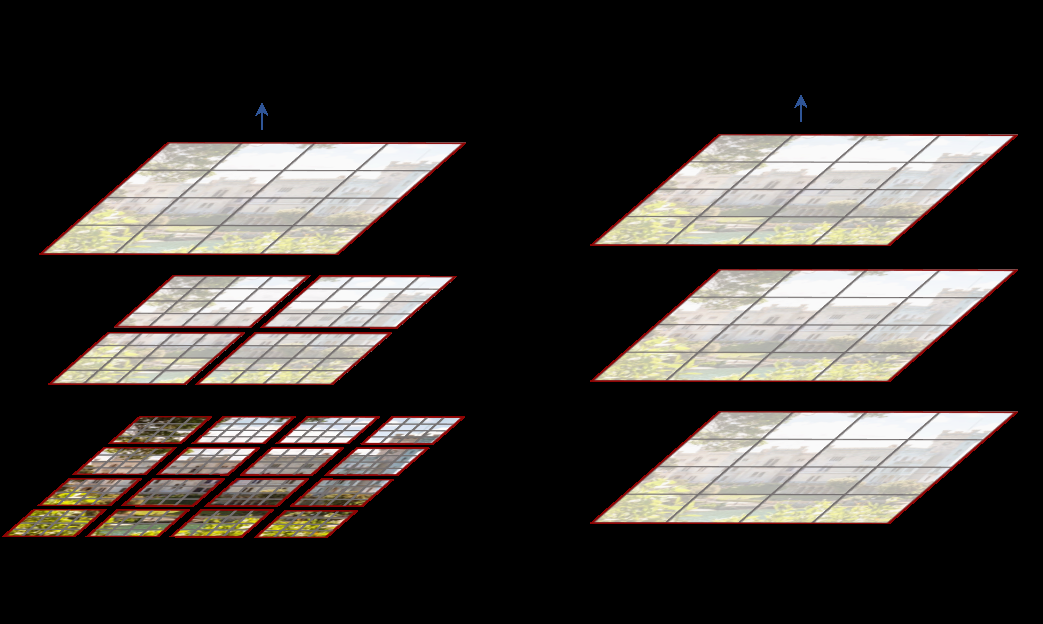
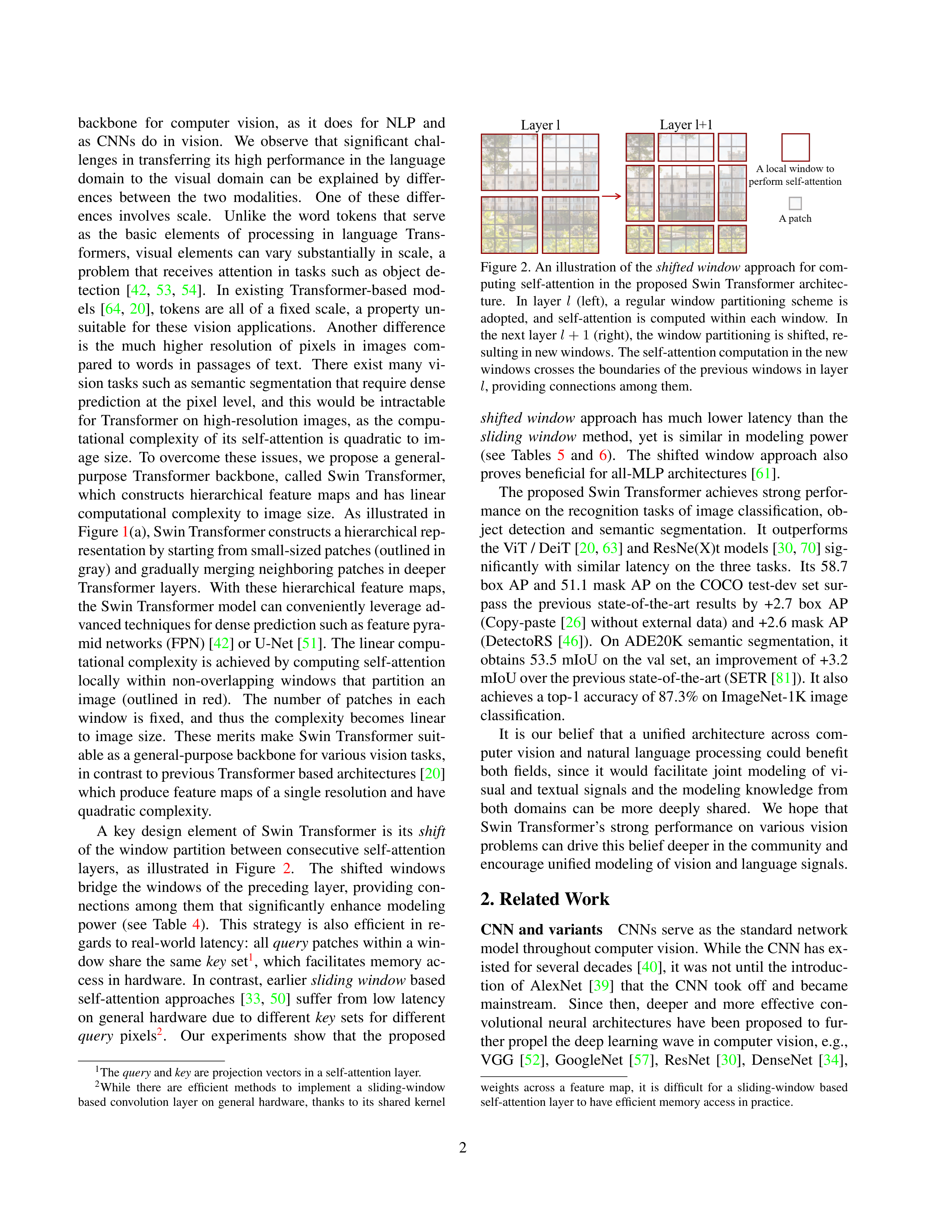
Figure
1.
(a)
The
proposed
Swin
Transformer
builds
hierarchical
feature maps by merging image patches (shown in gray) in deeper
layers and has linear computation complexity to input image size
due
to
computation
of
self-attention
only
within
each
local
win-
dow (shown in red).
It can thus serve as a general-purpose back-
bone
for
both
image
classification
and
dense
recognition
tasks.
(b)
In
contrast,
previous
vision
Transformers
[
20
]
produce
fea-
ture
maps
of
a
single
low
resolution
and
have
quadratic
compu-
tation complexity to input image size due to computation of self-
attention globally.
greater scale [
30
,
76
], more extensive connections [
34
], and
more sophisticated forms of convolution [
70
,
18
,
84
].
With
CNNs serving as backbone networks for a variety of vision
tasks, these architectural advances have led to performance
improvements that have broadly lifted the entire field.
On the other hand, the evolution of network architectures
in natural language processing (NLP) has taken a different
path,
where
the
prevalent
architecture
today
is
instead
the
Transformer
[
64
].
Designed
for
sequence
modeling
and
transduction
tasks,
the
Transformer
is
notable
for
its
use
of
attention
to
model
long-range
dependencies
in
the
data.
Its
tremendous
success
in
the
language
domain
has
led
re-
searchers
to
investigate
its
adaptation
to
computer
vision,
where it has recently demonstrated promising results on cer-
tain
tasks,
specifically
image
classification
[
20
]
and
joint
vision-language modeling [
47
].
In
this
paper,
we
seek
to
expand
the
applicability
of
Transformer
such
that
it
can
serve
as
a
general-purpose
arXiv:2103.14030v2 [cs.CV] 17 Aug 2021
backbone
for
computer
vision,
as
it
does
for
NLP
and
as
CNNs
do
in
vision.
We
observe
that
significant
chal-
lenges in transferring its high performance in the language
domain
to
the
visual
domain
can
be
explained
by
differ-
ences
between
the
two
modalities.
One
of
these
differ-
ences
involves
scale.
Unlike
the
word
tokens
that
serve
as
the
basic
elements
of
processing
in
language
Trans-
formers,
visual
elements
can
vary
substantially
in
scale,
a
problem
that
receives
attention
in
tasks
such
as
object
de-
tection
[
42
,
53
,
54
].
In
existing
Transformer-based
mod-
els
[
64
,
20
],
tokens
are
all
of
a
fixed
scale,
a
property
un-
suitable
for
these
vision
applications.
Another
difference
is
the
much
higher
resolution
of
pixels
in
images
com-
pared
to
words
in
passages
of
text.
There
exist
many
vi-
sion tasks such as semantic segmentation that require dense
prediction
at
the
pixel
level,
and
this
would
be
intractable
for
Transformer
on
high-resolution
images,
as
the
compu-
tational
complexity
of
its
self-attention
is
quadratic
to
im-
age size.
To overcome these issues,
we propose a general-
purpose
Transformer
backbone,
called
Swin
Transformer,
which
constructs
hierarchical
feature
maps
and
has
linear
computational
complexity
to
image
size.
As
illustrated
in
Figure
1
(a), Swin Transformer constructs a hierarchical rep-
resentation by starting from small-sized patches (outlined in
gray) and gradually merging neighboring patches in deeper
Transformer
layers.
With
these
hierarchical
feature
maps,
the Swin Transformer model can conveniently leverage ad-
vanced techniques for dense prediction such as feature pyra-
mid networks (FPN) [
42
] or U-Net [
51
].
The linear compu-
tational complexity is achieved by computing self-attention
locally
within
non-overlapping
windows
that
partition
an
image
(outlined
in
red).
The
number
of
patches
in
each
window
is
fixed,
and
thus
the
complexity
becomes
linear
to
image
size.
These
merits
make
Swin
Transformer
suit-
able as a general-purpose backbone for various vision tasks,
in contrast to previous Transformer based architectures [
20
]
which produce feature maps of a single resolution and have
quadratic complexity.
A
key
design
element
of
Swin
Transformer
is
its
shift
of the window partition between consecutive self-attention
layers,
as
illustrated
in
Figure
2
.
The
shifted
windows
bridge
the
windows
of
the
preceding
layer,
providing
con-
nections
among
them
that
significantly
enhance
modeling
power
(see
Table
4
).
This
strategy
is
also
efficient
in
re-
gards to real-world latency:
all
query
patches within a win-
dow share the same
key
set
1
,
which facilitates memory ac-
cess in hardware.
In contrast, earlier
sliding window
based
self-attention
approaches
[
33
,
50
]
suffer
from
low
latency
on
general
hardware
due
to
different
key
sets
for
different
query
pixels
2
.
Our
experiments
show
that
the
proposed
1
The
query
and
key
are projection vectors in a self-attention layer.
2
While
there
are
efficient
methods
to
implement
a
sliding-window
based
convolution
layer
on
general
hardware,
thanks
to
its
shared
kernel
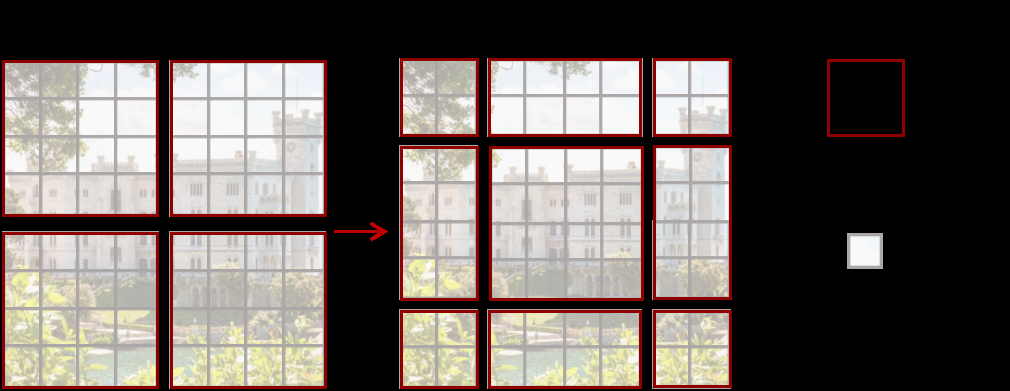
Figure 2. An illustration of the
shifted window
approach for com-
puting
self-attention
in
the
proposed
Swin
Transformer
architec-
ture.
In
layer
l
(left),
a
regular
window
partitioning
scheme
is
adopted,
and
self-attention
is
computed
within
each
window.
In
the next layer
l
+ 1
(right), the window partitioning is shifted, re-
sulting in new windows. The self-attention computation in the new
windows crosses the boundaries of the previous windows in layer
l
, providing connections among them.
shifted
window
approach
has
much
lower
latency
than
the
sliding
window
method,
yet
is
similar
in
modeling
power
(see
Tables
5
and
6
).
The
shifted
window
approach
also
proves beneficial for all-MLP architectures [
61
].
The proposed Swin Transformer achieves strong perfor-
mance on the recognition tasks of image classification, ob-
ject
detection
and
semantic
segmentation.
It
outperforms
the ViT / DeiT [
20
,
63
] and ResNe(X)t models [
30
,
70
] sig-
nificantly
with
similar
latency
on
the
three
tasks.
Its
58.7
box
AP
and
51.1
mask
AP
on
the
COCO
test-dev
set
sur-
pass
the
previous
state-of-the-art
results
by
+2.7
box
AP
(Copy-paste [
26
] without external data) and +2.6 mask AP
(DetectoRS
[
46
]).
On
ADE20K
semantic
segmentation,
it
obtains
53.5
mIoU
on
the
val
set,
an
improvement
of
+3.2
mIoU over the previous state-of-the-art (SETR [
81
]). It also
achieves a top-1 accuracy of 87.3% on ImageNet-1K image
classification.
It
is
our
belief
that
a
unified
architecture
across
com-
puter
vision
and
natural
language
processing
could
benefit
both
fields,
since
it
would
facilitate
joint
modeling
of
vi-
sual
and
textual
signals
and
the
modeling
knowledge
from
both
domains
can
be
more
deeply
shared.
We
hope
that
Swin
Transformer’s
strong
performance
on
various
vision
problems can drive this belief deeper in the community and
encourage unified modeling of vision and language signals.
2. Related Work
CNN
and
variants
CNNs
serve
as
the
standard
network
model throughout computer vision.
While the CNN has ex-
isted for several decades [
40
], it was not until the introduc-
tion
of
AlexNet
[
39
]
that
the
CNN
took
off
and
became
mainstream.
Since
then,
deeper
and
more
effective
con-
volutional
neural
architectures
have
been
proposed
to
fur-
ther propel the deep learning wave in computer vision, e.g.,
VGG
[
52
],
GoogleNet
[
57
],
ResNet
[
30
],
DenseNet
[
34
],
weights
across
a
feature
map,
it
is
difficult
for
a
sliding-window
based
self-attention layer to have efficient memory access in practice.
2
HRNet
[
65
],
and
EfficientNet
[
58
].
In
addition
to
these
architectural
advances,
there
has
also
been
much
work
on
improving
individual
convolution
layers,
such
as
depth-
wise convolution [
70
] and deformable convolution [
18
,
84
].
While
the
CNN
and
its
variants
are
still
the
primary
back-
bone
architectures
for
computer
vision
applications,
we
highlight the strong potential of Transformer-like architec-
tures
for
unified
modeling
between
vision
and
language.
Our work achieves strong performance on several basic vi-
sual
recognition
tasks,
and
we
hope
it
will
contribute
to
a
modeling shift.
Self-attention
based
backbone
architectures
Also
in-
spired
by
the
success
of
self-attention
layers
and
Trans-
former
architectures
in
the
NLP
field,
some
works
employ
self-attention layers to replace some or all of the spatial con-
volution layers in the popular ResNet [
33
,
50
,
80
].
In these
works, the self-attention is computed within a local window
of each pixel to expedite optimization [
33
], and they achieve
slightly better accuracy/FLOPs trade-offs than the counter-
part
ResNet
architecture.
However,
their
costly
memory
access
causes
their
actual
latency
to
be
significantly
larger
than that of the convolutional networks [
33
].
Instead of us-
ing sliding windows, we propose to
shift
windows between
consecutive layers, which allows for a more efficient imple-
mentation in general hardware.
Self-attention/Transformers to complement CNNs
An-
other line of work is to augment a standard CNN architec-
ture
with
self-attention
layers
or
Transformers.
The
self-
attention
layers
can
complement
backbones
[
67
,
7
,
3
,
71
,
23
,
74
,
55
] or head networks [
32
,
27
] by providing the ca-
pability
to
encode
distant
dependencies
or
heterogeneous
interactions.
More
recently,
the
encoder-decoder
design in
Transformer
has
been
applied
for
the
object
detection
and
instance
segmentation
tasks
[
8
,
13
,
85
,
56
].
Our
work
ex-
plores
the
adaptation
of
Transformers
for
basic
visual
fea-
ture extraction and is complementary to these works.
Transformer
based
vision
backbones
Most
related
to
our
work
is
the
Vision
Transformer
(ViT)
[
20
]
and
its
follow-ups
[
63
,
72
,
15
,
28
,
66
].
The
pioneering
work
of
ViT
directly
applies
a
Transformer
architecture
on
non-
overlapping
medium-sized
image
patches
for
image
clas-
sification.
It
achieves
an
impressive
speed-accuracy
trade-
off
on
image
classification
compared
to
convolutional
net-
works.
While
ViT
requires
large-scale
training
datasets
(i.e., JFT-300M) to perform well, DeiT [
63
] introduces sev-
eral
training
strategies
that
allow
ViT
to
also
be
effective
using the smaller ImageNet-1K dataset.
The results of ViT
on
image
classification
are
encouraging,
but
its
architec-
ture
is
unsuitable
for
use
as
a
general-purpose
backbone
network
on
dense
vision
tasks
or
when
the
input
image
resolution
is
high,
due
to
its
low-resolution
feature
maps
and
the
quadratic
increase
in
complexity
with
image
size.
There
are
a
few
works
applying
ViT
models
to
the
dense
vision
tasks
of
object
detection
and
semantic
segmenta-
tion
by
direct
upsampling
or
deconvolution
but
with
rela-
tively
lower
performance
[
2
,
81
].
Concurrent
to
our
work
are
some
that
modify
the
ViT
architecture
[
72
,
15
,
28
]
for
better
image
classification.
Empirically,
we
find
our
Swin
Transformer
architecture
to
achieve
the
best
speed-
accuracy
trade-off
among
these
methods
on
image
classi-
fication, even though our work focuses on general-purpose
performance
rather
than
specifically
on
classification.
An-
other concurrent work [
66
] explores a similar line of think-
ing
to
build
multi-resolution
feature
maps
on
Transform-
ers.
Its
complexity
is
still
quadratic
to
image
size,
while
ours
is
linear
and
also
operates
locally
which
has
proven
beneficial
in
modeling
the
high
correlation
in
visual
sig-
nals
[
36
,
25
,
41
].
Our
approach
is
both
efficient
and
ef-
fective,
achieving
state-of-the-art
accuracy
on
both
COCO
object detection and ADE20K semantic segmentation.
3. Method
3.1. Overall Architecture
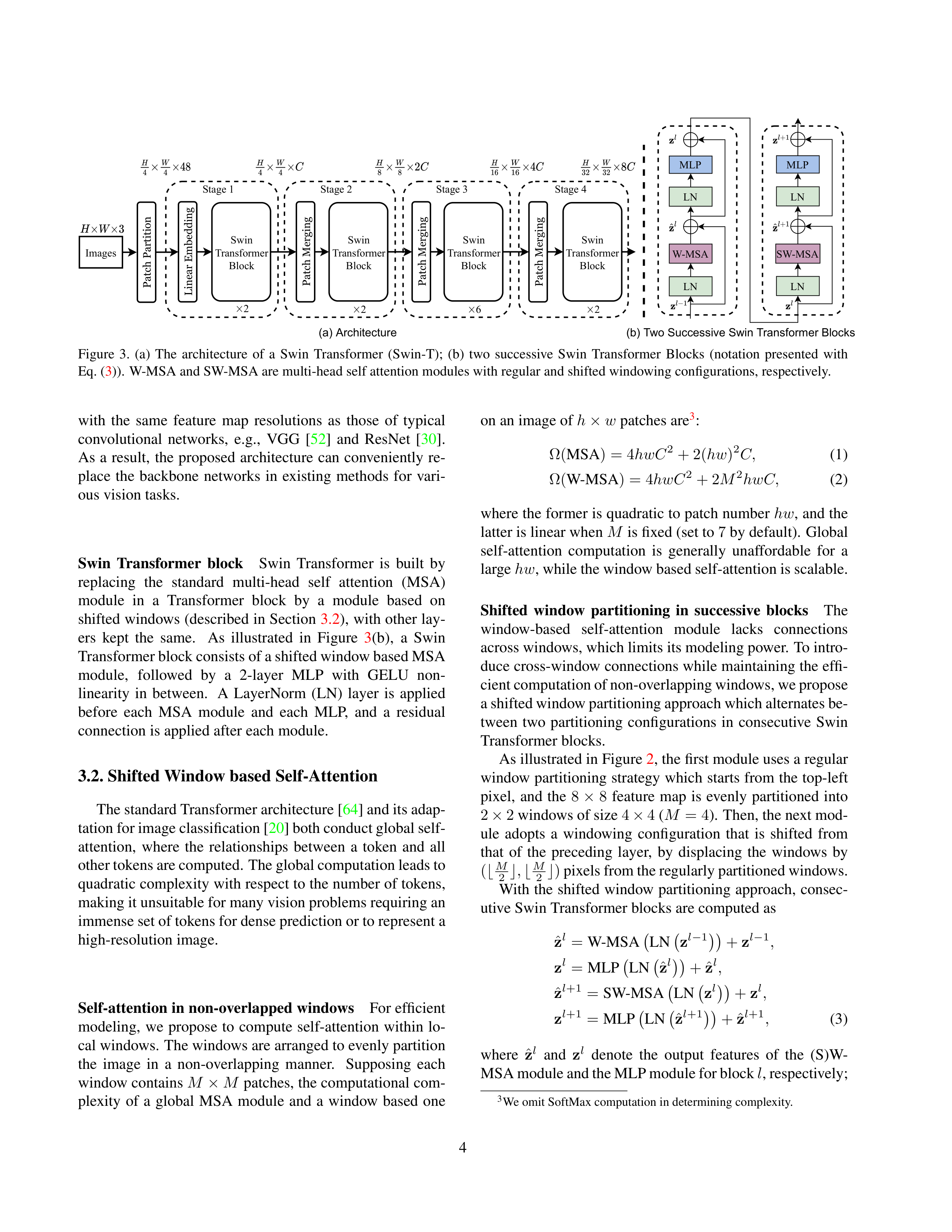
An overview of the Swin Transformer architecture is pre-
sented in Figure
3
, which illustrates the tiny version (Swin-
T). It first splits an input RGB image into non-overlapping
patches by a patch splitting module, like ViT. Each patch is
treated as a “token” and its feature is set as a concatenation
of the raw pixel RGB values. In our implementation, we use
a patch size of
4
×
4
and thus the feature dimension of each
patch
is
4
×
4
×
3
=
48
.
A
linear
embedding
layer
is
ap-
plied on this raw-valued feature to project it to an arbitrary
dimension (denoted as
C
).
Several Transformer blocks with modified self-attention
computation (
Swin Transformer blocks
) are applied on these
patch tokens.
The Transformer blocks maintain the number
of tokens (
H
4
×
W
4
), and together with the linear embedding
are referred to as “Stage 1”.
To produce a hierarchical representation,
the number of
tokens
is
reduced
by
patch
merging
layers
as
the
network
gets deeper.
The first patch merging layer concatenates the
features
of
each
group
of
2
×
2
neighboring
patches,
and
applies
a
linear
layer
on
the
4
C
-dimensional
concatenated
features.
This
reduces
the
number
of
tokens
by
a
multiple
of
2
×
2 = 4
(
2
×
downsampling of resolution), and the out-
put
dimension
is
set
to
2
C
.
Swin
Transformer
blocks
are
applied afterwards for feature transformation, with the res-
olution
kept
at
H
8
×
W
8
.
This
first
block
of
patch
merging
and feature transformation is denoted as “Stage 2”. The pro-
cedure
is
repeated
twice,
as
“Stage
3”
and
“Stage
4”,
with
output
resolutions
of
H
16
×
W
16
and
H
32
×
W
32
,
respectively.
These
stages
jointly
produce
a
hierarchical
representation,
3
(a) Architecture
MLP
LN
LN
W-MSA
(b) Two Successive Swin Transformer Blocks
MLP
LN
LN
SW-MSA
Images
Swin
Transformer
Block
Linear Embedding
Swin
Transformer
Block
Patch Merging
Swin
Transformer
Block
Patch Merging
Swin
Transformer
Block
Patch Merging
Stage 1
Stage 2
Stage 3
Stage 4
2
2
6
2
Patch Partition
Figure
3.
(a)
The
architecture
of
a
Swin
Transformer
(Swin-T);
(b)
two
successive
Swin
Transformer
Blocks
(notation
presented
with
Eq. (
3
)).
W-MSA and SW-MSA are multi-head self attention modules with regular and shifted windowing configurations, respectively.
with
the
same
feature
map
resolutions
as
those
of
typical
convolutional
networks,
e.g.,
VGG
[
52
]
and
ResNet
[
30
].
As
a
result,
the
proposed
architecture
can
conveniently
re-
place
the
backbone
networks
in
existing
methods
for
vari-
ous vision tasks.
Swin
Transformer
block
Swin
Transformer
is
built
by
replacing
the
standard
multi-head
self
attention
(MSA)
module
in
a
Transformer
block
by
a
module
based
on
shifted windows (described in Section
3.2
), with other lay-
ers
kept
the
same.
As
illustrated
in
Figure
3
(b),
a
Swin
Transformer block consists of a shifted window based MSA
module,
followed
by
a
2-layer
MLP
with
GELU
non-
linearity
in
between.
A
LayerNorm
(LN)
layer
is
applied
before
each
MSA
module
and
each
MLP,
and
a
residual
connection is applied after each module.
3.2. Shifted Window based Self-Attention
The standard Transformer architecture [
64
] and its adap-
tation for image classification [
20
] both conduct global self-
attention,
where
the
relationships
between
a
token
and
all
other tokens are computed. The global computation leads to
quadratic complexity with respect to the number of tokens,
making it unsuitable for many vision problems requiring an
immense set of tokens for dense prediction or to represent a
high-resolution image.
Self-attention in non-overlapped windows
For efficient
modeling,
we
propose
to
compute
self-attention
within
lo-
cal windows.
The windows are arranged to evenly partition
the
image
in
a
non-overlapping
manner.
Supposing
each
window contains
M
×
M
patches, the computational com-
plexity
of
a
global
MSA
module
and
a
window
based
one
on an image of
h
×
w
patches are
3
:
Ω(
MSA
) = 4
hwC
2
+ 2(
hw
)
2
C,
(1)
Ω(
W-MSA
) = 4
hwC
2
+ 2
M
2
hwC,
(2)
where the former is quadratic to patch number
hw
, and the
latter is linear when
M
is fixed (set to
7
by default).
Global
self-attention
computation
is
generally
unaffordable
for
a
large
hw
, while the window based self-attention is scalable.
Shifted
window
partitioning
in
successive
blocks
The
window-based
self-attention
module
lacks
connections
across windows, which limits its modeling power.
To intro-
duce cross-window connections while maintaining the effi-
cient computation of non-overlapping windows, we propose
a shifted window partitioning approach which alternates be-
tween
two
partitioning
configurations
in
consecutive
Swin
Transformer blocks.
As illustrated in Figure
2
, the first module uses a regular
window partitioning strategy which starts from the top-left
pixel,
and
the
8
×
8
feature
map
is
evenly
partitioned
into
2
×
2
windows of size
4
×
4
(
M
= 4
).
Then, the next mod-
ule
adopts
a
windowing
configuration
that
is
shifted
from
that
of
the
preceding
layer,
by
displacing
the
windows
by
(
⌊
M
2
⌋
,
⌊
M
2
⌋
)
pixels from the regularly partitioned windows.
With the shifted window partitioning approach,
consec-
utive Swin Transformer blocks are computed as
ˆ
z
l
=
W-MSA
LN
z
l
−
1
+
z
l
−
1
,
z
l
=
MLP
LN
ˆ
z
l
+ ˆ
z
l
,
ˆ
z
l
+1
=
SW-MSA
LN
z
l
+
z
l
,
z
l
+1
=
MLP
LN
ˆ
z
l
+1
+ ˆ
z
l
+1
,
(3)
where
ˆ
z
l
and
z
l
denote
the
output
features
of
the
(S)W-
MSA module and the MLP module for block
l
, respectively;
3
We omit SoftMax computation in determining complexity.
4
C
cyclic shift
A
A
C
B
window partition
reverse cyclic shift
A
A
C
B
C
...
masked
MSA
A
B
A
B
masked
MSA
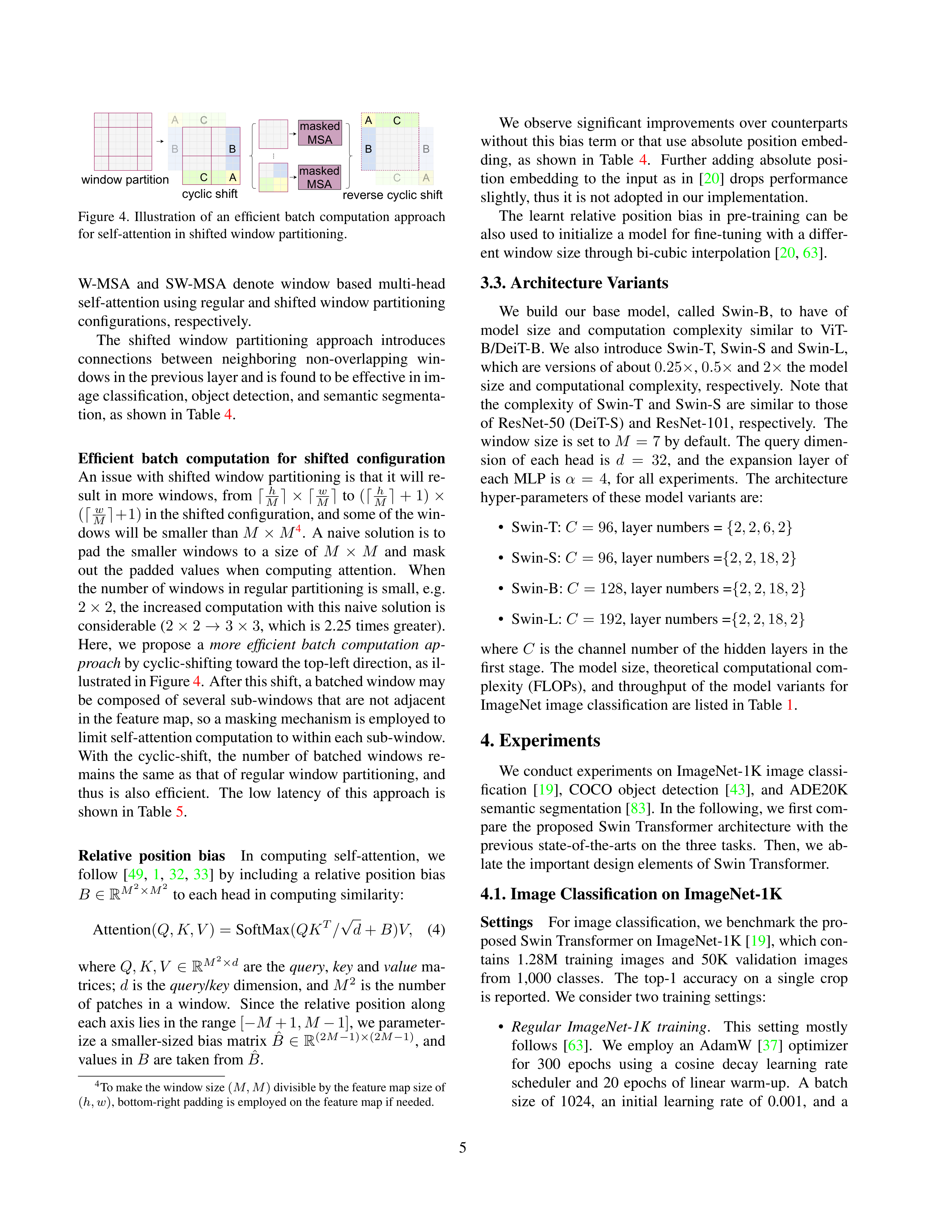
Figure
4.
Illustration
of
an
efficient
batch
computation
approach
for self-attention in shifted window partitioning.
W-MSA
and
SW-MSA
denote
window
based
multi-head
self-attention using regular and shifted window partitioning
configurations, respectively.
The
shifted
window
partitioning
approach
introduces
connections
between
neighboring
non-overlapping
win-
dows in the previous layer and is found to be effective in im-
age classification, object detection, and semantic segmenta-
tion, as shown in Table
4
.
Efficient
batch
computation
for
shifted
configuration
An issue with shifted window partitioning is that it will re-
sult in more windows,
from
⌈
h
M
⌉× ⌈
w
M
⌉
to
(
⌈
h
M
⌉
+ 1)
×
(
⌈
w
M
⌉
+1)
in the shifted configuration, and some of the win-
dows will be smaller than
M
×
M
4
.
A naive solution is to
pad
the
smaller
windows
to
a
size
of
M
×
M
and
mask
out
the
padded
values
when
computing
attention.
When
the number of windows in regular partitioning is small, e.g.
2
×
2
, the increased computation with this naive solution is
considerable (
2
×
2
→
3
×
3
, which is 2.25 times greater).
Here,
we
propose
a
more
efficient
batch
computation
ap-
proach
by cyclic-shifting toward the top-left direction, as il-
lustrated in Figure
4
. After this shift, a batched window may
be
composed
of
several
sub-windows
that
are
not
adjacent
in the feature map, so a masking mechanism is employed to
limit self-attention computation to within each sub-window.
With
the
cyclic-shift,
the
number
of
batched
windows
re-
mains the same as that of regular window partitioning, and
thus
is
also
efficient.
The
low
latency
of
this
approach
is
shown in Table
5
.
Relative
position
bias
In
computing
self-attention,
we
follow
[
49
,
1
,
32
,
33
]
by
including
a
relative
position
bias
B
∈
R
M
2
×
M
2
to each head in computing similarity:
Attention
(
Q, K, V
) =
SoftMax
(
QK
T
/
√
d
+
B
)
V,
(4)
where
Q, K, V
∈
R
M
2
×
d
are the
query
,
key
and
value
ma-
trices;
d
is the
query
/
key
dimension, and
M
2
is the number
of
patches
in
a
window.
Since
the
relative
position
along
each axis lies in the range
[
−
M
+1
, M
−
1]
, we parameter-
ize a smaller-sized bias matrix
ˆ
B
∈
R
(2
M
−
1)
×
(2
M
−
1)
, and
values in
B
are taken from
ˆ
B
.
4
To make the window size
(
M, M
)
divisible by the feature map size of
(
h, w
)
, bottom-right padding is employed on the feature map if needed.
We
observe
significant
improvements
over
counterparts
without this bias term or that use absolute position embed-
ding,
as
shown
in
Table
4
.
Further
adding
absolute
posi-
tion
embedding
to
the
input
as
in
[
20
]
drops
performance
slightly, thus it is not adopted in our implementation.
The
learnt
relative
position
bias
in
pre-training
can
be
also used to initialize a model for fine-tuning with a differ-
ent window size through bi-cubic interpolation [
20
,
63
].
3.3. Architecture Variants
We
build
our
base
model,
called
Swin-B,
to
have
of
model
size
and
computation
complexity
similar
to
ViT-
B/DeiT-B. We also introduce Swin-T, Swin-S and Swin-L,
which are versions of about
0
.
25
×
,
0
.
5
×
and
2
×
the model
size and computational complexity,
respectively.
Note that
the
complexity
of
Swin-T
and
Swin-S
are
similar
to
those
of
ResNet-50
(DeiT-S)
and
ResNet-101,
respectively.
The
window size is set to
M
=
7
by default.
The query dimen-
sion
of
each
head
is
d
=
32
,
and
the
expansion
layer
of
each
MLP
is
α
=
4
,
for
all
experiments.
The
architecture
hyper-parameters of these model variants are:
•
Swin-T:
C
= 96
, layer numbers =
{
2
,
2
,
6
,
2
}
•
Swin-S:
C
= 96
, layer numbers =
{
2
,
2
,
18
,
2
}
•
Swin-B:
C
= 128
, layer numbers =
{
2
,
2
,
18
,
2
}
•
Swin-L:
C
= 192
, layer numbers =
{
2
,
2
,
18
,
2
}
where
C
is the channel number of the hidden layers in the
first stage.
The model size, theoretical computational com-
plexity
(FLOPs),
and
throughput
of
the
model
variants
for
ImageNet image classification are listed in Table
1
.
4. Experiments
We conduct experiments on ImageNet-1K image classi-
fication
[
19
],
COCO
object
detection
[
43
],
and
ADE20K
semantic segmentation [
83
].
In the following, we first com-
pare
the
proposed
Swin
Transformer
architecture
with
the
previous
state-of-the-arts
on
the
three
tasks.
Then,
we
ab-
late the important design elements of Swin Transformer.
4.1. Image Classification on ImageNet-1K
Settings
For image classification, we benchmark the pro-
posed Swin Transformer on ImageNet-1K [
19
], which con-
tains
1.28M
training
images
and
50K
validation
images
from
1,000
classes.
The
top-1
accuracy
on
a
single
crop
is reported.
We consider two training settings:
•
Regular
ImageNet-1K
training
.
This
setting
mostly
follows
[
63
].
We
employ
an
AdamW
[
37
]
optimizer
for
300
epochs
using
a
cosine
decay
learning
rate
scheduler
and
20
epochs
of
linear
warm-up.
A
batch
size
of
1024,
an
initial
learning
rate
of
0.001,
and
a
5
weight
decay
of
0.05
are
used.
We
include
most
of
the
augmentation
and
regularization
strategies
of
[
63
]
in training, except for repeated augmentation [
31
] and
EMA
[
45
],
which
do
not
enhance
performance.
Note
that this is contrary to [
63
] where repeated augmenta-
tion is crucial to stabilize the training of ViT.
•
Pre-training
on
ImageNet-22K
and
fine-tuning
on
ImageNet-1K
.
We
also
pre-train
on
the
larger
ImageNet-22K
dataset,
which
contains
14.2
million
images and 22K classes.
We employ an AdamW opti-
mizer for 90 epochs using a linear decay learning rate
scheduler with a 5-epoch linear warm-up.
A batch size
of 4096, an initial learning rate of 0.001, and a weight
decay
of
0.01
are
used.
In
ImageNet-1K
fine-tuning,
we train the models for 30 epochs with a batch size of
1024,
a
constant
learning
rate
of
10
−
5
,
and
a
weight
decay of
10
−
8
.
Results
with
regular
ImageNet-1K
training
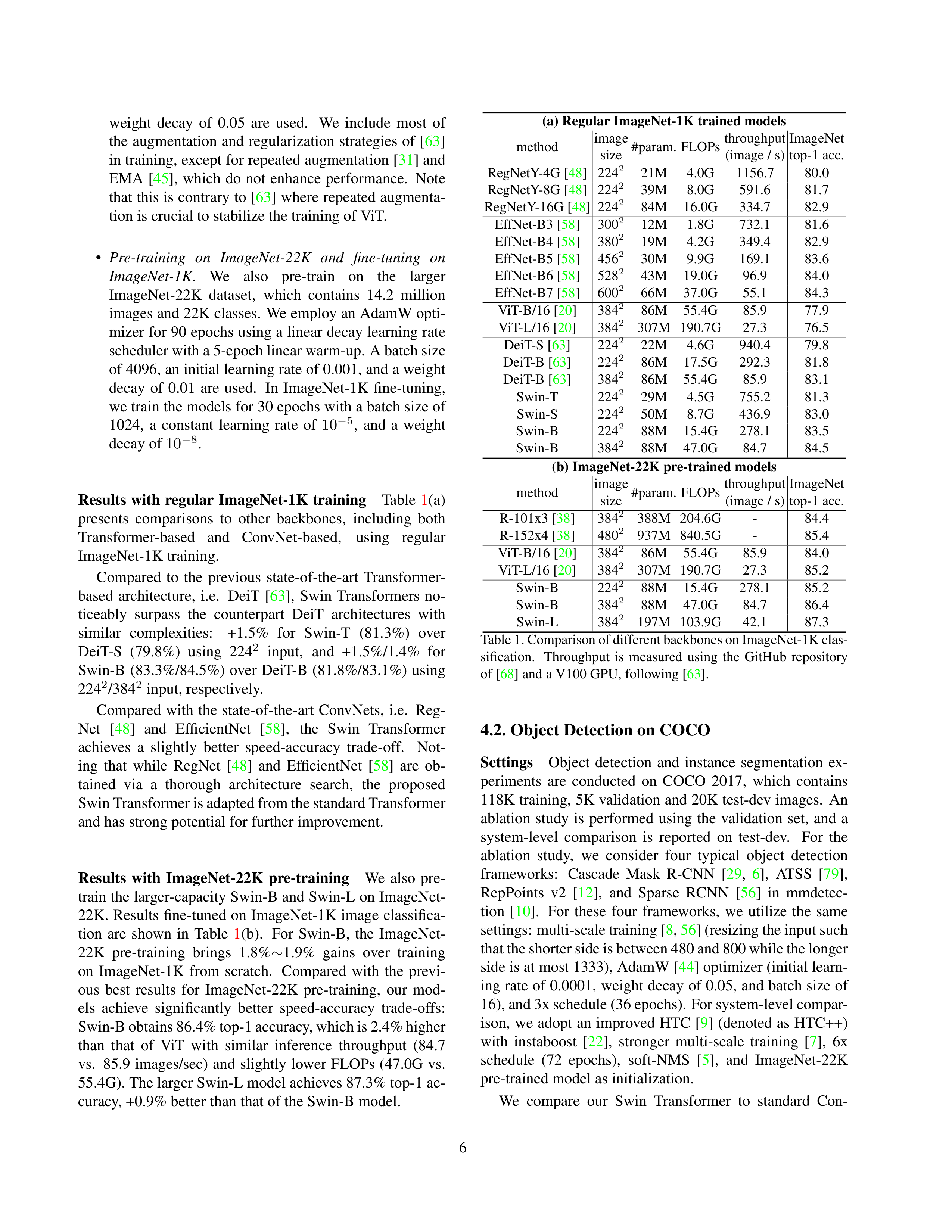
Table
1
(a)
presents
comparisons
to
other
backbones,
including
both
Transformer-based
and
ConvNet-based,
using
regular
ImageNet-1K training.
Compared
to
the
previous
state-of-the-art
Transformer-
based
architecture,
i.e.
DeiT
[
63
],
Swin
Transformers
no-
ticeably
surpass
the
counterpart
DeiT
architectures
with
similar
complexities:
+1.5%
for
Swin-T
(81.3%)
over
DeiT-S
(79.8%)
using
224
2
input,
and
+1.5%/1.4%
for
Swin-B
(83.3%/84.5%)
over
DeiT-B
(81.8%/83.1%)
using
224
2
/384
2
input, respectively.
Compared
with
the
state-of-the-art
ConvNets,
i.e.
Reg-
Net
[
48
]
and
EfficientNet
[
58
],
the
Swin
Transformer
achieves
a
slightly
better
speed-accuracy
trade-off.
Not-
ing
that
while
RegNet
[
48
]
and
EfficientNet
[
58
]
are
ob-
tained
via
a
thorough
architecture
search,
the
proposed
Swin Transformer is adapted from the standard Transformer
and has strong potential for further improvement.
Results
with
ImageNet-22K
pre-training
We
also
pre-
train the larger-capacity Swin-B and Swin-L on ImageNet-
22K. Results fine-tuned
on
ImageNet-1K
image
classifica-
tion
are
shown
in
Table
1
(b).
For
Swin-B,
the
ImageNet-
22K
pre-training
brings
1.8%
∼
1.9%
gains
over
training
on
ImageNet-1K
from
scratch.
Compared
with
the
previ-
ous
best
results
for
ImageNet-22K
pre-training,
our
mod-
els
achieve
significantly
better
speed-accuracy
trade-offs:
Swin-B obtains 86.4% top-1 accuracy, which is 2.4% higher
than
that
of
ViT
with
similar
inference
throughput
(84.7
vs.
85.9
images/sec)
and
slightly
lower
FLOPs
(47.0G
vs.
55.4G). The larger Swin-L model achieves 87.3% top-1 ac-
curacy, +0.9% better than that of the Swin-B model.
(a) Regular ImageNet-1K trained models
method
image
size
#param. FLOPs throughput
(image / s)
ImageNet
top-1 acc.
RegNetY-4G [
48
]
224
2
21M
4.0G
1156.7
80.0
RegNetY-8G [
48
]
224
2
39M
8.0G
591.6
81.7
RegNetY-16G [
48
]
224
2
84M
16.0G
334.7
82.9
EffNet-B3 [
58
]
300
2
12M
1.8G
732.1
81.6
EffNet-B4 [
58
]
380
2
19M
4.2G
349.4
82.9
EffNet-B5 [
58
]
456
2
30M
9.9G
169.1
83.6
EffNet-B6 [
58
]
528
2
43M
19.0G
96.9
84.0
EffNet-B7 [
58
]
600
2
66M
37.0G
55.1
84.3
ViT-B/16 [
20
]
384
2
86M
55.4G
85.9
77.9
ViT-L/16 [
20
]
384
2
307M
190.7G
27.3
76.5
DeiT-S [
63
]
224
2
22M
4.6G
940.4
79.8
DeiT-B [
63
]
224
2
86M
17.5G
292.3
81.8
DeiT-B [
63
]
384
2
86M
55.4G
85.9
83.1
Swin-T
224
2
29M
4.5G
755.2
81.3
Swin-S
224
2
50M
8.7G
436.9
83.0
Swin-B
224
2
88M
15.4G
278.1
83.5
Swin-B
384
2
88M
47.0G
84.7
84.5
(b) ImageNet-22K pre-trained models
method
image
size
#param. FLOPs throughput
(image / s)
ImageNet
top-1 acc.
R-101x3 [
38
]
384
2
388M
204.6G
-
84.4
R-152x4 [
38
]
480
2
937M
840.5G
-
85.4
ViT-B/16 [
20
]
384
2
86M
55.4G
85.9
84.0
ViT-L/16 [
20
]
384
2
307M
190.7G
27.3
85.2
Swin-B
224
2
88M
15.4G
278.1
85.2
Swin-B
384
2
88M
47.0G
84.7
86.4
Swin-L
384
2
197M
103.9G
42.1
87.3
Table 1. Comparison of different backbones on ImageNet-1K clas-
sification.
Throughput
is
measured
using
the
GitHub
repository
of [
68
] and a V100 GPU, following [
63
].
4.2. Object Detection on COCO
Settings
Object
detection
and
instance
segmentation
ex-
periments
are
conducted
on
COCO
2017,
which
contains
118K training, 5K validation and 20K test-dev images.
An
ablation
study
is
performed
using
the
validation
set,
and
a
system-level
comparison
is
reported
on
test-dev.
For
the
ablation
study,
we
consider
four
typical
object
detection
frameworks:
Cascade
Mask
R-CNN
[
29
,
6
],
ATSS
[
79
],
RepPoints
v2
[
12
],
and
Sparse
RCNN
[
56
]
in
mmdetec-
tion
[
10
].
For
these
four
frameworks,
we
utilize
the
same
settings: multi-scale training [
8
,
56
] (resizing the input such
that the shorter side is between 480 and 800 while the longer
side is at most 1333), AdamW [
44
] optimizer (initial learn-
ing rate of 0.0001,
weight decay of 0.05,
and batch size of
16), and 3x schedule (36 epochs). For system-level compar-
ison,
we adopt an improved HTC [
9
] (denoted as HTC++)
with
instaboost
[
22
],
stronger
multi-scale
training
[
7
],
6x
schedule
(72
epochs),
soft-NMS
[
5
],
and
ImageNet-22K
pre-trained model as initialization.
We
compare
our
Swin
Transformer
to
standard
Con-
6
(a) Various frameworks
Method
Backbone AP
box
AP
box
50
AP
box
75
#param. FLOPs FPS
Cascade
Mask R-CNN
R-50
46.3
64.3
50.5
82M
739G
18.0
Swin-T
50.5
69.3
54.9
86M
745G
15.3
ATSS
R-50
43.5
61.9
47.0
32M
205G
28.3
Swin-T
47.2
66.5
51.3
36M
215G
22.3
RepPointsV2
R-50
46.5
64.6
50.3
42M
274G
13.6
Swin-T
50.0
68.5
54.2
45M
283G
12.0
Sparse
R-CNN
R-50
44.5
63.4
48.2
106M
166G
21.0
Swin-T
47.9
67.3
52.3
110M
172G
18.4
(b) Various backbones w.
Cascade Mask R-CNN
AP
box
AP
box
50
AP
box
75
AP
mask
AP
mask
50
AP
mask
75
paramFLOPsFPS
DeiT-S
†
48.0
67.2
51.7
41.4
64.2
44.3
80M
889G
10.4
R50
46.3
64.3
50.5
40.1
61.7
43.4
82M
739G
18.0
Swin-T
50.5
69.3
54.9
43.7
66.6
47.1
86M
745G
15.3
X101-32
48.1
66.5
52.4
41.6
63.9
45.2
101M
819G
12.8
Swin-S
51.8
70.4
56.3
44.7
67.9
48.5
107M
838G
12.0
X101-64
48.3
66.4
52.3
41.7
64.0
45.1
140M
972G
10.4
Swin-B
51.9
70.9
56.5
45.0
68.4
48.7
145M
982G
11.6
(c) System-level Comparison
Method
mini-val
test-dev
#param. FLOPs
AP
box
AP
mask
AP
box
AP
mask
RepPointsV2* [
12
]
-
-
52.1
-
-
-
GCNet* [
7
]
51.8
44.7
52.3
45.4
-
1041G
RelationNet++* [
13
]
-
-
52.7
-
-
-
SpineNet-190 [
21
]
52.6
-
52.8
-
164M
1885G
ResNeSt-200* [
78
]
52.5
-
53.3
47.1
-
-
EfficientDet-D7 [
59
]
54.4
-
55.1
-
77M
410G
DetectoRS* [
46
]
-
-
55.7
48.5
-
-
YOLOv4 P7* [
4
]
-
-
55.8
-
-
-
Copy-paste [
26
]
55.9
47.2
56.0
47.4
185M
1440G
X101-64 (HTC++)
52.3
46.0
-
-
155M
1033G
Swin-B (HTC++)
56.4
49.1
-
-
160M
1043G
Swin-L (HTC++)
57.1
49.5
57.7
50.2
284M
1470G
Swin-L (HTC++)*
58.0
50.4
58.7
51.1
284M
-
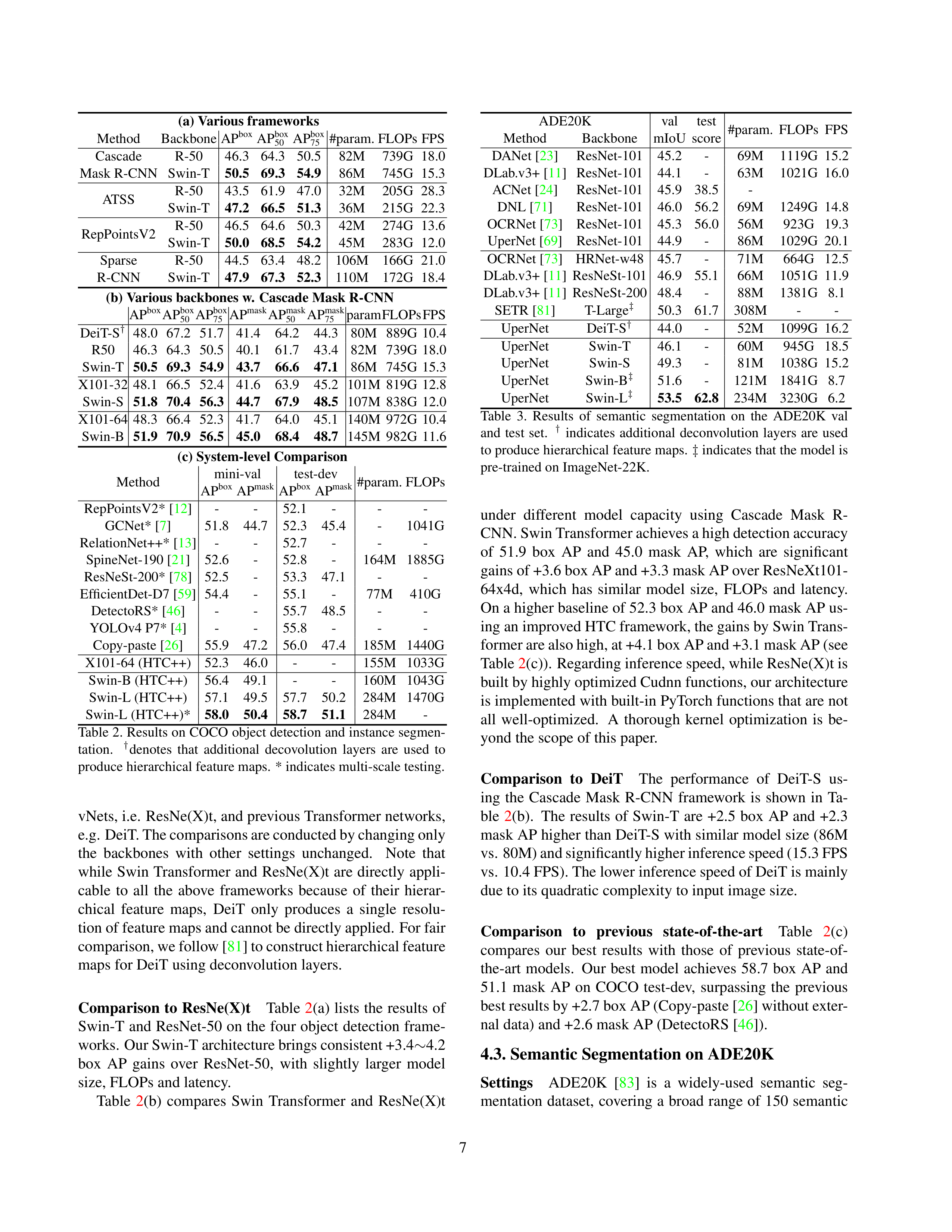
Table 2. Results on COCO object detection and instance segmen-
tation.
†
denotes
that
additional
decovolution
layers
are
used
to
produce hierarchical feature maps.
* indicates multi-scale testing.
vNets, i.e.
ResNe(X)t, and previous Transformer networks,
e.g. DeiT. The comparisons are conducted by changing only
the
backbones
with
other
settings
unchanged.
Note
that
while Swin Transformer and ResNe(X)t are directly appli-
cable
to
all
the
above
frameworks
because
of
their
hierar-
chical
feature
maps,
DeiT
only
produces
a
single
resolu-
tion of feature maps and cannot be directly applied.
For fair
comparison, we follow [
81
] to construct hierarchical feature
maps for DeiT using deconvolution layers.
Comparison to ResNe(X)t
Table
2
(a) lists the results of
Swin-T and ResNet-50 on the four object detection frame-
works.
Our Swin-T architecture brings consistent +3.4
∼
4.2
box
AP
gains
over
ResNet-50,
with
slightly
larger
model
size, FLOPs and latency.
Table
2
(b)
compares
Swin
Transformer
and
ResNe(X)t
ADE20K
val
test
#param.
FLOPs
FPS
Method
Backbone
mIoU
score
DANet [
23
]
ResNet-101
45.2
-
69M
1119G
15.2
DLab.v3+ [
11
]
ResNet-101
44.1
-
63M
1021G
16.0
ACNet [
24
]
ResNet-101
45.9
38.5
-
DNL [
71
]
ResNet-101
46.0
56.2
69M
1249G
14.8
OCRNet [
73
]
ResNet-101
45.3
56.0
56M
923G
19.3
UperNet [
69
]
ResNet-101
44.9
-
86M
1029G
20.1
OCRNet [
73
]
HRNet-w48
45.7
-
71M
664G
12.5
DLab.v3+ [
11
]
ResNeSt-101
46.9
55.1
66M
1051G
11.9
DLab.v3+ [
11
]
ResNeSt-200
48.4
-
88M
1381G
8.1
SETR [
81
]
T-Large
‡
50.3
61.7
308M
-
-
UperNet
DeiT-S
†
44.0
-
52M
1099G
16.2
UperNet
Swin-T
46.1
-
60M
945G
18.5
UperNet
Swin-S
49.3
-
81M
1038G
15.2
UperNet
Swin-B
‡
51.6
-
121M
1841G
8.7
UperNet
Swin-L
‡
53.5
62.8
234M
3230G
6.2
Table
3.
Results
of
semantic
segmentation
on
the
ADE20K
val
and
test
set.
†
indicates
additional
deconvolution
layers
are
used
to produce hierarchical feature maps.
‡
indicates that the model is
pre-trained on ImageNet-22K.
under
different
model
capacity
using
Cascade
Mask
R-
CNN. Swin Transformer achieves a high detection accuracy
of
51.9
box
AP
and
45.0
mask
AP,
which
are
significant
gains of +3.6 box AP and +3.3 mask AP over ResNeXt101-
64x4d,
which
has
similar
model
size,
FLOPs
and
latency.
On a higher baseline of 52.3 box AP and 46.0 mask AP us-
ing an improved HTC framework, the gains by Swin Trans-
former are also high, at +4.1 box AP and +3.1 mask AP (see
Table
2
(c)).
Regarding inference speed, while ResNe(X)t is
built by highly optimized Cudnn functions, our architecture
is implemented with built-in PyTorch functions that are not
all
well-optimized.
A
thorough
kernel
optimization
is
be-
yond the scope of this paper.
Comparison
to
DeiT
The
performance
of
DeiT-S
us-
ing
the
Cascade
Mask
R-CNN
framework
is
shown
in
Ta-
ble
2
(b).
The
results
of
Swin-T
are
+2.5
box
AP
and
+2.3
mask AP higher than DeiT-S with similar model size (86M
vs. 80M) and significantly higher inference speed (15.3 FPS
vs.
10.4 FPS). The lower inference speed of DeiT is mainly
due to its quadratic complexity to input image size.
Comparison
to
previous
state-of-the-art
Table
2
(c)
compares
our
best
results
with
those
of
previous
state-of-
the-art
models.
Our
best
model
achieves
58.7
box
AP
and
51.1
mask
AP
on
COCO
test-dev,
surpassing
the
previous
best results by +2.7 box AP (Copy-paste [
26
] without exter-
nal data) and +2.6 mask AP (DetectoRS [
46
]).
4.3. Semantic Segmentation on ADE20K
Settings
ADE20K
[
83
]
is
a
widely-used
semantic
seg-
mentation dataset,
covering a broad range of 150 semantic
7
ImageNet
COCO
ADE20k
top-1
top-5
AP
box
AP
mask
mIoU
w/o shifting
80.2
95.1
47.7
41.5
43.3
shifted windows
81.3
95.6
50.5
43.7
46.1
no pos.
80.1
94.9
49.2
42.6
43.8
abs.
pos.
80.5
95.2
49.0
42.4
43.2
abs.+rel.
pos.
81.3
95.6
50.2
43.4
44.0
rel.
pos.
w/o app.
79.3
94.7
48.2
41.9
44.1
rel.
pos.
81.3
95.6
50.5
43.7
46.1
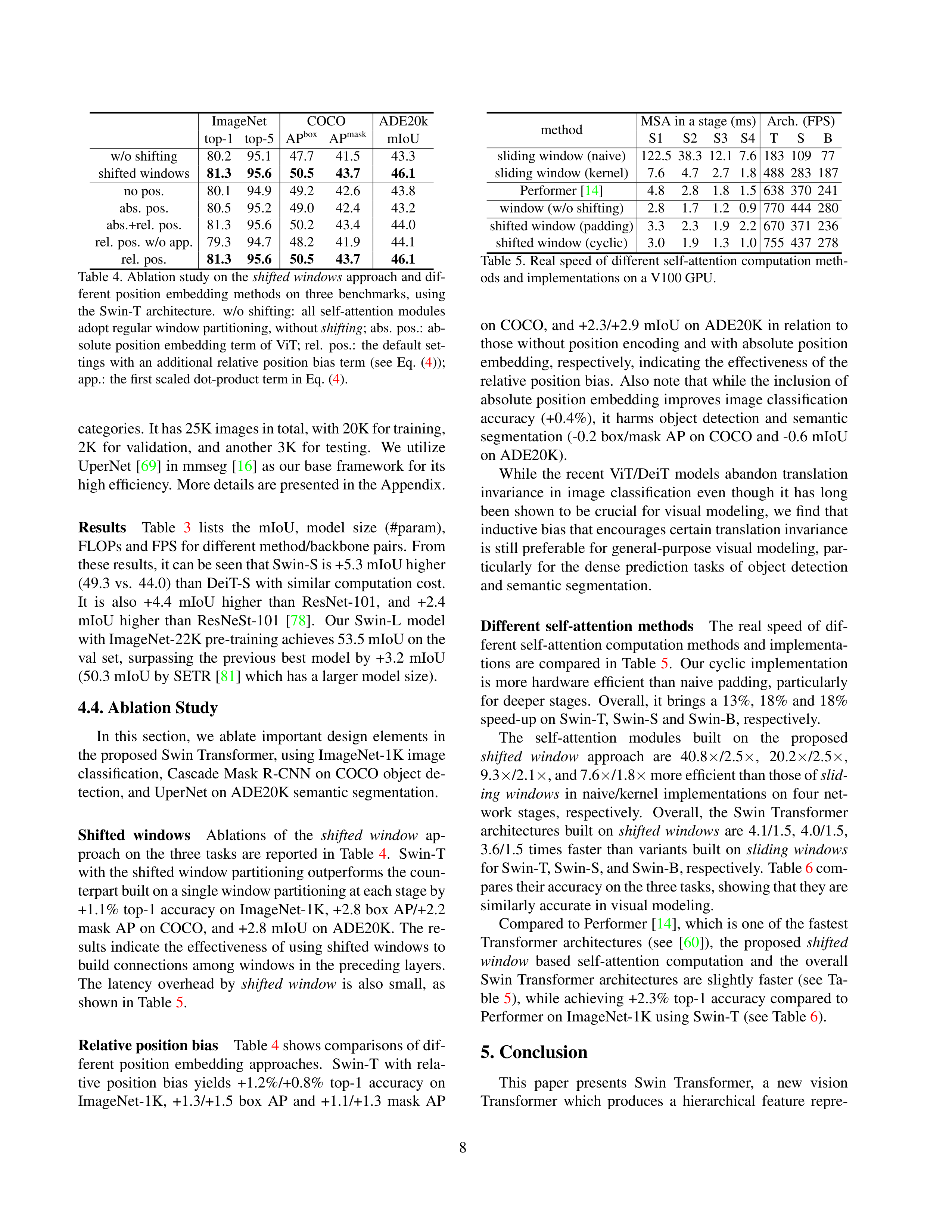
Table 4. Ablation study on the
shifted windows
approach and dif-
ferent
position
embedding
methods
on
three
benchmarks,
using
the
Swin-T
architecture.
w/o
shifting:
all
self-attention
modules
adopt regular window partitioning, without
shifting
; abs.
pos.:
ab-
solute position embedding term of ViT; rel.
pos.:
the default set-
tings
with
an
additional
relative
position
bias
term
(see
Eq.
(
4
));
app.:
the first scaled dot-product term in Eq. (
4
).
categories. It has 25K images in total, with 20K for training,
2K
for
validation,
and
another
3K
for
testing.
We
utilize
UperNet [
69
] in mmseg [
16
] as our base framework for its
high efficiency. More details are presented in the Appendix.
Results
Table
3
lists
the
mIoU,
model
size
(#param),
FLOPs and FPS for different method/backbone pairs.
From
these results, it can be seen that Swin-S is +5.3 mIoU higher
(49.3 vs.
44.0) than DeiT-S with similar computation cost.
It
is
also
+4.4
mIoU
higher
than
ResNet-101,
and
+2.4
mIoU
higher
than
ResNeSt-101
[
78
].
Our
Swin-L
model
with ImageNet-22K pre-training achieves 53.5 mIoU on the
val
set,
surpassing
the
previous
best
model
by
+3.2
mIoU
(50.3 mIoU by SETR [
81
] which has a larger model size).
4.4. Ablation Study
In
this
section,
we
ablate
important
design
elements
in
the proposed Swin Transformer, using ImageNet-1K image
classification,
Cascade Mask R-CNN on COCO object de-
tection, and UperNet on ADE20K semantic segmentation.
Shifted
windows
Ablations
of
the
shifted
window
ap-
proach
on
the
three
tasks
are
reported
in
Table
4
.
Swin-T
with the shifted window partitioning outperforms the coun-
terpart built on a single window partitioning at each stage by
+1.1% top-1 accuracy on ImageNet-1K, +2.8 box AP/+2.2
mask
AP
on
COCO,
and
+2.8
mIoU
on
ADE20K.
The
re-
sults indicate the effectiveness of using shifted windows to
build connections among windows in the preceding layers.
The
latency
overhead
by
shifted
window
is
also
small,
as
shown in Table
5
.
Relative position bias
Table
4
shows comparisons of dif-
ferent
position
embedding
approaches.
Swin-T
with
rela-
tive
position
bias
yields
+1.2%/+0.8%
top-1
accuracy
on
ImageNet-1K,
+1.3/+1.5
box
AP
and
+1.1/+1.3
mask
AP
method
MSA in a stage (ms)
Arch.
(FPS)
S1
S2
S3
S4
T
S
B
sliding window (naive)
122.5
38.3
12.1
7.6
183
109
77
sliding window (kernel)
7.6
4.7
2.7
1.8
488
283
187
Performer [
14
]
4.8
2.8
1.8
1.5
638
370
241
window (w/o shifting)
2.8
1.7
1.2
0.9
770
444
280
shifted window (padding)
3.3
2.3
1.9
2.2
670
371
236
shifted window (cyclic)
3.0
1.9
1.3
1.0
755
437
278
Table
5.
Real
speed
of
different
self-attention
computation
meth-
ods and implementations on a V100 GPU.
on COCO, and +2.3/+2.9 mIoU on ADE20K in relation to
those without position encoding and with absolute position
embedding, respectively, indicating the effectiveness of the
relative position bias.
Also note that while the inclusion of
absolute position embedding improves image classification
accuracy
(+0.4%),
it
harms
object
detection
and
semantic
segmentation (-0.2 box/mask AP on COCO and -0.6 mIoU
on ADE20K).
While
the
recent
ViT/DeiT
models
abandon
translation
invariance
in
image
classification
even
though
it
has
long
been shown to be crucial for visual modeling,
we find that
inductive bias that encourages certain translation invariance
is still preferable for general-purpose visual modeling, par-
ticularly
for
the
dense
prediction
tasks
of
object
detection
and semantic segmentation.
Different
self-attention
methods
The
real
speed
of
dif-
ferent self-attention computation methods and implementa-
tions
are
compared
in
Table
5
.
Our
cyclic
implementation
is more hardware efficient than naive padding,
particularly
for
deeper
stages.
Overall,
it
brings
a
13%,
18%
and
18%
speed-up on Swin-T, Swin-S and Swin-B, respectively.
The
self-attention
modules
built
on
the
proposed
shifted
window
approach
are
40.8
×
/2.5
×
,
20.2
×
/2.5
×
,
9.3
×
/2.1
×
, and 7.6
×
/1.8
×
more efficient than those of
slid-
ing
windows
in
naive/kernel
implementations
on
four
net-
work
stages,
respectively.
Overall,
the
Swin
Transformer
architectures
built
on
shifted
windows
are
4.1/1.5,
4.0/1.5,
3.6/1.5
times
faster
than
variants
built
on
sliding
windows
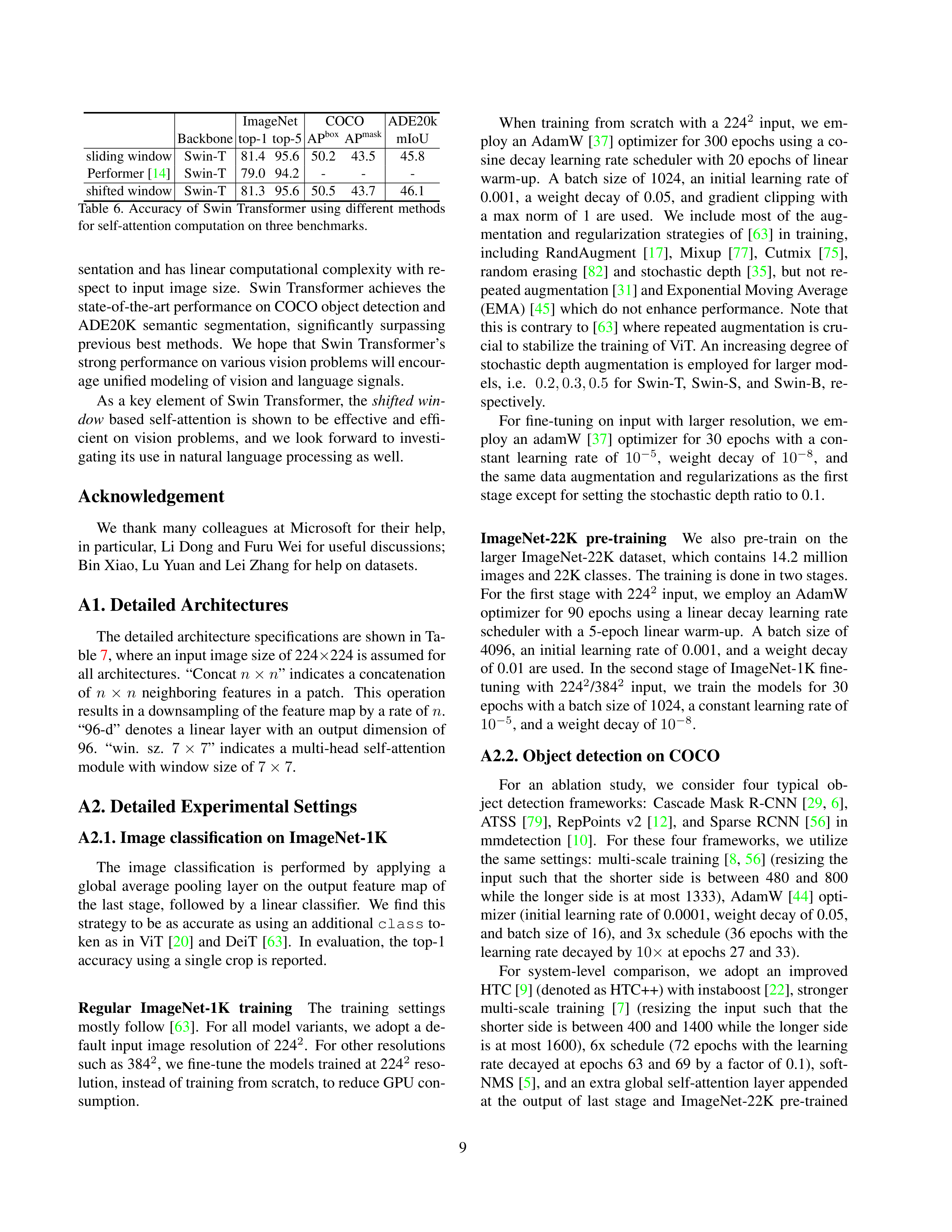
for Swin-T, Swin-S, and Swin-B, respectively. Table
6
com-
pares their accuracy on the three tasks, showing that they are
similarly accurate in visual modeling.
Compared to Performer [
14
], which is one of the fastest
Transformer
architectures
(see
[
60
]),
the
proposed
shifted
window
based
self-attention
computation
and
the
overall
Swin
Transformer
architectures
are
slightly
faster
(see
Ta-
ble
5
), while achieving +2.3% top-1 accuracy compared to
Performer on ImageNet-1K using Swin-T (see Table
6
).
5. Conclusion
This
paper
presents
Swin
Transformer,
a
new
vision
Transformer
which
produces
a
hierarchical
feature
repre-
8
ImageNet
COCO
ADE20k
Backbone
top-1
top-5
AP
box
AP
mask
mIoU
sliding window
Swin-T
81.4
95.6
50.2
43.5
45.8
Performer [
14
]
Swin-T
79.0
94.2
-
-
-
shifted window
Swin-T
81.3
95.6
50.5
43.7
46.1
Table
6.
Accuracy
of
Swin
Transformer
using
different
methods
for self-attention computation on three benchmarks.
sentation and has linear computational complexity with re-
spect
to
input
image
size.
Swin
Transformer
achieves
the
state-of-the-art performance on COCO object detection and
ADE20K
semantic
segmentation,
significantly
surpassing
previous
best
methods.
We
hope
that
Swin
Transformer’s
strong performance on various vision problems will encour-
age unified modeling of vision and language signals.
As a key element of Swin Transformer,
the
shifted win-
dow
based
self-attention
is
shown
to
be
effective
and
effi-
cient
on
vision
problems,
and
we
look
forward
to
investi-
gating its use in natural language processing as well.
Acknowledgement
We
thank
many
colleagues
at
Microsoft
for
their
help,
in particular, Li Dong and Furu Wei for useful discussions;
Bin Xiao, Lu Yuan and Lei Zhang for help on datasets.
A1. Detailed Architectures
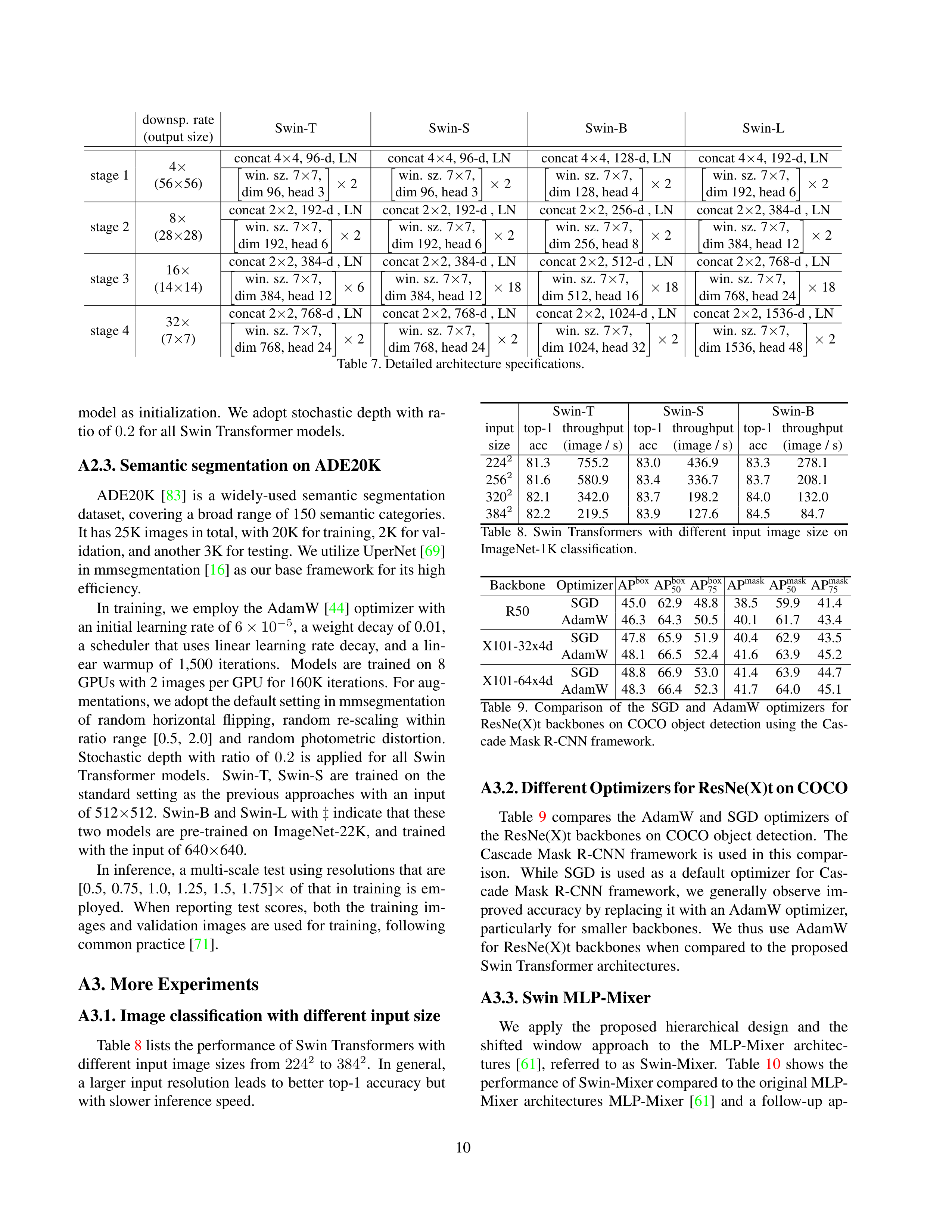
The detailed architecture specifications are shown in Ta-
ble
7
, where an input image size of 224
×
224 is assumed for
all architectures.
“Concat
n
×
n
” indicates a concatenation
of
n
×
n
neighboring
features
in
a
patch.
This
operation
results in a downsampling of the feature map by a rate of
n
.
“96-d”
denotes
a
linear
layer
with
an
output
dimension
of
96.
“win.
sz.
7
×
7
”
indicates
a
multi-head
self-attention
module with window size of
7
×
7
.
A2. Detailed Experimental Settings
A2.1. Image classification on ImageNet-1K
The
image
classification
is
performed
by
applying
a
global
average
pooling
layer
on
the
output
feature
map
of
the
last
stage,
followed
by
a
linear
classifier.
We
find
this
strategy to be as accurate as using an additional
class
to-
ken
as
in
ViT
[
20
]
and
DeiT
[
63
].
In
evaluation,
the
top-1
accuracy using a single crop is reported.
Regular
ImageNet-1K
training
The
training
settings
mostly follow [
63
].
For all model variants,
we adopt a de-
fault input image resolution of 224
2
.
For other resolutions
such as 384
2
, we fine-tune the models trained at 224
2
reso-
lution, instead of training from scratch, to reduce GPU con-
sumption.
When
training
from
scratch
with
a
224
2
input,
we
em-
ploy an AdamW [
37
] optimizer for 300 epochs using a co-
sine decay learning rate scheduler with 20 epochs of linear
warm-up.
A
batch
size
of
1024,
an
initial
learning
rate
of
0.001,
a
weight
decay
of
0.05,
and
gradient
clipping
with
a
max
norm
of
1
are
used.
We
include
most
of
the
aug-
mentation
and
regularization
strategies
of
[
63
]
in
training,
including
RandAugment
[
17
],
Mixup
[
77
],
Cutmix
[
75
],
random
erasing
[
82
]
and
stochastic
depth
[
35
],
but
not
re-
peated augmentation [
31
] and Exponential Moving Average
(EMA) [
45
] which do not enhance performance.
Note that
this is contrary to [
63
] where repeated augmentation is cru-
cial to stabilize the training of ViT. An increasing degree of
stochastic depth augmentation is employed for larger mod-
els,
i.e.
0
.
2
,
0
.
3
,
0
.
5
for
Swin-T,
Swin-S,
and
Swin-B,
re-
spectively.
For
fine-tuning
on
input
with
larger
resolution,
we
em-
ploy
an
adamW
[
37
]
optimizer
for
30
epochs
with
a
con-
stant
learning
rate
of
10
−
5
,
weight
decay
of
10
−
8
,
and
the same data augmentation and regularizations as the first
stage except for setting the stochastic depth ratio to 0.1.
ImageNet-22K
pre-training
We
also
pre-train
on
the
larger
ImageNet-22K
dataset,
which
contains
14.2
million
images and 22K classes.
The training is done in two stages.
For the first stage with 224
2
input,
we employ an AdamW
optimizer
for
90
epochs
using
a
linear
decay
learning
rate
scheduler
with
a
5-epoch
linear
warm-up.
A
batch
size
of
4096,
an
initial
learning
rate
of
0.001,
and
a
weight
decay
of 0.01 are used.
In the second stage of ImageNet-1K fine-
tuning
with
224
2
/384
2
input,
we
train
the
models
for
30
epochs with a batch size of 1024, a constant learning rate of
10
−
5
, and a weight decay of
10
−
8
.
A2.2. Object detection on COCO
For
an
ablation
study,
we
consider
four
typical
ob-
ject
detection
frameworks:
Cascade
Mask
R-CNN
[
29
,
6
],
ATSS
[
79
],
RepPoints
v2
[
12
],
and
Sparse
RCNN
[
56
]
in
mmdetection
[
10
].
For
these
four
frameworks,
we
utilize
the same settings:
multi-scale training [
8
,
56
] (resizing the
input
such
that
the
shorter
side
is
between
480
and
800
while
the
longer
side
is
at
most
1333),
AdamW
[
44
]
opti-
mizer (initial learning rate of 0.0001, weight decay of 0.05,
and batch size of 16), and 3x schedule (36 epochs with the
learning rate decayed by
10
×
at epochs 27 and 33).
For
system-level
comparison,
we
adopt
an
improved
HTC [
9
] (denoted as HTC++) with instaboost [
22
], stronger
multi-scale
training
[
7
]
(resizing
the
input
such
that
the
shorter side is between 400 and 1400 while the longer side
is at most 1600), 6x schedule (72 epochs with the learning
rate
decayed
at
epochs
63
and
69
by
a
factor
of
0.1),
soft-
NMS [
5
], and an extra global self-attention layer appended
at
the
output
of
last
stage
and
ImageNet-22K
pre-trained
9
downsp.
rate
(output size)
Swin-T
Swin-S
Swin-B
Swin-L
stage 1
4
×
(56
×
56)
concat 4
×
4, 96-d, LN
concat 4
×
4, 96-d, LN
concat 4
×
4, 128-d, LN
concat 4
×
4, 192-d, LN
win.
sz.
7
×
7,
dim 96, head 3
×
2
win.
sz.
7
×
7,
dim 96, head 3
×
2
win.
sz.
7
×
7,
dim 128, head 4
×
2
win.
sz.
7
×
7,
dim 192, head 6
×
2
stage 2
8
×
(28
×
28)
concat 2
×
2, 192-d , LN
concat 2
×
2, 192-d , LN
concat 2
×
2, 256-d , LN
concat 2
×
2, 384-d , LN
win.
sz.
7
×
7,
dim 192, head 6
×
2
win.
sz.
7
×
7,
dim 192, head 6
×
2
win.
sz.
7
×
7,
dim 256, head 8
×
2
win.
sz.
7
×
7,
dim 384, head 12
×
2
stage 3
16
×
(14
×
14)
concat 2
×
2, 384-d , LN
concat 2
×
2, 384-d , LN
concat 2
×
2, 512-d , LN
concat 2
×
2, 768-d , LN
win.
sz.
7
×
7,
dim 384, head 12
×
6
win.
sz.
7
×
7,
dim 384, head 12
×
18
win.
sz.
7
×
7,
dim 512, head 16
×
18
win.
sz.
7
×
7,
dim 768, head 24
×
18
stage 4
32
×
(7
×
7)
concat 2
×
2, 768-d , LN
concat 2
×
2, 768-d , LN
concat 2
×
2, 1024-d , LN
concat 2
×
2, 1536-d , LN
win.
sz.
7
×
7,
dim 768, head 24
×
2
win.
sz.
7
×
7,
dim 768, head 24
×
2
win.
sz.
7
×
7,
dim 1024, head 32
×
2
win.
sz.
7
×
7,
dim 1536, head 48
×
2
Table 7. Detailed architecture specifications.
model as initialization.
We adopt stochastic depth with ra-
tio of
0
.
2
for all Swin Transformer models.
A2.3. Semantic segmentation on ADE20K
ADE20K
[
83
]
is
a
widely-used
semantic
segmentation
dataset, covering a broad range of 150 semantic categories.
It has 25K images in total, with 20K for training, 2K for val-
idation, and another 3K for testing. We utilize UperNet [
69
]
in mmsegmentation [
16
] as our base framework for its high
efficiency.
In training, we employ the AdamW [
44
] optimizer with
an initial learning rate of
6
×
10
−
5
, a weight decay of 0.01,
a
scheduler
that
uses
linear
learning
rate
decay,
and
a
lin-
ear
warmup
of
1,500
iterations.
Models
are
trained
on
8
GPUs with 2 images per GPU for 160K iterations.
For aug-
mentations, we adopt the default setting in mmsegmentation
of
random
horizontal
flipping,
random
re-scaling
within
ratio
range
[0.5,
2.0]
and
random
photometric
distortion.
Stochastic
depth
with
ratio
of
0
.
2
is
applied
for
all
Swin
Transformer
models.
Swin-T,
Swin-S
are
trained
on
the
standard
setting
as
the
previous
approaches
with
an
input
of 512
×
512.
Swin-B and Swin-L with
‡
indicate that these
two
models
are
pre-trained
on
ImageNet-22K,
and
trained
with the input of 640
×
640.
In inference, a multi-scale test using resolutions that are
[0.5,
0.75,
1.0,
1.25,
1.5,
1.75]
×
of
that
in
training
is
em-
ployed.
When
reporting
test
scores,
both
the
training
im-
ages and validation images are used for training, following
common practice [
71
].
A3. More Experiments
A3.1. Image classification with different input size
Table
8
lists the performance of Swin Transformers with
different
input
image
sizes
from
224
2
to
384
2
.
In
general,
a
larger
input
resolution
leads
to
better
top-1
accuracy
but
with slower inference speed.
Swin-T
Swin-S
Swin-B
input
size
top-1
acc
throughput
(image / s)
top-1
acc
throughput
(image / s)
top-1
acc
throughput
(image / s)
224
2
81.3
755.2
83.0
436.9
83.3
278.1
256
2
81.6
580.9
83.4
336.7
83.7
208.1
320
2
82.1
342.0
83.7
198.2
84.0
132.0
384
2
82.2
219.5
83.9
127.6
84.5
84.7
Table
8.
Swin
Transformers
with
different
input
image
size
on
ImageNet-1K classification.
Backbone
Optimizer
AP
box
AP
box
50
AP
box
75
AP
mask
AP
mask
50
AP
mask
75
R50
SGD
45.0
62.9
48.8
38.5
59.9
41.4
AdamW
46.3
64.3
50.5
40.1
61.7
43.4
X101-32x4d
SGD
47.8
65.9
51.9
40.4
62.9
43.5
AdamW
48.1
66.5
52.4
41.6
63.9
45.2
X101-64x4d
SGD
48.8
66.9
53.0
41.4
63.9
44.7
AdamW
48.3
66.4
52.3
41.7
64.0
45.1
Table
9.
Comparison
of
the
SGD
and
AdamW
optimizers
for
ResNe(X)t
backbones
on
COCO
object
detection
using
the
Cas-
cade Mask R-CNN framework.
A3.2. Different Optimizers for ResNe(X)t on COCO
Table
9
compares
the
AdamW
and
SGD
optimizers
of
the ResNe(X)t backbones on COCO object detection.
The
Cascade
Mask
R-CNN
framework
is
used
in
this
compar-
ison.
While
SGD
is
used
as
a
default
optimizer
for
Cas-
cade
Mask
R-CNN
framework,
we
generally
observe
im-
proved accuracy by replacing it with an AdamW optimizer,
particularly
for
smaller
backbones.
We
thus
use
AdamW
for
ResNe(X)t
backbones
when
compared
to
the
proposed
Swin Transformer architectures.
A3.3. Swin MLP-Mixer
We
apply
the
proposed
hierarchical
design
and
the
shifted
window
approach
to
the
MLP-Mixer
architec-
tures
[
61
],
referred
to
as
Swin-Mixer.
Table
10
shows
the
performance of Swin-Mixer compared to the original MLP-
Mixer
architectures
MLP-Mixer
[
61
]
and
a
follow-up
ap-
10
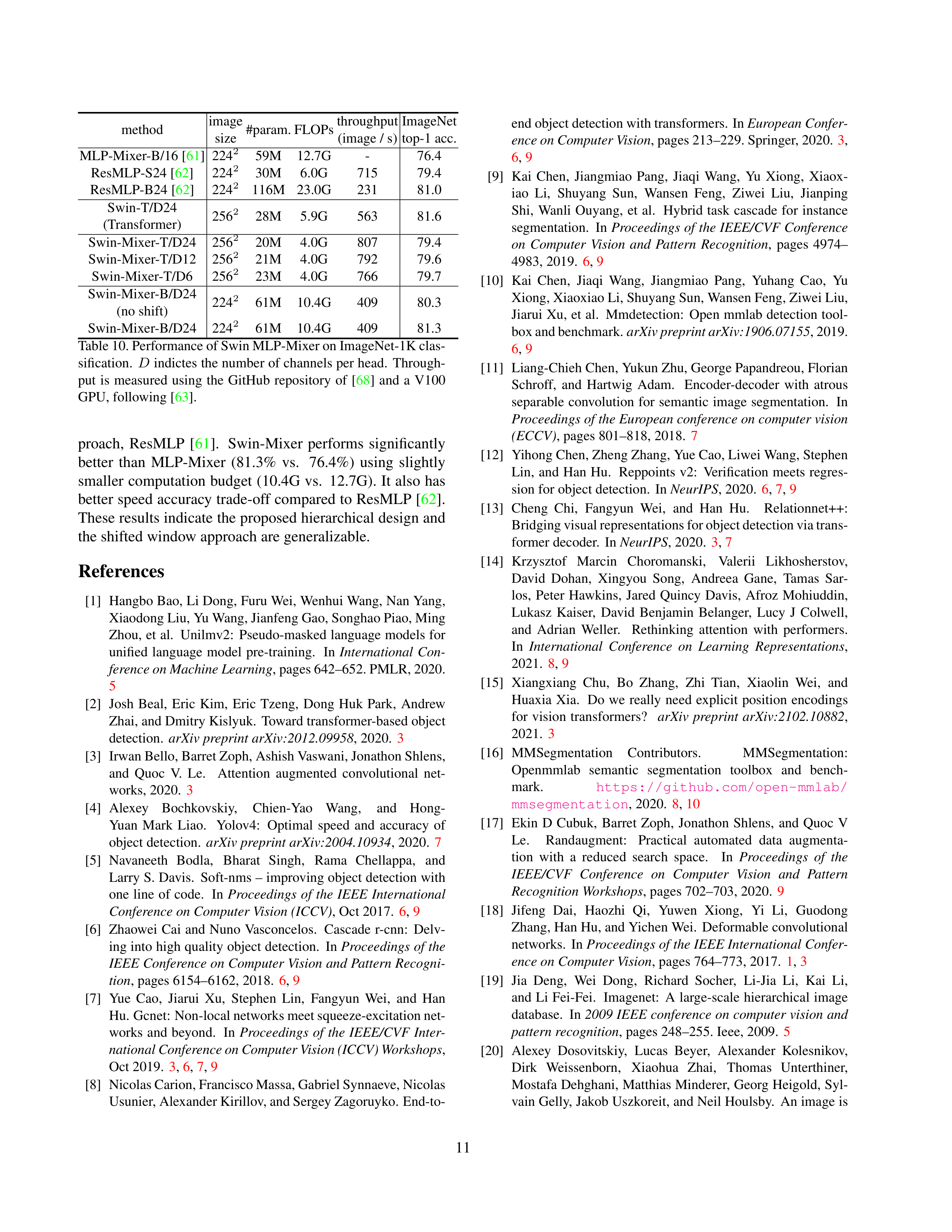
method
image
size
#param. FLOPs throughput
(image / s)
ImageNet
top-1 acc.
MLP-Mixer-B/16 [
61
]
224
2
59M
12.7G
-
76.4
ResMLP-S24 [
62
]
224
2
30M
6.0G
715
79.4
ResMLP-B24 [
62
]
224
2
116M
23.0G
231
81.0
Swin-T/D24
(Transformer)
256
2
28M
5.9G
563
81.6
Swin-Mixer-T/D24
256
2
20M
4.0G
807
79.4
Swin-Mixer-T/D12
256
2
21M
4.0G
792
79.6
Swin-Mixer-T/D6
256
2
23M
4.0G
766
79.7
Swin-Mixer-B/D24
(no shift)
224
2
61M
10.4G
409
80.3
Swin-Mixer-B/D24
224
2
61M
10.4G
409
81.3
Table 10. Performance of Swin MLP-Mixer on ImageNet-1K clas-
sification.
D
indictes the number of channels per head.
Through-
put
is
measured
using
the
GitHub
repository
of
[
68
]
and
a
V100
GPU, following [
63
].
proach,
ResMLP
[
61
].
Swin-Mixer
performs
significantly
better
than
MLP-Mixer
(81.3%
vs.
76.4%)
using
slightly
smaller computation budget (10.4G vs.
12.7G). It also has
better speed accuracy trade-off compared to ResMLP [
62
].
These results indicate the proposed hierarchical design and
the shifted window approach are generalizable.
References
[1]
Hangbo Bao, Li Dong, Furu Wei, Wenhui Wang, Nan Yang,
Xiaodong Liu, Yu Wang, Jianfeng Gao, Songhao Piao, Ming
Zhou, et al.
Unilmv2:
Pseudo-masked language models for
unified
language
model
pre-training.
In
International
Con-
ference on Machine Learning
, pages 642–652. PMLR, 2020.
5
[2]
Josh
Beal,
Eric
Kim,
Eric
Tzeng,
Dong
Huk
Park,
Andrew
Zhai, and Dmitry Kislyuk.
Toward transformer-based object
detection.
arXiv preprint arXiv:2012.09958
, 2020.
3
[3]
Irwan Bello, Barret Zoph, Ashish Vaswani, Jonathon Shlens,
and
Quoc
V.
Le.
Attention
augmented
convolutional
net-
works, 2020.
3
[4]
Alexey
Bochkovskiy,
Chien-Yao
Wang,
and
Hong-
Yuan
Mark
Liao.
Yolov4:
Optimal
speed
and
accuracy
of
object detection.
arXiv preprint arXiv:2004.10934
, 2020.
7
[5]
Navaneeth
Bodla,
Bharat
Singh,
Rama
Chellappa,
and
Larry S. Davis.
Soft-nms – improving object detection with
one
line
of
code.
In
Proceedings
of
the
IEEE
International
Conference on Computer Vision (ICCV)
, Oct 2017.
6
,
9
[6]
Zhaowei Cai and
Nuno
Vasconcelos.
Cascade
r-cnn:
Delv-
ing into high quality object detection.
In
Proceedings of the
IEEE Conference on Computer Vision and Pattern Recogni-
tion
, pages 6154–6162, 2018.
6
,
9
[7]
Yue
Cao,
Jiarui
Xu,
Stephen
Lin,
Fangyun
Wei,
and
Han
Hu. Gcnet: Non-local networks meet squeeze-excitation net-
works
and
beyond.
In
Proceedings
of
the
IEEE/CVF
Inter-
national Conference on Computer Vision (ICCV) Workshops
,
Oct 2019.
3
,
6
,
7
,
9
[8]
Nicolas Carion, Francisco Massa, Gabriel Synnaeve, Nicolas
Usunier, Alexander Kirillov, and Sergey Zagoruyko. End-to-
end object detection with transformers.
In
European Confer-
ence on Computer Vision
, pages 213–229. Springer, 2020.
3
,
6
,
9
[9]
Kai
Chen,
Jiangmiao
Pang,
Jiaqi
Wang,
Yu
Xiong,
Xiaox-
iao
Li,
Shuyang
Sun,
Wansen
Feng,
Ziwei
Liu,
Jianping
Shi,
Wanli
Ouyang,
et
al.
Hybrid
task
cascade
for
instance
segmentation.
In
Proceedings of the IEEE/CVF Conference
on
Computer
Vision
and
Pattern
Recognition
,
pages
4974–
4983, 2019.
6
,
9
[10]
Kai
Chen,
Jiaqi
Wang,
Jiangmiao
Pang,
Yuhang
Cao,
Yu
Xiong, Xiaoxiao Li, Shuyang Sun, Wansen Feng, Ziwei Liu,
Jiarui Xu, et al.
Mmdetection:
Open mmlab detection tool-
box and benchmark.
arXiv preprint arXiv:1906.07155
, 2019.
6
,
9
[11]
Liang-Chieh Chen, Yukun Zhu, George Papandreou, Florian
Schroff,
and
Hartwig
Adam.
Encoder-decoder
with
atrous
separable
convolution
for
semantic
image
segmentation.
In
Proceedings of the European conference on computer vision
(ECCV)
, pages 801–818, 2018.
7
[12]
Yihong Chen, Zheng Zhang, Yue Cao, Liwei Wang, Stephen
Lin,
and
Han
Hu.
Reppoints
v2:
Verification
meets
regres-
sion for object detection.
In
NeurIPS
, 2020.
6
,
7
,
9
[13]
Cheng
Chi,
Fangyun
Wei,
and
Han
Hu.
Relationnet++:
Bridging visual representations for object detection via trans-
former decoder.
In
NeurIPS
, 2020.
3
,
7
[14]
Krzysztof
Marcin
Choromanski,
Valerii
Likhosherstov,
David
Dohan,
Xingyou
Song,
Andreea
Gane,
Tamas
Sar-
los,
Peter
Hawkins,
Jared
Quincy
Davis,
Afroz
Mohiuddin,
Lukasz
Kaiser,
David
Benjamin
Belanger,
Lucy
J
Colwell,
and
Adrian
Weller.
Rethinking
attention
with
performers.
In
International
Conference
on
Learning
Representations
,
2021.
8
,
9
[15]
Xiangxiang
Chu,
Bo
Zhang,
Zhi
Tian,
Xiaolin
Wei,
and
Huaxia
Xia.
Do
we
really
need
explicit
position
encodings
for
vision
transformers?
arXiv
preprint
arXiv:2102.10882
,
2021.
3
[16]
MMSegmentation
Contributors.
MMSegmentation:
Openmmlab
semantic
segmentation
toolbox
and
bench-
mark.
https://github.com/open-mmlab/
mmsegmentation
, 2020.
8
,
10
[17]
Ekin
D
Cubuk,
Barret
Zoph,
Jonathon
Shlens,
and
Quoc
V
Le.
Randaugment:
Practical
automated
data
augmenta-
tion
with
a
reduced
search
space.
In
Proceedings
of
the
IEEE/CVF
Conference
on
Computer
Vision
and
Pattern
Recognition Workshops
, pages 702–703, 2020.
9
[18]
Jifeng
Dai,
Haozhi
Qi,
Yuwen
Xiong,
Yi
Li,
Guodong
Zhang, Han Hu, and Yichen Wei.
Deformable convolutional
networks.
In
Proceedings of the IEEE International Confer-
ence on Computer Vision
, pages 764–773, 2017.
1
,
3
[19]
Jia
Deng,
Wei
Dong,
Richard
Socher,
Li-Jia
Li,
Kai
Li,
and
Li
Fei-Fei.
Imagenet:
A
large-scale
hierarchical
image
database.
In
2009 IEEE conference on computer vision and
pattern recognition
, pages 248–255. Ieee, 2009.
5
[20]
Alexey
Dosovitskiy,
Lucas
Beyer,
Alexander
Kolesnikov,
Dirk
Weissenborn,
Xiaohua
Zhai,
Thomas
Unterthiner,
Mostafa Dehghani, Matthias Minderer, Georg Heigold, Syl-
vain Gelly, Jakob Uszkoreit, and Neil Houlsby.
An image is
11
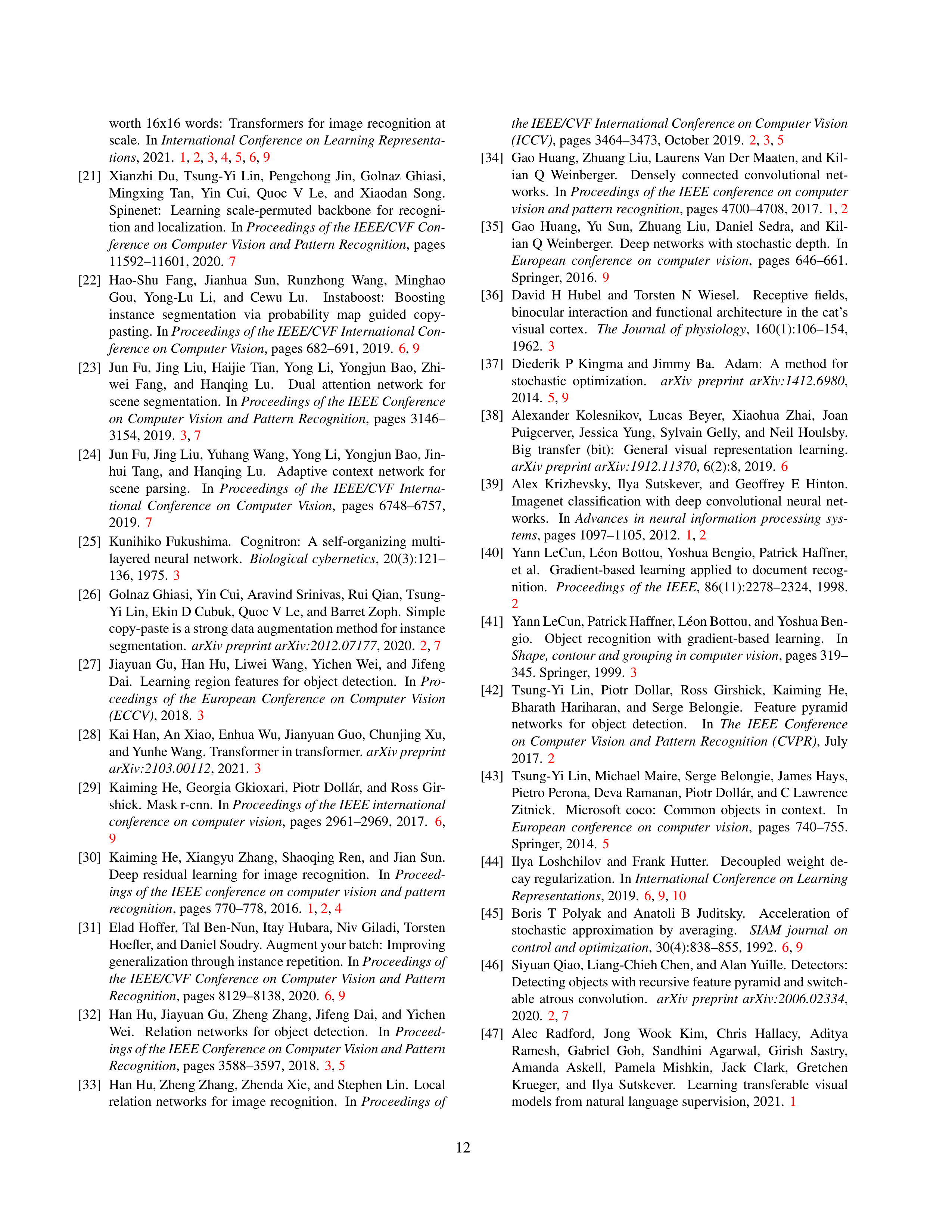
worth
16x16
words:
Transformers
for
image
recognition
at
scale.
In
International Conference on Learning Representa-
tions
, 2021.
1
,
2
,
3
,
4
,
5
,
6
,
9
[21]
Xianzhi
Du,
Tsung-Yi
Lin,
Pengchong
Jin,
Golnaz
Ghiasi,
Mingxing
Tan,
Yin
Cui,
Quoc
V
Le,
and
Xiaodan
Song.
Spinenet:
Learning
scale-permuted
backbone
for
recogni-
tion and localization.
In
Proceedings of the IEEE/CVF Con-
ference on Computer Vision and Pattern Recognition
, pages
11592–11601, 2020.
7
[22]
Hao-Shu
Fang,
Jianhua
Sun,
Runzhong
Wang,
Minghao
Gou,
Yong-Lu
Li,
and
Cewu
Lu.
Instaboost:
Boosting
instance
segmentation
via
probability
map
guided
copy-
pasting. In
Proceedings of the IEEE/CVF International Con-
ference on Computer Vision
, pages 682–691, 2019.
6
,
9
[23]
Jun
Fu,
Jing
Liu,
Haijie
Tian,
Yong
Li,
Yongjun
Bao,
Zhi-
wei
Fang,
and
Hanqing
Lu.
Dual
attention
network
for
scene segmentation.
In
Proceedings of the IEEE Conference
on
Computer
Vision
and
Pattern
Recognition
,
pages
3146–
3154, 2019.
3
,
7
[24]
Jun Fu, Jing Liu, Yuhang Wang, Yong Li, Yongjun Bao, Jin-
hui
Tang,
and
Hanqing
Lu.
Adaptive
context
network
for
scene
parsing.
In
Proceedings
of
the
IEEE/CVF
Interna-
tional
Conference
on
Computer
Vision
,
pages
6748–6757,
2019.
7
[25]
Kunihiko
Fukushima.
Cognitron:
A
self-organizing
multi-
layered
neural
network.
Biological
cybernetics
,
20(3):121–
136, 1975.
3
[26]
Golnaz Ghiasi, Yin Cui, Aravind Srinivas, Rui Qian, Tsung-
Yi Lin, Ekin D Cubuk, Quoc V Le, and Barret Zoph.
Simple
copy-paste is a strong data augmentation method for instance
segmentation.
arXiv preprint arXiv:2012.07177
, 2020.
2
,
7
[27]
Jiayuan
Gu,
Han
Hu,
Liwei
Wang,
Yichen
Wei,
and
Jifeng
Dai.
Learning
region
features
for
object
detection.
In
Pro-
ceedings
of
the
European
Conference
on
Computer
Vision
(ECCV)
, 2018.
3
[28]
Kai Han, An Xiao, Enhua Wu, Jianyuan Guo, Chunjing Xu,
and Yunhe Wang. Transformer in transformer.
arXiv preprint
arXiv:2103.00112
, 2021.
3
[29]
Kaiming
He,
Georgia
Gkioxari,
Piotr
Doll´ar,
and
Ross
Gir-
shick.
Mask r-cnn.
In
Proceedings of the IEEE international
conference on computer vision
,
pages 2961–2969,
2017.
6
,
9
[30]
Kaiming
He,
Xiangyu
Zhang,
Shaoqing
Ren,
and
Jian
Sun.
Deep
residual
learning
for
image
recognition.
In
Proceed-
ings of the IEEE conference on computer vision and pattern
recognition
, pages 770–778, 2016.
1
,
2
,
4
[31]
Elad Hoffer, Tal Ben-Nun, Itay Hubara, Niv Giladi, Torsten
Hoefler, and Daniel Soudry. Augment your batch: Improving
generalization through instance repetition.
In
Proceedings of
the IEEE/CVF Conference
on Computer
Vision and Pattern
Recognition
, pages 8129–8138, 2020.
6
,
9
[32]
Han Hu,
Jiayuan Gu,
Zheng Zhang,
Jifeng Dai,
and Yichen
Wei.
Relation
networks
for
object
detection.
In
Proceed-
ings of the IEEE Conference on Computer Vision and Pattern
Recognition
, pages 3588–3597, 2018.
3
,
5
[33]
Han Hu, Zheng Zhang, Zhenda Xie, and Stephen Lin.
Local
relation
networks
for
image
recognition.
In
Proceedings
of
the IEEE/CVF International Conference on Computer Vision
(ICCV)
, pages 3464–3473, October 2019.
2
,
3
,
5
[34]
Gao Huang, Zhuang Liu, Laurens Van Der Maaten, and Kil-
ian
Q
Weinberger.
Densely
connected
convolutional
net-
works.
In
Proceedings of the IEEE conference on computer
vision and pattern recognition
, pages 4700–4708, 2017.
1
,
2
[35]
Gao
Huang,
Yu
Sun,
Zhuang
Liu,
Daniel
Sedra,
and
Kil-
ian Q Weinberger.
Deep networks with stochastic depth.
In
European
conference
on
computer
vision
,
pages
646–661.
Springer, 2016.
9
[36]
David
H
Hubel
and
Torsten
N
Wiesel.
Receptive
fields,
binocular interaction and functional architecture in the cat’s
visual
cortex.
The
Journal
of
physiology
,
160(1):106–154,
1962.
3
[37]
Diederik
P
Kingma
and
Jimmy
Ba.
Adam:
A
method
for
stochastic
optimization.
arXiv
preprint
arXiv:1412.6980
,
2014.
5
,
9
[38]
Alexander
Kolesnikov,
Lucas
Beyer,
Xiaohua
Zhai,
Joan
Puigcerver,
Jessica
Yung,
Sylvain
Gelly,
and
Neil
Houlsby.
Big
transfer
(bit):
General
visual
representation
learning.
arXiv preprint arXiv:1912.11370
, 6(2):8, 2019.
6
[39]
Alex
Krizhevsky,
Ilya
Sutskever,
and
Geoffrey
E
Hinton.
Imagenet
classification
with
deep
convolutional
neural
net-
works.
In
Advances
in
neural
information
processing
sys-
tems
, pages 1097–1105, 2012.
1
,
2
[40]
Yann LeCun, L´eon Bottou, Yoshua Bengio, Patrick Haffner,
et
al.
Gradient-based
learning
applied
to
document
recog-
nition.
Proceedings
of
the
IEEE
,
86(11):2278–2324,
1998.
2
[41]
Yann LeCun, Patrick Haffner, L´eon Bottou, and Yoshua Ben-
gio.
Object
recognition
with
gradient-based
learning.
In
Shape, contour and grouping in computer vision
, pages 319–
345. Springer, 1999.
3
[42]
Tsung-Yi
Lin,
Piotr
Dollar,
Ross
Girshick,
Kaiming
He,
Bharath
Hariharan,
and
Serge
Belongie.
Feature
pyramid
networks
for
object
detection.
In
The
IEEE
Conference
on
Computer
Vision
and
Pattern
Recognition
(CVPR)
,
July
2017.
2
[43]
Tsung-Yi Lin, Michael Maire, Serge Belongie, James Hays,
Pietro Perona, Deva Ramanan, Piotr Doll´ar, and C Lawrence
Zitnick.
Microsoft
coco:
Common
objects
in
context.
In
European
conference
on
computer
vision
,
pages
740–755.
Springer, 2014.
5
[44]
Ilya
Loshchilov
and
Frank
Hutter.
Decoupled
weight
de-
cay regularization.
In
International Conference on Learning
Representations
, 2019.
6
,
9
,
10
[45]
Boris
T
Polyak
and
Anatoli
B
Juditsky.
Acceleration
of
stochastic
approximation
by
averaging.
SIAM
journal
on
control and optimization
, 30(4):838–855, 1992.
6
,
9
[46]
Siyuan Qiao, Liang-Chieh Chen, and Alan Yuille. Detectors:
Detecting objects with recursive feature pyramid and switch-
able
atrous
convolution.
arXiv
preprint
arXiv:2006.02334
,
2020.
2
,
7
[47]
Alec
Radford,
Jong
Wook
Kim,
Chris
Hallacy,
Aditya
Ramesh,
Gabriel
Goh,
Sandhini
Agarwal,
Girish
Sastry,
Amanda
Askell,
Pamela
Mishkin,
Jack
Clark,
Gretchen
Krueger,
and
Ilya
Sutskever.
Learning
transferable
visual
models from natural language supervision, 2021.
1
12
[48]
Ilija
Radosavovic,
Raj
Prateek
Kosaraju,
Ross
Girshick,
Kaiming
He,
and
Piotr
Doll´ar.
Designing
network
design
spaces.
In
Proceedings
of
the
IEEE/CVF
Conference
on
Computer
Vision
and
Pattern
Recognition
,
pages
10428–
10436, 2020.
6
[49]
Colin Raffel, Noam Shazeer, Adam Roberts, Katherine Lee,
Sharan
Narang,
Michael
Matena,
Yanqi
Zhou,
Wei
Li,
and
Peter J. Liu.
Exploring the limits of transfer learning with a
unified text-to-text transformer.
Journal of Machine Learn-
ing Research
, 21(140):1–67, 2020.
5
[50]
Prajit
Ramachandran,
Niki
Parmar,
Ashish
Vaswani,
Irwan
Bello, Anselm Levskaya, and Jon Shlens.
Stand-alone self-
attention in vision models.
In
Advances in Neural Informa-
tion Processing Systems
, volume 32. Curran Associates, Inc.,
2019.
2
,
3
[51]
Olaf
Ronneberger,
Philipp
Fischer,
and
Thomas
Brox.
U-
net:
Convolutional networks for biomedical image segmen-
tation.
In
International Conference on Medical image com-
puting
and
computer-assisted
intervention
,
pages
234–241.
Springer, 2015.
2
[52]
K.
Simonyan
and
A.
Zisserman.
Very
deep
convolutional
networks for large-scale image recognition.
In
International
Conference on Learning Representations
, May 2015.
2
,
4
[53]
Bharat
Singh
and
Larry
S
Davis.
An
analysis
of
scale
in-
variance
in
object
detection
snip.
In
Proceedings
of
the
IEEE
conference
on
computer
vision
and
pattern
recogni-
tion
, pages 3578–3587, 2018.
2
[54]
Bharat
Singh,
Mahyar
Najibi,
and
Larry
S
Davis.
Sniper:
Efficient
multi-scale
training.
In
Advances
in
Neural
Infor-
mation
Processing
Systems
,
volume
31.
Curran
Associates,
Inc., 2018.
2
[55]
Aravind
Srinivas,
Tsung-Yi
Lin,
Niki
Parmar,
Jonathon
Shlens,
Pieter
Abbeel,
and
Ashish
Vaswani.
Bottle-
neck
transformers
for
visual
recognition.
arXiv
preprint
arXiv:2101.11605
, 2021.
3
[56]
Peize
Sun,
Rufeng
Zhang,
Yi
Jiang,
Tao
Kong,
Chen-
feng
Xu,
Wei
Zhan,
Masayoshi
Tomizuka,
Lei
Li,
Zehuan
Yuan,
Changhu
Wang,
et
al.
Sparse
r-cnn:
End-to-end
object
detection
with
learnable
proposals.
arXiv
preprint
arXiv:2011.12450
, 2020.
3
,
6
,
9
[57]
Christian Szegedy,
Wei Liu,
Yangqing Jia,
Pierre Sermanet,
Scott
Reed,
Dragomir
Anguelov,
Dumitru
Erhan,
Vincent
Vanhoucke,
and
Andrew
Rabinovich.
Going
deeper
with
convolutions.
In
Proceedings
of
the
IEEE
conference
on
computer
vision
and
pattern
recognition
,
pages
1–9,
2015.
2
[58]
Mingxing Tan and Quoc Le.
Efficientnet:
Rethinking model
scaling
for
convolutional
neural
networks.
In
International
Conference on Machine Learning
, pages 6105–6114. PMLR,
2019.
3
,
6
[59]
Mingxing Tan, Ruoming Pang, and Quoc V Le.
Efficientdet:
Scalable
and
efficient
object
detection.
In
Proceedings
of
the
IEEE/CVF
conference
on
computer
vision
and
pattern
recognition
, pages 10781–10790, 2020.
7
[60]
Yi
Tay,
Mostafa
Dehghani,
Samira
Abnar,
Yikang
Shen,
Dara Bahri,
Philip
Pham,
Jinfeng
Rao,
Liu
Yang,
Sebastian
Ruder,
and
Donald
Metzler.
Long
range
arena
:
A
bench-
mark for efficient transformers.
In
International Conference
on Learning Representations
, 2021.
8
[61]
Ilya
Tolstikhin,
Neil
Houlsby,
Alexander
Kolesnikov,
Lu-
cas Beyer, Xiaohua Zhai, Thomas Unterthiner, Jessica Yung,
Andreas
Steiner,
Daniel
Keysers,
Jakob
Uszkoreit,
Mario
Lucic,
and
Alexey
Dosovitskiy.
Mlp-mixer:
An
all-mlp
ar-
chitecture for vision, 2021.
2
,
10
,
11
[62]
Hugo Touvron, Piotr Bojanowski, Mathilde Caron, Matthieu
Cord,
Alaaeldin
El-Nouby,
Edouard
Grave,
Gautier
Izac-
ard,
Armand
Joulin,
Gabriel
Synnaeve,
Jakob
Verbeek,
and
Herv´e J´egou. Resmlp: Feedforward networks for image clas-
sification with data-efficient training, 2021.
11
[63]
Hugo
Touvron,
Matthieu
Cord,
Matthijs
Douze,
Francisco
Massa,
Alexandre
Sablayrolles,
and
Herv´e
J´egou.
Training
data-efficient
image
transformers
&
distillation
through
at-
tention.
arXiv preprint arXiv:2012.12877
,
2020.
2
,
3
,
5
,
6
,
9
,
11
[64]
Ashish Vaswani, Noam Shazeer, Niki Parmar, Jakob Uszko-
reit,
Llion
Jones,
Aidan
N
Gomez,
Łukasz
Kaiser,
and
Illia
Polosukhin. Attention is all you need. In
Advances in Neural
Information Processing Systems
, pages 5998–6008, 2017.
1
,
2
,
4
[65]
Jingdong
Wang,
Ke
Sun,
Tianheng
Cheng,
Borui
Jiang,
Chaorui Deng, Yang Zhao, Dong Liu, Yadong Mu, Mingkui
Tan,
Xinggang Wang,
et al.
Deep high-resolution represen-
tation learning for visual recognition.
IEEE transactions on
pattern analysis and machine intelligence
, 2020.
3
[66]
Wenhai
Wang,
Enze
Xie,
Xiang
Li,
Deng-Ping
Fan,
Kaitao
Song,
Ding
Liang,
Tong
Lu,
Ping
Luo,
and
Ling
Shao.
Pyramid
vision
transformer:
A
versatile
backbone
for
dense
prediction
without
convolutions.
arXiv
preprint
arXiv:2102.12122
, 2021.
3
[67]
Xiaolong Wang,
Ross Girshick,
Abhinav Gupta,
and Kaim-
ing
He.
Non-local
neural
networks.
In
IEEE
Conference
on
Computer
Vision
and
Pattern
Recognition,
CVPR
2018
,
2018.
3
[68]
Ross
Wightman.
Pytorch
image
mod-
els.
https://github.com/rwightman/
pytorch-image-models
, 2019.
6
,
11
[69]
Tete
Xiao,
Yingcheng
Liu,
Bolei
Zhou,
Yuning
Jiang,
and
Jian
Sun.
Unified
perceptual
parsing
for
scene
understand-
ing.
In
Proceedings
of
the
European
Conference
on
Com-
puter Vision (ECCV)
, pages 418–434, 2018.
7
,
8
,
10
[70]
Saining
Xie,
Ross
Girshick,
Piotr
Doll´ar,
Zhuowen
Tu,
and
Kaiming
He.
Aggregated
residual
transformations
for
deep
neural
networks.
In
Proceedings
of
the
IEEE
Conference
on
Computer
Vision
and
Pattern
Recognition
,
pages
1492–
1500, 2017.
1
,
2
,
3
[71]
Minghao Yin, Zhuliang Yao, Yue Cao, Xiu Li, Zheng Zhang,
Stephen
Lin,
and
Han
Hu.
Disentangled
non-local
neural
networks.
In
Proceedings
of
the
European
conference
on
computer vision (ECCV)
, 2020.
3
,
7
,
10
[72]
Li Yuan, Yunpeng Chen, Tao Wang, Weihao Yu, Yujun Shi,
Francis
EH
Tay,
Jiashi
Feng,
and
Shuicheng
Yan.
Tokens-
to-token
vit:
Training
vision
transformers
from
scratch
on
imagenet.
arXiv preprint arXiv:2101.11986
, 2021.
3
[73]
Yuhui
Yuan,
Xilin
Chen,
and
Jingdong
Wang.
Object-
contextual
representations
for
semantic
segmentation.
In
13
16th
European
Conference
Computer
Vision
(ECCV
2020)
,
August 2020.
7
[74]
Yuhui Yuan and Jingdong Wang.
Ocnet:
Object context net-
work
for
scene
parsing.
arXiv
preprint
arXiv:1809.00916
,
2018.
3
[75]
Sangdoo
Yun,
Dongyoon
Han,
Seong
Joon
Oh,
Sanghyuk
Chun, Junsuk Choe, and Youngjoon Yoo.
Cutmix:
Regular-
ization strategy to train strong classifiers with localizable fea-
tures.
In
Proceedings
of
the
IEEE/CVF
International
Con-
ference on Computer Vision
, pages 6023–6032, 2019.
9
[76]
Sergey Zagoruyko and Nikos Komodakis. Wide residual net-
works.
In
BMVC
, 2016.
1
[77]
Hongyi
Zhang,
Moustapha
Cisse,
Yann
N
Dauphin,
and
David Lopez-Paz.
mixup:
Beyond empirical risk minimiza-
tion.
arXiv preprint arXiv:1710.09412
, 2017.
9
[78]
Hang Zhang,
Chongruo
Wu,
Zhongyue
Zhang,
Yi
Zhu,
Zhi
Zhang,
Haibin
Lin,
Yue
Sun,
Tong
He,
Jonas
Mueller,
R
Manmatha,
et
al.
Resnest:
Split-attention
networks.
arXiv
preprint arXiv:2004.08955
, 2020.
7
,
8
[79]
Shifeng
Zhang,
Cheng
Chi,
Yongqiang
Yao,
Zhen
Lei,
and
Stan
Z
Li.
Bridging
the
gap
between
anchor-based
and
anchor-free detection via adaptive training sample selection.
In
Proceedings
of
the
IEEE/CVF
Conference
on
Computer
Vision and Pattern Recognition
, pages 9759–9768, 2020.
6
,
9
[80]
Hengshuang
Zhao,
Jiaya
Jia,
and
Vladlen
Koltun.
Explor-
ing
self-attention
for
image
recognition.
In
Proceedings
of
the IEEE/CVF Conference
on Computer
Vision and Pattern
Recognition
, pages 10076–10085, 2020.
3
[81]
Sixiao
Zheng,
Jiachen
Lu,
Hengshuang
Zhao,
Xiatian
Zhu,
Zekun
Luo,
Yabiao
Wang,
Yanwei
Fu,
Jianfeng
Feng,
Tao
Xiang,
Philip
HS
Torr,
et
al.
Rethinking
semantic
segmen-
tation
from
a
sequence-to-sequence
perspective
with
trans-
formers.
arXiv
preprint
arXiv:2012.15840
,
2020.
2
,
3
,
7
,
8
[82]
Zhun
Zhong,
Liang
Zheng,
Guoliang
Kang,
Shaozi
Li,
and
Yi Yang. Random erasing data augmentation. In
Proceedings
of the AAAI Conference on Artificial Intelligence
, volume 34,
pages 13001–13008, 2020.
9
[83]
Bolei
Zhou,
Hang
Zhao,
Xavier
Puig,
Tete
Xiao,
Sanja
Fi-
dler, Adela Barriuso, and Antonio Torralba. Semantic under-
standing of scenes through the ade20k dataset.
International
Journal on Computer Vision
, 2018.
5
,
7
,
10
[84]
Xizhou
Zhu,
Han
Hu,
Stephen
Lin,
and
Jifeng
Dai.
De-
formable
convnets
v2:
More
deformable,
better
results.
In
Proceedings
of
the
IEEE
Conference
on
Computer
Vision
and Pattern Recognition
, pages 9308–9316, 2019.
1
,
3
[85]
Xizhou Zhu, Weijie Su, Lewei Lu, Bin Li, Xiaogang Wang,
and Jifeng Dai.
Deformable
{
detr
}
:
Deformable transform-
ers for end-to-end object detection.
In
International Confer-
ence on Learning Representations
, 2021.
3
14