
Published as a conference paper at ICLR 2026
S
EMANTIC
P
ARALLELISM
:
R
EDEFINING
E
FFICIENT
M
O
E I
NFERENCE
VIA
M
ODEL
-D
ATA
C
O
-S
CHEDULING
Yan Li
∗
Huawei Technologies
liyan412@huawei.com
Zhenyu Zhang
∗
Sun Yat-Sen University
zhangzhy239@mail2.sysu.edu.cn
Zhengang Wang
Huawei Technologies
wangzhengang@huawei.com
Pengfei Chen
Sun Yat-Sen University
chenpf7@mail.sysu.edu.cn
Pengfei Zheng
†
Huawei Technologies
zhengpengfei18@huawei.com
A
BSTRACT
Prevailing LLM (Large Language Model) serving engines employ expert paral-
lelism (EP) to implement multi-device inference of massive Mixture-of-Experts
(MoE)
models.
However,
the
efficiency
of
expert
parallel
inference
is
largely
bounded by inter-device communication, as EP embraces expensive all-to-all collec-
tives to route tokens to the remote experts if not collocating on the same GPU/NPU
device.
Nevertheless, state-of-the-art schemes treat expert device-placement and
request
(or
token)
device-scheduling
as
separate
concerns,
triggering
excessive
communication between them and compromising inference efficiency
This paper proposes
Semantic Parallelism
, a novel parallelism paradigm that mini-
mizes the steep communication costs in EP-centric MoE serving via model-data
collaborative
scheduling.
We
implement
Semantic
Parallelism
in
a
framework
called Sem-MoE. Sem-MoE maximally collocates experts and their activating to-
kens onto the same device using proactively modeled activation likelihood between
them and introduces three key techniques:
(1) Offline model scheduling, which pre-
liminarily clusters and collocates experts onto devices based on their co-activation
tendencies for certain classes of input.
(2) Online inter-request data scheduling
for Attention-DP setups, which proactively rebatches incoming requests onto the
device that hosts experts most likely and frequently activated by the corresponding
requests.
(3) Online intra-request data scheduling for Attention-TP setups, which
seamlessly fuses a token reshuffling procedure into the original inference pipeline
and proactively reschedules tokens to devices to reduce dispersed remote routing.
We build Sem-MoE into a prevailing LLM serving engine SGLANG. Experiments
show our collaborative scheduling approach can effectively reduce the all-to-all
communication volume in EP and achieve superior inference throughput compared
to existing solutions.
1
I
NTRODUCTION
The democratization of large language models (LLMs) has been largely driven by continuous model
scaling.
Over the past five years, the parameter count of the largest trained LLMs has increased by
three orders of magnitude, posing significant challenges to the scalability and economic viability of
both training and inference under modern AI hardware constraints.
∗
Equal contribution
†
Corresponding author
1
arXiv:2503.04398v5 [cs.LG] 27 Feb 2026
Published as a conference paper at ICLR 2026
2K
4K
8K
16K
Batch size * sequence length
0
10
20
30
40
MoE Layer Breakdown
(ms)
Comm. (all2all)
Comp. (grouped_gemm)
Others
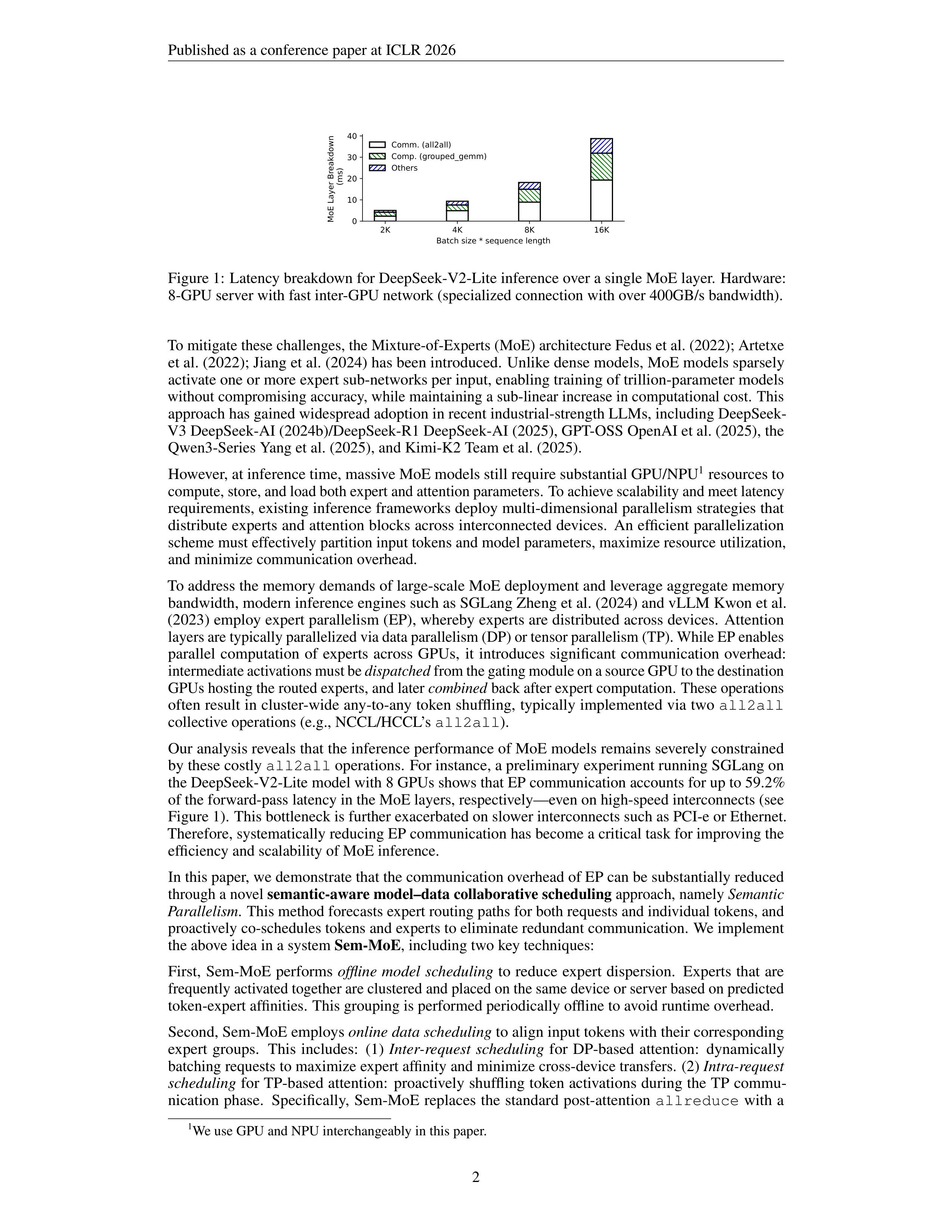
Figure 1:
Latency breakdown for DeepSeek-V2-Lite inference over a single MoE layer.
Hardware:
8-GPU server with fast inter-GPU network (specialized connection with over 400GB/s bandwidth).
To mitigate these challenges, the Mixture-of-Experts (MoE) architecture Fedus et al. (2022); Artetxe
et al. (2022); Jiang et al. (2024) has been introduced.
Unlike dense models, MoE models sparsely
activate one or more expert sub-networks per input, enabling training of trillion-parameter models
without compromising accuracy, while maintaining a sub-linear increase in computational cost.
This
approach has gained widespread adoption in recent industrial-strength LLMs, including DeepSeek-
V3 DeepSeek-AI (2024b)/DeepSeek-R1 DeepSeek-AI (2025), GPT-OSS OpenAI et al. (2025), the
Qwen3-Series Yang et al. (2025), and Kimi-K2 Team et al. (2025).
However, at inference time, massive MoE models still require substantial GPU/NPU
1
resources to
compute, store, and load both expert and attention parameters.
To achieve scalability and meet latency
requirements, existing inference frameworks deploy multi-dimensional parallelism strategies that
distribute experts and attention blocks across interconnected devices.
An efficient parallelization
scheme must effectively partition input tokens and model parameters, maximize resource utilization,
and minimize communication overhead.
To address the memory demands of large-scale MoE deployment and leverage aggregate memory
bandwidth, modern inference engines such as SGLang Zheng et al. (2024) and vLLM Kwon et al.
(2023) employ expert parallelism (EP), whereby experts are distributed across devices.
Attention
layers are typically parallelized via data parallelism (DP) or tensor parallelism (TP). While EP enables
parallel
computation
of
experts
across
GPUs,
it
introduces
significant
communication
overhead:
intermediate activations must be
dispatched
from the gating module on a source GPU to the destination
GPUs hosting the routed experts, and later
combined
back after expert computation.
These operations
often result in cluster-wide any-to-any token shuffling, typically implemented via two
all2all
collective operations (e.g., NCCL/HCCL’s
all2all
).
Our analysis reveals that the inference performance of MoE models remains severely constrained
by these costly
all2all
operations.
For instance, a preliminary experiment running SGLang on
the DeepSeek-V2-Lite model with 8 GPUs shows that EP communication accounts for up to 59.2%
of the forward-pass latency in the MoE layers, respectively—even on high-speed interconnects (see
Figure 1).
This bottleneck is further exacerbated on slower interconnects such as PCI-e or Ethernet.
Therefore, systematically reducing EP communication has become a critical task for improving the
efficiency and scalability of MoE inference.
In this paper, we demonstrate that the communication overhead of EP can be substantially reduced
through a novel
semantic-aware model–data collaborative scheduling
approach, namely
Semantic
Parallelism
.
This method forecasts expert routing paths for both requests and individual tokens, and
proactively co-schedules tokens and experts to eliminate redundant communication.
We implement
the above idea in a system
Sem-MoE
, including two key techniques:
First,
Sem-MoE
performs
offline
model
scheduling
to
reduce
expert
dispersion.
Experts
that
are
frequently activated together are clustered and placed on the same device or server based on predicted
token-expert affinities.
This grouping is performed periodically offline to avoid runtime overhead.
Second, Sem-MoE employs
online data scheduling
to align input tokens with their corresponding
expert
groups.
This
includes:
(1)
Inter-request
scheduling
for
DP-based
attention:
dynamically
batching requests to maximize expert affinity and minimize cross-device transfers.
(2)
Intra-request
scheduling
for TP-based attention:
proactively shuffling token activations during the TP commu-
nication
phase.
Specifically,
Sem-MoE
replaces
the
standard
post-attention
allreduce
with
a
1
We use GPU and NPU interchangeably in this paper.
2
Published as a conference paper at ICLR 2026
shuffled-reduce-scatter
and
a
deferred
shuffled-allgather
,
effectively
merging
proactive token routing with necessary data transformation.
Through collaborative model-data scheduling, semantic parallelism significantly reduces communi-
cation volume and improves inference throughput, as demonstrated through extensive experiments
implemented on top of SGLang.
We list the contributions of this paper as follows.
1.
We
conduct
a
comprehensive
data
analysis
and
reveal
a
significant
context-independent
correlation
between
tokens
and
experts
in
large-scale
MoE
models,
which
provides
a
foundational insight for optimizing expert placement and token routing.
2.
We design and implement an efficient
model-data collaborative scheduling algorithm
that
leverages the observed token–expert affinity.
Our scheduler improves local activation rate
by
15.4%
compared to baseline methods, substantially reducing unnecessary cross-device
communication.
3.
We implement semantic parallelism in
Sem-MoE
on top of the state-of-the-art inference
engine SGLang and perform extensive evaluations.
The results demonstrate that Sem-MoE
achieves a throughput improvement of up to
2.78x
under specific SLOs in Attention-DP
scenarios
and
up
to
24.9%
latency
reduction
under
Attention-TP
setups,
validating
the
practical effectiveness of our approach.
2
B
ACKGROUND
Mixture-of-Experts
The
Mixture-of-Experts
(MoE)
architecture
is
a
conditional
computation
paradigm designed to scale model capacity without a proportional increase in computational cost [1].
Unlike dense models, where all parameters are activated for every input, an MoE model consists of a
multitude of expert sub-networks (typically Feed-Forward Networks, FFNs) and a gating network
(or router).
For each input token, the gating network predicts a sparse combination of experts (e.g.,
the
top-
k
experts)
to
which
the
token
is
dispatched.
Only
the
selected
experts
are
activated
for
computation.
The most common gating function is the Top-K Gating, which selects the
k
experts with
the highest scores.
This design enables models to possess a vast number of parameters (e.g., trillions)
while keeping the FLOPs per token roughly constant, as only a small, fixed number of experts (e.g.,
k
= 2
) are active per token.
This has made MoE the de facto standard for building state-of-the-art
large language models, such as the DeepSeek series DeepSeek-AI (2024a;b; 2025), the GPT-OSS
series OpenAI et al. (2025), and the Qwen series Qwen-Team (2024); Yang et al. (2025).
MoE Training Systems.
There has been extensive research on optimizing systems of MoE training
systems, including FastMoE He et al. (2021), FasterMoE He et al. (2022), TA-MoE Chen et al. (2022),
SmartMoE Zhai et al. (2023), and FlexMoE Nie et al. (2023).
However such optimizations can not
directly translate to inference scenarios as inference is workload-sensitive and strongly emphasizes
latency over throughput.
MoE Inference Systems.
Integrated serving engines such as DeepSpeed-MII Holmes et al. (2024),
TensorRT-LLM NVIDIA, vLLM Kwon et al. (2023), and SGLang Zheng et al. (2024) have holistic
optimization for LLM inference that spans serving schedulers (e.g., continuous batching), dedicated
high-performance
kernels,
efficient
parallelization,
quantization,
and
elaborate
compiler
passes
for graph-level optimizations.
Built upon these general holistic optimizations for LLM inference,
DeepSpeed-MoE
Rajbhandari
et
al.
(2022);
Singh
et
al.
(2023)
and
Tutel
Hwang
et
al.
(2022)
specifically optimize MoE models’ computation and communication.
Following the design paradigm
of DeepSpeed-MoE, popular industry and open-sourced inference engines like vLLM and SGLang
also adopted expert parallelism deployment.
Sem-MoE specializes in optimizing MoE parallelization
(particularly EP) and inherits holistic optimizations from prior work.
MoE
Load-balancing
and
Experts
Re-grouping.
Lina
Li
et
al.
(2023)
probes
the
variation
of
expert hotness and allots non-uniform expert replicas to achieve load-balanced expert computation.
Similar studies Huang et al. (2023) exist to pursue expert load balancing and mitigate other sources
of MoE computing inefficiencies.
EPS-MoE Qian et al. (2025) optimizes the computation of MoE
FeedForward Network (FFN) modules by dynamically selecting the best backend implementation
of GroupGemm and DenseGemm.
DeepSeek also adopts EPLB (expert-parallelism load balancing)
3
Published as a conference paper at ICLR 2026
in its real-world deployment DeepSeek-AI (2024b).
ExFlow Yao et al. (2024) exploits the affinity
between experts across adjacent layers to reduce remote routing and collocate closely related experts.
Exflow only considers the model scheduling for MoE models, and requires a heavy
allgather
before
the
execution
of
each
model
layer,
which
significantly
incurs
memory
pressure
and
extra
communication overhead.
MoETuner Go & Mahajan (2025) optimizes the MoE model serving by
finding an optimal expert placement strategy to minimize inter-device communication.
MoE Offloading and Prefetching.
Existing prediction-based work on MoE inference primarily
focuses on prefetching offloaded experts and strategically saving GPU memories Yi et al. (2023);
Xue et al. (2024); Zhong et al. (2024), though offloading can extend inference latency and is rarely
used in latency-critical serving scenarios.
In contrast, Sem-MoE focuses on the speculative reduction
of communication overheads and exposes no risks to compromise latency.
The work also constructs
probabilistic models to predict the token-expert routing paths, while Sem-MoE’s features modelling
more
comprehensive
MoE
information,
i.e.,
intra-layer
and
inter-layer
expert
affinity
and
token-
expert affinity, compared to prior work.
Pre-gated MoE Hwang et al. (2024) modifies the MoE model
architecture to predict the experts to route at the next layer.
Sem-MoE requires no modification to
MoE architecture.
Dev k-1
Offline Collected Profile:
Token IDs & Token
Activation Map
Offline Token-
Expert Affinity
Modeling
T2D Table
𝒯𝒯∈ℝ
𝐿𝐿×𝑡𝑡×𝐷𝐷
S2D Table
𝒜𝒜∈ℝ
𝐷𝐷
𝑝𝑝
E2D Table
ℰ∈ℝ
𝐿𝐿×𝐸𝐸×𝐷𝐷
Request Scheduler (if DP)
Dev 0
Shuffled-Reduce-Scatter
(if TP)
Attn
Attn
MoE
MoE
Shuffled-Allgather
(if TP)
#L Layers
Req 0
Req k-1
Requests:
①
Offline Token-Expert Activation Modeling
②
Model Scheduling
③
Data Scheduling
(Inter-request)
③
Data Scheduling
(Intra-request)
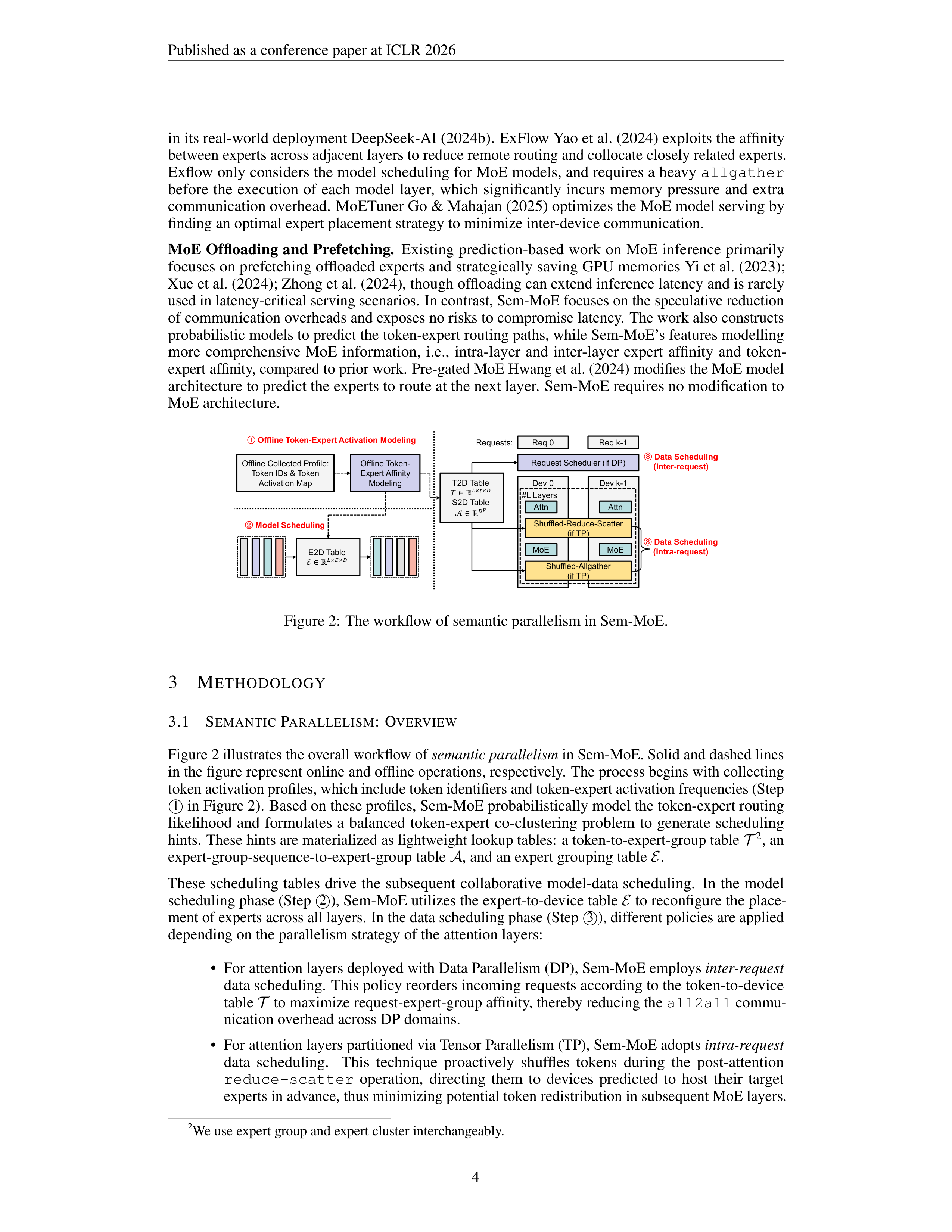
Figure 2:
The workflow of semantic parallelism in Sem-MoE.
3
M
ETHODOLOGY
3.1
S
EMANTIC
P
ARALLELISM
:
O
VERVIEW
Figure 2 illustrates the overall workflow of
semantic parallelism
in Sem-MoE. Solid and dashed lines
in the figure represent online and offline operations, respectively.
The process begins with collecting
token activation profiles, which include token identifiers and token-expert activation frequencies (Step
1
⃝
in Figure 2).
Based on these profiles, Sem-MoE probabilistically model the token-expert routing
likelihood
and
formulates
a
balanced
token-expert
co-clustering
problem
to
generate
scheduling
hints.
These hints are materialized as lightweight lookup tables:
a token-to-expert-group table
T
2
, an
expert-group-sequence-to-expert-group table
A
, and an expert grouping table
E
.
These
scheduling
tables
drive
the
subsequent
collaborative
model-data
scheduling.
In
the
model
scheduling phase (Step
2
⃝
), Sem-MoE utilizes the expert-to-device table
E
to reconfigure the place-
ment of experts across all layers.
In the data scheduling phase (Step
3
⃝
), different policies are applied
depending on the parallelism strategy of the attention layers:
•
For attention layers deployed with Data Parallelism (DP), Sem-MoE employs
inter-request
data scheduling.
This policy reorders incoming requests according to the token-to-device
table
T
to maximize request-expert-group affinity, thereby reducing the
all2all
commu-
nication overhead across DP domains.
•
For attention layers partitioned via Tensor Parallelism (TP), Sem-MoE adopts
intra-request
data
scheduling.
This
technique
proactively
shuffles
tokens
during
the
post-attention
reduce-scatter
operation,
directing
them
to
devices
predicted
to
host
their
target
experts in advance, thus minimizing potential token redistribution in subsequent MoE layers.
2
We use expert group and expert cluster interchangeably.
4


Published as a conference paper at ICLR 2026
Dev 0
Dev 1
E0@L0
E1@L0
E3@L0
E2@L0
E0@L1
E1@L1
E3@L1
E2@L1
4
5
6
7
0
1
2
3
4
5
6
7
0
1
2
3
4
5
6
7
0
1
2
3
Dispatch:
6
tokens
Combine:
6
tokens
Dispatch:
2
tokens
Combine:
2
tokens
Dev 0
Dev 1
E0@L0
E1@L0
E3@L0
E2@L0
E0@L1
E1@L1
E3@L1
E2@L1
4
5
6
7
0
1
2
3
4
5
6
7
0
1
2
3
4
5
6
7
0
1
2
3
Dispatch:
2
tokens
Combine:
2
tokens
Dispatch:
0
tokens
Combine:
0
tokens
Inter-request
data scheduling
Model
scheduling
Dev 0
Dev 1
E0@L0
E1@L0
E3@L0
E2@L0
E0@L1
E1@L1
E3@L1
E2@L1
0
1
2
3
0
1
2
3
Dispatch:
4
tokens
Combine:
4
tokens
reduce-
scatter
2
3
0
1
0
2
3
3
0
0
1
3
allgather
1
2
1
2
0
1
2
3
0
1
2
3
reduce-
scatter
2
3
0
1
0
2
3
3
0
0
1
3
allgather
1
2
1
2
Dispatch:
3
tokens
Combine:
3
tokens
Dev 0
Dev 1
E2@L0
E3@L0
E1@L0
E0@L0
E0@L1
E1@L1
E3@L1
E2@L1
0
1
2
3
0
1
2
3
Dispatch:
0
tokens
Combine:
0
tokens
shuffled-
reduce-
scatter
0
1
2
3
0
0
1
3
0
2
3
3
shuffled-
allgather
1
2
1
2
0
1
2
3
0
1
2
3
shuffled-
reduce-
scatter
2
3
0
1
0
2
3
3
0
0
1
3
shuffled-
allgather
1
2
1
2
Dispatch:
1
tokens
Combine:
1
tokens
Model
scheduling
Intra-request
data scheduling
Case #1: Data Parallelism for Attention
Case #2: Tensor Parallelism for Attention
4
5
6
7
0
1
2
3
4
5
6
7
0
1
2
3
Attn
@L0
Attn
@L0
Attn
@L0
Attn
@L0
4
5
6
7
0
1
2
3
Attn
@L1
Attn
@L1
4
5
6
7
0
1
2
3
Attn
@L1
Attn
@L1
0
1
2
3
0
1
2
3
0
1
2
3
0
1
2
3
Attn
TP0
@L0
Attn
TP1
@L0
Attn
TP0
@L0
Attn
TP1
@L0
Attn
TP0
@L1
Attn
TP1
@L1
Attn
TP0
@L1
Attn
TP1
@L1
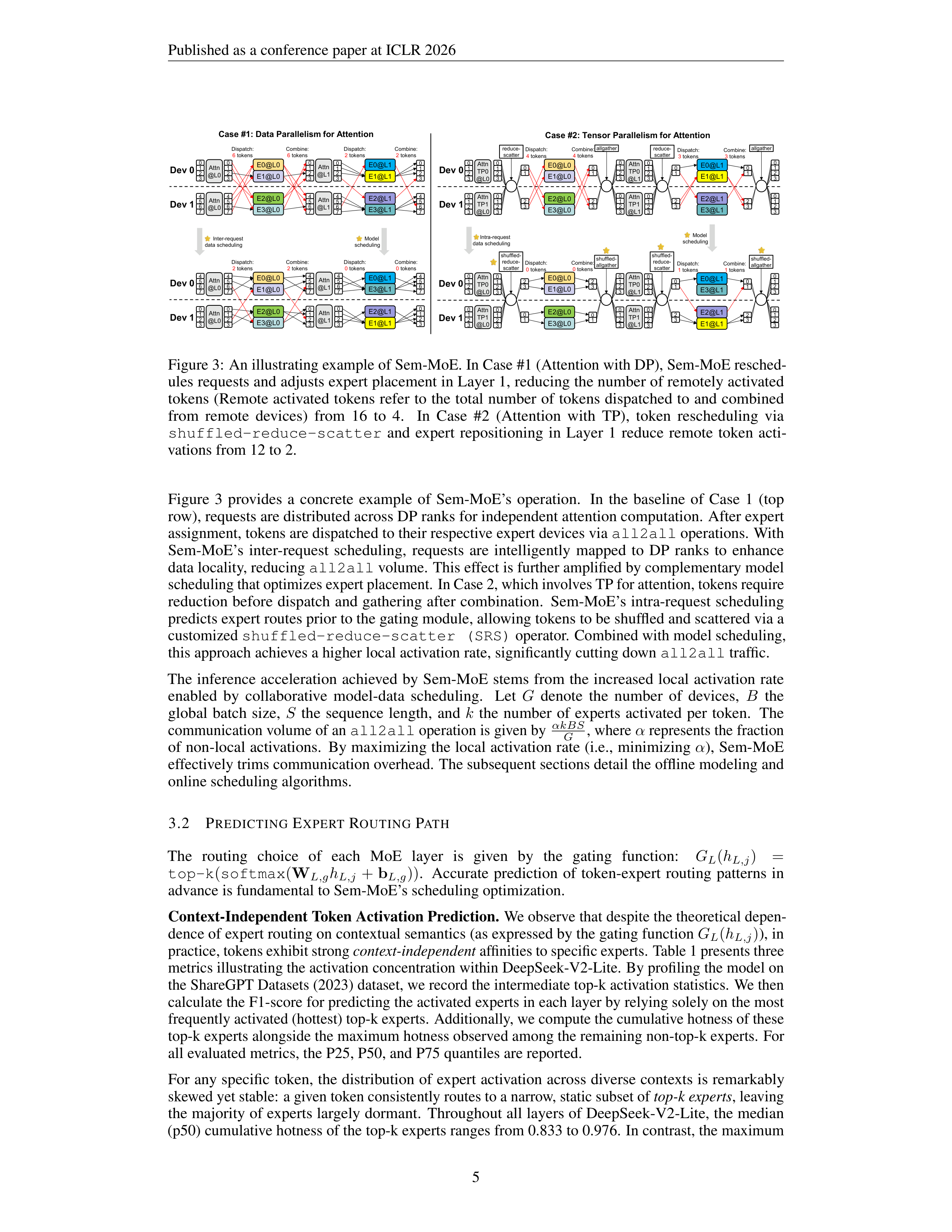
Figure 3:
An illustrating example of Sem-MoE. In Case #1 (Attention with DP), Sem-MoE resched-
ules requests and adjusts expert placement in Layer 1, reducing the number of remotely activated
tokens
(Remote activated
tokens refer
to the
total number
of tokens
dispatched to
and combined
from
remote
devices)
from
16
to
4.
In
Case
#2
(Attention
with
TP),
token
rescheduling
via
shuffled-reduce-scatter
and
expert
repositioning
in
Layer
1
reduce
remote
token
acti-
vations from 12 to 2.
Figure
3
provides
a
concrete
example
of
Sem-MoE’s
operation.
In
the
baseline
of
Case
1
(top
row), requests are distributed across DP ranks for independent attention computation.
After expert
assignment, tokens are dispatched to their respective expert devices via
all2all
operations.
With
Sem-MoE’s
inter-request
scheduling,
requests
are
intelligently
mapped
to
DP
ranks
to
enhance
data locality, reducing
all2all
volume.
This effect is further amplified by complementary model
scheduling that optimizes expert placement.
In Case 2, which involves TP for attention, tokens require
reduction before
dispatch and
gathering
after combination.
Sem-MoE’s
intra-request scheduling
predicts expert routes prior to the gating module, allowing tokens to be shuffled and scattered via a
customized
shuffled-reduce-scatter
(SRS)
operator.
Combined with model scheduling,
this approach achieves a higher local activation rate, significantly cutting down
all2all
traffic.
The
inference
acceleration
achieved
by
Sem-MoE
stems
from
the
increased
local
activation
rate
enabled
by
collaborative
model-data
scheduling.
Let
G
denote
the
number
of
devices,
B
the
global
batch
size,
S
the
sequence
length,
and
k
the
number
of
experts
activated
per
token.
The
communication volume of an
all2all
operation is given by
αkBS
G
, where
α
represents the fraction
of non-local activations.
By maximizing the local activation rate (i.e., minimizing
α
), Sem-MoE
effectively trims communication overhead.
The subsequent sections detail the offline modeling and
online scheduling algorithms.
3.2
P
REDICTING
E
XPERT
R
OUTING
P
ATH
The
routing
choice
of
each
MoE
layer
is
given
by
the
gating
function:
G
L
(
h
L,j
)
=
top-k
(
softmax
(
W
L,g
h
L,j
+
b
L,g
))
.
Accurate
prediction
of
token-expert
routing
patterns
in
advance is fundamental to Sem-MoE’s scheduling optimization.
Context-Independent Token Activation Prediction.
We observe that despite the theoretical depen-
dence of expert routing on contextual semantics (as expressed by the gating function
G
L
(
h
L,j
)
), in
practice, tokens exhibit strong
context-independent
affinities to specific experts.
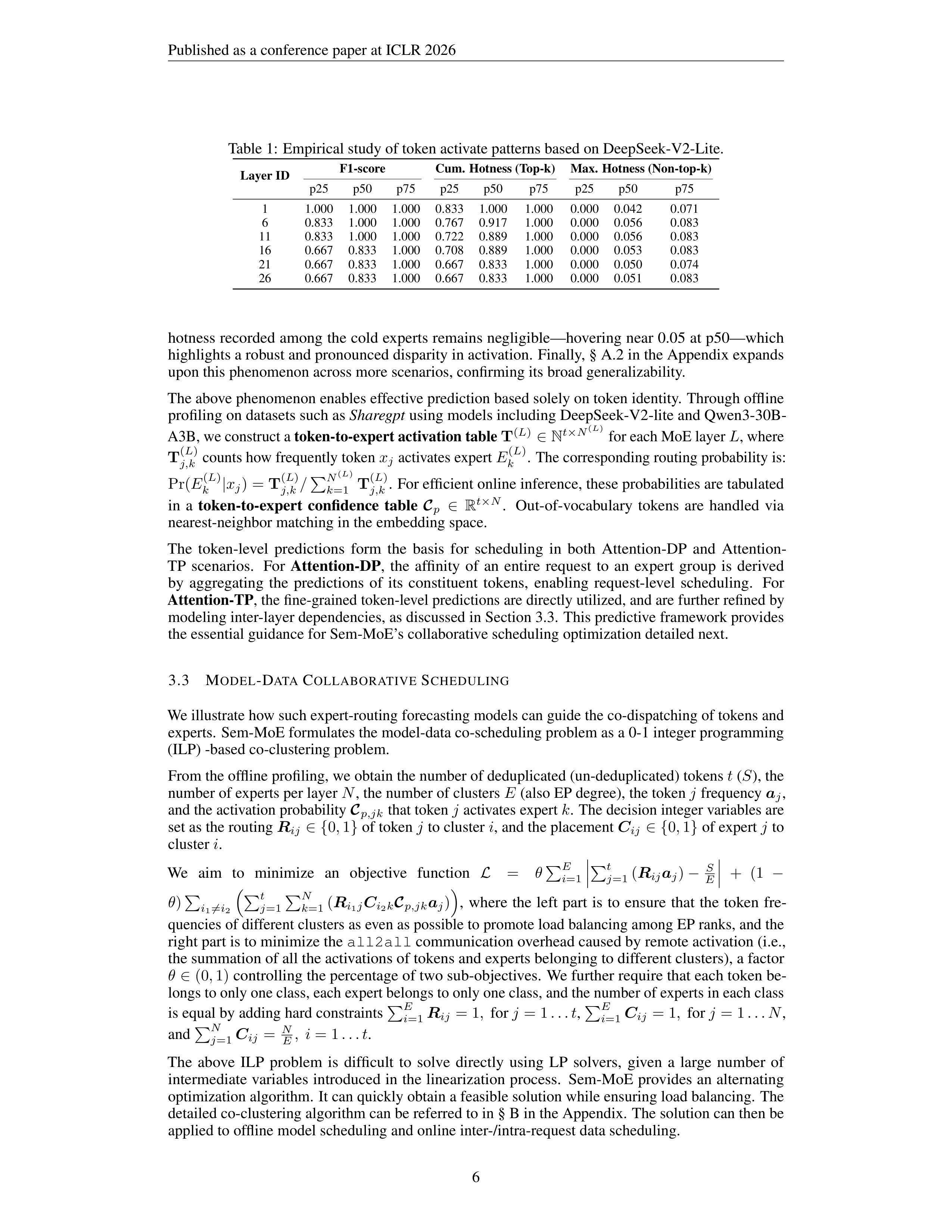
Table 1 presents three
metrics illustrating the activation concentration within DeepSeek-V2-Lite.
By profiling the model on
the ShareGPT Datasets (2023) dataset, we record the intermediate top-k activation statistics.
We then
calculate the F1-score for predicting the activated experts in each layer by relying solely on the most
frequently activated (hottest) top-k experts.
Additionally, we compute the cumulative hotness of these
top-k experts alongside the maximum hotness observed among the remaining non-top-k experts.
For
all evaluated metrics, the P25, P50, and P75 quantiles are reported.
For any specific token,
the distribution of expert activation across diverse contexts is remarkably
skewed yet stable:
a given token consistently routes to a narrow, static subset of
top-k experts
, leaving
the majority of experts largely dormant.
Throughout all layers of DeepSeek-V2-Lite, the median
(p50) cumulative hotness of the top-k experts ranges from 0.833 to 0.976.
In contrast, the maximum
5
Published as a conference paper at ICLR 2026
Table 1:
Empirical study of token activate patterns based on DeepSeek-V2-Lite.
Layer ID
F1-score
Cum.
Hotness (Top-k)
Max.
Hotness (Non-top-k)
p25
p50
p75
p25
p50
p75
p25
p50
p75
1
1.000
1.000
1.000
0.833
1.000
1.000
0.000
0.042
0.071
6
0.833
1.000
1.000
0.767
0.917
1.000
0.000
0.056
0.083
11
0.833
1.000
1.000
0.722
0.889
1.000
0.000
0.056
0.083
16
0.667
0.833
1.000
0.708
0.889
1.000
0.000
0.053
0.083
21
0.667
0.833
1.000
0.667
0.833
1.000
0.000
0.050
0.074
26
0.667
0.833
1.000
0.667
0.833
1.000
0.000
0.051
0.083
hotness recorded among the cold experts remains negligible—hovering near 0.05 at p50—which
highlights a robust and pronounced disparity in activation.
Finally, § A.2 in the Appendix expands
upon this phenomenon across more scenarios, confirming its broad generalizability.
The above phenomenon enables effective prediction based solely on token identity.
Through offline
profiling on datasets such as
Sharegpt
using models including DeepSeek-V2-lite and Qwen3-30B-
A3B, we construct a
token-to-expert activation table
T
(
L
)
∈
N
t
×
N
(
L
)
for each MoE layer
L
, where
T
(
L
)
j,k
counts how frequently token
x
j
activates expert
E
(
L
)
k
.
The corresponding routing probability is:
Pr(
E
(
L
)
k
|
x
j
) =
T
(
L
)
j,k
/
P
N
(
L
)
k
=1
T
(
L
)
j,k
.
For efficient online inference, these probabilities are tabulated
in
a
token-to-expert
confidence
table
C
p
∈
R
t
×
N
.
Out-of-vocabulary
tokens
are
handled
via
nearest-neighbor matching in the embedding space.
The
token-level
predictions
form
the
basis
for
scheduling
in
both
Attention-DP
and
Attention-
TP
scenarios.
For
Attention-DP
,
the
affinity
of
an
entire
request
to
an
expert
group
is
derived
by
aggregating
the
predictions
of
its
constituent
tokens,
enabling
request-level
scheduling.
For
Attention-TP
, the fine-grained token-level predictions are directly utilized, and are further refined by
modeling inter-layer dependencies, as discussed in Section 3.3.
This predictive framework provides
the essential guidance for Sem-MoE’s collaborative scheduling optimization detailed next.
3.3
M
ODEL
-D
ATA
C
OLLABORATIVE
S
CHEDULING
We illustrate how such expert-routing forecasting models can guide the co-dispatching of tokens and
experts.
Sem-MoE formulates the model-data co-scheduling problem as a 0-1 integer programming
(ILP) -based co-clustering problem.
From the offline profiling, we obtain the number of deduplicated (un-deduplicated) tokens
t
(
S
), the
number of experts per layer
N
, the number of clusters
E
(also EP degree), the token
j
frequency
a
j
,
and the activation probability
C
p,jk
that token
j
activates expert
k
.
The decision integer variables are
set as the routing
R
ij
∈{
0
,
1
}
of token
j
to cluster
i
, and the placement
C
ij
∈{
0
,
1
}
of expert
j
to
cluster
i
.
We
aim
to
minimize
an
objective
function
L
=
θ
P
E
i
=1
P
t
j
=1
(
R
ij
a
j
)
−
S
E
+
(1
−
θ
)
P
i
1
̸
=
i
2
P
t
j
=1
P
N
k
=1
(
R
i
1
j
C
i
2
k
C
p,jk
a
j
)
,
where
the
left
part
is
to
ensure
that
the
token
fre-
quencies of different clusters as even as possible to promote load balancing among EP ranks, and the
right part is to minimize the
all2all
communication overhead caused by remote activation (i.e.,
the summation of all the activations of tokens and experts belonging to different clusters), a factor
θ
∈
(0
,
1)
controlling the percentage of two sub-objectives.
We further require that each token be-
longs to only one class, each expert belongs to only one class, and the number of experts in each class
is equal by adding hard constraints
P
E
i
=1
R
ij
= 1
,
for
j
= 1
. . . t
,
P
E
i
=1
C
ij
= 1
,
for
j
= 1
. . . N
,
and
P
N
j
=1
C
ij
=
N
E
,
i
= 1
. . . t
.
The
above
ILP
problem
is
difficult
to
solve
directly
using
LP
solvers,
given
a
large
number
of
intermediate variables introduced in the linearization process.
Sem-MoE provides an alternating
optimization algorithm.
It can quickly obtain a feasible solution while ensuring load balancing.
The
detailed co-clustering algorithm can be referred to in § B in the Appendix.
The solution can then be
applied to offline model scheduling and online inter-/intra-request data scheduling.
6
Published as a conference paper at ICLR 2026
Model scheduling.
Before deployment, Sem-MoE adjusts the expert placement layout according to
the solved
C
, placing expert
j
to device
k
if
C
jk
= 1
.
Accordingly, Sem-MoE shuffles the column
of the gate matrix, thereby realizing a transparent expert re-distribution.
Data scheduling:
Attention-DP Scenarios.
In Attention-DP setups, where requests are processed
independently across DP ranks, scheduling operates at the
request granularity
.
We use the variable
S
r
∈
J
E
K
to
denote
the
cluster
to
which
request
r
needs
to
be
scheduled.
Once
the
scheduling
of
tokens
is
determined,
the
scheduling
of
the
request
r
can
be
determined
by
aggregating
the
routing result of its tokens,
S
r
=
arg max
j
∈
J
E
K
P
i
∈
r
R
ij
.
Meanwhile,
to achieve runtime load
balance, Sem-MoE realizes a workload-aware balanced request scheduling algorithm.
For continual
E
requests, Sem-MoE guarantees these requests are distributed to all
E
ranks, such that the loads of
all ranks would not skew in decoding stage.
Detailed algorithm could be referred to in Algorithm 2
in § B. This request-level scheduling minimizes cross-device communication by collocating entire
requests with their most likely expert group (i.e., DP rank).
Data
Scheduling:
Attention-TP
Scenarios.
In
Attention-TP
setups,
the
attention
computation
itself is distributed, requiring fine-grained,
token-level
scheduling.
Here, we enhance the basic token-
expert prediction with
inter-layer expert-expert affinity
.
We observe that expert selections exhibit
Markovian dependencies across layers:
the experts chosen at layer
L
depend on selections at previous
layers.
We
model
this
using
an
n
-gram
device
transition
model:
Pr(
D
(
L
)
k
|
D
(
L
−
1)
, . . . , D
(
L
−
n
)
)
where
D
(
l
)
∈{
1
, . . . , Q
}
, where
D
(
l
)
∈
1
, . . . , Q
denotes the device index of the expert selected at
layer
l
.
These transitions are stored in an
expert-group-sequence-to-expert-group confidence table
A
p
(we use 2-gram in practice).
Together with the token routing matrix
R
, we can achieve more
accurate proactive scheduling during the TP communication phase.
The detailed algorithm can be
found in Algorithm 3.
3.4
I
MPLEMENTATION
AND
S
YSTEM
O
PTIMIZATION
Sem-MoE is implemented as a plug-in module for the SOTA LLM inference engine SGLang.
Our
system comprises approximately 5,000 lines of Python code, along with several custom Triton OpenAI
kernels for high-performance communication operations.
To
support
affinity-aware
scheduling
in
the
Attention-DP
scenario,
we
extend
SGLang’s
request
scheduler to incorporate token–expert affinity information derived from our prediction models.
This
enables the runtime to batch requests with similar expert activation patterns onto the same device,
minimizing cross-device communication.
For
the
Attention-TP
scenario,
we
implement
two
fused
communication
primitives:
shuffled-reduce-scatter
(SRS)
,
and
shuffled-allgather
(SAG)
.
These
ker-
nels
integrate
speculative
token
shuffling—based
on
predicted
expert
routes—into
standard
reduce-scatter
and
allgather
collectives.
The
shuffling
logic
relies
on
an
optimized
argsort
kernel,
which
outperforms
the
native
PyTorch
implementation
by
25%
.
The
overall
overhead of embedding shuffling into the ring-based communication schedule is negligible, measured
at
approximately
1%
.
Furthermore,
for
efficient
all2all
,
Sem-MoE
integrates
frontier
MoE
communication libraries DeepEP Zhao et al. (2025).
By combining offline expert reorganization with online token- and request-level scheduling, Sem-
MoE
achieves
significant
reductions
in
all2all
communication
volume,
leading
to
improved
end-to-end inference throughput in both DP and TP configurations.
4
E
XPERIMENT
4.1
E
XPERIMENTAL
E
NVIRONMENTS
We evaluate Sem-MoE on an 8-GPU server, representing commercial GPU servers unified for both
training
and
inference,
which
are
configured
with
96GB-HBM
per
GPU
and
fast
homogeneous
interconnects.
GPUs
inside
a
server
can
communicate
with
each
other
at
a
premium
bandwidth
(specialized network with over 400GB/s bandwidth).
The server is equiped with two 44-core Intel
CPUs and 2TB DDR5 memory.
7
Published as a conference paper at ICLR 2026
200
300
LMSYS-Chat-1M
SLO
TTFT (ms)-Throughput
SGLang
MoETuner
Sem-MoE
3.25
3.50
3.75
SLO
E2E Latency (s)-Throughput
150
200
250
MMLU
SLO
3.5
4.0
SLO
500
1000
1500
2000
2500
Throughput
(tokens / second)
200
300
ShareGPT
SLO
500
1000
1500
2000
2500
Throughput
(tokens / second)
10
12
SLO
(a)
DeepSeek-V2-Lite.
200
400
LMSYS-Chat-1M
SLO
TTFT (ms)-Throughput
SGLang
MoETuner
Sem-MoE
19
20
21
SLO
E2E Latency (s)-Throughput
200
300
MMLU
SLO
19
20
21
SLO
200
400
600
800
1000
Throughput
(tokens / second)
200
300
ShareGPT
SLO
200
400
600
800
1000
Throughput
(tokens / second)
12
14
SLO
(b)
Qwen3-30B-A3B.
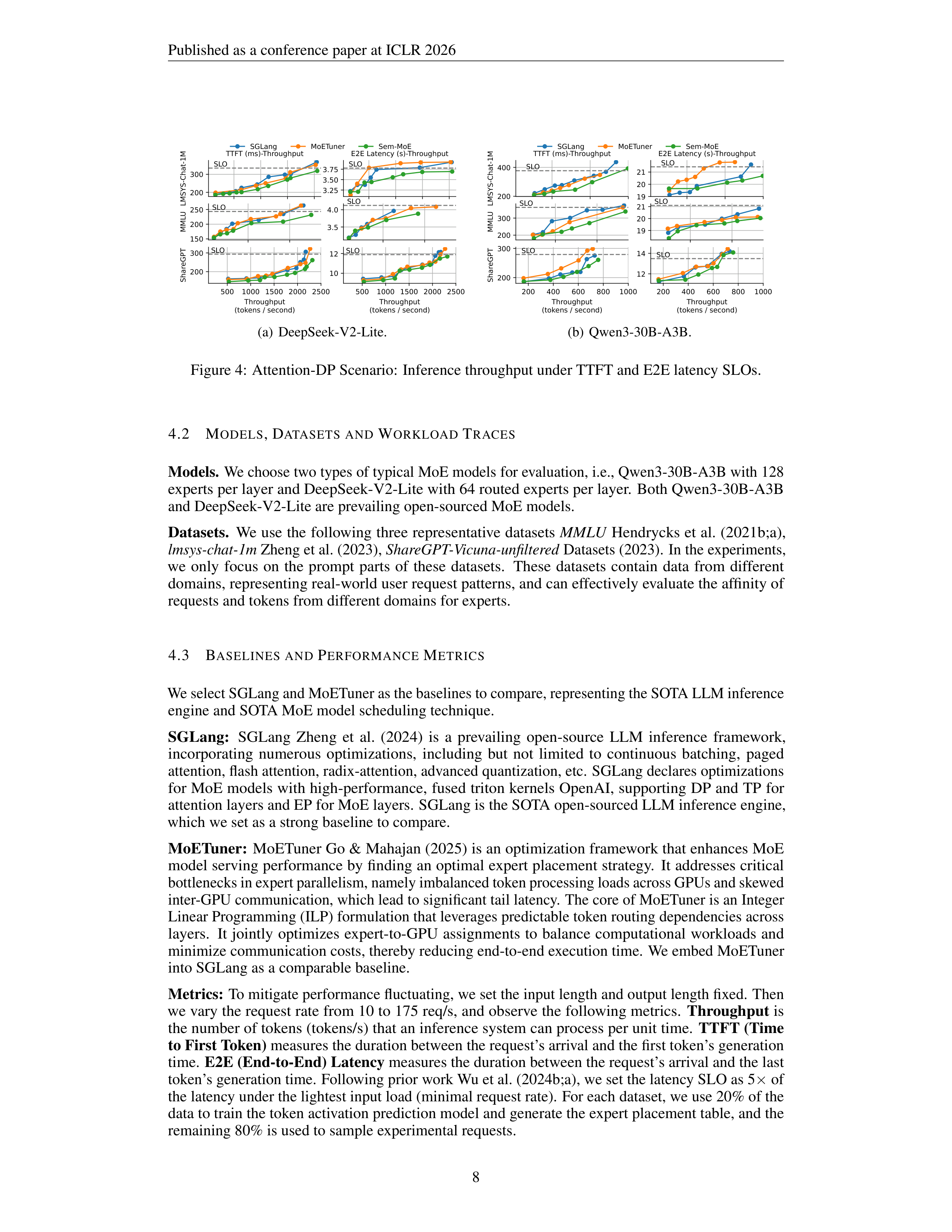
Figure 4:
Attention-DP Scenario:
Inference throughput under TTFT and E2E latency SLOs.
4.2
M
ODELS
,
D
ATASETS
AND
W
ORKLOAD
T
RACES
Models.
We choose two types of typical MoE models for evaluation, i.e., Qwen3-30B-A3B with 128
experts per layer and DeepSeek-V2-Lite with 64 routed experts per layer.
Both Qwen3-30B-A3B
and DeepSeek-V2-Lite are prevailing open-sourced MoE models.
Datasets.
We use the following three representative datasets
MMLU
Hendrycks et al. (2021b;a),
lmsys-chat-1m
Zheng et al. (2023),
ShareGPT-Vicuna-unfiltered
Datasets (2023).
In the experiments,
we
only
focus
on
the
prompt
parts
of
these
datasets.
These
datasets
contain
data
from
different
domains, representing real-world user request patterns, and can effectively evaluate the affinity of
requests and tokens from different domains for experts.
4.3
B
ASELINES
AND
P
ERFORMANCE
M
ETRICS
We select SGLang and MoETuner as the baselines to compare, representing the SOTA LLM inference
engine and SOTA MoE model scheduling technique.
SGLang:
SGLang
Zheng
et
al.
(2024)
is
a
prevailing
open-source
LLM
inference
framework,
incorporating
numerous
optimizations,
including
but
not
limited
to
continuous
batching,
paged
attention, flash attention, radix-attention, advanced quantization, etc.
SGLang declares optimizations
for MoE models with high-performance, fused triton kernels OpenAI, supporting DP and TP for
attention layers and EP for MoE layers.
SGLang is the SOTA open-sourced LLM inference engine,
which we set as a strong baseline to compare.
MoETuner:
MoETuner Go & Mahajan (2025) is an optimization framework that enhances MoE
model serving performance by finding an optimal expert placement strategy.
It addresses critical
bottlenecks in expert parallelism, namely imbalanced token processing loads across GPUs and skewed
inter-GPU communication, which lead to significant tail latency.
The core of MoETuner is an Integer
Linear Programming (ILP) formulation that leverages predictable token routing dependencies across
layers.
It
jointly
optimizes
expert-to-GPU
assignments
to
balance
computational
workloads
and
minimize communication costs, thereby reducing end-to-end execution time.
We embed MoETuner
into SGLang as a comparable baseline.
Metrics:
To mitigate performance fluctuating, we set the input length and output length fixed.
Then
we vary the request rate from 10 to 175 req/s, and observe the following metrics.
Throughput
is
the number of tokens (tokens/s) that an inference system can process per unit time.
TTFT (Time
to First Token)
measures the duration between the request’s arrival and the first token’s generation
time.
E2E (End-to-End) Latency
measures the duration between the request’s arrival and the last
token’s generation time.
Following prior work Wu et al. (2024b;a), we set the latency SLO as 5
×
of
the latency under the lightest input load (minimal request rate).
For each dataset, we use 20% of the
data to train the token activation prediction model and generate the expert placement table, and the
remaining 80% is used to sample experimental requests.
8
Published as a conference paper at ICLR 2026
Models
Input Length
p99 TTFT (ms)
Median E2E Latency (ms)
SGLang
MoETuner
Sem-MoE
SGLang
MoETuner
Sem-MoE
DeepSeek-V2-Lite
256
84.87
80.96
75.63
617.87
604.46
603.10
512
98.10
92.17
88.69
609.81
602.02
599.89
1024
111.19
119.76
100.74
608.96
606.54
604.45
Qwen3-30B-A3B
256
85.72
87.24
74.46
758.60
763.97
750.26
512
104.76
101.86
83.87
766.80
759.41
759.16
1024
107.73
107.36
103.69
769.83
764.16
762.30
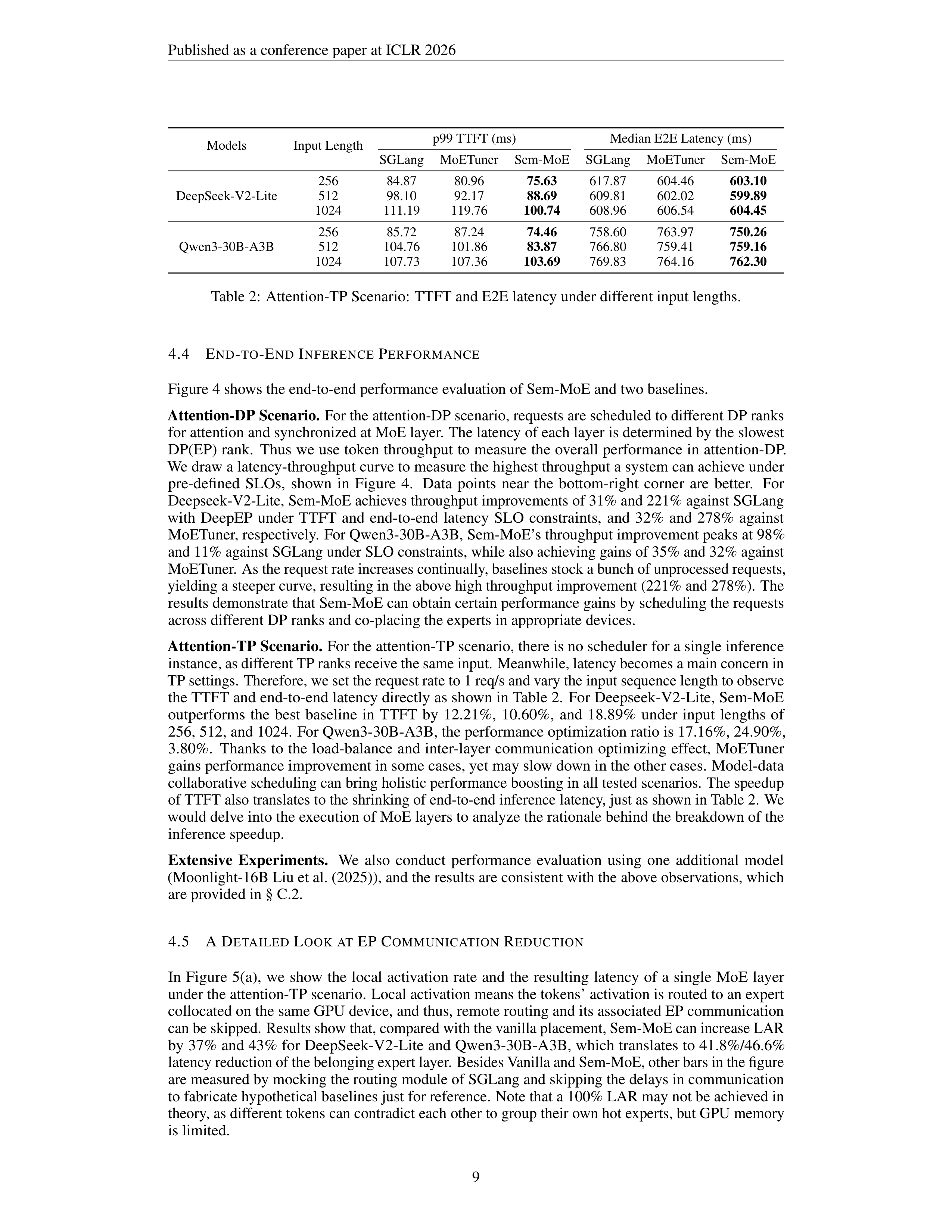
Table 2:
Attention-TP Scenario:
TTFT and E2E latency under different input lengths.
4.4
E
ND
-
TO
-E
ND
I
NFERENCE
P
ERFORMANCE
Figure 4 shows the end-to-end performance evaluation of Sem-MoE and two baselines.
Attention-DP Scenario.
For the attention-DP scenario, requests are scheduled to different DP ranks
for attention and synchronized at MoE layer.
The latency of each layer is determined by the slowest
DP(EP) rank.
Thus we use token throughput to measure the overall performance in attention-DP.
We draw a latency-throughput curve to measure the highest throughput a system can achieve under
pre-defined
SLOs,
shown
in
Figure
4.
Data
points
near
the
bottom-right
corner
are
better.
For
Deepseek-V2-Lite, Sem-MoE achieves throughput improvements of 31% and 221% against SGLang
with
DeepEP
under
TTFT
and
end-to-end
latency
SLO
constraints,
and
32%
and
278%
against
MoETuner, respectively.
For Qwen3-30B-A3B, Sem-MoE’s throughput improvement peaks at 98%
and 11% against SGLang under SLO constraints, while also achieving gains of 35% and 32% against
MoETuner.
As the request rate increases continually, baselines stock a bunch of unprocessed requests,
yielding a steeper curve, resulting in the above high throughput improvement (221% and 278%).
The
results demonstrate that Sem-MoE can obtain certain performance gains by scheduling the requests
across different DP ranks and co-placing the experts in appropriate devices.
Attention-TP Scenario.
For the attention-TP scenario, there is no scheduler for a single inference
instance, as different TP ranks receive the same input.
Meanwhile, latency becomes a main concern in
TP settings.
Therefore, we set the request rate to 1 req/s and vary the input sequence length to observe
the TTFT and end-to-end latency directly as shown in Table 2.
For Deepseek-V2-Lite, Sem-MoE
outperforms
the
best
baseline
in
TTFT
by
12.21%,
10.60%,
and
18.89%
under
input
lengths
of
256, 512, and 1024.
For Qwen3-30B-A3B, the performance optimization ratio is 17.16%, 24.90%,
3.80%.
Thanks to the load-balance and inter-layer communication optimizing effect,
MoETuner
gains performance improvement in some cases, yet may slow down in the other cases.
Model-data
collaborative scheduling can bring holistic performance boosting in all tested scenarios.
The speedup
of TTFT also translates to the shrinking of end-to-end inference latency, just as shown in Table 2.
We
would delve into the execution of MoE layers to analyze the rationale behind the breakdown of the
inference speedup.
Extensive
Experiments.
We
also
conduct
performance
evaluation
using
one
additional
model
(Moonlight-16B Liu et al. (2025)), and the results are consistent with the above observations, which
are provided in § C.2.
4.5
A
D
ETAILED
L
OOK
AT
EP
C
OMMUNICATION
R
EDUCTION
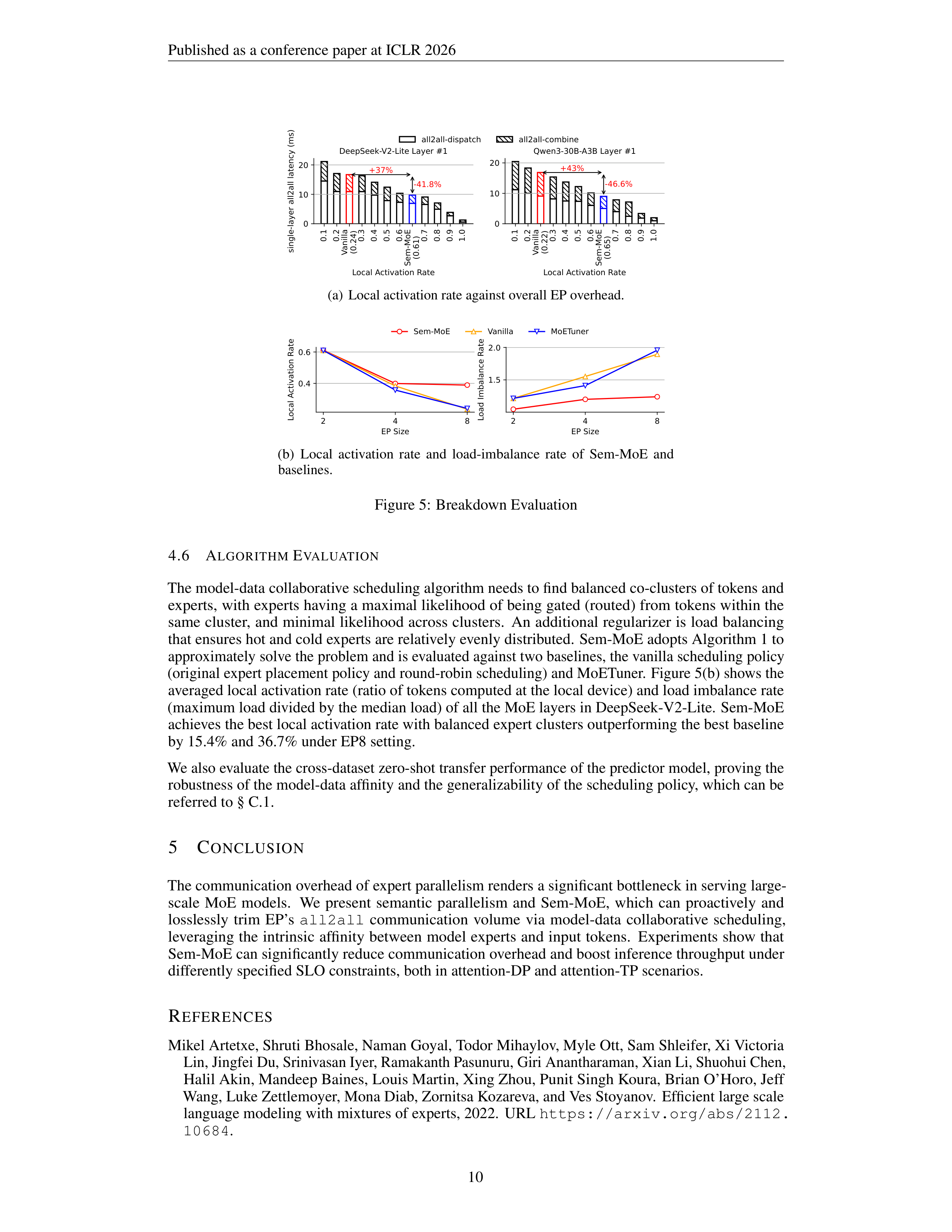
In
Figure
5(a),
we
show
the
local
activation
rate
and
the
resulting
latency
of
a
single
MoE
layer
under the attention-TP scenario.
Local activation means the tokens’ activation is routed to an expert
collocated on the same GPU device, and thus, remote routing and its associated EP communication
can be skipped.
Results show that, compared with the vanilla placement, Sem-MoE can increase LAR
by 37% and 43% for DeepSeek-V2-Lite and Qwen3-30B-A3B, which translates to 41.8%/46.6%
latency reduction of the belonging expert layer.
Besides Vanilla and Sem-MoE, other bars in the figure
are measured by mocking the routing module of SGLang and skipping the delays in communication
to fabricate hypothetical baselines just for reference.
Note that a 100% LAR may not be achieved in
theory, as different tokens can contradict each other to group their own hot experts, but GPU memory
is limited.
9
Published as a conference paper at ICLR 2026
0.1
0.2
Vanilla
(0.24)
0.3
0.4
0.5
0.6
Sem-MoE
(0.61)
0.7
0.8
0.9
1.0
Local Activation Rate
0
10
20
single-layer all2all latency (ms)
+37%
-41.8%
DeepSeek-V2-Lite Layer #1
0.1
0.2
Vanilla
(0.22)
0.3
0.4
0.5
0.6
Sem-MoE
(0.65)
0.7
0.8
0.9
1.0
Local Activation Rate
0
10
20
+43%
-46.6%
Qwen3-30B-A3B Layer #1
all2all-dispatch
all2all-combine
(a)
Local activation rate against overall EP overhead.
2
4
8
EP Size
0.4
0.6
Local Activation Rate
2
4
8
EP Size
1.5
2.0
Load Imbalance Rate
Sem-MoE
Vanilla
MoETuner
(b)
Local
activation
rate
and
load-imbalance
rate
of
Sem-MoE
and
baselines.
Figure 5:
Breakdown Evaluation
4.6
A
LGORITHM
E
VALUATION
The model-data collaborative scheduling algorithm needs to find balanced co-clusters of tokens and
experts, with experts having a maximal likelihood of being gated (routed) from tokens within the
same cluster, and minimal likelihood across clusters.
An additional regularizer is load balancing
that ensures hot and cold experts are relatively evenly distributed.
Sem-MoE adopts Algorithm 1 to
approximately solve the problem and is evaluated against two baselines, the vanilla scheduling policy
(original expert placement policy and round-robin scheduling) and MoETuner.
Figure 5(b) shows the
averaged local activation rate (ratio of tokens computed at the local device) and load imbalance rate
(maximum load divided by the median load) of all the MoE layers in DeepSeek-V2-Lite.
Sem-MoE
achieves the best local activation rate with balanced expert clusters outperforming the best baseline
by 15.4% and 36.7% under EP8 setting.
We also evaluate the cross-dataset zero-shot transfer performance of the predictor model, proving the
robustness of the model-data affinity and the generalizability of the scheduling policy, which can be
referred to § C.1.
5
C
ONCLUSION
The communication overhead of expert parallelism renders a significant bottleneck in serving large-
scale
MoE
models.
We
present
semantic
parallelism
and
Sem-MoE,
which
can
proactively
and
losslessly
trim
EP’s
all2all
communication
volume
via
model-data
collaborative
scheduling,
leveraging the intrinsic affinity between model experts and input tokens.
Experiments show that
Sem-MoE can significantly reduce communication overhead and boost inference throughput under
differently specified SLO constraints, both in attention-DP and attention-TP scenarios.
R
EFERENCES
Mikel Artetxe, Shruti Bhosale, Naman Goyal, Todor Mihaylov, Myle Ott, Sam Shleifer, Xi Victoria
Lin, Jingfei Du, Srinivasan Iyer, Ramakanth Pasunuru, Giri Anantharaman, Xian Li, Shuohui Chen,
Halil Akin, Mandeep Baines, Louis Martin, Xing Zhou, Punit Singh Koura, Brian O’Horo, Jeff
Wang, Luke Zettlemoyer, Mona Diab, Zornitsa Kozareva, and Ves Stoyanov.
Efficient large scale
language modeling with mixtures of experts, 2022.
URL
https://arxiv.org/abs/2112.
10684
.
10
Published as a conference paper at ICLR 2026
Chang Chen, Min Li, Zhihua Wu, Dianhai Yu, and Chao Yang.
Ta-moe:
Topology-aware large scale
mixture-of-expert training.
In S. Koyejo, S. Mohamed, A. Agarwal, D. Belgrave, K. Cho, and
A. Oh (eds.),
Advances in Neural Information Processing Systems
, volume 35, pp. 22173–22186.
Curran Associates, Inc., 2022.
Hugging Face Datasets. Sharegpt vicuna unfiltered dataset., 2023. URL
https://huggingface.
co/datasets/anon8231489123/ShareGPT_Vicuna_unfiltered
.
DeepSeek-AI.
Deepseek-v2:
A strong, economical, and efficient mixture-of-experts language model,
2024a.
DeepSeek-AI.
Deepseek-v3 technical report, 2024b.
URL
https://arxiv.org/abs/2412.
19437
.
DeepSeek-AI.
Deepseek-r1:
Incentivizing reasoning capability in llms via reinforcement learning,
2025.
URL
https://arxiv.org/abs/2501.12948
.
William Fedus, Barret Zoph, and Noam Shazeer.
Switch transformers:
Scaling to trillion parameter
models with simple and efficient sparsity.
Journal of Machine Learning Research
, 23(120):1–39,
2022.
URL
http://jmlr.org/papers/v23/21-0998.html
.
Seokjin
Go
and
Divya
Mahajan.
Moetuner:
Optimized
mixture
of
expert
serving
with
balanced
expert placement and token routing, 2025.
URL
https://arxiv.org/abs/2502.06643
.
Jiaao
He,
Jiezhong
Qiu,
Aohan
Zeng,
Zhilin
Yang,
Jidong
Zhai,
and
Jie
Tang.
Fastmoe:
A
fast
mixture-of-expert training system, 2021.
URL
https://arxiv.org/abs/2103.13262
.
Jiaao
He,
Jidong
Zhai,
Tiago
Antunes,
Haojie
Wang,
Fuwen
Luo,
Shangfeng
Shi,
and
Qin
Li.
Fastermoe:
modeling
and
optimizing
training
of
large-scale
dynamic
pre-trained
models.
In
Proceedings
of
the
27th
ACM
SIGPLAN
Symposium
on
Principles
and
Practice
of
Parallel
Programming
, PPoPP ’22, pp. 120–134, New York, NY, USA, 2022. Association for Computing
Machinery.
ISBN 9781450392044.
doi:
10.1145/3503221.3508418.
URL
https://doi.org/
10.1145/3503221.3508418
.
Dan
Hendrycks,
Collin
Burns,
Steven
Basart,
Andrew
Critch,
Jerry
Li,
Dawn
Song,
and
Jacob
Steinhardt.
Aligning ai with shared human values.
Proceedings of the International Conference on
Learning Representations (ICLR)
, 2021a.
Dan Hendrycks, Collin Burns, Steven Basart, Andy Zou, Mantas Mazeika, Dawn Song, and Jacob
Steinhardt.
Measuring massive multitask language understanding.
Proceedings of the International
Conference on Learning Representations (ICLR)
, 2021b.
Connor
Holmes,
Masahiro
Tanaka,
Michael
Wyatt,
Ammar
Ahmad
Awan,
Jeff
Rasley,
Samyam
Rajbhandari, Reza Yazdani Aminabadi, Heyang Qin, Arash Bakhtiari, Lev Kurilenko, and Yuxiong
He.
Deepspeed-fastgen:
High-throughput text generation for llms via mii and deepspeed-inference,
2024.
Haiyang Huang, Newsha Ardalani, Anna Sun, Liu Ke, Hsien-Hsin S. Lee, Anjali Sridhar, Shruti
Bhosale, Carole-Jean Wu, and Benjamin Lee.
Towards moe deployment:
Mitigating inefficiencies
in mixture-of-expert (moe) inference, 2023. URL
https://arxiv.org/abs/2303.06182
.
Changho
Hwang,
Wei
Cui,
Yifan
Xiong,
Ziyue
Yang,
Ze
Liu,
Han
Hu,
Zilong
Wang,
Rafael
Salas, Jithin Jose, Prabhat Ram, Joe Chau, Peng Cheng, Fan Yang, Mao Yang, and Yongqiang
Xiong.
Tutel:
Adaptive mixture-of-experts at scale.
CoRR
, abs/2206.03382, June 2022.
URL
https://arxiv.org/pdf/2206.03382.pdf
.
Ranggi Hwang, Jianyu Wei, Shijie Cao, Changho Hwang, Xiaohu Tang, Ting Cao, and Mao Yang.
Pre-gated moe:
An algorithm-system co-design for fast and scalable mixture-of-expert inference.
In
2024 ACM/IEEE 51st Annual International Symposium on Computer Architecture (ISCA)
, pp.
1018–1031, 2024.
doi:
10.1109/ISCA59077.2024.00078.
11
Published as a conference paper at ICLR 2026
Albert
Q.
Jiang,
Alexandre
Sablayrolles,
Antoine
Roux,
Arthur
Mensch,
Blanche
Savary,
Chris
Bamford,
Devendra
Singh
Chaplot,
Diego
de
las
Casas,
Emma
Bou
Hanna,
Florian
Bressand,
Gianna Lengyel, Guillaume Bour, Guillaume Lample, L
´
elio Renard Lavaud, Lucile Saulnier, Marie-
Anne Lachaux, Pierre Stock, Sandeep Subramanian, Sophia Yang, Szymon Antoniak, Teven Le
Scao, Th
´
eophile Gervet, Thibaut Lavril, Thomas Wang, Timoth
´
ee Lacroix, and William El Sayed.
Mixtral of experts, 2024.
URL
https://arxiv.org/abs/2401.04088
.
Woosuk Kwon, Zhuohan Li, Siyuan Zhuang, Ying Sheng, Lianmin Zheng, Cody Hao Yu, Joseph
Gonzalez, Hao Zhang, and Ion Stoica.
Efficient memory management for large language model
serving
with
pagedattention.
In
Proceedings
of
the
29th
Symposium
on
Operating
Systems
Principles
,
SOSP
’23,
pp.
611–626,
New
York,
NY,
USA,
2023.
Association
for
Computing
Machinery.
ISBN 9798400702297.
doi:
10.1145/3600006.3613165.
URL
https://doi.org/
10.1145/3600006.3613165
.
Jiamin Li, Yimin Jiang, Yibo Zhu, Cong Wang, and Hong Xu.
Accelerating distributed MoE training
and
inference
with
lina.
In
2023
USENIX
Annual
Technical
Conference
(USENIX
ATC
23)
,
pp. 945–959, Boston, MA, July 2023. USENIX Association.
ISBN 978-1-939133-35-9.
URL
https://www.usenix.org/conference/atc23/presentation/li-jiamin
.
Jingyuan Liu, Jianlin Su, Xingcheng Yao, Zhejun Jiang, Guokun Lai, Yulun Du, Yidao Qin, Weixin
Xu,
Enzhe
Lu,
Junjie
Yan,
Yanru
Chen,
Huabin
Zheng,
Yibo
Liu,
Shaowei
Liu,
Bohong
Yin,
Weiran He, Han Zhu, Yuzhi Wang, Jianzhou Wang, Mengnan Dong, Zheng Zhang, Yongsheng
Kang, Hao Zhang, Xinran Xu, Yutao Zhang, Yuxin Wu, Xinyu Zhou, and Zhilin Yang.
Muon is
scalable for llm training, 2025.
URL
https://arxiv.org/abs/2502.16982
.
Xiaonan Nie, Xupeng Miao, Zilong Wang, Zichao Yang, Jilong Xue, Lingxiao Ma, Gang Cao, and
Bin
Cui.
Flexmoe:
Scaling
large-scale
sparse
pre-trained
model
training
via
dynamic
device
placement.
Proc. ACM Manag. Data
,
1(1),
May 2023.
doi:
10.1145/3588964.
URL
https:
//doi.org/10.1145/3588964
.
NVIDIA.
Tensorrt-llm.
[Online].
Accessed 23 Oct 2024,
https://github.com/NVIDIA/
TensorRT-LLM
.
OpenAI.
Applied
ai
experiments
and
examples
for
pytorch.
[Online].
Accessed
23
Oct
2024,
https://github.com/pytorch-labs/applied-ai/tree/main
.
OpenAI,
:,
Sandhini
Agarwal,
Lama
Ahmad,
Jason
Ai,
Sam
Altman,
Andy
Applebaum,
Edwin
Arbus, Rahul K. Arora, Yu Bai, Bowen Baker, Haiming Bao, Boaz Barak, Ally Bennett, Tyler
Bertao, Nivedita Brett, Eugene Brevdo, Greg Brockman, Sebastien Bubeck, Che Chang, Kai Chen,
Mark Chen, Enoch Cheung, Aidan Clark, Dan Cook, Marat Dukhan, Casey Dvorak, Kevin Fives,
Vlad Fomenko, Timur Garipov, Kristian Georgiev, Mia Glaese, Tarun Gogineni, Adam Goucher,
Lukas Gross, Katia Gil Guzman, John Hallman, Jackie Hehir, Johannes Heidecke, Alec Helyar,
Haitang Hu,
Romain Huet,
Jacob Huh,
Saachi Jain,
Zach Johnson,
Chris Koch,
Irina Kofman,
Dominik Kundel, Jason Kwon, Volodymyr Kyrylov, Elaine Ya Le, Guillaume Leclerc, James Park
Lennon, Scott Lessans, Mario Lezcano-Casado, Yuanzhi Li, Zhuohan Li, Ji Lin, Jordan Liss, Lily,
Liu, Jiancheng Liu, Kevin Lu, Chris Lu, Zoran Martinovic, Lindsay McCallum, Josh McGrath,
Scott
McKinney,
Aidan
McLaughlin,
Song
Mei,
Steve
Mostovoy,
Tong
Mu,
Gideon
Myles,
Alexander
Neitz,
Alex
Nichol,
Jakub
Pachocki,
Alex
Paino,
Dana
Palmie,
Ashley
Pantuliano,
Giambattista Parascandolo, Jongsoo Park, Leher Pathak, Carolina Paz, Ludovic Peran, Dmitry
Pimenov,
Michelle
Pokrass,
Elizabeth
Proehl,
Huida
Qiu,
Gaby
Raila,
Filippo
Raso,
Hongyu
Ren, Kimmy Richardson, David Robinson, Bob Rotsted, Hadi Salman, Suvansh Sanjeev, Max
Schwarzer, D. Sculley, Harshit Sikchi, Kendal Simon, Karan Singhal, Yang Song, Dane Stuckey,
Zhiqing Sun, Philippe Tillet, Sam Toizer, Foivos Tsimpourlas, Nikhil Vyas, Eric Wallace, Xin
Wang, Miles Wang, Olivia Watkins, Kevin Weil, Amy Wendling, Kevin Whinnery, Cedric Whitney,
Hannah Wong, Lin Yang, Yu Yang, Michihiro Yasunaga, Kristen Ying, Wojciech Zaremba, Wenting
Zhan, Cyril Zhang, Brian Zhang, Eddie Zhang, and Shengjia Zhao.
gpt-oss-120b & gpt-oss-20b
model card, 2025.
URL
https://arxiv.org/abs/2508.10925
.
Yulei Qian, Fengcun Li, Xiangyang Ji, Xiaoyu Zhao, Jianchao Tan, Kefeng Zhang, and Xunliang
Cai.
Eps-moe:
Expert pipeline scheduler for cost-efficient moe inference, 2025.
URL
https:
//arxiv.org/abs/2410.12247
.
12
Published as a conference paper at ICLR 2026
Qwen-Team.
Qwen1.5-moe:
Matching
7b
model
performance
with
1/3
activated
parameters”,
February 2024.
URL
https://qwenlm.github.io/blog/qwen-moe/
.
Samyam
Rajbhandari,
Conglong
Li,
Zhewei
Yao,
Minjia
Zhang,
Reza
Yazdani
Aminabadi,
Am-
mar
Ahmad
Awan,
Jeff
Rasley,
and
Yuxiong
He.
DeepSpeed-MoE:
Advancing
mixture-of-
experts
inference
and
training
to
power
next-generation
AI
scale.
In
Kamalika
Chaudhuri,
Stefanie
Jegelka,
Le
Song,
Csaba
Szepesvari,
Gang
Niu,
and
Sivan
Sabato
(eds.),
Proceed-
ings
of
the
39th
International
Conference
on
Machine
Learning
,
volume
162
of
Proceedings
of
Machine
Learning
Research
,
pp.
18332–18346.
PMLR,
17–23
Jul
2022.
URL
https:
//proceedings.mlr.press/v162/rajbhandari22a.html
.
Siddharth
Singh,
Olatunji
Ruwase,
Ammar
Ahmad
Awan,
Samyam
Rajbhandari,
Yuxiong
He,
and Abhinav Bhatele.
A hybrid tensor-expert-data parallelism approach to optimize mixture-of-
experts training.
In
Proceedings of the 37th International Conference on Supercomputing
, ICS
’23,
pp.
203–214,
New
York,
NY,
USA,
2023.
Association
for
Computing
Machinery.
ISBN
9798400700569.
doi:
10.1145/3577193.3593704.
URL
https://doi.org/10.1145/
3577193.3593704
.
Kimi
Team,
Yifan
Bai,
Yiping
Bao,
Guanduo
Chen,
Jiahao
Chen,
Ningxin
Chen,
Ruijue
Chen,
Yanru Chen, Yuankun Chen, Yutian Chen, Zhuofu Chen, Jialei Cui, Hao Ding, Mengnan Dong,
Angang Du, Chenzhuang Du, Dikang Du, Yulun Du, Yu Fan, Yichen Feng, Kelin Fu, Bofei Gao,
Hongcheng Gao, Peizhong Gao, Tong Gao, Xinran Gu, Longyu Guan, Haiqing Guo, Jianhang
Guo, Hao Hu, Xiaoru Hao, Tianhong He, Weiran He, Wenyang He, Chao Hong, Yangyang Hu,
Zhenxing Hu, Weixiao Huang, Zhiqi Huang, Zihao Huang, Tao Jiang, Zhejun Jiang, Xinyi Jin,
Yongsheng
Kang,
Guokun
Lai,
Cheng
Li,
Fang
Li,
Haoyang
Li,
Ming
Li,
Wentao
Li,
Yanhao
Li,
Yiwei
Li,
Zhaowei
Li,
Zheming
Li,
Hongzhan
Lin,
Xiaohan
Lin,
Zongyu
Lin,
Chengyin
Liu, Chenyu Liu, Hongzhang Liu, Jingyuan Liu, Junqi Liu, Liang Liu, Shaowei Liu, T. Y. Liu,
Tianwei Liu, Weizhou Liu, Yangyang Liu, Yibo Liu, Yiping Liu, Yue Liu, Zhengying Liu, Enzhe
Lu, Lijun Lu, Shengling Ma, Xinyu Ma, Yingwei Ma, Shaoguang Mao, Jie Mei, Xin Men, Yibo
Miao,
Siyuan
Pan,
Yebo
Peng,
Ruoyu
Qin,
Bowen
Qu,
Zeyu
Shang,
Lidong
Shi,
Shengyuan
Shi,
Feifan
Song,
Jianlin
Su,
Zhengyuan
Su,
Xinjie
Sun,
Flood
Sung,
Heyi
Tang,
Jiawen
Tao,
Qifeng Teng, Chensi Wang, Dinglu Wang, Feng Wang, Haiming Wang, Jianzhou Wang, Jiaxing
Wang, Jinhong Wang, Shengjie Wang, Shuyi Wang, Yao Wang, Yejie Wang, Yiqin Wang, Yuxin
Wang, Yuzhi Wang, Zhaoji Wang, Zhengtao Wang, Zhexu Wang, Chu Wei, Qianqian Wei, Wenhao
Wu, Xingzhe Wu, Yuxin Wu, Chenjun Xiao, Xiaotong Xie, Weimin Xiong, Boyu Xu, Jing Xu,
Jinjing Xu, L. H. Xu, Lin Xu, Suting Xu, Weixin Xu, Xinran Xu, Yangchuan Xu, Ziyao Xu, Junjie
Yan, Yuzi Yan, Xiaofei Yang, Ying Yang, Zhen Yang, Zhilin Yang, Zonghan Yang, Haotian Yao,
Xingcheng Yao, Wenjie Ye, Zhuorui Ye, Bohong Yin, Longhui Yu, Enming Yuan, Hongbang Yuan,
Mengjie Yuan, Haobing Zhan, Dehao Zhang, Hao Zhang, Wanlu Zhang, Xiaobin Zhang, Yangkun
Zhang,
Yizhi
Zhang,
Yongting
Zhang,
Yu
Zhang,
Yutao
Zhang,
Yutong
Zhang,
Zheng
Zhang,
Haotian Zhao, Yikai Zhao, Huabin Zheng, Shaojie Zheng, Jianren Zhou, Xinyu Zhou, Zaida Zhou,
Zhen
Zhu,
Weiyu
Zhuang,
and
Xinxing
Zu.
Kimi
k2:
Open
agentic
intelligence,
2025.
URL
https://arxiv.org/abs/2507.20534
.
Bingyang
Wu,
Shengyu
Liu,
Yinmin
Zhong,
Peng
Sun,
Xuanzhe
Liu,
and
Xin
Jin.
Loongserve:
Efficiently serving long-context large language models with elastic sequence parallelism, 2024a.
URL
https://arxiv.org/abs/2404.09526
.
Bingyang Wu, Yinmin Zhong, Zili Zhang, Shengyu Liu, Fangyue Liu, Yuanhang Sun, Gang Huang,
Xuanzhe Liu, and Xin Jin.
Fast distributed inference serving for large language models, 2024b.
URL
https://arxiv.org/abs/2305.05920
.
Leyang Xue, Yao Fu, Zhan Lu, Luo Mai, and Mahesh Marina.
Moe-infinity:
Offloading-efficient
moe model serving, 2024.
URL
https://arxiv.org/abs/2401.14361
.
An Yang, Anfeng Li, Baosong Yang, Beichen Zhang, Binyuan Hui, Bo Zheng, Bowen Yu, Chang
Gao, Chengen Huang, Chenxu Lv, Chujie Zheng, Dayiheng Liu, Fan Zhou, Fei Huang, Feng Hu,
Hao Ge, Haoran Wei, Huan Lin, Jialong Tang, Jian Yang, Jianhong Tu, Jianwei Zhang, Jianxin
Yang,
Jiaxi
Yang,
Jing
Zhou,
Jingren
Zhou,
Junyang
Lin,
Kai
Dang,
Keqin
Bao,
Kexin
Yang,
Le Yu, Lianghao Deng, Mei Li, Mingfeng Xue, Mingze Li, Pei Zhang, Peng Wang, Qin Zhu, Rui
Men, Ruize Gao, Shixuan Liu, Shuang Luo, Tianhao Li, Tianyi Tang, Wenbiao Yin, Xingzhang
13
Published as a conference paper at ICLR 2026
Ren, Xinyu Wang, Xinyu Zhang, Xuancheng Ren, Yang Fan, Yang Su, Yichang Zhang, Yinger
Zhang, Yu Wan, Yuqiong Liu, Zekun Wang, Zeyu Cui, Zhenru Zhang, Zhipeng Zhou, and Zihan
Qiu.
Qwen3 technical report, 2025.
URL
https://arxiv.org/abs/2505.09388
.
Jinghan Yao, Quentin Anthony, Aamir Shafi, Hari Subramoni, Dhabaleswar K., and Panda. Exploiting
inter-layer expert affinity for accelerating mixture-of-experts model inference, 2024.
Rongjie Yi, Liwei Guo, Shiyun Wei, Ao Zhou, Shangguang Wang, and Mengwei Xu.
Edgemoe:
Fast
on-device inference of moe-based large language models, 2023.
URL
https://arxiv.org/
abs/2308.14352
.
Mingshu
Zhai,
Jiaao
He,
Zixuan
Ma,
Zan
Zong,
Runqing
Zhang,
and
Jidong
Zhai.
SmartMoE:
Efficiently training Sparsely-Activated models through combining offline and online parallelization.
In
2023 USENIX Annual Technical Conference (USENIX ATC 23)
, pp. 961–975, Boston, MA, July
2023. USENIX Association.
ISBN 978-1-939133-35-9.
URL
https://www.usenix.org/
conference/atc23/presentation/zhai
.
Chenggang
Zhao,
Shangyan
Zhou,
Liyue
Zhang,
Chengqi
Deng,
Zhean
Xu,
Yuxuan
Liu,
Kuai
Yu,
Jiashi
Li,
and
Liang
Zhao.
Deepep:
an
efficient
expert-parallel
communication
library.
https://github.com/deepseek-ai/DeepEP
, 2025.
Lianmin Zheng, Wei-Lin Chiang, Ying Sheng, Tianle Li, Siyuan Zhuang, Zhanghao Wu, Yonghao
Zhuang,
Zhuohan
Li,
Zi
Lin,
Eric.
P
Xing,
Joseph
E.
Gonzalez,
Ion
Stoica,
and
Hao
Zhang.
Lmsys-chat-1m:
A large-scale real-world llm conversation dataset, 2023.
Lianmin Zheng, Liangsheng Yin, Zhiqiang Xie, Chuyue Sun, Jeff Huang, Cody Hao Yu, Shiyi Cao,
Christos
Kozyrakis,
Ion
Stoica,
Joseph
E.
Gonzalez,
Clark
Barrett,
and
Ying
Sheng.
Sglang:
Efficient execution of structured language model programs, 2024.
URL
https://arxiv.org/
abs/2312.07104
.
Shuzhang Zhong, Ling Liang, Yuan Wang, Runsheng Wang, Ru Huang, and Meng Li.
Adapmoe:
Adaptive sensitivity-based expert gating and management for efficient moe inference, 2024.
URL
https://arxiv.org/abs/2408.10284
.
A
E
MPIRICAL
S
TUDY
OF
T
OKEN
-
EXPERT
A
FFINITY
A.1
I
MPACT
OF
R
EQUEST
S
EMANTICS
ON
E
XPERT
A
CTIVATION
To better illustrate the impact of request semantics on expert activation, we selected requests from
several
different
types
of
topics
in
the
MMLU
dataset
and
profiled
the
expert
activations
in
the
24th layer of Qwen3-30B-A3B, as shown in Figure 6(a).
After performing t-SNE dimensionality
reduction, it can be observed that requests from similar topics exhibit similarity in activated experts.
Requests from the math-related topics of abstract algebra and college mathematics activate similar
experts,
whereas
requests
from
humanities
topics,
such
as
philosophy
and
professional
law,
are
relatively distant from the math-related ones in the reduced-dimensional space.
Sem-MoE leverages
this semantic affinity between requests to perform co-scheduling of data and models for requests
under the Attention-DP scenario.
A.2
T
OKEN
-
EXPERT
C
ONJUGACY
Intra-layer token-expert affinity
Within each MoE layer, each expert module in an LLM layer is
trained to process a particular semantic domain of tokens.
Tokens and experts exhibit high affinity
in different dimensions.
We profile the intermediate activation of the gating module in each MoE
layer in the DeepSeek-V2-Lite.
One important observation shows that strong bi-clustered conjugacy
between tokens and experts, as shown in Figure 6.
That is, experts are likely to be activated by a
certain sub-group of tokens with high semantic affinity, while they are not likely to be activated by
other general tokens in the vocabulary.
And from the tokens’ perspective, it is true that semantically
similar tokens are likely to activate a certain sub-group of experts.
This is the preliminary motivation
for model-data collaborative scheduling.
14
Published as a conference paper at ICLR 2026
Inter-layer expert-expert affinity
The left picture of Figure 6(c) shows the activation correlation
of the 4th and 5th layer of the Mixtral-8x7B model.
The x-/y-axis represents the expert groups of a
layer.
For Mixtral-8x7B, each token is routed to 2 out of 8 experts at each layer.
Thus, the number of
expert groups at each layer is
�
8
2
=
28
.
When tokens choose some concrete experts at the fourth
layer, they tend to choose a rather fixed set of experts at the next layer with high probability.
We
name this phenomenon
inter-layer expert-expert affinity
.
Simple conditional probability model for token activation path
The above examples illustrate
the tabularized relationship between tokens and experts.
We argue that, simple conditional probability
model can work to predict the activation path of tokens by combining the above intra-layer conjugacy
and/inter-layer affinity.
We first calculate the kurtosis
3
of each token’s activation map.
The right
picture of Figure 6(b) shows most of the kurtosis values are higher than 8, indicating that the to-route
experts
for
each
token
concentrate
on
a
narrowed
set,
regardless
of
the
context.
We
further
use
partial (25%) of the profile dataset to calculate each tokens’ most routed top-k experts.
Then the
static top-k experts are used to predict the tokens activation using the left part (75%) of the profile
dataset, achieving a 96.3% precision and a 78.8% F1 score.
The right part of Figure 6(c) predicts
the next-layer-activation via looking back the prior layers.
As we know more about the previous
activation sequence at layer
L
, we can predict the activation at layer
L
+ 1
with higher confidence
(about 70% when looking back 5 layers).
Expert pre-grouping and token re-batching
Leveraging the intrinsic conjugacy between tokens
and experts in MoE models to achieve token-expert co-dispatching, may help reduce communication
volume and boost distributed parallel inference.
First, similar experts can be pre-grouped together at
deployment time based on pre-profiled and modeled affinity.
Second, on the fly, individual tokens
can be re-shuffled and re-batched to the GPU devices that host the expert groups whose member
experts have largest modeled conjugacy with the token.
Such co-scheduling aims to avoid scattered,
cross-device
token-expert
activations,
or
equivalently,
maximize
the
probability
of
intra-device,
local activations.
Figure 6(d) shows an micro-benchmark experiment, testing the
all2all
latency
under different local activation rate using the
nccl
all2allv
API. With the local activation rate
(
α
) varying from 0.2 to 0.9, the latency decreases gradually, showing the performance gains with
improved expert-token co-scheduling.
B
A
LGORITHM
FOR
THE
MODEL
-
DATA
CO
-
SCHEDULING
S
OLVER
Algorithm
1 describes the model-data co-scheduling alternating optimization algorithm in Sem-MoE.
The algorithm achieves optimal performance by alternating between optimizing the scheduling of
requests and the placement of experts.
Initially, requests are clustered based on their affinity to experts
to determine their scheduling (line 44).
In each iteration, the algorithm alternates between optimizing
expert placement with fixed requests and request scheduling with fixed experts.
For optimizing expert
placement, experts are first sorted by their hotness in descending order.
Given the current request
scheduling and expert placement, the affinities between experts and the cluster’s experts/requests
are computed and aggregated via weights
α
e
and
β
e
, which is adjusted by the cluster’s current load
to derive a final affinity score (lines 11-13).
The expert is assigned to the highest-scoring cluster,
with saturated clusters masked (line 14).
The algorithm then performs
ft
steps
fine-tuning rounds,
randomly selects two clusters and swaps their experts if it improves the affinity score (lines 20-25).
Request scheduling optimization is similar to expert placement.
The req-req affinity and req-expert
affinity
for
each
cluster
are
calculated,
aggregated
to
obtain
an
affinity
score,
and
the
request
is
scheduled to the cluster with the highest score (lines 28-42).
By
now,
the
token-device
scheduling
table
T
,
token-device
scheduling
confidence
table
T
p
,
and
expert-device
scheduling
table
E
are
generated.
After
the
scheduling
table
E
is
constructed,
the
experts at each layer need to be rearranged according to the scheduling table during online inference
service deployment.
In addition, the Sem-MoE rearranges the gating module by column to implement
transparent expert shuffle.
The semantics of other layers are not affected.
The rearranged experts are
highly boxed, so that the token activation at each layer is de-cohesive, and the redundant network
communication overhead caused by dispersive activation is reduced.
3
Kurtosis is a measure of the tailedness of a distribution.
High Kurtosis indicates a token favors several fixed
experts during multiple occurrences.
15
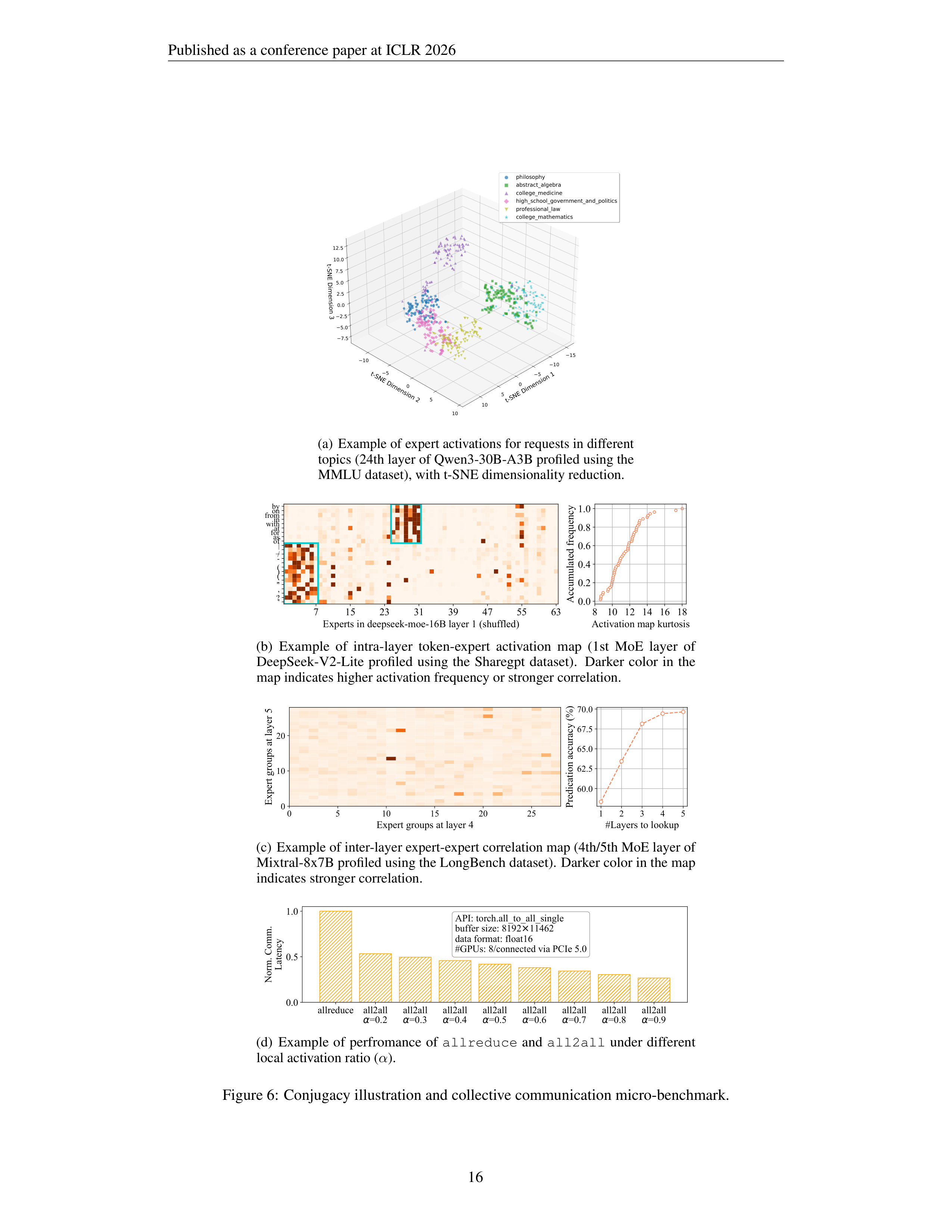
Published as a conference paper at ICLR 2026
15
10
5
0
5
10
t-SNE Dimension 1
10
5
0
5
10
t-SNE Dimension 2
7.5
5.0
2.5
0.0
2.5
5.0
7.5
10.0
12.5
t-SNE Dimension 3
philosophy
abstract_algebra
college_medicine
high_school_government_and_politics
professional_law
college_mathematics
(a)
Example of expert activations for requests in different
topics (24th layer of Qwen3-30B-A3B profiled using the
MMLU dataset), with t-SNE dimensionality reduction.
7
15
23
31
39
47
55
63
Experts in deepseek-moe-16B layer 1 (shuffled)
'
?.,":()(
-
/_|
of
as
for
at
with
in
from
on
by
8
10
12
14
16
18
Activation map kurtosis
0.0
0.2
0.4
0.6
0.8
1.0
Accumulated frequency
(b)
Example
of
intra-layer
token-expert
activation
map
(1st
MoE
layer
of
DeepSeek-V2-Lite
profiled
using
the
Sharegpt
dataset).
Darker
color
in
the
map indicates higher activation frequency or stronger correlation.
0
5
10
15
20
25
Expert groups at layer 4
0
10
20
Expert groups at layer 5
1
2
3
4
5
#Layers to lookup
60.0
62.5
65.0
67.5
70.0
Predication accuracy (%)
(c)
Example of inter-layer expert-expert correlation map (4th/5th MoE layer of
Mixtral-8x7B profiled using the LongBench dataset).
Darker color in the map
indicates stronger correlation.
allreduce
all2all
=0.2
all2all
=0.3
all2all
=0.4
all2all
=0.5
all2all
=0.6
all2all
=0.7
all2all
=0.8
all2all
=0.9
0.0
0.5
1.0
Norm. Comm.
Latency
API: torch.all_to_all_single
buffer size: 8192
×
11462
data format: float16
#GPUs: 8/connected via PCIe 5.0
(d)
Example
of
perfromance
of
allreduce
and
all2all
under
different
local activation ratio (
α
).
Figure 6:
Conjugacy illustration and collective communication micro-benchmark.
16
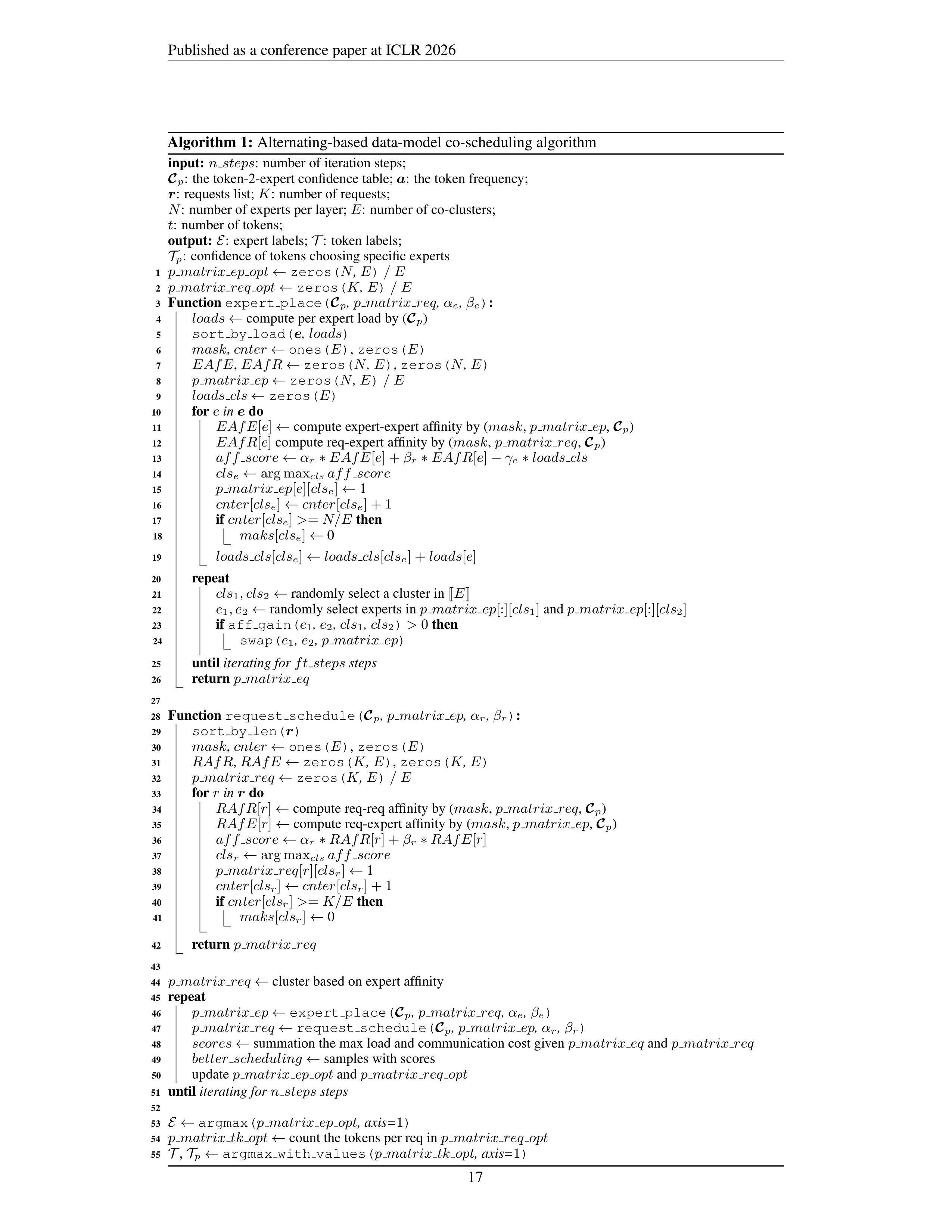
Published as a conference paper at ICLR 2026
Algorithm 1:
Alternating-based data-model co-scheduling algorithm
input:
n
steps
:
number of iteration steps;
C
p
:
the token-2-expert confidence table;
a
:
the token frequency;
r
:
requests list;
K
:
number of requests;
N
:
number of experts per layer;
E
:
number of co-clusters;
t
:
number of tokens;
output:
E
:
expert labels;
T
:
token labels;
T
p
:
confidence of tokens choosing specific experts
1
p
matrix
ep
opt
←
zeros(
N
,
E
)
/ E
2
p
matrix
req
opt
←
zeros(
K
,
E
)
/ E
3
Function
expert
place(
C
p
,
p
matrix
req
,
α
e
,
β
e
)
:
4
loads
←
compute per expert load by (
C
p
)
5
sort
by
load(
e
,
loads
)
6
mask
,
cnter
←
ones(
E
)
,
zeros(
E
)
7
EAfE
,
EAfR
←
zeros(
N
,
E
)
,
zeros(
N
,
E
)
8
p
matrix
ep
←
zeros(
N
,
E
)
/ E
9
loads
cls
←
zeros(
E
)
10
for
e
in
e
do
11
EAfE
[
e
]
←
compute expert-expert affinity by (
mask
,
p
matrix
ep
,
C
p
)
12
EAfR
[
e
]
compute req-expert affinity by (
mask
,
p
matrix
req
,
C
p
)
13
aff
score
←
α
r
∗
EAfE
[
e
] +
β
r
∗
EAfR
[
e
]
−
γ
e
∗
loads
cls
14
cls
e
←
arg max
cls
aff
score
15
p
matrix
ep
[
e
][
cls
e
]
←
1
16
cnter
[
cls
e
]
←
cnter
[
cls
e
] + 1
17
if
cnter
[
cls
e
]
>
=
N/E
then
18
maks
[
cls
e
]
←
0
19
loads
cls
[
cls
e
]
←
loads
cls
[
cls
e
] +
loads
[
e
]
20
repeat
21
cls
1
, cls
2
←
randomly select a cluster in
J
E
K
22
e
1
, e
2
←
randomly select experts in
p
matrix
ep
[:][
cls
1
]
and
p
matrix
ep
[:][
cls
2
]
23
if
aff
gain(
e
1
,
e
2
,
cls
1
,
cls
2
)
>
0
then
24
swap(
e
1
,
e
2
,
p
matrix
ep
)
25
until
iterating for
ft
steps
steps
26
return
p
matrix
eq
27
28
Function
request
schedule(
C
p
,
p
matrix
ep
,
α
r
,
β
r
)
:
29
sort
by
len(
r
)
30
mask
,
cnter
←
ones(
E
)
,
zeros(
E
)
31
RAfR
,
RAfE
←
zeros(
K
,
E
)
,
zeros(
K
,
E
)
32
p
matrix
req
←
zeros(
K
,
E
)
/ E
33
for
r
in
r
do
34
RAfR
[
r
]
←
compute req-req affinity by (
mask
,
p
matrix
req
,
C
p
)
35
RAfE
[
r
]
←
compute req-expert affinity by (
mask
,
p
matrix
ep
,
C
p
)
36
aff
score
←
α
r
∗
RAfR
[
r
] +
β
r
∗
RAfE
[
r
]
37
cls
r
←
arg max
cls
aff
score
38
p
matrix
req
[
r
][
cls
r
]
←
1
39
cnter
[
cls
r
]
←
cnter
[
cls
r
] + 1
40
if
cnter
[
cls
r
]
>
=
K/E
then
41
maks
[
cls
r
]
←
0
42
return
p
matrix
req
43
44
p
matrix
req
←
cluster based on expert affinity
45
repeat
46
p
matrix
ep
←
expert
place(
C
p
,
p
matrix
req
,
α
e
,
β
e
)
47
p
matrix
req
←
request
schedule(
C
p
,
p
matrix
ep
,
α
r
,
β
r
)
48
scores
←
summation the max load and communication cost given
p
matrix
eq
and
p
matrix
req
49
better
scheduling
←
samples with scores
50
update
p
matrix
ep
opt
and
p
matrix
req
opt
51
until
iterating for
n
steps
steps
52
53
E
←
argmax(
p
matrix
ep
opt
, axis=
1
)
54
p
matrix
tk
opt
←
count the tokens per req in
p
matrix
req
opt
55
T
,
T
p
←
argmax
with
values(
p
matrix
tk
opt
, axis=
1
)
17
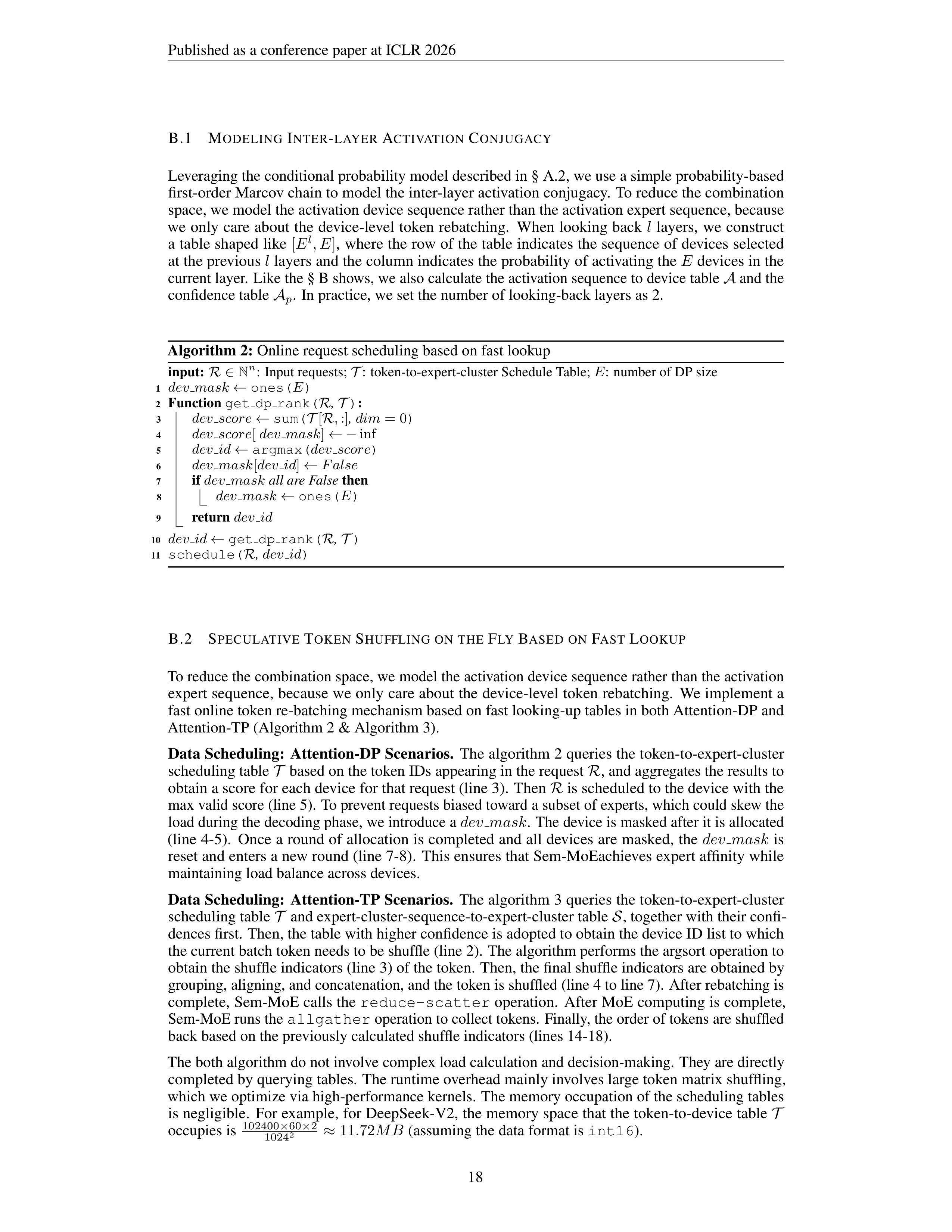
Published as a conference paper at ICLR 2026
B.1
M
ODELING
I
NTER
-
LAYER
A
CTIVATION
C
ONJUGACY
Leveraging the conditional probability model described in § A.2, we use a simple probability-based
first-order Marcov chain to model the inter-layer activation conjugacy.
To reduce the combination
space, we model the activation device sequence rather than the activation expert sequence, because
we only care about the device-level token rebatching.
When looking back
l
layers,
we construct
a table shaped like
[
E
l
, E
]
, where the row of the table indicates the sequence of devices selected
at the previous
l
layers and the column indicates the probability of activating the
E
devices in the
current layer.
Like the § B shows, we also calculate the activation sequence to device table
A
and the
confidence table
A
p
.
In practice, we set the number of looking-back layers as 2.
Algorithm 2:
Online request scheduling based on fast lookup
input:
R ∈
N
n
:
Input requests;
T
:
token-to-expert-cluster Schedule Table;
E
:
number of DP size
1
dev
mask
←
ones(
E
)
2
Function
get
dp
rank(
R
,
T
)
:
3
dev
score
←
sum(
T
[
R
,
:]
,
dim
= 0
)
4
dev
score
[
dev
mask
]
←−
inf
5
dev
id
←
argmax(
dev
score
)
6
dev
mask
[
dev
id
]
←
False
7
if
dev
mask
all are False
then
8
dev
mask
←
ones(
E
)
9
return
dev
id
10
dev
id
←
get
dp
rank(
R
,
T
)
11
schedule(
R
,
dev
id
)
B.2
S
PECULATIVE
T
OKEN
S
HUFFLING
ON
THE
F
LY
B
ASED
ON
F
AST
L
OOKUP
To reduce the combination space, we model the activation device sequence rather than the activation
expert sequence, because we only care about the device-level token rebatching.
We implement a
fast online token re-batching mechanism based on fast looking-up tables in both Attention-DP and
Attention-TP (Algorithm 2 & Algorithm 3).
Data Scheduling:
Attention-DP Scenarios.
The algorithm 2 queries the token-to-expert-cluster
scheduling table
T
based on the token IDs appearing in the request
R
, and aggregates the results to
obtain a score for each device for that request (line 3).
Then
R
is scheduled to the device with the
max valid score (line 5).
To prevent requests biased toward a subset of experts, which could skew the
load during the decoding phase, we introduce a
dev
mask
.
The device is masked after it is allocated
(line 4-5).
Once a round of allocation is completed and all devices are masked, the
dev
mask
is
reset and enters a new round (line 7-8).
This ensures that Sem-MoEachieves expert affinity while
maintaining load balance across devices.
Data Scheduling:
Attention-TP Scenarios.
The algorithm 3 queries the token-to-expert-cluster
scheduling table
T
and expert-cluster-sequence-to-expert-cluster table
S
, together with their confi-
dences first.
Then, the table with higher confidence is adopted to obtain the device ID list to which
the current batch token needs to be shuffle (line 2).
The algorithm performs the argsort operation to
obtain the shuffle indicators (line 3) of the token.
Then, the final shuffle indicators are obtained by
grouping, aligning, and concatenation, and the token is shuffled (line 4 to line 7).
After rebatching is
complete, Sem-MoE calls the
reduce-scatter
operation.
After MoE computing is complete,
Sem-MoE runs the
allgather
operation to collect tokens.
Finally, the order of tokens are shuffled
back based on the previously calculated shuffle indicators (lines 14-18).
The both algorithm do not involve complex load calculation and decision-making.
They are directly
completed by querying tables.
The runtime overhead mainly involves large token matrix shuffling,
which we optimize via high-performance kernels.
The memory occupation of the scheduling tables
is negligible.
For example, for DeepSeek-V2, the memory space that the token-to-device table
T
occupies is
102400
×
60
×
2
1024
2
≈
11
.
72
MB
(assuming the data format is
int16
).
18
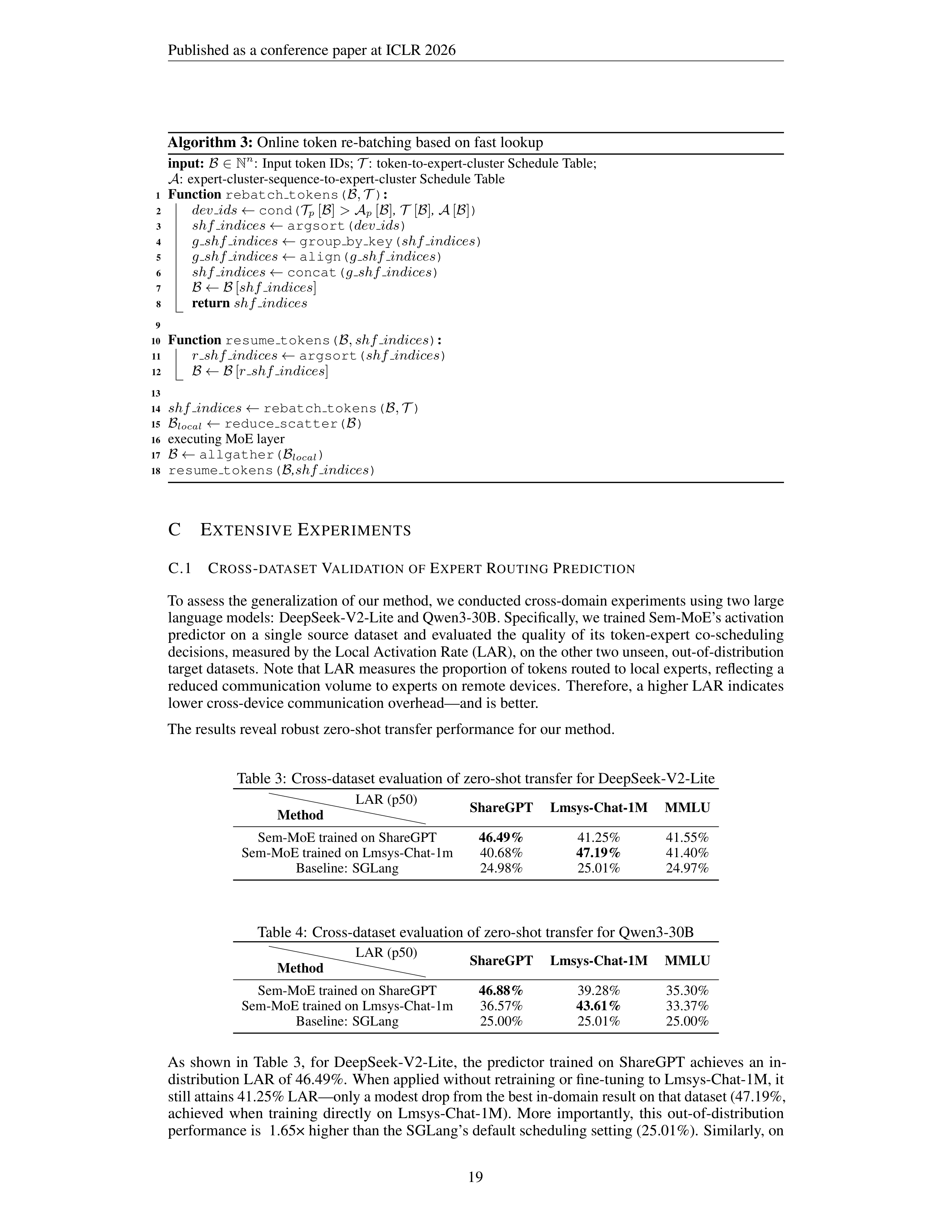
Published as a conference paper at ICLR 2026
Algorithm 3:
Online token re-batching based on fast lookup
input:
B
∈
N
n
:
Input token IDs;
T
:
token-to-expert-cluster Schedule Table;
A
:
expert-cluster-sequence-to-expert-cluster Schedule Table
1
Function
rebatch
tokens(
B
,
T
)
:
2
dev
ids
←
cond(
T
p
[
B
]
>
A
p
[
B
]
,
T
[
B
]
,
A
[
B
]
)
3
shf
indices
←
argsort(
dev
ids
)
4
g
shf
indices
←
group
by
key(
shf
indices
)
5
g
shf
indices
←
align(
g
shf
indices
)
6
shf
indices
←
concat(
g
shf
indices
)
7
B ←B
[
shf
indices
]
8
return
shf
indices
9
10
Function
resume
tokens(
B
, shf
indices
)
:
11
r
shf
indices
←
argsort(
shf
indices
)
12
B ←B
[
r
shf
indices
]
13
14
shf
indices
←
rebatch
tokens(
B
,
T
)
15
B
local
←
reduce
scatter(
B
)
16
executing MoE layer
17
B ←
allgather(
B
local
)
18
resume
tokens(
B
,
shf
indices
)
C
E
XTENSIVE
E
XPERIMENTS
C.1
C
ROSS
-
DATASET
V
ALIDATION
OF
E
XPERT
R
OUTING
P
REDICTION
To assess the generalization of our method, we conducted cross-domain experiments using two large
language models: DeepSeek-V2-Lite and Qwen3-30B. Specifically, we trained Sem-MoE’s activation
predictor
on
a
single
source
dataset
and
evaluated
the
quality
of
its
token-expert
co-scheduling
decisions, measured by the Local Activation Rate (LAR), on the other two unseen, out-of-distribution
target datasets.
Note that LAR measures the proportion of tokens routed to local experts, reflecting a
reduced communication volume to experts on remote devices.
Therefore, a higher LAR indicates
lower cross-device communication overhead—and is better.
The results reveal robust zero-shot transfer performance for our method.
Table 3:
Cross-dataset evaluation of zero-shot transfer for DeepSeek-V2-Lite
Method
LAR (p50)
ShareGPT
Lmsys-Chat-1M
MMLU
Sem-MoE trained on ShareGPT
46.49%
41.25%
41.55%
Sem-MoE trained on Lmsys-Chat-1m
40.68%
47.19%
41.40%
Baseline:
SGLang
24.98%
25.01%
24.97%
Table 4:
Cross-dataset evaluation of zero-shot transfer for Qwen3-30B
Method
LAR (p50)
ShareGPT
Lmsys-Chat-1M
MMLU
Sem-MoE trained on ShareGPT
46.88%
39.28%
35.30%
Sem-MoE trained on Lmsys-Chat-1m
36.57%
43.61%
33.37%
Baseline:
SGLang
25.00%
25.01%
25.00%
As
shown
in
Table
3,
for
DeepSeek-V2-Lite,
the
predictor
trained
on
ShareGPT
achieves
an
in-
distribution LAR of 46.49%.
When applied without retraining or fine-tuning to Lmsys-Chat-1M, it
still attains 41.25% LAR—only a modest drop from the best in-domain result on that dataset (47.19%,
achieved
when
training
directly
on
Lmsys-Chat-1M).
More
importantly,
this
out-of-distribution
performance is
1.65× higher than the SGLang’s default scheduling setting (25.01%).
Similarly, on
19
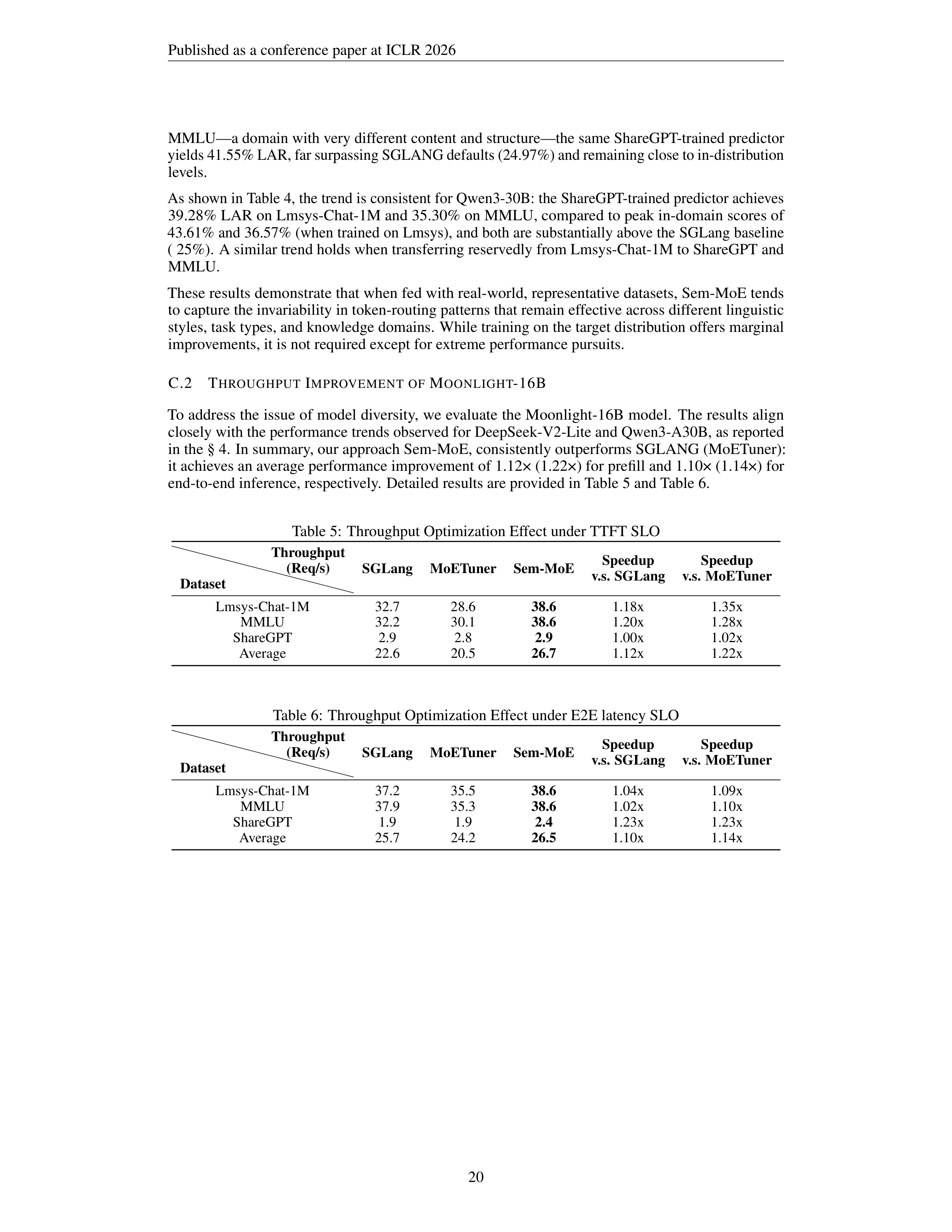
Published as a conference paper at ICLR 2026
MMLU—a domain with very different content and structure—the same ShareGPT-trained predictor
yields 41.55% LAR, far surpassing SGLANG defaults (24.97%) and remaining close to in-distribution
levels.
As shown in Table 4, the trend is consistent for Qwen3-30B: the ShareGPT-trained predictor achieves
39.28% LAR on Lmsys-Chat-1M and 35.30% on MMLU, compared to peak in-domain scores of
43.61% and 36.57% (when trained on Lmsys), and both are substantially above the SGLang baseline
( 25%).
A similar trend holds when transferring reservedly from Lmsys-Chat-1M to ShareGPT and
MMLU.
These results demonstrate that when fed with real-world, representative datasets, Sem-MoE tends
to capture the invariability in token-routing patterns that remain effective across different linguistic
styles, task types, and knowledge domains.
While training on the target distribution offers marginal
improvements, it is not required except for extreme performance pursuits.
C.2
T
HROUGHPUT
I
MPROVEMENT
OF
M
OONLIGHT
-16B
To address the issue of model diversity, we evaluate the Moonlight-16B model.
The results align
closely with the performance trends observed for DeepSeek-V2-Lite and Qwen3-A30B, as reported
in the § 4.
In summary, our approach Sem-MoE, consistently outperforms SGLANG (MoETuner):
it achieves an average performance improvement of 1.12× (1.22×) for prefill and 1.10× (1.14×) for
end-to-end inference, respectively.
Detailed results are provided in Table 5 and Table 6.
Table 5:
Throughput Optimization Effect under TTFT SLO
Dataset
Throughput
(Req/s)
SGLang
MoETuner
Sem-MoE
Speedup
v.s.
SGLang
Speedup
v.s.
MoETuner
Lmsys-Chat-1M
32.7
28.6
38.6
1.18x
1.35x
MMLU
32.2
30.1
38.6
1.20x
1.28x
ShareGPT
2.9
2.8
2.9
1.00x
1.02x
Average
22.6
20.5
26.7
1.12x
1.22x
Table 6:
Throughput Optimization Effect under E2E latency SLO
Dataset
Throughput
(Req/s)
SGLang
MoETuner
Sem-MoE
Speedup
v.s.
SGLang
Speedup
v.s.
MoETuner
Lmsys-Chat-1M
37.2
35.5
38.6
1.04x
1.09x
MMLU
37.9
35.3
38.6
1.02x
1.10x
ShareGPT
1.9
1.9
2.4
1.23x
1.23x
Average
25.7
24.2
26.5
1.10x
1.14x
20