

The Google File System
Sanjay Ghemawat, Howard Gobioff, and Shun-Tak
Leung
Google
∗
ABSTRACT
We
have
designed
and
implemented
the
Google
File
Sys-
tem,
a
scalable
distributed
file
system
for
large
distributed
data-intensive applications.
It provides fault tolerance while
running on inexpensive commodity hardware, and it delivers
high
aggregate
performance
to
a
large
number
of
clients.
While
sharing
many
of
the
same
goals
as
previous
dis-
tributed
file
systems,
our
design
has
been
driven
by
obser-
vations
of
our
application
workloads
and technological
envi-
ronment, both current and anticipated, that reflect a marked
departure
from
some
earlier
file
system
assumptions.
This
has
led
us
to
reexamine
traditional
choices
and
explore
rad-
ically
different
design
points.
The
file
system
has
successfully
met
our
storage
needs.
It
is
widely
deployed
within
Google
as
the
storage
platform
for
the
generation
and
processing
of
data
used
by
our
ser-
vice as
well
as
research
and development efforts that require
large
data
sets.
The
largest
cluster
to
date
provides
hun-
dreds
of
terabytes
of
storage
across
thousands
of
disks
on
over
a
thousand
machines,
and
it
is
concurrently
accessed
by
hundreds
of
clients.
In
this
paper,
we
present
file
system
interface
extensions
designed
to
support
distributed
applications,
discuss
many
aspects
of
our
design,
and
report
measurements
from
both
micro-benchmarks
and
real
world
use.
Categories and Subject Descriptors
D
[
4
]:
3—
Distributed
file
systems
General Terms
Design,
reliability,
performance,
measurement
Keywords
Fault
tolerance,
scalability,
data
storage,
clustered
storage
∗
The
authors
can
be
reached
at
the
following
addresses:
{
sanjay,hgobioff,shuntak
}
@google.com
.
Permission
to
make
digital
or
hard
copies
of
all
or
part
of
this
work
for
personal
or
classroom
use
is
granted
without
fee
provided
that
copies
are
not made or distributed
for profit or commercial
advantage
and that copies
bear this notice and the full citation on the first page.
To copy otherwise, to
republish, to post on servers or to redistribute to lists, requires prior specific
permission and/or a fee.
SOSP’03,
October 19–22, 2003, Bolton Landing, New York, USA.
Copyright 2003 ACM 1-58113-757-5/03/0010
...
$
5.00.
1.
INTRODUCTION
We
have
designed
and
implemented
the
Google
File
Sys-
tem (GFS) to meet the rapidly growing demands of Google’s
data
processing
needs.
GFS
shares
many
of
the
same
goals
as
previous
distributed
file
systems
such
as
performance,
scalability,
reliability,
and
availability.
However,
its
design
has been driven by key observations of our application work-
loads
and
technological
environment,
both
current
and
an-
ticipated,
that
reflect
a
marked
departure
from
some
earlier
file
system
design
assumptions.
We
have
reexamined
tradi-
tional
choices
and
explored
radically
different
points
in
the
design
space.
First,
component
failures
are
the
norm
rather
than
the
exception.
The
file
system
consists
of
hundreds
or
even
thousands
of
storage
machines
built
from
inexpensive
com-
modity
parts
and
is
accessed
by
a
comparable
number
of
client
machines.
The
quantity
and
quality
of
the
compo-
nents
virtually
guarantee
that
some
are
not
functional
at
any
given
time
and
some
will
not
recover
from
their
cur-
rent
failures.
We
have
seen
problems
caused
by
application
bugs,
operating
system bugs,
human errors,
and the failures
of
disks,
memory,
connectors,
networking,
and
power
sup-
plies.
Therefore,
constant
monitoring,
error
detection,
fault
tolerance,
and
automatic
recovery
must
be
integral
to
the
system.
Second,
files are
huge by
traditional
standards.
Multi-GB
files are common.
Each file typically
contains many applica-
tion
objects
such as
web documents.
When we
are
regularly
working with fast growing data sets of many TBs comprising
billions
of
objects,
it
is
unwieldy
to
manage
billions
of
ap-
proximately
KB-sized
files
even
when
the
file
system
could
support
it.
As
a
result,
design
assumptions
and
parameters
such
as
I/O
operation
and
block
sizes
have
to
be
revisited.
Third,
most
files
are
mutated
by
appending
new
data
rather than overwriting existing data.
Random writes within
a
file
are
practically
non-existent.
Once
written,
the
files
are
only
read,
and
often
only
sequentially.
A
variety
of
data
share
these
characteristics.
Some
may
constitute
large
repositories that data analysis programs scan through.
Some
may
be data streams
continuously generated by running ap-
plications.
Some
may
be
archival
data.
Some
may
be
in-
termediate
results
produced
on
one
machine
and
processed
on
another,
whether
simultaneously
or
later
in
time.
Given
this
access
pattern
on
huge
files,
appending
becomes
the
fo-
cus
of
performance
optimization
and
atomicity
guarantees,
while
caching
data
blocks
in
the
client
loses
its
appeal.
Fourth,
co-designing
the
applications
and
the
file
system
API
benefits
the
overall
system
by
increasing
our
flexibility.
For
example,
we
have
relaxed
GFS’s
consistency
model
to
vastly
simplify
the
file
system
without
imposing
an
onerous
burden
on
the
applications.
We
have
also
introduced
an
atomic append operation so that multiple clients can append
concurrently to a file without extra synchronization between
them.
These
will
be
discussed
in
more
details
later
in
the
paper.
Multiple
GFS
clusters
are
currently
deployed for
different
purposes.
The
largest
ones
have
over
1000
storage
nodes,
over
300
TB
of
disk
storage,
and
are
heavily
accessed
by
hundreds
of
clients
on
distinct
machines
on
a
continuous
basis.
2.
DESIGN OVERVIEW
2.1
Assumptions
In
designing
a
file
system
for
our
needs,
we
have
been
guided
by
assumptions
that
offer
both
challenges
and
op-
portunities.
We
alluded
to
some
key
observations
earlier
and
now
lay
out
our
assumptions
in
more
details.
•
The system is built from many inexpensive commodity
components that often fail.
It must constantly monitor
itself
and
detect,
tolerate,
and
recover
promptly
from
component
failures
on
a
routine
basis.
•
The
system
stores
a
modest
number
of
large
files.
We
expect
a
few
million
files,
each
typically
100
MB
or
larger
in
size.
Multi-GB
files
are
the
common
case
and should
be
managed
efficiently.
Small
files
must be
supported,
but
we
need
not
optimize
for
them.
•
The
workloads
primarily
consist
of
two
kinds
of
reads:
large
streaming
reads
and
small
random
reads.
In
large
streaming
reads,
individual
operations
typically
read hundreds of
KBs,
more commonly
1 MB
or more.
Successive
operations
from
the
same
client
often
read
through
a
contiguous
region
of
a
file.
A
small
ran-
dom
read
typically
reads
a
few
KBs
at
some
arbitrary
offset.
Performance-conscious
applications often batch
and
sort
their
small
reads
to
advance
steadily
through
the
file
rather
than
go
back
and
forth.
•
The
workloads
also
have many
large,
sequential
writes
that
append
data
to
files.
Typical
operation
sizes
are
similar
to
those
for
reads.
Once
written,
files
are
sel-
dom
modified
again.
Small
writes
at
arbitrary
posi-
tions
in
a
file
are
supported
but
do
not
have
to
be
efficient.
•
The system must efficiently implement well-defined se-
mantics
for
multiple
clients
that
concurrently
append
to
the
same
file.
Our
files
are
often
used
as
producer-
consumer
queues
or
for
many-way
merging.
Hundreds
of
producers,
running
one
per
machine,
will
concur-
rently
append
to
a
file.
Atomicity
with
minimal
syn-
chronization
overhead
is
essential.
The
file
may
be
read
later,
or
a
consumer
may
be
reading
through
the
file
simultaneously.
•
High sustained bandwidth is
more important than low
latency.
Most
of
our
target
applications
place
a
pre-
mium
on
processing
data
in
bulk
at
a
high
rate,
while
few
have
stringent
response
time
requirements
for
an
individual
read
or
write.
2.2
Interface
GFS
provides
a
familiar
file
system
interface,
though
it
does not implement a standard API such as POSIX. Files are
organized hierarchically in directories and identified by path-
names.
We
support
the
usual
operations
to
create
,
delete
,
open
,
close
,
read
,
and
write
files.
Moreover,
GFS
has
snapshot
and
record
append
opera-
tions.
Snapshot
creates
a
copy
of
a
file
or
a
directory
tree
at
low
cost.
Record
append
allows
multiple
clients
to
ap-
pend
data
to
the
same
file
concurrently
while
guaranteeing
the
atomicity
of
each
individual
client’s
append.
It
is
use-
ful
for
implementing
multi-way
merge
results
and producer-
consumer
queues
that
many
clients
can
simultaneously
ap-
pend
to
without
additional
locking.
We
have
found
these
types
of
files
to
be
invaluable
in
building
large
distributed
applications.
Snapshot and record append are discussed fur-
ther
in
Sections
3.4
and
3.3
respectively.
2.3
Architecture
A
GFS
cluster
consists
of
a
single
master
and
multiple
chunkservers
and
is
accessed
by
multiple
clients
,
as
shown
in
Figure
1.
Each
of
these
is
typically
a
commodity
Linux
machine running a user-level server process.
It is easy to run
both a chunkserver and a client on the same machine, as long
as machine resources
permit and the lower
reliability
caused
by
running
possibly
flaky
application
code
is
acceptable.
Files
are
divided
into
fixed-size
chunks
.
Each
chunk
is
identified by an immutable and globally
unique 64 bit
chunk
handle
assigned by the master at the time of chunk creation.
Chunkservers
store
chunks
on
local
disks
as
Linux
files
and
read
or
write
chunk
data
specified
by
a
chunk
handle
and
byte range.
For reliability, each chunk is replicated on multi-
ple chunkservers.
By default, we store three replicas, though
users
can
designate
different
replication
levels
for
different
regions
of
the
file
namespace.
The
master
maintains
all
file
system
metadata.
This
in-
cludes
the
namespace,
access
control
information,
the
map-
ping from files to chunks, and the current locations of chunks.
It
also
controls
system-wide
activities
such
as
chunk
lease
management,
garbage
collection
of
orphaned
chunks,
and
chunk
migration
between
chunkservers.
The
master
peri-
odically
communicates
with
each
chunkserver
in
HeartBeat
messages
to
give
it
instructions
and
collect
its
state.
GFS
client
code
linked
into
each
application
implements
the
file
system
API
and
communicates
with
the
master
and
chunkservers
to
read
or
write
data
on
behalf
of
the
applica-
tion.
Clients
interact
with
the
master
for
metadata
opera-
tions,
but
all
data-bearing
communication
goes
directly
to
the
chunkservers.
We
do
not
provide
the
POSIX
API
and
therefore
need
not
hook
into
the
Linux
vnode
layer.
Neither
the
client
nor
the
chunkserver
caches
file
data.
Client
caches
offer
little
benefit
because
most
applications
stream
through
huge
files
or
have
working
sets
too
large
to
be
cached.
Not
having
them
simplifies
the
client
and
the
overall
system
by
eliminating
cache
coherence
issues.
(Clients
do
cache
metadata,
however.)
Chunkservers
need
not
cache
file
data
because
chunks
are
stored
as
local
files
and so Linux’s buffer cache already keeps frequently accessed
data
in
memory.
2.4
Single Master
Having
a
single
master
vastly
simplifies
our
design
and
enables
the
master
to
make
sophisticated
chunk
placement
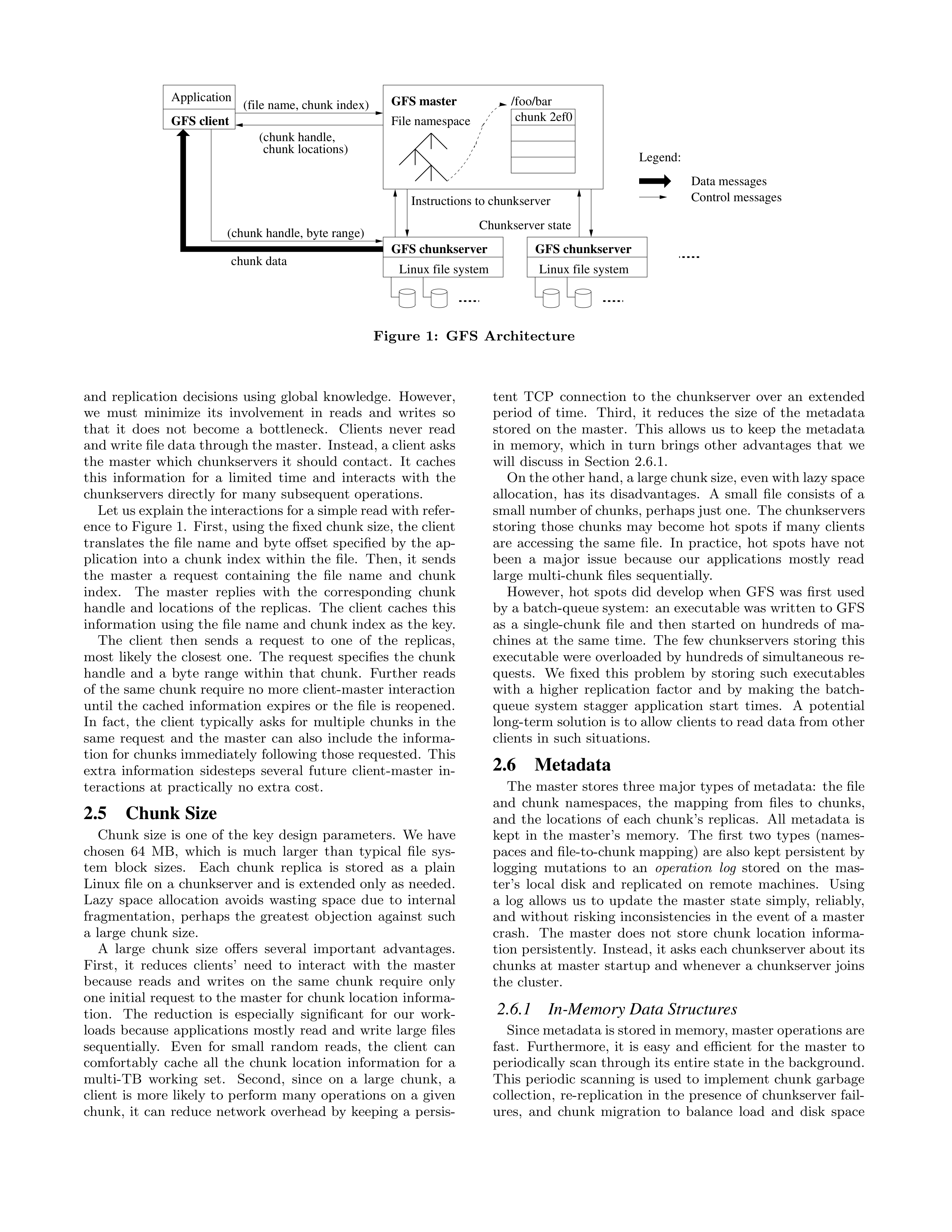
Legend:
Data messages
Control messages
Application
(file name, chunk index)
(chunk handle,
chunk locations)
GFS master
File namespace
/foo/bar
Instructions to chunkserver
Chunkserver state
GFS chunkserver
GFS chunkserver
(chunk handle, byte range)
chunk data
chunk 2ef0
Linux file system
Linux file system
GFS client
Figure
1:
GFS
Architecture
and
replication
decisions
using
global
knowledge.
However,
we
must
minimize
its
involvement
in
reads
and
writes
so
that
it
does
not
become
a
bottleneck.
Clients
never
read
and write file data through the master.
Instead, a client asks
the
master
which
chunkservers
it
should
contact.
It
caches
this
information
for
a
limited
time
and
interacts
with
the
chunkservers
directly
for
many
subsequent
operations.
Let us explain the interactions for a simple read with refer-
ence to Figure 1.
First,
using the fixed chunk size,
the client
translates
the
file
name
and
byte
offset
specified
by
the
ap-
plication
into
a
chunk
index
within
the
file.
Then,
it
sends
the
master
a
request
containing
the
file
name
and
chunk
index.
The
master
replies
with
the
corresponding
chunk
handle
and
locations
of
the
replicas.
The
client
caches
this
information
using
the
file
name
and
chunk
index
as
the
key.
The
client
then
sends
a
request
to
one
of
the
replicas,
most
likely
the
closest
one.
The
request
specifies
the
chunk
handle
and
a
byte
range
within
that
chunk.
Further
reads
of
the
same
chunk require
no
more
client-master
interaction
until
the
cached
information
expires
or
the
file
is
reopened.
In
fact,
the
client
typically
asks
for
multiple
chunks
in
the
same
request
and
the
master
can
also
include
the
informa-
tion for
chunks immediately
following
those requested.
This
extra
information
sidesteps
several
future
client-master
in-
teractions
at
practically
no
extra
cost.
2.5
Chunk Size
Chunk
size
is
one
of
the
key
design
parameters.
We
have
chosen
64
MB,
which
is
much
larger
than
typical
file
sys-
tem
block
sizes.
Each
chunk
replica
is
stored
as
a
plain
Linux
file
on
a
chunkserver
and
is
extended
only
as
needed.
Lazy
space
allocation
avoids
wasting
space
due
to
internal
fragmentation,
perhaps
the
greatest
objection
against
such
a
large
chunk
size.
A
large
chunk
size
offers
several
important
advantages.
First,
it
reduces
clients’
need
to
interact
with
the
master
because
reads
and
writes
on
the
same
chunk
require
only
one initial
request to the master for
chunk location
informa-
tion.
The
reduction
is
especially
significant
for
our
work-
loads
because
applications
mostly
read
and
write
large
files
sequentially.
Even
for
small
random
reads,
the
client
can
comfortably
cache
all
the
chunk
location
information
for
a
multi-TB
working
set.
Second,
since
on
a
large
chunk,
a
client
is
more
likely
to
perform
many
operations
on
a
given
chunk,
it
can
reduce
network
overhead
by
keeping
a
persis-
tent
TCP
connection
to
the
chunkserver
over
an
extended
period
of
time.
Third,
it
reduces
the
size
of
the
metadata
stored
on
the
master.
This
allows
us
to
keep
the
metadata
in
memory,
which
in
turn
brings
other
advantages
that
we
will
discuss
in
Section
2.6.1.
On the other hand, a large chunk size, even with lazy space
allocation,
has
its
disadvantages.
A
small
file
consists
of
a
small number of chunks, perhaps just one.
The chunkservers
storing
those
chunks
may
become
hot
spots
if
many
clients
are
accessing
the
same
file.
In
practice,
hot
spots
have
not
been
a
major
issue
because
our
applications
mostly
read
large
multi-chunk
files
sequentially.
However,
hot
spots
did
develop
when
GFS
was
first
used
by a batch-queue system:
an executable was written to GFS
as
a
single-chunk
file
and
then
started
on
hundreds
of
ma-
chines
at
the
same
time.
The
few
chunkservers
storing
this
executable
were
overloaded
by
hundreds of
simultaneous
re-
quests.
We
fixed
this
problem
by
storing
such
executables
with
a
higher
replication
factor
and
by
making
the
batch-
queue
system
stagger
application
start
times.
A
potential
long-term solution is to allow
clients to read data from other
clients
in
such
situations.
2.6
Metadata
The
master
stores
three
major
types
of
metadata:
the file
and
chunk
namespaces,
the
mapping
from
files
to
chunks,
and
the
locations
of
each
chunk’s
replicas.
All
metadata
is
kept
in
the
master’s
memory.
The
first
two
types
(names-
paces and file-to-chunk mapping) are also kept persistent by
logging
mutations
to
an
operation
log
stored
on
the
mas-
ter’s
local
disk
and
replicated
on
remote
machines.
Using
a
log
allows
us
to
update
the
master
state
simply,
reliably,
and
without
risking
inconsistencies
in
the
event
of
a
master
crash.
The
master
does
not
store
chunk
location
informa-
tion persistently.
Instead,
it asks each chunkserver about its
chunks
at
master
startup
and
whenever
a
chunkserver
joins
the
cluster.
2.6.1
In-Memory Data Structures
Since metadata is stored in memory, master operations are
fast.
Furthermore,
it
is
easy
and
efficient
for
the
master
to
periodically
scan through its
entire state
in the background.
This
periodic
scanning
is
used
to
implement
chunk
garbage
collection,
re-replication
in
the
presence
of
chunkserver
fail-
ures,
and
chunk
migration
to
balance
load
and
disk
space

usage
across
chunkservers.
Sections
4.3
and
4.4
will
discuss
these
activities
further.
One
potential
concern
for
this
memory-only
approach
is
that
the
number
of
chunks
and
hence
the
capacity
of
the
whole
system
is
limited
by
how
much
memory
the
master
has.
This
is
not
a
serious
limitation
in
practice.
The
mas-
ter maintains less than 64 bytes of metadata for each 64 MB
chunk.
Most chunks are full because most files contain many
chunks,
only
the
last
of
which
may
be
partially
filled.
Sim-
ilarly,
the
file
namespace
data
typically
requires
less
then
64
bytes
per
file
because
it
stores
file
names
compactly
us-
ing
prefix
compression.
If
necessary
to
support
even
larger
file
systems,
the
cost
of adding extra memory to the master is a small price to pay
for
the simplicity,
reliability,
performance,
and flexibility
we
gain
by
storing
the
metadata
in
memory.
2.6.2
Chunk Locations
The
master
does
not
keep
a
persistent
record
of
which
chunkservers have a replica
of a given chunk.
It simply
polls
chunkservers
for
that
information
at
startup.
The
master
can
keep
itself
up-to-date
thereafter
because
it
controls
all
chunk
placement
and
monitors
chunkserver status
with
reg-
ular
HeartBeat
messages.
We initially attempted to keep chunk location information
persistently
at
the
master,
but we
decided
that
it
was
much
simpler
to
request
the
data
from
chunkservers
at
startup,
and
periodically
thereafter.
This
eliminated
the
problem
of
keeping the master and chunkservers in sync as chunkservers
join
and
leave
the
cluster,
change
names,
fail,
restart,
and
so
on.
In
a
cluster
with
hundreds
of
servers,
these
events
happen
all
too
often.
Another way
to understand this design
decision
is
to real-
ize
that
a
chunkserver
has
the
final
word
over
what
chunks
it
does
or
does
not
have
on
its
own
disks.
There
is
no
point
in
trying
to
maintain
a
consistent
view
of
this
information
on
the
master
because
errors
on
a
chunkserver
may
cause
chunks
to
vanish
spontaneously
(e.g.,
a
disk
may
go
bad
and
be
disabled)
or
an
operator
may
rename
a
chunkserver.
2.6.3
Operation Log
The
operation
log
contains
a
historical
record
of
critical
metadata
changes.
It
is
central
to
GFS.
Not
only
is
it
the
only
persistent
record
of
metadata,
but
it
also
serves
as
a
logical
time
line
that
defines
the
order
of
concurrent
op-
erations.
Files
and
chunks,
as
well
as
their
versions
(see
Section
4.5),
are
all
uniquely
and
eternally
identified
by
the
logical
times
at
which
they
were
created.
Since
the
operation
log
is
critical,
we
must
store
it
reli-
ably
and
not
make
changes
visible
to
clients
until
metadata
changes
are
made
persistent.
Otherwise,
we
effectively
lose
the
whole
file
system
or
recent
client
operations
even
if
the
chunks
themselves
survive.
Therefore,
we
replicate
it
on
multiple
remote
machines
and
respond
to
a
client
opera-
tion
only
after
flushing
the
corresponding
log
record
to
disk
both
locally
and
remotely.
The
master
batches
several
log
records together before flushing thereby reducing the impact
of
flushing
and
replication
on
overall
system
throughput.
The
master
recovers
its
file
system
state
by
replaying
the
operation
log.
To
minimize
startup
time,
we
must
keep
the
log small.
The master checkpoints its state whenever the log
grows
beyond a certain size so
that it can recover by loading
the
latest
checkpoint
from
local
disk
and
replaying
only
the
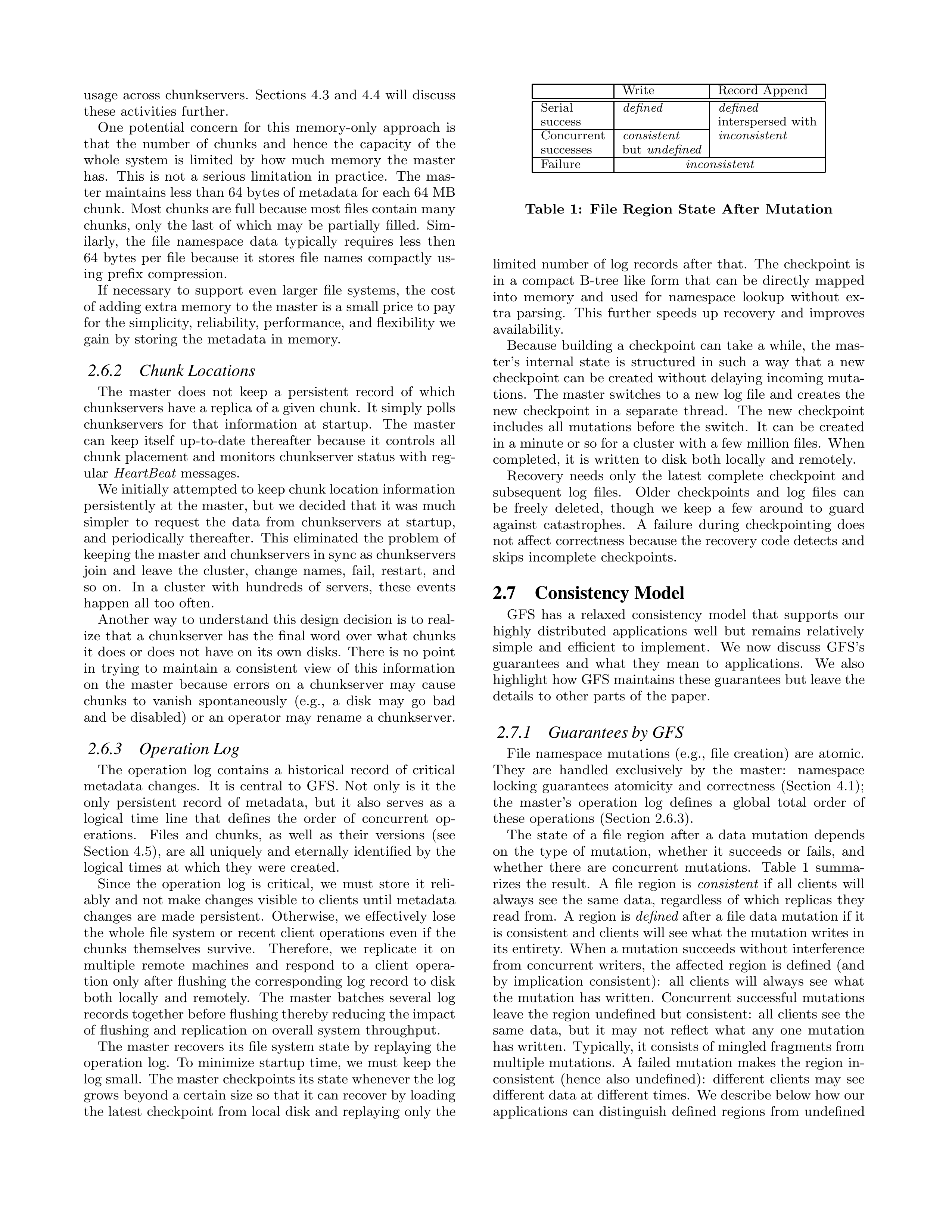
Write
Record
Append
Serial
defined
defined
success
interspersed
with
Concurrent
consistent
inconsistent
successes
but
undefined
Failure
inconsistent
Table
1:
File
Region
State
After
Mutation
limited
number
of
log
records
after
that.
The
checkpoint
is
in
a
compact
B-tree
like
form
that
can
be
directly
mapped
into
memory
and
used
for
namespace
lookup
without
ex-
tra
parsing.
This
further
speeds
up
recovery
and
improves
availability.
Because
building
a
checkpoint
can
take
a
while,
the
mas-
ter’s
internal
state
is
structured
in
such
a
way
that
a
new
checkpoint can
be
created
without
delaying
incoming
muta-
tions.
The
master
switches
to
a
new
log
file
and
creates
the
new
checkpoint
in
a
separate
thread.
The
new
checkpoint
includes
all
mutations
before
the
switch.
It
can
be
created
in a minute or so for a cluster with a few million
files.
When
completed,
it
is
written
to
disk
both
locally
and
remotely.
Recovery
needs
only
the
latest
complete
checkpoint
and
subsequent
log
files.
Older
checkpoints
and
log
files
can
be
freely
deleted,
though
we
keep
a
few
around
to
guard
against
catastrophes.
A
failure
during
checkpointing
does
not affect
correctness
because
the recovery
code detects
and
skips
incomplete
checkpoints.
2.7
Consistency Model
GFS
has
a
relaxed
consistency
model
that
supports
our
highly
distributed
applications
well
but
remains
relatively
simple
and
efficient
to
implement.
We
now
discuss
GFS’s
guarantees
and
what
they
mean
to
applications.
We
also
highlight how GFS maintains these guarantees but leave the
details
to
other
parts
of
the
paper.
2.7.1
Guarantees by GFS
File
namespace
mutations
(e.g.,
file
creation)
are
atomic.
They
are
handled
exclusively
by
the
master:
namespace
locking
guarantees
atomicity
and
correctness
(Section
4.1);
the
master’s
operation
log
defines
a
global
total
order
of
these
operations
(Section
2.6.3).
The
state
of
a
file
region
after
a
data
mutation
depends
on
the
type
of
mutation,
whether
it
succeeds
or
fails,
and
whether
there
are
concurrent
mutations.
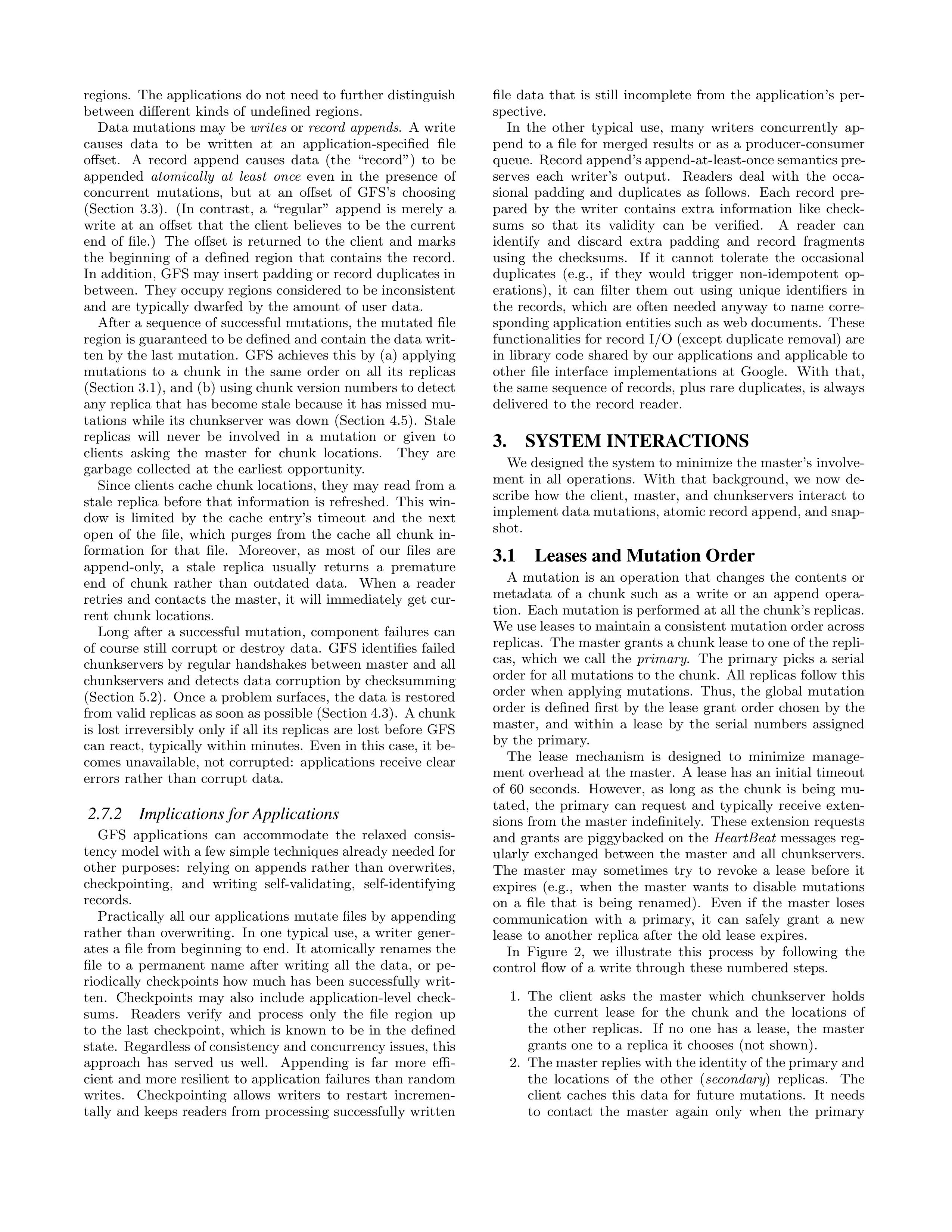
Table
1
summa-
rizes
the
result.
A
file
region
is
consistent
if
all
clients
will
always
see
the
same
data,
regardless
of
which
replicas
they
read
from.
A region
is
defined
after
a
file data
mutation
if
it
is consistent and clients will see what the mutation writes
in
its
entirety.
When a mutation succeeds
without interference
from
concurrent
writers,
the
affected
region
is
defined
(and
by
implication
consistent):
all
clients
will
always
see
what
the
mutation
has
written.
Concurrent
successful
mutations
leave
the
region
undefined
but
consistent:
all
clients
see
the
same
data,
but
it
may
not
reflect
what
any
one
mutation
has written.
Typically, it consists of mingled fragments from
multiple
mutations.
A
failed
mutation
makes
the
region
in-
consistent
(hence
also
undefined):
different
clients
may
see
different data at different times.
We describe below how our
applications
can
distinguish
defined
regions
from
undefined
regions.
The
applications
do
not
need to
further distinguish
between
different
kinds
of
undefined
regions.
Data
mutations
may
be
writes
or
record
appends
.
A
write
causes
data
to
be
written
at
an
application-specified
file
offset.
A
record
append
causes
data
(the
“record”)
to
be
appended
atomically
at
least
once
even
in
the
presence
of
concurrent
mutations,
but
at
an
offset
of
GFS’s
choosing
(Section
3.3).
(In
contrast,
a
“regular”
append
is
merely
a
write
at
an
offset
that
the
client
believes
to
be
the
current
end
of
file.)
The
offset
is
returned
to
the
client
and
marks
the
beginning
of
a
defined
region
that
contains
the
record.
In addition,
GFS may
insert padding or record duplicates in
between.
They
occupy regions
considered
to be inconsistent
and
are
typically
dwarfed
by
the
amount
of
user
data.
After
a
sequence
of
successful
mutations,
the
mutated
file
region is guaranteed to be defined and contain the data writ-
ten
by the last
mutation.
GFS
achieves
this
by (a)
applying
mutations
to
a
chunk
in
the
same
order
on
all
its
replicas
(Section 3.1), and (b) using chunk version numbers to detect
any
replica
that has become
stale
because
it has
missed
mu-
tations
while
its
chunkserver
was
down
(Section
4.5).
Stale
replicas
will
never
be
involved
in
a
mutation
or
given
to
clients
asking
the
master
for
chunk
locations.
They
are
garbage
collected
at
the
earliest
opportunity.
Since
clients
cache
chunk
locations,
they
may
read
from
a
stale
replica
before
that
information
is
refreshed.
This
win-
dow
is
limited
by
the
cache
entry’s
timeout
and
the
next
open
of
the
file,
which
purges
from
the
cache
all
chunk
in-
formation
for
that
file.
Moreover,
as
most
of
our
files
are
append-only,
a
stale
replica
usually
returns
a
premature
end
of
chunk
rather
than
outdated
data.
When
a
reader
retries
and
contacts
the
master,
it
will
immediately
get
cur-
rent
chunk
locations.
Long
after
a
successful
mutation,
component
failures
can
of
course
still
corrupt
or
destroy
data.
GFS
identifies
failed
chunkservers
by
regular
handshakes
between
master
and
all
chunkservers
and
detects
data
corruption
by
checksumming
(Section
5.2).
Once
a
problem
surfaces,
the
data
is
restored
from valid replicas as soon as possible (Section 4.3).
A chunk
is
lost
irreversibly
only
if
all
its
replicas
are
lost
before
GFS
can
react,
typically
within minutes.
Even in this
case,
it be-
comes
unavailable,
not
corrupted:
applications
receive
clear
errors
rather
than
corrupt
data.
2.7.2
Implications for Applications
GFS
applications
can
accommodate
the
relaxed
consis-
tency model with a few simple techniques already needed for
other
purposes:
relying
on
appends
rather
than
overwrites,
checkpointing,
and
writing
self-validating,
self-identifying
records.
Practically
all
our
applications
mutate
files
by
appending
rather
than
overwriting.
In
one
typical
use,
a
writer
gener-
ates
a
file
from
beginning
to
end.
It
atomically
renames
the
file
to
a
permanent
name
after
writing
all
the
data,
or
pe-
riodically
checkpoints
how
much
has
been
successfully
writ-
ten.
Checkpoints
may
also
include
application-level
check-
sums.
Readers
verify
and
process
only
the
file
region
up
to
the
last
checkpoint,
which
is
known
to
be
in
the
defined
state.
Regardless of consistency and concurrency issues, this
approach
has
served
us
well.
Appending
is
far
more
effi-
cient
and
more
resilient
to
application
failures
than
random
writes.
Checkpointing
allows
writers
to
restart
incremen-
tally
and
keeps
readers
from
processing
successfully
written
file
data
that
is
still
incomplete
from
the
application’s
per-
spective.
In
the
other
typical
use,
many
writers
concurrently
ap-
pend
to
a
file
for
merged
results
or
as
a
producer-consumer
queue.
Record append’s append-at-least-once semantics pre-
serves
each
writer’s
output.
Readers
deal
with
the
occa-
sional
padding
and
duplicates
as
follows.
Each
record
pre-
pared
by
the
writer
contains
extra
information
like
check-
sums
so
that
its
validity
can
be
verified.
A
reader
can
identify
and
discard
extra
padding
and
record
fragments
using
the
checksums.
If
it
cannot
tolerate
the
occasional
duplicates
(e.g.,
if
they
would
trigger
non-idempotent
op-
erations),
it
can
filter
them
out
using
unique
identifiers
in
the
records,
which
are
often
needed
anyway
to
name
corre-
sponding application entities such as web documents.
These
functionalities
for record I/O (except duplicate removal) are
in
library
code
shared
by
our
applications
and
applicable
to
other
file
interface
implementations
at
Google.
With
that,
the same
sequence
of
records,
plus rare
duplicates,
is
always
delivered
to
the
record
reader.
3.
SYSTEM INTERACTIONS
We designed the system to minimize
the master’s
involve-
ment
in
all
operations.
With
that
background,
we
now
de-
scribe
how
the
client,
master,
and
chunkservers
interact
to
implement data mutations, atomic record append, and snap-
shot.
3.1
Leases and Mutation Order
A
mutation
is
an
operation
that
changes
the
contents
or
metadata
of
a
chunk
such
as
a
write
or
an
append
opera-
tion.
Each mutation is performed at all the chunk’s replicas.
We use leases to maintain a consistent mutation order across
replicas.
The master grants a chunk lease to one of the repli-
cas,
which
we
call
the
primary
.
The
primary
picks
a
serial
order
for
all
mutations
to
the
chunk.
All
replicas
follow
this
order
when
applying
mutations.
Thus,
the
global
mutation
order
is
defined
first
by
the
lease
grant
order
chosen
by
the
master,
and
within
a
lease
by
the
serial
numbers
assigned
by
the
primary.
The
lease
mechanism
is
designed
to
minimize
manage-
ment
overhead at
the
master.
A
lease
has
an
initial
timeout
of
60
seconds.
However,
as
long
as
the
chunk
is
being
mu-
tated,
the
primary
can
request
and
typically
receive
exten-
sions
from
the
master
indefinitely.
These
extension
requests
and
grants
are
piggybacked
on
the
HeartBeat
messages
reg-
ularly
exchanged
between
the
master
and
all
chunkservers.
The
master
may
sometimes
try
to
revoke
a
lease
before
it
expires
(e.g.,
when
the
master
wants
to
disable
mutations
on
a
file
that
is
being
renamed).
Even
if
the
master
loses
communication
with
a
primary,
it
can
safely
grant
a
new
lease
to
another
replica
after
the
old
lease
expires.
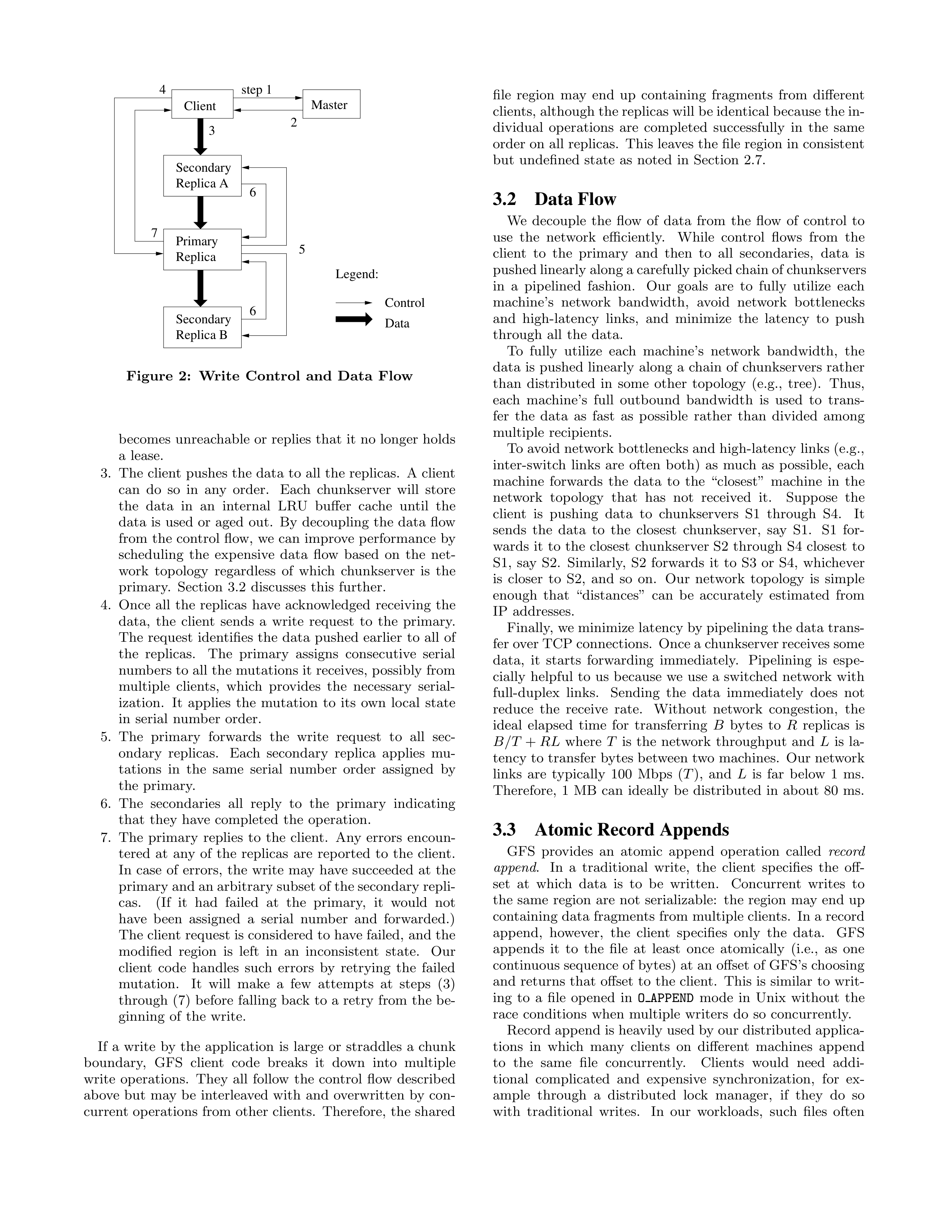
In
Figure
2,
we
illustrate
this
process
by
following
the
control
flow
of
a
write
through
these
numbered
steps.
1.
The
client
asks
the
master
which
chunkserver
holds
the
current
lease
for
the
chunk
and
the
locations
of
the
other
replicas.
If
no
one
has
a
lease,
the
master
grants
one
to
a
replica
it
chooses
(not
shown).
2.
The master replies with the identity of the primary and
the
locations
of
the
other
(
secondary
)
replicas.
The
client
caches
this
data
for
future
mutations.
It
needs
to
contact
the
master
again
only
when
the
primary

Primary
Replica
Secondary
Replica B
Secondary
Replica A
Master
Legend:
Control
Data
3
Client
2
step 1
4
5
6
6
7
Figure
2:
Write
Control
and
Data
Flow
becomes
unreachable
or
replies
that
it
no
longer
holds
a
lease.
3.
The
client
pushes
the
data
to
all
the
replicas.
A
client
can
do
so
in
any
order.
Each
chunkserver
will
store
the
data
in
an
internal
LRU
buffer
cache
until
the
data
is
used
or
aged
out.
By
decoupling
the
data
flow
from
the
control
flow,
we
can
improve
performance
by
scheduling
the
expensive
data
flow
based
on
the
net-
work
topology
regardless
of
which
chunkserver
is
the
primary.
Section
3.2
discusses
this
further.
4.
Once
all
the
replicas
have
acknowledged
receiving
the
data,
the
client
sends
a
write
request
to
the
primary.
The
request
identifies
the
data
pushed
earlier
to
all
of
the
replicas.
The
primary
assigns
consecutive
serial
numbers to all
the mutations it receives,
possibly
from
multiple
clients,
which
provides
the
necessary
serial-
ization.
It
applies
the
mutation
to
its
own
local
state
in
serial
number
order.
5.
The
primary
forwards
the
write
request
to
all
sec-
ondary
replicas.
Each
secondary
replica
applies
mu-
tations
in
the
same
serial
number
order
assigned
by
the
primary.
6.
The
secondaries
all
reply
to
the
primary
indicating
that
they
have
completed
the
operation.
7.
The
primary
replies
to
the
client.
Any
errors
encoun-
tered
at
any
of
the
replicas
are
reported
to
the
client.
In
case
of
errors,
the
write
may
have
succeeded
at
the
primary and an arbitrary subset of the secondary repli-
cas.
(If
it
had
failed
at
the
primary,
it
would
not
have
been
assigned
a
serial
number
and
forwarded.)
The client request is
considered to have failed,
and the
modified
region
is
left
in
an
inconsistent
state.
Our
client
code
handles
such
errors
by
retrying
the
failed
mutation.
It
will
make
a
few
attempts
at
steps
(3)
through
(7)
before
falling
back
to
a
retry
from
the
be-
ginning
of
the
write.
If
a
write
by
the
application
is
large
or
straddles
a
chunk
boundary,
GFS
client
code
breaks
it
down
into
multiple
write
operations.
They
all
follow
the
control
flow
described
above
but
may
be
interleaved
with
and
overwritten
by
con-
current operations
from
other
clients.
Therefore,
the
shared
file
region
may
end
up
containing
fragments
from
different
clients, although the replicas will be identical because the in-
dividual
operations
are
completed
successfully
in
the
same
order on
all
replicas.
This
leaves
the file region
in consistent
but
undefined
state
as
noted
in
Section
2.7.
3.2
Data Flow
We
decouple
the
flow
of
data
from
the
flow
of
control
to
use
the
network
efficiently.
While
control
flows
from
the
client
to
the
primary
and
then
to
all
secondaries,
data
is
pushed linearly along a carefully picked chain of chunkservers
in
a
pipelined
fashion.
Our
goals
are
to
fully
utilize
each
machine’s
network
bandwidth,
avoid
network
bottlenecks
and
high-latency
links,
and
minimize
the
latency
to
push
through
all
the
data.
To
fully
utilize
each
machine’s
network
bandwidth,
the
data
is
pushed
linearly
along
a
chain
of
chunkservers
rather
than
distributed
in
some
other
topology
(e.g.,
tree).
Thus,
each
machine’s
full
outbound
bandwidth
is
used
to
trans-
fer
the
data
as
fast
as
possible
rather
than
divided
among
multiple
recipients.
To avoid network
bottlenecks and high-latency
links (e.g.,
inter-switch
links
are
often
both)
as
much
as
possible,
each
machine
forwards
the
data
to
the
“closest”
machine
in
the
network
topology
that
has
not
received
it.
Suppose
the
client
is
pushing
data
to
chunkservers
S1
through
S4.
It
sends
the
data
to
the
closest
chunkserver,
say
S1.
S1
for-
wards
it
to
the
closest
chunkserver S2
through
S4
closest
to
S1,
say
S2.
Similarly,
S2
forwards
it
to
S3
or
S4,
whichever
is
closer
to
S2,
and
so
on.
Our
network
topology
is
simple
enough
that
“distances”
can
be
accurately
estimated
from
IP
addresses.
Finally,
we minimize
latency by pipelining the data trans-
fer over TCP connections.
Once a chunkserver receives some
data,
it
starts
forwarding
immediately.
Pipelining
is
espe-
cially
helpful
to
us
because
we
use
a
switched
network
with
full-duplex
links.
Sending
the
data
immediately
does
not
reduce
the
receive
rate.
Without
network
congestion,
the
ideal
elapsed
time
for
transferring
B
bytes
to
R
replicas
is
B/T
+
RL
where
T
is
the
network
throughput
and
L
is
la-
tency
to
transfer
bytes between two
machines.
Our network
links
are
typically
100
Mbps
(
T
),
and
L
is
far
below
1
ms.
Therefore,
1
MB
can
ideally
be
distributed
in
about
80
ms.
3.3
Atomic Record Appends
GFS
provides
an
atomic
append
operation
called
record
append
.
In
a
traditional
write,
the
client
specifies
the
off-
set
at
which
data
is
to
be
written.
Concurrent
writes
to
the
same
region
are
not
serializable:
the
region
may
end
up
containing data fragments
from
multiple clients.
In a record
append,
however,
the
client
specifies
only
the
data.
GFS
appends
it
to
the
file
at
least
once
atomically
(i.e.,
as
one
continuous sequence of bytes) at an offset of GFS’s choosing
and
returns
that
offset
to
the
client.
This
is
similar
to
writ-
ing
to
a
file
opened
in
O
APPEND
mode
in
Unix
without
the
race
conditions
when
multiple
writers
do
so
concurrently.
Record append is heavily
used by our distributed applica-
tions
in
which
many
clients
on
different
machines
append
to
the
same
file
concurrently.
Clients
would
need
addi-
tional
complicated
and
expensive
synchronization,
for
ex-
ample
through
a
distributed
lock
manager,
if
they
do
so
with
traditional
writes.
In
our
workloads,
such
files
often
serve
as
multiple-producer/single-consumer
queues
or
con-
tain
merged
results
from
many
different
clients.
Record
append
is
a
kind
of
mutation
and
follows
the
con-
trol
flow
in
Section
3.1
with
only
a
little
extra
logic
at
the
primary.
The
client
pushes
the
data
to
all
replicas
of
the
last
chunk
of
the
file
Then,
it
sends
its
request
to
the
pri-
mary.
The
primary
checks
to
see
if
appending
the
record
to
the
current
chunk
would
cause
the
chunk
to
exceed
the
maximum size
(64 MB).
If so,
it pads the chunk to the max-
imum
size,
tells
secondaries
to
do
the
same,
and
replies
to
the
client
indicating
that
the
operation
should
be
retried
on
the
next
chunk.
(Record
append
is
restricted
to
be
at
most
one-fourth
of
the
maximum
chunk
size
to
keep
worst-
case
fragmentation
at
an
acceptable
level.)
If
the
record
fits
within
the
maximum
size,
which
is
the
common
case,
the
primary
appends
the
data
to
its
replica,
tells
the
secon-
daries
to
write
the data at
the exact offset
where it
has,
and
finally
replies
success
to
the
client.
If a record append fails at any replica, the client retries the
operation.
As
a
result,
replicas
of
the
same
chunk
may
con-
tain
different data
possibly
including
duplicates
of
the
same
record
in
whole
or
in
part.
GFS
does
not
guarantee
that
all
replicas
are
bytewise
identical.
It
only
guarantees
that
the
data
is
written
at
least
once
as
an
atomic
unit.
This
prop-
erty
follows
readily
from
the simple
observation
that
for
the
operation to report success, the data must have been written
at
the
same
offset
on
all
replicas
of
some
chunk.
Further-
more,
after
this,
all
replicas
are
at
least
as
long
as
the
end
of
record
and
therefore
any
future
record
will
be
assigned
a
higher
offset
or
a
different
chunk
even
if
a
different
replica
later becomes the primary.
In terms of our consistency guar-
antees,
the regions
in which successful
record append opera-
tions
have
written
their
data
are
defined (hence
consistent),
whereas
intervening
regions
are
inconsistent
(hence
unde-
fined).
Our
applications
can
deal
with
inconsistent
regions
as
we
discussed
in
Section
2.7.2.
3.4
Snapshot
The
snapshot
operation
makes
a
copy
of
a
file
or
a
direc-
tory
tree
(the
“source”)
almost
instantaneously,
while
min-
imizing
any
interruptions
of
ongoing
mutations.
Our
users
use
it
to
quickly create
branch copies
of
huge
data
sets
(and
often
copies
of
those
copies,
recursively),
or
to
checkpoint
the
current
state
before
experimenting
with
changes
that
can
later
be
committed
or
rolled
back
easily.
Like AFS [5], we use standard copy-on-write techniques to
implement
snapshots.
When the
master
receives
a
snapshot
request, it first revokes any outstanding leases on the chunks
in
the
files
it
is
about
to
snapshot.
This
ensures
that
any
subsequent writes to these chunks will require an interaction
with
the
master
to
find
the
lease
holder.
This
will
give
the
master
an
opportunity
to
create
a
new
copy
of
the
chunk
first.
After
the
leases
have
been
revoked
or
have
expired,
the
master
logs
the
operation
to
disk.
It
then
applies
this
log
record
to
its
in-memory
state
by
duplicating
the
metadata
for the source file or directory tree.
The newly created snap-
shot
files
point
to
the
same
chunks
as
the
source
files.
The
first
time
a
client
wants
to
write
to
a
chunk
C
after
the
snapshot
operation,
it
sends
a
request
to
the
master
to
find
the
current
lease
holder.
The
master
notices
that
the
reference
count
for
chunk
C
is
greater
than
one.
It
defers
replying
to
the client
request and instead
picks a
new chunk
handle
C’.
It
then
asks
each
chunkserver
that
has
a
current
replica
of
C
to
create
a
new
chunk
called
C’.
By
creating
the
new
chunk
on
the
same
chunkservers
as
the
original,
we
ensure
that
the data
can
be
copied
locally,
not
over
the net-
work
(our
disks
are
about
three
times
as
fast
as
our
100
Mb
Ethernet links).
From
this
point,
request
handling is
no
dif-
ferent from that for any chunk:
the master
grants one of the
replicas a lease on the new chunk C’ and replies to the client,
which can write the chunk normally, not knowing that it has
just
been
created
from
an
existing
chunk.
4.
MASTER OPERATION
The
master
executes
all
namespace
operations.
In
addi-
tion,
it
manages
chunk
replicas
throughout
the
system:
it
makes
placement
decisions,
creates
new
chunks
and
hence
replicas,
and
coordinates
various
system-wide
activities
to
keep
chunks
fully
replicated,
to
balance
load
across
all
the
chunkservers,
and
to
reclaim
unused
storage.
We
now
dis-
cuss
each
of
these
topics.
4.1
Namespace Management and Locking
Many
master
operations
can
take
a
long
time:
for
exam-
ple, a snapshot operation has to revoke chunkserver leases on
all chunks covered by the snapshot.
We do not want to delay
other
master
operations
while
they
are
running.
Therefore,
we
allow
multiple
operations
to
be
active
and
use
locks
over
regions
of
the
namespace
to
ensure
proper
serialization.
Unlike
many
traditional
file
systems,
GFS
does
not
have
a
per-directory
data
structure
that
lists
all
the
files
in
that
directory.
Nor
does
it
support
aliases
for
the
same
file
or
directory
(i.e,
hard
or
symbolic
links
in
Unix
terms).
GFS
logically represents its namespace as a lookup table mapping
full
pathnames
to
metadata.
With
prefix
compression,
this
table
can
be
efficiently
represented
in
memory.
Each
node
in
the
namespace
tree
(either
an
absolute
file
name
or
an
absolute
directory
name)
has
an
associated
read-write
lock.
Each
master
operation
acquires
a
set
of
locks
before
it
runs.
Typically,
if
it
involves
/d1/d2/.../dn/leaf
,
it
will
acquire
read-locks
on
the
directory
names
/d1
,
/d1/d2
,
...,
/d1/d2/.../dn
,
and either a read lock or a write lock on the
full pathname
/d1/d2/.../dn/leaf
.
Note that
leaf
may be
a
file
or
directory
depending
on
the
operation.
We now illustrate how this locking mechanism can prevent
a
file
/home/user/foo
from
being
created
while
/home/user
is
being
snapshotted
to
/save/user
.
The
snapshot
oper-
ation
acquires
read
locks
on
/home
and
/save
,
and
write
locks
on
/home/user
and
/save/user
.
The
file
creation
ac-
quires
read
locks
on
/home
and
/home/user
,
and
a
write
lock
on
/home/user/foo
.
The
two
operations
will
be
seri-
alized
properly
because
they
try
to
obtain
conflicting
locks
on
/home/user
.
File
creation
does
not
require
a
write
lock
on
the
parent
directory
because
there
is
no
“directory”,
or
inode
-like, data structure to be protected from modification.
The read lock
on the name is sufficient to protect the parent
directory
from
deletion.
One
nice
property
of
this
locking
scheme
is
that
it
allows
concurrent
mutations
in
the
same
directory.
For
example,
multiple
file
creations
can
be
executed
concurrently
in
the
same
directory:
each
acquires
a
read
lock
on
the
directory
name
and
a
write
lock
on
the
file
name.
The
read
lock
on
the
directory
name
suffices
to
prevent
the
directory
from
being
deleted,
renamed,
or
snapshotted.
The
write
locks
on
file
names
serialize
attempts
to
create
a
file
with
the
same
name
twice.
Since the namespace can have many nodes, read-write lock
objects
are
allocated
lazily
and
deleted
once
they
are
not
in
use.
Also,
locks
are
acquired
in
a
consistent
total
order
to
prevent
deadlock:
they
are
first
ordered
by
level
in
the
namespace
tree
and
lexicographically
within
the
same
level.
4.2
Replica Placement
A
GFS
cluster
is
highly
distributed
at
more
levels
than
one.
It typically
has hundreds of
chunkservers spread across
many
machine
racks.
These
chunkservers
in
turn
may
be
accessed
from
hundreds of
clients
from
the
same
or
different
racks.
Communication
between
two
machines
on
different
racks
may
cross
one
or
more
network
switches.
Addition-
ally,
bandwidth
into
or
out
of
a
rack
may
be
less
than
the
aggregate
bandwidth
of
all
the
machines
within
the
rack.
Multi-level
distribution
presents
a
unique
challenge
to
dis-
tribute
data
for
scalability,
reliability,
and
availability.
The
chunk
replica
placement
policy
serves
two
purposes:
maximize data reliability and availability, and maximize net-
work
bandwidth
utilization.
For
both,
it
is
not
enough
to
spread
replicas
across
machines,
which
only
guards
against
disk or machine failures and fully utilizes each machine’s net-
work
bandwidth.
We must also spread chunk replicas across
racks.
This
ensures
that
some
replicas
of
a
chunk
will
sur-
vive
and
remain
available
even
if
an
entire
rack
is
damaged
or
offline
(for
example,
due
to
failure
of
a
shared
resource
like
a
network
switch
or
power
circuit).
It
also
means
that
traffic,
especially
reads,
for
a
chunk
can
exploit
the
aggre-
gate
bandwidth of
multiple
racks.
On
the
other
hand,
write
traffic has to flow through multiple racks, a tradeoffwe make
willingly.
4.3
Creation, Re-replication, Rebalancing
Chunk
replicas
are
created
for
three
reasons:
chunk
cre-
ation,
re-replication,
and
rebalancing.
When
the
master
creates
a
chunk,
it
chooses
where
to
place
the
initially
empty
replicas.
It
considers
several
fac-
tors.
(1) We want to place new replicas on chunkservers with
below-average
disk
space
utilization.
Over
time
this
will
equalize disk utilization across chunkservers.
(2) We want to
limit
the
number of
“recent”
creations
on
each
chunkserver.
Although
creation
itself
is
cheap,
it
reliably
predicts
immi-
nent heavy write traffic because chunks are created when de-
manded by writes, and in our append-once-read-many work-
load
they
typically
become
practically
read-only
once
they
have
been
completely
written.
(3)
As
discussed
above,
we
want
to
spread
replicas
of
a
chunk
across
racks.
The
master
re-replicates
a
chunk
as
soon
as
the
number
of
available
replicas
falls
below
a
user-specified
goal.
This
could
happen
for
various
reasons:
a
chunkserver
becomes
unavailable, it reports that its replica may be corrupted, one
of
its
disks
is
disabled
because
of
errors,
or
the
replication
goal
is
increased.
Each
chunk
that
needs
to
be
re-replicated
is
prioritized
based
on
several
factors.
One
is
how
far
it
is
from
its
replication
goal.
For
example,
we
give
higher
prior-
ity to a chunk that has lost two replicas than to a chunk that
has
lost
only
one.
In
addition,
we
prefer
to
first
re-replicate
chunks
for
live
files
as
opposed
to
chunks
that
belong
to
re-
cently
deleted
files
(see
Section
4.4).
Finally,
to
minimize
the
impact
of
failures
on
running
applications,
we
boost
the
priority
of
any
chunk
that
is
blocking
client
progress.
The
master
picks
the
highest
priority
chunk
and
“clones”
it
by
instructing
some
chunkserver
to
copy
the
chunk
data
directly
from
an
existing
valid
replica.
The
new
replica
is
placed
with
goals
similar
to
those
for
creation:
equalizing
disk
space
utilization,
limiting
active
clone
operations
on
any
single
chunkserver,
and
spreading
replicas
across
racks.
To
keep
cloning
traffic
from
overwhelming
client
traffic,
the
master
limits
the
numbers
of
active
clone
operations
both
for
the
cluster
and
for
each
chunkserver.
Additionally,
each
chunkserver
limits
the
amount
of
bandwidth
it
spends
on
each
clone
operation
by
throttling
its
read
requests
to
the
source
chunkserver.
Finally,
the
master
rebalances
replicas
periodically:
it
ex-
amines
the
current
replica
distribution
and
moves
replicas
for
better
disk
space
and
load
balancing.
Also
through
this
process,
the
master
gradually
fills
up
a
new
chunkserver
rather
than
instantly
swamps
it
with
new
chunks
and
the
heavy
write
traffic
that
comes
with
them.
The
placement
criteria
for
the
new
replica
are
similar
to
those
discussed
above.
In
addition,
the
master
must
also
choose
which
ex-
isting
replica
to
remove.
In
general,
it
prefers
to
remove
those
on
chunkservers
with
below-average
free
space
so
as
to
equalize
disk
space
usage.
4.4
Garbage Collection
After
a
file
is
deleted,
GFS
does
not
immediately
reclaim
the
available
physical
storage.
It
does
so
only
lazily
during
regular
garbage
collection
at
both
the
file
and
chunk
levels.
We
find
that
this
approach
makes
the
system
much
simpler
and
more
reliable.
4.4.1
Mechanism
When
a
file
is
deleted
by
the
application,
the
master
logs
the
deletion
immediately
just
like
other
changes.
However
instead
of
reclaiming
resources
immediately,
the
file
is
just
renamed
to
a
hidden name
that
includes
the
deletion
times-
tamp.
During
the
master’s
regular
scan
of
the
file
system
namespace,
it
removes
any
such hidden files
if
they
have ex-
isted
for
more
than three
days
(the interval
is
configurable).
Until
then,
the
file
can
still
be
read
under
the
new,
special
name
and
can
be
undeleted
by
renaming
it
back
to
normal.
When the hidden file is
removed from
the namespace,
its in-
memory
metadata
is
erased.
This
effectively
severs
its
links
to
all
its
chunks.
In
a
similar
regular
scan
of
the
chunk
namespace,
the
master
identifies
orphaned
chunks
(i.e.,
those
not
reachable
from
any
file)
and
erases
the
metadata
for
those
chunks.
In
a
HeartBeat
message
regularly
exchanged
with
the
master,
each
chunkserver
reports
a
subset
of
the
chunks
it
has,
and
the master replies
with the identity of all chunks that are no
longer
present
in
the
master’s
metadata.
The
chunkserver
is
free
to
delete
its
replicas
of
such
chunks.
4.4.2
Discussion
Although distributed garbage collection is a hard problem
that
demands
complicated
solutions
in
the
context
of
pro-
gramming
languages,
it
is
quite
simple
in
our
case.
We
can
easily
identify
all
references
to
chunks:
they
are
in
the
file-
to-chunk
mappings
maintained
exclusively
by
the
master.
We
can
also
easily
identify
all
the
chunk
replicas:
they
are
Linux files under designated directories on each chunkserver.
Any
such
replica
not
known
to
the
master
is
“garbage.”
The
garbage
collection
approach
to
storage
reclamation
offers
several
advantages
over
eager
deletion.
First,
it
is
simple and reliable
in a large-scale
distributed system where
component
failures
are
common.
Chunk
creation
may
suc-
ceed
on
some
chunkservers
but
not
others,
leaving
replicas
that
the
master
does
not
know
exist.
Replica
deletion
mes-
sages may be lost, and the master has to remember to resend
them
across
failures,
both
its
own
and
the
chunkserver’s.
Garbage
collection
provides
a
uniform
and
dependable
way
to
clean
up
any
replicas
not
known
to
be
useful.
Second,
it
merges
storage
reclamation
into
the
regular
background
activities
of
the
master,
such
as
the
regular
scans
of
names-
paces
and
handshakes
with
chunkservers.
Thus,
it
is
done
in
batches
and
the
cost
is
amortized.
Moreover,
it
is
done
only
when
the
master
is
relatively
free.
The
master
can
re-
spond
more
promptly
to client
requests that
demand timely
attention.
Third,
the
delay
in
reclaiming
storage
provides
a
safety
net
against
accidental,
irreversible
deletion.
In our experience, the main disadvantage is that the delay
sometimes
hinders
user
effort
to
fine
tune
usage
when
stor-
age
is
tight.
Applications
that
repeatedly
create
and
delete
temporary
files
may
not
be
able
to
reuse
the
storage
right
away.
We
address
these
issues
by
expediting
storage
recla-
mation
if
a
deleted
file
is
explicitly
deleted
again.
We
also
allow
users
to
apply
different
replication
and
reclamation
policies
to
different
parts
of
the
namespace.
For
example,
users
can specify
that all
the chunks in the files within
some
directory
tree
are
to
be
stored
without
replication,
and
any
deleted
files
are
immediately
and
irrevocably
removed
from
the
file
system
state.
4.5
Stale Replica Detection
Chunk
replicas
may
become
stale
if
a
chunkserver
fails
and
misses
mutations
to
the
chunk
while
it
is
down.
For
each
chunk,
the
master
maintains
a
chunk
version
number
to
distinguish
between
up-to-date
and
stale
replicas.
Whenever
the
master
grants
a
new
lease
on
a
chunk,
it
increases
the
chunk
version
number
and
informs
the
up-to-
date
replicas.
The
master
and
these
replicas
all
record
the
new
version
number
in
their
persistent
state.
This
occurs
before
any
client
is
notified
and
therefore
before
it
can
start
writing
to the chunk.
If
another replica
is
currently unavail-
able,
its
chunk
version
number
will
not
be
advanced.
The
master
will
detect
that
this
chunkserver
has
a
stale
replica
when
the
chunkserver
restarts
and
reports
its
set
of
chunks
and
their
associated
version
numbers.
If
the
master
sees
a
version
number greater
than the one in its
records,
the mas-
ter
assumes
that
it
failed
when
granting
the
lease
and
so
takes
the
higher
version
to
be
up-to-date.
The
master
removes
stale
replicas
in
its
regular
garbage
collection.
Before that, it effectively considers a stale replica
not to exist at all
when it replies
to client requests for chunk
information.
As
another
safeguard,
the
master
includes
the
chunk
version
number
when
it
informs
clients
which
chunkserver
holds
a
lease
on
a
chunk
or
when
it
instructs
a
chunkserver
to
read
the
chunk
from
another
chunkserver
in a cloning operation.
The client or the chunkserver verifies
the
version
number
when
it
performs
the
operation
so
that
it
is
always
accessing
up-to-date
data.
5.
FAULT TOLERANCE AND DIAGNOSIS
One
of
our
greatest
challenges
in
designing
the
system
is
dealing
with
frequent
component
failures.
The
quality
and
quantity of
components
together
make these
problems
more
the
norm
than
the
exception:
we
cannot
completely
trust
the
machines,
nor
can
we
completely
trust
the
disks.
Com-
ponent failures can result in an unavailable system or, worse,
corrupted
data.
We
discuss
how
we
meet
these
challenges
and the tools we have built into the system to diagnose prob-
lems
when
they
inevitably
occur.
5.1
High Availability
Among
hundreds
of
servers
in
a
GFS
cluster,
some
are
bound
to
be
unavailable
at
any
given
time.
We
keep
the
overall
system
highly
available
with
two
simple
yet
effective
strategies:
fast
recovery
and
replication.
5.1.1
Fast Recovery
Both
the
master
and
the
chunkserver
are
designed
to
re-
store
their
state
and
start
in
seconds
no
matter
how
they
terminated.
In
fact,
we
do
not
distinguish
between
normal
and
abnormal
termination;
servers
are
routinely
shut
down
just
by
killing
the
process.
Clients
and
other
servers
experi-
ence
a
minor
hiccup
as
they
time
out
on
their
outstanding
requests,
reconnect
to
the
restarted
server,
and
retry.
Sec-
tion
6.2.2
reports
observed
startup
times.
5.1.2
Chunk Replication
As
discussed
earlier,
each
chunk
is
replicated
on
multiple
chunkservers
on
different
racks.
Users
can
specify
different
replication
levels
for
different
parts
of
the
file
namespace.
The
default
is
three.
The
master
clones
existing
replicas
as
needed
to
keep
each
chunk
fully
replicated
as
chunkservers
go offline or detect corrupted replicas through checksum ver-
ification
(see
Section
5.2).
Although
replication
has
served
us
well,
we
are
exploring
other
forms
of
cross-server
redun-
dancy such as parity or erasure codes for our increasing read-
only
storage
requirements.
We
expect
that
it
is
challenging
but
manageable
to
implement
these
more
complicated
re-
dundancy
schemes
in
our
very
loosely
coupled
system
be-
cause
our
traffic
is
dominated
by
appends
and
reads
rather
than
small
random
writes.
5.1.3
Master Replication
The master state is replicated for reliability.
Its operation
log
and
checkpoints
are
replicated
on
multiple
machines.
A
mutation
to
the
state
is
considered
committed
only
after
its
log
record
has
been
flushed
to
disk
locally
and
on
all
master
replicas.
For
simplicity,
one
master
process
remains
in
charge
of
all
mutations
as
well
as
background
activities
such as garbage collection that change the system internally.
When
it
fails,
it
can
restart
almost
instantly.
If
its
machine
or
disk
fails,
monitoring
infrastructure
outside
GFS
starts
a
new
master
process
elsewhere
with
the
replicated
operation
log.
Clients
use
only
the
canonical
name
of
the
master
(e.g.
gfs-test),
which
is
a
DNS
alias
that
can
be
changed
if
the
master
is
relocated
to
another
machine.
Moreover,
“shadow”
masters
provide
read-only
access
to
the file system even when the primary master is down.
They
are
shadows,
not
mirrors,
in
that
they
may
lag
the
primary
slightly,
typically
fractions
of
a
second.
They
enhance
read
availability
for
files
that
are
not
being
actively
mutated
or
applications
that
do
not
mind
getting
slightly
stale
results.
In
fact,
since
file
content
is
read
from
chunkservers,
appli-
cations
do
not
observe
stale
file
content.
What
could
be
stale
within
short
windows
is
file
metadata,
like
directory
contents
or
access
control
information.
To keep itself informed, a shadow master reads a replica of
the
growing
operation
log
and
applies
the
same
sequence
of
changes
to
its
data
structures
exactly
as
the
primary
does.
Like the primary, it polls chunkservers at startup (and infre-
quently
thereafter)
to
locate
chunk
replicas
and
exchanges
frequent
handshake
messages
with
them
to
monitor
their
status.
It
depends
on
the
primary
master
only
for
replica
location
updates
resulting
from
the
primary’s
decisions
to
create
and
delete
replicas.
5.2
Data Integrity
Each chunkserver uses checksumming to detect corruption
of stored data.
Given that a GFS cluster often has thousands
of
disks
on
hundreds
of
machines,
it
regularly
experiences
disk
failures
that
cause
data
corruption
or
loss
on
both
the
read
and
write
paths.
(See
Section
7
for
one
cause.)
We
can
recover
from
corruption
using
other
chunk
replicas,
but
it
would
be
impractical
to
detect
corruption
by
comparing
replicas
across
chunkservers.
Moreover,
divergent
replicas
may be legal:
the semantics of GFS mutations,
in particular
atomic
record
append
as
discussed
earlier,
does
not
guar-
antee
identical
replicas.
Therefore,
each
chunkserver
must
independently
verify
the
integrity
of
its
own
copy
by
main-
taining
checksums.
A chunk is broken up into 64 KB blocks.
Each has a corre-
sponding
32
bit
checksum.
Like
other
metadata,
checksums
are
kept
in
memory
and
stored
persistently
with
logging,
separate
from
user
data.
For
reads,
the
chunkserver
verifies
the
checksum
of
data
blocks that overlap the read range before returning any data
to
the
requester,
whether
a
client
or
another
chunkserver.
Therefore
chunkservers
will
not
propagate
corruptions
to
other
machines.
If
a
block
does
not
match
the
recorded
checksum,
the
chunkserver returns an
error
to
the
requestor
and
reports
the
mismatch
to
the
master.
In
response,
the
requestor
will
read
from
other
replicas,
while
the
master
will
clone
the chunk from
another
replica.
After
a
valid
new
replica
is in place,
the master instructs the chunkserver that
reported
the
mismatch
to
delete
its
replica.
Checksumming
has
little
effect
on
read
performance
for
several
reasons.
Since
most
of
our
reads
span
at
least
a
few
blocks,
we
need
to
read
and
checksum
only
a
relatively
small
amount of
extra data
for verification.
GFS client code
further
reduces
this
overhead
by
trying
to
align
reads
at
checksum
block
boundaries.
Moreover,
checksum
lookups
and
comparison
on
the
chunkserver
are
done
without
any
I/O, and checksum calculation can often be overlapped with
I/Os.
Checksum
computation
is
heavily
optimized
for
writes
that
append
to
the
end
of
a
chunk
(as
opposed
to
writes
that
overwrite
existing
data)
because
they
are
dominant
in
our
workloads.
We
just
incrementally
update
the
check-
sum
for
the
last
partial
checksum
block,
and
compute
new
checksums
for
any
brand
new
checksum
blocks
filled
by
the
append.
Even
if
the
last
partial
checksum
block
is
already
corrupted
and
we
fail
to
detect
it
now,
the
new
checksum
value will not match the stored data, and the corruption will
be
detected
as
usual
when
the
block
is
next
read.
In
contrast,
if
a
write
overwrites
an
existing
range
of
the
chunk,
we
must
read
and
verify
the
first
and
last
blocks
of
the
range
being
overwritten,
then
perform
the
write,
and
finally
compute
and
record
the
new
checksums.
If
we
do
not
verify
the
first
and
last
blocks
before
overwriting
them
partially, the new checksums may hide corruption that exists
in
the
regions
not
being
overwritten.
During
idle
periods,
chunkservers
can
scan
and
verify
the
contents of inactive chunks.
This allows
us to detect corrup-
tion
in
chunks
that
are
rarely
read.
Once
the
corruption
is
detected,
the
master
can
create
a
new
uncorrupted
replica
and
delete
the
corrupted
replica.
This
prevents
an
inactive
but
corrupted
chunk
replica
from
fooling
the
master
into
thinking
that
it
has
enough
valid
replicas
of
a
chunk.
5.3
Diagnostic Tools
Extensive
and
detailed
diagnostic
logging
has
helped
im-
measurably
in
problem
isolation,
debugging,
and
perfor-
mance
analysis,
while
incurring
only
a
minimal
cost.
With-
out
logs,
it
is
hard
to
understand
transient,
non-repeatable
interactions
between
machines.
GFS
servers
generate
di-
agnostic
logs
that
record
many
significant
events
(such
as
chunkservers going
up and
down)
and
all
RPC
requests
and
replies.
These
diagnostic
logs
can
be
freely
deleted
without
affecting
the
correctness
of
the
system.
However,
we
try
to
keep
these
logs
around
as
far
as
space
permits.
The
RPC
logs
include
the
exact
requests
and
responses
sent
on
the
wire,
except
for
the
file
data
being
read
or
writ-
ten.
By
matching
requests
with
replies
and
collating
RPC
records
on
different
machines,
we
can
reconstruct
the
en-
tire interaction
history to diagnose
a problem.
The logs
also
serve
as
traces
for
load
testing
and
performance
analysis.
The
performance
impact
of
logging
is
minimal
(and
far
outweighed
by
the
benefits)
because
these
logs
are
written
sequentially
and
asynchronously.
The
most
recent
events
are
also
kept
in
memory
and
available
for
continuous
online
monitoring.
6.
MEASUREMENTS
In this section we present a few micro-benchmarks to illus-
trate
the
bottlenecks
inherent
in
the
GFS
architecture
and
implementation,
and
also
some
numbers
from
real
clusters
in
use
at
Google.
6.1
Micro-benchmarks
We
measured
performance
on
a
GFS
cluster
consisting
of
one
master,
two
master
replicas,
16
chunkservers,
and
16
clients.
Note
that
this
configuration
was
set
up
for
ease
of
testing.
Typical
clusters
have
hundreds
of
chunkservers
and
hundreds
of
clients.
All
the
machines
are
configured
with
dual
1.4
GHz
PIII
processors,
2 GB of memory, two 80 GB 5400 rpm disks, and
a
100
Mbps
full-duplex
Ethernet
connection
to
an
HP
2524
switch.
All
19
GFS
server
machines
are
connected
to
one
switch,
and
all
16
client
machines
to
the
other.
The
two
switches
are
connected
with
a
1
Gbps
link.
6.1.1
Reads
N
clients
read
simultaneously
from
the
file
system.
Each
client reads a randomly selected 4 MB region from a 320 GB
file
set.
This
is
repeated
256
times
so
that
each
client
ends
up
reading
1
GB
of
data.
The
chunkservers
taken
together
have only
32 GB of
memory, so we expect at most a 10%
hit
rate
in
the
Linux
buffer
cache.
Our
results
should
be
close
to
cold
cache
results.
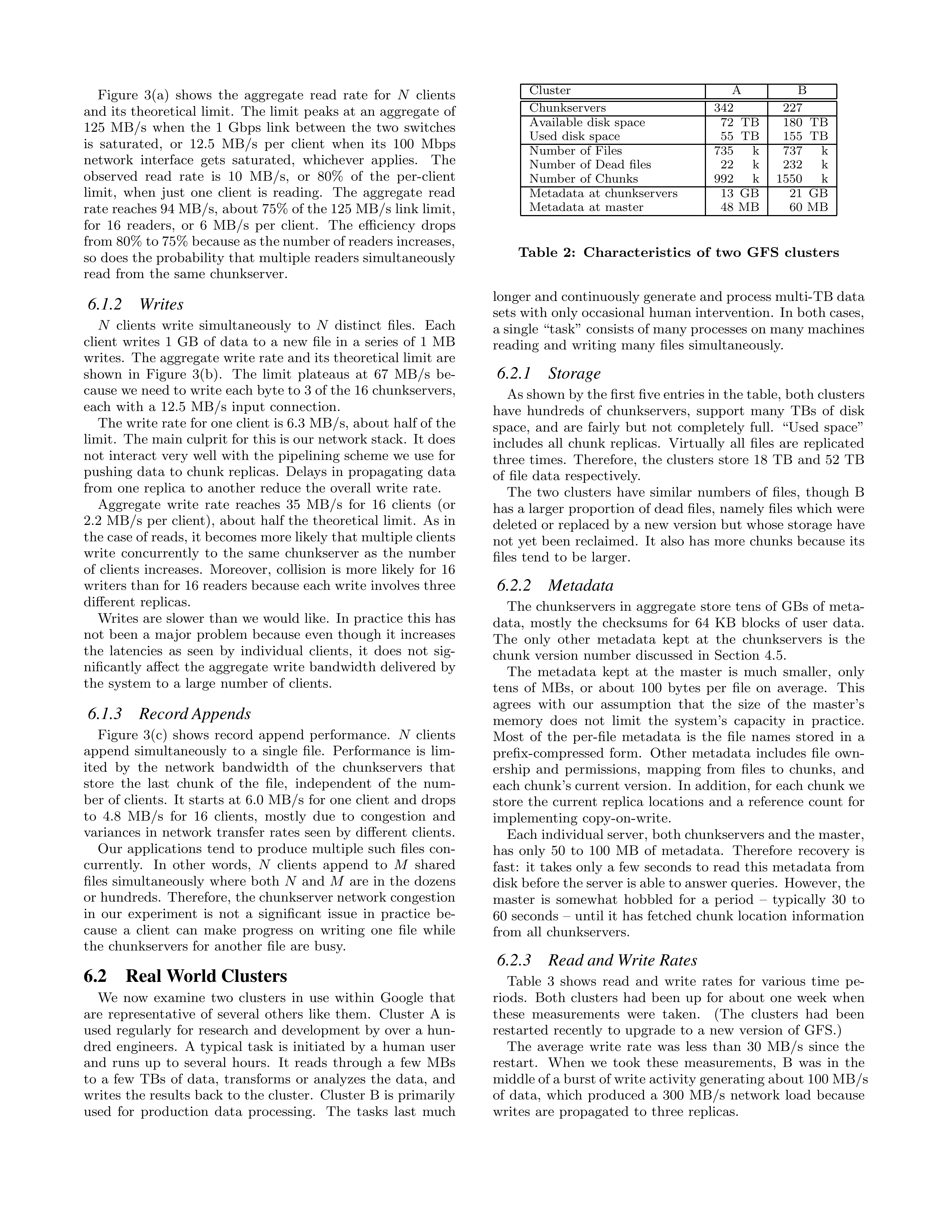

Figure
3(a)
shows
the
aggregate
read
rate
for
N
clients
and
its
theoretical
limit.
The
limit
peaks
at
an
aggregate
of
125
MB/s
when
the
1
Gbps
link
between
the
two
switches
is
saturated,
or
12.5
MB/s
per
client
when
its
100
Mbps
network
interface
gets
saturated,
whichever
applies.
The
observed
read
rate
is
10
MB/s,
or
80%
of
the
per-client
limit,
when
just
one
client
is
reading.
The
aggregate
read
rate reaches 94 MB/s, about 75% of the 125 MB/s link limit,
for
16
readers,
or
6
MB/s
per
client.
The
efficiency
drops
from 80% to 75% because as the number of readers increases,
so
does the probability
that multiple readers simultaneously
read
from
the
same
chunkserver.
6.1.2
Writes
N
clients
write
simultaneously
to
N
distinct
files.
Each
client
writes
1
GB
of
data
to
a
new
file
in
a
series
of
1
MB
writes.
The aggregate write rate and its theoretical limit are
shown
in
Figure
3(b).
The
limit
plateaus
at
67
MB/s
be-
cause we need to write each byte to 3 of the 16 chunkservers,
each
with
a
12.5
MB/s
input
connection.
The write rate for one client is 6.3 MB/s, about half of the
limit.
The main culprit for this is our network stack.
It does
not
interact
very
well
with
the
pipelining
scheme
we
use
for
pushing
data
to
chunk
replicas.
Delays
in
propagating
data
from
one
replica
to
another
reduce
the
overall
write
rate.
Aggregate
write
rate
reaches
35
MB/s
for
16
clients
(or
2.2
MB/s
per
client),
about
half
the
theoretical
limit.
As
in
the case of reads, it becomes more likely that multiple clients
write
concurrently
to
the
same
chunkserver
as
the
number
of
clients
increases.
Moreover,
collision
is
more
likely
for
16
writers than for 16 readers because each write involves three
different
replicas.
Writes
are
slower
than
we
would
like.
In
practice
this
has
not
been
a
major
problem
because
even
though
it
increases
the
latencies
as
seen
by
individual
clients,
it
does
not
sig-
nificantly
affect
the
aggregate
write
bandwidth
delivered
by
the
system
to
a
large
number
of
clients.
6.1.3
Record Appends
Figure
3(c)
shows
record
append
performance.
N
clients
append
simultaneously
to
a
single
file.
Performance
is
lim-
ited
by
the
network
bandwidth
of
the
chunkservers
that
store
the
last
chunk
of
the
file,
independent
of
the
num-
ber
of
clients.
It
starts
at
6.0
MB/s
for
one
client
and
drops
to
4.8
MB/s
for
16
clients,
mostly
due
to
congestion
and
variances
in
network
transfer
rates
seen
by
different
clients.
Our
applications
tend
to
produce
multiple
such
files
con-
currently.
In
other
words,
N
clients
append
to
M
shared
files
simultaneously
where
both
N
and
M
are
in
the
dozens
or hundreds.
Therefore,
the chunkserver network congestion
in
our
experiment
is
not
a
significant
issue
in
practice
be-
cause
a
client
can
make
progress
on
writing
one
file
while
the
chunkservers
for
another
file
are
busy.
6.2
Real World Clusters
We
now
examine
two
clusters
in
use
within
Google
that
are
representative
of
several
others
like
them.
Cluster
A
is
used
regularly
for
research
and
development
by
over
a
hun-
dred
engineers.
A
typical
task
is
initiated
by
a
human
user
and
runs
up
to
several
hours.
It
reads
through
a
few
MBs
to
a
few
TBs
of
data,
transforms
or
analyzes
the
data,
and
writes
the results
back
to the cluster.
Cluster
B
is
primarily
used
for
production
data
processing.
The
tasks
last
much
Cluster
A
B
Chunkservers
342
227
Available
disk
space
72
TB
180
TB
Used
disk
space
55
TB
155
TB
Number
of
Files
735
k
737
k
Number
of
Dead
files
22
k
232
k
Number
of
Chunks
992
k
1550
k
Metadata
at
chunkservers
13
GB
21
GB
Metadata
at
master
48
MB
60
MB
Table
2:
Characteristics
of
two
GFS
clusters
longer and continuously generate and process multi-TB data
sets with only occasional
human intervention.
In both cases,
a single “task” consists of many processes on many machines
reading
and
writing
many
files
simultaneously.
6.2.1
Storage
As shown by the first five entries in the table, both clusters
have
hundreds
of
chunkservers,
support
many
TBs
of
disk
space,
and
are
fairly
but
not
completely
full.
“Used
space”
includes
all
chunk
replicas.
Virtually
all
files
are
replicated
three
times.
Therefore,
the
clusters
store
18
TB
and
52
TB
of
file
data
respectively.
The
two
clusters
have
similar
numbers
of
files,
though
B
has a larger
proportion of dead files,
namely files which were
deleted or replaced by a new version but whose storage
have
not
yet
been
reclaimed.
It
also
has
more
chunks
because
its
files
tend
to
be
larger.
6.2.2
Metadata
The
chunkservers
in
aggregate
store
tens
of
GBs
of
meta-
data,
mostly
the
checksums
for
64
KB
blocks
of
user
data.
The
only
other
metadata
kept
at
the
chunkservers
is
the
chunk
version
number
discussed
in
Section
4.5.
The
metadata
kept
at
the
master
is
much
smaller,
only
tens
of
MBs,
or
about
100
bytes
per
file
on
average.
This
agrees
with
our
assumption
that
the
size
of
the
master’s
memory
does
not
limit
the
system’s
capacity
in
practice.
Most
of
the
per-file
metadata
is
the
file
names
stored
in
a
prefix-compressed
form.
Other
metadata
includes
file
own-
ership
and
permissions,
mapping
from
files
to
chunks,
and
each chunk’s current version.
In addition,
for each chunk we
store
the
current
replica
locations
and
a
reference
count
for
implementing
copy-on-write.
Each individual server, both chunkservers and the master,
has
only
50
to
100
MB
of
metadata.
Therefore
recovery
is
fast:
it
takes
only
a
few
seconds
to
read
this
metadata
from
disk before the server is able to answer queries.
However, the
master
is
somewhat
hobbled
for
a
period
–
typically
30
to
60
seconds
–
until
it
has
fetched
chunk
location
information
from
all
chunkservers.
6.2.3
Read and Write Rates
Table
3
shows
read
and
write
rates
for
various
time
pe-
riods.
Both
clusters
had
been
up
for
about
one
week
when
these
measurements
were
taken.
(The
clusters
had
been
restarted
recently
to
upgrade
to
a
new
version
of
GFS.)
The
average
write
rate
was
less
than
30
MB/s
since
the
restart.
When
we
took
these
measurements,
B
was
in
the
middle of a burst of write activity generating about 100 MB/s
of
data,
which
produced
a
300
MB/s
network
load
because
writes
are
propagated
to
three
replicas.
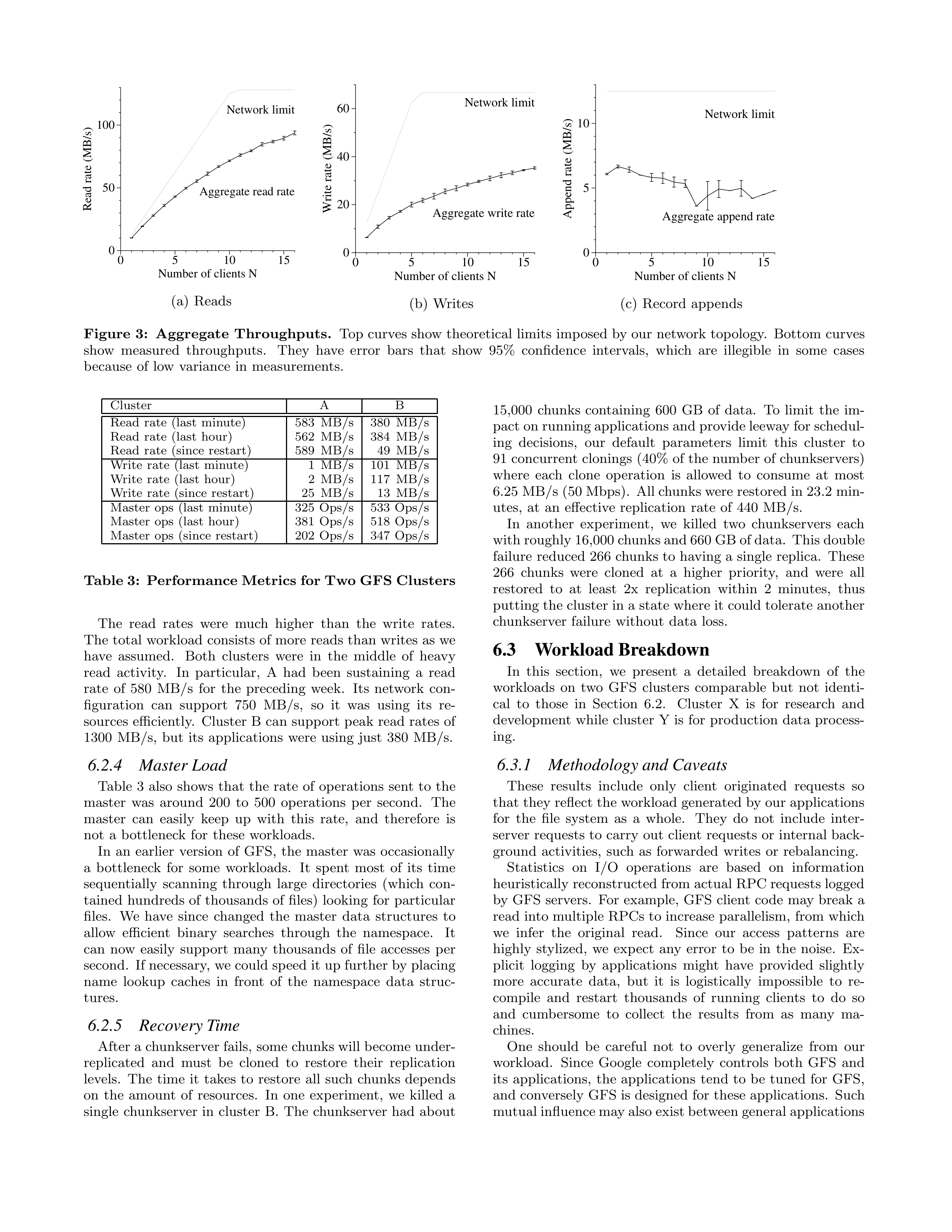

0
5
10
15
Number of clients N
0
50
100
Read rate (MB/s)
Network limit
Aggregate read rate
(a)
Reads
0
5
10
15
Number of clients N
0
20
40
60
Write rate (MB/s)
Network limit
Aggregate write rate
(b)
Writes
0
5
10
15
Number of clients N
0
5
10
Append rate (MB/s)
Network limit
Aggregate append rate
(c)
Record
appends
Figure
3:
Aggregate
Throughputs.
Top
curves
show
theoretical
limits
imposed
by
our
network
topology.
Bottom
curves
show
measured
throughputs.
They
have
error
bars
that
show
95%
confidence
intervals,
which
are
illegible
in
some
cases
because
of
low
variance
in
measurements.
Cluster
A
B
Read
rate
(last
minute)
583
MB/s
380
MB/s
Read
rate
(last
hour)
562
MB/s
384
MB/s
Read
rate
(since
restart)
589
MB/s
49
MB/s
Write
rate
(last
minute)
1
MB/s
101
MB/s
Write
rate
(last
hour)
2
MB/s
117
MB/s
Write
rate
(since
restart)
25
MB/s
13
MB/s
Master
ops
(last
minute)
325
Ops/s
533
Ops/s
Master
ops
(last
hour)
381
Ops/s
518
Ops/s
Master
ops
(since
restart)
202
Ops/s
347
Ops/s
Table 3:
Performance Metrics for Two GFS Clusters
The
read
rates
were
much
higher
than
the
write
rates.
The
total
workload
consists
of
more
reads
than writes
as
we
have
assumed.
Both
clusters
were
in
the
middle
of
heavy
read
activity.
In
particular,
A
had
been
sustaining
a
read
rate
of
580
MB/s
for
the
preceding
week.
Its
network
con-
figuration
can
support
750
MB/s,
so
it
was
using
its
re-
sources
efficiently.
Cluster
B
can
support
peak
read
rates
of
1300
MB/s,
but
its
applications
were
using
just
380
MB/s.
6.2.4
Master Load
Table
3
also
shows
that
the
rate
of
operations
sent
to
the
master
was
around
200
to
500
operations
per
second.
The
master
can
easily
keep
up
with
this
rate,
and
therefore
is
not
a
bottleneck
for
these
workloads.
In
an
earlier
version
of
GFS,
the
master
was
occasionally
a
bottleneck
for
some
workloads.
It
spent
most
of
its
time
sequentially
scanning
through
large
directories
(which
con-
tained
hundreds
of
thousands
of
files)
looking
for
particular
files.
We
have
since
changed
the
master
data
structures
to
allow
efficient
binary
searches
through
the
namespace.
It
can
now
easily
support
many
thousands
of
file
accesses
per
second.
If necessary,
we could speed it up further by placing
name
lookup
caches
in
front
of
the
namespace
data
struc-
tures.
6.2.5
Recovery Time
After a chunkserver fails,
some chunks will become under-
replicated
and
must
be
cloned
to
restore
their
replication
levels.
The
time
it
takes
to
restore
all
such
chunks
depends
on
the
amount
of
resources.
In
one
experiment,
we
killed
a
single
chunkserver
in
cluster
B.
The
chunkserver
had
about
15,000
chunks
containing
600
GB
of
data.
To
limit
the
im-
pact on running applications and provide leeway for schedul-
ing
decisions,
our
default
parameters
limit
this
cluster
to
91
concurrent clonings
(40%
of
the number of
chunkservers)
where
each
clone
operation
is
allowed
to
consume
at
most
6.25 MB/s (50 Mbps).
All chunks were restored in 23.2 min-
utes,
at
an
effective
replication
rate
of
440
MB/s.
In
another
experiment,
we
killed
two
chunkservers
each
with roughly 16,000 chunks and 660 GB of data.
This double
failure
reduced
266
chunks to
having
a
single
replica.
These
266
chunks
were
cloned
at
a
higher
priority,
and
were
all
restored
to
at
least
2x
replication
within
2
minutes,
thus
putting the cluster in a state where it could tolerate another
chunkserver
failure
without
data
loss.
6.3
Workload Breakdown
In
this
section,
we
present
a
detailed
breakdown
of
the
workloads
on
two
GFS
clusters
comparable
but
not
identi-
cal
to
those
in
Section
6.2.
Cluster
X
is
for
research
and
development
while
cluster
Y
is
for
production
data
process-
ing.
6.3.1
Methodology and Caveats
These
results
include
only
client
originated
requests
so
that they reflect the workload generated by our applications
for
the
file
system
as
a
whole.
They
do
not
include
inter-
server
requests
to
carry
out
client
requests
or
internal
back-
ground
activities,
such
as
forwarded
writes
or
rebalancing.
Statistics
on
I/O
operations
are
based
on
information
heuristically reconstructed from actual RPC requests logged
by
GFS
servers.
For
example,
GFS
client
code
may
break
a
read
into multiple
RPCs
to increase
parallelism,
from
which
we
infer
the
original
read.
Since
our
access
patterns
are
highly
stylized,
we
expect
any
error
to
be
in
the
noise.
Ex-
plicit
logging
by
applications
might
have
provided
slightly
more
accurate
data,
but
it
is
logistically
impossible
to
re-
compile
and
restart
thousands
of
running
clients
to
do
so
and
cumbersome
to
collect
the
results
from
as
many
ma-
chines.
One
should
be
careful
not
to
overly
generalize
from
our
workload.
Since
Google
completely
controls
both
GFS
and
its
applications,
the
applications
tend
to
be
tuned
for
GFS,
and conversely
GFS is
designed
for
these
applications.
Such
mutual influence may also exist between general applications
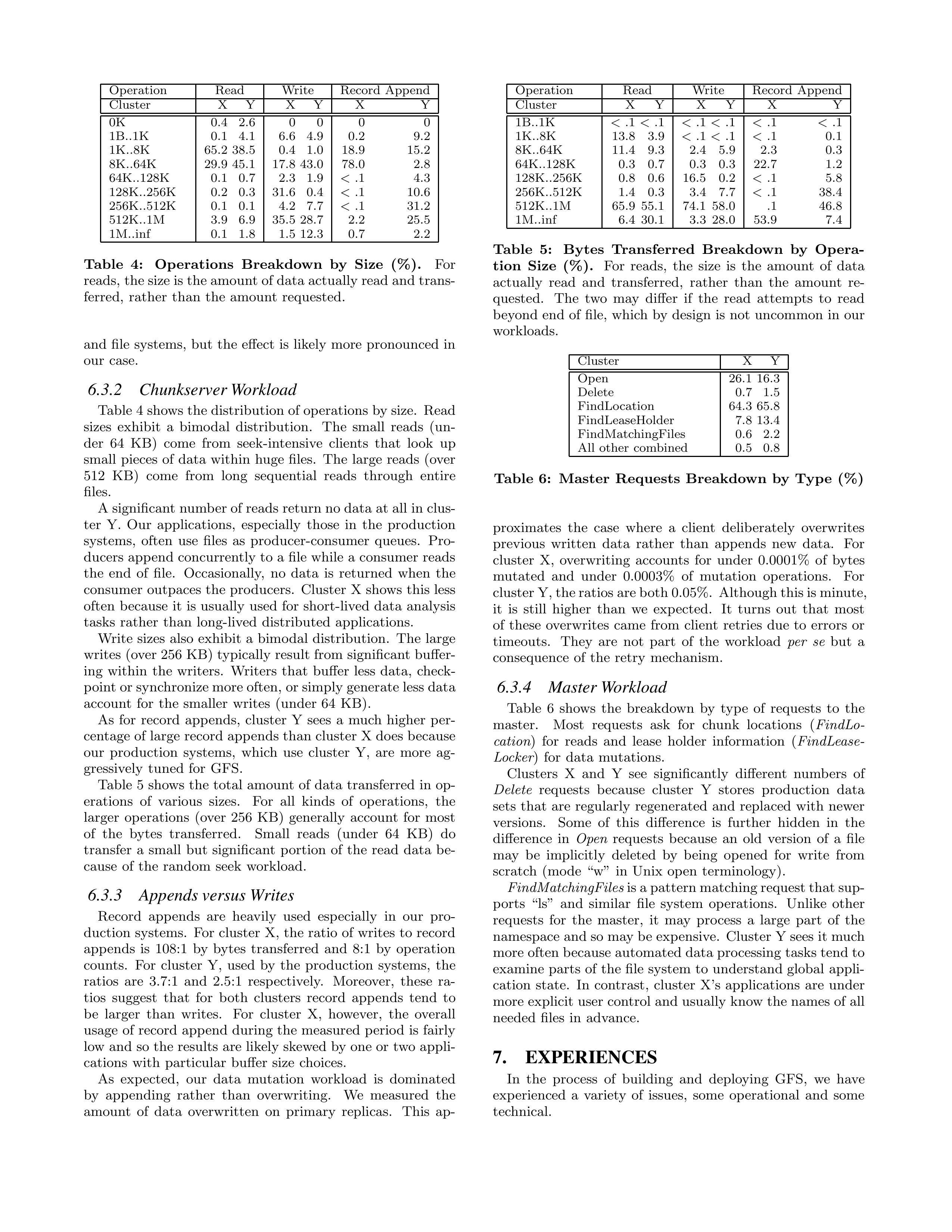

Operation
Read
Write
Record
Append
Cluster
X
Y
X
Y
X
Y
0K
0.4
2.6
0
0
0
0
1B..1K
0.1
4.1
6.6
4.9
0.2
9.2
1K..8K
65.2
38.5
0.4
1.0
18.9
15.2
8K..64K
29.9
45.1
17.8
43.0
78.0
2.8
64K..128K
0.1
0.7
2.3
1.9
<
.1
4.3
128K..256K
0.2
0.3
31.6
0.4
<
.1
10.6
256K..512K
0.1
0.1
4.2
7.7
<
.1
31.2
512K..1M
3.9
6.9
35.5
28.7
2.2
25.5
1M..inf
0.1
1.8
1.5
12.3
0.7
2.2
Table
4:
Operations
Breakdown
by
Size
(%).
For
reads, the size is the amount of data actually read and trans-
ferred,
rather
than
the
amount
requested.
and
file
systems,
but
the
effect
is
likely
more
pronounced
in
our
case.
6.3.2
Chunkserver Workload
Table 4 shows the distribution of operations by size.
Read
sizes
exhibit
a
bimodal
distribution.
The
small
reads
(un-
der
64
KB)
come
from
seek-intensive
clients
that
look
up
small
pieces
of
data
within
huge
files.
The
large
reads
(over
512
KB)
come
from
long
sequential
reads
through
entire
files.
A significant number of reads return no data at all in clus-
ter
Y.
Our
applications,
especially
those
in
the
production
systems,
often
use
files
as
producer-consumer
queues.
Pro-
ducers
append concurrently
to
a
file
while
a
consumer
reads
the
end
of
file.
Occasionally,
no
data
is
returned
when
the
consumer
outpaces
the
producers.
Cluster
X
shows
this
less
often
because
it
is
usually
used
for
short-lived
data
analysis
tasks
rather
than
long-lived
distributed
applications.
Write
sizes
also
exhibit
a
bimodal
distribution.
The
large
writes
(over 256
KB) typically
result from
significant buffer-
ing
within
the
writers.
Writers
that
buffer
less
data,
check-
point or synchronize more often, or simply generate less data
account
for
the
smaller
writes
(under
64
KB).
As
for
record
appends,
cluster
Y
sees
a
much
higher
per-
centage of
large
record appends than cluster X does because
our
production
systems,
which
use
cluster
Y,
are
more
ag-
gressively
tuned
for
GFS.
Table
5
shows
the
total
amount
of
data
transferred
in
op-
erations
of
various
sizes.
For
all
kinds
of
operations,
the
larger
operations
(over
256
KB)
generally
account
for
most
of
the
bytes
transferred.
Small
reads
(under
64
KB)
do
transfer
a
small
but
significant
portion
of
the
read
data
be-
cause
of
the
random
seek
workload.
6.3.3
Appends versus Writes
Record
appends
are
heavily
used
especially
in
our
pro-
duction
systems.
For
cluster
X,
the
ratio
of
writes
to
record
appends
is
108:1
by
bytes
transferred
and
8:1
by
operation
counts.
For
cluster
Y,
used
by
the
production
systems,
the
ratios
are
3.7:1
and
2.5:1
respectively.
Moreover,
these
ra-
tios
suggest
that
for
both
clusters
record
appends
tend
to
be
larger
than
writes.
For
cluster
X,
however,
the
overall
usage
of
record
append
during
the
measured
period
is
fairly
low
and
so
the results
are
likely
skewed
by
one or
two
appli-
cations
with
particular
buffer
size
choices.
As
expected,
our
data
mutation
workload
is
dominated
by
appending
rather
than
overwriting.
We
measured
the
amount
of
data
overwritten
on
primary
replicas.
This
ap-
Operation
Read
Write
Record
Append
Cluster
X
Y
X
Y
X
Y
1B..1K
<
.1
<
.1
<
.1
<
.1
<
.1
<
.1
1K..8K
13.8
3.9
<
.1
<
.1
<
.1
0.1
8K..64K
11.4
9.3
2.4
5.9
2.3
0.3
64K..128K
0.3
0.7
0.3
0.3
22.7
1.2
128K..256K
0.8
0.6
16.5
0.2
<
.1
5.8
256K..512K
1.4
0.3
3.4
7.7
<
.1
38.4
512K..1M
65.9
55.1
74.1
58.0
.1
46.8
1M..inf
6.4
30.1
3.3
28.0
53.9
7.4
Table
5:
Bytes
Transferred
Breakdown
by
Opera-
tion
Size
(%).
For
reads,
the
size
is
the
amount
of
data
actually
read
and
transferred,
rather
than
the
amount
re-
quested.
The
two
may
differ
if
the
read
attempts
to
read
beyond
end
of
file,
which
by
design
is
not
uncommon
in
our
workloads.
Cluster
X
Y
Open
26.1
16.3
Delete
0.7
1.5
FindLocation
64.3
65.8
FindLeaseHolder
7.8
13.4
FindMatchingFiles
0.6
2.2
All
other
combined
0.5
0.8
Table
6:
Master
Requests
Breakdown
by
Type
(%)
proximates
the
case
where
a
client
deliberately
overwrites
previous
written
data
rather
than
appends
new
data.
For
cluster
X,
overwriting
accounts
for
under
0.0001%
of
bytes
mutated
and
under
0.0003%
of
mutation
operations.
For
cluster Y, the ratios are both 0.05%.
Although this is minute,
it
is
still
higher
than
we
expected.
It
turns
out
that
most
of
these
overwrites
came
from
client
retries
due
to
errors
or
timeouts.
They
are
not
part
of
the
workload
per
se
but
a
consequence
of
the
retry
mechanism.
6.3.4
Master Workload
Table
6
shows
the
breakdown
by
type
of
requests
to
the
master.
Most
requests
ask
for
chunk
locations
(
FindLo-
cation
)
for
reads
and
lease
holder
information
(
FindLease-
Locker
)
for
data
mutations.
Clusters
X
and
Y
see
significantly
different
numbers
of
Delete
requests
because
cluster
Y
stores
production
data
sets
that
are
regularly
regenerated
and
replaced
with
newer
versions.
Some
of
this
difference
is
further
hidden
in
the
difference
in
Open
requests
because
an
old
version
of
a
file
may
be
implicitly
deleted
by
being
opened
for
write
from
scratch
(mode
“w”
in
Unix
open
terminology).
FindMatchingFiles
is a pattern matching request that sup-
ports
“ls”
and
similar
file
system
operations.
Unlike
other
requests
for
the
master,
it
may
process
a
large
part
of
the
namespace and so may be expensive.
Cluster Y sees it much
more often because automated data processing tasks tend to
examine
parts
of
the
file
system
to
understand global
appli-
cation
state.
In
contrast,
cluster
X’s
applications
are
under
more explicit user control and usually
know the names of
all
needed
files
in
advance.
7.
EXPERIENCES
In
the
process
of
building
and
deploying
GFS,
we
have
experienced
a
variety
of
issues,
some
operational
and
some
technical.
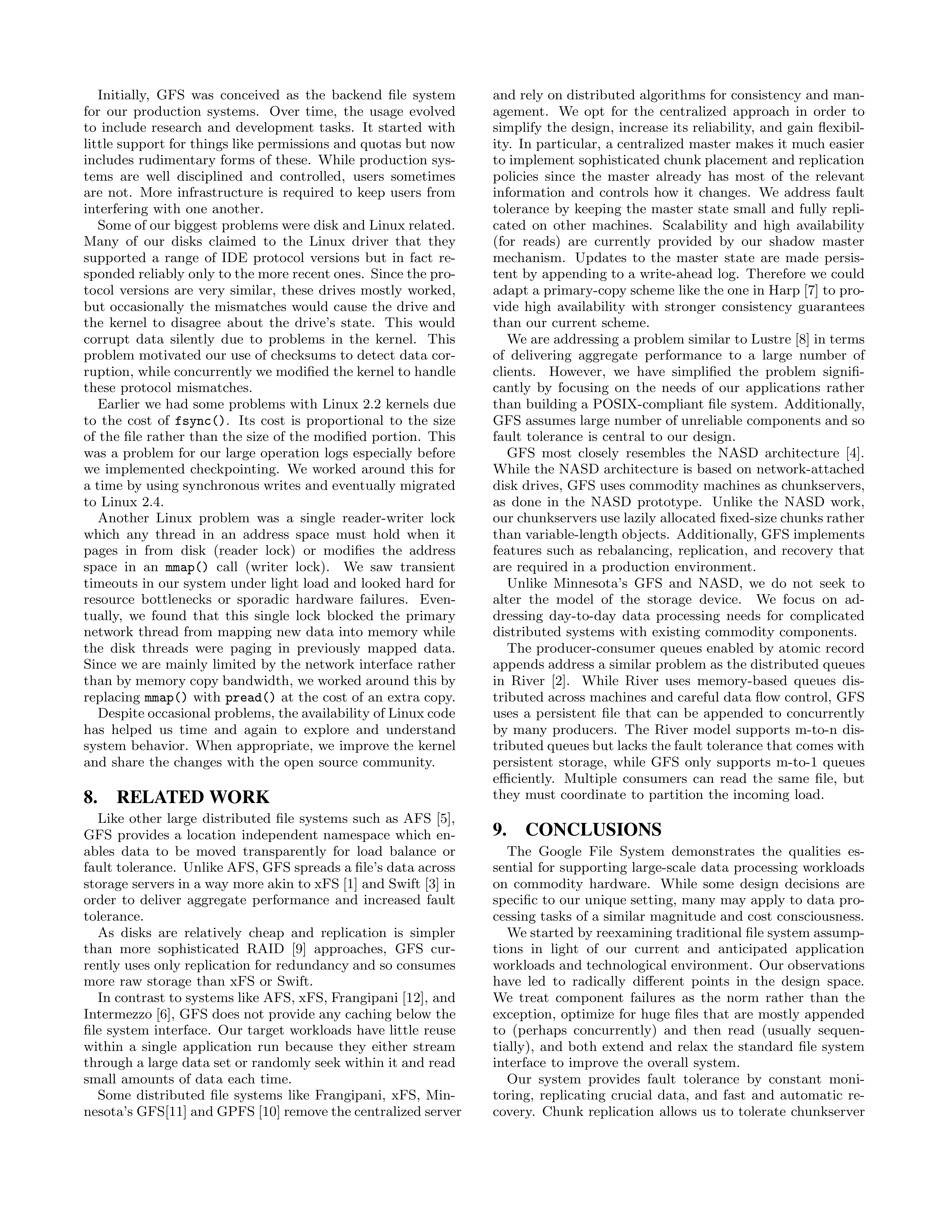
Initially,
GFS
was
conceived
as
the
backend
file
system
for
our
production
systems.
Over
time,
the
usage
evolved
to
include
research
and
development
tasks.
It
started
with
little support for things like permissions and quotas but now
includes
rudimentary
forms
of
these.
While
production
sys-
tems
are
well
disciplined
and
controlled,
users
sometimes
are
not.
More
infrastructure
is
required
to
keep
users
from
interfering
with
one
another.
Some of our biggest problems were disk and Linux related.
Many
of
our
disks
claimed
to
the
Linux
driver
that
they
supported
a
range
of
IDE
protocol
versions
but
in
fact
re-
sponded reliably only to the more recent ones.
Since the pro-
tocol
versions
are
very
similar,
these
drives
mostly
worked,
but
occasionally
the
mismatches
would
cause
the
drive
and
the
kernel
to
disagree
about
the
drive’s
state.
This
would
corrupt
data
silently
due
to
problems
in
the
kernel.
This
problem
motivated
our
use
of
checksums to
detect
data
cor-
ruption, while concurrently we modified the kernel to handle
these
protocol
mismatches.
Earlier
we
had
some
problems
with
Linux
2.2
kernels
due
to
the
cost
of
fsync()
.
Its
cost
is
proportional
to
the
size
of
the
file
rather
than
the
size
of
the
modified
portion.
This
was
a
problem
for
our
large
operation
logs
especially
before
we
implemented
checkpointing.
We
worked
around
this
for
a time by using synchronous writes
and eventually migrated
to
Linux
2.4.
Another
Linux
problem
was
a
single
reader-writer
lock
which
any
thread
in
an
address
space
must
hold
when
it
pages
in
from
disk
(reader
lock)
or
modifies
the
address
space
in
an
mmap()
call
(writer
lock).
We
saw
transient
timeouts
in
our
system under
light
load
and
looked
hard
for
resource
bottlenecks
or
sporadic
hardware
failures.
Even-
tually,
we
found
that
this
single
lock
blocked
the
primary
network
thread
from
mapping
new
data
into
memory
while
the
disk
threads
were
paging
in
previously
mapped
data.
Since
we
are
mainly
limited
by
the
network
interface
rather
than by memory copy bandwidth, we worked around this by
replacing
mmap()
with
pread()
at
the
cost
of
an
extra
copy.
Despite occasional problems, the availability of Linux code
has
helped
us
time
and
again
to
explore
and
understand
system
behavior.
When
appropriate,
we
improve
the
kernel
and
share
the
changes
with
the
open
source
community.
8.
RELATED WORK
Like
other
large
distributed
file
systems
such
as
AFS
[5],
GFS
provides
a
location
independent
namespace
which
en-
ables
data
to
be
moved
transparently
for
load
balance
or
fault tolerance.
Unlike AFS, GFS spreads a file’s data across
storage servers in a way more akin to xFS [1] and Swift [3] in
order
to
deliver
aggregate
performance
and
increased
fault
tolerance.
As
disks
are
relatively
cheap
and
replication
is
simpler
than
more
sophisticated
RAID
[9]
approaches,
GFS
cur-
rently uses only replication for
redundancy and so consumes
more
raw
storage
than
xFS
or
Swift.
In contrast to systems like AFS, xFS, Frangipani [12],
and
Intermezzo [6],
GFS does not provide any caching below
the
file
system
interface.
Our
target
workloads
have
little
reuse
within
a
single
application
run
because
they
either
stream
through a large data set or randomly seek within it and read
small
amounts
of
data
each
time.
Some
distributed
file
systems
like
Frangipani,
xFS,
Min-
nesota’s GFS[11] and GPFS [10] remove the centralized server
and rely
on distributed algorithms
for
consistency
and man-
agement.
We
opt
for
the
centralized
approach
in
order
to
simplify
the
design,
increase
its
reliability,
and
gain
flexibil-
ity.
In particular,
a
centralized
master
makes
it
much easier
to implement sophisticated chunk placement and replication
policies
since
the
master
already
has
most
of
the
relevant
information
and
controls
how
it
changes.
We
address
fault
tolerance
by
keeping
the
master
state
small
and
fully
repli-
cated
on
other
machines.
Scalability
and
high
availability
(for
reads)
are
currently
provided
by
our
shadow
master
mechanism.
Updates
to
the
master
state
are
made
persis-
tent
by
appending
to
a
write-ahead
log.
Therefore
we
could
adapt a primary-copy scheme like the one in Harp [7] to pro-
vide
high
availability
with
stronger
consistency
guarantees
than
our
current
scheme.
We are addressing a problem similar to Lustre [8] in terms
of
delivering
aggregate
performance
to
a
large
number
of
clients.
However,
we
have
simplified
the
problem
signifi-
cantly
by
focusing
on
the
needs
of
our
applications
rather
than
building
a
POSIX-compliant file
system.
Additionally,
GFS assumes large
number of unreliable
components and so
fault
tolerance
is
central
to
our
design.
GFS
most
closely
resembles
the
NASD
architecture
[4].
While
the
NASD
architecture
is
based
on
network-attached
disk
drives,
GFS uses commodity
machines
as
chunkservers,
as
done
in
the
NASD
prototype.
Unlike
the
NASD
work,
our chunkservers use lazily allocated fixed-size chunks rather
than variable-length objects.
Additionally, GFS implements
features
such
as
rebalancing,
replication,
and
recovery
that
are
required
in
a
production
environment.
Unlike
Minnesota’s
GFS
and
NASD,
we
do
not
seek
to
alter
the
model
of
the
storage
device.
We
focus
on
ad-
dressing
day-to-day
data
processing
needs
for
complicated
distributed
systems
with
existing
commodity
components.
The
producer-consumer
queues
enabled
by
atomic
record
appends address a similar problem as the distributed queues
in
River
[2].
While
River
uses
memory-based
queues
dis-
tributed across
machines and careful
data flow control,
GFS
uses
a
persistent
file
that
can
be
appended
to
concurrently
by
many
producers.
The
River
model
supports
m-to-n
dis-
tributed queues but lacks the fault tolerance that comes with
persistent
storage,
while
GFS
only
supports
m-to-1
queues
efficiently.
Multiple
consumers
can
read
the
same
file,
but
they
must
coordinate
to
partition
the
incoming
load.
9.
CONCLUSIONS
The
Google
File
System
demonstrates
the
qualities
es-
sential
for
supporting
large-scale
data
processing
workloads
on
commodity
hardware.
While
some
design
decisions
are
specific
to
our
unique setting,
many
may
apply
to
data
pro-
cessing
tasks
of
a
similar
magnitude
and
cost
consciousness.
We started by reexamining traditional file system assump-
tions
in
light
of
our
current
and
anticipated
application
workloads
and technological
environment.
Our observations
have
led
to
radically
different
points
in
the
design
space.
We
treat
component
failures
as
the
norm
rather
than
the
exception,
optimize
for
huge
files
that
are
mostly
appended
to
(perhaps
concurrently)
and
then
read
(usually
sequen-
tially),
and
both
extend
and
relax
the
standard
file
system
interface
to
improve
the
overall
system.
Our
system
provides
fault
tolerance
by
constant
moni-
toring,
replicating
crucial
data,
and
fast
and
automatic
re-
covery.
Chunk
replication
allows
us
to
tolerate
chunkserver
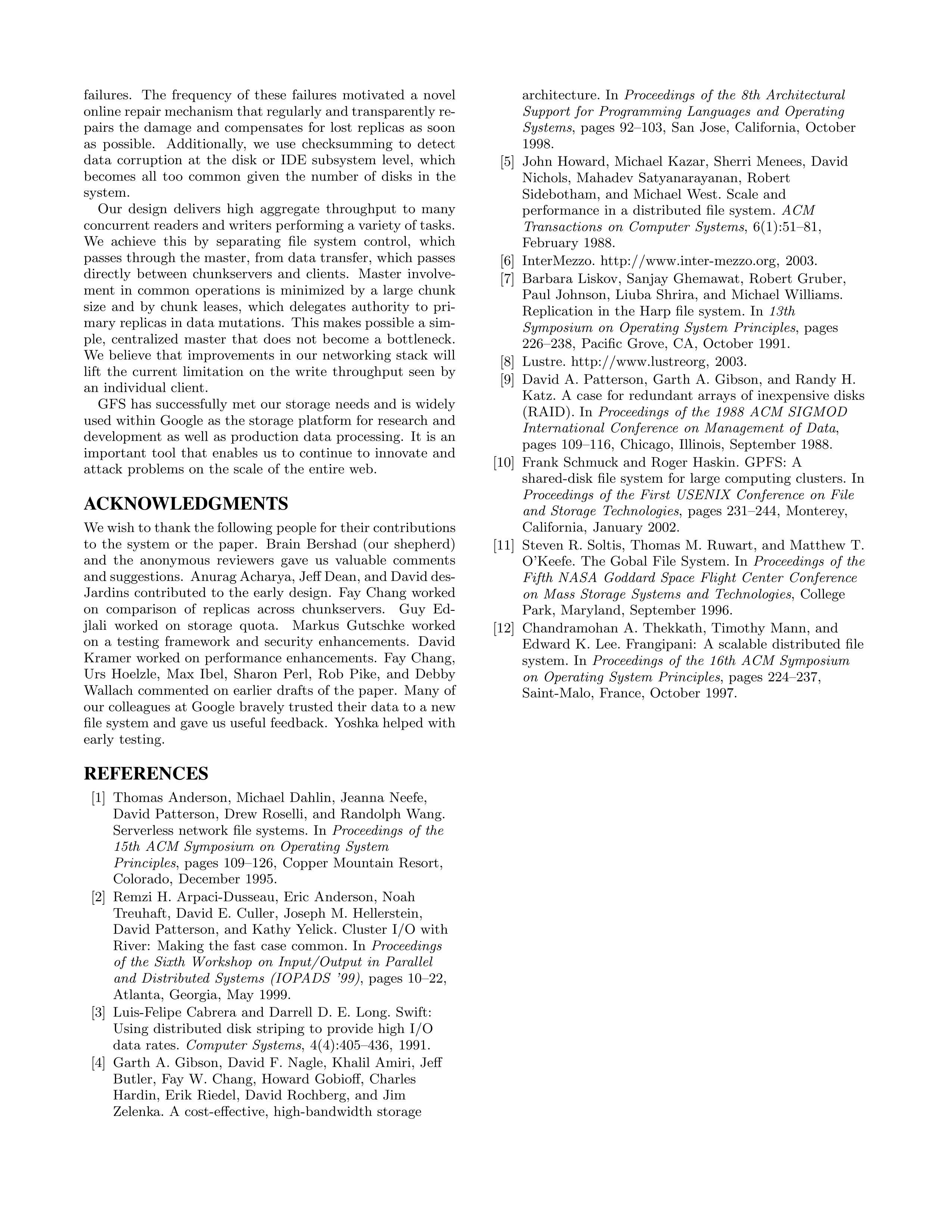
failures.
The
frequency
of
these
failures
motivated
a
novel
online repair mechanism that regularly and transparently re-
pairs
the
damage
and
compensates
for
lost
replicas
as
soon
as
possible.
Additionally,
we
use
checksumming
to
detect
data
corruption
at
the
disk
or
IDE
subsystem
level,
which
becomes
all
too
common
given
the
number
of
disks
in
the
system.
Our
design
delivers
high
aggregate
throughput
to
many
concurrent readers and writers performing a variety of tasks.
We
achieve
this
by
separating
file
system
control,
which
passes
through the master,
from
data
transfer,
which
passes
directly
between
chunkservers
and
clients.
Master
involve-
ment
in
common
operations
is
minimized
by
a
large
chunk
size
and
by
chunk
leases,
which
delegates
authority
to
pri-
mary replicas in data mutations.
This makes possible a sim-
ple,
centralized
master
that
does
not
become
a
bottleneck.
We
believe
that
improvements
in
our
networking
stack
will
lift
the
current
limitation
on
the
write
throughput
seen
by
an
individual
client.
GFS
has
successfully
met
our
storage
needs
and
is
widely
used
within
Google
as
the storage
platform
for
research
and
development
as
well
as
production
data
processing.
It
is
an
important
tool
that
enables
us
to
continue
to
innovate
and
attack
problems
on
the
scale
of
the
entire
web.
ACKNOWLEDGMENTS
We wish to thank the following people for their contributions
to
the
system
or
the
paper.
Brain
Bershad
(our
shepherd)
and
the
anonymous
reviewers
gave
us
valuable
comments
and suggestions.
Anurag Acharya, JeffDean, and David des-
Jardins
contributed
to
the
early
design.
Fay
Chang
worked
on
comparison
of
replicas
across
chunkservers.
Guy
Ed-
jlali
worked
on
storage
quota.
Markus
Gutschke
worked
on
a
testing
framework
and
security
enhancements.
David
Kramer
worked
on
performance
enhancements.
Fay
Chang,
Urs
Hoelzle,
Max
Ibel,
Sharon
Perl,
Rob
Pike,
and
Debby
Wallach
commented
on
earlier
drafts
of
the
paper.
Many
of
our colleagues
at Google
bravely trusted their data to a
new
file
system and gave
us useful
feedback.
Yoshka helped
with
early
testing.
REFERENCES
[1]
Thomas
Anderson,
Michael
Dahlin,
Jeanna
Neefe,
David
Patterson,
Drew
Roselli,
and
Randolph
Wang.
Serverless
network
file
systems.
In
Proceedings
of
the
15th
ACM
Symposium
on
Operating
System
Principles
,
pages
109–126,
Copper
Mountain
Resort,
Colorado,
December
1995.
[2]
Remzi
H.
Arpaci-Dusseau,
Eric
Anderson,
Noah
Treuhaft,
David
E.
Culler,
Joseph
M.
Hellerstein,
David
Patterson,
and
Kathy
Yelick.
Cluster
I/O
with
River:
Making
the
fast
case
common.
In
Proceedings
of
the
Sixth
Workshop
on
Input/Output
in
Parallel
and
Distributed
Systems
(IOPADS
’99)
,
pages
10–22,
Atlanta,
Georgia,
May
1999.
[3]
Luis-Felipe
Cabrera
and
Darrell
D.
E.
Long.
Swift:
Using
distributed
disk
striping
to
provide
high
I/O
data
rates.
Computer
Systems
,
4(4):405–436,
1991.
[4]
Garth
A.
Gibson,
David
F.
Nagle,
Khalil
Amiri,
Jeff
Butler,
Fay
W.
Chang,
Howard
Gobioff,
Charles
Hardin,
Erik
Riedel,
David
Rochberg,
and
Jim
Zelenka.
A
cost-effective,
high-bandwidth
storage
architecture.
In
Proceedings
of
the
8th
Architectural
Support
for
Programming
Languages
and
Operating
Systems
,
pages
92–103,
San
Jose,
California,
October
1998.
[5]
John
Howard,
Michael
Kazar,
Sherri
Menees,
David
Nichols,
Mahadev
Satyanarayanan,
Robert
Sidebotham,
and
Michael
West.
Scale
and
performance
in
a
distributed
file
system.
ACM
Transactions
on
Computer
Systems
,
6(1):51–81,
February
1988.
[6]
InterMezzo.
http://www.inter-mezzo.org,
2003.
[7]
Barbara
Liskov,
Sanjay
Ghemawat,
Robert
Gruber,
Paul
Johnson,
Liuba
Shrira,
and
Michael
Williams.
Replication
in
the
Harp
file
system.
In
13th
Symposium
on
Operating
System
Principles
,
pages
226–238,
Pacific
Grove,
CA,
October
1991.
[8]
Lustre.
http://www.lustreorg,
2003.
[9]
David
A.
Patterson,
Garth
A.
Gibson,
and
Randy
H.
Katz.
A
case
for
redundant
arrays
of
inexpensive
disks
(RAID).
In
Proceedings
of
the
1988
ACM
SIGMOD
International
Conference
on
Management
of
Data
,
pages
109–116,
Chicago,
Illinois,
September
1988.
[10]
Frank
Schmuck
and
Roger
Haskin.
GPFS:
A
shared-disk
file
system
for
large
computing
clusters.
In
Proceedings
of
the
First
USENIX
Conference
on
File
and
Storage
Technologies
,
pages
231–244,
Monterey,
California,
January
2002.
[11]
Steven
R.
Soltis,
Thomas
M.
Ruwart,
and
Matthew
T.
O’Keefe.
The
Gobal
File
System.
In
Proceedings
of
the
Fifth
NASA
Goddard
Space
Flight
Center
Conference
on
Mass
Storage
Systems
and
Technologies
,
College
Park,
Maryland,
September
1996.
[12]
Chandramohan
A.
Thekkath,
Timothy
Mann,
and
Edward
K.
Lee.
Frangipani:
A
scalable
distributed
file
system.
In
Proceedings
of
the
16th
ACM
Symposium
on
Operating
System
Principles
,
pages
224–237,
Saint-Malo,
France,
October
1997.