
Hunyuan-Large:
An Open-Source MoE Model with 52
Billion Activated Parameters by Tencent
Tencent Hunyuan Team
Abstract
In this paper, we introduce Hunyuan-Large, which is currently the largest open-
source Transformer-based mixture of experts model,
with a total of 389 billion
parameters and 52 billion activation parameters, capable of handling up to 256K to-
kens.
We conduct a thorough evaluation of Hunyuan-Large’s superior performance
across various benchmarks including language understanding and generation, logi-
cal reasoning, mathematical problem-solving, coding, long-context, and aggregated
tasks, where it outperforms LLama3.1-70B and exhibits comparable performance
when compared to the significantly larger LLama3.1-405B model.
Key practice
of Hunyuan-Large include large-scale synthetic data that is orders larger than in
previous literature, a mixed expert routing strategy, a key-value cache compres-
sion
technique,
and
an
expert-specific
learning
rate
strategy.
Additionally,
we
also investigate the scaling laws and learning rate schedule of mixture of experts
models, providing valuable insights and guidances for future model development
and optimization.
The code and checkpoints of Hunyuan-Large are released to
facilitate future innovations and applications.
Code
:
https://github.com/Tencent/Tencent-Hunyuan-Large
Models
:
https://huggingface.co/tencent/Tencent-Hunyuan-Large
1
Introduction
In recent years, Large language models (LLMs) have significantly advanced the field of artificial
intelligence,
proving
their
effectiveness
across
numerous
fields
such
as
NLP,
CV,
Speech,
and
AI4Science.
Starting from the emergence of ChatGPT (OpenAI, 2022), lots of powerful LLMs have
bloomed
(Achiam
et
al.,
2023;
Gemini
et
al.,
2023;
Touvron
et
al.,
2023;
OpenAI,
2024;
Dubey
et al., 2024; Qwen, 2024a), which inexorably bring in new ways for people to collect and process
information, broadly impacting our daily lives.
As the demand for more sophisticated AI systems
continues to grow, researchers are exploring new techniques and paradigms to push the boundaries
of
model
size
and
performance.
One
approach
that
stands
out
is
the
Mixture
of
Experts
(MoE)
model, which synergizes multiple specialized submodels to deliver superior performance in diverse
tasks with dynamic activated experts (Lepikhin et al., 2020; Fedus et al., 2022; Wang et al., 2024a),
achieving more efficient training and inference.
There is a current trend observed that more and more
MoE-structured LLMs have been constructed and open-sourced to facilitate the LLM community
(Mistral, 2024; DeepSeek-AI, 2024; Yang et al., 2024; Jamba et al., 2024).
Tencent’s AI chatbot, Yuanbao (yuanbao.tencent.com), has also adopted MoE as the neural architec-
ture of the trillion-parameter flagship LLM since February 2024.
Due to its exceptional capabilities
in reading, writing, and searching, the MoE-based Hunyuan model and Yuanbao chatbot are assisting
users in working effortlessly and enjoying a more vibrant life.
The MoE-powered Hunyuan models
have also enhanced thousands of scenarios within Tencent’s applications, enabling Tencent to better
serve its billions of users.
In addition to serving users with the premium models, another way that contributes to the community is
open-sourcing.
Open-source models can greatly promote the spreading of technology and flourishing
arXiv:2411.02265v3 [cs.CL] 6 Nov 2024
development of applications, as exemplified by LLama, Mistral, Qwen, and Deepseek, among others.
However, most open-source models are based on dense architectures, with only a very few models
based on the MoE architecture with relatively small scale of parameters.
In this work, we introduce
Hunyuan-Large,
a
large
Transformer-based
MoE
model,
featuring
an
unprecedented
389
billion
total parameters and 52 billion activated parameters, capable of handling up to 256K tokens.
This
model adopts the classical Transformer architecture (Vaswani et al., 2017) with MoE, containing a
pre-training stage for acquiring fundamental capabilities and a post-training stage for task-specific
instruction following, capability enhancement, and human preference alignment.
Hunyuan-Large
supports conventional NLP abilities such as question answering, reasoning, reading comprehension,
and specific LLM capabilities such as mathematics, coding, multi-turn interaction, and multilinguality.
We delve into the key technical innovations that have contributed to Hunyuan-Large’s exceptional
performance as follows.
•
High-Quality Synthetic Data
. The broad usage of synthetic data improves the quality and diversity
of training data, which enables the model to learn richer representations effectively and generalize
better to unseen data.
In total, Hunyuan-Large is pre-trained on 7T tokens, which contains nearly
1.5T tokens of high-quality and diverse synthetic data.
•
Enhanced Model Structure
.
We propose key-value (KV) cache compression, recycle routing,
and
expert-specific
learning
rate
scaling
strategies
to
enhance
Hunyuan-Large.
The
reduction
of KV cache overhead allows for more seamless deployment and scaling.
Moreover, we adopt
different learning rates for different shared/specialized experts with our recycle routing strategy,
ensuring that each token can be utilized effectively during training and contributing to the overall
performance.
•
Explorations on MoE Scaling Laws.
Additionally, we explore the scaling laws of MoE models
as our guidelines, highlighting the relationship between model size, training data, and performance.
This analysis offers insights into the foundational elements that contribute to the strong performance
of Hunyuan-Large, but also provides valuable insights for future development and optimization of
more powerful and larger MoE-structured LLMs.
To demonstrate the power of Hunyuan-Large, we conduct extensive experiments on diverse types of
benchmarks in both English and Chinese, compared with the best-performing dense and MoE models
having similar parameter sizes.
We find that Hunyuan-Large is capable of handling various tasks
including commonsense understanding, question answering, mathematics reasoning, coding, and
aggregated tasks, achieving the overall best performance among existing open-source similar-scale
LLMs.
The pre-trained and post-trained Hunyuan-Large models are publicly released to facilitate the
LLM community.
In the rest of this technical report, we will first give a detailed introduction to the pre-training stage of
Hunyuan-Large, including its data and tokenizer, model structure, and pre-training recipes in Section
2.
Next, we will describe our post-training in Section 3, with details of our SFT and RLHF techniques.
The comprehensive experimental results and in-depth analyses of Hunyuan-Large’s pre-trained and
post-trained models will be given in Section 4.
Finally, the conclusion and future direction will be
stated in Section 5.
2
Pre-Training
In this section, we will describe the details of pre-training Hunyuan-Large, including (a) data and
tokenizer, where high-quality data largely contributes to the model performance, (b) model structure,
consisting of our proposed KV cache compression, expert routing, and expert-specific learning rate
scaling strategies, and (c) pre-training recipes, introducing the detailed pre-training schedule as well
as our guidebook of explorations on MoE scaling laws.
These techniques build the foundation of
Hunyuan-Large’s remarkable capability in pre-training.
2.1
Data and Tokenizer
We first give the overview of our data, which is viewed as the fuel of our powerful model, with its
preprocessing steps and data synthesis strategies essential for the quantity and quality of data.
We
also introduce the tokenizer employed for converting text data into an appropriate format suitable for
Hunyuan-Large.
2
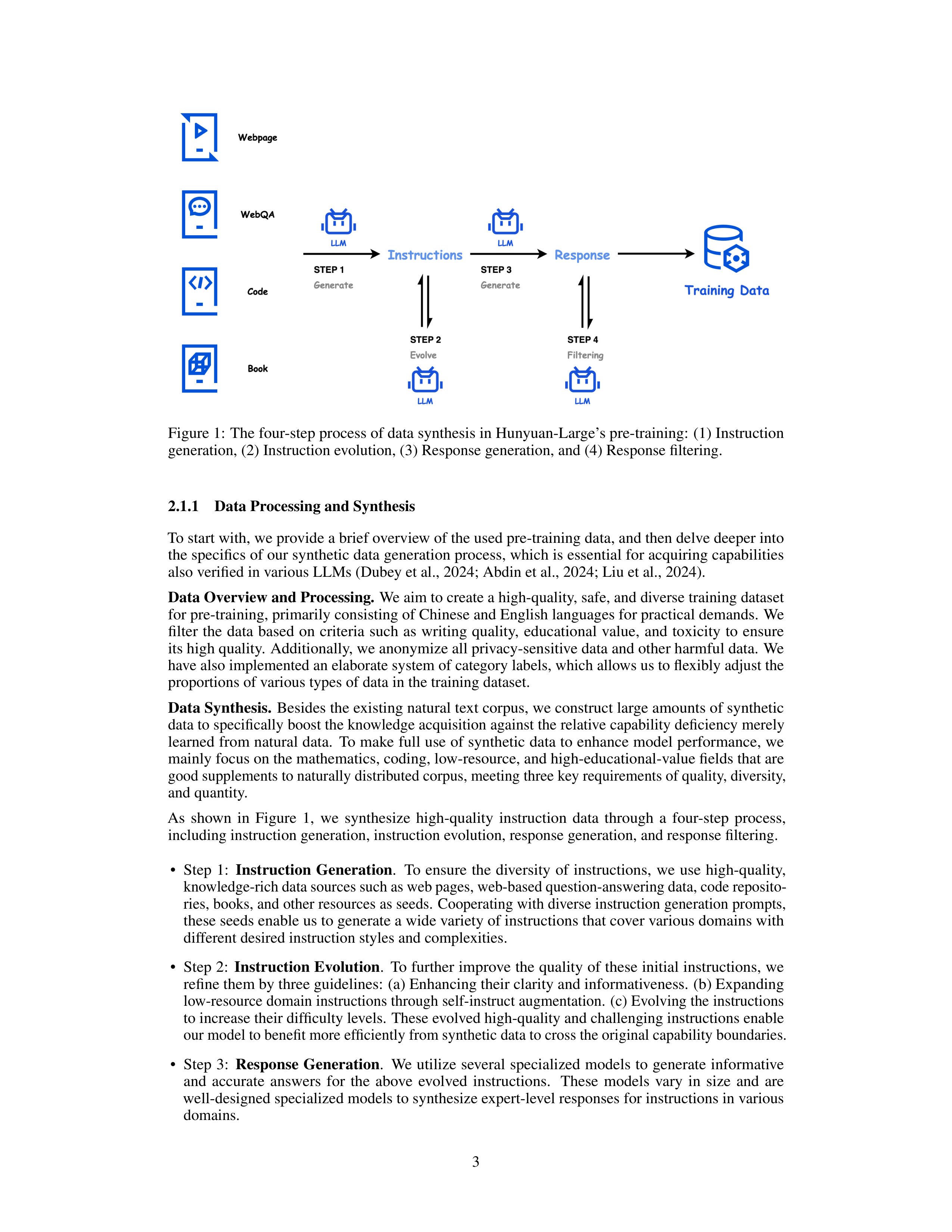
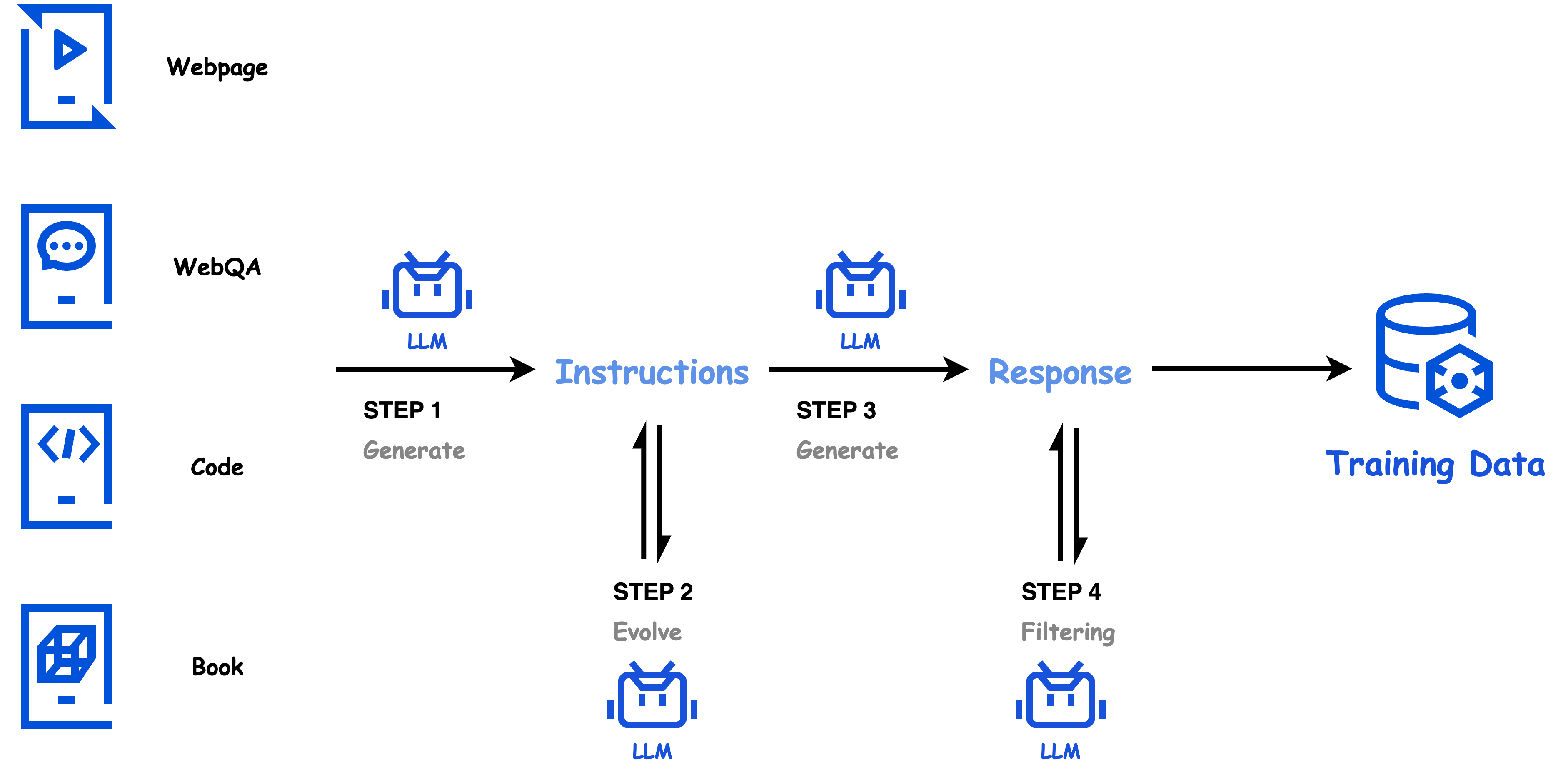
Figure 1:
The four-step process of data synthesis in Hunyuan-Large’s pre-training:
(1) Instruction
generation, (2) Instruction evolution, (3) Response generation, and (4) Response filtering.
2.1.1
Data Processing and Synthesis
To start with, we provide a brief overview of the used pre-training data, and then delve deeper into
the specifics of our synthetic data generation process, which is essential for acquiring capabilities
also verified in various LLMs (Dubey et al., 2024; Abdin et al., 2024; Liu et al., 2024).
Data Overview and Processing.
We aim to create a high-quality, safe, and diverse training dataset
for pre-training, primarily consisting of Chinese and English languages for practical demands.
We
filter
the
data
based
on
criteria
such
as
writing
quality,
educational
value,
and
toxicity
to
ensure
its high quality.
Additionally, we anonymize all privacy-sensitive data and other harmful data.
We
have also implemented an elaborate system of category labels, which allows us to flexibly adjust the
proportions of various types of data in the training dataset.
Data Synthesis.
Besides the existing natural text corpus, we construct large amounts of synthetic
data to specifically boost the knowledge acquisition against the relative capability deficiency merely
learned from natural data.
To make full use of synthetic data to enhance model performance, we
mainly focus on the mathematics, coding, low-resource, and high-educational-value fields that are
good supplements to naturally distributed corpus, meeting three key requirements of quality, diversity,
and quantity.
As
shown
in
Figure
1,
we
synthesize
high-quality
instruction
data
through
a
four-step
process,
including instruction generation, instruction evolution, response generation, and response filtering.
•
Step
1:
Instruction
Generation
.
To
ensure
the
diversity
of
instructions,
we
use
high-quality,
knowledge-rich data sources such as web pages, web-based question-answering data, code reposito-
ries, books, and other resources as seeds.
Cooperating with diverse instruction generation prompts,
these seeds enable us to generate a wide variety of instructions that cover various domains with
different desired instruction styles and complexities.
•
Step 2:
Instruction Evolution
.
To further improve the quality of these initial instructions, we
refine them by three guidelines:
(a) Enhancing their clarity and informativeness.
(b) Expanding
low-resource domain instructions through self-instruct augmentation.
(c) Evolving the instructions
to increase their difficulty levels.
These evolved high-quality and challenging instructions enable
our model to benefit more efficiently from synthetic data to cross the original capability boundaries.
•
Step
3:
Response
Generation
.
We
utilize
several
specialized
models
to
generate
informative
and
accurate
answers
for
the
above
evolved
instructions.
These
models
vary
in
size
and
are
well-designed specialized models to synthesize expert-level responses for instructions in various
domains.
3
•
Step 4:
Response Filtering
.
To filter the synthetic instruction-response pairs, we employ a critique
model and conduct self-consistency checks, in which we generate multiple answers to perform self-
consistency filtering for tasks such as objective question-answering tasks, ensuring the reliability
and accuracy.
This process allows us to effectively remove any low-quality or inconsistent data,
ensuring the utilization of high-quality text in pre-training.
2.1.2
Tokenizer
The tokenizer is a vital component for effectiveness and efficiency in pre-training,
which should
balance two critical factors:
(a) achieving a high compression rate for efficient training and inference,
and (b) maintaining an appropriately large vocabulary to ensure adequate learning of each word em-
bedding.
In Hunyuan-Large, we carefully consider both aspects and employ a vocabulary consisting
of 128K tokens.
This token vocabulary is a combination of 100K tokens from the tiktoken tokenizer
(OpenAI, 2023) and an additional 28K tokens specifically designed to enhance Chinese language
support.
Notably, when compared to the LLama3.1 tokenizer, our new tokenizer exhibits improved
compression rates, increasing from 2.78 to 3.13 characters per token.
2.2
Model Structure
Hunyuan-Large is equipped with superior model structure and training strategies to achieve impressive
LLM capabilities.
We first show the overview of model architecture and hyper-parameters, and then
delve into the KV cache compression, expert routing strategy, and expert-specific learning rate scaling
used in our model with details.
2.2.1
Overview of Hunyuan-Large
The model structure of Hunyuan-Large mainly follows the classical MoE structure that uses multiple
experts to replace the original FFN in Transformer.
Tokens will be assigned to different experts, and
only a small ratio of experts will be activated in training.
Hunyuan-Large consists of both shared
and specialized experts.
We use Rotary Position Embedding (RoPE) for position learning (Su et al.,
2024) and SwiGLU for activation (Shazeer, 2020).
Table 1 displays the overview of our model’s
architecture and key hyper-parameters.
Table 1:
Overview of the architecture and key hyper-parameters of Hunyuan-Large.
This model has
389B total parameters and 52B activated parameters.
There are 1 shared expert and 1 specialized
expert activated for each token.
Configuration
Hunyuan-Large
# Layers
64
# Attention Heads
80
# Key/Value Heads
8
# Shared Experts
1
# Specialized Experts
16
# Activated Specialized Experts
1
# Trained Tokens
7T
Activation Function
SwiGLU
Vocabulary Size
128K
Hidden Size
6,400
2.2.2
KV Cache Compression
To alleviate memory pressure of KV cache and reduce the cost during inference, we jointly integrate
two classical strategies for KV cache compression:
(a) Grouped-Query Attention (GQA) (Ainslie
et al., 2023), which uses an intermediate number of KV heads to form head groups, compressing
KV cache from the head aspect, and (b) Cross-Layer Attention (CLA) (Brandon et al., 2024), which
shares
the
KV
cache
between
adjacent
layers,
compressing
KV
cache
from
the
layer
aspect.
In
Hunyuan-Large, we set
8
groups of KV heads for GQA, and share KV cache every
2
layers, jointly
considering both effectiveness and efficiency.
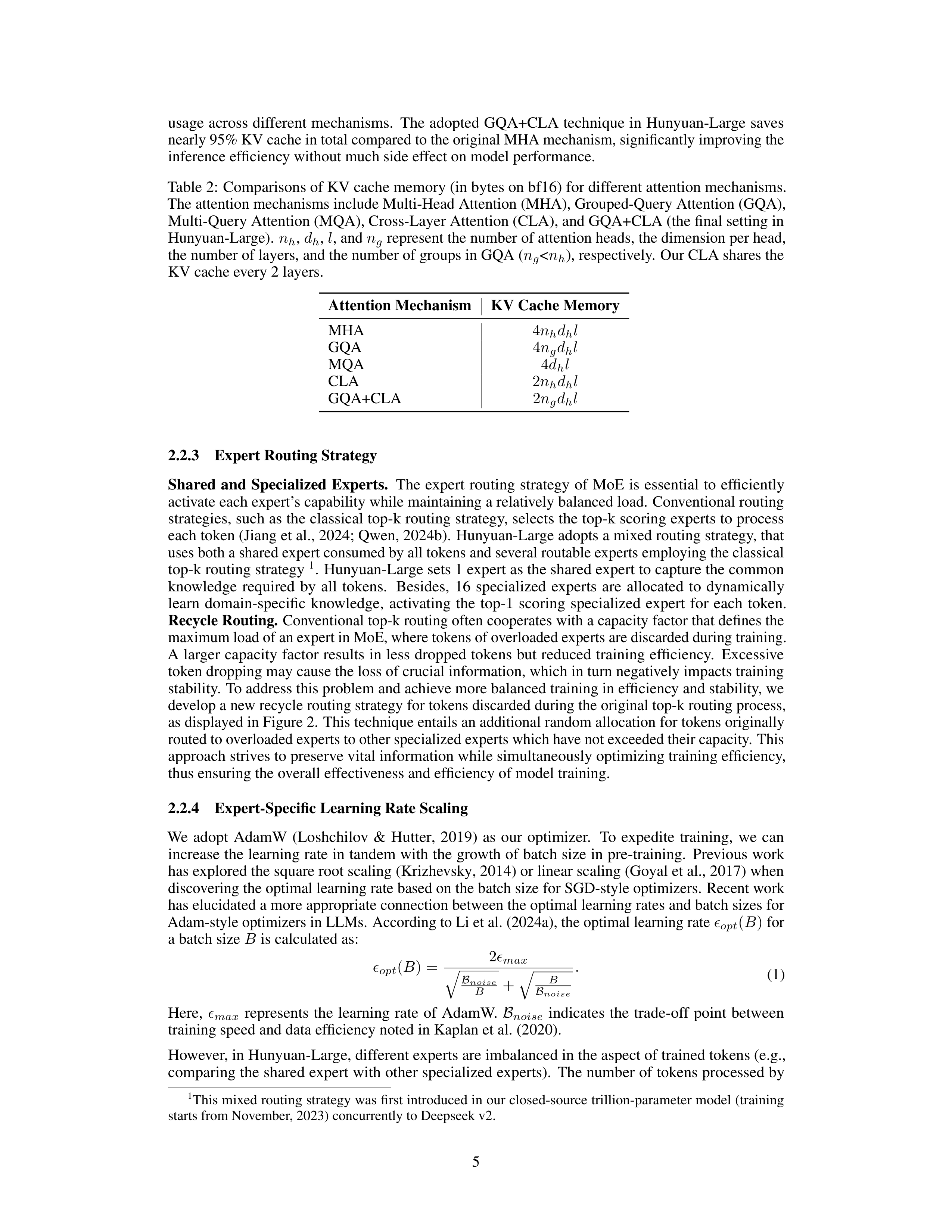
Table 2 presents a comparison of the KV cache memory
4
usage across different mechanisms.
The adopted GQA+CLA technique in Hunyuan-Large saves
nearly 95% KV cache in total compared to the original MHA mechanism, significantly improving the
inference efficiency without much side effect on model performance.
Table 2:
Comparisons of KV cache memory (in bytes on bf16) for different attention mechanisms.
The attention mechanisms include Multi-Head Attention (MHA), Grouped-Query Attention (GQA),
Multi-Query Attention (MQA), Cross-Layer Attention (CLA), and GQA+CLA (the final setting in
Hunyuan-Large).
n
h
,
d
h
,
l
, and
n
g
represent the number of attention heads, the dimension per head,
the number of layers, and the number of groups in GQA (
n
g
<
n
h
), respectively.
Our CLA shares the
KV cache every 2 layers.
Attention Mechanism
KV Cache Memory
MHA
4
n
h
d
h
l
GQA
4
n
g
d
h
l
MQA
4
d
h
l
CLA
2
n
h
d
h
l
GQA+CLA
2
n
g
d
h
l
2.2.3
Expert Routing Strategy
Shared
and
Specialized
Experts.
The
expert
routing
strategy
of
MoE
is
essential
to
efficiently
activate each expert’s capability while maintaining a relatively balanced load.
Conventional routing
strategies, such as the classical top-k routing strategy, selects the top-k scoring experts to process
each token (Jiang et al., 2024; Qwen, 2024b).
Hunyuan-Large adopts a mixed routing strategy, that
uses both a shared expert consumed by all tokens and several routable experts employing the classical
top-k routing strategy
1
.
Hunyuan-Large sets 1 expert as the shared expert to capture the common
knowledge
required
by
all
tokens.
Besides,
16
specialized
experts
are
allocated
to
dynamically
learn
domain-specific
knowledge,
activating
the
top-
1
scoring
specialized
expert
for
each
token.
Recycle Routing.
Conventional top-k routing often cooperates with a capacity factor that defines the
maximum load of an expert in MoE, where tokens of overloaded experts are discarded during training.
A larger capacity factor results in less dropped tokens but reduced training efficiency.
Excessive
token dropping may cause the loss of crucial information, which in turn negatively impacts training
stability.
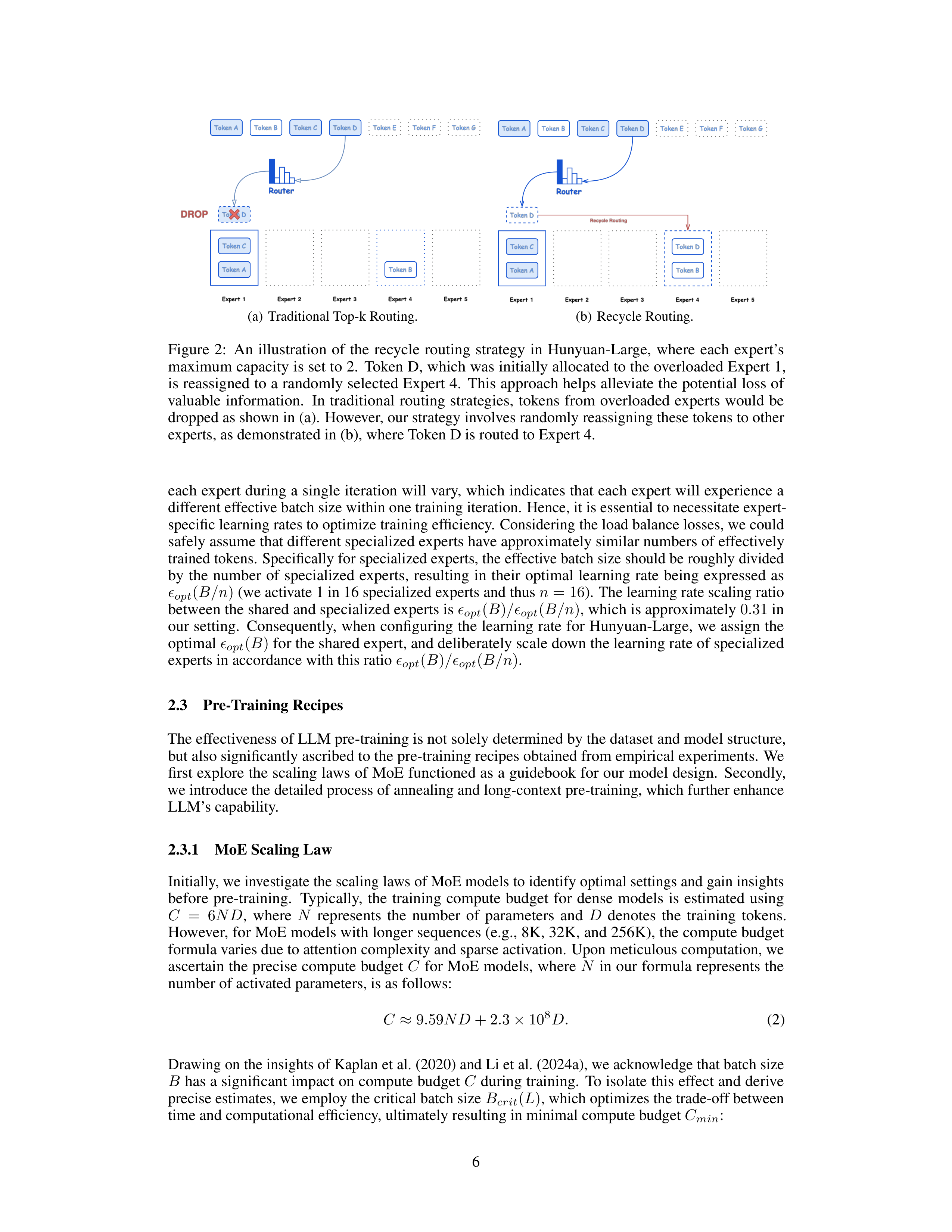
To address this problem and achieve more balanced training in efficiency and stability, we
develop a new recycle routing strategy for tokens discarded during the original top-k routing process,
as displayed in Figure 2.
This technique entails an additional random allocation for tokens originally
routed to overloaded experts to other specialized experts which have not exceeded their capacity.
This
approach strives to preserve vital information while simultaneously optimizing training efficiency,
thus ensuring the overall effectiveness and efficiency of model training.
2.2.4
Expert-Specific Learning Rate Scaling
We
adopt
AdamW
(Loshchilov
&
Hutter,
2019)
as
our
optimizer.
To
expedite
training,
we
can
increase the learning rate in tandem with the growth of batch size in pre-training.
Previous work
has explored the square root scaling (Krizhevsky, 2014) or linear scaling (Goyal et al., 2017) when
discovering the optimal learning rate based on the batch size for SGD-style optimizers.
Recent work
has elucidated a more appropriate connection between the optimal learning rates and batch sizes for
Adam-style optimizers in LLMs.
According to Li et al. (2024a), the optimal learning rate
ϵ
opt
(
B
)
for
a batch size
B
is calculated as:
ϵ
opt
(
B
) =
2
ϵ
max
q
B
noise
B
+
q
B
B
noise
.
(1)
Here,
ϵ
max
represents
the
learning
rate
of
AdamW.
B
noise
indicates
the
trade-off
point
between
training speed and data efficiency noted in Kaplan et al. (2020).
However, in Hunyuan-Large, different experts are imbalanced in the aspect of trained tokens (e.g.,
comparing the shared expert with other specialized experts).
The number of tokens processed by
1
This mixed routing strategy was first introduced in our closed-source trillion-parameter model (training
starts from November, 2023) concurrently to Deepseek v2.
5




























(a)
Traditional Top-k Routing.
(b)
Recycle Routing.
Figure
2:
An
illustration
of
the
recycle
routing
strategy
in
Hunyuan-Large,
where
each
expert’s
maximum capacity is set to 2.
Token D, which was initially allocated to the overloaded Expert 1,
is reassigned to a randomly selected Expert 4.
This approach helps alleviate the potential loss of
valuable
information.
In
traditional
routing
strategies,
tokens
from
overloaded
experts
would
be
dropped as shown in (a).
However, our strategy involves randomly reassigning these tokens to other
experts, as demonstrated in (b), where Token D is routed to Expert 4.
each expert during a single iteration will vary, which indicates that each expert will experience a
different effective batch size within one training iteration.
Hence, it is essential to necessitate expert-
specific learning rates to optimize training efficiency.
Considering the load balance losses, we could
safely assume that different specialized experts have approximately similar numbers of effectively
trained tokens.
Specifically for specialized experts, the effective batch size should be roughly divided
by
the
number
of
specialized
experts,
resulting
in
their
optimal
learning
rate
being
expressed
as
ϵ
opt
(
B/n
)
(we activate 1 in 16 specialized experts and thus
n
= 16
).
The learning rate scaling ratio
between the shared and specialized experts is
ϵ
opt
(
B
)
/ϵ
opt
(
B/n
)
, which is approximately
0
.
31
in
our setting.
Consequently,
when configuring the learning rate for Hunyuan-Large,
we assign the
optimal
ϵ
opt
(
B
)
for the shared expert, and deliberately scale down the learning rate of specialized
experts in accordance with this ratio
ϵ
opt
(
B
)
/ϵ
opt
(
B/n
)
.
2.3
Pre-Training Recipes
The effectiveness of LLM pre-training is not solely determined by the dataset and model structure,
but also significantly ascribed to the pre-training recipes obtained from empirical experiments.
We
first explore the scaling laws of MoE functioned as a guidebook for our model design.
Secondly,
we introduce the detailed process of annealing and long-context pre-training, which further enhance
LLM’s capability.
2.3.1
MoE Scaling Law
Initially, we investigate the scaling laws of MoE models to identify optimal settings and gain insights
before
pre-training.
Typically,
the
training
compute
budget
for
dense
models
is
estimated
using
C
=
6
ND
,
where
N
represents
the
number
of
parameters
and
D
denotes
the
training
tokens.
However, for MoE models with longer sequences (e.g., 8K, 32K, and 256K), the compute budget
formula varies due to attention complexity and sparse activation.
Upon meticulous computation, we
ascertain the precise compute budget
C
for MoE models, where
N
in our formula represents the
number of activated parameters, is as follows:
C
≈
9
.
59
ND
+ 2
.
3
×
10
8
D.
(2)
Drawing on the insights of Kaplan et al. (2020) and Li et al. (2024a), we acknowledge that batch size
B
has a significant impact on compute budget
C
during training.
To isolate this effect and derive
precise estimates, we employ the critical batch size
B
crit
(
L
)
, which optimizes the trade-off between
time and computational efficiency, ultimately resulting in minimal compute budget
C
min
:
6
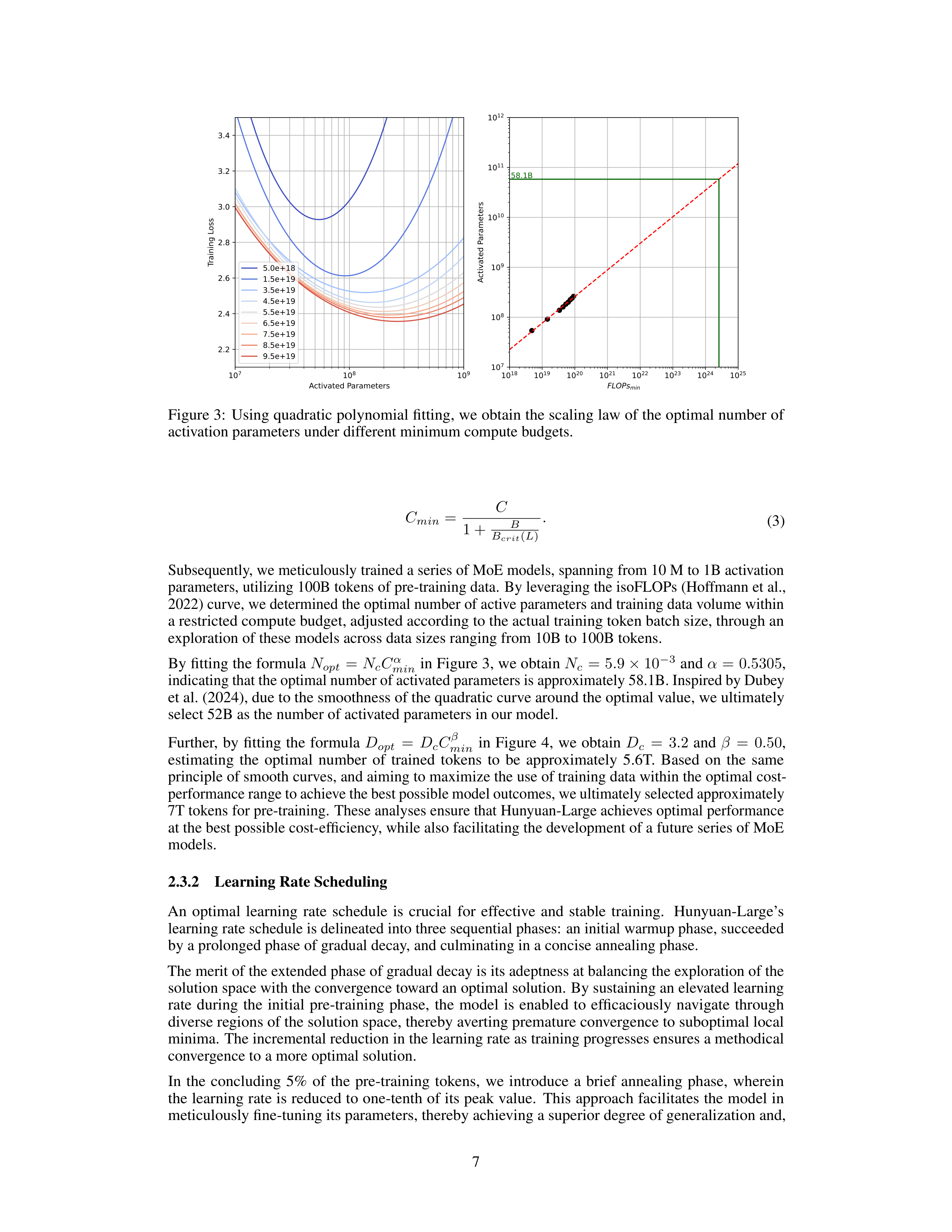
Figure 3:
Using quadratic polynomial fitting, we obtain the scaling law of the optimal number of
activation parameters under different minimum compute budgets.
C
min
=
C
1 +
B
B
crit
(
L
)
.
(3)
Subsequently, we meticulously trained a series of MoE models, spanning from 10 M to 1B activation
parameters, utilizing 100B tokens of pre-training data.
By leveraging the isoFLOPs (Hoffmann et al.,
2022) curve, we determined the optimal number of active parameters and training data volume within
a restricted compute budget, adjusted according to the actual training token batch size, through an
exploration of these models across data sizes ranging from 10B to 100B tokens.
By fitting the formula
N
opt
=
N
c
C
α
min
in Figure 3, we obtain
N
c
=
5
.
9
×
10
−
3
and
α
=
0
.
5305
,
indicating that the optimal number of activated parameters is approximately 58.1B. Inspired by Dubey
et al. (2024), due to the smoothness of the quadratic curve around the optimal value, we ultimately
select 52B as the number of activated parameters in our model.
Further,
by
fitting
the
formula
D
opt
=
D
c
C
β
min
in
Figure
4,
we
obtain
D
c
=
3
.
2
and
β
=
0
.
50
,
estimating
the
optimal
number
of
trained
tokens
to
be
approximately
5.6T.
Based
on
the
same
principle of smooth curves, and aiming to maximize the use of training data within the optimal cost-
performance range to achieve the best possible model outcomes, we ultimately selected approximately
7T tokens for pre-training.
These analyses ensure that Hunyuan-Large achieves optimal performance
at the best possible cost-efficiency, while also facilitating the development of a future series of MoE
models.
2.3.2
Learning Rate Scheduling
An
optimal
learning
rate
schedule
is
crucial
for
effective
and
stable
training.
Hunyuan-Large’s
learning rate schedule is delineated into three sequential phases:
an initial warmup phase, succeeded
by a prolonged phase of gradual decay, and culminating in a concise annealing phase.
The merit of the extended phase of gradual decay is its adeptness at balancing the exploration of the
solution space with the convergence toward an optimal solution.
By sustaining an elevated learning
rate
during
the
initial
pre-training
phase,
the
model
is
enabled
to
efficaciously
navigate
through
diverse regions of the solution space, thereby averting premature convergence to suboptimal local
minima.
The incremental reduction in the learning rate as training progresses ensures a methodical
convergence to a more optimal solution.
In
the
concluding
5%
of
the
pre-training
tokens,
we
introduce
a
brief
annealing
phase,
wherein
the learning rate is reduced to one-tenth of its peak value.
This approach facilitates the model in
meticulously fine-tuning its parameters, thereby achieving a superior degree of generalization and,
7
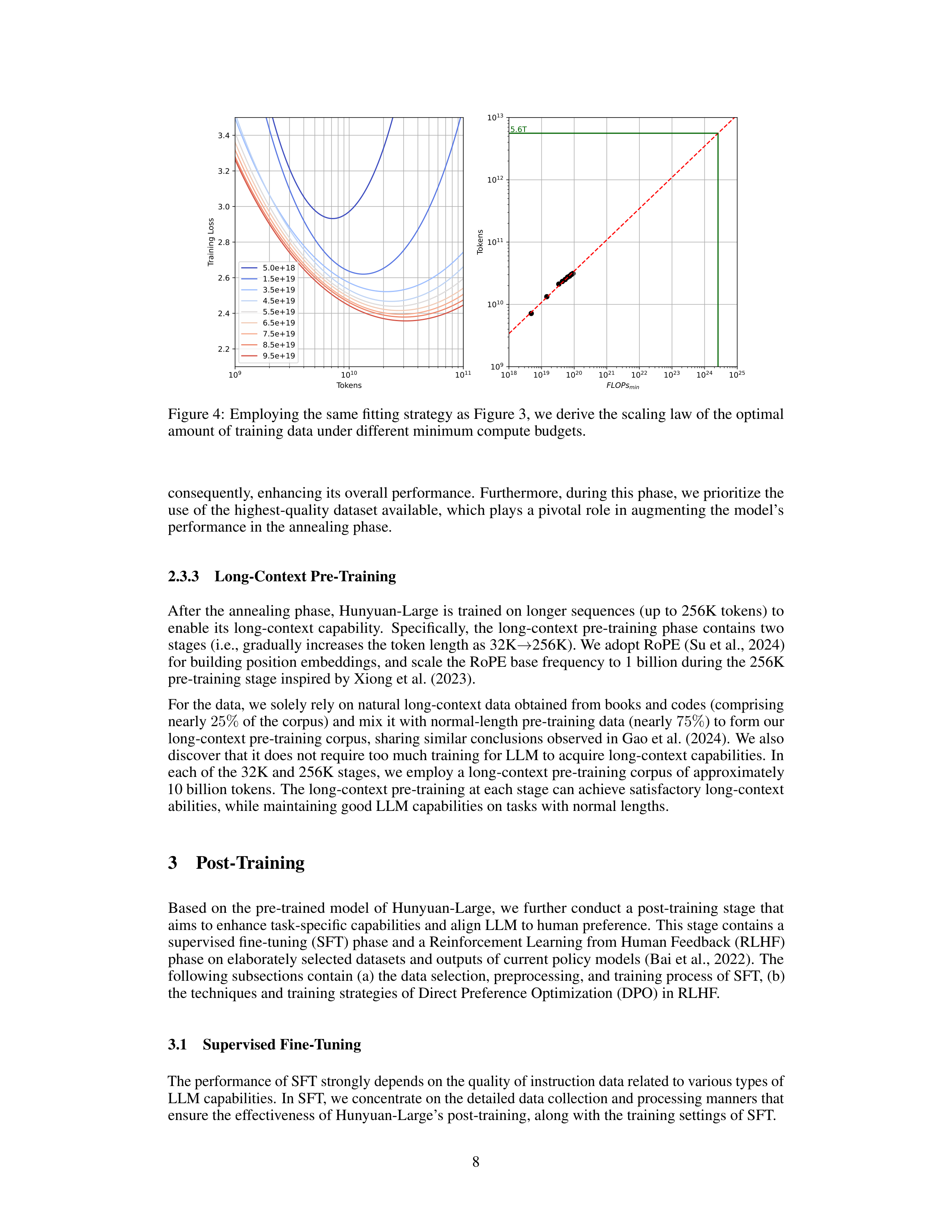
Figure 4:
Employing the same fitting strategy as Figure 3, we derive the scaling law of the optimal
amount of training data under different minimum compute budgets.
consequently, enhancing its overall performance.
Furthermore, during this phase, we prioritize the
use of the highest-quality dataset available, which plays a pivotal role in augmenting the model’s
performance in the annealing phase.
2.3.3
Long-Context Pre-Training
After the annealing phase, Hunyuan-Large is trained on longer sequences (up to 256K tokens) to
enable
its
long-context
capability.
Specifically,
the
long-context
pre-training
phase
contains
two
stages (i.e., gradually increases the token length as 32K
→
256K). We adopt RoPE (Su et al., 2024)
for building position embeddings, and scale the RoPE base frequency to 1 billion during the 256K
pre-training stage inspired by Xiong et al. (2023).
For the data, we solely rely on natural long-context data obtained from books and codes (comprising
nearly
25%
of the corpus) and mix it with normal-length pre-training data (nearly
75%
) to form our
long-context pre-training corpus, sharing similar conclusions observed in Gao et al. (2024).
We also
discover that it does not require too much training for LLM to acquire long-context capabilities.
In
each of the 32K and 256K stages, we employ a long-context pre-training corpus of approximately
10 billion tokens.
The long-context pre-training at each stage can achieve satisfactory long-context
abilities, while maintaining good LLM capabilities on tasks with normal lengths.
3
Post-Training
Based on the pre-trained model of Hunyuan-Large,
we further conduct a post-training stage that
aims to enhance task-specific capabilities and align LLM to human preference.
This stage contains a
supervised fine-tuning (SFT) phase and a Reinforcement Learning from Human Feedback (RLHF)
phase on elaborately selected datasets and outputs of current policy models (Bai et al., 2022).
The
following subsections contain (a) the data selection, preprocessing, and training process of SFT, (b)
the techniques and training strategies of Direct Preference Optimization (DPO) in RLHF.
3.1
Supervised Fine-Tuning
The performance of SFT strongly depends on the quality of instruction data related to various types of
LLM capabilities.
In SFT, we concentrate on the detailed data collection and processing manners that
ensure the effectiveness of Hunyuan-Large’s post-training, along with the training settings of SFT.
8
3.1.1
Overview of SFT Data
The central goal of SFT is further enhancing its performance across multiple key capabilities based
on
the
corresponding
well-selected
data.
These
capabilities
primarily
encompass
mathematics,
coding,
logical reasoning,
knowledge-based question answering,
agent behavior,
text generation,
NLP comprehension, industrial applications, role-playing, long-text capabilities, etc.
We recognize
that improving these abilities not only enables the model to be more adept in practical applications,
but also better satisfies users’ diverse needs across multiple scenarios.
Simultaneously, we place great
emphasis on data security, striving to ensure that the model aligns with human values under most
circumstances.
The overall SFT data volume exceeds 1 million.
3.1.2
Data Collection and Processing
The
key
techniques
of
SFT
data
collection
and
processing
mainly
include
instruction
extraction,
instruction generalization, instruction balancing, and data quality controlling.
Instruction Extraction.
To enhance the breadth and diversity of the instruction set, we develop an
instruction extraction model specifically for domains such as mathematics, logical reasoning, and
knowledge-based question answering, whose primary goal is to effectively extract data suitable for
instruction tuning from publicly available data sources (e.g., web pages, encyclopedias, etc.).
The
extracted data includes both instructions and corresponding reference answers.
We develop many
specialized models as instruction extractors.
With the help of these model, we successfully extract a
large set of natural instructions from public data.
These instructions play a crucial role as the seed to
enhance the final model’s generalization performance and diversity.
Instruction
Generalization.
We
propose
an
instruction
generalization
method
to
obtain
more
diverse and complex instructions in large quantities.
Specifically, we design and train an instruction
generalization system capable of generalizing targeted instructions while gradually increasing their
difficulty
and
complexity
levels.
The
central
recipe
of
this
system
lies
in
training
the
model
by
synthesizing numerous mappings between simple and complex instructions.
In addition, we construct
a
well-structured
instruction
taxonomy
with
its
corresponding
classification
models,
which
aims
to analyze and balance the distribution of various instruction types in SFT data.
Armed with this
instruction
taxonomy,
our
instruction
generalization
system
can
supplement
the
original
data
on
specific weak instructions of targeted types.
Instruction Balancing.
Through the instruction extraction and generalization processes, we accu-
mulate more than
10
million instructions.
Instruction balance is essential for enhancing the model’s
performance
across
various
scenarios.
However,
many
generated
instructions
have
very
similar
semantic
meanings
and
the
instruction
type
distribution
is
naturally
unbalanced.
To
enhance
the
instruction
complexity
while
maintaining
balanced
instruction
distributions,
we
attach
labels
for
each
instruction.
These
labels
encompass
multiple
dimensions.
By
meticulously
tagging
these
labels, we can more accurately understand and analyze the characteristics of our instruction sets.
By
ensuring adequate amounts and balanced distribution of different types of instructions during the SFT
process, we can effectively alleviate overfitting or underfitting problems on specific instruction types,
thereby improving the model’s generalization capabilities and adaptability across diverse application
scenarios.
Data Quality Controlling
.
The quality of SFT data is the foundation of superior performance.
We
mainly conduct the following three methods to ensure the high quality of our SFT data.
•
Rule-based Filtering.
We discover some common issues such as data truncation errors, duplication,
garbled characters, and format errors in SFT data.
Consequently, we develop a set of rule-based
data filtering strategies to prevent the above instruction extraction and generation models from
producing undesirable outputs.
•
Model-based Filtering.
To automatically extract high-quality SFT data from a substantial volume
of synthesized instruction data, we train a critique model (McAleese et al., 2024) based on a 70B
dense model of our Hunyuan series.
This model assigns a four-tier quality score to each instruction
sample, assessing aspects such as the accuracy, relevance, completeness, usefulness, and clarity of
the generated responses, and other possible data quality issues.
9
•
Human-based Filtering.
Prior to model training, the SFT data filtered via rule-based and model-
based methods further undergo human annotation, ensuring that answers adhere to the desired
task-specific response patterns and avoid introducing additional low-quality issues.
3.1.3
Training Details
In SFT, we fine-tune the pre-trained model based on the high-quality data (more than 1 million) for a
total of 3 epochs.
The learning rate decays from 2e-5 to 2e-6.
To mitigate overfitting during SFT, we
utilize an attention dropout of 0.1 and a hidden dropout of 0.2.
We find that, compared to the dense
models,
the
MoE
architecture
of
Hunyuan
series
could
benefit
more
from
incorporating
suitable
dropout rates.
3.2
Reinforcement Learning from Human Feedback
To align Hunyuan-Large with human preferences, we further train our SFT model using DPO (Rafailov
et al., 2024).
We adopt a single-stage training strategy that integrates both offline and online training,
which demonstrates superior controllability and overall performance.
In this integrated approach, we
utilize a pre-compiled preference dataset to enhance controllability, while simultaneously employing
the current policy model to generate multiple responses for each prompt and our reward model to
select the most and least preferred responses.
To enhance training stability, we incorporate an SFT loss term on the chosen response, similar to the
approaches in (Dubey et al., 2024; Adler et al., 2024).
This addition helps stabilize DPO training
by preventing a decrease in the log probability of chosen responses.
Furthermore, we implement an
exponential moving average strategy to mitigate reward hacking and reduce alignment tax (Ouyang
et al., 2022), ensuring a more stable training process across a larger dataset.
4
Model Evaluations
We conduct extensive evaluations of Hunyuan-Large to demonstrate its effectiveness.
The following
experiments concentrate on our pre-trained language model (in Sec.
4.1) and post-trained language
model (in Sec.
4.2) on various tasks in Chinese and English, including math and reasoning, code,
reading comprehension, commonsense, long context, and aggregated task, etc., where Hunyuan-Large
achieves excellent performance among tasks in both pre-training and post-training.
4.1
Evaluations on Pre-Trained Model
In this section, we report the performance of Hunyuan-Large’s pre-trained model on various types of
widely-used benchmarks, verifying the power of the fundamental capability of our model.
4.1.1
Benchmarks and Experimental Settings
Key Benchmarks.
We evaluate Hunyuan-Large on a large number of widely-used benchmarks of
various tasks, including commonsense understanding, machine comprehension, question answering,
math and reasoning, coding, and aggregated tasks, in both English and Chinese.
Specifically, we
choose MMLU (Hendrycks et al., 2021), MMLU-Pro (Wang et al., 2024b), BBH (Suzgun et al., 2022),
CMMLU (Li et al., 2023), and C-Eval (Huang et al., 2024) for the aggregated evaluations.
HellaSwag
(Zellers et al., 2019), CommonsenseQA (Talmor et al., 2019), and WinoGrande (Sakaguchi et al.,
2021) are adopted to measure our model on commonsense understanding, while PIQA (Bisk et al.,
2020)
is
specially
for
physical
related
commonsense.
We
also
select
DROP
(Dua
et
al.,
2019),
C3 (Sun et al., 2020) and NaturalQuestions(Kwiatkowski et al., 2019) to evaluate LLMs on their
basic capabilities on classical NLP tasks such as question answering and reading comprehension.
ARC-C (Clark et al., 2018), TriviaQA (Joshi et al., 2017) are added as QA tasks that require certain
background related to science and updated world knowledge.
Finally, we evaluate LLMs on GSM8k
(Cobbe et al., 2021), MATH Hendrycks et al. (2021), and CMATH (Wei et al., 2023) to measure the
mathematics capability, and on HumanEval (Chen et al., 2021) and MBPP (Austin et al., 2021) for
coding, which are representative and essential LLM abilities.
Evaluation Settings and Competitors.
We follow the commonly used evaluation settings (e.g.,
evaluation metrics and the numbers of shots) of various types of benchmarks in experiments.
Pre-
10
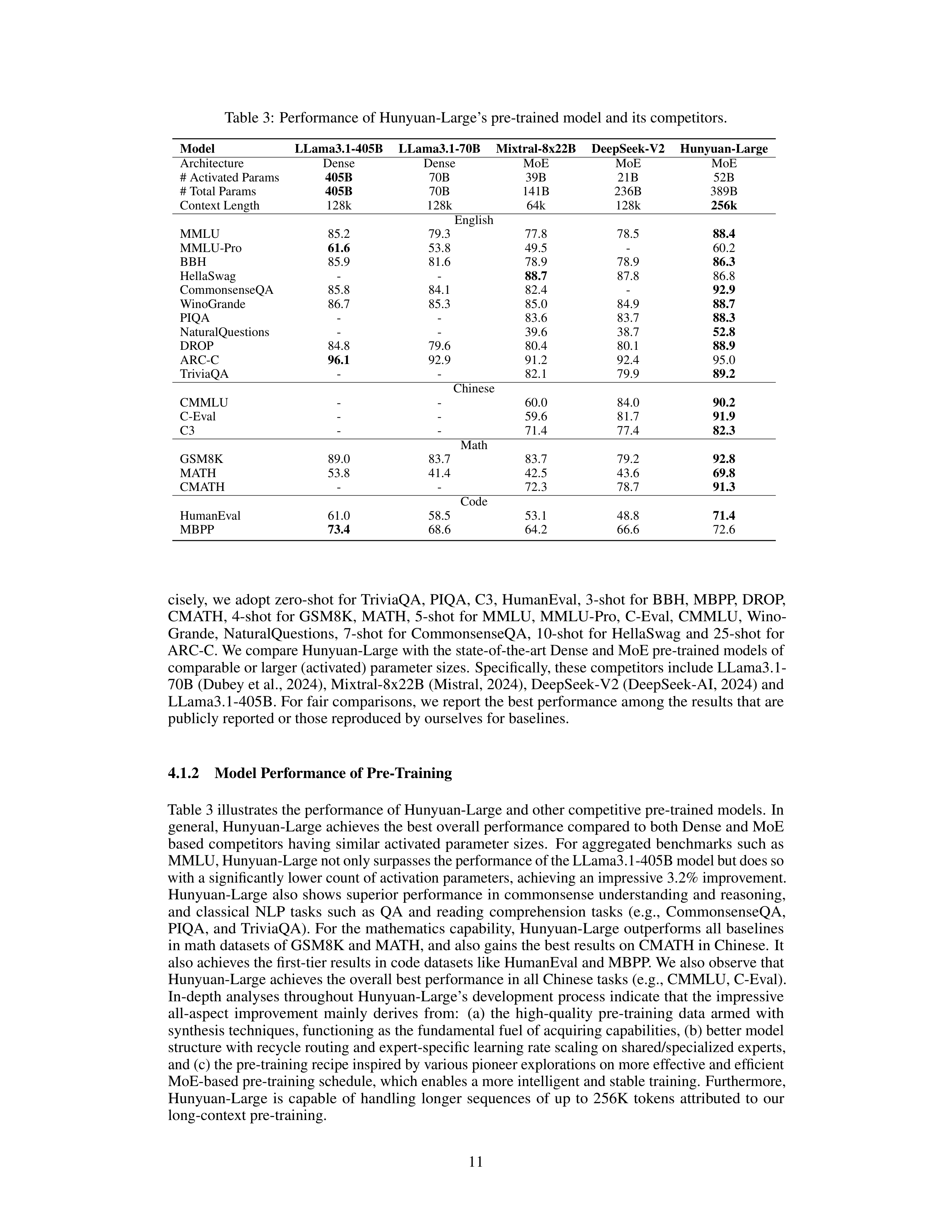
Table 3:
Performance of Hunyuan-Large’s pre-trained model and its competitors.
Model
LLama3.1-405B
LLama3.1-70B
Mixtral-8x22B
DeepSeek-V2
Hunyuan-Large
Architecture
Dense
Dense
MoE
MoE
MoE
# Activated Params
405B
70B
39B
21B
52B
# Total Params
405B
70B
141B
236B
389B
Context Length
128k
128k
64k
128k
256k
English
MMLU
85.2
79.3
77.8
78.5
88.4
MMLU-Pro
61.6
53.8
49.5
-
60.2
BBH
85.9
81.6
78.9
78.9
86.3
HellaSwag
-
-
88.7
87.8
86.8
CommonsenseQA
85.8
84.1
82.4
-
92.9
WinoGrande
86.7
85.3
85.0
84.9
88.7
PIQA
-
-
83.6
83.7
88.3
NaturalQuestions
-
-
39.6
38.7
52.8
DROP
84.8
79.6
80.4
80.1
88.9
ARC-C
96.1
92.9
91.2
92.4
95.0
TriviaQA
-
-
82.1
79.9
89.2
Chinese
CMMLU
-
-
60.0
84.0
90.2
C-Eval
-
-
59.6
81.7
91.9
C3
-
-
71.4
77.4
82.3
Math
GSM8K
89.0
83.7
83.7
79.2
92.8
MATH
53.8
41.4
42.5
43.6
69.8
CMATH
-
-
72.3
78.7
91.3
Code
HumanEval
61.0
58.5
53.1
48.8
71.4
MBPP
73.4
68.6
64.2
66.6
72.6
cisely, we adopt zero-shot for TriviaQA, PIQA, C3, HumanEval, 3-shot for BBH, MBPP, DROP,
CMATH, 4-shot for GSM8K, MATH, 5-shot for MMLU, MMLU-Pro,
C-Eval,
CMMLU, Wino-
Grande,
NaturalQuestions,
7-shot
for
CommonsenseQA,
10-shot
for
HellaSwag
and
25-shot
for
ARC-C. We compare Hunyuan-Large with the state-of-the-art Dense and MoE pre-trained models of
comparable or larger (activated) parameter sizes.
Specifically, these competitors include LLama3.1-
70B (Dubey et al., 2024), Mixtral-8x22B (Mistral, 2024), DeepSeek-V2 (DeepSeek-AI, 2024) and
LLama3.1-405B. For fair comparisons, we report the best performance among the results that are
publicly reported or those reproduced by ourselves for baselines.
4.1.2
Model Performance of Pre-Training
Table 3 illustrates the performance of Hunyuan-Large and other competitive pre-trained models.
In
general, Hunyuan-Large achieves the best overall performance compared to both Dense and MoE
based
competitors
having
similar
activated
parameter
sizes.
For
aggregated
benchmarks
such
as
MMLU, Hunyuan-Large not only surpasses the performance of the LLama3.1-405B model but does so
with a significantly lower count of activation parameters, achieving an impressive 3.2% improvement.
Hunyuan-Large
also
shows
superior
performance
in
commonsense
understanding
and
reasoning,
and
classical
NLP
tasks
such
as
QA
and
reading
comprehension
tasks
(e.g.,
CommonsenseQA,
PIQA, and TriviaQA). For the mathematics capability,
Hunyuan-Large outperforms all baselines
in math datasets of GSM8K and MATH, and also gains the best results on CMATH in Chinese.
It
also achieves the first-tier results in code datasets like HumanEval and MBPP. We also observe that
Hunyuan-Large achieves the overall best performance in all Chinese tasks (e.g., CMMLU, C-Eval).
In-depth analyses throughout Hunyuan-Large’s development process indicate that the impressive
all-aspect
improvement
mainly
derives
from:
(a)
the
high-quality
pre-training
data
armed
with
synthesis techniques, functioning as the fundamental fuel of acquiring capabilities, (b) better model
structure with recycle routing and expert-specific learning rate scaling on shared/specialized experts,
and (c) the pre-training recipe inspired by various pioneer explorations on more effective and efficient
MoE-based pre-training schedule, which enables a more intelligent and stable training.
Furthermore,
Hunyuan-Large
is
capable
of
handling
longer
sequences
of
up
to
256K
tokens
attributed
to
our
long-context pre-training.
11
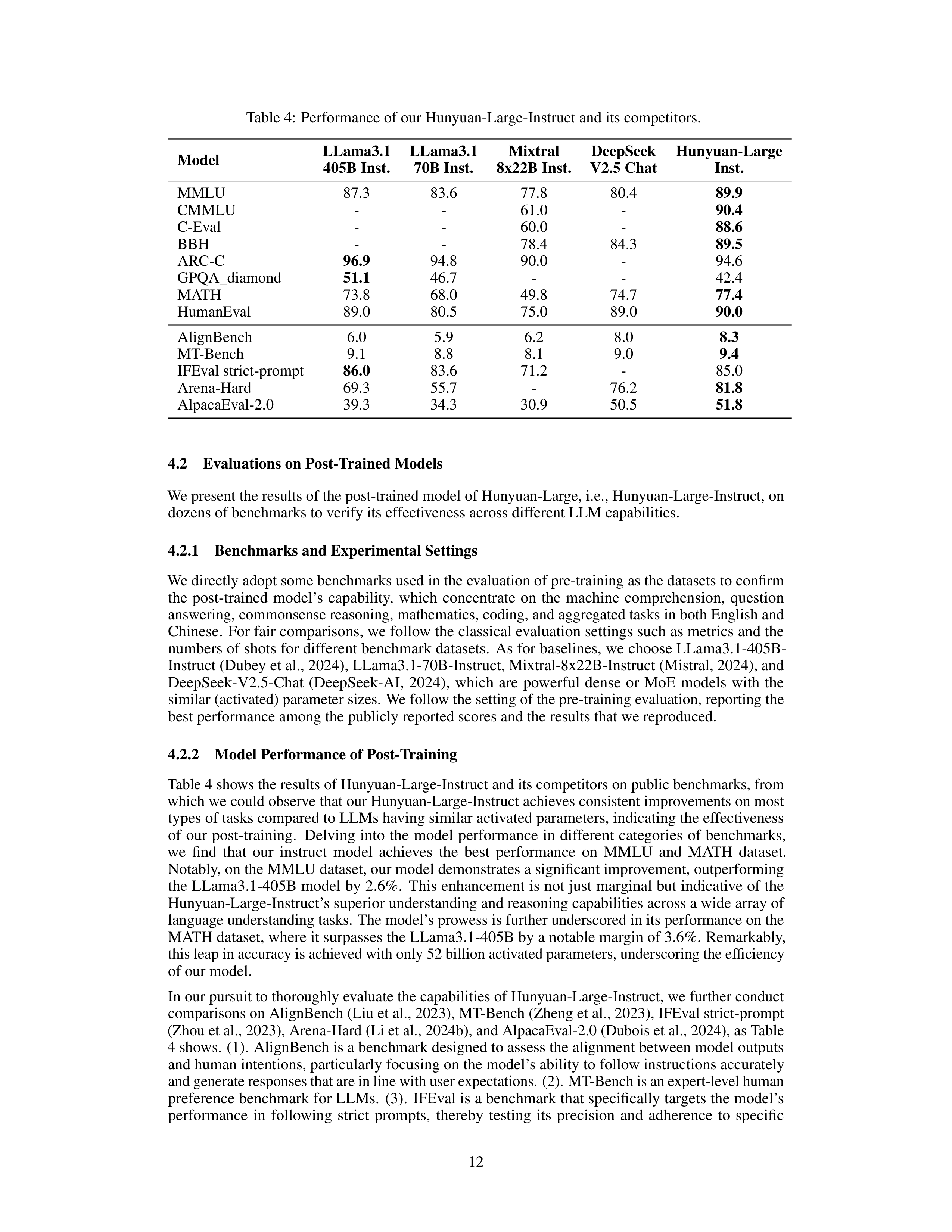
Table 4:
Performance of our Hunyuan-Large-Instruct and its competitors.
Model
LLama3.1
405B Inst.
LLama3.1
70B Inst.
Mixtral
8x22B Inst.
DeepSeek
V2.5 Chat
Hunyuan-Large
Inst.
MMLU
87.3
83.6
77.8
80.4
89.9
CMMLU
-
-
61.0
-
90.4
C-Eval
-
-
60.0
-
88.6
BBH
-
-
78.4
84.3
89.5
ARC-C
96.9
94.8
90.0
-
94.6
GPQA_diamond
51.1
46.7
-
-
42.4
MATH
73.8
68.0
49.8
74.7
77.4
HumanEval
89.0
80.5
75.0
89.0
90.0
AlignBench
6.0
5.9
6.2
8.0
8.3
MT-Bench
9.1
8.8
8.1
9.0
9.4
IFEval strict-prompt
86.0
83.6
71.2
-
85.0
Arena-Hard
69.3
55.7
-
76.2
81.8
AlpacaEval-2.0
39.3
34.3
30.9
50.5
51.8
4.2
Evaluations on Post-Trained Models
We present the results of the post-trained model of Hunyuan-Large, i.e., Hunyuan-Large-Instruct, on
dozens of benchmarks to verify its effectiveness across different LLM capabilities.
4.2.1
Benchmarks and Experimental Settings
We directly adopt some benchmarks used in the evaluation of pre-training as the datasets to confirm
the
post-trained
model’s
capability,
which
concentrate
on
the
machine
comprehension,
question
answering, commonsense reasoning, mathematics, coding, and aggregated tasks in both English and
Chinese.
For fair comparisons, we follow the classical evaluation settings such as metrics and the
numbers of shots for different benchmark datasets.
As for baselines, we choose LLama3.1-405B-
Instruct (Dubey et al., 2024), LLama3.1-70B-Instruct, Mixtral-8x22B-Instruct (Mistral, 2024), and
DeepSeek-V2.5-Chat
(DeepSeek-AI,
2024),
which
are
powerful
dense
or
MoE
models
with
the
similar (activated) parameter sizes.
We follow the setting of the pre-training evaluation, reporting the
best performance among the publicly reported scores and the results that we reproduced.
4.2.2
Model Performance of Post-Training
Table 4 shows the results of Hunyuan-Large-Instruct and its competitors on public benchmarks, from
which we could observe that our Hunyuan-Large-Instruct achieves consistent improvements on most
types of tasks compared to LLMs having similar activated parameters, indicating the effectiveness
of
our
post-training.
Delving
into
the
model
performance
in
different
categories
of
benchmarks,
we
find
that
our
instruct
model
achieves
the
best
performance
on
MMLU
and
MATH
dataset.
Notably, on the MMLU dataset, our model demonstrates a significant improvement, outperforming
the LLama3.1-405B model by 2.6%.
This enhancement is not just marginal but indicative of the
Hunyuan-Large-Instruct’s superior understanding and reasoning capabilities across a wide array of
language understanding tasks.
The model’s prowess is further underscored in its performance on the
MATH dataset, where it surpasses the LLama3.1-405B by a notable margin of 3.6%.
Remarkably,
this leap in accuracy is achieved with only 52 billion activated parameters, underscoring the efficiency
of our model.
In our pursuit to thoroughly evaluate the capabilities of Hunyuan-Large-Instruct, we further conduct
comparisons on AlignBench (Liu et al., 2023), MT-Bench (Zheng et al., 2023), IFEval strict-prompt
(Zhou et al., 2023), Arena-Hard (Li et al., 2024b), and AlpacaEval-2.0 (Dubois et al., 2024), as Table
4 shows.
(1).
AlignBench is a benchmark designed to assess the alignment between model outputs
and human intentions, particularly focusing on the model’s ability to follow instructions accurately
and generate responses that are in line with user expectations. (2). MT-Bench is an expert-level human
preference benchmark for LLMs.
(3).
IFEval is a benchmark that specifically targets the model’s
performance
in
following
strict
prompts,
thereby
testing
its
precision
and
adherence
to
specific
12
instructions within a given context.
(4).
Arena-Hard robustly differentiates model capabilities, aligns
closely with human preferences in real-world scenarios, and is frequently updated with new prompts
to prevent over-fitting and ensure ongoing relevance.
(5).
AlpacaEval-2.0 is also a commonly-used
benchmark
to
automatically
evaluate
the
LLMs’
instruction
following
abilities.
Hunyuan-Large-
Instruct shows the best overall performance on these five benchmarks compared to all the strong
baseline models.
It is implied that the impressive performance of Hunyuan-Large-Instruct could
mainly
attribute
to
its
powerful
pre-trained
model,
the
high-quality
SFT
and
DPO
data
with
the
well-designed four-step data collection and processing that generates this data, and the superior SFT
and DPO training strategies.
4.3
Long-Context Capability Evaluations
To comprehensively assess the long-context performance of Hunyuan-Large-Instruct, we undertook a
series of comprehensive assessments employing two widely recognized open-source benchmarks,
i.e.,
RULER
(Hsieh
et
al.,
2024)
and
LV-Eval
(Yuan
et
al.,
2024).
In
addition,
we
introduce
a
self-developed long-context benchmark,
i.e.,
PenguinScrolls,
for further comparisons.
We select
LLama3.1-70B-Instruct
as
a
strong
baseline
due
to
its
well-documented
strength
in
processing
extended contexts.
4.3.1
Open-Source Long-Context Benchmarks and Evaluation
RULER
. RULER encompasses a diverse set of task categories, including retrieval, multi-hop rea-
soning, aggregation, and question answering.
Each task spans varying context lengths, offering a
flexible and comprehensive evaluation framework for assessing LLMs’ long-context competencies.
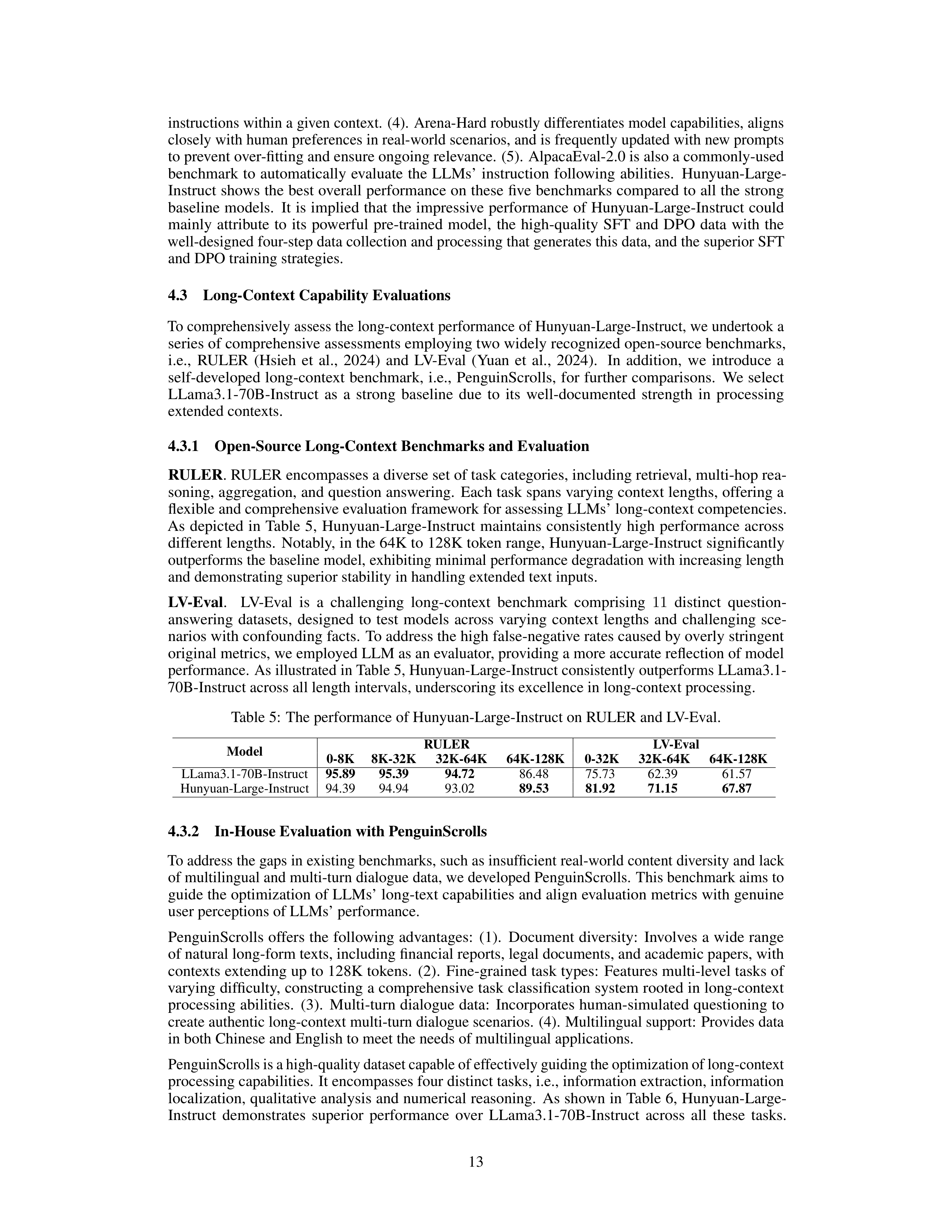
As
depicted
in
Table
5,
Hunyuan-Large-Instruct
maintains
consistently
high
performance
across
different lengths.
Notably, in the 64K to 128K token range, Hunyuan-Large-Instruct significantly
outperforms the baseline model, exhibiting minimal performance degradation with increasing length
and demonstrating superior stability in handling extended text inputs.
LV-Eval
.
LV-Eval
is
a
challenging
long-context
benchmark
comprising
11
distinct
question-
answering
datasets,
designed
to
test
models
across
varying
context
lengths
and
challenging
sce-
narios with confounding facts.
To address the high false-negative rates caused by overly stringent
original metrics, we employed LLM as an evaluator, providing a more accurate reflection of model
performance.
As illustrated in Table 5, Hunyuan-Large-Instruct consistently outperforms LLama3.1-
70B-Instruct across all length intervals, underscoring its excellence in long-context processing.
Table 5:
The performance of Hunyuan-Large-Instruct on RULER and LV-Eval.
RULER
LV-Eval
Model
0-8K
8K-32K
32K-64K
64K-128K
0-32K
32K-64K
64K-128K
LLama3.1-70B-Instruct
95.89
95.39
94.72
86.48
75.73
62.39
61.57
Hunyuan-Large-Instruct
94.39
94.94
93.02
89.53
81.92
71.15
67.87
4.3.2
In-House Evaluation with PenguinScrolls
To address the gaps in existing benchmarks, such as insufficient real-world content diversity and lack
of multilingual and multi-turn dialogue data, we developed PenguinScrolls.
This benchmark aims to
guide the optimization of LLMs’ long-text capabilities and align evaluation metrics with genuine
user perceptions of LLMs’ performance.
PenguinScrolls offers the following advantages:
(1).
Document diversity:
Involves a wide range
of natural long-form texts, including financial reports, legal documents, and academic papers, with
contexts extending up to 128K tokens.
(2).
Fine-grained task types:
Features multi-level tasks of
varying difficulty, constructing a comprehensive task classification system rooted in long-context
processing abilities.
(3).
Multi-turn dialogue data:
Incorporates human-simulated questioning to
create authentic long-context multi-turn dialogue scenarios.
(4).
Multilingual support:
Provides data
in both Chinese and English to meet the needs of multilingual applications.
PenguinScrolls is a high-quality dataset capable of effectively guiding the optimization of long-context
processing capabilities.
It encompasses four distinct tasks, i.e., information extraction, information
localization, qualitative analysis and numerical reasoning.
As shown in Table 6, Hunyuan-Large-
Instruct
demonstrates
superior
performance
over
LLama3.1-70B-Instruct
across
all
these
tasks.
13
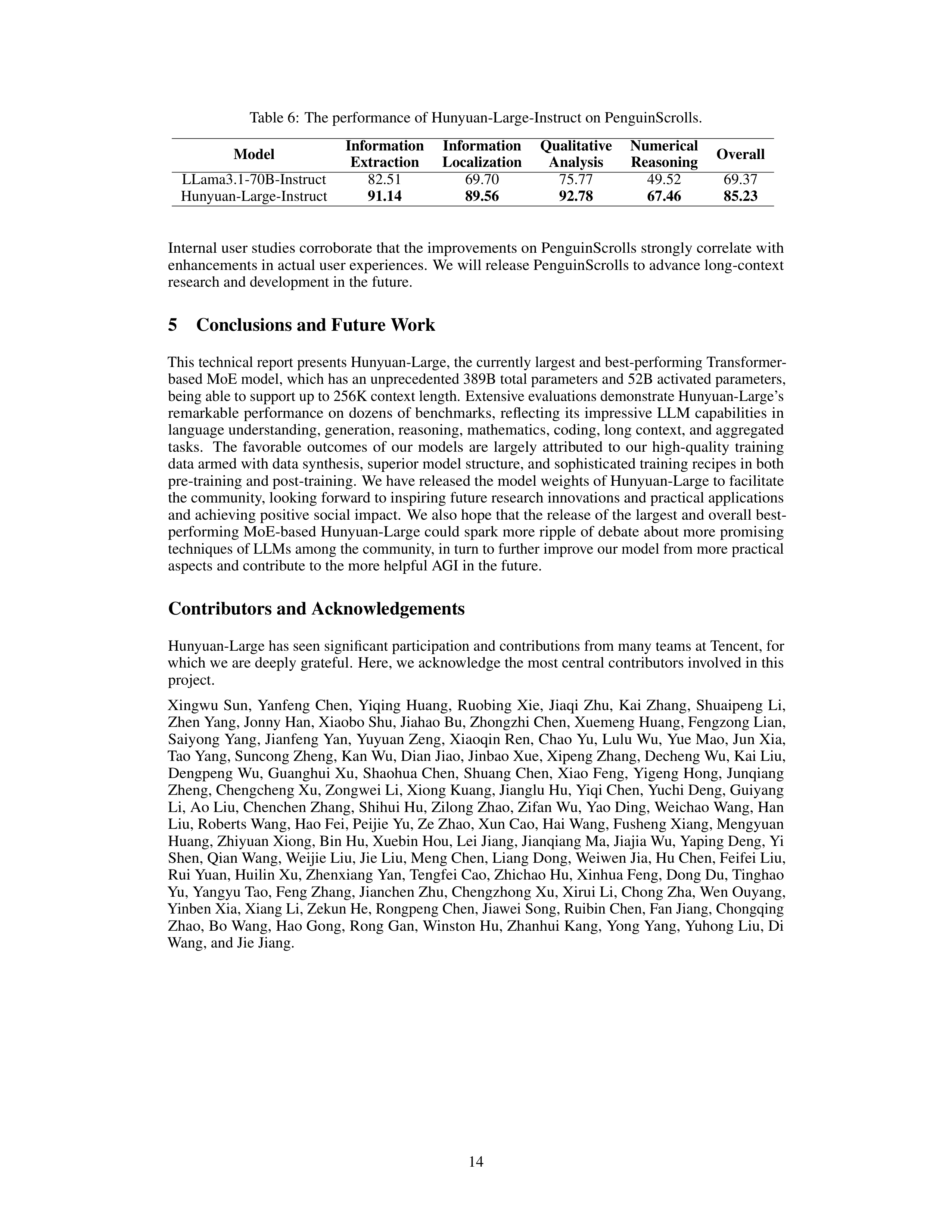
Table 6:
The performance of Hunyuan-Large-Instruct on PenguinScrolls.
Model
Information
Extraction
Information
Localization
Qualitative
Analysis
Numerical
Reasoning
Overall
LLama3.1-70B-Instruct
82.51
69.70
75.77
49.52
69.37
Hunyuan-Large-Instruct
91.14
89.56
92.78
67.46
85.23
Internal user studies corroborate that the improvements on PenguinScrolls strongly correlate with
enhancements in actual user experiences.
We will release PenguinScrolls to advance long-context
research and development in the future.
5
Conclusions and Future Work
This technical report presents Hunyuan-Large, the currently largest and best-performing Transformer-
based MoE model, which has an unprecedented 389B total parameters and 52B activated parameters,
being able to support up to 256K context length.
Extensive evaluations demonstrate Hunyuan-Large’s
remarkable performance on dozens of benchmarks,
reflecting its impressive LLM capabilities in
language understanding, generation, reasoning, mathematics, coding, long context, and aggregated
tasks.
The
favorable
outcomes
of
our
models
are
largely
attributed
to
our
high-quality
training
data armed with data synthesis, superior model structure, and sophisticated training recipes in both
pre-training and post-training.
We have released the model weights of Hunyuan-Large to facilitate
the community, looking forward to inspiring future research innovations and practical applications
and achieving positive social impact.
We also hope that the release of the largest and overall best-
performing MoE-based Hunyuan-Large could spark more ripple of debate about more promising
techniques of LLMs among the community, in turn to further improve our model from more practical
aspects and contribute to the more helpful AGI in the future.
Contributors and Acknowledgements
Hunyuan-Large has seen significant participation and contributions from many teams at Tencent, for
which we are deeply grateful.
Here, we acknowledge the most central contributors involved in this
project.
Xingwu
Sun,
Yanfeng
Chen,
Yiqing
Huang,
Ruobing
Xie,
Jiaqi
Zhu,
Kai
Zhang,
Shuaipeng
Li,
Zhen Yang, Jonny Han, Xiaobo Shu, Jiahao Bu, Zhongzhi Chen, Xuemeng Huang, Fengzong Lian,
Saiyong Yang, Jianfeng Yan, Yuyuan Zeng, Xiaoqin Ren, Chao Yu, Lulu Wu, Yue Mao, Jun Xia,
Tao Yang, Suncong Zheng, Kan Wu, Dian Jiao, Jinbao Xue, Xipeng Zhang, Decheng Wu, Kai Liu,
Dengpeng Wu, Guanghui Xu, Shaohua Chen, Shuang Chen, Xiao Feng, Yigeng Hong, Junqiang
Zheng, Chengcheng Xu, Zongwei Li, Xiong Kuang, Jianglu Hu, Yiqi Chen, Yuchi Deng, Guiyang
Li, Ao Liu, Chenchen Zhang, Shihui Hu, Zilong Zhao, Zifan Wu, Yao Ding, Weichao Wang, Han
Liu, Roberts Wang, Hao Fei, Peijie Yu, Ze Zhao, Xun Cao, Hai Wang, Fusheng Xiang, Mengyuan
Huang, Zhiyuan Xiong, Bin Hu, Xuebin Hou, Lei Jiang, Jianqiang Ma, Jiajia Wu, Yaping Deng, Yi
Shen, Qian Wang, Weijie Liu, Jie Liu, Meng Chen, Liang Dong, Weiwen Jia, Hu Chen, Feifei Liu,
Rui Yuan, Huilin Xu, Zhenxiang Yan, Tengfei Cao, Zhichao Hu, Xinhua Feng, Dong Du, Tinghao
Yu, Yangyu Tao, Feng Zhang, Jianchen Zhu, Chengzhong Xu, Xirui Li, Chong Zha, Wen Ouyang,
Yinben Xia, Xiang Li, Zekun He, Rongpeng Chen, Jiawei Song, Ruibin Chen, Fan Jiang, Chongqing
Zhao, Bo Wang, Hao Gong, Rong Gan, Winston Hu, Zhanhui Kang, Yong Yang, Yuhong Liu, Di
Wang, and Jie Jiang.
14
References
Abdin, M., Jacobs, S. A., Awan, A. A., Aneja, J., Awadallah, A., Awadalla, H., Bach, N., Bahree, A.,
Bakhtiari, A., Behl, H., et al.
Phi-3 technical report:
A highly capable language model locally on
your phone.
arXiv preprint arXiv:2404.14219
, 2024.
Achiam, J., Adler, S., Agarwal, S., Ahmad, L., Akkaya, I., Aleman, F. L., Almeida, D., Altenschmidt,
J., Altman, S., Anadkat, S., et al.
GPT-4 technical report.
arXiv preprint arXiv:2303.08774
, 2023.
Adler, B., Agarwal, N., Aithal, A., Anh, D. H., Bhattacharya, P., Brundyn, A., Casper, J., Catanzaro,
B., Clay, S., Cohen, J., et al.
Nemotron-4 340b technical report.
arXiv preprint arXiv:2406.11704
,
2024.
Ainslie, J., Lee-Thorp, J., de Jong, M., Zemlyanskiy, Y., Lebrón, F., and Sanghai, S.
GQA: Training
generalized
multi-query
transformer
models
from
multi-head
checkpoints.
In
Proceedings
of
EMNLP
, 2023.
Austin, J., Odena, A., Nye, M., Bosma, M., Michalewski, H., Dohan, D., Jiang, E., Cai, C., Terry, M.,
Le, Q., et al.
Program synthesis with large language models.
arXiv preprint arXiv:2108.07732
,
2021.
Bai, Y., Jones, A., Ndousse, K., Askell, A., Chen, A., DasSarma, N., Drain, D., Fort, S., Ganguli, D.,
Henighan, T., et al.
Training a helpful and harmless assistant with reinforcement learning from
human feedback.
arXiv preprint arXiv:2204.05862
, 2022.
Bisk, Y., Zellers, R., Gao, J., Choi, Y., et al.
PIQA: Reasoning about physical commonsense in natural
language.
In
Proceedings of AAAI
, 2020.
Brandon, W., Mishra, M., Nrusimha, A., Panda, R., and Kelly, J. R.
Reducing transformer key-value
cache size with cross-layer attention.
arXiv preprint arXiv:2405.12981
, 2024.
Chen,
M.,
Tworek,
J.,
Jun,
H.,
Yuan,
Q.,
Pinto,
H.
P.
D.
O.,
Kaplan,
J.,
Edwards,
H.,
Burda,
Y.,
Joseph, N., Brockman, G., et al.
Evaluating large language models trained on code.
arXiv preprint
arXiv:2107.03374
, 2021.
Clark, P., Cowhey, I., Etzioni, O., Khot, T., Sabharwal, A., Schoenick, C., and Tafjord, O.
Think
you have Solved Question Answering?
Try ARC, the AI2 Reasoning Challenge.
arXiv preprint
arXiv:1803.05457
, 2018.
Cobbe,
K.,
Kosaraju,
V.,
Bavarian,
M.,
Chen,
M.,
Jun,
H.,
Kaiser,
L.,
Plappert,
M.,
Tworek,
J.,
Hilton,
J.,
Nakano,
R.,
et
al.
Training
verifiers
to
solve
math
word
problems.
arXiv
preprint
arXiv:2110.14168
, 2021.
DeepSeek-AI.
DeepSeek-V2:
A strong, economical, and efficient mixture-of-experts language model.
arXiv preprint arXiv:2405.04434
, 2024.
Dua, D., Wang, Y., Dasigi, P., Stanovsky, G., Singh, S., and Gardner, M.
DROP: A reading compre-
hension benchmark requiring discrete reasoning over paragraphs.
arXiv preprint arXiv:1903.00161
,
2019.
Dubey, A., Jauhri, A., Pandey, A., Kadian, A., Al-Dahle, A., Letman, A., Mathur, A., Schelten, A.,
Yang, A., Fan, A., et al.
The Llama 3 Herd of Models.
arXiv preprint arXiv:2407.21783
, 2024.
Dubois, Y., Galambosi, B., Liang, P., and Hashimoto, T. B.
Length-controlled alpacaeval:
A simple
way to debias automatic evaluators, 2024.
URL
https://arxiv.org/abs/2404.04475
.
Fedus, W., Zoph, B., and Shazeer, N.
Switch transformers:
Scaling to trillion parameter models with
simple and efficient sparsity.
Journal of Machine Learning Research
, 2022.
Gao, T., Wettig, A., Yen, H., and Chen, D.
How to train long-context language models (effectively).
arXiv preprint arXiv:2410.02660
, 2024.
Gemini, T., Anil, R., Borgeaud, S., Wu, Y., Alayrac, J.-B., Yu, J., Soricut, R., Schalkwyk, J., Dai,
A. M., Hauth, A., et al.
Gemini:
a family of highly capable multimodal models.
arXiv preprint
arXiv:2312.11805
, 2023.
15
Goyal,
P.,
Dollár,
P.,
Girshick,
R.,
Noordhuis,
P.,
Wesolowski,
L.,
Kyrola,
A.,
Tulloch,
A.,
Jia,
Y.,
and
He,
K.
Accurate,
large
minibatch
SGD:
Training
Imagenet
in
1
hour.
arXiv
preprint
arXiv:1706.02677
, 2017.
Hendrycks, D., Burns, C., Kadavath, S., Arora, A., Basart, S., Tang, E., Song, D., and Steinhardt, J.
Measuring mathematical problem solving with the math dataset.
arXiv preprint arXiv:2103.03874
,
2021.
Hoffmann, J., Borgeaud, S., Mensch, A., Buchatskaya, E., Cai, T., Rutherford, E., Casas, D. d. L.,
Hendricks, L. A., Welbl, J., Clark, A., et al.
Training compute-optimal large language models.
arXiv preprint arXiv:2203.15556
, 2022.
Hsieh, C.-P., Sun, S., Kriman, S., Acharya, S., Rekesh, D., Jia, F., and Ginsburg, B.
RULER: What’s
the real context size of your long-context language models?
arXiv preprint arXiv:2404.06654
,
2024.
Huang, Y., Bai, Y., Zhu, Z., Zhang, J., Zhang, J., Su, T., Liu, J., Lv, C., Zhang, Y., Fu, Y., et al.
C-Eval:
A multi-level multi-discipline chinese evaluation suite for foundation models.
In
Proceedings of
NeurIPS
, 2024.
Jamba,
T.,
Lenz,
B.,
Arazi,
A.,
Bergman,
A.,
Manevich,
A.,
Peleg,
B.,
Aviram,
B.,
Almagor,
C.,
Fridman, C., Padnos, D., et al.
Jamba-1.5:
Hybrid transformer-mamba models at scale.
arXiv
preprint arXiv:2408.12570
, 2024.
Jiang, A. Q., Sablayrolles, A., Roux, A., Mensch, A., Savary, B., Bamford, C., Chaplot, D. S., Casas,
D. d. l., Hanna, E. B., Bressand, F., et al.
Mixtral of experts.
arXiv preprint arXiv:2401.04088
,
2024.
Joshi, M., Choi, E., Weld, D. S., and Zettlemoyer, L.
TriviaQA: A large scale distantly supervised
challenge dataset for reading comprehension.
arXiv preprint arXiv:1705.03551
, 2017.
Kaplan, J., McCandlish, S., Henighan, T., Brown, T. B., Chess, B., Child, R., Gray, S., Radford, A.,
Wu, J., and Amodei, D. Scaling laws for neural language models.
arXiv preprint arXiv:2001.08361
,
2020.
Krizhevsky,
A.
One
weird
trick
for
parallelizing
convolutional
neural
networks.
arXiv
preprint
arXiv:1404.5997
, 2014.
Kwiatkowski,
T.,
Palomaki,
J.,
Redfield,
O.,
Collins,
M.,
Parikh,
A.,
Alberti,
C.,
Epstein,
D.,
Polosukhin, I., Devlin, J., Lee, K., et al.
Natural questions:
a benchmark for question answering
research.
TACL
, 2019.
Lepikhin, D., Lee, H., Xu, Y., Chen, D., Firat, O., Huang, Y., Krikun, M., Shazeer, N., and Chen,
Z.
GShard:
Scaling giant models with conditional computation and automatic sharding.
arXiv
preprint arXiv:2006.16668
, 2020.
Li,
H.,
Zhang,
Y.,
Koto,
F.,
Yang,
Y.,
Zhao,
H.,
Gong,
Y.,
Duan,
N.,
and
Baldwin,
T.
CMMLU:
Measuring massive multitask language understanding in chinese.
arXiv preprint arXiv:2306.09212
,
2023.
Li, S., Zhao, P., Zhang, H., Sun, X., Wu, H., Jiao, D., Wang, W., Liu, C., Fang, Z., Xue, J., et al.
Surge
phenomenon in optimal learning rate and batch size scaling.
arXiv preprint arXiv:2405.14578
,
2024a.
Li, T., Chiang, W.-L., Frick, E., Dunlap, L., Wu, T., Zhu, B., Gonzalez, J. E., and Stoica, I.
From
crowdsourced data to high-quality benchmarks:
Arena-hard and benchbuilder pipeline,
2024b.
URL
https://arxiv.org/abs/2406.11939
.
Liu, R., Wei, J., Liu, F., Si, C., Zhang, Y., Rao, J., Zheng, S., Peng, D., Yang, D., Zhou, D., et al.
Best
practices and lessons learned on synthetic data.
In
Proceedings of COLM
, 2024.
Liu,
X.,
Lei,
X.,
Wang,
S.,
Huang,
Y.,
Feng,
Z.,
Wen,
B.,
Cheng,
J.,
Ke,
P.,
Xu,
Y.,
Tam,
W.
L.,
et al.
AlignBench:
Benchmarking chinese alignment of large language models.
arXiv preprint
arXiv:2311.18743
, 2023.
16
Loshchilov, I. and Hutter, F.
Decoupled weight decay regularization.
In
Proceedings of ICLR
, 2019.
McAleese, N., Pokorny, R. M., Uribe, J. F. C., Nitishinskaya, E., Trebacz, M., and Leike, J.
LLM
Critics Help Catch LLM Bugs.
arXiv preprint arXiv:2407.00215
, 2024.
Mistral. Cheaper, better, faster, stronger. continuing to push the frontier of AI and making it accessible
to all.
2024.
URL
https://mistral.ai/news/mixtral-8x22b
.
OpenAI.
Introducing ChatGPT.
2022.
URL
https://openai.com/index/chatgpt/
.
OpenAI.
Tiktoken.
2023.
URL
https://github.com/openai/tiktoken
.
OpenAI.
Hello GPT-4o.
2024.
URL
https://openai.com/index/hello-gpt-4o/
.
Ouyang, L., Wu, J., Jiang, X., Almeida, D., Wainwright, C., Mishkin, P., Zhang, C., Agarwal, S.,
Slama, K., Ray, A., et al.
Training language models to follow instructions with human feedback.
In
Proceedings of NeurIPS
, 2022.
Qwen.
Qwen2.5.
2024a.
URL
https://github.com/QwenLM/Qwen2.5
.
Qwen.
Qwen1.5-MoE:
Matching 7B
Model Performance
with 1/3
Activated
Parameters,
2024b.
URL
https://qwenlm.github.io/blog/qwen-moe/
.
Rafailov, R., Sharma, A., Mitchell, E., Manning, C. D., Ermon, S., and Finn, C.
Direct preference
optimization:
Your language model is secretly a reward model.
In
Proceedings of NeurIPS
, 2024.
Sakaguchi, K., Bras, R. L., Bhagavatula, C., and Choi, Y.
WinoGrande:
An adversarial winograd
schema challenge at scale.
Communications of the ACM
, 2021.
Shazeer, N.
GLU variants improve transformer.
arXiv preprint arXiv:2002.05202
, 2020.
Su, J., Ahmed, M., Lu, Y., Pan, S., Bo, W., and Liu, Y.
Roformer:
Enhanced transformer with rotary
position embedding.
Neurocomputing
, 2024.
Sun, K., Yu, D., Yu, D., and Cardie, C. Investigating prior knowledge for challenging chinese machine
reading comprehension.
TACL
, 2020.
Suzgun, M., Scales, N., Schärli, N., Gehrmann, S., Tay, Y., Chung, H. W., Chowdhery, A., Le, Q. V.,
Chi, E. H., Zhou, D., et al.
Challenging big-bench tasks and whether chain-of-thought can solve
them.
arXiv preprint arXiv:2210.09261
, 2022.
Talmor, A., Herzig, J., Lourie, N., and Berant, J.
CommonsenseQA: A question answering challenge
targeting commonsense knowledge.
In
Proceedings of NAACL
, 2019.
Touvron, H., Lavril, T., Izacard, G., Martinet, X., Lachaux, M.-A., Lacroix, T., Rozière, B., Goyal,
N., Hambro, E., Azhar, F., et al.
LLaMA: Open and Efficient Foundation Language Models.
arXiv
preprint arXiv:2302.13971
, 2023.
Vaswani,
A.,
Shazeer,
N.,
Parmar,
N.,
Uszkoreit,
J.,
Jones,
L.,
Gomez,
A.
N.,
Kaiser,
L.,
and
Polosukhin, I.
Attention is all you need.
In
Proceedings of NIPS
, 2017.
Wang, A., Sun, X., Xie, R., Li, S., Zhu, J., Yang, Z., Zhao, P., Han, J., Kang, Z., Wang, D., et al.
HMoE: Heterogeneous mixture of experts for language modeling.
arXiv preprint arXiv:2408.10681
,
2024a.
Wang, Y., Ma, X., Zhang, G., Ni, Y., Chandra, A., Guo, S., Ren, W., Arulraj, A., He, X., Jiang, Z.,
et al.
MMLU-Pro:
A more robust and challenging multi-task language understanding benchmark.
In
Proceedings of NeurIPS
, 2024b.
Wei, T., Luan, J., Liu, W., Dong, S., and Wang, B.
CMATH: Can your language model pass chinese
elementary school math test?
arXiv preprint arXiv:2306.16636
, 2023.
Xiong, W., Liu, J., Molybog, I., Zhang, H., Bhargava, P., Hou, R., Martin, L., Rungta, R., Sankarara-
man, K. A., Oguz, B., et al.
Effective long-context scaling of foundation models.
arXiv preprint
arXiv:2309.16039
, 2023.
17
Yang, A., Yang, B., Hui, B., Zheng, B., Yu, B., Zhou, C., Li, C., Li, C., Liu, D., Huang, F., et al.
QWen2 Technical Report.
arXiv preprint arXiv:2407.10671
, 2024.
Yuan, T., Ning, X., Zhou, D., Yang, Z., Li, S., Zhuang, M., Tan, Z., Yao, Z., Lin, D., Li, B., et al.
LV-Eval:
A balanced long-context benchmark with 5 length levels up to 256k.
arXiv preprint
arXiv:2402.05136
, 2024.
Zellers, R., Holtzman, A., Bisk, Y., Farhadi, A., and Choi, Y.
HellaSwag:
Can a machine really finish
your sentence?
In
Proceedings of ACL
, 2019.
Zheng, L., Chiang, W.-L., Sheng, Y., Zhuang, S., Wu, Z., Zhuang, Y., Lin, Z., Li, Z., Li, D., Xing, E.,
et al.
Judging LLM-as-a-Judge with MT-Bench and Chatbot Arena.
In
Proceedings of NeurIPS
,
2023.
Zhou,
J.,
Lu,
T.,
Mishra,
S.,
Brahma,
S.,
Basu,
S.,
Luan,
Y.,
Zhou,
D.,
and
Hou,
L.
Instruction-
following evaluation for large language models.
arXiv preprint arXiv:2311.07911
, 2023.
18