
PRECISE: Reducing the Bias of LLM Evaluations Using Prediction-Powered
Ranking Estimation
Abhishek Divekar
*
, Anirban Majumder
Amazon AI
adivekar@amazon.com, majumda@amazon.com
Abstract
Evaluating the quality of search systems traditionally requires
a significant number of human relevance annotations. In re-
cent times, several systems have explored the usage of Large
Language Models (LLMs) as automated judges for this task
while their inherent biases prevent direct use for metric estima-
tion. We present a statistical framework extending Prediction-
Powered
Inference
(PPI)
(Angelopoulos,
Duchi,
and
Zrnic
2024) that combines minimal human annotations with LLM
judgments to produce reliable estimates of metrics which re-
quire sub-instance annotations. Our method requires as few
as
100
human-annotated queries and
10
,
000
unlabeled exam-
ples, reducing annotation requirements by significantly com-
pared to traditional approaches. We formulate our proposed
framework (PRECISE) for inference of relevance uplift for
an LLM-based query reformulation application, extending PPI
to sub-instance annotations at the query-document level. By
reformulating
the
metric-integration
space,
we
reduced
the
computational
complexity
from
O
(2
|
C
|
)
to
O
(2
K
)
,
where
|
C
|
represents corpus size (in order of millions). Detailed ex-
periments across prominent retrieval datasets demonstrate that
our method reduces the variance of estimates for the business-
critical Precision@K metric, while effectively correcting for
LLM bias in low-resource settings.
Introduction
Large Language Models (LLMs) (Achiam, Adler et al. 2023;
Bai,
Kadavath
et
al.
2022;
DeepSeek-AI
et
al.
2025)
have
rapidly gained traction in industrial applications. Evaluation
of
LLM
applications
traditionally
relies
on
human
audits,
a
process
that
is
neither
scalable
nor
cost-effective,
espe-
cially
when
dealing
with
large,
diverse
datasets
collected
from real-world applications. To address this challenge, re-
cent work (Saad-Falcon et al. 2024; Zheng et al. 2023a; Es
et
al.
2024;
Dong,
Hu,
and
Collier
2024)
has
explored
us-
ing LLMs themselves as evaluators, leveraging their strong
reasoning capabilities and contextual comprehension. This
offers a potential solution to the evaluation bottleneck, au-
tomating quality assessment of complex tasks at scale.
Ranking and recommendation problems are cornerstones
of today’s e-commerce websites, spanning search, advertis-
*
Primary contributor and corresponding author.
Copyright © 2026, Association for the Advancement of Artificial
Intelligence (www.aaai.org). All rights reserved.
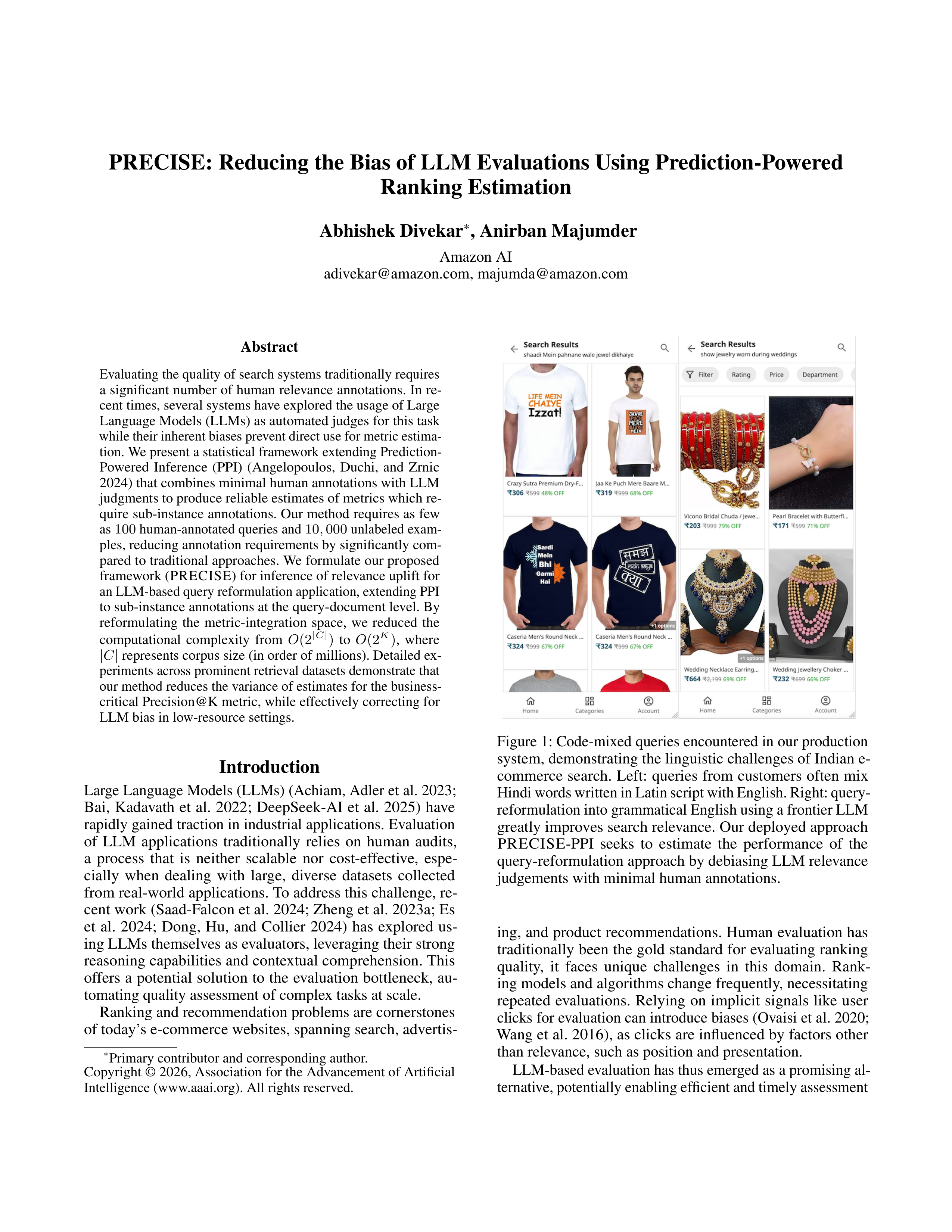
Figure 1: Code-mixed queries encountered in our production
system, demonstrating the linguistic challenges of Indian e-
commerce
search. Left:
queries
from customers
often
mix
Hindi words written in Latin script with English. Right: query-
reformulation into grammatical English using a frontier LLM
greatly improves search relevance. Our deployed approach
PRECISE-PPI
seeks
to
estimate
the
performance
of
the
query-reformulation approach by debiasing LLM relevance
judgements with minimal human annotations.
ing, and product recommendations. Human evaluation has
traditionally been the gold standard for evaluating ranking
quality,
it
faces
unique
challenges
in
this
domain.
Rank-
ing models and algorithms change frequently, necessitating
repeated
evaluations.
Relying
on
implicit
signals
like
user
clicks for evaluation can introduce biases (Ovaisi et al. 2020;
Wang et al. 2016), as clicks are influenced by factors other
than relevance, such as position and presentation.
LLM-based evaluation has thus emerged as a promising al-
ternative, potentially enabling efficient and timely assessment
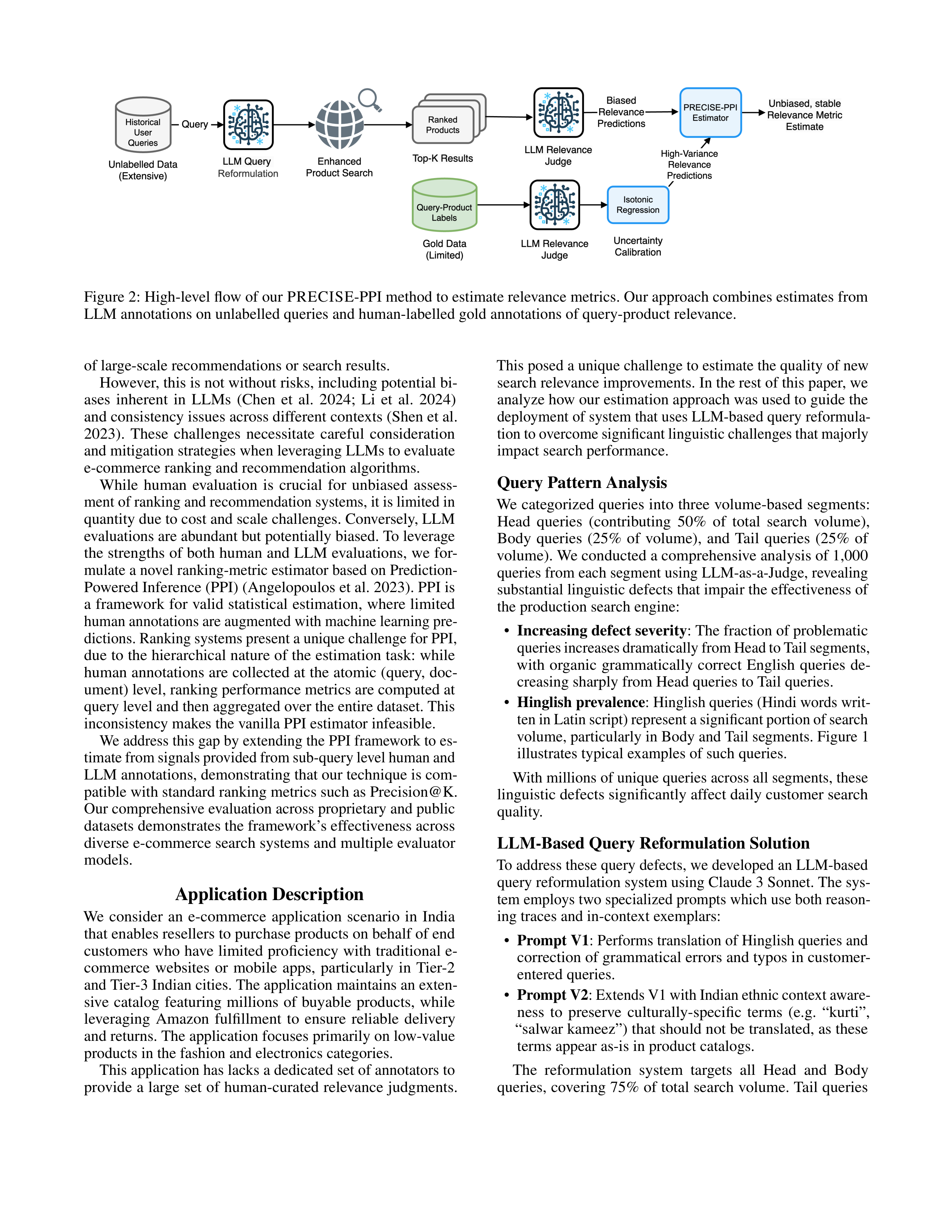
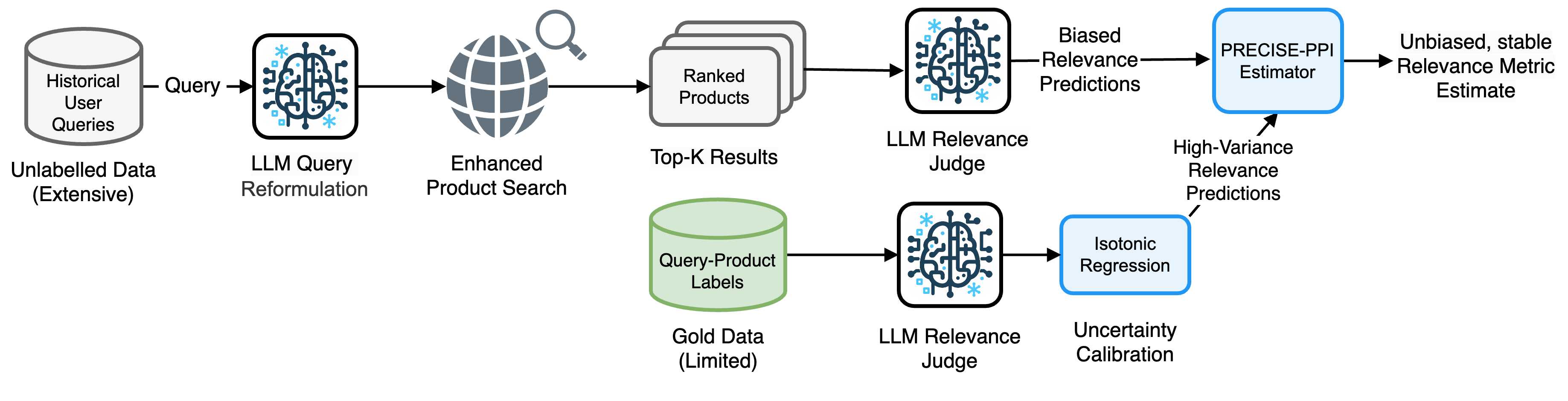
Figure 2: High-level flow of our PRECISE-PPI method to estimate relevance metrics. Our approach combines estimates from
LLM annotations on unlabelled queries and human-labelled gold annotations of query-product relevance.
of large-scale recommendations or search results.
However, this is not without risks, including potential bi-
ases
inherent
in
LLMs
(Chen
et
al.
2024;
Li
et
al.
2024)
and consistency issues across different contexts (Shen et al.
2023).
These
challenges
necessitate
careful
consideration
and mitigation strategies when leveraging LLMs to evaluate
e-commerce ranking and recommendation algorithms.
While
human
evaluation
is
crucial
for
unbiased
assess-
ment of ranking and recommendation systems, it is limited in
quantity due to cost and scale challenges. Conversely, LLM
evaluations are abundant but potentially biased. To leverage
the strengths of both human and LLM evaluations, we for-
mulate a novel ranking-metric estimator based on Prediction-
Powered Inference (PPI) (Angelopoulos et al. 2023). PPI is
a framework for valid statistical estimation, where limited
human annotations are augmented with machine learning pre-
dictions. Ranking systems present a unique challenge for PPI,
due to the hierarchical nature of the estimation task: while
human annotations are collected at the atomic (query, doc-
ument) level, ranking performance metrics are computed at
query level and then aggregated over the entire dataset. This
inconsistency makes the vanilla PPI estimator infeasible.
We address this gap by extending the PPI framework to es-
timate from signals provided from sub-query level human and
LLM annotations, demonstrating that our technique is com-
patible with standard ranking metrics such as Precision@K.
Our comprehensive evaluation across proprietary and public
datasets demonstrates the framework’s effectiveness across
diverse e-commerce search systems and multiple evaluator
models.
Application Description
We
consider
an
e-commerce
application
scenario
in
India
that enables resellers to purchase products on behalf of end
customers who have limited proficiency with traditional e-
commerce
websites
or
mobile
apps,
particularly
in
Tier-2
and Tier-3 Indian cities. The application maintains an exten-
sive
catalog
featuring
millions
of
buyable
products,
while
leveraging
Amazon
fulfillment
to
ensure
reliable
delivery
and returns. The application focuses primarily on low-value
products in the fashion and electronics categories.
This application has lacks a dedicated set of annotators to
provide a large set of human-curated relevance judgments.
This posed a unique challenge to estimate the quality of new
search relevance improvements. In the rest of this paper, we
analyze how our estimation approach was used to guide the
deployment of system that uses LLM-based query reformula-
tion to overcome significant linguistic challenges that majorly
impact search performance.
Query Pattern Analysis
We categorized queries into three volume-based segments:
Head
queries
(contributing
50%
of
total
search
volume),
Body
queries
(25%
of
volume),
and
Tail
queries
(25%
of
volume). We conducted a comprehensive analysis of 1,000
queries from each segment using LLM-as-a-Judge, revealing
substantial linguistic defects that impair the effectiveness of
the production search engine:
•
Increasing defect severity
: The fraction of problematic
queries increases dramatically from Head to Tail segments,
with
organic
grammatically
correct
English
queries
de-
creasing sharply from Head queries to Tail queries.
•
Hinglish prevalence
: Hinglish queries (Hindi words writ-
ten in Latin script) represent a significant portion of search
volume, particularly in Body and Tail segments. Figure 1
illustrates typical examples of such queries.
With millions of unique queries across all segments, these
linguistic defects significantly affect daily customer search
quality.
LLM-Based Query Reformulation Solution
To address these query defects, we developed an LLM-based
query reformulation system using Claude 3 Sonnet. The sys-
tem employs two specialized prompts which use both reason-
ing traces and in-context exemplars:
•
Prompt V1
: Performs translation of Hinglish queries and
correction of grammatical errors and typos in customer-
entered queries.
•
Prompt V2
: Extends V1 with Indian ethnic context aware-
ness
to
preserve
culturally-specific
terms
(e.g.
“kurti”,
“salwar kameez”) that should not be translated, as these
terms appear as-is in product catalogs.
The
reformulation
system
targets
all
Head
and
Body
queries, covering 75% of total search volume. Tail queries
are excluded due to their high uniqueness (the vast majority
are searched only once) and the prohibitive cost of reformu-
lating several million queries within the launch timeline of
the Diwali sale.
Note that we anonymize the user queries to remove poten-
tial PII information prior to usage in our LLM-based refor-
mulation solution.
Metric Estimation Pre-Deployment
Query
reformulation
presents
a
fundamental
challenge:
it
can either significantly improve or severely degrade search
relevance, depending on the quality of the reformulations. In
traditional search experiments, the impact of ML solutions
is
validated
using
extensive
human-annotated
test
sets
of
relevance judgments. However, our application’s annotation
constraints made this approach infeasible.
Deploying an untested query reformulation system would
pose substantial business risk. The available audit bandwidth
consisted of only a few days of software engineering team
time immediately before launch. This scenario exemplifies
the exact use case for which our
PRECISE
approach was
designed: estimating the true performance impact of an ML
system when extensive human annotation is prohibitively ex-
pensive or time-constrained, but where deployment decisions
must be made with confidence.
We
deployed
PRECISE
to
estimate
Precision@K
im-
provements across three treatments: (a) Control: unmodified
production queries; (b) T1: queries reformulated with Prompt
V1; (c) T2: queries reformulated with Prompt V2 including
Indian ethnic context. Our framework correctly identified the
best-performing treatment, which was subsequently validated
through A/B testing with limited traffic and deployed to pro-
duction, improving search relevance for millions of users and
leading to significant business impact for our application.
Method
In this section, we introduce our novel
PRECISE
method
of evaluating ranking models using LLMs. We first describe
the general framework of Prediction-Powered Inference for
estimating performance metrics (Boyeau et al. 2025).
Background: PPI for Metric Estimation
Assume
we
have
a
human-labeled
“gold”
dataset
D
g
=
{
(
x
(1)
g
, y
(1)
g
)
· · ·
(
x
(
n
)
g
, y
(
n
)
g
)
}
and
have
access
to
an unlabeled dataset
D
u
=
{
x
(1)
u
,
· · ·
, x
(
N
)
u
}
where
N
≫
n
,
and
both
covariates
are
iid
samples
from
the
same
(true)
distribution.
Our
goal
is
to
evaluate
performance
of
a
machine
learning
system
f
using
the
datasets
D
g
and
D
u
.
Let
ϕ
be any metric of interest e.g. accuracy for classification
task, squared error for regression etc. We can estimate model
performance as the expectation of
ϕ
(
f
(
x
(
i
)
g
)
, y
(
i
)
g
)
over the
labelled
data;
however
the
same
cannot
be
done
with
D
u
,
due to absence of ground-truth labels. Since we have limited
labeled examples, reporting
f
on
D
g
exhibits high variance
in the accuracy estimate.
To
leverage
the
large
corpus
of
unlabeled
data,
we
can
employ an “annotator” ML model
M
that generates synthetic
labels
{
˜
y
(1)
u
,
· · ·
,
˜
y
(
N
)
u
}
and average
ϕ
(
f
(
x
(
i
)
u
)
,
˜
y
(
i
)
u
)
across
D
u
.
While
this
reduces
variance,
potential
bias
from
the
trained
model
M
can
creep
in,
resulting
in
a
statistically
biased estimate. Prediction-Powered Inference is a statistical
framework
to
debias
estimates
by
leveraging
both
labeled
and unlabeled datasets. We typically use the efficient PPI++
estimator (Angelopoulos, Duchi, and Zrnic 2024):
ˆ
µ
PPI
++
=
λ
"
1
N
N
X
i
=1
˜
µ
(
i
)
u
#
+
1
n
n
X
i
=1
h
ϕ
(
f
(
x
(
i
)
g
)
, y
(
i
)
g
)
−
λ
·
˜
µ
(
i
)
g
i
(1)
where,
˜
µ
(
i
)
u
=
E
y
∼
M
(
·|
x
(
i
)
u
)
ϕ
(
f
(
x
(
i
)
u
)
, y
)
(2)
is
the
estimate
of
the
metric
on
each
instance
of
the
un-
labelled
set,
using
the
conditional
probability
distribution
output
from
the
annotator
over
the
output
space
Y
as
in
(Boyeau et al. 2025). Each
˜
µ
(
i
)
g
is calculated analogously.
Here
0
≤
λ
≤
1
is a hyperparameter that can be tuned to
minimize the variance of the estimator
µ
PPI
++
. However, the
estimator remains unbiased for any value of
λ >
0
.
PRECISE-PPI: Ranking Metric Estimation
A limitation of the previous PPI formulation is that it is un-
defined
for
situations
where
the
annotator
model
provides
synthetic labels at a granularity other than the instance-level.
For example, in the case of estimating common ranking met-
rics such as Precision@K, Recall@K, etc, the notion of an
“instance” pertains to a query but the annotator model pro-
vides a relevance annotation at the query-document level.
The
key
challenge
here
is
the
formulation
of
the
output
space
y
∈
Y
over
which
to
take
the
integrand/summand
ϕ
(
f
(
x
(
i
)
)
, y
)
·
˜
p
(
i
)
(
y
)
,
which
is
also
compatible
with
the
granularity of
˜
p
(
i
)
(
y
) =
M
(
y
|
x
(
i
)
)
provided by the annotator
model.
To
overcome
this
issue,
we
reformulate
˜
µ
(
i
)
u
and
˜
µ
(
i
)
g
in
order to estimate
ˆ
µ
PPI
++
appropriately for the task of search
relevance. Concretely, assume the corpus of documents
C
=
{
d
(1)
, . . . , d
(
|
C
|
)
}
is an internal aspect of the search relevance
model
under
evaluation,
i.e.
f
(
x
)
=
f
C
(
x
)
,
where
x
is
a
single query. Assume this model provides binarized relevance
labels to
K
documents in
C
. We can imagine the prediction
as a K-hot vector:
ˆ
y
=
f
C
(
x
) =
h
rel
(
d
(1)
)
, . . . , rel
(
d
(
|
C
|
)
)
i
,
where
∥
ˆ
y
∥
1
=
K
.
An
example
realization
may
be
[1
,
0
,
1
, . . . ,
0]
; exactly K indexes must be hot.
Assume that for the purpose of estimating Precision@K
using PPI, we have a labelled a small dataset of
n
queries,
providing a binary relevance annotation to each of the top-
K
results
per
query.
In
this
scenario,
we
can
represent
the
ground-truths
for
the
gold
set
as
using
a
similar
one-hot
vector:
y
=
h
rel
(
d
(1)
)
, . . . , rel
(
d
(
|
C
|
)
)
i
,
where
y
∥
1
≤
K
and
at most
K values are “hot”.
To measure Precision@K at the instance-level, we would
simply calculate the scaled dot product of these quantities:
ϕ
(
f
C
(
x
)
, y
) =
ϕ
(ˆ
y, y
) =
ˆ
y
T
y
K
However, both
y
and
ˆ
y
are sparse; it is equivalent to com-
pute the dot product of the K documents which are marked
as relevant by
f
C
(
·
)
.
The
above
observation
is
crucial
to
the
efficient
formu-
lation
of
the
iterable
space
Y
which
we
integrate/sum
to
produce
˜
µ
(
i
)
u
and
˜
µ
(
i
)
g
.
An
exact
calculation
of
these
quan-
tities
would
require
us
to
consider
Y
to
be
all
vectors
of
length
|
C
|
, and considering every possible combination of
hot
values,
i.e.
Y
=
{
0
,
1
}
|
C
|
.
As
|
C
|
is
often
in
millions,
this calculation is intractable.
However,
due
to
the
sparsity
in
the
calculation
of
Pre-
cision@K (as we have at most K “hot” positions), we can
instead iterate over a much-reduced space of all combinations
of K-length vectors
Y
=
{
0
,
1
}
K
.
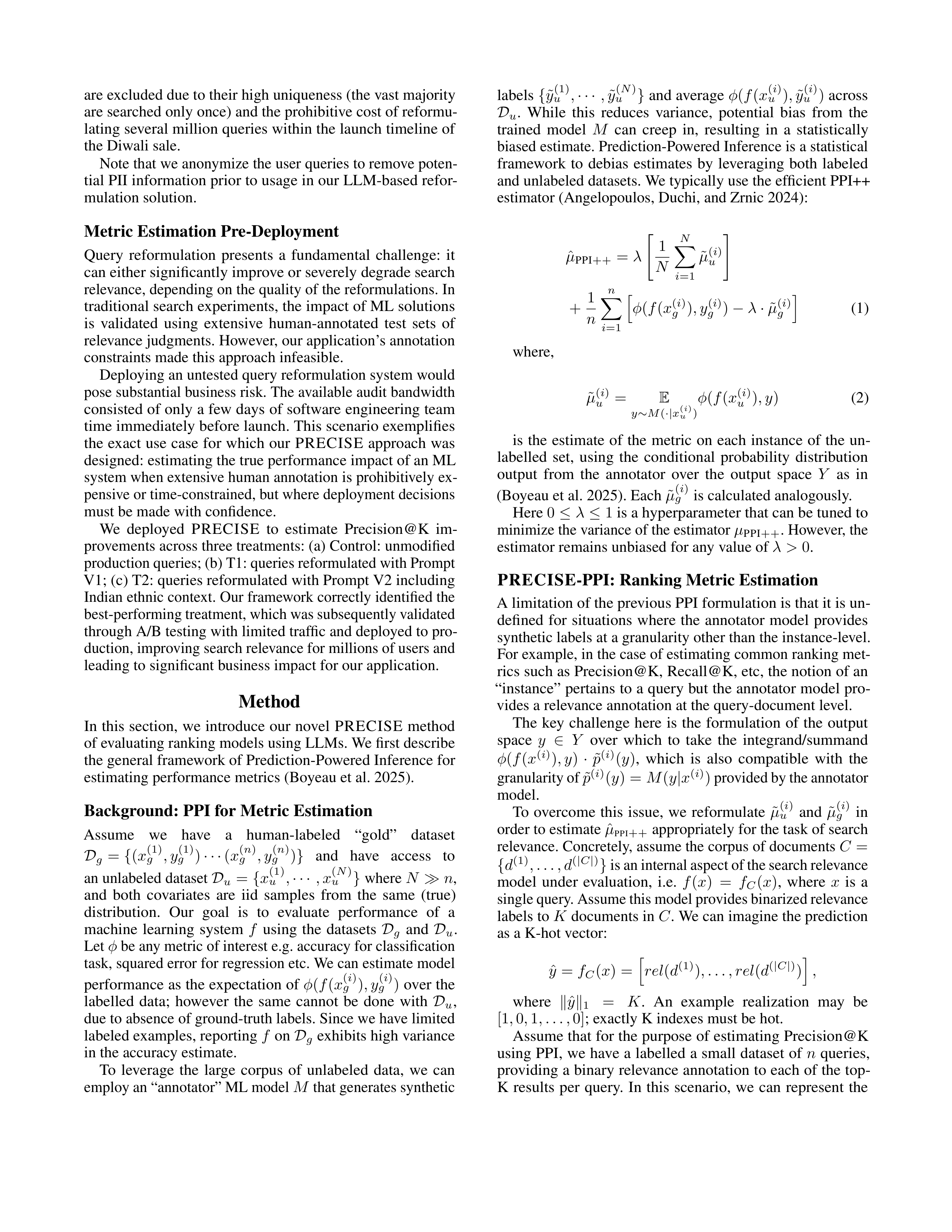
Our key observation here here is that the probability mass
of all
|
C
|
-length vectors where the K documents are zeros,
is
accumulated
into
a
single
probability
weight
of
the
all-
zero K-length vector. This makes the computation tractable:
although the size of the iterable space
|
Y
|
is still exponential,
typically we estimate Precision@K with small
K
(e.g.
≤
10
),
permitting us to estimate
˜
µ
(
i
)
u
and
˜
µ
(
i
)
g
.
Concretely,
consider
a
single
query
x
for
which
we
have a K-length vector of annotator-provided probabilities
˜
p
′
(
d
k
) =
M
(
d
k
|
x
)
that the
k
th ranked document
d
k
is rele-
vant to the query
x
.
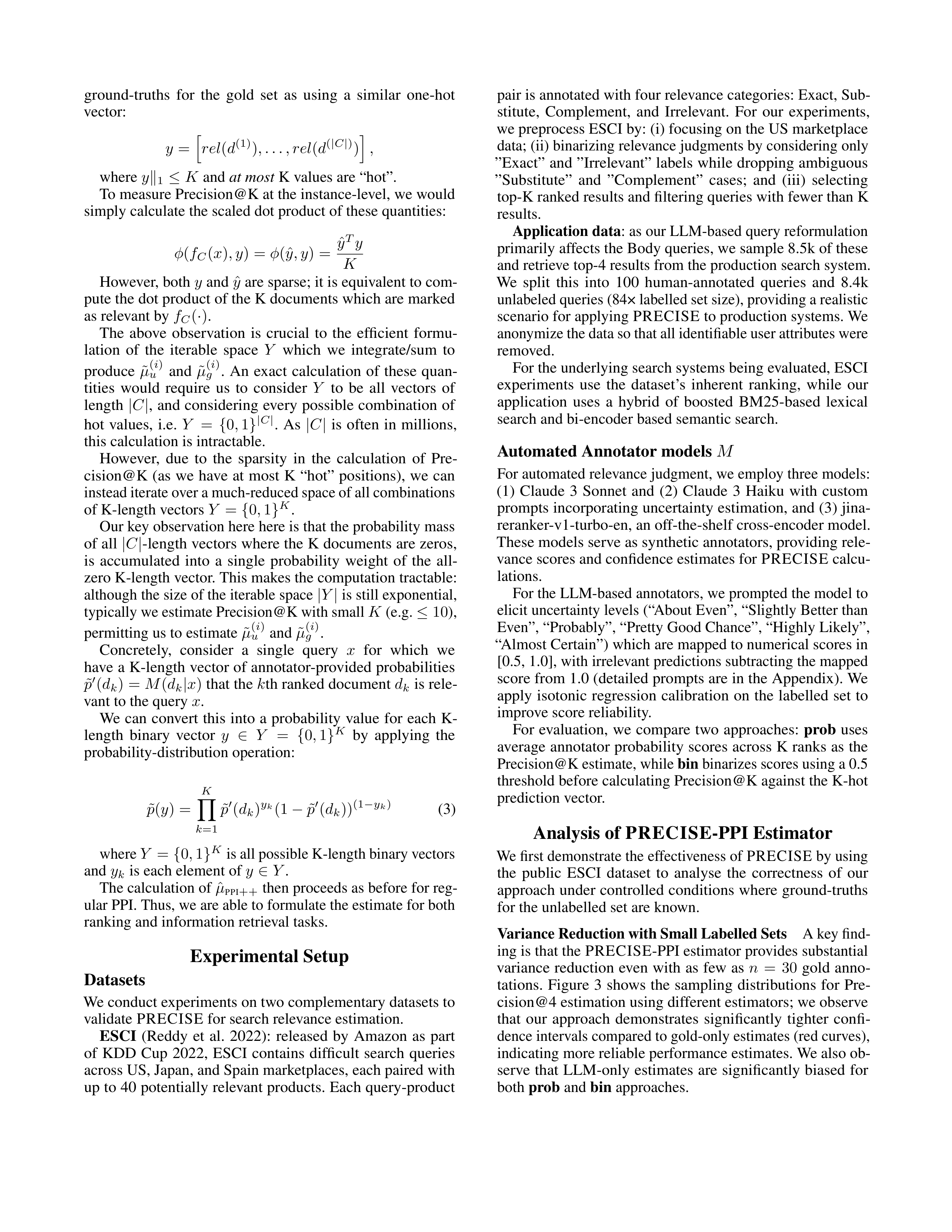
We
can
convert
this
into
a
probability
value
for
each
K-
length
binary
vector
y
∈
Y
=
{
0
,
1
}
K
by
applying
the
probability-distribution operation:
˜
p
(
y
) =
K
Y
k
=1
˜
p
′
(
d
k
)
y
k
(1
−
˜
p
′
(
d
k
))
(1
−
y
k
)
(3)
where
Y
=
{
0
,
1
}
K
is all possible K-length binary vectors
and
y
k
is each element of
y
∈
Y
.
The calculation of
ˆ
µ
PPI
++
then proceeds as before for reg-
ular PPI. Thus, we are able to formulate the estimate for both
ranking and information retrieval tasks.
Experimental Setup
Datasets
We conduct experiments on two complementary datasets to
validate PRECISE for search relevance estimation.
ESCI
(Reddy
et
al.
2022):
released
by
Amazon
as
part
of
KDD
Cup
2022,
ESCI
contains
difficult
search
queries
across US, Japan, and Spain marketplaces, each paired with
up to 40 potentially relevant products. Each query-product
pair is annotated with four relevance categories: Exact, Sub-
stitute,
Complement,
and
Irrelevant.
For
our
experiments,
we preprocess ESCI by: (i) focusing on the US marketplace
data; (ii) binarizing relevance judgments by considering only
”Exact” and ”Irrelevant” labels while dropping ambiguous
”Substitute”
and
”Complement”
cases;
and
(iii)
selecting
top-K ranked results and filtering queries with fewer than K
results.
Application data
: as our LLM-based query reformulation
primarily affects the Body queries, we sample 8.5k of these
and retrieve top-4 results from the production search system.
We
split
this
into
100
human-annotated
queries
and
8.4k
unlabeled queries (84× labelled set size), providing a realistic
scenario for applying PRECISE to production systems. We
anonymize the data so that all identifiable user attributes were
removed.
For the underlying search systems being evaluated, ESCI
experiments
use
the
dataset’s
inherent
ranking,
while
our
application
uses
a
hybrid
of
boosted
BM25-based
lexical
search and bi-encoder based semantic search.
Automated Annotator models
M
For automated relevance judgment, we employ three models:
(1)
Claude
3
Sonnet
and
(2)
Claude
3
Haiku
with
custom
prompts incorporating uncertainty estimation, and (3) jina-
reranker-v1-turbo-en, an off-the-shelf cross-encoder model.
These models serve as synthetic annotators, providing rele-
vance scores and confidence estimates for PRECISE calcu-
lations.
For the LLM-based annotators, we prompted the model to
elicit uncertainty levels (“About Even”, “Slightly Better than
Even”, “Probably”, “Pretty Good Chance”, “Highly Likely”,
“Almost Certain”) which are mapped to numerical scores in
[0.5, 1.0], with irrelevant predictions subtracting the mapped
score from 1.0 (detailed prompts are in the Appendix). We
apply
isotonic
regression
calibration
on
the
labelled
set
to
improve score reliability.
For
evaluation,
we
compare
two
approaches:
prob
uses
average annotator probability scores across K ranks as the
Precision@K estimate, while
bin
binarizes scores using a 0.5
threshold before calculating Precision@K against the K-hot
prediction vector.
Analysis of PRECISE-PPI Estimator
We first demonstrate the effectiveness of PRECISE by using
the
public
ESCI
dataset
to
analyse
the
correctness
of
our
approach under controlled conditions where ground-truths
for the unlabelled set are known.
Variance Reduction with Small Labelled Sets
A key find-
ing is that the PRECISE-PPI estimator provides substantial
variance reduction even with as few as
n
=
30
gold anno-
tations.
Figure
3
shows
the
sampling
distributions
for
Pre-
cision@4 estimation using different estimators; we observe
that
our
approach
demonstrates
significantly
tighter
confi-
dence intervals compared to gold-only estimates (red curves),
indicating more reliable performance estimates. We also ob-
serve that LLM-only estimates are significantly biased for
both
prob
and
bin
approaches.
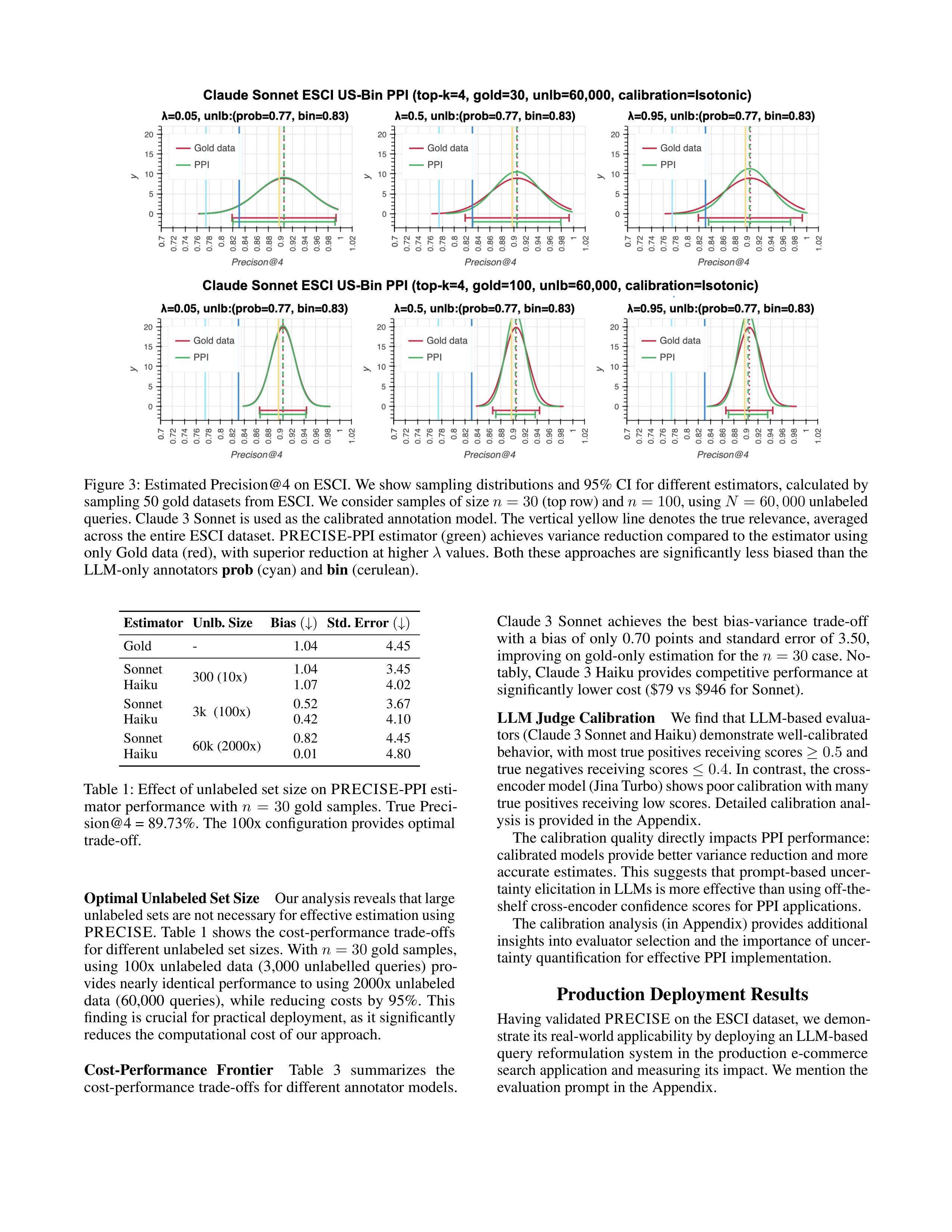
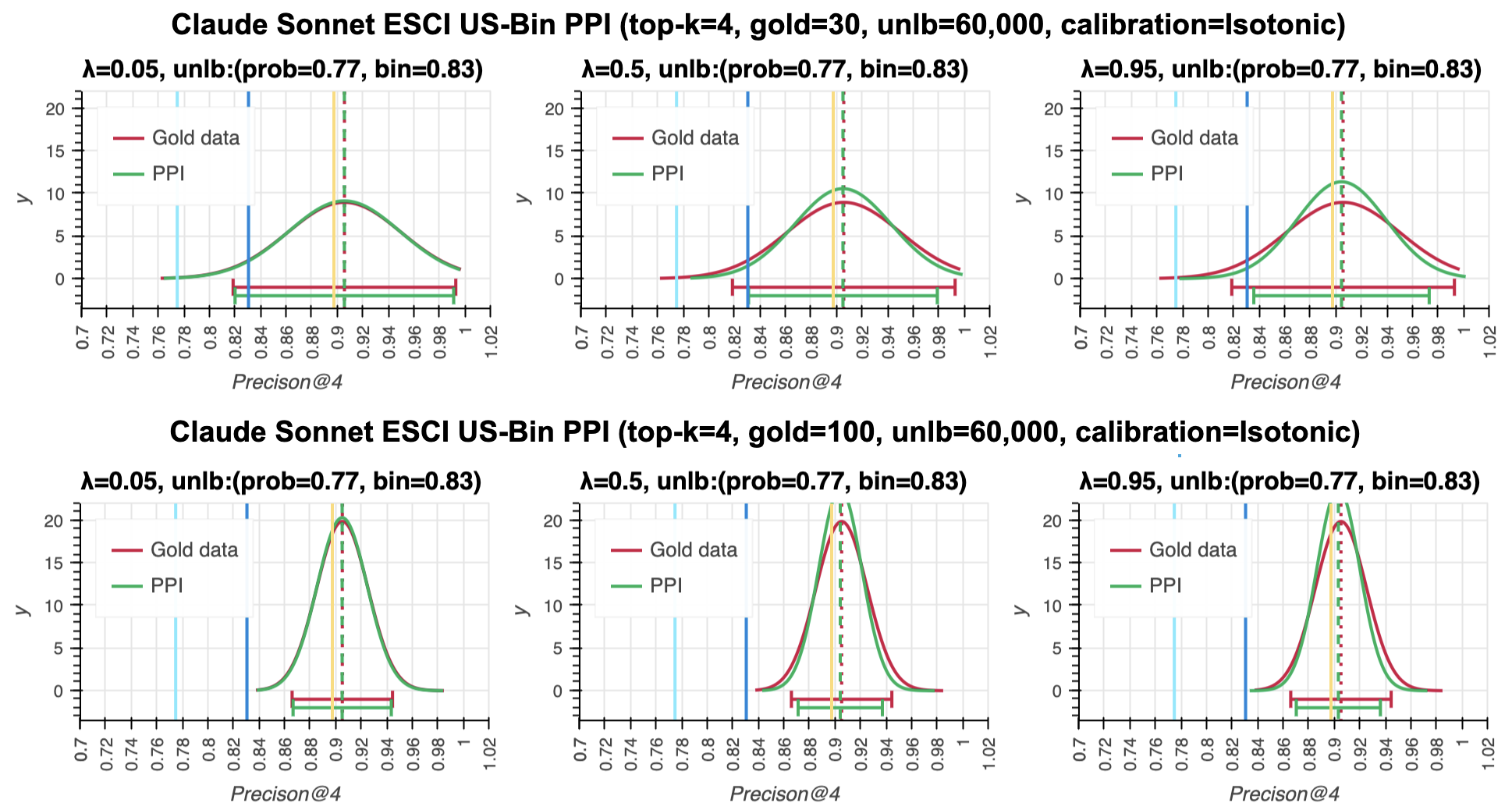
Figure 3: Estimated Precision@4 on ESCI. We show sampling distributions and 95% CI for different estimators, calculated by
sampling 50 gold datasets from ESCI. We consider samples of size
n
= 30
(top row) and
n
= 100
, using
N
= 60
,
000
unlabeled
queries. Claude 3 Sonnet is used as the calibrated annotation model. The vertical yellow line denotes the true relevance, averaged
across the entire ESCI dataset. PRECISE-PPI estimator (green) achieves variance reduction compared to the estimator using
only Gold data (red), with superior reduction at higher
λ
values. Both these approaches are significantly less biased than the
LLM-only annotators
prob
(cyan) and
bin
(cerulean).
Estimator
Unlb. Size
Bias
(
↓
)
Std. Error
(
↓
)
Gold
-
1.04
4.45
Sonnet
300 (10x)
1.04
3.45
Haiku
1.07
4.02
Sonnet
3k
(100x)
0.52
3.67
Haiku
0.42
4.10
Sonnet
60k (2000x)
0.82
4.45
Haiku
0.01
4.80
Table 1: Effect of unlabeled set size on PRECISE-PPI esti-
mator performance with
n
=
30
gold samples. True Preci-
sion@4 = 89.73%. The 100x configuration provides optimal
trade-off.
Optimal Unlabeled Set Size
Our analysis reveals that large
unlabeled sets are not necessary for effective estimation using
PRECISE. Table 1 shows the cost-performance trade-offs
for different unlabeled set sizes. With
n
= 30
gold samples,
using
100x
unlabeled
data
(3,000
unlabelled
queries)
pro-
vides nearly identical performance to using 2000x unlabeled
data
(60,000
queries),
while
reducing
costs
by
95%.
This
finding is crucial for practical deployment, as it significantly
reduces the computational cost of our approach.
Cost-Performance
Frontier
Table
3
summarizes
the
cost-performance trade-offs for different annotator models.
Claude 3
Sonnet
achieves
the
best
bias-variance
trade-off
with
a
bias
of
only
0.70
points
and
standard
error
of
3.50,
improving on gold-only estimation for the
n
= 30
case. No-
tably, Claude 3 Haiku provides competitive performance at
significantly lower cost ($79 vs $946 for Sonnet).
LLM Judge Calibration
We find that LLM-based evalua-
tors (Claude 3 Sonnet and Haiku) demonstrate well-calibrated
behavior, with most true positives receiving scores
≥
0
.
5
and
true negatives receiving scores
≤
0
.
4
. In contrast, the cross-
encoder model (Jina Turbo) shows poor calibration with many
true positives receiving low scores. Detailed calibration anal-
ysis is provided in the Appendix.
The calibration quality directly impacts PPI performance:
calibrated models provide better variance reduction and more
accurate estimates. This suggests that prompt-based uncer-
tainty elicitation in LLMs is more effective than using off-the-
shelf cross-encoder confidence scores for PPI applications.
The calibration analysis (in Appendix) provides additional
insights into evaluator selection and the importance of uncer-
tainty quantification for effective PPI implementation.
Production Deployment Results
Having validated PRECISE on the ESCI dataset, we demon-
strate its real-world applicability by deploying an LLM-based
query reformulation system in the production
e-commerce
search application and measuring its impact. We mention the
evaluation prompt in the Appendix.
Estimator
Production Search
Reformulation V1
Reformulation V2
K=1
K=2
K=4
K=1
K=2
K=4
K=1
K=2
K=4
S
TRICT
R
ELEVANCE
(P
ARTIAL
= I
RRELEVANT
)
Gold (
n
=100)
60.60%
60.00%
61.10%
64.60%
64.10%
65.70%
62.60%
62.60%
63.60%
Sonnet-Unlb (prob)
74.90%
74.90%
74.90%
77.40%
77.40%
77.40%
77.60%
77.60%
77.60%
Sonnet-Unlb (binary)
83.10%
82.70%
82.00%
85.20%
84.50%
84.00%
85.50%
84.80%
84.30%
PRECISE-PPI (
λ
=0.95)
55.10%
54.60%
55.30%
59.50%
59.10%
60.30%
59.70%
59.20%
59.40%
L
OOSE
R
ELEVANCE
(P
ARTIAL
= R
ELEVANT
)
Gold (
n
=100)
94.20%
93.70%
93.00%
97.30%
97.80%
97.60%
96.30%
97.30%
97.30%
Sonnet-Unlb (prob)
74.90%
74.90%
74.90%
77.40%
77.40%
77.40%
77.60%
77.60%
77.60%
Sonnet-Unlb (binary)
83.10%
82.70%
82.00%
85.20%
84.50%
84.00%
85.50%
84.80%
84.30%
PRECISE-PPI (
λ
=0.95)
91.40%
90.40%
89.50%
94.30%
94.50%
94.20%
94.00%
94.10%
94.30%
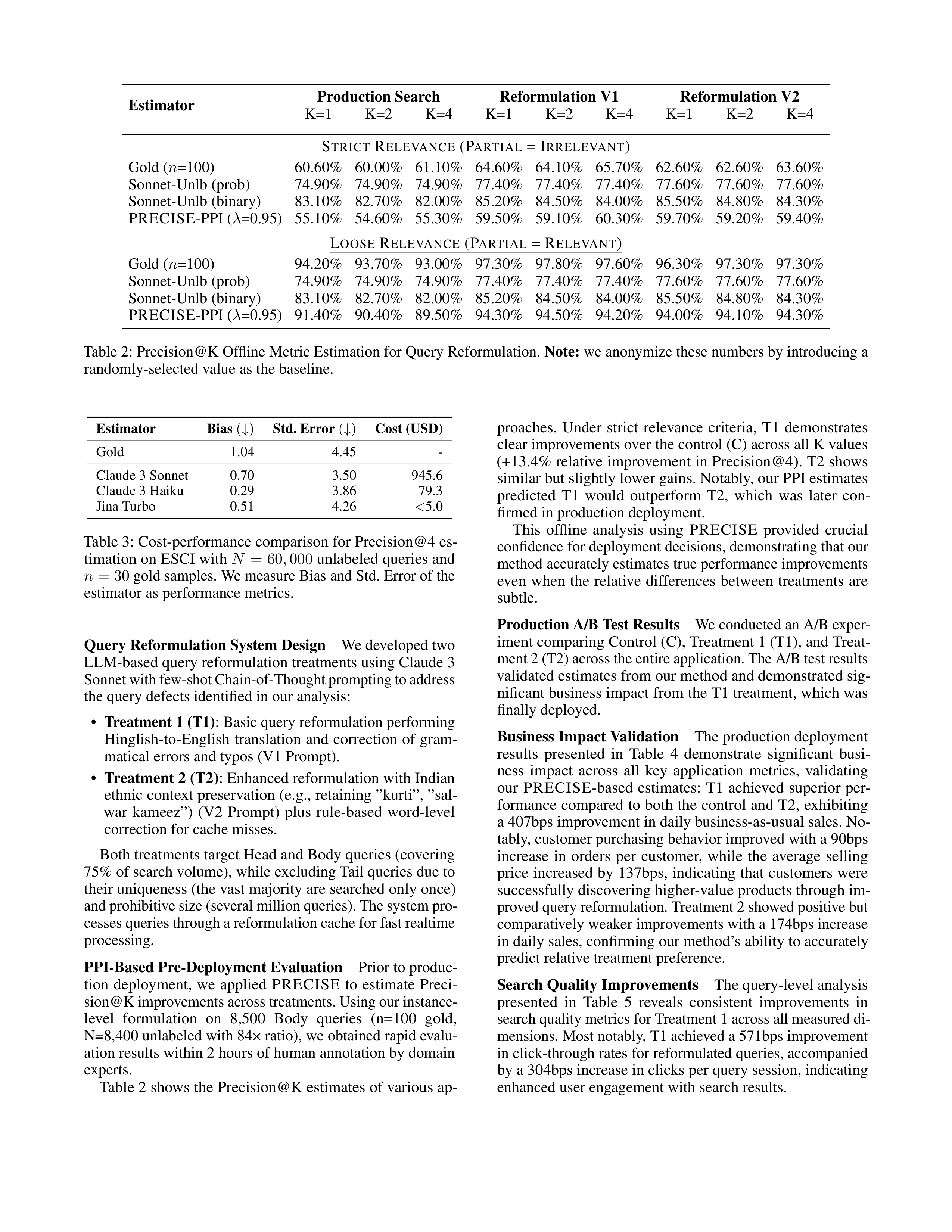
Table 2: Precision@K Offline Metric Estimation for Query Reformulation.
Note:
we anonymize these numbers by introducing a
randomly-selected value as the baseline.
Estimator
Bias
(
↓
)
Std. Error
(
↓
)
Cost (USD)
Gold
1.04
4.45
-
Claude 3 Sonnet
0.70
3.50
945.6
Claude 3 Haiku
0.29
3.86
79.3
Jina Turbo
0.51
4.26
<
5.0
Table 3: Cost-performance comparison for Precision@4 es-
timation on ESCI with
N
=
60
,
000
unlabeled queries and
n
= 30
gold samples. We measure Bias and Std. Error of the
estimator as performance metrics.
Query Reformulation System Design
We developed two
LLM-based query reformulation treatments using Claude 3
Sonnet with few-shot Chain-of-Thought prompting to address
the query defects identified in our analysis:
•
Treatment 1 (T1)
: Basic query reformulation performing
Hinglish-to-English translation and correction of gram-
matical errors and typos (V1 Prompt).
•
Treatment 2 (T2)
: Enhanced reformulation with Indian
ethnic context preservation (e.g., retaining ”kurti”, ”sal-
war
kameez”)
(V2
Prompt)
plus
rule-based
word-level
correction for cache misses.
Both treatments target Head and Body queries (covering
75% of search volume), while excluding Tail queries due to
their uniqueness (the vast majority are searched only once)
and prohibitive size (several million queries). The system pro-
cesses queries through a reformulation cache for fast realtime
processing.
PPI-Based Pre-Deployment Evaluation
Prior to produc-
tion
deployment,
we
applied
PRECISE
to
estimate
Preci-
sion@K improvements across treatments. Using our instance-
level
formulation
on
8,500
Body
queries
(n=100
gold,
N=8,400 unlabeled with 84× ratio), we obtained rapid evalu-
ation results within 2 hours of human annotation by domain
experts.
Table 2 shows the Precision@K estimates of various ap-
proaches.
Under
strict
relevance
criteria,
T1
demonstrates
clear improvements over the control (C) across all K values
(+13.4% relative improvement in Precision@4). T2 shows
similar but slightly lower gains. Notably, our PPI estimates
predicted
T1
would
outperform
T2,
which
was
later
con-
firmed in production deployment.
This
offline
analysis
using
PRECISE
provided
crucial
confidence for deployment decisions, demonstrating that our
method accurately estimates true performance improvements
even
when
the
relative
differences
between
treatments
are
subtle.
Production A/B Test Results
We conducted an A/B exper-
iment comparing Control (C), Treatment 1 (T1), and Treat-
ment 2 (T2) across the entire application. The A/B test results
validated estimates from our method and demonstrated sig-
nificant business impact from the T1 treatment, which was
finally deployed.
Business Impact Validation
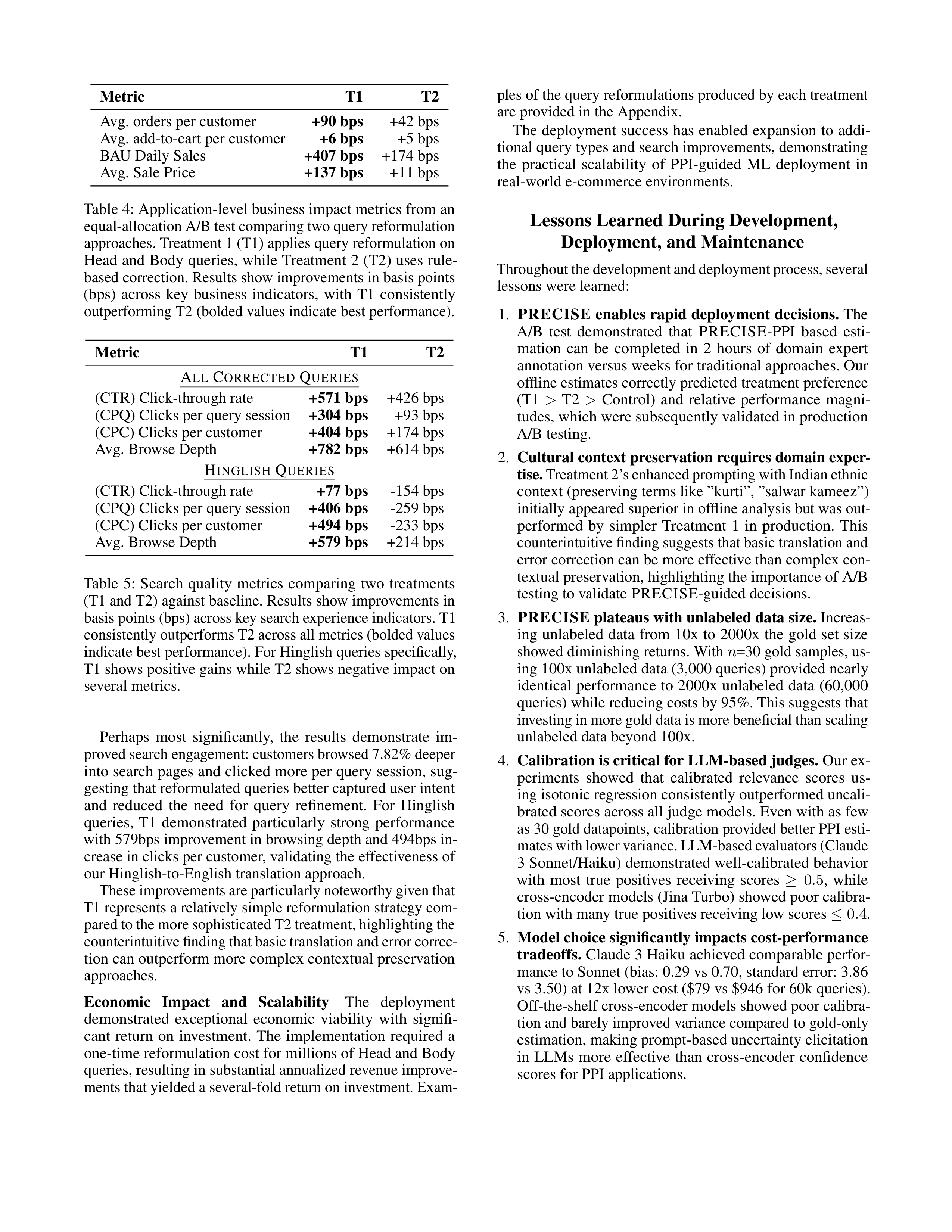
The production deployment
results
presented
in
Table
4
demonstrate
significant
busi-
ness
impact
across
all
key
application
metrics,
validating
our
PRECISE-based
estimates:
T1
achieved
superior
per-
formance compared to both the control and T2, exhibiting
a 407bps improvement in daily business-as-usual sales. No-
tably, customer purchasing behavior improved with a 90bps
increase
in
orders
per
customer,
while
the
average
selling
price increased by 137bps, indicating that customers were
successfully discovering higher-value products through im-
proved query reformulation. Treatment 2 showed positive but
comparatively weaker improvements with a 174bps increase
in daily sales, confirming our method’s ability to accurately
predict relative treatment preference.
Search Quality Improvements
The query-level analysis
presented
in
Table
5
reveals
consistent
improvements
in
search quality metrics for Treatment 1 across all measured di-
mensions. Most notably, T1 achieved a 571bps improvement
in click-through rates for reformulated queries, accompanied
by a 304bps increase in clicks per query session, indicating
enhanced user engagement with search results.
Metric
T1
T2
Avg. orders per customer
+90 bps
+42 bps
Avg. add-to-cart per customer
+6 bps
+5 bps
BAU Daily Sales
+407 bps
+174 bps
Avg. Sale Price
+137 bps
+11 bps
Table 4: Application-level business impact metrics from an
equal-allocation A/B test comparing two query reformulation
approaches. Treatment 1 (T1) applies query reformulation on
Head and Body queries, while Treatment 2 (T2) uses rule-
based correction. Results show improvements in basis points
(bps)
across
key
business
indicators,
with
T1
consistently
outperforming T2 (bolded values indicate best performance).
Metric
T1
T2
A
LL
C
ORRECTED
Q
UERIES
(CTR) Click-through rate
+571 bps
+426 bps
(CPQ) Clicks per query session
+304 bps
+93 bps
(CPC) Clicks per customer
+404 bps
+174 bps
Avg. Browse Depth
+782 bps
+614 bps
H
INGLISH
Q
UERIES
(CTR) Click-through rate
+77 bps
-154 bps
(CPQ) Clicks per query session
+406 bps
-259 bps
(CPC) Clicks per customer
+494 bps
-233 bps
Avg. Browse Depth
+579 bps
+214 bps
Table
5:
Search
quality
metrics
comparing
two
treatments
(T1 and T2) against baseline. Results show improvements in
basis points (bps) across key search experience indicators. T1
consistently outperforms T2 across all metrics (bolded values
indicate best performance). For Hinglish queries specifically,
T1 shows positive gains while T2 shows negative impact on
several metrics.
Perhaps
most
significantly,
the
results
demonstrate
im-
proved search engagement: customers browsed 7.82% deeper
into search pages and clicked more per query session, sug-
gesting that reformulated queries better captured user intent
and
reduced
the
need
for
query
refinement.
For
Hinglish
queries,
T1
demonstrated
particularly
strong
performance
with 579bps improvement in browsing depth and 494bps in-
crease in clicks per customer, validating the effectiveness of
our Hinglish-to-English translation approach.
These improvements are particularly noteworthy given that
T1 represents a relatively simple reformulation strategy com-
pared to the more sophisticated T2 treatment, highlighting the
counterintuitive finding that basic translation and error correc-
tion can outperform more complex contextual preservation
approaches.
Economic
Impact
and
Scalability
The
deployment
demonstrated
exceptional
economic
viability
with
signifi-
cant
return
on
investment.
The
implementation
required
a
one-time reformulation cost for millions of Head and Body
queries, resulting in substantial annualized revenue improve-
ments that yielded a several-fold return on investment. Exam-
ples of the query reformulations produced by each treatment
are provided in the Appendix.
The deployment success has enabled expansion to addi-
tional query types and search improvements, demonstrating
the
practical
scalability
of
PPI-guided
ML
deployment
in
real-world e-commerce environments.
Lessons Learned During Development,
Deployment, and Maintenance
Throughout the development and deployment process, several
lessons were learned:
1.
PRECISE
enables rapid deployment decisions.
The
A/B
test
demonstrated
that
PRECISE-PPI
based
esti-
mation
can
be
completed
in
2
hours
of
domain
expert
annotation versus weeks for traditional approaches. Our
offline estimates correctly predicted treatment preference
(T1
>
T2
>
Control)
and
relative
performance
magni-
tudes, which were subsequently validated in production
A/B testing.
2.
Cultural context preservation requires domain exper-
tise.
Treatment 2’s enhanced prompting with Indian ethnic
context (preserving terms like ”kurti”, ”salwar kameez”)
initially appeared superior in offline analysis but was out-
performed
by
simpler
Treatment
1
in
production.
This
counterintuitive finding suggests that basic translation and
error correction can be more effective than complex con-
textual preservation, highlighting the importance of A/B
testing to validate PRECISE-guided decisions.
3.
PRECISE plateaus with unlabeled data size.
Increas-
ing
unlabeled data
from 10x
to 2000x
the
gold set
size
showed diminishing returns. With
n
=30 gold samples, us-
ing 100x unlabeled data (3,000 queries) provided nearly
identical performance
to 2000x unlabeled data
(60,000
queries) while reducing costs by 95%. This suggests that
investing in more gold data is more beneficial than scaling
unlabeled data beyond 100x.
4.
Calibration is critical for LLM-based judges.
Our ex-
periments
showed
that
calibrated
relevance
scores
us-
ing isotonic regression consistently outperformed uncali-
brated scores across all judge models. Even with as few
as 30 gold datapoints, calibration provided better PPI esti-
mates with lower variance. LLM-based evaluators (Claude
3 Sonnet/Haiku) demonstrated well-calibrated behavior
with
most
true
positives
receiving
scores
≥
0
.
5
,
while
cross-encoder models (Jina Turbo) showed poor calibra-
tion with many true positives receiving low scores
≤
0
.
4
.
5.
Model choice significantly impacts cost-performance
tradeoffs.
Claude 3 Haiku achieved comparable perfor-
mance to Sonnet (bias: 0.29 vs 0.70, standard error: 3.86
vs 3.50) at 12x lower cost ($79 vs $946 for 60k queries).
Off-the-shelf cross-encoder models showed poor calibra-
tion and barely improved variance compared to gold-only
estimation, making prompt-based uncertainty elicitation
in
LLMs
more
effective
than
cross-encoder
confidence
scores for PPI applications.
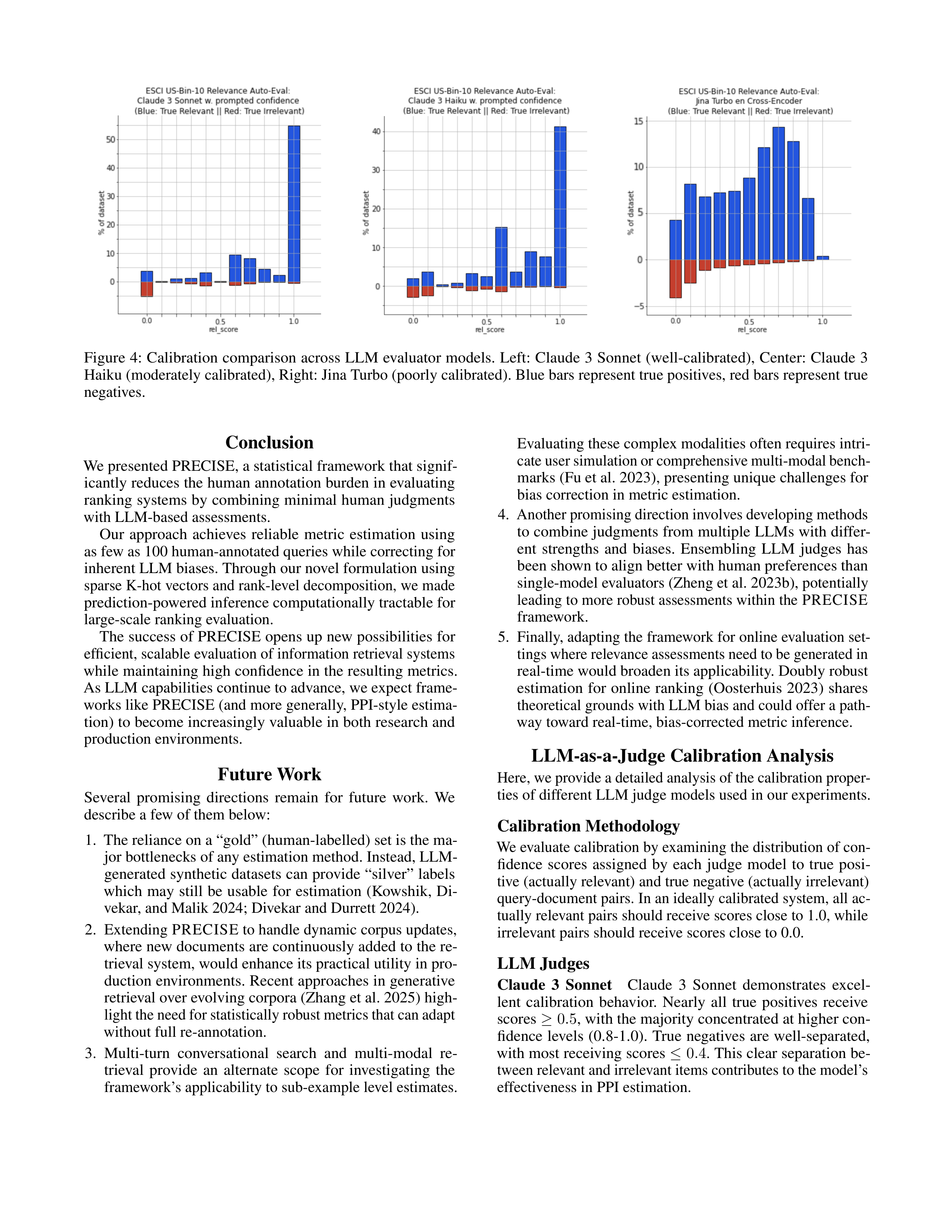
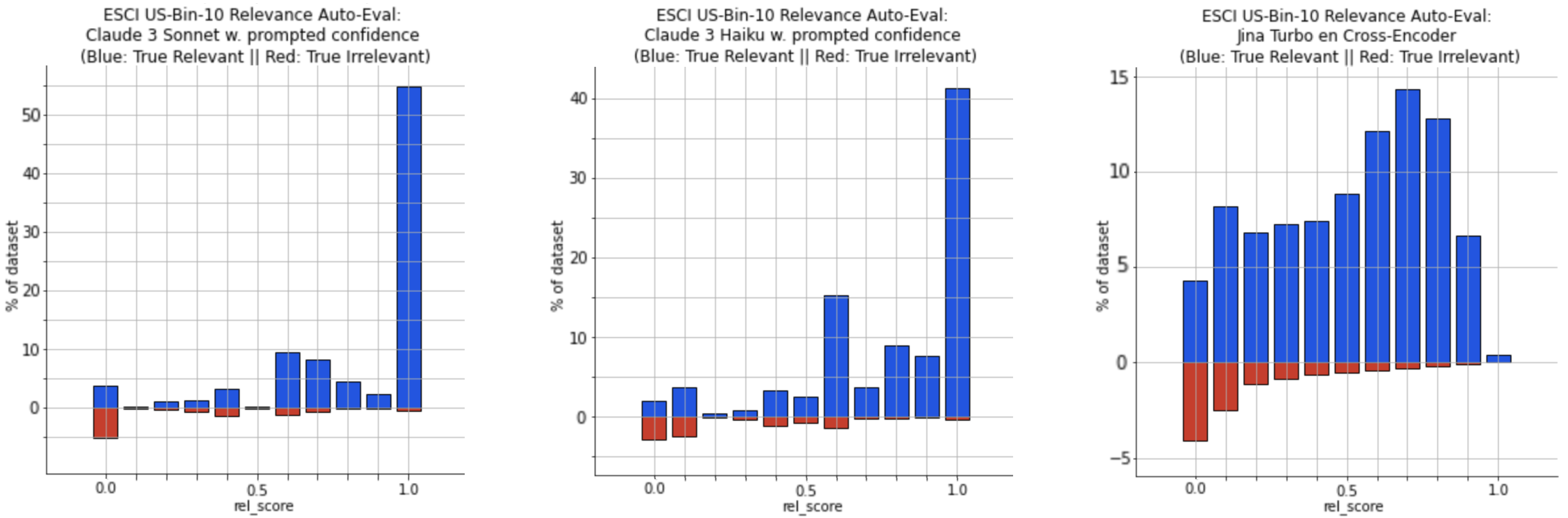
Figure 4: Calibration comparison across LLM evaluator models. Left: Claude 3 Sonnet (well-calibrated), Center: Claude 3
Haiku (moderately calibrated), Right: Jina Turbo (poorly calibrated). Blue bars represent true positives, red bars represent true
negatives.
Conclusion
We presented PRECISE, a statistical framework that signif-
icantly reduces the human annotation burden in evaluating
ranking systems by combining minimal human judgments
with LLM-based assessments.
Our
approach
achieves
reliable
metric
estimation
using
as few as 100 human-annotated queries while correcting for
inherent LLM biases. Through our novel formulation using
sparse K-hot vectors and rank-level decomposition, we made
prediction-powered inference computationally tractable for
large-scale ranking evaluation.
The success of PRECISE opens up new possibilities for
efficient, scalable evaluation of information retrieval systems
while maintaining high confidence in the resulting metrics.
As LLM capabilities continue to advance, we expect frame-
works like PRECISE (and more generally, PPI-style estima-
tion) to become increasingly valuable in both research and
production environments.
Future Work
Several
promising
directions
remain
for
future
work.
We
describe a few of them below:
1.
The reliance on a “gold” (human-labelled) set is the ma-
jor bottlenecks of any estimation method. Instead, LLM-
generated synthetic datasets can provide “silver” labels
which
may
still
be
usable
for
estimation
(Kowshik,
Di-
vekar, and Malik 2024; Divekar and Durrett 2024).
2.
Extending PRECISE to handle dynamic corpus updates,
where new documents are continuously added to the re-
trieval system, would enhance its practical utility in pro-
duction environments. Recent approaches in generative
retrieval over evolving corpora (Zhang et al. 2025) high-
light the need for statistically robust metrics that can adapt
without full re-annotation.
3.
Multi-turn
conversational
search
and
multi-modal
re-
trieval
provide
an
alternate
scope
for
investigating
the
framework’s applicability to sub-example level estimates.
Evaluating these complex modalities often requires intri-
cate user simulation or comprehensive multi-modal bench-
marks (Fu et al. 2023), presenting unique challenges for
bias correction in metric estimation.
4.
Another promising direction involves developing methods
to combine judgments from multiple LLMs with differ-
ent
strengths
and
biases.
Ensembling
LLM
judges
has
been shown to align better with human preferences than
single-model evaluators (Zheng et al. 2023b), potentially
leading to more robust assessments within the PRECISE
framework.
5.
Finally, adapting the framework for online evaluation set-
tings where relevance assessments need to be generated in
real-time would broaden its applicability. Doubly robust
estimation
for
online
ranking
(Oosterhuis
2023)
shares
theoretical grounds with LLM bias and could offer a path-
way toward real-time, bias-corrected metric inference.
LLM-as-a-Judge Calibration Analysis
Here, we provide a detailed analysis of the calibration proper-
ties of different LLM judge models used in our experiments.
Calibration Methodology
We evaluate calibration by examining the distribution of con-
fidence
scores
assigned
by
each
judge
model
to
true
posi-
tive (actually relevant) and true negative (actually irrelevant)
query-document pairs. In an ideally calibrated system, all ac-
tually relevant pairs should receive scores close to 1.0, while
irrelevant pairs should receive scores close to 0.0.
LLM Judges
Claude
3
Sonnet
Claude
3
Sonnet
demonstrates
excel-
lent
calibration
behavior.
Nearly
all
true
positives
receive
scores
≥
0
.
5
, with the majority concentrated at higher con-
fidence
levels
(0.8-1.0).
True
negatives
are
well-separated,
with most receiving scores
≤
0
.
4
. This clear separation be-
tween relevant and irrelevant items contributes to the model’s
effectiveness in PPI estimation.
Claude
3
Haiku
Claude
3
Haiku
shows
slightly
weaker
calibration
compared
to
Sonnet,
with
some
true
positives
receiving lower scores (0.6-0.8 range). However, the overall
calibration is still reasonable, with most true positives above
0.5
and
most
true
negatives
below
0.4.
The
reduced
cali-
bration quality compared to Sonnet may explain its slightly
higher standard error in PPI estimation.
Cross-Encoder Model
Jina-reranker-v1-turbo-en
The Jina Turbo cross-encoder
shows poor calibration, with a high proportion of true posi-
tives receiving scores
≤
0
.
4
. While true negatives are well-
calibrated (correctly receiving low scores), the systematic un-
derestimation of relevance for actually relevant pairs severely
impacts
the
model’s
utility
for
PPI.
This
poor
calibration
explains why Jina Turbo barely improves variance compared
to gold-only estimation.
Impact on PPI Performance
The calibration quality directly correlates with PPI effective-
ness:
•
Better-calibrated models
(Claude 3 Sonnet, Haiku) pro-
vide substantial variance reduction and accurate bias cor-
rection
•
Poorly
calibrated
models
(Jina
Turbo)
offer
minimal
improvement over gold-only estimation
•
Calibration correction
using isotonic regression on the
gold
set
improves
performance
for
all
models,
but
the
improvement
is
most
pronounced
for
poorly
calibrated
models
Recommendations
Based on our calibration analysis, we recommend:
1.
Prefer LLM judges
with prompted uncertainty over off-
the-shelf cross-encoder models
2.
Apply calibration correction
(e.g., isotonic regression)
when possible, especially for weaker models
3.
Evaluate calibration quality
before deploying any LLM
judge in a PPI-style framework
4.
Consider cost-performance trade-offs
: Claude 3 Haiku
provides good calibration at significantly lower cost than
Sonnet
Relevance Annotation Prompt
Table
6
presents
the
relevance
judge
prompt
used
in
our
production deployment.
Acknowledgments
Financial support for experiments was provided by Amazon
Central Machine Learning department. We additionally thank
Suhas Kowshik for providing feedback on the methodological
framing.
LLM-as-a-Judge Relevance Annotation Prompt
You
are
an
expert
product
judge
who
works
for
e-commerce
website
Amazon.
Your
job
is
to
determine
if
a
particular
product
is
relevant
to
a
search
query
asked
by
Amazon
customers.
This
is
to
improve
the
experience
and
safety
of
the
customers.
Make
sure
you
output
XML
when
asked.
The
customer’s
search
query
is
mentioned
in
XML
tags.
The
product
details
are
mentioned
in
XML
tags.
1.
First,
output
your
thoughts
in
XML
tags.
Here,
enter
your
justification
and
reasoning
for
your
evaluation.
2.
Secondly,
output
your
evaluation
of
the
relevance
of
the
product
to
the
search
query.
Your
evaluation
of
the
response
should
be
output
in
XML
tags.
Conduct
your
evaluation
of
the
relevance
between
the
search
query
and
product
as
follows:
-
Relevant:
If
the
product
details
exactly
or
partially
relates
to
the
search
query,
output
Relevant.
Consider
partial
matches
which
fulfill
some
but
not
all
criterion
in
the
search
query,
should
be
considered
Relevant.
-
Irrelevant:
If
the
product
details
does
not
have
any
match
to
the
search
query,
output
Irrelevant.
Unrelated
products
and
complementary
products
which
do
not
match
the
search
query,
should
be
considered
Irrelevant.
3.
Finally,
provide
your
best
guess
for
how
confident
you
are
that
your
evaluation
is
correct
in
XML
tags.
Give
ONLY
your
confidence,
no
other
words
or
explanation.
Provide
your
confidence
label
as
exactly
following
expressions
(ordered
from
least
confident
to
most
confident):
-
About
Even
-
Slightly
Better
than
Even
-
Probably
-
Pretty
Good
Chance
-
Highly
Likely
-
Almost
Certain
Table 6: LLM-as-a-Judge Relevance Annotation Prompt
References
Achiam, O. J.; Adler, S.; et al. 2023. GPT-4 Technical Report.
Angelopoulos, A. N.; Bates, S.; Fannjiang, C.; Jordan, M. I.;
and Zrnic, T. 2023.
Prediction-powered inference.
Science
,
382(6671): 669–674.
Angelopoulos, A. N.; Duchi, J. C.; and Zrnic, T. 2024. PPI++:
Efficient Prediction-Powered Inference.
arXiv:2311.01453.
Bai, Y.; Kadavath, S.; et al. 2022.
Constitutional AI: Harm-
lessness from AI Feedback.
arXiv:2212.08073.
Boyeau, P.; Angelopoulos, A. N.; Li, T.; Yosef, N.; Malik,
J.;
and
Jordan,
M.
I.
2025.
AutoEval
Done
Right:
Using
Synthetic Data for Model Evaluation.
In
Forty-second Inter-
national Conference on Machine Learning
.
Chen, G. H.; Chen, S.; Liu, Z.; Jiang, F.; and Wang, B. 2024.
Humans or LLMs as the Judge? A Study on Judgement Bias.
In Al-Onaizan, Y.; Bansal, M.; and Chen, Y.-N., eds.,
Pro-
ceedings of the 2024 Conference on Empirical Methods in
Natural Language Processing
, 8301–8327. Miami, Florida,
USA: Association for Computational Linguistics.
DeepSeek-AI; Liu, A.; Feng, B.; et al. 2025.
DeepSeek-V3
Technical Report.
arXiv:2412.19437.
Divekar, A.; and Durrett, G. 2024.
SynthesizRR: Generat-
ing
Diverse
Datasets
with
Retrieval
Augmentation.
In
Al-
Onaizan, Y.; Bansal, M.; and Chen, Y.-N., eds.,
Proceedings
of
the
2024
Conference
on
Empirical
Methods
in
Natural
Language Processing
, 19200–19227. Miami, Florida, USA:
Association for Computational Linguistics.
Dong, Y. R.; Hu, T.; and Collier, N. 2024.
Can LLM be a
Personalized Judge? In Al-Onaizan, Y.; Bansal, M.; and Chen,
Y.-N., eds.,
Findings of the Association for Computational
Linguistics:
EMNLP
2024
,
10126–10141.
Miami,
Florida,
USA: Association for Computational Linguistics.
Es, S.; James, J.; Espinosa Anke, L.; and Schockaert, S. 2024.
RAGAs: Automated Evaluation of Retrieval Augmented Gen-
eration.
In Aletras, N.; and De Clercq, O., eds.,
Proceedings
of the 18th Conference of the European Chapter of the Associ-
ation for Computational Linguistics: System Demonstrations
,
150–158. St. Julians, Malta: Association for Computational
Linguistics.
Fu,
C.;
Chen,
P.;
Shen,
Y.;
Qin,
Y.;
Zhang,
M.;
Lin,
X.;
Qiu, Z.; Lin, W.; Yang, J.; Zheng, X.; Li, K.; Sun, X.; and
Ji,
R.
2023.
MME:
A
Comprehensive
Evaluation
Bench-
mark
for
Multimodal
Large
Language
Models.
ArXiv
,
abs/2306.13394.
Kowshik, S. S.; Divekar, A.; and Malik, V. 2024.
CorrSynth
- A Correlated Sampling Method for Diverse Dataset Gen-
eration
from
LLMs.
In
Al-Onaizan,
Y.;
Bansal,
M.;
and
Chen, Y.-N., eds.,
Proceedings of the 2024 Conference on
Empirical Methods in Natural Language Processing
, 16076–
16095. Miami, Florida, USA: Association for Computational
Linguistics.
Li,
Z.;
Wang,
C.;
Ma,
P.;
Wu,
D.;
Wang,
S.;
Gao,
C.;
and
Liu, Y. 2024.
Split and Merge: Aligning Position Biases in
LLM-based Evaluators.
In Al-Onaizan, Y.; Bansal, M.; and
Chen, Y.-N., eds.,
Proceedings of the 2024 Conference on
Empirical Methods in Natural Language Processing
, 11084–
11108. Miami, Florida, USA: Association for Computational
Linguistics.
Oosterhuis, H. 2023.
Doubly Robust Estimation for Correct-
ing Position Bias in Click Feedback for Unbiased Learning
to Rank.
ACM Trans. Inf. Syst.
, 41(3).
Ovaisi, Z.; Ahsan, R.; Zhang, Y.; Vasilaky, K.; and Zheleva, E.
2020.
Correcting for Selection Bias in Learning-to-rank Sys-
tems.
In
Proceedings of The Web Conference 2020
, WWW
’20, 1863–1873. New York, NY, USA: Association for Com-
puting Machinery.
ISBN 9781450370233.
Reddy,
C.
K.;
M
`
arquez,
L.;
Valero,
F.;
Rao,
N.;
Zaragoza,
H.; Bandyopadhyay, S.; Biswas, A.; Xing, A.; and Subbian,
K.
2022.
Shopping
Queries
Dataset:
A
Large-Scale
ESCI
Benchmark for Improving Product Search.
Saad-Falcon, J.; Khattab, O.; Potts, C.; and Zaharia, M. 2024.
ARES: An Automated Evaluation Framework for Retrieval-
Augmented
Generation
Systems.
In
Duh,
K.;
Gomez,
H.;
and Bethard, S., eds.,
Proceedings of the 2024 Conference of
the North American Chapter of the Association for Computa-
tional Linguistics: Human Language Technologies (Volume
1: Long Papers)
, 338–354. Mexico City, Mexico: Association
for Computational Linguistics.
Shen,
C.;
Cheng,
L.;
Nguyen,
X.-P.;
You,
Y.;
and
Bing,
L.
2023.
Large
Language
Models
are
Not
Yet
Human-Level
Evaluators for Abstractive Summarization.
In Bouamor, H.;
Pino, J.; and Bali, K., eds.,
Findings of the Association for
Computational Linguistics: EMNLP 2023
, 4215–4233. Sin-
gapore: Association for Computational Linguistics.
Wang, X.; Bendersky, M.; Metzler, D.; and Najork, M. 2016.
Learning to Rank with Selection Bias in Personal Search.
In
Proceedings of the 39th International ACM SIGIR Confer-
ence on Research and Development in Information Retrieval
,
SIGIR ’16, 115–124. New York, NY, USA: Association for
Computing Machinery.
ISBN 9781450340694.
Zhang,
Z.;
Ma,
X.;
Sun,
W.;
Ren,
P.;
Chen,
Z.;
Wang,
S.;
Yin,
D.;
de
Rijke,
M.;
and
Ren,
Z.
2025.
Replication
and
Exploration of Generative Retrieval over Dynamic Corpora.
In
Proceedings of the 48th International ACM SIGIR Confer-
ence on Research and Development in Information Retrieval
,
SIGIR ’25, 3325–3334. New York, NY, USA: Association
for Computing Machinery.
ISBN 9798400715921.
Zheng,
L.;
Chiang,
W.-L.;
Sheng,
Y.;
Zhuang,
S.;
Wu,
Z.;
Zhuang, Y.; Lin, Z.; Li, Z.; Li, D.; Xing, E. P.; Zhang, H.;
Gonzalez,
J.
E.;
and
Stoica,
I.
2023a.
Judging
LLM-as-a-
judge with MT-bench and Chatbot Arena.
In
Proceedings
of the 37th International Conference on Neural Information
Processing Systems
, NIPS ’23. Red Hook, NY, USA: Curran
Associates Inc.
Zheng,
L.;
Chiang,
W.-L.;
Sheng,
Y.;
Zhuang,
S.;
Wu,
Z.;
Zhuang, Y.; Lin, Z.; Li, Z.; Li, D.; Xing, E. P.; Zhang, H.;
Gonzalez,
J.
E.;
and
Stoica,
I.
2023b.
Judging
LLM-as-a-
judge with MT-bench and Chatbot Arena.
In
Proceedings
of the 37th International Conference on Neural Information
Processing Systems
, NIPS ’23. Red Hook, NY, USA: Curran
Associates Inc.