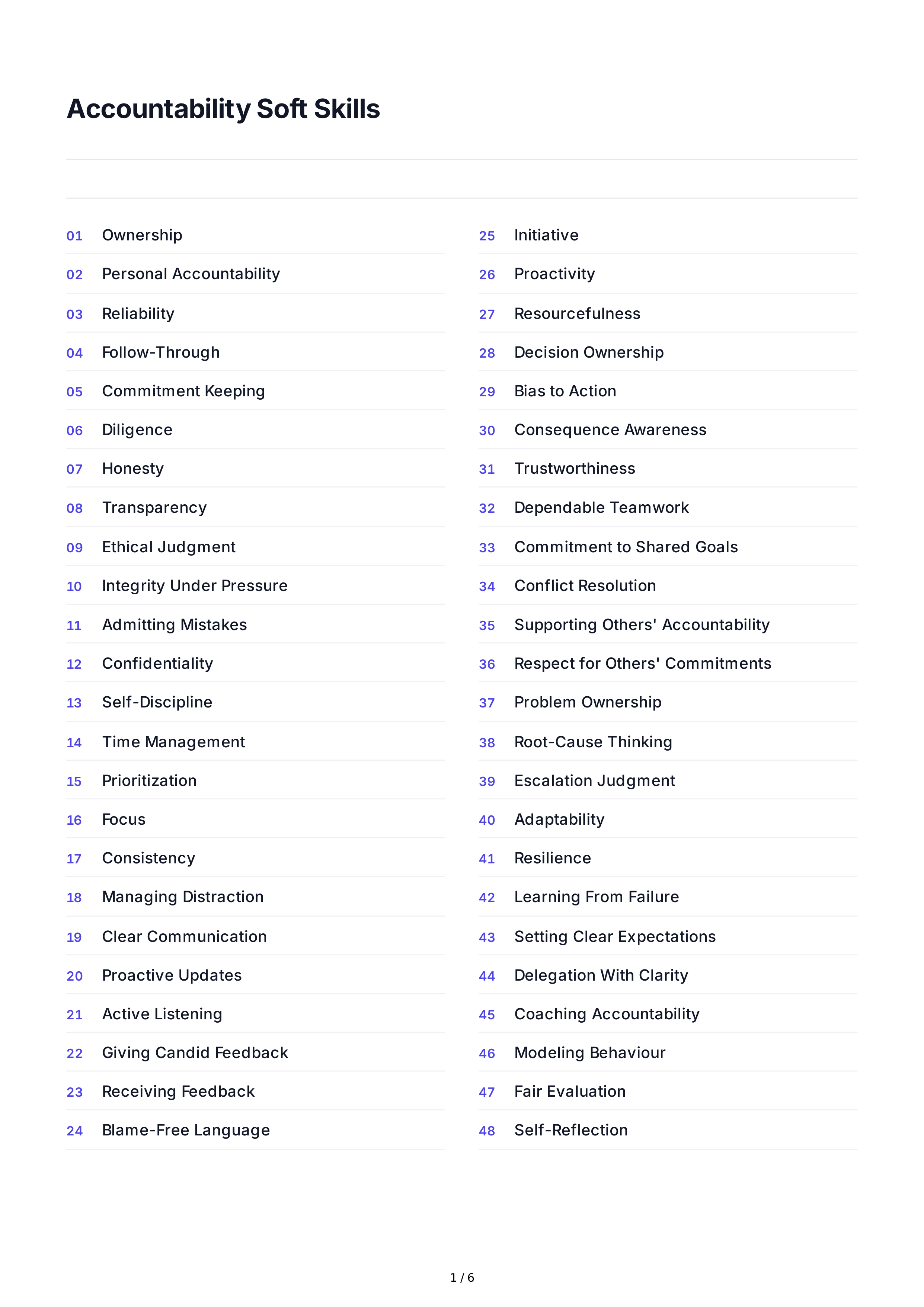
Accountability
Soft
Skills
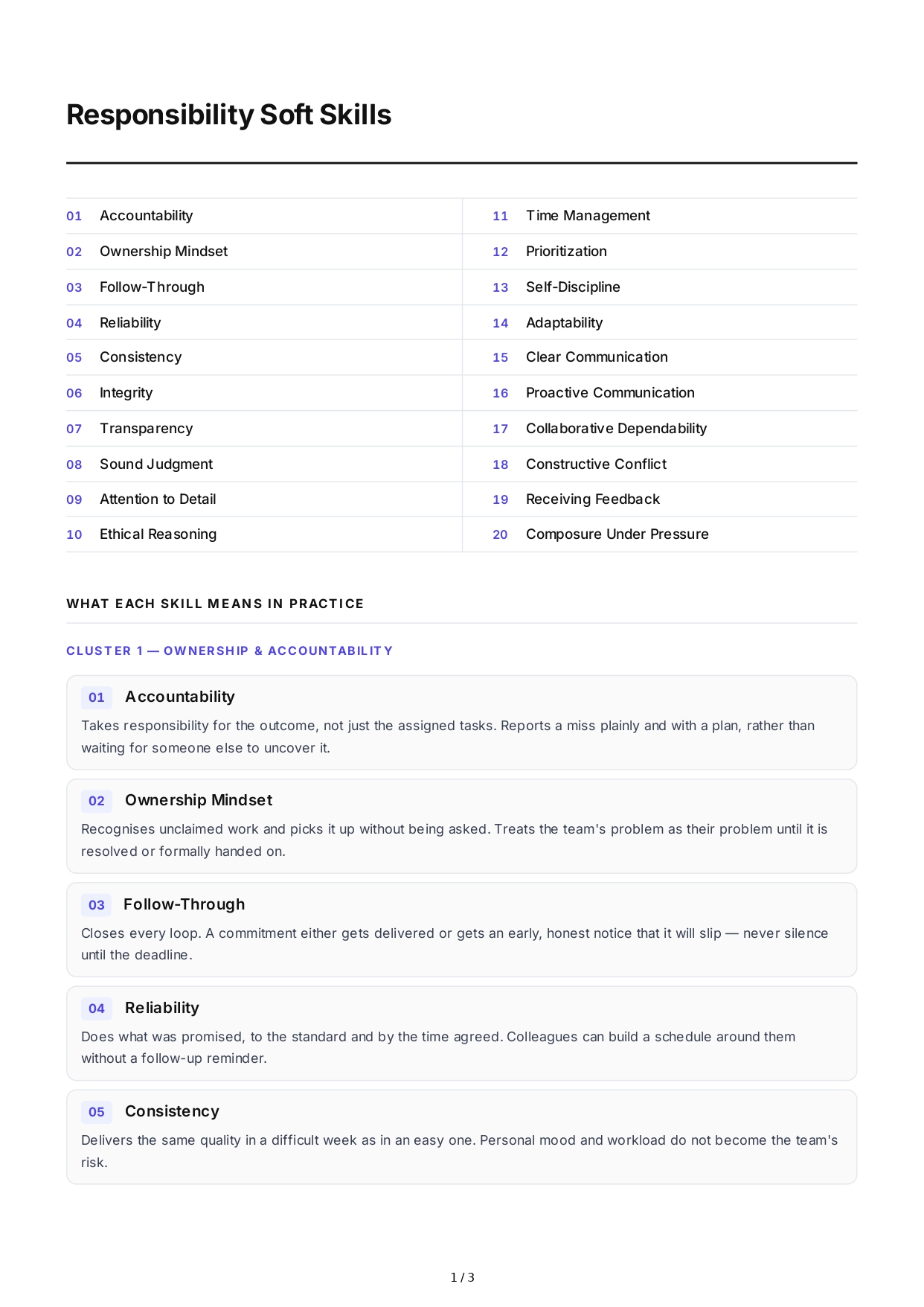
01
Ownership
25
Initiative
02
Personal
Accountability
26
Proactivity
03
Reliability
27
Resourcefulness
04
Follow
-
Through
28
Decision
Ownership
05
Commitment
Keeping
29
Bias
to
Action
06
Diligence
30
Consequence
Awareness
07
Honesty
31
Trustworthiness
08
Transparency
32
Dependable
Teamwork
09
Ethical
Judgment
33
Commitment
to
Shared
Goals
10
Integrity
Under
Pressure
34
Conflict
Resolution
11
Admitting
Mistakes
35
Supporting
Others
'
Accountability
12
Confidentiality
36
Respect
for
Others
'
Commitments
13
Self
-
Discipline
37
Problem
Ownership
14
Time
Management
38
Root
-
Cause
Thinking
15
Prioritization
39
Escalation
Judgment
16
Focus
40
Adaptability
17
Consistency
41
Resilience
18
Managing
Distraction
42
Learning
From
Failure
19
Clear
Communication
43
Setting
Clear
Expectations
20
Proactive
Updates
44
Delegation
With
Clarity
21
Active
Listening
45
Coaching
Accountability
22
Giving
Candid
Feedback
46
Modeling
Behaviour
23
Receiving
Feedback
47
Fair
Evaluation
24
Blame
-
Free
Language
48
Self
-
Reflection
1 / 6
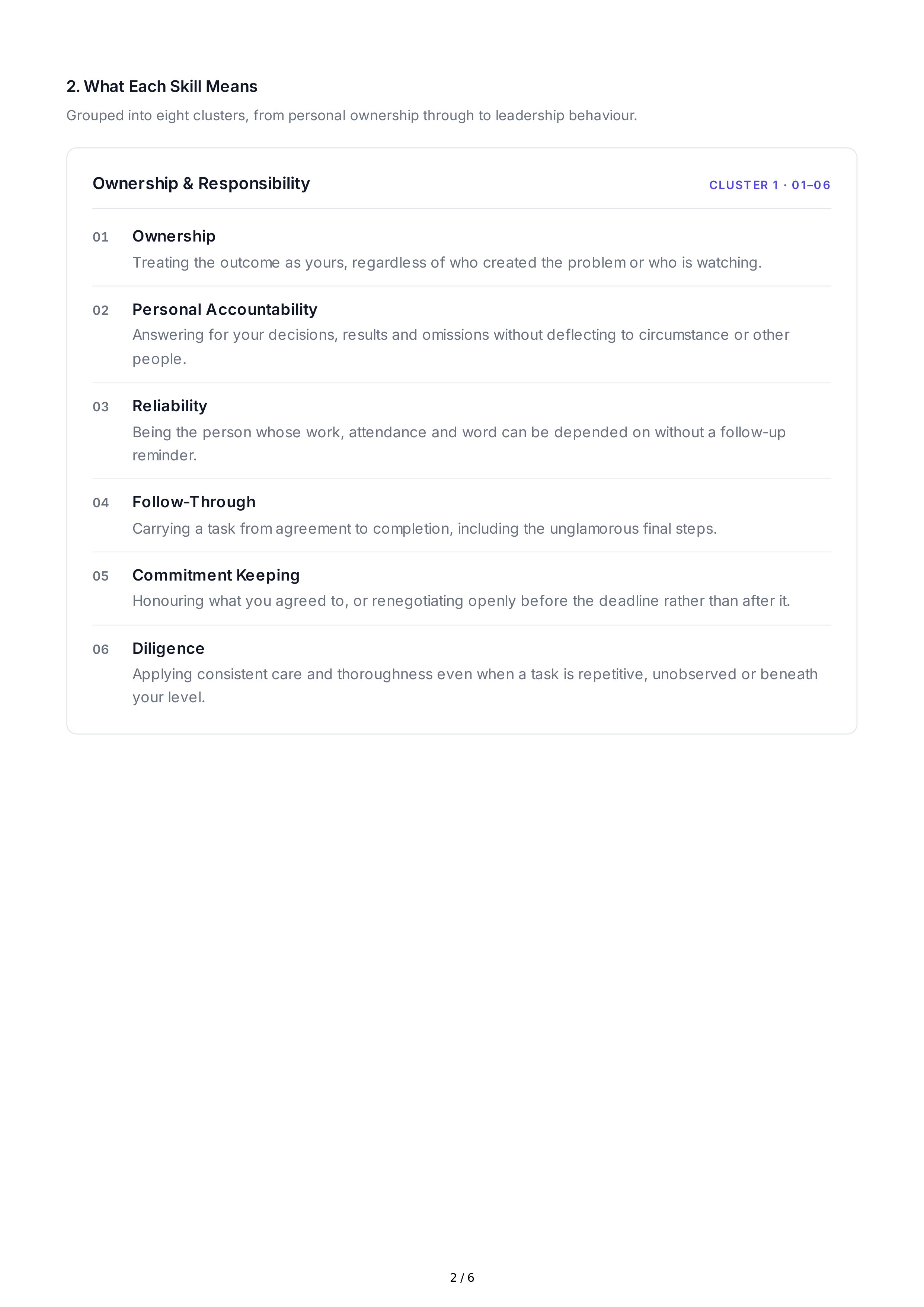
2.
What
Each
Skill
Means
Grouped
into
eight
clusters
,
from
personal
ownership
through
to
leadership
behaviour
.
Ownership
&
Responsibility
CLUST ER
1 · 0 1–0 6
01
Ownership
Treating
the
outcome
as
yours
,
regardless
of
who
created
the
problem
or
who
is
watching
.
02
Personal
Accountability
Answering
for
your
decisions
,
results
and
omissions
without
deflecting
to
circumstance
or
other
people
.
03
Reliability
Being
the
person
whose
work
,
attendance
and
word
can
be
depended
on
without
a
follow
-
up
reminder
.
04
Follow
-
Through
Carrying
a
task
from
agreement
to
completion
,
including
the
unglamorous
final
steps
.
05
Commitment
Keeping
Honouring
what
you
agreed
to
,
or
renegotiating
openly
before
the
deadline
rather
than
after
it
.
06
Diligence
Applying
consistent
care
and
thoroughness
even
when
a
task
is
repetitive
,
unobserved
or
beneath
your
level
.
2 / 6
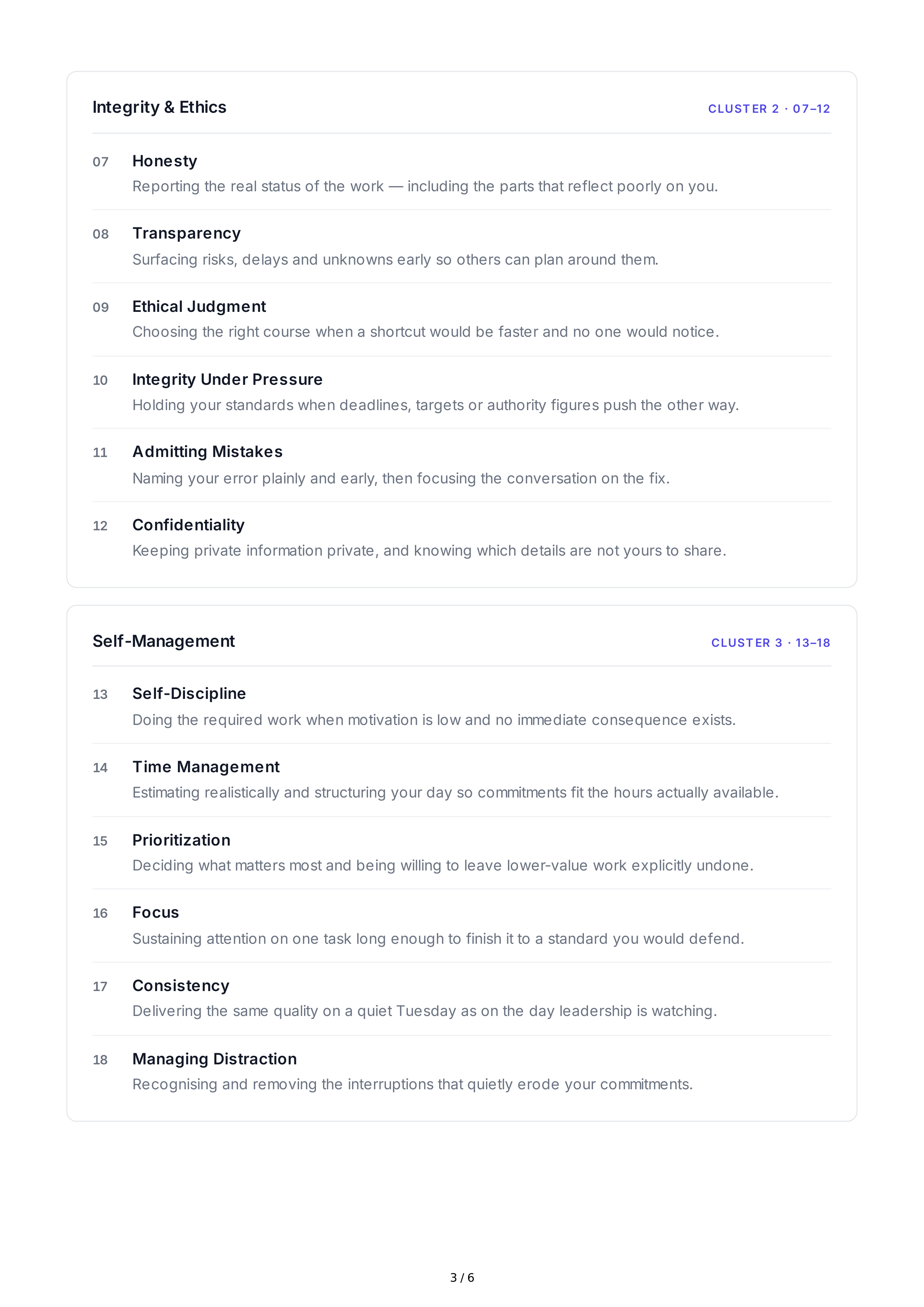
Integrity
&
Ethics
CLUST ER
2 · 0 7 –12
07
Honesty
Reporting
the
real
status
of
the
work
—
including
the
parts
that
reflect
poorly
on
you
.
08
Transparency
Surfacing
risks
,
delays
and
unknowns
early
so
others
can
plan
around
them
.
09
Ethical
Judgment
Choosing
the
right
course
when
a
shortcut
would
be
faster
and
no
one
would
notice
.
10
Integrity
Under
Pressure
Holding
your
standards
when
deadlines
,
targets
or
authority
figures
push
the
other
way
.
11
Admitting
Mistakes
Naming
your
error
plainly
and
early
,
then
focusing
the
conversation
on
the
fix
.
12
Confidentiality
Keeping
private
information
private
,
and
knowing
which
details
are
not
yours
to
share
.
Self
-
Management
CLUST ER
3 · 13–18
13
Self
-
Discipline
Doing
the
required
work
when
motivation
is
low
and
no
immediate
consequence
exists
.
14
Time
Management
Estimating
realistically
and
structuring
your
day
so
commitments
fit
the
hours
actually
available
.
15
Prioritization
Deciding
what
matters
most
and
being
willing
to
leave
lower
-
value
work
explicitly
undone
.
16
Focus
Sustaining
attention
on
one
task
long
enough
to
finish
it
to
a
standard
you
would
defend
.
17
Consistency
Delivering
the
same
quality
on
a
quiet
Tuesday
as
on
the
day
leadership
is
watching
.
18
Managing
Distraction
Recognising
and
removing
the
interruptions
that
quietly
erode
your
commitments
.
3 / 6
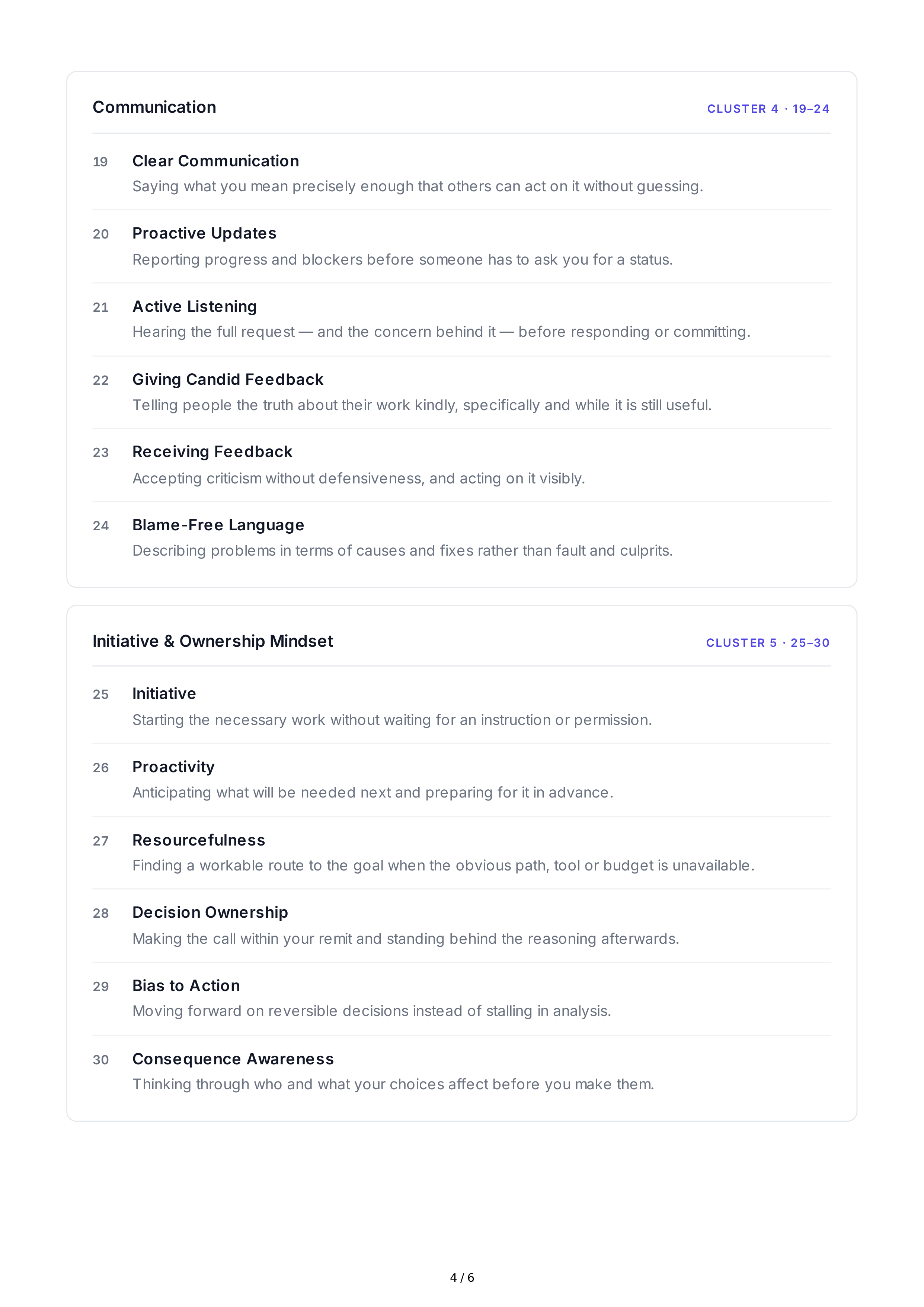
Communication
CLUST ER
4 · 19–24
19
Clear
Communication
Saying
what
you
mean
precisely
enough
that
others
can
act
on
it
without
guessing
.
20
Proactive
Updates
Reporting
progress
and
blockers
before
someone
has
to
ask
you
for
a
status
.
21
Active
Listening
Hearing
the
full
request
—
and
the
concern
behind
it
—
before
responding
or
committing
.
22
Giving
Candid
Feedback
Telling
people
the
truth
about
their
work
kindly
,
specifically
and
while
it
is
still
useful
.
23
Receiving
Feedback
Accepting
criticism
without
defensiveness
,
and
acting
on
it
visibly
.
24
Blame
-
Free
Language
Describing
problems
in
terms
of
causes
and
fixes
rather
than
fault
and
culprits
.
Initiative
&
Ownership
Mindset
CLUST ER
5 · 25–30
25
Initiative
Starting
the
necessary
work
without
waiting
for
an
instruction
or
permission
.
26
Proactivity
Anticipating
what
will
be
needed
next
and
preparing
for
it
in
advance
.
27
Resourcefulness
Finding
a
workable
route
to
the
goal
when
the
obvious
path
,
tool
or
budget
is
unavailable
.
28
Decision
Ownership
Making
the
call
within
your
remit
and
standing
behind
the
reasoning
afterwards
.
29
Bias
to
Action
Moving
forward
on
reversible
decisions
instead
of
stalling
in
analysis
.
30
Consequence
Awareness
Thinking
through
who
and
what
your
choices
affect
before
you
make
them
.
4 / 6
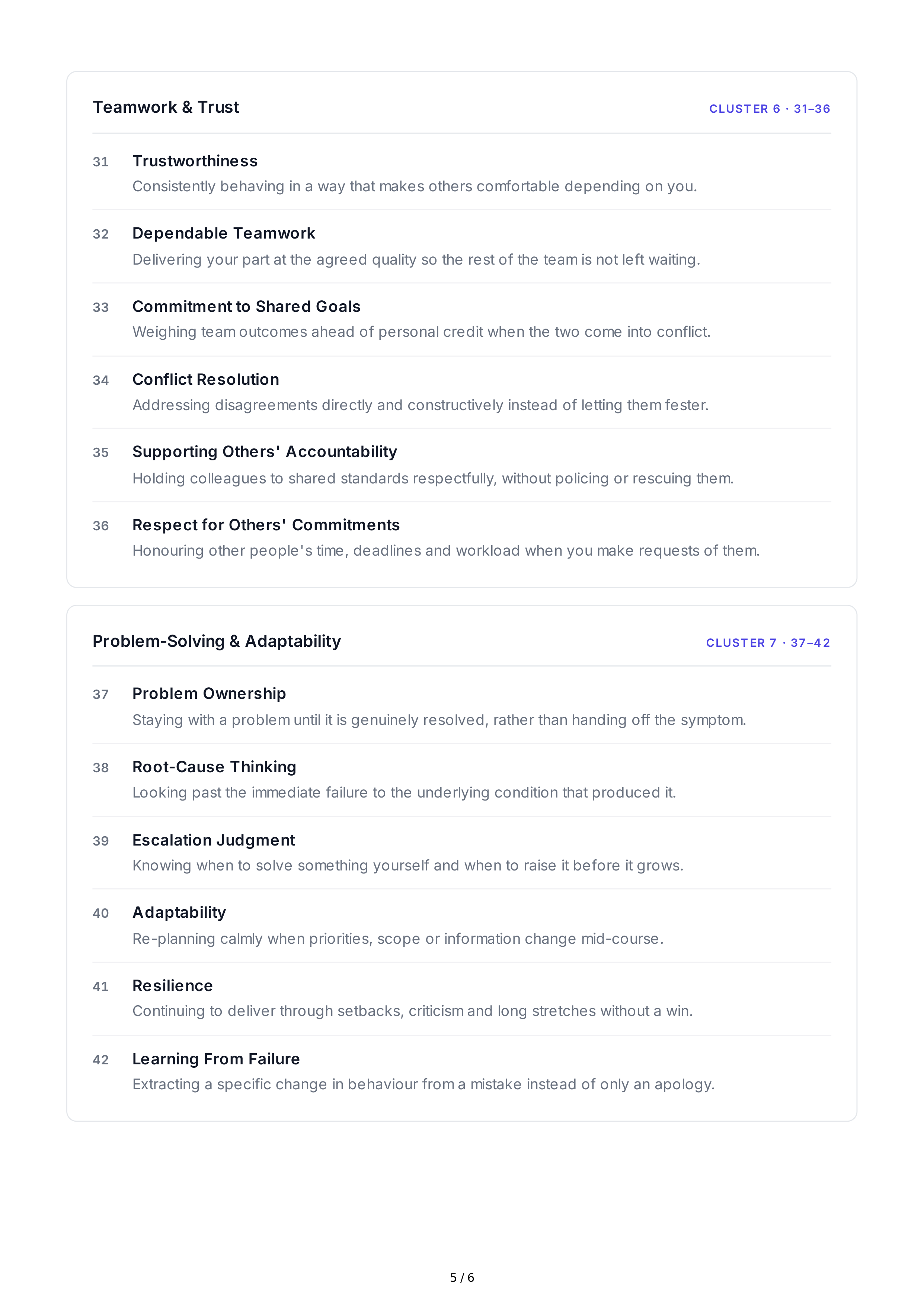
Teamwork
&
Trust
CLUST ER
6 · 31–36
31
Trustworthiness
Consistently
behaving
in
a
way
that
makes
others
comfortable
depending
on
you
.
32
Dependable
Teamwork
Delivering
your
part
at
the
agreed
quality
so
the
rest
of
the
team
is
not
left
waiting
.
33
Commitment
to
Shared
Goals
Weighing
team
outcomes
ahead
of
personal
credit
when
the
two
come
into
conflict
.
34
Conflict
Resolution
Addressing
disagreements
directly
and
constructively
instead
of
letting
them
fester
.
35
Supporting
Others
'
Accountability
Holding
colleagues
to
shared
standards
respectfully
,
without
policing
or
rescuing
them
.
36
Respect
for
Others
'
Commitments
Honouring
other
people
'
s
time
,
deadlines
and
workload
when
you
make
requests
of
them
.
Problem
-
Solving
&
Adaptability
CLUST ER
7 · 37 –4 2
37
Problem
Ownership
Staying
with
a
problem
until
it
is
genuinely
resolved
,
rather
than
handing
off
the
symptom
.
38
Root
-
Cause
Thinking
Looking
past
the
immediate
failure
to
the
underlying
condition
that
produced
it
.
39
Escalation
Judgment
Knowing
when
to
solve
something
yourself
and
when
to
raise
it
before
it
grows
.
40
Adaptability
Re
-
planning
calmly
when
priorities
,
scope
or
information
change
mid
-
course
.
41
Resilience
Continuing
to
deliver
through
setbacks
,
criticism
and
long
stretches
without
a
win
.
42
Learning
From
Failure
Extracting
a
specific
change
in
behaviour
from
a
mistake
instead
of
only
an
apology
.
5 / 6
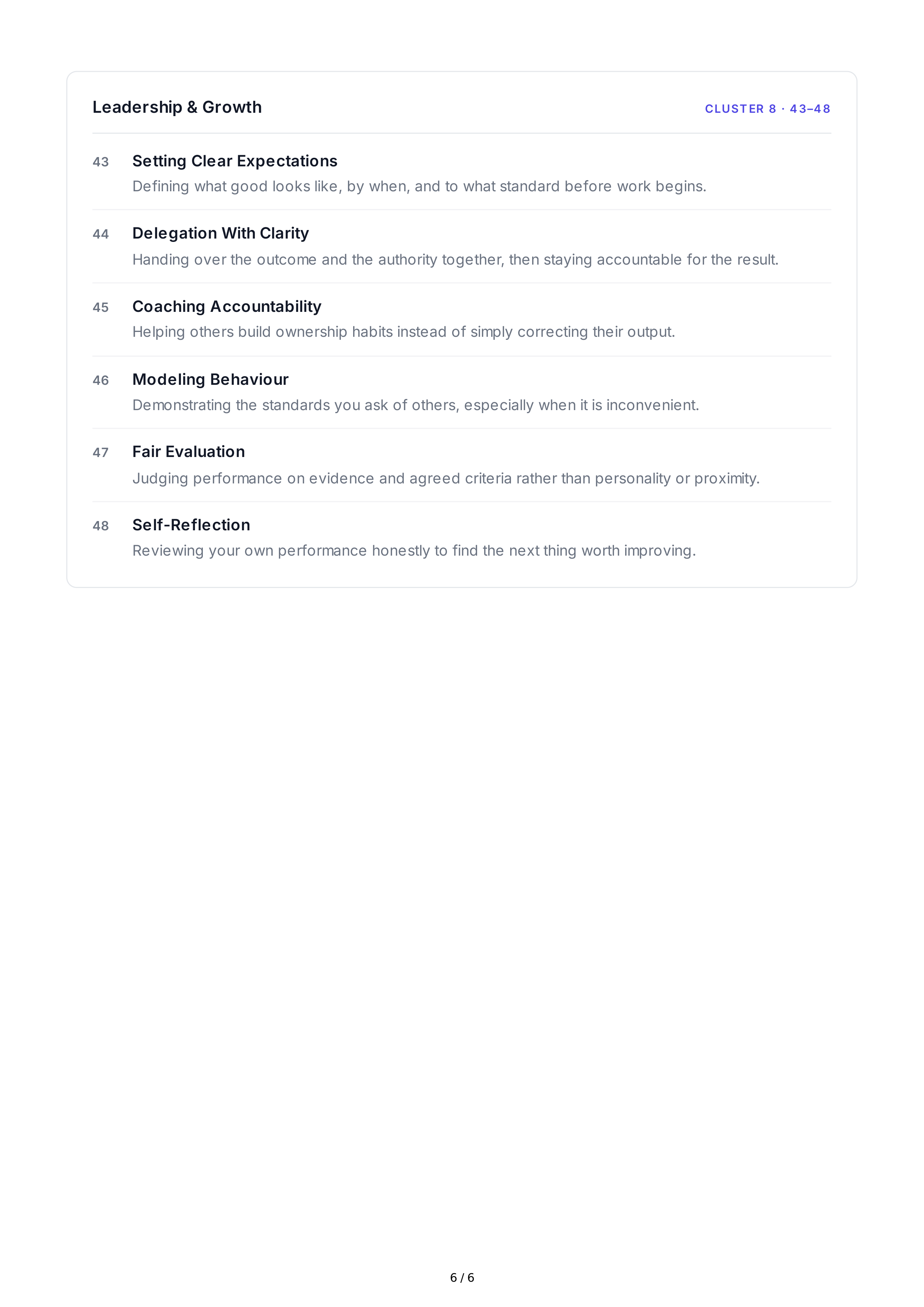
Leadership
&
Growth
CLUST ER
8 · 4 3–4 8
43
Setting
Clear
Expectations
Defining
what
good
looks
like
,
by
when
,
and
to
what
standard
before
work
begins
.
44
Delegation
With
Clarity
Handing
over
the
outcome
and
the
authority
together
,
then
staying
accountable
for
the
result
.
45
Coaching
Accountability
Helping
others
build
ownership
habits
instead
of
simply
correcting
their
output
.
46
Modeling
Behaviour
Demonstrating
the
standards
you
ask
of
others
,
especially
when
it
is
inconvenient
.
47
Fair
Evaluation
Judging
performance
on
evidence
and
agreed
criteria
rather
than
personality
or
proximity
.
48
Self
-
Reflection
Reviewing
your
own
performance
honestly
to
find
the
next
thing
worth
improving
.
6 / 6