Responsibility
Soft
Skills
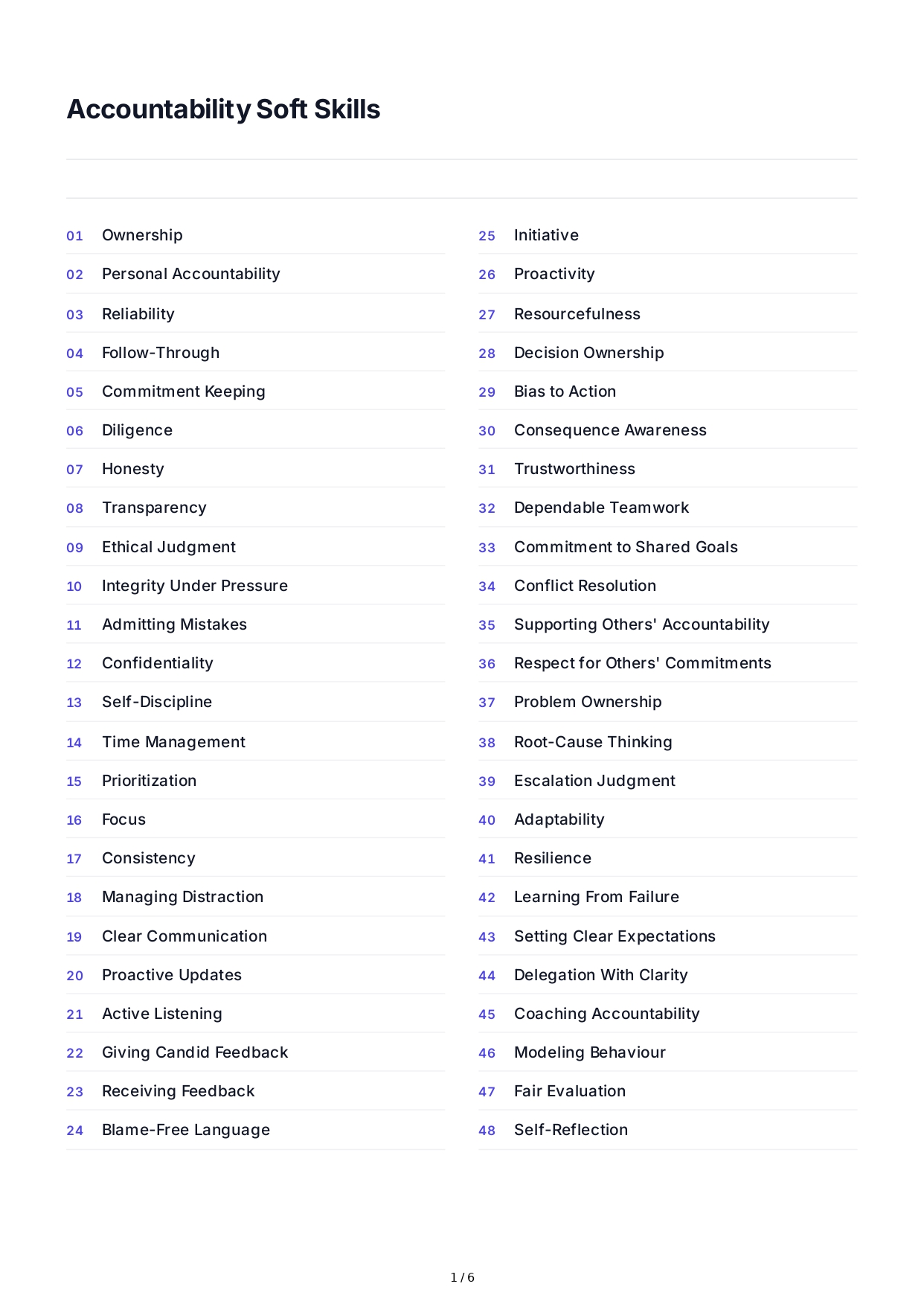
01
Accountability
11
Time
Management
02
Ownership
Mindset
12
Prioritization
03
Follow
-
Through
13
Self
-
Discipline
04
Reliability
14
Adaptability
05
Consistency
15
Clear
Communication
06
Integrity
16
Proactive
Communication
07
Transparency
17
Collaborative
Dependability
08
Sound
Judgment
18
Constructive
Conflict
09
Attention
to
Detail
19
Receiving
Feedback
10
Ethical
Reasoning
20
Composure
Under
Pressure
WHAT
E ACH
SKI LL
M E AN S
I N
PRACT I CE
CLUST ER
1 —
OWNERSHIP
&
ACCOUNTABILIT Y
01
Accountability
Takes
responsibility
for
the
outcome
,
not
just
the
assigned
tasks
.
Reports
a
miss
plainly
and
with
a
plan
,
rather
than
waiting
for
someone
else
to
uncover
it
.
02
Ownership
Mindset
Recognises
unclaimed
work
and
picks
it
up
without
being
asked
.
Treats
the
team
'
s
problem
as
their
problem
until
it
is
resolved
or
formally
handed
on
.
03
Follow
-
Through
Closes
every
loop
.
A
commitment
either
gets
delivered
or
gets
an
early
,
honest
notice
that
it
will
slip
—
never
silence
until
the
deadline
.
04
Reliability
Does
what
was
promised
,
to
the
standard
and
by
the
time
agreed
.
Colleagues
can
build
a
schedule
around
them
without
a
follow
-
up
reminder
.
05
Consistency
Delivers
the
same
quality
in
a
difficult
week
as
in
an
easy
one
.
Personal
mood
and
workload
do
not
become
the
team
'
s
risk
.
1 / 3
CLUST ER
2 —
INT EGRIT Y
&
JUD GMENT
06
Integrity
Chooses
the
honest
option
in
situations
where
no
one
would
ever
find
out
otherwise
.
Applies
the
same
standard
when
it
is
inconvenient
as
when
it
is
observed
.
07
Transparency
Surfaces
bad
news
early
and
explains
the
reasoning
behind
decisions
.
Shares
context
so
others
can
make
sound
calls
without
asking
.
08
Sound
Judgment
Knows
when
to
decide
alone
,
when
to
escalate
,
and
when
to
pause
for
more
information
.
Distinguishes
a
reversible
call
from
an
irreversible
one
.
09
Attention
to
Detail
Catches
the
error
before
it
reaches
a
customer
,
a
contract
,
or
a
production
system
.
Treats
small
inaccuracies
as
a
reliability
problem
,
not
a
cosmetic
one
.
10
Ethical
Reasoning
Weighs
the
impact
on
users
,
colleagues
,
and
the
wider
public
—
not
only
on
the
metric
being
measured
.
Raises
a
concern
when
the
fastest
path
is
not
the
right
one
.
CLUST ER
3 —
D ELIVERY
&
SELF
-
MANAGEMENT
11
Time
Management
Protects
the
work
that
matters
from
the
work
that
is
loudest
.
Plans
the
week
deliberately
rather
than
reacting
to
whichever
request
arrived
most
recently
.
12
Prioritization
Can
say
"
not
this
week
"
to
a
good
idea
in
favour
of
the
right
one
.
Makes
the
trade
-
off
explicit
so
the
decision
can
be
reviewed
later
.
13
Self
-
Discipline
Does
the
unglamorous
part
of
the
job
—
the
documentation
,
the
testing
,
the
follow
-
up
email
—
without
being
chased
for
it
.
14
Adaptability
Absorbs
a
change
in
scope
,
tooling
,
or
team
structure
without
dropping
accountability
for
the
original
outcome
.
CLUST ER
4 —
COMMUNICAT ION
&
COLLABORAT ION
15
Clear
Communication
Gives
updates
specific
enough
to
act
on
:
what
changed
,
what
is
blocked
,
what
is
needed
,
and
by
when
.
2 / 3
16
Proactive
Communication
Flags
risks
and
blockers
before
they
turn
into
missed
deadlines
.
Volunteers
status
instead
of
waiting
to
be
asked
for
it
.
17
Collaborative
Dependability
Carries
a
fair
share
of
any
shared
commitment
,
and
does
not
quietly
leave
the
difficult
portion
to
someone
else
.
18
Constructive
Conflict
Disagrees
directly
with
the
work
rather
than
the
person
,
and
commits
fully
once
a
decision
is
made
—
even
when
it
went
the
other
way
.
19
Receiving
Feedback
Takes
critique
without
deflecting
or
over
-
apologising
,
and
can
point
to
a
later
change
that
came
directly
from
it
.
CLUST ER
5 —
RESILIENCE
20
Composure
Under
Pressure
Stays
steady
during
an
incident
,
a
hard
deadline
,
or
a
difficult
conversation
,
and
keeps
making
clear
decisions
when
the
stakes
are
high
.
3 / 3