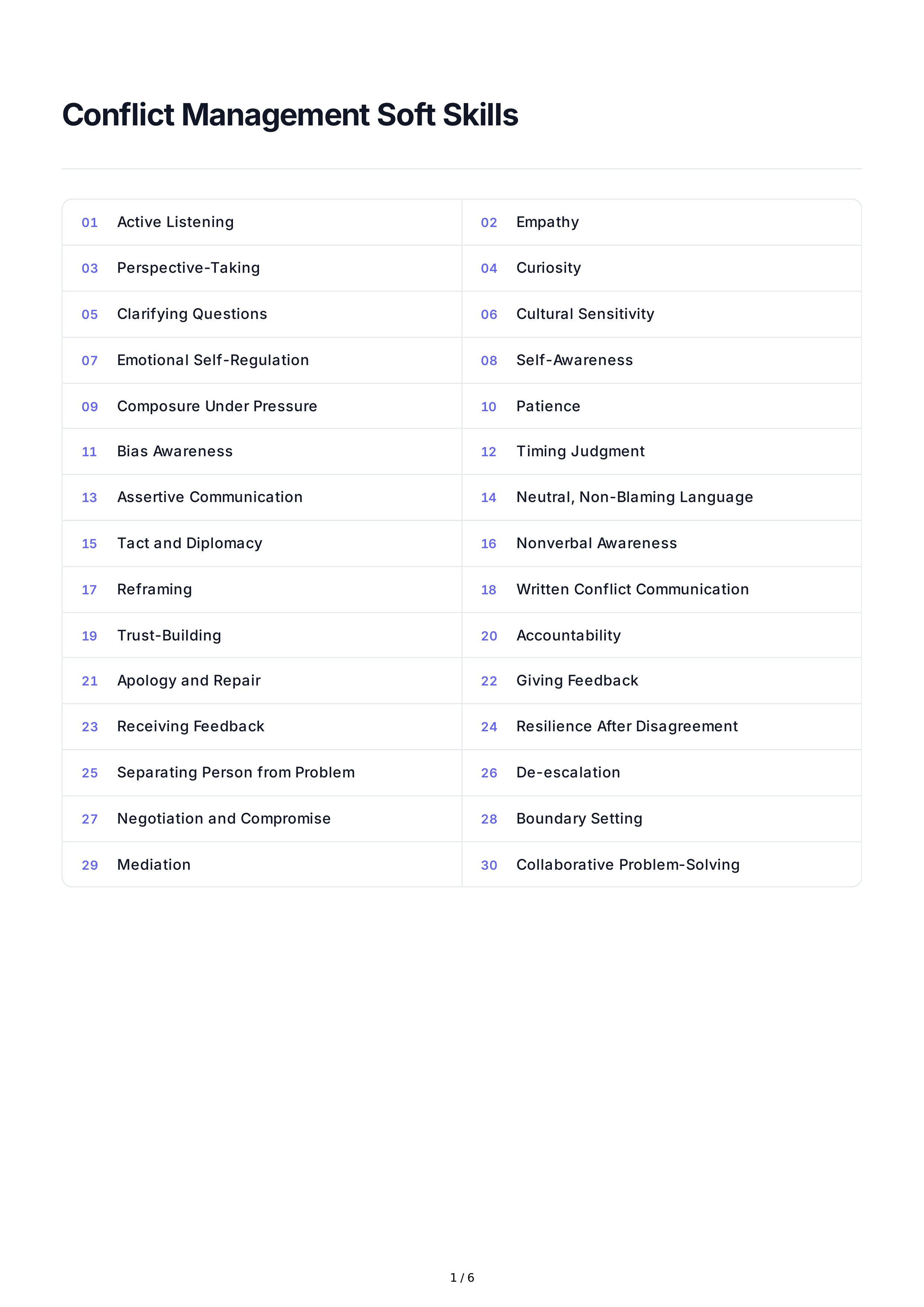
Conflict
Management
Soft
Skills
01
Active
Listening
02
Empathy
03
Perspective
-
Taking
04
Curiosity
05
Clarifying
Questions
06
Cultural
Sensitivity
07
Emotional
Self
-
Regulation
08
Self
-
Awareness
09
Composure
Under
Pressure
10
Patience
11
Bias
Awareness
12
Timing
Judgment
13
Assertive
Communication
14
Neutral
,
Non
-
Blaming
Language
15
Tact
and
Diplomacy
16
Nonverbal
Awareness
17
Reframing
18
Written
Conflict
Communication
19
Trust
-
Building
20
Accountability
21
Apology
and
Repair
22
Giving
Feedback
23
Receiving
Feedback
24
Resilience
After
Disagreement
25
Separating
Person
from
Problem
26
De
-
escalation
27
Negotiation
and
Compromise
28
Boundary
Setting
29
Mediation
30
Collaborative
Problem
-
Solving
1 / 6
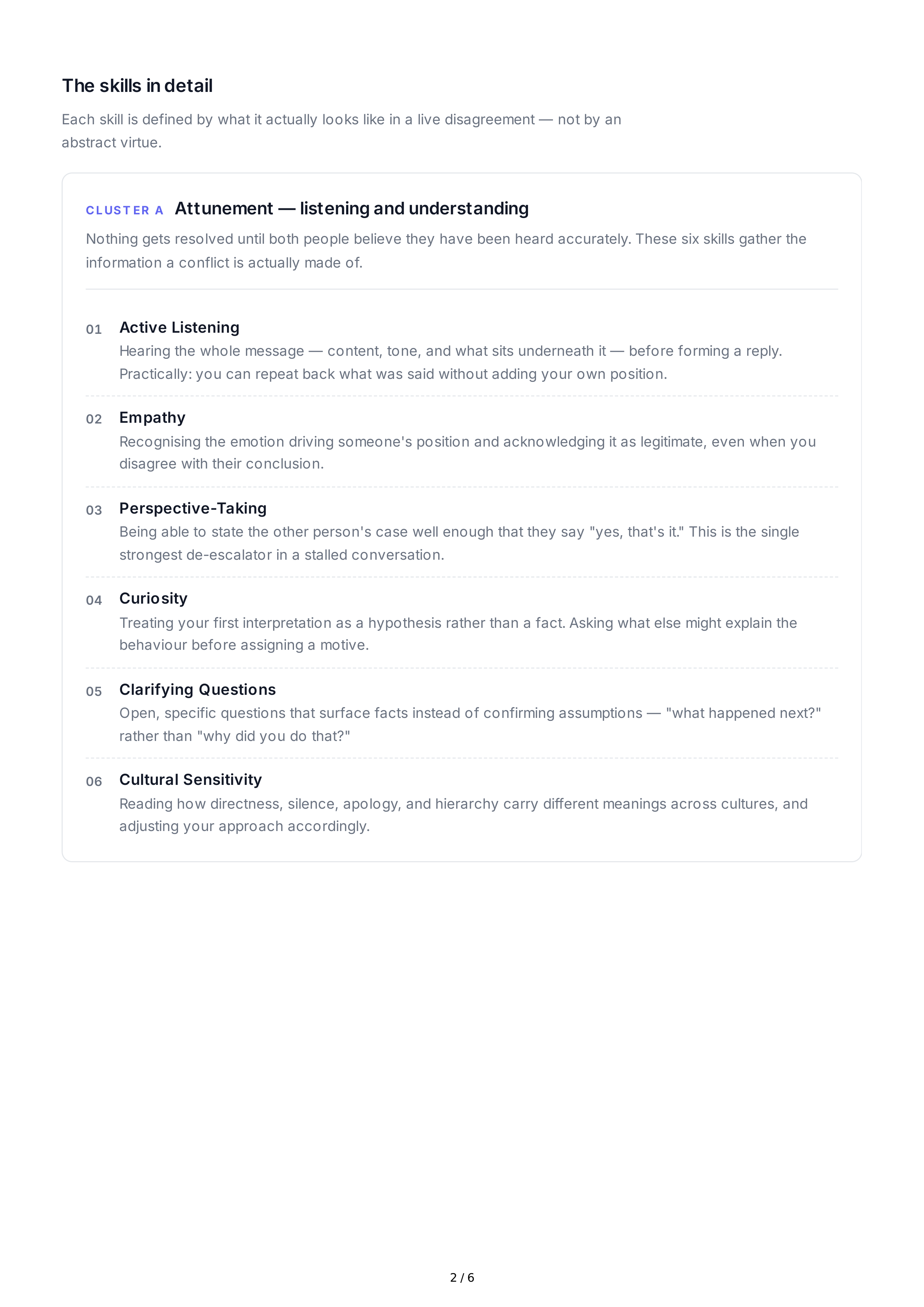
The
skills
in
detail
Each
skill
is
defined
by
what
it
actually
looks
like
in
a
live
disagreement
—
not
by
an
abstract
virtue
.
C L US T ER
A
Attunement
—
listening
and
understanding
Nothing
gets
resolved
until
both
people
believe
they
have
been
heard
accurately
.
These
six
skills
gather
the
information
a
conflict
is
actually
made
of
.
01
Active
Listening
Hearing
the
whole
message
—
content
,
tone
,
and
what
sits
underneath
it
—
before
forming
a
reply
.
Practically
:
you
can
repeat
back
what
was
said
without
adding
your
own
position
.
02
Empathy
Recognising
the
emotion
driving
someone
'
s
position
and
acknowledging
it
as
legitimate
,
even
when
you
disagree
with
their
conclusion
.
03
Perspective
-
Taking
Being
able
to
state
the
other
person
'
s
case
well
enough
that
they
say
"
yes
,
that
'
s
it
."
This
is
the
single
strongest
de
-
escalator
in
a
stalled
conversation
.
04
Curiosity
Treating
your
first
interpretation
as
a
hypothesis
rather
than
a
fact
.
Asking
what
else
might
explain
the
behaviour
before
assigning
a
motive
.
05
Clarifying
Questions
Open
,
specific
questions
that
surface
facts
instead
of
confirming
assumptions
— "
what
happened
next
?"
rather
than
"
why
did
you
do
that
?"
06
Cultural
Sensitivity
Reading
how
directness
,
silence
,
apology
,
and
hierarchy
carry
different
meanings
across
cultures
,
and
adjusting
your
approach
accordingly
.
2 / 6
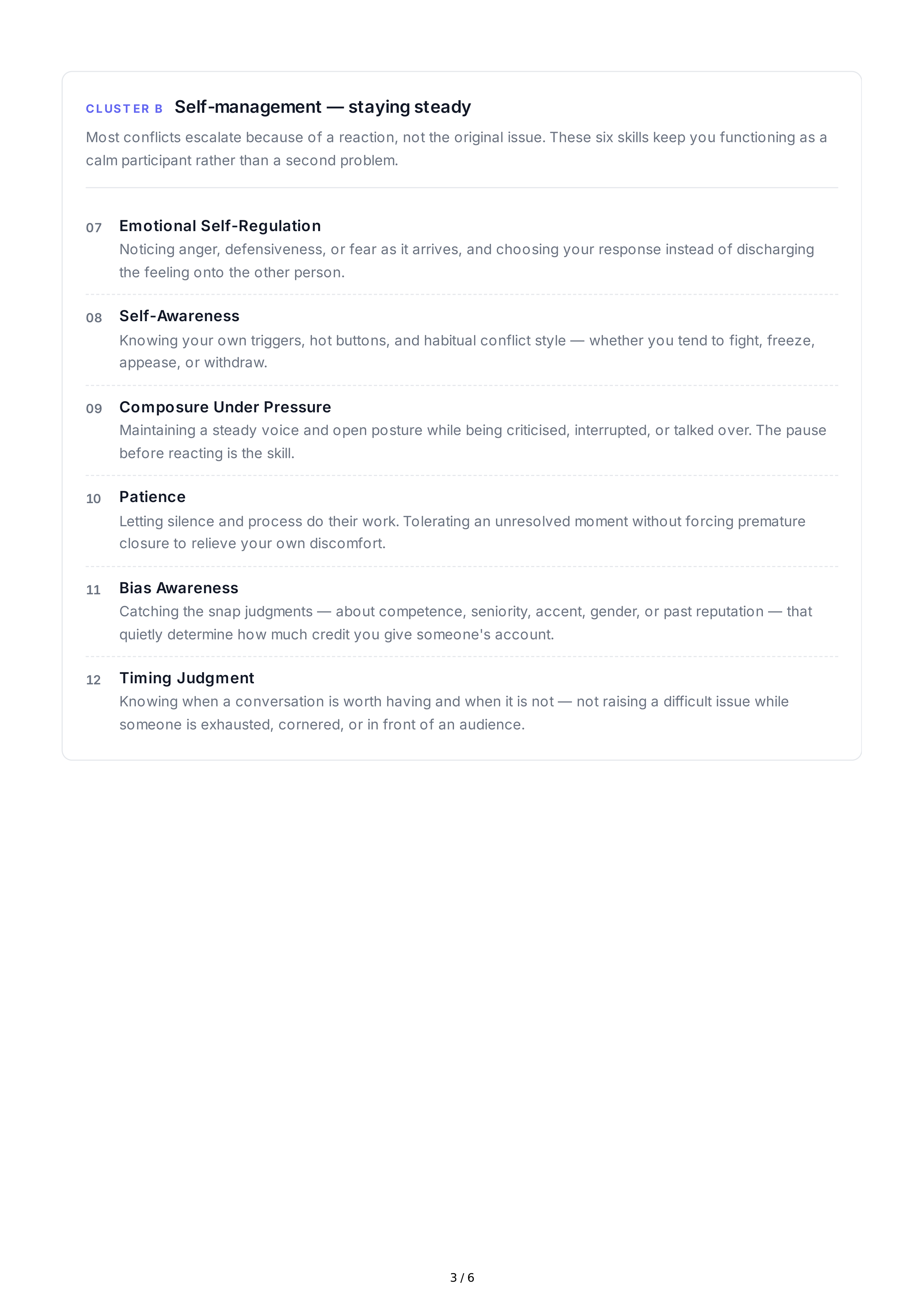
C L US T ER
B
Self
-
management
—
staying
steady
Most
conflicts
escalate
because
of
a
reaction
,
not
the
original
issue
.
These
six
skills
keep
you
functioning
as
a
calm
participant
rather
than
a
second
problem
.
07
Emotional
Self
-
Regulation
Noticing
anger
,
defensiveness
,
or
fear
as
it
arrives
,
and
choosing
your
response
instead
of
discharging
the
feeling
onto
the
other
person
.
08
Self
-
Awareness
Knowing
your
own
triggers
,
hot
buttons
,
and
habitual
conflict
style
—
whether
you
tend
to
fight
,
freeze
,
appease
,
or
withdraw
.
09
Composure
Under
Pressure
Maintaining
a
steady
voice
and
open
posture
while
being
criticised
,
interrupted
,
or
talked
over
.
The
pause
before
reacting
is
the
skill
.
10
Patience
Letting
silence
and
process
do
their
work
.
Tolerating
an
unresolved
moment
without
forcing
premature
closure
to
relieve
your
own
discomfort
.
11
Bias
Awareness
Catching
the
snap
judgments
—
about
competence
,
seniority
,
accent
,
gender
,
or
past
reputation
—
that
quietly
determine
how
much
credit
you
give
someone
'
s
account
.
12
Timing
Judgment
Knowing
when
a
conversation
is
worth
having
and
when
it
is
not
—
not
raising
a
difficult
issue
while
someone
is
exhausted
,
cornered
,
or
in
front
of
an
audience
.
3 / 6
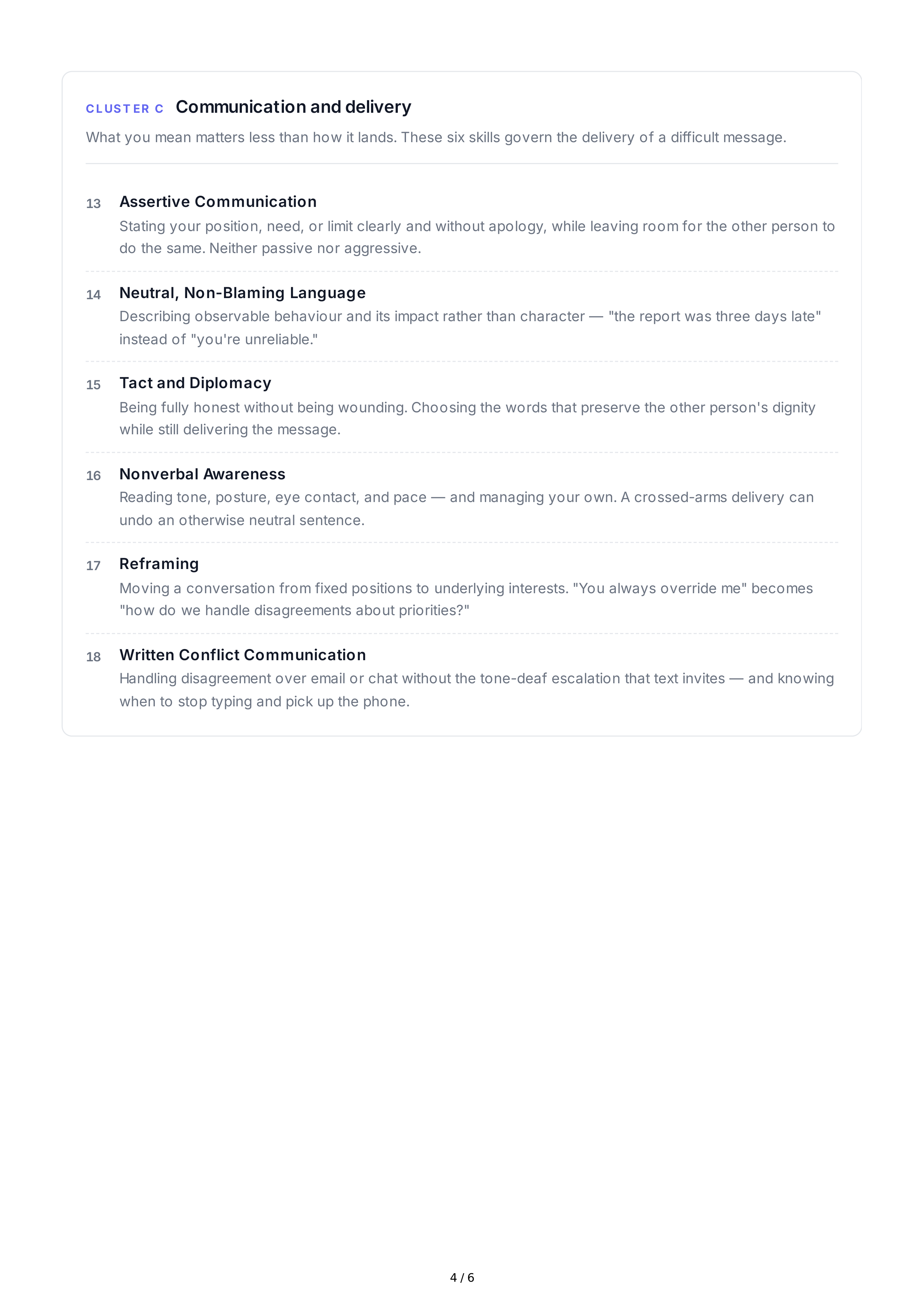
C L US T ER
C
Communication
and
delivery
What
you
mean
matters
less
than
how
it
lands
.
These
six
skills
govern
the
delivery
of
a
difficult
message
.
13
Assertive
Communication
Stating
your
position
,
need
,
or
limit
clearly
and
without
apology
,
while
leaving
room
for
the
other
person
to
do
the
same
.
Neither
passive
nor
aggressive
.
14
Neutral
,
Non
-
Blaming
Language
Describing
observable
behaviour
and
its
impact
rather
than
character
— "
the
report
was
three
days
late
"
instead
of
"
you
'
re
unreliable
."
15
Tact
and
Diplomacy
Being
fully
honest
without
being
wounding
.
Choosing
the
words
that
preserve
the
other
person
'
s
dignity
while
still
delivering
the
message
.
16
Nonverbal
Awareness
Reading
tone
,
posture
,
eye
contact
,
and
pace
—
and
managing
your
own
.
A
crossed
-
arms
delivery
can
undo
an
otherwise
neutral
sentence
.
17
Reframing
Moving
a
conversation
from
fixed
positions
to
underlying
interests
. "
You
always
override
me
"
becomes
"
how
do
we
handle
disagreements
about
priorities
?"
18
Written
Conflict
Communication
Handling
disagreement
over
email
or
chat
without
the
tone
-
deaf
escalation
that
text
invites
—
and
knowing
when
to
stop
typing
and
pick
up
the
phone
.
4 / 6
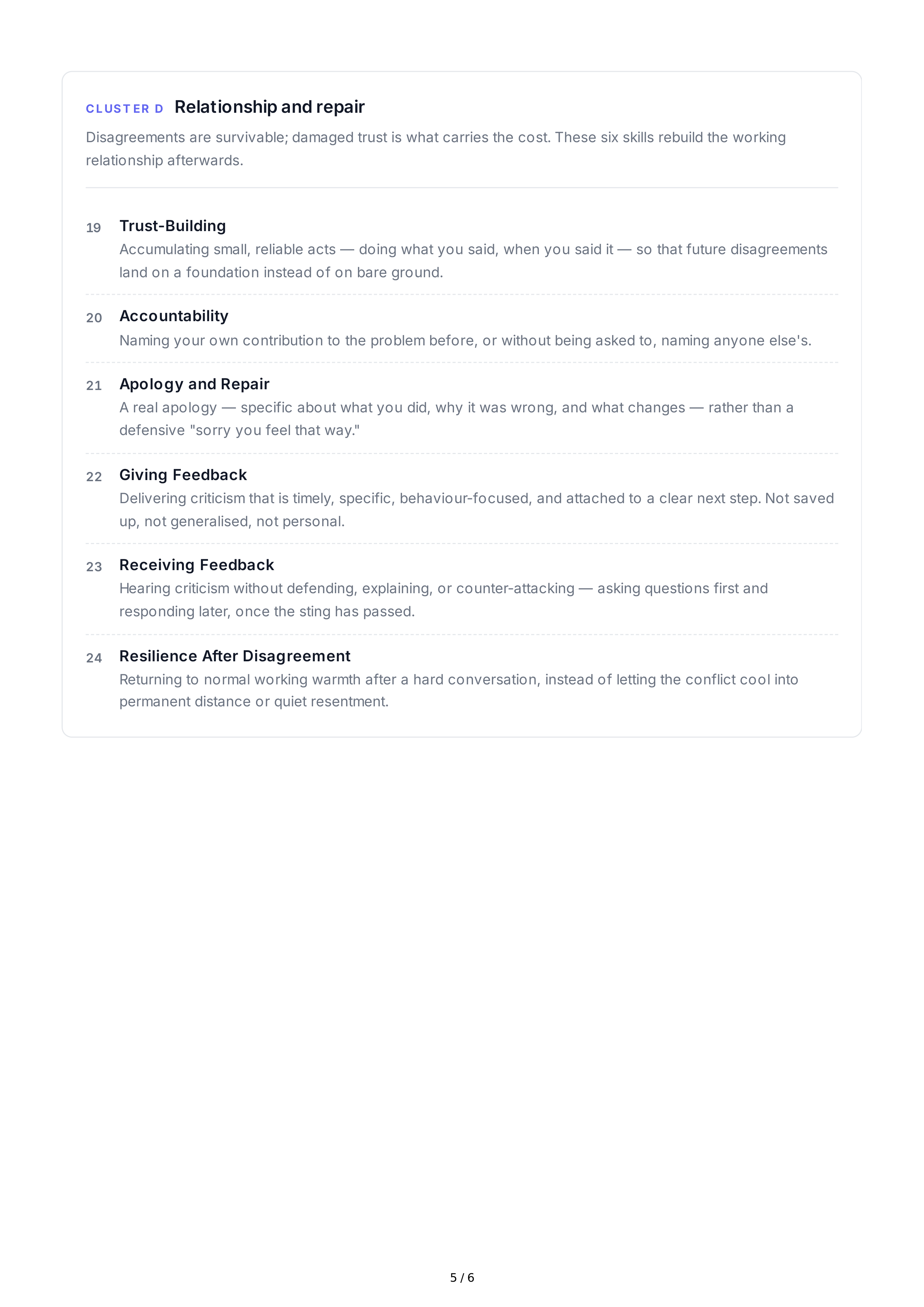
C L US T ER
D
Relationship
and
repair
Disagreements
are
survivable
;
damaged
trust
is
what
carries
the
cost
.
These
six
skills
rebuild
the
working
relationship
afterwards
.
19
Trust
-
Building
Accumulating
small
,
reliable
acts
—
doing
what
you
said
,
when
you
said
it
—
so
that
future
disagreements
land
on
a
foundation
instead
of
on
bare
ground
.
20
Accountability
Naming
your
own
contribution
to
the
problem
before
,
or
without
being
asked
to
,
naming
anyone
else
'
s
.
21
Apology
and
Repair
A
real
apology
—
specific
about
what
you
did
,
why
it
was
wrong
,
and
what
changes
—
rather
than
a
defensive
"
sorry
you
feel
that
way
."
22
Giving
Feedback
Delivering
criticism
that
is
timely
,
specific
,
behaviour
-
focused
,
and
attached
to
a
clear
next
step
.
Not
saved
up
,
not
generalised
,
not
personal
.
23
Receiving
Feedback
Hearing
criticism
without
defending
,
explaining
,
or
counter
-
attacking
—
asking
questions
first
and
responding
later
,
once
the
sting
has
passed
.
24
Resilience
After
Disagreement
Returning
to
normal
working
warmth
after
a
hard
conversation
,
instead
of
letting
the
conflict
cool
into
permanent
distance
or
quiet
resentment
.
5 / 6
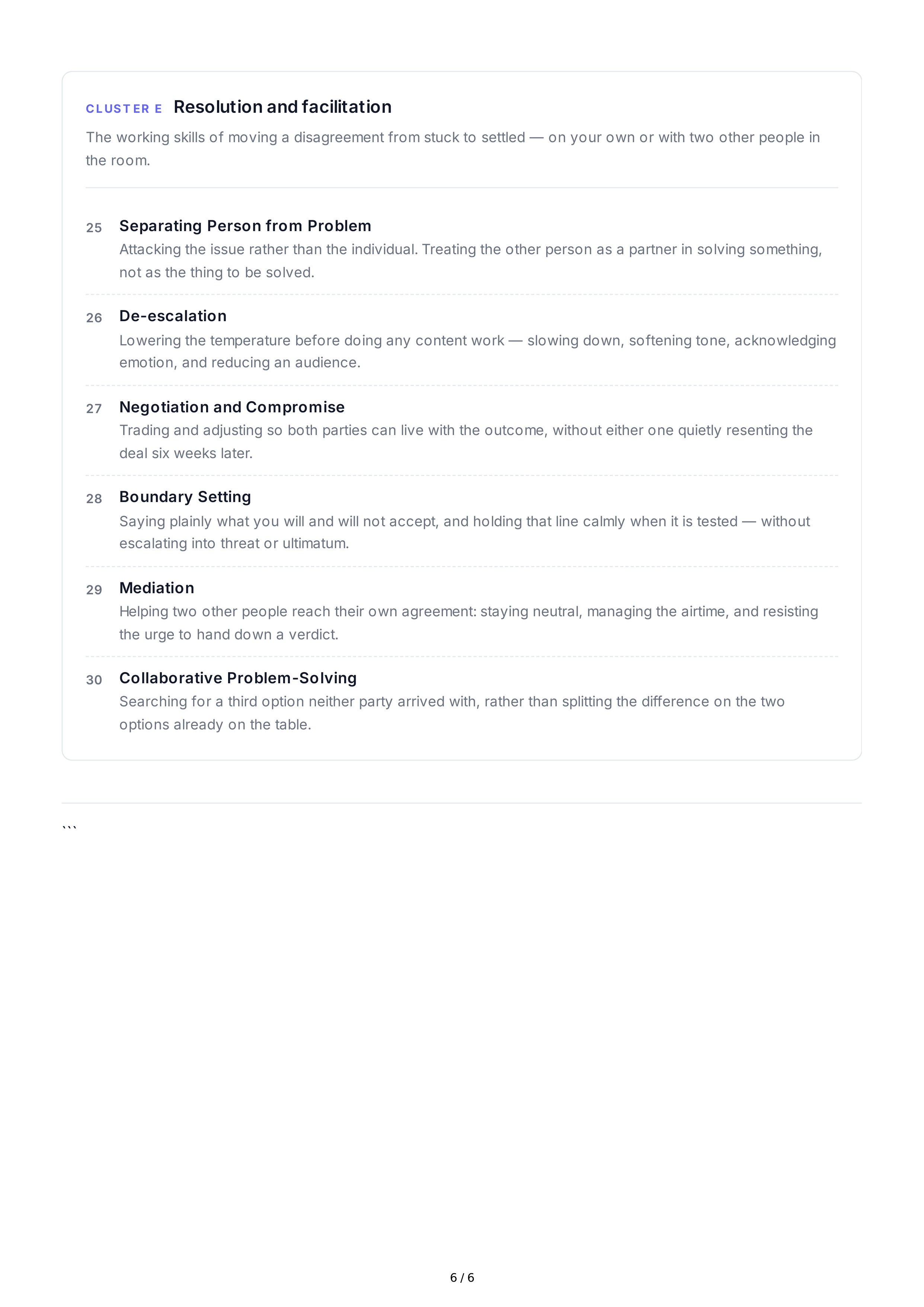
C L US T ER
E
Resolution
and
facilitation
The
working
skills
of
moving
a
disagreement
from
stuck
to
settled
—
on
your
own
or
with
two
other
people
in
the
room
.
25
Separating
Person
from
Problem
Attacking
the
issue
rather
than
the
individual
.
Treating
the
other
person
as
a
partner
in
solving
something
,
not
as
the
thing
to
be
solved
.
26
De
-
escalation
Lowering
the
temperature
before
doing
any
content
work
—
slowing
down
,
softening
tone
,
acknowledging
emotion
,
and
reducing
an
audience
.
27
Negotiation
and
Compromise
Trading
and
adjusting
so
both
parties
can
live
with
the
outcome
,
without
either
one
quietly
resenting
the
deal
six
weeks
later
.
28
Boundary
Setting
Saying
plainly
what
you
will
and
will
not
accept
,
and
holding
that
line
calmly
when
it
is
tested
—
without
escalating
into
threat
or
ultimatum
.
29
Mediation
Helping
two
other
people
reach
their
own
agreement
:
staying
neutral
,
managing
the
airtime
,
and
resisting
the
urge
to
hand
down
a
verdict
.
30
Collaborative
Problem
-
Solving
Searching
for
a
third
option
neither
party
arrived
with
,
rather
than
splitting
the
difference
on
the
two
options
already
on
the
table
.
```
6 / 6