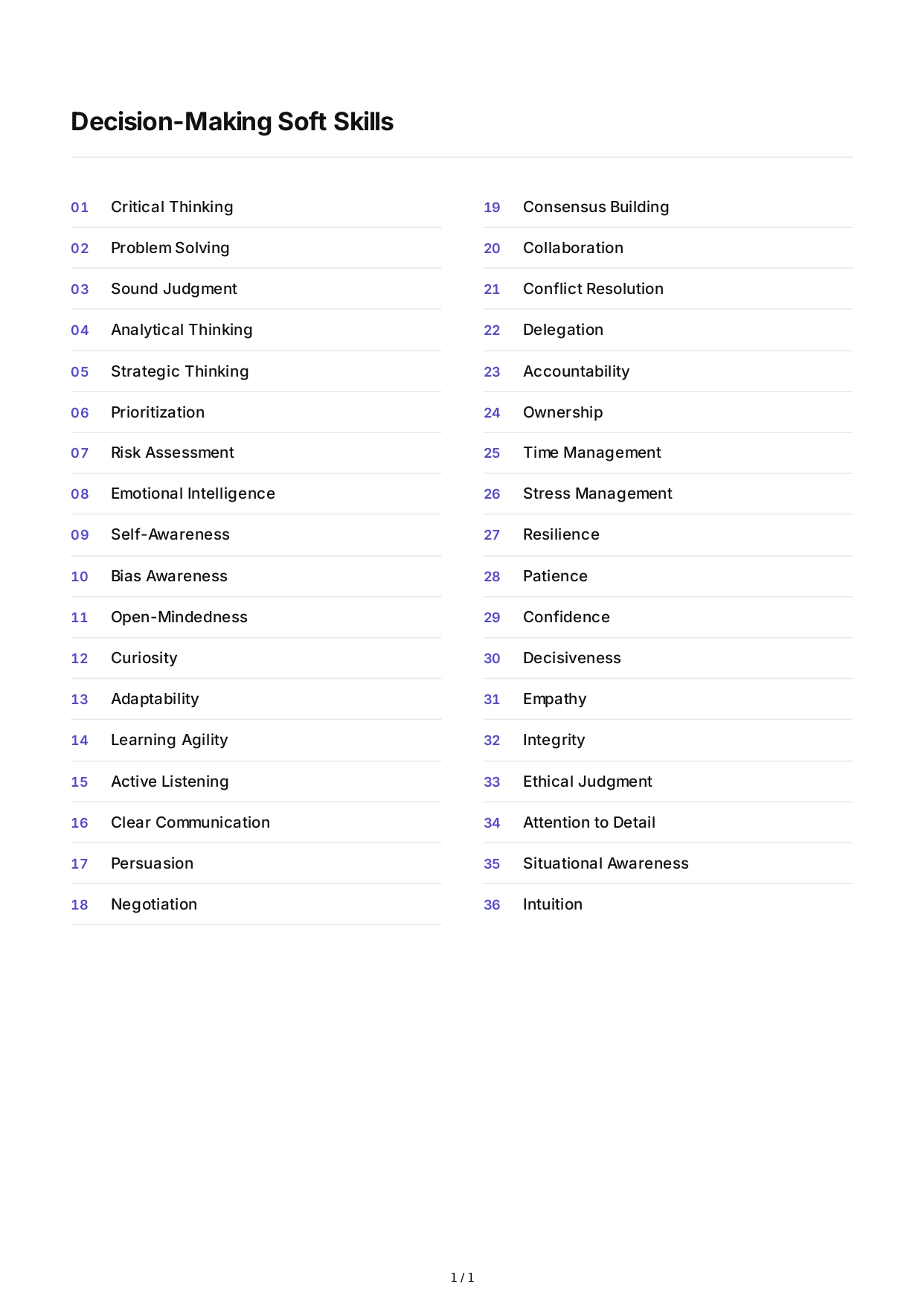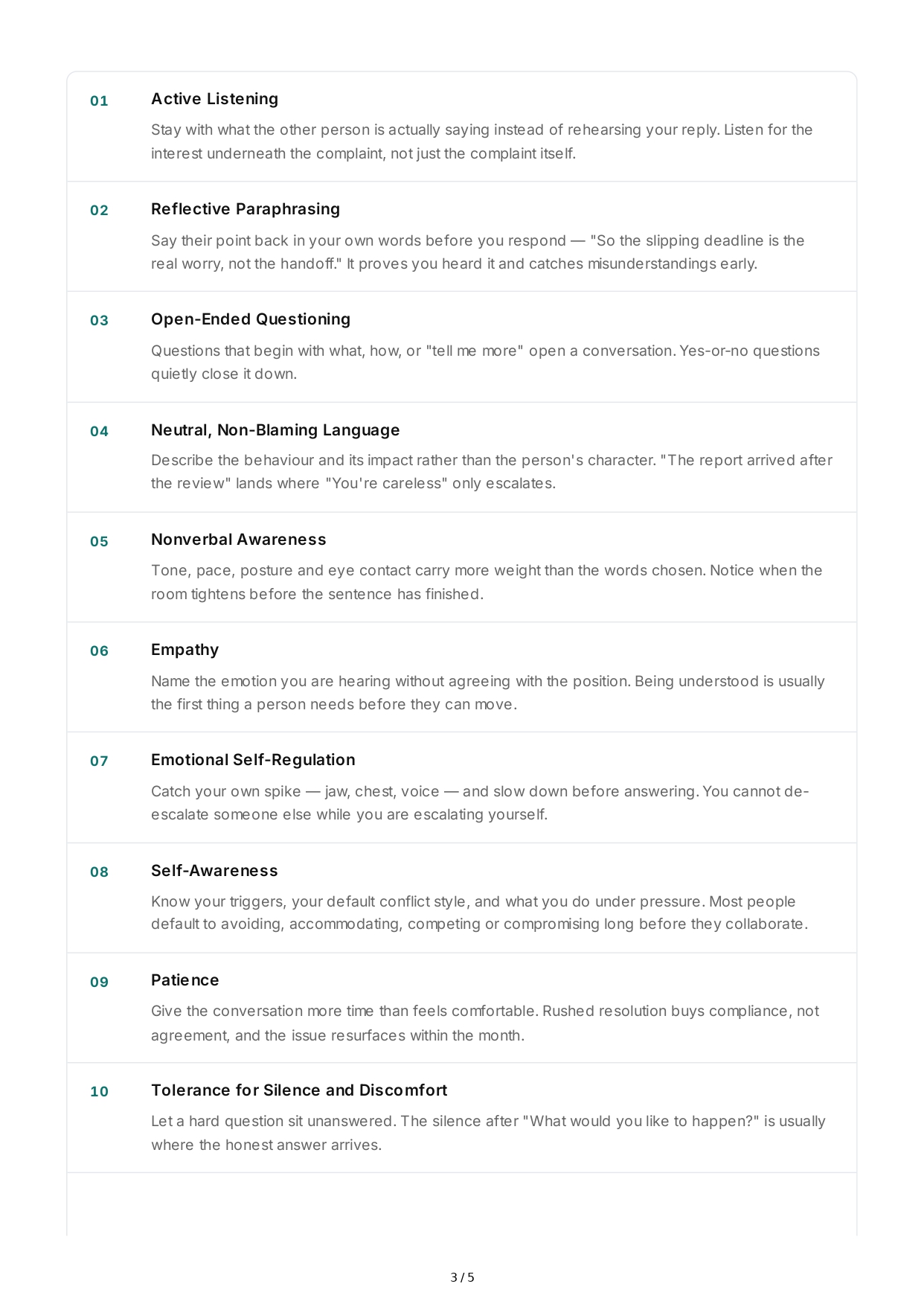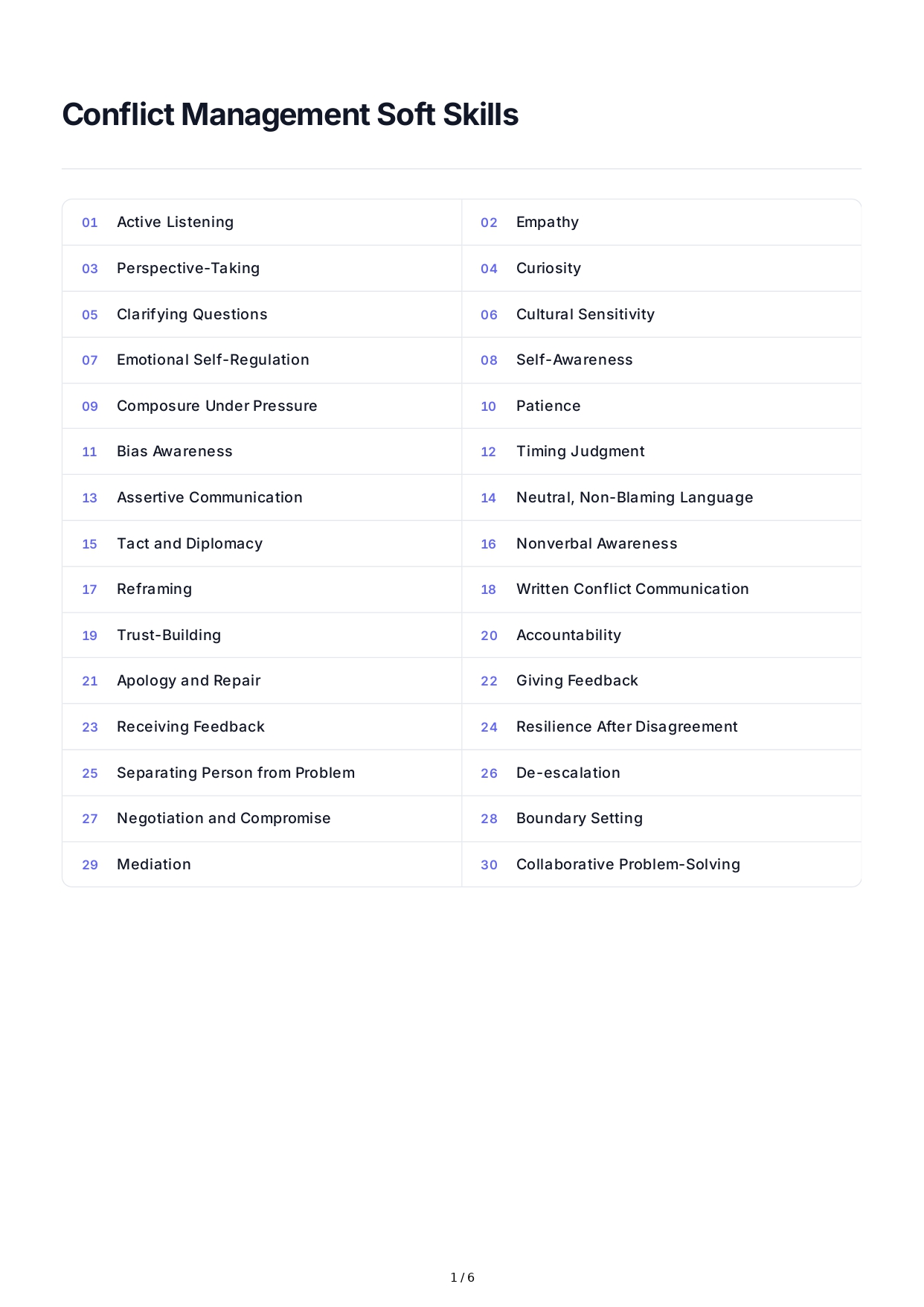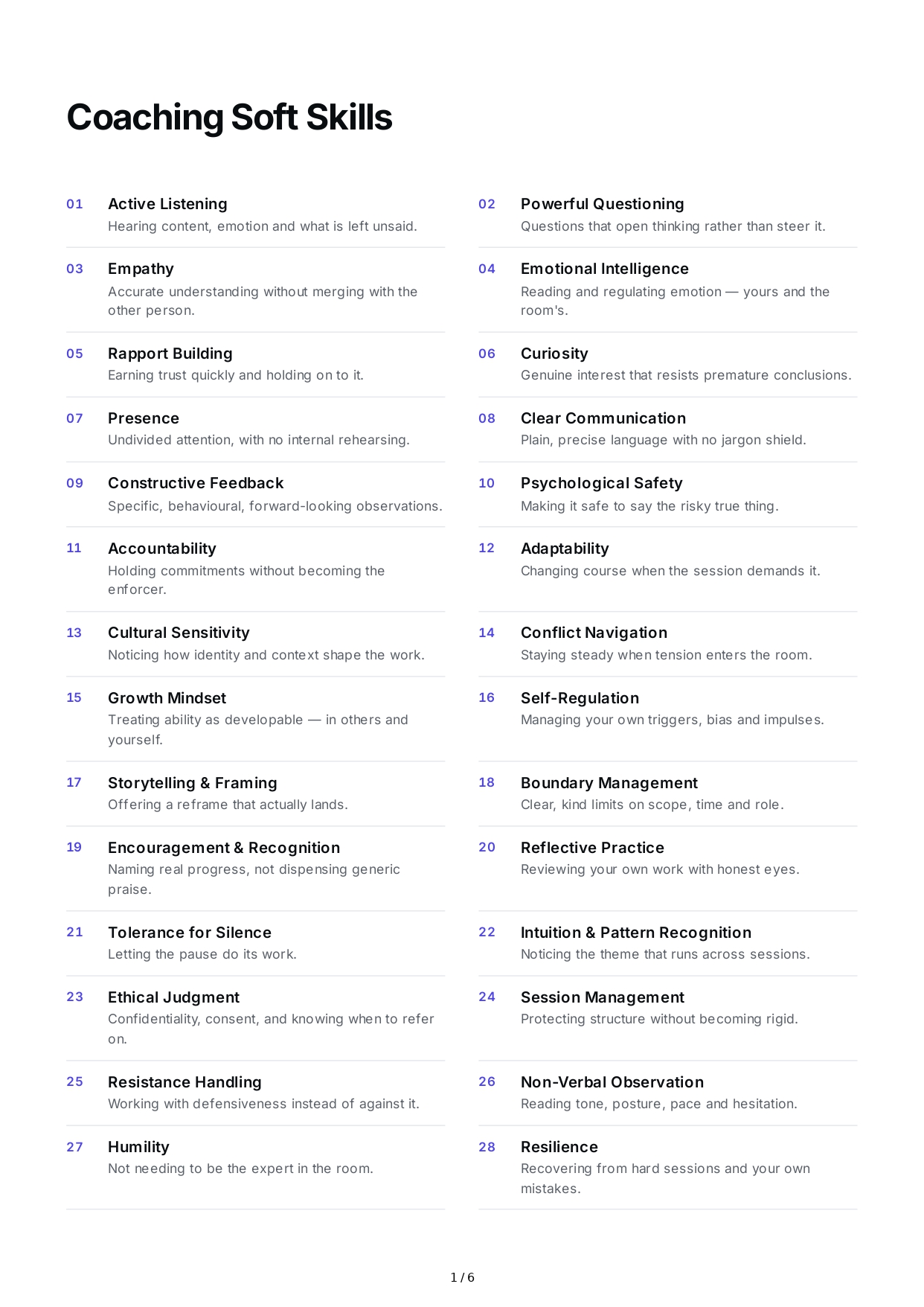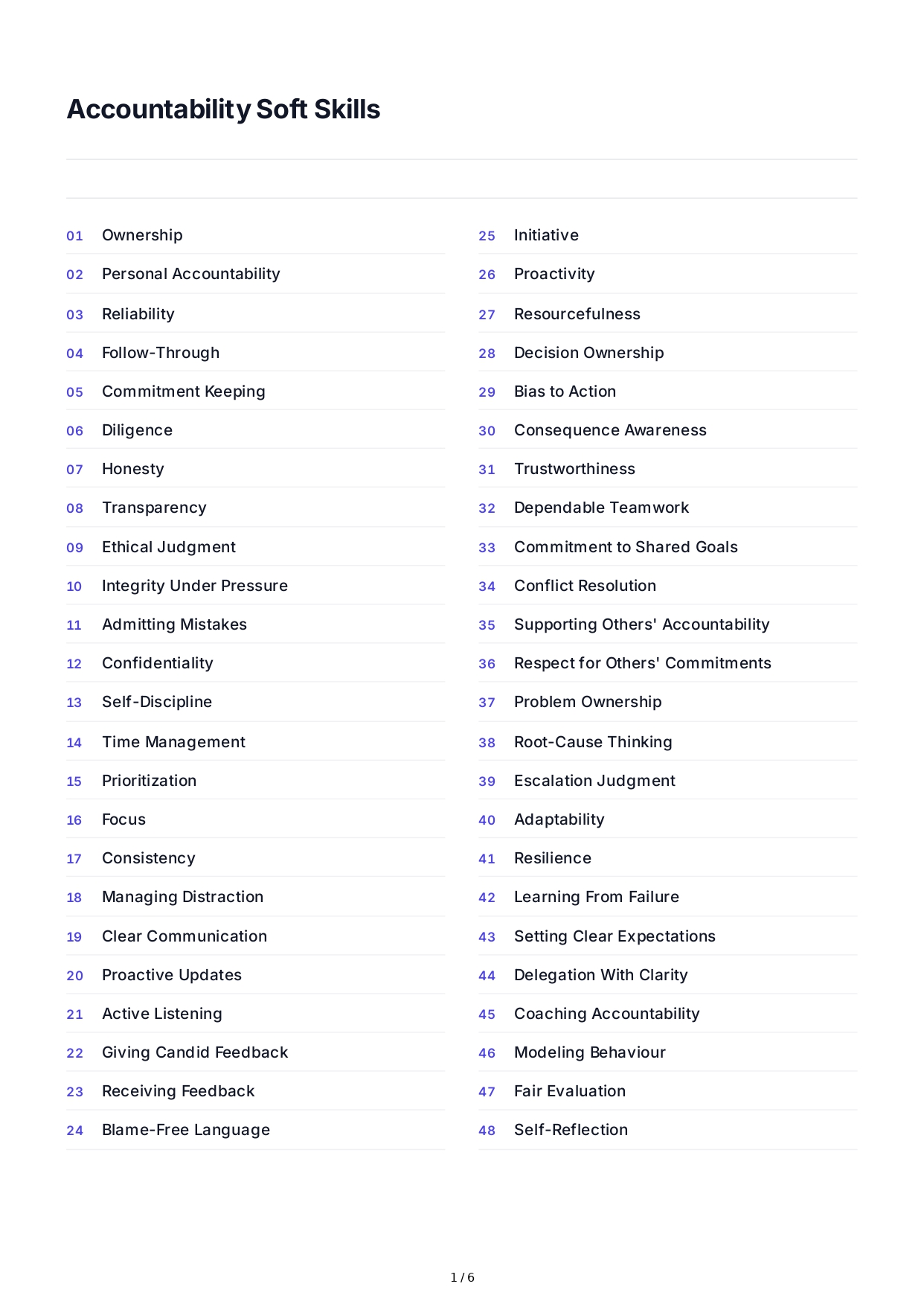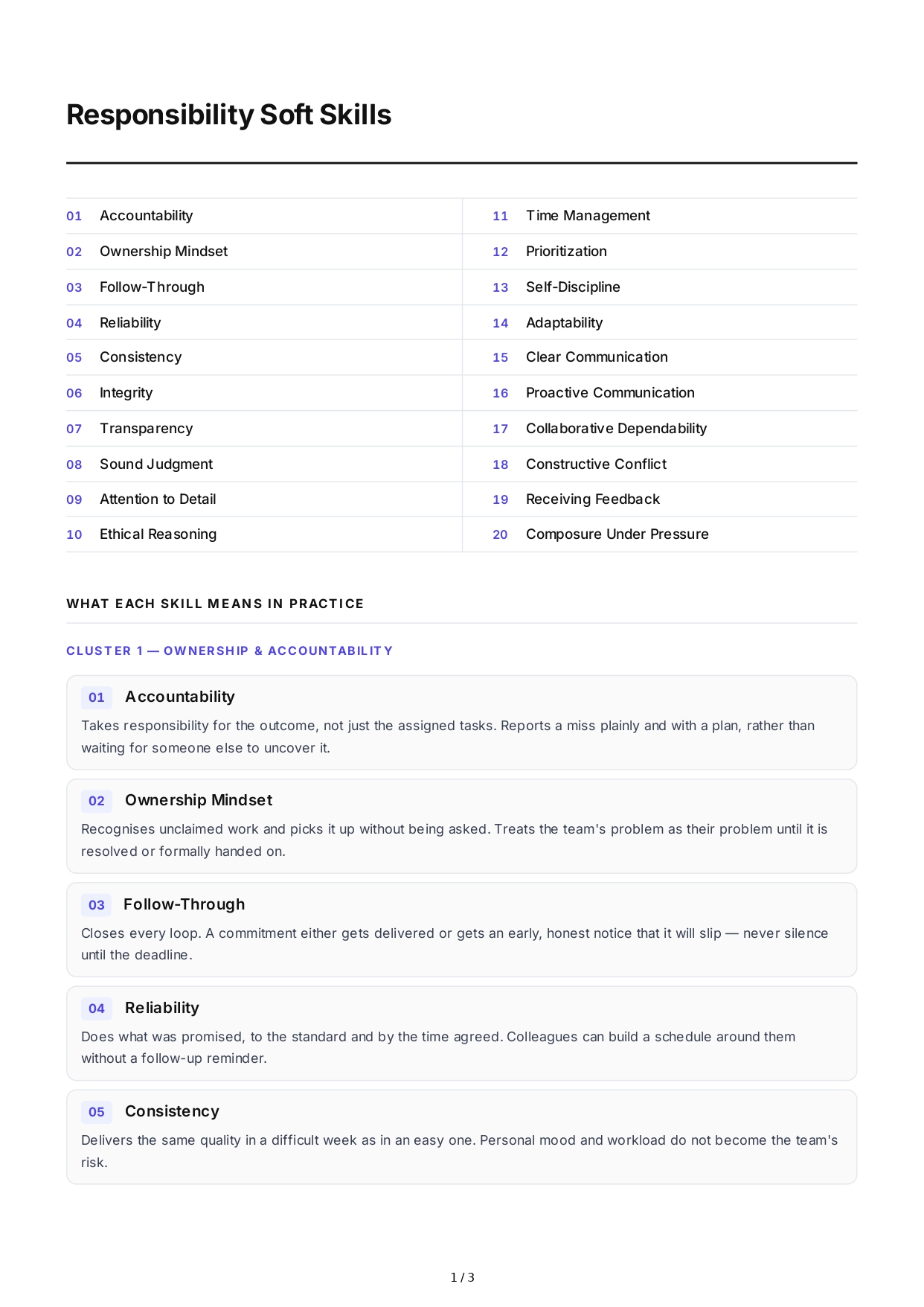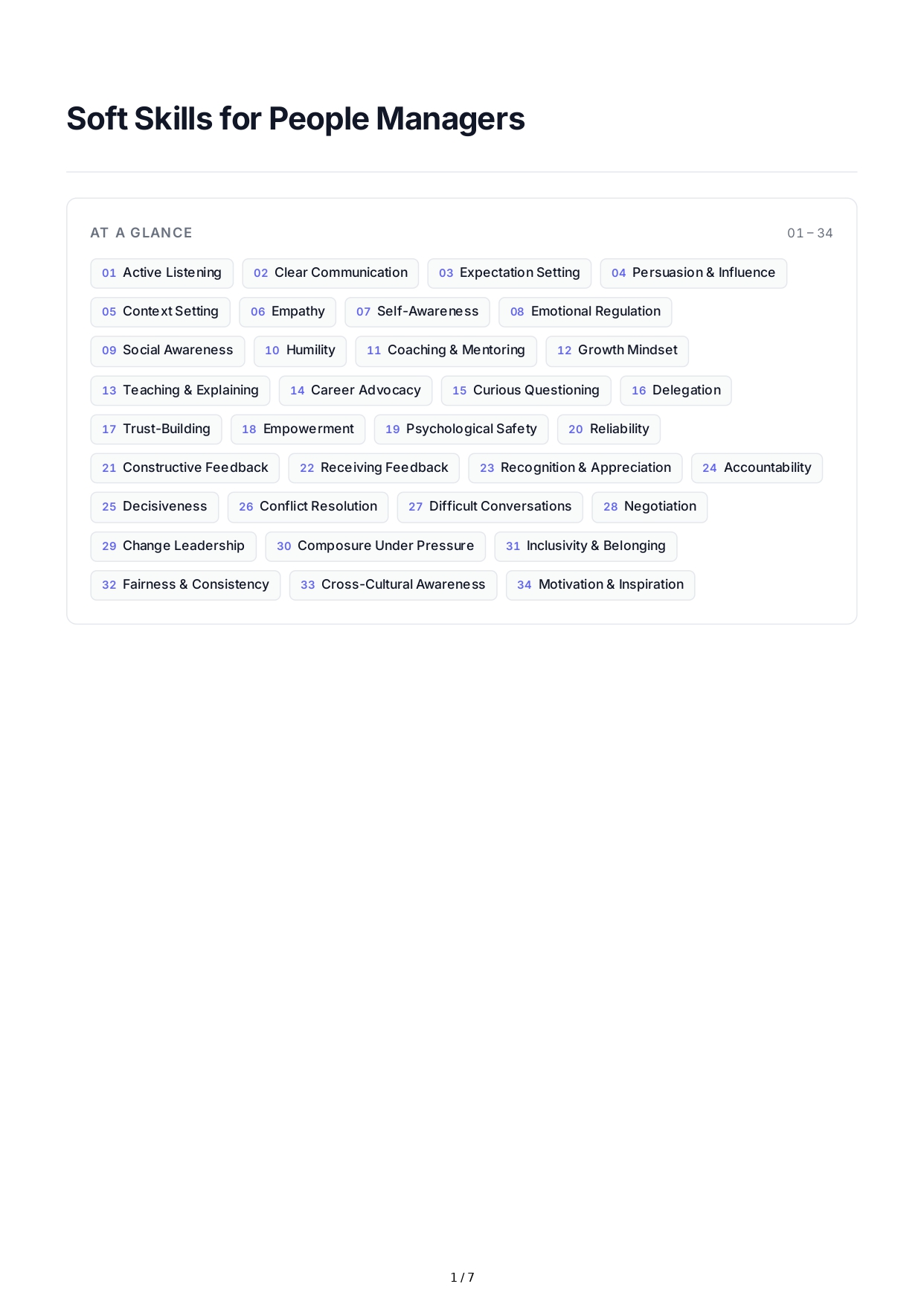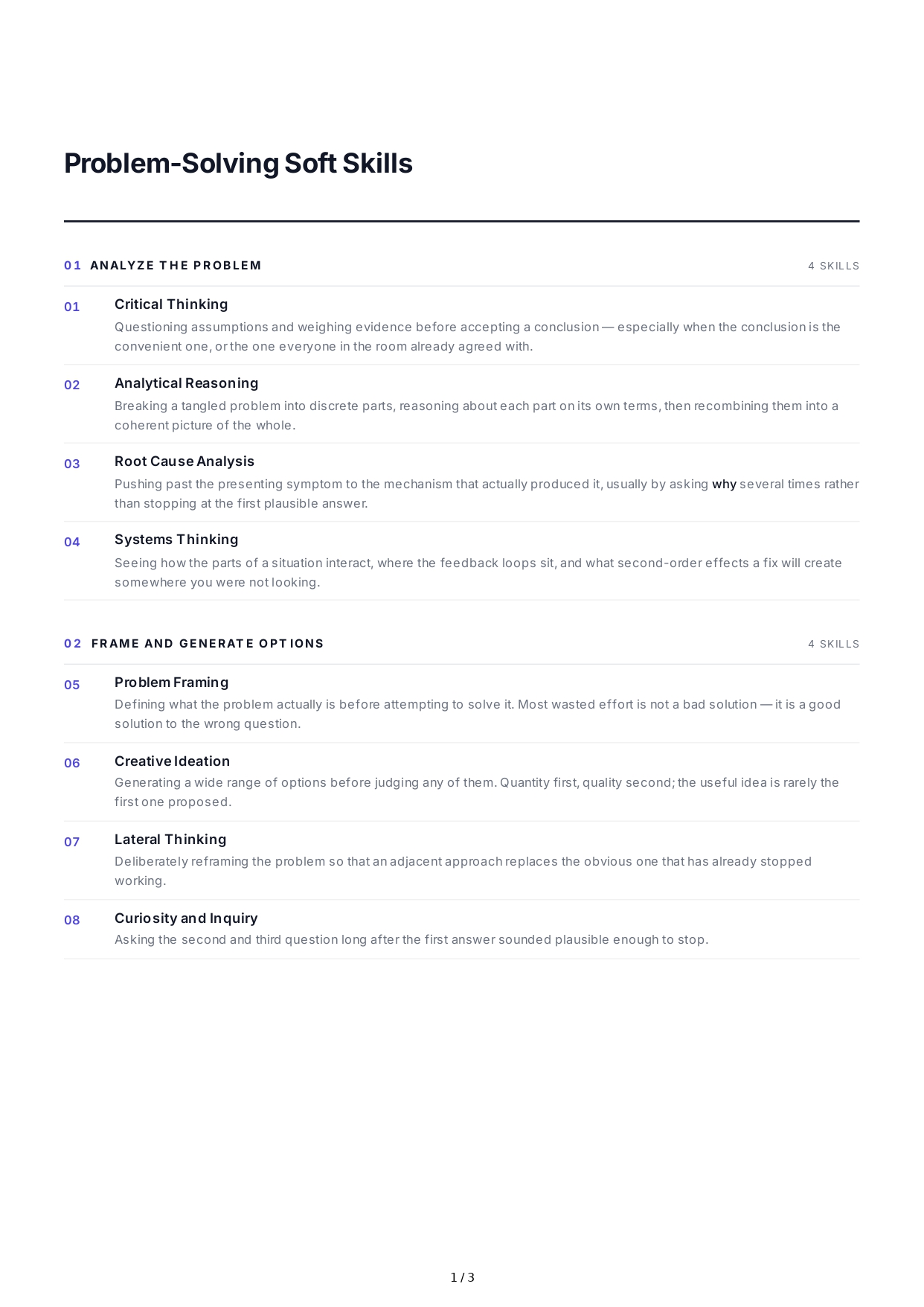
Organizational
Soft
Skills
01
Communication
&
Interpersonal
8
skills
Active
listening
Receiving
the
full
message
—
content
,
tone
,
and
what
was
left
unsaid
—
before
composing
a
reply
.
Clarity
in
writing
Turning
a
messy
situation
into
a
short
,
unambiguous
message
the
reader
can
act
on
.
Verbal
concision
Making
the
point
in
the
first
sentence
and
stopping
once
it
has
landed
.
Nonverbal
awareness
Treating
posture
,
pacing
,
and
hesitation
as
data
about
what
the
room
is
actually
thinking
.
Structured
presentation
Landing
a
complex
recommendation
in
five
minutes
without
dropping
the
nuance
.
Empathetic
framing
Delivering
difficult
information
in
a
form
the
other
person
can
absorb
and
respond
to
.
Questioning
technique
Asking
the
question
that
opens
a
conversation
rather
than
closing
it
down
.
Cross
-
audience
translation
Explaining
the
same
work
to
an
engineer
,
a
CFO
,
and
a
customer
without
diluting
it
.
02
Collaboration
&
Teamwork
8
skills
Reliability
Doing
what
you
said
you
would
do
by
the
date
you
said
you
would
do
it
.
Knowledge
sharing
Making
your
work
legible
to
others
instead
of
being
the
only
person
who
understands
it
.
Ceding
credit
Pointing
at
the
person
who
actually
did
the
work
,
publicly
and
by
name
.
Giving
peer
feedback
Commenting
on
the
work
,
specifically
,
close
to
the
moment
it
was
produced
.
Receiving
feedback
Extracting
the
useful
signal
without
either
defending
or
collapsing
.
Shared
goal
orientation
Optimizing
for
the
team
'
s
outcome
over
your
own
visibility
.
Async
and
remote
discipline
Keeping
distributed
colleagues
in
the
loop
without
defaulting
to
another
meeting
.
Boundary
respect
Recognizing
when
a
teammate
'
s
plate
is
full
and
routing
around
it
.
1 / 3
03
Leadership
&
Influence
8
skills
Setting
direction
Turning
an
ambiguous
mandate
into
a
priority
people
can
repeat
and
follow
.
Delegation
Handing
over
the
outcome
,
not
just
the
task
list
,
with
the
authority
to
match
.
Coaching
Asking
instead
of
telling
,
so
the
person
can
solve
it
themselves
the
next
time
.
Influence
without
authority
Moving
work
forward
across
teams
that
do
not
report
to
you
.
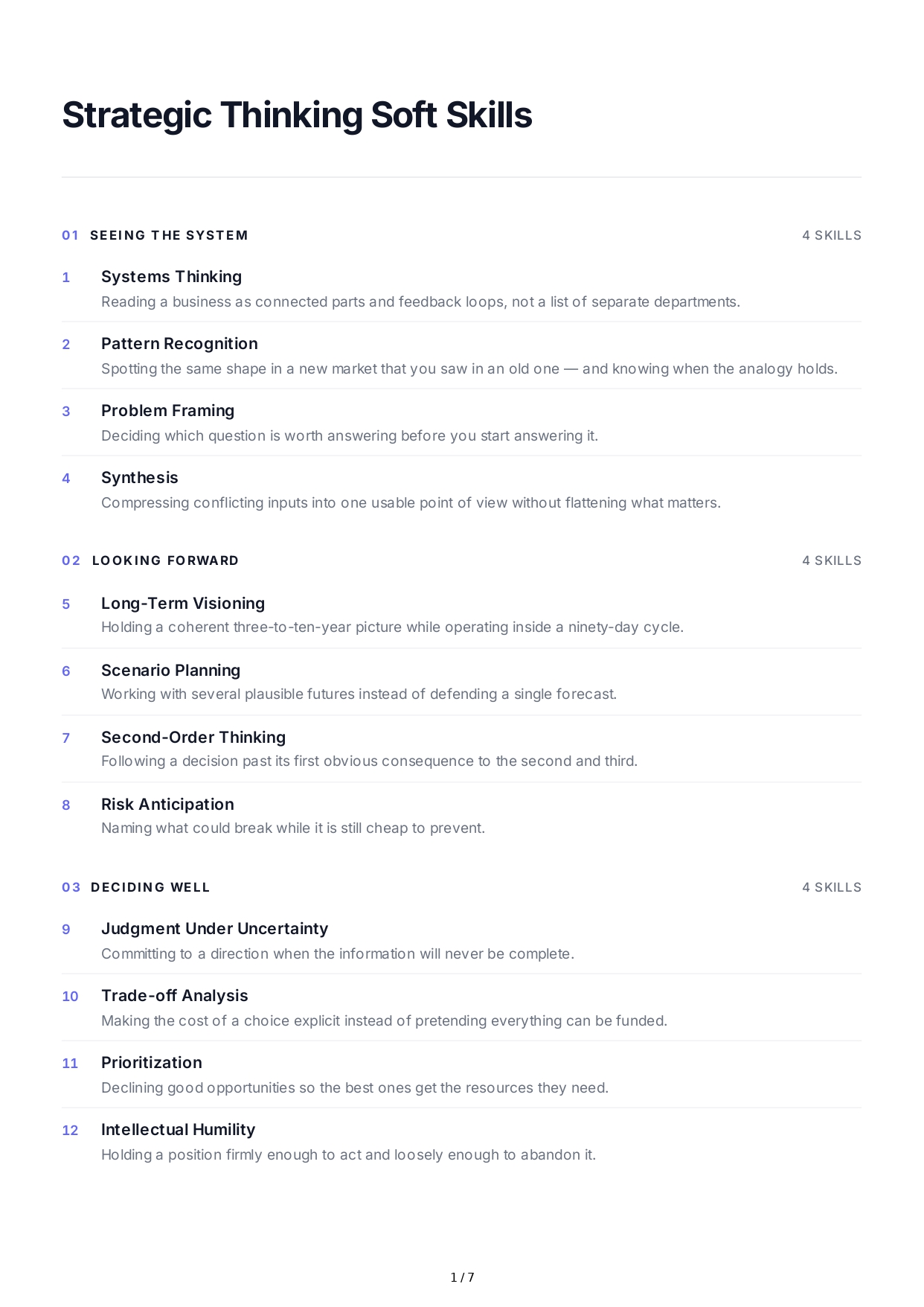
Deciding
under
ambiguity
Calling
it
with
seventy
percent
of
the
information
and
owning
the
result
.
Holding
accountability
Naming
a
missed
commitment
plainly
without
making
it
personal
.
Recognition
Noticing
good
work
out
loud
while
it
is
still
current
enough
to
matter
.
Vision
articulation
Describing
where
things
are
going
in
terms
people
can
carry
to
their
own
teams
.
04
Emotional
Intelligence
&
Self
-
Management
8
skills
Self
-
awareness
Knowing
which
situations
reliably
push
your
buttons
before
they
push
them
.
Emotional
regulation
Staying
steady
in
a
heated
meeting
without
going
flat
or
checking
out
.
Empathy
Understanding
someone
'
s
position
without
having
to
endorse
it
.
Impulse
control
Letting
the
sharp
reply
sit
for
an
hour
before
it
goes
out
.
Grace
under
criticism
Separating
the
critique
of
the
work
from
the
verdict
on
the
person
.
Stress
tolerance
Continuing
to
do
good
work
through
a
genuinely
bad
quarter
.
Patience
with
process
Accepting
that
some
things
take
longer
than
the
calendar
says
they
should
.
Optimism
with
realism
Holding
a
constructive
view
of
the
outcome
without
editing
out
the
evidence
.
05
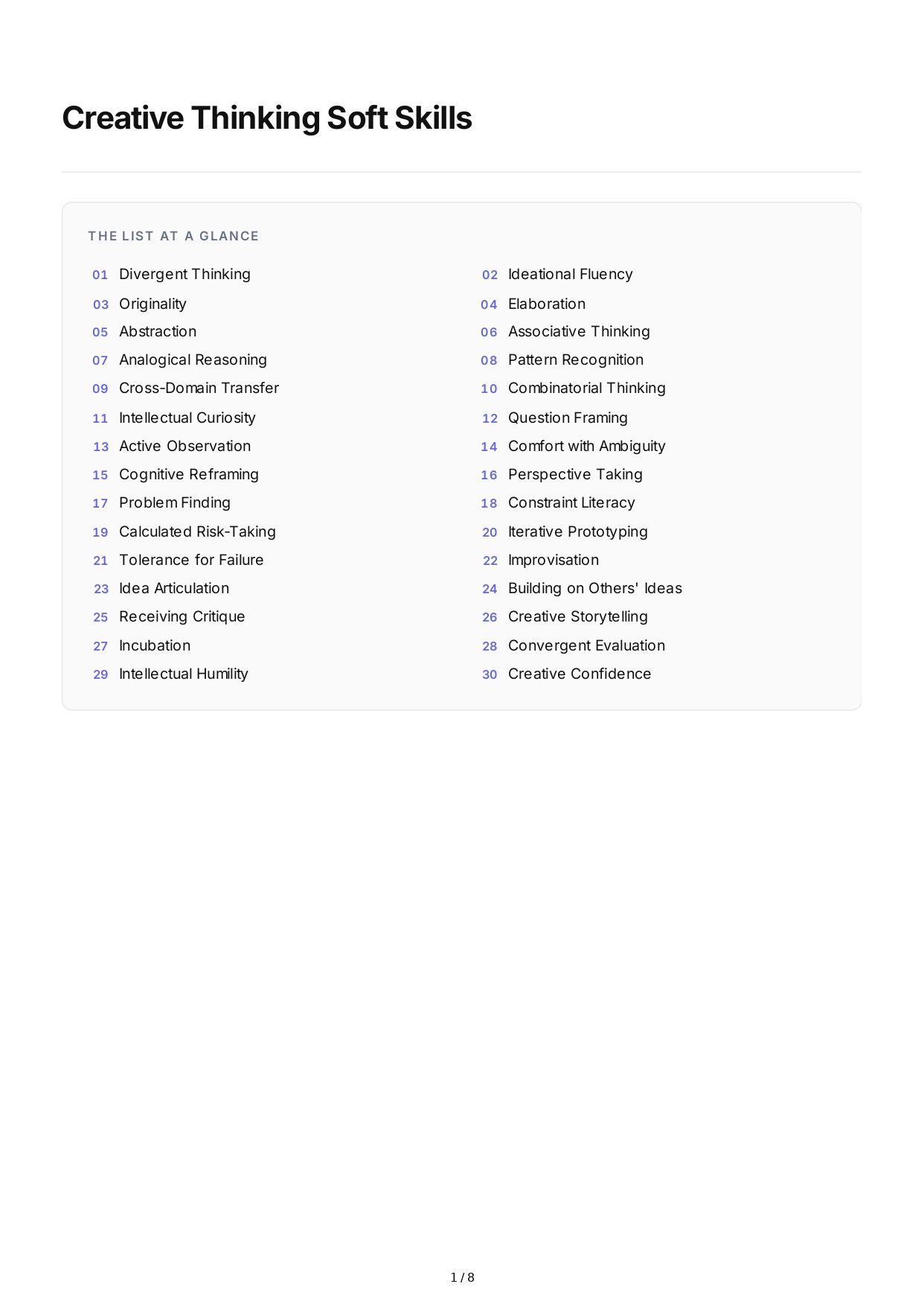
Adaptability
&
Change
Agility
8
skills
Comfort
with
ambiguity
Keeping
useful
momentum
when
the
plan
changes
twice
in
a
single
month
.
Learning
agility
Picking
up
a
new
tool
,
domain
,
or
system
fast
enough
to
be
genuinely
useful
.
Resilience
after
failure
Reading
the
postmortem
,
taking
the
lesson
,
and
returning
to
the
work
.
Cognitive
flexibility
Switching
approaches
when
the
evidence
says
the
first
one
is
not
working
.
Tolerance
for
rework
Redoing
it
without
treating
the
redo
as
a
personal
verdict
.
Curiosity
Asking
how
the
adjacent
system
works
,
unprompted
and
before
you
need
to
.
Change
advocacy
Helping
colleagues
through
a
transition
rather
than
waiting
for
it
to
settle
.
Continuous
improvement
Leaving
every
process
slightly
better
than
the
version
you
inherited
.
2 / 3
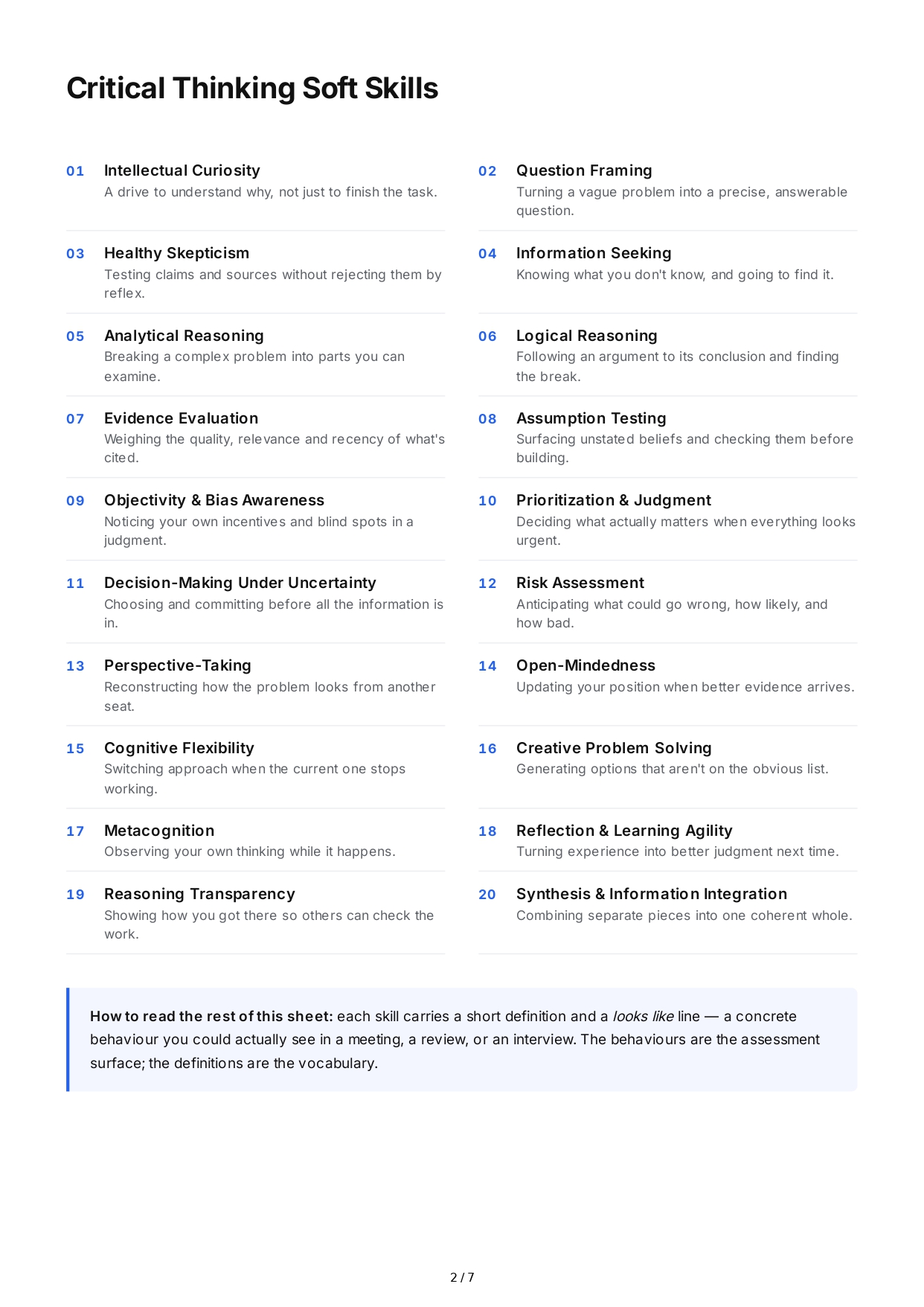
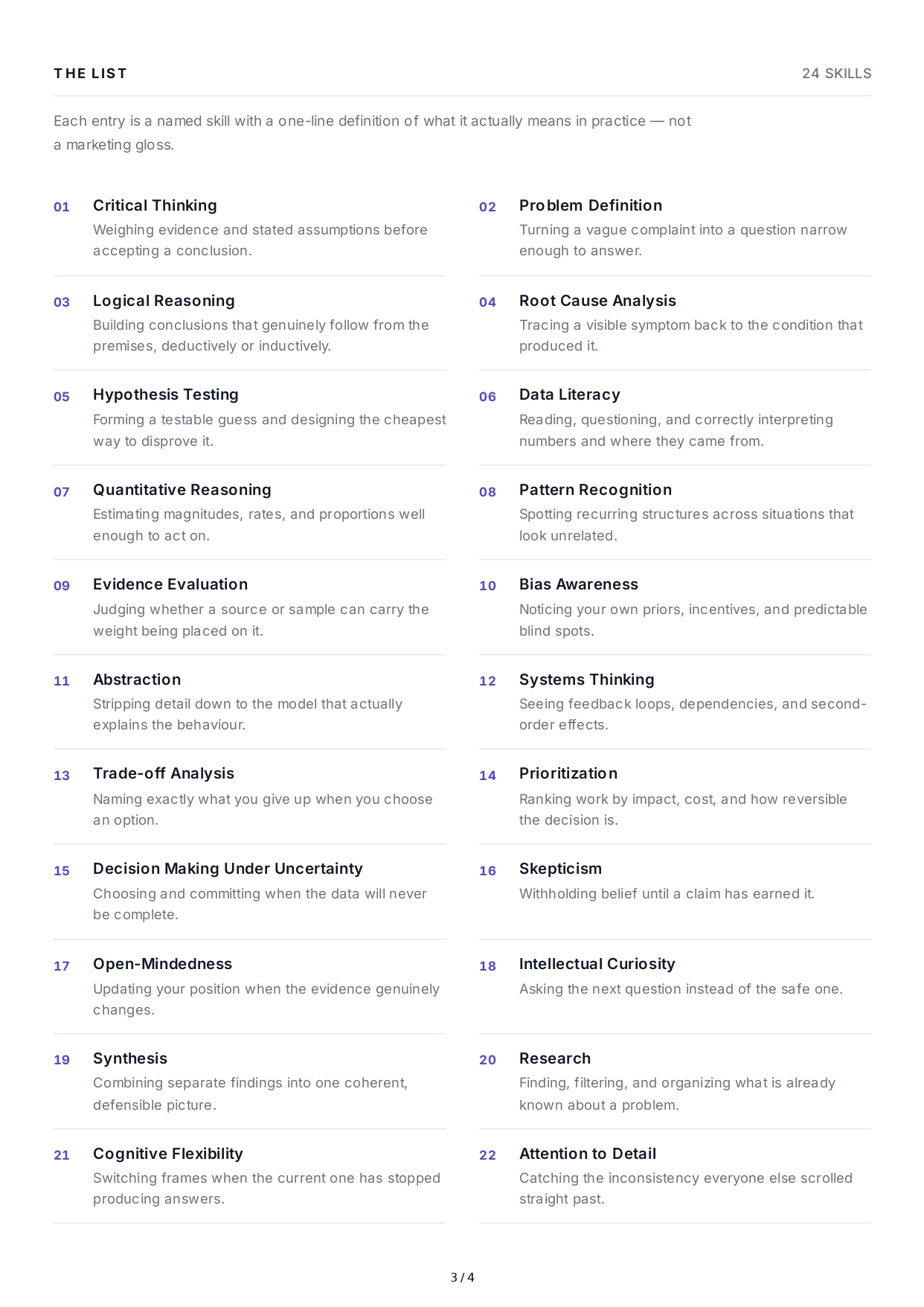
06
Critical
Thinking
&
Problem
Solving
8
skills
Root
-
cause
analysis
Pushing
past
the
first
plausible
explanation
to
the
cause
that
is
actually
load
-
bearing
.
Systems
thinking
Seeing
how
a
change
here
lands
three
steps
over
there
.
Prioritization
Deciding
what
not
to
do
,
and
being
comfortable
saying
so
out
loud
.
Judgment
Choosing
the
sensible
option
when
the
rulebook
does
not
cover
the
case
.
Data
-
informed
decisions
Using
evidence
where
it
exists
and
instinct
where
it
doesn
'
t
—
and
knowing
which
you
used
.
Creative
problem
solving
Generating
options
beyond
the
two
already
on
the
table
.
Attention
to
detail
Catching
the
small
error
that
would
have
been
expensive
three
weeks
later
.
Anticipating
risk
Naming
the
failure
mode
before
it
happens
rather
than
after
.
07
Time
,
Priority
&
Workload
Management
8
skills
Planning
and
sequencing
Ordering
the
work
so
nothing
critical
is
quietly
waiting
on
something
else
.
Deadline
management
Flagging
the
slip
early
enough
that
someone
can
still
respond
to
it
.
Focus
management
Protecting
the
two
uninterrupted
hours
that
actually
produce
the
output
.
Switching
discipline
Knowing
when
context
-
switching
costs
more
than
it
saves
.
Saying
no
constructively
Declining
the
request
with
an
alternative
already
attached
.
Meeting
hygiene
Arriving
with
a
purpose
,
leaving
with
a
named
owner
and
a
date
.
Estimating
Giving
a
range
you
will
actually
hit
rather
than
one
that
sounds
good
.
Workload
transparency
Saying
when
you
are
at
capacity
instead
of
quietly
missing
things
.
08
Conflict
,
Negotiation
&
Culture
8
skills
Constructive
disagreement
Arguing
the
position
rather
than
the
person
holding
it
.
De
-
escalation
Lowering
the
temperature
in
the
room
before
attempting
to
solve
anything
.
Mediation
Helping
two
colleagues
reach
a
workable
agreement
they
both
own
.
Interest
-
based
negotiation
Finding
the
underlying
need
instead
of
splitting
the
number
down
the
middle
.
Difficult
conversations
Having
the
conversation
you
have
been
avoiding
,
early
and
directly
.
Cultural
awareness
Adapting
your
own
working
norms
to
the
norms
in
the
room
.
Inclusion
Making
space
for
the
person
who
has
not
spoken
yet
.
Building
psychological
safety
Modeling
the
admission
of
a
mistake
so
the
team
can
do
the
same
.
3 / 3