Conflict
Resolution
Soft
Skills
1 / 5

1.
The
skills
at
a
glance
The
complete
list
,
in
the
order
most
people
find
easiest
to
practise
.
2 / 5
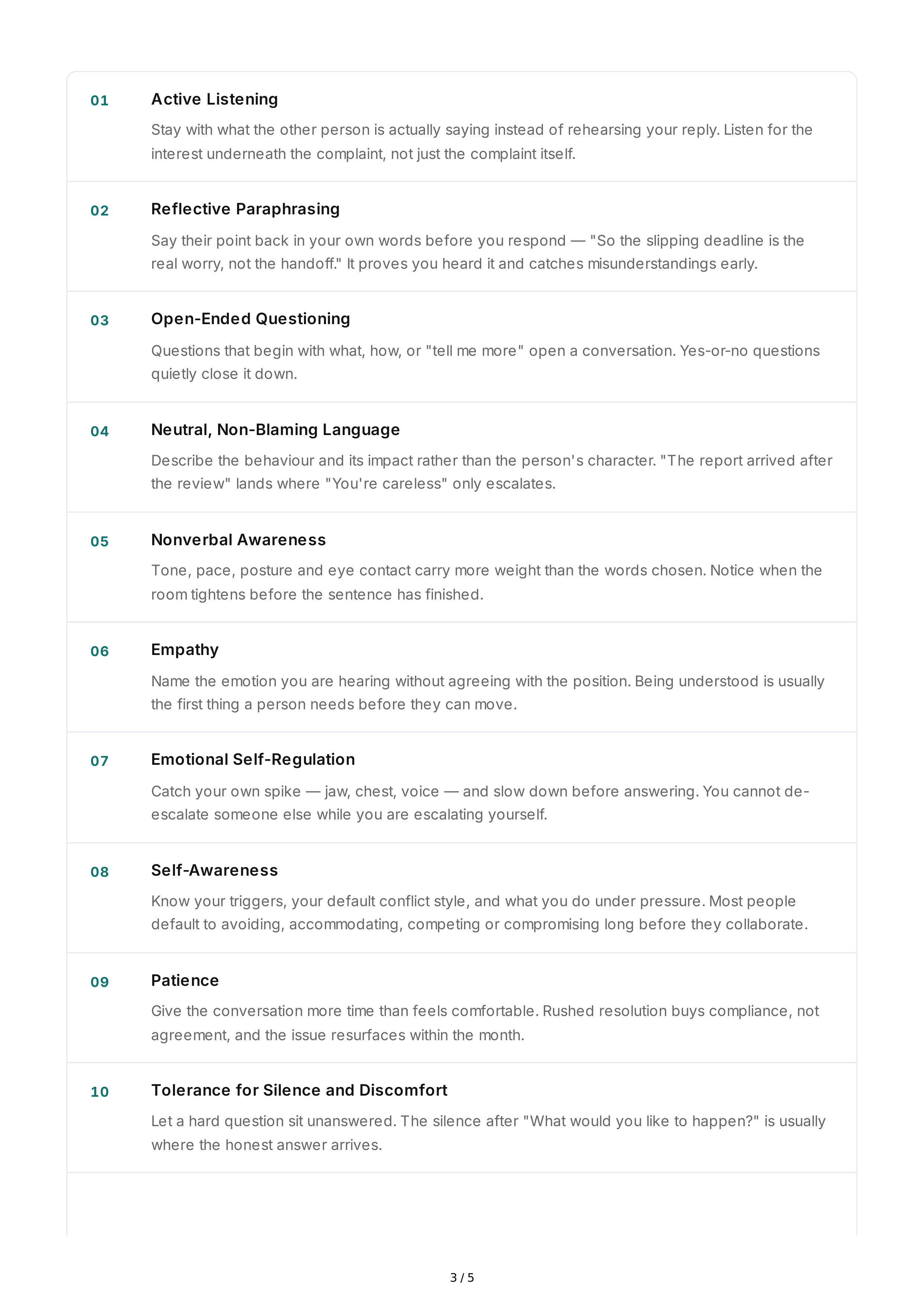
01
Active
Listening
Stay
with
what
the
other
person
is
actually
saying
instead
of
rehearsing
your
reply
.
Listen
for
the
interest
underneath
the
complaint
,
not
just
the
complaint
itself
.
02
Reflective
Paraphrasing
Say
their
point
back
in
your
own
words
before
you
respond
— "
So
the
slipping
deadline
is
the
real
worry
,
not
the
handoff
."
It
proves
you
heard
it
and
catches
misunderstandings
early
.
03
Open
-
Ended
Questioning
Questions
that
begin
with
what
,
how
,
or
"
tell
me
more
"
open
a
conversation
.
Yes
-
or
-
no
questions
quietly
close
it
down
.
04
Neutral
,
Non
-
Blaming
Language
Describe
the
behaviour
and
its
impact
rather
than
the
person
'
s
character
. "
The
report
arrived
after
the
review
"
lands
where
"
You
'
re
careless
"
only
escalates
.
05
Nonverbal
Awareness
Tone
,
pace
,
posture
and
eye
contact
carry
more
weight
than
the
words
chosen
.
Notice
when
the
room
tightens
before
the
sentence
has
finished
.
06
Empathy
Name
the
emotion
you
are
hearing
without
agreeing
with
the
position
.
Being
understood
is
usually
the
first
thing
a
person
needs
before
they
can
move
.
07
Emotional
Self
-
Regulation
Catch
your
own
spike
—
jaw
,
chest
,
voice
—
and
slow
down
before
answering
.
You
cannot
de
-
escalate
someone
else
while
you
are
escalating
yourself
.
08
Self
-
Awareness
Know
your
triggers
,
your
default
conflict
style
,
and
what
you
do
under
pressure
.
Most
people
default
to
avoiding
,
accommodating
,
competing
or
compromising
long
before
they
collaborate
.
09
Patience
Give
the
conversation
more
time
than
feels
comfortable
.
Rushed
resolution
buys
compliance
,
not
agreement
,
and
the
issue
resurfaces
within
the
month
.
10
Tolerance
for
Silence
and
Discomfort
Let
a
hard
question
sit
unanswered
.
The
silence
after
"
What
would
you
like
to
happen
?"
is
usually
where
the
honest
answer
arrives
.
3 / 5
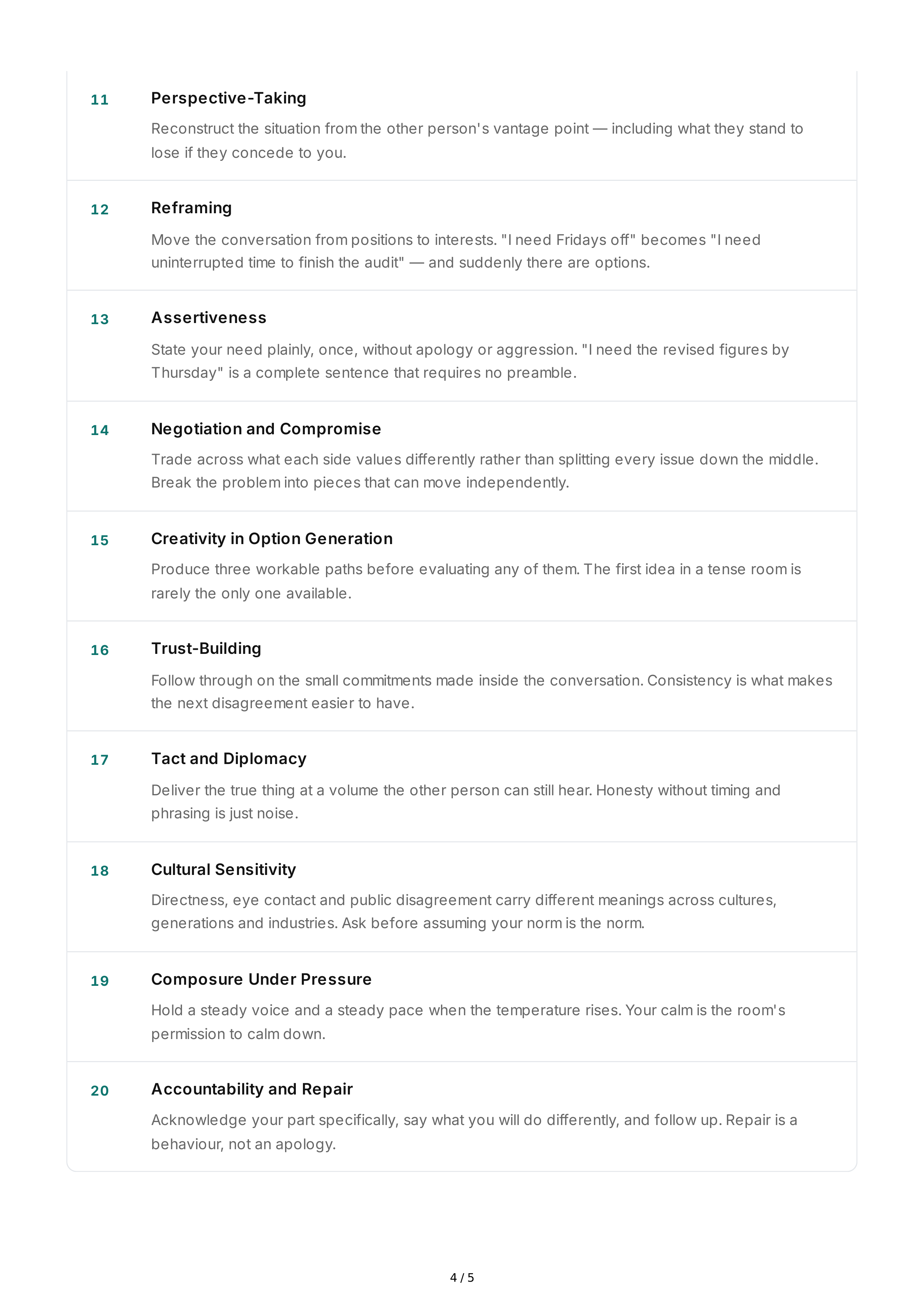
11
Perspective
-
Taking
Reconstruct
the
situation
from
the
other
person
'
s
vantage
point
—
including
what
they
stand
to
lose
if
they
concede
to
you
.
12
Reframing
Move
the
conversation
from
positions
to
interests
. "
I
need
Fridays
off
"
becomes
"
I
need
uninterrupted
time
to
finish
the
audit
" —
and
suddenly
there
are
options
.
13
Assertiveness
State
your
need
plainly
,
once
,
without
apology
or
aggression
. "
I
need
the
revised
figures
by
Thursday
"
is
a
complete
sentence
that
requires
no
preamble
.
14
Negotiation
and
Compromise
Trade
across
what
each
side
values
differently
rather
than
splitting
every
issue
down
the
middle
.
Break
the
problem
into
pieces
that
can
move
independently
.
15
Creativity
in
Option
Generation
Produce
three
workable
paths
before
evaluating
any
of
them
.
The
first
idea
in
a
tense
room
is
rarely
the
only
one
available
.
16
Trust
-
Building
Follow
through
on
the
small
commitments
made
inside
the
conversation
.
Consistency
is
what
makes
the
next
disagreement
easier
to
have
.
17
Tact
and
Diplomacy
Deliver
the
true
thing
at
a
volume
the
other
person
can
still
hear
.
Honesty
without
timing
and
phrasing
is
just
noise
.
18
Cultural
Sensitivity
Directness
,
eye
contact
and
public
disagreement
carry
different
meanings
across
cultures
,
generations
and
industries
.
Ask
before
assuming
your
norm
is
the
norm
.
19
Composure
Under
Pressure
Hold
a
steady
voice
and
a
steady
pace
when
the
temperature
rises
.
Your
calm
is
the
room
'
s
permission
to
calm
down
.
20
Accountability
and
Repair
Acknowledge
your
part
specifically
,
say
what
you
will
do
differently
,
and
follow
up
.
Repair
is
a
behaviour
,
not
an
apology
.
4 / 5
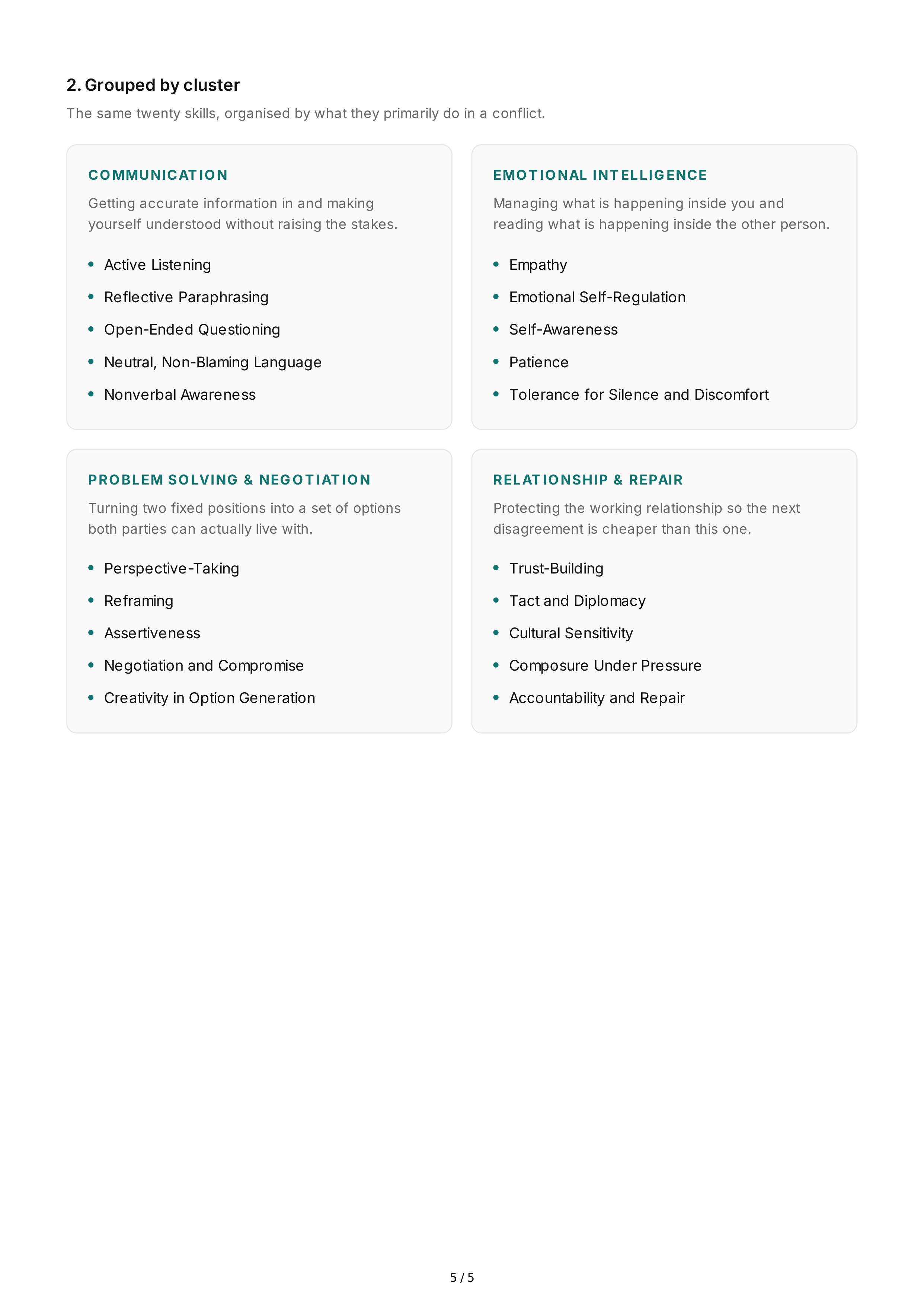
2.
Grouped
by
cluster
The
same
twenty
skills
,
organised
by
what
they
primarily
do
in
a
conflict
.
COMMUNICAT ION
Getting
accurate
information
in
and
making
yourself
understood
without
raising
the
stakes
.
EMOT IONAL
INT ELLIG ENCE
Managing
what
is
happening
inside
you
and
reading
what
is
happening
inside
the
other
person
.
PROBLEM
SOLVING
&
NEG OT IAT ION
Turning
two
fixed
positions
into
a
set
of
options
both
parties
can
actually
live
with
.
RELAT IONSHIP
&
REPAIR
Protecting
the
working
relationship
so
the
next
disagreement
is
cheaper
than
this
one
.
Active
Listening
Reflective
Paraphrasing
Open
-
Ended
Questioning
Neutral
,
Non
-
Blaming
Language
Nonverbal
Awareness
Empathy
Emotional
Self
-
Regulation
Self
-
Awareness
Patience
Tolerance
for
Silence
and
Discomfort
Perspective
-
Taking
Reframing
Assertiveness
Negotiation
and
Compromise
Creativity
in
Option
Generation
Trust
-
Building
Tact
and
Diplomacy
Cultural
Sensitivity
Composure
Under
Pressure
Accountability
and
Repair
5 / 5