Attention
to
Detail
1 .
T HE
L IS T
—
AT T ENT IO N
T O
D ETAIL
S O FT
S K IL L S
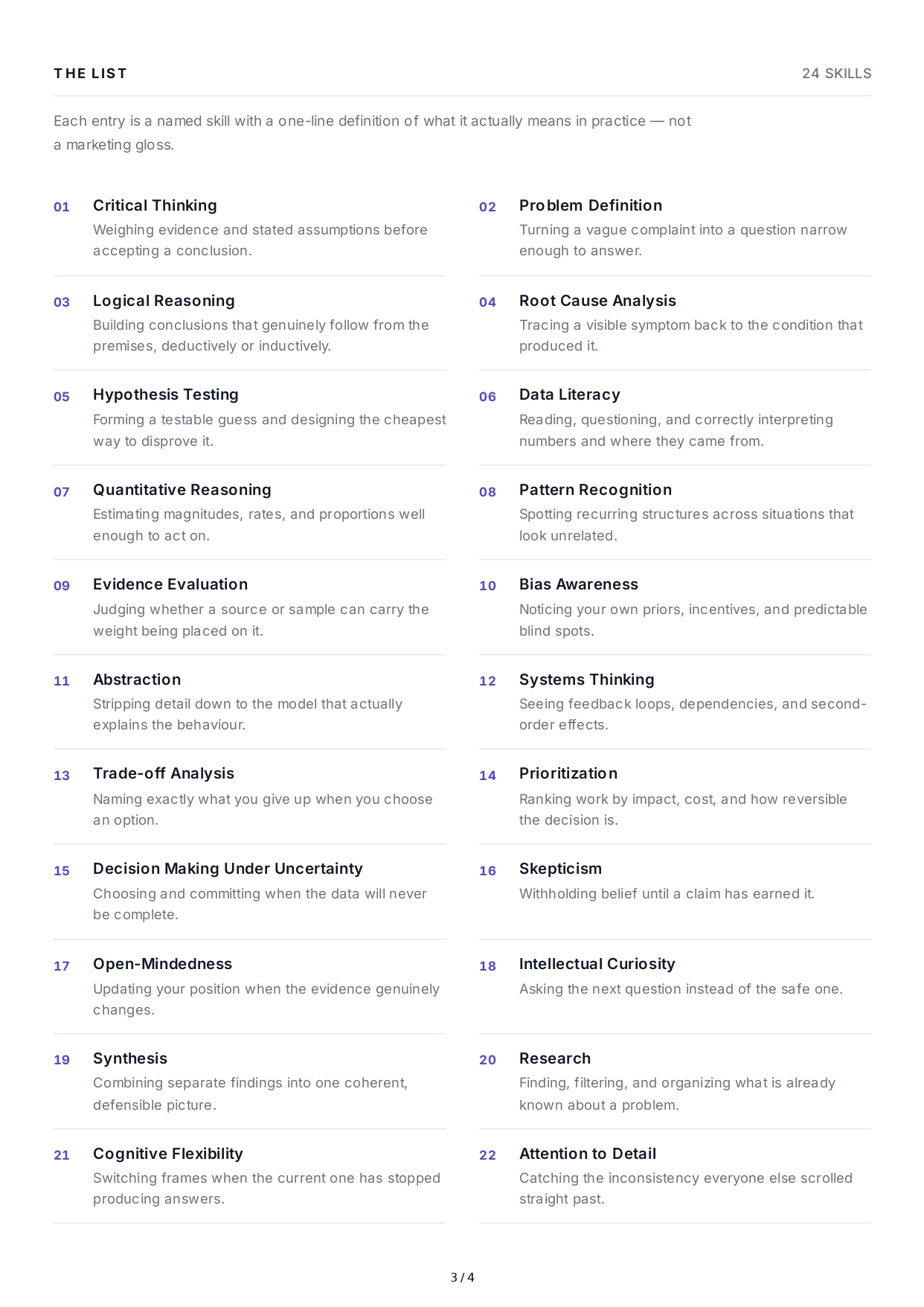
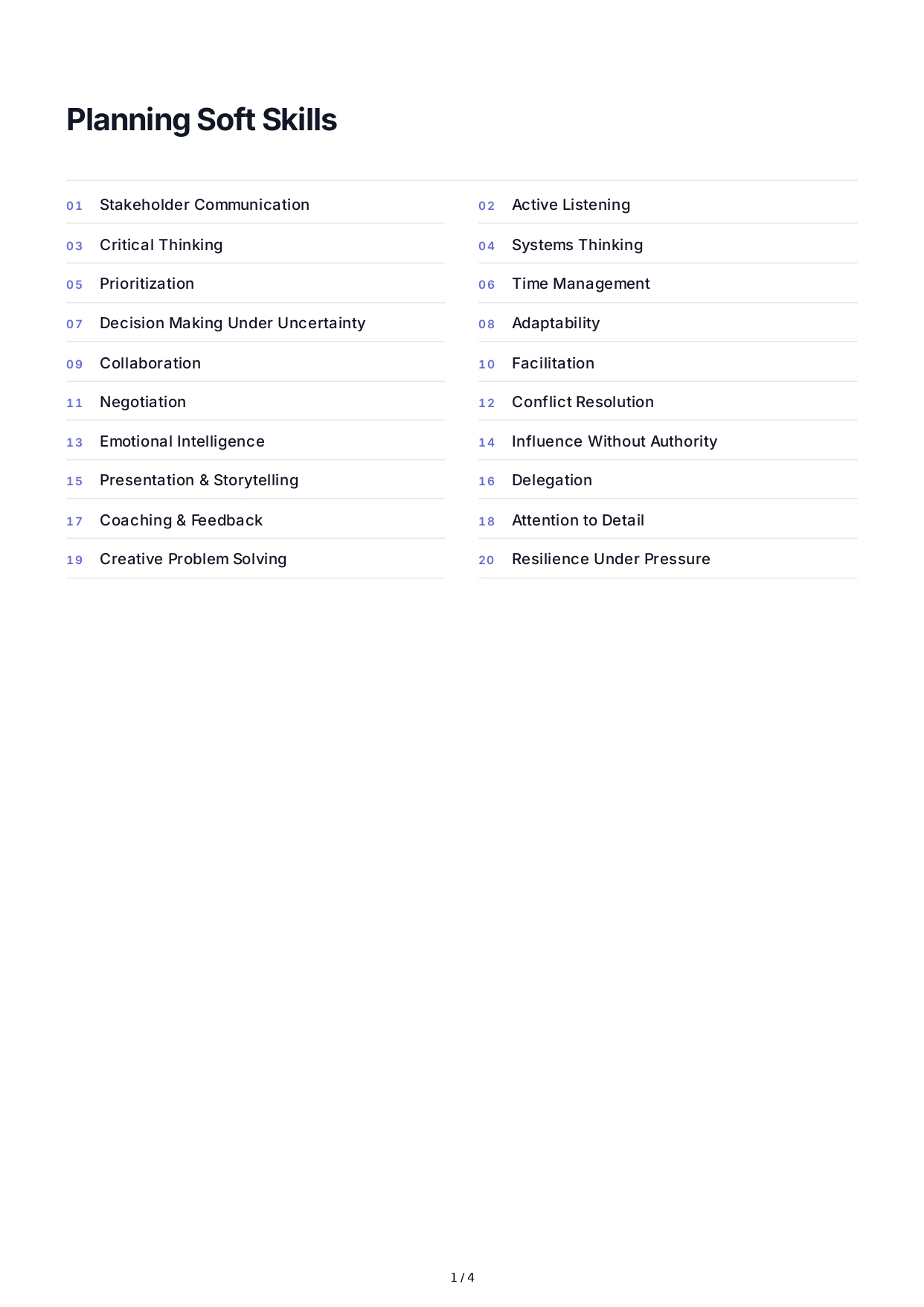
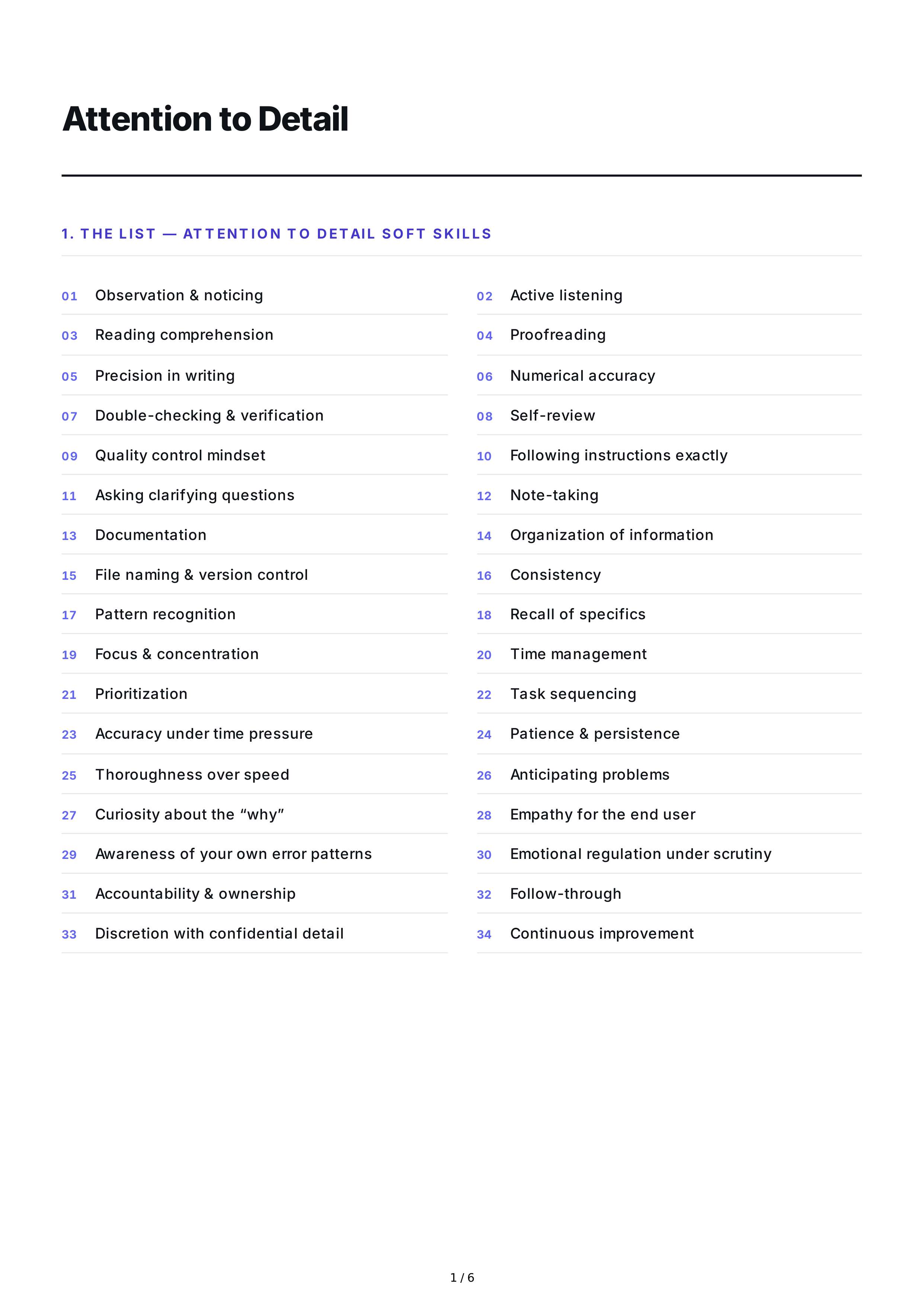
01
Observation
&
noticing
02
Active
listening
03
Reading
comprehension
04
Proofreading
05
Precision
in
writing
06
Numerical
accuracy
07
Double
-
checking
&
verification
08
Self
-
review
09
Quality
control
mindset
10
Following
instructions
exactly
11
Asking
clarifying
questions
12
Note
-
taking
13
Documentation
14
Organization
of
information
15
File
naming
&
version
control
16
Consistency
17
Pattern
recognition
18
Recall
of
specifics
19
Focus
&
concentration
20
Time
management
21
Prioritization
22
Task
sequencing
23
Accuracy
under
time
pressure
24
Patience
&
persistence
25
Thoroughness
over
speed
26
Anticipating
problems
27
Curiosity
about
the
“
why
”
28
Empathy
for
the
end
user
29
Awareness
of
your
own
error
patterns
30
Emotional
regulation
under
scrutiny
31
Accountability
&
ownership
32
Follow
-
through
33
Discretion
with
confidential
detail
34
Continuous
improvement
1 / 6
2 .
T HE
S AME
S K IL L S
,
G R O U P ED
&
D EFINED
G R O UP
A
Perception
—
noticing
what
is
actually
there
The
front
end
of
attention
to
detail
.
Before
you
can
fix
an
error
,
you
have
to
perceive
it
.
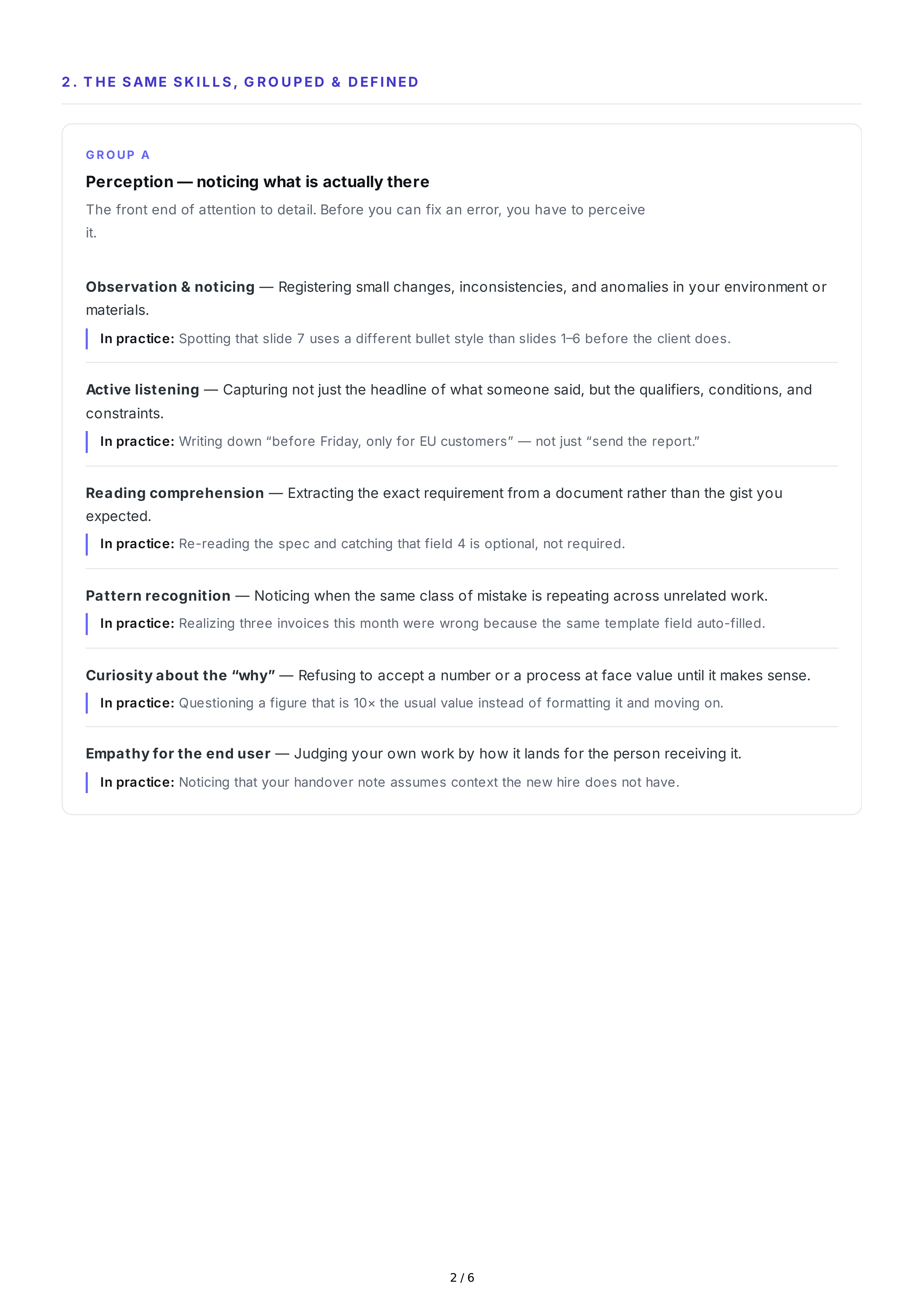
Observation
&
noticing
—
Registering
small
changes
,
inconsistencies
,
and
anomalies
in
your
environment
or
materials
.
In
practice
:
Spotting
that
slide
7
uses
a
different
bullet
style
than
slides
1–6
before
the
client
does
.
Active
listening
—
Capturing
not
just
the
headline
of
what
someone
said
,
but
the
qualifiers
,
conditions
,
and
constraints
.
In
practice
:
Writing
down
“
before
Friday
,
only
for
EU
customers
” —
not
just
“
send
the
report
.”
Reading
comprehension
—
Extracting
the
exact
requirement
from
a
document
rather
than
the
gist
you
expected
.
In
practice
:
Re
-
reading
the
spec
and
catching
that
field
4
is
optional
,
not
required
.
Pattern
recognition
—
Noticing
when
the
same
class
of
mistake
is
repeating
across
unrelated
work
.
In
practice
:
Realizing
three
invoices
this
month
were
wrong
because
the
same
template
field
auto
-
filled
.
Curiosity
about
the
“
why
”
—
Refusing
to
accept
a
number
or
a
process
at
face
value
until
it
makes
sense
.
In
practice
:
Questioning
a
figure
that
is
10×
the
usual
value
instead
of
formatting
it
and
moving
on
.
Empathy
for
the
end
user
—
Judging
your
own
work
by
how
it
lands
for
the
person
receiving
it
.
In
practice
:
Noticing
that
your
handover
note
assumes
context
the
new
hire
does
not
have
.
2 / 6
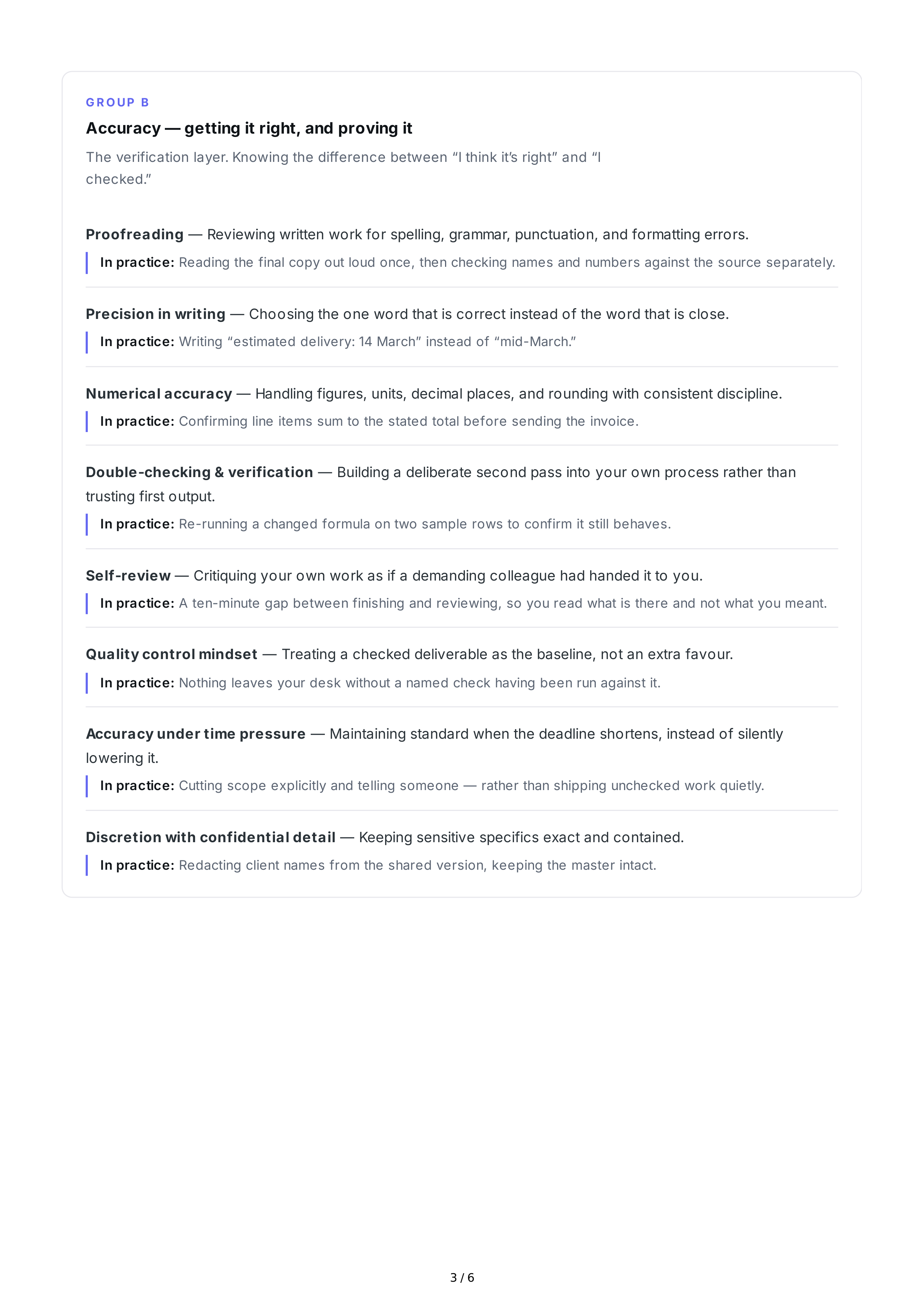
G R O UP
B
Accuracy
—
getting
it
right
,
and
proving
it
The
verification
layer
.
Knowing
the
difference
between
“
I
think
it
’
s
right
”
and
“
I
checked
.”
Proofreading
—
Reviewing
written
work
for
spelling
,
grammar
,
punctuation
,
and
formatting
errors
.
In
practice
:
Reading
the
final
copy
out
loud
once
,
then
checking
names
and
numbers
against
the
source
separately
.
Precision
in
writing
—
Choosing
the
one
word
that
is
correct
instead
of
the
word
that
is
close
.
In
practice
:
Writing
“
estimated
delivery
: 14
March
”
instead
of
“
mid
-
March
.”
Numerical
accuracy
—
Handling
figures
,
units
,
decimal
places
,
and
rounding
with
consistent
discipline
.
In
practice
:
Confirming
line
items
sum
to
the
stated
total
before
sending
the
invoice
.
Double
-
checking
&
verification
—
Building
a
deliberate
second
pass
into
your
own
process
rather
than
trusting
first
output
.
In
practice
:
Re
-
running
a
changed
formula
on
two
sample
rows
to
confirm
it
still
behaves
.
Self
-
review
—
Critiquing
your
own
work
as
if
a
demanding
colleague
had
handed
it
to
you
.
In
practice
:
A
ten
-
minute
gap
between
finishing
and
reviewing
,
so
you
read
what
is
there
and
not
what
you
meant
.
Quality
control
mindset
—
Treating
a
checked
deliverable
as
the
baseline
,
not
an
extra
favour
.
In
practice
:
Nothing
leaves
your
desk
without
a
named
check
having
been
run
against
it
.
Accuracy
under
time
pressure
—
Maintaining
standard
when
the
deadline
shortens
,
instead
of
silently
lowering
it
.
In
practice
:
Cutting
scope
explicitly
and
telling
someone
—
rather
than
shipping
unchecked
work
quietly
.
Discretion
with
confidential
detail
—
Keeping
sensitive
specifics
exact
and
contained
.
In
practice
:
Redacting
client
names
from
the
shared
version
,
keeping
the
master
intact
.
3 / 6
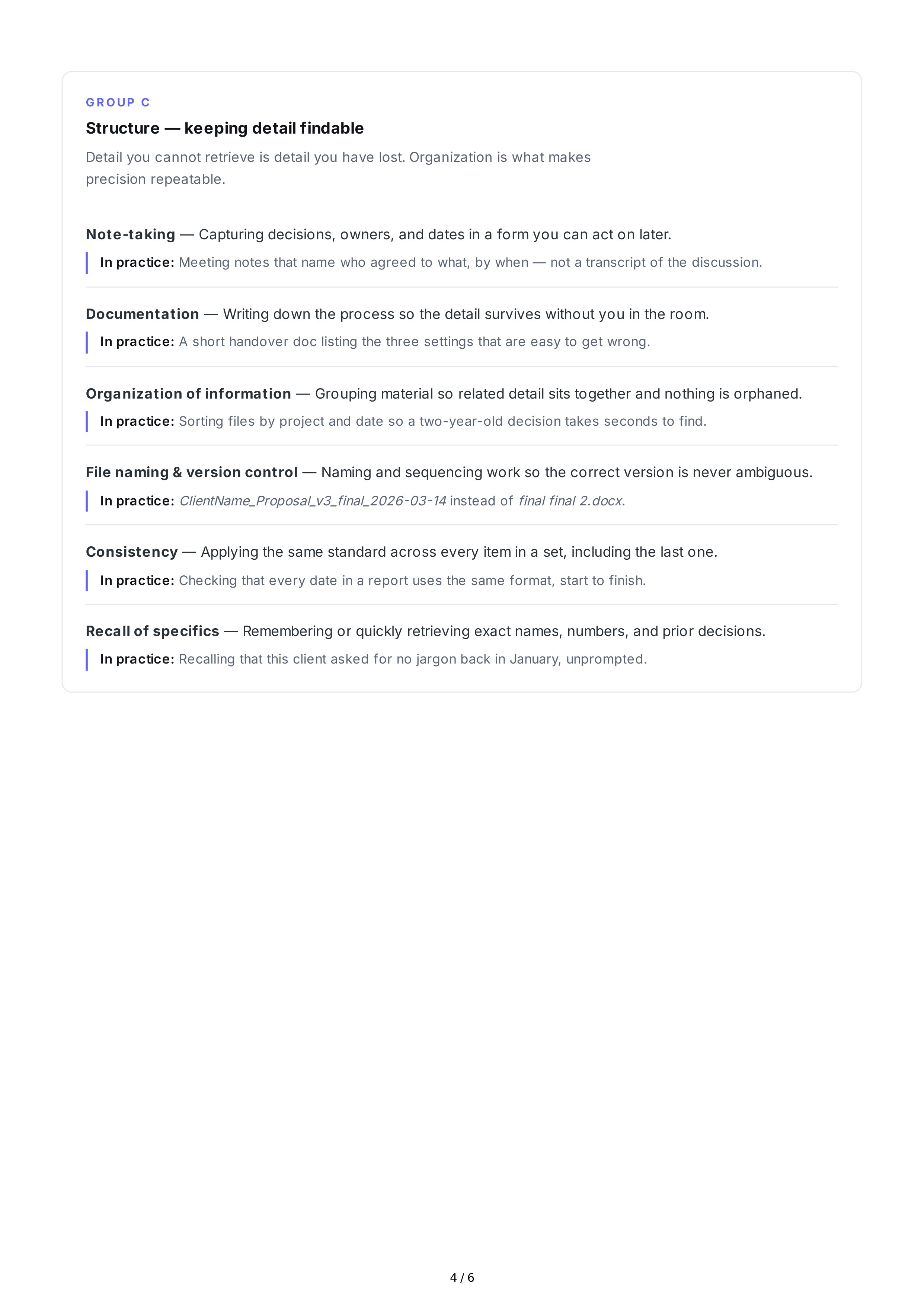
G R O UP
C
Structure
—
keeping
detail
findable
Detail
you
cannot
retrieve
is
detail
you
have
lost
.
Organization
is
what
makes
precision
repeatable
.
Note
-
taking
—
Capturing
decisions
,
owners
,
and
dates
in
a
form
you
can
act
on
later
.
In
practice
:
Meeting
notes
that
name
who
agreed
to
what
,
by
when
—
not
a
transcript
of
the
discussion
.
Documentation
—
Writing
down
the
process
so
the
detail
survives
without
you
in
the
room
.
In
practice
:
A
short
handover
doc
listing
the
three
settings
that
are
easy
to
get
wrong
.
Organization
of
information
—
Grouping
material
so
related
detail
sits
together
and
nothing
is
orphaned
.
In
practice
:
Sorting
files
by
project
and
date
so
a
two
-
year
-
old
decision
takes
seconds
to
find
.
File
naming
&
version
control
—
Naming
and
sequencing
work
so
the
correct
version
is
never
ambiguous
.
In
practice
:
ClientName
_
Proposal
_
v
3_
final
_2026-03-14
instead
of
final
final
2.
docx
.
Consistency
—
Applying
the
same
standard
across
every
item
in
a
set
,
including
the
last
one
.
In
practice
:
Checking
that
every
date
in
a
report
uses
the
same
format
,
start
to
finish
.
Recall
of
specifics
—
Remembering
or
quickly
retrieving
exact
names
,
numbers
,
and
prior
decisions
.
In
practice
:
Recalling
that
this
client
asked
for
no
jargon
back
in
January
,
unprompted
.
4 / 6
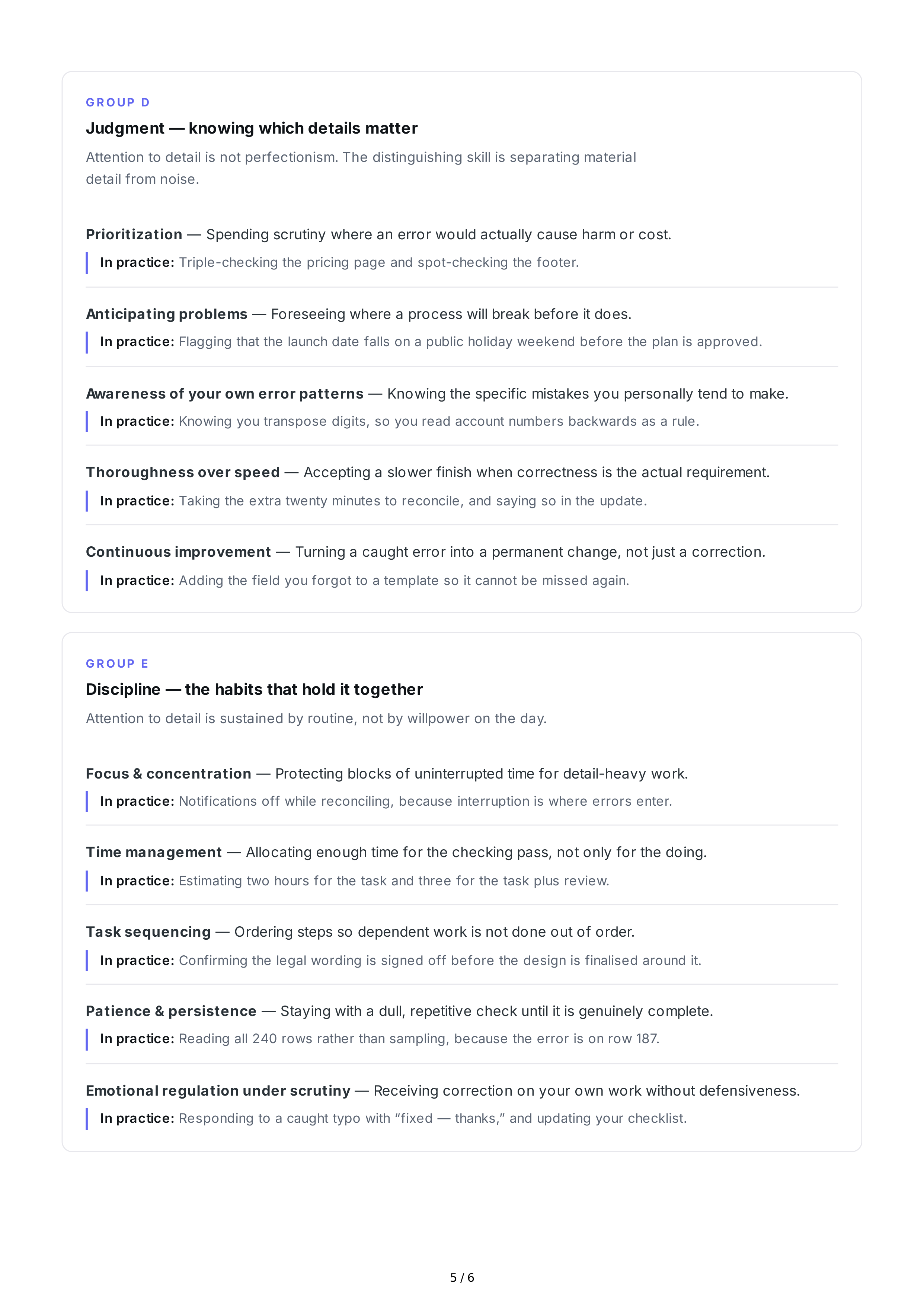
G R O UP
D
Judgment
—
knowing
which
details
matter
Attention
to
detail
is
not
perfectionism
.
The
distinguishing
skill
is
separating
material
detail
from
noise
.
Prioritization
—
Spending
scrutiny
where
an
error
would
actually
cause
harm
or
cost
.
In
practice
:
Triple
-
checking
the
pricing
page
and
spot
-
checking
the
footer
.
Anticipating
problems
—
Foreseeing
where
a
process
will
break
before
it
does
.
In
practice
:
Flagging
that
the
launch
date
falls
on
a
public
holiday
weekend
before
the
plan
is
approved
.
Awareness
of
your
own
error
patterns
—
Knowing
the
specific
mistakes
you
personally
tend
to
make
.
In
practice
:
Knowing
you
transpose
digits
,
so
you
read
account
numbers
backwards
as
a
rule
.
Thoroughness
over
speed
—
Accepting
a
slower
finish
when
correctness
is
the
actual
requirement
.
In
practice
:
Taking
the
extra
twenty
minutes
to
reconcile
,
and
saying
so
in
the
update
.
Continuous
improvement
—
Turning
a
caught
error
into
a
permanent
change
,
not
just
a
correction
.
In
practice
:
Adding
the
field
you
forgot
to
a
template
so
it
cannot
be
missed
again
.
G R O UP
E
Discipline
—
the
habits
that
hold
it
together
Attention
to
detail
is
sustained
by
routine
,
not
by
willpower
on
the
day
.
Focus
&
concentration
—
Protecting
blocks
of
uninterrupted
time
for
detail
-
heavy
work
.
In
practice
:
Notifications
off
while
reconciling
,
because
interruption
is
where
errors
enter
.
Time
management
—
Allocating
enough
time
for
the
checking
pass
,
not
only
for
the
doing
.
In
practice
:
Estimating
two
hours
for
the
task
and
three
for
the
task
plus
review
.
Task
sequencing
—
Ordering
steps
so
dependent
work
is
not
done
out
of
order
.
In
practice
:
Confirming
the
legal
wording
is
signed
off
before
the
design
is
finalised
around
it
.
Patience
&
persistence
—
Staying
with
a
dull
,
repetitive
check
until
it
is
genuinely
complete
.
In
practice
:
Reading
all
240
rows
rather
than
sampling
,
because
the
error
is
on
row
187.
Emotional
regulation
under
scrutiny
—
Receiving
correction
on
your
own
work
without
defensiveness
.
In
practice
:
Responding
to
a
caught
typo
with
“
fixed
—
thanks
,”
and
updating
your
checklist
.
5 / 6
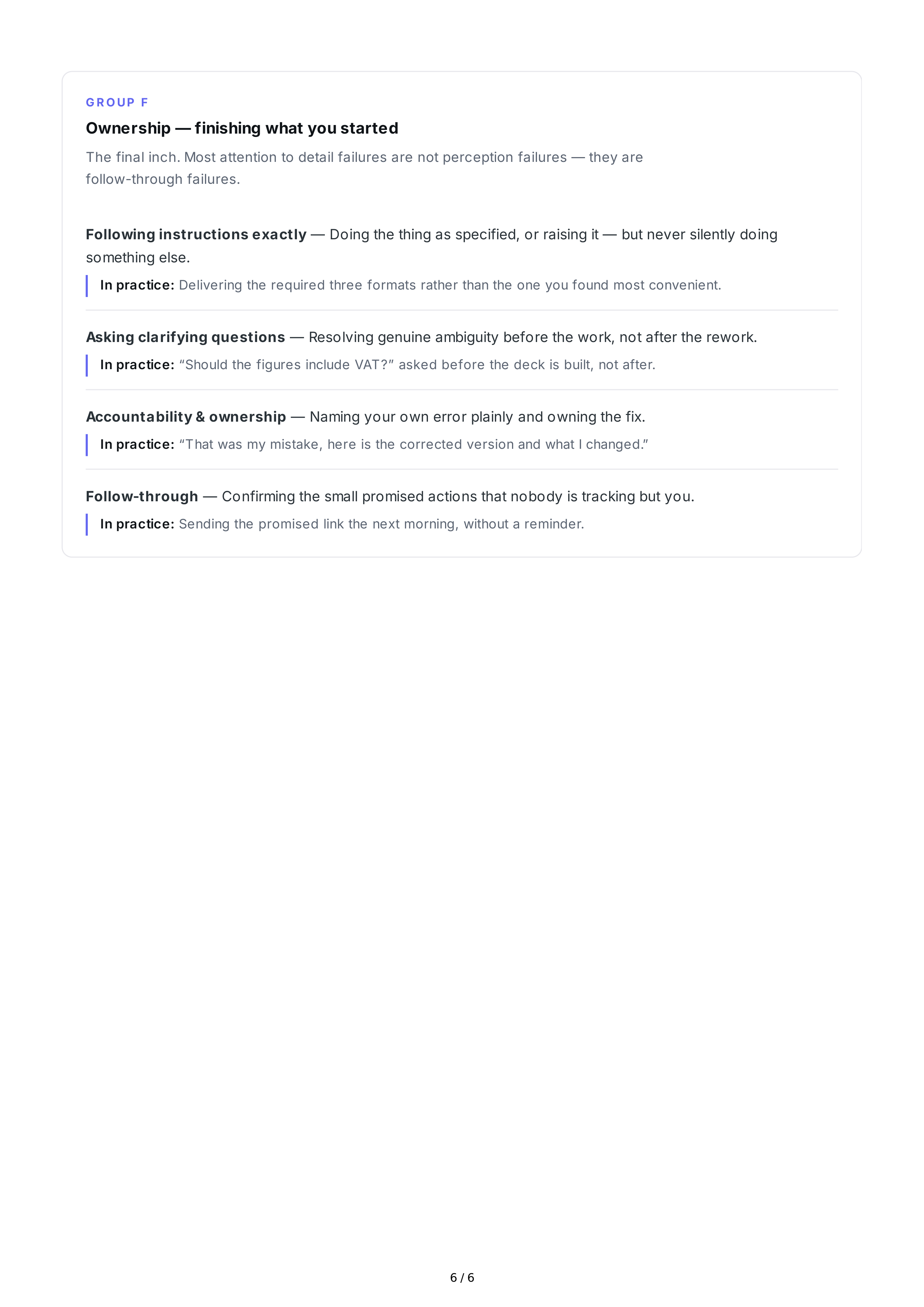
G R O UP
F
Ownership
—
finishing
what
you
started
The
final
inch
.
Most
attention
to
detail
failures
are
not
perception
failures
—
they
are
follow
-
through
failures
.
Following
instructions
exactly
—
Doing
the
thing
as
specified
,
or
raising
it
—
but
never
silently
doing
something
else
.
In
practice
:
Delivering
the
required
three
formats
rather
than
the
one
you
found
most
convenient
.
Asking
clarifying
questions
—
Resolving
genuine
ambiguity
before
the
work
,
not
after
the
rework
.
In
practice
:
“
Should
the
figures
include
VAT
?”
asked
before
the
deck
is
built
,
not
after
.
Accountability
&
ownership
—
Naming
your
own
error
plainly
and
owning
the
fix
.
In
practice
:
“
That
was
my
mistake
,
here
is
the
corrected
version
and
what
I
changed
.”
Follow
-
through
—
Confirming
the
small
promised
actions
that
nobody
is
tracking
but
you
.
In
practice
:
Sending
the
promised
link
the
next
morning
,
without
a
reminder
.
6 / 6