My Projects
Home
Free AI Soft Skills Generator
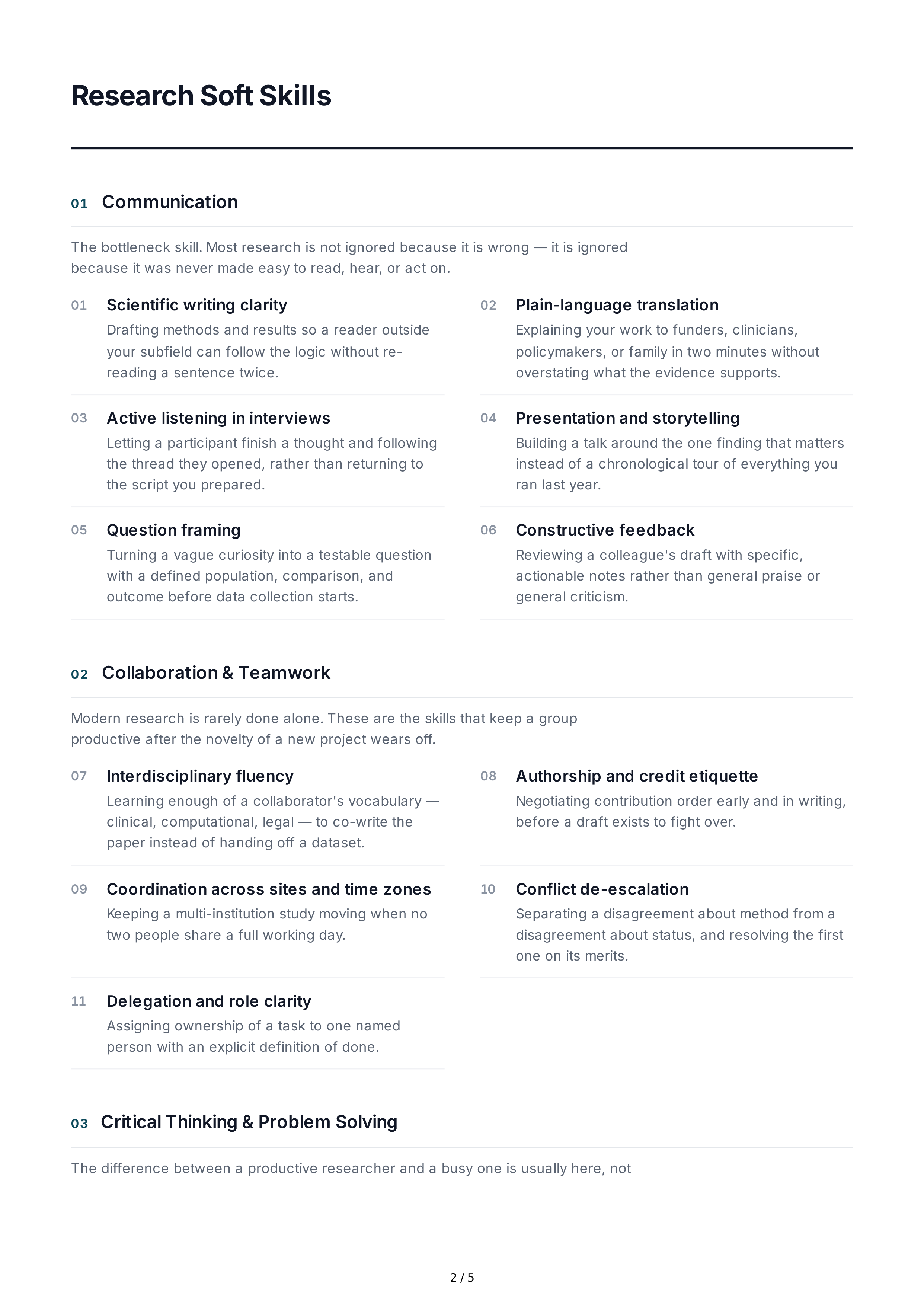
Research Soft Skills
1 / 5
Research
Soft
Skills
01
Communication
The
bottleneck
skill
.
Most
research
is
not
ignored
because
it
is
wrong
—
it
is
ignored
because
it
was
never
made
easy
to
read
,
hear
,
or
act
on
.
01
Scientific
writing
clarity
Drafting
methods
and
results
so
a
reader
outside
your
subfield
can
follow
the
logic
without
re
-
reading
a
sentence
twice
.
02
Plain
-
language
translation
Explaining
your
work
to
funders
,
clinicians
,
policymakers
,
or
family
in
two
minutes
without
overstating
what
the
evidence
supports
.
03
Active
listening
in
interviews
Letting
a
participant
finish
a
thought
and
following
the
thread
they
opened
,
rather
than
returning
to
the
script
you
prepared
.
04
Presentation
and
storytelling
Building
a
talk
around
the
one
finding
that
matters
instead
of
a
chronological
tour
of
everything
you
ran
last
year
.
05
Question
framing
Turning
a
vague
curiosity
into
a
testable
question
with
a
defined
population
,
comparison
,
and
outcome
before
data
collection
starts
.
06
Constructive
feedback
Reviewing
a
colleague
'
s
draft
with
specific
,
actionable
notes
rather
than
general
praise
or
general
criticism
.
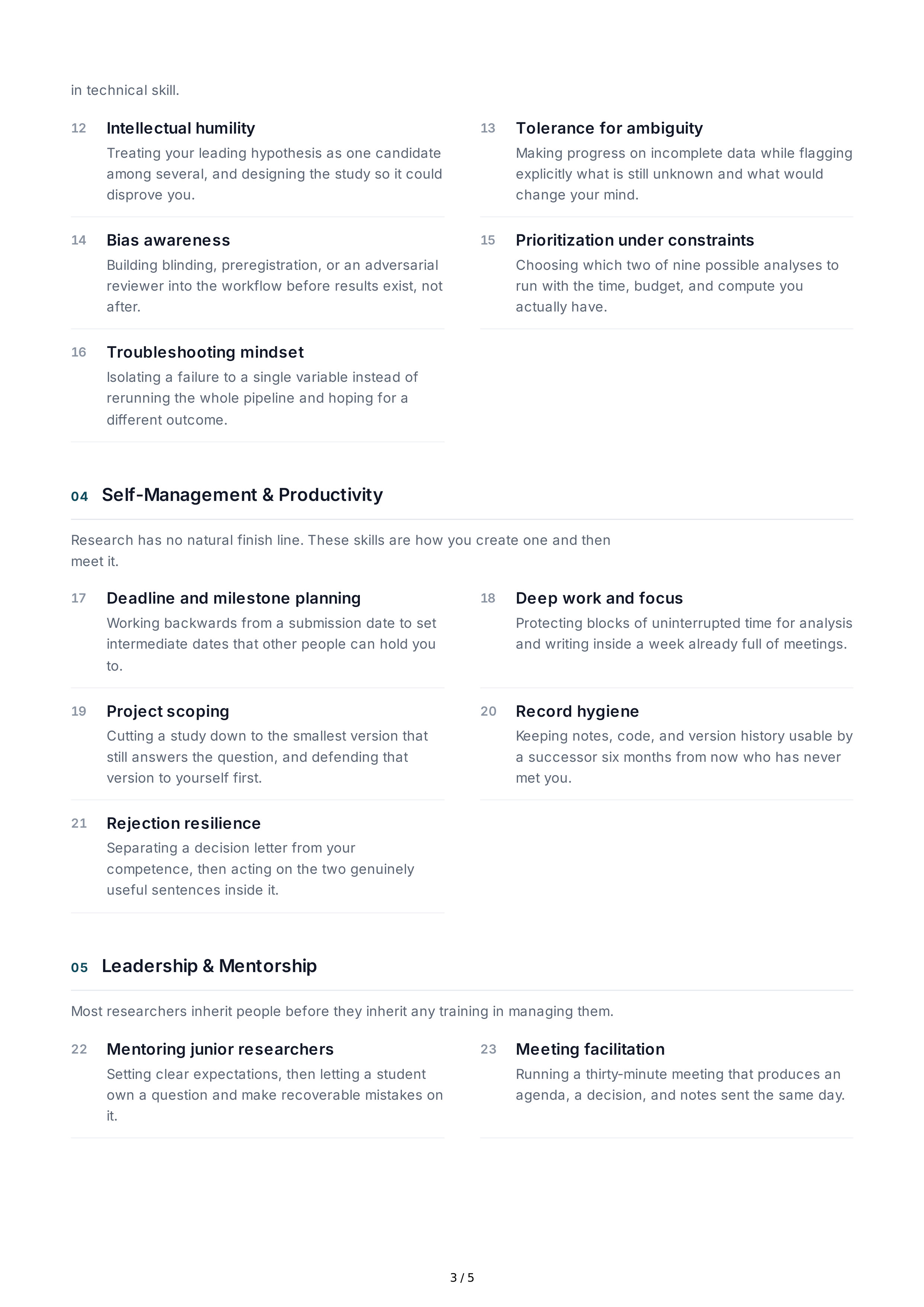
02
Collaboration
&
Teamwork
Modern
research
is
rarely
done
alone
.
These
are
the
skills
that
keep
a
group
productive
after
the
novelty
of
a
new
project
wears
off
.
07
Interdisciplinary
fluency
Learning
enough
of
a
collaborator
'
s
vocabulary
—
clinical
,
computational
,
legal
—
to
co
-
write
the
paper
instead
of
handing
off
a
dataset
.
08
Authorship
and
credit
etiquette
Negotiating
contribution
order
early
and
in
writing
,
before
a
draft
exists
to
fight
over
.
09
Coordination
across
sites
and
time
zones
Keeping
a
multi
-
institution
study
moving
when
no
two
people
share
a
full
working
day
.
10
Conflict
de
-
escalation
Separating
a
disagreement
about
method
from
a
disagreement
about
status
,
and
resolving
the
first
one
on
its
merits
.
11
Delegation
and
role
clarity
Assigning
ownership
of
a
task
to
one
named
person
with
an
explicit
definition
of
done
.
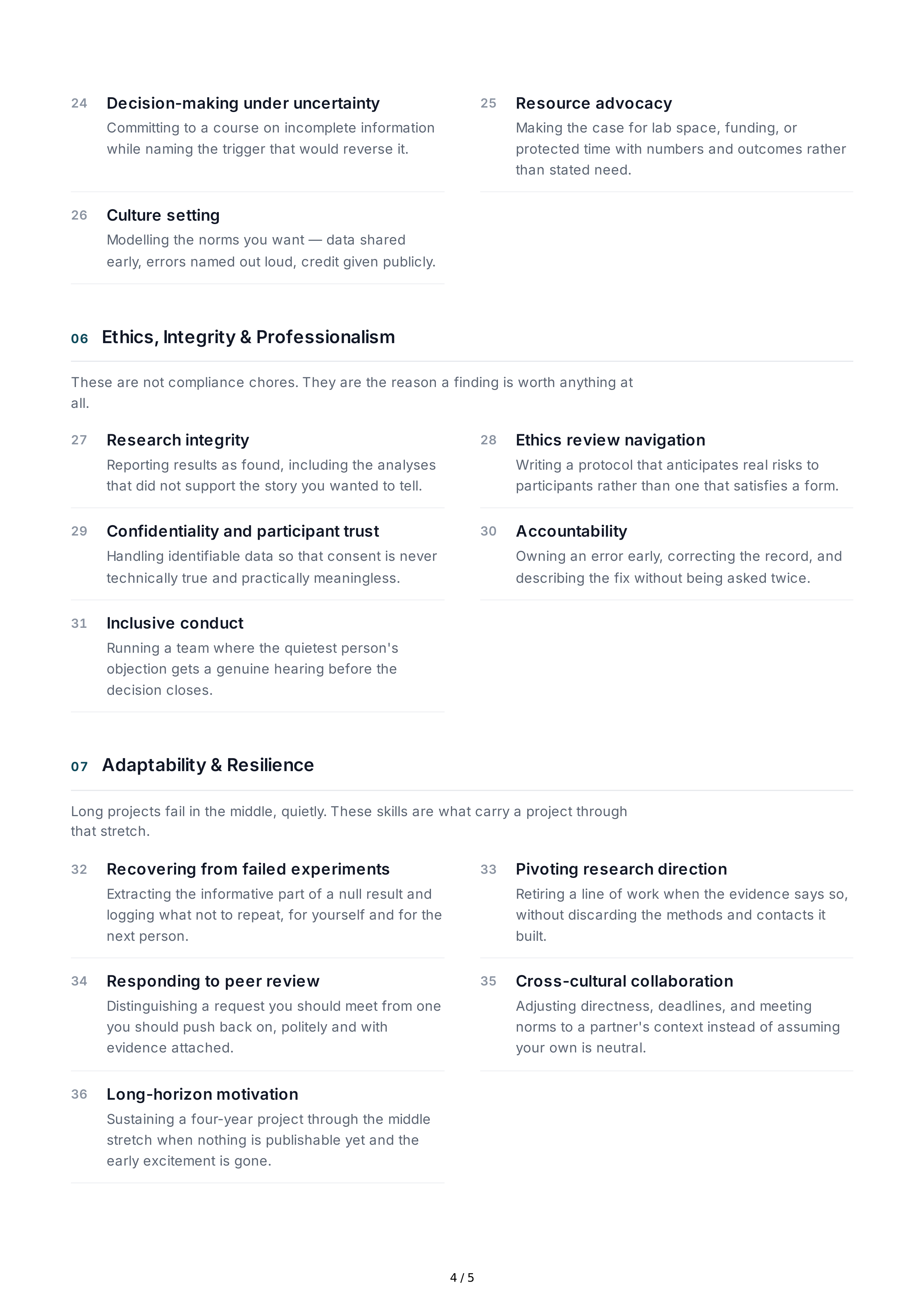
03
Critical
Thinking
&
Problem
Solving
The
difference
between
a
productive
researcher
and
a
busy
one
is
usually
here
,
not
2 / 5
in
technical
skill
.
12
Intellectual
humility
Treating
your
leading
hypothesis
as
one
candidate
among
several
,
and
designing
the
study
so
it
could
disprove
you
.
13
Tolerance
for
ambiguity
Making
progress
on
incomplete
data
while
flagging
explicitly
what
is
still
unknown
and
what
would
change
your
mind
.
14
Bias
awareness
Building
blinding
,
preregistration
,
or
an
adversarial
reviewer
into
the
workflow
before
results
exist
,
not
after
.
15
Prioritization
under
constraints
Choosing
which
two
of
nine
possible
analyses
to
run
with
the
time
,
budget
,
and
compute
you
actually
have
.
16
Troubleshooting
mindset
Isolating
a
failure
to
a
single
variable
instead
of
rerunning
the
whole
pipeline
and
hoping
for
a
different
outcome
.
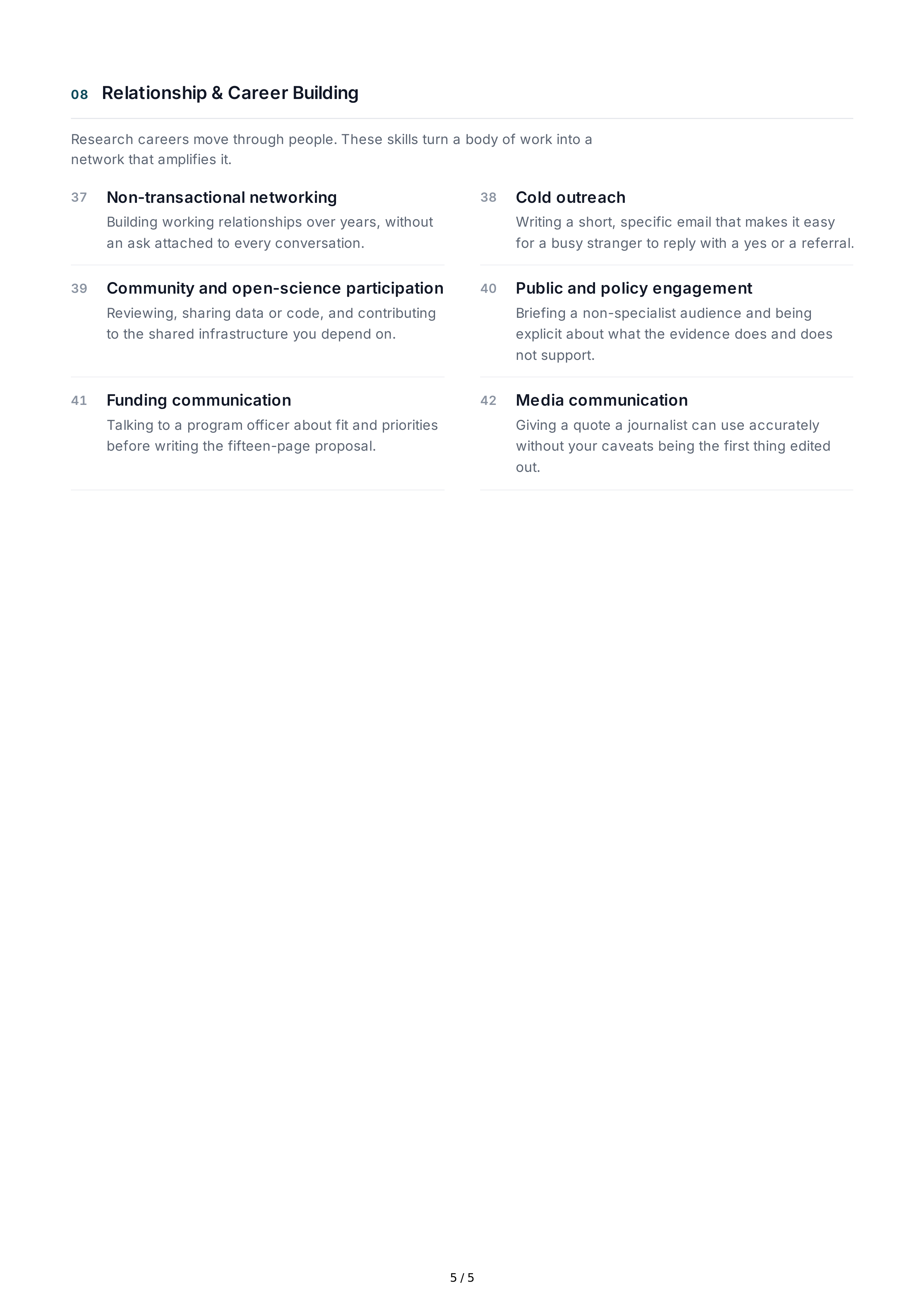
04
Self
-
Management
&
Productivity
Research
has
no
natural
finish
line
.
These
skills
are
how
you
create
one
and
then
meet
it
.
17
Deadline
and
milestone
planning
Working
backwards
from
a
submission
date
to
set
intermediate
dates
that
other
people
can
hold
you
to
.
18
Deep
work
and
focus
Protecting
blocks
of
uninterrupted
time
for
analysis
and
writing
inside
a
week
already
full
of
meetings
.
19
Project
scoping
Cutting
a
study
down
to
the
smallest
version
that
still
answers
the
question
,
and
defending
that
version
to
yourself
first
.
20
Record
hygiene
Keeping
notes
,
code
,
and
version
history
usable
by
a
successor
six
months
from
now
who
has
never
met
you
.
21
Rejection
resilience
Separating
a
decision
letter
from
your
competence
,
then
acting
on
the
two
genuinely
useful
sentences
inside
it
.
05
Leadership
&
Mentorship
Most
researchers
inherit
people
before
they
inherit
any
training
in
managing
them
.
22
Mentoring
junior
researchers
Setting
clear
expectations
,
then
letting
a
student
own
a
question
and
make
recoverable
mistakes
on
it
.
23
Meeting
facilitation
Running
a
thirty
-
minute
meeting
that
produces
an
agenda
,
a
decision
,
and
notes
sent
the
same
day
.
3 / 5
24
Decision
-
making
under
uncertainty
Committing
to
a
course
on
incomplete
information
while
naming
the
trigger
that
would
reverse
it
.
25
Resource
advocacy
Making
the
case
for
lab
space
,
funding
,
or
protected
time
with
numbers
and
outcomes
rather
than
stated
need
.
26
Culture
setting
Modelling
the
norms
you
want
—
data
shared
early
,
errors
named
out
loud
,
credit
given
publicly
.
06
Ethics
,
Integrity
&
Professionalism
These
are
not
compliance
chores
.
They
are
the
reason
a
finding
is
worth
anything
at
all
.
27
Research
integrity
Reporting
results
as
found
,
including
the
analyses
that
did
not
support
the
story
you
wanted
to
tell
.
28
Ethics
review
navigation
Writing
a
protocol
that
anticipates
real
risks
to
participants
rather
than
one
that
satisfies
a
form
.
29
Confidentiality
and
participant
trust
Handling
identifiable
data
so
that
consent
is
never
technically
true
and
practically
meaningless
.
30
Accountability
Owning
an
error
early
,
correcting
the
record
,
and
describing
the
fix
without
being
asked
twice
.
31
Inclusive
conduct
Running
a
team
where
the
quietest
person
'
s
objection
gets
a
genuine
hearing
before
the
decision
closes
.
07
Adaptability
&
Resilience
Long
projects
fail
in
the
middle
,
quietly
.
These
skills
are
what
carry
a
project
through
that
stretch
.
32
Recovering
from
failed
experiments
Extracting
the
informative
part
of
a
null
result
and
logging
what
not
to
repeat
,
for
yourself
and
for
the
next
person
.
33
Pivoting
research
direction
Retiring
a
line
of
work
when
the
evidence
says
so
,
without
discarding
the
methods
and
contacts
it
built
.
34
Responding
to
peer
review
Distinguishing
a
request
you
should
meet
from
one
you
should
push
back
on
,
politely
and
with
evidence
attached
.
35
Cross
-
cultural
collaboration
Adjusting
directness
,
deadlines
,
and
meeting
norms
to
a
partner
'
s
context
instead
of
assuming
your
own
is
neutral
.
36
Long
-
horizon
motivation
Sustaining
a
four
-
year
project
through
the
middle
stretch
when
nothing
is
publishable
yet
and
the
early
excitement
is
gone
.
4 / 5
08
Relationship
&
Career
Building
Research
careers
move
through
people
.
These
skills
turn
a
body
of
work
into
a
network
that
amplifies
it
.
37
Non
-
transactional
networking
Building
working
relationships
over
years
,
without
an
ask
attached
to
every
conversation
.
38
Cold
outreach
Writing
a
short
,
specific
email
that
makes
it
easy
for
a
busy
stranger
to
reply
with
a
yes
or
a
referral
.
39
Community
and
open
-
science
participation
Reviewing
,
sharing
data
or
code
,
and
contributing
to
the
shared
infrastructure
you
depend
on
.
40
Public
and
policy
engagement
Briefing
a
non
-
specialist
audience
and
being
explicit
about
what
the
evidence
does
and
does
not
support
.
41
Funding
communication
Talking
to
a
program
officer
about
fit
and
priorities
before
writing
the
fifteen
-
page
proposal
.
42
Media
communication
Giving
a
quote
a
journalist
can
use
accurately
without
your
caveats
being
the
first
thing
edited
out
.
5 / 5
Similar Examples
Generate Similar
Conflict Management Soft Skills
Generate Similar
Coaching Soft Skills
Generate Similar
Mentoring Soft Skills
Generate Similar
Motivation Soft Skills
Generate Similar
Team-Building Soft Skills
Generate Similar
Influence Soft Skills
Generate Similar
Accountability Soft Skills
Generate Similar
Responsibility Soft Skills
Generate Similar
People Management Soft Skills
Generate Similar
Problem-Solving Soft Skills
Generate Similar
Critical Thinking Soft Skills
Generate Similar
Analytical Thinking Soft Skills
Generate Similar
Creative Thinking Soft Skills
Generate Similar
Strategic Thinking Soft Skills
Generate Similar
Logical Thinking Soft Skills
Generate Similar
Reasoning Soft Skills
Generate Similar
Innovation Soft Skills
Generate Similar
Attention to Detail Soft Skills
Generate Similar
Resourcefulness Soft Skills
Generate Similar
Planning Soft Skills
Generate Similar
Organizational Soft Skills
Generate Similar
Time Management Soft Skills
Generate Similar
Prioritization Soft Skills
Generate Similar
Adaptability Soft Skills
Generate Similar
Flexibility Soft Skills
Generate Similar
Resilience Soft Skills