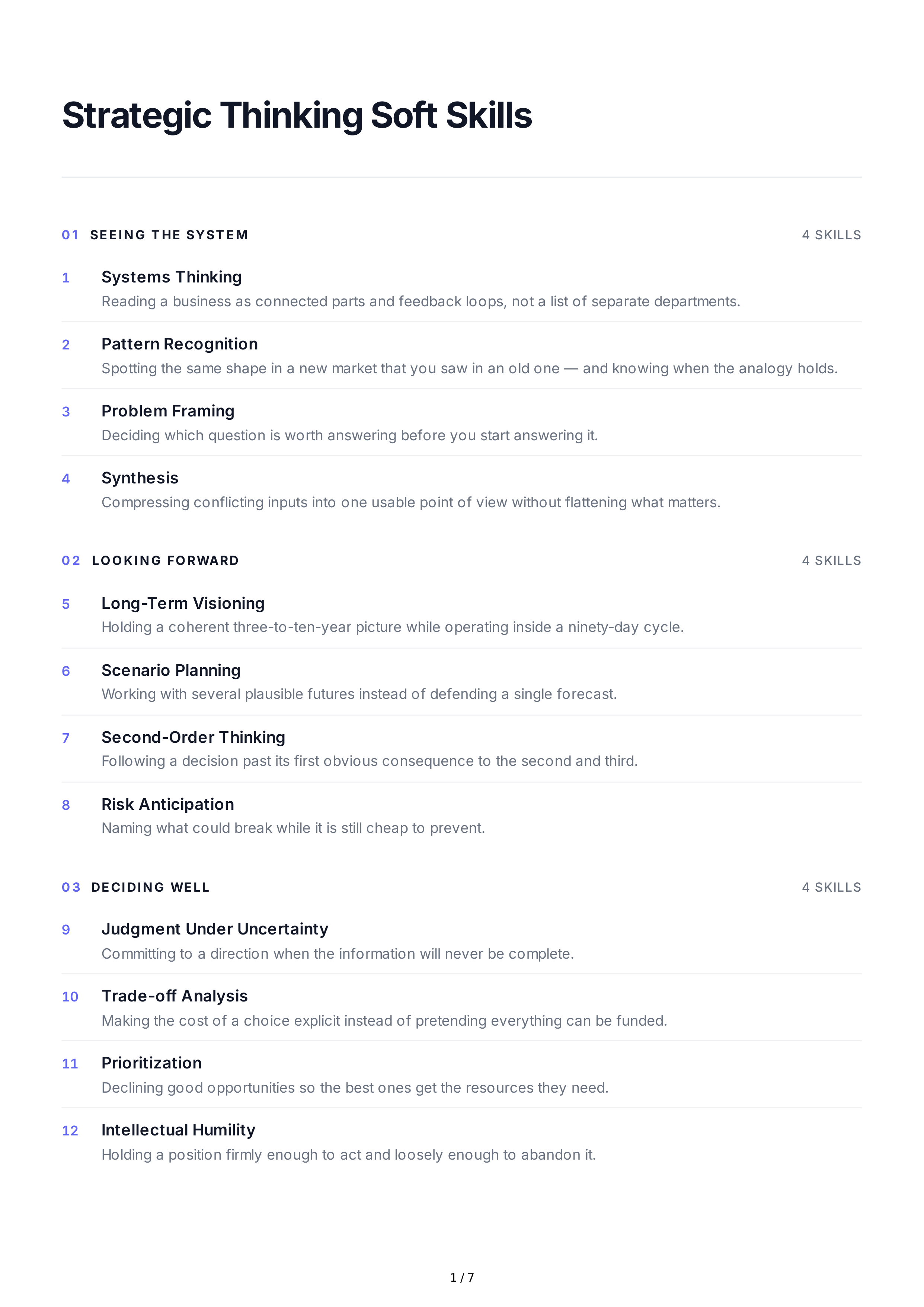
Strategic
Thinking
Soft
Skills
0 1
SEEIN G
T HE
SYST EM
4
SKILLS
1
Systems
Thinking
Reading
a
business
as
connected
parts
and
feedback
loops
,
not
a
list
of
separate
departments
.
2
Pattern
Recognition
Spotting
the
same
shape
in
a
new
market
that
you
saw
in
an
old
one
—
and
knowing
when
the
analogy
holds
.
3
Problem
Framing
Deciding
which
question
is
worth
answering
before
you
start
answering
it
.
4
Synthesis
Compressing
conflicting
inputs
into
one
usable
point
of
view
without
flattening
what
matters
.
0 2
LO O KIN G
FO RWARD
4
SKILLS
5
Long
-
Term
Visioning
Holding
a
coherent
three
-
to
-
ten
-
year
picture
while
operating
inside
a
ninety
-
day
cycle
.
6
Scenario
Planning
Working
with
several
plausible
futures
instead
of
defending
a
single
forecast
.
7
Second
-
Order
Thinking
Following
a
decision
past
its
first
obvious
consequence
to
the
second
and
third
.
8
Risk
Anticipation
Naming
what
could
break
while
it
is
still
cheap
to
prevent
.
0 3
DECIDIN G
WELL
4
SKILLS
9
Judgment
Under
Uncertainty
Committing
to
a
direction
when
the
information
will
never
be
complete
.
10
Trade
-
off
Analysis
Making
the
cost
of
a
choice
explicit
instead
of
pretending
everything
can
be
funded
.
11
Prioritization
Declining
good
opportunities
so
the
best
ones
get
the
resources
they
need
.
12
Intellectual
Humility
Holding
a
position
firmly
enough
to
act
and
loosely
enough
to
abandon
it
.
1 / 7
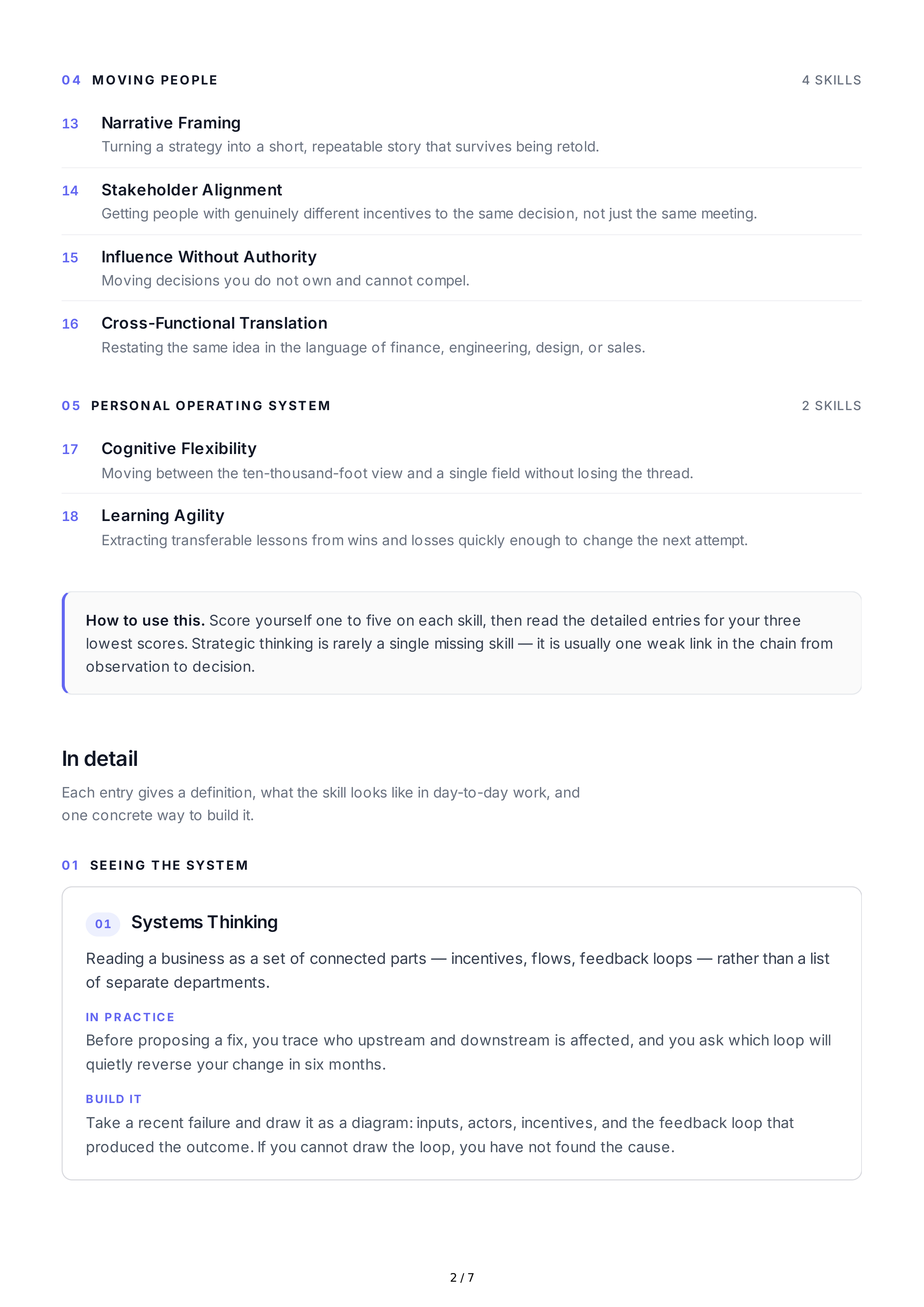
0 4
M O VIN G
PEO PLE
4
SKILLS
13
Narrative
Framing
Turning
a
strategy
into
a
short
,
repeatable
story
that
survives
being
retold
.
14
Stakeholder
Alignment
Getting
people
with
genuinely
different
incentives
to
the
same
decision
,
not
just
the
same
meeting
.
15
Influence
Without
Authority
Moving
decisions
you
do
not
own
and
cannot
compel
.
16
Cross
-
Functional
Translation
Restating
the
same
idea
in
the
language
of
finance
,
engineering
,
design
,
or
sales
.
0 5
PERSO N AL
O PERAT IN G
SYST EM
2
SKILLS
17
Cognitive
Flexibility
Moving
between
the
ten
-
thousand
-
foot
view
and
a
single
field
without
losing
the
thread
.
18
Learning
Agility
Extracting
transferable
lessons
from
wins
and
losses
quickly
enough
to
change
the
next
attempt
.
How
to
use
this
.
Score
yourself
one
to
five
on
each
skill
,
then
read
the
detailed
entries
for
your
three
lowest
scores
.
Strategic
thinking
is
rarely
a
single
missing
skill
—
it
is
usually
one
weak
link
in
the
chain
from
observation
to
decision
.
In
detail
Each
entry
gives
a
definition
,
what
the
skill
looks
like
in
day
-
to
-
day
work
,
and
one
concrete
way
to
build
it
.
0 1
SEEIN G
T HE
SYST EM
01
Systems
Thinking
Reading
a
business
as
a
set
of
connected
parts
—
incentives
,
flows
,
feedback
loops
—
rather
than
a
list
of
separate
departments
.
IN
P R AC T IC E
Before
proposing
a
fix
,
you
trace
who
upstream
and
downstream
is
affected
,
and
you
ask
which
loop
will
quietly
reverse
your
change
in
six
months
.
B UILD
IT
Take
a
recent
failure
and
draw
it
as
a
diagram
:
inputs
,
actors
,
incentives
,
and
the
feedback
loop
that
produced
the
outcome
.
If
you
cannot
draw
the
loop
,
you
have
not
found
the
cause
.
2 / 7
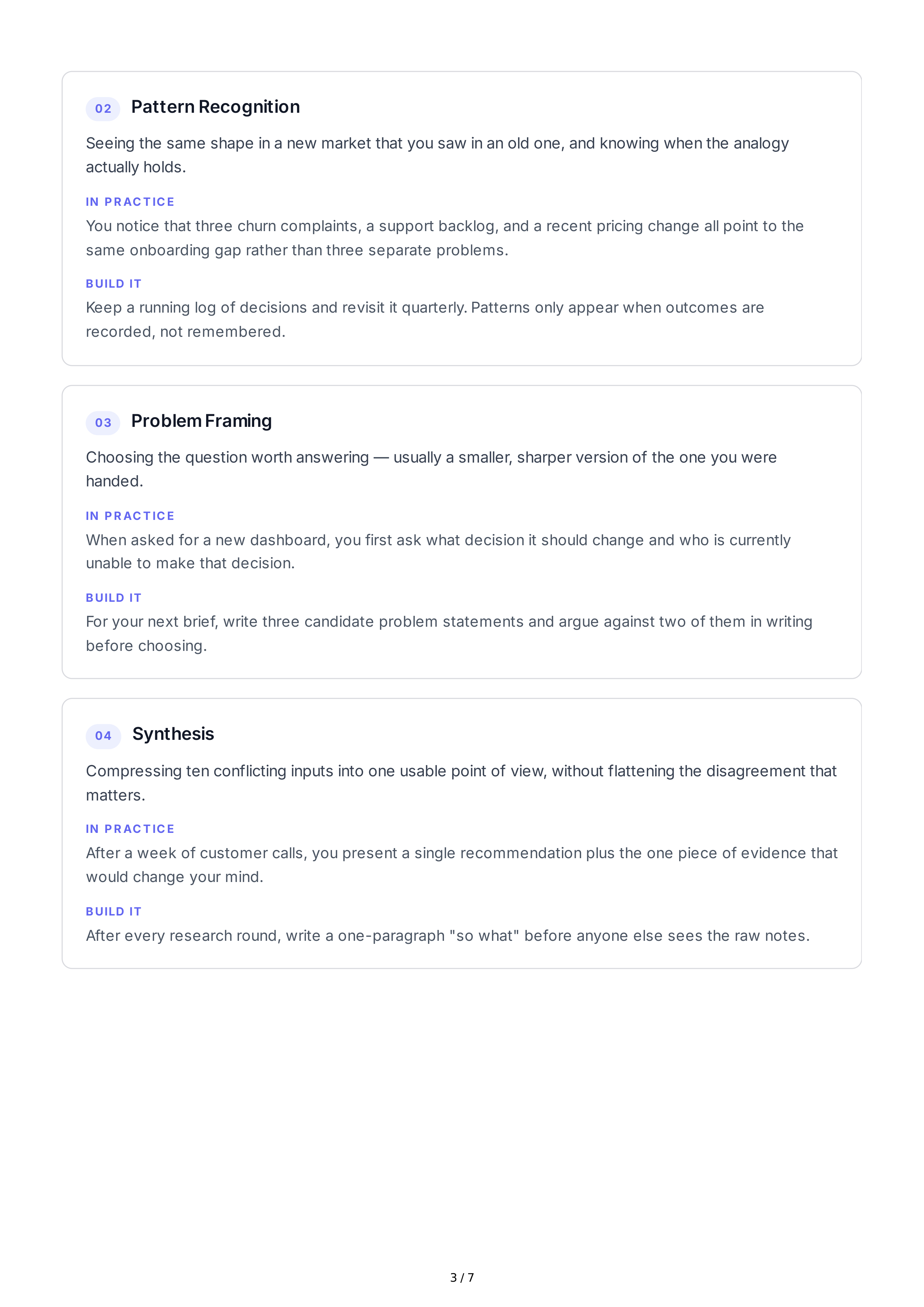
02
Pattern
Recognition
Seeing
the
same
shape
in
a
new
market
that
you
saw
in
an
old
one
,
and
knowing
when
the
analogy
actually
holds
.
IN
P R AC T IC E
You
notice
that
three
churn
complaints
,
a
support
backlog
,
and
a
recent
pricing
change
all
point
to
the
same
onboarding
gap
rather
than
three
separate
problems
.
B UILD
IT
Keep
a
running
log
of
decisions
and
revisit
it
quarterly
.
Patterns
only
appear
when
outcomes
are
recorded
,
not
remembered
.
03
Problem
Framing
Choosing
the
question
worth
answering
—
usually
a
smaller
,
sharper
version
of
the
one
you
were
handed
.
IN
P R AC T IC E
When
asked
for
a
new
dashboard
,
you
first
ask
what
decision
it
should
change
and
who
is
currently
unable
to
make
that
decision
.
B UILD
IT
For
your
next
brief
,
write
three
candidate
problem
statements
and
argue
against
two
of
them
in
writing
before
choosing
.
04
Synthesis
Compressing
ten
conflicting
inputs
into
one
usable
point
of
view
,
without
flattening
the
disagreement
that
matters
.
IN
P R AC T IC E
After
a
week
of
customer
calls
,
you
present
a
single
recommendation
plus
the
one
piece
of
evidence
that
would
change
your
mind
.
B UILD
IT
After
every
research
round
,
write
a
one
-
paragraph
"
so
what
"
before
anyone
else
sees
the
raw
notes
.
3 / 7
0 2
LO O KIN G
FO RWARD
05
Long
-
Term
Visioning
Holding
a
coherent
picture
of
where
things
should
be
in
three
to
ten
years
while
operating
inside
a
ninety
-
day
cycle
.
IN
P R AC T IC E
You
can
state
what
you
are
deliberately
not
building
this
year
because
it
contradicts
the
five
-
year
position
you
committed
to
.
B UILD
IT
Write
a
one
-
page
memo
describing
the
company
five
years
out
,
then
list
the
three
current
decisions
that
picture
rules
out
.
06
Scenario
Planning
Working
with
several
plausible
futures
rather
than
defending
one
forecast
under
pressure
.
IN
P R AC T IC E
You
build
base
,
upside
,
and
downside
cases
,
and
you
name
the
early
indicator
that
tells
you
which
one
is
actually
arriving
.
B UILD
IT
Take
your
biggest
current
assumption
and
write
what
the
world
looks
like
if
it
is
wrong
by
half
in
either
direction
.
07
Second
-
Order
Thinking
Following
a
decision
past
its
first
,
obvious
consequence
to
the
second
and
third
.
IN
P R AC T IC E
Discounting
prices
lifts
this
quarter
'
s
volume
and
teaches
the
market
to
wait
for
the
next
discount
—
so
you
price
the
expectation
,
not
just
the
unit
.
B UILD
IT
For
each
major
decision
,
write
"
and
then
what
?"
three
times
before
signing
off
.
08
Risk
Anticipation
Naming
what
could
break
—
technical
,
commercial
,
or
human
—
while
it
is
still
cheap
to
prevent
.
IN
P R AC T IC E
You
open
the
launch
review
with
the
three
most
likely
failure
modes
instead
of
burying
them
near
the
end
of
the
deck
.
B UILD
IT
Run
a
pre
-
mortem
:
assume
the
project
failed
badly
,
then
write
the
story
of
why
it
failed
.
4 / 7
0 3
DECIDIN G
WELL
09
Judgment
Under
Uncertainty
Committing
to
a
direction
when
the
information
is
genuinely
incomplete
and
the
cost
of
waiting
exceeds
the
cost
of
being
wrong
.
IN
P R AC T IC E
You
set
a
decision
date
in
advance
,
name
how
reversible
the
call
is
,
and
choose
the
option
that
keeps
the
most
doors
open
.
B UILD
IT
Classify
your
next
five
decisions
as
reversible
or
irreversible
,
and
check
how
much
analysis
each
type
actually
deserved
.
10
Trade
-
off
Analysis
Making
the
cost
of
a
choice
explicit
instead
of
pretending
everything
can
be
funded
at
once
.
IN
P R AC T IC E
You
state
the
trade
plainly
:
this
takes
two
engineers
off
the
mobile
roadmap
through
the
third
quarter
,
and
that
is
the
accepted
cost
.
B UILD
IT
In
every
proposal
,
add
a
line
titled
"
What
this
displaces
" —
and
never
leave
it
blank
.
11
Prioritization
Declining
good
opportunities
so
the
best
ones
get
the
attention
and
budget
they
need
.
IN
P R AC T IC E
You
hold
a
written
ranking
of
initiatives
that
survives
contact
with
a
persuasive
stakeholder
who
arrived
last
.
B UILD
IT
Score
your
current
portfolio
on
impact
and
confidence
,
then
cut
the
bottom
third
for
one
quarter
and
observe
what
actually
breaks
.
12
Intellectual
Humility
Holding
a
position
firmly
enough
to
act
and
loosely
enough
to
abandon
it
when
the
evidence
shifts
.
IN
P R AC T IC E
You
can
name
the
specific
fact
that
would
change
your
mind
,
and
you
say
so
publicly
before
the
debate
starts
rather
than
after
you
lose
it
.
B UILD
IT
End
your
next
recommendation
with
"
I
would
change
this
if
…"
and
mean
it
.
5 / 7
0 4
M O VIN G
PEO PLE
13
Narrative
Framing
Turning
a
strategy
into
a
short
,
repeatable
story
that
survives
being
retold
by
someone
who
was
not
in
the
room
.
IN
P R AC T IC E
The
plan
fits
in
one
sentence
with
a
before
and
an
after
—
where
we
were
,
what
changed
,
where
we
are
going
.
B UILD
IT
Rewrite
your
current
strategy
document
as
120
words
that
a
new
hire
could
repeat
accurately
a
week
later
.
14
Stakeholder
Alignment
Getting
people
with
genuinely
different
incentives
to
the
same
decision
,
not
merely
to
the
same
meeting
.
IN
P R AC T IC E
You
talk
to
the
sceptic
first
,
one
-
to
-
one
,
so
the
group
discussion
starts
from
shared
ground
rather
than
opening
with
a
fight
.
B UILD
IT
Before
your
next
cross
-
team
decision
,
list
each
stakeholder
'
s
actual
incentive
—
budget
,
headcount
,
reputation
—
and
design
the
proposal
around
it
.
15
Influence
Without
Authority
Moving
decisions
you
do
not
own
and
cannot
compel
.
IN
P R AC T IC E
You
win
by
supplying
the
missing
piece
of
evidence
,
or
by
making
the
other
team
'
s
own
goal
easier
to
hit
.
B UILD
IT
Take
one
decision
you
disagree
with
but
do
not
control
,
and
find
the
smallest
fact
that
would
move
it
.
6 / 7

16
Cross
-
Functional
Translation
Restating
the
same
idea
in
the
vocabulary
of
finance
,
engineering
,
design
,
or
sales
without
losing
its
meaning
.
IN
P R AC T IC E
The
same
initiative
is
"
payback
in
14
months
"
to
the
finance
lead
and
"
removes
the
manual
reconciliation
step
"
to
the
operations
lead
.
B UILD
IT
Explain
your
current
project
in
three
sentences
—
one
for
each
of
three
functions
—
and
check
whether
any
of
them
are
vague
.
7 / 7