My Projects
Home
Free AI Soft Skills Generator
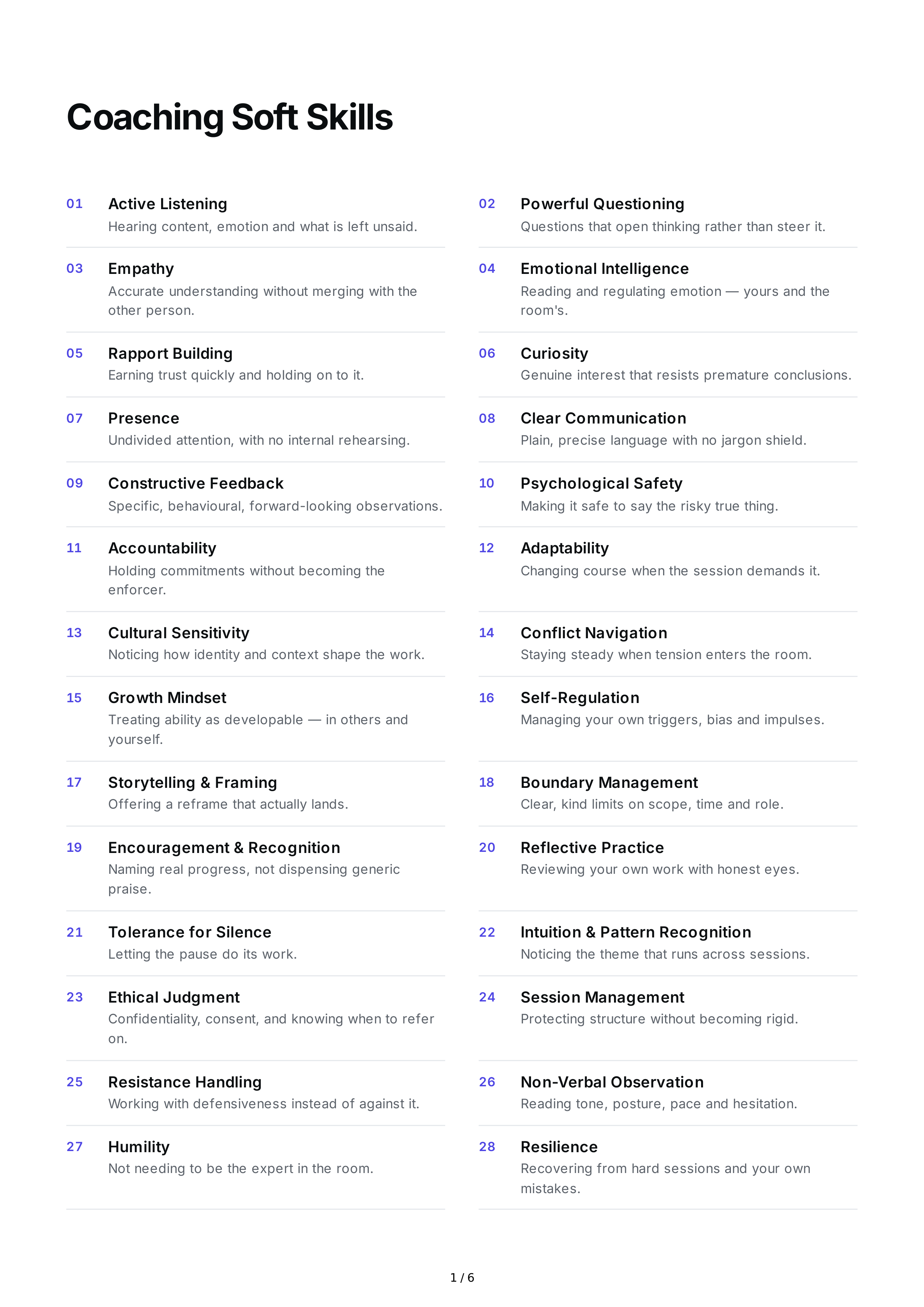
Coaching Soft Skills
Coaching
Soft
Skills
01
Active
Listening
Hearing
content
,
emotion
and
what
is
left
unsaid
.
02
Powerful
Questioning
Questions
that
open
thinking
rather
than
steer
it
.
03
Empathy
Accurate
understanding
without
merging
with
the
other
person
.
04
Emotional
Intelligence
Reading
and
regulating
emotion
—
yours
and
the
room
'
s
.
05
Rapport
Building
Earning
trust
quickly
and
holding
on
to
it
.
06
Curiosity
Genuine
interest
that
resists
premature
conclusions
.
07
Presence
Undivided
attention
,
with
no
internal
rehearsing
.
08
Clear
Communication
Plain
,
precise
language
with
no
jargon
shield
.
09
Constructive
Feedback
Specific
,
behavioural
,
forward
-
looking
observations
.
10
Psychological
Safety
Making
it
safe
to
say
the
risky
true
thing
.
11
Accountability
Holding
commitments
without
becoming
the
enforcer
.
12
Adaptability
Changing
course
when
the
session
demands
it
.
13
Cultural
Sensitivity
Noticing
how
identity
and
context
shape
the
work
.
14
Conflict
Navigation
Staying
steady
when
tension
enters
the
room
.
15
Growth
Mindset
Treating
ability
as
developable
—
in
others
and
yourself
.
16
Self
-
Regulation
Managing
your
own
triggers
,
bias
and
impulses
.
17
Storytelling
&
Framing
Offering
a
reframe
that
actually
lands
.
18
Boundary
Management
Clear
,
kind
limits
on
scope
,
time
and
role
.
19
Encouragement
&
Recognition
Naming
real
progress
,
not
dispensing
generic
praise
.
20
Reflective
Practice
Reviewing
your
own
work
with
honest
eyes
.
21
Tolerance
for
Silence
Letting
the
pause
do
its
work
.
22
Intuition
&
Pattern
Recognition
Noticing
the
theme
that
runs
across
sessions
.
23
Ethical
Judgment
Confidentiality
,
consent
,
and
knowing
when
to
refer
on
.
24
Session
Management
Protecting
structure
without
becoming
rigid
.
25
Resistance
Handling
Working
with
defensiveness
instead
of
against
it
.
26
Non
-
Verbal
Observation
Reading
tone
,
posture
,
pace
and
hesitation
.
27
Humility
Not
needing
to
be
the
expert
in
the
room
.
28
Resilience
Recovering
from
hard
sessions
and
your
own
mistakes
.
1 / 6
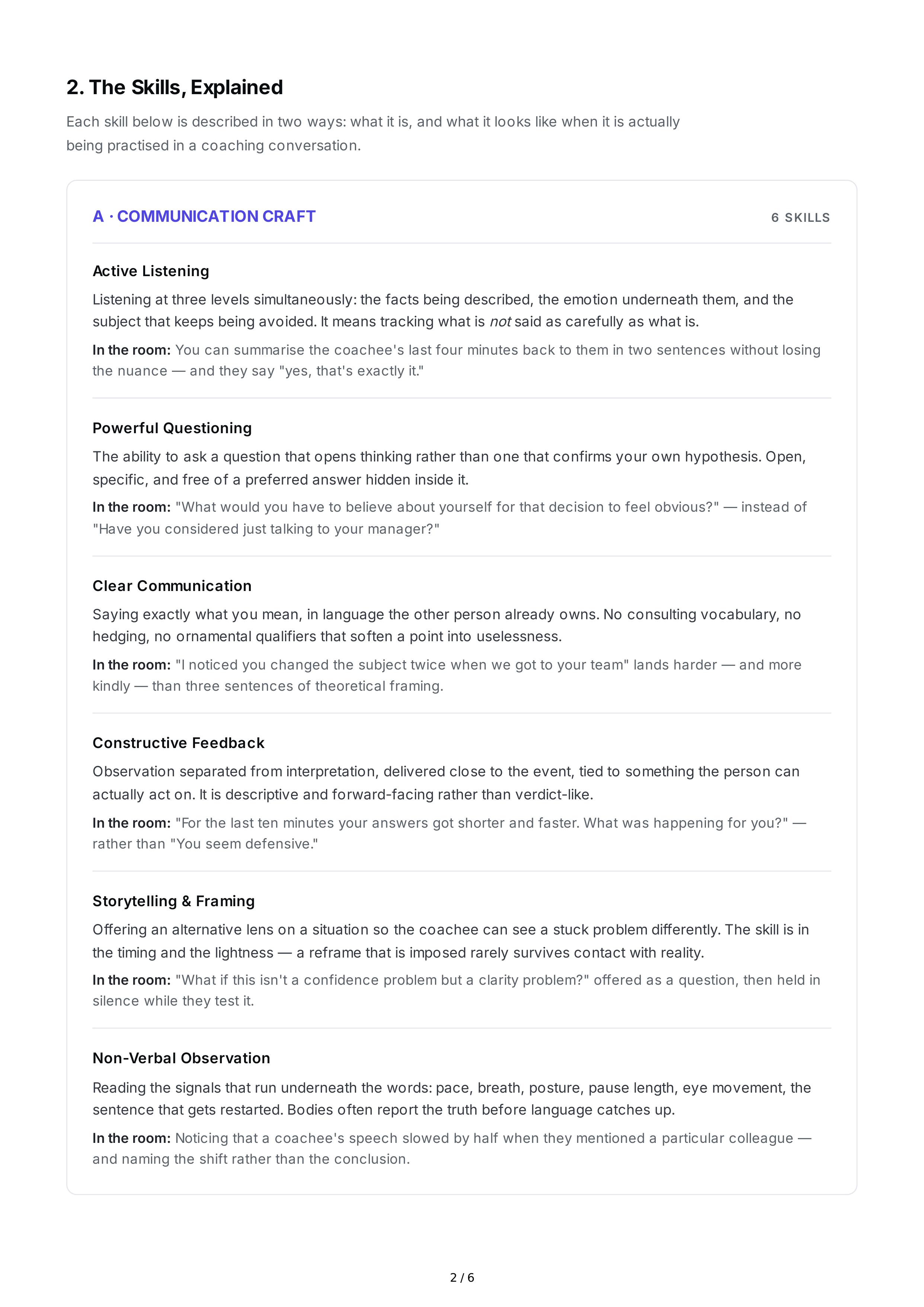
2.
The
Skills
,
Explained
Each
skill
below
is
described
in
two
ways
:
what
it
is
,
and
what
it
looks
like
when
it
is
actually
being
practised
in
a
coaching
conversation
.
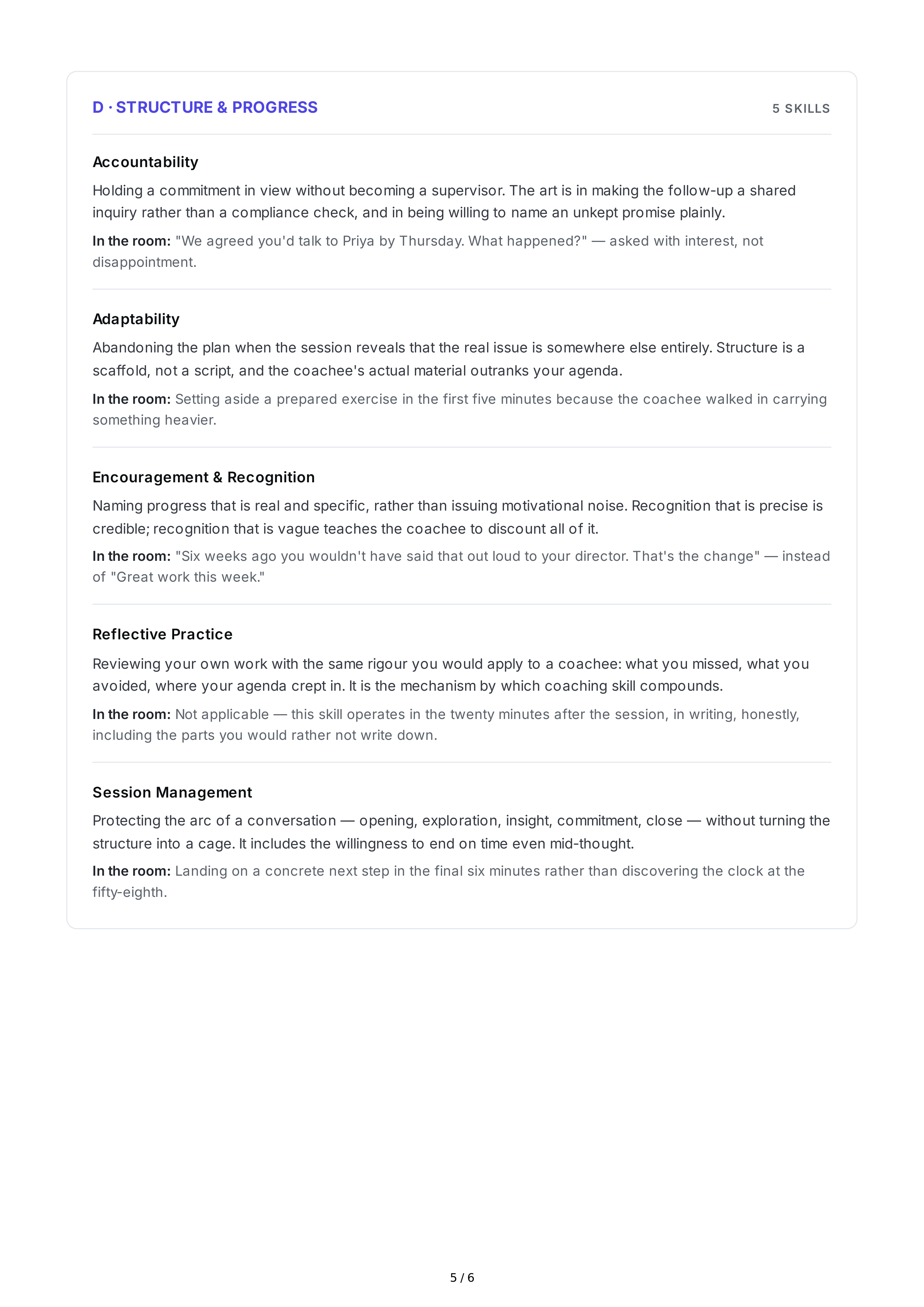
A
·
COMMUNICATION
CRAFT
6
SKILLS
Active
Listening
Listening
at
three
levels
simultaneously
:
the
facts
being
described
,
the
emotion
underneath
them
,
and
the
subject
that
keeps
being
avoided
.
It
means
tracking
what
is
not
said
as
carefully
as
what
is
.
In
the
room
:
You
can
summarise
the
coachee
'
s
last
four
minutes
back
to
them
in
two
sentences
without
losing
the
nuance
—
and
they
say
"
yes
,
that
'
s
exactly
it
."
Powerful
Questioning
The
ability
to
ask
a
question
that
opens
thinking
rather
than
one
that
confirms
your
own
hypothesis
.
Open
,
specific
,
and
free
of
a
preferred
answer
hidden
inside
it
.
In
the
room
:
"
What
would
you
have
to
believe
about
yourself
for
that
decision
to
feel
obvious
?" —
instead
of
"
Have
you
considered
just
talking
to
your
manager
?"
Clear
Communication
Saying
exactly
what
you
mean
,
in
language
the
other
person
already
owns
.
No
consulting
vocabulary
,
no
hedging
,
no
ornamental
qualifiers
that
soften
a
point
into
uselessness
.
In
the
room
:
"
I
noticed
you
changed
the
subject
twice
when
we
got
to
your
team
"
lands
harder
—
and
more
kindly
—
than
three
sentences
of
theoretical
framing
.
Constructive
Feedback
Observation
separated
from
interpretation
,
delivered
close
to
the
event
,
tied
to
something
the
person
can
actually
act
on
.
It
is
descriptive
and
forward
-
facing
rather
than
verdict
-
like
.
In
the
room
:
"
For
the
last
ten
minutes
your
answers
got
shorter
and
faster
.
What
was
happening
for
you
?" —
rather
than
"
You
seem
defensive
."
Storytelling
&
Framing
Offering
an
alternative
lens
on
a
situation
so
the
coachee
can
see
a
stuck
problem
differently
.
The
skill
is
in
the
timing
and
the
lightness
—
a
reframe
that
is
imposed
rarely
survives
contact
with
reality
.
In
the
room
:
"
What
if
this
isn
'
t
a
confidence
problem
but
a
clarity
problem
?"
offered
as
a
question
,
then
held
in
silence
while
they
test
it
.
Non
-
Verbal
Observation
Reading
the
signals
that
run
underneath
the
words
:
pace
,
breath
,
posture
,
pause
length
,
eye
movement
,
the
sentence
that
gets
restarted
.
Bodies
often
report
the
truth
before
language
catches
up
.
In
the
room
:
Noticing
that
a
coachee
'
s
speech
slowed
by
half
when
they
mentioned
a
particular
colleague
—
and
naming
the
shift
rather
than
the
conclusion
.
2 / 6
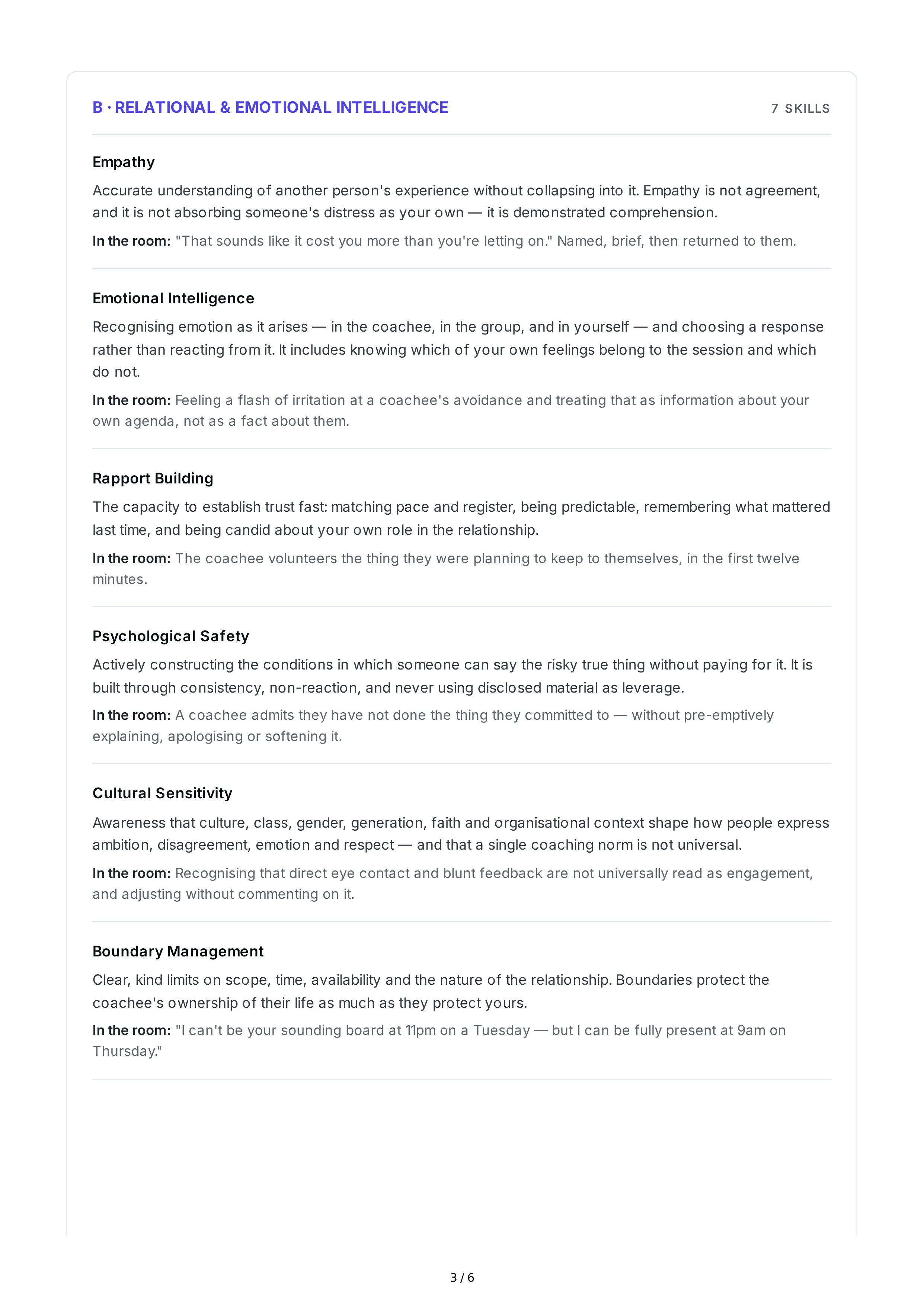
B
·
RELATIONAL
&
EMOTIONAL
INTELLIGENCE
7
SKILLS
Empathy
Accurate
understanding
of
another
person
'
s
experience
without
collapsing
into
it
.
Empathy
is
not
agreement
,
and
it
is
not
absorbing
someone
'
s
distress
as
your
own
—
it
is
demonstrated
comprehension
.
In
the
room
:
"
That
sounds
like
it
cost
you
more
than
you
'
re
letting
on
."
Named
,
brief
,
then
returned
to
them
.
Emotional
Intelligence
Recognising
emotion
as
it
arises
—
in
the
coachee
,
in
the
group
,
and
in
yourself
—
and
choosing
a
response
rather
than
reacting
from
it
.
It
includes
knowing
which
of
your
own
feelings
belong
to
the
session
and
which
do
not
.
In
the
room
:
Feeling
a
flash
of
irritation
at
a
coachee
'
s
avoidance
and
treating
that
as
information
about
your
own
agenda
,
not
as
a
fact
about
them
.
Rapport
Building
The
capacity
to
establish
trust
fast
:
matching
pace
and
register
,
being
predictable
,
remembering
what
mattered
last
time
,
and
being
candid
about
your
own
role
in
the
relationship
.
In
the
room
:
The
coachee
volunteers
the
thing
they
were
planning
to
keep
to
themselves
,
in
the
first
twelve
minutes
.
Psychological
Safety
Actively
constructing
the
conditions
in
which
someone
can
say
the
risky
true
thing
without
paying
for
it
.
It
is
built
through
consistency
,
non
-
reaction
,
and
never
using
disclosed
material
as
leverage
.
In
the
room
:
A
coachee
admits
they
have
not
done
the
thing
they
committed
to
—
without
pre
-
emptively
explaining
,
apologising
or
softening
it
.
Cultural
Sensitivity
Awareness
that
culture
,
class
,
gender
,
generation
,
faith
and
organisational
context
shape
how
people
express
ambition
,
disagreement
,
emotion
and
respect
—
and
that
a
single
coaching
norm
is
not
universal
.
In
the
room
:
Recognising
that
direct
eye
contact
and
blunt
feedback
are
not
universally
read
as
engagement
,
and
adjusting
without
commenting
on
it
.
Boundary
Management
Clear
,
kind
limits
on
scope
,
time
,
availability
and
the
nature
of
the
relationship
.
Boundaries
protect
the
coachee
'
s
ownership
of
their
life
as
much
as
they
protect
yours
.
In
the
room
:
"
I
can
'
t
be
your
sounding
board
at
11
pm
on
a
Tuesday
—
but
I
can
be
fully
present
at
9
am
on
Thursday
."
3 / 6
Humility
Not
needing
to
be
the
expert
,
the
fixer
or
the
most
interesting
person
in
the
conversation
.
It
means
holding
your
own
insight
lightly
enough
that
the
coachee
'
s
conclusion
can
still
take
precedence
.
In
the
room
:
Having
a
genuinely
good
suggestion
and
asking
a
further
question
instead
,
because
the
coachee
is
two
steps
from
arriving
there
themselves
.
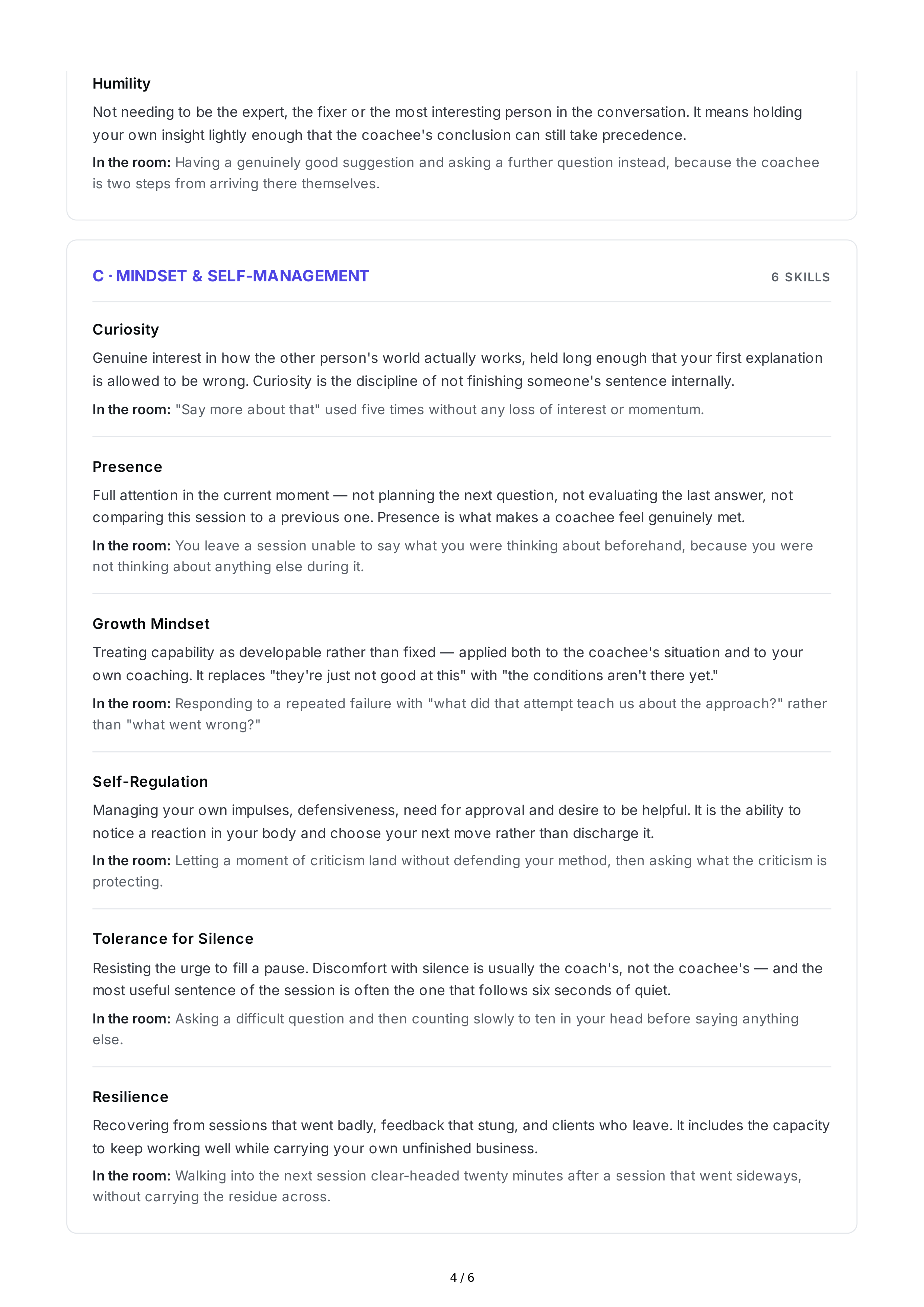
C
·
MINDSET
&
SELF
-
MANAGEMENT
6
SKILLS
Curiosity
Genuine
interest
in
how
the
other
person
'
s
world
actually
works
,
held
long
enough
that
your
first
explanation
is
allowed
to
be
wrong
.
Curiosity
is
the
discipline
of
not
finishing
someone
'
s
sentence
internally
.
In
the
room
:
"
Say
more
about
that
"
used
five
times
without
any
loss
of
interest
or
momentum
.
Presence
Full
attention
in
the
current
moment
—
not
planning
the
next
question
,
not
evaluating
the
last
answer
,
not
comparing
this
session
to
a
previous
one
.
Presence
is
what
makes
a
coachee
feel
genuinely
met
.
In
the
room
:
You
leave
a
session
unable
to
say
what
you
were
thinking
about
beforehand
,
because
you
were
not
thinking
about
anything
else
during
it
.
Growth
Mindset
Treating
capability
as
developable
rather
than
fixed
—
applied
both
to
the
coachee
'
s
situation
and
to
your
own
coaching
.
It
replaces
"
they
'
re
just
not
good
at
this
"
with
"
the
conditions
aren
'
t
there
yet
."
In
the
room
:
Responding
to
a
repeated
failure
with
"
what
did
that
attempt
teach
us
about
the
approach
?"
rather
than
"
what
went
wrong
?"
Self
-
Regulation
Managing
your
own
impulses
,
defensiveness
,
need
for
approval
and
desire
to
be
helpful
.
It
is
the
ability
to
notice
a
reaction
in
your
body
and
choose
your
next
move
rather
than
discharge
it
.
In
the
room
:
Letting
a
moment
of
criticism
land
without
defending
your
method
,
then
asking
what
the
criticism
is
protecting
.
Tolerance
for
Silence
Resisting
the
urge
to
fill
a
pause
.
Discomfort
with
silence
is
usually
the
coach
'
s
,
not
the
coachee
'
s
—
and
the
most
useful
sentence
of
the
session
is
often
the
one
that
follows
six
seconds
of
quiet
.
In
the
room
:
Asking
a
difficult
question
and
then
counting
slowly
to
ten
in
your
head
before
saying
anything
else
.
Resilience
Recovering
from
sessions
that
went
badly
,
feedback
that
stung
,
and
clients
who
leave
.
It
includes
the
capacity
to
keep
working
well
while
carrying
your
own
unfinished
business
.
In
the
room
:
Walking
into
the
next
session
clear
-
headed
twenty
minutes
after
a
session
that
went
sideways
,
without
carrying
the
residue
across
.
4 / 6
D
·
STRUCTURE
&
PROGRESS
5
SKILLS
Accountability
Holding
a
commitment
in
view
without
becoming
a
supervisor
.
The
art
is
in
making
the
follow
-
up
a
shared
inquiry
rather
than
a
compliance
check
,
and
in
being
willing
to
name
an
unkept
promise
plainly
.
In
the
room
:
"
We
agreed
you
'
d
talk
to
Priya
by
Thursday
.
What
happened
?" —
asked
with
interest
,
not
disappointment
.
Adaptability
Abandoning
the
plan
when
the
session
reveals
that
the
real
issue
is
somewhere
else
entirely
.
Structure
is
a
scaffold
,
not
a
script
,
and
the
coachee
'
s
actual
material
outranks
your
agenda
.
In
the
room
:
Setting
aside
a
prepared
exercise
in
the
first
five
minutes
because
the
coachee
walked
in
carrying
something
heavier
.
Encouragement
&
Recognition
Naming
progress
that
is
real
and
specific
,
rather
than
issuing
motivational
noise
.
Recognition
that
is
precise
is
credible
;
recognition
that
is
vague
teaches
the
coachee
to
discount
all
of
it
.
In
the
room
:
"
Six
weeks
ago
you
wouldn
'
t
have
said
that
out
loud
to
your
director
.
That
'
s
the
change
" —
instead
of
"
Great
work
this
week
."
Reflective
Practice
Reviewing
your
own
work
with
the
same
rigour
you
would
apply
to
a
coachee
:
what
you
missed
,
what
you
avoided
,
where
your
agenda
crept
in
.
It
is
the
mechanism
by
which
coaching
skill
compounds
.
In
the
room
:
Not
applicable
—
this
skill
operates
in
the
twenty
minutes
after
the
session
,
in
writing
,
honestly
,
including
the
parts
you
would
rather
not
write
down
.
Session
Management
Protecting
the
arc
of
a
conversation
—
opening
,
exploration
,
insight
,
commitment
,
close
—
without
turning
the
structure
into
a
cage
.
It
includes
the
willingness
to
end
on
time
even
mid
-
thought
.
In
the
room
:
Landing
on
a
concrete
next
step
in
the
final
six
minutes
rather
than
discovering
the
clock
at
the
fifty
-
eighth
.
5 / 6
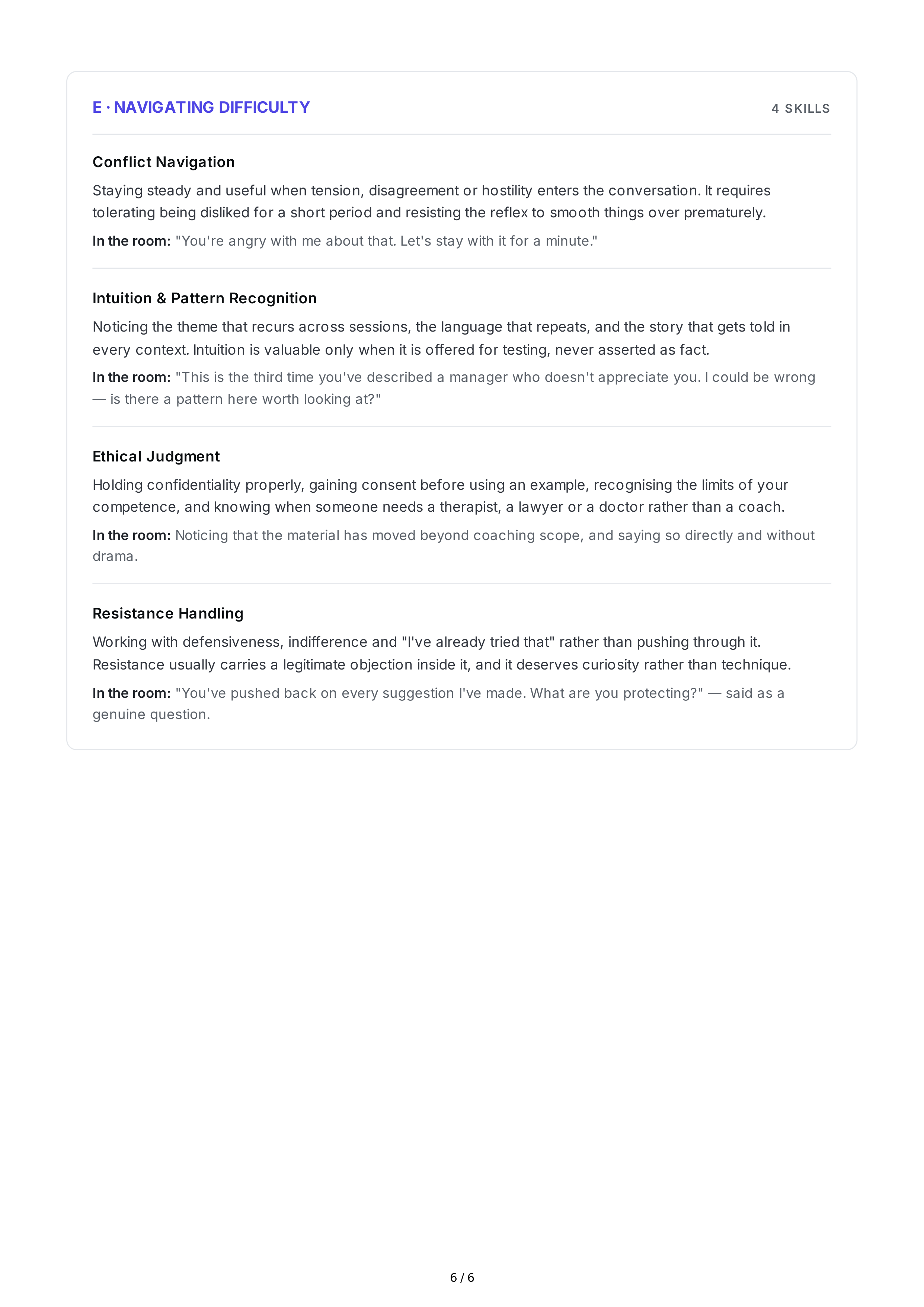
E
·
NAVIGATING
DIFFICULTY
4
SKILLS
Conflict
Navigation
Staying
steady
and
useful
when
tension
,
disagreement
or
hostility
enters
the
conversation
.
It
requires
tolerating
being
disliked
for
a
short
period
and
resisting
the
reflex
to
smooth
things
over
prematurely
.
In
the
room
:
"
You
'
re
angry
with
me
about
that
.
Let
'
s
stay
with
it
for
a
minute
."
Intuition
&
Pattern
Recognition
Noticing
the
theme
that
recurs
across
sessions
,
the
language
that
repeats
,
and
the
story
that
gets
told
in
every
context
.
Intuition
is
valuable
only
when
it
is
offered
for
testing
,
never
asserted
as
fact
.
In
the
room
:
"
This
is
the
third
time
you
'
ve
described
a
manager
who
doesn
'
t
appreciate
you
.
I
could
be
wrong
—
is
there
a
pattern
here
worth
looking
at
?"
Ethical
Judgment
Holding
confidentiality
properly
,
gaining
consent
before
using
an
example
,
recognising
the
limits
of
your
competence
,
and
knowing
when
someone
needs
a
therapist
,
a
lawyer
or
a
doctor
rather
than
a
coach
.
In
the
room
:
Noticing
that
the
material
has
moved
beyond
coaching
scope
,
and
saying
so
directly
and
without
drama
.
Resistance
Handling
Working
with
defensiveness
,
indifference
and
"
I
'
ve
already
tried
that
"
rather
than
pushing
through
it
.
Resistance
usually
carries
a
legitimate
objection
inside
it
,
and
it
deserves
curiosity
rather
than
technique
.
In
the
room
:
"
You
'
ve
pushed
back
on
every
suggestion
I
'
ve
made
.
What
are
you
protecting
?" —
said
as
a
genuine
question
.
6 / 6
Similar Examples
Generate Similar
Influence Soft Skills
Generate Similar
Accountability Soft Skills
Generate Similar
Responsibility Soft Skills
Generate Similar
People Management Soft Skills
Generate Similar
Problem-Solving Soft Skills
Generate Similar
Critical Thinking Soft Skills
Generate Similar
Analytical Thinking Soft Skills
Generate Similar
Creative Thinking Soft Skills
Generate Similar
Strategic Thinking Soft Skills
Generate Similar
Logical Thinking Soft Skills
Generate Similar
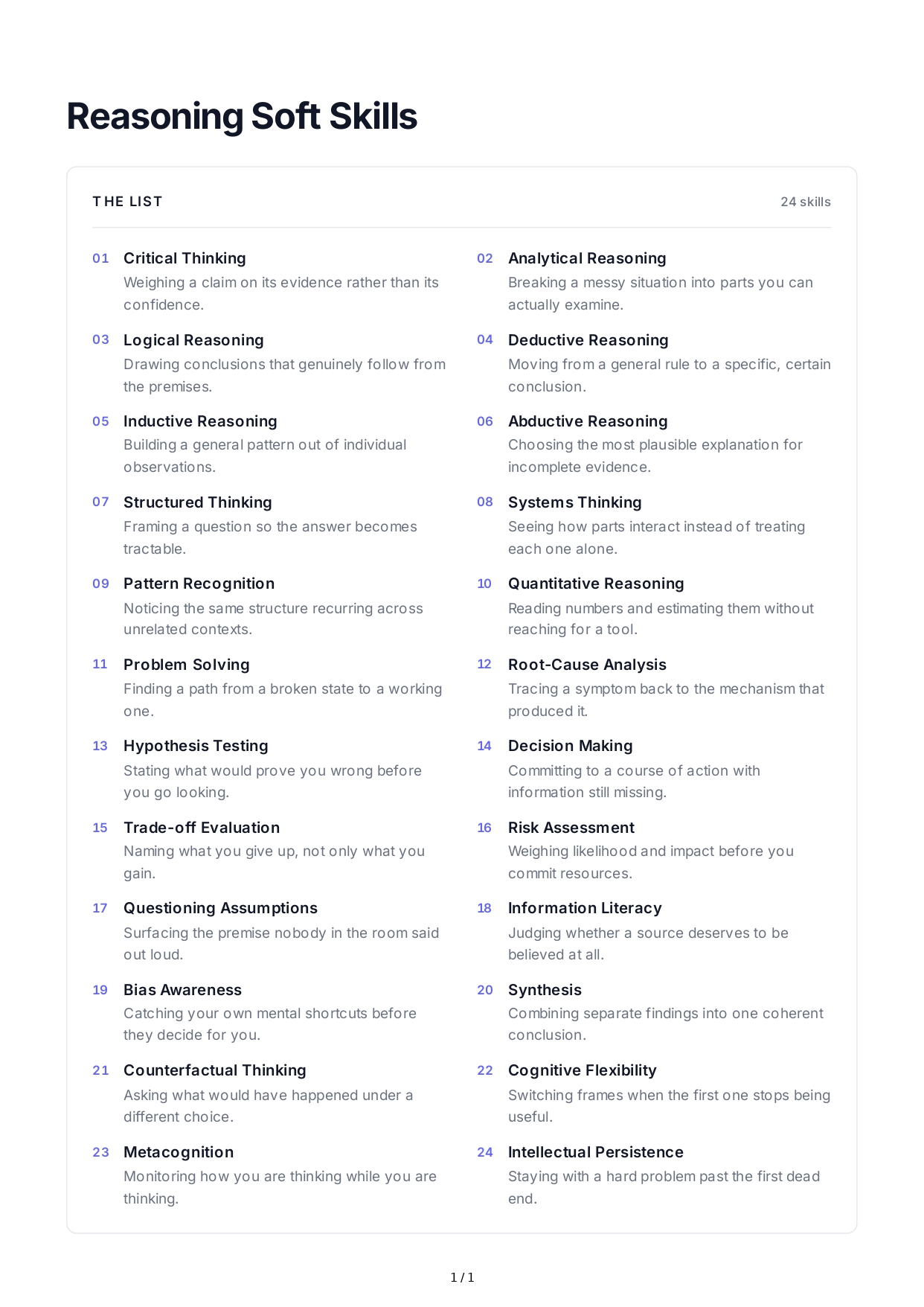
Reasoning Soft Skills
Generate Similar
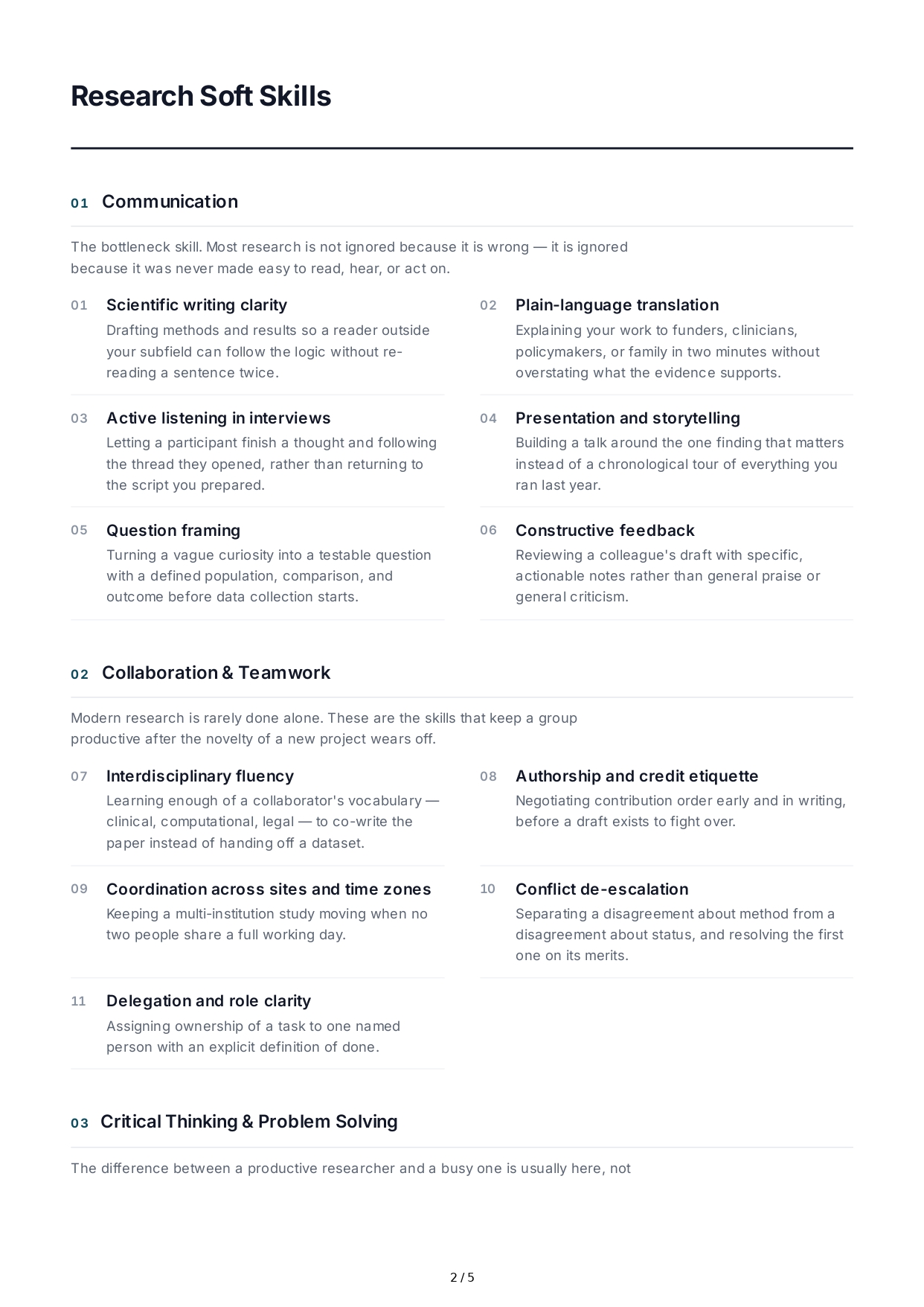
Research Soft Skills
Generate Similar
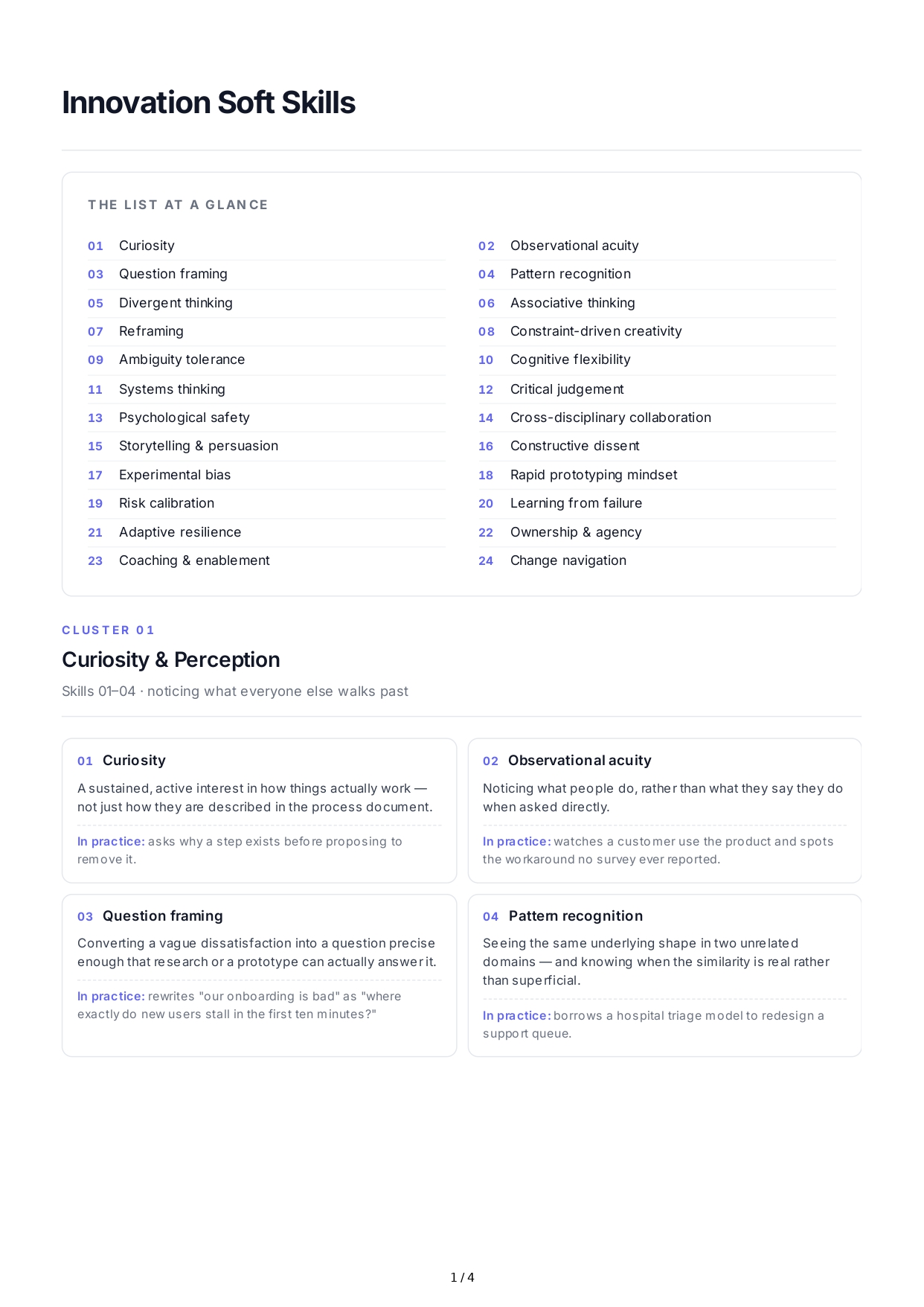
Innovation Soft Skills
Generate Similar
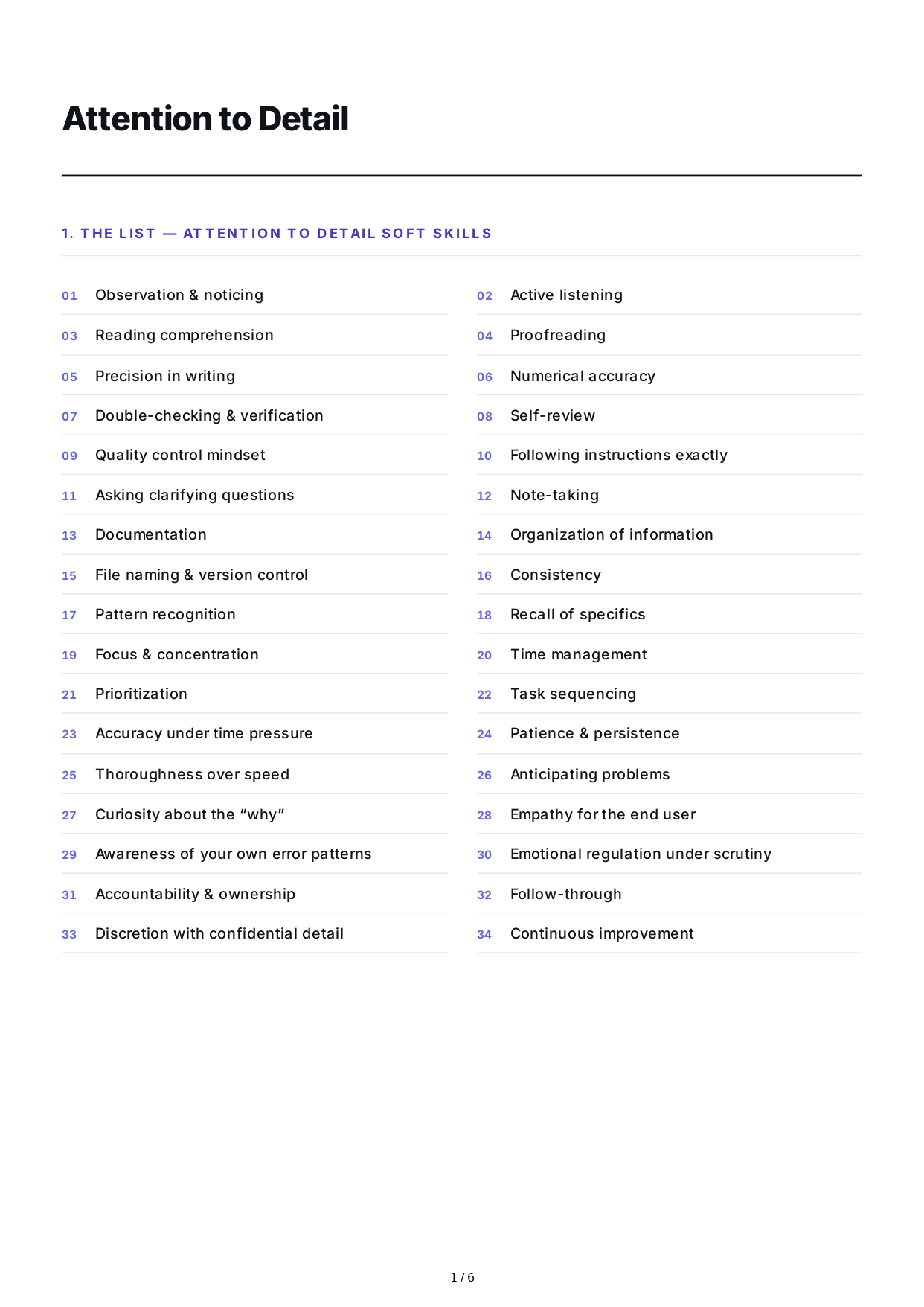
Attention to Detail Soft Skills
Generate Similar
Resourcefulness Soft Skills
Generate Similar
Planning Soft Skills
Generate Similar
Organizational Soft Skills
Generate Similar
Time Management Soft Skills
Generate Similar
Prioritization Soft Skills
Generate Similar
Adaptability Soft Skills
Generate Similar
Flexibility Soft Skills
Generate Similar
Resilience Soft Skills