Creative
Thinking
Soft
Skills
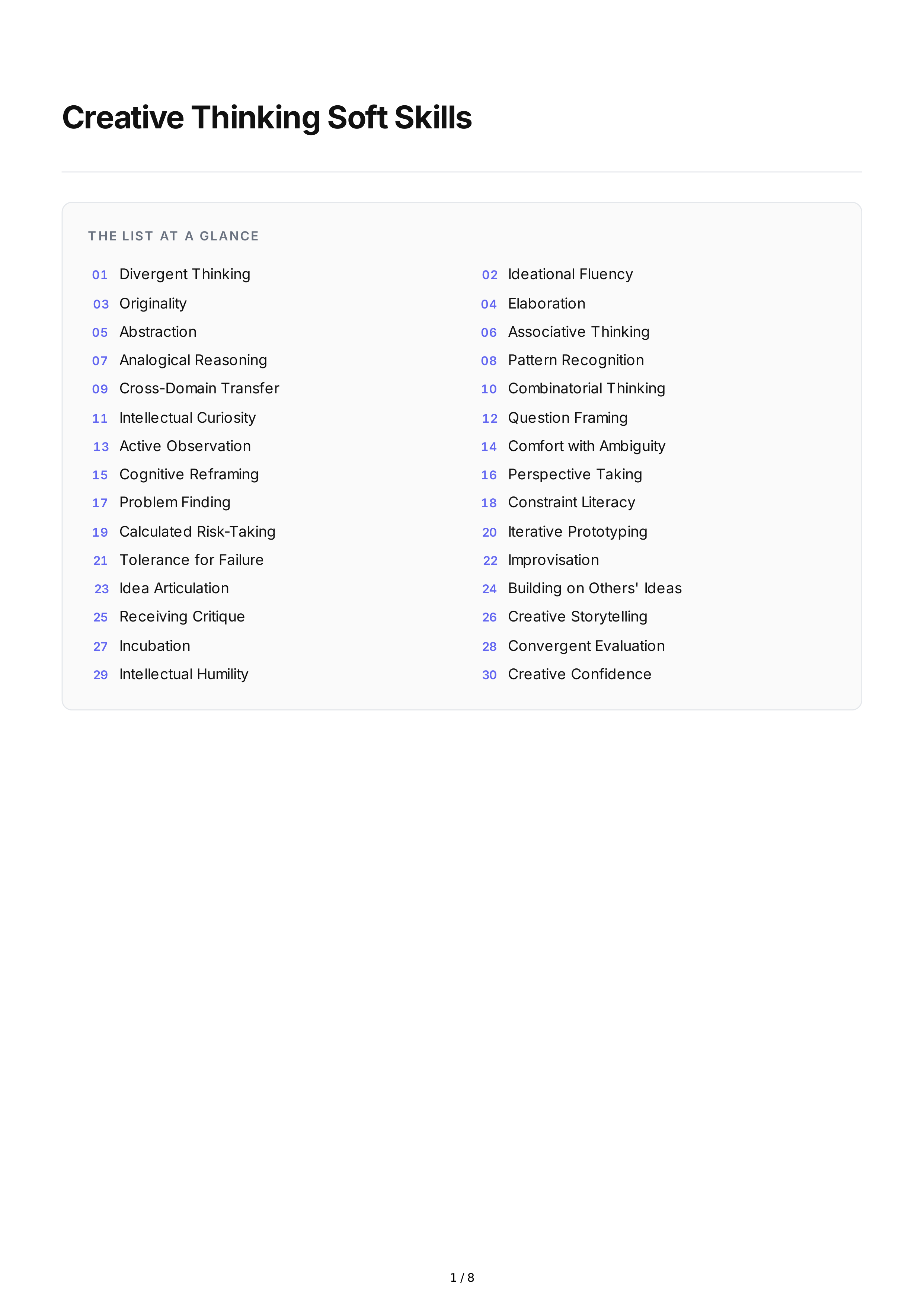
T HE
LIST
AT
A
GLANCE
01
Divergent
Thinking
02
Ideational
Fluency
03
Originality
04
Elaboration
05
Abstraction
06
Associative
Thinking
07
Analogical
Reasoning
08
Pattern
Recognition
09
Cross
-
Domain
Transfer
10
Combinatorial
Thinking
11
Intellectual
Curiosity
12
Question
Framing
13
Active
Observation
14
Comfort
with
Ambiguity
15
Cognitive
Reframing
16
Perspective
Taking
17
Problem
Finding
18
Constraint
Literacy
19
Calculated
Risk
-
Taking
20
Iterative
Prototyping
21
Tolerance
for
Failure
22
Improvisation
23
Idea
Articulation
24
Building
on
Others
'
Ideas
25
Receiving
Critique
26
Creative
Storytelling
27
Incubation
28
Convergent
Evaluation
29
Intellectual
Humility
30
Creative
Confidence
1 / 8
Divergent
Thinking
&
Idea
Generation
PRODUCING
OPTIONS
01
Divergent
Thinking
Generating
many
possible
answers
to
a
single
open
question
before
judging
any
of
them
.
The
deliberate
deferral
of
evaluation
is
what
makes
the
volume
possible
.
In
practice
:
Set
a
quota
of
twenty
ideas
before
you
allow
yourself
to
critique
the
first
one
.
02
Ideational
Fluency
The
raw
speed
and
ease
with
which
ideas
arrive
.
Fluency
is
trainable
—
it
responds
to
repetition
,
prompts
,
and
exposure
to
unfamiliar
material
.
In
practice
:
Run
a
five
-
minute
timed
idea
sprint
on
a
problem
you
already
think
you
'
ve
solved
.
03
Originality
The
ability
to
produce
an
idea
that
is
statistically
uncommon
rather
than
merely
correct
.
Originality
is
measured
against
the
obvious
answer
,
not
against
perfection
.
In
practice
:
Ask
"
what
would
make
this
idea
unrecognisable
to
the
person
who
first
proposed
it
?"
04
Elaboration
Fleshing
out
a
rough
idea
with
detail
,
sequence
,
and
consequence
until
someone
else
could
build
it
.
Most
ideas
die
from
under
-
description
,
not
from
being
wrong
.
In
practice
:
Write
a
one
-
paragraph
build
spec
for
your
wildest
idea
before
you
decide
it
'
s
unrealistic
.
05
Abstraction
Moving
up
a
level
to
name
the
underlying
principle
,
then
moving
back
down
to
apply
it
somewhere
new
.
Abstraction
is
how
a
specific
fix
becomes
a
reusable
method
.
In
practice
:
After
solving
a
problem
,
name
the
general
principle
in
one
sentence
—
then
find
a
second
place
it
applies
.
2 / 8
Connection
&
Association
COMBINING
IDEAS
06
Associative
Thinking
Following
the
link
between
two
apparently
unrelated
things
and
seeing
whether
the
link
holds
.
Creative
insight
is
usually
association
before
it
is
invention
.
In
practice
:
Pick
a
random
object
in
the
room
and
force
a
connection
to
the
problem
on
your
desk
.
07
Analogical
Reasoning
Borrowing
the
structure
of
a
solved
problem
from
another
field
and
mapping
it
onto
your
own
.
The
value
is
in
the
structure
,
not
the
surface
similarity
.
In
practice
:
Ask
how
a
hospital
triage
desk
,
an
airport
,
or
a
restaurant
kitchen
would
handle
your
bottleneck
.
08
Pattern
Recognition
Noticing
recurrence
—
the
same
complaint
,
the
same
delay
,
the
same
workaround
—
and
treating
repetition
as
a
signal
rather
than
noise
.
In
practice
:
Keep
a
running
note
of
things
you
have
fixed
twice
;
the
third
time
,
it
is
a
pattern
worth
designing
for
.
09
Cross
-
Domain
Transfer
Carrying
a
method
,
model
,
or
metaphor
from
one
discipline
into
another
and
adapting
it
honestly
rather
than
pasting
it
wholesale
.
In
practice
:
Read
one
article
a
week
from
a
field
you
have
no
professional
stake
in
.
10
Combinatorial
Thinking
Treating
existing
elements
as
components
to
be
recombined
.
Most
"
new
"
ideas
are
two
familiar
things
joined
at
an
angle
nobody
had
tried
.
In
practice
:
List
three
things
you
already
own
or
know
,
then
combine
two
of
them
into
a
single
offering
.
3 / 8
Curiosity
&
Inquiry
FEEDING
THE
INPUT
11
Intellectual
Curiosity
A
genuine
appetite
for
understanding
things
that
are
not
immediately
useful
to
you
.
Curiosity
is
the
input
valve
on
the
whole
system
.
In
practice
:
Ask
one
"
why
does
it
work
that
way
?"
question
per
meeting
—
and
stay
for
the
answer
.
12
Question
Framing
Writing
the
problem
as
a
question
that
is
open
enough
to
allow
surprise
and
specific
enough
to
be
answerable
.
A
well
-
framed
question
does
half
the
work
.
In
practice
:
Rewrite
your
brief
three
ways
,
each
starting
with
"
How
might
we
…"
at
a
different
level
of
ambition
.
13
Active
Observation
Watching
how
people
actually
behave
instead
of
how
they
are
supposed
to
.
Observation
catches
the
workarounds
and
the
awkward
silences
that
interviews
miss
.
In
practice
:
Spend
thirty
minutes
watching
a
workflow
end
to
end
without
interrupting
to
help
.
14
Comfort
with
Ambiguity
Working
productively
before
the
problem
,
the
constraints
,
or
the
definition
of
done
is
settled
.
Creativity
requires
a
tolerance
for
the
unfinished
.
In
practice
:
Start
a
draft
while
two
open
questions
remain
unresolved
,
and
mark
the
assumptions
you
'
re
carrying
.
4 / 8
Reframing
&
Perspective
CHANGING
THE
ANGLE
15
Cognitive
Reframing
Deliberately
restating
a
problem
so
that
a
different
class
of
solution
becomes
visible
.
Most
stuck
problems
are
stuck
because
of
the
frame
,
not
the
difficulty
.
In
practice
:
Rewrite
your
problem
as
an
opportunity
,
then
as
a
constraint
,
then
as
a
question
about
the
person
affected
.
16
Perspective
Taking
Reasoning
from
someone
else
'
s
incentives
,
knowledge
,
and
constraints
rather
than
your
own
.
It
is
the
difference
between
an
idea
that
works
and
one
that
gets
used
.
In
practice
:
Describe
your
idea
once
as
the
customer
,
once
as
the
sceptic
,
once
as
the
person
who
has
to
maintain
it
.
17
Problem
Finding
Recognising
which
problem
is
worth
solving
in
the
first
place
.
Choosing
well
is
usually
worth
more
than
solving
brilliantly
.
In
practice
:
Before
starting
,
write
down
what
happens
if
this
problem
simply
goes
unsolved
for
a
year
.
18
Constraint
Literacy
Telling
the
difference
between
constraints
that
are
fixed
and
constraints
that
are
merely
inherited
habit
.
Real
constraints
sharpen
work
;
assumed
ones
flatten
it
.
In
practice
:
Label
every
constraint
on
your
list
as
legal
,
physical
,
technical
,
or
"
we
'
ve
always
done
it
this
way
."
5 / 8
Experimentation
&
Risk
TESTING
IN
THE
OPEN
19
Calculated
Risk
-
Taking
Choosing
exposure
in
proportion
to
what
you
stand
to
learn
.
The
point
is
not
bravery
but
sizing
the
bet
so
the
lesson
is
affordable
.
In
practice
:
Before
committing
,
name
the
smallest
version
of
this
bet
that
still
produces
a
real
signal
.
20
Iterative
Prototyping
Building
the
cheapest
possible
version
of
an
idea
so
it
can
be
tested
rather
than
debated
.
A
prototype
ends
arguments
that
meetings
cannot
.
In
practice
:
Ask
"
what
is
the
crudest
thing
I
could
put
in
front
of
a
user
by
Thursday
?"
21
Tolerance
for
Failure
Treating
a
failed
attempt
as
information
rather
than
as
a
verdict
on
your
ability
.
This
is
what
allows
a
second
attempt
to
happen
at
all
.
In
practice
:
After
a
failed
experiment
,
write
one
sentence
on
what
you
now
know
that
you
didn
'
t
before
.
22
Improvisation
Responding
usefully
when
the
plan
breaks
—
accepting
the
situation
as
offered
and
building
forward
from
it
rather
than
restarting
.
In
practice
:
Practise
saying
"
yes
,
and
…"
in
your
next
review
instead
of
correcting
the
opener
.
6 / 8
Collaboration
&
Communication
MAKING
IDEAS
TRAVEL
23
Idea
Articulation
Explaining
a
half
-
formed
idea
clearly
enough
that
others
can
engage
with
it
.
An
idea
nobody
can
restate
is
an
idea
nobody
can
build
.
In
practice
:
Describe
the
idea
in
one
sentence
,
then
in
one
paragraph
,
then
in
one
picture
.
24
Building
on
Others
'
Ideas
Treating
a
colleague
'
s
rough
proposal
as
a
starting
point
to
develop
rather
than
a
target
to
correct
.
Combined
ideas
beat
defended
ones
.
In
practice
:
In
your
next
brainstorm
,
respond
to
every
idea
with
an
addition
before
any
objection
.
25
Receiving
Critique
Separating
the
work
from
the
self
,
extracting
the
useful
part
of
the
feedback
,
and
asking
a
clarifying
question
instead
of
defending
.
In
practice
:
Ask
"
what
would
have
to
be
true
for
this
to
work
?"
when
someone
pushes
back
.
26
Creative
Storytelling
Framing
an
idea
so
it
lands
emotionally
as
well
as
logically
.
The
narrative
is
often
what
gets
an
idea
resourced
and
remembered
.
In
practice
:
Open
your
next
pitch
with
the
situation
as
it
stands
,
not
with
the
solution
you
built
.
7 / 8
Metacognition
&
Self
-
Management
RUNNING
THE
PROCESS
27
Incubation
Stepping
away
from
a
problem
so
that
background
processing
can
do
its
work
.
Deliberate
rest
is
part
of
the
method
,
not
a
break
from
it
.
In
practice
:
When
stuck
,
write
the
problem
down
and
walk
away
from
it
for
twenty
minutes
rather
than
pushing
harder
.
28
Convergent
Evaluation
Knowing
when
to
stop
generating
and
start
choosing
—
applying
explicit
criteria
to
select
,
combine
,
and
cut
.
Divergence
without
convergence
produces
nothing
.
In
practice
:
Agree
on
three
selection
criteria
before
you
look
at
shortlists
,
not
after
.
29
Intellectual
Humility
Holding
your
own
idea
firmly
enough
to
defend
it
and
loosely
enough
to
abandon
it
when
the
evidence
changes
.
Certainty
is
the
most
common
creative
blocker
.
In
practice
:
Name
one
condition
under
which
you
would
change
your
mind
,
and
write
it
down
before
the
meeting
.
30
Creative
Confidence
The
settled
belief
that
you
are
capable
of
producing
something
worth
making
,
which
is
what
allows
you
to
begin
before
you
feel
ready
.
In
practice
:
Keep
a
file
of
finished
work
;
re
-
read
it
on
the
days
the
work
feels
pointless
.
8 / 8