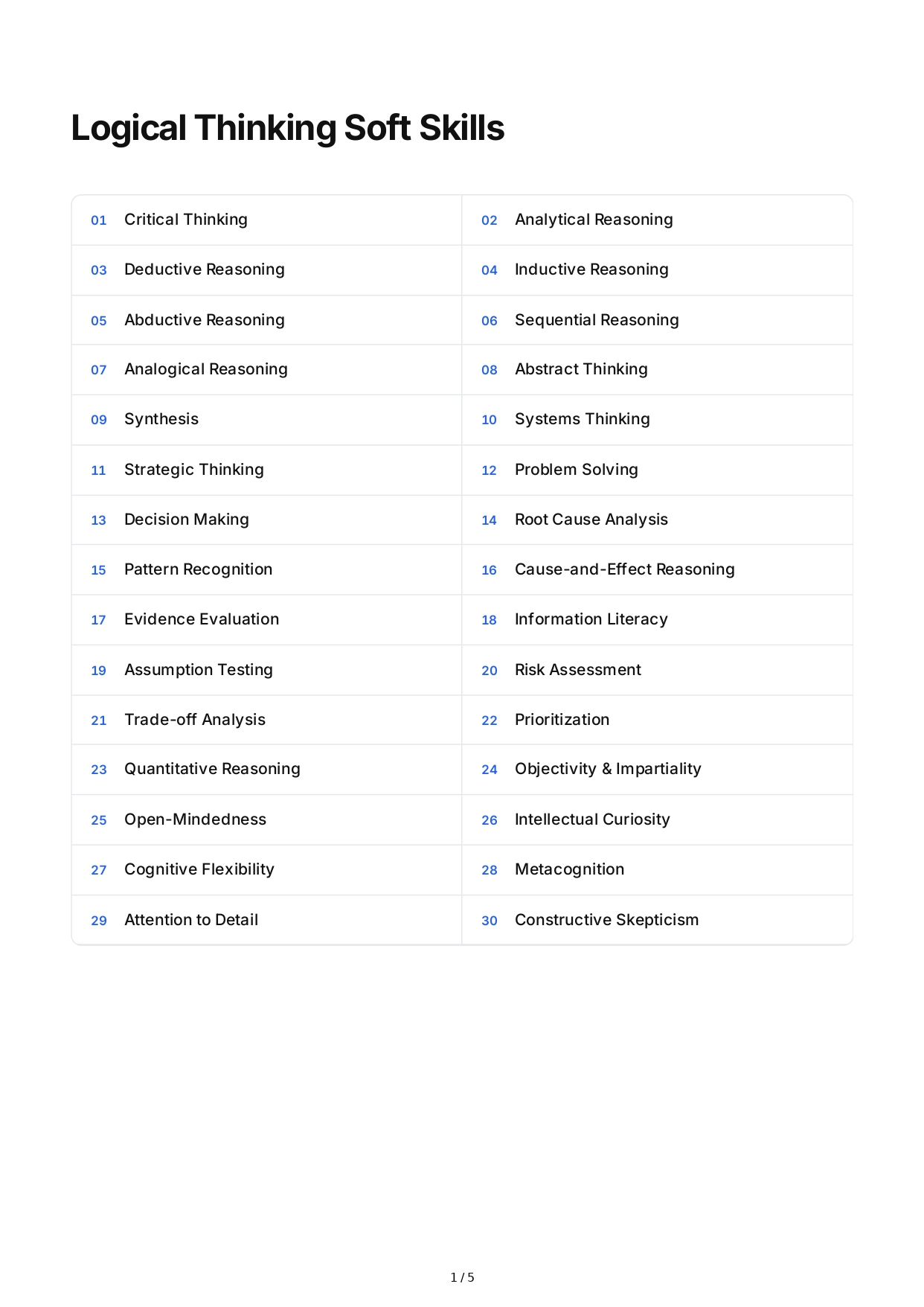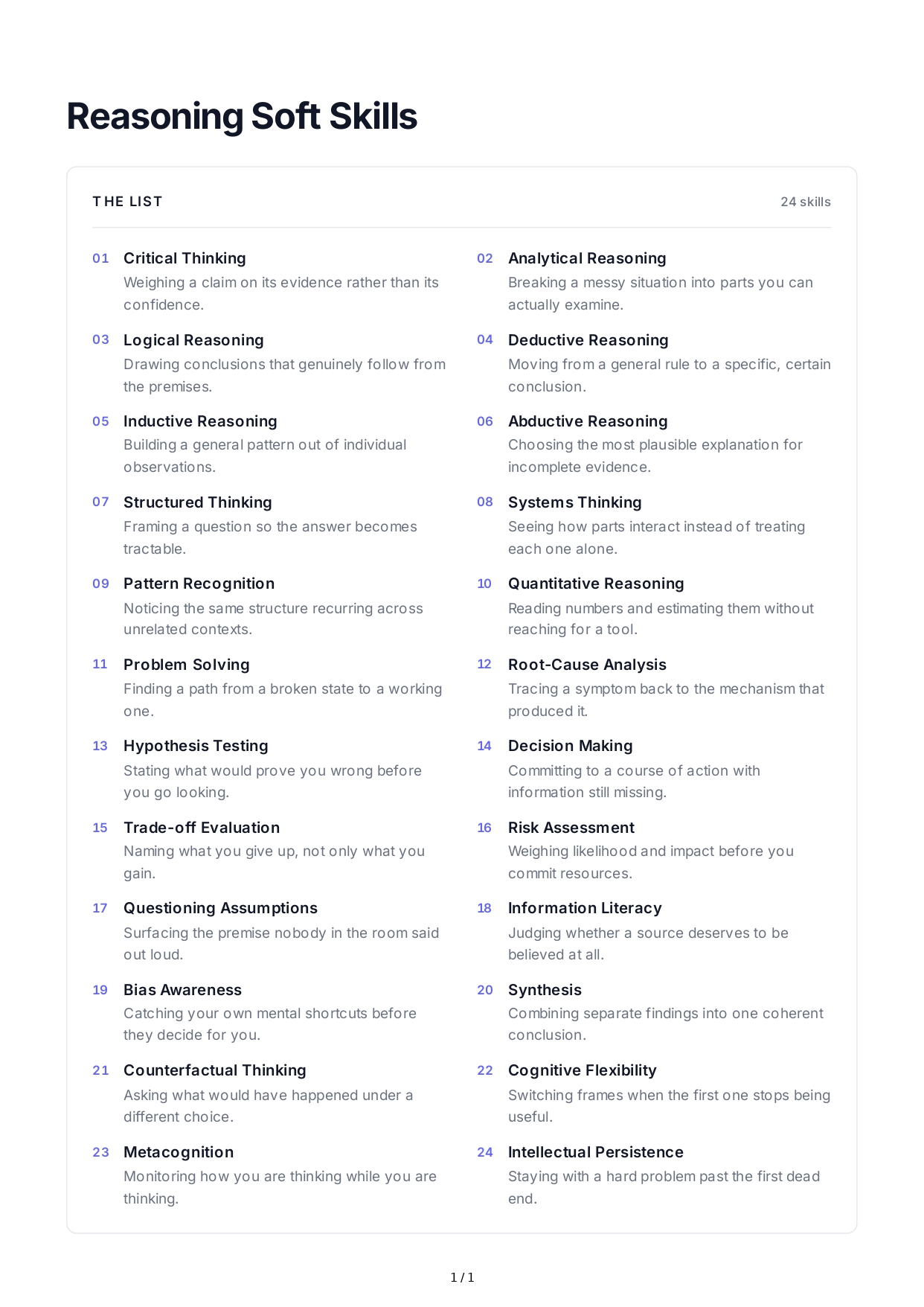
Critical
Thinking
Soft
Skills
01
Intellectual
Curiosity
A
drive
to
understand
why
,
not
just
to
finish
the
task
.
02
Question
Framing
Turning
a
vague
problem
into
a
precise
,
answerable
question
.
03
Healthy
Skepticism
Testing
claims
and
sources
without
rejecting
them
by
reflex
.
04
Information
Seeking
Knowing
what
you
don
'
t
know
,
and
going
to
find
it
.
05
Analytical
Reasoning
Breaking
a
complex
problem
into
parts
you
can
examine
.
06
Logical
Reasoning
Following
an
argument
to
its
conclusion
and
finding
the
break
.
07
Evidence
Evaluation
Weighing
the
quality
,
relevance
and
recency
of
what
'
s
cited
.
08
Assumption
Testing
Surfacing
unstated
beliefs
and
checking
them
before
building
.
09
Objectivity
&
Bias
Awareness
Noticing
your
own
incentives
and
blind
spots
in
a
judgment
.
10
Prioritization
&
Judgment
Deciding
what
actually
matters
when
everything
looks
urgent
.
11
Decision
-
Making
Under
Uncertainty
Choosing
and
committing
before
all
the
information
is
in
.
12
Risk
Assessment
Anticipating
what
could
go
wrong
,
how
likely
,
and
how
bad
.
13
Perspective
-
Taking
Reconstructing
how
the
problem
looks
from
another
seat
.
14
Open
-
Mindedness
Updating
your
position
when
better
evidence
arrives
.
15
Cognitive
Flexibility
Switching
approach
when
the
current
one
stops
working
.
16
Creative
Problem
Solving
Generating
options
that
aren
'
t
on
the
obvious
list
.
17
Metacognition
Observing
your
own
thinking
while
it
happens
.
18
Reflection
&
Learning
Agility
Turning
experience
into
better
judgment
next
time
.
19
Reasoning
Transparency
Showing
how
you
got
there
so
others
can
check
the
work
.
20
Synthesis
&
Information
Integration
Combining
separate
pieces
into
one
coherent
whole
.
How
to
read
the
rest
of
this
sheet
:
each
skill
carries
a
short
definition
and
a
looks
like
line
—
a
concrete
behaviour
you
could
actually
see
in
a
meeting
,
a
review
,
or
an
interview
.
The
behaviours
are
the
assessment
surface
;
the
definitions
are
the
vocabulary
.
2 / 7
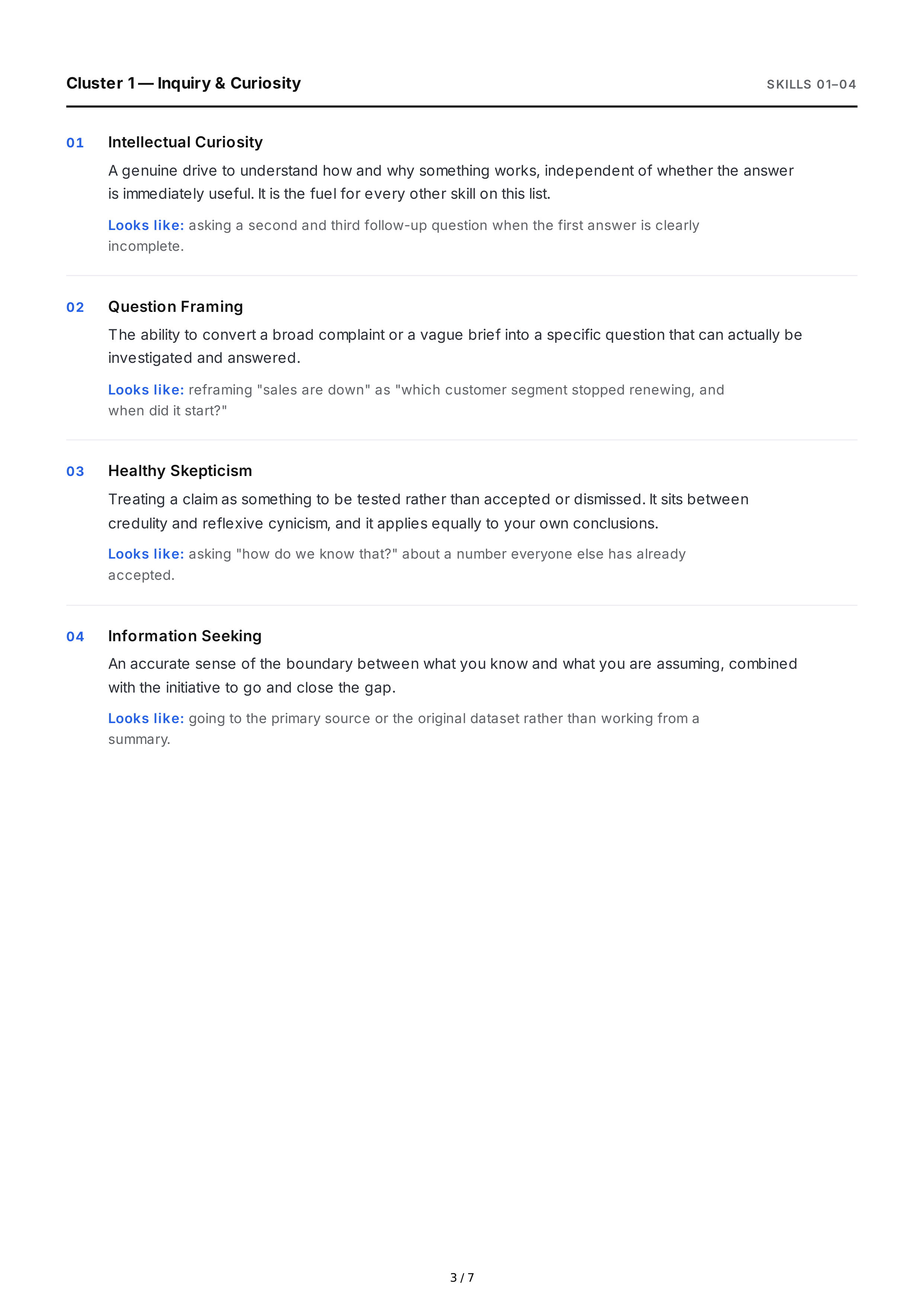
Cluster
1 —
Inquiry
&
Curiosity
SKILLS
01–04
01
Intellectual
Curiosity
A
genuine
drive
to
understand
how
and
why
something
works
,
independent
of
whether
the
answer
is
immediately
useful
.
It
is
the
fuel
for
every
other
skill
on
this
list
.
Looks
like
:
asking
a
second
and
third
follow
-
up
question
when
the
first
answer
is
clearly
incomplete
.
02
Question
Framing
The
ability
to
convert
a
broad
complaint
or
a
vague
brief
into
a
specific
question
that
can
actually
be
investigated
and
answered
.
Looks
like
:
reframing
"
sales
are
down
"
as
"
which
customer
segment
stopped
renewing
,
and
when
did
it
start
?"
03
Healthy
Skepticism
Treating
a
claim
as
something
to
be
tested
rather
than
accepted
or
dismissed
.
It
sits
between
credulity
and
reflexive
cynicism
,
and
it
applies
equally
to
your
own
conclusions
.
Looks
like
:
asking
"
how
do
we
know
that
?"
about
a
number
everyone
else
has
already
accepted
.
04
Information
Seeking
An
accurate
sense
of
the
boundary
between
what
you
know
and
what
you
are
assuming
,
combined
with
the
initiative
to
go
and
close
the
gap
.
Looks
like
:
going
to
the
primary
source
or
the
original
dataset
rather
than
working
from
a
summary
.
3 / 7
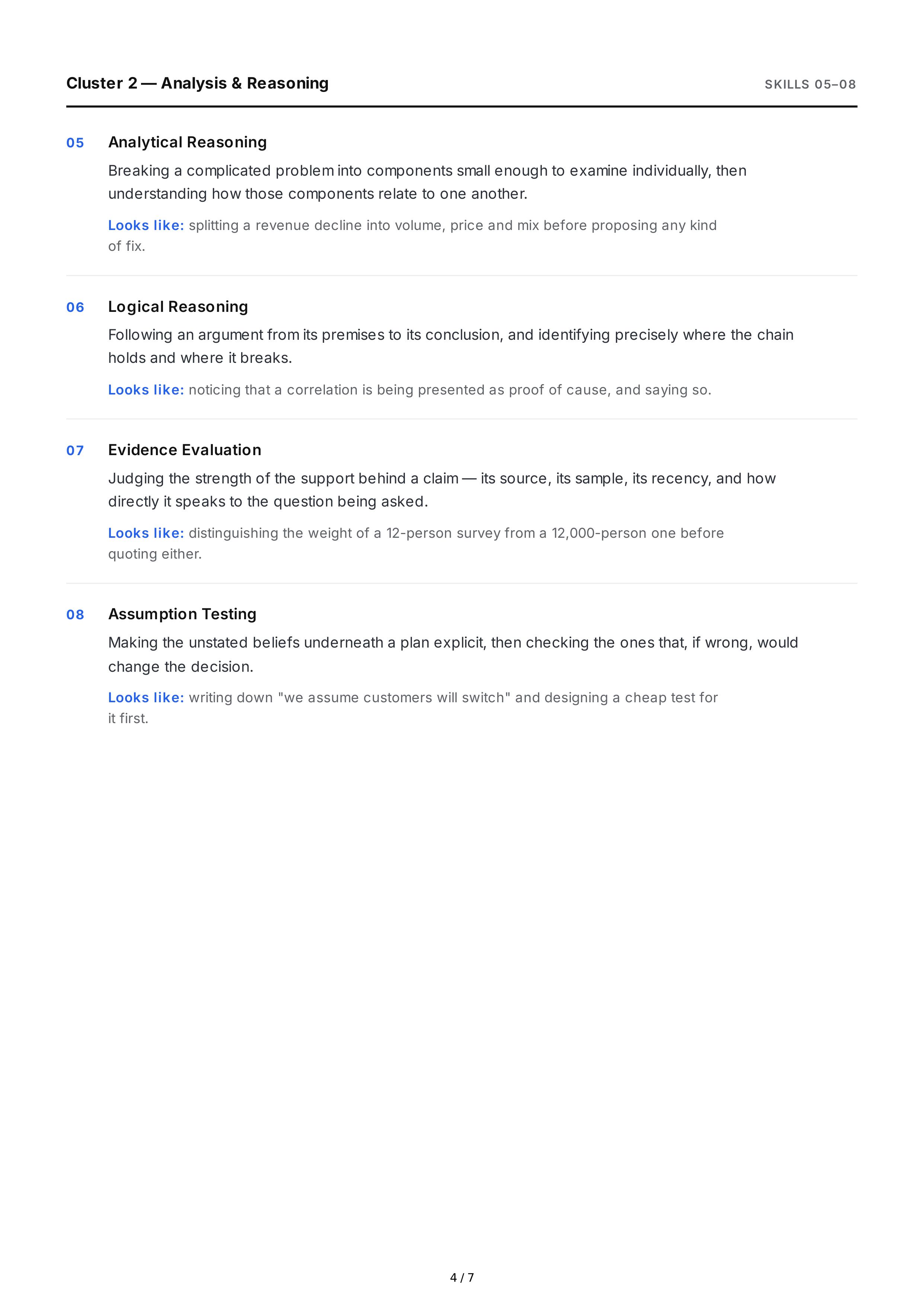
Cluster
2 —
Analysis
&
Reasoning
SKILLS
05–08
05
Analytical
Reasoning
Breaking
a
complicated
problem
into
components
small
enough
to
examine
individually
,
then
understanding
how
those
components
relate
to
one
another
.
Looks
like
:
splitting
a
revenue
decline
into
volume
,
price
and
mix
before
proposing
any
kind
of
fix
.
06
Logical
Reasoning
Following
an
argument
from
its
premises
to
its
conclusion
,
and
identifying
precisely
where
the
chain
holds
and
where
it
breaks
.
Looks
like
:
noticing
that
a
correlation
is
being
presented
as
proof
of
cause
,
and
saying
so
.
07
Evidence
Evaluation
Judging
the
strength
of
the
support
behind
a
claim
—
its
source
,
its
sample
,
its
recency
,
and
how
directly
it
speaks
to
the
question
being
asked
.
Looks
like
:
distinguishing
the
weight
of
a
12-
person
survey
from
a
12,000-
person
one
before
quoting
either
.
08
Assumption
Testing
Making
the
unstated
beliefs
underneath
a
plan
explicit
,
then
checking
the
ones
that
,
if
wrong
,
would
change
the
decision
.
Looks
like
:
writing
down
"
we
assume
customers
will
switch
"
and
designing
a
cheap
test
for
it
first
.
4 / 7
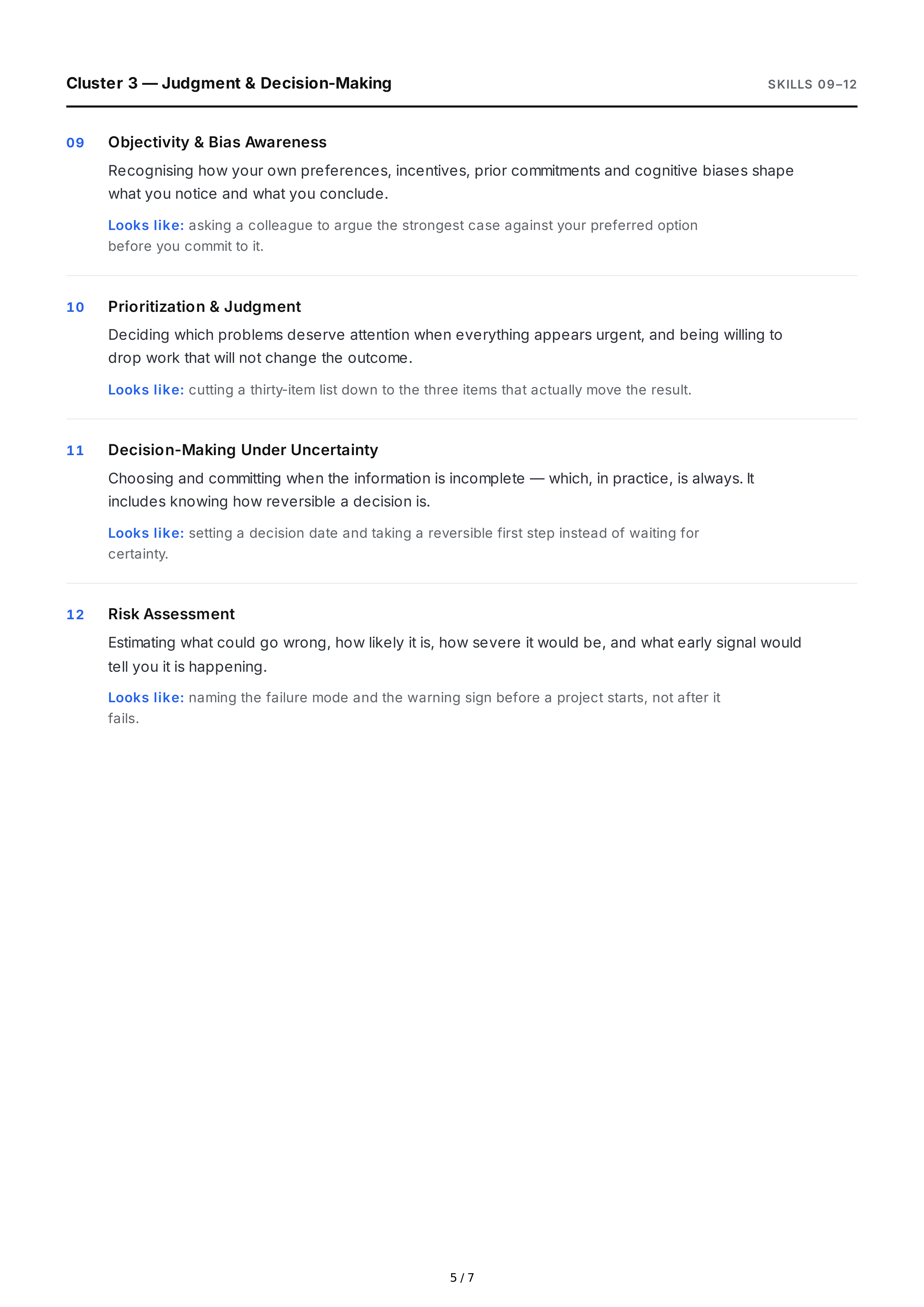
Cluster
3 —
Judgment
&
Decision
-
Making
SKILLS
09–12
09
Objectivity
&
Bias
Awareness
Recognising
how
your
own
preferences
,
incentives
,
prior
commitments
and
cognitive
biases
shape
what
you
notice
and
what
you
conclude
.
Looks
like
:
asking
a
colleague
to
argue
the
strongest
case
against
your
preferred
option
before
you
commit
to
it
.
10
Prioritization
&
Judgment
Deciding
which
problems
deserve
attention
when
everything
appears
urgent
,
and
being
willing
to
drop
work
that
will
not
change
the
outcome
.
Looks
like
:
cutting
a
thirty
-
item
list
down
to
the
three
items
that
actually
move
the
result
.
11
Decision
-
Making
Under
Uncertainty
Choosing
and
committing
when
the
information
is
incomplete
—
which
,
in
practice
,
is
always
.
It
includes
knowing
how
reversible
a
decision
is
.
Looks
like
:
setting
a
decision
date
and
taking
a
reversible
first
step
instead
of
waiting
for
certainty
.
12
Risk
Assessment
Estimating
what
could
go
wrong
,
how
likely
it
is
,
how
severe
it
would
be
,
and
what
early
signal
would
tell
you
it
is
happening
.
Looks
like
:
naming
the
failure
mode
and
the
warning
sign
before
a
project
starts
,
not
after
it
fails
.
5 / 7
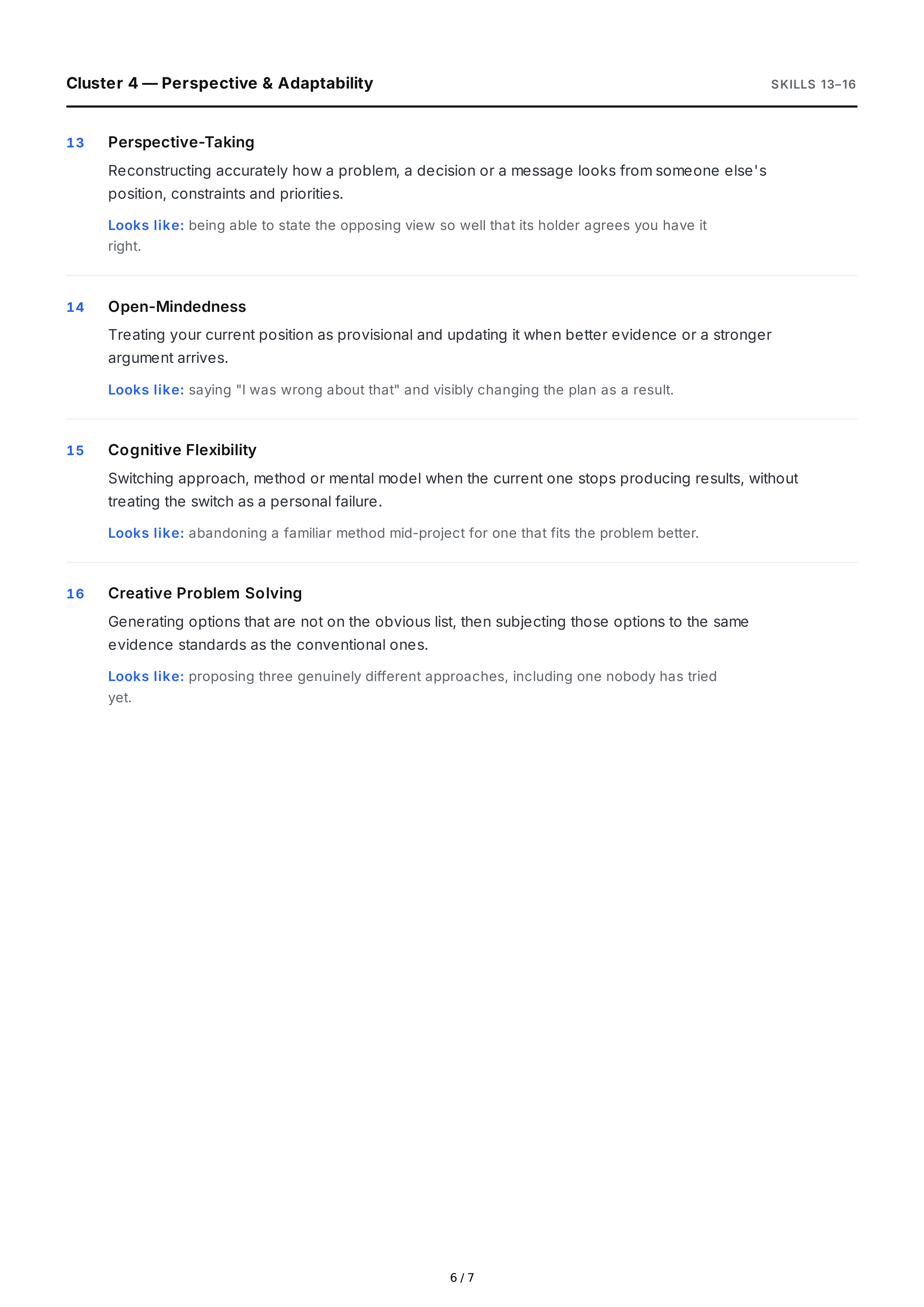
Cluster
4 —
Perspective
&
Adaptability
SKILLS
13–16
13
Perspective
-
Taking
Reconstructing
accurately
how
a
problem
,
a
decision
or
a
message
looks
from
someone
else
'
s
position
,
constraints
and
priorities
.
Looks
like
:
being
able
to
state
the
opposing
view
so
well
that
its
holder
agrees
you
have
it
right
.
14
Open
-
Mindedness
Treating
your
current
position
as
provisional
and
updating
it
when
better
evidence
or
a
stronger
argument
arrives
.
Looks
like
:
saying
"
I
was
wrong
about
that
"
and
visibly
changing
the
plan
as
a
result
.
15
Cognitive
Flexibility
Switching
approach
,
method
or
mental
model
when
the
current
one
stops
producing
results
,
without
treating
the
switch
as
a
personal
failure
.
Looks
like
:
abandoning
a
familiar
method
mid
-
project
for
one
that
fits
the
problem
better
.
16
Creative
Problem
Solving
Generating
options
that
are
not
on
the
obvious
list
,
then
subjecting
those
options
to
the
same
evidence
standards
as
the
conventional
ones
.
Looks
like
:
proposing
three
genuinely
different
approaches
,
including
one
nobody
has
tried
yet
.
6 / 7
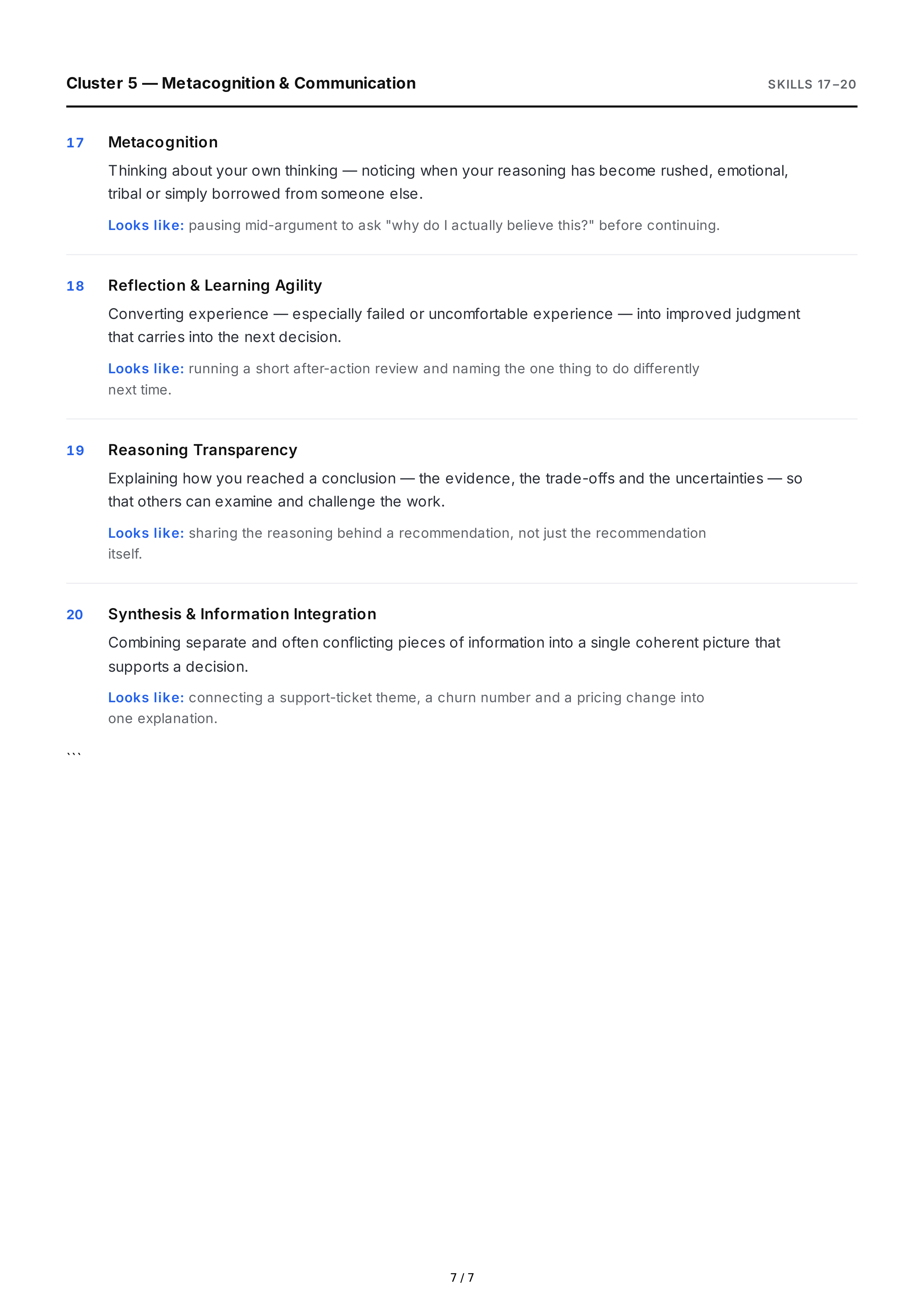
Cluster
5 —
Metacognition
&
Communication
SKILLS
17 –20
17
Metacognition
Thinking
about
your
own
thinking
—
noticing
when
your
reasoning
has
become
rushed
,
emotional
,
tribal
or
simply
borrowed
from
someone
else
.
Looks
like
:
pausing
mid
-
argument
to
ask
"
why
do
I
actually
believe
this
?"
before
continuing
.
18
Reflection
&
Learning
Agility
Converting
experience
—
especially
failed
or
uncomfortable
experience
—
into
improved
judgment
that
carries
into
the
next
decision
.
Looks
like
:
running
a
short
after
-
action
review
and
naming
the
one
thing
to
do
differently
next
time
.
19
Reasoning
Transparency
Explaining
how
you
reached
a
conclusion
—
the
evidence
,
the
trade
-
offs
and
the
uncertainties
—
so
that
others
can
examine
and
challenge
the
work
.
Looks
like
:
sharing
the
reasoning
behind
a
recommendation
,
not
just
the
recommendation
itself
.
20
Synthesis
&
Information
Integration
Combining
separate
and
often
conflicting
pieces
of
information
into
a
single
coherent
picture
that
supports
a
decision
.
Looks
like
:
connecting
a
support
-
ticket
theme
,
a
churn
number
and
a
pricing
change
into
one
explanation
.
```
7 / 7