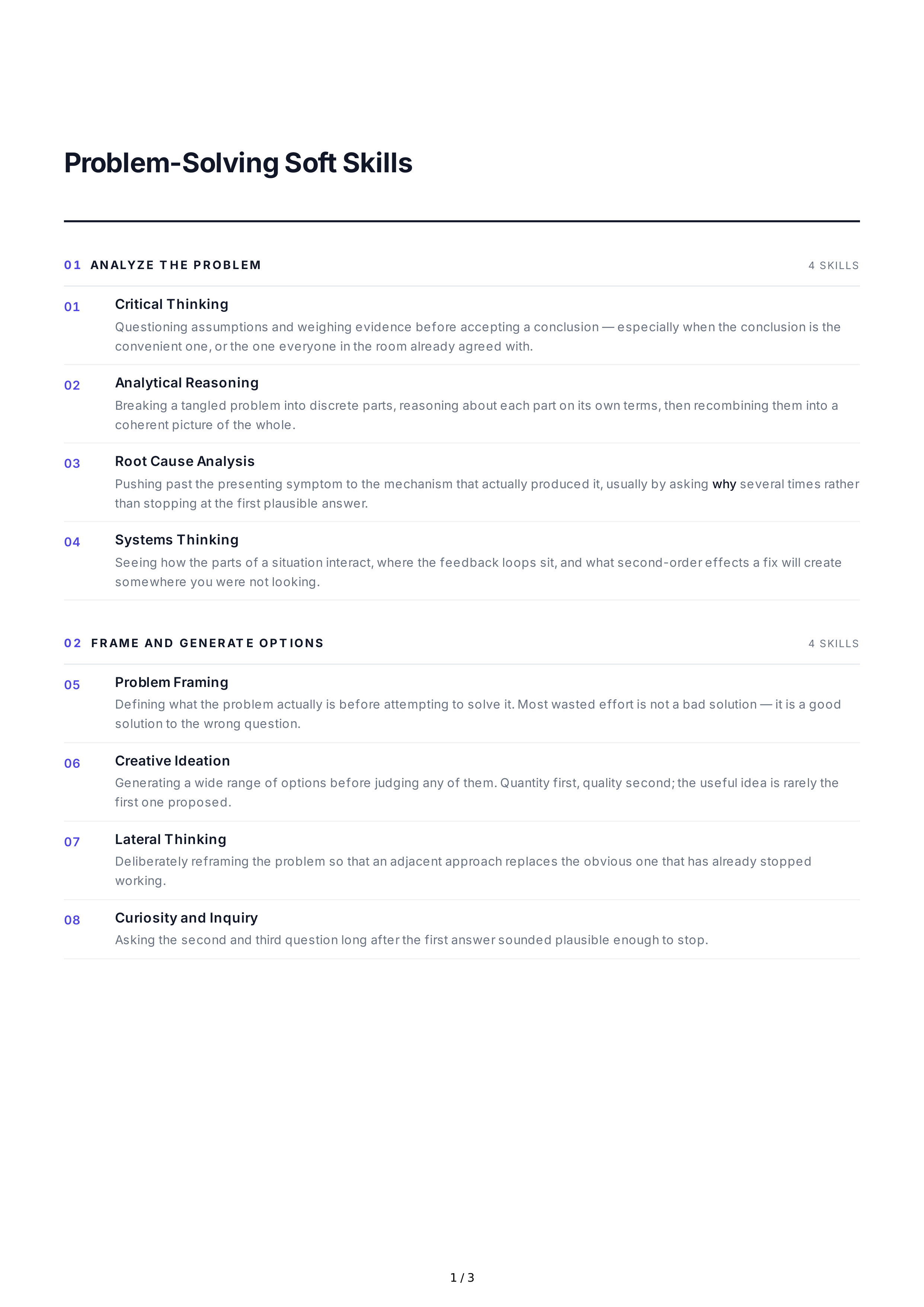
Problem
-
Solving
Soft
Skills
0 1
AN ALYZ E
T H E
P R OB L EM
4
SKILLS
01
Critical
Thinking
Questioning
assumptions
and
weighing
evidence
before
accepting
a
conclusion
—
especially
when
the
conclusion
is
the
convenient
one
,
or
the
one
everyone
in
the
room
already
agreed
with
.
02
Analytical
Reasoning
Breaking
a
tangled
problem
into
discrete
parts
,
reasoning
about
each
part
on
its
own
terms
,
then
recombining
them
into
a
coherent
picture
of
the
whole
.
03
Root
Cause
Analysis
Pushing
past
the
presenting
symptom
to
the
mechanism
that
actually
produced
it
,
usually
by
asking
why
several
times
rather
than
stopping
at
the
first
plausible
answer
.
04
Systems
Thinking
Seeing
how
the
parts
of
a
situation
interact
,
where
the
feedback
loops
sit
,
and
what
second
-
order
effects
a
fix
will
create
somewhere
you
were
not
looking
.
0 2
F R AM E
AN D
G EN ER AT E
OP T ION S
4
SKILLS
05
Problem
Framing
Defining
what
the
problem
actually
is
before
attempting
to
solve
it
.
Most
wasted
effort
is
not
a
bad
solution
—
it
is
a
good
solution
to
the
wrong
question
.
06
Creative
Ideation
Generating
a
wide
range
of
options
before
judging
any
of
them
.
Quantity
first
,
quality
second
;
the
useful
idea
is
rarely
the
first
one
proposed
.
07
Lateral
Thinking
Deliberately
reframing
the
problem
so
that
an
adjacent
approach
replaces
the
obvious
one
that
has
already
stopped
working
.
08
Curiosity
and
Inquiry
Asking
the
second
and
third
question
long
after
the
first
answer
sounded
plausible
enough
to
stop
.
1 / 3
0 3
D EC ID E
4
SKILLS
09
Prioritization
Separating
what
is
urgent
from
what
is
important
,
and
triaging
deliberately
when
everything
cannot
be
done
at
once
.
10
Judgment
Under
Uncertainty
Making
a
defensible
decision
with
70%
of
the
information
rather
than
waiting
for
a
certainty
that
will
arrive
too
late
to
be
useful
.
11
Risk
Assessment
Naming
the
ways
a
plan
could
fail
before
it
fails
,
and
deciding
which
of
those
failure
modes
genuinely
deserve
a
contingency
.
12
Hypothesis
Testing
Turning
a
hunch
into
a
falsifiable
guess
,
then
testing
it
cheaply
instead
of
arguing
about
it
at
length
.
0 4
EX EC UT E
4
SKILLS
13
Adaptability
Changing
the
approach
when
the
evidence
changes
,
without
treating
the
change
as
a
personal
defeat
.
14
Resourcefulness
Solving
with
the
tools
,
budget
,
and
time
actually
available
rather
than
the
ones
an
ideal
solution
would
require
.
15
Persistence
Staying
with
a
hard
problem
through
the
unglamorous
middle
,
which
is
where
most
promising
solutions
get
abandoned
.
16
Attention
to
Detail
Catching
the
edge
case
,
the
off
-
by
-
one
,
and
the
assumption
that
only
holds
on
the
happy
path
.
0 5
WOR K
WIT H
OT H ER
P EOP L E
4
SKILLS
17
Active
Listening
Hearing
the
constraint
behind
what
someone
said
,
not
only
the
words
they
used
to
say
it
.
18
Clarity
of
Communication
Explaining
a
problem
and
a
proposed
solution
so
plainly
that
a
non
-
expert
can
act
on
it
without
a
follow
-
up
meeting
.
19
Collaboration
and
Brainstorming
Building
on
someone
else
'
s
half
-
formed
idea
instead
of
defending
your
own
,
and
giving
credit
for
what
survives
.
20
Negotiation
and
Conflict
Resolution
Trading
priorities
openly
when
two
valid
solutions
cannot
both
win
,
and
separating
the
disagreement
from
the
person
holding
it
.
2 / 3

0 6
L EAR N
AN D
T AKE
OWN ER S H IP
4
SKILLS
21
Learning
Agility
Transferring
the
lesson
from
one
problem
to
the
next
,
and
recognizing
a
familiar
pattern
inside
an
unfamiliar
context
.
22
Openness
to
Feedback
Treating
criticism
of
the
solution
as
information
about
the
solution
,
rather
than
as
a
verdict
on
the
person
who
proposed
it
.
23
Ownership
and
Accountability
Remaining
responsible
for
the
outcome
after
the
interesting
part
of
the
work
is
finished
and
the
cleanup
begins
.
24
Cognitive
Bias
Awareness
Noticing
when
anchoring
,
confirmation
bias
,
or
sunk
cost
is
doing
the
deciding
on
your
behalf
.
```
3 / 3