Adult Education Teacher Teaching Philosophy
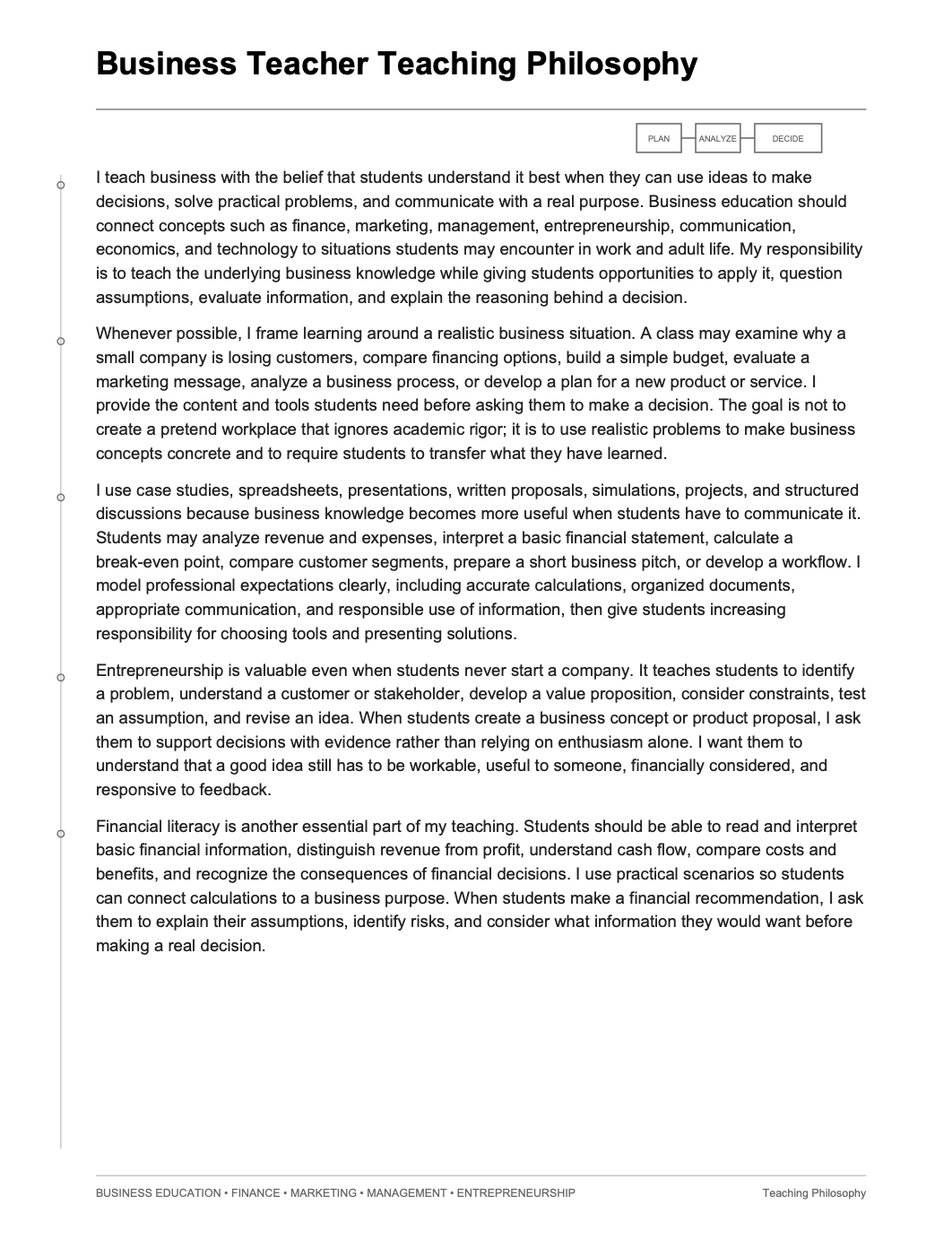
GOAL
LEARN
APPLY
NEXT
I teach adult education with the belief that adults learn best when instruction respects the knowledge they
already bring and makes the next learning step useful to a goal they care about. Adult learners may be
working toward a high school equivalency credential, stronger literacy or numeracy, English language
development, employment, further education, or greater confidence handling everyday responsibilities. My
role is to understand those goals, build from existing strengths, and provide rigorous instruction that helps
learners use new knowledge in situations that matter to them.
I begin by learning what students need to do, not only what level they are assigned. A learner may be
comfortable speaking about work but need help reading workplace documents; another may understand a
mathematical idea informally but struggle to express the reasoning in writing. I use conversations,
diagnostic tasks, reading and writing samples, mathematics activities, and other appropriate assessments
to identify strengths and gaps. I then use that information to set achievable learning goals and to adjust
instruction rather than assuming that all adults in a class need the same lesson at the same pace.
Relevance is important in adult education, but I do not confuse relevant instruction with easy instruction. I
use authentic or realistic materials such as schedules, forms, workplace documents, pay information,
health information, news, community resources, or practical problem scenarios when they support the
learning goal. Students read for a purpose, calculate to answer a question, write for an audience, and
discuss decisions they may actually need to make. This context gives academic skills a reason to matter
while still allowing me to teach the underlying reading, writing, mathematics, language, digital, or
problem-solving skills explicitly.
I use direct instruction, guided practice, collaborative learning, and independent application in deliberate
sequence. Adults deserve clear explanations rather than being expected to discover every skill without
support. I model a strategy, work through examples with students, ask them to explain their reasoning, and
then gradually reduce the scaffolding. I also encourage students to bring their own approaches to a
problem because adult learners often have practical knowledge that can strengthen classroom discussion.
My goal is to connect that existing knowledge to more formal academic and workplace strategies.
Self-directed learning is important, but independence develops through structure and feedback. I teach
students how to set a manageable goal, organize a study task, use available resources, monitor their own
progress, and ask a precise question when they need assistance. Digital literacy is part of that
independence because adult learners increasingly need to navigate online forms, information,
communication, learning platforms, and workplace systems. I integrate technology when it provides a
genuine learning or life skill rather than using it simply for novelty.
ADULT EDUCATION • LITERACY • NUMERACY • LANGUAGE • DIGITAL SKILLS • WORKFORCE READINESS
Teaching Philosophy
Adult Education Teacher Teaching Philosophy
Assessment should guide instruction and make growth visible. I use quick checks, short conversations,
reading responses, writing samples, problem-solving tasks, practice tests, and other formative measures
during instruction. When appropriate, I use standards or program expectations to clarify what learners
need to demonstrate for a credential, transition, or course goal. I give specific feedback and opportunities
to practice again. A learner should be able to understand both what they can do now and what they should
work on next.
I am especially attentive to the realities of adult learners' lives. Adults may be balancing employment,
caregiving, transportation challenges, health appointments, financial pressures, or other responsibilities
alongside education. I cannot remove those realities, but I can make the learning environment predictable
and respectful. Clear instructions, organized materials, transparent expectations, flexible opportunities
when program policy allows, and strong communication help adults remain connected to learning. I do not
interpret every interruption in attendance as a lack of motivation; I try to understand what support or
adjustment would make continued learning more possible.
Inclusion also means recognizing that adult classrooms can include wide differences in age, educational
history, language background, disability, cultural experience, and confidence. I avoid public comparisons
and use multiple ways for learners to practice and demonstrate understanding. For English learners, I
provide language support while maintaining meaningful content and communication goals. For learners
rebuilding academic confidence after a long break from school, I make the academic task explicit without
treating them as children. Adults should be challenged respectfully and given the information, tools, and
feedback needed to participate fully.
I see the teacher's role as both instructor and partner in the learner's progress. I maintain high
expectations for effort, accuracy, participation, and responsible use of information, while recognizing that
adult learners may need a different route to the same outcome. I collaborate with colleagues, advisors,
support staff, and workforce or community partners when that helps learners connect education with their
next step. I also reflect on my teaching by reviewing student work, progress data, attendance patterns, and
learner feedback, then changing materials or instructional routines when they are not serving the group
well.
Ultimately, I want adult learners to leave my classroom more capable of directing their own learning and
using academic skills in the world beyond school. They should be able to read and interpret important
information, communicate clearly, reason with numbers, use digital tools responsibly, solve problems, and
recognize the resources available to them when they encounter something unfamiliar. Whether their next
step is employment, a high school equivalency credential, postsecondary training, college,
English-language growth, or greater independence in daily life, I want the learning to be practical without
being narrow and rigorous without being disconnected from their goals. I also see my teaching as an
ongoing practice of adjustment: adult learners show me what is working through their questions, work, and
progress, and I use that evidence to improve what I teach next.
ADULT EDUCATION • LITERACY • NUMERACY • LANGUAGE • DIGITAL SKILLS • WORKFORCE READINESS
Teaching Philosophy