1
SOCIAL STUDIES EDUCATION
Teaching Philosophy
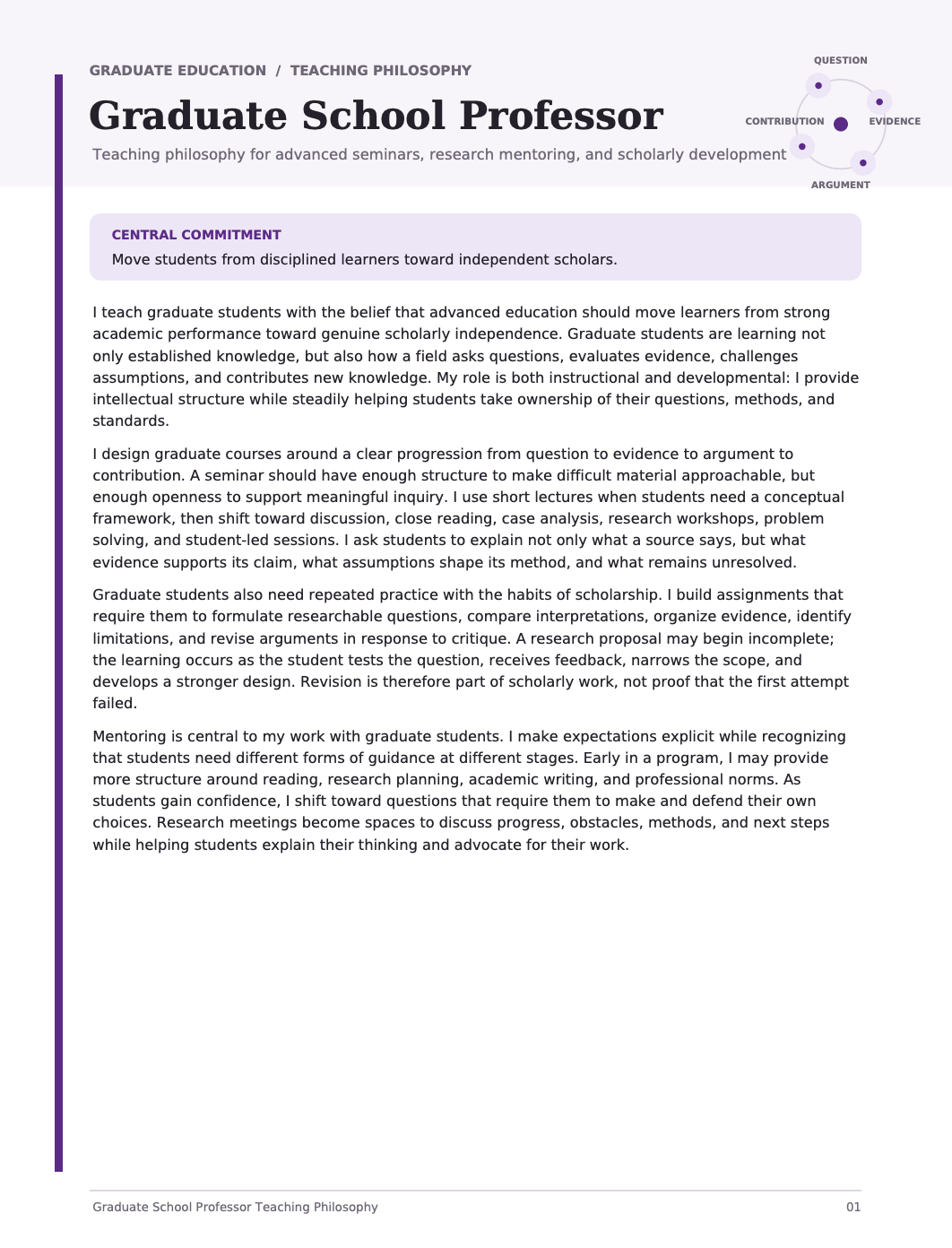
QUESTION
EVIDENCE
PERSPECTIVE
CONCLUSION
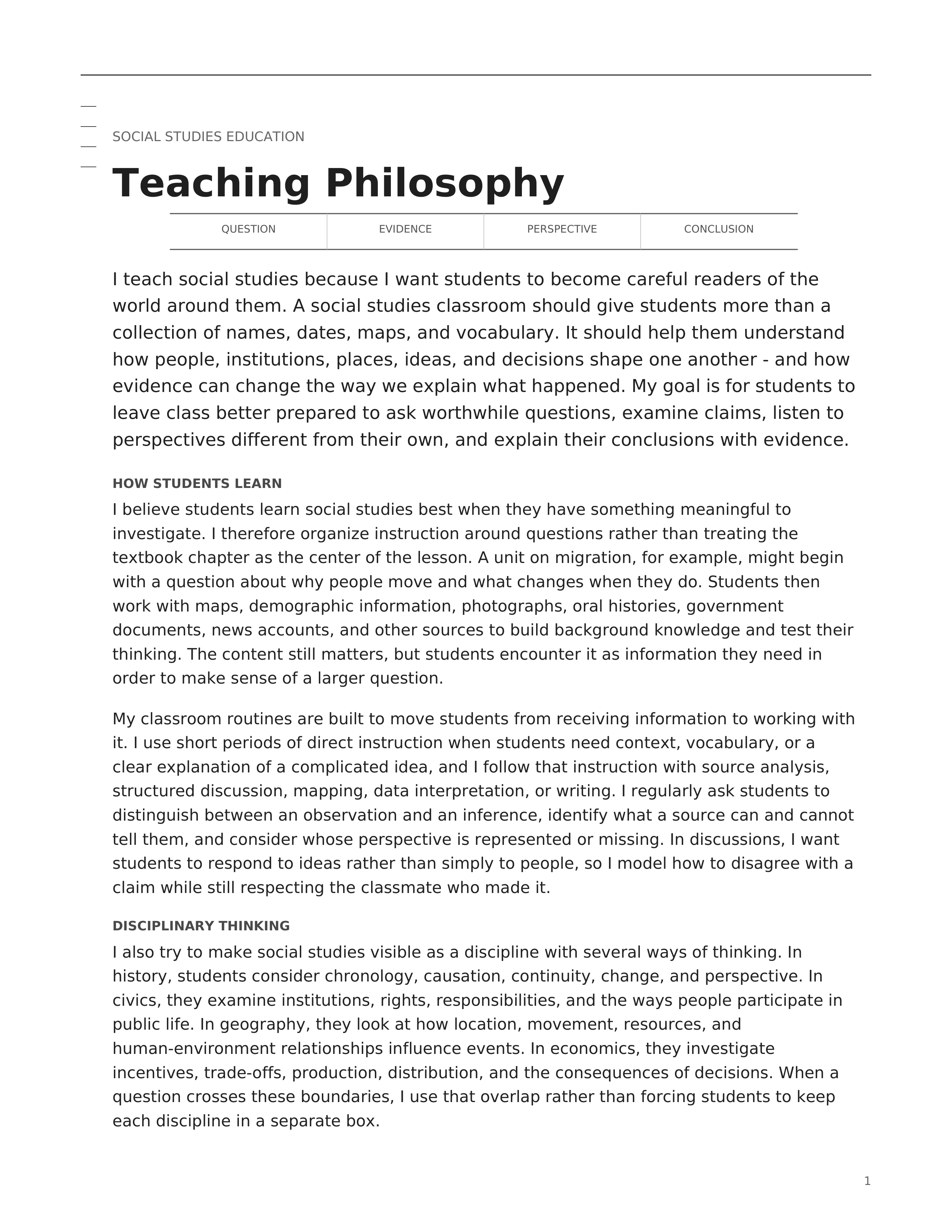
I teach social studies because I want students to become careful readers of the
world around them. A social studies classroom should give students more than a
collection of names, dates, maps, and vocabulary. It should help them understand
how people, institutions, places, ideas, and decisions shape one another - and how
evidence can change the way we explain what happened. My goal is for students to
leave class better prepared to ask worthwhile questions, examine claims, listen to
perspectives different from their own, and explain their conclusions with evidence.
HOW STUDENTS LEARN
I believe students learn social studies best when they have something meaningful to
investigate. I therefore organize instruction around questions rather than treating the
textbook chapter as the center of the lesson. A unit on migration, for example, might begin
with a question about why people move and what changes when they do. Students then
work with maps, demographic information, photographs, oral histories, government
documents, news accounts, and other sources to build background knowledge and test their
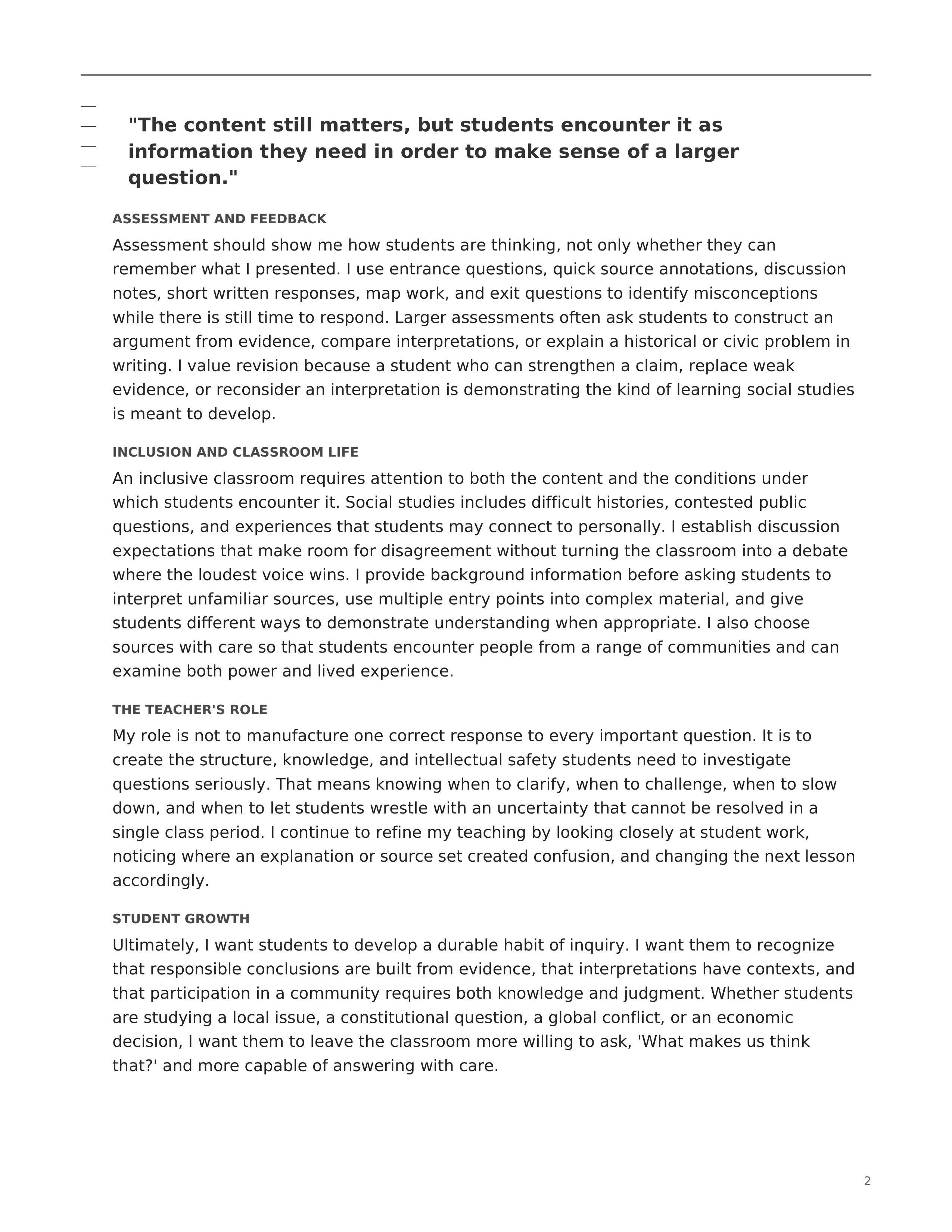
thinking. The content still matters, but students encounter it as information they need in
order to make sense of a larger question.
My classroom routines are built to move students from receiving information to working with
it. I use short periods of direct instruction when students need context, vocabulary, or a
clear explanation of a complicated idea, and I follow that instruction with source analysis,
structured discussion, mapping, data interpretation, or writing. I regularly ask students to
distinguish between an observation and an inference, identify what a source can and cannot
tell them, and consider whose perspective is represented or missing. In discussions, I want
students to respond to ideas rather than simply to people, so I model how to disagree with a
claim while still respecting the classmate who made it.
DISCIPLINARY THINKING
I also try to make social studies visible as a discipline with several ways of thinking. In
history, students consider chronology, causation, continuity, change, and perspective. In
civics, they examine institutions, rights, responsibilities, and the ways people participate in
public life. In geography, they look at how location, movement, resources, and
human-environment relationships influence events. In economics, they investigate
incentives, trade-offs, production, distribution, and the consequences of decisions. When a
question crosses these boundaries, I use that overlap rather than forcing students to keep
each discipline in a separate box.