Economics Teacher Teaching Philosophy
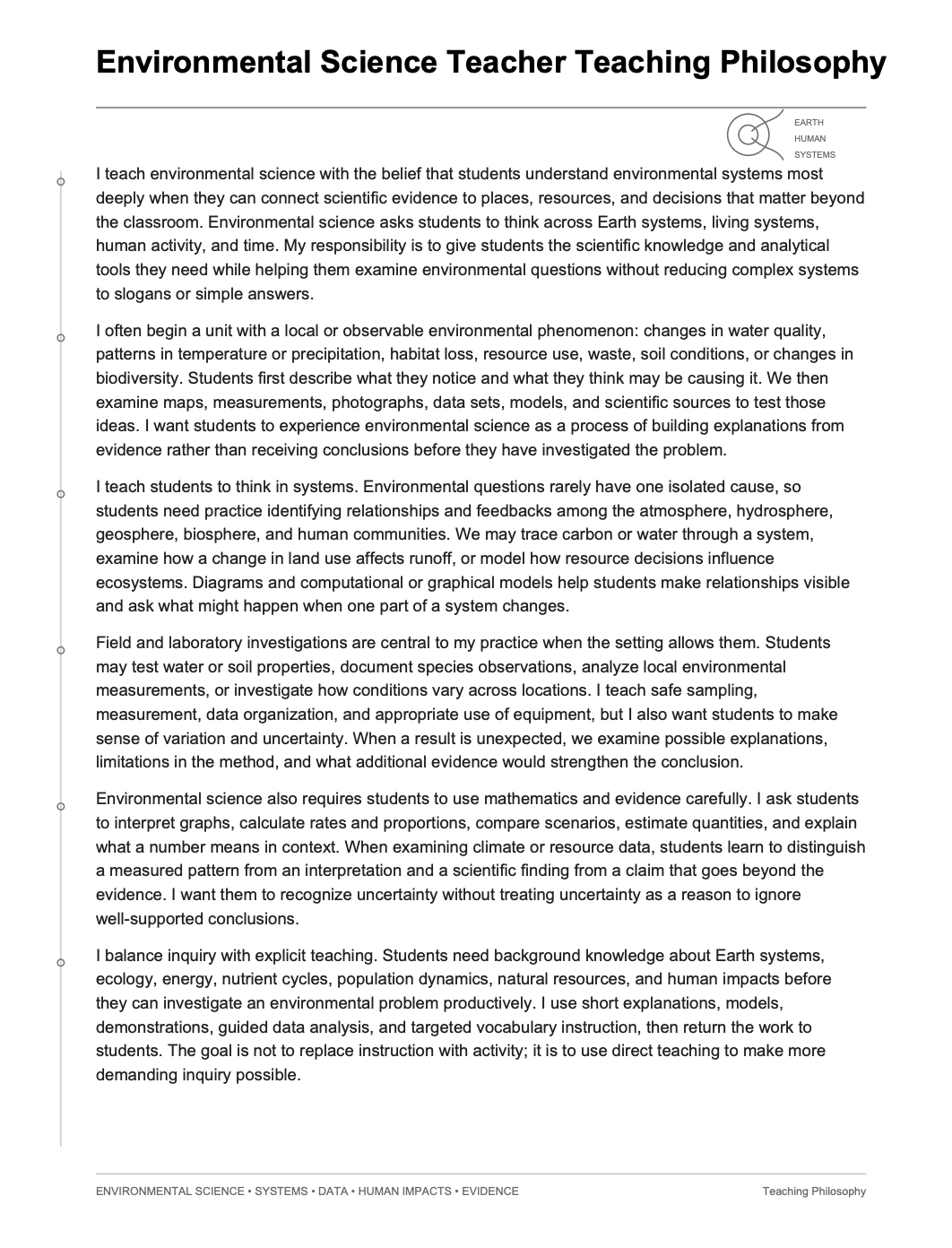
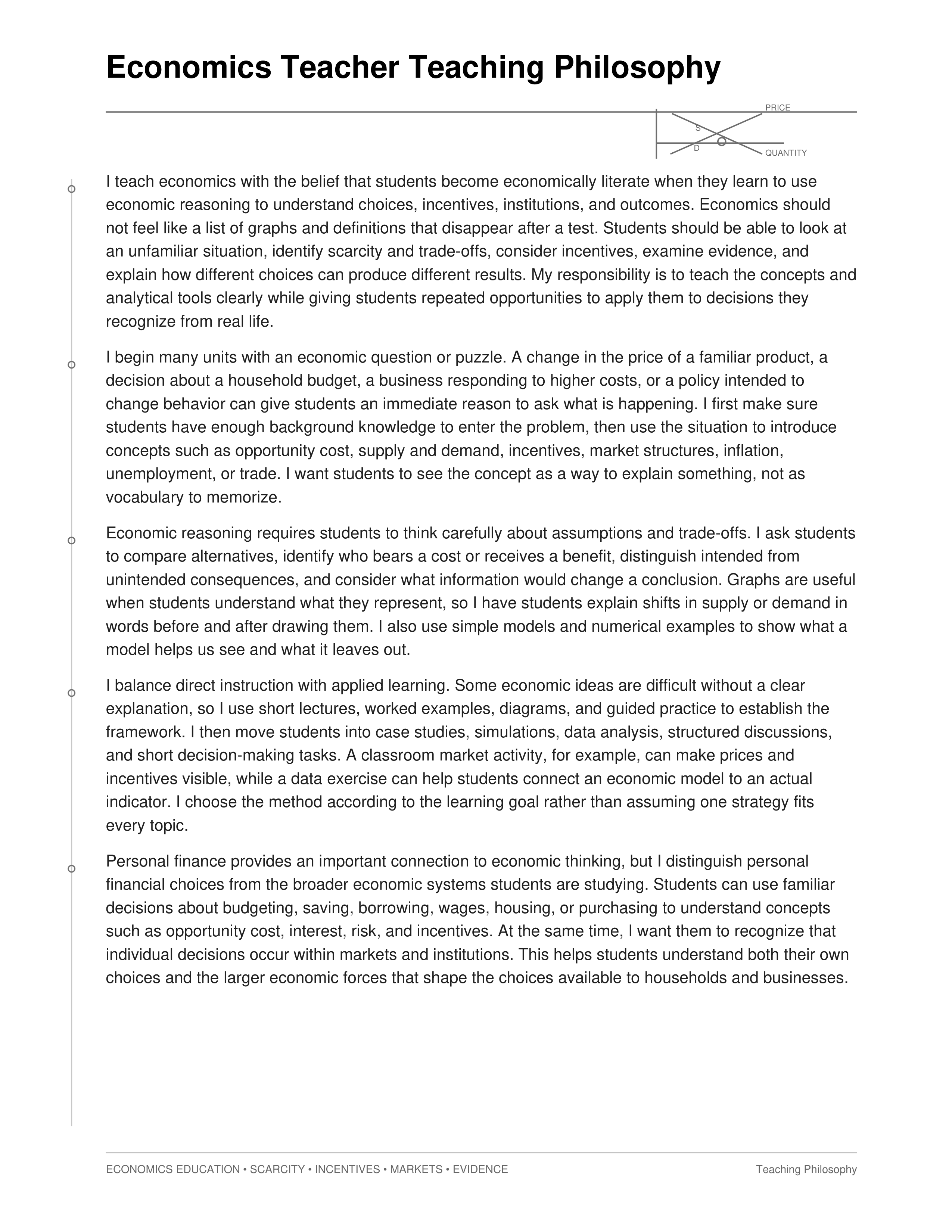
PRICE
QUANTITY
S
D
I teach economics with the belief that students become economically literate when they learn to use
economic reasoning to understand choices, incentives, institutions, and outcomes. Economics should
not feel like a list of graphs and definitions that disappear after a test. Students should be able to look at
an unfamiliar situation, identify scarcity and trade-offs, consider incentives, examine evidence, and
explain how different choices can produce different results. My responsibility is to teach the concepts and
analytical tools clearly while giving students repeated opportunities to apply them to decisions they
recognize from real life.
I begin many units with an economic question or puzzle. A change in the price of a familiar product, a
decision about a household budget, a business responding to higher costs, or a policy intended to
change behavior can give students an immediate reason to ask what is happening. I first make sure
students have enough background knowledge to enter the problem, then use the situation to introduce
concepts such as opportunity cost, supply and demand, incentives, market structures, inflation,
unemployment, or trade. I want students to see the concept as a way to explain something, not as
vocabulary to memorize.
Economic reasoning requires students to think carefully about assumptions and trade-offs. I ask students
to compare alternatives, identify who bears a cost or receives a benefit, distinguish intended from
unintended consequences, and consider what information would change a conclusion. Graphs are useful
when students understand what they represent, so I have students explain shifts in supply or demand in
words before and after drawing them. I also use simple models and numerical examples to show what a
model helps us see and what it leaves out.
I balance direct instruction with applied learning. Some economic ideas are difficult without a clear
explanation, so I use short lectures, worked examples, diagrams, and guided practice to establish the
framework. I then move students into case studies, simulations, data analysis, structured discussions,
and short decision-making tasks. A classroom market activity, for example, can make prices and
incentives visible, while a data exercise can help students connect an economic model to an actual
indicator. I choose the method according to the learning goal rather than assuming one strategy fits
every topic.
Personal finance provides an important connection to economic thinking, but I distinguish personal
financial choices from the broader economic systems students are studying. Students can use familiar
decisions about budgeting, saving, borrowing, wages, housing, or purchasing to understand concepts
such as opportunity cost, interest, risk, and incentives. At the same time, I want them to recognize that
individual decisions occur within markets and institutions. This helps students understand both their own
choices and the larger economic forces that shape the choices available to households and businesses.
ECONOMICS EDUCATION • SCARCITY • INCENTIVES • MARKETS • EVIDENCE
Teaching Philosophy
Economics Teacher Teaching Philosophy
I use current and historical economic data when it strengthens understanding. Students may examine
inflation, unemployment, interest rates, production, trade, or household indicators and practice asking
what the data show before making a claim about why a change occurred. I teach students to read axes
and units, compare time periods, recognize correlation without automatically calling it causation, and
identify what a data set cannot tell them. The goal is to make evidence part of economic reasoning rather
than an illustration added after an argument has already been made.
Assessment should show whether students can think economically. I use quick decision prompts, graph
explanations, short data interpretations, exit questions, simulations, and brief written claims during
instruction. Larger assessments may ask students to analyze a market situation, explain a policy using
economic concepts, interpret macroeconomic indicators, compare incentives, or evaluate a decision by
identifying costs and benefits. I value clear reasoning over the appearance of a single correct phrase.
When a student's answer is weak, I want to know whether the problem is the concept, the evidence, the
model, or the connection between them.
I am intentional about inclusion because students enter economics with different mathematics
preparation, reading experiences, family financial experiences, and confidence discussing complex
issues. I use accessible examples, visual representations, step-by-step quantitative models, vocabulary
support, and multiple ways to communicate reasoning. I avoid assuming that students' personal financial
circumstances are suitable for public classroom discussion. Instead, I use fictionalized or broadly
relatable scenarios when a topic could otherwise pressure students to disclose private information.
Students should be able to learn economic concepts rigorously without feeling that their household
circumstances determine how well they belong in the course.
I also want students to understand that economics involves analysis rather than automatic agreement.
When we examine economic policies or competing explanations, I ask students to separate empirical
claims from value judgments, identify the assumptions within an argument, and compare the likely
consequences of different choices. I do not want students to memorize a preferred answer. I want them
to become more capable of saying, 'This is what the evidence suggests, this is the trade-off, and these
are the assumptions behind my conclusion.'
Ultimately, I want students to leave economics with a durable way of thinking about the world. They
should be able to recognize scarcity, opportunity cost, incentives, and trade-offs; interpret basic
economic data; understand how markets and institutions influence choices; and communicate an
evidence-based economic argument. These skills are useful whether students become business owners,
employees, consumers, voters, or simply people making everyday decisions about time and money. I
also treat my teaching as an ongoing process of inquiry: I examine student work, notice which economic
models remain confusing, revise examples and simulations, and adjust instruction so students have
more opportunities to use the economic way of thinking independently.
ECONOMICS EDUCATION • SCARCITY • INCENTIVES • MARKETS • EVIDENCE
Teaching Philosophy