01
History Teacher Teaching Philosophy
Teaching the past as evidence, interpretation, and human experience
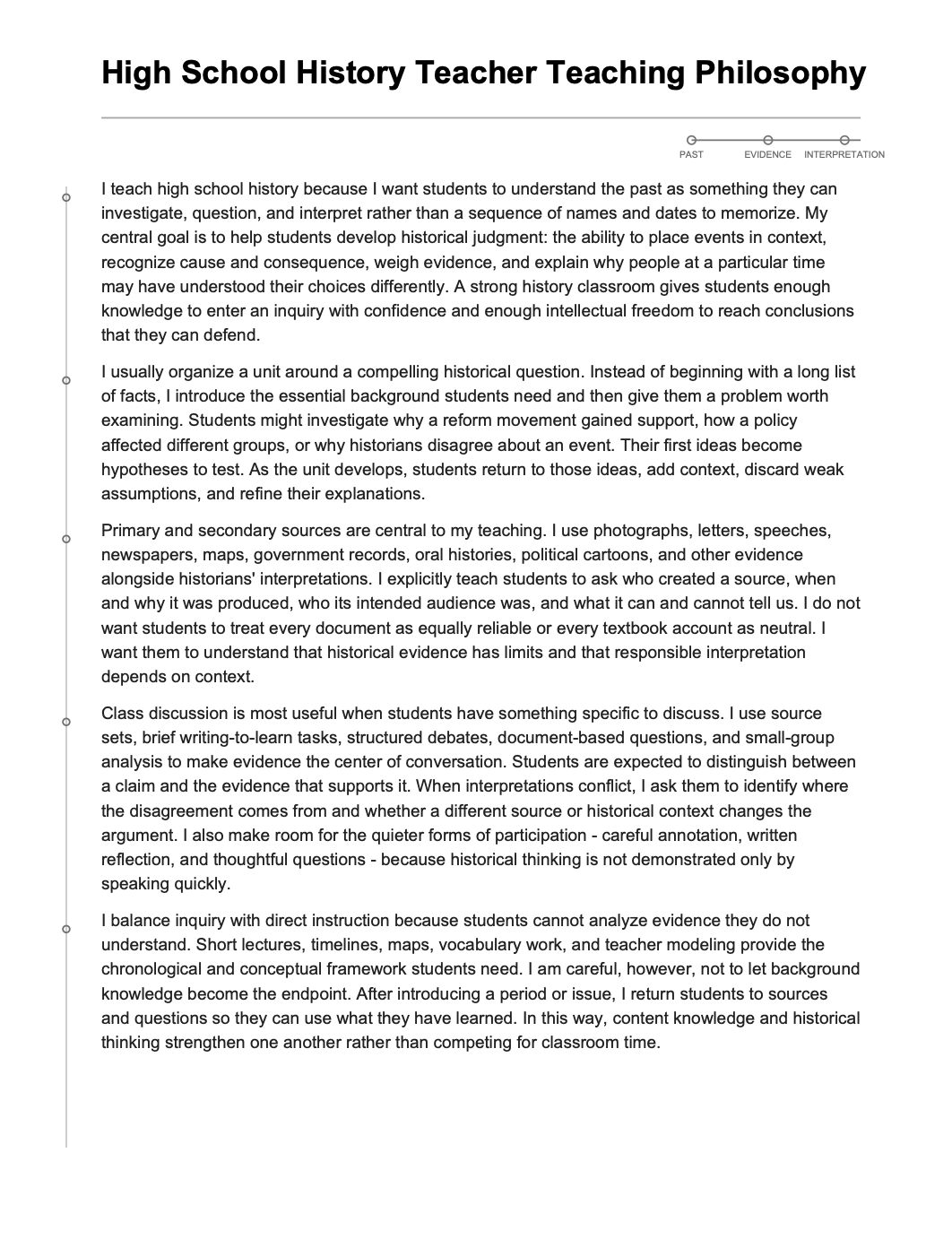
I teach history with the conviction that students learn the past most deeply when they are
asked to do more than remember it. A strong history classroom should give students a
clear foundation of people, places, events, and chronology, while also helping them
investigate how we know what we know. I want students to leave my classroom better able
to ask historical questions, examine evidence, recognize perspective, and explain how
interpretations of the past are constructed.
I see historical knowledge and historical thinking as inseparable. Students need enough
background knowledge to understand a document or event, but they also need regular
opportunities to work with the evidence itself. When we study a major turning point, I might
pair a textbook account with a letter, speech, newspaper excerpt, photograph, map, court
decision, oral history, or other primary source. I ask students to consider who created the
source, what audience was intended, what information is emphasized or missing, and how
the source fits with what they already know. These questions turn history from a list of
answers into an investigation.
My instruction balances direct teaching with inquiry. I use brief, focused explanations to
establish context and clarify difficult concepts, then move students into analysis,
discussion, writing, or collaborative problem solving. In a unit on the Civil War, for example,
I would not ask students simply to memorize causes. I would have them compare
competing arguments, trace economic and political developments, examine the language
of historical actors, and build an evidence-based explanation of causation. In a world
history course, the same approach might involve comparing accounts from different
regions or examining how trade, migration, conflict, and belief systems shaped one another
over time.
Student discussion is important in my classroom, but discussion must have substance
behind it. I establish routines that make it easier for students to enter a conversation:
annotating a source before speaking, citing a specific detail, asking a follow-up question,
and distinguishing between what a source says and what a student infers from it. I do not
expect students to agree. I expect them to listen carefully, revise a claim when the
evidence requires it, and disagree with ideas without diminishing the people who hold
them. Particularly with difficult or contested topics, I make the distinction between
examining a historical claim and endorsing it.
Assessment in history should reveal thinking, not just recall. I use short writing checks,
source annotations, discussions, quizzes, document-based questions, and longer analytical
assignments to see what students understand and where they need support. Formative
assessment helps me decide when to slow down, reteach background knowledge, model