STEM Teacher Teaching Philosophy
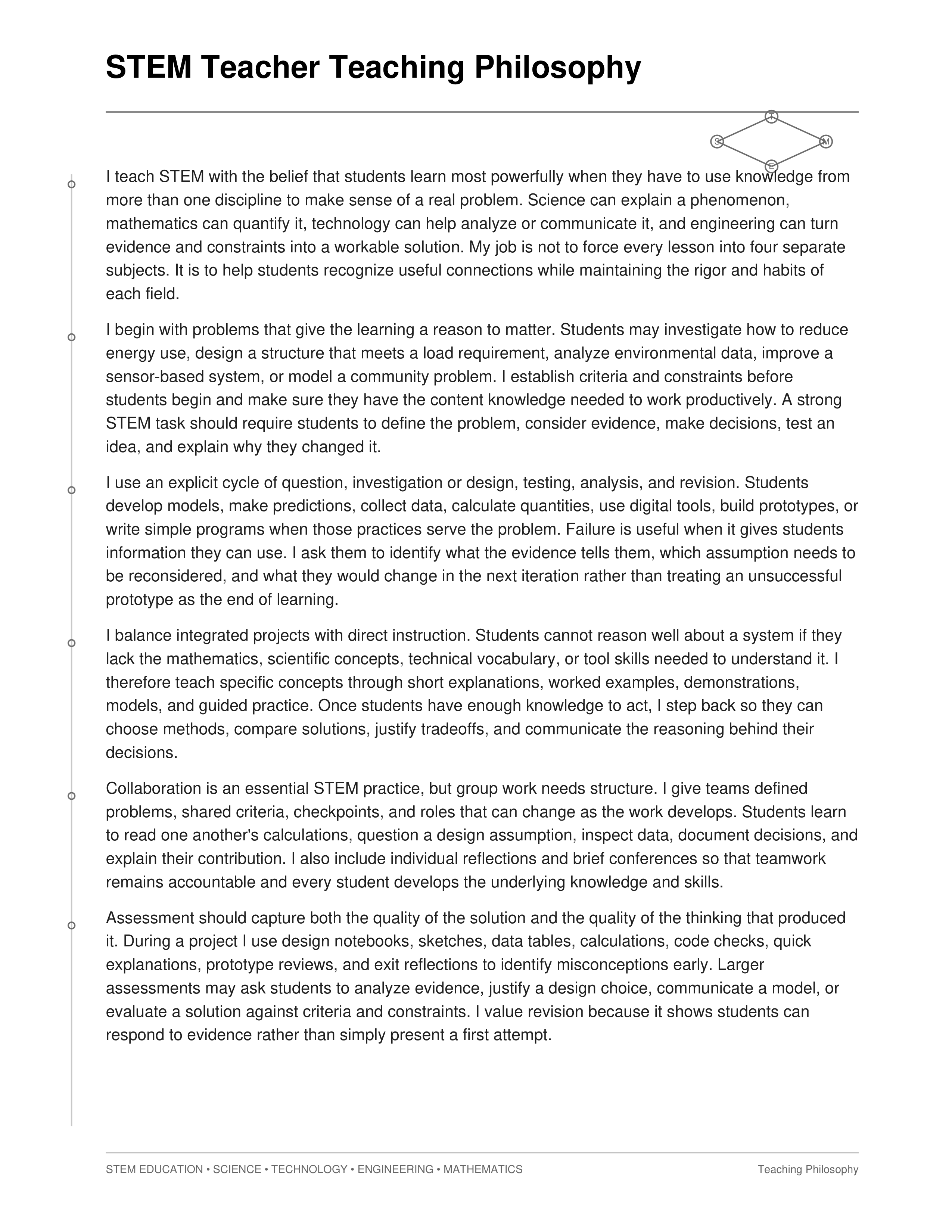
S
T
M
E
I teach STEM with the belief that students learn most powerfully when they have to use knowledge from
more than one discipline to make sense of a real problem. Science can explain a phenomenon,
mathematics can quantify it, technology can help analyze or communicate it, and engineering can turn
evidence and constraints into a workable solution. My job is not to force every lesson into four separate
subjects. It is to help students recognize useful connections while maintaining the rigor and habits of
each field.
I begin with problems that give the learning a reason to matter. Students may investigate how to reduce
energy use, design a structure that meets a load requirement, analyze environmental data, improve a
sensor-based system, or model a community problem. I establish criteria and constraints before
students begin and make sure they have the content knowledge needed to work productively. A strong
STEM task should require students to define the problem, consider evidence, make decisions, test an
idea, and explain why they changed it.
I use an explicit cycle of question, investigation or design, testing, analysis, and revision. Students
develop models, make predictions, collect data, calculate quantities, use digital tools, build prototypes, or
write simple programs when those practices serve the problem. Failure is useful when it gives students
information they can use. I ask them to identify what the evidence tells them, which assumption needs to
be reconsidered, and what they would change in the next iteration rather than treating an unsuccessful
prototype as the end of learning.
I balance integrated projects with direct instruction. Students cannot reason well about a system if they
lack the mathematics, scientific concepts, technical vocabulary, or tool skills needed to understand it. I
therefore teach specific concepts through short explanations, worked examples, demonstrations,
models, and guided practice. Once students have enough knowledge to act, I step back so they can
choose methods, compare solutions, justify tradeoffs, and communicate the reasoning behind their
decisions.
Collaboration is an essential STEM practice, but group work needs structure. I give teams defined
problems, shared criteria, checkpoints, and roles that can change as the work develops. Students learn
to read one another's calculations, question a design assumption, inspect data, document decisions, and
explain their contribution. I also include individual reflections and brief conferences so that teamwork
remains accountable and every student develops the underlying knowledge and skills.
Assessment should capture both the quality of the solution and the quality of the thinking that produced
it. During a project I use design notebooks, sketches, data tables, calculations, code checks, quick
explanations, prototype reviews, and exit reflections to identify misconceptions early. Larger
assessments may ask students to analyze evidence, justify a design choice, communicate a model, or
evaluate a solution against criteria and constraints. I value revision because it shows students can
respond to evidence rather than simply present a first attempt.
STEM EDUCATION • SCIENCE • TECHNOLOGY • ENGINEERING • MATHEMATICS
Teaching Philosophy