Reading Specialist | Teaching Philosophy
01
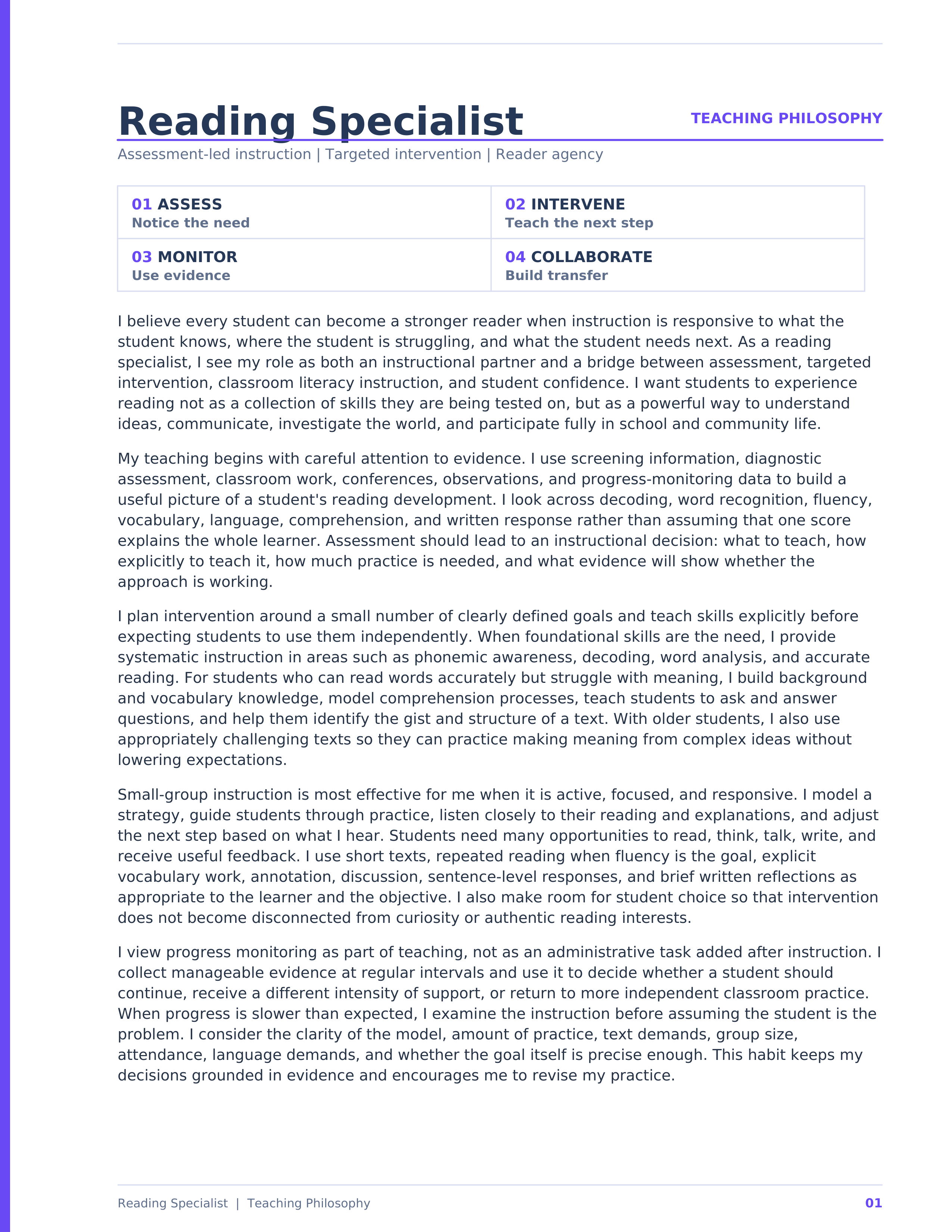
Reading Specialist
TEACHING PHILOSOPHY
Assessment-led instruction | Targeted intervention | Reader agency
01
ASSESS
Notice the need
02
INTERVENE
Teach the next step
03
MONITOR
Use evidence
04
COLLABORATE
Build transfer
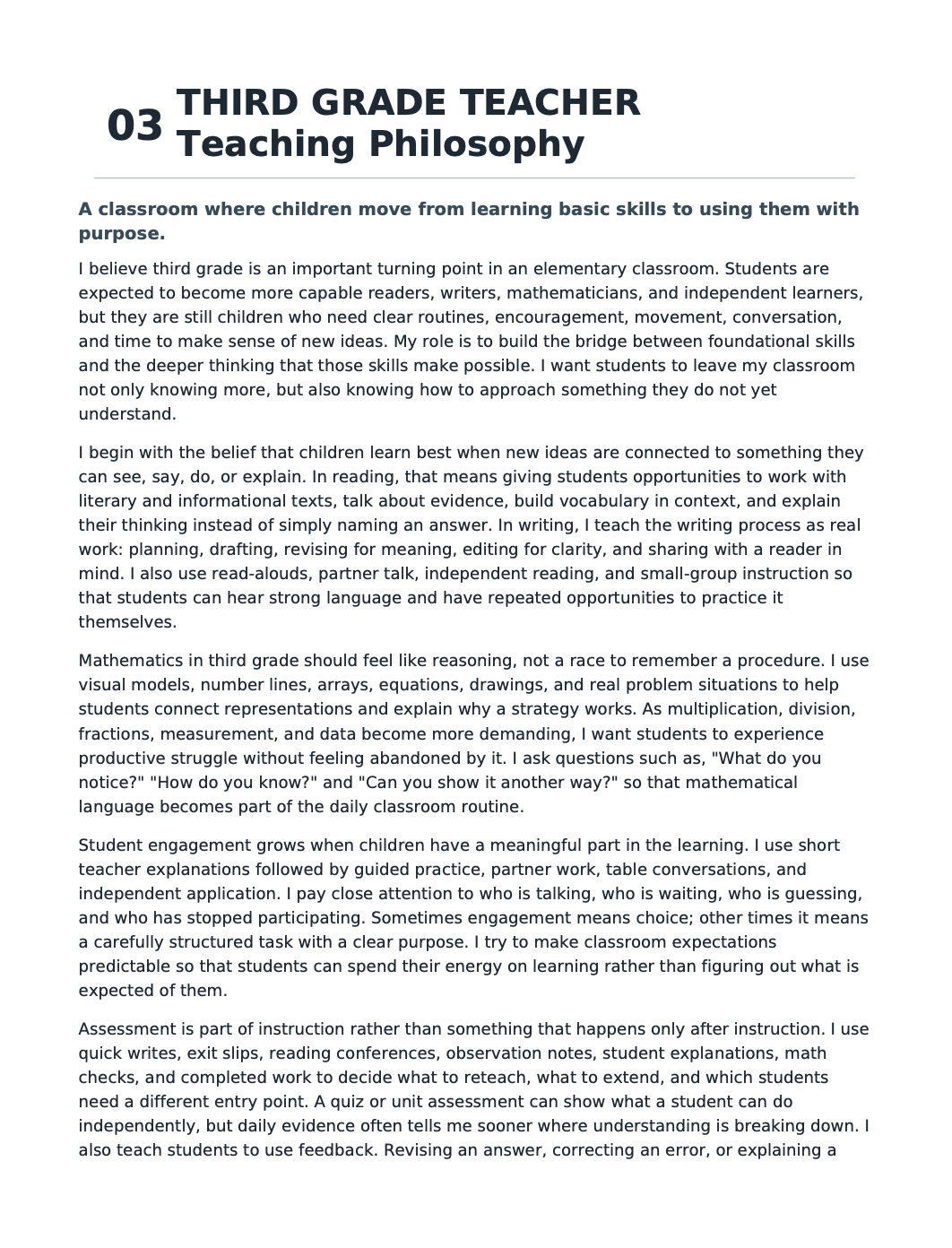
I believe every student can become a stronger reader when instruction is responsive to what the
student knows, where the student is struggling, and what the student needs next. As a reading
specialist, I see my role as both an instructional partner and a bridge between assessment, targeted
intervention, classroom literacy instruction, and student confidence. I want students to experience
reading not as a collection of skills they are being tested on, but as a powerful way to understand
ideas, communicate, investigate the world, and participate fully in school and community life.
My teaching begins with careful attention to evidence. I use screening information, diagnostic
assessment, classroom work, conferences, observations, and progress-monitoring data to build a
useful picture of a student's reading development. I look across decoding, word recognition, fluency,
vocabulary, language, comprehension, and written response rather than assuming that one score
explains the whole learner. Assessment should lead to an instructional decision: what to teach, how
explicitly to teach it, how much practice is needed, and what evidence will show whether the
approach is working.
I plan intervention around a small number of clearly defined goals and teach skills explicitly before
expecting students to use them independently. When foundational skills are the need, I provide
systematic instruction in areas such as phonemic awareness, decoding, word analysis, and accurate
reading. For students who can read words accurately but struggle with meaning, I build background
and vocabulary knowledge, model comprehension processes, teach students to ask and answer
questions, and help them identify the gist and structure of a text. With older students, I also use
appropriately challenging texts so they can practice making meaning from complex ideas without
lowering expectations.
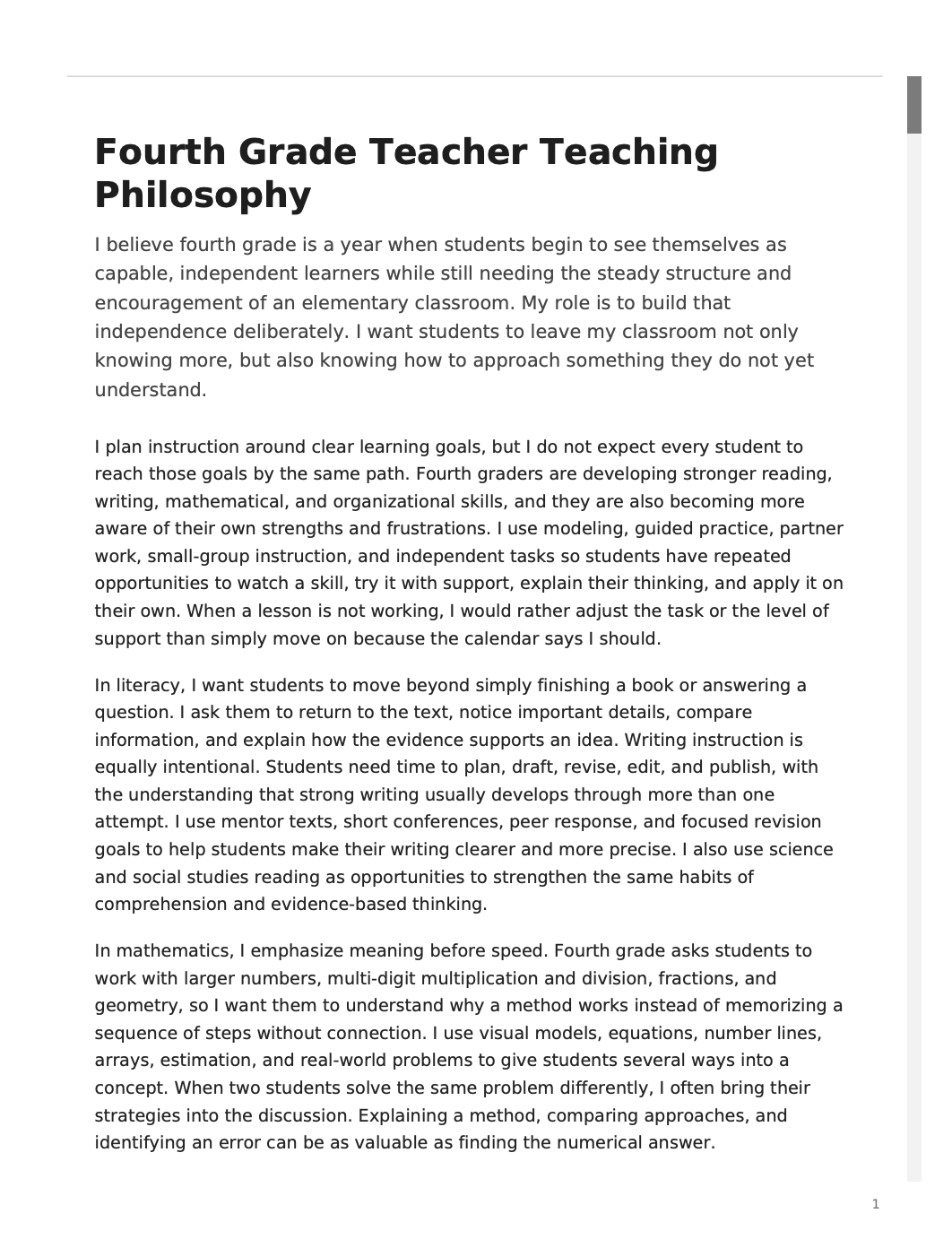
Small-group instruction is most effective for me when it is active, focused, and responsive. I model a
strategy, guide students through practice, listen closely to their reading and explanations, and adjust
the next step based on what I hear. Students need many opportunities to read, think, talk, write, and
receive useful feedback. I use short texts, repeated reading when fluency is the goal, explicit
vocabulary work, annotation, discussion, sentence-level responses, and brief written reflections as
appropriate to the learner and the objective. I also make room for student choice so that intervention
does not become disconnected from curiosity or authentic reading interests.
I view progress monitoring as part of teaching, not as an administrative task added after instruction. I
collect manageable evidence at regular intervals and use it to decide whether a student should
continue, receive a different intensity of support, or return to more independent classroom practice.
When progress is slower than expected, I examine the instruction before assuming the student is the
problem. I consider the clarity of the model, amount of practice, text demands, group size,
attendance, language demands, and whether the goal itself is precise enough. This habit keeps my
decisions grounded in evidence and encourages me to revise my practice.
Reading Specialist | Teaching Philosophy
02
Reading Specialist Teaching Philosophy
"Assessment should lead to an instructional decision."
A reading specialist turns evidence into the next teachable step.
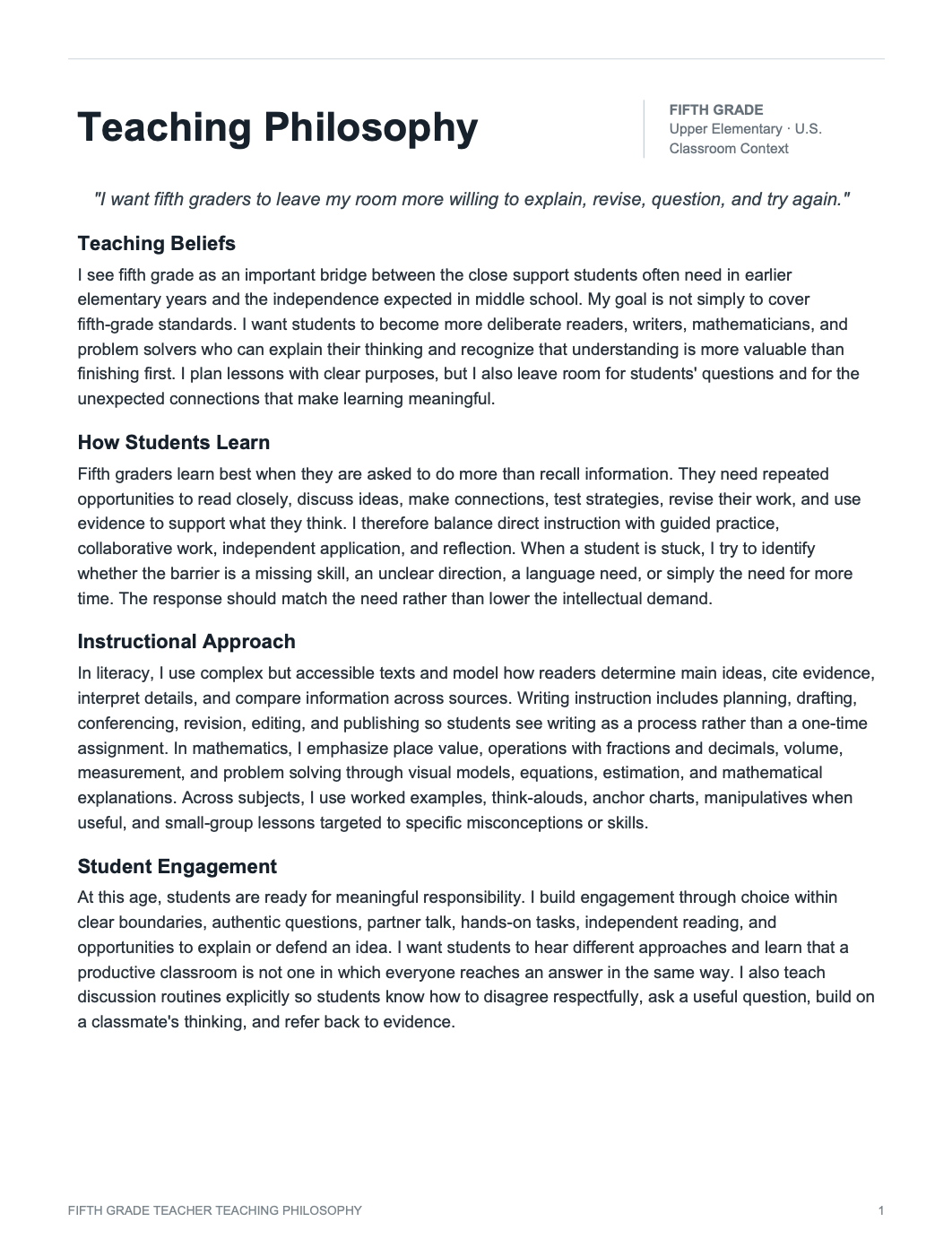
Collaboration is central to my work because students experience literacy across the school day, not
only during intervention. I communicate with classroom teachers about the skills being taught, the
language students are encountering, and the ways practice can transfer into grade-level work. I value
co-planning, shared observations, and practical strategies that teachers can use in the classroom
without creating an additional burden. I also communicate with families in clear, respectful language,
sharing strengths as well as needs and giving them realistic ways to encourage reading,
conversation, vocabulary, and comprehension at home.
Equity matters in literacy instruction. Students may come to school with different language
backgrounds, educational opportunities, cultural experiences, disabilities, or levels of access to books
and digital resources. I do not interpret differences as deficits. I select texts that widen students'
knowledge and reflect varied experiences, provide accessible entry points into demanding work, and
remain attentive to the difference between a reading difficulty and a language, opportunity, or
instructional issue. I want intervention spaces to feel focused and rigorous while also protecting
students' dignity and sense of belonging.
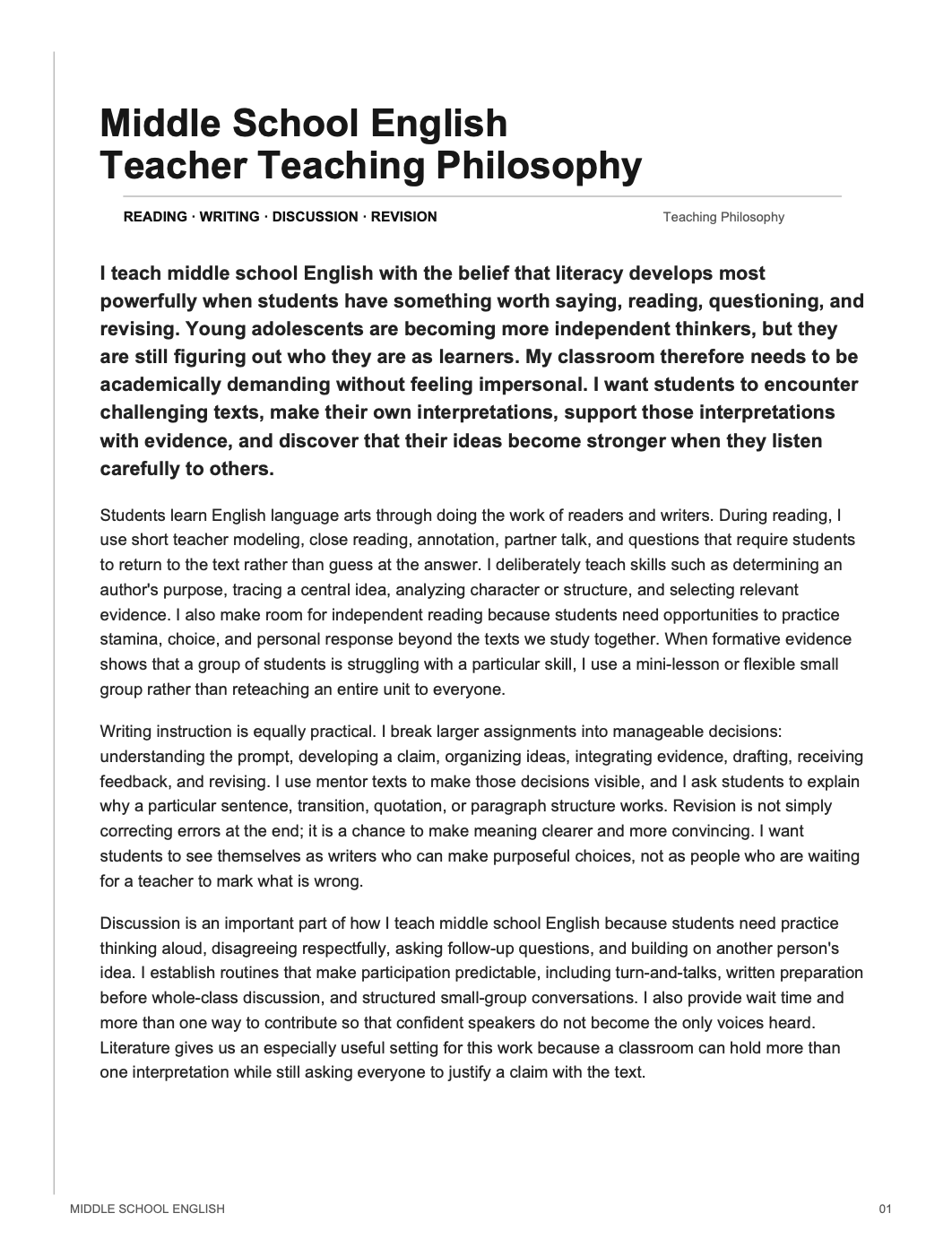
I also want students to become aware of themselves as readers. I teach them to notice when a text
stops making sense, choose a strategy deliberately, use context and word parts, ask for clarification,
and explain how they arrived at an interpretation. Gradually, students should need less prompting
from me because they can recognize a challenge and select a response on their own. Confidence, in
my view, grows from successful experiences with worthwhile work, not from praise alone. I therefore
celebrate specific growth, name effective habits, and help students see progress that may not be
obvious from a single score.
My own practice must remain responsive and evidence-informed. I review student work, intervention
data, classroom observations, and feedback from colleagues to identify where instruction can
improve. I continue learning about literacy research and effective intervention so that my decisions
are not based only on habit or a favorite program. I am willing to change a lesson sequence, regroup
students, refine a goal, increase explicit modeling, or introduce a different text when evidence shows
that students need another pathway.
Ultimately, I want my teaching to help students become capable, motivated, and increasingly
independent readers. I want them to leave intervention with stronger reading skills, but also with
strategies for approaching unfamiliar texts, language for describing their thinking, and confidence
that difficult reading can be learned through purposeful practice and support. As a reading specialist,
I see teaching as a cycle of noticing, responding, collaborating, and reflecting. My responsibility is to
make each part of that cycle useful so that students have a clearer path from where they are now to
what they are ready to understand and do next.