FIFTH GRADE TEACHER TEACHING PHILOSOPHY
1
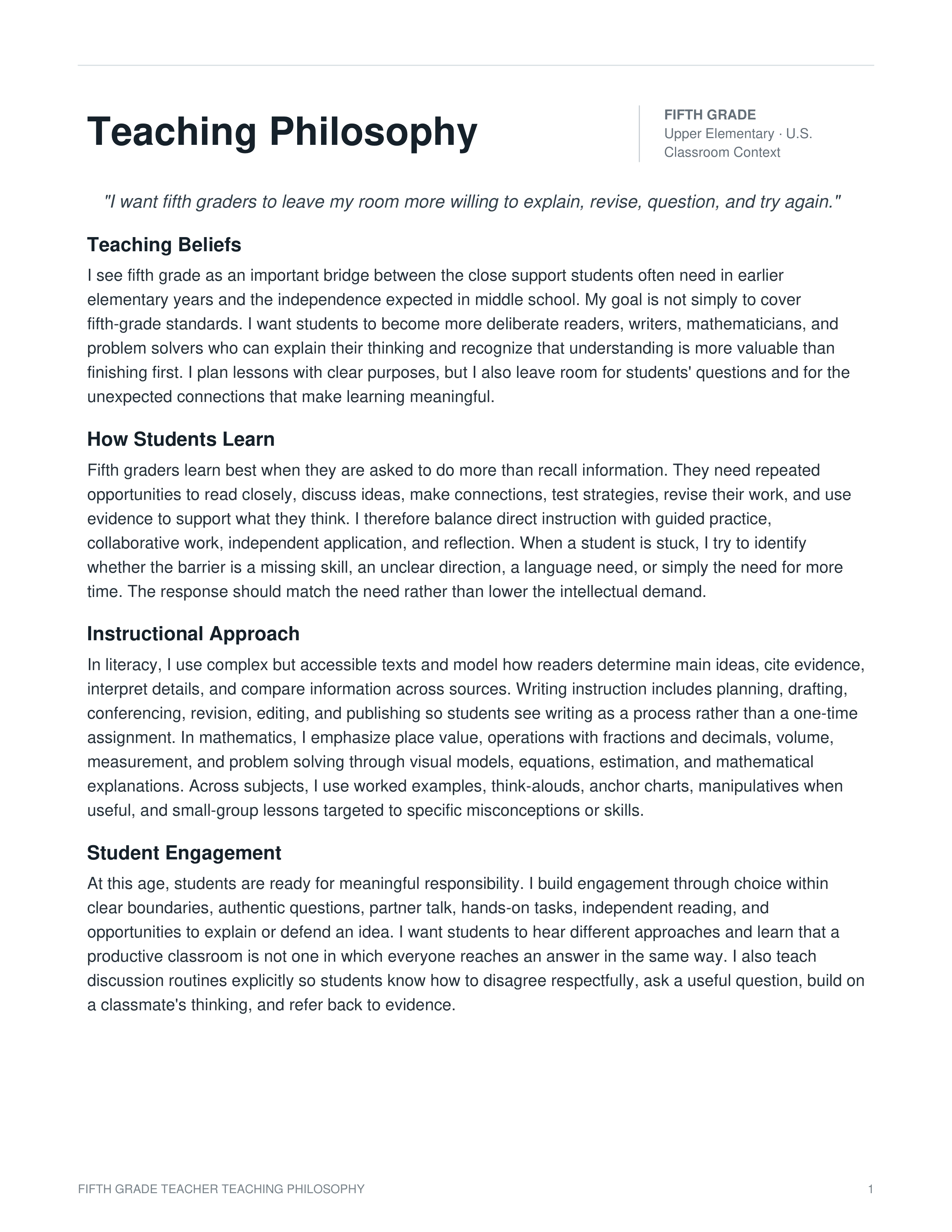
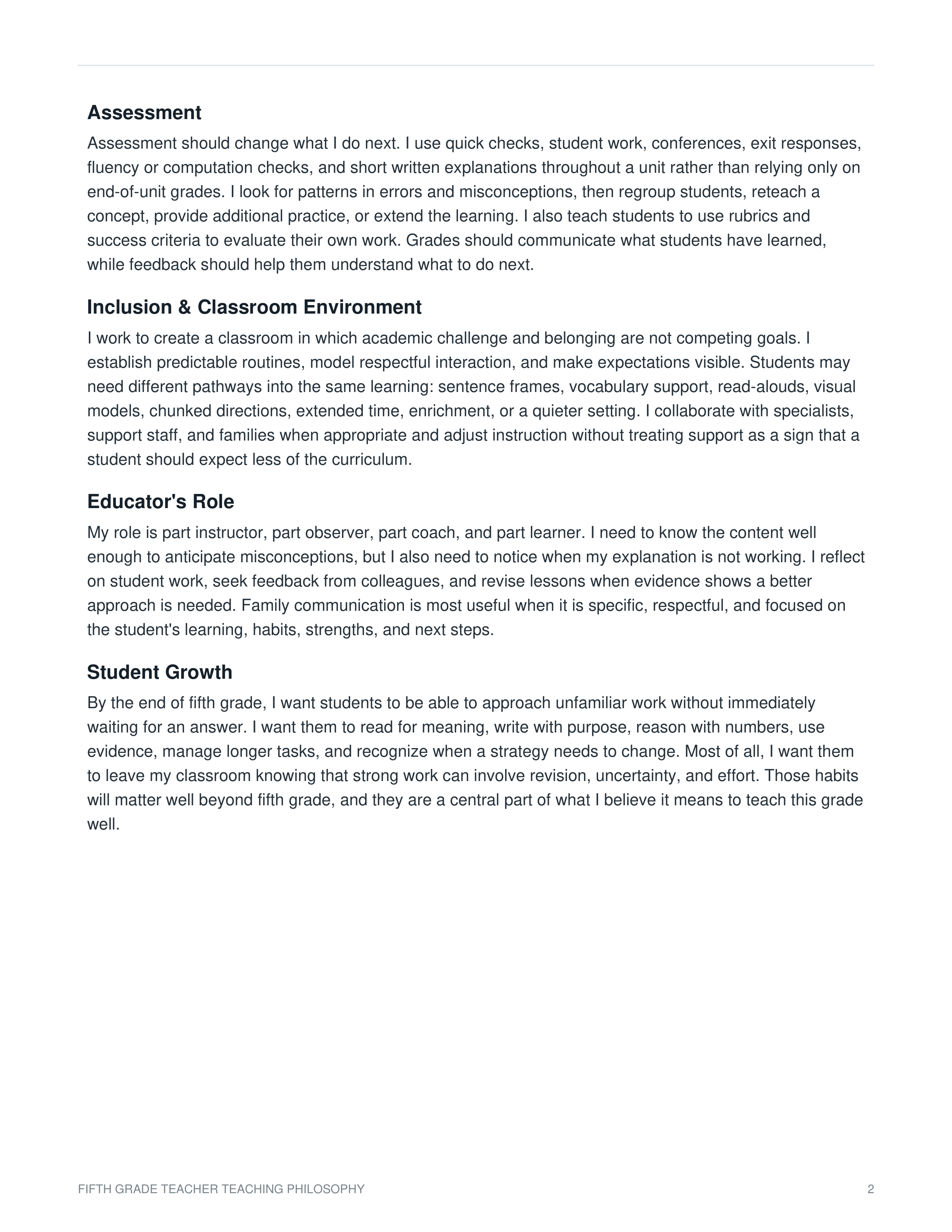
Teaching Philosophy
FIFTH GRADE
Upper Elementary · U.S.
Classroom Context
"I want fifth graders to leave my room more willing to explain, revise, question, and try again."
Teaching Beliefs
I see fifth grade as an important bridge between the close support students often need in earlier
elementary years and the independence expected in middle school. My goal is not simply to cover
fifth-grade standards. I want students to become more deliberate readers, writers, mathematicians, and
problem solvers who can explain their thinking and recognize that understanding is more valuable than
finishing first. I plan lessons with clear purposes, but I also leave room for students' questions and for the
unexpected connections that make learning meaningful.
How Students Learn
Fifth graders learn best when they are asked to do more than recall information. They need repeated
opportunities to read closely, discuss ideas, make connections, test strategies, revise their work, and use
evidence to support what they think. I therefore balance direct instruction with guided practice,
collaborative work, independent application, and reflection. When a student is stuck, I try to identify
whether the barrier is a missing skill, an unclear direction, a language need, or simply the need for more
time. The response should match the need rather than lower the intellectual demand.
Instructional Approach
In literacy, I use complex but accessible texts and model how readers determine main ideas, cite evidence,
interpret details, and compare information across sources. Writing instruction includes planning, drafting,
conferencing, revision, editing, and publishing so students see writing as a process rather than a one-time
assignment. In mathematics, I emphasize place value, operations with fractions and decimals, volume,
measurement, and problem solving through visual models, equations, estimation, and mathematical
explanations. Across subjects, I use worked examples, think-alouds, anchor charts, manipulatives when
useful, and small-group lessons targeted to specific misconceptions or skills.
Student Engagement
At this age, students are ready for meaningful responsibility. I build engagement through choice within
clear boundaries, authentic questions, partner talk, hands-on tasks, independent reading, and
opportunities to explain or defend an idea. I want students to hear different approaches and learn that a
productive classroom is not one in which everyone reaches an answer in the same way. I also teach
discussion routines explicitly so students know how to disagree respectfully, ask a useful question, build on
a classmate's thinking, and refer back to evidence.