TEACHING PHILOSOPHY
SECONDARY EDUCATION
High School Teacher
1
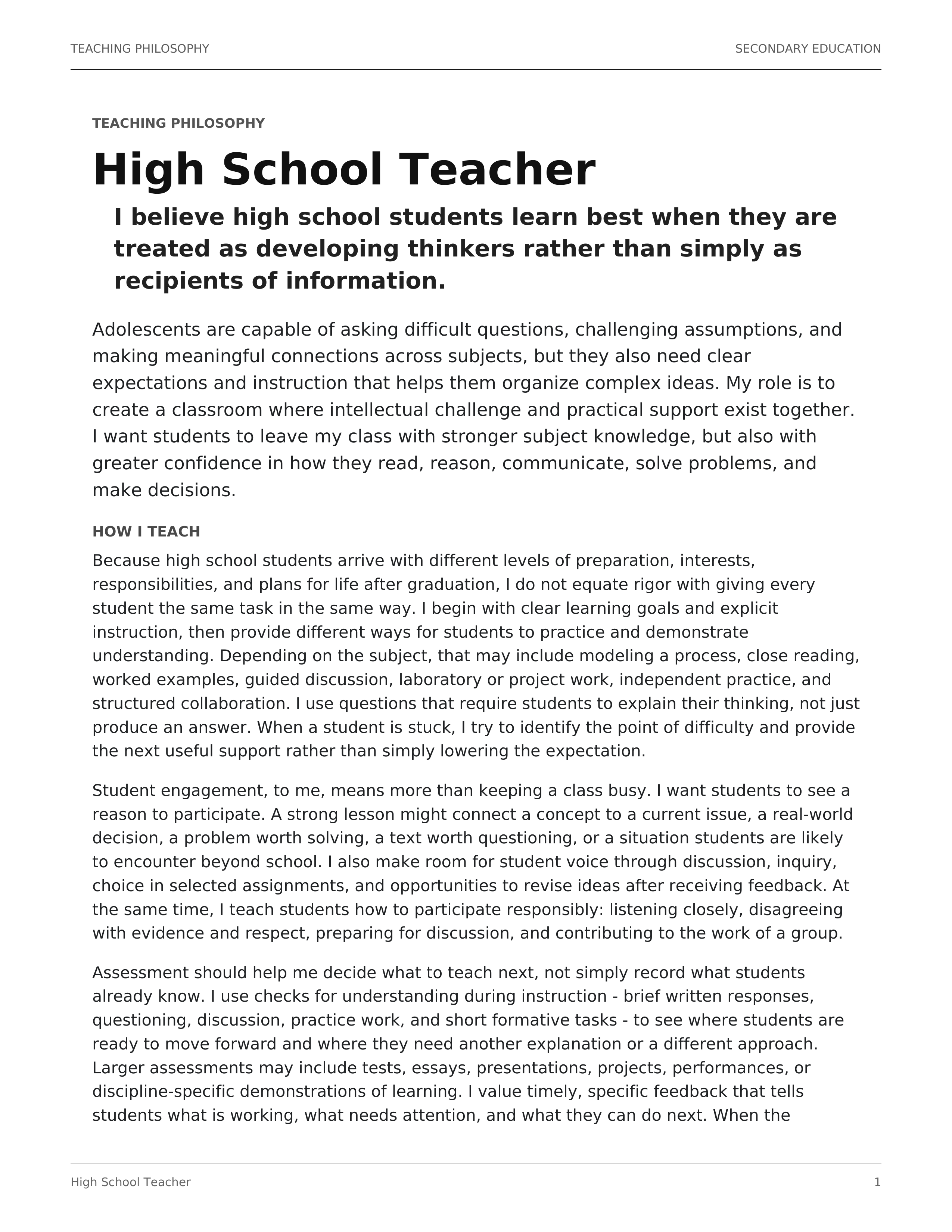
TEACHING PHILOSOPHY
High School Teacher
I believe high school students learn best when they are
treated as developing thinkers rather than simply as
recipients of information.
Adolescents are capable of asking difficult questions, challenging assumptions, and
making meaningful connections across subjects, but they also need clear
expectations and instruction that helps them organize complex ideas. My role is to
create a classroom where intellectual challenge and practical support exist together.
I want students to leave my class with stronger subject knowledge, but also with
greater confidence in how they read, reason, communicate, solve problems, and
make decisions.
HOW I TEACH
Because high school students arrive with different levels of preparation, interests,
responsibilities, and plans for life after graduation, I do not equate rigor with giving every
student the same task in the same way. I begin with clear learning goals and explicit
instruction, then provide different ways for students to practice and demonstrate
understanding. Depending on the subject, that may include modeling a process, close reading,
worked examples, guided discussion, laboratory or project work, independent practice, and
structured collaboration. I use questions that require students to explain their thinking, not just
produce an answer. When a student is stuck, I try to identify the point of difficulty and provide
the next useful support rather than simply lowering the expectation.
Student engagement, to me, means more than keeping a class busy. I want students to see a
reason to participate. A strong lesson might connect a concept to a current issue, a real-world
decision, a problem worth solving, a text worth questioning, or a situation students are likely
to encounter beyond school. I also make room for student voice through discussion, inquiry,
choice in selected assignments, and opportunities to revise ideas after receiving feedback. At
the same time, I teach students how to participate responsibly: listening closely, disagreeing
with evidence and respect, preparing for discussion, and contributing to the work of a group.
Assessment should help me decide what to teach next, not simply record what students
already know. I use checks for understanding during instruction - brief written responses,
questioning, discussion, practice work, and short formative tasks - to see where students are
ready to move forward and where they need another explanation or a different approach.
Larger assessments may include tests, essays, presentations, projects, performances, or
discipline-specific demonstrations of learning. I value timely, specific feedback that tells
students what is working, what needs attention, and what they can do next. When the